1. Introduction
Digital innovation has become one of the most powerful forces reshaping the architecture of global financial systems. The proliferation of financial technology (FinTech) and artificial intelligence (AI) has transformed how value, risk, and information are created, transmitted, and priced. Through algorithmic trading, decentralized finance, and AI-based analytics, digital technologies have improved market efficiency, expanded financial inclusion, and accelerated the diffusion of information. However, they have also introduced new systemic vulnerabilities. AI-driven trading algorithms and automated liquidity platforms amplify feedback loops that synchronize investor behavior and propagate shocks across markets (
Ma et al., 2025). These mechanisms have redefined the boundaries of diversification and contagion, suggesting that technological progress can simultaneously enhance efficiency and magnify systemic fragility.
As financial innovation deepens, its intersection with sustainability has become a defining feature of modern finance. The growing integration of digital infrastructures into sustainable investment frameworks reflects a broader transition toward a “smart–sustainable” economy. Digital technologies facilitate transparency in environmental reporting, automate sustainable investment screening, and accelerate capital allocation to sustainability-oriented assets. At the same time, the digitalization of sustainable finance creates feedback mechanisms through which technological shocks affect the performance of environmental investments. This interplay aligns with the principles of complex adaptive systems and network-based finance, where interlinked agents continuously adjust to technological and ecological signals, generating nonlinear dynamics of risk and resilience (
Haldane & May, 2011;
Battiston et al., 2017). This convergence highlights an emerging research frontier where efficiency, innovation, and sustainability jointly shape financial stability.
Within this paradigm, the Blue Economy has emerged as a strategic extension of sustainable finance (
Botoroga et al., 2025). In real-economy terms, it encompasses the sustainable development of ocean- and coastal-based activities, ranging from marine biodiversity protection to climate-resilient coastal infrastructure, while prioritizing ecological preservation. Blue finance, the financial market dimension of the Blue Economy, translates these sustainability aims into tradable instruments, including blue bonds, ocean-focused exchange-traded funds (ETFs), and blended finance structures (
OECD, 2025). In capital markets, blue finance instruments embed priced exposure to ocean sustainability, thereby providing high-frequency signals of risk transmission and portfolio reallocation within sustainability-linked investments. By internalizing ecological value and directing capital toward marine transition projects, blue finance supports the global sustainability agenda and contributes to achieving Sustainable Development Goal 14 (Life Below Water). However, as these markets become increasingly digitalized, they also inherit exposure to the volatility and spillover dynamics of technology-based financial sectors. Digital infrastructures that enhance access to blue capital flows can equally transmit systemic disturbances originating from FinTech and AI ecosystems. The resulting interaction creates a bidirectional mechanism in which technological turbulence influences sustainability-linked assets, while blue investments may provide stabilizing feedback during periods of digital stress. This complex interplay reveals the emergence of a new systemic layer within global finance, where technological innovation and environmental sustainability are no longer parallel trajectories but dynamically interdependent forces. Understanding how these domains co-move and transmit shocks across quantiles and investment horizons requires a framework capable of disentangling their asymmetric behaviors and long-run feedback structures.
Despite this apparent convergence, the economic nature of the relationship between digital innovation and blue finance remains conceptually unresolved. While AI- and FinTech-driven markets are characterized by rapid information diffusion, algorithmic trading, and short-term liquidity cycles, blue finance instruments embed longer-horizon expectations linked to environmental regulation, climate commitments, and sustainable capital allocation. The key economic puzzle, therefore, lies in whether these fundamentally different temporal and risk structures interact in a stabilizing or destabilizing manner when they coexist within the same digital market infrastructure. In particular, it remains unclear whether blue finance assets merely co-move with innovation-driven markets due to common equity exposure or whether they play a distinct systemic role by absorbing, redistributing, or amplifying technology-induced shocks across market regimes and investment horizons. Resolving this question is essential for understanding diversification, systemic risk transmission, and the resilience of sustainability-oriented portfolios in an increasingly digitalized financial system.
However, the existing empirical literature has not yet provided a systematic assessment of these interactions. Most existing studies examine FinTech, AI, and sustainability-oriented assets in isolation, overlooking the channels through which innovation-driven efficiency and blue finance interact to shape systemic stability. The absence of an integrated analytical perspective represents a critical gap, particularly as financial ecosystems become increasingly characterized by digital interconnectivity and ecological transition. Bridging this shortfall is essential to understanding how digital and ecological marine assets jointly influence systemic risk dynamics, offering actionable insights for portfolio diversification, financial stability, and coordinated sustainability strategies. This gap is especially important because these assets operate under different economic mechanisms and horizons. AI and FinTech markets are largely driven by innovation cycles, rapid information diffusion, and episodic speculative repricing, which tend to generate short-horizon and state-contingent spillovers, especially under stress. In contrast, blue finance instruments embed longer-horizon valuation components linked to sustainability regulation, climate commitments, and capital allocation toward marine transition projects. These differences imply that connectedness is unlikely to remain stable across market states or investment horizons.
Accordingly, this study investigates the dynamic connectedness among FinTech innovation, AI-driven technologies, and blue finance instruments using the quantile–frequency connectedness framework developed by
Chatziantoniou et al. (
2022). This approach allows spillovers to vary across downside, normal, and upside conditions while distinguishing short-run contagion from longer-run structural interdependence, beyond what mean-based connectedness measures can capture. Within this setting, the analysis advances the literature by explicitly modeling the innovation–blue finance nexus as a source of regime-dependent spillover and diversification dynamics that are not captured by studies that examine digital assets or ESG markets in isolation.
The contribution of this study is threefold. First, it addresses a fundamental economic question concerning the interaction between technology-driven financial innovation and blue finance within digitally integrated markets. In doing so, it expands connectedness research by examining cross-market linkages among FinTech, AI, and tradable blue-themed equity proxies benchmarked against global and mainstream ESG indices within interconnected financial systems. Second, it deepens the theoretical understanding of the digital–sustainability nexus by identifying the channels through which technology-driven efficiency interacts with sustainability-based resilience to shape systemic interdependence and financial stability. Third, it strengthens methodological innovation by applying the quantile–frequency connectedness framework, which captures asymmetric, tail-dependent, and frequency-specific spillovers that traditional mean-based models overlook. Collectively, these contributions advance the discourse on how digital and ecological forces jointly shape systemic financial resilience and guide sustainable portfolio and policy design in an era of intelligent finance.
The remainder of this paper is organized as follows.
Section 2 reviews the theoretical background and literature;
Section 3 presents the data and methodology;
Section 4 reports the results;
Section 5 discusses the findings; and
Section 6 concludes with key insights and policy implications.
4. Results
4.1. Static Quantile–Frequency Connectedness Analysis
The static quantile–frequency connectedness measures are derived within the quantile–frequency connectedness (QF–C) framework, following
Chatziantoniou et al. (
2022). Connectedness is evaluated over total, short-, and long-run frequency horizons to characterize spillover transmission within the digital–blue finance system. As presented in
Table 3,
Table 4 and
Table 5, the Total Connectedness Index (TCI) increases sharply from 55.92 under stable conditions to 73.30 and 74.06 in bearish and bullish regimes, respectively. This 18-point increase (approximately +32%) highlights a symmetric rise in systemic intensity, showing that both downturns and speculative market upswings occur within the digital–blue finance nexus. The nonlinear evolution of connectedness across quantiles underscores the conditional, state-dependent nature of systemic risk, as volatility transmission intensifies not only during crises but also during periods of financial exuberance. Short-term spillovers dominate, accounting for nearly three-quarters of total transmission, indicating that information and liquidity channels drive rapid yet transient spillover dynamics. Conversely, long-term spillovers remain moderate, indicating persistent structural diversification opportunities for long-horizon investors as markets gradually re-segment beyond transient shocks. Together, these patterns reveal a macro-financial symmetry of contagion within the digital–blue asset system, in which both pessimism and optimism give rise to comparable forms of systemic coupling and volatility clustering.
During normal market conditions (τ = 0.50), digital innovation assets and blue finance ETFs maintain a balanced yet asymmetric interaction structure. Within the innovation segment, NQROBO emerges as the leading net transmitter within the system, underscoring AI and robotics’ prominent position within cross-sector spillover dynamics. KFTX functions as an adaptive receiver, absorbing volatility spillovers through FinTech intermediation, and supporting liquidity flows. On the blue finance front, BJLE emerges as the primary net receiver of spillovers, while OCEN provides secondary diversification benefits. MSCI acts as a stabilizing global benchmark that preserves systemic coherence. This configuration depicts a functional diversification regime in which innovation-oriented assets contribute more strongly to volatility transmission, and blue finance ETFs predominantly absorb them, maintaining portfolio efficiency and moderate risk exposure.
When market stress intensifies (τ = 0.05), the structure reveals a distinct inversion of roles. NQROBO remains the most influential transmitter within this asset basket, reflecting heightened short-term volatility spillovers through technology-driven channels. At the same time, KFTX shifts from stabilizer to net transmitter, consistent with increased interconnectedness under liquidity stress. BJLE exhibits defensive, hedging-like behavior in the connectedness network, in the sense that it predominantly absorbs rather than transmits spillovers during stress (Net = −6.28), whereas OCEN retains a more limited shock-absorption capacity. MSCI continues to buffer innovation shocks with restricted transmission, suggesting a partial decoupling of global benchmarks from sector-specific turbulence. Economically, this pattern represents a phase of volatility concentration in which digital innovation accounts for a larger share of spillover transmission relative to blue finance instruments, while blue finance ETFs partially absorb spillovers but cannot fully contain cross-market fragility. The system thus shifts from equilibrium interdependence to technology-centered spillover diffusion, capturing the procyclicality of innovation under tight liquidity conditions.
Under bullish conditions (τ = 0.95), the system shifts from defensive to speculative synchronization. NQROBO remains the principal net transmitter, coinciding with AI- and robotics-driven optimism, while KFTX stabilizes through valuation maturity. OCEN transitions from receiver to transmitter, coinciding with stronger spillover intensity during ESG-oriented market expansions, consistent with a more procyclical connectedness profile in speculative phases. In contrast, BJLE preserves its defensive receiver role, absorbing fluctuations through long-term capital and policy-anchored stability. MSCI weakens amid an intensifying risk appetite and cross-market correlations. Overall, this regime reveals a procyclical phase in which blue finance ETFs increasingly co-move with innovation-led rallies, suggesting a temporary weakening of diversification benefits even in expansionary markets within this specific digital–blue configuration.
From a macro-financial standpoint, these results expose a dual regime of systemic interdependence. In contraction phases, technological volatility spillovers dominate volatility transmission while blue assets offer partial insulation. During expansions, speculative capital flows are associated with synchronized innovation and blue finance dynamics, transforming diversification into co-movement. This cyclical symmetry challenges the assumption of blue finance instruments, as unconditional risk buffers and underscores their regime- and asset-specific behavior. Strategically, the findings emphasize the need for regime-aware portfolio design and stress-sensitive asset allocation to preserve resilience within an increasingly integrated digital–blue financial system.
4.2. Network Analysis of Quantile–Frequency Connectedness
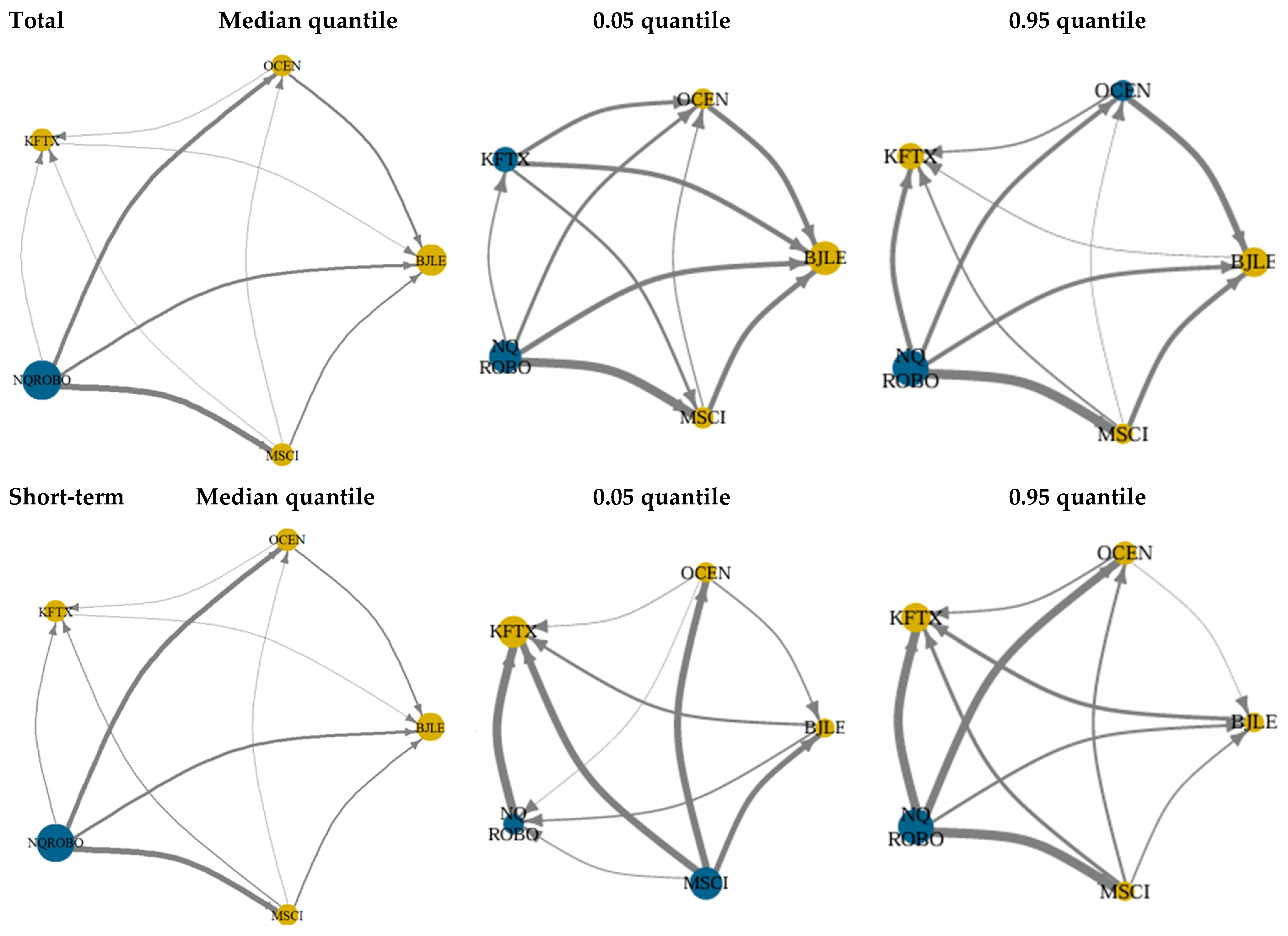
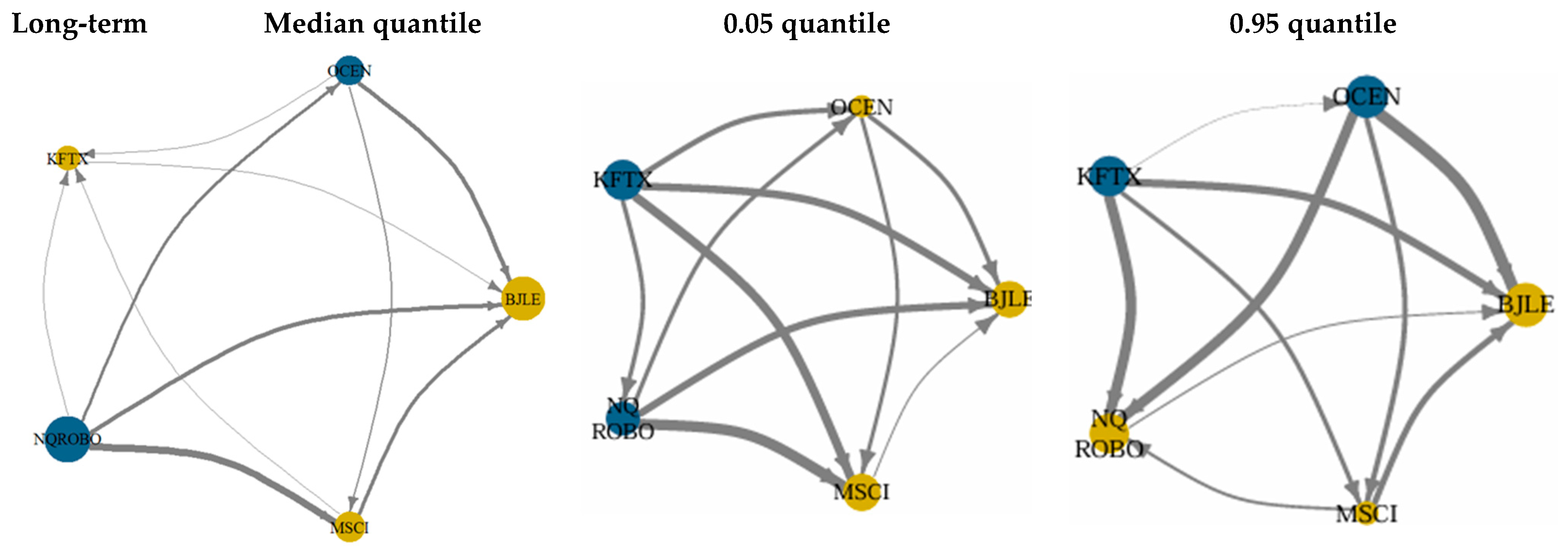
The network of net pairwise connectedness displayed in
Figure 2 visualizes how systemic linkages are observed to materialize and evolve across quantiles. The node size reflects each asset’s systemic importance, while the edge thickness measures the intensity of bilateral spillovers. This visual mapping transforms numerical evidence into a structural representation of financial interdependence, revealing how innovation and blue finance interact within this specific digital–blue asset system across regimes and frequencies.
Across quantiles, the topology progresses from a balanced configuration to a highly synchronized structure, visually translating the escalation in systemic interdependence as markets move from stability to stress and speculation. Under normal conditions (τ = 0.50), the system maintains a moderate level of connectivity, with innovation-led assets, particularly AI (NQROBO), acting as net transmitters of short-run volatility to blue-themed ETFs and global segments. Distinct clusters indicate an operational equilibrium between technological leadership and blue finance resilience. Volatility remains compartmentalized, and portfolio adjustments operate efficiently, suggesting that innovation and blue finance interact without evidence of strong structural coupling. When downside stress emerges (τ = 0.05), the network becomes denser and more directional. Expanding nodes and thickening connections reveal a concentration of spillover intensity centered on technology-driven assets, particularly AI (NQROBO) and FinTech (KFTX). This configuration signals the collapse of market segmentation, as volatility spillovers become increasingly synchronized across digital and blue domains. Liquidity contractions and correlated withdrawals are associated with a transition from efficiency to fragility, generating a self-reinforcing pattern of volatility diffusion. Economically, this regime represents a phase of contagion concentration in which innovation assets account for a larger share of systemic transmission within the digital–blue network, while blue assets absorb turbulence without fully isolating it. The digital core thus becomes the central hub of volatility spillovers, reflecting the speed and sensitivity of technology-intensive markets under liquidity constraints. At the upper quantile (τ = 0.95), the structure retains its density but shifts from defensive clustering to speculative synchronization. The symmetry of connections and the reduced polarity between transmitters and receivers illustrate the weakening of diversification as optimism spreads. AI (NQROBO) and the blue finance ETF segment (OCEN) jointly emerge as net transmitters, coinciding with a synchronized expansion across digital and blue finance domains. Digital and blue markets thus exhibit stronger co-movement in liquidity- and sentiment-driven phases, beyond what is observed under median conditions, mirroring the transition from defensive interdependence to collective speculation. Instead of mitigating shocks, blue finance ETFs increasingly participate in spillover transmission through co-movement, signaling a regime of procyclical amplification in which valuation momentum overrides traditional risk-sharing dynamics.
The frequency-layer decomposition deepens this interpretation. In the short term, spillover diffusion is driven by innovation impulses, confirming that AI and FinTech cycles are closely associated with the tempo of systemic volatility within this asset configuration. In the long-term layer, AI (NQROBO), FinTech (KFTX), and blue finance (OCEN) emerge as persistent net transmitters, generating enduring yet adaptive linkages that are reflected in sustained cross-sector connectedness. These slower interactions translate transitory volatility into more persistent interdependencies, embedding innovation and blue finance within the longer-horizon architecture of systemic connectedness.
From a macro-financial standpoint, the network analysis reveals a digital–blue paradox. Financial innovation is associated with enhanced liquidity and efficiency, yet also coincides with deeper systemic coupling across regimes. Crises and expansions alike foster synchronization, as blue finance ETFs act as partial buffers within a technology-driven ecosystem. Innovation thus occupies a dual position within the system that combines efficiency gains with heightened interconnectedness. This underscores the need for regime-aware portfolio design and adaptive policy frameworks to sustain resilience in an integrated digital innovation–blue finance nexus.
4.3. Dynamic Quantile–Frequency Connectedness Analysis
The static full-sample estimates are extended to a dynamic setting to account for the time-varying evolution of quantile–frequency connectedness obtained from rolling-window estimations, allowing spillover measures to adjust over time.
4.3.1. Dynamic Total Connectedness Across Time and Quantiles
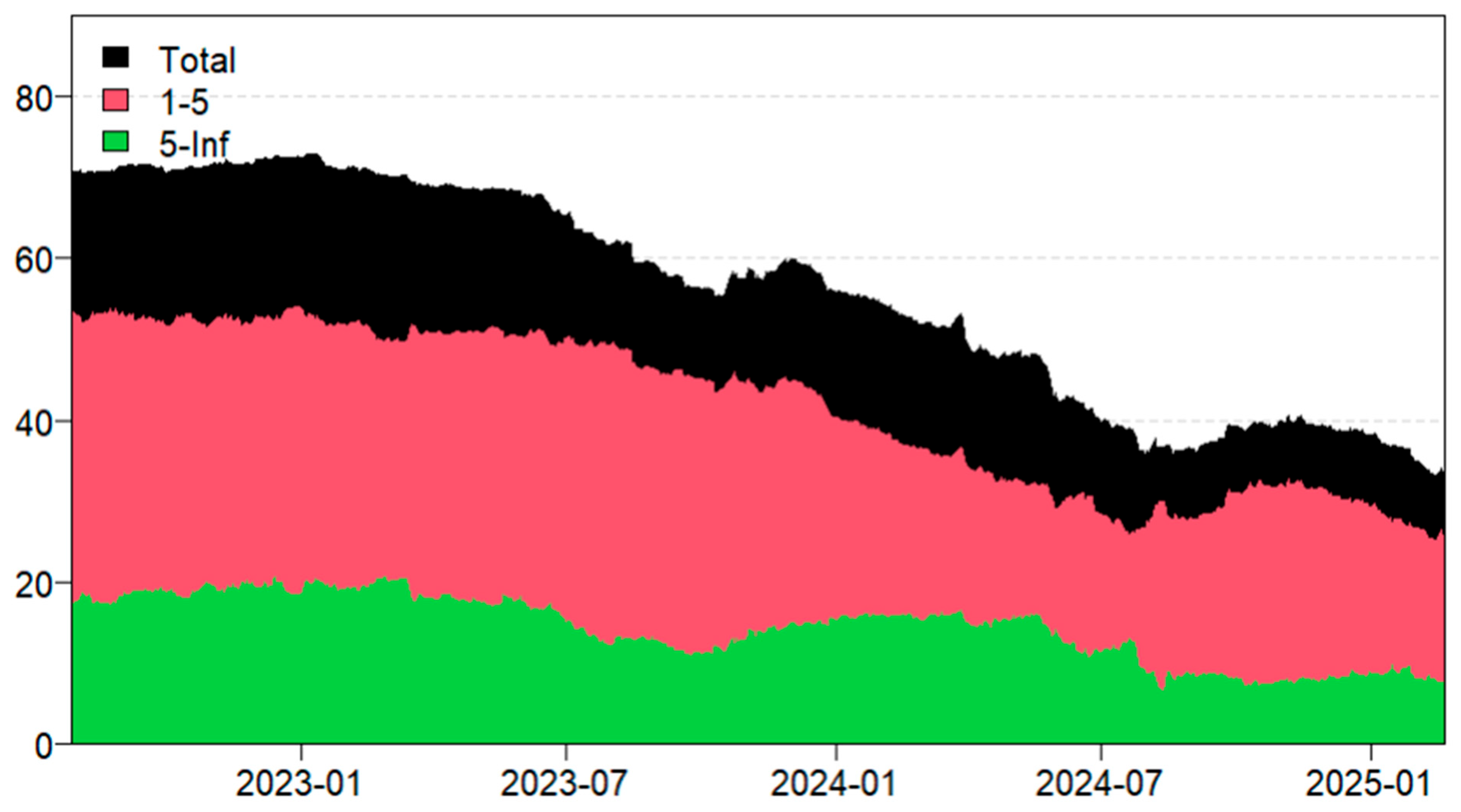
The evolution of dynamic connectedness across short-term (1–5 days) and long-term (5–∞ days) horizons, illustrated in
Figure 3, traces how systemic integration within the digital–blue finance nexus varies conditionally in association with shifting macro-financial and geopolitical regimes. Between mid-2022 and mid-2023, both horizons move within a narrow band, reflecting balanced volatility transmission amid lingering uncertainty from the Russia–Ukraine conflict and the associated energy and commodity market disruptions. This phase is consistent with an efficient post-pandemic equilibrium characterized by stable liquidity conditions and sustained policy coordination. From mid-2023 onward, total connectedness declines markedly, coinciding primarily with a sharper contraction in short-term spillovers (approximately twice the rate of long-term moderation). The cooling of speculative activity in AI and FinTech assets, combined with global monetary tightening, is associated with reduced high-frequency contagion and a re-emergence of asset-specific dynamics within the digital–blue system. In contrast, long-term connectedness remains broadly stable, indicating resilience in blue-finance-related capital allocation, and the continued salience of COP28 and ongoing ESG policy commitments. This dual-frequency pattern highlights a form of adaptive decoupling where markets reduce short-term co-movement without losing long-term alignment. Economically, it marks a transition from liquidity-driven synchronization to selective interdependence, signaling that systemic risk cycles are entering a phase of normalization rather than fragmentation. The decline in the Total Connectedness Index thus reflects a recalibration of systemic integration, rather than a uniform weakening of interdependence, where innovation momentum softens but blue finance linkages persist, preserving resilience within the digital–blue financial ecosystem.
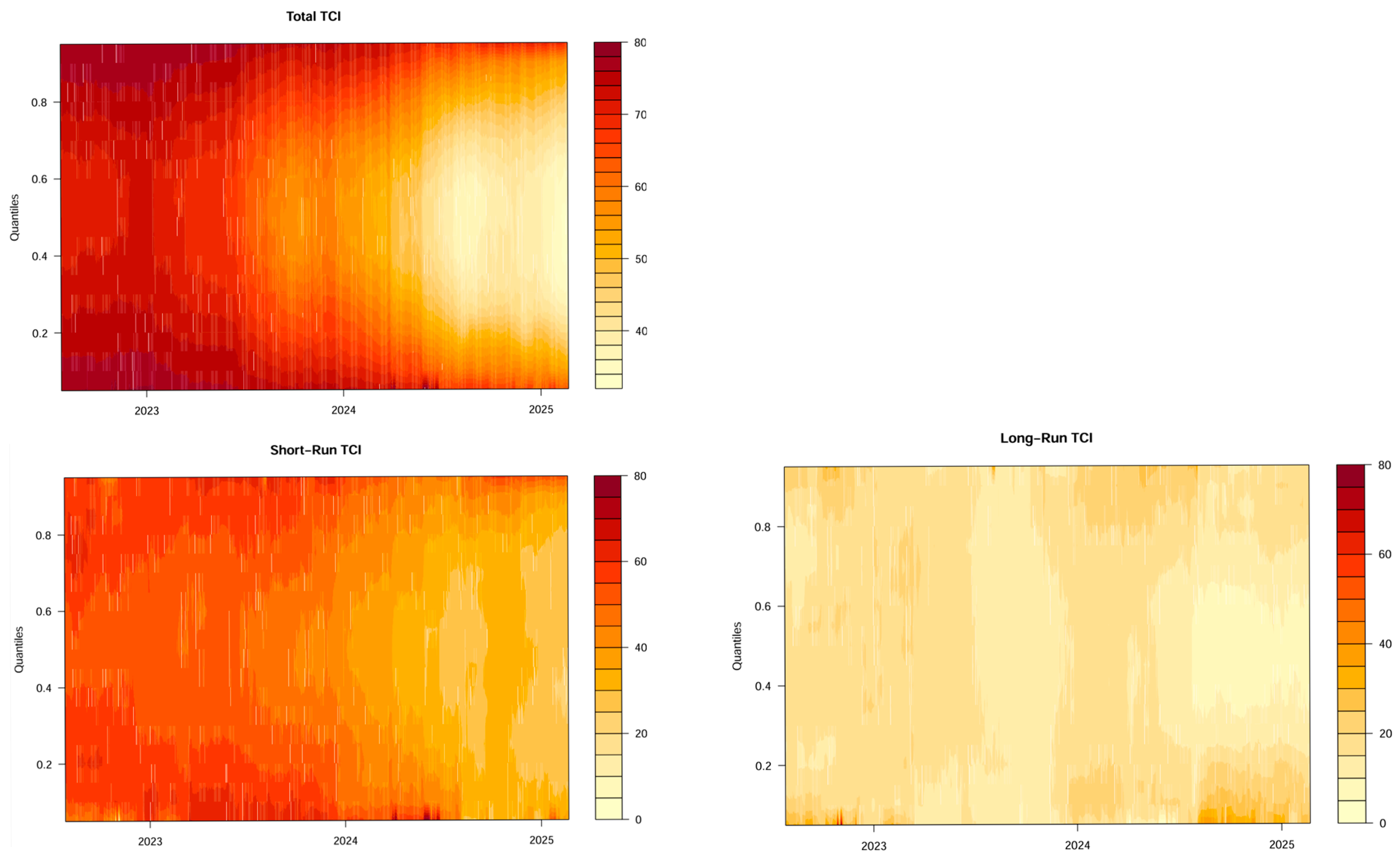
The analysis is further deepened in
Figure 4, which integrates the quantile dimension to capture how systemic connectedness evolves across both market states and frequency horizons. During the 2022 to mid-2023 stabilization phase, high connectedness values cluster around the median quantiles, reflecting balanced volatility transmission and efficient information diffusion within this asset configuration. This configuration indicates a regime of functional integration, where risk interdependence remains contained, and diversification operates effectively under moderate uncertainty. From mid-2023 onward, the heatmaps reveal a pronounced asymmetry between short- and long-run propagation across quantiles. Short-term connectedness weakens markedly at the tails (τ = 0.05 and τ = 0.95), suggesting that both bearish and bullish extremes experienced a partial decoupling of high-frequency shocks relative to median states. This attenuation is associated with the combined effects of global monetary tightening and speculative fatigue in AI and FinTech-linked assets, which coincide with reduced liquidity-driven volatility clustering. Conversely, long-run connectedness persists across all quantiles, indicating that sustainability-oriented capital flows and policy continuity surrounding COP28 continued to anchor financial integration despite short-term contractions. This divergence between horizons captures a structural shift from synchronized volatility to selective interdependence. Short-term co-movement diminishes as risk-sensitive segments normalize, while long-term linkages remain underpinned by the durability of sustainable finance commitments and the strategic positioning of blue finance instruments. The system thus evolves toward an adaptive equilibrium in which innovation cycles adjust dynamically around a stable blue finance core. From a macro-financial perspective, these dynamics demonstrate that systemic connectedness is both state-dependent and frequency-contingent. The quantile dimension uncovers behavioral asymmetries associated with investor sentiment and liquidity cycles, whereas the frequency perspective isolates persistence in transmission mechanisms. Together, they depict the digital–blue finance nexus as a dual-speed financial ecosystem that is reflexive and innovation-driven in the short term yet cohesive and policy-anchored over longer horizons. In sum, the temporal and quantile-based evidence reveals that the digital–blue financial system exhibits a resilient yet adaptive architecture, capable of absorbing cyclical shocks without losing structural cohesion. The coexistence of short-term reflexivity and long-term stability marks a defining feature of the sustainable finance transition in the contemporary global regime.
4.3.2. Dynamic Net Directional Connectedness Across Time and Quantiles
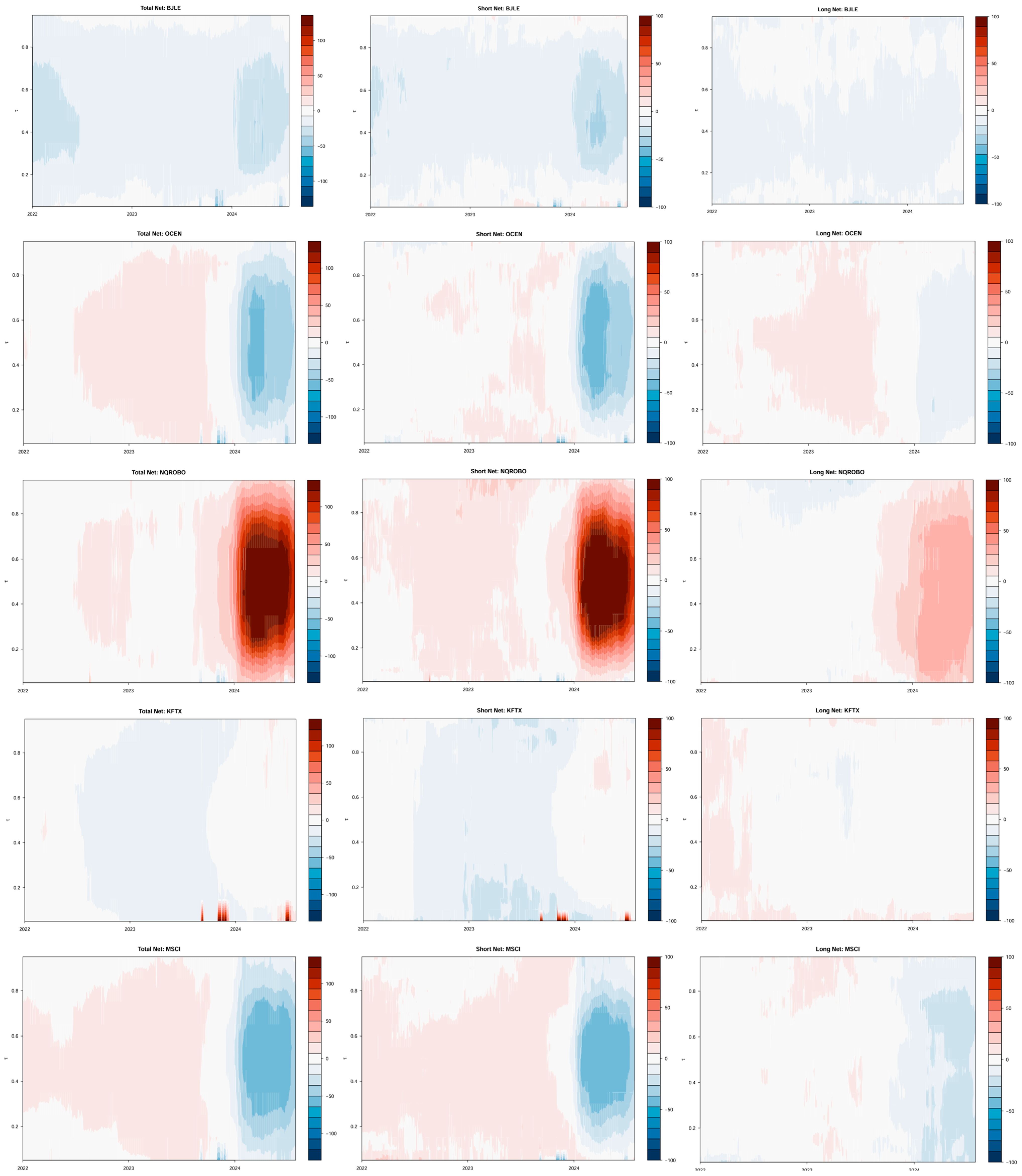
The analysis is extended in
Figure 5, which maps the net directional connectedness across quantiles and horizons, uncovering how digital and blue finance assets alternately act as transmitters or receivers of volatility under shifting systemic regimes. This multidimensional depiction captures both the tempo and persistence of spillover influence, translating how market sentiment, policy cycles, and liquidity conditions are reflected in the structure of interdependence within the digital–blue finance nexus.
NQROBO (AI and robotics) consistently emerges as the primary net transmitter across total and short-term horizons, with its influence peaking in early 2024 during the AI-driven surge of market optimism. This phase coincides with heightened innovation sentiment and capital reallocation into technology sectors following advances in global artificial intelligence applications. The prevalence of short-run spillovers, which account for nearly two-thirds of the total transmission, indicates that AI-induced euphoria is associated with intensified high-frequency volatility across both the digital and blue finance segments. Economically, this dynamic is consistent with a reflexive contagion pattern in which technological exuberance coincides with accelerated information diffusion and risk synchronization, while long-run stability remains intact. KFTX (FinTech), by contrast, operates mainly as a systemic receiver throughout most of the sample, punctuated by brief transmission bursts in late 2024 and late 2025. These episodes align with phases of monetary tightening and funding reallocation during which FinTech valuations adjusted to changing liquidity conditions. Its transmission is primarily short-term, underscoring FinTech’s high sensitivity to transient innovation and funding shocks. Over longer horizons, however, KFTX regains neutrality, highlighting its relative resilience once speculative pressures dissipate. This behavior positions FinTech as a conduit that absorbs volatility spillovers while preserving liquidity continuity within the digital–blue finance architecture.
BJLE (Blue Economy ETF) remains a persistent receiver across quantiles and horizons, reinforcing its function as a diversification vehicle rather than a source of contagion. Its weak propagation capacity is associated with ESG repricing, marine-related regulatory news, and investor reallocation toward sustainability themes. Similarly, OCEN (Clean Oceans ETF) transitions from neutrality in 2023 to a pronounced receiver regime in 2024, indicating increased integration into global ESG-driven financial networks. The intensification of receiver roles suggests that blue finance ETFs increasingly internalize volatility spillovers transmitted from digital and global benchmarks. Finally, MSCI (global benchmark) shifts from low transmission to pronounced receiver orientation from 2024 onward, absorbing corrections in AI and FinTech markets while maintaining global equilibrium. This underscores its role as the anchor of macro-financial stability, facilitating volatility absorption and systemic coherence, when digital and sustainable sectors face turbulence.
Together, these dynamics reveal a dual-speed systemic architecture in which digital assets account for a larger share of short-run spillover transmission through innovation cycles. In contrast, blue finance ETFs and global equities, are associated with long-run resilience through policy and sustainability linkages. This interaction suggests that the digital–blue finance nexus operates simultaneously as an engine of technological dynamism and a stabilizer of systemic resilience, underscoring the need for regime-aware portfolio design and adaptive macroprudential frameworks in the evolving architecture of sustainable finance.
4.3.3. Dynamic Net Pairwise Connectedness Across Time and Quantiles
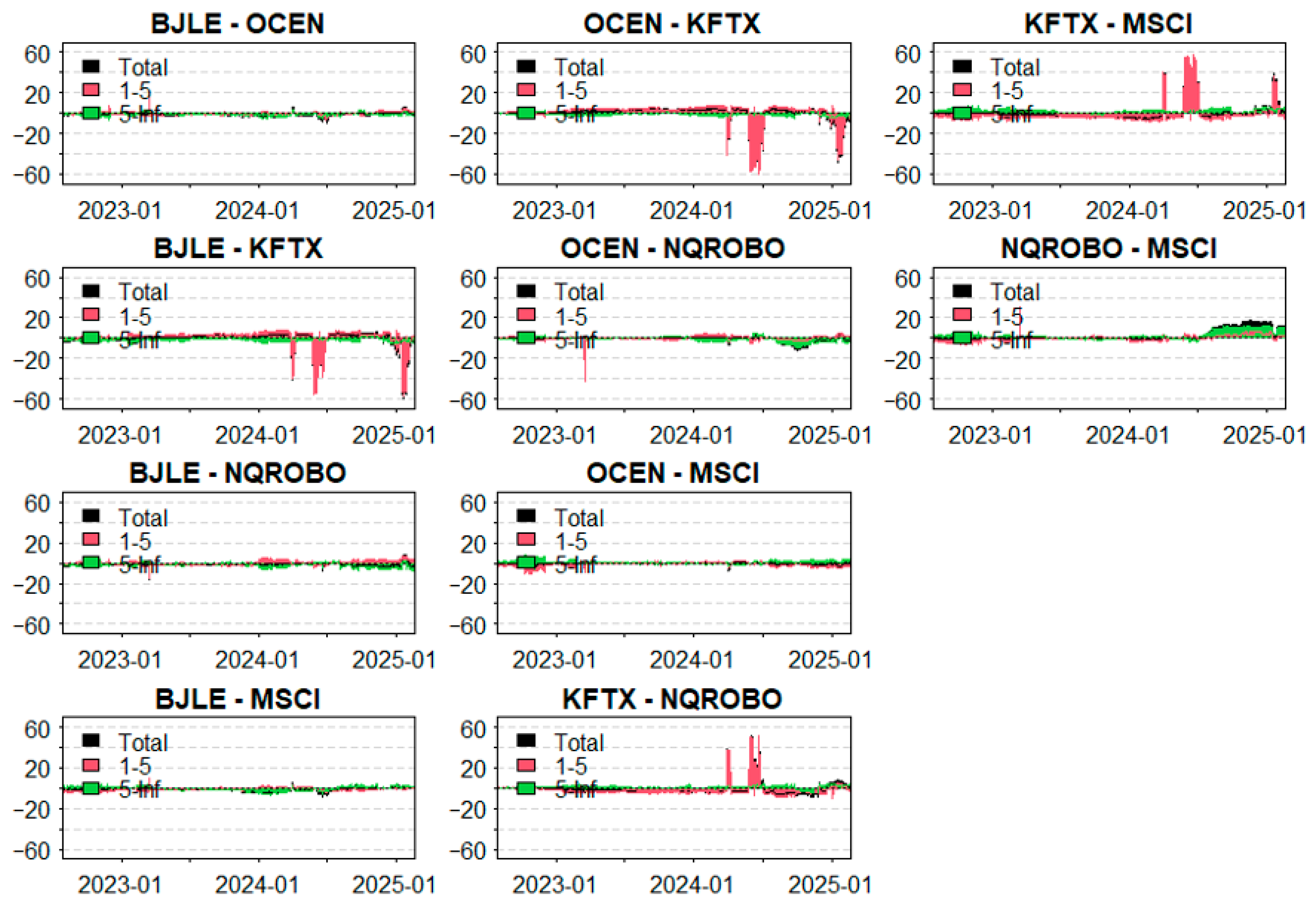
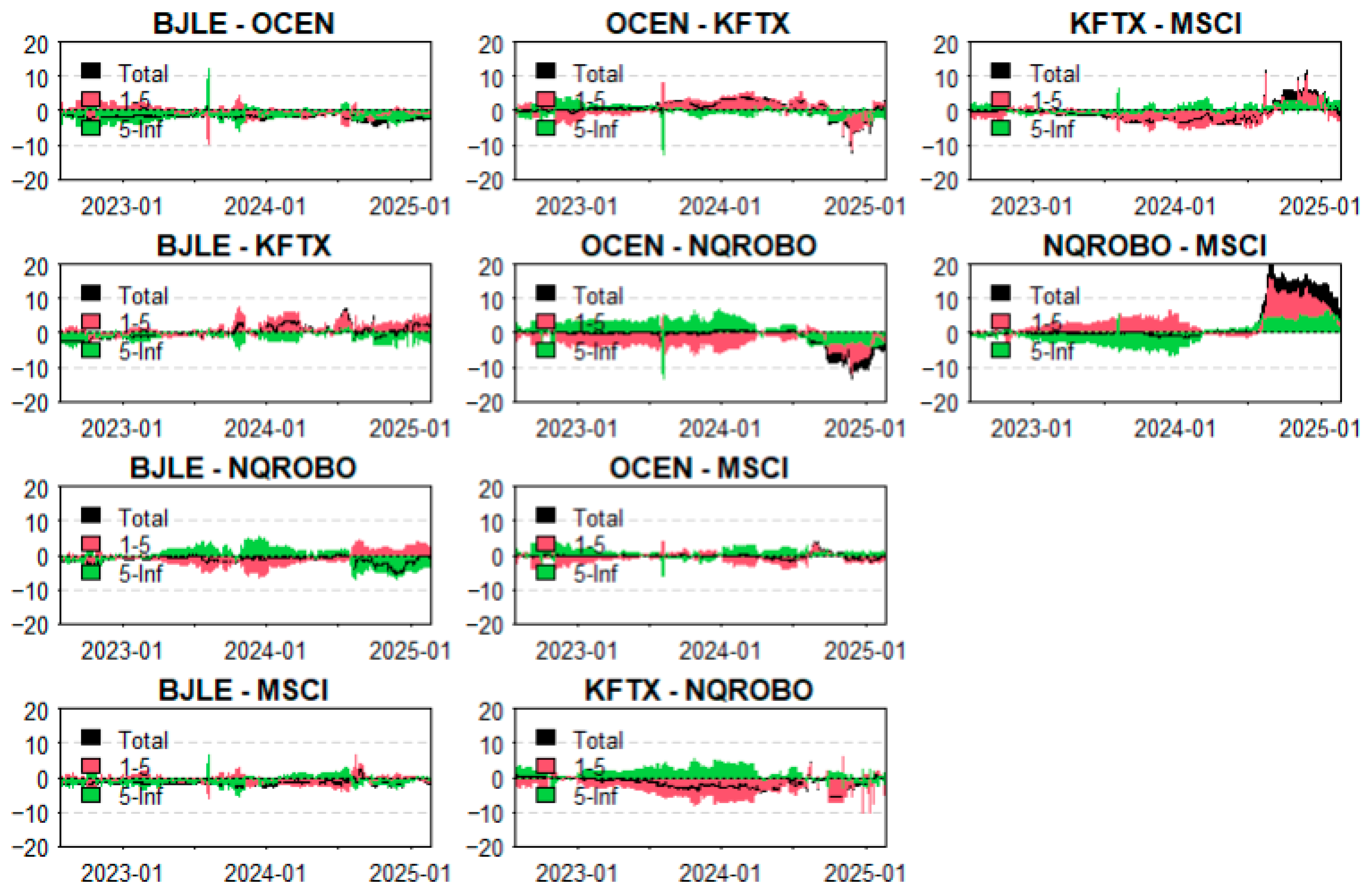
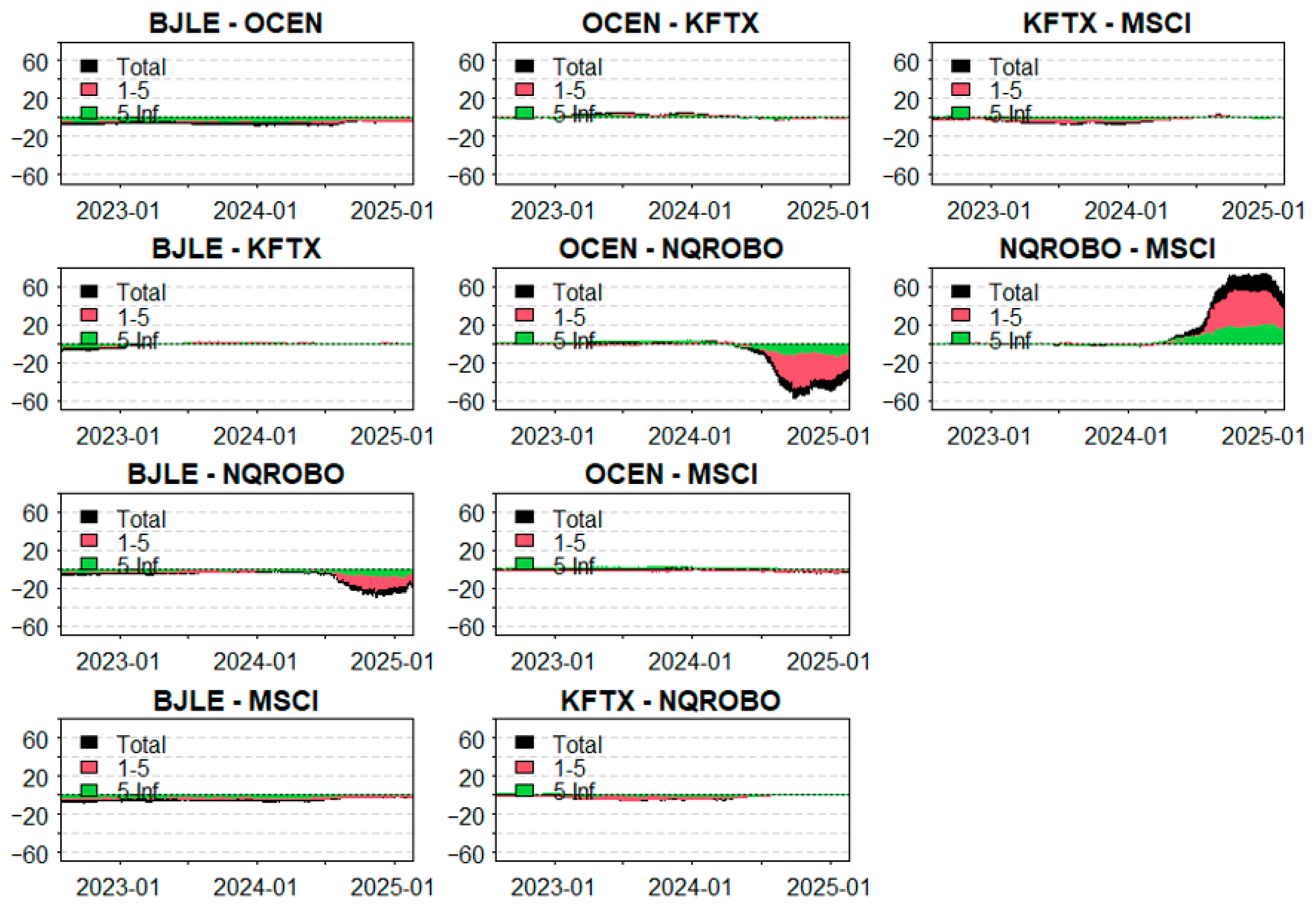
The dynamic structure of bilateral spillovers within the digital–blue financial nexus is further examined through
Figure 6,
Figure 7 and
Figure 8, which depict the time-varying evolution of net pairwise connectedness across the median, lower, and upper quantiles. The frequency dimension captures short-term (1–5 days) and long-term (5–∞ days) spillover components derived from the spectral decomposition of the Quantile VAR model. These multidimensional perspectives reveal how systemic influence circulates among AI, FinTech, and blue finance assets across market regimes and frequency horizons, thereby characterizing the mechanisms through which interconnectedness evolves between innovation and sustainability.
At the median quantile, the configuration portrays an equilibrium regime characterized by balanced volatility transmission and informational efficiency. AI and robotics (NQROBO) emerge as the primary net transmitter of systemic influence, accounting for short-term spillovers toward both blue ETFs and global markets. Its influence on MSCI, OCEN, and BJLE intensifies from mid-2024 onward, coinciding with the diffusion of technology-driven valuation cycles and liquidity realignments across the financial system. These interactions are associated with AI-related sentiment, which acts as a synchronizing force that aligns expectations between innovation and sustainability. Economically, this dynamic is consistent with a transition of technological momentum from a sectoral impulse to a system-wide co-movement pattern.
FinTech (KFTX) maintains a largely neutral stance toward NQROBO, MSCI, BJLE, and OCEN. Rather than amplifying shocks, it is characterized by an adaptive liquidity conduit role, transforming short-lived digital turbulence into more stable market adjustments. This behavior positions FinTech as a relative buffer that supports coherence within the digital–blue finance ecosystem. MSCI, in turn, maintains a mild receiver profile vis-à-vis BJLE and a neutral relation with OCEN. This receiver status is consistent with its broad diversification and deep liquidity base, which enable volatility absorption without substantial retransmission. Its behavior underscores benchmark inertia, an intrinsic capacity of global indices to internalize systemic shifts while preserving portfolio stability. The overall hierarchy positions AI as the core transmitter, FinTech as a liquidity mediator, and blue ETFs as absorptive stabilizers anchoring systemic balance.
Under the lower quantile, corresponding to bearish and high-stress conditions, connectedness becomes asymmetric and horizon-dependent. AI and robotics remain the main source of short-term volatility transmission vis-à-vis BJLE and OCEN from 2024 onward, as blue finance channels are associated with temporary stabilizing spillovers amid technological corrections. Over longer horizons, NQROBO re-emerges as a net transmitter toward MSCI, BJLE, and OCEN, indicating the diffusion of AI-induced repricing through blue finance and global segments. Its temporary spillovers to KFTX coincide with rapid feedback loops within the digital domain, where FinTech momentarily exhibits increased spillover intensity before systemic equilibrium is restored.
FinTech exhibits a dual, time-contingent profile. In the short run, it acts as a receiver from BJLE, OCEN, and MSCI, suggesting that blue ETFs and diversified markets temporarily counterbalance liquidity shocks. Over longer horizons, it transitions into a transmitter, reflecting the re-emergence of technological and financial impulses back toward these assets. This cyclical adjustment demonstrates FinTech’s hybrid nature as both a shock absorber and a connecting node, linking innovation and sustainability. BJLE and OCEN remain primarily defensive, absorbing digital volatility while occasionally exhibiting weak stabilizing spillovers. MSCI consolidates its long-horizon receiver role, reaffirming its position as a global sink that contains innovation-led volatility through diversification and depth.
At the upper quantile, representing speculative and expansionary conditions rather than liquidity stress, systemic linkages exhibit a reconfiguration. Until mid-2024, AI and robotics account for the bulk of short-term transmissions toward BJLE, OCEN, and MSCI, demonstrating how optimism in innovation coincides with spillover propagation through sentiment-sensitive channels. Beyond mid-2024, NQROBO becomes a long-term transmitter and short-term receiver, signaling the maturation of AI as a persistent contributor to systemic integration. FinTech follows a similar trajectory, shifting from an initial receiver position to a long-term transmitter as liquidity cycles renew and digital sustainability linkages strengthen. Blue finance assets remain largely absorptive but occasionally emit weak positive spillovers, consistent with ESG-driven reallocations during speculative expansions. MSCI begins as a stabilizing receiver before progressively internalizing digital exuberance, aligning global equity dynamics with innovation-led valuation cycles.
Across quantiles, these patterns converge into a consistent systemic hierarchy. From equilibrium to stress and exuberance, AI accounts for the largest share of short-run spillover reflexivity, FinTech mediates liquidity-related adjustments, and blue finance assets support longer-horizon stability. The amplitude of influence compresses across regimes, revealing that while contagion intensity fluctuates, the directional structure endures. The digital–blue nexus thus evolves as an adaptive architecture where innovation and sustainability jointly shape systemic coherence under shifting macro-financial conditions.
4.4. Robustness Check
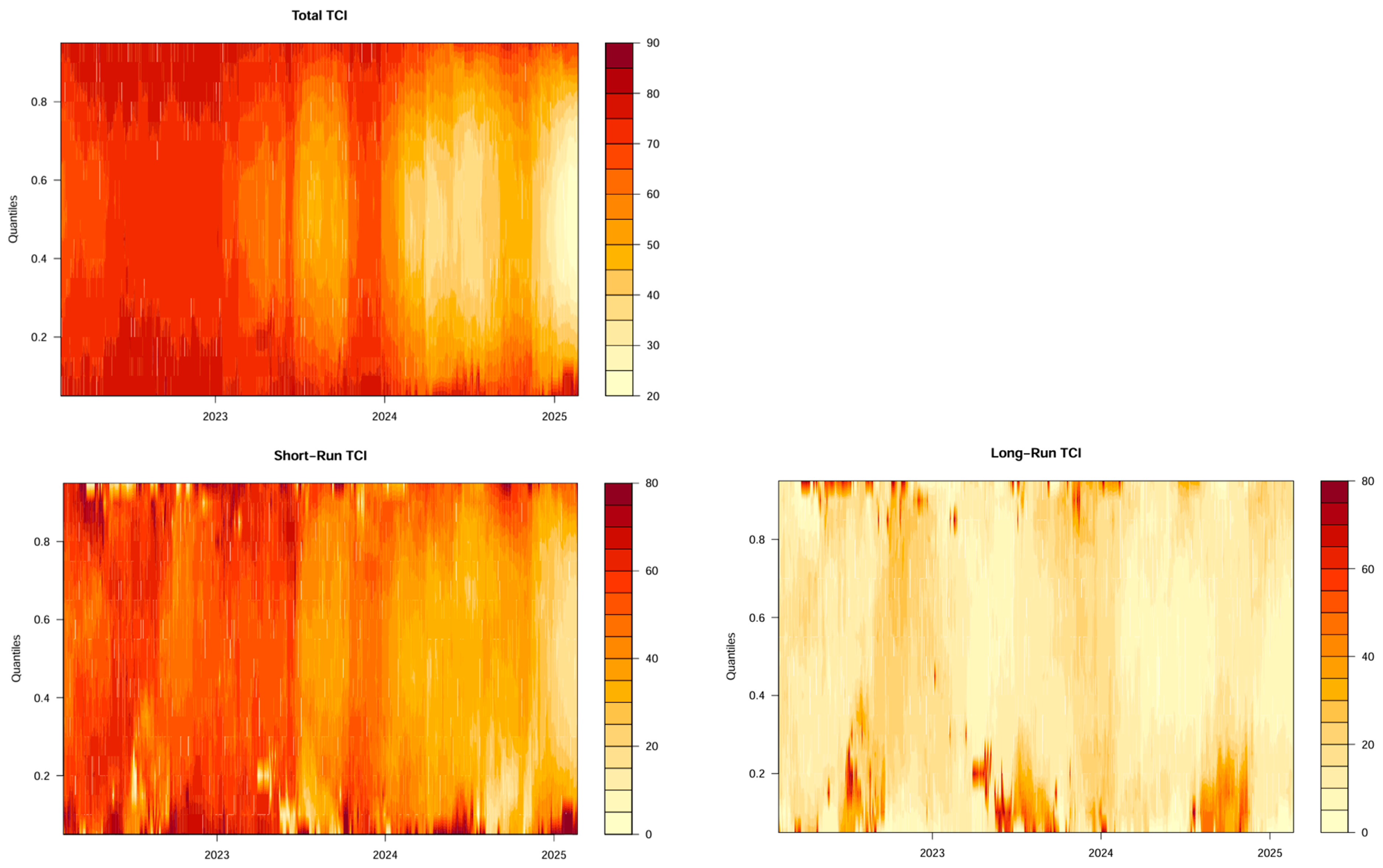
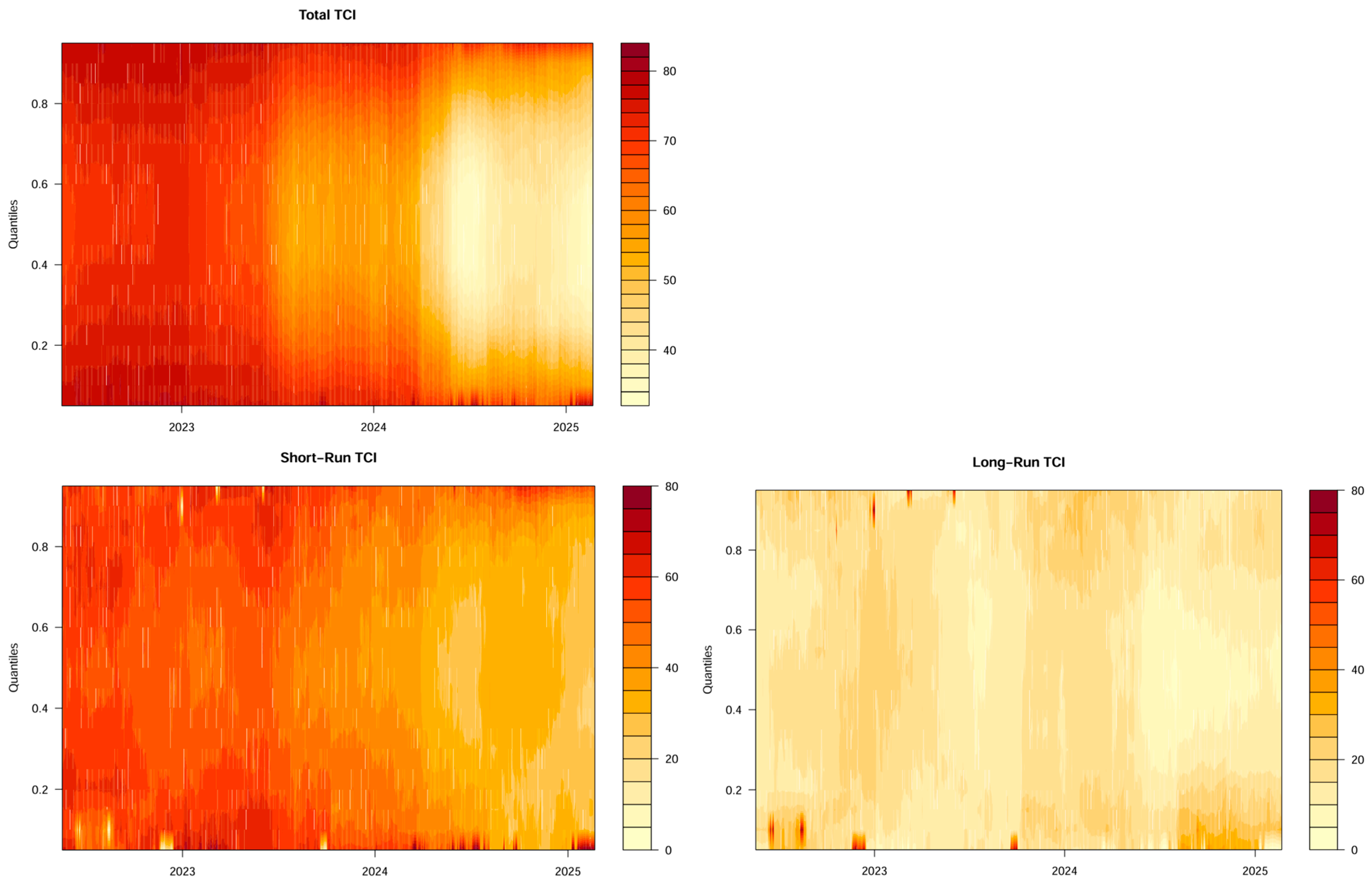
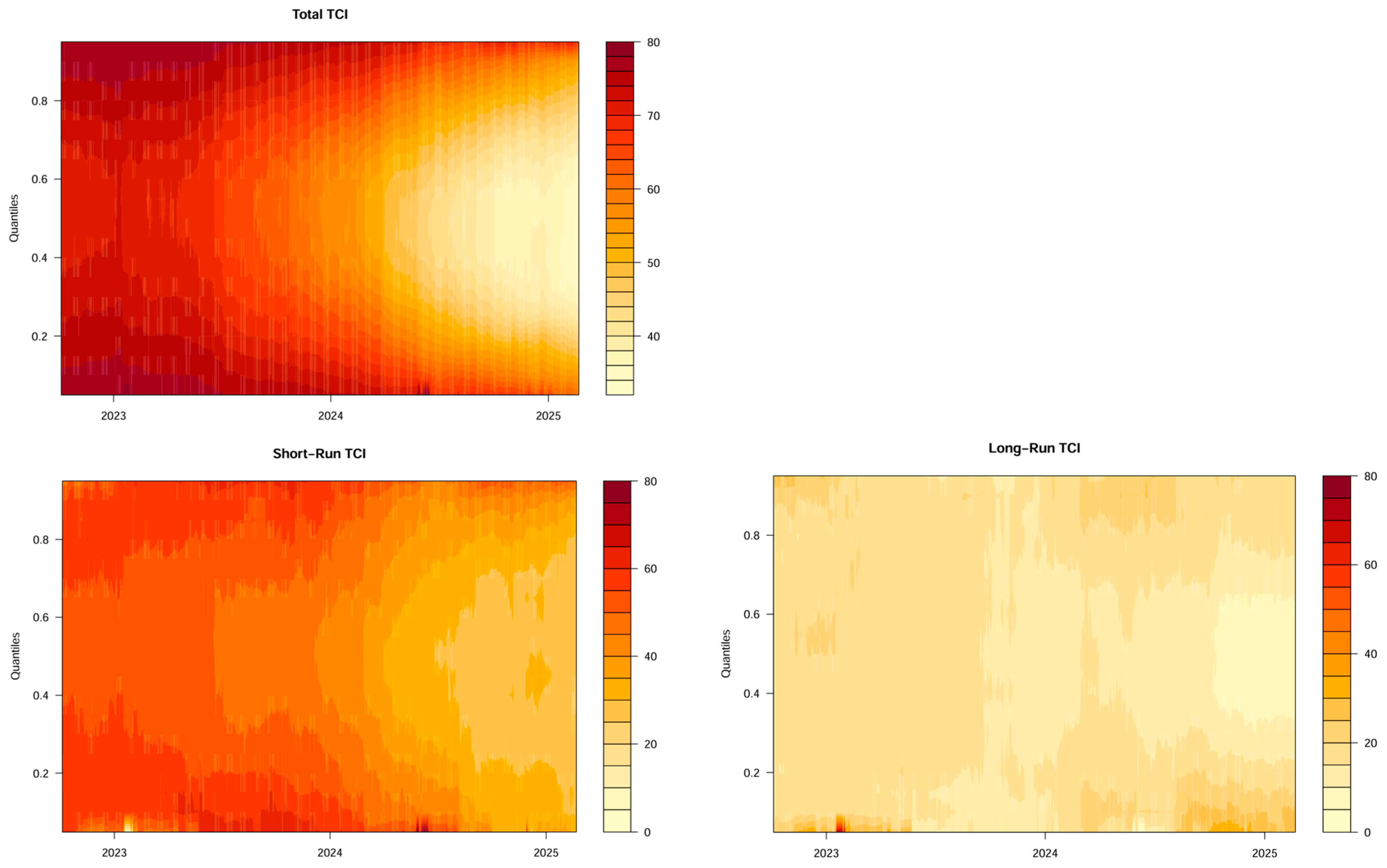
To verify the robustness of the QF-C connectedness estimates, the analysis was re-executed using alternative rolling windows of 75, 100, and 150 days. As shown in
Figure 9,
Figure 10 and
Figure 11, the Total Connectedness Indices preserve the same dynamic patterns observed under the 200-day benchmark in
Figure 4, confirming the stability of the results across window-length specifications. The net and pairwise directional connectedness measures also display comparable patterns across specifications
1, indicating that asset-level transmission mechanisms are not sensitive to the choice of rolling window.
Table 6 summarizes the net transmitter/receiver roles of each asset across lower, median, and upper quantiles, based on net directional connectedness measures, consistently observed across different rolling window specifications. This coherence indicates that the interconnectedness among technology, blue finance, and global equity markets is robust to methodological variation, reflecting the systemic persistence and robustness of the digital–blue finance nexus.
To evaluate whether the spillover patterns attributed to blue-themed ETFs merely reflect generic ESG equity dynamics, we augmented the baseline system with the STOXX Global ESG Leaders Index under the same estimation settings as in the baseline model. The extended model confirms the robustness of the main hierarchy. NQROBO remains the primary net transmitter across quantiles, whereas BJLE continues to act as a net receiver, consistent with a comparatively absorptive profile. The ESG benchmark is predominantly a net receiver, suggesting that mainstream ESG co-movement absorbs a non-trivial share of spillovers without subsuming the blue-finance-specific transmission structure. OCEN displays a more procyclical role in the tails, indicating heterogeneity among blue-themed equity proxies. Overall, the benchmark inclusion refines the core interpretations by disentangling blue-specific spillover effects from broader ESG equity dynamics, thereby highlighting the distinctive composition and directionality of the digital–blue finance nexus. Detailed static connectedness matrices for the extended system are reported in
Appendix A,
Table A1,
Table A2 and
Table A3.
5. Discussion
This study uncovers the evolving systemic architecture linking FinTech innovation, artificial intelligence (AI), and blue finance instruments, through a quantile–frequency connectedness framework. The results reveal a multi-regime, asymmetric, and adaptive interdependence within the digital–blue finance nexus, which is characterized by structured and persistent interactions between innovation-driven markets and blue finance instruments embedded in digitally mediated financial systems. The surge in connectedness during both downturns and rallies demonstrates that risk aversion and speculative sentiment are associated with compressed diversification and synchronized systemic risk, indicating a cyclical symmetry of contagion (
Chatziantoniou et al., 2022;
Liu et al., 2024;
Mensi et al., 2024). Short-term connectedness dominates, while long-run spillovers remain limited, suggesting that long-horizon investors retain structural diversification opportunities in blue finance assets. Such findings align with recent contributions, emphasizing frequency-contingent connectedness and ESG-driven resilience in financial markets (
Abakah et al., 2023;
Jiang et al., 2023). Volatility spillovers are transmitted primarily through liquidity imbalances, herding, and sentiment-driven capital reallocations, with digital innovation coinciding with synchronized trading behaviors. Institutional stability and ESG commitments are associated with countervailing forces, gradually restoring equilibrium and supporting systemic resilience in sustainability-linked markets (
X. Wang et al., 2024). These results confirm the empirical advantage of the quantile–frequency connectedness framework, which extends beyond traditional variance decomposition and network models (
Baruník & Křehlík, 2018;
Diebold & Yilmaz, 2012) by exposing regime- and horizon-specific spillovers, often masked in mean-based approaches. By integrating quantile and frequency domains, this framework captures tail amplification and horizon-dependent contagion, providing a granular representation of systemic dynamics specific to the digital–blue finance asset configuration.
Within this configuration, AI accounts for a central share of volatility transmission through innovation-led cycles associated with reflexive information diffusion and algorithmic coordination. This dominance reflects the intrinsic nature of AI-related assets as expectation-driven instruments, whose valuations are highly sensitive to high-frequency information flows, rapid belief updating, and algorithmic trading mechanisms. As a result, AI assets disproportionately amplify short-term spillovers, particularly during periods of intensified speculative activity and rapid capital rotation. FinTech intermediaries exhibit alternating transmission and absorption roles depending on liquidity and leverage conditions, consistent with the asymmetric transmission mechanisms identified by
Abakah et al. (
2023). In contrast, blue finance ETFs function as stabilizing anchors, supported by ESG mandates and long-horizon capital flows. This role reflects their institutional and policy-oriented nature, which prioritizes strategic sustainability objectives over short-term trading incentives. Their defensive capacity varies with market conditions, as shifts in investor risk perception and ESG inflows generate volatility clustering and trading surges mainly during speculative phases rather than liquidity stress. Benchmark comparisons further indicate that this behavior is not driven by generic ESG equity co-movement, as mainstream ESG indices primarily absorb market-wide spillovers without shaping their direction. Rather than acting as unconditional hedges, blue finance ETFs operate as state-contingent defensive assets, absorbing innovation-driven shocks during stress while partially synchronizing with broader market optimism during expansions.
These findings extend prior evidence from the digital and sustainability literature (
Abhilash et al., 2022;
Özkan et al., 2024) by revealing that blue finance instruments, while functionally similar to green or ESG-linked instruments, exhibit a distinctive state-dependent stabilization role within innovation-driven systems, particularly under high-frequency innovation shocks. Unlike earlier studies emphasizing short-run asymmetry (
Abakah et al., 2023;
Ma et al., 2025;
Si Mohammed et al., 2024), the results demonstrate that the interaction between innovation-led assets and blue finance instruments generates distinct, regime-dependent spillover and diversification patterns, reflecting a persistent adaptive balance between AI-induced volatility and blue-finance-based resilience.
The theoretical implications are substantial. The results support the Adaptive Market Hypothesis (
Lo, 2004), showing that efficiency evolves adaptively as markets learn and adjust to sentiment and regulation. Tail-driven fragility illustrates how extreme shocks act as stress tests, prompting systemic reorganization. This aligns with the complex systems perspective (
Battiston et al., 2017), which views finance as an interconnected network balancing efficiency and resilience.
Ultimately, the digital–blue nexus can be interpreted as an adaptive financial system in which innovation, market intermediation, and sustainability-oriented capital jointly shape observed patterns of risk transmission. Liquidity conditions and information flows are associated with intensified short-term contagion, while the stabilizing role of sustainability-linked assets contributes to moderating systemic pressures over longer horizons. These dynamics carry direct implications for portfolio construction, state-dependent diversification performance, and the monitoring of cross-market transmission channels in increasingly technology-driven financial environments.
6. Conclusions, Implications, and Limitations
6.1. Conclusions
This study investigates the systemic linkages among artificial intelligence, FinTech innovation, and blue finance instruments using the quantile–frequency connectedness framework. The empirical evidence reveals a multi-regime and asymmetric interdependence in which shifts in risk aversion and speculative sentiment are associated with compressed diversification benefits and synchronized systemic risk across digital and sustainability-linked market segments. Short-term spillovers dominate the transmission structure, whereas long-run effects remain comparatively moderate, preserving diversification opportunities for long-horizon investors.
AI and FinTech account for a central share of volatility transmission with liquidity cycles, leverage dynamics, and information reflexivity. In contrast, blue finance instruments function as state-contingent defensive assets, absorbing technology-related volatility spillovers during turbulent phases while partially aligning with speculative dynamics rather than liquidity stress in expansive regimes. This asymmetry highlights a structural trade-off between innovation-induced efficiency gains and the stabilizing properties of sustainability-linked assets.
Beyond these findings, this study advances the literature in three key respects. First, it extends research on digital assets by explicitly incorporating Blue Economy instruments into the connectedness analysis of AI and FinTech markets. Second, it moves beyond the ESG literature by showing that sustainability-linked assets interact dynamically with innovation-driven financial systems, rather than operating as a separate or purely defensive segment. Third, it reveals regime-dependent spillover and diversification effects that remain obscured in mean-based or single-domain analyses.
Overall, the results contribute to a clearer understanding of how digital innovation and blue finance jointly shape systemic risk and diversification in modern financial markets, with direct implications for portfolio allocation, risk management, and the design of resilient financial systems in an increasingly digital and sustainability-oriented environment.
6.2. Implications for Research, Practice, and Policy
The findings advance the literature on systemic risk and sustainable finance by introducing a Digital–Blue Resilience Paradigm in which financial stability is understood to emerge from the adaptive interaction between technological innovation and sustainability-oriented market stability. This paradigm illustrates how AI-driven efficiency and ESG-focused financial systems jointly shape observed patterns of robustness in contemporary financial markets. The quantile–frequency connectedness framework offers a dynamic analytical lens for identifying asymmetric and regime-dependent spillovers, providing a granular understanding of how digital shocks are transmitted within sustainability-linked financial networks, a dimension often overlooked in conventional approaches.
For investors, the results support the design of regime-aware and horizon-sensitive portfolios that limit short-term contagion while benefiting from the long-term stabilizing properties of blue finance instruments, and sustainability-linked assets. Blue-themed ETFs, AI-enhanced ESG portfolios, and blue-focused FinTech instruments enhance regime-dependent diversification benefits, and align investment performance with sustainability-driven mandates. This evolution from traditional return-based allocation to resilience-oriented portfolio construction reflects the growing importance of integrating sustainability-related risks and opportunities into capital allocation decisions.
For policymakers, the implications are significant. The results underscore the need to integrate digital and environmental spillovers into macroprudential oversight to safeguard financial stability in an increasingly interconnected financial system. Regulatory coordination across digital and sustainable finance domains, supported by frameworks from the EU AI Act, IOSCO sustainability guidelines, and ISSB disclosure standards, is relevant for ensuring algorithmic transparency, ESG verifiability, and cross-sector accountability. Beyond compliance, this alignment may serve as a strategic lever for strengthening financial system resilience and guiding the evolution of digital and sustainability-linked market infrastructures.
Collectively, these insights position sustainable digital finance as both a catalyst for technological progress and a stabilizing component of financial governance. Strengthening the interaction among innovation, regulation, and sustainability can support the transformation of technological disruption into systemic resilience and foster a more robust, financially stable global economy.
6.3. Limitations and Future Research
While this study captures macro-level interdependence among FinTech, artificial intelligence, and blue finance instruments, it does not fully address sectoral heterogeneity, behavioral asymmetries, or policy shocks that influence the broader architecture of sustainable finance. The sample period, shaped by post-pandemic adjustments and geopolitical volatility, may only partially reflect the long-term structural evolution of digital and sustainability-linked financial markets. Identifying structural long-run cycles requires a substantially longer time span.
Future research should examine more specific categories of blue finance instruments, including conservation bonds, coastal infrastructure financing instruments, and blue infrastructure equities, which represent important components of the expanding sustainable finance landscape. Integrating AI-driven ESG analytics would enhance the detection of sustainability signals and clarify how digital innovation interacts with environmental performance and market stability. Combining connectedness modeling, network topology, and machine learning could reveal deeper mechanisms of contagion linking technological innovation, financial intermediation, and sustainability-related risks. Including additional indicators, such as carbon-market dynamics, policy uncertainty indices, and climate-related financial metrics, would improve our understanding of how technological efficiency and ecological resilience contribute to systemic stability.
Advancing this line of inquiry will refine empirical insights into the ways digital transformation and sustainability-linked assets co-evolve across different market regimes. Deeper investigation of these mechanisms will support more accurate financial modeling and more informed decisions for portfolio managers and regulators operating within increasingly interconnected financial systems.