

Digital Financial Literacy and Investment Grip: A Study of Japanese Active Investors


Abstract
1. Introduction
2. Review of the Literature and the Study Novelty
3. Data and Methods
3.1. Data Source
3.2. Variable Definitions
- Understanding of Financial concepts and digital skills;
- Familiarity with digital financial services [DFS], including financial mindsets and habits
- Hands-on ability to use DFS platforms and tools;
- The ability to make sound financial decisions by applying positive financial attitudes and behaviors;
- Skills to protect oneself from internet scam and fraudulent activity.
3.3. Descriptive Statistics
3.4. Methods
4. Empirical Findings
5. Discussion
6. Conclusions
- Personalized DFL coaching: Financial advisors at institutions, such as Rakuten Securities, can deliver individualized training to navigate trading platforms safely and recognize phishing attempts. Enhanced confidence in digital finance can reduce impulsive sell-offs triggered by loss aversion.
- Interactive learning tools: Investors may benefit from tailored online simulations that cultivate digital transactions and cybersecurity skills by directly addressing the competencies presented here to strengthen their investment grip.
- Targeted educational workshops: Programs designed for groups with lower investment grip, such as women, older adults, and married investors, can improve digital self-efficacy and resilience to digital risks, including fraud and misinformation.
- Peer-led online communities: Participating in investor forums that share DFL strategies can reinforce self-efficacy and foster adaptive investment grip.
Author Contributions
Funding
Institutional Review Board Statement
Informed Consent Statement
Data Availability Statement
Conflicts of Interest
References
- Abdallah, W., Tfaily, F., & Harraf, A. (2025). The impact of digital financial literacy on financial behavior: Customers’ perspective. Competitiveness Review, 35, 347–370. [Google Scholar] [CrossRef]
- Adnan, M. F., Rahim, N. M., & Ali, N. (2023). Determinants of digital financial literacy from students’ perspective. Corporate Governance and Organizational Behavior Review, 7(2), 168–177. [Google Scholar] [CrossRef]
- Ahmed, F., Hussain, A., Khan, S. N., Malik, A. H., Asim, M., Ahmad, S., & El-Affendi, M. (2024). Digital risk and financial inclusion: Balance between auxiliary innovation and protecting digital banking customers. Risks, 12, 133. [Google Scholar] [CrossRef]
- Ajzen, I. (1991). The theory of planned behavior. Organizational Behavior and Human Decision Processes, 50, 179–211. [Google Scholar] [CrossRef]
- Allgood, S., & Walstad, W. (2012). The effects of perceived and actual financial literacy on financial behaviors. SSRN. Available online: https://ssrn.com/abstract=2191606 (accessed on 28 April 2025).
- Amarsanaa, J., Nguyen, T. X. T., Kuramoto, Y., Khan, M. S. R., & Kadoya, Y. (2025). Digital financial literacy and anxiety about life after 65: Evidence from a large-scale survey analysis of Japanese investors. Risks, 13, 170. [Google Scholar] [CrossRef]
- Bajwa, F. A., Fu, J., Bajwa, I. A., Rehman, M., & Abbas, K. (2025). Digital financial inclusion and its dual impact on economic and environmental outcomes in ASEAN countries. Data Science in Finance and Economics, 5(1), 53–75. [Google Scholar] [CrossRef]
- Baker, P. (2024). The frontiers of finance. University of Chicago. Available online: https://professional.uchicago.edu/stories/strategic-financial-management/frontiers-finance?language_content_entity=en (accessed on 10 May 2025).
- Bandura, A. (2023). Social cognitive theory—An agentic perspective on human nature. John Wiley & Sons, Inc. [Google Scholar]
- Barber, B. M., & Odean, T. (2001). Boys will be boys: Gender, overconfidence, and common stock investment. The Quarterly Journal of Economics, 116, 261–292. [Google Scholar] [CrossRef]
- Barberis, N., & Xiong, W. (2009). What drives the disposition effect? An analysis of a long-standing preference-based explanation. Journal of Finance, 64, 751–784. [Google Scholar] [CrossRef]
- Becker, G. S. (1962). Investment in human capital: A theoretical analysis. Journal of Political Economy, 70, 9–49. [Google Scholar] [CrossRef]
- Beers, B. (2022, June 26). Tips for long-term investors in volatile markets. Investopedia. Available online: https://www.investopedia.com/articles/02/051502.asp (accessed on 28 April 2025).
- Ben-David, I., & Hirshleifer, D. (2012). Are investors really reluctant to realize their losses? Trading responses to past returns and the disposition effect. The Review of Financial Studies, 25(8), 2485–2532. [Google Scholar] [CrossRef]
- Bianchi, M. (2017). Financial literacy and portfolio dynamics (TSE Working Paper No. 17-808). Toulouse School of Economics. Available online: https://www.tse-fr.eu/publications/financial-literacy-and-portfolio-dynamics (accessed on 16 September 2025).
- Bodie, Z., Merton, R. C., & Samuelson, W. F. (1992). Labor supply flexibility and portfolio choice in a life cycle model. Journal of Economic Dynamics and Control, 16, 427–449. [Google Scholar] [CrossRef]
- Braga, R., & Fávero, L. P. L. (2017). Disposition effect and tolerance to losses in stock investment decisions: An experimental study. Journal of Behavioral Finance, 18, 271–280. [Google Scholar] [CrossRef]
- Bucher-Koenen, T., Cziriak, M., Alessie, R. J. M., & van Rooij, M. C. J. (2024). Beyond knowledge: Confidence and the gender gap in financial literacy (ZEW Discussion Paper No. 24-083). Leibniz Centre for European Economic Research (ZEW). Available online: https://www.zew.de/en/publications/beyond-knowledge-confidence-and-the-gender-gap-in-financial-literacy (accessed on 28 April 2025).
- Calvet, L. E., Campbell, J. Y., & Sodini, P. (2007). Down or out: Assessing the welfare costs of household investment mistakes. Journal of Political Economy, 115, 707–747. [Google Scholar] [CrossRef]
- Choung, Y., Chatterjee, S., & Pak, T. Y. (2023). Digital financial literacy and financial well-being. Finance Research Letters, 58, 104438. Available online: https://www.sciencedirect.com/science/article/abs/pii/S1544612323008103 (accessed on 16 September 2025). [CrossRef]
- Choung, Y., Pak, T. Y., & Chatterjee, S. (2025). Digital financial literacy and life satisfaction: Evidence from South Korea. Behavioral Sciences, 15, 94. [Google Scholar] [CrossRef]
- Chu, Z., Wang, Z., Xiao, J. J., & Zhang, W. (2017). Financial literacy, portfolio choice and financial well-being. Social Indicators Research, 132, 799–820. [Google Scholar] [CrossRef]
- Cocco, J. F., Gomes, F. J., & Maenhout, P. J. (2005). Consumption and portfolio choice over the life cycle. The Review of Financial Studies, 18, 491–533. [Google Scholar] [CrossRef]
- Cupák, A., Fessler, P., Hsu, J. W., & Paradowski, P. R. (2020). Confidence, financial literacy and investment in risky assets: Evidence from the survey of consumer finances (Finance and Economics Discussion Series, 2020-004). Board of Governors of the Federal Reserve System. Available online: https://www.federalreserve.gov/econres/feds/files/2020004pap.pdf (accessed on 16 September 2025).
- Davis, F. D., & Granić, A. (2024). The technology acceptance model: 30 years of TAM (Human–Computer Interaction Series). Springer International Publishing AG. [Google Scholar]
- Du, Z., & Lv, G. (2025). Can digital finance unleash the potential for household consumption? A comparison based on the inconsistency between income and consumption classes. Journal of Theoretical and Applied Electronic Commerce Research, 20, 275. [Google Scholar] [CrossRef]
- Fiel’ardh, K. (2024). Futures thinking in middle school science textbooks: A perspective from Japan. Nordic Journal of Comparative and International Education, 8, 1–28. Available online: https://journals.oslomet.no/index.php/nordiccie/article/view/5647 (accessed on 20 May 2025). [CrossRef]
- Financial Services Agency (FSA), Government of Japan. (2025). FSA strategic priorities: July 2025–June 2026. Financial Services Agency. Available online: https://www.fsa.go.jp/en/news/2025/20250829/strategic_priorities_2025_outline.pdf (accessed on 26 November 2025).
- Gathergood, J., & Weber, J. (2014). Self-control, financial literacy & the co-holding puzzle. Journal of Economic Behavior and Organization, 107, 455–469. Available online: https://ssrn.com/abstract=2005031 (accessed on 20 May 2025). [CrossRef][Green Version]
- Giannikos, C. I., & Korkou, E. D. (2025). Are women more risk averse? A sequel. Risks, 13(1), 12. [Google Scholar] [CrossRef]
- Gignac, G. E. (2022). The association between objective and subjective financial literacy: Failure to observe the Dunning-Kruger effect. Personality and Individual Differences, 184, 111224. [Google Scholar] [CrossRef]
- Grable, J. E. (2000). Financial risk tolerance and additional factors that affect risk taking in everyday money matters. Journal of Business and Psychology, 14, 625–630. [Google Scholar] [CrossRef]
- Grable, J. E., Hubble, A., Kruger, M., & Visbal, M. (2020). Predicting financial risk tolerance and risk-taking behaviour: A comparison of questionnaires and tests. Financial Planning Research Journal, 6, 21–39. [Google Scholar] [CrossRef]
- Grable, J. E., Rabbani, A., & Heo, W. (2024). The complementary nature of financial risk aversion and financial risk tolerance. Risks, 12, 109. [Google Scholar] [CrossRef]
- Horioka, C. Y. (1990). Why is Japan’s household saving rate so high? A literature survey. Journal of the Japanese and International Economies, 4, 49–92. Available online: https://www.sciencedirect.com/science/article/pii/088915839090012U (accessed on 20 May 2025). [CrossRef]
- Iwao, S. (1993). The Japanese woman: Traditional image and changing reality. Free Press. Available online: https://searchworks.stanford.edu/view/2459659 (accessed on 9 October 2025).
- Japan Exchange Group (JPX). (2025). Be careful of phishing scams! (Warning). Available online: https://www.jpx.co.jp/english/corporate/news/news-releases/0060/20250404-01.html (accessed on 10 May 2025).
- Japan Securities Dealers Association. (2025). Survey results on online trading. Available online: https://www.jsda.or.jp/en/statistics/ (accessed on 27 August 2025).
- Jose, J., & Ghosh, N. (2025). Digital financial literacy and financial inclusion in the global south for a sustainable future: A scoping review. Decision, 52, 129–148. [Google Scholar] [CrossRef]
- Kahneman, D., & Tversky, A. (1979). Prospect theory: An analysis of decision under risk. Econometrica, 47, 263–290. [Google Scholar] [CrossRef]
- Khan, M. S. R., Rabbani, N., & Kadoya, Y. (2021). Can financial literacy explain lack of investment in risky assets in Japan? Sustainability, 13, 12616. [Google Scholar] [CrossRef]
- Koskelainen, T., Kalmi, P., Scornavacca, E., & Vartiainen, T. (2023). Financial literacy in the digital age—A research agenda. Journal of Consumer Affairs, 57, 507–528. [Google Scholar] [CrossRef]
- Kuramoto, Y., Bawalle, A. A., Khan, M. S. R., & Kadoya, Y. (2025). Hyperbolic discounting and its influence on loss tolerance: Evidence from Japanese investors. Risks, 13, 202. [Google Scholar] [CrossRef]
- Lal, S., Bawalle, A. A., Khan, M. S. R., & Kadoya, Y. (2025). What determines digital financial literacy? Evidence from a large-scale investor study in Japan. Risks, 13, 149. [Google Scholar] [CrossRef]
- Li, Y., Xu, S., Yang, Z., Ali, S. T., & Cui, J. (2020). Does financial literacy affect household financial behavior? The role of limited attention. Frontiers in Psychology, 13, 906153. [Google Scholar] [CrossRef]
- Lind, T., Ahmed, A., Skagerlund, K., Strömbäck, C., Västfjäll, D., & Tinghög, G. (2020). Competence, confidence, and gender: The role of objective and subjective financial knowledge in household finance. Journal of Family and Economic Issues, 41(4), 626–638. [Google Scholar] [CrossRef]
- Liu, S., Gao, L., Latif, K., Dar, A. A., Zia-Ur-Rehman, M., & Baig, S. A. (2021). The behavioral role of digital economy adaptation in sustainable financial literacy and financial inclusion. Frontiers in Psychology, 12, 742118. [Google Scholar] [CrossRef]
- Lusardi, A., & Mitchell, O. S. (2008). Planning and financial literacy: How do women fare? American Economic Review, 98, 413–417. [Google Scholar] [CrossRef]
- Lusardi, A., & Mitchell, O. S. (2014). The economic importance of financial literacy: Theory and evidence. Journal of Economic Literature, 52(1), 5–44. [Google Scholar] [CrossRef]
- Lyons, A. C., & Kass-Hanna, J. (2021). A methodological overview to defining and measuring “digital” financial literacy. Financial Planning Review, 4, e1113. [Google Scholar] [CrossRef]
- Makridis, C., & Liu, T. (2025). Cybersecurity vulnerabilities and their financial impact. Centre for Economic Policy and Research (CEPR)—VoxEU. Available online: https://cepr.org/voxeu/columns/cybersecurity-vulnerabilities-and-their-financial-impact (accessed on 20 May 2025).
- Nabeshima, H., Khan, M. S. R., & Kadoya, Y. (2025). Overconfidence and investment loss tolerance: A large-scale survey analysis of Japanese investors. Risks, 13, 142. [Google Scholar] [CrossRef]
- Nippon.com. (2025). Financial losses soar as cases of scams jump in Japan. Available online: https://www.nippon.com/en/japan-data/h02424/ (accessed on 24 August 2025).
- Odean, T. (1998). Are investors reluctant to realize their losses? Journal of Finance, 53, 1775–1798. [Google Scholar] [CrossRef]
- OECD. (2021). G20/OECD-INFE report on supporting financial resilience and transformation through digital financial literacy. OECD Publishing. Available online: https://www.oecd.org/en/publications/g20-oecd-infe-report-on-supporting-financial-resilience-and-transformation-through-digital-financial-literacy_0132c06d-en.html (accessed on 9 October 2025).
- OECD. (2024). OECD/INFE survey instrument to measure digital financial literacy. OECD Publishing. Available online: https://www.oecd.org/en/publications/oecd-infe-survey-instrument-to-measure-digital-financial-literacy_548de821-en.html (accessed on 16 September 2025).
- Ono, H. (2010). Lifetime employment in Japan: Concepts and measurements. Journal of the Japanese and International Economies, 24, 1–27. Available online: https://www.sciencedirect.com/science/article/pii/S0889158309000598 (accessed on 20 May 2025). [CrossRef]
- Peter, L., & Mathew, J. (2025). From confidence to action: How financial self-efficacy and risk tolerance influence investment behaviour. International Journal of Indian Psychology, 13, 1953–1963. [Google Scholar] [CrossRef]
- Prasad, H., Meghwal, D., & Dayama, V. (2018). Digital financial literacy: A study of households of Udaipur. Journal of Business and Management, 5, 23–32. [Google Scholar] [CrossRef]
- Rakuten Securities, Inc. (2024). FY2024 IR presentation: Rakuten bank, Ltd. (Q4). Rakuten Bank. Available online: https://www.rakuten-bank.co.jp/corp/english/investors/documents/Q4_FY2024_IR_Presentation_EN.pdf (accessed on 26 October 2025).
- Ravikumar, T., Suresha, B., Prakash, N., Vazirani, K., & Krishna, T. A. (2022). Digital financial literacy among adults in India: Measurement and validation. Cogent Economics and Finance, 10(1), 2132631. [Google Scholar] [CrossRef]
- Sahu, M., Uddin, F., & Hossain, M. B. (2025). Exploring the psychological drivers of cryptocurrency investment biases: Evidence from Indian retail investors. International Journal of Financial Studies, 13(4), 219. [Google Scholar] [CrossRef]
- SBI Holdings, Inc. (2024). Integrated report 2024. SBI Holdings. Available online: https://www.sbigroup.co.jp/english/investors/library/annualreport/pdf/2024ar_e-all.pdf (accessed on 26 October 2025).
- Serrano, A. S. (2020). High-frequency trading and systemic risk: A structured review of findings and policies. Review of Economics, 71, 169–195. [Google Scholar] [CrossRef]
- Setiawan, M., Effendi, N., Santoso, T., Dewi, V. I., & Sapulette, M. S. (2022). Digital financial literacy, current behavior of saving and spending and its future foresight. Economics of Innovation and New Technology, 31(4), 320–338. [Google Scholar] [CrossRef]
- Shrestha, N. (2020). Detecting multicollinearity in regression analysis. American Journal of Applied Mathematics and Statistics, 8, 39–42. [Google Scholar] [CrossRef]
- Siegel, J. J. (1998). Stocks for the long run (2nd ed.). McGraw-Hill. [Google Scholar]
- Soldatos, J., & Kyriazis, D. (2022). Big data and artificial intelligence in digital finance: Increasing personalization and trust in digital finance using big data and AI. Springer International Publishing. [Google Scholar]
- Song, G., & Valencia, M. G. (2024). Digital financial literacy and financial behavior. International Journal for Multidisciplinary Research, 6(4), 1–7. [Google Scholar] [CrossRef]
- Subburayan, B., Sankarkumar, A. V., Singh, R., & Mushi, H. M. (2024). Transforming of the financial landscape from 4.0 to 5.0: Exploring the integration of blockchain, and artificial intelligence. In M. Irfan, M. Khan, N. Naifar, & M. A. Khan (Eds.), Applications of block chain technology and artificial intelligence (pp. 137–161). Springer. [Google Scholar]
- Sukumaran, S., Bee, T. S., & Wasiuzzaman, S. (2023). Investment in cryptocurrencies: A study of its adoption among Malaysian investors. Journal of Decision Systems, 32, 732–760. [Google Scholar] [CrossRef]
- Susanti, A. K., Bhilawa, L., Rahman, M. F. W., Safwan, N. S. Z., & Peerzadah, S. A. (2024, December 9). How is digital financial literacy of FEB Unesa students? International Conference on Digital Business Innovation and Technology Management (ICONBIT) (Vol. 1, Issue 1), Surabaya, Indonesia. Available online: https://proceeding.unesa.ac.id/index.php/iconbit/article/view/4176 (accessed on 28 April 2025).
- The Japan Times. (2025, April 17). Japanese online brokerage accounts hacked in growing scandal. Available online: https://www.japantimes.co.jp/news/2025/04/17/japan/crime-legal/hacking-brokerage-accounts/ (accessed on 17 April 2025).
- van Rooij, M., Lusardi, A., & Alessie, R. (2011). Financial literacy and stock market participation. Journal of Financial Economics, 101, 449–472. [Google Scholar] [CrossRef]
- Venkatesan, J. (2023). The hidden traps of deceptive design: Embedding consumer protection into DFS. Centre for Financial Inclusion. Available online: https://www.centerforfinancialinclusion.org/the-hidden-traps-of-deceptive-design-embedding-consumer-protection-into-dfs/ (accessed on 20 May 2025).
- Venkatesh, V., Thong, J. Y. L., & Xu, X. (2016). Unified theory of acceptance and use of technology: A synthesis and the road ahead. Journal of the Association for Information Systems, 17, 328–376. [Google Scholar] [CrossRef]
- Xin, Z., Xiao, B., Wang, L., & Xiao, H. (2024). Individuals’ differences in self-assessment: The relationship between subjective and objective financial literacy. Metacognition and Learning, 19(2), 365–379. [Google Scholar] [CrossRef]
- Yahoo Finance. (2025). Global index and long-term interest rates. Yahoo Japan. Available online: https://finance.yahoo.co.jp/quote/998407.O/chart?frm=mnthly&trm=10y&compare=998407.O%2C%5EGSPC (accessed on 28 April 2025).
- Yamaguchi, M., Ogura, K., Himeno, Y., Shiiku, A., Nagahama, H., Nabeshima, H., Kuramoto, Y., Khan, M. S. R., & Kadoya, Y. (2025). The association of financial knowledge, attitude, and behavior with investment loss tolerance: Evidence from Japan. Risks, 13, 204. [Google Scholar] [CrossRef]
- Yeh, T., & Ling, Y. (2022). Confidence in financial literacy, stock market participation, and retirement planning. Journal of Family and Economic Issues, 43, 169–186. [Google Scholar] [CrossRef]
- Zumbühl, M., Dohmen, T., & Pfann, G. A. (2013). Parental Investment and the intergenerational transmission of economic preferences and attitudes (IZA Discussion Paper No. 7476). IZA. Available online: https://ssrn.com/abstract=2293293 (accessed on 20 May 2025).



| Variables | Definitions |
|---|---|
| Dependent Variables | |
| Investment grip | Ordinal variable: How much loss respondents can withstand if they invest JPY 1 million in an investment trust (1% loss/10% loss/20% loss/30% loss/40% loss) |
| Investment grip binary (for robustness test) | Binary variable: 1 = respondents can withstand a loss of 30% or more if they invest JPY 1 million in an investment trust |
| Main Independent Variable | |
| DFL Index | A continuous variable derived from the average scores across eight domains: digital knowledge, financial knowledge, awareness of DFS, awareness of positive financial attitudes and behaviors, practical knowledge of DFS, positive financial attitudes and behaviors, and self-protection against digital scams. |
| Control Variables | |
| Male | A binary variable set to 1 if the respondent’s gender is male, and 0 otherwise |
| Age | Continuous variable representing the age of the respondents |
| Age Squared | Continuous variable representing the square of respondents age |
| University Degree | Binary variable set to 1 if the respondent has a university degree or higher, and 0 otherwise |
| Unemployment | Binary variable set to 1 if the respondent is unemployed, and 0 otherwise |
| Married | Binary variable set to 1 if the respondent is married, and 0 otherwise |
| Having a Child | Binary variable set to 1 if the respondent has at least one child, 0 = otherwise |
| Household Income | Continuous variable indicating the estimated annual household income in Japanese yen |
| Log of Household Income | The natural logarithm of the estimated annual household income in Japanese yen |
| Household Asset | Continuous variable representing the household financial asset balance in Japanese yen |
| Log of Household Asset | The natural logarithm of the household financial asset balance in Japanese yen |
| Risk Aversion | Continuous variable indicating risk preference (percentage score based on the question, “Usually when you go out, how high must the probability of rainfall be before you take an umbrella?”) |
| Myopic view of the future | A binary variable assigned a value of 1 if the respondent agrees with the statement “Since the future is uncertain, it is a waste to think about it.” and 0 if otherwise. |
| Variable | Mean | Std. Dev. | Min | Max |
|---|---|---|---|---|
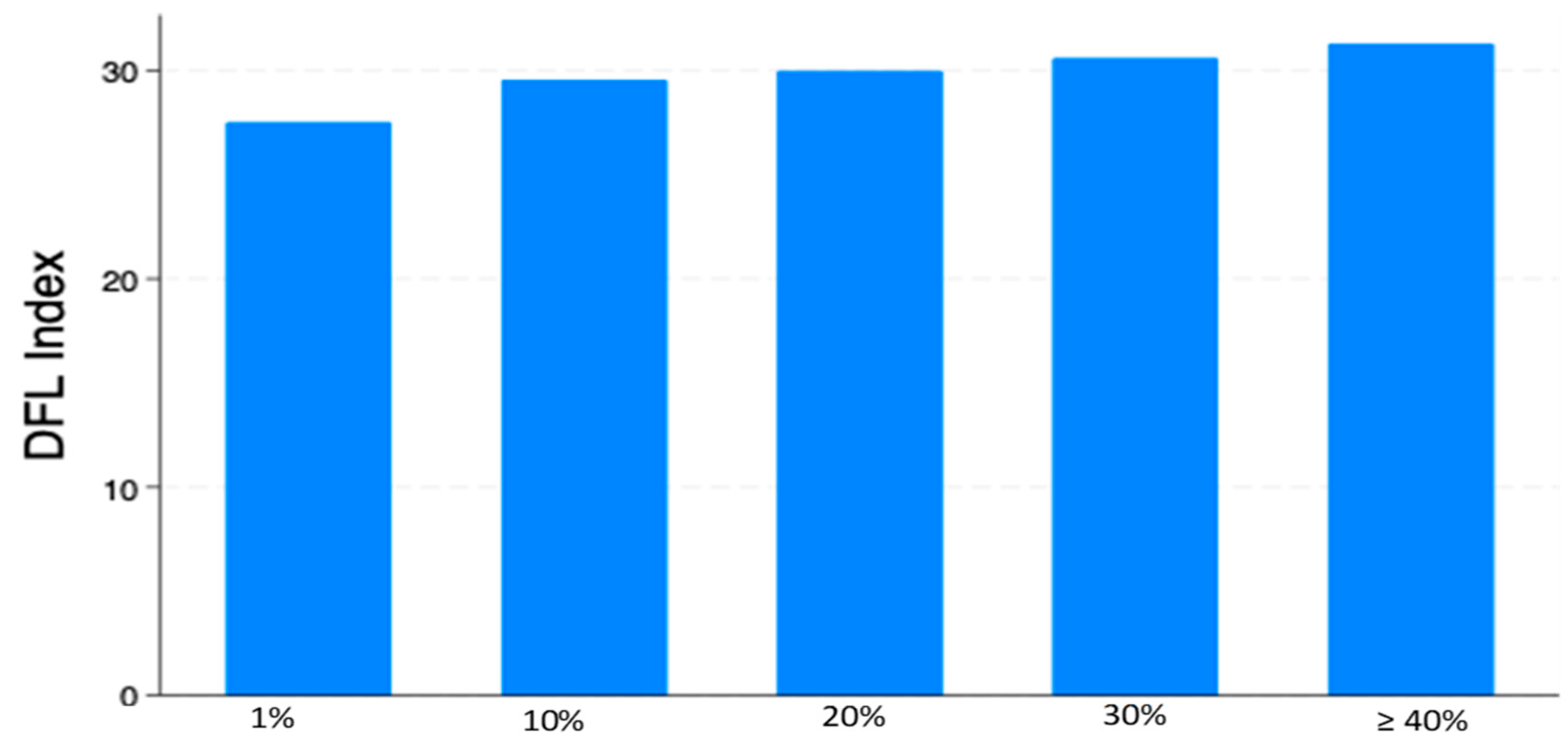
| DFL Index a | 30.24 | 4.572 | 7 | 36 |
| Investment grip | 0.245 | 0.127 | 0.01 | 0.4 |
| Investment grip (Binary) | 0.472 | 0.499 | 0 | 1 |
| Investment grip (Categorical) b | - | - | - | - |
| 1% | 0.048 | |||
| 10% | 0.240 | |||
| 20% | 0.240 | |||
| 30% | 0.157 | |||
| ≥40% | 0.315 | |||
| Male | 0.676 | 0.468 | 0 | 1 |
| Age | 46.356 | 12.219 | 18 | 90 |
| Age Square | 2298.163 | 1175.832 | 324 | 8100 |
| Married | 0.672 | 0.469 | 0 | 1 |
| Having a Child | 0.592 | 0.491 | 0 | 1 |
| University Degree | 0.644 | 0.479 | 0 | 1 |
| Unemployed | 0.069 | 0.254 | 0 | 1 |
| Annual Income | 7,721,102.5 | 4,288,951.6 | 1,000,000 | 20,000,000 |
| Annual Income (Logarithm scale) | 15.69 | 0.621 | 13.816 | 16.811 |
| Household Financial Asset | 21,667,869 | 25,580,218 | 2,500,000 | 1.000 × 10⁸ |
| Household Financial Asset (Logarithm scale) | 16.279 | 1.111 | 14.732 | 18.421 |
| Myopic View of the future | 0.152 | 0.359 | 0 | 1 |
| Risk Aversion | 0.535 | 0.238 | 0 | 1 |
| Number of Observations: 149,261 | ||||
| Dependent Variable: Investment Grip | ||||
|---|---|---|---|---|
| Variables | Model 1.1 | Model 2.1 | Model 3.1 | Model 4.1 |
| DFL Index | 0.2196 *** | 0.2148 *** | 0.1775 *** | 0.1768 *** |
| (0.0031) | (0.0031) | (0.0032) | (0.0032) | |
| Male | 0.3804 *** | 0.3803 *** | 0.3816 *** | |
| (0.0061) | (0.0062) | (0.0062) | ||
| Age | 0.0373 *** | 0.0273 *** | 0.0270 *** | |
| (0.0015) | (0.0017) | (0.0017) | ||
| Age Square | −0.0005 *** | −0.0004 *** | −0.0004 *** | |
| (0.000) | (0.000) | (0.000) | ||
| Married | −0.0337 *** | −0.0857 *** | −0.0865 *** | |
| (0.0075) | (0.008) | (0.008) | ||
| Having a Child | −0.0555 *** | −0.0218 *** | −0.0233 *** | |
| (0.0074) | (0.0074) | (0.0074) | ||
| University Degree | −0.0553 *** | −0.0521 *** | ||
| (0.0062) | (0.0062) | |||
| Unemployed | 0.0104 | 0.0099 | ||
| (0.013) | (0.013) | |||
| Annual Income | −0.0088 | −0.0086 | ||
| (0.006) | (0.006) | |||
| Household Financial Asset | 0.2313 *** | 0.2327 *** | ||
| (0.0031) | (0.0031) | |||
| Risk Aversion | −0.0939 *** | |||
| (0.0124) | ||||
| Myopic View of the future | 0.0038 | |||
| (0.0079) | ||||
| /cut1 | −1.6864 *** | −0.8486 *** | 2.2711 *** | 2.2472 *** |
| (0.0056) | (0.0377) | (0.0892) | (0.0894) | |
| /cut2 | −0.5551 *** | 0.3045 *** | 3.4525 *** | 3.4289 *** |
| (0.0035) | (0.0376) | (0.0894) | (0.0895) | |
| /cut3 | 0.0873 *** | 0.959 *** | 4.126 *** | 4.1025 *** |
| (0.0033) | (0.0376) | (0.0895) | (0.0896) | |
| /cut4 | 0.5084 *** | 1.3883 *** | 4.5668 *** | 4.5434 *** |
| (0.0034) | (0.0377) | (0.0896) | (0.0897) | |
| Observations | 149,261 | 149,261 | 149,261 | 149,261 |
| Pseudo R2 | 0.0131 | 0.0245 | 0.0396 | 0.0398 |
| Delta-Method | ||||||
|---|---|---|---|---|---|---|
| dy/dx | Std. Err. | z | p > |z| | [95% Conf. Interval] | ||
| DFL Index | −0.017 | 0.000 | −49.140 | 0.000 | −0.017 | −0.016 |
| Male | −0.036 | 0.001 | −53.190 | 0.000 | −0.037 | −0.034 |
| Age | −0.003 | 0.000 | −16.100 | 0.000 | −0.003 | −0.002 |
| Age Square | 0.000 | 0.000 | 23.680 | 0.000 | 0.000 | 0.000 |
| Married | 0.008 | 0.001 | 10.690 | 0.000 | 0.007 | 0.009 |
| Child | 0.002 | 0.001 | 3.080 | 0.002 | 0.001 | 0.004 |
| University Degree | 0.005 | 0.001 | 8.320 | 0.000 | 0.004 | 0.006 |
| Unemployed | −0.001 | 0.001 | −1.040 | 0.297 | −0.004 | 0.001 |
| Log of Income | 0.001 | 0.001 | 1.710 | 0.088 | −0.000 | 0.002 |
| Log of Asset | −0.022 | 0.000 | −63.350 | 0.000 | −0.022 | −0.021 |
| Risk Aversion | 0.009 | 0.001 | 7.510 | 0.000 | 0.006 | 0.011 |
| Myopic View | −0.000 | 0.001 | −0.380 | 0.707 | −0.002 | 0.001 |
| Dependent Variable: Investment Grip Binary | ||||
|---|---|---|---|---|
| Variables | Model 1.1 | Model 2.1 | Model 3.1 | Model 4.1 |
| DFL Index | 0.2212 *** | 0.2139 *** | 0.1755 *** | 0.1749 *** |
| (0.0037) | (0.0037) | (0.0037) | (0.0037) | |
| Male | 0.3438 *** | 0.3482 *** | 0.3494 *** | |
| (0.0072) | (0.0074) | (0.0074) | ||
| Age | 0.0428 *** | 0.0312 *** | 0.031 *** | |
| (0.0021) | (0.0023) | (0.0023) | ||
| Age Square | −0.0005 *** | −0.0005 *** | −0.0005 *** | |
| (0.000) | (0.000) | (0.000) | ||
| Married | −0.047 *** | −0.0874 *** | −0.0881 *** | |
| (0.0088) | (0.0095) | (0.0095) | ||
| Having a Child | −0.0666 *** | −0.0305 *** | −0.0319 *** | |
| (0.0087) | (0.0088) | (0.0088) | ||
| University Degree | −0.0803 *** | −0.0772 *** | ||
| (0.0074) | (0.0074) | |||
| Unemployed | −0.0161 | −0.0166 | ||
| (0.0161) | (0.0161) | |||
| Annual Income | −0.036 *** | −0.0358 *** | ||
| (0.007) | (0.007) | |||
| Household Financial Asset | 0.2463 *** | 0.2475 *** | ||
| (0.0037) | (0.0037) | |||
| Risk Aversion | −0.0887 *** | |||
| (0.0143) | ||||
| Myopic View of the future | 0.0065 | |||
| (0.0093) | ||||
| _cons | −0.0882 *** | −1.058 *** | −3.989 *** | −3.968 *** |
| (0.0033) | (0.0467) | (0.105) | (0.1052) | |
| Observations | 149,261 | 149,261 | 149,261 | 149,261 |
| Pseudo R2 | 0.0199 | 0.0363 | 0.0614 | 0.0616 |
Disclaimer/Publisher’s Note: The statements, opinions and data contained in all publications are solely those of the individual author(s) and contributor(s) and not of MDPI and/or the editor(s). MDPI and/or the editor(s) disclaim responsibility for any injury to people or property resulting from any ideas, methods, instructions or products referred to in the content. |
© 2026 by the authors. Licensee MDPI, Basel, Switzerland. This article is an open access article distributed under the terms and conditions of the Creative Commons Attribution (CC BY) license.
Share and Cite
Bawalle, A.A.; Lal, S.; Khan, M.S.R.; Kadoya, Y. Digital Financial Literacy and Investment Grip: A Study of Japanese Active Investors. Int. J. Financial Stud. 2026, 14, 25. https://doi.org/10.3390/ijfs14020025
Bawalle AA, Lal S, Khan MSR, Kadoya Y. Digital Financial Literacy and Investment Grip: A Study of Japanese Active Investors. International Journal of Financial Studies. 2026; 14(2):25. https://doi.org/10.3390/ijfs14020025
Chicago/Turabian StyleBawalle, Aliyu Ali, Sumeet Lal, Mostafa Saidur Rahim Khan, and Yoshihiko Kadoya. 2026. "Digital Financial Literacy and Investment Grip: A Study of Japanese Active Investors" International Journal of Financial Studies 14, no. 2: 25. https://doi.org/10.3390/ijfs14020025
APA StyleBawalle, A. A., Lal, S., Khan, M. S. R., & Kadoya, Y. (2026). Digital Financial Literacy and Investment Grip: A Study of Japanese Active Investors. International Journal of Financial Studies, 14(2), 25. https://doi.org/10.3390/ijfs14020025