Article

How Environmental Uncertainty Drives Asymmetric Mispricing in China: Dual Channels and Heterogeneous Media Effect

1
School of Accounting, Henan University of Engineering, Zhengzhou 451191, China
2
School of Economics and Management, Shihezi University, Shihezi 832003, China
*
Author to whom correspondence should be addressed.
Int. J. Financial Stud. 2026, 14(1), 23; https://doi.org/10.3390/ijfs14010023
Submission received: 12 December 2025 / Revised: 7 January 2026 / Accepted: 8 January 2026 / Published: 14 January 2026

Abstract

The essay delves into the impact of environmental uncertainty on asymmetric mispricing, utilizing the data from listed firms in China spanning from 2007 to 2023. Our analysis reveals that environmental uncertainty amplifies stock mispricing within capital markets, whether upward or downward. Diverging from prior research, we distinguish between upward and downward mispricing and reveal the black box of environmental uncertainty affecting stock mispricing from dual channels. Specifically, environmental uncertainty intensifies upward mispricing through heightened earnings management and exacerbates downward mispricing by boosting investor irrationality. Furthermore, we explore the heterogeneous impact of different media coverage. In the downward mispricing sample, negative media exacerbated the relationship between the two, while positive coverage played a mitigating role. In the upward mispricing sample, only negative reports have a significant impact and mitigate the impact of uncertainty on mispricing. Our research on media heterogeneity once again proves that it is a double-edged sword. Our research indicates that improving the capacity to recognize different mispricing mechanisms in various market directions can greatly boost decision-making efficiency. Meanwhile, it is vital to strengthen professional ethics in media organizations and encourage more objective reporting. These efforts can jointly contribute to improving the efficiency of emerging capital markets.

1. Introduction

The Efficient Markets Hypothesis (EMH), as propounded by Fama in 1970, maintains that securities prices are able to instantaneously reflect the information in capital, and that any attempts at arbitrage aimed at achieving excess returns are precluded. However, numerous market anomalies have repeatedly surfaced, casting doubt on the validity of the EMH. The capital market has been chronically mispriced, with stock prices frequently straying from their inherent worth (Lee et al., 1999). This results in the capital market’s capital allocation function operating inefficiently, hampering its healthy growth, and posing a significant threat to financial security.
The operational activities of enterprises are inherently influenced by their surrounding environment. Under the shifting economic landscape and escalating geopolitical tensions, global enterprises are confronted with varying degrees of environmental uncertainty (Eichengreen, 2024). This uncertainty poses numerous challenges. It complicates strategic planning, heightens the risks associated with future business operations, and exposes enterprises to significant performance fluctuations (Kim & Yasuda, 2021). Meanwhile, it exacerbates the level of information asymmetry, obscuring the actions of management and affording them greater opportunities to conceal mismanagement and other self-serving behaviors, leading external investors to find it increasingly difficult to monitor these enterprises (Hu & Wang, 2022).
Since 1978, following the reform and opening-up policy, the Chinese economy has entered a period of rapid growth. The rise in economic status has also brought more impact from changes in the domestic and international environment, resulting in high uncertainty for companies in various industries (O’Connor et al., 2012). As environmental uncertainty increases, so does the degree of information asymmetry between market participants, which affects not only management decisions but also investors’ judgments (Venky et al., 2019), so it cannot be ignored in exploring the pricing efficiency of capital markets. Compared with the mature securities markets in Europe and America, China’s securities market system is not perfect, and the investors are mainly individual investors. So, the performance of the securities market is not in line with economic development. The Chinese capital market, represented by the emerging economy, has more specificities. Whether environmental uncertainty, as an external factor, will seriously impact the capital market remains to be explored. How does it influence stock price mispricing? What are the underlying channels through which this impact materializes? How do the mechanisms driving asymmetric mispricing differ? Can media coverage effectively exert its governance mechanism? Do the effects of heterogeneous media coverage also display variations? This paper aims to address these questions in sequence.
We explore the impact of environmental uncertainty on stock mispricing using Chinese samples from 2007 to 2023. It is found that environmental uncertainty exacerbates the phenomenon of stock mispricing in the capital market. After distinguishing the direction of mispricing, we find that environmental uncertainty exacerbates upward-biased mispricing by increasing surplus management and downward-biased mispricing by increasing investor irrationality. Furthermore, we explore the heterogeneous impact of different media coverage. In the downward mispricing sample, negative media exacerbated the relationship between the two, while positive coverage played a mitigating role. In the upward mispricing sample, only negative reports have a significant impact, and alleviate the impact of environmental uncertainty on stock mispricing. Therefore, environmental uncertainty is one of the important factors affecting the pricing efficiency of capital markets. Our findings carry concrete implications for regulators, corporate managers, investors, and media institutions in emerging markets.
This article contributes to the literature from three perspectives. First, it constructs and applies a ‘macro-environment → micro-subject → macro-finance’ analytical framework—which can be succinctly described as a ‘macro-micro-macro’ transmission logic—to examine how uncertainty influences financial market outcomes. Specifically, we trace the channel from broad environmental uncertainty (macro) to firm-level decision-making and disclosure (micro), and ultimately to market-wide pricing efficiency (macro). While prior studies have clearly conceptualized environmental uncertainty (Drago, 1998; Manolis et al., 1997) and examined its economic consequences—such as corporate investment efficiency (Bloom et al., 2007), financing constraints (Talavera et al., 2012), and information quality (Y. Chen et al., 2018)—they have largely remained at the firm level and have not systematically explored its transmission to capital market outcomes. Our framework explicitly addresses this gap by analyzing how environmental uncertainty affects stock mispricing, thereby extending the research on the economic.
Second, it reveals the channels through which changes in the external environment affect the stock market from the perspectives of management and investors of capital market participants in China. The majority of instances of mispricing phenomenon in the capital market is caused by the irrational behavior of investors (M. Baker & Wurgler, 2007). Our study discusses the impact of environmental uncertainty on stock mispricing through two distinct channels by distinguishing the direction of mispricing. We observe that environmental uncertainty amplifies management earnings manipulation, leading to upward deviation in stock mispricing. Meanwhile, it increases investors’ irrationality, leading to mispricing and downward deviation of stocks. Beyond distinguishing mispricing, we delve further into the varying impacts of media reports with differing attitudes. This study helps us to better understand the causes of mispricing and provides an empirical basis for studying capital markets in transition economies.
Third, it indicates the existence of subjective media coverage. The effectiveness of media coverage in governance has always been controversial. We divided two sample groups, positive bias and negative bias, to explore the moderating effect of media coverage on the relationship between the two. In the downward mispricing sample, negative media coverage intensified the relationship, while positive coverage lessened it. In the upward mispricing sample, only negative reports had a significant impact, reducing the effect of environmental uncertainty on stock mispricing. It suggests that the emotional effects of media reports will be transmitted to the capital market, and also verifies that heterogeneous media reports have challenged the principle of objectivity.

2. Background

China, the largest emerging economy, opened its capital market only three decades ago, yet foreign firms flooded in after WTO entry and growth exploded (Wang, 2019; Stopford, 1994). Rapid expansion has left the market structurally unbalanced, distorting capital allocation and curbing further gains (Du et al., 2020). Retail investors—irrational and jittery—still dominate trading (Hu & Wang, 2024), while global turmoil keeps Chinese firms under high uncertainty. With the acceleration of technological progress, the continuous increase in the number of enterprises and the downward pressure of the economic situation, it is difficult for Chinese enterprises with weak competitiveness to deal with strong environmental uncertainty. There, not only the management but also the individual investors are influenced by the environmental uncertainty and become more and more irrational, which will obstruct Chinese capital market efficiency (Venky et al., 2019). Under environmental uncertainty, it is imperative to find ways to perfect the market system of the capital and strengthen the international competitiveness of the capital market so as to deepen the policy of reforming and opening, and accelerating the construction of the socialist market economy. That is why we conducted the research in China, which is fairly different from developed nations.

3. Hypothesis Development

3.1. Environmental Uncertainty and Mispricing: An Overall Analysis

Affected by global economic integration, the relationship between enterprises is becoming closer and closer, and the impact of the external environment is becoming more and more serious (Zhuang & Duan, 2025), increasing the environmental uncertainty faced by enterprises. This environmental uncertainty comes from the unpredictable and discontinuous degree of change (such as policy change, technology disruption, demand shock) in the external macro- and meso-environment, and its final performance is reflected in the fluctuation of enterprise performance. And the occurrence of unobservable behaviors of suppliers upstream of and customers downstream of the supply chain, market competitors and regulators will also increase the uncertainty faced by enterprises (Satyanarayan, 1999).
Whether at the enterprise level or the individual levels of investors, their decisions will be affected by the uncertainty of the environment. This study will focus on the core variable of corporate environmental uncertainty and analyze its impact on mispricing in the capital market, which is mainly reflected in the following two aspects. For one thing, environmental uncertainty sends unfavorable signals to the capital market, which can affect investors’ emotions and interfere with their decisions. The human brain has a limited capacity for memory and perceptual analysis, so investors can only use limited time and energy to process a large amount of information and make investment judgments (Dellavigna & Pollet, 2009). Based on the information transmission perspective, environmental uncertainty distracts investors’ attention, and the risk information it transmits enhances investors’ irrational cognition, leading to biased investment behavior (Nadiri & Panahian, 2024), which in turn affects stock prices. In addition, environmental uncertainty fundamentally worsens the corporate information environment. It increases the volatility of firm performance (Kim & Yasuda, 2021), which provides management with both the motive and a convenient pretext for earnings manipulation—such as income smoothing to maximize personal compensation or career prospects (Y. Chen et al., 2024). This opportunistic behavior directly distorts the information set available to outsiders. Meanwhile, environmental uncertainty increases the information asymmetry of participants in the market, making it more difficult for stakeholders to predict and monitor management’s behavior, and providing them with convenient conditions to hide decision failures and conceal operational misconduct (Merchant, 1990; Baum et al., 2010). Earnings manipulation is not only a whitewash of the company’s operating results, but also a cover-up of company-level information (Dai & Ngo, 2021), which in turn reduces the information content of stock prices and leads to mispricing as stock prices deviate from their true value. As a result, when firms face more uncertainty, their stocks are more mispriced in the markets. We develop the hypothesis:
H1. 
Environmental uncertainty exacerbates stock mispricing in China’s capital markets.

3.2. Environmental Uncertainty and Mispricing: Distinguishing Mispring Direction

Environmental uncertainty magnified the performance fluctuation and provided the management with the cover of ‘homeopathy’ manipulation. Both compensation and reputation are bound to the stock price, which has sufficient motivation to adjust profits upward: recognizing revenue in advance and postponing expenses to hedge against negative impacts and meet expectations. This kind of one-way earnings management distorts the real signal transmitted by enterprises and artificially creates more optimistic fundamentals (Y. Chen et al., 2024). It is difficult to identify investors with the lack of information, and the market will inflate the performance partially or completely due to the lack of conclusive evidence to discount them. Irrational investors will be hoodwinked and further push up the share price. As a result, the negative risks are underestimated and the positive signals are amplified, forming a systematic overestimation. Based on this, we develop the hypothesis:
H1a. 
Environmental uncertainty exacerbates the positive stock mispricing.
The systematic deviation of investors’ expectations for the future has been amplified with the information environment. Environmental uncertainty may lead to blind optimism, but also to a sudden collapse of confidence. Both of them highlight bounded rationality. When negative signals are dominant, information overload triggers cognitive bottlenecks, and anxiety and loss aversion dominate. Investors are more likely to pay attention to and amplify negative clues, and demand excessive risk premiums or direct selling with ‘one size fits all’ pessimistic expectations (Nadiri & Panahian, 2024). The selective negative coverage of uncertainty by the external media further solidifies this deviation and continues to expand the prediction error (Y. W. Chen et al., 2019). The result is that the stock price overreacts to the risk side and underreacts to the potential real value, thus forming a systematic downward mispricing at the group level. Based on this, we develop the hypothesis:
H1b. 
Environmental uncertainty exacerbates the negative stock mispricing.

4. Research Design

4.1. Sample and Data

This article takes the Chinese A-share companies from 2007 to 2023 as the original sample and performs the following operations to clean the data: (i) excluding the samples in the financial and insurance industry; (ii) excluding ST samples; (iii) excluding IPO samples in the current year; (iv) excluding the samples with missing data. Finally, a total of 21,478 firm-year samples is obtained in the study. The samples that are below 1% and above 99% of continuous variables were adjusted by winsoring.
The financial data are sourced from the China Stock Market & Accounting Research Database (CSMAR). The market risk coefficients are obtained from the Wind Economic Database (WIND). Data on internal control quality come from the DIB Internal Control and Risk Management Database (DIB), and media attention data are collected from the Chinese Research Data Services Platform (CNRDS). Then, we process data and graph by using Stata 17.

4.2. Variable Definition

4.2.1. Environmental Uncertainty (EU)

The operational stability of an enterprise serves as a reflective proxy for the equilibrium prevalent in its external environment, which posits that heightened levels of environmental uncertainty manifest in increased volatility within the revenue and profit streams of enterprises. Conversely, diminished environmental volatility is typically associated with more stable financial outcomes. Hence, employing fluctuations in enterprise performance as an indirect metric for environmental uncertainty has gained wide acceptance in contemporary scholarly discourse. This approach is esteemed as a viable ex post measure, adeptly capturing the residual impact or ‘trace’ of environmental uncertainty as it is etched into the corporate financial performance outcomes. We concur with the conclusion that excluding the steady growth component from operating revenue allows the remaining abnormal growth to more accurately reflect EU (Ghosh & Olsen, 2009). So, we employ Equation (1) to compute the abnormal operating income of firms over the past five years, using it as a gauge to measure EU. After eliminating the systematic growth trend, the model reflects the unique deviation of the enterprise, and separates the overall fluctuations of the industry, so as to accurately capture the unique environmental impact faced by each enterprise, peel off the impact of the endogenous decision of the enterprise to the greatest extent, and enhance the exogenous decision of the measurement of environmental uncertainty. In Equation (1), SALE represents sales revenue, which is derived from the operating income item in the income statement. ACCPER denotes the accounting year. The residual term, εi,t, represents the fluctuation in sales revenue after eliminating time trends, reflecting unique and unpredictable business fluctuations at the enterprise level.
Specifically, we first estimate a time–trend regression of sales revenue by year for each firm using data from years t − 4 to t, and extract the regression residuals, denoted as εi,t, to capture firm-specific deviations that are purged from systematic growth trends. The standard deviation of εi,t over the five-year period is then divided by the absolute value of its mean to derive the unadjusted coefficient of variation, which reflects the volatility of firm-level abnormal income. It is imperative to isolate industry-wide fluctuations in order to accurately capture the distinct environmental impacts encountered by individual enterprises. To this end, the adjustment of the standard deviation of sales revenue is implemented to mitigate the confounding effects attributed to inherent industry characteristics. It also enhances the robustness of the empirical analysis. Then, we can obtain it from this step, which is environmental uncertainty (EU). And Equation (1) is specified as follows:
S A L E = ϕ 0 + ϕ 1 A C C P E R + ε i , t

4.2.2. Stock Mispricing (MIS)

Most of the literature on stock mispricing uses investor sentiment as a proxy, but the factors affecting stock mispricing are not only limited to investor sentiment. Here, we construct the variable MIS = |1 − V/P| to measure the absolute deviation of market value (P) from intrinsic value (V). If V/P = 1, the market value fully reflects the intrinsic value and there is no asset mispricing. If V/P < 1, the stock is overvalued and vice versa. Our explanatory variable, MIS, is constructed on this basis. The value range of MIS is (0, +∞), and the larger the value, the more severe the deviation of market value from intrinsic value.
We use the residual income model (RIM) to estimate the intrinsic value of listed companies and construct the mispricing index. On the one hand, RIM uses the book stock to lock in the accounting policy judgment and uses the residual flow to discount future profits, so as to incorporate the information of the balance sheet and the income statement into the same valuation framework. Compared with the dividend discount model, which only relies on flow data, rim’s use of stock information strengthens the hard constraint on the prediction path, and significantly reduces the estimation error caused by the subjective setting of parameters and the choice of accounting policies, so it has stronger robustness and applicability in emerging markets with large fluctuations in the institutional environment or imperfect dividend policies. On the other hand, classic rim applications usually rely on analysts’ earnings forecasts. But there are double deviations between insufficient coverage and systematic optimism in the Chinese market: large and high-performing companies are paid too much attention, while small- and medium-sized market capitalization and low-profit companies generally lack forecasts, which makes it difficult for them to meet the needs of large sample research. In order to alleviate the above problems, we follow the fundamental prediction ideas, replacing analysts’ earnings prediction with earnings estimation based on the company’s fundamental information prediction model (Hou et al., 2012).
V t = B t + F ( 1 ) t R × B t ( 1 + R ) + F ( 2 ) t R × B ( 1 ) t ( 1 + R ) 2 + F ( 3 ) t R × B ( 2 ) t ( 1 + R ) 2 × R
where Vt is the intrinsic value of the share, Bt is the book value per share, Rt is the cost of capital, and F (·) is the capital analyst’s forecast of the company’s future earnings. We use Equation (3) to predict the earnings of companies in the next three years and bring the coefficients in Equation (3) into Equation (2) to obtain the intrinsic value (Vt). Then, we gain a more holistic understanding of stock mispricing, accounting for a broader range of factors beyond just investor sentiment.
E A R N i , t + j = β 0 + β 1 A S S E T i , t + β 2 D I V i , t + β 3 D D i , t + β 4 E A R N i , t + β 5 L O S S i , t + β 6 A C C i , t + δ i , t + j
where EARNi,t+1 is the earnings per share of company i for the next one to three years, ASSETi,t is total assets per share, DIVi,t is cash dividends per share, DDi,t is whether dividends are paid, LOSSi,t is whether the company is loss-making, and ACCi,t, is accruals per share.

4.3. Model Design

The models are described in Equation (4), where α1 tests the impact of environmental uncertainty on the stock mispricing. And industry dummy variables and year dummy variables are added to control for the effects of year macroeconomic fluctuations and industry differences on the test results. If the environmental uncertainty facing a firm exacerbates the mispricing of its stock, we predict that the coefficient α1 is positive.
M I S i , t = α 0 + α 1 E U i , t + C o n t r o l s + ε i , t
where MISi,t is the degree of absolute deviation of market value (Pt) from intrinsic value (Vt). EUi,t is measured as the coefficient of variation in sales income. SIZEi,t is the log of total market value of equity at the end of year t. LEVi,t is the ratio of total liabilities to total market value of equity at the year t. BETAi,t is the risk coefficient of market risk of the year t. GROWTHi,t is the net assets growth rate of the year t. ROAi,t is the net income divided by total assets of the year t. AGEi,t is the natural logarithm of the length of listing year plus 1. TURNi,t is the turnover rate of the year t. COMi,t is the degree of separation of the business’s operating rights from its ownership during the year t. εi,t is the error term. Please refer to Table 1.

5. Empirical Results

5.1. Descriptive Statistics

The descriptive statistics of key variables are presented in Table 2. If the capital market is efficient, the stock price of the company should accurately reflect the intrinsic value of listed companies in a timely manner. However, the mean value of the explanatory variable MIS is 0.300, the median value is 0.230, and the maximum value is 1.27, which indicates that the deviation of stock price from the intrinsic value of listed companies in China’s capital market is common. The maximum value of EU is 6.720, and the minimum value is 0.130, which indicates that the environmental uncertainty faced by different companies varies widely. The control variables’ characteristics are in agreement with prior studies.

5.2. Correlation Analysis

Panel A in Table 3 reports the correlation coefficient matrix, and Panel B reports VIF values. The positive correlation between EU and MIS at 1% significance level suggests that environmental uncertainty exacerbates stock mispricing and the hypothesis of this paper is tentatively tested. Meanwhile, all the correlation coefficients between variables are less than 0.8 in Panel A, and the maximum value of VIF in the same model is 1.53 in Panel B, far less than 10. Based on the variance expansion factor (VIF) and correlation coefficient test, it is shown that Equation (4) does not have a substantial multicollinearity problem.

5.3. Main Results

We explore the impact of environmental uncertainty (EU) on stock mispricing (MIS) through regressing Equation (4). The results are shown in Table 4. We can draw from column (1) in Table 4 that the coefficient of EU (α1) is 0.017, which is significant at the 1% level, suggesting that environmental uncertainty (EU) exacerbates the stock mispricing (MIS) significantly without considering the control variables. As listed by column (2) in Table 4, including the whole control variables, α1 is 0.015 after regressing Equation (4), and it still keeps positive at the 1% significant level. From the results shown in Table 4, we conclude that the higher the environmental uncertainty faced by enterprises, the more severe the mispricing of their stocks in the capital market. That means that for every 1% increase in the standard deviation of environmental uncertainty, the stock value mispricing increases by 5.8%. H1 is verified, which proves that environmental uncertainty indeed exacerbates the stock mispricing.
The mispricing of stock prices for listed companies in the market results in two scenarios: upward overestimation and downward underestimation. We conduct separate regression analyses on these two scenarios. Specifically, samples with market prices exceeding their intrinsic values are classified as the overvaluation group (upward bias), while those with market prices below their intrinsic values are classified as the undervaluation group (downward bias). The results of applying Equation (4) to both sample groups are presented in columns (3)–(4) of Table 4. The coefficient on EU (α1) is positive and significant at 1% in columns (3)–(4), which is consistent with the previous results. That is, environmental uncertainty exacerbates both the upward and downward mispricing of stock.

6. Robustness Tests

To ensure the robustness of our findings, we conduct a series of robustness tests using various methods. These included eliminating certain samples, distinguishing the direction of stock mispricing, substituting the measurement of variables and conducting placebo tests. Additionally, to address potential issues of omitted variables and reverse causality, we carry lag explanatory variables, adopt a fixed effects model and employ the instrumental variable method.

6.1. Eliminating Samples

The financial crisis in 2008 had a huge impact on the Chinese and international capital market, which had a much greater impact on all walks of life (Rose & Spiegel, 2010). COVID-19 hit the global markets in early 2020, which shut down numerous industries and frustrated firms (Goldstein et al., 2021). In order to exclude the stock mispricing caused by the financial crisis and epidemic shock, we choose to exclude the sample from 2008 and 2020 to regress Equation (4), and the results are shown in column (1) of Table 5. Some studies have argued that the effects of the financial crisis and COVID-19 are relatively long-lasting, so we further excluded the 2008–2010 and 2020–2022 samples from the review to check the main conclusion. And the results are shown in column (2) of Table 5. The coefficient on EU (α1) is positive and significant at 1% in columns (1)–(2), which is consistent with the previous results.

6.2. Substituting the Measurement of Stock Mispricing

In the previous section, we utilized the firm’s own financial reporting data to derive the intrinsic value of the firm and assessed the extent of mispricing based on this. Here, we gauge the level of mispricing using the industry average as a benchmark (Berger & Ofek, 1995). Specifically, we first impute the base value of firms based on all firms in the industry for the current year. Then, we measure the level of mispricing of the firms relative to their industry peers by comparing the actual value of the firms to the base value, referring to Equation (5). Taking into account both positive and negative mispricing, we persist in capturing mispricing deviations in absolute terms (MIS2). We regress MIS2, replacing MIS in Equation (4), and the results are presented in column (1) of Table 6. The coefficient on EU (α1) is positive and significant at 1% in column (6), which is consistent with the previous results. It shows that measuring stock mispricing with a different benchmark does not cause a change in conclusions.
M I S 2 i , t = L n C a p i t a l i , t / I m p u t e d ( C a p i t a l i , t ) = L n C a p i t a l i , t / ( A s s e t s i , t × R a t i o d , t )

6.3. Substituting the Measurement of Environmental Uncertainty

While our primary measure of environmental uncertainty is well-established in the accounting and finance literature as a proxy for ex post, firm-perceived uncertainty (Ghosh & Olsen, 2009), we acknowledge the slight distinction between uncertainty originating from a firm’s external environment and its manifested outcome in firm performance. To mitigate this concern and ensure the robustness of our findings beyond a singular measurement approach, we employ the industry-level and macro-level proxies for environmental uncertainty.
When a higher number of competitors in the same industry means a higher level of competition, then the environmental uncertainty faced by the firm increases accordingly. Adopting the methodology (Zhi & Hull, 2012), we use environmental complexity instead of measuring environmental uncertainty. Taking the three-level industry classification code updated by the China Securities Regulatory Commission in 2012 as the classification standard, the environmental complexity is quantified by calculating the natural logarithm of the number of enterprises in the same industry. This indicator is named EU2. We regress EU2, replacing EU in Equation (4). The coefficient on EU2 (α1) is positive and significant at 5% in column (2), which is consistent with the previous results. It indicates that environmental uncertainty significantly intensifies stock mispricing from both the micro-level perspective of abnormal sales revenue in firms and the meso-level perspective of industry complexity.
Macroeconomic uncertainty refers to the overall fluctuations in the entire economic system that are difficult to predict, such as policies, aggregate demand, and technological paradigms. It is the most macroscopic and exogenous shock source. Its external survival will lead to the increase in uncertainty faced by enterprises, which is reflected in the fluctuation of abnormal performance at the micro enterprise level. To capture broader regulatory and macroeconomic policy shocks, we utilize the China Economic Policy Uncertainty index developed by S. R. Baker et al. (2016) to measure environmental uncertainty at the macro level (EU3), which is based on the South China Morning Post. We regress EU3, replacing EU in Equation (4). The coefficient on EU3 (α1) is positive and significant at 1% in column (3), which is consistent with the previous results. This suggests that elevated macroeconomic policy uncertainty intensifies stock price mispricing, thereby underscoring the multifaceted uncertainties confronting enterprises and amplifying the mispricing of their stocks within capital markets.

6.4. Placebo Test

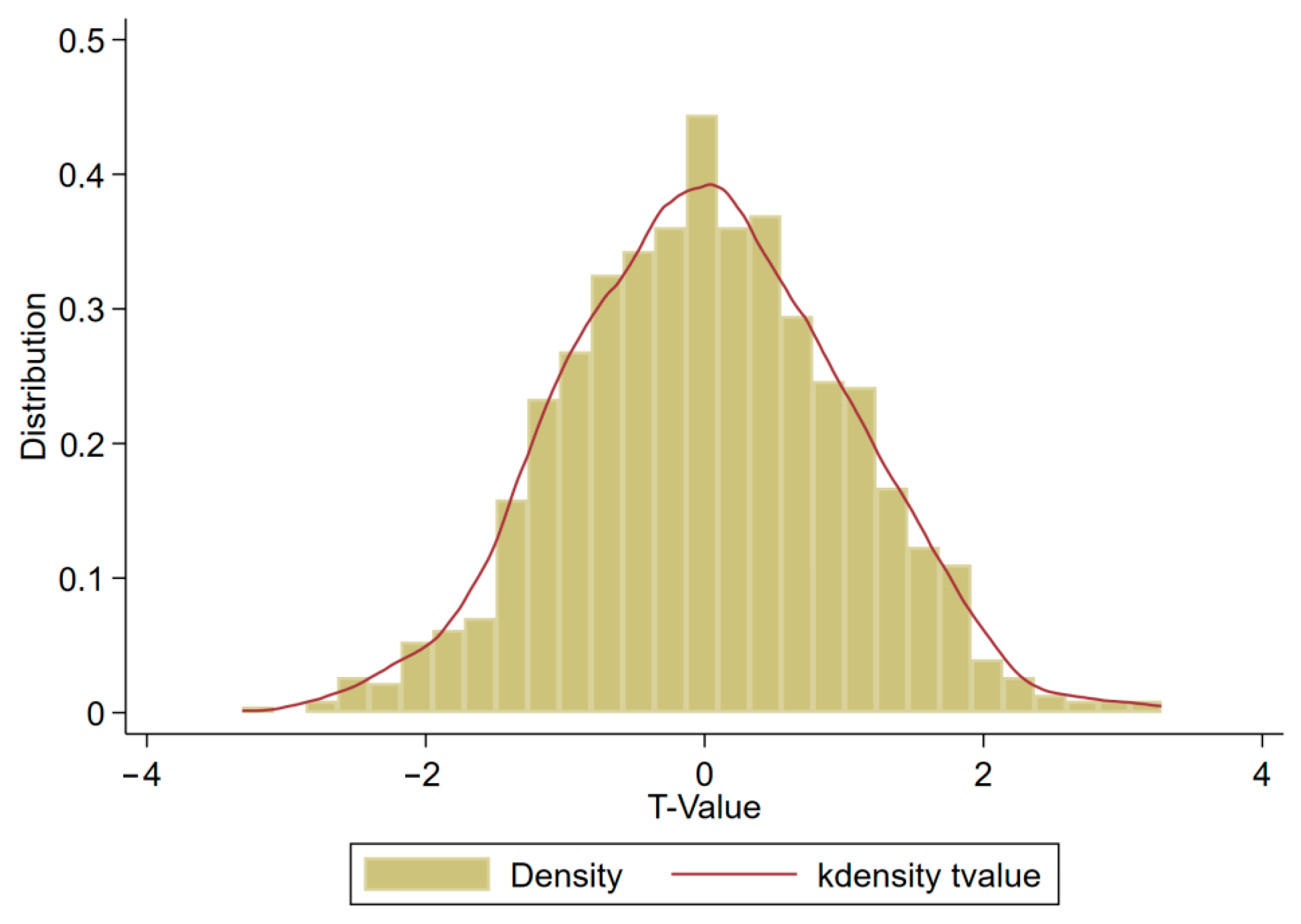
At the same time, it is also very important to prove that the conclusion of this paper is not the result of random generation and has economic significance. To rule out the possibility that the conclusion is a randomized result, we constructed a randomized trial group according to the research of Chetty et al. (2009), that is, all environmental uncertainty values (EU) are randomly assigned to all samples, and the random process is repeated 1000 times. It is shown in Figure 1 that the T-value of this randomized experiment is normally distributed around 0, and almost no random T-value is greater than the baseline T-value (10.00). So, the result reaches the expectation of the placebo test. It is shown that the results in this paper are regular rather than randomly generated.

6.5. Lag Explanatory Variables to Solve the Endogenous Problem of Reverse Causality

Given the cyclical nature of information transmission, stock prices may respond to environmental uncertainty with a lag. Meanwhile, it is also possible that firms’ contemporaneous stock mispricing affects their current exposure to environmental uncertainty, so there is a possibility of reverse causality. In order to test the lagged effect and rule out the possibility of reverse causality, we further regress the core explanatory variable EU with one to three lags. The late-stage EU is named LEU, L2EU, and L3EU. As shown in columns (1) to (3) of Table 7, the coefficients (α1) of environmental uncertainty for all lags are significantly positive and negative at the 1% level, which confirms that the conclusions are robust to different lags and are unlikely to stem from reverse causation.

6.6. Adopting a Fixed Effects Model to Solve the Endogenous Problem of Missing Variables

Although the influence of year and of the industry have been controlled, the influence of characteristic factors at the company level has not been effectively controlled. In order to solve the endogenous problem of missing variables caused by the individual characteristics of enterprises that do not change with time (such as corporate culture, management style, geographical location, etc.), we use the fixed effect models to retest the proposed hypothesis and control the individual effects of firms (Liao & Chen, 2020). We simultaneously include both firm and year fixed effects, removing individual characteristics that do not change over time and time shocks that do not vary across individuals. And the concrete finds are listed in column (4) of Table 7. α1 is 0.006 and significantly positive at 1%, which is consistent with the previous results. After controlling for individual fixed effects over time, we obtained a more accurate estimation result.

6.7. Instrumental Variable Method to Solve the Endogenous Problem of Reverse Causality

Although environmental uncertainty is relatively exogenous for micro enterprises, changes in company stocks in the capital market may lead to fluctuations in sales performance. It ultimately results in environmental uncertainty for the enterprise, constituting reverse causality. The lagged regression in columns (1)–(3) of Table 7 can only partially alleviate this problem. Therefore, we selected instrumental variables and re-estimated the model using two-stage least squares (2SLS) to alleviate potential endogeneity issues.
Then, we use the mean of industry environmental uncertainty excluding itself (MEU) as an instrumental variable (Jiang et al., 2017). The results are shown in columns (5)–(6) of Table 7. The coefficient between IV (MEU) and EU in column (5) was 0.982, significant at the 1% level, indicating that the instrumental and endogenous explanatory variables were significantly correlated. Both the CD and KP statistics were much greater than the 10% threshold and passed the weak instrumental variable test. Thus, the first-stage regression results of 2SLS rejected the null hypothesis of weak instrumental variables and showed a high correlation between explanatory variables and instrumental variables. We judge that MEU is an appropriate instrumental variable. After conducting the 2SLS method, the coefficient of EU in the second-stage regression results was significantly positive in column (6), confirming that the core conclusion is less affected by endogeneity.

7. Dual Channels Testing

7.1. Management Perspective: Earnings Manipulation

Previous studies have pointed out that environmental uncertainty will aggravate the degree of information asymmetry between firm management and external stakeholders (Y. Chen et al., 2018). When enterprises are faced with greater environmental uncertainty, the management has a strong incentive to whitewash the income and cover up the actual performance of the enterprise out of consideration of personal factors such as their salary and career development (Habib et al., 2010). Consequently, the stock price cannot truly and effectively reflect the enterprise’s performance, that is, the stock price deviates from its internal value.

7.2. Investor Perspective: Irrationality

Investor irrationality refers to the systematic bias in investors’ expectations about the future, which is vulnerable to the information environment and is a vital factor affecting stock pricing and market volatility. The increase in environmental uncertainty is not only a risk but also a challenge for investors, which may improve investors’ optimistic expectations, but also lead to the frustration of some investors’ confidence, but either way, the fluctuations are a reflection of investors’ limited rationality. The aggravation of investors’ irrationality makes it easier to produce deviation in future prediction, which affects their investment decisions (Y. W. Chen et al., 2019). The biased orientation of external media toward environmental uncertainty further exacerbates investors’ irrational cognition and judgment, which in turn leads to the mispricing of stocks in the capital market.

7.3. Channel Test Design

To test the channels, we use the mediating effects methods to verify the channels of environmental uncertainty on the stock mispricing (Wen & Fan, 2015), and the models we used are described in Equations (6) and (7).
M E D i , t = γ 0 + γ 1 E U i , t + C o n t r o l s + ε i , t
M I S i , t = λ 0 + λ 1 E U i , t + λ 2 M E D i , t + C o n t r o l s + ε i , t
where MED is the mediating variable, earnings manipulation (EM) and investor irrationality (LIM). Following prior studies (Dechow & Dichev, 2002), we calculate the manipulable accrued surplus using the Modified Jones Model and use it to measure earnings manipulation in year t (EM). For individual investors, institutional investors are more sophisticated and mature (Collins et al., 2003), so we take the percentage of the institutional investors’ shareholding in year t as a proxy variable for investor irrationality (LIM).

7.4. Result Analysis

7.4.1. Earnings Management Channels

Referring to prior studies, we use Equations (4), (6) and (7) to test the channels effect. And the results are reported in Table 8. When MED is EM, we find that α1 is 0.015 and significant in column (1). And next, the coefficient γ1 in Equation (6) is 0.002 in column (2), which is positive and significant. Then, we check the coefficient on MED in Equation (7), which is −0.066 in column (3), which is negative and significant. According to the test procedure, the symbols of γ1λ2 and λ1 are different. In the entire sample, the mediating effect of earnings management is not significant, and we judge it as a masking effect. According to the statistical definition, when the sign of indirect effect (γ1λ2) is opposite to that of direct effect (λ1), the direct effect will be partially offset, resulting in the total effect being ‘masked’. This full-sample result is not a contradiction of the theory, but a preliminary support for our ‘two channel asymmetric model’. Its economic intuition is that in the whole sample, there are two forces in opposite directions at the same time. Environmental uncertainty can either stimulate upward earnings manipulation (trying to push up stock prices) or exacerbate downward investor irrationality (suppressing stock prices).
When we mix the up and down bias in one sample, the two reverse mechanisms will interfere with each other, resulting in the net mediation effect of EM being not significant, or even masked. So, we divide the samples according to the direction of stock price bias and test whether there are differences in the channel effects of earnings management in different samples. Columns (4)–(6) report the results of the surplus management channel inspection in the sample with upward bias. We find that α1 is 0.017 and significant in column (4). And next, the coefficient γ1 in Equation (6) is 0.002 in column (5), positive and significant. Then, we check the coefficient on MED in Equation (7), which is 0.031 in column (6), which is positive and significant. The symbol of γ1λ2 and λ1 is the same, indicating that earnings management has played a channel/intermediary effect in samples with upward bias. That is to say, environmental uncertainty exacerbates the upward mispricing of stocks by exacerbating earnings management for companies. Columns (7)–(9) report the results of the surplus management channel tests in the sample with downward bias. We find that α1 is 0.006 and significant in column (7). The coefficient γ1 in Equation (6) is 0.004 in column (8), which is positive and significant. Then, we check the coefficient on MED in Equation (7), which is −0.065 in column (9), which is negative and significant. The symbol of γ1λ2 and λ1 are different, indicating that the mediating effect of earnings management is not significant and is also a masking effect.
Therefore, we conclude that earnings management only played a mediating effect in samples with upward bias. In the case of overvalued stock prices, environmental uncertainty mainly drives this result by intensifying the opportunistic earnings manipulation of management (information asymmetry channel).

7.4.2. Investor Irrationality Channels

The results of investor irrationality channels are reported in Table 9. When MED is LIM, we find that α1 is 0.015 and significant in column (1). Next, the coefficient γ1 in Equation (6) is 0.169 in column (2), which is positive and significant. Then, we check the coefficient on MED in Equation (7), which is −0.003 in column (3), which is negative and significant. According to the same procedure, the symbols of γ1λ2 and λ1 are different. So, the mediating effect of investor irrationality is not significant in the whole samples, and we judge it to be a masking effect. The results show that in the whole sample, the irrational existence of investors partially offsets or masks the real impact of environmental uncertainty on mispricing.
MIS measures absolute deviation, and its absolute value is large, regardless of whether it is overestimated or underestimated. If both optimism and pessimism can lead to large deviations, but they exist at the same time, the prediction relationship of MIS will become fuzzy or even negative. So, we still divide the sample based on the direction of stock price deviation to test whether there are differences in the irrational channel effects of investors in different samples. Columns (4)–(6) report the results of the investor irrationality channel test in the sample with upward bias. We find that α1 is 0.017 and significant in column (4). And next, the coefficient γ1 in Equation (6) is 0.137 in column (5), which is positive and significant. Then, we check the coefficient on MED in Equation (7), which is −0.009 in column (6), which is negative and significant. The symbol of γ1λ2 and λ1 are different, indicating that the mediating effect of investor irrationality is not significant and is also a masking effect. Columns (7)–(9) report the results of the investor irrationality channel tests in the sample with downward bias. We find that α1 is 0.006 and significant in column (7). The coefficient γ1 is 0.175 and significant in column (8). Then, we check if the coefficient λ2 on MED is 0.004 in column (9), which is positive and significant. The symbol of γ1λ1 and λ1 is the same, indicating that investor irrationality has played a channel/intermediary effect in samples with downward bias. That is to say, environmental uncertainty exacerbates the downward mispricing of stocks by exacerbating investor irrationality for companies.
Therefore, we conclude that investor irrationality only played the mediating effect in samples with downward bias. In the group of companies with low share prices, investors’ irrationality, aroused by environmental uncertainty, is clearly manifested as irrational pessimism. This pessimism magnifies the fundamental risk brought by uncertainty into a more serious share price repression force. This is the typical embodiment of ‘emotion driven pricing’ described by behavioral finance.

8. Heterogeneous Media Effect

8.1. Theory Analysis of Media

The external information environment is an important factor affecting enterprise decision-making and market pricing. As a ‘fourth power’ independent of the executive, legislative and judiciary, the media plays an indispensable role in messaging and governance oversight. Their improvement of the information environment helps to alleviate the phenomenon of stock mispricing under environmental uncertainty.
News media are an important channel for people to understand the world. From the perspective of communication, the media should be guided by the facts of communication, use objective and true judgment criteria to process and disseminate information, and become an important medium to alleviate information asymmetry (Y. Chen et al., 2020). In the previous discussion, we highlighted that information asymmetry and irrational investor behavior, both consequences of environmental uncertainty, lead to the phenomenon of stock mispricing. As a vital channel for information dissemination, media coverage plays a significant moderating role in mitigating this relationship. Firstly, the timely and effective information provided by media coverage enhances market transparency (Zaman et al., 2018), aiding investors in better understanding the impact of environmental uncertainty on firms. By increasing market transparency, media coverage helps investors grasp how environmental uncertainty affects firms. Secondly, media coverage can attract investors’ attention, directing them towards specific firms or industries. According to the attention-based theory, investors often adjust their investment decisions based on the frequency and content of media coverage. Therefore, an increase in media coverage can heighten investors’ focus on firm-specific information, thereby reducing mispricing caused by information neglect. Thirdly, media coverage serves as an external governance mechanism, ensuring that managerial decisions align with shareholder interests, further reducing stock mispricing due to managerial self-interest under environmental uncertainty (Cedergren et al., 2025). Thus, we believe that media reports have a negative regulatory effect on the relationship between the two. In other words, when the media attention is high, the aggravating effect of environmental uncertainty on stock mispricing will be weakened.
Considering the dual nature of media coverage—positive and negative—we further explore the impact of different types of media coverage on mispricing in different directions. Positive media coverage can alleviate the anxiety that environmental uncertainty brings to investors, thereby enhancing investor confidence. This may mitigate downward mispricing while potentially exacerbating upward mispricing. Conversely, negative media coverage may intensify the panic that environmental uncertainty induces in investors, leading to pessimistic expectations about stock prices (Jia et al., 2020). Thus, it may exacerbate downward mispricing while alleviating upward mispricing.

8.2. Media Mechanism Effect Design

According to the study design, we constructed Equation (8) for testing the regulatory mechanism, and we use the coefficient on EUi,tMVi,t as a basis for judgment. If it is negative and significant, α2 < 0, we believe that MV plays a mitigating role between environmental uncertainty and stock mispricing. And if it is positive and significant, α2 > 0, we concluded that MV plays an exacerbating role in both of them.
M I S i , t = α 0 + α 1 E U i , t + α 2 M V i , t + α 3 M V i , t × E U i , t + C O N T R O L S i , t + ε i , t
where MV stands for the moderator variable of media coverage (MEDIA), positive media coverage (MEDIA_P) and negative media coverage (MEDIA_N). The media coverage data comes from CNRDS, which utilizes NLP algorithms to preliminarily classify the emotional orientation (such as positive, negative, neutral) of each news item. Based on this, we conducted secondary structural processing: (i) MEDIAi,t is the natural logarithm of the number of news articles with company names in their headlines and content in year t plus one. (ii) MEDIA_Pi,t is the natural logarithm of the number of positive news with company names in year t plus one, and MEDIA_Ni,t is the natural logarithm of the number of negative news with company names in year t plus one.

8.3. External Information Environment Perspective

Table 10 reports the results for the regulatory mechanism test from the perspective of external information environment. Here, we focus on external media reports as our main research. From column (1), it is found that the coefficient on EUi,tMVi,t is −0.003, which is negative and significant, indicating that media reports mitigate the impact of environmental uncertainty on stock mispricing. Media reports have played an effective role in mediating information or external supervision. Its economic significance lies in that media attention has improved information transparency and market supervision, forcing management and investors to be more prudent in decision-making, thus buffering the damage of external shocks to pricing efficiency. This confirms the universal value of the media to play the role of external governance.
Furthermore, we explore whether there are differences in the roles played by different types of media reports. When MV is MEDIA_N, it is found that the coefficients on EUi,tMVi,t are −0.003 in column (2), which is negative and significant, indicating that negative media report mitigates the impact of environmental uncertainty on stock mispricing. Upon combining the data from columns (3) and (4), we observed that the coefficient α3 is significantly positive in the downward bias group, whereas it is significantly negative in the upward bias group. Negative media coverage exacerbates downward mispricing and alleviates upward mispricing. This conclusion is in line with our expectation that different types of media reports can shape the relationship between environmental uncertainty and stock mispricing by affecting investor sentiment. Negative media reports play an asymmetric regulatory role. When overestimating the wrong pricing, the negative emotions of negative media have a corrective effect, but when underestimating the mispricing, the negative emotions will magnify the downward mispricing.
When MV is MEDIA_P, it is that found the coefficients on EUi,tMVi,t is −0.002 in column (5), which is negative and significant, indicating that positive media reports mitigate the impact of environmental uncertainty on stock mispricing. Combining the data from columns (6) and (7), we found that α3 is significantly negative in the downward bias group, whereas it is not significant in the upward bias group. We concluded that positive media coverage mitigates downward mispricing but has no effect on the other group, indicating that the market’s feedback on positive information is positive under adverse environmental uncertainty. Therefore, the conclusion confirms that the media plays a negative regulatory role. Positive media reports play an asymmetric regulatory role, but when the mispricing is underestimated, its positive effect alleviates excessive pessimism, helps the market rediscover value, and returns the stock price to its intrinsic value. When overestimating and mispricing, the positive attitude of the media did not have a significant impact. It may be that in the optimistic atmosphere that the stock price has been frothy, and additional positive reports may be regarded by the market as icing on the cake or even cause suspicion that the benefits are all out, and its marginal information content and governance effect are limited.

9. Conclusions and Discussion

9.1. Conclusions

Research on stock mispricing determinants predominantly focuses on information asymmetry, investor sentiment, and market liquidity within developed markets. In contrast, China’s capital market, as the world’s largest emerging economy, has evolved under unique conditions characterized by rapid growth, structural imbalances, and frequent anomalies. While prior studies have established environmental uncertainty’s influence on corporate decisions (capital structure, investment behavior, governance, and risk-taking), its direct impact on stock mispricing in emerging markets remains underexplored.
Our investigation confirms persistent stock mispricing in China’s capital markets. Meanwhile, (1) the results reveal environmental uncertainty as a significant exacerbating factor with the framework ‘macro-environment → micro-subject → macro-finance’. And it is proved that environmental uncertainty is the independent exogenous driving force of A-share mispricing, surpassing the traditional company-level factors. (2) Channels analysis shows that environmental uncertainty intensifies upward-biased mispricing (positive) by increasing earnings management, and it intensifies downward mispricing (negative) by increasing investor irrationality. We reveal the black box between the two through the asymmetric dual channel perspective. (3) It is found that there is situational governance of media sentiment. Negative reports exacerbated pessimism but suppressed over optimism, while positive reports mainly alleviated underestimation, which decomposed the impact of macro uncertainty into verifiable micro pricing paths.
For emerging markets like China, our results underscore that improving pricing efficiency is a multi-front endeavor. It requires not only enhancing corporate governance to curb managerial opportunism but also fostering a healthier information environment to guide investor expectations and leveraging media’s dual potential for supervision and stabilization.

9.2. Discussion

Our findings carry concrete implications for regulators, corporate managers, investors, and media institutions in emerging markets. (i) For the regulator, it is imperative to make regulatory policies accurately adapted to the type of market mispricing. In order to combat upward mispricing (bubbles), priorities include strengthening the supervision of earnings quality to curb information asymmetry channels. In order to mitigate downward mispricing (panic-driven undervaluation), the focus should shift to stabilizing market sentiment, such as curbing the spread of unproven negative rumors. Policies should encourage balanced and responsible financial media coverage and optimize the market information environment. (ii) For corporate managers and boards, the board should anchor incentives to multi-year residual income or industry-relative returns, weaken the quarterly weight of stock prices, and reduce incentives for earnings manipulation. The management communicates with investors with clear, consistent, and forward-looking information, proactively dispelling doubts even when performance is under pressure, and reducing irrational selling due to amplified information gaps. (iii) For investors, improving their personal professionalism is an urgent issue to be addressed. Investor irrationality is one of the main causes of stock mispricing. Investors with professional knowledge can respond rationally to the impact of environmental uncertainty and fundamentally mitigate the phenomenon of capital market mispricing. (iv) For the media, authoritative sources of information must be disclosed when releasing media information, and unverified market rumors cannot be placed in the title or introduction of news articles. The disclosure of non-neutral news reports should be sufficient to prevent unilateral frameworks from triggering irrational behavior among investors.
We examine the flow of information from the external environment to the firm and to the capital market and the corresponding path of influence, and we indeed gain some conclusions. However, there are still many issues that have not been fully demonstrated in the paper and need to be gradually improved and perfected in future studies. We use the residual return valuation model method to measure stock mispricing (MIS), but this method uses data with a two-period lag, resulting in some missing data. So, it is necessary to study a more accurate way to measure it. Using exogenous shock events such as external policy changes and fluctuations in the economic environment as alternative measures of environmental uncertainty will enrich the experimental findings.


Author Contributions

Conceptualization, S.H.; methodology, S.H. and S.W.; software, S.H.; validation, S.H.; formal analysis, S.H.; data curation, S.H.; writing—original draft, S.H.; writing—review and editing, S.W.; supervision, S.W.; project administration, S.W. All authors have read and agreed to the published version of the manuscript.

Funding

This work was supported by Henan Soft Science Project (252400412058), Henan Provincial Department of Education Humanities and Social Science Research Project (2025-ZZJH-029), Henan University of Engineering Youth Doctoral High Goal Guidance and Cultivation Project (D2025104) and Shihezi University International cooperation program (GJHZ202101). I gratefully acknowledge the financial support from the funds.

Institutional Review Board Statement

Not applicable.

Informed Consent Statement

Not applicable.

Data Availability Statement

The original data source has been reflected in the section of the article (Section 4.1 Sample and Data). Further inquiries can be directed to the corresponding author.

Conflicts of Interest

The authors declare no conflict of interest.

References

  1. Baker, M., & Wurgler, J. (2007). Investor sentiment in the stock market. Journal of Economic Perspectives, 21(2), 129–152. [Google Scholar] [CrossRef]
  2. Baker, S. R., Bloom, N., & Davis, S. J. (2016). Measuring economic policy uncertainty. Quarterly Journal of Economics, 131(4), 1593–1636. [Google Scholar] [CrossRef]
  3. Baum, C. F., Caglayan, M., & Talavera, O. (2010). On the investment sensitivity of debt under uncertainty. Economics Letters, 106(1), 25–27. [Google Scholar] [CrossRef]
  4. Berger, P. G., & Ofek, E. (1995). Diversification’s effect on firm value. Journal of Financial Economics, 37, 39–65. [Google Scholar] [CrossRef]
  5. Bloom, N., Bond, S., & Reenen, J. V. (2007). Uncertainty and investment dynamics. Review of Economic Studies, 74(2), 391–415. [Google Scholar] [CrossRef]
  6. Cedergren, M., Luo, T., Xiao, X., & Yu, J. (2025). Pressures from media coverage: Evidence on managing earnings toward earnings guidance. Journal of Accounting, Auditing & Finance, 40(2), 311–336. [Google Scholar]
  7. Chen, Y., Chen, D., Wang, W., & Zheng, D. (2018). Political uncertainty and firms’ information environment: Evidence from China. Journal of Accounting and Public Policy, 37, 39–64. [Google Scholar] [CrossRef]
  8. Chen, Y., Cheng, C. S. A., Li, S., & Zhao, J. (2020). The monitoring role of the media: Evidence from earnings management. Journal of Business Finance & Accounting, 48, 533–563. [Google Scholar] [CrossRef]
  9. Chen, Y., Xu, J., Wang, S., & Xu, S. (2024). Economic environment uncertainty and financialization of real estate firms. International Review of Economics and Finance, 93, 1104–1114. [Google Scholar] [CrossRef]
  10. Chen, Y. W., Chou, R. K., & Lin, C. B. (2019). Investor sentiment, seo market timing, and stock price performance. Journal of Empirical Finance, 51, 28–43. [Google Scholar] [CrossRef]
  11. Chetty, R., Looney, A., & Kroft, K. (2009). Salience and taxation: Theory and evidence. American Economic Review, 99(4), 1145–1177. [Google Scholar] [CrossRef]
  12. Collins, D. W., Gong, G., & Hribar, P. (2003). Investor sophistication and the mispricing of accruals. Review of Accounting Studies, 8(2), 251–276. [Google Scholar] [CrossRef]
  13. Dai, L., & Ngo, P. (2021). Political uncertainty and accounting conservatism. European Accounting Review, 30, 277–307. [Google Scholar] [CrossRef]
  14. Dechow, P. M., & Dichev, I. D. (2002). The quality of accruals and earnings: The role of accrual estimation errors. Accounting Review, 77(4), 35–59. [Google Scholar] [CrossRef]
  15. Dellavigna, S., & Pollet, J. M. (2009). Investor inattention and friday earnings announcements. Journal of Finance, 64(2), 709–749. [Google Scholar] [CrossRef]
  16. Drago, W. A. (1998). Predicting organisational objectives: Role of stakeholder influence and volatility of environmental sectors. Management Research News, 21(9), 16–28. [Google Scholar] [CrossRef]
  17. Du, Q., Wang, Y., & Wei, K. (2020). Does cash-based operating profitability explain the accruals anomaly in China? Pacific-Basin Finance Journal, 61, 101336. [Google Scholar] [CrossRef]
  18. Eichengreen, B. (2024). Geopolitics and the global economy. Journal of International Money and Finance, 146, 103124. [Google Scholar] [CrossRef]
  19. Ghosh, D., & Olsen, L. (2009). Environmental uncertainty and managers’ use of discretionary accruals. Accounting Organizations & Society, 34(2), 188–205. [Google Scholar] [CrossRef]
  20. Goldstein, I., Koijen, R. S. J., & Mueller, H. M. (2021). COVID-19 and its impact on financial markets and the real economy. Review of Financial Studies, 34, 5135–5148. [Google Scholar] [CrossRef]
  21. Habib, A., Hossain, M., & Jiang, H. (2010). Environmental uncertainty and the market pricing of earnings smoothness. Advances in Accounting Incorporating Advances in International Accounting, 27(2), 256–265. [Google Scholar] [CrossRef]
  22. Hou, K., Dijk, M., & Zhang, Y. (2012). The implied cost of capital: A new approach. Journal of Accounting & Economics, 53(3), 504–526. [Google Scholar]
  23. Hu, S., & Wang, S. (2022). Does environmental uncertainty of enterprises aggravate the accrual anomaly in the stock market? Evidence from China. Frontiers in Psychology, 13, 1006957. [Google Scholar] [CrossRef]
  24. Hu, S., & Wang, S. (2024). Does air pollution affect the accrual anomaly in the Chinese capital market? From the perspective of investment adjustment strategy. Research in International Business and Finance, 69, 102267. [Google Scholar] [CrossRef]
  25. Jia, W., Redigolo, G., Shu, S., & Zhao, J. (2020). Can social media distort price discovery? Evidence from merger rumors—Sciencedirect. Journal of Accounting and Economics, 70(1), 101334. [Google Scholar] [CrossRef]
  26. Jiang, F., Ma, Y., & Shi, B. (2017). Stock liquidity and dividend payouts. Journal of Corporate Finance, 42, 295–314. [Google Scholar] [CrossRef]
  27. Kim, H., & Yasuda, Y. (2021). Economic policy uncertainty and earnings management: Evidence from Japan. Journal of Financial Stability, 56(2), 100925. [Google Scholar] [CrossRef]
  28. Lee, C., Myers, J. N., & Swaminathan, B. (1999). What is the intrinsic value of the dow? The Journal of Finance, 54(5), 1693–1741. [Google Scholar] [CrossRef]
  29. Liao, F. N., & Chen, F. W. (2020). Independent director interlocks: Effects and boundary on the earnings persistence of the firm. Ekonomska Istraživanja/Economic Research, 34(1), 383–409. [Google Scholar] [CrossRef]
  30. Manolis, C., Nygaard, A., & Stillerud, B. (1997). Uncertainty and vertical control: An international investigation. International Business Review, 6(5), 501–518. [Google Scholar] [CrossRef]
  31. Merchant, K. A. (1990). The effects of financial controls on data manipulation and management myopia. Accounting Organizations & Society, 15(4), 297–313. [Google Scholar] [CrossRef]
  32. Nadiri, M., & Panahian, H. R. (2024). Rational and irrational investor sentiments and stock market returns: Evidence from the Tehran stock exchange. Financial Research Journal (FRJ), 26(3), 614–645. [Google Scholar] [CrossRef]
  33. O’Connor, N., Vera-Muñoz, S., & Chan, F. (2012). Competitive forces and the importance of management control systems in emerging-economy firms: The moderating effect of international market orientation. Accounting Organizations & Society, 36(4), 246–266. [Google Scholar]
  34. Rose, A. K., & Spiegel, M. (2010). Cross-country causes and consequences of the crisis: An update. European Economic Review, 55(3), 309–324. [Google Scholar]
  35. Satyanarayan, S. (1999). Econometric tests of firm decision making under dual sources of uncertainty. Journal of Economics & Business, 51(4), 315–325. [Google Scholar] [CrossRef]
  36. Stopford, J. M. (1994). Multinational enterprises and the global economy. Journal of International Business Studies, 25(1), 190–193. [Google Scholar] [CrossRef]
  37. Talavera, O., Tsapin, A., & Zholud, O. (2012). Macroeconomic uncertainty and bank lending: The case of Ukraine. Economic Systems, 36, 279–293. [Google Scholar] [CrossRef]
  38. Venky, N., Jordan, S., & Laura, W. (2019). The effect of economic policy uncertainty on investor information asymmetry and management disclosures. Journal of Accounting and Economics, 67(1), 36–57. [Google Scholar] [CrossRef]
  39. Wang, H. (2019). China and globalization: 40 years of reform and opening-up and globalization 4.0. Journal of Chinese Economic and Business Studies, 17, 215–220. [Google Scholar] [CrossRef]
  40. Wen, Z., & Fan, X. (2015). Monotonicity of effect sizes: Questioning kappa-squared as mediation effect size measure. Psychological Methods, 20(2), 193–203. [Google Scholar] [CrossRef]
  41. Zaman, R., Bahadar, S., Kayani, U. N., & Arslan, M. (2018). Role of media and independent directors in corporate transparency and disclosure: Evidence from an emerging economy. Corporate Governance, 18(5), 858–885. [Google Scholar] [CrossRef]
  42. Zhi, T., & Hull, C. (2012). An investigation of entrepreneurial orientation, perceived environmental hostility, and strategy application among Chinese SMEs. Journal of Small Business Management, 50(1), 132–158. [Google Scholar] [CrossRef]
  43. Zhuang, X., & Duan, J. (2025). Under rising environmental uncertainty Chinese enterprises pursue fame or profits? Evidence from corporate social responsibility and financial investment. International Journal of Emerging Markets, 20(3), 1190–1213. [Google Scholar] [CrossRef]
Figure 1. T-value distribution of placebo test. Note: The figure describes the distribution of t-values obtained from 1000 placebo tests. As shown in column (2) of Table 3, all distributions are less than the T-value of the standard regression cross multiplication term (t = 10.00). The vertical line (T-value = 10) is not shown here on the horizontal axis since all the distribution values are much less than 10. Source: authors.
Ijfs 14 00023 g001
Table 1. Variable definitions.
Variable NameSymbolsVariable Definitions
Stock MispricingMISMeasured by the degree of absolute deviation of market value from intrinsic value. For specific methods, refer to Equations (2) and (3).
Environmental UncertaintyEUMeasured by the coefficient of variation in sales income. For specific methods, refer to Equation (1).
Firm SizeSIZEMeasured by the natural logarithm of an enterprise’s total assets of the year t.
Financial LeverageLEVMeasured by total liabilities divided by total assets of the year t.
Systematic RiskBETAMeasured by the risk coefficient of market risk, which uses the Capital Asset Pricing Model (CAPM).
Growth OpportunityGROWTHMeasured by the net assets growth rate of the year t.
Return on AssetsROAMeasured by the net income divided by total assets of the year t.
Firm AgeAGEMeasured by the natural logarithm of the length of listing year plus 1.
Stock LiquidityTURNMeasured by the turnover rate of the year t.
Separation of PowersSEPMeasured by the difference between the control rights and cash flow rights of the ultimate controller.
Industry Fixed EffectsINDUsing the industry virtual variable to control industry influence.
Year Fixed EffectsYEARUsing the year virtual variable to control the annual economic impact.
Earnings ManipulationEMMeasured by separating discretionary accruals from the modified Jones model.
Investor IrrationalityLIMMeasured by the shareholding ratio of institutional investors of the firm at the end of t.
Media CoverageMEDIAMeasured by the natural logarithm of the number of news articles with company names in their headlines and content in year t plus one.
MEDIA_PMeasured by the natural logarithm of the number of positive news with company names in year t plus one.
MEDIA_NMeasured by the natural logarithm of the number of negative news with company names in year t plus one.
Notes: This table contains explanatory variables, explained variables, control variables, mediating variables and moderating variables.
Table 2. Descriptive statistics of major variables.
VARObsMeanStd.MinMedianMax
MIS21,4780.3000.2600.0000.2301.270
EU21,4781.3101.1600.1300.9706.720
SIZE21,47822.441.31019.8522.2826.37
LEV21,4780.4700.2000.0700.4700.900
BETA21,4781.1100.3000.3001.1201.870
GROWTH21,4780.1200.230−0.3200.0701.230
ROA21,4780.0300.070−0.2700.0300.200
AGE21,4782.5000.5201.3902.5603.370
TURN21,4785.4103.9500.5304.29018.88
SEP21,4785.2107.6300.0000.02028.80
Notes: The period is 2007–2023. And the data here does not include variables involved in further research. Source: authors.
Table 3. Correlation analysis of main variables.
Panel A: Correlation Coefficient Matrix.
VARMISEUSIZELEVBETAGROWTHROAAGETURNSEP
MIS10.031 ***−0.103 ***−0.169 ***−0.028 ***−0.019 ***0.059 ***0.038 ***0.017 **0.038 ***
EU0.078 ***1−0.079 ***0.041 ***0.075 ***−0.037 ***−0.142 ***−0.0010.140 ***0.009
SIZE−0.172 ***−0.079 ***10.405 ***−0.097 ***0.153 ***0.051 ***0.299 ***−0.387 ***0.044 ***
LEV−0.164 ***0.039 ***0.405 ***1−0.026 ***0.049 ***−0.371 ***0.203 ***−0.035 ***0.033 ***
BETA−0.033 ***0.032 ***−0.120 ***−0.032 ***10.035 ***−0.043 ***−0.106 ***0.344 ***−0.038 ***
GROWTH0.0010.094 ***0.096 ***0.021 ***0.036 ***10.375 ***−0.158 ***−0.005−0.003
ROA0.048 ***−0.115 ***0.097 ***−0.308 ***−0.035 ***0.326 ***1−0.115 ***−0.118 ***0.023 ***
AGE0.028 ***0.038 ***0.282 ***0.208 ***−0.104 ***−0.151 ***−0.066 ***1−0.139 ***0.106 ***
TUR0.039 ***0.107 ***−0.350 ***−0.024 ***0.282 ***0.026 ***−0.124 ***−0.126 ***1−0.071 ***
SEPM0.015 **0.0010.056 ***0.042 ***−0.027 ***0.0080.049 ***0.094 ***−0.083 ***1
Panel B: VIF value.
VARSIZELEVROATURNGROWTHAGEBETAEUSEP
VIF1.541.451.371.261.211.161.091.051.02
1/VIF0.650.690.730.790.830.860.920.950.98
Notes: ***, ** state that the levels of significance are 1% and 5%. Spearman results are reported in the upper triangle, and the Pearson results are shown in the lower triangle. And the data here does not include variables involved in further research. Source: authors.
Table 4. The association between environmental uncertainty and stock mispricing.
VARMIS
(1)(2)UpwardDownward
(3)(4)
EU0.017 ***0.015 ***0.017 ***0.006 ***
(11.45)(10.00)(6.59)(4.28)
SIZE −0.040 ***−0.140 ***0.075 ***
(−22.45)(−41.95)(40.93)
LEV −0.064 ***0.101 ***−0.349 ***
(−5.75)(5.74)(−32.25)
BATA −0.042 ***−0.018−0.021 ***
(−5.95)(−1.60)(−2.96)
GROWTH 0.0010.029 **0.0050
(0.10)(2.16)(0.69)
ROA 0.217 ***0.769 ***−0.541 ***
(7.24)(16.23)(−18.17)
AGE 0.047 ***0.045 ***0.038 ***
(12.78)(7.34)(10.98)
TURN −0.004 ***−0.006 ***0.001
(−6.33)(−7.56)(0.90)
SEP 0.001 ***0.001 **0.001 ***
(3.17)(2.19)(2.94)
_CONS0.276 ***1.103 ***3.148 ***−1.267 ***
(104.14)(24.77)(39.75)(−27.71)
INDYesYesYesYes
YEARYesYesYesYes
N21,47821,478984211,636
ADJ-R20.0060.1080.2200.263
F-Value131.127.2829.0743.89
Notes: Column (1) reports the results of the regression without adding control variables. Column (2) includes the base set of control variables (SIZE, LEV, BETA, GROWTH, ROA, AGE, TURN, and SEP), and industry and year fixed effects. Column (3) reports results for the upward mispricing sample. Column (4) reports the results for the downward mispricing sample. All variables are as defined in Table 1. ***, ** state that the levels of significance are 1% and 5%. The t statistic is in parentheses. The meanings represented by the stars and t-values mentioned in this manuscript are consistent with those here. The control variables in the model are the same set of variables and will not be labeled in subsequent charts. Source: authors.
Table 5. Regression with subsamples.
VAR.MIS
Subsample1Subsample2
(1)(2)
EU0.016 ***0.013 ***
(9.86)(7.43)
SIZE−0.043 ***−0.044 ***
(−22.63)(−20.27)
LEV−0.051 ***−0.041 ***
(−4.35)(−3.01)
BATA−0.046 ***−0.082 ***
(−6.23)(−9.35)
GROWTH−0.0030−0.0160
(−0.40)(−1.62)
ROA0.214 ***0.157 ***
(6.60)(4.12)
AGE0.052 ***0.054 ***
(13.01)(11.80)
TURN−0.003 ***−0.002 ***
(−5.74)(−2.63)
SEP0.001 ***0.001 **
(3.18)(2.13)
_CONS1.137 ***1.180 ***
(23.93)(21.52)
FIRMNoNo
INDYesYes
YEARYesYes
N18,89513,556
ADJ-R20.1050.118
F-value23.7720.96
Notes: Column (1) reports the results excluding the 2008 and 2020 samples. Column (2) reports the results excluding the 2008–2010 and 2020–2022 samples. ***, ** indicates significance levels of 1% and 5%. Source: authors.
Table 6. Substituting the measurement of variable.
VARMIS
MIS Is MIS2EU Is EU2EU Is EU3
(1)(2)(3)
EU0.037 ***0.011 **0.020 ***
(14.39)(2.01)(5.95)
SIZE−0.219 ***−0.041 ***−0.041 ***
(−72.30)(−23.37)(−23.39)
LEV−0.146 ***−0.062 ***−0.062 ***
(−7.72)(−5.62)(−5.58)
BATA0.027 **−0.045 ***−0.044 ***
(2.24)(−6.29)(−6.18)
GROWTH0.168 ***0.0130.013
(11.88)(1.58)(1.58)
ROA1.565 ***0.186 ***0.185 ***
(30.49)(6.22)(6.19)
AGE−0.057 ***0.050 ***0.050 ***
(−8.94)(13.54)(13.44)
TURN0.004 ***−0.003 ***−0.003 ***
(4.39)(−5.62)(−5.61)
SEP−0.001 *0.001 ***0.001 ***
(−1.73)(3.34)(3.29)
_CONS7.197 ***1.127 ***1.127 ***
(94.50)(24.88)(25.12)
FIRMNoNoNo
INDYesYesYes
YEARYesYesYes
N21,47821,47821,478
ADJ-R20.7410.1040.104
F-value622.426.1926.41
Notes: Column (1) reports the result of replacing MIS with MIS2, which takes into account the impact of the industry when calculating the degree of mispricing. Column (2) reports the result of replacing EU with EU2, which is an alternative measure of environmental uncertainty at the industry level. And column (3) reports the result of replacing EU with EU3, which is an alternative measure of environmental uncertainty at the macro level. ***, **, * indicates significance levels of 1%, 5%, and 10%. Source: authors.
Table 7. Regression with a lag of one to three periods.
VARMIS
EU Is LEUEU Is L2EUEU Is L3EUFEIV
First-StageSecond-Stage
(1)(2)(3)(4)(5)(6)
EU0.009 ***0.005 ***0.007 ***0.006 *** 0.017 ***
(4.49)(2.62)(3.50)(2.65) (0.002)
IV 0.982 ***
(0.003)
SIZE−0.034 ***−0.030 ***−0.026 ***−0.082 ***−0.004−0.039 ***
(−14.58)(−12.58)(−10.35)(−10.69)(0.003)(0.002)
LEV−0.079 ***−0.097 ***−0.110 ***−0.006000.013−0.074 ***
(−5.34)(−6.40)(−6.84)(−0.23)(0.018)(0.013)
BATA−0.033 ***−0.039 ***−0.042 ***−0.021 **0.105 ***−0.036 ***
(−3.52)(−4.06)(−4.21)(−2.56)(0.010)(0.008)
GROWTH0.003−0.0010.01800.003000.119 ***0.005
(0.30)(−0.06)(1.31)(0.34)(0.018)(0.009)
ROA0.203 ***0.168 ***0.06900.230 ***−0.225 ***0.224 ***
(5.11)(4.08)(1.61)(5.28)(0.048)(0.036)
AGE0.048 ***0.051 ***0.051 ***0.035 *0.013 **0.049 ***
(8.93)(8.42)(7.29)(1.81)(0.006)(0.004)
TURN−0.002 ***−0.001 *−0.0010.0010.003 ***−0.003 ***
(−3.11)(−1.76)(−1.13)(1.00)(0.001)(0.001)
SEP0.001 **0.0000.001 *0.001 *−0.0000.001 ***
(2.21)(1.61)(1.95)(1.75)(0.000)(0.000)
_CONS0.949 ***0.887 ***0.784 ***1.936 ***1.061 ***1.051 ***
(16.32)(14.61)(12.33)(12.31)(0.070)(0.049)
FIRMNoNoNoYesNoNo
INDYesYesYesNoYesNo
YEARYesYesYesYesYesYes
N11,99811,241975621,47821,47821,478
ADJ-R20.1080.1010.1050.0790.095
F16.0414.7413.5039.0985,954.0556.15
Notes: Columns (1)–(3) report the results of the EU lag period one to three, respectively. Column (4) reports the regression results using a fixed effects model. Columns (5)–(6) report the regression results of the first and second stages of the instrumental variable method, respectively. ***, **, * indicates significance levels of 1%, 5%, and 10%. Specifically, the CD Wald F-value is 186,454.85 and the KP Wald F-value is 2144.38. Source: authors.
Table 8. Channel testing: earnings management channels.
VARMED Is EM
Full SampleUpward-Biased SampleDownward-Biased Sample
MISMEDMISMISMEDMISMISMEDMIS
(1)(2)(3)(4)(5)(6)(7)(8)(9)
EU0.015 ***0.002 ***0.015 ***0.017 ***0.002 **0.006 ***0.006 ***0.004 ***0.017 ***
(10.00)(4.74)(10.10)(6.59)(2.44)(4.24)(4.28)(4.37)(6.67)
MED −0.066 *** 0.031 * −0.065 **
(−3.33) (1.65) (−2.06)
SIZE−0.040 ***0.000−0.040 ***−0.140 ***−0.003 ***0.075 ***0.075 ***0.002−0.140 ***
(−22.45)(−0.20)(−22.46)(−41.95)(−3.83)(40.96)(40.93)(1.57)(−41.92)
LEV−0.064 ***−0.008 **−0.064 ***0.101 ***0.00200−0.349 ***−0.349 ***−0.013 **0.100 ***
(−5.75)(−2.04)(−5.79)(5.74)(0.46)(−32.26)(−32.25)(−2.24)(5.69)
BATA−0.042 ***0.002−0.042 ***−0.01800.00400−0.021 ***−0.021 ***−0.00100−0.0180
(−5.95)(0.62)(−5.94)(−1.60)(1.28)(−2.98)(−2.96)(−0.20)(−1.61)
GROWTH0.0010.056 ***0.0050.029 **0.060 ***0.0030.0050.050 ***0.033 **
(0.10)(19.62)(0.54)(2.16)(15.86)(0.44)(0.69)(11.53)(2.39)
ROA0.217 ***0.552 ***0.254 ***0.769 ***0.612 ***−0.560 ***−0.541 ***0.518 ***0.802 ***
(7.24)(53.34)(7.95)(16.23)(41.98)(−17.53)(−18.17)(33.96)(16.02)
AGE0.047 ***0.007 ***0.048 ***0.045 ***0.007 ***0.038 ***0.038 ***0.008 ***0.045 ***
(12.78)(5.62)(12.90)(7.34)(3.84)(10.92)(10.98)(3.98)(7.41)
TURN−0.004 ***0.000−0.004 ***−0.006 ***0.0000.0010.0010.000−0.006 ***
(−6.33)(0.16)(−6.33)(−7.56)(−0.16)(0.90)(0.90)(−0.06)(−7.56)
SEP0.001 ***0.0000.001 ***0.001 **0.0000.001 ***0.001 ***0.0000.001 **
(3.17)(−0.52)(3.16)(2.19)(−0.09)(2.94)(2.94)(−0.59)(2.18)
_CONS1.103 ***−0.038 **1.100 ***3.148 ***0.042 *−1.268 ***−1.267 ***−0.084 ***3.143 ***
(24.77)(−2.50)(24.72)(39.75)(1.86)(−27.74)(−27.71)(−3.30)(39.67)
INDYesYesYesYesYesYesYesYesYes
YEARYesYesYesYesYesYesYesYesYes
N21,47821,47821,47898429842984211,63611,63611,636
ADJ-R20.1080.2730.1080.2200.2560.2200.2630.2960.264
F-value27.2882.3527.1329.0735.2028.8343.8951.4743.48
Notes: Columns (1)–(3) report the test results of the channel effect of earnings management in the entire sample. Columns (4)–(6) report the test results of the channel effect of earnings management in the upward sample and Columns (7)–(9) report the results in downward mispricing sample group. ***, **, * indicates significance levels of 1%, 5%, and 10%. Source: Authors.
Table 9. Channel testing: investor irrationality channels.
VARMED Is LIM
Full SampleUpward-Biased SampleDownward-Biased Sample
MISMEDMISMISMEDMISMISMEDMIS
(1)(2)(3)(4)(5)(6)(7)(8)(9)
EU0.015 ***0.169 ***0.016 ***0.017 ***0.137 **0.018 ***0.006 ***0.175 ***0.005 ***
(10.00)(4.83)(10.38)(6.59)(2.52)(7.22)(4.28)(3.99)(3.82)
MED −0.003 *** −0.009 *** 0.004 ***
(−10.95) (−19.84) (13.01)
SIZE−0.040 ***−1.185 ***−0.044 ***−0.140 ***−2.007 ***−0.158 ***0.075 ***−1.454 ***0.080 ***
(−22.45)(−28.74)(−24.20)(−41.95)(−28.11)(−46.59)(40.93)(−24.75)(43.09)
LEV−0.064 ***0.403−0.062 ***0.101 ***1.478 ***0.115 ***−0.349 ***0.936 ***−0.352 ***
(−5.75)(1.56)(−5.64)(5.74)(3.92)(6.64)(−32.25)(2.69)(−32.80)
BATA−0.042 ***−0.152−0.043 ***−0.0180.274−0.015−0.021 ***−0.208−0.020 ***
(−5.95)(−0.92)(−6.04)(−1.60)(1.14)(−1.40)(−2.96)(−0.93)(−2.87)
GROWTH0.001−3.665 ***−0.0110.029 **−3.561 ***−0.0030.005−3.257 ***0.017 **
(0.10)(−19.04)(−1.32)(2.16)(−12.27)(−0.26)(0.69)(−13.17)(2.27)
ROA0.217 ***−14.399 ***0.171 ***0.769 ***−13.924 ***0.641 ***−0.541 ***−7.271 ***−0.514 ***
(7.24)(−20.59)(5.66)(16.23)(−13.73)(13.66)(−18.17)(−7.59)(−17.34)
AGE0.047 ***0.605 ***0.049 ***0.045 ***0.657 ***0.051 ***0.038 ***0.288 **0.037 ***
(12.78)(7.00)(13.33)(7.34)(5.04)(8.49)(10.98)(2.55)(10.75)
TURN−0.004 ***0.213 ***−0.003 ***−0.006 ***0.265 ***−0.004 ***0.0010.107 ***0.000
(−6.33)(16.32)(−5.10)(−7.56)(14.62)(−4.72)(0.90)(5.84)(0.20)
SEP0.001 ***0.0060.001 ***0.001 **0.021 **0.001 ***0.001 ***−0.0010.001 ***
(3.17)(1.07)(3.26)(2.19)(2.47)(2.73)(2.94)(−0.11)(2.97)
_CONS1.103 ***14.685 ***1.150 ***3.148 ***29.844 ***3.423 ***−1.267 ***22.626 ***−1.351 ***
(24.77)(14.16)(25.78)(39.75)(17.60)(43.40)(−27.71)(15.39)(−29.47)
INDYesYesYesYesYesYesYesYesYes
YEARYesYesYesYesYesYesYesYesYes
N21,47821,47821,47898429842984211,63611,63611,636
ADJ-R20.1080.1940.1130.2200.2800.2500.2630.1650.274
F-value27.2853.2628.3529.0739.5933.8843.8924.7745.80
Notes: Columns (1)–(3) report the test results of the channel effect of investor irrationality in the entire sample. Columns (4)–(6) report the test results of the channel effect of investor irrationality in the upward sample and Columns (7)–(9) report the results in downward mispricing sample group. ***, ** indicates significance levels of 1% and 5%. Source: authors.
Table 10. Media mechanism effect results.
VARMIS
MV Is MEDIAMV Is MEDIA_NMV is MEDIA_P
TotalTotalDownwardsUpwardsTotalDownwardsUpwards
(1)(2)(3)(4)(5)(6)(7)
EU0.031 ***0.023 ***−0.004000.027 ***0.018 ***0.009 ***0.024 ***
(3.80)(3.99)(−0.86)(2.80)(7.21)(3.94)(3.66)
MV0.047 ***0.049 ***−0.027 ***0.093 ***0.048 ***−0.037 ***0.120 ***
(16.03)(18.23)(−10.82)(20.64)(15.39)(−12.93)(21.03)
EU*MV−0.003 **−0.003 *0.003 **−0.004 *−0.002 *−0.002 *−0.0030
(−2.10)(−1.74)(2.14)(−1.65)(−1.79)(−1.87)(−1.11)
SIZE−0.056 ***−0.057 ***0.087 ***−0.173 ***−0.056 ***0.091 ***−0.186 ***
(−28.84)(−29.92)(42.05)(−50.09)(−27.65)(43.00)(−49.35)
LEV−0.065 ***−0.065 ***−0.355 ***0.102 ***−0.062 ***−0.355 ***0.124 ***
(−5.88)(−5.96)(−32.98)(5.99)(−5.61)(−33.09)(7.20)
BATA−0.041 ***−0.037 ***−0.022 ***−0.00400−0.046 ***−0.014 **−0.026 **
(−5.82)(−5.28)(−3.16)(−0.41)(−6.58)(−2.10)(−2.36)
GROWTH−0.004000.004000.002000.035 ***−0.006000.009000.00800
(−0.49)(0.54)(0.30)(2.68)(−0.76)(1.15)(0.63)
ROA0.196 ***0.246 ***−0.580 ***0.824 ***0.144 ***−0.506 ***0.638 ***
(6.57)(8.30)(−19.49)(17.98)(4.77)(−17.06)(13.74)
AGE0.055 ***0.054 ***0.035 ***0.056 ***0.052 ***0.035 ***0.058 ***
(14.79)(14.76)(9.95)(9.57)(14.05)(10.00)(9.73)
TURN−0.005 ***−0.005 ***0.002 ***−0.010 ***−0.005 ***0.002 ***−0.010 ***
(−9.46)(−9.73)(2.73)(−11.99)(−8.95)(3.39)(−12.40)
SEP0.001 ***0.001 ***0.001 ***0.001 ***0.001 ***0.001 ***0.001 *
(3.13)(3.37)(2.93)(2.59)(2.98)(2.93)(1.75)
_CONS1.272 ***1.371 ***−1.483 ***3.651 ***1.334 ***−1.540 ***3.807 ***
(27.53)(29.72)(−30.13)(45.75)(28.66)(−31.59)(46.22)
INDYesYesYesYesYesYesYes
YEARYesYesYesYesYesYesYes
N21,45621,45611,619983721,45611,6199837
ADJ-R20.1230.1290.2730.2720.1190.2780.264
F-value30.9032.5245.1037.4529.7346.2435.87
Notes: Column (1) reports the results of media coverage adjustments test. Columns (2)–(4) report the test results of negative media effect and columns (5)–(7) report the results of positive effect. And the lack of media data led to only 21,456 samples participating in the regression. ***, **, * state that the levels of significance are 1%, 5% and 10%. Source: authors.
Disclaimer/Publisher’s Note: The statements, opinions and data contained in all publications are solely those of the individual author(s) and contributor(s) and not of MDPI and/or the editor(s). MDPI and/or the editor(s) disclaim responsibility for any injury to people or property resulting from any ideas, methods, instructions or products referred to in the content.