1. Introduction
Accurately assessing liquidity is fundamental to the survival and sustainable growth of small- and medium-sized enterprises (SMEs). Extensive empirical literature shows that misinterpreting short-term liquidity signals leads to suboptimal decisions, including excessive leverage, inefficient working-capital management, and greater vulnerability to economic shocks (
Berger & Udell, 1998;
Carpenter & Petersen, 2002;
Molina & Preve, 2012). Behavioral–finance research further demonstrates that optimism bias, overconfidence, and distorted cash-flow expectations influence managerial judgment under uncertainty, shaping expansion strategies and risk exposure (
Kahneman & Tversky, 1979;
Barberis & Thaler, 2003). However, prior work has focused mainly on liquidity constraints—understood as limited access to external financing—while devoting far less attention to liquidity misperception as an internal cognitive distortion in how managers interpret short-term treasury conditions.
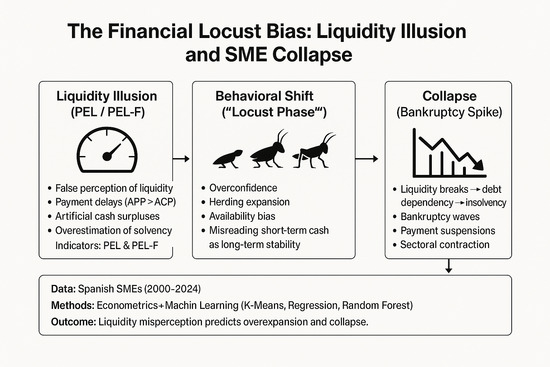
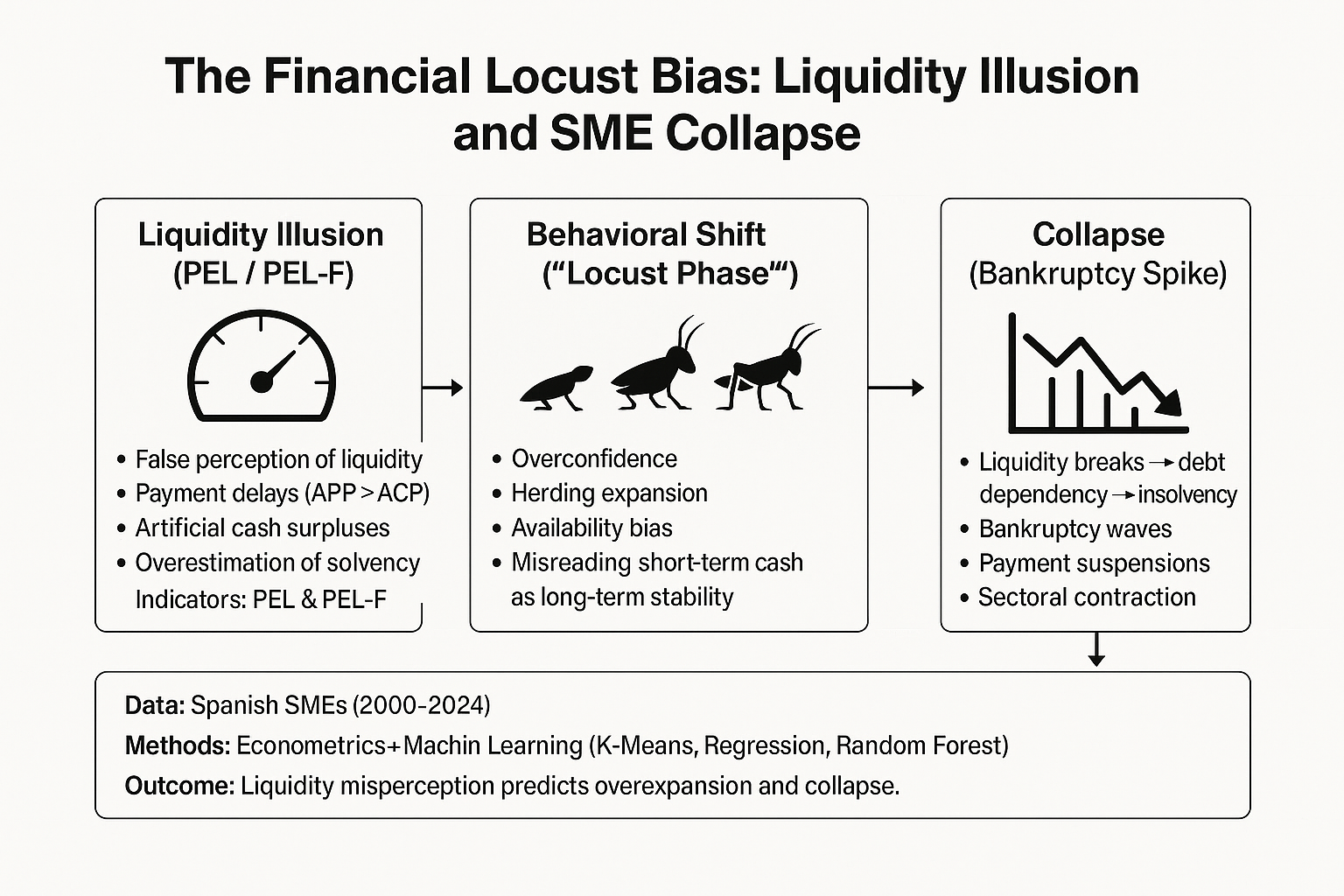
This study addresses this gap by introducing the Financial Lobster Bias, a behavioral mechanism whereby entrepreneurs interpret temporary cash-flow relief—such as extended supplier terms, accelerated collections, or short-term credit lines—as evidence of structural solvency. Used solely as an analytical construct, the concept captures the transformation of transient liquidity into perceived financial strength. Such misperception may incentivize premature expansion, debt accumulation, and operational scaling beyond real liquidity capacity, increasing the likelihood of synchronized failures once credit conditions tighten.
Spain provides an ideal empirical setting for analyzing this phenomenon. SMEs represent more than 99% of firms, and the country offers one of the most detailed and consistent longitudinal corporate datasets in Europe. Covering 2000–2024, the dataset spans two full liquidity and expansion cycles—the 2008 global financial crisis and the post-2020 disruption—allowing the study of how liquidity misperception emerges, persists, and contributes to systemic fragility across heterogeneous macroeconomic phases. These characteristics make the Spanish context methodologically valuable for observing liquidity dynamics in environments with high firm turnover and sensitivity to credit fluctuations.
The objective of this research is to examine the behavioral and financial mechanisms through which liquidity misperception evolves into unsustainable expansion and increased bankruptcy risk. Using official records from the Banco de España, the Spanish Commercial Registry, and the National Institute of Statistics, combined with econometric modelling and machine learning techniques, the study identifies liquidity distortions, evaluates their financial consequences, and determines the conditions under which they escalate into expansion–collapse cycles. Three hypotheses are tested: (1) temporary liquidity improvements may generate a false sense of stability that conceals underlying deterioration; (2) firms with stronger operating liquidity rely less on external debt, whereas those experiencing liquidity misperception increase leverage to sustain expansion; and (3) accelerated growth associated with illusory liquidity is systematically followed by higher business-failure rates.
By integrating behavioral insights, financial-ratio analysis, and predictive modelling, this research contributes to the literature on SME fragility, liquidity risk, and early-warning systems. In settings where expansion is often interpreted as a signal of strength, understanding the boundaries of liquidity-driven decision-making becomes essential for policymakers, financial institutions, and business managers seeking to mitigate systemic vulnerability.
2. Conceptual Framework
Business crises are often attributed to external shocks such as monetary tightening, demand contractions, financial turbulence, or technological disruptions. However, an equally important and less explored source of fragility originates within firms themselves, particularly in how entrepreneurs interpret liquidity and make strategic decisions under uncertainty. The Financial Lobster Bias describes the tendency of entrepreneurs to misread temporary liquidity—arising from deferred payments, accelerated collections, or short-term credit lines—as evidence of structural solvency. When firms mistake transitory cash availability for long-term financial strength, they may expand prematurely, increase leverage, and scale operations without adequate financial foundations, thereby intensifying vulnerability during downturns (
Anstey et al., 2009).
Although prior research recognizes that SMEs are prone to overconfidence, information asymmetries, and liquidity mismanagement (
Berger & Udell, 1998;
Carpenter & Petersen, 2002;
Demir et al., 2022), the literature has largely approached liquidity as a restrictive constraint rather than as a perceptual distortion. This study emphasizes that misperception—not merely scarcity—plays a decisive role in shaping expansion trajectories. When many firms adopt growth strategies based on perceived liquidity, business ecosystems become exposed to synchronized fragility. Once credit markets tighten or suppliers reduce payment terms, firms face abrupt liquidity shortages, often resulting in cascading insolvencies across sectors (
Sunstein & Thaler, 2008;
Gertler & Gilchrist, 1994). Understanding these behavioural mechanisms is essential to explain why expansion cycles frequently culminate in instability and why liquidity misinterpretations persist in undermining SME resilience.
The theoretical basis for this interpretation draws on Behavioral Game Theory (
Camerer, 2003) and Behavioral Economics (
Kahneman & Tversky, 1979), which explain why entrepreneurs deviate systematically from rational financial planning. Competitive SME environments often resemble coordination dilemmas in which cautious growth would be collectively optimal, yet entrepreneurs imitate competitors’ expansion strategies because restraint appears strategically risky (
Cooper et al., 1988;
Love & Roper, 2015;
Camerer & Lovallo, 1999;
Bazerman & Neale, 1992). Cognitive biases further reinforce this process: overconfidence leads to underestimation of liquidity risk (
Moore & Healy, 2008;
Langer, 1975); anchoring biases favour visible indicators such as cash balances while obscuring payment–collection cycles (
Tversky & Kahneman, 1974); herding behaviours encourage firms to replicate competitors’ growth patterns (
Banerjee, 1992); and temporal myopia prioritizes short-term decisions at the expense of long-term solvency (
Frederick et al., 2002;
Laibson, 1997;
Arnsten, 2009;
Kahneman, 2011). Together, these mechanisms generate environments where temporary liquidity is misinterpreted as structural financial strength, forming clusters of firms dependent on artificial liquidity that collapse rapidly when exposed to shocks (
Phelps et al., 2014;
Thaler, 2015). This pattern aligns with long-established theories of financial instability (
Minsky, 1986;
Barberis & Thaler, 2003;
Nowak, 2006); showing how biased perceptions amplify systemic fragility.
Within this framework, the present study seeks to validate the Financial Lobster Bias and quantify its implications for SME survival. The analysis examines whether liquidity misperception stimulates accelerated and unsustainable expansion, whether firms with stronger working capital rely less on external debt, and whether periods of intense business creation are followed by higher bankruptcy rates. By integrating behavioural theory with econometric and machine learning methods, and using a longitudinal dataset of Spanish SMEs (2000–2024), the study offers a comprehensive explanation of how liquidity perception shapes financial decisions and contributes to systemic instability. In doing so, it addresses a persistent gap in SME research, which has prioritised financial ratios while overlooking cognitive distortions. The conceptual framework therefore lays the behavioural foundations necessary to understand how liquidity illusions arise, propagate across firms, and culminate in the overexpansion–collapse patterns characteristic of vulnerable SME ecosystems.
3. Literature Review
Understanding SME fragility requires examining how managers interpret liquidity, how cognitive biases distort financial decisions, and how these distortions manifest at both firm and sector levels. Although liquidity management, entrepreneurial behaviour, and firm turnover have been widely studied, they have rarely been integrated into a unified analytical framework. This section synthesizes the main theoretical and empirical contributions that contextualize liquidity misperception and position the Financial Lobster Bias within established academic debates.
A broad empirical literature shows that SMEs do not always base decisions on objective liquidity indicators. Behavioral economics demonstrates that entrepreneurs often rely on heuristics, salient cues, and recent experiences that distort perceptions of solvency (
Kahneman & Tversky, 1979;
Barberis & Thaler, 2003;
Sunstein & Thaler, 2008;
Thaler, 1985). Temporary cash availability—emerging from delayed payments, favourable demand shocks, or relaxed credit conditions—may be misinterpreted as structural liquidity, encouraging premature investment and accelerated growth. Studies by
Cooper et al. (
1988),
Hall and Lerner (
2010),
Coad et al. (
2013), and
Molina and Preve (
2012) consistently show that SMEs expand when short-term liquidity improves, even when fundamentals remain fragile. Working-capital evidence further indicates that transient liquidity often obscures emerging constraints (
Baños-Caballero et al., 2014). Yet most research frames these issues as liquidity constraints, overlooking the behavioural origins of misinterpretation.
A second strand examines cognitive and strategic distortions shaping entrepreneurial judgment. Behavioral Game Theory and decision science show that SMEs operate in competitive environments resembling coordination dilemmas, where restraint may be collectively optimal but expansion appears individually rational (
Von Neumann & Morgenstern, 1944;
Cooper et al., 1988;
Love & Roper, 2015). Overconfidence leads entrepreneurs to underestimate liquidity risk (
Moore & Healy, 2008); anchoring biases overemphasize visible liquidity indicators (
Tversky & Kahneman, 1974); and herding prompts imitation of competitors regardless of fundamentals (
Banerjee, 1992). Neuroeconomic evidence confirms that positive financial cues increase risk-taking and reduce sensitivity to losses (
Knutson et al., 2008;
Frydman & Camerer, 2016;
Kuhnen & Knutson, 2005;
Glimcher & Fehr, 2013;
Schultz, 2016). These distortions help explain why temporary liquidity is often interpreted as structural solvency and why clusters of SMEs adopt expansion strategies rooted in misperception.
Micro-level distortions produce macro-level consequences. Classical theories of firm dynamics (
Schumpeter, 1934);
Hopenhayn (
1992) emphasize cyclical patterns of entry and exit, but when entry accelerates in response to misinterpreted signals rather than genuine productivity gains, sectors may overheat, margins may erode, and waves of failure may follow. Empirical studies corroborate this: liquidity-driven booms precede systemic instability (
Kindleberger & Aliber, 2005), and excessive firm creation reduces long-run productivity and increases fragility (
Caballero & Hammour, 1991). More recent work confirms that expansions fuelled by perceived liquidity or easy credit systematically precede concentrated insolvency episodes, especially in SME-dependent economies (
Fort et al., 2013;
Gopinath et al., 2017).
The connection between liquidity misperception and debt accumulation is equally relevant. SMEs often increase leverage during expansion phases despite unstable cash-flow positions (
Fazzari et al., 1988;
Bhaird & Lucey, 2010;
Mateev et al., 2013). Lenders may reinforce this misperception by extending credit during booms (
Adrian & Shin, 2010;
Ross et al., 2019), validating entrepreneurs’ optimistic beliefs. As a result, liquidity-driven expansions frequently evolve into overleveraged structures that become highly vulnerable when liquidity cycles revert.
A growing computational literature strengthens these insights. Machine learning studies show that deviations in working-capital behaviour, irregular liquidity patterns, and non-linear interactions between solvency and leverage outperform traditional ratios in predicting bankruptcy (
Shumway, 2001;
du Jardin, 2015;
Altman et al., 2017).
Barboza et al. (
2017) confirm that ML models detect early behavioural anomalies that precede collapse—patterns especially relevant for SMEs, whose decisions are more sensitive to cognitive biases.
Taken together, the literature converges on a central insight: distorted liquidity perception is a recurrent driver of SME fragility. Firms frequently misinterpret temporary improvements in cash flow as structural financial strength, leading to accelerated expansion, increased leverage, and synchronized failures. Although behavioural, financial, and computational studies document aspects of this mechanism, they have rarely been integrated. The Financial Lobster Bias advances this agenda by positioning liquidity misperception—not liquidity constraint—as the behavioural-financial distortion initiating expansion–collapse cycles, offering an empirically testable framework for detecting early signs of systemic fragility.
4. Theoretical Rationale for the Hypotheses
The hypotheses in this study derive from an integrated set of behavioral, financial, and structural mechanisms explaining how liquidity misperception can evolve into accelerated expansion and, ultimately, financial fragility. Their formulation is grounded in well-established empirical evidence and theoretical arguments from behavioral economics, corporate finance, and business-cycle dynamics. This section consolidates these foundations and clarifies the logic underlying the empirical relationships evaluated in the study.
Liquidity misperception—the core mechanism of the Hypothesis 1 (H1)—is widely documented in behavioral–finance research. Entrepreneurs frequently anchor decisions to salient indicators such as cash balances or temporary improvements in payment cycles, while underestimating vulnerabilities in working capital and short-term obligations. Cognitive biases such as overconfidence, availability heuristics, and anchoring distort solvency assessments, encouraging managers to infer stability from liquidity signals that are transitory. Empirical studies show that liquidity improvements often arise from tactical treasury actions—delaying payments or accelerating collections—rather than from real operational strength. Under such conditions, firms perceive themselves as more solvent than they are, generating a false sense of stability that becomes pronounced during periods of macroeconomic uncertainty or credit tightening. The Hypothesis 1 (H1), therefore reflects a clear theoretical expectation: perceived liquidity and actual liquidity frequently diverge, and SMEs are particularly susceptible to this distortion
Banerjee and Duflo (
2014).
The Hypothesis 2 (H2), builds on literature linking operating liquidity to leverage decisions. Corporate-finance theory shows that firms with stronger internal liquidity rely less on external borrowing, as internal funds offer a flexible and less costly financing source. Classical models such as the pecking-order framework describe this substitution mechanism, and empirical evidence confirms that SMEs with robust working capital have lower debt ratios. Conversely, firms facing liquidity volatility depend more heavily on short-term credit to sustain expansion. When liquidity is misperceived rather than real, firms may expand and accumulate debt simultaneously under the mistaken belief that internal resources are sufficient. The Hypothesis 2 (H2), therefore captures both the structural expectation of an inverse liquidity–debt relationship and the behavioural expectation that distorted liquidity perceptions promote debt-financed expansion.
The Hypothesis 3 (H3), is grounded in theories of business cycles, firm demography, and financial fragility. Research shows that rapid business creation and accelerated growth often emerge during periods of perceived opportunity, particularly when entrepreneurs extrapolate short-term liquidity improvements into long-term expectations. When expansions are not supported by real market fundamentals, they generate excess capacity, margin erosion, and heightened vulnerability. Empirical evidence demonstrates that clusters of SMEs frequently expand simultaneously under favourable liquidity conditions, followed by concentrated waves of insolvencies once credit conditions tighten or demand weakens. Behavioral contagion models further show that firms imitate expansion strategies when they perceive liquidity as abundant, amplifying subsequent contraction. The Hypothesis 3 (H3), therefore reflects a theoretically and empirically validated pattern: unsustainable expansion, particularly when driven by illusory liquidity, precedes increases in business-failure rates.
Together, these conceptual foundations ensure coherence between the study’s objectives, hypotheses, and empirical strategy. They justify the treatment of liquidity misperception as a behavioural-financial distortion with systemic implications and explain why the tested relationships emerge in SME ecosystems. By integrating insights from behavioural economics, corporate finance, and crisis-detection literature, this section clarifies the analytical logic behind the Financial Lobster Bias framework and establishes its relevance for understanding liquidity-driven fragility.
5. Methodology
This study adopts a fully quantitative and empirically grounded methodological design to validate the Financial Lobster Bias within the Spanish SME ecosystem. Because the central hypothesis concerns liquidity misperception and its translation into accelerated expansion and subsequent financial fragility, the analysis relies exclusively on audited financial indicators and observable business-demography data. Although the conceptual framework incorporates behavioural interpretations, the empirical procedures are strictly technical and independent of narrative elements. All data originate from official institutional repositories, and artificial intelligence is used solely for analytical modelling—never for generating, modifying, or estimating financial figures.
The dataset integrates information from three primary sources: the Banco de España’s Central de Balances Integrada (CBI), the Spanish Commercial Registry, and the National Institute of Statistics (INE). Together, they provide harmonized and longitudinal coverage of payment and collection periods, working-capital positions, solvency and leverage ratios, sectoral activity, and firm birth–death dynamics. After consolidating and standardizing all variables, the final panel includes 10,412 firms across major economic sectors, yielding 126,310 firm-year observations between 2000 and 2024. This period is methodologically appropriate because it encompasses two full expansion–contraction cycles—the 2008 financial crisis and the post-2020 shock—allowing the identification of shifts in liquidity behaviour under heterogeneous macroeconomic conditions.
Three indices validated in
De los Reyes-Marín et al. (
2025) are used to operationalize liquidity misperception and its financial effects. The Perceived Liquidity Error Index (PEL) measures distortions between perceived and actual liquidity. Its structural component captures misalignment between working capital, solvency ratios, and short-term obligations, while its operational component reflects the differential between the Average Payment Period (APP) and the Average Collection Period (ACP), a well-established indicator of treasury tension in SMEs. The Illusory Confidence in Liquidity Index (ICEL) quantifies deviations between managerial confidence and real liquidity, identifying overconfidence episodes that typically precede premature expansion. The Unsustainable Expansion Index (IEI) evaluates whether firm-level growth exceeds sectoral liquidity conditions, providing a system-level measure of expansion pressure.
Table 1 summarizes the definitions and analytical roles of all variables used in the empirical analysis.
The analytical strategy examines liquidity patterns, expansion trajectories, and leverage dynamics through descriptive statistics, correlation matrices, and econometric inference. Pearson correlation coefficients serve as an initial diagnostic tool, identifying baseline associations between liquidity indicators, leverage levels, APP–ACP imbalances, and the Unsustainable Expansion Index (IEI). These preliminary relationships motivate deeper modelling. Multivariate regressions subsequently test whether firms with stronger liquidity positions rely less on external financing. In these models, the debt ratio is regressed on working capital, controlling for sector, firm size, and macroeconomic shocks through fixed-effects specifications. Robust standard errors and Wald tests ensure statistical reliability. Empirically confirming an inverse liquidity–debt relationship supports the hypothesis that liquidity misperception encourages higher leverage and accelerated expansion.
To evaluate whether liquidity-distorted expansion precedes financial fragility, time-lagged regressions and Granger-causality tests compare the IEI with firm-creation and firm-dissolution patterns. This approach identifies temporal sequences consistent with the Financial Lobster Bias—specifically, surges in expansion followed by elevated insolvency rates.
Machine learning techniques complement the econometric framework by capturing nonlinear interactions and threshold behaviours that traditional models may overlook. Unsupervised K-means clustering identifies latent financial–behavioural profiles based on liquidity and leverage, revealing firm groups positioned along sustainable, aggressive, or crisis-prone trajectories. Supervised models—including logistic regression, Random Forests, Gradient Boosting, and Neural Networks—estimate the probability of business failure using liquidity metrics, capitalization, firm-creation density, and sectoral indicators as predictors. All models are validated with k-fold cross-validation and optimized through hyperparameter tuning. Feature-importance metrics further highlight which variables most strongly predict distress, reinforcing the interpretation of liquidity-driven fragility.
Finally, the extensive temporal coverage of the dataset—including pre-crisis expansion, the 2008 disruption, subsequent deleveraging, the 2014–2019 recovery, and the 2020–2021 liquidity interventions—provides a robust empirical basis for identifying liquidity misperception and its macro-structural manifestations. With more than 105,000 annual business incorporations and 86,000 closures on average, Spain’s high turnover and sectoral diversity offer fertile ground for detecting contagion effects, synchronized expansion, and collapse dynamics. The standardized panel of 45 financial indicators therefore forms a solid methodological foundation for validating the Financial Lobster Bias at both firm and system levels.
6. Results
The empirical results show how liquidity misperception evolved from 2000 to 2024 and how it relates to firms’ payment behaviour, financial structure, indebtedness, business creation, and business failure. The analysis begins with the descriptive behaviour of the Liquidity Misperception Index (PEL), examined both in its financial-structure formulation and in its operational formulation based on the differential between collection and payment periods.
Table 2, placed immediately after this descriptive section, reports annual values for both indicators and situates them within the main economic cycles of the period.
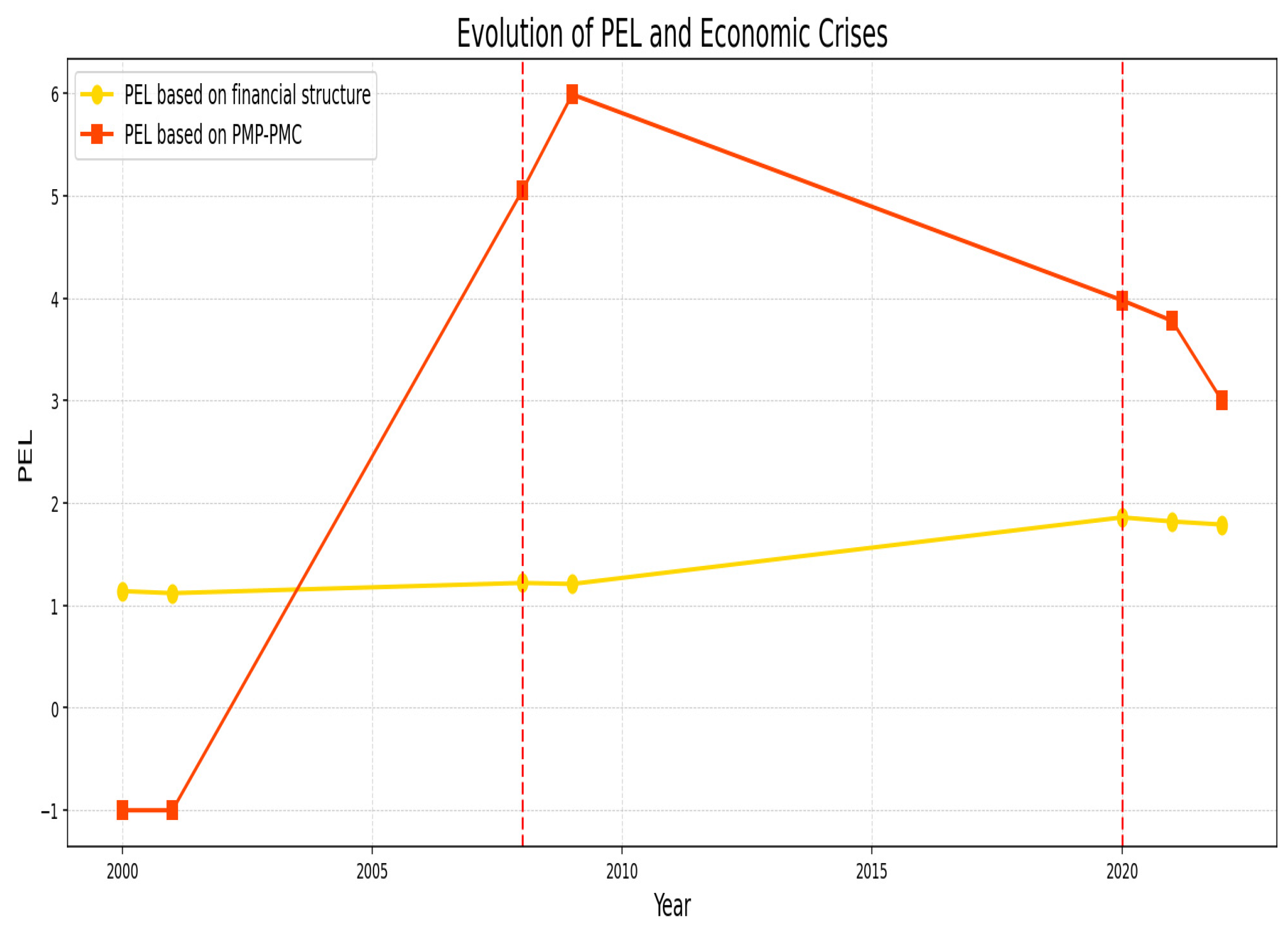
In the years preceding the 2008 crisis, both versions of the PEL remained stable. The financial-structure-based index fluctuated between 1.12 and 1.26, while the PMP–PMC differential stayed close to −1 day, indicating that firms did not rely on payment delays as a short-term liquidity mechanism. This pattern changed abruptly in 2008, when the operational PEL increased sharply and the payment–collection gap widened to more than five days. A similar, though less pronounced, rise appeared in the financial-structure-based index. These elevated values persisted until around 2013.
A second, more moderate elevation occurred between 2014 and 2018. After this period, the operational PEL gradually decreased, while the financial-structure-based PEL continued to rise. Overall, the descriptive evidence suggests that both payment behaviour and perceived liquidity deteriorated significantly during episodes of economic stress, and that these altered practices remained partially embedded even after macroeconomic conditions stabilised.
The analysis of the financial-structure-based PEL reveals two pronounced periods of elevation. The first occurs between 2008 and 2013, when the index rises above 1.22 and continues increasing to nearly 1.90, indicating a growing reliance on short-term liabilities relative to liquid assets. The second elevation appears after 2020 and coincides with substantial changes in current-liability structures driven by the COVID-19 shock and subsequent liquidity-support policies. These values suggest that firms’ balance sheets became structurally more dependent on short-term financing during both periods.
The operational PEL, measured through the PMP–PMC gap, exhibits a similarly distinct temporal pattern. Before 2008, firms consistently collected payments before issuing disbursements, indicating stable liquidity management. A clear break occurs in 2008, when the gap widens to more than five days, signalling a widespread shift toward payment deferral as a liquidity-sustaining mechanism. Although this gap gradually narrows after 2013, it remains above historical levels, indicating that many liquidity practices adopted during the crisis persisted long after financial markets had stabilised. A further adjustment appears during the COVID-19 period, reflecting the combined effects of liquidity injections, loan guarantees, and firms’ internal cash-flow strategies.
To assess whether the two forms of the PEL capture related aspects of liquidity behaviour, a correlation analysis was conducted for the entire period. As shown in
Table 3, the correlation exceeds 0.70 in most years, indicating a strong association between operational payment behaviour and structural liquidity conditions. Correlation levels are particularly high during crisis periods, when firms rely more heavily on payment extensions to maintain liquidity. Moderate correlations occur in years when firms combined extensions with alternative mechanisms such as credit restructuring. Lower correlations, by contrast, correspond to periods of financial stability, when payment behaviour was less influenced by perceived solvency conditions.
The temporal behaviour of both indices, and their consistent alignment, shows that liquidity misperception evolves in a structured and cumulative manner rather than fluctuating randomly. Firms adjust payment timing, debt accumulation, and liquidity strategies in response to macroeconomic shocks, and these adjustments persist over time. To evaluate whether these changes follow a systematic trend, a regression model was estimated using time as the independent variable and the operational PEL as the dependent variable. As shown in
Table 4, the model yields a statistically significant positive coefficient, indicating that liquidity misperception has increased gradually throughout the 2000–2024 period. The model explains approximately 41% of the variance in PEL values, confirming that the widening of the payment–collection gap reflects a directional and persistent pattern rather than isolated reactions to specific events.
A similar regression was conducted using the financial-structure-based PEL as the dependent variable. As shown in
Table 5, the results also indicate a strong and statistically significant positive trend. More than 70% of the variance in this indicator is explained by time, suggesting that liquidity distortions embedded in firms’ financial structures have become progressively more pronounced over the past two decades. This finding complements the operational analysis by demonstrating that both payment-cycle behaviour and the composition of current assets and liabilities follow similar long-term trajectories.
Taken together, the descriptive patterns, correlations, and regression results show that liquidity misperception intensified during major economic shocks and persisted well beyond them, manifesting both in payment-behaviour adjustments and in structural changes to firms’ balance sheets. The evidence reveals a progressive widening between real and perceived liquidity conditions, an erosion of working-capital stability, and a gradual increase in short-term debt exposure. These trends provide the empirical foundation for evaluating whether liquidity misperception influences leverage decisions, stimulates excessive firm creation, and precedes increases in business failure—relationships examined in the hypotheses and further developed in the Discussion section.
7. Discussion, Conclusions and Implications
The empirical results presented in the previous section allow for an integrated interpretation of how liquidity misperception, expansion intensity, and structural financial conditions co-evolve across different economic phases. When considered together, the liquidity indicators (PEL and ICEL), the expansion metric (IEI), the econometric estimates, and the machine learning outputs reveal a behavioural–financial process in which temporary liquidity conditions are repeatedly interpreted as structural solvency. This misinterpretation promotes accelerated expansion and increases long-term vulnerability within SME ecosystems.
A first central insight is that liquidity misperception follows a cumulative trajectory rather than episodic fluctuations. Both the operational and structural versions of the Liquidity Misperception Index display parallel movements across the 2000–2024 period and respond visibly to macroeconomic shocks.
Figure 1 illustrates this temporal evolution by presenting the long-run trajectory of the PEL and its alignment with major economic crises. The figure shows how divergence between perceived and real liquidity intensifies during downturns and often persists well into recovery phases, reinforcing patterns of overexpansion and subsequent fragility.
The convergence between the two PEL measures reinforces the mechanism underlying Hypothesis 1 (H1), which posits that temporary liquidity improvements—arising from delays in supplier payments, accelerated collections, and working capital adjustments—generate a systematic distortion between perceived and actual liquidity. The time-series regressions further show that divergence between perceived and actual liquidity has increased progressively over the past decades, suggesting a structural transformation in firms’ treasury practices. These findings are consistent with earlier research indicating that conventional liquidity ratios often fail to detect early deterioration, whereas dynamic indicators capture misalignment more effectively (
Molina & Preve, 2012;
Baños-Caballero et al., 2014).
Projection models extend this pattern. Forecasts to 2034 display continuous upward trends in both the operational and structural PEL, indicating that, without corrective measures, liquidity misperception is likely to intensify over time.
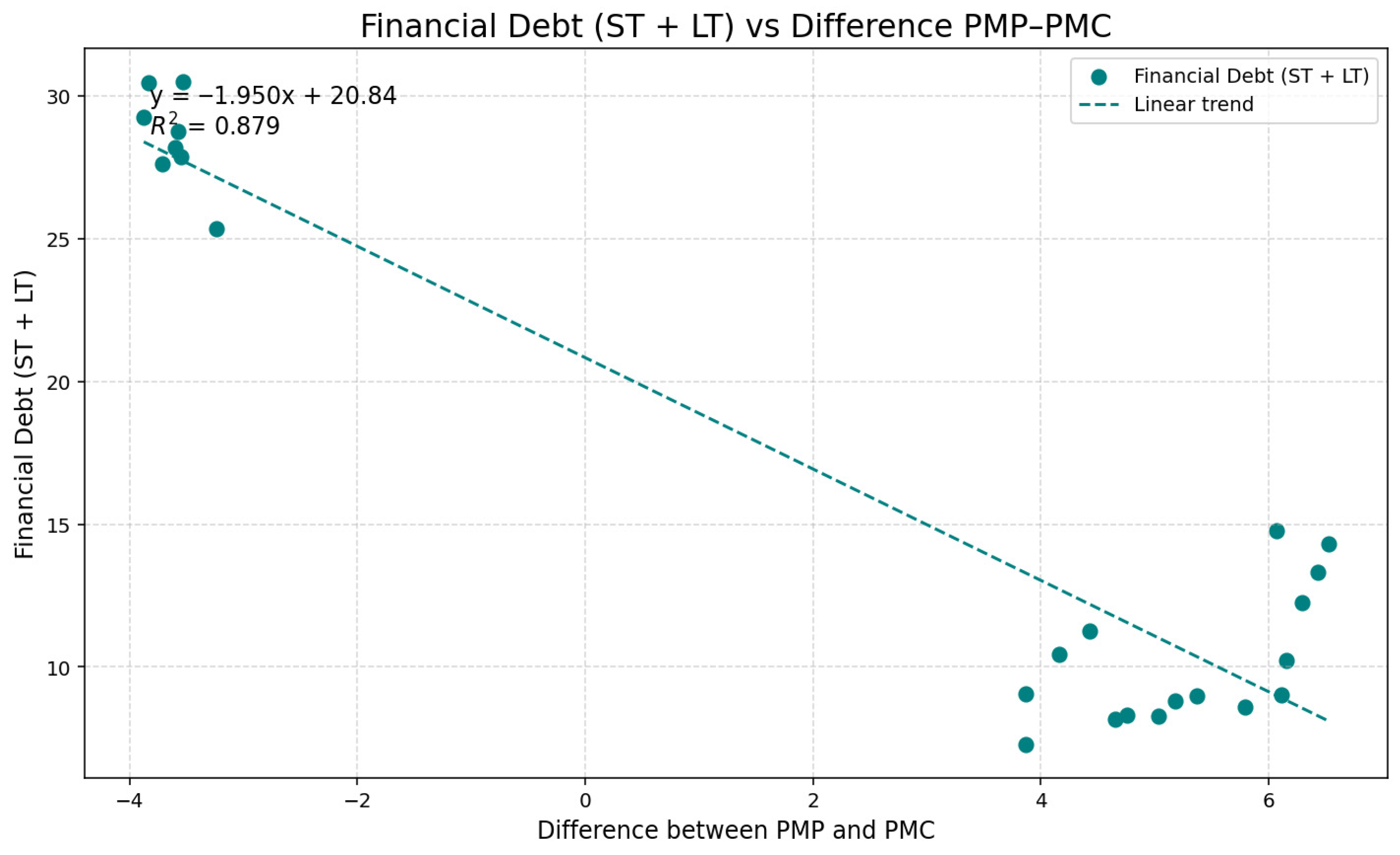
The discussion of Hypothesis 2 (H2) focuses on the inverse relationship between liquidity availability and financial debt, which posits that firms with stronger operating liquidity rely less on external financing, whereas liquidity-strained firms increase leverage to sustain expansion. The regression estimates show that firms with higher working capital systematically maintain lower leverage levels.
Figure 2 visually illustrates this dynamic by presenting the negative slope between liquidity and debt, highlighting the strong explanatory capacity of liquidity in predicting leverage.
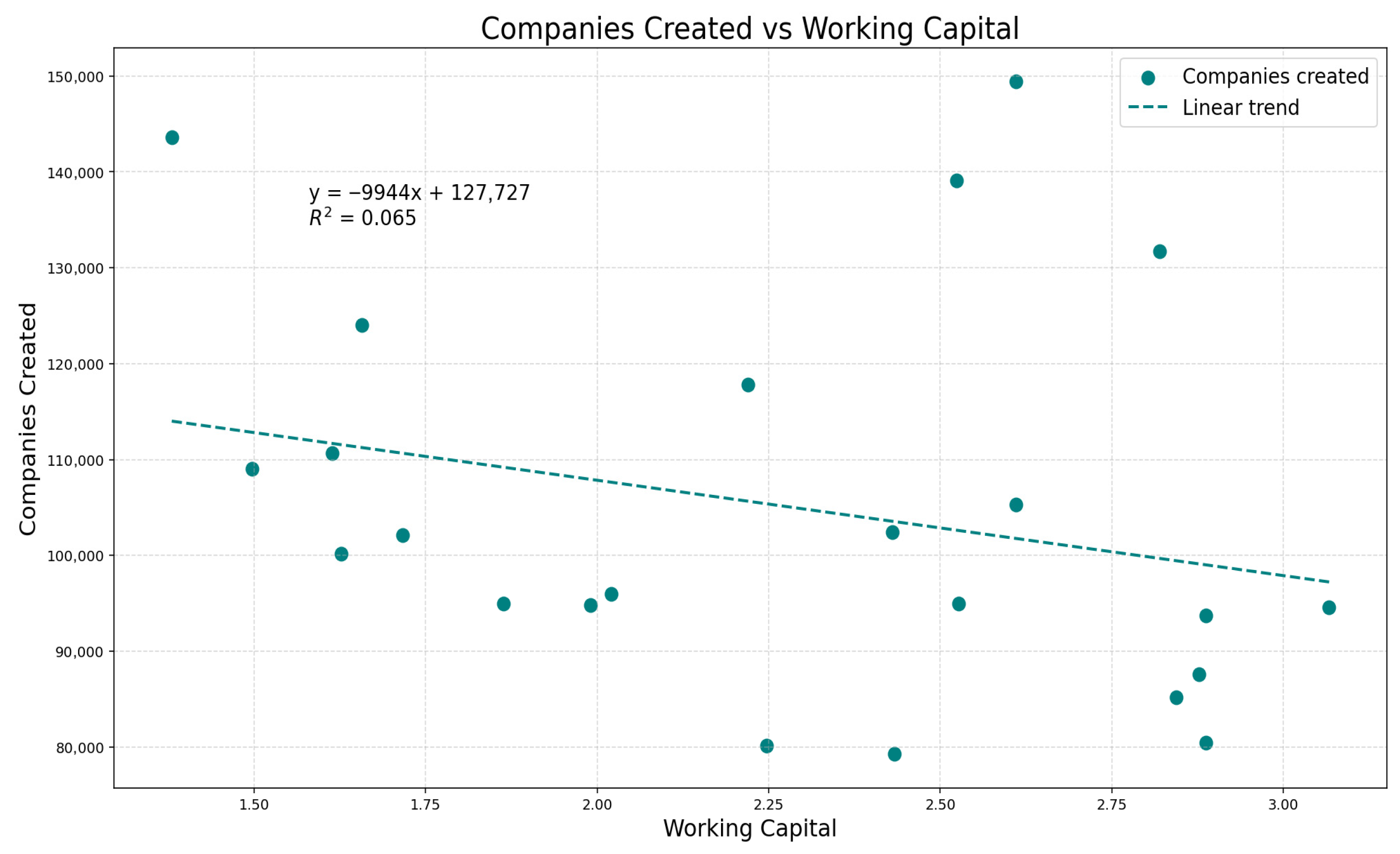
A complementary pattern emerges when examining business creation. Liquidity-rich environments consistently coincide with increases in entrepreneurial activity.
Figure 3 illustrates this positive association between liquidity conditions and firm creation, showing that expansion phases tend to occur when liquidity is perceived as favourable. This alignment indicates that liquidity misperception not only shapes internal financial decisions but also influences broader patterns of entrepreneurial entry across the SME ecosystem.
These results reinforce Hypothesis 2 (H2) which states that firms with stronger operating liquidity rely less on external debt, while liquidity misperception encourages leverage-financed expansion. The evidence shows that liquidity not only stabilizes firms but also stimulates expansion, shaping both financing structures and strategic growth decisions. Liquidity therefore operates as a dual mechanism: it reduces reliance on external debt while simultaneously encouraging firms to scale operations when conditions appear favourable.
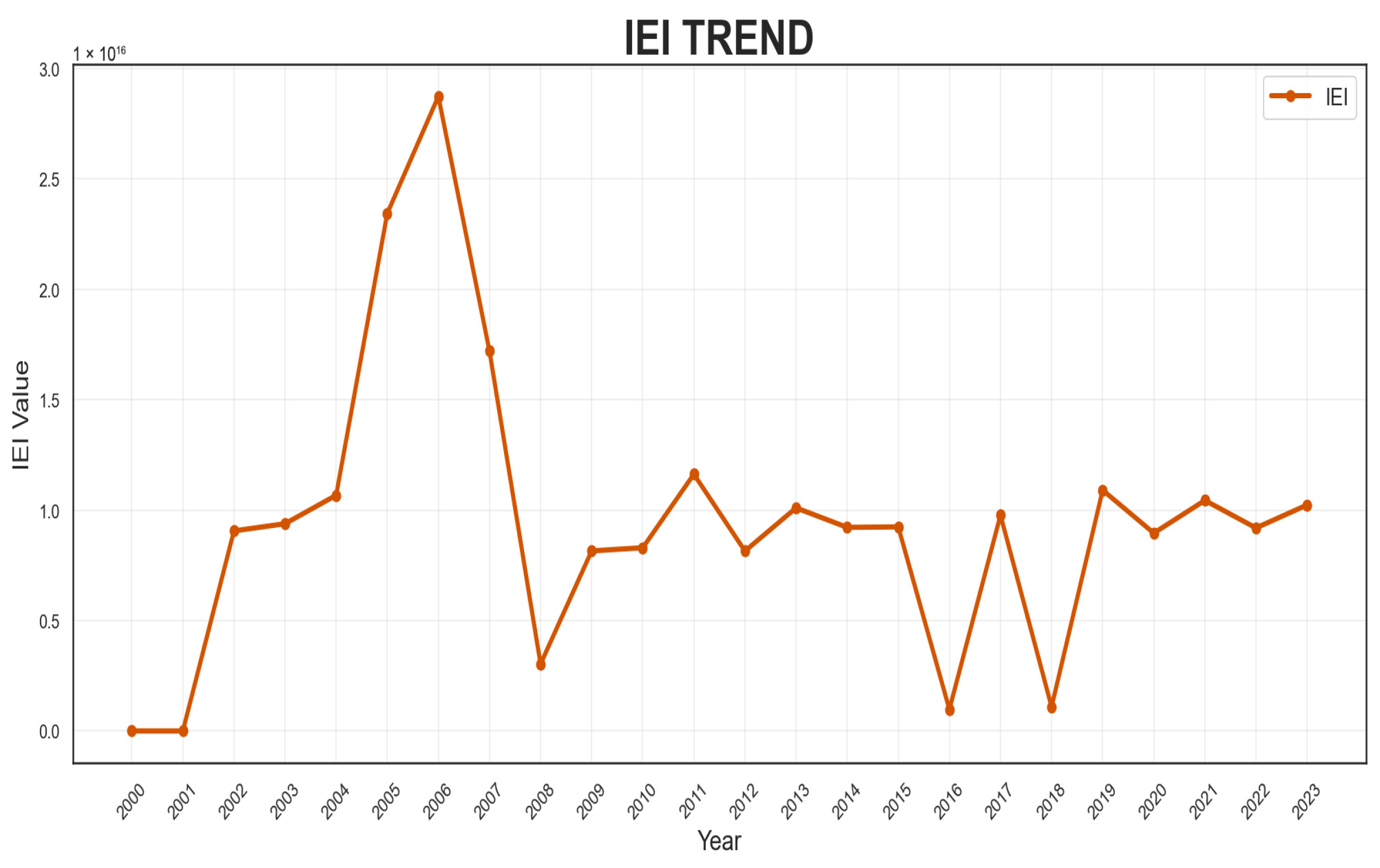
The evaluation of Hypothesis 3 (H3) examines whether accelerated expansion—particularly when driven by misinterpreted liquidity—systematically precedes increases in business failure, implying that unsustainable growth dynamics generate latent fragility that materializes during downturns. The Unsustainable Expansion Index (IEI) is central to this analysis.
Figure 4 illustrates the pre-crisis acceleration of the IEI, showing how expansion intensity exceeded sustainable levels during 2005–2007. This pattern indicates that firms expanded more aggressively than sectoral liquidity conditions could support, creating structural vulnerabilities prior to the 2008 disruption.
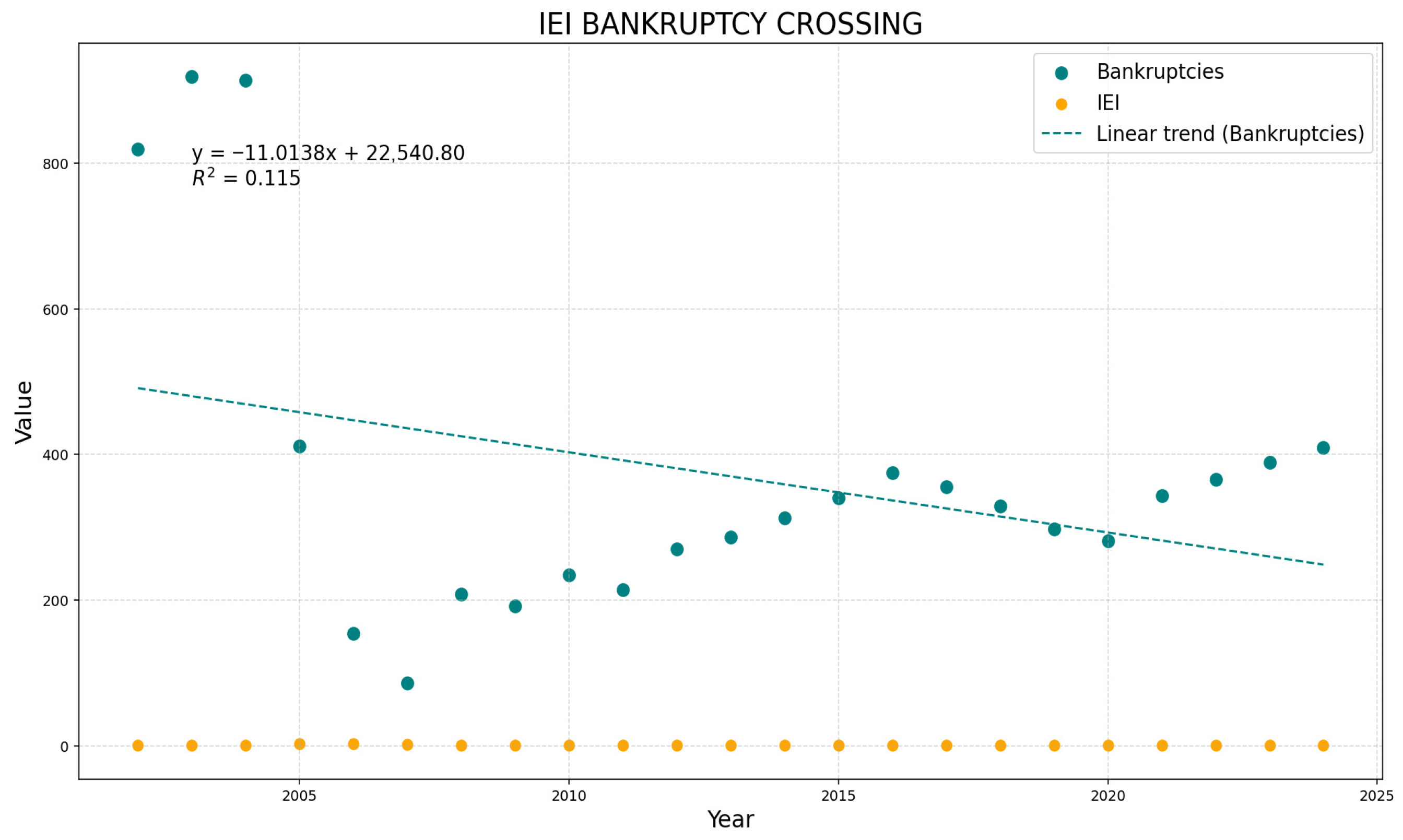
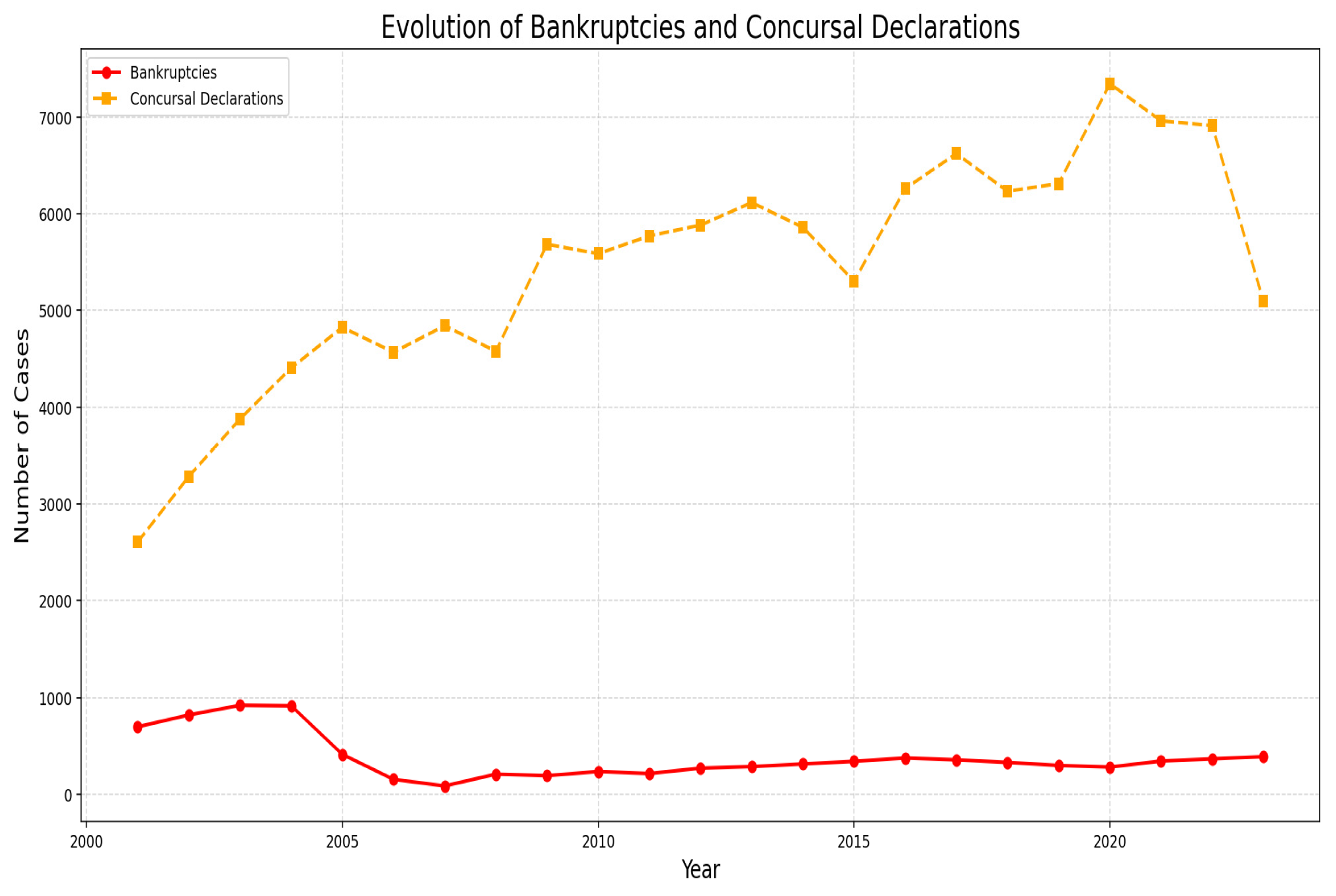
The subsequent decline of the IEI aligns with a sharp increase in bankruptcies during the 2008 crisis.
Figure 5 makes this relationship explicit by showing the temporal crossover between the surge in expansion intensity and the spike in insolvencies. This sequence supports Hypothesis 3 (H3) by illustrating that periods of liquidity-driven overexpansion tend to precede concentrated waves of business failure.
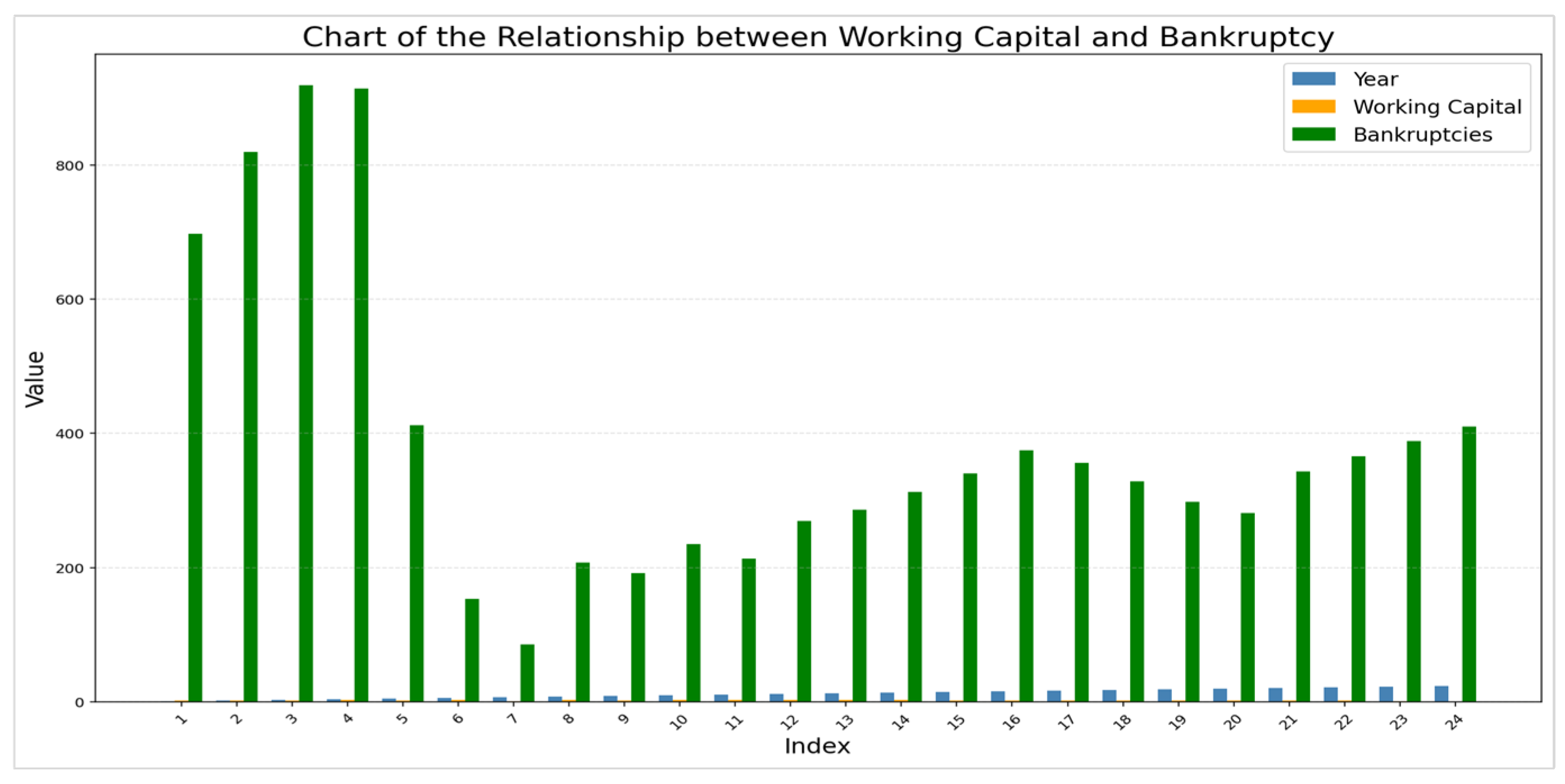
Although the direct relationship between working capital and bankruptcies is weaker at the aggregate level, liquidity shortages remain an important contextual factor in explaining collapse dynamics.
Figure 6 visualizes this modest correlation and highlights that additional structural variables—such as capitalization, leverage, and sectoral exposure—play a mediating role. These factors interact with liquidity constraints to determine the speed and severity of business failure, reinforcing the view that insolvency outcomes arise from a combination of liquidity tensions and broader balance-sheet vulnerabilities.
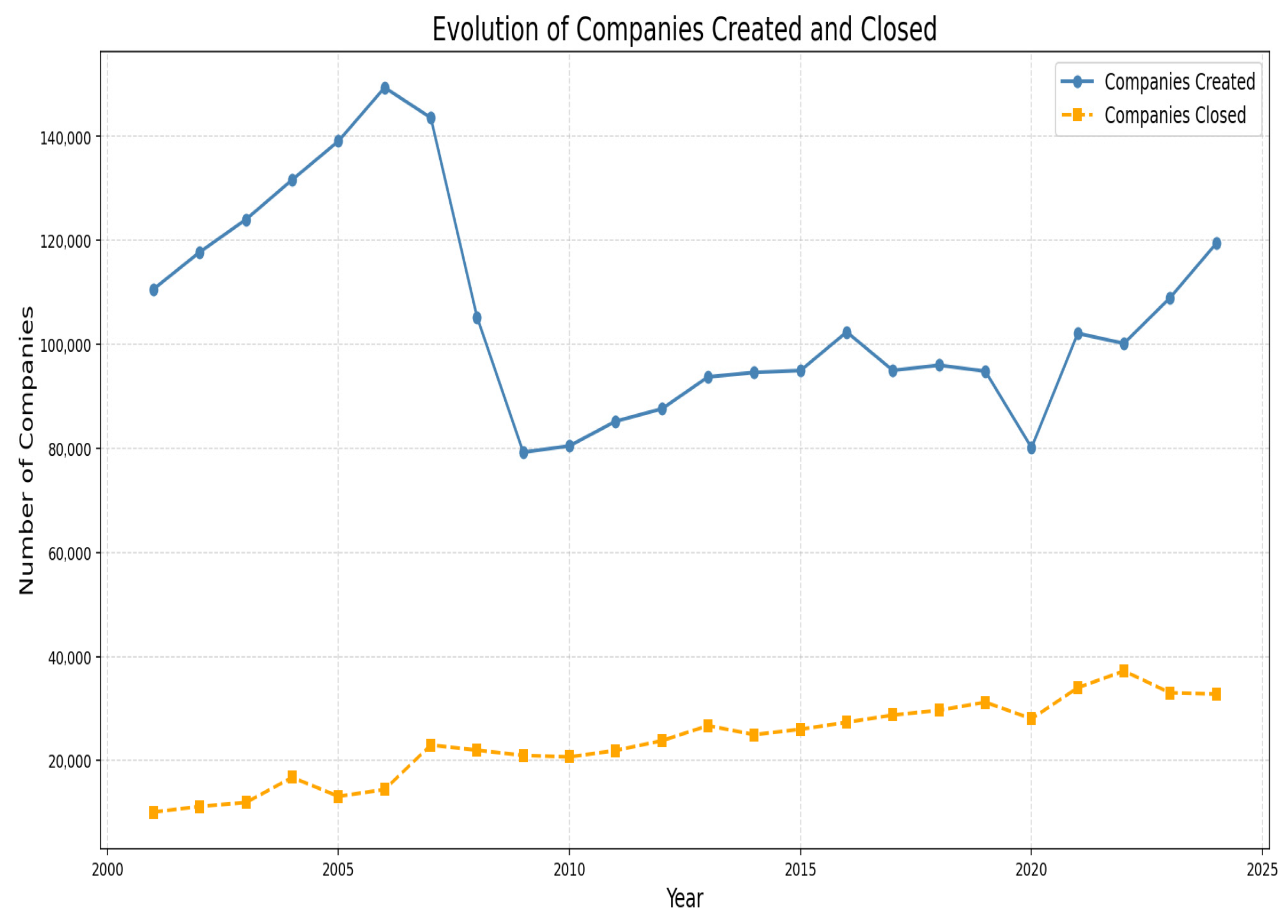
Further evidence of cyclical fragility emerges when comparing long-run patterns of business creation and dissolution.
Figure 7 highlights episodes in which contractions in liquidity or declines in revenue coincide with increases in business closures, illustrating how expansion that is not supported by real liquidity conditions tends to unwind rapidly. These periods of simultaneous entry and exit underscore the sensitivity of SME ecosystems to liquidity distortions and reveal how misperceived financial strength can accelerate both expansion and subsequent collapse.
At a broader temporal scale,
Figure 8 illustrates the evolution of firm births and deaths from 2000 to 2024, revealing alternating patterns of expansion and contraction that align with the Financial Lobster Bias framework. These cyclical movements show how periods of perceived liquidity abundance stimulate firm creation, while subsequent corrections—driven by liquidity tightening or deteriorating revenue conditions—lead to heightened business dissolution. The long-run sequence reinforces the idea that liquidity misperception is not merely a firm-level distortion but a systemic force shaping the collective dynamics of SME ecosystems.
Machine learning results further reinforce these interpretations. Although the predictive accuracy of the models is moderate, the classification outputs consistently identify recurrent interactions between rapid firm creation, insufficient capitalization, and subsequent increases in bankruptcies.
Figure 9 visualizes these interactions through a heat map, highlighting the variables that most reliably precede collapse. These patterns suggest that liquidity misperception interacts with structural weaknesses—such as low capitalization and rapid expansion—to create conditions in which financial distress becomes increasingly likely.
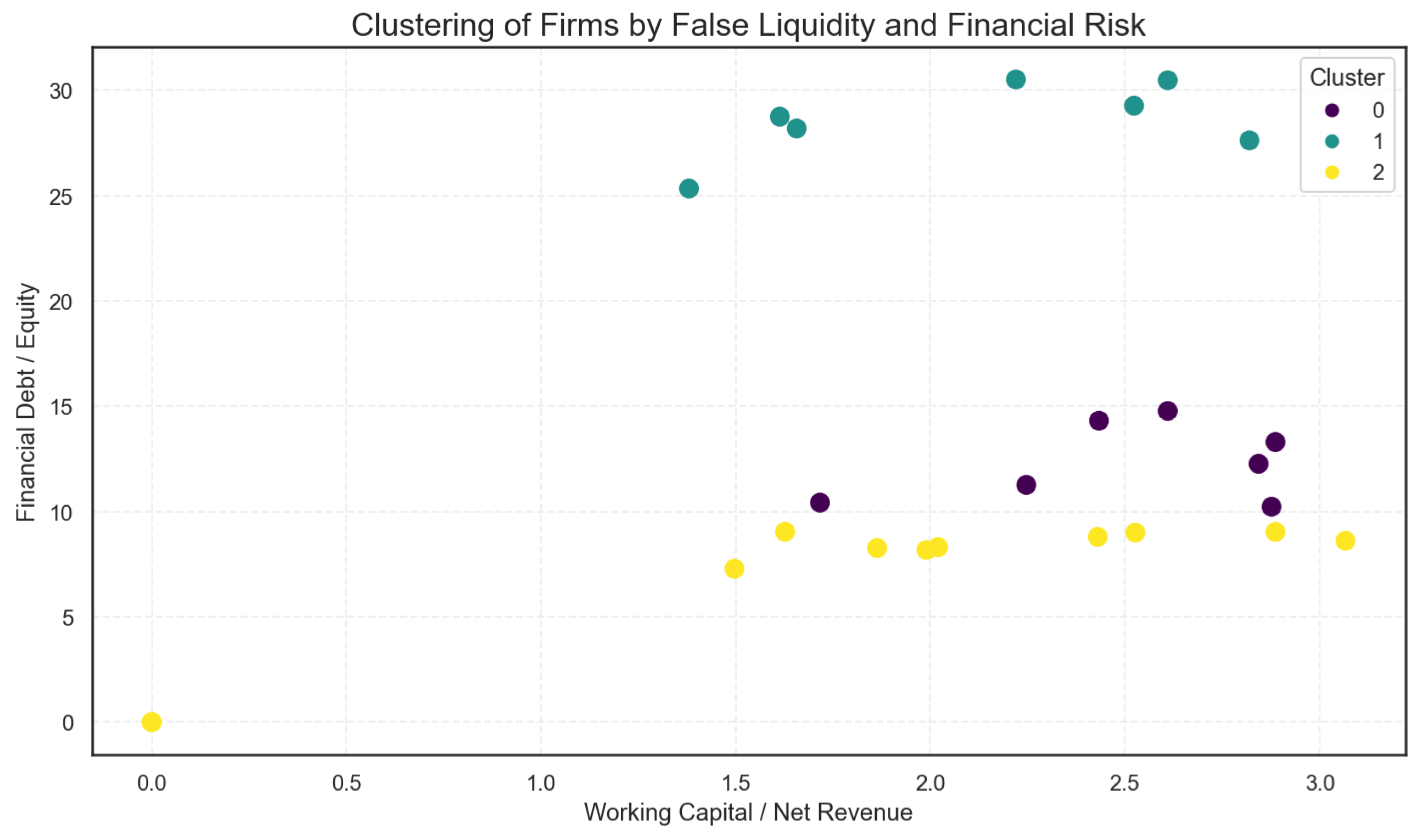
Clustering analysis further segments firms into groups differentiated by liquidity quality, debt intensity, and exposure to collapse.
Figure 10 displays these clusters, showing how liquidity and leverage variables effectively discriminate firms according to their level of financial fragility. This segmentation illustrates that vulnerability is not uniformly distributed across SMEs but emerges from distinct combinations of liquidity conditions and capital structure.
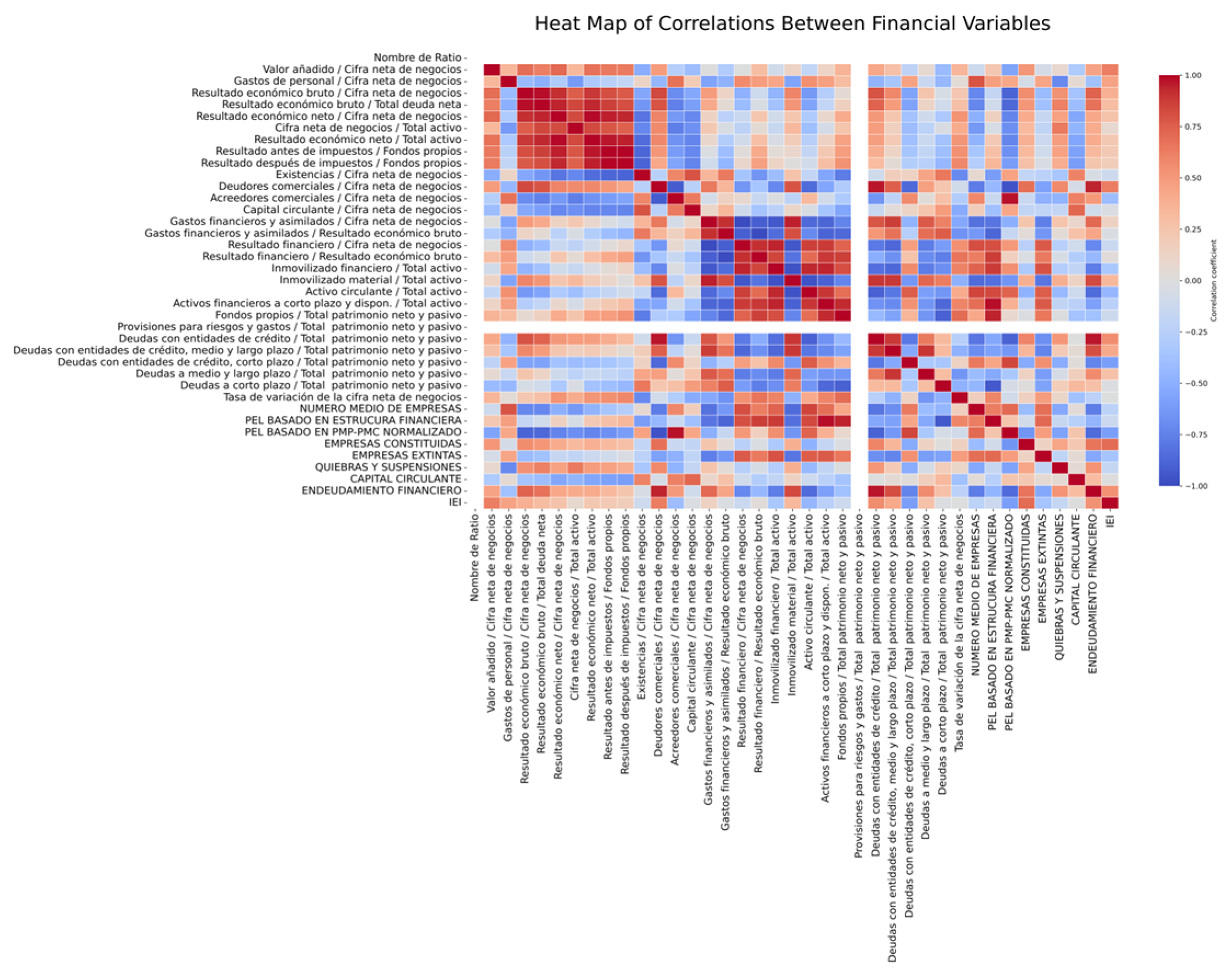
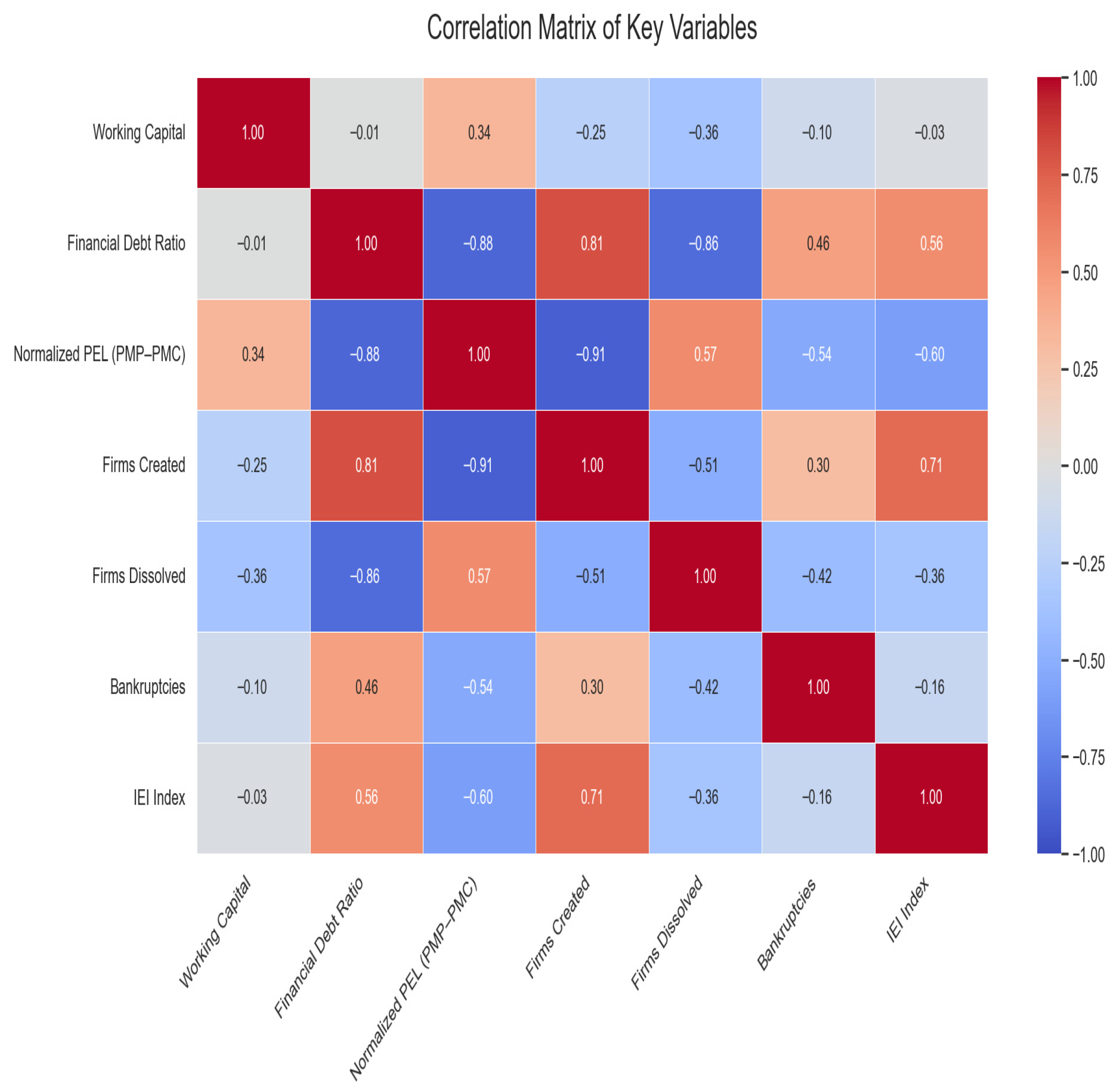
Finally,
Figure 11 integrates these relationships through a correlation matrix, providing a statistical overview of how liquidity misperception, leverage dynamics, expansion intensity, and business dissolution co-evolve. This synthesis highlights the interconnected nature of these mechanisms and reinforces the interpretation that liquidity distortion operates as a central driver of both firm-level fragility and system-wide instability.
Taken together, these results confirm the three hypotheses and reveal a coherent mechanism: liquidity misperception distorts managerial decisions, accelerates expansion, and amplifies systemic fragility. SMEs do not fail solely because of exogenous shocks; rather, liquidity illusions accumulate over time, shaping leverage choices, expansion strategies, and collective vulnerability across sectors.
From a managerial perspective, the findings underscore the importance of monitoring dynamic liquidity indicators rather than relying exclusively on static financial ratios. For policymakers and financial institutions, the results highlight the value of early-warning systems that incorporate payment-cycle metrics, sectoral liquidity benchmarks, and predictive analytics capable of anticipating synchronized expansions that may later evolve into systemic contractions.
In summary, the study demonstrates that liquidity—one of the most fundamental financial variables—is also one of the most cognitively distorted. The Financial Lobster Bias integrates behavioural theory, financial structure, and predictive modelling into a unified framework, offering a comprehensive explanation of why SME expansions become unsustainable and how early-warning mechanisms can mitigate liquidity-driven fragility.
8. Limitations and Future Research
Although this study offers new empirical and conceptual insights into liquidity misperception, SME fragility, and the Financial Lobster Bias, several limitations must be acknowledged to contextualize the findings and guide future research. These limitations do not undermine the validity of the results; rather, they clarify the structural, methodological, and theoretical boundaries within which the analysis was conducted.
A first limitation concerns the use of Spanish data. While Spain provides one of the most comprehensive SME financial datasets in Europe, its institutional, regulatory, and credit-market conditions may differ from those of other economies. As a result, the generalizability of the findings may be shaped by country-specific factors. Future research should therefore replicate the PEL, ICEL, and IEI indices in broader European samples or cross-country panels to assess external validity and identify potential structural differences in liquidity behaviour across institutional environments.
A second limitation relates to the sensitivity of the constructed indices—PEL, ICEL, and IEI—to financial-reporting practices. Although theoretically grounded and empirically validated, these indicators depend on the construction of financial ratios and the availability and frequency of payment-cycle data. Variations in accounting standards, reporting periodicity, or sectoral conventions may affect comparability. Future work could reinforce the robustness of these indices by incorporating alternative liquidity measures, nonlinear adjustment functions, or Bayesian calibration methods capable of accommodating reporting heterogeneity.
A third limitation involves the performance of the machine learning models. Although predictive accuracy is moderate and consistent with expectations for macro-level datasets, model performance is influenced by temporal autocorrelation, non-stationarity, and major economic shocks. Events such as the 2008 financial crisis or the COVID-19 interventions alter the statistical properties of financial variables in ways that traditional classifiers cannot fully capture. Future research would benefit from architectures designed for dynamic environments, including recurrent neural networks (LSTM), temporal convolutional networks, crisis-optimized ensemble models, or hybrid econometric–machine learning frameworks that balance predictive power with interpretability.
A further limitation is the absence of behavioural or psychological variables at the firm level. Financial statements provide objective information on liquidity and solvency but do not capture managerial expectations, perceived credit constraints, optimism, or risk tolerance—factors central to understanding liquidity misperception. Future studies could integrate survey data, sentiment analysis, textual information from corporate communications, or experimental approaches to deepen understanding of the cognitive mechanisms underpinning the Financial Lobster Bias.
Finally, the analysis does not explicitly model interactions between liquidity misperception, profitability cycles, and sector-specific shocks. Differences in capital intensity, demand volatility, cost structures, and competitive dynamics may generate heterogeneous sensitivity to liquidity distortions. Extending the empirical framework to include sectoral dummies, profitability metrics, or input-cost shocks would enable more nuanced insights and increase the model’s applicability for policymaking and risk assessment.
In summary, while this study provides a novel behavioural–financial framework and operational indices for the early detection of SME fragility, the limitations outlined above highlight the need for broader, deeper, and more interdisciplinary research. Future work that incorporates richer data sources, advanced modelling techniques, and behavioural variables will improve the predictive accuracy of the proposed indicators and strengthen the theoretical foundations of liquidity-driven instability in SME ecosystems.