
Comparative Analysis of Tail Risk in Emerging and Developed Equity Markets: An Extreme Value Theory Perspective



Abstract
1. Introduction and Literature Review
2. Methodology
2.1. Symmetric (Standard) GARCH Model
2.2. Exponential GARCH Model
2.3. GJR-GARCH Model
2.4. APARCH Model
2.5. EVT Models
2.5.1. Generalised Extreme Value Distribution (GEVD)
2.5.2. Generalised Pareto Distribution (GPD)
2.6. Methods and Materials
2.6.1. Parameter Estimation
2.6.2. Performance Indicators
2.6.3. Review of Risk Measures
2.7. R Packages
- The fpot function, which assesses the maximum likelihood for the PoT, allowing any of the parameters to be held fixed if desired (Pickands, 1975);
- The fgev function, which assesses the maximum likelihood fit for the GEVD and includes the linear modelling of the location parameter, allowing the parameters to be held fixed, if desired (Smith, 1985).
3. Analysis and Results
3.1. Data Description and Preliminary Analysis
- They occupy different positions along the “emerging to developed” market spectrum.
- All of them represent a large market capitalization and serve as benchmarks for market performance and risk analysis in their respective category of economies.
- They provide a diversified geographical representation.
3.2. Exploratory Data Analysis
3.3. Testing for Stylised Facts
3.4. GARCH-Type Model Fitting
3.4.1. Parameter Estimates
3.4.2. Residual Diagnostics
3.5. Generalise Extreme Value Distribution (GEVD)
3.6. Generalised Pareto Distribution (GPD)
3.7. Financial Risk Measures
4. Discussion
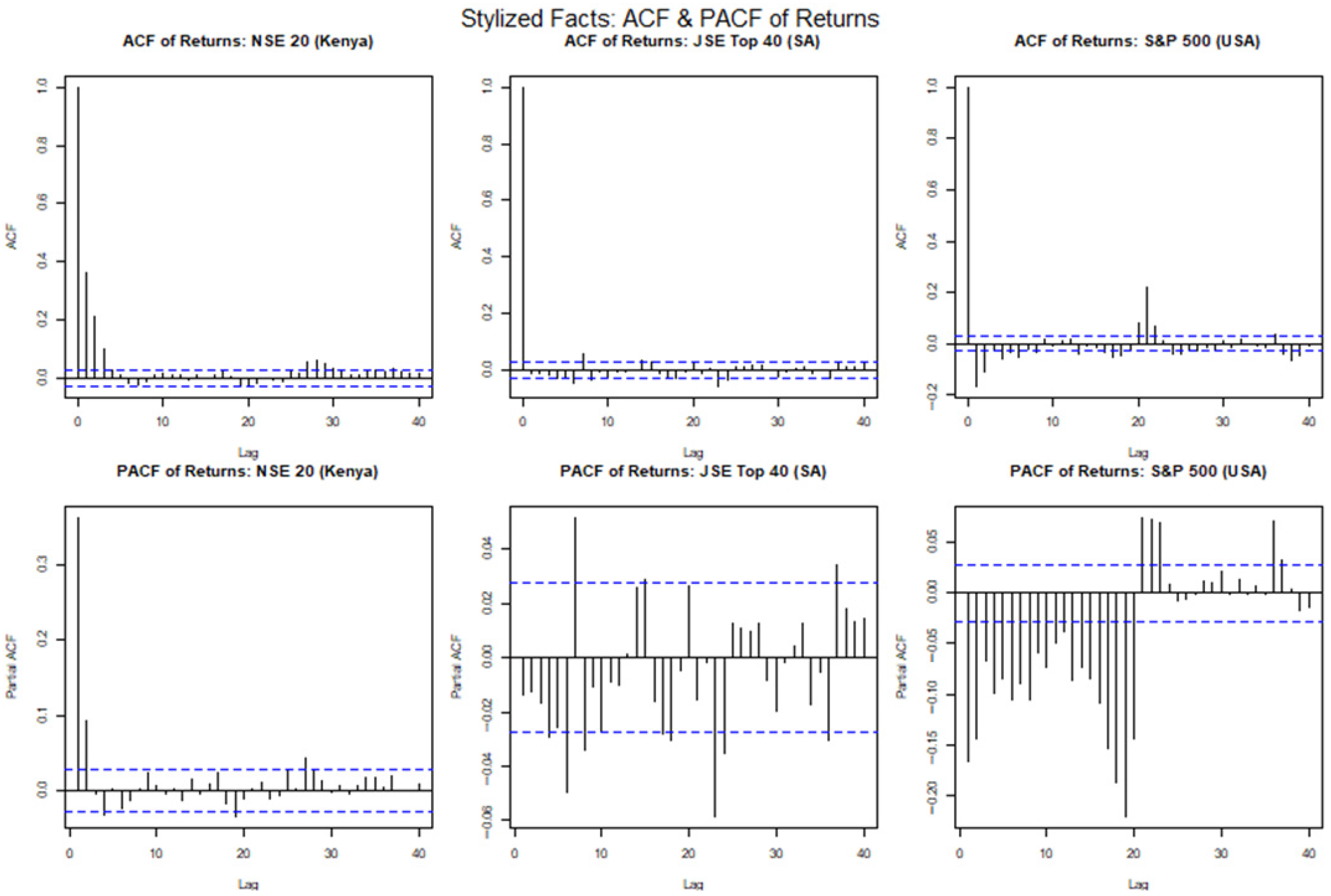
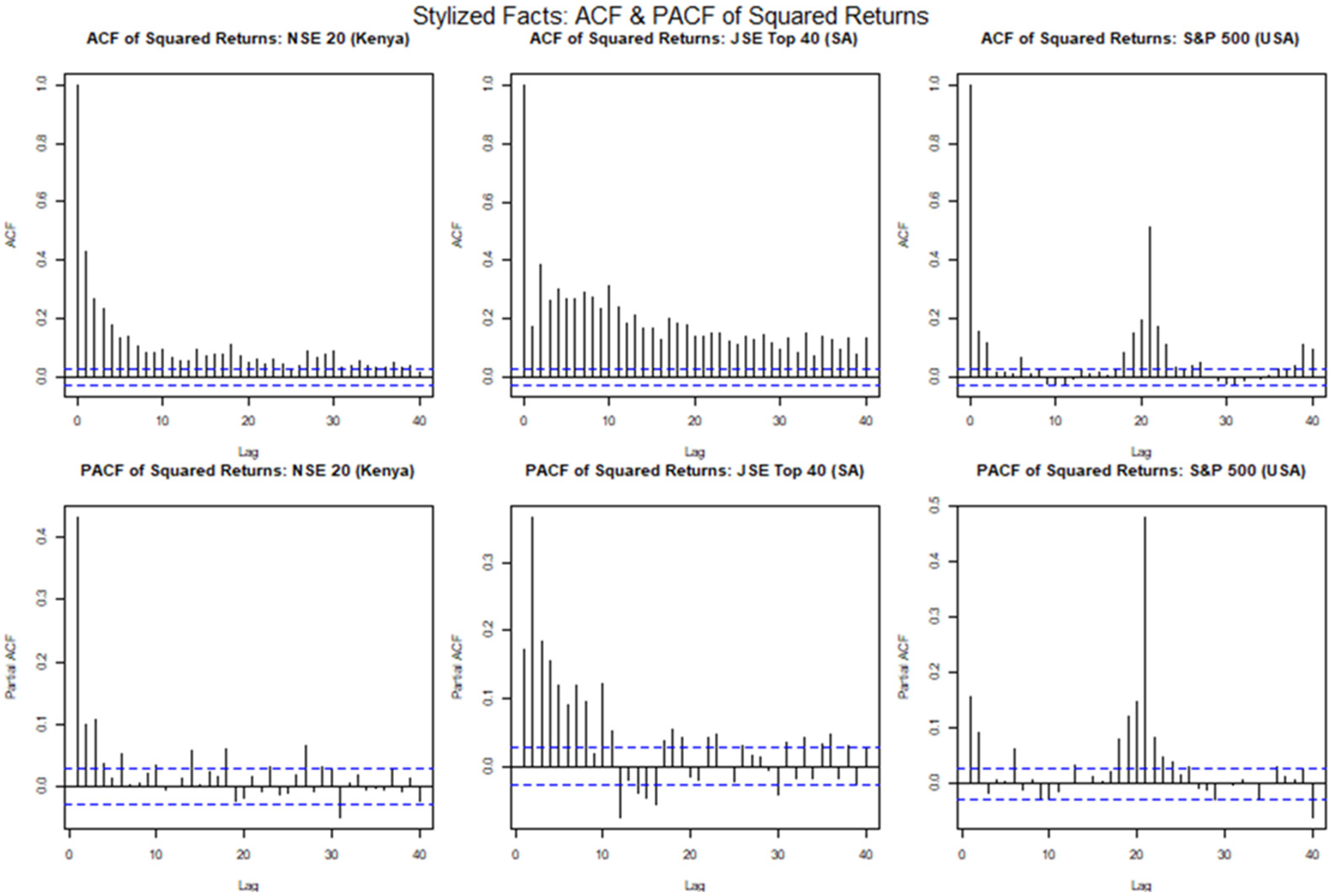
- Autocorrelation tests were conducted on all the returns prior to fitting the models, and the results from these tests confirmed the presence of both the ARCH effect and volatility clustering on the returns, providing evidence for the importance of applying ARCH and GARCH-family models to financial data.
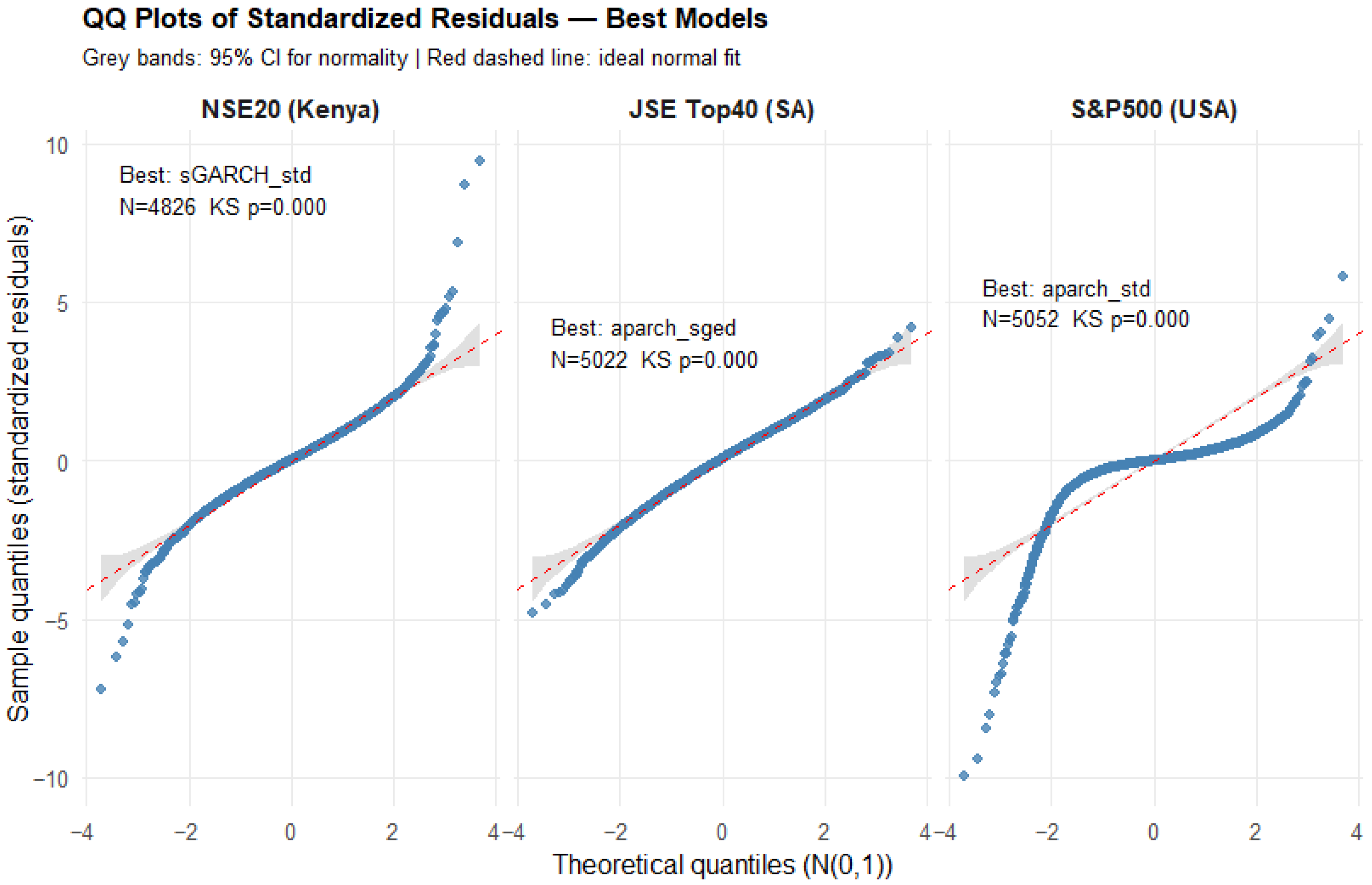
- Among the GARCH models and corresponding error distribution, the best fit for NSE20 returns was the standard GARCH (1,1) with Student-t errors. This suggests volatility clustering is symmetric, and the fat tails of the student-t distribution capture heavy-tailed NSE 20 returns better than the normal. For both the FTSE/JSE Top40 and S&P500 returns series, the APARCH (1,1), was the most suitable GARCH model, with the skewed GED errors and Student-t errors, respectively. This implies that the volatility dynamics of both these indices’ returns are asymmetric, and their return distributions are fat-tailed and skewed.
- A diagnostic assessment of the residuals of all three best fitting models was conducted, and no evidence of volatility clustering was found in all the indices, indicating the success of the chosen GARCH models in filtering out volatility clustering.
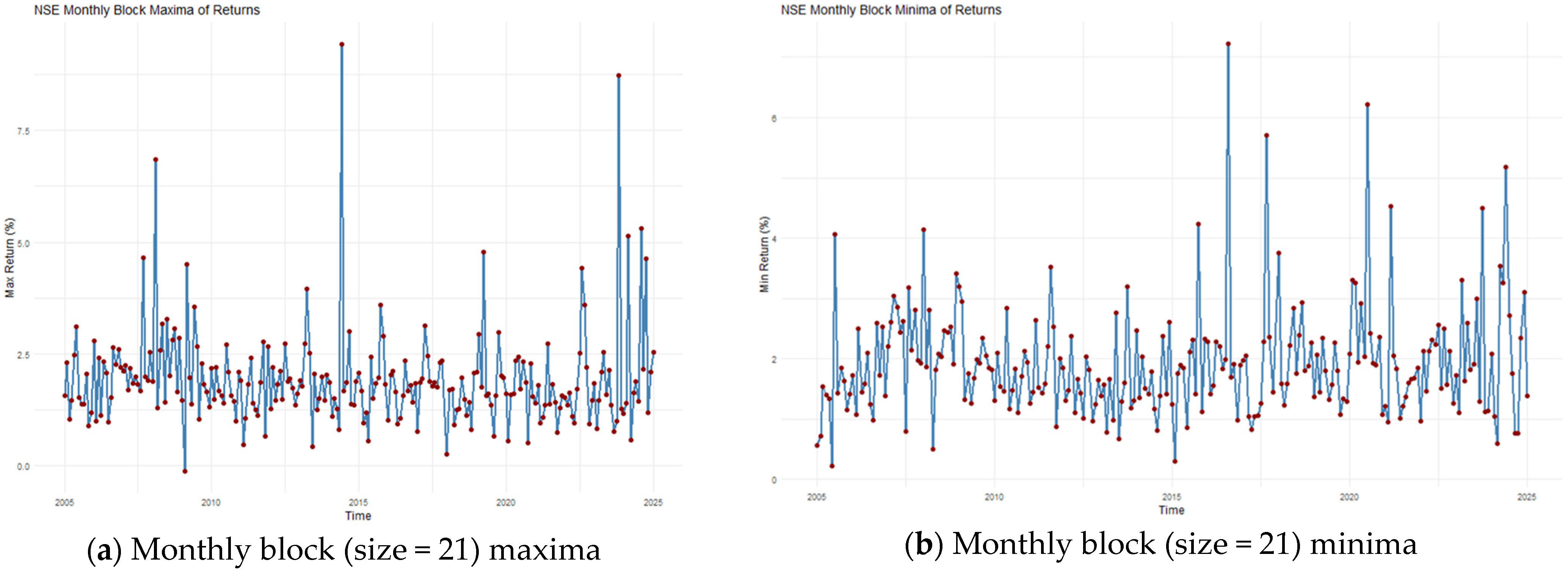
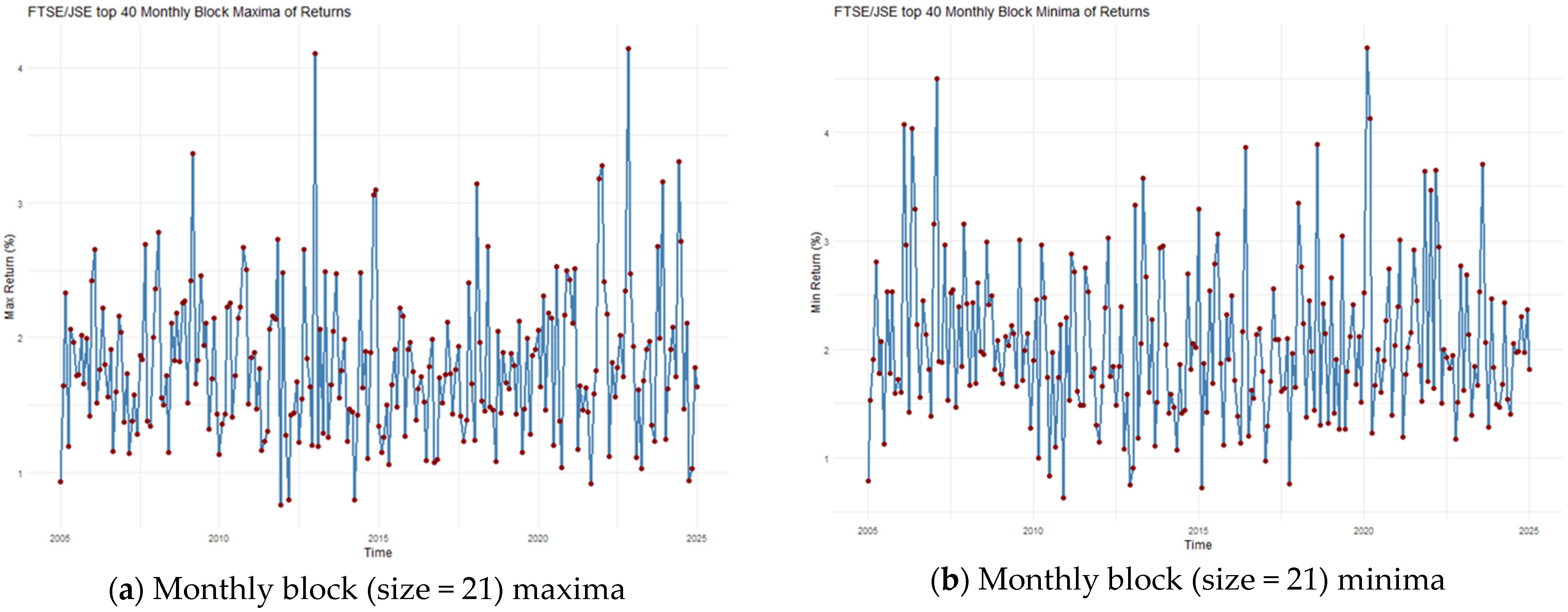
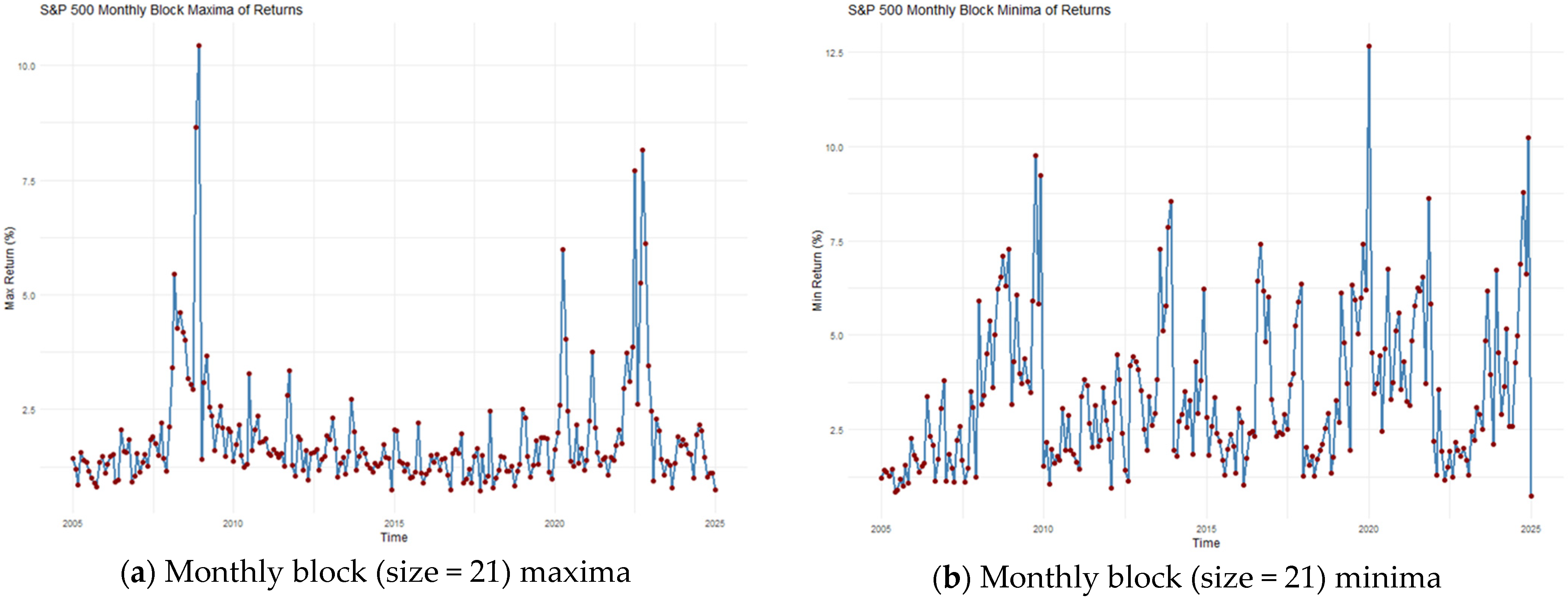
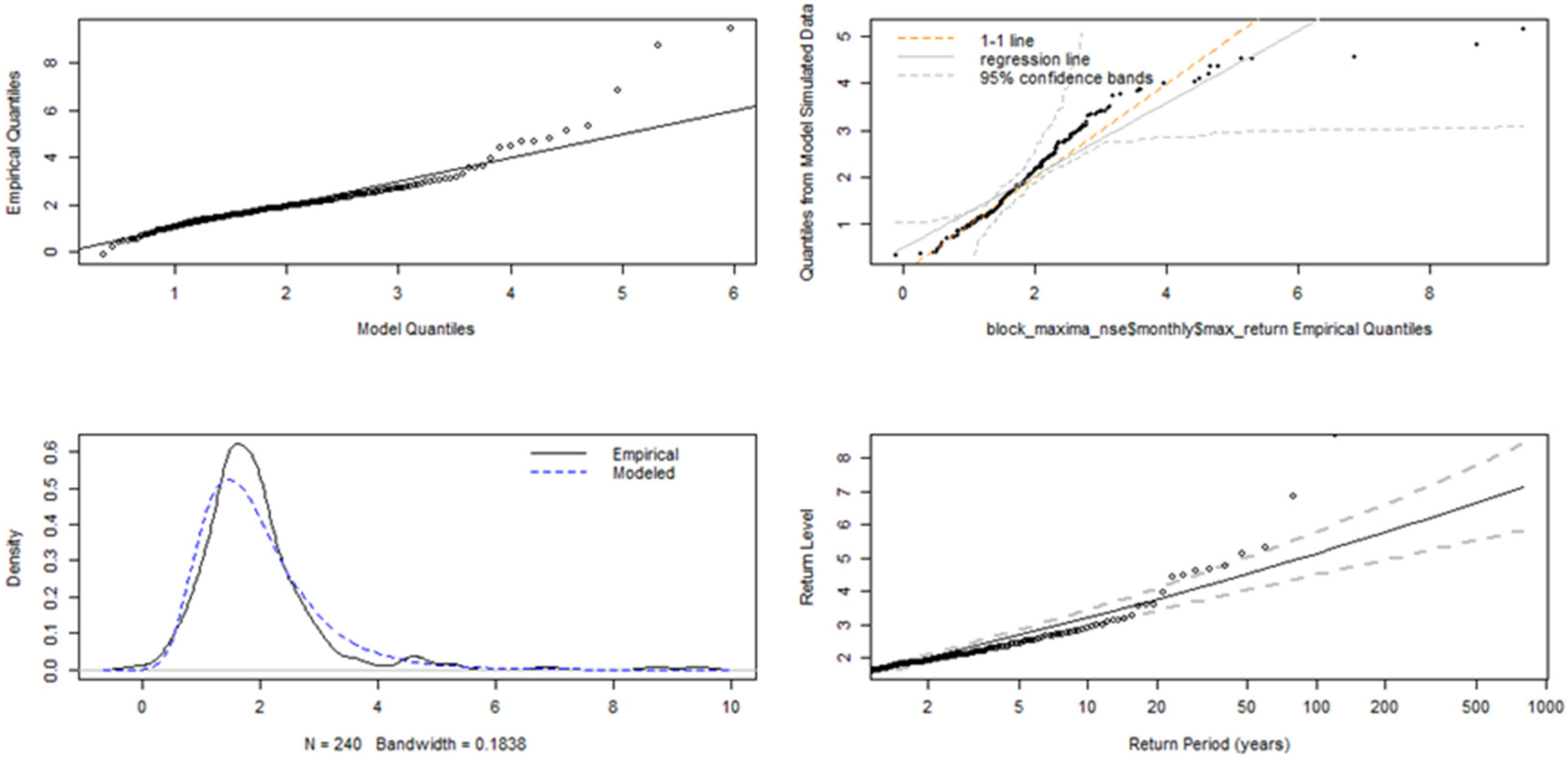
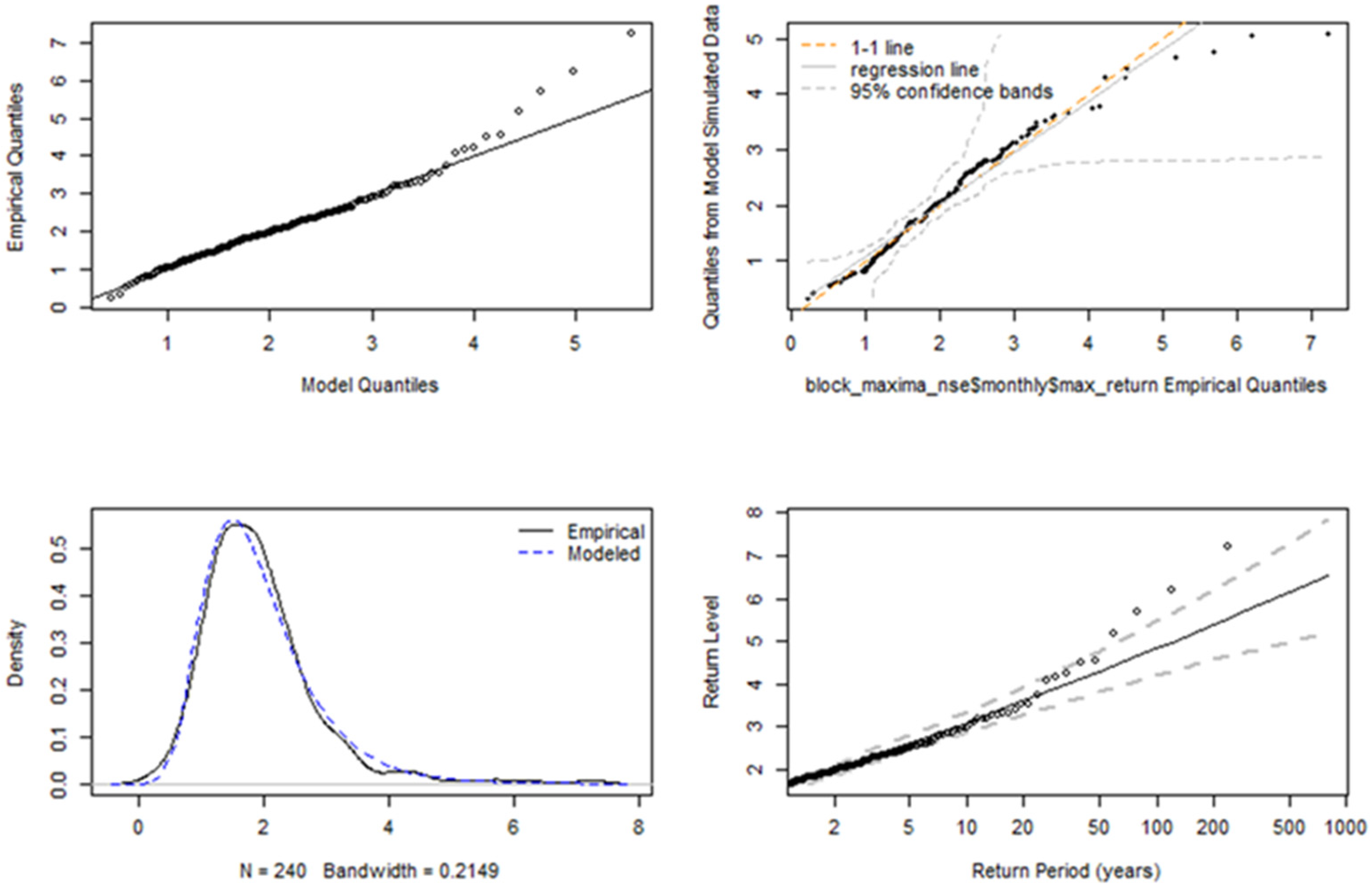
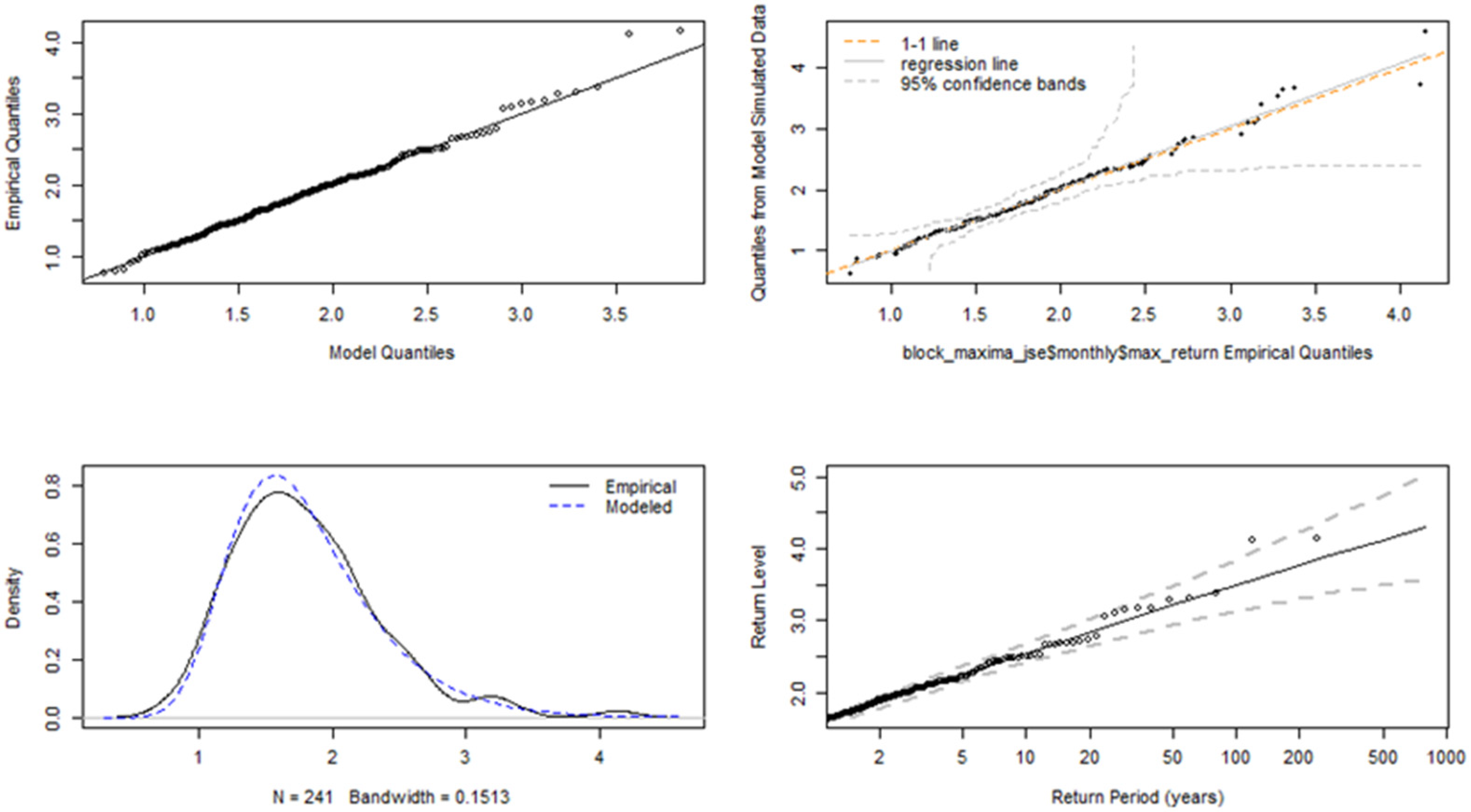
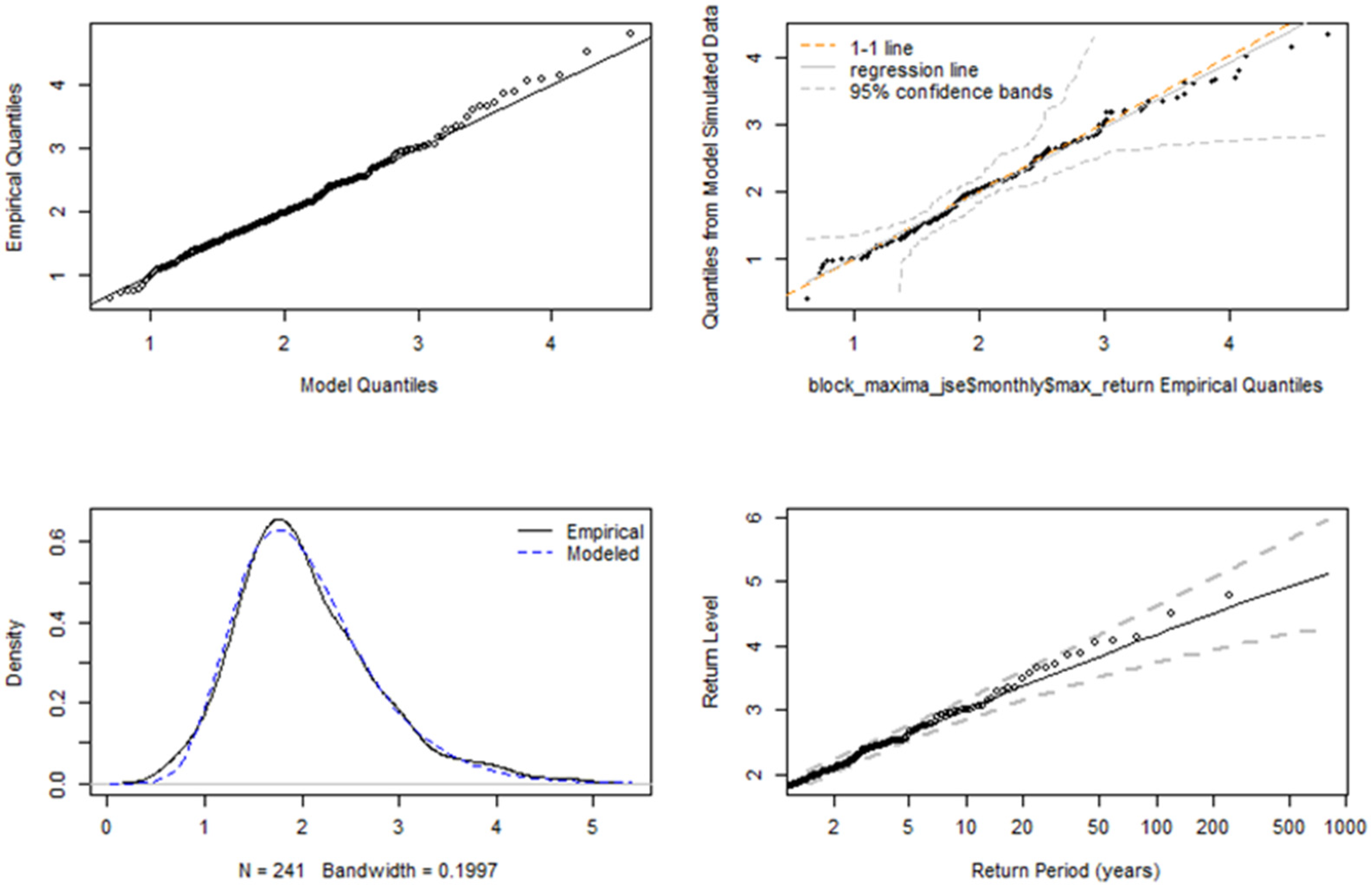
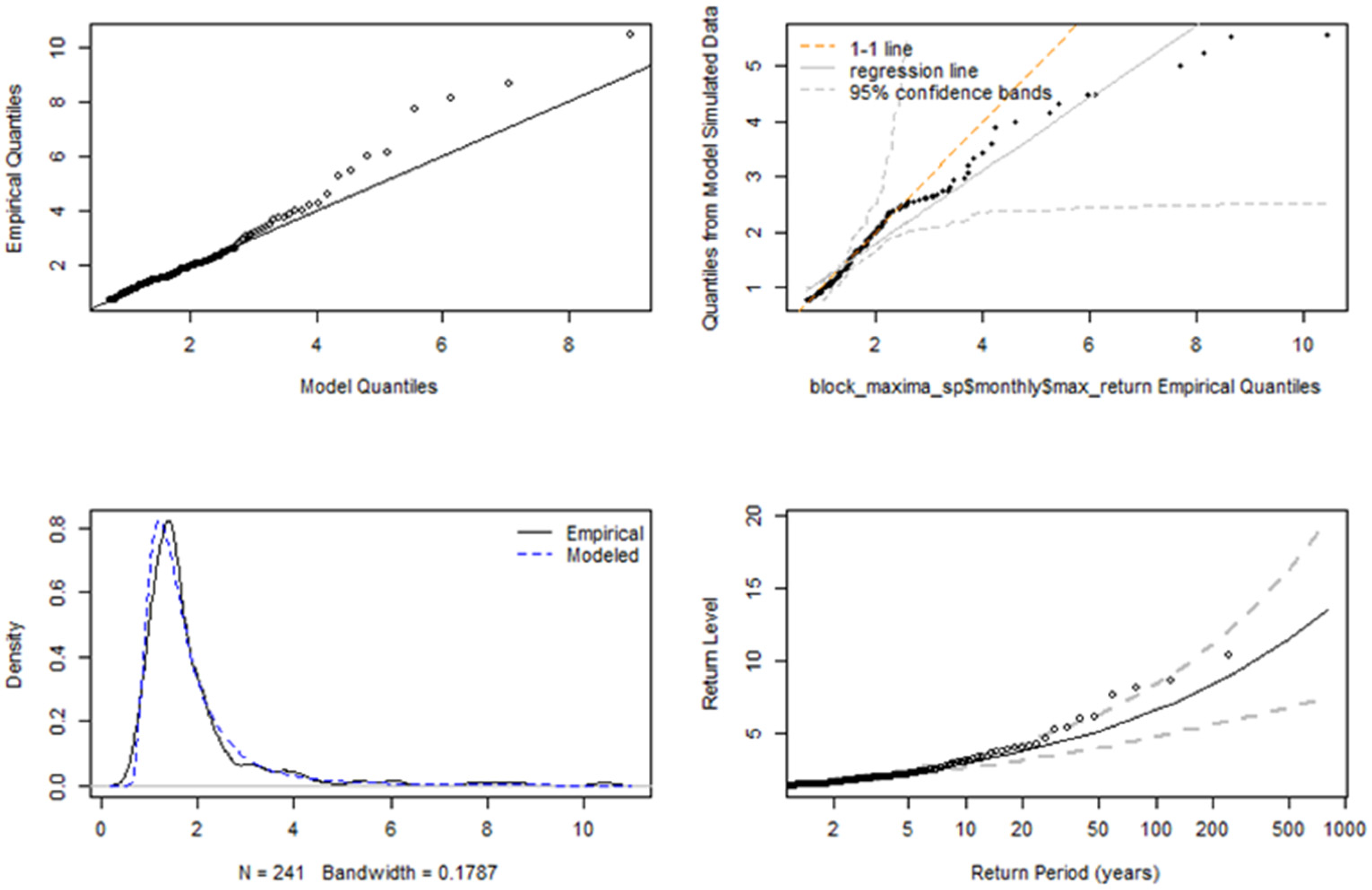
- Firstly, for the GEVD model, the return series represented gains while losses were represented by the negative of the same return series and were analysed separately. In line with block maxima methodology, three block sizes (21, 63 and 252) were chosen, corresponding to monthly, quarterly and yearly trading days, respectively. The GEVD model was then fitted to the different block sizes of maxima and minima for all datasets. Additionally, the performance of these models was ranked using AIC and BIC values and all the models with monthly block sizes were the best performing on both the maxima and minima of all three indices.
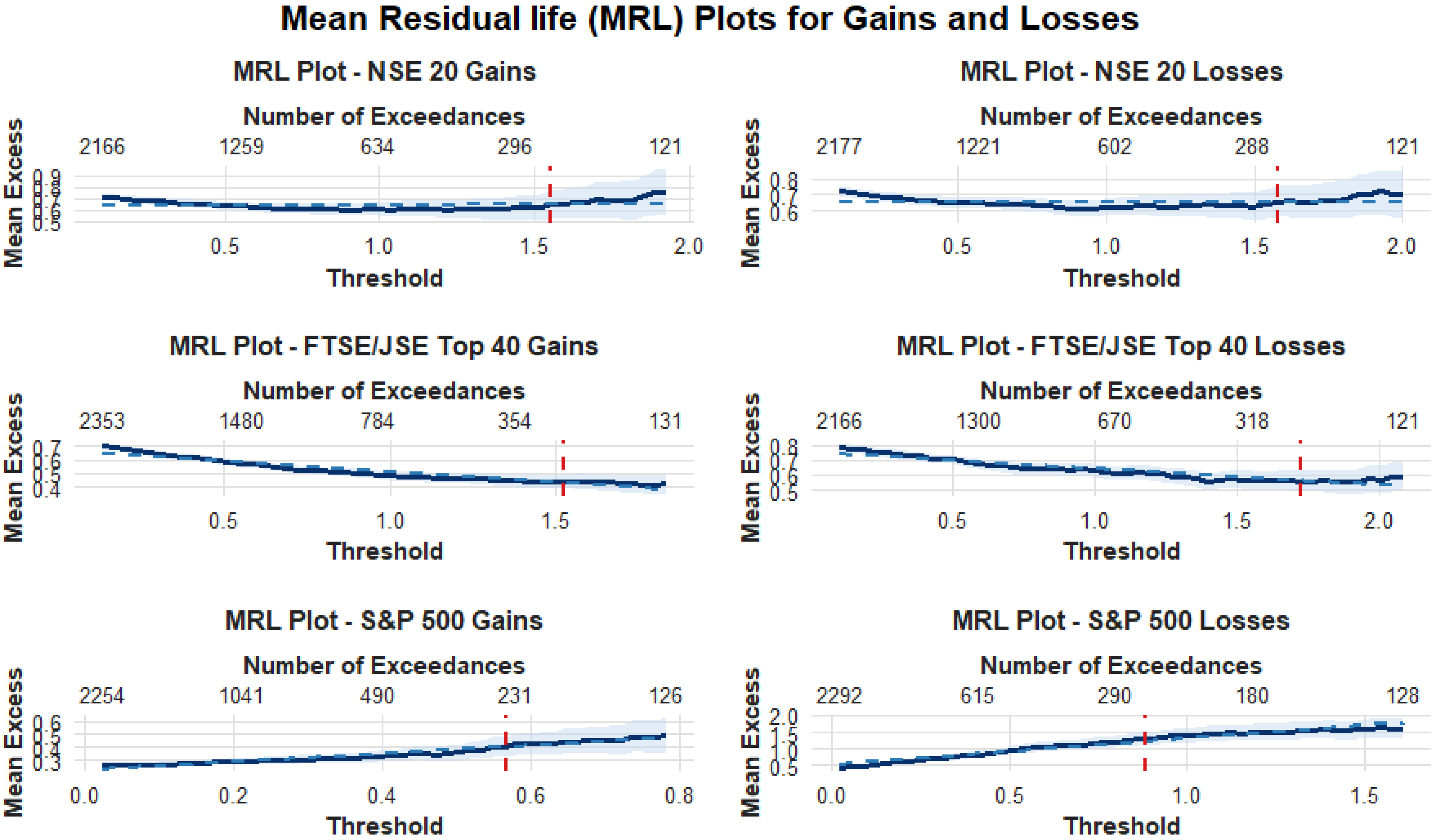
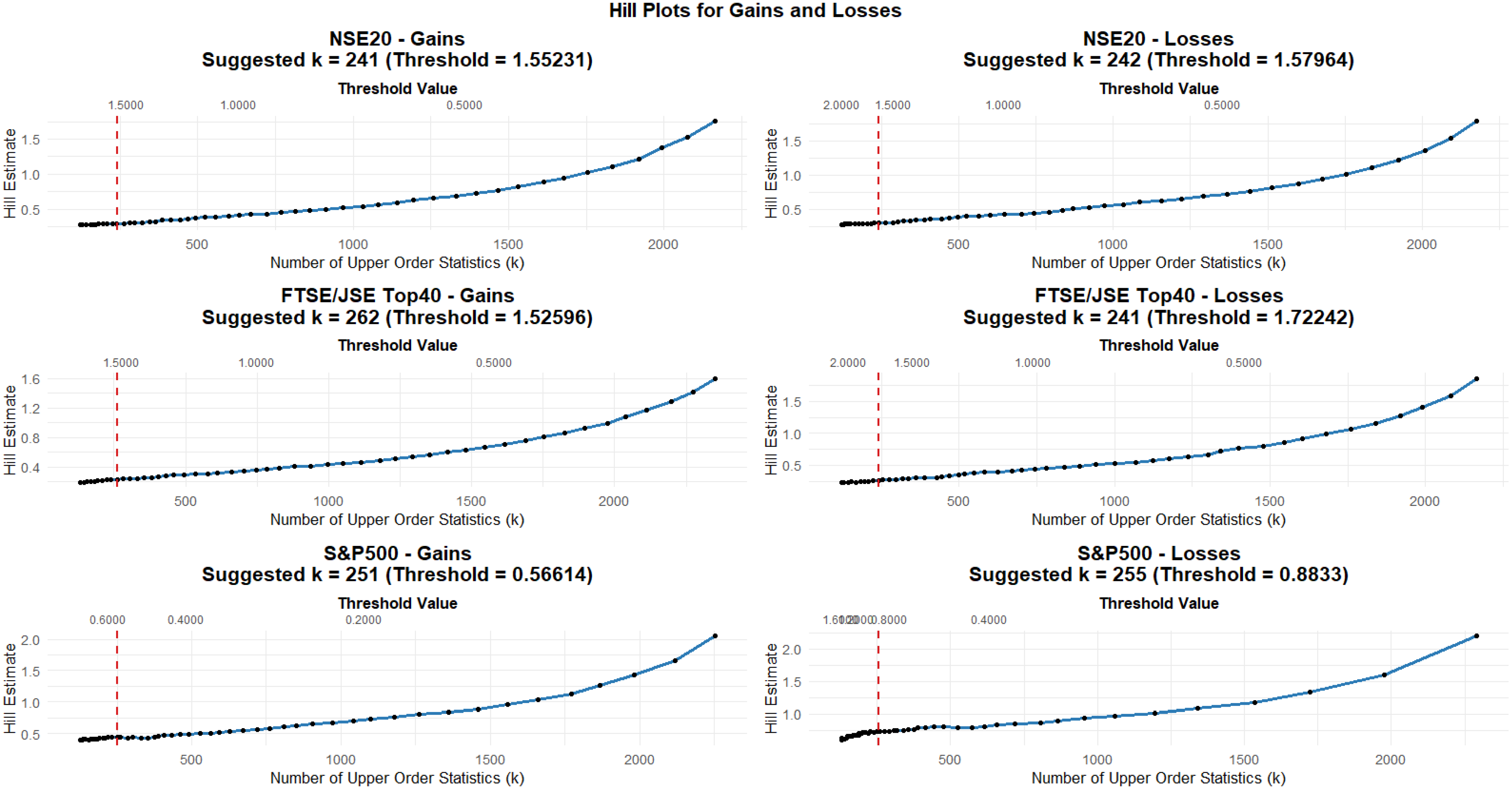
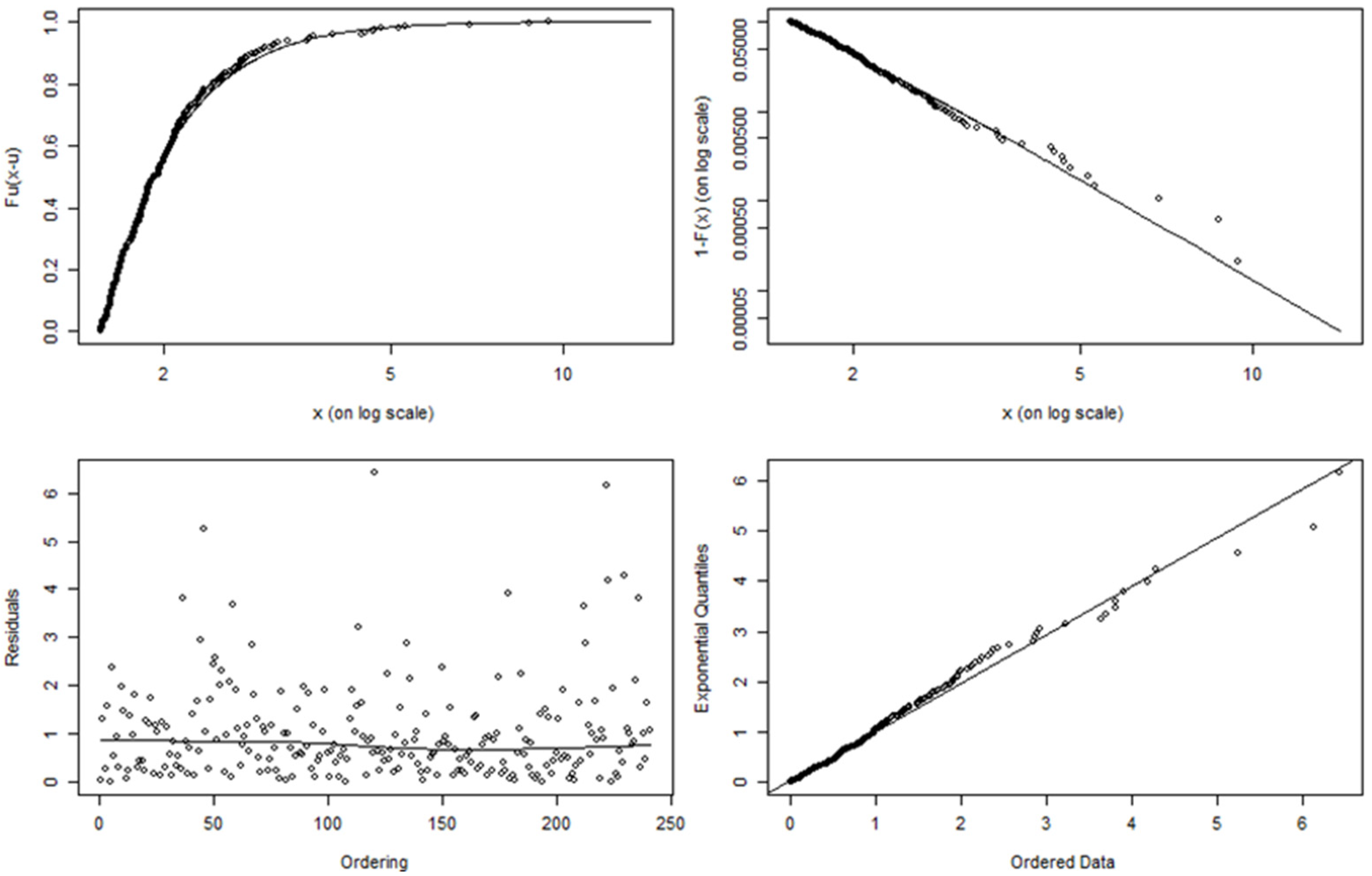
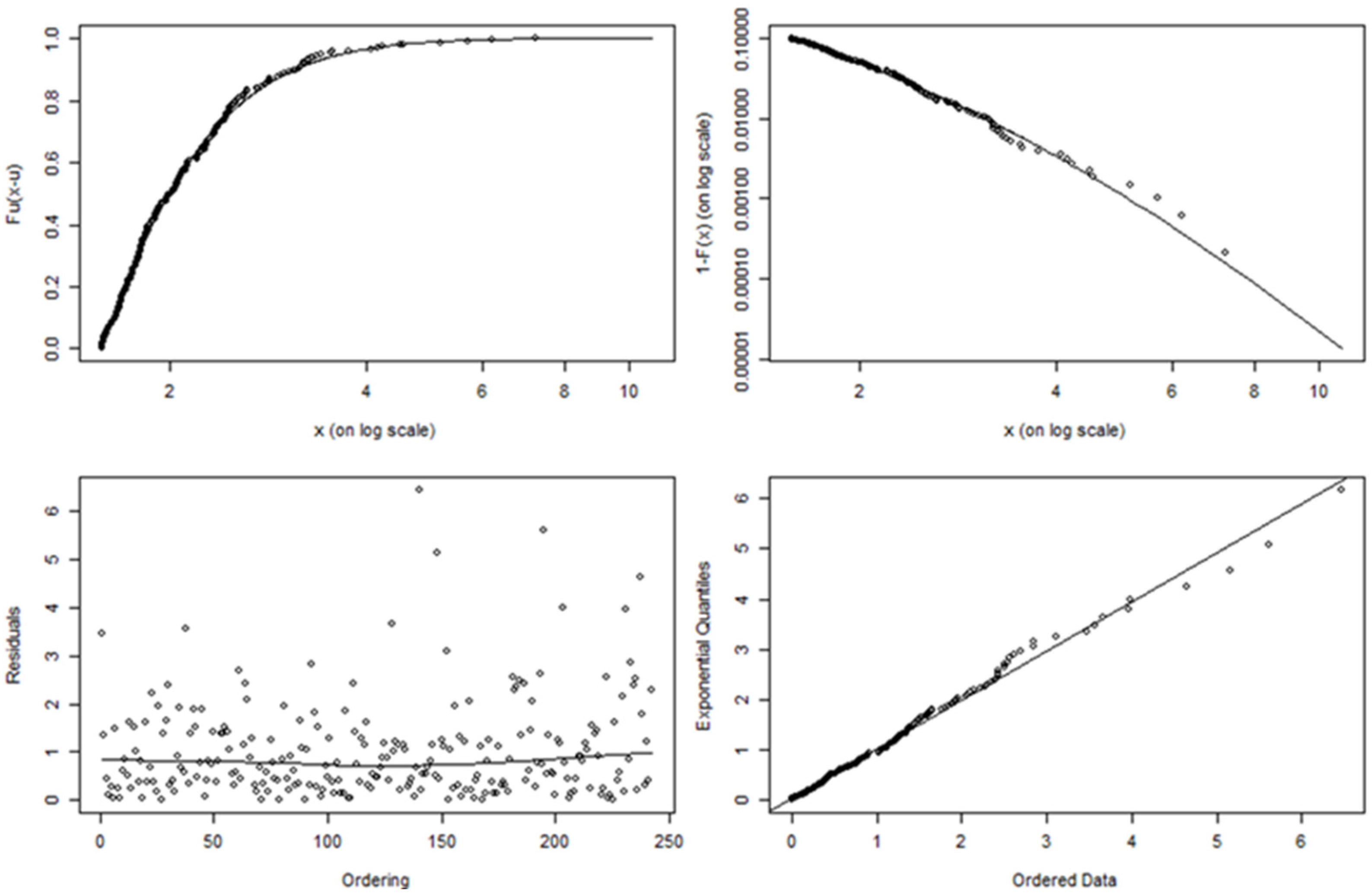
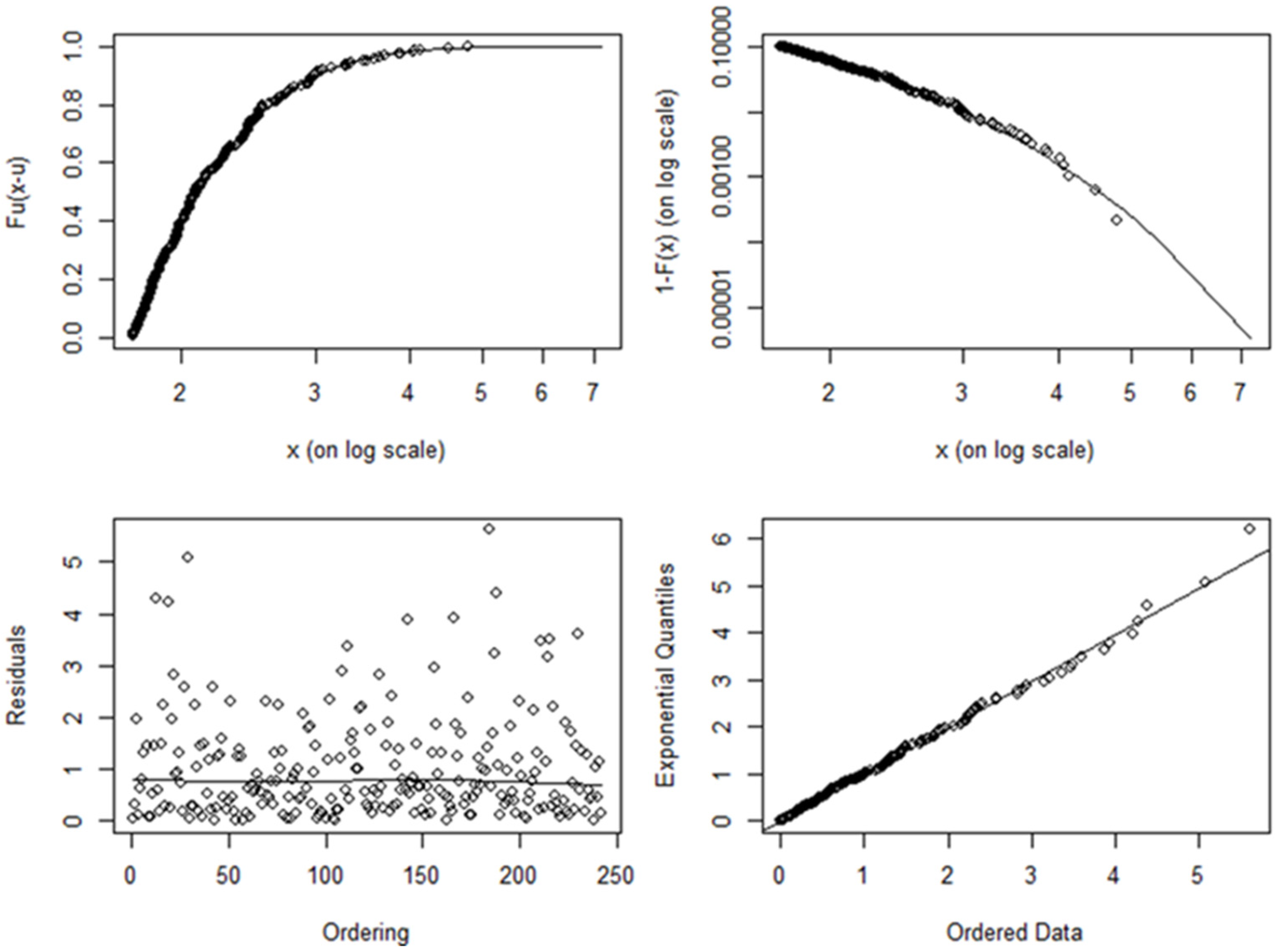
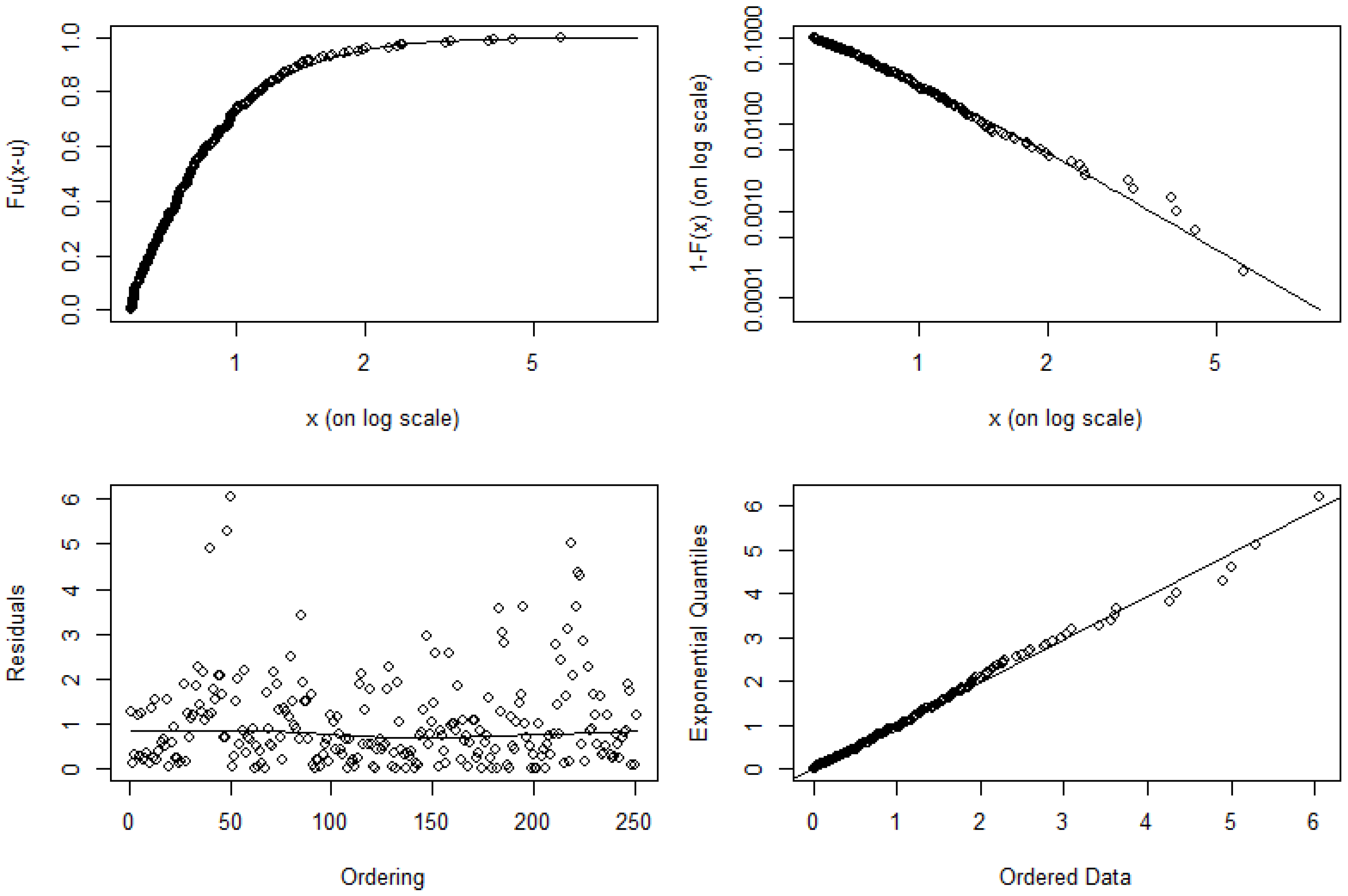
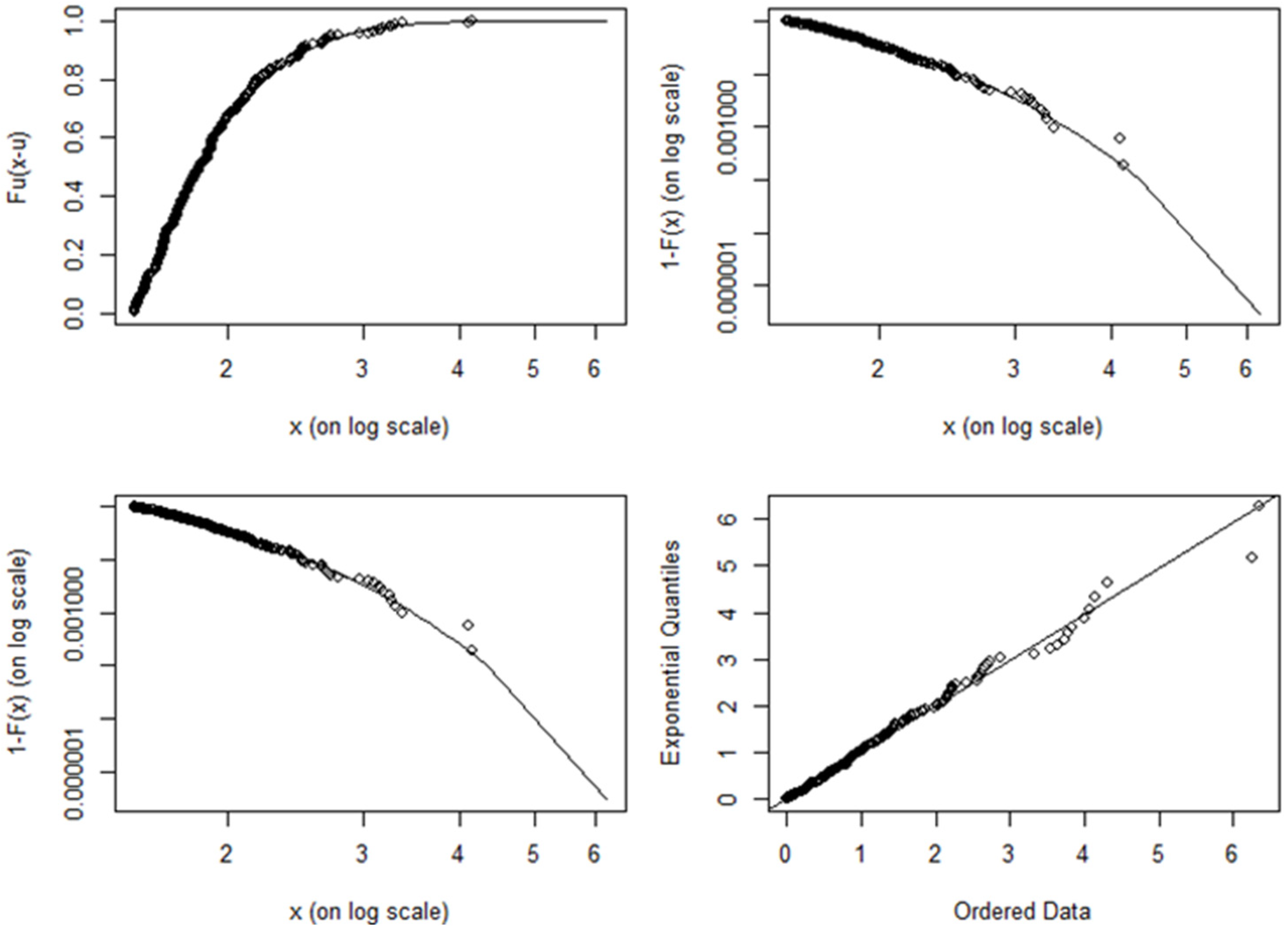
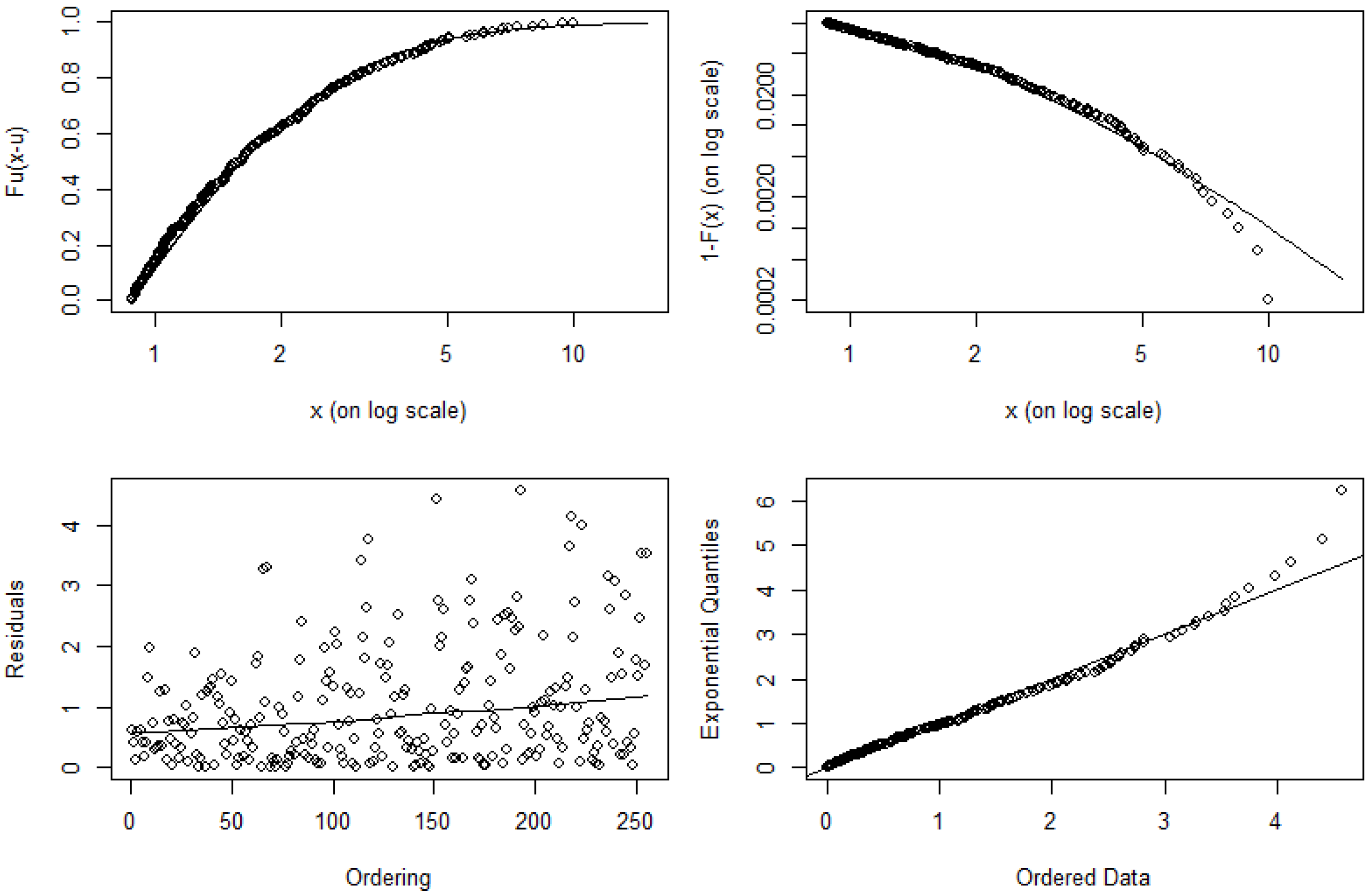
- Lastly, for the GPD model, the extracted standardised residuals for each dataset were separated into gains (positive) and losses (negative) and analysed separately. Following the PoT method, two threshold selection methods (MRL plots and Hill plots) were considered; however, the Hill plots offered slightly better threshold values with sufficiently high number of exceedances. As a result, the threshold values from the Hill plots were ultimately used to fit the GPD model to the gains and losses of all datasets. Moreover, an assessment of the fit was conducted using both diagnostic plots and GoF statistics (KS and AD), and the GPD models fit the data well.
- i.
- NSE20 (Emerging Market)
- GEVD maxima/minima:The GEVD produced reasonably accurate risk estimates at the 95% confidence level but began to show increasing deviations from empirical VaR and TVaR at 99% and 99.5%. For NSE20 maxima, GEVD tend to overestimate VaR while underestimating TVaR; this implies that for large gains, the model becomes conservative at the threshold VaR, but optimistic beyond it. For minima, similar behaviour occurred, with notable underestimation of extreme shortfall risk at high confidence levels.
- GPD gains/losses:The GPD produced very small VaR and TVaR deviations (often below 1–3%), demonstrating high stability in modelling both positive and negative extremes of NSE20 residuals. This consistency reinforces the suitability of the PoT framework for emerging-market data where sample sizes are smaller and tail events occur irregularly.
- Implication for emerging-market practitioners:For NSE20, EVT models, and particularly the GPD, allow portfolio managers and regulators to quantify extreme downside exposure more accurately than traditional models. Reliable tail estimates assist in stress testing and determining appropriate capital reserves in a market where volatility and liquidity constraints make extreme movements more costly for investors.
- ii.
- FTSE/JSE Top40 (Emerging Market)
- GEVD maxima/minima:The GEVD model performed reasonably well for both tails across most confidence levels, suggesting lighter tails and also producing low deviations for both maxima and minima. Although performance declined slightly at higher quantiles (99.5%), these deviations remained modest relative to the NSE20 and S&P500.
- GPD gains/losses:As with the NSE20, the GPD delivered consistently accurate VaR and TVaR estimates for the FTSE/JSE Top40 index, with deviations typically below 2%. This reinforces the robustness of the PoT approach even in markets with asymmetric volatility dynamics and skewed return distributions. Moreover, an assessment of the tails revealed that a distribution with finite tails might be appropriate.
- Implication for emerging-market practitioners:The FTSE/JSE Top40 results show that GPD-based EVT risk metrics can be used confidently for portfolio optimisation, tail risk budgeting, and regulatory capital calculation in advanced emerging markets. Policymakers may use these stable tail estimates to benchmark systemic risk resilience, support stress-test frameworks, and enhance early-warning indicators for market disruptions.
- iii.
- S&P500 (Developed Market)
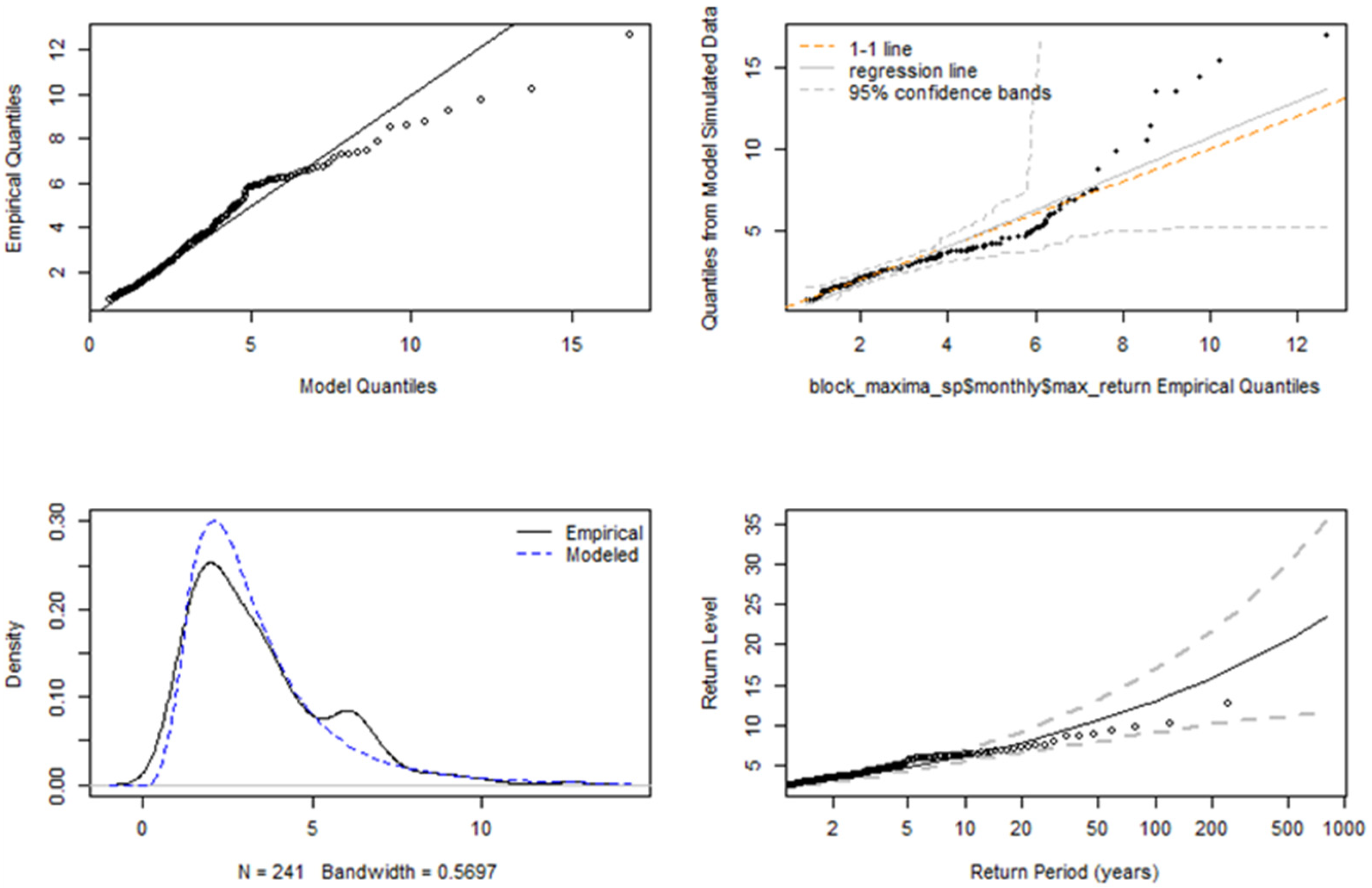
- GEVD maxima/minima:The GEVD showed substantial instability, especially in the left tail (losses) at the 99% and 99.5% confidence levels. Deviations in VaR and TVaR were extremely large, with TVaR deviations exceeding 30–90% for minima. This reflects the difficulty of fitting a block-maxima model to a market characterised by structural breaks, crisis periods, and extremely fat-tailed downside events.
- GPD gains/losses:In contrast, the GPD once again produced stable and accurate tail estimates, with VaR/TVaR deviations mostly within 1–6%. Even for the heavy-tailed S&P500 losses, the GPD captured the tail dynamics far more reliably than the GEVD.
- Implication for developed-market practitioners:For a highly liquid and globally integrated market like the S&P500, EVT models, particularly the GPD, provide critical tools for systemic-risk monitoring, allocating liquidity reserves and evaluating extreme market contagion risk. Portfolio managers benefit from more precise expected-shortfall measures, particularly under stress-regime conditions where traditional Gaussian assumptions severely understate risk.
- iv.
- Cross-market interpretation and practical implications
- GPD consistently outperforms GEVD in modelling both gains and losses, regardless of market classification.
- GEVD accuracy deteriorates rapidly at ultra-high confidence levels (99–99.5%), especially in developed markets where tail risks are stronger and more nonlinear.
- Emerging markets (NSE20 and JSE) show less extreme divergence between empirical and theoretical results compared to the S&P500 left tail but still benefit heavily from GPD’s superior precision.
- For practical decision-making:
- ○
- Portfolio managers gain more reliable tail-risk metrics for asset allocation, hedging and position sizing.
- ○
- Regulators can incorporate EVT-based VaR/TVaR into capital adequacy guidelines, replacing or supplementing Gaussian-based models that underestimate systemic risk.
- ○
- Policymakers in emerging markets can identify vulnerabilities to extreme movements, design targeted interventions, and build resilient financial-stability frameworks informed by accurate tail-risk measures.
5. Concluding Remarks
Supplementary Materials
Author Contributions
Funding
Institutional Review Board Statement
Informed Consent Statement
Data Availability Statement
Conflicts of Interest
Appendix A
Appendix A.1. Block Maxima Approach


Appendix A.2. Peak-over-Threshold (PoT)


Appendix A.3. Model Diagnostics






References
- Ait-Sahalia, Y., Fan, J., & Li, Y. (2013). The leverage effect puzzle: Disentangling sources of bias at high frequency. Journal of Financial Economics, 109(1), 224–249. [Google Scholar] [CrossRef]
- Avdulaj, K. (2011). The extreme value theory as a tool to measure market risk. Charles University in Prague, Institute of Economic Studies (IES), Prague (No. 26/2011). Available online: https://hdl.handle.net/10419/83384 (accessed on 15 January 2025).
- Bakali, H., Serhir, N., & Aouiche, I. (2021). Comparison between maximum annual and peak over threshold methods for the determination of extreme waves in Moroccan Atlantic Coast. IOP Conference Series: Earth and Environmental Science, 849(1), 012002. [Google Scholar] [CrossRef]
- Beirlant, J., Goegebeur, Y., Segers, J., & Teugels, J. L. (2004). Statistics of extremes: Theory and applications. John Wiley & Sons. [Google Scholar] [CrossRef]
- Benito, S., López-Martín, C., & Navarro, M. Á. (2023). Assessing the importance of the choice threshold in quantifying market risk under the POT approach (EVT). Risk Management, 25(1), 6. [Google Scholar] [CrossRef]
- Best, P. (2000). Implementing value at risk. John Wiley & Sons. ISBN 978-0-470-86596-5. [Google Scholar]
- Bollerslev, T. (1986). Generalized autoregressive conditional heteroskedasticity. Journal of Econometrics, 31(3), 307–327. [Google Scholar] [CrossRef]
- Cervantes, M. Á. N., Benito, S., & López-Martín, C. (2024). Assessing the performance of the block maxima method in estimating market risk. PsyArXiv. [Google Scholar] [CrossRef]
- Chauhan, G. S. (2011). Modelling of extreme market risk using extreme value theory (EVT): An empirical exposition for Indian and global stock indices. Indore Management Journal, 3(1), 23–33. [Google Scholar]
- Chege, C. K., Mungat’u, J. K., & Ngesa, O. (2016). Estimating the extreme financial risk of the Kenyan Shilling versus US Dollar exchange rates. Science Journal of Applied Mathematics and Statistics, 4(6), 249–255. [Google Scholar] [CrossRef][Green Version]
- Chernobai, A. S., Rachev, S. T., & Fabozzi, F. J. (2007). Operational risk: A guide to Basel II capital requirements, models, and analysis. John Wiley & Sons. [Google Scholar] [CrossRef]
- Chikobvu, D., & Jakata, O. (2020). Analyzing extreme risk in the South African Financial Index (J580) using the generalized extreme value distribution. Statistics, Optimization & Information Computing, 8(4), 915–933. [Google Scholar] [CrossRef]
- Chikobvu, D., & Jakata, O. (2023). Quantifying diversification effects of a portfolio using the generalised extreme value distribution-Archimedean Gumbel Copula model. Applied Mathematics & Information Sciences, 17(6), 967–981. [Google Scholar] [CrossRef]
- Chikobvu, D., & Ndlovu, T. (2023). The generalised extreme value distribution approach to comparing the riskiness of BitCoin/US Dollar and South African Rand/US Dollar returns. Journal of Risk and Financial Management, 16(4), 253. [Google Scholar] [CrossRef]
- Chinhamu, K., Huang, C. K., & Chikobvu, D. (2017). Evaluating risk in precious metal prices with generalized lambda, generalised Pareto and generalized extreme value distributions. South African Statistical Journal, 51(1), 159–182. [Google Scholar] [CrossRef]
- Coles, S. (2001). An introduction to statistical modeling of extreme values. Springer. ISBN 1-85233-459-2. [Google Scholar]
- Danielsson, J., & De Vries, C. G. (2000). Value-at-risk and extreme returns. Annales d’Economie et de Statistique, 239–270. [Google Scholar] [CrossRef]
- De Dieu, N. J., Mwita, N. P., & Mung’atu, N. J. (2014). Estimation of extreme value at risk in Rwanda exchange rate. European Journal Statistics and Probability, 2(3), 14–22. [Google Scholar] [CrossRef]
- Ding, Z., Granger, C. W., & Engle, R. F. (1993). A long memory property of stock market returns and a new model. Journal of Empirical Finance, 1(1), 83–106. [Google Scholar] [CrossRef]
- Echaust, K., & Just, M. (2020). Value at risk prediction in the tail of conditional distribution: The hybrid GARCH-EVT approach with optimal tail selection. Mathematics, 8(1), 114. [Google Scholar] [CrossRef]
- Edem, K. D., & Ndengo, M. (2021). Modelling bank of Kigali stock risks in Rwanda stock exchange using extreme value distribution. Journal of Financial Risk Management, 10, 225–240. [Google Scholar] [CrossRef]
- Engle, R. F. (1982). Autoregressive conditional heteroscedasticity with estimates of the variance of United Kingdom inflation. Econometrica, 50(4), 987–1007. [Google Scholar] [CrossRef]
- FTSE Russell. (2025). FTSE/JSE Africa index series—Factsheet. Available online: https://www.ftserussell.com (accessed on 10 September 2025).
- Glosten, L. R., Jagannathan, R., & Runkle, D. E. (1993). On the relation between the expected value and the volatility of the nominal excess return on stocks. Journal of Finance, 48(5), 1779–1801. [Google Scholar] [CrossRef]
- Heine, B. O., Meyer, M., & Strangfeld, O. (2005). Stylised facts and the contribution of simulation to the economic analysis of budgeting. Journal of Artificial Societies and Social Simulation, 8(4). [Google Scholar]
- Hussain, S. I., Masseran, N., Ruza, N., & Safari, M. A. M. (2021). Predicting extreme returns of Bitcoin: Extreme value theory approach. Journal of Physics: Conference Series, 1988, 012091. [Google Scholar] [CrossRef]
- Jakata, O., & Chikobvu, D. (2019). Modelling extreme risk of the South African financial index (J580) using the generalised Pareto distribution. Journal of Economic and Financial Sciences, 12(1), 1–7. [Google Scholar] [CrossRef][Green Version]
- Jakata, O., & Chikobvu, D. (2022). Extreme value modelling of the monthly South African industrial index (J520) returns. Statistics, Optimization & Information Computing, 10(2), 383–400. [Google Scholar] [CrossRef]
- J.P. Morgan & Co. (1996). Risk Metrics—Technical document (4th ed.). J.P. Morgan & Co. Incorporated. [Google Scholar]
- Këllezi, E., & Gilli, M. (2000). Extreme value theory for tail-related risk measures. Available online: https://core.ac.uk/reader/7183010 (accessed on 21 February 2024).
- Kiragu, K., & Mung’atu, J. K. (2016). Extreme values modelling of Nairobi securities exchange index. American Journal of Theoretical and Applied Statistics, 5(4), 229–234. [Google Scholar] [CrossRef]
- Klugman, S. A., Panjer, H. H., & Willmot, G. E. (2019). Loss models: From data to decisions (5th ed.). Wiley. ISBN 978-1-119-52378-9. [Google Scholar]
- Li, L. (2017). A comparative study of GARCH and EVT model in modeling value-at-risk. Journal of Applied Business and Economics, 19(7), 27–48. [Google Scholar]
- Makatjane, K. (2019). Extreme value theory as a financial risk measure of the South African stock market [Doctoral dissertation, North-West University]. [Google Scholar]
- Makatjane, K., & Moroke, N. (2021). Predicting extreme daily regime shifts in financial time series exchange/Johannesburg stock exchange—All share index. International Journal of Financial Studies, 9(2), 18. [Google Scholar] [CrossRef]
- Makatjane, K., & Moroke, N. (2022). Examining stylized facts and trends of FTSE/JSE TOP40: A parametric and nonparametric approach. Data Science in Finance and Economics, 2(3), 294–320. [Google Scholar] [CrossRef]
- Marambakuyana, W. A., & Shongwe, S. C. (2024a). Composite and mixture distributions for heavy-tailed data—An application to insurance claims. Mathematics, 12(2), 335. [Google Scholar] [CrossRef]
- Marambakuyana, W. A., & Shongwe, S. C. (2024b). Quantifying risk of insurance claims data using various loss distributions. Journal of Statistics Applications & Probability, 13(3), 1031–1044. [Google Scholar] [CrossRef]
- Mosala, R., Rachuene, K. A., & Shongwe, S. C. (2024). Most suitable threshold method for extremes in financial data with different volatility levels. In ITM web of conferences (Vol. 67, p. 01033). EDP Sciences. [Google Scholar] [CrossRef]
- Mushori, P., & Chikobvu, D. (2024). Modelling extreme tail risk of Bitcoin returns using the generalised Pareto distribution. In I. I. Miciula (Ed.), Cryptocurrencies—Financial technologies of the future (Working Title). IntechOpen. [Google Scholar] [CrossRef]
- Nelson, D. B. (1991). Conditional heteroskedasticity in asset returns: A new approach. Econometrica, 59(2), 347–370. [Google Scholar] [CrossRef]
- Nortey, E. N. N., Asare, K., & Mettle, F. O. (2015). Extreme value modelling of Ghana stock exchange index. Springer Plus, 4(1), 696. [Google Scholar] [CrossRef]
- Okumu, A. B., Olweny, T., & Muturi, W. (2021). Theoretical review of effect of firm specific factors on performance of initial public offering stocks at the Nairobi securities exchange in Kenya. Available online: http://41.89.101.166:8080/handle/123456789/11084 (accessed on 10 September 2025).
- Omari, C. O., Mwita, P. N., & Waititu, A. G. (2017). Using conditional extreme value theory to estimate value-at-risk for daily currency exchange rates. Journal of Mathematical Finance, 7(4), 846–870. [Google Scholar] [CrossRef][Green Version]
- Park, M. H., & Kim, J. H. (2016). Estimating extreme tail risk measures with generalized Pareto distribution. Computational Statistics & Data Analysis, 98, 91–104. [Google Scholar] [CrossRef]
- Pickands, J., III. (1975). Statistical inference using extreme order statistics. The Annals of Statistics, 3(1), 119–131. [Google Scholar] [CrossRef]
- Quintino, F. S., Oliveira, M., Rathie, P. N., Ozelim, L. C. S. M., & da Fonseca, T. A. (2023). Asset selection based on estimating stress–strength probabilities: The case of returns following three-parameter generalized extreme value distributions. AIMS Mathematics, 9(1), 2345–2368. [Google Scholar] [CrossRef]
- Rice, J. A., & Rice, J. A. (2007). Mathematical statistics and data analysis (Vol. 371). Thomson/Brooks/Cole. [Google Scholar]
- Singh, A. K., Allen, D. E., & Robert, P. J. (2012). Extreme market risk and extreme value theory. Mathematics and Computers in Simulation, 94, 310–328. [Google Scholar] [CrossRef]
- Smith, R. L. (1985). Maximum likelihood estimation in a class of non-regular cases. Biometrika, 72(1), 67–90. [Google Scholar] [CrossRef]
- Soltane, H. B., Karaa, A., & Bellalah, M. (2012). Conditional VaR using GARCH-EVT approach: Forecasting volatility in Tunisian financial market. Journal of Computations & Modelling, 2(2), 95–115. [Google Scholar]
- S&P Dow Jones Indices. (2025). S&P 500® factsheet. Available online: https://www.spglobal.com/spdji (accessed on 10 September 2025).
- Stephenson, A. (2022). Package ‘evd’: Functions for extreme value distributions (R package version 2.3-6.1). Available online: https://cran.r-project.org/web/packages/evd/evd.pdf (accessed on 20 March 2024).
- Sweeting, P. (2011). Financial enterprise risk management. Cambridge University Press. ISBN 9780521111645. [Google Scholar]
- Wentzel, D. C., & Maré, E. (2007). Extreme value theory—An application to the South African equity market. Investment Analysts Journal, 36(66), 73–77. [Google Scholar] [CrossRef]



| Publication | GARCH | Parameter Estimation | Goodness-of-Fit | Risk Measure | Application Data | |||
|---|---|---|---|---|---|---|---|---|
| GEVD | GPD | Other | ||||||
| Cervantes et al. (2024) | ✓ | ✓ | ML | KS, AD, CVM, QQ plot, Empirical vs. Fitted CDF | VaR, ES | Global equities-S&P500 (USA), CAC40 (France), DAX30 (Germany), FTSE100 (UK), and other indices. | ||
| Mushori and Chikobvu (2024) | ✓ | ML | AD, KS | VaR, ES | Bitcoin returns | |||
| Mosala et al. (2024) | ✓ | ML | MSE, QQ plot | Discovery Limited, SAGB, TCRS | ||||
| Chikobvu and Jakata (2023) | ✓ | ML | QQ plot | VaR, ES | SA Financial Index (J580), SA Industrial Index (J520) | |||
| Chikobvu and Ndlovu (2023) | ✓ | ML | QQ plot, PP plot, density plot, return level | VaR | Bitcoin/US Dollar (BTC/USD) and South African Rand/US Dollar (ZAR/USD) exchange rates | |||
| Quintino et al. (2023) | ✓ | ML | KS | Brazilian stock market-BBAS3 (Banco do Brasil), ITUB4 (Itaú Unibanco), VALE3 (Vale S.A.), and VIIA3 (Via S.A.) indices | ||||
| Jakata and Chikobvu (2022) | ✓ | ML | QQ plot, PP plot, scatter plot, residuals, return level | VaR, ES | J520 | |||
| Edem and Ndengo (2021) | ✓ | ✓ | LS, ML | QQ plot | VaR, ES | Bank of Kigali stock returns | ||
| Hussain et al. (2021) | ✓ | ML | QQ plot | - | Bitcoin returns | |||
| Chikobvu and Jakata (2020) | ✓ | ✓ | ML | QQ plot, return level, density plot | VaR, ES | J580 | ||
| Echaust and Just (2020) | ✓ | ✓ | ML | QQ plot, mean excess plots. | VaR | S&P500, FTSE100, CAC40, DAX, Nikkei225, and other indices | ||
| Jakata and Chikobvu (2019) | ✓ | ML | AD | VaR, ES | J580 | |||
| Makatjane (2019) | ✓ | ✓ | ✓ | ML | S-W, AD | VaR, ES, Glue-VaR | FTSE/JSE banking indices (ABSA, Capitec FNB, Nedbank, Std Bank) | |
| Chinhamu et al. (2017) | ✓ | ✓ | ✓ | ML | QQ plot, histograms | VaR, ES | Precious metals (platinum, gold, and silver) returns | |
| Omari et al. (2017) | ✓ | ✓ | ML | - | VaR | Four currency exchange rates against the Kenyan Shilling | ||
| Chege et al. (2016) | ✓ | ✓ | ML | QQ plot | VaR, ES | Kenyan Shilling/US Dollar exchange rate dataset | ||
| Kiragu and Mung’atu (2016) | ✓ | ✓ | ML | BIC, AIC, QQ plot, density plot | VaR, ES | NSE all share index | ||
| Nortey et al. (2015) | ✓ | ✓ | ML | QQ plot, PP plot, density plot | VaR, ES | Ghana Stock Exchange all-shares index | ||
| De Dieu et al. (2014) | ✓ | ✓ | ML | - | VaR | Rwanda exchange rate vs. Kenyan shilling, US Dollar, EUR, GBP | ||
| Soltane et al. (2012) | ✓ | ✓ | ML | QQ plots, LR | VaR, ES | Tunis Stock Exchange index (Tunindex) | ||
| Singh et al. (2012) | ✓ | ✓ | ML | QQ plot, scatter plot, density plot | VaR, ES | S&P500, ASX-All Ordinaries (Australian) indices | ||
| Avdulaj (2011) | ✓ | ✓ | ML | Empirical vs. Fitted CDF | VaR | Central European indices: DAX, PX50 (Czech Republic), SSMI (Switzerland), ATX (Austria) | ||
| Chauhan (2011) | ✓ | ML, MoM | Binomial test | VaR, ES | SENSEX, CNX NIFTY, S&P500, and FTSE100 | |||
| Wentzel and Maré (2007) | ✓ | ML | - | SA FTSE/JSE Top40 index | ||||
| Descriptive | NSE20 | FTSE/JSE Top40 | S&P500 | ||||||
|---|---|---|---|---|---|---|---|---|---|
| Returns | Gains | Losses | Returns | Gains | Losses | Returns | Gains | Losses | |
| Minimum | −5.2340 | 0.0004 | 0 | −10.4504 | 0.0013 | 0 | −38.4319 | 0.0017 | 0 |
| Maximum | 6.9476 | 6.9476 | 5.2339 | 9.0567 | 9.0570 | 10.4504 | 55.1073 | 55.1073 | 38.4319 |
| Mean | −0.0065 | 0.5432 | 0.5458 | 0.0380 | 0.9156 | 0.9378 | 0.0322 | 2.3607 | 2.8124 |
| Median | −0.0054 | 0.3812 | 0.3819 | 0.0744 | 0.6979 | 0.6643 | 0.1302 | 1.0996 | 1.0249 |
| Kurtosis | 853.1362 | 23.622 | 12.8642 | 508.6845 | 12.1856 | 12.7659 | 2074.5250 | 53.4579 | 12.9614 |
| Skewness | 27.3738 | 3.7227 | 2.9036 | −19.2317 | 2.6311 | 2.6279 | 20.1513 | 5.8363 | 3.1522 |
| Std deviation | 0.8004 | 0.5981 | 0.5753 | 1.2937 | 0.8671 | 0.9433 | 4.8682 | 3.8097 | 4.4956 |
| Variance | 0.6406 | 0.3578 | 0.3310 | 1.6736 | 0.7519 | 0.8898 | 23.6996 | 14.5141 | 20.2107 |
| Returns | Squared Returns | |
|---|---|---|
| McLeod-Li: p-Value | Ljung–Box: p-Value | |
| NSE20 | 0.01 | 0.01 |
| FTSE/JSE Top40 | 0.01 | 0.01 |
| S&P500 | 0.01 | 0.01 |
| NSE 20—Standard GARCH_std | FTSE/JSE Top 40—APARCH_sged | S&P 500—APARCH_std | ||||||||||
|---|---|---|---|---|---|---|---|---|---|---|---|---|
| Parameters | Estimate | Std. Error | t-Value | Estimate | Std. Error | t-Value | Estimate | Std. Error | t-Value | |||
| −0.0025 | 0.0088 | 0.2817 | 0.7782 | 0.0157 | 0.0143 | 1.1018 | 0.2705 | 0.1465 | 0.0067 | 21.8137 | 0.0000 | |
| 0.0988 | 0.0149 | 6.6361 | 0 | 0.0238 | 0.0012 | 20.2139 | 0.0000 | 0.5107 | 0.0550 | 9.2920 | 0.0000 | |
| 0.3094 | 0.0326 | 9.4780 | 0 | 0.0631 | 0.0045 | 14.1492 | 0.0000 | 0.8146 | 0.0768 | 10.6014 | 0.0000 | |
| 0.5364 | 0.0459 | 11.6795 | 0 | 0.9283 | 0.0054 | 170.8732 | 0.0000 | 0.4065 | 0.0181 | 22.4368 | 0.0000 | |
| NA | NA | NA | NA | 0.9740 | 0.0057 | 171.8116 | 0.0000 | 0.0316 | 0.0405 | 0.7793 | 0.4358 | |
| Skew | NA | NA | NA | NA | 1.0908 | 0.0861 | 12.6701 | 0.0000 | 0.4633 | 0.0514 | 9.0069 | 0.0000 |
| Shape | 5.6632 | 0.4336 | 13.0618 | 0 | 0.8705 | 0.0169 | 51.5807 | 0.0000 | 2.1000 | 0.0033 | 645.4520 | 0.0000 |
| Squared Residuals | |
|---|---|
| Ljung–Box: p-Value | |
| NSE20 | 0.436 |
| FTSE/JSE Top40 | 0.1032 |
| S&P500 | 0.55 |
| Block Size | ξ-Shape | β-Scale | µ-Location | KS p-Value | AD p-Value | BIC | AIC | Av. Rank | |
|---|---|---|---|---|---|---|---|---|---|
| GEVD maxima | 21 | 0.0540 (0.0302) | 0.7005 (0.0344) | 1.4977 (0.0489) | 0.1236 | 0.0780 | −610.103 [1] | −599.661 [1] | [1] |
| 63 | 0.3414 (0.0860) | 0.5823 (0.0621) | 2.0995 (0.0718) | 0.9775 | 0.9786 | −213.782 [2] | −206.598 [2] | [2] | |
| 252 | 0.5156 (0.2407) | 0.8810 (0.2180) | 2.9629 (0.2245) | 0.768 | 0.9407 | −82.229 [3] | −79.095 [3] | [3] | |
| GEVD minima | 21 | 0.0396 (0.0372) | 0.6548 (0.0333) | 1.5311 (0.0464) | 0.827 | 0.768 | −578.098 [1] | −567.656 [1] | [1] |
| 63 | 0.1502 (0.0822) | 0.6704 (0.0641) | 2.1151 (0.0834) | 0.8496 | 0.9872 | −218.006 [2] | −218.006 [2] | [2] | |
| 252 | −0.0506 (0.1680) | 1.1553 (0.2849) | 3.1600 (0.2849) | 0.9831 | 0.9933 | −80.424 [3] | −77.290 [3] | [3] |
| Block Size | ξ-Shape | β-Scale | µ-Location | KS p-Value | AD p-Value | BIC | AIC | Av. Rank | |
|---|---|---|---|---|---|---|---|---|---|
| GEVD maxima | 21 | −0.06136 (0.0432) | 0.4354 (0.0224) | 1.5602 (0.0313) | 0.9386 | 0.9851 | −369.5427 [1] | −359.0883 [1] | [1] |
| 63 | 0.0721 (0.0849) | 0.3860 (0.0360) | 1.97111 (0.0484) | 0.7311 | 0.9386 | −121.552 [2] | −114.369 [2] | [2] | |
| 252 | −0.1747 (0.1495) | 0.5624 (0.0958) | 2.5384 (0.1368) | 0.9324 | 0.9334 | −47.082 [3] | −43.948 [3] | [3] | |
| GEVD minima | 21 | −0.0556 (0.0417) | 0.5826 (0.0295) | 1.7286 (0.0416) | 0.8772 | 0.8897 | −506.039 [1] | −495.584 [1] | [1] |
| 63 | 0.0148 (0.0875) | 0.5230 (0.0484) | 2.3232 (0.0660) | 0.9814 | 0.9870 | −165.504 [2] | −158.320 [2] | [2] | |
| 252 | −0.2575 (0.1597) | 0.7054 (0.1221) | 3.0499 (0.1720) | 0.670768 | 0.9597 | −54.762 [3] | −51.628 [3] | [3] |
| Block Size | ξ-Shape | β-Scale | µ-Location | KS p-Value | AD p-Value | BIC | AIC | Av. Rank | |
|---|---|---|---|---|---|---|---|---|---|
| GEVD maxima | 21 | 0.3655 (0.0508) | 0.2418 (0.0153) | 0.6304 (0.0173) | 0.5774 | 0.7774 | −196.116 [1] | −185.662 [1] | [1] |
| 63 | 0.3592 (0.0906) | 0.3195 (0.0347) | 0.8599 (0.0397) | 0.9955 | 0.9988 | −117.937 [2] | −110.753 [2] | [2] | |
| 252 | 0.5121 (0.2370) | 0.3925 (0.0959) | 1.2888 (0.0997) | 0.9917 | 0.9974 | −48.372 [3] | −45.239 [3] | [3] | |
| GEVD minima | 21 | 0.5041 (0.0812) | 0.7417 (0.0555) | 1.2243 (0.0581) | 0.4552 | 0.3531 | −767.633 [1] | −757.179 [1] | [1] |
| 63 | 0.4210 (0.1339) | 1.1009 (0.1348) | 1.7986 (0.1481) | 0.8102 | 0.8997 | −322.549 [2] | −315.366 [2] | [2] | |
| 252 | −0.0228 (0.2461) | 2.1279 (0.4319) | 3.4131 (0.5640) | 0.9583 | 0.9887 | −106.947 [3] | −103.814 [3] | [3] |
| k-Threshold | Exceedances | ξ-Shape | β-Scale | KS | AD | AIC | BIC | |
|---|---|---|---|---|---|---|---|---|
| Gains | 1.5523 | 241 | 0.2579 (0.0742) | 0.4771 (0.0462) | 0.6127 | 0.8612 | 253.702 | 260.672 |
| Losses | 1.5796 | 242 | 0.1215 (0.0689) | 0.5750 (0.0540) | 0.9642 | 0.2478 | 278.929 | 285.907 |
| k-Threshold | Exceedances | ξ-Shape | β-Scale | KS | AD | AIC | BIC | |
|---|---|---|---|---|---|---|---|---|
| Gains | 1.5146 | 261 | −0.0377 (0.0572) | 0.4660 (0.0393) | 0.6973 | 0.9769 | 107.714 | 114.843 |
| Losses | 1.7230 | 248 | −0.0117 (0.0696) | 0.5631 (0.0534) | 0.9774 | 0.5600 | 204.417 | 211.395 |
| k-Threshold | Exceedances | ξ-Shape | β-Scale | KS | AD | AIC | BIC | |
|---|---|---|---|---|---|---|---|---|
| Gains | 0.5661 | 251 | 0.3317 (0.0826) | 0.2701 (0.0275) | 0.8900 | 0.1456 | 615.3664 | 622.4100 |
| Losses | 0.8833 | 255 | 0.2890 (0.0953) | 0.9526 (0.1073) | 0.4921 | 0.7294 | 636.5947 | 643.6773 |
| Dataset | Tail | Confidence | Empirical VaR | Theoretical VaR | VaR Deviation | Empirical TVaR | Theoretical TVaR | TVaR Deviation |
|---|---|---|---|---|---|---|---|---|
| NSE20 | MAXIMA | 95 | 3.5889 | 3.7542 | 4.61% | 5.5013 | 4.6234 | −15.96% |
| NSE20 | MAXIMA | 99 | 6.2473 | 5.1552 | −17.48% | 8.3336 | 6.1042 | −26.75% |
| NSE20 | MAXIMA | 99.5 | 8.3544 | 5.7916 | −30.68% | 9.0736 | 6.777 | −25.31% |
| NSE20 | MINIMA | 95 | 3.4200 | 3.5950 | 5.12% | 4.7159 | 4.362 | −7.51% |
| NSE20 | MINIMA | 99 | 5.4955 | 4.8352 | −12.02% | 6.3806 | 5.6533 | −11.40% |
| NSE20 | MINIMA | 99.5 | 6.1125 | 5.3894 | −11.83% | 6.7198 | 6.2303 | −7.28% |
| JSE Top40 | MAXIMA | 95 | 2.7156 | 2.8133 | 3.60% | 3.22 | 3.2134 | −0.21% |
| JSE Top40 | MAXIMA | 99 | 3.3035 | 3.4679 | 4.98% | 3.7969 | 3.8543 | 1.51% |
| JSE Top40 | MAXIMA | 99.5 | 3.7589 | 3.7404 | −0.49% | 4.0366 | 4.1211 | 2.09% |
| JSE Top40 | MINIMA | 95 | 3.3349 | 3.3707 | 1.07% | 3.9424 | 3.8767 | −1.67% |
| JSE Top40 | MINIMA | 99 | 4.1834 | 4.2006 | 0.41% | 4.5205 | 4.6781 | 3.48% |
| JSE Top40 | MINIMA | 99.5 | 4.4839 | 4.5403 | 1.26% | 4.6808 | 5.0061 | 6.95% |
| S&P500 | MAXIMA | 95 | 1.9293 | 1.9282 | −0.06% | 3.084 | 3.0571 | −0.87% |
| S&P500 | MAXIMA | 99 | 3.9896 | 3.5241 | −11.67% | 4.7733 | 5.5724 | 16.74% |
| S&P500 | MAXIMA | 99.5 | 4.3735 | 4.5535 | 4.12% | 5.1385 | 7.1948 | 40.02% |
| S&P500 | MINIMA | 95 | 5.6702 | 6.3292 | 11.62% | 7.2188 | 13.014 | 80.28% |
| S&P500 | MINIMA | 99 | 8.3002 | 14.7090 | 77.21% | 9.2764 | 29.9115 | 222.45% |
| S&P500 | MINIMA | 99.5 | 9.2082 | 20.9909 | 127.96% | 9.6787 | 42.5789 | 339.92% |
| Dataset | Tail | Confidence | Empirical VaR | Theoretical VaR | VaR Deviation | Empirical TVaR | Theoretical TVaR | TVaR Deviation |
|---|---|---|---|---|---|---|---|---|
| NSE20 | GAINS | 95 | 1.9243 | 1.9151 | −0.48% | 2.6775 | 2.6841 | 0.25% |
| NSE20 | GAINS | 99 | 2.8956 | 3.0536 | 5.46% | 4.2928 | 4.2182 | −1.74% |
| NSE20 | GAINS | 99.5 | 3.5991 | 3.7095 | 3.07% | 5.3587 | 5.1021 | −4.79% |
| NSE20 | LOSSES | 95 | 2.0028 | 1.9957 | −0.35% | 2.7058 | 2.7077 | 0.07% |
| NSE20 | LOSSES | 99 | 3.1042 | 3.1076 | 0.11% | 3.9484 | 3.9734 | 0.63% |
| NSE20 | LOSSES | 99.5 | 3.4087 | 3.6577 | 7.30% | 4.6158 | 4.5995 | −0.35% |
| JSE Top40 | GAINS | 95 | 1.8346 | 1.8306 | −0.22% | 2.2569 | 2.2624 | 0.25% |
| JSE Top40 | GAINS | 99 | 2.5199 | 2.528 | 0.32% | 2.9504 | 2.9474 | −0.10% |
| JSE Top40 | GAINS | 99.5 | 2.7454 | 2.8221 | 2.79% | 3.2556 | 3.2363 | −0.59% |
| JSE Top40 | LOSSES | 95 | 2.0858 | 2.1102 | 1.17% | 2.671 | 2.6691 | −0.07% |
| JSE Top40 | LOSSES | 99 | 3.0029 | 3.0095 | 0.22% | 3.5558 | 3.5702 | 0.40% |
| JSE Top40 | LOSSES | 99.5 | 3.4917 | 3.3976 | −2.69% | 3.9582 | 3.9591 | 0.02% |
| S&P500 | GAINS | 95 | 0.7821 | 0.7773 | −0.61% | 1.279 | 1.2862 | 0.56% |
| S&P500 | GAINS | 99 | 1.4123 | 1.5007 | 6.25% | 2.3387 | 2.3686 | 1.28% |
| S&P500 | GAINS | 99.5 | 1.8901 | 1.9527 | 3.31% | 3.084 | 3.0449 | −1.27% |
| S&P500 | LOSSES | 95 | 1.6105 | 1.6157 | 0.33% | 3.2149 | 3.2534 | 1.20% |
| S&P500 | LOSSES | 99 | 4.322 | 4.0016 | −7.41% | 5.9807 | 6.6093 | 10.51% |
| S&P500 | LOSSES | 99.5 | 5.5967 | 5.4245 | −3.08% | 7.2188 | 8.6106 | 19.28% |
Disclaimer/Publisher’s Note: The statements, opinions and data contained in all publications are solely those of the individual author(s) and contributor(s) and not of MDPI and/or the editor(s). MDPI and/or the editor(s) disclaim responsibility for any injury to people or property resulting from any ideas, methods, instructions or products referred to in the content. |
© 2026 by the authors. Licensee MDPI, Basel, Switzerland. This article is an open access article distributed under the terms and conditions of the Creative Commons Attribution (CC BY) license.
Share and Cite
Dlamini, S.; Shongwe, S.C. Comparative Analysis of Tail Risk in Emerging and Developed Equity Markets: An Extreme Value Theory Perspective. Int. J. Financial Stud. 2026, 14, 11. https://doi.org/10.3390/ijfs14010011
Dlamini S, Shongwe SC. Comparative Analysis of Tail Risk in Emerging and Developed Equity Markets: An Extreme Value Theory Perspective. International Journal of Financial Studies. 2026; 14(1):11. https://doi.org/10.3390/ijfs14010011
Chicago/Turabian StyleDlamini, Sthembiso, and Sandile Charles Shongwe. 2026. "Comparative Analysis of Tail Risk in Emerging and Developed Equity Markets: An Extreme Value Theory Perspective" International Journal of Financial Studies 14, no. 1: 11. https://doi.org/10.3390/ijfs14010011
APA StyleDlamini, S., & Shongwe, S. C. (2026). Comparative Analysis of Tail Risk in Emerging and Developed Equity Markets: An Extreme Value Theory Perspective. International Journal of Financial Studies, 14(1), 11. https://doi.org/10.3390/ijfs14010011