
The Effect of Second Language Immersion Experience on the Perception of VOT by Saudi Arabic Learners of English


Abstract
1. Introduction
- How do learners perceive L2 phonemes that are absent from their native phonological inventory?
- Do Saudi Arabic learners of English with varying levels of L2 experience exhibit shifts in the perceptual category boundaries of English bilabial stops?
- Does increased L2 immersion experience enhance Saudi learners’ ability to discriminate English bilabial stops?
2. Materials and Methods
2.1. Participants
2.2. Stimuli
2.3. Procedure
2.3.1. Identification Task
2.3.2. Discrimination Task (Same/Different)
2.4. Statistical Analyses
3. Results
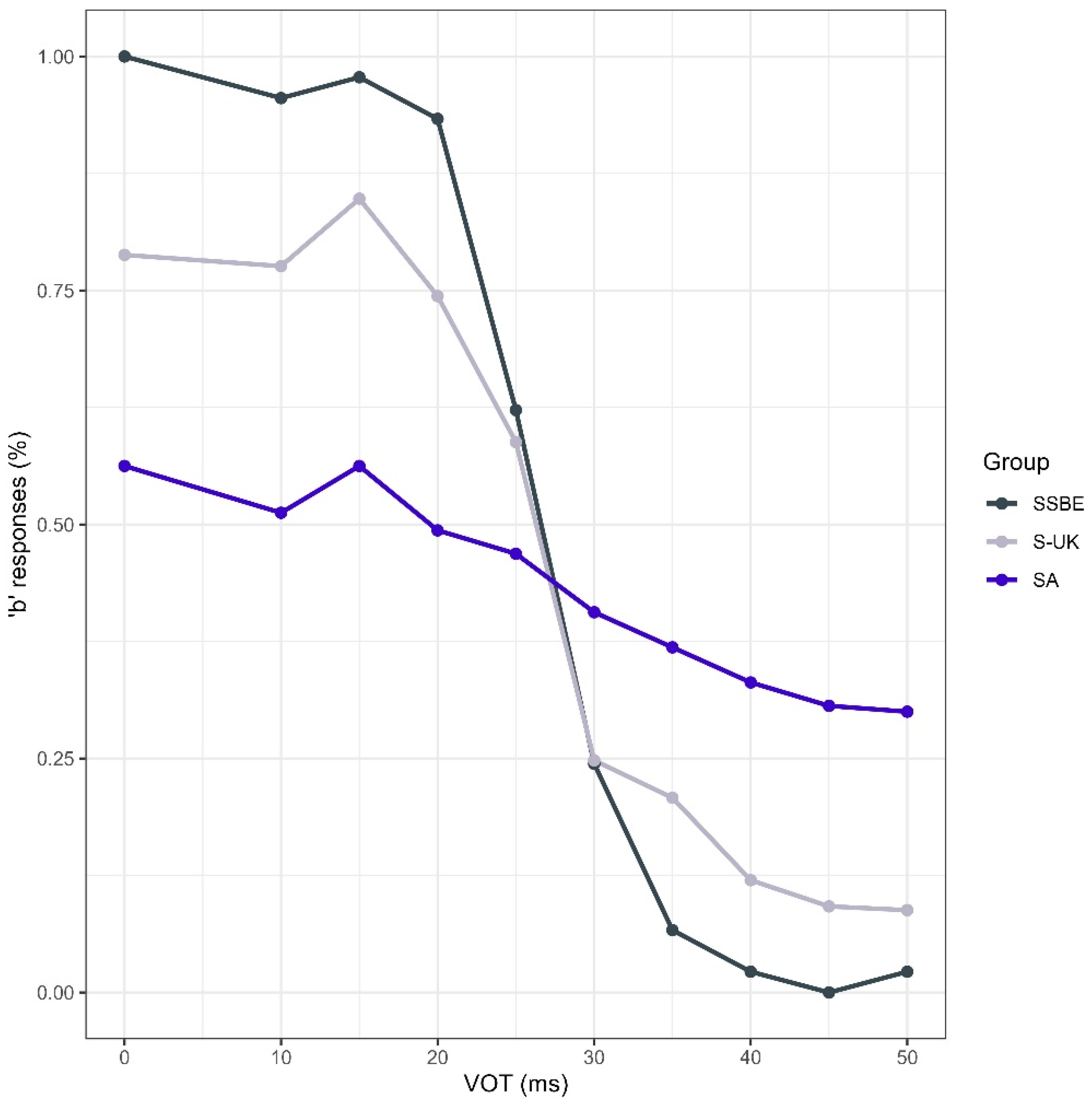
3.1. The Identification Task
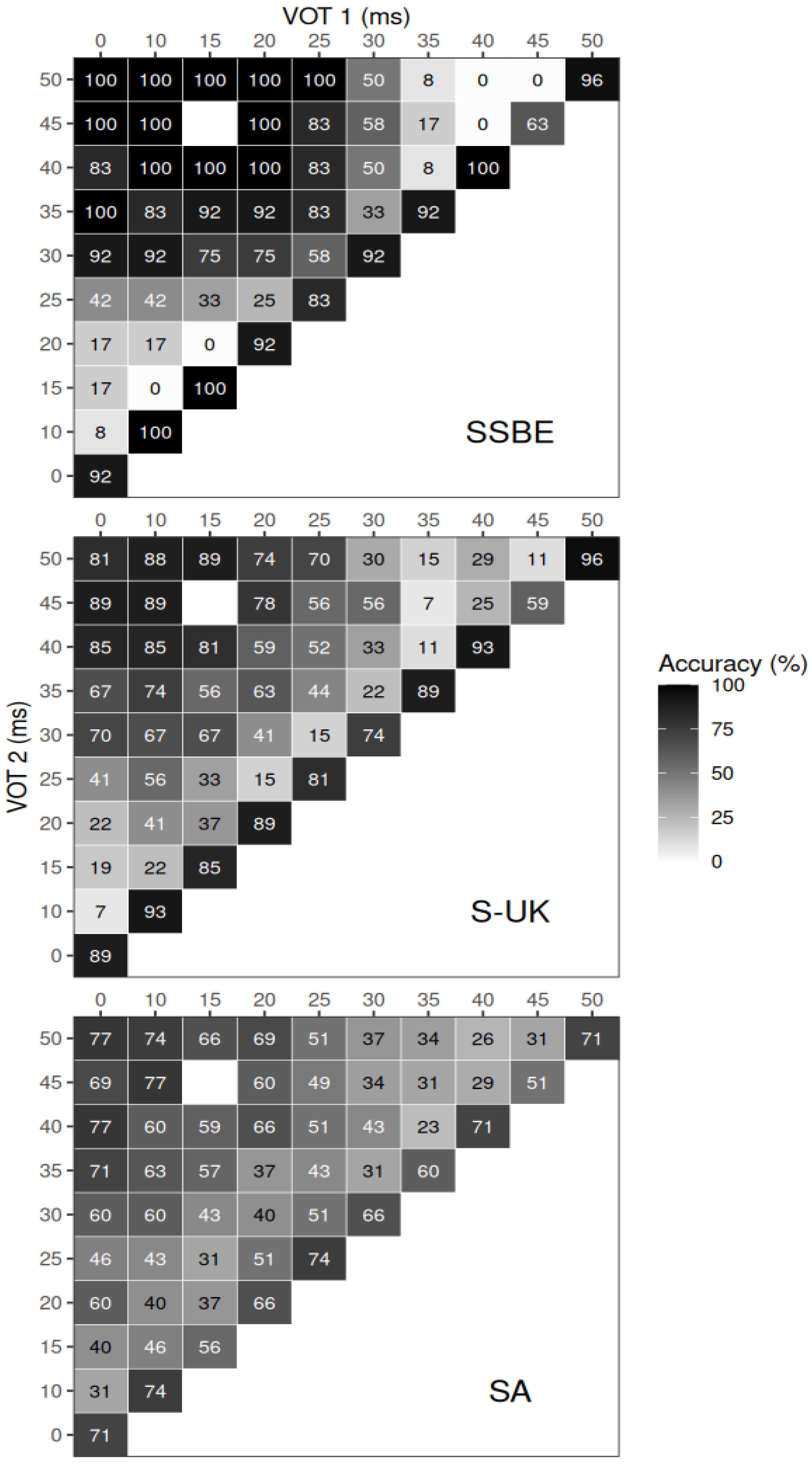
3.2. The Discrimination Task (Same/Different)
4. Discussion
5. Conclusions
Funding
Institutional Review Board Statement
Informed Consent Statement
Data Availability Statement
Acknowledgments
Conflicts of Interest
Appendix A. Audio Stimuli Used for Tasks in MP3 Format, with 10–Step VOT Continuum from /b/ to /p/
| Identification Task | Discrimination Task |
| BP__VOT_01 | 3VOT-4VOT |
| BP__VOT_02 | 1VOT-9VOT |
| BP__VOT_03 | 10VOT-10VOT |
| BP__VOT_04 | 1VOT-10VOT |
| BP__VOT_05 | 1VOT-1VOT |
| BP__VOT_06 | 1VOT-2VOT |
| BP__VOT_07 | 1VOT-3VOT |
| BP__VOT_08 | 1VOT-4VOT |
| BP__VOT_09 | 1VOT-5VOT |
| BP__VOT_10 | 1VOT-6VOT |
| BP__VOT_01 | 1VOT-7VOT |
| BP__VOT_02 | 1VOT-8VOT |
| BP__VOT_03 | 2VOT-10VOT |
| BP__VOT_04 | 2VOT-2VOT |
| BP__VOT_05 | 2VOT-3VOT |
| BP__VOT_06 | 2VOT-4VOT |
| BP__VOT_07 | 2VOT-5VOT |
| BP__VOT_08 | 2VOT-6VOT |
| BP__VOT_09 | 2VOT-7VOT |
| BP__VOT_10 | 2VOT-8VOT |
| BP__VOT_01 | 2VOT-9VOT |
| BP__VOT_02 | 3VOT-10VOT |
| BP__VOT_03 | 3VOT-3VOT |
| BP__VOT_04 | 3VOT-5VOT |
| BP__VOT_05 | 3VOT-6VOT |
| BP__VOT_06 | 3VOT-7VOT |
| BP__VOT_07 | 3VOT-8VOT |
| BP__VOT_08 | 3VOT-9VOT |
| BP__VOT_09 | 4VOT-10VOT |
| BP__VOT_10 | 4VOT-4VOT |
| BP__VOT_01 | 4VOT-5VOT |
| BP__VOT_02 | 4VOT-6VOT |
| BP__VOT_03 | 4VOT-7VOT |
| BP__VOT_04 | 4VOT-8VOT |
| BP__VOT_05 | 4VOT-9VOT |
| BP__VOT_06 | 5VOT-10VOT |
| BP__VOT_07 | 5VOT-5VOT |
| BP__VOT_08 | 5VOT-6VOT |
| BP__VOT_09 | 5VOT-7VOT |
| BP__VOT_10 | 5VOT-8VOT |
| BP__VOT_01 | 5VOT-9VOT |
| BP__VOT_02 | 6VOT-10VOT |
| BP__VOT_03 | 6VOT-6VOT |
| BP__VOT_04 | 6VOT-7VOT |
| BP__VOT_05 | 6VOT-8VOT |
| BP__VOT_06 | 6VOT-9VOT |
| BP__VOT_07 | 7VOT-10VOT |
| BP__VOT_08 | 7VOT-7VOT |
| BP__VOT_09 | 7VOT-8VOT |
| BP__VOT_10 | 7VOT-9VOT |
| 8VOT-10VOT | |
| 8VOT-8VOT | |
| 8VOT-VOT | |
| 9VOT-10VOT | |
| 9VOT-10VOT | |
| 9VOT-9VOT |
References
- Agbangba, C. E., Aide, E. S., Honfo, H., & Kakai, R. G. (2024). On the use of post-hoc tests in environmental and biological sciences: A critical review. Heliyon, 10(3), e25131. [Google Scholar] [CrossRef] [Scilit]
- Alanazi, S. (2018). The acquisition of English stops by Saudi L2 learners [Unpublished doctoral dissertation]. University of Essex.
- Al-Ani, S. H. (1970). Arabic phonology: An acoustical and physiological investigation. Mouton. [Google Scholar]
- Al-Ghamdi, N., Al-Tamimi, J., & Khattab, G. (2019). The acoustic properties of laryngeal contrast in Najdi Arabic initial stops. In S. Calhoun, P. Escudero, M. Tabain, & P. Warren (Eds.), Proceedings of the 19th international congress of phonetic sciences (pp. 2051–2055). Australasian Speech Science and Technology Association Inc. [Google Scholar]
- Alharbi, A., Foltz, A., Kornder, L., & Mennen, I. (2023). L2 acquisition and L1 attrition of VOTs of voiceless plosives in highly proficient late bilinguals. Second Language Research, 39(4), 1133–1163. [Google Scholar] [CrossRef] [Scilit]
- Alluhaidah, M. (2023). Comparison VOT production between Arabic ESL learner and English native speaker. American Journal of Educational Research, 11(2), 25–33. [Google Scholar]
- Alotaibi, Y. A., & AlDahri, S. S. (2011). Investigating VOTs of Arabic stops /b, k/ with comparisons to other languages. In 2011 4th international congress on image and signal processing (Vol. 5, pp. 2413–2417). IEEE. [Google Scholar] [CrossRef] [Scilit]
- Alzahrani, S. (2021). The perception in Saudi learners of the English bilabial stops and the English labiodental fricatives. International Journal of English Linguistics, 11(1), 278. [Google Scholar] [CrossRef] [Scilit]
- Anwyl-Irvine, A. L., Massonnié, J., Flitton, A., Kirkham, N., & Evershed, J. K. (2020). Gorilla in our midst: An online behavioral experiment builder. Behavior Research Methods, 52, 388–407. [Google Scholar] [CrossRef] [Scilit]
- BaeseBerk, M. M., Kapnoula, E. C., & Samuel, A. G. (2025). The relationship of speech perception and speech production: It’s complicated. Psychonomic Bulletin & Review, 32(1), 226–242. [Google Scholar] [CrossRef] [Scilit]
- Barriuso, T. A., & HayesHarb, R. (2018). High variability phonetic training as a bridge from research to practice. The CATESOL Journal, 30(1), 177–194. [Google Scholar] [CrossRef] [Scilit]
- Best, C. T. (1995). A direct realist view of cross-language speech perception. In W. Strange (Ed.), Speech perception and linguistic experience: Issues in cross-language research (p. 171204). York Press. [Google Scholar]
- Best, C. T., & Tyler, M. D. (2007). Nonnative and second-language speech perception: Commonalities and complementarities. In O.-S. Bohn, & M. J. Munro (Eds.), Language experience in second language speech learning: In honor of james emil flege (Vol. 10389, pp. 13–34). John Benjamins. [Google Scholar] [CrossRef] [Scilit]
- Boersma, P., & Weenink, D. (2022). Praat: Doing phonetics by computer (Version 6.2.00). Available online: http://www.fon.hum.uva.nl/praat/download_win.html (accessed on 29 August 2025).
- Casillas, J. V. (2021). Exploring phonemic boundaries using logistic regression. Available online: https://www.jvcasillas.com/posts/2021-05-15_logistic_regression_and_phonemic_boundaries/2021-05-15_logistic_regression_and_phonemic_boundaries.html (accessed on 29 August 2025).
- Cebrian, J. (2006). Experience and the use of non-native duration in L2 vowel categorization. Journal of Phonetics, 34(3), 372–387. [Google Scholar] [CrossRef] [Scilit]
- Cho, T., Whalen, D. H., & Docherty, G. (2019). Voice onset time and beyond: Exploring laryngeal contrast in 19 languages. Journal of Phonetics, 72, 52–65. [Google Scholar] [CrossRef] [Scilit]
- Doan, T. L. A., & Oh, E. (2023). The role of L2 experience on the perceived similarity and identification of British English vowels by Vietnamese speakers. Linguistic Research, 40, 127–149. [Google Scholar] [CrossRef]
- Escudero, P. (2005). Linguistic perception and second language acquisition: Explaining the attainment of optimal phonological categorization [Ph.D. thesis, Utrecht University]. [Google Scholar]
- Flege, J. E. (1987). The production of “new” and “similar” phones in a foreign language: Evidence for the effect of equivalence classification. Journal of Phonetics, 15(1), 47–65. [Google Scholar] [CrossRef] [Scilit]
- Flege, J. E. (1995). Second language speech learning: Theory, findings, and problems. In W. Strange (Ed.), Speech perception and linguistic experience: Issues in cross-language research (pp. 233–277). York Press. [Google Scholar]
- Flege, J. E., Bohn, O. S., & Jang, S. (1997). Effects of experience on non-native speakers’ production and perception of English vowels. Journal of Phonetics, 25, 437–470. [Google Scholar] [CrossRef] [Scilit]
- Flege, J. E., & Liu, S. (2001). The effect of experience on adults’ acquisition of a second language. Studies in Second Language Acquisition, 23(4), 527–552. [Google Scholar] [CrossRef] [Scilit]
- Flege, J. E., Munro, M. J., & MacKay, I. R. A. (1995). Factors affecting the strength of perceived foreign accent in a second language. Journal of the Acoustical Society of America, 97(5), 3125–3134. [Google Scholar] [CrossRef] [Scilit]
- Flege, J. E., & Port, R. (1981). Cross-language phonetic interference: Arabic to English. Language and Speech, 24(2), 125–146. [Google Scholar] [CrossRef] [Scilit]
- Fox, J., & Weisberg, S. (2019). An R companion to applied regression (3rd ed.). Sage. Available online: https://www.johnfox.ca/Companion/ (accessed on 29 August 2025).
- Francis, A. L., Kaganovich, N., & Driscoll-Huber, C. (2008). Cuespecific effects of categorization training on the relative weighting of acoustic cues to consonant voicing in English. The Journal of the Acoustical Society of America, 124(2), 1234–1251. [Google Scholar] [CrossRef] [Scilit]
- Ganong, W. F. (1980). Phonetic categorization in auditory word perception. Journal of Experimental Psychology: Human Perception and Performance, 6(1), 110–125. [Google Scholar] [CrossRef] [Scilit] [PubMed]
- García-Sierra, A., Schifano, E., Duncan, G. M., & Fish, M. S. (2021). An analysis of the perception of stop consonants in bilinguals and monolinguals in different phonetic contexts: A rangebased language cueing approach. Attention, Perception, & Psychophysics, 83, 1878–1896. [Google Scholar] [CrossRef] [Scilit] [PubMed]
- Georgiou, G. P. (2021). Toward a new model for speech perception: The Universal Perceptual Model (UPM) of second language. Cognitive Processing, 22(2), 277–289. [Google Scholar] [CrossRef] [Scilit] [PubMed]
- Giovannone, N., & Theodore, R. M. (2021). Individual differences in lexical contributions to speech perception. Journal of Speech, Language, and Hearing Research: JSLHR, 64(3), 707–724. [Google Scholar] [CrossRef] [Scilit] [PubMed]
- Gorba, C. (2018). The effect of L2 experience on the categorization of native and non-native stops by Spanish learners of English. In S. Martin, D. Owen, & E. PladevallBallester (Eds.), Persistence and resistance in English studies. New research (pp. 163–173). Cambridge Scholars Publishing. [Google Scholar]
- Gorba, C. (2019). Bidirectional influence on L1 Spanish and L2 English stop perception: The role of L2 experience. The Journal of the Acoustical Society of America, 145(6), EL587–EL592. [Google Scholar] [CrossRef] [Scilit]
- Gorba, C., & Cebrian, J. (2021). The role of L2 experience in L1 and L2 perception and production of voiceless stops by English learners of Spanish. Journal of Phonetics, 88, 101094. [Google Scholar] [CrossRef] [Scilit]
- Hattori, K. (2010). Perception and production of English /r/-/L/ by adult Japanese speakers [Doctoral dissertation, UCL (University College London)]. [Google Scholar]
- Hillenbrand, J., Getty, L. A., Clark, M. J., & Wheeler, K. (1995). Acoustic characteristics of American English vowels. The Journal of the Acoustical Society of America, 97(5), 3099–3111. [Google Scholar] [CrossRef] [Scilit]
- Holm, S. (1979). A simple sequentially rejective multiple test procedure. Scandinavian Journal of Statistics, 6(2), 6570. [Google Scholar]
- Hoonhorst, I., Colin, C., Markessis, E., Radeau, M., Deltenre, P., & Serniclaes, W. (2009). French native speakers in the making: From language-general to language-specific voicing boundaries. Journal of Experimental Child Psychology, 104(4), 353–366. [Google Scholar] [CrossRef] [Scilit]
- Iverson, P., Kuhl, P. K., Akahane-Yamada, R., Diesch, E., Tohkura, Y., Kettermann, A., & Siebert, C. (2003). A perceptual interference account of acquisition difficulties for non-native phonemes. Cognition, 87, B47–B57. [Google Scholar] [CrossRef] [Scilit] [PubMed]
- Kartushina, N., & Martin, C. D. (2019). Third-language learning affects bilinguals’ production in both their native languages: A longitudinal study of dynamic changes in L1, L2, and L3 vowel production. Journal of Phonetics, 77, 100920. [Google Scholar] [CrossRef] [Scilit]
- Khattab, G. (2002). VOT production in English and Arabic bilingual and monolingual children. In Perspectives on Arabic linguistics XIII–XIV: Papers from the thirteenth and fourteenth annual symposia on Arabic linguistics (Vol. 230, p. 1). John Benjamins Publishing. [Google Scholar]
- Kulikov, V. (2016). Voicing in Qatari Arabic: Evidence for prevoicing and aspiration. In Qatar foundation annual research conference proceedings (Vol. 2016, p. SSHAPP2330). HBKU Press. [Google Scholar] [CrossRef] [Scilit]
- Kuznetsova, A., Brockhoff, P. B., & Christensen, R. H. (2017). lmerTest package: Tests in linear mixed effects models. Journal of Statistical Software, 82, 1–26. [Google Scholar] [CrossRef] [Scilit]
- Ladefoged, P., & Maddieson, I. (1996). The sounds of the world’s languages. Blackwell Publishing. [Google Scholar]
- Levy, E. S., & Law, F. F. (2010). Production of French vowels by American-English learners of French: Language experience, consonantal context, and the perception-production relationship. The Journal of the Acoustical Society of America, 128(3), 1290–1305. [Google Scholar] [CrossRef] [Scilit]
- Liberman, A. M., Cooper, F. S., Shankweiler, D. P., & Studdert-Kennedy, M. (1967). Perception of the speech code. Psychological Review, 74(6), 431. [Google Scholar] [CrossRef] [Scilit] [PubMed]
- Liberman, A. M., Delattre, P. C., & Cooper, F. S. (1958). Some cues for the distinction between voiced and voiceless stops in initial position. Language and Speech, 1(3), 153–167. [Google Scholar] [CrossRef] [Scilit]
- Lisker, L., & Abramson, A. S. (1964). A crosslanguage study of voicing in initial stops: Acoustical measurements. Word, 20(3), 384–422. [Google Scholar] [CrossRef] [Scilit]
- Lisker, L., & Abramson, A. S. (1971). Distinctive features and laryngeal control. Language, 47, 767–785. [Google Scholar] [CrossRef] [Scilit]
- Morrison, G. S. (2002, April 6–7). Perception of English /i/ and /I/ by Japanese and Spanish listeners: Longitudinal results [Paper presentation]. Northwest Linguistics Conference 2002 (pp. 29–48), Burnaby, BC, Canada. [Google Scholar]
- Morrison, G. S. (2008). Logistic regression modelling for first and second language perception data. In Segmental and prosodic issues in Romance phonology (pp. 219–236). John Benjamins Publishing Company. [Google Scholar] [CrossRef] [Scilit]
- Nagle, C. (2019). A longitudinal study of voice onset time development in L2 Spanish stops. Applied Linguistics, 40(1), 86–107. [Google Scholar] [CrossRef] [Scilit]
- Nakai, S., & Scobbie, J. M. (2016). The VOT category boundary in word-initial stops: Counter-evidence against rate normalization in English spontaneous speech. Laboratory Phonology, 7(1), 13. [Google Scholar] [CrossRef] [Scilit]
- Newman, D. (2002). The phonetic status of Arabic within the world’s languages. Antwerp Papers in Linguistics, 100, 65–75. [Google Scholar]
- Petrova, K., Jasmin, K., Saito, K., & Tierney, A. T. (2023). Extensive residence in a second language environment modifies perceptual strategies for suprasegmental categorization. Journal of Experimental Psychology: Learning, Memory, and Cognition, 49(12), 1943–1955. [Google Scholar] [CrossRef] [Scilit] [PubMed]
- Piske, T., MacKay, I. R., & Flege, J. E. (2001). Factors affecting degree of foreign accent in an L2: A review. Journal of Phonetics, 29(2), 191–215. [Google Scholar] [CrossRef] [Scilit]
- R Development Core Team. (2023). R: A language and environment for statistical computing. R Foundation for Statistical Computing. [Google Scholar]
- Schoonmaker-Gates, E. (2015). On voice-onset time as a cue to foreign accent in Spanish: Native and nonnative perceptions. Hispania, 98(4), 779–791. [Google Scholar] [CrossRef] [Scilit]
- Souganidis, C., Molinaro, N., & Stoehr, A. (2024). Bilinguals produce language-specific voice onset time in two true-voicing languages: The case of Basque-Spanish early bilinguals. Linguistic Approaches to Bilingualism, 14(3), 370–399. [Google Scholar] [CrossRef] [Scilit]
- Trofimovich, P., & Baker, W. (2006). Learning second language suprasegmentals: Effect of L2 experience on prosody and fluency characteristics of L2 speech. Studies in Second Language Acquisition, 28(1), 1–30. [Google Scholar] [CrossRef] [Scilit]
- Van Leussen, J. W., & Escudero, P. (2015). Learning to perceive and recognize a second language: The L2LP model revised. Frontiers in Psychology, 6, 1000. [Google Scholar] [CrossRef] [Scilit] [PubMed]
- Wickham, H. (2016). Programming with ggplot2. In ggplot2: Elegant graphics for data analysis (pp. 241–253). Springer International Publishing. [Google Scholar] [CrossRef] [Scilit]
- Winn, M. B. (2020). Manipulation of voice onset time in speech stimuli: A tutorial and flexible Praat script. The Journal of the Acoustical Society of America, 147(2), 852–866. [Google Scholar] [CrossRef] [Scilit] [PubMed]


| β | SE | z Value | p Value | |
|---|---|---|---|---|
| Fixed Effects | ||||
| (Intercept) | −0.08835 | 0.33508 | −0.264 | 0.792 |
| VOT_std | −4.70684 | 0.47479 | −9.913 | <2 × 10⁻¹⁶ *** |
| GroupS–UK | −0.23741 | 0.38183 | −0.622 | 0.534 |
| GroupSA | −0.26398 | 0.37054 | −0.712 | 0.476 |
| VOT_std:GroupS–UK | 2.95816 | 0.48274 | 6.128 | 8.91 × 10⁻¹⁰ *** |
| VOT_std:GroupSA | 4.27779 | 0.47771 | 8.955 | <2 × 10⁻¹⁶ *** |
| Random effects | ||||
| Groups | Name | Variance | SD | |
| Participant | (Intercept) | 0.7001 | 0.8367 |
| Response: nCorrect | |||
|---|---|---|---|
| Chisq | Df | p Value | |
| PairVOT | 449.099 | 56 | 2.20 × 10⁻¹⁶ |
| Group | 6.356 | 2 | 0.041668 |
| PairVOT:Group | 151.584 | 106 | 0.002451 |
| Contrast | β | SE | df | z Ratio | p Value |
|---|---|---|---|---|---|
| SSBE–(S–UK) | 0.393 | 0.163 | Inf | 2.405 | 0.0323 |
| SSBE–SA | 0.57 | 0.155 | Inf | 3.667 | 0.0007 |
| (S–UK)–SA | 0.177 | 0.116 | Inf | 1.529 | 0.1262 |
Disclaimer/Publisher’s Note: The statements, opinions and data contained in all publications are solely those of the individual author(s) and contributor(s) and not of MDPI and/or the editor(s). MDPI and/or the editor(s) disclaim responsibility for any injury to people or property resulting from any ideas, methods, instructions or products referred to in the content. |
© 2026 by the author. Licensee MDPI, Basel, Switzerland. This article is an open access article distributed under the terms and conditions of the Creative Commons Attribution (CC BY) license.
Share and Cite
Alshangiti, W. The Effect of Second Language Immersion Experience on the Perception of VOT by Saudi Arabic Learners of English. Languages 2026, 11, 81. https://doi.org/10.3390/languages11050081
Alshangiti W. The Effect of Second Language Immersion Experience on the Perception of VOT by Saudi Arabic Learners of English. Languages. 2026; 11(5):81. https://doi.org/10.3390/languages11050081
Chicago/Turabian StyleAlshangiti, Wafaa. 2026. "The Effect of Second Language Immersion Experience on the Perception of VOT by Saudi Arabic Learners of English" Languages 11, no. 5: 81. https://doi.org/10.3390/languages11050081
APA StyleAlshangiti, W. (2026). The Effect of Second Language Immersion Experience on the Perception of VOT by Saudi Arabic Learners of English. Languages, 11(5), 81. https://doi.org/10.3390/languages11050081