1. Introduction
Differential Object Marking (DOM) is a widely studied linguistic property that necessarily invokes the syntax–semantics interface due to its dependence on the semantic features of the direct object (DO), and which can also invoke the syntax–pragmatics interface with topicalization and dislocation, as is the case in some languages. Though much of the experimental literature on the acquisition of DOM among monolingual children of a variety of languages, including Spanish, reports high levels of convergence as early as 1;6 to 5;0 years of age (see
Avram, 2015 and chapters therein for overview;
Chung, 2020;
Foroodi-Nejad, 2011;
Rodríguez-Mondoñedo, 2008; cf.
Guijarro-Fuentes et al., 2017;
Ketrez, 2015), research on other populations shows comparatively more divergence.
For example, second language (L2) learners of Spanish show errors of omission of DOM in sentence completion tasks (
Guijarro-Fuentes, 2012), in narrative tasks (
Arechabaleta Regulez & Montrul, 2021), in elicited production tasks (
Nediger et al., 2017), and are less sensitive to ungrammatical DOM omission (
Hopp & Arriaga, 2016). Proficiency (e.g.,
Guijarro-Fuentes & Marinis, 2007), the specific featural make-up of the DO (e.g.,
Sagarra et al., 2020), task type (e.g.,
Arechabaleta Regulez & Montrul, 2021), and the L1 of participants (e.g.,
Montrul, 2019) all affect convergence on DOM.
Similarly, heritage speakers of Spanish also omit DOM in oral production tasks (e.g.,
Montrul, 2004), in story-retelling tasks (e.g.,
Montrul & Sánchez-Walker, 2013), in sentence completion tasks (e.g.,
Cuza et al., 2018), and have shown less sensitivity to the absence of DOM in written acceptability tasks (e.g.,
Montrul & Bowles, 2009) and in self-paced reading tasks (e.g.,
Jegerski, 2014; cf.
Jegerski & Sekerina, 2020). Task type (e.g.,
Arechabaleta Regulez & Montrul, 2023), verb frequency (e.g.,
Hur, 2020), and proficiency (e.g.,
Thane, 2024) are some of the factors that affect the production, comprehension, and processing of DOM in heritage speakers. Importantly, though differences are found across many L2 and heritage speaker studies, some of the same studies and others report convergence.
Likewise, research on early simultaneous bilinguals reveals a medley of outcomes, with some convergence and some divergence from monolinguals across a variety of tasks, language combinations, and ages.
Austin (
2020) reported that young Basque–Spanish bilinguals (2;01–3;4) use DOM at the same age in each language and that bilingualism in Spanish seems to accelerate the use of DOM in Basque, given that DOM is protracted in monolingual Basque as compared to Spanish.
Avram and Tomescu (
2020) reported convergence on DOM via examination of longitudinal corpora data in both monolingual Romanian and simultaneous Hungarian–Romanian bilinguals (1;11–2;01). Though the bilinguals were less accurate with uses of DOM dependent upon discourse-pragmatics, DOM appears very early and follows the same trajectory in both groups. Differently,
Ticio (
2015) documented the emergence of DOM in Spanish in the spontaneous production of simultaneous Spanish–English bilinguals. Compared to monolingual children, the simultaneous bilinguals omitted DOM more, leading the author to conclude that DOM was not acquired by age 3;6 in the simultaneous bilingual group. Bilinguals tested later in life also show differences from monolinguals (e.g.,
Guijarro-Fuentes & Marinis, 2009), across varieties (
Rodríguez-Ordóñez, 2020), and according to syntax and the semantic features of the DO (
Bel & Benito, 2024).
Importantly, recent experimental and corpus-based studies on bilinguals in contact varieties have shown that these speakers exhibit varying degrees of optionality with regards to DOM acceptability, processing, and production, and this is particularly true of Catalan–Spanish bilinguals. As described in more detail in
Section 2, both Spanish and Catalan exhibit DOM. While some overlap exists between the two systems, prescriptive grammars stipulate a comparatively more restricted distribution of DOM in Catalan. Somewhat contrary to prescriptive grammars, the Catalan of Catalan–Spanish bilinguals reveals more optionality, whereby DOM distribution is wider than predicted, a finding that holds across task type. For example, said optionality in Catalan DOM is found in acceptability and processing tasks (
Benito, 2023;
Bel & Benito, 2024;
Puig-Mayenco & Judy, 2025;
Puig-Mayenco et al., 2017,
2018) and in production tasks (
Benito, 2017,
2020,
2023;
Perpiñán, 2018). Research examining specific regional varieties outside of Catalonia demonstrate that the distribution of Catalan DOM is not a monolith, but rather that some varieties show a wider DOM distribution, while some retain a more restricted one (
Pineda, 2023;
Zeugin, 2021; see also
Boeddu (
2020) for Arborense in contact with Standard and Regional Italian and
Corral Esteban (
2020) for Asturian and Vaqueiru in contact with Spanish).
These differences from monolingual and prescriptive norms, as well as the factors that might modulate them, are the focus of this article. More specifically, and in light of the divergent outcomes reported in different types of bilinguals (e.g., L2 learners, heritage speakers), we examine offline acceptance and online processing of DOM in the Spanish of adult simultaneous Catalan–Spanish bilinguals residing in two geographic regions of central Catalonia. The experimental methodology seeks first to determine the actual distribution of DOM in the Spanish of these Catalan–Spanish bilinguals and then to determine which linguistic and extralinguistic factors modulate its distribution. Based on previous research on Catalan, along with sustained bilingualism at the community and individual levels, more optionality in the distribution of Spanish DOM is predicted than described in prescriptive or monolingual grammars. We hope to make strides towards identifying the source(s) of this optionality, whether it be framed as grammatical instability, the presence of competing systems, or a stable state of variation. Our study also contributes to the experimental studies that examine dialectal variation of DOM distribution, in many cases regional dialects (e.g.,
Balasch, 2011;
Benito, 2023;
Bautista-Maldonado & Montrul, 2019;
Company Company, 2001,
2002;
Dumitrescu, 1997;
Judy & Iverson, 2020;
Montrul, 2013;
Puig-Mayenco & Judy, 2025;
Zdrojewski, 2020), but also contact dialects (e.g.,
Boeddu, 2020;
Corral Esteban, 2020;
Pineda, 2023;
Zeugin, 2021). While the aforementioned studies examining DOM in Catalan–Spanish bilinguals examine the distribution in Catalan, the current study focuses on Spanish DOM distribution and is among the first to do so alongside
Benito (
2023). As described in subsequent sections, our results point to a DOM distribution unique to this contact variety.
2. Differential Object Marking
Differential Object Marking (DOM) is a linguistic property evidenced in many languages, including several Romance varieties. Though various syntactic accounts of DOM exist, the indisputable facts are that, in languages with DOM, some direct objects (DOs) are marked while others are unmarked. Syntactic accounts vary in terms of their formalization of the triggers of DOM. For example, Bossong’s seminal work (
Bossong, 1983/1984) distinguishes two types of semantic features that affect DOM: inherent features, such as
animacy, and referential features, such as
specificity and
definiteness. Many of the world’s languages rely exclusively on referential features, such as specificity in Persian, while others rely on a combination of both, such as animacy and specificity in Spanish.
Torrego (
1998,
1999) pointed out that both the agentivity of the subject and verbal semantics impact DOM in Spanish.
Aissen (
2003) later combined and formalized these factors as
prominence, creating an animacy and a definiteness scale seen in (1) and (2) below, whereby DOs higher on each scale are more likely to be marked.
- (1)
Animacy scale:
| human > animate > inanimate |
- (2)
Definiteness scale:
| personal pronoun > proper name > definite NP > non-definite, specific NP > non-definite, non-specific NP |
Still, many exceptions have been identified for Spanish DOM. For example, telicity and affectedness of the DO play a role (
Laca, 2006;
von Heusinger & Kaiser, 2011; see
García García (
2018) for overview;
Romero Heredero & García García, 2023; cf.
Romero Heredero (
2021) regarding telicity), negative quantifiers always require DOM (
Leonetti, 2008), DOM is used to distinguish between an inanimate subject and DOs (
Rodríguez-Mondoñedo, 2008;
García García, 2018), and both dislocation and individuation affect DOM (see
Fábregas (
2013),
Gerards (
2023),
Iemmolo (
2010), and
López (
2012) for comprehensive reviews). Some authors have also argued for the presence of DOM with inanimate DOs in certain constructs (e.g.,
Camacho, 2023;
López, 2012;
Wall et al., 2025).
Wall et al. (
2025), for example, examined the distribution of DOM with inanimate DOs across four varieties of Spanish and found that inanimate DOs in canonical transitive SVO sentences and in reversible–symmetrical predicates showed some degree of variation with respect to the acceptance of DOM. Furthermore, recent empirical accounts reveal dialect and speaker variation in largely monolingual Spanish-speaking areas. In Caribbean varieties, variable DOM use was revealed with [+animate; +definite] DOs (
Alfaraz, 2011;
Bullock & Toribio, 2009). For River Plate Spanish,
Bautista-Maldonado and Montrul (
2019),
Judy and Iverson (
2020), and
Zdrojewski (
2020) independently found that DOM is extended to inanimate DOs for some speakers, even when the subject is animate (see also
Camacho, 2023;
Wall et al., 2025). Earlier findings from
Dumitrescu (
1997) showed extension of DOM to topicalized inanimate DOs in Argentine Spanish. Similarly, the corpus work of
Company Company (
2001,
2002) chronicled extension of DOM to inanimate DOs in Mexican Spanish. Certainly, bilingual and contact varieties exhibit variation from prescriptive uses of DOM, as described above for Catalan in contact with Spanish. It is nonetheless methodologically important to outline the prescriptive distribution of DOM in Spanish and Catalan.
Comparison of Spanish and Catalan DOM
In both Spanish and in Catalan, DOM appears as the prenominal syntactic marker
a. In Spanish, it is generally accepted that DOM appears with specific and animate DOs, and more frequently with humans than with animals. Importantly, in canonical SVO sentences with agentive—especially human—subjects and inanimate DOs, DOM is typically prescribed as ungrammatical (
Batchelor, 2006;
Bradley & Mackenzie, 2004;
Butt et al., 2019;
von Heusinger & Kaiser, 2007;
Real Academia Española, n.d.;
Zagona, 2002). In Catalan, prescriptive grammars present a more restricted distribution of DOM. DOM is generally considered to be limited to strong pronouns and some indefinite pronouns (see
Bel, 2002), though it is prescribed in contexts of animate dislocated DOs and to clarify subject–object ambiguity (e.g.,
Fabra, 1918;
GIEC, 2016;
Solà, 1994). Historically, DOM appears variably in medieval Catalan (
Segarra, 1985) and has been treated as either an internal development or as a product of contact with other Romance languages (
Moll, 1952;
Salvador & Pérez Saldanya, 1993). Contemporary prescriptive descriptions thus frame DOM as marginal and frequently stigmatize its extension as the result of contamination from Spanish.
Though we acknowledge that the actual use of DOM often extends beyond the canonical cases described above in both Spanish and Catalan, the experimental design of this study focuses precisely on canonical cases of DOM where there seems to be a greater degree of agreement as to the presence or absence of DOM. Of experimental value is the fact that Spanish and Catalan are said to differ in all but one of the four canonical cases examined herein. Specifically, we examine DOM with Proper Names, Human (definite) Noun Phrases, Human (indefinite) Noun Phrases, and Inanimate (indefinite) Noun Phrases.
Table 1 below shows that, for all but the last category, Spanish is said to mark these DOs, while Catalan is said not to.
5. Discussion
We begin the
Section 5 by revisiting the research questions guiding the methodological design of the study, as well as their predictions:
RQ1: What is the distribution of DOM in the Spanish of Catalan–Spanish bilinguals in Catalonia?
RQ2: What linguistic and extralinguistic factors modulate the distribution of Spanish DOM in these bilinguals?
As outlined in
Section 3.1, we predicted that the Catalan–Spanish bilinguals tested herein would provide less clear acceptance and RT data to the experimental conditions based on previous DOM research. Specifically, we predicted higher-than-expected acceptance and faster-than-expected RTs to the absence of DOM in the three animate conditions (Proper Name, Human (definite), Human (indefinite) DP) based on previous literature examining both Spanish and Catalan. As discussed in detail below, the distribution of DOM in the Spanish of our Catalan–Spanish bilingual participants differs from more conservative standard accounts of (Peninsular) Spanish DOM, evidencing more variability with animate DOs, across geographical area, and across task type, but importantly, not as a product of language dominance nor with inanimate DOs of the type tested herein.
We expand on this general summary by first considering the findings from the Acceptability Judgment Task (AJT). Recall that the experimental design included four conditions (Proper Name, Human (definite), Human (indefinite), and Inanimate (indefinite) DP) that fall at different points on both the animacy and definiteness scales referenced in
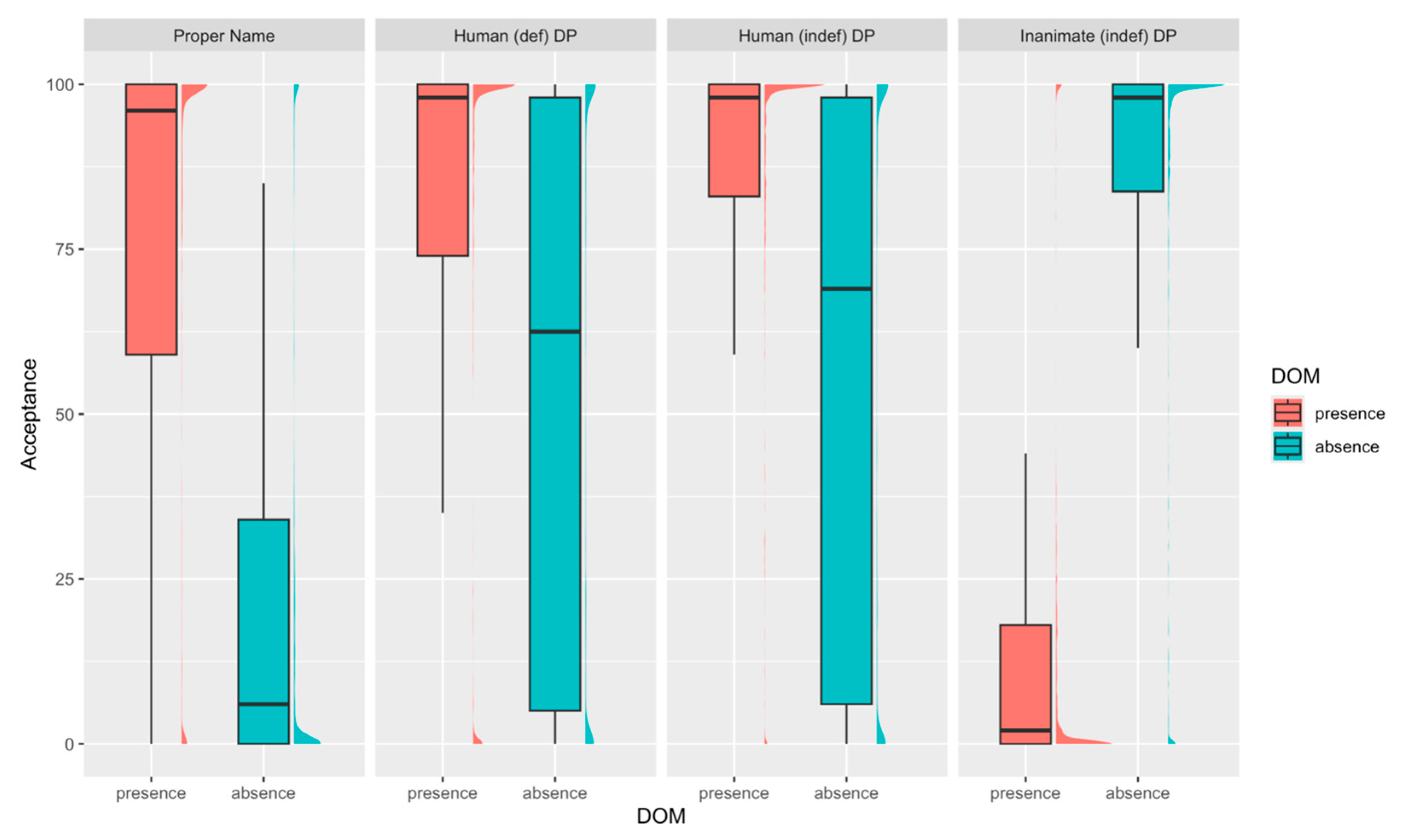
Section 2. Perhaps not surprisingly, participants provided the most clear-cut judgments to the conditions at either end of the scale (i.e., Proper Name and Inanimate (indefinite) DP). First, participants showed categorical acceptance for the presence of DOM with Proper Names, and a simultaneous rejection of the absence of DOM with Proper Names. Though this finding aligns with the predicted distribution according to the animacy and definiteness scales and prescriptive and empirical accounts of Spanish DOM, it contrasts with recent research on the distribution of DOM in Catalan within the same speaker profile and in the same geographic area (
Puig-Mayenco & Judy, 2025), where it was found that Catalan–Spanish bilinguals accept both the presence and the absence of DOM in Catalan. This contrast suggests that Catalan allows for greater flexibility and optionality even at the upper end of the scales than the Spanish of Catalonia. We interpret this finding in Spanish, culled from a similar participant population and geographic area, as an indication that Catalan does not seem to directly influence DOM marking in Spanish with Proper Names. That is to say that the fact that our bilingual participants retain categorical DOM in Spanish with Proper Names implies that the Spanish system is (metalinguistically) resistant to apparent CLI from Catalan and that the constraints governing DOM in Spanish remain strongly anchored at the top of the hierarchy, at least for the AJT data.
At the other end of the scales, the AJT results reveal a near-categorical rejection of DOM with Inanimate (indefinite) DPs, and near-categorical acceptance of the absence of DOM with this DO type. This is unsurprising given the animacy and definiteness scales, and general agreement that inanimate DOs tend to be unmarked in most varieties of Spanish (but see
Camacho, 2023;
García García, 2018;
López, 2012;
Wall et al., 2025), and in Catalan. Indeed, our inanimate condition served as a conservative control condition, and participants categorically rejected DOM in this context. This fits with the traditional view that, unlike other varieties (largely non-Peninsular; see
Bautista-Maldonado & Montrul, 2019;
Camacho, 2023;
Company Company, 2001,
2002;
Dumitrescu, 1997;
Judy & Iverson, 2020;
Zdrojewski, 2020), DOM with inanimate DOs remains outside the core grammar of Peninsular Spanish (see overviews in
Fábregas, 2013;
García García, 2018;
Wall et al., 2025). At the same time, some research has argued that DOM can appear with inanimate DOs in highly restricted lexical or semantic environments (
Camacho, 2023;
López, 2012). In particular,
Wall et al. (
2025) showed that, when verb class and predicate type are carefully controlled, especially in reversible–symmetrical predicates, speakers across several Spanish varieties accept the presence of DOM with inanimate DOs. Importantly, our study did not include these predicate types nor specific syntactic constructions, and thus our findings should be understood as reflecting the canonical, highly dispreferred contexts for DOM with inanimate DOs. Nevertheless, as
Wall et al. (
2025) demonstrated, future work must systematically manipulate predicate type and syntax to determine whether the Spanish of Catalan–Spanish bilinguals behaves similarly to other contact and non-contact varieties regarding these emerging inanimate DOM patterns. We offer this suggestion for future research.
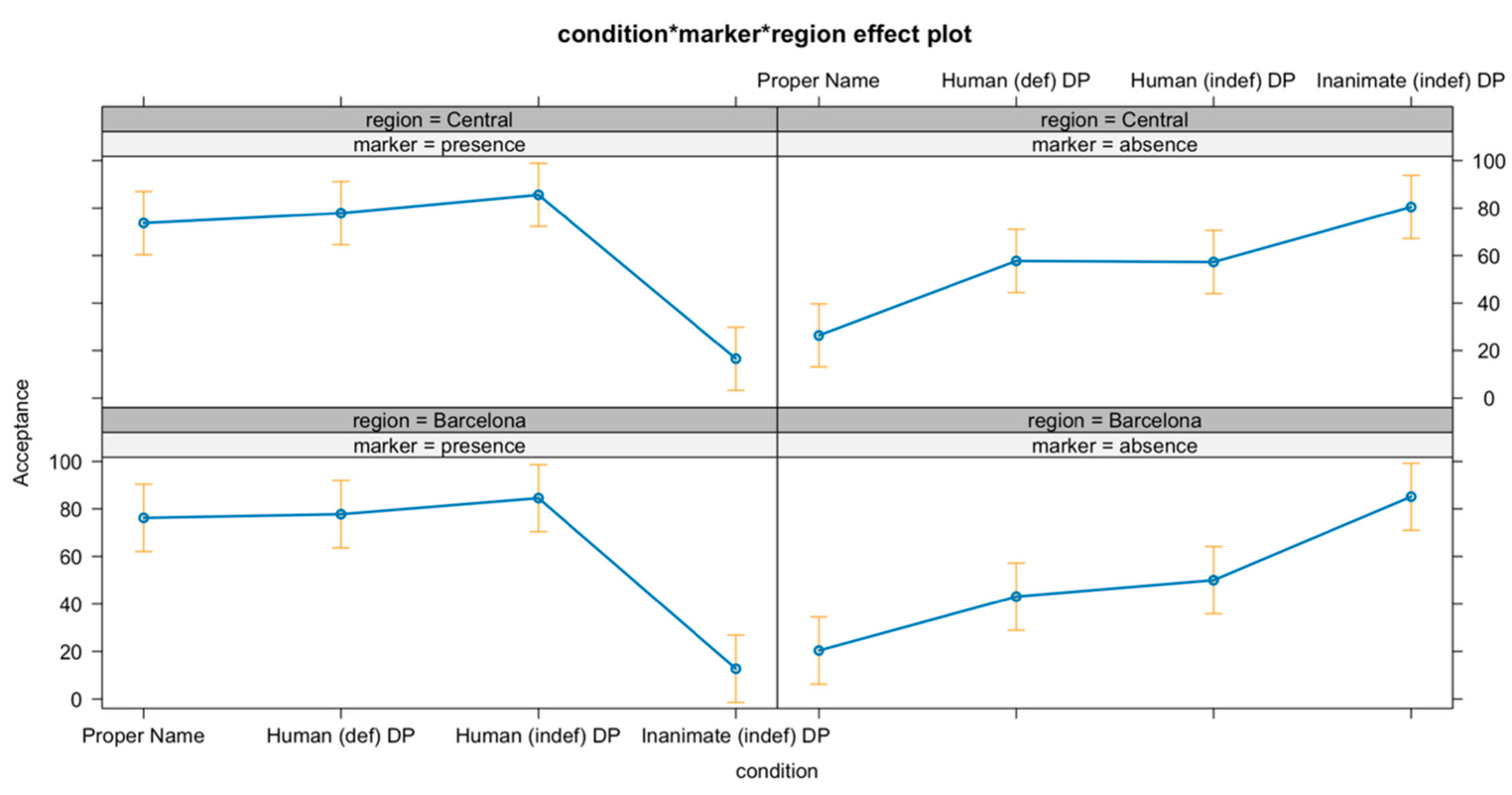
For the remaining two conditions (Human (definite), Human (indefinite) DP), participants show a high degree of acceptance of the presence of DOM, while simultaneously showing much more variability as regards the absence of DOM. That participants accept DOM with animate DOs in Spanish is expected, which makes their variable acceptance of the absence of DOM of import, given their prominence on the animacy and definiteness scales, prescriptive and empirical accounts of DOM distribution, and given the absence of any mitigating factors (e.g., a relative clause with the subjunctive indicating non-specificity). Since prescriptive accounts of Catalan purport that these animate DOs are unmarked in Catalan, Catalan can reasonably be considered a potential source of this variability. In fact, we initially expected language dominance (LD) to modulate DOM distribution in these bilinguals, based on previous experiments conducted within a similar population and geographic area. Nonetheless, the statistical measures exclude LD as a modulating factor, indicating that dominance in Catalan does not promote more acceptance of the absence of DOM with Human definite and indefinite DPs. Instead, there is an extralinguistic effect of geographical area, whereby participants from the metropolitan area of Barcelona accept the absence of DOM with animate DOs in Spanish slightly less than participants from central Catalonia. We interpret this result as indicating a change (potentially in progress) in the distribution of DOM in Spanish in certain areas of Catalonia, which parallels the effects that are seen for Catalan DOM (
Benito, 2023) and suggests microvariation across metropolitan and non-metropolitan areas. We also suggest that these results may indicate an extension of the reported and expected variability seen for Human indefinite DOs (e.g., with a subjunctive relative clause) to Human definite DOs. This finding seems to suggest that participants across different areas of Catalonia are spreading the absence of DOM up the definiteness scale, which is happening asymmetrically across regions.
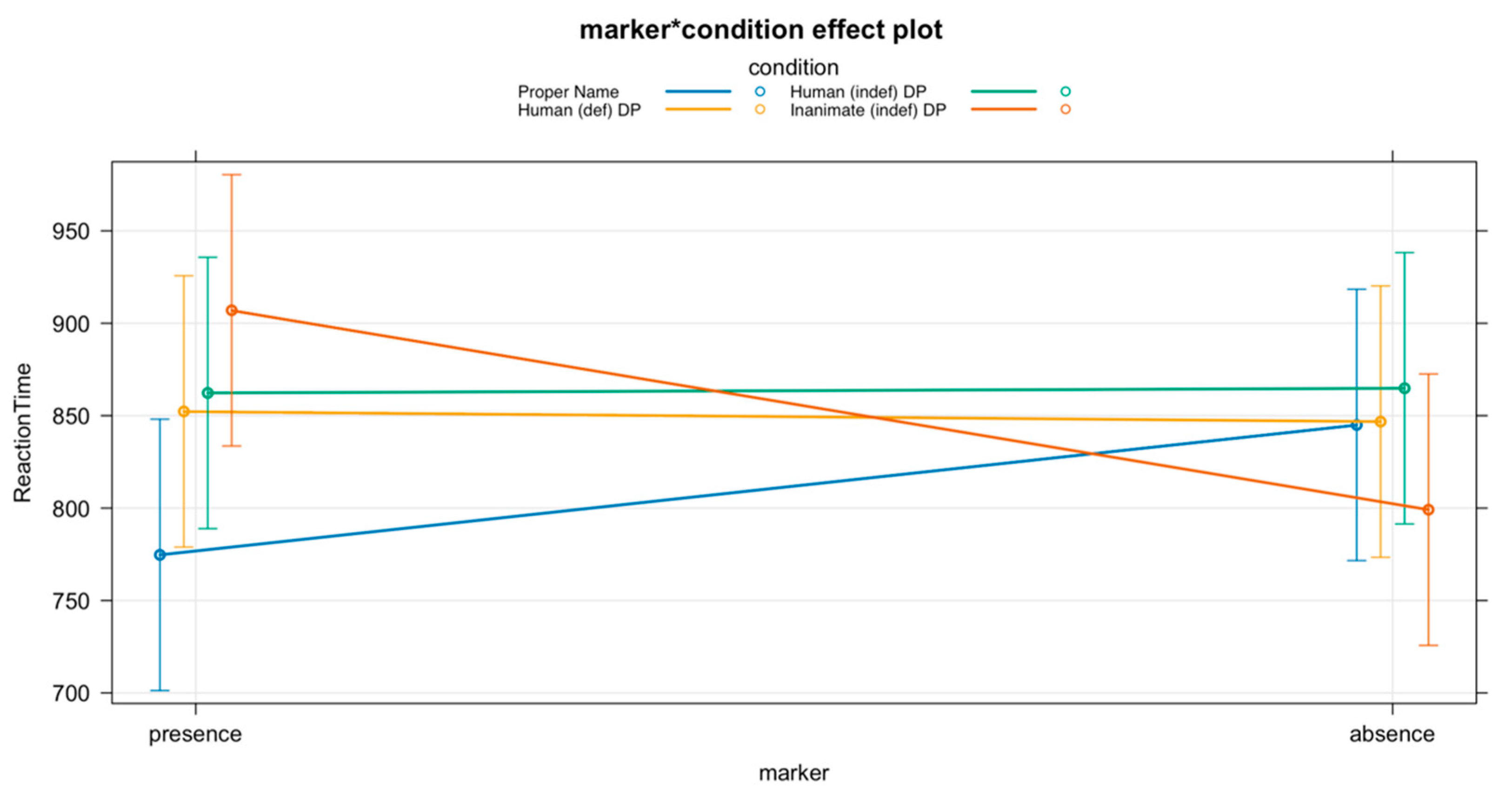
2The results of the Self-Paced Reading task (SPR) tell a slightly different story from that of the AJT, in that only one significant difference obtained for the pairwise comparison: participants were significantly slower with Inanimate (indefinite) DOs in the presence of DOM. That participants are slower with the presence of DOM in the inanimate condition aligns with the AJT findings, and is entirely expected given the categorical rejection of inanimate DOM in both Spanish and Catalan. It also confirms that the participants’ parser is sensitive to the presence of DOM with inanimate DOs in real time. That said, we might also expect a significant difference for the Proper Names condition given the participants’ categorical acceptance of DOM and rejection of the absence of DOM in the AJT; this finding was not born out. In fact, the SPR results for the three other conditions, all animate, show that speakers process both the presence and absence of DOM with Proper Names, Human (definite) and Human (indefinite) DPs similarly. The lack of significant differences within these three conditions indicates optionality (or different groups within the larger population). We take this optionality to indicate that, from a processing perspective, participants are not sensitive to the absence of DOM with animate DOs, meaning that their grammars allow for animate DOs to be unmarked. Considering the AJT results and the standard distribution, this is somewhat expected for the Human (definite) and Human (indefinite) conditions, as the participants accepted both the absence and presence of DOM. Nevertheless, that no statistically significant difference obtained for Proper Names in the SPR reveals a clear difference between the AJT and SPR results. Recall that, in the AJT, participants categorically rejected the absence of DOM in this condition, maintaining DOM with DOs that are high on the animacy and definiteness scales. However, the absence of DOM with Proper Names did not trigger a slowdown effect in the SPR. Such AJT–SPR asymmetries have been observed in similar and different bilingual and contact varieties (e.g.,
Arechabaleta Regulez & Montrul, 2023;
Puig-Mayenco et al., 2018;
Puig-Mayenco & Judy, 2025), where categorical judgments coexist with gradient or optional representations in online processing. In our study, this pattern suggests that the acceptability of the absence of DOM may be spreading up the animacy and definiteness scales to even Proper Names and at the level of processing, as was observed for the Human conditions in the AJT.
The discrepancy across tasks highlights the importance of triangulating different data sources (e.g., offline and online) when attempting to determine the distribution of DOM in bilingual grammars. Judgments alone would suggest a stable, categorical rule for proper names; processing alone would suggest much greater fluidity. The combination of both reveals a more nuanced picture: speakers appear to maintain a prescriptive or metalinguistic commitment to DOM with DOs that are high on the animacy and definiteness scales, while their real-time grammars tolerate greater variability with these same DOs, possibly indicating early stages of reanalysis or weakening of the obligatory DOM constraint in these contexts. Taken together, the SPR data, along with the AJT data, lead to the conclusion that DOM in the Spanish of Catalan–Spanish bilinguals in Catalonia is no longer uniformly obligatory even in contexts where canonical grammars predict categorical marking (with DOs high on the animacy and definiteness scales), revealing a degree of optionality that is not captured by descriptions of standard Peninsular Spanish.
6. Conclusions
In conclusion, our findings support the view that DOM is undergoing linguistic change not only in the Catalan of Catalan–Spanish bilinguals, as argued in the literature (
Benito, 2017,
2020,
2023;
Bel & Benito, 2024;
Perpiñán, 2018;
Puig-Mayenco & Judy, 2025;
Puig-Mayenco et al., 2017,
2018), but also in their Spanish. Recent work in Catalan shows the existence of optional DOM in specific syntactic and semantic contexts (e.g.,
Benito, 2023;
Puig-Mayenco & Judy, 2025), suggesting an internal shift in the object-marking systems of Catalan. Parallel processes have been documented for Spanish in a range of language contact and heritage settings where DOM displays increased optionality, reduced obligatoriness, or context-dependent variability (see the literature reviewed in
Section 1). Our results indicate that similar processes may be shaping the Spanish of Catalonia: the traditional boundary between obligatory and variable DOM appears to be loosening, particularly for DOs in the middle ranges of the animacy and definiteness scales.
There are two potential sources for the observable changes to the DOM system in the Spanish of Catalan–Spanish bilinguals. One possibility is cross-linguistic influence from Catalan, whereby Spanish speakers extend some of Catalan’s greater tolerance for the absence of DOM marking into their Spanish grammars, especially in the two Human conditions tested herein, where variability is most pronounced. The second possibility is that we are observing the emergence of a stable bilingual variety (
Perpiñán, 2018), in which at least some speakers have a Spanish grammar that independently licenses the absence of DOM with human DPs, not as the result of direct CLI, but as part of a broader process of reweighting the animacy, definiteness, and discourse-related constraints that regulate DOM in their variety of Spanish. In either case, DOM in the Spanish of Catalonia appears to be diverging from the more conservative Peninsular Spanish system, showing early signs of a restructuring.