1. Introduction
Over the last 150 years, foreign language teaching has gradually shifted from a model centered on the transmission of rules to one that prioritizes learners’ situated action. Notably, this pedagogical transformation has unfolded mainly in practice, without having been guided by a unified cognitive theory capable of explaining it. This historical sketch is necessarily selective and is most representative of the Euro-American—mainly North American—genealogy of modern L2 pedagogy. In other regions, however, second-language learning has often been shaped by different multilingual ecologies and by longer-standing traditions of out-of-school, interaction-based learning. More broadly, L2 development is not confined to formal instruction: a growing body of recent research shows that it also occurs through sustained engagement beyond the classroom, where learners build competence through everyday use, interaction, and self-directed participation in social contexts (
Kusyk et al., 2025).
In the 19th century, the grammar-translation method dominated the classroom by conceiving learning as the accumulation of linguistic forms and their literal translation from classical texts. At the end of the 19th century and in the first decades of the 20th century, alternatives emerged that broadened the emphasis on oral expression: the direct method, based on immersion and on the form-meaning association without the L1 mediation (
Berlitz, 1878;
Gouin, 1880), and later the audiolingual method, based on behavioral psychology and intensive practice of oral patterns with immediate correction (
Fries, 1945;
Lado, 1961;
Skinner, 1957).
The 1970s marked a turning point with the communicative approach, which prioritized communicative effectiveness over grammatical accuracy and treated language as a resource for negotiating meaning (
Hymes, 1972;
Canale & Swain, 1980). In this vein, methodologies that are sensitive to the individual complexity of acquisition emerged: task-based learning (TBL) (
Nunan, 1989,
2004;
Skehan, 1998;
J. Willis, 1996), the lexical approach (
Lewis, 1993,
1997;
D. Willis, 1990), and, in the 21st century, multimodal proposals with hybrid scenarios (blended learning), peer-to-peer cooperation, CLIL, virtual reality, and mobile devices (
Brown, 1980,
2006;
Kramsch, 1998;
Larsen-Freeman, 2011). These latter tendencies share an implicit premise: that learning a language is about acting effectively in a social and material ecosystem that offers opportunities for interaction. Nevertheless, contemporary research reveals an explanatory gap: most of these approaches describe what activities work but do not explain why specific immersive experiences produce progressive and lasting changes in foreign language communicative competence.
Aiming to address this explanatory gap, this paper proposes the Ecological–Enactive Approach (EEA) as a meta-explanatory, metatheoretical framework, and adopts a cognitive-ecological stance on cognition that conceives the mind as an embodied, situated, and dynamic system whose cognitive processes emerge from the sensorimotor coordination of an agent in an environment rich in ecological information (
J. J. Gibson, 1979/2015;
Varela et al., 1991;
Chemero, 2009). This approach describes how embodied habits and the detection of affordances co-evolve in perception–action cycles that foster linguistic competence, rather than reducing the learning process to the internalization of representations (
Rietveld & Kiverstein, 2014;
Di Paolo et al., 2017).
We conduct this study in four sections. In the first, we trace the philosophical genealogy that links the theses of pragmatism with ecological psychology and enactivism, in which the roles of action and habit are emphasized (
James, 1907;
Dewey, 1922/2007). The second part describes in detail the two analytical levels—subpersonal and personal—that articulate the ecological–enactive approach and provides recent empirical evidence on auditory–articulatory loops, gestures, and prosodic regulation (
Tang, 2024;
García-Gámez & Macizo, 2023). The third part examines how immersive environments densify the domain of sociomaterial affordances and accelerate lexical and phonological acquisition (
Güvendir et al., 2024;
Wayland et al., 2024). Finally, we discuss possible criticisms the Ecological–Enactive Approach (EEA) might face, ranging from shifts in the conceptual frameworks for learning and cognition to methodological challenges it entails.
2. The Pragmatist Approach to Learning
Since the 19th century, William
James (
1907), John
Dewey (
1916/2004,
1922/2007) and Charles Sanders
Peirce (
1992) set some important precedents for shifting the focus of knowledge from passive representations, either resulting from rational introspection (idealism) or as a reflection of the world (empiricism), to an active construction resulting from practical activity. In what follows, we draw primarily on classical North American pragmatism (especially James and Dewey) as a philosophical genealogy for the action- and habit-centered view of cognition that later resonates with ecological psychology and enactivism. Both ecological psychology and enactivism have repeatedly pointed to classical pragmatism as a key precursor for treating cognition as situated, action-guided practice. Contemporary discussions further develop this lineage in relation to affordances, organism–environment coupling, and sense-making (
Heft, 2001,
2017;
Gallagher, 2009,
2022;
van Dijk & Myin, 2019;
Crippen, 2020;
Heras-Escribano, 2021).
As a philosophical current, pragmatism prioritized practical consequences over abstract principles to explain knowledge, science, and ethics (
James, 1907;
Dewey, 1925/1958,
1922/2007). As
Heft (
2001) states, individuals never know the world independently of their active, situated experience. Opposed to empiricism and idealism, the active exploration of the environment by organisms was highlighted (
Hook, 1936/1962). For
James (
1890/1981) and
Dewey (
1925/1958), cognitive abilities result from biological adaptation, in which experience is conceived as activity rather than a passive reflection of an independent reality. According to the pragmatists, experience is understood as an organic coordination between the organism and its environment that gives rise to habits that constitute cognitive skills (
Dewey, 1895,
1896). Indeed, the ideas of Darwinism inspired this philosophical current, which maintained that organisms and their environments must be studied in a mutually reciprocal relationship (
Darwin, 1872;
Dewey, 1910/1997). That is, the actions of an organism modify its environment, which generates sensory feedback that guides its subsequent actions. This positive feedback cycle of functional coordination constitutes the basis of the pragmatist understanding of experience and cognitive abilities (
Baldwin, 1896;
Bateson, 1972/2004;
Shook, 2000).
The concept of “habit” is fundamental to the cognitive theses of pragmatism. For
James (
1890/1981), organisms are “bundles of habits” that follow regulatory behavior patterns which contribute to their survival when these are effectively manifested (
Heras-Escribano, 2021). Such habits are automatic but flexible acquired sensorimotor and social sensitivities, as they adjust to changes in the environment
1.
Dewey (
1922/2007) refined this idea by describing habits as acquired sensitivities/abilities that organize behavior, from physiological to social, arising from continuous organic coordination with the environment. In that regard, habits are constituted through the active incorporation of the ecological and social environment, establishing regularities that orient future action. Experience, then, is the operation of habits (
Dewey, 1922/2007, p. 32), thus continually refining the agent’s capacities.
From a pragmatist perspective, cognition manifests in sensorimotor–agent–world coordination that enables the organism to solve situated problems—that is, to learn. Consequently, learning is equivalent to refining effective habits of action in interaction with the environment (
James, 1907;
Dewey, 1922/2007). To that end, this perspective has an epistemological connection to the so-called post-cognitive approaches that emerged a few decades ago within the field of cognitive sciences, which involve the body, action, and the environment to explain cognitive processes. Post-cognitive theories, discussed below, resume and deepen the pragmatist intuition that cognition is a dynamic coupling between brain, body, and world, in which
affordances guide perception and behavior. Although these post-cognitivist theoretical–practical developments were conceived to understand cognition as an individual, autonomous process, they have direct consequences for social action theories and teaching-learning theories.
3. Post-Cognitivist Approaches to Cognition
The cognitive sciences constitute an interdisciplinary field of study that emerged in the mid-20th century to form a “science of the mind,” in clear opposition to the behaviorism that had dominated until then. This paradigm is founded on a key metatheoretical principle: the necessity of postulating and characterizing internal mental processes to explain cognitive capacities. Despite this shared objective, the field has been heterogeneous, encompassing diverse theories of cognition (
Serrano & Haimovici, 2023). Classical cognitivism (
Fodor, 1975), one of the foundational approaches, conceives the mind as a computational system that processes discrete symbols, analogous to a computer. Importantly, this contrast is not meant to deny that research on language acquisition has long emphasized interactional and context-sensitive factors—joint attention, gesture, and the learner’s uptake of opportunities for action—especially within social-pragmatic and usage-based traditions (e.g.,
Tomasello, 2003;
Lieven & Tomasello, 2008;
MacWhinney, 1999). Rather, our target is the strong representational–computational construal of cognition as primarily intracranial symbol manipulation, which still informs many tacit assumptions in pedagogy and assessment.
Another related approach is connectionism, which draws inspiration from the brain’s structure and models cognition through neural networks, where processing is parallel and representations are distributed within connection patterns (
Venturelli & Barberis, 2023). As observed, in the second half of the 20th century, cognitive sciences were dominated by the representational–computational paradigm (RCC), which conceived the mind as an information-processing system, brain-centric, and based on the manipulation of symbolic representations (
Fodor, 1975;
Rumelhart et al., 1986).
However, various critiques of this model began to question its cerebral reductionism and its abstraction from bodily and environmental conditions. For many, the computational model of the mind undervalues the fact that cognition is not limited to the brain but must consider its interaction with the nervous system and the rest of the body, as well as the constantly interacting environment (
Serrano & Haimovici, 2023). The publication of
The Embodied Mind (
Varela et al., 1991) was a milestone in this transition; its authors proposed that cognition emerges from the continuous interaction among the brain, body, and environment. These perceptions drew inspiration from
Merleau-Ponty’s (
1945/2012) phenomenology and dynamic neurobiology. Almost simultaneously, work on
distributed cognition (
Flor & Hutchins, 1991) highlighted the role of collective and material structures in cognitive performance; however, this tradition often remains compatible with broadly cognitivist commitments. Since our argumentative core draws on more radical anti-internalist views, we rely primarily on enactivism and ecological psychology in what follows.
All these approaches have been labeled “post-cognitivism” to differentiate them from classical cognitivism. Overall, post-cognitivist approaches constitute a pluralistic set of perspectives that question the traditional conception of cognition as the internal manipulation of symbolic representations. Instead, they describe the mind and learning as embodied, situated, and relational processes. Theories such as the neuro-enactive phenomenology by
Varela et al. (
1991),
Gallagher’s (
2005) embodied mind philosophy,
Chemero’s (
2009) ecological realism, and
Hutto and Myin’s (
2013) radical enactivism converge on three fundamental theses: (i) the functional inseparability among brain, body, and environment; (ii) the dynamic and emergent nature of cognitive experience; and (iii) the primacy of skillful action within socio-material contexts for the construction of meaning (
Newen et al., 2018). Accordingly, cognition is understood as a participatory adaptation within culturally configured practice niches, in which affordances (action possibilities) influence perception and behavior (
Rietveld & Kiverstein, 2014). By displacing the mind from the “cranial box” and anchoring it in distributed activity circuits that include tools, languages, and other agents, post-cognitivist approaches offer a novel paradigm for rethinking human formation and agency beyond the confines of individual cognition.
Several post-cognitive approaches adopted the label “4E cognition” (
Newen et al., 2018) because cognitive processes are considered: (1)
Embodied, as they critically depend on the morphological and physiological characteristics of the body; (2)
Embedded, as the physical and social environment causally influences them; (3)
Extended, as they can include external elements as a constitutive part of the cognitive process (
Clark & Chalmers, 1998); and (4)
Enactive, as they arise through active engagement and the co-construction of the environment (
Monterroza-Rios, 2023). Because the label
post-cognitivism (and, later,
4E cognition) covers a heterogeneous landscape, our aim here is not to provide an exhaustive taxonomy. Instead, we highlight only the conceptual moves needed to motivate the Ecological–Enactive Approach, concentrating on enactivism and ecological psychology.
One of the most significant discussions within 4E currents concerns the role of mental representations in cognitive processes, where no consensus currently exists. For example, some authors, such as
Chemero (
2009) and
Hutto and Myin (
2013), promote a “radical enactivism” that rejects internal representations, while others, such as
Clark (
2008), advance “extended functionalism,” integrating representations with embodied processes without abandoning the idea of mental representation. These divergences in approaches indicate that the 4E framework does not have a single position regarding mental representations. An important methodological question in the study of human cognition is the selection of paradigmatic examples. While traditional cognitivism used abstract tasks such as playing chess or solving the Tower of Hanoi, 4E approaches take as examples activities such as spatial navigation, emotional recognition, or social interaction, since they denote more representative aspects of situated cognition (
Newen, 2015).
Some researchers have argued for explicitly integrating a fifth “E” from an ecological psychological perspective, given the central role environments play in cognitive processes (
Rietveld & Kiverstein, 2014). Ecological psychology is a naturalistic research program that conceives of cognition as a relational phenomenon that emerges from an organism’s exploration of its environment. This perspective was proposed through the theoretical and empirical works of the spouses James and Eleanor Gibson. For ecological psychology, perceiving is equivalent to actively exploring the environment, and the unit of analysis for the study of cognition is the organism–environment system, not the isolated brain (
J. J. Gibson, 1979/2015). Its cornerstone is the concept of
ecological information, understood as structured patterns of energy generated when the agent’s action is articulated with the medium’s physical properties. This information, when detected, immediately guides action without requiring internal representations. This informational nexus is characterized by a one-to-one correspondence between certain ecological variables and the perception of opportunities for action or
affordances (
J. J. Gibson, 1979/2015). Affordances are relational properties that do not depend entirely on the agent nor entirely on the environment, but rather express what the environment offers the agent in function of their bodily capacities (
J. J. Gibson, 1979/2015).
For our purposes, post-cognitivist approaches reconsider learning processes, since learning does not consist of the acquisition or construction of internal representations, but instead of the active transformation of bodily and mental capacities situated in interaction with the environment. Learning to ride a bicycle, comprehending a text, or engaging in an emotional conversation cannot be adequately explained solely in terms of intracranial information processing. Instead, these are understood as an incorporation of new sensorimotor dispositions and action patterns (
Noë, 2004;
Engel et al., 2013). Below, we will explore in more detail what we term the “ecological-enactive approach,” which explains learning processes in general on a multilevel scale.
4. The Ecological–Enactive Approach (EEA)
The Ecological–Enactive Approach to Cognition (EEA) proposes a framework for understanding mind and cognition that unifies the enactivist (
Varela et al., 1991;
Chemero, 2009) and ecological (
J. J. Gibson, 1979/2015) traditions. This hybrid perspective highlights the practical and situated interaction between agents and their environment through the concept of
affordances (
Rietveld et al., 2018). Why is a hybrid fusion of these perspectives feasible? One reason, as Manuel Heras-Escribano argues, is that both traditions share pragmatist roots. Although historical reservations existed between enactivism and ecological psychology, there is now a broad consensus that both currents advocate for complementary principles that enable an entirely situated and embodied cognitive science
2.
According to
Heras-Escribano (
2021), perception and action constitute two inseparable manifestations of a single, continuous activity. This activity is historically and recursively shaped through the organism’s interaction with an environment that does not act merely as a source of stimuli but rather as a constitutive component of the abilities that, sedimented throughout this history of couplings, configure the cognitive system itself. For this reason, he proposes three unifying points to overcome differences and strengthen similarities (
Heras-Escribano, 2021, p. s354).
First (1), perception and action are inseparable phases of a single, dynamic process. Perceiving is an active achievement of the organism, not merely an internal theater (
J. J. Gibson, 1979/2015), and seeing is something we do through sensorimotor exploration (
Noë, 2004). Second (2), the environment is constitutive of cognition: the animal and its environment form a co-defined pair (
J. J. Gibson, 1979/2015). Furthermore, adaptivity refers to a living system’s capacity to draw evaluative distinctions based on its viability (
Di Paolo, 2005). The concepts of
sense-making—that is, the agent’s practical creation of meaning (
Di Paolo et al., 2017)—and
affordance, that is, meaningful possibilities for action (
Costall, 1995), show how the relevance of the world emerges in relation to bodily capacities. Moreover, (3) cognition is a repertoire of historically developed skills; that is, perceptual development and the structuring of ecological information are forged through cycles of interaction (
E. J. Gibson & Pick, 2000;
Reed, 1996), while enactive processes ground sensorimotor habits (
Di Paolo et al., 2017) (
Heras-Escribano, 2021, pp. s354–s355).
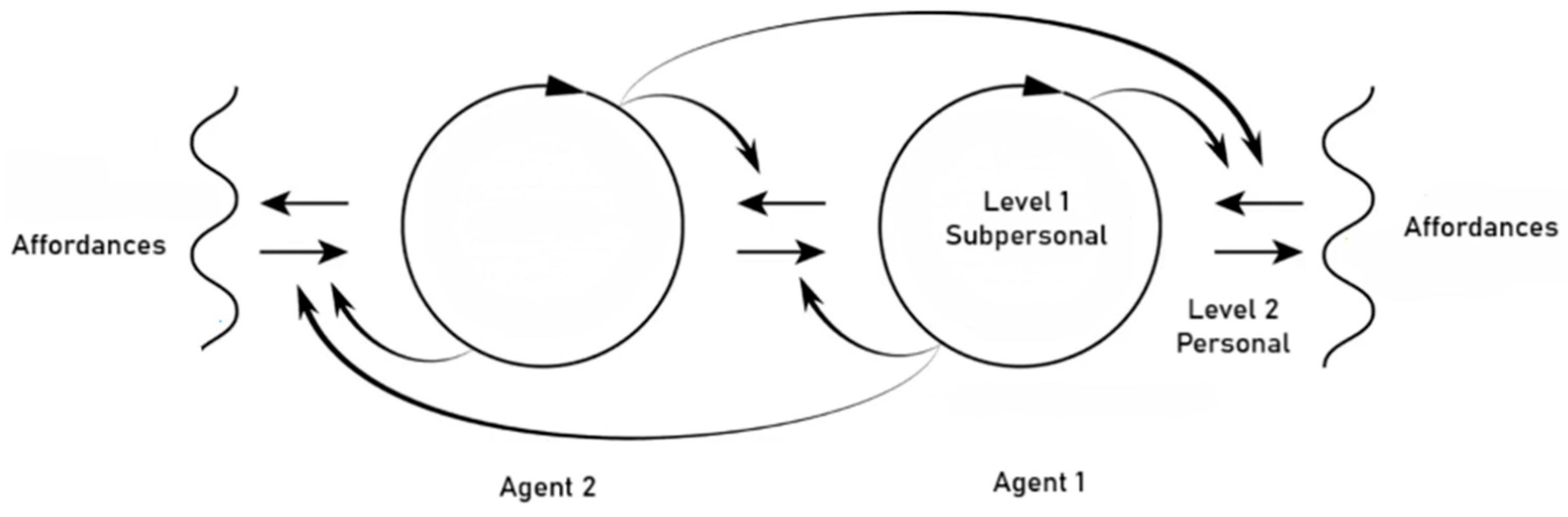
For a coherent post-cognitivist research program, it is beneficial to delineate a general framework that should distribute its analytical competencies across two levels of complementary organic coordination: (1) the study of sensorimotor contingencies that structure immediate experience and (2) the examination of organism–environment systemic dynamics that confer ecological meaning to the experience (
Chemero, 2009;
Heras-Escribano, 2021). This is why these authors propose that the Ecological–Enactive Approach (EEA) serves as a hybrid, multilevel explanatory framework, as presented below:
Subpersonal Level (sensorimotor contingencies). This level studies the dynamic networks that sustain neurodynamic agencies, autopoietic processes, and coupling patterns between action and sensation. Techniques such as dynamic systems modeling and recordings of brain activity enable us to describe how sensorimotor regularities stabilize into embodied habits. In the context of language, this level accounts for auditory–articulatory synchrony and the fine adjustments of the “buccofacial loops” that enable phonetic production. If we notice, a large part of speech acts involves sensorimotor modulation in response to stimuli from others and the environment.
Personal Level (organism–environment). The organism couples ecologically with the environment through higher-order information present in energetic flows (optical, acoustic, chemical, and tactile patterns). This ecological information guides prospective exploration. Some methodologies, such as organism–environment dynamics analysis, motion capture, or affordance perception experiments (
Warren, 1984), allow for the characterization of this circuit. For the study of foreign language acquisition, this level explains why the speaker identifies turn-taking, registers, and pragmatic conventions available in the sociomaterial scene.
The levels—the personal and the subpersonal—are synchronous and interdependent. This is because the action possibilities modulated at Level 2 can reconfigure the sensorimotor contingencies of Level 1, and, in turn, generate a reciprocal cycle of learning and adaptation. Thus, perceiving a new opportunity for action can modify the agent’s sensorimotor patterns, while consolidating a new habit can alter the repertoire of detectable action possibilities. The multilevel framework described shows that the mind is not located “within” the brain but is distributed among the perception–action systems coupled to the environment. That is, it emerges in the continuous history of sensorimotor and ecological coordination that shapes the intentional life of organisms (
Figure 1).
In a subsequent reflection,
Segundo-Ortin and Heras-Escribano (
2021) expand the integration between enactivism and ecological psychology within the EEA framework by demonstrating that practical intelligence depends on habitual perception–action sequences anchored in the conscious detection of action possibilities. The authors conceive habits as embodied, flexible, and context-sensitive dispositions that simplify environmental exploration without reducing action to automatic routines. Such plasticity is maintained through attention directed toward increasingly specific informational variables, which prevents mechanical drift and ensures the agent’s adaptive control (
Segundo-Ortin & Heras-Escribano, 2021).
At this point, a question arises: in what way can this ecological–enactive approach help explain why active and immersive methodologies are more effective in foreign language learning, given that they attune to the very way in which learning itself emerges? In the next section, we address this question by applying the EEA to L2 learning as situated practice across subpersonal and personal levels.
5. Applying the Ecological–Enactive Approach to Second-Language Learning
From an ecological–enactive perspective (EEA), “speaking” would be the result of thought and action intertwined with each other—a kind of synchronization among bodily actions, gestures, and sounds that is co-created in real time. It would not be a mere vocalization of ideas previously formed in the brain. In what we call
classical cognitivism in its strong representational–computational form (
Fodor, 1975), learning is often modeled primarily as the internal acquisition and manipulation of symbol-like structures. While interactionist, social-pragmatic, and usage-based approaches in language acquisition have long highlighted joint attention, gesture, and the learner’s sensitivity to contextual affordances (
Tomasello, 2003;
Lieven & Tomasello, 2008;
MacWhinney, 1999), the Ecological–Enactive Approach brings these dimensions into a unified agent–environment explanatory frame and uses them to clarify why active, situated pedagogies can be especially effective.
In a fluent conversation, nobody consults a manual to decide when to initiate, yield, or take the floor; these transitions are learned through practice with others and form what
Batisti and Vidal (
2025) term a “fine infrastructure” of turn-taking. Such learning leaves a physical imprint, molding muscles, posture, and voice modulation. Given that each body is the product of a history of interactions, analyzing words without considering gestures and posture means observing only a partial aspect of the phenomenon of “speaking a language.”
Although the present section uses oral interaction as an illustrative entry point, the ecological–enactive approach is not restricted to speech. The same agent–environment logic also applies to learning the L2 writing system and to developing literate practices—reading and writing the institutional standard—understood as sociomaterially mediated forms of action.
How would the ecological–enactive approach operate when applied to language learning? The acquisition of a foreign language results from two synchronized dynamics: (1) the reorganization of subpersonal sensorimotor circuits and (2) the exploration of sociomaterial possibilities at the personal level. For this reason, immersive environments—that is, those that simultaneously demand bodily action and offer information-rich contexts—accelerate an agent’s linguistic fluency by aligning muscular and neural plasticity with the detection of meaningful communicative opportunities.
From this standpoint, literacy is not merely the internal acquisition of orthographic rules, but a coordinated reorganization of practices across both levels. At the subpersonal level, reading and writing recruit and reshape sensorimotor loops involving oculomotor control, visuomotor integration, and fine motor coordination (handwriting or typing), progressively stabilizing new perceptual discriminations and production routines. At the personal level, the learner couples with a field of textual affordances that are irreducibly sociomaterial: scripts, typographic conventions, keyboards, screens, notebooks, and genres regulated by institutional norms (e.g., academic, legal, journalistic registers). Thus, learning to read and write in the L2 can be described as the emergence of adaptive fluency within a niche of artifacts and normative practices that orient attention, constrain interpretation, and enable participation in institutionally stabilized forms of discourse.
At Level 1 (subpersonal), neurodynamic circuits regulate auditory perception, articulatory control, and proprioceptive feedback. Experiments with altered auditory feedback, such as those conducted by Tang, show that foreign language learners immediately readjust tongue position and subglottal pressure when the pitch or duration of syllables is modified, confirming a coupling between afferent and efferent pathways that operates without explicit instruction (
Tang, 2024). Similarly, some experiments demonstrate that performing congruent iconic gestures during vocabulary encoding activates premotor networks and strengthens phonological–semantic associations, thereby amplifying the sensory trace in the motor cortex and cerebellum (
García-Gámez & Macizo, 2023). Even prosodic nuances are reconfigured. As shown by
Wayland et al. (
2024), foreign language learners, after a semester of immersion, begin to produce consonant lenition, indicating that corticobulbar patterns adapt to the phonetics of the surrounding environment.
At Level 2 (personal), a language learner interacts with the environment, guided by ecological information that specifies linguistic possibilities (such as turn-taking, politeness registers, and gestural cues for irony, among others). Studies on study-abroad experiences show that the frequency and variety of interactions better predict lexical growth than mere length of residence, underscoring the importance of communicative action density (
Güvendir et al., 2024). Likewise, hands-on projects in Content and Language Integrated Learning (CLIL) environments—such as cooking or constructing objects—improve retention because each material step requires the coordination of verbal, tactile, and visual instructions. A physical object acts as a mediator, making relevant lexical and syntactic possibilities perceptible (
Lai, 2024). At this scale, conscious attention does not propositionally plan each utterance but responds to the perception of relevant possibilities (
Segundo-Ortin & Heras-Escribano, 2021). From an enactive perspective, the personal level can also be described in terms of
participatory sense-making, where meanings and norms emerge through coordinated interaction rather than being merely ‘in’ the individual learner (
De Jaegher & Di Paolo, 2007). In this view, socially scaffolded L2 learning is not only supported by environmental affordances but also constituted by interactional dynamics in which learners and interlocutors co-regulate attention, timing, and action.
We can thus see that, in the practice of language learning, personal and subpersonal levels act and feed back into one another. For example, detecting a new intonational pattern in street conversation (Level 2) triggers micro-muscular adjustments (Level 1) that, after repetition, consolidate into a phonetic habit. At the same time, mastering an articulatory sequence frees attentional resources, allowing the learner to perceive more complex discursive possibilities and enrich their interactive repertoire. This cycle explains the effectiveness of active and immersive methodologies: by simultaneously exposing students to demanding bodily tasks and socially meaningful contexts, these methods catalyze the self-organization of the learner–world system toward increasing levels of adaptability and fluency. Although spoken interaction offers a clear case for illustrating the Ecological–Enactive Approach, the framework is not limited to oral communication. Reading and writing can also be understood as practices shaped by the body and supported by material tools, in which meaning develops through learners’ coordinated engagement with texts, artifacts, and widely shared writing and genre norms. Recent work in reading research, for example, highlights how understanding grows through the combined influence of the reader’s physical engagement, the tangible features of texts, and the action possibilities provided by reading media and technologies within broader sociocultural practices (
Hillesund et al., 2022).
6. Discussion of the Proposal
The Ecological–Enactive Approach (EEA), when applied to explain foreign language learning, seeks to coherently articulate enactive embodied cognition with the ecological psychology of affordances. However, as with any integrative proposal, it must address potential objections raised by prevailing conceptions in cognition and learning, particularly in language acquisition. This discussion of possible criticisms aims to delineate and clarify the scope of the approach—specifically, to refine its terms and concepts and to strengthen its explanatory and pedagogical potential. Let us examine which possible objections could be raised and what provisional responses might be offered to them.
A first objection (1) might argue that the EEA reiterates, using a more sophisticated cognitive-philosophical language, ideas already present in established theories of language learning, such as the sociocultural approach (
Lantolf & Thorne, 2006), the usage-based approach (
Ellis et al., 2016), or the dynamic systems theory (
Larsen-Freeman & Cameron, 2008). These perspectives also highlight the social, situated, and dynamic nature of learning, the role of interaction, and the importance of meaningful practice. From this viewpoint, the notions of
affordance or
organism–environment coupling could appear as a mere terminological reformulation of phenomena already theoretically described. However, the EEA provides a more radical ontological and epistemological explanation. Earlier approaches tend to maintain a representational conception in which the environment “facilitates” the internal construction of knowledge, whereas the EEA holds that learning is
co-constitutive of the relationship between agent and environment (
Di Paolo et al., 2017;
Rietveld & Kiverstein, 2014). Cognition does not “occur in the brain” and then apply to the world; it emerges from sensorimotor coordination and the coupling with ecological structures of information (
Chemero, 2009). In this way, the proposal offers a meta-explanatory framework that accounts for the success of active pedagogies in language learning.
Another possible criticism (2) of the EEA is that, when compared to radical versions of enactivism (
Hutto & Myin, 2013), it might seem to deny the existence or relevance of mental representations. This could be problematic, given empirical evidence on the importance of explicit knowledge, declarative memory, and metalinguistic reflection in second language acquisition (
Ellis, 2005;
DeKeyser, 2007). In educational practice, reflection on rules and metalinguistic awareness remain valuable components of advanced linguistic development. Nevertheless, this objection stems from an extreme interpretation of enactivism that we do not share. The EEA does not need to reject all forms of representation but rather to relocate its function within broader systems of situated action. Even conceptual or deliberative processes are anchored in bodily, perceptual, and practical structures; representations are ecological tools that guide action rather than self-sufficient internal entities (
Gallagher, 2017). In this sense, explicit knowledge can be understood as a reconfiguration of attention and the body—that is, as a form of reflective enaction that reorganizes sensorimotor and linguistic habits. Thus, the EEA can accommodate the notion of representation, but grounded in the stimuli produced by the affordances of the environment, such as images, texts, or inscriptions.
In contrast to objection, (3) the multilevel structure described in the EEA might lead one to believe that its empirical application would require costly or complex techniques (dynamic modeling, neuroimaging, kinematic tracking) that are not easily accessible in educational contexts. This concern has already been raised in recent debates on 4E cognition (
Newen et al., 2018), where scholars have noted the difficulty of translating theory into experimental or pedagogical designs. Methodological discussions in situated/4E cognition have extensively emphasized these translation challenges—i.e., moving from broad theoretical commitments to concrete experimental and intervention designs—highlighting the need for explicit methodological foundations and, often, explanatory pluralism (
Casper & Artese, 2023, Introduction). Nevertheless, this does not invalidate the approach; instead, it could help define a new research agenda. The key point is that the EEA does not aim to measure levels of cognition but to recognize the interdependence among levels through approaches distinct from classical cognitivism. For this reason, micro-analytical studies of gesture and prosody (
McNeill, 2005;
Goldin-Meadow, 2014) or research on pedagogical affordances (
van Lier, 2004) already offer viable paths. Instead of proposing a specific methodology, the model offers a conceptual framework that connects diverse analytical scales—from neurodynamics to discursive interaction—without reducing one to the other.
Another possible objection (4) concerns the practical application of the EEA, which might seem to require immersive environments rich in affordances that could be unfeasible in contexts with limited resources, large classes, or low exposure to native speakers. In such settings, the ideal of a rich, embodied learning ecology could seem utopian. However, the EEA does not prescribe complete immersion; instead, it offers criteria for locally increasing ecological richness through actions and stimuli available in any classroom. Research in ecological applied linguistics (
van Lier, 2004;
Kramsch, 2002) suggests that learning depends less on the amount of exposure and more on the relational quality of interactions and the possibility of meaningful exploration. In this sense, a “microecology” of practice can be designed through objects, collaborative tasks, dramatizations, simulations, or digital technologies that multiply opportunities for joint action. The EEA invites teachers to act as designers and facilitators of local ecological niches rather than mere transmitters of knowledge. A critic might claim that this role repeats the constructivist discourse of the “facilitator”; however, the notion of ecological designer does not refer to the
ex nihilo creation of environments but to the situated orchestration of material, temporal, and social conditions that enable agent–environment coupling (
Carvalho & Goodyear, 2014). The teacher does not design cognition but the contexts of possibility in which cognition can emerge, providing theoretical coherence to practices such as project-based learning, cooperative work, or the use of multimodal artifacts, and legitimizing the teacher as a cognitive actor who modulates complex systems rather than a mere technician.
In contrast to objection, (5) the EEA’s emphasis on “adaptive fluency” and situated performance could raise concerns about the potential loss of objective evaluation standards. The assessment of communicative competence requires comparable criteria and precise metrics, especially in certifying institutions (
Norris & Ortega, 2009). However, this ecological–enactive approach does not propose eliminating standards but rather redefining their nature. Adaptive fluency can be operationalized through observable indicators—such as turn-taking management, pragmatic appropriateness, multimodal integration, and collaborative coordination—that reflect the learner’s ability to perform effectively in authentic contexts (
Larsen-Freeman, 2015). In this way, the idea is validated that assessment constitutes the measurement of performance in situated contexts rather than the evaluation of learned content.
Finally, (6) it could be argued that the EEA employs overly generic concepts—affordance, enaction, habit, coupling—with limited theoretical precision. For instance, some authors have criticized ecological psychology for risking treating “affordance” as a synonym for “general possibility for action,” thereby emptying it of its relational specificity (
Wilson & Golonka, 2013). Overall, we offer EEA not as a standalone empirical theory, but as a meta-explanatory, metatheoretical framework that integrates findings across embodied cognition, ecological psychology, and applied linguistics.
Affordance does not denote merely a proper stimulus but a correspondence between bodily capacities and environmental properties (
J. J. Gibson, 1979/2015).
Habit is not equivalent to a mechanical routine but to a plastic and flexible pattern of sensorimotor coordination (
Dewey, 1922/2007).
Enaction is not a simple environmental interaction but the process of sense-making arising from the co-determination of agent and environment (
Varela et al., 1991). Only such conceptual precision allows the EEA to function as an analytical framework rather than as a pompous lexicon for already known phenomena.
These possible objections reveal that the EEA, when applied to language learning, remains under construction and requires further theoretical and methodological development. At the same time, however, it constitutes an opportunity to revitalize the explanation of learning processes that have already proven successful in participatory action contexts by incorporating new concepts. The EEA can thus be understood as an epistemic framework of integration, capable of linking the neurodynamics of action, social interaction, and material culture for a more comprehensive understanding of what it means to learn to speak, listen, and inhabit a language.
7. Conclusions
We defend an ecological–enactive approach to cognition (EEA), according to which foreign language learning can be described as a process of situated and embodied action that unfolds through continuous interaction with a participatory sociomaterial environment rich in ecological information. The EEA seeks to explain, through new concepts, why learning a foreign language cannot be reduced to the internal acquisition of grammatical rules, but must instead be understood as the co-organization of two simultaneous dynamics. (1) At the subpersonal level, learning involves the reconfiguration of sensorimotor loops—auditory, articulatory, gestural, and prosodic—that progressively refine phonation and the perceptual discrimination of auditory structures. In parallel, (2) at the personal level, organism–environment coupling occurs, guided by linguistic affordances that orient communicative exploration and expand pragmatic repertoires.
The discussion of this proposal has shown that this approach provides a coherent metatheoretical framework integrating findings from embodied cognition, ecological psychology, and applied linguistics. One reason for postulating it is that it helps explain why active and immersive forms of practical interaction are more effective for learning a foreign language: action within active pedagogies synchronizes the bodily and ecological dimensions of cognition, generating self-organizing dynamics between agents and their linguistic environments. Linguistic competence, therefore, emerges as an adaptive process of coordination within an expanded agent–world system rather than as the storage of internal symbolic representations.
Accordingly, we present EEA as a metatheoretical framework that can guide empirical work rather than as a fully specified testable theory. Future studies may use this framework to formulate and evaluate context-sensitive hypotheses about the interdependence among neurodynamic, kinematic, and discursive processes in L2 practice, operationalized in terms of adaptive fluency and situated performance.