1. Introduction
For second language (L2) learners, the ability to differentiate between completed and ongoing events is crucial, as it directly influences the interpretation of temporal meanings. This distinction is closely associated with telicity which indicates whether an event reaches completion or continues without an endpoint. Telicity is a semantic property of lexical aspect, referring to the inherent temporal properties of verbs and verb predicates (
Smith, 1991). Lexical aspect also refers to ‘situation aspect’ or ‘VP aspect’, which is determined by verb semantics and the characteristics of its internal argument. Lexical aspect is traditionally characterized by
Vendler’s (
1967) four-way aspectual classification of verbs into accomplishments, achievements, activities, and statives. Accomplishment predicates are bounded and refer to durative events that develop over time and culminate in an inherent endpoint (e.g.,
write a letter, paint a wall). Achievement predicates are also bounded, but they indicate instantaneous completions (e.g.,
win the race, reach the station, recognize the signal). Activity predicates are dynamic, unbounded, and denote ongoing actions that do not require a natural endpoint (e.g.,
walk, drink, play, talk). Stative predicates, on the other hand, indicate situations or mental states that endure without internal change and are non-dynamic (e.g.,
own a vehicle, enjoy songs, understand the issue). Telic events are bounded by an inherent endpoint beyond which they cannot continue, and they are expressed through accomplishment and achievement predicates (
Tenny, 1994, p. 4). Atelic events, which are characterized by their lack of intrinsic endpoints, unbounded, and express through statives and activity predicates (
Bosch et al., 2021;
Tong & Shirai, 2016). For instance, the same activity of ‘
writing’ can be interpreted as telic in ‘
writing a letter’ due to presence of bounded object NP whereas it is atelic in
‘writing letters’, where the bare plural object results in an unspecified object noun phrase.
In natural languages, the inherent temporal properties provided by lexical aspect are complemented by viewpoint aspect, which refers to the choice of speaker on how the event is viewed in time. Perfective and imperfective distinctions are part of the viewpoint aspect, which deals with grammatical encoding of an event either from the outside as the event has completed, or from the inside as it is ongoing (
Smith, 1991). Telicity arises from the interaction between the verb and its internal argument in the verb phrase (VP) (
Friedrich & Gateva, 2017;
Rothstein, 2004). Aspectual interpretations, therefore, result from the systematic interaction of lexical aspect and viewpoint aspect, both of which are present in every phrase and remain conceptually different (
Slabakova, 1999). Since languages use various interactions between lexical semantics and argument structure to communicate event completion, telicity is a crucial area of cross-linguistic diversity. These disparities are examined in the following sections (
Section 1.1 and
Section 1.2) to measure the potential effect of structural contrasts between Urdu and English on the interpretation of telicity in second language (L2) English by Urdu L1 Pakistani ESL learners.
1.1. Telicity in English
In English, the telicity of a verb predicate depends upon the cardinality of object noun phrase (NP); it is compositionally derived from the interaction between the verb, and its internal argument determines whether an event is bounded or unbounded (
Slabakova, 1999;
Filip, 2004). The quantity feature (AspQ) of the direct object is related to English telicity (
Borer, 2005). English establishes telicity through the nominal boundedness of specified (e.g.,
an apple, the ball, two chairs) or unspecified (e.g.,
apples, balls, chairs) direct objects for both the count and mass nouns. In the following examples 1 (a–d), the verb and its direct object interact, where the lexical telicity is determined by the boundedness of the noun phrase, independent of the viewpoint aspect:
| 1 | (a) | Ramis wrote a letter. | (telic, perfective, bounded) |
| | (b) | Ramis was writing a letter. | (telic, imperfective, bounded) |
| | (c) | Ramis wrote. | (atelic, perfective, unbounded) |
| | (d) | Ramis was writing. | (atelic, imperfective, unbounded) |
In examples (a) and (b), the presence of a quantified/bounded object (
a letter) in the accomplishment predicate is specified, determining the telicity of verb predicates that interacts with the perfective and imperfective viewpoint aspects (
wrote, was writing). In contrast, in (c) and (d), the absence of a quantified/unbounded object results in an unspecified interpretation, creating an atelic verb predicate. As a result, the “boundedness” of NP serves as the catalyst for telicity; an unbounded NP leaves the event boundary undefined, but a bounded NP offers an end point. The adverbial compatibility test is a common way to assess English telicity (
Borer, 2005;
Gabriele, 2008). By determining whether a verb phrase is consistent with durative (for an hour) or completive (in an hour) adverbs, this test differentiates between telic and atelic events.
See the example 2 (a–b):
| 2 | (a) | Hani painted the two balls in an hour/*for an hour. | (telic, bounded) |
| | (b) | Hani painted balls for an hour/*in an hour. | (atelic, unbounded) |
A telic event is presented in sentence 2(a), where the quantity feature [+q] is described by a numerical, bounded object (e.g.,
the two balls) and marks an endpoint indicated by an accomplishment predicate. Telic verb phrases operate better with completive adverbials (e.g.,
in an hour) than durative ones. Atelic phrase 2(b) contains cumulative predicates [−q], where the quantity feature [−q] is described as unbounded object (e.g.,
balls) which has no natural end point. So, atelic verbs match with durative (
for an hour) adverbs but not with completive (
Bosch et al., 2021).
1.2. Telicity in Urdu
Urdu is an aspect-based language, whereas English is typically tense-oriented. While English verbs inflect for both tense and aspect, Urdu verbs inflect for aspectual differences (
Ali et al., 2023). In contrast to English, which lacks ergative morphology and follows a Subject–Object–Verb (SOV) sequence, Urdu uses ergative case marking (-
ne) in perfective transitive sentences.
Unlike English, the Urdu language expresses telicity differently, where telicity does not rely on the cardinality of the object NP, but on aspectual marking (
Husain, 2015;
Butt & Ramchand, 2005). Firstly, Urdu lacks a lexical equivalent for the English definite article
the (
Kachru, 2008). Instead, only the indefinite article
ek (a/one) exists, serves to indicate cardinality rather than specificity (
Ahmad & Khan, 2019). Due to this nominal underspecification, the verb in the simple perfective predicate can be interpreted as either telic or atelic, while the simple perfective in Urdu remains underspecified for telicity. See example (3):
| 3. | Simple Perfective |
| | Esha-ne | pizza | khāyā |
| | Esha.F.SG-ERG | pizza.M.SG | eat-PERF.M.SG (V: eat) |
| | ‘Esha ate (the) pizza.’ (telic/atelic, perfective) |
In (3), the subject Esha takes the ergative ne, followed by the nominative object pizza. A simple perfective form of the transitive verb khā (eat) is expressed through khāyā (ate); it signifies the arbitrary ends. Unlike English, the object pizza is not constrained by any article and does not suggest that it was consumed completely. So, simple perfective examples can be interpreted as both as telic and atelic.
Secondly, telicity can be realized through complex verb (CV) constructions in predicate (
Singh, 1998;
Butt, 1995). These constructions comprise a main verb (
V1) and a light/co-verb (
V2), which collectively form a singular syntactic and semantic unit (
Kiani, 2013). The light verb carries aspectual meaning and typically marks event completion. The light verbs that are commonly used in Urdu include
liyā,
chukā,, and
gayā. For instance, the English sentence “Esha ate the pizza” exhibits telic and perfective qualities; however, the Urdu version uses a different grammatical structure to gauge telicity in a comparable statement. Examine the Urdu equivalent in (4).
| 4. | Perfective Predicate with Complex Verb (V1 + V2) |
| | Esha-ne | pizza | khā-liyā |
| | Esha.F.SG-ERG | pizza.M.SG | eat (V1: eat) − take (V2: liya)-PERF.M.SG |
| | ‘Esha ate up (the) pizza.’ (telic, perfective) |
The Complex Verb (CV) structure in example (7) specifically causes telicity. The action is indicated by the main verb (V1) ‘khā’ (eat), while the light verb (V2) ‘li-yaa’ (take) serves as a “completion marker.” This linguistic combination ensuring that event has reached its natural culmination; pizza has been eaten in its whole. In contrast to (6), this V1 + V2 structure eliminates any aspectual ambiguity, compelling a telic interpretation through verbal morphology instead of nominal indicators.
Thirdly, the semantic knowledge of telicity among Urdu L1 Pakistani ESL learners also relies on the
neutral perfective reading of past accomplishment predicates (
Singh, 1998;
Kaku et al., 2007). This feature is available in Urdu but does not exist in English. This linguistic phenomenon is also known as ‘Event cancelation’ and refers to the potential of a perfective predicate to indicate an event that did not reach its culminating point. Perfective constructions allow an event to be interpreted as completed even if part of it remains unfinished. This aspectual flexibility is common in languages such as Japanese, Chinese, and Hindi/Urdu (Urdu and Hindi share similar grammatical structures) (
Singh, 1998). Consider the following examples 5 (a, b and c).
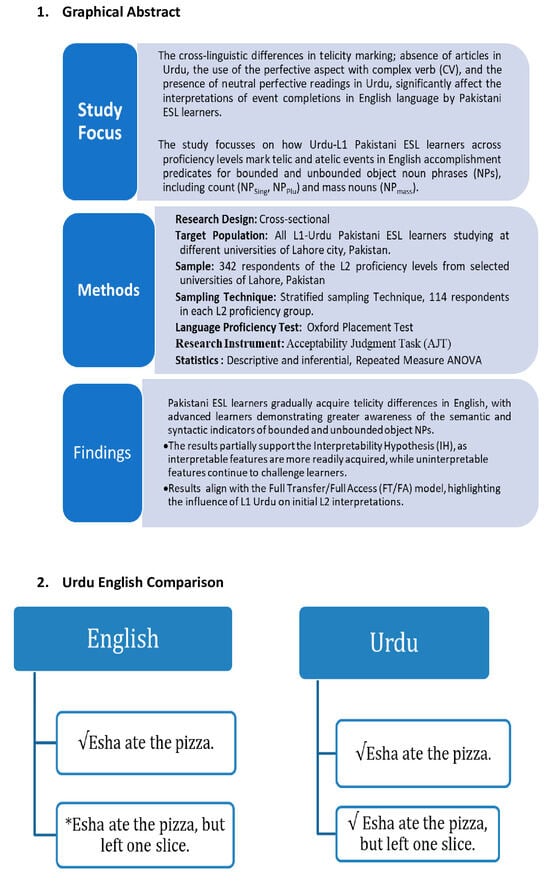
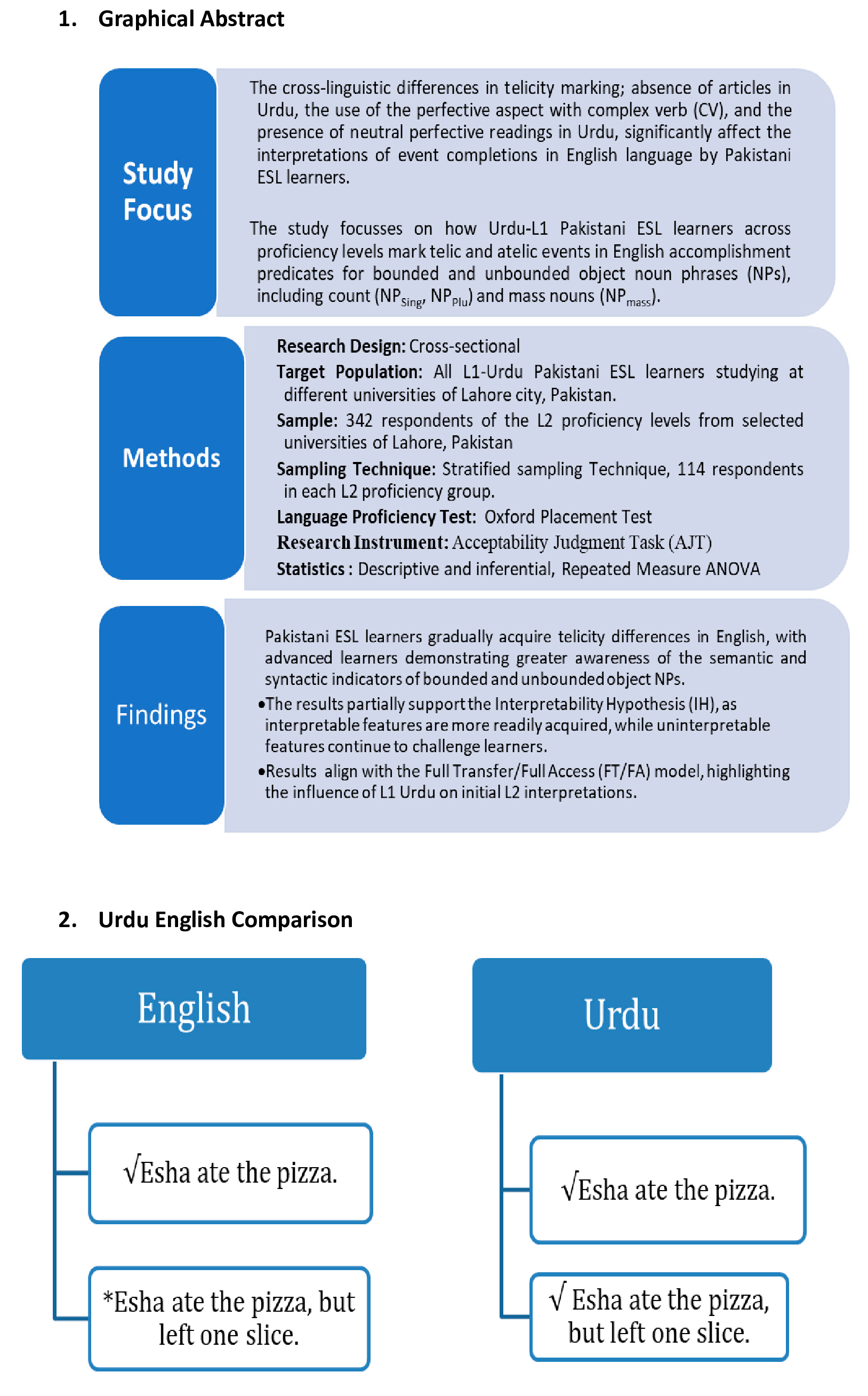
| 5. | (a) | √ Esha ate the pizza. |
| | (b) | # Esha ate the pizza, but left one slice. |
| | (c) | Neutral Perfective in Urdu |
| | | √Esha-ne | pizza | khā-yaa, | Lekin | ek | tukṛā | chor-diyā |
| | | Esha.F.SG-ERG | pizza.M.SG | Eat-PERF.M.SG | but | one | piece | left(V1:left)- give (V2:give)
- PERF.M.SG |
| | | ‘Esha ate (the) pizza, but left one slice.’ |
Sentence 5 (a) clearly signals a completed event, and it is grammatically and semantically acceptable in English. The activity of eating the entire pizza was completed, with no remaining part to eat. Conversely, sentence 5(b) is semantically infelicitous; the initial clause (
Esha ate the pizza) entails completion, which directly contradicts the subsequent clause (
but left one slice) that the eating of the pizza remains unfinished. The statement is a contradiction in English because the definite object NP “the pizza” triggers a telic interpretation that cannot be cancelled. However, the Urdu equivalent of the English example 5(c) shows that the Urdu simple perfective (khā-yaa) is aspectually neutral regarding telicity. Urdu perfective does not strictly require the achievement of an end-state, allowing for the use of a cancelation clause (…
lekin ek tukda chhod diya/but left one piece) (
Smith, 1991;
Singh, 1998). This provides evidence that the Urdu language has specific way to mark termination of an event, reflecting that the aspectual flexibility is available in the Urdu language without strictly enforcing that the entire pizza must be consumed. In sum, the above cross-linguistic differences in telicity marking pose a substantial challenge for Urdu L1 Pakistani ESL learners. In Urdu, the interpretation of event completion depends on aspectual marking rather than the nominal boundedness. Because Urdu lacks articles, it is often considered underspecified in this regard. Moreover, telicity marking is mainly determined by complex verb (CV) constructions and the presence of neutral perfective reading. These are the factors which significantly influence how Pakistani ESL learners acquire telicity marking in English. Consequently, when encountering a bounded English object NP (e.g.,
Esha ate the pizza), learners may initially transfer their L1 properties into their interlanguage, leading them to incorrectly accept atelic or incomplete interpretations. Thus, this transition is important because it requires learners to restructure their semantic knowledge of telicity without explicit instructions in the classrooms, potentially creating a persistent bottleneck in their interlanguage development.
Despite a wealth of studies on L2 English telicity in Slavic, Romance, and East Asian languages, there is still a significant empirical gap in the Indo-Iranian branch, particularly in the studies of learners whose first language (L1) is Urdu. Moreover, it is uncertain whether Urdu L1 Pakistani ESL learners can restructure their interlanguage to avoid neutral perfective readings in English or whether the lack of comparable grammatical features in Urdu results in a persistent bottleneck that prevents native-like proficiency. Therefore, to address these gaps and examine the potential for morphosyntactic and semantic restructuring in the L2 interlanguage grammar, the present study aims to examine how L1 Urdu Pakistani ESL learners acquire the telicity marking associated with the [+bounded] semantic features of English object NPs including count and mass nouns across proficiency levels.
To achieve this aim, the study addresses the following research question:
How well do Pakistani ESL learners with different L2 proficiency levels mark telicity in English accomplishment predicates with bounded and unbounded object noun phrases (NPs) that involve: (a) count noun phrase singular (NPsing); (b) count noun phrase plural (NPplu); (c) mass noun phrase (NPmass)?
2. Literature Review and Theory
The acquisition of telicity has been extensively studied across languages from different typological groups, each employing different methods to show event boundaries. A substantial body of research on the acquisition of telicity has investigated learners whose first languages (L1s) are typologically distinct from English. In Germanic languages such as English, telicity emerges from the interaction between the verb phrase and its direct object, with quantification serving as a crucial element (
Friedrich & Gateva, 2017). In contrast, Slavic languages prioritize interpretations; they use verbal morphology to symbolize aspectual distinctions (
Borer, 2005).
Slabakova (
2001) investigated the acquisition of telicity in languages where the noun phrase structure (e.g., English and Spanish) is more pivotal for event interpretation than verbal morphology (e.g., Bulgarian). Continuing this cross-linguistic analogy, the results indicated that while Bulgarian learners persistently faced challenges with the telic–atelic distinction, Spanish language learners were able to interpret telicity similar to native English speakers. Further,
Montrul and Slabakova (
2002) elucidated that Spanish ESL learners who achieved high morphological accuracy also had a strong grasp of aspectual semantics, highlighting the form–meaning relationship in telicity learning. However, the study of
Martínez Vera et al. (
2023) examined that the Spanish aspectual marker ‘
se’ creates telic interpretations and heritage group can acquire telicity similar to monolinguals.
Urrutia et al. (
2024) also found that Spanish children with developmental language disorders have a harder time understanding the differences between telic and atelic events.
García-Tejada et al. (
2023) highlighted the role of linguistic experience in aspectual interpretation.
Based on the morphosyntactic indicators,
Gabriele (
2008) investigated how L1 Japanese learners of English identify telic and atelic distinctions, including mass/count nouns and directional prepositions, observing that learners demonstrated significant sensitivity to these features. Continuing along this line of research,
Gabriele (
2010) subsequently showed that both native English speakers and L1 Japanese learners experienced challenges with unbounded count nouns, highlighting the persistent restraints in the interpretations of object boundedness. Nevertheless,
Wagner et al. (
2024) connected visual signals to telicity, a cognitive semantic category that is independent of modality. The study of
Oliveira (
2025) demonstrated that Portuguese L2 learners of German find it difficult to interpret telicity with resultative particles but perform native-like while using adjectival indicators and bounded noun phrases.
Kimura and Wakabayashi (
2019) provided a developmental framework for the learning of nominal functional categories, indicating that learners gradually acquire the ability to differentiate between definiteness and indefiniteness.
Van Hout (
2018) emphasized the importance of verb semantics in the acquisition of event completion.
From a semantic view,
Zhang (
2023) also established that the quantization of the incremental theme determines the telicity in Mandarin, while
Zhong et al. (
2025) focused on the role of syntax–semantics mapping, showing that Mandarin children acquire telicity through resultative verb compounds.
Kimura and Wakabayashi (
2019) showed that the learning of English resultatives is greatly impacted by the syntactic and semantic differences between Korean and English, with L1 telicity being a key factor.
Kaku-MacDonald (
2009) found that L1 Japanese ESL learners often reject neutral perfective interpretations that are not present in English, reflecting a knowledge of target language constraints. Expanding the cross-linguistic data, ESL learners frequently have difficulties in comprehending telicity and boundedness within L2 English aspectual interpretations (
Shkurenko & Cele, 2022;
Yin & Kaiser, 2013;
Falhasiri et al., 2012).
Taken together, the cross-linguistic studies indicate that linguistic experience increases the sensitivity to aspectual distinctions since the telic–atelic interpretations are influenced by the L2 morphosyntactic cues and the L1 typological properties (
Slabakova, 2001;
Montrul & Slabakova, 2002;
Oliveira, 2025;
Shkurenko & Cele, 2022;
Martínez Vera et al., 2023;
García-Tejada et al., 2023). Studies involving heritage speakers and bilingual individuals further demonstrate that linguistic experience can improve perceptions of aspectual variations (
Martínez Vera et al., 2023;
García-Tejada et al., 2023). Despite extensive research and interpretation on telicity marking, research has focused on L1 backgrounds from Europe and East Asia, while South Asian ESL learners, particularly those from Pakistan, remain under-represented in the literature. Empirical research in the Pakistani ESL context is limited; particularly, the impact of L1 properties on English telicity interpretation has not been systematically investigated. This study fills the gap by looking at how Pakistani ESL learners with different levels of English proficiency acquire telic–atelic events in English accomplishment predicates.
Theoretical Framework
The present study is based on two significant theoretical accounts in SLA: the Full Transfer/Full Access (FTFA) hypothesis and the Interpretability Hypothesis (IH). In SLA research, the nature of the “initial state” remains a significant debate, particularly with respect to the extent of transfer of L1 grammatical knowledge. In response to this debate, the FT/FA hypothesis (
Schwartz & Sprouse, 1994,
1996) uniquely predicts that the final state of the learner’s first language (L1) constitutes the initial state of the second language (L2). Unlike general or partial transfer models, L2 learners transfer all the syntactic properties of their L1 (including functional categories) into their interlanguage grammar (ILG). As learners are exposed to L2 input over time, they retain full access to Universal Grammar (UG), resetting the underlying L1 parameters in response to the sufficient input. Thus, the study posits that L2 learners have access to functional categories and aspectual meanings from the outset. In contrast, partial transfer theories such as the Minimal Trees Hypothesis (MTH) (
Vainikka & Young-Scholten, 1994) represent an “impoverished” initial state. MTH proposes that, initially, second language (L2) learners start with “minimal trees” grammars, where learners initially transfer only lexical categories (e.g., nouns, verbs), while functional categories (e.g., Tense, Agreement, Aspect P) are absent and must be developed through L2 input. However, since the native language of Pakistani ESL learners (Urdu) already provides the functional categories and aspectual indicators, FT/FA uniquely predicts that these structures are available to the learner from the beginning. Therefore, under FT/FA, persistent deviation in telicity marking is not interpreted as a lack of grammatical category. Instead, it is ascribed to the Mapping Problem Hypothesis (
Lardière, 2006), which suggests that learners possess the abstract syntactic–semantic features but struggle to map them onto the correct L2 morphological forms.
Expanding upon this, the Interpretability Hypothesis (IH) (
Tsimpli & Dimitrakopoulou, 2007) addresses the constraints of adult L2 learning through a distinction of interpretable and uninterpretable features. IH posits that second language learners can acquire interpretable features (those contributing to semantic meaning, i.e., telicity) as they remain accessible through Universal Grammar. However, uninterpretable features (solely for syntactic computation) are constrained by a critical period, rendering them inaccessible to L2 learners after a critical period (
Tsimpli & Dimitrakopoulou, 2007, p. 224). The observed disparities contribute to debates on the accessibility of universal grammar for adult second language learners. (e.g.,
Hawkins & Chan, 1997). Thus, post-childhood learners may excel in acquiring structures based on interpretable features, even if they are not present in their L1, but are likely to have difficulties with structures that involve uninterpretable features. This distinction explains why learners may excel in acquiring complex aspectual meanings yet continue to display “optionality” or fossilization in surface-level syntactic performance (
Lardière, 2000).
Collectively, these theoretical models provide a structured lens for analyzing both the developmental stages of telicity acquisition and the cross-linguistics influence, especially in relation to compositional markers such as the object NP type and the interpretations of event boundaries. Based on the above-mentioned theoretical models, the following hypotheses are proposed:
RH1: In accordance with the Full Transfer Hypothesis, it is hypothesized that Pakistani ESL learners at elementary level will initially fail to correctly recognize the telic constraints of bounded object NPs due to the nominal underspecification of Urdu language.
RH2: In line with the Full Access Hypothesis, advanced ESL learners will exhibit significant interlanguage restructuring, showing a higher accuracy in marking telicity as their proficiency increases.
RH3: The Interpretability Hypothesis posits that a persistent disparity will exist between advanced learners and native speakers. This shortfall arises from the absence of the [+bounded] feature in the Urdu nominal system, resulting in a persistent bottleneck at the syntax–semantics interface.
3. Materials and Methods
The cross-sectional research design was employed for the study to collect the data at a single shot time from second language learners across three proficiency levels (
Creswell, 2014). Stratified random sampling technique was employed to collect the data from the accessible population of 502 graduate-level students from selected universities in Lahore, Pakistan. The stratified variable (Language proficiency) classified the population into equal-sized groups that were different from each other and similar in characteristics within each group (
Gay et al., 2011). A suitable sample of 342 respondents was recruited using
Cohen et al. (
2018) criteria of sample size. The participants were grouped into three proficiency levels based on their scores from the Oxford Placement Test (
Allan, 2004). There were 114 (
n = 114) respondents in each L2 proficiency (elementary, intermediate and advanced). This equality was necessary to prevent the results from being distorted by the opinions of an unusual informant (
Zaidi et al., 2023;
Nimehchisalem, 2010). However, the sample’s proportion of male and female responders was uneven (
Meyvis & Van Osselaer, 2018).
Further, a power analysis using G*Power software (Version 3.1.9.2) (
Faul et al., 2007;
Beck, 2013) was also used to verify the sample size. A post hoc analysis based on an ANOVA (fixed effects, one-way) with a large effect size of 0.40 and power of 92% supported a total sample of 342. This procedure ensured sufficient statistical power to detect meaningful differences. A control group of 10 native English speakers was also included to establish baseline judgements and validate the accuracy of interpretations regarding telic and atelic conditions.
The study employed an Acceptability Judgement Task (AJT) to measure how Urdu L1 Pakistani ESL learners interpret telicity in English. The AJT was modified from well-known context-based judgment tasks found in the literature (
Slabakova, 1999;
Kaku-MacDonald, 2009;
Al-Thubaiti, 2009). The test was structured to make sure that participants’ judgements represented context-dependent perceptions of telicity, rather than independent sentence-level grammaticality.
The present study targeted three types of noun phrases, including count singular, count plural, and mass nouns. Each type was further divided into bounded/unbounded object NPs. Then, each NP condition appeared in both telic and atelic contexts. As a result, six experimental conditions were produced including: (a) bounded/unbounded count noun singular
NPsing, (b) bounded/unbounded count noun plural
NPplu, (c) bounded/unbounded mass noun
NPmass. Thus, AJT consisted of 32 target situations with 16 telic and 16 atelic test items having an equal distribution of all conditions. In addition, 16 fillers were also included in task. Consider the following examples 6 and 7:
| 6. Last night, Noor had three cups of spaghetti. After she finished, she washed them all and put them in the cupboard. There are not any dirty cups left. |
| | - (a)
Noor washed the cups in an hour. (acceptable: bounded NP with bounded time)
|
| | - (b)
#Noor washed cups for an hour. (Infelicitous: unbounded NP with unbounded time)
|
Example (6a) describes a telic situation where the definite plural (the cups) with bounded time (in an hour) matches with the event context because Noor has finished the event of cleaning the cups. However, in the same context, the unspecified object NP (cups) with unbounded time (for an hour) in 6(b) does not match a context of total completion, and produces an infelicitous interpretation.
| 7. Last night, Noor had three cups of spaghetti. After she finished, she washed two of the cups, but before doing the other, she left to answer the phone. |
| | - (a)
#Noor washed the cups in an hour. (Infelicitous: bounded NP/time falsely indicates completion)
|
| | - (b)
Noor washed cups for an hour. (Acceptable: unbounded NP with unbounded time)
|
Example (7) shows an atelic context for an incomplete activity. In (7a), the definite plural (the cups) with bounded time falsely indicates completion and is infelicitous, but the unbounded plural object NP (cups) with unbounded time matches the incomplete activity.
In AJT, the ratings for each event context were based on whether the respondents correctly accepted or rejected telic/atelic sentence continuations. The respondents chose between two sentence continuation options (a/b) and rated their judgement on a 7-point Likert scale from −3 (highly unacceptable) to +3 (highly acceptable), with zero representing (don’t know) response. Instead of using a categorical acceptance–rejection threshold (such as midpoint-based cut-offs), the judgements were analyzed on gradient considering the accuracy score with confidence. In order to quantify the responses, the Likert scale judgements were transformed into an accuracy scale ranging from 1 (lowest accuracy) to 6 (highest accuracy) with polarity adjusted for acceptable vs. unacceptable continuations (
Slabakova, 1999;
Al-Thubaiti, 2009;
Alruwaili, 2014).
Table 1 presents a description of the score’s transformation.
Table 1 shows that for unacceptable continuations, the respondents who rated as −3 (highly unacceptable) received a score of 6 (correctly rejected with no doubts), while those who rated them as +3 (highly acceptable) received a score of 1 (incorrectly accepted with no doubts). The polarity of the scale was reversed for acceptable continuations, with +3 (highly acceptable) scoring as 6 (correctly accepted with no doubts) and −3 (highly unacceptable) scoring as 1 (incorrectly rejected with no doubts) (
Mackey & Gass, 2016;
Al-Thubaiti, 2009). In order to ensure that the mean scores accurately represented linguistic judgements, the responses of ‘0’ (Don’t know) were omitted from the accuracy calculations. Therefore, the maximum score achieved by a respondent for each condition was 16 items × 6 points.
Prior to data collection, the study obtained ethical clearance from the institutional review board and formal permission from the participating universities. Participants were fully briefed on the objectives of the research, provided written consent, and were guaranteed confidentiality, anonymity, and the freedom to withdraw at any stage.
4. Results
Descriptive and inferential statistics were used to test the following null hypotheses:
H1: There is no significant effect of the L2 proficiency levels and the object NP type on telicity marking in English accomplishment predicates.
H2: There is no significant mean score difference between bounded and unbounded count noun—singular object (NPsing) in telic and atelic contexts across proficiency levels.
H3: There is no significant mean score difference between bounded and unbounded count noun—plural object (NPplu)in telic and atelic contexts across proficiency levels.
H4: There is no significant mean score difference between bounded and unbounded mass noun object (NPmass) in telic and atelic contexts across proficiency levels.
A one-way repeated-measures ANOVA was used to examine the effects of proficiency levels and the object NP type (bounded vs. unbounded) on telic and atelic marking in the AJT. Within-subject factor included object NP types (
NPsing,
NPplu,
NPmass), while the between-subjects factor was proficiency group (elementary, intermediate, advanced, control) (see
Table 2).
Table 2 shows the impacts of NP type, proficiency groups, and their interaction in telic and atelic conditions. It should provide a concise and precise description of the experimental results, their interpretation, as well as the experimental conclusions that can be drawn. In telic context, Mauchly’s test indicated sphericity assumption not being fulfilled for χ
2(14) = 232.36,
p < 0.001, requiring a Greenhouse–Geisser correction (ε = 0.741). The analysis revealed significant effects of NP type [
F(3.71, 1289.21) = 11.05,
p < 0.001, η
2 = 0.03], proficiency group [
F(3, 348) = 100.16,
p < 0.001, η
2 = 0.46], and proficiency group and NP type interaction [
F(11.11, 1289.21) = 2.45,
p < 0.001, η
2 = 0.02]. Secondly, Mauchly’s test in atelic context revealed sphericity assumption not being met (χ
2(14) = 71.74,
p < 0.001), requiring a Greenhouse–Geisser correction (ε = 0.920). Repeated-measures ANOVA results show significant effects of NP type [
F(4.59, 1600.17) = 14.57,
p < 0.001, η
2 = 0.04], proficiency group [
F(3, 348) = 237.8,
p < 0.001, η
2 = 0.672], and proficiency group and NP type interaction [
F(13.79, 1600.17) = 8.27,
p < 0.001, η
2 = 0.672]. Therefore, the results rejected the null hypothesis
H01 and concluded that there was a significant effect of the L2 proficiency levels (elementary, intermediate, advanced, control) and the object NP type (bounded vs. unbounded) on telicity marking in the English accomplishment predicates.
4.1. Telicity Marking in Count Noun—Singular NP (NPsing)
The singular count noun
NPsing result is presented in
Table 3. The results of repeated-measures ANOVA (assuming sphericity is not met) showed the significant effect of context [F(2.62, 348) = 20.05,
p < 0.001, η
2 = 0.054], proficiency group [
F(3, 348) = 96.45,
p < 0.001, η
2 = 0.454], and the interaction effect between
NPsing and group [
F(7.86, 348) = 4.28,
p < 0.001, η
2 = 0.036]. The result showed that there was a significant effect of a/telic context on the correct acceptance/rejection of the bounded and unbounded count singular noun (
NPsing) in AJT across proficiency levels.
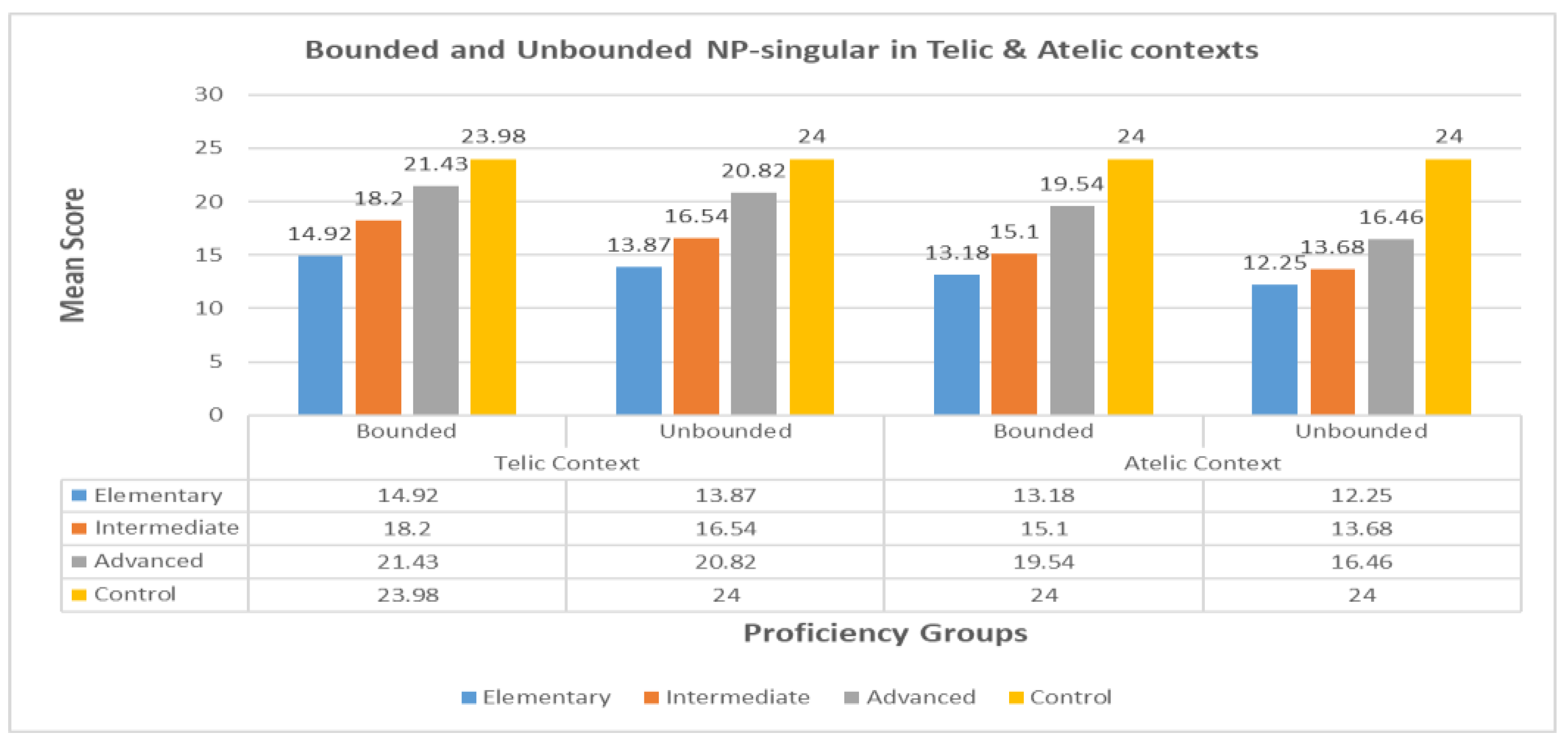
Concerning the correct judgement of bounded NPsing in telic contexts (The plumber fixed a pipe in an hour/*for an hour.), the post hoc Bonferroni test showed higher scores for intermediate (M = 18.20, SD = 5.01) than elementary learners (M = 14.92, SD = 6.18), while advanced learners (M = 21.43, SD = 3.19) scored below the control group (M = 23.80, SD = 0.63), p < 0.001. In atelic contexts, elementary (M = 15.87, SD = 4.32) and intermediate (M = 16.54, SD = 3.19) groups scored significantly lower than advanced (M = 20.82, SD = 3.63) and control (M = 24.00, SD = 0.00) groups, also at p < 0.001.
In terms of correct judgement of unbounded NPsing (The plumber fixed pipes for an hour/*in an hour.), the post hoc Bonferroni test results showed significant differences within telic contexts. Elementary (M = 13.18, SD = 5.55) and intermediate learners (M = 15.10, SD = 4.67) scored lower than advanced (M = 19.54, SD = 2.69), who still scored below native speakers (M = 24.00, SD = 0.00), p < 0.001. Similarly, in atelic contexts, elementary (M = 12.25, SD = 3.67) and intermediate (M = 13.68, SD = 2.84) groups also scored significantly lower than advanced (M = 16.46, SD = 3.56) and control groups (M = 24.00, SD = 0.00). Therefore, the results reject H02 and demonstrate a significant mean score difference between bounded and unbounded count noun—singular object (NPsing) in telic and atelic contexts across proficiency levels.
Results indicated that atelic contexts consistently accepted unbounded singular noun phrases better than telic situations. Advanced ESL learners outperformed elementary and intermediate learners, showing proficiency influences English telicity marking. Unbounded noun phrases were less accepted than the control group in atelic settings, suggesting Urdu transfer. The findings show that Pakistani ESL learners’ AJT judgements reflect cross-linguistic effects and L2 English constraints.
The mean scores for proficiency levels regarding bounded and unbounded
NPsing in both telic and atelic contexts are illustrated in
Figure 1. The data indicate a gradual increase in accuracy across proficiency levels, with the control group performing at ceiling.
4.2. Telicity Marking in Count Noun—Plural NP (NPplu)
Regarding plural count nouns
NPplu, the results of repeated-measures ANOVA in
Table 3 (sphericity not assumed) showed that there was a significant effects of context [
F(1.00, 348) = 18.03,
p < 0.001, η
2 = 0.049], proficiency group [
F(2.63, 348) = 13.49,
p < 0.001, η
2 = 0.037], and the interaction effect between
NPplu and group [
F(7.9, 348) = 4.53,
p < 0.001, η
2 = 0.038]. The result showed that there was a significant effect of a/telic context on the correct acceptance/rejection of the bounded and unbounded count plural noun (
NPplu) in AJT across proficiency levels.
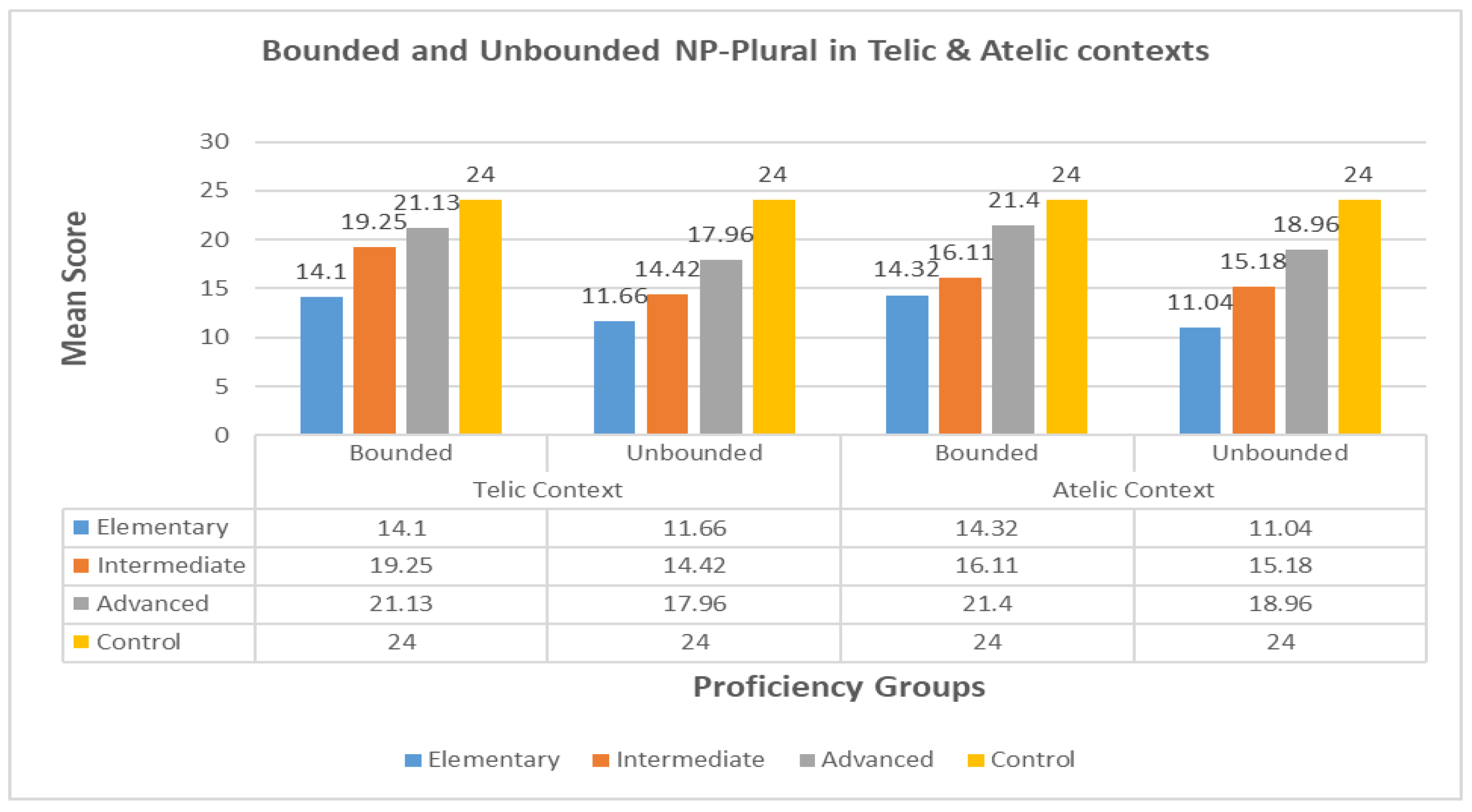
The results of the post hoc Bonferroni test regarding bounded count noun plural (NPplu) (e.g., Hani washed the cups in an hour/*for an hour.) in telic context showed that the intermediate group (M = 19.25, SD = 5.23; p < 0.001) outperformed the elementary (M = 14.10, SD = 6.61), while the advanced group (M = 21.13, SD = 4.25) scored below the control group (M = 24.00, SD = 0.00); p < 0.001. In atelic contexts, elementary (M = 14.32, SD = 4.68) and intermediate (M = 16.11, SD = 2.81) groups scored significantly lower than advanced (M = 21.40, SD = 2.81) and control groups (M = 23.90, SD = 0.316); p < 0.001. These results provide evidence of interpreting telicity based on proficiency with bounded plural NPs.
Concerning unbounded count noun plural (NPplu) in telic context (e.g., Hani washed cups for an hour/*in an hour.), post hoc Bonferroni tests showed lower mean scores for elementary (M = 11.66, SD = 5.27) and intermediate (M = 14.42, SD = 3.86) groups, with the advanced group (M = 17.96, SD = 3.77) scoring below the control group (M = 24.00, SD = 0.00); p < 0.001. In an atelic context, elementary (M = 11.04, SD = 5.25) and intermediate (M = 15.18, SD = 2.74) groups also scored considerably lower than advanced (M = 18.96, SD = 3.07) and control groups (M = 24.00, SD = 0.00); p < 0.001. Therefore, the results rejected the null hypothesis H03 and indicated a statistically significant mean score difference between bounded and unbounded plural count noun (NPplu) in telic and atelic contexts across proficiency levels.
The findings showed that unbounded plural noun phrases were consistently accepted more successfully in atelic than in telic contexts. The fact that advanced ESL learners outperformed elementary and intermediate learners suggests that proficiency influences English telicity scoring. In atelic settings, unbounded noun phrases were less accepted than the control group, suggesting partial transfer of the L1 Urdu. The findings show cross-linguistic impacts and limitations of L2 English in Pakistani ESL learners’ AJT ratings.
The distribution of mean scores across the four proficiency groups for
NPplu is presented in
Figure 2. Similar to the singular noun results, a developmental trend is observed, though with slightly lower baseline accuracy in the elementary group.
4.3. Telicity Marking in Mass Noun (NPmass)
The results of repeated-measures ANOVA in
Table 3 concerning mass noun (
NPmass) in a/telic contexts, showed (sphericity not assumed) the significant effects for context, proficiency group, and interaction effect [
F(2.53, 348) = 7.63,
p < 0.001, η
2 = 0.021], [
F(3, 348) = 168.38,
p < 0.001, η
2 = 0.592], and [
F(7.58, 348) = 3.54,
p < 0.001, η
2 = 0.030], respectively. The results showed that there was a significant effect of a/telic context on the correct acceptance/rejection of the bounded and unbounded mass object (
NPmass) in AJT across proficiency levels.
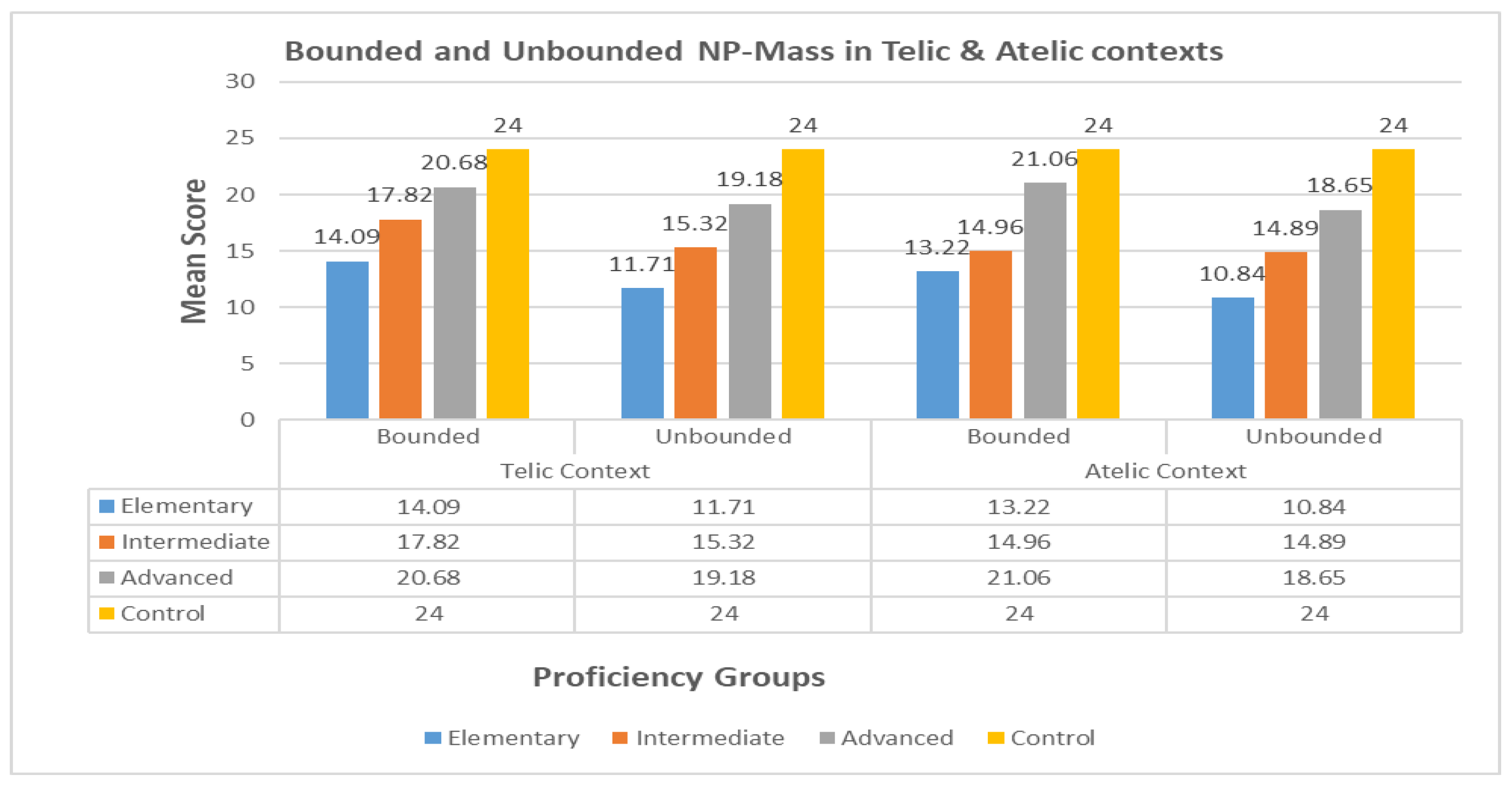
The post hoc Bonferroni test was applied to compare the mean score difference across proficiency levels in telic context regarding bounded mass noun (NPmass) (e.g., Ahmad did the homework in two hours/*for two hours.). The results showed that the intermediate group (M = 17.82, SD = 6.04) demonstrated higher scores compared to the elementary group (M = 14.09, SD = 6.02); p < 0.001. Conversely, the advanced group (M = 20.68, SD = 3.80) scored lower than the control group (M = 23.90, SD = 0.32); p < 0.001. In atelic contexts for bounded NPmass, elementary (M = 13.22, SD = 4.76) and intermediate (M = 14.96, SD = 2.94) groups scored below than advanced (M = 21.02, SD = 3.26) and control groups (M = 24.00, SD = 0.000).
Regarding unbounded mass noun (NPmass) (e.g., Ahmad did homework for two hours/*in two hours.), post hoc Bonferroni tests revealed that the elementary group scored lower (M = 11.71, SD = 5.15) than the intermediate group (M = 15.32, SD = 3.04); the advanced group (M = 19.18, SD = 2.68) scored below the control group (M = 24.00, SD = 0.00), p < 0.001. In atelic contexts, elementary (M = 10.84, SD = 4.63) and intermediate (M = 14.89, SD = 2.94) groups scored significantly lower than advanced (M = 18.65, SD = 3.09) and control groups (M = 24.00, SD = 0.00), The results rejected the null hypothesis H04, and exhibited a significant mean score difference between bounded and unbounded mass noun object (NPmass) in telic and atelic contexts across proficiency levels.
The results indicated that unbounded mass noun phrases were consistently accepted more effectively in the atelic context than in telic ones. The higher scores of advanced ESL learners compared to elementary and intermediate learners indicates that proficiency affects English telicity score. In atelic contexts, unbounded noun phrases had lower acceptance than the control group, indicating a partial transfer from L1 Urdu.
Figure 3 displays the mean accuracy scores for bounded and unbounded object mass nouns (
NPmass) across proficiency levels in telic and atelic contexts. In telic/atelic context, elementary and intermediate learners performed higher on bound
NPmass than unbounded. It reveals that
NPmass atelic context interpretations are difficult than telic. However, the advanced group overall achieved higher scores as compared to elementary and intermediate groups, and accuracy improved with proficiency.
As shown in
Figure 3, the comparative mean scores for bounded and unbounded
NPmass follow a consistent pattern of improvement from elementary to advanced proficiency, though scores for unbounded mass nouns in atelic contexts represent the lowest accuracy levels observed.
5. Discussion
The present study focused on the acquisition of L2 telicity marking among Urdu L1 Pakistani ESL learners across different proficiency levels. Results from the Acceptability Judgment Task (AJT) showed that the acquisition of the semantic category of telicity by Pakistani ESL learners is attainable. The learners were required to associate past simple accomplishment predicates with bounded object noun phrases (NPs) for telic interpretations (e.g., Sara read a book) and with unbounded object NPs for atelic interpretations (e.g., Sara read books). The AJT presented telic and atelic contexts crossed with three types of direct objects: singular count noun (NPsing), plural count noun (NPplu), and mass noun (NPmass). The findings indicate that Pakistani ESL learners experienced difficulties to associate the appropriate telic or atelic interpretation with corresponding object noun phrases in the AJT. Their acceptance and rejection rates showed gradual developmental progression across proficiency levels, but persistent divergence from native speaker judgements was observed, particularly in atelic contexts with unbounded objects.
The findings of this study provide strong empirical support for the Full Transfer Hypothesis (RH1), revealed by the significant impact between NP type and proficiency group (
p < 0.001, η
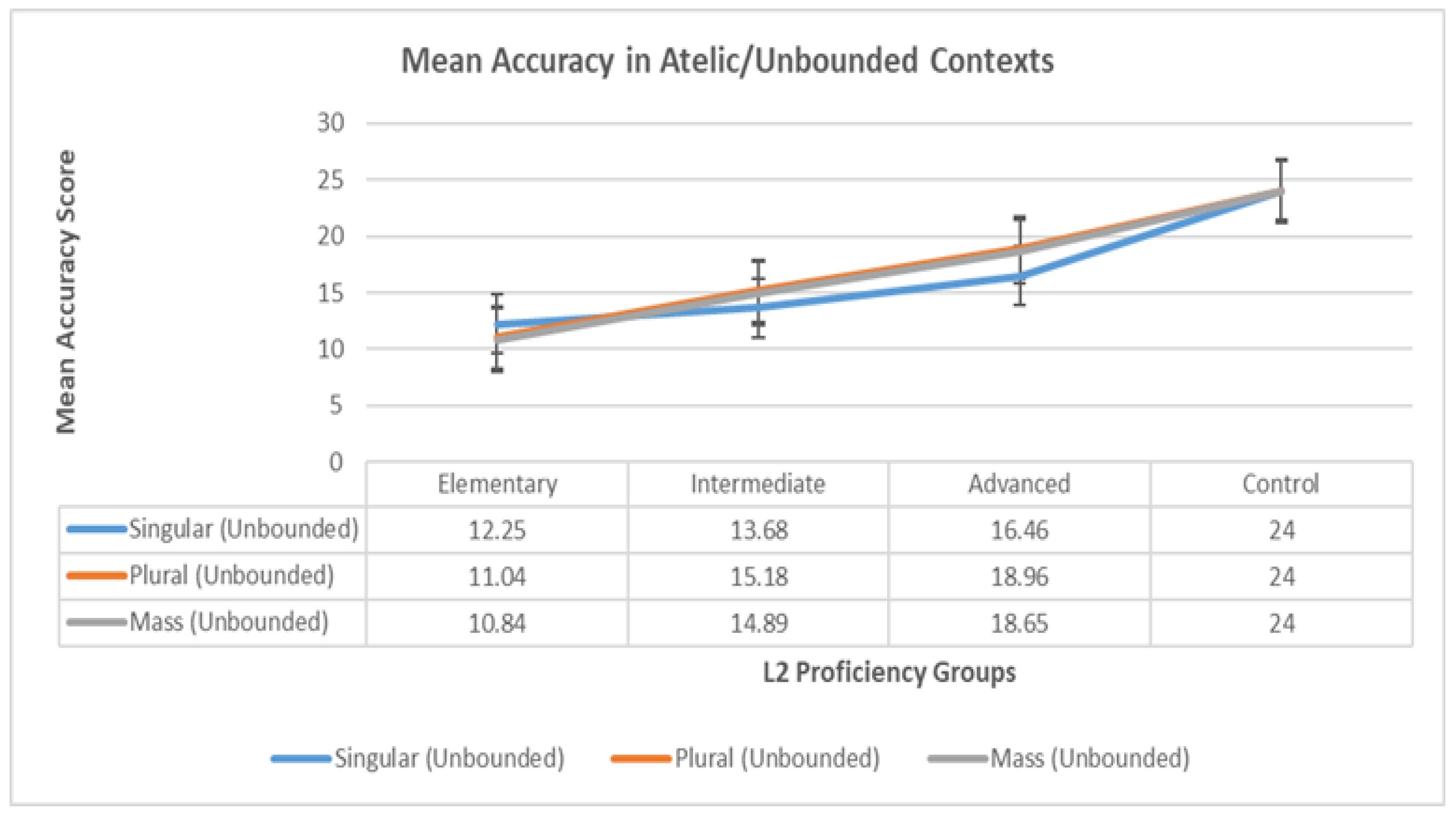
2 = 0.036). The results strongly support RH1, the results indicate that Pakistani ESL learners initially transfer the nominal underspecification of Urdu into their English interlanguage (ILG). As illustrated in the combined interaction plot (
Figure 4).
The visualization provided in
Figure 4 provides empirical evidence for RH1, revealing a systematic accuracy discrepancy across object NP types in atelic contexts. The accuracy of elementary ESL learners in telicity marking rapidly drops as the inherent unboundedness of NP develops (moving from count to mass nouns): Mass (10.84) < Plural (11.04) < Singular (12.25). Telicity marking in Urdu is essentially based on complex verb (CV) constructions rather than the cardinality of the object NPs. Moreover, articles are not available in Urdu with singular NPs, thus the results validate the continuous effect of the NP structures of the L1 Urdu on the correct acceptance of the unbounded NP constructions. The accuracy fall in the statistical disparity indicates that, absence of L1 equivalent for the English article system, initially these learners treat count nouns as unbounded by default: native speakers (M = 24.00) but the elementary group scored considerably lower (M = 10.84) reflecting the fact that in Urdu, bare NPs are structurally unclear and can adjust between telic and atelic interpretations. The tendency to the indiscriminate acceptance or rejection of telicity markers provides statistical evidence of the L1 Urdu influence. Consequently, the elementary group failed to perceive the contrast between bounded (i.e.,
fixed the pipe) and unbounded (i.e.,
fixed pipes) NPs. Therefore, the results regarding unbounded
NPmass,
NPsing and
NPplu in atelic contexts revealed a
transfer of underspecification in the L1 Urdu onto the learning of L2 English bounded and unbounded NPs constructions. These results are consistent with
Schwartz and Sprouse (
1996), showing that the English [+bounded] feature is inaccessible until further ILG restructuring takes place, and that the “initial state” of the L2 grammar is an exact representation of the L1.
In line with the Full Access Hypothesis, the results support the second research hypothesis (RH2). The significant main effect of proficiency group shows that learners actively restructure their interlanguage grammar. As proficiency increases, Pakistani ESL learners demonstrate considerable interlanguage restructuring in the marking of telic–atelic constructions in AJT [F(3, 348) = 100.16,
p < 0.001, η
2 = 0.46]. The findings exhibit that L1 Urdu transfer does not significantly restrict the Intermediate and Advanced groups. The gradual development with the increase in proficiency level across all NP types (
NPsing,
NPplu,
NPmass) indicates a transition from the aspectual verb (complex verb in Urdu) to the nominal domain (NP in English). RH2 is also supported by the findings as the Intermediate group begins to deviate from the “unbounded norm” of their L1 Urdu, for instance, accuracy increases from 11.04 (elementary) to 15.18 (intermediate), a critical midway point in the restructuring process (
Section 4.1,
Section 4.2 and
Section 4.3). This progression culminates in the advanced ESL group, which achieved significantly higher scores compared to other L2 proficiency groups across all NP types: bounded:
NPsing (M = 21.43, SD = 3.19),
NPplu (M = 21.13, SD = 4.25),
NPmass (M = 20.68, SD = 3.80), and unbounded:
NPsing (M = 19.54, SD = 2.69),
NPplu (M = 17.96, SD = 3.77),
NPmass (M = 19.18, SD = 2.68). These high acceptance/rejection rates in the AJT suggest that advanced proficiency learners have full access to Universal Grammar (UG). Results also support that advanced ESL learners have ability to restructure the bounded/unbounded features of the L2 English NPs in their interlanguage grammar.
Concerning the Interpretability Hypothesis (IH) (
Tsimpli & Dimitrakopoulou, 2007) suggest that results from the AJT are partially consistent with the third research hypothesis (RH3). Interpretable features, which carry semantic significance, are more readily acquired by Pakistani ESL learners, whereas uninterpretable features, serving primarily for syntactic agreement, pose greater challenges in acquiring telicity marking. The interpretable features [+bounded] in English are essentially located within the nominal domain (DP). The interpretable [±cardinal] features play a crucial role in acquiring bounded object NPs ([±bound]), which in turn influences event interpretation (
Slabakova, 2003,
2008). In contrast, due to the absence of definite articles, Urdu lacks this interpretable feature in its nominal system. Instead, Urdu relies on interpretable aspectual features within the verbal domain (Complex Verbs) to indicate telicity. Therefore, they face significant difficulty with the interpretable feature of nominal boundedness in L2 English. The data indicate that learners have partially acquired these interpretable features, affecting whether a verb encodes a natural endpoint [+telic] or an ongoing process [−atelic].
Although the significant restructuring evidenced in the advanced group, the results provide strong support for RH3. While the advanced proficiency group achieved high means compared to the intermediate and elementary proficiency groups, they performed significantly below the native control group (M = 24.00, p < 0.01) across all conditions. Therefore, it is evident that a persistent deficit remains in the final state of the L2 acquisition. Even in the highest-scoring category, NPsing Advanced (M = 21.43, SD = 3.19) vs. Control (M = 24.00, SD = 0.00), advanced learners fail to reach the native ceiling. This deficit is even more pronounced in unbounded plural contexts NPplu (M = 17.96, SD = 3.77). In addition, the results exhibit the persistent gap between advanced and the native control group also in NPmass: advanced (M = 20.68, SD = 3.80) vs. control (M = 24.00, SD = 0.00). Hence the finding suggests that the mapping of English articles and number morphology to telicity remains not fully acquired by the ESL learners across proficiency levels.
The Urdu nominals lack of the [+bounded] characteristic, sets a permanent barrier at the syntax-semantics interface, where Urdu-L1 learners find it difficult to reconstruct the universal feature of [+bounded] onto the English nominal system (articles/plurals) instead of the verbal system. The ESL groups across proficiency levels in distinguishing between [e.g.,
washed cups] and [e.g.,
washed the cups] sets a barrier at the syntax-semantics interface, where Urdu-L1 learners find it difficult to reconstruct the universal feature of [+bounded] onto the English nominal system (articles/plurals) instead of the verbal system (
Phan & Duffield, 2021). The absence of native-like accuracy, and the English bounded objects are treated as ‘neutral’ or ‘underspecified’ suggests that issue is mapping between the syntax-semantics interface for English nominals, whether [+bounded] or [−bounded], is a “bottleneck” for Pakistani ESL learners.
The findings of the study also align with
Kimura and Wakabayashi’s (
2019) report that advanced ESL learners more accurately recognize the grammatical features of L2 object NPs, particularly definiteness. Such results suggest that grammatical restructuring is possible: some advanced ESL learners performed at a level comparable to native speakers. As
Lardière (
2009) notes, reassembling features is challenging when L1 and L2 encode similar properties differently; learners must separate L1 feature matrices and reconstruct them to align with L2 structures.
Overall, the findings suggest that Pakistani ESL learners gradually acquire telicity differences in English, with advanced learners demonstrating greater awareness of the semantic and syntactic indicators of bounded and unbounded object NPs. The results partially support the Interpretability Hypothesis (IH), as interpretable features are more readily acquired, while uninterpretable features continue to challenge learners. They also align with the Full Transfer/Full Access (FT/FA) model, highlighting the influence of L1 Urdu on initial L2 interpretations. These patterns highlight how language proficiency and cross-linguistic transfer interact in L2 event semantics, which aids theoretical comprehension and pedagogical practice.
6. Conclusions
This study explored how Urdu L1 Pakistani ESL learners acquire telicity, with a specific focus on accomplishment predicates where telicity is determined by object noun phrases and temporal adverbials. It underscores the significance of considering semantics alongside syntax and lexicon in second language acquisition. The findings revealed a developmental progression across proficiency levels, consistent with the Full Transfer/Full Access model, which suggests that learners gradually restructure their L1-based representations using L2 input. This development indicates that although learners initially apply the aspectual properties of their Urdu L1, they have access to Universal Grammar to restructure their interlanguage grammar for the L2 telicity marking. The study also highlights the importance the syntax–semantics interface to measure the acquisition of telicity as semantic property.
However, learners continued to show non-native-like judgements in atelic contexts, particularly when interpreting unbounded NPs (count and mass), provides critical support for the Interpretability Hypothesis. This suggests difficulty in acquiring uninterpretable features due to maturational constraints that are not semantically accessible in the L1. The core issue recognized is a mapping deficit at the syntax–semantics interface; because Urdu encodes telicity through verbal morphology (complex verbs) rather than nominal boundedness, the English feature [+bounded] remains a vulnerable domain. The Interpretability Hypothesis (IH) is partially supported by the learners’ continued non-native-like judgements in atelic contexts, especially when interpreting unbounded NPs (count and mass). This underscores the challenge of learning uninterpretable L2 features that are absent from the L1 (Urdu).
The findings show that cross-linguistic influence affects how L2 learners interpret English event completion. This study shows the relationship between L1 structures and L2 temporal meaning in second language event semantics. Pakistani ESL learners struggled to recognize how English expresses event boundaries compositionally since Urdu encodes telicity through aspectual morphology rather than object structure. This asymmetry suggests that L1 Urdu, with its distinct grammatical telicity marking in terms of compound verbs, may lead to transfer-related challenges in mapping aspectual distinctions in English L2.
From a pedagogical perspective, the findings underscore the significance of specific instruction on event structure, particularly the impact of noun phrases and adverbials on telicity interpretation. Educators should emphasize how the internal composition of a noun phrase directly dictates the telicity of a sentence, helping learners map semantic completion onto the nominal domain. The study provides insights derived from a significant sample and the acceptability judgment task, although it depends on offline data. Online processing methods like eye-tracking or self-paced reading may be used to test real-time telicity sensitivity. Further research may examine instructional strategies that improve aspectual knowledge among L2 learners from typologically diverse L1 backgrounds.