
Article

A Description of Hobart English Monophthongs: Vowel and Voice Quality

1
Independent Researcher, Melbourne, VIC 3086, Australia
2
School of Languages and Linguistics, The University of Melbourne, Grattan Street, Parkville, VIC 3010, Australia
*
Author to whom correspondence should be addressed.
Languages 2025, 10(12), 297; https://doi.org/10.3390/languages10120297 (registering DOI)
Submission received: 1 May 2025 / Revised: 6 November 2025 / Accepted: 20 November 2025 / Published: 30 November 2025
(This article belongs to the Special Issue Advances in Australian English)

Abstract

This study focuses on vowel variation in Mainstream Australian English, describing F1/F2 vowel spaces and voice quality produced by speakers from the capital, Hobart, of the island state of Tasmania. Vowels are analysed by comparing F1/F2 vowel spaces produced by 39 male and female speakers, divided into younger and older age groups. Voice quality is measured by acoustic analysis of H1*-H2* as well as CPP. Results for vowel quality show that vowels produced by speakers from Hobart are undergoing change at a slower pace than in other large urban areas in Australia. For voice quality, younger speakers are shown to use more creak than older speakers, and male speakers also use more creak than female speakers. For monophthongal vowel quality, the study shows congruence with other work in Australia highlighting minor variability between urban centres, as well as illustrating that geographically distant locations with smaller populations have slower rates of change. For voice quality, the study also aligns with recent work showing less modal (and creakier) voiced vowels for younger speakers, and for male speakers. The study contributes to the small but growing body of work analysing speech produced in the island state of Tasmania, relating it to knowledge of variation and change in Mainstream Australian English more generally.

1. Introduction and Background

Research into variation in the production of vowels in Mainstream Australian English primarily focuses on the major urban Australian metropolitan areas, such as Sydney (i.e., Cox, 1999; Grama et al., 2019; Cox et al., 2024), Melbourne (Billington, 2011) and Adelaide (Butcher, 2006), with a comparative study focusing on Sydney, Melbourne, Adelaide, and Perth (Cox & Palethorpe, 2019). These studies have tended to focus on vowels in controlled speech, although Docherty et al. (2018) have also analysed vowels in conversational speech in Perth, and Grama et al. (2019) analysed spontaneous speech in Sydney. Some other studies have analysed vowels produced in regional areas, e.g., Townsville in Queensland (Gregory, 2019), and Ocean Grove in Victoria (Schmidt et al., 2021). A small number of comparative studies have also looked at vowels between regional towns. For example, one study compared three regional towns in New South Wales with one in Victoria (Cox & Palethorpe, 2004), while Warrnambool and Mildura in Victoria have also been sites of study, with comparisons between vowels produced by Mainstream Australian English and Aboriginal Australian English (Loakes & Gregory, 2024; Loakes et al., 2024b).
Some of the main findings from these studies about Mainstream Australian English vowels concern regional variation and diachronic vowel change. Considering regional variation first, the study comparing vowel spaces in Sydney, Melbourne, Adelaide, and Perth (Cox & Palethorpe, 2019) showed variation in the /əʉ/1 (using Wells’ (1982) lexical sets, this is the GOAT) vowel, which has a different realisation in South Australia (Adelaide) and Perth, compared to Melbourne and Sydney. They also observed that /ʉ/ (GOOSE) has greater diphthongisation and fronting in Adelaide and Perth, which contributes to the difference in the /əʉ/ diphthong; that the /o:/ (THOUGHT) vowel has an offglide for female speakers in Adelaide; and that /ɪə/ (NEAR) vowels also have some complex regional variability such as raising of the first element of the diphthong in Perth, and fronting for both male and female speakers in Sydney. Perth also had some regional differences for males in the realisation of /æ/ (TRAP), with less movement across F1, and for females in the realisation of /ɑe/ (PRICE), with female speakers having a phonetically lower vowel overall. The results of Cox and Palethorpe (2019) are highly relevant for the current paper, which also uses data from the same corpus (AusTalk, as will be described further below).
In Australian English more generally, rapid diachronic change has been observed in the front lax vowels /ɪ e æ/ (KIT DRESS TRAP) with /ɪ e/ being observed to have raised and then lowered over time, linked to the substantial lowering of /æ/ (Cox & Palethorpe, 2008). Similar findings for these vowels have been observed by Grama et al. (2019) in spontaneous speech, which also found that the likely initiator of these changes is the retraction of the BATH vowel /ɐ:/. Due to the attention paid to these vowels in the literature on Australian English, they will also be a major focus in the current work.
Recent and comprehensive work by Cox et al. (2024) focusing on female speakers from Sydney, has focused on static and dynamic analyses of vowels in Sydney from older timepoints (1960s and 1990s), compared to more recently produced speech (2010s) and has shown significant lowering of F1 over time for /e æ ɐ ɜ ɔ, o: ʊ ʉ/ and significant fronting of KIT and FLEECE, /ɪ/ and /i:/, when focusing on just static F1/F2. Using DCT (Discrete Cosine Transform) and GAMMS (Generalised Additive Models) analyses for dynamic measures, however, some more nuanced findings were observed. For example, Cox et al. (2024, p. 17) report that in 24/40 cases there was agreement in the static and dynamic analyses with respect to whether significant change was observed over time, while for the other 16 cases change was observed in the dynamics and not the static measurements (or vice versa). The main conclusion of their paper, with respect to using either dynamic or static analysis for analysing changing vowels, is that dynamic analyses are clearly “superior” for highlighting nuanced differences, but actually static measures are superior for comparison and visualisation of vowel spaces when the relationship between vowels is of interest (i.e., Cox et al., 2024, p. 1). As such, we use static measures when analysing vowel quality in this study.
As for other kinds of regional variability, a regionally specific vowel merger, where /e/->[æ]/ _l exists in the southern parts of the state of Victoria (for production studies see Cox & Palethorpe, 2004; Loakes et al., 2014, 2024b; Coats et al., 2025). Otherwise, studies analysing Australian English speech produced in regional towns show some limited differences across locations. For example, Cox and Palethorpe (2004) analysed vowels in three New South Wales towns compared to one Victorian town and (aside from the above-mentioned vowel merger) observed some small regional differences between the close vowels /i:, ɪ, u:/ and open vowels /ɐ:/ and /ɐ/, but not always in both F1 and F2, and not for all towns analysed. In a study comparing speech produced in the Victorian towns of Mildura and Warrnambool, Loakes & Gregory (2024) also observed minor regional differences in the trajectories of vowel monophthongs for Aboriginal English speakers in particular, compared with static points within the vowel. These studies analysing regional towns which are relatively nearby to one another find only very minimal regional differences overall, which is perhaps not surprising given differences between larger urban city locations are also those that are not especially large (i.e., Cox et al., 2024 findings reported above).
There have also been some studies focusing on vowel perception, which help to consolidate production findings. For example Mannell (2004) showed there has been a rapid change from the late 1980s to the mid-2000s in terms of how listeners process the contrasts between /ɪ e/, /e æ/, /æ ɐ/, and /ɐ ɔ/, and, in particular, the contrasts /æ ɐ/ and /ɐ ɔ/. Loakes et al. (2024a, 2024b) have also shown clear processing differences for older and younger listeners especially for the /e æ/ contrast, where later category crossovers for younger listeners indicate their requirement for a perceptually more open /æ/ vowel to be able to classify it as such, further supporting other research highlighting rapid shifts in the /e æ/ category boundary in recent times. Finally, there is some perceptual evidence suggesting that vowel change is not as extensive in regional areas as in urban areas (Loakes et al., 2024a, 2024b), with slower rates of change exhibited by less differentiation in perceptual behaviour between younger and older listeners.
As noted in the introduction, there is also evidence of regional variation in some aspects of voice quality (Loakes & Gregory, 2022); for example, F0 differences exist for women between Mildura and Warrnambool, along with differences in the degree of modal voicing between the two locations, with less modal voicing and more creaky and breathy tokens in Warrnambool (Loakes & Gregory, 2022). Regional variability in voice quality contrasts with findings by Leung et al. (2022) who observed no differences in speaking fundamental frequency (F0) across the urban or regional centres in their study—in this study, F0 was drawn from narrative-like read speech. They did, however, predict that differences may occur, and this may simply not have been evident in the centres chosen for their sample.
While research on Mainstream Australian English vowels has been growing, and highlighting some variability between locations, very little attention has been paid to English in Tasmania despite its geographically distant position as an island state, separated from other urban centres on the mainland. Melbourne is closest geographically but separated by sea. Travelling time is a known predictor for linguistic distance (Gooskens, 2005), so this geographical separation, making connection between Hobart and the mainland more difficult, is of interest for the current research. It is also worth noting that the population of Hobart is very small compared to other capital cities in Australia, with approximately 250,000 people living in the greater Hobart area, accompanied by a slow growth rate, compared to over 5 million people in the rapidly growing greater Melbourne and Sydney areas, for example (see ABS, 2025).
While no studies have directly compared the vowel spaces of speakers in Tasmania with speakers from Melbourne or other regions, Coats et al. (2025) analysed /el/-/æl/ productions by speakers from various regions across Australia, and while there was some similarity in patterns of behaviour in the south-eastern areas of Victoria and Tasmania, the Tasmanian cities Hobart and Launceston were evidently different to Melbourne.
Powell-Davies and Billington (2024) focus on change over time in the realisation of /t/, and Powell-Davies (2022) focused on diphthongs in Hobart. Powell-Davies (2022) compared F1/F2 dynamics of the FACE, PRICE, GOAT, MOUTH, and CHOICE vowels, /æɪ, ɑe, əʉ, æɔ oɪ /, produced by Mainstream Australian English speakers in Hobart, with the same vowels in Sydney, also using the AusTalk corpus; some or all of the Sydney speakers would thus be the same as the speakers in Cox and Palethorpe’s (2019) study and the Hobart speakers will be drawn from the same corpus as used in the current study. Powell-Davies (2022) found differences at points along the trajectories for the /æɪ/ vowel for males, the /əʉ/ vowel for females, the /æɔ/ vowel for males, and the /oɪ/ vowel for females. We also note that Leung et al. (2022) included Hobart in their study comparing speakers’ F0, but found no regional variability across the nine cities analysed. This data would also have been drawn from the same corpus (AusTalk) that we focus on in the current study.

Aims and Predictions

The aim of the current paper is to provide a more comprehensive illustration of monophthongal vowels in Tasmania, specifically the capital city, Hobart. This will allow for a better understanding of English spoken in this region, and will place it into the wider context of what we know about variation and change in Mainstream Australian English more generally. As noted earlier, Powell-Davies (2022) has worked on dipthongs, so we focus on the monophthongs only.
We first present some descriptive findings showing F1/F2 vowel spaces for Hobart English, considering regional variation by comparing to other published accounts of vowel quality discussed above. We also look at sociophonetic aspects of vowel quality, by taking into account age and sex, and we also focus on voice quality (through analysis of H1*-H2* and CPP). Voice quality is an important variable to analyse, being a salient feature of accent (Esling, 2012), and because some voice quality differences have started to emerge in Australian English, regionally and sociophonetically (Penney et al., 2020; Loakes & Gregory, 2022).
We predict that there will be some observable differences between vowels produced in Hobart compared to other urban centres in Australia, due both to geographic distance (and consequently travel time, i.e., Gooskens (2005)) between Hobart and the mainland of Australia, and also because of Hobart’s comparatively small population size. While geographic distance does not necessarily mean that phonetic differences are inevitable, as evidenced by the fact that Australia is a large continent with minor variability reported in the vowel system (i.e., Cox & Palethorpe, 2019), distance is nevertheless known to be a dominant predictor of variation and change across language varieties along with social variability (e.g., Wieling et al., 2011; Knooihuizen, 2023). Geographic distance may also account for some of the differences seen by Cox and Palethorpe (2019) when focusing on vowels in Perth, followed by Adelaide, compared to the more populated and geographically closer locations of Melbourne and Sydney. It is also suggested that geographic isolation is a reason for some of the patterns found in Mildura (a region isolated from capital cities) compared to Warrnambool (close to the capital Melbourne) in a recent study analysing vowel changes in Australian English (Loakes et al., 2024b).
Our research questions are as follows:
(1)
What is the nature of the F1/F2 monophthongal vowel space in Hobart English?
(2)
Which broad sociophonetic factors are relevant for patterns in the vowel formant data (sex and age)?
(3)
Are diachronic (age-related) differences evident in Hobart, and do they match rates of change observed for other Australian cities?
(4)
What voice quality patterns are evident for Hobart English vowels, and are there sociophonetic patterns for this feature?

2. Materials and Methods

2.1. Data Collection and Participants

In total, 39 speakers of English from Hobart (18 female and 21 male) were selected from the AusTalk corpus (Cassidy et al., 2014; Estival et al., 2014), using the Alveo Virtual Laboratory (Cassidy et al., 2017) which is a web-based data repository. The Hobart corpus used consists of all available speakers in AusTalk from this region. In AusTalk, all speakers had to have completed all of their primary and secondary schooling in the area in which they were recorded were eligible to take part (Cassidy et al., 2017). These years of schooling in Australia start generally between 4 and 6 years old and finish at around 17–18 years old.
Speakers were aged between 23 and 81 years of age at the time of recording2 and produced each of the 12 Australian English monophthongal vowels (/i:, ɪ, e:, e, ɜ:, æ, ɐ:, ɐ, o:, ɔ, u:, ʊ/) in /hVd/ format for three repetitions. In total, 1096 vowel tokens were analysed. For comparisons between age cohorts, speakers over 60 years of age at the time of recording were classified as older speakers (n = 15), and speakers under 40 years of age at the time of recording were classified as younger speakers (n = 24). These age ranges were selected to give a clear delineation between younger and older speakers. The breakdown of speakers in each group can be seen in Table 1.
While the study analysed only a relatively modest number of vowel tokens and finding should thus be considered in this light, the corpus size is nevertheless comparable with other Australian English studies using AusTalk (e.g., Cox & Palethorpe, 2019; Leung et al., 2022; Powell-Davies, 2022).

2.2. Data Analysis

Each of the 1096 tokens was automatically labelled and segmented using WebMAUS Basic (Kisler et al., 2014). For the formant analysis, emuR version 2.5.0 (Jochim et al., 2023 was used to automatically identify F1, F2, and F3 at the temporal midpoints in Rstudio version 4.3.1 (RStudio Team, 2020). Outliers in the datasets were examined manually using Praat version 6.3.03 (Boersma & Weenink, 2004)), and hand-corrected where there was an error in formant tracking. Vowel tokens were then plotted against reversed F1/F2 axes using the phonR package (McCloy, 2016).
Normalisation was not used, in order to be comparable with other Australian English vowel studies (e.g., Elvin et al., 2016; Cox & Palethorpe, 2019; Loakes & Gregory, 2022; Powell-Davies, 2022; Cox et al., 2024).
CPP and H1*-H2* data3 across each vowel’s duration was extracted using VoiceSauce (Shue et al., 2011) in MATLAB (The MathWorks Inc., 2022), at regular 1 ms intervals across the vowel. This data was then z-scored and plotted across normalised time using the ggplot2 package version 3.4.3 (Wickham, 2016). These time-tracked plots were smoothed using a Generalised Additive Model (GAM) smoother, with a track set as a random factor, to ensure that time-tracked data were not treated as a random selection of points. The GAM smoothing command used in ggplot2 was
geom_smooth(aes(group=labels,randomid=factor(sl_rowIdx)),
meth-od="gam",formula=y~s(x, bs="cs") + s(randomid, bs="re"))
		
where “cs” is a cubic regression spline and “re” is a random effect grouping by track number (randomID). This required a custom wrapping function mgcv::gam() to be inserted into the ggplot2 package, which predicts group trajectory based on the random effects model. This approach was used because samples are not independent, and smoothing procedures should take this into account. One way of achieving this with GAMs is via a random effect. However, random effects are not included when performing smoothing with ggplot2 using default options. Linear Mixed Effects (LMEs) analyses were used on the measures explored, using the nlme package in R (version 3.1-164) (Pinheiro & Bates, 2023; R Core team 2024). Specifically, LMEs were used to analyse vowel formants (F1, F2, and F3) at their acoustic midpoints. For each acoustic measure, LMEs were fitted to examine the effects of age group (younger vs. older), speaker sex (male vs. female), and vowel phoneme, as well as their interactions. Random effects were specified for participant to account for inter-speaker variability. Post hoc pairwise comparisons were conducted using the emmeans package version 1.8.8 (Lenth, 2023) in R, comparing estimated marginal means for age group within each combination of sex and vowel phoneme using the following command:
emmeans(model, pairwise ~ Age | Sex | Vowel)
		

2.3. Voice Quality Measures

For the voice quality analysis, this study utilises two measures of phonation, cepstral peak prominence (CPP) and the difference between the first and second harmonics, corrected to account for the effects of vowel formants (H1*-H2*). CPP is a measure of harmonicity. Higher CPP values indicate a signal that is more periodic, tending to correlate with modal voice (Blankenship, 2002; Garellek & Keating, 2011). Lower CPP values are indicative of a noisier, less periodic signal, correlating with nonmodal voice (Blankenship, 2002; Garellek & Keating, 20114). CPP has been found to be particularly useful for distinguishing modal and breathy voice (Blankenship, 2002; Esposito, 2006, 2010). While it fares less well as a discriminator of modal and creaky voice, CPP can still be useful when comparing the two (see esp. Esposito, 2006; Garellek & Keating, 2011). Unfortunately, CPP is not useful for distinguishing between breathy and creaky phonation outside of the first third of the vowel, and even then the difference has been found to be only moderately significant (Garellek & Keating, 2011, p. 148), so we use it judiciously here when discussing creaky and modal voicing. H1*-H2* is a spectral tilt measure, corrected for the effects of vowel formants. It correlates with the open quotient (OQ) of the vocal folds (Garellek & Keating, 2011; Holmberg et al., 1995). A lower H1*-H2* measurement correlates with creaky voice and a higher H1*-H2* measurement correlates with breathy voice (Iseli & Alwan, 2004; Loakes & Gregory, 2022). In this study, we analyse all vowels together, to give a general sense of voice quality for each speaker group (male and female, older and younger), similarly to the procedure in Loakes and Gregory (2022).

3. Results

3.1. Hobart English Vowel Spaces

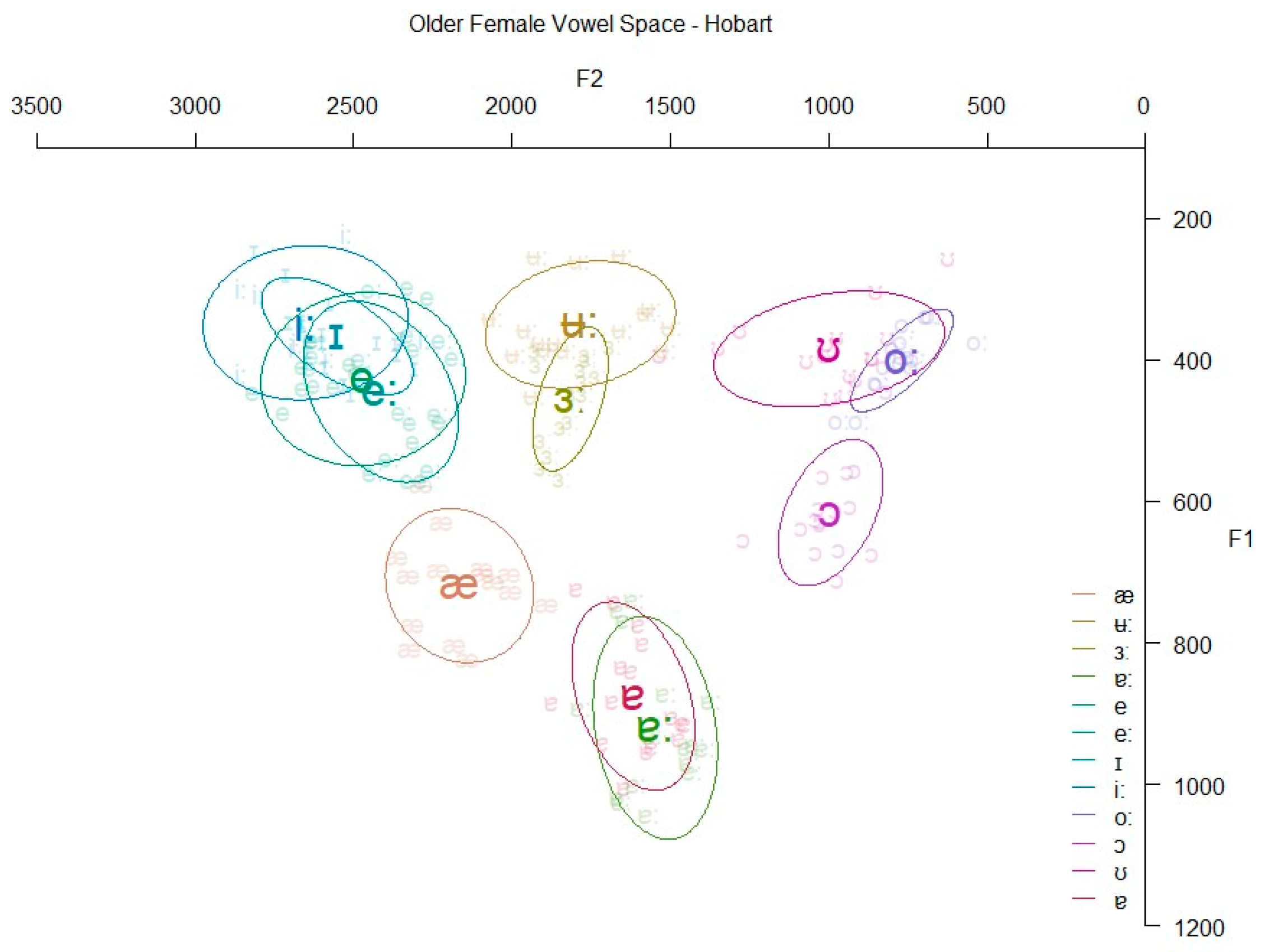
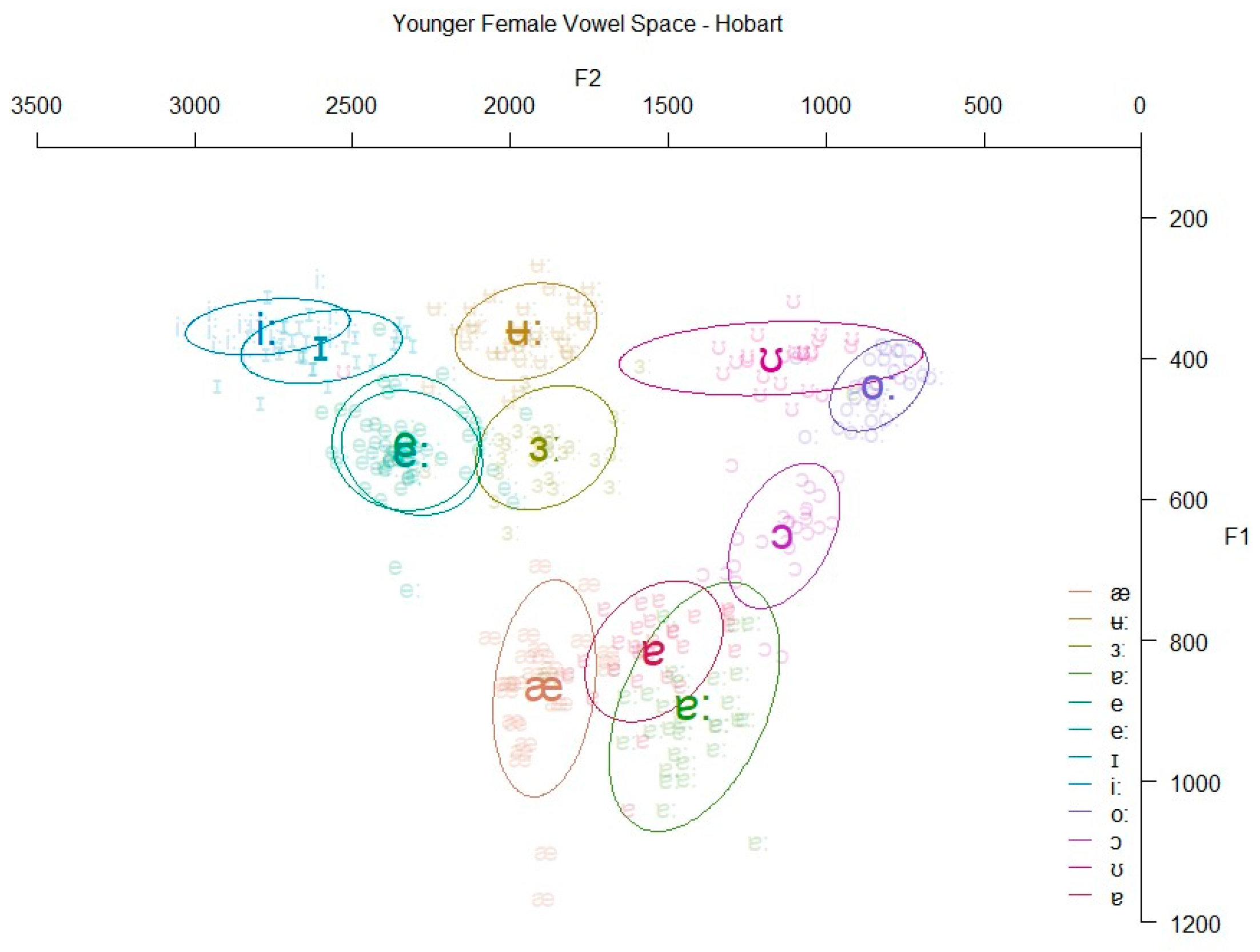
Figure 1 and Figure 2 show the vowel spaces for older and younger female speakers of Hobart English, respectively, plotted against inverted F1/F2 axes. The ellipses show 95% confidence intervals for the data (i.e., 95% of data points fit within the ellipses), while the IPA symbol marks the co-ordinates of the mean F1/F2 (see Harrington (2010, p. 58) for further information). Patterns in vowel spaces are described first, then statistical differences are summarised at the end of the section.
As can be seen here, older female speakers tend to produce the high and mid-high front unrounded vowels /i:, ɪ, e, e:/ in a cluster with a large degree of overlap for their ellipses, while younger speakers have /i:, ɪ/ separated from /e, e:/. This differentiation of the close front vowels is reflective of the kinds of changes over time reported by Cox et al. (2024) in female speakers from Sydney, where /i:, ɪ/ and /e, e:/ do not have overlapping ellipses in speech produced by younger speakers. This change over time is also seen in other studies, such as Cox and Palethorpe (2008) and Elvin et al. (2016), and the perceptual vowel space comparison by Mannell (2004). The vowel /æ/ is produced considerably lower and further back in the vowel space by younger speakers compared to older speakers—closer to productions of /ɐ, ɐ:/. For older speakers /æ/ has a mean F1 of 719 Hz, while for young speakers the mean F1 is 868 Hz; this 149 Hz difference represents substantial diachronic lowering. For F2, the differences are 2165 Hz for older speakers and 1892 Hz for younger speakers, with the 273 Hz difference representing substantial diachronic retraction. This is also reflective of the kinds of diachronic changes reported in the literature by, e.g., Cox (1999), Cox and Palethorpe (2008), and Cox et al. (2024). Other marked differences between the older and younger female Hobart speakers are that the low-/mid-central unrounded vowel /ɜ:/ is slightly further forward in the vowel space of the younger female speakers (72 Hz difference between the means), while /ɔ/ is further forward for younger speakers (146 Hz between the means), putting it closer to their productions of /ɐ, ɐ:/. Other evident differences between the older and younger female speakers are a greater range in F2 for the high back rounded vowel /ʊ/ for younger female speakers of Hobart English than older speakers, with some productions being close to (and just over) 1500 Hz (in F2). Finally, the high-central rounded vowel /u:/ is further forward in the vowel space for younger female speakers of Hobart English than the older speakers by 167 Hz. As indicated at the beginning of the discussion here, these findings reflect typical diachronic changes in Mainstream Australian English reported in other work (i.e., Cox et al., 2024; Loakes & Gregory, 2024), although it is interesting to note the larger ellipses for some vowels produced by younger speakers, particularly /æ/, /ɐ:/, and /ʊ/, likely reflecting more variability in this group, which is unsurprising given the attested rapid change in the vowel system (Cox & Palethorpe, 2008).
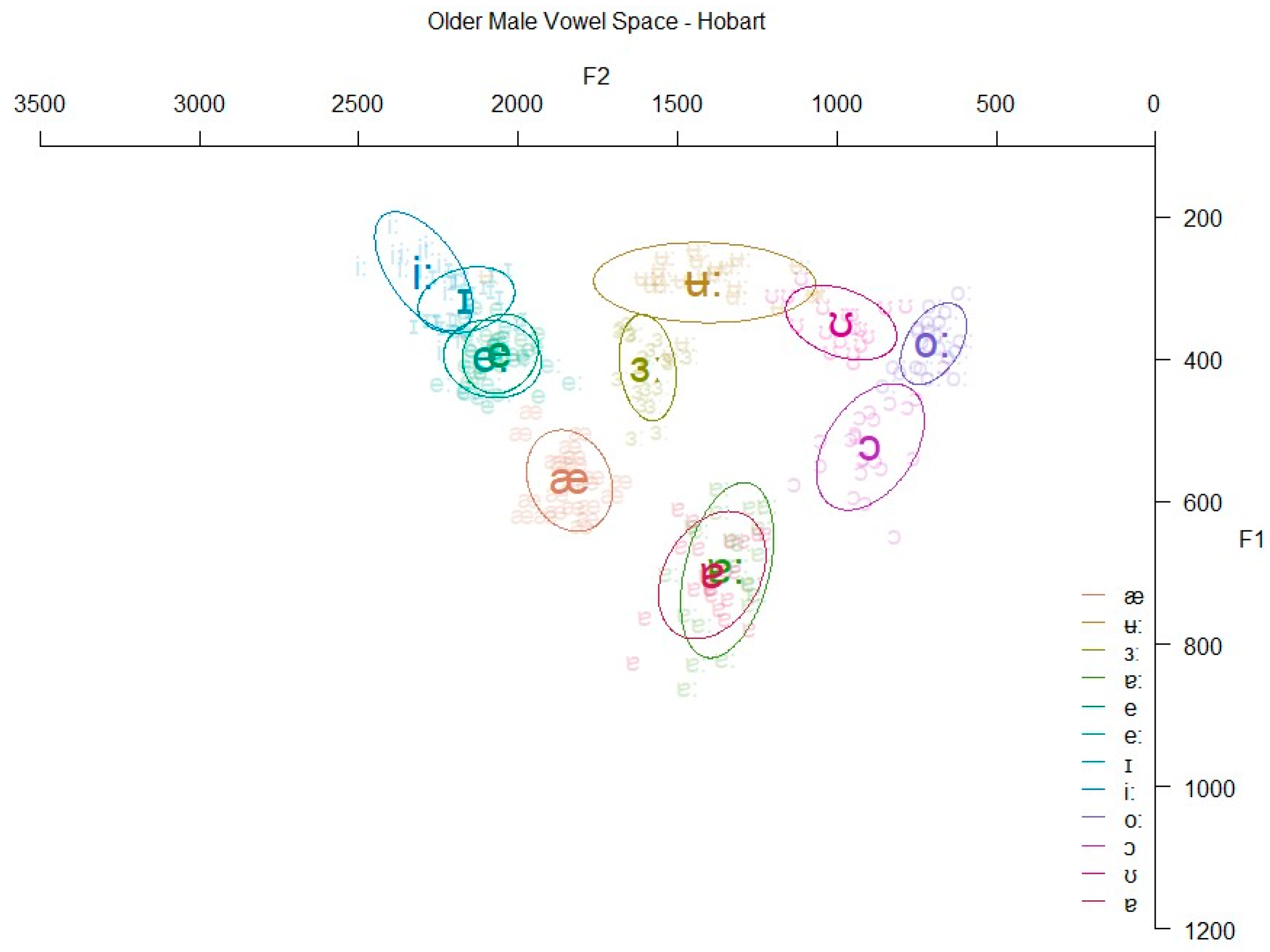
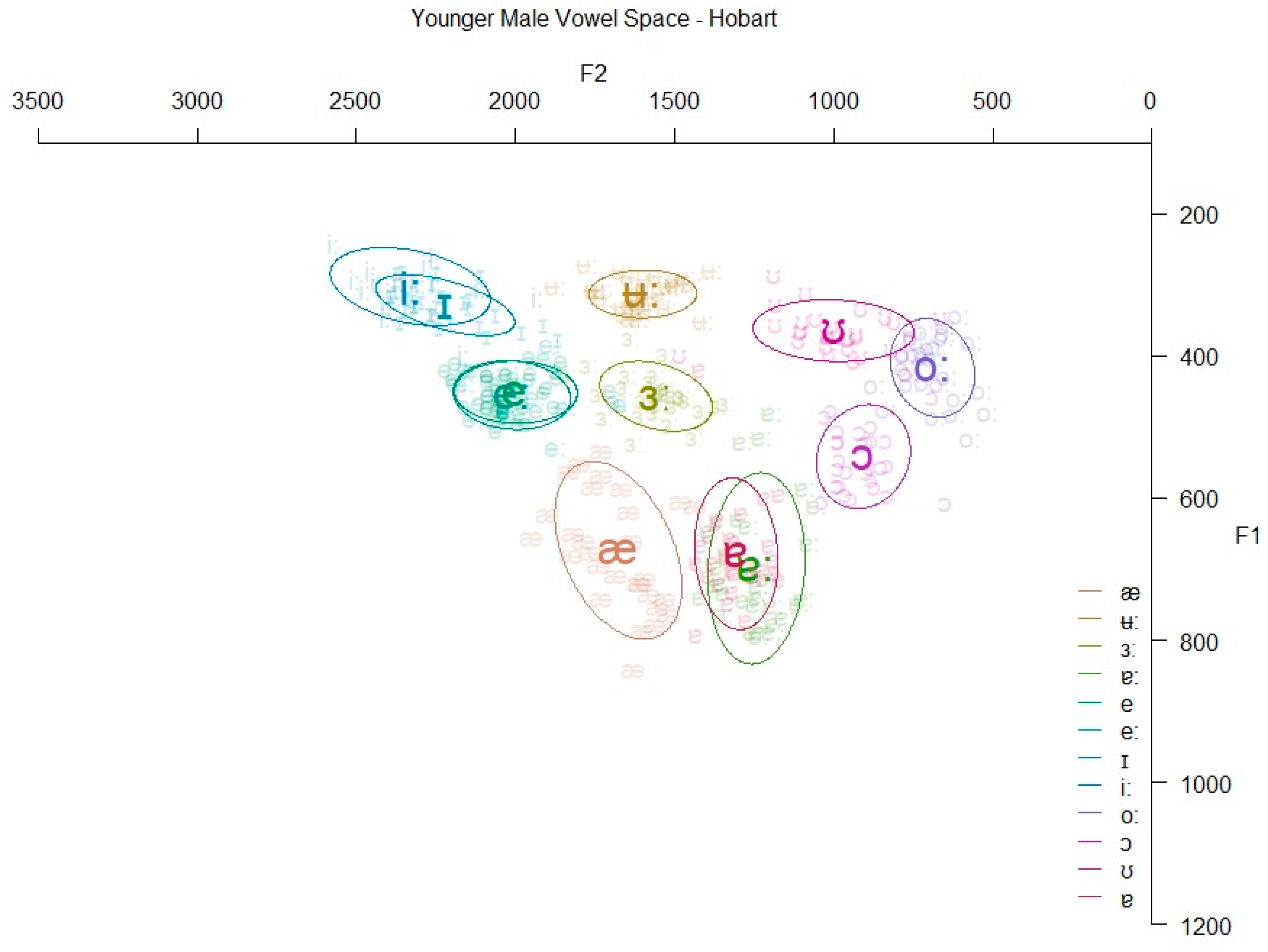
Figure 3 and Figure 4 show the vowel spaces for older and younger male speakers of Hobart English, respectively, plotted against inverted F1/F2 axes.
Like the younger female speakers, younger male speakers also have a clearer separation between /i:, ɪ/ and /e, e:/ compared to older speakers (for whom the ellipses are touching). However, older male speakers have less overlap between all of these close front vowels than older female speakers whose close front vowels all had overlapping ellipses. This detail about separation of the ellipses in the F1 dimension for younger speakers is interesting to note because it reflects what we know about the expansion of Australian English vowel spaces also observed in other studies. For example, Cox et al. (2024, p. 8) show a diachronic lowering of F1 of /e/ over time, which is reflected in formant values but also illustrated in the separation of ellipses as shown here.
Also like the female speakers, younger male speakers produce /æ/ lower (by 103 Hz) and further back in the vowel space (by 162 Hz) than older male speakers, also in alignment with the /ɐ, ɐ:/ vowels. Finally, younger male speakers of Hobart English produce the high central rounded vowel /u:/ further forward in the vowel space than older speakers. Older males speakers have a mean F2 of 1600 Hz compared to the mean of 1415 Hz by the younger males; this 185 Hz difference represents substantial fronting for the younger group. Similarly to the female speakers, the younger male group has a wider ellipse for this vowel than the older males, reflecting the change that has occurred over time. With respect to the relative position of vowels in the vowel space, like the female speakers, the observations for male speakers reflect the kinds of diachronic changes discussed in the literature for Australian English (i.e., Cox, 1999; Cox & Palethorpe, 2008; Cox et al., 2024). Comparisons with other studies will be made in the discussion section, to assess how the Hobart data relates to vowels produced in other regions in Australia.
As far as significant differences are concerned between the age groups, the LME tests highlight significant differences in a number of vowels as shown below in Table 2.5 This table shows every vowel and formant for which significant differences occurred diachronically. Out of a total of 48 possible significant differences, 21 were observed, and these also largely align with findings discussed in other studies, in particular for vowels which have lowered and or retracted, /e/, /æ/, /ɐ/, and /ɐ:/, as well as the fronting of /ʉ:/.

3.2. Voice Quality

3.2.1. CPP

We turn now from analysing vowel quality to the analysis of voice quality, beginning with CPP. As described earlier, CPP measures harmonicity. Higher CPP values indicate a signal that is more periodic, reflecting modal phonation, whereas lower values indicate a noisier, less periodic signal, reflecting non-modal phonation. Again, this measure has been found to distinguish modal and breathy voice well, but is less useful for discriminating creaky and modal voicing.
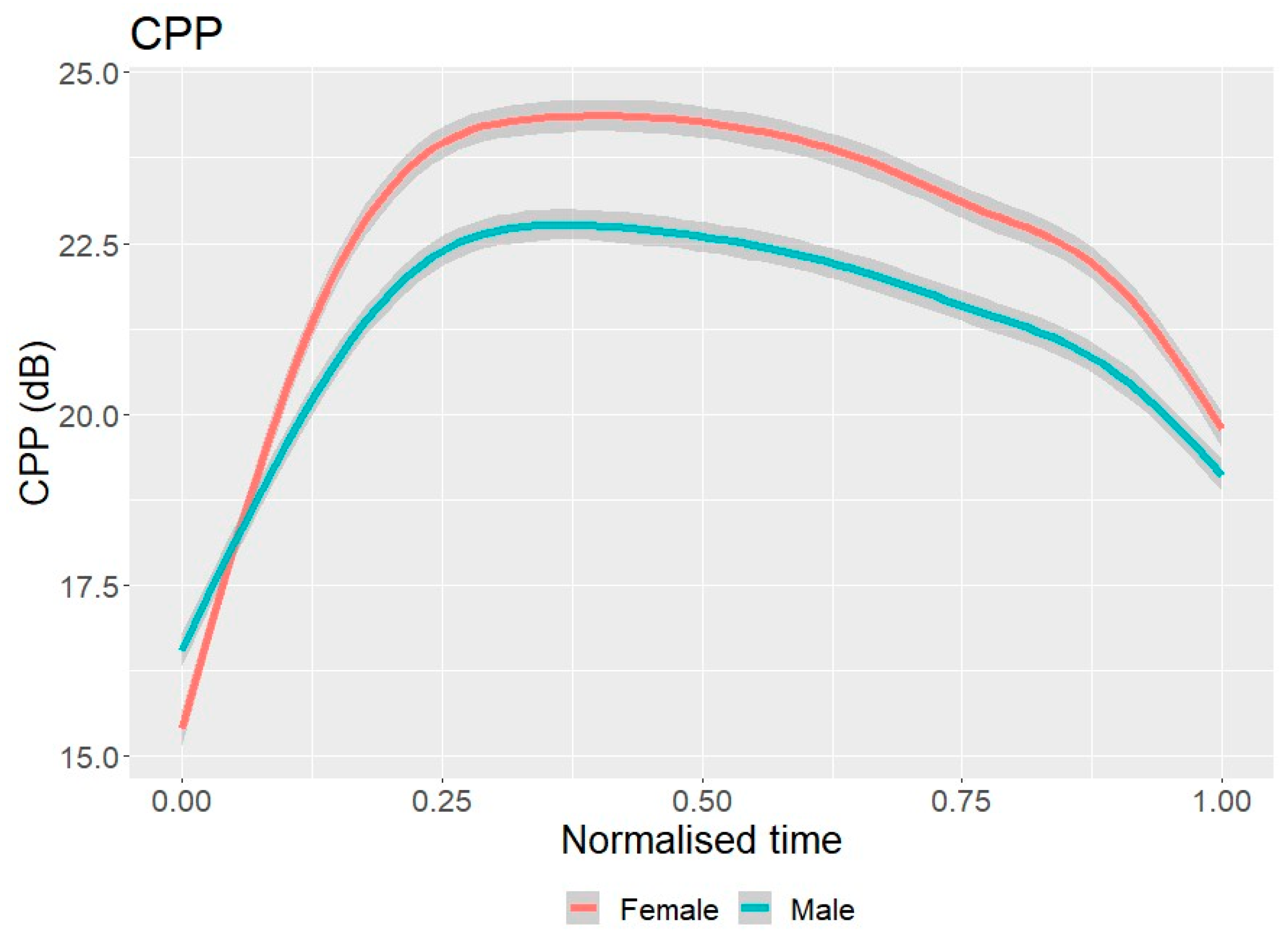
Figure 5 is a GAM-smoothed plot of CPP across normalised time for all the data points for male and female speakers. As can be seen in this plot, female speakers (red line) have markedly higher CPP values (as shown by the grey, 95% confidence intervals) than male speakers (blue line), indicating a less noisy (and therefore more modal) voice quality for almost the entirety of vowel duration.
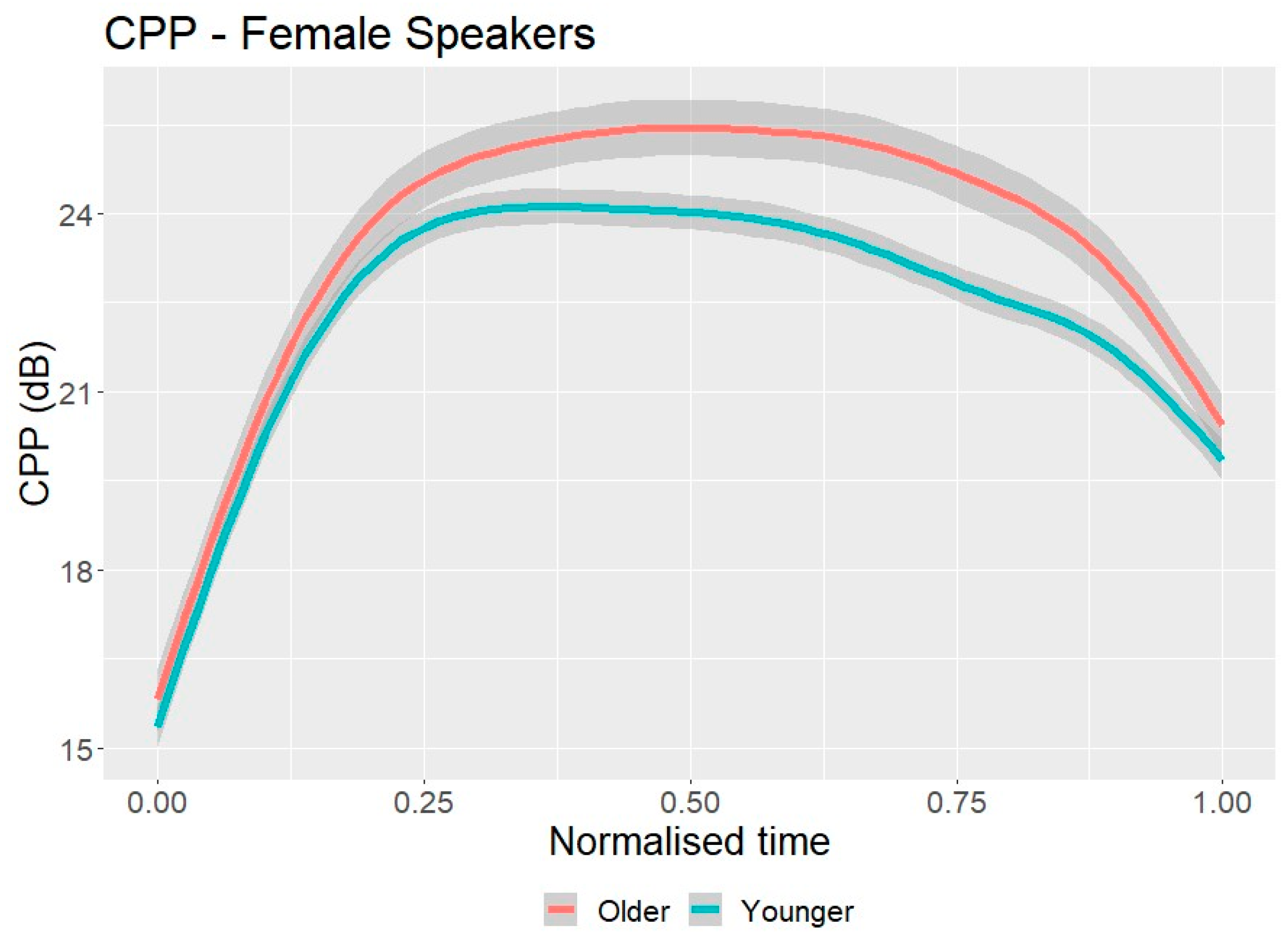
Figure 6 is a GAM-smoothed plot of CPP across normalised time, now just focusing on the female speakers, taking into account age. As can be seen in this plot, female speakers of Hobart English do not have a marked difference in CPP until approximately 25% of a vowel’s duration. After this point, older speakers (red line) have higher CPP values than younger speakers (blue line), indicating more modal voicing for the older group.
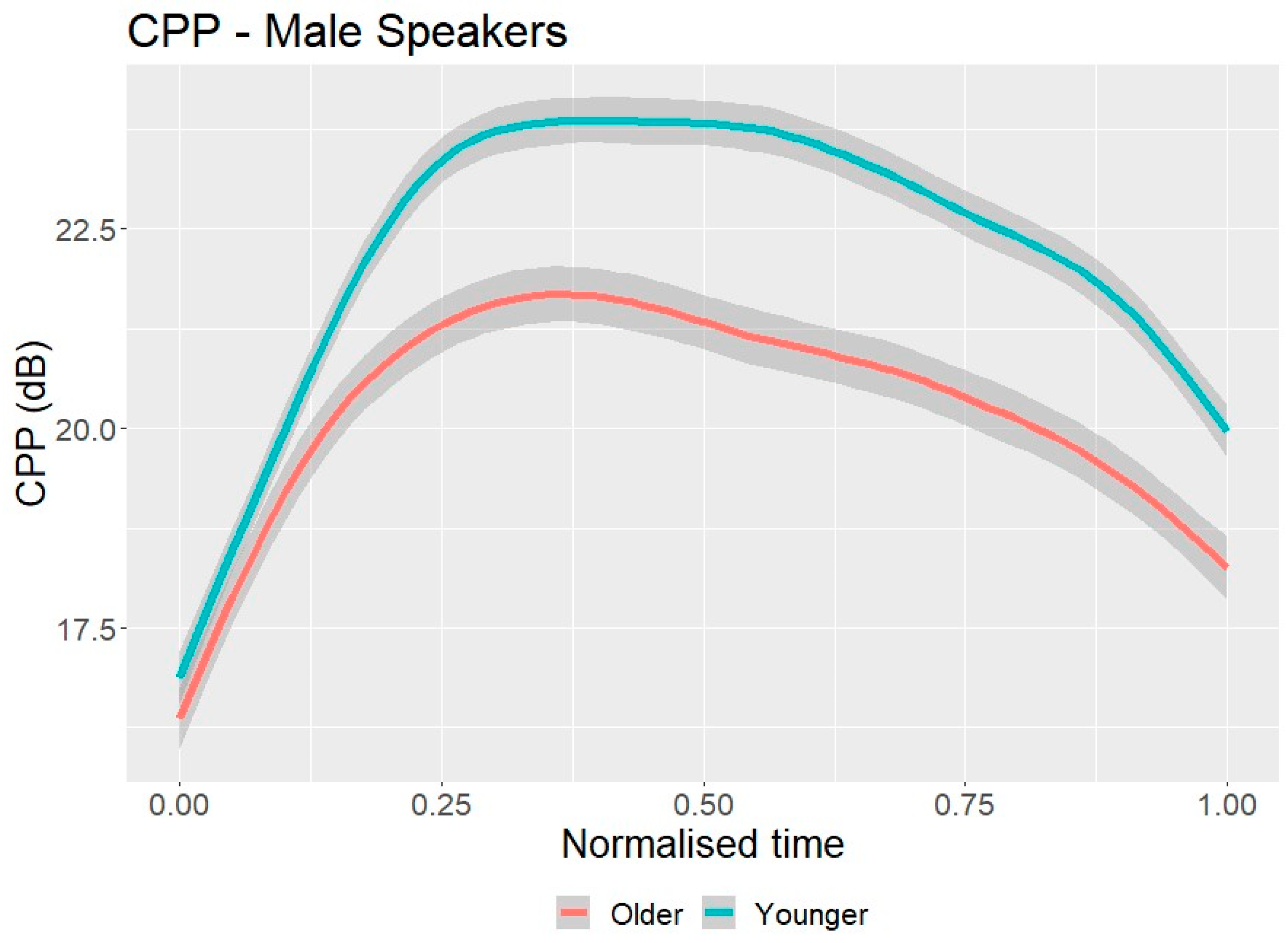
Figure 7 is a GAM-smoothed plot of CPP across normalised time focusing on the male speakers. As can be seen in this plot, younger male speakers (blue line) of Hobart English produce vowels with markedly higher CPP values than older speakers (red line) for the majority of the vowel’s duration.

3.2.2. H1*-H2*

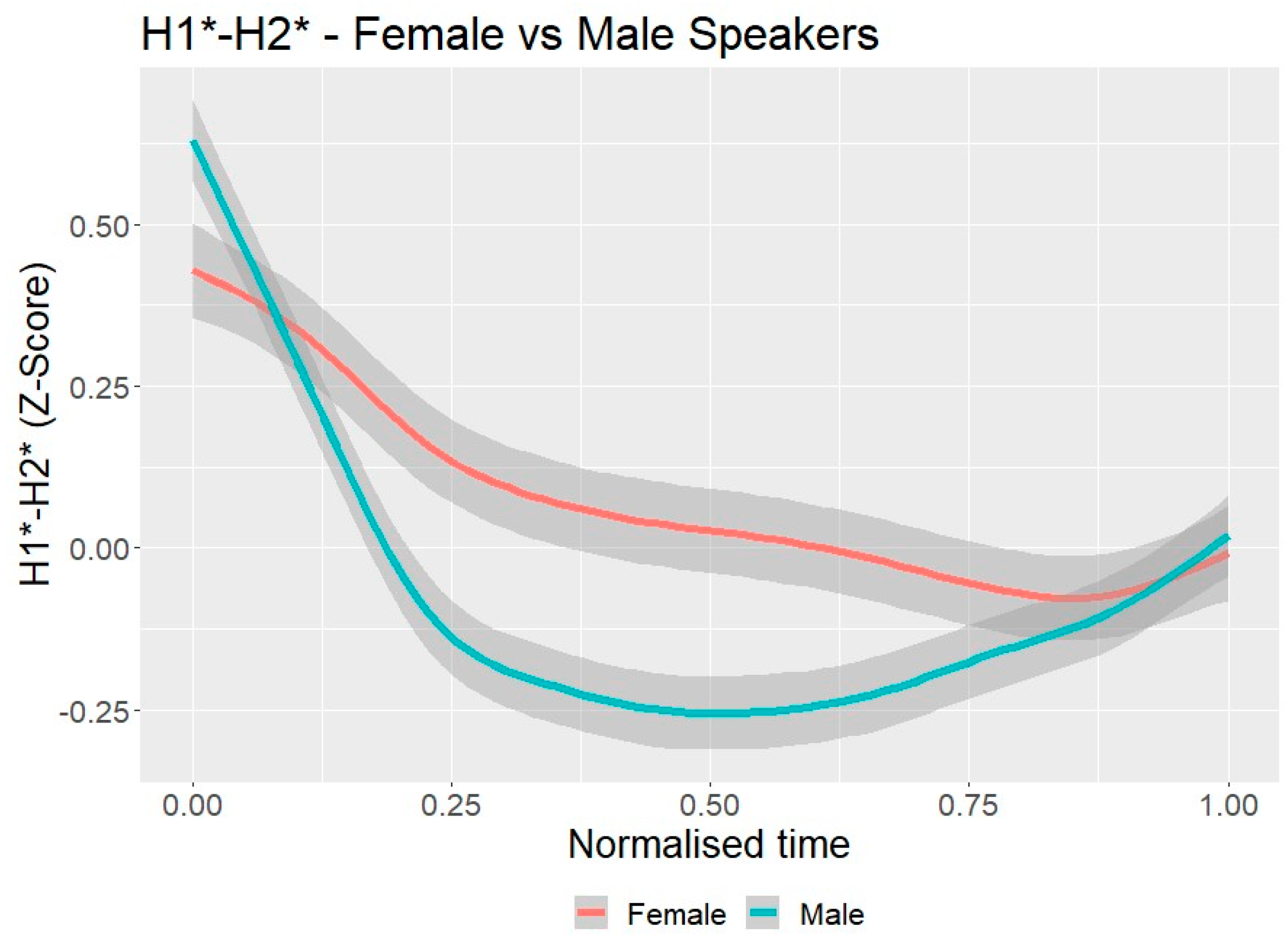
Figure 8 is a GAM-smoothed plot of H1*-H2* across normalised time for male and female speakers of Hobart English. As can be seen in this plot, there is little difference between male and female speakers at vowel onset and offset. However, for the middle portion of the vowel, female speakers (red line) have higher H1*-H2* values than male speakers (blue line). This difference correlates with more spread vocal folds, indicating less creak (and, potentially, a degree of breathiness) for the female speakers.
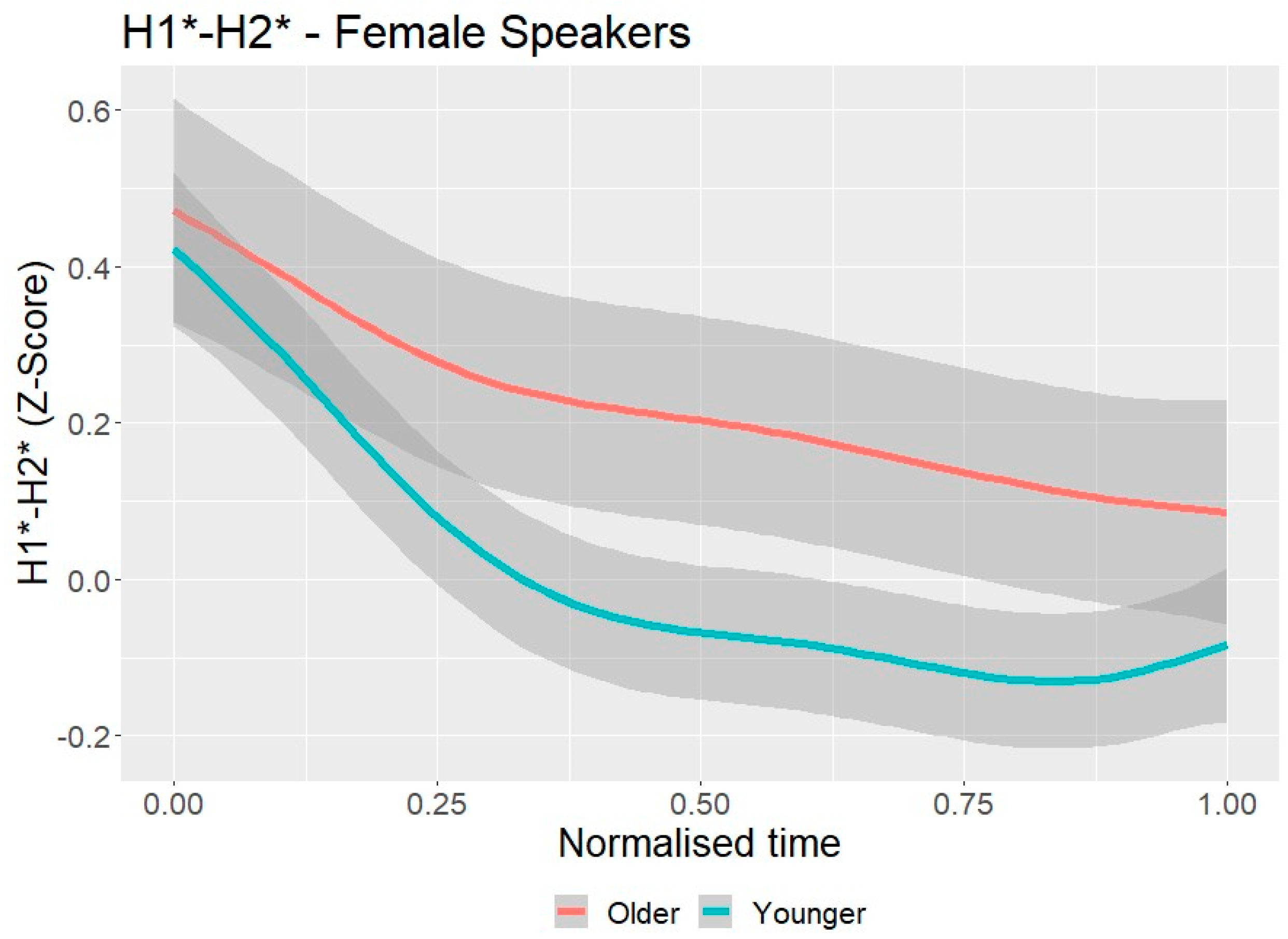
Considering now differences across age groups, Figure 9 is a GAM-smoothed plot of H1*-H2* across normalised time for younger and older female speakers of Hobart English. As can be seen in this plot, older female speakers (red line) have higher H1*-H2* values between approximately 30% and 90% of a vowel’s duration than younger female speakers (blue line), indicating that the younger female speakers have slightly more constricted vocal folds. Since younger female speakers also have a lower CPP than older female speakers, this combination is an indication that younger female speakers of Hobart English have overall creakier voicing than older female speakers.
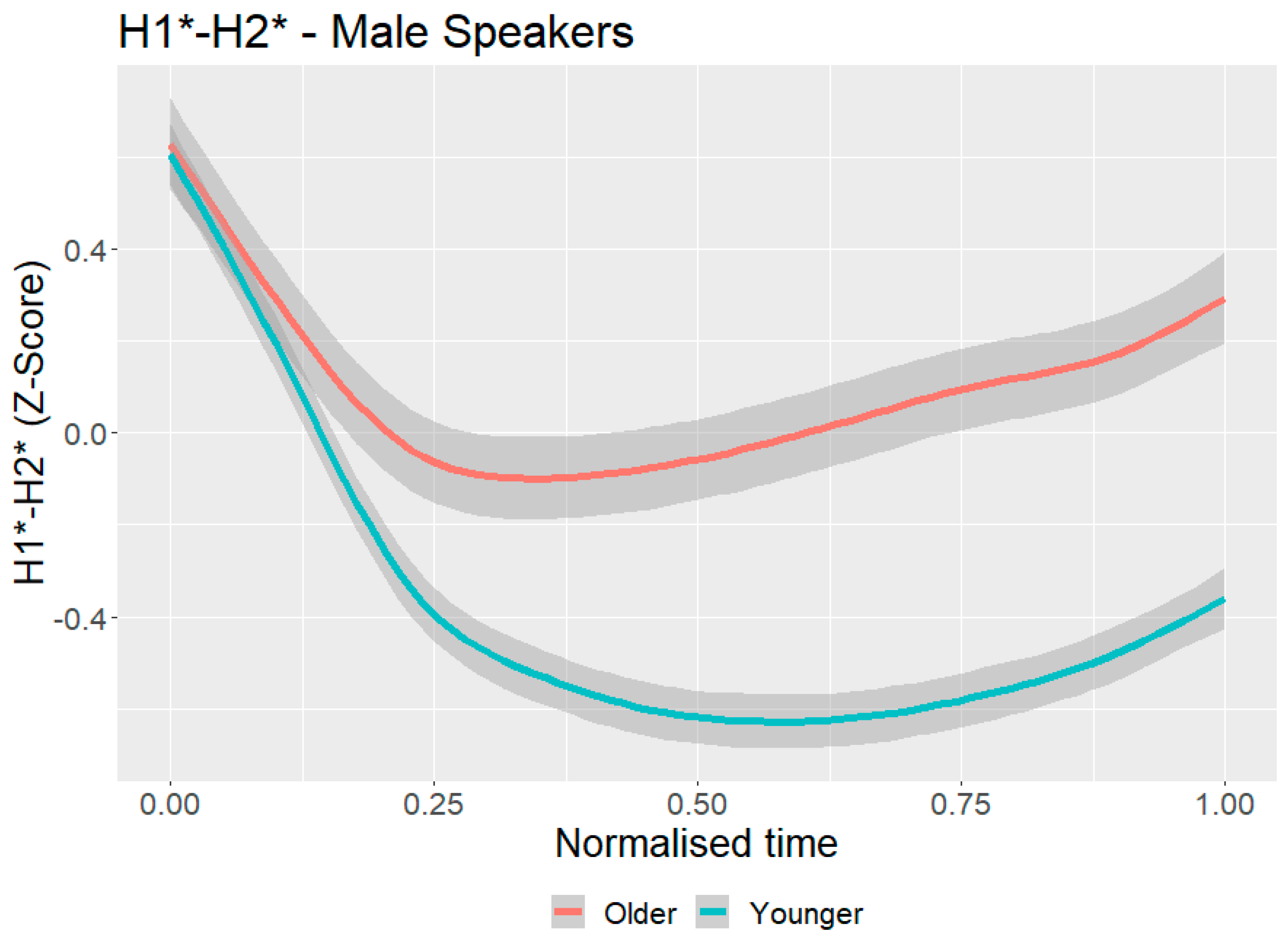
Figure 10 is a GAM-smoothed plot of H1*-H2* across normalised time for younger and older male speakers of Hobart English. As can be seen here, the older male speakers (red line) have higher H1*-H2* values from approximately 20% of a vowel’s duration until the end of the vowel than younger male speakers (blue line), and similarly to the female speakers shows that younger male speakers have more constricted vocal folds than older male speakers.
The findings in this section correlate with other observations for Australian English with respect to voice quality, as will be addressed in the discussion further below.

4. Discussion

This study reported on F1/F2 quality and voice quality of vowels as produced by speakers of Australian English from Hobart, with respect to vowel and voice quality. Our study showed the nature of the F1/F2 vowel space in Hobart English (RQ1), and we found that both sex and age are relevant sociophonetic categories (RQ2), as has been observed in other studies. We also observed some regional variability when we compared Hobart English vowel spaces with other published work (RQ3), and also found that speaker sex and age are relevant for the way speakers use voice quality in Hobart (RQ4).
To understand whether Hobart vowels are different from what has been reported for other locations, it is most useful to compare our data with the data from Cox and Palethorpe (2019), which is also based on AusTalk data but from Melbourne, Sydney, Perth, and Brisbane. Some other studies are also relevant, in particular the vowel spaces in Cox (1999) and Cox et al. (2024), which report diachronic changes in Australian English from Sydney. It should be noted that Cox (1999) reports values only for male speakers, and Cox et al. (2024) for female speakers. It is also worth noting that the speaker groups are relatively comparable in these studies, though not as directly as the Cox and Palethorpe (2019) study, which has speakers drawn from the same corpus. Cox (1999) analysed a dataset of 60 teenagers aged 15 years old, while our young male group comprises speakers aged up to 40, which presumably includes some speakers who would have been born around the same time as the young speakers in that study. Additionally, in the Cox et al. (2024) study, a small number of those speakers were also drawn from the AusTalk corpus, so the data is relatively comparable, but it should also be noted that there is a much younger overall age for the younger cohort in Cox et al. (2024) than in this study or in Cox and Palethorpe (2019).
Comparing the vowel spaces here (Figure 1, Figure 2, Figure 3 and Figure 4) with other published data, the space for the younger males in Hobart is very similar to the space for the young males presented in Cox (1999).6 Similarities include the relative positions of vowels known to have undergone substantial change, in particular /e/, /æ/, and /u:/, as well as peripheral vowels such as /i:/ and /ʊ/. However, one evident difference between the male speakers here and those in Cox (1999) is the /o:/ vowel, which in the Hobart data is the most retracted vowel, having an F2 of 690 Hz (see Table A8), while in Cox (1999) the mean F2 for male speakers is 847 Hz, representing much more fronting. Later work by Cox et al. (2024) analysing female speech shows that this vowel is the most back vowel in the space, similarly to what is seen in this Hobart data. In that study, the comparison of data from three time periods shows that /o:/ has first raised and retracted, and then retracted further. It appears that the Hobart data represents an “older” pronunciation, with less difference between the older and younger speakers.
While many similarities can be seen across the datasets, apparent differences can nevertheless be observed, and most especially in the close front vowels known to be undergoing rapid change in Australian English (Cox & Palethorpe, 2008; Cox et al., 2024). This is especially evident when we analyse the Hobart vowels with respect to the Cox and Palethorpe (2019) study, which had the most comparable data.
For example, in Cox and Palethorpe (2019), /æ/ vowels produced by women in Melbourne, Sydney, Perth, and Brisbane have a mean F1 of approximately 1000 Hz, but in Hobart it is far closer to 800 Hz on average (see Figure 1 and Figure 2). In more recent work with the even younger cohort from Sydney, Cox et al. (2024) show an even more open /æ/ vowel, with the ellipse extending somewhat past 1200 Hz. Relatedly, given the discussion of a push chain in Australian English (i.e., Cox & Palethorpe, 2008), the F1 of /e/ is also more open in other studies than in the Hobart data presented here. Specifically, the F1 of /e/ is greater than 600 Hz for the female speakers in Melbourne, Sydney, Brisbane, and Perth (Cox & Palethorpe, 2019), and for the 2010s cohort in Cox et al. (2024), but around 500 Hz for the female speakers in this study. The findings for male speakers (Figure 3 and Figure 4) are also in line with these findings, with dramatically different F1 values in particular compared to the vowel spaces presented by Cox and Palethorpe (2019).
Supporting the idea that Hobart vowels have a slower rate of change, female speakers’ vowel spaces in the current study are more similar to older speakers’ 1960s and 1990s vowel data in Cox et al. (2024)—although as mentioned there is some overlap in ages in the 1990s cohort in that data. Additionally, the data presented by Cox (1999) for male speakers is much more comparable with observations for young male Hobart speakers in this study.
Another related observation in the Hobart data was that close front vowels cluster more closely together for the older speakers, which is also observed by Cox et al. (2024). However, connected to /e/ being even lower for the young speakers from Sydney compared to Hobart, there is even more separation between these close front vowels in Sydney. The relationship between the open vowels /æ/ and /ɐ/ is also worthy of comparison, with the /æ/ being lower than /ɐ/ in all of the four major cities compared by Cox and Palethorpe (2019), as well as the young Sydney speakers in Cox et al. (2024), yet this is not the case for the Hobart data. Comparing the younger and older Hobart speakers, /æ/ and /ɐ/ are almost on an equal plane in terms of F1 in the younger cohort, whereas /æ/ is much higher for the older group. This is again more reflective of some of the older data presented by Cox et al. (2024), where /æ/ is similarly close to /ɐ/ in F1, but not lower.
When we focus on vowels known to be undergoing change, overall, the Hobart data is most similar to older vowel spaces—the 1960s and 1990s data shown by Cox et al. (2024), as opposed to the AusTalk vowel spaces shown for Melbourne, Sydney, Brisbane, and Perth presented by Cox and Palethorpe (2019), the data for which was collected at the same time as the data in this study. The two main findings here, that vowels known to be undergoing the most rapid change in Australian English (/ɪ e æ/) are not as open as vowels observed in recent work, and that Hobart vowels align with older work, indicates that the Hobart vowels align with older studies. This suggests a slower rate of change in the vowel system of Hobart speakers than in vowels produced in other regions.
These findings also accord with perceptual research on variability in Victoria (i.e., Loakes et al., 2024a) which shows, that while changes are indeed underway, they are more rapid and extreme in the larger metropolitan areas.
Turning now to voice quality, there are two particularly relevant studies focusing on regional variation in voice quality in Australian English, one which predicts diversification in future (Leung et al., 2022) and one which shows some regional variability for female speakers but also acknowledges that variability can be minimal (Loakes & Gregory, 2022). Here, it is difficult to directly compare the Hobart findings with other studies that looked at regional variation in voice quality because of differences in methodology. Specifically, for the two studies that included regional variation, Leung et al. (2022) only looked at modal tokens and excluded creak, while Loakes and Gregory (2022) used similar measures as the current study with respect to H1*-H2*, but did not analyse CPP, and included F0 in the analysis. However, it does appear that the findings are congruent with general sociophonetic observations for voice quality distributions in Mainstream Australian English. For example, other studies on similar populations have shown that younger speakers have, overall, creakier voices than older speakers (Penney et al., 2020; Loakes & Gregory, 2022), and that male speakers have creakier voices than female speakers (Dallaston & Docherty, 2020; Loakes & Gregory, 2022), which is what we also observed in the Hobart data. This too accords with perceptual findings showing that listeners also associate creak with younger voices (Penney et al., 2020) and male voices (White et al., 2024). Shea et al. (2024) have also shown that creak has complex interactions with indexicality in Australian English male voices, but that younger male speech has a greater amount of creak than older male speech. As we observed for vowels, findings for voice quality reflect other recent research showing diachronic changes in Australian English, rather than highlighting evident synchronic variability between regions.
Comparing the results of this study with others on Australian English, the findings support the gravity model of sound change, which includes factors such as population size and distance (e.g., Knooihuizen, 2023). For example, there are, overall, very few differences between large cities on the mainland of Australia despite their distances; e.g., the findings in the study by Cox & Palethorpe (2019) using AusTalk data (and also comparing that with the Hobart data in this study). Additionally, studies show that vowel quality differences between regional towns with small populations appear to be greater the further the location is from an urban centre (i.e., results in Loakes et al., 2024b, compared to Loakes et al., 2024a). The fact that the Hobart vowels, drawn from a location which has a small population and is geographically isolated, align more with vowel spaces in older studies and regional locations is the primary reason for the assertion that the gravity model explains some of the observed patterns.
However, geographical distance cannot account for every pattern in the available data on vowel spaces in Australian English, and we contend that sociophonetic variation is also present in communities. While that was not the focus of the current study, other studies on Australian English have shown divergent patterns between Mainstream speakers and Aboriginal English speakers from the same regions (e.g., Loakes et al., 2024a, 2024b) as well as between Mainstream Australian English speakers and speakers with different heritage backgrounds in parts of Sydney (see e.g., Horvath, 1985; Grama et al., 2021; Sheard, 2024). These differences may also be better viewed through the lens of the agent-based model which also has a focus on population dynamics and leaders of change within communities (e.g., Harrington & Schiel, 2017; Harrington et al., 2018). Other researchers, too, discuss the idea of economic power (generally emanating from large cities) and other broader social reasons for making larger cities the epicentre of changes (Wieling et al., 2011). Taking all of these ideas into account, the fact that change is occurring along the same trajectory in Hobart compared to other regions (when we compare older and younger speakers), but is less evident compared to other major cities on the mainland of Australia, is not a surprising finding.

5. Conclusions

In summary, this paper sought to provide a more comprehensive illustration of vowels in Tasmania, specifically the capital city Hobart, to allow for a better understanding of English spoken in this region, and to place it into the wider context of what we know about variation and change in Mainstream Australian English.
This study has contributed to knowledge on variation in Australian English, with the most salient findings being diachronic variability between the younger and older age groups within Hobart, which accords with other research on Mainstream Australian English. The study shows limited evidence of synchronic variation (regional variability) between cities, which was inferred by comparison with other comparable studies using the same corpus (Cox & Palethorpe, 2019) and other studies with similar data (Cox, 1999; Cox et al., 2024). Findings on voice quality align well with other work showing that male speakers and young speakers use less modal voicing (and more creak) than other speakers.
Finally, this study adds to the slowly growing description of English in the island state of Tasmania (along with Powell-Davies, 2022; Powell-Davies & Billington, 2024), providing a better understanding of variation and change across Australian English more generally.

Author Contributions

Conceptualization, R.S. and D.L.; methodology, R.S. and D.L.; software, R.S.; validation, R.S. and D.L.; formal analysis, R.S.; investigation, R.S. and D.L.; resources, R.S. and D.L.; data curation, R.S.; writing—original draft preparation, R.S. and D.L.; writing—review and editing, D.L.; visualization, R.S.; supervision, R.S. and D.L.; project administration, R.S. and D.L. All authors have read and agreed to the published version of the manuscript.

Funding

This research received no external funding.

Institutional Review Board Statement

Ethical review and approval were waived for this specific study because the data were sourced from existing corpora.

Informed Consent Statement

Informed consent was obtained from participants who had been previously recorded for the corpora used in this study.

Data Availability Statement

Data are available upon request.

Conflicts of Interest

The authors declare no conflicts of interest.

Abbreviations

The following abbreviations are used in this manuscript:
CPPCepstral Peak Prominence
GAMGeneral Additive Model
LMELinear Mixed Effects

Appendix A

Table A1. Post hoc Pairwise Comparisons of F1 Values of the Long Vowels of Hobart English for Older and Younger Speakers. Bold shows findings which are significant.
VowelSexAge GroupValueSEDFtp
/i:/FemaleOlder vs.34719.338−0.3860.7021
Younger−924.135
MaleOlder vs.27516.535−1.3450.1874
Younger−2921.535
/e:/FemaleOlder vs.44515.638−4.5610.0001
Younger−8919.535
MaleOlder vs.39813.735−3.2390.0026
Younger−5817.935
/ ɜ:/FemaleOlder vs.45515.638−3.6840.0008
Younger−7219.635
MaleOlder vs.41013.935−2.6840.0110
Younger−4818.035
/ ɐ:/FemaleOlder vs.920 25.7515.6381.3230.1945
Younger19.535
MaleOlder vs.69813.735−0.2920.7719
Younger−517.835
/o:/FemaleOlder vs.40115.638−1.9120.0640
Younger−3819.735
MaleOlder vs.37713.735−2.3010.0275
Younger−4117.835
/ ʉ:/FemaleOlder vs.35015.638−0.6140.5435
Younger−1219.435
MaleOlder vs.29213.535−1.2750.2108
Younger−2217.435
Table A2. Post hoc Pairwise Comparisons of F1 Values of the Short Vowels of Hobart English for Older and Younger Speakers. Bold shows findings which are significant.
VowelSexAge GroupValueSEDFtp
/ɪ/FemaleOlder vs.36815.238−0.9340.3565
Younger−1819.535
MaleOlder vs.31613.735−0.803−0.4276
Younger−1417.835
/e/FemaleOlder vs.42515.938−4.763<0.0001
Younger−9520.035
MaleOlder vs.39113.735−3.4390.0015
Younger−6117.835
/æ/FemaleOlder vs.71715.938−7.621<0.0001
Younger−15219.935
MaleOlder vs.56913.735−5.919<0.0001
Younger−10617.935
/ɐ/FemaleOlder vs.87515.6382.9710.0053
Younger5819.635
MaleOlder vs.70413.9351.3200.1953
Younger2418.135
/ɔ/FemaleOlder vs.61615.638−1.8310.0756
Younger−3619.835
MaleOlder vs.52213.735−1.1720.2490
Younger−2117.935
/ʊ/FemaleOlder vs.38515.638−0.9150.3665
Younger−1819.935
MaleOlder vs.34814.735−0.8940.3776
Younger−1718.835
Table A3. Post hoc Pairwise Comparisons of F2 Values of the Long Vowels of Hobart English for Older and Younger Speakers. Bold shows findings which are significant.
VowelSexAge GroupValueSEDFtp
/i:/FemaleOlder vs.264647.138−2.1110.0420
Younger−12458.935
MaleOlder vs.229440.835−0.4910.6262
Younger−2652.935
/e:/FemaleOlder vs.241139.4382.0350.0495
Younger10149.735
MaleOlder vs.208235.1351.7630.0867
Younger8045.635
/ ɜ:/FemaleOlder vs.181339.438−1.5200.1374
Younger−7649.935
MaleOlder vs.159435.5350.9050.3715
Younger41.4345.835
/ ɐ:/FemaleOlder vs.154539.4382.6140.0131
Younger12949.535
MaleOlder vs.134635.1352.3550.0243
Younger10745.535
/o:/FemaleOlder vs.76739.438−1.3030.2010
Younger−6550.135
MaleOlder vs.69935.1350.3020.7641
Younger1445.535
/ ʉ:/FemaleOlder vs.178139.438−3.3230.0021
Younger−16449.435
MaleOlder vs.142034.735−3.9310.0004
Younger−17644.735
Table A4. Post hoc Pairwise Comparisons of F2 Values of the Short Vowels of Hobart English for Older and Younger Speakers. Bold shows findings which are significant.
Vowel.SexAge GroupValueSEDFtp
/ɪ/FemaleOlder vs.254638.838−1.1410.2615
Younger−2449.535
MaleOlder vs.216435.135−1.1400.2622
Younger−5245.535
/e/FemaleOlder vs.247040.2382.7310.0098
Younger−13850.735
MaleOlder vs.205835.1351.3930.1725
Younger6345.535
/æ/FemaleOlder vs.216640.2385.415<0.0001
Younger27350.535
MaleOlder vs.184135.1353.6860.0008
Younger16845.635
/ɐ/FemaleOlder vs.161539.4381.3720.1787
Younger6849.935
MaleOlder vs.139535.5352.0240.0506
Younger9346.035
/ɔ/FemaleOlder vs.99239.438−2.7750.0088
Younger−14050.335
MaleOlder vs.89735.135−0.0070.9948
Younger045.635
/ʊ/FemaleOlder vs.99739.438−3.6870.0008
Younger−18650.535
MaleOlder vs.98837.135−0.1270.8996
Younger−647.435
Table A5. Post hoc Pairwise Comparisons of F3 Values of the Long Vowels of Hobart English for Older and Younger Speakers.
VowelSexAge GroupValueSEDFtp
/i:/FemaleOlder vs.340970.6381.5780.1236
Younger13988.035
MaleOlder vs.285360.535−1.0920.2824
Younger−8678.735
/e:/FemaleOlder vs.306357.5380.5750.5688
Younger−4272.335
MaleOlder vs.257050.735−1.5970.1193
Younger−10666.235
/ ɜ:/FemaleOlder vs.270257.538−0.3390.7363
Younger−2572.635
MaleOlder vs.244551.4350.4990.6206
Younger33.1866.435
/ ɐ:/FemaleOlder vs.294957.5380.4430.6605
Younger3272.035
MaleOlder vs.265550.7351.2240.2293
Younger8165.935
/o:/FemaleOlder vs.287857.5380.5070.6151
Younger3772.935
MaleOlder vs.258850.735−1.0810.2870
Younger−7165.935
/ ʉ:/FemaleOlder vs.243357.538−0.8020.4277
Younger−5871.735
MaleOlder vs.230150.1350.9820.3328
Younger6364.635
Table A6. Post hoc Pairwise Comparisons of F3 Values of the Short Vowels of Hobart English for Older and Younger Speakers. Bold shows findings which are significant.
VowelSexAge GroupValueSEDFtp
/ɪ/FemaleOlder vs.325456.4380.8490.4014
Younger6172.035
MaleOlder vs.272750.735−1.5840.1223
Younger−10465.935
/e/FemaleOlder vs.322658.8382.3270.0258
Younger17273.935
MaleOlder vs.261450.735−1.2180.2312
Younger−8065.935
/æ/FemaleOlder vs.307758.8381.8780.0688
Younger13873.635
MaleOlder vs.252450.735−0.1130.9103
Younger−866.235
/ɐ/FemaleOlder vs.294457.5380.5840.5627
Younger4272.635
MaleOlder vs.254451.4350.3210.7498
Younger2166.835
/ɔ/FemaleOlder vs.277857.538−0.3290.7444
Younger−2473.335
MaleOlder vs.256750.7350.2000.8427
Younger1366.235
/ʊ/FemaleOlder vs.267657.538−0.0870.9309
Younger−673.635
MaleOlder vs.246454.135−0.5630.5773
Younger−3969.235

Appendix B. Mean F1, F2, and F3 Values

Table A7. Mean F1, F2, and F3 Values of the Long Vowels of Hobart English for Female and Male Speakers.
VowelSexAge GroupMean F1
(Hz)
Mean F2
(Hz)
Mean F3
(Hz)
/i:/Female


Male
Older
All Ages
Younger
Older
All Ages
348
352
355
277
294
2651
2727
2769
2296
2301
3418
3310
3276
2858
2909
Younger30323302938
/e:/Female


Male
Older
All Ages
Younger
Older
All Ages
445
502
534
399
430
2414
2360
2312
2081
2014
3069
3030
3026
2568
2606
Younger45520122673
/ ɜ:/Female


Male
Older
All Ages
Younger
Older
All Ages
456
506
527
412
440
1816
1856
1888
1594
1573
2707
2730
2731
2442
2415
Younger45715592411
/ ɐ:/Female


Male
Older
All Ages
Younger
Older
All Ages
920
901
894
696
706
1548
1464
1417
1344
1301
2954
2910
2920
2653
2597
Younger69912432571
/o:/Female


Male
Older
All Ages
Younger
Older
All Ages
401
419
439
378
401
769
790
833
698
698
2883
2857
2846
2587
2625
Younger4176902657
/ ʉ:/Female


Male
Older
All Ages
Younger
Older
All Ages
350
356
363
292
306
1784
1874
1951
1415
1541
2438
2492
2499
2289
2269
Younger31316002230
Table A8. Mean F1, F2, and F3 Values of the Short Vowels of Hobart English for Female and Male Speakers.
VowelSexAge GroupMean F1
(Hz)
Mean F2
(Hz)
Mean F3
(Hz)
/ɪ/Female


Male
Older
All Ages
Younger
Older
All Ages
367
375
384
317
322
2551
2599
2599
2163
2179
3262
3228
3194
2725
2766
Younger32922202829
/e/Female


Male
Older
All Ages
Younger
Older
All Ages
428
496
520
392
427
2470
2377
2329
2056
2009
3228
3082
3056
2612
2643
Younger45119992691
/æ/Female


Male
Older
All Ages
Younger
Older
All Ages
719
810
868
571
628
2165
1985
1892
1839
1737
3078
2968
2942
2523
2520
Younger67416772530
/ɐ/Female


Male
Older
All Ages
Younger
Older
All Ages
875
842
816
703
696
1617
1564
1545
1392
1351
2950
2908
2906
2537
2516
Younger67913072521
/ɔ/Female


Male
Older
All Ages
Younger
Older
All Ages
616
624
652
523
539
995
1069
1134
895
912
2783
2823
2811
2565
2549
Younger5429072552
/ʊ/Female


Male
Older
All Ages
Younger
Older
All Ages
385
393
400
349
357
999
1082
1174
987
997
2681
2685
2678
2472
2492
Younger36510012508

Notes

1
This study uses phonetic symbol conventions from Harrington et al. (1997).
2
AusTalk data were collected between 2011 and 2016.
3
CPP and H1*-H2* are explained in more detail in the next section about voice quality measures.
4
Garellek and Keating (2011) analysed Mazatec, a language with contrastive phonation.
5
The full results are presented in Table A1, Table A2, Table A3, Table A4, Table A5 and Table A6 in the Appendix A, results in Table 2 are rounded to 3 decimal places.
6
For specific reference, Table A7 and Table A8 in this study show the mean formant values for the monophthongs in the Hobart data, which can be compared with Cox (1999, Appendix A pp. 21–22).

References

  1. Australian Bureau of Statistics [ABS]. (2025). Regional population: Statistics about the population and components of change (births, deaths, migration) for Australia’s capital cities and regions. Australian Bureau of Statistics. Available online: https://www.abs.gov.au/statistics/people/population/regional-population/latest-release (accessed on 1 May 2025).
  2. Billington, R. (2011). Location, location, location: Regional characteristics and national patterns of change in the vowels of Melbourne adolescents. Australian Journal of Linguistics, 31, 275–303. [Google Scholar] [CrossRef]
  3. Blankenship, B. (2002). The timing of nonmodal phonation in vowels. Journal of Phonetics, 30, 163–191. [Google Scholar] [CrossRef]
  4. Boersma, P., & Weenink, D. (2004). Praat doing phonetics by computer (Version 6.4.05). Available online: http://www.praat.org/ (accessed on 27 January 2024).
  5. Butcher, A. (2006, December 6–8). Formant frequencies of /hVd/ vowels in the speech of South Australian females. 11th Australasian International Conference on Speech Science & Technology (pp. 449–453), Auckland, New Zealand. [Google Scholar]
  6. Cassidy, S., Estival, D., & Cox, F. (2017). Case study: The AusTalk corpus. In N. Ide, & J. Pustejovsky (Eds.), Handbook of linguistic annotation (pp. 209–227). Springer. [Google Scholar]
  7. Cassidy, S., Estival, D., Jones, T., Burnham, D., & Berghold, J. (2014, May 26–31). The alveo virtual laboratory: A web based repository API. Ninth International Conference on Language Resources and Evaluation (LREC ’14) (pp. 1–7), Reykjavik, Iceland. [Google Scholar]
  8. Coats, S., Diskin-Holdaway, C., & Loakes, D. (2025, January 19). Regional distribution of the /el/-/æl/ merger in Australian English. 12th Workshop on NLP for Similar Languages, Varieties and Dialects (pp. 147–156), Abu Dhabi, United Arab Emirates. [Google Scholar]
  9. Cox, F. (1999). Vowel change in Australian English. Phonetica, 56, 1–27. [Google Scholar] [CrossRef]
  10. Cox, F., & Palethorpe, S. (2004). The border effect: Vowel differences across the NSW—Victorian border. In C. Marovsky (Ed.), Proceedings of the 2003 conference of the Australian linguistic society (pp. 1–27). School of Language and Media, University of Newcastle. [Google Scholar]
  11. Cox, F., & Palethorpe, S. (2008, September 22–26). Reversal of short front vowel raising in Australian English. In J. Fletcher, D. Loakes, R. Göcke, D. Burnham, & M. Wagner (Eds.), Proceedings of interspeech 2008 incorporating SST 2008, Brisbane, Australia (p. 34245). ISCA. Available online: https://www.isca-archive.org/interspeech_2008/cox08_interspeech.pdf (accessed on 1 May 2025).
  12. Cox, F., & Palethorpe, S. (2019, August 5–9). Vowel variation in a standard context across four major Australian cities. In P. E. Calhoun, M. Tabain, & P. Warren (Eds.), 19th International congress of phonetic sciences, Melbourne, Australia (pp. 577–581). Australasian Speech Science and Technology Association Inc. Available online: https://assta.org/proceedings/ICPhS2019/papers/ICPhS_626.pdf (accessed on 30 April 2025).
  13. Cox, F., Penney, J., & Palethorpe, S. (2024). Australian English monophthong change across 50 years: Static versus dynamic measures. Languages, 9(3), 99. [Google Scholar] [CrossRef]
  14. Dallaston, K., & Docherty, G. (2020). The quantitative prevalence of creaky voice (vocal fry) in varieties of English: A systematic review of the literature. PLoS ONE, 15(3), e0229960. [Google Scholar] [CrossRef]
  15. Docherty, G., Foulkes, P., Gonzalez, S., & Mitchell, N. (2018). Missed connections at the junction of sociolinguistics and speech processing. Topics in Cognitive Science, 10, 759–774. [Google Scholar] [CrossRef]
  16. Elvin, J., Williams, D., & Escudero, P. (2016). Dynamic acoustic properties of monophthongs and diphthongs in Western Sydney Australian English. Journal of the Acoustical Society of America, 140(1), 576–581. [Google Scholar] [CrossRef]
  17. Esling, J. (2012). The articulatory function of the larynx and the origins of speech, Proceedings of the annual meeting of the Berkeley Linguistics. Society, 38, 121–149. [Google Scholar]
  18. Esposito, C. (2006). The effects of linguistic experience on the perception of phonation [Ph.D. Thesis, University of California]. [Google Scholar]
  19. Esposito, C. (2010). Variation in contrastive phonation in santa ana del valle zapote. Journal of the International Phonetic Association, 40(2), 181–198. [Google Scholar] [CrossRef]
  20. Estival, D., Cassidy, S., Cox, F., & Burnham, D. (2014, May 26–31). AusTalk: An audio-visual corpus of Australian English. Ninth International Conference on Language Resources and Evaluation (LREC ’14) (pp. 3105–3109), Reykjavik, Iceland. [Google Scholar]
  21. Garellek, M., & Keating, P. (2011). The acoustic consequences of phonation and tone interactions in jalapa mazatec. Journal of the International Phonetic Association, 41(2), 185–205. [Google Scholar] [CrossRef]
  22. Gooskens, C. (2005). Travel time as a predictor of linguistic distance. Dialectologia et Geolinguistica, 13, 38–62. [Google Scholar] [CrossRef]
  23. Grama, J., Travis, C., & Gonzalez, S. (2019, August 5–9). Initiation, progression and conditioning of the short-front vowel shift in Australian English. In S. Calhoun, P. Escudero, M. Tabain, & P. Warren (Eds.), Proceedings of the 19th international congress of phonetic sciences (ICPhS), Melbourne, Australia (pp. 1769–1773). Australasian Speech Science and Technology Association. [Google Scholar]
  24. Grama, J., Travis, C. E., & Gonzalez, S. (2021). Ethnic variation in real time: Change in Australian English diphthongs. In H. Van de Velde, N. H. Hilton, & R. Knooihuizen (Eds.), Language variation—European perspectives VIII (Vol. 25, pp. 292–314). John Benjamins. [Google Scholar] [CrossRef]
  25. Gregory, A. (2019, August 5–9). The [ae]nds of the earth: An investigation of the DRESS and TRAP vowels in Northern Queensland. In P. E. Calhoun, M. Tabain, & P. Warren (Eds.), 19th International congress of phonetic sciences, Melbourne, Australia (pp. 1754–1758). Australasian Speech Science and Technology Association Inc. [Google Scholar]
  26. Harrington, J. (2010). The phonetic analysis of speech corpora. John Wiley and Sons. [Google Scholar]
  27. Harrington, J., Cox, F., & Evans, Z. (1997). An acoustic phonetic study of broad, general, and cultivated Australian English vowels. Australian Journal of Linguistics, 17(2), 155–184. [Google Scholar] [CrossRef]
  28. Harrington, J., Kleber, F., Reubold, U., & Schiel, F. (2018). Linking cognitive and social aspects of sound change using agent-based modelling. Topics in Cognitive Science, 10(4), 1–22. [Google Scholar] [CrossRef]
  29. Harrington, J., & Schiel, F. (2017). /u/-fronting and agent-based modeling: The relationship between the origin and spread of sound change. Language, 93(2), 414–445. [Google Scholar] [CrossRef]
  30. Holmberg, E., Hillman, R., Perkell, J., Guiod, P., & Golaman, S. (1995). Comparisons among aerodynamic, electroglottographic, and acoustic spectral measures of female voice. Journal of Speech and Hearing Research, 38, 1212–1223. [Google Scholar] [CrossRef] [PubMed]
  31. Horvath, B. (1985). Variation in Australian English: The sociolects of Sydney. Cambridge University Press. [Google Scholar]
  32. Iseli, M., & Alwan, A. (2004, May 17–21). An improved correction formula for the estimation of harmonic magnitudes and its application to open quotient estimation. IEEE International Conference on Acoustics, Speech, and Signal Processing (ICASSP ’04) (pp. 669–672), Montreal, QC, Canada. [Google Scholar]
  33. Jochim, M., Winkelmann, R., Jaensch, K., Cassidy, S., & Harrington, J. (2023). emuR: Main package of the EMU speech database management system (R Package Version 2.4.2). R Core Team. [Google Scholar]
  34. Kisler, T., Schiel, F., & Sloetjes, H. (2014, July 17–22). Signal processing via Web Services: The use case WebMAUS. Proceedings of Digital Humanities (pp. 30–34), Hamburg, Germany. [Google Scholar]
  35. Knooihuizen, R. (2023). Explaining language change: How change starts and spreads. In The linguistics of the history of English (p. 1729). Springer International Publishing. [Google Scholar]
  36. Lenth, R. (2023). emmeans: Estimated marginal means, aka least-squared means (R Package Version 1.8.7). Available online: https://CRAN.R-project.org/package=emmeans (accessed on 11 October 2024).
  37. Leung, Y., Oates, J., Papp, V., & Chan, S.-P. (2022). Speaking fundamental frequencies of adult speakers of Australian English and effects of sex, age, and geographical location. Journal of Voice, 2(36), 434-e1. [Google Scholar] [CrossRef] [PubMed]
  38. Loakes, D., Clothier, J., Hajek, J., & Fletcher, J. (2014). An investigation of the /el/–/æl/ merger in Australian English: A pilot study on production and perception in South-West Victoria. Australian Journal of Linguistics, 34(4), 436–452. [Google Scholar] [CrossRef]
  39. Loakes, D., Clothier, J., Hajek, J., & Fletcher, J. (2024a). Sociophonetic variation in vowel categorization of Australian English. Language and Speech, 67(3), 870–906. [Google Scholar] [CrossRef]
  40. Loakes, D., Fletcher, J., & Clothier, J. (2024b). One place, two speech communities: Differing responses to sound change in Mainstream and Aboriginal Australian English in a small rural town. In F. Kleber, & T. Rathcke (Eds.), Speech dynamics: Synchronic variation and diachronic change (Ch. 4, pp. 117–144). De Gruyter Mouton. [Google Scholar]
  41. Loakes, D., & Gregory, A. (2022). Voice quality in Australian English. Journal of the Acoustical Society of America—Express Letters, 2(8), 085201. [Google Scholar] [CrossRef]
  42. Loakes, D., & Gregory, A. (2024). Acoustic analysis of vowels in Australian aboriginal English spoken in victoria. Languages, 9(9), 299. [Google Scholar] [CrossRef]
  43. Mannell, R. (2004). Perceptual vowel space for Australian English lax vowels: 1998 and 2004. In S. Cassidy, F. Cox, R. Mannell, & S. Palethorpe (Eds.), Proceedings of 10th Australian international conference on speech science and technology (pp. 221–226). ASSTA. [Google Scholar]
  44. McCloy, D. (2016). phonR: Tools for phoneticians and phonologists (R Package Version 1.0-7). R Core Team. [Google Scholar] [CrossRef]
  45. Penney, J., Cox, F., & Szakay, A. (2020). Glottalisation, coda voicing, and phrase position in Australian English. The Journal of the Acoustical Society of America, 148(5), 3232–3245. [Google Scholar] [CrossRef]
  46. Pinheiro, J. C., & Bates, D. M. (2023). nlme: Linear and nonlinear mixed effects models (R package version 3.1-163). R Core Team. [Google Scholar]
  47. Powell-Davies, T. (2022). Exploring Tasmania’s place in Australian English regional variation through diphthongs [Honours thesis, Australian National University]. [Google Scholar]
  48. Powell-Davies, T., & Billington, R. (2024). Realisation of intervocalic /t/ in Australian English: A snapshot. In O. Maxwell, & R. Bundgaard-Nielsen (Eds.), Proceedings of the nineteenth Australasian international conference on speech science and technology (pp. 212–216). Causal Productions, Melbourne. [Google Scholar]
  49. R Core Team. (2024). nlme: Linear and nonlinear mixed effects models (R Package Version 3.1-164). R Core Team. [Google Scholar] [CrossRef]
  50. RStudio Team. (2020). RStudio: Integrated development for R. RStudio, PBC. [Google Scholar]
  51. Schmidt, P., Chloé, D.-H., & Loakes, D. (2021). New insights into /el/-/æl/ merging in Australian English. Australian Journal of Linguistics, 41(1), 66–95. [Google Scholar] [CrossRef]
  52. Shea, T., White, H., Penney, J., & Cox, F. (2024). Masculinity and sexual orientation as predictors of creaky voice in Australian English speaking men. In O. Maxwell, & R. Bundgaard-Nielsen (Eds.), Proceedings of the nineteenth Australasian international conference on speech science and technology (pp. 232–236). Australasian Speech Science and Technology Association. [Google Scholar]
  53. Sheard, E. (2024). The Sydney speaks lifespan corpus. Australian Journal of Linguistics, 44(2–3), 182–199. [Google Scholar] [CrossRef]
  54. Shue, Y.-L., Keating, P., Vicenik, C., & Yu, K. (2011, August 17–21). VoiceSauce: A program for voice analysis. Proceedings of the 17th International Congress of Phonetic Sciences (pp. 1846–1849), Hong Kong. [Google Scholar]
  55. The MathWorks Inc. (2022). MATLAB version 9.13.0. R2022b. Available online: https://www.mathworks.com (accessed on 27 January 2024).
  56. Wells, J. C. (1982). Accents of english: Volume 1. Cambridge University Press. [Google Scholar]
  57. White, H., Penney, J., Gibson, A., Szakay, A., & Cox, F. (2024). Influence of pitch and speaker gender on perception of creaky voice. Journal of Phonetics, 102, 101293. [Google Scholar] [CrossRef]
  58. Wickham, H. (2016). ggplot2: Elegant graphics for data analysis. Springer. [Google Scholar]
  59. Wieling, M., Nerbonne, J., & Baayen, R. H. (2011). Quantitative social dialectology: Explaining linguistic variation geographically and socially. PLoS ONE, 6(9), e23613. [Google Scholar] [CrossRef]
Figure 1. F1/F2 Ellipse Plot of Female Vowel Space for Older Speakers of Hobart English.
Languages 10 00297 g001
Figure 2. F1/F2 Ellipse Plot of Female Vowel Space for Younger Speakers of Hobart English.
Languages 10 00297 g002
Figure 3. F1/F2 Ellipse Plot of Male Vowel Space for Older Speakers of Hobart English.
Languages 10 00297 g003
Figure 4. F1/F2 Ellipse Plot of Male Vowel Space for Younger Speakers of Hobart English.
Languages 10 00297 g004
Figure 5. CPP Plot of Speakers of Hobart English, plotted across Normalised Time.
Languages 10 00297 g005
Figure 6. CPP Plot of Female Speakers of Hobart English, Plotted across Normalised Time.
Languages 10 00297 g006
Figure 7. CPP Plot of Male Speakers of Hobart English, Plotted across Normalised Time.
Languages 10 00297 g007
Figure 8. H1*-H2* Plot of Speakers of Hobart English, Plotted across Normalised Time.
Languages 10 00297 g008
Figure 9. H1*-H2* Plot of Female Speakers of Hobart English, Plotted across Normalised Time.
Languages 10 00297 g009
Figure 10. H1*-H2* Plot of Male Speakers of Hobart English, Plotted across Normalised Time.
Languages 10 00297 g010
Table 1. Number of Speakers of Each Sex and Age Category.
SexNo. of Younger SpeakersNo. of Older Speakers
female117
male138
Table 2. Number of significant differences across age groups per vowel, per formant.
VowelFormantSignificance Level
e:10.001 (F); 0.003 (M)
ɜ:10.001 (F); 0.011 (M)
o:10.028 (M)
e1<0.001 (F); 0.002 (M)
æ1<0.001 (M); <0.001 (F)
ɐ10.005 (F)
i:20.04 (F)
e:20.05 (F)
ɐ:20.013 (F); 0.024 (M)
ʉ:20.002 (F); 0.001 (M)
e20.009 (F)
æ2<0.001 (F); 0.001 (M)
ɔ20.008 (F)
ʊ20.001 (F)
Disclaimer/Publisher’s Note: The statements, opinions and data contained in all publications are solely those of the individual author(s) and contributor(s) and not of MDPI and/or the editor(s). MDPI and/or the editor(s) disclaim responsibility for any injury to people or property resulting from any ideas, methods, instructions or products referred to in the content.