1. Introduction
As Spanish heritage language (SHL) programs proliferate across the U.S., there is a growing consensus on the need to integrate topics concerning language variation and diversity, multilingual practices, and societal, cultural, and political aspects of language into SHL curricula (
Leeman & Serafini, 2016). These topics are vital because Spanish, as a minoritized language in the U.S., is shaped by hierarchies that privilege European and academic varieties over vernacular ones (
Leeman, 2005,
2018;
Leeman & Serafini, 2016;
Loza & Beaudrie, 2021). In both classroom and community contexts, linguistic features such as code-switching, loanwords, transfers, and calques—a consequence of language contact situations—are often labeled as deficient or informal (
Flores & Rosa, 2015;
Zentella, 2014). These evaluative stances reflect broader language ideologies that reinforce power relations and hierarchies (
Irvine & Gal, 2000). Drawing on
Fuller and Leeman’s (
2020) typology, this study focuses on three dominant language ideologies frequently found in SHL learners: the
standard language ideology, which frames “correct” Spanish as aligned with academic or Peninsular norms; the
essentialist ideology, which ties Spanish proficiency to “authentic” Latinx identity; and
commodification, which views Spanish as a marketable skill for academic or professional gain. Additionally, this study also includes the
deficit ideology, which positions bilingual practices such as Spanglish, code-switching, or translanguaging as deficient (
Flores & Rosa, 2015).
Research indicates that SHL learners often internalize these ideologies, resulting in linguistic insecurity, feelings of embarrassment or shame, and, in some cases, abandoning their heritage language (HL) (
Beaudrie & Fairclough, 2012;
A. Tseng, 2020). To counteract the effects of shame and embarrassment and promote positive language attitudes and language maintenance in SHL learners, many programs adopt pedagogical approaches rooted in Critical Language Awareness (CLA). CLA encourages students to analyze the sociopolitical effects of language use, critically reflect on language ideologies, and empower learners to challenge dominant norms about “correctness” and linguistic legitimacy (
Leeman, 2012). Within CLA, student agency is understood as the socioculturally mediated ability to act, including recognizing and challenging dominant language ideologies and making autonomous linguistic choices (
Ahearn, 2001;
Serafini, 2021b).
Prior research has explored the effects of sociolinguistic topics and CLA on SHL learners’ self-perceptions, identity development, and HL attitudes (
Beaudrie et al., 2019,
2021;
Gómez García, 2022;
Herrera-Dulcet, 2019;
Herrera-Dulcet & Yocupicio, 2024;
Holguín Mendoza, 2018;
Hudgens Henderson, 2022;
Sánchez-Muñoz, 2016;
Serafini, 2021b;
Wilson, 2022). Yet gaps remain on how sociolinguistically informed curricula foster student agency in classroom discourse, and how students in intermediate and advanced SHL courses experience it. Enrollment motives may also reflect internalized ideologies (e.g., the need for Spanish proficiency to be “truly Latinx” or access to academic Spanish as a requirement for legitimacy and career success) (
Del Carpio & Ochoa, 2022;
Loza, 2017;
Showstack, 2017).
Given these gaps, this study investigates SHL students’ reasons for enrolling in SHL courses; how they perceive their Spanish and linguistic identities; and how Critically Oriented Sociolinguistic Topics influence their confidence, ideological and critical awareness, and agency.
1.1. SHL Classrooms and Learner Confidence
Languages are used across a range of registers, from formal academic to informal family or peer interactions (
Sánchez-Muñoz, 2016). While most native speakers develop proficiency across these registers, SHL speakers in the U.S. often demonstrate stronger skills in English and less exposure to reading and writing in Spanish (
Sánchez-Muñoz, 2009). Many acquire Spanish primarily through oral use at home, with limited opportunities to engage with academic registers.
In language classrooms, linguistic insecurity is reinforced by dominant language ideologies that devalue SHL varieties. For instance, the standard language ideology favors a single, idealized, and homogeneous variety of Spanish while marginalizing others (
Lippi-Green, 1994;
Leeman, 2018). Deficit ideology frames bilingual practices as deficient and/or as “languagelessness” (
Rosa, 2016), essentialist ideology ties identity to mastery of “standard” Spanish (
Fishman, 1991;
Woolard, 2016), and commodification ideology portrays Spanish as a marketable skill for academic or professional advancement (
Fuller & Leeman, 2020). Collectively, such ideologies can undermine confidence and delegitimize HL varieties.
Many SHL speakers enter the language classroom with low linguistic self-esteem, internalizing deficit discourses that question their Spanish, English, or bilingual proficiency (
Sánchez-Muñoz, 2016). Some may also experience insecurity regarding their cultural identity (
Amezcua, 2019). As research has shown, SHL learners’ perceptions influence their identity, sense of ethnic belonging, and familial pride (
Oh & Fuligni, 2010;
V. Tseng & Fuligni, 2000). Critical approaches, like critical language awareness discussed in
Section 1.2, are one pathway for addressing these insecurities.
At the same time, integrating CLA and Critical Translingual Competence (CTC) can actively challenge essentialist ideologies that associate linguistic authenticity with mastery of a standardized Spanish, thereby disrupting the evaluations that often undermine learners’ confidence. CLA and CTC encourage learners to view variation as a resource, which can foster greater self-esteem and investment in SHL maintenance. These challenges point to the need for critical pedagogical frameworks such as CLA and CTC, discussed in the next section.
1.2. Critical Translingual Competence, Critical Language Awareness, and Critically Oriented Sociolinguistic Topics
Over the past two decades, SHL education has increasingly emphasized the importance of fostering positive attitudes and building learner confidence through sociolinguistics-informed pedagogy. Scholars have advocated for critical pedagogies that examine the relationship between language, societal power, and sociopolitical structures, especially considering the status of Spanish as a minoritized language in the U.S. (
Martínez, 2003;
Leeman, 2005,
2018).
One widely adopted framework is CLA, which treats language as socially constructed and tied to power (
Leeman, 2018), challenging beliefs that non-standard varieties are “inappropriate” or in need of “correction” (e.g.,
Flores & Rosa, 2015;
Leeman, 2005,
2018;
Martínez & Schwartz, 2012). Within SHL settings, CLA encourages students to reflect on dominant ideologies (e.g., standard, essentialist) that help shape identity and empowers them to challenge the marginalization of home Spanish varieties and bilingual practices. By validating these stigmatized varieties, CLA fosters confidence, student agency, and resistance to linguistic hierarchies (
Leeman, 2018;
Leeman & Serafini, 2016).
Building on CLA,
Leeman and Serafini’s (
2016) model of CTC integrates sociolinguistics with critical pedagogy, which emphasizes learners’ reflection on variation, translanguaging, and ideologies while also examining the sociopolitical dimensions of language and identity. By exploring topics such as code-switching, bilingualism, and language–power relations, CTC equips students to analyze their language practices, challenge language hierarchies, and affirm linguistic legitimacy.
In this way, CLA and CTC offer SHL learners a transformative lens where they can develop the tools to contest deficit discourses, dismantle language ideologies, and cultivate linguistic self-confidence, while also fostering reflection on power dynamics, identity, and agency beyond the classroom. Building from these frameworks, I use the term Critically Oriented Sociolinguistic Topics (COST) to describe topics included in syllabi that are informed by CLA and CTC principles. In this study, COST operationally included linguistic discrimination, U.S. Spanish variation, code-switching, language ideologies, and identity. To see how these principles operate in classrooms, the next section reviews empirical studies of SHL courses and learners.
1.3. Research on SHL Courses and Learners
Although the theoretical benefits of integrating critical pedagogies into SHL courses have been well documented, to date, few empirical studies have examined how such approaches shape learners’ HL perceptions, motivations for enrollment, and engagement with ideologies. Prior research shows that well-designed curricula strengthen linguistic confidence, promote HL maintenance, and help address low self-esteem, while also fostering HL development (
Amezcua, 2019;
Sánchez-Muñoz, 2016).
For instance,
Sánchez-Muñoz (
2016) found that while many SHL students valued Spanish as part of their identity, they often internalized deficit discourses, labeling their HL variety as
pocho and restricting it to family. Surveys at the beginning and end of an SHL course revealed that these perceptions reflected broader deficit ideologies and discouraged speakers from using the HL beyond their home. Similarly,
Amezcua (
2019) found that in a Chicana/o Studies 101 course, assignments rooted in the lived experiences of students (e.g., family histories, bilingual poetry, and community projects) reinforced their HL confidence across personal and public domains, thereby strengthening language maintenance. However, even when confidence improved, many continued to internalize essentialist beliefs (e.g., needing Spanish to be Mexican).
Wilson (
2022) studied receptive bilinguals in an SHL program integrating sociolinguistics and CLA. Findings showed that students valued identity representation but also reproduced prestige language ideologies, devaluing their New Mexican variety in comparison to Peninsular Spanish. These findings suggest that while representation can foster belonging, ingrained ideologies may persist.
Collectively, this research suggests that SHL courses—whether through culturally relevant content, identity-affirming assignments, or the integration of sociolinguistic and CLA—can positively shape how students value their HL. Yet questions remain about how critical content influences linguistic confidence, the dismantling of ideologies, and the development of student agency—issues taken up in the next section.
1.4. Language Ideologies in SHL Research
As outlined in
Section 1.1, dominant language ideologies (standard, deficit, essentialist, and commodification) shape how SHL learners evaluate the legitimacy of their language practices. Since these beliefs often fuel linguistic insecurity and self-policing, ideological transformation has become a central goal of SHL instruction. In light of this, research has examined how SHL courses, particularly those incorporating sociolinguistic or critical frameworks (e.g., CLA), influence learners’ internalization and challenge of language ideologies. Findings from research on language ideologies in SHL classes highlight both the potential and the challenges of fostering ideological change in SHL contexts.
For instance,
Herrera-Dulcet (
2019) designed and implemented a Sociolinguistically Informed Critical Pedagogy (SICP), a critical model framed within CLA principles, in an advanced SHL course. Although conceptually related, SICP differs from the COST examined in the present study, which refers to curricular topics informed by CLA/CTC principles rather than a full pedagogical model. The course included topics such as U.S. Spanish variation, language/dialect distinctions, and code-switching, paired with discussions designed to challenge myths of bilingual incompetence. Findings revealed that students critically examined linguistic hierarchies, challenged standard language ideology, and developed more positive attitudes toward their own and others’ bilingual practices. Drawing on data from this same study,
Herrera-Dulcet and Yocupicio (
2024) found that SICP not only fostered critical awareness of language variation and language ideologies but also positive attitudes toward classroom multilingual practices, with participants positioning bilingualism as the norm and resisting deficit views tied to bilingualism. In contrast, students in a non-SICP control group maintained strong adherence to standard language ideology, restricting bilingual practices to informal, home contexts.
Del Carpio and Ochoa (
2022) similarly examined the persistence and transformation of ideologies among advanced SHL students enrolled in a CLA-oriented SHL university program. Students with more experience in the program moved away from harmful, prescriptive views, whereas newer students maintained the standard language ideology. Even the instructor—despite their awareness of such ideologies—occasionally reinforced prescriptive standards, highlighting contradictions. These findings showcase the complexity of ideological change, underscoring the importance of sustained engagement for both students and educators.
Parallel results were reported by
McKinnon and Elias (
2024) in their study of advanced SHL speakers enrolled in a CLA-informed course on U.S. Spanish that addressed topics such as language variation, code-switching, and language ideologies through a critical sociolinguistic lens. Most participants rejected monoglossic and standard language ideologies, reflecting shifts in how they viewed their HL and interacted with others. However, some retained dominant beliefs that had been critically addressed in the class, which continued to fuel their linguistic insecurities.
Together, this scholarship suggests that SHL courses incorporating sociolinguistics and critical content can foster more agentive, affirming stances and agency, but dominant ideologies may persist among some learners. Building on this work, I argue that integrating COST can create spaces for learners to interrogate ideologies, strengthen confidence, and begin to develop the agency to contest the status quo.
2. Current Study
This study delves into the perceptions held by SHL students enrolled in intermediate and advanced courses at a public and a private university. The primary objectives are as follows: (1) to explore students’ reasons for enrolling in a Spanish heritage language course at the college level; (2) to analyze the self-perceptions of Spanish heritage language speakers regarding their heritage language; and (3) to explore how students described the influence of Critically Oriented Sociolinguistic Topics on their confidence, critical awareness, and agency.
2.1. Setting and Spanish Heritage Language Courses
The research was carried out at two large universities within the Washington-Maryland-Virginia (DMV) metropolitan area, where a majority of Latinx/Hispanic individuals, exceeding 53%, are immigrants. Approximately one-third of the local population traces its ancestral origins to Salvadoran heritage, as reported by the Pew Research Center in 2014 (
Pew Research Center, 2016).
The first university, referred to as University A, is a public research institution with approximately 14% of the undergraduate student population identifying as Hispanic/Latinx
1. During the study, this institution offered two courses: an Intermediate and an Advanced I SHL course. Students underwent an online placement test to determine their course level and were also queried about their language use at home.
The second institution, designated as University B, is a private research university. Most undergraduate students at this university identify as white (47%), with 7.8% claiming Hispanic/Latinx identity. Within the institution, one SHL course was offered per semester. Throughout the study, participants were enrolled in an Advanced II SHL class, determined through a language placement test.
At University A, both the Intermediate and Advanced I SHL classes were offered online due to the global COVID-19 pandemic. The Intermediate course focused on enhancing oral and written skills using Spanish texts, films, music, and visual arts, with an emphasis on fostering students’ critical comprehension of language varieties, Spanish-speaking communities, and matters concerning language and identity. Similarly, the Advanced I class aimed to cultivate an understanding of Latin American, Latinx, and Spanish histories and cultures. Alongside this, students engaged in grammar components, writing assignments, and readings associated with their heritage culture.
At the time of the study, University B offered the Advanced II SHL class online as well, an integral component of a two-semester course tailored for students who acquired the HL at home and completed their formal education primarily in English. This class was specifically designed to enhance students’ bilingual proficiency, aiming to achieve communicative, linguistic, and sociolinguistic competence across reading, writing, speaking, and listening. The course goals encompassed academic and professional proficiency, along with fostering a comprehensive understanding of Spanish and its diverse varieties. Moreover, the course aimed to raise awareness of the cultural diversity present in Hispanic/Latinx communities, both within the U.S. and the broader Spanish-speaking world.
Critically Oriented Sociolinguistic Topics
In order to assess the integration of Critically Oriented Sociolinguistic Topics (COST) across institutions, I requested and analyzed the syllabi from all three SHL courses offered at University A and University B. The syllabi were coded using CLA learning objectives proposed by
Serafini (
2021a). As illustrated in
Table 1, the three courses varied in their incorporation of COST, with the Advanced II course at University B incorporating the highest number of topics (9 out of 12). At University A, the Intermediate course included 7 out of 12 topics, while the Advanced I course incorporated the fewest, with 4 out of 12. This variation provides important context when interpreting student reflections (see
Section 3.3).
As previously mentioned, the Advanced I course primarily emphasized enhancing students’ writing and reading skills alongside exploration of Latin American and Spanish cultures, while the other two courses delved into topics pertaining to language varieties, Latinx communities, and language and identity.
2.2. Participants and Instructors
Participants were recruited from three online classes across two universities. Students were offered two extra credit points on a test for completing the study. Initially, 18 students expressed interest; however, only 13 students completed interviews. For the purposes of this study, the term “SHL learner” was defined as an individual raised in households where a language other than English was spoken (
Valdés, 2001).
The participants included in this study were 13 individuals who self-identified as bilingual or Spanish heritage speakers. Among these, nine were self-identified as female and four as male, with ages ranging from 18 and 25 years (M = 20.5). Ten participants reported Spanish as their first language, one indicated English, and two reported both. Additionally, at the time of the study, one participant predominantly used Spanish, two favored English, and ten utilized a combination of both. Participants were enrolled in both private (n = 4) and public (n = 9) universities, with three in their first year, one in their sophomore year, five in their junior year, and four in their senior year.
Eight participants were born in the U.S., while five were born in Latin American countries (Bolivia, El Salvador, and Peru). Foreign-born participants had arrived in the U.S. between the ages of 6 and 14 (M = 9). All participants reported at least one Latin American parent, most commonly from El Salvador (
n = 9). A detailed breakdown is provided in
Appendix A,
Table A1.
During the preceding semester, one participant had enrolled in the Advanced I course within the SHL program at University B. Conversely, three participants had undergone instruction in the Intermediate SHL class at University A, a topic that will be expounded upon in the subsequent results
Section 3. Among the respondents, eight had enrolled in Spanish courses during high school, while one participant had studied French and had not learned Spanish formally before university.
The instructor at University A was a native Spanish speaker from Peru with a Ph.D. in literature, with limited CLA training, who taught both SHL courses. In contrast, at University B, the instructor was an L2 learner of Spanish, pursuing a Ph.D. in Spanish Linguistics. Despite having taken sociolinguistic courses previously and independently reading about CLA, they had not received formal training in critical pedagogies.
2.3. Data Collection
The primary data collection method was semi-structured interviews conducted within the first month of the semester via Zoom, aimed at examining students’ attitudes and perceptions. Thirteen interviews were recorded and ranged from 25 min to an hour (M = 26 min 54 s). Certain interview questions (see
Appendix B) were adapted from
Yanguas (
2014), who conducted interviews with SHL students within a similar instructed context. These interview questions encompassed various topics, including language use and variation; language maintenance, contact with Hispanic/Latinx communities; identity; reasons and motivation for enrolling in a HL course; future use of Spanish; and perspectives of Spanish and the Latinx community in the U.S.
The study received IRB approval, and participants provided informed consent before participating. I conducted all interviews in English, as this was the default language of the interview questions (
Appendix B). All participants, except for one, responded primarily in English. During the interviews, I encouraged participants to respond in the language they felt most comfortable with (Spanish, English, or a combination of both). As such, one participant exclusively answered questions in Spanish, while the remainder, who primarily responded in English, nevertheless used Spanish to varying degrees throughout the interviews. After the interviews, participants completed an online background questionnaire in English via Qualtrics (29 items; 10–12 min). Items included age, place of birth, parents’ birthplaces, students’ majors and minors, and language usage across different life stages. Following the conclusion of the study, I provided each instructor with a list of participants, ensuring each would receive the appropriate extra credit.
All video recordings, along with their respective transcriptions, were retrieved from the Zoom database and organized in individual folders using the participants’ self-selected pseudonyms. Each transcription underwent thorough revision by the researcher to accurately reflect the verbatim statements from the interviews.
2.4. Data Analysis
A thematic analysis was conducted using an inductive thematic analysis (
Hawkins, 2018). In the first stage, I conducted an initial reading of the transcripts, noting any recurring ideas and experiences related to students’ language use, confidence, and identity. These initial impressions were labeled as microtopics (e.g., linguistic insecurity, HL reconnection, classroom confidence) and coded manually in Word before being organized in an Excel spreadsheet.
As patterns emerged, I condensed overlapping codes into broader thematic categories, such as perceptions of HL legitimacy, motivations for SHL enrollment, and student agency. Following
Irvine and Gal (
2000), language ideologies were understood as socially constructed beliefs about language that shape learners’ perceptions and evaluations of their HL practices. Under this lens, some microtopics intersected with more than one category (e.g., “needing Spanish to be Peruvian” overlapped with both identity insecurity and essentialist ideology). In such cases, I cross-referenced the codes and retained them in both categories, returning to them during subsequent rounds of analysis to ensure consistency.
In the final stage, I interpreted these thematic categories in relation to dominant language ideologies outlined in the literature review (i.e., standard, deficit, essentialist, commodification). This step distinguished between surface-level topics of discussion prompted by the interview questions and the deeper ideological patterns that emerged from participants’ responses. The process was conducted by hand, rather than using a qualitative analysis software, which allowed for close engagement with the data but also introduced some methodological challenges, such as overlapping codes that aligned with multiple thematic categories.
3. Results
The following results present the thematic categories identified through the inductive coding process described in
Section 2.4. Initial microtopics (e.g., linguistic insecurity, heritage reconnection) were condensed into broader categories that captured recurring patterns across participants’ narratives. Three categories frame the analysis that follows: (1) students’ reasons for enrolling in a Spanish heritage language course; (2) students’ perceptions of their heritage language; and (3) students’ engagement with COST and their perceived impact of CLA, and agency. Each category is discussed not only in terms of the practical issues raised by students but also in relation to the dominant language ideologies (standard, deficit, essentialist, commodification) that shaped their perspectives and responses.
In what follows, I present the results using excerpts that best exemplify each category. Because some participants, particularly Jorge, provided detailed narratives that touched on multiple themes, his reflections appear across sections. These are presented not as isolated cases but as representative patterns echoed by other students.
3.1. “It’s a Lot of Stuff I Can Connect to”: Reasons for Enrolling
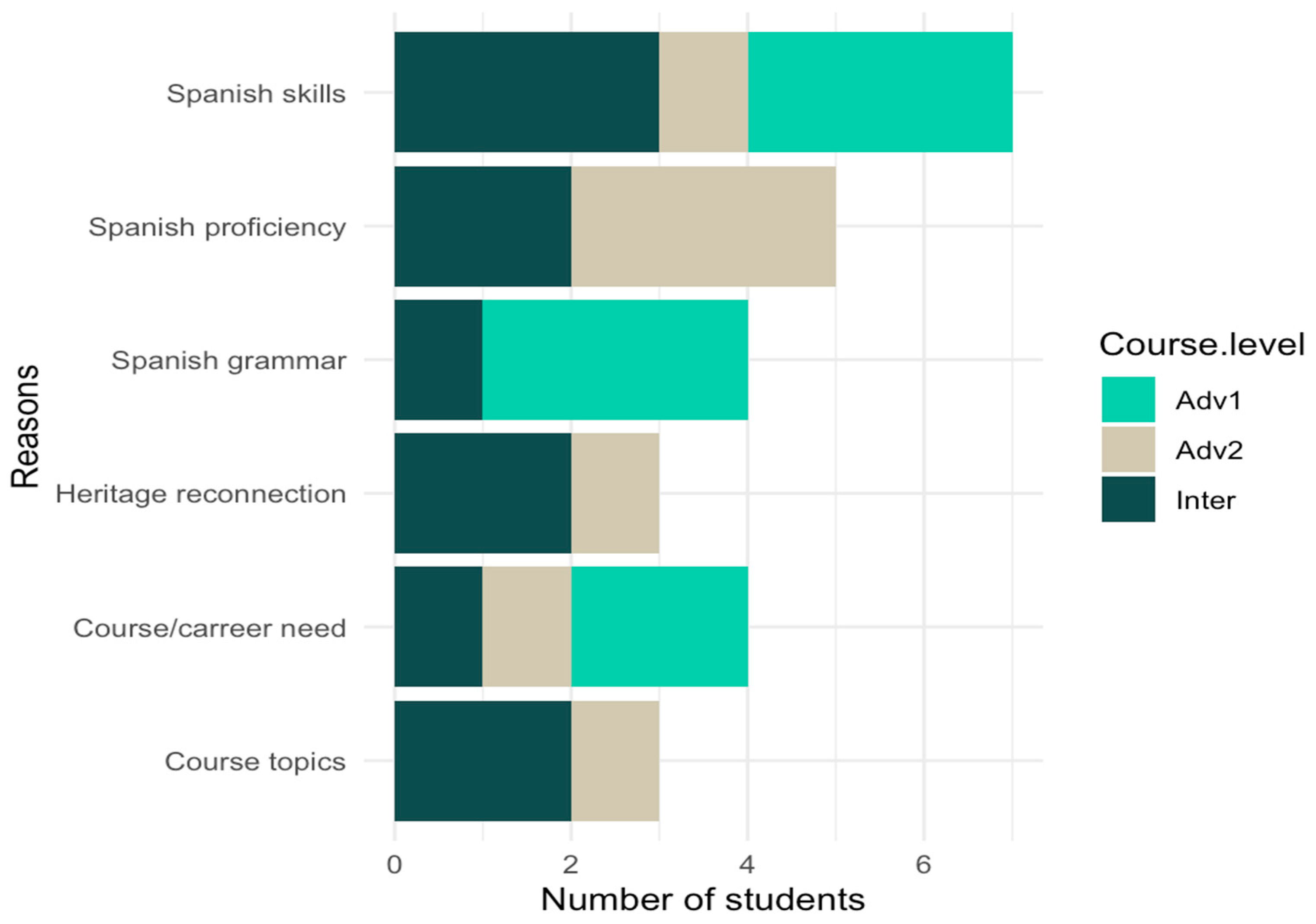
To address RQ1, which asked what motivates SHL students to enroll in SHL courses, six recurring reasons were identified (see
Figure 1): aspirations to reconnect with heritage roots (3/13), preparing for future courses or career prospects (4/13), learning grammar rules (4/13), improving reading, writing, and speaking skills (7/13), strengthening overall Spanish proficiency (5/13), and interest in course topics described in course syllabi (3/13). The discussion below illustrates how these practical motives were underpinned by broader language ideologies.
Although these reasons mirrored the interview prompts, the thematic analysis revealed that they also reflected deeper motivations shaped by language ideologies. For example, heritage reconnection often reflected an essentialist ideology (
Fishman, 1991;
Woolard, 2016), while career-oriented motivations suggested commodification (
Fuller & Leeman, 2020). Similarly, grammar- and proficiency-focused reasons aligned with standard language ideology (
Lippi-Green, 1994;
Leeman, 2018) and were often intertwined with deficit discourses (
Rosa, 2016).
Notably, these patterns varied across course levels: Intermediate students predominantly emphasized heritage reconnection and general skill-building, combining essentialist and standard language ideologies; Advanced I students focused on grammar and improving reading, writing, and speaking abilities, reflecting standard language ideology; most Advanced II students sought to strengthen their overall Spanish proficiency, again aligning with standard language ideology. The following subsections illustrate these rationales in greater depth, drawing on student excerpts to illustrate how these motives were expressed by students.
3.1.1. Classroom Topics
Three students (two Advanced II, one intermediate) noted compelling classroom topics as a key reason for enrollment. One explained that issues such as Spanglish, Latino histories in the US, and identity crises were “a lot of stuff that I connect to … stuff that you don’t talk about in upper-level Spanish courses, because they usually talk about literature from Spain” (Pedro, Advanced II). His comment illustrates how COST content contrasted with the Eurocentric focus of previous courses and validated his heritage experiences. Such responses show how ideologically relevant topics can increase the perceived value of SHL courses in contrast to second language (L2) course offerings.
3.1.2. Relevance for Future Courses and Career Prospects
Four students described SHL enrollment as strategic preparation for future academic or career prospects. For instance, one Intermediate student explained her goal of pursuing a career with the FBI, stating, “
este curso me ayudó a tomar esa decisión de hacer el minor [this course helped me decide to pursue the minor in Spanish]” (Lola, Intermediate). Another (Advanced II) emphasized that enrolling helped prepare him for medical Spanish: “taking this class prepares me to take that class in the future” (Jorge, Advanced II). Both examples demonstrate identified regulation (
Ryan & Deci, 2000), where Spanish is recognized as a resource for professional and academic growth.
3.1.3. Improving Reading, Writing, and Speaking Abilities
The most frequently reported reason was improving reading, writing, and speaking skills. Seven students described ongoing struggles with accents and grammar. For example, one Advanced II student noted struggling with accents: “I really don’t know where the accents go sometimes” (Carolina, Advanced II). Others, like Oscar, an Intermediate student, described choosing a lower-level course to practice reading and writing despite speaking and understanding the HL.
3.1.4. Strengthening Overall Proficiency
Five students expressed their desire to strengthen their overall Spanish proficiency. One Intermediate student noted that the SHL course provided “more benefits than any other Spanish class” she had taken (Laura, Intermediate). Another student emphasized the value of peer community while improving their HL, saying it felt “nice to be surrounded by other students that are in the same spot as you” (Lucas, Advanced II).
3.1.5. Learning Spanish Grammar Rules
Four participants reported grammar as a primary motivation for enrollment. One Intermediate student emphasized learning accentuation and direct/indirect object pronouns: “Aprender a hacer mucho la gramática, hacer los acentos, las tildes …” (Lola, Intermediate). Another Advanced I student contrasted prior L2-oriented classes with the chance to refine grammar in an SHL setting: “I just felt I could probably just refine my grammar skills in this class” (Silvia, Advanced I).
3.1.6. Reconnecting with Heritage Roots
Three participants highlighted their desire to reconnect with their familial heritage as a primary motivation. For instance, one Advanced I student shared, “I want to reconnect … at least I’m listening to other people’s experiences and like getting a taste of that” (Monica, Advanced I). These findings underscore how SHL courses can validate students’ lived experiences in dialogue with peers, which can reinforce linguistic confidence in their HL.
3.2. “You Know, the Gringa Spanish”: Linguistic Perceptions and Insecurities
To address RQ2, which explored how students perceive their HL and the insecurities or ideological tensions surrounding it, this section examines four subthemes: family pressures to “perfect” their Spanish, community judgment that labeled their HL as gringa or foreign, feelings of being outsiders abroad, and resistance to correction through assertions of legitimacy and student agency. These subthemes reveal how standard, deficit, and essentialist ideologies shaped students’ perceptions of their HL, while also underscoring instances where students contested such ideologies and reframed their Spanish as valid.
3.2.1. Family Pressures to “Perfect” Spanish
A prevailing theme of linguistic insecurity emerged, often tied to family members’ perceptions of students’ bilingual practices as imperfect. For example, Jorge discussed his Spanish as requiring grammatical improvement, labeling it as broken and informal:
“I think that I need to improve my Spanish a lot grammatically … My Spanish is very … broken and very informal, and so there’s many aspects to improve on, and my parents tell me that all the time … I need to perfect my Spanish … They tell me that I’m forgetting my roots … so to keep practicing it.”
(Jorge, Advanced II)
Jorge’s account shows how family members reinforce the idea of “perfect” Spanish, reflecting the reproduction of an essentialist ideology, where language proficiency is tightly linked to identity (
Woolard, 2016). At the same time, his characterization of his Spanish as “broken” and “informal” echoes both deficit and standard language ideologies, which frame HL varieties as inadequate until corrected and legitimate only when aligned with academic norms (
Lippi-Green, 1994;
Rosa, 2016). Within the U.S. context, these overlapping ideologies are often tied to cultural belonging, where Spanish ability is seen as part of a Latinx identity (
Fuller & Leeman, 2020). Consequently, both Jorge and his parents positioned ongoing Spanish practice as a condition for maintaining his roots and cultural authenticity. Here, Jorge demonstrated a lack of agency, as he reproduced rather than contested the ideologies that delegitimize his HL variety.
3.2.2. Community Judgments and “Gringa” Spanish
Participants also described how judgments extended beyond the family into the broader Spanish-speaking community, where SHL speakers were often perceived as “imperfect” due to their accent or U.S. upbringing. For example, Silvia recalled being labeled “gringa” because of her Americanized accent:
“A lot of people immigrate here, but I was born here, so I feel like I have more of an Americanized accent. Some … older people from other countries have criticized me for the way I speak Spanish … Sometimes they’ll be like ‘O, tu acento suena como muy gringa [Oh, your accent sounds really American] … La manera que hablas no necesariamente es correcto [the way you speak is not necessarily correct]’ … or … I’ll end a sentence with a preposition and that’s not considered proper… So, I have been corrected before …”
(Silvia, Advanced I)
Silvia’s account illustrates how accent and U.S.-born status became grounds for critique, producing shame and embarrassment. Such evaluations reproduce standard language ideology, where “proper” Spanish is tied to strict grammatical and phonological norms (
Lippi-Green, 1994), as well as deficit ideology, which frames bilingual practices and variation as inadequate (
Rosa, 2016). At the same time, the labeling of her speech as “gringa” reflects essentialist ideology, linking authentic Latinx identity to “native-like” Spanish (
Woolard, 2016). The layering of ideologies mirrors broader findings that U.S.-born HL speakers are often positioned as “deficient Latinos” due to perceived linguistic (
A. Tseng, 2020). Silvia’s case shows limited agency, as she internalized deficit and standard ideologies rather than resisting them.
3.2.3. Feeling Like an Outsider Abroad
Some participants expressed feeling like outsiders when traveling to their heritage countries, where their Spanish was judged against local norms. Laura, for instance, reflected on a sense of not belonging when visiting family in Mexico:
“When I’m in Mexico … I feel like my Spanish … is not like their dialect … I kind of feel like, not embarrassed but … I feel like they can tell I’m from here [the U.S.] when I go, with my Spanish.”
(Laura, Intermediate)
Although Laura noted she was “not embarrassed” per se, her account illustrates how deficit discourses (i.e., framing her Spanish as lacking) intersect with essentialist ideology, where birthplace and dialect are tied to authenticity (
Fuller & Leeman, 2020;
Woolard, 2016). As Fuller and Leeman note, citing
Bedolla (
2003) and
Shenk (
2007), there are expectations—among Latinxs and non-Latinxs—that Latinxs must speak “flawless” Spanish to demonstrate authenticity. Laura’s experience reflects this pressure, underscoring how HL speakers internalize the belief that sounding “native” is a prerequisite for legitimate belonging. This finding also aligns with
Sánchez-Muñoz (
2016), whose participants expressed similar insecurities about speaking pocho. Here, Laura demonstrated ambivalence, as she recognized her difference without fully internalizing shame, thus wavering between reproduction and contestation of ideologies.
3.2.4. Resistance and Assertion of Agency
As evidenced thus far, there exists a strong association between language ideologies, prejudice toward SHL varieties, and linguistic insecurity. However, not all participants internalized these negative beliefs. Some resisted correction and affirmed their Spanish as legitimate.
One Advanced I student explained:
“Whenever my family comes from Peru, I do get nervous speaking Spanish because my Spanish to them ((gestures air quotes)) isn’t what’s considered … ‘proper Spanish’ ((gestures air quotes)) … So they tend to correct me … they’ll say that … my Spanish is like the American Spanish or … the gringa Spanish … because it’s been like Americanized. So, I do tend to get nervous speaking around them, because I make what they consider mistakes.”
(Isabel, Advanced I)
Though Isabel acknowledges feeling nervous, unlike Jorge and Silvia, she attributes her discomfort to her family’s perception rather than her own. Her use of air quotes around “proper Spanish” signals skepticism of the very notion of correctness. Here, deficit and standard ideologies intersect with essentialist ones: her Spanish is framed as “mistaken” or “broken” (deficit), while Peruvian Spanish is positioned as the authentic benchmark (essentialist). Isabel also noted being categorized as an outsider or gringa due to her “Americanized” Spanish, echoing broader findings that particular varieties are socially esteemed while others are devalued (
Milroy, 2001;
Woolard, 2016). Nevertheless, her insecurity seems linked less to actual proficiency than to her anticipation of correction, suggesting a tension between reproduction and resistance of dominant ideologies, which allowed Isabel to assert her own agency, rejecting external evaluations and redefining her Spanish on her own terms:
“I think I know how to speak Spanish my way. The way that I like it, but not the way that my family in Peru would like. But at this point, it doesn’t bother me … As long as I’m able to communicate with them, that’s all that matters to me. I realize I like the way that I speak Spanish … I can speak Spanish.
(Isabel, Advanced I)
The second excerpt illustrates critical agency: Isabel contests deficit and standard language ideologies, resists essentialist expectations of “authentic” Spanish, and instead asserts both her linguistic legitimacy and autonomy. In doing so, she not only reassured both the interviewer and herself but also validated her HL variety. Such resistance echoes
Leeman et al.’s (
2011) description of SHL learners as potential “social and community activist[s]” (p. 487), positioned to transform not only their own educational experience but also broader language hierarchies.
Overall, these accounts highlight how SHL students navigated overlapping evaluations of their Spanish, ranging from pressures to perfect their Spanish to community judgments about gringa Spanish, feelings of outsider status abroad, and moments of resistance. The next section turns to students’ engagement with COST, which shaped not only how students reflected on language ideologies but also how they envisioned their HL.
3.3. Impact of Critically Oriented Sociolinguistic Topics on SHL Learners
To address RQ3, which asked about students’ engagement with COST and SHL learners’ perceived impact, this section examines four subthemes that illustrate how engagement with COST fostered critical reflection, contested dominant ideologies, and supported the development of student agency. These subthemes include: awareness of social issues affecting Latinxs in the U.S. and abroad, valuing diverse perspectives from peers, recognition of language variation and linguistic hierarchies, and affirmations of identity and linguistic legitimacy.
3.3.1. Awareness of Social Issues
One way COST shaped students’ perspectives was by raising awareness of social issues related to immigration and Latinx experiences. For example, Jorge reflected on how class discussions offered perspectives he had not encountered before:
“I was born here, and all my friends were born here. So, I didn’t really get that perspective of somebody coming from a different country, and I think it’s helping me become more aware of the issues that they face … it makes me sad because my parents also came from a different country. And I just learned about all these kids who also [went] through just to live a better life here, and to come here and not even experience that great of a life because of everything that’s happening…”
(Jorge, Advanced II)
Here, Jorge shows how classroom dialogue and COST fostered empathy and a critical awareness by connecting broader migration struggles to his parents’ experiences. Importantly, his reflection also questioned the idealized narrative of migration as solely a pursuit of a “better life,” instead pointing out the hardship and inequities many migrants face. This illustrates the development of CLA, as Jorge interrogates not only the stories told about immigration but also the ideologies that underlie them. In doing so, he problematized commodification ideology (migration framed in terms of opportunity) and essentialist ideologies (authentic belonging tied to place of origin). This reflective stance signals critical agency, as Jorge positions himself not only as a learner of sociolinguistics content but also as an active interpreter who challenges dominant discourses shaping migration narratives (
De Fina et al., 2021).
3.3.2. Valuing Diverse Perspectives from Peers
Another subtheme highlighted how students valued the classroom as a space to explore diverse perspectives from heritage peers, particularly when classmates came from different countries or had lived experiences abroad and in the U.S. For example, Maria, an Advanced I student originally from Bolivia, reflected on how course discussions broadened her understanding of Latinx struggles both locally and internationally:
“I feel like [the SHL course] kind of shows us like the big struggle that a lot of communities face here in the U.S., like the oppression and all of that… We just started talking about that as well, how the biggest countries and communities that have been oppressed and been violated have been those in Latin America. And I just think it makes me feel like very lucky to be in the position that I am. Because I feel like I was able to experience kind of both situations like living over there and being here. So, it definitely makes me feel a lot more appreciative of where I am and my family, my own culture.”
(Maria, Advanced I)
Maria’s account demonstrates how COST encouraged her to contextualize her bicultural trajectory within larger structures of oppression and inequality. Her reflection shows awareness of systemic discrimination against Latinx communities across both the U.S. and Latin America. This recognition signals the development of CLA, as she critiques deficit ideologies that position certain Latin American communities as marginalized and devalued. At the same time, Maria reframes her own position as an immigrant student in the U.S. not through the lens of deficit but as a site of strength, which reflects agency. By articulating her experiences as a Bolivian American, she resists essentialist notions that tie authenticity to one “true” national or linguistic identity. Instead, she claims a hybrid perspective that validates her bilingual, bicultural position as an asset. Although the Advanced I course incorporated the fewest COST, Maria’s reflection suggests that even limited exposure to COST can prompt students to link personal experiences to broader sociopolitical contexts.
3.3.3. Contesting Standard Language Ideologies
Some students described how COST and classroom discussions prompted them to interrogate previously internalized beliefs about “correct” Spanish. For instance, Jorge recounted his high school experience, where Peninsular Spanish was explicitly taught as the “proper” form, leaving him to view his own variety as “improper”:
“At my high school, they taught the Spaniard, like Spain Spanish and so I always thought ‘Oh, that’s the proper Spanish.’ But I think I hadn’t really thought of my Spanish as a terrible … I just thought like we spoke improper Spanish. But now, I’m realizing there’s different versions of Spanish that are actually like, valid and I don’t know … Maybe, the Spaniard is–I wouldn’t consider it the proper Spanish anymore, I would just consider it like a different variety.”.
(Jorge, Advanced II)
This reflection demonstrates an ideological shift: Jorge moved from reproducing standard language ideology (which positioned Peninsular Spanish as superior and his Salvadoran Spanish as deficient) toward contesting it by recognizing linguistic variation as equally legitimate. Scholars contend that educational institutions play a pivotal role in reproducing such hierarchies and advocate for their elimination from academic contexts (
Milroy, 2001;
Urciuoli, 2008). In contrast, Jorge’s experience in the SHL classroom—where COST emphasized language variation—created a space for him to question these norms. In doing so, Jorge not only began to reframe his Salvadoran Spanish as valid but also demonstrated the beginnings of CLA, moving from acceptance of dominant hierarchies to an active contestation of them.
3.3.4. Developing Appreciation and Agency
The effectiveness of addressing language ideologies in the classroom was evident as students expressed appreciation for their own Spanish varieties and identities.
One Advanced II student reflected:
“We talked about it yesterday in class where different Spanish speaking countries have their own way of saying certain words … I’ve noticed that I use words that are relative to El Salvador. So, maybe mine isn’t bad, it’s just how me and my parents communicate.”.
(Jorge, Advanced II)
Here, Jorge demonstrates a move away from deficit and standard ideologies that would position Salvadoran Spanish as “inferior” to prestigious varieties. Instead, exposure to COST enabled him to reframe his usage as valid, showing both awareness of linguistic diversity and the beginnings of CLA.
Another student echoed this transformation by explicitly linking the course to identity confirmation:
“I guess like this course, has made me more appreciate more my Spanish, and my accents in English and Spanish … It has also taught me like appreciating my identity too, in a sense.”
(Pedro, Advanced II)
Pedro’s reflection highlights the empowerment that came from re-evaluating stigmatized features (e.g., accents) and re-signifying them as a part of a valued HL identity. Rather than internalizing deficit views of bilingual practices, he began to see them as legitimate, which reflects a form of resistance to standard and deficit ideologies.
Together, these accounts illustrate how COST fostered not only awareness of language variation but also an appreciation of students’ HL practices and identity. This aligns with prior scholarship that argues that sociolinguistically informed SHL curricula empower learners to contest dominant ideologies and position themselves as legitimate speakers (
Leeman, 2005;
Leeman & Serafini, 2016;
Martínez, 2003).
Taken together, these subthemes show how COST shaped a trajectory from awareness to CLA to agency. Classroom discussions prompted students to interrogate dominant ideologies, validate their own linguistic practices, and assert themselves as legitimate speakers, thereby underscoring the transformative role of sociolinguistically informed SHL curricula. Notably, while exploratory, the strongest patterns of contestation and agency were observed in the Advanced II course, which incorporated the greatest number of COST (9/12). This suggests that greater exposure to COST may correspond with more robust critical engagement.
4. Discussion
In this study, I aimed to explore SHL learners’ reasons for enrollment in Intermediate and Advanced levels of SHL courses, their perceptions of their HL, and the impact of COST. Motives for enrolling centered around heritage reconnection, career preparation, grammar, reading/writing/speaking skills, overall proficiency, and interest in course topics. Importantly, these reasons were not only pragmatic but ideologically embedded. For instance, heritage reconnection reflected essentialist ideologies, career-oriented rationales illustrated commodification, and grammar/proficiency goals reproduced standard and deficit ideologies. As others have also shown (e.g.,
Sánchez-Muñoz, 2016;
Wilson, 2022), such motives are tied to insecurities about “Americanized” Spanish. Unlike
Wilson’s (
2022) emphasis on the insecurities of receptive bilinguals, however, the present study shows that the very reasons for enrolling in Intermediate and Advanced courses were already articulated through students’ ideological stances about identity, legitimacy, and belonging. While CLA scholarship has long argued for moving beyond skills-based instruction toward critical engagement with ideologies (
Leeman, 2005,
2018;
Martínez, 2003), this study extends that work by showing that language ideologies shape how students justify their enrollment. In this sense, while skills- and proficiency-oriented motives were the most frequently mentioned, enrollment can also be understood as an ideologically charged act, as students framed even these practical goals through deficit, standard, essentialist, or commodification beliefs that they either reproduced or contested.
RQ2 asked about students’ perceptions of their HL. Findings revealed that deficit, standard, and essentialist ideologies deeply shaped how learners evaluated their Spanish. Consistent with prior research (e.g.,
Herrera-Dulcet & Yocupicio, 2024;
Sánchez-Muñoz, 2016;
Wilson, 2022), students often described U.S. Spanish as “deficient” or “informal,” reproducing family and community narratives of “flawless” Spanish, while also facing judgments that positioned them as outsiders or gringas (
A. Tseng, 2020). Findings also resonate with
Del Carpio and Ochoa’s (
2022) observation that standard and commodification ideologies remained salient in SHL contexts. Yet unlike prior studies, several students in this study both reproduced and resisted such judgments–whether being told their Spanish was “broken,” “imperfect,” or “gringare”–sometimes reframing their Spanish on their own terms, demonstrating what
Leeman et al. (
2011) call critical agency. In this sense, the findings also echo
Serafini and Roca-Ramirez (
2024), who demonstrate how heritage speakers’ self-positioning both reveals internalized ideologies and enables agency in challenging them. Agency in this study appeared uneven and contested, as students alternated between compliance and resistance in negotiating what counts as “legitimate” Spanish.
In relation to RQ3, findings showed that engaging with COST supported the development of critical awareness, CLA, and agency among SHL learners. However, these effects were not evenly distributed across course levels. While Advanced II (9/12 topics) and Intermediate (7/12) students provided the most robust evidence of reflection, contestation, and agency, Advanced I (4/12) students demonstrated more limited engagement, reflecting the reduced integration of COST in the course. Classroom discussions on immigration, oppression, and language variation allowed students to connect their past experiences to broader sociopolitical structures, demonstrating how critically oriented content can foster both empathy and critical reflection. Similarly to
McKinnon and Elias (
2024), the students in this study both revealed internalized ideologies and challenged them, signaling shifts in their views of their HL. Unlike
Herrera-Dulcet (
2019), whose participants showed limited sociopolitical awareness, students here explicitly linked U.S. and Latin American struggles, suggesting that COST can extend critical reflection across borders. These results are also consistent with
Leeman and Serafini’s (
2016) call for SHL curricula to prepare students to engage with linguistic variation, develop critical consciousness, and exercise agency in their linguistic choices (see also
Leeman, 2005,
2018). Nevertheless, these findings suggest that the impact of COST did not appear to depend on instructors’ formal CLA training, since students consistently attributed their reflections to the topics and peer discussions themselves. This suggests that integrating COST in a syllabus can itself generate meaningful opportunities for critical reflection and agency. While tentative, the fact that the Advanced II course integrated the highest number of COST (9/12) suggests that greater exposure may foster more robust engagement, and future research should further explore.
5. Conclusions
Overall, the study highlights the positive impact of Critically Oriented Sociolinguistic Topics (COST) on SHL students, showing how these discussions foster critical consciousness, contest dominant ideologies, and support the development of student agency. Students challenged standard language ideology, reframed deficit views, and affirmed their linguistic legitimacy. These findings extend prior research by demonstrating that COST can foster awareness and encourage students to take agentive stances toward their Spanish. These findings also suggest that the scope and depth of COST integration shape its effects: courses with more sustained engagement fostered stronger evidence of CLA and agency, whereas courses with fewer COST reflected more ambivalence.
At the same time, there are limitations to be acknowledged. The study drew on a small sample drawn from Intermediate and Advanced students at two universities, limiting generalizability. Data were collected on a one-time basis rather than over a longer-term period (e.g., at the beginning and end of the semester). Additionally, reliance on interviews meant that the findings reflected self-reported experiences rather than observed classroom practices. The analysis was conducted by a single coder, which may introduce interpretive bias. Finally, because the three courses incorporated differing numbers of COST (4, 7, and 9 out of 12 possible topics), variation in exposure may have influenced the depth of critical engagement reported.
Future work should examine SHL learners’ trajectories across multiple semesters to trace how CLA and agency evolve, as well as how teacher training interacts with curriculum design. Research might also compare institutions with varying levels of COST integration to evaluate whether different curricular emphases shape the depth of student reflection and agency. Finally, further work could explore raciolinguistic dimensions (
Flores & Rosa, 2015), given that participants here emphasized sounding gringa, whereas other studies (e.g.,
Del Carpio & Ochoa, 2022;
Serafini & Roca-Ramirez, 2024) have found concerns about ethnic and racial appearance.
Pedagogically, these findings underscore the importance of integrating COST not only to foster critical reflection but also to empower students to act as agents in their linguistic choices. By affirming their own repertoires as legitimate, SHL learners can begin to resist deficit and standard ideologies both inside and outside the classroom. Only then will SHL students feel confident enough to say, “I know how to speak Spanish my way.”