Article

Future Highly Efficient Engines with Solid Oxide Fuel Cell–Gas Turbine Coupling: System Modeling Study and Comparison of Directly and Indirectly Coupled SOFC–GT Systems

1
Leibniz University Hannover, Institute of Thermodynamics, An der Universität 1, 30823 Garbsen, Germany
2
German Aerospace Center (DLR), Institute of Engineering Thermodynamics, Pfaffenwaldring 38, 70569 Stuttgart, Germany
*
Author to whom correspondence should be addressed.
Aerospace 2026, 13(3), 263; https://doi.org/10.3390/aerospace13030263
Submission received: 30 January 2026 / Revised: 8 March 2026 / Accepted: 9 March 2026 / Published: 11 March 2026

Abstract

This study investigates hybridization of a solid oxide fuel cell with a gas turbine (SOFC–GT) for application in an ATR 72 regional aircraft. Several challenges hinder its viability, including the low gravimetric power density of SOFC stacks and stringent heat integration constraints. A steady-state model sweeps the cell voltage, overall pressure ratio (OPR), and a bounded turbine inlet temperature (TIT). This study introduces a new corrected power-share metric. This metric accounts for operating-point-dependent SOFC power density. It also enables weight-relevant comparisons. We analyze two types of coupling: direct and indirect. In the direct coupling, SOFC cooling fixes the core airflow and a TIT ceiling imposes a minimum power share. In the indirect coupling, a bypass decouples SOFC and gas turbine operation, incurring an efficiency penalty. We compare two heat-integration architectures: preheating with SOFC cathode exhaust versus low-pressure turbine (LPT) exhaust. Results show that direct coupling achieves efficiencies above 65% at high-corrected power shares, whereas indirect coupling offers greater operational flexibility but lower efficiency. Cathode exhaust preheating improves feasibility and outperforms LPT recuperation by more than 15% efficiency at low-to-mid-corrected power shares. However, LPT recuperation attains higher peak efficiency only at high-corrected power shares and within a narrow OPR window, which is limited by recuperator pinch.

1. Introduction

The global transition toward sustainable energy sources places significant pressure on the aerospace sector to develop highly efficient, low-emission propulsion systems [1,2,3]. In addition to the use of batteries or sustainable aviation fuels (SAF) in conventional engines, several alternative approaches are being explored to reduce the climate impact of aviation. These include direct hydrogen combustion and more efficient hydrogen utilization via low-temperature proton exchange membrane (PEM) fuel cells, as one of the most researched concepts [4]. Although PEM fuel cell systems can achieve efficiencies of around 50%, they require necessary active cooling systems to reject the low-temperature waste heat and need a high purity of hydrogen as a fuel [5,6,7]. Another promising option is the use of high-temperature solid oxide fuel cells (SOFC). Since these fuel cells operate at temperatures typically above 600 °C, they can be coupled with a gas turbine (GT) system. The downstream turbine can then exploit the exergy of the warm exhaust gases from the fuel cell [8]. As summarized in the reviews by Azizi & Brouwer [9] and Fernandes et al. [10], thermal efficiencies above 60% are obtained, showing the potential for sustainable efficiency improvements over conventional gas turbines or PEM fuel cells. In addition to the continued use of gas turbines as proven technology, SOFC–GT systems are emerging as an attractive option for future aircraft propulsion systems. Furthermore, SOFCs offer the capability of using different fuels other than pure hydrogen, which enables the use of sustainable aviation fuel (or other sustainably produced hydrocarbons) but also ammonia as a fuel [11,12,13]. These attributes make SOFC systems an attractive alternative for future propulsion systems, especially when compared to low-temperature PEM fuel cells, as discussed by Peyrani et al. [14].
Since the technical relevance of SOFCs in the past was mainly seen for stationary applications, e.g., as investigated by [15,16,17,18], the development was not driven in the direction of lightweight-optimized cells or stacks, leading to low gravimetric power densities of state-of-the-art SOFC stacks available on the market. Due to this limitation, studies conducted to date in the field of aviation have mainly been limited to use as auxiliary power units (APUs). For example, Rajashekara et al. [19] investigated an SOFC–GT concept including a pre-reformer fueled by commercial jet fuel for onboard power generation in so-called more electric aircraft. In the same power class, namely, 440 kW electric power, for a long-range, 300-passenger civil airplane, studies by NASA showed exceptional potential efficiency above 70% for the APU [20]. As shown by [21], a hybrid SOFC–GT system is used with an electrical power share related to the overall power of the APU of ≈75%. In [22], an SOFC hybrid system to cover the onboard loads (60 kW) of different regional aircraft was investigated. As summarized by Waters & Cadou [23] in 2015, the electric power fraction in commercial air transport can increase to up to 6% for large aircraft with all-electric subsystems. Even if this is a significant power class, it can fairly be stated that the overall fraction of power generated by the SOFC in these cases is low compared to the overall propulsion system. Another application of the smaller power class is the propulsion of unmanned aerial vehicles (UAVs). A NASA study conducted by Himansu et al. [24] investigated the use of a 50 kW SOFC–GT system for long-endurance UAV missions. Similar investigations were carried out by Aguiar et al., showing efficiencies of 66% related to the lower heating value [25].
In recent studies, hybrid SOFC–GT systems are increasingly being investigated as the propulsion system. Chung et al. [26] investigated different aircraft conceptual designs, e.g., advanced blended wing bodies, powered by SOFC–GT systems from [27] supported with batteries. Here, the SOFC mass alone takes 60% of the overall propulsion system mass (29,860 kg without the batteries). In a similar setup, ref. [28] reported the SOFC mass fraction to be 46.5% (26,600 kg) for a 28.7 MW design power system. In the study by [29], the hybrid propulsion system was investigated with different SOFC power shares of the overall power between 5% up to 20%. Xu et al. [30] investigated a system with an all-electric-powered fan. Here, the turbine with an inlet temperature of 1160 K powered the compressor, without generating additional power for the propulsion system. This ammonia-powered system reached a thermal efficiency of 55.8%. In the concept provided by Daggett et al. [31], a system with a total output power of 1060 kW is reported. Here, the power distribution is 85% SOFC power and 15% GT power. Wagner & Tingas [32] showed a relative weight increase for a SOFC–GT system with 1 MW SOFC power of 119% with the assumption of a 2015 system, and respectively, 55% for a 2030 scenario, where a gravimetric power density of up to 3 kW/kg was assumed. The respective gravimetric power densities of the SOFC were reported in the original studies by [33] with 0.263 kW/kg (2015) and 0.6838 kW/kg (2030), based on [20,34].
The studies clearly showed that a weight challenge must be overcome for the implementation of SOFCs as part of the main propulsion systems, especially when the system is designed with a high proportion of SOFC power, which is associated with high efficiencies. Ongoing SOFC development, however, offers a promising outlook for future power densities through improved cell and stack designs, especially due to additive manufacturing as demonstrated by Martos et al. [35]. Even though this research is not yet at a commercial stage, the fabricated electrolyte-supported (ESC) SOFC stack with 18 single repeating units (SRUs) reportedly increased the gravimetric power density by a factor of 4 compared to state-of-the-art SOFCs. An additional promising result is presented by Nehter et al. [36], where the Airbus team demonstrated an SOFC concept with a gravimetric power density of 2 kW/kg on the cell level and an even more optimistic outlook. Further efforts for lightweight SOFCs are reported in [37,38].
Still, it is reasonable to assume that the gravimetric power density of SOFCs will remain lower than that of conventional gas turbine systems in the near future. SOFCs are therefore the critical factor in total weight, though determining mass requires more detailed analyses of the designed system, particularly in the context of multi-point analysis rather than the design point analysis which will be performed in this study. Nevertheless, it can be deduced from this that the power share (PS) between the SOFC’s electrical power to the total system output power is a critical initial indicator for a qualitative estimate of the system weight. Thus, a system with a high electrical power share corresponds to a higher system weight under the current assumption of a rather low gravimetric power density of the SOFC. However, if the SOFC’s power density exceeds that of the gas turbine system, this analysis would no longer apply and the aforementioned effects could be inverted.
Since (electrolyte-supported) SOFCs operate at temperatures above 700 °C, while the compressor outlet temperature is typically 300–400 °C, the incoming streams must be preheated. Different SOFC support structures would reduce the required operating temperature to 600 °C (anode-supported) or down to 500 °C (metal-supported). However, preheating would still be necessary, though the challenge of heat integration would be eased. To maximize efficiency, thermal energy already present in the system should be recovered and reused via heat integration. Previous analyses [39] identified two promising system architectures with high-temperature heat exchangers for heat integration: (i) utilizing the SOFC cathode off-gas within the core flow (Figure 1a) and (ii) variants that recover heat from the low-pressure turbine (LPT) (Figure 1b) in order to preheat the incoming air to the SOFC. The general operating principle of the system under investigation is explained in Section 2. One key architectural design decision is the coupling strategy between SOFC and GT. Typically, in the literature, only the direct coupling was introduced, denoted by a single serial core flow path without bypass. In that case, the operating conditions of the SOFC dictate the required air mass flow of the system as a result of the SOFC’s cooling requirement. Hence, the turbine inlet temperature and therefore the power share is a result of the air mass flow and the excess hydrogen as a function of the SOFC’s fuel utilization or supplemental direct fuel injection to the combustion chamber (CC). This study introduces the concept of indirect coupling using an air bypass or parallel airflow path around the SOFC and heat exchanger, which enables setting the SOFC and GT operating conditions independently. This provides system designers with the flexibility to select lower power share operating points, a necessity imposed by the discussed current SOFC power density limitations, and quantifies the associated efficiency penalty.
Since most of the previous studies focused on either high- or low-SOFC power shares (or low-power classes), the present study systematically examines how system constraints and SOFC operating conditions govern feasible power shares and efficiency for direct and indirect coupling. Doing so, the trade-offs between the power share as a weight indicator and the system efficiency are investigated within the complete feasible power share range from low through mid to high SOFC power shares. As a result, design trade-offs can be deduced showing potential efficiency benefits also in a medium power-share regime, making the SOFC–GT system an attractive propulsion system not only as a long-term alternative, but also in the short-to-medium time scale according to the state of SOFC development. The analysis targets a representative cruise operating point of an ATR-72-class aircraft at flight level (FL) 240 (ISA+0) and explores within a power class of 1.2 MW:
  • The effect of the overall pressure ratio (OPR, also refered to as the pressure ratio) and the SOFC cell voltage on power share and efficiency.
  • Two strategies to lower the power share: supplemental fuel injection into the combustion chamber and reduced SOFC fuel utilization.
  • The different SOFC–GT system characteristics between direct and bypass-enabled indirect coupling across the same operating space.
  • Within the indirectly coupled system, a comparison of the introduced SOFC–GT system architectures utilizing (i) the cathode’s exhaust or (ii) the LPT’s exhaust to preheat the incoming air.
Since this study focuses on the general thermodynamic behavior of SOFC–GT systems, the results can be applied to different power classes and applications. For space applications (e.g., power generation), a closed Brayton cycle would be required. In addition, dedicated cooling systems and a stored oxidizer supply would be necessary. Section 2 outlines the modeling methodology and assumptions, including SOFC, heat-exchanger, and turbomachinery models. In Section 3, the results of the different investigations with directly coupled SOFC–GT are outlined. Subsequently, the results for the investigations of the indirectly coupled systems are discussed in Section 4. Section 5 evaluates the comparison between the presented system architectures. Due to the absence of experimental data to validate the simulation model, Appendix A shows a cross-validation between two independently developed simulation frameworks to substantiate the accuracy of the simulation models developed.

2. Methodology

Two SOFC–GT architectures are considered, differing in heat integration for air preheating to ensure proper operating conditions of the SOFC. In both architectures, the incoming air is first compressed and subsequently preheated from the compressor outlet temperature to the required SOFC inlet temperature by a heat exchanger before entering the SOFC. Due to the expected improvements in power density (see Section 1) and a solid foundation for modeling activities, an electrolyte-supported SOFC was chosen. The required inlet temperature of the SOFC is 973 K. The temperature difference across the SOFC (inlet to outlet) is set constant to 150 K by adjusting the air mass flow. Both cathode and anode outlets are mixed in the combustion chamber in order to completely oxidize the excess hydrogen of the fuel cell. The subsequent high-pressure turbine (HPT) powers the compressor. The low-pressure turbine generates the shaft power. The baseline architecture utilizes the cathode’s outlet stream to preheat the incoming air. The second architecture recovers heat from the low-pressure turbine’s exhaust for heat integration and air preheating. In the baseline architecture, the consistently warmer cathode outlet stream is used for heat integration, ensuring sufficient preheating independent of the operating conditions. The drawback is a lower turbine inlet temperature, which reduces the available enthalpy and turbine work potential. This drawback is avoided in the second architecture, where the turbine exhaust is used for heat integration downstream of the turbines. This yields a thermodynamic benefit, provided the exhaust temperature remains sufficiently high. In both architectures, the incoming hydrogen is assumed to be in a gaseous state at the compressor discharge pressure. It is preheated from 300 K by an additional heat exchanger fed by the anode’s outlet to the SOFC inlet temperature of 973 K. For both system architectures, shown in Figure 1a (cathode exhaust utilization) and Figure 1b (LPT exhaust utilization), a comparison is made between directly and bypass-enabled indirectly coupled systems indicated by the adjustable air bypass valve and the green dotted line in the respective figures. As described in Section 1, the air bypass allows the SOFC and GT operating conditions to be set independently by providing a parallel flow path around the SOFC and the heat exchanger. Unless otherwise stated, the maximum allowable turbine inlet temperature is 1400 K to reflect uncooled turbine blades [40,41]. As noted above, the system partly relies on hydrogen combustion, which poses practical challenges. The detailed design of the combustor and turbines for hydrogen-fueled operation is beyond the scope of this study. For recent overviews of progress and remaining challenges in hydrogen combustion and hydrogen-fueled gas turbines, see [42,43,44].

2.1. Component Models

2.1.1. SOFC Model

The system modeling is integrated in a steady-state MATLAB/Simulink R2024a framework. A one-dimensional discretized SOFC model adapted from Hollmann et al. [45,46] is used. The reaction heat and dissipative heat from the fuel cell is captured by the fluids flowing through it in a co-flow arrangement. The model covers convective and conductive heat transfer. Radiation is neglected. A detailed description of the fuel cell model can be found in the original source [46]. As a result of a discretization study, the electrochemically active area is modeled as 10 segments (20 in the original study using hydrocarbon fuels). The model calculates the Nernst voltage
U N = U 0 R m T 2 F · ln x H 2 O x H 2 · x O 2 1 / 2 · p p 0
as a function of the temperature T and the reactants molar fractions x i or their partial pressures p i . Here, F describes the Faraday constant, R m , the universal gas constant, U 0 , the reversible electrochemical voltage at standard state, and p 0 , the reference pressure of 1 bar. All loss mechanisms, including activation, ohmic, and concentration overpotential, are described by the area-specific resistance
ASR ( T ) = ASR 0 · exp E a R m 1 T 1 T 0
as a function of temperature T compared to the reference temperature T 0 in order to calculate the actual cell voltage
U cell = U N ASR ( T ) · j
with the Nernst potential, ASR loss mechanism, and the current density j [47,48]. The reference ASR 0 (0.236 Ω cm 2 ) and the activation energy E a (8.64 · 10 4 J / mol ) of the electrochemical reaction are derived from experimental data from Fraunhofer IKTS (Institute for Ceramic Technologies and Systems, Dresden, Germany) [49,50]. The reference temperature T 0 is 1123.15 K. The active cell area is assumed to be 127.8 cm2, based on [45,46]. The power per SOFC cell
P cell = U cell · j · A = ( U N ASR ( T ) · j ) · j · A
is therefore a function of the Nernst potential (especially the pressure and gas composition), operating temperature (ASR), and current density. The baseline operating envelope respects a maximum temperature difference ( Δ T) of 150 K between inlet and outlet. Cathode airflow is adjusted to maintain this Δ T constraint at each operating point. The SOFC fuel consumption and the excess hydrogen are determined by the fuel utilization
F U = I 2 F · n ˙ fuel · N cell
as a function of the electrical current I and the number of cells N cell compared to the supplied molar fuel flow n ˙ fuel [47,48]. The fuel is assumed to be pure hydrogen. Air is assumed to be a composition of 79 mol% nitrogen and 21 mol% oxygen. A heat loss of 5% relative to the electrical power of the fuel cell is assumed in accordance with staying within the limits specified by the manufacturers.

2.1.2. Turbomachinery and Combustion Chamber Models

The turbomachinery is based on lumped zero-dimensional models with constant isentropic efficiencies. Based on the baseline engine from [51], the compressor has an efficiency of 86%, the high-pressure turbine 88%, and the low-pressure turbine 90%. The isentropic (is) efficiency is calculated as
η comp = Δ h is Δ h = h outlet , is h inlet h outlet h inlet
for the compressor (comp) and as
η turb = Δ h h is = h outlet h inlet h outlet , is h inlet
for the turbine (turb) [40,51]. The pressure ratio is treated as a design parameter and varied over a representative range between 5 and 25. The combustion chamber is modeled assuming a complete fuel burn. Cooling of the combustion chamber as well as of the HPT inlet is neglected. A combined pressure loss of the combustion chamber and the SOFC is assumed to be 5% of the respective SOFC inlet pressure. As no turbomachinery maps are considered within the scope of this study, a constant pressure ratio between the LPT outlet and ambient of 1.1 is assumed. The outlet pressure of the HPT is manipulated in order to ensure power balance between the compressor and the HPT. A full list of the modeling assumptions is captured in Table 1 at the end of Section 2.

2.1.3. Heat Exchanger Models

Heat exchangers (HEX) are modeled using the number of transfer units (NTU) method [52] in counter-flow configuration. A detailed geometry is not considered. A potential high-temperature heat exchanger is presented by Fuchs et al. [53]. The heat flow
Q ˙ HEX = Q ˙ HEX max · ϵ
is calculated using the maximum transferable heat flow
Q ˙ HEX max = C ˙ min · ( T h , in T c , in ) .
and the heat exchanger effectiveness
ϵ = 1 exp ( N T U ( 1 C r ) ) 1 C r · exp ( N T U ( 1 C r ) ) .
Here, C ˙ min is the smaller heat capacity flow of the two fluids entering the heat exchanger multiplied by the maximum temperature difference between the warm fluid (h) and the cold fluid (c) at their respective inlets (in). The effectiveness of the heat exchanger is calculated using the ratio between the minimum and maximum heat capacity flow of the fluids
C r = C ˙ min / C ˙ max
and the definition
N T U = U A / C ˙ min ,
where U is the overall heat transfer coefficient for the heat-transferring area A, which is scaled in order to reach the required SOFC inlet temperature.
Table 1. Summary of main assumptions and boundary conditions.
Boundary Conditions
Ambient temperature T amb 240.6 K (ISA, FL240)
Ambient pressure p amb 39,300 Pa (ISA, FL240)
Flight Mach-Number Ma 0 0.44
Target shaft power P target 1200 kW (+ 5% POT)
Hydrogen supply conditions300 K, gaseous, CDP *
Component Assumptions
SOFC-Modeling1D ASR(T) approach[45,46]
SOFC Inlet Temperature973 KESC-Model
SOFC Temperature Difference150 KESC-Model
SOFC Heat-loss5% of SOFC P el
Compressor (Comp)Isentropic eff. (86%, const.)[51]
High-Pressure Turbine (HPT)Isentropic eff. (90%, const.)[51]
Low-Pressure Turbine (LPT)Isentropic eff. (88%, const.)[51]
Combustion ChamberFull Conversion
max. Turbine Inlet Temperature1400 K[40,41]
Power Electronics98% (constant)[54,55]
Electric Motor95% (constant)[54,55]
Heat ExchangerNTU method[52]
Nozzle Pressure Ratio1.1
Pressure loss5% of CDP * after CC **
* CDP: Compressor Discharge Pressure, ** CC: Combustion Chamber.

2.1.4. Electrical Components

Power electronics and the electric motor (E-motor) are modeled with constant efficiencies
η el = P el , out P el , in .
In accordance with the first law of thermodynamics, the difference between the input and output power of the electrical (el.) components results in a dissipative heat flow. Thermal management systems or other cooling measures to reject this low-temperature heat are not considered within the study. Based on Ebersberger et al. [54,55], the efficiency of the electric motor and the power electronics is assumed to be 95% and 98%, respectively, which results in an overall electrical efficiency of 93%.

2.2. Boundary Conditions and Performance Metrics

A cruise operating point representative for an ATR-72-class aircraft is considered at flight level FL240 (7.3 km altitude, ISA conditions). The required propulsor shaft power per engine is 1.2 MW. To power avionics and power off-takes (POT), 5% of the shaft power (60 kW) is additionally drawn directly from the SOFC.
The thermal system efficiency
η sys = | P out | n ˙ fuel · L H V m , fuel = | P E - Motor | + | P LPT | n ˙ fuel · L H V m , fuel
is defined as the ratio of the total output shaft power to the chemical power supplied by the fuel mass flow and the corresponding lower molar heating value ( L H V m ) of hydrogen. Furthermore, the thermal efficiency of the fuel cell
η SOFC = | P SOFC | n ˙ fuel , SOFC · L H V m , fuel
is defined as the ratio of the electrical SOFC power P SOFC and the fuel flow into the SOFC n ˙ fuel , SOFC . In a similar way, the gas turbine’s efficiency
η GT = | P LPT | n ˙ fuel , CC · L H V m , fuel
is defined by the ratio of the mechanical output power of the LPT and the total amount of fuel entering the combustion chamber n ˙ fuel , CC , which can be a sum of the fuel cell’s excess fuel and additionally supplied fuel directly to the combustion chamber.
The resulting electrical power share
P S = | P E - Motor | | P out |
is the ratio between the power of the electrical motor P E - Motor and the total system’s output power P out . In the first place, the power share between the electrical SOFC power and mechanical turbine power describes the degree of hybridization. Here, a theoretical value of 1 would describe a sole SOFC system. A value of 0 or near 0 would describe a sole gas turbine system or a gas turbine system with a fuel cell as an auxiliary power unit (APU).
For the directly coupled system, the system’s air mass flow is defined by the fuel cell’s cooling requirement to maintain the described temperature boundaries. The fuel mass flow is defined by the fuel utilization Equation (5) as a function of the cell number and the electrical current. The maximum power share is reached when only the excess fuel from the fuel cell is burned in the combustion chamber since this marks the point with the lowest turbine outlet power. For a variation in power share, the turbine inlet temperature is adjusted by either supplemental fuel injection or decreased fuel utilization. According to the resulting power share, the number of SOFC cells is scaled in order to reach the target system output power of 1.2 MW.
Considering the indirectly coupled system, the system’s air mass flow is defined by the sum of the core air mass flow through the SOFC m ˙ SOFC and the bypass air mass flow m ˙ Bypass . The bypass air mass flow is defined by the target power share together with the target turbine inlet temperature (defined by either supplemental fuel injection or decreased fuel utilization). The air bypass ratio
A B R = m ˙ SOFC m ˙ Bypass
defines the split between the air mass flows. The air mass flow though the SOFC is still defined by the cooling requirements. The air mass flow through the bypass is, however, defined by the required turbine output power to set for the power share. The number of SOFC cells scales accordingly.
However, using the power share as an indicator of the weight is only sufficient for a constant power density or power per cell. The power per cell varies with the operating conditions, especially with the current density and pressure Equation (4). To take this into account, a corrected power share
P S corr = P SOFC P out · P SOFC N 1 · P SOFC N ref = N P out · P SOFC N ref
is introduced within this study. Here, the inverse power per cell ( P SOFC N ) 1 is used to describe the number of cells (N) required to reach the SOFC power at the respective power share. To make this value dimensionless again, it is multiplied with a reference power per cell ( P SOFC N ) ref , which is assumed to be 60 W/cell. Since with the corrected power share, the power density and the number of cells are taken into account, it can be used as an indicator of the system weight. If the actual power per cell is decreased compared to the reference, e.g., by changes in the operating pressure or a change in cell voltage, a higher corrected PS results and vice versa. It should be noted that the corrected power share is a theoretical value. In contrast to the conventional degree of hybridization (power share), values greater than 1 can therefore occur. A more detailed investigation of the respective component weights or the influence of different temperature levels and the associated size and weight of the turbomachinery is not considered.

2.3. Parametric Studies

Within this study, four parametric studies are conducted:
1.
The differences between the two options for lowering the power share by either direct, additional fuel injection to the combustion chamber or reduced fuel utilization are evaluated for the same configuration (Section 3.1).
2.
The influence of different pressure ratios at a fixed cell voltage and the influence of different cell voltages at a fixed pressure ratio are analyzed for the direct coupled SOFC–GT architecture utilizing the cathode’s exhaust for heat integration (Section 3.2 and Section 3.3). To maintain the defined cell voltage, the current density is adapted.
3.
In order to overcome the inherent limitations of minimum power shares, the system characteristics of the directly and indirectly coupled SOFC–GT architecture are examined using the architecture described above (Section 4).
4.
Finally, the influence of the SOFC–GT architecture itself is examined in Section 5. Here, the systems presented in Figure 1 are analyzed in the same power share range.
The detailed sensitivity investigations and the introduction of the corrected power share metric extend the previously presented proceedings paper of the EASN 15th International Conference, which introduced the power share investigations via an air bypass.

2.4. Limitations and Cross-Validation

The analysis is steady-state at a single cruise operating point. Transients and off-design mission segments are outside the present scope. The turbomachinery is modeled as lumped components with constant isentropic efficiencies. The influence of the turbomachinery size is not taken into account. Heat exchanger modeling is not based on detailed correlations and the simulations are based on the assumption of a constant and scalable channel geometry. The pressure loss of the heat exchanger is not calculated within this study. Low-temperature thermal management for the rejected heat is not modeled. No detailed combustion kinetics are considered. Due to a lack of available experimental data, a validation of the simulation results is not possible. To counteract this, this study involves cross-validation between two independently developed simulation frameworks in MATLAB/Simulink and Modelica. Details can be found in Appendix A.

3. Direct Coupling: Effect of Cell Voltage and Pressure Ratio

This analysis quantifies the impact of the cell voltage and overall pressure ratio on system behavior in the directly coupled SOFC–GT architecture. The focus is on the minimum power share window imposed by a turbine inlet temperature (TIT) ceiling. A TIT limit of 1400 K is used as an example consistent with uncooled turbine blades. The same analysis can be performed with any prescribed TIT limit, which primarily alters the minimum power-share window (higher TIT shifts it toward lower PS and lower TIT shifts it toward higher PS), while the qualitative trends remain the same.

3.1. Effects of Additional Fuel Injection and Lower Fuel Utilization

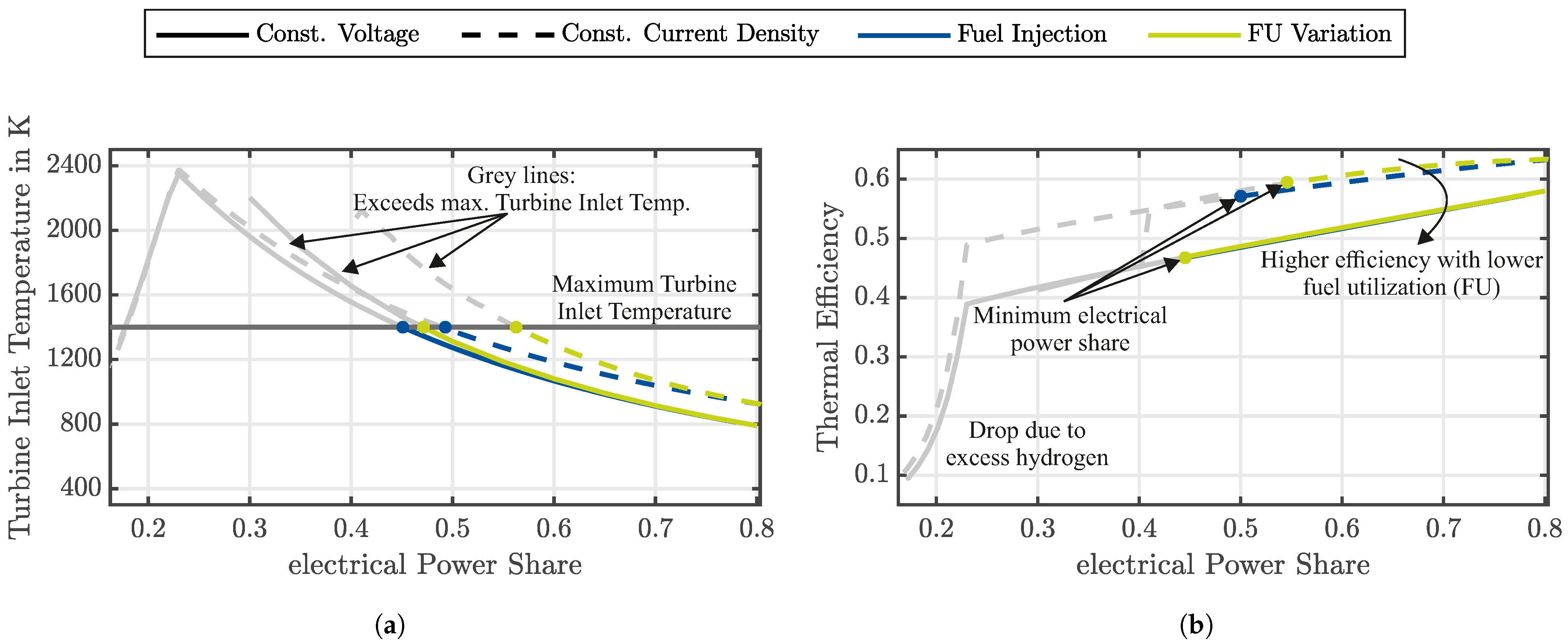
Achieving a lower power share in a directly coupled SOFC–GT architecture necessitates an increase in mechanical turbine power. Increasing the mechanical power in general can be done by either an increase in mass flow or a higher enthalpy change within the turbine (Section 2). Since the air mass flow is defined by the SOFC’s cooling requirement, the only free variable to increase the mechanical output power at otherwise constant operating conditions is the turbine inlet temperature. This section compares two strategies for achieving higher turbine inlet temperatures or a lower power share in a directly coupled SOFC–GT architecture: (i) increasing the turbine inlet temperature via supplemental fuel injection in the combustor, and (ii) reducing SOFC fuel utilization (FU), allowing more unreacted hydrogen to reach the combustor. Both strategies, shown in Figure 2, exhibit a monotonic trend: higher turbine inlet temperature enables lower power shares, but decreases the system efficiency since the electrochemical conversion is inherently more efficient than hydrogen combustion and subsequent conversion in a gas turbine. This results in the general characteristic that SOFC–GT systems with high electrical power shares and therefore low turbine inlet temperatures are most efficient.
For the comparison of both strategies, two SOFC operating conditions are shown. First, the SOFC operating condition with a fixed current density is considered. Here, the SOFC voltage and electrochemical efficiency increase due to the higher hydrogen partial pressure along the anode due to lower FU in order to reduce the power share. Therefore, the SOFC dissipative heat decreases and less air mass is required to maintain the temperature constraints compared to the strategy with additional fuel supply. The lower airflow raises the equivalence ratio in the combustion chamber causing the turbine inlet temperature to grow more steeply. As a result, the maximum TIT limitation is reached at a higher power share when the FU is decreased. However, at equal PS, the system efficiency is slightly higher (≈+1.0 to 1.5%) for reduced FU due to the higher SOFC voltage. At fixed cell voltages, the potentially higher efficiency from the reduced FU is converted into a higher current density and therefore power per cell. This partly offsets the previously described effect as more heat is released at a constant SOFC efficiency and more airflow is required to fulfill the cooling requirement. Still, as a result of both overlapping effects, the maximum TIT is reached at a higher power share when the FU decreases compared to the additional fuel supply. Overall, it can be stated that the difference between the two power share reduction strategies is low. Especially, because of the low benefit in efficiency and the earlier limitations of minimum power share, the subsequent sections focus on the supplemental fuel strategy as the primary lever for PS control.

3.2. Effect of Cell Voltage

The results presented here and in the following pertain to the supplemental fuel injection strategy. Reduction of the SOFC’s fuel utilization (FU) is not used for power share control in these sections as the FU is kept constant at 75%. The pressure ratio for the variation in cell voltage is set to 10. To maintain the respective target cell voltage, the current density is adjusted accordingly. The power share is swept by changing the supplemental combustion chamber fuel flow. The minimal power share window for each parameter setting is defined with the lowest feasible PS under the turbine inlet temperature limitations. The maximum power share is the upper endpoint which corresponds to operation without additional fuel injection. In this case, the combustion chamber only oxidizes the unconverted hydrogen from the SOFC anode off-gas. The turbine inlet temperature then reaches its minimum, which is determined by the cathode airflow required to satisfy the SOFC’s temperature difference constraint of Δ T = 150 K, together with the amount of unreacted fuel implied by FU.
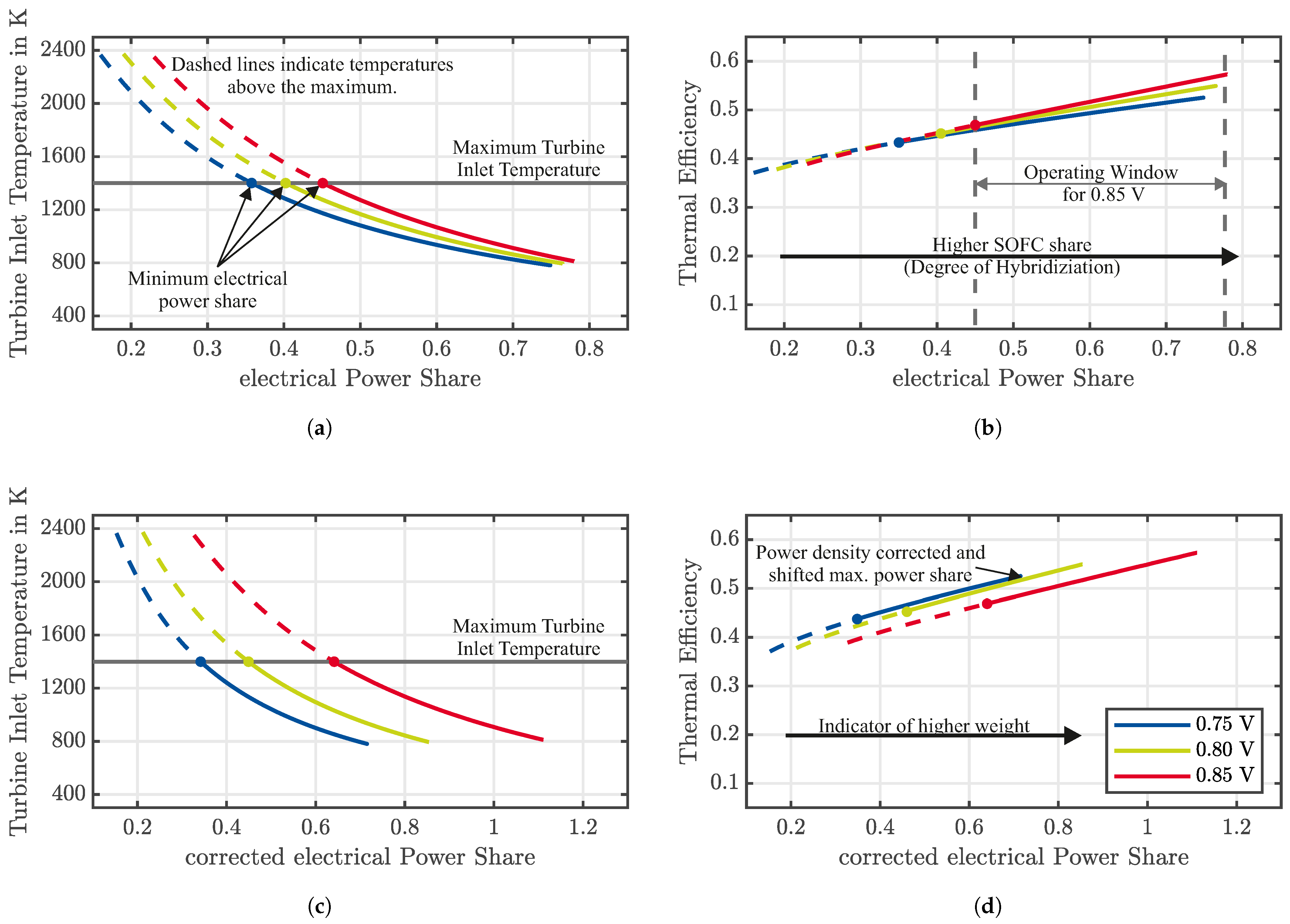
With a fixed OPR, an increase in cell voltage is accompanied by a significantly lower current density and thus lower power per cell. At the same time, a higher cell voltage leads to an increase in SOFC efficiency (Table 2). As a result, the SOFC heat release decreases, and therefore the cathode airflow per cell drops due to the fixed Δ T constraint. This reduced airflow leads to a higher equivalence ratio of the combustion chamber. Therefore, the combustor exit temperature, and thus the TIT, increases more rapidly as the PS decreases. Consequently, the TIT upper limit is reached at a higher PS, and the minimal power-share window shifts upward. Across the examined voltage range, the minimum operating power share varies from 36% to 45% (Figure 3a). The system thermal efficiency at these points ranges from 44% to 47% (Figure 3b).The resulting operating window, exemplarily shown for a cell voltage of 0.75 V, corresponds to a PS range of 39%. A dominance shift is observed in the power share: at moderate-to-high PS, SOFC efficiency dominates, and higher cell voltage yields higher system efficiency. As PS decreases and the gas turbine contribution becomes dominant, the trend reverses at a power share of ≈35%. Here, a lower cell voltage becomes system-optimal because the associated operating conditions favor a higher gas turbine efficiency, which then dominates system efficiency. This means that for high degrees of hybridization, high cell voltage translates into high thermal efficiency. Small degrees of hybridization, on the other hand, tend to favor lower voltages due to better operating conditions for the gas turbine, even if the difference here is small.
However, comparing the identical values using the power density corrected power share as an indicator of the system weight reveals further important insights (Figure 3c,d). The higher system efficiency at high cell voltages is maintained, while the effect of reduced power density due to lower current densities at high cell voltages now becomes noticeable. Since the efficiency gain with higher voltages is smaller than the loss in power density of the cells, the corresponding efficiency shifts to higher corrected power shares. This means that now, for a given corrected power share and therefore approximated weight, operating settings with low cell voltages yield higher overall system efficiencies due to higher SOFC power density.

3.3. Effect of Pressure Ratio

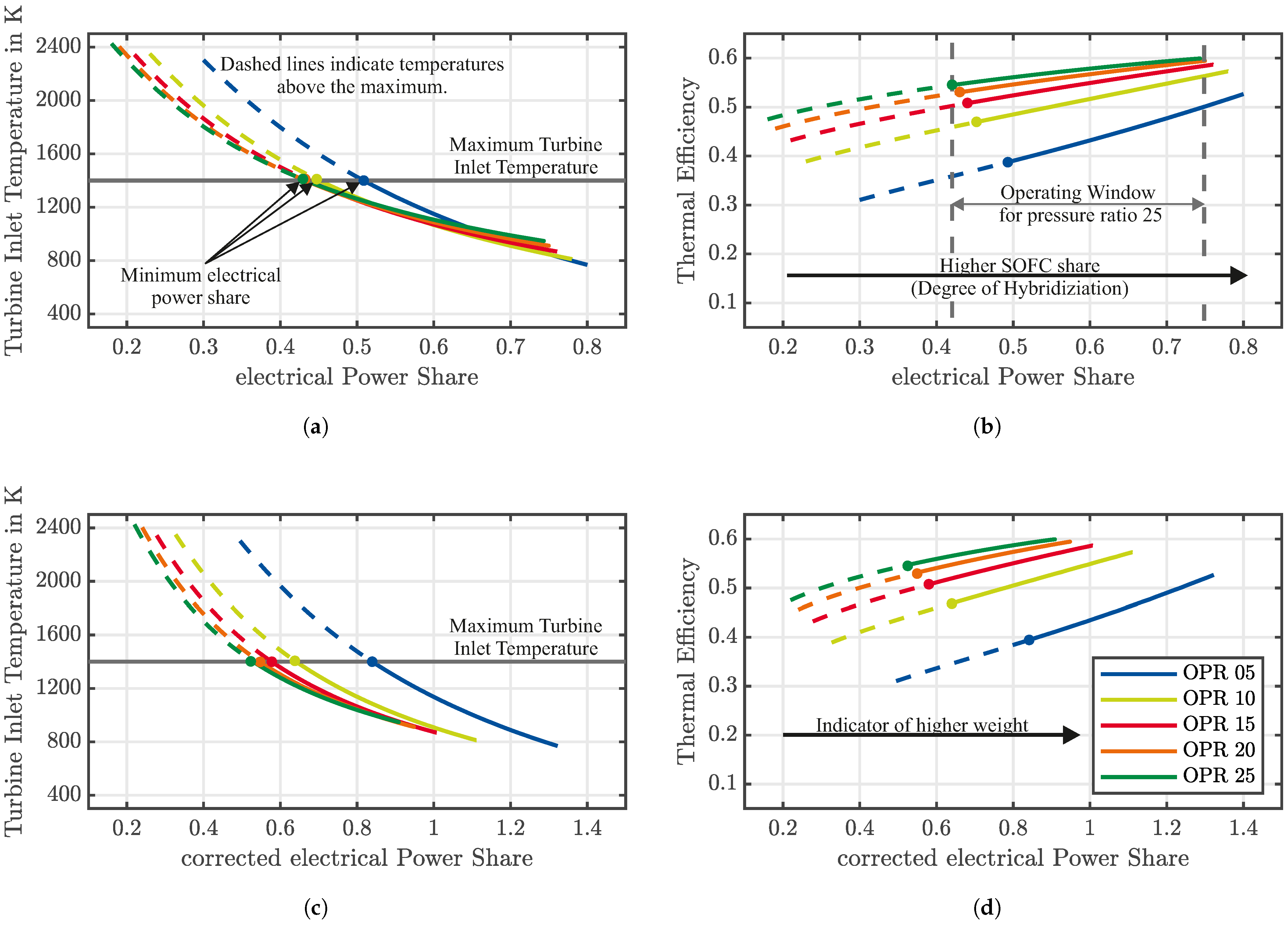
At a fixed cell voltage (0.85 V), increasing the OPR increases the Nernst potential, which depends logarithmically on pressure (see Section 2.1.1). Maintaining the same cell voltage leads to an increase in current density. This raises the stack’s dissipative heat release, necessitating higher cathode airflow to keep the cell temperature difference ( Δ T) within the defined limits (Table 3). The larger air mass flow resulting from this process increases the overall air-to-fuel ratio, meaning the TIT limit is reached at lower PS. Thus, the minimal power share window shifts downward from a power share of ≈51% at OPR = 5 to ≈43% at OPR = 25 (Figure 4a). It also narrows at higher OPR, consistent with the logarithmic pressure dependency of the Nernst potential. The system’s thermal efficiency (Figure 4b) increases significantly with OPR due to the gas turbine cycle benefit, while the SOFC efficiency remains essentially constant due to the fixed cell voltage. The resulting efficiencies at the respective lower power shares windows are 39% at OPR = 5 and 54.7% at OPR = 25 (lower endpoint), as well as 52.7% at OPR = 5 and 60% at OPR = 25 (upper endpoint).
Unlike previous cell voltage variation, changes toward higher pressure ratios and operating pressure lead to higher SOFC power density and especially system efficiency, as both the SOFC and the gas turbine benefit from higher pressures. The simultaneous increase in power density and efficiency means that even when considering the corrected power share in Figure 4c,d, the trends observed previously remain unchanged. The efficiency of the system increases for all corrected PS with the pressure ratio. However, the corrected PS now reveals the significant differences in power density when the pressure ratio varies. The maximum power share is 74% ( η sys = 60%) at a pressure ratio of 25 and 80% ( η sys = 52.7%) at a pressure ratio of 5, which corresponds to a relative decrease of −7.5%. However, if the corrected maximum power share is considered, there is a relative difference of +48% (132% at OPR = 5 to 91% at OPR = 25). This means that due to the lower power density at low-pressure, the estimated weight would increase by more than 40%-points, underlining the benefit of higher operating pressures. Table 4 summarizes the qualitative trends for directly coupled SOFC–GT architectures. For each sensitivity study, it compares the changes in turbine inlet temperature and thermal efficiency for a given power share and corrected power share.

4. Indirect Coupling of SOFC–GT Systems

4.1. Effect of Cell Voltage

This section analyzes the indirectly coupled SOFC–GT configuration, in which a controllable bypass airflow increases the core flow after the SOFC (Figure 1). Cell voltage variation is used to adjust the operating efficiency and cooling demand of the SOFC, while the turbine inlet temperature is limited by the same maximum as in the previous chapter (1400 K). For power shares above the minimum power share of the directly coupled system (Section 3), the bypass remains closed, and the architectures coincide. Since the main characteristic changes between the power share and corrected power share are explained in the previous section and remain the same, the following section will only refer to the corrected power share.
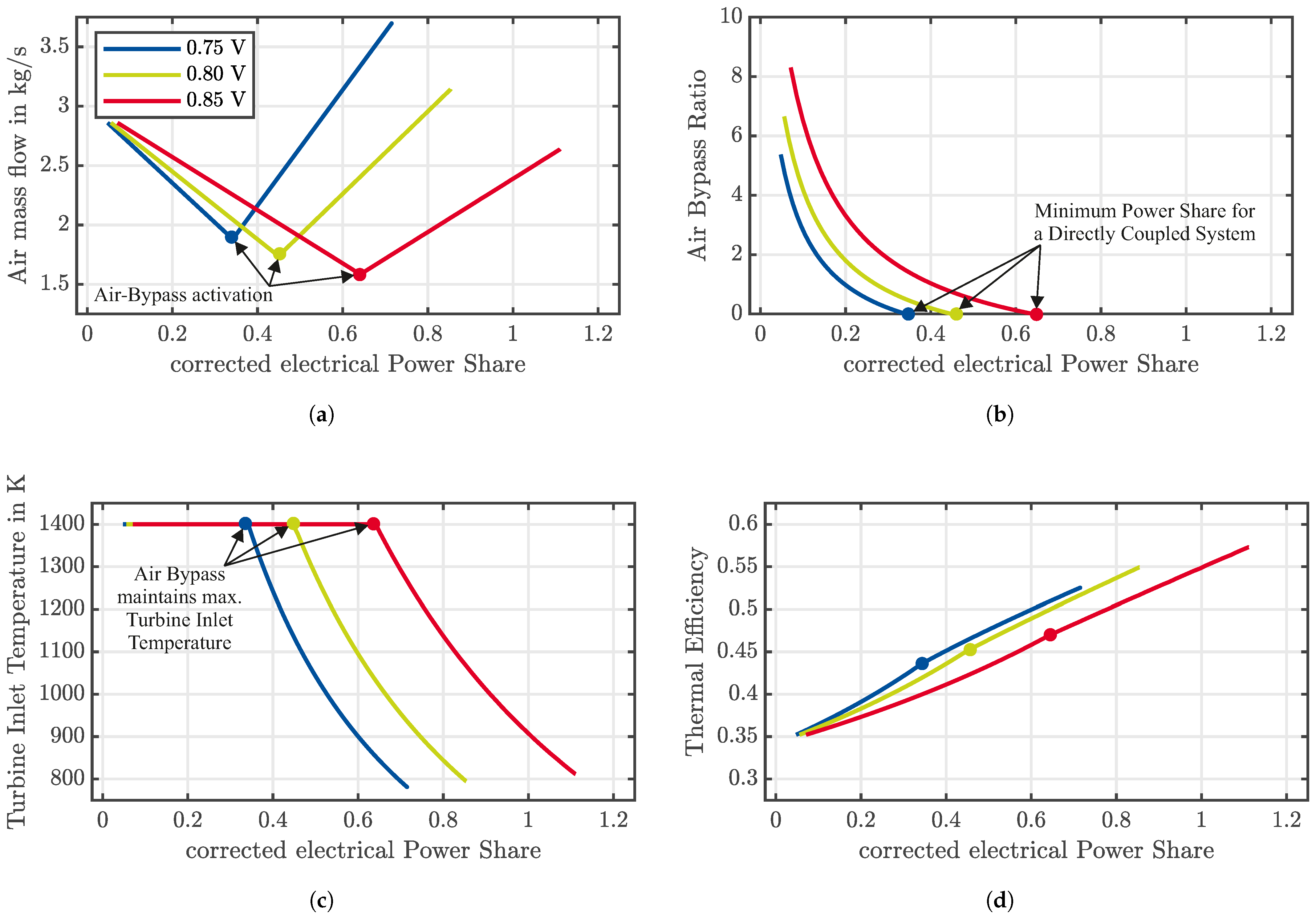
Once the power share is reduced to its minimal, directly coupled value, the bypass activates to maintain the prescribed turbine inlet temperature limit of 1400 K (Figure 5a,b). From this point onward, an additional air mass flow is admitted to the system. The overall mass flow is split into two streams: (i) the SOFC path, which is still governed by the cooling constrains of the SOFC, and (ii) the bypass stream, which is adjusted to deliver the required mechanical turbine power at the fixed turbine inlet temperature for the defined power share. This control mechanism causes an initial trend reversal: while the total mass flow decreases with power share in the directly coupled configuration (SOFC–GT characteristic), it increases with a further reduction in power share once the bypass is engaged, which is a classical characteristic of gas turbines.
In general, the characteristics with changes in cell voltage remain the same as described in Section 3.2. Due to the higher dissipative heat at lower voltages and the corresponding changes in the air-to-fuel ratio, the bypass activation starts at lower power shares in order to maintain the maximum turbine inlet temperature of 1400 K (Figure 5c). After activation of the air bypass, a change in the resulting efficiency curves can be observed. For the directly coupled case, the system efficiency decreases convexly with power share, meaning that the decline steepens with rising turbine inlet temperature or lower power shares, shown in Figure 5d. For the indirectly coupled configuration, the efficiency decline becomes concave. Thus, efficiency degrades more mildly with power share. Similarly to the previous chapter, the configuration with the lowest SOFC cell voltage is in favor with respect to the efficiency at a certain corrected power share (weight) for both the indirectly and directly coupled regime. However, a high degree of hybridization represented by high (corrected) power shares and therefore lower turbine inlet temperatures offer the highest overall system efficiencies.
In summary, for power shares above the directly coupled minimal value, there is no difference between direct and indirect coupling because the bypass is inactive. Below this threshold, the bypass enforces the turbine inlet temperature constraint by adding air, shifting the system into a gas-turbine-dominated regime, and increasing the total air mass flow. The efficiency curves for different cell voltage converge, and the efficiency decline with power share changes from convex (direct coupling) to concave (indirect coupling). These results imply that indirect coupling effectively removes the inherent minimal power share limit imposed by the turbine inlet temperatures in direct coupling at the cost of overall system efficiency.

4.2. Effect of Pressure Ratio

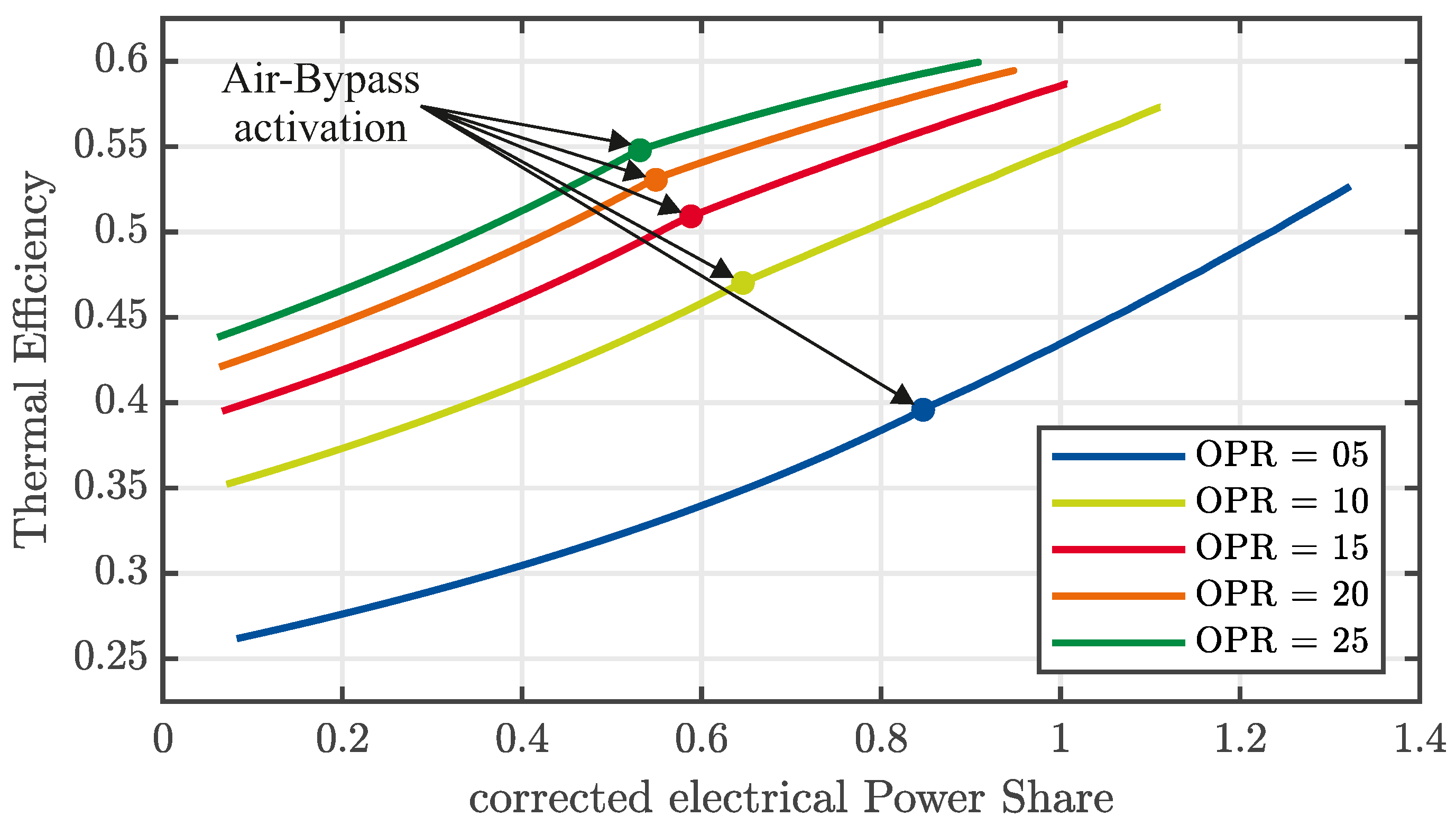
Building on the previous section, the effect of the pressure ratio on the indirectly coupled SOFC–GT system at a fixed SOFC cell voltage is examined. For corrected power shares above the directly coupled minimum, similarly to the previous section, the bypass remains inactive, thus there is no difference between the two architectures. Below that threshold, the bypass is active and the mass flow is scaled in order to achieve the required power share for the fixed turbine inlet temperature. Across the examined range, increasing the power share raises the system’s thermal efficiency in both the bypass-inactive and bypass-active regimes (Figure 6). This is consistent with the classical Brayton-cycle behavior at a given turbine inlet temperature. As with the direct coupling results (Section 3.3), the qualitative shape of the efficiency curves remains the same: above the bypass threshold, efficiency decreases convexly with decreasing power share. Below the threshold (bypass active), the efficiency decline becomes concave because additional turbine power is delivered via an increase in air mass flow at a fixed turbine inlet temperature rather than a further temperature rise. However, the qualitative trend that the GT behavior dominates the system behavior due to constant SOFC efficiency remains and can be seen by the increasing efficiency with higher pressure ratio for each corrected power share. Again, increased operating pressures lead to both more efficient and lighter systems.

4.3. Effect of Turbine Inlet Temperature

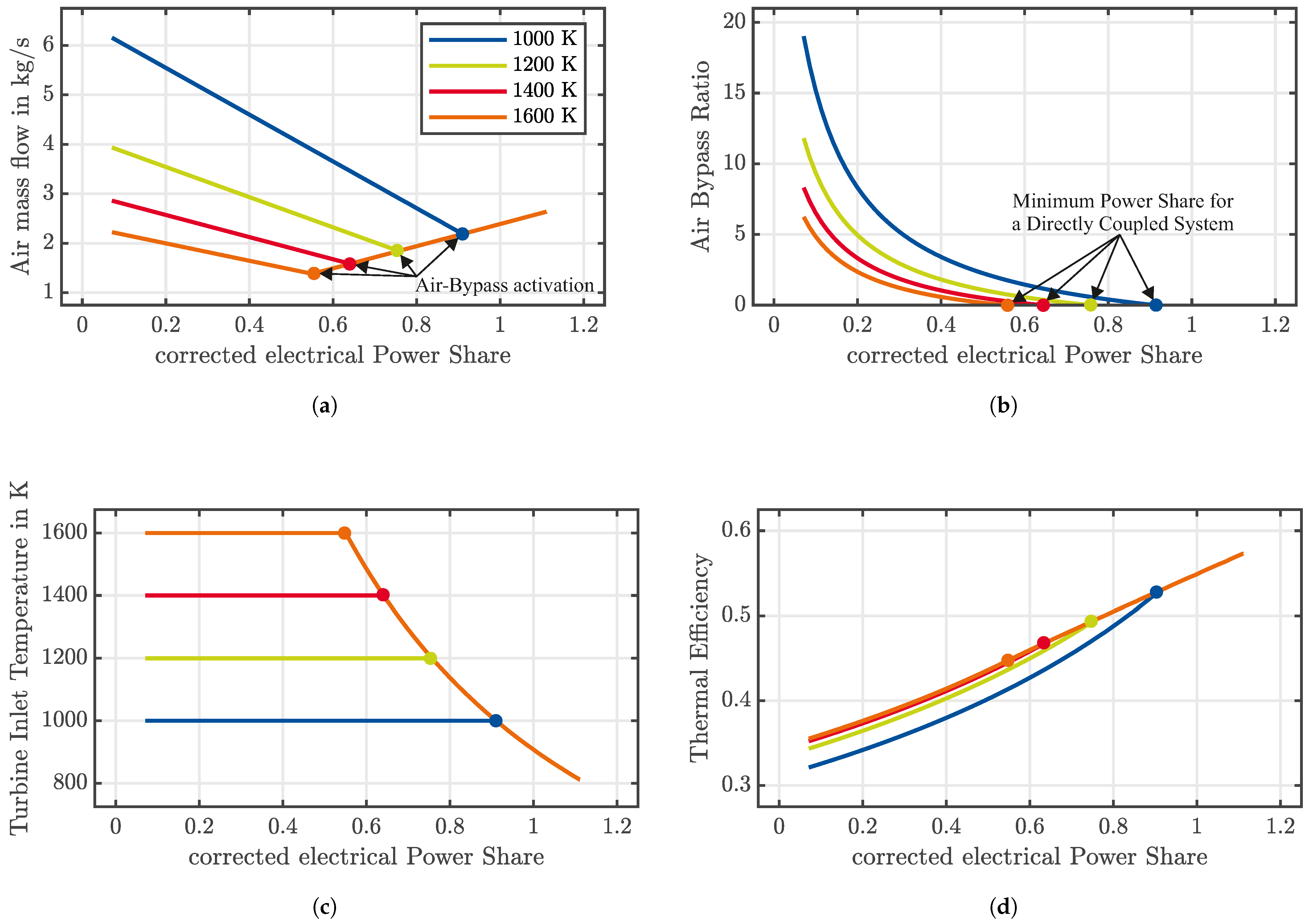
In contrast to the previous sections, the maximum turbine inlet temperature is not held constant but varied. The SOFC cell voltage and pressure ratio are set constant ( U cell = 0.85 V, OPR = 10). In the previous analysis, the turbine inlet temperature was limited to 1400 K. Here, it is treated as a setpoint parameter, varying between low temperatures (1000 K, for high SOFC–GT efficiency) and high temperatures (1600 K, for high gas turbine efficiency). Thus, the bypass is activated when the turbine inlet temperature for a specific power share would overcome the respective limit of turbine inlet temperature as increasing TIT decreases the minimum power share of the directly coupled system (Figure 7c).
Since the OPR is fixed, a higher TIT yields a higher change in the specific enthalpy and thus turbine-specific work. Figure 7a shows that once the bypass is active, higher TIT setpoints reduce the total air mass flow required to achieve a given power share. The total flow splits into the SOFC path, which is still governed by the Δ T cooling requirement and scales with the number of SOFC cells, and the bypass stream (Figure 7b). The bypass stream is adjusted to deliver the required mechanical turbine power at the fixed TIT. Since a higher TIT increases the turbine’s specific enthalpy drop, less mass flow is needed to provide the same turbine output power. Consequently, the mass flow is smaller with higher TIT at a given power share in the bypass-active regime.
The efficiency response shows a distinct reversal compared to the direct coupling. In a directly coupled architecture, lowering the power share requires increased turbine inlet temperatures, which shifts a larger fraction of the total fuel conversion from the fuel cell to the gas turbine. This leads to a lower system efficiency, as can be seen in the directly coupled regime in Figure 7d for the bypass-inactive regime and in Section 3. However, after the bypass engages the indirect coupled architecture, the behavior changes. At a given power share, higher turbine inlet temperature setpoints yield higher system efficiency. This trend is consistent with Brayton-cycle behavior at a fixed OPR, where increased TIT improves cycle efficiency until certain thermodynamic limits are reached. Table 5 summarizes the key findings from this and the preceding section of Section 4 and qualitatively assesses how variations in the independent variables affect two key metrics: turbine inlet temperature and thermal efficiency.

5. System Architectures Comparison

This chapter compares two SOFC–GT architectures that differ in how the compressor discharge air is preheated prior to entering the SOFC: (i) Cathode exhaust utilization (Section 2, Figure 1a), in which thermal energy from the SOFC cathode off-gas is transferred to the incoming air, and (ii) exhaust recuperated preheating, in which thermal energy is extracted from the low-pressure turbine exhaust (Section 2, Figure 1b). In theory, the architecture utilizing the LPT exhaust for heat integration can attain higher thermal efficiency because preheating draws on thermal energy extracted at the end of the Brayton cycle. This avoids any temperature or enthalpy reduction within the core flow upstream of the turbines, which also directly influences the power share. However, the LPT utilization cycle’s feasible operating settings are inherently constrained by the requirement that the LPT exhaust temperature must exceed the SOFC air-inlet temperature target by a sufficient margin to enable effective heat transfer. This condition depends sensitively on the overall pressure ratio (OPR). At a higher OPR and a given turbine inlet temperature, the LPT exhaust temperature decreases. This tightens the recuperator pinch and shifts or narrows the feasible OPR range. Furthermore, the tightened recuperator pinch results in a reduced log-mean temperature difference (LMTD) across the recuperator. This results in a substantial increase in the required heat-transfer area unless the required SOFC inlet temperature decreases. Previous initial sizing calculations indicated that the heat-transfer surface area would increase by a factor of 4 to 10 compared to the cathode utilization cycle [39]. This increase would result in associated mass and volume penalties, which are particularly relevant for aerospace applications.
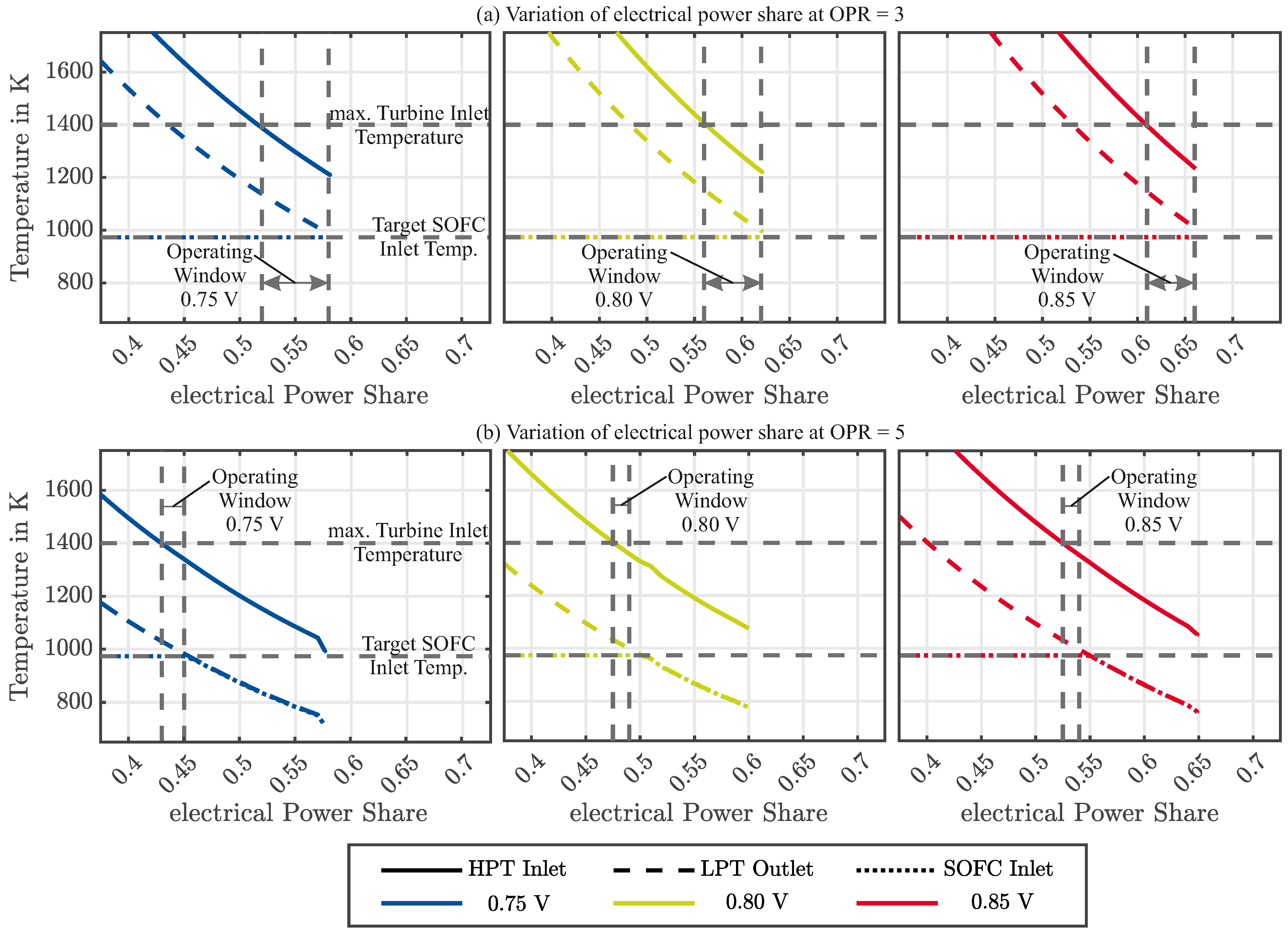
The comparison of the two system configurations takes place under conditions that are as similar as possible. For this purpose, fuel utilization is set at 75%, the cell voltage is varied between 0.75 V and 0.85 V, and the power share is reduced by means of additional fuel injection. Consistent with prior results, the admissible OPR window is bounded by thermodynamic and heat exchanger constraints. Figure 8 shows the turbine inlet temperature, the LPT outlet temperature, and the resulting thermal efficiency of the directly coupled variant for the variation in the power shares at different cell voltages and a design pressure ratio of 3. Here, no restriction on preheating occurs even at the highest power share. Without any additional fuel combustion (highest power share), it is clearly visible and captured in Table 6 that due to excess fuel combustion alone, the resulting TIT is low compared to conventional gas turbine engines. However, contrary to conventional gas turbine engines, the LPT outlet temperature (thus the heat exchanger hot-side inlet) is restricted, since it must be above the required SOFC inlet temperature. The resulting pinch for the heat exchanger at this point is between 13 K and 33 K, depending on the cell voltage (Table 6). An increase in the pressure ratio under the given operating conditions would reduce the LPT outlet temperature; this would prevent the required preheating.
However, a reduced power share (increased TIT) leads to a higher LPT outlet temperature and therefore a higher HEX pinch temperature in the range of 160 K to 180 K. For comparison, when utilizing the cathode’s exhaust for heat integration, the pinch is defined by the SOFC temperature difference (150 K). This leads to smaller HEX sizes, which are comparable to the previously analyzed system architecture. The efficiency range here is between 52% and 61% and therefore also in the same range as described in Section 3 for the utilization of the cathode’s exhaust for heat integration. A potential increase in OPR due to higher TIT would lead to a higher efficiency, but is still limited by the heat exchanger pinch temperature. As shown in Figure 8b, the increased OPR leads to an LPT outlet temperature below the required SOFC inlet temperature. As a result, the feasible operating windows under the here taken assumptions are reduced compared to the results with an OPR of 3. Hence, the preheating through this heat integration method is only feasible for a small operating window depending on the SOFC voltage. Beside the dependence of pressure ratio and heat exchanger pinch temperature, the general trend from the previous analysis regarding the increased turbine inlet temperature at lower power shares remains similar.
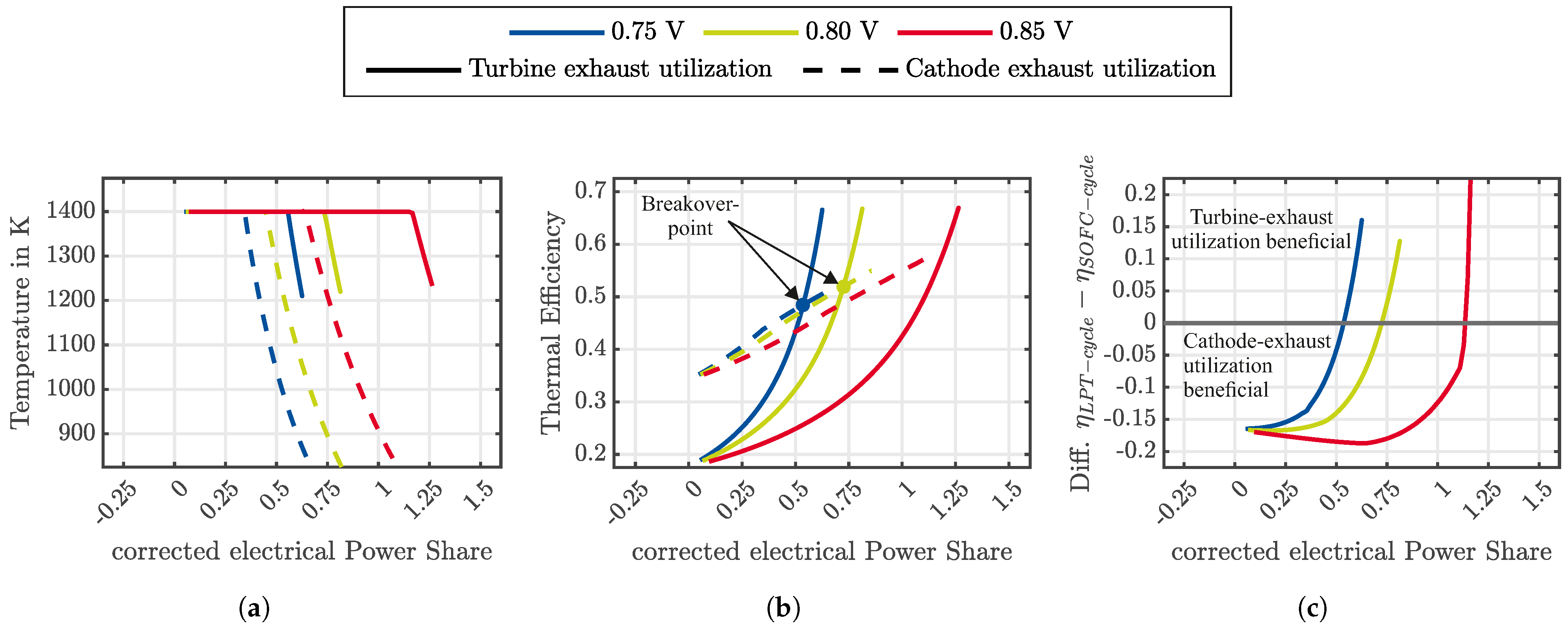
Adding the air bypass to the LPT utilization system helps to overcome the limitation in terms of minimum power shares. The bypass mechanism maintains a constant turbine inlet temperature as well as a constant LPT outlet temperature, due to the assumed constant pressure ratio of 3. However, the comparison between the two different heat integration methods in the context of corrected power share (weight indicator) versus efficiency trade-offs remains interesting (Figure 9). Due to the constraints of heat integration, the comparison is not done at identical pressure ratios and the pressure ratio of the cathode’s exhaust utilization cycle is set to 10. Although the pressure ratio of 10 is more than three times higher here, the maximum efficiency of the cathode exhaust utilization cycle remains lower compared to the LPT exhaust utilization. The general trend that a higher operating cell voltage leads to higher corrected power shares (indicating higher weight), remains the same for both architectures (Figure 9a,b). However, looking at each operating voltage, a breakover point can be observed. The cathode utilization for heat integration yields a higher efficiency at the same corrected power share. This breakover point can be found at the corrected power shares of 0.54 (0.75 V) and 0.72 (0.80 V) with the respective efficiencies of 48.4% (0.75 V) and 51.9% (0.80 V). For a cell voltage of 0.85 V, there is no breakover point since at the maximum corrected power share with cathode exhaust utilization, the efficiency is higher compared to the LPT exhaust utilization. However, at corrected power shares beyond the maximum point, the efficiency of the LPT utilization cycle is higher. For corrected power shares below the breakover point, the efficiency gap starts to increase (Figure 9c). Under the assumptions established in this study, at each respective cell voltage, the recuperator cycle (LPT exhaust utilization) with bypass emerges as the better architecture for high-corrected power shares, indicating higher allowable weight. It is worth to note that the influence of the gravimetric power densities of the turbines with respect to the varying temperature levels was not explicitly factored into this specific comparison. Additionally, the increasing heat exchanger size is not taken into account. However, in the regime of low-to-medium corrected power shares, the SOFC utilization cycle emerges as the better option. Here, at a given corrected power share, the efficiency of this cycle outperforms the efficiency of the recuperator cycle.

6. Conclusions and Future Perspectives

Solid Oxide Fuel Cell–Gas Turbine (SOFC–GT) hybrid systems represent a highly promising alternative for future aircraft propulsion concepts due to their exceptional efficiency of possibly more than 60%. This increased efficiency is due to the effective electrochemical fuel conversion and the synergy with the re-utilization of the high temperature waste heat of the SOFC within the gas turbine. However, the current technological limitation lies in the low gravimetric power density of SOFC stacks. Consequently, the chosen power share between fuel cell and turbines becomes a critical design variable directly influencing the overall system weight.
The power share can be adapted by an adjustment of the turbine inlet temperature. As demonstrated in the results, directly coupled SOFC–GT systems impose a minimum power share that cannot be undercut under the given assumptions. For an overall pressure ratio of 10 and a maximum turbine inlet temperature of 1400 K, the minimum power share ranges from 36% to 45%. The associated efficiencies range from 44% to 47%. When the overall pressure ratio is varied from 5 to 25 at a fixed cell voltage of 0.85 V, the minimum power share decreases from 51% to 43%, with efficiencies between 39% and 55%. If system weight constraints necessitate designing the engine below this minimum (corrected) power share, the introduction of a bypass mechanism might become a valuable design choice. Due to the bypass, the operating conditions and especially the SOFC temperature constraints can be set independently of the gas turbine constraints on air mass flow. The SOFC and GT systems are therefore indirectly coupled.
The results have clearly shown the different system characteristics between the directly coupled and the indirectly coupled system. It is worth recapping that the indirectly coupled (bypass-active) regime shows similar characteristics in terms of the effects of the pressure ratio and turbine temperature levels as a conventional gas turbine system. This implies that within the investigated design space, higher OPR as well as higher turbine inlet temperatures correspond with higher system efficiency. At a corrected power share of 0.60, increasing the maximum turbine inlet temperature from 1000 to 1400 K raises the efficiency from 42.6% to 45.7% This trend is reversed for the directly coupled system. Here, the highest system efficiency is reached with a rather low turbine inlet temperature as the electrical power share and therefore the power proportion of the highly efficient fuel cell dominate the system behavior. Increasing the turbine inlet temperature, thereby decreasing the power share, results in a monotonic decrease in efficiency.
However, using the electrical power share, describing the degree of hybridization, is only sufficient for constant SOFC power densities. Since changing operating conditions, e.g., pressure and cell voltage, imply a change in power density, a correction needs to be applied. For the SOFC model used here, at an OPR of 10, the power per cell is 62.8 W at 0.75 V. Increasing the cell voltage to 0.85 V decreases the power per cell to 42.2 W (−32.8%). By contrast, the efficiency increases by 10.9% (relative), from 45.9% (0.75 V) to 50.9% (0.85 V). For this reason, this study proposes a corrected power share, setting the actual SOFC power density in relation to a reference power density. Using this methodology results in a change to the system’s overall characteristics. Since the increase in power density with lower cell voltages is higher than the loss of efficiency, at a given corrected power share the efficiency is now highest for low cell voltages. If the power density of the SOFC is sufficiently high or a high weight can be afforded, increased operating voltages still correspond with higher efficiencies. The trend of increased efficiency with higher pressure ratios remains.
While the bypass reduces the system’s efficiency compared to the purely directly coupled optimum, the resulting hybrid still offers a significant efficiency increase over a conventional gas turbine system. Crucially, the bypass introduces flexibility in the design point power share, allowing engine designers to strategically trade-off system efficiency for favorable weight adjustment. It is unequivocally confirmed that the directly coupled system always yields the highest overall efficiency. Therefore, the indirectly coupled SOFC-GT system is rather not the long-term optimal solution from a thermodynamic point of view, but rather a short-to-medium-term alternative that provides essential power share flexibility, even with moderate SOFC power density. With continued advancements in SOFC power density, the long-term objective remains the implementation of the directly coupled configuration to achieve maximum efficiency gains in propulsion technology.
Beyond providing design flexibility, the introduction of a bypass also offers significant potential advantages concerning the off-design performance and control of the system. Given that the highest air preheating demand occurs at the cruise flight phase (due to lower ambient temperature), only the cruise point was considered for the system design analysis presented here. However, it is well known that the resulting air mass flow differs significantly between various operational points along the flight phases. Since the mass flow in the directly coupled system dictates the thermal management of the fuel cell stack, the ability to regulate it becomes paramount. An insufficient mass flow rate would lead to an increase in the temperature difference ( Δ T) across the SOFC, resulting in detrimental thermo-mechanical stresses that can cause cell failure. Conversely, a higher mass flow rate would decrease the Δ T, mitigating thermal stress but potentially increasing the internal resistance of the SOFC, which could cause a corresponding voltage drop. A detailed, off-design and transient analysis and its effect on SOFC integrity is therefore required.
In addition to the results regarding the bypass, a comparison of the system architectures utilizing either the cathode’s exhaust or the LPT exhaust is performed. Due to the required high LPT outlet temperature, the LPT cycle is only feasible for low-pressure ratios (3 to 5 within this study). Only electrolyte-supported SOFCs were investigated, as they require the highest operating temperatures and thus constitute the most demanding case for heat integration. If the required SOFC inlet temperature can be reduced, e.g., by the use of anode- or metal-supported SOFCs, this effect can be slightly relaxed. However, the required inlet temperature will stay in the range of 870 K, meaning that the pressure ratios will remain limited. Further studies comparing different SOFC support structures are needed to accurately assess the effect of the fuel-cell operating temperature. Due to the absence of a temperature or enthalpy sink upstream of the turbine, the LPT cycle in general performs better in terms of efficiency and requires a lower number of cells to achieve the same system output power. The achieved peak efficiency within this study was 67%. However, a steep decrease in efficiency can be observed for decreased power shares. Thus, this cycle is only beneficial for high-corrected power shares. If a low-to-medium-corrected power share is required, the SOFC utilization cycle becomes the better option due to a higher efficiency with a difference of up to 19%-points. It is worth noting that the implications of the limited pressure ratio to the power density of the turbomachinery and therefore the weight of the system are, as well as the implications for the heat exchanger, not taken into account. For a broad operating range, the cycle utilizing the cathode’s exhaust performs better with less potential negative implications for the different components.


Author Contributions

Conceptualization, P.K.; methodology, P.K.; software, P.K., J.H. and A.T.; validation, P.K., J.H. and A.T.; formal analysis, P.K., J.H. and A.T.; investigation, P.K., J.H. and A.T.; data curation, P.K.; writing—original draft preparation, P.K.; writing—review and editing, J.H., A.T., M.P.H. and S.K.; visualization, P.K. and J.H.; supervision, M.P.H. and S.K.; project administration, M.P.H. and S.K.; funding acquisition, M.P.H. and S.K. All authors have read and agreed to the published version of the manuscript.

Funding

This work was funded by the European Union under the grant agreement number 101137583. The views and opinions expressed are however those of the author(s) only and do not necessarily reflect those of the European Union or CINEA. Neither the European Union nor the granting authority can be responsible for them.

Data Availability Statement

The data presented in this study are openly available in the Research Data Repository Leibniz University Hannover (LUH) [56].

Acknowledgments

During the preparation of this manuscript, the authors used LUHKI2 https://luhki2.uni-hannover.de/ in order to correct potential grammar mistakes and improve the readability of the text. The authors have reviewed and edited the output and take full responsibility for the content of this publication. The authors thank Markus Richter (Institute of Thermodynamics, Leibniz University Hannover) for his ongoing support of this study.

Conflicts of Interest

The authors declare no conflicts of interest.

Appendix A. Cross-Validation

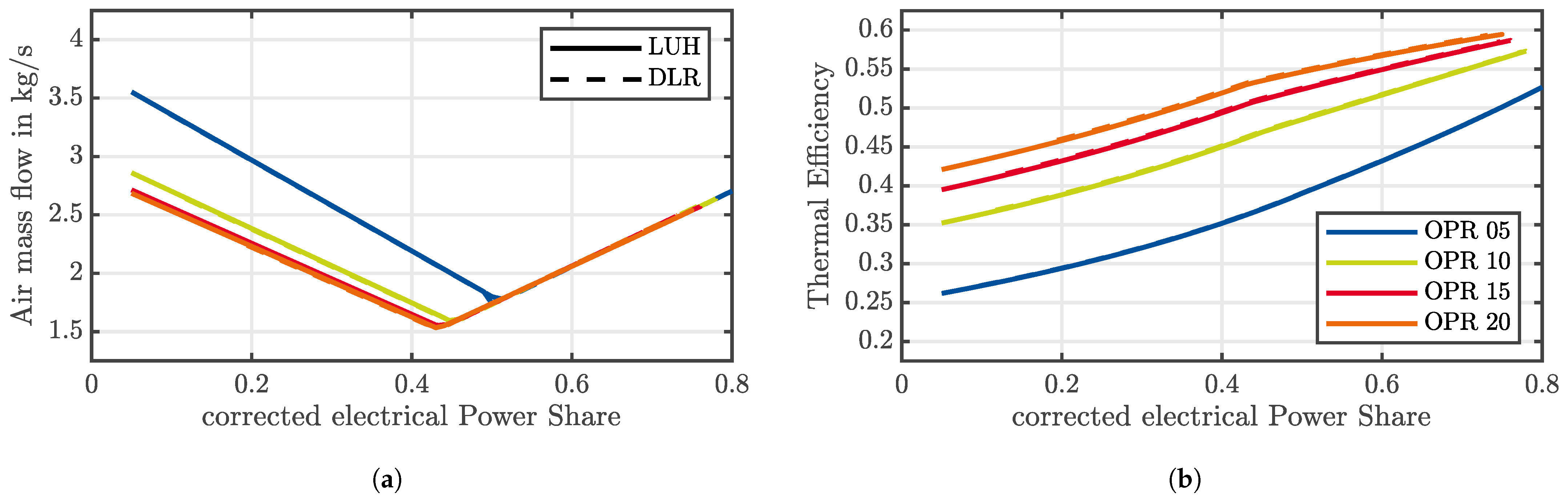
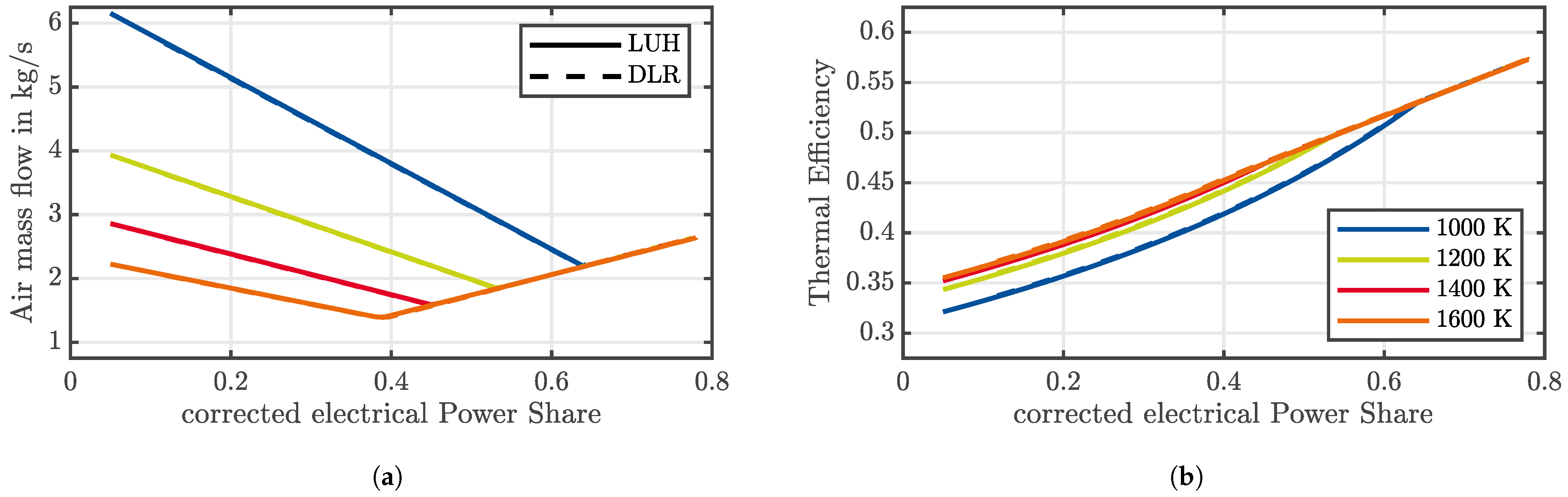
In the absence of experimental reference data, the obtained results were cross-validated using two independently developed simulation frameworks. The first model, implemented in MATLAB/Simulink at Leibniz University Hannover (LUH), and the second, developed in Modelica at the German Aerospace Center (DLR), were configured separately to ensure methodological independence and avoid cross-dependencies that could bias the comparison. This approach allows a robust consistency check of the underlying physical models and numerical solvers. The model consistency check for cross-validation is done for:
  • The variation in cell voltage for constant pressure ratio (10) and a maximum turbine inlet temperature of 1400 K;
  • The variation in the pressure ratio for constant cell voltage (0.85 V) and a maximum turbine inlet temperature of 1400 K;
  • The variation in the turbine inlet temperature with constant pressure ratio (10) and cell voltage (0.85 V).
The SOFC inlet temperature is set to 973 K with a temperature difference of 150 K. All cross-validations are done for the SOFC–GT architecture utilizing the cathode’s exhaust gas for heat integration. The comparison of the simulation results is performed for the resulting system thermal efficiency and the required air mass flow within the investigated power share range. Since the simulations were not performed at the same power share intervals, an interpolation is performed for a better comparison. Table A1 shows the calculated mean and maximum deviations between the simulation frameworks. Figure A1, Figure A2 and Figure A3 show the direct comparison of the variation in cell voltage, pressure ratio, and turbine inlet temperature.
Both models exhibit excellent agreement across air mass flow rate and thermal efficiency. The mean deviations are below 1% across all compared values. For the air mass flow comparison, a maximum deviation of 3.35% occurs within the variation in the pressure ratio and 1.76% within the cell-voltage variation. For both cases, this maximum deviation is located at the breakover point. The reason for this deviation might be an inaccuracy in the interpolation. However, together with the low mean deviation, a good agreement of the simulation output for both modeling frameworks can be reported.
Figure A1. Cross-validation comparison of (a) air mass flow and (b) thermal efficiency for the variation in cell voltage at a pressure ratio of 10 and a maximum turbine inlet temperature of 1400 K. SOFC inlet temperature is 973 K with a temperature difference of 150 K.
Aerospace 13 00263 g0a1
Figure A2. Cross-validation comparison of (a) air mass flow and (b) thermal efficiency for the variation in pressure ratio at a constant cell voltage of 0.85 V and a maximum turbine inlet temperature of 1400 K. SOFC inlet temperature is 973 K with a temperature difference of 150 K.
Aerospace 13 00263 g0a2
Figure A3. Cross-validation comparison of (a) air mass flow and (b) thermal efficiency for the variation in maximum turbine inlet temperature at a pressure ratio of 10 and a constant cell voltage of 0.85 V. SOFC inlet temperature is 973 K with a temperature difference of 150 K.
Aerospace 13 00263 g0a3
Table A1. Cross -validation results for mean and maximum deviations in mass flow and efficiency. If not varied, the pressure ratio is 10, cell voltage 0.85 V, and max. turbine inlet temperature 1400 K. The SOFC inlet temperature is 973 K with a temperature difference of 150 K. All values are relative in %.
Variation in Cell Voltage
Cell VoltageMean Δ m ˙ air Max. Δ m ˙ air Mean Δ η sys Max. Δ η sys
0.75 V0.491.760.190.41
0.80 V0.360.940.190.29
0.85 V0.280.700.210.30
Variation in Pressure Ratio
Pressure RatioMean Δ m ˙ air Max. Δ m ˙ air Mean Δ η sys Max. Δ η sys
50.233.350.090.13
100.280.700.210.30
150.340.630.210.30
200.370.900.350.46
Variation in Maximum Turbine Inlet Temperature (TIT)
Max. TIT in KMean Δ m ˙ air Max. Δ m ˙ air Mean Δ η sys Max. Δ η sys
10000.280.820.210.30
12000.230.600.200.27
14000.280.700.210.30
16000.341.370.220.33

References

  1. Air Transport Action Group (ATAG). Supporting Economic & Social Development. 2025. Available online: https://atag.org/industry-topics/supporting-economic-social-development (accessed on 18 April 2025).
  2. Lee, D.S.; Fahey, D.W.; Skowron, A.; Allen, M.R.; Burkhardt, U.; Chen, Q.; Doherty, S.J.; Freeman, S.; Forster, P.M.; Fuglestvedt, J.; et al. The Contribution of Global Aviation to Anthropogenic Climate Forcing for 2000 to 2018. Atmos. Environ. 2021, 244, 117834. [Google Scholar] [CrossRef]
  3. European Commission. Flightpath 2050: Europe’s Vision for Aviation; Policy/European Commission, Publications Office of the European Union: Luxembourg, 2012. [Google Scholar]
  4. Clean Sky 2 JU & FCH 2 JU. Hydrogen Economics, and Climate Impact by 2050; Publications Office of the European Union: Luxembourg, 2020. [Google Scholar]
  5. Gopalasingam, D.; Rakhshani, B.; Rodriguez, C. Hydrogen Propulsion Technologies for Aviation: A Review of Fuel Cell and Direct Combustion Systems Towards Decarbonising Medium-Haul Aircraft. Hydrogen 2025, 6, 92. [Google Scholar] [CrossRef]
  6. Sain, C.K.; Hänsel, J.; Kazula, S. Conceptual Design of Air and Thermal Management in a Nacelle-Integrated Fuel Cell System for an Electric Regional Aircraft. In Proceedings of the AIAA AVIATION 2023 Forum, San Diego, CA, USA and Online, 12–16 June 2023. [Google Scholar] [CrossRef]
  7. Nozinski, M.; Meyer, P.; Delony, F.; Friedrichs, J.; Göing, J.; Kabelac, S. On the Design and Operation of the Thermal Management System of PEMFC-Powered Aircraft. Aerospace 2026, 13, 243. [Google Scholar] [CrossRef]
  8. Ferrari, M.L.; Damo, U.M.; Turan, A.; Sánchez, D. Hybrid Systems Based on Solid Oxide Fuel Cells: Modelling and Design, 1st ed.; Wiley: Hoboken, NJ, USA, 2017. [Google Scholar] [CrossRef]
  9. Azizi, M.A.; Brouwer, J. Progress in solid oxide fuel cell-gas turbine hybrid power systems: System design and analysis, transient operation, controls and optimization. Appl. Energy 2018, 215, 237–289. [Google Scholar] [CrossRef]
  10. Fernandes, M.D.; de P. Andrade, S.T.; Bistritzki, V.N.; Fonseca, R.M.; Zacarias, L.G.; Gonçalves, H.; de Castro, A.F.; Domingues, R.Z.; Matencio, T. SOFC-APU systems for aircraft: A review. Int. J. Hydrogen Energy 2018, 43, 16311–16333. [Google Scholar] [CrossRef]
  11. Seyam, S.; Dincer, I.; Agelin-Chaab, M. Novel hybrid aircraft propulsion systems using hydrogen, methane, methanol, ethanol and dimethyl ether as alternative fuels. Energy Convers. Manag. 2021, 238, 114172. [Google Scholar] [CrossRef]
  12. Okai, K.; Nomura, H.; Tagashira, T.; Nishizawa, A. Effects of Fuel Type on Aircraft Electric Propulsion with SOFC/GT Hybrid Core. In Proceedings of the 53rd AIAA/SAE/ASEE Joint Propulsion Conference, Atlanta, GA, USA, 10–12 July 2017. [Google Scholar] [CrossRef]
  13. Liu, H.; Qin, J.; Xiu, X.; Ha, C.; Dong, P. Comparative study of fuel types on solid oxide fuel cell – gas turbine hybrid system for electric propulsion aircraft. Fuel 2023, 347, 128426. [Google Scholar] [CrossRef]
  14. Peyrani, G.; Marocco, P.; Gandiglio, M.; Biga, R.; Santarelli, M. Solid oxide fuel cells for aviation: A comparative evaluation against alternative propulsion technologies. eTransportation 2025, 24, 100408. [Google Scholar] [CrossRef]
  15. McLarty, D.; Brouwer, J.; Samuelsen, S. Fuel cell–gas turbine hybrid system design part II: Dynamics and control. J. Power Sources 2014, 254, 126–136. [Google Scholar] [CrossRef]
  16. McLarty, D.; Brouwer, J.; Samuelsen, S. Fuel cell–gas turbine hybrid system design part I: Steady state performance. J. Power Sources 2014, 257, 412–420. [Google Scholar] [CrossRef]
  17. Haseli, Y.; Dincer, I.; Naterer, G.F. Thermodynamic analysis of a combined gas turbine power system with a solid oxide fuel cell through exergy. Thermochim. Acta 2008, 480, 1–9. [Google Scholar] [CrossRef]
  18. Ferrari, M.L. Solid oxide fuel cell hybrid system: Control strategy for stand-alone configurations. J. Power Sources 2011, 196, 2682–2690. [Google Scholar] [CrossRef]
  19. Rajashekara, K.; Grieve, J.; Daggett, D. Solid Oxide Fuel Cell/Gas Turbine Hybrid APU System for Aerospace Applications. In Proceedings of the Conference Record of the 2006 IEEE Industry Applications Conference Forty-First IAS Annual Meeting, Tampa, FL, USA, 8–12 October 2006; pp. 2185–2192. [Google Scholar] [CrossRef]
  20. Freeh, J.E.; Steffen, C.J.; Larosiliere, L.M. Off-Design Performance Analysis of a Solid-Oxide Fuel Cell/Gas Turbine Hybrid for Auxiliary Aerospace Power. In Proceedings of the 3rd International Conference on Fuel Cell Science, Engineering and Technology, ASMEDC, Ypsilanti, MI, USA, 23–25 May 2005; pp. 265–272. [Google Scholar] [CrossRef]
  21. Choudhary, T.; Sahu, M.; Krishna, S. Thermodynamic Analysis of Solid Oxide Fuel Cell Gas Turbine Hybrid System for Aircraft Power Generation. In SAE Technical Paper Series; Choudhary, T., Sahu, M., Krishna, S., Eds.; SAE International400 Commonwealth Drive: Warrendale, PA, USA, 2017. [Google Scholar] [CrossRef]
  22. Santarelli, M.; Cabrera, M. Hybrid Solid Oxide Fuel Cell and Micro Gas Turbine for Regional Jets. J. Aircr. 2011, 48, 1216–1224. [Google Scholar] [CrossRef]
  23. Waters, D.F.; Cadou, C.P. Engine-integrated solid oxide fuel cells for efficient electrical power generation on aircraft. J. Power Sources 2015, 284, 588–605. [Google Scholar] [CrossRef]
  24. Himansu, A.; Freeh, J.E.; Steffen, C.J.; Tornabene, R.T.; Wang, X.Y.J. Hybrid Solid Oxide Fuel Cell/Gas Turbine System for High Altitude Long Endurance Aerospace Missions. In Proceedings of the ASME 2006 Fourth International Conference on Fuel Cell Science, Engineering and Technology, Parts A and B, Irvine, CA, USA, 19–21 June 2006; pp. 573–583. [Google Scholar] [CrossRef]
  25. Aguiar, P.; Brett, D.; Brandon, N. Solid oxide fuel cell/gas turbine hybrid system analysis for high-altitude long-endurance unmanned aerial vehicles. Int. J. Hydrogen Energy 2008, 33, 7214–7223. [Google Scholar] [CrossRef]
  26. Chung, O.C.V.; AlSamri, K.; Huynh, J.; Brouwer, J. Design of Hydrogen Solid Oxide Fuel Cells in Blended-Wing–Body Aircraft. J. Aircr. 2025, 62, 816–834. [Google Scholar] [CrossRef]
  27. Alsamri, K.; Rezaei, S.; Chung, V.; Huynh, J.; Brouwer, J. Dynamic modeling of Hydrogen SOFC/GT powered Aircraft with integration analysis. In Proceedings of the AIAA SCITECH 2024 Forum, Orlando, FL, USA, 8–12 January 2024. [Google Scholar] [CrossRef]
  28. Collins, J.M.; McLarty, D. All-electric commercial aviation with solid oxide fuel cell-gas turbine-battery hybrids. Appl. Energy 2020, 265, 114787. [Google Scholar] [CrossRef]
  29. Yu, H.; Li, Y.; Ma, E.; Gao, Y. Matching work characteristics of a gas turbine-solid oxide fuel cell hybrid power system for hydrogen-electric aircraft. Appl. Therm. Eng. 2025, 279, 128046. [Google Scholar] [CrossRef]
  30. Xu, K.; Zhang, X.; Ma, X.; Shuai, S. Performance simulation of a turbofan engine integrated with direct ammonia solid oxide fuel cell. Aerosp. Sci. Technol. 2025, 166, 110532. [Google Scholar] [CrossRef]
  31. Daggett, D.; Carroll, J.; Wilson, J.; Leger, J.; Zhou, X.D.; Singhal, S.; Bradley, M.; Liu, S. Hybrid SOFC-powered Mid-range Commercial Aircraft Concept. In Proceedings of the AIAA AVIATION 2023 Forum, San Diego, CA, USA and Online, 12–16 June 2023. [Google Scholar] [CrossRef]
  32. Wagner, L.; Tingas, E.A. Computational analysis of an ammonia-fuelled hybrid solid oxide fuel cell–gas turbine propulsion system for commercial aviation. Energy Convers. Manag. 2025, 336, 119861. [Google Scholar] [CrossRef]
  33. Valencia, E.A.; Hidalgo, V.; Panagiotis, L.; Nalianda, D.; Singh, R.; Liu, C. Design Point Analysis of an Hybrid Fuel Cell Gas Turbine Cycle for Advanced Distributed Propulsion Systems. In Proceedings of the 51st AIAA/SAE/ASEE Joint Propulsion Conference, Orlando, FL, USA, 27–29 July 2015. [Google Scholar] [CrossRef]
  34. Tornabene, R.; Wang, X.Y.; Steffen, C.J.; Freeh, J.E. Development of Parametric Mass and Volume Models for an Aerospace SOFC/Gas Turbine Hybrid System. In Proceedings of the ASME Turbo Expo 2005: Power for Land, Sea, and Air, Reno, Nevada, USA, 6–9 June 2005; Volume 5, pp. 135–144. [Google Scholar] [CrossRef]
  35. Martos, A.M.; Márquez, S.; Pavlov, R.S.; Zambelli, W.; Anelli, S.; Nuñez, M.; Bernadet, L.; Brey, J.J.; Torrell, M.; Tarancón, A. 3D printing of reversible solid oxide cell stacks for efficient hydrogen production and power generation. J. Power Sources 2024, 609, 234704. [Google Scholar] [CrossRef]
  36. Nehter, P.; Geisler, H.; Ahilan, V.; Friedl, S.; Rohr, O.; Walter, A.; Metzner, C.; Zimmermann, K. Solid Oxide Fuel Cells for Aviation. Ecs Trans. 2023, 111, 143–154. [Google Scholar] [CrossRef]
  37. Hashimoto, S.; Hirota, T.; Suzuki, K.; Namioka, T.; Ito, H.; Miyata, R.; Kobayashi, K.; Yashiro, K.; Takamura, H.; Kawada, T.; et al. Material Development Strategy of Lightweight Solid Oxide Fuel Cells for Airplane System Electrification. Ecs Trans. 2019, 91, 311–318. [Google Scholar] [CrossRef]
  38. Cable, T.L.; Sofie, S.W. A symmetrical, planar SOFC design for NASA’s high specific power density requirements. J. Power Sources 2007, 174, 221–227. [Google Scholar] [CrossRef]
  39. Köhler, P.; Hollmann, J.; Kabelac, S. Solid Oxide Fuel Cell-Gas Turbine (SOFC-GT) Hybrid Engines for Aircraft Propulsion: Comprehensive Thermodynamic System Study and Analysis of High-Temperature Heat Exchangers for Heat Integration. Energy Convers. Manag. X 2025, preprint. [Google Scholar] [CrossRef]
  40. Farokhi, S. Aircraft Propulsion: Toward Net-Zero Aviation, 4th ed.; John Wiley & Sons Inc: Hoboken, NJ, USA, 2025. [Google Scholar]
  41. Wilson, D.G.; Korakianitis, T. The Design of High-Efficiency Turbomachinery and Gas Turbines; The MIT Press: Cambridge, MA, USA, 2014. [Google Scholar] [CrossRef]
  42. Adler, E.J.; Martins, J.R. Hydrogen-powered aircraft: Fundamental concepts, key technologies, and environmental impacts. Prog. Aerosp. Sci. 2023, 141, 100922. [Google Scholar] [CrossRef]
  43. Boretti, A. Towards hydrogen gas turbine engines aviation: A review of production, infrastructure, storage, aircraft design and combustion technologies. Int. J. Hydrogen Energy 2024, 88, 279–288. [Google Scholar] [CrossRef]
  44. Cecere, D.; Giacomazzi, E.; Di Nardo, A.; Calchetti, G. Gas Turbine Combustion Technologies for Hydrogen Blends. Energies 2023, 16, 6829. [Google Scholar] [CrossRef]
  45. Hollmann, J.; Fuchs, M.; Spieker, C.; Gardemann, U.; Steffen, M.; Luo, X.; Kabelac, S. System Simulation and Analysis of an LNG-Fueled SOFC System Using Additively Manufactured High Temperature Heat Exchangers. Energies 2022, 15, 941. [Google Scholar] [CrossRef]
  46. Hollmann, J.; Kabelac, S. Steady-State and Transient Operation of Solid Oxide Fuel Cell Systems with Anode Off-Gas Recirculation within a Highly Constrained Operating Range. Energies 2023, 16, 7827. [Google Scholar] [CrossRef]
  47. Dicks, A.L.; Rand, D.A.J. Fuel Cell Systems Explained; Wiley: Hoboken, NJ, USA, 2018. [Google Scholar] [CrossRef]
  48. O’Hayre, R.; Cha, S.W.; Colella, W.; Prinz, F.B. Fuel Cell Fundamentals; Wiley: Hoboken, NJ, USA, 2016. [Google Scholar] [CrossRef]
  49. La Cardenas De Cruz, C.T.; Herz, G.; Reichelt, E.; Jahn, M. Modeling of a Novel Atmospheric SOFC/GT Hybrid Process and Comparison with State–of–the–Art SOFC System Concepts. Fuel Cells 2020, 20, 608–623. [Google Scholar] [CrossRef]
  50. Megel, S.; Kusnezoff, M.; Beckert, W.; Trofimenko, N.; Dosch, C.; Weder, A.; Jahn, M.; Michaelis, A.; Bienert, C.; Brandner, M.; et al. CFY-Stacks: Progress in Development. In Proceedings of the 12th European SOFC & SOE Forum, Lucerne, Switzerland, 5–8 July 2016; p. A0908. [Google Scholar]
  51. Kurzke, J.; Halliwell, I. Propulsion and Power: An Exploration of Gas Turbine Performance Modeling; Springer: Cham, Switzerland, 2018. [Google Scholar] [CrossRef]
  52. Baehr, H.D.; Stephan, K. Heat and Mass Transfer, 2nd ed.; Springer Vieweg: Berlin/Heidelberg, Germany, 2006. [Google Scholar]
  53. Fuchs, M.; Bodemer, J.; Kabelac, S. Experimental investigation of additively manufactured high-temperature heat exchangers. Int. J. Heat Mass Transf. 2024, 218, 124774. [Google Scholar] [CrossRef]
  54. Ebersberger, J.; Fauth, L.; Keuter, R.; Cao, Y.; Freund, Y.; Hanke-Rauschenbach, R.; Ponick, B.; Mertens, A.; Friebe, J. Power Distribution and Propulsion System for an All-Electric Short-Range Commuter Aircraft—A Case Study. IEEE Access 2022, 10, 114514–114539. [Google Scholar] [CrossRef]
  55. Ebersberger, J.; Hagedorn, M.; Lorenz, M.; Mertens, A. Potentials and Comparison of Inverter Topologies for Future All-Electric Aircraft Propulsion. IEEE J. Emerg. Sel. Top. Power Electron. 2022, 10, 5264–5279. [Google Scholar] [CrossRef]
  56. Köhler, P.; Hollmann, J.; Taissir, A.; Heddrich, M.P.; Kabelac, S. Dataset: Future Highly Efficient Engines with Solid Oxide Fuel Cell–Gas Turbine Coupling: System Modeling Study and Comparison of Directly and Indirectly Coupled SOFC–GT Systems, 2026. [CrossRef]
Figure 1. Schematic system overview of the architectures using (a) the cathode’s exhaust for heat integration and (b) the turbines’ exhaust for heat integration. The green dotted lines show the potential air bypass for indirect coupling.
Aerospace 13 00263 g001
Figure 2. Comparison of turbine inlet temperature (a) and the respective thermal efficiency (b) achieved by supplemental fuel injection (blue) and reduced fuel utilization (green) for constant SOFC voltage (0.85 V), constant current density (0.2 A/cm2), and a pressure ratio of 10. If not varied, fuel utilization is 75%. The SOFC inlet temperature is set to 973 K. The temperature difference to the outlet is 150 K.
Aerospace 13 00263 g002
Figure 3. Comparison of system behavior at fixed pressure ratio (10) and fuel utilization (75%) for cell voltage variation over power share (a,b) and corrected power share (c,d) for turbine inlet temperature and system efficiency. SOFC inlet temperature is set to 973 K. The temperature difference to the outlet is 150 K.
Aerospace 13 00263 g003
Figure 4. Comparison of system behavior in terms of turbine inlet temperature and system efficiency over power share (a,b) and corrected power share (c,d) with pressure ratio variation at a fixed cell voltage (0.85 V) and fuel utilization (75%). SOFC inlet temperature is set to 973 K. The temperature difference to the outlet is 150 K.
Aerospace 13 00263 g004
Figure 5. Comparison of indirectly and directly coupled system with cell voltage variation at constant pressure ratio (10) and fuel utilization 75%. The different system characteristics are shown with (a) the air mass flow rates, (b) the air bypass ratio, (c) the turbine inlet temperature, and (d) the system’s thermal efficiency over the corrected power share. SOFC inlet temperature is set to 973 K. The temperature difference to the outlet is 150 K.
Aerospace 13 00263 g005
Figure 6. Effects of pressure ratio on the system’s efficiency for both directly and indirectly coupled system at constant cell voltage (0.85 V) and fuel utilization 75%. SOFC inlet temperature is set to 973 K. The temperature difference to the outlet is 150 K.
Aerospace 13 00263 g006
Figure 7. Indirectly coupled system with variation in maximum turbine inlet temperature at constant cell voltage (0.85 V), pressure ratio (10), and fuel utilization (75%). The influence of TIT on (a) overall air mass flow, (b) air bypass ratio, (c) turbine inlet temperature, and (d) system efficiency is shown. SOFC inlet temperature is set to 973 K. The temperature difference to the outlet is 150 K.
Aerospace 13 00263 g007
Figure 8. Resulting temperatures at the high-pressure-turbine inlet, low-pressure-turbine outlet, and SOFC inlet as functions of cell voltage (0.75 V, 0.80 V, 0.85 V) and pressure ratios of 3 (a) and 5 (b). Fuel utilization is 75%. The SOFC inlet temperature is 973 K, and the SOFC inlet-to-outlet temperature rise is 150 K.
Aerospace 13 00263 g008
Figure 9. Performance comparison between the cycles with cathode exhaust utilization (dashed lines, pressure ratio 10) and LPT exhaust utilization (solid lines, pressure ratio 3). The effects of different cell voltages are compared over the corrected power share for (a) the turbine inlet temperature, (b) the thermal efficiency, and (c) the difference between the thermal efficiencies of both systems. Fuel utilization is 75%. SOFC inlet temperature is set to 973 K. The temperature difference to the outlet is 150 K.
Aerospace 13 00263 g009
Table 2. SOFC operating conditions for cell voltage variation at a pressure ratio of 10 and fuel utilization 75%. SOFC inlet temperature is set to 973 K. The temperature difference to the outlet is 150 K.
Cell Voltage Ucell0.75 V0.80 V0.85 V
j SOFC in A/cm20.65560.52600.3883
P SOFC , cell in W62.853.742.2
η SOFC in %45.947.950.9
Q ˙ diss , cell / N cell in W77.258.640.8
m ˙ air / N cell in g/s0.22670.16150.1043
m ˙ fuel / N cell in g/s0.00120.00090.0007
Table 3. Resulting SOFC operating characteristics for varying pressure ratios, constant cell voltage (0.85 V), and fuel utilization 75%. SOFC inlet temperature is set to 973 K. The temperature difference to the outlet is 150 K.
Pressure Ratio510152025
j SOFC in A/cm20.33460.38830.41730.43710.4521
P SOFC , cell in W36.542.245.347.549.1
η SOFC in %50.850.850.850.850.8
Q ˙ diss , cell / N cell in W35.140.843.845.947.5
m ˙ air / N cell in g/s0.08980.10430.11200.11730.1213
m ˙ fuel / N cell in g/s0.00060.00070.00070.00080.0008
Table 4. Summary of the qualitative effect of the varied parameters Fuel Utilization and supplemental Fuel Injection (Section 3.1), Voltage (Section 3.2), and Overall Pressure Ratio (Section 3.3) on the turbine inlet temperature and thermal efficiency.
Qualtitative Change of … at a Given:
Power Share (PS)Corrected Power Share (PScorr)
Changed VariableTITEfficiencyTITEfficiency
FU ↓+//
Fuel Injection ↑+//
Voltage ↑+++
OPR ↑++
FU: Fuel Utilization, OPR: Overall Pressure Ratio, TIT: Turbine Inlet Temperature. Symbol “/” marks non-investigated changes. ↑ indicated increase, ↓ decrease. “+”/“−” indicate the effect to the variable (up or down).
Table 5. Summary of the qualitative effect of the varied parameters Voltage (Section 4.1), and Overall Pressure Ratio (Section 4.2), and Turbine Inlet Temperature (Section 4.3) on the thermal efficiency turbine inlet temperature for a given corrected power share (PScorr) in the bypass-active regime.
Qualtitative Change of …
Changed VariableTITEfficiency
Voltage ↑
OPR ↑+
TIT ↑++
OPR: Overall Pressure Ratio, TIT: Turbine Inlet Temperature.
Table 6. Resulting temperature levels within the directly coupled system utilizing the LPT outlet for heat integration at a pressure ratio of 3 and 5 at the upper and lower power shares for the investigated cell voltages.
OPR = 3
Voltage in V0.750.800.85
Power Share0.520.580.560.620.610.66
Turbine Inlet Temp. in K140012131400122014001233
LPT Outlet Temp. in K1140986114499411461006
HEX Pinch Temp. in K164131802117333
η sys in %52.466.553.266.755.766.9
OPR = 5
Voltage in V0.750.800.85
Power Share0.430.450.4750.490.5250.54
Turbine Inlet Temp. in K140013401400135714001354
LPT Outlet Temp. in K103098210309971030997
HEX Pinch Temp. in K57957245755
η sys in %61.265.062.364.963.766.3
Disclaimer/Publisher’s Note: The statements, opinions and data contained in all publications are solely those of the individual author(s) and contributor(s) and not of MDPI and/or the editor(s). MDPI and/or the editor(s) disclaim responsibility for any injury to people or property resulting from any ideas, methods, instructions or products referred to in the content.