3.2. Experimental Results Analyses
This section focuses on the verification of the CEIF and launch vehicle attitude fault-tolerant controller designed above to prove their effectiveness. The simulation model was established mainly by consultingthe literature [
20,
21]. The moment of inertia was
, the initial value of the launch vehicle attitude control system was
,
, the attitude instruction signal was
. At the same time, this simulation has considered the influence of the external disturbance
on the launch vehicle attitude control system.
As shown in
Table 1, in the controller, eight reaching laws were adopted to perform the simulation and compare the control results. In them, Reaching Law One, Reaching Law Two and Reaching Law Three represented the Constant Reaching Law, Exponential Reaching Law and the Power Reaching Law, respectively; Reaching Law Six adopted the Constant Power Reaching Law (CPRL) designed in this paper; all the rest of the reaching laws played the role of control group members.
When the parameters of the sliding mode reaching laws were
,
,
,
,
,
, the parameters of the failure about the loss of effectiveness were
,
, the parameters of the failure about deviation were
,
, and the parameters of the terminal sliding face were
,
. The absolute values of the differences between the peak values of the attitude angles in three channels after failures and the objective values of the attitude angles in the three channels could are shown in
Table 2.
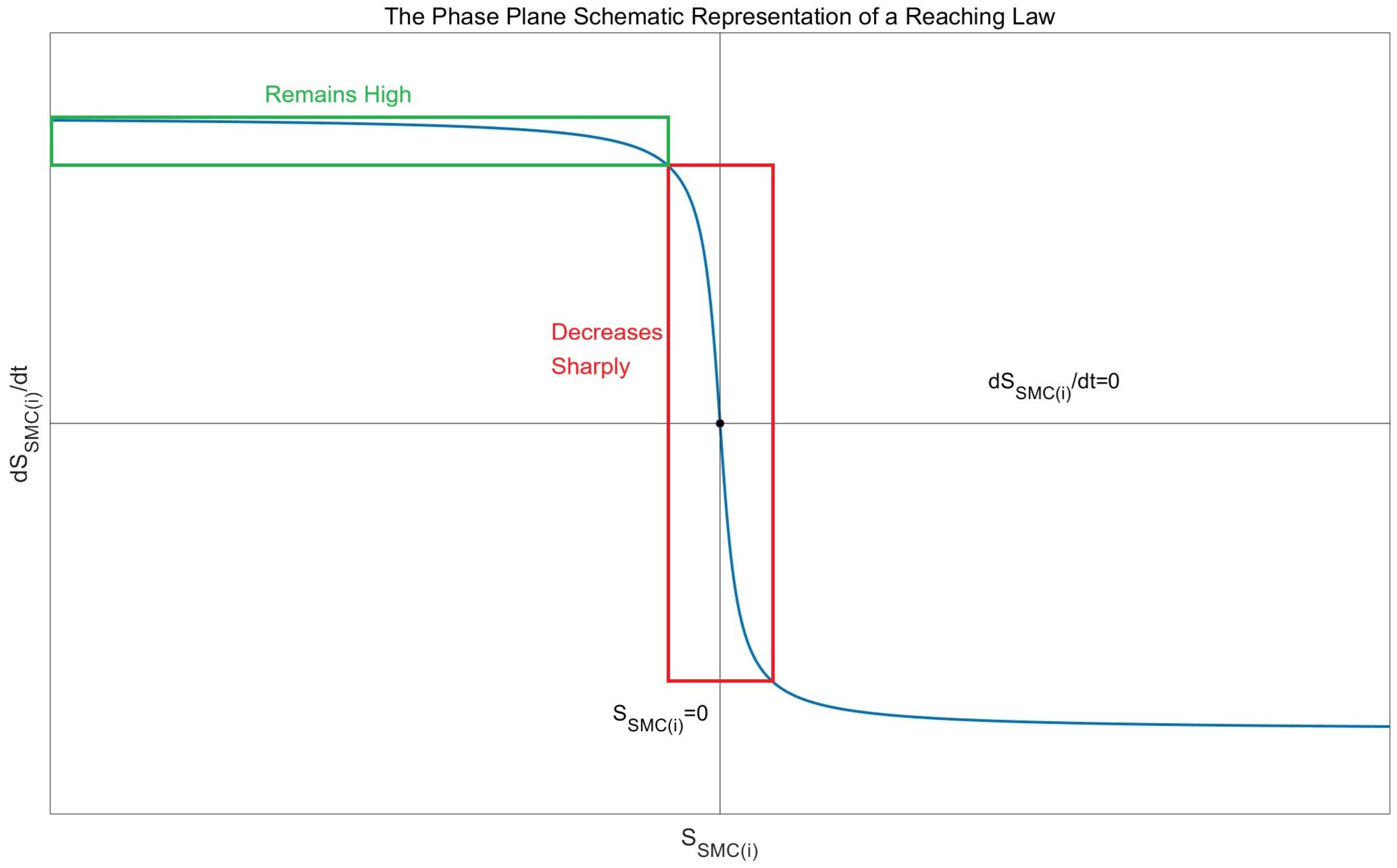
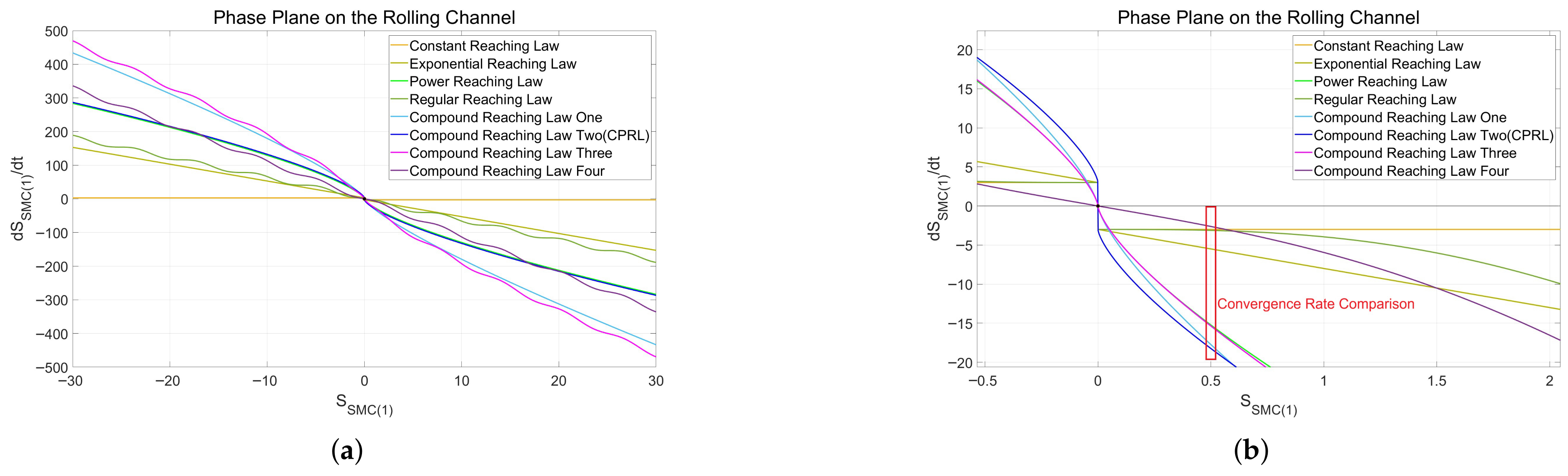
According to the Min-1 normalization of population variance, the differences among the influence of the different reaching laws on the pitching angles in the pitching channel comprehensive faults were much smaller than the differences among the influence of the different reaching laws on the rolling angles in the rolling channel comprehensive faults. Similarly, the differences among the influence of the different reaching laws on the yawing angles in the yawing channel comprehensive faults were much smaller than the differences among the influence of the different reaching laws on the rolling angles in the rolling channel comprehensive faults. Based on the above consideration, each failure was placed in the rolling channel in this paper. When the parameters of the slide mode reaching laws remained constant, by separately observing the rolling channel, the phase trajectories of the different reaching laws could be shown in
Figure 4.
Figure 4a shows the phase trajectories of the eight reaching laws. In the process of the sliding mode control, the phase trajectories gradually approached to the coordinate origin as time passed, known in the information in the enlarged partial graph in
Figure 4b, when the absolute values of the phase plane horizontal coordinate
entered a small range, which means sliding through the area contained by the red box in
Figure 4b from the area far from the original point of the phase plane. This effect was especially pronounced after this horizontal coordinate was smaller than 0.5, thanks to the term related to the sign function in the Constant Reaching Law
in Reaching Law Six designed in this paper. The absolute value of the vertical coordinate
of Reaching Law Six was obviously larger than the absolute values of the vertical coordinate
of Reaching Law Three, Reaching Law Five, Reaching Law Seven, and Reaching Law Eight without the term related to the sign function in the Constant Reaching Law
. Even if there similarly existed the term related to the sign function in the Constant Reaching Law
, the term related to the power function in the Power Reaching Law
of Reaching Law Six still assisted the absolute value of its vertical coordinate
of Reaching Law Six, being obviously larger than the absolute values of those of Reaching Law One, Reaching Law Two and Reaching Law Four. Therefore, when the horizontal coordinate of the phase plane was small enough, Reaching Law Six could approach to the coordinate origin with the fastest speed, i.e, the rise time of Reaching Law Six was the shortest; in the real control, the control system usually appeared as the maximum overshoot (quantity)
. This, in the phase plane, could be expressed as the phase trajectory continuing to enter the other side of the coordinate origin after it arrived at this coordinate origin. After this occurred, the phase trajectory could return to the coordinate origin with the largest negative increment with the help of Reaching Law Six, i.e, the maximum overshoot (quantity)
of Reaching Law Six was the smallest.
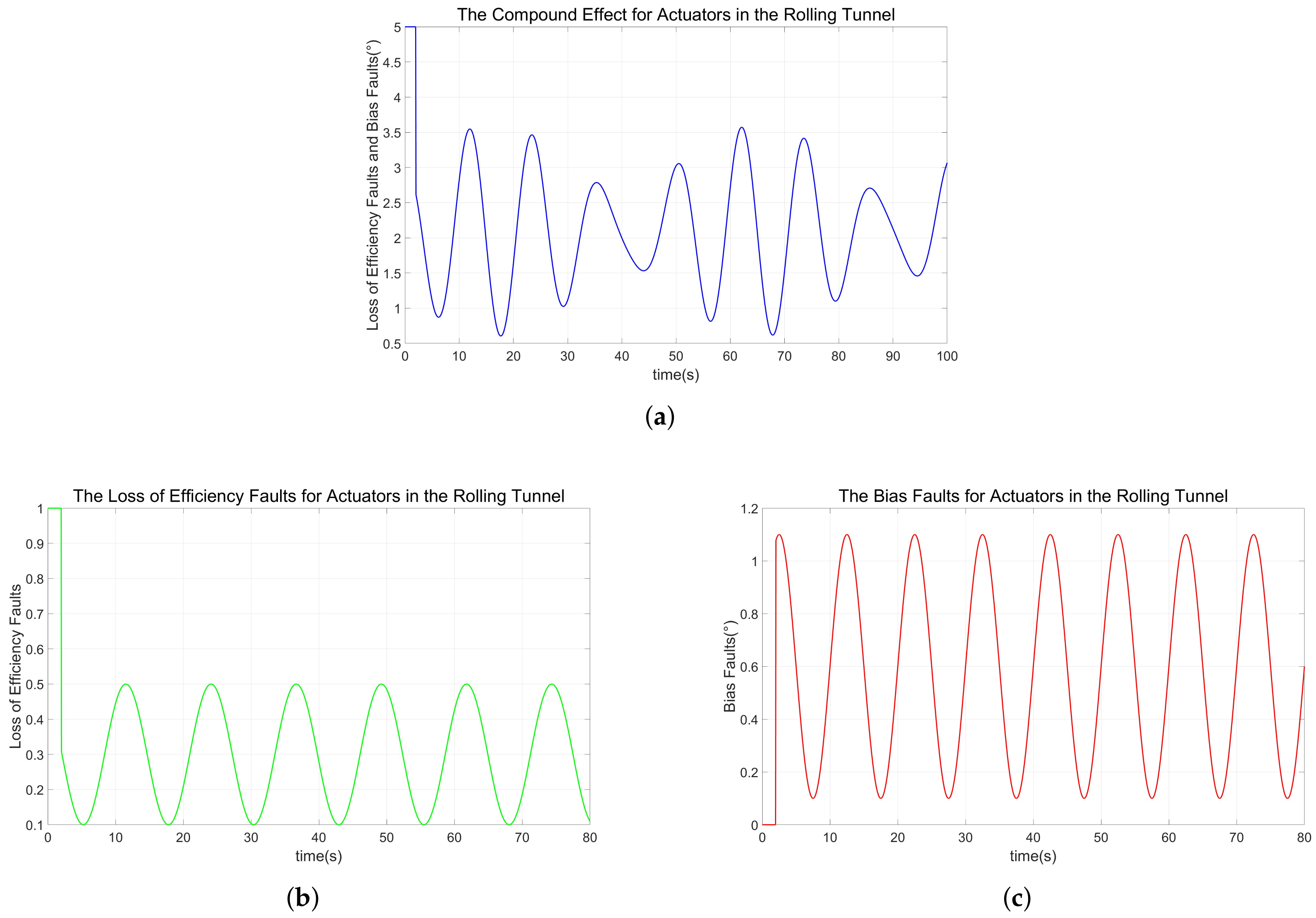
It was assumed that the faults expressed in Equation (
14) occurred in the simulation of launch vehicle swinging actuators. In detail, the faults were defined to occur when the time of
came, which could be shown as follows:
In the current experiments, the parameters of the failure regarding the loss of effectiveness, the parameters of the failure regarding deviation, the parameters of the terminal sliding face, and the parameters of the slide mode reaching laws are consistent with those parameters mentioned above, setting the moment of fault occurring to 2 s. Known in Equation (
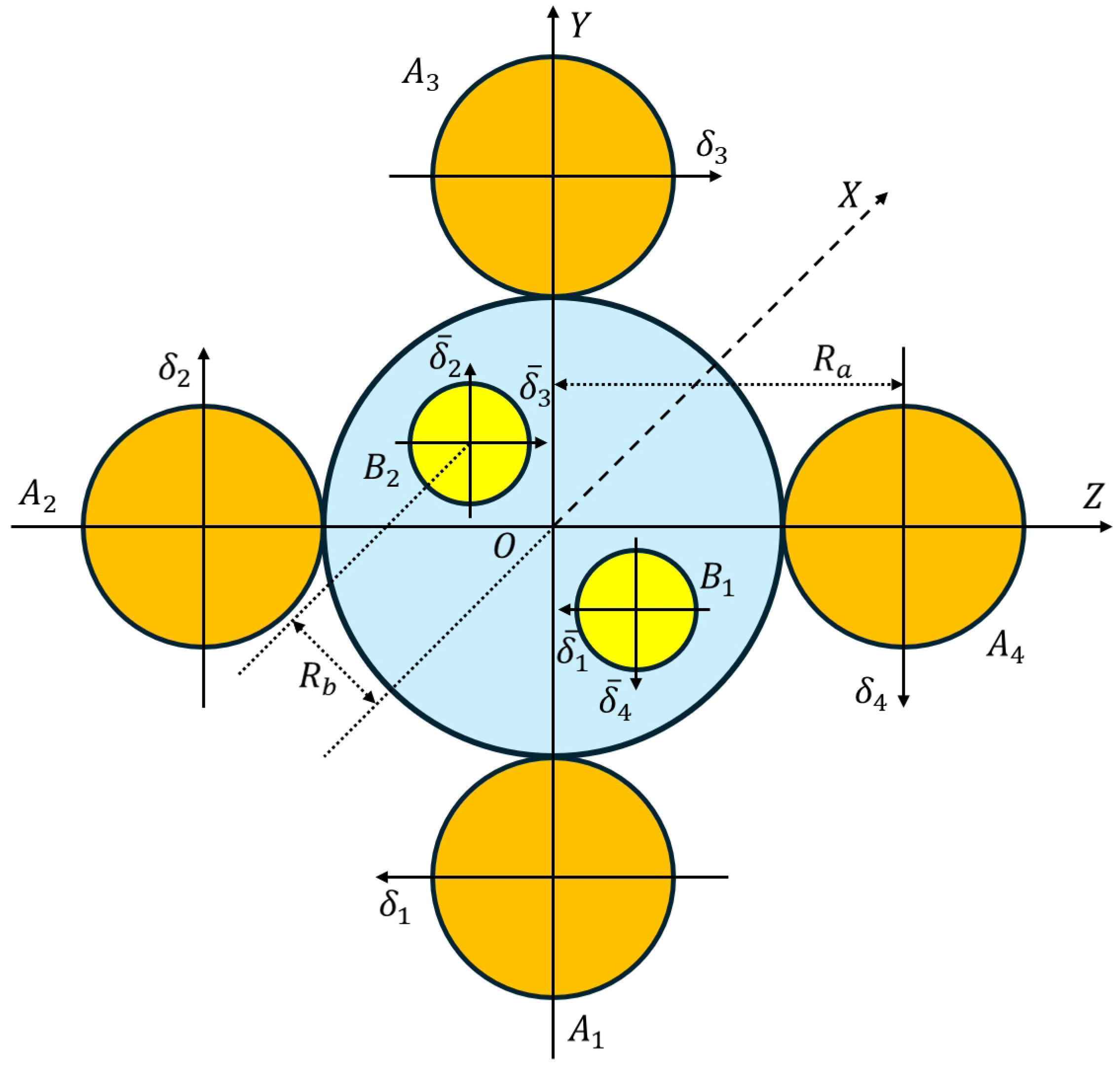
14), both the failure regarding the loss of effectiveness and the failure regarding deviation occurred in the rolling channel of actuators in the simulation at 2 s, shown in
Figure 5.
Before and after the above faults occurred, some of the function indexes—used in calculating the CEIF in Equation (
11)—and the final calculation results of the CEIF were all arranged in ascending order of their values shown in
Table 3.
The following information is reflected in
Table 3:
(1) Before the failures occurred, the rise time of the Exponential Reaching Law was shorter than the rise time of the Constant Reaching Law, but the maximum overshoot of the Exponential Reaching Law was larger than the maximum overshoot of the Constant Reaching Law. On the contrary, after the failures occurred, the rise time of the Exponential Reaching Law was longer than the rise time of the Constant Reaching Law, but the maximum overshoot of the Exponential Reaching Law was smaller than the maximum overshoot of the Constant Reaching Law. In addition, after the failures occurred, the rise time of the Power Reaching Law was longer than not only but also , and the maximum overshoot of the Power Reaching Law was larger than not only but also . Since the rise time could reflect the characters of the response speed of a system and the maximum overshoot could reflect the characters of the operation stability of that system, the above comparison results illustrated that the difficulty in coordinating the response speed of the attitude angles with the operation stability of these angles frequently arose.
(2) Before the failures occurred, the rise time of the Power Reaching Law was obviously shorter than both the rise time of the Constant Reaching Law and the rise time of the Exponential Reaching Law. The maximum overshoot of the Power Reaching Law was smaller than both the maximum overshoot of the Constant Reaching Law and the maximum overshoot of the Exponential Reaching Law. At this time, the CEIF of the Power Reaching Law was smaller than both the CEIF of the Constant Reaching Law and the CEIF of the Exponential Reaching Law. After the failures occurred, both the rise time of the Constant Reaching Law and the rise time of the Exponential Reaching Law were obviously shorter than the rise time of the Power Reaching Law, and both the maximum overshoot of the Constant Reaching Law and the maximum overshoot of the Exponential Reaching Law were also smaller than the maximum overshoot of the Power Reaching Law. At this time, both the CEIF of the Constant Reaching Law and the CEIF of the Exponential Reaching Law were smaller than the CEIF of the Power Reaching Law. Seen in (1), the rise time could reflect the characters of the response speed of a system, and the maximum overshoot could reflect the characters of the operation stability of that system. Thus, the value of CEIF could reflect the levels of both the response speed and the operation stability of a system.
(3) According to the above conclusions, as shown
Table 3, before the failures occurred, among the various indexes of the dynamic process of the launch vehicle rolling angle tracking target rolling angle, the rise time
influenced by the CPRL designed in this paper was shorter than the rise time
influenced by the Constant Reaching Law, the rise time
influenced by the Exponential Reaching Law, and the rise time
influenced by Power Reaching Law. The maximum overshoot
influenced by the CPRL designed in this paper was smaller than the maximum overshoot
influenced by the Constant Reaching Law, the maximum overshoot
influenced by the Exponential Reaching Law, and the maximum overshoot
influenced by the Power Reaching Law. The value of CEIF
influenced by the CPRL designed in this paper was smaller than the value of CEIF
influenced by the Constant Reaching Law, the value of CEIF
influenced by the Exponential Reaching Law and the value of CEIF
influenced by the Power Reaching Law.
(4) After failures occurred, among the various indexes of the dynamic process of the launch vehicle rolling angle deviation value regressing to the stable value again, the rise time influenced by the CPRL designed in this paper was shorter than the rise time influenced by the Constant Reaching Law, the rise time influenced by the Exponential Reaching Law and the rise time influenced by the Power Reaching Law. The maximum overshoot influenced by the CPRL designed in this paper was smaller than the maximum overshoot influenced by the Constant Reaching Law, the maximum overshoot influenced by the Exponential Reaching Law and the maximum overshoot influenced by the Power Reaching Law. The value of CEIF influenced by the CPRL designed in this paper was smaller than the value of CEIF influenced by the Constant Reaching Law, the value of CEIF influenced by the Exponential Reaching Law and the value of CEIF influenced by the Power Reaching Law.
(5) The CEIF represented that in certain conditions—not only before the failures occurred but also after they occurred—the control performance of the control system influenced by the CPRL designed in this paper was the best.
The CEIF values arranged in
Table 3 could be calculated and shown in
Table 4.
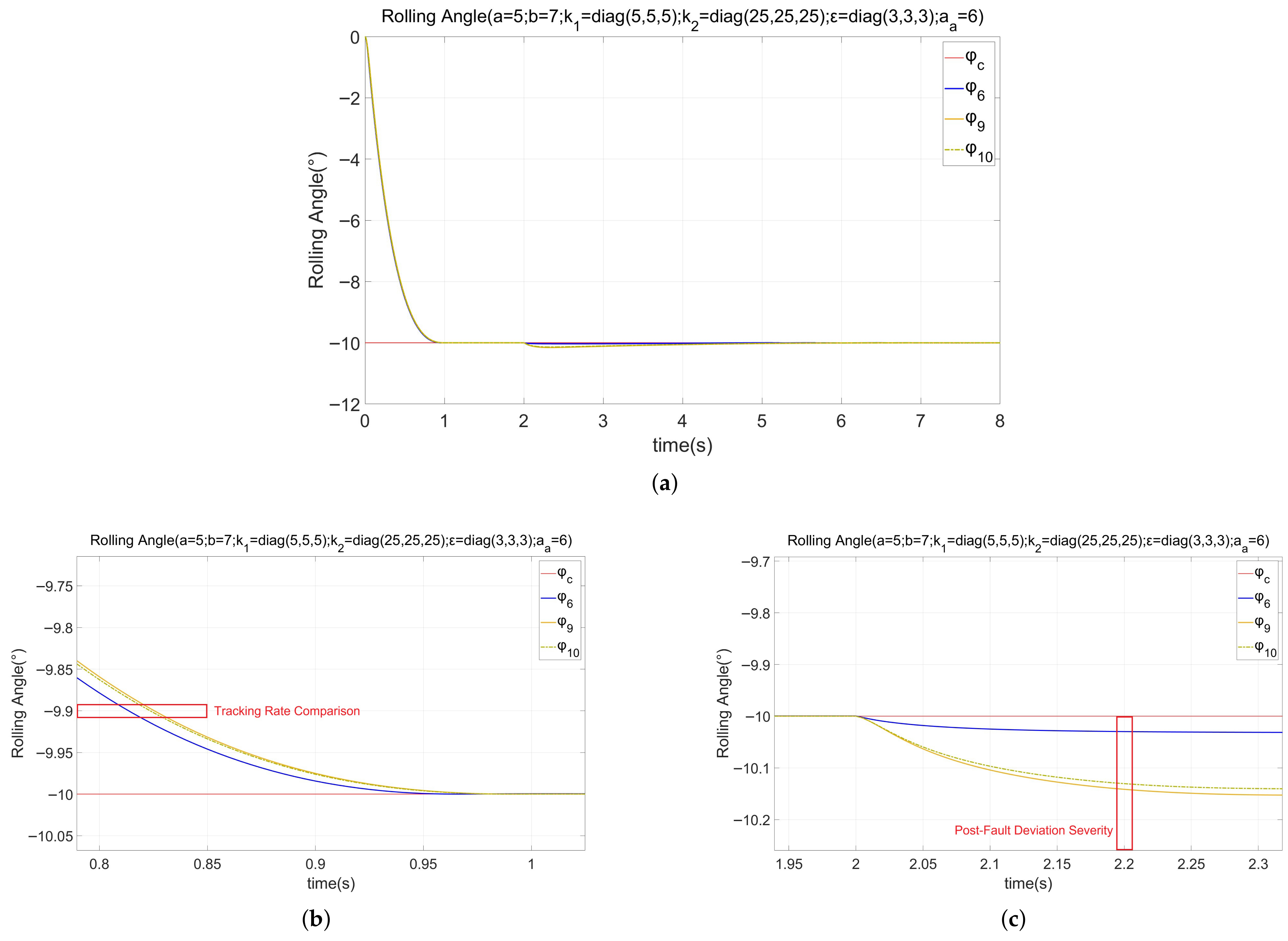
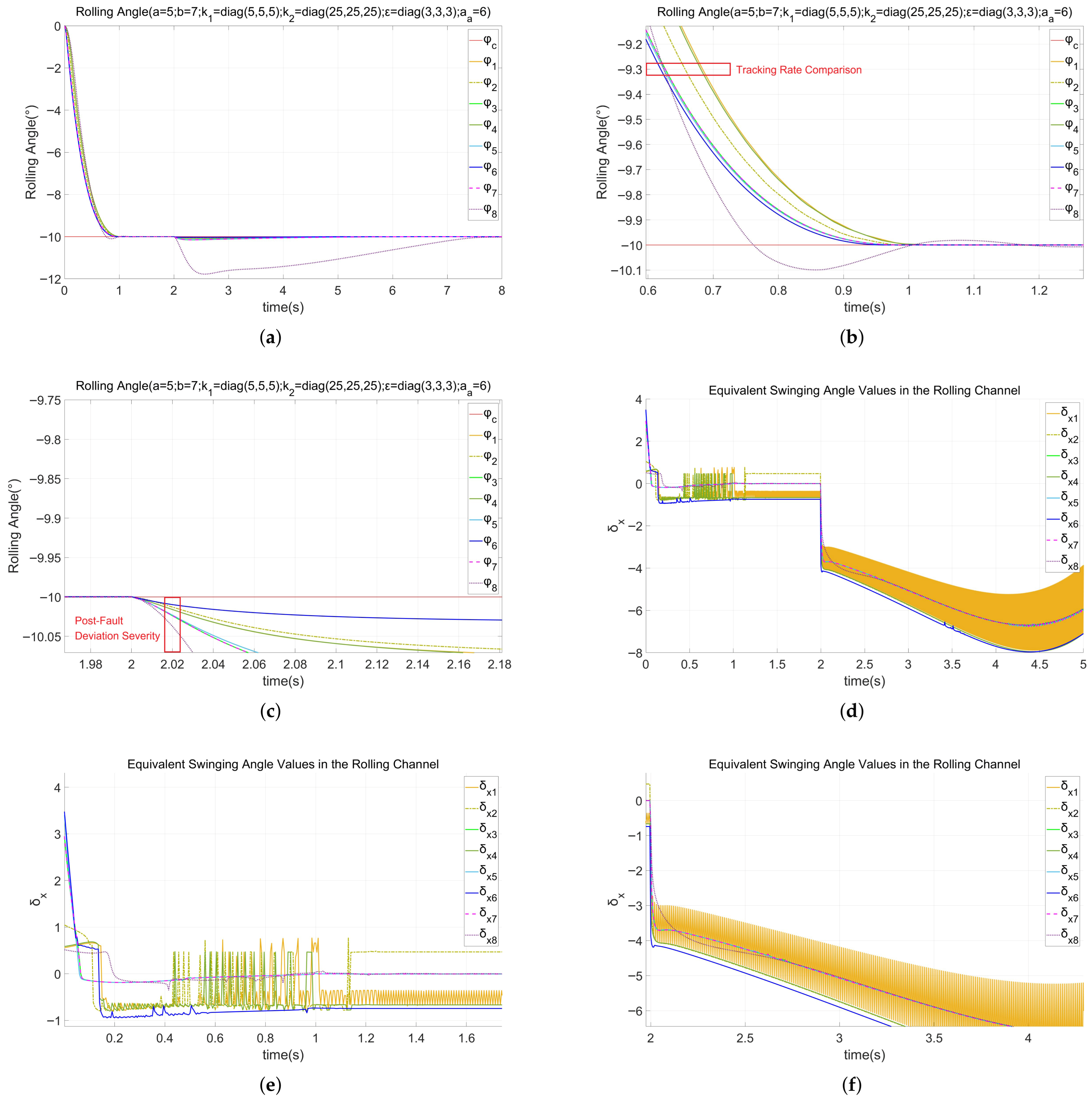
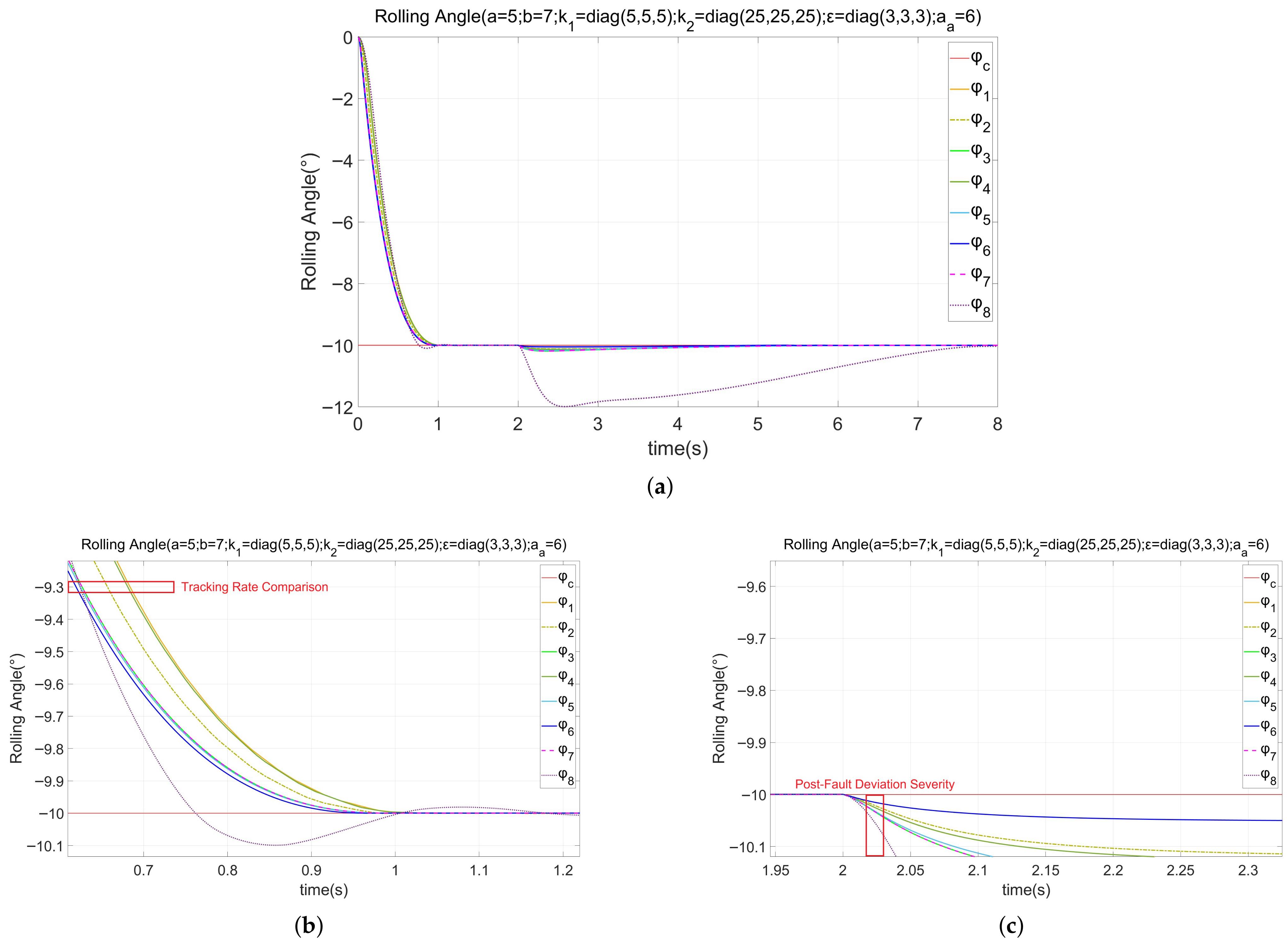
Figure 6 shows the curve of the launch vehicle rolling angle instruction tracking of the launch vehicle attitude system. In these graphs, it is shown that:
(1) All of the launch vehicle attitude angles controlled by the fault-tolerant control laws applying eight reaching laws, respectively, could track to the value of the instruction signal at about 1 second after tracking, shown in
Figure 6.
(2) Two seconds after the start of the simulation, the launch vehicle system started to experience actuator failures, shown in
Figure 6. The tracking character of the launch vehicle attitude was clearly affected, and this launch vehicle attitude system showed apparent tracking errors, but employing the eight fault-tolerant control laws, respectively, applying eight reaching laws could lessen the lasting effect of failures on the launch vehicle attitude.
(3) While the fault-tolerant control laws applying all of these reaching laws—except for the CPRL designed in this paper (Reaching Law Six)—could still accomplish the tracking of the attitude instruction over time, before the failures occurred, employing the fault-tolerant control law applyingthe CPRL designed in this paper could cause the launch vehicle rolling angle value to reach to the tracking-instruction angle value more swiftly and more evenly than the seven control laws respectively applying the rest seven reaching laws, shown in the area contained by the red box in
Figure 6b. After the failures occurred, the launch vehicle rolling angles respectively controlled by those seven fault-tolerant control laws applying the rest of the seven reaching laws showed a more severe deviation from the tracking-instruction value than that fault-tolerant control law applying the CPRL designed in this paper, shown in the area contained by the red box in
Figure 6c. Therefore, the calculation results of the CEIF were consistent with the laws of comparison obtained by directly observing the launch vehicle rolling angle dynamic variation curves influenced by the eight reaching laws.
(4)
Figure 6d–f represent the equivalent swinging angle values influenced by the fault-tolerant control law with the the Constant Power Reaching Law (CPRL, Reaching Law Six), steadily showing the larger absolute value, which means that the fault-tolerant control law with CPRL could offer stronger controlling ability to restrain the deviation from the target value with more swiftness and a smaller overshoot.
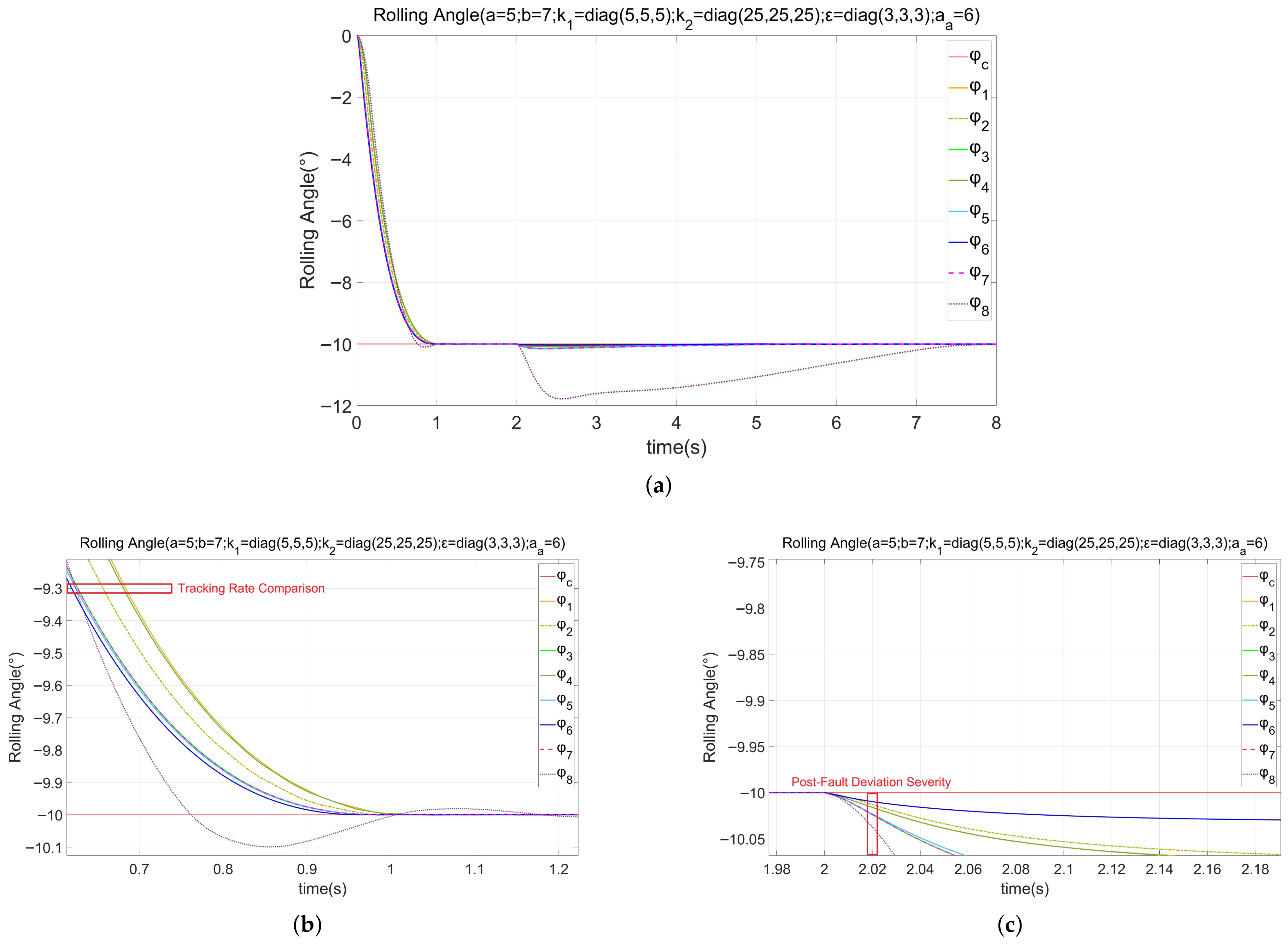
The parameters of the failure about the loss of effectiveness are defined as
,
, the parameters of the failure regarding deviation were
,
, which means that the parameters of the Loss of Effectiveness became worse and the parameters of the loss of effectiveness remained unchanged. The simulation results of the rolling angle of the launch vehicle are shown in
Figure 7a–c.
From
Figure 7, even though the parameters of the loss of effectiveness became worse, before the failures occurred, employing the fault-tolerant control law applying the CPRL designed in this paper could cause the launch vehicle rolling angle value to reach the tracking-instruction angle value more swiftly and more evenly than the seven control laws respectively applying the rest of the seven reaching laws after the failures occurred, shown in the areas contained by the red boxes in
Figure 7b,c. The launch vehicle rolling angles respectively controlled by those seven fault-tolerant control laws applying the rest of the seven reaching laws still showed more severe deviation from the tracking-instruction value than the fault-tolerant control law applying CPRL.
The parameters of the failure regarding the loss of effectiveness are defined as
,
, and the parameters of the failure regarding deviation were
,
, which means that the parameters of the failure regarding deviation became worse and the parameters of the loss of effectiveness remained unchanged. The simulation results of the rolling angle of the launch vehicle are shown in
Figure 8a–c.
From
Figure 8, even though the parameters of the failure regarding deviation became worse, before the failures occurred, employing the fault-tolerant control law applying the CPRL designed in this paper could cause the launch vehicle rolling angle value to reach to the tracking-instruction angle value more swiftly and more evenly than the seven control laws respectively applying the rest of the seven reaching laws after the failures occurred, shown in the areas contained by the red boxes in
Figure 8b,c. The launch vehicle rolling angles respectively controlled by those seven fault-tolerant control laws applying the rest of the seven reaching laws still showed the most severe deviation from the tracking-instruction value compared to the fault-tolerant control law applying CPRL.
In
Table 5, the Two Power Reaching Law was proposed by Mei H. et al. [
17] and used by Zhang H. X. [
13]; the Multi Power Reaching Law was proposed by Zhang Y. et al. [
18].
Let
,
,
,
,
,
,
,
. The simulation results are shown in
Figure 9.
Figure 9 shows the comparison of the attitude fault-tolerant control performance among the Constant Power Reaching Law (CPRL), the Two Power Reaching Law and The Multi Power Reaching Law. In these figures,
still represents the rolling angle of the launch vehicle adopted by CPRL,
and
represents the Two Power Reaching Law and The Multi-Power Reaching Law, respectively. It is obviously noted that the fault-tolerant control algorithm with CPRL shows faster convergence velocity and better smoothness, shown in the areas contained by the red boxes in
Figure 9b,c.