Article

Physically Interpretable and AI-Powered Applied-Field Thrust Modelling for Magnetoplasmadynamic Space Thrusters Using Symbolic Regression: Towards More Explainable Predictions


by
Miguel Rosa-Morales
,
Matthew Ravichandran
,
Wenjuan Song
and
Mohammad Yazdani-Asrami
*
CryoElectric Research Lab, Propulsion, Electrification & Superconductivity Group, Autonomous Systems and Connectivity Division, James Watt School of Engineering, University of Glasgow, Glasgow G12 8QQ, UK
*
Author to whom correspondence should be addressed.
Aerospace 2026, 13(3), 245; https://doi.org/10.3390/aerospace13030245

Submission received: 29 December 2025 / Revised: 9 February 2026 / Accepted: 3 March 2026 / Published: 5 March 2026
(This article belongs to the Special Issue Artificial Intelligence in Aerospace Propulsion)

Abstract

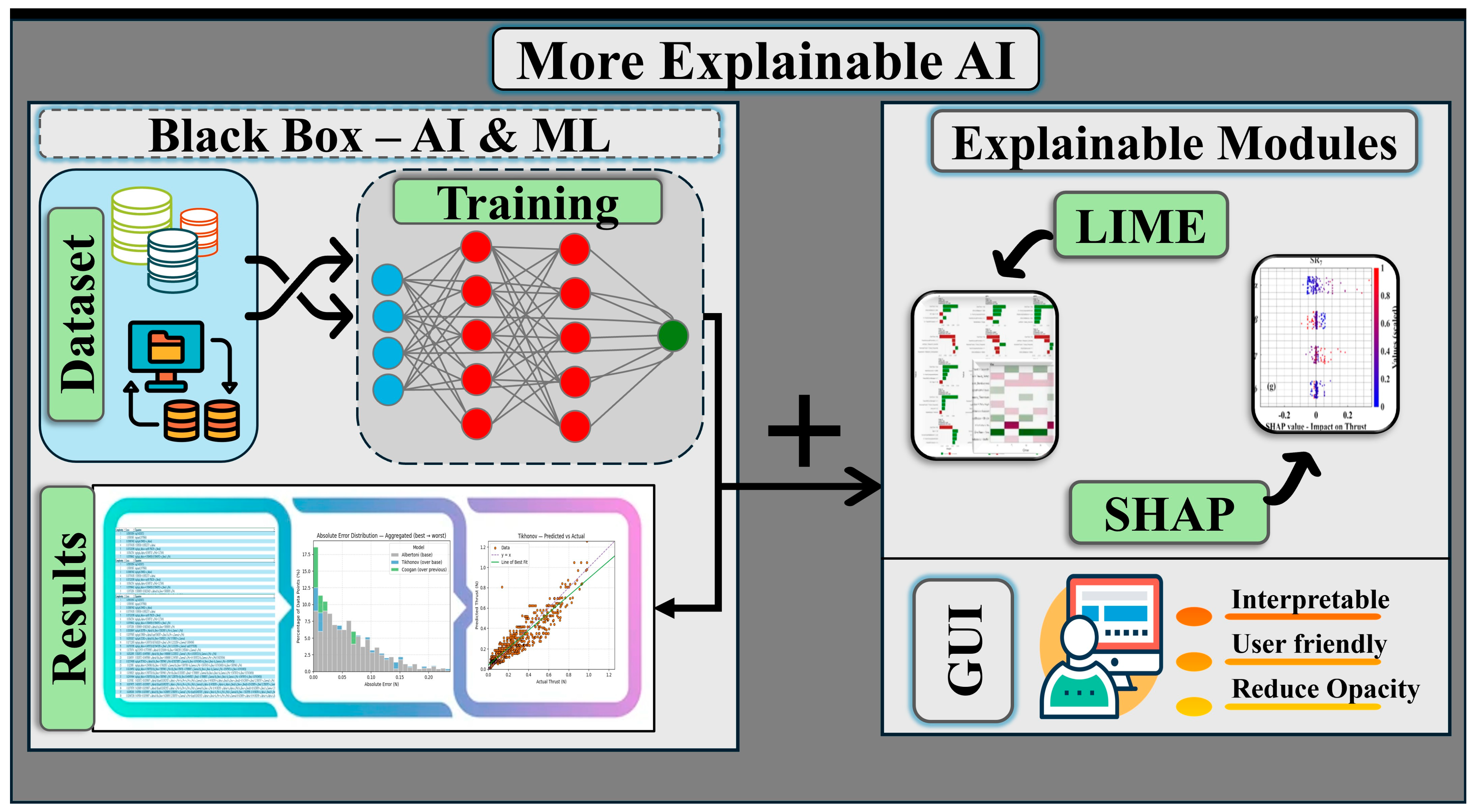
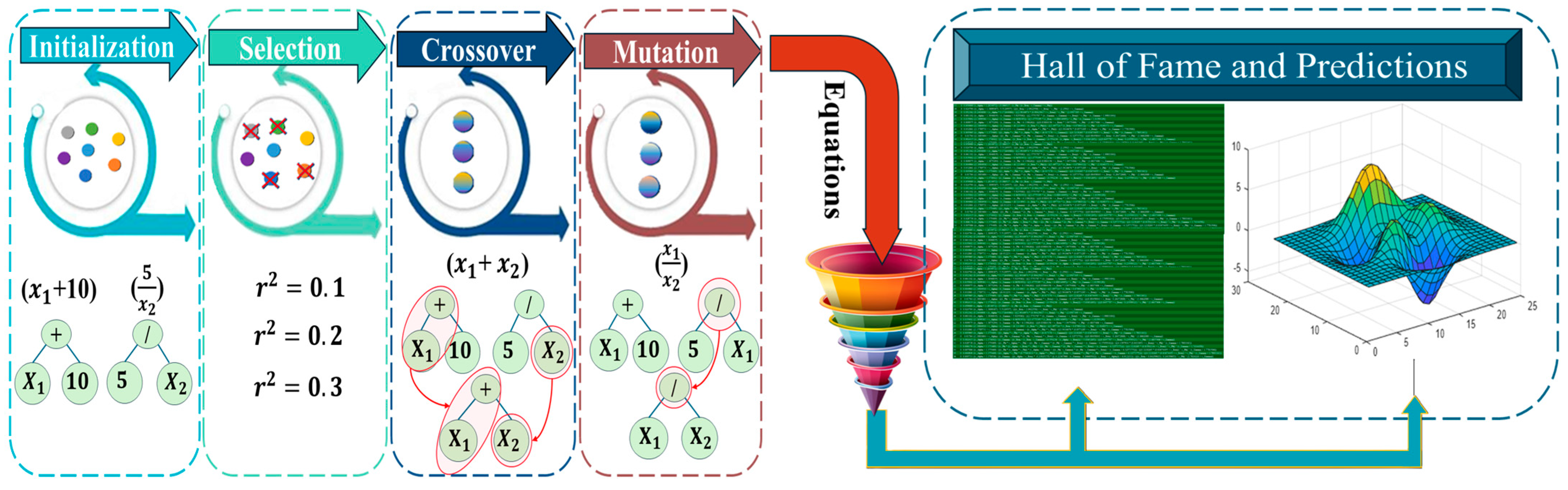
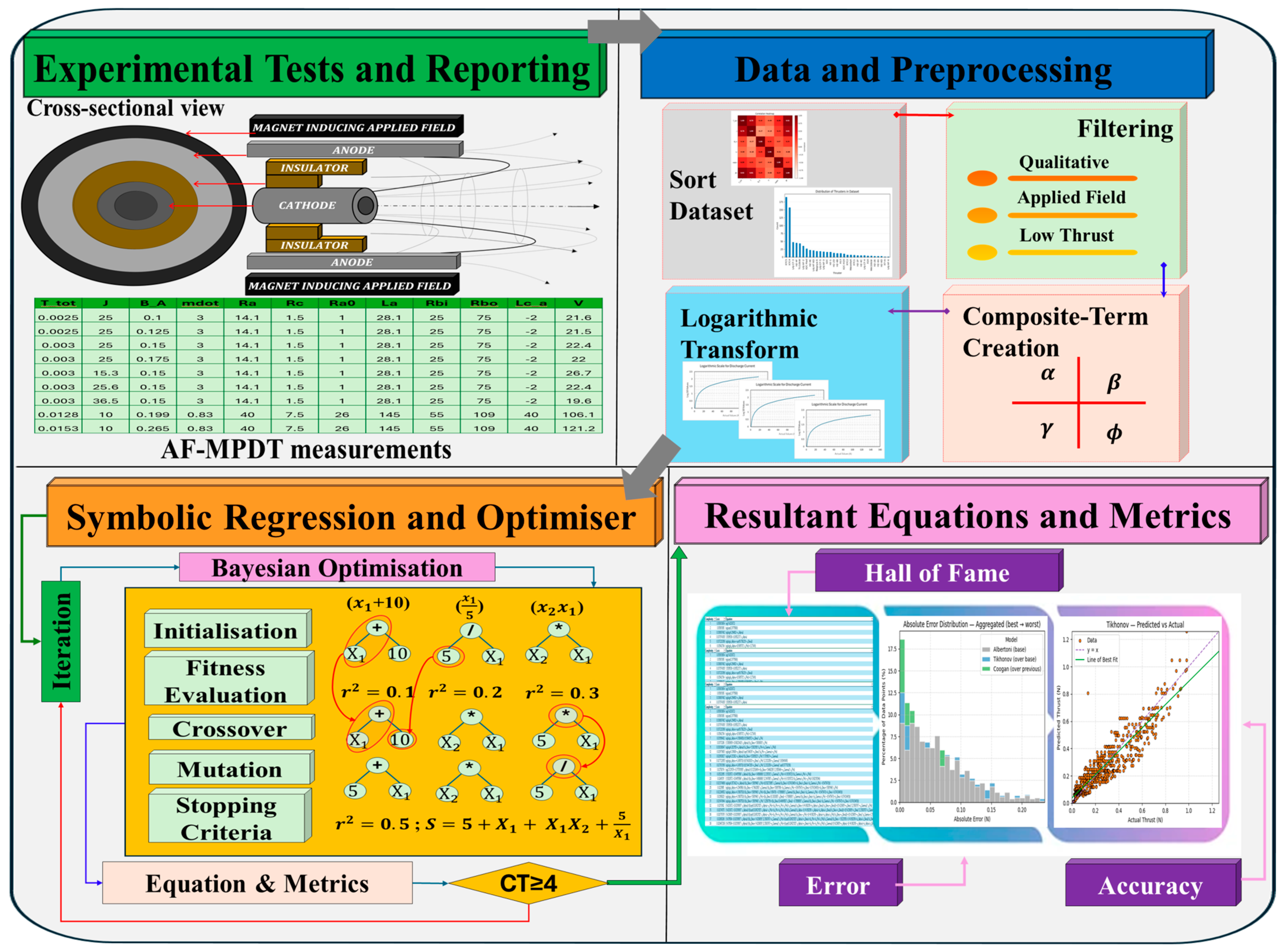
Magnetoplasmadynamic thrusters (MPDTs) are becoming increasingly viable as electric propulsion (EP) technology for space missions, yet their complex plasma behaviour, intricate thrust-generation process, and nonlinear multi-physics thrust–field interactions prove difficult for conventional modelling approaches, including empirical techniques. Traditional empirical modelling shortcomings include failure to predict accurately across wide operational regimes. This paper introduces a physically interpretable, artificial intelligence (AI)-powered thrust model for Applied-Field Magnetoplasmadynamic Thrusters (AF-MPDTs), developed using symbolic regression (SR) to address the gap between data-driven prediction and physics-based understanding. The proposed method, an alternative to traditional black box AI methods, incorporates physics-aware composite-term operators, ensuring that the resulting analytical expressions are bounded by known physical behaviours while retaining the flexibility to discover previously overlooked nonlinear couplings. A comprehensive dataset of AF-MPDTs undergoes rigorous preprocessing to ensure dimensional consistency and noise robustness. The SR model then evolves candidate equations, balancing predictive accuracy with interpretability through Tree-Structured Parzen Estimator (TPE) optimisation. The results, closed-form surrogate correlations with 95.98% of accuracy as goodness of fit, root mean square error of 0.0199, mean absolute error of 0.0143, and mean absolute percentage error reduction of 28.91% against the benchmark model in the literature. A post-discovery protocol for numerical robustness and physical consistency is implemented, with Shapley Additive Explanations (SHAP) providing insight into the influence of each composite-term in the developed correlation, followed by a numerical robustness and physical consistency validation using a Monte Carlo (MC) envelope. A StabilityScore is calculated for all developed correlations, enabling explicit accuracy–complexity–stability comparisons. In doing so, we demonstrated that SR can systematically recover known physical relationships—such as the scaling of thrust with discharge current and applied magnetic field—while proposing interpretable higher-order corrections that improve fit quality. The resulting SR-based thrust models not only achieve competitive accuracy relative to state-of-the-art numerical and empirical methods but also offer more explainable and interpretable results capable of revealing compact formulations that capture essential acceleration mechanisms with transparency. Overall, this paper, using SR, advances explainable AI (XAI) methodologies capable of generating trustworthy, analytically transparent models for next-generation electric propulsion systems.
Keywords: AF-MPDTs; machine learning; Monte Carlo; thrust prediction; tree-structured Parzen Estimator; XAI AF-MPDTs; machine learning; Monte Carlo; thrust prediction; tree-structured Parzen Estimator; XAI