Article

Performance Degradation and Regeneration of Palladium Catalysts for Hybrid Rockets

1
Department of Industrial Engineering, University of Naples “Federico II”, 80125 Naples, Italy
2
Industrial Chemistry Laboratory (NICL), University of Naples “Federico II”, 80125 Naples, Italy
3
Laboratory of Industrial Chemistry and Reaction Engineering (TKR), Åbo Akademi University, 20100 Turku, Finland
4
Flemish Institute for Technological Research, VITO, Boeretang 200, 2400 Mol, Belgium
5
Cosmology, Space Science and Space Technology, Scuola Superiore Meridionale, Largo S. Marcellino, 10, 80138 Naples, Italy
6
INFN Sezione di Napoli, Via Cintia, 80126 Naples, Italy
*
Author to whom correspondence should be addressed.
Aerospace 2026, 13(3), 238; https://doi.org/10.3390/aerospace13030238
Submission received: 25 January 2026 / Revised: 25 February 2026 / Accepted: 25 February 2026 / Published: 3 March 2026
(This article belongs to the Special Issue Heat and Mass Transfer in Rocket Propulsion)

Abstract

The renewed interest in hydrogen peroxide-based space propulsion systems has highlighted the persistent issue of catalyst degradation during long-term operation. Although several studies have investigated the underlying causes of this phenomenon, effective regeneration techniques capable of restoring catalytic activity have not yet been clearly demonstrated. This study investigates the mechanisms responsible for performance degradation and proposes a viable regeneration strategy for palladium-based catalysts. Experimental analyses were conducted on a batch of commercial Al2O3/Pd pellets subjected to multiple firing cycles in a 10 N-class hybrid mini-thruster. Monitoring of the propulsive performance revealed a progressive decline in catalytic activity, ultimately preventing ignition of the hybrid rocket engine. To characterize the degradation mechanisms, the pellets were examined through visual inspection, static hydrogen peroxide decomposition tests, and Temperature Programmed Reduction (TPR) analysis. The results indicated significant surface oxidation of palladium, leading to reduced decomposition efficiency. A chemical regeneration procedure based on sodium borohydride (NaBH4) treatment was subsequently developed to restore catalytic performance. The regenerated pellets were tested under the same experimental conditions that had previously led to ignition failure. Their propulsive performance was then compared with both the degraded pellets and a new batch of equivalent catalysts. The results demonstrate that the regeneration process successfully restored the catalytic activity to levels comparable with the original state, enabling stable and efficient hybrid combustion. These findings confirm the role of surface oxidation in catalyst degradation and demonstrate that targeted chemical treatment can significantly extend catalyst lifetime. The proposed regeneration strategy offers a practical method to reduce costs of ground-based experimental campaigns and support the future deployment of hydrogen peroxide-based propulsion systems in space applications by providing insights into the mechanisms that can degrade the performance of palladium catalysts.

1. Introduction

Hydrogen peroxide has been a well-established and widely used propellant since the beginning of the rocket propulsion era. Its earliest documented applications include systems such as the Walter HWK 109-500 thruster, which was employed as a liquid-propellant assist rocket for various aircraft, and the H2O2-based turbopumps that fueled the German V2 rocket during World War II [1]. Over the following 80 years, from the 1940s to the present day, the highly concentrated aqueous solution commonly known as High Test Peroxide (HTP) has been selected for various spacecraft and rocket propulsion systems owing to some of its unique chemico-physical characteristics. These include high density, which implies high specific impulse, reducing the volume and dry mass of the relative tanks [2]. Its liquid nature (at ambient pressure and room temperature) and chemical stability make it easy to store, and are coupled with low procurement costs and relatively low toxicity, also dictated by low vapor pressure at room temperature [1]. In addition, its high specific heat makes it suitable for regenerative cooling applications [2]. This is paired with satisfactory propulsive performance for numerous applications, and with the ability to feed different types of propulsion systems. Specifically, hydrogen peroxide can be employed for monopropellant thrusters, as an oxidizer in liquid bipropellant systems, including quasi-hypergolic and hypergolic configurations, and in hybrid rocket engines. It can also be used as a gas generator to drive turbo pumps in more complex propulsion architectures. This versatility provides significant flexibility, enabling it to meet a wide range of mission requirements. The working principle shared by all of the above-mentioned technologies is the exothermic decomposition of hydrogen peroxide, which follows the reaction scheme shown in Equation (1) [1].
H 2 O 2 ( l ) yields H 2 O ( g ) + 1 2 O 2 ( g ) + Heat
This mechanism generates an oxygen-rich gas and releases a large amount of heat, equal to 97.98 kJ/mol of pure H2O2 decomposed. Among the possible applications, the resulting flow can be used as a propellant for hybrid rockets, such as the ILR-33 AMBER [3], Nammo’s Nucleus sounding rocket [4], and DLR/HyImpulse mini-launcher [5], as well as a Reaction Control System (RCS), as was the case for missions such as Mercury, SYNCOM II/III, and COMSAT [6]. The exothermic decomposition of hydrogen peroxide can be activated by exposing the aqueous mixture to high temperatures or through interaction with chemical elements or molecules, resulting in thermal or catalytic decomposition, respectively. The latter is typically preferred because, by choosing suitable catalysts, the activation energy of the phenomenon can be lowered [1], facilitating the reaction and making it more controllable, repeatable, and reliable.
The development of catalysts for propulsion applications has always been one of the most active areas of research related to hydrogen peroxide-based systems. The main challenge is to develop materials capable of ensuring satisfactory performance in a reliable manner, while at the same time guaranteeing resistance to chemical degradation and mechanical strength. This is crucial considering applications that require an extended lifetime and a high number of thermomechanical cycles. One of the first and historically most widespread technological solutions involved the use of silver mesh. However, the low melting temperatures typical of materials containing this element constitute a critical disadvantage, as they limit the maximum concentration of H2O2 that can be employed [7]. Indeed, higher HTP concentrations imply higher temperatures of the decomposition products, which can reach up to 1000 °C for 99% HTP [1]. Furthermore, silver gauze typically exhibits degraded performance at low operating temperatures, complicating the startup of the catalytic component. To overcome these problems, advanced catalysts based on chemical compounds such as platinum, palladium, lead oxides [8], manganese oxides [9], and alkali permanganates [10] have been developed over the years, often coupled with ceramic substrates such as alumina. These technologies are not immune to issues such as poisoning (by stabilizers and impurities), thermomechanical degradation, powdering, and the creation of excessive pressure drops across the catalytic bed [9]. However, their use generally guarantees significantly higher propulsive performance than that obtained with classic silver gauze [8,11], and they are therefore preferred.
As mentioned above, one of the key aspects to be analyzed for the successful use of catalysts is their durability and the degradation phenomena induced by thermomechanical and chemical stresses during successive decomposition cycles. Several studies have addressed this issue, attempting to characterize various types of substrates, chemical compounds, and manufacturing methods. In [11], Palmer et al. performed an extensive study regarding 33 different types of catalyst, sorted among three main categories depending on their substrate: metallic foam-based, ceramic-based, and metallic gauze-based. Each sample was characterized by different catalytic compounds selected among the most common ones, ranging from platinum, to manganese oxide and palladium. Experimental tests measured decomposition capabilities and assessed structural and catalytic degradation induced by successive decomposition cycles. Results show that fatigue survivability, mechanical integrity, and durability are critical aspects and that, despite the numerous combinations evaluated, only a very limited number of catalysts can guarantee acceptable catalytic performance for possible applications in space propulsion [11]. Torre et al. [12] analyzed the durability and resistance to poisoning of 20 samples composed of a spherical alumina substrate coated with various catalytic chemical compounds: platinum, palladium, manganese oxides, ruthenium oxides, and silver. The phenomenon of poisoning can be caused by stabilizing substances present in hydrogen peroxide to prevent its self-decomposition, such as pyrophosphate ions [11]. These chemical elements can interact with the catalytic bed, inhibiting its action and lowering its catalytic performance. The catalysts were subjected to numerous decomposition cycles, studying their behavior over time. Even in this case, a trend of degradation and consequent inactivation of some batches was observed, both with the Pd/Al2O3 formulation (ALTA ID LR-63) and with the Ag/Al2O3 (ALTA ID LR-121), as well as for MnxOy/Al2O3 (ALTA ID LR-161) catalysts. All other samples, on the other hand, showed high resistance to degradation and poisoning [12]. However, it should be noted that, in addition to the different chemical composition and manufacturing techniques used for the catalysts examined in this work, the concentration of hydrogen peroxide used is relatively low (30% wt). For applications in monopropellant/hybrid thrusters, where the HTP used is typically concentrated between 85% and 98%, the thermo-mechanical and chemical stresses are greater, which could reduce the durability of the catalysts studied. A progressive degradation of catalysts was also noted in [13,14], where the performance and endurance of four platinum catalysts on a ceramic base were evaluated. In firing tests carried out with 90% HTP, a deterioration in catalytic capacity was observed for samples on compact carriers, while for those made on porous carriers, the loss of performance was due to thermomechanical wear, which caused an increasing pressure drop. The combined analysis of all the above-mentioned experimental results found in the literature highlights the importance of catalyst degradation in the decomposition of high-concentration hydrogen peroxide. Although the phenomenon of catalyst degradation is well known and widely studied in the relevant scientific literature, to the best of the authors’ knowledge, no methods have currently been proposed for the regeneration of catalysts used in firing tests.
This work contributes to ongoing research in this area by investigating the behavior of a palladium-coated alumina pellets. Their durability is assessed through a sequence of hybrid firing tests performed on a 10 N-class mini-thruster for CubeSat applications, previously investigated in earlier studies [15]. The progressive degradation of the catalytic decomposition performance is analyzed and its underlying causes are identified. A regeneration technique is then proposed, and the decomposition capability of the regenerated pellets is evaluated and compared with the original behavior. This study therefore aims to evaluate the performance degradation of commercial catalysts under relevant operating conditions, a critical aspect for ensuring effectiveness and reliability in future space applications. The lifetime of catalytic elements is a key limiting factor for re-ignition capability driven by mission requirements and directly influences propulsion system design choices. Furthermore, identifying low-cost regeneration techniques supports the implementation of university-level experimental campaigns based on this class of catalysts, reducing both material consumption and procurement costs for ground-based testings.

2. Experimental Setup and Materials

2.1. Laboratory Setup

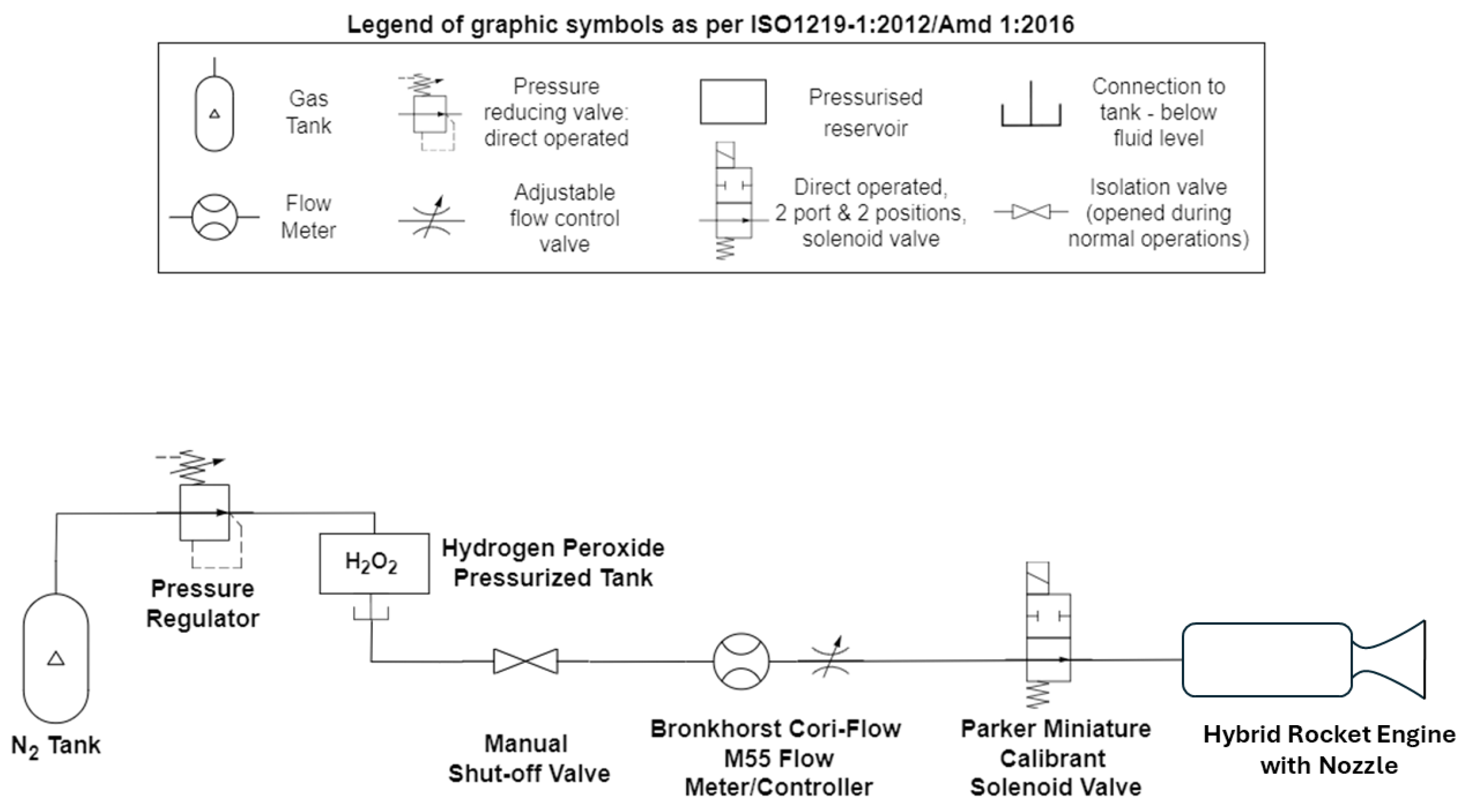
The experimental data used for this work were obtained through a dedicated test campaign conducted at the Aerospace Propulsion Laboratory of the University of Naples Federico II. It is located within the military airport of Grazzanise, Caserta province, Italy. The experimental facilities were designed to conduct firing tests of hybrid, monopropellant, and bipropellant thrusters using different oxidizers (O2, H2O2, N2O). The modularity of the available equipment and the interoperability of different systems allow for the evaluation of engines of various scales, from 1 N to 1000 N. A small-scale hybrid thruster is used for studies of the catalytic decomposition of hydrogen peroxide. Its characteristics will be detailed in Section 2.3. For this category of engine, the experimental apparatus involves the use of a dedicated feed line, represented in Figure 1. It supplies liquid H2O2 from a tank pressurized with nitrogen. The feed pressure is adjusted to the experimental requirements using a pressure regulator. The stainless steel tank is connected via a 1/4″ pipe, on which a manual on/off valve is located for safety. Hydrogen peroxide supply to the engine is measured through a Coriolis mass flow meter, which exploits the homonymous physical principle to provide an accurate measurement of m ˙ for both liquids and gases. When necessary, the instrument can also act as a mass flow rate controller thanks to its integrated Proportional-Integral-Derivative (PID) feedback controller, which allows an internal valve to be actuated in order to manage the H2O2 flow. The technical specifications of this instrument are shown in Table 1, together with those of the other measurement systems employed. Downstream of the mass flow meter, a Parker Series 9 Calibrant solenoid valve is installed. It is electrically actuated and controlled via a reprogrammable micro-controller. The very quick response time (<5 ms, [16]) and the ability to actuate the valve to activate and stop the hydrogen peroxide flow allows the thruster to operate in two distinct modes: pulsed injection, with adjustable valve opening and closing intervals, and continuous injection. Pulsed preheating allows the catalytic decomposition process to gradually ramp-up to full operating conditions, as detailed in [17]. Lastly, the feed line is connected to the injection plate of the monopropellant/hybrid rocket engine, which is secured to the test bench by a support structure. The mechanical interface is coupled with a Tedea Huntleigh 1042 load cell [18], which provides thrust measurements. Propulsion performance is monitored by a suite of sensors that includes K-type thermocouples manufactured by Tersid [19] and Setra C206 capacitive pressure transducers [20]. Signal acquisition and storage are performed using a high-bandwidth National Instruments PXI 1082e, connected via fiber optic cable to a computer in the control room. This allows the test to be monitored and the main management systems to be operated.

2.2. Catalyst Under Investigation

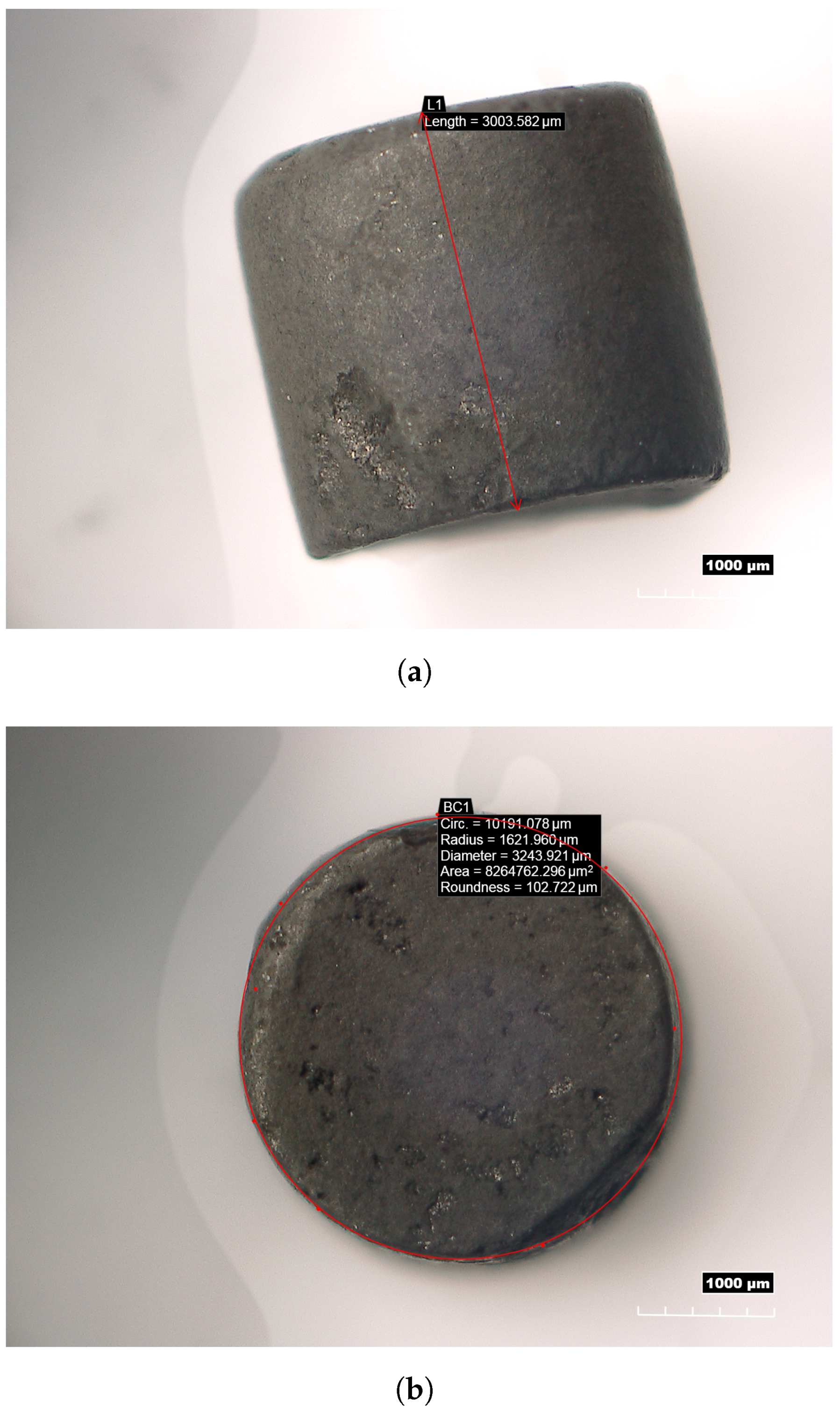
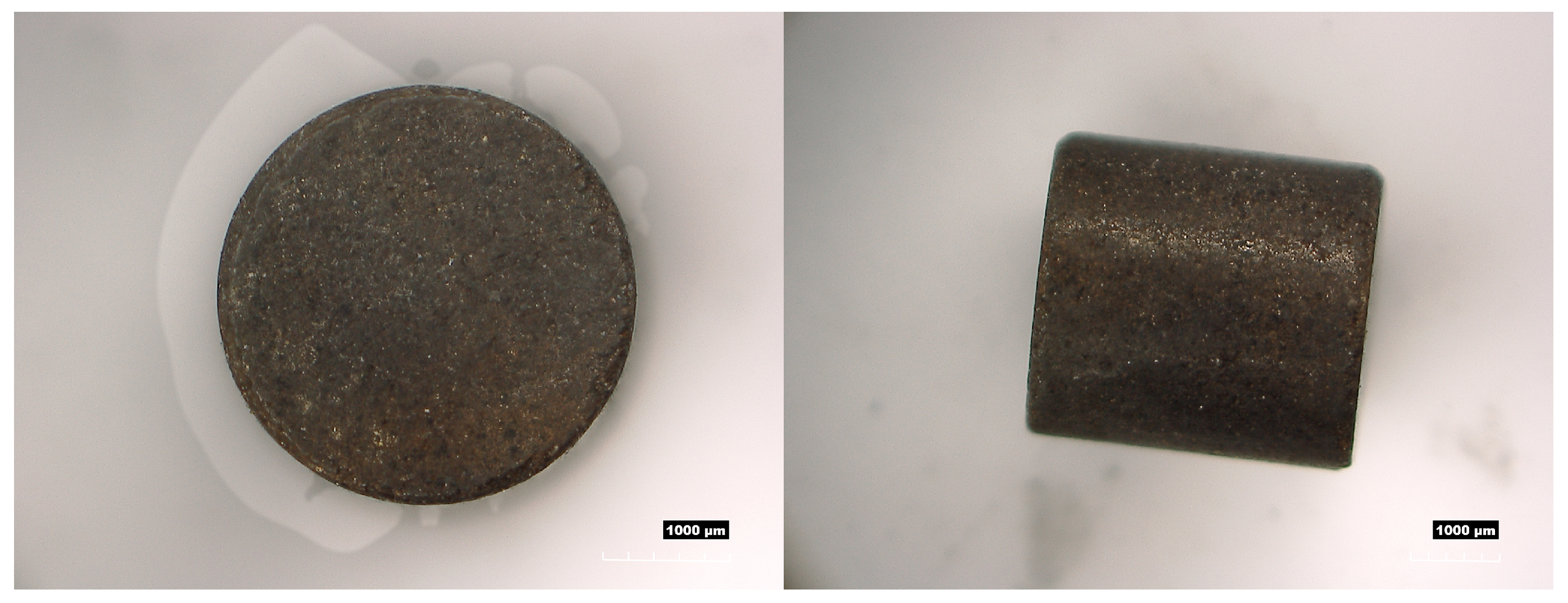
This section describes the characteristics of the catalyst under investigation. In the thruster of interest, H2O2 catalytic decomposition occurs within a dedicated catalytic chamber, whose geometry is detailed in Section 2.3. The catalyst consists of alumina cylindrical pellets coated with 5% palladium. The pellets are commercially available and are manufactured by Thermo Fisher Scientific, Segrate, Italy (formerly Alpha Aesar). As mentioned in the brief literature review in Section 1, palladium is one of the main chemical elements used to promote the catalytic decomposition of H2O2 [11,12,13,14]. This transition metal is able to guarantee good performance thanks to its ability to break the O–O bond [24], leading to the formation of oxygen and water vapor. The Pd metal loading required to achieve sufficient decomposition performance is typically quite low [9,12], allowing for lower costs associated with the acquisition of materials. Employing an Al2O3 substrate guarantees durability and resistance to the thermo-mechanical and chemical stresses that occur in thruster decomposition chambers. In fact, alumina, a form of aluminum oxide, exhibits high mechanical strength coupled with good thermal stability [25]. The porous nature of the support increases the exposed surface area, boosting the ability to catalyze the decomposition reaction with fixed values of metal loading. The combination of these characteristics makes Pd-coated Al2O3 catalysts a promising candidate for space propulsion applications. Pellets under analysis are composed of alumina cylinders with a radius of 1.5 mm and a height of 3 mm, with a total volume of 21.19 mm3. Figure 2a,b show the experimental measurements performed with an electronic microscope to characterize the geometry of the catalytic element before testing. In addition to the radius and height measurements, roundness and surface area are also specified. As mentioned, palladium constitutes 5% of the pellet’s mass. The reference value is guaranteed by the manufacturer through periodic batch analyses, as reported in [26]. Given the geometric characteristics of the thruster, a total mass of 18 ± 0.5 g is typically used to fill the catalytic chamber in order to promote efficient decomposition of hydrogen peroxide.

2.3. Thruster Configuration

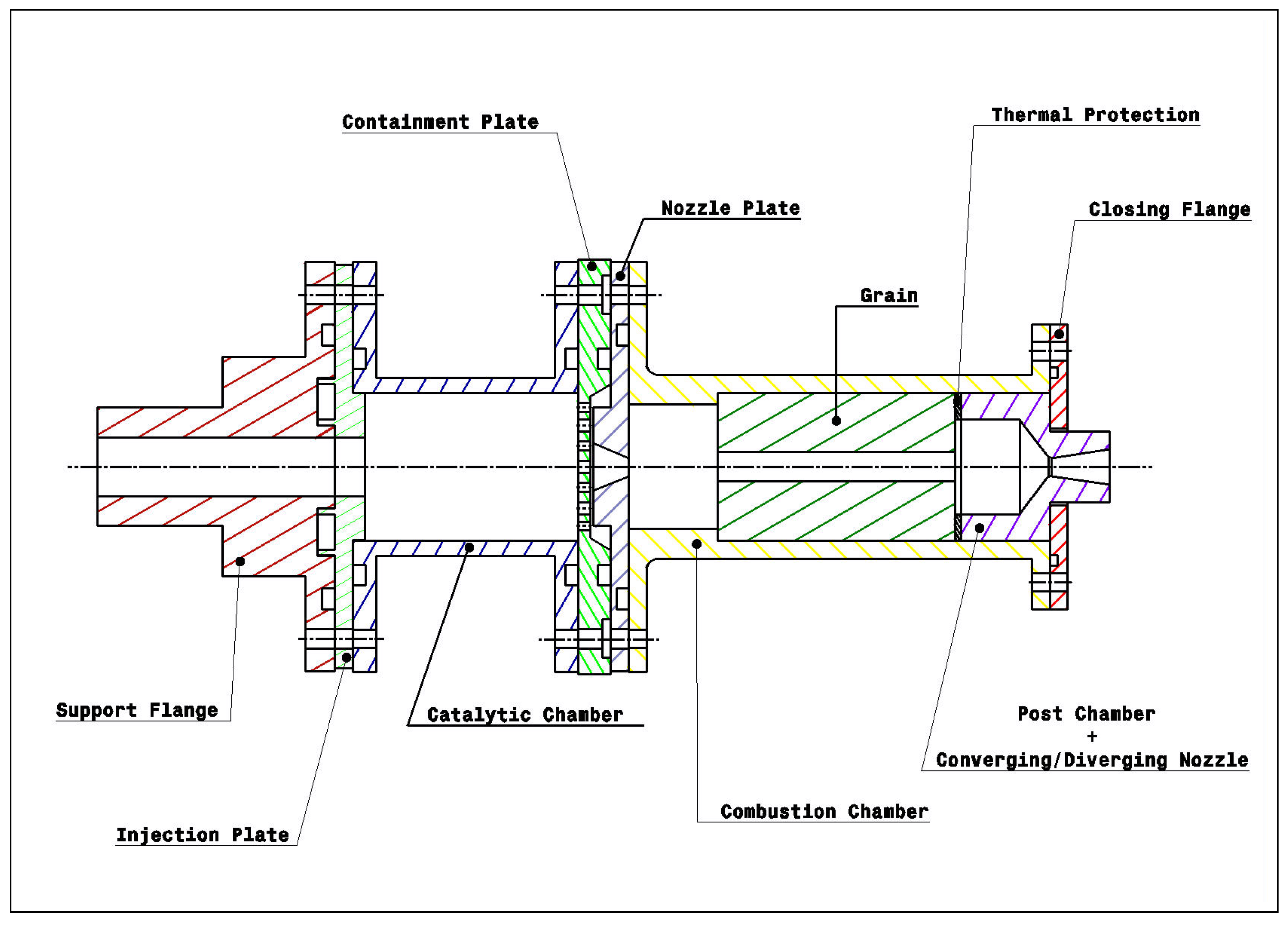
The experimental campaign for characterizing catalyst performance was carried out using a small-scale hybrid thruster, operating with 90% wt HTP and High Density PolyEthylene (HDPE) or Acrylonitrile Butadiene Styrene (ABS) and represented in Figure 3. The architecture of this 10 N-class engine comprises a decomposition chamber connected via a simply convergent nozzle to a combustion chamber, hosting the fuel grain and equipped with a convergent-divergent nozzle with a 3 mm throat diameter and an expansion ratio of 1.494. The thruster configuration under analysis involves a catalytic bed composed of palladium-coated alumina pellets to decompose high-concentration hydrogen peroxide, following the diagram shown in Section 2.2. Employing a catalytic compound lowers the activation energy of the decomposition reaction, facilitating the dissociation of H2O2 into oxygen and water vapor at high temperatures. The hot gas is then injected into the combustion chamber, allowing the fuel grain to polymerize. When the reaction products are mixed with the oxidizer, the combustion reaction is enabled. The design adopted allows the self-ignition of the fuel grain to be exploited (as observed in [17]), without requiring external igniters and minimizing electrical power consumption, a key aspect in the system budget of CubeSats and other small satellites. At the same time, the catalytic chamber is fairly small, meeting the volumetric and mass constraints typical of CubeSat platforms. Since the objective of this work is to study the catalytic performance of Al2O3/Pd pellets over time and to assess the outcome of their regeneration, for the sake of brevity, this section will only provide information on the decomposition chamber. For more details on the combustion chamber, it is possible to refer to [15], where the same thruster configuration was employed.
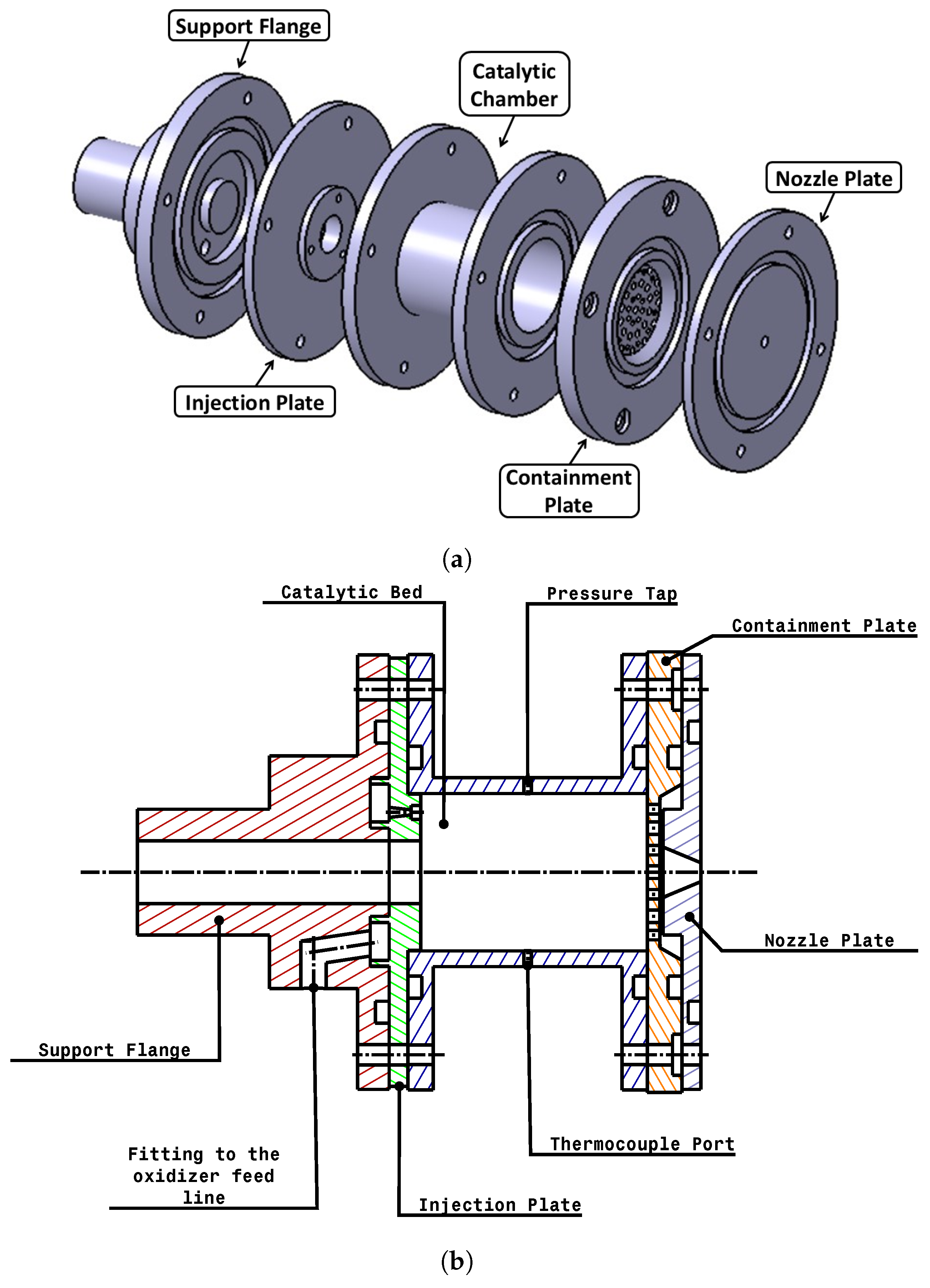
An exploded view diagram and a schematic representation of the decomposition chamber assembly are shown respectively in Figure 4a and Figure 4b. The liquid H2O2 flow is supplied via the feed line described in Section 2.1. Downstream of the Parker solenoid valve, the H2O2 feed line is connected to a stainless steel tube welded to the side of the support flange. The inclined hole allows the oxidiser to be conveyed into a 2.2 mm deep and 7 mm wide toroidal cavity. This cavity is coupled with an injection plate designed to break out the flow and promote the decomposition of hydrogen peroxide. Injection takes place through three converging holes with a minimum diameter of 0.3 mm. The catalytic chamber is a stainless steel AISI 316 cylinder (Artec Srl, Cento, Italy) with a diameter of 25 mm and a length of 38 mm. The total volume offered is 1.86 × 10⁻⁵ m3. As displayed in Figure 4b, two ports are located in the middle of its length to accommodate a k-type thermocouple and a pressure transducer, whose characteristics are summarized in Table 1. The thermocouple is therefore positioned in the mid-plane of the decomposition chamber, at a radial distance of 10.5 mm from the longitudinal axis of the thruster. A perforated containment plate allows the decomposition products to flow through, while forming a physical barrier to the movement of the pellets. Finally, a plate with a converging nozzle with a 2 mm throat diameter accelerates the flow and conveys it into the combustion chamber. The same configuration can also be used in monopropellant mode, as reported in [17].

3. Experimental Methodology

3.1. Experiments in Propulsive Environment and Data Analysis

Experience gained from several propulsion experiments has revealed catalyst degradation under different operating conditions [27]. Tests were conducted both with and without preheating of the catalytic chamber [28,29], and in all cases the catalysts were able to ensure ignition and correct engine operation for up to a maximum of three tests. For these reasons, a batch of previously unused catalysts was considered, and their operational history was monitored in order to analyse the possible causes leading to degradation and, if feasible, to subsequently attempt regeneration. Although the experiments were carried out under different operating conditions in terms of pressure and mass flow rates, the degradation consistently occurred after three tests. This led to the assumption that, while pressure and mass flow rate may have an influence, the dominant factor governing the degradation process is the total amount of hydrogen peroxide decomposed. It is also well known that both mass flow rate and pressure affect the decomposition efficiency and, therefore, the effective amount of hydrogen peroxide actually decomposed [30]. Consequently, in this work the total mass of H2O2 processed by the catalyst prior to failure was studied, while monitoring also the pressure and mass flow rate levels.
Regarding the experimental procedure, it should be noted that the tests are characterized by a two-phase operation: a pulsed monopropellant phase, used for preheating, followed by a continuous hybrid-mode phase. Pulsed preheating has proven to be an effective method for ensuring reliable rocket ignition, and the optimal pulse sequence, demonstrated elsewhere [17], is reported in Table 2 for completeness. Each step of the preheating phase involves a specific number of pulses and is characterized by precise time intervals during which the Parker valve is open (On Time) and closed (Off Time). This allows the injected mass to be gradually increased, following the progressive heating of the catalytic chamber, which increases its decomposition capability.
Table 3 reports the main information related to the tests presented and analyzed in this work. In the test designation, in addition to the ID number of the test type, the batch type used is also specified. B1 denotes the reference batch, whereas BFresh refers to a batch analogous to the reference one, employed to evaluate the performance of an unused catalyst under the same operating conditions as those adopted in the failure case (Test 4-B1Fail) and with the regenerated batch (Test 4-B1Reg). Table 2 also reports the number of monopropellant pulses required to ignite the hybrid rocket, the target oxidiser mass flow rate planned for the test, the intended duration of operation in hybrid configuration, and the pressure set upstream of the feed line. Although a similar target mass flow rate was imposed, the first three tests differ for the following reasons: tests 1 and 2/3 were performed using two different hybrid rocket nozzle throats. Since the throat used in tests 2 and 3 is smaller, a higher chamber pressure was expected at the same mass flow rate. Therefore, to ensure the same oxidiser flow rate, a higher feed pressure was required.
For the performance evaluation, Equation (2) is used to calculate the decomposition efficiency during the hybrid operating phase.
η d e c = m ˙ o x , t h m ˙ o x , e x p
Specifically, since the catalytic chamber nozzle is not choked during the test and the characteristic velocity cannot be defined, η d e c is defined as the ratio between the theoretical and the experimental mass flow rates, where the theoretical mass flow rate is computed using the compressible, subsonic form of Bernoulli’s equation [31]. Based on the recorded pressure signals, the theoretical mass flow rate corresponds to that obtained in the case of complete decomposition. In practice, however, since the reaction is not always complete, the resulting gas is cooler and denser, leading to a higher mass flow rate at a fixed pressure. Therefore, the above ratio provides an indication of the quality of decomposition achieved during the test.
In Section 4, the characteristic velocity in the combustion chamber and the combustion efficiency are also evaluated in order to assess the possible impact of the catalytic efficiency on the combustion performance.
c e x p = P c A t m ˙ t o t
η c o m b = c e x p c t h

3.2. Characterization Technique

Among the post-processing activities, specific analyses were carried out on the spent catalysts in order to assess the oxidation state of their surface, which, as will be shown, is suggested to be the potential main cause of performance degradation. The oxidation state of the Pd/Al2O3 catalyst and its behavior in a reducing environment was explored with Temperature Programmed Reduction (TPR) experiments (Microtrac Belcat II, BEL Japan Inc. (MicrotracBEL Corp.), Osaka, Japan). Before the experiment, a small fraction of sample (ca. 100 mg) was dried at 200 °C for 2 h under inert atmosphere (Argon flow, 30 mL/min). Afterwards, the unit was cooled down at 30 °C and the gas mixture was switched to 5 vol% hydrogen in argon. Since the reference gas (Ar) and the measurement gas (H2/Ar) have different thermal conductivities, a 1 h waiting time was essential to stabilize the thermal conductivity (TC) detector prior to the TPR experiment. Subsequently, the chamber temperature was increased up to 900 °C (heating rate 10 °C/min) while the hydrogen consumption was monitored with the TC detector to obtain fundamental insights on the reduction temperature of palladium oxides.

3.3. Catalyst Regeneration

As will be shown in Section 4, palladium oxidation appears to be the main driver of catalyst performance degradation; therefore, an attempt was made to reduce the generated palladium oxide in order to regenerate the catalytic activity. The regeneration of the 5% wt Pd/Al2O3 catalyst pellets was performed using sodium borohydride (NaBH4, Sigma-Aldrich (Merck), Burlington, MA, USA) as the reducing agent. A NaBH4 solution was prepared by dissolving the required amount of NaBH4 in 200 mL of distilled water. Particularly, the solution for the regeneration was prepared to reduce a full catalyst batch after propulsion experiments (≈18 g). The palladium-to-sodium borohydride ratio was kept to 1:3 to guarantee an excess of NaBH4 with respect to the palladium on the solid catalyst material. The spent catalyst pellets were immersed in the NaBH4 solution at room temperature for 30 min. Afterwards, they were withdrawn from the solution and washed with distilled water to remove the excess of NaBH4 from the catalyst surface.

4. Results and Discussion

In this chapter, the results concerning the performance of the catalysts under investigation throughout their lifetime are presented. The possible causes of the degradation of catalytic activity are then analyzed, and a solution to the problem through a regeneration process is proposed. Finally, the performance of the catalysts in their initial state is compared with that observed after regeneration following the first failure.

4.1. Evolution of Catalyst Performance

With the aim of monitoring step by step the level of catalyst consumption, the decomposition efficiency was calculated using Equation (2) during the hybrid combustion phase of each firing test. This analysis has been implemented in order to assess whether a possible degradation has an impact on the combustion efficiency. The cumulative amount of decomposed HTP in previous tests was also monitored. Indeed, since the tests are performed under different operating conditions and a wide variety of testing scenarios is considered for these catalysts, evaluating the consumption by parameterizing it solely in terms of pressures and mass flow rates over time may be of limited relevance. It is instead more meaningful to determine how much HTP can be decomposed with high efficiency over a wide range of operating conditions.
In the first set of tests prior to failure (Tests 1-B1 to 3-B1), the catalysts operated at pressures up to 17 bar, with mass flow rates reaching values of 11 g/s during the impulse phase, while in the hybrid phase the flow rate stabilized at slightly less than 3 g/s. Table 4 reports the main results of interest concerning the catalytic and combustion performance in the conducted tests, together with the cumulative amount of HTP decomposed prior to the test in the hybrid configuration.
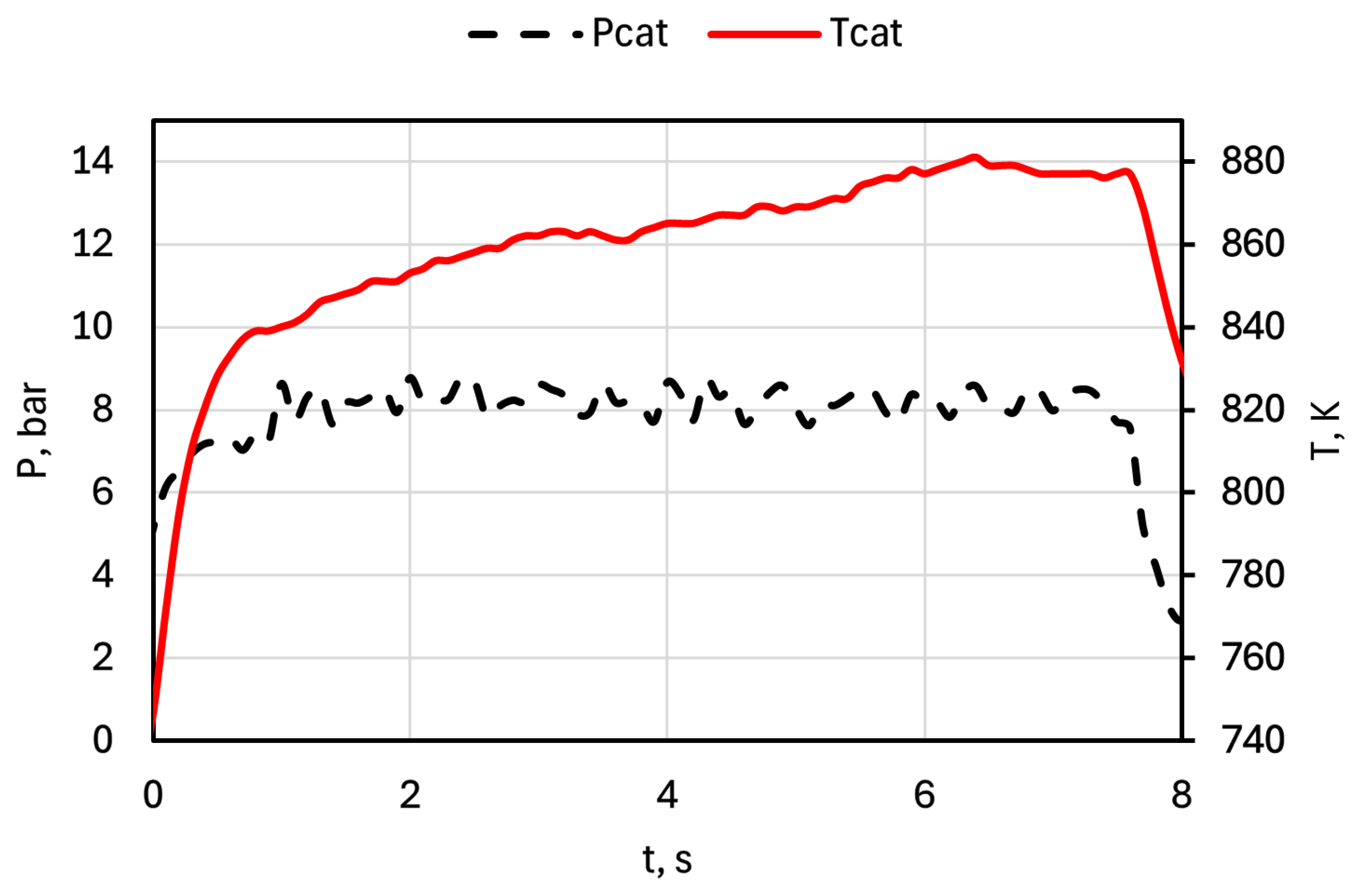
The efficiency observed in Test 1-B1 is remarkably high, demonstrating that the fresh catalyst, as originally designed, exhibits very good catalytic capabilities. Figure 5 illustrates the behavior during the hybrid phase in terms of measured values of pressure and temperature in the catalytic chamber. In addition to a stable pressure level, a temperature measured at mid-length of the catalytic chamber approaching 900 K is observed, while the adiabatic decomposition temperature is about 1000 K. The fact that the gas temperature is already so high at mid-chamber indicates that, under these conditions, a shorter length than the full catalytic chamber is sufficient to achieve complete decomposition. In general, this may have an impact in terms of catalyst consumption. Indeed, a very hot gaseous phase flowing through the catalyst, in addition to causing significant pressure losses, tends to accelerate catalyst degradation due to enhanced thermomechanical loads. Therefore, during the design phase, it would be preferable to tailor the catalytic chamber to the expected mass flow rate and pressure levels, so as to achieve complete decomposition only near the end of the catalytic chamber. It is also true that it is not possible to change the catalytic chamber for each operating condition; for this reason, such issues inevitably arise, causing rapid degradation phenomena.
It can be observed that the decomposition efficiency decreases as the tests progress, while at the same time it does not appear to have a significant impact on the combustion efficiency. Indeed, in the first two tests, although the decomposition efficiency drops by 16%, the combustion performance does not show any noticeable degradation. This behavior is reasonable, since even when the η d e c decreases, the hydrogen peroxide injected into the combustion chamber is already in the gaseous state (with temperatures in the catalytic chamber always exceeding 700 K). Therefore, no heat losses associated with phase change occur in the combustion chamber. Instead, the fraction not decomposed in the catalytic chamber undergoes thermal decomposition due to the high temperatures in the combustion chamber. An asterisk is reported for Test 3, since, owing to the use of ABS as fuel and the incomplete knowledge of its thermophysical properties, the theoretical characteristic velocity adopted for the efficiency calculation may not be fully reliable.
Test 4-B1 was performed after a total of 255.61 g of hydrogen peroxide had been decomposed. Despite exhibiting a residual catalytic activity, with the temperature in the catalytic chamber never exceeding 450 K, the catalysts were unable to induce fuel pyrolysis and to ensure flame ignition and stabilization.
Following this, the catalysts were analyzed and several activities were carried out to explain the underlying mechanisms responsible for the observed degradation and how the problem could be addressed. This is discussed in the following sections.

4.2. Degradation Assessment

The catalysts extracted from the catalytic chamber after the test failure were visually inspected and appeared slightly discolored compared to the intense black color typical of unused pellets. Some pellets appeared to be in good condition to the naked eye. They were considered for the subsequent analyses, in order to verify whether they exhibited a level of degradation sufficient to compromise their decomposition capability.
A comparison between the appearance of a spent catalyst, shown in Figure 6, and a new pellet, shown in Figure 2, highlights the difference in color.
Subsequently, in order to assess the ineffectiveness of the catalyst when in this condition, static tests were carried out by comparing two fresh pellets with two spent pellets of the type shown in Figure 6.
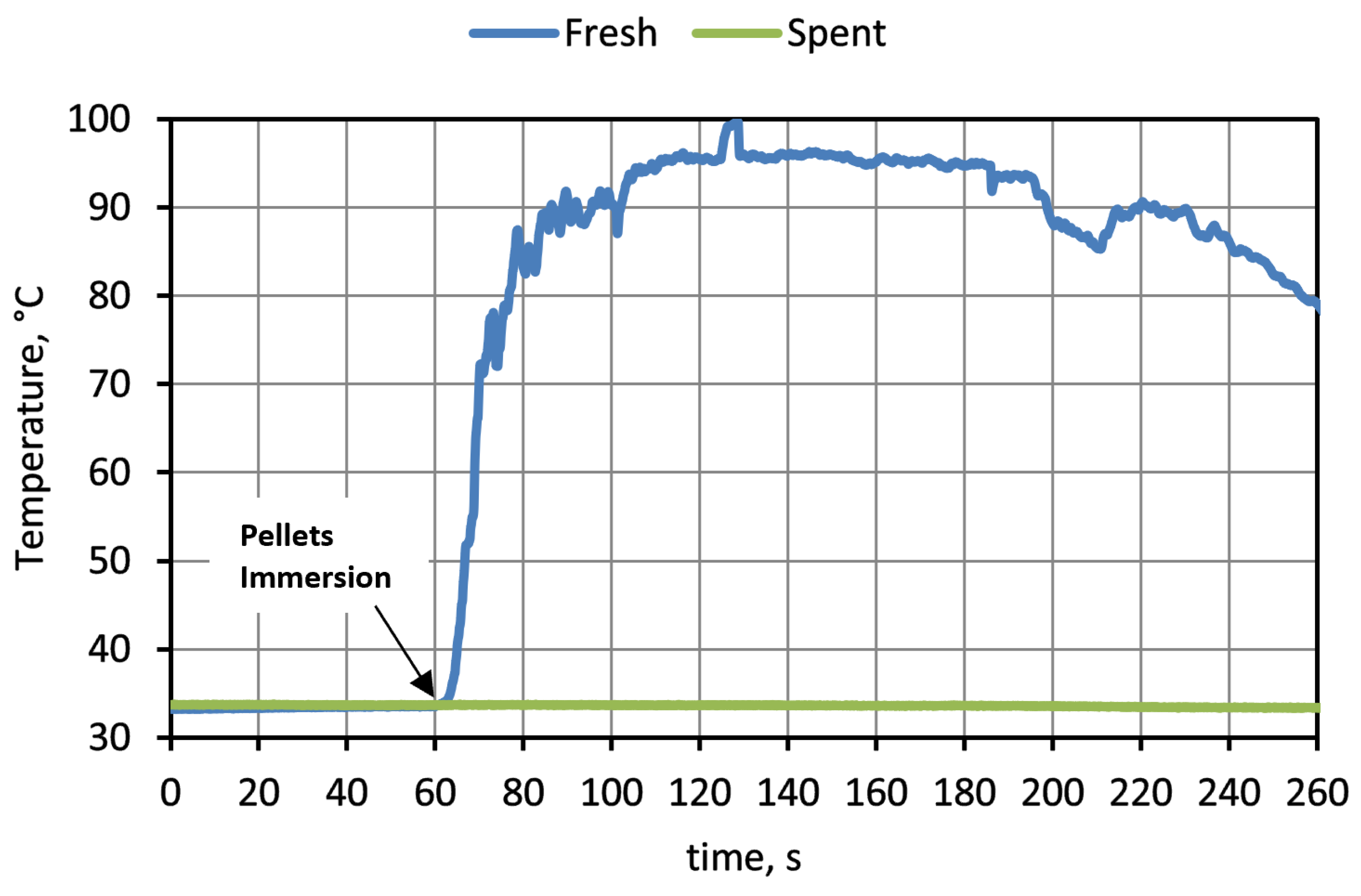
In two separate experiments, two pellets were placed in a glass column containing 7 g of hydrogen peroxide (90% wt), with a thermocouple positioned 5 cm above the liquid surface. Figure 7 reports the temperature profiles obtained during these experiments. For fresh catalysts, temperature reached approximately 100 °C and the hydrogen peroxide was almost completely consumed after about two minutes. Instead, in the case of spent catalysts no significant reaction was observed, with the temperature remaining at ambient level and no appreciable hydrogen peroxide consumption, except for the formation of a few small gas bubbles.

4.3. Degradation Causes and Regeneration

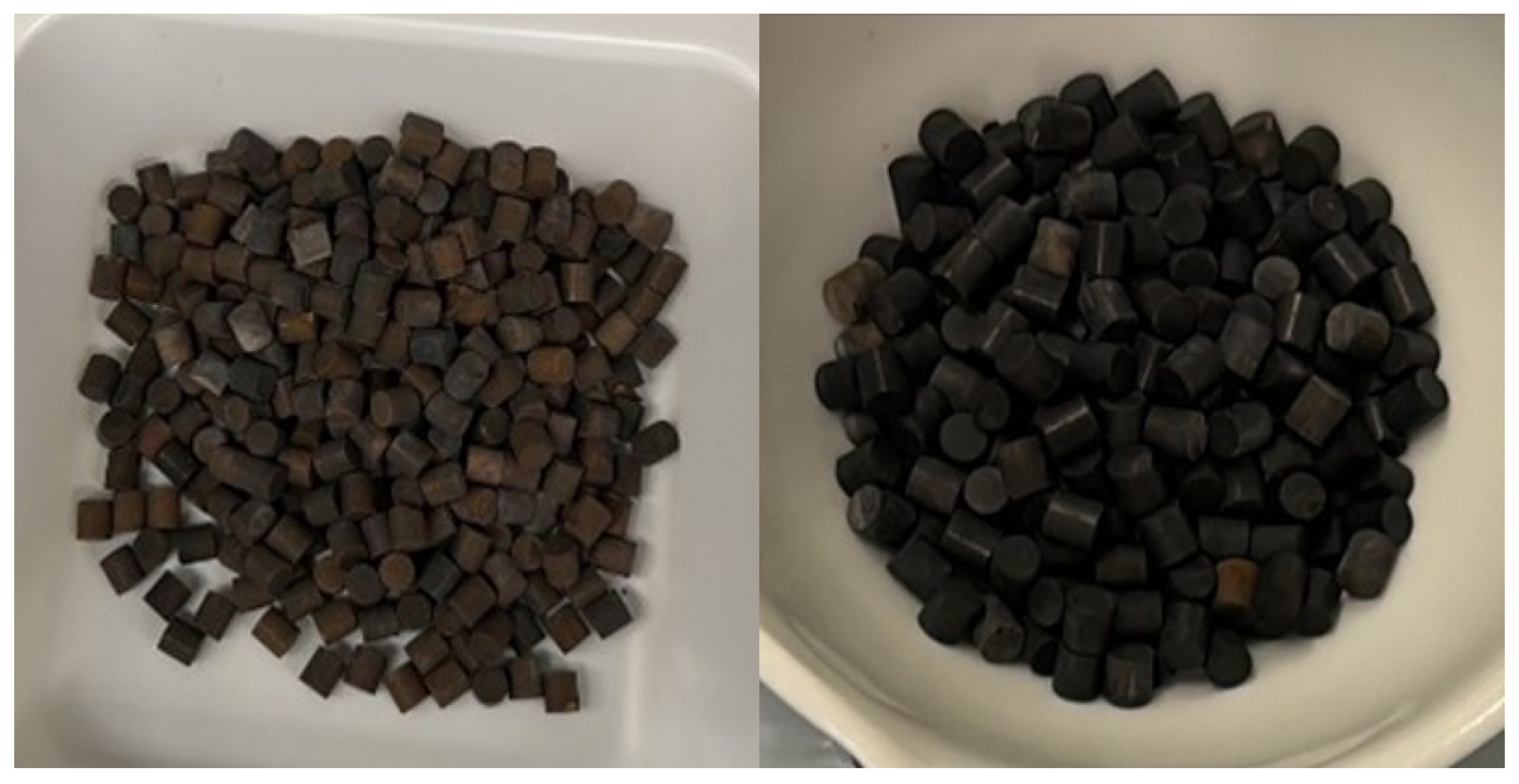
As mentioned, visual inspections of the catalytic pellets after propulsion experiments highlighted a significant modification of their color, switching from black to dark brown (Figure 8, left). Such variation in color is diagnostic of a significant modification of the oxidation state of the palladium nanoparticles on the Al2O3 surface. The treatment in NaBH4 restored the color of the pellets, highlighting the reduction of the formed oxides to metallic palladium.
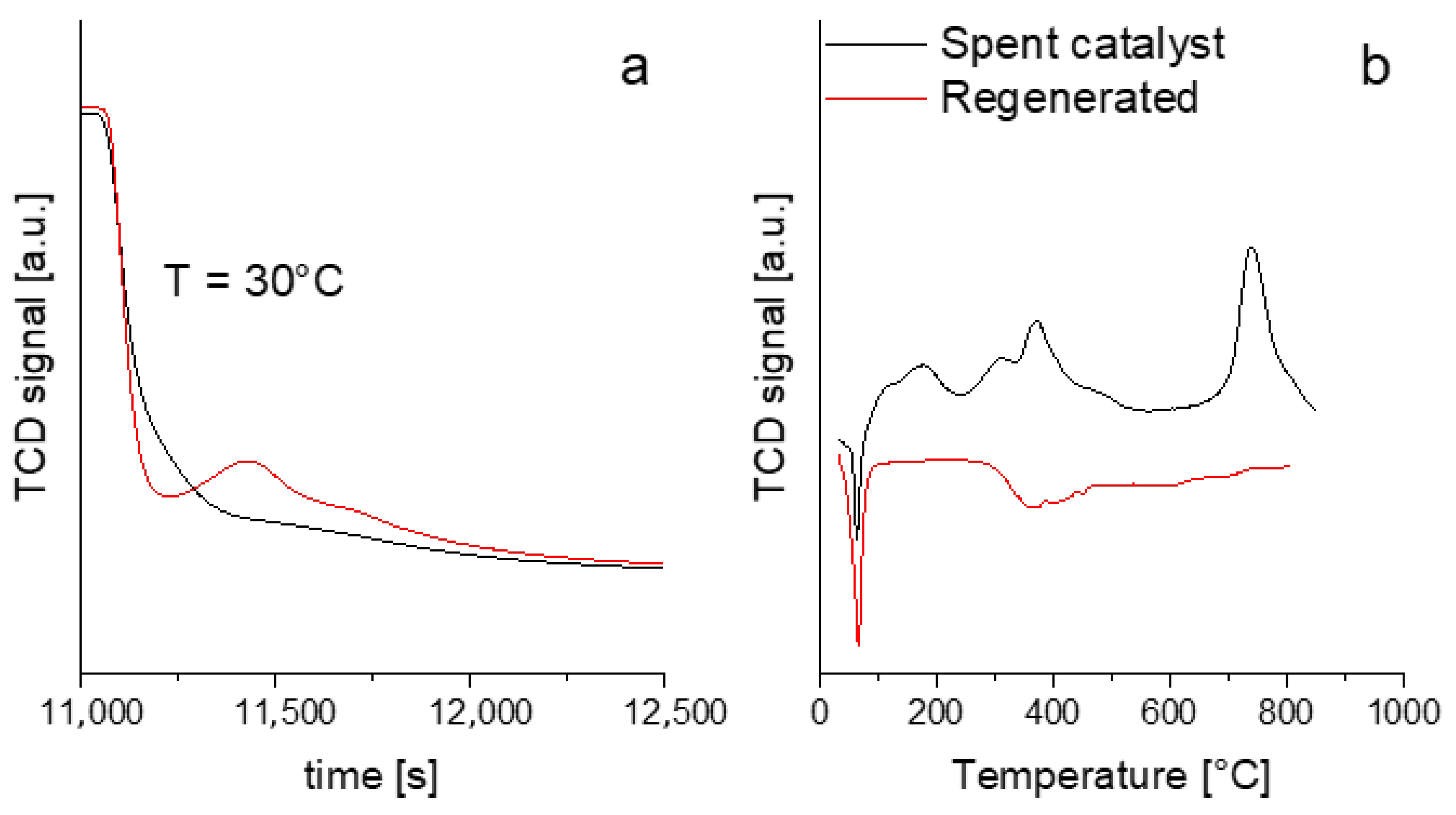
Temperature Programmed Reduction (TPR) experiments were carried out to obtain further insights into the modification of the oxidation state of the palladium nanoparticles after treatment in NaBH4. Figure 9a displays the behavior of the Thermal Conductivity Detector (TCD) signal during stabilization at 30 °C. While the spent catalyst exhibits a monotonic decreasing profile, the regenerated catalyst shows a distinct peak, suggesting that a fraction of palladium oxides was still present on the catalyst surface after NaBH4 treatment. Nonetheless, those oxides are easily reduced at low temperatures (30 °C). Many literature case-studies displayed that classical Pd/Al2O3 catalysts are easily reduced at T < 20 °C [32,33,34]. Such reduction peaks require specific instruments with integrated cooling units for accurate detection. Moreover, an additional contribution to the hydrogen consumption can be attributed to the formation of β -PdH because of the interaction of H2 with metallic Pd. The obtained thermograms for both the spent and regenerated catalysts are displayed in Figure 9b. Both catalysts exhibited a sharp negative peak at T = 60 °C, which is attributed to the desorption of hydrogen from β -PdH species [35]. In case of the regenerated catalyst, no additional peaks were observed. On the contrary, the spent catalyst revealed broad reduction peaks at different temperatures, namely at 175 °C, 315 °C, 380 °C and 750 °C. High temperature reduction peaks have been scarcely observed in the open literature for Pd/Al2O3 catalysts without promoters. Among the first, Lieske and Voelter [36] explored the reduction behavior of Pd/Al2O3 catalysts after treatment at high temperatures (600 and 900 °C) under oxygen atmosphere. Their results revealed the formation of high temperature reduction peaks, which were attributed to the formation of palladium oxide surface complexes [PdO]sc with strong interactions with the alumina support. Given the presence of oxygen and hydrogen peroxide, which is also a strong oxidating agent, and the high temperatures in the catalytic chamber, a similar oxidation behavior is presumed during propulsion, yielding catalyst deactivation. Similar thermograms were observed in our previous study in the low temperature hydrogen peroxide decomposition on 3D printed Pd/Al2O3 catalysts [37]. In that case, the highest reduction peak was at 380 °C. The exposure of the catalyst to propulsion conditions yielded to the formation of stronger palladium oxides, which are more difficult to reduce in hydrogen atmosphere. Nonetheless, the TPR profile of the regenerated catalyst did not show significant peaks, proving that the strong palladium oxides are reduced by NaBH4 at low temperatures. The analysis of TPR experiments during both the stabilization of the TCD signal and the temperature gave meaningful information on the primary causes of catalyst deactivation and highlighted the role of NaBH4 in the regeneration experiment. The presence of oxygen and concentrated hydrogen peroxide in the catalytic chamber causes the formation of palladium oxide surface complexes which are difficult to reduce. Such oxides are responsible for a steep decline in the catalytic activity. The treatment with NaBH4 allows the reconversion of palladium oxides into metallic palladium. However, the reduction is not completed since reduction peaks are observed during signal stabilization in the regenerated catalyst (Figure 9a). Further investigations will aim at improving the regeneration of the palladium oxides to restore completely the catalytic activity by e.g., increasing the reduction temperature, increasing the NaBH4 concentration or changing the reducing agent.

4.4. Performance of Regenerated Catalysts and Comparisons

After regenerating the catalysts, a test was carried out under the same operating conditions as the failed one (see Test 4-B1Fail in Table 3) and was designated as Test 4-B1Reg. For completeness, and in order to enable a direct comparison among fresh, spent, and regenerated catalysts, an additional test was also performed using the same type of catalyst but never previously used, referred to as Test 4-BFresh.
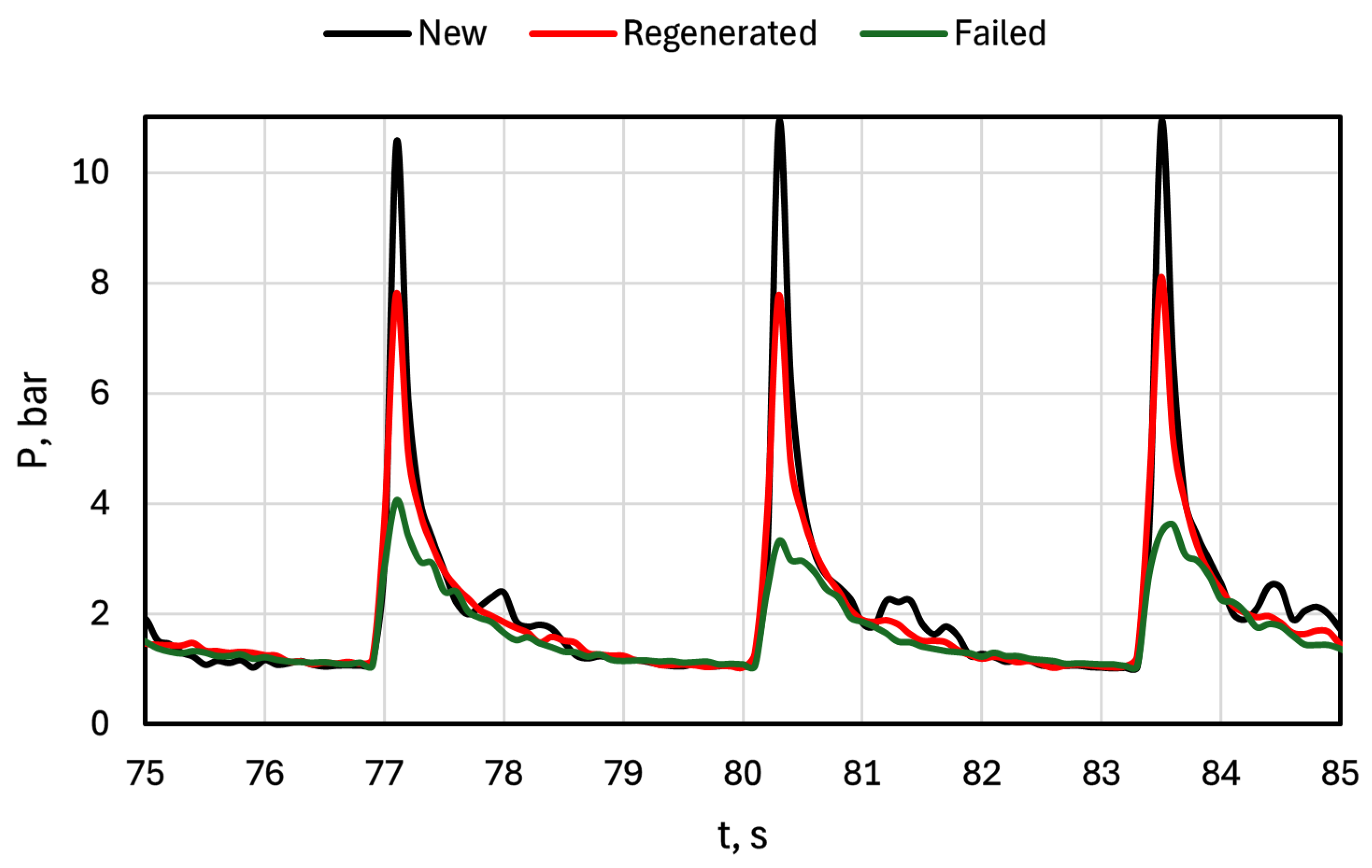
Figure 10 shows some of the pressure signals obtained during step 2 of the pulse train reported in Table 2. It can be observed that, under identical operating conditions, the pressure peak achieved during the pulsed phase differs significantly among the three analyzed cases. Since the pressure level is indicative of the amount of hot gas generated in the catalytic chamber, the results obtained in the propulsion environment also clearly suggest that the regeneration process, although effective, is not complete but only partial.
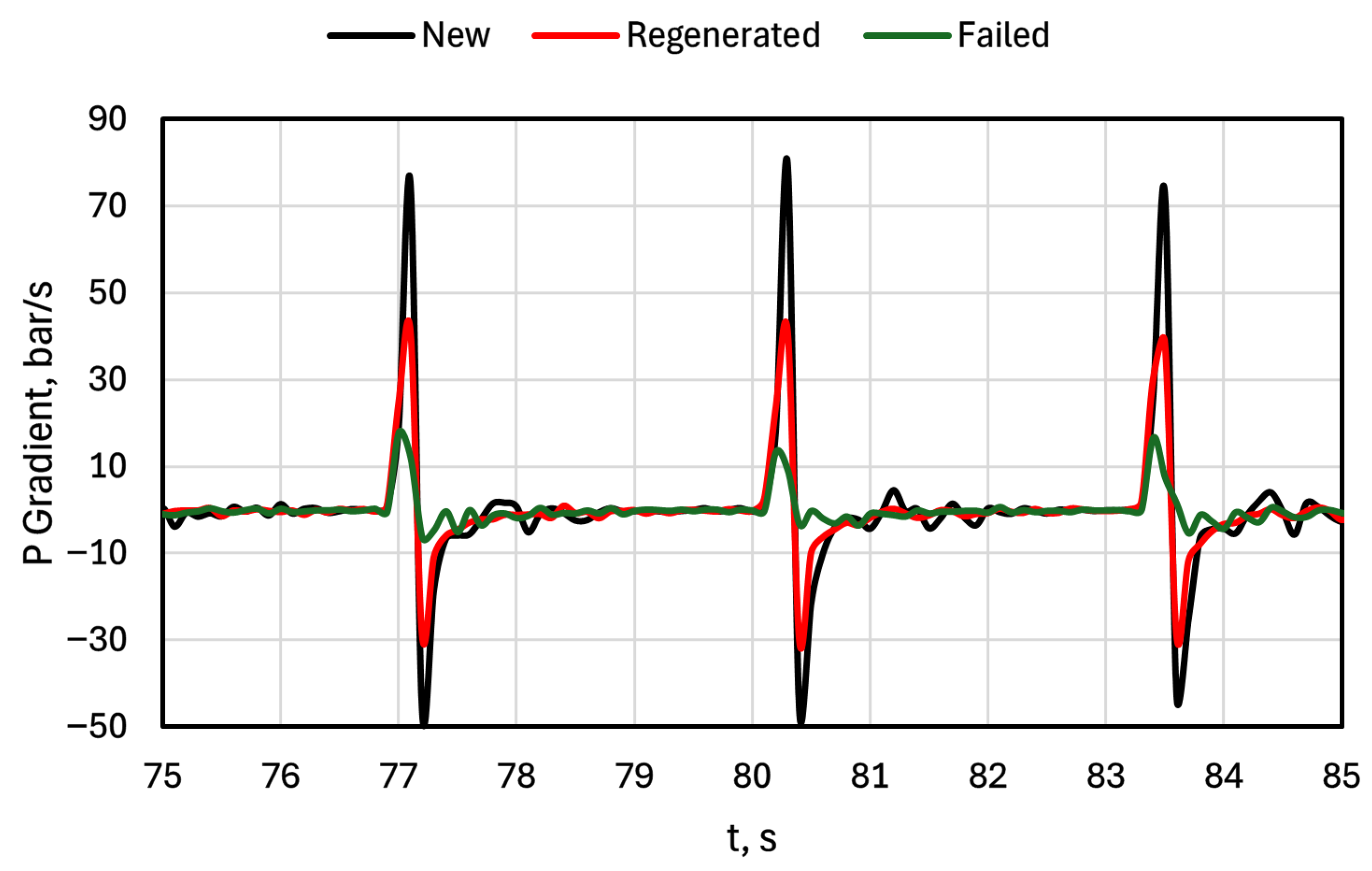
This conclusion is further supported by the analysis of the pressure gradient recorded during the pulsed phase, which is indicative of the rate of pressure variation and thus of the catalyst reactivity when it comes into contact with hydrogen peroxide. As shown in Figure 11, the fresh catalyst reaches a peak of about 80 bar/s, which is approximately twice that exhibited by the regenerated catalyst.
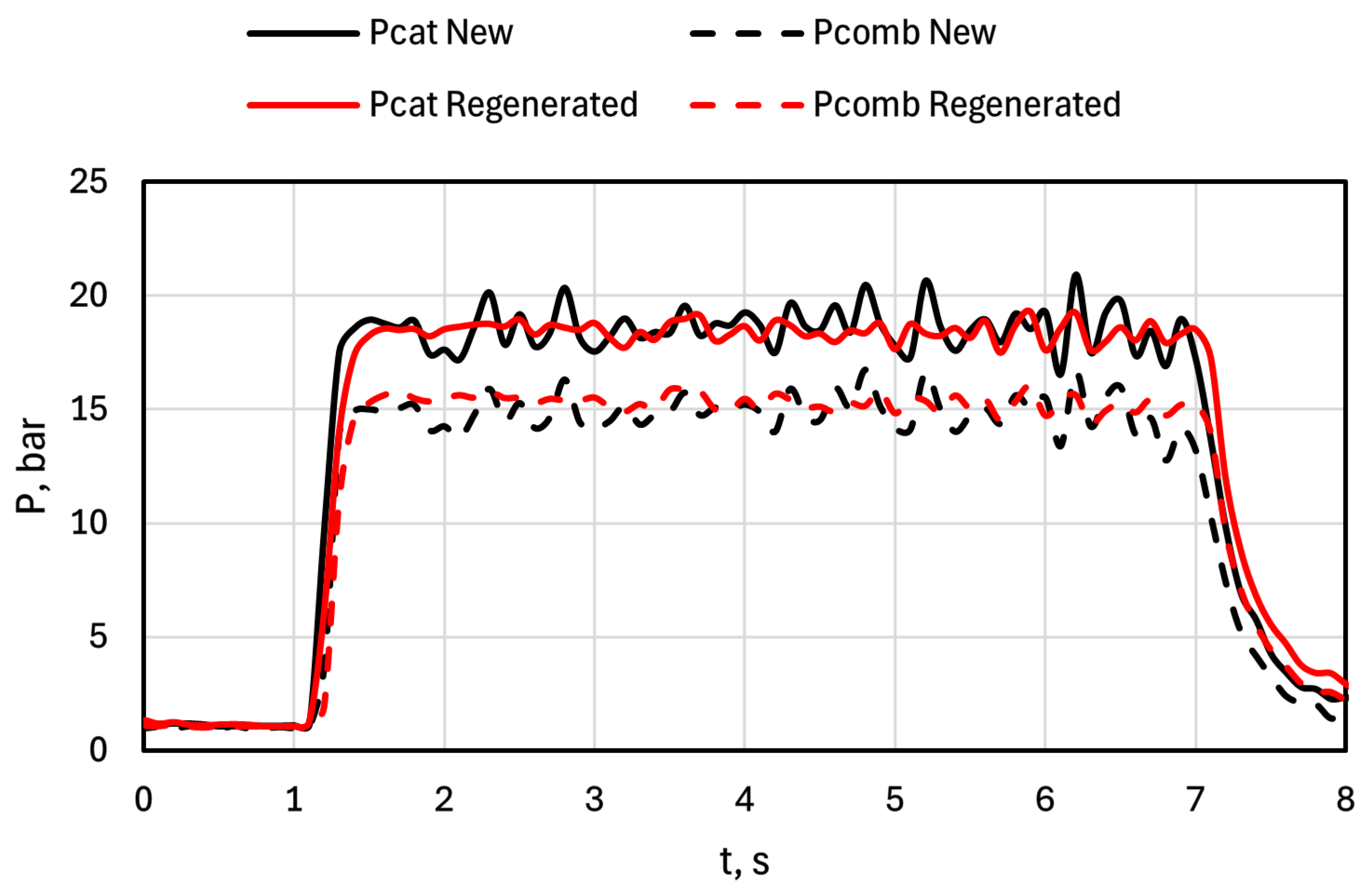
Nevertheless, although regeneration is only partial, it is sufficient for this type of application to ensure ignition and flame sustaining. For this reason, the pressure curves during the continuous phase in hybrid configuration were analyzed in order to further assess the possible impact of the catalyst on combustion efficiency. Figure 12 reports the pressure signals recorded in the catalytic chamber and in the combustion chamber for both the fresh and the spent catalyst cases. It can be observed that the pressure levels are practically identical, which already suggests that, during operation in hybrid configuration, the engine behaved in the same manner under identical operating conditions. In both cases, the efficiencies were also evaluated in order to obtain a quantitative estimate (see Table 5).
Based on the value of the decomposition efficiency, it appears that the regenerated catalyst returned to conditions slightly better than those observed after the first Test 1-B1. It will be important to determine how many times this regeneration procedure can be repeated before it ultimately becomes ineffective.

5. Conclusions

This work investigated the evolution of the decomposition performance of a batch of palladium-coated alumina pellets subjected to a sequence of hybrid firing tests using a 10 N-class mini-thruster exmploying 90% HTP and HDPE/ABS as propellants. During the first three tests, continuous monitoring of the main propulsive parameters revealed a progressive degradation of the catalytic activity. In the fourth test, this degradation resulted in the inability to ignite the polymeric fuel grain, leading to the failure of the firing test.
The degraded pellets were subsequently analyzed through visual inspection, static HTP decomposition measurements, and Temperature Programmed Reduction (TPR) experiments. These analyses identified surface oxidation of palladium as the primary cause of the observed loss in catalytic performance. On the basis of these findings, a regeneration technique based on sodium borohydride (NaBH4) treatment was developed. This approach enables the reduction of palladium oxides back to their metallic state, thereby restoring the decomposition capability of the catalyst. The treatment resulted in partial regeneration of the pellets, which were then subjected to an additional firing test to characterize their behavior. By comparing the experimental results obtained from the regenerated pellets with those from both a new batch and the degraded batch, the effectiveness of the proposed treatment was assessed. Despite the partial nature of the regeneration, the treated pellets exhibited performance only slightly lower than that of new catalysts and were fully sufficient to ensure reliable ignition of the fuel grain and successful completion of the firing test.
This work has provided some insights into the degradation mechanisms at work during repeated firing tests of small-scale hybrid thrusters operating with hydrogen peroxide, highlighting how the surface oxidation of palladium pellets severely limits their catalytic activity over time, making them practically inactive after a limited number of consecutive firing tests. Furthermore, the experimental results reported demonstrate that the proposed regeneration technique is capable of partially recovering the decomposition performance of palladium-coated alumina pellets affected by surface oxidation. providing significantly better decomposition properties than spent pellets, although slightly lower than new pellets. This shows that sodium borohydride treatment can be considered as a promising technique that deserves further study and development. It could be exploited to lower costs for ground-based testing, facilitating the experimental activities of research groups, especially in universities and in the early stages of hybrid rocket propulsion system R&D. Future work will focus on further optimization of the oxide reduction process, assessment of the long-term behavior of regenerated catalysts, and evaluation of the maximum number of feasible regeneration cycles. The possibility of developing regeneration systems for use in orbit may also be evaluated through dedicated feasibility studies.

Author Contributions

Conceptualization, S.C.; methodology, S.C., L.M., R.G., S.M. and R.S.; software, S.C.; validation, S.C., L.M., S.M. and R.S.; formal analysis, S.C.; investigation, S.C., L.M. and R.G.; resources, V.R., T.S. and R.S.; data curation, S.C. and L.M.; writing—original draft preparation, S.C., L.M. and R.G.; writing—review and editing, S.C., L.M., R.G. and S.M.; visualization, S.C. and L.M.; supervision, S.M. and R.S.; project administration, R.S.; funding acquisition, V.R., T.S. and R.S. All authors have read and agreed to the published version of the manuscript.

Funding

This research received no external funding.

Data Availability Statement

The original contributions presented in the study are included in the article, further inquiries can be directed to the corresponding author.

Acknowledgments

This study was carried out within the Space It Up project funded by the Italian Space Agency, ASI, and the Ministry of University and Research, MUR, under contract n. 2024-5-E.0—CUP n. I53D24000060005.

Conflicts of Interest

The authors declare no conflicts of interest.

Nomenclature

Acronyms
ABSAcrylonitrile Butadiene Styrene
AISIAmerican Iron and Steel Institute
HDPEHigh Density Polyethylene
HTPHigh Test Peroxide
N.A.Not Available
PIDProportional–Integral–Derivative
RCSReaction Control System
TCThermal Conductivity
TCDThermal Conductivity Detector
TPRTemperature Programmed Reduction
Symbols
A t Throat Area, mm2
c e x p Experimental Characteristic Velocity, m s
c t h Theoretical Characteristic Velocity, m s
m ˙ o x , e x p Experimental Oxidizer Mass Flow Rate, g s
m ˙ o x , t h Theoretical Oxidizer Mass Flow Rate, g s
m ˙ t o t Total Mass Flow Rate, g s
P 0 Feed Pressure, bar
P c Combustion Chamber Pressure, bar
η c o m b Combustion Efficiency
η d e c Decomposition Efficiency

References

  1. Levikhin, A.; Boryaev, A. Hydrogen peroxide—A promising oxidizer for rocket engines: Physical and chemical properties: Decomposition in the liquid phase. Adsorption 2024, 30, 2187–2217. [Google Scholar] [CrossRef]
  2. Ventura, M.; Mullens, P. The use of hydrogen peroxide for propulsion and power. In Proceedings of the 35th Joint Propulsion Conference and Exhibit, Los Angeles, CA, USA, 20–24 June 1999; p. 2880. [Google Scholar]
  3. Okninski, A.; Surmacz, P.; Bartkowiak, B.; Mayer, T.; Sobczak, K.; Pakosz, M.; Kaniewski, D.; Matyszewski, J.; Rarata, G.; Wolanski, P. Development of Green Storable Hybrid Rocket Propulsion Technology Using 98% Hydrogen Peroxide as Oxidizer. Aerospace 2021, 8, 234. [Google Scholar] [CrossRef]
  4. Faenza, M.; Boiron, A.J.; Haemmerli, B.; Verberne, C.J. Development of the nucleus hybrid propulsion system: Enabling a successful flight demonstration. In Proceedings of the AIAA Propulsion and Energy 2019 Forum, Indianapolis, IN, USA, 19–22 August 2019; p. 3839. [Google Scholar]
  5. Schmierer, C.; Kobald, M.; Tomilin, K.; Fischer, U.; Schlechtriem, S. Low cost small-satellite access to space using hybrid rocket propulsion. Acta Astronaut. 2019, 159, 578–583. [Google Scholar] [CrossRef]
  6. Wernimont, E.; Ventura, M.; Garboden, G.; Mullens, P. Past and present uses of rocket grade hydrogen peroxide. Chem. Eng. Hist. 1999, 92656, 680. [Google Scholar]
  7. Baumgartner, H.; Hood, G.; Monger, J.; Sanborn, C. Decomposition of concentrated hydrogen peroxide on silver II. High temperature decomposition. J. Catal. 1963, 2, 415–420. [Google Scholar] [CrossRef]
  8. Rusek, J.J. New decomposition catalysts and characterization techniques for rocket-grade hydrogen peroxide. J. Propuls. Power 1996, 12, 574–579. [Google Scholar] [CrossRef]
  9. Cervone, A.; Romeo, L.; Torre, L.; D’Agostino, L.; Calderazzo, F.; Roberts, G.; Musker, A.; Saccoccia, G. Development of green hydrogen peroxide monopropellant rocket engines and testing of advanced catalytic beds. In Proceedings of the 3rd International Conference on Green Propellants for Space Propulsion, Poitiers, France, 17–20 September 2006. [Google Scholar]
  10. Musker, A. Highly stabilised hydrogen peroxide as a rocket propellant. In Proceedings of the 39th AIAA/ASME/SAE/ASEE Joint Propulsion Conference and Exhibit, Huntsville, AL, USA, 20–23 July 2003; p. 4619. [Google Scholar]
  11. Palmer, M.; Musker, A.; Roberts, G.; Ponce-de Leon, C. Manufacture, Assessment and Down-Selection of Catalysts for the Decomposition of Hydrogen Peroxide. In Proceedings of the 4th European Conference for Aerospace Sciences (EUCASS), Saint Petersburg, Russia, 4–8 July 2011. [Google Scholar]
  12. Torre, L.; Romeo, L.; Pasini, A.; Cervone, A.; d’Agostino, L.; Calderazzo, F. Performance of different catalysts supported on alumina spheres for hydrogen peroxide decomposition. In Proceedings of the 43rd AIAA/ASME/SAE/ASEE Joint Propulsion Conference & Exhibit, Cincinnati, OH, USA, 8–11 July 2007; p. 5466. [Google Scholar]
  13. Pasini, A.; Torre, L.; Romeo, L.; Cervone, A.; d’Agostino, L. Endurance tests on different catalytic beds for H2O2 monopropellant thrusters. In Proceedings of the 45th AIAA/ASME/SAE/ASEE Joint Propulsion Conference & Exhibit, Denver, CO, USA, 2–5 August 2009; p. 5472. [Google Scholar]
  14. Pasini, A.; Torre, L.; Romeo, L.; Cervone, A.; d’Agostino, L. Performance characterization of pellet catalytic beds for hydrogen peroxide monopropellant rockets. J. Propuls. Power 2011, 27, 428–436. [Google Scholar] [CrossRef]
  15. Cassese, S.; Mungiguerra, S.; Guida, R.; Sannino, A.; Cecere, A.; Savino, R. Firing Tests and Simulations of a CubeSat-Scale H2O2-Based Hybrid Rocket. J. Propuls. Power 2025. [Google Scholar] [CrossRef]
  16. Parker Hannifin Corporation, Precision Fluidics Division. Series 9 Liquid Flow Datasheet: Miniature High Speed and Pressure Liquid Dispense Valve; Parker Hannifin Corporation: Hollis, NH, USA, 2015. [Google Scholar]
  17. Cassese, S.; Mungiguerra, S.; Capone, V.; Guida, R.; Cecere, A.; Savino, R. Fuel Ignition in HTP Hybrid Rockets at Very Low Mass Fluxes: Challenges and Pulsed Preheating Techniques Using Palladium-Coated Catalysts. Aerospace 2024, 11, 884. [Google Scholar] [CrossRef]
  18. Tedea-Huntleigh. Load Cell Model 1042; Load Cell Datasheet; Model 1042; Technical Specifications; Tedea-Huntleigh (Vishay Precision Group): Albertslund, Denmark, 2014; Available online: https://www.tekemas.com/hubfs/Website/PDF/Weighing/Data%20Sheets%20Load%20Cells%20+%20Mounts/Tedea%20Huntleigh/1042-single-point-load-cell-tedea-huntleigh-tekemas.pdf?hsLang=en (accessed on 20 January 2026).
  19. Tersid Srl. Tersid K-Type Thermocouple Datasheet; Tersid Srl: Sesto San Giovanni, Italy, 2025. [Google Scholar]
  20. Setra Systems, Inc. Setra Model 206 Industrial Pressure Transducer Datasheet; Setra Systems, Inc.: Boxborough, MA, USA, 2020. [Google Scholar]
  21. Cassese, S.; Guida, R.; Trincone, D.; Mungiguerra, S.; Savino, R. Relevant Fluid Dynamics Aspects of the Internal Ballistics in a Small-Scale Hybrid Thruster. Fluid Dyn. Mater. Process. 2025, 21, 1299–1337. [Google Scholar] [CrossRef]
  22. ISO 1219-1:2012/Amd 1:2016; Fluid Power Systems and Components, Graphical Symbols and Circuit Diagrams, Part 1: Graphical Symbols for Conventional Use and Data-Processing Applications. International Organization for Standardization (ISO): Geneva, Switzerland, 2016.
  23. Bronkhorst High-Tech B.V. mini CORI-FLOW M14 Datasheet: Low Flow Coriolis Mass Flow Meter for Liquids and Gases; Bronkhorst High-Tech B.V.: Ruurlo, The Netherlands, 2025. [Google Scholar]
  24. Plauck, A.; Stangland, E.E.; Dumesic, J.A.; Mavrikakis, M. Active sites and mechanisms for H2O2 decomposition over Pd catalysts. Proc. Natl. Acad. Sci. USA 2016, 113, E1973–E1982. [Google Scholar] [CrossRef] [PubMed]
  25. Liu, H.; Chen, X.; Qiu, S.; Wei, Q.; Qin, Y.; Ji, L.; Xu, J. Insight into enhanced catalytic performance of alkali-treated Al2O3 supported Ag catalyst for toluene oxidation. Fuel 2025, 393, 134987. [Google Scholar] [CrossRef]
  26. Alfa Aesar. Certificate of Analysis: Palladium, 5% on 3 mm Alumina Pellets; Alfa Aesar: Segrate, Italy, 2021. [Google Scholar]
  27. Cassese, S.; Mungiguerra, S.; Monteverde, F.; Savino, R. Durable Oxide Catalysts free of Noble Metals for Hydrogen Peroxide Thrusters. In Proceedings of the 75th International Astronautical Congress (IAC), IAC-24, Milan, Italy, 14–18 October 2024. C4,IP,77,x90200. [Google Scholar]
  28. Cassese, S.; Capone, V.; Guida, R.; Mungiguerra, S.; Savino, R. Properties and Behavior of 3D-Printed ABS Fuel in a 10 N Hybrid Rocket: Experimental and Numerical Insights. Aerospace 2025, 12, 291. [Google Scholar] [CrossRef]
  29. Cassese, S.; Mungiguerra, S.; Guida, R.; Cecere, A.; Savino, R. Regression Rate and Performance Analysis via Ballistic Reconstruction of a small-scale H2O2-based Hybrid Rocket fuelled by Polyvinyl Chloride. Aerosp. Sci. Technol. 2024, 146, 108911. [Google Scholar] [CrossRef]
  30. Cassese, S.; Gallo, G.; Mungiguerra, S.; Cecere, A.; Savino, R. Preliminary Design and Study of 5N HTP Monopropellant Thruster for Small Satellites. Acta Astronaut. 2023, 202, 94–103. [Google Scholar] [CrossRef]
  31. Kamps, L.; Hirai, S.; Nagata, H.; Carmicino, C.; Shimada, T.; Karabeyoglu, A. Hybrid Rockets as Post-Boost Stages and Kick Motors. Aerospace 2021, 8, 253. [Google Scholar] [CrossRef]
  32. Sandoval, V.H.; Gigola, C.E. Characterization of Pd and Pd–Pb/γ-Al2O3 catalysts. A TPR–TPD study. Appl. Catal. A Gen. 1996, 148, 81–96. [Google Scholar] [CrossRef]
  33. Boretskaya, A.; Il’yasov, I.; Popov, A.; Lamberov, A. Modification of a phase-inhomogeneous alumina support of a palladium catalyst. Part II: The effect of palladium dispersion on the formation of hydride forms, electronic state, and catalytic performance in the reaction of partial hydrogenation of unsaturated hydrocarbons. Mater. Today Chem. 2021, 19, 100387. [Google Scholar] [CrossRef]
  34. Vedyagin, A.A.; Volodin, A.M.; Kenzhin, R.M.; Stoyanovskii, V.O.; Rogov, V.A.; Medvedev, D.A.; Mishakov, I.V. Characterization and study on the thermal aging behavior of palladium–alumina catalysts. J. Therm. Anal. Calorim. 2017, 130, 1865–1874. [Google Scholar] [CrossRef]
  35. Batista, J.; Pintar, A.; Mandrino, D.; Jenko, M.; Martin, V. XPS and TPR examinations of γ-alumina-supported Pd–Cu catalysts. Appl. Catal. A Gen. 2001, 206, 113–124. [Google Scholar] [CrossRef]
  36. Lieske, H.; Voelter, J. Pd Redispersion by Spreading of PdO in O2 Treated Pd/Al2O3. J. Phys. Chem. 1985, 89, 1841–1846. [Google Scholar] [CrossRef]
  37. Mastroianni, L.; Agovino, G.; Sandri, F.; Aho, A.; Eränen, K.; Cassese, S.; Mungiguerra, S.; Di Serio, M.; Murzin, D.Y.; Russo, V.; et al. Digital light processing (DLP) 3D-printed Pd/Al2O3 catalysts for H2O2 decomposition: Towards efficient green thrusters. Appl. Catal. A Gen. 2025, 706, 120466. [Google Scholar] [CrossRef]
Figure 1. Schematic of the hydrogen peroxide feed line, from [21]. The graphic symbols employed are in accordance with the International Standard Organisation ISO 1219-1:2012/Amd 1:2016 [22].
Aerospace 13 00238 g001
Figure 2. Side view (a) and front view (b) of a Pd-coated Al2O3 catalytic pellet.
Aerospace 13 00238 g002
Figure 3. Hybrid thruster configuration, as in [15].
Aerospace 13 00238 g003
Figure 4. Exploded view diagram (a) and cross section view (b) of the decomposition chamber employed during the firing tests.
Aerospace 13 00238 g004
Figure 5. Gas pressure and temperature signals in the catalytic chamber during the hybrid operating phase of Test 1-B1.
Aerospace 13 00238 g005
Figure 6. Microscopic images of a spent pellet.
Aerospace 13 00238 g006
Figure 7. Temporal evolution of temperature measured during the static decomposition tests.
Aerospace 13 00238 g007
Figure 8. Catalyst batch after a propulsion experiment (left) and after regeneration in NaBH4 (right).
Aerospace 13 00238 g008
Figure 9. Summary of the TPR experiment. (a) TCD signal during stabilization and (b) obtained thermograms for spent and regenerated catalysts.
Aerospace 13 00238 g009
Figure 10. Pressure signals obtained during the pulsed phase. Curves corresponding to three cases are compared: fresh, spent, and regenerated catalyst.
Aerospace 13 00238 g010
Figure 11. Pressure gradients obtained during the pulsed phase. Curves corresponding to three cases are compared: fresh, spent, and regenerated catalyst.
Aerospace 13 00238 g011
Figure 12. Pressure signals during the continuous phase in the catalytic and combustion chambers. Signals obtained with fresh and regenerated catalysts are compared.
Aerospace 13 00238 g012
Table 1. Technical specifications of sensors employed.
Sensor
Denomination
Number
of
Sensors
RangeAccuracyAcquisition
Rate
Bronkhorst
mini CORI-FLOW
mass flow meter
M14 [23]
10–8.33 g/s
(for liquid)
±0.2% of reading
(for liquid)
5 kHz
Tedea Huntleigh
load cell [18]
1from 1 N
to 20 N
±0.02%
of rated output
5 kHz
Tersid Srl
K-type Thermocouple [19]
2from −200 °C
to 1100 °C
±1.5 °C5 kHz
Setra Systems C206
Pressure Transducer [20]
30–700 bar±0.13% of
full scale value
5 kHz
Table 2. Summary of the pulsed preheating sequence with number of pulses and valve opening/closing time intervals.
Pulses NumberOn Time (ms)Off Time (ms)
Step 1151003000
Step 2152003000
Step 3103003000
Step 4105003000
Table 3. Key parameters of the experimental tests.
N. of PulsesMFR Target (g/s)Continuum Phase
Duration (s)
P0 (bar)
Test 1-B160 a≈2.5612
Test 2-B141≈2.5619.5
Test 3-B142≈2.5615.5
Test 4-B1FailN.A. b≈5.5623
Test 4-B1Reg31≈5.5623
Test 4-BFresh28≈5.5623
a During this test, ignition was not achieved after the standard 60-pulse sequence; it occurred only after the transition to continuous mode following the pulsed preheating phase. b N.A. = Not Available.
Table 4. Main results obtained in the first three tests. Decomposition and combustion efficiencies are reported, together with the amount of hydrogen peroxide already decomposed before the continuous operating phase.
Test 1-B1Test 2-B1Test 3-B1
Cumulative decomposed mass, g73.33157.65238.36
m ˙ ox , exp , g/s2.482.712.50
η dec 0.970.810.76
c exp , m/s1459.361388.821110.13
η comb 0.991.000.87
Table 5. Main results obtained in the tests with fresh and regenerated catalysts. Decomposition and combustion efficiencies are reported.
Test 4-BFreshTest 4-BReg
m ˙ ox , exp , g/s5.565.63
η dec 0.950.87
c exp , m/s1509.511559.58
η comb 0.991.00
Disclaimer/Publisher’s Note: The statements, opinions and data contained in all publications are solely those of the individual author(s) and contributor(s) and not of MDPI and/or the editor(s). MDPI and/or the editor(s) disclaim responsibility for any injury to people or property resulting from any ideas, methods, instructions or products referred to in the content.