

Experimental Aircraft: Comparative Analysis of Governance, Funding, and Business Models

 ,
,  , ,
, ,  ,
, 

Abstract
1. Introduction
2. Methodology
2.1. Analytical Framework
- What governance, funding, and business models are employed in existing experimental aircraft programs worldwide?
- How do these models relate to platform scale, sectoral orientation (civil, defence, or dual-use), and strategic objectives?
- What lessons can be derived from existing experimental aircraft programs to inform the development of a future European experimental aircraft?
2.2. Data Structure and Compilation of EA Data
3. Results and Analysis
3.1. Governance Models
3.2. Funding Models
3.3. Business Models
3.4. Interconnections Between Funding, Business, and Governance Models
3.4.1. Interplay Between Funding and Business Models of EA
Public and Public–Private Funding
Private Funding
Academic and Government Grants
3.4.2. Interplay Between Governance Structures and Funding Models
Government-Led or Public Institution Governance
Corporate Governance
University Governance
3.5. Contextual Aspects of EA
3.5.1. Scale and Type of EA
Scale in Relation to Funding and Governance Models
- Full-Scale Experimental Aircraft
- Sub-Scale Experimental Aircraft
3.5.2. Regional Aspects
Geographic Distribution of EA
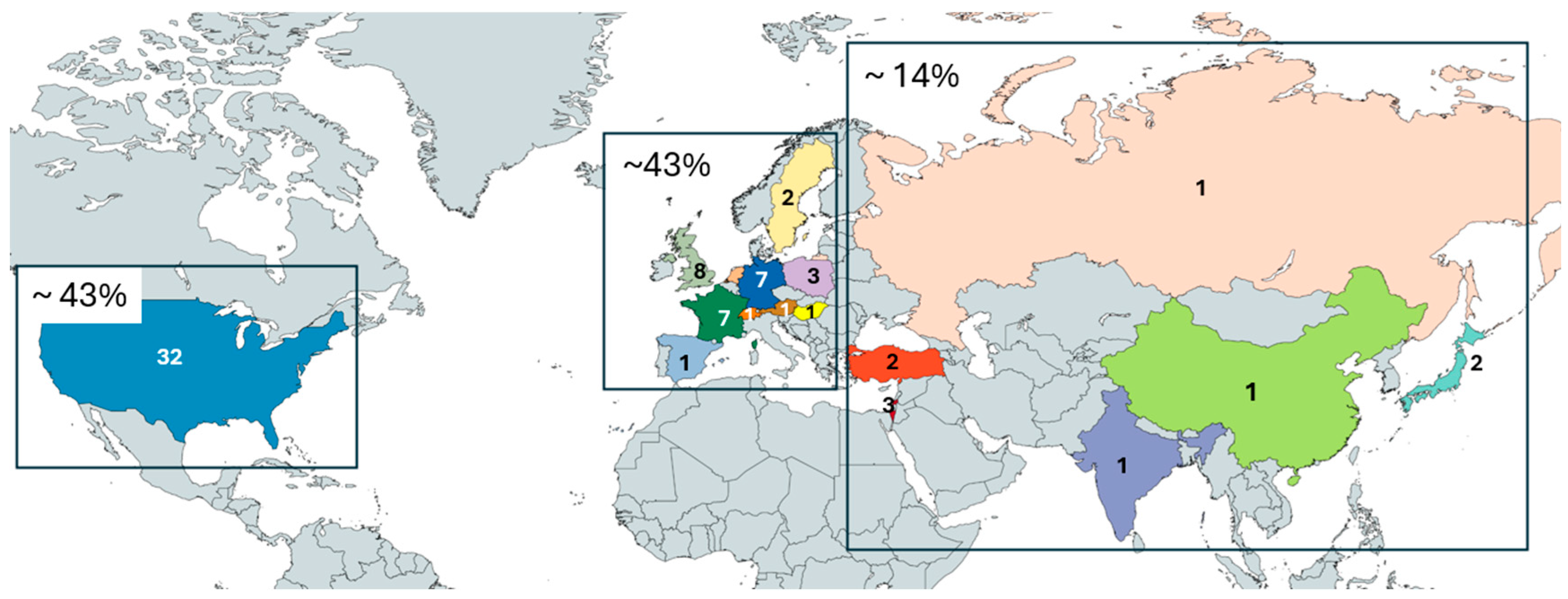
- Europe and the USA frequently utilize public–private partnerships backed by strong institutional support from, for example, the EU Horizon programs, NASA, and the U.S. Department of Defense (DoD).
- Japan and India predominantly rely on government and defence ministry funding, with projects often fully publicly funded and oriented towards technology demonstration.
- Emerging markets like Turkey and Israel exhibit mixed funding models, combining private investment with indirect public support for strategically important projects.
3.5.3. Civil, Defence, and Dual-Use Applications
3.5.4. Launch and Operational Period Trends
- Early testbeds and demonstrators (1980s to 2000s) primarily concentrated on crewed, full-scale aircraft, with substantial government defence involvement. These platforms were designed for traditional aerospace applications, emphasizing established propulsion and avionics technologies.
- More recent projects (2010s onward) show a marked shift toward electric and hydrogen propulsion, urban air mobility (UAM), and uncrewed aerial vehicles (UAVs). This transition mirrors broader trends toward sustainability, autonomy, and innovative air transport concepts.
- There is an emerging trend of commercialization of full-scale EA, signalling a movement away from purely research.
3.5.5. Organizational Involvement Patterns
- Large aerospace corporations such as Airbus, Boeing, and Rolls-Royce dominate full-scale projects, frequently collaborating with government aviation and defence agencies to leverage resources and strategic capabilities.
- Universities and research centres—including institutions like NLR, TU Delft, NASA research centres, and various international universities—primarily lead or contribute to sub-scale and uncrewed platforms, focusing on innovation, fundamental research, and technology validation.
- Complex full-scale projects often involve multi-organization consortia that span national boundaries and sectoral domains, combining expertise from industry, academia, and government to address the multifaceted challenges of modern aerospace development.
4. Discussion—Lessons Learned from EA
4.1. Key Lessons on Flight Testing, Collaboration, and Technology Challenges
4.2. Collaborative Governance Is Key to Flying Research Platforms Success
4.3. Funding Patterns Reflect the Strategic Nature of Experimental Aircraft
4.4. Scale and Sectoral Leadership Vary with Governance and Funding
4.5. Public–Private Partnerships Enable Risk Sharing and Innovation
4.6. Geographic and Regional Nuances Shape Flying Research Platforms Ecosystems
4.7. Experimental Aircraft Are Primarily Strategic Innovation Platforms
4.8. Flight Testing and Certification Require Early and Sustained Investment
4.9. Modularity and Flexibility Enhance Testbed Value and Longevity
4.10. Technology-Specific Funding and Governance Adaptations Are Necessary
4.11. Cross-Disciplinary Collaboration and Multi-Stakeholder Networks Are Essential
5. Conclusions
Author Contributions
Funding

Data Availability Statement
Conflicts of Interest
Appendix A. Complete Excel Table, Including Dataset and Literature Sources
| Testbed Name | ID No | Country | Governance Model | Business Model | Key Technologies | Scale | Launch Year | End of Operations | Crewed/Uncrewed | Civil/Defence–Military/Dual | Source |
| Boeing ecoDemonstrator | EA_0001 | USA | C.G | T&I | SAFs, Flight Controls, Operational and Load Optimization, Environmental Impact | full | 2012 | ongoing | Crewed | Civil | [15,51,52,53,54,55,56,57,58] |
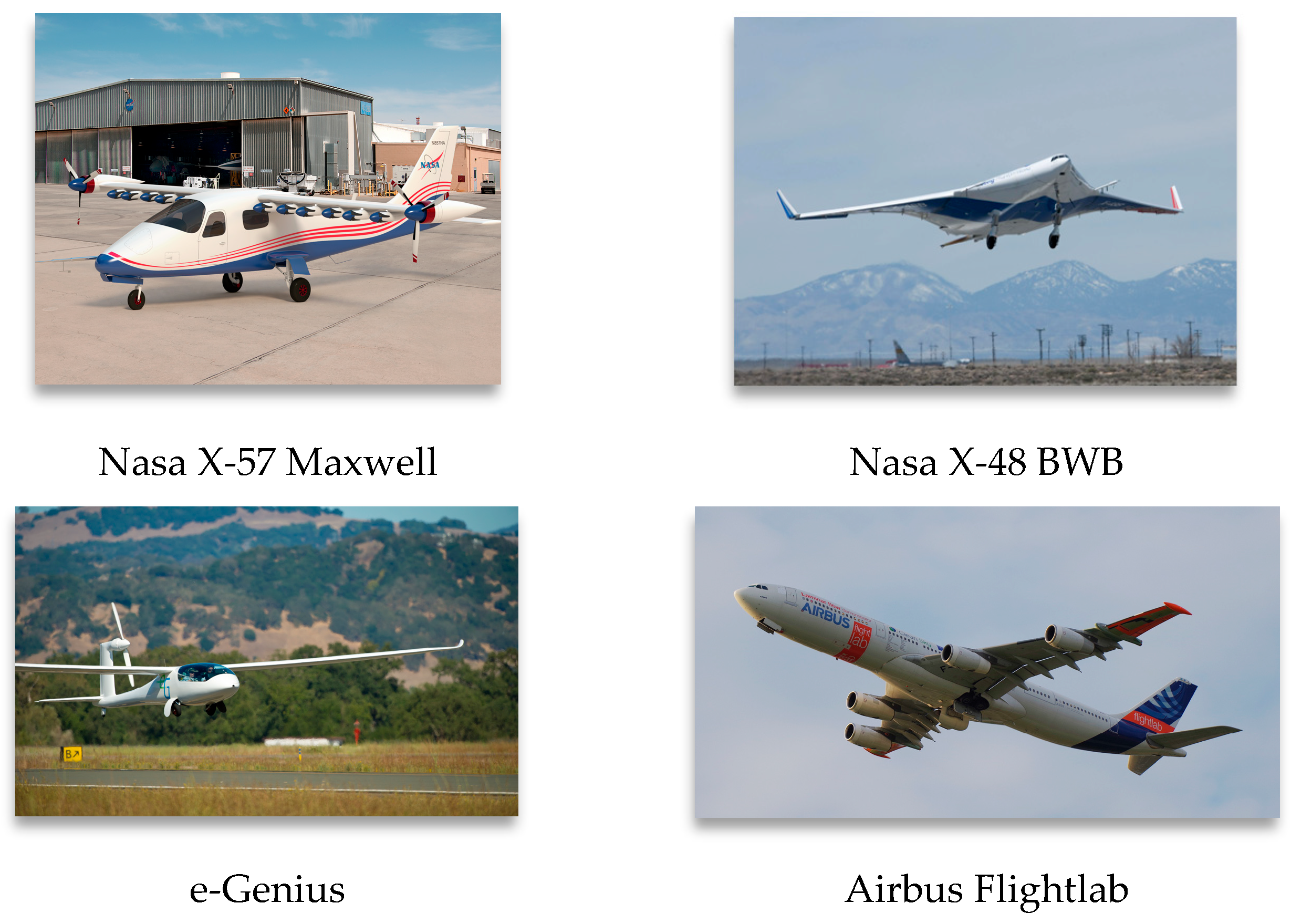
| Airbus Flightlab—BLADE EA demonstrator | EA_0002 | France | P.P. | T&I | Aerodynamic Design, Emissions, Data Connectivity | full | 2010 | ongoing | Crewed | Civil | [6,59,60,61,62,63,64,65,66] |
| Airbus UPNEXT | EA_0003 | France | C.G | T&I | Aerodynamic Design, New Fuels | full | 2020 | ongoing | Crewed | Civil | [16,67,68,69,70,71,72,73,74] |
| Airbus A310 MRTT | EA_0004 | Spain | C.G | T&I | Air Refueling, Systems Integration and Testing | full | 2006 | 2023 | Crewed | Civil | [75,76,77,78,79,80,81,82] |
| Airbus A350 XWB Testbed | EA_0005 | France | C.G | T&I | Aerodynamical and Structural Design, Engine Testing | full | 2012–2013 | ongoing | Crewed | Civil | [37,83,84,85,86,87,88,89] |
| Rolls-Royce’s “Spirit of Innovation” | EA_0006 | UK | P.P | T&I | Energy Systems, Structural Design and Thermal Testing | full | 2019 | 2022 | Crewed | Civil | [22,90,91,92,93,94,95,96,97,98,99,100] |
| NASA X-57 Maxwell | EA_0007 | USA | P.G. | T&I | Flight Systems, Avionics | full | 2016 | 2023 | Crewed | [10,18,101,102,103,104,105,106,107,108,109,110] | |
| ZeroAvia’s Hydrogen-Powered Aircraft | EA_0008 | UK | P.P. | T&I | Hydrogen Fuel Cells, Power Electronics | sub | 2019–2020 | ongoing | Crewed | [34,111,112,113,114,115,116,117,118,119,120,121,122,123] | |
| Joby Aviation|Joby | EA_0009 | USA | C.G. (before 2021) P.P. (after 2021) | C.F | eVTOL, Electric Propulsion, Noise Reduction | full | 2015 | ongoing (planned to be commercialized) | Crewed | [36,124,125,126,127,128,129,130,131,132,133,134] | |
| Lilium Jet | EA_0010 | Germany | C.G. | C.F | Electric Ducted Fans, Li-ion Batteries, Fly-by-Wire | full | 2017 | 2024 | Crewed | [135,136,137,138,139,140,141,142,143,144,145,146] | |
| Alice Aircraft by Eviation Aircraft | EA_0011 | Israel | C.G | C.F | Electric Propulsion, Battery System, Composite Airframe | full | 2019 | 2025 (paused) | Crewed | [28,147,148,149,150,151,152,153,154,155] | |
| Urban Aeronautics’ CityHawk | EA_0012 | Israel | C.G | C.F | Ducted-Fan VTOL, Hydrogen Fuel Cells | full | 2017 | ongoing (to be commercialized) | Crewed | ||
| Vertical Aerospace (eVTOL Aircraft) | EA_0013 | UK | C.G | C.F | DEP, Lightweight Composites, Low-Noise Design | full | 2018 (first flight) | ongoing (to be commercialized) | Crewed | [156,157,158,159,160,161,162,163] | |
| General Electric Boeing 747-400 jumbo jet | EA_0014 | USA | C.G | T&I | Turbofan Engines, FADEC, Aero Testing | full | 2010 | 2018 | Crewed | [164,165,166,167] | |
| Rolls Royce Boeing 747-200B | EA_0015 | UK | C.G | T&I | Engine Integration, Instrumentation | full | early 1980s | late 2000s | Crewed | [167,168,169] | |
| Airbus EcoPulse (ΤΒΜ-900) | EA_0016 | France | C.G | T&I | HMI, AI-Assisted Operations | full | 2022 | ongoing | Crewed | [170,171,172,173,174,175,176,177,178,179] | |
| NLR Research Aircraft Cessna Citation II | EA_0017 | Netherlands | P.G. | T&I | Sensor Integration, Instrumentation | full | 1993 | ongoing | Crewed | [19,180,181,182] | |
| NLR SFD | EA_0018 | Netherlands | P.G. | T&I | DEP, Hybrid Propulsion, Advanced Controls | sub | 2017 | ongoing | Uncrewed | [13,183,184,185,186,187,188,189] | |
| NASA Gulfstream III Aerodynamics Research | EA_0019 | USA | P.G. | T&I | Morphing Wings, Aeroelastic Actuation | full | 2012 (first flight) | 2015 | Crewed | [47,190,191,192,193,194,195,196] | |
| NASA Langley ‘s AIRSTAR | EA_0020 | USA | P.G. | T&I | Subscale Testing, Adaptive Control, Telemetry | sub | early 2000s | ongoing (probably) | Uncrewed | [48,197,198,199,200,201,202,203] | |
| NASA F-15B TN 836 Aeronautics Research | EA_0021 | USA | P.G. | T&I | High-AOA Aerodynamics, Fly-by-Wire | full | late 1980s | late 2010s | Crewed | Defence–Military | [191,204,205,206,207] |
| E-FAN | EA_0022 | France | C.G | T&I | Electric Propulsion, Lightweight Composites | full | 2011 | 2017 | Crewed | Civil | [208,209,210,211,212] |
| E-FAN X | EA_0023 | UK | Collaborative Consortium Governance | T&I | Hybrid-Electric, High-Voltage Systems | full | 2017 | 2020 | Crewed | Civil | [24,213,214,215,216] |
| Boeing X-48 (2 models: X-48B and X-48C) | EA_0024 | USA | P.P. | T&I | BWB Aerodynamics | sub | 2005 | 2012–2013 | Uncrewed | Defence–Military | [21,217,218,219,220] |
| JetZero’s project | EA_0025 | USA | C.G | C.F | Aero Efficiency, Alternative Propulsion | sub | 2021 | ongoing | Uncrewed | Dual Use | [17,221,222,223,224] |
| Ilyushin Il-76 (many variants were developed) | EA_0026 | Russia | C.G P.G. | C.F | Heavy Transport, Turbofans, Rugged Airframe | full | 1971 | ongoing | Crewed | Defence–Military | [225,226,227,228,229,230] |
| Lockheed Martin CATBird (Cooperative Avionics Test Bed) | EA_0027 | USA | P.P. | T&I | Avionics, Autonomous Systems | full | 2007 | 2014 | Crewed | Defence–Military | [38,231,232,233,234,235] |
| MIT Lincoln Laboratory’s Airborne Sensor Test Bed | EA_0028 | USA | P.G. | T&I | EO/IR Sensors, Communications | full | 1990s | Ongoing | Crewed | Defence–Military | [236,237,238,239] |
| Lockheed Martin X-56 | EA_0029 | USA | P.P. | T&I | Uncrewed Systems, Advanced Controls | sub | 2013 (first flight) | 2017 | Uncrewed | Defence–Military | [240,241,242,243,244,245,246,247,248] |
| Boeing Phantom Ray | EA_0030 | USA | C.G | T&I | Stealth UAV, Autonomous Missions | full | 2010 | 2013 | Uncrewed | Defence–Military | [39,249,250,251,252,253,254,255] |
| Scaled Composites Proteus | EA_0031 | USA | C.G | C.F | High-Altitude Aerodynamics, Lightweight Composites | full | 1998 | ongoing | Crewed | Dual Use | [256,257,258,259,260] |
| Honeywell 757 Flying Testbed | EA_0032 | USA | C.G | T&I | Propulsion Testing, Avionics Systems | full | 2005 | ongoing | Crewed | Dual Use | [261,262,263,264,265,266,267] |
| Kawasaki XC-2 | EA_0033 | Japan | P.P | T&I | Composites, Turbofans, Fly-by-Wire | full | 2010 | ongoing | Crewed | Defence–Military | [23,268,269,270] |
| SWiFT (Stealth Wing Flying Testbed) | EA_0034 | India | P.G. | T&I | Stealth Wing, Autonomous Control | sub | 2022 | ongoing | Uncrewed | Defence–Military | [20,271,272,273,274,275] |
| Turkish Aerospace Industries (TAI) Anka UAV (1–3 variants) | EA_0035 | Turkey | C.G | T&I | UAV Autonomy, Stealth Design | full | 2022 | ongoing | Uncrewed | Defence–Military | [276,277,278,279] |
| Israel Aerospace Industries (IAI) Heron UAV | EA_0036 | Israel | P.P | C.F | EO/IR Sensors, SATCOM, Autonomous Ops | full | 1994 (first flight) | ongoing | Uncrewed | Defence–Military | [280,281,282,283,284,285,286,287] |
| DA 62—Diamond Aircraft | EA_0037 | Austria | C.G | C.F | Efficient Engines, Composite Airframe | full | 2012 | ongoing | Crewed | Civil use (private, training, utility aviation) | [30,288,289,290,291,292,293,294] |
| Zero-e | EA_0038 | France | P.P. | T&I | Hydrogen Combustion, LH2 Storage, Fuel Cells | full | 2020 | ongoing | Crewed | Civil Use | [43,295,296,297,298,299] |
| H2FLY HY4 | EA_0039 | Germany | C.C. | T&I | DEP, Aeroelastic Structures, Digital Twin | sub (1:5–1:3 scale of a regional airliner) | 2018 | 2023 | Uncrewed | Civil Use | [25,300,301,302,303,304,305,306,307,308] |
| Numerical Design Results Demonstrator (NORD) | EA_0040 | Poland | A.G. | T&I | Dynamic Stability, Flight Data Analysis | subd | early 2020s | possibly ongoing | Uncrewed | Civil | [309,310] |
| AlbatrossONE | EA_0041 | UK | C.G: | T&I | Hinged Wing-Tips, Gust Alleviation | subd | 2019 | ongoing | Uncrewed | Civil use | [311,312] |
| FLEXOP demonstrator | EA_0042 | Hungary | C.C. | T&I | Aeroelastic Tailoring, Flutter Control | full | 2015 | 2020 | Uncrewed | Civil use (potentially dual use) | [313,314,315,316] |
| e-Genius-Mod | EA_0043 | Germany | A.G. | T&I | Electric Motor, Battery System | full | 2022 | ongoing | Crewed | Civil Use | [27,317] |
| Scout B1-100 | EA_0044 | Switzerland | C.G | C.F | Autonomous Control, Robust Airframe | sub | mid-to-late 2010s or early 2020s | ongoing | Uncrewed | Civil | [44,318,319] |
| Cirrus SR22T | EA_0045 | USA | A.G. | R&E | DEP Propulsion | sub | 2017 | ongoing | Uncrewed | Civil | [40,320] |
| MAGMA | EA_0046 | UK | P.P. | T&I | Fluidic Controls, Circulation Control | sub | 2017 | early 2020s | Uncrewed | Civil | [35,321,322,323] |
| Super Guppy Foamie | EA_0047 | USA | P.G. | T&I | Scaled Model, Balloon Launch | sub | around 2012 | ongoing | Crewed | Civil | [49,324,325] |
| GA-USTAR aircraft | EA_0048 | USA | A.G. | R&E | Dynamic Scaling, Flight Data Systems | sub | 2017 | ongoing | Uncrewed | Civil | [32,326,327] |
| UIUC Subscale Sukhoi | EA_0049 | USA | A.G. | R&E | Scaled Aerodynamics, High-Precision Telemetry | sub | 2015 | ongoing | Uncrewed | Civil | [26,328,329,330,331,332,333] |
| SAGITTA demonstrator | EA_0050 | Germany | P.P. | T&I | Flying Wing, Autonomous Jet | sub | 2014–2015 | 2020–2021 | Uncrewed | Civil | [26,328,329,330,331,332,333] |
| Flying V | EA_0051 | Germany | P.P. | T&I | Integrated BWB Airframe, Lightweight Composites | sub | 2014 2020 (first flight) | ongoing | Uncrewed | Civil | [334,335,336,337,338,339] |
| MOSUPS | EA_0052 | Poland | A.G. | T&I | Box-Wing Design, Ducted Fan Propulsion | sub | 2014 (first flight) | early 2020s (probably) | Uncrewed | Civil | [14,340,341,342,343,344] |
| TURAC | EA_0053 | Turkey | A.G. | T&I | Hybrid VTOL, Advanced Flight Control | sub | 2014 | ongoing | Uncrewed | Dual Use | [345,346,347] |
| Great Planes Avistar Elite | EA_0054 | USA | A.G. | R&E | Aerodynamic Simulation, Sensor Integration | sub | 2014 | ongoing | Uncrewed | Civil | |
| GL-10 Greased Lightning Prototype | EA_0055 | USA | P.G. | T&I | DEP, Tilt-Wing VTOL | sub | 2013 | 2017 | Crewed | Military | [348,349,350,351,352,353] |
| Technology- Evaluation Research Aircraft (PTERA) | EA_0056 | USA | P.P. | T&I | DEP, Autonomous Systems | sub | 2013 | ongoing | Uncrewed | Civil | [190,354,355] |
| UIUC Aero Testbed | EA_0057 | USA | A.G. | R&I | Electric Propulsion, Autonomous Control | sub | 2013 | possibly ongoing | Uncrewed | Civil | [41,356] |
| Sig Rascal 110 | EA_0058 | USA | A.G. | R&E | Large Airframe, Sensor Integration | sub | 2006 | possibly concluded | Uncrewed | Civil | [357,358,359] |
| Phastball | EA_0059 | USA | A.G. | R&E | EDF Propulsion, Autonomous Avionics | sub | around 2013 | possibly ongoing | Uncrewed | Civil | [360,361,362,363] |
| S3CM | EA_0060 | Japan | Public Governance | T&I | Low-Sonic-Boom Aero, Supersonic Control | sub | 2015 (first launch) | concluded-single use | Uncrewed | Civil | [31,364,365] |
| Yak-54 UAV | EA_0061 | USA | A.G. | R&I | Flight Control, Radar Sensors | sub | 2012 | possibly ongoing | Crewed | Civil | [366,367] |
| X-HALE | EA_0062 | USA | A.G | R&E | Flexible Wings, Aeroelastic Modeling | sub | 2010 | possibly ongoing | Uncrewed | Civil | [46,368,369,370] |
| Puffin demonstrator | EA_0063 | USA | P.G. | R&E | Tail-Sitter VTOL, Electric Propulsion | sub | 2008 | 2011 | Crewed | Civil | [33,371] |
| Hyperion 1.0, 2.0, 2.1 | EA_0064 | USA | A.G. | R&E | Hybrid Propulsion, BWB Design | sub | 2008 | 2011 | Uncrewed | Civil | [42,372,373] |
| Generic Future Fighter (GFF) demonstrator | EA_0065 | Sweeden | A.G. | R&E | Stealth, AI Autonomy, Advanced EW | full | 2009 | ongoing | Both crewed and uncrewed | Military | [374,375,376,377,378] |
| BB-1, BB-2, BB-3, BB-4 | EA_0066 | China | A.G. | T&I | BWB Aerodynamics, Low-Speed Dynamics | sub | 2008 | 2012 | Uncrewed | Civil | [3,379] |
| Raven | EA_0067 | Sweden | A.G. | R&E | Scaled Aircraft, Micro Turbines, Control Systems | sub | 2007 | possibly ongoing | Uncrewed | Civil | [3,45,380,381] |
| SensorCraft RPV | EA_0068 | USA | P.G. | T&I | SAR/EO Sensors, Stealth, Autonomous Flight | full | early 2000s | - | Uncrewed | Military | [382] |
| ECLIPSE | EA_0069 | UK | C.C. | T&I | Flapless (Fluidic) Control, Turbojet Propulsion | sub | 2009 2010 (first flight) | 2010 | Uncrewed | Defence–Military | [383,384,385,386,387] |
| VELA 2 | EA_0070 | Germany | A.G. | R&E | DEP, BWB Airframe | sub | 2007 | possibly concluded | Uncrewed | Civil | [50,388] |
| FASER (Ultrastick 120) | EA_0071 | USA | P.G. | T&I | Scaled Turbine Mode, Adaptive Control | sub | 2006 | ongoing | Uncrewed | Civil | [389,390] |
| GTM-T2 | EA_0072 | USA | P.G. | T&I | Flight Dynamics, System ID | sub | 2005 | finalized in 2010s | Uncrewed | Civil | [203,391,392,393] |
| Innovative Evaluation Platform (IEP) | EA_0073 | France | C.C. | T&I | Modular Testbed, Nonlinear Control | sub | 2005 | 2010 (NACRE project ending) | Uncrewed | Civil | [394,395,396,397] |
| AC20.30 | EA_0074 | Germany | A.G. | R&E | BWB, Scaled Electric Testbed | sub | early 2000s | possibly concluded | Uncrewed | Civil | [398] |
References
- European Green Deal—Delivering on Our Targets. Publications Office of the European Union. 2021. Available online: https://data.europa.eu/doi/10.2775/373022 (accessed on 16 November 2025).
- Eurocontrol. Decarbonising Long-Haul Flights by 2050: Is There a Pathway Through Sustainable Aviation Fuel Use, Fleet Renewal and Green Energy Upscaling? 2024. Available online: https://www.eurocontrol.int/publication/eurocontrol-think-paper-22-decarbonising-long-haul-flights-2050 (accessed on 16 November 2025).
- Sobron, A.; Lundström, D.; Krus, P. A Review of Current Research in Subscale Flight Testing and Analysis of Its Main Practical Challenges. Aerospace 2021, 8, 74. [Google Scholar] [CrossRef]
- Quaranta, G.; Jones, M.; Lu, L.; White, M. Challenges and opportunities offered by flight certification of rotorcraft by simulation. In Proceedings of the 47th European Rotorcraft Forum, Glasgow, Scotland, 7–9 September 2021. [Google Scholar]
- Wong, J.; Nesbitt, E.; Jones, M.G.; Nark, D.M. Flight test methodology for NASA advanced inlet liner on 737MAX-7 test bed (quiet technology demonstrator 3). In Proceedings of the 25th AIAA/CEAS Aeroacoustics Conference, Delft, The Netherlands, 20–23 May 2019; p. 2763. [Google Scholar]
- Airbus. Airbus Flightlab. 2025. Available online: https://www.airbus.com/en/innovation/innovation-ecosystem/airbus-flightlab (accessed on 16 November 2025).
- Larsson, R. Analysis of the effect of flow transition over the wings of the blade demonstrator. In Proceedings of the 33rd Congress of the International Council of the Aeronautical Sciences, Stockholm Sweden, 4–9 September 2022. [Google Scholar]
- Schmollgruber, P.; Toussaint, C.; Iannelli, P.; Jentink, H.; Kierbel, D. Results of the scale flight demonstrator flight tests. In Proceedings of the 34th Congress of the International Council of the Aeronautical Sciences, Florence, Italy, 9–13 September 2024. [Google Scholar]
- EXAELIA Consortium. EU-Project EXAELIA: Towards Flying Testbeds for Novel Long-Range Aircraft. 2025. Available online: https://www.exaelia.eu (accessed on 16 November 2025).
- ScitechDaily. NASA Takes Delivery of X-57 Maxwell–First All-Electric Experimental Aircraft. 2019. Available online: https://scitechdaily.com/nasa-takes-delivery-of-x-57-maxwell-first-all-electric-experimental-aircraft/ (accessed on 16 November 2025).
- NewAtlas. X-48C Blended Wing Body Aircraft Flight Testing Campaign Comes to a Close. 2013. Available online: https://newatlas.com/x-48c-blended-wing-body-campaign-completed/27066/ (accessed on 16 November 2025).
- ZDNET. Impossible Aerospace Reimagines the Electric Airplane. 2018. Available online: https://www.zdnet.com/article/impossible-aerospace-reimagines-the-electric-airplane/ (accessed on 16 November 2025).
- Netherlands Aerospace Centre. Maiden Flight of Clean Sky 2’s Scaled Flight Demonstrator. 2022. Available online: https://www.nlr.org/newsroom/nieuws/maiden-flight-of-clean-sky-2s-scaled-flight-demonstrator/ (accessed on 16 November 2025).
- Galinski, C.; Stalewski, W.; Lis, M.; Hajduk, J. Overview of the Inverted Joined Wing Scaled Demonstrator Programme. In Proceedings of the 30th Congress of the International Council of the Aeronautical Sciences, Daejeon, Republic of Korea, 25–30 September 2016. [Google Scholar]
- Nesbitt, E.; Suzuki, T.; Daneshvarn, N.; Ghouali, A. Boeing-Safran landing gear noise reduction project on 2020 Boeing ecoDemonstrator program. In Proceedings of the 28th AIAA/CEAS Aeroacoustics 2022 Conference, Southampton, UK, 14–17 June 2022; p. 2849. [Google Scholar]
- Airbus. eXtra Performance Wing Demonstrator Takes Off. 2023. Available online: https://www.airbus.com/en/newsroom/stories/2023-11-extra-performance-wing-demonstrator-takes-off (accessed on 16 November 2025).
- JetZero. The JetZero Progress. Available online: https://www.jetzero.aero/progress (accessed on 16 November 2025).
- Schnulo, S.; Hall, D.L.; Chin, J.; Smith, A.D. Further development of the NASA X-57 Maxwell mission planning tool for mods II, III, and IV. In Proceedings of the 2019 AIAA/IEEE Electric Aircraft Technologies Symposium (EATS), Cincinnati, Ohio, USA, 12–14 July 2018; IEEE: New York, NY, USA, 2019; pp. 1–14. [Google Scholar]
- Netherlands Aerospace Centre. Research Aircraft: Cessna Citation II. Available online: https://www.nlr.org/newsroom/facility/research-aircraft-cessna-citation (accessed on 16 November 2025).
- SSBCrack. DRDO Approved to Transform Stealth Wing Flying Testbed (SWiFT) Program into 1-Ton Full UCAV for Mini-Bomber and Surveillance Functions. Read More. Available online: https://www.ssbcrack.com/2024/10/drdo-approved-to-transform-stealth-wing-flying-testbed-swift-program-into-1-ton-full-ucav-for-mini-bomber-and-surveillance-functions.html (accessed on 25 October 2024).
- NASA. X-48 Research: All Good Things Must Come to an End. 2013. Available online: https://www.nasa.gov/centers-and-facilities/armstrong/x-48-research-all-good-things-must-come-to-an-end/ (accessed on 16 November 2025).
- Rolls-Royce. The ‘Spirit of Innovation’ Officially Breaks Speed Record and Becomes the World’s Fastest All-Electric Vehicle. 2022. Available online: https://www.rolls-royce.com/media/press-releases/2022/20-01-2022-the-spirit-of-innovation-officially-breaks-speed-record.aspx (accessed on 16 November 2025).
- Kawasaki Heavy Industrie. XC-2 Test Aircraft for Japanese Defense Ministry Completes First Flight. 2010. Available online: https://global.kawasaki.com/en/corp/newsroom/news/detail/ba_c3100126_2.html (accessed on 16 November 2025).
- Jayme, D.B. Evaluation of the Hybrid-Electric Aircraft Project Airbus E-Fan X. Master’s Thesis, Faculty of Engineering and Computer Science, Hamburg, Germany, 2019. [Google Scholar]
- H2FLY GmbH. H2FLY and Partners Complete World’s First Piloted Flight of Liquid Hydrogen Powered Electric Aircraft. 2023. Available online: https://www.h2fly.de/2023/09/07/h2fly-and-partners-complete-worlds-first-piloted-flight-of-liquid-hydrogen-powered-electric-aircraft/ (accessed on 16 November 2025).
- Bierig, A.; Nikodem, F.; Gallun, P.; Greiner-Perth, C. Design of the general systems for the SAGITTA demonstrator UAV. In Proceedings of the 2017 International Conference on Uncrewed Aircraft Systems (ICUAS), Miami, FL, USA, 13–16 June 2017. [Google Scholar]
- Bergmann, D.P.; Denzel, J.; Baden, A.; Kugler, L.; Strohmayer, A. Innovative Scaled Test Platform e-Genius-Mod—Scaling Methods and Systems Design. Aerospace 2019, 6, 20. [Google Scholar] [CrossRef]
- Eviation Aircraft Inc. Eviation’s Alice Achieves Milestone with First Flight of All-Electric Aircraft. 2022. Available online: https://www.eviation.com/Press%20Release/eviations-alice-achieves-milestone-with-first-flight-of-all-electric-aircraft/ (accessed on 16 November 2025).
- Vertical Aerospace. Meet the VX4. 2025. Available online: https://vertical-aerospace.com/meet-the-vx4/ (accessed on 16 November 2025).
- Diamond Aircraft Industries. DA62 The Ultimate Flying Machine. 2025. Available online: https://www.diamondaircraft.com/en/private-owners/aircraft/da62/overview/ (accessed on 16 November 2025).
- Honda, M.; Yoshida, K. D-SEND2 flight demonstration for low sonic boom design technology. In Proceedings of the 29th Congress of the International Council of the Aeronautical Sciences, St. Petersburg, Russia, 7–12 September 2014. [Google Scholar]
- Ananda, G.K.; Vahora, M.; Dantsker, O.D.; Selig, M.S. Design Methodology for a Dynamically-Scaled General Aviation Aircraft. In Proceedings of the 35th AIAA Applied Aerodynamics Conference, Denver, CO, USA, 5–9 June 2017; American Institute of Aeronautics and Astronautics: Reston, VA, USA, 2017. [Google Scholar]
- Moore, M. NASA Puffin Electric Tailsitter VTOL Concept. In Proceedings of the 10th AIAA Aviation Technology, Integration, and Operations (ATIO) Conference, Fort Worth, TX, USA, 13–15 September 2010; American Institute of Aeronautics and Astronautics: Reston, VA, USA, 2010. [Google Scholar]
- ZeroAvia. ZeroAvia Completes World First Hydrogen-Electric Passenger Plane Flight. 2020. Available online: https://zeroavia.com/zeroavia-completes-world-first-hydrogen-electric-passenger-plane-flight/ (accessed on 16 November 2025).
- Warsop, C.; Crowther, W. NATO AVT-239 Task Group: Flight Demonstration of Fluidic Flight Controls on the MAGMA Subscale Demonstrator Aircraft. In Proceedings of the AIAA Scitech 2019 Forum, San Diego, CA, USA, 7–11 January 2019; American Institute of Aeronautics and Astronautics: Reston, VA, USA, 2019. [Google Scholar]
- Joby Aviation. UK ELECTRIC AIR TAXI SERVICE ON THE HORIZON—Joby and Virgin Atlantic Announce Partnership. 2025. Available online: https://ir.jobyaviation.com/news-events/press-releases/detail/125/uk-electric-air-taxi-service-on-the-horizon-joby-and/ (accessed on 16 November 2025).
- Airbus. A350-900 with Trent XWB-84 Enhanced Performance Engine Receives EASA Certification. 2025. Available online: https://aircraft.airbus.com/en/newsroom/press-release/2025-04-a350-900-with-trent-xwb-84-enhanced-performance-engine-receives-easa (accessed on 16 November 2025).
- Delehant, E.J. Safety & Design Considerations for the Cooperative Avionics Test Bed (CATBird) Aircraft. 2005. Available online: https://saemobilus.sae.org/papers/safety-design-considerations-cooperative-avionics-test-bed-catbird-aircraft-2005-01-3267 (accessed on 16 November 2025).
- Boeing. Boeing Phantom Works. Available online: https://www.boeing.com/defense/phantom-works#overview (accessed on 16 November 2025).
- Pieper, K.C.; Perry, A.T.; Ansell, P.J.; Bretl, T. Design and Development of a Dynamically Scaled Distributed Electric Propulsion Aircraft Testbed. In Proceedings of the 2018 AIAA/IEEE Electric Aircraft Technologies Symposium, Cincinnati, OH, USA, 12–14 July 2018; American Institute of Aeronautics and Astronautics: Reston, VA, USA, 2018. [Google Scholar]
- Dantsker, O.D.; Johnson, M.; Selig, M.S.; Bretl, T.W. Development and Initial Testing of the Aero Testbed: A Large-Scale Uncrewed Electric Aerobatic Aircraft for Aerodynamics Research. In Proceedings of the 31st AIAA Applied Aerodynamics Conference, San Diego, CA, USA, 24–27 June 2013; American Institute of Aeronautics and Astronautics: Reston, VA, USA, 2013. [Google Scholar]
- Koster, J.; Balaban, S.; Hillery, D.; Humbargar, C.; Nasso, D.; Serani, E.; Velazco, A. Design of a Blended Wing Body UAS with Hybrid Propulsion. In Proceedings of the ASME International Mechanical Engineering Congress and Exposition, Denver, CO, USA, 11–17 November 2011; Volume 1: Advances in Aerospace Technology; Energy Water Nexus; Globalization of Engineering; Posters; ASMEDC: New York, NY, USA, 2011; pp. 331–337. [Google Scholar]
- Airbus. The ZEROe Demonstrator Has Arrived a Giant Leap Towards Hydrogen-Powered Aircraft by 2035. 2022. Available online: https://www.airbus.com/en/newsroom/stories/2022-02-the-zeroe-demonstrator-has-arrived (accessed on 16 November 2025).
- Aeroscout GmbH. Scout B1-100 UAV Helicopter. 2022. Available online: https://www.aeroscout.ch/index.php/scout-uav-helicopters/scout-b1-100-uav-helicopter (accessed on 16 November 2025).
- Staack, I.; Lundström, D. SUBSCALE FLIGHT TESTING AT LINKÖPING UNIVERSITY. In Proceedings of the 27th Congress of the International Council of the Aeronautical Sciences, Nice, France, 19–24 September 2010. [Google Scholar]
- Cesnik, C.E.S.; Senatore, P.J.; Su, W.; Atkins, E.M.; Shearer, C.M.; Pitcher, N.A. X-HALE: A Very Flexible UAV for Nonlinear Aeroelastic Tests. In Proceedings of the 51st AIAA/ASME/ASCE/AHS/ASC Structures, Structural Dynamics, and Materials Conference, Orlando, FL, USA, 12–15 April 2010. [Google Scholar]
- Baumann, E.; Hernandez, J.; Ruhf, J. An Overview of NASA’s SubsoniC Research Aircraft Testbed (SCRAT). In Proceedings of the AIAA Atmospheric Flight Mechanics (AFM) Conference, Boston MA, USA, 19–22 August 2013. [Google Scholar]
- Jordan, T.; Bailey, R. NASA Langley’s AirSTAR Testbed: A Subscale Flight Test Capability for Flight Dynamics and Control System Experiments. In Proceedings of the AIAA Guidance, Navigation and Control Conference and Exhibit, Honolulu, HI, USA, 18–21 August 2008; American Institute of Aeronautics and Astronautics: Reston, VA, USA, 2008. [Google Scholar]
- Riddick, S.E.; Busan, R.C.; Cox, D.E.; Laughter, S.A. Learn to Fly Test Setup and Concept of Operations. In Proceedings of the 2018 Atmospheric Flight Mechanics Conference, Kissimmee, FL, USA, 8–12 January 2018; American Institute of Aeronautics and Astronautics: Reston, VA, USA, 2018. [Google Scholar]
- Trittler, M.; Fichter, W.; Voit-Nitschmann, R.; Schmoldt, R.; Kittmann, K. Preliminary System Identification of the Blended Wing Body Flight Demonstrator VELA 2 from Flight Data. In Proceedings of the AIAA Atmospheric Flight Mechanics Conference and Exhibit, Honolulu, HI, USA, 18–21 August; American Institute of Aeronautics and Astronautics: Reston, VA, USA, 2008. [Google Scholar]
- Gallo, F.; Anderson, B.E.; Baughcum, S.; Brown, M.D.; Griffin, W.M.; Jordan, C.; Shook, M.A.; Wiggins, E.B.; Winstead, E.L.; Ziemba, L.D.; et al. Aircraft Engine Particle Emissions during the 2023 NASA-Boeing ecoDemonstrator Field Measurements. In Proceedings of the AAAR 42nd Annual Conference, Albuquerque, NM, USA, 21–25 October 2024. [Google Scholar]
- Boeing. ecoDemonstrator. Boeing Sustainability. Available online: https://www.boeing.com/sustainability/environment/ecodemonstrator#overview (accessed on 16 November 2025).
- Boeing. ecoDemonstrator Backgrounder 2017. 2017. Available online: https://www.boeing.com/content/dam/boeing/boeingdotcom/principles/environment/pdf/Backgrounder_ecoDemonstrator-2017.pdf (accessed on 16 November 2025).
- Boeing. ecoDemonstrator Backgrounder 2024. October 2024. Available online: https://www.boeing.com/content/dam/boeing/boeingdotcom/principles/environment/pdf/BKG-ecoDemonstrator_2024_Oct.pdf (accessed on 16 November 2025).
- Royal Aeronautical Society. Innovate, Collaborate, Accelerate: Boeing’s ecoDemonstrator Programme Examined. 2023. Available online: https://www.aerosociety.com/news/innovate-collaborate-accelerate-boeing-s-ecodemonstrator-programme-examined/ (accessed on 16 November 2025).
- Boeing. ecoDemonstrator to Test New Cabin and Efficiency Technologies. Available online: https://www.boeing.com/company/about-bca/washington/ecodemonstrator-to-test-new-cabin-and-efficiency-technologies (accessed on 16 November 2025).
- Boeing. Boeing ecoDemonstrator to Test Technologies to Improve Cabin Recyclability, Operational Efficiency. 2024. Available online: https://investors.boeing.com/investors/news/press-release-details/2024/Boeing-ecoDemonstrator-to-test-technologies-to-improve-cabin-recyclability-operational-efficiency/default.aspx (accessed on 16 November 2025).
- Czech, M.; Thomas, R.H.; Guo, Y.; June, J.; Clark, I.; Shoemaker, C. Propulsion Airframe Aeroacoustics and Aircraft System Noise Flight Test on the Boeing 2020 ecoDemonstrator program. In Proceedings of the 28th AIAA/CEAS Aeroacoustics 2022 Conference, Southampton, UK, 14–17 June 2022; American Institute of Aeronautics and Astronautics: Reston, VA, USA, 2022. [Google Scholar]
- Royal Aeronautical Society. Blade Runner: Wake Up, Time to fly! 2017. Available online: https://www.aerosociety.com/news/blade-runner-wake-up-time-to-fly/ (accessed on 16 November 2025).
- Airbus. Airbus BLADE Laminar Flow Wing Demonstrator Makes First Flight. 2017. Available online: https://www.airbus.com/en/newsroom/press-releases/2017-09-airbus-blade-laminar-flow-wing-demonstrator-makes-first-flight (accessed on 16 November 2025).
- Airbus. European Laminar Flow Research Takes a New Step with Airbus BLADE Flight Lab. 2017. Available online: https://www.airbus.com/en/newsroom/news/2017-09-european-laminar-flow-research-takes-a-new-step-with-airbus-blade-flight-lab (accessed on 16 November 2025).
- DNW—German-Dutch Wind Tunnels. Airbus Presents Flight Lab “BLADE” Test Aircraft to EU Clean Sky partners at ILA. 2018. Available online: https://www.dnw.aero/news/airbus-presents-flight-lab-blade-test-aircraft-to-eu-clean-sky-partners-at-ila/ (accessed on 16 November 2025).
- Airbus. Airbus Presents Flight Lab “BLADE” Test Aircraft to EU Clean Sky. 2018. Available online: https://www.airbus.com/en/newsroom/press-releases/2018-04-airbus-presents-flight-lab-blade-test-aircraft-to-eu-clean-sky (accessed on 16 November 2025).
- Airbus. A Flying Laboratory for Future Technologies. 2021. Available online: https://www.airbus.com/en/newsroom/stories/2021-02-a-flying-laboratory-for-future-technologies (accessed on 16 November 2025).
- Air & Cosmos International. A340 Laminar Flow Demonstrator Makes First Flight. 2017. Available online: https://www.aircosmosinternational.com/article/a340-laminar-flow-demonstrator-makes-first-flight-1197 (accessed on 16 November 2025).
- Krüger, W.; Bode, F.; Kirmse, T.; Lemarechal, J.; Schröder, A.; Barth, H.P.; Oertwig, S.; Siller, H.; Delfs, J.W.; Moreau, A.; et al. Common Numerical Methods & Common Experimental Means for the Demonstrators of the Large Passenger Aircraft Platforms. In Proceedings of the Aerospace Europe Conference 2020, Bordeaux, France, 25–28 February 2020. [Google Scholar]
- Airbus. Airbus Launches Extra High Performance Wing Demonstrator to Fortify Its Decarbonisation Leadership. 2021. Available online: https://www.airbus.com/en/newsroom/press-releases/2021-09-airbus-launches-extra-high-performance-wing-demonstrator-to-fortify (accessed on 16 November 2025).
- CompositesWorld. Diehl Aviation Matures Recyclable Composite Eco-Bin. 2024. Available online: https://www.compositesworld.com/news/diehl-aviation-matures-recyclable-composite-eco-bin (accessed on 16 November 2025).
- GlobalAir. Airbus to Install Extra Performance Flapping Wings on Citation VII for Ground Testing. 2023. Available online: https://www.globalair.com/articles/airbus-to-install-extra-performance-flapping-wings-on-citation-vii-for-ground-testing?id=6801 (accessed on 16 November 2025).
- AIN Online. Airbus Set to Fly Morphing Wing Testbed. 2022. Available online: https://www.ainonline.com/aviation-news/business-aviation/2022-12-12/airbus-set-fly-morphing-wing-testbed (accessed on 16 November 2025).
- Airbus. Airbus UpNext. Available online: https://www.airbus.com/en/innovation/innovation-ecosystem/airbus-upnext (accessed on 16 November 2025).
- Airbus. Airbus Takes Superconductivity Research for Hydrogen-Powered Flight to the Next Level. 2024. Available online: https://www.airbus.com/en/newsroom/press-releases/2024-05-airbus-takes-superconductivity-research-for-hydrogen-powered (accessed on 16 November 2025).
- Xi, J.; Zeng, X.; Liu, P.; Galla, G.; Surapaneni, R.K.; Ybanez, L.; Pei, X. Investigation of 10-kW Cryogenic Bidirectional DC-DC Converter for Electric Aircraft. In Proceedings of the 2024 IEEE Energy Conversion Congress and Exposition (ECCE), Phoenix, AZ, USA, 20–24 October 2024; IEEE: New York, NY, USA, 2024; pp. 2378–2384. [Google Scholar]
- Wilson, T.; Kirk, J.; Mills, R.; Castrichini, A.; Mastracci, P.; Geoghegan Hart, B.; Meyer, T.; Alvarez-Rementeria Reina, J.; Boin, J.P. Overview of Semi Aeroelastic Hinge Simulation Research at Airbus. In Proceedings of the AIAA SCITECH 2025 Forum, Orlando, FL, USA, 6–10 January 2025; American Institute of Aeronautics and Astronautics: Reston, VA, USA, 2025. [Google Scholar]
- Academia-Lab. Airbus A310 MRTT. Available online: https://academia-lab.com/enciclopedia/airbus-a310-mrtt/ (accessed on 16 November 2025).
- AviationsMilitaires.net. Airbus A310 MRTT. Available online: https://aviationsmilitaires.net/v3/kb/aircraft/show/9220/airbus-a310-mrtt (accessed on 16 November 2025).
- Aerospace Global News. Airbus A310 MRTT Test Bed Retires. 2024. Available online: https://aerospaceglobalnews.com/news/airbus-a310-mrtt-test-bed-retires/ (accessed on 16 November 2025).
- Advanced Air Mobility. Airbus A310 MRTT Retires After 18 Years of Service. 2024. Available online: https://aam.aero/blog_info?id=780 (accessed on 16 November 2025).
- Airbus. A310 MRTT Test Bed Retires After Pioneering Air-to-Air Refuelling. 2024. Available online: https://www.airbus.com/en/newsroom/stories/2024-09-a310-mrtt-test-bed-retires-after-pioneering-air-to-air-refuelling (accessed on 16 November 2025).
- Horizon.mt. Airbus A310 MRTT Test Bed Retires After Pioneering Air-to-Air Refuelling. 2024. Available online: https://www.horizon.mt/2024/09/27/airbus-a310-mrtt-test-bed-retires-after-pioneering-air-to-air-refuelling/ (accessed on 16 November 2025).
- Aviacionline. Airbus Retires Its A310 MRTT: 18 Years at the Forefront of European in-Flight Refueling Development. 2024. Available online: https://www.aviacionline.com/airbus-retires-its-a310-mrtt-18-years-at-the-forefront-of-european-in-flight-refueling-development (accessed on 16 November 2025).
- Martinez, V.; Sanz, A.; Asensio, F.; Romo, I. Advanced Refueling Boom System (ARBS) Automatic Air to Air refueling Flight Control Laws. In Proceedings of the AIAA SCITECH 2024 Forum, Orlando, FL, USA, 6–10 January 2024; American Institute of Aeronautics and Astronautics: Reston, VA, USA, 2024. [Google Scholar]
- Aviation Today. A350-1000 Takes the Lead in Autonomous Flying. 2024. Available online: https://www.aviationtoday.com/2024/10/03/a350-1000-takes-the-lead-in-autonomous-flying/ (accessed on 16 November 2025).
- Rolls-Royce. Rolls-Royce Trent XWB completes first test flight. 2012. Available online: https://www.rolls-royce.com/media/press-releases-archive/yr-2012/120218-xwb.aspx (accessed on 16 November 2025).
- Toulouse, M.L.; Lewis, R. A350XWB Icing Certification Overview. 2015. Available online: https://legacy.sae.org/publications/technical-papers/content/2015-01-2111/ (accessed on 16 November 2025).
- Airport-Technology. Airbus A350 XWB Aircraft Begins Route-Proving Tests. 2014. Available online: https://www.airport-technology.com/news/newsairbus-a350-xwb-aircraft-begins-route-proving-tests-4327685/?cf-view (accessed on 16 November 2025).
- Technology, A. Airbus and Rolls-Royce Prepare for A350 Engine Flight Test. 2013. Available online: https://www.airport-technology.com/news/newsairbus-rolls-royce-prepare-for-a350-engine-flight-test/?cf-view (accessed on 16 November 2025).
- Simple Flying. Airbus Optimistic for FAA Approval of New Engine for the A350. 2025. Available online: https://simpleflying.com/airbus-optimistic-faa-approval-new-engine-a350/ (accessed on 16 November 2025).
- Airlines and Destinations. Airbus installs first A350 XWB Flight Test Engine on its A380 Flying Testbed. 2013. Available online: https://www.airlinesanddestinations.com/aircraft/airbus-installs-first-a350-xwb-flight-test-engine-on-its-a380-flying-testbed/ (accessed on 16 November 2025).
- Science Museum—Blog. Spirit of Innovation: The world’s Fastest Electric Aircraft. 2022. Available online: https://blog.sciencemuseum.org.uk/spirit-of-innovation-the-worlds-fastest-electric-aircraft/ (accessed on 16 November 2025).
- Rolls-Royce. Spirit of Innovation Factsheet [PDF]. 2021. Available online: https://www.rolls-royce.com/~/media/Files/R/Rolls-Royce/documents/innovation/spirit-of-innovation-factsheet.pdf (accessed on 16 November 2025).
- Rolls-Royce. Spirit of Innovation—STEM Inspiration. Available online: https://careers.rolls-royce.com/stem/spirit-of-innovation (accessed on 16 November 2025).
- Rolls-Royce. First Flight of the Spirit of Innovation. 2021. Available online: https://www.rolls-royce.com/media/our-stories/discover/2021/first-flight.aspx (accessed on 16 November 2025).
- Evolito. ACCEL: Spirit of Innovation–World’s Fastest Electric Plane. Available online: https://evolito.aero/accel/ (accessed on 16 November 2025).
- Aero, K. Spirit of Innovation: How Rolls-Royce Built the Fastest All-Electric Aircraft. 2022. Available online: https://www.key.aero/article/spirit-innovation-how-rolls-royce-built-fastest-all-electric-aircraft (accessed on 16 November 2025).
- Rolls-Royce. Spirit of Innovation Stakes Claim to Be the World’s Fastest All-Electric Vehicle. 2021. Available online: https://www.rolls-royce.com/media/press-releases/2021/19-11-2021-spirit-of-innovation-stakes-claim-to-be-the-worlds-fastest-all-electric-vehicle.aspx (accessed on 16 November 2025).
- Rolls-Royce. All-Electric Spirit of Innovation Takes to the Skies for the First Time. 2021. Available online: https://www.rolls-royce.com/media/press-releases/2021/15-09-2021-rr-all-electric-spirit-of-innovation-takes-to-the-skies-for-the-first-time.aspx (accessed on 16 November 2025).
- Rolls-Royce. All-Electric Spirit of Innovation Powers Through Another Milestone to a World Record. 2021. Available online: https://www.rolls-royce.com/media/press-releases/2021/01-03-2021-rr-electric-spirit-of-innovation-powers-through-another-milestone-to-a-world-record.aspx (accessed on 16 November 2025).
- Smith, N. Rolls-Royce Electrical wins Royal Academy of Engineering’s Colin Campbell Mitchell Award for Spirit of Innovation. 2022. Available online: https://raeng.org.uk/news/world-s-fastest-electric-vehicle-wins-colin-campbell-mitchell-award/ (accessed on 16 November 2025).
- Aviation Business Journal. Rolls-Royce’s All-Electric Spirit of Innovation Powers Through Another Milestone on Its Way to a World Record. 2021. Available online: https://aviationbusinessjournal.aero/headlines/rolls-royces-all-electric-spirit-of-innovation-powers-through-another-milestone-on-its-way-to-a-world-record/ (accessed on 16 November 2025).
- NASA Armstrong Flight Research Center. X-57 Maxwell. Available online: https://www.nasa.gov/centers-and-facilities/armstrong/x-57-maxwell/ (accessed on 16 November 2025).
- NASA. NASA X-57 Aircraft. Available online: https://www.nasa.gov/nasa-missions/x-57-aircraft/ (accessed on 16 November 2025).
- NASA. X-57 Technical Papers. Available online: https://www.nasa.gov/directorates/armd/x-57-technical-papers/ (accessed on 16 November 2025).
- NASA Langley Research Center—Systems Analysis and Concepts Directorate. X-57 Maxwell (ASAB Projects). Available online: https://sacd.larc.nasa.gov/asab/asab-projects-2/x57maxwell/ (accessed on 16 November 2025).
- NASA. X-57 Maxwell Special Feature. Available online: https://www3.nasa.gov/specials/X57/index.html (accessed on 16 November 2025).
- NASA Advanced Supercomputing Division. X-57 Maxwell Simulation Demonstration (SC20). 2020. Available online: https://www.nas.nasa.gov/SC20/demos/demo2.html (accessed on 16 November 2025).
- NASA Advanced Supercomputing Division. X-57 Maxwell Research Project (SC21). 2021. Available online: https://www.nas.nasa.gov/SC21/research/project22.html (accessed on 16 November 2025).
- NASA. X-57 Project Overview and Evolution [PDF]. 2024. Available online: https://ntrs.nasa.gov/api/citations/20240003363/downloads/1-X-57_Project%20Overview%20and%20Evolution_corrected.pdf (accessed on 16 November 2025).
- Viken, J.K.; Viken, S.; Deere, K.A.; Carter, M. Design of the Cruise and Flap Airfoil for the X-57 Maxwell Distributed Electric Propulsion Aircraft. In Proceedings of the 35th AIAA Applied Aerodynamics Conference, Denver, CO, USA, 5–9 June 2017; American Institute of Aeronautics and Astronautics: Reston, VA, USA, 2017. [Google Scholar]
- Schnulo, S.L.; Hall, D.; Chin, J. Further Development and Validation of NASA X-57 Maxwell Mission Planning Tool for Mods III and IV. In Proceedings of the AIAA Propulsion and Energy 2019 Forum, Indianapolis, IN, USA, 19–22 August 2019; American Institute of Aeronautics and Astronautics: Reston, VA, USA, 2019. [Google Scholar]
- Time. ZeroAvia’s Hydrogen-Powered Planes Could Revolutionize Aviation. 2023. Available online: https://time.com/6249019/zeroavia-hydrogen-powered-planes/ (accessed on 16 November 2025).
- CNN Travel. ZeroAvia’s Zero-Emission Hydrogen Planes Take Flight. 2024. Available online: https://edition.cnn.com/travel/article/zeroavia-zero-emission-hydrogen-planes-spc-intl/index.html (accessed on 16 November 2025).
- GreenAir News. ZeroAvia Expands Hydrogen-Electric Propulsion Research. 2024. Available online: https://www.greenairnews.com/?p=4876 (accessed on 16 November 2025).
- AeroTime Hub. ZeroAvia Hydrogen-Electric Engines Attract More Customers. 2024. Available online: https://www.aerotime.aero/articles/zeroavia-hydrogen-electric-engines-customers (accessed on 16 November 2025).
- CNN Travel. ZeroAvia Hydrogen Test Flight Could Help Combat Climate Change. 2023. Available online: https://edition.cnn.com/travel/article/zeroavia-hydrogen-test-flight-climate/index.html (accessed on 16 November 2025).
- ZeroAvia. ZeroAvia awarded U.S. Air Force Grant for an Autonomous Hydrogen-Electric Aircraft. 2024. Available online: https://zeroavia.com/zeroavia-awarded-u-s-airforce-grant-for-an-autonomous-hydrogen-electric-aircraft/ (accessed on 16 November 2025).
- FlightGlobal. ZeroAvia Reveals New Liquid Hydrogen Testbed Role for Dornier 228. 2024. Available online: https://www.flightglobal.com/aerospace/zeroavia-reveals-new-liquid-hydrogen-testbed-role-for-do-228/162692.article (accessed on 16 November 2025).
- New Atlas. ZeroAvia Makes First Commercial-Scale Hydrogen Fuel Cell Electric Flight. 2023. Available online: https://newatlas.com/aircraft/zeroavia-first-commercial-scale-hydrogen-fuel-cell-electric-flight/ (accessed on 16 November 2025).
- Hydrogen Insight. Scotland Invests £26m in Hydrogen Aircraft Pioneer ZeroAvia as Part of Start-Up’s Largest-Ever Capital Raise. 2024. Available online: https://www.hydrogeninsight.com/transport/scotland-invests-26m-in-hydrogen-aircraft-pioneer-zeroavia-as-part-of-start-ups-largest-ever-capital-raise/2-1-1708775 (accessed on 16 November 2025).
- Airlines, A. American Airlines Commits to Conditional Purchase of 100 ZeroAvia Hydrogen-Powered Engines, Increases Investment in Hydrogen-Electric Innovator. 2024. Available online: https://news.aa.com/news/news-details/2024/American-Airlines-commits-to-conditional-purchase-of-100-ZeroAvia-hydrogen-powered-engines-increases-investment-in-hydrogen-electric-innovator-CORP-OTH-07/ (accessed on 16 November 2025).
- ZeroAvia. Dornier 228 First Flight with Hydrogen-Electric Engine. 2023. Available online: https://zeroavia.com/do228-first-flight/ (accessed on 16 November 2025).
- Gollnow, M.; Scholz, D. Passenger Aircraft Towards Zero Emission with Hydrogen and Fuel Cells; Hochschule für Angewandte Wissenschaften: Hamburg, Germany, 2022. [Google Scholar]
- Kramer, D. Hydrogen-powered aircraft may be getting a lift. Phys. Today 2020, 73, 27–29. [Google Scholar] [CrossRef]
- Wikipedia. Joby Aviation. 2025. Available online: https://en.wikipedia.org/wiki/Joby_Aviation (accessed on 16 November 2025).
- Fast Company. Joby Aviation: Flying Taxis in the UK with Virgin Atlantic Partnership. 2023. Available online: https://www.fastcompany.com/91298567/joby-aviation-flying-taxis-uk-virgin-atlantic (accessed on 16 November 2025).
- Fast Company. Joby Aviation’s Electric Air Taxi Takes Flight in NYC Powered by $500M from Toyota. 2023. Available online: https://www.fastcompany.com/91203498/joby-aviations-electric-air-taxi-takes-flight-in-nyc-powered-by-500m-from-toyota (accessed on 16 November 2025).
- NPR. Joby Aviation Introduces Electric Flying Taxi in NYC. 2023. Available online: https://www.npr.org/2023/07/01/1185060325/joby-electric-flying-taxi (accessed on 16 November 2025).
- Travel + Leisure. Joby Aviation All-Electric Air Taxi Arrives in Dubai. 2023. Available online: https://www.travelandleisure.com/joby-aviation-all-electric-air-taxi-dubai-11715560 (accessed on 16 November 2025).
- Thai, A.D.; Bain, J.J.; Pascioni, K.A. Identification and Computation of Individual Propeller Acoustics of the Joby Aviation Aircraft. In Proceedings of the 30th AIAA/CEAS Aeroacoustics Conference (2024), Rome, Italy, 4–7 June 2024; American Institute of Aeronautics and Astronautics: Reston, VA, USA, 2024. [Google Scholar]
- Pascioni, K.A.; Watts, M.E.; Houston, M.; Lind, A.; Stephenson, J.H.; Bain, J. Acoustic Flight Test of the Joby Aviation Advanced Air Mobility Prototype Vehicle. In Proceedings of the 28th AIAA/CEAS Aeroacoustics 2022 Conference, Southampton, UK, 14–17 June 2022; American Institute of Aeronautics and Astronautics: Reston, VA, USA, 2022. [Google Scholar]
- Pascioni, K.A.; Thai, A.D.; Bain, J.J. Propeller Source Noise Separation from Flight Test Measurements of the Joby Aviation Aircraft. In Proceedings of the 30th AIAA/CEAS Aeroacoustics Conference (2024), Rome, Italy, 4–7 June 2024; American Institute of Aeronautics and Astronautics: Reston, VA, USA, 2024. [Google Scholar]
- TechCrunch. Joby Aviation and Virgin Atlantic Partner to Launch Electric Air Taxis in the UK. 2025. Available online: https://techcrunch.com/2025/03/15/joby-aviation-and-virgin-atlantic-partner-to-launch-electric-air-taxis-in-the-uk/ (accessed on 16 November 2025).
- Joby Aviation. Joby Flies Quiet Electric Air Taxi in New York City. 2023. Available online: https://ir.jobyaviation.com/news-events/press-releases/detail/77/joby-flies-quiet-electric-air-taxi-in-new-york-city (accessed on 16 November 2025).
- Joby Aviation. UK Electric Air Taxi Service on the Horizon. 2024. Available online: https://www.atc-network.com/atc-news/uk-electric-air-taxi-service-on-the-horizon-joby-and-virgin-atlantic-announce-partnership (accessed on 16 November 2025).
- Lilium. Lilium Jet. Available online: https://jet.lilium.com/ (accessed on 16 November 2025).
- FlightGlobal. Lilium’s Future Still Unclear as Insolvency Filing Pushed Back. 2023. Available online: https://www.flightglobal.com/aerospace/liliums-future-still-unclear-as-insolvency-filing-pushed-back/161815.article (accessed on 16 November 2025).
- Wikipedia. Lilium Jet. 2025. Available online: https://en.wikipedia.org/wiki/Lilium_Jet (accessed on 16 November 2025).
- eVTOL News. Lilium Jet: 16-Seater eVTOL Aircraft. 2023. Available online: https://evtol.news/lilium-jet-16-seater (accessed on 16 November 2025).
- AeroTime Hub. eVTOL Lilium Jet Aerospace Insolvency Concerns. 2023. Available online: https://www.aerotime.aero/articles/evtol-lilium-jet-aerospace-insolvency (accessed on 16 November 2025).
- FlightGlobal. Would-Be Buyer of Lilium Assets Faces Hurdles as Administrators Await Key Documents. 2025. Available online: https://www.flightglobal.com/aerospace/would-be-buyer-of-lilium-assets-faces-hurdles-as-administrators-await-key-documents/164226.article (accessed on 16 November 2025).
- AIN Online. Lilium Closes eVTOL Business as New Investment Falls Through. 2025. Available online: https://www.ainonline.com/aviation-news/futureflight/2025-02-21/lilium-closes-evtol-business-new-investment-falls-through (accessed on 16 November 2025).
- Airport-Technology. Lilium Jet Project Overview. Available online: https://www.airport-technology.com/projects/lilium-jet/ (accessed on 16 November 2025).
- Vertical Magazine. Lilium Files for Insolvency Again as Funding Deal Falls Through. 2025. Available online: https://verticalmag.com/news/lilium-files-for-insolvency-again-as-funding-deal-falls-through/ (accessed on 16 November 2025).
- Bacchini, A.; Cestino, E. Electric VTOL Configurations Comparison. Aerospace 2019, 6, 26. [Google Scholar] [CrossRef]
- Gardner, A.D. Lilium Pegasus Outwash in Hover; DLR Göttingen: Göttingen, Germany, 2024. [Google Scholar]
- Sziroczák, D.; Szilágyi, D. Operation of New-Generation Aircraft in the Emergency Response Service. In Energy and Sustainable Aviation Fuels Solutions; Springer: Cham, Switzerland, 2024. [Google Scholar]
- Eviation. Eviation Aircraft. Available online: https://www.eviation.com/ (accessed on 16 November 2025).
- Deutsche Post DHL Group. DHL Express Shapes Future for Sustainable Aviation with the Order of first-Ever All-Electric Cargo Planes from Eviation. 2021. Available online: https://group.dhl.com/en/media-relations/press-releases/2021/dhl-express-shapes-future-for-sustainable-aviation-order-first-ever-all-electric-cargo-planes-eviation.html (accessed on 16 November 2025).
- Aviation Week Network. Eviation Explains Redesigned Alice Electric Nine-Seater. 2024. Available online: https://aviationweek.com/aerospace/advanced-air-mobility/eviation-explains-redesigned-alice-electric-nine-seater (accessed on 16 November 2025).
- Airplane Update. Eviation Alice: All-Electric Passenger Aircraft. 2019. Available online: https://www.airplaneupdate.com/2019/11/eviation-alice.html (accessed on 16 November 2025).
- Electrive. Eviation Aircraft Presents Technical Details for Alice. 2021. Available online: https://www.electrive.com/2021/07/04/eviation-aircraft-presents-technical-details-for-alice/ (accessed on 16 November 2025).
- AIN Online. Eviation Reveals Latest Redesign of Alice Electric Airplane. 2024. Available online: https://www.ainonline.com/aviation-news/futureflight/2024-04-29/eviation-reveals-latest-redesign-alice-electric-airplane (accessed on 16 November 2025).
- GeekWire. Eviation Lays off Employees and Pauses Development of Electric-Powered Airplane. 2025. Available online: https://www.geekwire.com/2025/eviation-lays-off-employees-and-pauses-development-of-electric-powered-airplane/ (accessed on 16 November 2025).
- Eviation. Aircraft Overview. Available online: https://www.eviation.com/aircraft/ (accessed on 16 November 2025).
- Li, Z. Electric Aviation Development and Future Prospect. E3S Web Conf. 2025, 606, 01003. [Google Scholar] [CrossRef]
- The Flighter. Urban Aeronautics CityHawk eVTOL. Available online: https://theflighter.com/urban-aeronautics-cityhawk-evtol/ (accessed on 16 November 2025).
- Forecast International. UAM Snapshot: Urban Aeronautics CityHawk. 2024. Available online: https://flightplan.forecastinternational.com/2024/04/11/uam-snapshot-urban-aeronautics-cityhawk/ (accessed on 16 November 2025).
- New Atlas. Urban Aeronautics CityHawk Flying Car Enters “Full Development”. Available online: https://newatlas.com/urban-aeronautics-cityhawk-flying-car-vtol/55589/ (accessed on 16 November 2025).
- Maxim. Urban Aeronautics CityHawk is World’s First Hydrogen-Powered eVTOL. Available online: https://www.maxim.com/rides/urban-aeronautics-cityhawk-is-worlds-first-hydrogen-powered-evtol/ (accessed on 16 November 2025).
- Aviation Today. Urban Aeronautics Raises $10 Million for Wingless Air Taxi CityHawk. 2021. Available online: https://www.aviationtoday.com/2021/09/16/urban-aeronautics-raises-10-million-wingless-air-taxi-cityhawk/ (accessed on 16 November 2025).
- Israel21c. Israeli-Made Flying Cars May Be Floating into Our Future. Available online: https://www.israel21c.org/israeli-made-flying-cars-may-be-floating-into-our-future/ (accessed on 16 November 2025).
- Urban Aeronautics. Urban Aeronautics. Available online: https://www.urbanaero.com/ (accessed on 16 November 2025).
- Urban Aeronautics. Air Taxi. Available online: https://www.urbanaero.com/air-taxi (accessed on 16 November 2025).
- Bowman, M.W. Boeing 747: A History: Delivering the Dream; Pen and Sword: Barnsley, UK, 2014. [Google Scholar]
- Simple Flying. General Electric Boeing 747 Flying Testbed. 2024. Available online: https://simpleflying.com/general-electric-boeing-747-flying-testbed/ (accessed on 16 November 2025).
- GE Aerospace. Going Very High, Very Fast: Up in the Air with GE’s 747 Flying Test Bed Engineers. 2023. Available online: https://www.geaerospace.com/news/articles/people-product/going-very-high-very-fast-air-ges-747-flying-test-bed-engineers (accessed on 16 November 2025).
- Borg, D.; Krejmas, A. Propulsion Flight Testing on General Electric’s B747 Flying Test Bed. In Proceedings of the 2000 World Aviation Conference, San Diego, CA, USA, 10–12 October 2000. [Google Scholar]
- Rolls-Royce. The Multi-Tasker That Loves to Be Tested. 2024. Available online: https://www.rolls-royce.com/media/our-stories/discover/2024/business-aviation-rr-multi-tasker-that-loves-to-be-tested.aspx (accessed on 16 November 2025).
- Rolls-Royce. How Our Testbed Helps Advancements Take Flight. 2019. Available online: https://www.rolls-royce.com/media/our-stories/discover/2019/trent1000-updates-10-01-19.aspx (accessed on 16 November 2025).
- ThomasNet. EcoPulse Demonstrator Flight Tests. Available online: https://www.thomasnet.com/insights/ecopulse-demonstrator-flight-tests/ (accessed on 16 November 2025).
- CompositesWorld. EcoPulse Demonstrator Configuration Revealed. Available online: https://www.compositesworld.com/news/ecopulse-demonstrator-configuration-is-revealed-in-preparation-for-upcoming-flights (accessed on 16 November 2025).
- Airbus. EcoPulse Demonstrator Takes First Flight with Batteries Onboard. 2023. Available online: https://www.airbus.com/en/newsroom/stories/2023-12-ecopulse-demonstrator-takes-first-flight-with-batteries-onboard (accessed on 16 November 2025).
- Aviation Week. Daher Closes EcoPulse Hybrid-Electric Flight Test. Available online: https://aviationweek.com/air-transport/aircraft-propulsion/daher-closes-ecopulse-hybrid-electric-flight-test (accessed on 16 November 2025).
- Military Aerospace. Airbus, Daher, and Safran’s EcoPulse Demonstrator Shows Promise. Available online: https://www.militaryaerospace.com/commercial-aerospace/article/55265691/airbus-daher-and-safrans-ecopulse-demonstrator-shows-promise-for-hybrid-electric-aviation (accessed on 16 November 2025).
- Wagen Club. EcoPulse Hybrid-Electric Aircraft Demonstrator Airbus Test Details. 2024. Available online: https://wagenclub.com/2024/12/ecopulse-hybrid-electric-aircraft-demonstrator-airbus-test-details.html (accessed on 16 November 2025).
- TechStory. EcoPulse Aircraft Successfully Completes First Hybrid-Electric Flight. Available online: https://techstory.in/ecopulse-aircraft-successfully-completes-first-hybrid-electric-flight/ (accessed on 16 November 2025).
- Reysset, A.; Budinger, M.; Jézégou, J.; Lutz, F. Study of hybridisation scenarios for turboprop aircraft in the general aviation segment. In Proceedings of the 34th Congress of the International Council of the Aeronautical Sciences, Florence, Italy, 9–13 September 2024. [Google Scholar]
- Airbus. EcoPulse. Available online: https://www.airbus.com/en/innovation/energy-transition/hybrid-and-electric-flight/ecopulse (accessed on 16 November 2025).
- Aerospace Global News. EcoPulse Demonstrator Completes Campaign. Available online: https://aerospaceglobalnews.com/news/ecopulse-demonstrator-completes-campaign/ (accessed on 16 November 2025).
- GlobalAir. Cessna Citation II Brochure. Available online: https://www.globalair.com/aircraft-for-sale/specifications?specid=184#specs (accessed on 16 November 2025).
- BusinessJetTraveler. Cessna Citation II Overview and Specs. Available online: https://www.bjtonline.com/aircraft/cessna-citation-iiiisp (accessed on 16 November 2025).
- Verbeek, M.J.; Jentink, H.W. Optical air data system flight testing. In Proceedings of the Avionics Europe 2012 Conference, Munich, Germany, 21–22 March 2012. [Google Scholar]
- Netherlands Aerospace Centre. Scaled Flight Demonstrator (SFD). Available online: https://www.nlr.org/newsroom/case/scaled-flight-demonstrator-sfd/ (accessed on 16 November 2025).
- Netherlands Aerospace Centre. Report: Scaled Flight Demonstrator. Available online: https://reports.nlr.nl/server/api/core/bitstreams/e19a7016-b664-4bdd-a08f-2d2dbe5372ed/content (accessed on 16 November 2025).
- Döll, C.; Hoogreef, M.F.M.; Iannelli, P.; Jentink, H.; Kierbel, D. Final Design, Manufacturing and Testing of the Clean Sky 2 Distributed Electric Propulsion Scaled Flight Demonstrator D08 DEP–SFD. In Proceedings of the AIAA SciTech Forum, Orlando, FL, USA, 8–12 January 2024. [Google Scholar]
- Clean Aviation. Novel Aircraft & Scaled Flight Test Demonstration. Available online: https://www.clean-aviation.eu/research-and-innovation/clean-sky-2/clean-sky-2-achievement-report/clean-sky-2s-key-achievements/novel-aircraft-scaled-flight-test-demonstration (accessed on 16 November 2025).
- Netherlands Aerospace Centre. Clean Aviation’s Scaled Flight Demonstrator Completes Its Mission Flight Tests. Available online: https://www.nlr.org/newsroom/nieuws/clean-aviations-scaled-flight-demonstrator-completes-its-mission-flight-tests/ (accessed on 16 November 2025).
- University of Stuttgart. Scaled Flight Demonstrator for Distributed Electric Propulsion Completes Maiden Flight. Available online: https://www.uni-stuttgart.de/en/university/news/all/Scaled-Flight-Demonstrator-for-Distributed-Electric-Propulsion-Completes-Maiden-Flight/ (accessed on 16 November 2025).
- Jentink, H.; Döll, C.; Iannelli, P.; Hoogreef, M.; Kierbel, D. Scaled Flight Testing for Evaluating Distributed Electric Propulsion. 2024. Available online: https://resolver.tudelft.nl/uuid:6af63aa6-e264-4e41-a94c-91a23c6cd08d (accessed on 16 November 2025).
- NASA. Armstrong Flight Research Center Fact Sheet: FS-108. 2017. Available online: https://www.nasa.gov/wp-content/uploads/2017/09/fs-108-afrc.pdf (accessed on 16 November 2025).
- Cumming, S.; Smith, M.; Frederick, M. Aerodynamic Effects of a 24-Foot, Multi-Segmented Telescoping Nose Boom on an F-15B Airplane. In Proceedings of the AIAA Atmospheric Flight Mechanics Conference and Exhibit, Hilton Head, SC, USA, 20–23 August 2007; American Institute of Aeronautics and Astronautics: Reston, VA, USA, 2007. [Google Scholar]
- Trautvetter, C. NASA: Wing Morphing Trials on G-III Testbed Successful. 2015. Available online: https://www.ainonline.com/aviation-news/aerospace/2015-04-28/nasa-wing-morphing-trials-giii-testbed-successful (accessed on 16 November 2025).
- Miller, E.J.; Lokos, W.A.; Cruz, J.; Crampton, G.; Stephens, C.A. Approach for Structurally Clearing an Adaptive Compliant Trailing Edge Flap for Flight. 2015. Available online: https://ntrs.nasa.gov/api/citations/20150019388/downloads/20150019388.pdf (accessed on 16 November 2025).
- U.S. Air Force Materiel Command. Flight Tests Conclude for Shape Changing Aircraft Flap. 2015. Available online: https://www.afmc.af.mil/News/Article-Display/Article/803903/flight-tests-conclude-for-shape-changing-aircraft-flap (accessed on 16 November 2025).
- NASA. Pumping It Up: Airbags Take The Weight in ACTE G-III Loads Tests. Available online: https://www.nasa.gov/aeronautics/pumping-it-up-airbags-take-the-weight-in-acte-g-iii-loads-tests/ (accessed on 16 November 2025).
- NASA. NASA Successfully Tests Shape-Changing Wing for Next-Generation Aviation. Available online: https://www.nasa.gov/news-release/nasa-successfully-tests-shape-changing-wing-for-next-generation-aviation/ (accessed on 16 November 2025).
- NASA. AirSTAR: For the Sake of Pilots and Passengers. Available online: https://www.nasa.gov/aeronautics/airstar-for-the-sake-of-pilots-and-passengers/ (accessed on 16 November 2025).
- Lie, B. Flight Experiments with the AirSTAR Subscale Testbed. 2014. Available online: https://insidegnss.com/wp-content/uploads/2018/01/marapr14-Lie.pdf (accessed on 16 November 2025).
- Bailey, T.; Jordan, T.R. AirSTAR: Subscale Flight Testbed for Flight Dynamics and Control Experiments (NASA/TM-2008-34482). 2008. Available online: https://ntrs.nasa.gov/citations/20080034482 (accessed on 16 November 2025).
- Gregory, I.; Cao, C.; Xargay, E.; Hovakimyan, N.; Zou, X. L1 Adaptive Control Design for NASA AirSTAR Flight Test Vehicle. In Proceedings of the AIAA Guidance, Navigation, and Control Conference, Chicago, IL, USA, 10–13 August 2009; American Institute of Aeronautics and Astronautics: Reston, VA, USA, 2009. [Google Scholar]
- Cunningham, K.; Cox, D.E.; Foster, J.V.; Riddick, S.E.; Laughter, S.A. AirSTAR Flight Test Results For Autonomous Flight Control Evaluation (NASA/TM-2016-10790). 2016. Available online: https://ntrs.nasa.gov/api/citations/20160010790/downloads/20160010790.pdf (accessed on 16 November 2025).
- Laughter, S.; Cox, D. Flight Testing of the AirSTAR Subscale Flight Test Vehicle for Autonomous Control System Evaluation (NASA/TM-2016-12037). 2016. Available online: https://ntrs.nasa.gov/api/citations/20160012037/downloads/20160012037.pdf (accessed on 16 November 2025).
- Jordan, T.L.; Langford, W.M.; Belcastro, C.; Foster, J.; Shah, G.; Howland, G.; Kidd, R. Development of a dynamically scaled Generic Transport Model testbed for flight research experiments. In Proceedings of the AUVSI’s Uncrewed Systems North America 2004 Symposium and Exhibition, Anaheim, CA, USA, 3–5 August 2004. [Google Scholar]
- NASA Armstrong Flight Research Center. F-15B Test Bed. Available online: https://www.nasa.gov/aeronautics/f-15b-test-bed/ (accessed on 16 November 2025).
- Aerotime Aero. How NASA’s F-15 Research Aircraft Could Help Cut Airline Ticket Prices. 23 January 2026. Available online: https://www.aerotime.aero/articles/nasa-f-15-research-aircraft-lower-airline-ticket-prices (accessed on 16 November 2025).
- Corda, S. In-Flight Vibration Environment of the NASA F-15B Flight Test Fixture; National Aeronautics and Space Administration, Dryden Flight Research Center: Edwards, CA, USA, 2002.
- Pauer, B. Aerodynamic Flight Testing of the NASA F-15B Test Bed (NASA/TM-2016-06705). 2016. Available online: https://ntrs.nasa.gov/api/citations/20160006705/downloads/20160006705.pdf (accessed on 16 November 2025).
- International Civil Aviation. Environmental Report 2016. 2016, pp. 174–176. Available online: https://www.icao.int/2016-environmental-report (accessed on 16 November 2025).
- Racom. Airbus Group Innovations: E-Fan Aircraft. Available online: https://www.racom.eu/eng/news/airbus-group-innovations-e-fan-aircraft (accessed on 16 November 2025).
- Wikipedia. Airbus E-Fan. Available online: https://en.wikipedia.org/wiki/Airbus_E-Fan (accessed on 16 November 2025).
- Juvé, L.; Fosse, J.; Joubert, E.; Fouquet, N. Airbus Group Electrical Aircraft Program, The E-Fan Project. In Proceedings of the 52nd AIAA/SAE/ASEE Joint Propulsion Conference, Salt Lake City, UT, USA, 25–27 July 2016; American Institute of Aeronautics and Astronautics: Reston, VA, USA, 2016. [Google Scholar]
- Airbus. Electrifying the Sky. 2017. Available online: https://www.airbus.com/en/newsroom/news/2017-05-electrifying-the-sky (accessed on 16 November 2025).
- Airbus. E-Fan X. Available online: https://www.airbus.com/en/innovation/low-carbon-aviation/hybrid-and-electric-flight/e-fan-x (accessed on 16 November 2025).
- Atkins. E-Fan X. Available online: https://www.atkinsrealis.com/en/projects/e-fan-x (accessed on 16 November 2025).
- Rolls-Royce. The World’s Most Powerful Flying Generator. 2019. Available online: https://www.rolls-royce.com/media/our-stories/discover/2019/e-fan-x-continues-to-explore.aspx (accessed on 16 November 2025).
- Airbus. The E-Fan X Puts Its Aerodynamic Design to the Test. 2020. Available online: https://www.airbus.com/en/newsroom/stories/2020-02-the-e-fan-x-puts-its-aerodynamic-design-to-the-test (accessed on 16 November 2025).
- Liebeck, R.H. The X-48B and X-48C take to the air. Tube 2009, 163–197. [Google Scholar]
- Cosenito, G.B. Flight Testing the X-48B at the Dryden Flight Research Center (No. DFRC-E-DAA-TN1299). 2010. Available online: https://ntrs.nasa.gov/citations/20100040481 (accessed on 16 November 2025).
- NASA. X-48C Blended Wing Body Research Aircraft Completes Flight Testing. 2013. Available online: https://boeing.mediaroom.com/2013-04-12-Boeing-X-48C-Blended-Wing-Body-Research-Aircraft-Completes-Flight-Testing (accessed on 16 November 2025).
- Sampson, B. Waiting for the Blended Wing Breakthrough: History of the X-48. 2025. Available online: https://www.aerospacetestinginternational.com/features/waiting-for-the-blended-wing-breakthrough-history-of-the-x-48.html (accessed on 16 November 2025).
- JetZero. JetZero x RTX Press Release. 2025. Available online: https://www.jetzero.aero/hubfs/JetZero%20x%20RTX%20Press%20Release.pdf?hsLang=en (accessed on 16 November 2025).
- JetZero. United Airlines Invests in JetZero. 2025. Available online: https://www.jetzero.aero/united-investment-announcement (accessed on 16 November 2025).
- JetZero. JetZero Selects Greensboro, NC for First U.S. Factory. 2025. Available online: https://www.jetzero.aero/jetzero-selectsgreensborro-nc-for-factory (accessed on 16 November 2025).
- JetZero. SHZ Advanced Technologies Partners with JetZero for LH2 Storage and Distribution Solutions. 2025. Available online: https://www.jetzero.aero/shz-advanced-technologies-partners-with-jetzero-for-lh2-storage-and-distribution-solutions (accessed on 16 November 2025).
- AirVectors. Ilyushin Il-76. Available online: https://www.airvectors.net/avil76.html (accessed on 16 November 2025).
- Wikipedia. Ilyushin Il-76. Available online: https://el.wikipedia.org/wiki/Ilyushin_Il-76 (accessed on 16 November 2025).
- Karnozov, V. Asian nations to enlarge Ilyushin fleets. Def. Rev. Asia 2017, 11, 42. [Google Scholar]
- Flightradar24. Cargo Beast: All About the Ilyushin Il-76. 2022. Available online: https://www.flightradar24.com/blog/flight-tracking-news/special-aircraft-tracking/cargo-beast-all-about-the-ilyushin-il-76/ (accessed on 16 November 2025).
- Aeroflap. Ilyushin Il-114-300 Engine Completes Last Test Phase. 2023. Available online: https://www.aeroflap.com.br/en/ilyushin-il-114-300-engine-completes-last-test-phase/ (accessed on 16 November 2025).
- Reddit. Ilyushin Il-76LL Testbed Equipped with a Prototype [Discussion Post, Internet]. 2018. Available online: https://www.reddit.com/r/WeirdWings/comments/afyxe1/ilyushin_il76ll_testbed_equipped_with_a_prototype/ (accessed on 16 November 2025).
- Wikipedia. Lockheed Martin CATBird. Wikipedia. Available online: https://en.wikipedia.org/wiki/Lockheed_Martin_CATBird (accessed on 16 November 2025).
- Code One Magazine. Lockheed Martin CATBird. Available online: https://www.codeonemagazine.com/article.html?item_id=50 (accessed on 16 November 2025).
- Aviation Today. F-35 CATBird Hits Avionics Milestone. 2008. Available online: https://www.aviationtoday.com/2008/12/09/f-35-catbird-hits-avionics-milestone/ (accessed on 16 November 2025).
- Flying, S. Lockheed Martin’s Boeing 737 Testbed: CATBird and More. 2021. Available online: https://simpleflying.com/lockheed-martin-boeing-737-testbed/ (accessed on 16 November 2025).
- Lockheed Martin. CATBird Avionics Test Bed Achieves Initial Goals; F-35 Lightning II Logs Flight Progress. 2007. Available online: https://news.lockheedmartin.com/2007-02-12-CATBird-Avionics-Test-Bed-Achieves-Initial-Goals-F-35-Lightning-II-Logs-Flight-Progress (accessed on 16 November 2025).
- MIT Lincoln Laboratory. Airborne Radar Testbed. Available online: https://www.ll.mit.edu/r-d/projects/airborne-radar-testbed (accessed on 16 November 2025).
- MIT Lincoln Laboratory. Airborne Sensor Test Bed. Available online: https://www.ll.mit.edu/r-d/projects/airborne-sensor-test-bed (accessed on 16 November 2025).
- Knowlton, R. Airborne Ladar Imaging Research Testbed (ALIRT). 2011. Available online: https://archive.ll.mit.edu/publications/technotes/TechNote_ALIRT.pdf (accessed on 16 November 2025).
- MIT Lincoln Laboratory. Advanced Sensor Systems and Test Beds. Available online: https://www.ll.mit.edu/r-d/air-missile-and-maritime-defense-technology/advanced-sensor-systems-and-test-beds (accessed on 16 November 2025).
- Wikipedia. Lockheed Martin X-56. Available online: https://en.wikipedia.org/wiki/Lockheed_Martin_X-56 (accessed on 16 November 2025).
- Designation-Systems.Net. Lockheed Martin X-56 MUTT. 2024. Available online: https://www.designation-systems.net/dusrm/app4/x-56.html (accessed on 16 November 2025).
- NASA. X-56A Multi-Utility Technology Testbed. 2014. Available online: https://www.nasa.gov/aeronautics/x-56a-mutt/ (accessed on 16 November 2025).
- Miller, C. X-56 Flight Test and Lessons Learned. 2021. Available online: https://ntrs.nasa.gov/api/citations/20210023064/downloads/X-56%20ACGSC%20Fall%202022%20-%20Meeting%20127.pdf (accessed on 16 November 2025).
- Grauer, J.A.; Boucher, M.J. Aeroelastic Modeling of X-56A Stiff-Wing Configuration Flight Test Data. 2017. Available online: https://api.semanticscholar.org/CorpusID:96455584 (accessed on 16 November 2025).
- Jones, J.; Cesnik, C.E. Nonlinear Aeroelastic Analysis of the X-56 Multi-Utility Aeroelastic Demonstrator. In Proceedings of the 15th Dynamics Specialists Conference, San Diego, CA, USA, 4–8 January 2016; American Institute of Aeronautics and Astronautics: Reston, VA, USA, 2016. [Google Scholar]
- Ryan, J.J.; Bosworth, J.T. Current and Future Research in Active Control of Lightweight, Flexible Structures Using the X-56 Aircraft. In Proceedings of the 52nd Aerospace Sciences Meeting, National Harbor, MD, USA, 13–17 January 2014; American Institute of Aeronautics and Astronautics: Reston, VA, USA, 2014. [Google Scholar]
- Lockheed, M. X-56A. Available online: https://www.lockheedmartin.com/en-us/products/X-56A.html (accessed on 16 November 2025).
- Lockheed, M. Skunk Works® X-Plane to Become Digitally-Certified Aircraft. 2024. Available online: https://www.lockheedmartin.com/en-us/news/features/2024/skunk-works-x-plane-to-become-digitally-certified-aircraft.html (accessed on 16 November 2025).
- Air & Space Forces Magazine. Phantom Ray Away. 2011. Available online: https://www.airandspaceforces.com/phantomrayaway/ (accessed on 16 November 2025).
- Reliable Plant. Boeing Unveils Phantom Ray. 2011. Available online: https://www.reliableplant.com/Read/24487/Boeing-unveils-Phantom-Ray (accessed on 16 November 2025).
- Boeing. Boeing Phantom Ray Uncrewed Air Vehicle. Available online: https://secure.boeingimages.com/archive/Boeing-Phantom-Ray-Uncrewed-Air-Vehicle-2F3XC5KRU1K.html (accessed on 16 November 2025).
- Masse, D. Boeing Phantom Ray completes first flight. Microw. J. 2011, 54, 51. [Google Scholar]
- Spectrum, I. Boeing Phantom Ray UCAV Makes First Flight. 2011. Available online: https://spectrum.ieee.org/boeing-phantom-ray-ucav-makes-first-flight (accessed on 16 November 2025).
- Taylor, D. Boeing flies Phantom Ray for first time; more flights planned soon. Inside Navy 2011, 24, 8. [Google Scholar]
- Wired. The Secret History of Boeing’s Killer Drone. 2011. Available online: https://www.wired.com/2011/06/killer-drone-secret-history/ (accessed on 16 November 2025).
- Scaled Composites. Proteus. Available online: https://scaled.com/portfolio/proteus/ (accessed on 16 November 2025).
- NASA Dryden Flight Research Center. Proteus. 2003. Available online: https://www.nasa.gov/wp-content/uploads/2021/09/120319main_fs-069-dfrc.pdf (accessed on 16 November 2025).
- Port MA and S. Scaled Composites Proteus. Available online: https://www.mojaveairport.com/our-work/page/scaled-composites-proteus (accessed on 16 November 2025).
- Scaled Composites. Proteus Reaches 25 Years of Flight. 2023. Available online: https://scaled.com/2023/07/26/proteus25/ (accessed on 16 November 2025).
- Brown, D. Flight Test of the new Global Hawk Radar Using the Proteus Crewed High Altitude Aircraft. In Proceedings of the 10th AIAA Aviation Technology, Integration, and Operations (ATIO) Conference, Fort Worth, TX, USA, 13–15 September 2010; American Institute of Aeronautics and Astronautics: Reston, VA, USA, 2010. [Google Scholar]
- Runway Girl Network. Honeywell Demonstration Flight: Boeing 757. 2024. Available online: https://runwaygirlnetwork.com/2024/09/honeywell-demonstration-flight-boeing-757/ (accessed on 16 November 2025).
- Honeywell. Honeywell’s Legendary Boeing 757 Test Aircraft Turns 40 Years Old. 2022. Available online: https://www.honeywell.com/us/en/press/2022/06/honeywells-legendary-boeing-757-test-aircraft-turns-40-years-old (accessed on 16 November 2025).
- Simple Flying. A Look at Honeywell’s Bizarre Boeing 757 Flight Test Aircraft. 2022. Available online: https://simpleflying.com/a-look-at-honeywells-bizarre-boeing-757-flight-test-aircraft/ (accessed on 16 November 2025).
- runwaygirlnetwork.com. Press Release: Gilat’s ESA Terminal Demos on Honeywell 757 Testbed. 2019. Available online: https://runwaygirlnetwork.com/2019/12/press-release-gilats-esa-terminal-demos-on-honeywell-757-testbed/ (accessed on 16 November 2025).
- Honeywell. Honeywell’s Legendary Boeing 757 Test Aircraft to Showcase Latest Aviation Technology at Avalon 2023. 2023. Available online: https://aerospace.honeywell.com/us/en/about-us/press-release/2023/02/honeywells-legendary-boeing-757-test-aircraft-to-showcase-latest-aviation-technology-at-avalon-2023 (accessed on 16 November 2025).
- Honeywell. Honeywell’s B757 Test Aircraft Shapes the Future of Aviation. 2021. Available online: https://aerospace.honeywell.com/us/en/about-us/blogs/honeywell-b757-test-aircraft-shapes-future-aviation (accessed on 16 November 2025).
- Honeywell. Honeywell Flying Lab Relies on Golden Engine. Available online: https://aerospace.honeywell.com/us/en/about-us/blogs/honeywell-flying-lab-relies-on-golden-engine (accessed on 16 November 2025).
- Kawasaki Heavy Industries. XC-2 Transport Aircraft. Available online: https://global.kawasaki.com/en/mobility/air/aircrafts/xc_2.html (accessed on 16 November 2025).
- Airforce Technology. Kawasaki XC-2 Military Transport Aircraft. Available online: https://www.airforce-technology.com/projects/kawasaki-xc-2-military-transport-aircraft/ (accessed on 16 November 2025).
- TWZ. Japan’s C-2 Cargo Jet Absolutely Dwarfs the C-1 it Developed from in This Viral Video. 2021. Available online: https://www.twz.com/42641/japans-c-2-cargo-jet-absolutely-dwarfs-the-c-1-it-developed-from-in-this-viral-video (accessed on 16 November 2025).
- IDRW. SWiFT-K: India to Develop First Kamikaze Stealth Drone. 2025. Available online: https://idrw.org/swift-k-india-to-develop-first-kamikaze-stealth-drone/ (accessed on 16 November 2025).
- IDRW. DRDO’s SWiFT TD Paves the Way for Future Stealthy Giants. 2024. Available online: https://idrw.org/drdos-swift-td-paves-the-way-for-future-stealthy-giants/ (accessed on 16 November 2025).
- SPS Land Forces. Indigenous Kamikaze Stealth Drone. 2025. Available online: https://www.spslandforces.com/experts-speak/?h=Indigenous-Kamikaze-Stealth-Drone&id=1273 (accessed on 16 November 2025).
- Kadidal, A.; Parakala, A. DRDO Successfully Test Flies Flying-Wing UCAV. 2022. Available online: https://www.janes.com/osint-insights/defence-news/defence/drdo-successfully-test-flies-flying-wing-ucav (accessed on 16 November 2025).
- Martin, G. Air Combat: Loyal Wingmen Ready for Global Take Off. 2023. Available online: https://asiapacificdefencereporter.com/from-the-magazine-loyal-wingmen-ready-for-global-take-off/ (accessed on 16 November 2025).
- ArmedForces.eu. TAI Anka. Available online: https://armedforces.eu/air_forces/drone/TAI_Anka (accessed on 16 November 2025).
- MilitaryNow. TAI Anka. Available online: https://www.militarynow.live/uav/tai-anka/ (accessed on 16 November 2025).
- Military Factory. TAI Anka Uncrewed Aerial Vehicle (UAV). Available online: https://www.militaryfactory.com/aircraft/detail.php?aircraft_id=1007 (accessed on 16 November 2025).
- Turkey Today. Türkiye’s Anka-3 UAV Successfully Completes 1st Live-Fire Test. 2024. Available online: https://www.turkiyetoday.com/turkiye/turkiyes-anka-3-uav-successfully-completes-1st-live-fire-test-55326/ (accessed on 16 November 2025).
- Israel Aerospace Industries. Heron TP. Available online: https://www.iai.co.il/p/heron-tp (accessed on 16 November 2025).
- Israel Aerospace Industries. Heron UAV landing at Ben Gurion Airport. Available online: https://www.iai.co.il/heron-uav-landing-at-ben-gurion-airport (accessed on 16 November 2025).
- Carlin, M. The Heron and Harop are Israel’s Deadliest Drones. 2025. Available online: https://nationalinterest.org/blog/buzz/the-heron-and-harop-are-israels-deadliest-drones (accessed on 16 November 2025).
- Military Leak. IAI to Supply Its Heron UAV to India. 2022. Available online: https://militaryleak.com/2022/10/31/iai-to-supply-its-heron-medium-altitude-long-endurance-uncrewed-aerial-vehicle-to-india/ (accessed on 16 November 2025).
- Chemla, S. IAI Heron UAV to Fly for the European Union. 2020. Available online: https://www.jpost.com/israel-news/israeli-aerospace-industries-heron-uav-will-fly-for-the-european-union-646540 (accessed on 16 November 2025).
- Israel National News. Agreement Signed for IAI to Lease Heron UAVs to Greece. 2020. Available online: https://www.israelnationalnews.com/news/279766 (accessed on 16 November 2025).
- Airbus. The Heron TP RPAS Has Made Its Maiden Flight Over Germany. 2024. Available online: https://www.airbus.com/en/newsroom/press-releases/2024-05-the-heron-tp-rpas-produced-by-uav-peo-at-the-directorate-of-defense (accessed on 16 November 2025).
- Defence Industry.eu. IAI Proposes Advanced Defence Systems to Hellenic Armed Forces. Available online: https://defence-industry.eu/iai-proposes-advanced-defence-systems-to-hellenic-armed-forces/ (accessed on 16 November 2025).
- Wikipedia. Diamond DA62. 2025. Available online: https://en.wikipedia.org/wiki/Diamond_DA62 (accessed on 16 November 2025).
- Aircraft Owners and Pilots Association. Diamond DA62. Available online: https://www.aopa.org/go-fly/aircraft-and-ownership/aircraft-guide/aircraft/diamond-da62.
- Industries DA. DA62—Technical Specifications. Available online: https://www.diamondaircraft.com/en/private-owners/aircraft/da62/tech-specs/ (accessed on 16 November 2025).
- Aircraft Cost Calculator. Diamond DA62 Operating Costs. Available online: https://www.aircraftcostcalculator.com/AircraftOperatingCosts/695/Diamond+DA62 (accessed on 16 November 2025).
- FLYING Magazine. We Fly: Diamond DA62. 2024. Available online: https://www.flyingmag.com/we-fly-diamond-da62-3/ (accessed on 16 November 2025).
- AvWeb. Diamond Renames the DA52 the DA62. 2014. Available online: https://web.archive.org/web/20140606210615/http://www.avweb.com/avwebflash/news/Diamond-Renames-the-DA52-the-DA62222112-1.html (accessed on 16 November 2025).
- Diamond Aircraft Industries. DA62 MPP—The Next Special Mission Experience. Available online: https://www.diamondaircraft.com/en/special-mission/aircraft/da62-mpp/overview/ (accessed on 16 November 2025).
- BBC News. Airbus Reveals Hydrogen-Powered ZEROe Plane Concepts. 21 September 2020. Available online: https://www.bbc.com/news/business-54242176 (accessed on 16 November 2025).
- Airbus. First ZEROe Engine Fuel Cell Successfully Powers on. 2024. Available online: https://www.airbus.com/en/newsroom/stories/2024-01-first-zeroe-engine-fuel-cell-successfully-powers-on (accessed on 16 November 2025).
- Airbus. Airbus Powers on ZEROe Fuel Cell, Eyes A380 Test Flights in 2026. 2025. Available online: https://runwaygirlnetwork.com/2024/01/airbus-powers-on-zeroe-fuel-cell-eyes-a380-test-flights-in-2026/ (accessed on 16 November 2025).
- FlightGlobal. Airbus Pushes Back ZEROe Timeline and Ditches A380 Fuel Cell Flight-Test Plan. 2025. Available online: https://www.flightglobal.com/air-transport/airbus-pushes-back-zeroe-timeline-and-ditches-a380-fuel-cell-flight-test-plan/161718.article (accessed on 16 November 2025).
- Reuters. Airbus Postpones Development of New Hydrogen Aircraft. 2025. Available online: https://www.reuters.com/business/aerospace-defense/airbus-postpones-development-new-hydrogen-aircraft-2025-02-07/ (accessed on 16 November 2025).
- Wiikipedia. DLR HY4. Wikipedia. 2024. Available online: https://en.wikipedia.org/wiki/DLR_HY4 (accessed on 16 November 2025).
- HY4. Zero-Emission Air Transport: First Flight of Four-Seat Passenger Aircraft HY4. 2018. Available online: https://web.archive.org/web/20180331010031/http://hy4.org/zero-emission-air-transport-first-flight-of-four-seat-passenger-aircraft-hy4 (accessed on 16 November 2025).
- Air Liquide. World Premiere: Air Liquide Contributes to First Piloted Electric Flight Powered by Liquid Hydrogen. Available online: https://www.airliquide.com/stories/hydrogen/world-premiere-air-liquide-contributes-first-piloted-electric-flight-powered-liquid-hydrogen (accessed on 16 November 2025).
- AIN Online. Joby and H2FLY Fly Hydrogen-Powered eVTOL Aircraft. 11 July 2024. Available online: https://www.ainonline.com/aviation-news/futureflight/2024-07-11/joby-and-h2fly-fly-hydrogen-powered-evtol-aircraft (accessed on 16 November 2025).
- PopSci. Cryo-Hydrogen Plane H2FLY Makes First Flight. 2023. Available online: https://www.popsci.com/technology/cryo-hydrogen-plane-h2fly/ (accessed on 16 November 2025).
- CompositesWorld. H2FLY Begins LH2 Tank Integration into HY4 Test Aircraft. 2023. Available online: https://www.compositesworld.com/news/h2fly-begins-lh2-tank-integration-into-hy4-test-aircraft (accessed on 16 November 2025).
- German Aerospace Center (DLR). World’s First Piloted Flight of Liquid Hydrogen Powered Electric Aircraft Completed. 2023. Available online: https://www.dlr.de/en/tt/latest/news/2023/07-september-2023-worlds-first-piloted-flight-of-liquid-hydrogen-powered-electric-aircraft-completed/ (accessed on 16 November 2025).
- Airport Technology. HY4 Aircraft Project Overview. Available online: https://www.airport-technology.com/projects/hy4-aircraft/?cf-view (accessed on 16 November 2025).
- NewAtlas. HY4 Hydrogen-Electric Passenger Aircraft Sets Altitude Record. 2023. Available online: https://newatlas.com/aircraft/hydrogen-electric-hy4-passenger-aircraft-sets-altitude-record/ (accessed on 16 November 2025).
- Mieloszyk, J.; Tarnowski, A.; Kowalik, M.; Perz, R.; Rzadkowski, W. Preliminary Design of 3D Printed Fittings for UAV. Aircr. Eng. Aerosp. Technol. 2019, 91, 756–760. [Google Scholar] [CrossRef]
- Mieloszyk, J.; Tarnowski, A.; Tomaszewski, A.; Goetzendorf-Grabowski, T. Validation of flight dynamic stability optimization constraints with flight tests. Aerosp. Sci. Technol. 2020, 106, 106193. [Google Scholar] [CrossRef]
- Airbus. AlbatrossOne: The Future of Wings. Available online: https://www.airbus.com/en/innovation/future-aircraft/wings/albatrossone (accessed on 16 November 2025).
- Baird, J. AlbatrossOne Jet Concept Features Unique Flaps and Wings. 2023. Available online: https://robbreport.com/motors/aviation/albatrossone-jet-concept-flaps-wings-1234575211/ (accessed on 16 November 2025).
- FLEXOP Project. FLEXOP Project (CORDIS Entry). Available online: https://cordis.europa.eu/project/id/636307 (accessed on 16 November 2025).
- FLEXOP Project. FLEXOP Project (SZTAKI/HUN-REN Entry). Available online: https://sztaki.hun-ren.hu/en/research/projects/flexop (accessed on 16 November 2025).
- Roessler, C.; Stahl, P.; Sendner, F.; Hermanutz, A.; Koeberle, S.; Bartasevicius, J.; Rozov, V.; Breitsamter, C.; Hornung, M.; Meddaikar, Y.M. Aircraft Design and Testing of FLEXOP Uncrewed Flying Demonstrator to Test Load Alleviation and Flutter Suppression of High Aspect Ratio Flexible Wings. In Proceedings of the AIAA Scitech 2019 Forum, San Diego, CA, USA, 7–11 January 2019; American Institute of Aeronautics and Astronautics: Reston, VA, USA, 2019. [Google Scholar]
- Stahl, P.; Sendner, F.M.; Hermanutz, A.; Rößler, C.; Hornung, M. Mission and Aircraft Design of FLEXOP Uncrewed Flying Demonstrator to Test Flutter Suppression within Visual Line of Sight. In Proceedings of the 17th AIAA Aviation Technology, Integration, and Operations Conference, Denver, CO, USA, 5–9 June 2017; American Institute of Aeronautics and Astronautics: Reston, VA, USA, 2017. [Google Scholar]
- Bergmann, D.P.; Denzel, J.; Strohmayer, A. UAS as flexible and innovative test platform for aircraft configuration and systems testing. In Proceedings of the EASN-CEAS 2018, Glasgow, UK, 4–7 September 2018. [Google Scholar]
- Eck, C.; Imbach, B. Aerial Magnetic Sensing with an UAV Helicopter [PDF]. 2012. Available online: https://isprs-archives.copernicus.org/articles/XXXVIII-1-C22/81/2011/isprsarchives-XXXVIII-1-C22-81-2011.pdf (accessed on 16 November 2025).
- Wikipedia. Aeroscout Scout B1-100. 2025. Available online: https://en.wikipedia.org/wiki/Aeroscout_Scout_B1-100 (accessed on 16 November 2025).
- Aerospace Research Center U of IUC. Aerodynamics Research Lab. Available online: https://aerospace.illinois.edu/research/research-facilities/aerodynamics-research-lab (accessed on 16 November 2025).
- Shearwood, T.R.; Nabawy, M.R.; Crowther, W.J.; Warsop, C. Directional Control of Finless Flying Wing Vehicles—An Assessment of Opportunities for Fluidic Actuation. In Proceedings of the AIAA Aviation 2019 Forum, Dallas, TX, USA, 17–21 June 2019; American Institute of Aeronautics and Astronautics: Reston, VA, USA, 2019. [Google Scholar]
- Shearwood, T.R.; Nabawy, M.R.; Crowther, W.J.; Warsop, C. Yaw control of maneuvering tailless aircraft using induced drag—A control allocation method based on aerodynamic mode shapes. In Proceedings of the AIAA AVIATION 2020 FORUM, Online, 15–19 June 2020; American Institute of Aeronautics and Astronautics: Reston, VA, USA, 2020. [Google Scholar]
- University of Manchester AVS. Research. Available online: https://sites.manchester.ac.uk/aerospace-vehicle-systems/research/ (accessed on 16 November 2025).[Green Version]
- Heim, E.H.; Viken, E.; Brandon, J.M.; Croom, M.A. NASA’s Learn-to-Fly Project Overview. In Proceedings of the 2018 Atmospheric Flight Mechanics Conference, Atlanta, GA, USA, 8–12 January 2018; American Institute of Aeronautics and Astronautics: Reston, VA, USA, 2018. [Google Scholar]
- NASA. Guppy Aircraft Operations. Available online: https://www.nasa.gov/specials/jsc-aircraft-ops/guppy.html (accessed on 16 November 2025).
- Dantsker, O.D.; Ananda, G.K.; Selig, M.S. GA-USTAR Phase 1: Development and Flight Testing of the Baseline Upset and Stall Research Aircraft. In Proceedings of the 35th AIAA Applied Aerodynamics Conference, Denver, CO, USA, 5–9 June 2017; American Institute of Aeronautics and Astronautics: Reston, VA, USA, 2017. [Google Scholar]
- Qadri, M.; Vahora, M.; Hascaryo, R.; Finlon, S.; Dantsker, O.D.; Ananda, G.K.; Selig, M.S. Undergraduate Contribution to Dynamically Scaled General Aviation Research at the University of Illinois at Urbana-Champaign. In Proceedings of the 2018 AIAA Aerospace Sciences Meeting, Kissimmee, FL, USA, 8–12 January 2018; American Institute of Aeronautics and Astronautics: Reston, VA, USA, 2018. [Google Scholar]
- Gramüller, B.; Stroscher, F.; Schmidt, J.; Ungwattanapanit, T.; Löbel, T.; Hanke, M. Design Process and Manufacturing of an Uncrewed Blended Wing-Body Aircraft. 2015. Available online: https://api.semanticscholar.org/CorpusID:13999559 (accessed on 16 November 2025).
- Kügler, M.E.; Holzapfel, F. Planning, implementation, and execution of an automatic first flight of a UAV. In Proceedings of the 31st Congress of the International Council of the Aeronautical Sciences (ICAS), Belo Horizonte, Brazil, 9–14 September 2018. [Google Scholar]
- Kügler, M.E.; Heller, M.; Holzapfel, F. Automatic Take-off and Landing on the Maiden Flight of a Novel Fixed-Wing UAV. In Proceedings of the 2018 Flight Testing Conference, Atlanta, GA, USA, 25–29 June 2018; American Institute of Aeronautics and Astronautics: Reston, VA, USA, 2018. [Google Scholar]
- Nikodem, F.; Möller, F.; Gallun, P.; Bierig, A. Design of a Retractable Landing Gear for the SAGITTA Demonstrator UAV. 2017. Available online: https://www.dglr.de/publikationen/2017/450033.pdf (accessed on 16 November 2025).
- Airbus. Successful First Flight for UAV Demonstrator SAGITTA. 2017. Available online: https://www.airbus.com/en/newsroom/press-releases/2017-07-successful-first-flight-for-uav-demonstrator-sagitta (accessed on 16 November 2025).
- Airport Technology. SAGITTA UAV Demonstrator. Available online: https://www.airport-technology.com/projects/sagitta-uav-demonstrator/ (accessed on 16 November 2025).
- Benad, J. Evacuation Simulation of the Flying-V Using Cellular Automata. Ph.D. Dissertation, Institute of Mechanics, University of Berlin, Berlin, Germany, 2020. [Google Scholar]
- KLM Royal Dutch Airlines. KLM and TU Delft Present Successful First Flight Flying-V. 2020. Available online: https://news.klm.com/klm-and-tu-delft-present-successful-first-flight-flying-v (accessed on 16 November 2025).
- Delft University of Technology. Flying V. Available online: https://www.tudelft.nl/en/ae/flying-v (accessed on 16 November 2025).
- Airport Technology. Flying V Aircraft. Available online: https://www.airport-technology.com/projects/flying-v-aircraft/ (accessed on 16 November 2025).
- CNN Travel. KLM Flying V Plane. Available online: https://edition.cnn.com/travel/article/klm-flying-v-plane-scli-intl (accessed on 16 November 2025).
- Benad, J. The Flying V: A new aircraft configuration for commercial passenger transport. In German Aerospace Congress (DLRK); DLR: Rostock, Germany, 2015; p. 370094. [Google Scholar]
- Galiński, C.; Hajduk, C.; Kalinowski, M.; Wichulski, M.; Stefanek, Ł. Inverted joined wing scaled demonstrator programme. In Proceedings of the 29th Congress International Council of the Aeronautical Sciences, St. Petersburg, Russia, 7–12 September 2014. [Google Scholar]
- Galinski, C.; Lis, M.; Hajduk, J. Electric Propulsion Concepts for an Inverted Joined Wing Airplane Demonstrator. Energies 2017, 10, 762. [Google Scholar] [CrossRef]
- Głowacki, D.; Bogdański, K.; Rodzewicz, M. Research on the Rotor of a Ducted Fan Propulsion System of MOSUPS Aircraft Taking into Account Self-Balance during Operation. Solid State Phenom. 2015, 240, 191–197. [Google Scholar] [CrossRef]
- Łukasiewicz Research Network. MOSUPS. Available online: https://ilot.lukasiewicz.gov.pl/en/mosups/ (accessed on 16 November 2025).
- Łukasiewicz Research Network. Tunnel Tests in MOSUPS Project. Available online: https://ilot.lukasiewicz.gov.pl/en/tunnel-tests-in-mosups-project/ (accessed on 16 November 2025).
- Aktas, Y.O.; Ozdemir, U.; Dereli, Y.; Tarhan, A.F.; Cetin, A.; Vuruskan, A.; Yuksek, B.; Cengiz, H.; Basdemir, S.; Ucar, M.; et al. Rapid Prototyping of a Fixed-Wing VTOL UAV for Design Testing. J. Intell. Robot. Syst. 2016, 84, 639–664. [Google Scholar] [CrossRef]
- Aktas, Y.O.; Ozdemir, U.; Dereli, Y.; Tarhan, A.F.; Cetin, A.; Vuruskan, A.; Yuksek, B.; Cengiz, H.; Basdemir, S.; Ucar, M.; et al. A low cost prototyping approach for design analysis and flight testing of the TURAC VTOL UAV. In Proceedings of the 2014 International Conference on Uncrewed Aircraft Systems (ICUAS), Orlando, FL, USA, 27–30 May 2014; IEEE: New York, NY, USA, 2014; pp. 1029–1039. [Google Scholar]
- Ozdemir, U.; Aktas, Y.O.; Vuruskan, A.; Dereli, Y.; Tarhan, A.F.; Demirbag, K.; Erdem, A.; Kalaycioglu, G.D.; Ozkol, I.; Inalhan, G. Design of a Commercial Hybrid VTOL UAV System. J. Intell. Robot. Syst. 2014, 74, 371–393. [Google Scholar] [CrossRef]
- Busan, R.C.; Rothhaar, P.M.; Croom, M.A.; Murphy, P.C.; Grafton, S.B.; O’Neal, A.W. Enabling Advanced Wind-Tunnel Research Methods Using the NASA Langley 12-Foot Low Speed Tunnel. In Proceedings of the 14th AIAA Aviation Technology, Integration, and Operations Conference, Atlanta, GA, USA, 16–20 June 2014; American Institute of Aeronautics and Astronautics: Reston, VA, USA, 2014. [Google Scholar]
- Rothhaar, P.M.; Murphy, P.C.; Bacon, B.J.; Gregory, I.M.; Grauer, J.A.; Busan, R.C.; Croom, M.A. NASA Langley Distributed Propulsion VTOL TiltWing Aircraft Testing, Modeling, Simulation, Control, and Flight Test Development. In Proceedings of the 14th AIAA Aviation Technology, Integration, and Operations Conference, Atlanta, GA, USA, 16–20 June 2014; American Institute of Aeronautics and Astronautics: Reston, VA, USA, 2014. [Google Scholar]
- Fredericks, W.J.; Moore, M.D.; Busan, R.C. Benefits of Hybrid-Electric Propulsion to Achieve 4x Cruise Efficiency for a VTOL UAV. In Proceedings of the 2013 International Powered Lift Conference, Los Angeles, CA, USA, 12–14 August 2013; American Institute of Aeronautics and Astronautics: Reston, VA, USA, 2013. [Google Scholar]
- Fredericks, W.J.; McSwain, R.G.; Beaton, B.F.; Klassman, D.W.; Theodore, C.R. Greased Lightning (GL-10) Flight Testing Campaign (No. L-20737). 2017. Available online: https://ntrs.nasa.gov/citations/20170007194 (accessed on 16 November 2025).
- McSwain, R.G.; Glaab, L.J.; Theodore, C.R.; Rhew, R.D.; North, D.D. Greased Lightning (GL-10) Performance Flight Research: Flight Data Report (No. NF 1676L-28427). 2017. Available online: https://ntrs.nasa.gov/citations/20180000765 (accessed on 16 November 2025).
- Hartwig, J.W.; Niezgoda, B.; Kohlman, L.W. Feasibility Study of a Liquefied Natural Gas Fuel-Cooled Small Scale Hybrid Electric Flight Vehicle. In Proceedings of the AIAA Scitech 2020 Forum, Orlando, FL, USA, 6–10 January 2020; American Institute of Aeronautics and Astronautics: Reston, VA, USA, 2020. [Google Scholar]
- Kuehme, D.; Alley, N.R.; Phillips, C.; Cogan, B.R. Flight Test Evaluation and System Identification of the Area-I Prototype-Technology-Evaluation Research Aircraft (PTERA). In Proceedings of the AIAA Flight Testing Conference, Atlanta, GA, USA, 16–20 June 2014; American Institute of Aeronautics and Astronautics: Reston, VA, USA, 2014. [Google Scholar]
- Aerospace Testing International. Remotely Piloted PTERA Provides Low-Risk Flight Testing. Available online: https://www.aerospacetestinginternational.com/news/drones-air-taxis/remotely-piloted-ptera-provides-low-risk-flight-testing.html (accessed on 16 November 2025).
- Ragheb, A.; Dantsker, O.D.; Selig, M.S. Stall/Spin Mitigation Flight Testing with a Subscale Aerobatic Aircraft. In Proceedings of the 31st AIAA Applied Aerodynamics Conference, Reno, NV, USA, 11–14 January 1993; American Institute of Aeronautics and Astronautics: Reston, VA, USA, 2013. [Google Scholar]
- Ouellette, J.; Patil, M.; Kapania, R. Scaling Laws for Flight Control Development and Testing in the Presence of Aeroservoelastic Interactions. In Proceedings of the AIAA Atmospheric Flight Mechanics Conference, Minneapolis, MN, USA, 13–16 August 2012; American Institute of Aeronautics and Astronautics: Reston, VA, USA, 2012. [Google Scholar]
- Palframan, M.C. Real Time Biological Threat Agent Detection with a Surface Plasmon Resonance Equipped Uncrewed Aerial Vehicle. Ph.D. Dissertation, Virginia Tech, Blacksburg, VA, USA, 2013. [Google Scholar]
- Ouellette, J.A.; Patil, M.; Woolsey, C.A. Flight Testing of a Subscale Aeroservoelastic Aircraft. In Proceedings of the AIAA Atmospheric Flight Mechanics Conference, Atlanta, GA, USA, 16–20 June 2014; American Institute of Aeronautics and Astronautics: Reston, VA, USA, 2014. [Google Scholar]
- Kumar, T.; Gu, Y.; Chao, H.; Rhudy, M.B. Flight Data Analysis of Pilot-Induced-Oscillations of a Remotely Controlled Aircraft. In Proceedings of the AIAA Guidance, Navigation, and Control (GNC) Conference, Boston, MA, USA, 19–22 August 2013; American Institute of Aeronautics and Astronautics: Reston, VA, USA, 2013. [Google Scholar]
- Larrabee, T.; Chao, H.; Kumar, T.; Gururajan, S.; Gu, Y.; Napolitano, M. Design, Simulation, and Flight Test Validation of a UAV Ground Control Station for Aviation Safety Research and Pilot Modeling. In Proceedings of the AIAA Guidance, Navigation, and Control (GNC) Conference; American Institute of Aeronautics and Astronautics: Reston, VA, USA, 2013. [Google Scholar][Green Version]
- Kumar, T.; Gu, Y. Pilot Vehicle System Modeling Using Sub-Scale Flight Experiments. In Proceedings of the AIAA Modeling and Simulation Technologies Conference, Boston, MA, USA, 19–22 August 2013; American Institute of Aeronautics and Astronautics: Reston, VA, USA, 2014. [Google Scholar]
- West Virginia University. Uncrewed Aerial Systems Facilities. Available online: https://uncrewedaerialsystems.wvu.edu/facilities (accessed on 16 November 2025).
- Honda, M.; Yoshida, K. D-SEND project for low sonic boom design technology. In Proceedings of the 28th Congress of the International Council of the Aeronautical Sciences (ICAS), Brisbane, Australia, 23–28 September 2012; pp. 181–188. [Google Scholar]
- Kawaguchi, J.; Suzuki, H.; Ninomiya, T.; Tomita, H. Post-flight Evaluation of the Guidance and Control for D-SEND#2 2nd Drop Test. In Proceedings of the AIAA Atmospheric Flight Mechanics Conference, Denver, CO, USA, 5–9 June 2017; American Institute of Aeronautics and Astronautics: Reston, VA, USA, 2017. [Google Scholar]
- Lykins, R.; Riley, R.; Garcia, G.; Keshmiri, S. Modal Analysis of 1/3-Scale Yak-54 Aircraft Through Simulation and Flight Testing. In Proceedings of the AIAA Atmospheric Flight Mechanics Conference, Portland, OR, USA, 8–11 August 2011; American Institute of Aeronautics and Astronautics: Reston, VA, USA, 2011. [Google Scholar]
- Thompson, E.C.; McCafferty, J.P.; Sellers, J.B.A. Advanced aircraft analysis of the Yak-54 40%. In Proceedings of the AIAA Modeling and Simulation Technologies (MST) Conference, Boston, MA, USA, 19–22 August 2013. [Google Scholar]
- Jones, J.R.; Cesnik, C.E.S. Preliminary flight test correlations of the X-HALE aeroelastic experiment. Aeronaut. J. 2015, 119, 855–870. [Google Scholar] [CrossRef]
- University of Michigan. The X-HALE: A High-Altitude, Long-Endurance Aircraft. 2018. Available online: https://news.engin.umich.edu/2018/02/the-x-hale-a-high-altitude-long-endurance-aircraft/ (accessed on 16 November 2025).
- Kaszynski, A.A. X-HALE: The Development of a Research Platform for the Validation of Nonlinear Aeroelastic Codes. Master’s Thesis, University of Michigan, Ann Arbor, MI, USA, 2011. [Google Scholar]
- Seegers, B.S.; Guthrie, B.; Fontana, R. Puffin redundant electric propulsion powertrain system. In Proceedings of the 10th AIAA Aviation Technology, Integration, and Operations (ATIO) Conference, Fort Worth, TX, USA, 13–15 September 2010. [Google Scholar]
- Koster, J.; Velazco, A.; Kosyan, M.; Balaban, S.; McDowell, L. The Hyperion 2 Green Aircraft Project. In Proceedings of the 50th AIAA Aerospace Sciences Meeting including the New Horizons Forum and Aerospace Exposition, Nashville, TN, USA, 9–12 January 2012; American Institute of Aeronautics and Astronautics: Reston, VA, USA, 2012. [Google Scholar]
- Koster, J.N.; Soin, G. Hyperion—Three years of novel aircraft design. In Proceedings of the 55th AIAA/ASME/ASCE/AHS/ASC Structures, Structural Dynamics, and Materials Conference, National Harbor, MD, USA, 13–17 January 2014; American Institute of Aeronautics and Astronautics: Reston, VA, USA, 2014. [Google Scholar]
- Saab, A.B. Saab Receives Order for Swedish Future Fighter Concept Studies. 2024. Available online: https://www.saab.com/newsroom/press-releases/2024/saab-receives-order-for-swedish-future-fighter-concept-studies (accessed on 16 November 2025).
- Aviation.direct. Sweden’s Vision for Future Fighter Aircraft: Saab Publishes First Details. 2024. Available online: https://aviation.direct/en/Sweden%27s-vision-for-future-fighter-aircraft-Saab-publishes-first-details (accessed on 16 November 2025).
- Army Recognition. Details on Swedish Future Fighter Jet Just Unveiled by Saab. 2024. Available online: https://armyrecognition.com/news/aerospace-news/2024/details-on-swedish-futur-fighter-jet-just-unveiled-by-saab (accessed on 16 November 2025).
- GKN Aerospace. GKN Aerospace Receives Order for Swedish Future Fighter Power and Propulsion Concept Studies. GKN Aerospace. 2024. Available online: https://www.gknaerospace.com/news-insights/news/gkn-aerospace-receives-order-for-swedish-future-fighter-power-and-propulsion-concept-studies/ (accessed on 16 November 2025).
- Army Recognition. Saab to Study Concept of Swedish Future Crewed and Uncrewed Fighter. 2024. Available online: https://armyrecognition.com/news/aerospace-news/2024/saab-to-study-concept-of-swedish-future-crewed-and-uncrewed-fighter (accessed on 16 November 2025).
- Lu, Y.; Zhang, S.G.; Hao, L.; Huangfu, H.Y.; Sheng, H. System dynamics modeling of the safety evolution of blended-wing-body subscale demonstrator flight testing. Saf. Sci. 2016, 89, 219–230. [Google Scholar] [CrossRef]
- Jouannet, C.; Lundstrom, D.; Amadori, K.; Berry, P. Design of a Very Light Jet and a Dynamically Scaled Demonstrator. In Proceedings of the 46th AIAA Aerospace Sciences Meeting and Exhibit, Reno, NV, USA, 7–10 January 2008; American Institute of Aeronautics and Astronautics: Reston, VA, USA, 2008. [Google Scholar]
- Lundström, D.; Amadori, K. Raven—A subscale radio controlled business jet demonstrator. In Proceedings of the 26th Congress of the International Council of the Aeronautical Sciences, Anchorage, AK, USA, 14–19 September 2008. [Google Scholar]
- Richards, J.; Suleman, A.; Canfield, R.; Blair, M. Design of a Scaled RPV for Investigation of Gust Response of Joined-Wing Sensorcraft. In Proceedings of the 50th AIAA/ASME/ASCE/AHS/ASC Structures, Structural Dynamics, and Materials Conference, Palm Springs, CA, USA, 4–7 May 2009; American Institute of Aeronautics and Astronautics: Reston, VA, USA, 2009. [Google Scholar]
- Yarf-Abbasi, A.; Fielding, J. Design Integration of the Eclipse and Demon Demonstrator UAVs. In Proceedings of the 7th AIAA ATIO Conf, 2nd CEIAT Int’l Conf on Innov and Integr in Aero Sciences, 17th LTA Systems Tech Conf; followed by 2nd TEOS Forum, Belfast, Northern Ireland, 18–20 September 2007; American Institute of Aeronautics and Astronautics: Reston, VA, USA, 2007. [Google Scholar]
- Yarf-Abbasi, A.; Clarke, A.; Lawson, C.P.; Fielding, J.P. Design and development of the Eclipse and Demon demonstrator UAVs. In Proceedings of the 26th Congress of the International Council of the Aeronautical Sciences (ICAS), Anchorage, AK, USA, 14–19 September 2008. [Google Scholar]
- Fielding, J.P.; Lawson, C.P.; Pires, R.; Monterzino, G. Development of the Demon technology demonstrator UAV. In Proceedings of the 27th Congress of the International Council of the Aeronautical Sciences (ICAS), Nice, France, 19–24 September 2010. [Google Scholar]
- Fielding, J.P.; Mills, A.; Smith, H. Design and manufacture of the DEMON uncrewed air vehicle demonstrator vehicle. Proc. Inst. Mech. Eng. G J. Aerosp. Eng. 2010, 224, 365–372. [Google Scholar] [CrossRef]
- FlightGlobal. British Team Proves Flapless Flight with DEMON UAV. Available online: https://www.flightglobal.com/pictures-and-video-british-team-proves-flapless-flight-with-demon-uav/96070.article (accessed on 16 November 2025).
- ONERA. First Flight of Electric Scaled Flight Demonstrator. 2024. Available online: https://onera.fr/en/press/first-flight-of-electric-scaled-flight-demonstrator (accessed on 16 November 2025).
- Owens, B.; Cox, D.; Morelli, E. Development of a Low-Cost Sub-Scale Aircraft for Flight Research: The FASER Project. In Proceedings of the 25th AIAA Aerodynamic Measurement Technology and Ground Testing Conference, San Francisco, CA, USA, 5–8 June 2006; American Institute of Aeronautics and Astronautics: Reston, VA, USA, 2006. [Google Scholar]
- Dorobantu, A.; Johnson, W.; Lie, F.A.; Taylor, B.; Murch, A.; Paw, Y.C.; Gebre-Egziabher, D.; Balas, G. An airborne experimental test platform: From theory to flight. In Proceedings of the 2013 American Control Conference, Washington, DC, USA, 17–19 June 2013; IEEE: New York, NY, USA, 2013; pp. 659–673. [Google Scholar]
- Norouzi, R.; Kosari, A.; Sabour, M.H. Evaluating the Effects of Control Surfaces Failure on the GTM. ArXiv. 2019. Available online: https://api.semanticscholar.org/CorpusID:162184339 (accessed on 16 November 2025).
- Jordan, T.L.; Foster, J.V.; Bailey, R.M.; Belcastro, C.M. AirSTAR: A UAV Platform for Flight Dynamics and Control System Testing. In Proceedings of the 25th AIAA Aerodynamic Measurement Technology and Ground Testing Conference, San Francisco, CA, USA, 5–8 June 2006. [Google Scholar]
- Pelech, S. Integration of the GTM T2 Model Into a Full-Sized Simulator for Human-In-The-Loop Testing. Master’s Thesis, University of Illinois at Urbana-Champaign, Champaign, IL, USA, 2013. [Google Scholar]
- Schmollgruber, P.; Gobert, J.L.; Gall, P.E.; Goraj, Z.; Jentink, H.W.; Näs, A.; Voit-Nitchmann, R. An innovative evaluation platform for new aircraft concepts. Aeronaut. J. 2010, 114, 451–456. [Google Scholar] [CrossRef]
- Kittmann, K.; Breeman, J.; Schmollgruber, P. The NACRE Innovative Evaluation Platform and its Navigation & Control Strategies. 2011. Available online: https://legacy.sae.org/publications/technical-papers/content/2011-01-2632/ (accessed on 16 November 2025).
- European Commission. NACRE: New Aircraft Concepts Research. Available online: https://cordis.europa.eu/project/id/516068/reporting (accessed on 16 November 2025).
- Goraj, Z.; Kitmann, K.; Voit-Nitschmann, R.; Szender, M. Design and integration of Flexi-Bird—A low-cost sub-scale research aircraft for safety and environmental issues. In Proceedings of the 27th Congress of the International Council of the Aeronautical Sciences, Nice, France, 19–24 September 2010. [Google Scholar]
- Schmidt, A.; Brunswig, H. The AC20.30 blended-wing body configuration: Development and current status. In Proceedings of the 25th Congress of the International Council of the Aeronautical Sciences (ICAS), Hamburg, Germany, 3–8 September 2006. [Google Scholar]



| Research Methods |
|
| Data Sources (>390) |
|
| Analytical Framework |
|
| Geographic Scope | Europe (mainly) and Worldwide (international) |
| Temporal Scope | Past and Existing EA |
| Platform Types | Crewed and Uncrewed Vehicles |
| Application Scope | Civil and Defence Sectors |
| Number of EA identified | 74 |
| Key Attributes | Description | Key Attributes | Description |
|---|---|---|---|
| Testbed Name | Official name of the EA | Launch Year | Year operations started |
| ID No | Internal unique identifier for easy referencing | End of Operations Year | Year ended (if applicable) |
| Indicative Figure | A representative image or illustration of the EA | Main Organizations Involved | Partners or stakeholders |
| Country of Origin | Country where the testbed is based or coordinated | Crewed/Uncrewed | Type of aircraft or platform used |
| Governance Model/Leader Entity | Type of governance and lead organization | Civil/Defence–Military/Dual Use | Intended application or domain |
| Funding Structure/Main Funding | Source(s) of funding | Scale | Physical scale of the EA |
| Business Model | Operating approach | References | Source of the information (link, doc, partner input) |
| Key Testbed Technologies | Technologies tested |
| EA Name | Country of Origin | Governance Model | Funding Structure | Business Model | Launch Year |
|---|---|---|---|---|---|
| Clean Sky 2—SFD | Netherlands | Public Governance | Public Funding | Technology Demonstration and Strategic Innovation Business Model | 2017 |
| Airbus Flightlab-BLADE EA demonstrator | France | Public–Private partnership | Public–Private Funding | Technology Demonstration and Strategic Innovation Business Model | 2010 |
| General Electric Boeing 747-400 jumbo jet | USA | Corporate Governance | Private Funding | Technology Demonstration and Strategic Innovation Business Model | 2010 |
| Ilyushin Il-76 | Russia | Public Governance | Public Funding | Commercialization-focused | 1971 |
| e-Genius-Mod | Germany | Academic Governance | Public Funding | Technology Demonstration and Strategic Innovation Business Model | 2022 |
| GA-USTAR aircraft | USA | Academic Governance | Public Funding | Academic Research and Education | 2015 |
| Governance Model Type | Description | Representative EA Examples |
|---|---|---|
| Corporate Governance | This model is characterized by private ownership and control. A corporation or commercial entity is the primary decision-maker, overseeing the EA project in alignment with its business strategy, profitability goals, and shareholder interests. Governance is typically structured through formal corporate hierarchies, with executive leadership, boards of directors, and internal R&D units managing the initiative. This model is common in proprietary platforms developed for commercial product testing or technology demonstration. | Boeing ecoDemonstrator [15] Airbus UPNEXT [16] JetZero [17] |
| Public Governance | Public governance refers to EA that are wholly controlled and operated by governmental bodies or publicly funded research organizations. These testbeds are designed to serve national priorities, such as public safety, strategic capability development, or scientific advancement. Operations are fully funded through public budgets, with policy-driven decision-making, and often focus on civil aviation regulation, defence testing, or space research. | NASA X-57 Maxwell [18] NLR Research Aircraft Cessna Citation II [19] SWiFT (Stealth Wing Flying Testbed) [20] |
| Public–Private Partnership (PPP) | Under a PPP governance model, public sector entities (e.g., government agencies, national labs) and private companies collaborate to develop and operate the EA. Responsibilities, risks, and investments are shared, leveraging public oversight and objectives with private-sector innovation and efficiency. Decision-making structures are negotiated through formal agreements, often under joint steering committees or boards. PPPs are frequently used in dual-use or strategically significant testbeds. | Boeing X-48 [21] Rolls-Royce “Spirit of Innovation” [22] Kawasaki XC-2 [23] |
| Collaborative Consortium Governance | This model involves a network of multiple partners, often including universities, research institutions, private companies, and public agencies, working together through structured consortia. Decision-making is typically collective, based on consensus or shared governance bodies. This inclusive model supports joint innovation, open research, and distributed ownership, often aligned with EU-funded or multi-partner initiatives. | E-FAN X [24] H2FLY HY4 [25] ECLIPSE [25] |
| Academic Governance | In this structure, universities or academic institutions lead and operate the EA. The primary objectives centre around research, experimentation, education, and publication. Governance decisions are guided by academic leadership and faculty, often with funding from research grants and national or international research programs. These EA typically serve as open platforms for advancing early-stage or exploratory technologies. | UIUC Subscale Sukhoi [26] e-Genius-Mod [27] MOSUPS [14] |
| Funding Model Type | Description | Representative EA Examples |
|---|---|---|
| Private Funding | In this model, the EA is financed exclusively by private investors, including corporations, venture capitalists, or industry consortia. This model is driven primarily by commercial objectives, focusing on rapid innovation cycles, market-driven technology development, and potential financial returns. Private funding may offer greater operational agility but typically requires clear business models and demonstrable value propositions. | Alice Aircraft by Eviation [28] Vertical Aerospace [29] Diamond DA 62 [30] |
| Public Funding | In this model, financial support for the EA is provided entirely by government budgets or public grant programs. Funding is directed towards projects that serve broader societal or strategic goals such as advancing scientific knowledge, enhancing national security, or developing critical infrastructure. Public funding often ensures stable and long-term support but may be subject to political and budgetary constraints. | S3CM [31] GA-USTAR aircraft [32] Puffin demonstrator [33] |
| Public–Private Funding | This mixed funding structure combines resources from government entities and private sector participants. By sharing the financial burden, risks, and potential benefits, public–private funding models aim to leverage the strengths of both sectors: the public sector’s mandate for public interest and strategic investment, and the private sector’s drive for innovation and commercial viability. These partnerships often underpin testbeds with dual-use applications or significant technological challenges. | ZeroAvia Hydrogen Aircraft [34] MAGMA [35] Boeing ecoDemonstrator [15] |
| Business Model Type | Description | Representative EA Examples |
|---|---|---|
| Commercialization Focused | This model emphasizes transforming flying testbeds into revenue-generating products or services. The primary aim is to develop market-ready solutions that can be sold, licensed, or integrated through partnerships. Business success is measured by profitability, scalability, and market impact. Funding often involves private investment, and operations prioritize efficiency, customer needs, and commercial competitiveness. | Joby Aviation [36] Alice Aircraft by Eviation [28] Vertical Aerospace [29] |
| Technology Demonstration and Strategic Innovation | EA adopting this model are used to develop, validate, and showcase new aerospace technologies. Their purpose is to reduce technical and operational risks, provide proof of concept, and attract further investment or policy support. These testbeds often serve as platforms for early-stage innovation, enabling stakeholders to demonstrate capabilities that can lead to commercialization or regulatory adoption. | Airbus A350 XWB Testbed [37] Lockheed Martin CATBird [38] Boeing Phantom Ray [39] |
| Academic Research and Education | This business model centres on supporting scientific research and training the next generation of aerospace professionals. EA operating under this model primarily facilitate knowledge creation, curriculum development, and academic publication. Funding typically comes from research grants, public institutions, and educational programs. The focus is on exploration, experimentation, and contributing to the broader scientific community. | Cirrus SR22T [40] UIUC Aero Testbed [41] Hyperion 1.0–2.1 [42] |
| Aspects | USA | Europe |
|---|---|---|
| Dominant Governance | Public Governance (NASA, DoD) | Corporate (e.g., Airbus) |
| Corporate (Boeing, Lockheed, etc.) | Public–Private Partnerships (EU Frameworks) | |
| Funding | Public (NASA, DoD) | Public–Private (EU, Horizon 2020, national programs) |
| Public–Private (e.g., NASA-industry) | Corporate Investment | |
| Business Focus | Mixed: Aerospace/Defence (NASA, Lockheed) + Commercial eVTOL | Predominantly innovation-focused within Airbus and Rolls Royce |
| Academic Involvement | Strong (UIUC, MIT, etc.), many purely academic projects | Strong but more connected to EU consortia or applied research |
Disclaimer/Publisher’s Note: The statements, opinions and data contained in all publications are solely those of the individual author(s) and contributor(s) and not of MDPI and/or the editor(s). MDPI and/or the editor(s) disclaim responsibility for any injury to people or property resulting from any ideas, methods, instructions or products referred to in the content. |
© 2026 by the authors. Licensee MDPI, Basel, Switzerland. This article is an open access article distributed under the terms and conditions of the Creative Commons Attribution (CC BY) license.
Share and Cite
Markatos, D.; Psihoyos, H.; Kalampoukas, T.; Iannelli, P.; Pellone, L.; Armbrust, M.; Strohmayer, A.; Pantelakis, S.; Filippatos, A. Experimental Aircraft: Comparative Analysis of Governance, Funding, and Business Models. Aerospace 2026, 13, 181. https://doi.org/10.3390/aerospace13020181
Markatos D, Psihoyos H, Kalampoukas T, Iannelli P, Pellone L, Armbrust M, Strohmayer A, Pantelakis S, Filippatos A. Experimental Aircraft: Comparative Analysis of Governance, Funding, and Business Models. Aerospace. 2026; 13(2):181. https://doi.org/10.3390/aerospace13020181
Chicago/Turabian StyleMarkatos, Dionysios, Harry Psihoyos, Thomas Kalampoukas, Pierluigi Iannelli, Lorenzo Pellone, Marco Armbrust, Andreas Strohmayer, Spiros Pantelakis, and Angelos Filippatos. 2026. "Experimental Aircraft: Comparative Analysis of Governance, Funding, and Business Models" Aerospace 13, no. 2: 181. https://doi.org/10.3390/aerospace13020181
APA StyleMarkatos, D., Psihoyos, H., Kalampoukas, T., Iannelli, P., Pellone, L., Armbrust, M., Strohmayer, A., Pantelakis, S., & Filippatos, A. (2026). Experimental Aircraft: Comparative Analysis of Governance, Funding, and Business Models. Aerospace, 13(2), 181. https://doi.org/10.3390/aerospace13020181