


Abstract
Metal-composite joints, leveraging the high specific strength/stiffness and superior fatigue resistance of carbon fiber reinforced polymers (CFRP) alongside metallic materials’ excellent toughness and formability, have become prevalent in aerospace structures. Fastener flexibility serves as a critical parameter governing load distribution prediction and fatigue life assessment, where accurate quantification directly impacts structural reliability. Current approaches face limitations: experimental methods require extended testing cycles, numerical simulations exhibit computational inefficiency, and conventional machine learning (ML) models suffer from “black-box” characteristics that obscure mechanical principle alignment, hindering aerospace implementation. This study proposes an integrated framework combining numerical simulation with explainable ML for fastener flexibility analysis. Initially, finite element modeling (FEM) constructs a dataset encompassing geometric features, material properties, and flexibility values. Subsequently, a random forest (RF) prediction model is developed with five-fold cross-validation and residual analysis ensuring accuracy. SHapley Additive exPlanations (SHAP) methodology then quantifies input features’ marginal contributions to flexibility predictions, with results interpreted in conjunction with theoretical flexibility formulas to elucidate key parameter influence mechanisms. The approach achieves 0.99 R2 accuracy and 0.11 s computation time while resolving explainability challenges, identifying fastener diameter-to-plate thickness ratio as the dominant driver with negligible temperature/preload effects, thereby providing a validated efficient solution for aerospace joint optimization.
1. Introduction
Carbon Fiber Reinforced Polymer (CFRP), renowned for its high specific strength, high specific stiffness, and superior fatigue resistance [1], has become a cornerstone material in modern lightweight aerospace design. Taking the Boeing 787 as an example, CFRP constitutes over 50% of its fuselage structure [2], significantly reducing airframe weight. This reduction lowers the power demand during critical flight phases such as take-off and cruise, markedly enhancing fuel efficiency. However, in practical aerospace applications, complex loading scenarios involving multi-directional forces and dynamic impacts are common. Consequently, CFRP often needs to work synergistically with metallic components, forming CFRP-Metal Hybrid Connection Structures [3]. Within these structures, CFRP primarily serves as skins, panels, or frames, bearing in-plane loads, while metallic materials leverage their excellent toughness and formability to constitute underlying load-bearing skeletons or lower support structures [4,5]. These two distinct material systems achieve stiffness–toughness complementarity through mechanical joining methods such as riveting and bolting [6].
In CFRP-Metal Hybrid Connection Structures, fastener flexibility is an essential parameter for predicting load distribution using the stiffness method [7]. It is also a critical basis for determining fatigue life via the DFR (Detail Fatigue Rating) approach [8], directly influencing the overall structural load-bearing efficiency and fatigue durability. Therefore, accurately predicting fastener flexibility and elucidating the influence mechanisms of various factors on it are crucial for assessing the overall structural safety. In the early 1980s, Huth [9] pioneered a semi-empirical formulation for fastener flexibility through integrated experimental-theoretical analysis, demonstrating significantly superior accuracy to Tate’s purely theoretically derived model [10]. Moris [11] conducted a series of tensile tests on joint structures, determining the undetermined coefficients in the flexibility formula using a single-factor fitting method. Min et al. [8,12,13] further refined the engineering calculation formula for fastener flexibility coefficients based on finite element simulation data.
However, existing methods still exhibit significant limitations. Experimental approaches require consideration of multiple influencing factors such as fastener type, connected plate thickness ratio, and material combination, leading to extensive test matrices and prolonged testing cycles. Numerical simulation methods, conversely, face challenges like contact nonlinearity and convergence difficulties, making their computational efficiency often insufficient for engineering demands. There is a pressing need to develop an efficient and reliable method capable of rapidly and accurately determining fastener flexibility.
In recent years, Machine Learning (ML) techniques have garnered significant attention in structural engineering due to their powerful data processing capabilities and ability to capture complex nonlinear relationships [14,15,16,17,18]. Tosun and Calik [19] successfully applied neural networks to predict the failure load of Single Lap Joints (SLJs) under tensile loading, achieving good agreement with experimental data. Balcıoğlu et al. [20] further utilized neural networks to analyze the failure load of bonded pultruded composites under different bonding angles, identifying the angle range corresponding to maximum strength. Lim et al. [21] achieved high classification accuracy (nearly 90%) for composite delamination damage using a Random Forest (RF) model. However, as prediction accuracy improves, model explainability often diminishes significantly. This opacity prevents researchers from verifying whether models adhere to fundamental mechanical principles and makes it difficult to identify potential structural safety hazards.
The distributed representation mechanism achieved through multi-level nonlinear transformations in deep learning fundamentally differs from the explicit equation expressions used in traditional mechanical analysis [22], rendering its decision-making process difficult to explain using physical logic. Even relatively transparent tree-based models (like Random Forest) [23,24] obscure the reasoning of individual decision trees through their ensemble decision mechanism. To address this critical bottleneck, eXplainable Artificial Intelligence (XAI) methods have rapidly developed in recent years. Among these, the SHapley Additive exPlanations (SHAP) method proposed by Lundberg et al. [25] enables the visual deconstruction of ML algorithm predictions by quantifying the marginal contribution of each input feature to the model output [26]. This method has demonstrated excellent engineering applicability in mechanical property prediction [27], having been successfully applied to predict the curvature of bistable composite laminates [28], the flexural capacity of RC beams strengthened with CFRP [29], and the interfacial strength of CFRP-steel epoxy-bonded joints [30]. Currently, the SHAP method has not yet been applied to fastener flexibility research. This paper innovatively introduces SHAP into the explanation of fastener flexibility prediction models. By quantifying the contribution of each feature, it clarifies the influence mechanisms of different parameters on flexibility.
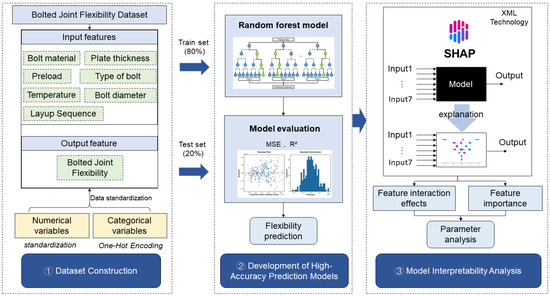
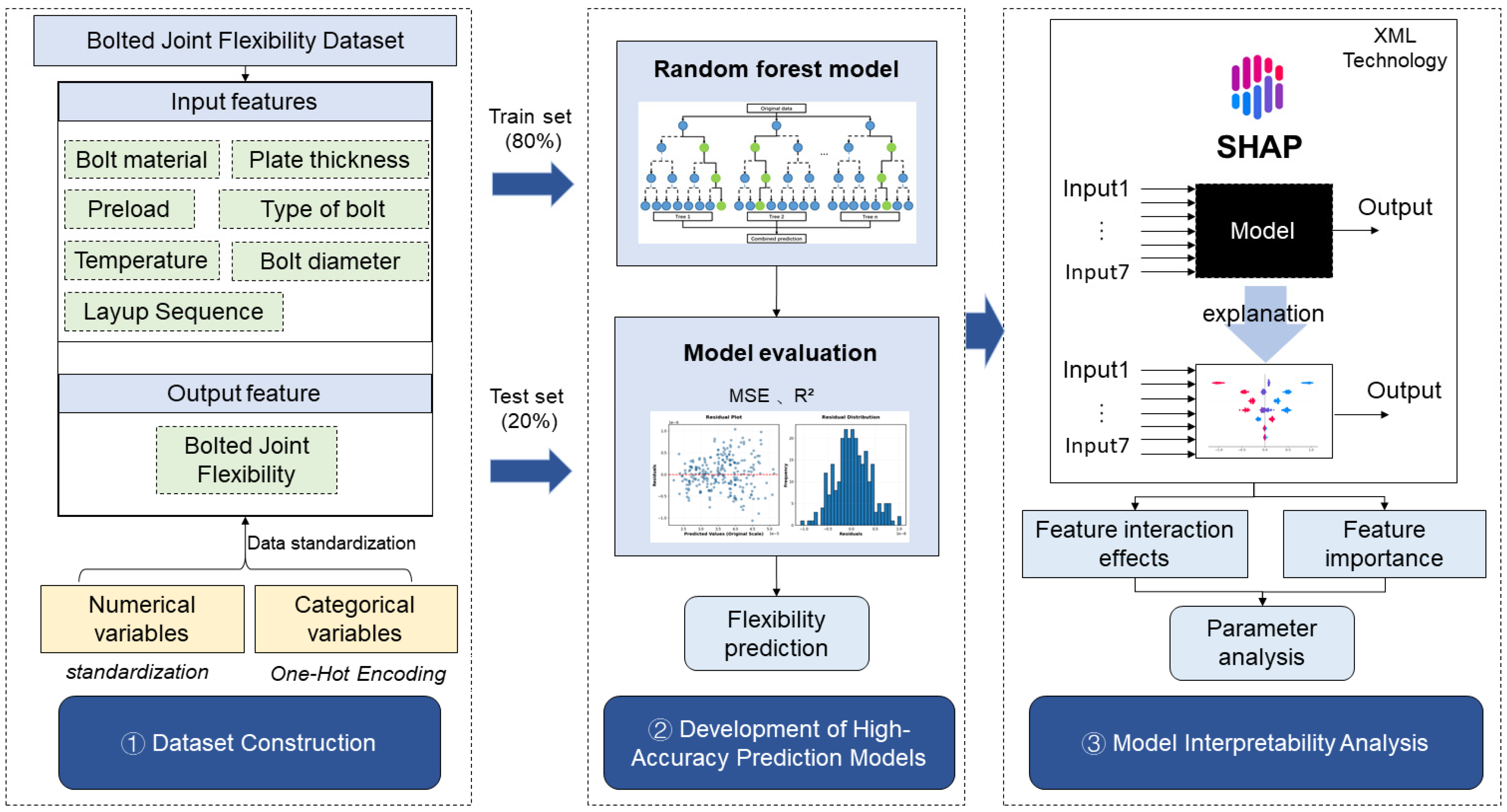
This study proposes a fastener flexibility analysis framework for connection structures that integrates numerical simulation and explainable machine learning. Firstly, a dataset encompassing geometric features, material properties, and fastener flexibility is constructed using the Finite Element Method (FEM). Subsequently, a Random Forest algorithm is employed to establish a prediction model, with model accuracy ensured through five-fold cross-validation and residual analysis. Building upon this, SHAP values are applied for feature importance analysis, and combined with theoretical flexibility formulas to quantify the independent contribution of each feature parameter to the flexibility prediction. The corresponding workflow diagram is shown in Figure 1. Workflow Diagram. Compared to traditional theoretical calculation methods, this approach not only enhances the accuracy of fastener flexibility prediction but also effectively achieves quantitative analysis of the influence weights of key parameters and their coupling effects. It overcomes the black-box nature of traditional ML models, providing an accurate and reliable analytical method for the design optimization of connection structures in aerospace and related fields.
Figure 1.
Workflow Diagram.
2. Numerical Modeling and Experimental Validation
The predictive accuracy and generalization capability of machine learning models are highly dependent on the quality of training data. To address the complex problem of fastener flexibility in CFRP-metal hybrid connection structures, which is governed by the coupled influence of multiple parameters, this study constructed a dataset through parametric finite element modeling validated by experimental data.
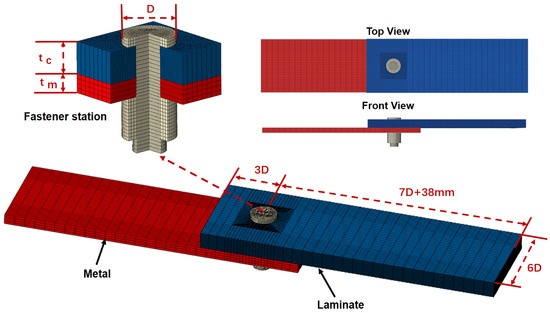
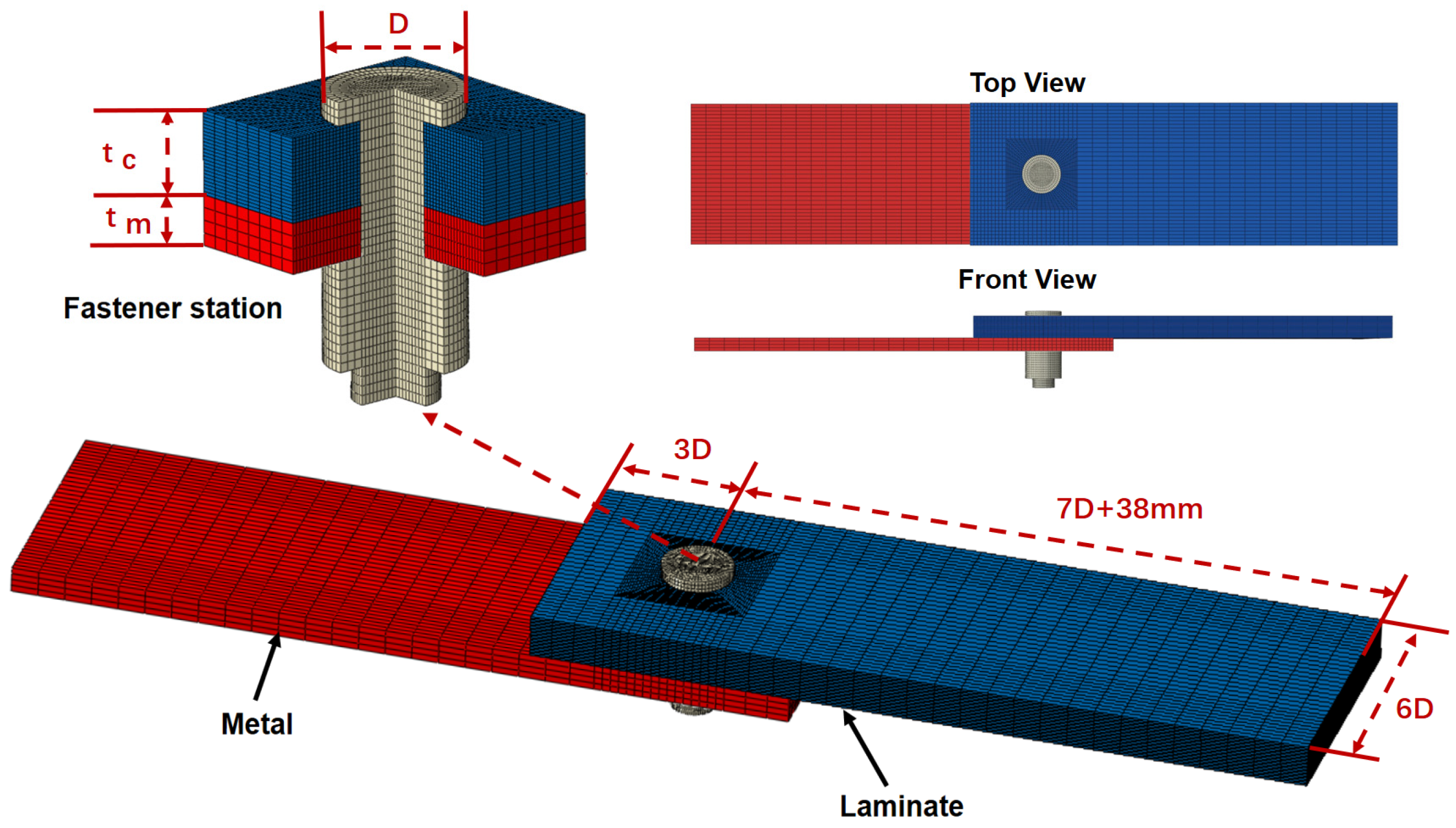
First, a finite element model of a single-bolt, single-shear single-lap joint was established using the ABAQUS/Standard platform, with detailed geometric configuration shown in Figure 2. Individual plies within the composite laminate were modeled as carbon fiber reinforced polymer (CFRP), employing C3D8R linear reduced integration hexahedral elements. The material properties of the lamina, metallic plates (Al), fasteners (Ti), and fasteners (Inconel), are summarized in Table 1. Since the analysis is conducted within the linear elastic regime, only elastic constants, including Young’s modulus, Poisson’s ratio, and coefficient of thermal expansion are considered.
Figure 2.
Numerical Modeling of metal-CFRP fastened joints.
Table 1.
Material properties.
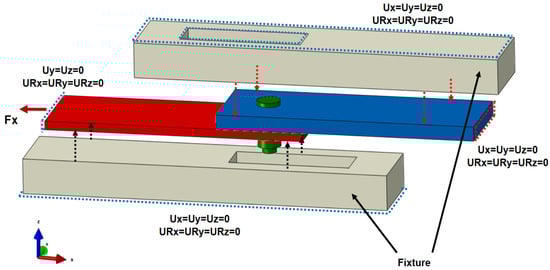
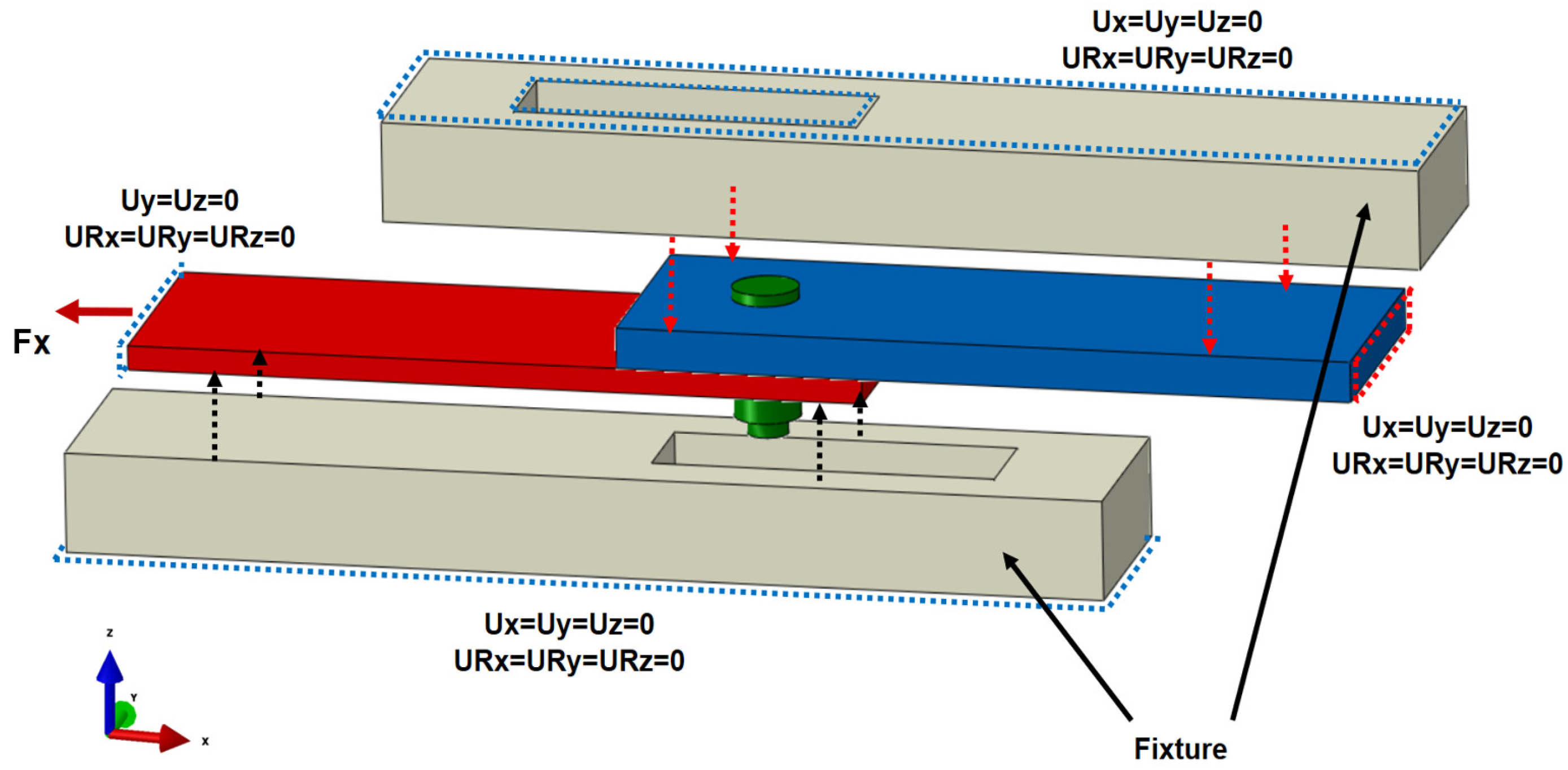
Local mesh refinement was implemented around the bolt holes in both the metal and composite plates. All contacts within the model were defined as hard surface-to-surface interactions; specifically, the contact between the bolt shank and the holes was modeled as frictionless, while the remaining contacts—including the interface between the two plates and the contacts between the bolt head/nut and the plates—were assigned a friction coefficient of 0.15. The analysis procedure comprises four steps: first, a minimal initial preload is applied using the boltload command to ensure computational convergence; subsequently, the actual preload force is applied to establish the initial fastened state of the joint; then, while maintaining constant bolt elongation, a temperature field is applied; finally, a 5 kN tensile load is applied to the metal plate end. The boundary conditions, as illustrated in Figure 3, feature fully fixed constraints at the composite plate end, while the metal plate end is constrained in all degrees of freedom except the tensile direction, with simplified fixtures (maintaining a 0.1 mm clearance from the structural surface) implemented to prevent excessive out-of-plane bending. This multi-step loading sequence comprehensively simulated the mechanical response of the joint structure under the combined effects of bolt preload, temperature variation, and external tensile loading.
Figure 3.
Boundary Conditions.
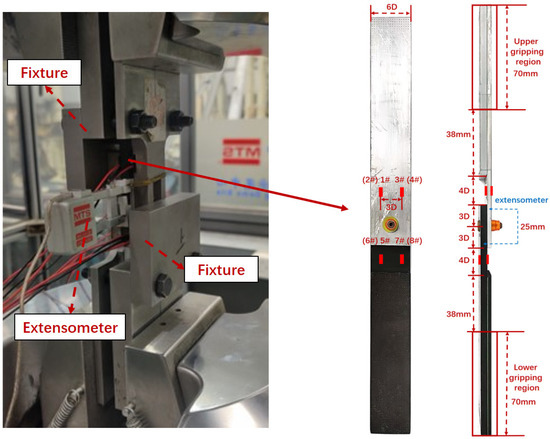
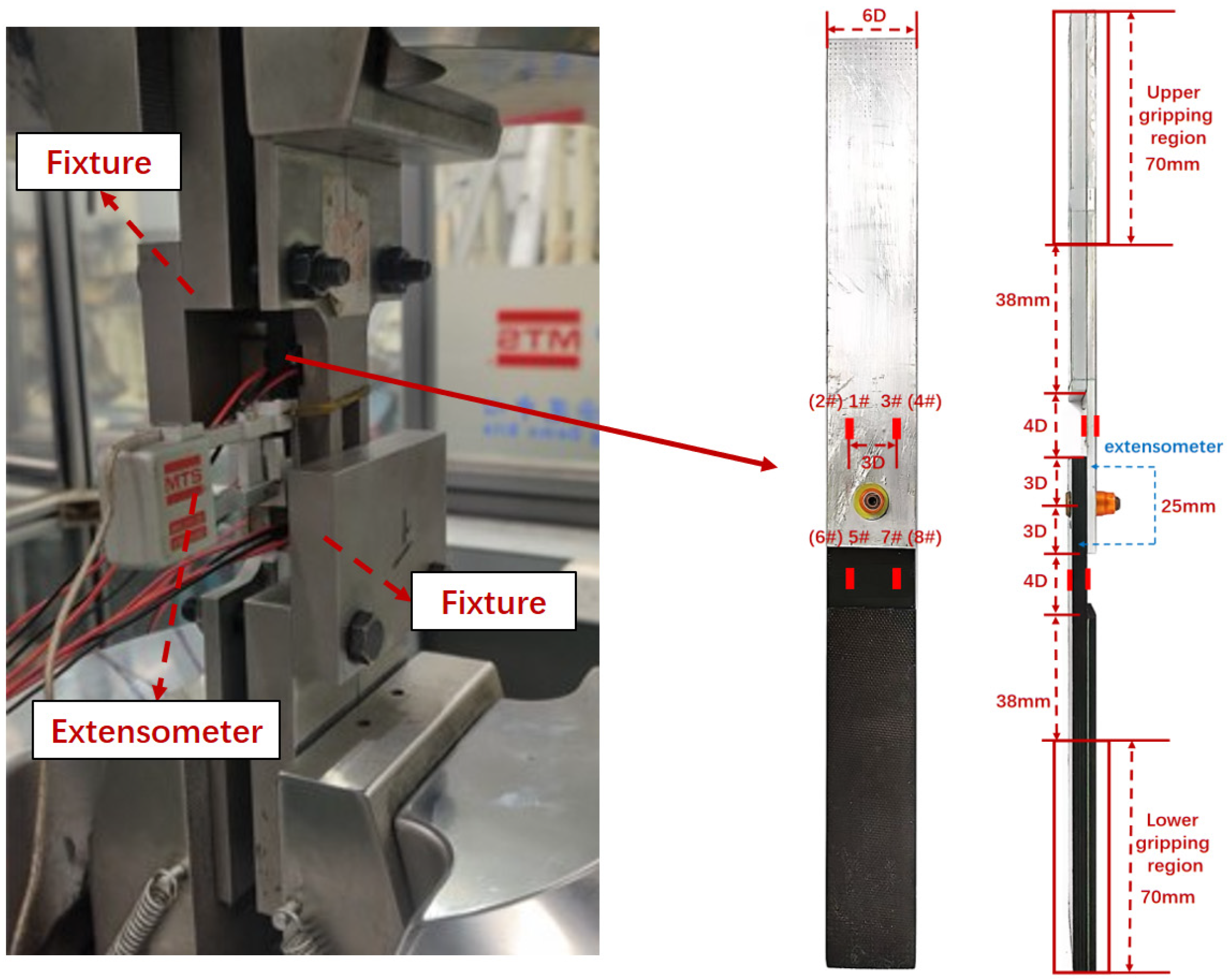
To verify the accuracy of the finite element model, experimental verification was conducted according to ASTM D5961M-23 standard [35] (test configuration shown in Figure 4, where bolt diameter D = 4.76 mm, dome head Inconel bolt, room temperature, preload of 5 N·m, and thickness ratio of 0.4). This study employed VTI’s EX1629 dynamic strain gauge for experimental measurements, strain gauge locations detailed in Figure 4: positions 1#–8#, with numbers in parentheses indicating backside measurement points. The comparison between the experimental strain values and the corresponding element strain values from the finite element model under a 5 kN tensile load is presented in Table 2, showing good agreement between experimental measurements and simulation results with a mean absolute relative error of 2.4%.
Figure 4.
Longitudinal Tension Test of Metal-CFRP Fastened Joints.
Table 2.
Comparative Analysis of Experimental and Finite Element Strain Results.
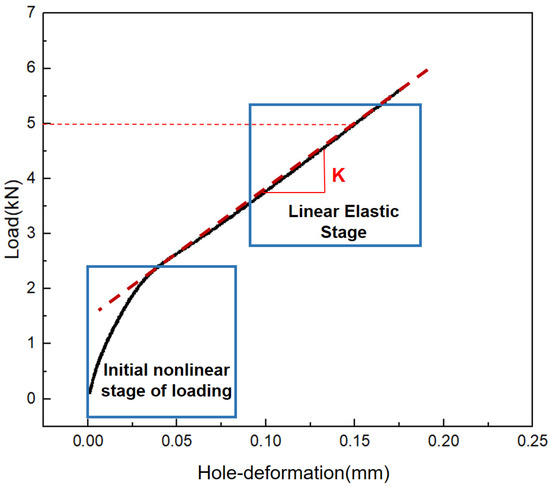
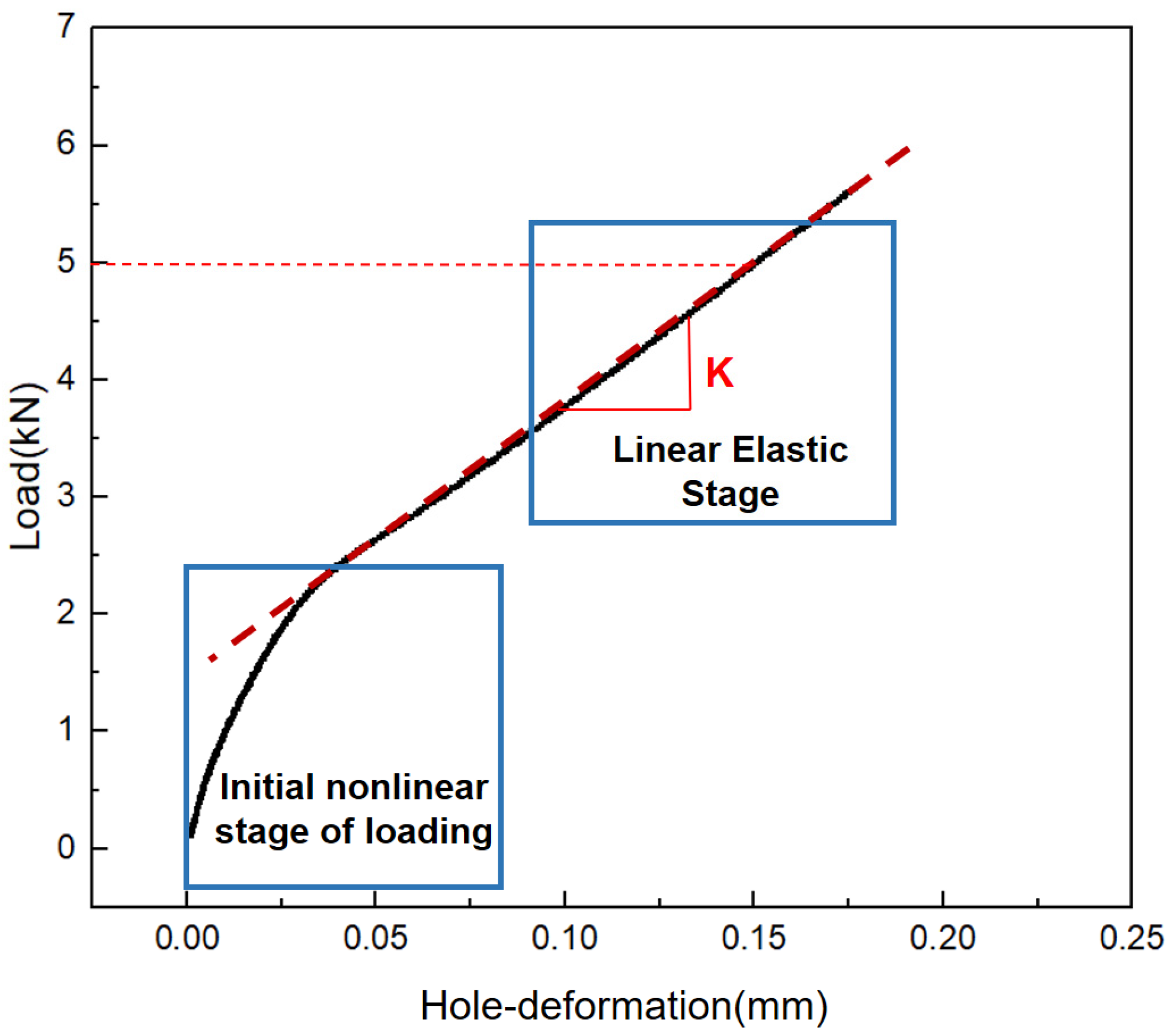
During testing, fastener displacement was measured using an extensometer, and the recorded data are shown in Figure 5. The load–hole deformation curve exhibits two distinct stages: an initial nonlinear segment followed by a linear elastic region. The nonlinear behavior in the initial stage is attributed to the static friction forces generated by the bolt preload, during which no slip occurs at the joint interface. After this stage, the system enters the linear elastic regime. In this study, the fastener flexibility is defined as the slope of the tangent to the linear elastic portion of the curve. Based on this definition, the experimental fastener flexibility is determined to be 4.08 × 10⁻⁵ mm/N. Under the same loading condition, the simulated fastener flexibility is obtained by extracting nodal displacements at the extensometer measurement locations in the finite element model. The simulated value is 3.92 × 10⁻⁵ mm/N, resulting in a relative error of 3.9%. This close agreement between experimental and simulated results further validates the accuracy and effectiveness of the established finite element model.
Figure 5.
The load hole-deformation curve from a single-lap, single-bolt joint.
3. Machine Learning-Based Flexibility Prediction Model
3.1. Database Generation
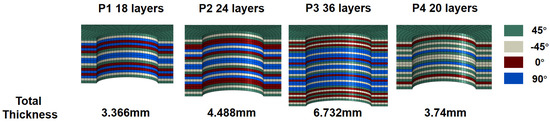
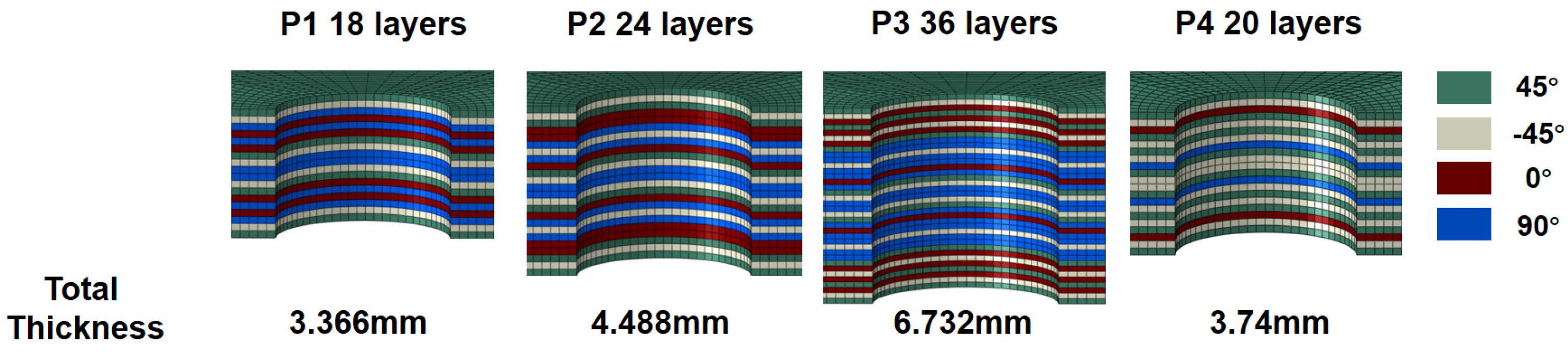
The dataset for the random forest machine learning model was constructed by systematically varying seven critical design parameters in single-bolt, single-shear metal-composite hybrid joints. Value ranges and selection criteria for six geometric/material parameters are detailed in Table 3. To investigate the effects of ply angle ratios and thickness on connection performance, four representative composite laminate configurations were selected. The 0°/±45°/90° ply angle ratios for P1, P2, P3, and P4 are 33.33/44.44/22.22, 25/50/25, 33.33/44.44/22.22, and 10/80/10, with their stacking sequences illustrated in Figure 6. Through full factorial design [36], 864 unique parameter combinations were generated. Parametric finite element models were then programmatically established using Python (version 3.7) scripting to automate the ABAQUS modeling process. These parameters, selected based on those commonly considered in prior studies on aircraft joint design [37,38,39,40,41,42,43,44], enable a comprehensive evaluation of their combined effects on connection performance through systematic variation in parameter combinations.
Table 3.
Feature Selection for Machine Learning Datasets.
Figure 6.
Feature Selection for Machine Learning Datasets-Layup Sequence.
3.2. Data Preprocessing
To enhance the training effectiveness and generalization capability of the machine learning model, preprocessing was performed on the generated 864 datasets. Categorical features (fastener type: protruding head/countersunk) were processed using one-hot encoding, while numerical features (including stacking sequence parameters, fastener material, diameter, thickness ratio, temperature, and tightening torque) were standardized using sklearn.preprocessing’s StandardScaler to eliminate dimensional inconsistencies among features and ensure training stability and convergence efficiency. The dataset was randomly partitioned into training and testing sets at an 8:2 ratio.
3.3. ML-Based Flexibility Prediction Model Construction
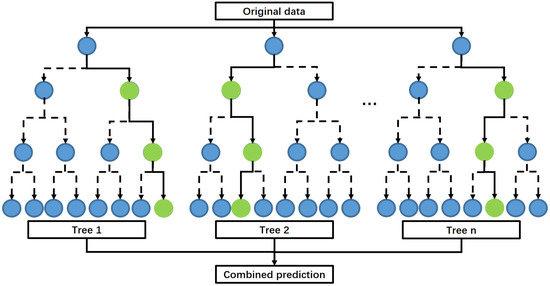
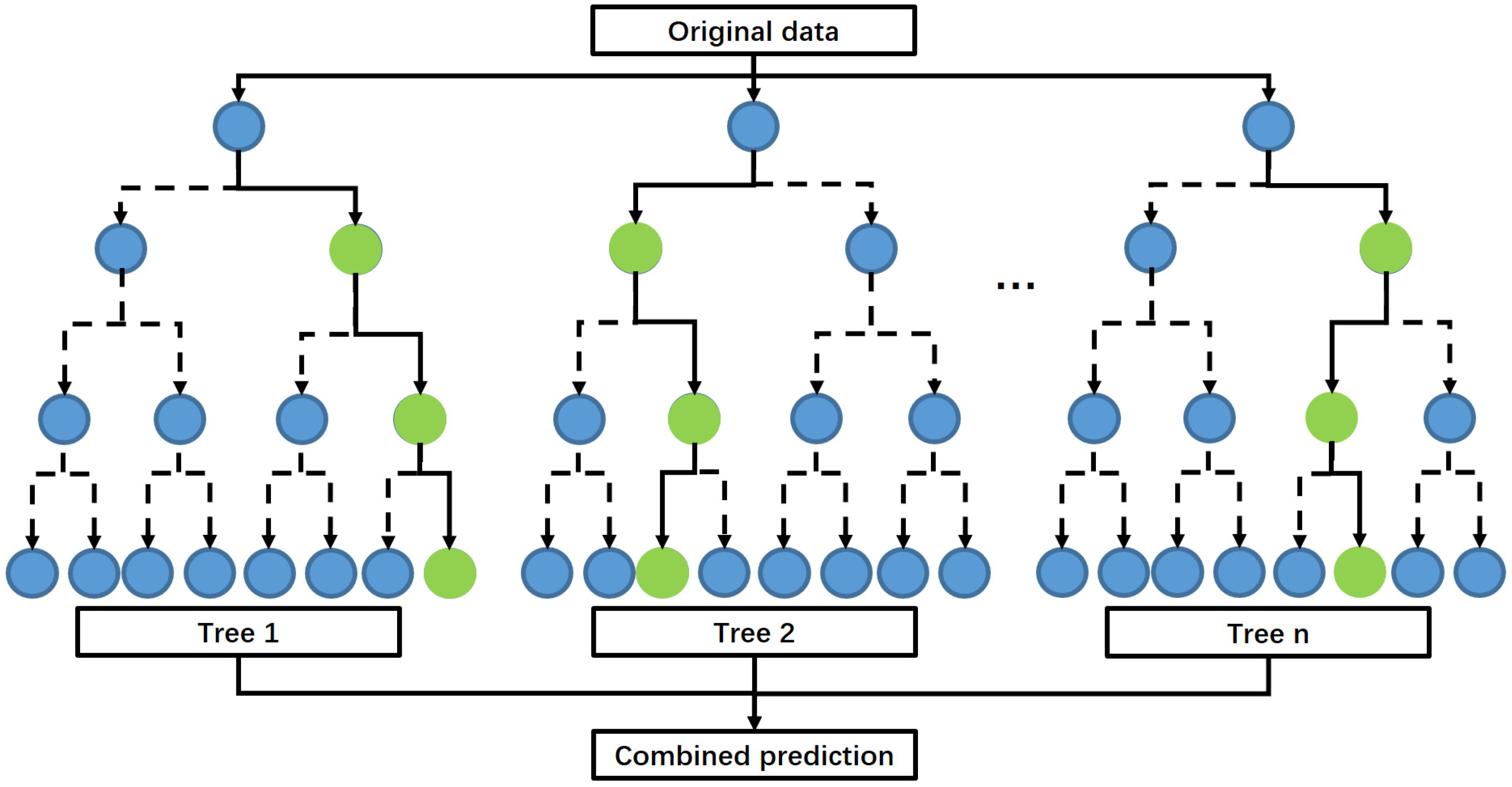
This study employs Random Forest, an ensemble learning-based machine learning algorithm, to construct the fastener flexibility prediction model. The algorithm enhances prediction accuracy and robustness by building multiple decision trees and aggregating their individual predictions.
The Random Forest model construction process initiates with bootstrap sampling, where T = 100 distinct bootstrap sample sets are generated through repeated random sampling with replacement from the training data. For each bootstrap sample, a decision tree is recursively constructed: at every node, a random subset of features is selected from the full feature space. For numerical features, candidate split points are computed as midpoints between adjacent unique values, while categorical features are evaluated through subset partitioning. The optimal split point (or subset) is determined by minimizing the weighted Mean Squared Error (MSE).
This partitioning process recurses until the MSE within a leaf node reaches zero, at which point the mean flexibility value of the training samples within that terminal node is assigned as its prediction output. The complete Random Forest ensemble is formed by concurrently training n such decision trees. When presented with a new sample for prediction, each constituent decision tree independently processes the input: starting from the root node, the sample traverses down the tree based on prescribed splitting rules to either the left or right child node until reaching a leaf node containing the stored prediction value. Following independent prediction generation by all trees, the final ensemble prediction is obtained by averaging the outputs of the individual trees:
where is the prediction of the t-th decision tree, T = 100. The prediction mechanism is illustrated in Figure 7 where the green circles and solid lines represent the actual paths selected during prediction.
Figure 7.
Prediction Mechanism of Random Forest Models.
3.4. Validation of the ML-Based Flexibility Prediction Model
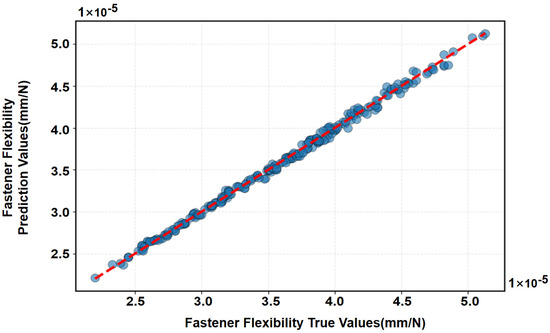
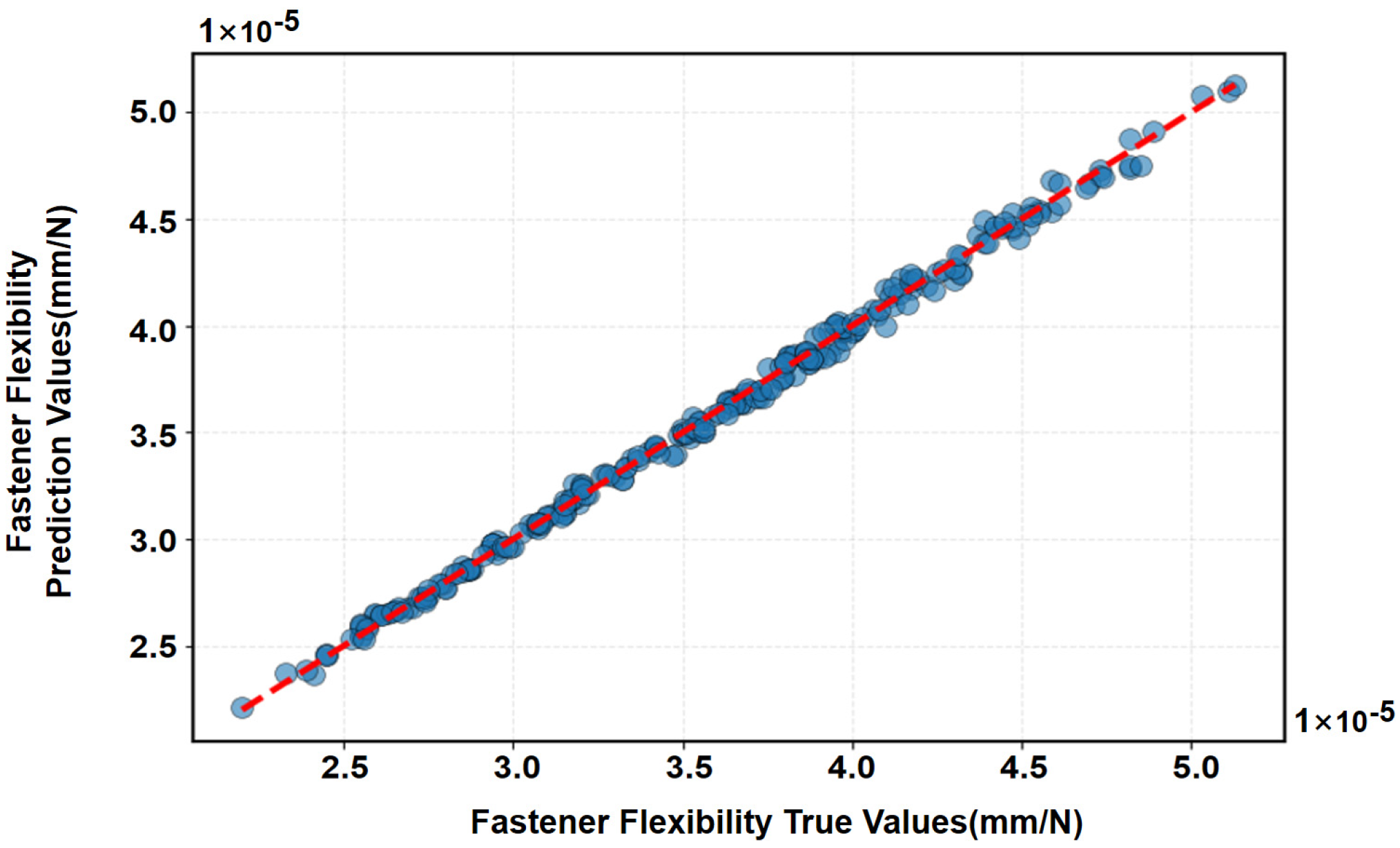
Figure 8 presents the scatter plot distribution of predicted versus actual fastener flexibility values for the hybrid joint structure, demonstrating excellent agreement between the random forest (RF) model predictions and ground truth data. The prediction accuracy was quantitatively evaluated using two key metrics: mean squared error (MSE) and coefficient of determination (R2), as summarized in Table 4.
Figure 8.
Comparison between predicted and measured values using Random Forest model.
Table 4.
MSE and R2 of RF model.
The MSE represents a measure of the discrepancy between predicted and observed values, mathematically defined as:
R2 serves as a metric for evaluating the goodness-of-fit of regression models. It quantifies the proportion of variance in the dependent variable that is predictable from the independent variables, formally defined as the ratio of explained variance to total variance:
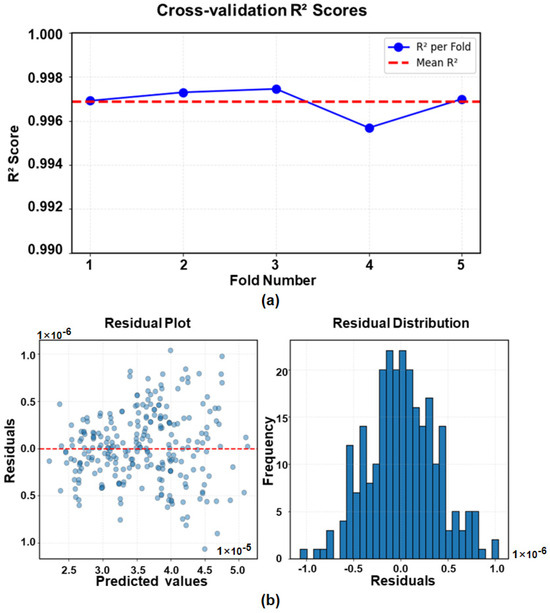
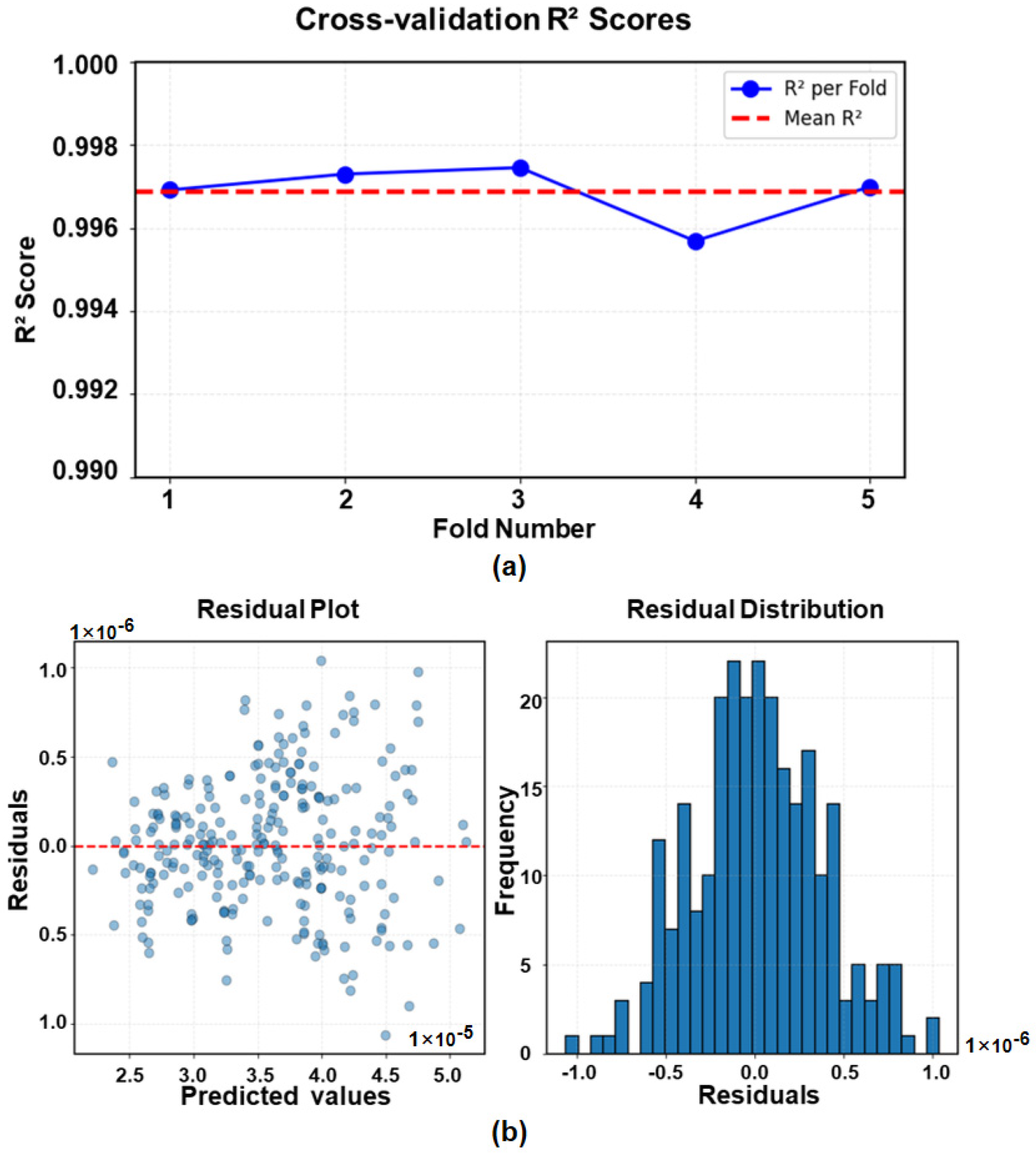
To validate the model’s stability and generalization capability, five-fold cross-validation was implemented. As shown in Figure 9a, the R2 scores across all folds consistently exceeded 0.995 with variations below 0.002, confirming consistent predictive accuracy across data subsets. Residual analysis in Figure 9b revealed that the errors are normally distributed around zero, with no clear patterns or signs of heteroscedasticity, suggesting that the model captures the underlying relationships without overfitting.
Figure 9.
Validation Analysis of Random Forest Predictive Performance. (a) Five-fold cross-valida-ion results. (b) Residual analysis.
4. Model Explanation
4.1. Model Explanation by SHAP
Notwithstanding the superior predictive accuracy of the Random Forest algorithm, its inherent “black-box” nature constrains result credibility in engineering applications. SHAP (Shapley Additive Explanations) analysis addresses this limitation through the Shapley value framework from cooperative game theory, establishing a rigorous quantitative interpretation method for model predictions [25]. By decomposing feature contributions into marginal effects, this approach establishes transparent Random Forest decision pathways. This enables the ML model to maintain high accuracy while significantly enhancing physical interpretability.
The mathematical formulation of the Shapley value is given by:
where denotes the SHAP value of the i-th feature, N represents the set of all features, S is a subset of N, M is the total number of features, indicates the model’s predicted value when using the feature subset S, and constitutes the weighting term.
In this study, we first compute SHAP values for all samples efficiently using the TreeSHAP algorithm—specifically optimized for tree-based models—applied to a trained Random Forest model. Subsequently, parameter influence mechanisms are revealed through a three-stage analysis: (1) Global feature importance quantified by denotes the SHAP value of the i-th feature for the j-th sample and n is the total sample size; (2) Feature distribution interpretation via beeswarm plots visualizing the relationship between parameter values and corresponding SHAP values; (3) Quantification of feature interactions through conditional SHAP values to identify nonlinear coupling effects among parameters.
4.2. SHAP Result Analysis
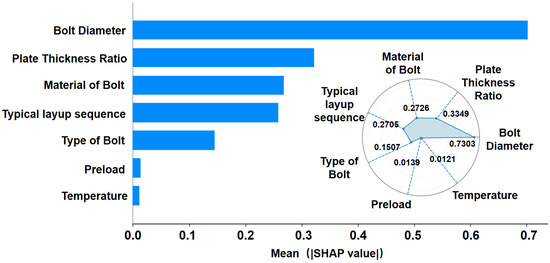
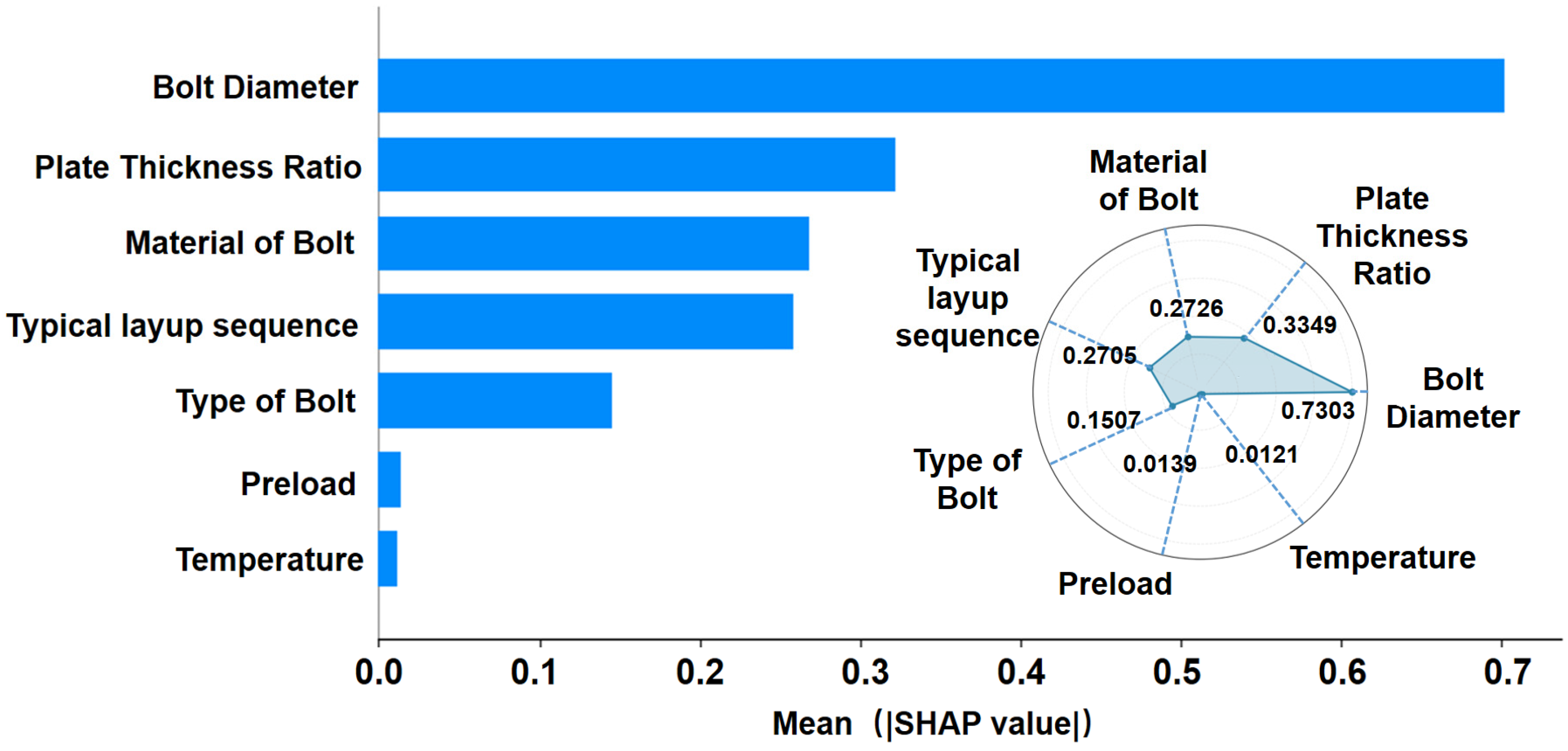
Figure 10 presents the global interpretation results, displaying the importance ranking of seven features in the flexibility prediction model based on SHAP analysis. Among these, the fastener diameter emerges as the most influential feature, followed by the plate thickness ratio. The fastener material, ply orientation, and fastener type exhibit moderate influence, whereas the effects of preload and temperature on fastener flexibility are negligible.
Figure 10.
SHAP-based feature importance analysis.
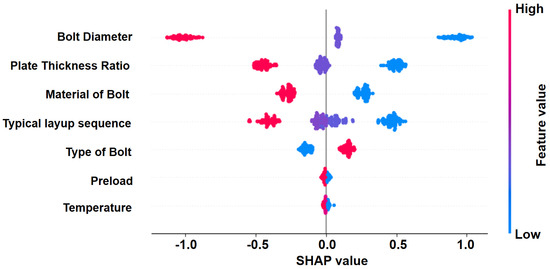
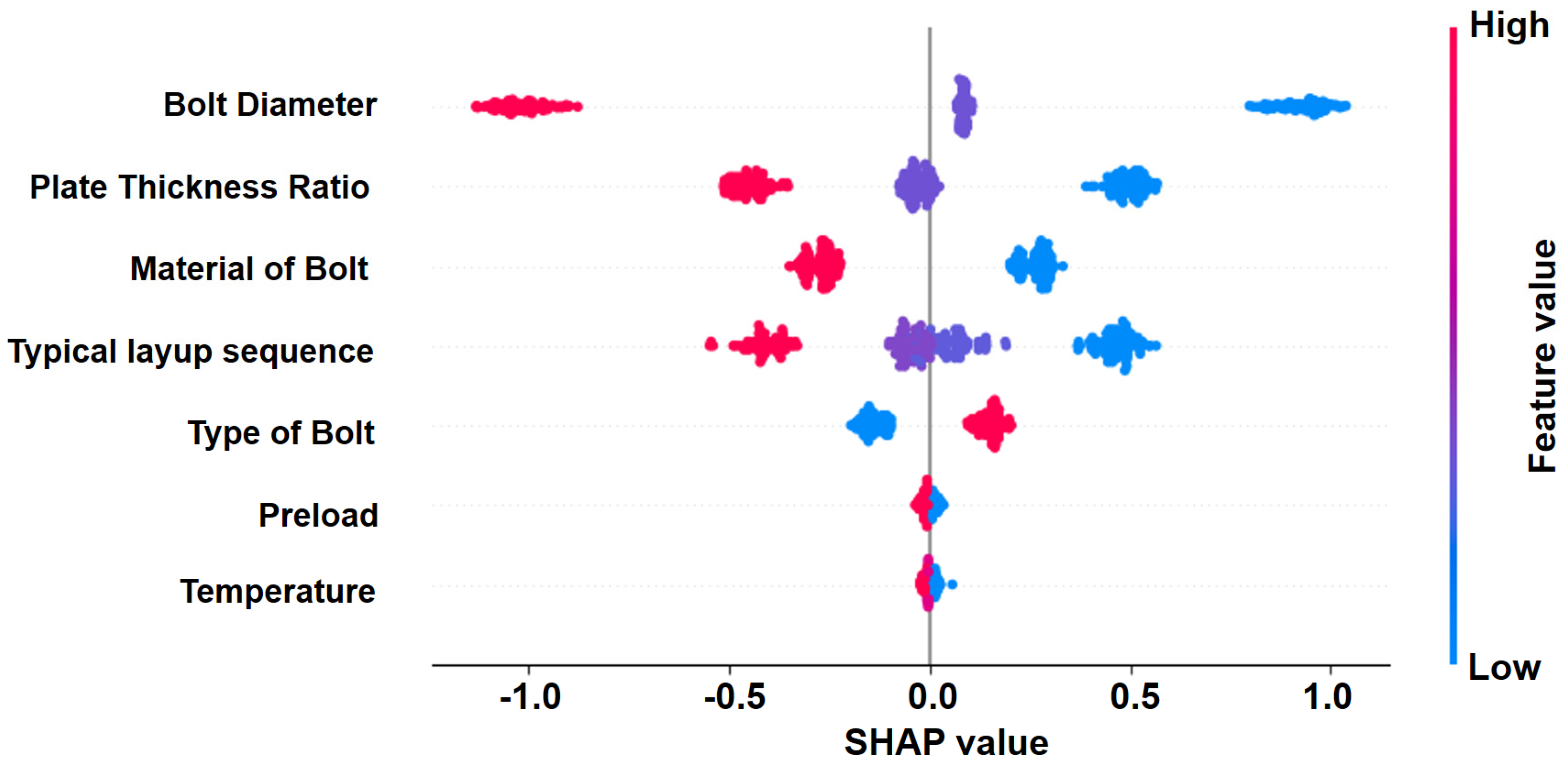
Figure 11 presents the SHAP beeswarm plot for global feature importance, where each point represents an individual sample with point density indicating the concentration of sample distribution. The color gradient (red → blue) corresponds to feature value magnitude, with red denoting maximum values and blue minimum values. Points with larger absolute SHAP values exert more significant influence on model predictions; Positive SHAP values correlate with increased joint compliance, whereas negative values correspond to enhanced structural stiffness. Subsequent analysis integrates SHAP results with the analytical formulation of fastener flexibility to elucidate the underlying mechanisms through which key features influence prediction outcomes.
Figure 11.
Distribution of characteristic SHAP values for parameters.
4.3. Discussion
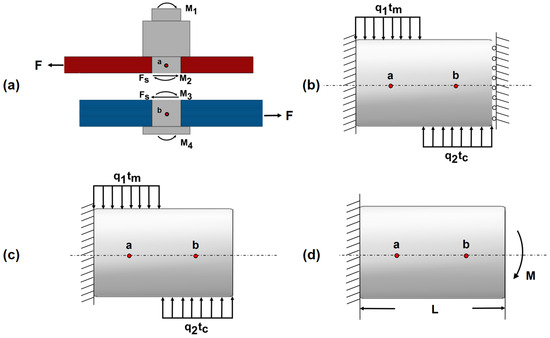
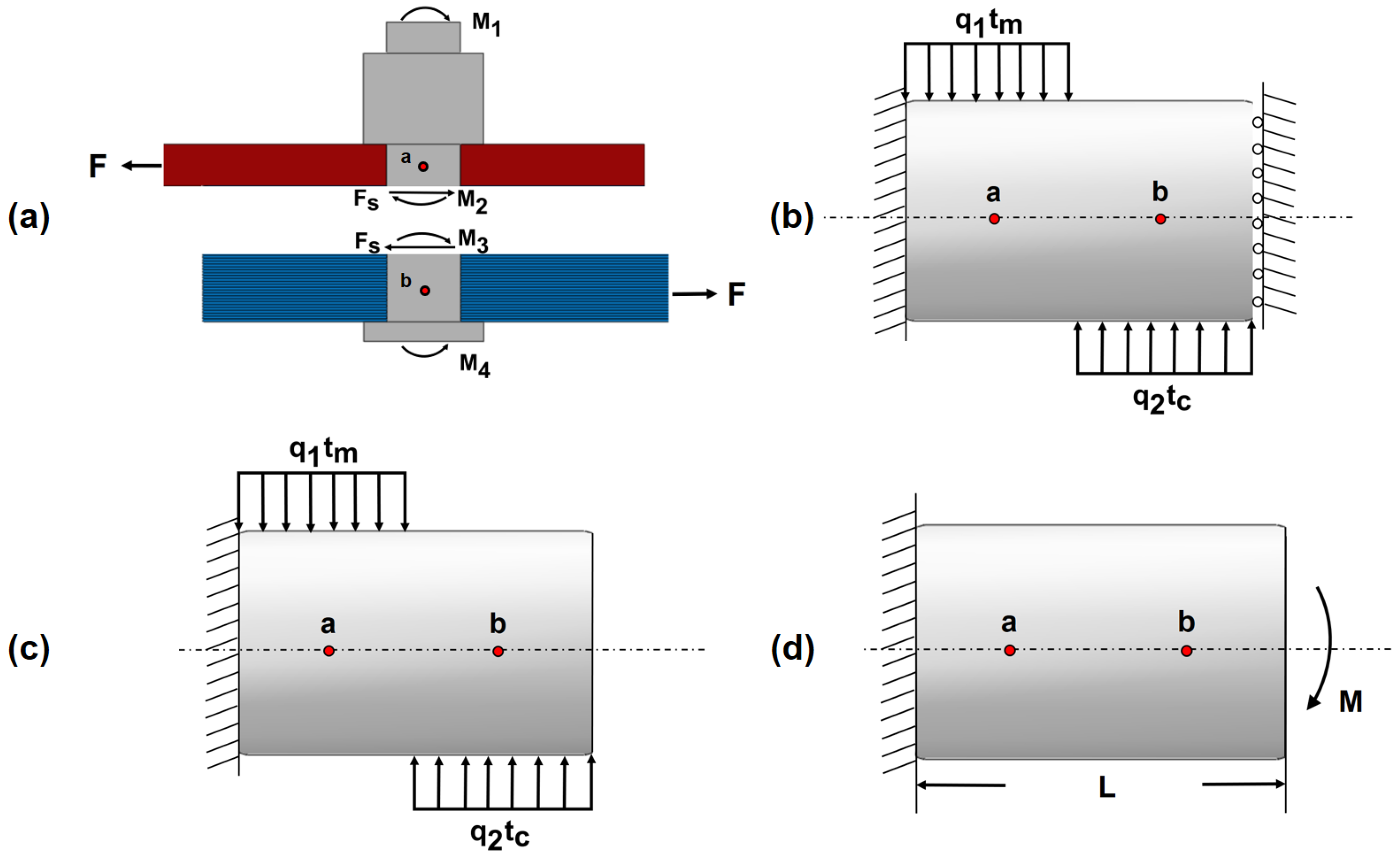
As illustrated in Figure 12, in a single-bolt, single-shear joint, the fastener experiences deformation not only from shear force and bending moment but also undergoes bearing deformation due to interfacial bearing pressure between the fastener and connected plates. Consequently, the total fastener flexibility comprises four additive components: fastener shear flexibility (), bending flexibility (), bearing flexibility of the fastener (), and bearing flexibility of both connected plates ().
Figure 12.
Stress State of Single-Bolt Single-Shear Bolted Joints. (a) Overall loading condition of the structure. (b) Simplified loading condition of the structure. (c) Statically determinate structure 1. (d) Statically determinate structure 2.
Assuming uniformly distributed bearing pressure along the axial direction with boundary conditions of one end fully fixed and the opposite end fixed but permitted to slide (rotation constrained), this loading state can be equivalently modeled as the linear superposition of two statically determinate structures [45], as shown in Figure 12b–d.
Based on the fundamental equations of strength of materials, the rotation angle at the right end under each individual load can be calculated. According to the boundary condition requiring zero rotation at the right end, the following equation can be established:
By combining this with equilibrium equation:
The bending moment M can be determined as:
The shear deformation between points A and B is:
where is the fastener’s elastic modulus, is the cross-sectional area of the fastener, is the fastener shape factor ( for circular fasteners), and the shear compliance can be obtained as:
The bending deformation at points a and b is caused by three components :
The bending compliance is obtained as:
The bearing compliance of the fastener and the bearing compliance of the joined plates are:
Theoretically, under the assumption of uniform load distribution through the plate thickness, the compliance expression for a single-shear fastener is:
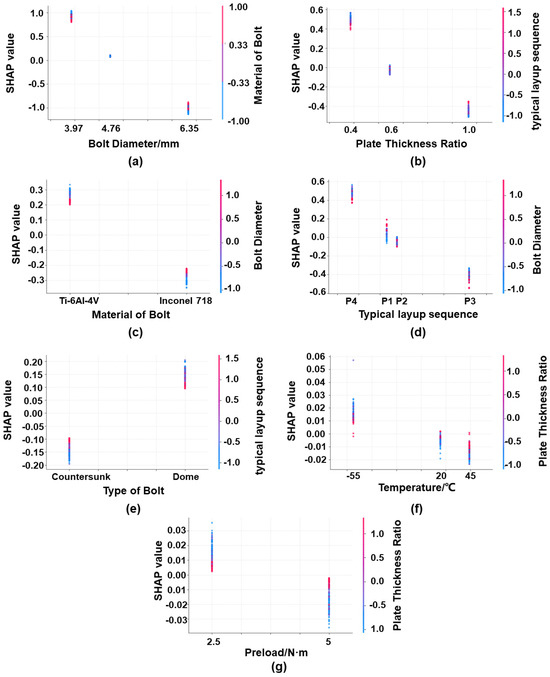
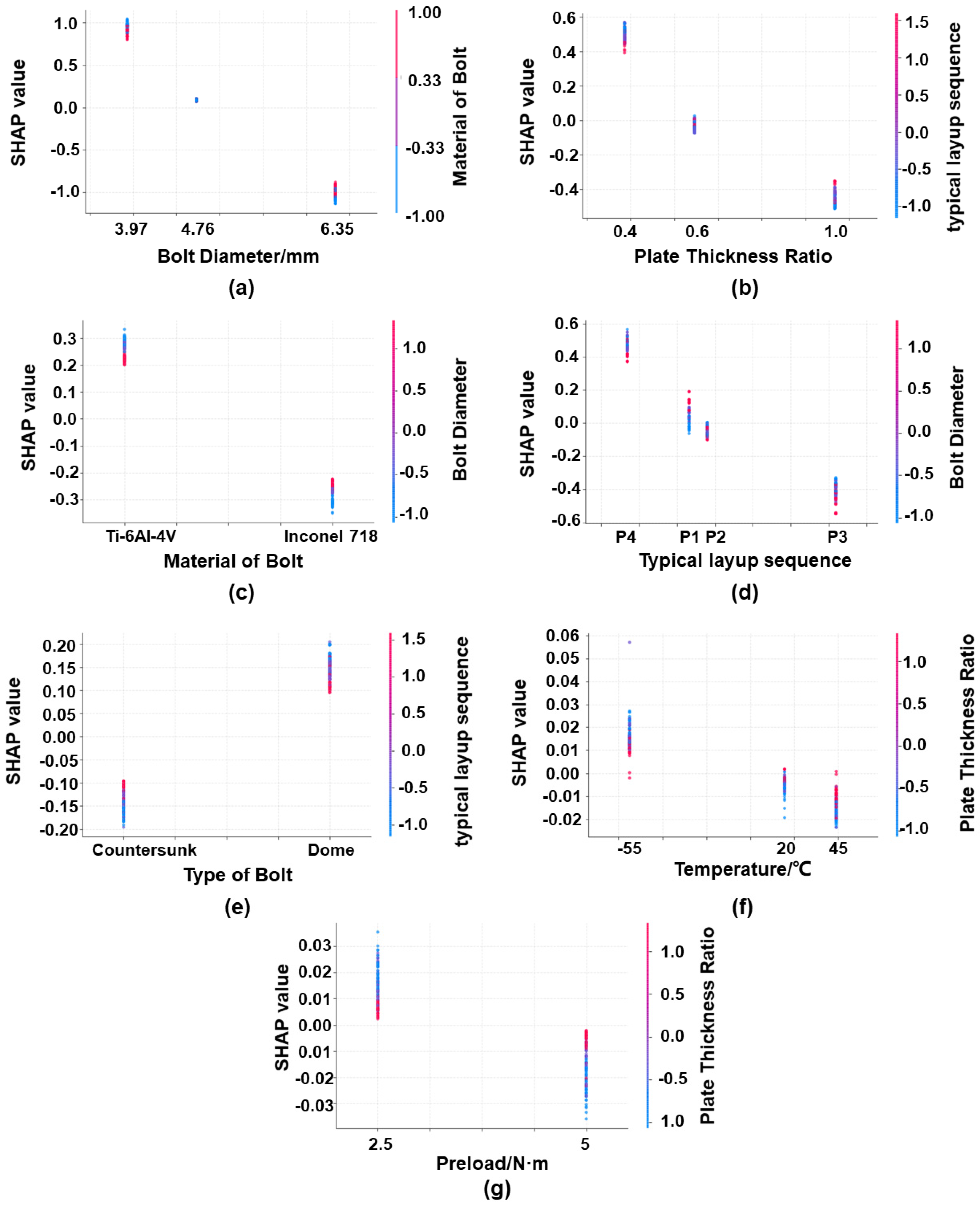
As shown in Figure 13a–g, the influence mechanisms of various structural parameters on fastener compliance can be systematically interpreted through the combination of SHAP analysis and mechanical models:
Figure 13.
Correlation plot of SHAP features for input variables. (a) bolt diameter interacting with material of bolt; (b) plate thickness ratio interacting with typical layup sequence; (c) material of bolt interacting with bolt diameter; (d) typical layup sequence interacting with bolt diameter; (e) type of bolt interacting with typical layup sequence; (f) temperature interacting with plate thickness ratio; (g) preload interacting with plate thickness ratio.
(1) SHAP analysis reveals that the negative impact on fastener flexibility peaks when the diameter increases to 6.35 mm. This aligns with mechanical principles: shear flexibility decreases inversely with the square of diameter due to the shear area relationship; bending flexibility, governed by moment of inertia, exhibits a stronger quartic inverse relationship with diameter; simultaneously, increased diameter effectively reduces contact stress at the hole wall, thereby diminishing bearing flexibility.
(2) As the plate thickness ratio increases, fastener flexibility decreases. When metal and composite plates share similar thicknesses (thickness ratio = 1.0), the SHAP value for fastener flexibility reaches its minimum. Under this condition, fastener deformation is shear-dominated with near-uniform shear stress distribution along the axis and negligible secondary bending moment. Conversely, when the thickness ratio < 1.0, localized shear strain concentrations develop on the composite side, while thickness disparity-induced eccentric bending moments significantly amplify fastener bending deformation, consequently increasing flexibility.
(3) The influence of composite layup design on fastener flexibility manifests primarily through two aspects: laminate stiffness and thickness. The P3 layup exhibits the minimum SHAP value due to its maximized product of tensile-direction equivalent stiffness and thickness. Enhanced tensile stiffness in composites increases perihole radial stiffness, thereby reducing bearing deformation. Concurrently, increased ply thickness extends the fastener’s effective load-bearing length, causing bending flexibility to rise cubically with length. Nevertheless, this effect can be mitigated through optimized layup design.
(4) The influence of fastener head configuration on pin flexibility primarily manifests in load transfer mechanisms and stress distribution. Protruding head fasteners exhibit lower SHAP values, since their exposed heads act as rigid fulcrums that constrain bending deformation and partially homogenize bearing stress. Compared to countersunk fasteners, they demonstrate reduced bending and shear flexibility—particularly advantageous for eccentric-load connections. Conversely, while countersunk heads satisfy aerodynamic smoothness requirements, geometric discontinuities at the conical head-socket interface induce severe stress concentration in the transition zone. Furthermore, the absence of head-induced moment restraint exacerbates pin bending, amplifying contact non-uniformity at the hole periphery and ultimately increasing localized compliance.
(5) Increased preload alters load transfer paths through enhanced interfacial friction, yet exerts minimal influence on the fastener’s inherent shear and bending flexibility. While temperature variations induce additional stresses due to differential thermal expansion coefficients, their effect on the elastic modulus of metallic fasteners within the conventional operating range (−55 °C to +45 °C) is typically minor. Such stiffness variations are generally overshadowed by other uncertainty sources in engineering calculations.
(6) As depicted in Figure 13a, substituting nickel alloy with titanium alloy at a fastener diameter of 3.97 mm significantly elevates the Shapley value of diameter, a phenomenon intrinsically linked to the dynamic distribution characteristics of Shapley values under multi-feature interactions. Analysis of charts Figure 13b–g demonstrates that increasing fastener diameter effectively counteracts the stiffness degradation caused by P4 layups; while countersunk configurations amplify flexibility, their detrimental effects can be mitigated through optimized ply sequencing. Titanium alloy’s flexibility characteristics manifest more prominently within smaller diameter ranges, enabling stiffness variations from material selection and layup configuration to be balanced through diameter adjustment in engineering practice. The results reveal that identical feature values exert divergent influences due to inter-variable interactions under synergistic effects of structural features, with these complex nonlinear interactions providing critical evidence for optimizing composite joint designs.
The explainable analysis based on the SHAP methodology not only clearly elucidates the mechanistic effects of various feature parameters on fastener flexibility, but also verifies that the machine learning model has genuinely learned fundamental physical principles. This enables a dependable data-driven decision-making approach for optimizing joint designs.
5. Conclusions
This study has developed an accurate predictive model for fastener compliance in metal-composite connections using explainable artificial intelligence techniques, achieving outstanding prediction accuracy of 0.998 on the test set and 0.996 on the training set. The model demonstrates remarkable computational efficiency, completing predictions in just 0.02 s—a dramatic improvement over conventional finite element analysis which requires 5400 s.
Through SHAP interpretability analysis, we quantitatively determined that pin diameter and thickness ratio are the dominant factors influencing compliance, accounting for 59.62% of the total effect. Secondary factors including layup sequence, fastener type and material properties collectively contribute 39%, while preload and temperature conditions have negligible impact with less than 1.45% contribution.
The machine learning model demonstrated high accuracy in predicting fastener flexibility, while SHAP interpretability analysis effectively revealed the contribution mechanisms of key design parameters. Although SHAP offers a solid theoretical foundation for feature importance assessment, its results may be sensitive to data distribution characteristics, such as class imbalance or missing values, potentially leading to biased interpretations. To address this, this study conducted a combined validation between SHAP analysis results and theoretical models, significantly enhancing the reliability of the conclusions and improving the credibility and engineering applicability of the approach in structural mechanics.
Author Contributions
Conceptualization and methodology, X.N.; validation, X.N.; formal analysis, X.N.; data curation, X.N.; writing—original draft preparation, X.N.; writing—review and editing, visualization, X.Z.; supervision, X.Z. All authors have read and agreed to the published version of the manuscript.
Funding
This research received no external funding.
Data Availability Statement
The data presented in this study are not available on request from the corresponding authors because they are part of an ongoing study.
Conflicts of Interest
The authors declare no conflicts of interest.
References
- Luo, X.; Li, Y.; Li, W.; Guo, X. Study on Axial Compression Performance of CFRP-Aluminum Alloy Laminated Short Tubes. Materials 2025, 18, 3480. [Google Scholar] [CrossRef] [Scilit] [PubMed]
- Zhu, H.; Fu, K.; Huang, T.; Liu, H.; Yang, B.; Zhou, Y.; Li, Y. Highly conductive CFRP composite with Ag-coated T-ZnO interlayers for excellent lightning strike protection, EMI shielding and interlayer toughness. Compos. Part B Eng. 2024, 279, 111448. [Google Scholar] [CrossRef] [Scilit]
- Pramanik, A.; Basak, A.K.; Dong, Y.; Sarker, P.K.; Uddin, M.S.; Littlefair, G.; Dixit, A.R.; Chattopadhyaya, S. Joining of carbon fibre reinforced polymer (CFRP) composites and aluminium alloys—A review. Compos. Part A Appl. Sci. Manuf. 2017, 101, 1–29. [Google Scholar] [CrossRef] [Scilit]
- Islami, D.P.; Muzaqih, A.F.; Adiputra, R.; Prabowo, A.R.; Firdaus, N.; Ehlers, S.; Braun, M.; Jurkovič, M.; Smaradhana, D.F.; Carvalho, H. Structural design parameters of laminated composites for marine applications: Milestone study and extended review on current technology and engineering. Results Eng. 2024, 24, 103195. [Google Scholar] [CrossRef] [Scilit]
- Delzendehrooy, F.; Akhavan-Safar, A.; Barbosa, A.Q.; Beygi, R.; Cardoso, D.; Carbas, R.J.C.; Marques, E.A.S.; da Silva, L.F.M. A comprehensive review on structural joining techniques in the marine industry. Compos. Struct. 2022, 289, 115490. [Google Scholar] [CrossRef] [Scilit]
- Suo, H.; Zhou, H.; Wei, Z.; Li, R.; Zhang, Y.; Guan, W.; Cheng, H.; Luo, B.; Zhang, K. Degradation mechanisms and mechanical behavior of composite-metal bolted/riveted joints in complex service conditions: A comprehensive review. Eng. Fail. Anal. 2025, 182, 110037. [Google Scholar] [CrossRef] [Scilit]
- Shu, H.; Li, Y.; Liu, X. Analytical and experimental study on fastener connection compliance. Eng. Mech. 2013, 30, 470–475+480. [Google Scholar]
- Min, Q.; Wang, B.; Wang, Y. Research on typical connection structure fastener flexibility coefficient calculation method. Aeronaut. Sci. Technol. 2014, 25, 16–20. [Google Scholar]
- Huth, H. Influence of fastener flexibility on the prediction of load transfer and fatigue life for multiple-row joints. In Fatigue in Mechanically Fastened Composite and Metallic Joints; ASTM STP: West Conshohocken, PA, USA, 1986; Volume 927, pp. 221–250. [Google Scholar]
- Tate, M.B.; Rosenfeld, S.J. Preliminary Investigation of the Loads Carried by Individual Bolts in Bolted Joints; NACA Technical Note: Boston, MA, USA, 1946; Volume 1051. [Google Scholar]
- Morris, G. Defining a Standard Formula and Test-Method for Fastener Flexibility in Lap-Joints. Master’s Thesis, Delft University of Technology, Delft, The Netherlands, 2004. [Google Scholar]
- Lian, T.; Huang, Q.; Yin, Z.; Su, X. The modification of the formula for the aircraft structural fastener’s flexibility. Mech. Strength 2014, 36, 555–559. [Google Scholar] [CrossRef]
- Li, Z.; Huang, Q.; Yin, Z.; Ma, K. Analysis of influence factors to the flexibility of aircraft structural fasteners. Mech. Sci. Technol. Aerosp. Eng. 2013, 32, 923–927. [Google Scholar] [CrossRef]
- Zarringol, M.; Patel, V.I.; Liang, Q.Q. Artificial neural network model for strength predictions of CFST columns strengthened with CFRP. Eng. Struct. 2023, 281, 115784. [Google Scholar] [CrossRef] [Scilit]
- Thai, H.-T. Machine learning for structural engineering: A state-of-the-art review. Structures 2022, 38, 448–491. [Google Scholar] [CrossRef] [Scilit]
- Zhang, S.; Lei, H.; Zhou, Z.; Wang, G.; Qiu, B. Fatigue life analysis of high-strength bolts based on machine learning method and SHapley Additive exPlanations (SHAP) approach. Structures 2023, 51, 275–287. [Google Scholar] [CrossRef] [Scilit]
- Kaiser, I.; Richards, N.; Ogasawara, T.; Tan, K.T. Machine learning algorithms for deeper understanding and better design of composite adhesive joints. Mater. Today Commun. 2023, 34, 105428. [Google Scholar] [CrossRef] [Scilit]
- Vijayan, D.S.; Sivasuriyan, A.; Devarajan, P.; Stefańska, A.; Wodzyński, Ł.; Koda, E. Carbon fibre-reinforced polymer (CFRP) composites in civil engineering application—A comprehensive review. Buildings 2023, 13, 1509. [Google Scholar] [CrossRef] [Scilit]
- Tosun, E.; Çalık, A. Failure load prediction of single lap adhesive joints using artificial neural networks. Alex. Eng. J. 2016, 55, 1341–1346. [Google Scholar] [CrossRef] [Scilit]
- Birecikli, B.; Karaman, Ö.A.; Çelebi, S.B.; Turgut, A. Failure load prediction of adhesively bonded GFRP composite joints using artificial neural networks. J. Mech. Sci. Technol. 2020, 34, 4631–4640. [Google Scholar] [CrossRef] [Scilit]
- Lim, D.K.; Mustapha, K.B.; Pagwiwoko, C.P. Delamination detection in composite plates using random forests. Compos. Struct. 2021, 278, 114676. [Google Scholar] [CrossRef] [Scilit]
- Theodoridis, S. Neural networks and deep learning: Part II. In Machine Learning, 3rd ed.; Theodoridis, S., Ed.; Academic Press: Cambridge, MA, USA, 2026; pp. 997–1102. Available online: https://www.elsevier.com/books-and-journals/book-companion/9780443292385 (accessed on 17 January 2025).
- Staniak, M.; Biecek, P. Explanations of model predictions with live and breakdown packages. arXiv 2018. [Google Scholar] [CrossRef] [Scilit]
- Tan, S.; Soloviev, M.; Hooker, G.; Wells, M.T. Tree Space Prototypes: Another Look at Making Tree Ensembles Interpretable. arXiv 2020, arXiv:1611.07115. [Google Scholar] [CrossRef] [Scilit]
- Lundberg, S.M.; Lee, S. A unified approach to interpreting model predictions. Adv. Neural Inf. Process. Syst. 2017, 30, 4768–4777. [Google Scholar]
- Zhao, J.; Wang, B.; Lyu, Q.; Xie, W.; Guo, Z.; Wang, B. Compression after multiple impact strength of composite laminates prediction method based on machine learning approach. Aerosp. Sci. Technol. 2023, 136, 108243. [Google Scholar] [CrossRef] [Scilit]
- Yossef, M.; Noureldin, M.; Alqabbany, A. Explainable artificial intelligence framework for FRP composites design. Compos. Struct. 2024, 341, 118190. [Google Scholar] [CrossRef] [Scilit]
- Saberi, S.; Nasiri, H.; Ghorbani, O.; Friswell, M.I.; Castro, S.G.P. Explainable Artificial Intelligence to Investigate the Contribution of Design Variables to the Static Characteristics of Bistable Composite Laminates. Materials 2023, 16, 5381. [Google Scholar] [CrossRef] [Scilit]
- Wang, Z.; Chen, X.; Zhang, J.; Huang, H. Machine learning-based prediction and interpretability analysis of flexural capacity for CFRP-strengthened RC beams. Case Stud. Constr. Mater. 2025, 23, e05203. [Google Scholar] [CrossRef] [Scilit]
- Ke, L.; Qiu, M.; Chen, Z.; Zhou, J.; Feng, Z.; Long, J. An interpretable machine learning model for predicting bond strength of CFRP-steel epoxy-bonded interface. Compos. Struct. 2023, 326, 117639. [Google Scholar] [CrossRef] [Scilit]
- Kapidžić, Z.; Nylander, A.M. Fatigue and failure testing of a hybrid CFRP-aluminum wing box at elevated temperature. Compos. Struct. 2023, 305, 116469. [Google Scholar] [CrossRef] [Scilit]
- Zhang, H.; Song, Z.; Zhang, L.; Liu, Z.; Zhu, P. Effects of hygrothermal ageing and temperature on the mechanical behavior of aluminum-CFRP hybrid (riveted/bonded) joints. Int. J. Adhes. Adhes. 2023, 121, 103299. [Google Scholar] [CrossRef] [Scilit]
- Yu, X.; Ren, F.; Yan, G.; Tang, J.; Cai, C.; Zhang, C.; Gu, X.; Xu, X. Compressive behavior of composite stiffened panels with hybrid bonded-bolted stiffener terminations: Experimental and numerical investigations. Thin-Walled Struct. 2026, 219, 114160. [Google Scholar] [CrossRef] [Scilit]
- Special Metals Corporation. INCONEL® Alloy 718. In Technical Bulletin; Special Metals Corporation: Huntington, WV, USA, 2007; Available online: https://www.specialmetals.com/documents/technical-bulletins/inconel/inconel-alloy-718.pdf (accessed on 1 September 2007).
- ASTM D5961M-23; Standard Test Method for Bearing Response of Polymer Matrix Composite Laminates. ASTM International: West Conshohocken, PA, USA, 2023.
- Sahoo, P.; Barman, T.K. ANN modelling of fractal dimension in machining. In Mechatronics and Manufacturing Engineering; Paulo Davim, J., Ed.; Woodhead Publishing: Cambridge, UK, 2012; pp. 159–226. [Google Scholar] [CrossRef] [Scilit]
- Lee, H.M.; Kwak, H.M.; Choi, J.M.; Eom, J.G.; Kim, H.J.; Chung, W.J.; Joun, M.S. Experimental and numerical study on fillet rolling of a Ti6Al4V alloy aircraft bolt focusing on fatigue life. J. Manuf. Process. 2025, 151, 490–505. [Google Scholar] [CrossRef] [Scilit]
- Marques, A.; Guimarães, B.; Bartolomeu, F.; Miranda, G.; Silva, F.S.; Carvalho, O. Multi-material Inconel 718—Aluminium parts targeting aerospace applications: A suitable combination of low-weight and thermal properties. Opt. Laser Technol. 2023, 158, 108913. [Google Scholar] [CrossRef] [Scilit]
- Xie, Y.; Xiao, Y.; Lv, J.; Zhang, Z.; Zhou, Y.; Xue, Y. Influence of creep on preload relaxation of bolted composite joints: Modeling and numerical simulation. Compos. Struct. 2020, 245, 112332. [Google Scholar] [CrossRef] [Scilit]
- Bai, J.-B.; Xu, H.; Zhu, Y.-T.; Bu, G.-Y. Experimental and numerical investigation on thermomechanical behavior of diverse plain-woven CFRP bolted joint configurations. Thin-Walled Struct. 2025, 218, 114155. [Google Scholar] [CrossRef] [Scilit]
- Takai, T. Dependence of slip behavior of bolted connection on contact pressure and splice plate thickness. J. Constr. Steel Res. 2025, 237, 110123. [Google Scholar] [CrossRef] [Scilit]
- Stocchi, C.; Robinson, P.; Pinho, S.T. A detailed finite element investigation of composite bolted joints with countersunk fasteners. Compos. Part A Appl. Sci. Manuf. 2013, 52, 143–150. [Google Scholar] [CrossRef] [Scilit]
- Hussnain, S.; Sajid, Z.; Shah, S.; Megat-Yusoff, P.; Hussain, M. Effect of bolt size and fibre orientation on the bearing performance of resin-infused thermoplastic and thermoset 3D woven composite double-lap joints. J. Thermoplast. Compos. Mater. 2024, 38, 1818–1841. [Google Scholar] [CrossRef] [Scilit]
- Liu, K.; Liu, Y.; Sabbrojjaman, M.; Tafsirojjaman, T. Effect of bolt size on the bearing strength of bolt-connected orthotropic CFRP laminate. Polym. Test. 2023, 118, 107894. [Google Scholar] [CrossRef] [Scilit]
- Liu, W. Research on Pin Load Distribution of Mechanically Connected Composites Under Shear Load. Master’s Thesis, Shanghai Jiao Tong University, Shanghai, China, 2012. [Google Scholar]

Disclaimer/Publisher’s Note: The statements, opinions and data contained in all publications are solely those of the individual author(s) and contributor(s) and not of MDPI and/or the editor(s). MDPI and/or the editor(s) disclaim responsibility for any injury to people or property resulting from any ideas, methods, instructions or products referred to in the content. |
© 2026 by the authors. Licensee MDPI, Basel, Switzerland. This article is an open access article distributed under the terms and conditions of the Creative Commons Attribution (CC BY) license.