1. Introduction
Flight test is the final stage of aircraft design verification, serving as a critical process to identify, expose, and validate potential design issues. During flight tests, if potential defects are not identified beforehand, the aircraft may otherwise be pushed unintentionally to the edge of its flight envelope, which is extremely challenging and risky. Compared with routine civil operations, flight test conditions involve sparse abnormal samples, strong coupling among subsystems, and limited repeatability of hazardous scenarios. These characteristics significantly constrain the applicability of purely data-driven safety-monitoring approaches and highlight the need for methods that incorporate structured expert knowledge. To enhance situational awareness during abnormal attitude conditions, this study constructs an aircraft attitude prediction model based on the flight test safety knowledge graph, aiming to enable auxiliary decision-making and strengthen the interpretation capability of telemetry data.
In the future, the aviation industry is evolving toward being intelligent, autonomous, distributed, and interconnected, aiming to integrate multiple technologies to ensure flight safety [
1]. Under this development trend, a domain knowledge graph can organically integrate aviation safety knowledge and construct a comprehensive and interrelated knowledge system. The domain knowledge graph [
2] focuses on the depth of knowledge, emphasizes the quality of the knowledge base, is constructed using domain-specific data, and has domain-specific significance. It is usually constructed in a top-down approach. From knowledge representation [
3,
4], knowledge acquisition [
5,
6,
7], to knowledge fusion [
8,
9,
10], numerous techniques have been developed to enhance the efficiency and quality of knowledge graph construction.
The rules-based entity extraction method exhibits high accuracy but low efficiency. Consequently, deep-learning-based approaches have been widely explored. Xiong M et al. apply the Bi-LSTM-CRF method [
11] to extract deeply embedded security-related entities from civil aviation accident texts.
The research on the combination of Large Language Model (LLM) and knowledge graph shows promise [
12,
13,
14]. Dagdelen J et al. have utilized LLM [
15] to automatically extract knowledge from unstructured texts. Qu J et al. [
16] have proposed a remote supervised relationship extraction method based on reinforcement learning for clustering to extract the relationships between aviation accident entities. Currently, graphs are mostly applied in intelligent question answering [
17,
18], recommendation systems [
19], and knowledge visualization [
20]. This type of application requires a breadth of knowledge; however, they often lack depth and may introduce duplication of identical knowledge, irrelevant knowledge, and erroneous knowledge when dealing with heterogeneous data sources.
Main approaches include data-based auxiliary decision-making [
21], model-based auxiliary decision-making [
22,
23], and knowledge graph-based auxiliary decision-making [
24]. These three approaches provide different perspectives and methods for solving complex decision-making problems. Many studies combine two or three of them to conduct research on auxiliary decision-making. For instance, safety alarm issues have been studied based on model-based and data-based frameworks [
25,
26].
Alarm information is the key input for flight test safety-auxiliary decision-making. Through the analysis of alarm information and the security risk quantification methods [
27,
28], the degree of security risk in the current flight test state can be assessed, and data-driven methods combined with feature extraction can further improve the accuracy of risk-related parameter prediction [
29]. Aviation safety risks have been evaluated based on flight data and pilot behavior characteristics [
30], specifically, pilot behavior can affect the response to risks such as take-off runway overrun [
31,
32] and flight in icy conditions [
33], but not the occurrence of these events. Risk quantification aims to clarify the dangerous state, determine the dangerous state, and explore how to restore the safe state. The problem of stalling has been studied by planning flight paths [
34], minimizing the loss of altitude [
35], or adopting flow control technologies such as plasma actuators to delay stall occurrence [
36].
Building on these insights, this study introduces the principles of auxiliary decision-making, analyzes the relationships among the flight test safety knowledge graph, prediction model, decision, and support system, and proposes a linear risk quantification method. The safe maneuvering space calculation, knowledge graph design, visualization, and the neural-network-based attitude prediction model are presented. Finally, the framework’s effectiveness is validated using angle-of-attack and sideslip-angle examples.
2. The Auxiliary Decision-Making Method Based on Knowledge Graph and Predictive Model
2.1. Principle of Auxiliary Decision-Making
To provide support for unexpected situations during flight, the auxiliary decision-making should be clear about two goals: one is to improve the decision-making efficiency, that is, to push the most accurate decision-making information at the fastest speed when unexpected situations occur. With the knowledge graph as the basic tool, telemetry data are combined with flight safety knowledge, enabling alarm information and disposal measures to be quickly pushed when relevant parameters meet the alarm discrimination requirements. The other goal is to enhance the analysis ability of complex faults. For complex faults encountered during flight tests, it is necessary to be able to identify the essence, analyze the key alarm causes and solutions from a large amount of data, and provide a strong theoretical support for auxiliary decision-making.
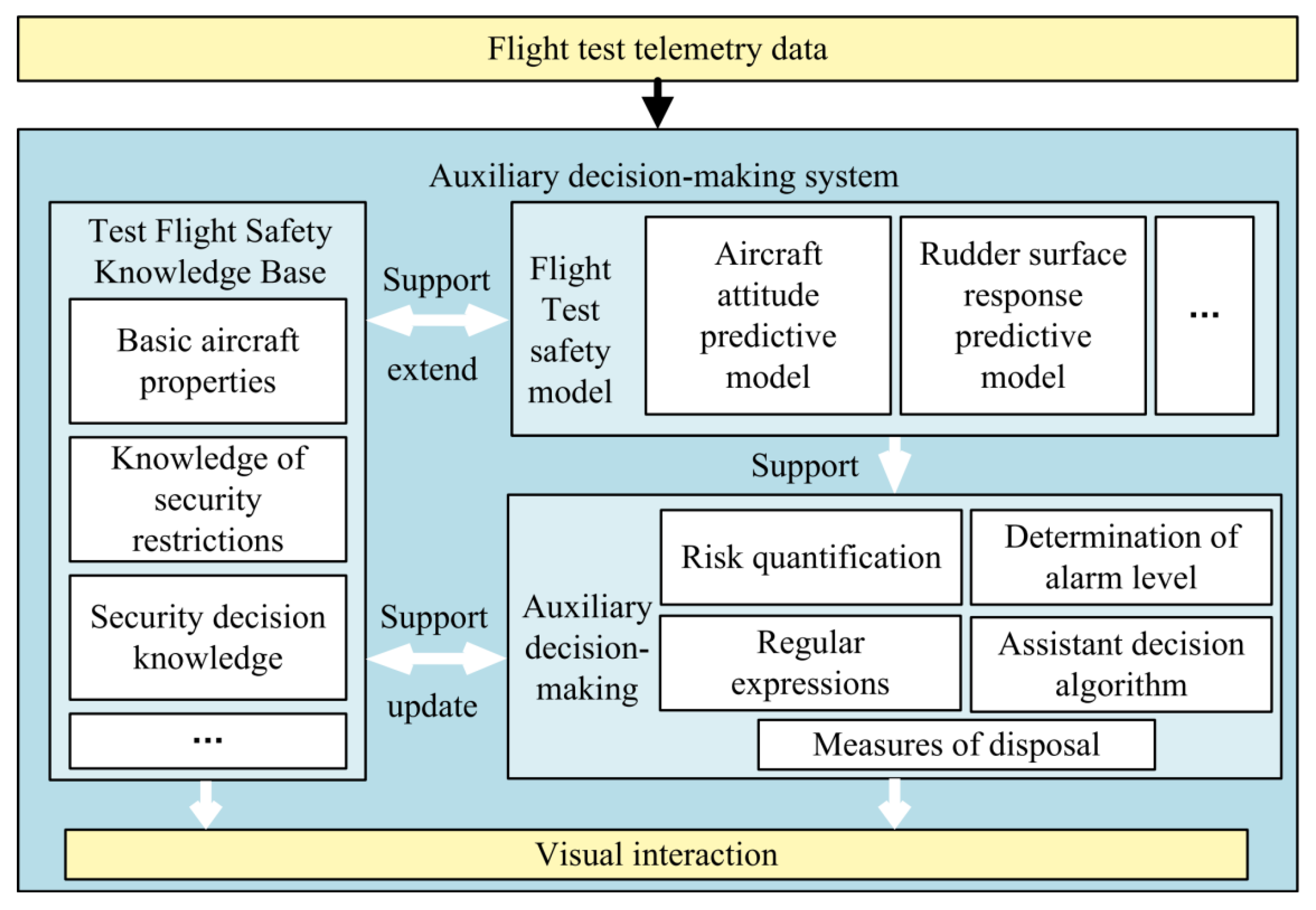
The principle of the auxiliary decision-making is illustrated in
Figure 1. The auxiliary decision-making system primarily comprises the knowledge graph of flight test safety, the flight test safety model, and the auxiliary decision-making model.
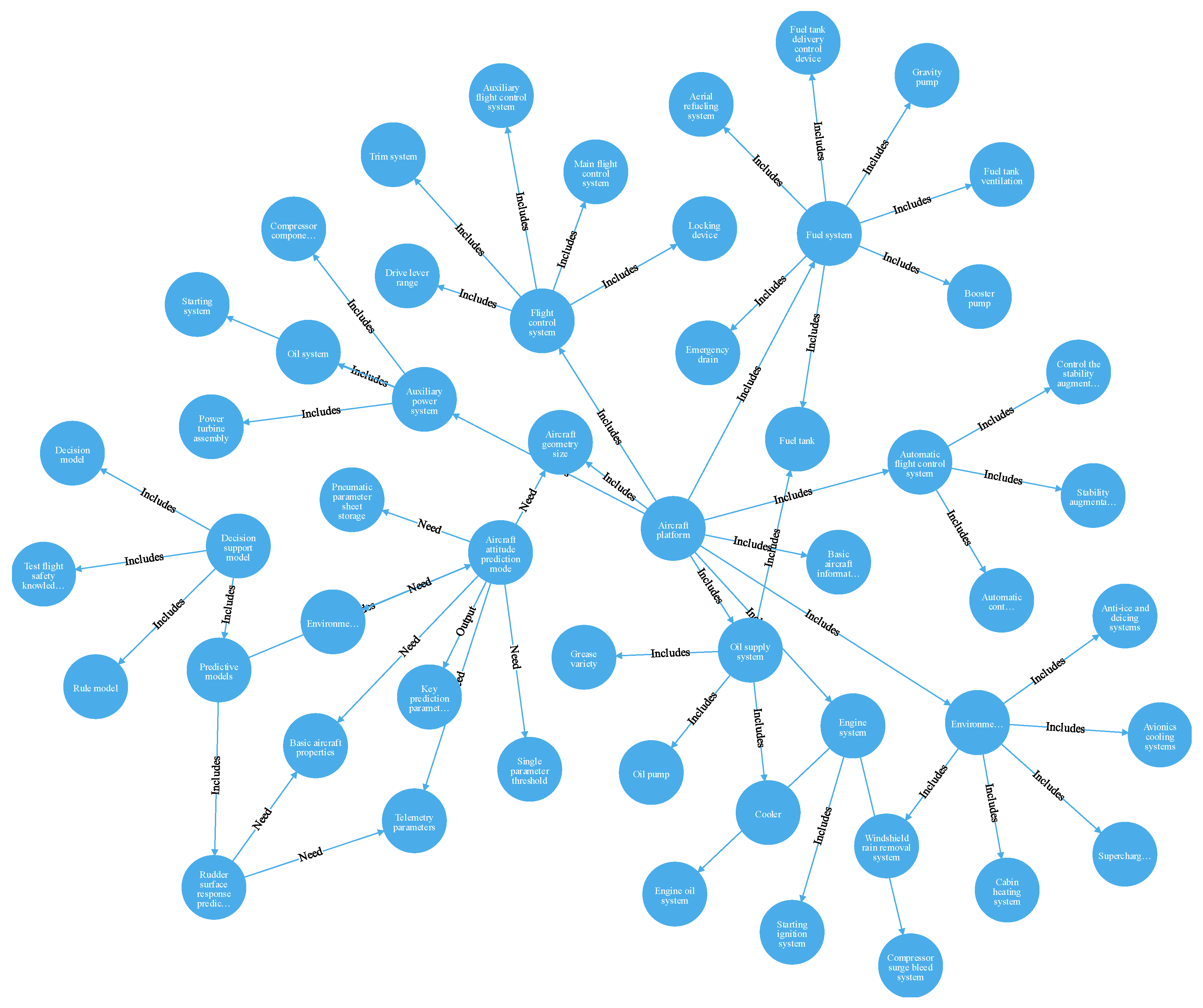
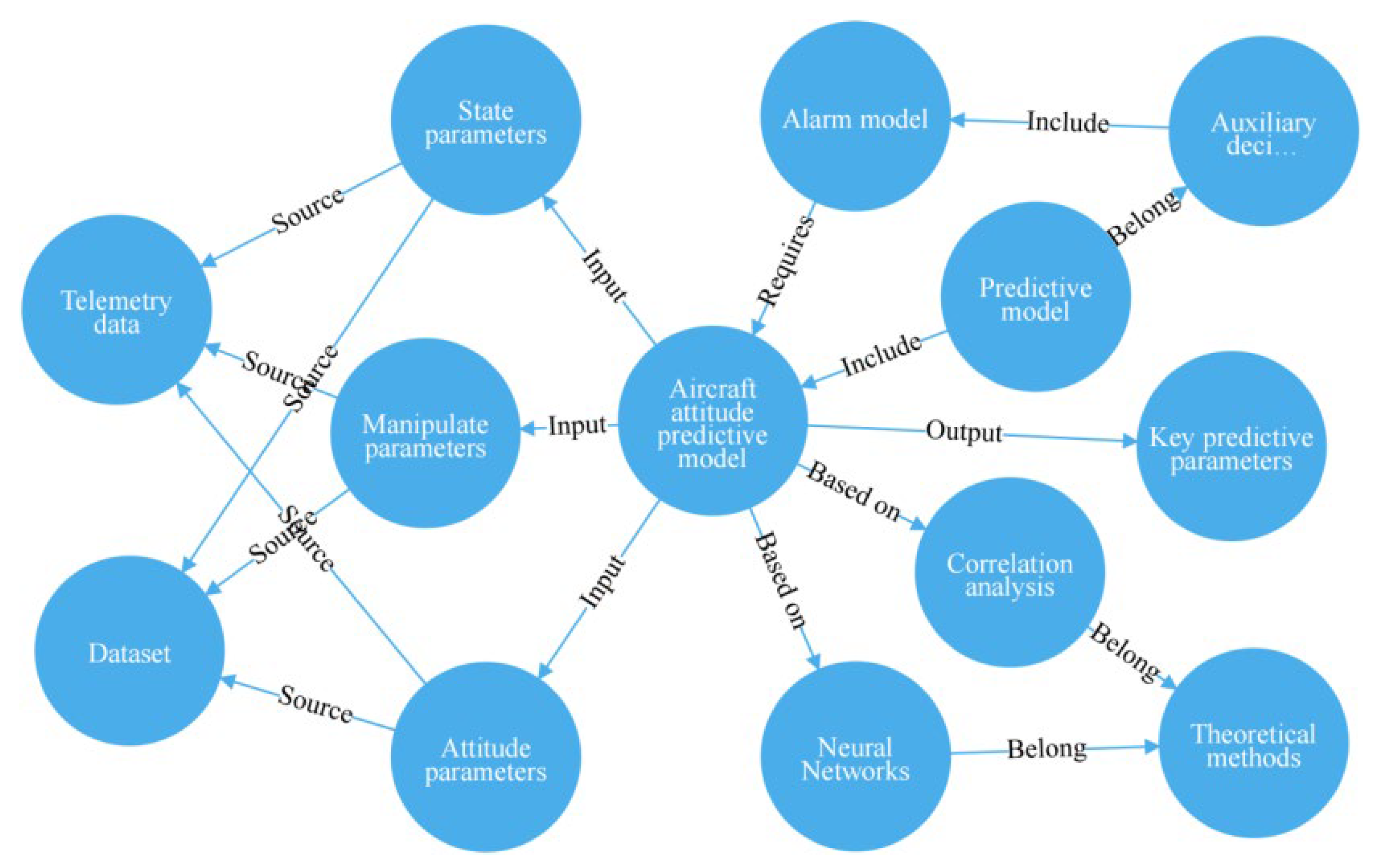
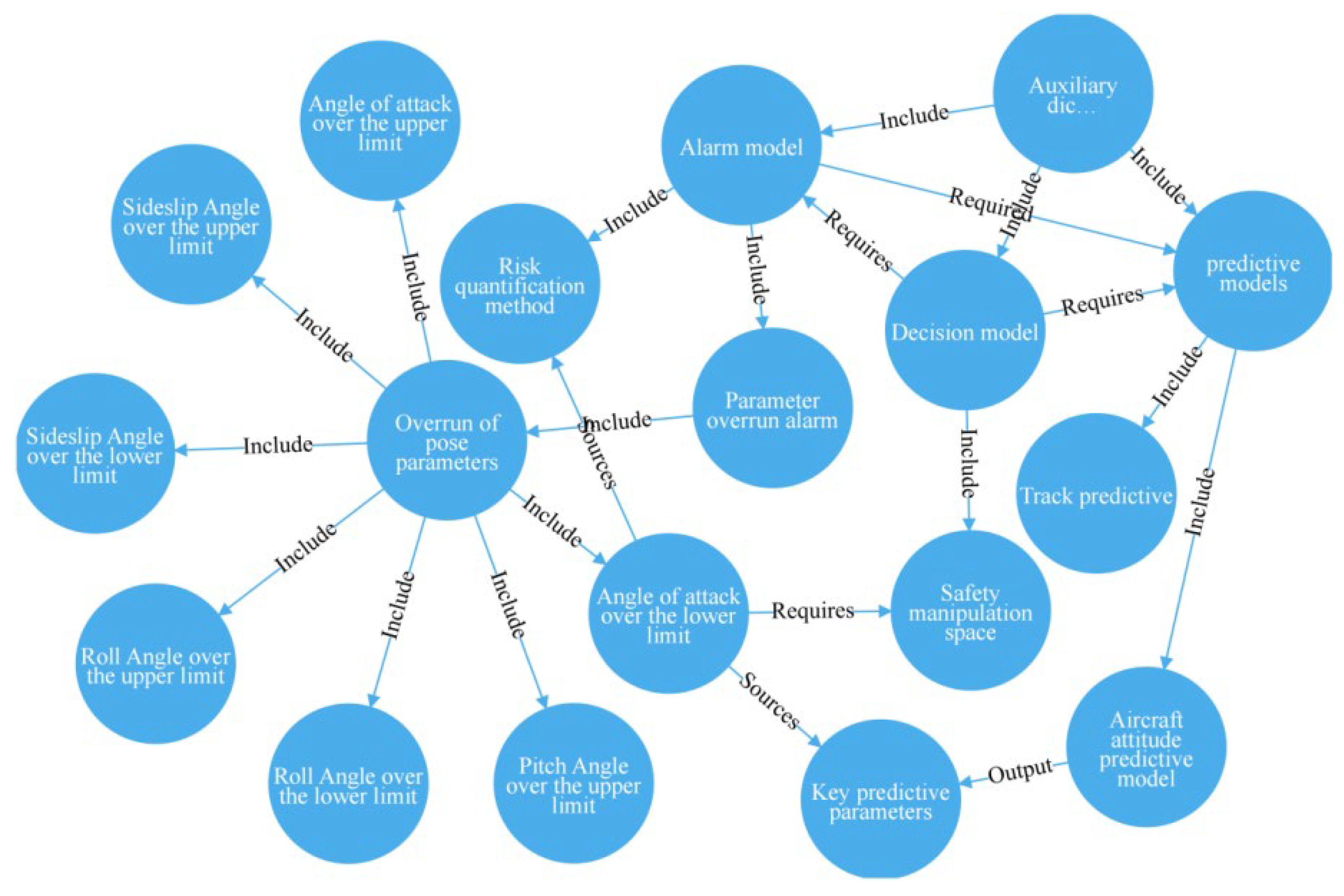
The knowledge graph of flight test safety includes basic aircraft attributes, knowledge of security restrictions, and security decision knowledge. This knowledge provides support for the construction of flight test safety models and auxiliary decision-making models. Flight test safety monitoring personnel can quickly query the concerned and related safety knowledge through the knowledge graph.
The flight test safety model serves a specific role. It does not directly participate in decision-making. Instead, it integrates flight test safety knowledge. It extracts numerous parameters from the obtained flight test telemetry data. Then, through calculations, it simplifies the multi-dimensional parameters to obtain the parameters required by the reduced dimensional auxiliary decision-making model. This process is also the process in which commanders and ground engineers analyze and process numerous data when making auxiliary decisions.
The auxiliary decision-making model mainly includes risk quantification, determination of alarm levels, and assistant decision algorithms. By integrating knowledge graphs and flight test safety models, the auxiliary decision-making model quantifies risks and determines alarm levels for key safety parameters, thereby clarifying the importance of the alarm items to be addressed. Then, it associates the warning items with handling measures through regular expressions or auxiliary decision-making algorithms. Finally, it presents the handling measures through visual interaction to provide decision support. Good decision-making cases can be stored in the knowledge base to update the flight test safety knowledge graph. This study conducts preliminary exploration based on simulation scenarios, providing technical reference for subsequent applications in real flight tests.
The construction of auxiliary decision system is a gradual development process. The auxiliary decision method for the aircraft attitude anomaly problem is mainly studied, providing reference for other flight test safety problems where the knowledge graph and model are utilized for auxiliary decision making. The aircraft attitude predictive model is used to calculate the predicted values of aircraft attitude parameters, and the safety range of aircraft attitude is defined by combining the knowledge graph. The risk value is calculated by the risk quantification method, and then the safety manipulation space is determined. The alarm information was associated with the disposal measures in the flight manual, and the decision suggestions could be pushed in time when the alarm occurred, so as to improve the decision-making efficiency and ensure the safety of the test flight. In the following, the risk quantification method of aircraft attitude parameters and the construction of safety manipulation space model are mainly introduced.
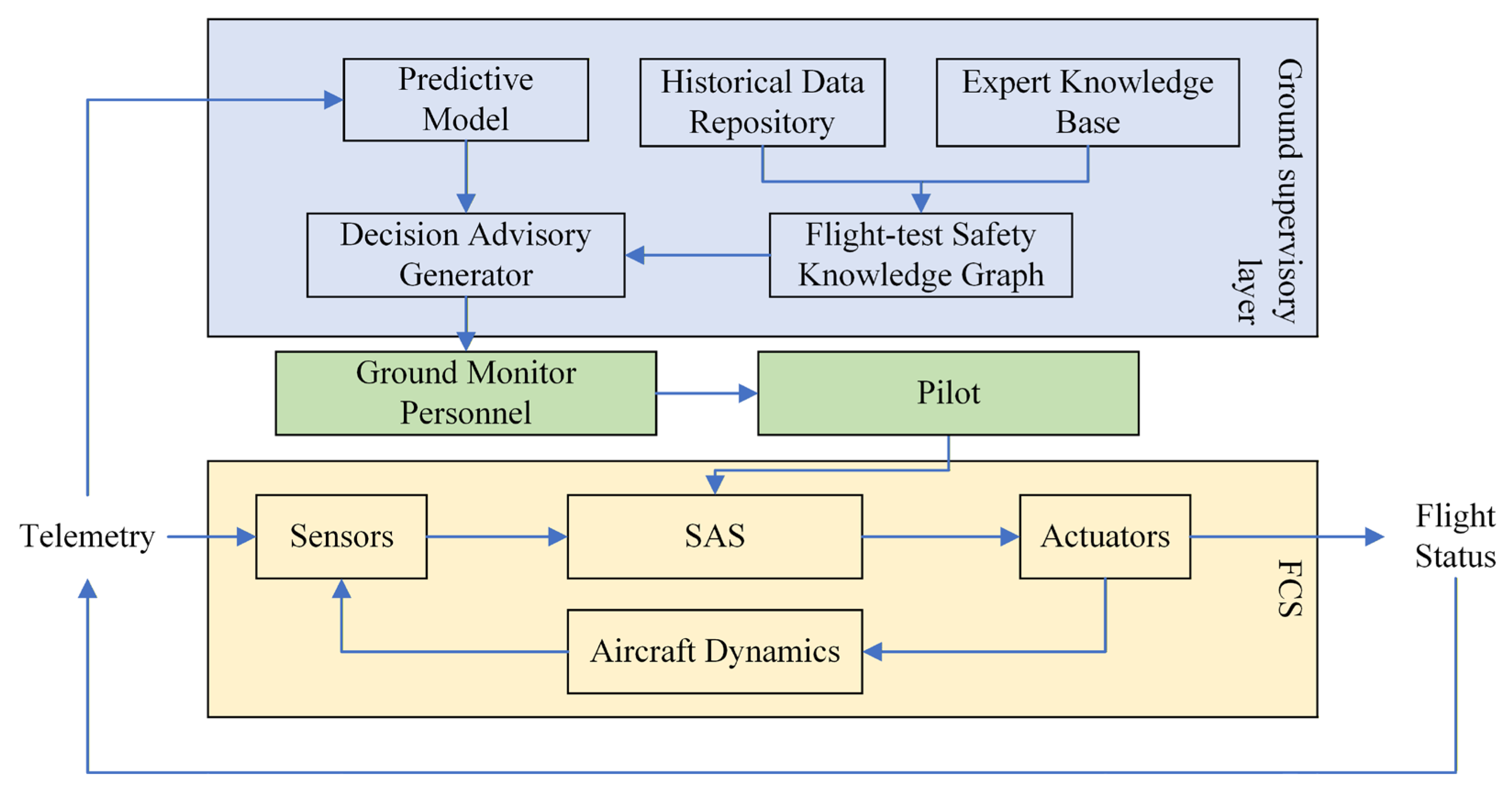
On this basis, a human-in-the-loop extended closed-loop framework is established in
Figure 2. It is important to emphasize that this framework functions as an external supervisory decision-support system, primarily assisting ground monitoring personnel in assessing abnormal conditions and selecting appropriate response measures. The framework does not intervene in or modify the onboard closed-loop stability augmentation system (e.g., SAS), nor does it assume control authority over the aircraft. Instead, it provides predictive trends, risk assessments, and recommended actions as advisory information. Flight crew or ground personnel may choose whether to adopt these suggestions, and multiple valid recovery strategies may exist for the same abnormal condition. This separation ensures that the auxiliary system improves situational awareness and decision-making efficiency without interfering with the aircraft’s inherent stability control loops.
2.2. Risk Quantification Methods
Aircraft attitude anomaly is one of the important threats to flight safety. From the perspective of aircraft simulation telemetry data, aircraft attitude anomaly is often reflected in the anomaly of key parameters such as aircraft attitude angle, aircraft attitude angle change rate, acceleration, airspeed, or flight trajectory. However, how many of these parameters count as abnormal is different for different aircraft and different flight tasks, and how to evaluate whether the current aircraft attitude parameters are normal is the prerequisite for decision-making.
The existing safety assessment methods are based on observing whether the real-time critical telemetry parameters of the aircraft exceed the safety limit value, and the cognition of the parameter limit is vague. For instance, the angle of attack limit is set at 16 degrees, but an angle of attack exceeding 15.5 degrees is equally dangerous. To quantify this restriction, many studies divide the parameter limit value into multiple segments and give the risk value or risk level by means of intervals. However, the improvement or reduction in the risk level can only be perceived at the abrupt change in the interval, and the increase or decrease in the parameter value in the interval cannot be perceived.
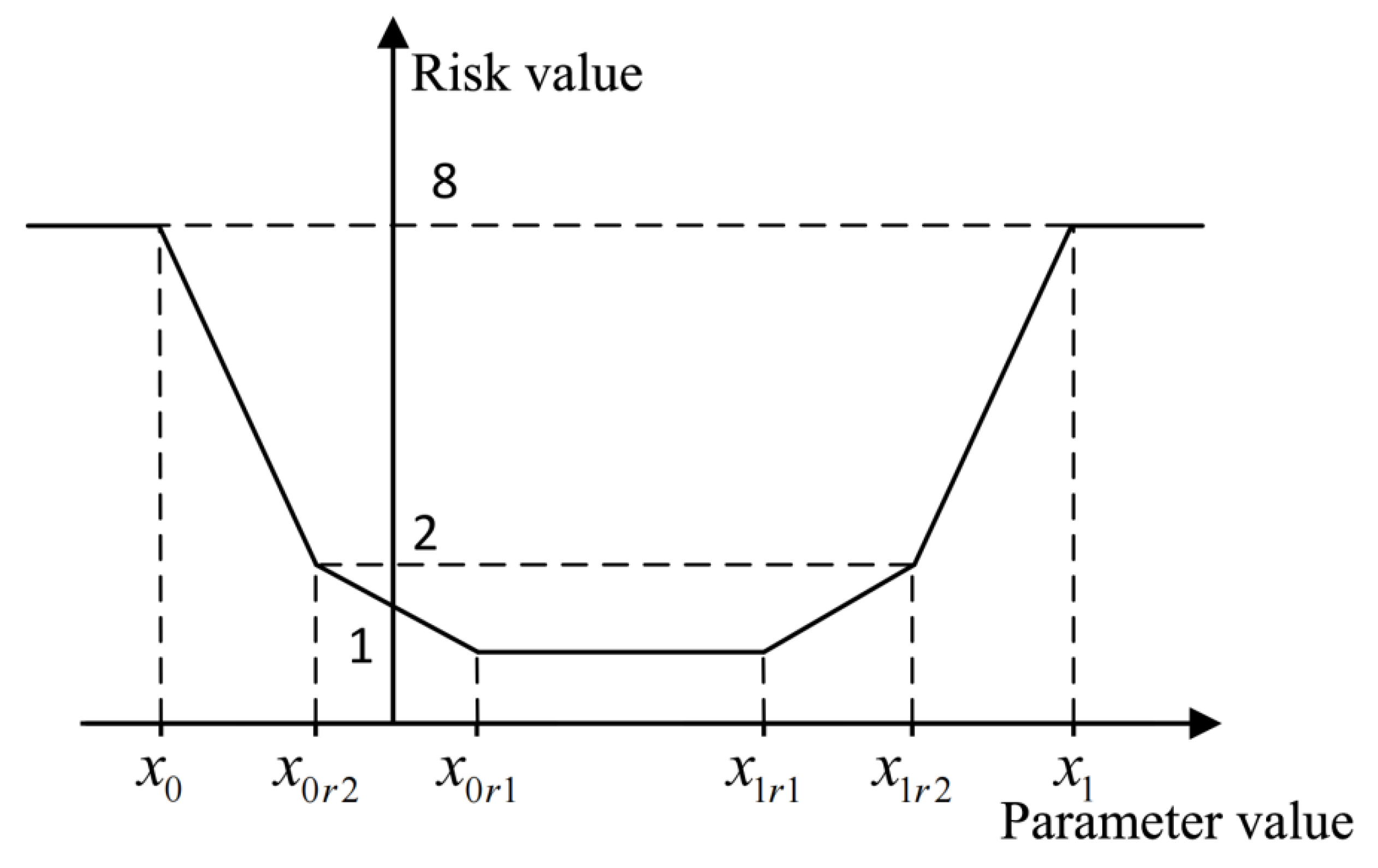
To address this issue, the risk value is designed as a piecewise linear function of the parameter limit interval. For instance, if the design limit interval of a key safety parameter
is [
,
], the
and
of the design limit interval are taken as the two risk levels of this parameter. The risk level intervals of the parameter value can be divided into seven intervals based on
,
,
,
,
, and
. The risk value range of different intervals is set within [1, 8]. Then, the calculation formula of the risk value for this parameter is given by Equation (1).
In this context
,
,
, and
are assumed to be functions of
,
,
, and
, respectively, as seen in Equation (2).
According to the calculation formula, the change curve of risk value with parameter value is drawn in
Figure 3. When the risk value is 1, it means that the parameter is within the normal range, and when the risk value is equal to 8, it means that the current parameter is seriously exceeded. How to define the interval in the formula can be adjusted according to the flight test task and the safety monitoring task.
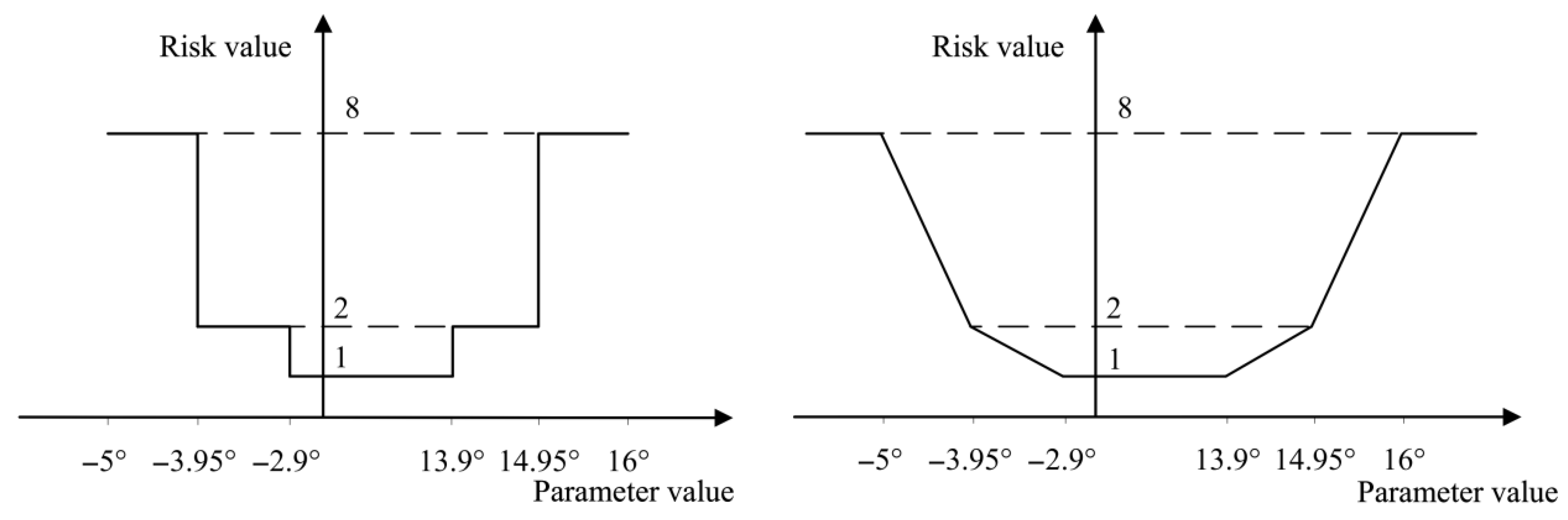
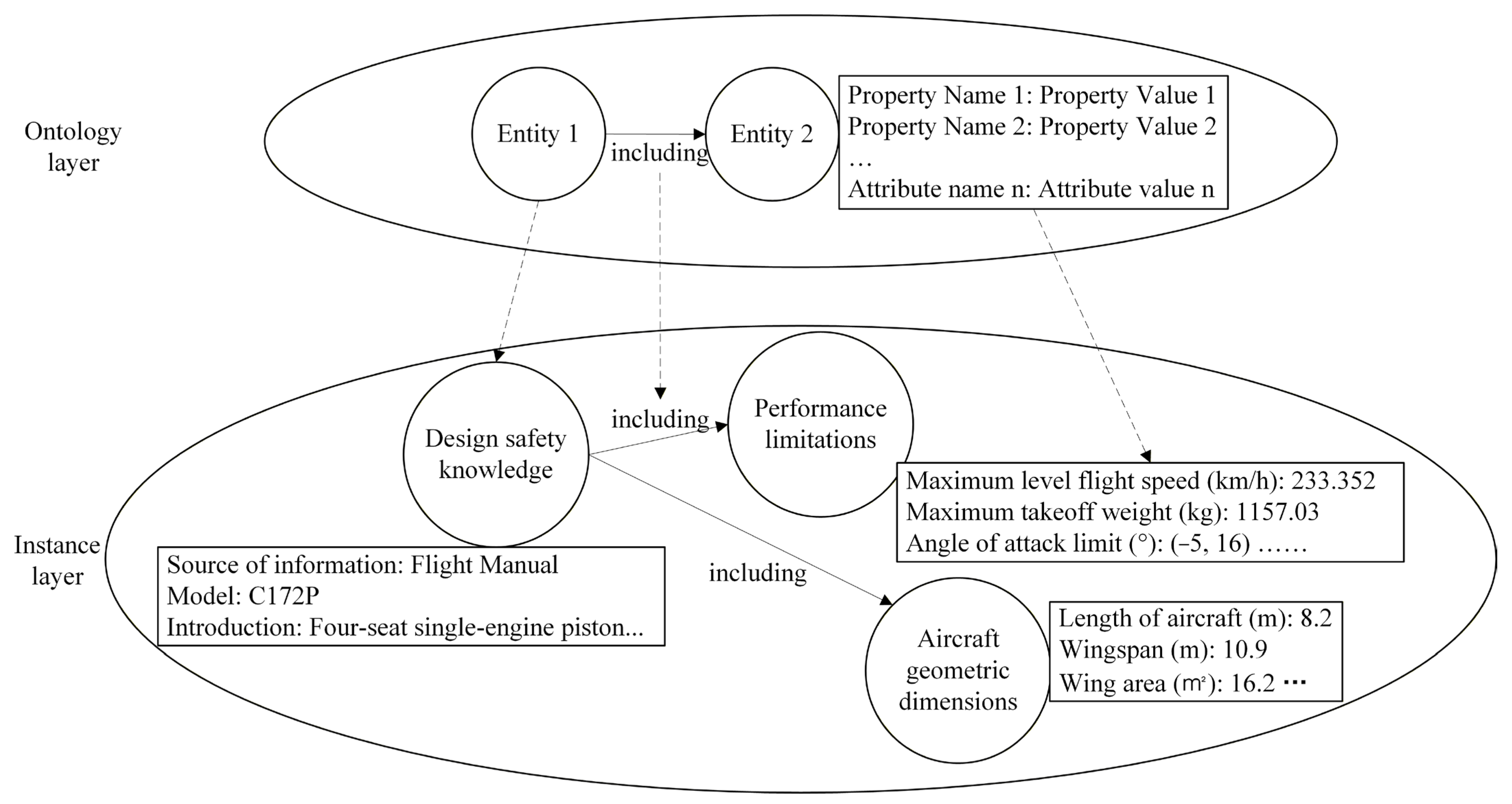
Taking angle of attack as an example, according to the design safety knowledge stored in the knowledge graph, the angle of attack limit of C172P aircraft is (−5, 16) degrees, and the percentage of risk level interval is set as 80% and 90%. According to the formula, the change curve of angle of attack risk value with angle of attack can be obtained in
Figure 4. On the left side, the risk value is determined according to the parameter interval, and the risk value in the interval is constant. On the right side, the risk value is calculated by linear interpolation, and the parameter can also be identified when the parameter changes in the interval.
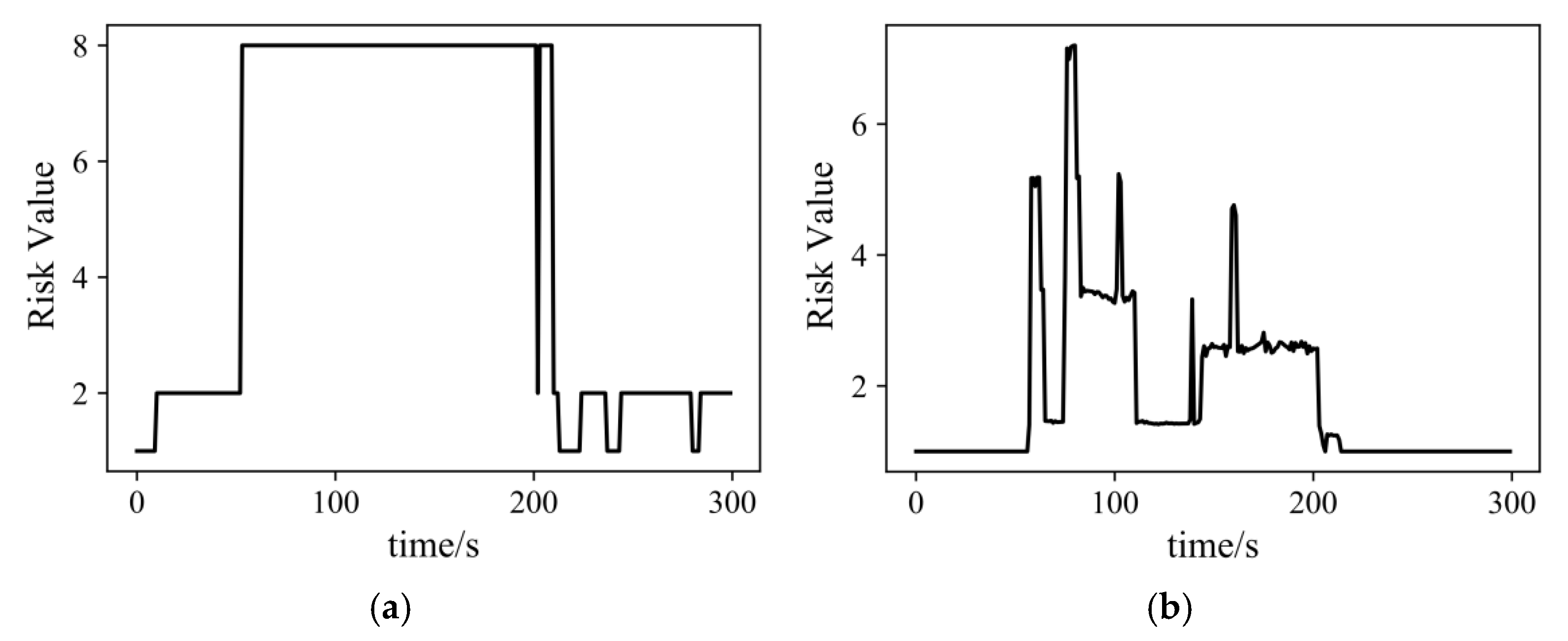
When the two risk quantification methods were applied to quantify the risk of angle of attack in a certain period of time during a flight, the results were obtained in
Figure 4, and the applied risk quantification methods corresponded to
Figure 4. It can be seen from
Figure 5 that when the linear interpolation method is used to calculate the risk value of the parameter, the change in the risk value with the parameter can be more clearly perceived. For example, the right figure shows that the risk value of the angle of attack tends to decrease with the pilot’s control at about 80–100 s, while the left risk value figure cannot perceive the change. The risk value on the right side can be clearly seen at which moment the risk value is the largest, and the change in the risk value can also be clearly perceived. The risk value contains more key information, which is more conducive to the safety monitoring personnel to make auxiliary decisions.
The risk quantification can only represent the dangerous state of the aircraft and cannot give specific decision-making suggestions. In the following, the risk quantification method is combined with the aircraft attitude predictive model to calculate the aircraft safety manipulation space, so as to provide theoretical support for decision-making.
2.3. Construction of Safety Manipulation Space Model
The quantitative method of aircraft attitude anomaly risk can evaluate the real-time safety of flight. However, this method has obvious limitations in predicting the change trend of key safety parameters in the future. In order to improve the predictive accuracy of the change trend of key safety parameters, an aircraft attitude predictive model is constructed to predict the aircraft’s key attitude parameters. The prediction accuracy of this model is more accurate and reliable than that of the observation method.
In the actual flight, when the parameters exceed the limit, it is often accompanied by the anomaly of multiple related parameters. Therefore, it is not only necessary to consider the real-time overrun parameters of the aircraft, but also to identify the potential overrun parameters and calculate the predictive value combined with the predictive model and then calculate the risk to predict other possible overrun parameters.
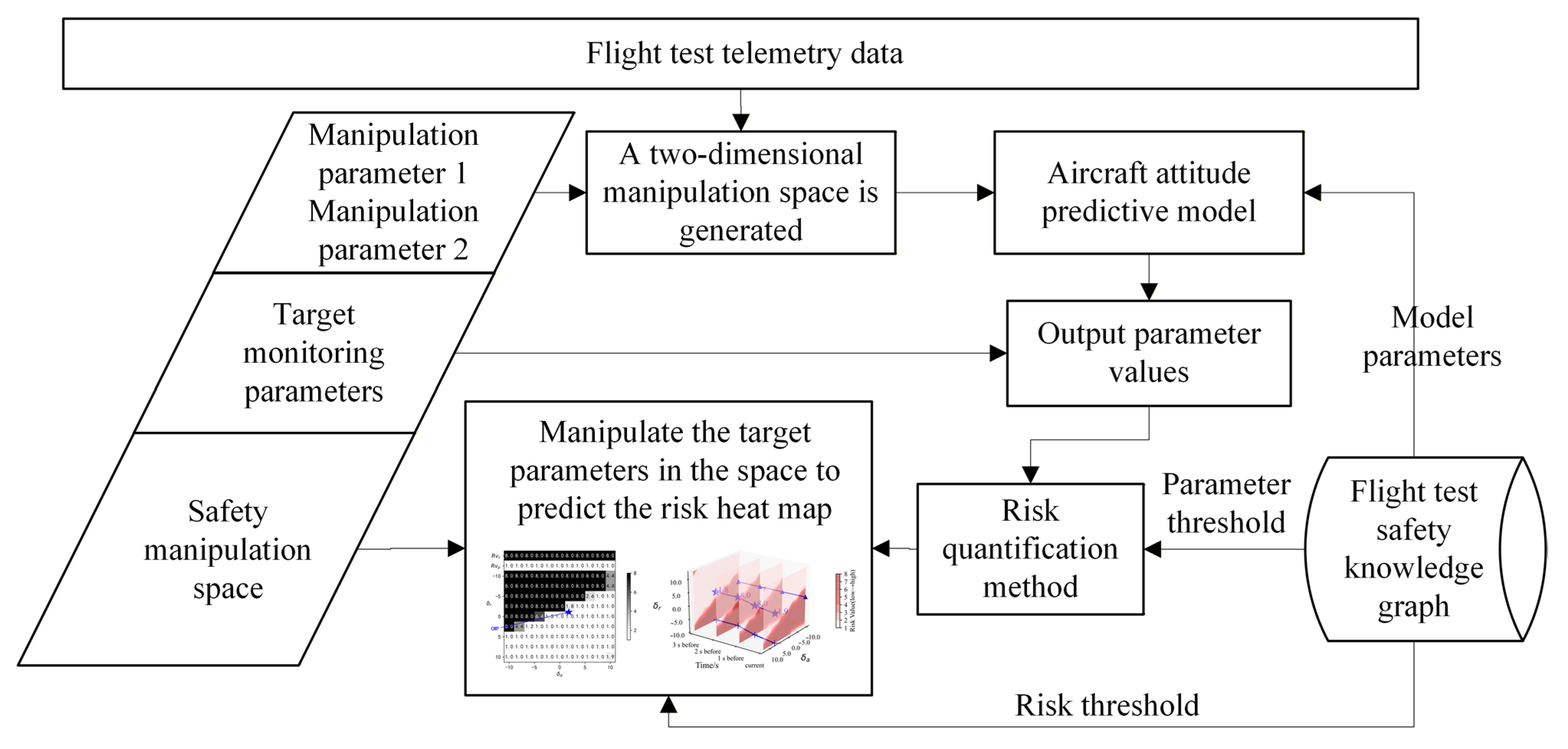
By constructing the aircraft safety manipulation space model shown in
Figure 6, the flight test safety knowledge graph, aircraft attitude predictive model, and risk quantification method are combined to enhance the parameter risk perception ability and improve the efficiency and accuracy of auxiliary decision-making. In the aircraft safety manipulation space model, the target monitoring parameters are first determined, and two manipulation parameters that have an impact on the target monitoring parameters are selected. At the same time, the simulation telemetry data is received to determine the input data matrix. The data is input into the aircraft attitude predictive model to obtain the target monitoring parameter value matrix, and then the risk value of the target parameter value matrix is calculated by the risk quantification method. The parameters required by the aircraft attitude predictive model and the target parameter thresholds required by the risk quantification method are obtained from the flight test safety knowledge graph. After drawing the calculated risk value as the target parameter prediction risk heat map in the manipulation space, the specific aircraft safety manipulation space can be determined according to the risk threshold in the flight test safety knowledge graph, and the pilot control advice can be given combined with the aircraft safety manipulation space.
The aircraft manipulation space here mainly considers the control range of the throttle and the main control surfaces, which refer to the elevator, rudder, and left aileron (the deflection angles of the left and right ailerons are of the same size but in opposite directions). The left aileron deflects downward as positive, and the aircraft rolls to the right; if the rudder deflects to the left as positive, the aircraft will yaw to the left, and the elevator tilts downward as positive, and the aircraft bows down. In addition, the gas is closely related to the aircraft’s flight performance and maneuverability. The throttle is included in the discussion of the aircraft’s space, and a more comprehensive understanding of the aircraft’s flight characteristics and maneuverability is achieved.
In the specific implementation, the aircraft attitude parameters mainly focus on the angle of attack, sideslip angle, roll angle, and pitch angle. When the angle of attack and pitch angle are concerned, the throttle and elevator are usually mainly chosen as the control parameters. When the sideslip angle and roll angle are concerned, the aileron and rudder are usually the primary control parameters. Taking angle of attack overrun and sideslip overrun as examples, the safety manipulation space model is applied to study the auxiliary decision-making.
4. Aircraft Attitude Predictive Model Construction
4.1. Data Analysis and Model Parameter Design
Based on the six-degree-of-freedom calculation equation of the aircraft, the parameters that may affect the aircraft’s attitude were analyzed. The flight gear was used to obtain simulation data, which is based on the JSBSim open-source simulation program. Referring to the actual data reception frequency of safety monitoring, the data reception frequency during the simulation flight was set at 8 Hz, and a total of 50,710 data points were obtained. The influence of ground effect on the aircraft’s attitude is not considered, and thus the simulation flight data with an altitude of over 100 m (the airport altitude is 45 m) was selected. Overall, 80% of the data, a total of 40,568 data points, were taken as the train set, and 20%, a total of 10,142 data points, were taken as the test set.
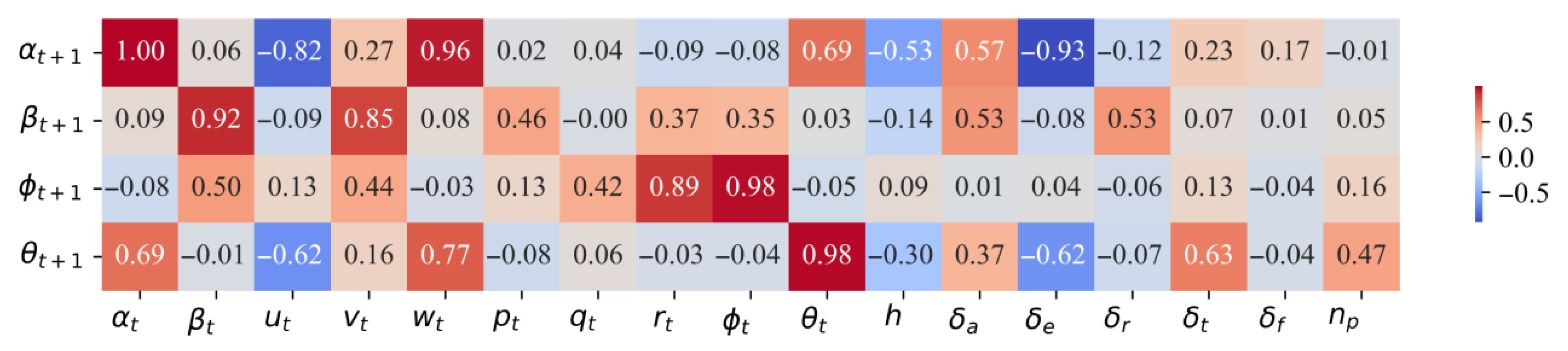
The Pearson coefficient was calculated using the obtained simulation data and a heatmap was drawn as shown in
Figure 11. In the figure,
,
,
,
,
, and
represent the velocity and angular velocity of the aircraft in the body coordinate system in three directions, respectively. Additionally,
and
represent the current moment and the moment 1 s later, respectively. This 1 s prediction horizon corresponds to eight steps ahead because the telemetry sampling rate is 8 Hz (0.125 s per frame). Moreover, the parameters
,
,
,
,
,
,
,
,
,
, and
represent the angle of attack, sideslip angle, roll angle, pitch angle, altitude, aileron deflection, elevator deflection, rudder deflection, throttle, flap deflection, and engine speed, respectively. The figure clearly shows the correlation between these key flight parameters and the aircraft attitude variables (including angle of attack, sideslip angle, roll angle, and pitch angle). For example, the rudder and sideslip angle show a strong positive correlation (correlation coefficient of 0.79), and the elevator and angle of attack (correlation coefficient of −0.87) and the elevator and pitch angle (correlation coefficient of −0.51) show a strong negative correlation. The correlation between the flap and the attitude angle is relatively low, so the flap parameter is removed when building the model to reduce the impact of unnecessary parameters on the results.
After determining the parameters required for the model, the dataset is organized and input into the neural networks for training. The input layer receives data with 16 feature dimensions, which then undergoes feature transformation through the hidden layer, and finally, the output layer generates four predictive results. The selection of the network structure and hyperparameters is a complex process. As shown in
Table 3, there are a total of 81 combinations of hyperparameters. Here, GridSearchCV implemented in scikit-learn (version 1.2.2) is applied for parameter tuning. GridSearchCV can automatically search for the best parameter combination through grid search, reducing the workload of manual parameter adjustment and improving model performance. In this process, GridSearchCV is employed to perform five-fold cross-validation. Each parameter combination is trained and tested five times, with different training and test sets utilized each time. The average value of the negative mean squared error in the five tests is used as the quantitative standard for finding the optimal parameter combination.
To prevent the model from overfitting, L2 regularization was introduced during training. Specifically, the regularization term calculates the sum of squared L2-norms of all weight parameters in the model, and the coefficient is set to 0.01 to balance the weight of the regularization term and the original loss function in the total loss. The original loss function is based on the mean square error (MSE) loss, evaluation model prediction, and the difference between the observed value. In terms of the optimization algorithm, this model uses the Adam optimizer, which combines the advantages of RMSprop and Momentum algorithms, and can adaptively adjust the learning rate to adapt to the optimization needs of different parameters.
4.2. Analysis of Model Training Results
As shown in
Table 4, the model training results were evaluated using mean squared error (MSE), mean absolute error (MAE), and coefficient of determination (R
2), all of which were greater than 0.9, indicating a good fit of the model to the training set. The MAE of the roll angle was 0.923 and the MSE was 2.001, suggesting slightly lower accuracy and stability.
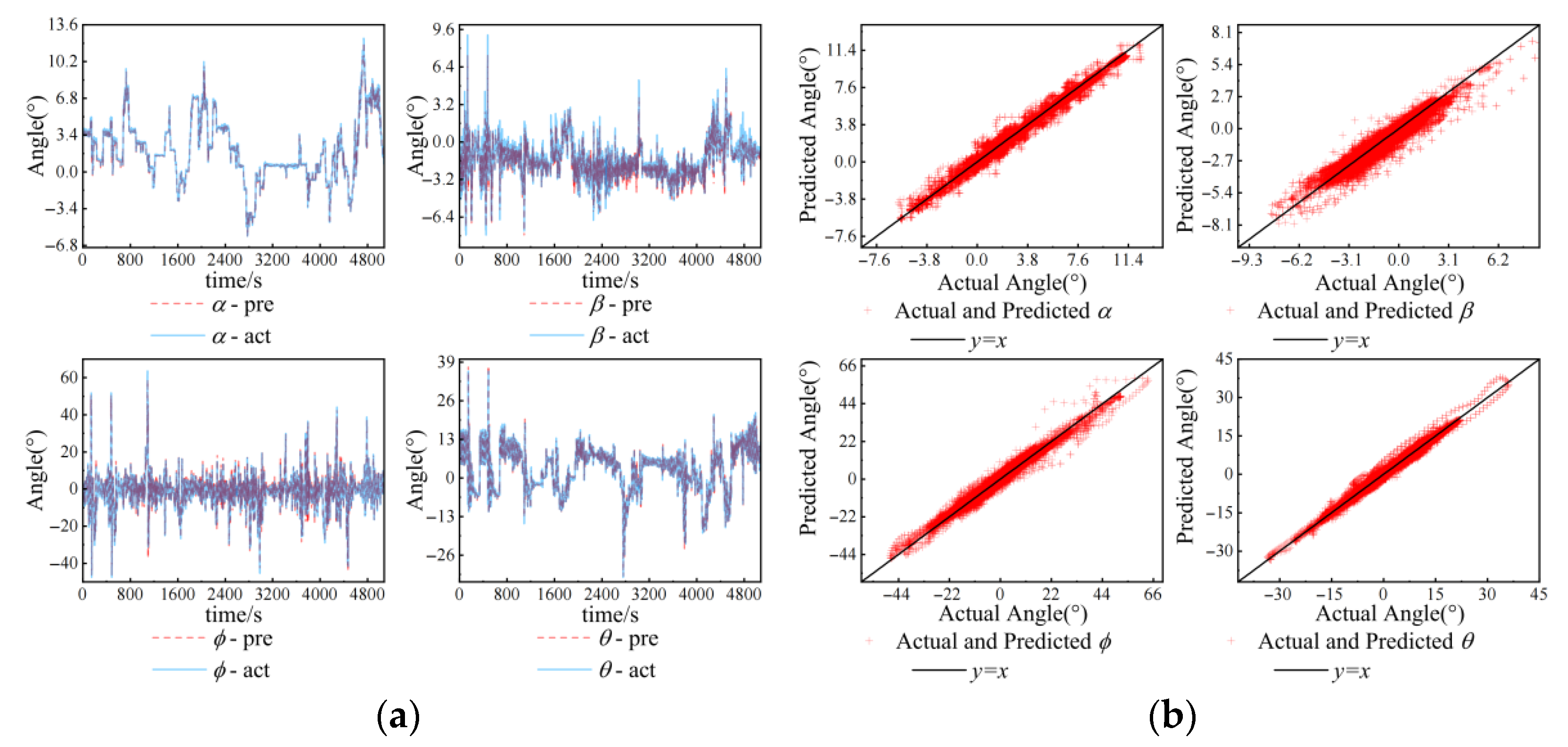
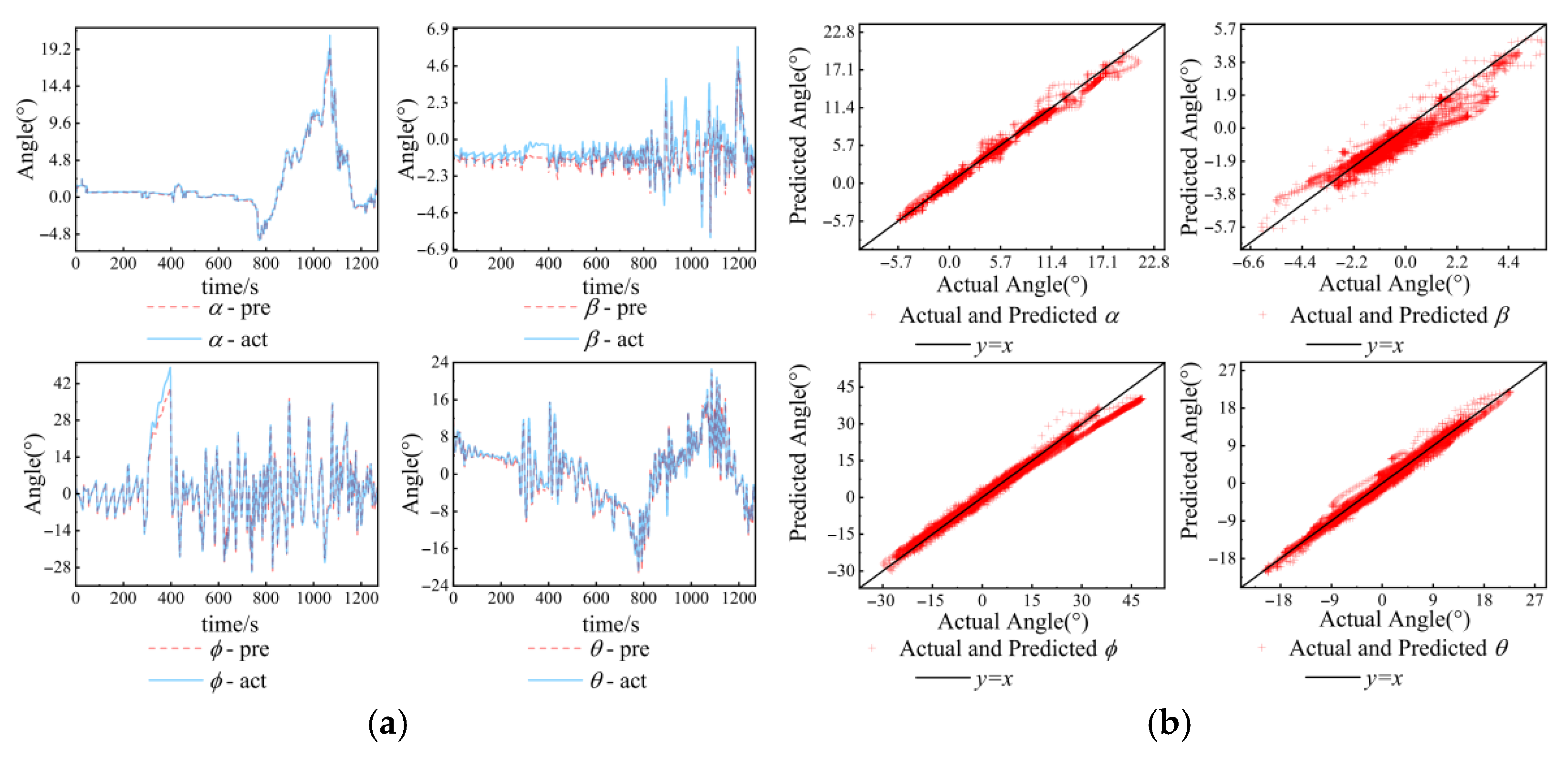
The results of the model training are shown in
Figure 12. The left side is the time series curve of the actual values and predicted values, and the right side is the scatter plot of the actual values and predicted values. There are deviations near the extreme points on the time series curve. The fitting effect of the sideslip angle in the scatter plot is slightly poor, while the fitting effects of the angle of attack, roll angle, and pitch angle are relatively good, all concentrated near the
y =
x line.
The foregoing analysis investigated the prediction outcomes of the model on the training set, which demonstrated high prediction accuracy and good stability. Subsequently, the test set was employed to assess the model’s performance on it and examine its generalization capacity.
4.3. Analysis of Model Predictive Results
The quantitative analysis of the results of the aircraft attitude predictive model yields
Table 5. It can be observed from the table that for the angle of attack, roll angle, and pitch angle, the prediction accuracy of the model is relatively high, as manifested by the R
2 values close to 1, indicating a small error between the model’s predictions and the actual values and that the model can better explain the variability in the data. For the sideslip angle, although the MSE and MAE are relatively small, indicating that the prediction accuracy is acceptable from an engineering perspective because the MAE/MSE fall within the ±1° threshold required for flight test safety monitoring, the R
2 value is relatively low, showing weaker statistical fitting performance compared with other attitude parameters. On the whole, the model performs well in predicting attitude angles.
When predicting the key attitude parameters of the aircraft-angle of attack, sideslip angle, roll angle, and pitch angle, the overall test set results are shown in
Figure 13. The left side is the time series curve of the actual values and predicted values of the test set; the right side is the scatter plot of the actual values and predicted values, with the black solid line being a straight line. The closer the points are to this line, the more accurate the prediction is.
On the time series graph, there is a significant deviation between the predicted and actual values during the rapid change in the angle of attack, indicating that the model has limitations in predicting rapid changes in the angle of attack. However, in the scatter plot of the angle of attack, the predicted values and the actual values maintain a good consistency at most data points. On the time series graph, the predictive effect of the sideslip angle is not very ideal, especially in the area where the sideslip angle is small. The scatter plot shows that most of the predictive results are smaller than the actual results.
The scatter plot of the roll angle shows that when the roll angle is greater than 20°, the prediction effect significantly decreases. The possible reason is that the range covered by the training data is relatively small, and there is a lack of training data for larger roll angles. The prediction results of the pitch angle indicate that the model performs well overall in predicting the pitch angle.
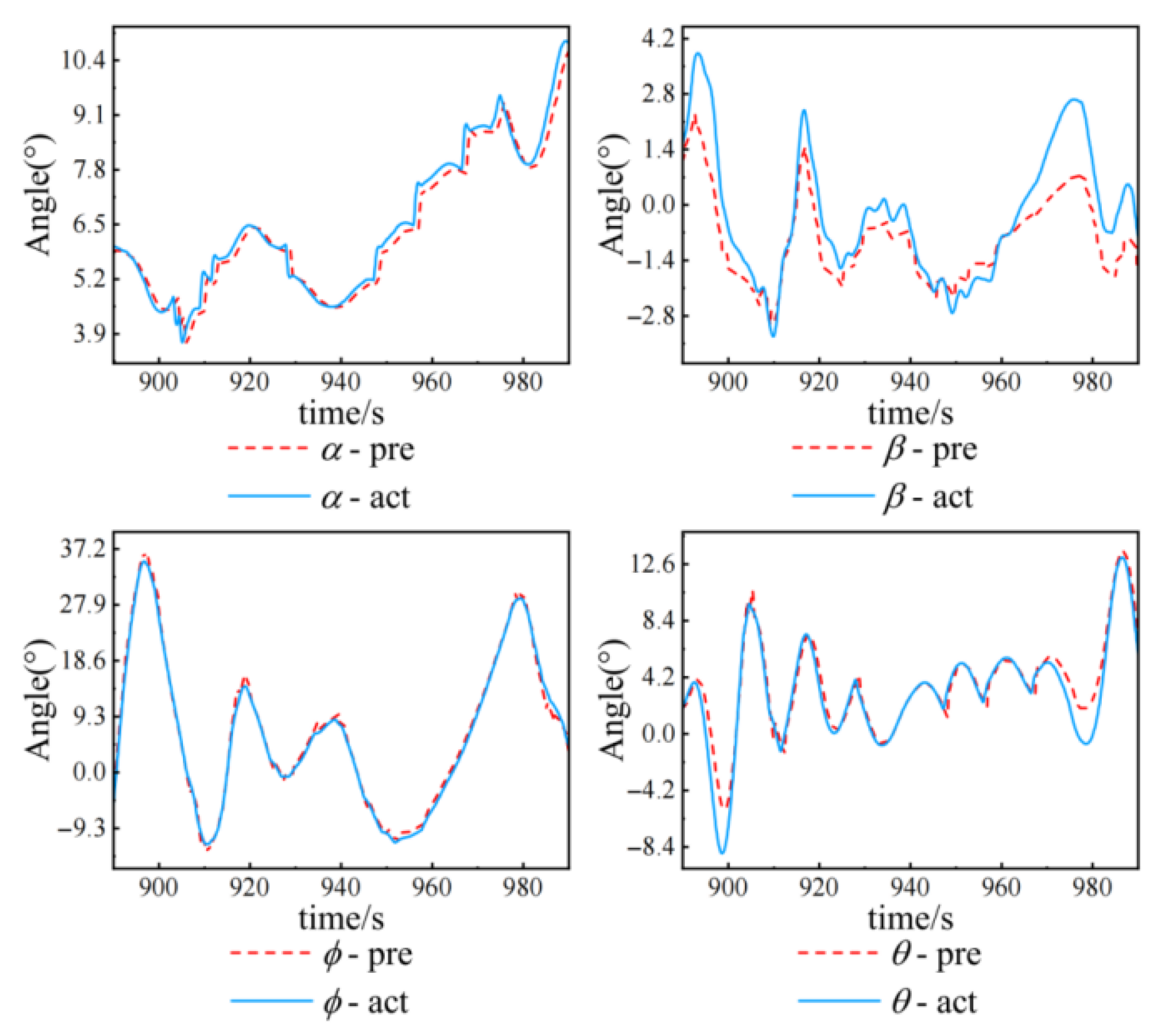
The local test set results of the aircraft attitude predictive model are shown in
Figure 14. The predictive trends of the roll angle and pitch angle are basically consistent, but there are deviations between the predictive values and the actual values near the extreme points. The predictive values of the angle of attack are basically consistent with the actual values, with high accuracy. The predictive error of the sideslip angle is relatively large, and the predictive effect is not very stable.
5. Results and Discussion
5.1. Auxiliary Decision-Making of Angle of Attack Exceeding Limit
Taking the problem of excessive angle of attack as an example, the selected flight segment is shown in
Table 6. The pilot’s control mainly focuses on the elevator and throttle. Combined with the critical safety attitude parameter threshold
Table 2 stored in the knowledge graph in
Section 3, it can be seen that the throttle remains unchanged during the selected flight segment. As the deflection angle of the elevator increases, the angle of attack rapidly decreases, even falling below the lower limit of the designed safety knowledge. The angle of attack risk value increases sharply within a short period of time.
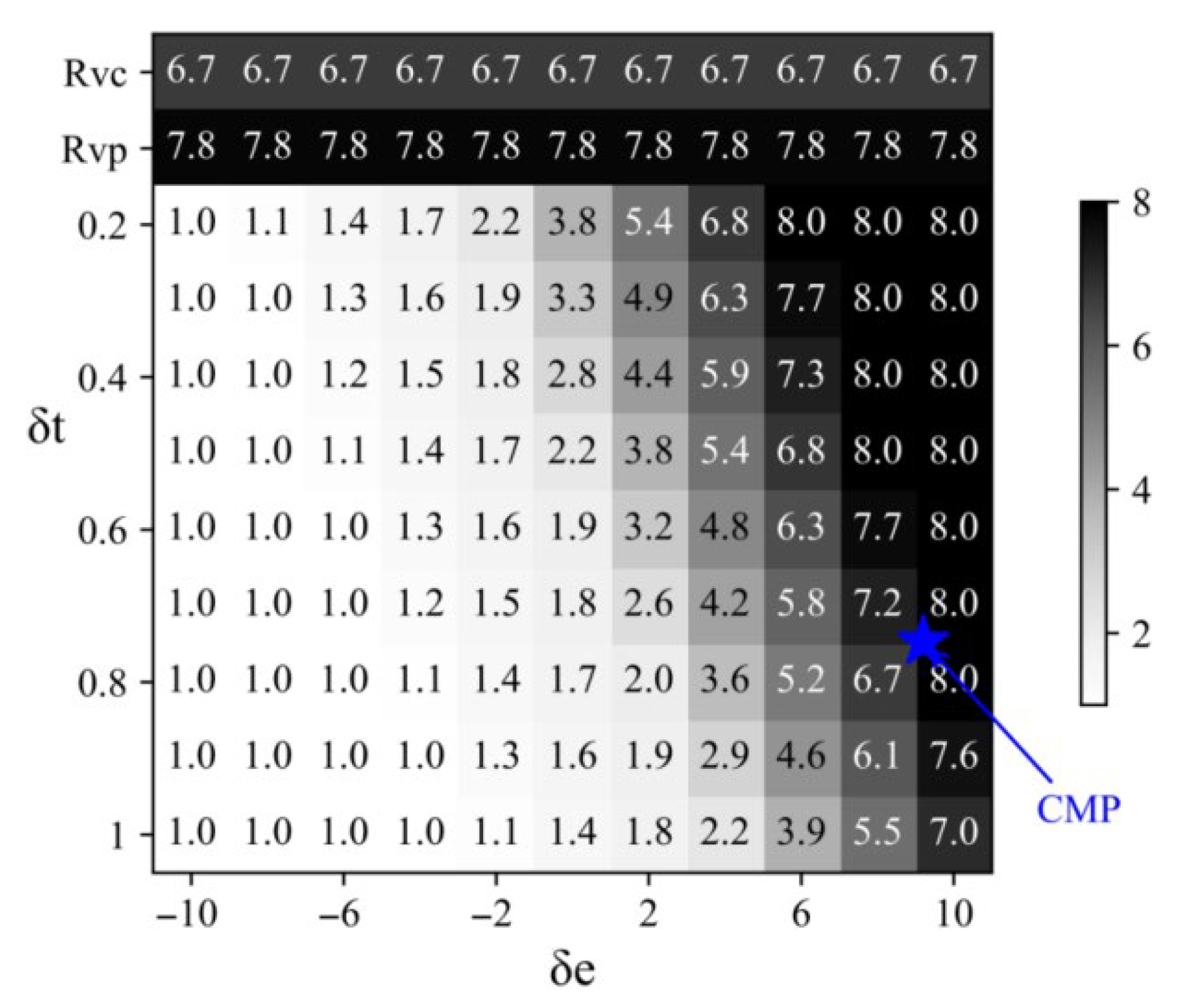
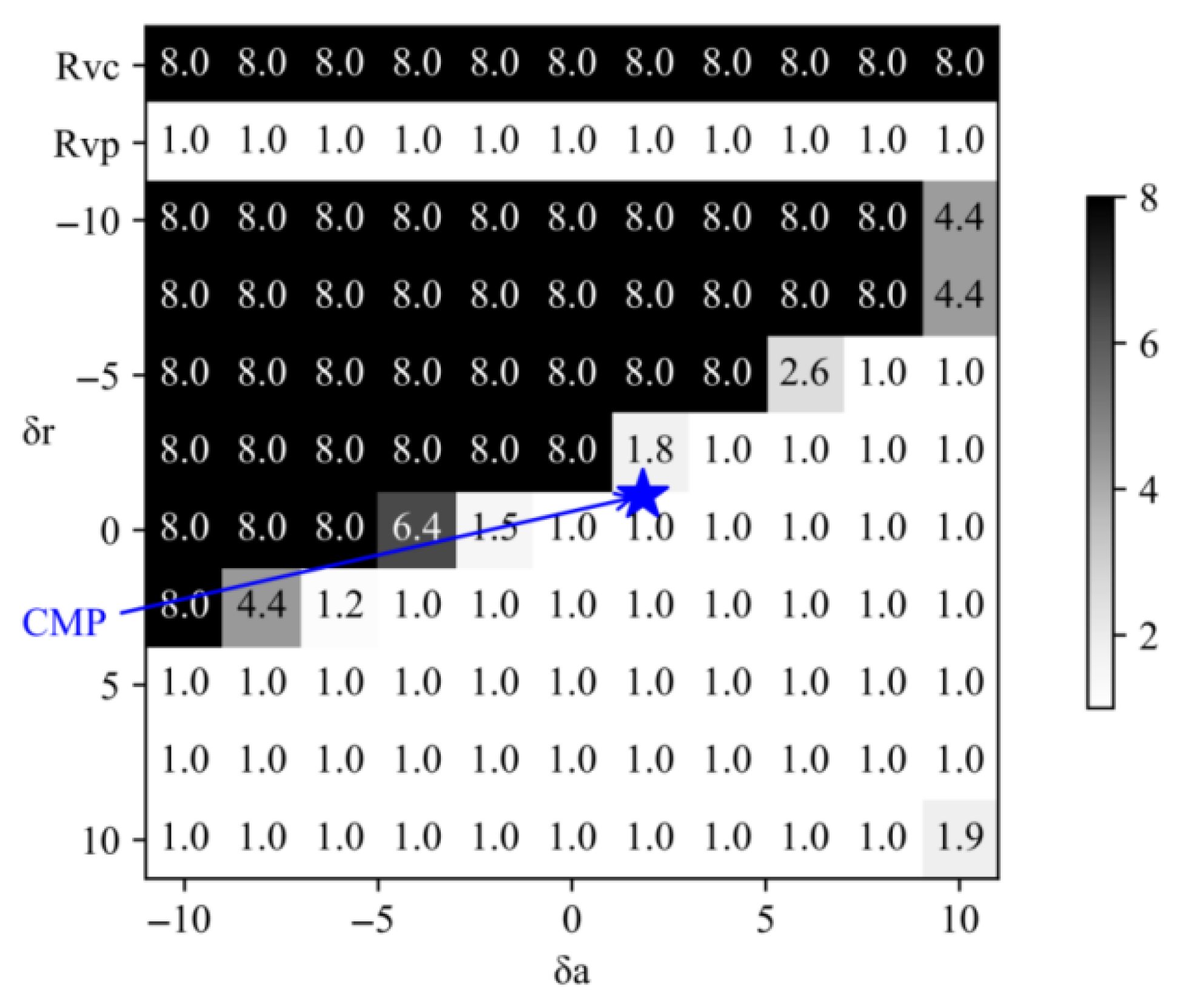
First, focus on the moment when the angle of attack risk value increases sharply, that is, at the 2774th second. Based on the aircraft attitude predictive model and risk quantification method, calculate the current and predicted angle of attack risk value heat map of the manipulation space as shown in
Figure 15.
The first row in the figure, represented by the letter , refers to the angle of attack risk value of the aircraft in its current state. And the second row, represented by the letter , refers to the angle of attack risk value of the next second if the aircraft maintains its current control state unchanged. It can be seen that if the current control remains unchanged, the risk of the aircraft’s angle of attack exceeding the limit shows a decreasing trend, but it still remains at a relatively high-risk level. The third row and below represent the predicted angle of attack risk values within the selected aircraft manipulation space.
Considering that in the actual control process, except for the aircraft’s takeoff and landing process, the deflection angle of the aircraft’s control surfaces will not be too large, the selected manipulation space range here is limited. The selected elevator range is [−10, 10] degrees, and the throttle opening is set to [0.2, 1]. The blue star mark in the figure, which is indicated by the letter CMP, indicates the current position of the elevator and throttle control in the manipulation space. Based on this point’s position and the risk value heat map, the correct control direction can be clearly identified. It is easy to see that increasing the throttle and pulling the stick to make the elevator deflect upward can effectively reduce the risk of the angle of attack exceeding the lower limit. From the heat map, it can be seen that the correct control of the elevator is more crucial for reducing the risk value. Returning the elevator to the neutral position can reduce the risk value to a relatively low level, while increasing the throttle at this time has a slightly worse effect; even if the throttle is increased to the maximum, the risk value is still quite large. If the angle of attack risk value does not exceed 4, which is set as the safe range, then the specific safe control range of the throttle and elevator when the angle of attack risk value is in a safe state can be given.
According to
Figure 15, reviewing the captured segment
Table 6, during the flight process from the 2773rd to the 2774th second, the elevator continued to deflect downward, causing the angle of attack risk value to rise rapidly. At the 2774th second, the elevator was still not manipulated correctly, resulting in the angle of attack exceeding the design lower limit directly in the next moment.
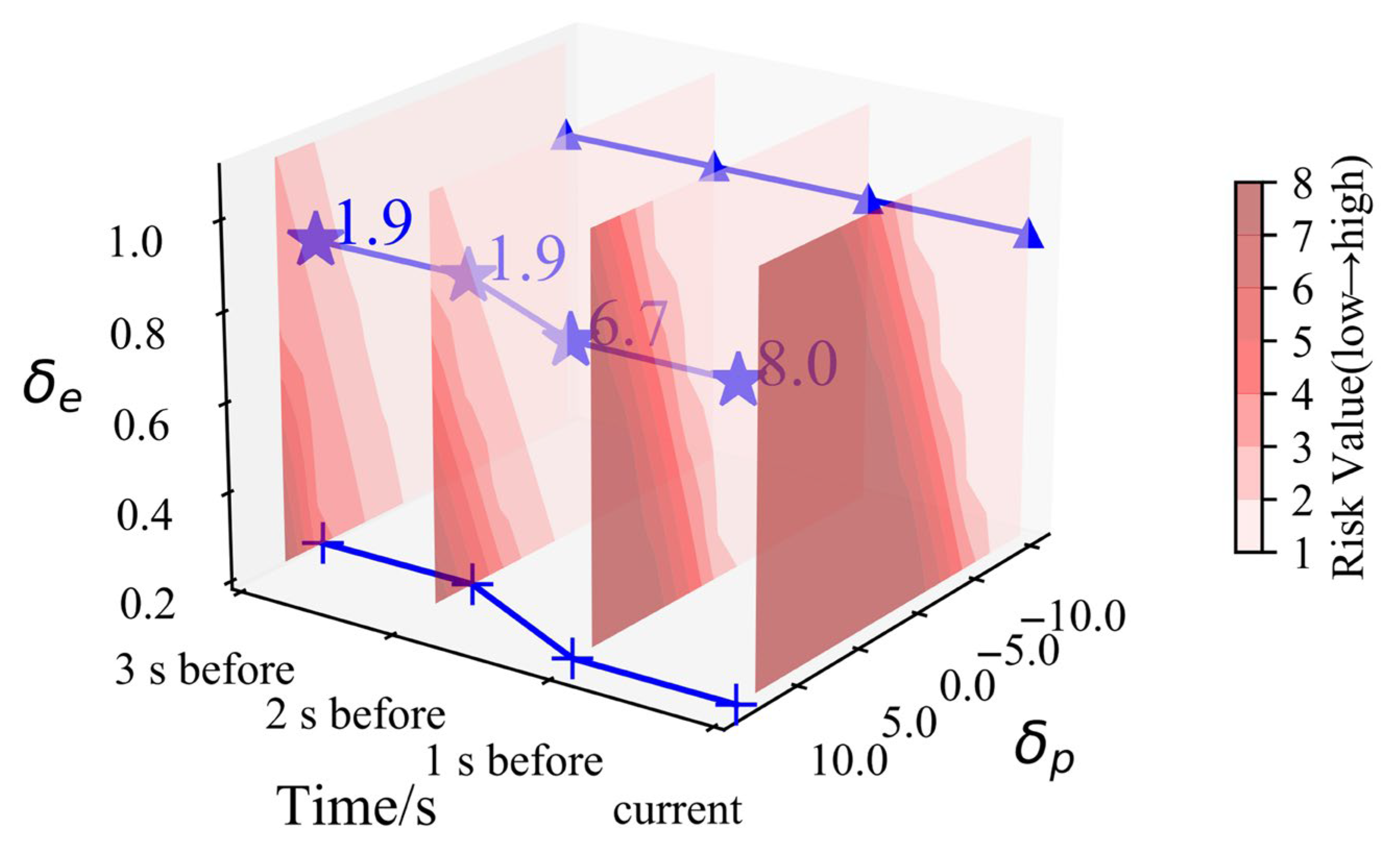
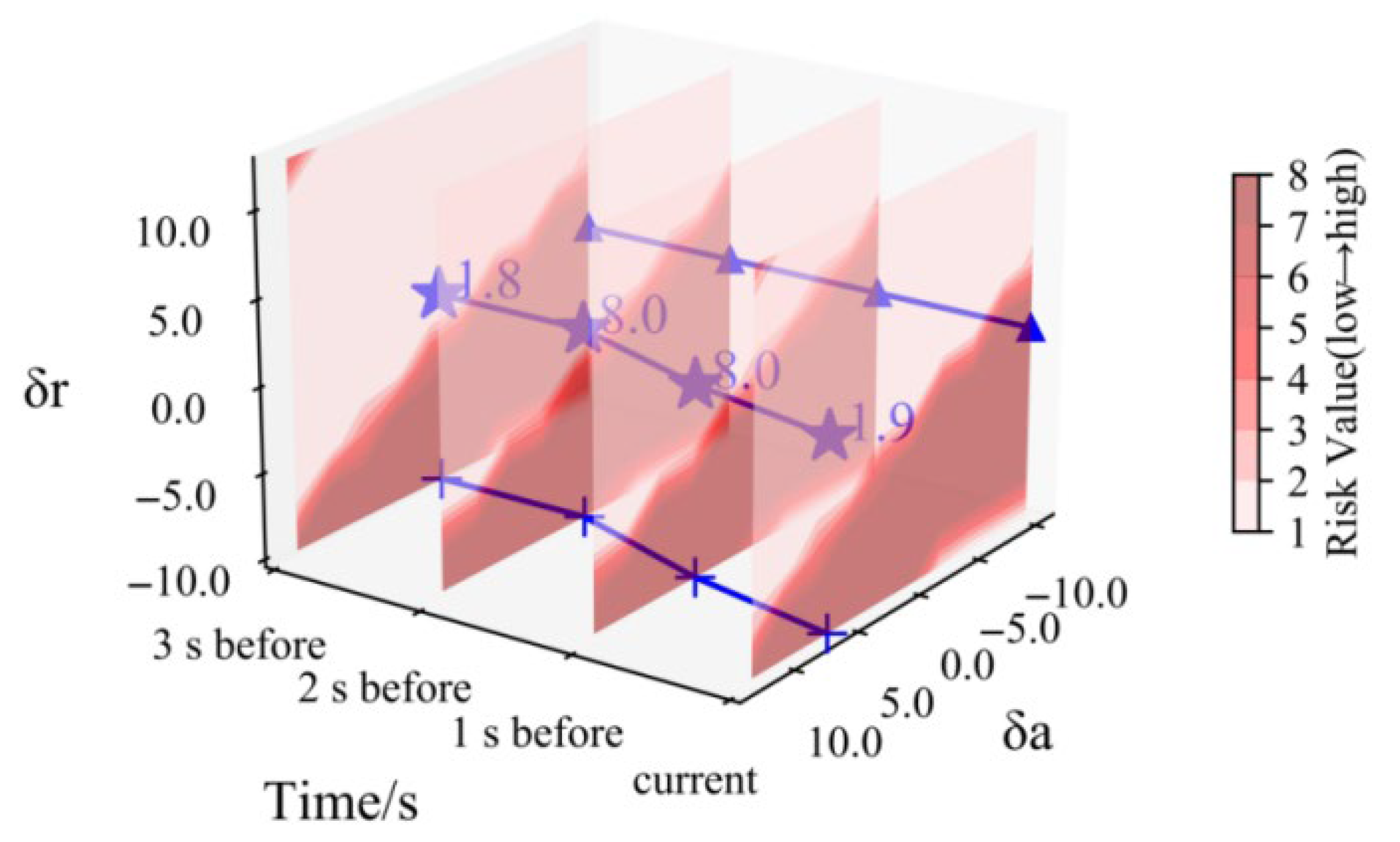
When assisting in decision-making, to present the changes in pilot control and risk values more intuitively, a three-dimensional heat map of the predicted risk of throttle and longitudinal manipulation space angle of attack is
Figure 16, mainly including the current and the previous three seconds’ time series heat maps, which are updated in real time during safety monitoring. The blue star marks indicate the control points in the manipulation space at the corresponding moment, with the values corresponding to the real-time risk values. The blue triangular marks indicate the throttle opening values that change over time, and within this time period, the throttle opening has almost no change; the blue plus marks indicate the elevator deflection angles that change over time, and as the elevator deflection angle increases, the angle of attack risk value rises sharply. From the three-dimensional heat map, it can be seen how the risk value changes with the manipulation quantity, which is convenient for analyzing the influence of historical manipulation on the risk value.
In conclusion, when the aircraft’s angle of attack exceeds the lower limit, the correct operation should be to first pull the stick to make the elevator deflect upwards, while simultaneously coordinating an increase in throttle. Similarly, based on the above method, the correct operation when the angle of attack exceeds the upper limit is to first push the stick to make the elevator deflect downwards, while simultaneously coordinating a reduction in throttle.
5.2. Auxiliary Decision-Making of Sideslip Angle Exceeding Limit
The following is a flight segment excerpt where the sideslip angle exceeded the limit, as shown in
Table 7. The sideslip angle limit is [−5, 8] degrees, as indicated in
Table 2 of the key safety attitude parameter threshold values in the knowledge graph.
As shown in
Figure 17, it can be seen from the current risk value in the first row that the current sideslip angle risk value is very high, having exceeded the sideslip angle limit. However, the predicted risk value is 1.7, indicating that the current manipulation is correcting the sideslip angle. By maintaining the current manipulation, the aircraft can return to a safe state. Based on the risk value heat map, the specific safety manipulation space for lateral manipulation can be clearly identified. At this time, if rudder manipulation is still needed to turn the aircraft, coordinated manipulation of the ailerons should be used to keep the sideslip angle within a safe level.
When conducting safety monitoring,
Figure 17 and
Figure 18 are analyzed and used for decision-making. The time series three-dimensional heat map includes the predictive risk value heat map of the aircraft’s manipulation space within the last three seconds. In the three-dimensional heat map, it can be seen that the rudder deflection angle remains almost unchanged. At the beginning, the aileron (left aileron) deflection angle decreases, causing the risk value of the sideslip angle to increase rapidly. In the previous second, the aileron deflection angle is corrected in time, thereby significantly reducing the current risk value of the sideslip angle.
In summary, during safety monitoring, if the aircraft’s sideslip angle falls below the lower limit, attention should be paid to lateral manipulation. The ailerons and rudder should be coordinated to manipulate the left aileron to deflect downward and the rudder to deflect to the left. For longitudinal manipulation, the elevator should be adjusted to keep the aircraft level, and the issue of angle of attack exceeding the limit should be noted.
By using the safety manipulation space model to draw the predictive parameter risk heat map within the manipulation space, the magnitude and trend of risks can be clearly identified. Combining the knowledge graph to determine the safety manipulation space can provide reliable decision-making suggestions for pilots. It is also noted that although the 1 s prediction horizon provides meaningful short-term trend estimation, it remains shorter than the 3–5 s lead time typically desired for pilot decision support during abnormal attitude scenarios, which will be addressed in future work.
6. Conclusions
(1) A knowledge graph for flight test safety is constructed, expanding its application scope. By leveraging the depth of knowledge in the flight test safety knowledge graph, the graph not only provides rich background knowledge and parameter support for the aircraft attitude predictive model but also offers scientific manipulation suggestions for flight safety monitoring and decision-making.
(2) A linear risk quantification method is adapted to the flight test safety monitoring context. Compared with the traditional risk interval quantification method, the risk values calculated by this method contain more key information, because the adaptation of this well-established piecewise linear (trapezoidal) mapping technique preserves continuous risk variation, providing more reliable data support for flight test safety monitoring and facilitating more reasonable auxiliary decision-making by safety monitoring personnel.
(3) An aircraft attitude predictive model is built based on neural networks, accurately predicting key aircraft attitude parameters. The average absolute error for the angle of attack prediction is 0.18°. However, the prediction accuracy for the sideslip angle is relatively low and requires further research and improvement. Meanwhile, although this method avoids the impact of data inaccuracies on the results through a data interception mechanism, future research should further explore how to ensure the algorithm’s robustness without resorting to data interception. By combining the model’s predicted values with the parameter thresholds of the knowledge graph and using the risk quantification method, the aircraft’s safety manipulation space is calculated. Through a visual display design, these key pieces of information are made more intuitive and understandable. This not only provides a theoretical basis for pilots’ operation decisions in abnormal attitude situations but also offers new technical means and practical guidance for the field of flight safety.