Article

Flight-State-Driven Threshold Optimization Framework for Rotorcraft HUMS

1
Department of Aerospace Engineering and the Program in Aerospace Systems Convergence, Inha University, 36, Gaetbeol-ro, Yeonsu-gu, Incheon 21999, Republic of Korea
2
Department of Aerospace Engineering, Inha University, 36, Gaetbeol-ro, Yeonsu-gu, Incheon 21999, Republic of Korea
3
AI Development Team, Korea Aerospace Industries, 309, Teheran-ro, Gangnam-gu, Seoul 06151, Republic of Korea
*
Author to whom correspondence should be addressed.
Aerospace 2025, 12(12), 1110; https://doi.org/10.3390/aerospace12121110
Submission received: 17 October 2025 / Revised: 9 December 2025 / Accepted: 10 December 2025 / Published: 16 December 2025

Abstract

Conventional thresholding methods for rotorcraft Health and Usage Monitoring Systems (HUMS) often neglect flight-condition variability, resulting in frequent false alarms. To address this, a flight-state-driven threshold optimization framework that explicitly incorporates flight parameters and operational context is proposed. The proposed method combines proactive spike filtering with Principal Component Analysis (PCA) of flight parameters to distinguish flight-state-driven Condition Indicator (CI) variations from spike-like artifacts, and then re-estimates thresholds from the filtered CI distribution. The framework is evaluated using HUMS data collected from in-service rotorcraft, focusing on vibration- and fatigue-sensitive transmission components. Quantitative results show that the framework significantly reduces the Background Alarm Rate (BAR) to approximately 0.030 compared to the baseline of 0.202, while maintaining a high In-window Alarm Concentration (IAC) comparable to conventional methods. These validation results using real fault cases confirm the practical applicability of the approach to operational rotorcraft environments, indicating that the framework effectively reduces unnecessary alarms and enhances the stability and reliability of fault detection compared with conventional methods. The proposed framework offers an explainable, consistent, and operationally grounded basis for periodic threshold reviews in HUMS. It complements existing practices in Condition-Based Maintenance (CBM), providing a practical pathway to enhance confidence in vibration-based diagnostics under diverse flight conditions.

1. Introduction

Rotorcraft are inherently subjected to persistent, high-level vibrations and loads due to the structural characteristics of the main rotor. As system complexity has grown, fault modes have become increasingly complicated and uncertain, making conventional rule-based diagnosis and maintenance practices insufficient to ensure reliability and safety [1]. Consequently, Health and Usage Monitoring Systems (HUMS) and Condition-Based Maintenance (CBM) have been widely adopted across aerospace maintenance operations. Such Prognostics and Health Management (PHM) frameworks are increasingly recognized as core enablers of safety and operational efficiency through reliable condition monitoring and fault prognostics.
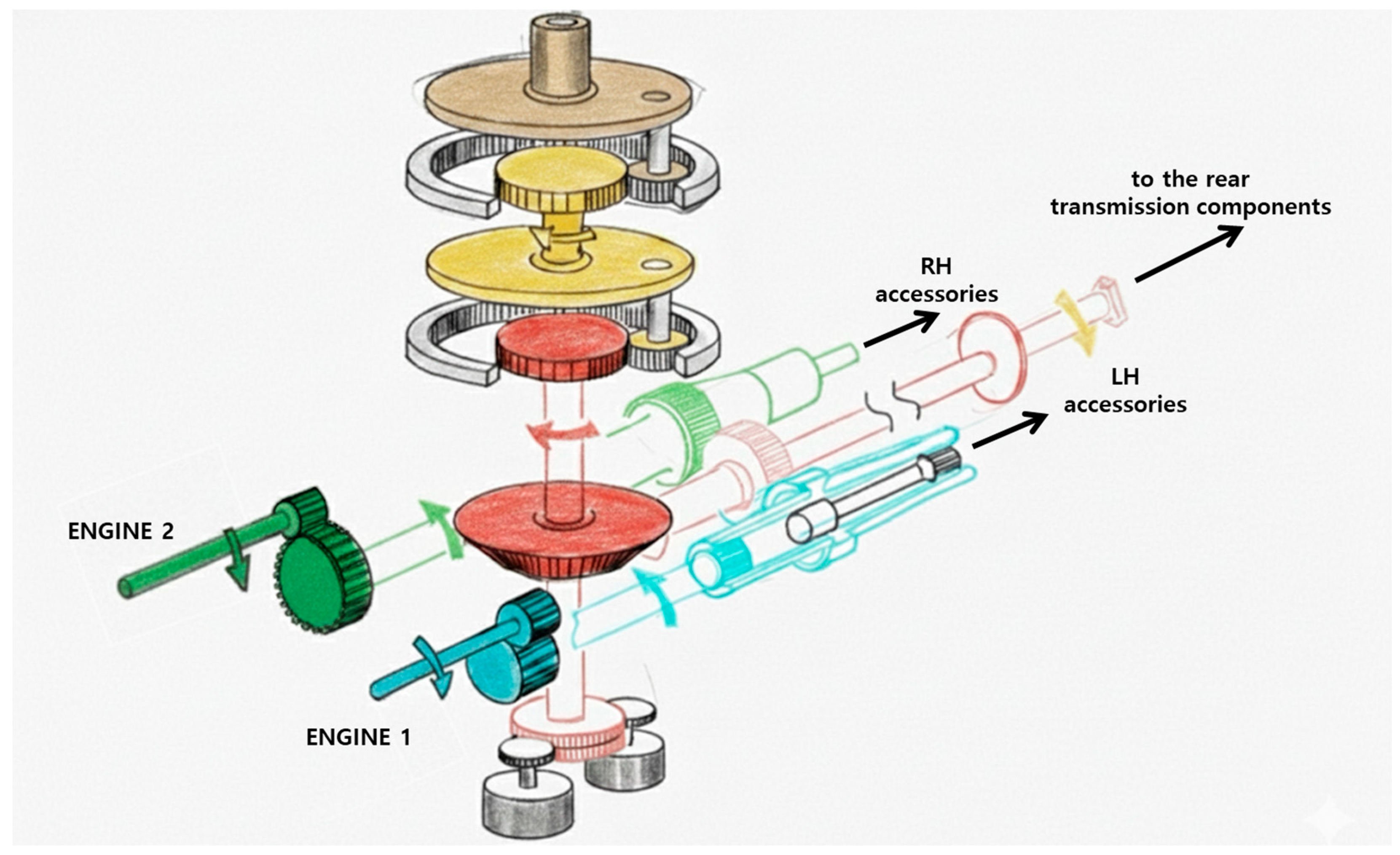
Within rotorcraft transmission systems, particularly in vibration- and fatigue-sensitive components such as shafts, gears, and bearings, numerous vibration-based Condition Indicators (CIs) have been developed and evaluated [2,3,4]. In parallel, fault diagnosis methods employing statistical features and machine-learning-based signal analysis have been actively investigated. Because CI values are computed from sensor signals, how their thresholds are determined has become a critical factor influencing anomaly detection accuracy and early warning performance. For confidentiality reasons, the specific aircraft type analyzed in this study, as well as the underlying HUMS and flight datasets, cannot be disclosed; nevertheless, the HUMS CIs are representative of those measured in the main rotor transmission system of in-service rotorcraft. The data are managed under contractual confidentiality and operational security policies agreed with the operator, and are therefore available only for internal, anonymized analysis rather than public release. To provide physical context, Figure 1 presents a simplified schematic of a typical main rotor gearbox, illustrating the power flow from the engines to the rotor system and accessory drives [5]. This diagram is intended solely as a generic example of rotorcraft transmission architecture and does not depict the specific aircraft type used for the HUMS data analysis in this study.
Consequently, previous studies have proposed various thresholding strategies to improve the reliability of vibration-based CIs. These approaches generally consider the empirical distribution and detection characteristics of normal vibration data. Typical examples include thresholds derived from the statistical properties of normal data such as the mean, standard deviation, or Rayleigh/Rice distributions [6,7,8,9,10,11], optimization methods that balance detection sensitivity against false alarm rate using Receiver Operating Characteristic (ROC) analysis and signal detection theory [12,13,14], and the construction of composite Health Indicators (HIs) by combining multiple CIs [7]. Other representative approaches involve the selection of critical values from the Cumulative Distribution Function (CDF) [8], threshold adjustment associated with damage-progression timing [9], and hybrid methods that combine statistical outlier filtering with empirical coefficients [10]. In rotorcraft HUMS applications, these strategies have been used to tune gearbox and bearing CIs, to evaluate alarm behavior at the fleet level, and to construct transmission health indicators that support PHM and CBM decision-making, illustrating how threshold design directly affects the balance between early fault detection and false alarm rate. However, these methods almost always treat the CI distribution as a single, stationary population and set fixed limits directly on the marginal CI values, without explicitly accounting for changes in flight state or operating conditions.
In addition, many existing methods simplify the underlying sensor-signal distributions, for example, by assuming normality, or depend heavily on practitioner heuristics. Common limitations include the high sensitivity of thresholds to external factors such as operating conditions, environmental variations, and sensor drift, as well as the difficulty of detecting gradually developing faults. In addition, the lack of a universally applicable thresholding scheme across different operating contexts and the scarcity of verified fault data pose challenges for validation. Industry guidelines for HUMS operation and quality assurance also highlight the importance of appropriate threshold setting and the practical difficulties encountered in service, including overly conservative limits and frequent false alarms [15]. Overall, these studies provide useful building blocks for CI and HI design, but they typically address operating condition effects only qualitatively or indirectly (for example, by discarding non-representative data or broadening limits), rather than embedding flight state information directly into the threshold setting process. These limitations underscore the need for thresholding approaches that explicitly incorporate operational context.
Previous research has primarily focused on analyzing vibration signals without sufficiently considering how various flight parameters influence CI values. However, numerous studies have shown that operating conditions such as main rotor speed, gearbox oil temperature and pressure, engine torque and speed, fuel flow, aircraft attitude, and load state can significantly affect vibration characteristics [16,17,18]. Therefore, the statistical behavior of CIs and their anomaly detection performance cannot be fully explained using a single vibration sensor channel alone. In the context of rotorcraft health monitoring, several studies have explicitly linked flight state variables to structural vibration and deformation using subspace-type analyses. In-flight health monitoring of helicopter blades based on differential analysis of strain signals has shown that changes in rotor speed and aerodynamic loading lead to measurable variations in vibration and strain responses [19]. Other work has reconstructed rotor blade shape from strain measurements to infer the blade’s aeroelastic behavior under varying operating conditions [20]. Collectively, these studies demonstrate that structural vibration and deformation are strongly coupled with the underlying flight state, motivating the use of PCA-based subspace monitoring in the present work to represent flight conditions when optimizing HUMS CI thresholds.
Most HUMS implementations further complicate this challenge because CI algorithms are proprietary and the acquisition windows for vibration data are very short, which limits independent signal analysis. As a result, CI values alone are often insufficient for reliable decision-making, and conventional thresholding methods fail to adequately reflect variations in operating conditions. Therefore, robust anomaly detection and threshold optimization require a multivariate approach that accounts for both vibration data and the most relevant flight parameters.
In this context, the present study makes three main contributions. First, it introduces a flight-state-driven threshold optimization framework that explicitly couples vibration-based CIs with multivariate flight parameters, rather than treating CI distributions as a single stationary population. Second, it represents the flight state in a reduced-order PCA subspace and uses this representation to distinguish CI excursions driven by normal changes in operating condition from spike-like artifacts, embedding this distinction into a practical threshold resetting procedure that remains compatible with legacy HUMS practices. Third, it implements and compares three complementary outlier-removal and threshold-setting pipelines (purely statistical, density-based, and flight-state-driven) on in-service HUMS data with verified transmission faults, thereby quantifying the reduction in nuisance alarms while preserving fault-detection timing and providing a transparent, repeatable workflow for threshold review in operational PHM and CBM environments.
To address these issues, this study integrates HUMS data collected from in-service rotorcraft with alarm histories, maintenance records, and a comprehensive set of flight parameters. The objective is to overcome the limitations of conventional threshold-based detection by introducing a flight-state-driven threshold optimization framework. First, false alarms are identified by linking alarm events with corresponding maintenance outcomes, and CI-specific alarm frequencies are associated with confirmed component faults. Using data filtered around alarm timestamps, salient flight parameters are extracted, and key variables are selected through correlation analysis. Subsequently, statistical-, density-based, and flight-state-driven outlier removal pipelines are applied, and their threshold optimization performance is comparatively evaluated.
In particular, this study moves beyond single-CI thresholding by jointly incorporating flight information such as main rotor speed, oil temperature, and other operational parameters together with vibration data. The goal is to establish a reliable and practically applicable detection criterion that reflects actual flight conditions through a flight-state-driven threshold optimization workflow.
The remainder of this paper is organized as follows. Section 2 analyzes HUMS and maintenance histories to identify false alarms and to clarify the limitations of existing detection practices. Section 3 presents the correlation analysis between CIs and flight data, including key-variable selection and dimensionality reduction. Section 4 compares the threshold optimization performance across statistical, density-based, and flight-state-driven methods, validating the effectiveness of the proposed approach. The conclusion summarizes the findings of this study and discusses the implications for HUMS deployment in operational environments.

2. Analysis of HUMS False Alarm History

In this section, in-service rotorcraft HUMS data were cross-referenced with maintenance records to construct the evaluation dataset used to validate the proposed method. For each CI system, alarm timestamps were identified and matched with maintenance entries recorded in temporal proximity to those events. Based on this cross-reference, each alarm was classified as either a false alarm or an actual defect indication by examining the post-maintenance behavior of the same CI system, that is, whether the alarm reoccurs after maintenance or disappears following corrective action. The resulting labels were subsequently used for evaluating the performance of the flight-state-driven threshold optimization framework.

2.1. HUMS Data Composition

Condition Indicator (CI) data used in HUMS is derived primarily from vibration signals measured by onboard sensors. Accelerometers mounted on key rotorcraft transmission components such as shafts, gears, and bearings, collect diverse vibration responses during flight. Through onboard processing, these signals are transformed into time- and frequency-domain features, such as statistical moments and spectral descriptors, from which various CIs are computed. The vibration segments used to compute a CI are limited to a very short acquisition window centered around each CI time stamp. Table 1 summarizes representative CIs commonly used for gearbox health assessment and provides brief descriptions. Each CI can be interpreted in terms of statistical properties such as mean or standard deviation, or associated with characteristic gearbox conditions including misalignment, imbalance, impacts, or wear [21,22].
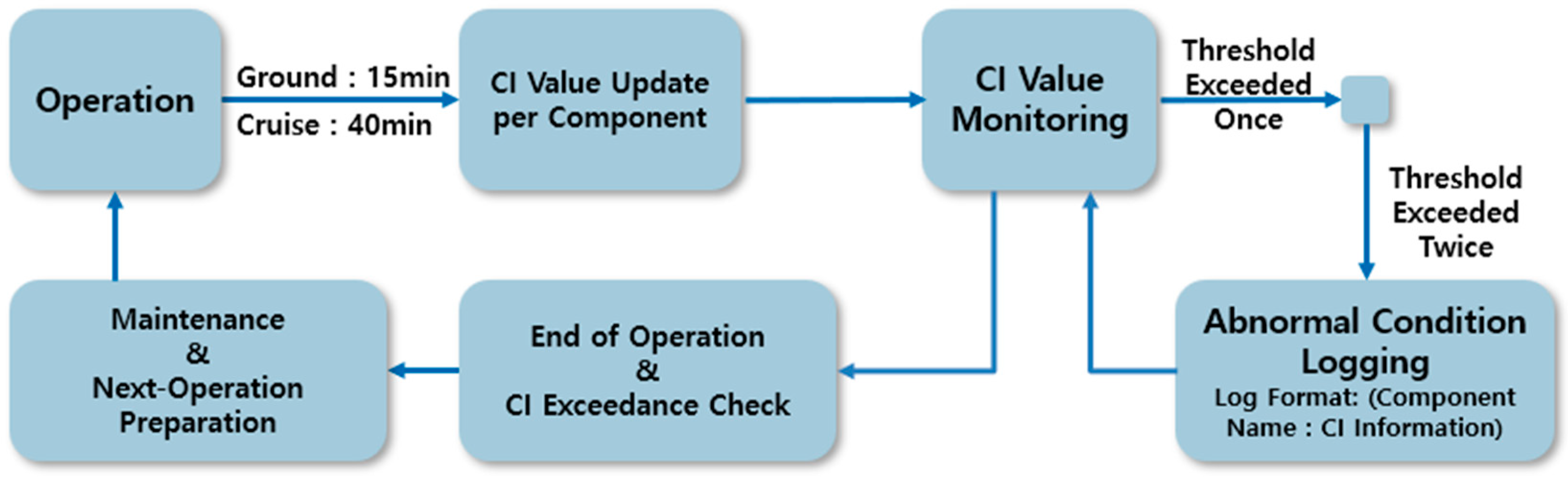
As illustrated in Figure 2, CI values are not logged continuously. Instead, after a minimum runtime, they are automatically stored at preset intervals determined by the operating state such as ‘Ground’ or ‘Cruise’. During an operation, the onboard system continuously computes CI values and checks them against their thresholds in the ‘Monitoring’ state. When a CI exceeds its threshold once, the system does not log an exceedance entry but switches to a tracking mode for the corresponding component’s CI. If a second exceedance occurs, an exceedance entry is recorded. This ‘Monitoring’ state continues until the end of the operation, after which all exceedance events are summarized in an offline CI exceedance check, and the resulting records are forwarded to maintenance and next-operation preparation. Thus, the recorded results do not feed back into the running operation in real time. Instead, they are used between operations to support maintenance planning and periodic threshold review.

2.2. Selection of HUMS Data for Analysis

Before analyzing false alarms in HUMS CI data, the scope of the analysis was first defined. Although HUMS records CIs for multiple systems, including the transmission, engine, and tail rotor, this study focuses on the transmission system. Among major rotorcraft components, the transmission is particularly vulnerable to vibration and fatigue, and its failures can lead to system level consequences for the aircraft [12]. In contrast, CI data streams from non-transmission subsystems, such as engine or tail rotor often suffer from degraded signal quality, missing data, elevated noise, or excessive sensitivity to operating conditions, making it difficult to ensure consistent analysis. To ensure analytical consistency and enhance the reliability of the findings, the dataset was therefore restricted to transmission-related CIs.
Table 2 summarizes the selected components, namely the input gear and the intermediate gear, along with their associated measurement locations. Using the aircraft’s forward direction as the reference, the left side is referred to as port and the right side as starboard. On the port side, two accelerometer mounting positions were used to capture the vibration response of the gears: the port combiner (primary) and the port ancillary (secondary). Together with the corresponding starboard positions, CI data from six accelerometers in total were used for the analysis.
These components and measurement locations were selected because, among all transmission elements, they provide the largest amount of usable data, thereby minimizing estimation errors in the subsequent correlation analysis and threshold adjustment. In addition, they are located on load paths directly driven by engine torque and rotor speed, which ensures strong signal observability and a clear physical relationship with flight parameters. These characteristics enhance interpretability and make the dataset well suited for the proposed flight-state-driven threshold optimization.
Furthermore, this focus is consistent with previous studies, which have predominantly analyzed transmission systems, including shafts, gears, and bearings, in vibration-based CI research [11,12]. Accordingly, the present study used CI records from the six specified transmission measurement locations as the target dataset.

2.3. Dataset Construction via False Alarm and Maintenance Records

When a CI value exceeds a preset threshold, the system raises an alarm and automatically logs meta-data including the time stamp, the CI value, and the active threshold. If alarms recur for the same system, maintenance inspection and data review procedures are initiated. A false alarm is defined as an alarm event for which no defect is identified during maintenance or no operational abnormality is observed during service. Because false alarms can waste maintenance resources, induce unnecessary downtime, and erode trust in the monitoring system, alarm histories were compared with maintenance records to identify and label false alarms. The resulting labels were then used to curate the learning dataset for subsequent analyses.
HUMS CI data were screened based on two primary indicators:
  • Pre/Post-maintenance distribution shift: a significant change in the range or distribution of CI values before and after maintenance among entries with recorded threshold exceedances.
  • Spike-type samples: distinct transient peaks observed in the pre-maintenance CI time series.
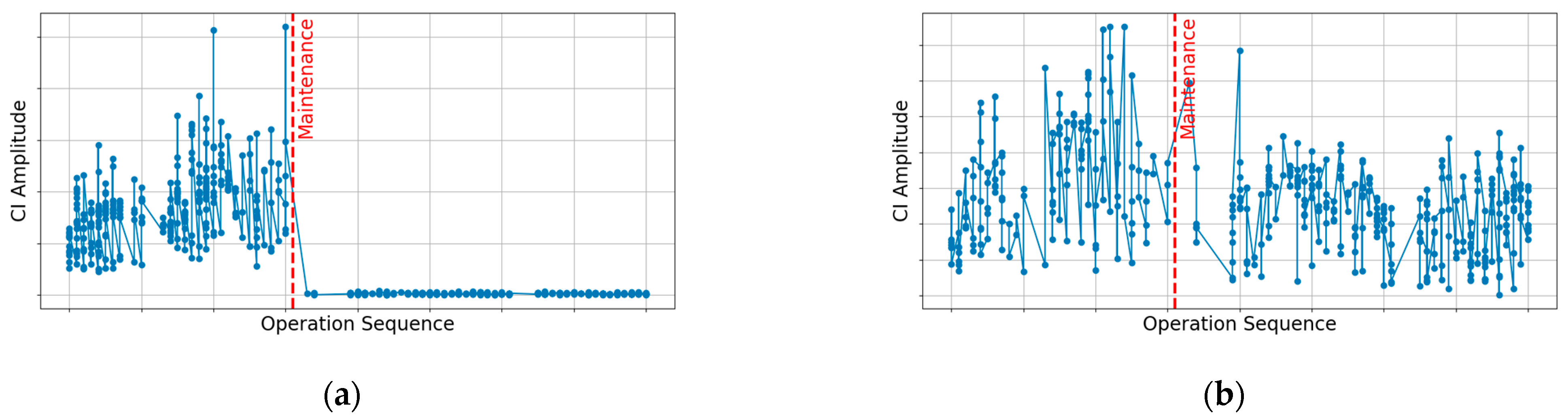
Figure 3 illustrates representative patterns observed in the CI time series. Using the operation sequence as a reference, the analysis examined whether the CI distribution changed significantly across maintenance events and whether spike-type segments were present. In Figure 3a, CI values are elevated prior to maintenance and decrease sharply afterward, suggesting that the pre-maintenance alarms are associated with an actual CI anomaly. In contrast, when CI values for the pre- and post-maintenance ranges show no substantial difference, as illustrated in Figure 3b, the association with an actual defect is considered very low, and such CIs were excluded from the analyses for this study.
For CI streams with repeated alarms and recorded exceedance entries, corresponding flight operations were confirmed, and same-day maintenance logs were examined to verify whether actions were performed on the same system. Table 3 presents an example consistent with Figure 3a. In this case, the maintenance record, particularly the Inspector’s Summary Opinion, was reviewed to confirm whether the corrective action corresponds directly to the alarming CI or system.
When a clear linkage was identified between the alarming CI system and the corresponding maintenance action, the post-maintenance behavior of that CI was examined. If the affected component, including the alarming subassembly, was replaced and the alarm ceased thereafter, the case was labeled as a true fault.
Based on the information in Figure 3 and Table 3, true faults were distinguished from false alarms, and representative outcomes are summarized in Table 4. Around operation 5XX, pre-maintenance threshold exceedances were observed exclusively on the Left Ancillary Intermediate Gear. Consequently, the Left Ancillary Intermediate Gear was identified as the failed component, and further review of the maintenance record indicated gear misalignment as the underlying cause. The corresponding CI records were subsequently used as a case study in later sections to evaluate the proposed flight-state-driven threshold optimization method.

3. Key Variable Identification Through Correlation Analysis

Before describing the proposed method in detail, the variables that most influence fault diagnosis were identified through correlation analysis between HUMS CI values and flight parameters, followed by dimensionality reduction. The purpose of this process is to reduce data dimensionality through correlation analysis and to ensure that the proposed methodology is established on a valid and well-justified set of variables.
Pearson and Spearman correlation coefficients were computed to quantify associations between flight parameters and HUMS CI variables. Based on these results and preliminary preprocessing, highly correlated variables were selected as key variables and then dimensionality reduction was applied to reduce model complexity while preserving the salient structure of the data. The resulting compact representation serves as the input basis for the flight-state-driven threshold optimization described in the next section.

3.1. Selection of Flight Parameters and Correlation Analysis with HUMS Data

Prior to correlation analysis, the flight parameters used in this study were selected. As described in Section 2.2, the HUMS CI variables analyzed in this study were restricted to transmission-related indicators, and the associated flight parameters were curated prior to correlation analysis and dimensionality reduction. Although each flight sortie logs 325 parameters, fields that were not quantifiable or contained no meaningful information, such as binary flag variables recorded only as 0 or 1, as well as parameters with substantial missing values or irregular recording patterns across operations, were excluded. Based on this screening, 45 flight parameters were retained. Table 5 summarizes the categories, counts, and principal measurements of these flight parameters, collectively covering key operational states such as speed, temperature, and pressure. The selected 45 flight parameters therefore form a feature vector for each operation, describing the corresponding operating condition. In the subsequent PCA step (Section 4.5), these vectors are projected onto a low-dimensional set of principal components, which is used as a component representation of the flight state.
Consistent with the analysis scope defined in Section 2.1, the HUMS portion of the analysis was confined to the transmission CIs listed in Table 1. Among the CI records available for transmission, engine, and tail rotor systems, only transmission-related CIs were retained, following previous studies that primarily focused on transmission components [11,12].
When a CI alarm occurs, the system logs ±10 s window of flight parameter data centered on the alarm time. Therefore, correlation analysis among the variables recorded in these windows is required. Because sampling rates differ among flight parameters (for example, some are recorded at 8 Hz while others at 1 Hz), and because HUMS CIs are stored only within short windows around exceedance or alarm events, a common time axis is required before computing correlations. Direct use of the raw data streams would result in misaligned events and obscure synchronous variations. Accordingly, linear interpolation was applied to each parameter as follows: when gaps occurred between two adjacent observations, the intervals were divided according to the finest system logging step, 0.125 s, and values within the gap were linearly interpolated between the bracketing samples. The same procedure was applied to both flight parameters and the CI traces within each alarm-centered window. This temporal alignment produced uniformly sampled time series for all parameters, after which each flight parameter series was paired one-to-one with the corresponding CI values in the same window for correlation computation.

3.2. Correlations Analysis Algorithms

In this section, correlation analysis was conducted to identify flight parameters that are strongly associated with the HUMS CI variables. To capture the dependence structure in a robust manner, two complementary measures were considered: Pearson Correlation Coefficient (PCC) and Spearman Correlation Coefficient (SCC). The PCC emphasizes linear dependence and is sensitive to the actual numerical spacing of the data, whereas the SCC, being rank-based, captures monotonic but potentially nonlinear associations and is less affected by outliers or marginal heavy tails. This dual perspective is particularly relevant for HUMS CI data, which may exhibit skewed or heavy-tailed behavior and whose response to changes in flight state is not guaranteed to be strictly linear [23]. On this basis, flight parameter-CI pairs that exhibit consistently high absolute correlation in either PCC or SCC were regarded as strongly associated and were retained for subsequent dimensionality reduction and threshold optimization. The following subsections briefly summarize the two correlation measures and describe how they are applied in the present analysis.

3.2.1. Pearson Correlation Coefficient

To quantify the linear relationships between the extracted flight parameters and CI time series, the Pearson correlation coefficient (PCC) was employed. The PCC measures the strength and direction of a linear association between two variables and takes values within the range [−1, 1], where +1 indicates a perfect positive linear relationship, −1 indicates a perfect negative linear relationship, and values close to 0 indicate little or no linear association [24].
γ = i = 1 n x i x ¯ y i y ¯ i = 1 n x i x ¯ 2 i = 1 n y i y 2
Equation (1) defines the Pearson correlation coefficient, where x i and y i denote the i - t h observations of variables X and Y   ( i = 1 ,   ,   n ) ; x ¯ i and y ¯ i represents the sample means of X and Y ; and n is the number of paired observations.
However, the PCC can be misleading when the underlying relationship is nonlinear or when the data contains outliers. That is, it evaluates only linear dependence and may not fully capture nonlinear associations or independence. To overcome these limitations, the analysis was complemented with the rank-based Spearman correlation coefficient, which is more robust to outliers and capable of identifying monotonic, though not necessarily linear, relationships.

3.2.2. Spearman Correlation Coefficient

The Spearman Correlation Coefficient (SCC), also known as Spearman’s rho ( ρ s ), is a nonparametric, rank-based measure of association between two variables. It is computed by ranking the observations and then evaluating the correlation between the ranked variables (equivalently, from rank differences). Its value lies in [−1, 1], where values near +1 indicate strong positive monotonic dependence, values near −1 indicate strong negative monotonic dependence, and values close to 0 indicate weak rank association.
ρ s = 1 6 d i 2 n n 2 1
Equation (2) defines the SCC, where d i = r a n k ( x i ) r a n k ( y i ) denotes the difference between the ranks of the i - t h pair ( i = 1 ,   ,   n ) ; n is the sample size; and r a n k ( · ) is the ranking function, with average ranks used in the case of ties.
Since SCC relies solely on ranks, it is invariant to the units and marginal distributions of the variables. It also remains effective for nonlinear or non-normal data and in the presence of outliers, providing a stable and distribution-free measure of association under such conditions [25].

3.3. Correlation Analysis Results

Associations between flight parameter data and HUMS CI data were evaluated using both the Pearson and Spearman correlation coefficients. Previous comparative studies have reported that, although both metrics can yield significant values on the same dataset, their interpretations and statistical significance may differ depending on distributional characteristics such as nonlinearity, and outliers, scale effects [26]. Accordingly, both coefficients were computed for all variable pairs (Table 6), and cases exhibiting strong association, defined as those with | γ   | 0.8 or | ρ s | 0.8 , were identified.
A similar idea of using multiple measured quantities as complementary descriptions of a single structural state has been adopted in other structural monitoring applications [27]. In the present study, vibration-based CIs and flight parameters were analogously viewed as coupled observations of the rotorcraft transmission component. However, this idea was implemented in a deliberately simple way: the joint Pearson-Spearman correlation analysis was used only as a screening step to identify strongly associated flight parameters, which were then passed to the subsequent PCA-based flight-state representation and flight-state-driven threshold optimization.
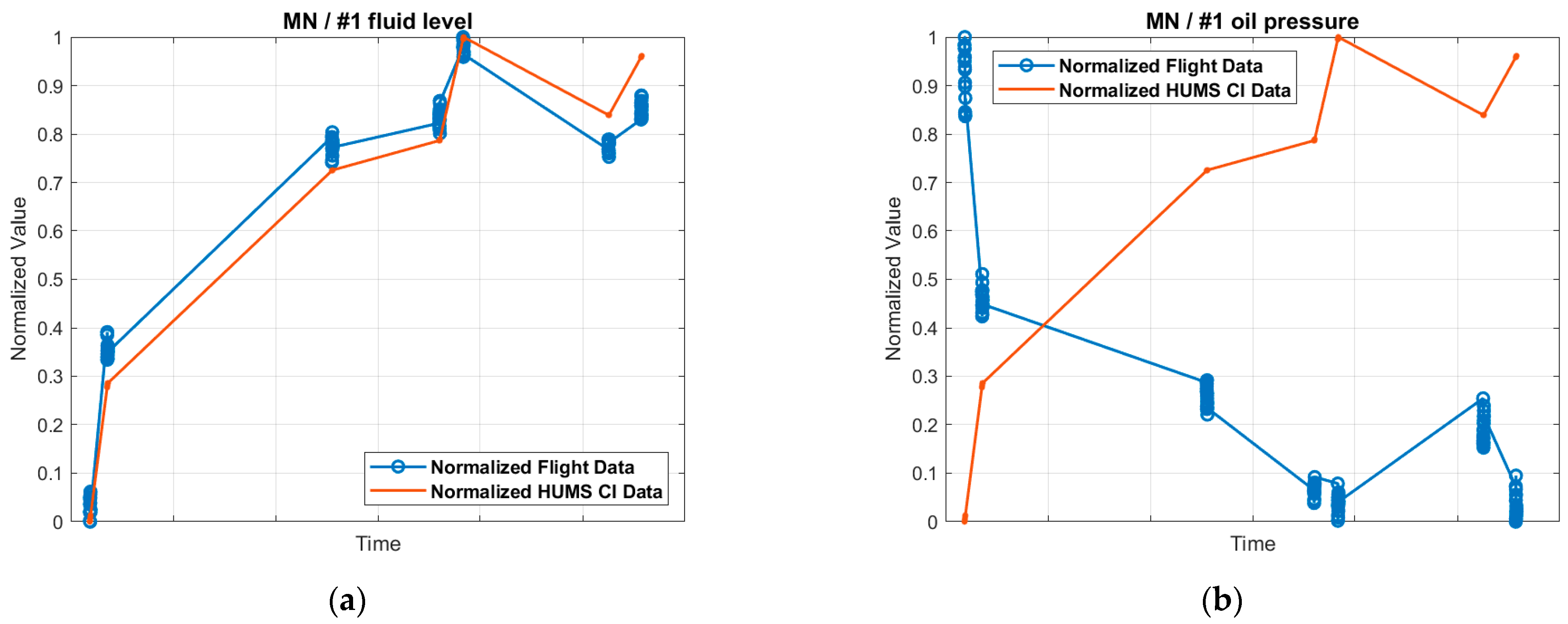
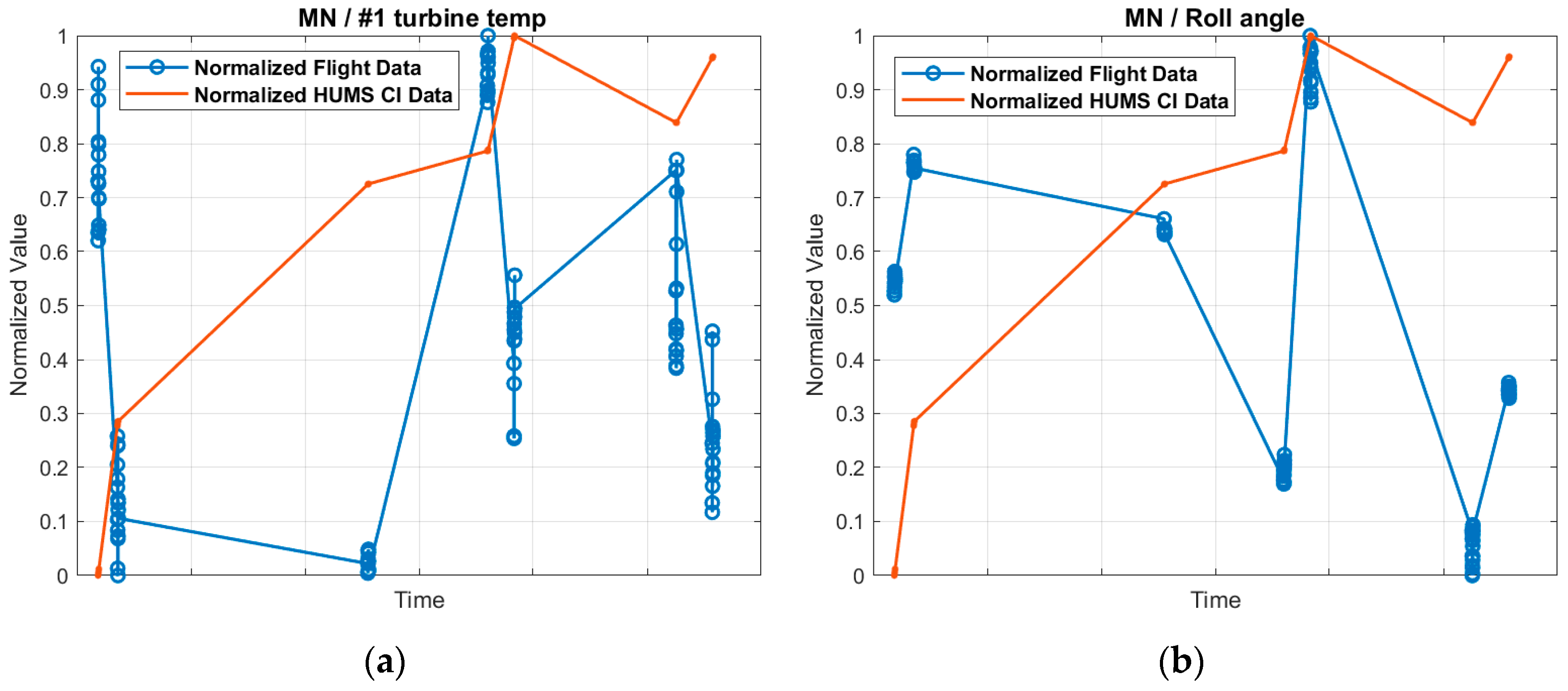
In Figure 4 and Figure 5, the normalized CI values (shown in orange) are plotted together with the normalized flight parameter values corresponding to the ±10 s window around each CI timestamp. These flight parameter values are represented as blue circles positioned at the time corresponding to each CI record. Between consecutive CI timestamps, the normalized CI values and the average values of the normalized flight parameters within each ±10 s window are linearly interpolated and plotted as orange and blue lines, respectively. The correlation analysis was performed between the normalized CI values and the averaged normalized flight parameter values within the ±10 s windows. In Figure 4a, the variable pair exhibits a strong positive correlation ( γ ≥ 0.8), where the flight parameter and the CI time series show similar temporal trends. In contrast, Figure 4b demonstrates a strong negative correlation, in which one series increases while the other decreases, resulting in mirrored temporal patterns. Figure 5 provides an example of a weak correlation, where the flight parameter and CI time series display clearly different patterns and dissimilar temporal evolution. These observations indicate that, although some variable pairs exhibit strong associations, high correlations are not universally observed across all variables.
For empirical validation of the proposed workflow, the correlation analysis on the HUMS side was restricted to gear-related components. Specifically, four transmission components were considered, namely the Left/Right Ancillary Input Gears and the Left/Right Ancillary Intermediate Gears. Correlations were computed between 14 CI types from these components and the 45 screened flight parameters, and the flight parameters showing the highest correlation with each component-CI combination are summarized in Table 7.
Overall, the analysis confirms the presence of meaningful correlations between component-specific CI data and selected flight parameters. In particular, for high-correlation pairs, one data stream may potentially complement the other when information is missing on one side, suggesting utility for gap filling, anomaly mitigation, and feature selection in subsequent analysis pipelines. Moreover, the consistent correlations observed across several components provide statistical support for incorporating flight parameters when updating CI thresholds, thereby reinforcing the practical value of the proposed flight-state-driven threshold optimization approach.

4. CI Threshold Optimization

Thresholds used for HUMS CI data are not set once and left unchanged; instead, they must be periodically re-evaluated and adjusted in response to operational alarms, particularly false alarms, and shifts in the data. Industry guidance recommends concentrating threshold verification during the initial introduction of a new HUMS of aircraft and, for mature systems, conducting regular reviews at least every two years or every 500 flight hours [10]. Such periodic reassessment reflects evolving operating environments and equipment conditions and, over the long term, supports stable and reliable anomaly detection.
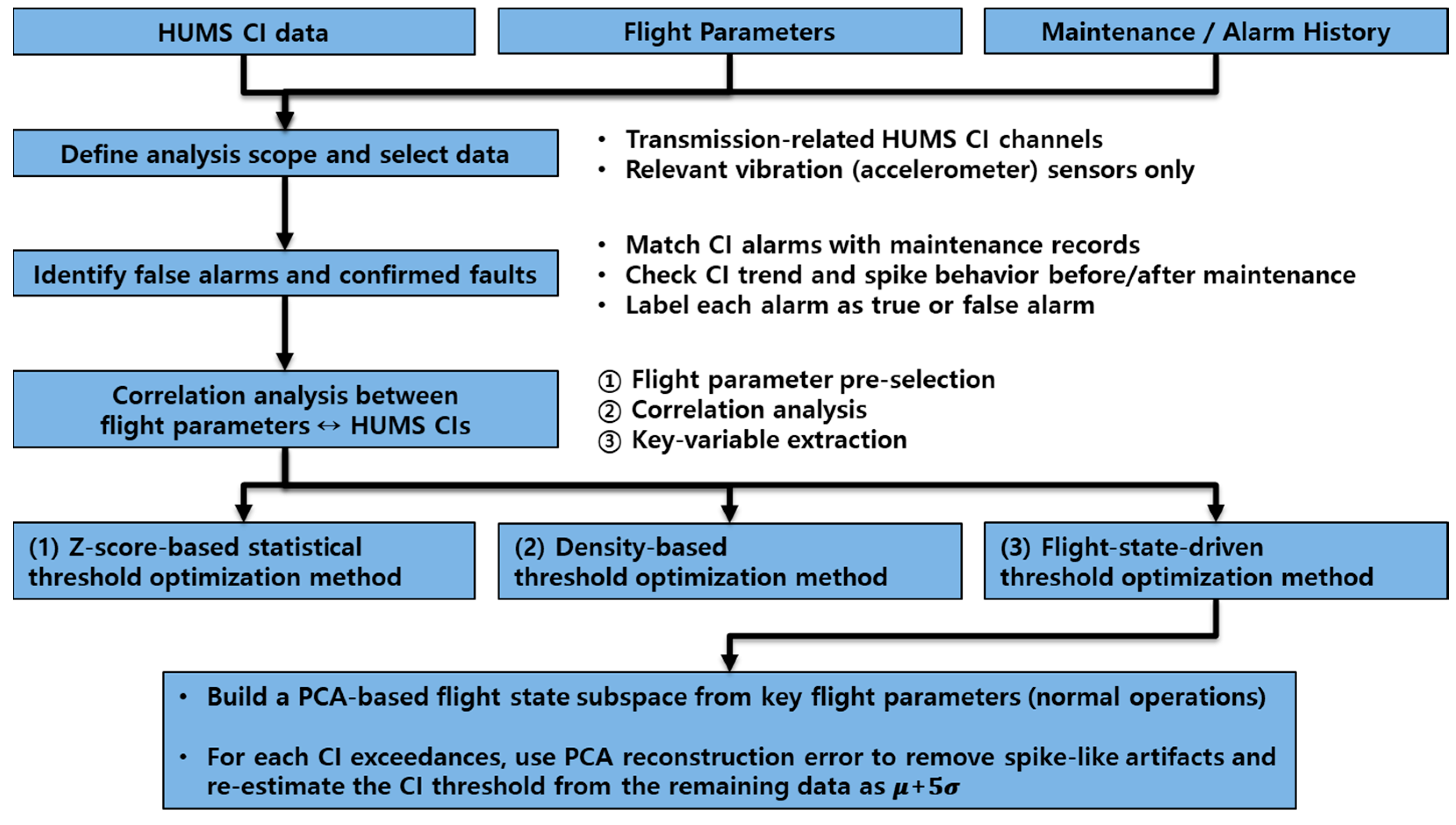
In this study, CI thresholds were re-estimated using the following three different approaches, and the effects of threshold optimization were compared and analyzed to assess performance and to validate the practicality and effectiveness of the proposed flight-state-driven approach: (i) a statistics-based workflow that removes outliers using a Z-score criterion [22] before threshold setting; (ii) a density-based workflow that removes outliers using methods proposed in previous studies [28,29] before threshold setting; and (iii) the proposed flight-state-driven threshold optimization, which removes outliers and sets thresholds while jointly considering flight data. Figure 6 summarizes the overall threshold optimization workflow, from data selection and fault labeling to CI-flight parameter correlation analysis and the application of these three threshold-setting pipelines.

4.1. Review of Existing Thresholds and Definition of Comparison Criteria

The thresholds already configured for each CI within the HUMS dataset were first examined. Reviewing legacy thresholds prior to optimization is essential because these values, which are set based on prior operational and maintenance experience as well as historical data analysis, provide an objective baseline for evaluating the effects of any new thresholds, including changes in sensitivity and false alarm behavior. Clarifying the limitations of the existing thresholds also helps to refine the objectives and direction of the optimization process.
As mentioned earlier, the analysis was confined to transmission-related CIs to maintain focus and enhance the reliability of conclusions. Among the 34 transmission CIs, threshold information was available for 10. For the four components of interest, six CI thresholds were identified. Because not all CIs have established thresholds, subsequent efforts, such as trend analysis, may further improve fault-diagnosis accuracy and guide future threshold determination within the proposed flight-state-driven optimization framework.

4.2. Z-Score-Based Statistical Filtering Method

In conventional HUMS data analysis, temporal pattern changes are monitored to support data-driven maintenance and preventive diagnostics. A particularly important pattern is the data spike [15], which refers to a brief and abrupt excursion in the measured value. Such spikes are typically not directly related to actual defects; rather, they are regarded as outliers caused by acquisition artifacts, transient sensor malfunctions, or external disturbances. When threshold exceedances are triggered by spikes, they are generally removed during data cleansing or classified as false alarms that do not require further maintenance. However, repeated spikes at the same location or clusters of spikes within the same dataset may indicate an emerging issue and should trigger additional inspection.
To remove spike-type outliers, a Z-score-based statistical filtering method [22] was applied. The Z-score quantifies how far each sample deviates from the mean in units of standard deviation, and samples exceeding conventional cutoff values are treated as outliers. In many applications, two-sided criteria around |Z| > 3 are commonly used [18,21]. In the present study, spike artifacts occurred primarily in the upper tail, so a one-sided strategy was adopted. Values exceeding 2 μ + 3 σ were first identified as sensor-error spikes and removed. After these outliers were excluded, the CI threshold was re-established at μ + 5 σ based on the cleaned distribution. This two-step procedure effectively suppresses transient, nonphysical excursions while preserving the underlying distribution relevant to anomaly detection, resulting in a more conservative and stable threshold for subsequent evaluation.

4.3. Density-Based Filtering Method

Density-Based outlier detection identifies anomalies by analyzing the local point density of the data distribution and is widely applied in sensor networks and engineering signal processing. Representative algorithms include DBSCAN (Density-Based Spatial Clustering of Applications with Noise) and its variant DBSCAN-OD for outlier detection [28]. More recent developments extend this approach, such as OPTICS (Ordering Points To Identify the Clustering Structure), which generalizes DBSCAN to handle varying densities and supports both hierarchical clustering and outlier identification [29].
In this study, a density-based filtering procedure was adopted to identify samples located in low-density regions as outliers, particularly in feature spaces of dimension two or higher. The overall data distribution was analyzed to define a density threshold, and observations with local densities below this cutoff (for example, the lowest approximately 5%) were removed. The cleaned dataset was then used to re-estimate CI thresholds, enabling a fair comparison with the statistics-based workflow and the proposed flight-state-driven threshold optimization in subsequent sections. The specific percentile levels and the μ + 5 σ form of the density-based threshold are summarized in Section 4.4.

4.4. Performance Analysis of Conventional Thresholding Methods

As described above, thresholds obtained after filtering outliers using a Z-score criterion were compared with those derived from density-based filtering. In the Z-score workflow, samples exceeding 2 μ + 3 σ were treated as outliers and removed, whereas in the density-based workflow, observations in the lowest approximately 5% by local density were excluded. For both methods, the final CI threshold was set to μ + 5 σ based on the cleaned distribution.
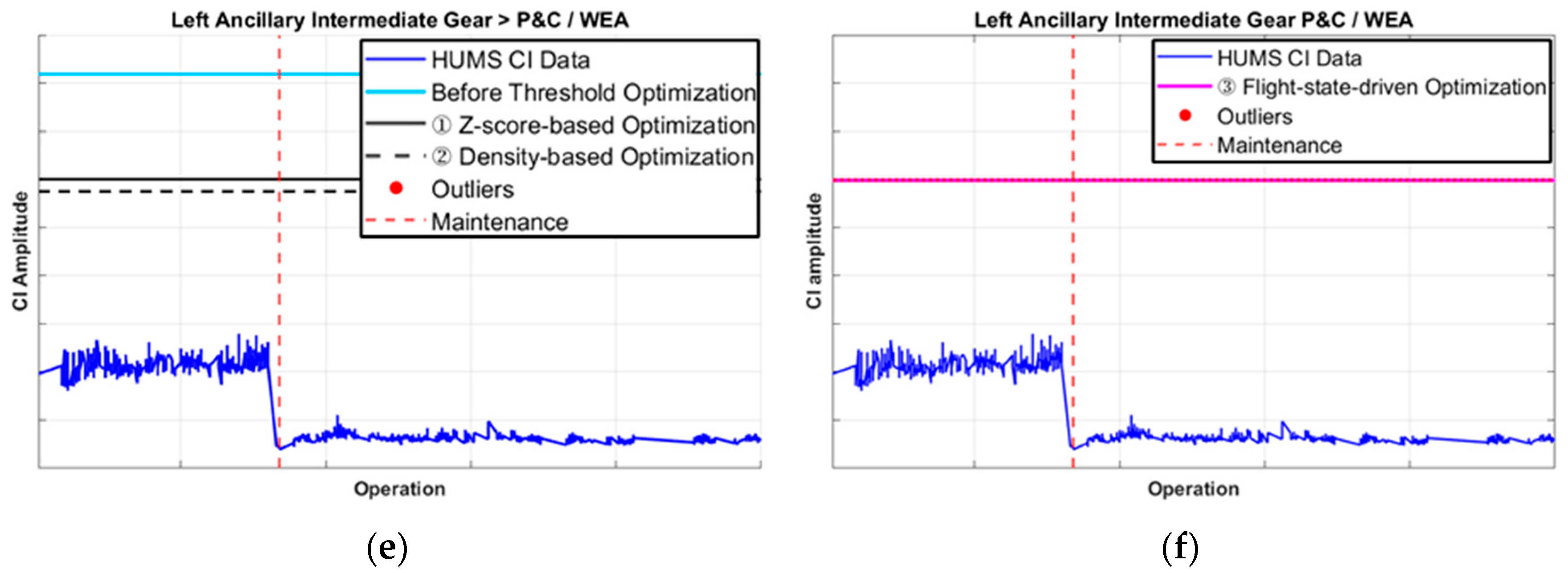
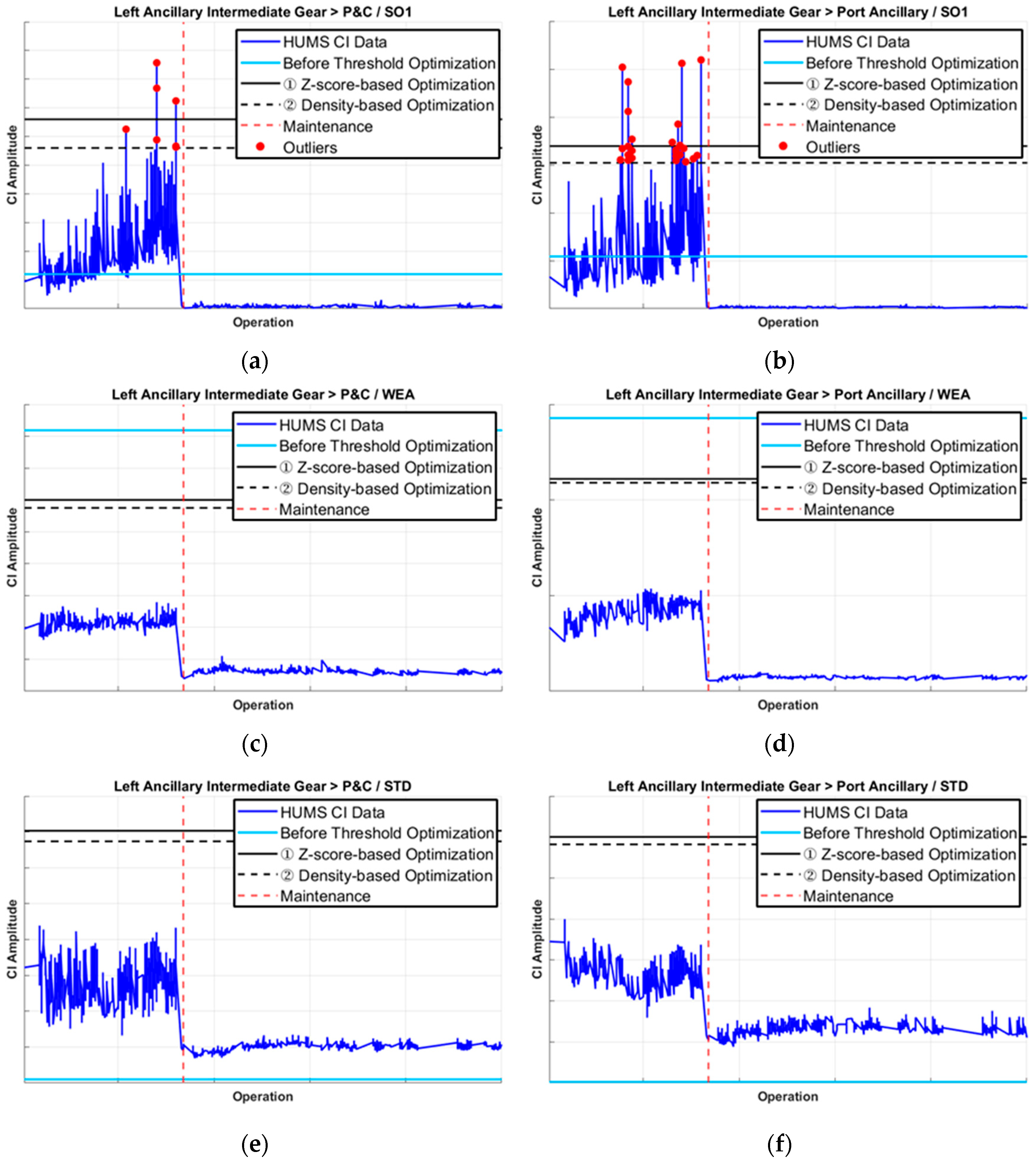
Compared with pre-optimization values, several CIs exhibited substantial shifts in their optimized thresholds, emphasizing the need for a systematic optimization procedure. Figure 7 illustrates the result for the Left Ancillary Intermediate Gear. Consistent with Section 2.3, pre-maintenance outliers and alarms are concentrated within a limited operation sequence interval associated with maintenance case C in Table 3, and they are predominantly observed in the CI channels corresponding to the component that actually failed. In particular, as shown in Figure 7e,f, applying the legacy thresholds (light blue) results in frequent alarms even outside the intervals identified as true faults around operation 5XX in Table 4, indicating that the original thresholds alone were insufficient for reliable detection.
Figure 7a,b correspond to the SO1 CI for the Left Ancillary Intermediate Gear, which is defined as balance indicators in Table 1. Around operation 5XX, both channels exhibit pronounced CI peaks highlighted by red markers, and these peaks are confined to the pre-maintenance interval associated with maintenance case C described in Section 2.3 and summarized in Table 3 and Table 4. After the maintenance action, the SO1 amplitudes return to a lower, steady level, and the corresponding alarms disappear. This localized behavior in the balance-related SO1 channels of the failed gear, together with the absence of comparable peaks in other CIs for the same component, is consistent with a balance-type defect of the Left Ancillary Intermediate Gear rather than random spikes or noise. In contrast, for the other CIs of the same component shown in Figure 7c–f, the amplitudes remain below their respective optimized thresholds over the entire operation, and no peaks comparable to the SO1 events appear.
However, when alarm frequency, temporal alignment with maintenance actions, and operational cost are considered together, no single method is universally superior, and a more systematic, side-by-side comparison is warranted.
Two practical constraints further limit threshold performance in current HUMS implementations. First, as a commercial system, the CI computation pipeline is proprietary, restricting direct algorithmic interpretation and revision. Second, vibration snapshots used to compute CIs are captured only within very short windows, which may under-represent evolving operating conditions and aircraft states.
Given these limitations, approaches relying solely on HUMS CI streams face inherent challenges in precisely distinguishing faults across diverse operating regimes and in reducing false alarms. To address these challenges, a flight-state-driven threshold optimization method is proposed, which integrates CI data with additional, readily available flight parameters. The objective is to enhance the stand-alone HUMS capability with a thresholding procedure that reflects operational context, thereby improving reliability of fault diagnosis and supporting prognostic-oriented decision-making. The linkage to flight parameters also indicates the potential to derive complementary diagnostic cues that capture anomaly signatures difficult to identify from CI data alone.

4.5. Flight-State-Driven Threshold Optimization Method

4.5.1. Overview of the Flight-State-Driven Threshold Optimization Method

The proposed workflow is summarized below and illustrated as a flowchart in Figure 8. Building on the statistics-based step, the procedure first performs proactive spike filtering and then refines thresholds using flight-state context. In the first step, a proactive statistical filtering and baseline thresholding process is applied. A Z-score rule is used to remove upper-tail spikes exceeding 2 μ + 3 σ , and, based on the cleaned distribution, a baseline CI threshold is established at μ + 5 σ . In the second step, candidate fault-operations are identified. Flight operations with CI values exceeding the μ + 5 σ baseline are marked as candidate fault operations, and evaluation windows are defined around the corresponding alarms or exceedances. In the third step, a Principal Component Analysis (PCA) space is constructed using flight parameter vectors from operations that exclude these candidate fault operations. The number of components retained corresponds to the level required to achieve 95% cumulative explained variance. In the fourth step, reconstruction error screening is applied to the evaluation windows. The flight parameter sets from candidate fault operations are projected into the PCA space, and the reconstruction error is computed as described in Section 4.5.2.
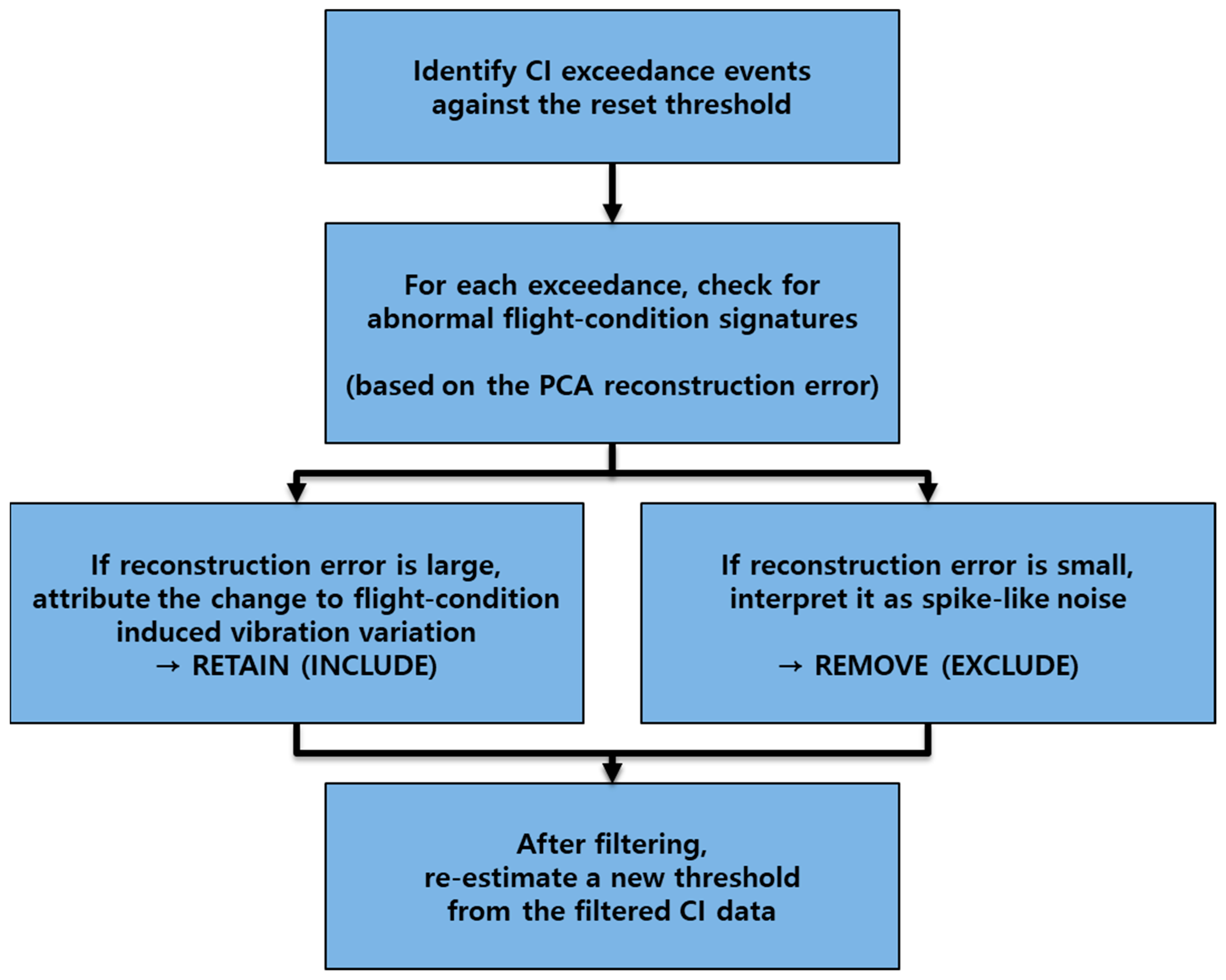
If the reconstruction error is large, the corresponding maneuver deviates meaningfully from nominal flight behavior. In this case, the associated CI variation is interpreted as being driven by the flight state, and these samples are retained in the threshold-estimation dataset. Conversely, if the reconstruction error is small, the flight profile is nominal while only the CI exhibits a transient spike. These samples are treated as spike-like artifacts and excluded from threshold estimation to mitigate the influence of false alarms.
Finally, the CI threshold is re-estimated using the filtered dataset, and the resulting performance is evaluated.

4.5.2. Principal Component Analysis

Principal Component Analysis (PCA) is a standard technique for dimensionality reduction that projects high-dimensional data onto a lower-dimensional subspace spanned by the principal components [30,31]. PCA iteratively finds orthogonal axes that (equivalently) minimize reconstruction error or maximize preserved variance. The first component explains the largest variance in the data, the second component is orthogonal to the first component and explains the next largest variance, and so on. Through projection and reconstruction, the reconstruction error can be computed and subsequently used for outlier screening and anomaly detection [32].
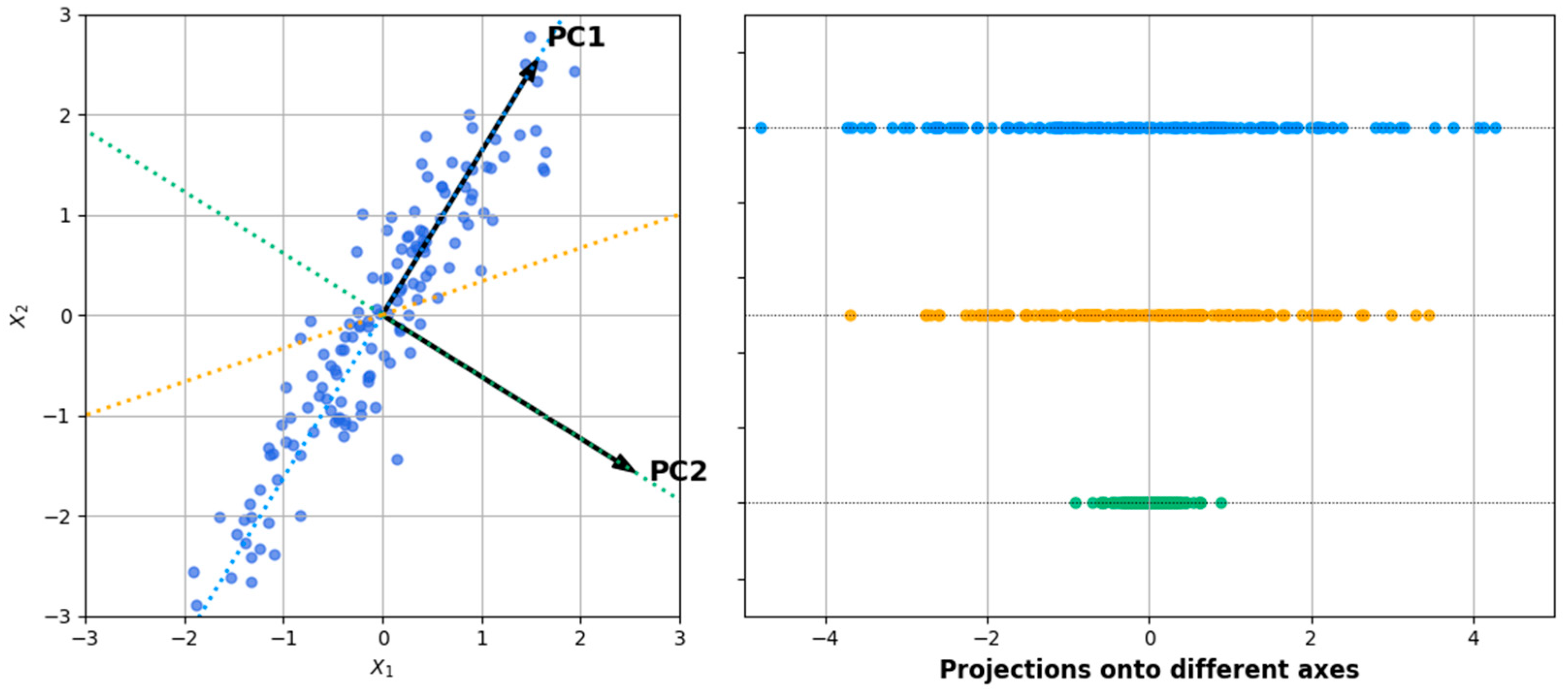
Figure 9 illustrates the core concept of PCA. The left panel presents a scatter plot of two variables ( x 1 ,   x 2 ) where the arrows indicate the first component (PC1), representing the direction that preserves the largest overall variance, and the second component (PC2), which is orthogonal to PC1 and accounts for the second-largest variance. The right panel shows the same samples projected onto three axes: PC1 (blue), an arbitrary axis (yellow) rotated about PC1, and PC2 (green). This visualization demonstrates that variance is maximized along PC1 and minimized along PC2, which is consistent with PCA’s objective of finding “maximum-variance” directions [23,33]. In the following, the term “principal component” (PC) refers to the axis or direction, whereas the corresponding scalar projection of each sample onto a PC is referred to as the principal component score (or simply “PCA score”).
In the proposed workflow, flight parameter vectors from candidate fault operations are projected into the PCA space derived from non-candidate operations, and then reconstructed using only the retained components. In this study, the “flight state” of each operation is represented by a small set of PCA-based indices computed from the selected flight parameters. For every operation where a CI is evaluated, the corresponding values of the selected flight parameters (Section 3.1) are assembled into a single feature vector. PCA is trained on these vectors from nominal operations and produces a few principal components (PCs) that capture the dominant patterns of variation. Each operation is then described by its principal component scores, i.e., the numerical values obtained by projecting the feature vector onto the retained PCs. This short vector of scores is treated as a compact, continuous representation of the flight state, without introducing any discrete state labels or clustering.
The resulting reconstruction error is interpreted qualitatively: large errors indicate deviations driven by flight-state changes, which are included for threshold estimation, whereas small errors indicate spike-like CI excursions under nominal flight profiles and are excluded. Details of the computation are described in the next section; here, the focus is on how reconstruction error guides the decisions of inclusion and exclusion within the flight-state-driven threshold optimization process.

4.5.3. PCA Reconstruction-Error Computation

In the proposed workflow, the PCA model is not used to construct additional health indicators directly from the principal component analysis, nor to assign discrete flight-state classes. Instead, it serves as a compact representation of nominal flight behavior in the selected flight parameter space. Flight parameter vectors from normal operations are expected to lie close to the PCA subspace and to be well reconstructed from the retained components, whereas unusual operating conditions manifest as larger reconstruction errors. The PCA reconstruction error is therefore used as a scalar measure of how far each operation departs from the normal flight-state manifold. This quantity is then exploited to distinguish flight-state-driven CI variations from spike-like artifacts that occur under otherwise nominal flight profiles.
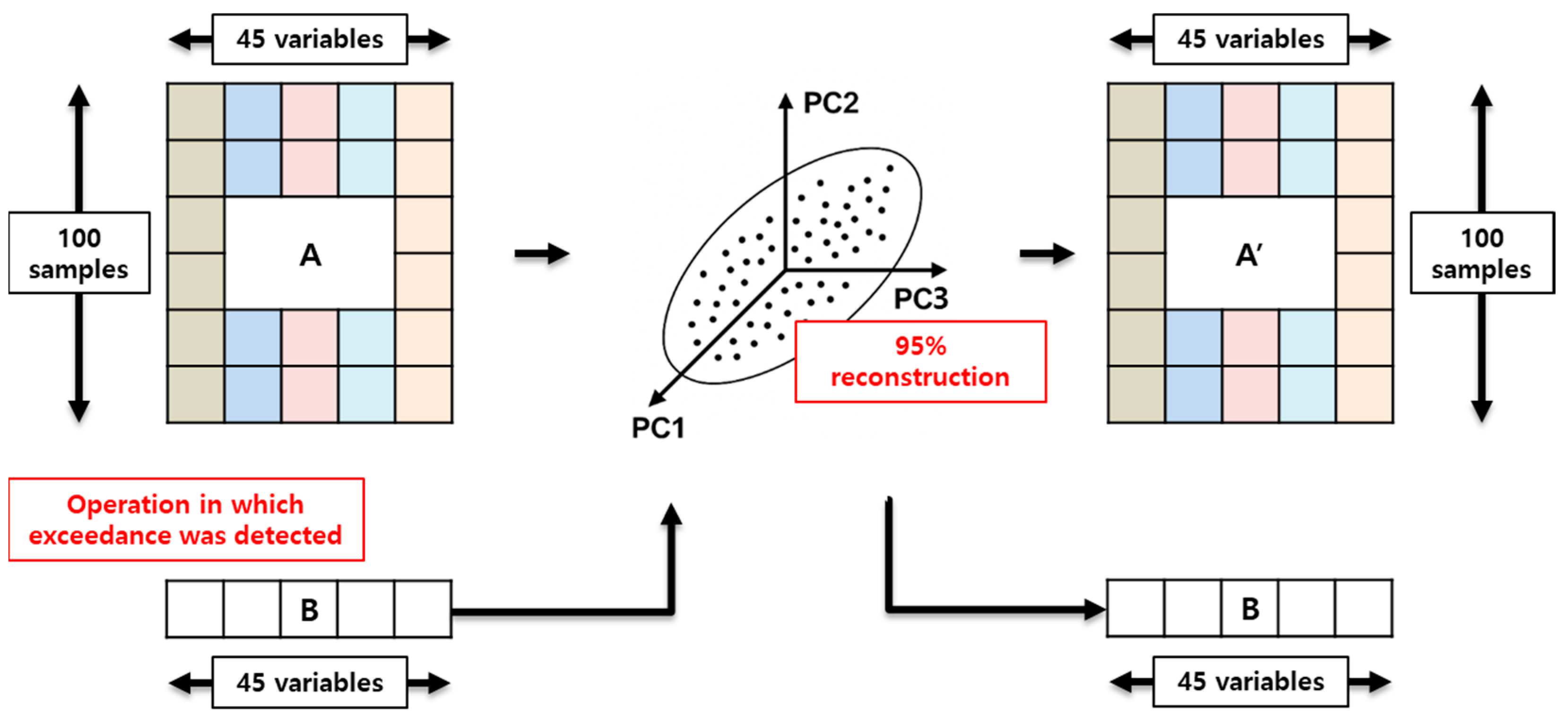
The procedure for computing PCA-based reconstruction errors on flight parameters is summarized schematically in Figure 10 and proceeds as follows:
(i)
Baseline matrix construction: A baseline matrix is built from nominal operations. One hundred flight operations regarded as nominal are randomly sampled, and for each flight operation where a CI is recorded, a flight parameter vector is extracted that consists of the average value of each flight parameter within the ±10 s window corresponding to that CI. These flight parameter vectors are then assembled to form matrix A.
(ii)
PCA fitting and component selection: PCA is applied to A, and the minimum number of principal components required to explain at least 95% of the cumulative variance is retained. This basis defines the nominal PCA space.
(iii)
Nominal reconstruction and error quantification: Using the retained components, the nominal data are projected and reconstructed to obtain A , and reconstruction errors are computed for A   A . The resulting nominal error distribution serves as the reference for subsequent evaluation.
(iv)
Evaluation of candidate fault operations: For each candidate fault operation (Section 4.5.1), the corresponding flight parameter vector is extracted to form vector B . The flight parameter vector B is then projected into the nominal PCA space and reconstructed to obtain B , yielding the reconstruction error for each candidate operation.
(v)
One-sided decision rule: From the nominal error distribution in step (iii), a one-sided cutoff is defined at the 97.5th percentile (i.e., the upper 2.5%), as illustrated by the red dashed line in Figure 10 [34,35]. If a candidate window’s reconstruction error exceeds this cutoff, the corresponding flight profile is interpreted as meaningfully deviating from nominal (e.g., due to aggressive maneuvering or an operating-condition shift). The associated CI peak is then treated as flight-state-driven, and the window is included in the dataset for threshold estimation. Conversely, if the reconstruction error does not exceed the cutoff, the flight profile is considered nominal while only the CI exhibits a transient spike. Such windows are treated as spike-like artifacts (e.g., brief sensor disturbances) and excluded from threshold estimation.
Figure 10. Conceptual diagram of PCA-based reconstruction error of abnormal operation evaluation.
Aerospace 12 01110 g010
Figure 11 illustrates two examples across all 45 flight parameters: In Figure 11a, several variables exceed the one-sided cutoff, indicating broad deviations driven by changes in operating conditions. In contrast, Figure 11b remains below the cutoff, suggesting a localized anomaly that is likely unrelated to a true change in operating state.
In this study, the PCA reconstruction error is used not only to determine inclusion or exclusion during threshold re-estimation but also as a signal to adjust the threshold itself to the operational context. For operations with reconstruction errors exceeding the 97.5th percentile, a positive weight proportional to the degree of exceedance is applied to raise the μ + 5 σ threshold for those windows. This adjustment reflects the fact that, under flight states deviating from nominal, CI values may legitimately increase within the normal range. By adapting the threshold upward in such cases, unnecessary alarms that would otherwise occur under fixed legacy thresholds can be reduced.
Conversely, when the reconstruction error is at or below the 97.5th percentile, the corresponding CI peaks are interpreted as spike-like events without operational context, and no weighting or downward adjustment is applied. This design choice reflects the fact that lowering the threshold solely on the basis of a small reconstruction error could lead to incidental noise being interpreted as alarms, while the proposed procedure already maintains robust detection performance for genuine anomalies. Therefore, the potential risks of unnecessary alarms outweigh the marginal benefits of downward threshold adjustment.
Threshold adjustment proceeds as follows. For each operation, let x o p denote the flight parameter vector and x ^ o p its reconstruction from the retained principal components. The PCA reconstruction error is defined as
e o p = 1 d j = 1 d x o p , j x ^ o p , j 2 ,
where d is the dimension of the flight parameter vector. Let e denote the 97.5-percentile of the nominal reconstruction error distribution. The exceedance score is computed as
s o p = max 0 ,   e o p e e ,
where e o p is a PCA reconstruction error for the given operation, and e is the reference cutoff for reconstruction error, and s o p is a normalized exceedance beyond the cutoff, indicating how much e o p exceeds e in relative terms. The exceedance score is then scaled into a weight w o p according to
w o p = α min ( 1 ,   s o p ) ,
where w o p is the weight applied to the corresponding operation ( w o p = 0 indicates no adjustment, while larger values of α produce a stronger upward shift). The coefficient α ( 0 ,   1 ) controls the strength of the upward adjustment. In this study, α = 0.5 was used based on the sensitivity analysis presented later in Section 4.5.4 (Table 8), which indicated this value offers an optimal balance between sensitivity and specificity. Finally, the operation-specific threshold is computed as
T h r e s h o l d o p = T h r e s h o l d ( 1 + w o p ) .
By calculating the reconstruction error e o p , the deviation of the current flight state from the nominal manifold can be quantified by using Equation (4). This deviation is then mapped to a weight w o p using a scaling function, which dynamically adjusts the detection threshold by using Equation (5). This mathematical mechanism ensures that the detection boundary “adapts” to the energy of the flight maneuver, thereby stabilizing the false alarm rate even under highly dynamic flight conditions.
This scheme classifies CI elevations driven by operational context as normal, while suppressing alarms caused by context-free spikes without compromising sensitivity. As described in the previous sections, the include/exclude filtering is repeated across all windows, and thresholds are recalculated using μ + 5 σ based on the filtered CI distribution within the overall flight-state-driven threshold optimization framework.
In the implementation, all scalar constants in the threshold optimization workflow were fixed a priori and applied uniformly across all CI component pairs. In the spike filtering step, CI samples exceeding 2 μ + 3 σ (computed from all operations of a given CI) were treated as outliers and removed. For the density-based method, only samples at or below the 97.5th percentile of the CI amplitude distribution were retained, and the density-based CI threshold was set to μ + 5 σ of this trimmed distribution; the same μ + 5 σ was used for the manual-based and flight-state-driven thresholds after their respective filtering steps. For the flight-state-driven method, the PCA reconstruction error cutoff was likewise fixed at the 97.5th percentile of the nominal reconstruction error distribution. Operation-wise exceedances of this cutoff were normalized and converted into weights through a smooth saturating function with an upper gain of 0.5, and the resulting weights were smoothed across neighboring operations using a five-point Gaussian kernel.

4.5.4. Results of the Flight-State-Driven Threshold Optimization

Applying the flight-state-driven outlier removal to HUMS data from in-service rotorcraft enabled finer-grained filtering that reflects flight parameters and operating states, unlike purely statistical or density-based methods. When CI thresholds are estimated using samples that exceed the threshold for reasons unrelated to flight state, CI variance can become overstated and thresholds inflated, which may degrade detection specificity. The proposed procedure retains CI variations explainable by flight state and removes unexplained spike-like excursions, thereby reducing unnecessary alarms while preserving fault-detection performance.
Figure 12 illustrates threshold-optimization examples for each CI, conditioned on whether the PCA reconstruction error (Section 4.5.3) exceeds the one-sided cutoff. Each panel presents results for the same CI measured at different locations of the component that experienced the actual failure, allowing direct comparison with the legacy thresholding methods shown in Figure 7. As observed previously in Figure 7, common outliers appear over similar operation intervals only for the Left Ancillary Intermediate Gear, which was the failed component, and only for the CIs associated with that failure.
Figure 13 provides concrete examples of applying the PCA-reconstruction-error based weighting (Section 4.5.3) to re-estimate thresholds, demonstrating the method’s effectiveness in distinguishing artifacts from true faults. Figure 13a illustrates a case of a premature alarm in a non-failing component. Traditional methods (black dashed/solid lines) would have raised a false alarm due to the spike; however, the proposed method (pink line) correctly identifies this as a flight-state-driven variation and adjusts the threshold upward, thereby suppressing the nuisance alarm. Conversely, Figure 13b presents the real fault case (Left Ancillary Intermediate Gear). Crucially, the proposed method successfully captures the anomaly leading up to the maintenance event. Despite the adaptive thresholding capability, the fault-induced vibration energy sufficiently exceeds the limit, confirming that the method preserves detection sensitivity for actual defects while filtering out noise.
Because spurious alarms can trigger repeated inspections and checks, they impose additional operational and maintenance costs. These examples demonstrate that the proposed flight-state-driven threshold optimization effectively suppresses such unnecessary alarms while preserving accurate detection of true faults. By excluding spike-like segments unrelated to the failures and allowing normal, flight-state-driven amplitude variations through PCA-informed threshold adjustment, the proposed method enhances the overall reliability and interpretability of the alarm system.
After resetting thresholds with the flight-state-driven outlier removal, the total number of alarms decreased while fault detection capability was maintained. Figure 14 compares the normalized magnitudes of three thresholds: (①) after Z-score-based statistical filtering, (②) after density-based filtering, (③) after the proposed flight-state-driven filtering. All three optimized thresholds fall within a similar range, indicating that the proposed approach establishes a baseline performance comparable to that of existing methods.
Furthermore, Figure 15 contrasts the proposed approach (right) with the statistical and density-based methods (left). All three methods detect anomalies at similar times around the true-fault interval, while the proposed flight-state-driven method produces fewer spurious alarms during nominal periods, resulting in higher specificity while maintaining comparable sensitivity.
The practical impact of threshold optimization is quantified from two perspectives: minimizing unnecessary alarms during nominal operation and concentrating alarms immediately before a fault. Two evaluation metrics are defined based on previous studies [12,36,37]. Let M denote the interval exhibiting fault-like behavior (anchored at the maintenance operation), and let B represent the background interval comprising all remaining operations. For each operation ( o p ), define the alarm indicator A ( o p ) = 1 if at least one alarm occurs during the operation, and A ( o p ) = 0 otherwise.
The Background Alarm Rate ( B A R ), which measures the frequency of unnecessary alarms during nominal operation, is defined as
B A R = # o p B : A ( o p ) = 1 # o p B ,
where o p denotes an operation, A ( o p ) is the binary alarm indicator for the o p , and B represents the background set of operations, that is, all operations outside the maintenance window M . A smaller B A R indicates fewer spurious alarms during nominal operation.
The In-window Alarm Concentration ( I A C ), which measures the degree to which alarms are concentrated within the maintenance window M , is defined as
I A C = # o p M : A ( o p ) = 1 # o p M ,
where M denotes the in-window interval of operations used to assess alarm concentration near the fault. Larger I A C values indicate stronger concentration of alarms within the fault-related interval.
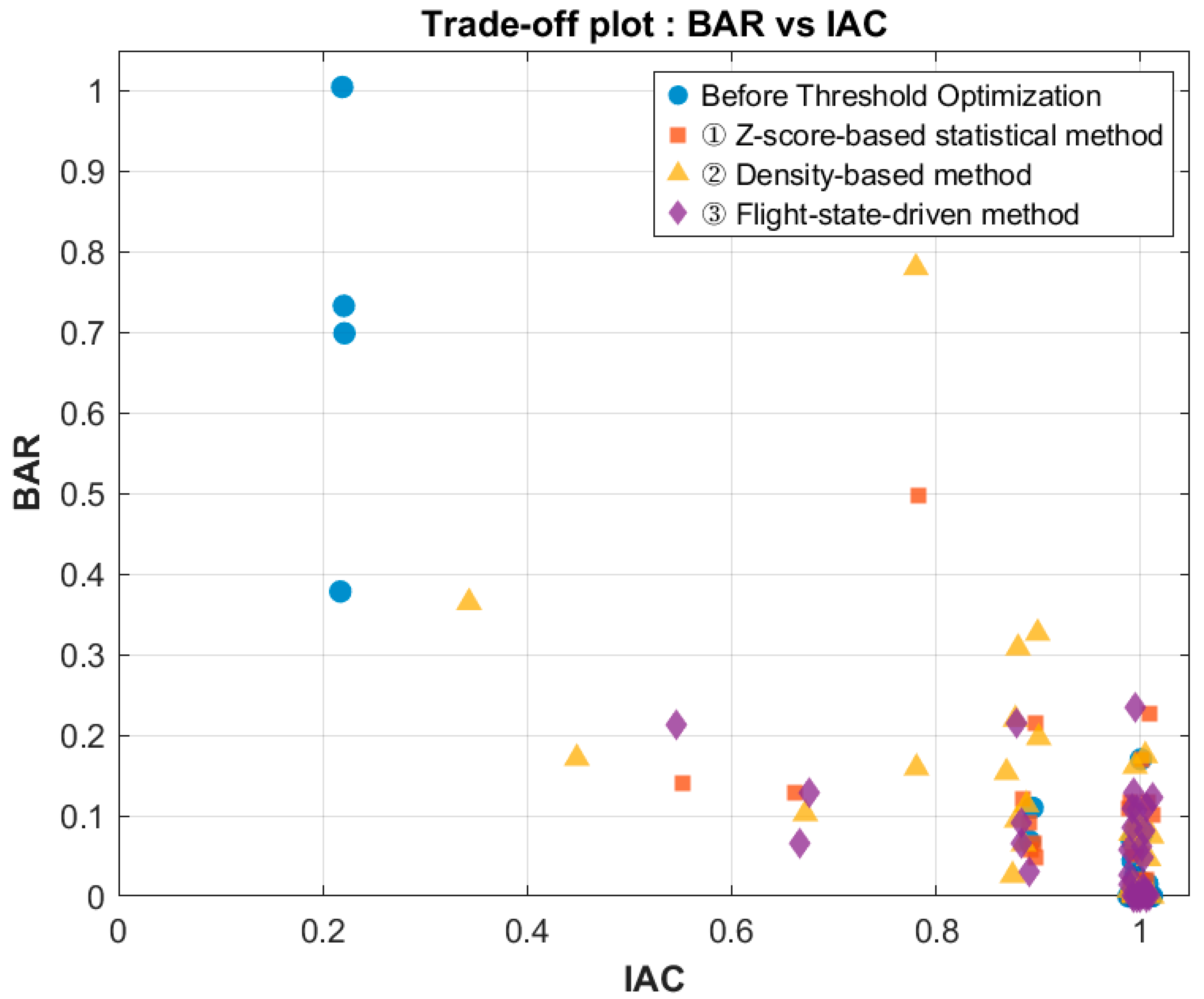
Figure 16 compares the performance of the three methods on two axes: the B A R (y-axis) and the I A C (x-axis). The I A C represents the proportion of operations within M that contain at least one alarm, where higher values indicate stronger fault-related concentration, while the B A R represents the proportion of operations within B that contain at least one alarm, where lower values indicate fewer unnecessary alarms.
For Z-score-based statistical filtering method (①, shown in orange) and Density-based (②, shown in yellow) filtering method, several instances appear in the high- I A C region where the B A R rises to 0.3–0.8, indicating intermittent spurious alarms during nominal periods. In contrast, the proposed flight-state-driven threshold optimization (③, shown in purple) generally occupies the high- I A C and low- B A R region, with no isolated spikes of high- B A R . In other words, it maintains detection performance comparable to the alternative methods while reducing both the variance and the upper bound of B A R , thereby suppressing unnecessary alarms in many cases.
For the flight-state-driven method, three hyperparameters are considered in the sensitivity analysis: the percentile used to set the PCA reconstruction error cutoff, the percentile used to trim the upper tail of the CI density distribution, and the maximum weighting factor α applied when adjusting thresholds according to flight state deviations. The comparative results indicate that the flight-state-driven threshold optimization achieves a more favorable balance between sensitivity and specificity than the legacy statistical and density-based schemes. Across the verified fault cases, it preserves or slightly improves the I A C while reducing B A R , so that alarms are more tightly focused around true fault intervals with fewer nuisance events in nominal operation. Moreover, varying the PCA cutoff, CI density trimming level, and weighting gain for the reconstruction error-based adjustment leads only to modest changes in these metrics, indicating that the proposed method is robust to reasonable hyperparameter choices rather than being tuned to a single configuration. The numerical results summarized in Table 8 therefore provide additional evidence that embedding flight state information into CI threshold review can enhance HUMS decision confidence under practical operational constraints.
Table 8. Sensitivity of IAC and BAR to hyperparameters in the flight-state-driven threshold optimization. Baseline and alternative hyperparameter settings for the proposed flight-state-driven method and the corresponding overall IAC and BAR are summarized. For the sub-rows grouped under “Flight-state-driven” in the first column, each hyperparameter is perturbed one at a time from the baseline configuration while the others are held fixed. The gray-shaded cells indicate the perturbed hyperparameter value in each setting, while the baseline row reports the unperturbed configuration. The “Before Optimization”, “Z-score-based”, and “Density-based” rows use the baseline configuration of the legacy methods for comparison.
MethodConfig.PCA Reconstruction Error Cutoff [%]CI Density Trimming Percentile [%]Flight State Weight (Alpha)IACBAR
Before OptimizationBaseline---0.2430.202
Z-score-basedBaseline---0.0330.030
Density-basedBaseline---0.0640.050
Flight-state-drivenBaseline97.597.50.500.0360.030
PRC9595.097.50.500.0230.023
PRC9999.097.50.500.0460.035
DENS9597.595.00.500.0360.030
Alpha = 0.797.597.50.700.0340.029
Table 9 summarizes the CI-wise mean I A C and B A R for six representative gear-related CIs (SO1, SO2, GE2, M6, WEA, and STD) across the four thresholding schemes. For all CIs, the “Before Optimization” row exhibits the highest background alarm rates, confirming that the legacy thresholds generate frequent nuisance alarms during nominal operation. Both the Z-score-based and density-based optimizations substantially reduce B A R , but in some cases this reduction is accompanied by a noticeable decrease in I A C , indicating a loss of sensitivity. In contrast, the proposed flight-state-driven threshold optimization consistently maintains high I A C values that are comparable to or higher than those of the density-based method, while achieving similar or lower B A R values for most CIs, particularly SO2, WEA, and STD. These CI-level results are consistent with the aggregate behavior shown in Figure 16 and Table 8, and they confirm that embedding flight state information into the threshold review process improves alarm specificity across multiple gearbox CIs without sacrificing fault detection.


5. Conclusions

This study introduced a flight-state-driven threshold optimization framework for rotorcraft HUMS. Unlike conventional statistical or density-based approaches that rely solely on vibration-based CIs, the proposed method integrates flight parameters and operational context into the threshold-setting process. This integration directly addresses the limitation of legacy HUMS practices, namely the inability to reflect varying flight states when interpreting CI exceedances.
The proposed workflow combines proactive statistical filtering and PCA of flight parameters to distinguish flight-state-driven CI variations from transient, spike-like artifacts. Thresholds are then re-estimated based on the cleaned CI distribution ( μ + 5 σ ), ensuring that exceedances attributable to normal flight-state changes are not misclassified as faults. By incorporating operational context, the method improves both the interpretability and reliability of threshold adjustments.
Application to in-service HUMS data demonstrated that the proposed approach preserves fault-detection timing comparable to conventional methods while reducing false alarms during nominal operation. Quantitatively, the analysis confirmed that the framework significantly reduced the Background Alarm Rate (BAR) to approximately 0.030 compared to the baseline of 0.202, while maintaining a high In-window Alarm Concentration (IAC). Sensitivity analyses of the PCA cutoff, CI density trimming level, and flight state weighting factor further showed that these gains are stable under reasonable hyperparameter variations. By providing a transparent, data-driven foundation rather than relying on heuristics, these results confirm that linking CI thresholds to flight parameters enhances HUMS decision confidence and supports more efficient Condition-Based Maintenance (CBM).
Although the number of verified fault cases was limited, the proposed approach was validated using real failure data collected from in-service rotorcraft, which provided practical evidence of its applicability and significance. However, these fault cases are confined to a small set of transmission components and operating scenarios, so the evaluation set is not statistically representative of all possible failure modes and may be subject to sampling bias. In addition, the analysis is constrained to HUMS and flight data from a single operator and rotorcraft type, and to a subset of transmission-related CIs and flight parameters recorded in the available database. The proposed framework also relies on specific modeling assumptions, including a PCA-based linear subspace representation of the flight state and percentile-based rules for defining outliers and reconstruction error cutoffs, which should be kept in mind when generalizing the results to other platforms or HUMS implementations. This empirical demonstration underscores the method’s value for real-world HUMS operations, even under constraints of limited failure data. Nevertheless, more extensive validation based on a larger pool of confirmed fault cases remains an important direction for future work. Expanding such datasets will enable a more rigorous statistical assessment of detection reliability and generalization across aircraft types and flight environments, and will also provide a basis for exploring the potential application of more sophisticated machine learning models within the proposed framework to further enhance threshold optimization performance.

Author Contributions

Conceptualization, J.H.K.; methodology, D.Y.P.; software, D.Y.P.; validation, D.Y.P. and G.J.L.; investigation, D.Y.P. and G.J.L.; resources, S.H.J.; data curation, S.H.J.; writing—original draft preparation, G.J.L.; writing—review and editing, D.Y.P. and J.H.K.; supervision, J.H.K.; project administration, J.H.K.; funding acquisition, S.H.J. All authors have read and agreed to the published version of the manuscript.

Funding

This work was supported by Korea Research Institute for defense Technology planning and advancement (KRIT)—Grant funded by Defense Acquisition Program Administration (DAPA) (KRIT-CT-22-081, Weapon System CBM+ Research Center).

Data Availability Statement

The original contributions presented in this study are included in the article. Further inquiries can be directed to the corresponding author.

Acknowledgments

The authors would like to acknowledge the support of the Korea Aerospace Industries.

Conflicts of Interest

Author Seon-Ho Jeong employed by the Korea Aerospace Industries. The remaining authors declare that the research was conducted in the absence of any commercial or financial relationships that could be construed as a potential conflict of interest.

Abbreviations

The following abbreviations are used in this manuscript:
BARBackground alarm rate
CBMCondition-based maintenance
CDFCumulative distribution function
CICondition indicators
DBSCANDensity-based spatial clustering of applications with noise
DBSCAN-ODDensity-based spatial clustering of applications with noise for outlier detection
HIHealth indicator
HUMSHealth and usage monitoring systems
IACIn-window alarm concentration
IGBIntermediate gearbox
MGBMain gearbox
OPTICSOrdering points to identify the clustering structure
P&CPort and combiner
PCAPrincipal component analysis
PCCPearson correlation coefficient
PHMPrognostics and health management
ROCReceiver operating characteristic
SCCSpearman correlation coefficient
TGBTail gearbox

References

  1. Qi, X.; Theilliol, D.; Qi, J.; Zhang, Y.; Han, J. A literature review on fault diagnosis methods for manned and unmanned helicopters. In Proceedings of the 2013 International Conference on Unmanned Aircraft Systems (ICUAS), Atlanta, GA, USA, 28–31 May 2013; pp. 1114–1118. [Google Scholar]
  2. Antolick, L.J.; Branning, J.S.; Wade, D.R.; Dempsey, P.J. Evaluation of gear condition indicator performance on rotorcraft fleet. In Proceedings of the AHS 66th Annual Forum and Technology Display: Rising to New Heights in Vertical Lift Technology (No. E-17255), Phoenix, AZ, USA, 11–13 May 2010. [Google Scholar]
  3. Delgado, I.R.; Dempsey, P.J.; Antolick, L.J.; Wade, D.R. Continued evaluation of gear condition indicator performance on rotorcraft fleet. In Proceedings of the Airworthiness, Condition Based Maintenance (CBM), and Health and Usage Monitoring (HUMS) Conference (No. NASA/TM-2013-217876), Huntsville, AL, USA, 11–13 February 2013. [Google Scholar]
  4. Dempsey, P.J.; Wade, D.R.; Antolick, L.J.; Thomas, J. Investigation of Spiral Bevel Gear Condition Indicator Validation Via AC-29-2C Using Fielded Rotorcraft HUMS Data; National Aeronautics and Space Administration, Glenn Research Center: Cleveland, OH, USA, 2014.
  5. Air Accidents Investigation Branch (AAIB). Report on the Accident to Aerospatiale Eurocopter AS332 L2 Super Puma, Registration G-REDL 11 nm NE of Peterhead, Scotland on 1 April 2009; Air Accidents Investigation Branch: Aldershot, UK, 2009; p. 700.
  6. Yang, X.; Xue, Y. A Threshold Design Method of Aircraft Sensor Fault Detection Monitor. J. Phys. Conf. Ser. 2023, 2658, 012040. [Google Scholar] [CrossRef]
  7. Bechhoefer, E.; Bernhard, A.P. A generalized process for optimal threshold setting in HUMS. In Proceedings of the 2007 IEEE Aerospace Conference, Big Sky, MT, USA, 3–10 March 2007; pp. 1–9. [Google Scholar]
  8. Bechhoefer, E.; Mayhew, E. Mechanical Diagnostics System Engineering in IMD HUMS. In Proceedings of the 2006 IEEE Aerospace Conference, Big Sky, MT, USA, 4–11 March 2006; pp. 1–8. [Google Scholar]
  9. Jun, B.K.; Jeong, S.G.; Kim, Y.M.; Chang, I.K. Flight Safety Assurance Technology for Rotary Aircraft through Optimization of HUMS Vibration Thresholds. J. Adv. Navig. Technol. 2016, 20, 446–452. [Google Scholar] [CrossRef][Green Version]
  10. Bechhoefer, E.; Bernhard, A.P. Setting HUMS condition indicator thresholds by modeling aircraft and torque band variance. In Proceedings of the 2004 IEEE Aerospace Conference Proceedings (IEEE Cat. No. 04TH8720), Big Sky, MT, USA, 6–13 March 2004; Volume 6, pp. 3590–3595. [Google Scholar]
  11. Dempsey, P.J.; Mosher, M.; Huff, E.M. Threshold assessment of gear diagnostic tools on flight and test rig data. In Proceedings of the 59th Annual Forum and Technology Display (No. E-13812), Phoenix, AZ, USA, 6–8 May 2003. [Google Scholar]
  12. Tucker, B.E.; Dempsey, P.J. Health monitoring survey of bell 412EP transmissions. In Proceedings of the American Helicopter Society International’s Annual Forum & Technology Display (No. GRC-E-DAA-TN30704), West Palm Beach, FL, USA, 17–19 May 2016. [Google Scholar]
  13. Byington, C.S.; Watson, M.; Kalgren, P.; Safa-Bakhsh, R. Metrics evaluation and tool development for health and usage monitoring system technology. In Proceedings of the Third International Conference on Health and Usage Monitoring-HUMS2003, Melbourne, Australia, 11–14 February 2003; pp. 27–35. [Google Scholar]
  14. Dempsey, P.J.; Keller, J.A.; Wade, D.R. Signal Detection Theory Applied to Helicopter Transmission Diagnostic Thresholds; National Aeronautics and Space Administration: Washington, DC, USA, 2008.
  15. HeliOffshore. Health and Usage Monitoring Systems (HUMS) Recommended Practice Guidance (Version 2.1, HO-HUMS-RP-v2.1). 2023. Available online: https://www.helioffshore.org (accessed on 23 June 2025).
  16. Mosher, M.; Huff, E. Analysis of In-Flight Vibration Measurements from Helicopter Transmissions. In Proceedings of the 60th Forum of American Helicopter Society, Baltimore, MD, USA, 8–10 June 2004. [Google Scholar]
  17. Wei, Y.; Chen, R.; Yuan, Y.; Wang, L. Influence of Engine Dynamic Characteristics on Helicopter Handling Quality in Hover and Low-Speed Forward Flight. Aerospace 2023, 11, 34. [Google Scholar] [CrossRef]
  18. Saetti, U.; Horn, J.F.; Berger, T. On the effects of rotor induced vibrational stability on helicopter flight dynamics. CEAS Aeronaut. J. 2024, 15, 439–458. [Google Scholar] [CrossRef]
  19. Serafini, J.; Bernardini, G.; Porcelli, R.; Masarati, P. In-flight health monitoring of helicopter blades via differential analysis. Aerosp. Sci. Technol. 2019, 88, 436–443. [Google Scholar] [CrossRef]
  20. Bernardini, G.; Porcelli, R.; Serafini, J.; Masarati, P. Rotor blade shape reconstruction from strain measurements. Aerosp. Sci. Technol. 2018, 79, 580–587. [Google Scholar] [CrossRef]
  21. US Army Aviation Missile Command (AMCOM). Aeronautical Design Standard Handbook for Condition Based Maintenance Systems for, US Army Aircraft Systems; ADS-79C-HDBK; Aviation Engineering Directorate, AMCOM: Redstone Arsenal, AL, USA, 2009; Available online: https://www.dau.edu/sites/default/files/Migrated/CopDocuments/ads%2079a%201.pdf (accessed on 3 July 2025).
  22. Iglewicz, B.; Hoaglin, D.C. How to Detect and Handle Outliers; ASQC Quality Press: Milwaukee, WI, USA, 1993; Volume 16. [Google Scholar]
  23. Ringnér, M. What is principal component analysis? Nat. Biotechnol. 2008, 26, 303–304. [Google Scholar] [CrossRef] [PubMed]
  24. Cohen, I.; Huang, Y.; Chen, J.; Benesty, J. Noise Reduction in Speech Processing; Springer: Berlin/Heidelberg, Germany, 2009; pp. 1–4. [Google Scholar]
  25. Ali Abd Al-Hameed, K. Spearman’s correlation coefficient in statistical analysis. Int. J. Nonlinear Anal. Appl. 2022, 13, 3249–3255. [Google Scholar]
  26. Hauke, J.; Kossowski, T. Comparison of values of Pearson’s and Spearman’s correlation coefficients on the same sets of data. Quaest. Geogr. 2011, 30, 87–93. [Google Scholar] [CrossRef]
  27. Sun, Z.; Wang, X.; Han, T.; Liu, J.; Wang, L.; Wei, X.; Wu, Z. Advanced prediction of pipeline vertical deformation and axial strain via multi-source data fusion and multi-task deep learning. Struct. Health Monit. 2025; online ahead of print. [Google Scholar] [CrossRef]
  28. Abid, A.; Kachouri, A.; Mahfoudhi, A. Outlier detection for wireless sensor networks using density-based clustering approach. IET Wirel. Sens. Syst. 2017, 7, 83–90. [Google Scholar] [CrossRef]
  29. Abid, A.; Khediri, S.E.; Kachouri, A. Improved approaches for density-based outlier detection in wireless sensor networks. Computing 2021, 103, 2275–2292. [Google Scholar] [CrossRef]
  30. Abdi, H.; Williams, L.J. Principal component analysis. Wiley Interdiscip. Rev. Comput. Stat. 2010, 2, 433–459. [Google Scholar] [CrossRef]
  31. Shlens, J. A tutorial on principal component analysis. arXiv 2014, arXiv:1404.1100. [Google Scholar] [CrossRef]
  32. Jolliffe, I. Principal component analysis. In International Encyclopedia of Statistical Science; Springer: Berlin/Heidelberg, Germany, 2011; pp. 1094–1096. [Google Scholar]
  33. Daga, A.P. Vibration Monitoring: Gearbox Identification and Faults Detection. Ph.D. Thesis, Politecnico di Torino, Turin, Italy, 2019. Available online: https://hdl.handle.net/20.500.14242/125448 (accessed on 6 July 2025).
  34. Jackson, J.E.; Mudholkar, G.S. Control procedures for residuals associated with principal component analysis. Technometrics 1979, 21, 341–349. [Google Scholar] [CrossRef]
  35. Kourti, T.; MacGregor, J.F. Process analysis, monitoring and diagnosis, using multivariate projection methods. Chemom. Intell. Lab. Syst. 1995, 28, 3–21. [Google Scholar] [CrossRef]
  36. Ahmad, S.; Purdy, S. Real-time anomaly detection for streaming analytics. arXiv 2016, arXiv:1607.02480. [Google Scholar] [CrossRef]
  37. Lavin, A.; Ahmad, S. Evaluating real-time anomaly detection algorithms—The Numenta anomaly benchmark. In Proceedings of the 2015 IEEE 14th International Conference on Machine Learning and Applications (ICMLA), Miami, FL, USA, 9–11 December 2015; pp. 38–44. [Google Scholar]
Figure 1. Exploded schematic of a typical main rotor gearbox (MGB). Redrawn by the authors for illustrative purposes based on technical information reported by the UK Air Accidents Investigation Branch (AAIB), in Accident Report 2/2011 (G-REDL) [5]; not to scale. This original artwork does not reproduce the AAIB figure.
Aerospace 12 01110 g001
Figure 2. CI value exceedance detection and logging procedure.
Aerospace 12 01110 g002
Figure 3. Example of CI values: (a) large pre- and post-maintenance range differences; (b) case excluded from analysis.
Aerospace 12 01110 g003
Figure 4. Example of variable pairs with strong correlation. (a) MN/#1 fluid level; (b) MN/#1 oil pressure. ‘MN’ denotes a HUMS CI defined in Table 1 (orange), whereas ‘#1 fluid level’ and ‘#1 oil pressure’ are flight parameters (blue). In both panels, the flight parameter and the HUMS CI are min-max normalized over time; (a) shows a positive trend, while (b) shows a negative trend.
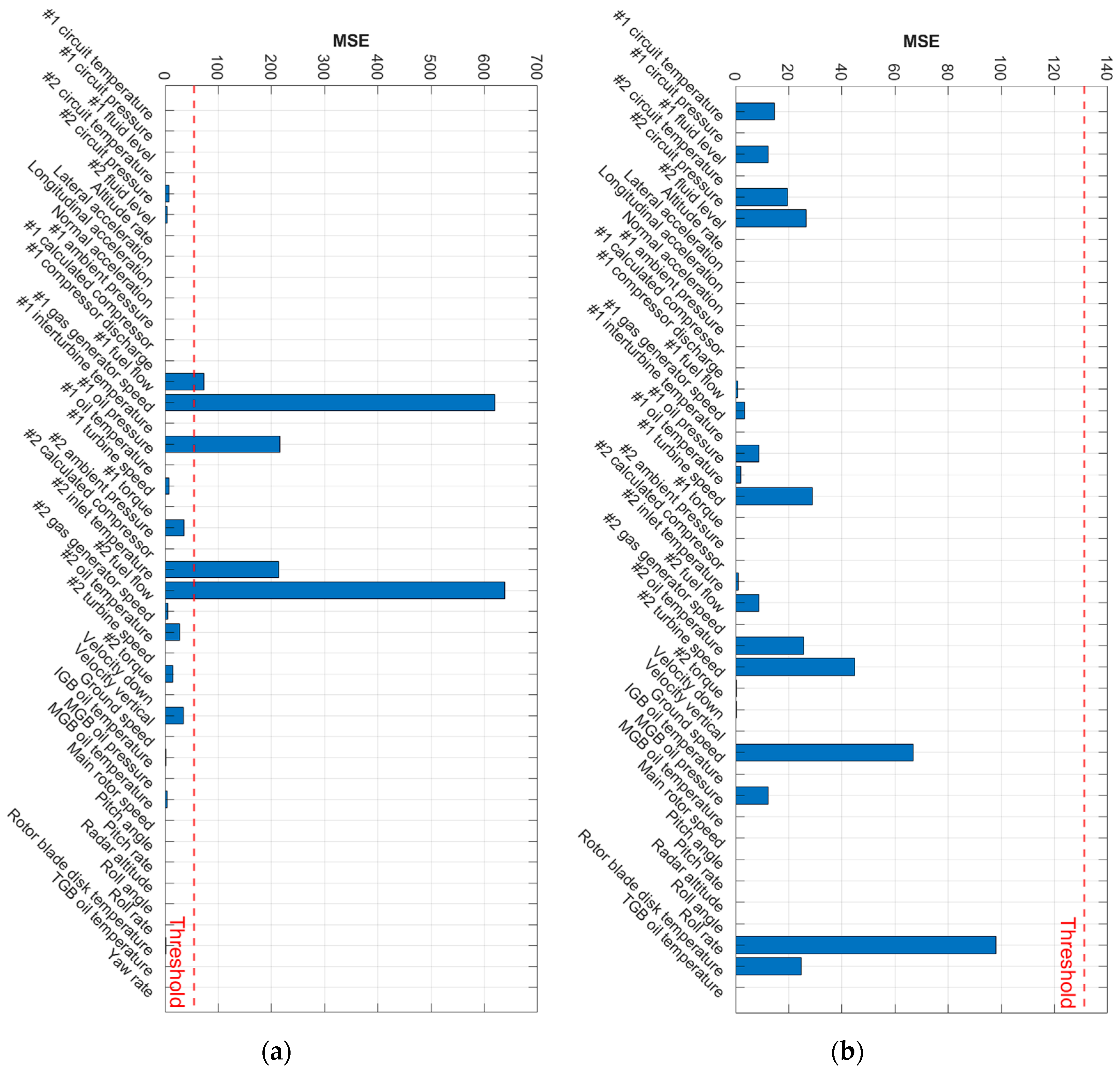
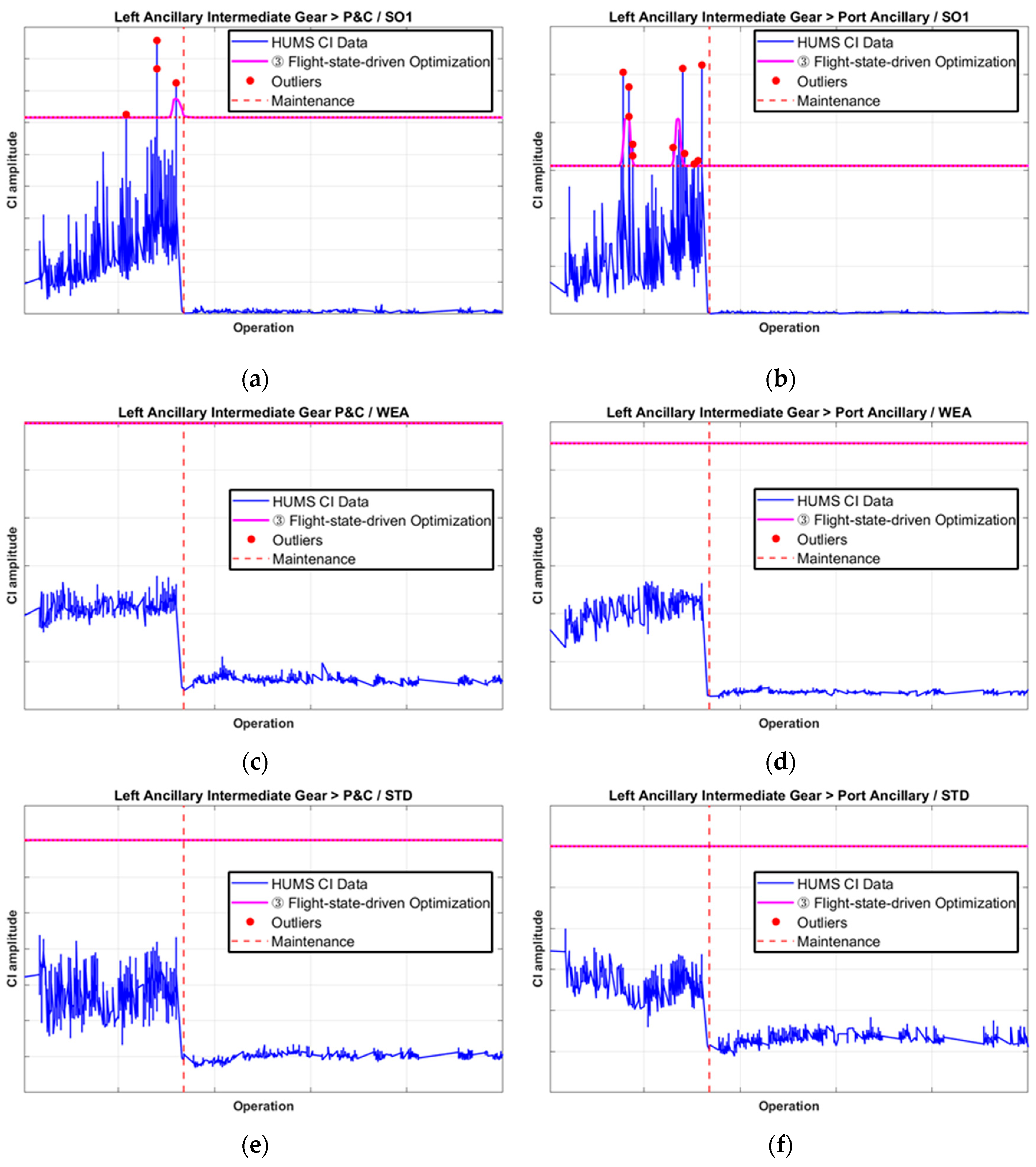
Aerospace 12 01110 g004
Figure 5. Example of variable pairs with weak correlation. (a) MN/#1 turbine temp; (b) MN/Roll angle. ‘MN’ denotes a HUMS CI defined in Table 1 (orange), whereas ‘#1 turbine temp’ and ‘Roll angle’ are flight parameters (blue). In both panels, the flight parameter and the HUMS CI are min-max normalized over time, showing limited agreement in temporal trends.
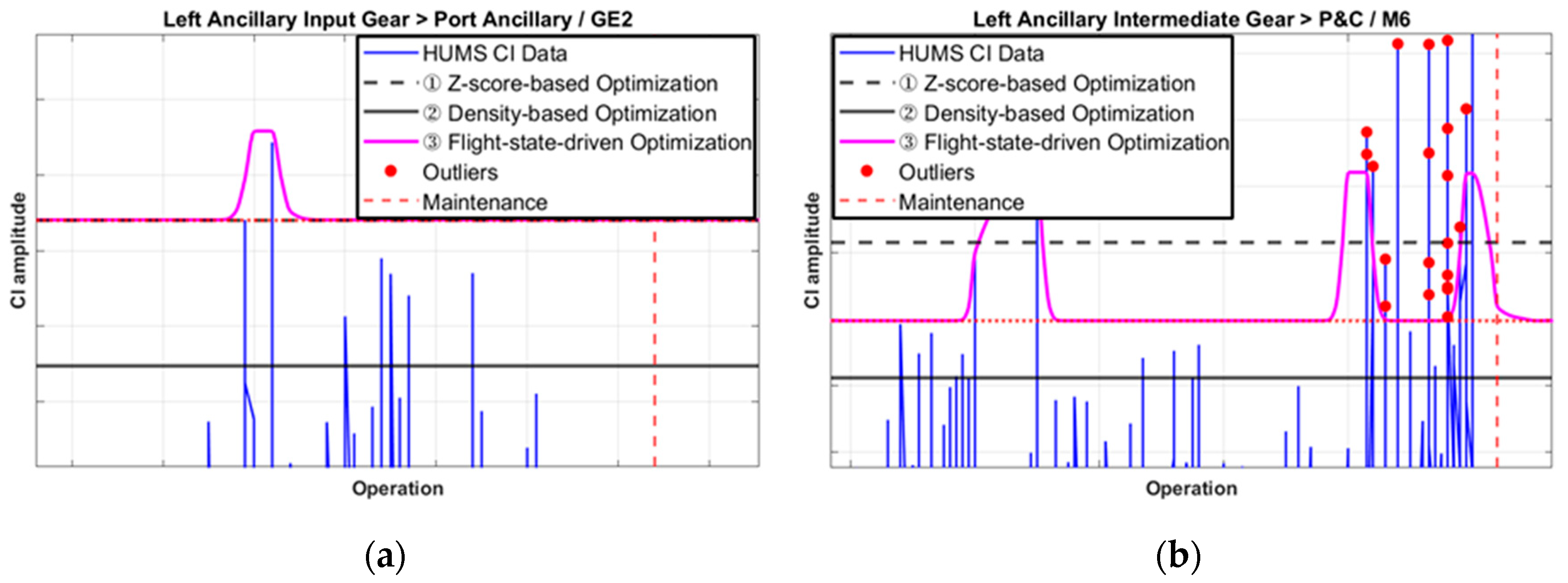
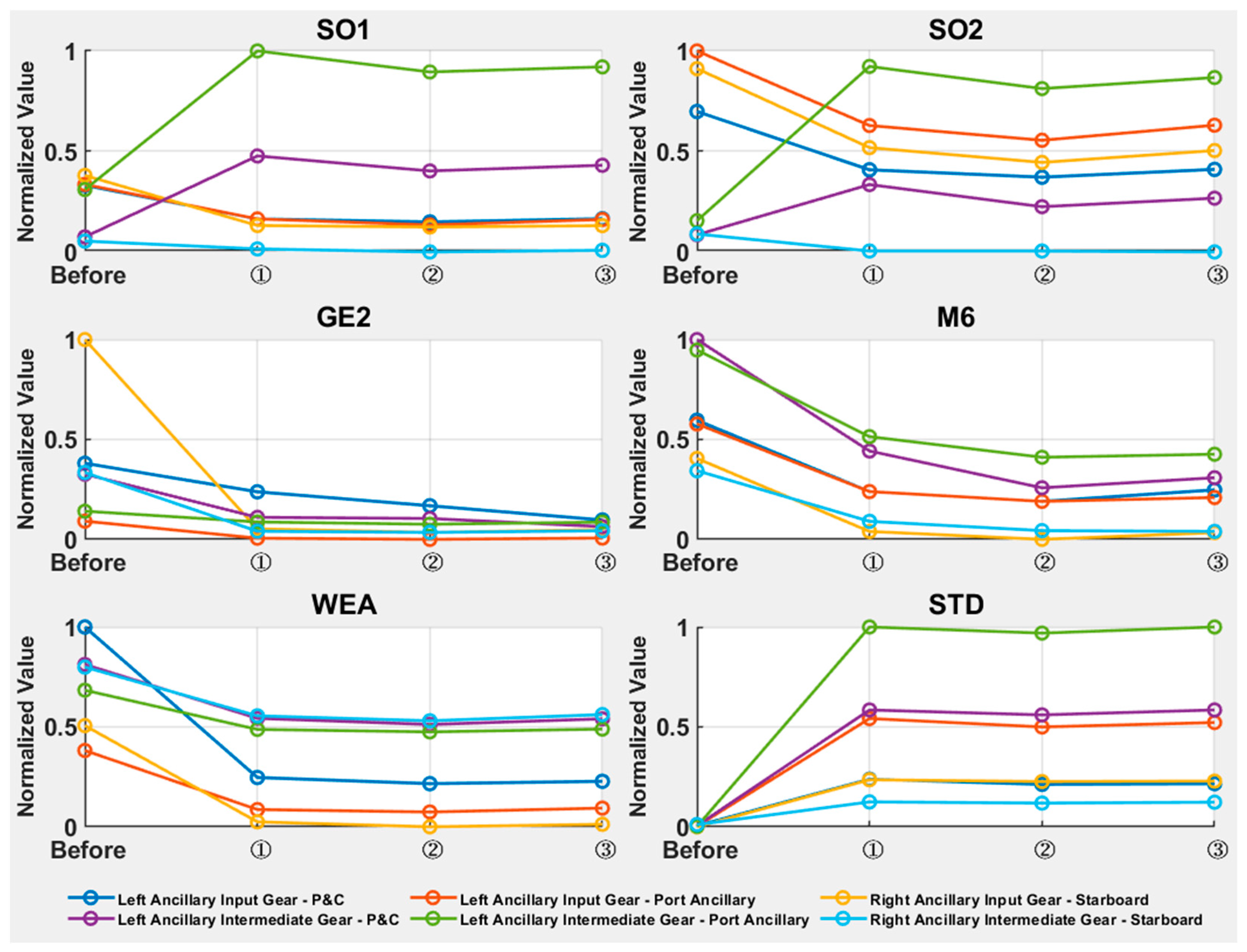
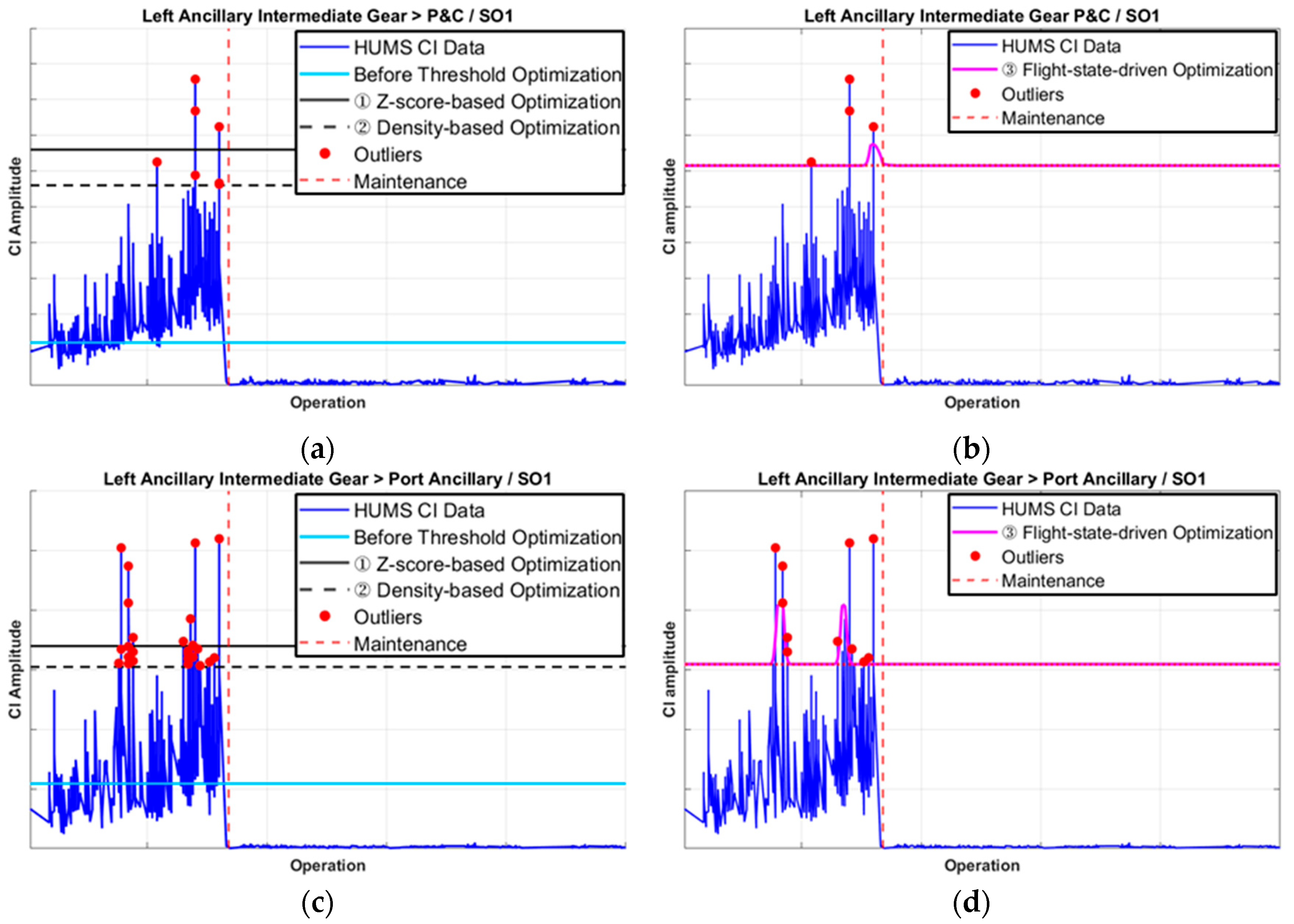
Aerospace 12 01110 g005
Figure 6. Overall workflow for CI threshold optimization, including data selection, false alarm identification, correlation analysis between flight parameters and HUMS CIs, and the three threshold optimization methods (statistics-based, density-based, and flight-state-driven).
Aerospace 12 01110 g006
Figure 7. Example of threshold optimization results for the Left Ancillary Intermediate Gear based on Z-score-based statistical and density-based filtering methods. (a) P&C/SO1; (b) Port Ancillary/SO1; (c) P&C/WEA; (d) Port Ancillary/WEA; (e) P&C/STD; (f) Port Ancillary/STD. In all panels, the blue curve shows CI amplitude versus operation, the light blue line is the legacy threshold, the black solid and dashed lines are the statistical- and density-based optimized thresholds, respectively, the red dashed vertical line marks the maintenance action, and red dots (where present) indicate samples treated as outliers.
Aerospace 12 01110 g007
Figure 8. Flowchart of the flight-state-driven threshold optimization method.
Aerospace 12 01110 g008
Figure 9. Concepts of Principal Component Analysis. The left panel shows the original 2-D data (blue points) together with several candidate projection directions (colored dashed lines) and the first and second principal components (black arrows, PC1 and PC2). The right panel shows the data projected onto each direction, where points with different colors correspond to projections onto the respective colored dashed axes in the left panel.
Aerospace 12 01110 g009
Figure 11. Example of PCA reconstruction error distribution: (a) retain (include); (b) remove (exclude).
Aerospace 12 01110 g011
Figure 12. Example of threshold optimization results for the Left Ancillary Intermediate Gear based on the flight-state-driven threshold optimization method. (a) P&C/SO1; (b) Port Ancillary/SO1; (c) P&C/WEA; (d) Port Ancillary/WEA; (e) P&C/STD; (f) Port Ancillary/STD. In all panels, the blue curve shows CI amplitude versus operation, the magenta line represents the flight-state-driven optimized threshold, the red dashed vertical line marks the maintenance action, and red dots indicate samples treated as outliers.
Aerospace 12 01110 g012
Figure 13. Specific example of optimization results based on flight-state-driven threshold optimization method. (a) Left Ancillary Input Gear > Port Ancillary/GE2; (b) Left Ancillary Intermediate Gear > P&C/M6. In both panels, the blue curve shows CI amplitude versus operation, the black dashed and black solid lines represent the Z-score-based and density-based optimized thresholds, respectively, the magenta curve represents the flight-state-driven optimized threshold, the red dashed vertical line marks the maintenance action, and the red dots indicate samples treated as outliers.
Aerospace 12 01110 g013
Figure 14. Threshold adjustment results following outlier filtering methods.
Aerospace 12 01110 g014
Figure 15. Flight-state-driven outlier removal for threshold optimization and comparison with Z-score-based and density-based methods for the Left Ancillary Intermediate Gear. (a) P&C/SO1, Z-score- and density-based thresholds; (b) P&C/SO1, flight-state-driven threshold; (c) Port Ancillary/SO1, Z-score- and density-based thresholds; (d) Port Ancillary/SO1, flight-state-driven threshold; (e) P&C/WEA, Z-score- and density-based thresholds; (f) P&C/WEA, flight-state-driven threshold. In each panel, the blue curve shows CI amplitude versus operation, the light blue line is the legacy threshold, the black solid and dashed lines are the Z-scored- and density-based optimized thresholds (where present), the magenta line is the flight-state-driven optimized threshold (where present), the red dashed vertical line marks the maintenance action, and red dots denote samples treated as outliers.
Aerospace 12 01110 g015aAerospace 12 01110 g015b
Figure 16. Example of trade-off across thresholding methods: I A C vs. B A R .
Aerospace 12 01110 g016
Table 1. Example of CI list.
ComponentCIDescription
GearSTDStandard deviation of signal average
MNAverage value of the signal
CVGDifference between signal average
SO1Balance characteristic measurement
SO2Measurement of shaft alignment imbalance
MSVibration caused by gear meshing
GE1Low frequency modulation in MS
GE2Low frequency modulation in MS
M6Impact measurement of irregular shocks
WEAVibration measurement related to gear wear
Table 2. List of gearbox components used for HUMS CI data analysis.
ComponentPosition and Function (Accelerometer)
Left Ancillary Input GearPort Ancillary
Port and Combiner (P&C)
Right Ancillary Input GearStarboard
Left Ancillary Intermediate GearPort Ancillary
Port and Combiner (P&C)
Right Ancillary Intermediate GearStarboard
Table 3. Example of maintenance record.
Maintenance CaseMaintenance Start DateMaintenance End DateInspector’s Summary Opinion
AXX July 2017XX July 2017Engine wash completed, HUMS sensor replaced/No abnormality observed
BXX August 2017XX August 2017Daily inspection, no abnormality
CXX September 2017XX October 2017Exceed HUMS threshold, vibration level increased/MGB and oil replacement completed
DXX October 2017XX October 2017Daily inspection, no abnormality
Table 4. Example of false alarm record analysis result.
Operation #Maintenance RecordAction TakenActual Fault Occurrence
1XXMGB oil filter inspectionCI alarm removedO
2XXGearbox oil replacement and oil temperature sensor checkCI alarm keptX
5XXMGB and oil replacementCI alarm removedO
Table 5. Flight parameter categories and descriptions.
Flight ParameterCountDescription
Speed9Main Rotor, aircraft speed, fuel flow, etc.
Temperature10Gearbox oil, circuit-related temperatures
Pressure3Oil and circuit-related pressures
Altitude/Position11Pitch, roll, yaw, stick position, etc.
Torque3Torque from engine or gearbox
Acceleration3Accelerometer readings from components
Fluid level2Hydraulic fluid, fuel level
Etc.4-
Table 6. Example results of Pearson and Spearman correlation coefficients between the key CI (MN) and flight parameters.
Flight ParameterMN
PearsonSpearman
Engine temperature0.1458110.705773
Circuit pressure0.9736770.949015
Fluid level−0.48511−0.321321
Table 7. Sets of flight parameters showing high correlation with CIs by component.
ComponentCIFlight Parameter
Left Ancillary Input GearMNCircuit pressureEngine temperature
MGB oil pressureMGB oil temperature
TGB oil temperatureTurbine speed
Altitude rateYaw rate
SO1Oil temperatureOil pressure
MGB oil temperatureRotor blade disk temp
Right Ancillary Input GearMNCircuit pressureOil pressure
Fluid levelIGB oil temperature
Roll angleRotor blade disk temp
MSTurbine speed
Left Ancillary Intermediate GearMNCircuit pressureFluid level
Rotor blade disk tempIGB oil temperature
Right Ancillary Intermediate GearSTDIGB temperature
MNIGB oil temperatureRotor blade disk temp
Fluid level
Table 9. CI-wise IAC and BAR for gearbox CIs under different thresholding methods.
SO1SO2GE2M6WEASTD
IACBARIACBARIACBARIACBARIACBARIACBAR
Before Optimization0.7410.0680.7410.0430.9810.0120.9810.0051.0000--
Z-score-based0.9630.0140.9630.0090.9260.0390.8700.0231.0000.0071.0000.007
Density-based0.9050.0190.9420.0170.9070.0590.7590.0380.9810.0111.0000.007
Flight-state-driven0.9260.0140.9810.0090.9440.0400.8700.0241.0000.0051.0000.004
Disclaimer/Publisher’s Note: The statements, opinions and data contained in all publications are solely those of the individual author(s) and contributor(s) and not of MDPI and/or the editor(s). MDPI and/or the editor(s) disclaim responsibility for any injury to people or property resulting from any ideas, methods, instructions or products referred to in the content.