1. Introduction
Ensuring both performance optimization and operational safety in aero-engine control systems remains a central challenge in propulsion. As performance demands on aircraft continue to rise, online performance optimization has emerged as a key means of achieving low fuel consumption and extended flight range. However, such optimization dynamically shifts the engine’s steady-state operating point, necessitating controller handovers between operating modes (e.g., steady and transient states). If not handled properly, substantial disturbances may be introduced by initial-condition mismatches, leading to command discontinuities, rotor-speed overshoot, and transient violations of critical thermodynamic limits [
1,
2]. Meanwhile, the engine’s inherently multivariable, strongly coupled, and tightly constrained nature further compounds the difficulty of achieving smooth, bumpless transfer [
3,
4].
To address the foregoing challenges, a switching architecture that combines the parallel valve-position controller (VPC) with model predictive control (MPC) is proposed. Within this framework, the VPC is responsible for steady-state multivariable performance optimization (e.g., online minimization of fuel consumption), thereby enabling efficient economic operation. In contrast, the MPC is dedicated to managing transient dynamics while rigorously enforcing prescribed limits (e.g., surge margin). The two layers are designed to be complementary across separated time scales. Nevertheless, the central bottleneck of this architecture lies in achieving a smooth, bumpless transfer between the VPC and MPC so that steady-state economic objectives and transient safety constraints can be satisfied jointly.
In engineering practice, the Min–Max selection logic and its refinements are widely employed, typically relying on hard switching or rudimentary compensation mechanisms (e.g., tunable interpolation functions [
5], multiple Lyapunov functions [
6], H∞ filters [
7], and adaptive gain compensation [
8]). However, under highly dynamic transients (e.g., emergency acceleration/deceleration), these approaches exhibit structural limitations. Their switching logic commonly depends on fixed rotor-speed thresholds, yielding delayed responses incompatible with large-inertia systems. More critically, compensator-based state synchronization is ill-suited to endogenously coordinating strongly coupled multivariable dynamics under stringent safety constraints (e.g., surge margin and over-temperature limits). These limitations motivate the VPC–MPC integrated architecture developed in this work.
Extensive hardware-in-the-loop and bench testing have shown that the ‘bump’ introduced by conventional controller handover is a primary cause of large thrust transient deviations (instantaneous deviations exceeding 15%), compressor surge, and even protective shutdowns [
9,
10,
11,
12]. Although Ling Xu et al. sought to improve smoothness through compensators or integral reset schemes [
13,
14], their effectiveness is constrained by fundamental limitations: dependence of compensation accuracy on model fidelity, the absence of an endogenous capability to handle multivariable constraints, and switching-time bias stemming from lagging decision criteria.
To overcome the inherent limitations of the Min–Max framework and the steady-state operating-point migration caused by multivariable performance optimization, this study proposes a bumpless transfer strategy based on control-input mismatch and integral compensation. The core innovation of this strategy lies in integrating two synergistic mechanisms, which together ensure switching smoothness and control effectiveness:
- (i)
Control-Variable-Driven Dynamic Switching Criterion
Unlike conventional switching rules based on fixed rotor-speed thresholds, this strategy monitors the rate of change in the core control variables—fuel flow rate Wf, nozzle throat area A8, and aft-duct ejector area A163—and quantifies their dynamic characteristics using the infinity norm. This criterion can more sensitively and accurately capture operating-point migration caused by performance optimization, providing a precise and reliable basis for controller handover.
- (ii)
Feedforward Setpoint Pre-shaping for State Alignment
A feedforward alignment scheme is designed to pre-shape the reference trajectory of the MPC, ensuring it matches the instantaneous output of the VPC. By eliminating state mismatches during the controller handover, this mechanism prevents command bumps and significantly enhances the smoothness of the switching process.
Together, these two mechanisms work in tandem to ensure that the transition between the two controllers is seamless and that the system performance is optimized during transient conditions.
The remainder of this paper is organized as follows.
Section 2 describes the dual-loop VPC–MPC architecture and the control-variable switching criterion and develops a bumpless-transfer mechanism based on control-variable alignment and feedforward correction. In
Section 3, the responses of key variables—including thrust and fuel flow—are evaluated through simulations under a representative acceleration scenario.
Section 4 concludes by summarizing the advantages of the proposed method and outlining directions for future work.
2. Control System Architecture and Bumpless-Transfer Mechanism Design
2.1. Overall Architecture of the VPC–MPC Control System
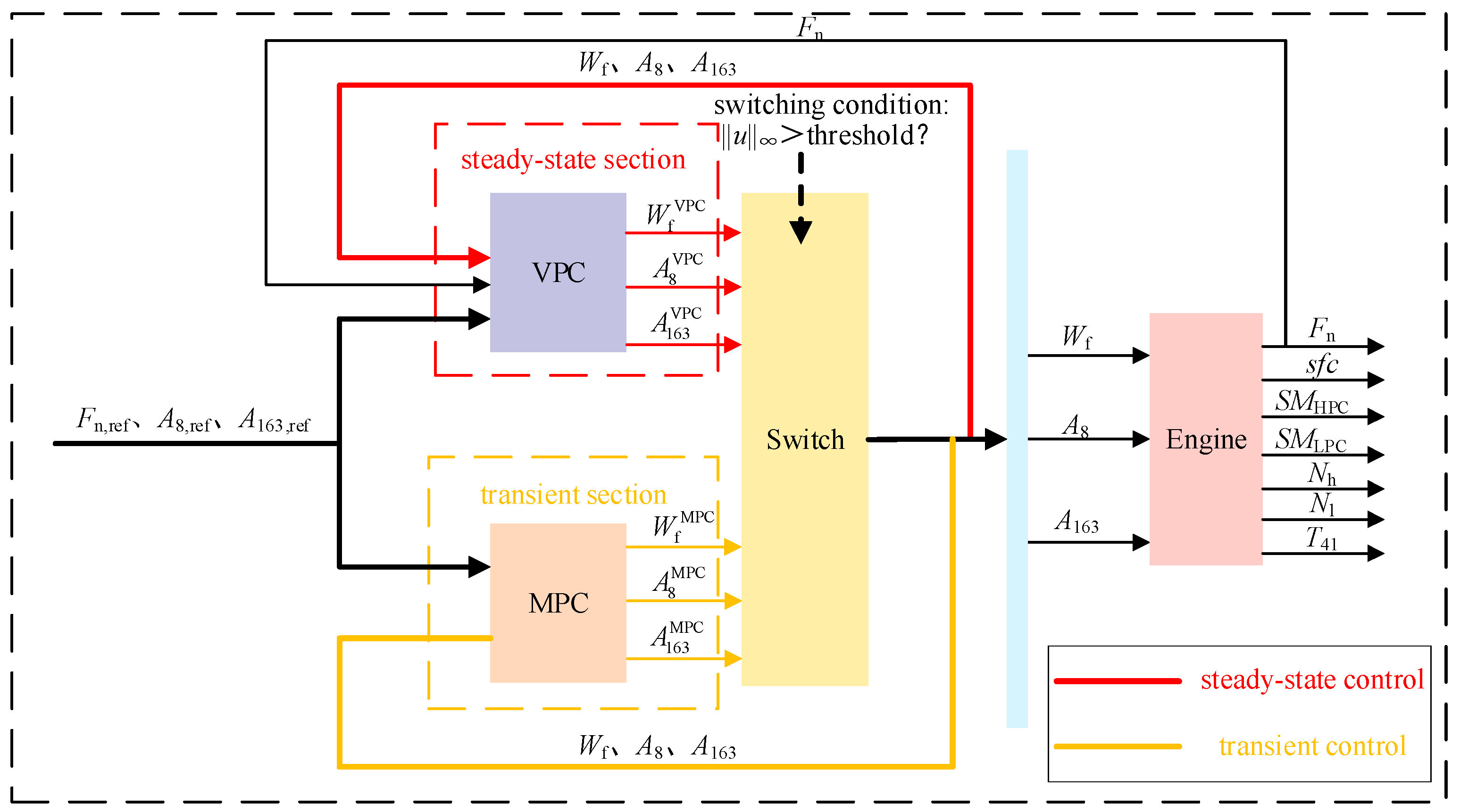
The central challenge in modern aero-engine control system design lies in reconciling steady-state fuel-economy optimization with the requirement for fast and safe transient responses. To address this challenge, an innovative dual-loop control architecture is developed, whose core is a bumpless, seamless transfer between steady-state performance-optimization control via a parallel valve-position controller (VPC) and transient regulation via model predictive control (MPC). The overall framework is depicted in
Figure 1.
Switching between VPCs and MPCs is adaptively performed according to the engine operating state. Under steady-state conditions, the VPC loop conducts online performance optimization, adjusting variable-geometry settings and other actuators to minimize fuel consumption. When a transient requiring a rapid response is detected, control is transferred seamlessly to the MPC loop, whose online optimization manages the dynamic process while strictly enforcing multivariable safety constraints (e.g., rotor-speed limits, turbine-inlet-temperature ceilings, and surge–margin boundaries).
- (1)
Operating Principle of the VPC
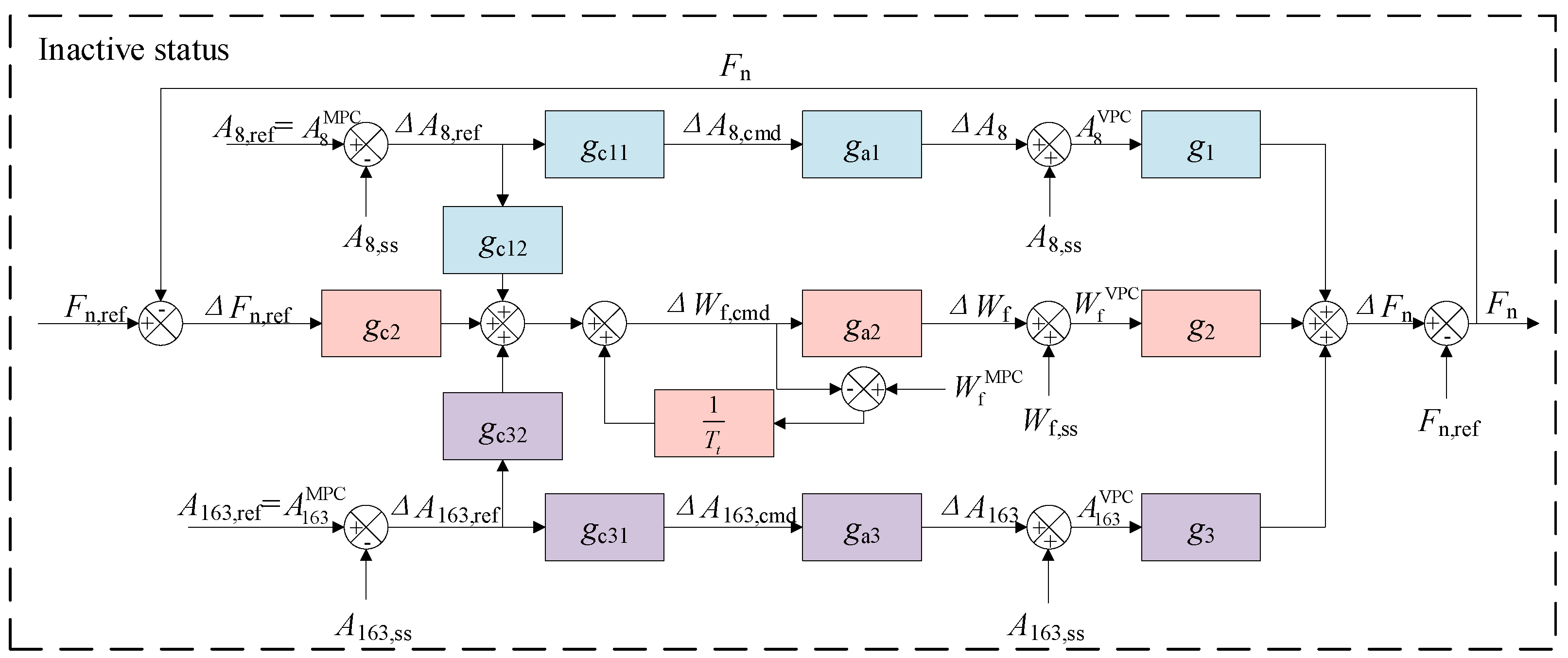
As shown in
Figure 2, the VPC is an internal controller composed of three coordinated loops: the
A8 loop built by
gc11 (with actuator
ga1 and plant channel
g1), the
A163 loop built by
gc31 (with
ga3,
g3), and the fuel
Wf loop
gc2 that performs thrust tracking (with
ga2,
g2). Following Ref. [
15], the inner loop is shaped to the open-loop target L = ω
b1/s, yielding a first-order thrust law
Gy1(
s) =
ωb1/(
s +
ωb1). To realize this,
gc2 is selected as a PI controller while
gc11,
gc31 are lead–lag (no integral) and
gc12,
gc32 are PD decouplers; the latter feed forward into the
Wf PI input to suppress the
A8/
A163 →
Fn disturbance paths. This design maintains thrust dynamics and enables the outer optimizer to adjust Δ
A8,ref and Δ
A163,ref for fuel-economy optimization without biasing thrust.
To achieve bumpless transfer during authority handover with MPC, a track-reference (TR) branch (the 1/
Tt block in
Figure 2) compares the external target
with the VPC command
uc2 ≡ Δ
Wf,cmd and injects the tracking error into the PI input. The
Wf loop is thus written as follows:
where
;
ξ is the integrator state; and
utar is the external tracking target
when MPC is in authority (VPC tracks) and
utar =
uc2 when VPC is in authority (the TR term vanishes, and the structure reduces to [
15]). In steady operation, the inner loop maintains the shaped thrust behavior while the outer loop performs Newton–Raphson optimization on Δ
A8, Δ
A163 to minimize SFC.
- (2)
Operating Principle of the MPC
The central challenge of transient control lies in maintaining system stability while satisfying safety limits under rapidly changing operating conditions. Owing to its explicit handling of multivariable coupling and input–output constraints, MPC delivers fast, constraint-compliant responses during accelerations and decelerations, outperforming gain-scheduled baselines under stringent safety bounds. Consequently, MPC affords pronounced advantages during acceleration and deceleration transients [
16]. Compared with conventional gain-scheduled control methods, the handling of rapid engine responses and stringent safety constraints is more effectively achieved with MPC; consequently, it has been widely adopted for transient control in aero- and automotive-engine applications [
17].
When MPC is in authority, it regulates the transient while enforcing multivariable constraints; when MPC is in tracking mode (i.e., VPC in authority), an external manipulated variable (MV) tracking term is used so that the MPC output remains aligned with the current VPC command, ensuring bumpless transfer. Building on standard constrained MPC formulations widely used for engine transients [
16,
17], Equation (2) is defined as the following finite-horizon program:
where
k: sampling instant; (·)k+i∣k: prediction at time k.
x: state vector; y: output vector (includes thrust Fn if used).
: MV vector;
r: output reference (typically ).
Np, Nc: prediction and control horizons.
Q ≥ 0, R > 0: weights on output error, MV rate, and MV alignment; λ ≥ 0: alignment gain.
utar,k: external MV target— in tracking (aligns to VPC); utar,k = uk in authority (term deactivates).
A, B, C: linear prediction model from local identification/linearization; box constraints encode actuator/safety limits (bounds on Wf, A8, A163, temperatures/speeds, etc.).
Remark. The third term in
Jk is the only addition beyond a standard regulator; it mirrors the VPC-side TR mechanism in
Figure 2 and guarantees a continuous MV at handover.
In summary, the synergy between VPC and MPC constitutes the backbone of the proposed architecture. However, the effectiveness of their coordination is constrained by the smoothness of the switching instant; therefore, a carefully engineered bumpless-transfer mechanism is required.
2.2. Analysis of the Bumpless-Transfer Mechanism
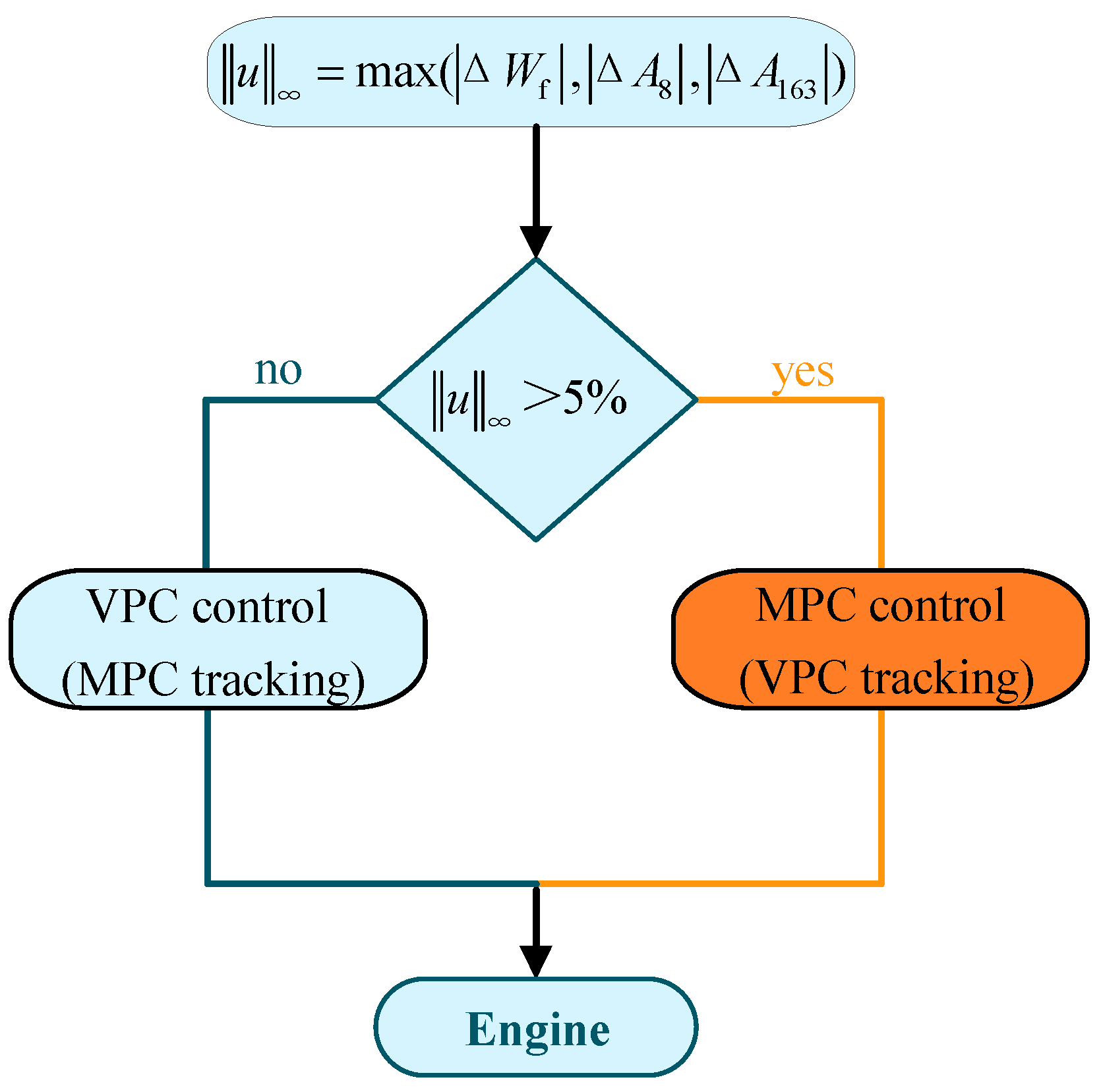
Traditional switching criteria based on fixed rotor-speed thresholds suffer from response latency and the risk of misclassification, making them unsuitable for the dynamically shifting onset and termination of transients induced by performance optimization. Accordingly, a novel multi-control-variable switching criterion is proposed. By monitoring in real-time the rate of change in the control input—quantified by the infinity norm —the need for transition from steady to transient operation can be detected more sensitively and accurately. When the monitored quantity exceeds a preset threshold, a switch from VPC to MPC is triggered, thereby providing a precise timing basis for subsequent bumpless transfer.
For the switching decision between the two controllers, the infinity norm of the control input,
, is adopted as the criterion (see
Figure 3):
We monitor the normalized control-variable activity:
where
denotes nominal magnitudes (or allowable ranges) used for normalization. A VPC → MPC handover is triggered when
ηk > 0.05 for a prescribed dwell, and the reverse handover is enabled when
ηk < 0.05. The 5% threshold is selected after normalization to be (i) consistent with Ref. [
15], which applies 5% (
A8) and 3% (
A163) perturbations for outer-loop gradient estimation, thus capturing optimization-induced operating-point migration promptly; and (ii) sufficiently above sensor/actuator ripples and small dithers so as to avoid spurious switching.
- (1)
Steady (VPC) → Transient (MPC)
When exceeds the 5% threshold, the engine is regarded as entering the transient regime, and control authority is transferred from “VPC in control, MPC tracking” to “MPC in control, VPC tracking.” Because, prior to switching, the MPC continuously tracks the VPC’s real-time outputs (including fuel-flow and variable-geometry setpoints), feedforward pre-alignment is used to pre-shape the MPC reference trajectory so that the MPC’s initial command is fully aligned with the current VPC output. The MPC then leverages receding-horizon optimization to maintain continuity of the manipulated variables while responding rapidly to thrust changes and strictly enforcing safety bounds on turbine-inlet temperature, rotor speed, and related parameters, thereby avoiding transient limit violations caused by dynamic coupling. Meanwhile, the VPC is relegated from “controller” to “tracker”, continuously monitoring MPC commands and caching state references for the subsequent reverse handover.
- (2)
Transient (MPC) → Steady (VPC)
When falls to within 5% and remains stable, the operating condition is classified as steady-state, and a gradual handover is initiated from “MPC in control, VPC tracking” to “VPC in control, MPC tracking.” Prior to switching, the VPC—by tracking the MPC outputs—has precomputed the targets for steady-state performance optimization (e.g., the parameter settings at the minimum-fuel operating point). During the transfer, the MPC command is steered toward the VPC’s optimization objective, while the VPC’s inner thrust-feedback loop makes real-time fine adjustments to fuel flow and variable-geometry parameters. This mechanism—pre-tracking to establish state linkage, followed by state alignment at the switching instant—both preserves MPC’s strict supervision of the transient and enables a bumpless initiation of VPC-based steady-state optimization, ultimately settling the engine at an economically optimal operating point.
Both switching directions use the threshold as the triggering core. By employing a pre-tracking strategy, state linkage between the two controllers is established in advance; at the handover, feedforward alignment together with a gradual transfer of authority is used to achieve bump-free commands, thereby, in principle, eliminating the risk of control discontinuities while balancing the need for rapid transient response with steady-state fuel-economy optimization.
3. Simulation Studies and Performance Evaluation
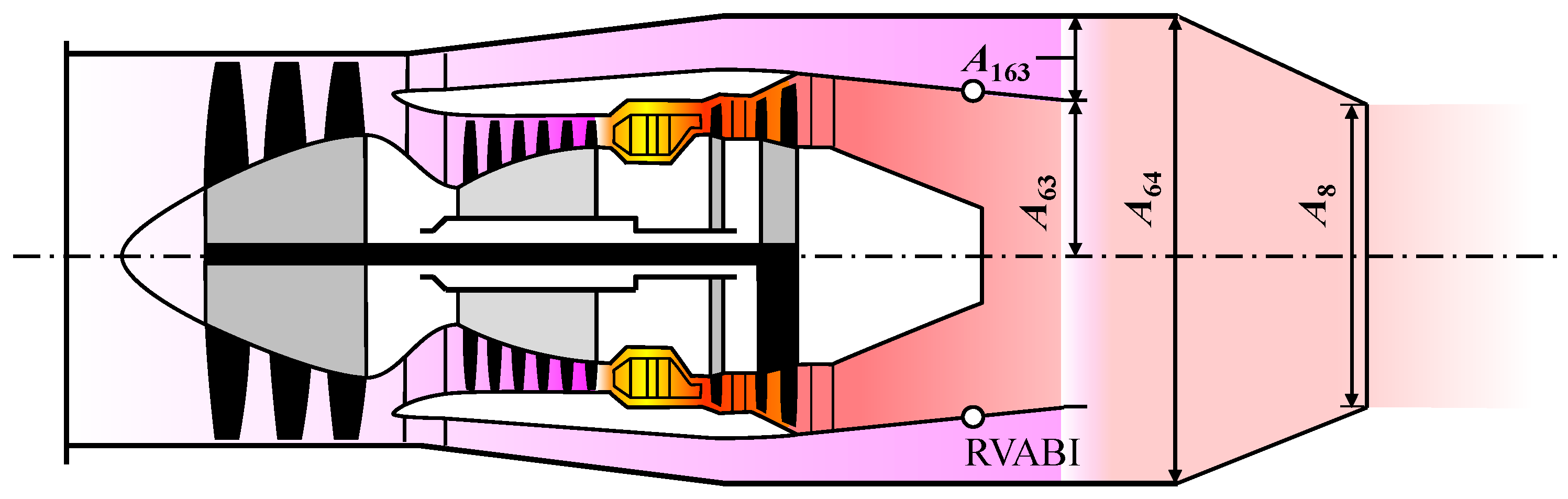
To verify the practical effectiveness of the proposed bumpless-transfer control strategy, a representative nonlinear simulation model of a mixed-flow turbofan engine equipped with an aft-duct ejector was constructed in MATLAB 2024b/Simulink, as illustrated in
Figure 4.
The engine deck used in this work defines the design point (DP) as the rated maximum-thrust condition of the selected variable-cycle turbofan, namely a net thrust of 84.51 kN with spool-speed ratings Nh = 15,000 r/min and Nl = 9000 r/min; these DP values are also used to normalize the reference areas A8,DP and A163,DP when building the constant-thrust SFC maps. A convergent nozzle is assumed because the study focuses on near-ground subsonic operation (Alt = 0.4 km, Ma = 0.8). For controller identification and subsequent tests, we operate at 75% of the DP thrust, which keeps the plant within the linear region while preserving safety margins.
α8 denotes the exhaust nozzle throat area opening:
α163 denotes the aft-duct ejector opening:
Operating Conditions and Simulation Analysis of Representative Scenarios
The simulation scenario is an acceleration maneuver under near–sea-level, standard-atmosphere conditions, with the engine initially stabilized at a low-speed operating point. Model parameters are set to representative rated values, and practical constraints on key variables—high- and low-pressure rotor speeds, turbine inlet temperature
T41, and compressor surge margin—are enforced. The control system employs the proposed dual-loop VPC–MPC architecture; switching is triggered by a control-variable criterion based on the
ℓ∞ norm of the normalized increments of
Wf,
and
, with hysteresis and a dwell time. Smooth transitions are ensured by a symmetric MV-alignment mechanism: on the VPC side, the track-reference branch in
Figure 2 (Equation (1)) makes the fuel-loop PI output follow
at VPC → MPC handover; on the MPC side, the cost in Equation (2) includes an MV-alignment term with
in tracking. Together with rate/box constraints and actuator dynamics, these provisions keep manipulated variables continuous and prevent chatter. The total simulation time is 100 s, with emphasis on the dynamic response during rapid acceleration from cruise to maximum thrust.
The simulation scenario is configured such that the thrust command is rapidly increased from an initial low-power condition, emulating a pilot swiftly advancing the thrust lever to maximum.
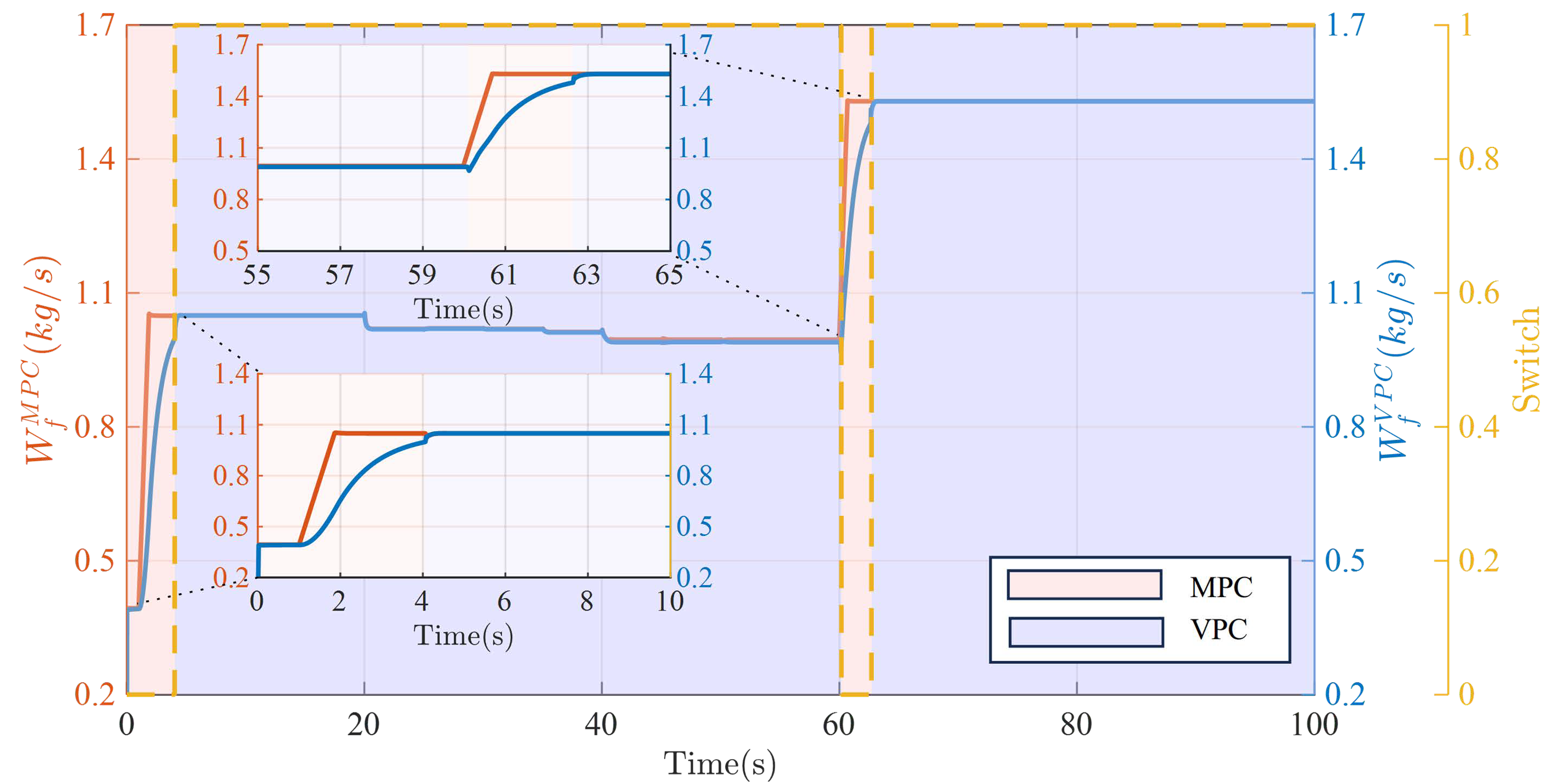
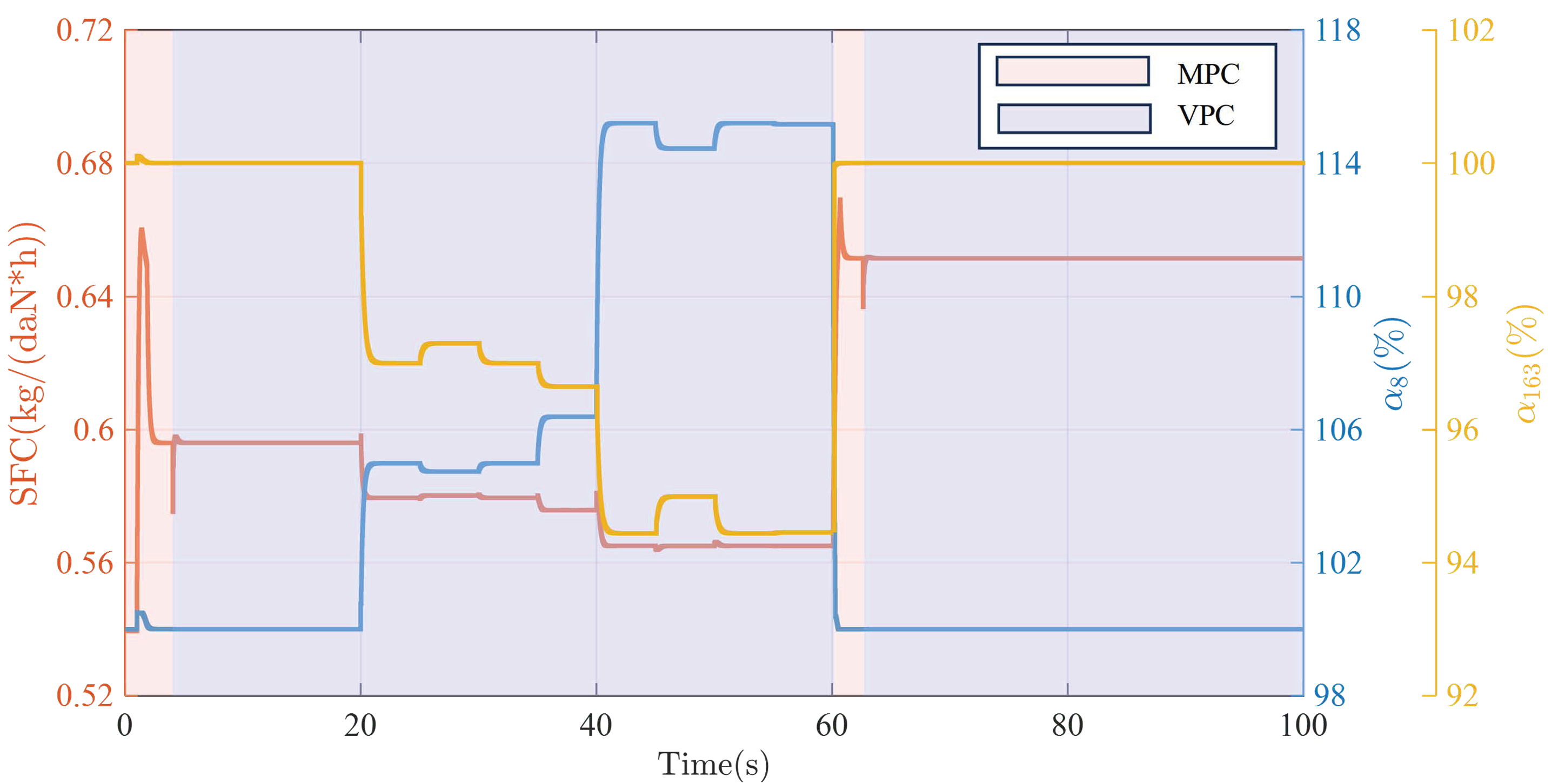
Figure 5,
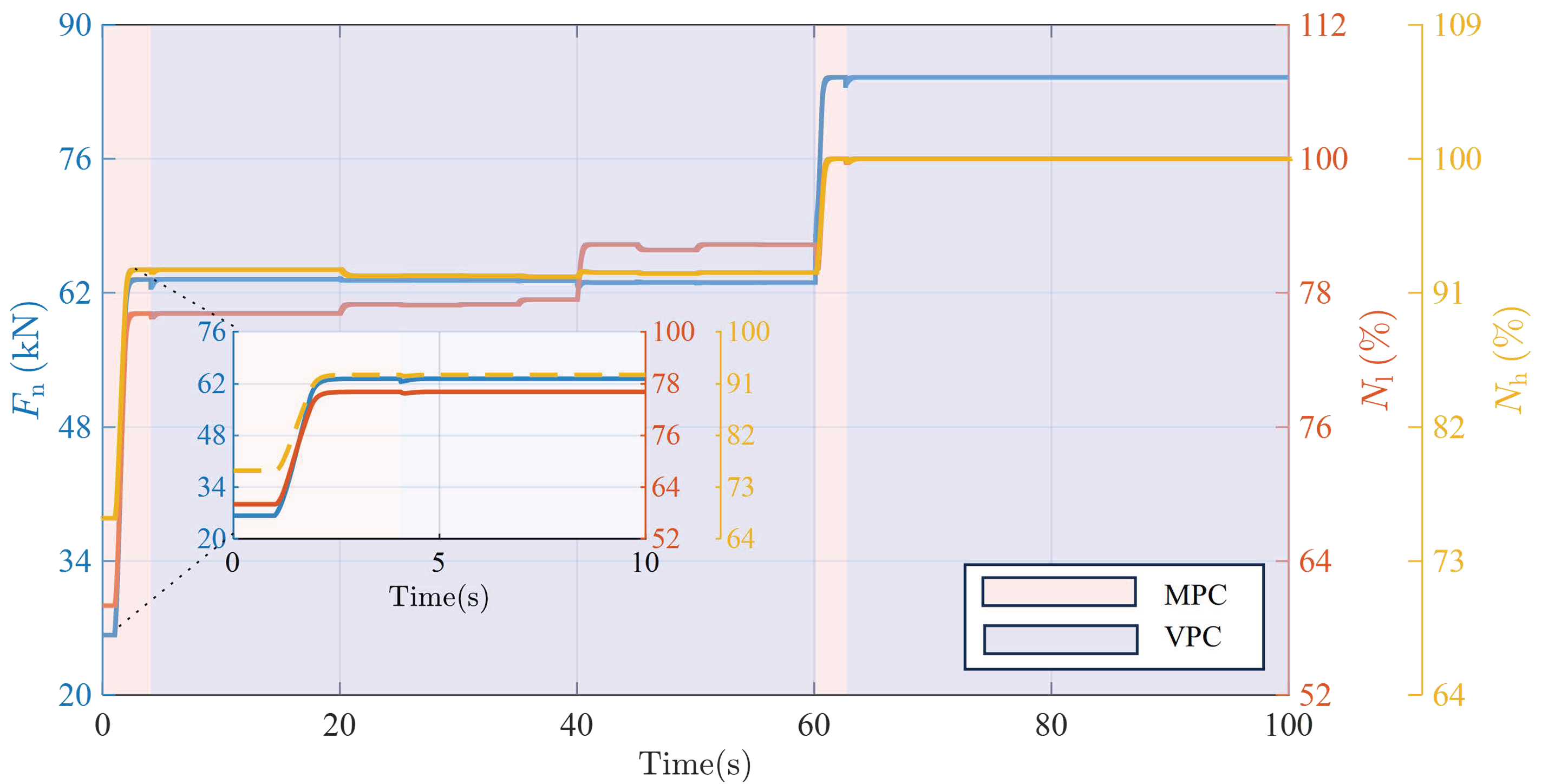
Figure 6,
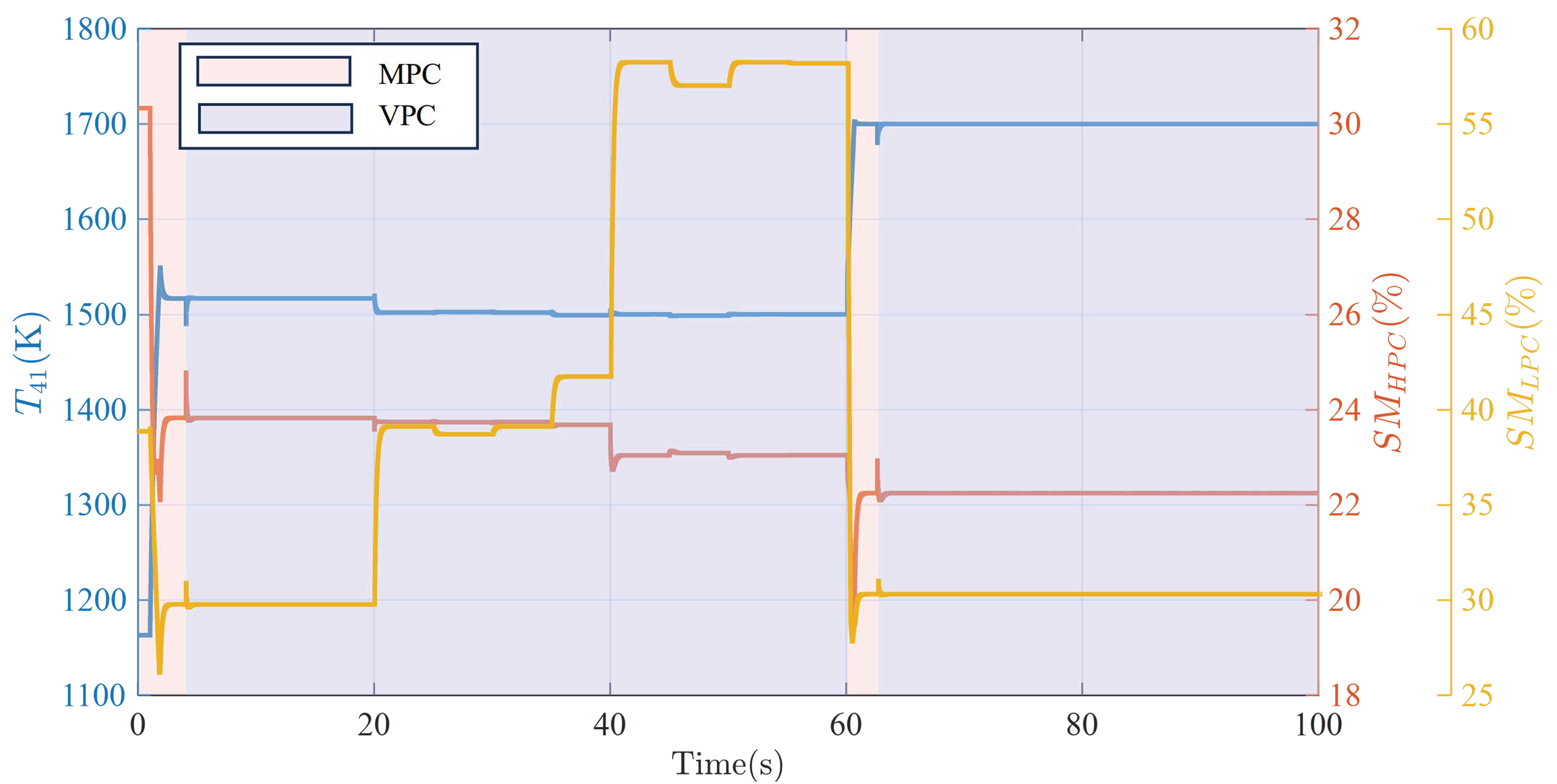
Figure 7 and
Figure 8 present the dynamic evolution of key indicators, including fuel-flow tracking and controller switching, engine thrust and rotor speeds, critical thermodynamic variables and safety margins, as well as fuel consumption and efficiency metrics.
Specifically,
Figure 5 illustrates the commanded fuel flow (
Wf), its tracking performance, and the controller mode transitions. The command was rapidly raised from approximately 0.39 kg/s to 1.05 kg/s, held briefly, and subsequently increased to 1.55 kg/s, indicating a two-stage step-up in thrust demand. The switching signal clearly indicates bumpless VPC ↔ MPC handovers at 4.04 s and 60.08 s. The fuel-flow command is tracked without discernible discontinuities, highlighting the continuity benefit of the proposed mechanism.
Figure 6 analyzes the dynamics of specific fuel consumption (SFC) and efficiency-related variables (
α8,
α163). SFC exhibits a brief increase at the onset of acceleration; however, after approximately 20 s, steady-state performance optimization via the VPC is engaged and progressively improves the operating condition. SFC then decreases and ultimately stabilizes at about 0.56 kg/(daN·h), corresponding to a reduction of approximately 5.03%, while efficiency indicators improve markedly. These results highlight that, under steady conditions, the VPC effectively optimizes fuel economy and component-level efficiency.
Figure 7 depicts the responses of engine thrust (
Fn) and the high- and low-pressure rotor speeds (
Nh,
Nl). Following the step command, both thrust and speeds increase rapidly and settle at their targets with a smooth transient, exhibiting no appreciable overshoot or oscillation. This favorable dynamic performance is attributed to the precise switching criterion and the MPC’s feedforward setpoint alignment (state alignment) technique.
Figure 8 presents thermodynamic variables and safety margins in detail, including the turbine inlet temperature (
T41) and the surge margins of the high- and low-pressure compressors (
SMHPC and
SMLPC).
T41 rises rapidly but remains safely below 1700 K; the HPC surge margin decreases yet stays within controllable limits, whereas the LPC (fan) surge margin increases slightly. Throughout the maneuver, all margins stay within prescribed limits. These results indicate that the MPC strategy effectively prevents overtemperature and surge-margin encroachments, thereby ensuring safe dynamic engine operation.
Across the acceleration scenario (specific changes in performance indicators are as shown in
Table 1), the proposed VPC–MPC scheme achieves bumpless transfers with a maximum thrust deviation of ≤1.5%, while maintaining continuous fuel-flow commands and respecting actuator rate/box limits. After steady operation is re-established, the SFC decreases by ≈5.03% and stabilizes, whereas efficiency-related settings
α8,
α163 converge smoothly. Safety-critical variables remain within bounds throughout the maneuver—
T41 < 1700 K, and both HPC/LPC surge margins stay inside prescribed limits. The VPC ↔ MPC transfers occur at 4.04 s and 60.08 s, with no observable command bumps (see).
In summary, the simulations verify the effectiveness of the proposed VPC–MPC bumpless-transfer strategy under a representative acceleration scenario. Precise, bump-free handovers ensure continuous thrust and fuel-flow responses, while steady-state optimization yields measurable reductions in SFC and improves component-efficiency metrics. Collectively, these outcomes deliver concurrent gains in steady-state fuel economy and transient safety, conferring high practical engineering value.
4. Conclusions
We proposed a bumpless transfer strategy to mitigate disturbances induced by steady-state operating-point migration during online performance optimization. Built upon control-variable deviation analysis (Wf, A8, A163) and feedforward integral compensation, the dual-loop VPC–MPC architecture employs a dynamic handover criterion to pinpoint transient onset/termination and a feedforward setpoint-alignment to pre-align controller states. In simulations, thrust deviations at handover remain within 1.5%, fuel-flow continuity is markedly improved, VPC reduces SFC by 5.03%, and MPC rigorously enforces thermal and surge constraints.
Despite favorable control performance and simultaneous gains in economy and safety observed in the simulation, broader validation is required prior to practical deployment. Future work will therefore focus on (i) expanding the test envelope—e.g., high-altitude and extreme-temperature conditions—and assessing robustness and parameter sensitivity using higher-fidelity digital-twin engine models; (ii) improving real-time capability by reducing the online computational burden of MPC through lightweight receding-horizon formulations, with feasibility evaluated via hardware-in-the-loop experiments; and (iii) strengthening safety mechanisms by integrating fault diagnosis and fault-tolerant control to enhance disturbance rejection during switching, and by exploring deep-reinforcement-learning-based adaptive tuning of switching parameters. Subsequent efforts will concentrate on model refinement, algorithmic acceleration, and safety enhancement to facilitate engineering applications.