Article

Field-Relevant High Stokes Number Study of Particle Impacts in High-Speed Compressor via Engine Test


Advanced Propulsion and Power Laboratory, Virginia Tech, Blacksburg, VA 24061, USA
*
Author to whom correspondence should be addressed.
Aerospace 2025, 12(12), 1038; https://doi.org/10.3390/aerospace12121038
Submission received: 1 October 2025 / Revised: 14 November 2025 / Accepted: 15 November 2025 / Published: 23 November 2025
(This article belongs to the Section Aeronautics)

Abstract

Exposure of propulsion gas turbines to inlet flow contaminated with dust, sand, or ash particulates can lead to a myriad of complex and interrelated damage modes that reduce engine operational life, increase maintenance costs, and pose a safety risk to passengers and hardware assets. Experimental and computational research is ongoing to better understand the fundamental physics underlying this phenomenon, but data from full-scale engine tests with particles are needed for anchoring and validation under fully representative conditions. In this study, compressor blade/particle interactions are investigated at field-relevant conditions using Rolls-Royce/Allison M250-C20C turboshaft engines in an instrumented engine test cell. A novel experimental dataset was produced, yielding a qualitative visualization of particle impact regions on blades and vanes of an on-engine full six-stage axial compressor at transonic tip speeds for two particle compositions and two inlet particle delivery configurations. This investigation contributes the first experimental dataset of its kind for a rotating frame at transonic blade tip speeds (nominal Mach 1.0). By comparing the resulting impact patterns produced in this work to those of fielded hardware, it is shown that for field-relevant high-Stokes number particle conditions at the first-stage rotor, particle/engine dynamics simplify significantly due to ballistic inertial particle behavior. In addition, the spatial distribution of particle concentration and particle velocities across the compressor inlet plane was found to have only minor effects on the resulting particle/blade impact patterns for the two dust injection configurations tested.

1. Introduction

Gas turbines, when subjected to sand-, ash-, or dust-laden inlet conditions, can experience decreases in power production and efficiency, accelerated need for maintenance, and higher risk of failure. Particle-related cold-section degradation is typically characterized by erosion-induced mass loss [1,2,3,4,5] and geometry changes in rotating and stationary blading [1,2,3,4,5,6,7,8,9,10], resulting in loss of aerodynamic efficiencies [6,10,11,12], reduction of surge margin [7,9], and corresponding decreases in system-level engine performance [8,9,13]. Many parameters have been identified as having first-order effects on compressor erosion, including the particle size distribution (PSD) [14,15], particle material properties, blade speed [15,16], and compressor geometry/material properties [1]. The evolution of particle size and shape through a multi-stage compressor due to particle breakage has also been posed as an important factor, especially for downstream stages where the impinging PSD is largely unknown [17,18,19,20,21].

1.1. Previous Experimental Research Using Rigs, Engine Tests, and Fielded Hardware

Although efforts have been ongoing to address this engine safety and durability problem, a deficit still exists in the basic understanding of blade/particle interactions from the perspective of full-scale engine tests. A great deal of numerical simulation has been done over the years to gain insights into how particles behave in compressor/turbine flow paths [3,6,11,12,13,14,15,16,22,23,24,25,26]. However, there have been relatively few direct comparisons of these simulated outcomes to experimental results at fully representative conditions. This is likely due to (a) the difficulty involved in generating rig-based engine-relevant speeds, flow, and particle feeding conditions, and (b) the inherently prohibitive cost and complexity of conventional full-engine particle ingestion experiments. Despite these obstacles, rig tests such as the work of Tabakoff et al. [5,11,12,14,22,27], Leithead et al. [1,2,3], Ghenaiet et al. [10,28], and others such as [29,30,31,32] have yielded strong conclusions and scientific learning of this complex research topic. Some works have focused on blade geometries and engine-simulated flowfields, while others have taken a different approach by employing coupon tests to investigate the fundamental physics of particle rebound and erosion of various substrates as functions of impingement angle, particle type, particle speed, etc. It is worth noting that detailed experimental data for particle/compressor interactions in high-speed rotating-frame flows is scarce in the literature, specifically in the transonic blade tip speed regime. The rotating compressor rig particle ingestion work of Ghenaiet et al. [10,28] and Leithead et al. [1,2,3], for example, reached tip Mach numbers of roughly 0.3 and 0.5, respectively.
Many full-engine particle ingestion tests have been done by industry- and government-led research efforts, such as the volcanic ash ingestion testing done by the NASA Vehicle Integrated Propulsion Research (VIPR) test program [33,34,35,36,37,38,39,40]. However, only a limited portion of these results have been published in the open literature. For example, Kilchenstein et al. [8] investigated performance degradation of a Rolls-Royce T56-A7-B turboprop to assess how the presence of a protective coating influences the detailed progression and morphology of compressor degradation. Dunn et al. [9,41,42] conducted particle ingestion degradation tests on a series of Pratt & Whitney TF33 turbofans for a similar purpose, highlighting bulk erosive-material loss regions on compressor blading, and tracking system-level performance losses. For the other literature on full-engine particle ingestion tests, the authors invite the reader to examine references [8,9,17,21,41,42,43,44,45,46].
Compressor erosion characteristics have also been studied for fielded engines [7,21,23,47,48,49,50,51,52], such as in the work of Dvirnyk et al. [7], where 4800 compressor blades from forty fielded TV3-117VM/VMA Soviet-era turboshafts were analyzed, and it was found that changes in blade resonant frequencies and surge margin had occurred. Another example of particle/engine dynamics research using fielded hardware is presented by Kolkman [47], who presents a particle impact visualization on the first-stage rotor of a fielded variant of the Rolls-Royce/Allison M250 turboshaft engine. In this case, field exposure to airborne particulates during 200 h of service powering an MBB Bo 105 helicopter in Western Europe caused partial removal of an experimental aluminum-pigmented erosion-resistant coating which had been applied to the compressor blades. The resulting patterns show regions of predominant particle impacts and erosion. Noting that this is the same basic type of engine used in the present study, these field results are considered in more detail subsequently.
One of the major limitations of field-based damage analysis is that detailed scientific information about the causative particle ingestion parameters, such as the ingested PSDs and concentrations, and the total ingested dosages, is often unknown, hindering the development of first-principles fundamental understanding. Overall, particle ingestion in gas turbines has proven challenging to model numerically and non-trivial to study experimentally on full engines. Engine tests in the literature have also generally focused on system-level degradation rather than the fundamental underlying science. Thus, more work is needed linking models and rig experiments to fully representative on-engine compressors for scientific learning and model validation.

1.2. Test Methodology for Particle Ingestion Research Using Full-Engines

Part of the reason why the topic of particle ingestion has proven elusive to understand is that the associated experimental research presents some significant inherent challenges. It is well known that the particle composition and PSD play key roles in determining cold section erosion. In addition, variables such as particle concentration per unit gas volume, total duration (e.g., dose) of particle ingestion, and compressor shaft operating speed all play important roles in determining the resulting dynamics. Each of these parameters represents a continuous (or nearly continuous) set of possible values, each combination of which may theoretically be seen by engines in field operation. The classical design-of-experiments approach to investigating the interplay among these input variables and the output degradation results would understandably necessitate an impossibly large number of tests, even for a select sampling of only a few key values of each parameter. To compound this limitation, particle ingestion engine tests in the industry and literature are typically very costly in time and money and yield limited increases in fundamental understanding. This greatly limits the ability of researchers to generate actionable conclusions and advance fundamental scientific understanding from traditional experimental engine test campaigns.
The authors believe that by strategically leveraging leading indicators of damage and small-engine tests for this fundamental research, many of these challenges and limitations can be overcome. This approach opens new opportunities for advancing the state of the art for engine testing methods, particle ingestion research, and modeling.
An example of a leading indicator of damage, leveraged in the present study, is the erosive removal of a thin visualization coating applied to the compressor interior surfaces. By observing the spatially resolved regions of coating removal, useful information can be gained without requiring erosive degradation of the compressor hardware. Ghenaiet et al. [10,28] applied a similar experimental method to blades in a single-stage compressor rig by applying four layers of conventional spray paint, each having a different color. The resulting patterns were used to identify regions of significant erosion after particle ingestion tests having durations on the order of hours, and these coating results were then used to validate numerical particle trajectory/erosion models [10,26,28,53,54]. The blade tip speeds in these experiments were relatively low, around 100 m/s or about half to one-third of the transonic speeds encountered by the compressor blade tips in the M250-C20C at high power. Brun et al. used a similar coating visualization method to qualitatively validate a particle impact model, in which a single abradable coating was applied to a single-stage centrifugal compressor rig as a means of determining the regions of predominant particle impacts [55,56]. As discussed in more detail in Section 2.3, the present study advances these methods by employing machinist’s layout fluid [57], which can be removed by even single particle impacts, enabling a more direct experimental approximation of the locations of particle impacts on the hardware, compared with thicker coatings whose patterns depend on the erosive intensity of impacts. Also, the visualization methods in the present study were able to yield experimental results after only 3 min of low-concentration particle ingestion at blade tip Mach numbers of roughly 1.0, resulting in no measurable erosion of the compressor hardware, with no change in engine performance. This test capability can be used to support the generation and validation of first-order predictive models.

1.3. Objective of the Present Study

The primary goal of this paper is to present a series of experimental test results obtained from a set of spatially resolved particle impact patterns for a full six-stage axial compressor having transonic blade tip speeds, and to draw out the associated learning and implications. In particular, for field-relevant conditions at the first-stage rotor, the physics of particle/blade interactions simplify greatly up to the point of first impact due to high local Stokes numbers. This behavior is observed to be robust to a variety of inlet conditions for the engine architecture studied, including an example of fielded hardware from the literature. These results not only yield informative observations about the physics involved at field-relevant conditions but can also in principle provide an experimental dataset to support the development of more accurate and computationally efficient reduced-order modeling approaches for predicting particle ingestion effects such as transport, erosion, and breakage models.
Rolls-Royce M250-C20 series helicopter turboshaft engines (Rolls-Royce Corporation, Indianapolis, IN, USA) are being used in an engine test cell at Virginia Tech to experimentally investigate cold-section particle ingestion physics and damage mechanisms via full-scale dust ingestion engine tests [17,58,59,60]. This experimental work is part of a multi-project research effort funded by the US Office of Naval Research, Rolls-Royce, and Pratt & Whitney. The architecture of these M250 engines features a removable compressor stator half-casing, which offers unique and easy access to the full six-stage axial compressor rotor for measurements and inspections while the engine is on-stand. The research program seeks to leverage innovative experimental techniques on this opportune architecture to generate new learning about the governing damage mechanisms from a holistic system-level perspective, and to develop novel test methodologies and instrumentation that impact industry engine testing. The research effort involves an interdisciplinary academic collaboration among Virginia Tech’s Advanced Propulsion and Power Lab [61], Petrology Lab [62], and Transport Phenomena Lab [63], as well as the government and industry partners listed above.
It is important to note that the objective of these experiments is not to precisely reproduce field conditions and associated observations. Conditions such as the inlet particle spatial distribution and particle initial velocities on the test stand certainly diverge from those typically seen by engines in the field. Ingestion of pure mineral types with narrow PSDs at single operating conditions further diverge from field expectations. Rather, the primary objective of these engine test experiments is to strike a balance between replicating key characteristics of field damage, while also maintaining tightly constrained boundary conditions that will better facilitate fundamental scientific learning and future model development/validation. This enables a full-engine, holistic approach to investigating the physics and the relative importance of different parameters over different functional regimes to advance understanding of particle/engine interactions.

2. Experimental Methods

2.1. Experimental Setup and Test Matrix

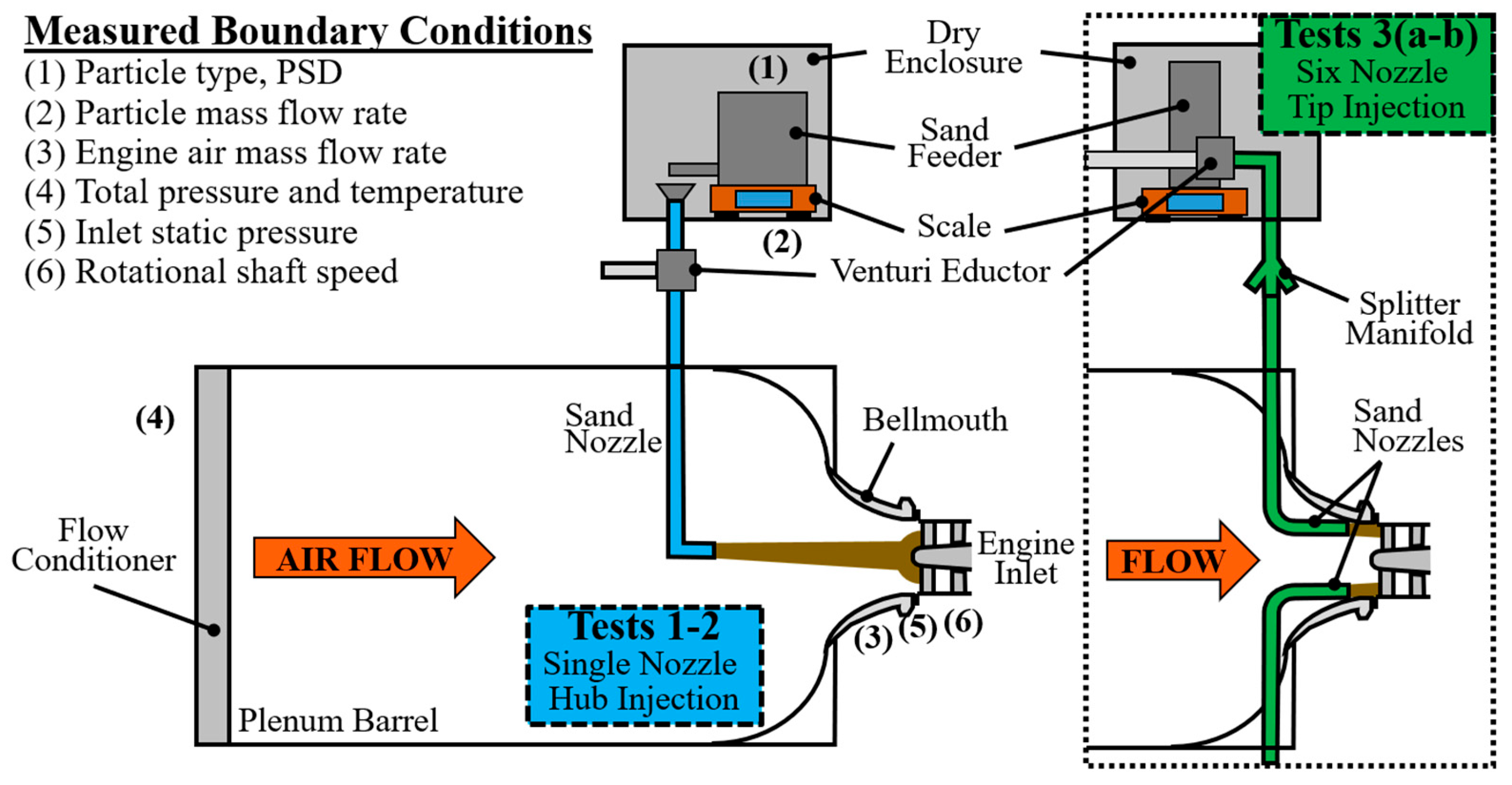
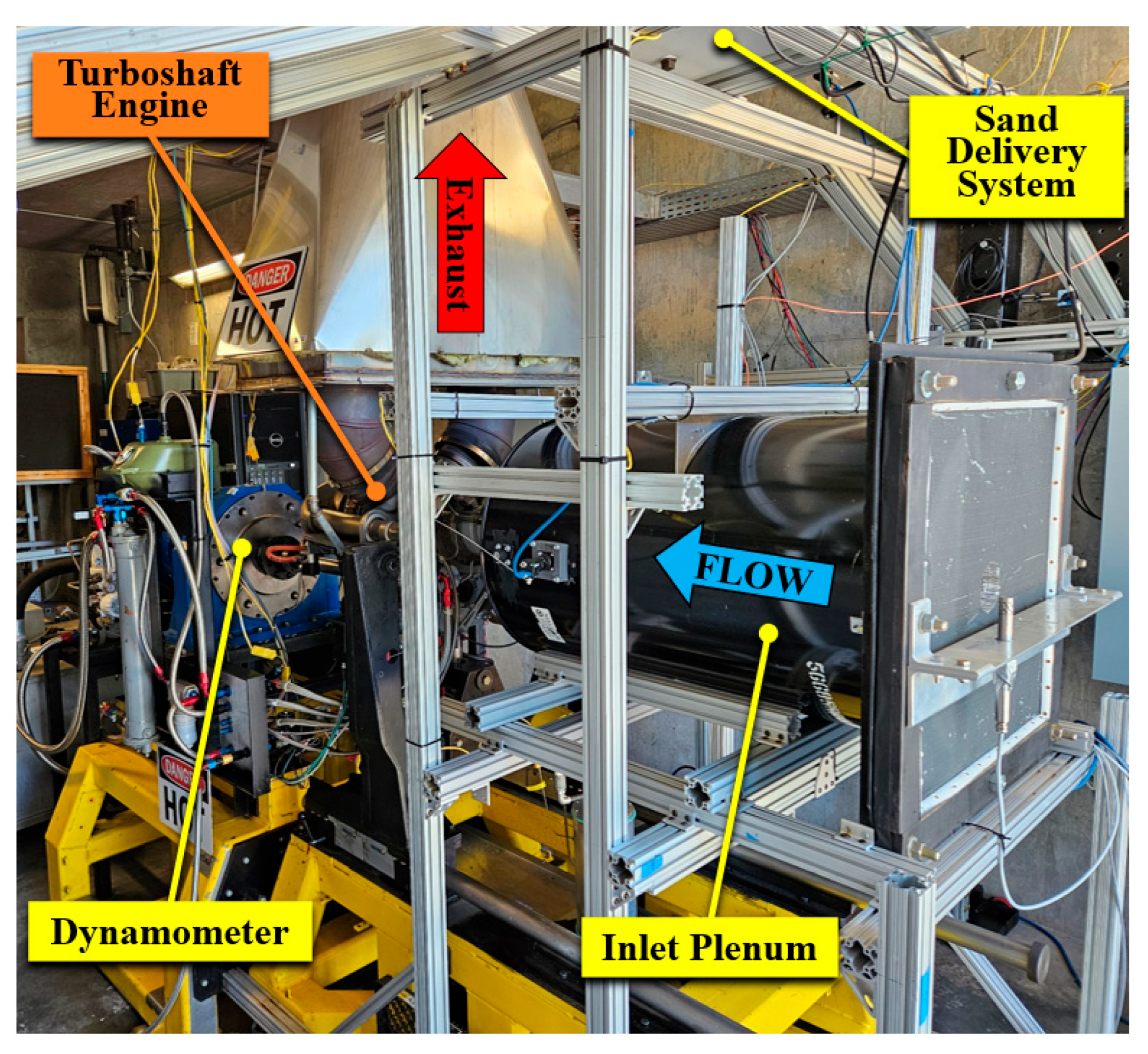
A detailed summary of the engine test facility used in the present study, its data acquisition hardware, and a subset of the team’s measurement capabilities is provided in reference [17]. The basics of this setup are shown schematically in Figure 1 and via photo in Figure 2.
The results of four separate sand/engine tests are outlined in Table 1. Each test utilized the M250-C20C engine (a military variant of the C20 series also known as the T63-A-720). In each test, particle ingestion was performed after the engine compressor speed had stabilized near the maximum continuous limit for roughly two minutes. For Tests 1, 2, and 3(a), particles were then ingested at a low nominal concentration of 40 mg/m3 for a total ingested dose of around 12 g. This pairing of concentration and dosage was selected based on previous experience at Virginia Tech [17,58], since it provides sufficient results for post-analysis while at the same time does not incur any significant damage to the engine. The fourth test point (Test 3(b)) was obtained from a longer multi-test erosion campaign. The concentration in this test case was much higher, at roughly 400 mg/m3: nominally simulating what would be seen by a helicopter engine operating in low-flight brownout conditions in combination with an inlet vortex tube separator system having 80% separation efficiency. The only fundamental difference between Tests 1 and 2 is particle composition, and the only difference between Tests 1 and 3 is the method of inlet particle injection. At all four test conditions, the first-stage rotor tip was transonic, with a Mach number of approximately 1.0 in the relative frame, based on machine speed and gas axial velocity.
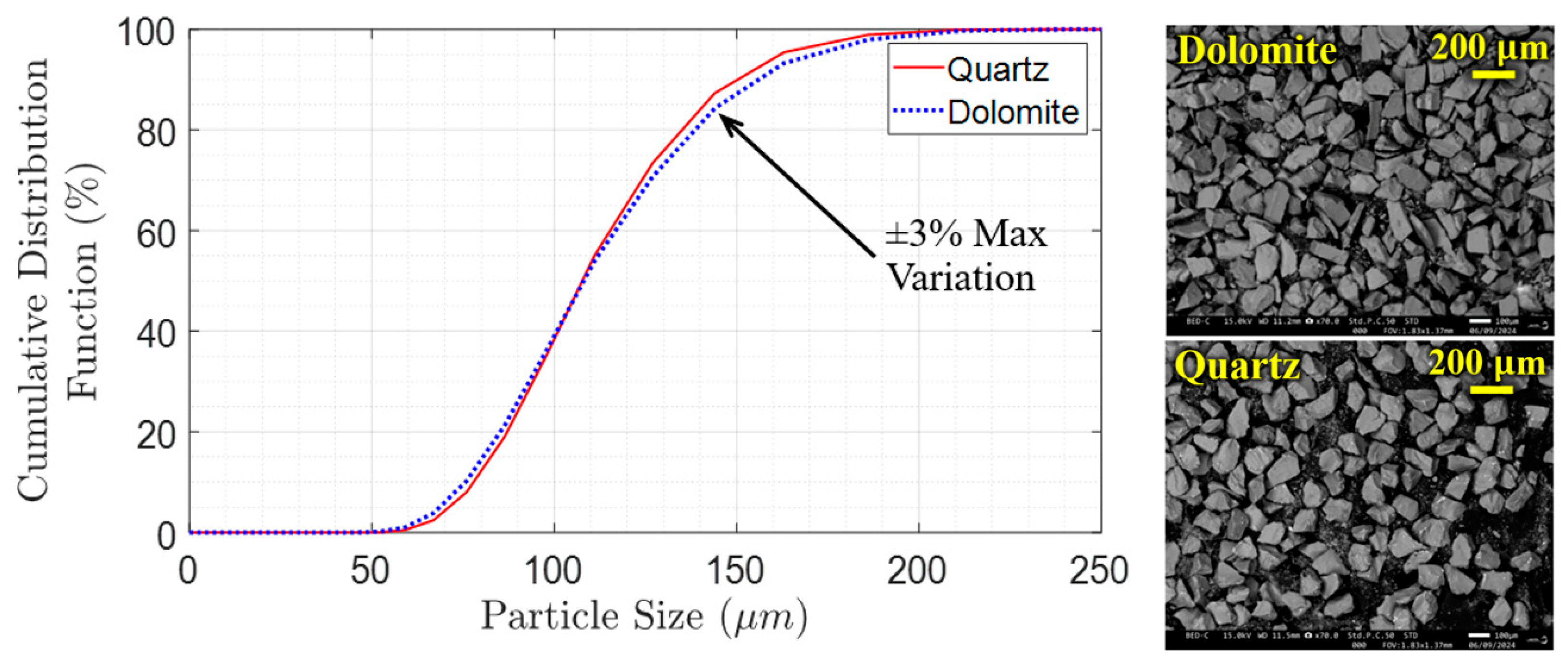
To provide a tightly constrained PSD for future model development, pure samples of crushed quartz and dolomite were purchased from Powder Technology Inc. (Arden Hills, MN, USA) [64], each of which had been sieved to within a nominal particle size range of 90–106 µm, based on ASTM 140 and ASTM 170 mesh sizes [65]. The PSDs for the quartz and dolomite batches used in these experiments are displayed graphically in Figure 3. These data were obtained using laser diffraction with a Malvern Panalytical Mastersizer 3000 (Malvern, UK), which reports the diameter of a sphere of equivalent volume to the real (non-spherical) particles. As also shown in Figure 3, scanning electron microscopy reveals that, while the grains are not spherical, they have relatively low aspect ratios and are neither acicular nor tabular. For the purpose of this test, the quartz and dolomite dusts are considered to be composed of particles with identical sizes, despite the minor variations in size distribution. A nominal particle size of 100 µm has also experimentally been found to fall within the reasonable range of particle sizes encountered by engines powering helicopters and short-takeoff/vertical-landing aircraft during low-altitude flight over arid landscapes [66].
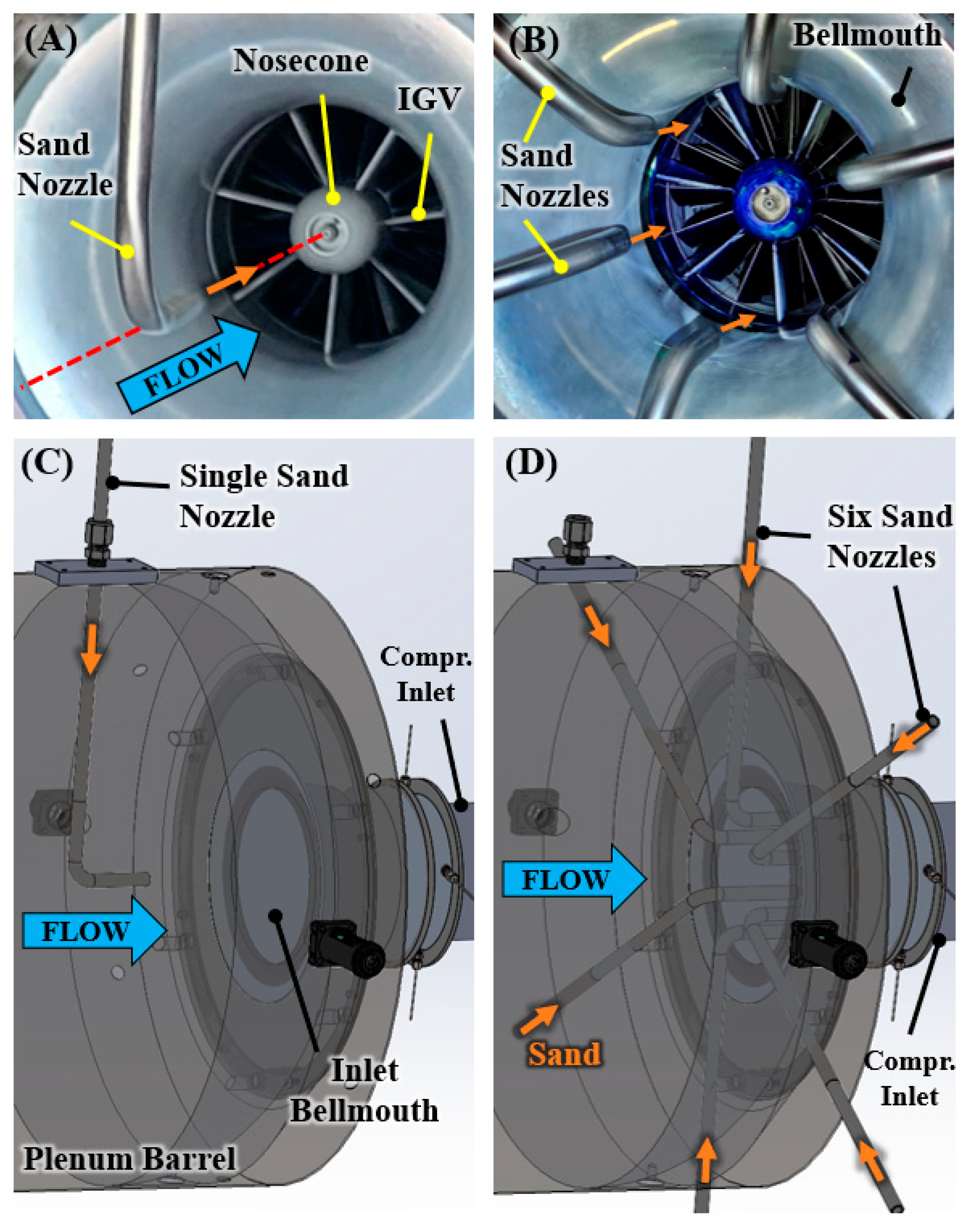
During Tests 1–2, particles were seeded into an air flow using a helical-type powder feeder (the AccuRate Volumetric Series Feeder by Schenck Process LLC, Deer Park, NY, USA [67]) in combination with a Fox Venturi Eductor [68]. The particle-laden flow was then supplied to the engine inlet by a single tube whose exit faced axially downstream toward the engine’s inlet guide vane (IGV) stationary nosecone from approximately 190.5 mm (7.5 inches) upstream. This arrangement is shown in parts (A) and (C) of Figure 4. Particle rebounds from the compressor nose cone were designed to have a spreading effect on the particles, thereby increasing the spatial distribution of particles across the inlet flow path. It is expected that a percentage of the particles impacting the nosecone will likely suffer fragmentation; the associated effect on PSD is not accounted for in this study.
For Tests 3(a) and 3(b), particles were delivered to the engine via an Orbetron Series OD100SV rotary disk powder feeder [69] in place of the helical-type feeder. This change was made to improve the transient uniformity of the particle feedrate delivered to the engine inlet. An axisymmetric array of six injection tubes were used to deliver particles near the blade tips, with tube exits positioned approximately 81.3 mm (3.2 inches) axially upstream of the nosecone. This configuration is shown in parts (B) and (D) of Figure 4. It should be noted that for the six-nozzle injector configuration of Tests 3(a–b), experimental evidence also showed that a portion of the particles rebounded off the bellmouth wall immediately downstream of the nozzle exit (upstream of IGVs), which resulted in a scattering effect of the particles towards the shaft centerline.
Based on experimental evidence from particle impact visualization on the IGV leading edges, the radial distribution of particles at the inlet plane of the compressor was roughly 0–75% of the blade span for Tests 1–2, and 30–100% for Tests 3(a–b). In effect, Tests 1–2 saw particle delivery predominantly near the rotor hub, while Tests 3(a–b) saw particles entering the compressor near the blade tips.

2.2. Test Characterization Parameters and Assumptions

To provide a more holistic and informative quantification of the particle behavior encountered in these tests, the nondimensional particle Stokes Number ( S t k ) was employed. This metric characterizes the ability of the particles to follow the flow, and is defined by the ratio of the particle’s characteristic timescale to the characteristic timescale of the gas flow [70]. The characteristic timescale of the particle is a function of the particle’s mass in relation to the viscosity of the gas. The particle S t k can be computed using the following equation:
S t k = t 0 u 0 l 0
where u 0 is the gas velocity magnitude relative to the blade, l 0 is a characteristic length (taken as the first-stage rotor mid-span chord length), and t 0 is the particle’s characteristic time constant which can be estimated by
t 0 = ρ p d p 2 18 μ g
where μ g is the gas viscosity, ρ p is the material density of the particle, and d p is the particle diameter [70]. The response time in Equation (2) assumes that the drag force on the particle is Stokesian; however, for the particle transport of this study, this assumption breaks down because the particle Reynolds number is large. In this case, the particle response time given by Equation (2) must be modified, which consequently results in a corrected Stokes number. For spherical particles, the corrected Stokes number, S t k c o r r , is defined as
S t k c o r r   = ψ S t k
ψ = 3 c R e 0 1 / 3 tan 1 c R e 0 1 / 3 c 3 / 2 R e o
where c = 0.158 [71].
The key particle characteristics for the tests considered in the present study are, therefore, recast in this nondimensional framework. Since the particle/blade interactions at the first-stage rotor were used to nominally characterize the full engine test, the S t k c o r r was calculated relative to the first-stage rotor, at mid-span location. Table 1 displays both S t k c o r r and S t k for each of the four engine tests considered in this study. Although the present study considers a rotating turbomachinery flow, the generalized centrifugal Stokes number [72,73] is not used to characterize particle dynamics because the primary focus of the investigation is on the initial impacts in the first-stage rotor. This region of the flow has not yet been significantly affected by rotation and associated centrifugal forces on the particles. For analysis of the particle behavior further downstream, the generalized centrifugal Stokes number is recommended to gauge the potential collision of particles on rotor and stator blades as long as R e 0 is not much smaller than 1.
In all four test cases, S t k c o r r was far greater than 10. Based on the work of Bojdo et al. [74], who analyzed particle/flow dynamics in the vicinity of a turbine nozzle guide vane row, we can expect that for S t k c o r r   10, particle motion and trajectories will be completely dominated by inertial forces. Thus, for the tests considered in this study, ingested particles should behave nearly independent of the surrounding flow up to the point of first impact, having behavior that approximately approaches particle travel in a vacuum.
Particle agglomeration due to humidity was not fully prevented or quantified in these experiments; however, precautions were taken to minimize its effects. Ambient relative humidity conditions were recorded, as presented in Table 1. Particle samples were baked in an oven for ten hours to remove all moisture and were then moved to the test cell particle injection system where they were encased in dry shop air up to the point of exiting the sand injector nozzle upstream of the engine inlet. It should also be noted that no clumping was observed with the quartz particles even before baking, due to the particle size and material properties of quartz.
Effects from electrostatic attraction/repulsion and discharge may also have played a role in these experiments. Charge buildup on engine hardware and on particles of varying sizes can cause agglomeration of particles and changes to particle trajectories [75,76]. The engine and test stand have both been found to be well grounded electrically in static condition (including both compressor rotors and stators). At the engine operating conditions corresponding to sand ingestion, local surface voltage buildup on non-rotating components was found to be negligible, remaining in the order of tens of millivolts and within measurement uncertainties. However, charging of particles in the gas path is expected. Electrostatic effects were not quantitatively characterized in this study.
It is important to note that the results and conclusions from this experimental work are not expected to apply universally to all particles encountered in the field, since the particles used in Tests 1–3 covered a narrow range of S t k c o r r and only included two particle compositions.
Various operating parameters were measured during the test, such as inlet total temperature and pressure, engine air mass flow rate, particle feed mass flow rate and supply air pressures, engine shaft speeds, overall pressure ratio, power output, and inter-turbine temperature. These and other parameters were used to track engine degradation, and to accurately account for the precise boundary conditions constraining the particle ingestion tests.

2.3. Particle-Surface Impact Visualization Method

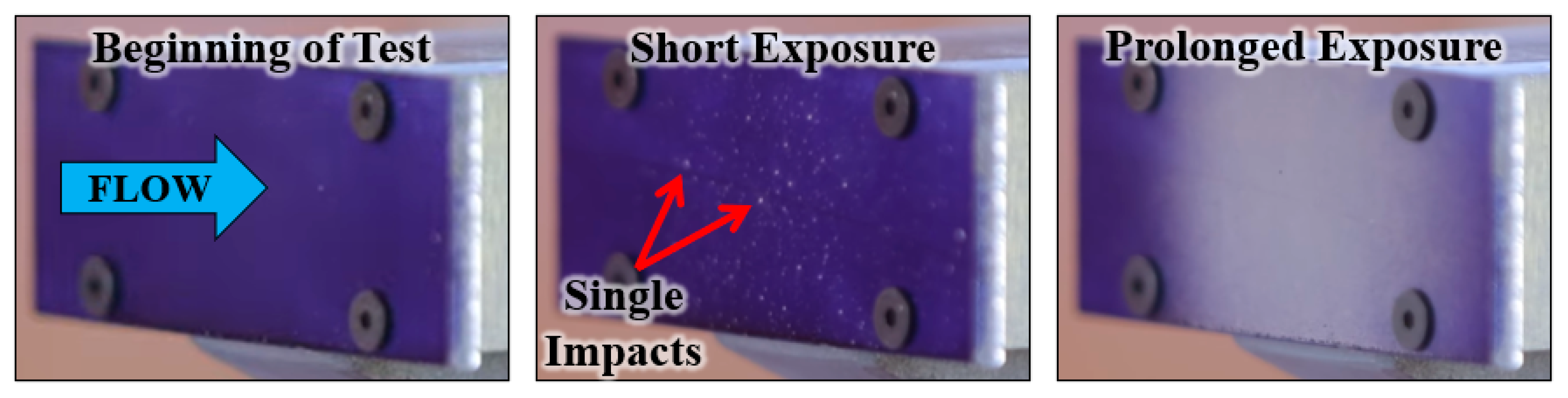
The Turbomachinery Particle-Surface Impact Visualization (TP-SIV) method developed at Virginia Tech utilizes conventional machinist’s layout fluid (Dykem Steel Blue [57]), to assist machinists in marking metal stock for cutting. Once the fluid has dried, it produces a thin, dark blue film coating that can be easily and precisely scratched or scribed, revealing the metal surface beneath. Previous rig testing at Virginia Tech (unpublished) demonstrated that even single-particle impacts can produce clearly visible markings. The contrast between the dark blue ink and the bright metal impact marks offers an opportunity to easily visualize the locations of particle impacts while requiring negligible actual erosion of the component. This qualitative measurement technique is thus a nearly nondestructive leading indicator of damage, having implications for low-cost accelerated experimental research on full-scale engines. For example, images of these impact patterns, the reader is directed to Section 3.
After removing the axial compressor’s upper casing half to expose the compressor’s interior geometry, Dykem Steel Blue machinist’s layout fluid was applied via paintbrush to the rotor blades, stator vanes, inlet guide vane (IGV), hub, IGV casing shroud, and inlet nosecone. Detailed and repeatable pre-test photos were taken of the pressure and suction sides of the rotor blades, stator vanes, and IGV’s before and after sand ingestion engine tests such as the tests described in this study, with removal and reapplication of the coating being performed between each test. The complex geometry of the compressor proved a challenge for photography from a lighting and viewpoint perspective. Also, due to the bright color of the metal, lighting glare from the intact layout fluid coating tended to appear as bare metal in the photos, obscuring an accurate assessment of the pattern. To counteract this effect, the photos were combined with visual inspection and careful hand sketches for more complete documentation of the realized coating removal patterns.
It is important to note a few key points regarding this particle impact visualization method. First, the coating removal patterns generated by sand ingestion are not indicative of erosion intensity but rather of particle impact locations. This is because, as noted previously, coating removal has been experimentally observed at Virginia Tech for even single particle impacts at relevant impact speeds (see Figure 5). It should be noted, however, that these coupon tests were performed only at a 90° impingement angle, so there may be an effect of impact angle on the ability of particles to remove the layout fluid coating. This effect is expected to be very small. Particle size is also expected to affect the coating removal, especially for very small particles and those having softer mechanical properties. Overall, the regions of intact coating can be considered regions where minimal particle impacts are located and where virtually no erosion takes place. Repeatability of this method has been established using engine tests conducted with nominally equivalent conditions of particle ingestion and engine operating conditions on different days. Despite a difference in ambient conditions and a new coating of layout fluid (including the associated coating thickness irregularities as discussed below), the resulting particle impact patterns were nearly identical.
It was demonstrated experimentally that no visible removal of the coating occurs during engine operation at a variety of shaft speeds when particles were not being ingested, implying that the impact patterns are created as a result of ingesting the particles. The impact patterns produced by this method have a relatively high level of circumferential uniformity, despite variations along the radial and axial directions, among stages, and between pressure and suction sides. This observation indicates that the particle impact “signal” dominates the associated random noise in the results. Lastly, it should be noted that given the combination of complex compressor geometry and low layout fluid viscosity, it was difficult to produce a completely uniform coating layer thickness due to run lines and beading. These occurrences were minimized during coating application but could not be fully prevented. Although the relative thickness varies significantly in these discrete locations, the overall thickness of the coating remains very small, and the thickness variations produce only localized variations in the particles’ ability to remove the coating on impact: thickness has only a minor effect on the resulting impact patterns as averaged across the full circumference. It should be noted that the potential effect on particle rebound characteristics by the presence of the layout fluid coating has not been considered in this work.
The resulting patterns produced by removal of the machinist’s layout fluid coating represent a close approximation to the time-averaged locations of particle impacts. These “output” patterns, in conjunction with the precisely measured/controlled “input” parameters such as engine operating conditions, flow conditions, and particle delivery initial conditions, could in principle be used as an experimental reference dataset for both development and first-order validation of reduced-order particle/engine models.
TP-SIV results were obtained for Tests 1–3(a). Note that Test 3(b) had nominally identical conditions to Test 3(a), with the exception of particle concentration and total mass of particles ingested.

3. Results and Discussion

3.1. High-Level Observations

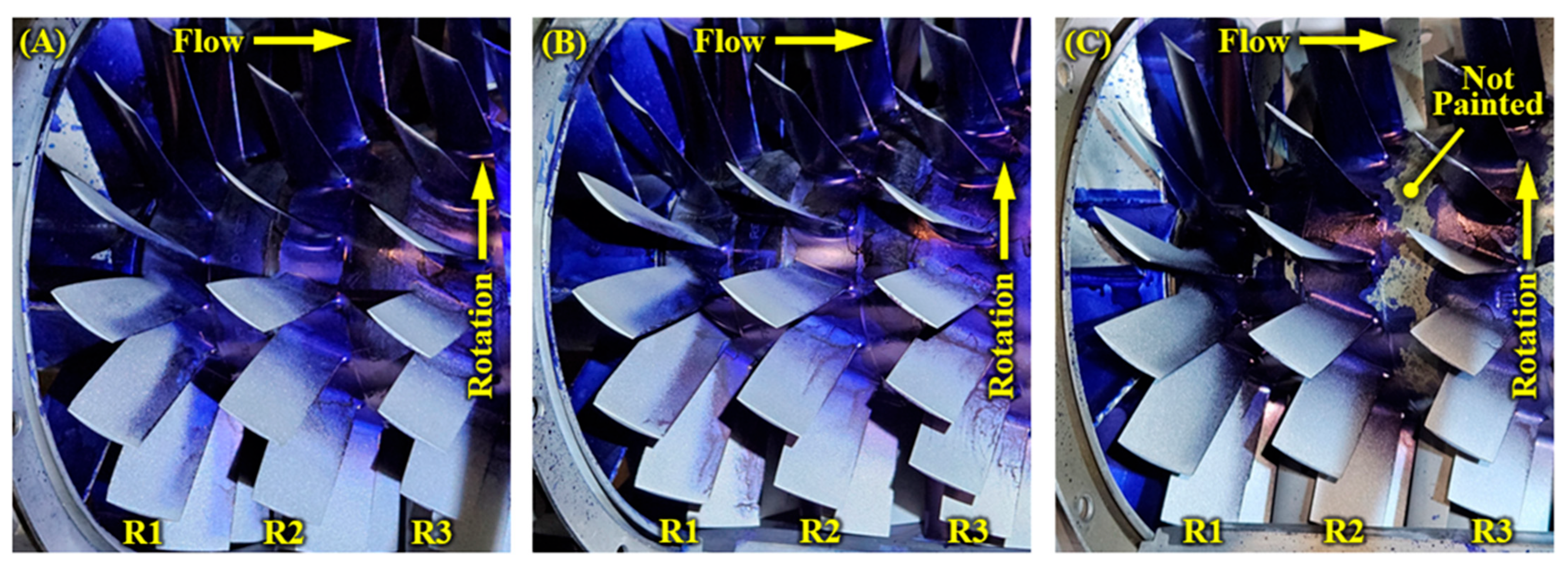
A summary of the particle impact patterns for the first three rotor stages in Tests 1–3 is shown in Figure 6. As expected, the patterns produced by quartz and dolomite at equivalent S t k c o r r and equivalent particle injection conditions are nearly identical. This is in agreement with intuition, since the TP-SIV patterns approximate particle impact locations (which are governed predominantly by S t k c o r r ), as opposed to erosion (for which quartz is known to have different properties than dolomite). It is surprising to notice, however, that the results from Tests 1 and 3(a) are also nominally equivalent, despite significantly different particle injection conditions and radial particles spread at the compressor inlet. Further consideration of this point is deferred to Section 3.4.
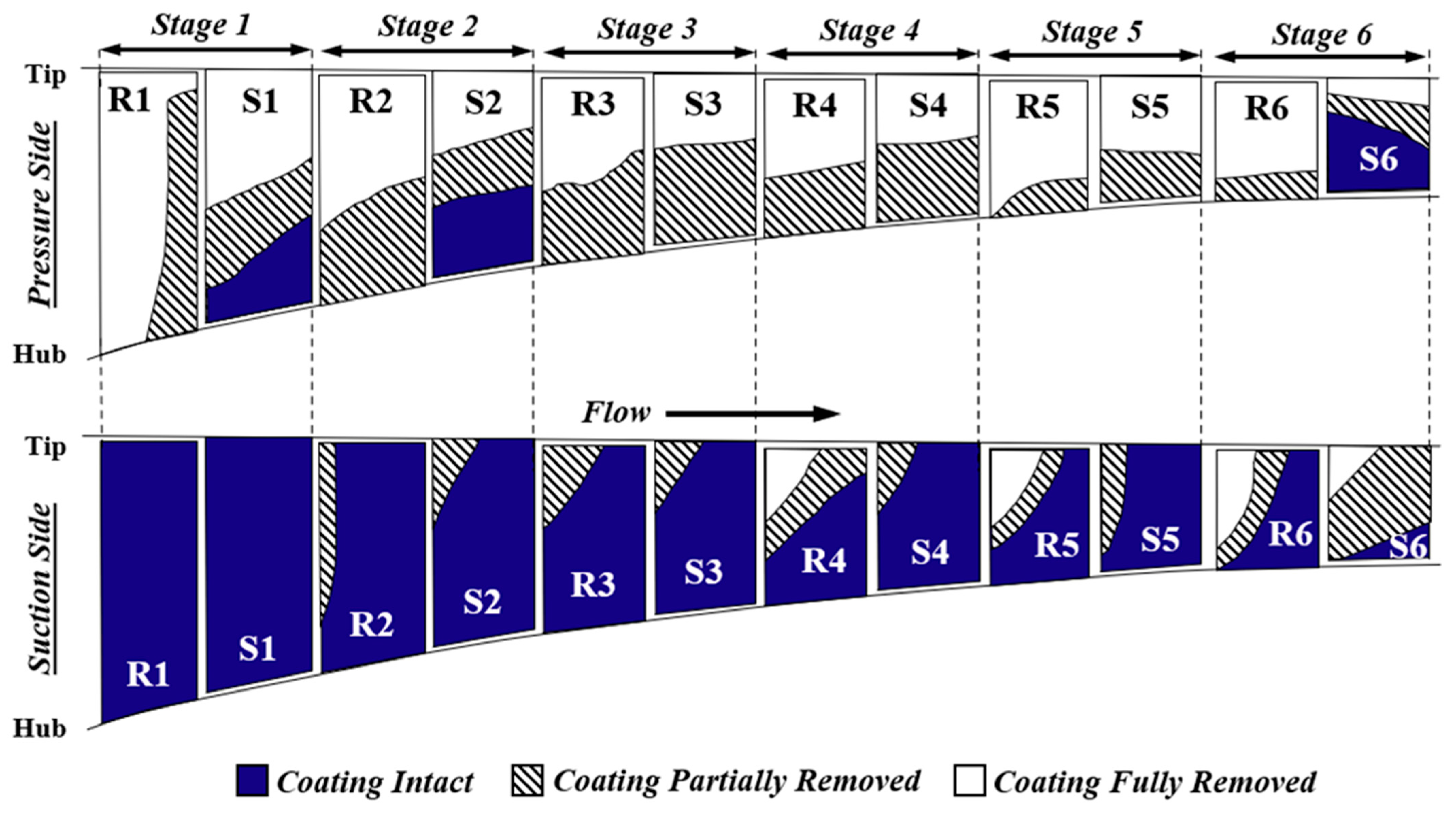
The particle impact patterns produced by Test 1 are shown in Figure 7 and will be treated as the “baseline” test case for this study. For simplicity, consideration of the full six-stage particle impact patterns will be restricted to this dataset. A comparison of the patterns produced on the pressure side of the first-stage rotor is provided subsequently for all four test cases. Several interesting observations can be drawn about the particle/blade impact behavior from the experimental results, as outlined below.
First, it may be noted that the patterns seem to indicate a centrifuging of the particles towards the outer casing during the first two stages. This is visible on both the pressure and suction sides, as evidenced by narrowing regions of removed coating towards the outer casing as the particles travel downstream through the compressor stages. This centrifuging effect agrees with what has been indicated by previous studies in the literature [12,14,23,25,26,77,78,79,80,81,82].
As shown in Figure 7, the impact regions downstream of the first two stages (where evidence of centrifuging exists) are confined to a roughly uniform radial band near the outer casing wall. This may result from a balance of competing physical mechanisms in this particular compressor geometry, where the effect of stochastic particle scatter is balanced by a geometric narrowing of the compressor flow path toward the outer radius. Note that although the radial band of particle impacts remains relatively constant, the blade/vane spanwise coverage tends to increase as the particle-laden flow passes through the stages.
On the suction sides of both rotors and stators, we find a uniform trend of coating removal at the leading edge/outer radius corner, possibly due to particle rebounds off the blades and vanes immediately upstream. It is interesting to note, however, that the suction sides of both the rotor and stator on the first stage show no evidence of particle impacts, implying that particles cannot rebound to these surfaces from impacts on the pressure side of adjacent or upstream blading.
A noticeably different impact pattern was observed on the sixth-stage stator. Several factors might contribute to this difference. The M250-C20C is designed with an acceleration bleed, which draws flow from an annular slot positioned around the full circumference of the outer casing surrounding the fifth-stage rotor tips. Although the acceleration bleed was closed at the high-power operating conditions of this test, the annular slot geometry and associated circumferential plenum cavity may have contributed to changes in the impact patterns downstream. Another more likely explanation is that the centrifugal compressor’s impeller leading edge, which is located directly downstream of this stator row, may have an aerodynamic effect that caused the observed sixth-stage stator patterns. Both are indicative of the fact that this measurement technique can highlight engine architectural effects on the impact locations.
Excluding the sixth-stage stator, it can be observed that the impact patterns on stages 4 through 6 show much less variation among stages than observed in the first two stages. Since, hypothetically, the impact patterns are strongly dependent on local particle S t k c o r r , the uniformity of patterns after the second stage may be evidence of less variation in S t k c o r r after the second stage compared to stages 1–2. This, in turn, may be reasonable evidence to suggest that particle breakage and size evolution is minimal after the first couple of stages. As discussed in the work of Vlach et al. [17], post-test particle swab samples taken from various parts of the M250-C20 after ingestion of MIL “C-spec” quartz particles at ground idle indicated that negligible particle breakage occurs downstream of the compressor. It may be that most particle breakage events are localized within the first couple stages of the compressor, a hypothesis that these impact patterns seem to support.
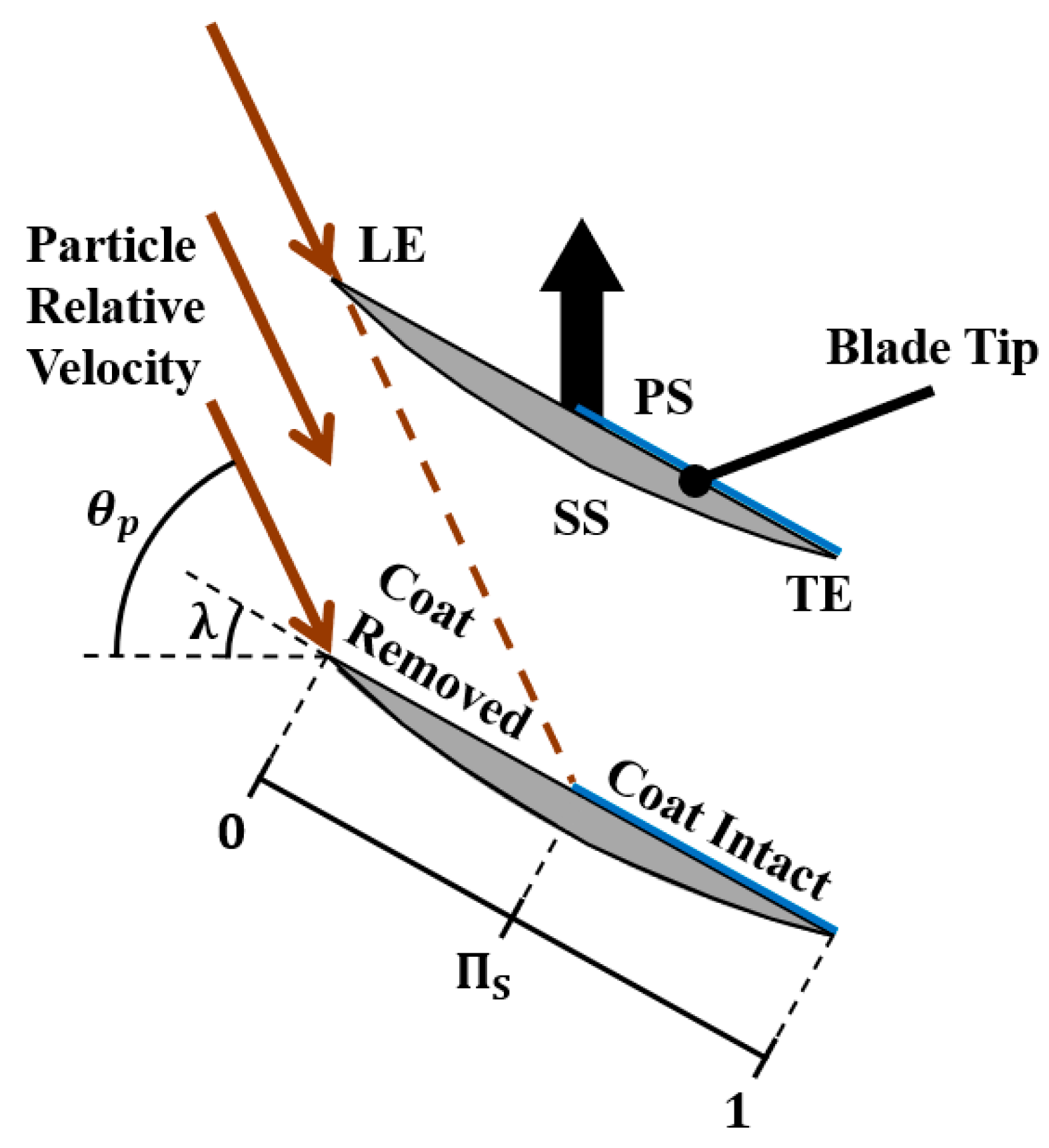
Turning attention back upstream to the first-stage rotor, consider the unique impact pattern that was produced on the pressure side. This pattern differs from all the downstream patterns yet exhibits high circumferential uniformity among blades. As shown in Figure 7, a band of full coating removal seems to cover the leading edge and tip regions, with a linear pattern boundary along the span at a nearly constant offset distance from the leading edge. Since the coating is still mostly intact downstream of this boundary, one may reasonably infer that only a small number of particles saw blade impacts behind this line. Thus, this pattern boundary line may be thought of as an effective shadow line created by shielding from the adjacent rotor blade, as illustrated in Figure 8. As S t k c o r r increases far beyond unity, theory predicts that particle dynamics and trajectories should become almost totally inertially driven. According to Bojdo et al. [74], this behavior is observed when S t k c o r r 10. Thus, in the S t k c o r r regime reproduced in these experiments ( S t k c o r r 150), it would be expected that the particle trajectories become ballistic, with a linear trajectory over this short distance, determined almost completely by initial conditions, significantly reducing the complexity of the particle/flow dynamics to a simple, canonical geometry problem.

3.2. Low-Order Modeling

Due in part to the low blade solidity of the IGVs of the M250-C20C, the particles entering the first-stage rotor have little to no upstream impact/breakage history (excluding rebounds off the nosecone in Tests 1–2 or off the casing wall in Tests 3(a–b)). To a first-order approximation, a simple analytical model can therefore be produced using classical turbomachinery velocity triangles to relate the particle initial conditions, engine geometry parameters, and operating speeds to the expected chordwise location where the “shadow line” should occur.
Recasting this simple model in a form dependent only on nondimensional compressor geometry parameters, the following expression results:
Π S =   σ cos λ tan θ p sin λ 1
where Π S is the predicted shadow line location as a fraction of the blade chord from the leading edge, σ is the blade solidity, λ is the blade setting angle, and θ p is the angular difference between the shaft axial direction and the particle velocity vector in the relative frame, defined such that increasing blade speed corresponds to increasing θ p . This analytical equation represents the simplest possible model for what was observed, comprising a first-order approximation for the simplified high-Stokes conditions.
Inserting the measured M250-C20C geometry parameters and operating conditions from Test 1 into this model and assuming the particles move in a purely axial direction, yields a predicted shadow line location of 31% of the blade chord from the leading edge. However, the actual location of the shadow line observed in Test 1 was roughly 75% of the true chord from the leading edge. Upon inspection, all the parameters used in the model for this test case had low uncertainties, except for θ p . The primary source of uncertainty in this model’s prediction of shadow line location is this particle velocity angle, which implicitly includes the particle speed. Unfortunately, particle speed and direction were not measured at the first-stage rotor inlet during these tests. Also, the prediction of 31% chord location assumes that the particles are traveling in a purely axial direction, at the same velocity as when they exited the sand delivery nozzle. This assumption neglects the effects of particle acceleration due to the higher speed surrounding gas and particle rebound off the IGV nosecone or casing wall. A brief parametric study of Equation (5) shows a relatively high sensitivity to θ p ; a roughly 9% decrease in the assumed θ p value yields the observed 75% shadow line location. It is, thus, probable that the simple model does capture the dominating physics for this simplified particle/flow regime, although the present experiments are not able to validate this fact due to unmeasured particle velocity initial conditions. In future work, the effects of particles rebound off the nosecone, nonlinear particle trajectories due to S t k c o r r , and stochasticity of particle inlet conditions might be incorporated into this baseline model, in addition to gaining more definite experimental verification of the model.
Despite the simplicity of Equation (5), when combined with the experimental and field results shown in this study, it can offer valuable insights into the complex problem of particle/compressor dynamics, as considered in the following sections.

3.3. Application of Reduced-Order Analytical Model

Although the observed impact pattern and associated conclusions are coupled with these specific test conditions and engine geometry, this learning may in principle be transferred to different engine architectures. Using the simple analytical model and the learning obtained from these experiments, a rough, first-order estimate can be obtained for whether the first-stage rotor will impact the dominant majority of particles for a given engine geometry and operating condition. The assumptions of this model are met when (1) particle S t k c o r r is greater than around 150, and (2) a simple compressor architecture is considered (e.g., rotating flat plate or similar). Under these conditions, it is posed that the large majority of particles will impact the first-stage rotor when Π S 1 . For Π S 1 , the shadow line will be downstream of the trailing edge, in which regime a larger fraction of the ingested particles may pass the first-stage rotor without impacts, and the particles that do still impact the first-stage rotor may impact at only glancing impingement angles. Note that the assumption of S t k c o r r 150 in the model above is imposed not by the physics, but by the bounds of the experimental test matrix included in this study. Based on the work of Bojdo et al. [74], the model is applicable for S t k c o r r anywhere above roughly 10.
For the experimental engine tests considered in the present study, the first-stage rotor sees an essentially uniform inlet flow/particle field, due to high S t k c o r r , very low IGV solidity, and careful upstream flow conditioning. Application to different rotor stages, or different engine architectures having upstream fans or high-solidity/high-flow-turning IGVs may require consideration of additional factors neglected in this baseline analytical approximation. Due to the stochastic nature of the particle/engine interactions, it is expected that the effect of IGVs will primarily constitute an increase in the uncertainty of individual particle impact locations proportional to the percentage of particles impacting the IGV blading. Different behavior may also be introduced if particle breakage occurs on any of these upstream impacts. The model may in principle be applied nicely to fan blades, provided the proper particle S t k c o r r conditions are met.

3.4. Comparison of Particle Dynamics at First-Stage Rotor

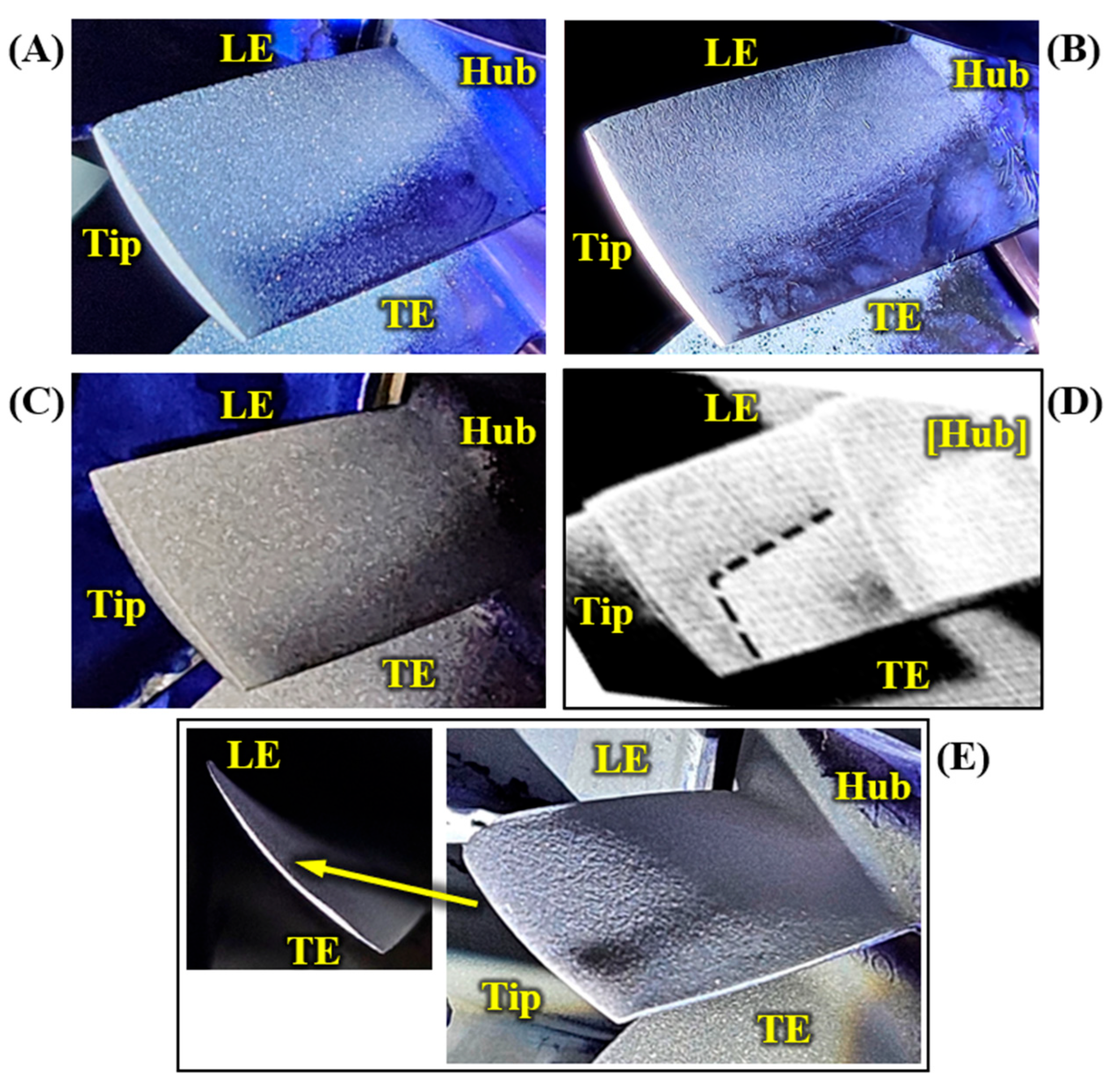
The results from the four sand-ingestion engine tests at the first-stage rotor are shown in Figure 9; included is also the coating removal pattern found by Kolkman on a fielded M250 variant [47].
The impact pattern produced during quartz ingestion Figure 9A is essentially identical to that produced by dolomite ingestion Figure 9B. As summarized in Table 1, their corrected Stokes numbers were nearly identical. Thus, it is experimentally verified that in on-engine conditions, particle trajectories (as measured by impact locations) can be described by the particle Stokes number.
It is interesting to compare the TP-SIV pattern from Test 3(a) in Figure 9C with the erosion contouring from Test 3(b) shown in Figure 9E, which is illustrated by the shadows produced by directing a light source across the pressure side of the blade from trailing edge to leading edge. Note that erosive thinning of the blade occurs in roughly the same area as where the layout fluid coating was removed. The match is not exact, the erosion region seeming to cover a smaller chordwise percentage of the blade than the TP-SIV pattern. However, this discrepancy is understandable given that the TP-SIV method more closely approximates all particle impact locations, not merely those having sufficient impact angle and velocity to produce metal erosion. Thus, the TP-SIV method can be used as a leading indicator of damage. The impact patterns were obtained by ingesting less than 0.5% of the total particle dose required to reach the more conventional erosion results of Test 3(b); also, no measurable impact on engine performance was incurred by any of the TP-SIV engine tests.
The most surprising observation is that for all the results shown in Figure 9, the same basic shadow line pattern characteristics are present. In particular, the patterns in Figure 9A,C,D are nominally the same, despite having varied inlet particle conditions. The radial spread of particles entering the compressor during Test 1 (Figure 9A) was concentrated near the hub, roughly covering 0–75% span, whereas Test 3 (Figure 9C) saw particles entering the compressor near the blade tips at roughly 30–100% span. Note that the only significant difference between the experimental conditions of Tests 1 and 3 was the particle injection configuration.
The pattern shown in Figure 9D was produced by 200 h of field service onboard a helicopter operating in Western Europe; this implies that the erosion-resistant coating was removed by cumulative effects of widely varying shaft speeds and particle sizes during this term of operation. Inlet distortion of both the flow and the particle initial conditions at the compressor inlet also presents a notable difference compared to the Virginia Tech engine test stand, due to the likely presence of upstream ducting and possibly filtration as part of the helicopter airframe.

3.5. Physics-Based Interpretation

The question may rightfully be raised as to how these three patterns could turn out so similar under such varying boundary conditions. Upon further consideration of the physics at play, it is remembered that the S t k c o r r encountered in Tests 1 and 3 were 140 and 150, respectively. This means that the particle/flow dynamics should be vastly dominated by inertia and not flow effects. However, according to Bojdo et al. [74], this regime of physics may be entered upon with particle S t k c o r r as low as 10. Considering the M250-C20C operating parameters at a nominal cruise condition, with quartz particle ingestion, it is found that to achieve a S t k c o r r 10 , particle diameter must be smaller than roughly 17 µm. It is possible that the field conditions endured by the engine in Figure 9D were such that most of the particles impacting the blade were large enough to be within the high-Stk ballistic regime, and/or the portion of the particles that were in this regime were the same ones primarily responsible for eroding the protective coating to produce the pattern. Also, the shadow line parameter Π S in Equation (5) is relatively insensitive to engine shaft speed, a fact which may help explain why such a clean line resulted in Figure 9D. The fact that the impact patterns of Figure 9A–C bear the same basic shadow line characteristics as the fielded engine in Figure 9D demonstrates that the experimental conditions were field-relevant, and that this high-Stokes particle behavior is typical for first-stage rotor impacts in the field for this engine architecture.
Moreover, it may be learned from the results of this study that under the conditions encountered, the physics of the complex particle/flow/engine phenomenon reduces significantly to a simple geometry problem, which can, in principle, be easily modelled to a first-order accuracy within the first-stage rotor. This conclusion is derived from consideration of the experimental/field prevalence of the shadow line impact behavior, and assessment of the dominant physics involved.

3.6. Extension of Results Beyond Studied Engine Architecture

The experimental tests conducted at Virginia Tech in this study have been shown to replicate observations from the same type of engine operating in the field, supporting that the highlighted experimental results and conclusions drawn are representative of relevant conditions seen by engines in the field, not simply attributable to experimental artifacts encountered in a laboratory test stand.
It is thus reasonable to conclude that for high-Stokes number (field relevant) conditions at the first-stage rotor, inlet particle/flow conditions, inlet distortion, and variation in these conditions do not have a significant effect on the resulting particle/engine interactions, as quantified by the locations of particle impacts. Note that the fact that effects of upstream ducting evidently have a low or negligible impact, is probably due to the resulting variation in particle/flow velocities at the compressor inlet being dwarfed by the machine speed of the engine rotor blades.

4. Conclusions and Implications

In the present study, compressor particle/blade impact visualization patterns were obtained from two Rolls-Royce M250-C20C engines operated on a test stand with ingestion of two particle compositions having narrow size distributions and using two particle injection configurations having different particle radial dispersion characteristics. These novel experimental results, when considered together with the fielded hardware documented by Kolkman [47], yield the following main conclusions and takeaways:
  • Under field-relevant conditions at the first-stage rotor, the physics of particle/blade interactions up to the point of first impact simplify greatly due to high local Stokes numbers. This behavior is robust to all inlet conditions realized in this study.
  • A simple analytical equation is formulated to model this particle behavior within the first-stage rotor, which, when combined with the experimental and field results shown in this study, offers valuable insights into the complex problem of particle/compressor dynamics.
  • Variation in the radial distribution of particles across the compressor inlet was found to have a near-negligible effect on the particle trajectories and associated locations of particle impacts within the first-stage rotor. This behavior is expected to hold true at other particle/engine conditions within the high-Stokes regime ( S t k c o r r 10), a fact that may prove useful to airframe designers, engine manufacturers, and engine test programs.
Further implications and considerations are provided in the subsections below.

4.1. Particle Dynamics and Fragmentation

When engine and environmental conditions are paired in such a way that the particle S t k c o r r at the compressor inlet is high (which, for example, is expected as typical field conditions for the M250-C20C), particle dynamics at the first stage reduce in complexity to a simple geometry problem, greatly simplifying analysis and predictive modelling. Equation (5) is posed as a first-order approximation for this condition.
It is important to note that the presence of a particle impact shadow line on the first-stage rotor of engines such as the M25-C20C implies that the full inlet plane of particles impinges on the first-stage rotor. This means that few particles pass the first-stage rotor without having suffering at least one blade impact. Such a conclusion may prove informative in the context of particle breakage and size/shape evolution through a multistage compressor. Based on Rolls-Royce engine test experience [21], evidence suggests that particle fragmentation reduces particles to a roughly uniform terminal size by the end of the compression system, regardless of inlet PSD or composition. Where exactly in the compressor this terminal size is reached is unknown. The impact of nearly all entering particles within the first-stage rotor would tend to support the further hypothesis that most breakage is confined within the early stages, since, by implication, only a small percentage of particles would experience first impacts on components downstream of the first stage. This is an area of previous [17,58,59] and future study at Virginia Tech.

4.2. Effect of Particle Conditions at Compressor Inlet

Particle inlet radial distribution and initial conditions were found not to play a first-order role within the high-Stokes ( S t k c o r r   10) regime. The effect of upstream ducting on the resulting particle impact patterns was also found to be negligible. These observations are useful for the broader particle ingestion engine research community, since reproducing a desired particle spread at the engine inlet experimentally is generally nontrivial.
The effect of inlet particle filtration on the particle dynamics inside an engine compressor will largely depend on the specific filtration system and engine architecture, as well as the shaft speeds and particle characteristics. Vortex tube separators would likely push the size distribution of particles entering the engine toward smaller sizes, reducing the S t k c o r r . This may change the S t k c o r r regime in which the engine’s first-stage rotor is operating, spreading initial particle impacts (and breakage) further downstream into the compressor stages, and affecting the resulting erosion and fouling. The performance of inertial particle separators, on the other hand, are highly dependent on engine architecture and particle S t k c o r r . As shown by Tabakoff [83], inertial particle separator systems under certain conditions can fail to remove larger particles due to duct wall rebounds. The overall effect may be to increase or decrease the average particle S t k c o r r , and most likely to introduce a radial nonuniformity in particle size and velocities depending on rebound history, ultimately resulting in a mixed net effect.

4.3. Broader Implications for Engine Test Research

Lastly, this experimental investigation can itself be considered as a case study highlighting one of many methods whereby the cost and duration of particle/engine testing can be significantly reduced while still yielding key insights into the fundamental physics involved in the complex engineering problem of particle ingestion. The methods and philosophy employed in this work enabled the agility necessary for a cadence of nine separate sand ingestion engine tests per year. Each of these particle/engine tests yielded useful information for the program, and this cadence and rapidity of learning iteration would not have been possible using a conventional engine test methodology. The sand/engine tests using TP-SIV (Tests 1–3) were performed with the objective of maximizing learning while not incurring significant engine deterioration, and no significant measurable engine performance degradation was observed, as reflected in parameters such as inter-stage turbine temperature, compressor overall pressure ratio, power output, and engine air mass flow. This demonstrates the feasibility of non-destructive particle ingestion testing on full engines. By using such methods as these, engine testing can yield actionable results with much greater efficiency in terms of time, cost, and learning.
The fact that this learning could be obtained without any measurable engine degradation suggests an important opportunity for engine testing methodology. By utilizing leading indicators of damage (such as coating impact patterns) to conduct research on gas turbines in place of the conventional trailing indicators of damage (such as blade mass loss and engine performance degradation), valuable insights can be gained while reaping the added benefits of reduced test duration, reduced personnel and hardware costs, reduced risks in test planning, and the ability to probe a broader, more agile experimental design space. Thus, understanding the interplay of the dominant physics involved in gas turbine particle ingestion can be advanced in a more holistic, thorough, cost-effective, and time-efficient manner.

4.4. Future Work

In the years ahead, the Virginia Tech particle ingestion research program seeks to further develop tools and approaches for transferring the results and learning obtained from small engine architectures, directly to larger engines that are of greater interest to government and industry. The program is synthesizing the combined efforts of reduced-order model development and full-engine experimental test campaigns to holistically investigate compressor erosion and particle/engine interactions, at both the component level and the full system level. A major focus of ongoing work is leveraging innovative measurement and instrumentation techniques to study the breakage-induced evolution of particle size and shape in multistage compressors. Other future work includes further development of the shadow line model, and measurement of compressor inlet particle velocity.

Author Contributions

Conceptualization, L.B.E., W.N., K.T.L., G.B., M.C. and R.Q.; data curation, L.B.E., G.B. and S.M.; formal analysis, L.B.E.; investigation, L.B.E., G.B. and S.M.; methodology, L.B.E., W.N., K.T.L., G.B., R.Q. and P.B.; project administration, L.B.E., W.N. and K.T.L.; visualization, L.B.E.; writing—original draft, L.B.E., M.C., R.Q. and P.B.; writing—review and editing, L.B.E., W.N., K.T.L., G.B., M.C., R.Q., S.M. and P.B. All authors have read and agreed to the published version of the manuscript.

Funding

The authors would like to acknowledge the Office of Naval Research for funding support under grants N00014-20-1-2538 and N00014-21-1-2397, program manager Steven Martens. The Virginia Tech team also acknowledges financial support from the Pratt & Whitney—Rolls-Royce Academic Alliance (PRAA).

Data Availability Statement

The original contributions presented in this study are included in the article. Further inquiries can be directed to the corresponding author.

Acknowledgments

The authors are grateful for the many valuable contributions of Rory Clarkson, Phil Owen, Jessica Cummings, Jim Loebig, and Chong Cha at Rolls-Royce, and of Charlie Haldeman, Andy Consiglio, and Sean Powers at Pratt & Whitney. Lastly, the authors would like to acknowledge the important contributions of supporting faculty, students, and staff at Virginia Tech: Changmin Son, Gaith Orfaly, Leo Olivera, Peter Rassam, Christopher Caulfield, David Bunin, Nilotpal Chakraborty, Randall Monk, and Jason Doby.

Conflicts of Interest

The authors declare no conflicts of interest.

Nomenclature and Representative Units

c nondimensionalintegration constant
d p mparticle diameter
I G V inlet guide vane
l 0 mcharacteristic length
P S pressure side
P S D particle size distribution
R e 0 nondimensionalparticle freestream Reynolds number
S S suction side
S t k nondimensionalstokes number
S t k c o r r nondimensionalcorrected Stokes number
TP-SIV Turbomachinery Particle-Surface Impact Visualization
t 0 sparticle characteristic timescale
u 0 m s−1gas velocity magnitude relative to the blade
θ p radparticle velocity angle in relative frame
λ radblade setting angle
μ g kg m−1 s−1gas viscosity
ρ p kg m−3particle material density
σ nondimensionalblade solidity
Π S nondimensionalfirst-stage rotor shadow line parameter
ψ nondimensionalStokes correction factor

References

  1. Leithead, S.G.; Allan, W.D.; Zhao, L.; Yang, Q. Enhanced experimental testing of new erosion-resistant compressor blade coatings. J. Eng. Gas Turbines Power 2016, 138, 112603. [Google Scholar] [CrossRef]
  2. Leithead, S.G. A Durability Test Rig and Methodology for Erosion-Resistant Blade Coatings in Turbomachinery. Master’s Thesis, Royal Military College of Canada, Kingston, ON, Canada, 2013. [Google Scholar]
  3. Jiang, L.-Y.; Wu, X.; Yang, Q. Sand erosion modeling in generic compressor rig testing. Aeronaut. J. 2022, 126, 1303–1323. [Google Scholar] [CrossRef]
  4. Klein, M.; Simpson, G. The development of innovative methods for erosion testing a Russian coating on GE T64 gas turbine engine compressor blades. In Proceedings of the Turbo Expo: Power for Land, Sea, and Air, Vienna, Austria, 14–17 June 2004; Volume 41677, pp. 347–352. [Google Scholar]
  5. Tabakoff, W.; Mason, R. Dust-induced deterioration of compressor first stage blades in supersonic cascade erosion wind tunnel. Int. J. Turbo Jet Engines 2007, 24, 85–92. [Google Scholar] [CrossRef]
  6. Shi, L.; Guo, S.; Yu, P.; Zhang, X.; Xiong, J. A review on leading-edge erosion morphology and performance degradation of aero-engine fan and compressor blades. Energies 2023, 16, 3068. [Google Scholar] [CrossRef]
  7. Dvirnyk, Y.; Pavlenko, D.; Przysowa, R. Determination of serviceability limits of a turboshaft engine by the criterion of blade natural frequency and stall margin. Aerospace 2019, 6, 132. [Google Scholar] [CrossRef]
  8. Kilchenstein, G.; Juarez, F.M.; Moseley, M.; Cheverie, J.; Duffles, M.; Acker, J. Compressor Airfoil Protective Coating for Turbine Engine Fuel Efficiency; 0148-7191; SAE Technical Paper; SAE Publications: Warrendale, PA, USA, 2013. [Google Scholar]
  9. Dunn, M.G.; Padova, C.; Moller, J.; Adams, R. Performance deterioration of a turbofan and a turbojet engine upon exposure to a dust environment. J. Eng. Gas Turbines Power 1987, 109, 336–343. [Google Scholar] [CrossRef]
  10. Ghenaiet, A.; Tan, S.; Elder, R. Experimental investigation of axial fan erosion and performance degradation. Proc. Inst. Mech. Eng. Part A J. Power Energy 2004, 218, 437–450. [Google Scholar] [CrossRef]
  11. Tabakoff, W.; Lakshminarasimha, A.; Pasin, M. Simulation of compressor performance deterioration due to erosion. J. Turbomach. 1990, 112, 78–83. [Google Scholar] [CrossRef]
  12. Balan, C.; Tabakoff, W. Axial flow compressor performance deterioration. In Proceedings of the 20th Joint Propulsion Conference, Cincinatti, OH, USA, 11–13 June 1984; p. 1208. [Google Scholar]
  13. Singh, D.; Hamed, A.; Tabakoff, W. Simulation of Performance Deterioration in Eroded Compressors. In Volume 1: Turbomachinery, Proceedings of the ASME 1996 International Gas Turbine and Aeroengine Congress and Exhibition, Birmingham, UK, 10–13 June 1996; V001T01A112; American Society of Mechanical Engineers: New York, NY, USA, 1996. [Google Scholar] [CrossRef]
  14. Tabakoff, W.; Hamed, A.; Metwally, M. Effect of particle size distribution on particle dynamics and blade erosion in axial flow turbines. J. Eng. Gas Turbines Power 1991, 113, 607–615. [Google Scholar] [CrossRef]
  15. Ghenaiet, A. Simulation of particle trajectories and erosion in a centrifugal compressor. J. Turbomach. 2012, 134, 051022. [Google Scholar] [CrossRef]
  16. Liu, R.; Pan, Y.; Chen, A.; Bin, G.; Li, H. Study on the influence of surface roughness on the erosion characteristics of compressor blades. Powder Technol. 2023, 430, 119037. [Google Scholar] [CrossRef]
  17. Vlach, T.; Olshefski, K.T.; Bunin, D.J.; Ehlers, A.M.; Caddick, M.J.; Lowe, K.T.; Ng, W.F. Analysis of C-Spec Particle Breakage in a Turbine Engine Particle Ingestion Test Cell. In Turbo Expo: Power for Land, Sea, and Air; American Society of Mechanical Engineers: New York, NY, USA, 2023; Volume 87103, p. V13CT31A002. [Google Scholar]
  18. Goodwin, J.; Sage, W.; Tilly, G. Study of erosion by solid particles. Proc. Inst. Mech. Eng. 1969, 184, 279–292. [Google Scholar] [CrossRef]
  19. Sommerfeld, H.; Koch, C.; Schwarz, A.; Beck, A. High velocity measurements of particle rebound characteristics under erosive conditions of high pressure compressors. Wear 2021, 470, 203626. [Google Scholar] [CrossRef]
  20. Klaoudatos, D. Particle Fragmentation Probability in Axial Compressors. Ph.D. Thesis, The University of Manchester, Manchester, UK, 2023. [Google Scholar]
  21. Mann, D.L.; Warnes, G.D. Future Directions in Helicopter Engine Protection System Configuration. In Proceedings of the AGARD Conference Proceedings AGARD CP, Rotterdam, The Netherlands, 25–28 April 1994; p. 4. [Google Scholar]
  22. Metwally, M.; Tabakoff, W.; Hamed, A. Blade erosion in automotive gas turbine engine. J. Eng. Gas Turbines Power 1995, 117, 213–219. [Google Scholar] [CrossRef]
  23. Blinov, V.; Zubkov, I.; Deryabin, G. Estimating the Influence of Compressor Blade Erosion Wear on the Compressor’s Integral and Local Characteristics. Therm. Eng. 2024, 71, 440–451. [Google Scholar] [CrossRef]
  24. Cagdas, T.I. The Numerical Investigation of the Effects of Sand Ingestion on Compressor Blade Erosion. Master’s Thesis, Virginia Tech, Blacksburg, VA, USA, 2024. [Google Scholar]
  25. Alqallaf, J.; Teixeira, J.A. Numerical study of effects of solid particle erosion on compressor and engine performance. Results Eng. 2022, 15, 100462. [Google Scholar] [CrossRef]
  26. Ghenaiet, A. A numerical study of volcanic ash ingestion and erosion of the front components of a high bypass turbofan engine. Aeronaut. J. 2024, 128, 1450–1484. [Google Scholar] [CrossRef]
  27. Gorokhovsky, V.; Bowman, C.; Wallace, J.; VanVorous, D.; O’Keefe, J.; Champagne, V.; Pepi, M.; Tabakoff, W. LAFAD Hard Ceramic and Cermet Coatings for Erosion Protection of Turbomachinery Components. In Proceedings of the Turbo Expo: Power for Land, Sea, and Air, Orlando, FL, USA, 8–12 June 2009; Volume 48852, pp. 807–817. [Google Scholar]
  28. Ghenaiet, A.; Elder, R.; Tan, S. Particles trajectories through an axial fan and performance degradation due to sand ingestion. In Turbo Expo: Power for Land, Sea, and Air; American Society of Mechanical Engineers: New York, NY, USA, 2001; Volume 78507, p. V001T03A079. [Google Scholar]
  29. Nieto, A.; Agrawal, R.; Bravo, L.; Hofmeister-Mock, C.; Pepi, M.; Ghoshal, A. Calcia–magnesia–alumina–silicate (CMAS) attack mechanisms and roadmap towards Sandphobic thermal and environmental barrier coatings. Int. Mater. Rev. 2021, 66, 451–492. [Google Scholar] [CrossRef]
  30. Milluzzo, J.; Leishman, J.G. Assessment of rotorcraft brownout severity in terms of rotor design parameters. J. Am. Helicopter Soc. 2010, 55, 32009. [Google Scholar] [CrossRef]
  31. Yan, C.; Chen, W.; Zhao, Z. Experimental study on the high-speed impact of a sand particle on Ti–6Al–4V. Proc. Inst. Mech. Eng. Part J J. Eng. Tribol. 2020, 234, 632–646. [Google Scholar] [CrossRef]
  32. Yan, C.; Chen, W.; Zhao, Z.; Liu, L. A probability prediction model of erosion rate for Ti-6Al-4V on high-speed sand erosion. Powder Technol. 2020, 364, 373–381. [Google Scholar] [CrossRef]
  33. Lekki, J. The hazard of volcanic ash ingestion. In Proceedings of the Meeting at Central Aerohydrodynamic Institute, Moscow, Russia, 5–7 April 2017. No. GRC-E-DAA-TN39768. [Google Scholar]
  34. Boyle, D.K. Acoustic Detection of Faults and Degradation in a High-Bypass Turbofan Engine During VIPR Phase III Testing. In Proceedings of the 55th AIAA Aerospace Sciences Meeting, Grapevine, TX, USA, 9–13 January 2017; p. 0933. [Google Scholar]
  35. Li, W.; Chen, T. VIPR III VADR SPIDER Structural Design and Analysis; Glenn Research Center: Cleveland, OH, USA, 2016.
  36. Venti, M.; Lekki, J.; Loy-Kraft, G. Vehicle Integrated Propulsion Research (VIPR) III Volcanic Ash Environment (VAE) Preliminary Visual and Teardown Observations. In Proceedings of the Aircraft Airworthiness and Sustainment Conference (AA&S 2016), Grapevine, TX, USA, 20–21 March 2016. No. DFRC-E-DAA-TN30644. [Google Scholar]
  37. Simon, D.L.; Csank, J.; Rinehart, A. Vehicle Integrated Propulsion Research (VIPR) Gas Path Diagnostics and Volcanic Ash Ingestion Test Results. In Proceedings of the 5th NASA GRC Propulsion Control and Diagnostics (PCD) Workshop, Cleveland, OH, USA, 16–17 September 2015. [Google Scholar]
  38. Hunter, G.W.; Lekki, J.; Simon, D. Overview of vehicle integrated propulsion research (vipr) testing. In Electrochemical Society Meeting Abstracts 225; No. 6; The Electrochemical Society, Inc.: Pennington, NJ, USA, 2014; p. 464. [Google Scholar]
  39. Lekki, J.; Lyall, E.; Guffanti, M.; Fisher, J.; Erlund, B.; Clarkson, R.; van de Wall, A. Multi-partner experiment to test volcanic-ash ingestion by a jet engine. In Proceedings of the 6th International Workshop on Volcanic Ash, Citeko, Indonesia, 11–15 March 2013. No. GRC-E-DAA-TN8284. [Google Scholar]
  40. Lekki, J.D.; Simon, D.L.; Hunter, G.W.; Woike, M.; Tokars, R.P. Vehicle Integrated Propulsion Research for the Study of Health Management Capabilities. In Proceedings of the Turbine Engine Technology Symposium, Dayton, OH, USA, 10–13 September 2012. No. E-18500. [Google Scholar]
  41. Batcho, P.F.; Moller, J.; Padova, C.; Dunn, M.G. Interpretation of gas turbine response due to dust ingestion. J. Eng. Gas Turbines Power 1987, 109, 344–352. [Google Scholar] [CrossRef]
  42. Dunn, M.G.; Baran, A.J.; Miatech, J. Operation of gas turbine engines in volcanic ash clouds. J. Eng. Gas Turbines Power 1996, 118, 724–731. [Google Scholar] [CrossRef]
  43. Baran, A.J.; Dunn, M.G. The Response of a Second YF101-GE-100 Engine to a Dust-Laden Environment; Technical Report No. DNA-TR-94-24; Calspan Advanced Technology Center: Buffalo, NY, USA, 1994. [Google Scholar]
  44. Cosher, C.R.; Dunn, M.G. Comparison of the sensitivity to foreign particle ingestion of the GE-F101 and P/W-F100 engines to modern aircraft engines. J. Eng. Gas Turbines Power 2016, 138, 121201. [Google Scholar] [CrossRef]
  45. Dunn, M.G. Operation of Gas Turbine Engines in an Environment Contaminated with Volcanic Ash. J. Turbomach. 2012, 134, 051001. [Google Scholar] [CrossRef]
  46. Wang, Q.; Zhang, W.; Yuan, X.; Wang, Y.; Shen, Z.; Wang, F. Research on the Impact of the Sand and Dust Ingestion Test on the Overall Performance of Turboshaft Engines. Aerospace 2025, 12, 146. [Google Scholar] [CrossRef]
  47. Kolkman, H. Gas Turbine Compressor Corrosion and Erosion in Western Europe. In Proceedings of the AGARD Conference Proceedings AGARD CP, Rotterdam, The Netherlands, 25–28 April 1994; p. 30. [Google Scholar]
  48. Przysowa, R.; Gawron, B.; Kułaszka, A.; Placha-Hetman, K. Polish experience from the operation of helicopters under harsh conditions. J. KONBIN 2018, 48, 263–299. [Google Scholar] [CrossRef][Green Version]
  49. Reitz, G.; Dwinger, K.; Schlange, S.; Friedrichs, J.; Kappei, F. Analysis of jet engine compressor deterioration and capturing correlations between geometric parameters. In Proceedings of the 16th International Symposium on Transport Phenomena and Dynamics of Rotating Machinery, Honolulu, HI, USA, 10–15 April 2016. [Google Scholar]
  50. Richardson, J.; Sallee, G.; Smakula, F. Causes of high pressure compressor deterioration in service. In Proceedings of the AIAA, SAE, and ASME, Joint Propulsion Conference, Las Vegas, NV, USA, 18–20 June 1979. No. AIAA PAPER 79-1234. [Google Scholar]
  51. Sallee, G.P.; Kruckenberg, H.; Toomey, E. Analysis of Turbofan Engine Performance Deterioration and Proposed Follow-On Tests; 1975. Available online: https://ntrs.nasa.gov/citations/19750018937 (accessed on 12 November 2025).
  52. Walton, K.; Blunt, L.; Fleming, L.; Goodhand, M.; Lung, H. Areal parametric characterisation of ex-service compressor blade leading edges. Wear 2014, 321, 79–86. [Google Scholar] [CrossRef]
  53. Ghenaiet, A. Simulation of particle-laden flows and erosion in an axial fan stage considering the relative position of the blades. Aeronaut. J. 2024, 128, 1379–1416. [Google Scholar] [CrossRef]
  54. Ghenaiet, A. Modeling and Simulation of Sand Particle Trajectories and Erosion in a Transonic Fan Stage. J. Turbomach. 2024, 147, 071012. [Google Scholar] [CrossRef]
  55. Brun, K.; Nored, M.; Kurz, R. Particle transport analysis of sand ingestion in gas turbine engines. J. Eng. Gas Turbines Power 2012, 134, 012402. [Google Scholar] [CrossRef]
  56. Brun, K.; Nored, M.; Kurz, R. Analysis of Solid Particle Surface Impact Behavior in Turbomachines to Assess Blade Erosion and Fouling. 2012. Available online: https://hdl.handle.net/1969.1/162949 (accessed on 12 November 2025).
  57. ITWProBrands. STEEL BLUE Layout Fluid. Available online: https://www.itwprobrands.com/product/steel-blue (accessed on 4 September 2025).
  58. Antous, B.; Byun, G.; Lowe, K.T.; Smith, C.F. Virginia Tech Optical Inlet Sensor for Particle Detection: Rolls Royce M250 Turboshaft Demonstration. J. Eng. Gas Turbines Power 2024, 146, 031010. [Google Scholar] [CrossRef]
  59. Estes, B.; Brockway, P.; Olivera, L.; Bunin, D.; Qiao, R.; Ng, W.; Caddick, M.; Son, C.; Lowe, T.; Byun, G.B.; et al. Particle/blade Impact Study of Near-Transonic Compressor in Engine Test. In Volume 11: Turbomachinery—Deposition, Erosion, Fouling, and Icing; Design Methods & CFD Modeling for Turbomachinery; Ducts, Noise & Component Interactions, Proceedings of the ASME Turbo Expo 2025: Turbomachinery Technical Conference and Exposition, Memphis, TN, USA, 16–20 June 2025; V011T31A013; International Gas Turbine Institute: Houston, TX, USA, 2025. [Google Scholar] [CrossRef]
  60. Olshefski, K.T. Development of Diagnostic Tools for Use in a Gas Turbine Engine Undergoing Solid Particulate Ingestion; Virginia Tech: Blacksburg, VA, USA, 2023. [Google Scholar]
  61. Advanced Propulsion and Power Lab. Available online: https://www.aoe.vt.edu/research/multidisciplinary-centers-labs/appl.html (accessed on 4 September 2025).
  62. Petrology @ VT. Available online: https://sites.google.com/vt.edu/petrology/ (accessed on 4 September 2025).
  63. Laboratory of Transport Phenomena for Advanced Technologies. Available online: https://tpl.me.vt.edu/ (accessed on 4 September 2025).
  64. Powder Technology, Inc. Available online: https://www.powdertechnologyinc.com/ (accessed on 4 September 2025).
  65. American Standard Test Sieve Series (ASTM). Available online: https://www.endecotts.com/faq/sieves-and-calibration/american-standard-test-sieve-series-astm/ (accessed on 4 September 2025).
  66. Cowherd, C., Jr. Sandblaster 2 Support of See-Through Technologies for Particulate Brownout. 2007. Available online: https://apps.dtic.mil/sti/html/tr/ADA504965/ (accessed on 12 November 2025).
  67. AccuRate Series Feeder. Available online: https://fhn.coperion.com/process/accurate-series-feeder/ (accessed on 4 February 2025).
  68. Fox Venturi Products. Available online: https://www.foxvalve.com/ (accessed on 4 September 2025).
  69. Orbetron Disc Feeders. Available online: https://orbetron.com/disc-feeders/ (accessed on 4 February 2025).
  70. Wessel, R.; Righi, J. Generalized correlations for inertial impaction of particles on a circular cylinder. Aerosol Sci. Technol. 1988, 9, 29–60. [Google Scholar] [CrossRef]
  71. Israel, R.; Rosner, D.E. Use of a generalized Stokes number to determine the aerodynamic capture efficiency of non-Stokesian particles from a compressible gas flow. Aerosol Sci. Technol. 1982, 2, 45–51. [Google Scholar] [CrossRef]
  72. Klaoudatos, D.; Bojdo, N.; Filippone, A.; Covey-Crump, S.; Jones, M.; Pawley, A. A Probabilistic Method for Predicting Particle-Blade Impact Kinematics in Turbomachinery. In Volume 10B: Turbomachinery—Axial Flow Turbine Aerodynamics; Deposition, Erosion, Fouling, and Icing; Radial Turbomachinery Aerodynamics, Proceedings of the ASME Turbo Expo 2022: Turbomachinery Technical Conference and Exposition, Rotterdam, The Netherlands, 13–17 June 2022; V10BT31A006; International Gas Turbine Institute: Houston, TX, USA, 2022. [Google Scholar] [CrossRef]
  73. Klaoudatos, D.; Bojdo, N.; Filippone, A.; Jones, M.; Covey-crump, S.; Pawley, A. An improved particle-blade interaction model to investigate turbomachinery erosion numerically. In Proceedings of the 14th European Conference on Turbomachinery Fluid dynamics & Thermodynamics, Gdansk, Poland, 12–16 April 2021; European Turbomachinery Society: Naples, Italy, 2021. [Google Scholar]
  74. Bojdo, N.; Ellis, M.; Filippone, A.; Jones, M.; Pawley, A. Particle-vane interaction probability in gas turbine engines. J. Turbomach. 2019, 141, 091010. [Google Scholar] [CrossRef]
  75. Raj, R.; Moskowitz, S. Experimental studies of deposition by electrostatic charge on turbine blades. In Turbo Expo: Power for Land, Sea, and Air; American Society of Mechanical Engineers: New York, NY, USA, 1984; Volume 79481, p. V003T05A007. [Google Scholar]
  76. Raj, R. Deposition results of a transpiration air-cooled turbine vane cascade in a contaminated gas stream. J. Eng. Power 1983, 105, 827. [Google Scholar] [CrossRef]
  77. Suman, A.; Vulpio, A.; Casari, N.; Pinelli, M.; Kurz, R.; Brun, K. Deposition pattern analysis on a fouled multistage test compressor. J. Eng. Gas Turbines Power 2021, 143, 081006. [Google Scholar] [CrossRef]
  78. Casari, N.; Pinelli, M.; Spina, P.R.; Suman, A.; Vulpio, A. Performance degradation due to fouling and recovery after washing in a multistage test compressor. J. Eng. Gas Turbines Power 2021, 143, 031020. [Google Scholar] [CrossRef]
  79. Suzuki, M.; Yamamoto, M. Numerical Simulation of Particulate Erosion in Two-Stage Compressor. Blucher Mech. Eng. Proc. 2014, 1, 2742–2753. [Google Scholar][Green Version]
  80. Ghenaiet, A. Simulation of Erosive Effects of Sand Particle Impacts in Axial Turbomachinery. In Proceedings of the 2010 AIP Conference, Annapolis, MD, USA, 1–4 November 2010; American Institute of Physics: College Park, MD, USA, 2010; Volume 1220, pp. 78–90. [Google Scholar]
  81. Ghenaiet, A.; Tan, S.C.; Elder, R. Prediction of an axial turbomachine performance degradation due to sand ingestion. Proc. Inst. Mech. Eng. Part A J. Power Energy 2005, 219, 273–287. [Google Scholar] [CrossRef]
  82. Saxena, S.; Jothiprasad, G.; Bourassa, C.; Pritchard, B. Numerical simulation of particulates in multistage axial compressors. J. Turbomach. 2017, 139, 031013. [Google Scholar] [CrossRef]
  83. Tabakoff, W. Compressor erosion and performance deterioration. J. Fluids Eng. 1987, 109, 297–306. [Google Scholar] [CrossRef]
Figure 1. Engine inlet apparatus and particle injection system used in Tests 1–2 (Left) and 3(a–b) (Right).
Aerospace 12 01038 g001
Figure 2. Virginia Tech M250 engine test stand.
Aerospace 12 01038 g002
Figure 3. Pre-test particle size distribution and electron microprobe images.
Aerospace 12 01038 g003
Figure 4. Comparison of particle injection configurations at engine inlet; centerline hub injection (A,C), six-nozzle tip injection (B,D). Note that layout fluid is present on IGV and nosecone in (C).
Aerospace 12 01038 g004
Figure 5. TP-SIV proof-of-concept rig/coupon testing.
Aerospace 12 01038 g005
Figure 6. Summary of TP-SIV impact patterns on the first three rotor stages after (A) Test 1, (B) Test 2, and (C) Test 3(a).
Aerospace 12 01038 g006
Figure 7. Particle-surface impact visualization results for Test 1.
Aerospace 12 01038 g007
Figure 8. Particle impact shadow line concept.
Aerospace 12 01038 g008
Figure 9. Summary of TP-SIV impact patterns on the first-stage rotor pressure side for (A) Test 1: quartz centerline injection, Stk~140, (B) Test 2: dolomite centerline injection, Stk~150, (C) Test 3(a): quartz tip injection, Stk~140; (D) Fielded engine: 200hr service in W. Europe, adapted from [47]; and (E) region of erosive blade thinning from Test 3(b): high dosage quartz tip injection, Stk~140.
Aerospace 12 01038 g009
Table 1. Detailed experimental conditions.
TestParticle Injection
(Approx. Inlet Particle Spread in % Span)
Shaft Speed (% Max
Continuous Limit)
Particle TypeParticle Density (kg/m3)Ambient Relative Humidity (%)Corrected Stokes
Number
Uncorrected Stokes
Number
Concentration (mg/m3)Total Dust Ingested (g)Total
Exposure (min)
11 nozzle at centerline (0–75%)95%Quartz266086%142141945123
295%Dolomite285052%152151643113
3(a)6 nozzles at blade tip (30–100%)96%Quartz266032%141143541103
3(b)95–96%Quartz266022–50%139–1411351–1428381–436265479
Estimated
Uncertainties
------±2%±1%----±1%±0.02 g--
Disclaimer/Publisher’s Note: The statements, opinions and data contained in all publications are solely those of the individual author(s) and contributor(s) and not of MDPI and/or the editor(s). MDPI and/or the editor(s) disclaim responsibility for any injury to people or property resulting from any ideas, methods, instructions or products referred to in the content.