
Article

Modelling Rigid Body Potential of Small Celestial Bodies for Analyzing Orbit–Attitude Coupled Motions of Spacecraft

Department of Astronomy, Yonsei University, Seoul 03722, Republic of Korea
*
Author to whom correspondence should be addressed.
Aerospace 2024, 11(5), 364; https://doi.org/10.3390/aerospace11050364

Submission received: 10 April 2024 / Revised: 30 April 2024 / Accepted: 1 May 2024 / Published: 5 May 2024
(This article belongs to the Special Issue Deep Space Exploration)

Abstract

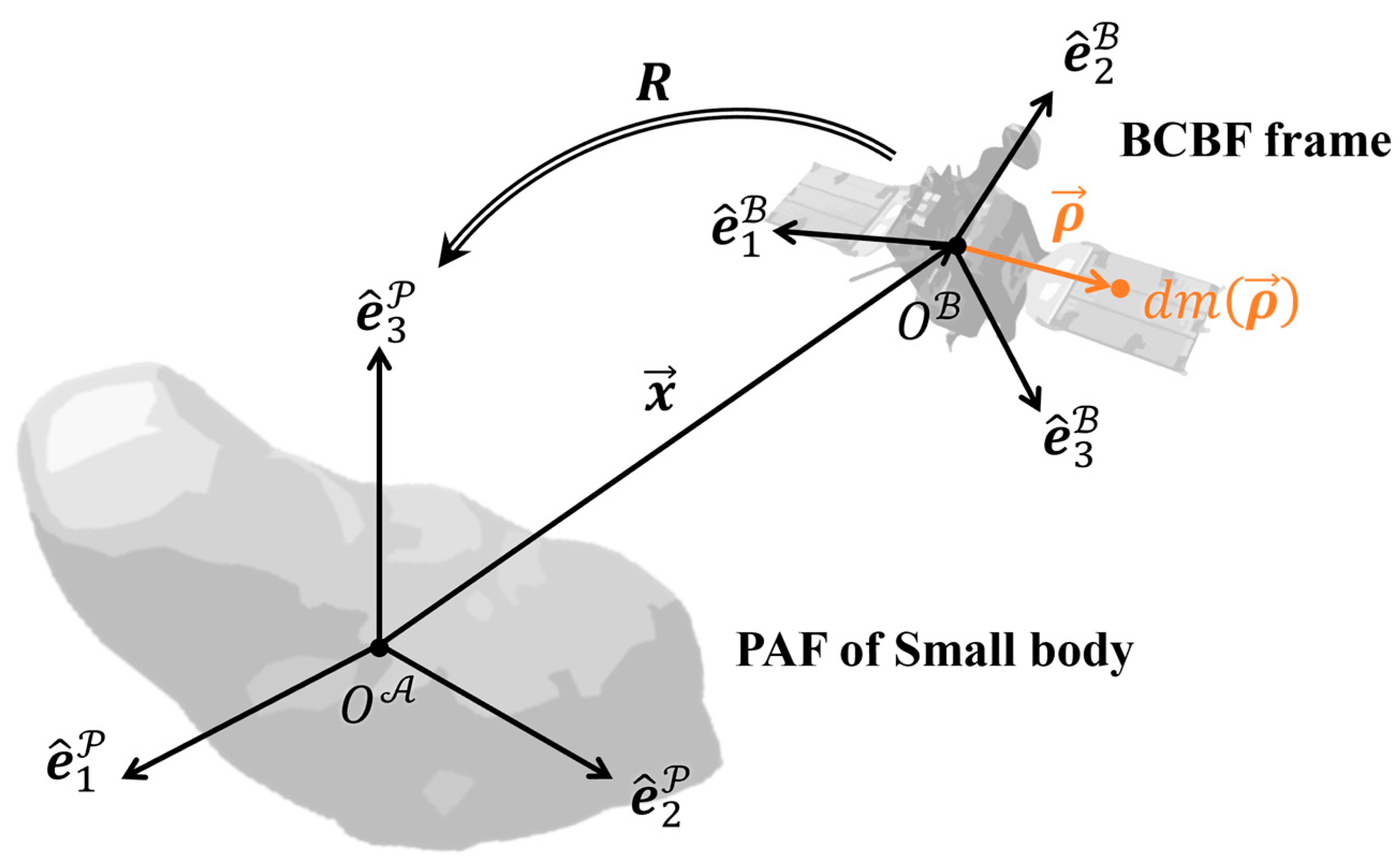
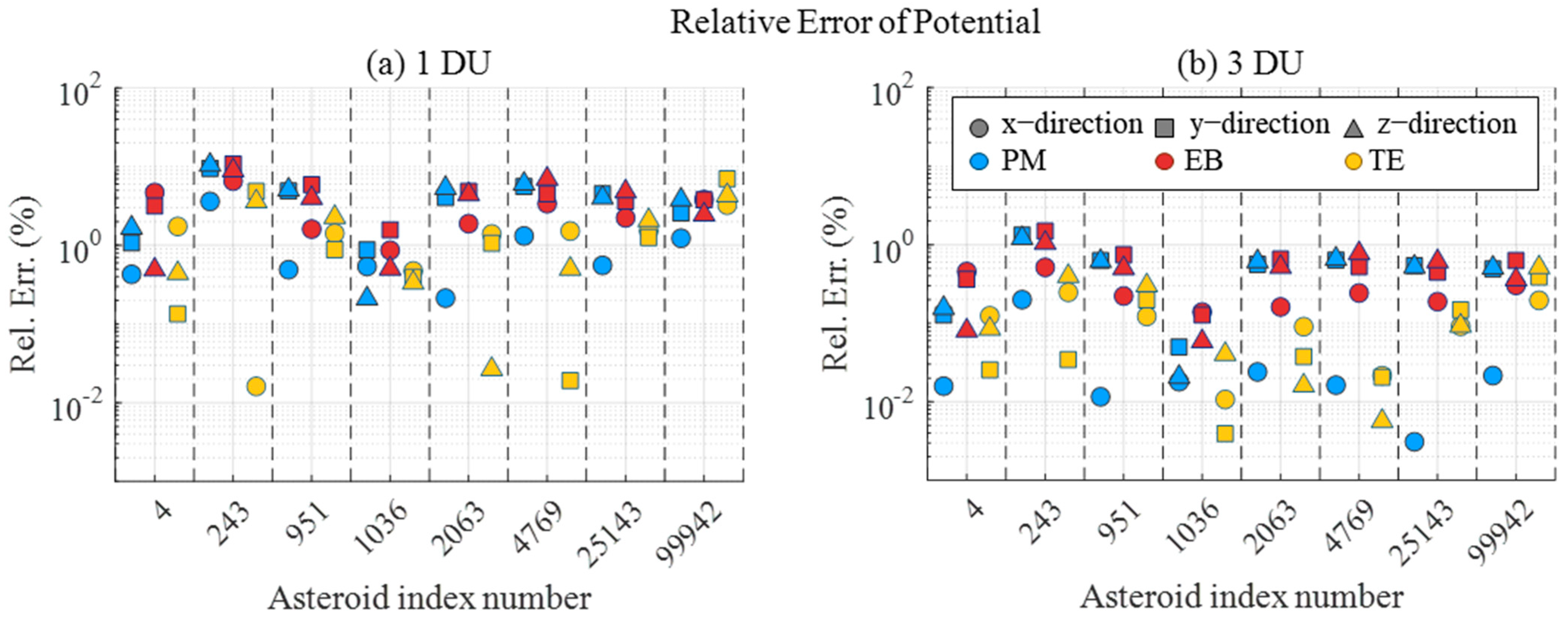
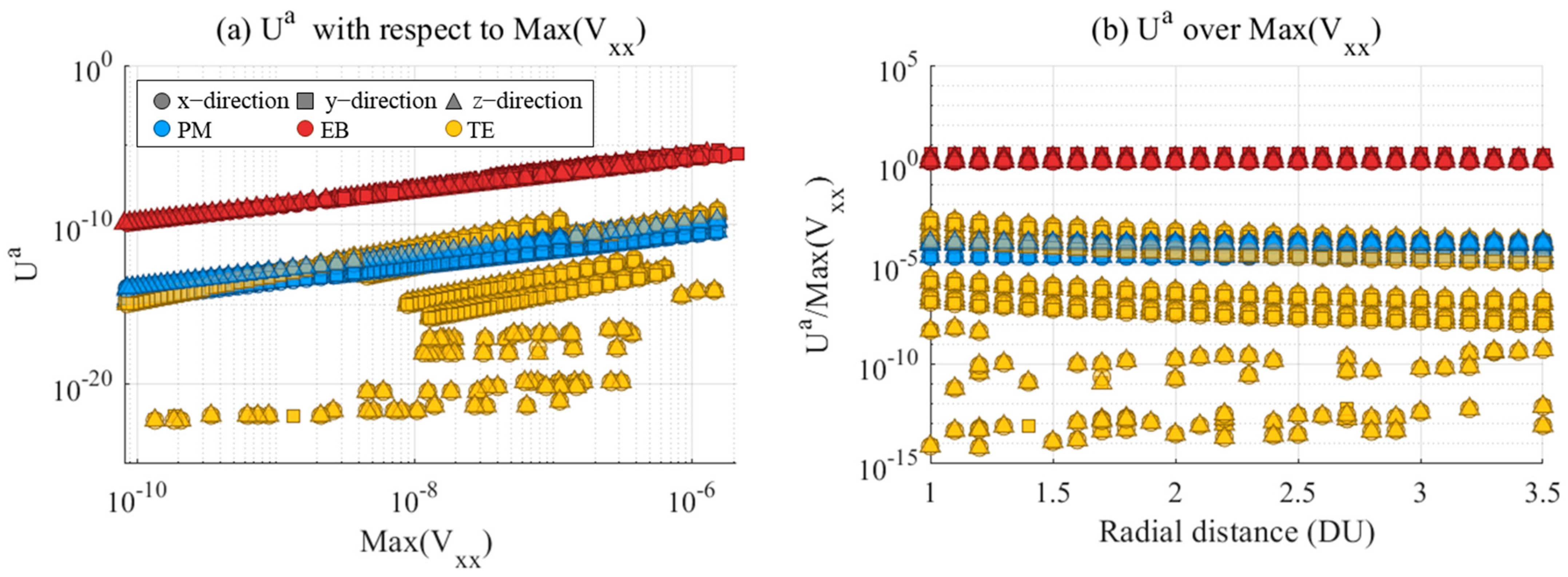
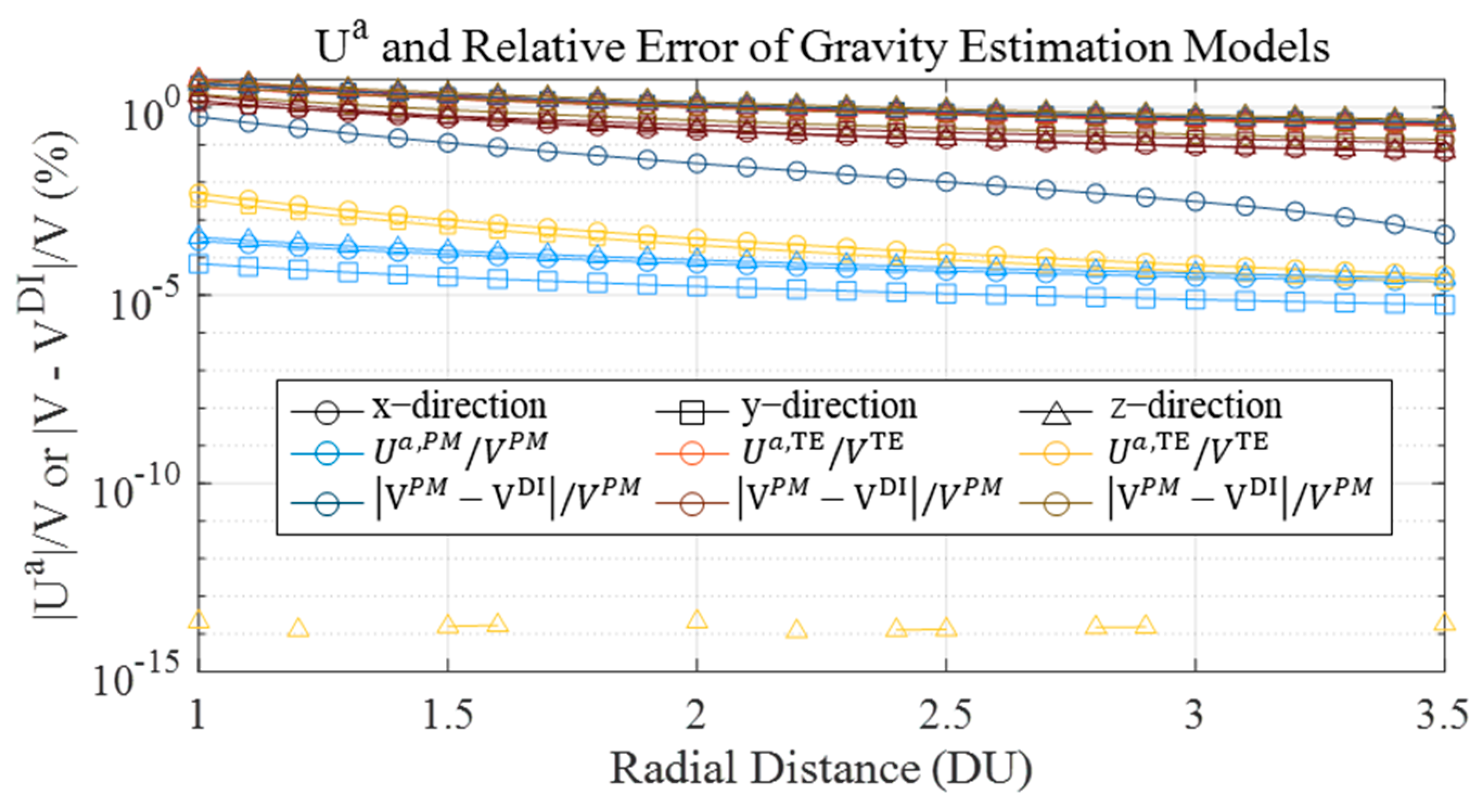
The present study aims to propose a general framework of modeling rigid body potentials (RBPs) suitable for analyzing the orbit–attitude coupled motion of a spacecraft (S/C) near small celestial bodies, regardless of gravity estimation models. Here, ‘rigid body potential’ refers to the potential of a small celestial body integrated across the finite volume of an S/C, assuming that the mass of the S/C has no influence on the motion of the small celestial body. First proposed is a comprehensive formulation for modeling the RBP including its associated force, torque, and Hessian matrix, which is then applied to three gravity estimation models. The Hessian of potential plays a crucial role in calculating the RBP. This study assesses the RBP via numerical simulations for the purpose of determining proper gravity estimation models and seeking modeling conditions. The gravity estimation models and the associated RBP are tested for eight small celestial bodies. In this study, we utilize distance units (DUs) instead of SI units, where the DU is defined as the mean radius of the given small celestial body. For a given specific distance in Dus, the relative error of the gravity estimation model at this distance has a similar value regardless of the small celestial body. However, the difference value between the potential and RBP depends on the DU; in other words, it depends on the size of the small celestial body. This implies that accurate gravity estimation models are imperative for conducting RBP analysis. The overall results can help develop a propagation system for orbit–attitude coupled motions of an S/C in the vicinity of small celestial bodies.
Keywords: gravity estimation; orbit–attitude coupled motion; rigid body potential; small celestial body; direct integration gravity estimation; orbit–attitude coupled motion; rigid body potential; small celestial body; direct integration