Article

Bibliometric Analysis of Climate Resilience Research: Trends, Indicators, and Conceptual Approach


Laboratoire de Recherche en Economie et Management des Organisations (LAREMO), École Nationale de Commerce et de Gestion (ENCG), Université Sultan Moulay Slimane (USMS), Beni Mellal 23000, Morocco
*
Author to whom correspondence should be addressed.
Climate 2026, 14(6), 119; https://doi.org/10.3390/cli14060119
Submission received: 20 March 2026 / Revised: 15 May 2026 / Accepted: 18 May 2026 / Published: 5 June 2026

Abstract

Climate resilience has evolved and transitioned from a concept focused on disaster risk to a strategic development paradigm. It has become a core area of focus for researchers, professionals, and policymakers due to the increasing frequency and severity of climate change hazards. The academic landscape persists in a fragmented state in spite of its significant prominence due to diverse conceptual frameworks, various definitions, and a lack of precise indicators to assess climate resilience across sectors. The crucial objective of this research is to conduct a comprehensive bibliometric analysis of the academic literature on climate resilience, measure the scientific influence, and identify gaps and opportunities. This bibliometric review was conducted using data from Web of Science, consisting of 1096 articles published between 2015 and 2025. Vosviewer represents the main software used to evaluate the network of leading authors, journals, international collaborations, and the dominant countries. Terms such as climate change, resilience, and indicators received particular attention, representing the main conceptual connections. This study reveals an overview of the field’s progression, themes, trends, and challenges. The results reveal a sustained increase in research output and a heterogeneous landscape organized around key domains, including urban resilience, ecosystem dynamics, agricultural systems, governance, climate impacts, and sustainability transitions. Resilience is assessed using diverse, context-specific indicators, with governance, vulnerability, and adaptive capacity frequently identified as core dimensions. However, measurement approaches remain inconsistent and lack standardization. Scientific production is concentrated in a limited number of countries, although international collaboration is gradually expanding. These findings underscore the multidimensional and evolving characteristics of climate resilience research, with no clear movement toward a unified measurement framework.

1. Introduction

Climate change constitutes one of the most pressing global challenges of the 21st century. Anthropogenic greenhouse gas emissions are driving substantial changes in atmospheric, oceanic, and terrestrial systems [1] and disrupting food security, water resources, infrastructure, and public health [1,2]. In response, scientific and policy communities have expanded their focus beyond emissions reduction to include adaptation and resilience [3]. Despite the prominence of climate resilience in these discussions, its definition and practical applications remain contested.
Climate resilience is commonly defined as the capacity of systems to anticipate, absorb, adapt to, and recover from climate-related disturbances [4,5]. However, interpretations of this concept differ. Some scholars view resilience as the ability of systems to remain stable and operational under stress [6], while others conceptualize it as a dynamic process involving adaptation, learning, and transformation after climate shocks [7]. The shift from a static to a more flexible understanding of resilience complicates the identification of its objectives and the development of appropriate metrics [8].
The ambiguity surrounding climate resilience is compounded by its multidisciplinary origins. Environmental perspectives emphasize ecosystem stability and nature-based solutions [9,10], whereas social and economic viewpoints focus on governance, institutional frameworks, and community dynamics [11]. As a result, climate resilience encompasses environmental, economic, social, and institutional dimensions. Although holistic approaches are increasingly advocated, many studies remain sector-specific, impeding the development of a unified analytical framework for resilience [12]. This fragmentation is reflected in the diversity of methodologies and perspectives, which are not fully harmonized. Divergent conceptualizations are particularly evident in measurement practices [13]. There is a broad consensus that a single indicator cannot capture resilience. Instead, it must address multiple dimensions, such as social and economic capacity, infrastructure, governance, and environmental conditions [14,15]. Composite indices are often used to synthesize this complexity into a single metric. While these indices facilitate comparison and communication, they frequently rely on subjective weighting and require extensive data, raising concerns about validity and transparency [16]. Although composite tools help structure measurements, they may obscure important local variations. Alternative approaches prioritize location-specific indicators, arguing that resilience is inherently context-dependent and cannot be standardized across diverse regions [17]. These methods emphasize local relevance, adaptability, and community engagement, especially in data-scarce environments [18]. However, the lack of standardized metrics complicates cross-study and cross-regional comparisons, hindering the establishment of consistent resilience benchmarks [19,20]. Balancing comparability with local specificity remains a central challenge in developing resilience indicators [21].
Ongoing debate surrounds the selection of appropriate indicators for assessing resilience. Many studies differentiate between process-based indicators, which evaluate the implementation of adaptation strategies and institutional readiness, and outcome-based indicators, which assess the tangible impacts of these efforts [22]. Process-based indicators are more commonly used because they are easier to measure. However, they may not accurately capture the effectiveness of resilience interventions in reducing risks or supporting recovery [23]. In contrast, there are outcome-based indicators [24,25]. Economic development and infrastructure supply essential resources and strengthen system robustness [15], while environmental stability, particularly regarding water security and ecosystem services, supports overall resilience [26]. Despite recognition of these interconnections, many studies continue to examine these domains separately rather than as components of an integrated system [27].
This fragmentation is further reflected in the variety of methodologies used to assess climate resilience. Composite indices, such as the Climate and Natural Climate Resilience Index (CNCRI), Multidimensional Resilience Index (MRI), and Index of Urban Resilience (IUR), combine multiple indicators using methods like surveys, multi-criteria analysis, and Geographic Information Systems GIS modeling [28,29,30]. Some studies also employ statistical techniques, such as Principal Component Analysis (PCA), to identify key components and reduce redundancy [31]. While these approaches increase the sophistication of resilience measurement, they involve trade-offs: advanced models offer more nuanced analysis but require extensive data and technical expertise, which may limit their use in developing contexts. A geographic imbalance is evident in climate resilience research, with most studies originating from developed countries that have superior data and research infrastructure [32,33]. Conversely, regions most vulnerable to climate change are often underrepresented [15,28]. This disparity complicates the evaluation of the universal applicability of existing frameworks and highlights the need for context-sensitive approaches tailored to diverse social and environmental conditions [34].
Despite advances in climate resilience research, divergent conceptualizations, methodologies, and indicators continue to impede cohesion within the field. The lack of flexible yet standardized tools, the dominance of process-based indicators, and the persistence of disciplinary and regional divides underscore the need for more integrated approaches [35]. Integrating conceptual, methodological, and practical dimensions is essential for advancing both theoretical understanding and practical implementation of climate resilience [36]. In response to the conceptual fragmentation surrounding climate resilience and its measurement, this study uses a bibliometric approach to map and analyze the existing literature systematically. Bibliometric analysis provides a quantitative, transparent, and reproducible framework for examining extensive scientific output [37]. This methodology facilitates the identification of research structures, thematic patterns, and knowledge gaps over time [38]. In contrast to traditional narrative reviews, bibliometric analysis offers a data-driven and comprehensive overview of the field, thereby reducing subjectivity and strengthening analytical rigor. This fragmentation highlights the need for a structured, integrative assessment of the field.
Therefore, this study conducts a bibliometric analysis of scientific publications indexed in the Web of Science from 2015 to 2025 to examine the evolution of research on climate resilience and its measurement frameworks. In order to understand the development of the field of climate resilience, this study is guided by the following research questions:
RQ1: What are the primary intellectual frameworks and thematic trends that define the field of climate resilience research?
RQ2: How has the field of climate resilience research evolved over time, with particular emphasis on the integration and role of resilience indicators?
RQ3: How has the climate resilience literature evolved in terms of publication trends, collaboration patterns, and key contributions?
To achieve these objectives and answer the research questions, this study is conceptually grounded in resilience theory, vulnerability frameworks, and climate adaptation perspectives. The integration of these theoretical foundations with quantitative mapping techniques allows the analysis to extend beyond descriptive trends and critically examine the conceptualization, operationalization, and measurement of resilience across diverse contexts. Beyond providing maps of the literature, this study contributes theoretically by showing that climate resilience research has progressively evolved into a multidimensional and system-oriented field integrating governance, adaptive capacity, socio-economic systems, and environmental dimensions. The bibliometric results also reveal a persistent fragmentation in resilience assessment, as indicators persist in being largely context-specific and insufficiently standardized across thematic domains. By uncovering these structural and conceptual gaps, this study emphasizes the need for more integrated and operational resilience assessment frameworks. The remainder of this article is organized as follows. Section 2 describes the materials and methods, including data collection, screening procedures, and bibliometric techniques. Section 3 presents the results using a progressive analytical framework to examine the evolution of scientific production, collaboration structures, intellectual foundations, and thematic developments in climate resilience research. Section 4 discusses the principal findings and theoretical implications. Section 5 concludes by outlining limitations and suggesting directions for future research.

2. Materials and Methods

2.1. Data Source and Search Methodology

A bibliometric approach was used to systematically analyze scientific output on climate resilience, with a specific focus on indicators, conceptual frameworks and measurements. The dataset was obtained from the Web of Science Core Collection (WoS), a credible, high-quality source recognized for its rigorous peer-review process and contributions from leading scholars across multiple disciplines. As a result, Web of Science publications are frequently utilized in systematic literature reviews and bibliometric research [39,40]. To capture the multidimensional aspects of climate resilience and explicitly incorporate measurement-related dimensions, a structured query was applied to the topic field (TS), which includes titles, abstracts, and keywords.
TS = (“climate resilience” OR “resilience to climate change” OR “climate adaptive capacity”) AND TS = (“indicator” OR “metric” OR “assessment” OR “index” OR “composite index”) AND TS = (“climate change” OR “climate adaptation”).
The Boolean operators OR and AND were applied to enhance the relevance of search results by covering all related concepts within the topic. Specifically, the operator OR was employed to combine synonymous and semantically related terms, such as “climate resilience,” “resilience to climate change,” and “climate adaptation”, to cover possible terminology used in different scholarly articles. On the other hand, the operator AND was applied to link the concepts of climate resilience with terms referring to measurements (“indicator,” “assessment,” “index,” etc.). This query was performed on 12 April 2026.

2.2. Data Screening and Workflow

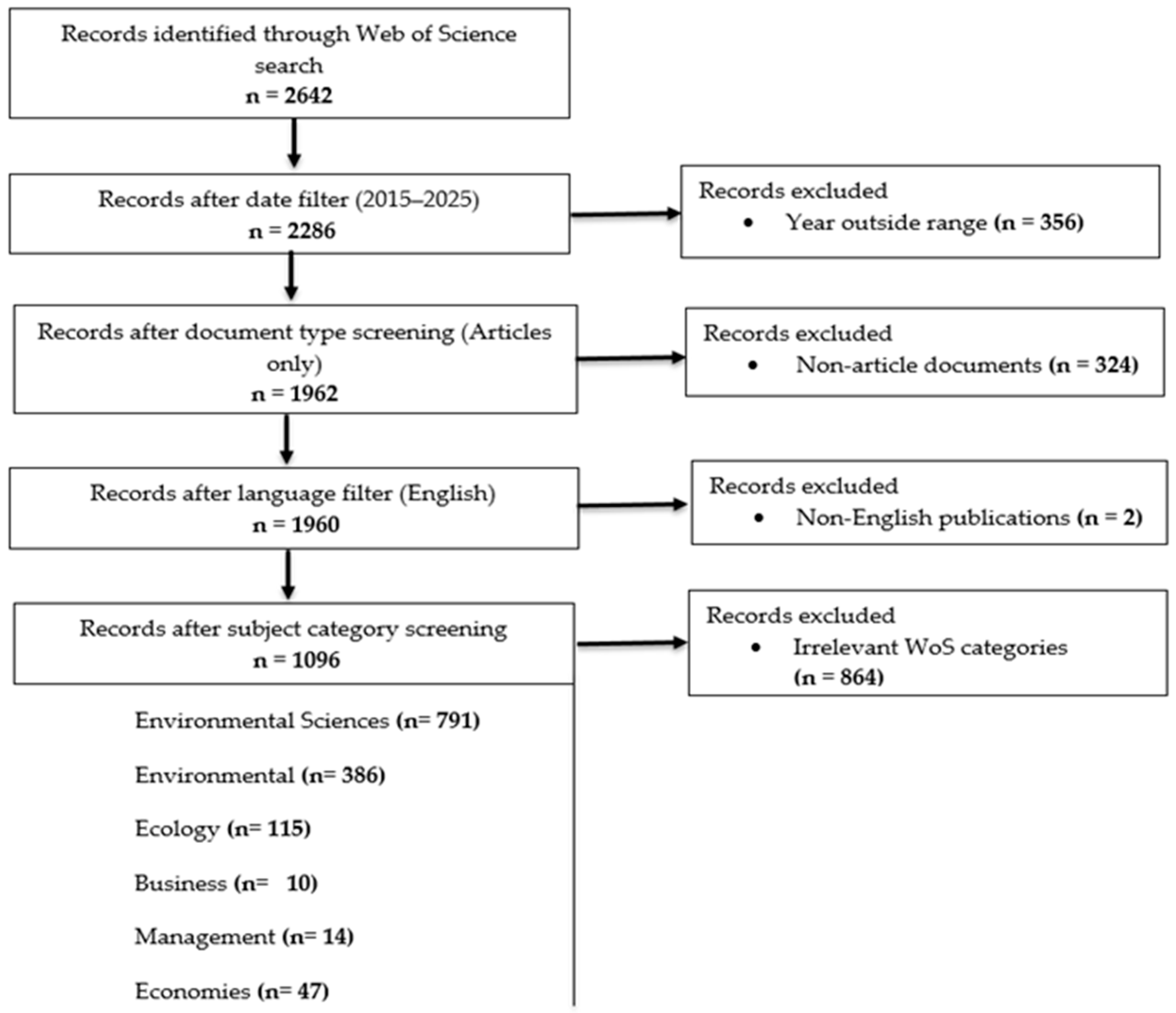
A rigorous multi-step filtering process was implemented, utilizing a PRISMA-inspired approach (Figure 1) to enhance transparency and ensure methodological consistency. The initial search revealed 2642 records. Using a time filter (2015–2025) to frame the field’s recent developments reduced the database to 2286 documents, excluding 356 records. Thereafter, screening by document type retained only peer-reviewed articles, leading to 1962 records and excluding 324 non-article documents. Only articles were included in the filtering stage to preserve methodological uniformity and scientific validity. Unlike conference papers, editorials, reviews, and book chapters, research articles normally contain comprehensive methodological procedures, empirical results, and scientifically validated contributions that make them suitable for bibliometric and thematic analyses. A language screen was applied to include only English-language publications, thereby ensuring analytical consistency (n = 1960; 2 records excluded). Subsequent subject category screening retained thematic relevance, narrowing the dataset to 1096 articles and excluding 864 records from unrelated Web of Science categories. The final dataset is concentrated on the following main categories: Environmental Sciences, Environmental Studies, Ecology, Economics, Management, and Business. This filtering process achieves a balance between comprehensiveness and relevance and limits disciplinary noise.

2.3. Bibliometric Analysis and Tools

The dataset obtained from Web of Science was analyzed using VOSviewer (version 1.6.20), a bibliometric software designed to visualize thematic evolution, conceptual structure, scientific collaborations, and co-citation patterns within climate resilience research. Different units of analysis were selected according to the specific objectives of each analysis. Author keywords were used for conceptual mapping, while authors and countries were analyzed for collaboration patterns. Cited references and publications served as the basis for citation-based analyses. To enhance network interpretability and minimize isolated nodes, minimum occurrence and citation thresholds were established according to the distribution and density of each dataset. The association strength normalization method in VOSviewer was employed to determine the intensity of relationships between nodes. Full counting was used to maintain the relative contribution of all occurrences and links within the dataset [41]. Clustering was performed automatically using the VOSviewer modularity-based algorithm, which groups nodes according to the strength of co-occurrence, co-citation, citation, or bibliographic relationships. This methodological approach has been applied in several review studies [39]. The analytical process followed a structured sequence: it began with publication trends and collaboration analyses, proceeded to citation and co-citation analyses to examine intellectual foundations, and then used bibliographic coupling and keyword analyses to identify emerging thematic directions and thematic evolution in climate resilience research.

2.4. Methodological Limitations and Critical Considerations

Although this approach is robust, certain limitations persist. Relying exclusively on Web of Science may omit relevant studies indexed in other databases such as Scopus. These selection criteria were chosen to ensure standardized, high-quality, and non-duplicated data. Additionally, keyword-based retrieval may exclude studies that address resilience implicitly, potentially underrepresenting specific perspectives. While bibliometric methods effectively identify structural and thematic patterns, they do not capture the full depth of theoretical contributions. To address this limitation, the results are critically interpreted, with particular attention given to the fragmentation of indicators and conceptual approaches.

3. Results

3.1. Evolution of Scientific Production in Climate Resilience Research

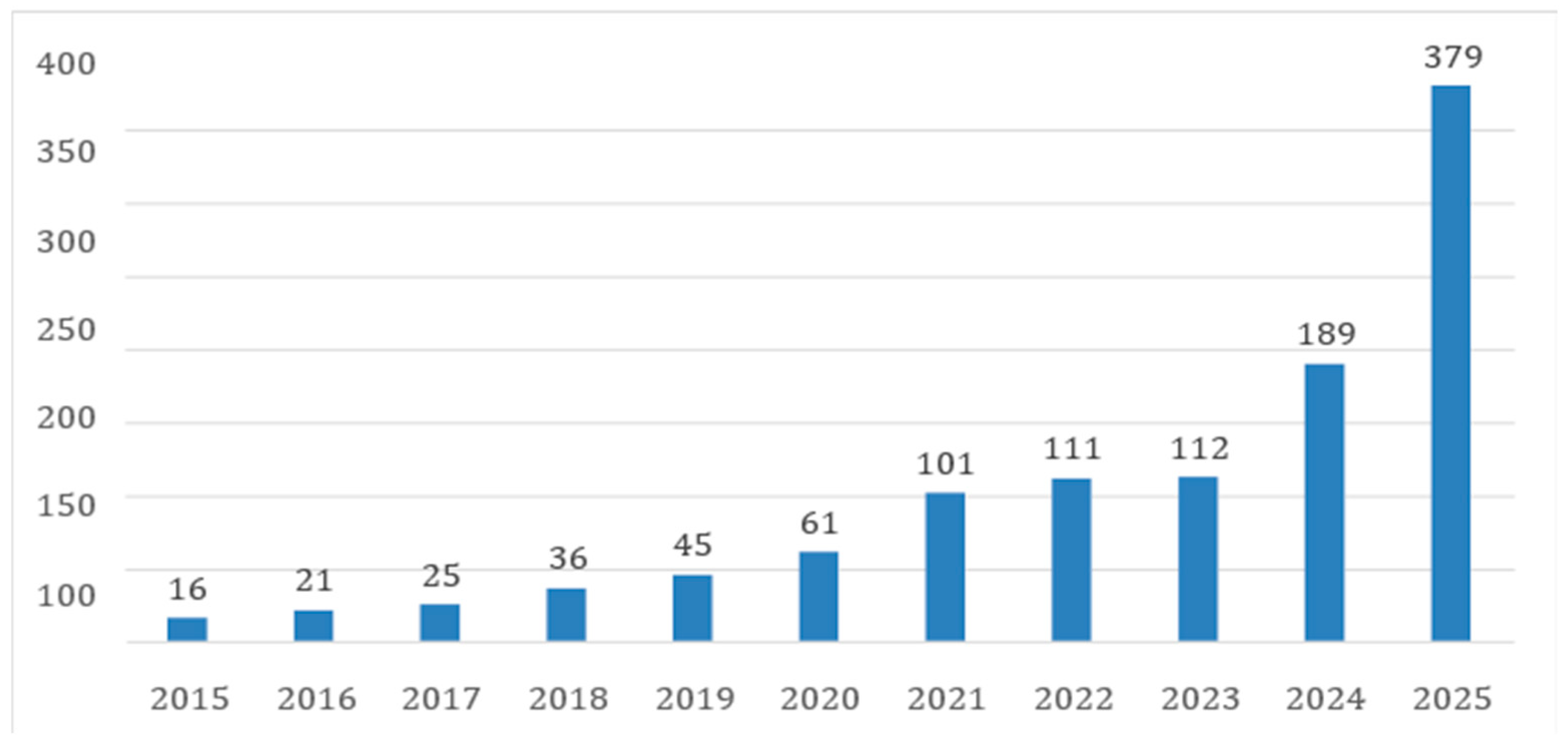
Figure 2 illustrates the annual progression of scientific publications on climate resilience research from 2015 to 2025, indicating a sustained increase in academic engagement and research output throughout this period.
The temporal evolution of climate resilience publications (Figure 2) exhibits a nonlinear growth pattern, driven predominantly by global shocks and policy milestones rather than by continuous scientific progress. The relatively low publication output from 2015 to 2019 suggests an initial phase of conceptual consolidation, primarily influenced by frameworks such as the Paris Agreement and Agenda 2030 [42]. During this period, resilience research was integrated into the broader climate change discourse but struggled to establish itself as a distinct analytical field. A notable inflection point occurred in 2020, aligning with the emergence of the COVID-19 pandemic. The resulting surge in publications underscores the extent to which systemic crises amplify scholarly attention to resilience, particularly in relation to vulnerability, adaptive capacity, and governance. This pattern suggests that resilience research is primarily reactive and event-driven, with interdisciplinary engagement increasing in response to global risks rather than through gradual theoretical advancement [43,44]. The exponential rise in publications during 2024–2025 raises critical concerns about the balance between research quality and quantity. While the increased volume confirms resilience as a central research priority, the absence of methodological standardization and the proliferation of fragmented indicator frameworks suggest that this growth may promote thematic dispersion rather than conceptual coherence. Consequently, this trend reflects a field experiencing rapid expansion without consolidation, where reactive increases in scholarships may impede theoretical progress. Solving fragmentation within climate resilience research involves enhancing interdisciplinary and institutional processes [45]. Shared analytical frameworks and knowledge co-production arrangements play a critical role in fostering cross-disciplinary collaboration [46]. Without such coordinated approaches, climate resilience research risks expanding in scope while remaining methodically fragmented, limiting its comparability and practical policy relevance

3.2. Scientific Collaboration Patterns in Climate Resilience

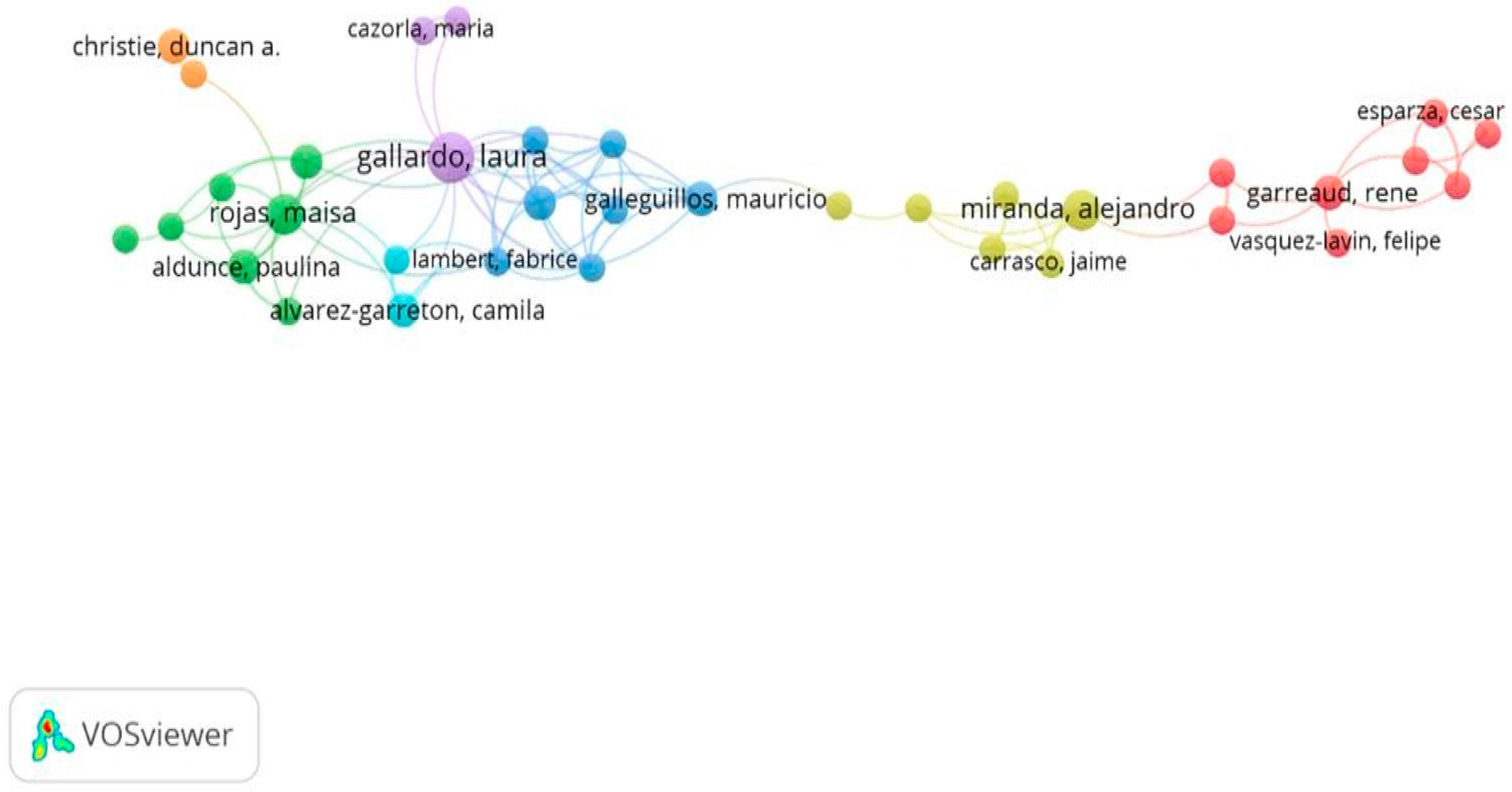
The co-authorship network (Figure 3) demonstrates the collaborative structure of climate resilience research by identifying distinct clusters of authors connected through co-publications. Node size represents author productivity, and link strength quantifies the intensity of collaboration, thereby offering insight into the organization of scientific knowledge within the field.
The co-authorship network (Figure 3) reveals a fragmented, semi-centralized collaboration pattern, with knowledge primarily produced within closed clusters defined by institutional and geographic ties. While authors like Gallardo L. and Rojas Maissa contribute to interdisciplinary projects, their influence is mostly confined to regional groups. This suggests a broader disconnect between policy and research, with collaboration often driven by national or institutional funding priorities rather than fostering global cooperation [47]. From a governance standpoint, limited interaction across clusters sustains conceptual fragmentation. Climate resilience research spans areas such as urban planning, agriculture, ecosystems, and governance, yet bibliometric evidence shows that insights tend to remain within disciplines or regions. This fragmentation hampers the development of standardized indicators and unified frameworks, reducing resilience research’s capacity to guide coherent international policies. The persistence of localized agendas underscores the challenge of managing a fragmented global climate governance system, in which numerous institutions and agreements operate without strong coordination. Although some bridging authors connect different groups, weak cross-institutional and cross-regional ties suggest that resilience knowledge primarily advances through localized efforts rather than coordinated global initiatives. As a result, resilience strategies remain highly context-specific and are implemented inconsistently, limiting the spread of best practices across governance systems. The identified collaboration gaps underscore the necessity for policy instruments and funding frameworks that explicitly support interdisciplinary and international partnerships. In the absence of such mechanisms, resilience research is likely to remain fragmented despite increased publication volume. Achieving conceptual maturity will require governance reforms that facilitate collective knowledge production and ensure that resilience indicators and frameworks are diverse, integrated, and transferable across contexts.
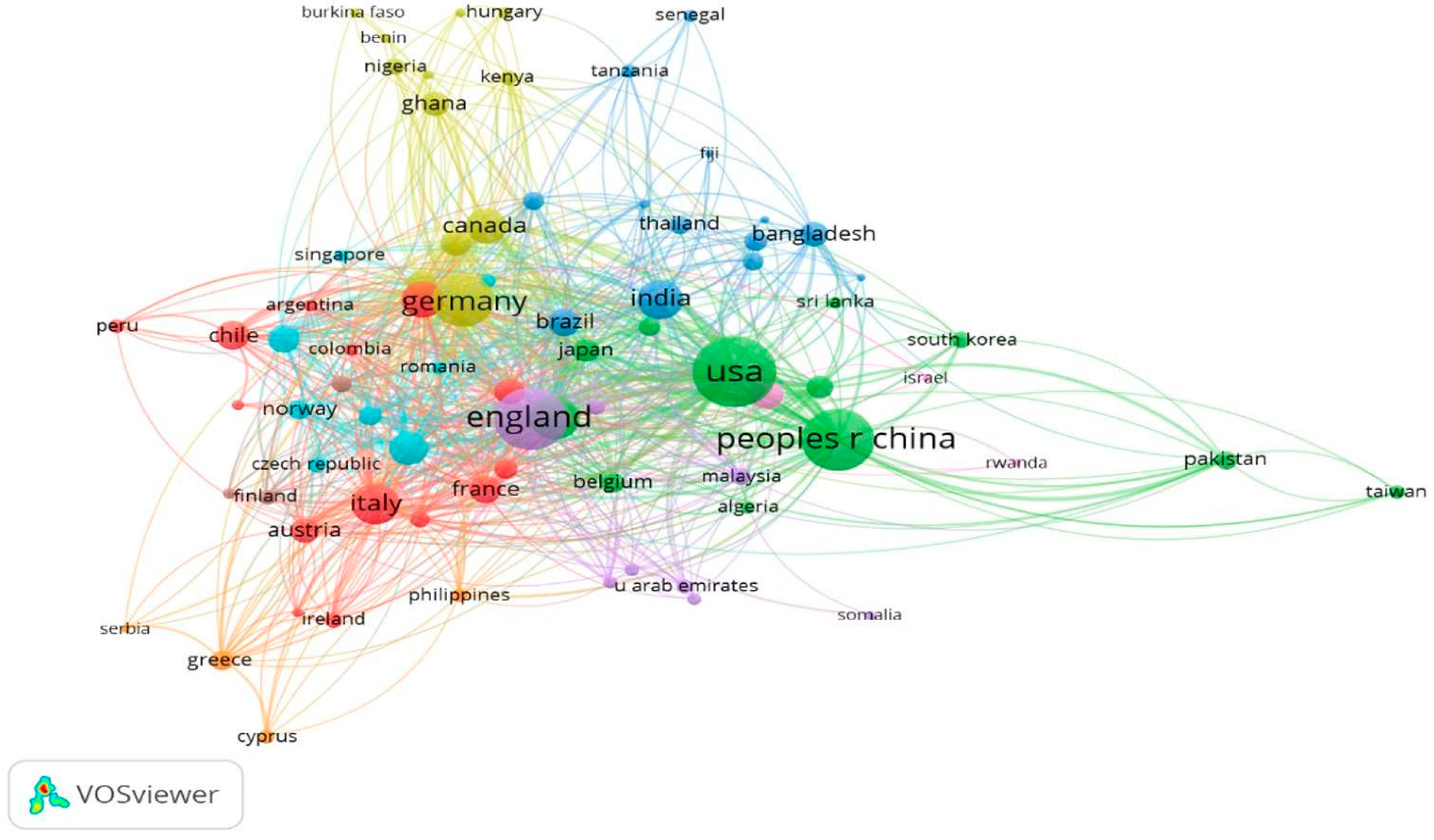
Building on the author-level collaboration analysis, the country collaboration network (Figure 4) reveals five geographically differentiated research communities structured around distinct climate resilience priorities. The Green cluster, dominated by the United States, China and South Korea, is primarily associated with technological innovation, adaptation policies and socio-economic resilience. The Blue cluster, including India, Bangladesh and Brazil, reflects collaborations focused on agricultural adaptation, food security and vulnerability in climate-sensitive regions. The Red cluster, represented by Germany, France, and Italy, emphasizes climate governance, ecological transition, and territorial resilience through strong European–Latin American cooperation. The Yellow cluster highlights African resilience challenges through countries such as Ghana, Nigeria, and Kenya, particularly regarding local adaptation, water, and sustainable development. Finally, the purple cluster, centered on England, the United Arab Emirates, and Malaysia, illustrates more heterogeneous and transitional collaboration patterns. This network demonstrates high intensity but low inclusivity. Strong TLS values among dominant hubs indicate robust collaboration, yet peripheral countries, often the most vulnerable to climate hazards, such as South Africa and South and Southeast Asian countries, remain marginal. This imbalance represents a systemic failure of collaboration performance, where quantitative growth in partnerships does not translate into qualitative diversity or conceptual integration. The clustering patterns further highlight regional lock-in effects, with collaborations shaped by geographic proximity and historical ties rather than thematic complementarity. This reinforces country-level knowledge silos, mirroring the author-level fragmentation observed earlier. Such asymmetry constrains climate resilience’s ability to evolve toward standardized frameworks, instead perpetuating reactive, context-specific approaches. Importantly, the prominence of high-capacity countries may create a top-down bias in resilience research, with indicators and frameworks prioritizing institutional agendas over the lived experiences of vulnerable areas. This challenges the field’s capacity to produce resilience measures that are applicable worldwide and accounts for the uneven progress across different domains highlighted in the later thematic analysis.

3.3. Intellectual Structure of Climate Resilience Research

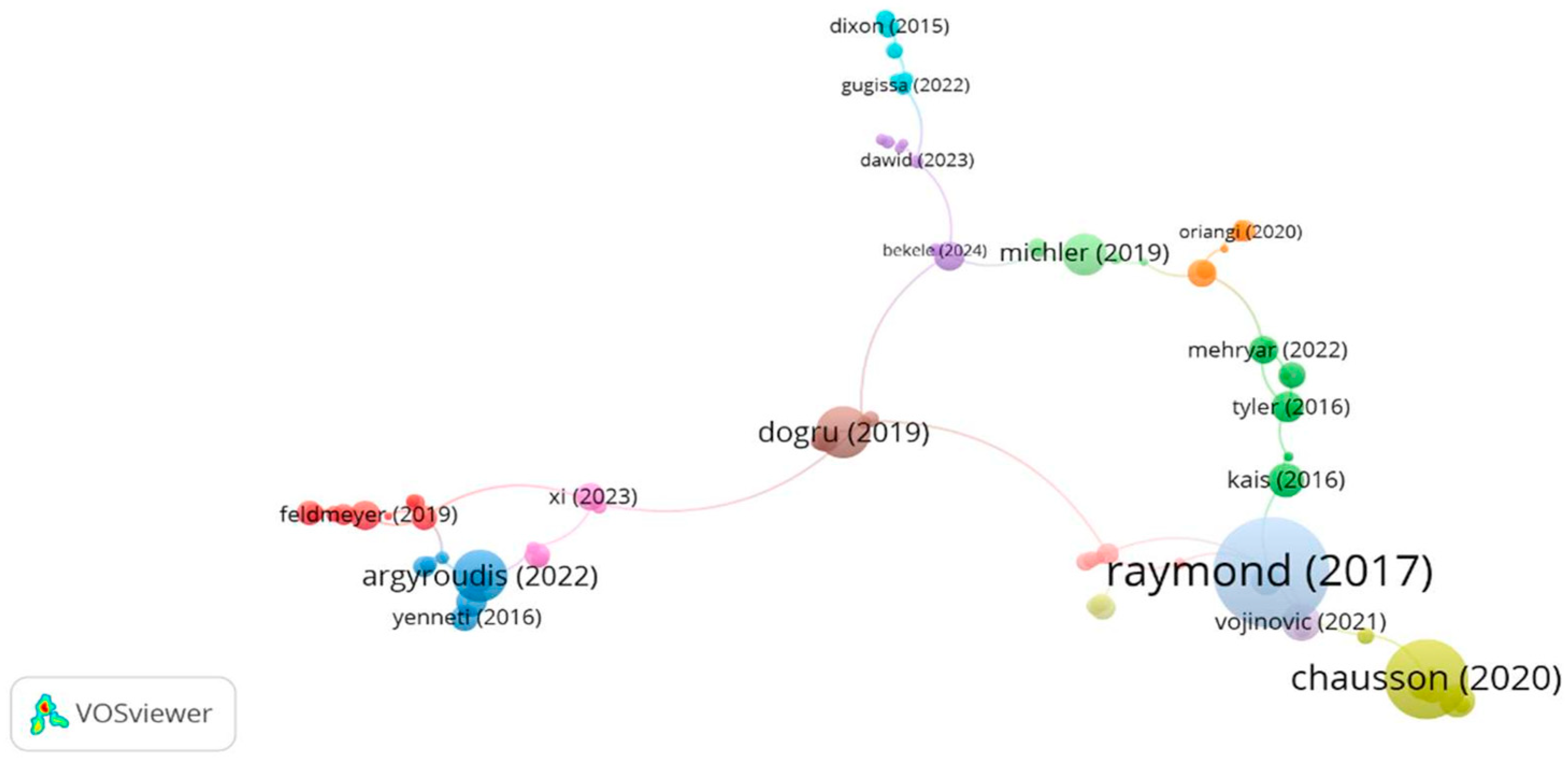
The map presents a citation network between documents. The analysis was conducted using a minimum of four citations per document. Each node represents a publication and its size indicates the number of citations.
The citation network (Figure 5) indicates that climate resilience research is structured around a limited set of intellectual anchors, notably Raymond (2017) and Chausson (2020); their central position within the right section of the network indicates the high citation of their influential and structuring reference within the climate resilience literature. This concentration exemplifies a path-dependent knowledge system in which newer studies reinforce established frameworks instead of diversifying conceptual approaches towards climate resilience. The presence of intermediary publications, such as Dogru (2019), connecting different clusters indicates the emergence of integrative research trajectories capable of bridging otherwise specialized domains. Although this cumulative trajectory consolidates resilience as a research priority, it simultaneously reveals institutional biases. Highly cited works frequently originate from well-funded institutions in the Global North, embedding perspectives that prioritize governance efficiency, ecosystem services, or urban adaptation. Conversely, emerging clusters that address context-specific vulnerabilities, such as socio-economic fragility in the Global South, remain poorly integrated, limiting their visibility and policy relevance [48]. This imbalance directly affects measurement approaches. Weak cross-linkages between citation streams result in measurement frameworks that evolve in isolation, producing fragmented tools that are difficult to compare or transfer across contexts. Consequently, climate resilience research risks becoming quantitatively robust but methodologically inconsistent, which undermines its capacity to inform coherent global strategies. The intellectual structure, therefore, reveals both progress and constraint [49]. Consolidation around seminal works provides stability, but the absence of integration across clusters perpetuates conceptual fragmentation. This explains why thematic evolution later in the analysis shows uneven development: resilience knowledge expands reactively, but without institutional mechanisms to unify measurement approaches, climate resilience research struggles to mature into a coherent domain.
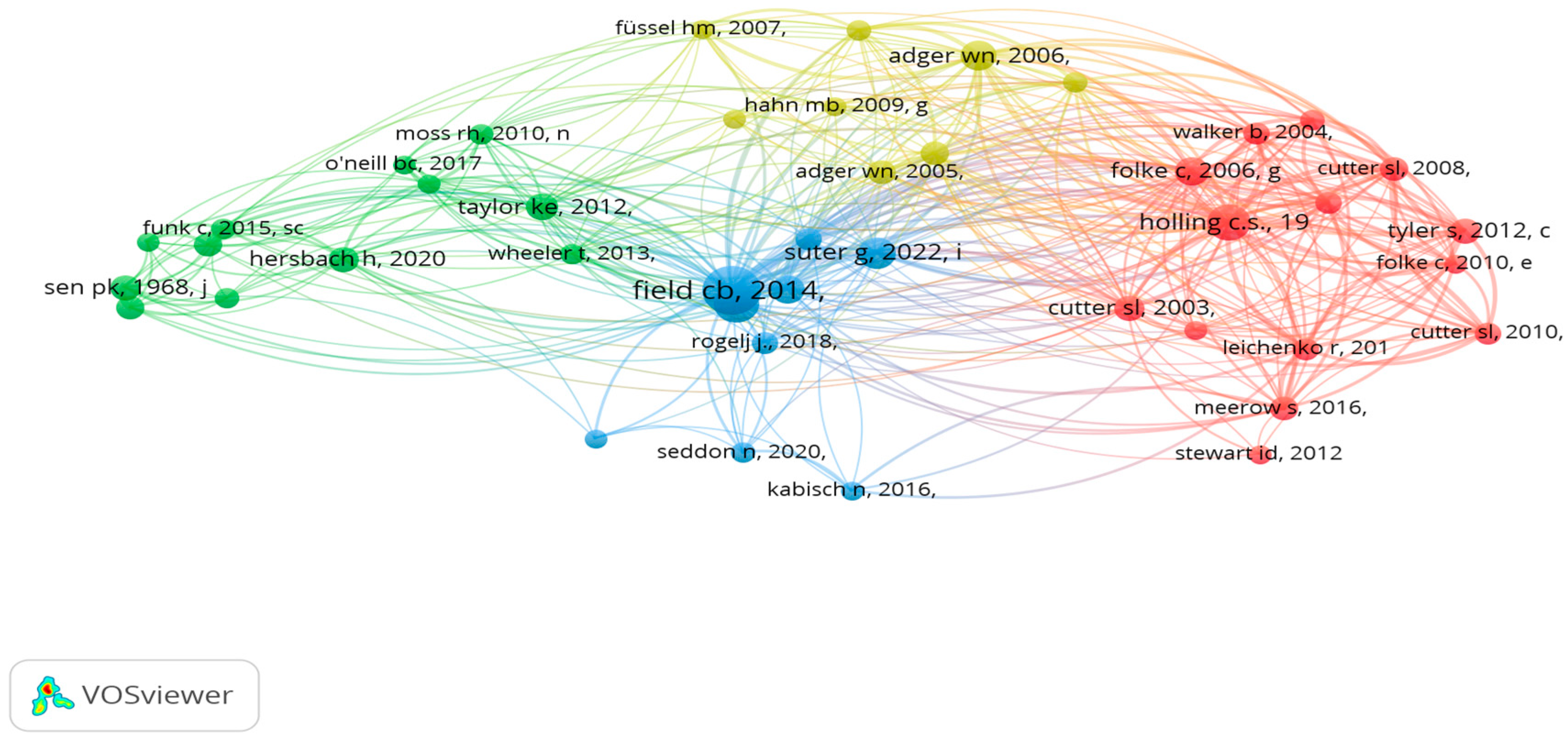
The co-citation structure (Figure 6) enables the identification of intellectual structures of climate resilience and the foundational references shaping the field. The map reveals a triangular intellectual architecture in climate resilience research, structured around socio-ecological theory, governance frameworks, and methodological innovation. The centrality of Field et al. (2014) constitutes the map’s most analytically significant finding. This centrality does not reflect genuine theoretical integration; instead, it demonstrates that cross-cluster coherence is normatively mediated through a single policy synthesis document, rather than through direct intellectual exchange among the four traditions. This structural dependency presents a critical limitation: the AR5 vulnerability framework, based on exposure, sensitivity, and adaptive capacity, was finalized over a decade ago and incorporates assumptions about institutional manageability and linear risk assessment that have been substantially revised by post-2018 resilience scholarship, including the IPCC AR6 (2022). The continued dominance of AR5 as the primary co-citation node, despite the availability of the Fifth Assessment Report (AR6), indicates a citation lag that restricts theoretical renewal across the field. Within the cluster structure, the most significant analytical gap exists between the Yellow and Green clusters. The Yellow cluster, anchored by [Adger and Füssel], provides the conceptual vocabulary for measuring resilience dimensions such as vulnerability, exposure, and adaptive capacity. The Green cluster, built around CMIP5 scenarios, ERA5 reanalysis, and machine learning tools, provides the methodological infrastructure for large-scale quantitative assessment. However, the weak mutual co-citation density between these clusters indicates that the frameworks best suited to define resilience and the tools best suited to operationalize it at scale are advancing largely in parallel. This disconnect constitutes the structural mechanism underlying the measurement heterogeneity that the field has not resolved. When theoretical frameworks and quantitative methods develop without mutual citation accountability, researchers employ sophisticated tools to operationalize implicit and incompatible definitions of resilience, resulting in outputs that are technically rigorous but analytically incomparable across studies and contexts [50,51]. The Red cluster’s internal density, while reflecting genuine theoretical consolidation around the socio-ecological tradition, also signals intellectual insularity, as Holling, Folke, Walker, and Carpenter are predominantly co-cited with one another, limiting their integrative influence on the vulnerability and methodological clusters. In contrast, the Blue cluster remains the least consolidated, its key works (Seddon, 2020) and (Rogelj, 2018) are weakly internally linked, suggesting that urban- and nature-based resilience scholarship is still negotiating its theoretical foundations [52,53]. Overall, the co-citation architecture reveals a field with an intellectual depth that is concentrated within individual traditions rather than distributed across them. Until the four clusters establish direct, substantive co-citation relationships independent of the IPCC as a normative intermediary, climate resilience research will remain structurally constrained in its ability to produce the unified, cross-sectoral measurement framework required for policy relevance.

3.4. Bibliographic Coupling Structure of Climate Resilience Research

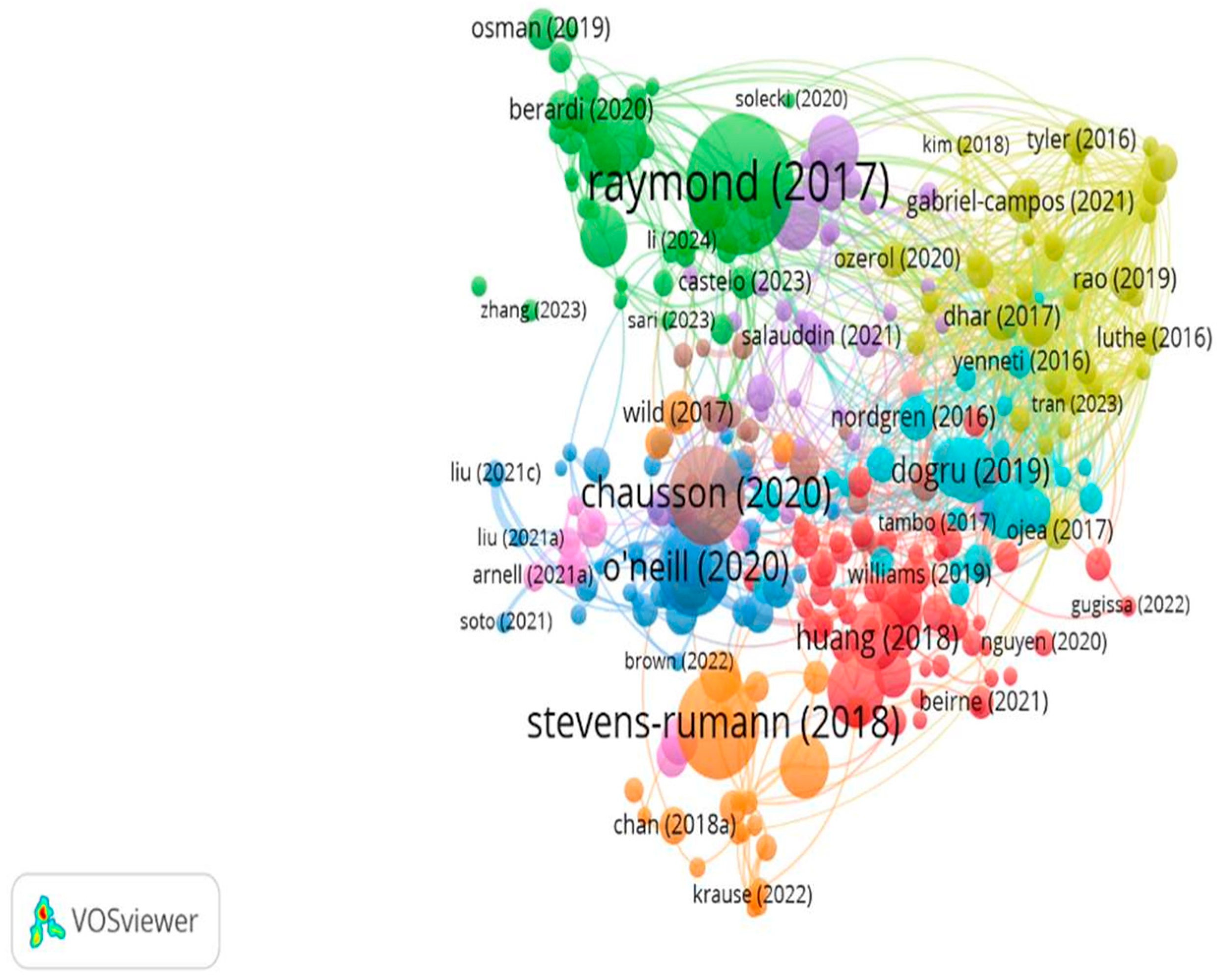
The bibliographic coupling network (Figure 7) illustrates the intellectual proximity among publications in climate resilience research through shared references. In this map, nodes represent individual documents, with their size reflecting their relative influence, and links indicate the extent to which two documents cite the same sources. The clustering of nodes reveals groups of studies that share common theoretical foundations and research orientations, providing insight into the field’s contemporary thematic organization.
The network (Figure 7) exhibits a dense and multi-clustered structure, indicating a relatively high level of intellectual connectivity across the literature. Prominent nodes such as the work by Raymond and Stevens-Rumann, which occupy central positions within tightly connected clusters, suggest that they serve as key reference points around which current research on climate resilience converges. This pattern reflects a field in which recent studies are increasingly interconnected through shared conceptual frameworks, signaling both thematic consolidation and ongoing diversification. However, despite this density, the structure reveals partial fragmentation within thematic clusters. The field is not progressing through a unified theoretical trajectory, but rather through the evolving expansion of empirical and operational research shaped by various adaptation priorities and real-world climate hazards. This reflects the transition of resilience from a primarily conceptual framework into a strategic means increasingly embedded within climate governance and sustainability agendas, yet this shift remains uneven across domains. Consequently, methodological development and empirical application have progressed more rapidly than theoretical integration. In addition, resilience research demonstrates a strong capacity for contextual adaptation and practical implementation, while continuing to lack a sufficiently coherent analytical foundation capable of standardizing resilience assessment across different sectors and scales. From a policy perspective, these findings highlight the importance of fostering integrative research frameworks that bridge thematic silos and support the development of holistic, cross-sectoral climate resilience strategies and measurement indicators.

3.5. Thematic Evolution of Climate Resilience Research

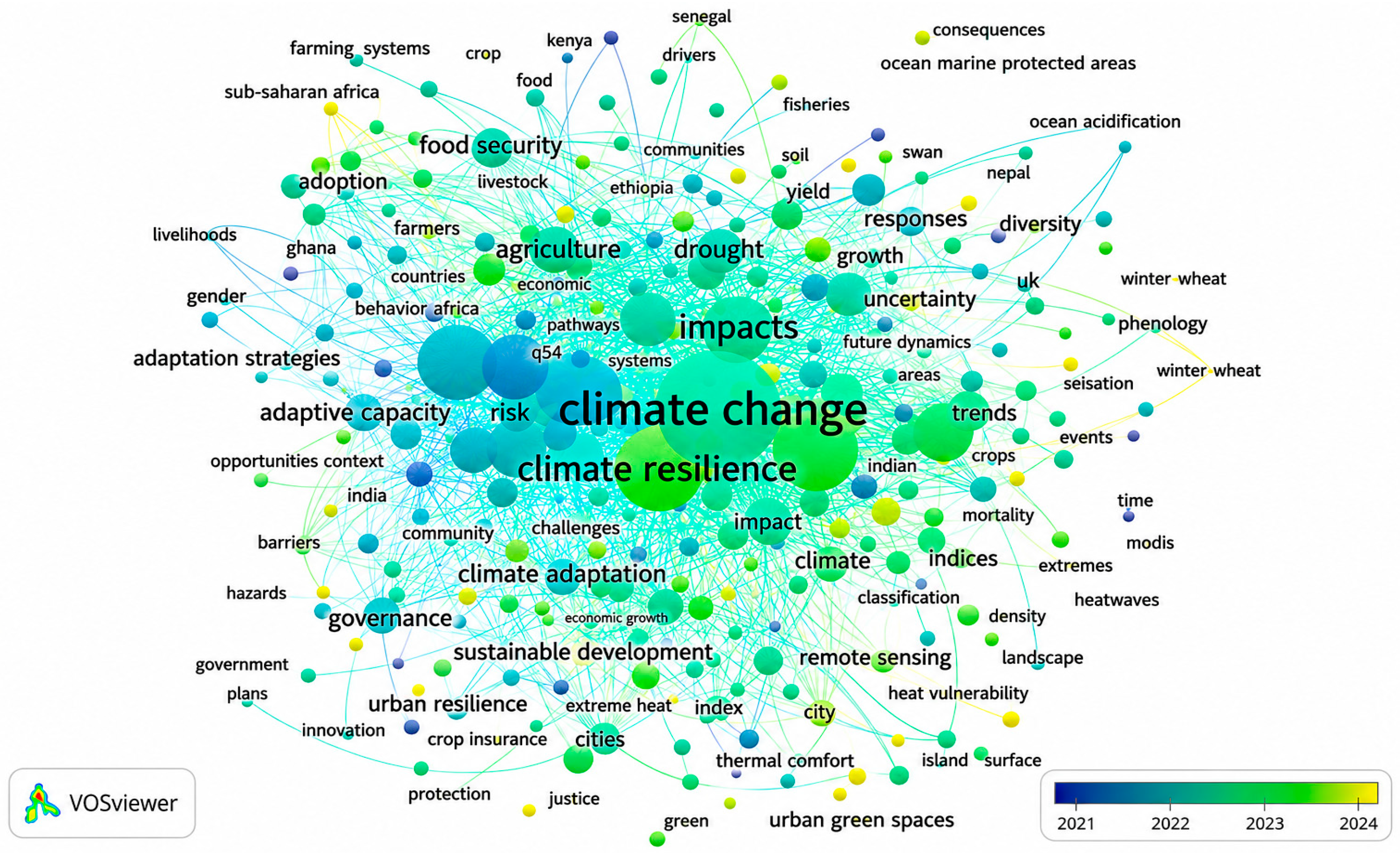
The map presents the temporal distribution of scientific publications on climate resilience during the study period (Figure 8). This visualization facilitates the assessment of the field’s growth dynamics and helps identify key developmental phases and periods of heightened activity in response to major global events and the policy framework.
The temporal evolution of climate resilience research (Figure 8) demonstrates a progressive transition from conceptual and vulnerability-oriented perspectives toward increasingly operational, sector-specific, and policy-driven approaches. During the initial phase (2020–2021), the literature was largely structured around foundational concepts such as resilience, adaptive capacity, indicators, and assessment, reflecting efforts to define the theoretical boundaries of climate resilience and organize its principal analytical dimensions [54]. This early orientation was strongly influenced by global adaptation and disaster-risk governance frameworks, particularly the Paris Agreement and the Sendai Framework for Disaster Risk Reduction, which reinforced the prominence of vulnerability assessments and institutional preparedness within resilience research. From 2022 onward, the thematic structure became more diversified and empirically grounded, expanding toward domains such as agriculture, food security, urban resilience, livelihoods, and climate impacts. The emergence of themes related to gender, mortality, and social vulnerability indicates a growing recognition that resilience is not solely determined by environmental exposure, but also by socio-economic inequalities, governance conditions, and differentiated adaptive capacities. This thematic diversification reflects the increasing integration of resilience into sustainable development and climate adaptation agendas, particularly through climate-smart agriculture, ecosystem restoration strategies, and urban adaptation policies promoted under the 2030 Agenda for Sustainable Development. The most recent phase (2023–2024) is characterized by a stronger orientation toward operational resilience and data-driven assessment approaches, illustrated by the increasing prominence of concepts such as nature-based solutions, remote sensing, machine learning, urban heat islands, and climate governance. This evolution demonstrates that resilience research is increasingly shifting toward implementation-oriented, technology-supported adaptation frameworks. However, the thematic flows and overlay structure also reveal that methodological development has advanced more rapidly than conceptual consolidation. While resilience applications continue to diversify across sectors and scales, assessment approaches remain highly dependent on context-specific indicators, proxy variables, and specialized analytical tools. Consequently, climate resilience research appears increasingly interdisciplinary and operational, yet still fragmented in terms of standardized measurement frameworks and transferable assessment methodologies across domains and geographical contexts.
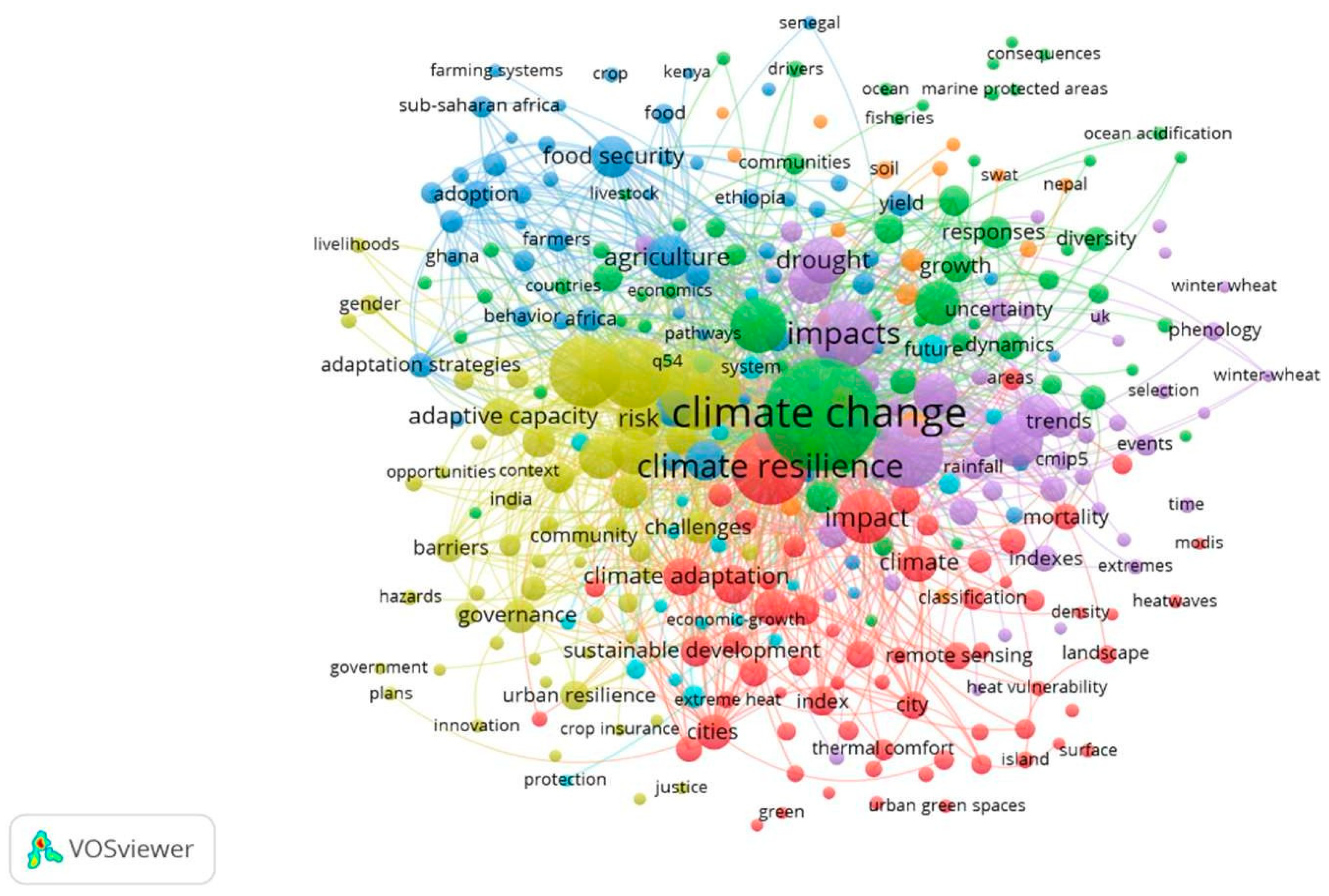
The co-occurrence network (Figure 9) demonstrates that climate change and climate resilience are the primary conceptual anchors within the field. An interdisciplinary convergence space has developed, integrating governance, environmental systems, socio-economic vulnerability, and adaptation planning. The close association among governance, adaptive capacity, risk, and vulnerability suggests that institutional effectiveness is increasingly recognized as a central determinant of resilience performance. The prominence of agriculture, drought, and food security underscores heightened concern regarding climate-sensitive production systems. Concurrently, the emergence of urban resilience, remote sensing and environmental monitoring indicates a shift toward technology-supported, spatially explicit adaptation approaches. However, the network reveals that conceptual expansion has outpaced methodological stabilization. Resilience measurement and quantitative assessment remain peripheral, reflecting continued reliance on fragmented, context-dependent proxies rather than harmonized indicator frameworks. This gap may limit the comparability and scalability of adaptation strategies, particularly in vulnerable regions where resilience depends on the integrated performance of governance, infrastructure, ecosystems, and socio-economic systems. Based on these thematic configurations, the principal research clusters are synthesized in Table 1 according to their dominant themes, keywords, and representative publications.

4. Discussion

The findings of this study provide a comprehensive and up-to-date perspective on the evolution of climate resilience research, revealing a field that is expanding yet structurally fragmented. The significant increase in scientific output after 2015 highlights the growing prominence of resilience within global climate governance, particularly following the Paris Agreement and the United Nations Sustainable Development Goals. Although these frameworks have effectively stimulated research activity, the results indicate that they have not led to a coherent consolidation of concepts or measurement methodologies [67].
The thematic structure identified through keyword co-occurrence and citation mapping demonstrates that climate resilience is grounded in a multidimensional conceptual framework integrating risk, adaptation, and socio-ecological systems. Rather than converging toward a unified framework, the literature is increasingly diversified across thematic domains, including urban resilience, ecosystem-based approaches, and livelihood-oriented resilience. Recent studies confirm that resilience is interpreted differently across disciplinary and sectoral contexts, complicating its operationalization [68]. This conceptual plurality, while reflecting the field’s richness, introduces ambiguity in defining resilience’s boundaries and limits the comparability of empirical studies.
A central contribution of this research is the identification of a persistent imbalance between conceptual development and empirical measurement. Although resilience has gained prominence in policy and academic discourse, the integration of indicators remains weak within the scientific literature. Bibliometric analysis reveals limited connectivity between resilience-related keywords and those associated with measurement, such as indicators, metrics, and indices [69]. Recent studies strongly support this observation, emphasizing that resilience assessment frameworks remain fragmented and lack a universally accepted set of indicators [70]. The proliferation of context-specific indicators, while valuable for localized analysis, impedes the development of universal and comparable measurement systems.
Bibliographic coupling analyses further reveal a structural disconnection between theoretical and applied research streams [71]. Conceptual studies primarily focus on defining resilience and its dimensions, whereas applied research increasingly relies on data-driven, sector-specific indicators. This duality reflects a broader methodological tension within the field, as advances in measurement techniques, such as remote sensing, composite indices, and spatial analytics, are not systematically grounded in unified theoretical frameworks [72]. Consequently, resilience is often operationalized in a fragmented manner, reducing its analytical robustness and limiting its usefulness for policy evaluation.
Another critical insight from this study concerns the geographical and institutional concentration of scientific production. The predominance of developed countries in collaboration networks highlights significant disparities in knowledge production and raises concerns about the global representativeness of resilience frameworks. Given that climate vulnerability is disproportionately higher in developing regions, particularly in Africa, the underrepresentation of these contexts in the literature suggests a potential mismatch between research outputs and real-world needs [32]. Recent studies emphasize the need to integrate local knowledge, socio-economic conditions, and institutional capacities into resilience assessments to enhance their relevance and applicability [73].
This examination confirms the long-lived process–outcome distinction promoted by Pearce-Higgins: process-oriented indicators prevail in research, making the case for urban governance and institutional readiness, rather than outcome-based measures, by looking at concrete recoveries/adaptation outcomes [22]. This is an imbalance that constrains the ability of decision-makers to evaluate the extent to which resilience initiatives work in reality [23].
The results also highlight the increasing influence of policy-oriented and governance-related research in shaping the resilience agenda. The emergence of keywords related to governance, adaptation strategies, and institutional capacity indicates a shift toward more applied and decision-focused research. However, this evolution exposes a significant limitation: although governance frameworks increasingly prioritize resilience, tools for measuring policy effectiveness remain underdeveloped. For example, recent studies demonstrate that adaptation policies often lack robust evaluation mechanisms because standardized resilience indicators are absent. This gap restricts policymakers’ ability to assess the effectiveness of climate interventions and allocate resources efficiently.
The findings further underscore a sectoral imbalance in resilience research, particularly between mitigation and adaptation perspectives. While mitigation-related indicators, such as emissions reductions, are relatively well established, adaptation and resilience indicators remain less clearly defined and more heterogeneous [74]. This imbalance is widely recognized in recent studies, which advocate for the development of integrated indicator systems encompassing both environmental and socio-economic dimensions of resilience. The absence of such integration constitutes a significant limitation in current research and highlights the need for more holistic approaches.
Beyond methodological limitations, the bibliometric findings reveal significant structural and conceptual inconsistencies within climate resilience research. While the field has expanded rapidly across governance, socio-economic systems, environmental management, urban adaptation, and technological resilience, this diversification has not led to corresponding methodological integration. Analyses of co-occurrence, co-citation, and bibliographic coupling collectively indicate that resilience assessment remains fragmented across thematic and sectoral domains, with limited standardization of indicators and weak comparability between assessment frameworks. Most studies continue to emphasize process-oriented and context-specific indicators focused on vulnerability, adaptive capacity, or institutional preparedness, whereas measurable, outcome-based evaluations of resilience are comparatively underdeveloped. Consequently, resilience is often conceptualized as a static condition rather than a dynamic, evolving process shaped by long-term adaptation trajectories and interactions across multiple scales. Furthermore, our findings indicate that governance and institutional dimensions, despite their growing conceptual prominence within resilience discourse, remain inadequately operationalized in empirical assessment frameworks. The limited integration between micro-level resilience assessments and broader national or global adaptation frameworks underscores a persistent disconnect between localized resilience practices and large-scale governance structures. The bibliometric analysis further highlights geographical disparities in scientific production and collaboration, demonstrating the continued dominance of Global North institutions in shaping resilience frameworks, indicators, and research priorities, even though developing regions experience greater vulnerability to climate change impacts. Finally, by highlighting disconnections among conceptual, governance, methodological, and measurement practices, this study sheds light on how resilience is built and used in science. It emphasizes the need for more integrated, transferable, and outcome-focused assessment tools to improve comparability, causal understanding, and application across scales and contexts.
Addressing these gaps requires a transition from descriptive mapping to analytical and integrative approaches that connect indicators, outcomes, and multi-scale dynamics. In this context, the present study contributes by organizing the knowledge base and identifying areas where analytical advancements are most critical.

5. Conclusions

The bibliometric analysis contributes by highlighting significant structural gaps in climate resilience research. Although the field has evolved toward a multidimensional framework integrating governance, socio-economic systems, environmental dynamics, and adaptation processes, resilience assessment remains fragmented across thematic and disciplinary domains. The analysis indicates that resilience is still predominantly assessed using context-specific and process-oriented indicators, characterized by limited standardization and a weak integration of outcome-based measures. Furthermore, although governance and institutional dimensions are central to the literature, they are not sufficiently operationalized using measurable variables. The findings further highlight the significant geographical disparities in scientific production and collaboration, noting that dominant resilience frameworks are largely shaped by highly connected research systems, even as climate vulnerability increases in developing regions. Furthermore, the reliance on descriptive and composite-index methods, along with the scarcity of longitudinal, causal, and multi-level analytical frameworks, limits the operationalization and comparability of resilience assessments. The study demonstrates that climate resilience research has progressed more rapidly in conceptual diversification than in methodological and analytical integration.
Despite its contributions and findings, this study identifies several limitations and exposes important gaps in the climate resilience literature. The analysis relies exclusively on the Web of Science database, which, despite its scientific rigor, may underrepresent regional publications and non-English contributions, potentially affecting the results’ geographical and thematic coverage. Consequently, the identified collaboration patterns and thematic structures reflect the indexed academic production rather than the full diversity of resilience research. Additionally, as a bibliometric study, the analysis focuses on mapping the field’s intellectual structure rather than evaluating the methodological robustness or empirical validity of individual studies. The reliance on keyword-based search strategies may also have excluded relevant studies that use alternative terminologies.

Author Contributions

K.I. played a responsible role in the design of the work, acquisition and data analysis, development of methodology, conceptualization, drafting the original manuscript, and participation in the review and editing process. J.N. contributed to the methodology, data acquisition, validation, and participated in the writing of the original draft, review, and editing. All authors have read and agreed to the published version of the manuscript. O.M. contributed to the validation, work administration, review, and editing. All authors have read and agreed to the published version of the manuscript.

Funding

This research was funded by the National Center for Scientific and Technical Research (CNRST) in Morocco through its PASS scholarship, which supported the study’s academic aspects. The funder was not involved in the study design, data collection, analysis, interpretation of results, or the decision to publish. No specific funding number was provided.

Data Availability Statement

The data in this study were obtained from Web of Science. These data are available from the corresponding author upon reasonable request, subject to database access restrictions.

Acknowledgments

AI tools such as ChatGPT (OpenAI, GPT-5), Grammarly (Pro) and Perplexity (Sonar pro) were used solely for the purpose of generating summaries and enhancing the linguistic refinement and structural organization of paragraphs; all intellectual content and interpretations remain the original work of the authors.

Conflicts of Interest

The authors report no competing financial interests or personal relationships that could have influenced the outcome of the research reported in this article.

Abbreviations

The following abbreviations are used in this manuscript:
CNCRIComposite National Climate Resilience Index
MRIMunicipality Resilience Index
IURUrban Resilience Index
SDGsSustainable Development Goals
WoSWeb of Science
OECDOrganisation for Economic Co-operation and Development
PCAPrincipal Component Analysis
TLSTotal Link Strength
GIS Geographic Information System
IPCCIntergovernmental Panel on Climate Change

References

  1. Calvin, K.; Dasgupta, D.; Krinner, G.; Mukherji, A.; Thorne, P.W.; Trisos, C.; Romero, J.; Aldunce, P.; Barrett, K.; Blanco, G.; et al. IPCC, 2023: Climate Change 2023: Synthesis Report. Contribution of Working Groups I, II and III to the Sixth Assessment Report of the Intergovernmental Panel on Climate Change; Arias, P., Bustamante, M., Elgizouli, I., Flato, G., Howden, M., Méndez-Vallejo, C., Pereira, J.J., Pichs-Madruga, R., Rose, S.K., Saheb, Y., et al., Eds.; IPCC: Geneva, Switzerland, 2023. [Google Scholar]
  2. Cologna, V.; Meiler, S.; Kropf, C.M.; Lüthi, S.; Mede, N.G.; Bresch, D.N.; Lecuona, O.; Berger, S.; Besley, J.; Brick, C.; et al. Extreme Weather Event Attribution Predicts Climate Policy Support across the World. Nat. Clim. Change 2025, 15, 725–735. [Google Scholar] [CrossRef] [Scilit]
  3. OCDE. Climate Resilience in Development Planning: Experiences in Colombia and Ethiopia; OECD Publishing: Paris, France, 2014; ISBN 978-92-64-20949-7. [Google Scholar]
  4. Feldmeyer, D.; Wilden, D.; Kind, C.; Kaiser, T.; Goldschmidt, R.; Diller, C.; Birkmann, J. Indicators for Monitoring Urban Climate Change Resilience and Adaptation. Sustainability 2019, 11, 2931. [Google Scholar] [CrossRef] [Scilit]
  5. Pachauri, R.K.; Meyer, L. Changements Climatiques 2014 Rapport de Synthèse Publié Sous La Direction de L’équipe de Rédaction Principale Rapport de Synthèse GIEC Équipe de Rédaction Principale; GIEC/IPCC (Intergovernmental Panel on Climate Change): Geneva, Switzerland, 2014; ISBN 978-92-9169-243-9. [Google Scholar]
  6. Seidu, S.; Chan, D.W.M.; Edwards, D.J.; Owusu-Manu, D.G. A Systematic Review of Green Infrastructure and Ecosystem-Based Technologies for Climate Resilience: Development Trends, Research Outlook and Future Projections. Environ. Res. Lett. 2025, 20, 083001. [Google Scholar] [CrossRef] [Scilit]
  7. Schleussner, C.F.; Pfleiderer, P.; Andrijevic, M.; Vogel, M.M.; Otto, F.E.L.; Seneviratne, S.I. Pathways of Climate Resilience over the 21st Century. Environ. Res. Lett. 2021, 16, 054058. [Google Scholar] [CrossRef] [Scilit]
  8. OECD. Strengthening Climate Resilience: Guidance for Governments and Development Co-operation. Strength. Clim. Resil. 2021, 16, 054058. [Google Scholar] [CrossRef] [Scilit]
  9. Doorn, N. Resilience Indicators: Opportunities for Including Distributive Justice Concerns in Disaster Management. J. Risk Res. 2015, 20, 711–731. [Google Scholar] [CrossRef] [Scilit]
  10. Soimu, O.; Borges, C.E.; Ferrón, L.M.; Mugarra, A. Towards Holistic Environmental Policy Assessment. Multi-Criteria Frameworks and Recommendations for Modelers. npj Clim. Action 2025, 4, 77. [Google Scholar] [CrossRef] [Scilit]
  11. Einecker, R.; Kirby, A. Climate Change: A Bibliometric Study of Adaptation, Mitigation and Resilience. Sustainability 2020, 12, 6935. [Google Scholar] [CrossRef] [Scilit]
  12. Laurien, F.; Martin, J.G.C.; Mehryar, S. Climate and Disaster Resilience Measurement: Persistent Gaps in Multiple Hazards, Methods, and Practicability. Clim. Risk Manag. 2022, 37, 100443. [Google Scholar] [CrossRef] [Scilit]
  13. Lade, S.J.; Walker, B.H.; Jamila Haider, L. Resilience as Pathway Diversity: Linking Systems, Individual and Temporal Perspectives on Resilience. Ecol. Soc. 2019, 25, 19. [Google Scholar] [CrossRef] [Scilit]
  14. Xie, Y.; Li, H.; Liu, J.; Han, L.; Zhang, X.; Zhou, X.; Guo, X.; Xiu, L.; Yin, H.; Yin, K. The Climate Change Impacts and Responses Index: Quantifying Disparities and Guiding Policies for Collective Resilience. Int. J. Sustain. Dev. World Ecol. 2023, 31, 222–245. [Google Scholar] [CrossRef] [Scilit]
  15. Xiong, M.; Zhao, R.; Li, X.; Wang, Y.; Xu, Z.; Li, F. Climate Resilience Assessment of Sustainability at National Level: A Case Study of Sub-Saharan Africa. J. Clean. Prod. 2023, 430, 139717. [Google Scholar] [CrossRef] [Scilit]
  16. Greco, S.; Ishizaka, A.; Tasiou, M.; Torrisi, G. On the Methodological Framework of Composite Indices: A Review of the Issues of Weighting, Aggregation, and Robustness. Soc. Indic. Res. 2019, 141, 61–94. [Google Scholar] [CrossRef] [Scilit]
  17. Andries, A.; Morse, S.; Murphy, R.J.; Woolliams, E.R. Examining Adaptation and Resilience Frameworks: Data Quality’s Role in Supporting Climate Efforts. Sustainability 2023, 15, 13641. [Google Scholar] [CrossRef] [Scilit]
  18. Hallegatte, S.; Engle, N.L. The Search for the Perfect Indicator: Reflections on Monitoring and Evaluation of Resilience for Improved Climate Risk Management. Clim. Risk Manag. 2019, 23, 1–6. [Google Scholar] [CrossRef] [Scilit]
  19. Boluwatife, S. ESG Metrics and Reporting: Best Practices for Companies; ResearchGate: Berlin, Germany, 2025. [Google Scholar]
  20. Salehi, S.; Ardalan, A.; Garmaroudi, G.; Ostadtaghizadeh, A.; Rahimiforoushani, A.; Zareiyan, A. Climate Change Adaptation: A Systematic Review on Domains and Indicators. Nat. Hazards 2019, 96, 521–550. [Google Scholar] [CrossRef] [Scilit]
  21. Feldmeyer, D.; Wilden, D.; Jamshed, A.; Birkmann, J. Regional Climate Resilience Index: A Novel Multimethod Comparative Approach for Indicator Development, Empirical Validation and Implementation. Ecol. Indic. 2020, 119, 106861. [Google Scholar] [CrossRef] [Scilit]
  22. Pearce-Higgins, J.W.; Antão, L.H.; Bates, R.E.; Bowgen, K.M.; Bradshaw, C.D.; Duffield, S.J.; Ffoulkes, C.; Franco, A.M.A.; Geschke, J.; Gregory, R.D.; et al. A Framework for Climate Change Adaptation Indicators for the Natural Environment. Ecol. Indic. 2022, 136, 108690. [Google Scholar] [CrossRef] [Scilit]
  23. Goonesekera, S.M.; Olazabal, M. Climate Adaptation Indicators and Metrics: State of Local Policy Practice. Ecol. Indic. 2022, 145, 109657. [Google Scholar] [CrossRef] [Scilit]
  24. Summers, J.K.; Harwell, L.C.; Smith, L.M.; Buck, K.D. Measuring Community Resilience to Natural Hazards: The Natural Hazard Resilience Screening Index (NaHRSI)—Development and Application to the United States. Geohealth 2018, 2, 372–394. [Google Scholar] [CrossRef] [Scilit]
  25. Özerol, G.; Bressers, H. Enhancing the Resilience of Midsize Cities to Climate Extremes: A Tool for Practitioners to Assess Their Governance Context. Total Environ. Res. Themes 2023, 8, 100080. [Google Scholar] [CrossRef] [Scilit]
  26. Shoaib, S.A.; Rahman, M.M.; Shalabi, F.I.; Alshayeb, A.F.; Shatnawi, Z.N. Climate Resilience and Environmental Sustainability: How to Integrate Dynamic Dimensions of Water Security Modeling. Agriculture 2022, 12, 303. [Google Scholar] [CrossRef] [Scilit]
  27. Belkhiri, K.; Onescu, I.; Szitar-Sirbu, M.A. Integrating Sustainability into Urban Planning: A Systematic Review of Policies Addressing Hazard Risks and Climate Change. Sustainability 2026, 18, 2068. [Google Scholar] [CrossRef] [Scilit]
  28. Sono, D.; Wei, Y.; Jin, Y. Assessing the Climate Resilience of Sub-Saharan Africa (Ssa): A Metric-Based Approach. Land 2021, 10, 1205. [Google Scholar] [CrossRef] [Scilit]
  29. Oriangi, G.; Bamutaze, Y.; Mukwaya, P.I.; Musali, P.; Di Baldassarre, G.; Pilesjö, P. Testing the Proposed Municipality Resilience Index to Climate Change Shocks and Stresses in Mbale Municipality in Eastern Uganda. Am. J. Clim. Change 2019, 8, 520–543. [Google Scholar] [CrossRef]
  30. Anelli, D.; Ranieri, R. Resilience of Complex Urban Systems: A Multicriteria-Based Methodology to Create a Geo-Referenced Urban Resilience Index (IUR). In Urban Resilience Research: Strengthening Cities and Human Settlements Through Research and Innovation; Springer: Cham, Switzerland, 2022; pp. 97–118. [Google Scholar]
  31. Serrano-Candela, F.; Estrada, F.; Raga, G.; González Salazar, C. Data-Driven Complementary Indices and Metrics for Assessing National Progress on Climate Risk and Adaptation. PLoS Clim. 2024, 3, e0000365. [Google Scholar] [CrossRef] [Scilit]
  32. Hanif, H.; Biswas, A.; Raza, S.; Li, Y. Bridging the Climate Research Divide: A Global Imperative for Equitable Resilience. Sci. Adv. 2025, 11, eadz0469. [Google Scholar] [CrossRef] [Scilit] [PubMed]
  33. Pasgaard, M.; Dalsgaard, B.; Maruyama, P.K.; Sandel, B.; Strange, N. Geographical Imbalances and Divides in the Scientific Production of Climate Change Knowledge. Glob. Environ. Change 2015, 35, 279–288. [Google Scholar] [CrossRef] [Scilit]
  34. Forino, G.; von Meding, J.; Brewer, G.J. A Conceptual Governance Framework for Climate Change Adaptation and Disaster Risk Reduction Integration. Int. J. Disaster Risk Sci. 2015, 6, 372–384. [Google Scholar] [CrossRef] [Scilit]
  35. Eriksen, C.; Simon, G.L. Social Resilience Research on Climate-Related Hazards: Trends, Accomplishments and Shortcomings. PLoS Clim. 2025, 4, e0000496. [Google Scholar] [CrossRef] [Scilit]
  36. Mashwama, N.X.; Phesa, M. Systematic Review of Multidimensional Assessment of Coastal Infrastructure Resilience to Climate-Induced Flooding: Integrating Structural Vulnerability, System Capacity, and Organizational Preparedness. Climate 2025, 13, 192. [Google Scholar] [CrossRef] [Scilit]
  37. Baas, J.; Schotten, M.; Plume, A.; Côté, G.; Karimi, R. Scopus as a Curated, High-Quality Bibliometric Data Source for Academic Research in Quantitative Science Studies. Quant. Sci. Stud. 2020, 1, 377–386. [Google Scholar] [CrossRef] [Scilit]
  38. Pranckutė, R. Web of Science (WoS) and Scopus: The Titans of Bibliographic Information in Today’s Academic World. Publications 2021, 9, 12. [Google Scholar] [CrossRef] [Scilit]
  39. Dube, K.; Al Ali, H.; Khan, B.; Daneshkhah, A. Heatwaves and Public Health: A Bibliometric Exploration of Climate Change Impacts and Adaptation Strategies. Climate 2025, 13, 249. [Google Scholar] [CrossRef] [Scilit]
  40. Soosaraei, M.; Khasseh, A.A.; Fakhar, M.; Hezarjaribi, H.Z. A Decade Bibliometric Analysis of Global Research on Leishmaniasis in Web of Science Database. Ann. Med. Surg. 2018, 26, 30–37. [Google Scholar] [CrossRef] [Scilit]
  41. Leydesdorff, L.; Woo Park, H. Full and Fractional Counting in Bibliometric Networks. J. Informetr. 2016, 11, 117–120. [Google Scholar] [CrossRef] [Scilit]
  42. Fu, H.-Z.; Waltman, L. A Large-Scale Bibliometric Analysis of Global Climate Change Research between 2001 and 2018. Clim. Change 2021, 170, 36. [Google Scholar] [CrossRef] [Scilit]
  43. Suhaimi, N.; Mahmud, S.N.D. A Bibliometric Analysis of Climate Change Literacy between 2001 and 2021. Sustainability 2022, 14, 11940. [Google Scholar] [CrossRef] [Scilit]
  44. Farshi, M. The Impact of the COVID-19 Lockdown on Climate. Int. J. Environ. Monit. Anal. 2022, 10, 68–78. [Google Scholar] [CrossRef]
  45. Pedde, S.; Grendelman, R.; Cumiskey, L.; McCullagh, D.; Vinke-de Kruijf, J.; Hölscher, K. Leveraging Climate Resilience Capacities by (Un)Learning from Transdisciplinary Research Projects. Clim. Risk Manag. 2025, 47, 100675. [Google Scholar] [CrossRef] [Scilit]
  46. Carr Kelman, C.; Brady, U.; Raschke, B.A.; Schoon, M.L. A Systematic Review of Key Factors of Effective Collaborative Governance of Social-Ecological Systems. Soc. Nat. Resour. 2023, 36, 1452–1470. [Google Scholar] [CrossRef] [Scilit]
  47. Harmawan, B.N.; Ilman, G.M.; Pertiwi, V.I.; Bataha, K. Research Trends of Collaborative Governance in Climate Change: A Bibliometric Analysis. Glob. Knowl. Mem. Commun. 2024. [Google Scholar] [CrossRef] [Scilit]
  48. Goodwin, S.; Olazabal, M.; Castro, A.J.; Pascual, U. Global Mapping of Urban Nature-Based Solutions for Climate Change Adaptation. Nat. Sustain. 2023, 6, 458–469. [Google Scholar] [CrossRef] [Scilit]
  49. Siders, A.R. Adaptive Capacity to Climate Change: A Synthesis of Concepts, Methods, and Findings in a Fragmented Field. Wiley Interdiscip. Rev. Clim. Change 2019, 10, e573. [Google Scholar] [CrossRef] [Scilit]
  50. Manyani, A.; Biggs, R.; Hill, L.; Preiser, R. The Evolution of Social-Ecological Systems (SES) Research: A Co-Authorship and Co-Citation Network Analysis. Ecol. Soc. 2024, 29, 33. [Google Scholar] [CrossRef] [Scilit]
  51. Intergovernmental Panel on Climate Change. Climate Change 2022—Impacts, Adaptation and Vulnerability: Working Group II Contribution to the Sixth Assessment Report of the Intergovernmental Panel on Climate Change; Cambridge University Press: Cambridge, UK, 2023. [Google Scholar] [CrossRef] [Scilit]
  52. Seddon, N.; Chausson, A.; Berry, P.; Girardin, C.A.J.; Smith, A.; Turner, B. Understanding the Value and Limits of Nature-Based Solutions to Climate Change and Other Global Challenges. Philos. Trans. R. Soc. B Biol. Sci. 2020, 375, 20190120. [Google Scholar] [CrossRef] [Scilit]
  53. Intergovernmental Panel on Climate Change. Mitigation Pathways Compatible with 1.5 °C in the Context of Sustainable Development. In Global Warming of 1.5 °C Intergovernmental Panel on Climate Change; Cambridge University Press: Cambridge, UK, 2022; pp. 93–174. [Google Scholar] [CrossRef] [Scilit]
  54. Nguyen, H.L.; Akerkar, R. Modelling, Measuring, and Visualising Community Resilience: A Systematic Review. Sustainability 2020, 12, 7896. [Google Scholar] [CrossRef] [Scilit]
  55. Tyler, S.; Nugraha, E.; Nguyen, H.K.; Nguyen, N.V.; Sari, A.D.; Thinpanga, P.; Tran, T.T.; Verma, S.S. Indicators of Urban Climate Resilience: A Contextual Approach. Environ. Sci. Policy 2016, 66, 420–426. [Google Scholar] [CrossRef] [Scilit]
  56. Chausson, A.; Turner, B.; Seddon, D.; Chabaneix, N.; Girardin, C.A.J.; Kapos, V.; Key, I.; Roe, D.; Smith, A.; Woroniecki, S.; et al. Mapping the Effectiveness of Nature-Based Solutions for Climate Change Adaptation. Glob. Change Biol. 2020, 26, 6134–6155. [Google Scholar] [CrossRef] [Scilit] [PubMed]
  57. Dixon, J.L.; Stringer, L.C. Towards a Theoretical Grounding of Climate Resilience Assessments for Smallholder Farming Systems in Sub-Saharan Africa. Resources 2015, 4, 128–154. [Google Scholar] [CrossRef] [Scilit]
  58. Filho, W.L.; Nagy, G.J.; Martinho, F.; Saroar, M.; Erache, M.G.; Primo, A.L.; Pardal, M.A.; Li, C. Influences of Climate Change and Variability on Estuarine Ecosystems: An Impact Study in Selected European, South American and Asian Countries. Int. J. Environ. Res. Public Health 2022, 19, 585. [Google Scholar] [CrossRef] [Scilit]
  59. Michler, J.D.; Baylis, K.; Arends-Kuenning, M.; Mazvimavi, K. Conservation Agriculture and Climate Resilience. J. Environ. Econ. Manag. 2019, 93, 148–169. [Google Scholar] [CrossRef] [Scilit]
  60. Kais, S.M.; Islam, M.S.; Blake, D.; Johnston, D.M.; Macdonald, C. Community Capitals as Community Resilience to Climate Change: Conceptual Connections. Int. J. Environ. Res. Public Health 2016, 13, 1211. [Google Scholar] [CrossRef] [Scilit]
  61. Xu, L.; Cui, S.; Tang, J.; Nguyen, M.; Liu, J.; Zhao, Y. Assessing the Adaptive Capacity of Urban Form to Climate Stress: A Case Study on an Urban Heat Island. Environ. Res. Lett. 2019, 14, 044013. [Google Scholar] [CrossRef] [Scilit]
  62. Yang, C.; Wu, H.; Xie, C.; Wan, Y.; Qin, Y.; Jiang, R.; Zhang, Y.; Che, S. Community Future Climate Resilience Assessment Based on CMIP6, A Case Study of Communities along an Urban-Rural Gradient in Shanghai. Urban Clim. 2024, 56, 101966. [Google Scholar] [CrossRef] [Scilit]
  63. Laino, E.; Toledo, I.; Aragonés, L.; Iglesias, G. A Novel Multi-Hazard Risk Assessment Framework for Coastal Cities under Climate Change. Sci. Total Environ. 2024, 954, 176638. [Google Scholar] [CrossRef] [Scilit]
  64. Dogru, T.; Marchio, E.A.; Bulut, U.; Suess, C. Climate Change: Vulnerability and Resilience of Tourism and the Entire Economy. Tour. Manag. 2019, 72, 292–305. [Google Scholar] [CrossRef] [Scilit]
  65. Yuan, Y.; Zheng, Y.; Huang, X.; Zhai, J. Climate Resilience of Urban Water Systems: A Case Study of Sponge Cities in China. J. Clean. Prod. 2024, 451, 141781. [Google Scholar] [CrossRef] [Scilit]
  66. Mosleh, L.; Negahban-Azar, M.; Pavao-Zuckerman, M. Stormwater Green Infrastructure Resilience Assessment: A Social-Ecological Framework for Urban Stormwater Management. Water 2023, 15, 1786. [Google Scholar] [CrossRef] [Scilit]
  67. Yu, Y.; Chen, K.; Liao, J.; Zhu, W. Detecting the Research Trends and Evolution of Energy Resilience: A Bibliometric Analysis. Environ. Sci. Pollut. Res. Int. 2023, 30, 21797–21814. [Google Scholar] [CrossRef] [Scilit]
  68. Simpson, N.P.; Sparkes, E.; de Ruiter, M.; Trogrlić, R.Š.; Passos, M.V.; Schlumberger, J.; Lawrence, J.; Mechler, R.; Hochrainer-Stigler, S. Advances in Complex Climate Change Risk Assessment for Adaptation. npj Clim. Action 2025, 4, 74. [Google Scholar] [CrossRef] [Scilit]
  69. Jamshed, A.; Rana, I.A.; Birkmann, J.; McMillan, J.M.; Kienberger, S. A Bibliometric and Systematic Review of the Methods for the Improvement of Vulnerability Assessment in Europe Framework: A Guide for the Development of Further Multi-Hazard Holistic Framework. Jamba J. Disaster Risk Stud. 2023, 15, a1486. [Google Scholar] [CrossRef] [Scilit]
  70. Forster, P.M.; Smith, C.; Walsh, T.; Lamb, W.F.; Lamboll, R.; Hall, B.; Hauser, M.; Ribes, A.; Rosen, D.; Gillett, N.P.; et al. Indicators of Global Climate Change 2023: Annual Update of Key Indicators of the State of the Climate System and Human Influence. Earth Syst. Sci. Data 2024, 16, 2625–2658. [Google Scholar] [CrossRef] [Scilit]
  71. Arteaga, E.; Nalau, J.; Biesbroek, R.; Howes, M. Unpacking the Theory-Practice Gap in Climate Adaptation. Clim. Risk Manag. 2023, 42, 100567. [Google Scholar] [CrossRef] [Scilit]
  72. Tehler, H.; Cedergren, A.; de Goër de Herve, M.; Gustavsson, J.; Hassel, H.; Lindbom, H.; Nyberg, L.; Wester, M. Evidence-Based Disaster Risk Management: A Scoping Review Focusing on Risk, Resilience and Vulnerability Assessment. Prog. Disaster Sci. 2024, 23, 100335. [Google Scholar] [CrossRef] [Scilit]
  73. Andrijevic, M.; Crespo Cuaresma, J.; Lissner, T.; Thomas, A.; Schleussner, C.F. Overcoming Gender Inequality for Climate Resilient Development. Nat. Commun. 2020, 11, 6261. [Google Scholar] [CrossRef] [Scilit]
  74. Rana, I.A. Disaster and Climate Change Resilience: A Bibliometric Analysis. Int. J. Disaster Risk Reduct. 2020, 50, 101839. [Google Scholar] [CrossRef] [Scilit]
Figure 1. Flow diagram for data selection.
Climate 14 00119 g001
Figure 2. Yearly scientific publications in climate resilience research (2015–2025).
Climate 14 00119 g002
Figure 3. Co-authorship analysis using VOSviewer clusters = 7 (minimum threshold per author = 2), (n = 5399); n = 35 items were retained for clearer visualization.
Climate 14 00119 g003
Figure 4. Co-authorship analysis of countries using VOSviewer, clusters = 9 (minimum threshold per country = 3), (n = 130); n = 78 items were retained.
Climate 14 00119 g004
Figure 5. Citation analysis using VOSviewer (minimum citation threshold per document = 4), (n = 1096), n = X86 publications were retained.
Climate 14 00119 g005
Figure 6. Co-citation analysis using VOSviewer (minimum co-citation threshold = 10), (n = 62,160), n = 83 references were retained.
Climate 14 00119 g006
Figure 7. Bibliographic coupling analysis using VOSviewer, (minimum coupling threshold = 16), (n = 1096); n = 291 publications were retained for clearer visualization.
Climate 14 00119 g007
Figure 8. Occurrences of climate resilience keywords in overlay structure using VOSviewer (minimum threshold per keyword = 5), (n = 4981); n = 333 items were retained.
Climate 14 00119 g008
Figure 9. Occurrences of climate resilience keywords using VOSviewer (minimum threshold per keyword = 5), (n = 4981), n = 333 items were retained.
Climate 14 00119 g009
Table 1. Thematic clusters and emerging trends in climate resilience research.
ClusterMain Theme/Research TrendsDominant KeywordsRepresentative Publications
Red ClusterUrban resilience, climate resilience, and climate impactsClimate adaptation, cities, remote sensing, urban planning, heat vulnerability. Indicators of Urban Climate Resilience: A Contextual Approach [55]; Indicators for Monitoring Urban Climate Change Resilience and Adaptation [4]
Green ClusterClimate change, ecosystems, and environmental responsesBiodiversity, ecosystems, conservation, responses, uncertainty, diversity Mapping the Effectiveness of Nature-Based Solutions for Climate Change Adaptation [56,57]:
influences of climate change and variability on estuarine ecosystems: an impact study in selected European, South American and Asian countries [58]
Blue ClusterAgriculture and food security and rural adaptationAgriculture, food security, farmers, Sub-Saharan Africa, farming systems Towards a Theoretical Grounding of Climate Resilience Assessments for Smallholder Farming Systems in Sub-Saharan Africa [57]: Conservation Agriculture and Climate Resilience [59]
Yellow ClusterGovernance, risk, and adaptive capacityRisk, vulnerability, governance, adaptive capacity, adaptation strategies Community Capitals as Community Resilience to Climate Change: Conceptual Connections [60]; assessing the adaptive capacity of urban form to climate stress: a case study on an urban heat island [61]
Purple ClusterClimate impacts and resilience indicatorsImpacts, drought, uncertainty, CMIP6, projections Community Future Climate Resilience Assessment Based on CMIP6: A Case Study of Communities Along an Urban–Rural Gradient in Shanghai [62]; A Novel Multi-Hazard Risk Assessment Framework for Coastal Cities Under Climate Change [63]
Light Blue ClusterSustainability and socio-economic systemsSustainable development, economic growth, emissions, systems Climate Change: Vulnerability and Resilience of Tourism and the Entire Economy [64]; Climate Resilience Assessment of Sustainability at National Level: A Case Study of Sub-Saharan Africa [15]
Cyan ClusterWater systems and resource managementWater resources, hydrology, streamflow, basin, SWAT, groundwater Climate Resilience of Urban Water Systems: A Case Study of Sponge Cities in China [65]; Storm water Green Infrastructure Resilience Assessment: A Social-Ecological Framework for Urban Storm water Management [66]
Sources: Author’s elaboration using Vosviewer map and table of co-occurrences of keywords.
Disclaimer/Publisher’s Note: The statements, opinions and data contained in all publications are solely those of the individual author(s) and contributor(s) and not of MDPI and/or the editor(s). MDPI and/or the editor(s) disclaim responsibility for any injury to people or property resulting from any ideas, methods, instructions or products referred to in the content.