Article

ENSO Phase-Dependent Modulation of the Interannual Relationship Between Summer Rainfall and Intraseasonal Oscillation Intensity over the Yangtze River Basin in China

1
National Marine Environmental Forecasting Center, Beijing 100081, China
2
Chinese Academy of Meteorological Sciences, Beijing 100081, China
3
School of Atmospheric Sciences, Nanjing University of Information Science and Technology, Nanjing 210044, China
4
Shaanxi Meteorological Observatory, Xi’an 710014, China
*
Author to whom correspondence should be addressed.
Climate 2026, 14(5), 101; https://doi.org/10.3390/cli14050101
Submission received: 9 April 2026 / Revised: 29 April 2026 / Accepted: 6 May 2026 / Published: 8 May 2026

Abstract

Based on gridded rainfall data and reanalysis datasets during the period 1979–2021, this study investigates the phase-dependent modulation of ENSO (El Niño–Southern Oscillation) on the interannual relationship between summer rainfall and intraseasonal oscillation (ISO) intensity over the middle-lower reaches of the Yangtze River Basin (YRB), together with the associated physical mechanisms. The results show that summer rainfall over the YRB exhibits prominent intraseasonal variability and is significantly positively correlated with ISO intensity at the interannual timescale. This interannual correlation is strongly dependent on the phase of ENSO. During the developing phase of El Niño summers, both summer rainfall and ISO intensity over the YRB are significantly suppressed, and their interannual relationship becomes statistically insignificant. In contrast, during the decaying phase of El Niño summers, both rainfall and ISO intensity are remarkably enhanced, with their positive interannual correlation being substantially strengthened compared to the climatological mean. Further analysis indicates that ENSO influences YRB summer rainfall and ISO intensity primarily by modulating the structure and amplitude of the East Asia–Pacific (EAP) teleconnection pattern. These EAP-related circulation anomalies alter the large-scale atmospheric circulation and moisture transport conditions over the YRB, leading to adjustments in both summer mean rainfall and its intraseasonal variability. Such adjustments not only modify the magnitudes of rainfall and ISO anomalies but also reshape their interannual covariability, resulting in the distinct characteristics of their relationship observed between the developing and decaying phases of El Niño. Therefore, ENSO acts as a key regulator of summer rainfall, ISO intensity, and their interannual relationship in the YRB through its phase-dependent modulation effects.

1. Introduction

ENSO (El Niño–Southern Oscillation) is one of the most prominent air–sea coupling phenomena in the global climate system. By altering the sea surface temperature (SST) distribution in the tropical Pacific, it triggers anomalies in global atmospheric circulation and exerts significant impacts on weather and climate worldwide [1]. During both El Niño and La Niña events, large-scale atmospheric circulation anomalies can directly or indirectly induce extreme weather events across the globe [2,3]. The East Asian subtropical region, regulated by both the South Asian monsoon and the tropical Western Pacific monsoon systems, has a climate variability closely linked to ENSO [4,5].
The middle-lower reaches of the Yangtze River (YRB) are a typical climate-sensitive zone in eastern China, where interannual variations in summer rainfall directly affect regional agricultural security, water resource management, and disaster prevention and mitigation planning. Therefore, clarifying the pathways and mechanisms through which ENSO influences summer rainfall in this region has long been a key focus of climate research.
In addition to interannual-scale variability dominated by ENSO, the atmospheric intraseasonal oscillation (ISO, typically with a period of 10–90 days) is the most prominent mode of intraseasonal atmospheric variability. The concept of ISO originated from Madden and Julian’s studies on the eastward propagation of wind and pressure fields in the tropics, a phenomenon now known as the Madden–Julian Oscillation (MJO) [6,7]. Subsequent studies have demonstrated that ISO is not confined to the tropical region in winter but is also closely associated with the onset, progression, and withdrawal of the Asian summer monsoon [8,9,10,11], leading to the widespread use of the term ISO.
Global-scale studies have shown that the propagation pathways and intensity variations in tropical ISO significantly influence global weather and climate anomalies [12,13,14]. Moreover, ISO activity is not limited to the tropics; intraseasonal variability in the mid-to-high-latitude atmospheric circulation of both hemispheres also plays a critical role in regulating weather and climate events [15,16,17,18,19,20,21,22]. ISO substantially modulates short-term regional rainfall variability via the periodic evolution of convective activity and circulation systems, as illustrated by the coordination between the upper-troposphere divergence and the lower-troposphere convergence in driving ISO-associated rainfall and circulation anomalies [23].
Focusing on the YRB, numerous studies have confirmed that summer rainfall anomalies in this region are closely related to ISO activity [19,24,25,26]. In historical extreme events, ISO has been identified as a key factor governing the low-frequency variation in rainfall during the Meiyu period in the YRB; it not only modulates the distribution of rainfall anomalies but also contributes to the formation and maintenance of regional-scale extreme weather events, such as abrupt drought–flood alternations and persistent extreme heavy rainfall [20,25]. Moreover, the record-breaking Meiyu in 2020 was significantly influenced by specific atmospheric circulation patterns and tropical SST anomalies [27]. Furthermore, a significant positive interannual correlation consistently exists between summer rainfall and ISO intensity in the YRB [19,28,29], with strong ISO activity typically corresponding to a wetter summer and a weak ISO associated with a drier summer. Specifically, in wet summers, the ISO is mainly associated with the northward movement of cyclonic–anticyclonic pairs in the lower troposphere over the tropical region, whereas in dry summers, it is associated with the westward propagation of anomalous anticyclones over the tropical northwestern Pacific [19].
On the other hand, the ENSO cycle is widely recognized as a key driver of summer rainfall anomalies in the YRB, as it modulates atmospheric circulation over the tropical Indian–northwestern Pacific region [3,18,30]. Meanwhile, ENSO can also regulate ISO intensity and propagation pathways by altering the boundary layer moisture distribution and the structure of horizontal and vertical circulations over the tropical Western Pacific [31,32,33]. The relationship between El Niño–Southern Oscillation (ENSO) phases, summer rainfall over the Yangtze River Basin (YRB), and intraseasonal oscillation (ISO) activity represents a critical nexus in East Asian climate dynamics. Extensive research demonstrates that ENSO exerts a profound influence on YRB precipitation through modulation of the East Asian summer monsoon (EASM) system and its embedded ISO components, particularly the 10–20-day and 30–60-day oscillations. For instance, during the decaying phase of El Niño events, a robust teleconnection emerges wherein anomalous sea surface temperature (SST) patterns in the tropical Pacific induce a persistent Western North Pacific anticyclone. This circulation anomaly enhances low-level southwesterly moisture transport into the YRB while simultaneously altering the background state to favor stronger and more organized northward-propagating ISO activity [34,35]. Previous studies have further indicated that the intraseasonal variation in summer rainfall over the YRB is predominantly controlled by the intraseasonal fluctuation of the Western North Pacific subtropical high (WNPSH), and the dynamic changes in WNPSH are further regulated by Rossby wave-like circulation–convection coupling systems [36]. Additionally, the interaction between ENSO and the Indian Ocean Dipole (IOD) exerts a significant modulating effect on ISO activity over the Maritime Continent region [37,38,39,40,41]. Both ENSO and IOD can generate anomalous anticyclones/cyclones over the Western North Pacific (WNPAC/WNPC), which in turn enhance or diminish water vapor transport, leading to changes in summer extreme precipitation over the YRB.
Despite the extensive research on ENSO–rainfall interactions, ISO–rainfall relationships, and ENSO-ISO interactions separately, existing studies have rarely focused on the modulation effect of ENSO on the significant interannual linkage between summer rainfall and ISO intensity in the YRB, especially the phase-dependent differences in this modulation effect during El Niño developing and decaying years, as well as the underlying physical mechanisms.
To focus on the phase-dependent modulation exerted by ENSO on the interannual relationship between summer rainfall and ISO intensity over the YRB, the structure of this study is organized as follows: Section 2 describes the data and methods employed in this research. Section 3 focuses on the interannual relationship between summer rainfall and ISO in the YRB, laying a foundation for subsequent analysis. Section 4 explores the effect of ENSO, including the impacts of SST anomalies on both concurrent and lagged summer rainfall and ISO intensity, as well as the dependence of YRB summer rainfall and ISO on different El Niño evolution phases. Section 5 further elaborates on the modulation mechanism of ENSO on the interannual relationship between summer rainfall and ISO in the YRB. Finally, the main findings and relevant discussions are summarized in Section 6.

2. Data and Method

The daily gridded rainfall data from the Meteorological Information Center of the China Meteorological Administration, with a resolution of 0.5° × 0.5°, are used to depict the summer rainfall and its intraseasonal variation across China. The monthly mean Extended Reconstructed Sea Surface Temperature version 5 (ERSST.V5), developed by the National Oceanic and Atmospheric Administration (NOAA), is used to categorize the ENSO events [42,43,44,45]. In addition, monthly winds, geopotential height, and specific humidity on standard pressure levels from the fifth-generation ECMWF (European Centre for Medium-Range Weather Forecasts) atmospheric reanalysis (ERA5) are utilized to investigate large-scale circulation anomalies and moisture transport variations [46]. The original ERA5 data is provided at a horizontal resolution of 0.25° × 0.25°, which is spatially interpolated to a coarser 1.0° × 1.0° grid in this study. Considering the regional focus and large-scale interannual and intraseasonal analysis objectives, the 1.0° resolution is well-suited for the analysis.
Morlet wavelet spectrum analysis is used to extract the dominant signal of summer rainfall in the YRB. A Lanczos band-pass filter is applied to isolate the intraseasonal signals of rainfall [47]. Empirical Orthogonal Function (EOF) analysis is performed on the 850 hPa zonal wind to obtain the principal mode of the East Asia–Pacific (EAP) teleconnection pattern in the lower troposphere. Composite and regression analyses are also utilized in this study, and a Student t-test is applied to assess the statistical significance of the composite and correlation patterns.
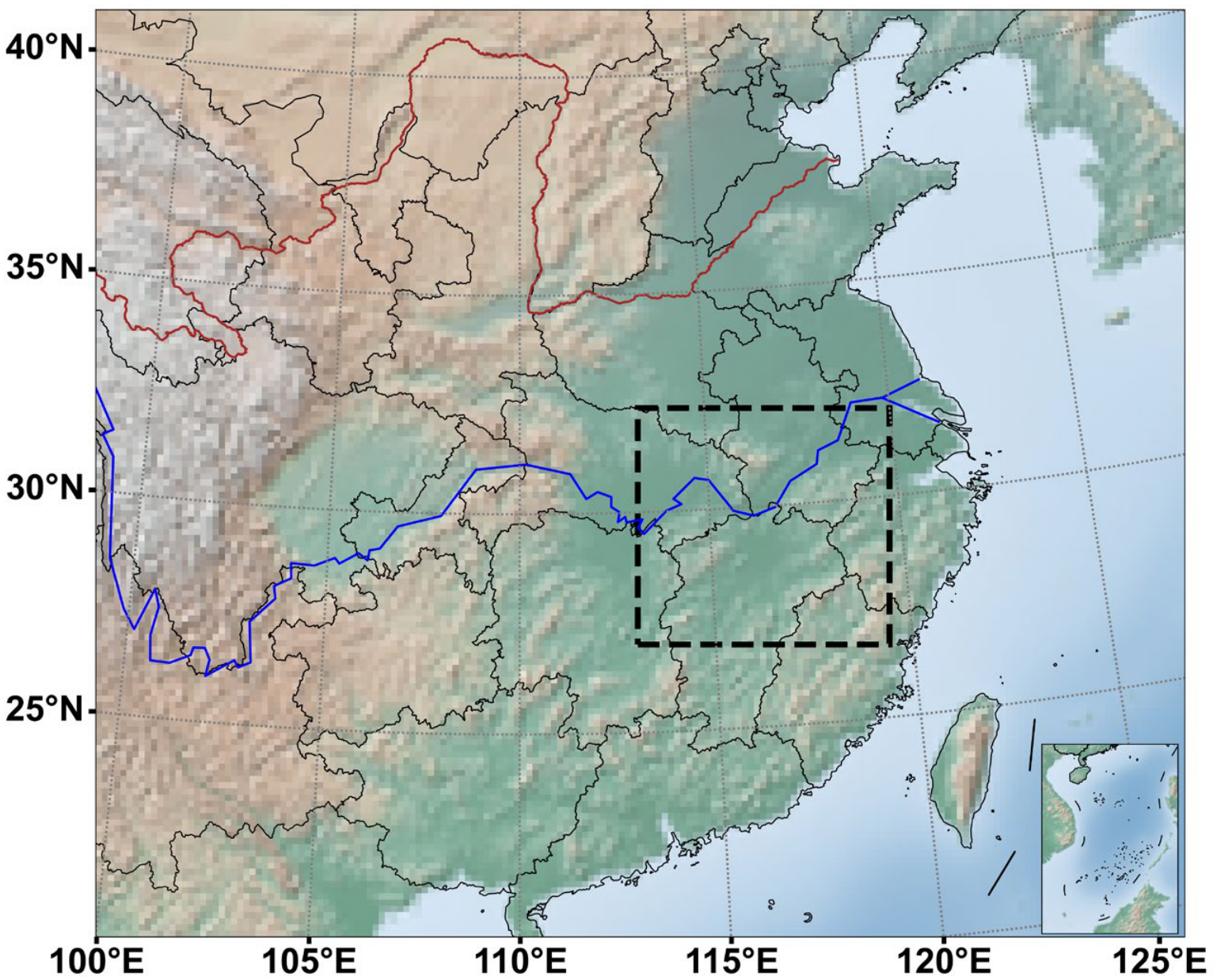
The climatological summer mean of all meteorological variables is defined as May–August (MJJA) from 1979 to 2021 (43 year) in this study. The research area focuses on the middle and lower reaches of the Yangtze River Basin (YRB), with a geographical range of 113–120° E and 27–32° N (Figure 1). The detailed selection criteria and geographical scope of the study area are presented in Section 3. Following standard operational criteria, El Niño/La Niña events are identified based on the Niño 3.4 (5° S–5° N, 120° W–170° W) SST anomalies during both June–August (JJA) and December–February (DJF). El Niño developing and decaying summers are then selected according to the identified El Niño events.

3. Interannual Relationship Between Summer Rainfall and ISO Intensity in the YRB

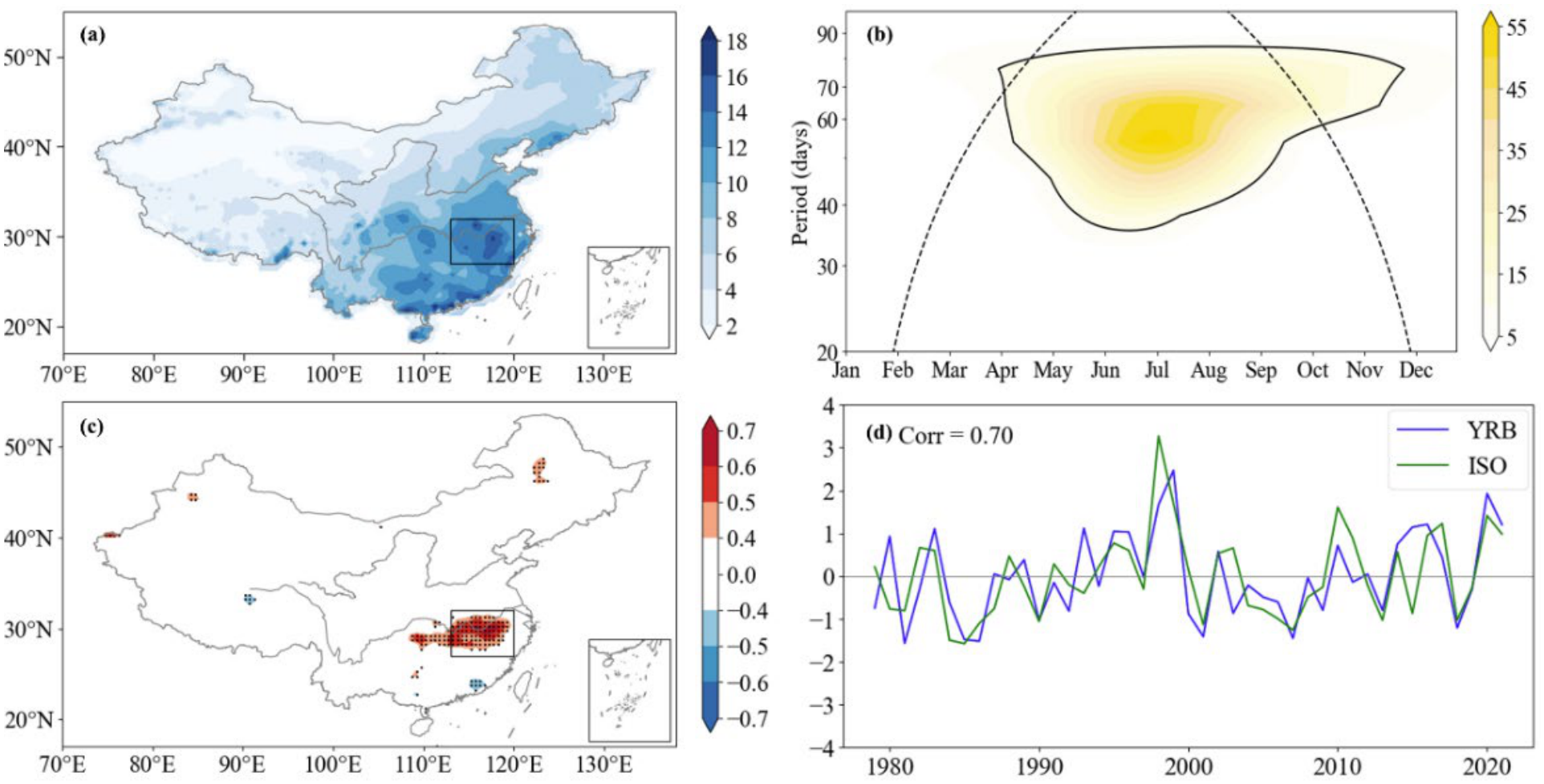
The East Asian monsoon region, which includes China, is characterized by concentrated summer rainfall. With the gradual intensification of the Asian summer monsoon in May, rainfall starts to increase over southeastern China. To fully capture the intraseasonal variability of summer rainfall, this study defines summer as the period from May to August (MJJA). Statistical analysis of rainfall during 1979–2021 indicates that summer mean rainfall decreases gradually from the southeastern coast to the northwestern inland, with a prominent rainband extending in a southwest–northeast direction. Figure 2a displays the standard deviation of summer rainfall over China averaged for 1979–2021. It is found that the largest variability in summer rainfall occurs over the middle-lower reaches of the Yangtze River and the southeastern China. Since the middle-lower Yangtze River Basin (113–120° E, 27–32° N, bounded by the rectangle in Figure 2a; hereinafter referred to as the YRB region) features the most pronounced summer rainfall variability, this domain is selected as the key region to investigate the relationship between summer rainfall and the strength of its intraseasonal variability.
Previous studies have indicated that the YRB is not only a center of maximum summer rainfall variability but also a region with pronounced intraseasonal oscillation activity [19,26,36,48]. Wavelet analysis was performed on the daily YRB rainfall from 1979 to 2021, after removing the annual cycle and seasonal mean by subtracting the first four Fourier harmonics. Figure 2b presents the wavelet power spectrum of summer rainfall over the YRB, revealing a significant oscillatory signal within the 30–90-day band. This demonstrates that YRB summer rainfall in the YRB exhibits prominent intraseasonal oscillation (ISO) characteristics. The result is consistent with the conclusions of Qi et al. [19]. As the leading intraseasonal mode, the 30–90-day component exerts a crucial modulation effect on the subseasonal variability of summer rainfall in the YRB [19,49].
To examine the relationship between summer rainfall and ISO intensity in the YRB, the ISO intensity is defined as the standard deviation of 30–90-day filtered summer rainfall. Studies have demonstrated that the 30–90-day band is the dominant intraseasonal oscillation (ISO) mode that modulates summer rainfall variability over the Yangtze River Basin, and it contributes significantly to high-frequency fluctuations and extreme precipitation events in this region [19]. The selection of this band is consistent with common practices in the relevant literature. Accordingly, ISO intensity is defined as the standard deviation of 30–90-day filtered summer rainfall during the study period, which ensures the rationality and reproducibility of the calculation and provides a reliable basis for analyzing the interannual relationship between summer rainfall and ISO intensity. Correlation analysis between YRB-averaged summer rainfall and ISO intensity (Figure 2c) shows that ISO intensity over eastern China, particularly in the YRB and its southern surroundings, is significantly positively correlated with the YRB rainfall time series. This result indicates that the two variables exhibit statistically synchronous interannual variability, consistent with the findings of Qi et al. [19]. In the regions with significant correlations, summer rainfall and ISO intensity exhibit highly consistent interannual variations, with a correlation coefficient of up to 0.7 (Figure 2d), suggesting that YRB summer rainfall and ISO intensity vary coherently on the interannual scale. Generally, summers with above-average rainfall correspond to stronger ISO activity, while summers with below-average rainfall are associated with weaker ISO activity.

4. Effect of ENSO

4.1. Impacts of SST on Concurrent and Lagged Summer Rainfall and ISO Intensity in the YRB

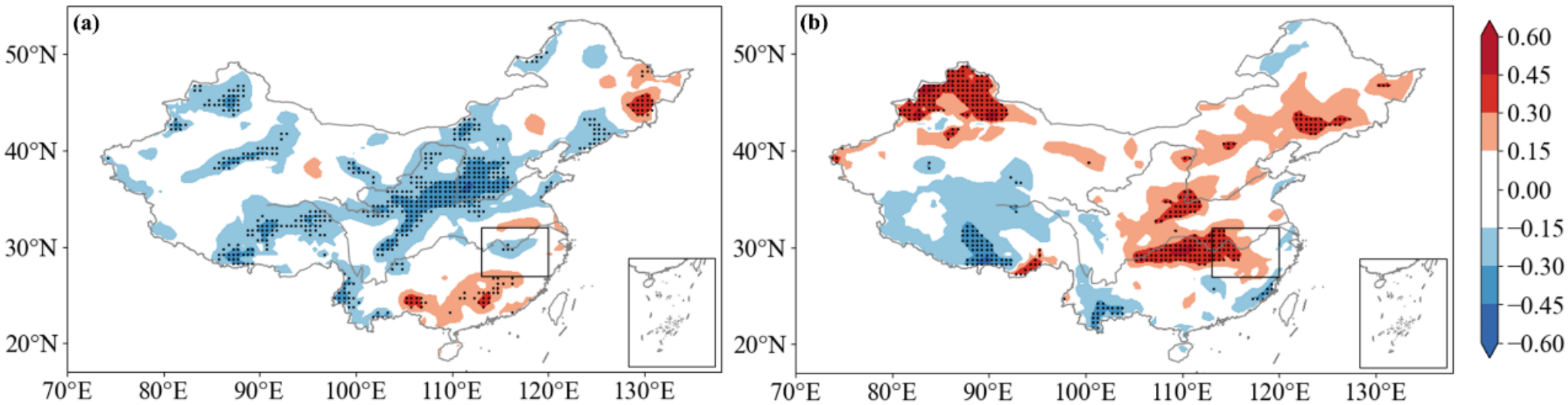
To investigate the connection between sea surface temperature (SST) variations in the Niño3.4 region (5° S–5° N, 120° W–170° W) and concurrent as well as lagged summer rainfall and ISO intensity in the YRB, summer rainfall and ISO intensity are regressed onto the concurrent and preceding winter Niño3.4 SST, respectively (Figure 3). SST changes during different phases of Niño3.4 exert distinctly different concurrent and lagged effects on summer rainfall in the YRB. During the summer when Niño3.4 SST begins to rise, rainfall in the YRB shows a decreasing trend (Figure 3a), whereas in the summer following the winter when SST reaches its warmest peak, rainfall increases significantly (Figure 3b). The result indicates that summer rainfall in the YRB is closely linked to ENSO events and exhibits contrasting responses to the seasonal evolution of Niño3.4 SST.
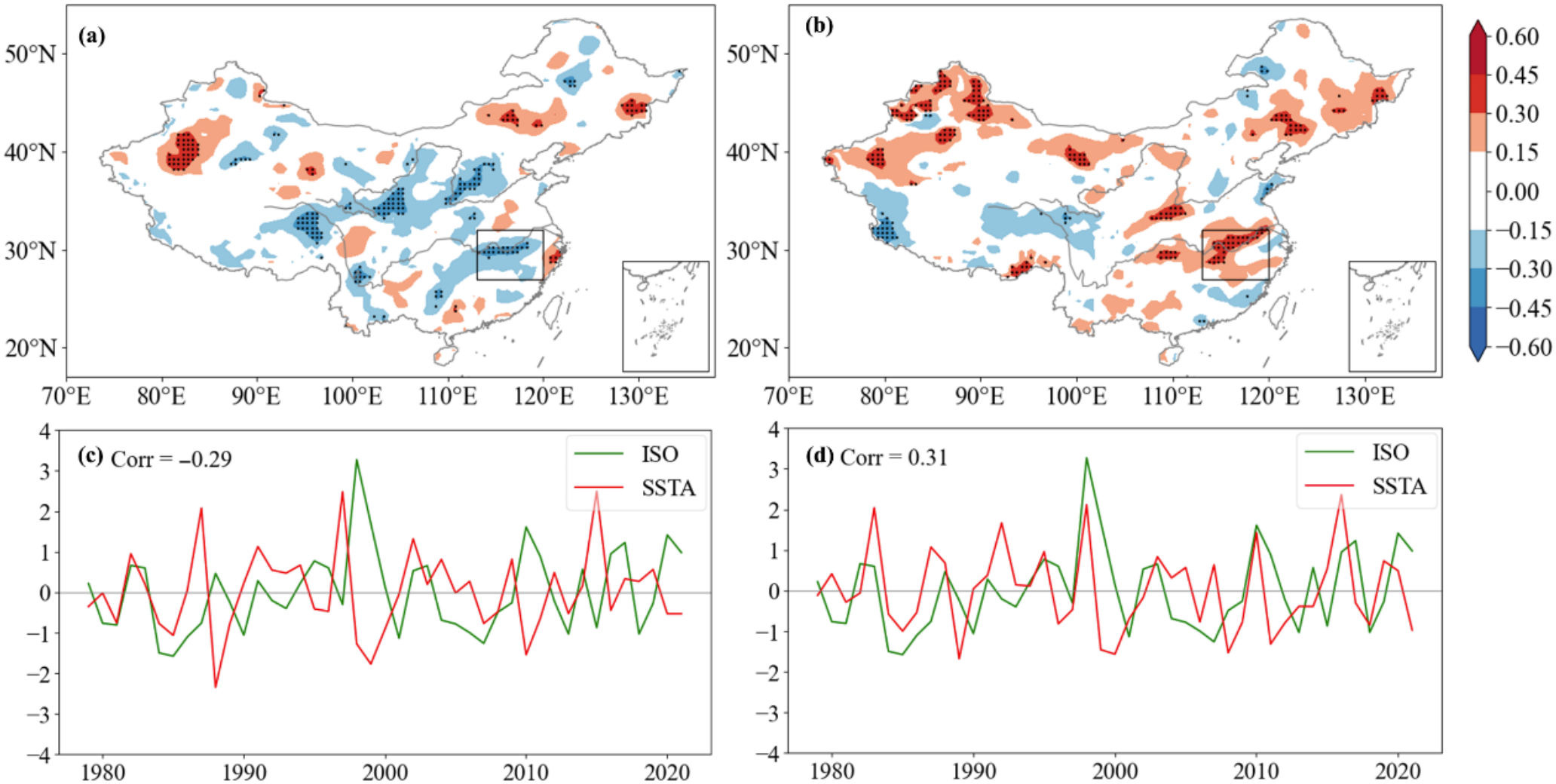
The results of the regression analysis of ISO intensity onto the Niño3.4 index show a correlation pattern consistent with that between summer rainfall and Niño3.4 SST. Specifically, ISO intensity in the YRB weakens during the developing phase of Niño3.4 SST warming (Figure 4a) and strengthens significantly in the summer following the SST peak phase (Figure 4b). Correlation coefficients of their time series indicate that the relationships between ISO intensity and Niño3.4 SST at different phases both exceed the 95% significance level: the concurrent correlation coefficient during the developing phase is −0.29, while the lagged correlation coefficient with preceding winter SST is 0.31. In comparison, the positive correlation between ISO intensity and preceding winter SST is more pronounced (Figure 4c,d).
The above analysis indicates that both summer rainfall and ISO intensity in the YRB are negatively correlated with concurrent summer Niño3.4 SST (Figure 3a and Figure 4a,c) but positively correlated with Niño3.4 SST in the preceding winter (Figure 3b and Figure 4b,d). It suggests that when summer Niño3.4 SST anomalies are positive, summer rainfall in the YRB tends to be below average and ISO activity is weaker. Conversely, in the summer following a winter with warm SST peaks, rainfall in the YRB is above average and ISO activity is stronger. The responses of summer rainfall and ISO intensity in the YRB to Niño3.4 SST anomalies show remarkable consistency, further confirming that their covariability remains stable under the modulation of ENSO events. This result also indicates that SST anomalies in the tropical central-eastern Pacific play a crucial regulatory role in the interannual relationship between summer rainfall and ISO intensity in the YRB.

4.2. Classification of Developing and Decaying Summers of El Niño

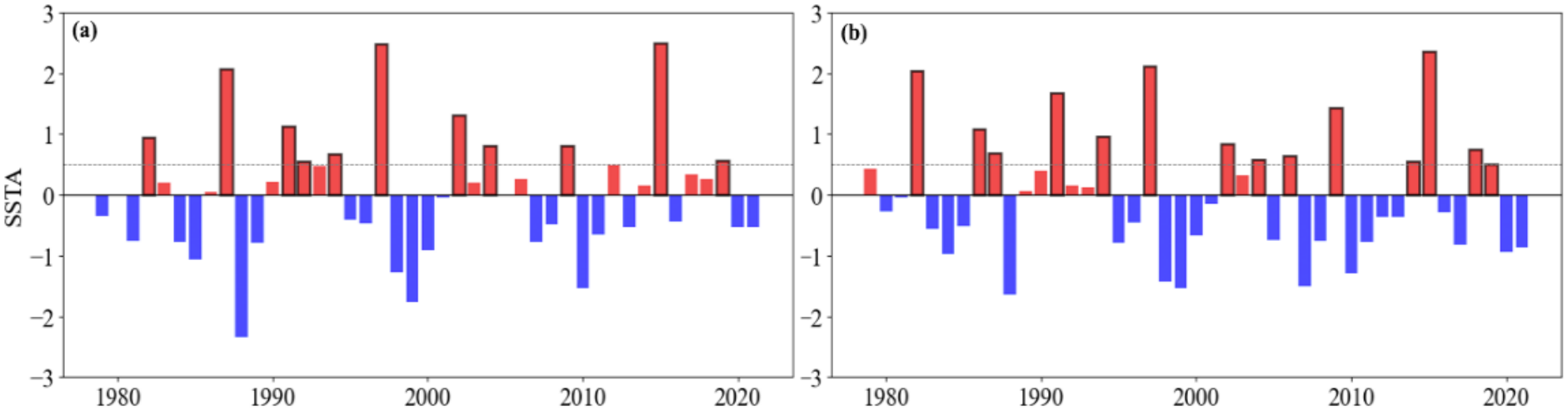
Given that summer rainfall and ISO intensity in the YRB exhibit distinct responses to different phases of ENSO warm events, we therefore consider classifying El Niño events into developing-phase summers and decaying-phase summers to further analyze and investigate the relationship between summer rainfall and ISO intensity in the YRB. Figure 5 shows the time series of Niño3.4 SSTA during summer and winter from 1979 to 2021, which clearly displays the evolution and magnitude of tropical Pacific SST anomalies. The identification of El Niño developing and decaying summers must account for whether SST anomalies in the tropical central-eastern Pacific satisfy the defined criteria during both the summer development/decay phase and the winter mature phase of the event. Following the operational ENSO event classification standards of the National Oceanic and Atmospheric Administration (NOAA) and using the seasonally averaged SSTA in the Niño3.4 region (5° S–5° N, 120° W–170° W) as the primary index, the following conditions must be met for summer (JJA) and winter (DJF):
  • A year is classified as an El Niño developing year if both the summer and winter Niño3.4 SSTA exceed 0.5 times the climatological standard deviation.
  • A year is classified as an El Niño decaying year if the summer Niño3.4 SSTA is below 0.5 times the standard deviation while the preceding winter SSTA exceeds 0.5 times the standard deviation.
Based on these criteria, a total of 10 El Niño developing summers (1982, 1987, 1991, 1994, 1997, 2002, 2004, 2009, 2015, 2019) and 10 El Niño decaying summers (1983, 1988, 1992, 1995, 1998, 2003, 2005, 2007, 2010, 2016) were identified, as listed in Table 1.

4.3. Dependence of YRB Summer Rainfall and ISO Intensity on El Niño Evolution Phases

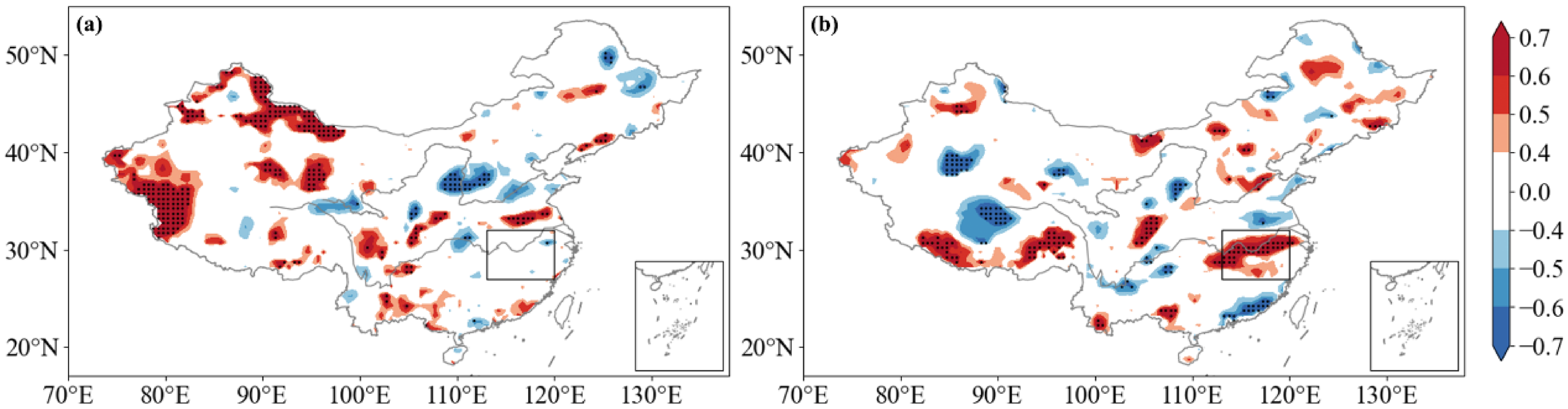
To further examine the stability of the correlation between summer rainfall and ISO intensity in the YRB across different phases of El Niño, correlation analyses were performed between the YRB summer rainfall and ISO intensity for the 10 El Niño developing years and the 10 decaying years, respectively (Figure 6). Given the relatively small sample size (n = 10), particular attention was paid to evaluating the statistical significance of the correlation coefficients. The results show that during El Niño developing years, the correlation between the two variables fails to pass the 95% significance test (Figure 6a), whereas a significant positive correlation (statistically significant at the 95% confidence level) is maintained during decaying years (Figure 6b).
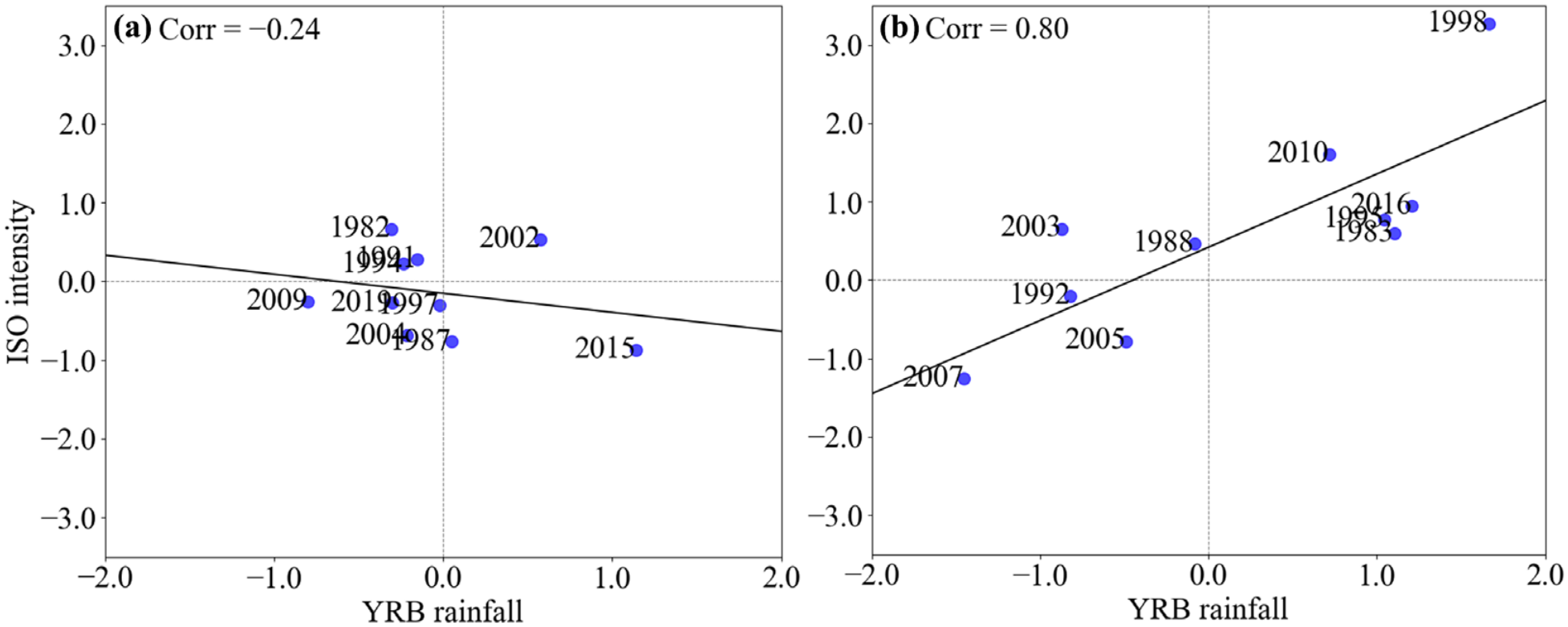
Scatter plots of YRB region-averaged ISO intensity and rainfall further confirm this pattern. No significant correlation is observed during developing summers and even a weak negative correlation is present as shown in Figure 7a. In contrast, the positive correlation becomes more pronounced during decaying summers with a correlation coefficient as high as 0.8, which exceeds the 99% significance level, as presented in Figure 7b. Compared with the 43-year climatological mean (1979–2021), El Niño decaying years play a positive role in enhancing the covariability between the two variables. The result demonstrates that their relationship is modulated by ENSO phases; the correlation is insignificant during El Niño development and significantly enhanced during the decaying phase.
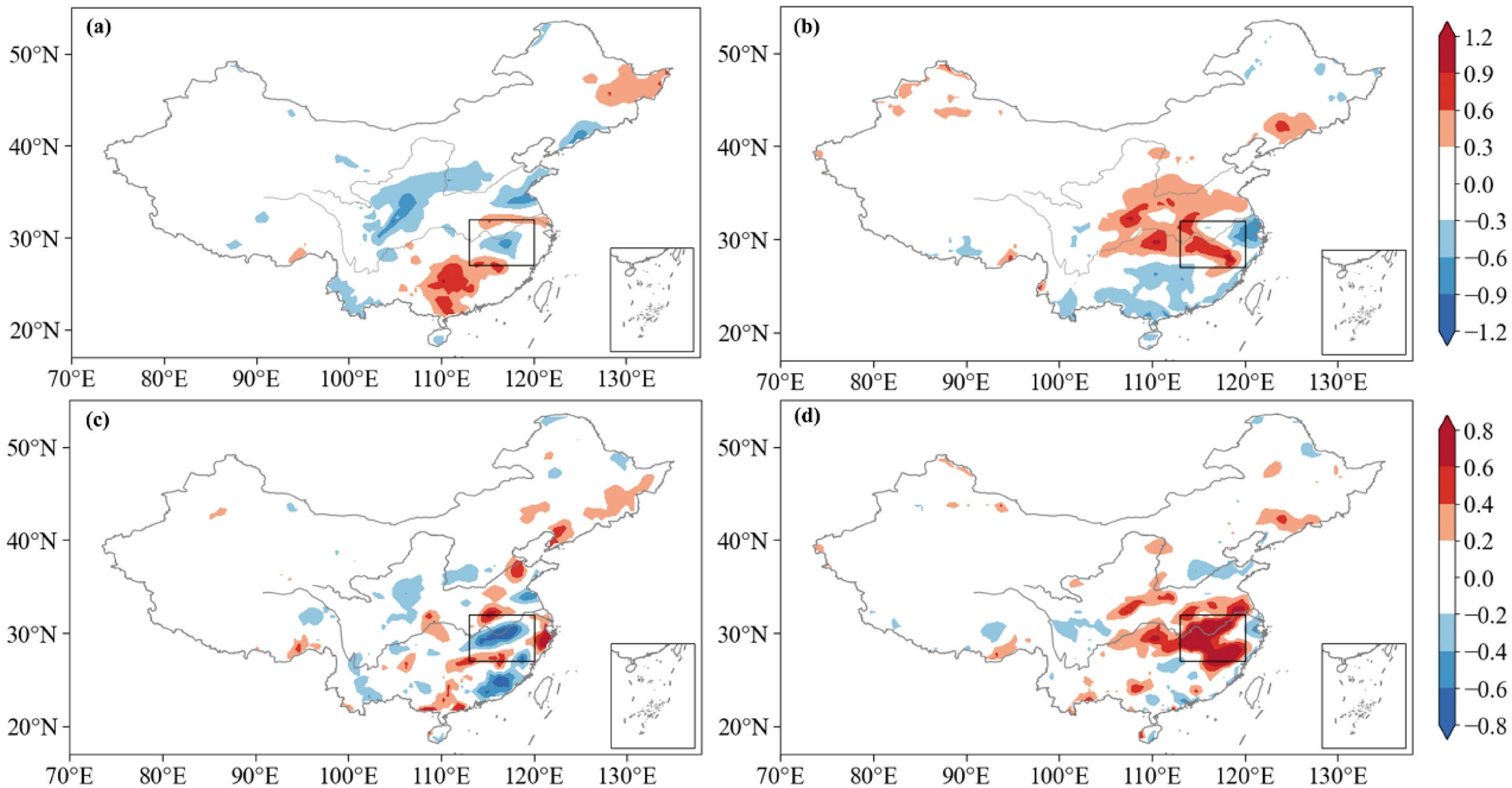
To further illustrate the phase-dependent differences, composite analyses were conducted for the same 10 developing and 10 decaying El Niño years, with results presented in Figure 8. The composite distributions align with the aforementioned correlation and scatter plot findings, clearly reflecting contrasting responses of rainfall and ISO activity to El Niño’s evolutionary stages.
For summer rainfall, El Niño developing years are marked by negative anomalies across most of the YRB (Figure 8a), while decaying years exhibit widespread positive anomalies (Figure 8b). This pattern is consistent with historical flood events in the middle-lower reaches of the YRB as severe floods occurred in the summer of 1998 and 2016 following the super El Niño events of 1997 and 2015 [26,50]. Regarding ISO intensity, a consistent phase-dependent pattern emerges: ISO activity is weakened during El Niño developing years (Figure 8c) and significantly enhanced during decaying years (Figure 8d). Notably, while both rainfall and ISO intensity exhibit concurrent weakening in developing years and concurrent strengthening in decaying years, their interannual relationship differs markedly—insignificant in developing years but significantly positive and enhanced in decaying years.
Additionally, the spatial distributions of rainfall and ISO intensity anomalies are highly consistent, with more pronounced signals in the central and lower reaches of the YRB. Collectively, these results confirm that ENSO phases play a crucial role in regulating the covariability between YRB summer rainfall and ISO intensity.

5. Modulation of ENSO on the Interannual Relationship Between Summer Rainfall and ISO Intensity in the YRB

The East Asia–Pacific (EAP) teleconnection pattern is a key circulation system influencing summer climate anomalies in East Asia. By modulating the atmospheric circulation configuration over East Asia, it is directly linked to rainfall variability in crucial regions of China, such as the Yangtze–Huai River basin and South China [51,52]. Previous studies have confirmed that the EAP teleconnection pattern, excited by SSTAs in the tropical Pacific, serves as a critical bridge through which ENSO events affect the East Asian summer climate [2,53,54]. Its meridional wave train structure can induce significant rainfall anomalies in East Asia by altering the position of the subtropical high and the interaction between low- and high-latitude circulations [55].
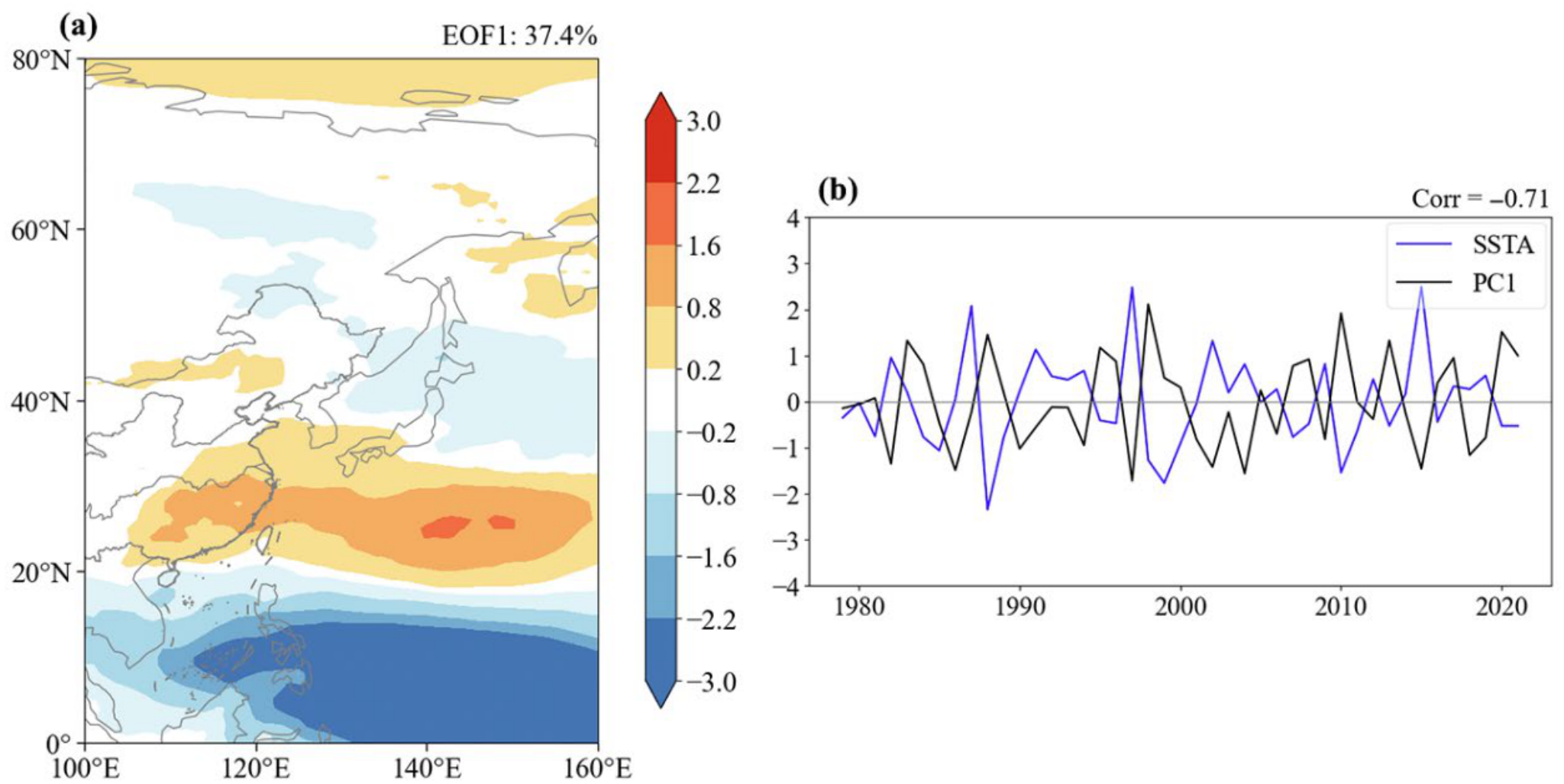
To investigate the dominant mode of summer atmospheric circulation variability over the East Asia–Western Pacific region and its link to the EAP teleconnection pattern, an Empirical Orthogonal Function (EOF) analysis was performed on the summer mean 850 hPa zonal wind within the domain (0–80° N, 100–160° E). The first EOF mode (EOF1) passed the North significance test [56] and explained 37.4% of the total variance, confirming it as a robust and dominant mode of circulation variability in this region (Figure 9a). The spatial structure of EOF1 exhibits a distinct meridional wave train with a “− + −” distribution, as negative anomalies prevail near 20° N and 60° N while positive anomalies are concentrated around 40° N. Based on the meridional shear characteristics of zonal wind, this wave train structure implies anticyclonic circulation anomalies at low latitudes (around 20° N) and high latitudes (around 60° N) alongside cyclonic circulation anomalies in mid-latitudes (around 40° N). This signature configuration is consistent with the classic EAP teleconnection pattern. As a key circulation bridge connecting tropical and mid-latitude climate processes, the anomalous phase of this EOF1-derived wave train is capable of regulating the position and intensity of the Western Pacific Subtropical High, as well as the interaction between low- and high-latitude circulations, thereby inducing significant anomalies in summer rainfall over East Asia, including the YRB.
Given the well-documented role of tropical Pacific SSTAs in regulating the formation and development of the summer EAP teleconnection wave train, correlation analysis was conducted between the principal component (PC1) of EOF1 and the summer mean SST in the Niño3.4 region (Figure 9b). The results demonstrate a robust and significant negative correlation between the two variables, with a correlation coefficient of −0.71 that is statistically significant at the 95% confidence level. Specifically, negative SSTAs in the Niño3.4 region correspond to positive PC1 values, which align with the positive phase of the EAP teleconnection pattern identified in the EOF1 spatial structure. Conversely, positive SSTAs in the Niño3.4 region coincide with negative PC1 values, indicative of the negative phase of the EAP pattern. This pronounced statistical relationship confirms that cooler SSTs in the tropical central-eastern Pacific region, thereby further validating the role of tropical Pacific SSTAs as a key driver of the EAP teleconnection pattern.
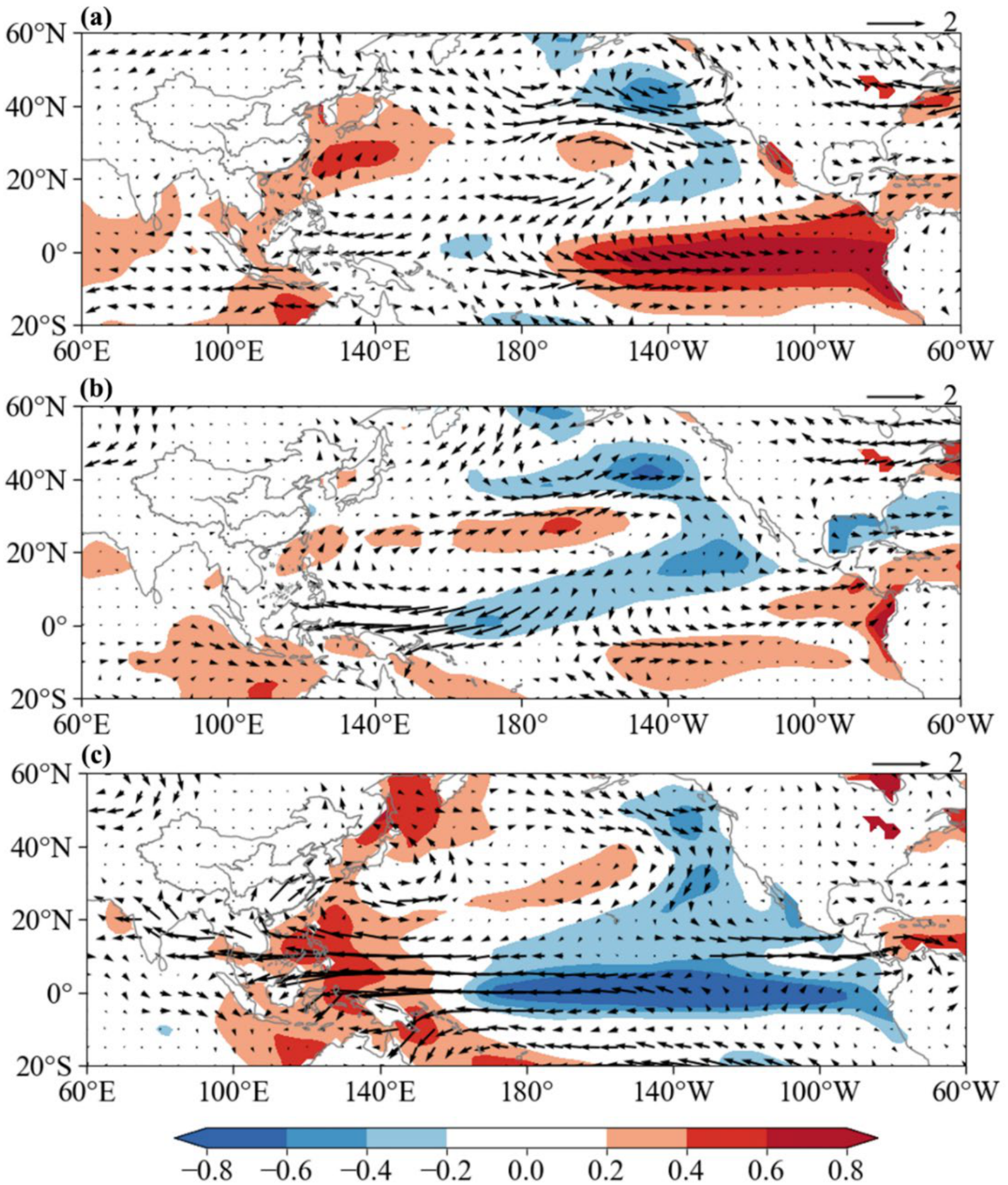
To clarify how seasonal variations in tropical central-eastern Pacific SST modulate the EAP teleconnection pattern, global SST and 850 hPa wind fields were regressed onto PC1 separately for the preceding winter [DJF(−1)], concurrent spring [MAM(0)], and concurrent summer [JJA(0)]. As illustrated in Figure 10, the association between the EAP wave train and tropical central-eastern Pacific SST anomalies exhibits distinct seasonal differences, with only signals passing the 95% significance test displayed.
Corresponding to the positive phase of the EAP wave train, positive SST anomalies arise in the tropical eastern Pacific during the preceding winter. This pattern mirrors the characteristic SST warming and low-level tropospheric westerly anomalies observed at the peak of El Niño events (Figure 10a). Over the tropical Western Pacific, low-level easterly wind anomalies predominate, while weak anticyclonic circulation anomalies prevail over Southeast Asia. Positive SST anomalies extend from the Indian Ocean to the Western Pacific, accompanying these circulation features. In spring, SST anomalies in the tropical central-eastern Pacific begin to weaken, whereas easterly anomalies over the Western Pacific intensify (Figure 10b). The SST warming from the Indian Ocean to the Western Pacific remains persistent during this period. By summer, SST in the tropical central-eastern Pacific decays significantly, presenting a cold distribution analogous to La Niña conditions (Figure 10c). Concurrently, easterly anomalies strengthen markedly across the tropical domain spanning from the central Pacific westward to the Western Pacific. This intensification fosters the formation of a robust anomalous anticyclonic circulation in the lower troposphere.
Notably, the sustained warming from the eastern Indian Ocean to the Western Pacific, which persists from the preceding winter through the subsequent summer, plays a crucial role in maintaining the stability of the Western Pacific anticyclonic circulation [38,57]. This circulation anomaly in turn effectively modulates the structure and intensity of the EAP wave train. It facilitates the wave train’s significant positive phase, a configuration that favors increased rainfall and enhanced ISO activity in the YRB.
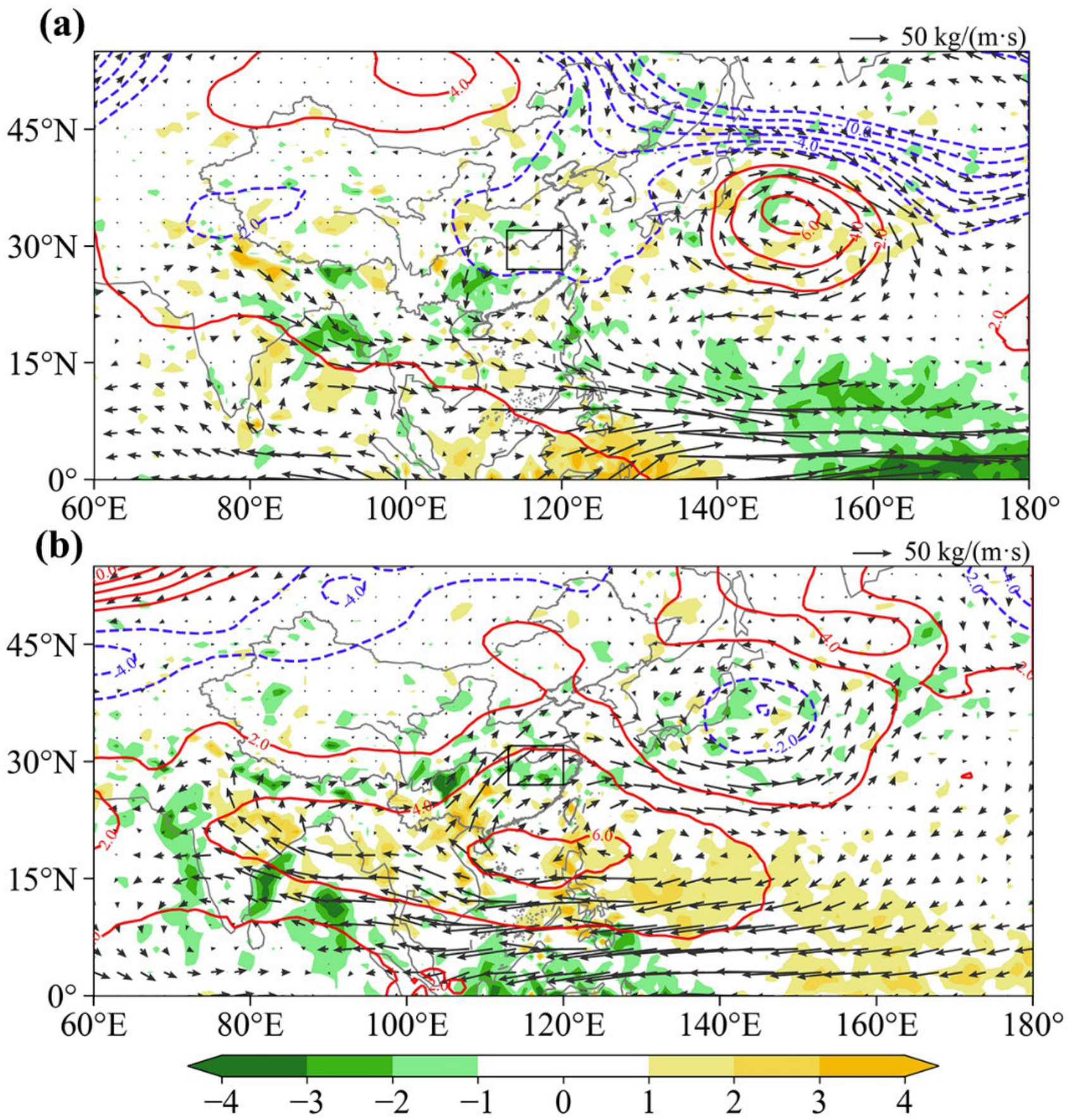
For a deeper understanding of how the ENSO-excited EAP wave train links to summer rainfall and ISO activity in the YRB, composite analyses were carried out for El Niño developing and decaying years, respectively. The composites include vertically integrated (1000–300 hPa) moisture flux, its divergence, and the 500 hPa geopotential height (Figure 11). The East Asia-oriented meridional EAP wave train exhibits distinct phase characteristics, with a negative phase during developing years and a positive phase during decaying years of El Niño.
During El Niño developing years (Figure 11a), strong westerly winds dominate the tropical Western Pacific, with anomalous cyclonic circulation prevailing on its northern flank. This circulation configuration induces strong moisture convergence in the region, favoring increased local rainfall. Meanwhile, an anticyclonic circulation pattern is present over the ocean east of Japan. Eastern China, including the middle-lower reaches of the Yangtze River, is influenced by northeasterly winds, which limit significant moisture transport and convergence. The lack of sufficient moisture supply and convergence conditions is unfavorable for rainfall formation in the YRB (Figure 11a).
In El Niño decaying years (Figure 11b), the East Asian region features the positive phase of the EAP wave train, extending from low to mid-high latitudes. A robust anomalous high-pressure system controls a broad area spanning the Indo-China Peninsula, the South China Sea, and the Philippine Sea, where dry weather conditions and moisture divergence are prominent. Notably, the southwesterly winds on the western flank of the lower-tropospheric anticyclonic circulation act as a critical pathway for transporting tropical moisture toward the middle-lower reaches of the Yangtze River. Concurrently, these southwesterlies converge with northeasterly winds to the north over the YRB. Such convergence, in combination with strong vertical upward motion, abundant low-level moisture, and favorable vertical wind shear, synergistically facilitates the formation of heavy rainfall and the enhanced development of ISO over the region.
Previous studies have confirmed that the EAP wave train, by modulating moisture transport, not only influences the interannual variability of the East Asian summer monsoon but also regulates ISO-related interannual rainfall variability in the YRB [19]. Furthermore, the EAP wave train itself exhibits significant intraseasonal variations during its evolution [52], and the ISO signal embedded in East Asian moisture transport shows a high degree of consistency with the intraseasonal evolution pattern of the EAP wave train [19]. This coupled intraseasonal–interannual feature further amplifies the positive correlation between summer rainfall and ISO intensity in the YRB during El Niño decaying years, which aligns with the earlier findings regarding the phase-dependent covariability of the two variables.

6. Summary and Discussion

Effects of ENSO on the interannual relationship between summer rainfall and intraseasonal oscillation (ISO) intensity in the middle-lower reaches of the Yangtze River (YRB) have been studied by using observational and reanalysis data from 1979 to 2021. Summer rainfall in the YRB exhibits distinct intraseasonal variations and shares a significant positive interannual correlation with ISO intensity. This covariability is strongly modulated by ENSO. Tropical central-eastern Pacific sea surface temperature (SST) anomalies, and particularly those in the preceding winter, exert a prominent lagged influence on subsequent summer rainfall and ISO intensity over the YRB.
Summer rainfall and ISO intensity in the YRB respond to ENSO in a phase-dependent manner, showing contrasting characteristics between El Niño developing and decaying years. During El Niño developing years, negative rainfall anomalies and weak ISO intensity prevail, but their correlation fails to pass significance testing. In contrast, during the summer of El Niño decaying years, positive rainfall anomalies and enhanced ISO intensity are observed, with a significantly strengthened positive correlation between the two variables that exceeds the climatological mean. Additionally, both variables respond consistently to Niño3.4 SST, with negative correlations in summer and positive correlations with the preceding winter, thus providing a key SST forcing for their interannual variability.
ENSO modulates the YRB summer rainfall–ISO relationship mainly through its regulation of tropical northwest Pacific circulation, with the East Asia–Pacific (EAP) teleconnection wave train acts as the key mechanism. In the summer of El Niño decaying years, persistent Indian Ocean warming sustains a stable anomalous anticyclone over the tropical northwestern Pacific that is linked to the positive phase of the EAP teleconnection. This anticyclone steers moisture from the South China Sea and tropical northwestern Pacific toward the YRB, inducing strong moisture convergence. Combined with favorable dynamic conditions, this not only boosts rainfall but also facilitates ISO development, amplifying the positive correlation between summer rainfall and ISO intensity. Conversely, in the summer of El Niño developing years, the EAP teleconnection signal is weak. The YRB is dominated by easterly winds, which inhibit wind convergence and moisture accumulation, leading to reduced rainfall, weakened ISO activity, and an insignificant correlation between them.
By linking tropical central-eastern Pacific SST anomalies to tropical northwestern Pacific circulation, moisture transport, and convergence, this study highlights the key role of ENSO in modulating the interannual covariability of summer rainfall and ISO intensity in the YRB. It reveals the phase-dependent nature of this impact, showing that El Niño decaying years are critical for enhanced rainfall–ISO covariability and providing a refined framework for understanding the region’s summer climate variability while complementing previous studies on ENSO’s lagged effects. The findings provide new insights into the combined impacts of large-scale circulation anomalies and ENSO events on summer precipitation over the Yangtze River Basin. It can help improve the seasonal prediction skill of regional summer rainfall and offer a scientific reference for short-term climate prediction and disaster prevention in East China.
However, this study still has several limitations. The present work only focuses on the modulation of different ENSO phases on the interannual relationship between summer rainfall and ISO intensity over the Yangtze River Basin. The synergistic impacts of other large-scale climate systems, such as the Arctic Oscillation and the Western Pacific Subtropical High, are not considered in this work. In addition, potential interdecadal differences in the above linkage remain unexplored. Future studies are suggested to further incorporate the combined effects of multiple climate drivers and conduct interdecadal variation analysis, so as to comprehensively reveal the underlying physical mechanisms governing the relationship between regional summer rainfall and intraseasonal oscillation activity.

Author Contributions

Conceptualization, J.L. and Y.Q.; methodology, J.L.; software, J.L.; validation, J.L., Y.Q. and Z.Z.; formal analysis, J.L.; investigation, J.L.; resources, Z.Z. and S.Y.; data curation, J.L.; writing—original draft preparation, J.L.; writing—review and editing, Y.Q., Z.Z., S.Y. and Y.O.; visualization, J.L.; supervision, Y.Q.; project administration, Y.Q.; funding acquisition, Y.Q. All authors have read and agreed to the published version of the manuscript.

Funding

This work is supported by the National Natural Science Foundation of China (41675068) and S&T Development Fund of CAMS (2023KJ019).

Data Availability Statement

No new data were generated in this study. All analyzed data come from publicly accessible reanalysis datasets, which can be obtained from their official websites.

Conflicts of Interest

The authors declare no conflict of interest.

References

  1. Philander, S.G.H. El Niño Southern Oscillation phenomena. Nature 1983, 302, 295–301. [Google Scholar] [CrossRef]
  2. Wang, B.; Li, J.; He, Q. Variable and robust East Asian monsoon rainfall response to El Niño over the past 60 years (1957–2016). Adv. Atmos. Sci. 2017, 34, 1235–1248. [Google Scholar] [CrossRef]
  3. Wang, X.; Xie, S.; Guan, Z. Guan Atmospheric Internal Variability in the Summer Indo–Northwestern Pacific: Role of the Intraseasonal Oscillation. J. Clim. 2020, 33, 3395–3410. [Google Scholar] [CrossRef]
  4. Li, C.; Long, Z.; Zhang, Q. Strong/Weak summer monsoon activity over the South China Sea and atmospheric intraseasonal oscillation. Adv. Atmos. Sci. 2001, 18, 1146–1160. [Google Scholar]
  5. Ding, Y.; Chan, J.C.L. The East Asian summer monsoon: An overview. Meteorol. Atmos. Phys. 2005, 89, 117–142. [Google Scholar]
  6. Madden, R.A.; Julian, P.R. Detection of a 40–50 Day Oscillation in the Zonal Wind in the Tropical Pacific. J. Atmos. Sci. 1971, 28, 702–708. [Google Scholar] [CrossRef]
  7. Madden, R.A.; Julian, P.R. Description of Global-Scale Circulation Cells in the Tropics with a 40–50 Day period. J. Atmos. Sci. 1972, 29, 1109–1123. [Google Scholar] [CrossRef]
  8. Krishnamurti, T.N.; Subrahmanyam, D. The 30–50 Day Mode at 850 mb During MONEX. J. Atmos. Sci. 1982, 39, 2088–2095. [Google Scholar] [CrossRef]
  9. Murakami, M. Analysis of the Deep Convective Activity over the Western Pacific and Southeast Asia. J. Meteorol. Soc. Jpn. 1983, 61, 60–76. [Google Scholar] [CrossRef]
  10. Lau, K.-M.; Chan, P.H. Aspects of the 40–50 Day Oscillation during the Northern Summer as Inferred from Outgoing Longwave Radiation. Mon. Weather Rev. 1986, 114, 1354–1367. [Google Scholar] [CrossRef]
  11. Lee, J.-Y.; Wang, B.; Wheeler, M.C.; Fu, X.; Waliser, D.E.; Kang, I.-S. Real-time multivariate indices for the boreal summer intraseasonal oscillation over the Asian summer monsoon region. Clim. Dyn. 2013, 40, 493–509. [Google Scholar] [CrossRef]
  12. Wang, B.; Webster, P.; Kikuchi, K.; Yasunari, T.; Qi, Y. Boreal summer quasi-monthly oscillation in the global tropics. Clim. Dyn. 2006, 27, 661–675. [Google Scholar] [CrossRef]
  13. Liu, F.; Ouyang, Y.; Wang, B.; Yang, J.; Ling, J.; Hsu, P.-C. Seasonal evolution of the intraseasonal variability of China summer precipitation. Clim. Dyn. 2020, 54, 4641–4655. [Google Scholar] [CrossRef]
  14. Qi, Y.; Zhong, T. Multi-timescale variability of tropical convection in the Indo-western Pacific Ocean. Dyn. Atmos. Ocean. 2025, 109, 101508. [Google Scholar] [CrossRef]
  15. Hendon, H.H.; Zhang, C.; Glick, J.D. Interannual Variation of the Madden–Julian Oscillation during Austral Summer. J. Clim. 1999, 12, 2538–2550. [Google Scholar] [CrossRef]
  16. Han, R.; Li, W.; Dong, M. The Impact of 30–60 day Oscillations over the Subtropical Pacific on the East Asian Summer Rainfall. Acta Meteorol. Sin. 2006, 64, 149–163. (In Chinese) [Google Scholar]
  17. Li, C.; Pan, J.; Song, J. Progress on the MJO Research in Recent Years. Chin. J. Atmos. Sci. 2013, 37, 229–252. (In Chinese) [Google Scholar]
  18. Liu, F.; Wang, B. A Mechanism for Explaining the Maximum Intraseasonal Oscillation Center over the Western North Pacific. J. Clim. 2014, 27, 958–968. [Google Scholar] [CrossRef]
  19. Qi, Y.; Li, T.; Zhang, R.; Chen, Y. Interannual relationship between intensity of rainfall intraseasonal oscillation and summer-mean rainfall over Yangtze River Basin in eastern China. Clim. Dyn. 2019, 53, 3089–3108. [Google Scholar] [CrossRef]
  20. Qi, Y.; Zhang, R.; Wang, Z. Large-scale background and role of quasi-biweekly moisture transport in the extreme Yangtze River rainfall in summer 2020. Clim. Dyn. 2023, 61, 3721–3736. [Google Scholar] [CrossRef]
  21. Yang, S.; Liu, Y.; Zhu, Z.; Qi, Y. Influence of the mid-high-latitude Eurasian ISO on PM2.5 concentration anomaly in North China during boreal winter. Clim. Dyn. 2024, 62, 2455–2474. [Google Scholar] [CrossRef]
  22. Yang, S.; Xu, Q.; Zhu, Z.; Qi, Y. Interannual variability of mid-high-latitude intraseasonal oscillation intensity at the southern hemisphere during austral summer. Clim. Dyn. 2024, 62, 3859–3876. [Google Scholar] [CrossRef]
  23. Ma, Y.; Yang, H.; Deng, Z.; Qin, Y.; Li, J.; Wei, X. Intra-seasonal variability of autumn rainfall in the Yangtze River Delta and its related atmospheric circulations. Atmos. Res. 2022, 278, 106363. [Google Scholar] [CrossRef]
  24. Mao, J.; Wu, G. Intraseasonal Variability in the Yangtze HuaiHe River Rainfall and Subtropical High during the 1991 Meiyu Preriod. Acta Meteorol. Sin. 2005, 63, 762–770. (In Chinese) [Google Scholar]
  25. Yang, S.; Wu, B.; Zhang, R.; Zhou, S. Relationship between an abrupt drought-flood transition over mid-low reaches of the Yangtze River in 2011 and the intraseasonal oscillation over mid-high latitudes of East Asia. Acta Meteorol. Sin. 2013, 27, 129–143. [Google Scholar] [CrossRef]
  26. Qi, Y.; Zhang, R.; Li, T. Structure and Evolution Characteristics of Atmospheric Intraseasonal Oscillation and Its Impact on the Summer Rainfall over the Yangtze River Basin in 1998. Chin. J. Atmos. Sci. 2016, 40, 451–462. (In Chinese) [Google Scholar]
  27. Ding, Y.; Liu, Y.; Hu, Z.Z. The record-breaking Meiyu in 2020 and associated atmospheric circulation and tropical SST anomalies. Adv. Atmos. Sci. 2021, 38, 1980–1993. [Google Scholar] [CrossRef]
  28. Wang, Z.; Ding, Y. Climatic features of intraseasonal oscillations of summer rainfalls over mid-lower reaches of the Yangtze River in the flood and drought years. J. Appl. Meteorol. Sci. 2008, 19, 710–715. (In Chinese) [Google Scholar]
  29. Jia, Y.; Guan, Z. Associations of Summertime Rainfall Anomalies over the Changjiang-Huaihe River Valley with the Interannual Variability of 30–60-day Oscillation Intensity in the Northwestern Pacific. Chin. J. Atmos. Sci. 2010, 34, 691–702. (In Chinese) [Google Scholar]
  30. Lin, A.; Ji, Z.; Gu, D.; Li, C.; Zheng, B.; He, C. The Application of Intra-seasonal Oscillation of the Atmosphere in Precipitation Forecasting in South China. J. Tro. Meteorol. 2016, 32, 878–889. (In Chinese) [Google Scholar]
  31. Hsu, P.; Li, T. Role of the Boundary Layer Moisture Asymmetry in Causing the Eastward Propagation of the Madden–Julian Oscillation. J. Clim. 2012, 25, 4914–4931. [Google Scholar] [CrossRef]
  32. Liu, F.; Li, T.; Wang, H.; Deng, L.; Zhang, Y. Modulation of Boreal Summer Intraseasonal Oscillations over the Western North Pacific by ENSO. J. Clim. 2016, 29, 7189–7201. [Google Scholar] [CrossRef]
  33. Li, J.; Mao, J. Factors controlling the interannual variation of 30–60-day boreal summer intraseasonal oscillation over the Asian summer monsoon region. Clim. Dyn. 2019, 52, 1651–1672. [Google Scholar] [CrossRef]
  34. Yan, M.; Guo, Y. Influence of ENSO on the ECMWF subseasonal prediction of summer rainfall over the Yangtze River. Clim. Dyn. 2023, 61, 3955–3969. [Google Scholar] [CrossRef]
  35. Wei, J.; Wang, W.; Shao, Q.; Rong, Y.; Xing, W.; Liu, C. Influence of mature El Niño-Southern Oscillation phase on seasonal precipitation and streamflow in the Yangtze River Basin, China. Int. J. Climatol. 2019, 40, 3885–3905. [Google Scholar] [CrossRef]
  36. Mao, J.; Sun, Z.; Wu, G. 20–50-day oscillation of summer Yangtze rainfall in response to intraseasonal variations in the subtropical high over the western North Pacific and South China Sea. Clim. Dyn. 2009, 34, 747–761. [Google Scholar] [CrossRef]
  37. Xie, S.P.; Annamalai, H.; Friedrich, A.; Schott; McCreary, J.P. Structure and Mechanisms of South Indian Ocean Climate Variability. J. Clim. 2002, 15, 864–878. [Google Scholar] [CrossRef]
  38. Xie, S.-P.; Hu, K.; Hafner, J.; Tokinaga, H.; Du, Y.; Huang, G.; Sampe, T. Indian Ocean Capacitor Effect on Indo-Western Pacific Climate during the Summer following El Niño. J. Clim. 2009, 22, 730–747. [Google Scholar] [CrossRef]
  39. Li, X.; Yin, M.; Chen, X.; Yang, M.; Xia, F.; Li, L.; Chen, G.; Yu, P.; Zhang, C. Impacts of the Tropical Pacific–Indian Ocean Associated Mode on Madden–Julian Oscillation over the Maritime Continent in Boreal Winter. Atmosphere 2020, 11, 1049. [Google Scholar] [CrossRef]
  40. Demir, U.S.; Koc, A.C. Investigation of the North Atlantic Oscillation and Indian Ocean Dipole Influence on Precipitation in Turkey with Cross-Spectral Analysis. Atmosphere 2021, 12, 99. [Google Scholar] [CrossRef]
  41. Jiang, J.; Wu, J.; Luo, J. Understanding the Influence of the Tropical Intraseasonal Oscillation in Predicting the Indian Ocean Dipole. J. Clim. 2025, 38, 645–662. [Google Scholar] [CrossRef]
  42. Bamston, A.G.; Chelliah, M.; Goldenberg, S.B. Documentation of a highly ENSO-related sst region in the equatorial pacific: Research note. Atmos.-Ocean 1997, 35, 367–383. [Google Scholar]
  43. Rasmusson, E.M.; Carpenter, T.H. Variations in Tropical Sea Surface Temperature and Surface Wind Fields Associated with the Southern Oscillation/El Niño. Mon. Weather Rev. 1982, 110, 354–384. [Google Scholar] [CrossRef]
  44. Trenberth, K.E. The Definition of El Niño. Bull. Amer. Meteorol. Soc. 1997, 78, 2771–2778. [Google Scholar] [CrossRef]
  45. Trenberth, K.E.; Stepaniak, D.P. Indices of El Niño Evolution. J. Clim. 2001, 14, 1697–1700. [Google Scholar] [CrossRef]
  46. Hersbach, H.; Bell, B.; Berrisford, P.; Hirahara, S.; Horányi, A.; Muñoz-Sabater, J.; Nicolas, J.; Peubey, C.; Radu, R.; Schepers, D.; et al. The ERA5 global reanalysis. Q. J. R. Meteorol. Soc. 2020, 146, 1999–2049. [Google Scholar] [CrossRef]
  47. Duchon, C.E. Lanczos filtering in one and two dimensions. J. Appl. Meteorol. 1979, 18, 1016–1022. [Google Scholar] [CrossRef]
  48. Lu, E.; Ding, Y. Low Frequency Oscillation in East Asia during the 1991 Excessively Heavy Rain over ChangJiang-HuaiHe River Basin. Acta Meteorol. Sin. 1996, 54, 730–736. (In Chinese) [Google Scholar]
  49. Zhu, Z.; Zhou, Y.; Jiang, W.; Fu, S.; Hsu, P. Influence of compound zonal displacements of the South Asia high and the western Pacific subtropical high on Meiyu intraseasonal variation. Clim. Dyn. 2023, 61, 3309–3325. [Google Scholar] [CrossRef]
  50. Yuan, Y.; Gao, H.; Li, W.J.; Liu, Y.J.; Chen, L.J.; Zhou, B.; Ding, Y.H. Analysis and comparison of summer precipitation features and physical mechanisms between 2016 and 1998. Acta Meteorol. Sin. 2017, 75, 19–38. (In Chinese) [Google Scholar]
  51. Zong, H.; Zhang, Q.; Chen, L. A Study of the Processes of East Asia-Pacific Teleconnection Pattern Formation and the Relationship to ENSO. Chin. J. Atmos. Sci. 2008, 32, 220–230. (In Chinese) [Google Scholar]
  52. Wu, J.; Xu, X.; Jin, F.; Guo, P. Research of the intraseasonal evolution of the East Asia Pacific pattern and the maintenance mechanism. Acta Meteorol. Sin. 2013, 71, 476–491. (In Chinese) [Google Scholar]
  53. Huang, R. The East Asia/Pacific Pattern Teleconnection of Summer Circulation and Climate Anomaly in East Asia. J. Meteorol. Res. 1992, 6, 25–37. [Google Scholar]
  54. Wang, B.; Wu, R.; Fu, X. Pacific–East Asian Teleconnection: How Does ENSO Affect East Asian Climate? J. Clim. 2000, 13, 1517–1536. [Google Scholar] [CrossRef]
  55. Wang, J.; Wen, Z.; Wu, R.; Guo, Y.; Chen, Z. The mechanism of growth of the low-frequency East Asia–Pacific teleconnection and the triggering role of tropical intraseasonal oscillation. Clim. Dyn. 2016, 46, 3965–3977. [Google Scholar] [CrossRef]
  56. North, G.R.; Bell, T.L.; Cahalan, R.F.; Moeng, F.J. Sampling Errors in the Estimation of Empirical Orthogonal Functions. Mon. Weather Rev. 1982, 110, 699–706. [Google Scholar] [CrossRef]
  57. Du, Y.; Xie, S.-P.; Huang, G.; Hu, K. Role of Air–Sea Interaction in the Long Persistence of El Niño-Induced North Indian Ocean Warming. J. Clim. 2009, 22, 2023–2038. [Google Scholar] [CrossRef]
Figure 1. Geographic location and topography of the study area, namely, the Yangtze River Basin (YRB), outlined by the black dashed box.
Climate 14 00101 g001
Figure 2. (a) Distribution of the standard deviation of summer (MJJA) mean rainfall (units: mm/day) over China during 1979–2021; (b) Morlet wavelet power spectrum of rainfall in the YRB (113–120° E, 27–32° N) after removing the first four harmonics. The area enclosed by the solid line indicates significant spectral exceeding the 95% confidence level, and the dashed line denotes the cone of influence; (c) distribution of correlation coefficients between ISO intensity and the YRB rainfall time series. Dotted areas indicate significance at the 95% confidence level; (d) time series of summer rainfall (blue line) and ISO intensity in the key YRB region (green line).
Climate 14 00101 g002
Figure 3. Regression coefficients of summer rainfall onto (a) concurrent summer and (b) preceding winter sea surface temperature in the Niño3.4 region. Dotted areas indicate regions significant at the 95% confidence level.
Climate 14 00101 g003
Figure 4. (a,b) Regression coefficients of ISO intensity onto (a) concurrent summer and (b) preceding winter sea surface temperature anomaly (SSTA) in the Niño3.4 region. Dotted areas indicate regions significant at the 95% confidence level. (c,d) Time series of ISO intensity in the YRB and (c) concurrent summer and (d) preceding winter sea surface temperature anomaly (SSTA) in the Niño3.4 region.
Climate 14 00101 g004
Figure 5. Time series of Niño3.4 sea surface temperature averaged over (a) summer and (b) winter during the period 1979–2021.
Climate 14 00101 g005
Figure 6. Correlation coefficients between ISO intensity and YRB area-averaged rainfall during (a) El Niño developing summers and (b) El Niño decaying summers. Dotted areas indicate regions significant at the 95% confidence level.
Climate 14 00101 g006
Figure 7. Scatter plots of ISO intensity versus area-averaged rainfall in the YRB during (a) El Niño developing summers and (b) El Niño decaying summers. The numbers in the upper-left corner denote the correlation coefficient.
Climate 14 00101 g007
Figure 8. Composite anomalies of summer rainfall during El Niño (a) developing years and (b) decaying years, and composite anomalies of ISO intensity during El Niño (c) developing years and (d) decaying years (units: mm/day).
Climate 14 00101 g008
Figure 9. EOF analysis of summer 850 hPa zonal wind over the East Asia–Western Pacific region (0–80° N, 100–160° E): (a) spatial pattern of the first EOF mode (units: m/s); (b) time series of the first EOF mode’s principal component (PC1, black line) and summer mean SSTAs in the Niño3.4 region (blue line). The correlation coefficient between the two time series is −0.71, significant at the 95% confidence level.
Climate 14 00101 g009
Figure 10. Regression coefficients of sea surface temperature (shaded) and 850 hPa wind fields (arrows) onto PC1 for different seasons. Only signals passing the 95% significance test are displayed: (a) preceding winter [DJF(−1)]; (b) concurrent spring [MAM(0)]; (c) concurrent summer [JJA(0)].
Climate 14 00101 g010
Figure 11. Composite anomalies of summer vertically integrated (1000–300 hPa) moisture flux (arrows, kg/(m·s)), moisture flux divergence (shadings, 10−5 kg/(m2·s)), and 500 hPa geopotential height (contours, gpm): (a) El Niño developing years; (b) El Niño decaying years.
Climate 14 00101 g011
Table 1. Classification of different developmental phases of El Niño events *.
Phase Classification of El Niño EventsCorresponding Years
El Niño Developing Year:1982, 1987, 1991, 1994, 1997, 2002, 2004, 2009, 2015, 2019
1. JJA (0) Niño3.4 SSTA > 0.5σ
2. DJF (0) Niño3.4 SSTA > 0.5σ
El Niño Decaying Year:1983, 1988, 1992, 1995, 1998, 2003, 2005, 2007, 2010, 2016
1. DJF (−1) Niño3.4 SSTA > 0.5σ
2. JJA (0) Niño3.4 SSTA < 0.5σ
* Note: JJA(0) and DJF(0) denote the summer and winter of the current year, respectively. DJF(−1) denotes the winter of the preceding year. “σ” represents the standard deviation.
Disclaimer/Publisher’s Note: The statements, opinions and data contained in all publications are solely those of the individual author(s) and contributor(s) and not of MDPI and/or the editor(s). MDPI and/or the editor(s) disclaim responsibility for any injury to people or property resulting from any ideas, methods, instructions or products referred to in the content.