1. Introduction
The Madden–Julian Oscillation (MJO, [
1,
2,
3]) couples moist processes to atmospheric circulation. Recent results have demonstrated that substantial MJO signal derives from upper tropospheric planetary-scale Kelvin waves altered by interaction with the mean flow [
4,
5]. As the Kelvin wave arrives from the west over East Africa, it amplifies as the MJO wind aggregates into itself zonally confluent background flow, and then it slows down over the Indian Ocean as it is Doppler-shifted westward by the upper tropospheric easterly background wind [
4,
5]. Finally, it weakens or breaks down as it aggregates into itself a diffluent zonal background wind that often occurs near the Maritime Continent or the Western Pacific Basin [
4]. The MJO’s associated upper tropospheric Kelvin wave signal propagates eastward because the divergence of the wind removes mass east of the trough anomaly, as the geopotential gradient force accelerates easterly wind anomalies at the same location (see [
6] for another perspective on the Kelvin wave mechanism of MJO propagation). With the effects of convection being absent, the Coriolis force associated with Kelvin wave zonal wind anomalies achieves geostrophic balance with the meridional geopotential gradient force. The upward vertical wind associated with the Kelvin wave cools the atmosphere adiabatically, thereby intensifying deep convection near the location of strongest upper tropospheric mass divergence of the Kelvin wave [
5,
7,
8]. Although the convection acts as a mass source in that region, geopotential height declines, suggesting that convection cannot be directly driving the associated primary equatorial upper tropospheric geopotential and zonal wind signals. Instead, the associated deep convection grows a reinforcing Kelvin wave response that emerges downward toward the east from the lower stratosphere when the stratospheric background wind is easterly and downward from below the tropopause when the stratospheric background wind is westerly, explaining part of the MJO’s association with the quasi-biennial oscillation (QBO, [
9,
10,
11]), which controls the zonal mean zonal wind of the equatorial stratosphere. Additionally, the MJO’s upper tropospheric circulation signal includes eastward advected Rossby waves in Western Hemisphere westerly wind regions and along subtropical jet streams [
12,
13].
A previous project used robust regression analysis against data representing advection of the MJO zonal wind by the background zonal wind over the Indian Ocean to diagnose the strength of the background wind advecting the MJO wind over a range of MJO signal phase speeds at zonal wavenumber 2 [
14]. That project found that the slowest MJO events over the Indian Ocean are advected westward the most, and that adjusting upper tropospheric MJO circulation phase speed for the effect of the background wind suggests that in a resting basic state it would propagate in the range of 15–17 ms
−1. Background upper tropospheric easterly winds stronger than 15–17 ms
−1 would thus prevent eastward propagation along the equator by the Kelvin wave–mean flow interaction mechanism.
Although the associated Indian Basin convection often moves at a similar phase speed to that determined by this upper tropospheric Kelvin wave adjusted by the mean flow [
4], the Kelvin wave cannot completely determine the behavior of deep convection. For convection to maintain on subseasonal timescales, rainfall must correlate positively with the import of moisture into the precipitating region. Otherwise, since convection depletes moisture, the associated rainfall would limit itself. Thus, we can only observe subseasonal convection that happens to have favorable alignment, regardless of its causes. Relevant mechanisms could include air sea interaction, modulating fluxes of sensible and latent heat from the oceans [
15] or modified moist and dry air transports that in tandem modulate the development and decay of rainfall anomalies. The correlation between rainfall and import of moisture has led many authors to suggest that the MJO is a moisture mode. A broad summary of moisture mode hypotheses in relation to other MJO theories is given by [
16]. In a moisture mode, the dynamics driving import of moisture are forced by the rainfall itself. The base state-modified upper tropospheric Kelvin wave hypothesis for the MJO suggests that the upper tropospheric Kelvin wave dynamics help create environments favorable for deep convection, where vertical motion induced by the waves yields cold anomalies that steepen the lapse rate. The lower tropospheric flow response to the upper tropospheric Kelvin wave could circumstantially support the convection under favorable background conditions, but moist processes might contribute further to the circulation in a way that enhances the rainfall. Alternatively, the upper tropospheric Kelvin wave might modulate convection, which then drives the lower tropospheric circulation in ways that facilitate subseasonal convective anomalies. In that case, the relevance of the Kelvin wave might not eliminate potential contributions of a moisture mode that the Kelvin wave triggers. The process of moist coupling to Kelvin waves has been studied for decades [
17], integrating boundary layer and convective processes to the free atmospheric structures of Kelvin waves. Regardless of how moist convection couples, the convection would force changes in the associated circulation distinct from Kelvin waves, including gyres, overturning circulations, and extratropical Rossby waves. Other theoretical frameworks beyond Kelvin waves attempting to explain MJO dynamics include scale interaction models, wherein smaller-scale waves provide the energy source for the broader circulation (e.g., the skeleton model of [
18]). A planetary-scale Kelvin wave core of the MJO does not necessarily eliminate contribution of smaller-scale waves to the superstructure or as an energy source among others.
Ref. [
5] suggests a hypothesis that convection disrupts the meridional geostrophic balance in a Kelvin wave, leading to poleward wind that removes mass injected by convection toward maintaining the meridionally balanced wave structure. This poleward flow would advect background planetary vorticity and thus create non-Kelvin features like Rossby gyres. The disturbances that have become known as convectively coupled Kelvin waves also include such features in response to convection that are distinct from theoretical Kelvin waves [
19]. The way in which such moist processes couple to the Kelvin wave at both synoptic and planetary scales therefore merits future study.
The seasonal cycle places strong constraints on the behavior of the MJO, including its atmospheric circulation, the geographical distribution of its associated rainfall, and the directions of its movement [
20,
21,
22,
23,
24]. The background wind of the tropics varies seasonally and may therefore contribute to seasonal attributes of the MJO [
24] through the Kelvin wave–mean flow interaction mechanism. Ref. [
14] showed that the slowest MJO events after accounting for advection by the background flow are the ones with the strongest associated deep convection, and that these events propagate at 4–5 ms
−1 relative to the Earth. The more intense convection associated with these events might explain their dominance in power spectra of outgoing longwave radiation and rainfall, but the planetary-scale upper tropospheric Kelvin waves associated with these events may be part of a broader population of circulation signals more weakly associated with convection that act over a wider range of phase speeds [
19]. Understanding why these 4–5 ms
−1 events couple more strongly to convection would be critical to understanding the phenomenon.
Ref. [
25] showed that during northern winter, slow MJO events propagating at 2–3 ms
−1 tend to be associated with patterns that import cool dry air into the equatorial region from Europe across the Sahara and Arabia, which might weaken the convection. Yet it is unclear why events moving at 4–5 ms
−1 tend to associate with stronger convection than slightly faster events or how these events fit into some broader population of upper tropospheric Kelvin wave signals characterized by a wider range of phase speeds.
This project advances previous works assessing the relationship between the MJO’s associated upper tropospheric circulation signals and the background flow from a different algorithm than the previous works, by sorting MJO events based on those occurring in different deciles of the background wind. This separation allows the project to further connect the previous results to seasonal evolution of the background wind. Furthermore, the approach allows for the assessment of the relationship between the upper and lower tropospheric winds and convective signals during the different upper tropospheric wind states. Assessment of signals north and south of the equator as well as in the cross-equatorial average allows the approach to assess connections to monsoon flows. The cross-equatorial-averaged MJO-associated lower tropospheric zonal wind signal is frequently described as weaker than but opposite to the upper tropospheric equatorial zonal wind [
26]. Diagnosing the geographical and temporal distribution of significant departures from this reversed similarity hypothesis will provide objective guidance on where to look for mechanisms driving disparate signals across the depth of the troposphere. Although [
5] showed that propagation of MJO convection is tightly constrained by the upper tropospheric Kelvin wave, this work attempts to diagnose impacts of seasonal variations in the background wind on the MJO’s upper tropospheric zonal wind signal and its association with the lower troposphere.
2. Materials and Methods
Zonal wind data at 850 and 200 hPa were obtained July 2021 from the ERA5 reanalysis [
27], reduced from 0.25- to 1-degree resolution by block averaging, and then averaged over three latitude bands, from 10° S to 10° N, from 1° to 10° N, and from 1° to 10° S. Background winds in each of those latitude bands were estimated by applying a 100-day low pass filter by means of a Fourier transform. Although 100 days is substantially longer than the period of most MJO events, slow MJO signals moving at 1–2 ms
−1 [
15] operating at zonal wavenumber 2 have periods longer than 100 days. Sensitivity testing shows similar results are achieved with an 80-day boundary. A background wind index was constructed as the average background wind from 40° E to 100° E, also in each latitude band. Histograms of background wind in each latitude band were made for each month across the full climatology to reveal the distribution of historical background wind index values across the year. Outgoing longwave radiation data were obtained from the NOAA interpolated dataset [
28] on a 2.5-degree grid. All data were analyzed from 1979 to 2020. Anomalies were estimated by subtracting the seasonal cycle and its first four harmonics by Fourier regression [
5], and a 120-day high pass filter was applied to remove the background mean for composite analysis to show the subseasonal components.
The MJO was approximately traced through the real-time multivariate MJO (RMM) index [
29]. This index has the advantage in this application of being dominated by the associated circulation signal [
30], with the caveats being that it includes projections from other waves [
31] and that its fixed spatial scales cannot span the phase space of MJO dynamics, which occur across a wide range of spatial and temporal scales [
30] with no clear point of separation from Kelvin waves [
19]. This poor separation from Kelvin waves partially reflects that the MJO itself includes a substantial planetary-scale Kelvin wave signal [
19]. Despite these limitations, hundreds of studies have used the index to gain insight regarding the MJO, generating results that are consistent with those from other tracking systems. Days when the RMM index was in phase 3 were then selected for analysis throughout the seasonal cycle when RMM amplitude exceeded 1. Selection of RMM phase 3 centers the analysis on Indian Basin MJO events, where Kelvin wave–mean flow interaction has been previously demonstrated as dominating the equatorial upper tropospheric dynamics. Composite MJO events were made by averaging grids of anomaly data over sets of dates determined by time lags against the intersection of RMM phase 3 days with deciles of the Indian Basin background wind indexes bounded every tenth percentile, and the process was repeated for each latitude band. Time lags against the RMM event dates in a given background flow decile reveal the average sequence of events leading up to and following the events, including other RMM phases beyond phase 3. Composite average background zonal wind was calculated at both 200 hPa and 850 hPa over the full historical record on the dates of the same MJO events intersecting with periods of time when the upper tropospheric background wind indexes were in each percentile range.
To diagnose the statistical significance of departures of the composite 850 hPa MJO wind anomaly from the reverse similarity hypothesis with the MJO’s upper tropospheric zonal wind, the zonal wind data at 200 hPa and at 850 hPa were divided by their respective global standard deviations in the above domains, then a minus sign was applied to the standardized 850 hPa zonal wind. The resulting standardized negative 850 hPa zonal wind data were then subtracted from the standardized 200 hPa zonal wind, and the result was composited in the same way as the OLR and wind anomaly data already discussed. A bootstrap experiment was then applied, resampling from the set of RMM events included in the composites at each decile of the background wind in each latitude band. An RMM event is defined as an unbroken consecutive sequence of dates when phase 3 exceeded amplitude 1 during a given background wind decile. No arbitrary minimum length is imposed on events because high-frequency variability can temporarily interfere with continuing events. The statistical significance of the difference from zero was identified in a two-sided test at the 95% confidence level. Results highlight locations and time lags when the lower tropospheric composite zonal wind varies from opposite signed similarity to the upper tropospheric zonal wind, allowing the project to diagnose conditions in which the lower tropospheric wind is not largely determined by the upper tropospheric signal.
The seasonal cycle of subseasonal OLR anomaly phase speed over the Indian Ocean was estimated by a wavelet analysis of anomaly data pre-filtered for 20 to 120 days. Filtering before wavelet analysis removes short-timescale synoptic Kelvin waves from consideration so that they do not project onto results. The anomaly data are first averaged across the equator from 10° S to 10° N. The wavelet was calculated as in [
5] but included an imaginary component so that the complex conjugate square of the transform created a smooth time series of spectral power. Space time wavelet power was calculated for OLR anomaly data zonal wavenumbers 1 and 2 at phase speeds at integer and half values from 1 to 15 ms
−1. Holding the wavenumber
fx constant but varying the phase speed
c requires altering the frequency
using
. The wavelet function is
where
and
represent longitude and time, and
and
are constants of localization set to 7000 (units in inverse degrees longitude
2 or inverse days
2). Variations were applied to these values, showing that conclusions have low sensitivity.
represents the base longitude at 70° E to focus on the Central Indian Basin. The * symbol reflects multiplication. Prior to calculating the wavelet index at a given phase speed and wavenumber,
is divided by the sum of its absolute values in time and space so that the transform results are scaled by signal amplitude rather than differences between the wavelets. A real and imaginary valued wavelet time index is created centered at the base point by taking the dot product in time and space between the wavelet and the detrended time window centered within 100 days of each time step
t. The result is multiplied by its complex conjugate to create power. The primary and first four harmonics of the seasonal cycle are then fitted to the power to estimate its seasonal cycle by linear regression.
3. Results
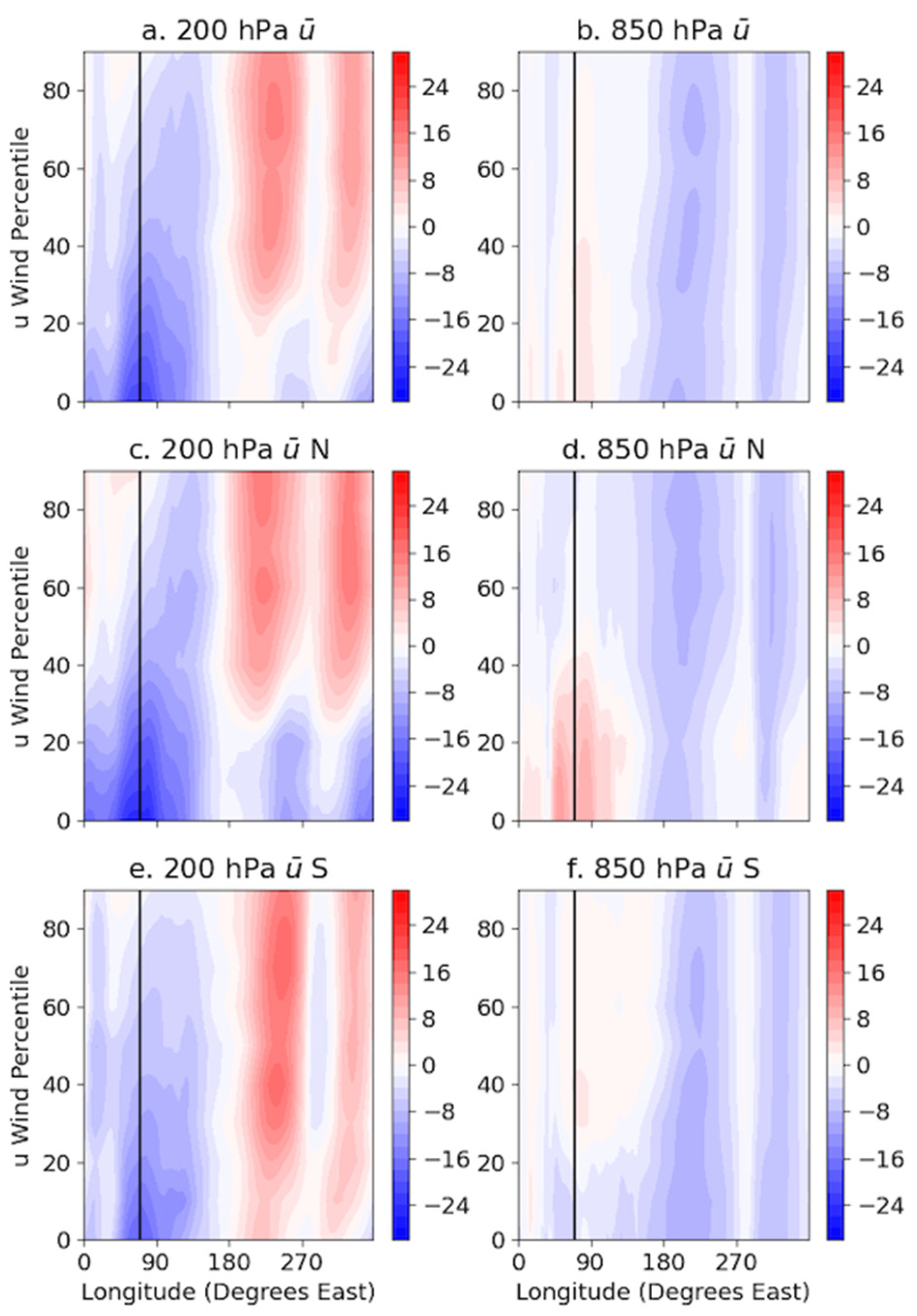
Figure 1 shows the average background
u wind in the three included latitude bands (each with its own row of panels) during each decile of background wind during the RMM phase 3 events. The left column shows the result at 200 hPa and the right column shows the corresponding 850 hPa result during the same upper tropospheric background conditions.
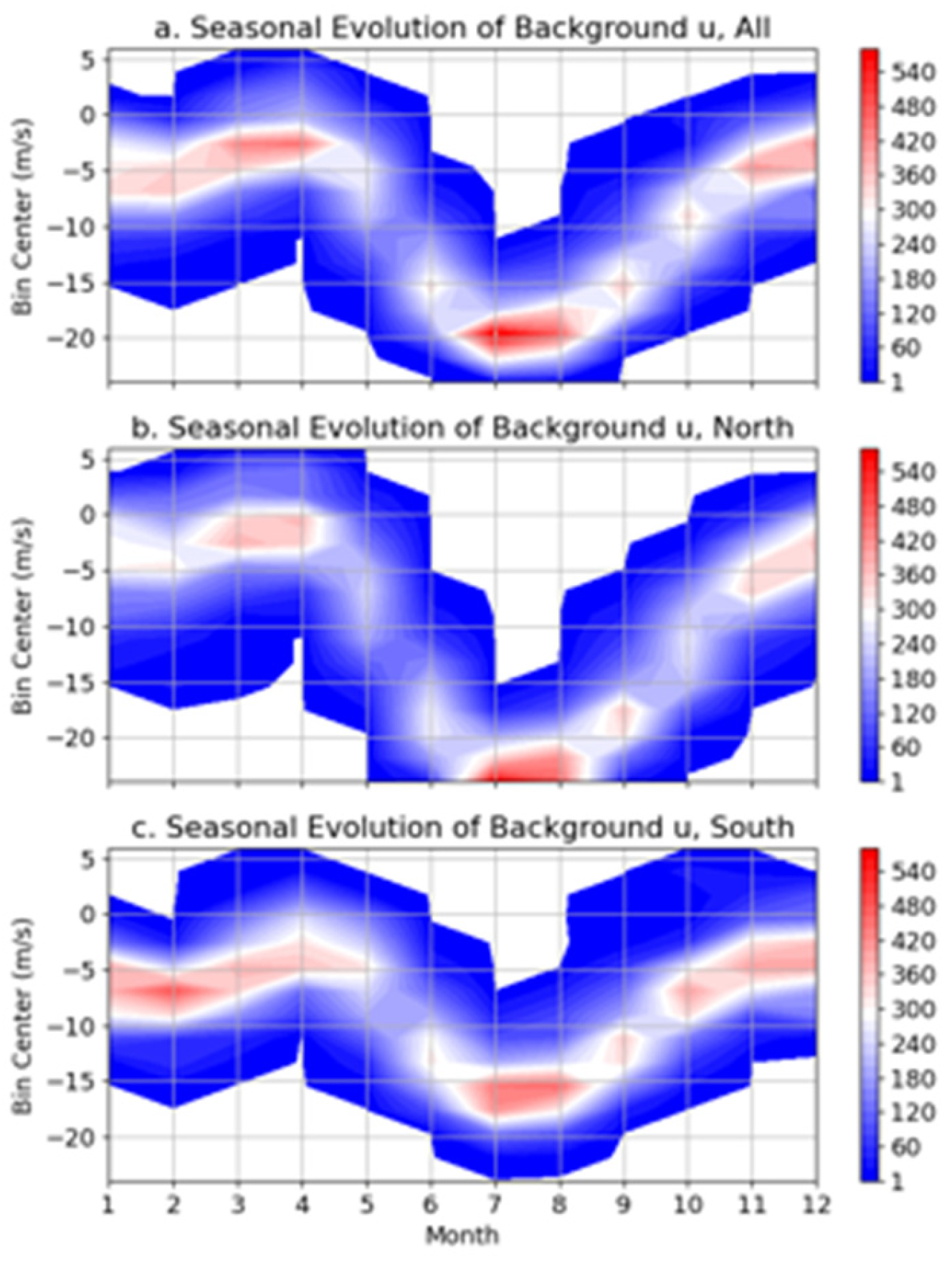
Figure 2 shows the histograms by month of the low-frequency upper tropospheric background zonal wind averaged from 40° E to 100° E. Implicit in the Indian Basin signal in
Figure 1 is the seasonality shown in
Figure 2, and individual events would map onto both figures. The left column of
Figure 1 shows that an upper tropospheric easterly wind region dominates over the warm pool, especially the Indian Basin, and that upper tropospheric westerlies tend to occur over the Western Hemisphere. The Western Hemisphere westerlies weaken when the Eastern Hemisphere easterlies strengthen, with Pacific basin westerlies being replaced by easterlies at 200 hPa when Indian Basin easterlies are strongest (panel c, lower deciles). The strongest upper tropospheric easterlies over the Indian Ocean shown in the left column of
Figure 1 appear in seasonally evolving distributions during June through August in
Figure 2. Those northern summer easterlies are strongest north of the equator (
Figure 1b). The center of the wind distribution in all shown latitude bands is always easterly but is weakest easterly during March through April and again during November and December. Westerlies can occur on the periphery of the distributions in the equatorial and northern latitude bands during October through May and are more frequent in the northern band than in the other bands between February and April.
Ref. [
14] suggests that the dominant background 200 hPa zonal wind associated with MJO events moving at the central 4–5 ms
−1 phase speed is 10–11 ms
−1. That speed of background wind occurs throughout the year in each of these latitude bands but is only near the center of the distribution during May–June and September–October. Results suggest that the average planetary-scale upper tropospheric Kelvin wave event during northern winter propagates at around 10 ms
−1 given the dominant background wind signals at the time, even though that is the time of greatest energy in 4–5 ms
−1 signals. Strong 4–5 ms
−1 MJO signals would therefore not be the norm for northern winter, even though that is when the strongest 4–5 ms
−1 has been reported. It is possible that these events achieve stronger amplitude in moist convection so that they dominate the power spectrum. Taking the results of
Figure 2a for the background wind, the resulting planetary-scale Kelvin wave phase speed in the upper troposphere over the Indian Ocean would range between 0 and 20 ms
−1 during January–March (for example) and between 0 and 8 ms
−1 during June–August. The center of the expected distribution of MJO phase speeds over the Central and Eastern Indian Basin during July and August is zero, because the background easterlies match or exceed the upper bound of the expected moist Kelvin wave phase speed in a resting basic state. The hypothesis predicts that the planetary-scale moist Kelvin waves should not be able to propagate over the Indian Ocean in such conditions. In such conditions, the signal would be expected to evolve at a slow crawl over Africa and the Western Indian Ocean, stall, and then appear absent over the Central and Eastern Indian Ocean. The zeroth and tenth percentiles for background upper tropospheric zonal wind occur almost exclusively during June through August in the 10° S to 10° N and northern latitude bands, suggesting that stronger easterly headwinds during northern summer would be expected to contribute strongly to reduced dependence of subseasonal variability on eastward propagation over the equatorial Indian Ocean. In the southern band, the strongest easterlies still occur during June through August, but the distributions there overlap more across the year, with less amplitude in the seasonal cycle. The remainder of the project analyzes composite MJO events during the different deciles of the background upper tropospheric zonal wind, together with a spectrum of planetary-scale signal phase speed to assess the extent to which the wave spectrum is consistent with these expectations.
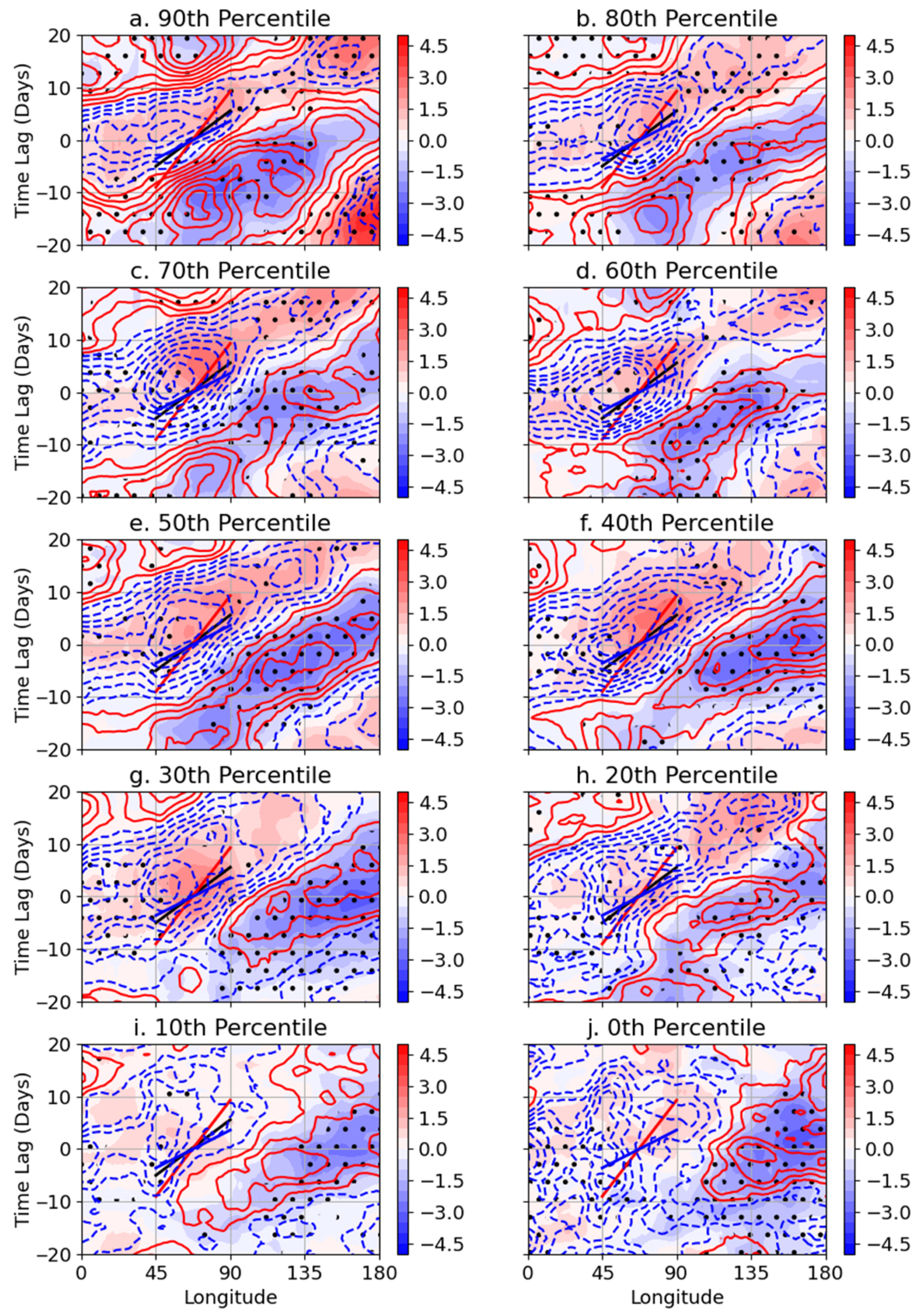
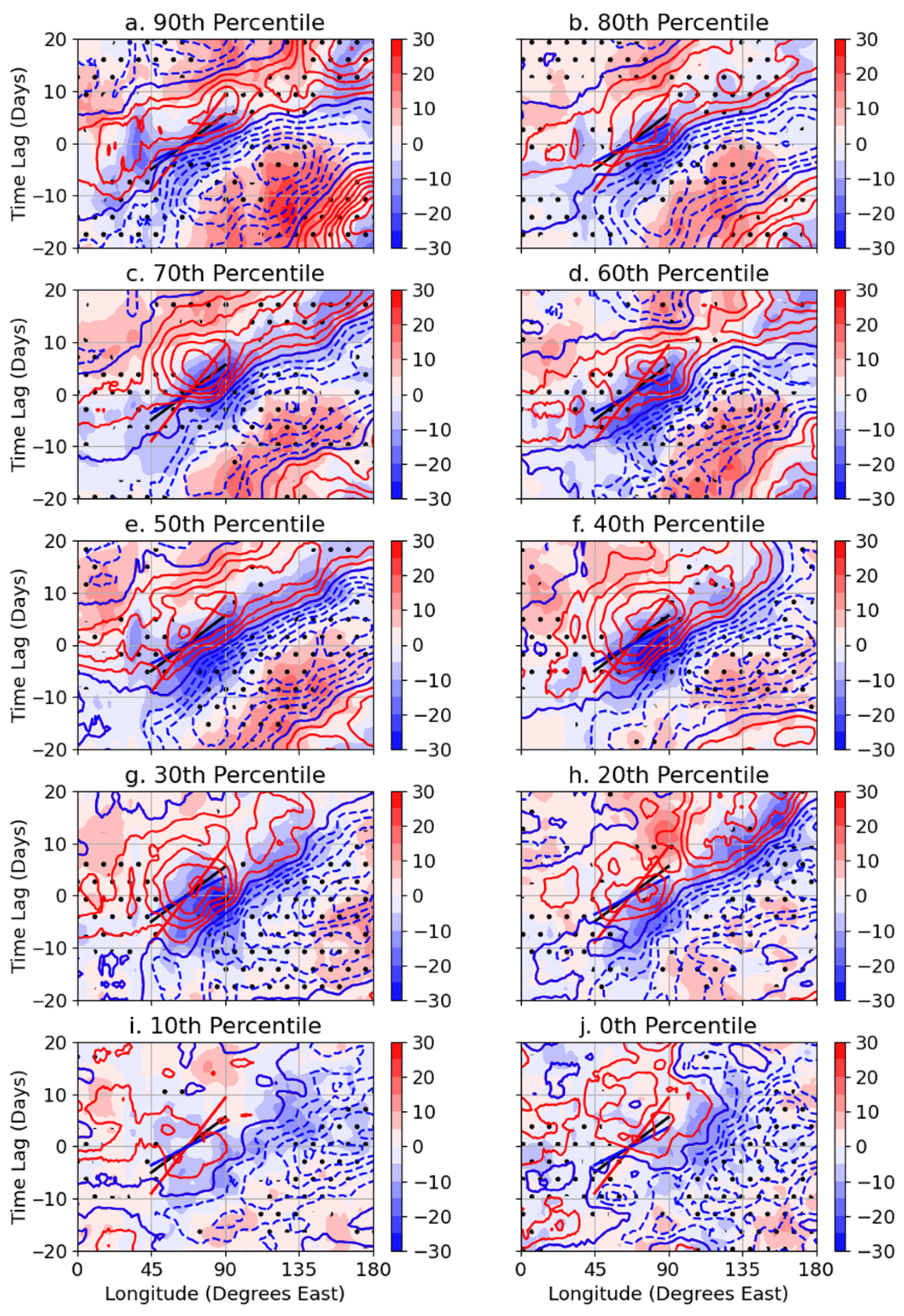
Figure 3 shows the RMM 3 time lag composites of 200 hPa (contours) and 850 hPa (shading) zonal wind anomaly for events that occurred in the Indian Basin upper tropospheric background zonal wind decile shown in the panel titles for 10° S to 10° N. West to east propagation of the composite signals is apparent around the world in most panels of all three figures. Consistent with [
14], over the Indian Ocean, upper tropospheric zonal wind anomalies propagate more rapidly eastward at high deciles representing the most westerly or least easterly background conditions (panels a and b), and they are slow or even stalled over the Western Indian Ocean at the lowest deciles that have the strongest background easterly wind (panels i and j). Associated lower tropospheric wind (shading) usually appears in phase with the upper tropospheric wind, but is weak and noisy at the lowest deciles (panels h–j). It is observed that 200 hPa zonal wind anomalies over the Indian Ocean at 60th to 30th deciles appear consistent with MJO signals near 4–6 ms
−1. Dotted hatching in most Western Hemisphere anomalies indicates that strong upper tropospheric zonal wind anomalies are typically significantly stronger than the corresponding reversed-sign standardized lower tropospheric zonal wind anomalies. At most background upper tropospheric zonal wind deciles, the upper tropospheric easterly wind anomaly of the MJO first arrives over the Indian Ocean statistically significantly stronger than the reversed-sign standardized lower tropospheric zonal wind anomaly, but after the upper tropospheric zonal wind anomaly grows there, the 850 hPa zonal wind anomaly amplifies. For example, in panel c, the upper tropospheric easterly wind anomaly arrives between 50 and 90° E by lag = −10 days, and the low-level westerly anomalies begin a few days later but do not grow strong until after lag = 0 days. The 200 hPa easterly wind anomaly crossing the Indian Ocean near lag = 0 days between 60 and 90° E does not usually achieve statistical significance in the difference from the standardized reversed sign lower tropospheric signals. These results imply that the lower tropospheric wind tends to grow in relation to the upper tropospheric wind after the upper tropospheric Kelvin wave arrives over the Western Indian Ocean and amplifies by advection of the confluent upper tropospheric background wind located there, as previously explained by [
4,
5].
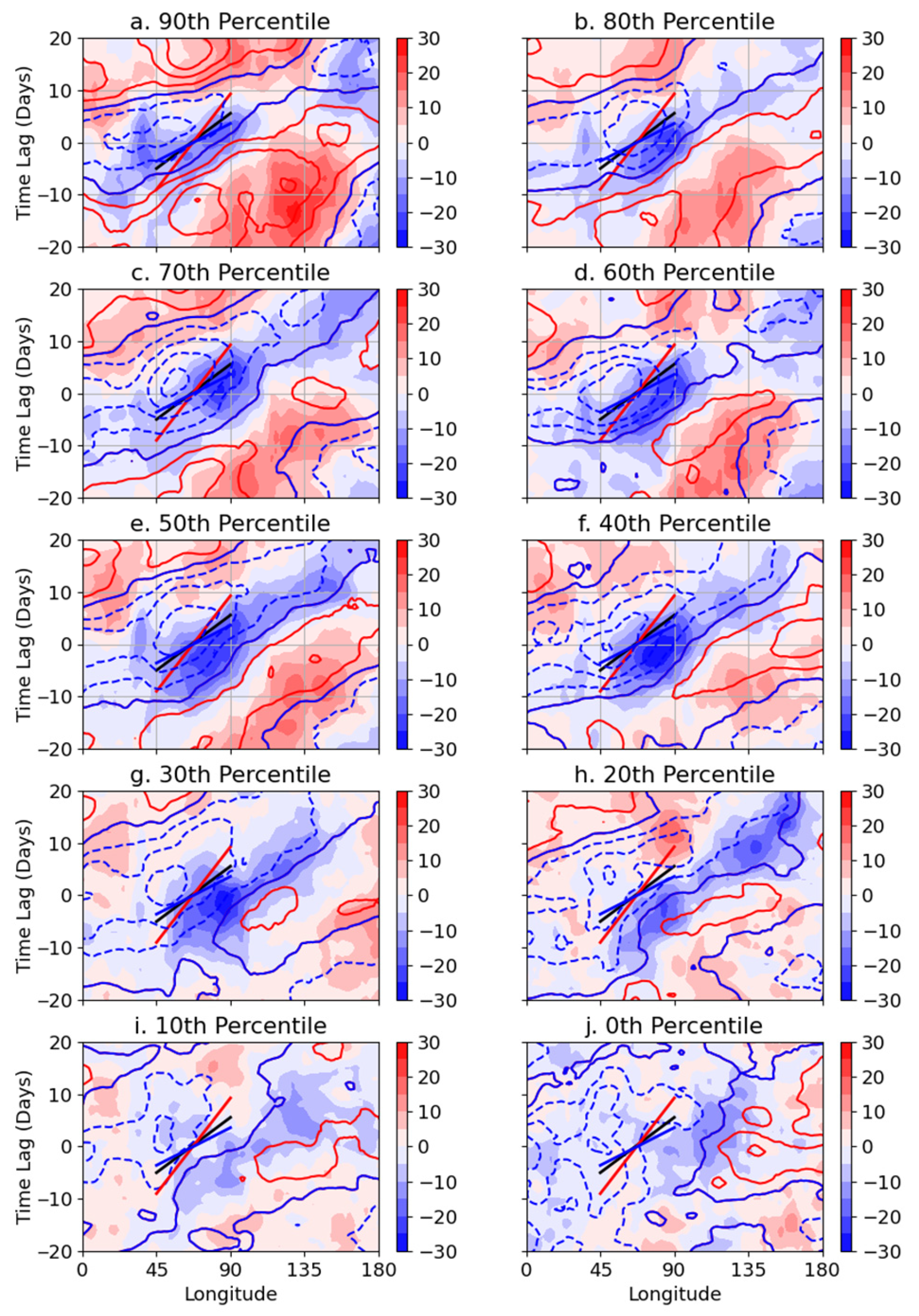
Figure 4 shows the corresponding OLR anomalies (shaded) plotted together with the same 10° S to 10° N averaged 200 hPa zonal wind anomalies shown in
Figure 3. The strongest negative OLR anomalies tracing active convection occur in panels d-f, representing background zonal wind percentiles of 40–60. Following [
14], these background wind speeds support phase speeds in the 4–5 ms
−1 range. From 40° E eastward in each panel, negative OLR anomalies occur near the leading edge of the advancing easterly wind anomaly, slightly west of the transition point between easterly and westerly wind. The background flow advecting the convection westward may contribute to this westward shift within the easterly wind, but why the convection is not centered between easterlies and westerlies is unclear. In general, the eastward phase speed of the convection appears consistent with the eastward phase speed of the leading edge of easterly wind anomaly. When systematic Kelvin wave propagation fails during the lowest deciles of the background wind (panels i and j), negative OLR anomalies are relatively disorganized and weak around the nearly stationary easterly wind anomaly near East Africa, but some weak OLR anomalies emerge farther east over the Maritime Continent.
Figure 5 puts the composite OLR and 850 hPa zonal wind anomalies together. Between 45° E and 135° E, the stronger 850 hPa westerly wind anomalies tend to emerge and considerably grow to the west of and coincident with or slightly delayed from the negative OLR anomalies in the same longitude range. In general, as the stronger 850 hPa westerly wind anomalies strengthen, they become statistically indistinguishable from the reverse similarity hypothesis with the 200 hPa winds, but not before convection organizes. Comparison against
Figure 3 shows that growing 850 hPa westerly wind anomalies are preceded by upper tropospheric easterly wind anomalies arriving in the same region from the west, which are followed by development of convection, and these in turn are followed by amplification of lower tropospheric westerly wind anomalies.
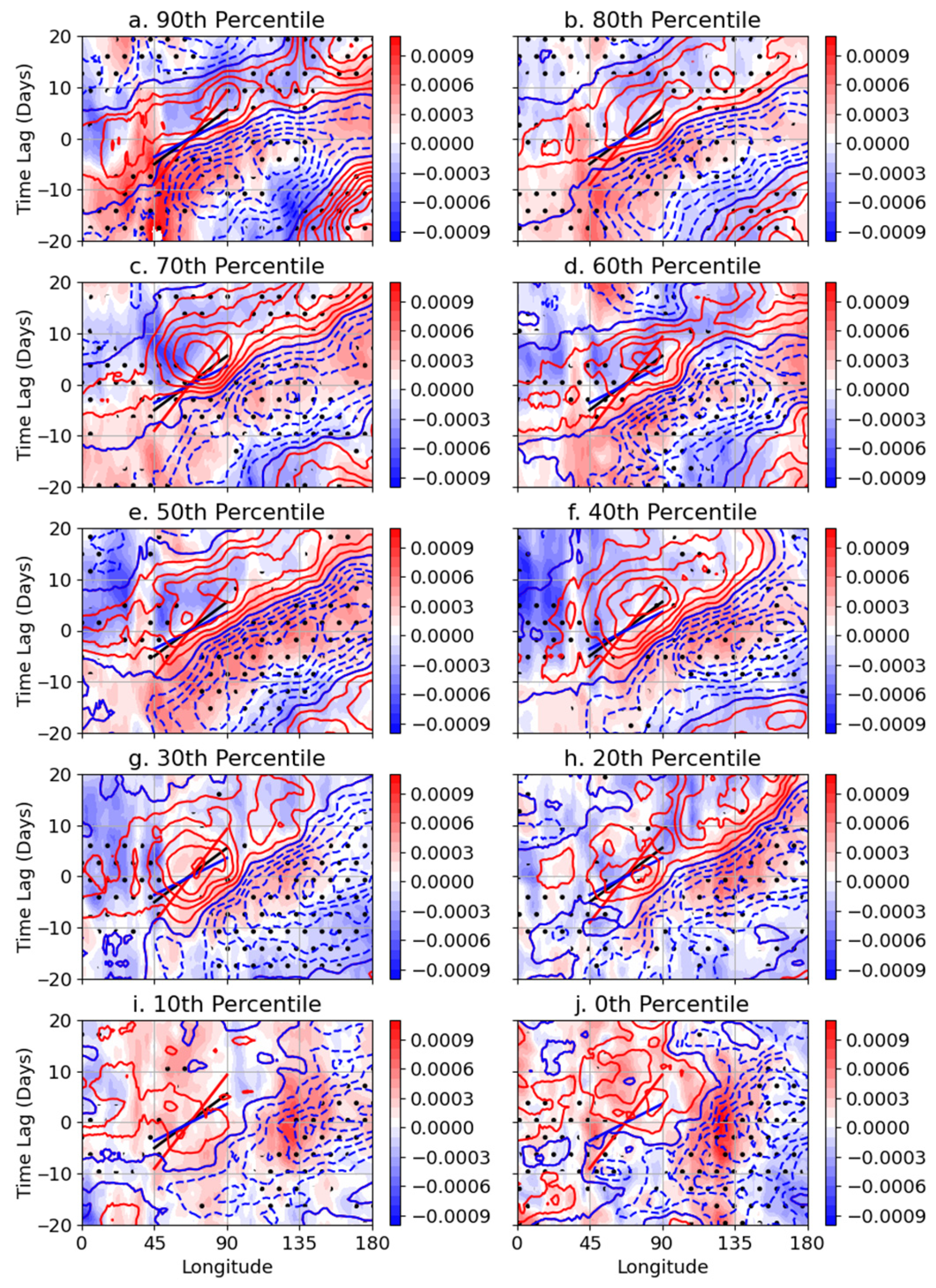
Figure 6 shows the composite 850 hPa specific humidity (shading) together with 850 hPa zonal wind (contours) for comparison with
Figure 3,
Figure 4 and
Figure 5. Over the Indian Basin from 45° E to 90° E, from the 90th down to the 40th percentile, moving from the most negative lag times shown toward positive lags, specific humidity increases across the easterly wind anomalies to a maximum near the end of the easterly wind anomalies, with the sign of the humidity anomaly typically reversing early in the developing westerly wind anomalies. Lower deciles show less organized subseasonal change in humidity over the Indian Ocean.
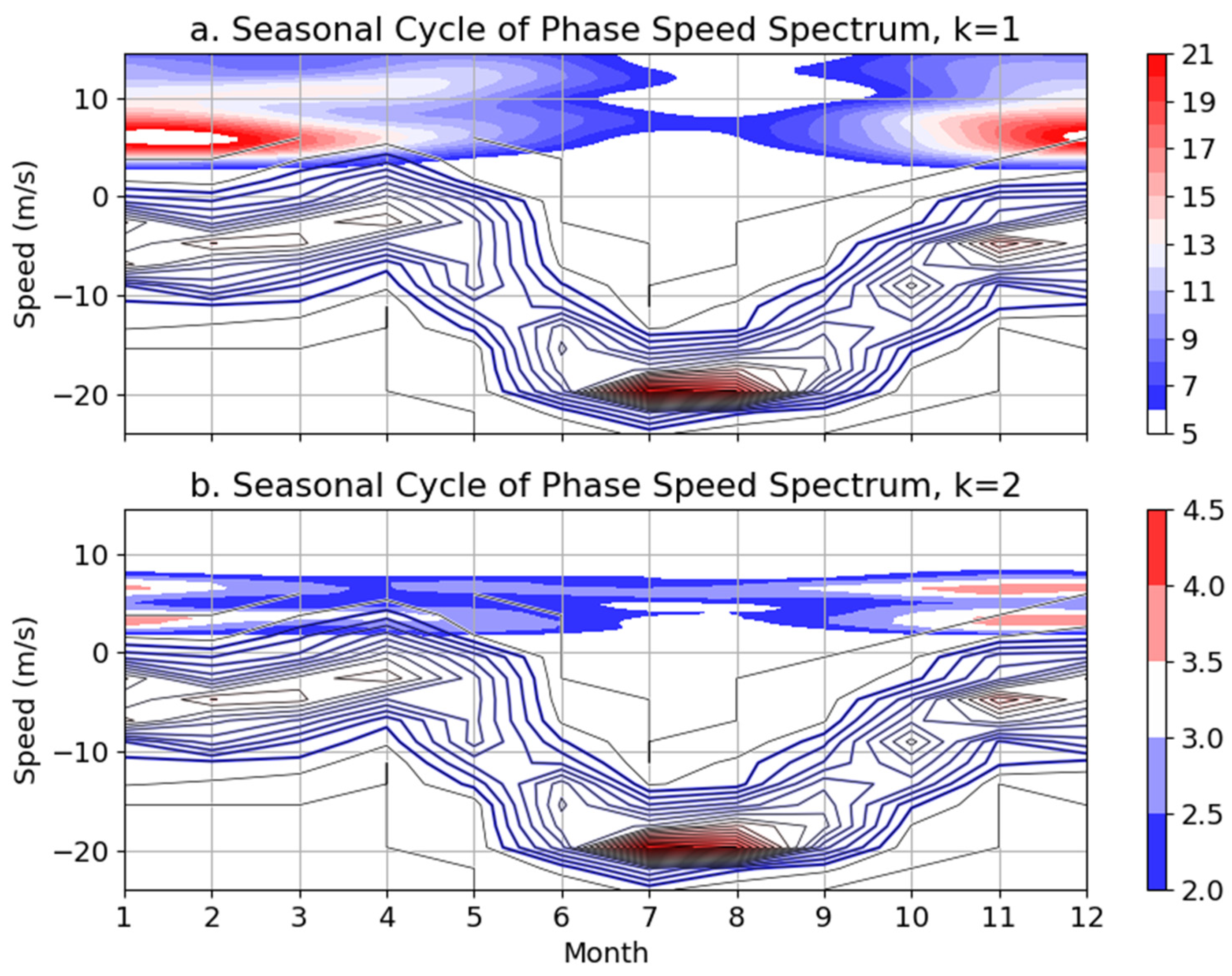
Figure 7 gives the seasonal cycle (by day of year on the horizontal axis) of the Indian Basin 20–120-day band OLR anomaly wavelet power across a continuum of phase speeds from 1 to 15 ms
−1 with results at wavenumbers 1–2, shown in panels a-b. The greatest power is between 5 and 10 ms
−1 at wavenumber 1. Wavenumber 2 is associated with less power that is also concentrated at lower phase speeds. This result is consistent with slow signals emerging from fast ones coming from the Western Hemisphere, becoming zonally narrower as they slow down. Signal at all phase speeds diminishes considerably during days 150–300 (June through October). Total power at low phase speeds at wavenumber 2 contributes a larger fraction of total power during June through August. A considerable reduction in power during northern summer is consistent with much less propagating signal at that time and is also consistent with stalled signals appearing at the strong easterly background wind speeds observed over the Western Indian Basin (
Figure 2, Panels i and j of
Figure 3,
Figure 4,
Figure 5 and
Figure 6). March and April show maximum power at phase speeds above 10 ms
−1, consistent with less easterly and sometimes even westerly background flow. Maximum power across the year occurs during January and December, with phase speeds between 5 and 8 ms
−1 showing greatest power. Although wavenumber 1 has most power overall, wavenumber 2 shows a substantial fraction of the total power below 5 ms
−1 across the year.
4. Discussion
This study highlights the role of background zonal winds in modulating the zonal propagation, amplitude, and convective characteristics of the Madden–Julian Oscillation (MJO) over the Indian Ocean, emphasizing seasonal variations as the MJO interacts with the background wind. Analysis of composites of MJO events based on deciles of upper tropospheric background winds and spectral analysis of OLR anomalies are consistent with prior findings that the MJO’s upper tropospheric Kelvin wave component interacts dynamically with the mean flow, leading to predictable shifts in phase speed and amplitude across seasons. These findings build on prior work [
4,
5,
14] by quantifying how seasonal background wind distributions are associated with behaviors of circulation features associated with the MJO, offering a potential dynamical explanation for some observed seasonal asymmetries in MJO propagation and intensity.
Results show that the fastest eastward propagation of MJO signals over the Indian Ocean tends to occur during March–April (consistent with [
22]), when background upper tropospheric easterlies are weakest and occasionally transition to westerlies (
Figure 2). In this regime, phase speeds often exceed 10 m s
−1, and the weaker background easterlies observed at the same time would allow less impeded eastward propagation by the Kelvin wave mechanism (
Figure 7). Conversely, during northern summer (June–August), the strongest easterly background winds (typically −15 to −25 m s
−1 with stronger values north of the equator) are associated with reduced or stalled propagation, consistent with the hypothesis of propagation arrested by westward advection by the background flow (
Figure 1 and
Figure 3i,j). This stalling is followed by absent or disorganized eastward-moving signals over the eastern Indian Ocean, with reduced spectral power across all phase speeds at zonal wavenumber 1 (
Figure 7a). Such patterns might explain the diminished eastward-propagating subseasonal variability during boreal summer over the Indian Ocean, consistent with previous observations of seasonal MJO variation [
20,
21]. Previous works have also demonstrated stalling of eastward propagation of the MJO over the Indian Ocean [
32,
33]. Ref. [
32] suggested that increased sea surface temperature contributes to the slower or stalled propagation, while [
33] suggests the difference may be explained by the interaction of the convection with potential vorticity anomalies. During December–January, the background wind distribution centers on moderate easterlies (−2 to −10 m s
−1), supporting MJO phase speeds predominantly between 5 and 12 m s
−1 at wavenumber 1 (
Figure 5a). This range is notably faster than the community consensus of ~4–5 m s
−1. Events in the 4–5 m s
−1 range dominate space–time OLR power spectra near zonal wavenumber 2 (
Figure 7b), likely because convection is stronger in these events even though a wider range of phase speeds express in the wind data. When faster northern winter events occur, they experience weaker easterly headwinds, including coherent propagation but weaker convective amplitude, highlighting weaker coupling between circulation and moist processes associated with faster and slower events.
The relationship between upper and lower tropospheric zonal winds also analyzed here reveals height-dependent asymmetries. Lower tropospheric winds generally mirror the upper-level signals in phase but with opposite sign, as expected from traditional MJO descriptions [
26]. However, statistical tests show significant departures from proportional reversed similarity over the Western Hemisphere, where upper tropospheric anomalies are proportionally stronger, whereas over the Central Indian Ocean lower-level winds amplify, following growth of convection post-arrival of the upper tropospheric Kelvin wave (
Figure 3 and
Figure 5). The 850 hPa westerly wind signals grow most not when upper tropospheric easterly winds grow most to the west near east Africa, but when convection grows most to the east after the 200 hPa wind anomalies have arrived from the west. Lower tropospheric specific humidity anomalies over the Indian Ocean grow through the period of easterly low-level wind associated with the MJO. Previous works have shown that the upper tropospheric wind signal begins amplifying near East Africa in response to advection of the background confluent zonal wind near East Africa by the advancing MJO zonal wind [
4,
5]. This sequence is consistent with a lower tropospheric westerly wind anomaly that organizes in response to the advance of convection catalyzed by the arrival of the amplifying upper tropospheric easterly wind anomaly rather than the lower tropospheric wind initiating in more direct response to the upper tropospheric signal somehow without mediation by moist processes. In strong easterly wind background states (at low deciles), lower tropospheric wind, moisture, and OLR signals become weak and noisy, with convection organizing at higher deciles of the background wind when the advancing upper tropospheric signal is more coherent. Results suggest that convective anomalies consistently initiate near and to the west of the leading edge of advancing upper easterlies (
Figure 4). This positioning underscores the upper tropospheric Kelvin wave’s role in preconditioning environments for deep convection, while moist processes (including moisture import suggested by specific humidity increasing during easterly 850 hPa wind anomalies over the Indian Ocean) probably trigger the lower tropospheric westerly wind anomaly and force the downward-propagating planetary-scale Kelvin wave response from the stratosphere [
10,
11], which then reinforces the environment for deep convection to the east of its present location. These conclusions presented here suggest implications for subseasonal forecasting and understanding MJO–QBO interactions. The QBO’s modulation of stratospheric winds influences Kelvin wave descent [
6,
10,
11], and these results suggest that seasonal background tropospheric winds could amplify or dampen these effects, particularly during transitions like northern spring. Future work should explore high-resolution modeling to disentangle moist–dry contributions and assess how climate change-induced shifts in background winds (e.g., stronger subtropical jets and stronger tropical sheared flow) might alter MJO propagation.
Observations and reanalysis data in the context of momentum budgets [
4,
5,
14] have previously demonstrated the mechanisms whereby planetary-scale Kelvin wave signals can take on characteristics of the MJO. The above analysis suggests that seasonal evolution of the background wind is also associated with profound differences in MJO propagation characteristics consistent with the mechanisms already demonstrated in those previous works. A more theoretical perspective may also help inform these results.
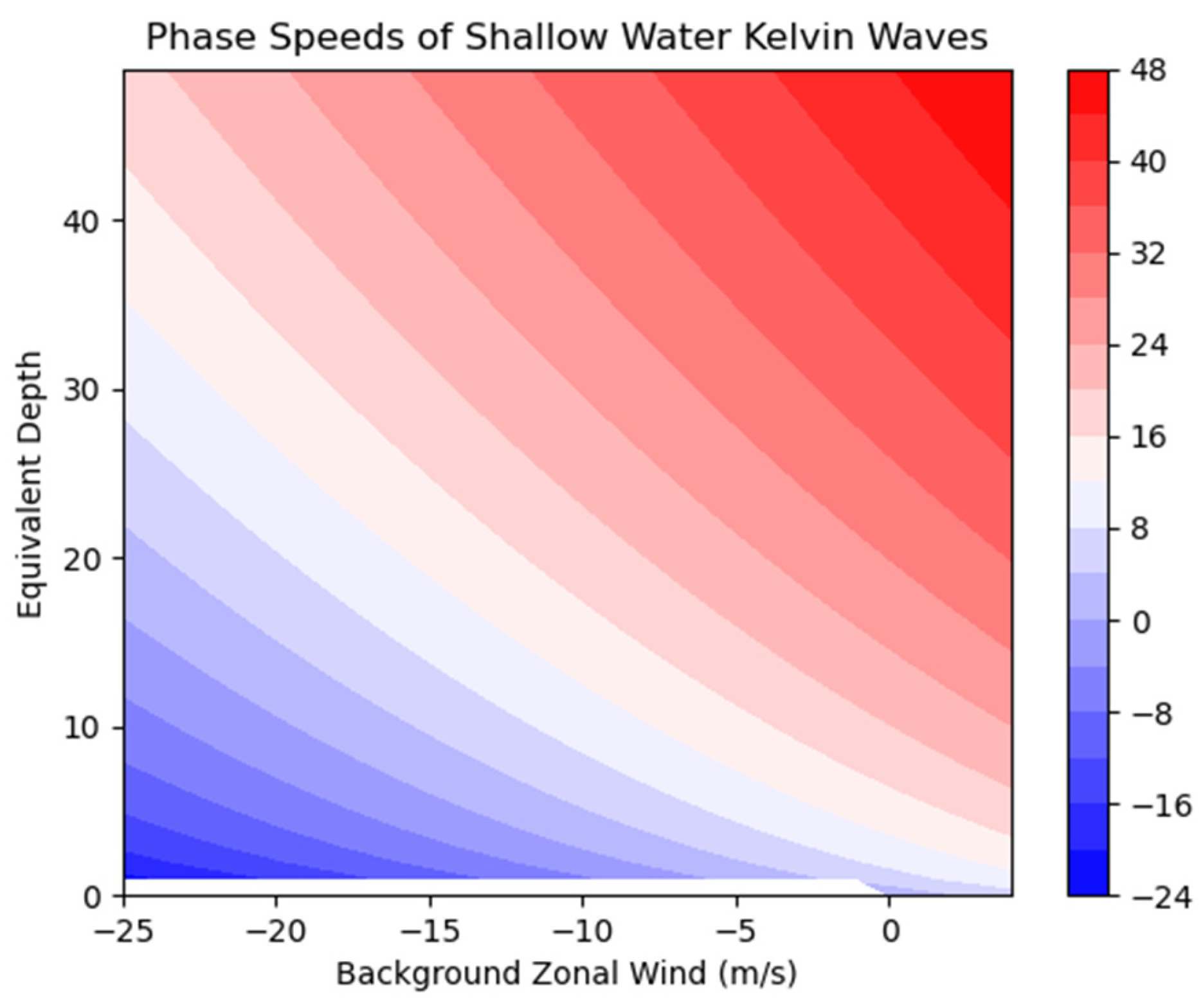
Appendix A solves the equatorial beta plane shallow water model for a Kelvin wave in the presence of a globally uniform, constant background flow, and finds the dispersion relationship accommodating that background flow. The result demonstrates that phase speed varies linearly with background wind and is proportional to the square root of the equivalent depth, showing the plausibility of these results in a simple model.
In summary, many seasonal variations in MJO propagation along the equator over the Indian Ocean may be governed by Kelvin wave–mean flow interactions, with northern summer easterlies probably imposing a propagation barrier, spring weak easterlies or even westerlies enabling rapid transit, and winter background flow moderating propagation favoring a 3–12 m s−1 phase speed range (considering wavenumbers 1–2). Lower tropospheric westerly winds developing within and to the west of deep convection appear to be consistent with responses to that convection rather than as direct responses to the upper tropospheric Kelvin wave. This framework reconciles discrepancies in perceived MJO speeds and emphasizes the need to consider a wide range of phase speeds for comprehensive MJO theory.