Article

The Patos Lagoon Digital Twin—A Framework for Assessing and Mitigating Impacts of Extreme Flood Events in Southern Brazil


by
Elisa Helena Fernandes
1,*,
Glauber Gonçalves
2,
Pablo Dias da Silva
1,
Vitor Gervini
2 and
Éder Maier
3
1
Institute of Oceanography, Federal University of Rio Grande (FURG), Rio Grande 96203-900, Brazil
2
Computational Sciences Centre, Federal University of Rio Grande (FURG), Rio Grande 96203-900, Brazil
3
Institute of Humanity Sciences and Information, Federal University of Rio Grande (FURG), Rio Grande 96203-900, Brazil
*
Author to whom correspondence should be addressed.
Climate 2026, 14(2), 34; https://doi.org/10.3390/cli14020034
Submission received: 26 November 2025 / Revised: 18 January 2026 / Accepted: 22 January 2026 / Published: 29 January 2026
(This article belongs to the Section Climate Adaptation and Mitigation)

Abstract

Recent projections by the Intergovernmental Panel on Climate Change indicate that global warming will turn permanent and further intensify the severity and frequency of extreme weather events (heat waves, rain, and intense droughts), with coastal regions being the most vulnerable to extreme events. Therefore, the risk of natural disasters and the associated regional impacts on water, food, energy, social, and health security represents one of the world’s greatest challenges of this century. However, conventional methodologies for monitoring these regions during extreme events are usually not available to managers and decision-makers with the necessary urgency. The aim of this study was to present a framework concept for assessing extreme flood event impacts in coastal zones using a suite of field data combined with numerical (hydrological, meteorological, and hydrodynamic) and computational (flooding) models in a virtual environment that provides a replica of a natural environment—the Patos Lagoon Digital Twin. The study case was the extreme flood event that occurred in the southernmost region of Brazil in May 2024, considered the largest flooding event in 125 years of data. The hydrodynamic model calculated the water levels around Rio Grande City (MAE ± 0.18 m). These results fed the flooding model, which projected the water over the digital elevation model of the city and produced predictions of flooding conditions on every street (ranging from a few centimeters up to 1.5 m) days before the flooding happened. The results were further customized to attend specific demands from the security forces and municipal civil defense, who evaluated the best alternatives for evacuation strategies and infrastructure safety during the May 2024 extreme flood event. Flood Safety Maps were also generated for all the terminals in the Port of Rio Grande, indicating that the terminals were 0.05 to 2.5 m above the flood level. Overall, this study contributes to a better understanding of the strengths of digital twin models in simulating the impacts of extreme flood events in coastal areas and provides valuable insights into the potential impacts of future climate change in coastal regions, particularly in southern Brazil. This knowledge is crucial for developing targeted strategies to increase regional resilience and sustainability, ensuring that adaptation measures are effectively tailored to anticipated climate impacts.

1. Introduction

Since the end of the 20th century, the Intergovernmental Panel on Climate Change (IPCC) has presented evidence for the irreversible human impacts on the world’s climate [1,2]. Projections indicate that permanent global warming will further intensify the severity and frequency of extreme events such as heat waves [3], intense rain [4], and drought [5,6]. Consequently, the risk of natural disasters and the related impacts on water, food, and energy supply, as well as social and health security, represent some of the greatest challenges in this century. Coastal regions are among the areas most vulnerable to the impacts of global climate change, being directly susceptible to extreme weather events [5]. These events pose safety threats to the population due to the occurrence of higher waves and rising sea levels along coastlines [7], heavy rainfall and flooding [8,9,10,11], extreme droughts, and severe wind conditions (cyclones). Therefore, scientific studies focused on coastal regions are required to understand the causes and impacts of extreme events, and to develop tools and prevention measures that support alerts. These initiatives aim to mitigate impacts on society and promote resilience and sustainability in the affected regions.
Conventional methodologies for monitoring coastal region dynamics enable the accurate and timely generation of natural disaster alerts [12]; however, they typically involve approaches based on field data and provide information that is generally limited in terms of space and time. Moreover, such valuable information is often not readily available to managers and decision-makers. Furthermore, the shortage of adequate cartographic products representing the territories where processes produce impacts is a complicating factor [13]. These limitations become particularly important in developing countries, resulting in insufficient understanding of the spatial and temporal variability of coastal dynamics. This makes it difficult to predict how these areas will respond to extreme meteorological and hydrological events and how the effects of these events can be mitigated.
Several approaches can be considered for the monitoring and prediction of flood impacts inland. The use of the Google Earth Engine (GEE) cloud-computing platform combined with remote sensing products to investigate the extent of flood inundation and deforestation during the 2022 Assam flood, in India, was proposed by [14]. The authors highlighted that the findings of their research contributed to raising awareness, planning, and implementing future disaster management strategies to protect both the environment and human life. A different strategy was proposed by [15], where traditional neural networks were combined with a Two-Dimensional Hidden Layer (Td) architecture to better deal with the spatio-temporal characteristics of hydrological data. The results suggested that this alternative enhances prediction accuracy and may contribute to the development of a flood prediction system.
Recently, the authors of [16] presented a thorough review of the use of digital twin technology combined with remote sensing products for urban flood risk management and early warning systems. This review identified key technical and governance challenges while recommending the development of modular, AI-driven DT frameworks which are particularly tailored for regions with limited resources.
The concept of digital twin models refers to a model prototype of a real entity (the physical twin) that uses existing data and computational predictions over time [17], providing a virtual replica of the natural environment [18]. This digital technology results in valuable information for applied interventions. The application of digital twins has expanded dramatically in the last decade due to the rapid growth of techniques related to database computation, artificial intelligence, and the Internet of Things (IoT) [19].
At present, efforts are being made to create relatively large-scale digital twin models of cities, oceans, and even the entire Earth [19]. The digital twin of Earth proposed in [20] incorporates high-precision digital models of the Earth to monitor and simulate natural phenomena and related human activities. This digital technology enables exploration of the past, an understanding of the present, and the development of predictive models for the future. A digital twin based on river–coastal–ocean circulation modeling of the Seto Inland Sea to perform efficient simulations at varying scales was proposed by [21]. A deep hybrid network for significant wave height estimation using spatial and temporal information about wind fields was proposed by [22]. Similarly, a method to enhance coastal impact recognition by assessing unmanned aerial vehicles (UAVs) for monitoring accuracy and implementing a digital twin framework was proposed by [23]. The results of these studies enhanced accessibility, fostered community engagement and awareness, improved the capability of predicting and simulating potential impacts in real time, and offered a forward-thinking strategy for mitigating coastal threats. More recently, ref. [24] presented a digital twin of the Yangtze River basin based on 3D simulations of the region and data on weather, water flow, ecology, sediment properties, and topography to provide real-time modeling of projected flood routing, water engineering, scheduling, shipping, ecological impacts, and other outcomes. It is evident, however, that although the digital twin technology is being widely used around the world for studies focused on sustainable environmental development, its application as a tool for preventing and mitigating the impacts of extreme events in coastal regions is still in its early stages.
In response to the global and national context related to the increasing intensity and frequency of extreme events [4,25] and the necessity of developing tools to prevent and mitigate the impacts of these events in coastal regions, Brazil’s first environmental digital twin is presented herein. The proposed Patos Lagoon Digital Twin, field-validated during the May 2024 extreme event, serves as an important tool for carrying out flood condition assessments and impact management in cities along the margins of Patos Lagoon. The proposed framework can be applied worldwide by utilizing a similar suite of data and numerical models [13], thus providing the necessary information for preventing and managing impacts to human lives in coastal zones and contributing to the definition of global flood management strategies.

2. Materials and Methods

2.1. Patos Lagoon—The Physical Twin

Patos Lagoon (Figure 1) receives water drained from half of the state of Rio Grande do Sul (RS) (more than 200,000 km2), covering 270 municipalities that together account for 78% of the state’s Gross Domestic Product (GDP). The region has high fishing and agricultural value, with intensively irrigated rice and soy crops, and is home to approximately 6 million people. Furthermore, Portos RS (https://www.portosrs.com.br, accessed on 14 December 2024), a company responsible for operating public ports in the cities of Rio Grande, Pelotas, and Porto Alegre (Figure 1), is located in this region. The topographic characteristics of the large basin that feeds Patos Lagoon and its tributaries create mountainous river valleys in the north and an extensive coastal plain surrounding the lagoon. These geographical features result in environments that are highly vulnerable to extreme hydrological events [9].
The lagoon operates under a microtidal regime with 30 cm amplitude, and its dynamics are mainly driven by freshwater discharges and winds [26]. The influence of wind becomes more relevant at shorter timescales and during periods of reduced freshwater discharge (<2000 m3.s−1) [27]. The predominant wind directions in the region are NE (22.3%) and SW (13.5%). NE winds are predominant throughout the year (mean velocity 5 m.s−1), driven by the Atlantic Anticyclone. SW winds occur secondarily at a higher intensity (mean velocity 8 m.s−1), mainly during winter [28]. The mean annual freshwater discharge in Patos Lagoon is approximately 2400 m3.s−1 [29]. These conditions, however, vary according to ENSO cycles [30] and exhibit well-recognized signals at seasonal and interannual [31,32,33], as well as interdecadal [34], scales.
The year 2024 was the hottest in recent centuries [35]. Between the end of April and the beginning of May 2024, the largest floods ever observed in Brazil occurred in the state of Rio Grande do Sul, located in the southernmost part of the country (Figure 1). During this event, extremely high precipitation (652 mm, approximately 6 times the usual precipitation for the same period and area [9]) occurred in drainage basins in the northern region of the state (Figure 1). Rapid floods with extreme water levels occurred in mountainous regions to the north, while in the coastal plain lowlands, to the south, the floods lasted for a long time, though at lower levels. The impacts were catastrophic and far-reaching, with 478 out of the 497 municipalities in Rio Grande do Sul affected and almost 2.4 million people impacted. More than 15,000 km2 was submerged, with alarming losses of human life and property, as well as high rates of infectious diseases. There were 183 confirmed deaths and 27 missing people, in addition to 806 injured. Exposure to flood waters caused more than 15,000 registered cases of leptospirosis. Thousands of houses were destroyed or severely damaged, displacing nearly 146,000 people and leaving more than 50,000 homeless [36].
Similar events occurred in September and November 2023 in the same region, offering a glimpse of what can be expected in the coming decades due to climate change and extreme events in southern Brazil. According to [4,37], projections indicate that the increase in magnitude of the maximum flows of rivers in the southern region during floods could be approximately fivefold, increasing the potential impacts of events such as the one in 2024. Another complicating factor is that Patos Lagoon is the only connection between this basin and the coastal area and Atlantic Ocean (Figure 1).

2.2. Patos Lagoon—The Digital Twin

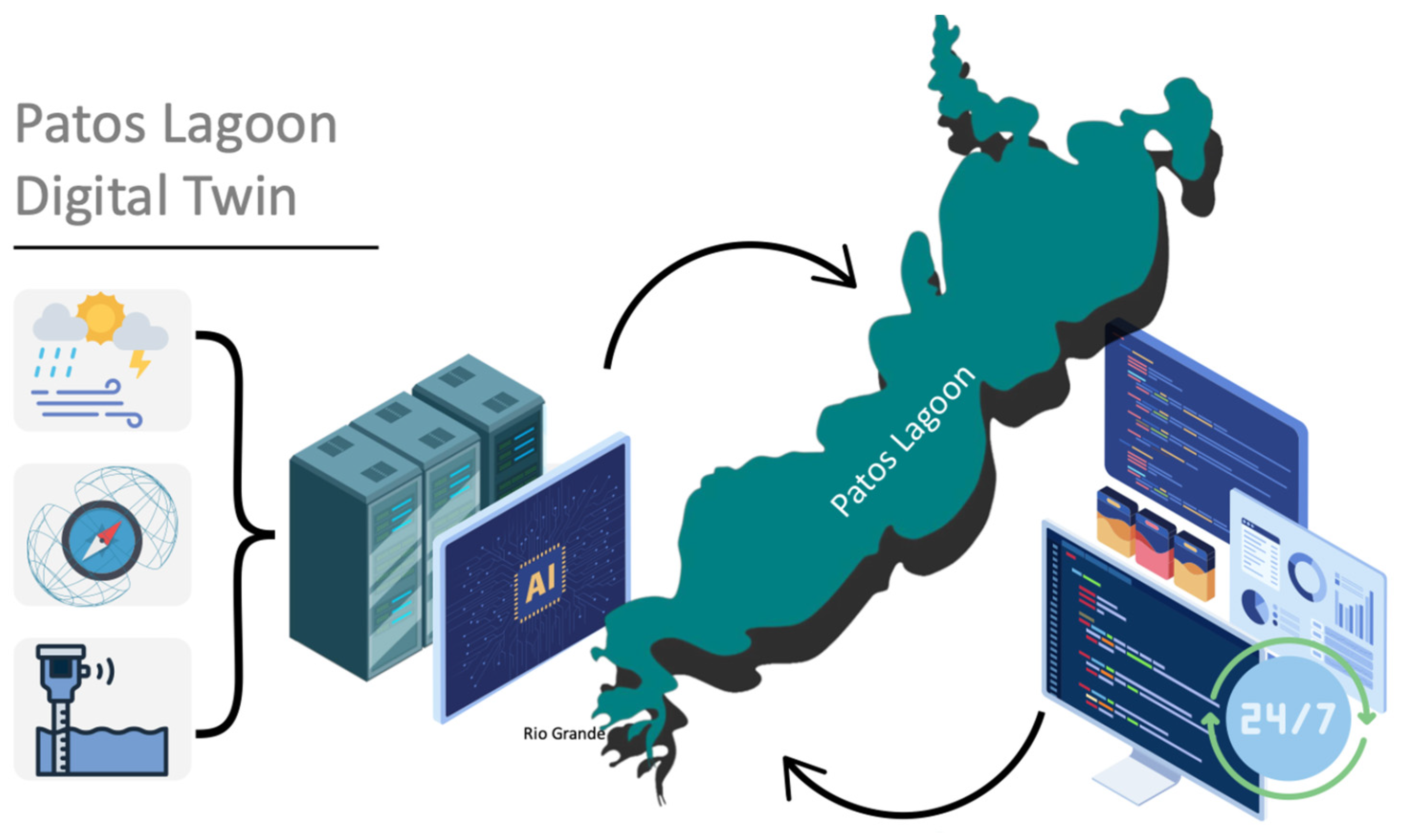
The Patos Lagoon Digital Twin is based on meteorological (precipitation, winds), oceanographic (water level), and geodetic (terrain) datasets that feed the virtual environment for adequate observations of environmental conditions in real time. The data are also used to force and validate numerical forecasting models (hydrological, hydrodynamic, and flood) combined with computer vision methods, which provide a virtual replica of the environment (Figure 2). Here, we focused on the suite of monitoring data and prediction models applied to evaluate flood impacts in the southern Patos Lagoon during the May 2024 event as a case study.

2.2.1. The Patos Lagoon Water Level Monitoring Network

During the May 2024 flood event, the Patos Lagoon Water Level Monitoring Network (https://monitoramentolagoadospatos.com.br, accessed on 14 December 2024), composed of stations along the lagoon’s margins, was under construction, sponsored by Portos RS. The water level monitoring at these stations is carried out by prototypes fully developed at the Federal University of Rio Grande (FURG), and in this study, data from station Rio Grande/CCMAR were used. Water level data from stations Laranjal (maintained by Hidrosens, from the Federal University of Pelotas) and São Lourenço do Sul (maintained by the National Water and Sanitation Agency—ANA (https://www.gov.br/ana/pt-br, accessed on 14 December 2024)) were also used during the May 2024 event (Figure 1). Data from these three stations are available at the Hidro Portal, as part of the National Water Resources Information System—SNIRH (https://www.snirh.gov.br/hidrotelemetria/serieHistorica.aspx, accessed on 14 December 2024).

2.2.2. The Hydrodynamic Numerical Model

The TELEMAC-3D hydrodynamic model in the Patos Lagoon Digital Twin is based on the Open Telemac-Mascaret (https://www.opentelemac.org) suite of numerical models. Although the TELEMAC-3D model has been applied in Southern Brazil for the past 20 years, the May 2024 flood event was the first time it was applied in prognostic form to predict the hydrodynamics of Patos Lagoon. The model forecasted the water level and current velocities 5 days ahead (due to the reliability of wind forecasts over the area), resulting in 6 simulations throughout May 2024.
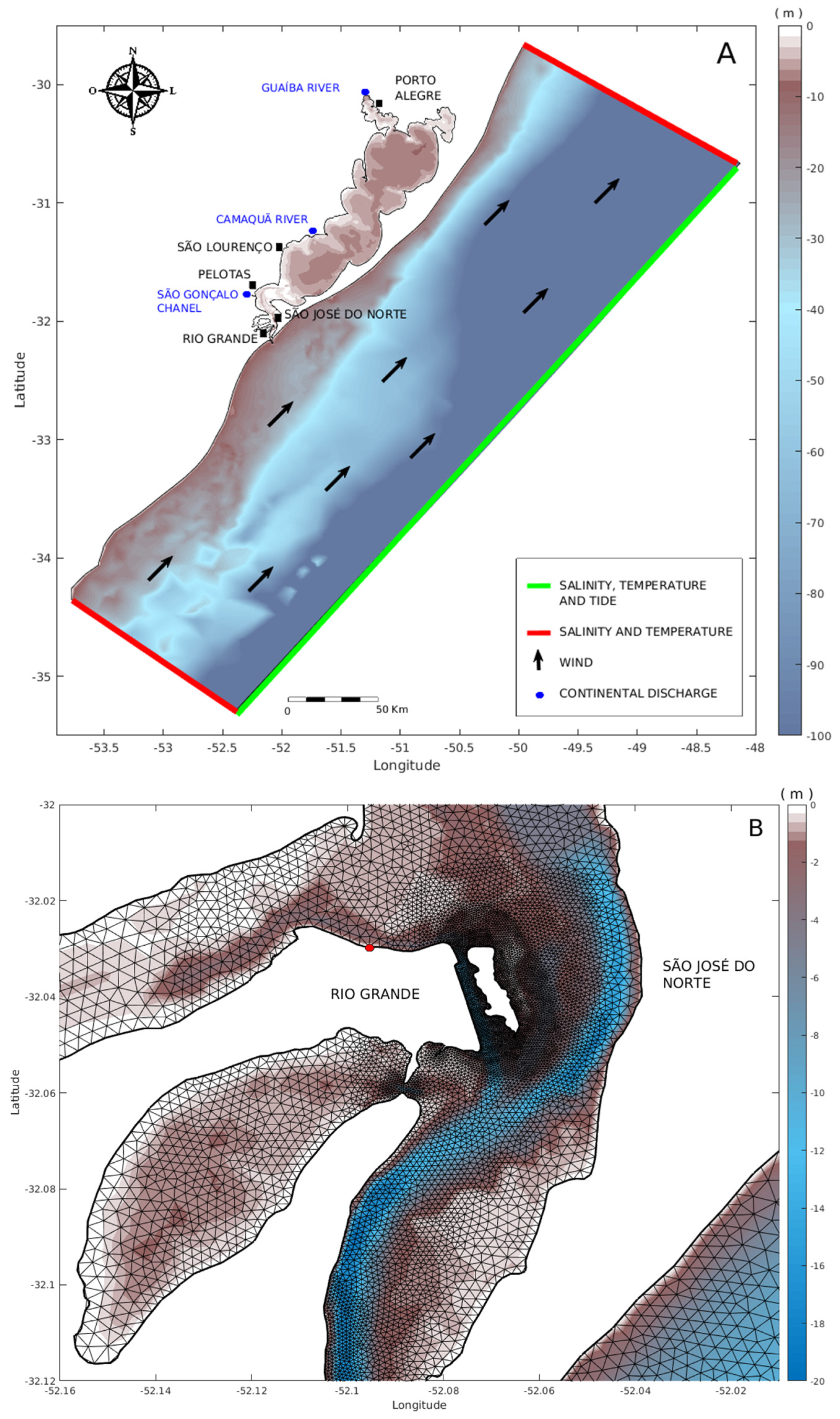
The numerical domain covered the region 29.5–35.5° S and 48–54° W, including Patos Lagoon, its estuary, and an oceanic area up to 2300 m depth (Figure 3A). This large computational domain was necessary so that boundary conditions from larger-scale models could be used. The domain was discretized with an unstructured computational grid comprising triangular finite elements of variable size (Figure 3B) to ensure adequate representation of the coastline and bathymetric variations. The numerical grid used for the May 2024 flood event was generated using the BlueKenue software (http://www.nrccnrc.gc.ca/eng/solutions/advisory/blue_kenue_index.html, accessed on 14 December 2024) and was composed of 52,098 nodes (vertices of the triangles for which the model solves the equations and generates predictions) and 7 vertical sigma levels throughout the water column.
The initial and boundary conditions of the hydrodynamic model (Figure 3A) included (a) sea level data and velocity fields obtained from the OSU Tidal Reversal System, which is implemented internally in the TELEMAC-3D model, providing 33 tidal harmonic components; (b) salinity and temperature fields from the Global HYCOM + NCODA Project (Hybrid Coordinate Ocean Model) (https://www.hycom.org), with temporal and spatial resolutions of 3 h and 0.08°, respectively; (c) wind speed and direction forecast from the ECMWF (European Centre for Medium-Range Weather Forecasts, http://www.ecmwf.int, accessed on 14 December 2024) provided every 5 days by Rhama Analysis Company, with temporal and spatial resolutions of 1 h and 11 km, respectively; and (d) forecasts of freshwater discharge from the main tributaries (the Guaíba and Camaquã Rivers and São Gonçalo Channel, Figure 3A), provided by the Hydraulic Research Institute from the Federal University of Rio Grande do Sul (IPH-UFRGS), from the large basin hydrological model MGB-IPH [38,39]. The MGB-IPH computational mesh discretization is such that the basin is sub-divided into smaller unit-catchments and further into hydrological response units (HRUs), categorized by combinations of land use and soil types. The model then simulates the vertical energy and water budget at each HRU, while the runoff generated within each unit-catchment is routed to the stream network using linear reservoirs. In addition, a flow-routing method is used to propagate flows downstream along river networks [40]. The quality of the water level forecasts used in the hydrodynamic model was presented by [41]. The quality of the wind forecasts at the CCMAR—Rio Grande station was classified as being between good (mean RMAE = 0.41) and reasonable (RMAE = 0.54) for the V and U components, respectively, according to [42].
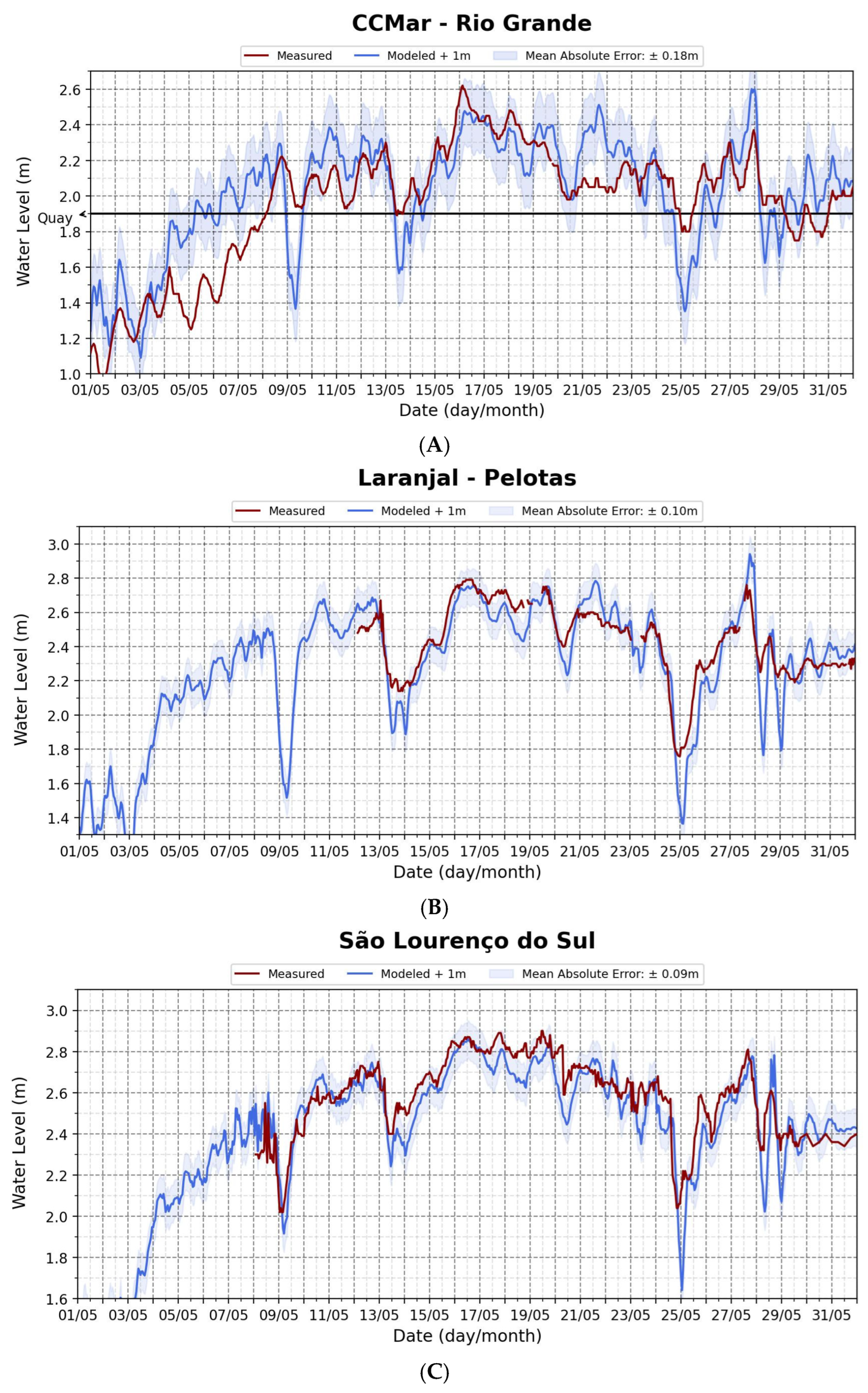
The TELEMAC-3D model has been widely applied and extensively calibrated and validated for Patos Lagoon and the adjacent continental shelf [33,43,44,45,46,47]. Details about the calibration of the numerical mesh used in this study were presented by [45]. A new validation of this mesh was performed with field data (Figure 4) during the April–May 2024 flood event and is presented in Table 1.
This validation indicated high-quality reproducibility in different areas of the lagoon waterbody for most of the observed time, as shown by the similarity between the lines in the graphs representing the measured data (red line) and the model predictions (blue line). To align with the reference level of Imbituba (the Brazilian Vertical Datum), 1 m was added to the water levels calculated by the hydrodynamic model (which uses the vertical reference of the Brazilian Navy).

2.2.3. The Flood Simulation Model

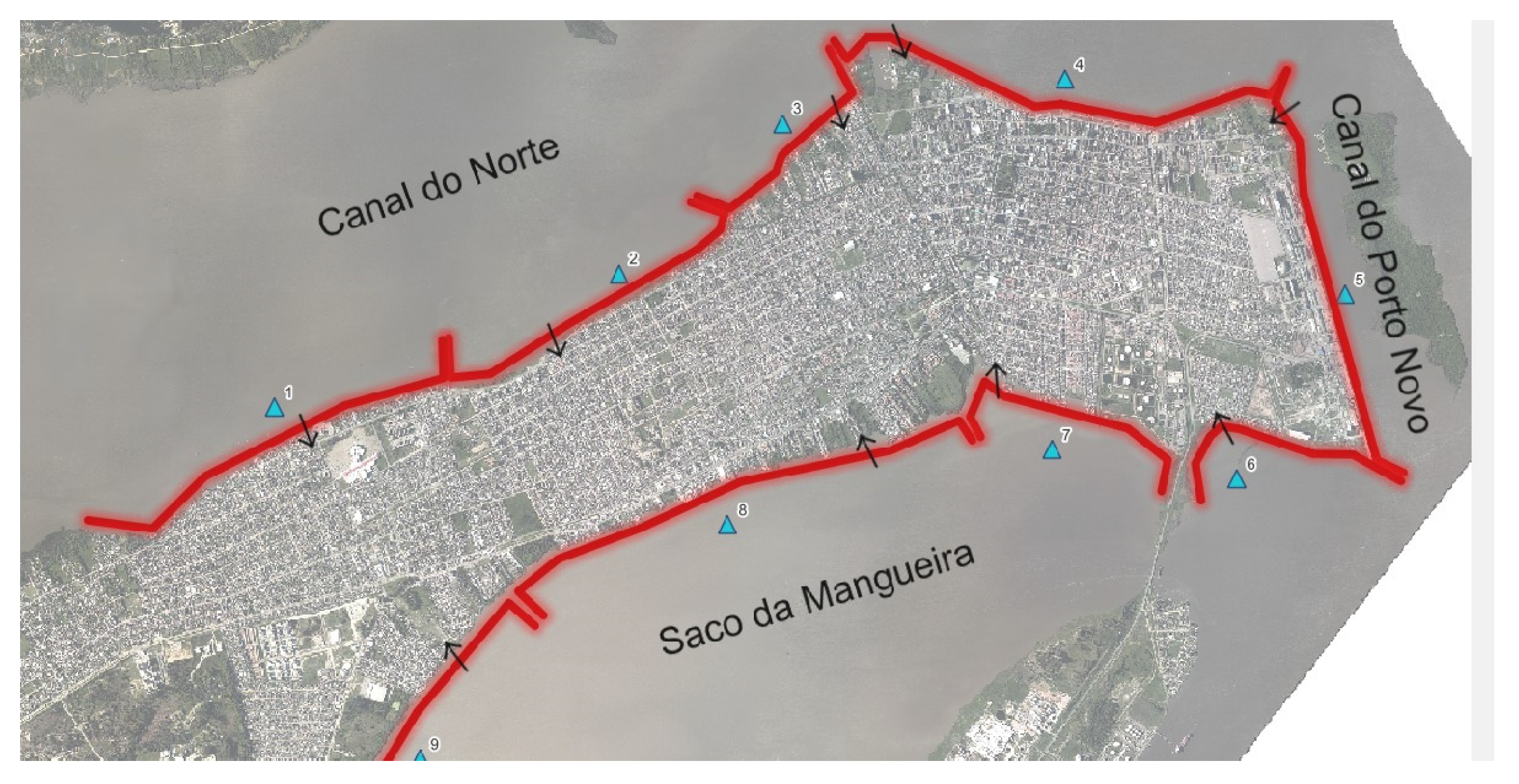
The fundamental database for the flood simulation comprised the calculated water levels from the hydrodynamic model and a digital elevation model of the region. To exemplify the method, the flood conditions in the city of Rio Grande (Figure 1) were investigated during the May 2024 extreme flood event. Once the vertical variations in the water level around Rio Grande city were known, a region-growing algorithm [48] known as the Watershed method, a data-driven adaptative algorithm, projected this information onto points at the edge line of the digital elevation model throughout the reference sections at the margins (Figure 5). The selection of the 8 points around the city of Rio Grande followed the areas where floods have (or have not) historically been observed at different intensities due to the terrain elevations in each area. The digital elevation model of Rio Grande City, made available by Rio Grande City Hall, was developed based on LiDAR data, has a ground sample distance (GSD) of 0.5 m, and a vertical point accuracy of 3.2 cm [13].
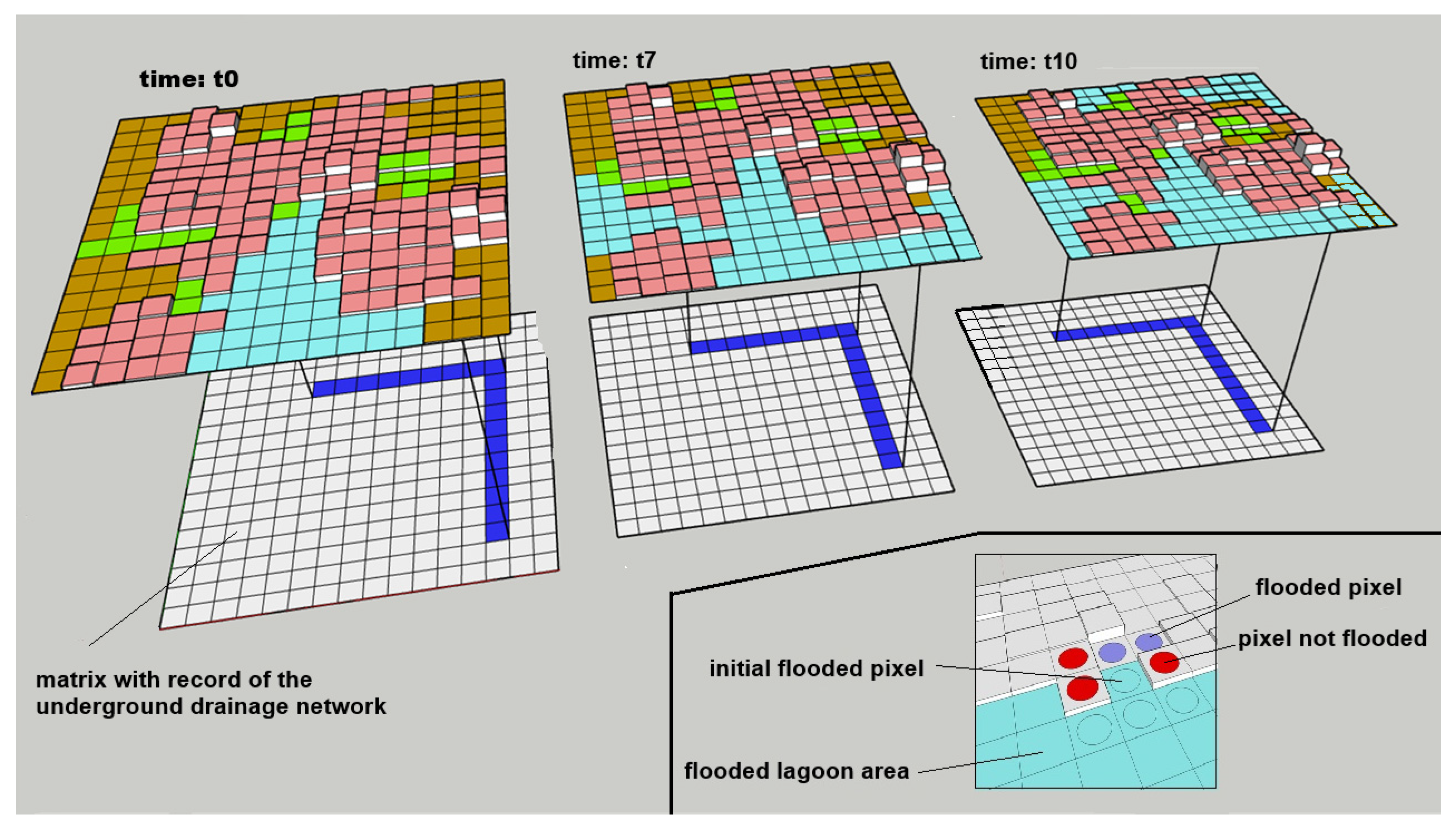
The flood model concept is illustrated in Figure 6. At each modeling step, a value is taken from the calculated water level time series at these points, and the signal propagates through the neighborhood connected to it. Additionally, an adaptation was introduced to the standard algorithm to represent an underground drainage network without backflow control, whose extent and configuration are not fully known. The flooding conditions observed in the Digital Twin domain, characterized by flat terrain, long duration, and the absence of local storm forcing, enabled aerial photogrammetric surveys using unmanned aerial vehicles and direct delineation of flood boundaries through GNSS measurements. By comparing the observed flood extents with the modeled results, areas not captured by the simulation were identified, and the algorithm subsequently determined the shortest path between points of minimum elevation along the real and modeled flood boundaries, establishing a virtual underground connection within the parallel matrix to improve flood representation (Figure 6).
The model was implemented as a Python 3.13.0 script and executed on a QGIS platform, allowing the use of interactive vectorization tools, advanced cartographic generation, and format conversion for sharing with specific technical groups, especially those involved in the rescue process during the April–May extreme event.
Signal propagation is governed by a simple and logical elevation test: is the ground level at the neighboring point lower than or equal to the level of the point on the shore? If the answer is positive, its coordinates (x,y) are transferred to a dynamically allocated record table, which contains the points with flooded status (Figure 6). Otherwise, this point does not populate the table and retains its original properties. This process is repeated until no more connected points are detected as flooded, that is, all neighboring points tested are above the level reported by the hydrodynamic model. Then, this table is traversed sequentially, and in the matrix representing the terrain, all points with recorded coordinates are assigned the color corresponding to flooding. The accuracy of the maximum level reached at the monitored points was statistically validated as significant, with an overall Root-Mean-Square Error (RMSE) of 3.3 cm for the day of maximum flooding measured at the CCMAR—Rio Grande station (16 May 2024).
Thus, the Patos Lagoon Digital Twin framework provided water level and flooding condition predictions (updated every 3 days) to the civil defense, security forces, and overall community. The results were immediately and widely shared through WhatsApp, social media, and the Federal University of Rio Grande website (https://www.furg.br, accessed on 14 December 2024). Additionally, television broadcasters and major newspapers disseminated the information from the produced bulletins in their headlines. The framework was also applied to provide information for strategic planning in response to specific security demands.

3. Results

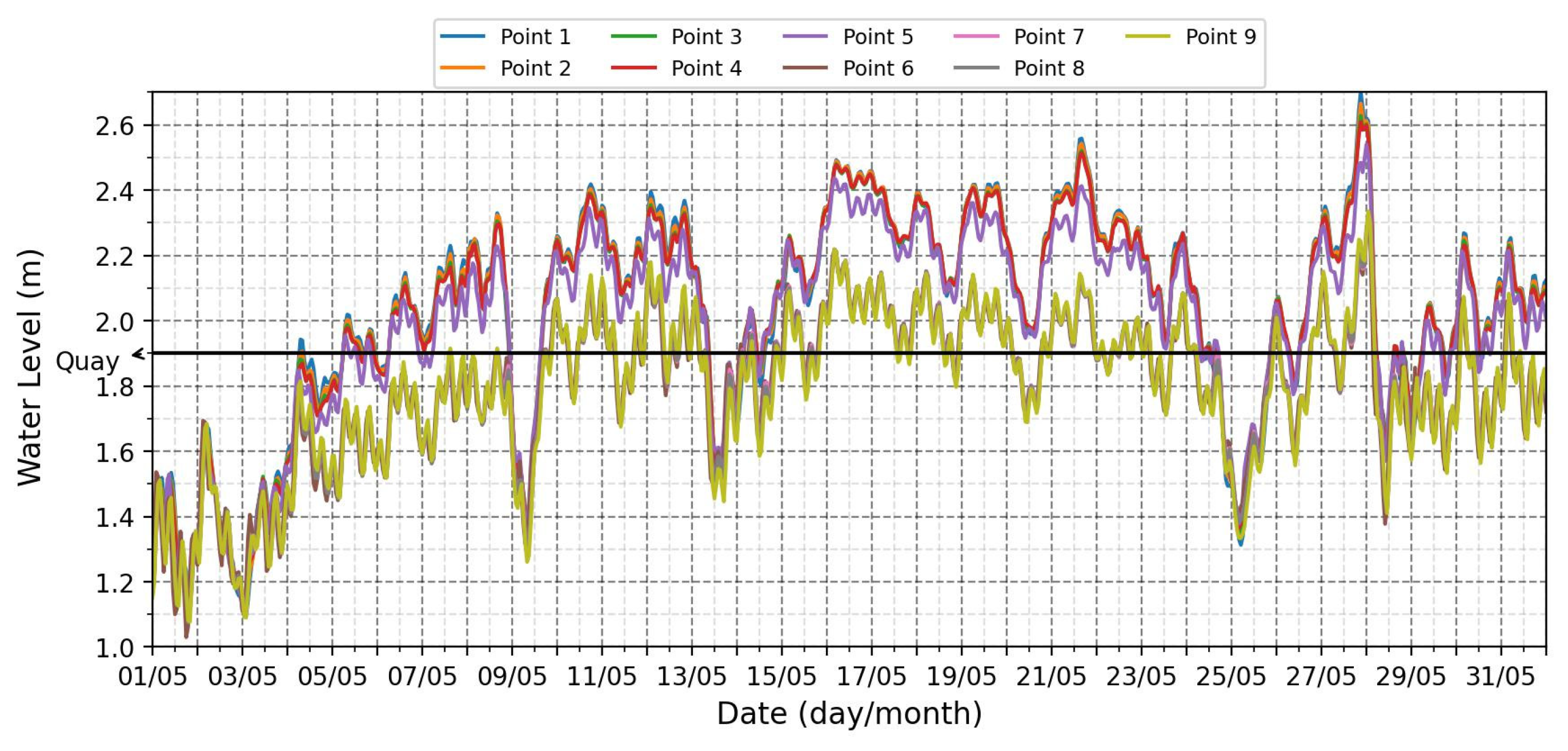
The calculated water levels for the 8 points at the edge line of the Digital Terrain Model (Figure 5) of Rio Grande City during the May 2024 extreme flood event are presented in Figure 7. The Quay reference at CCMAR—Rio Grande station (Figure 1) indicates flooding conditions in the city center when the water level exceeds 1.90 m. The results show that flooding in Rio Grande City started on 5 May and alternated between high flood conditions (between 2.4 and 2.7 m) and no flooding at all during specific periods (water level below 1.90 m). This water level variability around Rio Grande city was mainly controlled by local wind variability. Please refer to Video S1 for a simulation of inundation in the Rio Grande City center during May 2024.
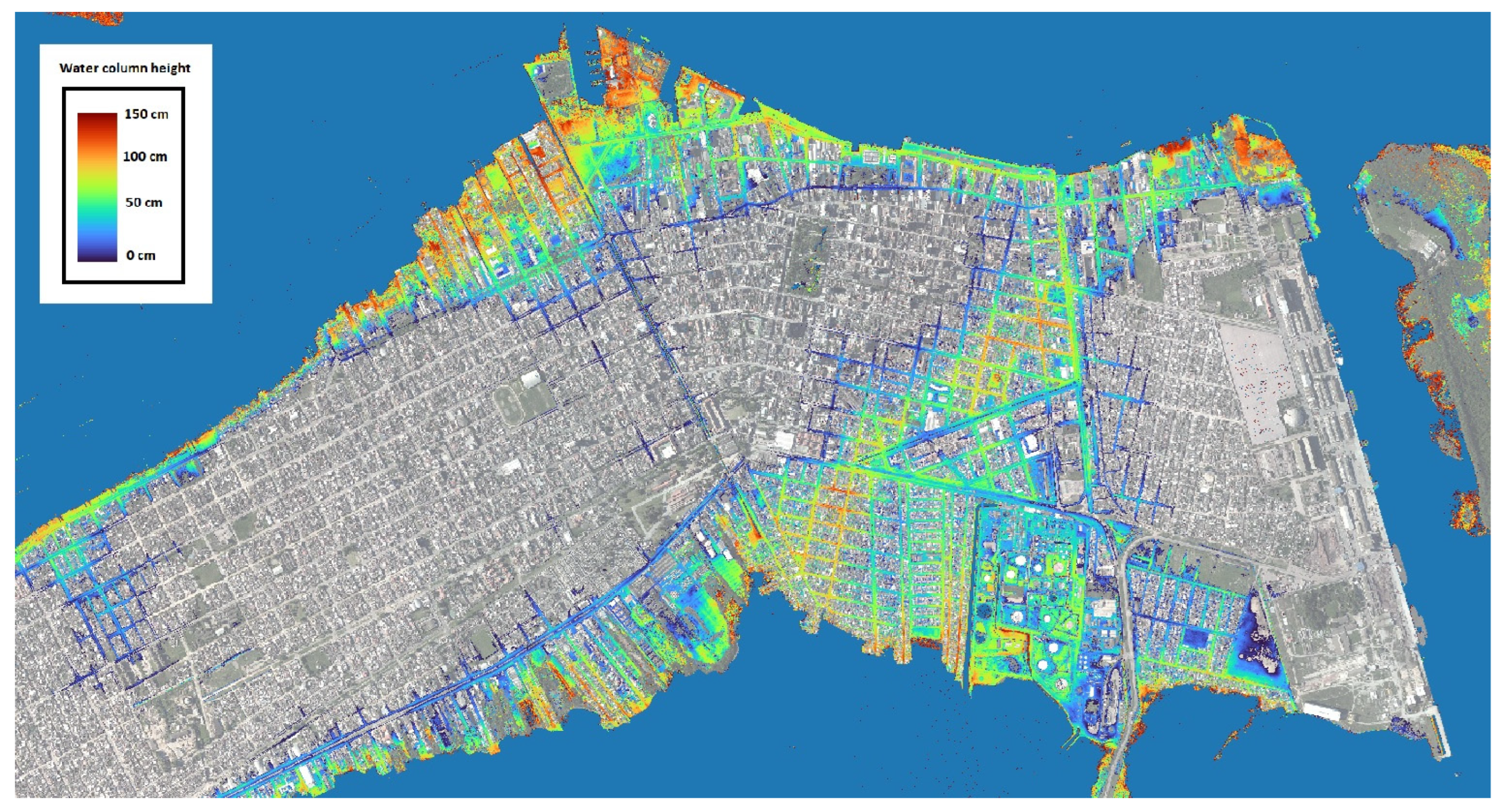
The predicted flooding conditions over the Rio Grande City digital elevation model are illustrated in Figure 8 for the day of maximum flooding measured at the CCMAR—Rio Grande station (16 May 2024). At this time, the maximum calculated water level on the streets reached 1.5 m (red in the color scale), and the predominant flood condition was 0.75 m of water on the streets (yellow in the color scale).
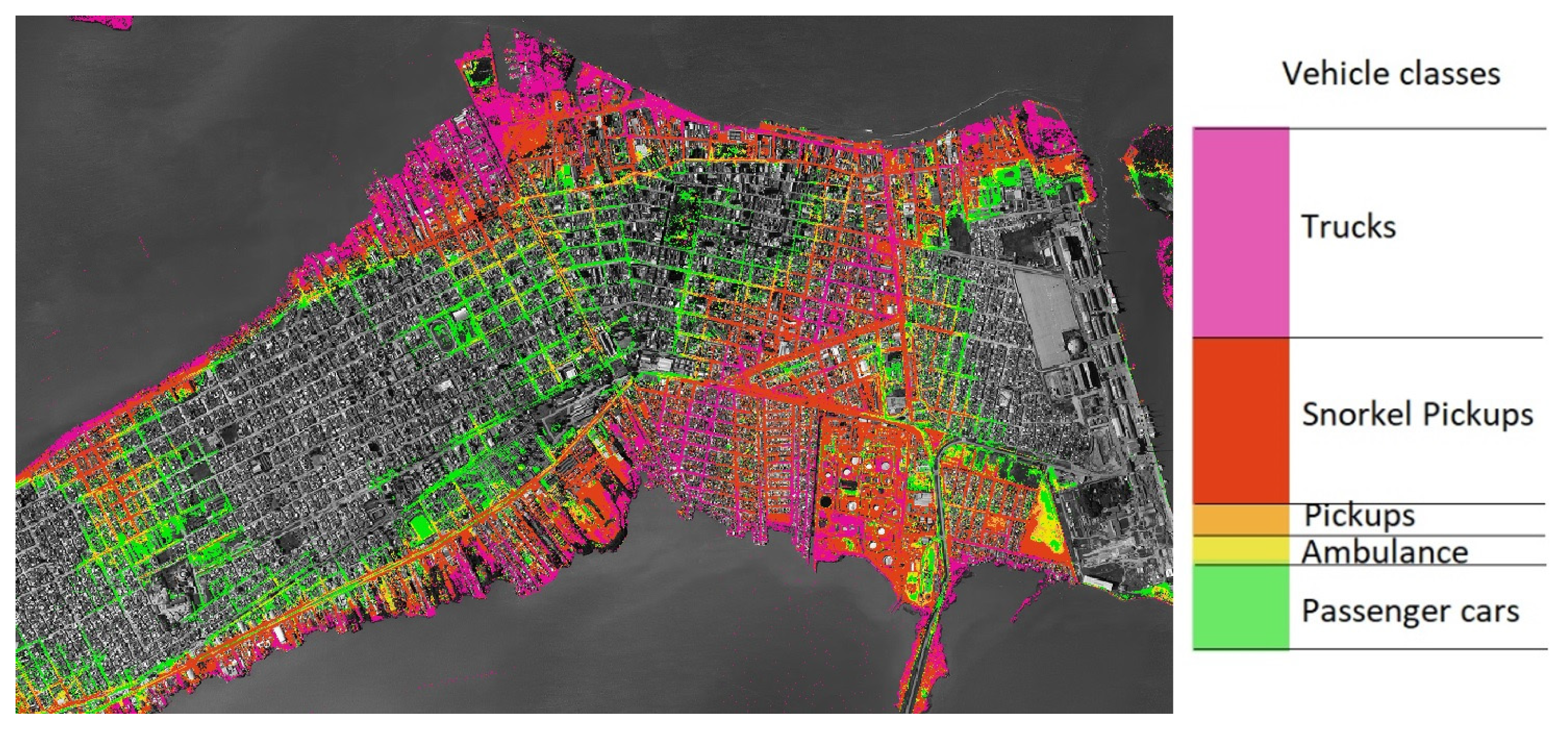
The predicted flooding conditions were then analyzed using various representation techniques to generate customized products that were delivered to the population and to civil defense and security forces. Based on these products, the best alternatives for evacuation strategies and infrastructure safety during the May 2024 extreme flood event were established. The application of the flooding results to classify public streets in relation to traffic safety for various vehicle classes is presented in Figure 9. It was considered safe for a passenger car to travel in up to 30 cm of water, an ambulance in up to 35 cm, a pickup truck without special gear in up to 45 cm, and a pickup truck with a snorkel in up to 55 cm. Above this value, any type of wheeled vehicle was considered unsuitable. This information was essential for safe planning of the evacuation operation at the Federal University of Rio Grande Hospital and was widely used by security forces for the safe rescue of the population located in the regions most affected during the event.
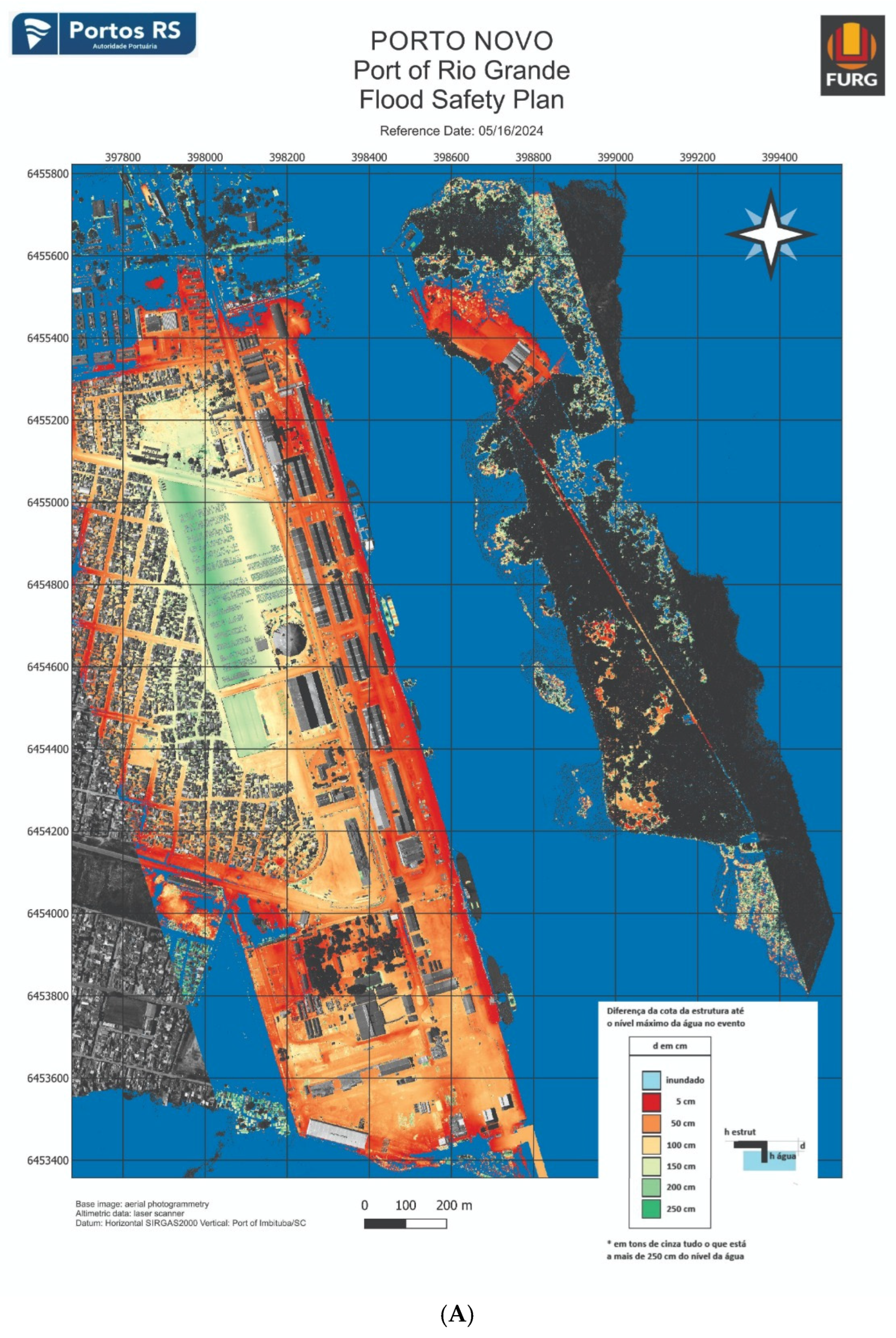
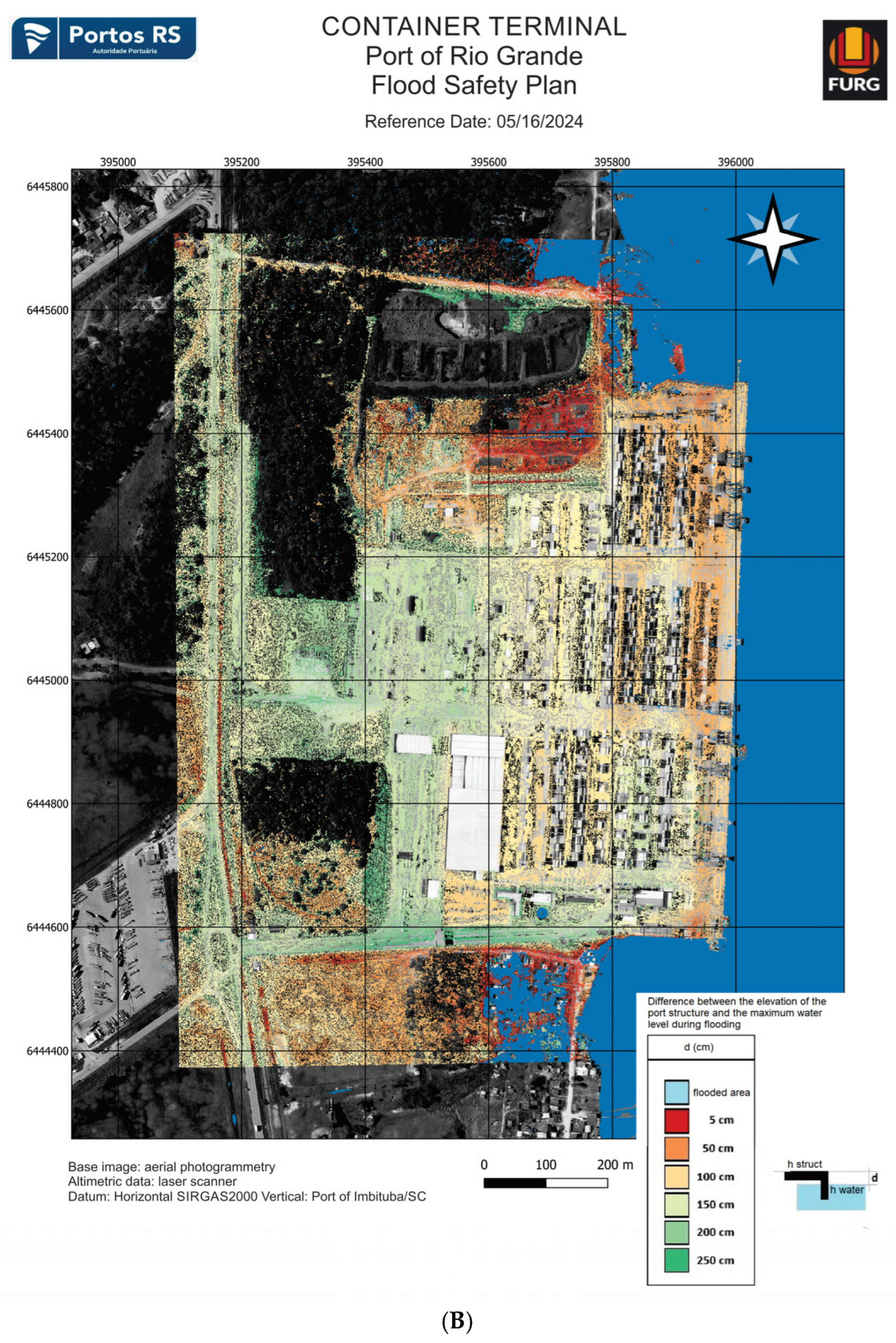
Using the flooding predictions for the May 2024 extreme event but with an inverse metric logic, Flood Safety Maps were also generated. The Port of Rio Grande was the only one in Rio Grande do Sul State operating during the April–May 2024 event. In addition to receiving permanent support regarding predictions of water levels and current velocities used to plan safe operational windows, the Port Authority was informed of the vertical distance measured from the estimated water level to the berthing structures or maneuvering, parking, and storage areas in its various terminals. The Flood Safety Maps for the Porto Novo area (Figure 10A) and the Container Terminal (Figure 10B) of the Port of Rio Grande indicate areas 5 cm (in red), 50 cm (in orange), and 250 cm (in dark green) above the flood level.

4. Discussion

Recent projections by the Intergovernmental Panel on Climate Change [5] highlight that the observed permanent global warming will further intensify the severity and frequency of extreme weather events (heat waves, heavy rainfall, and intense droughts). Several authors have highlighted that coastal regions are among the areas most vulnerable to these extreme events [3,4,7,11].
The annually averaged global mean near-surface temperature in 2024 was 1.55° ± 0.13 °C above the 1850–1900 average, and 2024 was the warmest year in the 175-year observational record, promoting several climatic extremes around the world such as floods, droughts, and heat waves. Associated with this, strong 2023/2024 El Niño conditions were established by mid-2023, became strong by the end of 2023, and dissipated by the second quarter of 2024 [35]. This contributed to the increased precipitation anomalies associated with El Niño events [49,50] and to the probability of flooding in southern Brazil [36].
Recent projections of climate change’s impact on Brazilian water resources carried out by [4,37] indicated that it is precisely in the southern region of Brazil where there is the greatest indication of increased flooding due to climate change. As a result, the 2024 disaster was caused by rainfall with a combination of magnitude, duration, intensity, and spatial scope that had never been observed before in Brazil [9]. These rains fell precisely in the highest, steepest regions with the shallowest soils in the Patos Lagoon watershed, producing high volumes of runoff. Accumulated rainfall exceeded 700 mm in the northern part of the state. The 2024 rainfall was heavier and more intense than rainfall from the region’s previous major flood event, which occurred in 1941 [10]. According to [37], projections indicate that the increase in the magnitude of maximum river flows in southern Brazil during floods could be around 20%, increasing the impacts of events such as the one in 2024 [36].
In the face of climate change scenarios worldwide and in southern Brazil, conventional methodologies for monitoring coastal region dynamics and generating natural disaster alerts quickly and accurately are limited in their ability to ensure population safety. Thus, state-of-the-art monitoring and forecast methodologies are essential to ensure accurate predictions of how coastal areas will respond to extreme meteorological and hydrological events and how the effects of these events can be mitigated [13]. The concept of digital twins, providing a virtual replica of a natural environment by combining numerical models and field data, emerges as a contemporary alternative producing valuable information for applied interventions and mitigation [18,20,21,24].
In southern Brazil, the proposed Patos Lagoon Digital Twin, field-validated during the May 2024 extreme event for the cities of Rio Grande, Pelotas, and São Lourenço do Sul (Figure 2 and Figure 4), provided a virtual replica of the environment. The framework synthesizes hydrology, fluid dynamics, remote sensing, and computation technologies within a complex environmental system research paradigm, delivering a scientifically sound and actionable solution for coastal flood impact management.
This study is positioned primarily as an operational and applicative innovation rather than a theoretical or methodological advance, as its central contribution resides in the operational implementation and integrated use of established hydrological, meteorological, hydrodynamic, and flooding models within a digital twin environment designed to support real time decision making during extreme events. The innovation does not stem from the development of novel algorithms, but from the robust integration, orchestration, and operationalization of mature and well validated modeling approaches into a coherent system capable of delivering timely, interpretable, and actionable information to emergency managers. While more sophisticated methods, such as deep learning based flood prediction models, may offer advantages in pattern recognition or computational speed under controlled conditions, they typically require large training datasets, extensive calibration, limited physical interpretability, and significant computational infrastructure, which can constrain their applicability in crisis scenarios. In contrast, the physically based models adopted here provided a transparent and reliable balance between accuracy and computational efficiency, enabling rapid scenario generation and continuous updates under severe time constraints. This trade off proved optimal for the Brazilian context, where heterogeneous data availability, infrastructure limitations, and the urgency of civil defense operations demand solutions that are robust, explainable, and immediately deployable, thereby reinforcing the role of operational feasibility and usability as key elements for effective emergency response and climate resilience.
Particularly because the main tributaries are located from days (São Gonçalo Channel and Camaquã River) to a week (Guaíba River) upstream of Rio Grande City (Figure 1), the Patos Lagoon Digital Twin provides an important time lag for effective protective actions in municipalities along the margins (Figure 8 and Figure 9). As Brazil’s first environmental digital twin, it overcomes the limitations of traditional static models and isolated simulations by enabling dynamic flood progression forecasting days in advance, providing critical windows for evacuation operations in cities along the margins of Patos Lagoon [13]. A similar approach for the Yangtze River, in China, was proposed by [24] and highlighted the substantial challenges of digital twin technology in terms of enhancing existing data collection and management, as well as improving models and services.
The Patos Lagoon Digital Twin was also used to ensure safe and resilient operations at the Port of Rio Grande during the extreme event of May 2024, providing valuable information about potential flooding areas, safety thresholds for operation at different terminals, and areas of free or restricted access readily available to port managers and security forces in the region (Figure 10). The availability of this type of information at very high spatial and temporal resolution facilitated the establishment of important prevention measures and strategic planning in the face of the most extreme hydrological event in Brazil’s history. This information was also extremely important for establishing best safety practices regarding drainage and containment basins in areas that receive toxic products, as well as for planning docking and undocking maneuvers.
Thus, it is evident that the Patos Lagoon Digital Twin played a decisive role for the Rio Grande do Sul State during the April–May 20024 extreme flooding event. This contribution became a reference of success in Brazil regarding the application of digital technologies to mitigate the impact of extreme flooding events, as reported by the National Water Agency [36] and the Secretariat for Support of the Reconstruction of Rio Grande do Sul of the Federal Government [13]. In particular, the Flood Safety Maps generated for the Port of Rio Grande received an ANTAQ Award in 2024—important recognition from the National Agency for Waterway Transportation (ANTAQ), in Brazil. Furthermore, the success of the Patos Lagoon Digital Twin methodology during the April–May extreme event led to the creation of the Interinstitutional Center for Observation and Forecasting of Extreme Events (CIEX), at the Federal University of Rio Grande (@ciexfurg).
The perspective of further application of the Patos Lagoon Digital Twin in long-term flood risk assessment and adaptive planning is a reality in South Brazil. Good examples of further work are (i) the Building Resilience Project: Intervention scenarios for mitigating the impacts of flood events in Rio Grande do Sul (Technical Cooperation ATN/OC-20864-BR), aiming to support the Government of the State of Rio Grande do Sul in the elaboration of a multisectoral plan that contributes to resilient reconstruction after the floods of May 2024 within the scope of the Inter-American Development Bank (IDB)’s Environment and Natural Disasters Sector Project BR-T1620, and (ii) the development of Climate Action Plans and Contingency Plans for the municipalities at the margins of Patos Lagoon, which is already underway.
When considering the worldwide application of the digital twin technology to assess environmental issues, a broad range of applications, environmental parameters, spatial scales, and outcomes can be identified, making it difficult to compare initiatives. When looking at the involved spatial scales, for example, we have the Yangtze River Digital Twin covering almost one-fifth of China’s land area (around 1.8 million km2), home to hundreds of millions of people [24]. On the other hand, [18] presented a digital twin concept for assessing Nature-Based Solutions (NBSs) against natural phenomena, such as storm surges and coastal erosion, for the coastal plain of Emilia-Romagna, a 130 km long portion of the Adriatic Sea (around 22,000 km2). Although the Patos Lagoon Digital Twin framework covers a smaller area (around 10,000 km2), the produced results affect a population of around 2 million inhabitants. One characteristic these digital twins have in common, however, is the ability to produce strategic information to ensure the safety of the population and of the environment, ensuring the economic development of resilient regions.
Particularly in relation to the economy of Rio Grande do Sul State, the public and strategic information generated by the Patos Lagoon Digital Twin is expected to also be of fundamental importance for planning investments in the main sectors of the region’s economy (agriculture, fishing, port activities, industry, and commerce). On the other hand, the real-time operation of the Patos Lagoon Digital Twin consolidates the capacity to simulate more than just future flood and drought events. Scenarios related to the impacts of structural interventions under consideration to mitigate flood impacts in the region and scenarios of future extreme events are also a possibility, as suggested in [20]. Simulating controlled scenarios could generate important information to guide the actions of public managers and the development of public policies.
Thus, the 2024 extreme flooding event in southern Brazil highlighted the importance of a coordinated and efficient response to natural disasters, as well as the need for investments in resilient and robust infrastructure, early warning systems, and digital tools for flood prediction [36]. The lessons learned from this experience are essential to guide future actions, not only in Rio Grande do Sul State but worldwide, as we are all facing increasingly frequent extreme weather events. The authors of [24] went further and highlighted the importance of having a system to disseminate digital twin predictions more widely to the public through the Internet or mobile phone apps, so that citizens can offer comments and recommendations, take part in the management decision-making process, increase their awareness and sense of accountability for protecting water resources, and be encouraged to use water resources sustainably.
Furthermore, the Patos Lagoon Digital Twin concept can be broadly applied in other coastal areas subject to extreme events whenever a similar composition of models and data is considered. The concept to be followed requires accurate water level measurements, combined with data provided by a calibrated and validated hydrodynamic model and a flood model that projects the water onto the surface of the terrain from an available high-resolution digital elevation model [13]. It is important to highlight that, if high-resolution topographic data are not available for the site, their acquisition represents a significant cost in this process. Thus, the Patos Lagoon Digital Twin framework can be applied worldwide, providing necessary information for the prevention and management of impacts to human lives in coastal zones and contributing to the definition of global flood management strategies.
The main limitations of this study stem from the fact that the quality of the hydrodynamic predictions and, consequently, the flooding predictions, depends upon the quality of the hydrological and meteorological predictions, which have their own associated uncertainties. The hydrological forcing has a longer scale of variability (days), but the wind intensity and direction acting over the region vary on the scale of a few hours, making their prediction more difficult and often inaccurate. Alternative ways of dealing with this limitation include continuously validating results from the meteorological model and considering implementing data assimilation methods to put the model back on track whenever necessary. A systematic review on remote sensing applications integrated with machine learning methods to improve the accuracy of urban flood risk management under the digital twin technology concept was presented by [16]. The authors also highlighted the challenges involved, such as data interoperability and computational demands, alongside future directions for scalable, AI-driven DT frameworks.
Another alternative is to have the Patos Lagoon Digital Twin operating in real time and updating the meteorological prediction every 24 h (or less), an approach under construction as a follow-up of this study. Regarding the flooding model, the region-growing algorithm provides good results for coastal plain areas. However, when considering river valley regions, the algorithm needs a different method of signal propagation.

5. Conclusions

The Patos Lagoon Digital Twin modeling framework proved how an appropriate combination of field data and a range of complementary numerical and computational models can provide the basis for more comprehensive decision-making during extreme flood events.
Another important contribution of the Patos Lagoon Digital Twin technology during the April–May extreme events was the opportunity for integration between academia and security forces, which proved essential and should be replicated in future events and in other regions. This strategy ensures the safety of communities living in coastal regions at relatively low cost with high-quality data provided by the researchers and research structure. Furthermore, the digital twin modeling framework allows us to answer questions about future extreme events and intervention scenarios, providing the necessary information for the prevention, management, and mitigation of the consequences of extreme events in coastal zones.
Overall, this study contributes to a better understanding of the strengths of digital twin models in simulating the impact of extreme flood events in coastal areas. Furthermore, it provides valuable insights into the potential impacts of future climate change in coastal regions, particularly in southern Brazil. This knowledge is crucial for developing targeted strategies and public policies to increase regional resilience and sustainability.

Supplementary Materials

The following supporting information is available: https://www.mdpi.com/article/10.3390/cli14020034/s1, Figure S1: Illustrations of linigrapher stations developed at FURG. (A) CCMAR - Rio Grande station at night and (B) São Lourenço do Sul station, where the linimetric rule is installed within the relief well (Photo: Hiago Reisdoerfer); Video S1: Flood simulation in Rio Grande City during the May 2024 extreme event.

Author Contributions

E.H.F. (conceptualization, methodology, validation, formal analysis, investigation, resources, writing—original draft preparation, supervision); G.G. (conceptualization, methodology, software, validation, formal analysis, investigation, resources, supervision); P.D.d.S. (methodology, software, validation, formal analysis); V.G. (methodology, software, validation, formal analysis, investigation); É.M. (methodology, formal analysis, visualization). All authors have read and agreed to the published version of the manuscript.

Funding

There was no specific funding for the development of these activities during the April–May 2024 flood event in southern Brazil.

Data Availability Statement

The TELEMAC-3D model is open-source code available from the TELEMAC-MASCARET System (www.opentelemac.org), and the numerical mesh was generated using software (http://www.nrccnrc.gc.ca/eng/solutions/advisory/blue_kenue_index.html, accessed on 14 December 2024). The boundary conditions for the hydrodynamic model are available from the HYCOM+NCODA Global Project (HYbrid Coordinate Ocean Model, https://hycom.org) for salinity and temperature fields, the European Center for Medium-Range Weather Forecast, http://www.ecmwf.int, accessed on 14 December 2024) ERA-Interim for winds, https://www.ufrgs.br/iph/noticias, accessed on 14 December 2024 for predicted Guaíba and Camaquã River discharges, and https://wp.ufpel.edu.br/alm/agencia, accessed on 14 December 2024 for São Gonçalo Channel discharges. Data and Phyton codes are available at rafael-simao/WaterLevel_PatosLagoon: v.1.0 (v.1.0) [Dataset]. Zenodo. https://doi.org/10.5281/zenodo.13820042.

Acknowledgments

The authors are grateful to Portos RS Port Authority, which sponsored the implementation of the latest version of the TELEMAC-3D model for Patos Lagoon; to Rio Grande Municipality, which sponsored the acquisition of the Laser Scanner data used to generate the city’s digital elevation model; to Walter Collischonn and Matheus Sampaio (IPH/UFRGS) for their predictions of continental discharge for the Patos Lagoon tributaries; to Enzo Todesco (Rhama Analysis Company) for hourly wind intensity and direction predictions; to Lauro Barcellos (CCMar—FURG) for hosting the first linigrapher station; and to Eduardo Secchi, who made valuable contributions during this study. Special thanks go to the LOCOSTE members Natália Carvalho (Figure 1), Kristhal Silva (Figure 2), and Rafael Simão (Figure 4) for contributing high-quality figures. EHF is a Brazilian National Council for Scientific and Technological Development (CNPq) research fellow (No. 304684/2022-8).

Conflicts of Interest

The authors declare no conflicts of interest.

References

  1. IPCC. Climate Change 1995: Contribution of Working Group I to the Second Assessment Report of the Intergovernmental Panel on Climate Change; Houghton, J.T., Meira Filho, L.G., Callander, B.A., Harris, N., Kattenberg, A., Maskell, K., Eds.; Cambridge University Press: Cambridge, UK, 1995. [Google Scholar]
  2. IPCC. Climate Change 2001: The Scientific Basis. Contribution of Working Group I to the Third Assessment Report of the Intergovernmental Panel on Climate Change; Houghton, J.T., Ding, Y., Griggs, D.J., Noguer, M., van der Linden, P.J., Dai, X., Maskell, K., Johnson, C.A., Eds.; Cambridge University Press: Cambridge, UK; New York, NY, USA, 2001. [Google Scholar]
  3. Monteiro, M.; Vaz, N.; Cotrim, S.M.; Freitas, R.; Azeiteiro, U.M.; Dias, J.M. Trends and variability of marine heatwaves in Portuguese coastal waters. Sci. Total Environ. 2025, 973, 179161. [Google Scholar] [CrossRef]
  4. Petry, I.; Miranda, P.T.; Paiva, R.C.D.; Collischonn, W.; Fan, F.M.; Fagundes, H.O.; Araujo, A.A.; Souza, S. Changes in flood magnitude and frequency projected for vulnerable regions and major wetlands of south America. Geophys. Res. Lett. 2025, 52, e2024GL112436. [Google Scholar] [CrossRef]
  5. IPCC. Climate Change 2023: Synthesis Report. Contribution of Working Groups I, II and III to the Sixth Assessment Report of the Intergovernmental Panel on Climate Change; Lee, H., Romero, J., Eds.; IPCC: Geneva, Switzerland, 2023; pp. 35–115. [Google Scholar] [CrossRef]
  6. Liu, S.; Wu, Y.; Xu, G.; Cheng, S.; Zhong, Y.; Zhang, Y. Characterizing the 2022 extreme drought event over the Poyang Lake Basin using multiple satellite remote sensing observations and in situ data. Remote Sens. 2023, 15, 5125. [Google Scholar] [CrossRef]
  7. Marino, M.; Baptist, M.J.; Alkharoubi, A.I.K.; Nasca, S.; Cavallaro, L.; Foti, E.; Musumeci, R.E. Nature-based solutions as building blocks for coastal flood risk reduction: A model-based ecosystem service assessment. Sci. Rep. 2025, 15, 12070. [Google Scholar] [CrossRef] [PubMed]
  8. Caballero, I.; Roca, M.; Dunbar, M.B.; Navarro, G. Water quality and flooding impact of the record-breaking Storm Gloria in the Ebro Delta (western Mediterranean). Remote Sens. 2024, 16, 41. [Google Scholar] [CrossRef]
  9. Collischonn, W.; Breda, J.P.; Wongchuig, S.; Ruhoff, A.; Paiva, R.; Fan, F.M.; Filho, R.C.d.C.M.; Ramalho, N. Unprecedented April–May 2024 rainfall in south Brazil sets new record. Rev. Bras. Recur. Hidric. 2024, 29, e50. [Google Scholar] [CrossRef]
  10. Collischonn, W.; Fan, F.M.; Possantti, I.; Dornelles, F.; Paiva, R. O Desastre Hidrológico Excepcional de Abril-Maio de 2024 no Sul do Brasil; HydroShare: Chapel Hill, NC, USA, 2024; Available online: https://www.hydroshare.org/resource/d9e5c2ffb49a4b729b240f3eb3084ff4/ (accessed on 14 December 2024).
  11. Simões-Sousa, I.T.; Camargo, C.M.L.; Távora, J.; Piffer-Braga, A.; Farrar, J.T.; Pavelsky, T.M. The May 2024 flood disaster in southern Brazil: Causes, impacts, and SWOT-based volume estimation. Geophys. Res. Lett. 2025, 52, e2024GL112442. [Google Scholar] [CrossRef]
  12. Cavanaugh, K.C.; Bel, T.; Aerni, K.; Byrnes, J.; MacCammon, S.; Smith, M. New technologies for monitoring coastal ecosystem dynamics. Annu. Rev. Mar. Sci. 2025, 17, 409–433. [Google Scholar] [CrossRef] [PubMed]
  13. Fernandes, E.H.; Gonçalves, G.A. Aplicação de um Digital Twin para prognóstico e mitigação dos efeitos da inundação nas cidades às margens da Lagoa dos Patos. In Resiliência & Sustentabilidade—Reflexões Para a Reconstrução do Rio Grande do Sul; Ferrer, J., Danéris, M., Marques, P.R., Eds.; Libretos: Porto Alegre, Brazil, 2025; pp. 133–157. Available online: https://portal.fespsp.org.br/store/file_source/FESPSP/Documentos/RS/reflexao.pdf (accessed on 14 December 2024).
  14. Halder, B.; Barman, S.; Banik, P.; Das, P.; Bandyopadhyay, J.; Tangang, F.; Shahid, S.; Pande, C.B.; Al-Ramadan, B.; Yaseen, Z.M. Large-Scale Flood Hazard Monitoring and Impact Assessment on Landscape: Representative Case Study in India. Sustainability 2023, 15, 11413. [Google Scholar] [CrossRef]
  15. Wang, Y.-Y.; Wang, W.-C.; Xu, D.-N.; Zhao, Y.-W.; Zang, H.-F. A novel strategy for flood flow prediction: Integrating spatio-temporal information through a Two-Dimensional hiden layer structure. J. Hydrol. 2024, 638, 131482. [Google Scholar] [CrossRef]
  16. Hlal, M.; Baraka Munyaka, J.-C.; Chenal, J.; Azmi, R.; Diop, E.B.; Bounabi, M.; Ebnou Abdem, S.A.; Almouctar, M.A.S.; Adraoui, M. Digital Twin Technology for Urban Flood Risk Management: A Systematic Review of Remote Sensing Applications and Early Warning Systems. Remote Sens. 2025, 17, 3104. [Google Scholar] [CrossRef]
  17. Barbie, A.; Pech, N.; Hasselbring, W.; Flögel, S.; Wenzhöfer, F.; Walter, M.; Shchekinova, E.; Busse, M.; Turk, M.; Hofbauer, M.; et al. Developing and underwater network of ocean observation systems with Digital Twin Prototypes—A field report from the Baltic Sea. IEEE Ann. Hist. Comput. 2021, 26, 33–42. [Google Scholar] [CrossRef]
  18. Pillai, U.P.A.; Pinardi, N.; Alessandri, J.; Federico, I.; Causio, S.; Unguendoli, S.; Valentini, A.; Staneva, J. A Digital Twin modelling framework for the assessment of seagrass Nature Based Solutions against storm surges. Sci. Total Environ. 2022, 847, 157603. [Google Scholar] [CrossRef]
  19. Voosen, P. Europe builds “digital twin” of Earth to hone climate forecasts. Science 2020, 370, 16–17. [Google Scholar] [CrossRef]
  20. Duque, J.P.; Brovelli, M.A. Building a digital twin of the Italian coasts. In Proceedings of the International Archives of the Photogrammetry, Remote Sensing and Spatial Information Sciences XLVIII-4/W1-2022, Academic Track, Florence, Italy, 22–28 August 2022. [Google Scholar]
  21. Jeong, J.S.; Lee, H.S. Unstructured grid-based river–coastal ocean circulation modeling towards a Digital Twin of the Seto Inland Sea. Appl. Sci. 2023, 13, 8143. [Google Scholar] [CrossRef]
  22. Patanè, L.; Iuppa, C.; Faraci, C.; Xibilia, M.G. A deep hybrid network for significant wave height estimation. Ocean Model. 2024, 189, 102363. [Google Scholar] [CrossRef]
  23. Yuan, R.; Zhang, H.; Xu, R.; Zhang, L. Enhancing coastal risk recognition: Assessing UAVs for monitoring accuracy and implementation in a Digital Twin framework. Appl. Sci. 2024, 14, 2879. [Google Scholar] [CrossRef]
  24. Wang, X.; Wu, B.; Zhou, G.; Wang, T.; Meng, F.; Zhou, L.; Cao, H.; Tang, Z. How a vast digital twin of the Yangtze River could prevent flooding in China. Nature 2025, 639, 303. [Google Scholar] [CrossRef] [PubMed]
  25. Shimizu, M.H.; Anochi, J.A.; Santos, D.J. Assessing NOAA/GFDL models performance for South American seasonal climate: Insights from CMIP6 historical runs and future projections. Climate 2025, 13, 4. [Google Scholar] [CrossRef]
  26. Moller, O.O.; Castaing, P.; Salomon, J.C.; Lazure, P. The influence of local and non-local forcing effects on the subtidal circulation of Patos Lagoon. Estuaries 2001, 24, 297–311. [Google Scholar] [CrossRef]
  27. Moller, O.O.; Castaing, P. Hydrological characteristics of the estuarine area of Patos Lagoon (30°S, Brazil). In Estuaries of South America: Their Geomorphology and Dynamics; Perillo, G.M.E., Piccolo, M.C., Eds.; Springer: Berlin, Germany, 1999; pp. 83–100. [Google Scholar] [CrossRef]
  28. Stech, J.L.; Lorenzetti, J.A. The response of the South Brazil Bight to the passage of wintertime cold fronts. J. Geophys. Res. 1992, 97, 9507–9520. [Google Scholar] [CrossRef]
  29. Vaz, A.C.; Möller, O.O.; Almeida, T.L. Análise quantitativa da descarga dos rios afluentes da Lagoa dos Patos. Atlantica 2006, 28, 13–23. [Google Scholar]
  30. Fernandes, E.H.; Dyer, K.R.; Moller, O.O.; Niencheski, L.F.H. The Patos Lagoon hydrodynamics during an El Niño event (1998). Cont. Shelf Res. 2002, 22, 1699–1713. [Google Scholar] [CrossRef]
  31. Távora, J.; Fernandes, E.H.L.; Thomas, A.C.; Weatherbee, R.; Schettini, C.A.F. The influence of river discharge and wind on Patos Lagoon, Brazil, suspended particulate matter. Int. J. Remote Sens. 2019, 40, 4506–4525. [Google Scholar] [CrossRef]
  32. Távora, J.; Fernandes, E.H.; Bitencourt, L.P.; Orozco, P. El-Niño Southern Oscillation (ENSO) effects on the variability of Patos Lagoon suspended particulate matter. Reg. Stud. Mar. Sci. 2020, 40, 101495. [Google Scholar] [CrossRef]
  33. Bitencourt, L.P.; Fernandes, E.H.; Silva, P.D.; Möller, O.O. Spatio-temporal variability of suspended sediment concentrations in a shallow and turbid lagoon. J. Mar. Syst. 2020, 212, 103454. [Google Scholar] [CrossRef]
  34. Bortolin, E.C.; Távora, J.; Fernandes, E.H. Long-term variability on suspended particulate matter loads from the tributaries of the world’s largest choked lagoon. Front. Mar. Sci. 2022, 9, 836739. [Google Scholar] [CrossRef]
  35. World Meteorological Organization (WMO). State of the Global Climate 2024; WMO-No. 1368; WMO: Geneva, Switzerland, 2025. [Google Scholar]
  36. Agência Nacional de Águas e Saneamento Básico (ANA). As Enchentes no Rio Grande do Sul: Lições, Desafios e Caminhos Para um Futuro Resiliente; ANA: Brasília, Brazil, 2025. Available online: https://www.gov.br/ana/pt-br/centrais-de-conteudos/publicacoes#Destaques (accessed on 16 March 2025).
  37. Paiva, R.C.D.; Collischonn, W.; Miranda, P.T.; Fan, F.M.; Ruhoff, A.L. Adaptação e resiliência a cheias no Rio Grande do Sul no contexto da variabilidade e mudança climática. In Resiliência & Sustentabilidade: Reflexões Para a Reconstrução do Rio Grande do Sul; Ferrer, J., Danéris, M., Marques, P.R., Eds.; Libretos: Porto Alegre, Brazil, 2025; pp. 263–291. [Google Scholar]
  38. Lopes, V.A.R.; Fan, F.M.; Pontes, P.R.M.; Siqueira, V.A.; Collischonn, W.; da Motta Marques, D. A first integrated modelling of a river-lagoon large-scale hydrological system for forecasting purposes. J. Hydrol. 2018, 565, 177–196. [Google Scholar] [CrossRef]
  39. Giacomelli, L.; Nectoux, M.; Fan, F.; Fleischmann, A.; Siqueira, V.; Collischonn, W.; Custódio, M. Previsão de cheias e produção de avisos no estado do Rio Grande do Sul através da sala de situação SEMA/RS e modelo MGB. In XXIII Simpósio Brasileiro de Recursos Hidrícos; ABRH: Porto Alegre, Brazil, 2019. [Google Scholar]
  40. Collischonn, W.; Allasia, D.; Silva, B.; Tucci, C. The MGB-IPH model for large-scale rainfall—Runoff modelling. Hydrol. Sci. J. 2007, 52, 878–895. [Google Scholar] [CrossRef]
  41. Medeiros, M.S.; Fan, F.M.; Paiva, R.C. Emergency forecast for water levels in the Guaíba River during the 2024 unprecedented flood in South Brazil. Braz. J. Water Resour. 2025, 30, e43. [Google Scholar] [CrossRef]
  42. Walstra, L.; Van Rijn, L.; Blogg, H.; Van Ormondt, M. Evaluation of a Hydrodynamic Area Model Based on the Coast3d Data at Teignmouth 1999. In Proceedings of the Coastal Dynamics 2001 Conference, Lund D, Lund, Sweden, 11–15 June 2001; pp. D4.1–D4.4. [Google Scholar]
  43. Marques, W.C.; Fernandes, E.H.; Monteiro, I.O.; Möller, O.O. Numerical modeling of the Patos Lagoon coastal plume, Brazil. Cont. Shelf Res. 2009, 29, 556–571. [Google Scholar] [CrossRef]
  44. António, M.H.; Fernandes, E.H.; Muelbert, J.H. Impact of jetty configuration changes on the hydrodynamics of the subtropical Patos Lagoon estuary, Brazil. Water 2020, 12, 3197. [Google Scholar] [CrossRef]
  45. Fernandes, E.H.; Silva, P.D.; Gonçalves, G.A.; Möller, O.O. Dispersion plumes in open ocean disposal sites of dredged sediment. Water 2021, 13, 808. [Google Scholar] [CrossRef]
  46. Lisboa, P.V.; Fernandes, E.H.; Sottolichio, A.; Huybrecht, N.; Bendô, R. Coastal plumes contribution to the suspended sediment transport in the Southwest Atlantic inner continental shelf. J. Mar. Syst. 2022, 236, 103796. [Google Scholar] [CrossRef]
  47. Franzen, M.O.; Silva, P.; Siegle, E.; Fernandes, E.H.L. Influence of long jetties on estuarine and coastal hydrodynamics in a microtidal estuary. Reg. Stud. Mar. Sci. 2023, 59, 102809. [Google Scholar] [CrossRef]
  48. Beucher, S.; Lantuéjoul, C. Use of watersheds in contour detection. In Proceedings of the International Workshop on Image Processing, CCETT, Renne, France, 17–21 September 1979; pp. 2–12. [Google Scholar]
  49. Ropelewski, C.H.; Halpert, S. Global and regional scale precipitation patterns associated with the El Niño/Southern Oscillation. Mon. Weather Rev. 1987, 115, 1606–1626. [Google Scholar] [CrossRef]
  50. Ropelewski, C.H.; Halpert, S. Precipitation patterns associated with the high index phase of the Southern Oscillation. J. Clim. 1989, 2, 268–284. [Google Scholar] [CrossRef]
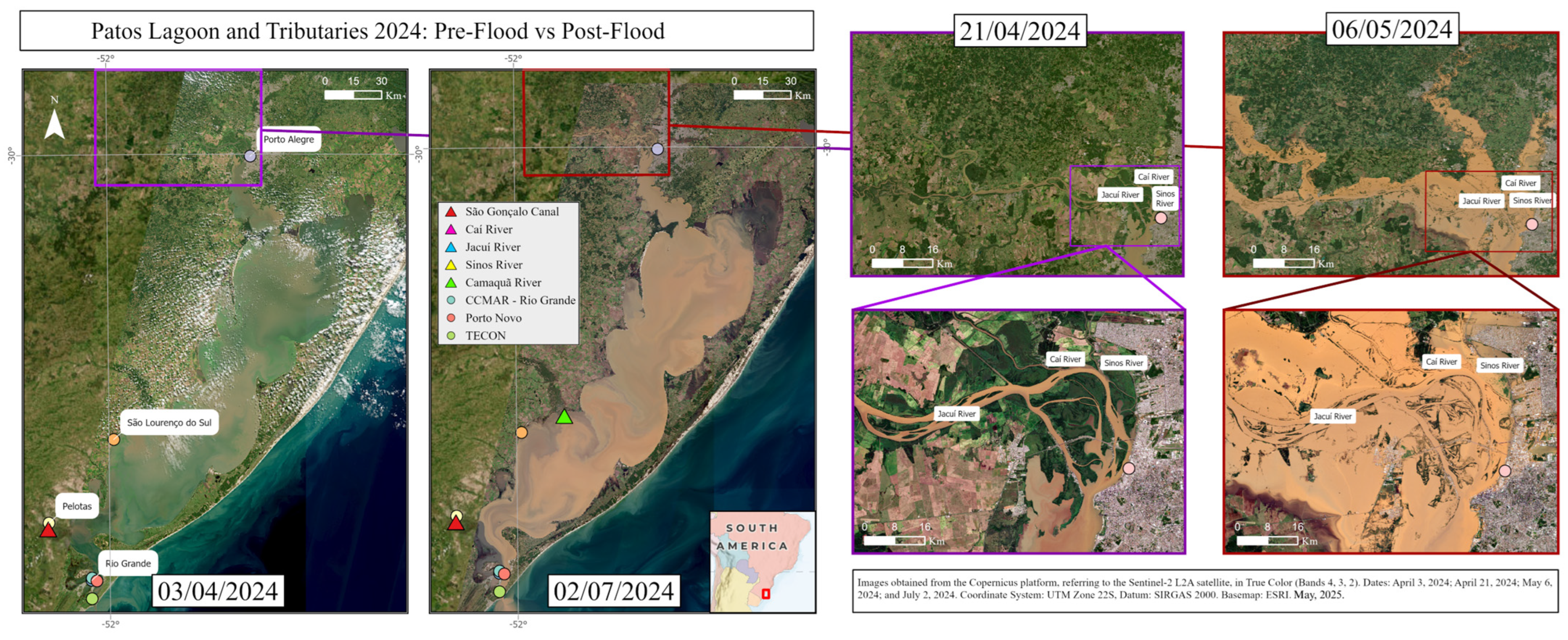
Figure 1. Patos Lagoon in pre-flood (3 April 2024, first image) and post-flood (2 July 2024, second image) conditions and highlights of the tributaries in the northern region (top right) and the metropolitan area around Porto Alegre city (bottom right) before (21 April 2024) and during (6 May 2024) the May 2024 flood event.
Climate 14 00034 g001
Figure 2. The concept of the Patos Lagoon Digital Twin. Meteorological, geodetic, and oceanographic data are combined with numerical and computational models, generating real-time predictions about the hydrodynamic behavior of Patos Lagoon.
Climate 14 00034 g002
Figure 3. (A) Patos Lagoon and the computational domain with the type and location of boundary conditions for TELEMAC–3D. (B) Details of the area and mesh around Rio Grande City (square). The color scale represents the bathymetry, the red dot is the CCMAR—Rio Grande station, black squares are the main cities, and blue dots are continental discharge from the tributaries.
Climate 14 00034 g003
Figure 4. Measured water level data (red line) and hydrodynamic model predictions (blue line) at stations (A) CCMAR—Rio Grande, (B) Laranjal—Pelotas (HidroSens/UFPEL), and (C) São Lourenço do Sul (ANA). The blue shading is the Mean Absolute Error. Here, 1.90 m represents the limit of the CCMar Pier, and values > 1.90 m indicate flooding.
Climate 14 00034 g004
Figure 5. Calculated water levels around Rio Grande city feed a region-growing algorithm that projects this information in points at the edge line of the digital elevation model (blue triangles) throughout the reference sections at the margins of Rio Grande City.
Climate 14 00034 g005
Figure 6. Illustration of the flood model based on the Watershed algorithm, adapted to represent flood dynamics and to account for the presence of an underground drainage network, which is represented in the model by a parallel matrix. In detail, the standard algorithm operates by identifying neighboring pixels with elevations equal to or lower than the water level of the source pixel, marking them as flooded and treating them as new source pixels.
Climate 14 00034 g006
Figure 7. Calculated water levels for the 8 points at the edge line of the Digital Terrain Model of Rio Grande City during the May 2024 extreme flood event.
Climate 14 00034 g007
Figure 8. Predicted flooding conditions (color scale) over the Rio Grande City digital elevation model for the day of maximum flooding measured at CCMAR—Rio Grande station (16 May 2024).
Climate 14 00034 g008
Figure 9. A customized product based on the flooding predictions: classification of flooded streets according to the vehicles capable of traversing them as a function of the height of the water column for the day of maximum flooding measured at CCMAR/Rio Grande station (16 May 2024).
Climate 14 00034 g009
Figure 10. Flood Safety Maps of the (A) Porto Novo and (B) Container Terminal of the Port of Rio Grande. The color scale indicates the difference between the structure’s elevation and the maximum water level on 16 May, when the highest levels of the May 2024 flood event were recorded at CCMAR station. The gray tones indicate everything that is more than 250 cm above the water level in the channel.
Climate 14 00034 g010aClimate 14 00034 g010b
Table 1. Validation of the TELEMAC-3D model at three stations during the April–May 2024 extreme events. Classification according to [42].
StationMAEClassification
CCMAR—Rio Grande±0.18Excellent
Laranjal—Pelotas±0.10 mExcellent
São Lourenço do Sul±0.09 mExcellent
Disclaimer/Publisher’s Note: The statements, opinions and data contained in all publications are solely those of the individual author(s) and contributor(s) and not of MDPI and/or the editor(s). MDPI and/or the editor(s) disclaim responsibility for any injury to people or property resulting from any ideas, methods, instructions or products referred to in the content.