
Long-Term Hourly Temperature Dynamics on Tropical Hainan Island (1940–2022)



Abstract
1. Introduction
2. Methodology and Datasets
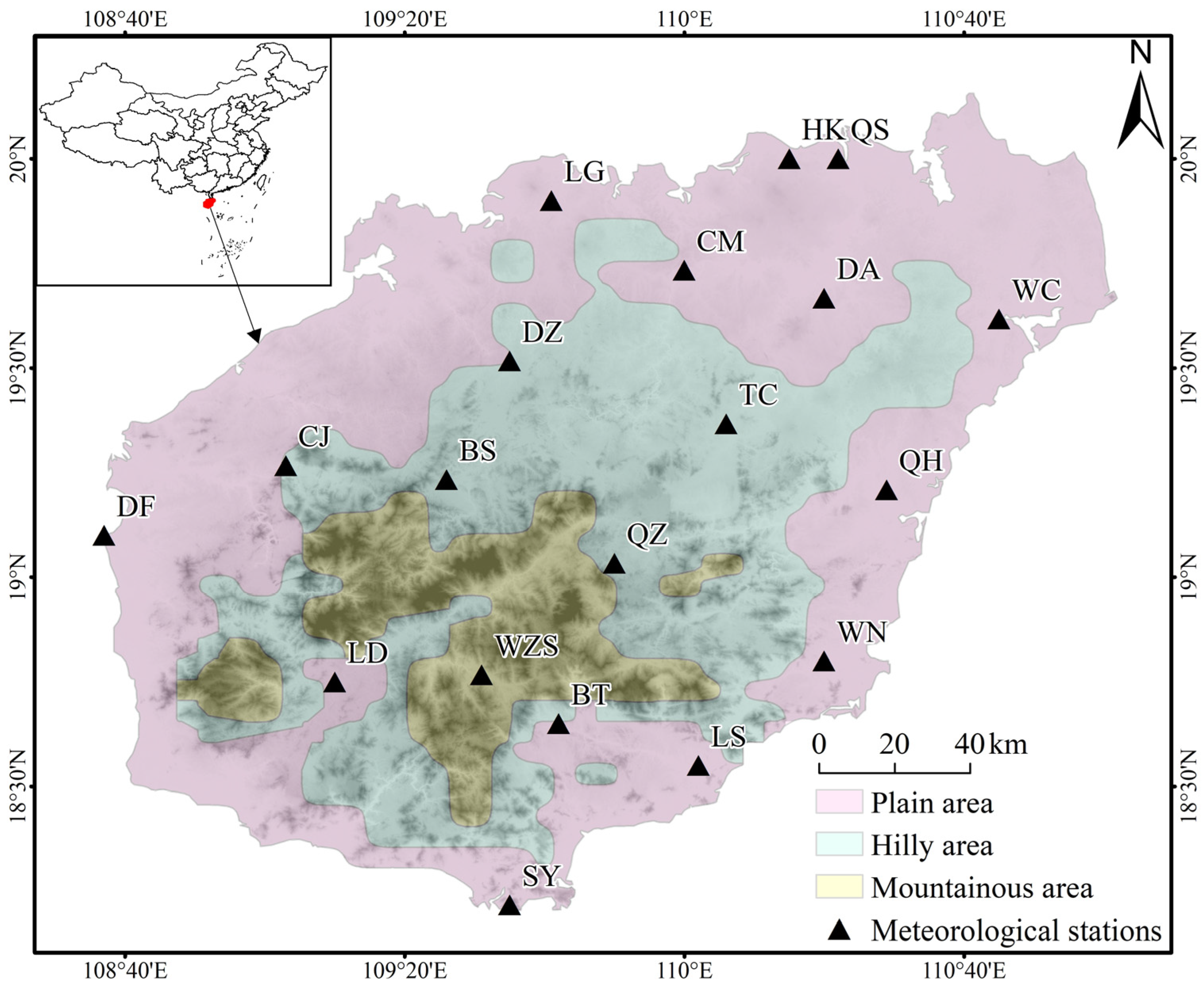
2.1. Study Area
2.2. Datasets
2.3. Methodology
3. Results
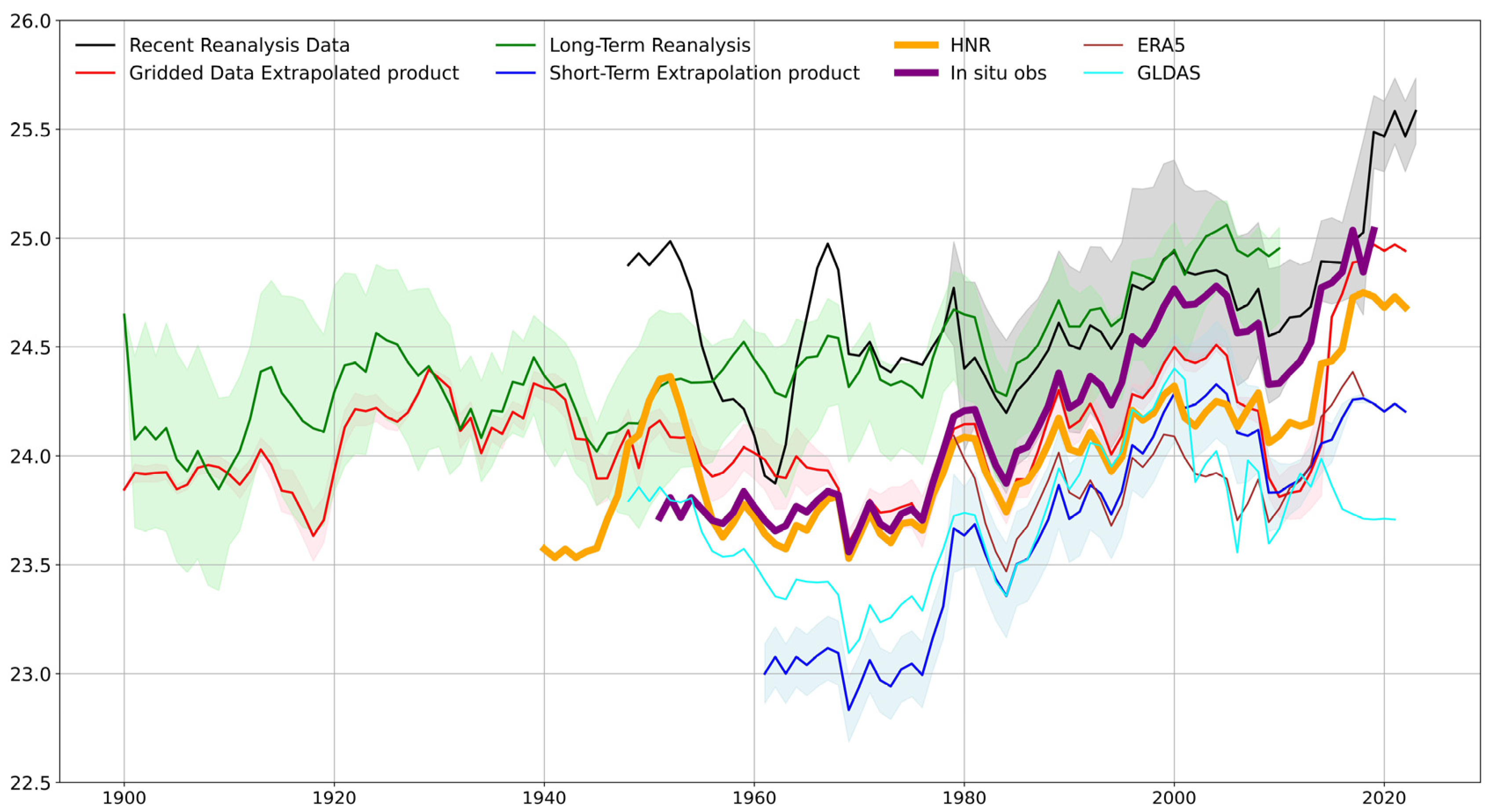
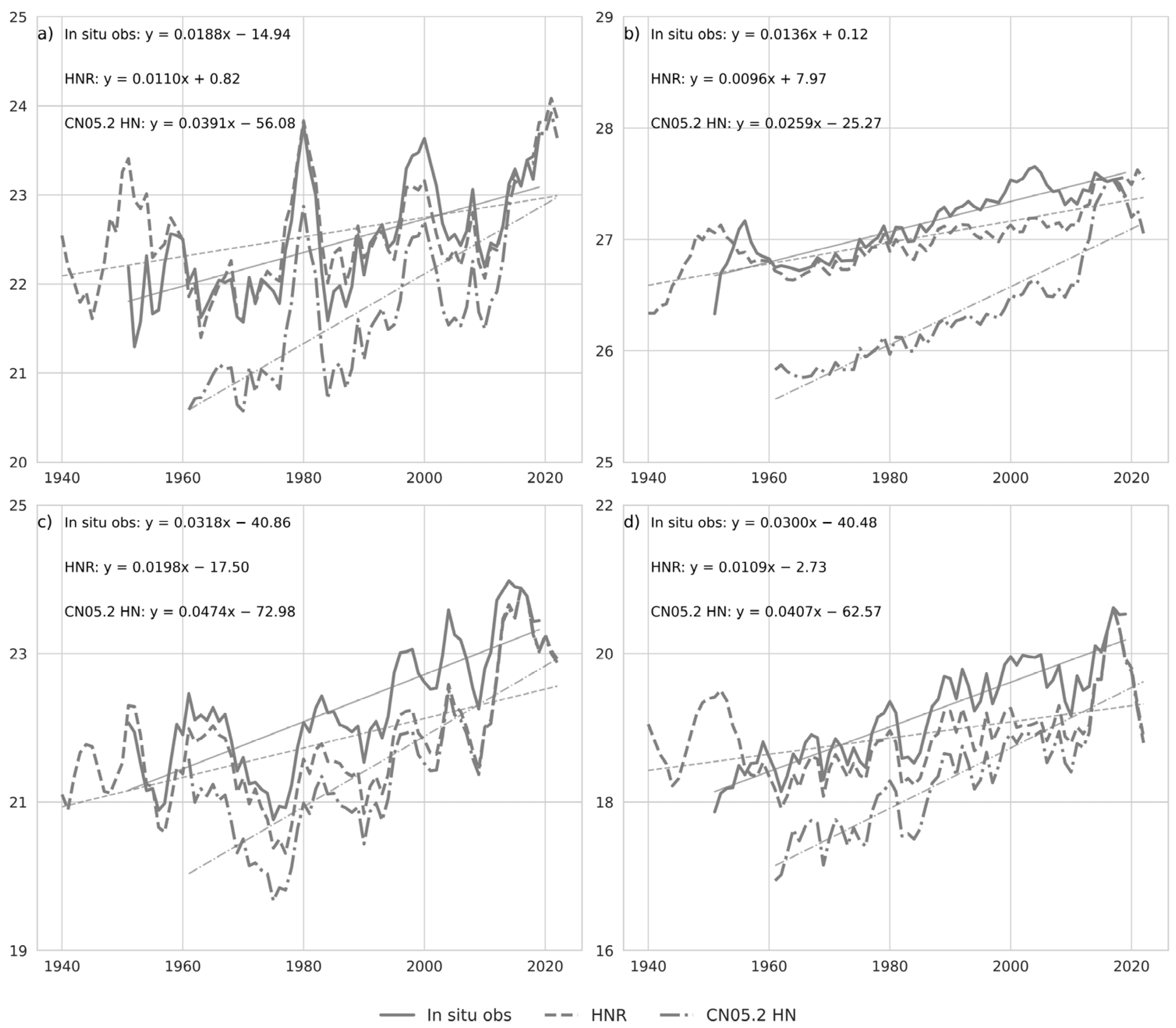
3.1. Evaluation of HN Reanalysis Datasets
3.2. Multiscale Temperature Trends and Variability
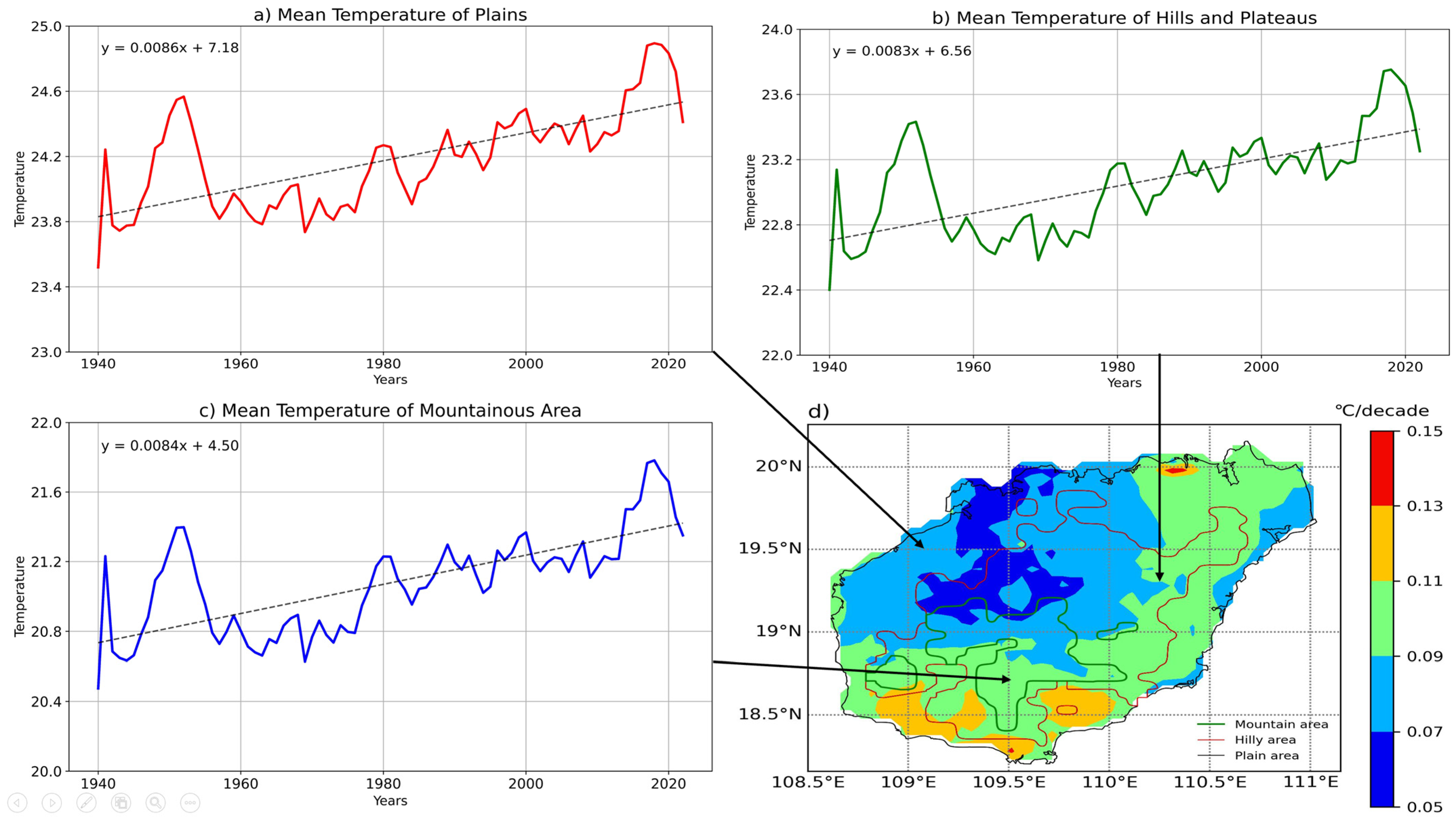
3.2.1. Decadal-Scale Temperature Trends
3.2.2. Seasonal Temperature Patterns
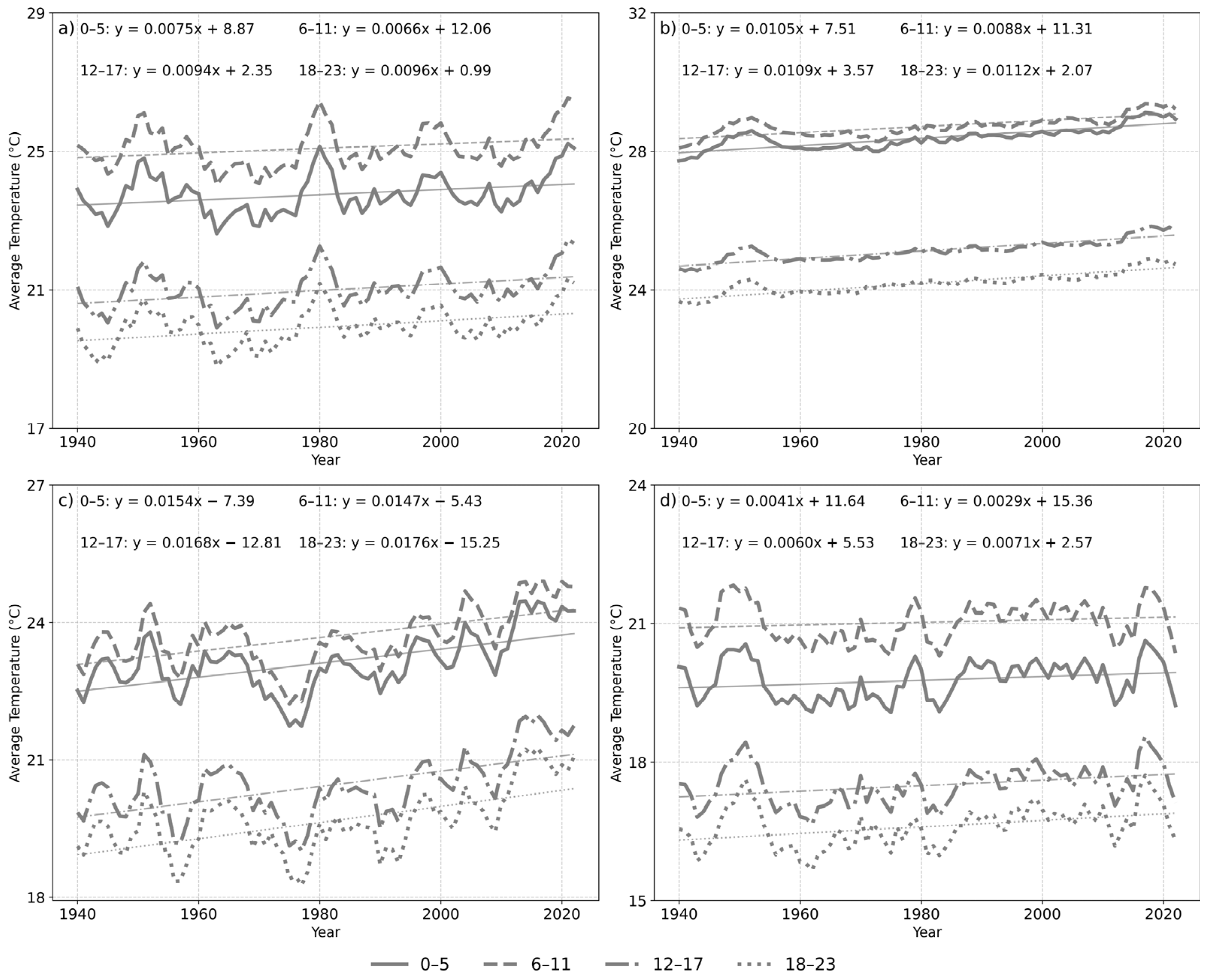
3.2.3. Seasonal Diurnal Temperature Patterns
3.3. Spatial Heterogeneity in Temperature Dynamics
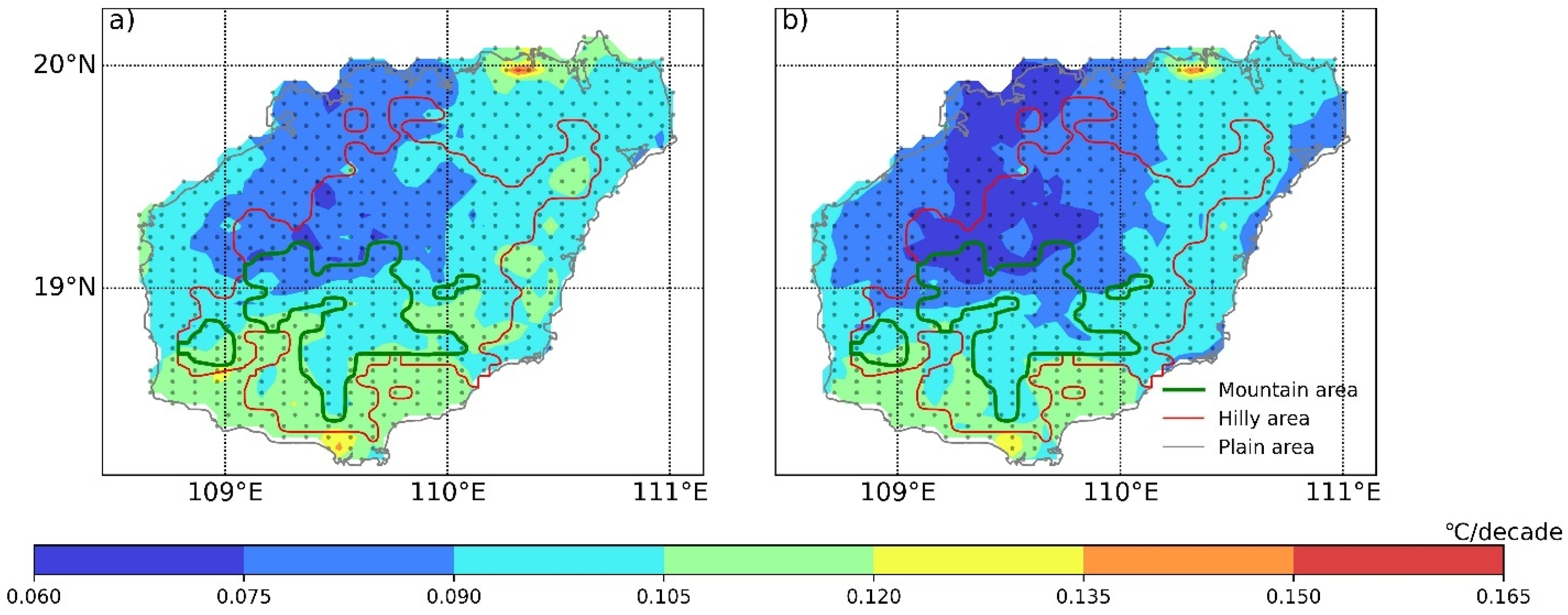
3.3.1. Decadal Patterns
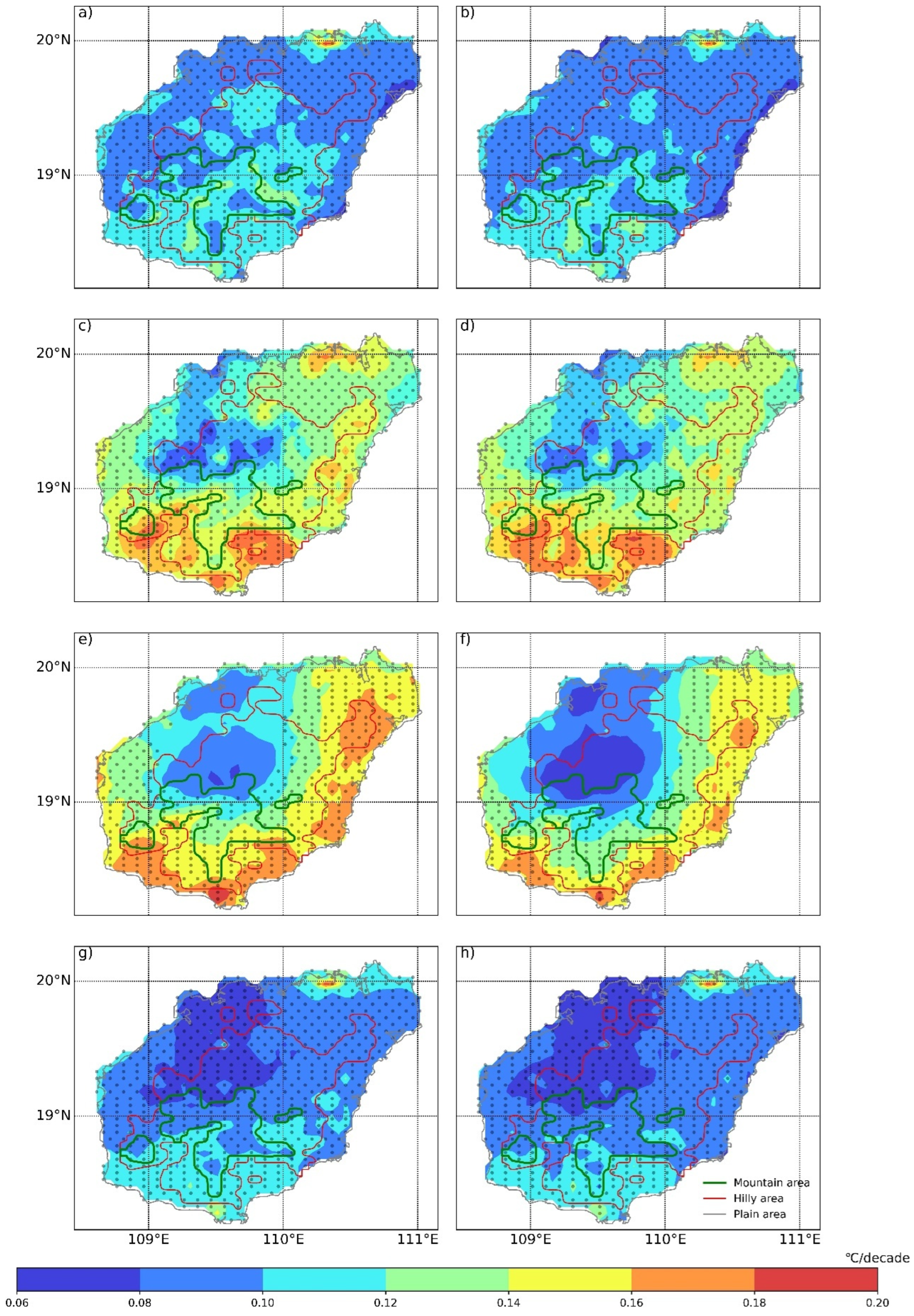
3.3.2. Seasonal Patterns
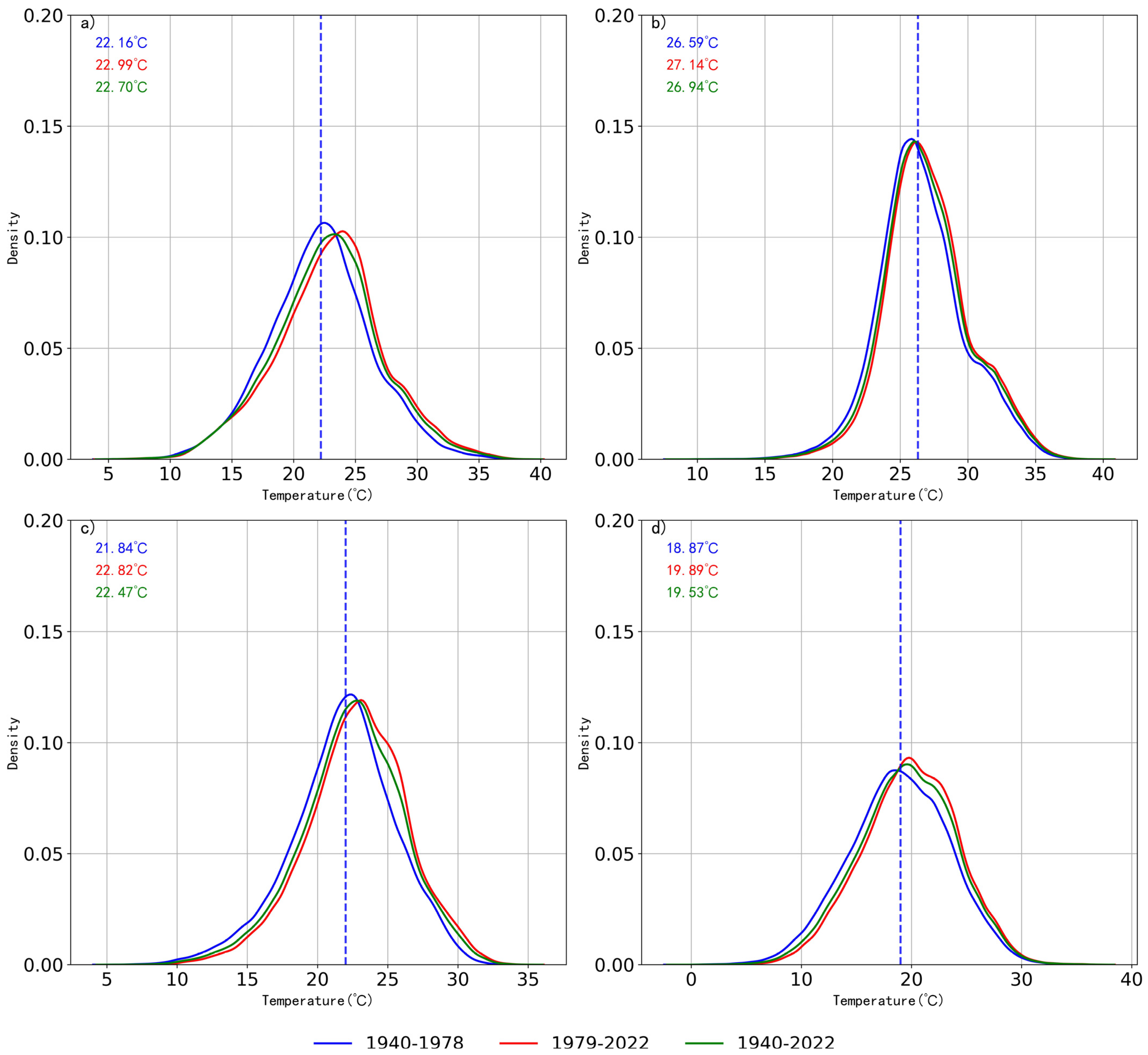
3.4. Temporal Evolution of Temperature Probability Density Functions
3.5. Diurnal Temperature Variation: Timing and Magnitude
3.5.1. Diurnal Timing of Maximum and Minimum Temperatures
3.5.2. Long-Term Changes in Diurnal Temperature Range
4. Discussion
5. Conclusions
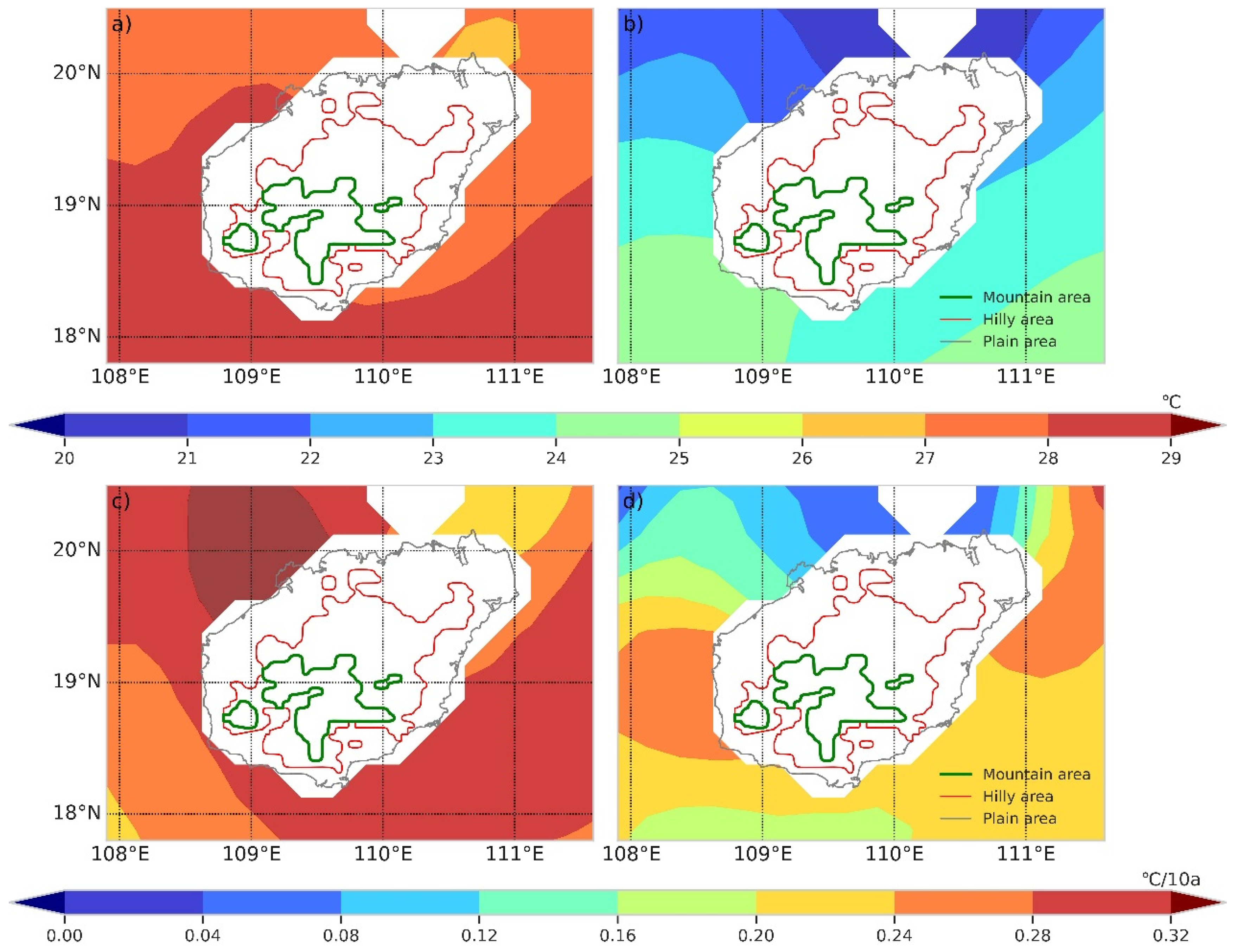
- Temperature changes in Hainan Island during 1900–2022 exhibited significant periodic characteristics: slight warming during 1900–1949 (0.02–0.08 °C/decade), warming hiatus or slight cooling during 1950–1979 (−0.8 °C/decade), and accelerated warming during 1979–2022 (0.14–0.28 °C/decade). The overall warming rate was lower than that of mainland China, reflecting the unique response pattern of tropical island climate to global warming.
- Temperature variations exhibit significant spatial heterogeneity, with coastal plains (0.11 °C/decade) warming faster than mountainous inland regions (0.08 °C/decade). This disparity is primarily influenced by a combination of factors, with the lower warming rate in mountainous areas largely attributed to topographic regulation and high vegetation cover.
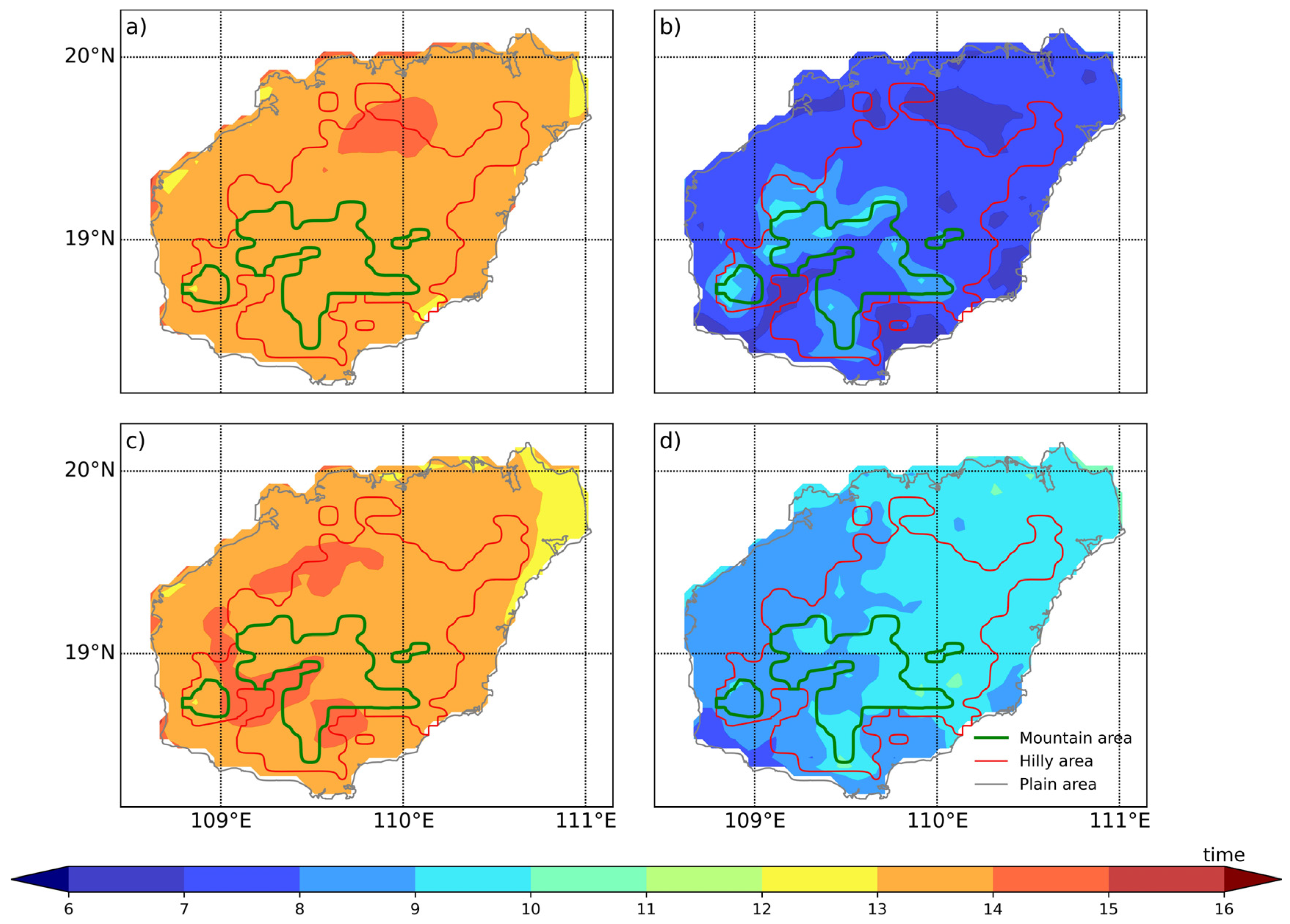
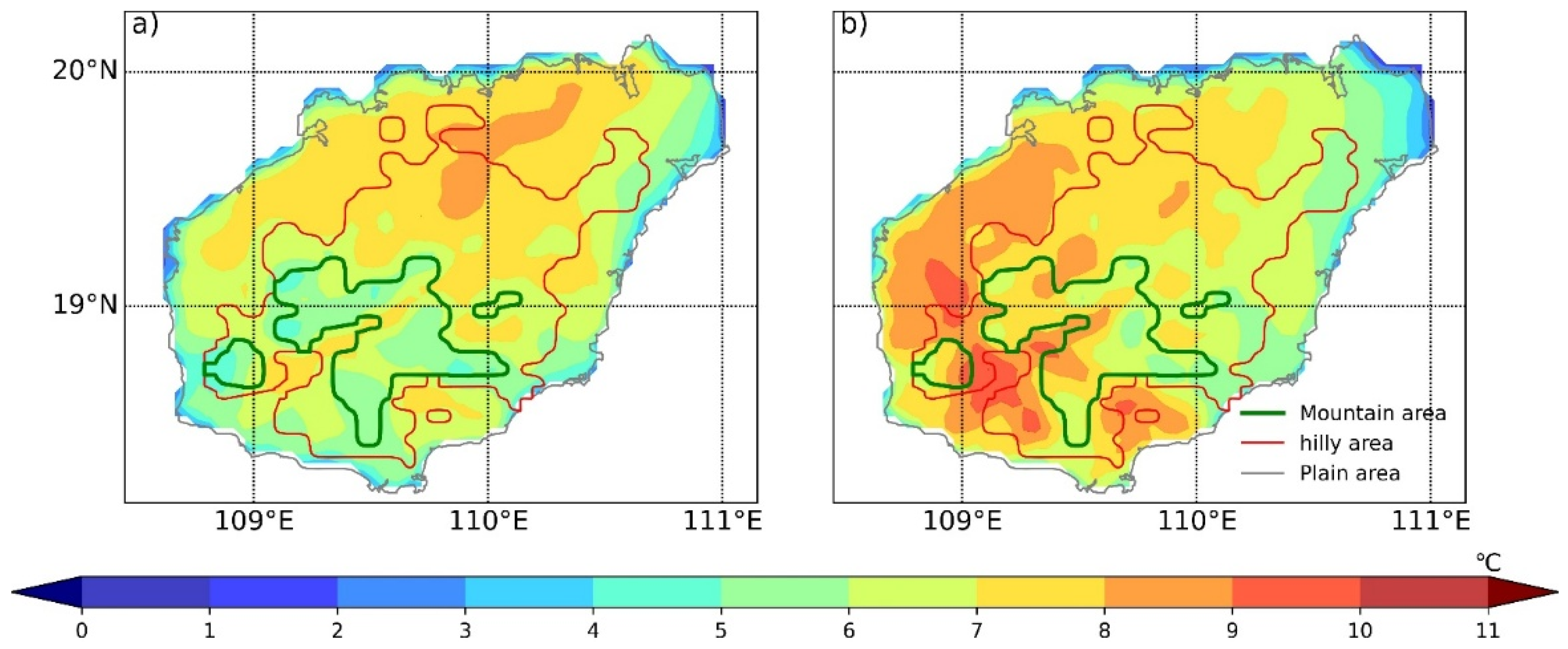
- Diurnal temperature range (DTR) variations show distinct topographic dependence. During the warm season, the northern region exhibits the maximum DTR (8–9 °C), while coastal areas display the minimum values (1–2 °C). In the cold season, a significant southwest–northeast gradient is observed, with the maximum values occurring between Jianfengling and the central mountainous regions (approximately 9 °C). This phenomenon is closely related to the interaction between oceanic regulation, the northeast monsoon, and topographic lifting effects.
- Probability density function (PDF) analysis reveals that the PDFs for transitional and cold seasons are wider, with greater fluctuations, and show a distinct rightward skew, most notably in the 1979–2022 period. This indicates that, while the average temperature on Hainan Island is rising, the frequency of extreme temperature events is also expected to increase.
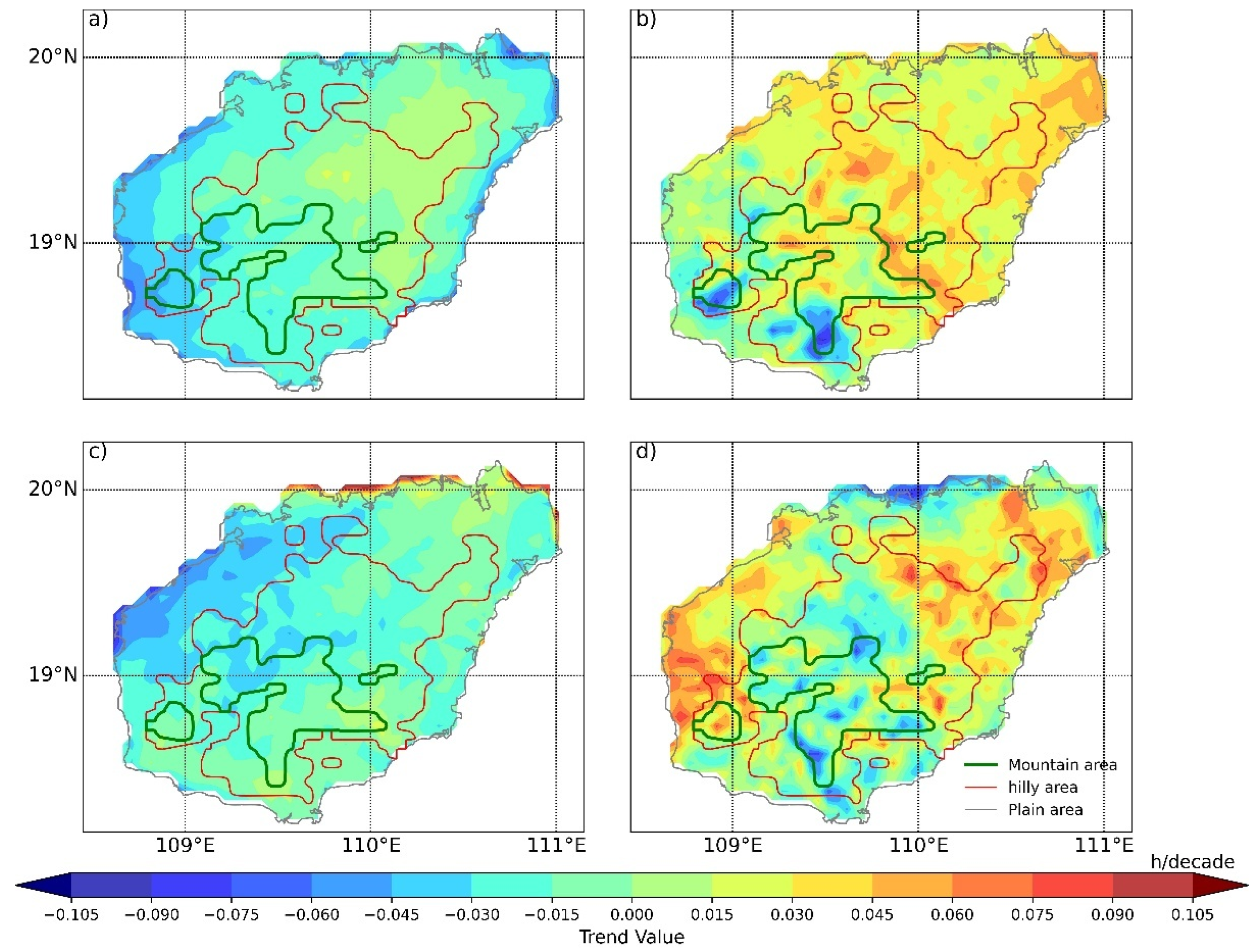
- The timing of maximum and minimum temperatures showed systematic changes. During the warm season, the occurrence of maximum temperature in coastal plains advanced (−0.05 to −0.1 h/decade), while mountainous regions exhibited a delay trend (0–0.03 h/decade). This spatial disparity indicates that topography and land–sea thermal contrast are the primary regulatory mechanisms of diurnal temperature variations.
Author Contributions
Funding
Data Availability Statement
Conflicts of Interest
Appendix A

| CC | RMSE | MAE | ||||||||||
|---|---|---|---|---|---|---|---|---|---|---|---|---|
| Station Name | Year | Season | Month | Day | Year | Season | Month | Day | Year | Season | Month | Day |
| Qiongshan | 0.89 *** | 0.95 *** | 0.99 *** | 0.97 *** | 0.47 | 0.34 | 0.72 | 1.10 | 0.22 | 0.11 | 0.53 | 1.21 |
| Haikou | 0.76 *** | 0.89 *** | 0.99 *** | 0.97 *** | 0.49 | 0.54 | 0.77 | 1.14 | 0.24 | 0.29 | 0.59 | 1.31 |
| Dongfang | 0.58 *** | 0.91 *** | 0.99 *** | 0.97 *** | 0.60 | 0.61 | 0.65 | 1.08 | 0.36 | 0.37 | 0.43 | 1.16 |
| Lingao | 0.90 *** | 0.96 *** | 0.99 *** | 0.98 *** | 0.34 | 0.34 | 0.64 | 1.05 | 0.06 | 0.12 | 0.41 | 1.10 |
| Chengmai | 0.54 *** | 0.97 *** | 0.99 *** | 0.98 *** | 0.72 | 0.34 | 0.48 | 0.96 | 0.52 | 0.11 | 0.19 | 0.91 |
| Danzhou | 0.55 *** | 0.91 *** | 0.99 *** | 0.97 *** | 0.56 | 0.48 | 0.63 | 1.08 | 0.34 | 0.23 | 0.40 | 1.16 |
| Changjiang | 0.91 *** | 0.96 *** | 0.99 *** | 0.97 *** | 0.70 | 1.17 | 0.86 | 1.26 | 0.49 | 1.38 | 0.74 | 1.58 |
| Baisha | 0.50 *** | 0.95 *** | 0.99 *** | 0.97 *** | 0.89 | 0.63 | 0.56 | 1.11 | 0.78 | 0.40 | 0.31 | 1.22 |
| Qiongzhong | 0.67 *** | 0.94 *** | 0.99 *** | 0.97 *** | 0.68 | 0.97 | 0.69 | 1.10 | 0.47 | 0.95 | 0.48 | 1.21 |
| Ding’an | 0.89 *** | 0.97 *** | 0.99 *** | 0.98 *** | 0.27 | 0.41 | 0.44 | 0.95 | 0.07 | 0.17 | 0.20 | 0.91 |
| Tunchang | 0.60 *** | 0.96 *** | 0.99 *** | 0.98 *** | 0.80 | 0.75 | 0.57 | 1.02 | 0.65 | 0.57 | 0.32 | 1.05 |
| Qionghai | 0.29 * | 0.93 *** | 0.99 *** | 0.98 *** | 1.02 | 0.51 | 0.44 | 0.95 | 1.03 | 0.26 | 0.19 | 0.91 |
| Wenchang | 0.82 *** | 0.97 *** | 0.99 *** | 0.98 *** | 0.29 | 0.26 | 0.34 | 0.85 | 0.09 | 0.07 | 0.12 | 0.72 |
| Ledong | 0.96 *** | 0.93 *** | 0.99 *** | 0.96 *** | 0.47 | 0.80 | 0.59 | 1.02 | 0.22 | 0.63 | 0.34 | 1.04 |
| Wuzhishan | 0.73 *** | 0.96 *** | 0.99 *** | 0.96 *** | 0.80 | 1.00 | 0.78 | 1.14 | 0.63 | 0.90 | 0.61 | 1.31 |
| Baoting | 0.88 *** | 0.96 *** | 0.99 *** | 0.95 *** | 0.37 | 0.95 | 0.60 | 1.08 | 0.14 | 0.91 | 0.36 | 1.17 |
| Sanya | 0.24 *** | 0.51 *** | 0.93 *** | 0.92 *** | 1.67 | 2.19 | 1.70 | 1.86 | 2.76 | 4.81 | 2.90 | 3.46 |
| Wanning | 0.62 *** | 0.96 *** | 0.99 *** | 0.98 *** | 0.79 | 0.71 | 0.58 | 0.98 | 0.62 | 0.50 | 0.34 | 0.96 |
| Lingshui | 0.74 *** | 0.96 *** | 0.99 *** | 0.97 *** | 0.47 | 0.60 | 0.43 | 0.88 | 0.22 | 0.36 | 0.19 | 0.78 |

References
- Masson-Delmotte, V.; Zhai, P.; Pirani, A.; Connors, S.L.; Péan, C.; Berger, S.; Caud, N.; Chen, Y.; Goldfarb, L.; Gomis, M.I. Climate change 2021: The physical science basis. In Contribution of Working Group I to the Sixth Assessment Report of the Intergovernmental Panel on Climate Change; Cambridge University Press: Cambridge, UK, 2021; Volume 2, p. 2391. [Google Scholar]
- Diffenbaugh, N.S.; Burke, M. Global warming has increased global economic inequality. Proc. Natl. Acad. Sci. USA 2019, 116, 9808–9813. [Google Scholar] [CrossRef] [Scilit]
- Schär, C. The worst heat waves to come. Nat. Clim. Chang. 2016, 6, 128–129. [Google Scholar]
- Storlazzi, C.D.; Gingerich, S.B.; Van Dongeren, A.; Cheriton, O.M.; Swarzenski, P.W.; Quataert, E.; Voss, C.I.; Field, D.W.; Annamalai, H.; Piniak, G.A.; et al. Most atolls will be uninhabitable by the mid-21st century because of sea-level rise exacerbating wave-driven flooding. Sci. Adv. 2018, 4, eaap9741. [Google Scholar] [CrossRef] [Scilit]
- Sheridan, S.C.; Dixon, P.G. Spatiotemporal trends in human vulnerability and adaptation to heat across the United States. Anthropocene 2017, 20, 61–73. [Google Scholar]
- Russo, S.; Sillmann, J.; Sterl, A. Humid heat waves at different warming levels. Sci. Rep. 2017, 7, 7477. [Google Scholar]
- Perkins-Kirkpatrick, S.E.; Lewis, S.C. Increasing trends in regional heatwaves. Nat. Commun. 2020, 11, 3357. [Google Scholar]
- Meehl, G.A.; Tebaldi, C. More Intense, More Frequent, and Longer Lasting Heat Waves in the 21st Century. Science 2004, 305, 994–997. [Google Scholar] [CrossRef] [Scilit] [PubMed]
- Zhai, P.; Pan, X. Trends in temperature extremes during 1951–1999 in China. Geophys. Res. Lett. 2003, 30, 2003GL018004. [Google Scholar] [CrossRef] [Scilit]
- Zhou, Y.; Ren, G. Change in extreme temperature event frequency over mainland China, 1961–2008. Clim. Res. 2011, 50, 125–139. [Google Scholar] [CrossRef] [Scilit]
- Revadekar, J.V.; Hameed, S.; Collins, D.; Manton, M.; Sheikh, M.; Borgaonkar, H.P.; Kothawale, D.R.; Adnan, M.; Ahmed, A.U.; Ashraf, J. Impact of altitude and latitude on changes in temperature extremes over South Asia during 1971–2000. Int. J. Climatol. 2013, 33, 199–209. [Google Scholar] [CrossRef] [Scilit]
- Seneviratne, S.I.; Zhang, X.; Adnan, M.; Badi, W.; Dereczynski, C.; Luca, A.D.; Ghosh, S.; Iskandar, I.; Kossin, J.; Lewis, S. Weather and Climate Extreme Events in a Changing Climate; Cambridge University Press: Cambridge, UK, 2021. [Google Scholar]
- Im, E.-S.; Pal, J.S.; Eltahir, E.A.B. Deadly heat waves projected in the densely populated agricultural regions of South Asia. Sci. Adv. 2017, 3, e1603322. [Google Scholar] [CrossRef] [Scilit]
- Chen, Y.; Li, Z.; Fan, Y.; Wang, H.; Deng, H. Progress and prospects of climate change impacts on hydrology in the arid region of northwest China. Environ. Res. 2015, 139, 11–19. [Google Scholar]
- Dian-Xiu, Y.; Ji-Fu, Y.; Zheng-Hong, C.; You-Fei, Z.; Rong-Jun, W. Spatial and temporal variations of heat waves in China from 1961 to 2010. Adv. Clim. Chang. Res. 2014, 5, 66–73. [Google Scholar]
- Xu, Y.; Zhang, X.; Wang, X.; Hao, Z.; Singh, V.P.; Hao, F. Propagation from meteorological drought to hydrological drought under the impact of human activities: A case study in northern China. J. Hydrol. 2019, 579, 124147. [Google Scholar] [CrossRef] [Scilit]
- Zhang, Q.; Ni, X.; Zhang, F. Decreasing trend in severe weather occurrence over China during the past 50 years. Sci. Rep. 2017, 7, 42310. [Google Scholar]
- Giorgi, F.; Gutowski, W.J. Regional Dynamical Downscaling and the CORDEX Initiative. Annu. Rev. Environ. Resour. 2015, 40, 467–490. [Google Scholar] [CrossRef] [Scilit]
- Hu, X.X.; Jiang, X.Y.; Li, W. Analysis of high-temperature variations in Changjiang County, Hainan Province from 1990 to 2020. Agric. Dev. Equip. 2022, 63–65. (In Chinese) [Google Scholar]
- Huang, Y.; Wang, G.; Su, D.F. Analysis of temperature changes in Haikou over 55 years. J. Meteorol. Res. Appl. 2008, 56, 58. (In Chinese) [Google Scholar]
- Chen, X.L.; Wu, H. Climatic change characteristics of Hainan Island in recent 42 years. Meteorol. Mon. 2004, 30, 27–31. (In Chinese) [Google Scholar]
- Yatagai, A.; Yasunari, T. Trends and decadal-scale fluctuations of surface air temperature and precipitation over China and Mongolia during the recent 40 year period (1951–1990). J. Meteorol. Soc. Jpn. Ser. II 1994, 72, 937–957. [Google Scholar] [CrossRef] [Scilit]
- Wilcox, L.J.; Highwood, E.J.; Dunstone, N.J. The influence of anthropogenic aerosol on multi-decadal variations of historical global climate. Environ. Res. Lett. 2013, 8, 024033. [Google Scholar] [CrossRef] [Scilit]
- Zhou, J.; Lu, T. Long-term spatial and temporal variation of near surface air temperature in southwest China during 1969–2018. Front. Earth Sci. 2021, 9, 753757. [Google Scholar] [CrossRef] [Scilit]
- Zhong, R.; Song, S.; Zhang, J.; Ye, Z. Spatial–temporal variation and temperature effect of urbanization in Guangdong Province from 1951 to 2018. Environ. Dev. Sustain. 2023, 26, 9661–9683. [Google Scholar] [CrossRef] [Scilit]
- Wang, D. Ocean Circulation and Air-Sea Interaction in the South China Sea; Springer Nature Singapore: Singapore, 2022. [Google Scholar]
- Santer, B.D.; Po-Chedley, S.; Zelinka, M.D.; Cvijanovic, I.; Bonfils, C.; Durack, P.J.; Fu, Q.; Kiehl, J.; Mears, C.; Painter, J.; et al. Human influence on the seasonal cycle of tropospheric temperature. Science 2018, 361, eaas8806. [Google Scholar] [CrossRef] [Scilit]
- Nojarov, P.; Arsov, T.; Kalapov, I.; Angelov, H. Influence of water vapor and aerosols on downward longwave radiation in the high mountain region of Musala peak, Bulgaria. J. Bulg. Geogr. Soc. 2021, 44, 59–72. [Google Scholar] [CrossRef] [Scilit]
- Smith, R.B. Mountain meteorology and regional climates. In Atmospheric Turbulence and Mesoscale Meteorology; Cambridge University Press: Cambridge, UK, 2004; Volume 193, p. 222. [Google Scholar]
- Gevorgyan, A. Summertime wind climate in Yerevan: Valley wind systems. Clim. Dyn. 2017, 48, 1827–1840. [Google Scholar] [CrossRef] [Scilit]
- Giovannini, L.; Laiti, L.; Serafin, S.; Zardi, D. The thermally driven diurnal wind system of the Adige Valley in the Italian Alps. Q. J. R. Meteorol. Soc. 2017, 143, 2389–2402. [Google Scholar] [CrossRef] [Scilit]
- Wang, S.; Sobel, A.H. Factors controlling rain on small tropical islands: Diurnal cycle, large-scale wind speed, and topography. J. Atmos. Sci. 2017, 74, 3515–3532. [Google Scholar] [CrossRef] [Scilit]
- Zhu, L.; Meng, Z.; Zhang, F.; Markowski, P.M. The influence of sea-and land-breeze circulations on the diurnal variability in precipitation over a tropical island. Atmos. Chem. Phys. 2017, 17, 13213–13232. [Google Scholar]
- Dhage, L.; Widlansky, M.J. Assessment of 21st Century Changing Sea Surface Temperature, Rainfall, and Sea Surface Height Patterns in the Tropical Pacific Islands Using CMIP6 Greenhouse Warming Projections. Earth’s Future 2022, 10, e2021EF002524. [Google Scholar] [CrossRef] [Scilit]
- Phan, T.T.H.; Nguyen, H.A. Spatial and temporal distributions of temperature and rainfall on tropical islands of Vietnam. J. Water Clim. Change 2023, 14, 1395–1412. [Google Scholar] [CrossRef] [Scilit]
- Mohanty, M.; Jena, S.R.; Misra, S.K. Mathematical Modelling of Engineering Problems; IIETA: Edmonton, AB, Canada, 2021; Volume 8, pp. 409–417. [Google Scholar]
- Yendra, R.; Hanaish, I.S.; Fudholi, A. Power Bayesian Markov Chain Monte Carlo (MCMC) for Modelling Extreme Temperatures in Sumatra Island Using Generalised Extreme Value (GEV) and Generalised Logistic (GLO) Distributions. Math. Model. Eng. Probl. 2021, 8, 365–376. [Google Scholar] [CrossRef] [Scilit]
- Ouyang, X.; Liao, W.; Luo, M. Change of probability density distributions of summer temperatures in different climate zones. Front. Earth Sci. 2024, 18, 1–16. [Google Scholar] [CrossRef] [Scilit]
- Hersbach, H.; Bell, B.; Berrisford, P.; Hirahara, S.; Horányi, A.; Muñoz-Sabater, J.; Nicolas, J.; Peubey, C.; Radu, R.; Schepers, D.; et al. The ERA5 global reanalysis. Q. J. R. Meteorol. Soc. 2020, 146, 1999–2049. [Google Scholar] [CrossRef] [Scilit]


| Category | Datasets | Temporal Coverage | Spatial Resolution (°) | Temporal Resolution | Organization |
|---|---|---|---|---|---|
| Atmospheric Reanalysis | CERA-20C | 1901–2010 | 2.0 | 6 h | ECMWF, EU |
| NOAA-20CR | 1900–2015 | 2.0 | 6 h | NOAA, US | |
| NCEP/NCAR R1 | 1948–2022 | 2.5 | 6 h | NOAA, US | |
| NCEP/DOE R2 | 1979–2022 | 2.5 | 6 h | NOAA, US | |
| JRA-55 | 1979–2017 | 0.50 | 6 h | JMA, JP | |
| MERRA-2 | 1980–2021 | 0.50 × 0.313 | 1 h | NASA, US | |
| ERA5 | 1940–2022 | 0.25 | 1 h | ECMWF, EU | |
| Land Surface process Reanalysis | GLDAS | 1948–2021 | 0.25 | 3 h | NASA, US |
| Extrapolated gridded observation | CRU TS | 1901–2022 | 0.50 | Monthly | UEA, UK |
| UDEL | 1900–2022 | 0.50 | Monthly | UDEL, US | |
| APHRODITE | 1961–2015 | 0.25 | Daily | UT, JP | |
| CN05 | 1961–2022 | 0.25 | Daily | NCC, CN | |
| CMFD | 1979–2018 | 0.10 | 3 h | ITP, CN | |
| Regional Reanalysis | HNR | 1940–2022 | 0.05 | 1 h | HNU, CN |
| Scale | Time | CC | RMSE (°C) | MSE (°C) |
|---|---|---|---|---|
| Year | - | 0.82 * | 0.31 | 0.10 |
| Month | - | 0.99 * | 0.48 | 0.23 |
| Day | - | 0.98 * | 0.81 | 0.65 |
| Warm season | All day | 0.85 * | 0.27 | 0.07 |
| 00:00–06:00 | 0.83 * | 0.50 | 0.25 | |
| 06:00–12:00 | 0.72 * | 0.54 | 0.29 | |
| 12:00–18:00 | 0.91 * | 0.26 | 0.07 | |
| 18:00–00:00 | 0.76 * | 0.61 | 0.38 | |
| Cold season | All day | 0.90 * | 0.60 | 0.36 |
| 00:00–06:00 | 0.85 * | 0.73 | 0.54 | |
| 06:00–12:00 | 0.92 * | 0.41 | 0.17 | |
| 12:00–18:00 | 0.86 * | 0.56 | 0.31 | |
| 18:00–00:00 | 0.81 * | 1.09 | 1.18 |
| Datasets | Periods (°C/Decade) | |||
|---|---|---|---|---|
| 1900–1949 | 1950–1979 | 1979–2022 | All Period | |
| I Long-term Series Extrapolated Gridded Observation Data | ||||
| 1.1 Ensemble (1900–2022) | 0.06 *** | −0.10 *** | 0.16 *** | 0.04 *** |
| 1.2 CRU (1901–2022) | 0.08 *** | −0.11 *** | 0.15 *** | 0.03 *** |
| 1.3 UDEL WM (1900–2022) | 0.04 * | −0.10 ** | 0.000 | 0.01 |
| II Long-term Series Atmospheric Reanalysis Data | ||||
| 2.1 Ensemble (1900–2010) | 0.02 | 0.04 * | 0.20 *** | 0.07 *** |
| 2.2 NOAA 20C (1900–2015) | 0.03 | 0.12 *** | 0.17 *** | 0.14 *** |
| 2.3 ERA 20C (1901–2010) | 0.07 *** | 0.13 *** | 0.20 *** | 0.09 *** |
| 2.4 CERA20C (1901–2010) | −0.04 * | −0.06 * | 0.15 *** | 0.000 |
| 2.5 ERA20CM (1901–2010) | 0.06 * | −0.01 | 0.24 *** | 0.05 *** |
| III Short-term Series Atmospheric Reanalysis Data | ||||
| 3.1 Ensemble (1948–2022) | - | −0.04 | 0.21 ** | 0.08 *** |
| 3.2 JRA55 (1979–2017) | - | - | 0.19 *** | 0.19 *** |
| 3.3 MERRA2 (1980–2021) | - | - | 0.12 *** | 0.12 *** |
| 3.4 NCEP1 (1948–2022) | - | −0.05 | 0.11 ** | 0.09 *** |
| 3.5 NCEP2 (1979–2022) | - | - | 0.13 *** | 0.14 *** |
| IV Short-term gridded observation | ||||
| 4.1 Ensemble (1961–2022) | - | - | 0.16 *** | 0.24 *** |
| 4.2 APHRO (1961–2015) | - | - | 0.14 *** | 0.20 *** |
| 4.3 CN05 (1961–2022) China Region | - | - | 0.28 *** | 0.27 *** |
| 4.4 CMFD (1979–2018) | - | - | 0.11 ** | 0.12 ** |
| V Hainan Regional Atmospheric Reanalysis | ||||
| 5 surface observation (1940–2022) | - | −0.8 | 0.14 ** | 0.09 *** |
| VI Atmospheric Forcing Data for HNR | ||||
| 6 ERA5 (1979–2022) | - | - | 0.10 *** | 0.10 *** |
| VII In situ observation | ||||
| 7 In situ obs (1951–2019) | - | 0.42 * | 0.22 *** | 0.27 *** |
| VIII In situ observation in differed regions | ||||
| 8.2 CN05.1 South China Region | - | - | 0.26 *** | 0.21 *** |
| 8.1 CN05.2 (1961–2022) Hainan Island | - | - | 0.28 *** | 0.27 *** |
| IX Land Surface Reanalysis | ||||
| 9 GLDAS (1948–2021) | - | −0.15 *** | 0.02 | 0.06 *** |
Disclaimer/Publisher’s Note: The statements, opinions and data contained in all publications are solely those of the individual author(s) and contributor(s) and not of MDPI and/or the editor(s). MDPI and/or the editor(s) disclaim responsibility for any injury to people or property resulting from any ideas, methods, instructions or products referred to in the content. |
© 2025 by the authors. Licensee MDPI, Basel, Switzerland. This article is an open access article distributed under the terms and conditions of the Creative Commons Attribution (CC BY) license.
Share and Cite
Xing, Y.; Shi, C.; Jiao, Y.; Shang, M.; Du, J.; Bai, L. Long-Term Hourly Temperature Dynamics on Tropical Hainan Island (1940–2022). Climate 2026, 14, 9. https://doi.org/10.3390/cli14010009
Xing Y, Shi C, Jiao Y, Shang M, Du J, Bai L. Long-Term Hourly Temperature Dynamics on Tropical Hainan Island (1940–2022). Climate. 2026; 14(1):9. https://doi.org/10.3390/cli14010009
Chicago/Turabian StyleXing, Yihang, Chenxiao Shi, Yue Jiao, Ming Shang, Jianhua Du, and Lei Bai. 2026. "Long-Term Hourly Temperature Dynamics on Tropical Hainan Island (1940–2022)" Climate 14, no. 1: 9. https://doi.org/10.3390/cli14010009
APA StyleXing, Y., Shi, C., Jiao, Y., Shang, M., Du, J., & Bai, L. (2026). Long-Term Hourly Temperature Dynamics on Tropical Hainan Island (1940–2022). Climate, 14(1), 9. https://doi.org/10.3390/cli14010009