Article

Comprehensive Tool for Assessing Farmers’ Knowledge and Perception of Climate Change and Sustainable Adaptation: Evidence from Himalayan Mountain Region


by
Nirmal Kumar Patra
1,*,
Limasangla A. Jamir
1 and
Tapan B. Pathak
2
1
Department of Agricultural Extension Education, School of Agricultural Sciences (SAS), Nagaland University, Medziphema 797106, Nagaland, India
2
Department of Civil and Environmental Engineering, University of California, Merced, CA 95348, USA
*
Author to whom correspondence should be addressed.
Climate 2026, 14(1), 20; https://doi.org/10.3390/cli14010020 (registering DOI)
Submission received: 26 October 2025 / Revised: 31 December 2025 / Accepted: 5 January 2026 / Published: 15 January 2026

Abstract

Knowledge and perceptions are prerequisites for contributing to CC mitigation and adaptation. This paper developed a framework and a tool (scale) to capture farmers’ knowledge and perceptions of all aspects of CC. We involved 15 extremely qualified (those with PhD degrees in agriculture and allied disciplines and experience in scale construction and CC research) experts and 83 highly qualified (a minimum of a PhD degree in agriculture and allied fields was the prerequisite criterion for acting as a judge) judges in the construction of this scale. Further, we adopted factor analysis to draw valid conclusions. We proposed 138 items/statements related to 14 dimensions/issues (General, GHGs, Temperature, Rainfall, Agricultural emissions, shifting cultivation, rice cultivation, Mitigation, C-sequestration, Impact on Agriculture, Livestock, Wind, Natural disaster, Impact, and Adaptation) associated with agriculture and CC scenarios. Finally, 102 items/statements were retained with six indicators/dimensions. The results indicate that the scale explains 83% of variance. The scale is highly consistent (Cronbach alpha = 0.985) and widely applicable to future research and policy decisions. Further, the scale was adopted (with 100 respondents) to assess consistency and validity. Finally, the tool (scale) for assessing farmers’ knowledge and perceptions of CC was prepared for further use and replication. The policy and research system may adopt the framework and scale to assess stakeholders’ inclusive knowledge and perceptions of CC. The findings of this study may be helpful for policymakers, researchers, development workers, and extension functionaries.

1. Introduction

Climate change (CC) is a global challenge; developing countries are the most vulnerable to it [1,2], and CC mitigation policy should emphasize the economic development of developing countries [3]. Various drivers, namely, construction and infrastructure development, the power and electric sector, industry, fossil fuel burning, and agriculture, contribute to CC and global warming through the emission of greenhouse gases (GHGs) [1,4]. However, to some extent, crop cultivation is emission-neutral and C-sequestering, but some crop cultivation emits GHGs. Further, agriculture is highly vulnerable to CC and global warming [1,5,6,7,8,9]. The influence of CC and global warming on agriculture varies in degree and nature [1,10,11,12]. Therefore, assessing the effect of CC on agriculture is essential for management and policymaking regarding the mitigation of and adaptation to CC [13]. For instance, global warming primarily and negatively impacts the temperate crops of mountain and plain ecosystems. Paradoxically, it has a positive influence on non-cold-loving/non-thermo-sensitive crops. The nature and degree of influence also differ across mountainous, coastal [14], and plain agroecological situations.
This study was conducted in the Himalayan Mountain region of India. Among mountain ecosystems, the Himalayan Mountain region is the most vulnerable to CC and global warming [5]. The Himalayan Mountain region is experiencing significant changes in climate, consistent with broader warming and climatic shifts across Northeast India [15]. Recent warming trends in both the minimum and maximum temperatures are evident across the region, contributing to greater heat stress and altered seasonal cycles [16,17]. Similarly, precipitation patterns have also become more variable, including a declining frequency of monsoon rainfalls and increased frequency of extreme rainfall events. This makes the region vulnerable to both flood and drought conditions and increases the risk of agricultural disruptions [18]. In Nagaland, historical climate data reveal increasing temperatures and high inter-annual rainfall variability, which together affect groundwater recharge, crop productivity, and the stability of rain-fed farming systems that dominate the state’s economy [19].
The Himalayan Mountain region spans eight countries: Afghanistan, Bangladesh, Bhutan, China, India, Myanmar, Nepal, and Pakistan. It covers an area around 7,550,000 km2 [20]. Around 70% of people in the Himalayan Mountains depend on crop-based and livestock-based livelihood activities [21,22]. In the Himalayan Mountain region, various forms of agriculture and crop cultivation remain, like permanent or settled and shifting cultivation.
Mountain and non-mountain agriculture are important drivers of CC through the emission of GHGs and are also highly vulnerable to CC. It is universally accepted that the mitigation and adaptation of CC are easily achievable through involvement and contribution from individual/general people and the community [23,24,25,26,27]. Similarly, farm-level adaptation may be an alternative to minimize the emission of GHGs and the risk of CC in agriculture [28], and in situ adaptation is more desirable for managing the CC risk [29,30]. For instance, local communities are playing a leading role in addressing drought problems through the combined use of traditional and modern methods [31]. Therefore, individuals’ thorough understanding of CC and its mitigation and adaptation is essential for effective CC mitigation and adaptation [6,23,32,33,34].
However, it is widely accepted that awareness leads to the acquisition of knowledge, which leads to comprehension, followed by understanding, perception, and application [35]. On the other hand, CC, global warming, and its mitigation and adaptation are relatively new concepts. Knowledge about these among ordinary people is inadequate [6]. Concerning rural and farming communities, people’s overall knowledge and perceptions are very low, as literacy rates and educational attainment are relatively low in rural areas [36,37,38]. Therefore, it is a prerequisite to assess the knowledge and perceptions of stakeholders/individuals about CC and its impacts on the environment, society, and livelihoods. Research is an alternative to address knowledge gaps [39]. This will support understanding the CC scenario from the perspective of stakeholders [40] and appropriate policymaking to minimize the knowledge and perception gaps of stakeholders and facilitate the start of CC mitigation and adaptation initiatives.
Understanding farmers’ knowledge and perceptions of climate change is essential for shaping effective policies, interventions, and sustainable practices in agriculture [41]. Farmers’ perceptions influence how they adapt to climate risks, such as changes in rainfall, temperature, and extreme weather, which directly affect their livelihoods. Tailoring solutions to align with their beliefs and knowledge ensures greater acceptance and practicality, while bridging knowledge gaps can promote resilience and proactive measures like water conservation and crop diversification. Incorporating traditional knowledge with scientific research fosters innovative, locally adapted solutions, and effective communication based on farmers’ experiences builds trust and engagement. Ultimately, recognizing farmers’ perspectives empowers them to address climate challenges while ensuring that policies and initiatives are equitable and impactful. However, farmers’ knowledge has widely been under-recorded and overlooked in scientific research [42]. The knowledge and perception of people regarding CC have been of great importance for CC mitigation and adaptation [43,44], and exposure to the extreme consequences of CC may raise awareness [45] and initiate mitigation endeavors [46]. Several researchers [47,48,49,50] found that public perception may facilitate the implementation of CC mitigation and adaptation policy. However (based on website searches and discussions with some research methodology experts), the availability of tools and techniques for examining people’s awareness, knowledge, and perception of agricultural CC is relatively limited.
Tools for assessing interaction amongst farmers–agriculture–CC–global warming–mitigation and adaptation to CC are either absent or extremely inadequate. This paper consists of an attempt with the following objectives: (i) to develop a framework for scale construction and (ii) to construct a scale to measure the knowledge and perception of farming communities on CC. This paper emphasizes the impact of CC on all agroecological situations (mountain, foothill, and plain situations) with different cultivation models (settled and shifting cultivation). Accordingly, we involved 15 extremely qualified experts, 83 highly qualified judges, and 100 farmers in the construction of this scale.
This research made a novel contribution to the fields of CC and agricultural research through its multidimensional approach to assessing farmers’ knowledge and perceptions of CC, which aligns with Wilson et al.’s [51] findings. Many existing studies often focus on specific aspects of CC. However, this research develops a robust, scientifically validated scale grounded in an extensive conceptual framework using various dimensions of CC impacts and agricultural practices. The involvement of highly qualified experts and judges in scale development lends credibility and depth to the findings. Importantly, this research highlights the scalability of the framework, making it adaptable to various socio-economic, ecological, and geographical settings worldwide. Further, there is relatively sparse evidence on such a comprehensive scale on CC and agricultural interaction for the Himalayan Mountain region; therefore, this paper adds value to the existing literature.
This paper is organized as follows. The next section presents a conceptual framework, the basis for this study, and the methodology adopted to complete this study. The results and discussion are presented in Section 3. Concluding remarks form the last section.

2. Methodology

This section presents this study’s conceptual framework and the research methods used to develop the scale for assessing farmers’ knowledge and perceptions of CC. The present study was conducted in Nagaland (25°6′ N to 27°4′ N and 93°20′ E to 95°15′ E), India (Figure 1). Also, the study area is in the Himalayan Mountain region.
A Likert-type scale was constructed to assess farmers’ knowledge and perceptions of CC. The 1st step of scale construction is to form the theory and define the construct to be assessed based on the literature [52]. Van Valkengoed et al. [43], based on the literature [53,54,55,56], postulated three types of CC knowledge and perception, namely, belief about the reality of CC, causes of CC, and consequences of CC. van der Linden [57] proposed three interrelated areas: public knowledge about the causes, impacts, and responses to CC. Further, the CC risk perception model (CCRPM) of van der Linden [57], willingness to act on CC [58], CC skepticism questionnaire [59], and health risks associated with CC [60] were taken into consideration. Further, to explain the interaction between agriculture and CC, it is necessary to include other issues from agriculture and CC, as well as the outcomes of their interaction.
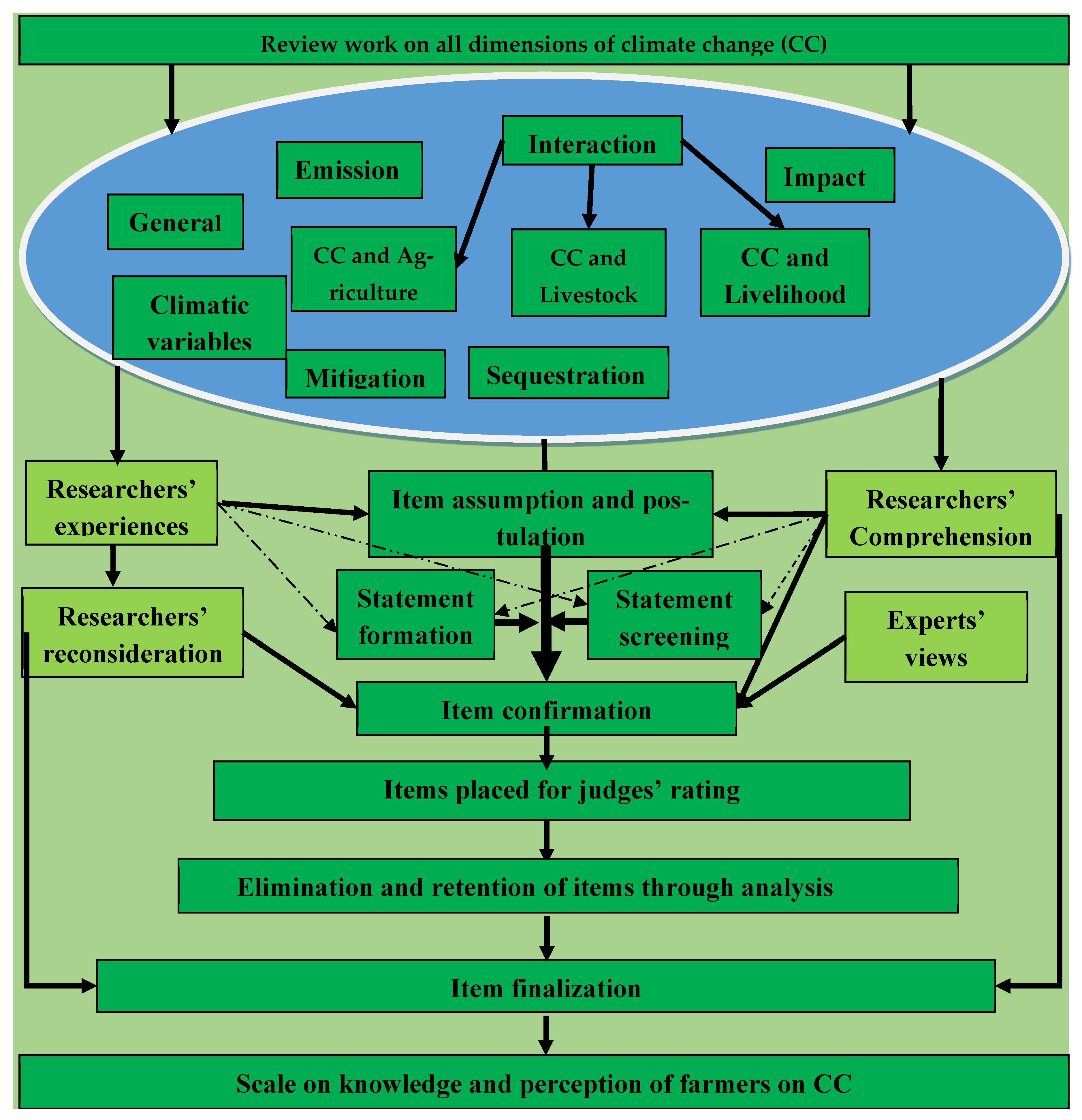
Concerning agricultural CC, it is necessary to include additional aspects and sub-sectors of agricultural activities, along with their interaction with CC and global warming. Therefore, we included general awareness about the environment; climate; CC; global warming; interaction with CC and agriculture and allied activities; the contribution of agriculture and allied activities to CC; the influence of CC on agriculture; information about GHGs (how these gases are responsible for CC and which agricultural activities are responsible for production and sequestration of GHGs); consequences of CC on the pattern of temperature, rainfall, wind flow, and natural disasters; and the impact of CC and its mitigation and adaptation. In general, mitigation refers to reducing GHG emissions, whereas adaptation is a strategic intervention conducted to reduce vulnerability to CC. However, it is often difficult to clearly distinguish the two, and the term ‘climate resilience’ is an alternative. Accordingly, all the issues mentioned earlier are included in the conceptual framework (Figure 2).
The conceptual framework (Figure 2) depicts a detailed description and outline of this research for scale construction. It covers the literature survey with an emphasis on various dimensions of CC and includes all important dimensions in this research. Subsequently, it includes the appropriate methodological guidelines, i.e., item assumption and postulation to item finalization through the contribution from experts and judges, followed by final scale construction on the knowledge and perceptions of farmers regarding CC (Figure 2).

2.1. Item/Statement Selection

Knowing that an idea, practice, or object exists is awareness; retaining and recalling the idea, practice, or object is knowledge. Similarly, perception is one’s capability of understanding, perceiving, and interpreting something. A rigorous literature review of all the earlier-mentioned aspects was conducted to develop the items. Initially, 162 items were selected. After thorough consideration, 143 items were retained, and the remaining 19, which were redundant or irrelevant, were removed. All the aspects of climatic factors; climatic variables; the impact of CC and warming on agriculture and allied issues; and the role/contribution of agriculture to CC, C-sequestration, mitigation, and adaptation of CC were taken into account at the time of item selection. Accordingly, a list of 143 items was prepared and sent to experts (N = 15) with a binary continuum (relevant or irrelevant) to examine the consistency of all items. It is essential to mention that experts had PhD degrees in agriculture and allied disciplines and experience in scale construction and CC research and were recognized as ‘extremely qualified’. However, 5 items (out of 143) received 100% non-relevant responses, which were discarded accordingly. Finally, 138 items were retained and included in the scale construction for rating by the judges.

2.2. Scoring

It is accepted that CC is a relatively new subject. Educated and progressive people are required to perceive new concepts like CC. Indian farming communities are relatively less educated, less progressive, and unable to accurately perceive the CC scenario. The present scale construction was intended to be conducted to assess Indian farmers’ knowledge and perceptions of CC. A good blending of negative and positive scoring in scale construction was recommended. However, the expert (N = 15) group recommended avoiding negative scoring because respondents would consist of a less educated and less progressive farming community. Accordingly, all the items (138) were considered with a four-point positive continuum (following the Likert technique): extremely relevant, highly relevant, relevant, and not relevant. Further, weightings of 3 (extremely relevant), 2 (highly relevant), 1 (relevant), and 0 (not relevant) were assigned to responses for each item and used for analyses.

2.3. Construction of Questionnaire

All items were included in the judges’ rating process, with a four-point scoring continuum. The questionnaire starts with a cover letter for information and to request the judge’s presence, followed by an option for collecting some basic information about the judge, like their name, discipline/specialization, qualification, designation, department/organization, email ID, and Phone Number. The last part of the questionnaire contained 138 items. Each item separately had four alternative responses. The response to the option is editable or changeable by the respondent until submission. The questionnaire was published online as a www.google.com form (with the following link: https://forms.gle/vCSox37YL2sTF3AHA).

2.4. Criteria for Selection of Judge

It is accepted that CC is a relatively new concept, and qualified people can perceive and interpret it. Therefore, advanced knowledge of agriculture is required to serve as a judge to establish the relationship between CC and agriculture. Considering all the issues, a minimum of a PhD degree in agriculture and allied fields was decided as a prerequisite criterion for acting as a judge, and people with this designation were recognized as ‘highly qualified.’

2.5. Collection of Judges’ Responses

Based on the criteria, a list of intended judges was prepared by consulting the websites of agricultural universities and research institutes; the online profiles of faculty and scientists and professional groups; and participants’ lists of seminars, symposiums, and workshops. All the intended judges (approximately 500) were communicated with through email using the following www.google.com/form link: https://docs.google.com/forms/d/e/1FAIpQLScvAZEFDZvr2G5TXyS8Jw80nWthxt5cCINPON8zjE7ummBR9Q/formResponse, accessed on 28 April 2025. They were subsequently sent reminders/requests for response. Further, only the complete online submission of forms by judges (respondents) was enabled to avoid incomplete submissions. Around 83 judges’ complete responses were included in this study.

2.6. Data Analysis

Initially, we examined the distribution of responses under different continuums. Based on the scholarly literature [61], it was decided that items with ≥20.00% non-relevant responses were rejected, and the remaining items were retained as components/items of the scale. Following Patra and Babu [62] and Patra et al. [63], we adopted Cronbach alpha analysis, and following Patra and Babu [62] and Abunyewah [64], we adopted factor analysis. Cronbach alpha analysis was used to assess the reliability and consistency of the questionnaire with retained items. Following this, factor analysis (principal component analysis) with varimax rotation was adopted to complete scale construction. Factor analysis is unique in converting large numbers of variables with similar backgrounds into a small set of factors. In factor analysis, three aspects, namely, eigenvalue, factor loading, and communality, were considered for retaining the variable and factor. Based on the literature [62,65,66], with factor analysis, a factor with an eigenvalue ≥ 1 was retained in this study. Similarly, variables with factor loadings ≥ 0.35 and communality ≥ 0.70 were retained for further interpretation.

2.7. Consistency Assessment

Another important parameter in scale construction is the calculation of internal consistency and reliability or coefficient alpha. The most popular method of measurement is the calculation of Cronbach alpha. In general, a higher reliability coefficient (>0.80) indicates the greater internal consistency and reliability of the scale. In this scale construction, we separately calculated the entire scale and each factor.

2.8. Application of Scale for Assessment of Farmers’ Knowledge and Perceptions of Climate Change

Lastly, the constructed scale was adopted to measure the knowledge and perceptions of the intended respondents and to evaluate its consistency. All the retained items/statements from 14 dimensions/issues (General, GHGs, Temperature, Rainfall, Agricultural emission, shifting cultivation, rice cultivation, Mitigation, C-sequestration, Impact on Agriculture, Livestock, Wind, Natural disaster, Impact, and Adaptation) associated with agriculture and CC scenarios were included as components in the knowledge and perception index (KPI) to assess farmers’ knowledge and perceptions of CC. Further, all the items were presented (following the Likert technique) with the 3-point continuum: fully aware/knowledgeable, partially aware/knowledgeable, and not aware/knowledgeable, with weights of 2, 1, and 0, respectively. Regarding scoring, the researcher determined the score during the interview based on the respondents’ degree of awareness/knowledge/perception in the continuum consisting of without, partial, and full/complete knowledge. Accordingly, 100 farmers were included as respondents to assess their knowledge and perceptions. Based on the respondents’ responses, a ‘knowledge and perception index’ (KPI) was developed to categorize them based on their KPI score. The following formula was used to calculate the KPI.
K n o w l e d g e   a n d   p e r c e p t i o n   I n d e x   ( K P I ) = A c h i e v e d   s c o r e A c h i e v a b l e   s c o r e   ×   100
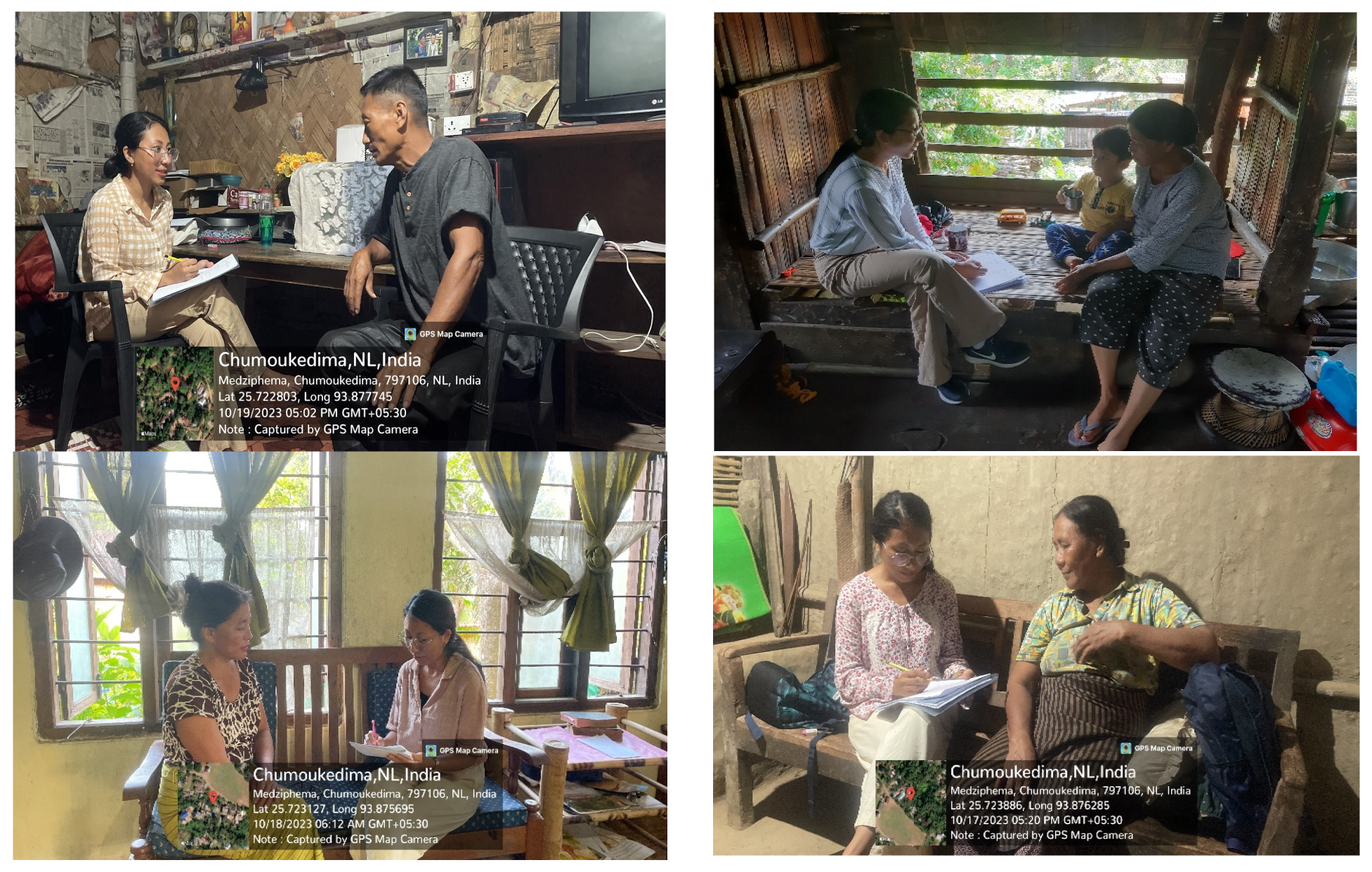
For data collection from farmers, researchers conducted face-to-face and oral interviews with individual farmers (Figure 3) using an interview schedule. Further, the English language was used for the drafting of the interview schedule and for interactions with respondents. Simultaneously, Nagamese (the most commonly used language in the state of Nagaland) was used as required to overcome language barriers and facilitate effective interviews and interactions.

2.9. Criteria for Selection of Farmers

The present study was conducted with an emphasis on representing the Himalayan Mountain region. Accordingly, farmers from the state of Nagaland (25°6′ N to 27°4′ N and 93°20′ E to 95°15′ E), India (Figure 1), were selected as respondents. Also, the study area is in the Himalayan Mountain region. Two districts, namely Chumoukedima and Dimapur, with an altitude range from 145 to 2000 m above MSL [67,68], were selected to include 100 farmers (50 farmers from each district) as respondents in the present study. Further, farmers with a minimum of 5 years of continuous experience in farming and their willingness and ability to interact with the researcher/interviewer were the criteria for the selection of farmers as respondents.

2.10. Ethical Statement

Regarding ethics approval, this study was conducted in accordance with the approval given by the Human Research Ethics Committee of Nagaland University (protocol code ref. NU/HREC/2025/01/05 and date of approval 4 July 2025). Further, the consent of experts, judges, and respondents was waived. This study on human participants was conducted in accordance with the local legislation and institutional requirements. Written informed consent for participation was not required for this study in accordance with the national legislation and the institutional requirements.

3. Results

Altogether, 83 respondents submitted their responses, constituting the judges’ community for this scale construction. It was decided that items that received ≥20.00% of ‘irrelevant’ responses were rejected or discarded. Subsequently, items that received ≥80.00% relevant/highly relevant/extremely relevant reactions, either individually or in combined responses, were accepted as items for the scale on CC knowledge and perception. Accordingly, 109 items were retained, and 29 were rejected. All the 109 retained items were denoted as x1–x109 (Table 1 and Table 2). Retained items (x1–x109) represented all the aspects of climatic factors; climatic variables; the impact of CC and warming on agriculture and allied issues; and the role/contribution of agriculture to CC, C-sequestration, mitigation, and adaptation of CC. Apart from these, items x45, x46, x54–x57, and x59 addressed the issue of mitigation, and items x64, x66, x92, and x102–x109 addressed the aspect of adaptation. In the next stage, factor analysis was applied to complete the scale construction to measure farmers’ knowledge and perceptions of CC.
Table 2 shows how 102 statements about climate change were grouped into six categories based on how experts, judges, and farmers responded. These groups, i.e., indicators, reflect different aspects of respondents/farmers’ understanding of climate change. Group I captures what respondents/farmers know about how agriculture contributes to climate change, such as greenhouse gas emissions, soil disturbance, and mitigation practices like composting or minimum tillage. Group II includes statements related to how respondents/farmers adapt to climate change, such as changing planting dates, using drought-resistant crops, improving water management, and adopting practices like mulching or intercropping. Group III focuses on the effects of climate change on agriculture and livestock, including increased crop losses, reduced yields, more pests and diseases, and stress on animals. Group IV covers the broader impacts and consequences of climate change, such as more floods, droughts, landslides, heat, and glacier melt. Group V reflects the general awareness of climate change causes, greenhouse gases, and basic climate concepts. Finally, group VI captures how climate change affects human life and livelihoods, including impacts on health, well-being, comfort, and daily living. Together, these results show that the scale is comprehensive and captures all major areas of knowledge and perception that matter for understanding climate change in farming communities.
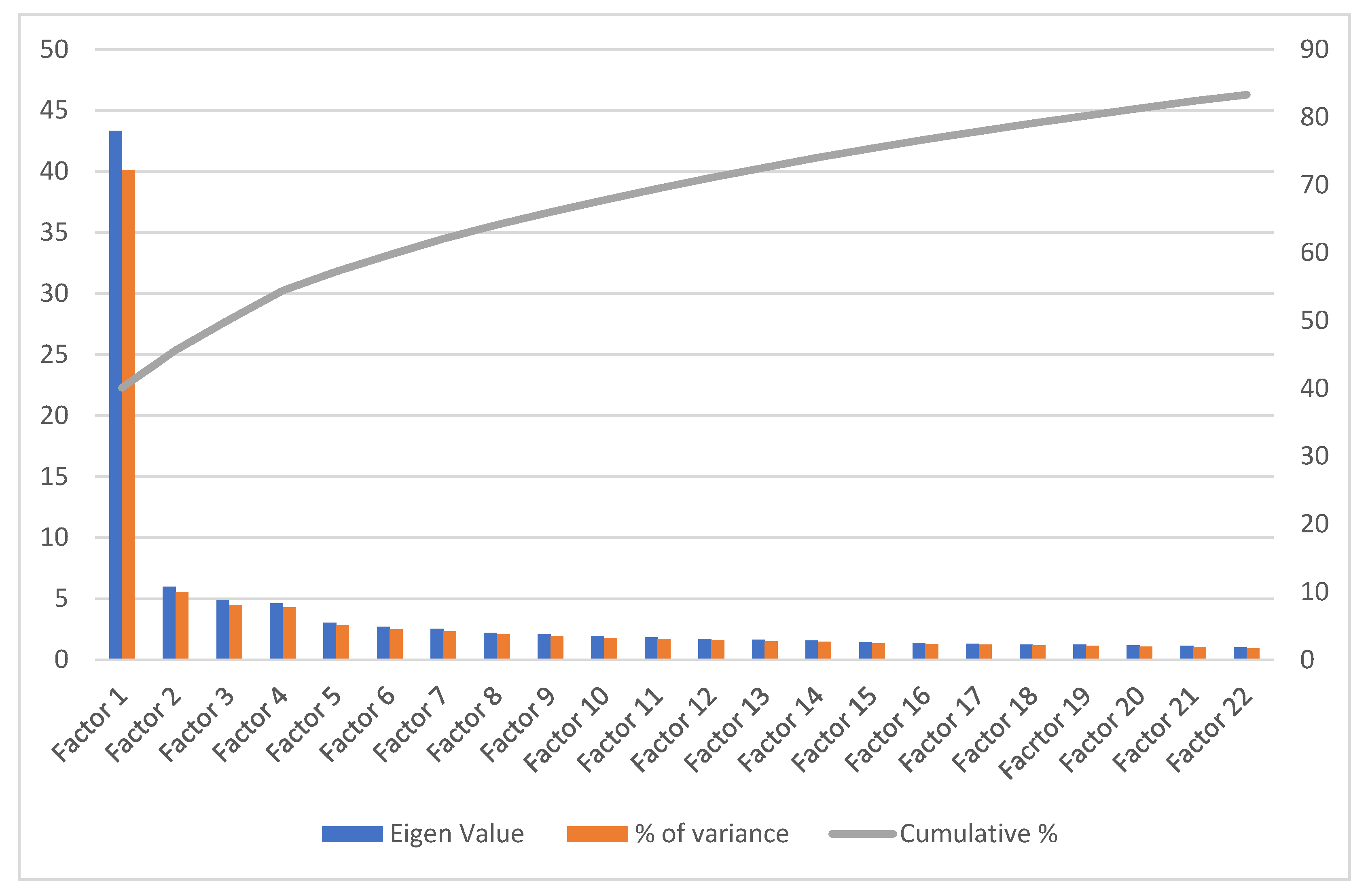
The factor analysis (Table 2) of 109 items/variables produces various factors, but factors with eigenvalues of ≥1.00 were retained and the remaining discarded. Altogether, 22 factors were retained with eigenvalues greater than 1.00 (Figure 4 and Table 2). On the other hand, 102 items/statements (x1–x13, x15–x25–x32, x35, x36, x38–x40, x42–x49, x51–x77, and x79–x109) were retained based on a factor loading ≥0.35 with a communality ≥0.70 (Table 2), and the remaining 7 items/statements (x14, x33, x34, x37, x41, x50, and x78) were discarded due to low factor loading (Table 1). The overall Cronbach alpha value of 109 items is 0.985, and the cumulative percentage of variance is 83.32. Patra and Babu [62] reported a Cronbach alpha value of 0.857 with a cumulative percentage of variance of 86.15%, and the CCRPM of Linden [57] explained around 70% of the variance.
The determination of stakeholders’ ‘Knowledge need’ is crucial for filling the knowledge gap in adaptation planning [50,69], an appropriate adaptation strategy [70], and policy decisions [71]. Subsequently, Factor 1 accounts for 40.12% of data variability. Altogether, 16 items/statements (x44, x46, x52, x54, x55, x57, x59, x60, x61, x62, x63, x64, x65, x66, x67, and x68) are retained under Factor 1. The Cronbach alpha value of the factor is 0.938. Factor 13 accounts for 1.51% of the data variability with one (x43) variable. Factor 14 accounts for 1.48% of the data variability and retains three items/statements (x40, x53, and x56). Factor 15 accounts for 1.35% of the data variability and retains three items/statements (x42, x45, and x58). Further, Factor 20 and Factor 22 account for 1.08% and 1.01% of the data variability; each retains a single item/statement (x17 and x44, respectively). Altogether, 24 similar items/statements are retained under Indicator-I (Factor 1, Factor 13, Factor 14, Factor 15, Factor 20, and Factor 22). ‘Respondents’ Knowledge and perception of agricultural CC, emission of GHGs and mitigation strategy’ (Table 2) is the nomenclature of Indicator-I, and items are associated with exploring the same. Further, of the 24 items/statements, 7 are associated with mitigation strategies (x45, x46, x54–x57, and x59) for agricultural GHG emissions. Similar types of items/statements were emphasized in the development of the CC perception scale by van Valkengoed et al. [43]).
Farmers’ adoption of environmentally friendly practices is less than achievable [72]. The IPCC has recognized the strength of traditional and local knowledge for mitigation and adaptation to CC [1,73]. CC knowledge among farmers significantly influences their CC adaptation [64]. Guiding farmers on CC adaptation has sustainably impacted CC adaptation [74]. Concerning adaptation, Factor 2 has an eigenvalue of 5.97 with a data variability of 5.54%. The Cronbach alpha value of Factor 2 is 0.939, and 12 items/statements (x90–x92, x94, and x102–x109) are retained under this factor. Further, nine items/statements (x92 and x102-x109) are associated with adaptation strategies to agricultural CC. Factor 2, with 12 items/statements, constitutes Indicator-II. Based on the retained items/statements, the nomenclature is given as ‘Sustainable adaptation to agricultural CC’. Concerning this, Asrat and Simane [75], Madaki et al. [76], and Raghuvanshi and Ansari [77] immensely prioritized adaptation-related issues. On the other hand, Sara and Terre [78] studied genetically engineered crops for CC adaptation.
CC is placing massive pressure on the availability of critical resources, namely, water, energy, and food [79]. Further, the FAO [80] found that CC is putting tremendous pressure on water resources. Therefore, CC is impacting various dimensions. Here, we concentrate on the diversity of the effects of CC on agriculture and allied sectors. At this juncture, Factor 4 retains nine items/statements, namely x7, x77, x93, x96, x97, x98, x99, x100, and x101. The data variability is 4.28%, with a Cronbach alpha value of 0.937. Factor 6 also retains five items/statements (x86, x87, x88, x89, and x95) with 2.50% data variability and a Cronbach alpha of 0.930. All the items/statements under Factor 4 and Factor 6 are highly concerned about the occurrences of climatic hazards, impacts, and exposure to climatic hazards. Accordingly, Indicator-III is constituted by Factor 4 and Factor 6, and the nomenclature is given as ‘Effect of CC on Agriculture’. Regarding this, Thaker et al. [60] immensely emphasized climatic hazards and exposure to assess the perception of climatic hazards.
The impact of CC on different contexts and dimensions should be considered [71]. Similarly, Indicator-IV is constituted by four factors (Factors 3, 8, 11, and 19), and the nomenclature is given as ‘Impact of CC or Occurrence of CC consequences.’ Factor 3 retains nine items/statements (x51, x73, x79, x80, x81, x82, x83, x84, and x85) with a data variability of 4.49% and Cronbach alpha value of 0.939. Factor 8 retains five items/statements (x1, x3, x4, x5, and x6) with 2.05% data variability and a Cronbach alpha value of 0.893. On the other hand, Factor 11 retains three items/statements (x36, x38, and x39) with a data variability of 1.69% and Cronbach alpha value of 0.916. Factor 19 retains only one item/statement (x35) with a data variability of 1.14%. Eventually, the impact of CC was also taken into account by Patra and Babu [62], Asrat and Simane [75], Madaki et al. [76], and Raghuvanshi and Ansari [77] in a similar type of scale construction.
Stakeholders’ collaborative role in adaptation is widely accepted [81]. Assessing stakeholders’ willingness to act on CC is essential for appropriate policy formulation [82]. The knowledge and perception levels of community/farmers regarding CC accelerate their willingness to act on CC adaptation [83]. Concerning the knowledge and perception of CC, Factor 5, Factor 7, Factor 9, Factor 16, and Factor 17 accounted for 2.82%, 2.34%, 1.90%, 1.28%, and 1.23% of the total data variability, with Cronbach alpha values of 0.892, 0.889, 0.844, 0.897, and 0.693, respectively, and these were taken into consideration for the assessment of the knowledge and perception levels of farmers. Factor 5 retained eight items/statements (x12, x13, x18, x19, x20, x21, x22, and x23), and Factor 7 retained four items/statements (x26, x27, x28, and x32). Similarly, Factor 9 retained five items/statements (x8, x9, x10, x11, and x49), Factor 16 retained four items/statements (x29, x30, x31, and x47), and Factor 17 retained two items/statements (x15 and x16). Based on the retained items/statements, these factors are closely related to the general awareness and knowledge of CC. Accordingly, Indicator-V is constituted by these factors; the nomenclature is given as ‘Basic/general awareness/knowledge and perception on CC’. Linden [57] and Xie et al. [58] emphasized the cause and impact/influence of knowledge in their scale construction.
CC negatively impacts life, livelihood, agriculture, and livestock [1]. Rijal et al. [84] reported that the diversification of livelihoods and agricultural practices are the two most common adaptation strategies. Factor 10 retained four items/statements (x69, x70, x71, and x72) with a data variability of 1.76% and Cronbach alpha value of 0.908. Factor 12 retained five items/statements (x25, x48, x74, and x75) with a data variability of 1.60% and Cronbach alpha value of 0.805. Similarly, Factor 18 and Factor 21 retained one item/statement each (x24 and x2) with a variability of 1.16% and 1.06%. Further, concerning the retained items/statements in the four factors, all are well connected to the consequences and impacts of CC. Accordingly, Indicator-VI was formed with four factors and has a nomenclature given as ‘Impact of CC on life and livelihood.’ In this respect, Madaki et al. [76] and Raghuvanshi and Ansari [77] also emphasized these issues during scale construction.
Subsequently, we assess the internal consistency and reliability of the scale, including the 109 items/statements and the individual factors, using the Cronbach alpha value. The Cronbach alpha for 109 items is 0.985, indicating that the scale items have high internal consistency. Therefore, it can be concluded that the constructed scale and its items are highly consistent, appropriate, and reliable for measuring farmers’ knowledge and perceptions. This finding aligns with the findings of Patra and Babu [62]. Further, the Cronbach alpha values for Factors 1, 2, 3, 4, 6, 10, and 11 are ≥0.900. The Cronbach alpha values for Factors 5, 7, 8, 9, 12, and 16 are ≥0.800. Similarly, the Cronbach alpha values for Factors 14, 15, and 17 are ≥ 0.700. On the other hand, Cronbach alpha analysis is not possible for Factors 13, 18, 19, 20, 21, and 22 because each of these factors contains only one item/statement. Further, the scale explains around 83.32% of data variability. Therefore, it can be concluded that the constructed scale is highly consistent and reliable, as the value of the reliability coefficient for the entire scale is 0.985; for the seven Factors, it is also >0.900; for six factors, it is >0.800 (the recommended value is ≥0.800).

Application of Scale for Assessment of Farmers’ Awareness, Knowledge, and Perceptions of CC

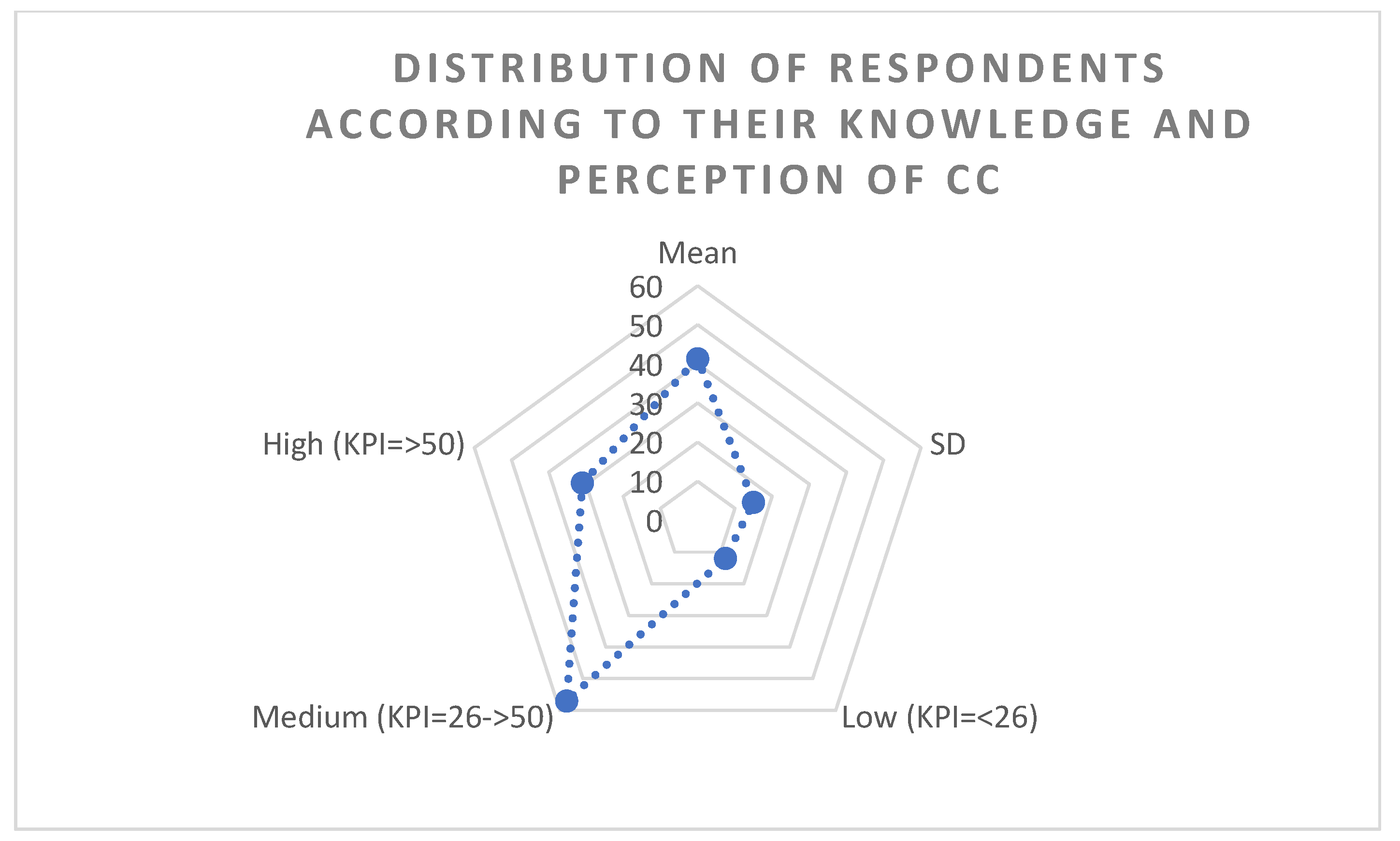
Farmers are playing a front-line and leading role in CC adaptation in the farming sector [85]. Further, farmers’ CC knowledge is positively associated with their CC perception [76]. In this section, we evaluate the developed scale’s consistency for measuring farmers’ knowledge and perceptions of CC. All items/statements (Table 2) of the constructed scale (102 items/statements) are included as components in the KPI to assess farmers’ level of knowledge and perceptions of CC. Accordingly, all items/statements are included in the interview schedule, with responses rated on a 3-point continuum (2, 1, and 0). The possible range of scores is 0.00 to 204.00 (102 × 2). The scores achieved by all respondents ranged from 5.39 to 78.92, with a mean score of 41.37 and a standard deviation value of 15.03 (Figure 5). According to their KPI score, further respondents are categorized into three groups: low, medium, and high. It is clear that around 57.00% of the farmers are classified under the medium category, and around 69.00% (Figure 5) of the farmers achieved KPI scores that are under 50.00% of the maximum achievable score, and the respondents’ overall knowledge and perception level is relatively low (mean score: 41.37). Accordingly, it can be concluded that in the study area, farmers have a huge inadequacy of CC knowledge and perception.

4. Discussion

This study developed a multidimensional and statistically robust scale to assess farmers’ knowledge and perceptions of climate change (CC) in the Himalayan Mountain region. The six indicators that emerged from factor analysis represent distinct yet interconnected dimensions of CC knowledge, perception, and experiential understanding. The following discussion is organized around these six indicators. The indicators derived from factor analysis reveal a strong conceptual structure aligned with existing CC perception frameworks, such as those by van Valkengoed et al. [43] and Linden [57].

4.1. Knowledge and Perception

Indicator-I reflects farmers’ understanding of how agricultural activities contribute to greenhouse gas (GHG) emissions, carbon dynamics, and available mitigation options. Items retained under this indicator emphasize knowledge of soil carbon exposure, fertilizer management practices, rice field emissions, livestock-related emissions, and mitigation strategies such as composting, SRI, zero tillage, and proper manure handling. The strength of this indicator confirms that mitigation-related concepts are conceptually distinct within farmers’ cognitive frameworks. However, field application revealed that while farmers have a general awareness of agriculture–climate interactions, their technical understanding of mitigation practices remains limited. This aligns with van Valkengoed et al. [43], who found that mitigation perceptions require higher-order conceptual knowledge, often lacking in rural populations. The indicator highlights a critical gap and an urgent need to address climate literacy. Farmers experience climate stress but are less familiar with emission-reducing agronomic interventions. Strengthening this knowledge is essential for promoting low-carbon agriculture and meeting broader regional climate action goals.

4.2. Sustainable Adaptation

Indicator-II captures farmers’ awareness of adaptation strategies, including changing crop duration, shifting planting windows, integrated water management, mulching, farm ponds, intercropping, and transitioning from shifting to settled cultivation. These strategies reflect well-established adaptation pathways recommended in mountainous and rainfed ecosystems [75,76]. The strong performance of adaptation-related items in factor analysis suggests that farmers more readily grasp strategies that are practical, experience-based, and directly relevant to their production systems. Yet, the KPI results indicate that despite familiarity with some adaptation practices, overall adoption and deeper understanding remain limited. This is consistent with global findings [80] that emphasize barriers such as resource constraints, limited extension access, incentives to adopt sustainable practices, and insufficient technical guidance. Indicator-II, therefore, underscores the need for reinforcing adaptation extension programs that translate scientific recommendations into actionable, locally tailored practices.

4.3. Effects of Climate Change on Agriculture

Indicator-III consolidates farmers’ perceptions of CC impacts on crops and livestock, including increased pest and disease pressure, reduced milk production, livestock mortality, fodder scarcity, and additional burdens such as water collection challenges during hot or drought periods. The items in this indicator reflect direct experiential evidence consistent with documented impacts in the Himalayan region [21] and other developing countries experiencing agroecological stress. The farmers’ strong agreement with these impact-related items demonstrates that their operations are likely being affected by the effects of climate change. However, their limited ability to link these observable changes to broader CC processes reflects a disconnect between experiential knowledge and scientific understanding. This distinction is important because it suggests that while farmers can identify symptoms of CC, they may not possess the conceptual tools needed to anticipate future risks or select appropriate interventions without targeted climate education.

4.4. Occurrence of Climate Hazards

Indicator-IV covers farmers’ perceptions of extreme climatic events—landslides, floods, droughts, heavy rainfall, strong winds, cyclones, unpredictable monsoon behavior, and glacial influences. The clustering of natural disaster-related items into this indicator highlights the centrality of climate hazards in shaping farmers’ lived experiences and risk perceptions. These findings are consistent with regional reports showing increased climate variability and hazard frequency in the Himalayan belt [1,15]. Farmers’ strong recognition of hazard patterns indicates that climate shocks form a major component of their CC awareness. However, while their experiential understanding is strong, conceptual gaps remain in interpreting climate drivers or linking these hazards to long-term climate trends. This emphasizes the value of community-level climate services, early warning dissemination, and participatory hazard mapping to enhance preparedness and adaptive decision-making.

4.5. Awareness/Knowledge of Climate Change

Indicator-V incorporates farmers’ general climate literacy, such as their awareness of greenhouse gases, climate drivers, environmental degradation, fossil fuel emissions, ozone depletion, and modernization-related impacts. This indicator corresponds to foundational CC knowledge highlighted in global perception models [57,58]. Despite the comprehensive nature of these items, the KPI results show that overall general awareness remains low. This mirrors findings from northeastern India and other developing regions where CC is increasingly observed but not thoroughly understood [37,86]. Limited educational levels, insufficient climate communication infrastructure, and the relatively recent introduction of CC concepts contribute to these gaps. Strengthening Indicator-V through targeted capacity-building efforts is essential, as general awareness provides the cognitive base for interpreting climate signals, evaluating risks, and adopting mitigation and adaptation practices.

4.6. Impact of Climate Change on Livelihood

Indicator-VI addresses farmers’ perceptions of CC impacts beyond agriculture, including effects on the health, well-being, comfort levels, habitability, and vulnerability of coastal or warm regions. It reflects how farmers conceptualize climate change as a broader socio-environmental threat rather than solely an agricultural issue. The inclusion of these livelihood dimensions aligns with the literature recognizing CC as a multidimensional stressor affecting food security, health systems, income stability, and living conditions [1]. Farmers’ strong agreement with these items suggests an intuitive understanding that CC affects all aspects of life, even if they lack detailed scientific explanations. This indicator reinforces the need for resilience-building programs that integrate agriculture, public health, disaster preparedness, and social protection.

4.7. Enhancing the Capacity of Farmers

There may be various reasons for farmers’ low KPIs for CC. Experts also recognized that the concept of CC is relatively new to the farming community, and farmers may face problems in response to each item/statement. Accordingly, experts have suggested avoiding negative items/statements in the scale. Various studies have been conducted on improved cultivation practices, focusing on farmers’ knowledge and perception in the present study area. The knowledge and perception of the farmers in the present study area are relatively inadequate. For instance, Patra and Kense [87] reported a low level of knowledge among Mandarin growers in Nagaland. Patra et al. [88] also reported a low level of knowledge of rubber growers in Nagaland, India. Lathmawii et al. [37] and Patra et al. [38] from NER, India, also reported a similar observation. Patra et al. [84] also reported a significant lack of knowledge on improved maize cultivation in Nagaland, India. Finally, by collating and comparing the findings of the present study on farmers’ KPIs of CC using the constructed scale and previous findings in a similar genre, it can also be concluded that the constructed scale has sufficient consistency to assess farmers’ knowledge and perceptions of CC.
Enhancing farmers’ climate literacy is essential to translating the analytical insights of this study into on-farm actions. The findings highlight that improved access to localized climate information, clearer interpretation of indicators, and timely communication of emerging risks can strengthen growers’ ability to make informed decisions under increasing uncertainty. Building climate literacy requires a combination of practical, locally relevant, and tailored tools such as seasonal outlooks, heat risk, and yield risk summaries, delivered by trained extension professionals through workshops, demonstration sites, and peer-learning networks. By integrating the six indicators evaluated in this manuscript into grower-centered decision support products, farmers can better understand how climate signals relate to management choices, anticipate adverse conditions earlier, and adopt adaptive strategies with greater confidence. Ultimately, strengthening climate literacy bridges the gap between scientific assessments and farm-level action, enabling more proactive and climate-smart agricultural systems.

5. Concluding Remarks

Initially, out of 138 items/statements, 109 items/statements were retained, and 29 were discarded. Further, we applied factor analysis with the principal component method and varimax rotation with 109 items/statements, retaining 102 items (from 14 dimensions) under 22 factors. Subsequently, six indicators were developed, namely, Indicator-I—‘Respondents’ Knowledge and perception of agricultural CC, emission of GHGs and mitigation strategy;’ Indicator-II—‘Sustainable adaptation to agricultural CC;’ Indicator-III—‘Effect of CC on agriculture;’ Indicator-IV—‘Impact of CC or Occurrence of CC consequences;’ Indicator-V—‘Basic/general awareness/knowledge of CC;’ and Indicator-VI—‘Impact of CC on life and livelihood.’
Regarding the scale’s internal consistency, the Cronbach alpha for 109 items was 0.985, indicating high internal consistency. Cronbach’s alpha values for Factors 1, 2, 3, 4, 6, 10, and 11 were ≥0.900. Cronbach’s alpha values for Factors 5, 7, 8, 9, 12, and 16 were ≥0.800. Simultaneously, the scale explained around 83.32% of data variability. Accordingly, it can be concluded that the constructed scale is highly consistent and reliable. Further, the reliability coefficient for the entire scale was 0.985; for seven factors, it was >0.900; and for six factors, it was >0.800 (the recommended value is ≥0.80). Therefore, it can be concluded that the constructed scale and its items were highly consistent, appropriate, and reliable in measuring farmers’ knowledge and perceptions of CC. Lastly, we evaluated the developed scale’s consistency for measuring farmers’ knowledge and perceptions of CC. All 102 items/statements were included in the interview schedule, with a 3-point response continuum. A total of 100 farmers were included as respondents. Based on the scale’s application, we concluded that it is highly consistent and accurate in mapping farmers’ level of knowledge and perceptions regarding CC.
Finally, it can be concluded that the developed conceptual framework (Figure 2) and scale are appropriate to adopt for any scale construction (perception scale, awareness scale, knowledge scale, and attitude scale) in society for any discipline under social and behavioral sciences and any part of the world to map respondents’ knowledge and perceptions about CC and CC adaptation. The policy and research systems may adopt the framework and scale to assess stakeholders’ inclusive knowledge and perceptions of CC worldwide. The findings of this study may be helpful for policymakers, development workers, and extension functionaries in the Himalayan and other mountain regions, as well as in other areas of the planet, for mitigation and adaptation to CC and sustainable, resilient building to combat CC. Despite its many positive aspects, this study’s major limitation is that it relies on judges’ and respondents’ perceptions and recall abilities. Eventually, the possibility of bias and error is present. When adopting the scale in future research, researchers may develop a need-based strategy to minimize the influence of error.

Author Contributions

Conceptualization, N.K.P. and L.A.J.; methodology, N.K.P., L.A.J. and T.B.P.; software, N.K.P. and L.A.J.; validation, N.K.P., L.A.J. and T.B.P.; formal analysis, N.K.P. and L.A.J.; investigation, N.K.P. and L.A.J.; data curation, L.A.J. and N.K.P.; writing-original draft preparation, N.K.P., L.A.J. and T.B.P.; writing-reviewing and editing, N.K.P., T.B.P. and L.A.J.; visualization, N.K.P., L.A.J. and T.B.P.; supervision, N.K.P. All authors have read and agreed to the published version of the manuscript.

Funding

The authors declare that no financial support was received for the research.

Data Availability Statement

The original contributions presented in the study are included in the article; further inquiries can be directed to the corresponding author.

Acknowledgments

The authors would like to thank all experts, judges and respondents who helped to complete this study. We are also thankful Sagar Mondal and R. R. Burman for their support on methodology for scale construction. We are also We would also like to express our sincere gratitude to the three anonymous reviewers for their insightful comments and suggestions. Their feedback significantly enhanced the quality of our manuscript, leading to substantial improvements beyond our initial draft, ultimately strengthening the overall impact of our research.

Conflicts of Interest

The authors declare no conflict of interest.

References

  1. IPCC. Climate Change 2022: Impacts, Adaptation and Vulnerability. Contribution of Working Group II to the Sixth Assessment Report of the IPCC; Portner, H.O., Roberts, D.C., Tignor, M., Poloczanska, E.S., Okem, K., Rama, B., Eds.; Cambridge University Press: Cambridge, UK; New York, NY, USA, 2022; p. 3056. Available online: https://report.ipcc.ch/ar6/wg2/IPCC_AR6_WGII_FullReport.pdf (accessed on 24 April 2025).
  2. Chanda, N.; Chintalacheruvu, M.R.; Choudhary, A.K. Exploring climate-change impacts on streamflow and hydropower potention: Insights from CMIP6 multi-GCM analysis. J. Water Clim. Change 2024, 15, 4476. [Google Scholar] [CrossRef]
  3. Fujimori, S.; Hasegawa, T.; Oshiro, K.; Zhao, S.; Sasaki, K.; Takakura, J.; Takahashi, K. Potential side effects of climate change mitigation on poverty and countermeasures. Sustain. Sci. 2023, 18, 2245–2257. [Google Scholar] [CrossRef]
  4. Moyer, J.D.; Pirzadeh, A.; Irfan, M.; Solorzano, J.; Stone, B.; Xiong, Y.; Hanna, T.; Hughes, B.B. How many people will live in poverty because of CC? A macro-level projection analysis to 2070. Clim. Change 2023, 176, 137. [Google Scholar] [CrossRef]
  5. IPCC. Climate Change 2014: Synthesis Report. Contribution of Working Groups I, II and III to the Fifth Assessment Report of the Intergovernmental Panel on Climate Change; Pachauri, R.K., Meyer, L.A., Eds.; IPCC: Geneva, Switzerland, 2014. [Google Scholar]
  6. Patra, N.K.; Babu, S.C. Mapping Indian Agricultural Emissions Lessons for Food System Transformation and Policy Support for Climate-Smart Agriculture. IFPRI Discuss. Pap. 2017, 01660. Available online: www.ifpri.org (accessed on 24 April 2025).
  7. Stewart, S.A.; Arbuthnott, K.D.; Sauchyn, D.J. Climate change perceptions and Associate Sharacteristics in Canadian Prairie Agricultureal Producers. Challenges 2023, 14, 54. [Google Scholar] [CrossRef]
  8. Barry, M.; Wreford, A.; Knook, J.; Teixeira, E.; Monge, J.; Parker, A. Diversification as a climate change adaptation strategy in viticulture systems: Winegrowers’ insights from Marlboroug, New Zealand. Agroecol. Sustain. Food Syst. 2024, 49, 494–517. [Google Scholar] [CrossRef]
  9. Bhatnagar, S.; Chaudhary, R.; Sharma, S.; Janjhua, Y.; Thakur, P.; Sharma, P.; Keprate, A. Exploring the dynamics of climate-smart agriculture practices for sustainable resilience in a changing climate. Environ. Sustain. Indic. 2024, 24, 100535. [Google Scholar] [CrossRef]
  10. Karki, S.; Burton, P.; Mackey, B. The experience and perceptions of farmers about the impact of climate change and variability on crop production: A review. Clim. Dev. 2019, 12, 80–95. [Google Scholar] [CrossRef]
  11. Jayadas, A.; Ambujam, N.K. Research and design of a farmer resilience index in coastal farming communities of Tamil Nadu, India. J. Water Clim. Change 2021, 12, 3143–3158. [Google Scholar] [CrossRef]
  12. Mugambiwa, S.S.; Makhubele, J.C. Indigenous knowledge systems based climate governance in water and land resource management in rural Zimbabwe. J. Water Clim. Change 2021, 12, 2045–2054. [Google Scholar] [CrossRef]
  13. Alexandridis, N.; Feit, B.; Kihara, J.; Luttermoser, T.; May, W.; Midega, C.; Öborn, I.; Poveda, K.; Sileshi, G.W.; Zewdie, B.; et al. Climate change and ecological intensification of agriculture in sub-Saharan Africa—A systems approach to predict maize yield under push-pull technology. Agric. Ecosyst. Environ. 2023, 352, 108511. [Google Scholar] [CrossRef]
  14. Hesam, M.; Roshan, G.; Grab, S.W.; Shabahrami, A.R. Comparative assessment of farmers’ perception on drought impacts: The case of a coastal lowland versus adjoining mountain foreland region of northern Iran. Theor. Appl. Climatol. 2021, 143, 489–503. [Google Scholar] [CrossRef]
  15. Rani, S.; Tiwari, P. climate change vulnerability assessment for adaptation planning in Uttarakhand, Indian Himalaya. Int. J. Disaster Risk Reduct. 2024, 114, 104938. [Google Scholar] [CrossRef]
  16. Jain, S.K.; Kumar, V.; Saharia, M. Analysis of rainfall and temperature trends in northeast India. Int. J. Clim. 2013, 33, 968–978. [Google Scholar] [CrossRef]
  17. Dimri, A.P.; Niyogi, D. Regional climate model application at subgrid scale on Indian monsoon over the western Himalyas. Int. J. Climatol. 2013, 33, 2185. [Google Scholar] [CrossRef]
  18. Borgaonkar, H.; Ram, S.; Sikder, A. Assessment of tree-ring analysis of high-elevation Cedrus deodara D. Don from Western Himalaya (India) in relation to climate and glacier fluctuations. Dendrochronologia 2009, 27, 59–69. [Google Scholar] [CrossRef]
  19. Deb, P.; Shrestha, S.; Babel, M.S. Forecasting climate change impacts and evaluation of adaptation options for maize cropping in the hilly terrain of Himalayas: Sikkim, India. Theor. Appl. Climatol. 2015, 121, 649–667. [Google Scholar] [CrossRef]
  20. Government of India. Governance for Sustaining Himalayan Ecosystem. GSHE Guidelines and Best Practices; Ministry of Environment & Forests, Govind Ballabh Pant Institute of Himalayan Environment & Development, Government of India: Almora, India, 2006. Available online: http://gbpihed.gov.in/PDF/Publication/G-SHE_Book.pdf (accessed on 14 May 2025).
  21. Dahal, K.R.; Dahal, P.; Adhikari, R.K.; Naukkarinen, V.; Panday, D.; Bista, N.; Helenius, J.; Marambe, B. climate change Impact and Adaptation in a Hill Farming System of the Himalayan Region: Climate Trends, Farmers’ Perceptions and Practices. Climate 2023, 11, 11. [Google Scholar] [CrossRef]
  22. Patra, N.K.; Benjongtoshi. Sustainable performance of French bean (Phaseolus vulgaris L.) cultivation, a livelihood component in Eastern Himalayan Region. Int. J. Agric. Sustain. 2023, 21, 2247784. [Google Scholar] [CrossRef]
  23. Ado, A.M.; Leshan, J.; Savadogo, P.; Bo, L.; Shah, A.A. Farmers’ awareness and perception of climate change impacts: Case study of Aguie district in Niger. Environ. Dev. Sustain. 2019, 21, 2963–2977. [Google Scholar] [CrossRef]
  24. Bhadwal, S.; Sharma, G.; Gorti, G.; Sen, S.M. Livelihoods, gender and climate change in the Eastern Himalayas. Environ. Dev. 2019, 31, 68–77. [Google Scholar] [CrossRef]
  25. Johnson, O.W.; du Pont, P.; Gueguen-Teil, C. Perception of climate-related risk in Southeast Asia’s power sector. Clim. Policy 2021, 21, 264–276. [Google Scholar] [CrossRef]
  26. Hossen, M.A.; Netherton, C.; Benson, D.; Rahman, R.M.; Salehin, M.A. Governance Perspective for climate change Adaptation: Conceptualizing the Policy-Community interface in Bangladesh. Environ. Sci. Policy 2022, 137, 174–184. [Google Scholar] [CrossRef]
  27. Skeiryte, A.; Krikstolaitis, R.; Liobikiene, G. The differences of climate change perception, responsibility and climate-friendlybehaviour among generations and the main determinants of youth’s climate-friendly actions in the EU. J. Environ. Manag. 2022, 323, 116277. [Google Scholar] [CrossRef] [PubMed]
  28. Sertse, S.F.; Khan, N.A.; Shah, A.A.; Liu, Y.; Naqvi, S.A.A. Farm households’ perceptions and adaptation strategies to climate change risks and their determinants: Evidence from Raya Azebo district, Ethiopia. Int. J. Disaster Risk Reduct. 2021, 60, 102255. [Google Scholar] [CrossRef]
  29. Duijndam, S.J.; Botzen, W.W.; Endendijk, T.; de Moel, H.; Slager, K.; Aerts, J.C.J.H. A look into out future under climate change? Adaptation and mitigation intentions following extreme flooding in the Netherlands. Int. J. Disaster Risk Reduct. 2023, 95, 103840. [Google Scholar] [CrossRef]
  30. Patra, N.K.; Rilung, T.; Das, L.; Kumar, P. Assessing climate change and its impact on kiwi (Actinidia deliciosa Chev.) production in the Eastern Himalayan Region of India through a combined approach of people perception and meteorological data. Theor. Appl. Climatol. 2024, 155, 2347–2364. [Google Scholar] [CrossRef]
  31. Hemandez Lopez, J.A.; Puerta-Cortes, D.X.; Andrade, H.J. Predictive analysis of Adaptation to Drought of Farmers in the central Zone of Colombia. Sustainability 2024, 16, 7210. [Google Scholar] [CrossRef]
  32. Datta, P.; Behera, B. Do farmers perceive climate change clearly? An analysis of meteorological data and farmers’ perceptions in the sub-Himalayan West Bengal, India. J. Water Clim. Change 2022, 13, 2188. [Google Scholar] [CrossRef]
  33. Nicolletti, M.; Maschietto, F.; Moreno, T. Integrating social learning into climate change adaptation public policy cycle: Building upon from experiences in Brazil and the United Kingdom. Environ. Dev. 2020, 33, 100486. [Google Scholar] [CrossRef]
  34. Zhao, J.; Radke, J.; Chen, F.S.; Sachdeva, S.; Gershman, S.J.; Luo, Y. How do we reinforce climate action? Sustain. Sci. 2024, 19, 1503–1517. [Google Scholar] [CrossRef]
  35. Bloom, B.S.; Engelhart, M.D.; Furst, E.J.; Hill, W.H.; Krathwohl, D.R. Taxonomy of Educational Objectives: The Classification of Educational Goals. In Handbook I: Cognitive Domain; David Mckay Company: Philadelphia, PA, USA, 1956. [Google Scholar]
  36. Government of India. Census Data. 2011. Available online: www.censusindia.gov.in/2011-common/censusdataonline.html (accessed on 14 June 2023).
  37. Lalthamawii; Patra, N.; Sailo, Z. Knowledge and Adoption Status of Recommended Practices of Rice by Farmers in Mizoram, India. Indian Res. J. Ext. Educ. 2022, 22, 91–98. [Google Scholar] [CrossRef]
  38. Patra, N.; Lalthamawii; Rohith, G.; Das, S. Socio-economic and Psychological Status of Rice (Oryza sativa L.) Growers and Constraints in Cultivation: Evidence from Mizoram, India. J. Community Mobilization Sustain. Dev. 2023, 18, 1057–1065. [Google Scholar] [CrossRef]
  39. Tiller, R.; Booth, A.M.; Cowan, E. Risk Perception and Risk Realities in Forming Legally Blinding Agreements: The Governance of Plastics. Environ. Sci. Policy 2022, 134, 67–74. [Google Scholar] [CrossRef]
  40. Vijhani, A.; Sinha, V.S.P.; Vishwakarma, C.A.; Singh, P.; Pandey, A.; Govindan, M. Study of stakeholders’ perceptions of climate change and its impact on mountain communities in central Himalaya, India. Environ. Dev. 2023, 46, 100824. [Google Scholar] [CrossRef]
  41. Bitew, A.B.; Minale, A.S. Smallholder farmers’ perceptions of climate variability and its risks across agroecological zones in the Ayehu watershed, Upper Blue Nile. Environ. Sustain. Indic. 2025, 25, 100546. [Google Scholar] [CrossRef]
  42. Klein, A.O.; Carlisle, L.; Lloyd, M.G.; Sayre, N.F.; Bowles, T.M. Understanding farmers knowledge of soil and soil management: A case study of 13 organic farms in an agricultural land scape of northern California. Agroecol. Sustain. Food Syst. 2023, 48, 17–49. [Google Scholar] [CrossRef]
  43. van Valkengoed, A.; Steg, L.; Perlaviciute, G. Development and validation of a climate change perceptions scale. J. Environ. Psychol. 2021, 76, 101652. [Google Scholar] [CrossRef]
  44. Lounis, M.; Madani, A.; Boutebal, S.E. Perception and Knowledge of Algerian Students about Climate change and its Putative Relationship with the COVID-19 Pandemic: A Preliminary Cross-Sectional Survey. Climate 2023, 11, 90. [Google Scholar] [CrossRef]
  45. Boudet, H.; Giordono, L.; Zanocco, C.; Satein, H.; Whitley, H. Event attribution and partisanship shape local discussion of climate change after extreme weather. Nat. Clim. Change 2020, 10, 69–76. [Google Scholar] [CrossRef]
  46. Spence, A.; Poortinga, W.; Butler, C.; Pidgeon, N.F. Perception of climate change and willingness to save energy related to flood experience. Nat. Clim. Change 2011, 1, 46–49. [Google Scholar] [CrossRef]
  47. Ruiz, I.; Faria, S.H.; Neumann, M.B. climate change Perception: Driving Forces and Their Interactions. Environ. Sci. Policy 2020, 108, 112–120. [Google Scholar] [CrossRef]
  48. Rayamajhee, V.; Guo, W.; Bohara, A.K. The perception of climate change and the demand for weather- index microinsurance: Evidence from a contingent valuation survey in Nepal. Clim. Dev. 2021, 14, 557–570. [Google Scholar] [CrossRef]
  49. Cheval, S.; Bulai, A.; Croitoru, A.-E.; Dorondel, Ș.; Micu, D.; Mihăilă, D.; Sfîcă, L.; Tișcovschi, A. climate change perception in Romania. Theor. Appl. Climatol. 2022, 149, 253–272. [Google Scholar] [CrossRef] [PubMed]
  50. Tiwari, A.; Rodrigues, L.C.; Nalakurthi, S.-R.; Gharbia, S. Public perceptions of climate risks, vulnerability, and adaptation strategies: Fuzzy cognitive mapping in Irish and Spanish living labs. Environ. Sustain. Indic. 2025, 26, 100678. [Google Scholar] [CrossRef]
  51. Wilson, R.S.; Zwickle, A.; Walpole, H. Developing a Broadly Applicable Measure of Risk Perception. Risk Anal. 2019, 39, 777–791. [Google Scholar] [CrossRef]
  52. Yong, A.G.; Pearce, S. A Beginner’s Guide to Factor Analysis Focusing on Exploratory Factor Analysis. Tutor. Quant. Meth. Psychol. 2013, 9, 79–94. [Google Scholar] [CrossRef]
  53. Bostrom, A.; O’Connor, R.E.; Böhm, G.; Hanss, D.; Bodi, O.; Ekström, F.; Halder, P.; Jeschke, S.; Mack, B.; Qu, M.; et al. Casual thinking and support for climate change policies: International survey findings. Glob. Environ. Change 2012, 22, 210–222. [Google Scholar] [CrossRef]
  54. Guy, S.; Kashima, Y.; Walker, I.; O’Neill, S. Investigating the effects of knowledge and ideology on climate change beliefs: Knowledge, ideology, and climate change beliefs. Eur. J. Soc. Psychol. 2014, 44, 421–429. [Google Scholar] [CrossRef]
  55. Heath, Y.; Gifford, R. Free Market ideology environmental degradation: The case of belief in global climate change. Environ. Behav. 2006, 38, 48–71. [Google Scholar] [CrossRef]
  56. Poortinga, W.; Whitmarsh, L.; Steg, L.; Böhm, G.; Fisher, S. Climate change perceptions and their individual-level determinants: A cross-European analysis. Glob. Environ. Change 2019, 55, 25–35. [Google Scholar] [CrossRef]
  57. van der Linden, S. The social-psychological determinants of climate change risk perceptions: Towards a comprehensive model. J. Environ. Psychol. 2015, 41, 112–124. [Google Scholar] [CrossRef]
  58. Xie, B.; Brewer, M.B.; Hayes, B.K.; McDonald, R.I.; Newell, B.R. Predicting climate change risk perception and willingness to act. J. Environ. Psychol. 2019, 65, 101331. [Google Scholar] [CrossRef]
  59. de Graaf, J.A.; Stok, F.M.; de Wit, J.B.; Bal, M. Climate change skepticism questionnaire: Validation of a measure to assess doubts regarding CC. J. Environ. Psychol. 2023, 89, 102068. [Google Scholar] [CrossRef]
  60. Thaker, J.; Richardson, L.M.; Holmes, D.C. Australians’ perceptions about health risks associated with CC: Exploring the role of media in a comprehensive climate change risk. J. Environ. Psychol. 2023, 89, 102064. [Google Scholar] [CrossRef]
  61. Sahoo, A.K.; Burman, R.R.; Lenin, V.; Sajesh, V.K.; Sharma, P.R.; Sarkar, S.; Sharma, J.P.; Iquebal, A. Scale construction to measure the attitude of farmers towards IARI_post Office Linkage Extension Model. Asian J. Agric. Ext. Econ. Sociol. 2019, 37, 1–13. [Google Scholar]
  62. Patra, N.K.; Babu, S.C. Institutional and policy process for climate-smart agriculture: Evidence from Nagaland State, India. J. Water Clim. Change 2022, 14, 1–16. [Google Scholar] [CrossRef]
  63. Patra, N.K.; Nina, N.; Pathak, T.B.; Karak, T.; Babu, S.C. Nutrition Security and Homestead Gardeners: Evidence from the Himalayan Mountain Region. Nutrients 2025, 17, 2499. Available online: https://creativecommons.org/licenses/by/4.0 (accessed on 27 April 2025). [CrossRef]
  64. Abunyewah, M.; Erdiaw-Kwasie, O.M.; Acheampong, O.A.; Arhin, P.; Okyere, S.A.; Zanders, K.; Frimpong, L.K.; Byrne, K.M.; Lassa, J. Understanding climate change adaptation in Ghana: The role of climate change anxiety, experience and knowledge. Environ. Sci. Policy 2023, 150, 103594. [Google Scholar] [CrossRef]
  65. Patra, N.K. Extension Management by Agricultural Development Officers of West Bengal. Ph.D. Thesis, Bidhan Chandra Krishi Viswavidyalaya, Nadia, India, 2004. Available online: http://krishikosh.egranth.ac.in/handle/1/5810007465 (accessed on 27 April 2025).
  66. Patra, N.K.; Odyuo, M.N.; Mondal, S. Indicators of Effective Management of Development Work by Non Government Organizations in Nagaland, India. Int. J. Ext. Educ. 2015, XI, 90–100. [Google Scholar]
  67. The Land of Opportunity-Chumoukedima. 2025. Available online: https://chumoukedima.nic.in/about-district (accessed on 15 October 2025).
  68. Gateway of Nagaland-District Dimapur. 2025. Available online: https://dimapur.nic.in/about-district/#:~:text=A%20large%20area%20of%20the,44%E2%80%B2%2030%E2%80%9D%20E%20Longitude (accessed on 15 October 2025).
  69. Okafor, C.C.; Ajaero, C.C.; Madu, C.N.; Nzekwe, C.A.; Otunomo, F.A.; Nixon, N.N. Climate Change Mitigation and Adaptation in Nigeria: A Review. Sustainability 2024, 16, 7048. [Google Scholar] [CrossRef]
  70. N’SOuvi, K.; Adjakpenou, A.; Sun, C.; Ayisi, C.L. climate change perceptions, impacts on the catches, and adaptation practices of the small-scale fishermen in Togo’s coastal area. Environ. Dev. 2024, 49, 100957. [Google Scholar] [CrossRef]
  71. Adams, K.J.; Metzger MJMacleod, C.J.A.; Helliwell, R.C.; Pohle, I. Understanding knowledge needs for Scotland to become a resilient Hydro Nation: Water stakeholder perspectives. Environ. Sci. Policy 2022, 136, 157–166. [Google Scholar] [CrossRef]
  72. Drescher, M.; Hannay, J.; Feick, R.D.; Caldwell, W. Social psychological factors drive farmers’ adoption of environmental best management practices. J. Environ. Manag. 2024, 350, 119491. [Google Scholar] [CrossRef] [PubMed]
  73. IPCC. Climate Change and Land: An IPCC Special Report on Climate Change, Desertification, Land Degradation, Sustainable Land Management, Food Security, and Greenhouse Gas Fluxes in Terrestrial Ecosystems; Shukla, P.R., Skea, J.E., Calvo Buendia, V., Masson-Delmotte, H.O., Portner, P., Zhai, R., Slade, S., Connors, R., van Diemen, M., Ferrat, E., et al., Eds.; IPCC: Geneva, Switzerland, 2019. [Google Scholar] [CrossRef]
  74. Ma, J.; Zhou, W.; Guo, S.; Deng, X.; Song, J.; Xu, D. The influence of peer effects on farmers’ response to climate change: Evidence from Sichuan Province, China. Clim. Change 2022, 175, 9. [Google Scholar] [CrossRef]
  75. Asrat, P.; Simane, B. Framers’ perception of climate change and adaptation strategies in the Dabus watershed, North-West Ethiopia. Ecol. Process. 2018, 7, 7. [Google Scholar] [CrossRef]
  76. Madaki, M.Y.; Muench, S.; Kaechele, H.; Bavorova, M. climate change knowledge and perception among farming households in Nigeria. Climate 2023, 11, 115. [Google Scholar] [CrossRef]
  77. Raghuvanshi, R.; Ansari, M.A. A scale to measure farmers’ risk perceptions about climate change and its impact on agriculture. Asian J. Agric. Ext. Econ. Sociol. 2019, 32, 1–10. [Google Scholar] [CrossRef]
  78. Sara, N.; Terre, S. On the Nature of Naturalness? Theorizing Nature for the Study of Public Perceptions of Novel Genomic Technologies in Agriculture and Conservation. Environ. Sci. Policy 2022, 136, 291–303. [Google Scholar] [CrossRef]
  79. Balaican, D.; Nichersu, I.; Nichersu, I.I.; Peerce, A.; Wilhelmi, O.; Laborgrie, P.; Bratfanof, E. Creating Knowledge about Food-Water-Energy Nexus at local scale: A participatory approach in Tulcea Romania. Environ. Sci. Policy 2023, 141, 23–32. [Google Scholar] [CrossRef]
  80. FAO. Protection Issues Faced by Women Farmers in Pakistan-Study and Strategy Solutions, Islamabad. 2024. Available online: https://openknowledge.fao.org/server/api/core/bitstreams/c59fd3200c16-4411-9840-b076fdd67c64/content (accessed on 28 April 2025).
  81. Gutman, V.; Frank, F.; Monjeau, A.; Peri, P.L.; Ryan, D.; Volante, J.; Apaza, L.; Scardamaglia, V. Stakeholder-based mdelling in climate change planning for the agriculture sector in Argentina. Clim. Policy 2023, 24, 490–500. [Google Scholar] [CrossRef]
  82. Vehola, A.; Malkamaki, A.; Kosenius, A.-K.; Hurmekoski, E.; Toppinen, A. Risk Perception and Political Leading Explain the Preferences of Non-industries Private landowners for Alternative climate change Mitigation Strategies in Finnish Forests. Environ. Sci. Policy 2022, 137, 228–238. [Google Scholar] [CrossRef]
  83. Ehsan, S.; Begum, R.A.; Maulud, K.N.A.; Yaseen, Z.M. Households’ perceptions and socio-economic determinants of climate change awareness: Evidence from Selangor Coast Malaysia. J. Environ. Manag. 2022, 316, 115261. [Google Scholar] [CrossRef]
  84. Rijal, S.; Gentle, P.; Khanal, U.; Wilson, C.; Rimal, B. A systematic review of Nepalese farmers’ climate change adaptation strategies. Clim. Policy 2022, 22, 132–146. [Google Scholar] [CrossRef]
  85. Rockney, M.P. Farmers adapt to climate change irrespective of stated belief in CC: A California case study. Clim. Change 2022, 173, 23. [Google Scholar] [CrossRef]
  86. Patra, N.K.; Chophi, V.S.; Das, S. Knowledge level and adoption behavior of maize growers in selected districts of Nagaland, India. Indian J. Ext. Educ. 2023, 59, 28–34. [Google Scholar] [CrossRef]
  87. Patra, N.K.; Kense, P.-U. Study on Knowledge and Adoption of Improved Cultivation Practices of Mandarin (Citrus reticulata blanco) Growers in Nagaland, India. Indian J. Ext. Educ. 2020, 56, 126–133. [Google Scholar] [CrossRef]
  88. Patra, N.K.; Moasunep; Sailo, Z. Assessing socioeconomic and modernization status of rubber (Hevea brasiliensis) Growers: Evidence from Nagaland, North Eastern Himalayan Region, India. Indian Res. J. Ext. Educ. 2020, 20, 45–51. [Google Scholar]
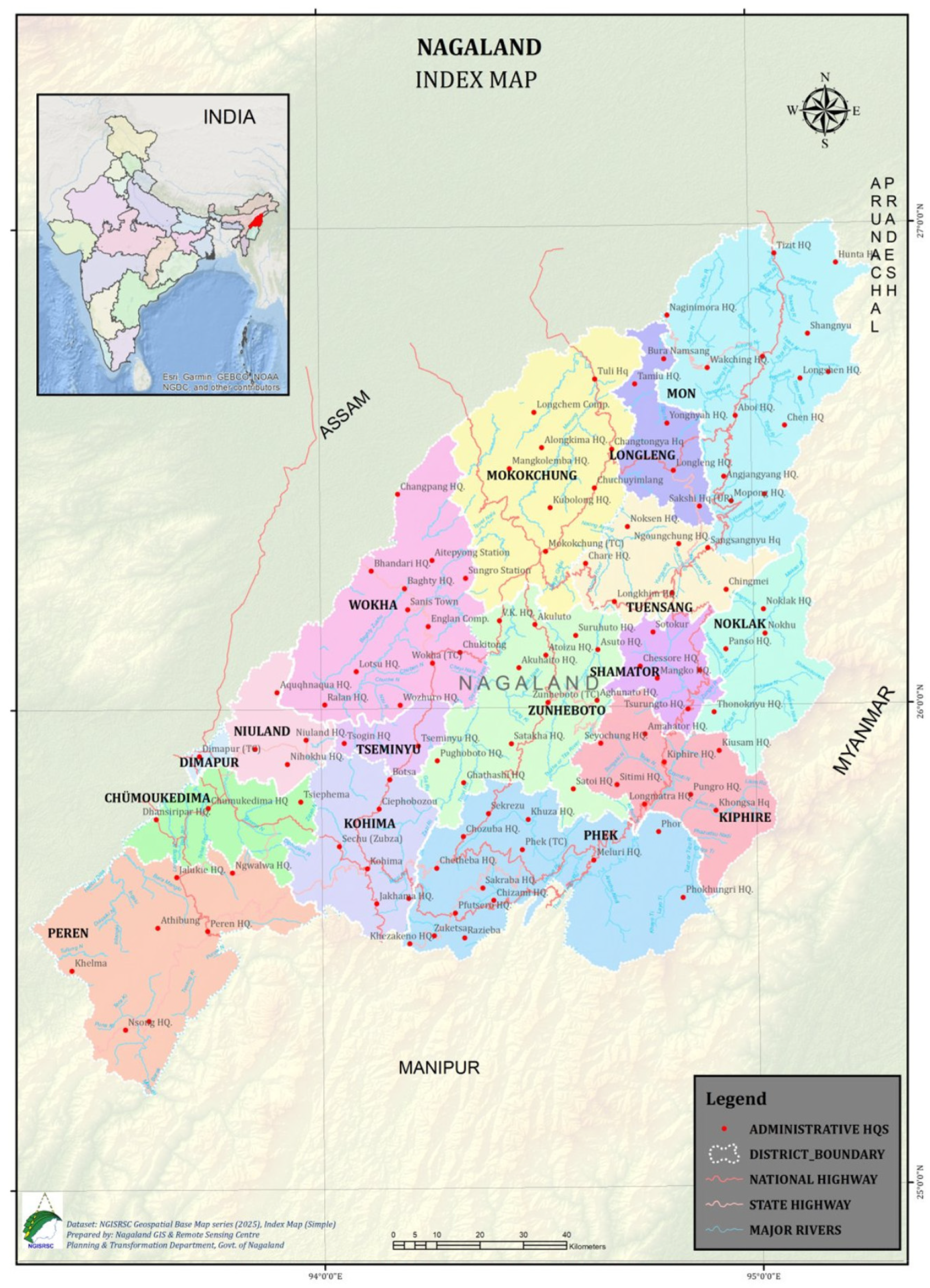
Figure 1. Location map of study area. Source: https://nagalandgis.in/wp-content/uploads/2025/05/INDEX-MAP_2025A.pdf.
Climate 14 00020 g001
Figure 2. Conceptual framework for construction of scale on knowledge and perception of farmers regarding CC (source: authors’ compilation).
Climate 14 00020 g002
Figure 3. Researcher conducting interview of respondents.
Climate 14 00020 g003
Figure 4. Factors with eigenvalue, % of variance, and cumulative % of variance.
Climate 14 00020 g004
Figure 5. Depiction of respondents according to their knowledge and perception of CC.
Climate 14 00020 g005
Table 1. Items/statements rejected based on judges’ rating for scale construction.
Items/Statements
* X14 Solar and renewable energy are emission-neutral/climate-friendly
* X33 The environment is getting warmer day by day
* X34 Frequency of unexpected climatic events has increased
* X37 Erratic precipitation during monsoon
* X41 Duration of the rainy season has shortened
* X50 Jhum (shifting cultivation) burning is emitting/adding GHGs
* X78 Climatic uncertainty has increased
* Rejected items/statements.
Table 2. Rotated component/factor matrix and retained/accepted items/statements of scale on knowledge and perceptions of farmers on CC.
Indicator (Name of Indicator)FactorItems/StatementsFactor LoadingEigenvalueCommunalityCronbach Alpha
(Overall = 0.985)
Each Factor
I
(Respondents’ Knowledge and perception of agricultural CC, emission of GHGs and mitigation strategy)
1* x46 Proper composting of crop residue is a/an mitigation/adaptation strategy to climate change (CC)0.40843.330.7450.938
x52 Rice cultivation is also adding N2O to the environment0.5560.813
x54 Alternative dry and wet spells of rice fields is a mitigation measure to reduce the emission of GHGs from rice field0.5450.879
x55 SRI has the potential to reduce the emission of GHGs from rice field0.5260.790
** x57 Root zone placement of Nitrogenous fertiliser is a mitigation measure to reduce the emission of N2O from crop field0.4650.871
** x59 Proper handling of animal urine is a measure to reduce the emission of GHG0.4610.818
x60 Earth’s surface is an enormous reservoir of Carbon0.6370.857
x61 Exposing/disturbing the soil surface is used to expose soil carbon, which is also a reason for CC 0.7780.877
x62 Ploughing is a means to expose soil carbon 0.7590.850
x63 Grazing is a reason to expose the earth’s surface0.7130.881
x64 Zero or minimum tillage is desirable to adapt the emission due to disturbance of soil surface0.7630.822
x65 Are you aware of C-sequestration0.5640.826
** x66 Crop cultivation is a practice of C-sequestration0.4740.833
x67Agriculture (except some crops) is used to consider as GHG emission neutral0.5660.854
x68 Eastern Himalayan region is more vulnerable to CC0.5520.772
13x43 Agriculture is highly vulnerable to CC0.7431.630.888-
14** x40 Annual rate of rainfall is inconsistent (with respect to previous years)0.4511.590.7740.759
* x53 Waterlogging rice cultivation is greatly responsible for CC0.4440.828
x56 Split application of nitrogenous fertiliser is a mitigation measure to reduce the emission of N2O from rice field0.5020.859
15* x42 Agriculture is also emitting GHGs0.4301.450.8270.765
* x45 Proper composting can reduce the emission from animal dropping0.4210.804
x58 Animal urine is a source of nitrogen gas and emitting/adding N to the environment0.5380.840
20x17 Deforestation is responsible for CC0.6061.160.764-
22* x44 Livestock (ruminant) are greatly emitting GHG0.38481.010.783
II
(Sustainable Adaptation to Agricultural CC)
2x90 CC may be the reason for the increased cost of cultivation0.5055.970.8060.939
** x91 CC is the reason for the early maturity/harvesting of crops0.4810.775
** x92 Change in planting time is a mitigation measure to CC0.4420.760
x94 CC has influenced the increased occurrence of disease attacks in the crop0.5270.865
x102 Change from long-duration to short-duration crop varieties is an adaptation strategy to CC0.7250.883
x103 Change to more cash crops is an adaptation strategy to CC0.7110.876
x104 Change of planting/sowing time as per weather conditions is an adaptation strategy to CC0.7900.855
x105 Integrated water management for scarcity (during the winter) is an adaptation strategy to CC0.6500.880
x106 Intercropping is an adaptation strategy to CC0.7080.847
x107 Construction of farm ponds is an adaptation strategy to CC 0.5310.737
x108 Mulching is an adaptation strategy to CC0.6060.840
* x109 Resort to terrace/settled cultivation in place of shifting cultivation is an adaptation strategy to CC0.4010.767
III
(Effect of CC on Agriculture)
4x7 CC is mostly anthropogenic0.5294.610.7640.937
** x77 Occurrence of strong wind has increased0.4840.814
* x93 CC has influenced the increased occurrence of insect attacks in the crop0.4160.846
x96 (Due to CC) Increased occurrence of incidence of disease in animals 0.6980.822
x97 (Due to CC) Increased mortality rate of the animals0.7310.850
x98 CC is the reason for the reduction in the species of forest trees0.6650.910
x99 High temperature is the reason for the reduction in milk production of animal0.7730.878
x100 High temperature is the reason for the restricted growth of livestock0.6750.851
x101 Collection of water for livestock during summer/drought is a difficult task0.6650.860
6x86 Agricultural losses have increased due to CC0.7042.690.8990.930
x87 CC has influenced the reduction of yield0.6540.896
x88 Unfavorable weather is responsible for crop failure0.6130.856
x89 CC is a tremendous threat to food security0.6650.854
x95 Owing to CC (drought/flood), the availability of fodder for livestock has decreased 0.5020.808
IV
(Impact of CC
Or
Occurrences of CC consequences)
3x73 CC has a substantial negative impact on cold-loving (temperate) crops (like apples)0.5334.840.8800.939
x79 Occurrence of natural disasters has increased 0.5690.890
x80 Occurrence of the landslide has increased0.7850.896
x81 Occurrence of thunderstorms has increased0.7090.857
x82 Phenomenon of drought occurrence has increased0.6210.888
x83 Phenomenon of flood occurrence has increased0.7650.883
x84 Phenomenon of cyclone occurrence has increased0.6490.880
** x85 Frequency of dry spells has increased0.4590.828
* x51 Rice cultivation is emitting CH4 gas0.3780.790
8* x1 CC is a natural process0.4042.210.7210.893
x3 CC is also a reason for global warming0.5980.829
x4 CC is the reason for the rise of sea level0.8480.850
x5 CC is the reason for mountain glacier melting 0.8190.930
x6 CC is the reason for pole glacier melting0.7750.879
11* x36 Unpredictable occurrence of rainfall has increased0.4171.830.7730.916
x38 Unpredictable onset of monsoon rain0.7900.930
x39 Unpredictable cessation of monsoon rain0.7410.870
19x35 The Frequency of heavy rain has increased 0.6481.230.785-
V
(Basic/general awareness/knowledge of CC)
5** x12 Burning of fuel by vehicle is adding GHGs (and harmful gases) to the environment 0.4083.040.8330.892
** x13 Modernization of society, i.e., better civilization, is also a reason for CC0.4600.834
x18 Have you heard about GHGs?0.5330.752
x19 Emission of GHGs is the reason for CC0.6510.839
x20 CO2 is a GHG0.8130.836
x21 CH4 is a GHG0.8680.895
x22 N2O is a GHG0.8030.840
x23 CFC is also a GHG0.5040.803
7x26 Rainfall is a climatic factor/variable0.8002.530.8610.889
x27 Temperature is a climatic factor/variable0.7590.862
x28 Humidity is a climatic factor/variable0.7300.850
** x32 Temperature is rising during the daytime0.4820.854
9x8 Overpopulation is also a reason for CC0.7852.050.8500.844
x9 Urbanisation is a driver for CC0.7880.900
** x10 Generation/production of electricity is a reason for CC0.4740.793
x11 Fossil fuel burning is a major driver for CC0.5600.821
* x49 Jhum (shifting cultivation) is a reason for CC0.4030.750
16x29 Have you ever heard the term CC (CC)0.5771.380.8740.897
x30 Have you ever heard the term global warming0.5920.876
x31 Have you heard about ozone layer depletion 0.5110.870
* x47 Crop residue burning is adding GHGs0.35710.830
17** x15 Industry is a responsible driver for CC0.4791.330.8020.693
x16 Construction (road and building) work is a driver for CC 0.6260.729
VI
(Impact of CC on life and livelihood)
10x69 CC has a huge negative impact on human well-being0.7311.900.8270.908
x70 CC has a huge negative impact on human health0.5570.838
x71 CC has a substantial negative impact on livelihood0.6390.877
** x72 CC has a substantial negative impact on livestock0.4600.847
12* x25 H2O-vapour is also a reason for local-level warming0.4341.720.7400.805
* x48 Household (including kitchen waste) waste is also releasing/emitting GHGs0.4470.788
x74 Owing to CC (warming), the cold place is more comfortable to live0.5340.764
x75 Owing to CC (warming), warm places (tropical zone) are more uncomfortable to live0.7050.823
x76 Owing to CC (warming), coastal zones are more vulnerable to sea level rise0.5500.814
18x24 CO2 is harmful to the human and mammal kingdom 0.6791.250.853-
21x2 Owing to increasing population, some extent of CC is unavoidable0.7611.140.832-
* Item/statement with factor loading ≤ 0.450. ** Item/statement with factor loading ≤ 0.500.
Disclaimer/Publisher’s Note: The statements, opinions and data contained in all publications are solely those of the individual author(s) and contributor(s) and not of MDPI and/or the editor(s). MDPI and/or the editor(s) disclaim responsibility for any injury to people or property resulting from any ideas, methods, instructions or products referred to in the content.