Article

Bridging Economic Development and Environmental Protection: Decomposition of CO2 Emissions in a Romanian Context


by
Carmelia Mariana Dragomir Bălănică
1,*,
Carmen Gabriela Sirbu
1,
Gina Ioan
1,* and
Ionel Sergiu Pirju
2
1
Department of Applied Sciences, The Cross Border Faculty, “Dunărea de Jos” University of Galați, 800201 Galati, Romania
2
Department of Communication, Faculty of Communication and International Relations, Danubius University of Galati, 800654 Galati, Romania
*
Authors to whom correspondence should be addressed.
Climate 2026, 14(1), 10; https://doi.org/10.3390/cli14010010 (registering DOI)
Submission received: 24 November 2025 / Revised: 19 December 2025 / Accepted: 27 December 2025 / Published: 30 December 2025

Abstract

Climate change governance has become an essential concern for policymakers, with carbon dioxide (CO2) emissions representing one of the most pressing challenges to sustainable economic development. In this context, understanding the main drivers of CO2 emissions is essential for designing effective public policies that support Romania’s transition toward a low-carbon economy. This study investigates the determinants of CO2 emissions in Romania’s energy sector between 2008 and 2023 using the Logarithmic Mean Divisia Index (LMDI) decomposition method. The analysis considers five key elements: the carbon intensity effect (ΔC), the energy mix effect (ΔM), the energy efficiency effect (ΔL), the economic effect (ΔB), and the population effect (ΔP). The results highlight the need for coherent governance frameworks and targeted policy measures to balance economic expansion with environmental sustainability. The study offers actionable insights for public authorities aiming to strengthen Romania’s climate governance and align national strategies with the objectives of the European Green Deal and climate neutrality by 2050.

1. Introduction

Global warming is a critical current concern for humanity. Among the greenhouse gases (GHGs), carbon dioxide (CO2) holds the largest share and is the main factor responsible for all the repercussions of climate change.
The concern of international decision-makers at present is to focus on reducing these emissions throughout the energy cycle, given that this is the main source responsible for CO2 and GHG emissions. The major targets pursued both at the global and national levels are as follows: promoting the efficient use of renewable sources and encouraging carbon-free alternatives, with the ultimate goal of achieving climate neutrality.
Sustainable development and economic progress, regardless of the stage of evolution of a nation (developed or emerging), require a solid foundation, which is based on two fundamental elements: drastically reducing pollution and ensuring energy security.
Real economic growth cannot be maintained in the long term if it is achieved through continuous environmental degradation or if it is vulnerable to unstable and polluting energy sources. Hence the need to maintain the two fundamental elements permanently interconnected. Therefore, prioritizing the transition to clean and secure energy sources becomes a sine qua non condition for future global prosperity.
Data from the European Environment Agency (EEA) [1] from 2021 show that the EU’s greenhouse gas emissions have stabilized at 3.6 billion tonnes of CO2 equivalent, marking a 22% reduction compared to 2008 levels. In the composition of GHGs, CO2 dominates with around 80%, followed by methane (over 12%). Extreme events are becoming more frequent in Europe and globally due to climate change. In response, the Intergovernmental Panel on Climate Change (IPCC) [2] calls for limiting global warming to 1.5 °C and achieving carbon neutrality by the middle of the 21st century, as set out in the Paris Agreement, 2015 [3].
The 2019 European Green Deal [4] sets the binding objective of making Europe climate neutral by 2050. Achieving this neutrality requires sustained efforts by all Member States to rigorously implement legislative measures, accompanied by strict monitoring. The mitigation strategy includes economic instruments, such as the Emissions Trading Scheme (ETS) and carbon tax, integrated with permanent measures to reduce energy consumption and increase the use of alternative sources and carbon-free technologies.
For Romania, the application of these strategies requires a remodeling of the economic framework toward a low-carbon economy, based on the analysis of the contributions of industrial factors to CO2 emissions. Thus, the assessment, analysis, and operational reduction of energy intensity become an essential priority of energy policy, energy being considered a fundamental resource for national sustainable development.
This research aims to identify and evaluate the influence of the main determining factors (economic structure, social dynamics/population, and energy intensity) on the evolution of national energy-related CO2 emissions, focusing on total energy use across sectors rather than solely the power sector, using the Logarithmic Mean Divisia Index (LMDI) method for the period 2008–2023. The study clarifies that the analysis covers total national energy-related CO2 emissions, encompassing all energy-consuming sectors, and aims to contribute to understanding the mechanisms driving changes in carbon emissions at the national level.
The intentions of the study are to evaluate the role of economic, social, and energy-intensity factors on CO2 emissions and provide evidence-based recommendations for more effective public policies in the context of the energy transition.
The LMDI formulation provides a single, unambiguous result that is not influenced by the order or nature of intermediate data, making the analysis results robust, replicable, and free from analytical ambiguity. This is a subtle yet profound theoretical advantage that underscores LMDI’s standing as a superior method. The LMDI approach is uniquely flexible, as it offers both multiplicative and additive decomposition models. This allows researchers to choose the model that best fits the nature of the data and the research question. The multiplicative model is suitable for data where effects scale proportionally with the trend, while the additive model is better for situations where fluctuations remain relatively constant [5]. The LMDI framework also includes a simple mathematical relationship between the two forms, allowing for easy conversion and consistent results. This flexibility makes LMDI an adaptable and versatile tool for a wide range of analytical scenarios [6].
An additional objective of this research is to identify and evaluate the key drivers of CO2 emissions in Romania, particularly focusing on the role of energy transition policies, and to offer insights into how these factors can be leveraged to support sustainable economic development and environmental protection.
This study makes a significant contribution by being the first research to apply the Logarithmic Mean Divisia Index (LMDI) methodology in Romania to simultaneously decompose and analyze five essential determinants: CO2 emissions, primary energy resources, energy consumption, Gross Domestic Product (GDP) and population, fully covering the period 2008–2023.
Following the review of the Romanian literature, we found that although the factors that impact carbon emissions have been examined, none have resorted to the LMDI decomposition technique, thus considering that there is a major methodological gap in the research on these phenomena in the country.
Therefore, the use of the LMDI procedure is crucial to fill these information gaps and to provide rigorous and credible evidence regarding the real influence of these factors on CO2 emissions in the Romanian economic and social context.

2. Background

This study looks at the key factors that shape CO2 emissions, focusing on elements such as total CO2 output, the structure of primary energy resources, overall energy consumption, GDP, and population. To explore how these factors influence emissions over time, the LMDI method is applied to a dataset spanning 15 years. By decomposing the data on a year-to-year basis, we can track the gradual shifts in the contribution of each factor throughout the studied period.
Over the past few decades, researchers have increasingly relied on various decomposition techniques to understand what drives changes in energy use and CO2 emissions. These approaches range from econometric regression models to structural decomposition and several forms of index-based decomposition, all widely used to pinpoint the main forces behind emission trends [7]. The theoretical background of decomposition analysis was outlined relatively early by Rose and Casler [8]. Since then, numerous index decomposition methods have been introduced, including those developed by Howarth et al. [9], Scholl et al. [10], Shrestha et al. [11], Zhang et al. [12], and Ang et al. [13].
A considerable number of empirical studies have applied these methods either to specific geographical areas or to individual economic and industrial sectors. For example, Paul and Bhattacharya [14] examined how energy use contributes to CO2 emissions in India, while Steenhof et al. [15] analyzed electricity demand in China’s industrial sector. Mai et al. [16] explored the links between CO2 emissions, energy consumption, and economic growth in China. Other notable applications include the structural decomposition of energy use in Brazil [17] and similar work on greenhouse gas emissions in Australia [18]. Additional contributions come from Kim [19], who used the LMDI method to study Korea’s manufacturing sector, and De Oliveira-De Jesus [20], who investigated carbon accumulation intensity in Latin America and the Caribbean. The Turkish case was presented by İpek Tunç [21].
In Romania, decomposition techniques have been used to examine how pollutants such as PM10, PM2.5, and N2O relate to the incidence of respiratory, dermatological, and oncological diseases, with the aim of assessing the broader health effects of air pollution on the population [22,23].
Late literature, Wang et al. [24], supposes that open markets may impact CO2 emissions by expanding stock sources and transforming economical schemes, along with effects depending on trade liberalization and heterogeneity. Besides that, machine intelligence plays a pivotal role in the energy sector by optimizing power generation and consumption techniques, with the purpose of diminishing the carbon footprint. Therefore, this study examines how these two factors—energy consumption and decomposed carbon emission—can directly influence CO2 emissions levels, with a focus on their applicability in the economic context of Romania and the Eastern European region.
According to Yang and Li [25], reducing CO2 emissions not only impacts climate change but can also have significant effects on public health, such as reducing air pollution and respiratory diseases, for example. Moreover, Wang et al. [26] and Kamyab et al. [27] demonstrate that a transition to cleaner energy sources could support biodiversity by reducing environmental pollution and improving ecosystem quality. Additionally, emission reductions can contribute to improving social equity by creating jobs in renewable energy sectors and providing more equitable access to clean energy sources.
Compared to other countries in Eastern Europe, Romania is undergoing an energy transition characterized by continued dependence on fossil energy sources, particularly coal and natural gas, which significantly influence CO2 emissions [28]. Although some countries in the region, such as Poland and Hungary, face similar challenges, Romania has implemented more recent emission reduction policies, focusing on diversifying the energy mix and promoting renewable energy [29]. However, compared to other economies in Central Europe, Romania still records a relatively low level of clean energy usage, and the transition to a green economy is proceeding at a slower pace. These differences in energy structure and the pace of policy implementation reflect the economic and institutional particularities of each country and directly influence the evolution of CO2 emissions at the national level [30].
Several studies have been conducted on CO2 emissions in Eastern European regions, but research focusing exclusively on Romania is limited. Thus, this study represents an original contribution to understanding the factors influencing CO2 emissions in the Romanian economy. By employing the LMDI method and applying it in the specific context of Romania, the research addresses a significant gap in the existing literature. The detailed analysis of economic and energy variables from 2008 to 2023 provides an original perspective on the dynamics of CO2 emissions at the national level, and the results obtained will contribute to the development of more effective public policies in the fields of environmental protection and energy transition.
The Logarithmic Mean Divisia Index method has emerged as the preeminent tool for decomposition analysis, a quantitative technique used to attribute changes in an aggregate indicator to a set of underlying driving factors. This report provides an exhaustive justification for its selection over other decomposition methods, particularly those based on the classical Laspeyres and Paasche indices. The LMDI’s superiority is rooted in its robust theoretical foundation and its distinct practical advantages. Unlike alternative methods that often produce an unexplained “residual” term, LMDI guarantees a perfect decomposition, ensuring that the overall change is fully and accurately allocated to its components’ items. Additionally, its coherence in clustering enables multi-step assessment, allowing scientists to disaggregate country-level outcomes into distinctive sub-sections without losing mathematical consistency. These aspects, in addition to its capability to strongly manage joint database aberrations like zero or negative data, its resilience as regards both cumulative and multiplicative models have strengthened LMDI’s status as the effective common in theoretical and policymaking sectors.
Decomposition studies are a fundamental analytical approach used to calculate the driving forces and their variations in a cumulative indicator over the years. This technique disintegrates complex and perceptible changes (for example a nation’s total consumption of energy or CO2 emissions) within the quantitative incomes of different basic factors [31]. In addition, a decomposition evaluation should indicate the main adjustments in economic domain, energy intensities, or a variation in the manufacturing system supplied to a noticed modification in internal energy utilization. By separating these “driving forces”, the evaluation states a detailed comprehension of former transformations and provides a significant indication support for developing focused and efficacious strategy involvements. This makes decomposition analysis an indispensable tool in fields ranging from environmental regulation to economic policy and energy strategy, where prescriptions must be supported by rigorous analysis and a balanced appraisal of contributing factors [32].

3. Methodology and Data

To investigate the determinants of CO2 emissions, this study adopts the LMDI method formulated by [32], together with the Kaya identity [33]. This combined analytical framework enables a systematic exploration of the factors that have shaped the evolution of Romania’s CO2 emissions over the period 2008–2023. The empirical component relies on annual data obtained from the National Institute of Statistics of Romania through the TEMPO online database, NISR, 2024 [34]. All data were publicly accessible, and the selection process involved identifying those economic and energy-related indicators most relevant for characterizing the country’s emissions trajectory.
The set of variables employed in the analysis, along with the justification for their inclusion, is presented in the following section. Due to constraints related to data availability, the study focuses on five key drivers at the national level: total CO2 emissions, the composition of primary energy resources, total energy consumption, gross domestic product, and demographic trends. These indicators are incorporated into an LMDI-based decomposition model, which allows for the quantification of each factor’s individual contribution to changes in CO2 emissions over the examined period. A valid decomposition analysis, particularly one based on the Kaya identity, necessitates meticulous data preparation to ensure mathematical consistency. The raw data for the five variables are likely in different units, such as Gg tons CO2 for emissions, millions of RON for GDP, and tons of oil equivalent (toe) for energy consumption. For the decomposition formula to be mathematically sound, all energy data must be standardized to a common unit, such as terajoules (TJ) or kilotons of oil equivalent (ktoe). Furthermore, for the GDP variable, it is imperative to use a series that has been adjusted for inflation.
Index Decomposition Analysis methodologies are grouped into four categories: Laspeyres (LASP), Shapley/Sun (S/S), Logarithmic Mean Divisia Index (LMDI), and other Divisia methods [35]. Among these, the LMDI method was selected for this study due to its key advantages: it provides full decomposition without residual terms, handles zero values effectively, and allows both additive and multiplicative forms. These features make it particularly suited for tracking national-level CO2 emission drivers over time.
The choice of variables used in this research is based on their theoretical and empirical relevance in analyzing CO2 emissions in Romania, as well as on the country’s economic and energy specifics. Each of the five selected variables reflects important factors influencing CO2 emissions, according to the existing literature and the national context.
CO2 emissions represent the dependent variable of the study and are essential in analyzing the impact of energy on climate change. CO2 emissions are widely used in research related to climate policy and energy transition, as they are the main greenhouse gas responsible for climate change [36].
Fossil-based energy is preferred, considering that it constitutes the dominant source of CO2 emissions in Romania. Additionally, Romania remains substantially dependent on fossil energy, including fossil-based energy production, and this component is indispensable for determining the emission intensity proportionate to non-renewable power and for studying the consequences of the transition to sustainable energy sources [37].
Overall, energy consumption considers the total configuration of energy demand at the national level and its effect on CO2 emissions. Clean energy and maximizing energy efficiency are strategic aims for reducing emissions and increasing the proportion of sustainable energy sources overall, exerting a substantial effect on CO2 emission levels [38].
Evaluating GDP per capita is essential for considering the connection between economic progress and CO2 emissions, reflecting Romania’s economic performance and impacting the quantity of energy usage proportionate to generation.
Demographic growth is linked to higher energy usage and expected increases in CO2 emissions, notably within the context of urban expansion and lifestyle changes; therefore, this study evaluates emissions per person and their impact on climate policy [39].
The analysis relies on Equation (1), which is used to decompose Romania’s carbon emissions:
C = C F E G G P P
In this expression, C denotes total carbon emissions. The term C/F represents CO2 emissions per unit of fossil energy consumption (F), reflecting the emission intensity associated with fossil fuels. The ratio F/E captures the proportion of fossil energy within total energy consumption (E) and therefore indicates the degree of energy mix cleanliness. The component E/G refers to energy use per unit of GDP (G), serving as a proxy for overall energy efficiency. Finally, G/P expresses GDP per capita (P), a commonly used indicator of a country’s macroeconomic performance (Table 1).
Changes in CO2 emissions result from the combined influence of these five factors, each contributing differently over time. The LMDI framework allows these contributions to be isolated and quantified, using either additive or multiplicative decomposition indexes to assess the specific role played by each factor in shaping emission trends. Based on Equation (1), after logarithmic transformation, the cumulative function of the LMDI technique for CO2 emissions is expressed as Equation (2):
C = C t C 0 = C t C 0 l n C t l n C 0 l n C t l n C 0 = A l n l n   C t F t F 0 C 0 + l n l n   F t E t E 0 F 0 + l n l n   E t G t G 0 E 0 + l n l n   G t P t P 0 G 0   + l n P t P 0 = I + M + L + B + P
In Equation (2), ΔC indicates the difference between CO2 emissions Ct in the year t and C0 in the base year 0; ΔI indicates the contribution of C/F in Equation (1) to ΔC and is defined as the carbon intensity effect. Consequently, ΔM represents the contribution of F/E and is defined as the energy mix effect; ΔL indicates the contribution of E/G and is defined as the energy efficiency effect; ΔB indicates the contribution of G/P and is defined as the economic effect; ΔP indicates the contribution of P and is defined as the population effect.
To simplify the calculation, A is defined as follows (Equation (3)):
A = C t C 0 l n C t l n C 0
To assess the contribution to the changes in CO2 emissions, five indexes can be computed for each interval (Equations (4)–(8)):
        I = A l n C t F t l n C 0 F 0
M = A l n F t E t l n F 0 E 0
L = A l n F t G t l n F 0 G 0
B = A l n G t P t l n G 0 P 0
P = A l n P t l n P 0
The index increases the CO2 emissions when the contribution is positive; conversely, if the contribution rate is negative, it implies that the index reduces CO2 emissions.

4. Results and Discussion

4.1. CO2 Emissions

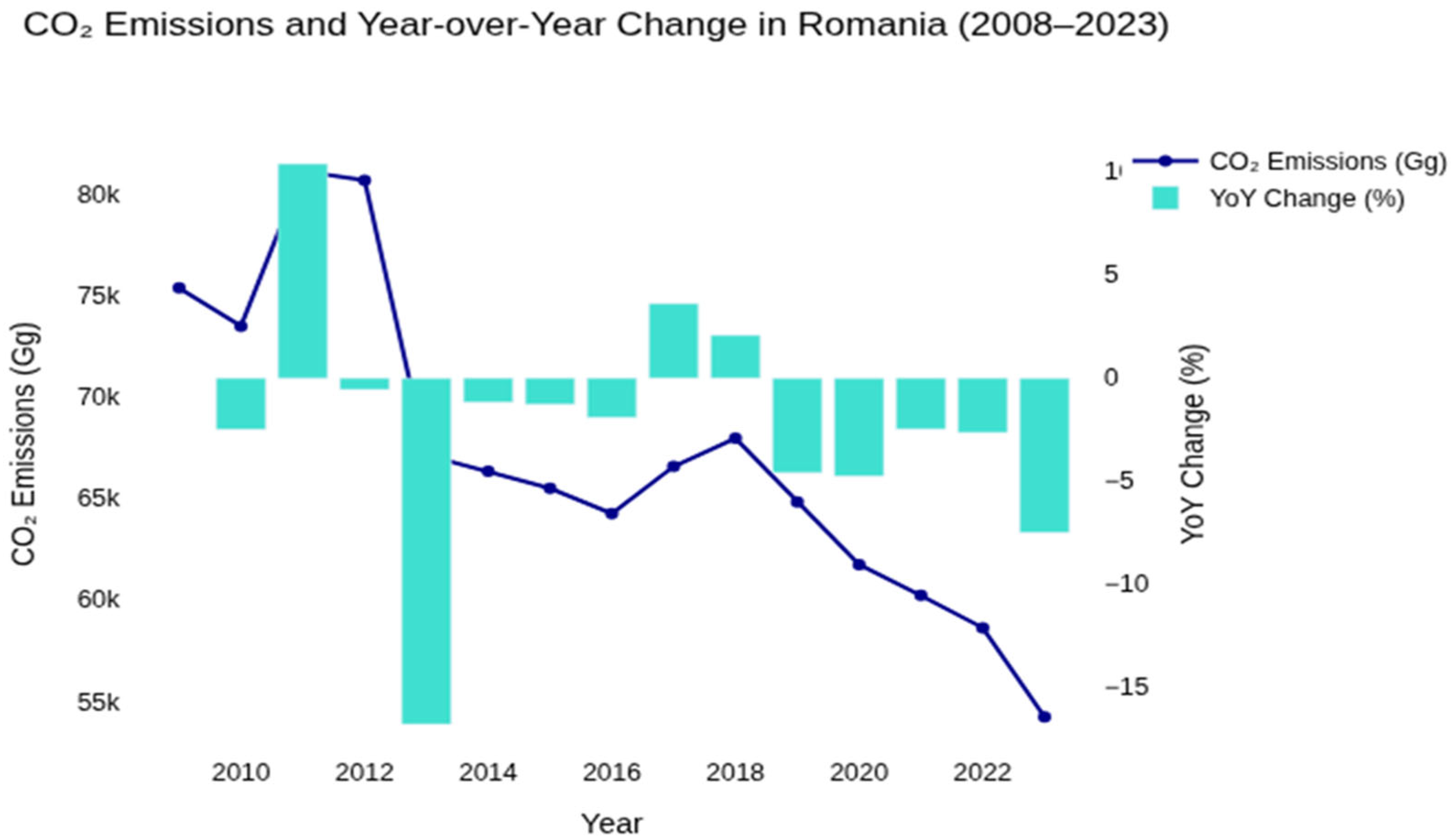
The CO2 emissions resulting from economic activities were calculated based on Formula (1). Figure 1 shows the trend for the period 2008–2023. The CO2 emissions from Romania decreased from 95,224.62 Gg tons in 2008 to 58,638.12 Gg tons in 2022, the percentage of decrease in CO2 emissions being 38.42% during the analyzed period. Considering the fact that Romania entered the European Union in 2007, a series of restrictions were imposed regarding the amount of CO2 resulting from the main economic activities, especially those in the industrial sector. Based on the data collected by the National Institute of Statistics of Romania from 2008 to 2023, the CO2 emissions show an overall declining trend with some fluctuations. We can observe a significant drop in the early years: CO2 emissions started at 95,224.62 Gg tons in 2008 but sharply decreased to 75,396.61 Gg tons in 2009, a reduction of approximately 21%. This could be attributed to the global financial crisis of 2008–2009, which likely led to reduced industrial activity and energy consumption, fluctuations and partial recovery: emissions slightly decreased further in 2010 to 73,517.16 Gg tons but then increased in 2011 to 81,164.57 Gg tons, almost reaching 2008 levels. This might indicate economic recovery or increased energy demand. However, emissions fell again in 2012 to 80,716.08 Gg tons. It is also evident that there was a steady decline from 2013 onward: from 2013 to 2016, emissions consistently decreased from 67,154.48 Gg tons to 64,268.27 Gg tons, suggesting possible efforts toward energy efficiency, renewable energy adoption, or environmental policies. There was a minor uptick in 2017 (66,591.75 Gg tons) and 2018 (67,978.74 Gg tons), but emissions resumed declining in 2019 (64,848.96 Gg tons). The recent years, including the pandemic impact, may be described as a continuation of the decline from 2020 to 2023, with emissions dropping to 54,241 Gg tons in 2023. The year 2020 (61,760.11 Gg tons) likely reflects the impact of the COVID-19 pandemic, which caused reduced transportation and industrial activity. The persistent decrease in subsequent years may indicate sustained environmental measures or structural changes in the economy. The overall trend is clear: over the 16-year period, CO2 emissions decreased by about 43% from 2008 to 2023. This suggests a positive trajectory toward lower carbon emissions, possibly driven by policy interventions, technological advancements, or shifts to cleaner energy sources. However, the fluctuations highlight that emissions are influenced by economic cycles and external events.
In summary, the data demonstrate a clear long-term reduction in CO2 emissions, with temporary increases during periods of economic growth. This trend aligns with global efforts to combat climate change, but continued vigilance and policies are needed to maintain this progress.
Figure 1 shows the evolution of CO2 emissions from economic activities in Romania between 2008 and 2023, as well as the annual percentage changes. Overall, a clear downward trend is observed: emissions decreased from approximately 95,224 Gg tons in 2008 to 54,241 Gg tons in 2023, which represents a reduction of approximately 43%. This decrease indicates a significant transition toward a more energy-efficient and less polluting economy. In the first years, between 2009 and 2010, a sharp reduction in emissions is observed, correlated with the effects of the global financial crisis, which led to a decrease in industrial activities. In 2011, emissions increased by over 10%, a sign of economic recovery, but this increase was not sustained. In 2013, the graph highlights the largest annual decrease, of almost 17%, probably driven by industrial restructuring and stricter energy policies. Subsequently, between 2014 and 2018, emissions remained relatively stable, with small variations, but the overall trend continued to be downward.
During the period 2019–2023, the reduction in emissions was constant, culminating in a significant decrease in 2023, of approximately 7.5% compared to the previous year. This acceleration suggests the effectiveness of climate policies and the adoption of green technologies, as well as a firmer orientation toward renewable energy sources.
Interpreting these data, we can conclude that Romania is on a positive path toward decarbonization. The constant reduction in emissions is not just a cyclical effect but reflects structural changes in the economy and the energy sector. To maintain this trend, it is essential to continue investing in renewable energy, apply strict policies for high-emission industries, and support innovative technologies such as carbon capture and storage.
Overall, the biggest decrease is between 2008 and 2009 with a difference of 19,828 Gg tons, following during the period 2010–2012 a fairly significant increase of 7646 Gg tons and then until 2023 the trend was obviously decreasing. Starting with 2010 and until 2013, Romania passed through an economic crisis and investments in environmental protection were reduced, followed by a very important period with non-reimbursable European investments at the same time correlated with legislative impositions at the EU level.

4.2. Contributing Indexes

For the purpose of describing the driving forces of CO2 emissions, this subsection analyzes their contribution, mentioning that ΔC indicates the difference between CO2 emissions Ct in the year t and C0 in the base year 0; ΔI indicates the contribution of CO2 emissions per unit of fossil energy consumption, defined as the carbon intensity effect; ΔM represents the contribution of the proportion of fossil energy within the total energy consumption and, therefore, indicates the degree of energy mix cleanliness; ΔL refers to the energy use per unit of GDP, serving as a proxy for overall energy efficiency, and is defined as the energy efficiency effect; ΔB indicates contribution of GDP per capita and is defined as the economic effect; and ΔP indicates the contribution of P and is defined as the population effect.
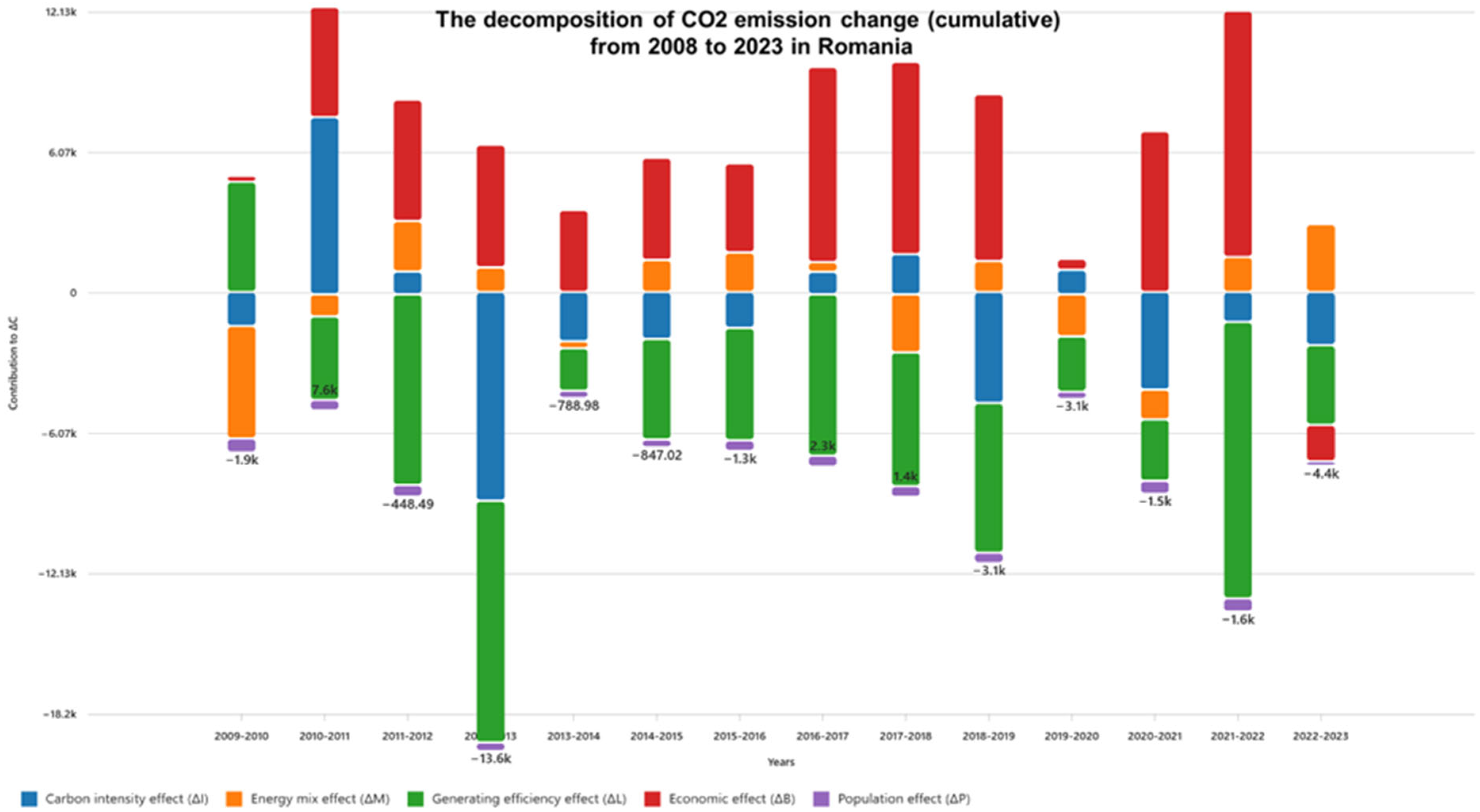
In order to get a clear overview of the driving forces of CO2 emissions, we have represented graphically, in Figure 2, the contribution of carbon intensity (ΔI), energy mix (ΔM), energy efficiency (ΔL), economy (ΔB), and population (ΔP) for the entire analyzed period.
According to the data presented in Figure 2, the CO2 emission change in Romania was 36,586.5 Gg tons from 2008 to 2023. This change may be decomposed into two positive factors (ΔB and ΔM) and three negative factors (ΔL, ΔP, and ΔI), and, among these, the most important inhibiting effect is that of ΔL, while the most important promoting effect is ΔB. The most significant variations in CO2 emissions are observed in the period 2008–2009, with a value of −19,828 Gg tons, compared to the year 2021–2022, when the cumulative value was only −1593 Gg tons.
The largest positive index was ΔB, accounting for 34.94% of the overall CO2 emission change of the energy use in Romania from 2008 to 2023. After the end of the communist period, along with the development of the reform, the Romanian economy developed relatively consistently.
The non-reimbursable European funds are a basic element of the development of the national economy, the purpose of these funds being the creation of more jobs, ensuring a solid European economy, and a healthy environment. On the other hand, economic growth also has a flip side: the use of resources and environmental pollution.
The cumulative analysis of the variation of CO2 emissions in Romania for the period 2008–2023 highlights a net reduction in emissions, despite economic and structural pressures. The results obtained through the decomposition method show that the factor with the largest negative contribution is generation efficiency (ΔL), with a value of −91,097.30 Gg tons, which confirms the essential role of improving energy production technologies and processes in reducing emissions. Carbon intensity (ΔI) also contributed significantly to the decrease in emissions, with −28,132.59 Gg tons, reflecting the transition to less polluting fuels and cleaner technologies. In contrast, the economic effect (ΔB) had a positive contribution of +72,711.80 Gg tons, indicating that economic growth generated additional energy demand, which led to increased emissions. The energy mix (ΔM) also contributed positively, with +21,642.59 Gg tons, suggesting that changes in the energy mix were not sufficiently oriented toward renewables in certain periods. The population effect (ΔP) had a small but negative influence of −5288.90 Gg tons, indicating a minor demographic impact on the total variation. Overall, the cumulative value of ΔC is −30,164.40 Gg tons, demonstrating a general trend of reducing emissions over the period analyzed. These results underline the importance of energy efficiency policies and decarbonizing the production mix, while highlighting the challenges generated by economic growth and the current energy mix. The observed dynamics confirm that technological progress and the transition to low-emission sources are key factors for achieving long-term climate goals.
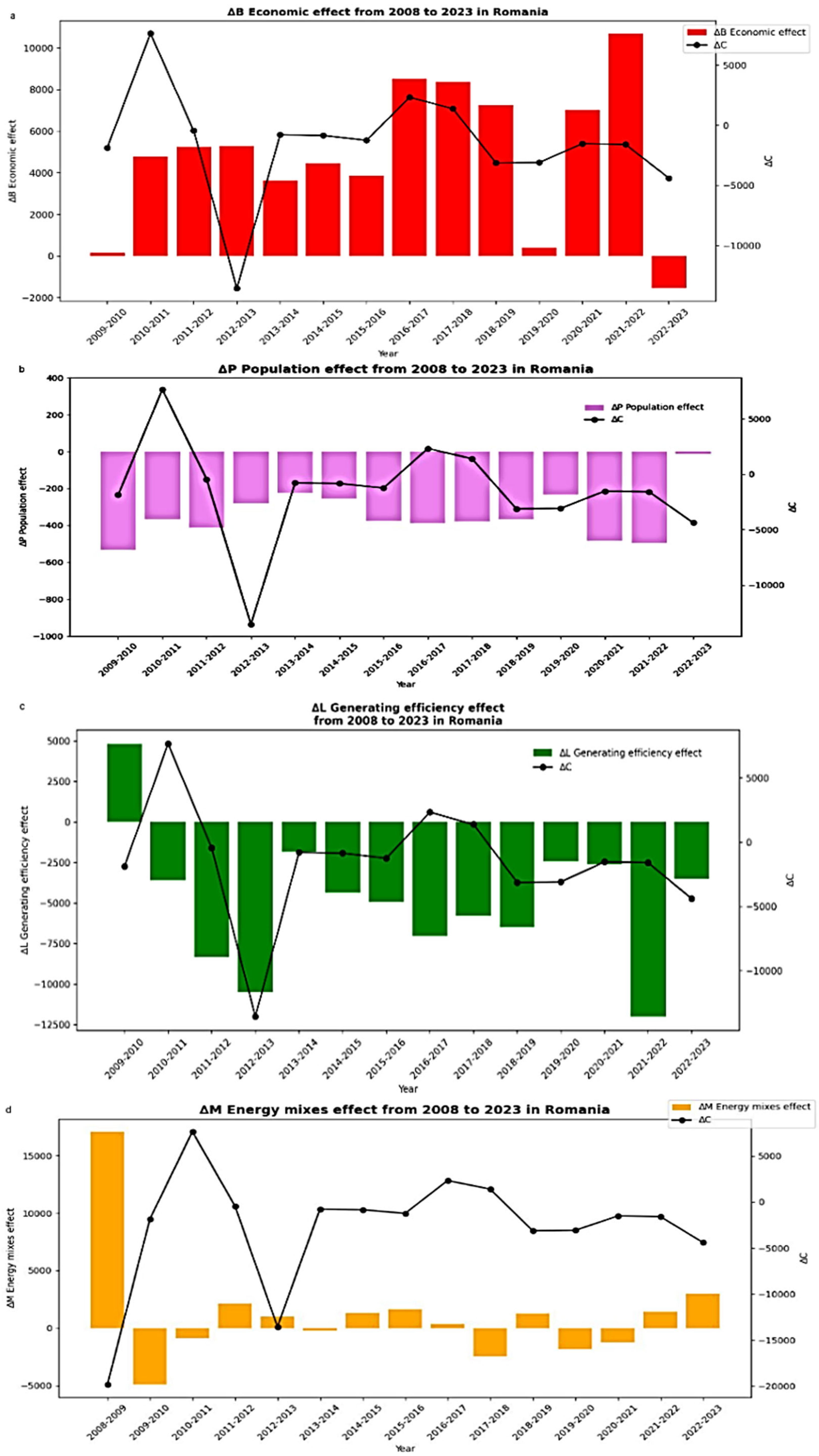
As indicated in Figure 3a, from 2008 to 2023, Romania’s GDP steadily increased, with a yearly average growth rate of 3.25%, with variations from −5% to 9.3% compared to the previous year. In the analyzed period, there were three situations with a negative percentage compared to the previous year: namely, 2009, with −5.5% compared to 2008; −3.9% in 2010 compared to 2009; and the last instance in 2020, with a percentage of −3.7% compared to 2019. In the first two cases, this reflects the economic crisis that our country went through, while the third case reflects the COVID pandemic, which had a major economic impact worldwide. In total, Romania’s GDP increased from RON 539,834 million in 2008 to RON 1,409,783 million in 2022, representing an increase of almost three times the initial amount.
Generally speaking, the economic effect assesses the impact of economic development, which is related to the immediate process of industrialization and increased consumption of energy. If we refer to the population, in the last three decades there has been an important phenomenon of agglomeration of citizens in areas with economic growth and the depopulation of some cities and villages where there was no more advantageous economic business. Therefore, the task of energy preservation and emission reduction in Romania is additionally required. On a national scale, it is crucial to encourage the industrial upgradation and enhancement to accomplish the general progress within the economy segment, community, and environs to mitigate CO2 discharges within the sustainable economic growth. The massive manufacturing plants in the metallurgic, heat power, or machinery building segments, as well as resource- and power-consuming industries, have progressively ceased their business, the places being replaced by a variety of investments that should conform with the European standards concerning the utmost permitted limits of contaminants.
The minimal positive index was ΔP, accounting for 3.72% of the amount of CO2 emissions. Romania’s residents have progressively declined from 20,635,460 inhabitants in 2008 to 19,042,455 inhabitants in 2022. In the percentage terms, the inhabitants decline to only 7.71%; more exactly, the variance is 1,593,005 citizens.
As illustrated in Figure 3b, CO2 emissions were considerably linked with the total number of inhabitants, being reflected in the total energy demand as well as the aspect of habitable demand. Over the last ten years, the consumer’s need for electrical energy has become gradually higher as a consequence of the usage of household gadgets, lighting apparatuses, and thermal plants for housing, manufacturing, and public areas. Nevertheless, the population size has decreased, but utilization of energy is continuously increasing, meaning that the share of inhabitants’ contributions to CO2 emissions will probably not decrease significantly in the future. Because of this, increasing citizens’ awareness of conserving energy and using eco-friendly alternatives may lessen CO2 emissions.
The largest negative index was ΔL, accounting for −46.27% of the overall change from 2008 to 2023. In Figure 3c, the overall energy consumption intensity of Romania indicates a descending trend, from 18,230 thousand tons of oil equivalent to 13,289 thousand tons of oil equivalent in 2022, representing a decrease of 27.46% in energy consumed during the analyzed period. It considers the constant improvement of power conservation automation, principally subsequent to 2007, the year Romania became a member of the EU.
In Figure 3:
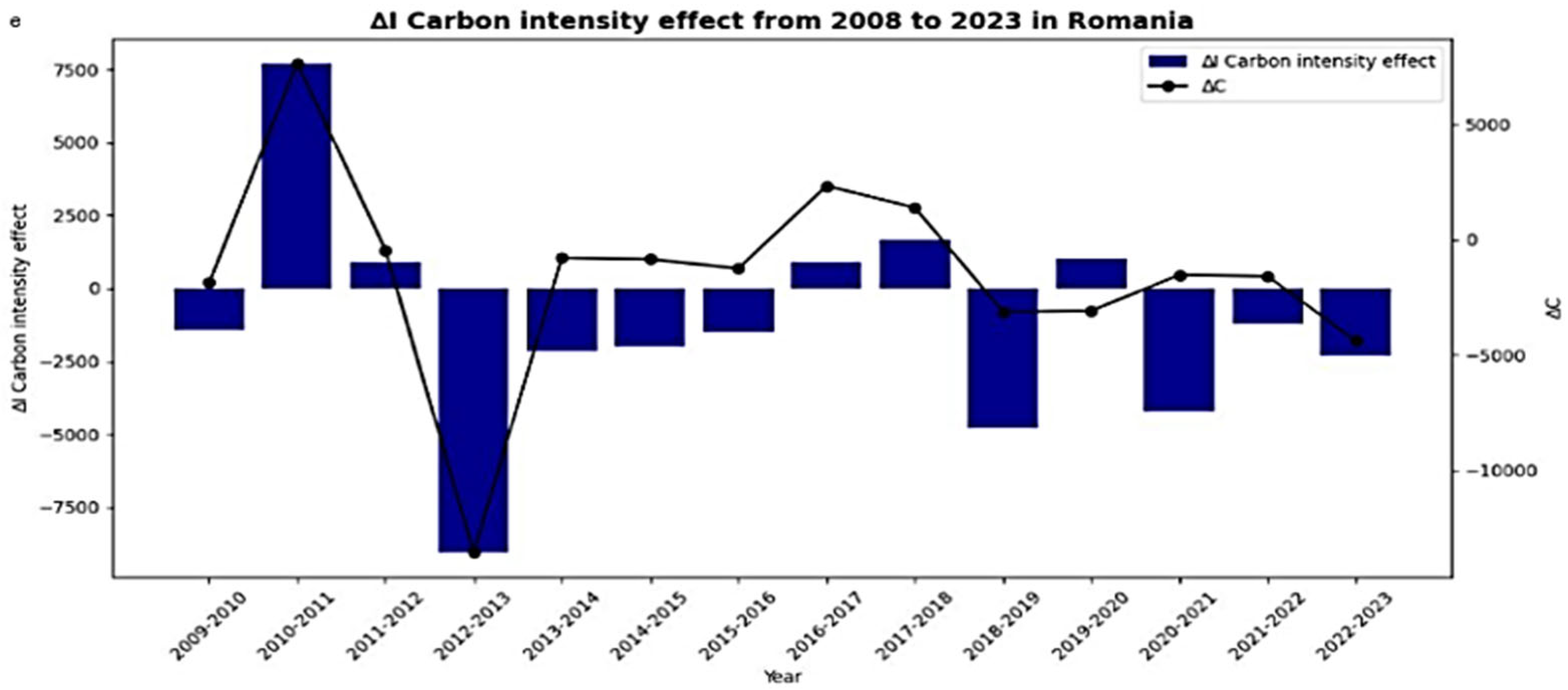
Figure 3. (ae). The detailed impact of the decomposition of CO2 emission change (cumulative) from 2008 to 2023 in Romania. (a) The contribution of the economy (ΔB) index based on Romania’s annual GDP. The histogram indicates the contribution of the economy (ΔB) index, in red. The black line represents the CO2 emission change in energy use. (b) The contribution of the population (ΔP) index based on the resident population. The histogram indicates the contribution of the population (ΔP) index, in purple. The black line represents the CO2 emission change in energy use. (c) The contribution of the energy consumption (ΔL) index based on final energy consumption in the industry. The histogram indicates the contribution of the final energy consumption (ΔL) index, in green. The black line represents the CO2 emission change in energy use. (d) The contribution of the energy consumption (ΔM) index based on primary energy resources. The histogram indicates the contribution of the final energy consumption (ΔM) index, in orange. The black line represents the CO2 emission change in energy use. (e) The contribution of the energy consumption (ΔI) index based on CO2 emissions. The histogram indicates the contribution of the CO2 emissions (ΔI) index, in blue. The black line represents the CO2 emission change in energy use.
Climate 14 00010 g003aClimate 14 00010 g003b
According to Figure 3c, the energy intensity heightened considerably in 2012–2013 and 2021–2022, which could be a result of the expansion of renewable energy. Energy stocks could overrun the absorptive capacity of production. The strong positive correlation between energy intensity and CO2 emissions is evident. Immediately upon production efficiency enhancement in Figure 3c, its impact on CO2 emissions changed negatively and in an opposite manner. The period of 2009–2010 is the only example when a positive coefficient was recorded, the explanation being that both the production and the consumption of electricity increased compared to previous years, according to the official reports of the National Energy Regulatory Authority. From the period of the centralized economy, Romania inherited a highly intensive structure of the economy and, implicitly, a very high intensity of primary energy.
Advances in technology had a positive effect on CO2 emissions. In addition to the constant development of technology and efficiency, energy utilization is reduced, thus decreasing CO2 emissions. The second-largest positive index was ΔM, accounting for 7.44% of the total emission change. It was negatively correlated with CO2 emission, opposite to ΔL. Taking into account a specific quantity of energy consumption, the greater the weight of fossil-based energy, the less renewable energy was utilized, and the larger CO2 emissions were recorded. On the other hand, increasing the proportion of renewable energy might decrease CO2 emissions.
In Figure 3d, an alternation of positive and negative values of the contribution of the energy consumption (ΔM) index based on final energy consumption in industry can be observed. The final energy consumption in the industry varied from 48,166 thousand tons of oil equivalent in 2008 to 41,562 thousand tons of oil equivalent in 2022. A significant difference occurred between 2008–2009 and 2009–2010, of approximately 30%, thus indicating that the contribution of the energy consumption (ΔM) index was 17,098.44 in the first year studied, and, in the second, the ΔM index was −4910.97.
In the period 2008–2023, the main types of primary energy resources used by different sectors of the economy included crude oil (22%), natural gas (22%), coal (12%), hydroelectric, nuclear, and imported electricity (10%), and firewood (10%).
ΔI was the second-largest negative index, accounting for −12.15% of the total emission change. This index, the carbon intensity, is related to all types of energy sources, both fossil energy and renewable energy; additionally, the amount of energy imported during this period was also included in the calculations. According to the literature, the carbon intensity differs from various mixes of fossil fuels, for example, diesel and gasoline are more carbon intensive than raw coal, which is, in turn, more carbon intensive than natural gas. Conversely, using renewable energy, such as solar, wind, and hydro energy, might not release CO2, and, in this period, the percentage of renewable energy produced and imported was only 11%.
A strong negative correlation with CO2 emissions can be observed in Figure 3e, the index varying from −9656.05 in 2008 to −1219.73 in 2022, registering a positive peak of 7714.77 in 2010, comparable to the value of −9051.58 recorded in 2012. Energy production in Romania was still strongly related to coal and anthracite, lignite and brown coal, natural gas, and oil.

5. Policy Implications, Limitations, and Recommendations

In this paper, the influencing factors of CO2 emissions from energy use in Romania were calculated using the LMDI method of decomposition. The analysis also considers the impact of different energy sources used: crude oil, natural gas, coal, hydroelectric, nuclear, and imported electricity, and firewood. The five components of the change in CO2 emissions analyzed in this study were carbon intensity (ΔI), energy mix (ΔM), energy efficiency (ΔL), economy (ΔB), and population (ΔP). Among them, two positive factors (ΔB and ΔM) have an expanding effect on CO2 emissions, while the three negative factors (ΔL, ΔP, and ΔI) have an inhibiting effect. From 2008 to 2023, economic progress was the major factor impacting the increase in total CO2 emissions from energy utilization.
On the contrary, enhancing energy efficiency was the most important factor in preventing emissions. Improving the energy system and decreasing carbon intensity furthermore had mitigating consequences for emissions. Our paper shows that the principal component that influences changes in CO2 emissions in Romania is economic activity and, by contrast, that the energy efficiency effect is the largest negative index.
Predominantly, it can be observed that emissions are cyclical: CO2 emissions increase during periods of economic expansion and decrease when economic activity becomes constricted, the most obvious index being ΔI, the carbon intensity effect.
Nevertheless, we also notice an essential modification in the structure of the economy during the 2008–2023 interval; for example, the economic crisis that our country went through between 2008 and 2010 and the effects of the COVID-19 pandemic are evident in our analyses. All five indexes studied showed variations in the transition from 2008 to subsequent years, probably due to changes in the structure of large sectors of the Romanian economy under the impact of EU accession, as well as the gaps between the sectors of the economy in terms of labor productivity.
The results indicate a substantial expansion of economic activity, with gross domestic product increasing nearly threefold between 2008 and 2022, from RON 539,835 million to RON 1,409,784 million. This pronounced economic growth translated into a strongly positive economic effect (∆B), whose contribution fluctuated between −611.18 and 10,697.27. The above data confirm that economic expansion represented the most significant driving force behind upward pressure on CO2 emissions during the period under review.
Romania’s resident population declined steadily from 20,635,460 inhabitants in 2008 to 19,042,455 in 2022. This demographic contraction was reflected in a consistently negative population effect (∆P), with values decreasing from −807.04 to −494.82. Even though it is smaller than the economic effect, this contribution played a measurable role in partially offsetting emission increases by reducing aggregate energy demand. This level of requirement is associated with household consumption and public services.
Changes in the structure of primary energy resources also had a quantifiable impact on CO2 emissions. Total primary energy resources decreased from 48,166 thousand tons of oil equivalent in 2008 to 41,562 thousand tons of oil equivalent in 2022. Within the LMDI framework, the energy mix effect (∆M) ranged from strong positive contributions of 17,098.44 to much lower values of 1436.76. This dispersion reflects shifts in the relative shares of fossil fuels and renewable sources; its overall effect remained secondary compared to economic growth and efficiency gains. Its mitigating effect was neither uniform nor sufficiently strong to offset the emission pressures generated by sustained economic expansion.
Improvements in energy efficiency emerged as the most influential mitigating factor in the decomposition analysis. Final energy consumption declined markedly from 18,230 thousand tons of oil equivalent in 2008 to 13,289 thousand tons of oil equivalent in 2022. The energy efficiency effect (∆L) consistently registered large negative values, ranging from −25,852.18 to −12,012.68. This substantial negative contribution demonstrates that gains in energy efficiency and reductions in energy intensity played a decisive role in counteracting the emission-increasing effects of economic growth.
These results underscore the analytical strength of the LMDI approach in empirically quantifying the relative magnitude and direction of each contributing factor. The decomposition highlights that Romania’s emission trajectory over the 2008–2023 period was shaped by the interaction between strong economic expansion and equally significant efficiency-driven mitigation effects. This offers a nuanced and data-driven perspective on the country’s progress toward decarbonization.
The carbon intensity effect (∆I) index decreased from −9656.05 to −1219.73. Although, due to difficulties in data acquisition and analysis, this article has some limitations, it is, nevertheless, the first analysis of the situation in Romania using the LMDI method for the period 2008–2023. A number of presumptions made in this study may insignificantly bias the results, but future studies must focus on a more comprehensive analysis of all environmental and economic benefits. These data may have realistic value for encouraging economic progress with low carbon emissions, especially in the context of climate neutrality imposed for the period 2030–2050, while maintaining a proper balance among environmental, social, and economic objectives. The significance of our study is its feasible application to assist the government and local authorities in developing appropriate policy decisions for improved air quality control in Romania.
To strengthen the empirical robustness of this study, it is important to situate the LMDI-based decomposition results for Romania within the context of existing findings from both national and Eastern European sources. The analysis presented here identifies economic growth (∆B) as the principal driver of CO2 emissions from energy use, while improvements in energy efficiency (∆L) and reductions in carbon intensity (∆I) serve as the main mitigating factors, with population decline (∆P) and shifts in the energy mix (∆M) playing secondary roles. These results align with observations reported in bottom-up national inventories and EU/EEA datasets, which indicate that Romania’s CO2 emissions are strongly influenced by GDP trends and structural changes in the economy, particularly the relative contributions of fossil fuels versus renewable energy sources. For instance, the cyclical pattern of emissions—rising during periods of economic expansion and declining during economic contractions, such as the 2008–2010 financial crisis or the COVID-19 pandemic—corroborates trends observed in comparable analyses of Central and Eastern European economies, where decarbonization has been partially offset by industrial growth and population dynamics.
Given its robust theoretical foundation and its unmatched practical utility, LMDI is unequivocally the preferred and most widely adopted method for decomposition analysis. It provides the analytical rigor, precision, and flexibility required for modern quantitative research and evidence-based policy formulation. The broad consensus among scholars and the method’s proven track record in a multitude of empirical studies across diverse fields affirm its status as the de facto standard. For any professional or academic seeking to undertake a decomposition analysis, the LMDI method offers the most reliable, complete, and insightful approach to understanding the complex drivers of change.

Limitations of the Study

Despite the significant contributions of this study, there are several limitations. For example, the data used are limited in terms of temporal coverage, being available only for the period 2008–2023, and certain economic and energy variables could not be included in our analysis due to data limitations or difficulties in obtaining accurate information for all relevant economic sectors.
The analysis excludes factors such as urbanization level, infrastructure development, and the impact of direct fiscal policies on emissions due to data limitations, although future research could potentially incorporate these aspects using multivariate or spatial models.
Regarding the recommendations for economic and environmental policies, it is essential for Romania to continue encouraging investments in renewable energy sources through subsidies and tax incentives, as well as through the development of support programs for research and development in green energy.
A more flexible legislative framework is needed to support the transition from fossil fuels to renewable sources, through policies that facilitate job conversion and reduce the social impact of this transition.
It is also necessary to develop infrastructure dedicated to ecological transport, adopt policies that support the development of the circular economy by promoting recycling and waste reduction, and provide grants and financial incentives for start-ups and companies in the green technology sector. These measures will help develop solutions that can significantly reduce CO2 emissions.

6. Conclusions

The findings of this study provide a comprehensive understanding of the key determinants influencing CO2 emissions in Romania’s energy sector between 2008 and 2023. By applying the LMDI decomposition, the analysis identifies the economic effect (∆B) as the main driving force increasing carbon emissions, while energy efficiency (∆L) and carbon intensity (∆I) exert substantial mitigating impacts. This dual dynamic underscores the complexity of Romania’s decarbonization pathway, where economic growth and industrial expansion continue to challenge the country’s capacity to achieve sustainable environmental outcomes.
From an administrative and policy perspective, the results highlight the importance of integrating environmental objectives into national economic strategies. The observed positive association between GDP growth and CO2 emissions suggests that economic expansion remains energy-dependent, emphasizing the need for targeted administrative instruments to decouple economic performance from carbon output. The efficiency-driven reductions in emissions demonstrate that administrative innovation, technology adoption, and energy governance reforms can yield tangible environmental benefits.
Population decline and shifts in primary energy resources (∆P and ∆M) highlight the demographic and structural aspects of Romania’s transition toward sustainability. Although population changes exert a relatively modest influence, the transformation of the energy mix, particularly the gradual inclusion of renewable sources, plays a crucial role in mitigating emissions. Strengthening institutional capacities to manage these structural transitions will be essential for maintaining policy coherence across energy, demographic, and economic domains.
The study reinforces the argument that sustainable development requires not only technological solutions but also coherent administrative coordination, consistent policy frameworks, and long-term governance strategies. Romania’s experience demonstrates that while economic growth may intensify emission pressures, effective public administration, through efficiency enhancement, emission monitoring, and green policy integration, can realign development objectives with sustainability imperatives. Future research should deepen this approach by examining sectoral variations, regional governance mechanisms, and the administrative instruments that most effectively support decarbonization within emerging European economies.

Author Contributions

Conceptualization, C.M.D.B. and G.I.; methodology, C.M.D.B.; software, C.G.S.; validation, C.M.D.B., C.G.S. and I.S.P.; formal analysis, C.M.D.B.; investigation, C.M.D.B.; resources, C.G.S.; data curation, G.I.; writing—original draft preparation, G.I.; writing—review and editing, C.G.S.; visualization, G.I.; supervision, C.M.D.B.; project ad-ministration, C.G.S.; funding acquisition, C.G.S. All authors have read and agreed to the published version of the manuscript.

Funding

This research received no external funding.

Data Availability Statement

National Institute of Statistics of Romania through the TEMPO online database http://statistici.insse.ro:8077/tempo-online/ (accessed on 1 May 2025).

Conflicts of Interest

The authors declare no conflict of interest.

References

  1. EEA. Annual European Union Greenhouse Gas Inventory 1990–2021 and Inventory Report 2023. Available online: https://www.eea.europa.eu/publications/annual-european-union-greenhouse-gas-2 (accessed on 20 February 2025).
  2. IPCC. Climate Change 2023: Synthesis Report. 2023. Available online: https://www.ipcc.ch/report/ar6/syr/ (accessed on 1 May 2025).
  3. Paris Agreement. OJ L 282, 19.10.2016, p. 4. 2016. Available online: https://eur-lex.europa.eu/legal-content/EN/TXT/?uri=CELEX:22016A1019(01) (accessed on 1 May 2025).
  4. EC. European Green Deal: Research & Innovation Call; Directorate-General for Research and Innovation; Publications Office of the European Union: Brussels, Belgium, 2021; ISBN 978-92-76-42387-4. [Google Scholar] [CrossRef]
  5. Yang, F.; Yang, X.; Tian, X.; Wang, X.; Xu, T. Decomposition analysis of CO2 emissions of electricity and carbon-reduction policy implication: A study of a province in China based on the logarithmic mean Divisia index method. Clean Energy 2023, 7, 340–349. [Google Scholar] [CrossRef]
  6. Wei, Y.; Zhao, T.; Wang, J.; Zhang, X. Exploring the impact of transition in energy mix on the CO2 emissions from China’s power generation sector based on IDA and SDA. Environ. Sci. Pollut. Res. 2021, 28, 30858–30872. [Google Scholar] [CrossRef] [PubMed]
  7. Wang, W.W.; Zhang, M.; Zhou, M. Using LMDI method to analyze transport sector CO2 emissions in China. Energy 2011, 36, 5909–5915. [Google Scholar] [CrossRef]
  8. Rose, A.; Casler, S. Input-output structural decomposition analysis: A critical appraisal. Econ. Syst. Res. 1996, 8, 33–62. [Google Scholar]
  9. Howarth, R.B.; Schipper, L.; Duerr, P.A.; Strom, S. Manufacturing energy use in eight OECD countries. Energy Econ. 1991, 13, 135–142. [Google Scholar] [CrossRef]
  10. Scholl, M.A.; Ingebritsen, S.E.; Janik, C.J.; Kauahikaua, J.P. Use of precipitation and ground water isotopes to interpret regional hydrology on a tropical volcanic island: Kilauea Volcano area, Hawaii. Water Resour. Res. 1996, 32, 3525–3537. [Google Scholar]
  11. Shrestha, R.M.; Timilsina, G.R. Factors affecting CO2 intensity of power sector in Asia: A divisia decomposition analysis. Energy Econ. 1996, 18, 283–293. [Google Scholar] [CrossRef]
  12. Zhang, Z. Decoupling China’s carbon emissions increase from economic growth: An economic analysis and policy implications. World Dev. 2000, 28, 739–752. [Google Scholar] [CrossRef]
  13. Ang, B.W.; Liu, N. Handling zero values in the logarithmic mean Divisia index decomposition approach. Energy Policy 2007, 35, 238–246. [Google Scholar] [CrossRef]
  14. Paul, S.; Bhattacharya, R.N. CO2 emissions from energy use in India: A decomposition analysis. Energy Policy 2004, 32, 585–593. [Google Scholar] [CrossRef]
  15. Steenhof, P.A. Decomposition of electricity demand in China’s industrial sector. Energy Econ. 2006, 28, 370–384. [Google Scholar]
  16. Mai, L.; Ran, Q.Y.; Wu, H.T. A LMDI decomposition analysis of carbon dioxide emissions from the electric power sector in Northwest China. Nat. Resour. Model. 2020, 33, e12284. [Google Scholar] [CrossRef]
  17. Wachsmann, U.; Wood, R.; Lenzen, M.; Schaeffer, R. Structural decomposition of energy use in Brazil from 1970 to 1996. Appl. Energy 2009, 86, 578–587. [Google Scholar] [CrossRef]
  18. Wood, R. Structural decomposition analysis of Australia’s greenhouse gas emissions. Energy Policy 2009, 37, 4943–4948. [Google Scholar]
  19. Kim, S. LMDI Decomposition Analysis of Energy Consumption in the Korean Manufacturing Sector. Sustainability 2017, 9, 202. [Google Scholar] [CrossRef]
  20. De Oliveira-De Jesus, P.M. Effect of generation capacity factors on carbon emission intensity of electricity in Latin America & the Caribbean—A temporal IDA-LMDI analysis. Renew. Sustain. Energy Rev. 2019, 101, 516–526. [Google Scholar]
  21. İpek Tunç, G.; Türüt-Aşık, S.; Akbostancı, E. A decomposition analysis of CO2 emissions from energy use: Turkish case. Energy Policy 2009, 37, 4689–4699. [Google Scholar] [CrossRef]
  22. Andrei, J.V.; Avram, S.; Băncescu, I.; Gâf Deac, I.I.G.; Gheorghe, C. Evolution of Romania’s economic structure and environment degradation—An assessment through LMDI decomposition approach. Risk Manag. Healthc. Policy 2021, 14, 3505–3521. [Google Scholar]
  23. Năstase, G.; Șerban, A.; Năstase, A.F.; Dragomir, G.; Brezeanu, A.I. Air quality, primary air pollutants and ambient concentrations inventory for Romania. Atmos. Environ. 2018, 184, 292–303. [Google Scholar] [CrossRef]
  24. Wang, Q.; Suo, R.; Han, Q. A study on natural gas consumption forecasting in China using the LMDI-PSO-LSTM model: Factor decomposition and scenario analysis. Energy 2024, 292, 130435. [Google Scholar] [CrossRef]
  25. Yang, J.; Li, Z. Improving urban ecological welfare performance: An ST-LMDI approach to the Yangtze River Economic Belt. Land 2024, 13, 1318. [Google Scholar] [CrossRef]
  26. Wang, Z.; Li, L.; Lei, Y.; Wu, S.; Cui, Y.; Dong, Z.; Ren, C. Synergistic emission reductions and health effects of energy transitions under carbon neutrality target. J. Clean. Prod. 2024, 456, 142303. [Google Scholar] [CrossRef]
  27. Kamyab, H.; Saberi-Kamarposhti, M.; Hashim, H.; Yusuf, M. Carbon dynamics in agricultural greenhouse gas emissions and removals: A comprehensive review. Carbon Lett. 2024, 34, 265–289. [Google Scholar] [CrossRef]
  28. Onofrei, M.; Vintilă, G.; Dascalu, E.D.; Roman, A.; Firtescu, B.N. The Impact of Environmental Tax Reform on Greenhouse Gas Emissions: Empirical Evidence from European Countries. Environ. Eng. Manag. J. 2017, 16, 2843–2849. [Google Scholar] [CrossRef]
  29. Mohammed, S.; Gill, A.R.; Ghosal, K.; Al-Dalahmeh, M.; Alsafadi, K.; Szabó, S.; Harsanyi, E. Assessment of the environmental Kuznets curve within EU-27: Steps toward environmental sustainability (1990–2019). Environ. Sci. Ecotechnology 2024, 18, 100312. [Google Scholar] [CrossRef]
  30. Firtescu, B.N.; Brinza, F.; Grosu, M.; Doaca, E.M.; Siriteanu, A.A. The effects of energy taxes level on greenhouse gas emissions in the environmental policy measures framework. Front. Environ. Sci. 2023, 10, 965841. [Google Scholar] [CrossRef]
  31. Wang, H.; Ou, X.; Zhang, X. Logarithmic Mean Divisia Index decomposition of CO2 emissions from urban passenger transport: An empirical study of global cities from 1960–2001. Sustainability 2019, 11, 4310. [Google Scholar] [CrossRef]
  32. Ang, B.W. The LMDI approach to decomposition analysis: A practical guide. Energy Policy 2005, 33, 867–871. [Google Scholar] [CrossRef]
  33. Kaya, Y. Impact of Carbon Dioxide Emission on GNP Growth: Interpretation of Proposed Scenarios; IPCC Energy and Industry Subgroup: Geneva, Switzerland, 1989. [Google Scholar]
  34. NISR. National Institute of Statistics Romania, 2024. Available online: http://statistici.insse.ro:8077/tempo-online/#/pages/tables/insse-table (accessed on 1 May 2025).
  35. Li, K. Influencing Factors and Emission Reduction Paths of Industrial Carbon Emissions Under Target of “Carbon Peaking”: Evidence from China. Pol. J. Environ. Stud. 2025, 34, 2715–2734. [Google Scholar] [CrossRef]
  36. Bianco, V.; Cascetta, F.; Nardini, S. Analysis of the carbon emissions trend in European Union—A decomposition and decoupling approach. Sci. Total Environ. 2024, 909, 168528. [Google Scholar] [CrossRef]
  37. Gao, Q.; Raza, N.; Sun, D.; Akmal, M.; Nayab, F. Energy and social factor decomposition to identify drivers impeding sustainable environmental transition in emerging countries: SDGs-2030 progress assessment using LMDI analysis. Environ. Sci. Pollut. Res. 2024, 31, 24599–24618. [Google Scholar] [CrossRef] [PubMed]
  38. Zhao, E.; Wu, J.; Wang, S.; Sun, S.; Wang, S. Factors Influencing Energy Consumption from China’s Tourist Attractions: A Structural Decomposition Analysis with LMDI and K-Means Clustering. Environ. Model. Assess. 2024, 29, 569–587. [Google Scholar]
  39. Wang, Q.; Zhang, F.; Li, R.; Sun, J. Does artificial intelligence promote energy transition and curb carbon emissions? The role of trade openness. J. Clean. Prod. 2024, 447, 141298. [Google Scholar] [CrossRef]
Figure 1. CO2 emissions and year-over-year change in Romania (2008–2023).
Climate 14 00010 g001
Figure 2. The decomposition of CO2 emission change (cumulative) from 2008 to 2023 in Romania, represented as follows: carbon intensity (ΔI) in blue; energy mix (ΔM) in orange; energy efficiency (ΔL) in green; economy (ΔB) in red; and population (ΔP) in purple. The histogram indicates the contribution of every index.
Climate 14 00010 g002
Table 1. Interpretation and definition of the symbols.
SymbolTermDefinition and FormulaUnitsEffect Name and Interpretation
CCarbon EmissionsTotal CO2 emissions from fuel combustionGg tons CO2/yearDependent variable
FFossil EnergyTotal fossil energy resourcesktoe
ETotal EnergyTotal energy consumption before transformationktoe
PPopulationTotal populationPersonsΔP → Population effect
GGDPGross Domestic Product (constant currency)RON millionΔB → Economic effect
C/FCarbon IntensityCO2 emissions per unit of fossil energyMtCO2/ktoeΔI → Carbon intensity effect
F/EEnergy MixShare of fossil energy in total energy%ΔM → Energy mix effect
E/GEnergy EfficiencyEnergy use per unit of GDPktoe/RON millionΔL → Energy efficiency effect
G/PGDP per CapitaGDP divided by populationRON/personΔB → Economic effect
ΔCChange in EmissionsCt–C0 (difference between year t and base year)MtCO2Total change
ΔI, ΔM, ΔL, ΔB, ΔPDecomposition EffectsContributions of each factor to ΔCMtCO2Interpret as drivers of change
Disclaimer/Publisher’s Note: The statements, opinions and data contained in all publications are solely those of the individual author(s) and contributor(s) and not of MDPI and/or the editor(s). MDPI and/or the editor(s) disclaim responsibility for any injury to people or property resulting from any ideas, methods, instructions or products referred to in the content.