


Abstract
This study investigates the impact of eddy viscosity on equatorially trapped waves and the instability of the background shear in a simple barotropic–baroclinic model. It is the first study to include eddy viscosity in the study of tropical wave dynamics. This study also unifies the study of baroclinic and barotropic instabilities by using a coupled barotopic and baroclinic model of the tropical atmosphere. Linear wave theory is combined with a systematic Galerkin projection of the baroclinic dynamical fields onto parabolic cylinder functions. This study investigates varying shear strengths, eddy viscosities, and their combined effects. In the absence of shear, baroclinic and barotropic waves decouple. The baroclinic waves themselves separate into triads, forming the equatorially trapped wave modes known as Matsuno waves. However, when a strong eddy viscosity is included, the structure and propagation characteristics of these equatorial waves are significantly altered. Different wave types interact, leading to strong mixing in the meridional direction and coupling between meridional modes. This coupling destroys the Matsuno mode separation and offers pathways for these waves to couple and interact with one another. These results suggest that viscosity does not simply suppress growth; it may also reshape the propagation characteristics of unstable modes. In the presence of a background shear, some wave modes become unstable, and barotropic and baroclinic waves are coupled. Without eddy viscosity, instability begins with small scale and slowly propagating modes, at arbitrary small shear strengths. This instability manifests as an ultra-violet catastrophe. As the shear strength increases, the catastrophic instability at small scales expands to high-frequency waves. Meanwhile, instability peaks emerge at synoptic and planetary scales along several Rossby mode branches. When a small eddy viscosity is reintroduced, the catastrophic small-scale instabilities disappear, while the large-scale Rossby wave instabilities persist. These westward-moving modes exhibit a mixed barotropic–baroclinic structure with signature vortices straddling the equator. Some vortices are centered close to the equator, while others are far away. Some waves resemble synoptic-scale monsoon depressions and tropical easterly waves, while others operate on the planetary scale and present elongated shapes reminiscent of atmospheric-river flow patterns.
1. Introduction
Energy and momentum in the atmosphere are transferred from larger to smaller scales through two mechanisms: the instability of the basic flow, followed by eddy turbulence cascades that expand down to molecular dissipation scales. Basic flow instabilities can be classified into two main groups: baroclinic and barotropic instabilities (or a mixture of these two) and Kelvin-Helmholtz-type instabilities. Barotropic and baroclinic instabilities occur at synoptic scales and lead to the growth of various weather systems, while Kelvin-Helmholtz-type instabilities occur at much smaller scales and primarily lead to turbulent eddies at fluid interfaces [1,2,3].
In the tropics, waves and wave-like disturbances, such as tropical easterly waves and tropical depressions, are often linked to barotropic and baroclinic instability of the ambient flow [4,5,6,7,8,9]. Tropical easterly waves are particularly known to play a central role in the genesis and amplification of tropical cyclones, especially in the tropical Atlantic [10], while the breakdown of the intertropical convergence zone (ITCZ) is believed to be a manifestation of barotropic instability and often leads to synoptic scale eddies that in turn intensify through vorticity stretching to become tropical cyclones [11,12]. The interaction between barotropic flows and equatorially trapped waves (ETW) are believed to be the conveyor belt through which kinetic energy is transported between the tropics and extra-tropics [13,14,15,16]. Biello and Majda [14] emphasized the significance of interactions between barotropic and baroclinic Rossby waves in the two-way transfer of energy and momentum between barotropic and baroclinic flows, especially in the presence of a mean shear. Meanwhile, while extra-tropical Rossby-like disturbances emanating from baroclinic and barotropic instability often propagate, westward and eastward moving modes are typically a tropical phenomenon [17,18], and eastward moving synoptic weather systems have been observed at latitudes as high as 15° [19]. Interactions of equatorially trapped Kelvin waves and the barotropic flow among other possibilities have been identified as the primary drivers [13,19] of such off-equatorial weather patterns.
Spectral analysis of both observations and reanalysis data of the tropical troposphere shows concentration of wave energy at synoptic and planetary scales, superimposed on a red noise-like background [17]. While the predominant spectral peaks are associated with convectively coupled analogues of the ETWs of Matsuno [20], tropical depressions, and the Madden-Julian oscillation [21,22], the origin of the background spectrum remains a subject of debate [23,24]. Hottovy and Stechmann [25] demonstrated that this background red noise could be linked to stochastic white noise forcing, which coincidentally justifies the red-noise classification. However, a recent study by Garfinkel et al. [24] proposed that the power background might be associated with turbulent eddies due to the existence of an inverse cascade between mesoscale motions associated with organized convection and synoptic waves. While this view is problematic, as it fails to explain the spectral gap between Kelvin waves and Madden-Julian oscillation (MJO), it opens the door to new interpretations of tropical wave dynamics and their interactions across scales with convective motions. In essence, it suggests that equatorial waves, although appearing linear, have a nonlinear impact, generating turbulence and eddy viscosity, for instance. Furthermore, there is ample evidence of persistent eddies in the subtropics and extra-tropics [26], which influence large-scale flow patterns like the Hadley cell [27,28] and tropical cyclones [29,30]. According to [27,31], the scale at which turbulence transitions to wavelike behavior, marking a sharp reduction in the energy cascade rate, is estimated around the Rhines scale. This scale can vary from a hundred to up to a thousand kilometers in the tropics, depending on the strength of the background flow. This finding is consistent with the results of [28].
However, all known studies of convectively coupled waves, and the MJO, are based on linear and non-viscous dynamics. The effects of transient eddies and nonlinearity are rarely accounted for. The eddy generation through nonlinear interaction is often accounted for in theoretical and numerical studies of atmospheric dynamics through an eddy viscosity term [32,33]. However, theoretical studies of equatorial wave dynamics have ignored the eddy viscosity terms and systematically been replaced by either uniform damping terms such as Rayleigh damping (for momentum) and Newtonian Cooling (for energy) [34] or boundary layer dissipation [35]. Incidentally, the use of uniform (or zero) damping allows for a systematic decoupling of the equations of motion into triads and the decoupling of the tropical wave modes going by the names of Kelvin, Rossby, mixed Rossby-gravity (a.k.a Yanai), and inertia-gravity waves [20,34], usually referred to as Matsuno waves.
This study investigates the systematic effect of viscosity on the dynamics and morphology of ETWs and how it influences the baroclinic-barotropic instability in a simplied primitive equation model reduced to a barotropic mode and a first baroclinic mode [36]. Using linear analysis, we show that in the absence of a background flow, the ETWs of Matsuno become coupled with one another through viscosity and as such both their dynamical morphology and propagation characteristic change rather drastically, when the viscosity is high. Moreover, while a simple linear baroclinic shear becomes unstable fairly instantly, producing ultraviolet catastrophe, through the growing instability of high wavenumber modes, the addition of eddy viscosity induces a scale selection mechanism by stabilizing the large wavenumber modes, while instability peaks at synoptic and planetary scales persist. These large-scale unstable modes are associated with westward moving coupled baroclinic-barotropic Rossby waves, akin to tropical easterly waves, monsoon depressions, and atmospheric-river flow patterns [4,5,6,7,19,37,38].
For the first time, the effect of eddy viscosity is included in the study of tropical wave dynamics. This study also unifies the study of baroclinic and barotropic instabilities through the use of a coupled barotopic and baroclinic model of the tropical atmosphere.
The rest of this paper is organized as follows: Section 2 presents the model and analysis method. Section 3 illustrates the effect of viscosity on the structure and the propagation of ETWs. Section 4 reports the shear instability results in the presence of viscosity. Section 5 concludes this paper, and some technical details of the linear theory are reported in Appendix A and Appendix B.
2. The Model Equations and Linear Analysis Procedure
We consider the non-linear primitive equations for synoptic scale atmospheric dynamics on an equatorial -plane [18,39]:
Here, is the horizontal velocity field, u is the zonal component, v is the meridional (North—South) component, and W is the vertical velocity. The scalars and are, respectively, the pressure and potential temperature perturbations with respect to a stationary-background state. The total potential temperature, including the background that depends only on height, is given by
where is a reference constant temperature and defines the vertical profile background stratification, which is assumed to be a constant so that . The constant N is the Brunt-Väisälä-buoyancy frequency, and m s−2 is Earth’s gravitational constant. Here, are, respectively, the zonal, meridional, and vertical coordinates, and is time. is the y-gradient of the Coriolis parameter.
The primitive equations are supplemented with the rigid lid boundary conditions:
Here, H is the height of the troposphere, which is also assumed to be constant. For mathematical convenience, the primitive equations are converted into non-dimensional form, using the synoptic reference scales of equatorial dynamics balancing the Coriolis and buoyancy forces, so that both and become unity. We temporarily denote the non-dimensional variables as follows:
where , , and the temperature scale is , including, respectively, the reference velocity, length, time, and temperature scales. With the values of m−1s−1 and s−1, and with the tropospheric height set to km, consistent with earlier studies [1,2,39], we obtain
Of particular interest, the length scale L corresponds to the equatorial Rossby radius of deformation [2]. It sets the scale at which equatorial waves are trapped in the vicinity of the equator [18,20,39].
2.1. Barotropic–Baroclinic Model Equations with Viscosity
Following earlier work [14,36,40], the non-dimensionalized primitive Equation (1) are expanded in the vertical direction and truncated to retain only the barotropic and first baroclinic modes:
In short, the barotropic and baroclinic modes arise from a systematic expansion of the linearized primitive equations of atmospheric dynamics using separation of variables between the vertical and horizontal coordinates [18,39]. They represent the normal modes of tropical variability associated with the propagation of gravity waves in shallow water-like environments with different equivalent depths [18,20,41]. In general, the barotropic mode is associated with the deepest and fastest gravity waves. In the present setting of constant stratification and rigid lid boundary conditions, the barotropic gravity wave speed is infinite, meaning that “external” gravity waves are filtered out, and as such, the barotropic mode is divergence free and carries only vortical motions in the form of Rossby waves. The systematic vertical normal mode expansion leads to an infinite number of baroclinic modes whose vertical flow eigen-structures are given by the two sequences , often referred to as the normal modes of vertical structure [41]. The associated gravity wave speeds of internal or baroclinic dynamics are given by the sequence , corresponding to the first and fastest baroclinic mode that sets the reference velocity scale of m/s and the deepest equivalent depth of m [18], which nonetheless remains much smaller than H.
2.2. Linearized Barotropic–Baroclinic Equations in a Baroclinic Shear Background
When the non-linear primitive equations are projected onto the barotropic and first-baroclinic modes, based on the ansatz in (3) and (4), a coupled system of two-mode shallow water-like equations is obtained [14,40]. To this so-called barotropic–baroclinic system of equations, we here add eddy viscosity terms:
Here, represents the eddy viscosity coefficient, due to the turbulent cascade of kinetic energy from the synoptic flow by means of mesoscale eddies that are not captured by the primitive equations. As such, for clarity, we assume , where is a tuning parameter that represents the eddy length scale and is a dissipation time scale. Numerous observational and numerical studies have suggested momentum damping scale of the order of 2 to 20 days in the tropical atmosphere due to cumulus frictions and other turbulent eddy mechanisms [42,43,44,45,46]. Consistently, here, we set days and vary . In this fashion, when , the Rossby radius of deformation, synoptic waves with comparable wavelengths are damped on the 10-day scale, while smaller eddies are damped at a much faster rate.
We linearize the barotropic–baroclinic equations about a shear flow background. We choose a background with a baroclinic flow on the form
with
and no barotropic component.
Small perturbations of this basic flow, denoted by obey, at first order, a linear system of equations. Further we put the barotropic flow in the vorticity-stream function form, where is the perturbation stream function so that
and the perturbation barotropic vorticity is
The linearized barotropic–baroclinic equations, which we will here analyze, are given as follows:
It is worth noting that the first and second terms after the time derivative in the vorticity equation (first equation in (6)) represent the advection of baroclinic vorticity and baroclinic convergence by the baroclinic shear, respectively. The fourth and fifth terms are vorticity stretching terms that essentially extract vorticity from the baroclinic shear and inject it into the barotropic mode. These later two terms are only active in the presence of a meridional shear (), while the first two are activated by a vertical shear alone and serve to transfer vorticity and convergence from baroclinic to barotropic waves. On the other hand, barotropic waves feedback onto baroclinic waves through the advection of the background shear by the barotropic wave flow (the term in the second equation) and the advection of the barotropic vorticity by the background shear (the terms and in the second and third equations, respectively). The combined effect effectively highlights the central role of the barotropic–baroclinic interaction in transferring vorticity and momentum from the baroclinic background flow to both baroclinic and barotropic waves. When disturbances are exited (i.e., become unstable) by the baroclinic shear, both baroclinic and barotropic flow components are present. For this reason, it is more adequate to refer to this type of shear instability, at synoptic and planetary scales, as mixed barotropic–baroclinic instability.
2.3. Galerkin Truncation in the Meridional Direction
In the absence of shear and viscosity, i.e., and , the baroclinic and barotropic waves in (6) decouple, forming separate linear systems. The wave solutions of these systems are the barotropic Rossby waves and the ETWs of Matsuno, respectively (see [18,20,39]). A key distinction lies in their propagation characteristics. The barotropic Rossby waves propagate both westward along the equator and in the North and South directions, while the Matsuno waves only propagate along the equator, which acts as a waveguide. This peculiarity arises from the vanishing and sign change of the Coriolis force at the equator.
The meridional structure of the Matsuno waves, as defined by their dependence on the y variable, consists of linear combinations of the parabolic cylinder functions from quantum mechanics. These functions are defined as:
where are the Hermite polynomials (see [47]), and the are normalization constants so that the form an orthonormal basis of the square integrable functions on the real line. The presence of the exponential in these functions reflects the fact that the waves are trapped in the vicinity of the equator. The integer is known as the meridional index in the Matsuno wave theory and serves to distinguish wave groups based on how much they are trapped in the vicinity of the equator. The case is associated with a single wave, known as the Kelvin wave, corresponds to a couplet of mixed Rossby-gravity (MRG) or Yanai waves, while each is associated with a triad consisting of an equatorial Rossby and an eastward and westward propagating gravity wave. While details can be inferred from the cited literature, it is worth noting here that the y-structure of the Kelvin wave involves only and appears to be the most trapped wave, while the two MRGs involve both and . The triads associated with have a meridional structure that combines .
Motivated by the meriodional structure of the uncoupled barotropic–baroclinic waves, we expand the solutions of (4) in the y-variable using a combination of Fourier modes for the barotropic waves and the parabolic cylinder functions for the baroclinic waves:
where represents the meridional wavenumber for barotropic Rossby waves expressed in non-dimensional units. Here, km is the perimeter of the Earth along the equator, and , , and are the expansion coefficients that depend on x and t, respectively.
To obtain a reasonable approximate system to analyze, we use Galerkin truncation based on a mixed Fourier and parabolic cylinder function expansion, applied to the barotropic and baroclinic equations in (4), respectively. For the sake of simplicity, only one Fourier mode is retained for the barotropic stream function (), while up to parabolic cylinder functions are retained in the expansion of the baroclinic waves. As demonstrated in previous studies [48,49,50], provides a high enough accuracy for the analysis of equatorially trapped and convectively coupled waves. Using only one Fourier mode for the stream function, on the other hand, provides an opportunity to study the interaction of a single barotropic Rossby wave with ETWs with more clarity. The study of the interaction of a single pair of barotropic and baroclinic Rossby waves was considered in [14].
To eliminate spurious modes in the truncated system due to the abrupt Galerkin truncation, we impose a radiation condition on the last coefficients of the baroclinic expansion [48,49]:
This condition, as outlined in [48], ensures that only meaningful wave modes are retained. In essence, this condition renders the parabolic-cylinder function expansion equivalent to expanding the same equations in terms of wave modes, as done in [20,34], for example.
Denoting the coefficient of the single-mode-barotropic Rossby wave by , The truncated system thus reduces to a linear system of partial differential equations for the unknown vector:
on the form
Further mathematical details leading to this system and exact expressions of the constant coefficient matrices ,, and are provided in the Appendix A and Appendix B.
To move further, we proceed with a spectral analysis by assuming wavelike solutions for the solution vector :
where ( is the nondimensional zonal wave number and is the generalized frequency. For simplicity in exposition, in the sequel, we use k to refer to the non-dimensional wavenumber . The spectral method leads to the generalized eigenvalue problem:
The matrices and are found in Appendix A. By varying the wavenumber k, the dispersion relation and eigenstructure vector for individual wave solutions are obtained. The real part of , represents the phase of the wave (with being the phase speed). Its imaginary part, , represents the rate of growth or decay, depending on whether it is positive or negative. In the presence of shear, unstable waves manifest as modes with positive growth.
3. ETWs in the Presence of Eddy Viscosity
To gain some basic understanding on how the eddy viscosity terms affect the structure and propagation characteristics of the equatorial waves, we will here consider the simple case when the background flow is zero. The corresponding linear equations take the form
As a result, the barotropic waves, represented by the stream function , and the baroclinic waves completely decouple from one another. Moreover, it is evident from the -equation that the effect of viscosity on the barotropic Rossby waves is a simple damping mechanism for high-wavenumber modes. Indeed, the dispersion relation (obtained when plugging in the ansatz ) is given by
3.1. Riemann Invariants
By introducing the Riemann invariants,
we can rewrite the baroclinic wave equations as follows:
where are the raising and lowering operators of quantum mechanics. Combining these equations leads to the harmonic oscillator of quantum mechanics, whose eigen-solutions are precisely the parabolic cylinder functions introduced found in (7) [18,48].
In the absence of viscosity , as already mentioned, equations for ETWs with distinct meridional indices are naturally separated. Indeed, the expansion in (8) decouples the baroclinic equations in (18) into a single equation for , a 2 × 2 system coupling and , and an infinite sequence of triads coupling and for all . The -equation defines the Kelvin waves, the 2 × 2 system yields the eastward and westward MRG waves, while the triads have three solutions corresponding to a branch of Rossby waves and two branches associated with eastward and westward inertia-gravity waves, respectively [18,39].
However, when , besides a somewhat trivial decoupling between symmetric and antisymmetric waves, the expected wave-type decoupling does not occur. Instead, the commonly known ETWs appear to be coupled to one another. To illustrate, we consider the first few equations, up to , while enforcing the radiation condition in (9), to ensure that only relevant wave modes are retained. In terms of the Riemann invariants, this condition amounts to setting .
Dropping the tilde notation for simplicity in exposition, the remaining variables solve the following coupled (systems of) equations:
Although the equations in (19)–(22) are intrinsically coupled, they are purposefully separated into a scalar Equation (19) for Kelvin waves, a 2 system for MRG waves (20), and two triads (Equations (21) and (22)) associated with lowest index symmetric and anti-symmetric Rossby and inertia-gravity waves, respectively. These last two systems are repeated for and correspond to Rossby and inertia-gravity waves of higher meridional indices.
It is easy to see that when , the sub-systems composing (19)–(22) decouple from one another as anticipated. However, viscosity appears to provide a mechanism through which waves of different meridional indices can be coupled with one another. Nonetheless, the symmetric waves associated with even components are only coupled with symmetric waves, and the same applies for anti-symmetric waves. For instance, Kelvin waves can excite symmetric Rossby waves and vice versa through interactions of with in the system (19)–(21), which subsequently leads to interactions with . Similarly, MRG waves can interact with anti-symmetric Rossby waves in a similar manner.
While the strength of these couplings is theoretically directly tied to the eddy viscosity, its relevance for wave-wave coupling in the real atmosphere remains to be investigated. In this study, we focus on examining the effect of this coupling on the dynamical structure and the speed of propagation of the ETWs as a simple theoretical exercise.
While infinitely many (symmetric and anti-symmetric) wave modes are theoretically coupled together, it is both impractical and non-physical to assume this. To limit the analysis, we use Galerkin truncation, which allows us to consider only the first waves, where , to include at least Kelvin and MRG waves as well as the Rossby and inertio-gravity waves associated with the first two triads. This truncation corresponds to stopping the expansion in (8) at . For more details, see Appendix A.
A Galerkin truncation of order N yields a linear system of PDEs in the x and t of the form in (10) of dimension for all , for which we look for wave solutions of the form , where represents the vector of components . This leads to a generalized eigenvalue problem of the form in (11). The corresponding matrices are given in Appendix B, for the sake of completeness.
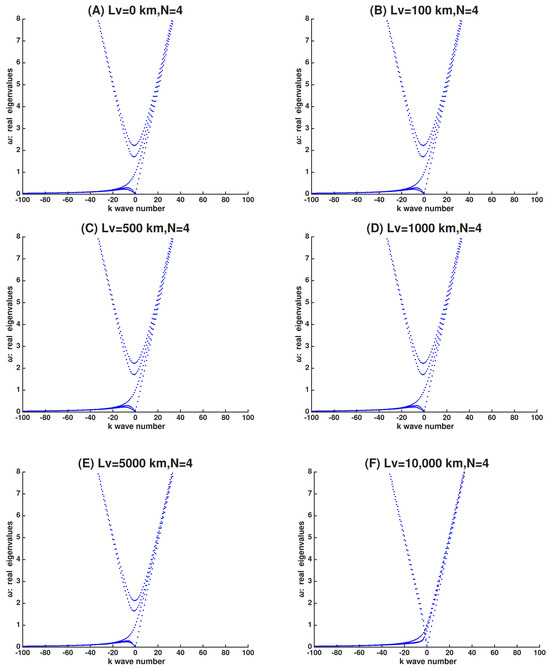
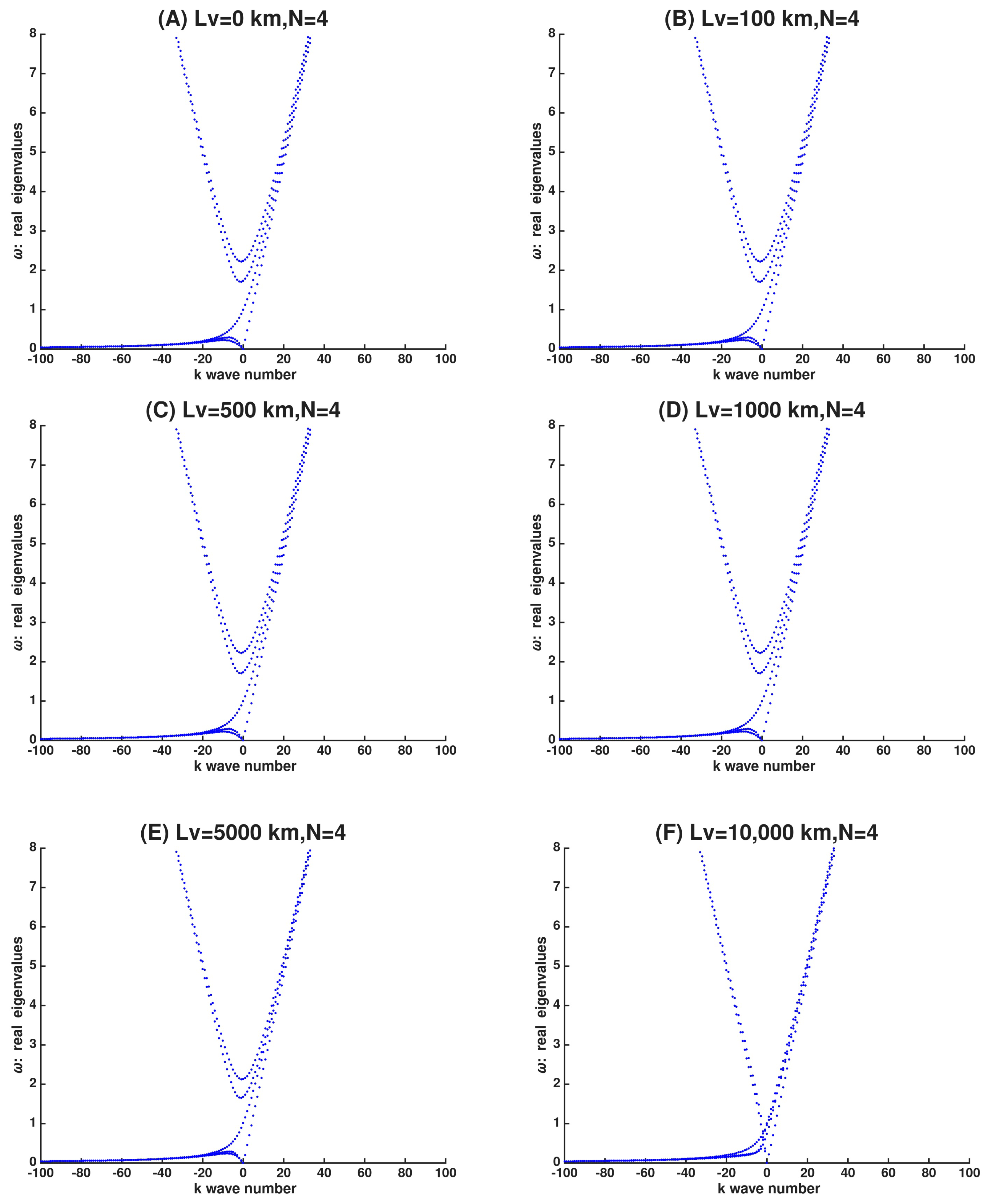
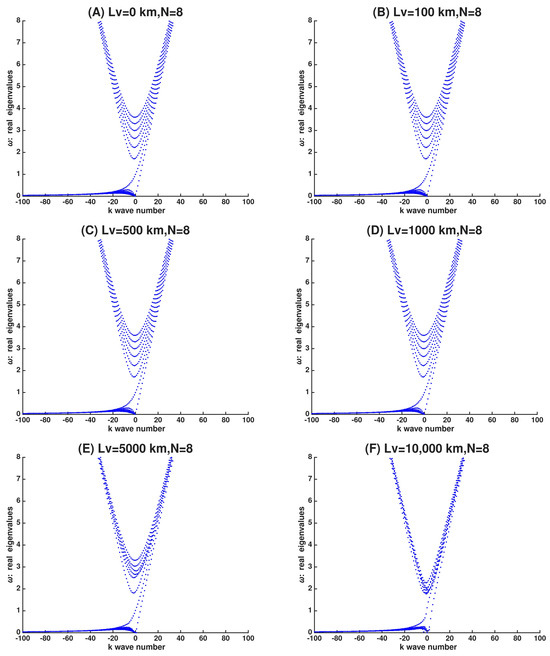
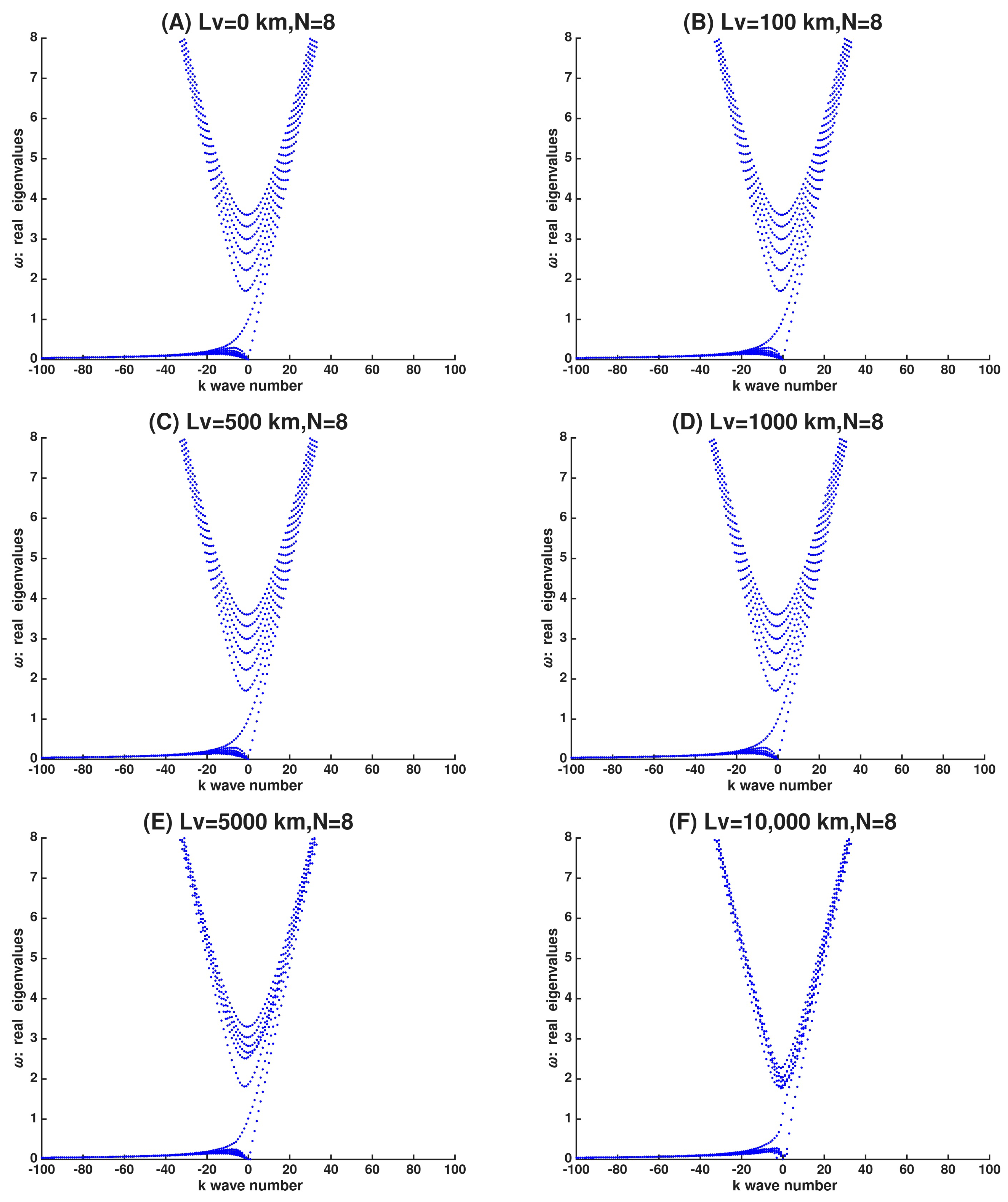
Despite the equatorial modes being coupled to one another, through viscosity, the spectral analysis for the system in (19)–(22) and its variants associated with arbitrary N values will still yield a certain number of wave modes. Specifically, for all , there are modes, and for , there is only one mode. Due to the resemblance of the dispersion relation curves in Figure 1 and Figure 2 to the inviscid case (), especially for reasonably small eddy viscosities, we retained the same names for the corresponding branches, as listed in Table 1, Table 2, Table 3 and Table 4.
Figure 1.
Equatorially trapped wave dispersion relations : sensitivity to eddy viscosity, Garlerkin truncation with .The various curves represents the branches representative of the first 9 equatorial wave modes: Kelvin, Eastward and Westward mixed Rossby-gravity, () Symmetric and () anti-symmetric Rossby and Eastward and Westward Inertio-gravity waves, respectively.
Figure 2.
Same as Figure 1 but for .
Table 1.
Effect of viscosity of propagation of speed of first 9 ETWs for wavenumbers 1, 2, 5, and 10 and Galerkin truncation at .
Table 2.
Same as Table 1 but for .
Table 3.
Damping rate () of ETWs under the influence of eddy viscosity. .
Table 4.
Same as Table 3 but for .
3.2. Eddy Damping and Effect of Viscosity on Phase Speed
We recall that for ease of interpretation, we have set , where days is fixed and varies. This allows us to observe the effect of damping eddies of length scale over a time period of 10 days. Incidentally, this 10-day period is comparable to the lifetime of convectively coupled Kelvin waves, as reported in observations [17]. It is worth noting that values as large as 10,000 km will be tested here. While such values may seem unrealistic, large damping timescales are not uncommon in theoretical studies of tropical dynamics, including models for the MJO (see [51] and references therein). In Fourier space, a km value is equivalent to planetary scales being damped on the 10-day time scale, consistent with these MJO theories.
In Figure 1 and Figure 2, we plot the dispersion relations, which are the real parts of the eigenvalues , for the Galerkin truncated system in (18) with and , respectively. The wavenumber k varies from to 100 in non-dimensional units of . The eddy viscosity parameter is gradually increased by varying through the different panels. The case is plotted for reference.
As can be surmised from Figure 1 and Figure 2, for km, which is roughly the Rossby radius of deformation, the effect of viscosity on the dispersion relations is negligible at least in appearance for both when and . Significant changes in the dispersion relations appear, especially for the inertio-gravity waves, only for the largest values of in Panels E and F. Based on the fact that the dispersion relations are only mildly distorted, especially for the smaller values of , it is reasonable to conclude that the ETWs preserve their identities, as Kelvin, MRG (Yanai), Rossby, inertia-gravity waves, etc., despite the apparent coupling due to the presence of eddy viscosity.
In Table 1 and Table 2, we present the phase speeds, , of the first nine ETWs for varying values of (the strength of eddy viscosity) and wavenumber k. These phase speeds are based on Galerkin truncations at and , respectively. Consistent with Figure 1 and Figure 2, the phase speeds remain relatively stable when km. However, slight changes begin to emerge at km and become more pronounced at km and km.
We note that at such large values, there is a significant quantitative sensitivity to the order of the Galerkin truncation. For example, with , the -Kelvin wave speeds corresponding to km and km are 42.99 m/s and 46.03 m/s, respectively. These values represent significant reductions compared to the 50 m/s benchmark corresponding to . However, the reduction becomes significantly more pronounced at , yielding phase speeds of 36.20 m/s and 22.21 m/s, respectively. This suggests that the eddy viscosity mechanism not only makes Kelvin waves interact with Rossby and inertia-gravity waves, but also, these interactions extend to higher meridional-index modes.
As anticipated, the most obvious and perhaps most significant effect of eddy viscosity on ETWs is to damp them down, so that in the absence of forcing such as shear instability or diabatic heating from convection [18], the waves will decay over time and die. As in the example of the barotropic wave dispersion relation in (16), the damping effect of eddy viscosity appears as a negative imaginary part in the relation. In Table 3 and Table 4, we report the damping rates, , in units of hour−1 associated with the first nine ETWs for the same sequence of increasing and k values as in Table 1 and Table 2, corresponding to and , respectively. Although an analytic formula is not accessible, unlike the case of barotropic waves in (16), we can see from these tables that the damping rate increases nonlinearly both with increasing viscosity and with increasing wavenumber.
Moreover, if we focus on the viscosity value corresponding to km (which is on the order of the Rossby radius of deformation of roughly 1500 km), the damping rate inflected on Kelvin and -Rossby waves is around per hour at , corresponding to a damping time scale of 10 days, which is within the realm of damping time scale found in theoretical and observational studies of tropical dynamics and the MJO in particular [43,44,45,46,51,52]. Thus, setting as high as 2000 km is perhaps not as high as it appears to be.
3.3. Effect of Eddy Viscosity on Wave Structure
While eddy viscosity is expected to dampen equatorially trapped waves from both physical and mathematical perspectives, the change in phase speed, although minimal for realistically low eddy viscosity scales ( km), is less expected. However, a quick look at the Galerkin projection equations in (19)–(22) suggests that the waves, no longer decoupled, would likely see their propagation characteristics significantly altered, leading to changes in their phase speeds.
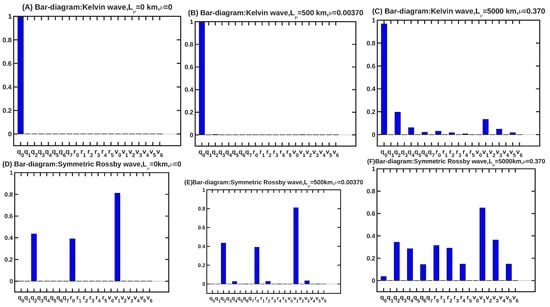
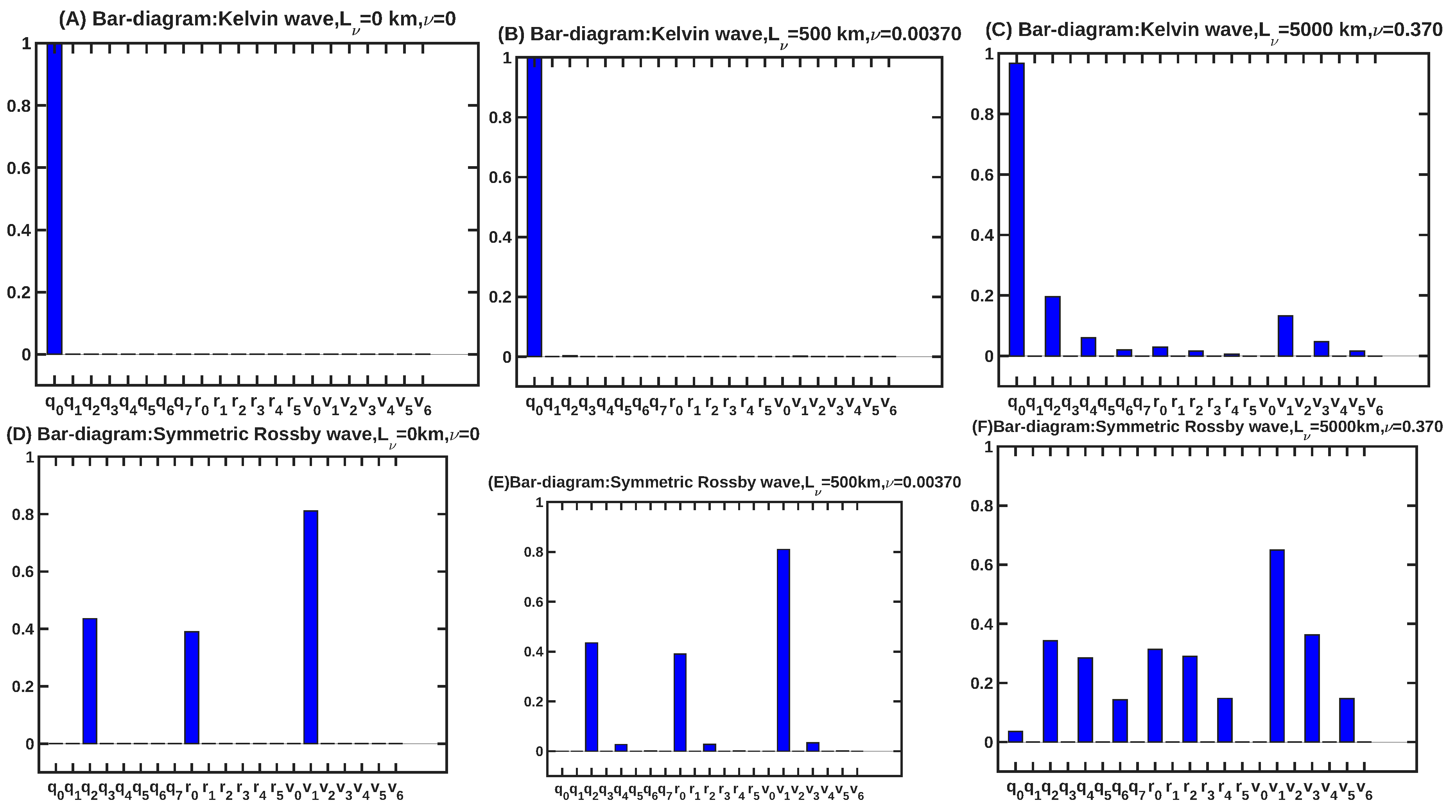
To further investigate the effect of eddy viscosity on equatorially trapped waves, we plot in Figure 3 the bar diagrams of the relative strength of the Galerkin expansion components, , , , for the two eigen-modes associated with the Kelvin and (symmetric) Rossby waves. We only illustrate these two modes for simplicity, although the same effect, and sometimes more pronounced, is observed for all modes. The Kelvin and Rossby waves are chosen because of their central importance in tropical dynamics [17]. To focus on synoptic-scale waves that are most prominent in equatorial dynamics [17,18], we select a wavenumber of . To balance clarity and accuracy, we set the Galerkin truncation to .
Figure 3.
Bar diagram of the Kelvin (A–C) and Rossby (D–F) waves at wavenumber for (A,D), km (B,E), and km (C,F). .
First, we note that, consistent with the theory of equatorially trapped waves [18,39], as expected from (19)–(22), at zero eddy viscosity, the Kelvin wave in Figure 3 retains only the component , while the Rossby wave is represented by . At km, there is a small contribution (1% or less) from to the Kelvin mode in Figure 3B, which significantly amplifies at km in Figure 3C, which also depicts non-zero as well as components, though going from weak to weaker.
Similarly, we also see at first the appearance of a -triad contribution at km that amplifies as is increased to km for the Rossby modes in Figure 3E,F. At the same time, the interaction trickles down to contributions from the triad , where we observe a significant contribution from (≈15% of ), a signature of an interaction with the Kelvin waves.
From a different perspective, these bar diagrams suggest that under the influence of eddy viscosity, what we perceive as a Kelvin wave may actually contain significant Rossby and potentially inertio-gravity wave contributions that impact both its propagation speed and dynamical structure. Similarly, the Rossby wave becomes coupled to higher index (, etc.) Rossby waves, and possibly even gravity waves, as well as the Kelvin wave. From a practical standpoint, this coupling could be attributed to the ability of certain equatorially trapped waves, such as the Kelvin wave, to interact and potentially excite other waves, including Rossby and inertia-gravity waves. Several MJO theories are based Kelvin-Rossby couplets through the advanced interaction mechanisms, which vary from boundary layer dissipation to wave action [51].
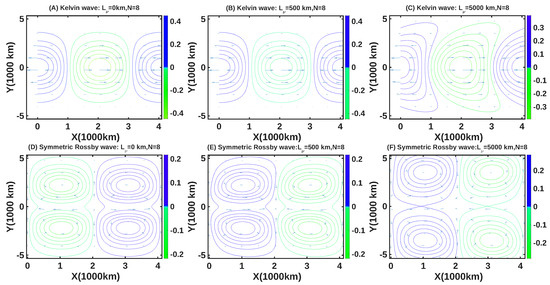
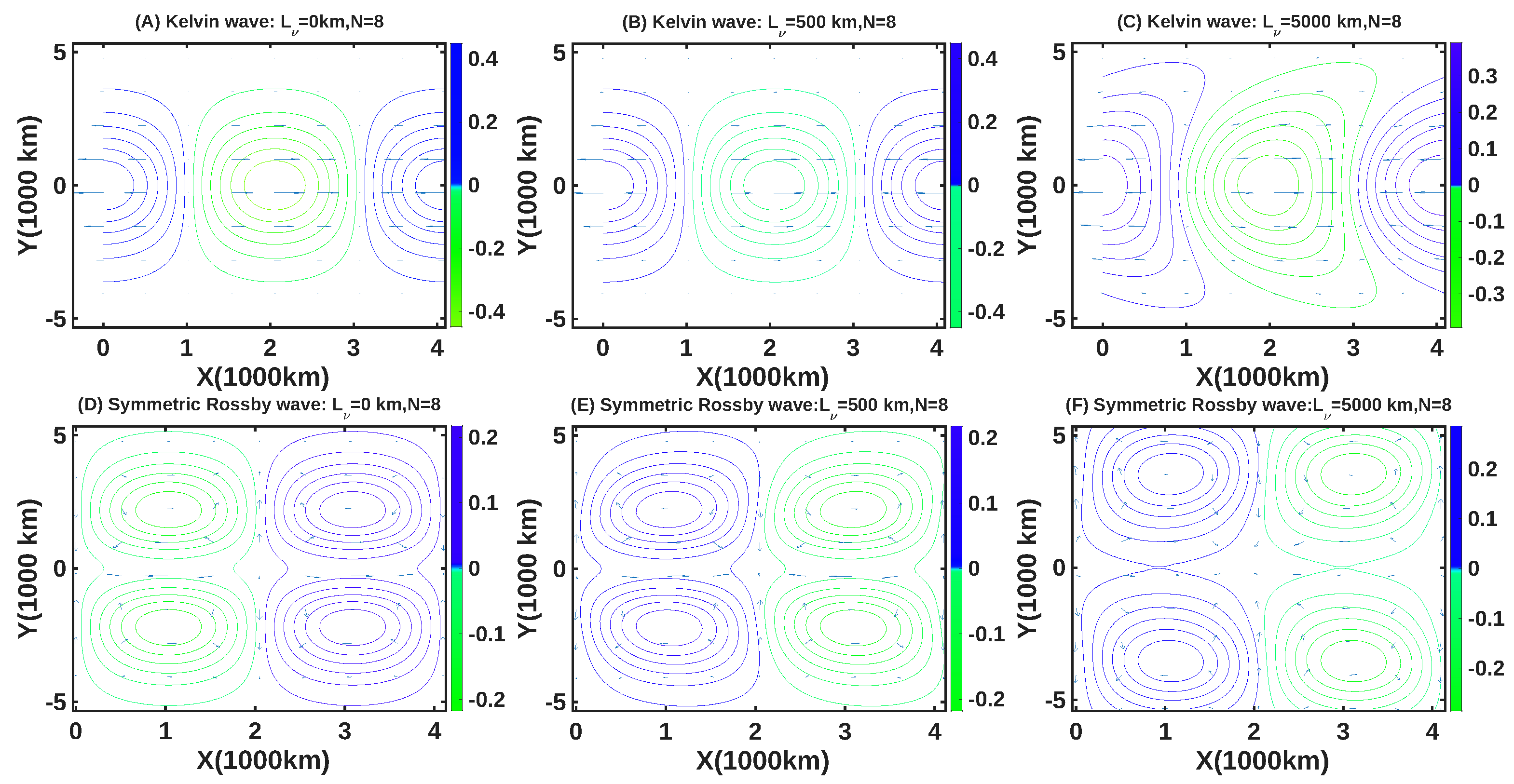
We conclude this section by plotting in Figure 4 the structure of the viscous Kelvin and Rossby waves, depicted in Figure 3. As expected from the bar diagrams of Figure 3, the change in wave structure becomes visually significant at km for the Kelvin wave, while it remains negligible at km (Figure 4B,C). For the Rossby wave structure, however, significant tilting is readily observed at km. Interestingly, the effect of strong eddy viscosity on the Kelvin wave, as shown in Figure 3C, is identical to that of a highly diffusive numerical simulation of a non-forced Kelvin wave (see Figure 1 of [13]), and also intriguingly reminiscent of the effect of a barotropic easterly shear on the wave (see Figure 5 of [13]). While it is unclear whether the deformed structure of equatorial waves would have a significant dynamical effect in the tropical atmosphere, this result suggests that observed tropical waves may not be exact replicas of the Matsuno waves derived for inviscid, unforced equations.
Figure 4.
Same as Figure 3, but for the wave structure. Contours of potential temperature and total velocity fields (arrows).
Figure 5.
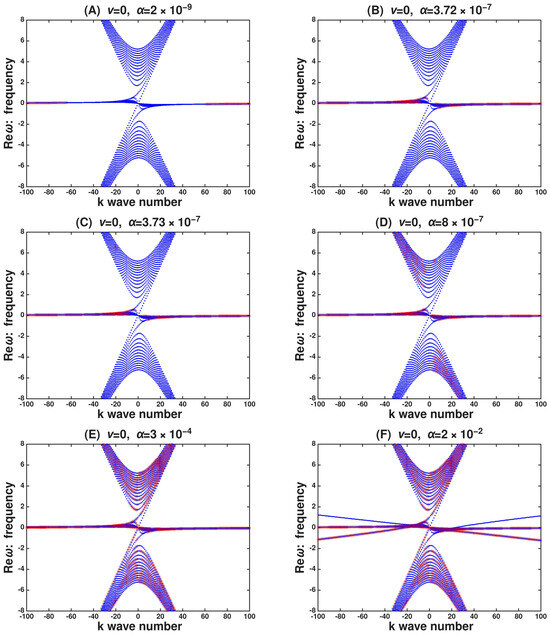
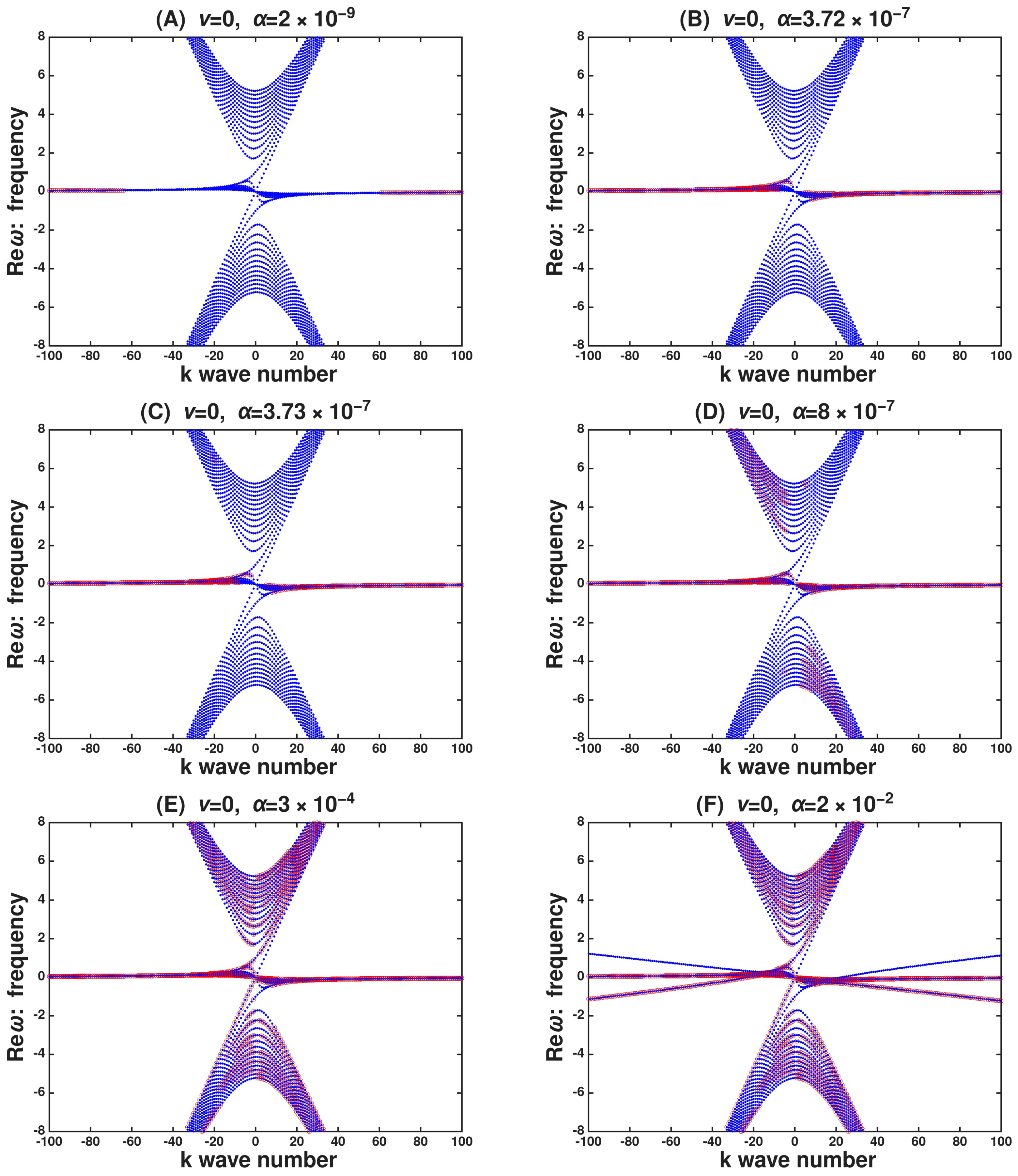
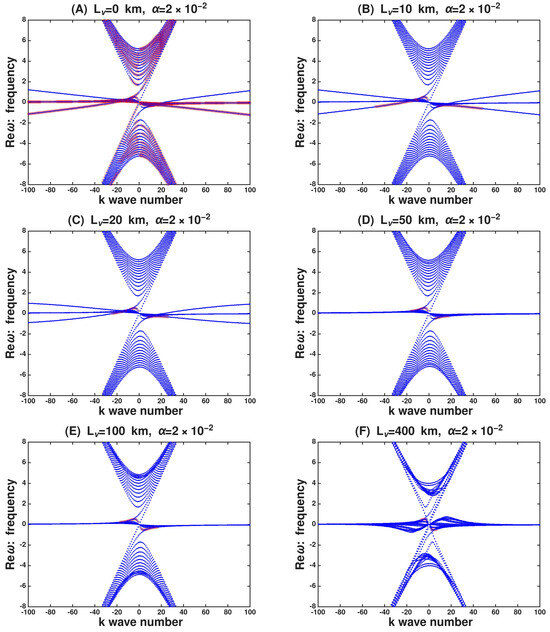
Dispersion relations and instability of the (Galerkin truncated) barotropic–baroclinic equations for increasing values of the shear strength in the absence of viscosity . Galerkin truncation modes. Instable modes are highlighted in red.
4. Baroclinic-Barotropic Instability in the Presence of Eddy Viscosity
We now return to the linearized barotropic–baroclinic equations in (6) and assume that the baroclinic shear takes the simple linear form:
and we attempt to find wave disturbances that are unstable, i.e, disturbances that are capable in extracting energy from the background flow and grow.
The baroclinicity of the background flow implies that we are actually in the presence of both vertical and meridional shear, which induces a temperature gradient:
For this reason, this type of instability is often referred to as mixed barotropic–baroclinic instability [53,54,55,56]. As mentioned in the introduction, the barotropic and baroclinic instability plays a central role in tropical dynamics. It is believed to be one of the main mechanism of the genesis of tropical easterly waves and monsoon low-pressure systems [4,5,7,19,53,57].
The parameter in (23) is used to control the strength of the background shear. When the system in (4) is Galerkin projected in the meridional direction onto parabolic cylinder functions mixed with the single Fourier mode for the barotropic stream function as previously discussed, a system of the form in (8) is obtained. This system is analyzed using the spectral method, which leads to the linear algebra problem in (11).
As in [49,50], we fix . These early studies suggested that at such a high value of N, the Galerkin method is highly accurate in representing the most significant equatorial wave dynamics in the presence of both convection and shear. We begin with the inviscid case of .
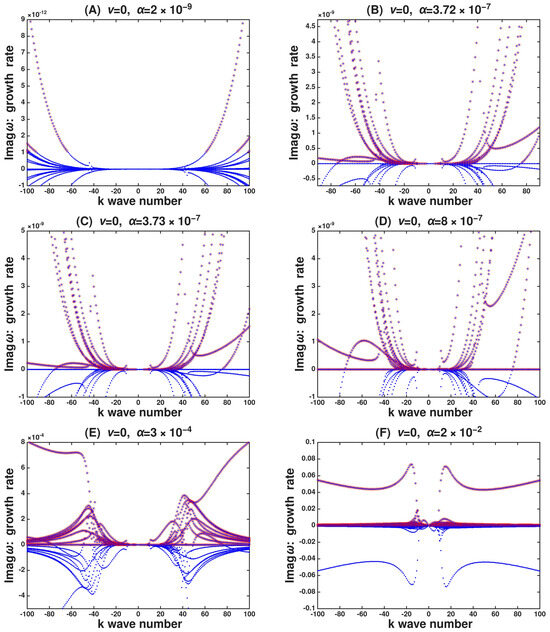
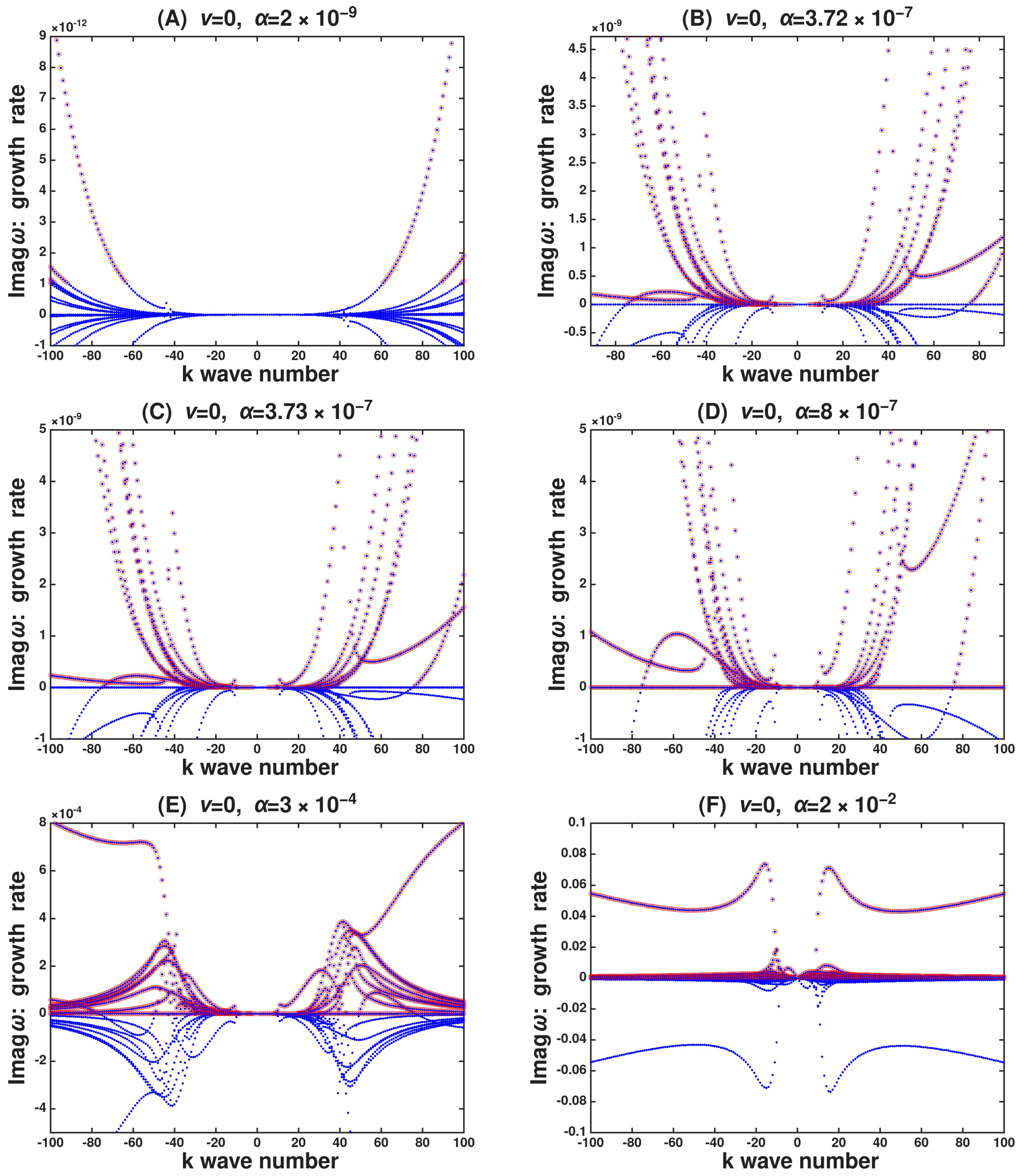
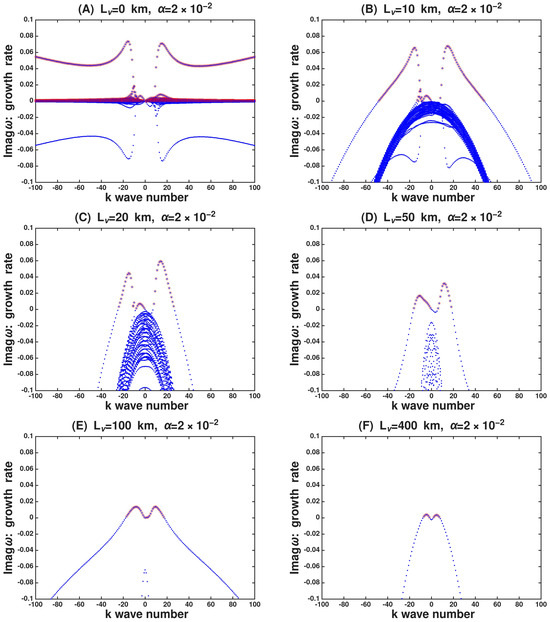
In Figure 5 and Figure 6, we plot the dispersion relations, , and growth rates, , respectively, for increasing values of the parameter . The unstable modes (corresponding to eigenvalues of the linear system with ) are highlighted with red circles. As can be seen, the instability begins at shear strengths as small as (corresponding to a shear value of s−1 in dimensional units). It appears, however, at small scales corresponding to wavenumbers , or wavelengths of 400 km and shorter, with the instability increasing with wavenumber and extending to smaller scales. Indeed, an arbitrarily small parameter leads to instabilities at arbitrarily smaller scales. The increase in growth rate with wavenumber is often referred to as the ultra-violet catastrophe. Such catastrophic small-scale instabilities are both non-physical and non-desirable in a large-scale dynamics model.
Figure 6.
Same as Figure 5, but for the growth rates.
It terms of wave type, it appears from Figure 5 that the instability is restricted to slow-moving/low-frequency Rossby-like waves. As is increased, the instability moves towards synoptic and planetary scales, along those Rossby branches. High-frequency gravity modes are also destabilized when and higher. At large shear (), the effect of the background wind on the wave speed becomes noticeable, and all wave types and almost all wave branches become unstable. Once more, this widespread instability behavior is both catastrophic in terms of numerical modeling and physically unrealistic, though the imposed shear strength corresponding to 1 m/s over one Rossby radius of deformation (or s−1) is still on the weak side compared to observed background shear values in the tropics. It is within the realm if not on the weaker side of shear values induced by the Indian monsoon trough or the African jet, to name a few examples. Suhas and Boos [58] have, for instance, used a meridional shear on the order of 10 m/s over 10 degrees (∼1100 km to study the amplification of monsoon depressions by horizontal shear.
Moreover, it is worth noting that the transition to the instability of high-frequency modes is rather abrupt instead of being gradual; compare, for instance, Figure 5B,C, where the increase in is only on the order 0.3%. It is worth noting that for larger values, the shear background also significantly impacts the dispersion diagram due to Doppler shift.
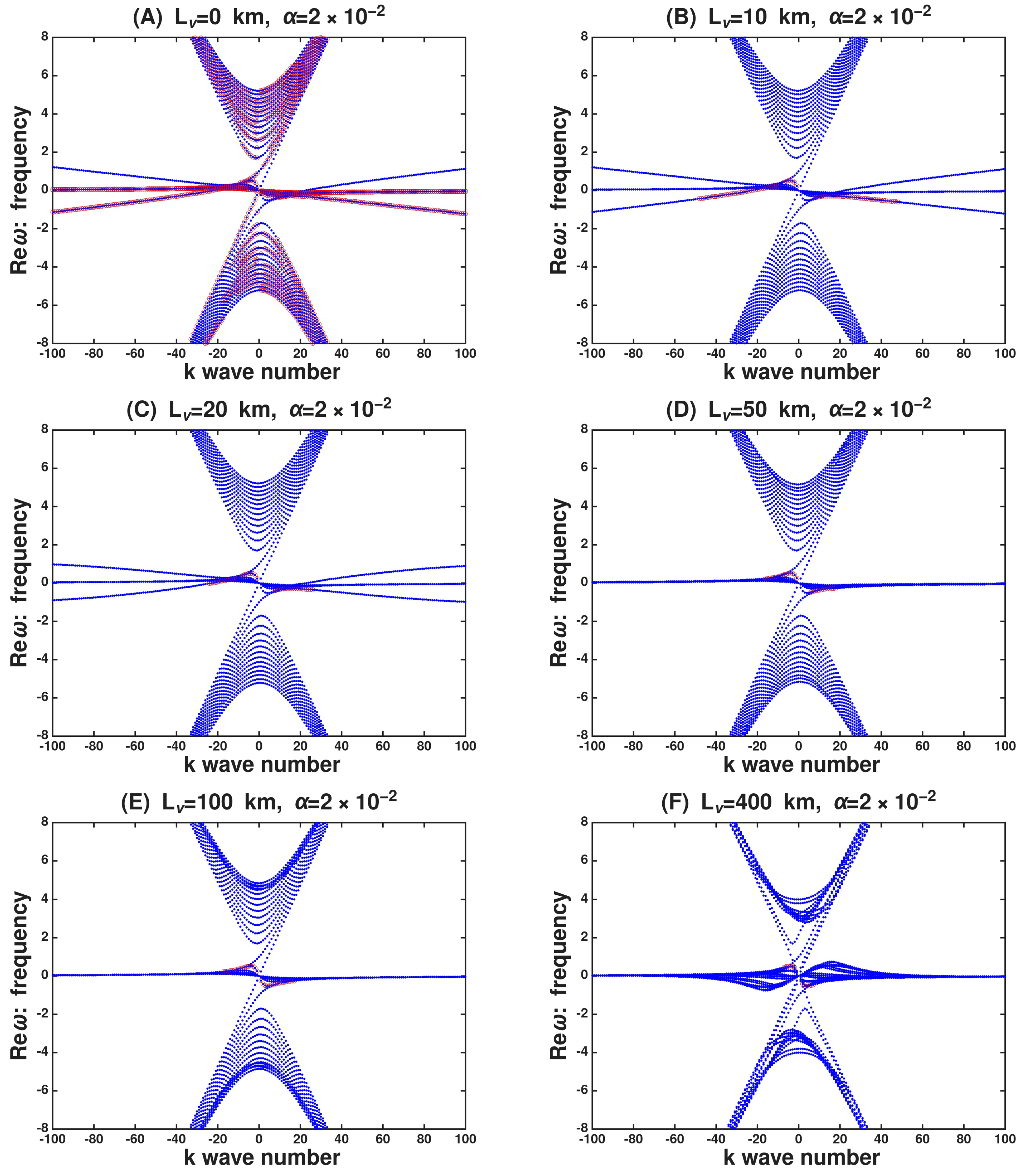
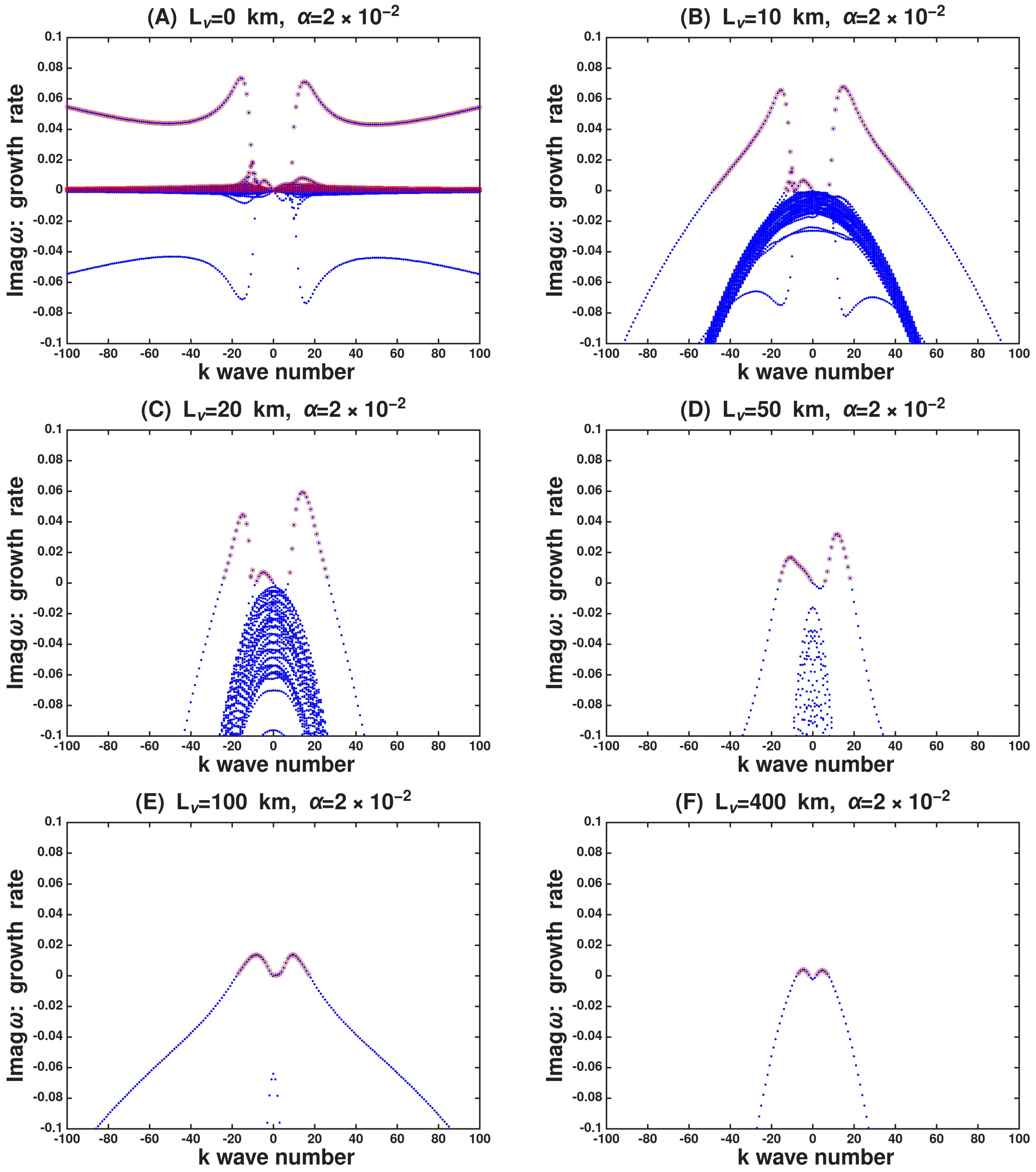
We now reintroduce the effects of viscosity. In Figure 7 and Figure 8, we plot the dispersion relations and growth rates, respectively, for the baroclinic-barotropic system with shear for increasing values of viscosity when . Starting with the small viscosity value corresponding to km, the catastrophic instability at both large wavenumber and high frequency waves disappears. Only the instability of synoptic-scale westward-moving Rossby-type waves remains, involving both the barotropic Rossby wave branch and equatorially trapped Rossby waves.
Figure 7.
Same as Figure 5 but for fixed shear strength and varying viscosity scale, .
Figure 8.
Same as Figure 7, but for the growth rates.
However, as previously noted, in the presence of shear, baroclinic and barotropic modes are strongly coupled, likely leading to highly mixed wave modes. As such, these unstable waves should not be expected to be purely barotropic nor purely baroclinic Rossby waves, but rather mixed. As is increased, the instability significantly weakens, moves further towards larger scales, and eventually disappears altogether.
A closer look at Figure 7A and Figure 8A suggests that, for the smallest eddy viscosity, at least three branches are unstable, on both sides of y-axis: MRG waves and both barotropic and baroclinic Rossby waves. However, as the viscosity is increased, both the instability of the MRG and equatorial Rossby waves fade out very quickly. The MRG instability disappears first, at as small as 10 km. This is followed by the baroclinic (equatorial) Rossby waves, which disappear at km. The instability corresponding to the barotropic Rossby branch persists to up to km, which roughly corresponds to damping occurring at the length scales of coherent mesoscale vortices associated with organized convective systems in the ITCZ [59,60] and squall lines that are abundant in monsoon environments [61,62]. In other words, the imposed viscosity is interpreted as the presence of such coherent vortices that extract energy from the background shear.
Of course, for larger values, the various instability types will persist for larger viscosity coefficients. Interestingly, however, even though it is the one persisting when the viscosity is increased, the barotropic Rossby branch is not the dominant instability mode in the lower viscosity cases in Figure 7A and Figure 8A.
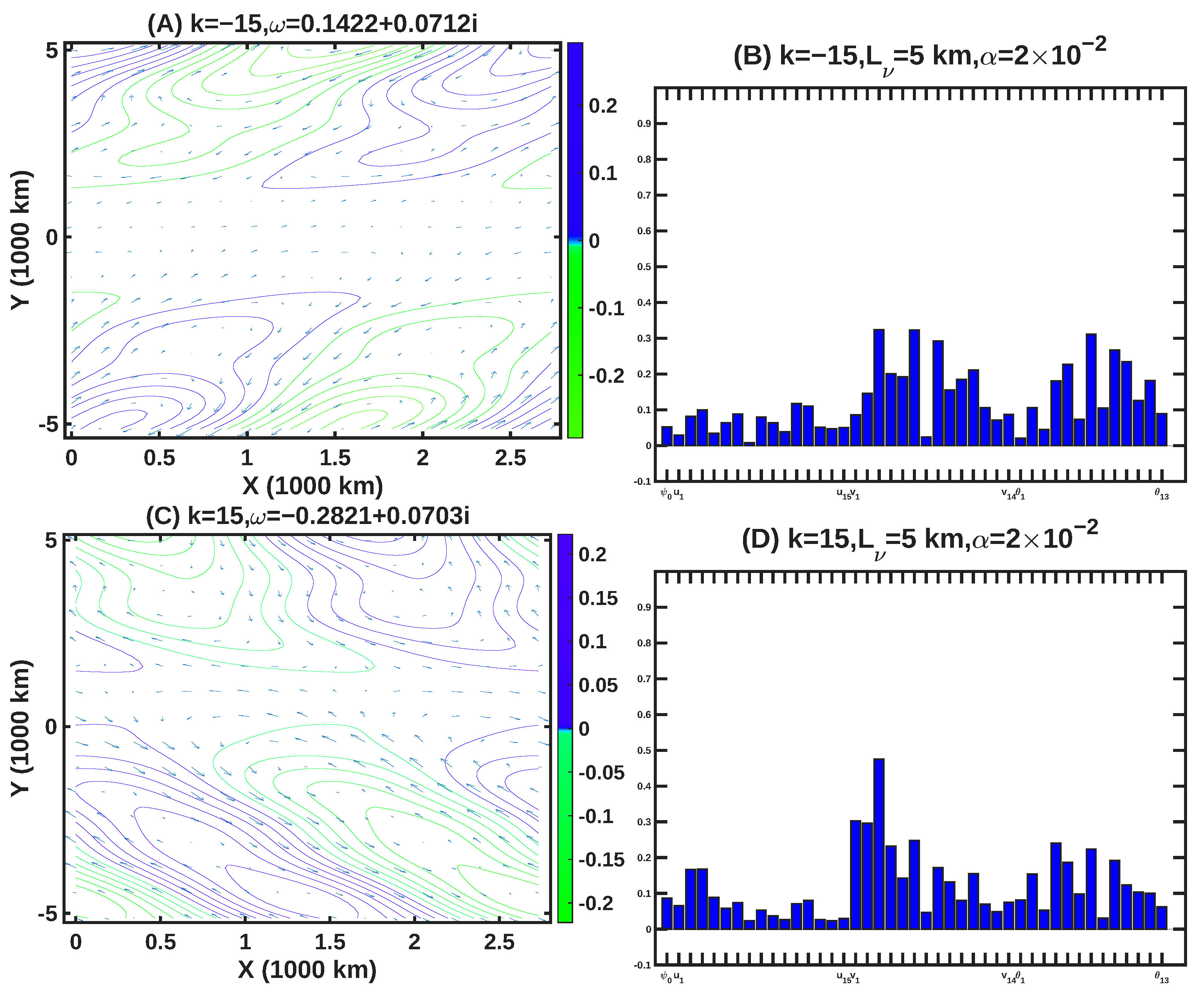
At a wave length of km, the two dominant waves exhibit growth rates of approximately 0.25 and 0.2 per day, respectively. Their corresponding propagation speeds are −4.35 m/s and −2.73 m/s, respectively, for the peaks corresponding to and , respectively. These speeds align with the range of propagation speeds observed in Indian monsoon depressions, as estimated by Hunt and Parker [63] based on extensive statistical analysis of ERA-Interim data [64]. Hunt and Parker (2016) [63] estimated the average propagation speed of Indian monsoon depressions to be around 4.24 m/s, with a standard deviation of 3.1 m/s. Both speeds reported here fall within this range, although other studies have reported propagation speeds for tropical depressions reaching up to 15 m/s [19]. While Hunt and Parker [63] and others (see also [65]) proposed a beta-drift-like mechanism to explain the slow eastward movement of monsoon depressions, it is also evident that the strong coupling of barotropic and equatorial Rossby waves through the background shear could provide an alternative explanation.
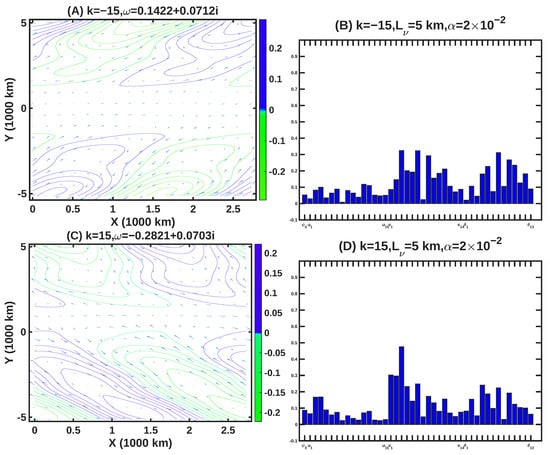
In Figure 9, we plot the dynamical structure (mid-tropospheric potential temperature contours and near surface horizontal wind field-arrows) and bar diagrams of the two most unstable modes when and km. As we can see from the two bar diagrams in Figure 7C,D, as expected, the unstable waves exhibit strong coupling between barotropic and baroclinic flows. In fact, the bar diagrams suggest that the barotropic mode has a rather smaller contribution compared to the higher baroclinic components. Although the dominating bars are within the first six or seven meridional components, higher indices contribute a fair amount as well, especially for the u and variables. This is indeed a consequence of the fact that these unstable waves are not trapped in the vicinity of the equator, as indicated by the dynamical structures in Figure 9A,B, unlike the pure equatorial modes of Matsuno. Both waves appear to consist of wave trains of tilted vortices centered off the equator that carry a significant potential temperature perturbation whose peaks and troughs coincide with the centers of cyclonic and anti-cyclonic vorticity, consistent with the free-tropospheric warm core characterizing tropical depressions [66]. Moreover, sometimes, the titled vortices extend over long distances between the equator and midlatitudes, reminiscent to atmospheric rivers, seen as filaments of water vapor lounging along elongated low pressure systems [67,68].
Figure 9.
The dynamical structures (A,C: mid-tropospheric potential temperature contours and near surface horizontal wind field-arrows) of the two most unstable waves corresponding to wavenumbers and and their bar diagrams (B,D). In the diagram, the Galerkin indices are shifted by 1: corresponds to in (8).
It is too early to assume that the most unstable branches are the sole representatives of monsoon depressions, although as pointed out, they may also be associated with tropical-extra-tropical teleconnection modes.
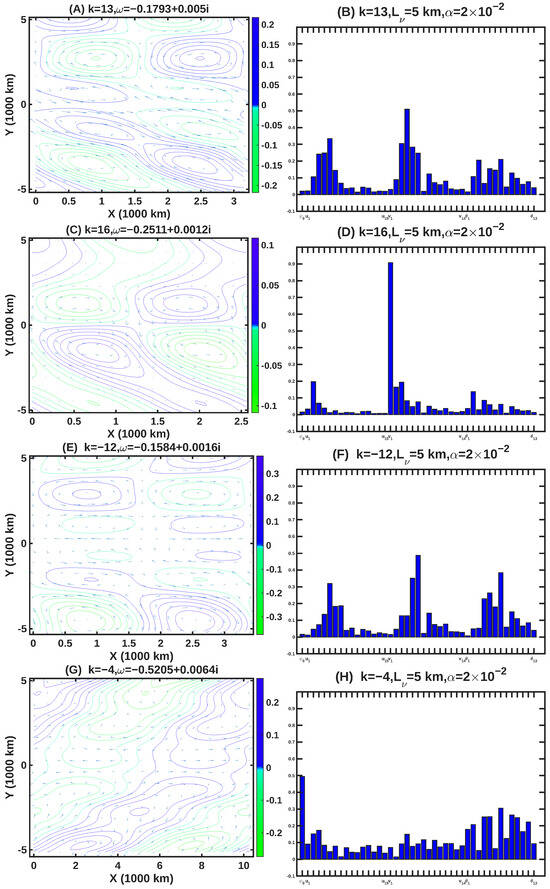
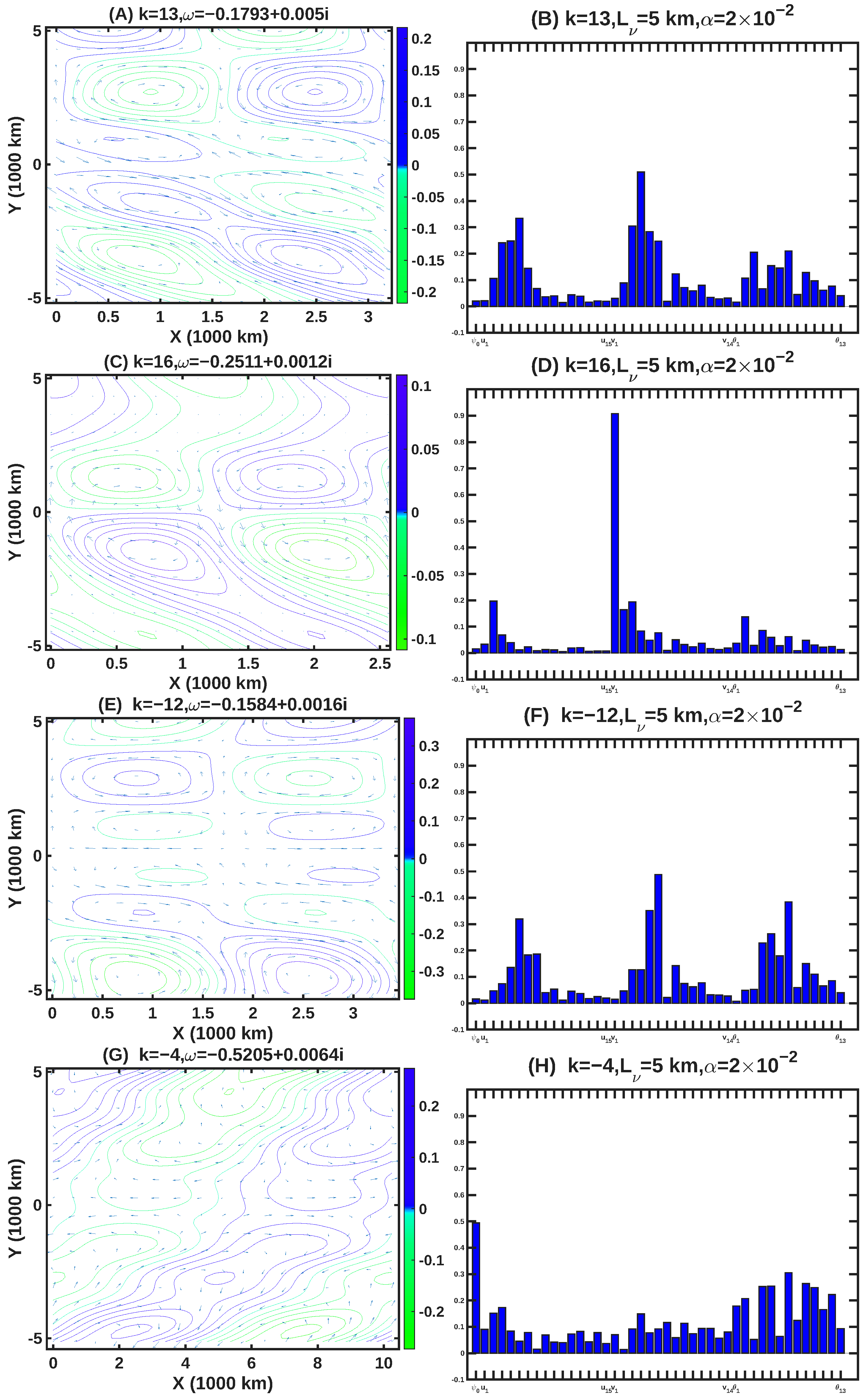
In Figure 10, we plot the structures and bar diagrams of the secondary-instability branches in Figure 6. For each unstable branch, we localize the most unstable wavenumber and plot the corresponding wave structures and bar diagrams in panels (A) to (H), respectively.
Figure 10.
Same as Figure 9, but for the secondary modes.
We note that the waves in panels (A, B), (C, D), and (E, F) of Figure 10 all correspond to local instability peaks (along distinct branches) at synoptic scales corresponding to wavelengths of around 4000 km or less, characteristic of monsoon depressions, much like the two cases in Figure 9. However, the wave disturbance in Figure 10G,H corresponds to an instability branch that peaks at wavenumber , corresponding to a planetary scale wavelength of 10,000 km. This mode also has the fastest phase speed of , where , yielding m/s, which is much faster than the reported propagation speeds of monsoon depressions in the literature. This mode also has the unique characteristic of displaying a dominant barotropic stream function component based on the bar diagram in Figure 10H.
The dynamical structure of this mode seen in Figure 10G is reminiscent of atmospheric rivers, with elongated vorticity streaks that can provide pathways for transporting moisture from the tropics to midlatitudes. Such flow can also transport dry air from the midlatitudes to the tropics and influence the dynamics of tropical waves-convectively coupled waves, including the initiation and termination of the MJO. Moreover, the westward movement of the tilted structure may be regarded as a northward propagating signal for an observer standing north of and looking towards the equator. This type of argument has been used previously to provide a theory of the northward propagation of monsoon intraseasonal oscillations based on equatorial modes [69]. Similarly, a southward propagation would appear for an observer standing south of equator. It is also worth noting that this mode corresponds to the instability branch that most persists when the viscosity is increased, and it is the mode that has the largest barotropic projection based on the bar diagram in Figure 10H.
Returning to the unstable wave modes in Figure 10A–F, we observe that their corresponding phase speeds are all close to −3 m/s, similar to the propagation speeds reported in [66] as mentioned earlier. Unlike the most unstable modes depicted in Figure 9, the plots in Figure 10C,E show vortices closer to the equator, centered around 1000 km to 3000 km. These locations align more closely with the geography of monsoonal regions like the central Indian continent. However, it is important to note that the current model may have some limitations in accurately representing the real world. The combination of wave modes in Figure 9 and Figure 10A–F presents a diverse range of wave modes, all triggered by a mixed barotropic–baroclinic-type instability. These modes can serve as surrogates for tropical easterly waves and tropical depressions. This finding is consistent with the study in [66], which depicted a spectrum of monsoon depression disturbances with a wide range of propagation speeds and geographical locations across the Indian continent.
5. Conclusions
In the tropics, waves and wave-like disturbances, such as tropical easterly waves and tropical depressions, are often linked to barotropic and baroclinic instability of the ambient flow [4,5,6,7,8,9]. Tropical easterly waves are particularly known to play a central role in the genesis and amplification of tropical cyclones, especially in the tropical Atlantic [10], while the breakdown of the intratropical convergence zone (ITCZ) is believed to be a manifestation of barotropic instability and often leads to synoptic scale eddies that in turn intensify through vorticity stretching to become tropical cyclones [11,12]. Moreover, there is ample evidence that eddy turbulence plays a central in transferring energy from synoptic to dissipation scales [24,25,26,27,28,29], however, existing theoretical studies of tropical waves and tropical large-scale dynamics have oversimplified this phenomenon by reducing the effect of friction to Rayleigh damping or boundary layer dissipation [34,35,45]. This study investigates the systematic effect of viscosity on the dynamics and morphology of ETWs and how they influence the baroclinic-barotropic instability in a simplified 92 primitive equation model reduced to a barotropic mode and a first barcolinic mode.
Using linear analysis, we show that in the absence of a background flow, the ETWs of Matsuno become coupled with one another through viscosity, and as such, both their dynamical morphology and propagation characteristic change rather drastically when the viscosity is high. Moreover, while a simple linear barolinic shear becomes unstable fairly instantly, producing ultraviolet catastrophe, through the growing instability of high wavenumber modes, the addition of eddy viscosity induces a scale selection mechanism by stabilizing the large wavenumber modes, while instability peaks at synoptic and planetary scales persist. These large-scale unstable modes are associated with westward moving coupled baroclinic-barotropic Rossby-type waves, akin to tropical easterly waves, monsoon depressions, and atmospheric-river flow patterns [4,5,6,7,19,67,70,71].
In summary, this study unifies westward-moving disturbances in the tropics and extra-tropics, such as tropical depressions, monsoon low-pressure systems, and tropical easterly waves, under the umbrella of a mixed barotropic–baroclinic instability of the background wind shear. It also demonstrates that eddy viscosity not only dampens small-scale instabilities of the basic shear but also provides a pathway for equatorially trapped waves to interact with each other. While the background shear instability provides energy for coupled baroclinic-barotropic Rossby-like disturbances, which are surrogates of tropical easterly waves and depressions, eddy viscosity serves as a scale selection mechanism. As the eddy viscosity is increased, the instability of a planetary-scale mode, peaking at around wavenumber 4, persists. This persistent mode, while also containing a mixture of barotropic and baroclinic flow components, is the only unstable mode dominated by the barotropic stream function contribution. Consequently, it becomes non-trapped in the tropical regions and presents highly tilted and elongated vortices resembling the flow patterns associated with atmospheric rivers [67].
Author Contributions
Conceptualization, A.B., A.K., and B.K.; methodology, A.B., A.K., and B.K.; software, A.B., and A.K.; validation, A.B., A.K., and B.K.; formal analysis, A.B., A.K., and B.K.; investigation, A.B., A.K., and B.K.; resources, A.K., and B.K.; data curation, A.B.; writing—original draft preparation, A.B., and B.K.; writing—review and editing, A.B., A.K., and B.K.; visualization, A.B., A.K., and B.K.; supervision, A.K., and B.K.; project administration, B.K.; funding acquisition, B.K. All authors have read and agreed to the published version of the manuscript.
Funding
This work is part of A.B.’s PhD thesis. This research of B.K. is partially supported by a Canada Natural Sciences and Engineering Research Council Discovery grant.
Data Availability Statement
No third-party data or newly created data was used for this study. The commercially available MATLAB software (version 2025b) was used to compute the eigenvalues and eigenvectors for the linear algebra systems presented in the Appendix A and Appendix B as well for making plots.
Acknowledgments
The authors are thankful to the Algerian government for sponsoring short visits for A.B. to the University of Victoria, during which a significant portion of the work was conducted.
Conflicts of Interest
The authors declare no conflicts of interest. The funders had no role in the design of the study; in the collection, analyses, or interpretation of data; in the writing of the manuscript; or in the decision to publish the results.
Appendix A. Galerkin Projection
The system of Equations (6) presented in Section 2 corresponds to the barotropic and baroclinic models that describe the behavior of equatorial wave modes under the influence of eddy viscosity () and a baroclinic shear background (). To solve these equations analytically and numerically, we employ the Galerkin projection method, which is particulary suitable for the problems involving vertical or meridional structures. The first step consists of expending the solutions of Equation (4) in the meridional coordinate-y using an appropriate set of basis functions: Fourier modes are used to represent the barotropic component, while parabolic cylinder functions are adopted for the baroclinic waves.
where is the the meridional wavenumber for barotropic Rossby wave and km is the perimeter of the Earth along the equator.
The Galerkin projection approach requires selecting a set of orthogonal basis functions that can accurately capture the spatial variability of the solution and satisfy the prescribed boundary conditions. In equatorial dynamics, the family of parabolic cylinder functions provides a natural and efficient representation of the meridional structures associated with equatorially tapped modes.
We consider the parabolic cylindrical functions as
where are the Hermite polynomials, given by
The Hermite polynomials satisfy the following recursive formula:
Using the normalized parabolic cylinder functions, , we can form an orthogonal basis for the square integrable functions, i.e.,
As a result, for any given function , the -projection, , is defined by
where
and are the N zeros of the Hermite polynomial for a given N, while are the standard Hermite-Gauss quadrature coefficient.
Moreover, we have
where are the lowering and raising operators of quantum mechanics. Therefore,
By using the above identities and properties, we can obtain the following formulas,
After applying the Galerkin truncation, some spurious modes may appear. To eliminate them, a radiation condition is imposed on the last coefficient of the baroclinic expansion:
and we use only one Fourier mode for the stream function, keeping only the most important waves:
where
where
After using spectral method, we obtained:
where
where
where
where
and
Once again, to calculate
we use the Gauss-Hermite quadrature formula:
and are the N zeros of the Hermite polynomial for a given N while the are the standard Hermite-Gauss quadrature coefficient.
The remaining integrals are approximated using Simpson’s composite formula:
References
- Vallis, G.K. Atmospheric and Oceanic Fluid Dynamics; Cambridge University Press: Cambridge, UK, 2006; p. 745. [Google Scholar]
- Pedlosky, J. Geophysical Fluid Dynamics, 2nd ed.; Springer: New York, NY, USA, 1987; p. 710. [Google Scholar]
- Benoit, C.R.; Jean-Marie, B. Introduction to Geophysical Fluid Dynamics: Physical and Numerical Aspects, 2nd ed.; Academic Press: Oxford, UK, 2011. [Google Scholar]
- Leroux, S.; Hall, N.M.J. On the Relationship between African Easterly Waves and the African Easterly Jet. J. Atmos. Sci. 2009, 66, 2303–2316. [Google Scholar] [CrossRef] [Scilit]
- Goswami, B.N.; Keshavamurthy, R.N.; Satyan, V. Role of barotropic-baroclinic instability for the growth of monsoon depressions and mid-tropospheric cyclones. Proc. Indian Acad. Sci.-Sect. A 1980, 89, 79–97. [Google Scholar]
- Mishra, S.K.; Tandon, M.Y. A Combined Barotropic-Baroclinic Instability Study of the Upper Tropospheric Tropical Easterly Jet. J. Atmos. Sci. 1983, 40, 2708–2723. [Google Scholar] [CrossRef] [Scilit]
- Wu, M.C.; Reale, O.; Siegfried, D.S.; Max, J.S.; Thorncroft, C.D. African Easterly Jet: Barotropic Instability, Waves, and Cyclogenesis. J. Clim. 2012, 25, 1489–1510. [Google Scholar] [CrossRef] [Scilit]
- Webster, P.J.; Hai-Ru, C. Energy Accumulation and Emanation Regions at Low Latitudes: Impacts of a Zonally Varying Basic State. J. Atmos. Sci. 1988, 45, 803–829. [Google Scholar] [CrossRef] [Scilit]
- Xie, B.W.X. Low-frequency equatorial waves in vertically sheared zonal flow. Part I: Stable waves. J. Atmos. Sci. 1996, 53, 449–467. [Google Scholar] [CrossRef]
- Xiyan, D.; Jung-Eun, C.; Fei-Fei, J.; Hoi-Ming, C. Global coupled dynamics of tropical easterly waves and tropical cyclone genesis. npj Clim. Atmos. Sci. 2025, 8, 125. [Google Scholar] [CrossRef] [Scilit]
- Ferreira, R.N.; Schubert, W.H. Barotropic Aspects of ITCZ Breakdown. J. Atmos. Sci. 1997, 54, 261–285. [Google Scholar] [CrossRef]
- Yang, Q.; Majda, A.J. Upscale Impact of Mesoscale Disturbances of Tropical Convection on Convectively Coupled Kelvin Waves. J. Atmos. Sci. 2018, 75, 85–111. [Google Scholar] [CrossRef] [Scilit]
- Ferguson, J.; Khouider, B.; Namazi, M. Two-way interactions between between equatorially trapped waves and the barotropic flow. Chin. Ann. Math. Ser. B 2010, 30, 539–568. [Google Scholar]
- Majda, A.J.; Biello, J.A. The nonlinear interaction of barotropic and equatorial baroclinic Rossby waves. J. Atmos. Sci. 2003, 60, 1809–1821. [Google Scholar] [CrossRef] [Scilit]
- Jones, C.; Waliser, D.; Lau, K.; Stern, W. The Madden-Julian oscillation and its impact on Northern Hemisphere weather predictability. Mon. Weather Rev. 2004, 132, 1462–1471. [Google Scholar] [CrossRef] [Scilit]
- Zhang, C.; Webster, P. Effects of zonal flows on equatorially trapped waves. J. Atmos. Sci. 1989, 46, 3632–3652. [Google Scholar] [CrossRef] [Scilit]
- Kiladis, G.N.; Wheeler, M.C.; Haertel, P.T.; Straub, K.H.; Roundy, P. Convectively coupled equatorial waves. Rev. Geophys. 2009, 47, RG2003. [Google Scholar] [CrossRef] [Scilit]
- Khouider, B. Models for Tropical Climate Dynamics: Waves, Clouds, and Precipitation; Springer: Cham, Switzerland, 2019; Volume 3. [Google Scholar]
- Huaman, L.; Schumacher, C.; Kiladis, G.N. Eastward-Propagating Disturbances in the Tropical Pacific. Mon. Weather Rev. 2020, 148, 3713–3728. [Google Scholar] [CrossRef] [Scilit]
- Matsuno, T. Quasi-geostrophic motions in the equatorial area. J. Met. Jap. 1966, 44, 25–41. [Google Scholar]
- Wheeler, M.; Kiladis, G.N. Convectively Coupled Equatorial Waves: Analysis of Clouds and Temperature in the Wavenumber-Frequency Domain. J. Atmos. Sci. 1999, 56, 374–399. [Google Scholar] [CrossRef] [Scilit]
- Takayabu, Y.N. Large-scale cloud disturbances associated with equatorial waves. Part I: Spectral features of the cloud disturbances. J. Meteorol. Soc. Jpn. 1994, 72, 433–448. [Google Scholar] [CrossRef] [Scilit]
- Roundy, P.E. Interpretation of the spectrum of eastward-moving tropical convective anomalies. Q. J. R. Meteorol. Soc. 2020, 146, 795–806. [Google Scholar] [CrossRef] [Scilit]
- Chaim, G.; Ofer, S.; Itzhak, F.; Nathan, P. Tropical Background and Wave Spectra: Contribution of Wave–Wave Interactions in a Moderately Nonlinear Turbulent Flow. J. Atmos. Sci. 2021, 78, 1773–1789. [Google Scholar] [CrossRef] [Scilit]
- Stechmann, S.N.; Hottovy, S. Unified Spectrum of Tropical Rainfall and Waves in a Simple Stochastic Model. Geophys. Res. Lett. 2017, 44, 10713–10724. [Google Scholar] [CrossRef] [Scilit]
- Noboru, N. Large-Scale Eddy-Mean Flow Interaction in the Earth’s Extratropical Atmosphere. Annu. Rev. Fluid Mech. 2024, 56, 349–377. [Google Scholar] [CrossRef] [Scilit]
- Hartmann, D.L. The Atmospheric General Circulation and Its Variability. J. Meteorol. Soc. Jpn. Ser. II 2007, 85B, 123–143. [Google Scholar] [CrossRef] [Scilit]
- Schröttle, J.; Suhas, D.L.; Harnik, N.; Sukhatme, J. Turbulence and equatorial waves in moist and dry shallow-water flow, excited through mesoscale stochastic forcing. Q. J. R. Meteorol. Soc. 2022, 148, 599–619. [Google Scholar] [CrossRef] [Scilit]
- Galperin, B.; Nickerson, A.K.; King, G.P.; Zhang, J.A. Turbulence of Tropical Cyclones: From Peristrophic to Zonostrophic. J. Geophys. Res. Atmos. 2025, 130, e2024JD042733. [Google Scholar] [CrossRef] [Scilit]
- Kerry, E.; Velez-Pardo, M.; Cronin, T.W. The Surprising Roles of Turbulence in Tropical Cyclone Physics. Atmosphere 2023, 14, 1254. [Google Scholar] [CrossRef] [Scilit]
- Barnes, E.A.; Hartmann, D.L. The Global Distribution of Atmospheric Eddy Length Scales. J. Clim. 2012, 25, 3409–3416. [Google Scholar] [CrossRef] [Scilit]
- Smagorinsky, J. General circulation experiments with the primitive equations: I. The basic experiment. Mon. Weather Rev. 1963, 91, 99–164. [Google Scholar] [CrossRef]
- Kraichnan, R. Eddy Viscosity in Two and Three Dimensions. J. Atmos. Sci. 1976, 33, 1521–1536. [Google Scholar] [CrossRef]
- Gill, A.E. Some simple solutions for heat-induced tropical circulation. Q. J. R. Meteorol. Soc. 1980, 106, 447–462. [Google Scholar] [CrossRef] [Scilit]
- Biello, J.A.; Majda, A.J. Boundary layer dissipation and the nonlinear interaction of equatorial baroclinic and barotropic rossby waves. Geophys. Astrophys. Fluid Dyn. 2004, 98, 85–127. [Google Scholar] [CrossRef] [Scilit]
- Khouider, B.; Majda, A.J. A non-oscillatory balanced scheme for an idealized tropical climate model: Part I: Algorithm and validation. Theor. Comput. Fluid Dyn. 2005, 19, 331–354. [Google Scholar] [CrossRef] [Scilit]
- Kiladis, G.N.; Thorncroft, C.D.; Hall, N.M.J. Three-Dimensional Structure and Dynamics of African Easterly Waves. Part I: Observations. J. Atmos. Sci. 2006, 63, 2212–2230. [Google Scholar] [CrossRef] [Scilit]
- Hall, N.M.J.; Kiladis, G.M.; Thorncroft, C.D. Three-Dimensional Structure and Dynamics of African Easterly Waves. Part II: Dynamical Modes. J. Atmos. Sci. 2006, 63, 2231–2245. [Google Scholar] [CrossRef] [Scilit]
- Majda, A. Introduction to PDEs and Waves for the Atmosphere and Ocean; American Mathematical Soc.: Providence, RI, USA, 2003; Volume 9. [Google Scholar]
- Khouider, B.; Majda, A.J.; Stechmann, S. Climate science in the tropics: Waves, vortices and PDEs. Nonlinearity 2012, 26, R1. [Google Scholar] [CrossRef] [Scilit]
- Kasahara, A.; Puri, K. Spectral representation of three-dimensional global data by expansion in normal mode functions. Mon. Weather Rev. 1981, 109, 37–51. [Google Scholar] [CrossRef] [Scilit]
- Kacimi, A.; Khouider, B. The transient response to an equatorial heat source and its convergence to steady state: Implications for MJO theory. Clim. Dyn. 2018, 50, 3315–3330. [Google Scholar] [CrossRef] [Scilit]
- Lin, J.L.; Zhang, M.; Mapes, B.E. Zonal momentum budget of the Madden-Julian oscillation: The source and strength of equivalent linear damping. J. Atmos. Sci. 2005, 62, 2172–2188. [Google Scholar] [CrossRef] [Scilit]
- Lin, J.L.; Mapes, B.E.; Weiqing, H. What Are the Sources of Mechanical Damping in Matsuno–Gill-Type Models? J. Clim. 2008, 21, 165–179. [Google Scholar] [CrossRef] [Scilit]
- Romps, D.M. Rayleigh Damping in the Free Troposphere. J. Atmos. Sci. 2014, 71, 553–565. [Google Scholar] [CrossRef] [Scilit]
- Lee, S.K.; Chunzai, W.; Mapes, B.E. A Simple Atmospheric Model of the Local and Teleconnection Responses to Tropical Heating Anomalies. J. Clim. 2009, 22, 272–284. [Google Scholar] [CrossRef] [Scilit]
- Milton, A.; Stegun, I.A. Handbook of Mathematical Functions with Formulas, Graphs, and Mathematical Tables; Applied Mathematics Series; National Bureau of Standards: Gaithersburg, MD, USA, 1964; Volume 55.
- Majda, A.J.; Khouider, B. A numerical strategy for efficient modeling of the equatorial wave guide. Proc. Am. Acad. Sci. USA 2001, 98, 1341–1346. [Google Scholar] [CrossRef] [PubMed]
- Khouider, B.; Majda, A.J. Equatorial Convectively Coupled Waves in a Simple Multicloud Model. J. Atmos. Sci. 2008, 65, 3376–3397. [Google Scholar] [CrossRef] [Scilit]
- Han, Y.; Khouider, B. Convectively Coupled Waves in a Sheared Environment. J. Atmos. Sci. 2010, 67, 2844–2863. [Google Scholar] [CrossRef] [Scilit]
- Zhang, C.; Adames, A.F.; Khouider, B.; Wang, B.; Yang, D. Four Theories of the Madden-Julian Oscillation. Rev. Geophys. 2020, 58, e2019RG000685. [Google Scholar] [CrossRef] [Scilit]
- Kacimi, A.; Khouider, B. A numerical investigation of the barotropic instability on the equatorial β-plane. Theor. Comput. Fluid Dyn. 2013, 27, 491–512. [Google Scholar] [CrossRef] [Scilit]
- Shukla, J. Barotropic-Baroclinic instability of mean zonal wind during summer monsoon. Pure Appl. Geophys. (PAGEOPH) 1977, 115, 1449–1461. [Google Scholar] [CrossRef] [Scilit]
- Shukla, J. CISK-Barotropic-Baroclinic Instability and the Growth of Monsoon Depressions. J. Atmos. Sci. 1978, 35, 495–508. [Google Scholar] [CrossRef] [Scilit]
- Youngs, M.K.; Thompson, A.F.; Lazar, A.; Richards, K.J. ACC Meanders, Energy Transfer, and Mixed Barotropic-Baroclinic Instability. J. Phys. Oceanogr. 2017, 47, 1291–1305. [Google Scholar] [CrossRef] [Scilit]
- Yang, Y.; Liang, X.S. On the Seasonal Eddy Variability in the Kuroshio Extension. J. Phys. Oceanogr. 2018, 48, 1871–1886. [Google Scholar] [CrossRef] [Scilit]
- Sikka, D.R. Some aspects of the life history, structure and movement of monsoon depressions. Pure Appl. Geophys. 1977, 115, 1501–1529. [Google Scholar] [CrossRef] [Scilit]
- Suhas, D.L.; Boos, W.R. Monsoon Depression Amplification by Horizontal Shear and Humidity Gradients: A Shallow Water Perspective. J. Atmos. Sci. 2023, 80, 633–647. [Google Scholar] [CrossRef] [Scilit]
- Liu, C.H.; Moncrieff, M.W. Effects of convectively generated gravity waves and rotation on the organization of convection. J. Atmos. Sci. 2004, 61, 2218–2227. [Google Scholar] [CrossRef] [Scilit]
- Khouider, B.; Moncrieff, M.W. Organized convection parameterization for the ITCZ. J. Atmos. Sci. 2015, 72, 3073–3096. [Google Scholar] [CrossRef] [Scilit]
- Lebel, T.; Parker, D.J.; Flamant, C.; Bourlès, B.; Marticorena, B.; Mougin, E.; Peugeot, C.; Diedhiou, A.; Haywood, J.M.; Ngamini, J.B.; et al. The AMMA field campaigns: Multiscale and multidisciplinary observations in the West African region. Q. J. R. Meteorol. Soc. 2010, 136, 8–33. [Google Scholar] [CrossRef] [Scilit]
- Shubho, D.; Debasish, L.; Sarkar, S.; Sadhukhan, I.; Debnath, G.C. Organizational modes of squall-type Mesoscale Convective Systems during premonsoon season over eastern India. Atmos. Res. 2012, 106, 120–138. [Google Scholar] [CrossRef] [Scilit]
- Hunt, K.M.R.; Parker, D.J. The movement of Indian monsoon depressions by interaction with image vortices near the Himalayan wall. Q. J. R. Meteorol. Soc. 2016, 142, 2224–2229. [Google Scholar] [CrossRef] [Scilit]
- Dee, D.P.; Uppala, S.; Simmons, A.J.; Berrisford, P.; Poli, P.; Kobayashi, S.; Vitart, F. The ERA-Interim reanalysis: Configuration and performance of the data assimilation system. Q. J. R. Meteorol. Soc. 2011, 137, 553–582. [Google Scholar] [CrossRef] [Scilit]
- Boos, W.R.; Hurley, J.V.; Murthy, V.S. Adiabatic westward drift of Indian monsoon depressions. Q. J. R. Meteorol. Soc. 2015, 141, 1035–1048. [Google Scholar] [CrossRef] [Scilit]
- Hunt, K.M.R.; Turner, A.G.; Inness, P.M.; Parker, D.E.; Levine, R.C. On the Structure and Dynamics of Indian Monsoon Depressions. Mon. Weather Rev. 2016, 144, 3391–3416. [Google Scholar] [CrossRef] [Scilit]
- Ralph, F.M.; Neiman, P.J.; Wick, G.A. Satellite and CALJET Aircraft Observations of Atmospheric Rivers over the Eastern North Pacific Ocean during the Winter of 1997/98. Mon. Weather Rev. 2004, 132, 1721–1745. [Google Scholar] [CrossRef] [Scilit]
- Dacre, H.F.; Clark, P.A.; Martinez-Alvarado, O.; Stringer, M.A.; Lavers, D.A. How Do Atmospheric Rivers Form? Bull. Am. Meteorol. Soc. 2015, 96, 1243–1255. [Google Scholar] [CrossRef] [Scilit]
- Lawrence, D.M.; Webster, P.J. The boreal summer intraseasonal oscillation: Relationship between northward and eastward movement of convection. J. Atmos. Sci. 2002, 59, 1593–1606. [Google Scholar] [CrossRef] [Scilit]
- Hunt, K.M.; Fletcher, J.K. The relationship between Indian monsoon rainfall and low-pressure systems. Clim. Dyn. 2019, 53, 1859–1871. [Google Scholar] [CrossRef] [Scilit]
- Raymond, D.J.; Zeng, X. Instability and large-scale circulations in a two-column model of the tropical troposphere. Q. J. R. Meteorol. Soc. 2000, 126, 3117–3135. [Google Scholar] [CrossRef]

Disclaimer/Publisher’s Note: The statements, opinions and data contained in all publications are solely those of the individual author(s) and contributor(s) and not of MDPI and/or the editor(s). MDPI and/or the editor(s) disclaim responsibility for any injury to people or property resulting from any ideas, methods, instructions or products referred to in the content. |
© 2025 by the authors. Licensee MDPI, Basel, Switzerland. This article is an open access article distributed under the terms and conditions of the Creative Commons Attribution (CC BY) license (https://creativecommons.org/licenses/by/4.0/).