
Article

Spatiotemporal Patterns of Cloud Water Resources in Response to Complex Terrain in the North China Region

by
Junjie Zhao
1,2,†,
Miao Cai
3,†,
Yuquan Zhou
3,*,
Jie Yu
4,
Shujing Shen
3,
Jianjun Ou
5 and
Zhaoxin Cai
6,*
1
Meteorological Disaster Prevention Technology Center of Shanxi Province, Taiyuan 030032, China
2
The Joint Research Center for Weather Modification of China Meteorological Administration and Chengdu University of Information Technology, Chengdu 610225, China
3
Cloud-Precipitation Physics and Weather Modification Key Laboratory (CPML), China Meteorological Administration, CMA Weather Modification Centre, Beijing 100081, China
4
School of Mechanical and Precision Instrument Engineering, Xi’an University of Technology, Xi’an 710048, China
5
Shanghai by Weather Technology Co., Ltd., Shanghai 201306, China
6
Weather Modification Center of Shanxi Province, Taiyuan 030032, China
*
Authors to whom correspondence should be addressed.
These authors contributed equally to this work.
Climate 2025, 13(11), 230; https://doi.org/10.3390/cli13110230
Submission received: 2 October 2025 / Revised: 31 October 2025 / Accepted: 6 November 2025 / Published: 8 November 2025
(This article belongs to the Special Issue Impacts of Climate Change on Hydrological Processes)

Abstract

Based on a cloud water resources (CWR) diagnostic dataset with a 1° × 1° resolution over China from 2000 to 2019, this study systematically analyzes the spatiotemporal patterns of CWR in the complex terrain of the North China Region. The results indicate the following: (1) CWR-related physical quantities exhibit significant seasonal differences, with most being highest in summer and lowest in winter; water vapor convergence is strongest in summer and weakest in autumn, while hydrometeor convergence is smallest in summer and largest in winter; and the water surplus (precipitation minus evaporation) is minimal and negative in spring, indicating severe spring drought. (2) At the annual scale, precipitation is highly correlated with cloud condensation (r > 0.99), and CWR variation is primarily controlled by hydrometeor influx (r > 0.99). (3) The regional annual CWR and precipitation increase at rates of 34.8 mm/10 years and 49.2 mm/10 years, respectively, but exhibit seasonal asynchrony—CWR increases in all four seasons, while precipitation shows a slight decreasing trend in winter. (4) Spatially, CWR show a pattern of “more in the south and north, less in the central region; more in the east, less in the west,” with significant increases in the central–southern parts (southern Shanxi and Hebei, Beijing, and Tianjin). (5) Empirical orthogonal function (EOF) analysis reveals two dominant modes of CWR anomalies: a “region-wide consistent pattern” and a “north–south out-of-phase dipole pattern,” the latter being related to terrain-induced differences in water vapor transport and uplift condensation. The results statistically elucidate the distribution patterns of CWR under the influence of complex topography in NCR, providing a scientific reference for the development and utilization of regional CWR.

1. Introduction

Water resources are fundamental to ecological security and socioeconomic development. The IPCC AR6 report indicates that global warming is continuously intensifying the global water cycle, leading to increasingly prominent water security risks, which are particularly significant in vulnerable regions such as arid and semi-arid areas [1]. As a core region in China with a dense population and developed economy, North China faces an extremely prominent problem of water resource shortage [2]. The per capita water resources in this region are only one-seventh of the national average. Long-term reliance on groundwater overdraft has formed one of the world’s largest groundwater depression cones [3], severely constraining regional sustainable development. Although water-saving technologies and inter-basin water diversion projects have alleviated water pressure to some extent, they have not fundamentally resolved the water shortage problem in the North China Region (NCR) [4,5]. Therefore, exploring new water resource pathways is urgently needed. As a non-traditional water source with great potential, atmospheric water resources possess significant economic, social, and ecological value [6,7] and are attracting increasing attention.
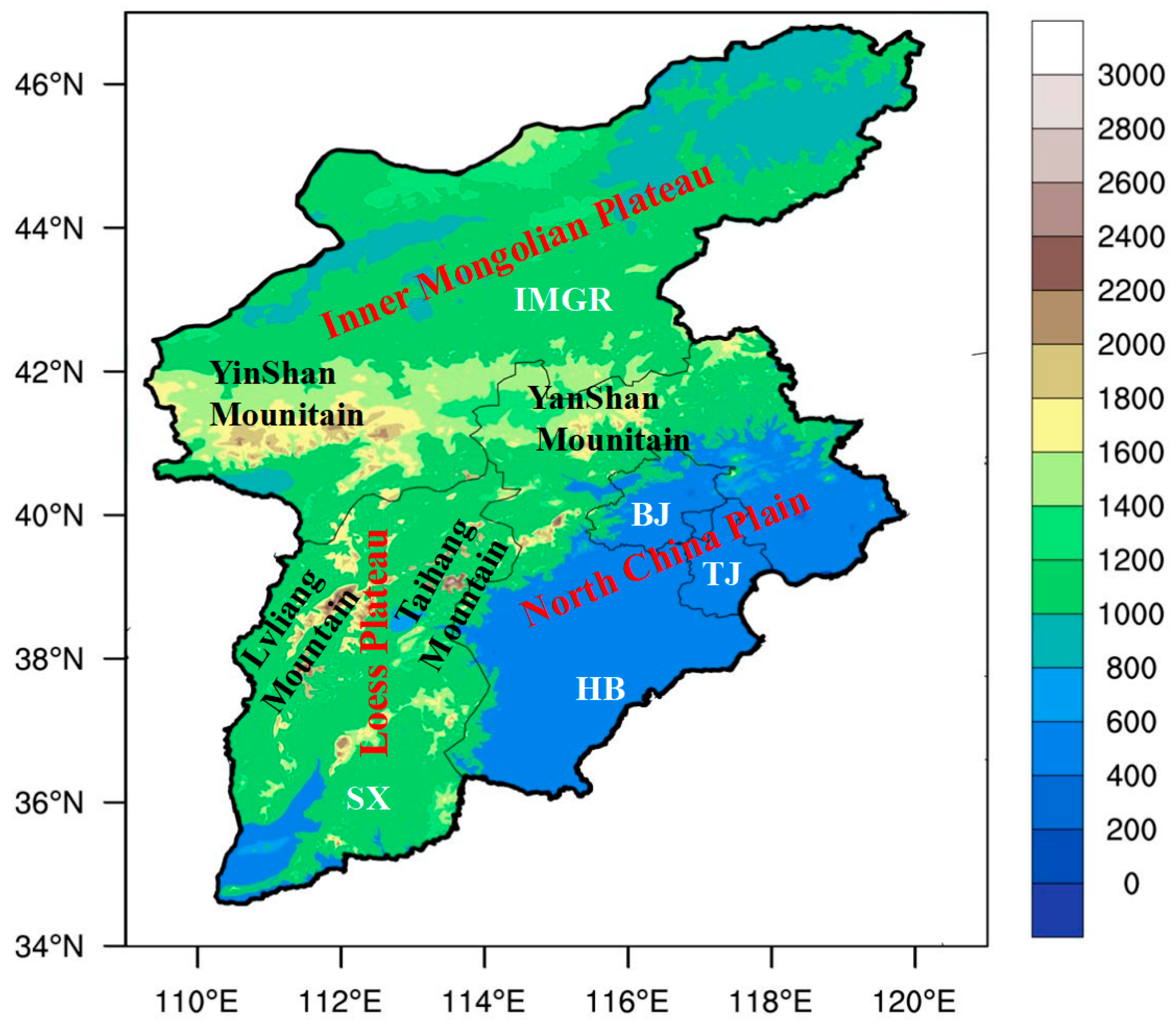
Artificial precipitation enhancement is currently the primary technical means for developing and utilizing cloud water resources (CWR), with its core objective being to improve the “water vapor–cloud–precipitation” conversion efficiency [8,9,10]. The effectiveness of this technology highly depends on an in-depth understanding of the spatiotemporal distribution of CWR and their evolution mechanisms [11], processes that are significantly affected by topographic conditions. The NCR features complex topography (Figure 1), exhibiting a typical stepped distribution from west to east: the west is characterized by the Loess Plateau, framed by the Lüliang Mountains; the central region is traversed by the Yinshan–Yanshan Mountains (with many peaks exceeding 1000 m); the east transitions abruptly to the North China Plain (NCP), bounded by the Taihang Mountains; and the north connects to the Inner Mongolia Plateau (IMP). This “plateau–mountain–plain” stepped structure exerts an important influence on the formation and spatial distribution of regional CWR by blocking and guiding atmospheric circulation and generating dynamic uplift effects on water vapor transport.
Research on CWR has undergone significant development, evolving from focusing on single elements to systematic assessment. Early studies primarily focused on the relationship between water vapor transport and precipitation [12,13]. Later, research gradually deepened into the analysis of macro- and micro-physical characteristics of clouds (such as cloud classification, cloud amount, and cloud water path) to explore the distribution of atmospheric water resources in different regions [14,15,16,17,18,19,20]. In recent years, with advances in observation technology and the development of reanalysis data, significant progress has been made in CWR research. Cai Miao [21] clarified the concept of CWR from the perspective of weather modification. On this basis, Zhou et al. [22] established a complete quantitative assessment framework, proposed a conceptual model including 16 components and 12 characteristic variables, and developed two sets of quantitative assessment methods: Cloud Water Resource Observational Diagnosis (CWR-DQ) and Numerical Simulation (CWR-NQ). Analyses of typical months (April and August 2017) and cases in North China preliminarily revealed the basic characteristics and correlations of multiple physical quantities related to CWR [22,23,24].
Furthermore, Cai et al. [25] constructed a 1° × 1° resolution cloud water resource assessment dataset for China spanning 2000–2019, enabling large-scale, long-term sequence research on CWR. Numerous studies based on this dataset, or using the CWR-DQ assessment method with ERA5 atmospheric reanalysis data, have revealed the interannual and intra-annual variations in CWR across different regions of China [25,26], In addition, in-depth studies have also been conducted in distinct climatic zones, such as Northwest China [10,27], the Tibetan Plateau [28], South China [29], and the Huaihe River Basin [30]. Collectively, these studies have gradually revealed the basic patterns and regional characteristics of CWR distribution in China. Moreover, they not only verified the reliability of the assessment methods but also deepened the understanding of the evolution patterns of CWR under different underlying topographic conditions.
However, despite the severe water security situation in the NCR, current understanding of CWR in this region remains limited in several aspects. Existing studies have predominantly focused on short-term case analyses or discussions of single physical quantities. Specifically, a comprehensive understanding of the long-term spatiotemporal patterns of key CWR parameters and their linkages to the complex topographic configuration remains limited. This knowledge gap consequently constrains a mechanistic understanding of regional cloud water formation and, in turn, poses challenges for designing targeted and sustainable weather modification operations.
To address these aspects, this study utilizes the Chinese cloud water resource dataset (2000–2019) constructed by Cai et al. [25] to examine the spatiotemporal characteristics of CWR under the complex topography of the NCR. It specifically focuses on (1) the spatiotemporal evolution of various CWR-related physical quantities; (2) the correlation characteristics among the multiple physical quantities; and (3) the potential links between topographic factors and spatial distribution patterns of CWR-related physical quantities. By employing spatiotemporal statistical analysis, correlation analysis, and EOF analysis to extract dominant spatiotemporal patterns and examine their correspondence with the regional topographic configuration, this work aims to provide a statistical characterization of cloud water processes in this complex terrain region. The findings are expected to offer scientific insights relevant to optimizing artificial precipitation enhancement operations in the NCR.

2. Materials and Methods

2.1. Data

This study utilizes the Cloud Water Resource Assessment Dataset for China (2000–2019) (Version CWR-DQ V1.0, 2020; [25]), which was developed under the National Key Research and Development Program of China entitled “Cloud Water Resource Assessment Research and Utilization Demonstration”. The dataset provides monthly and annual gridded data at a 1° × 1° resolution and includes various physical quantities involved in the atmospheric water cycle, including the following:
Components (16 in total): These include the state quantities of various atmospheric water substances ( M x , where subscript x can be replaced with h, v, and w, respectively, representing atmospheric hydrometeors, water vapor, and total atmospheric water substance) and the variation rates of the atmospheric water, including influx ( Q x i ) and outflux ( Q x o ), cloud evaporation ( C h v ), cloud condensation ( C v h ), surface evaporation ( E s ), and surface precipitation ( P s ).
Characteristic variables (12 in total): These include CWR, the gross mass ( G M x ), mean mass ( M M x ), precipitation efficiency ( P E x ), and renewal time ( R T x ) of various atmospheric water substances. Each of these physical quantities has been meticulously compared and analyzed against prior findings or numerical model outputs.
The atmospheric hydrometeors (also known as cloud water), water vapor, and atmospheric water substances in the dataset meet the atmospheric water budget balance equations:
M h 1 + Q h i + C v h = M h 2 + Q h o + C h v + P s M v 1 + Q v i + C h v + E s = M v 2 + Q v o + C v h M w 1 + Q w i + E s = M w 2 + Q w o + P s
The dataset strictly adheres to the atmospheric water budget balance equation (Equation (1)). For unified comparison, the state items, advection items, gross mass items, and CWR of various water substances in this study are all converted into equivalent water depth per unit area (unit: mm).
The water substances renewal time reflects the cycling conditions, transformation processes, and characteristics of atmospheric water substances in a specific region and period. The calculation formula is as follows [22]:
R T x = M M x / P s / T
The study area is the North China Region (NCR), as defined in the 2014 National Weather Modification Plan (shown by the black curve in Figure 1), encompassing Beijing, Tianjin, Hebei, Shanxi, and four leagues/cities in the Inner Mongolia Autonomous Region, with a total area of approximately 6.62376 × 10¹¹ m2. Topographic data adopts the GEBCO 2024 gridded elevation dataset (https://download.gebco.net/, accessed on 15 January 2024), with units in meters and a horizontal resolution of 15 arc-s, used to analyze the potential influence of topography on the spatial distribution of CWR.

2.2. Methods

2.2.1. Definition and Algorithm for CWR

This study uses the CWR definition of Zhou et al. [22], that is, in a certain area and a period of time, the gross mass of hydrometeors participating in the atmospheric water cycle does not form surface precipitation and may remain in the atmosphere for development. The calculation formula is as follows:
C W R = G M h P s = M h 1 + Q h i + C v h P s
In the formula: G M h is the gross mass of hydrometeors, and the state term M h 1 is the initial mass of hydrometeors (as the initial state term varies greatly during the research period, this study focuses on long-term series changes and uses the mean mass gross of hydrometeors ( M M h ) to replace the initial value for analysis). Q h i is the gross mass of hydrometeors transported into the region across different boundaries, and C v h is the mass of atmospheric hydrometeors converted from water vapor through condensation (or desublimation) processes. P s is the surface precipitation, which is sourced from GPCP (Global Precipitation Climatology Project) daily rainfall products [31].
There are certain differences between the overall regional CWR and the gridded CWR. Overall regional CWR treat the entire NCR as a single system, calculated based on the net advective flux along its external boundaries. Within the region, advective transports between grid cells cancel each other out, resulting in a small net convergence/divergence term. The magnitude of CWR is relatively small, on the same order as precipitation. Gridded CWR are computed independently for each grid cell, with the advection term representing the net input of water vapor/hydrometeors across the grid’s own boundaries. As each grid functions as an open channel, the advection term becomes numerically dominant and constitutes the main component of gridded CWR, with a magnitude one order higher than precipitation.

2.2.2. Empirical Orthogonal Function

The empirical orthogonal function (EOF) decomposition method was employed to extract the dominant spatiotemporal modes of CWR anomalies in the NCR. This method decomposes the variable field into spatial functions and time coefficients and effectively identifies the dominant distribution patterns and their temporal evolution characteristics [32]. In this study, EOF analysis is performed on the detrended CWR anomaly field to reveal the main spatial modes influenced by topography and climatic background, as well as their interannual–interdecadal evolution laws.

3. Spatiotemporal Variation Characteristics of CWR in the NCR

3.1. The Overall Regional Characteristics

3.1.1. Multi-Year Average Characteristics

The distribution of CWR is regulated by complex physical processes within the atmospheric water cycle. Table 1 lists the annual and seasonal average values of various components and characteristic variables involved in the atmospheric water cycle in the NCR from 2000 to 2019. The gross mass of water vapor ( G M v ) participating in the annual atmospheric water cycle in the NCR is approximately 9030.0 mm. Of this, the annual water vapor influx ( Q v i ) is 8537.1 mm, with about 5.5% of G M v being converted into hydrometeors (cloud water). The annual average C v h is about 495.4 mm. Combined with the hydrometeor influx across the boundaries ( Q h i , 335.1 mm), the gross mass of hydrometeor ( G M h ) reaches 830.7 mm. However, only 53.1% of these hydrometeors are converted into surface precipitation ( P s ), which amounts to 441.8 mm.
The regional precipitation efficiency of water vapor ( P E v , 4.9%) and of hydrometeors ( P E h , 53.1%) and the condensation efficiency of water vapor ( C E v 5.5%) in the NCR are the lowest among the six weather modification zones in China. The water vapor renewal time ( R T v ) and the hydrometeors renewal time ( R T h ) are 10 days and 5.8 h, respectively, both longer than the national average [25], indicating a relatively low cloud-to-precipitation conversion efficiency. The annual regional convergence of water vapor ( D v , Q v i minus Q v o ) and hydrometeors ( D h , Q h i minus Q h o ) are 5.3 mm and 19.3 mm, respectively. The annual total amount of regional surface evaporation ( E s ) reached 417.0 mm, resulting in the water surplus ( P s minus E s ) being only 24. 8mm. In contrast, the CWR are 388.8 mm, significantly higher than national average (176 mm). Therefore, the NCR has an urgent demand for CWR development and considerable potential for exploitation, particularly through weather modification measures to enhance cloud-to-precipitation conversion efficiency.
All physical quantities related to CWR in the NCR exhibit noticeable seasonal variations (Table 1). In summer, the influx and gross mass of water vapor and hydrometeors are the highest throughout the year, with the highest condensation efficiency of water vapor, the shortest renewal time, and the maximum surface precipitation (265.6 mm). In winter, all indicators are the lowest, with precipitation being only 16.4 mm. Water vapor shows convergence in summer and winter and divergence in spring and autumn. The water surplus ( P s minus E s ) can reflect the regional climate’s dry–wet conditions and, to a certain extent, the potential demand for artificial precipitation enhancement. It is the smallest in spring, at only −12.4 mm, indicating the prominent spring drought in NCR. It is positive in other seasons, with the largest value in winter (21.8 mm), which may be related to low temperatures inhibiting evaporation.
The seasonal differences in CWR are much smaller than those of other variables. The CWR are the most abundant in summer (113.8 mm) and least in winter (75.1 mm), with a seasonal amplitude of less than 35%. However, the hydrometeor renewal time (3.8~36.3 h) and precipitation efficiency (17.9~70.0%) show significant seasonal differences, indicating considerable potential for improving the cloud-to-precipitation conversion efficiency through weather modification.

3.1.2. Interannual Variation Characteristics

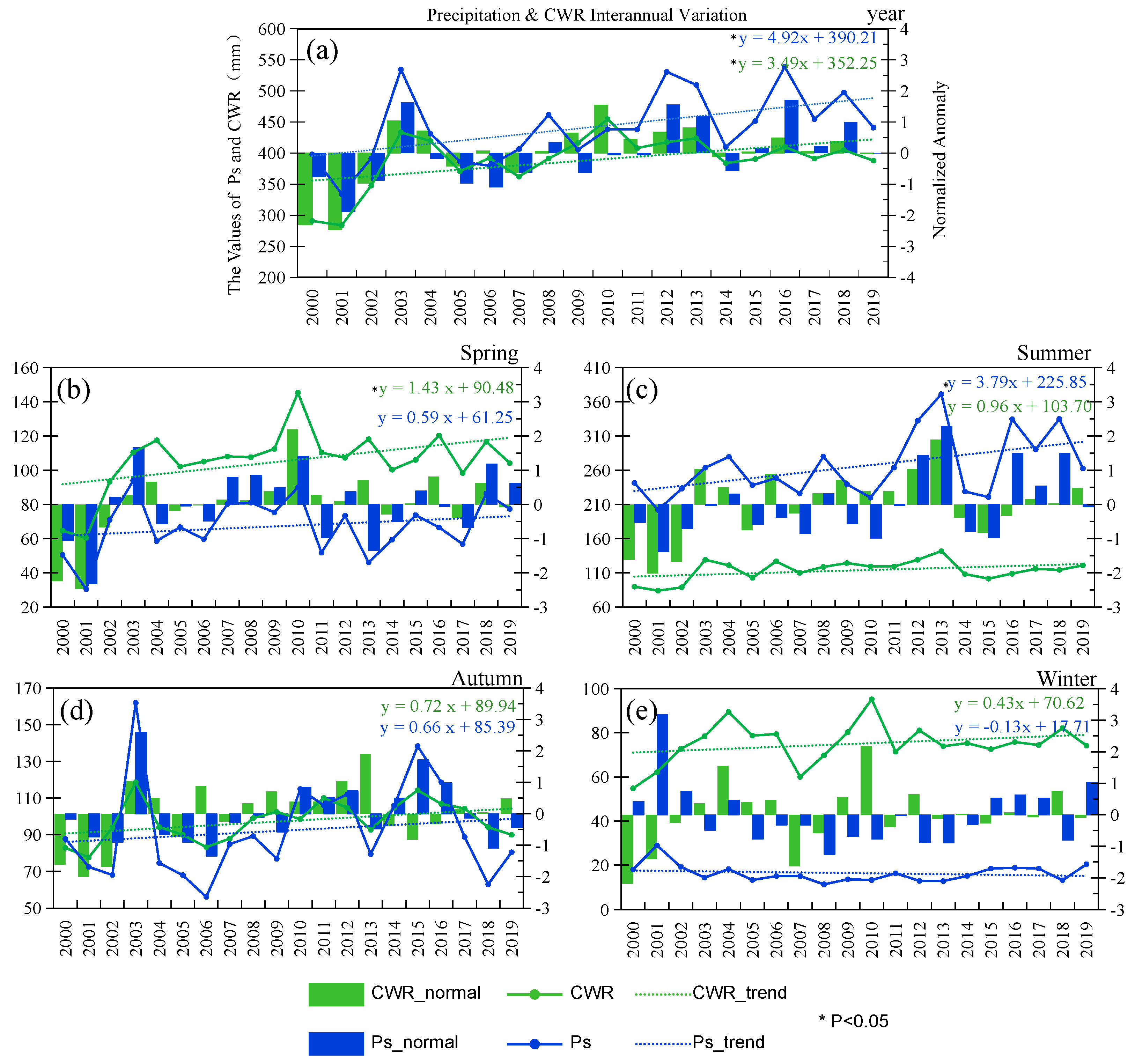
Both CWR and P s exhibited significant interannual fluctuations in the NCR during 2000–2019 (Figure 2). On the annual scale (Figure 2a), both CWR and P s showed increasing trends, with growth rates of 34.8 mm/10 years and 49.2 mm/10 years, respectively (p < 0.01). The moving t-test identified 2009 as a statistically significant change point (p < 0.05), revealing a clear regime shift: before 2009, both variables were predominantly negative anomalies with large positive/negative amplitudes, whereas afterwards, they were predominantly positive anomalies with smaller amplitudes. The correlation between CWR and P s over the entire period is 0.65 (p < 0.01), with strong synchronization during 2000–2005 and 2013–2019.
On the seasonal scale (Figure 2b–e), CWR increased in all four seasons, with the most significant increase in spring. This trend provides favorable conditions for alleviating the prominent spring drought in the NCR. In contrast, P s showed a decreasing trend in winter but increasing trends in the other seasons, with the significant largest increase in summer. The interannual variability in P s was greatest in spring and smallest in winter, while that of CWR was greatest in autumn and smallest in spring. There is obvious seasonal asynchrony in the variations in CWR and P s .
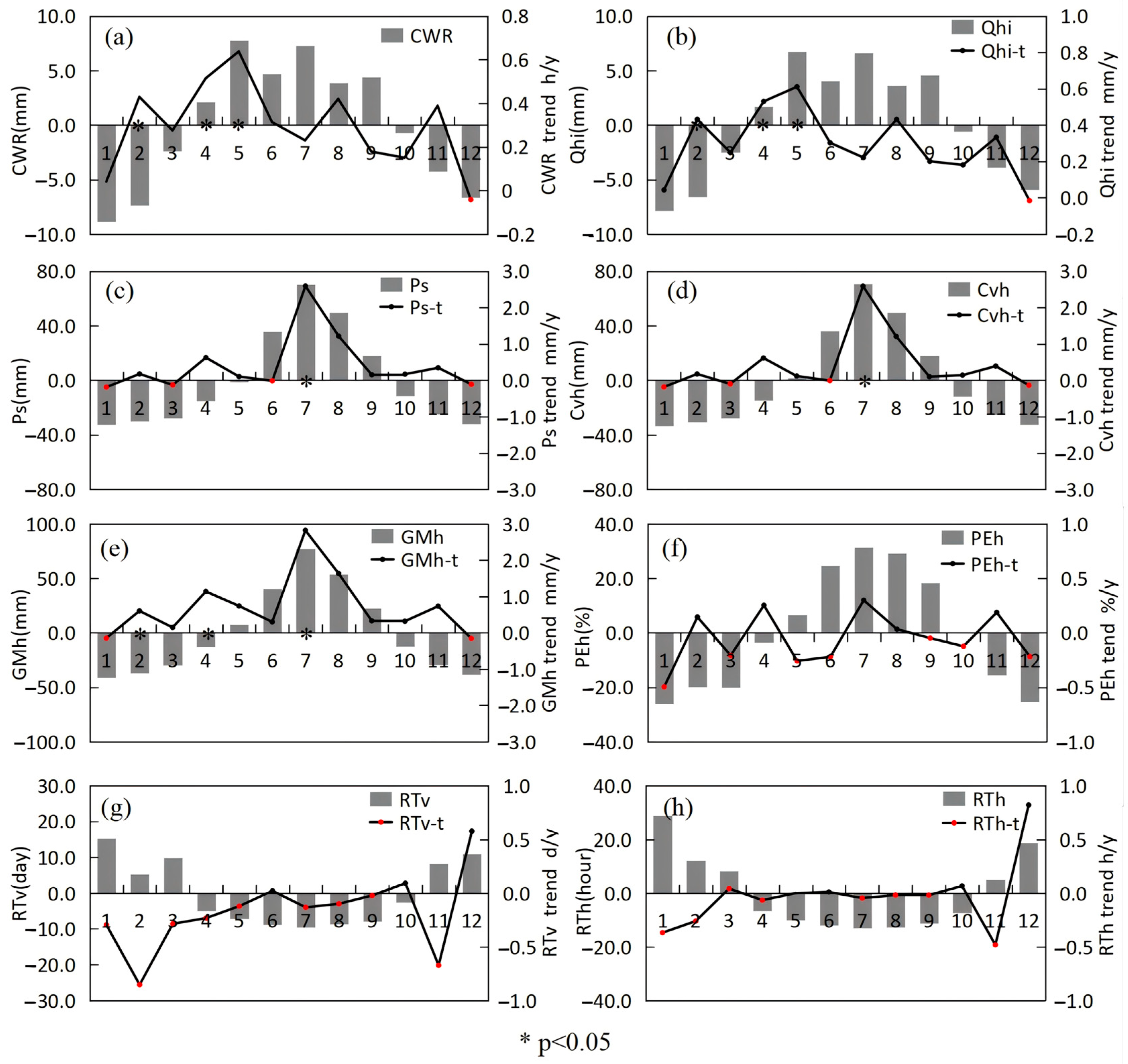
The annual variation characteristics were illustrated by the differences between the multi-year monthly averages and the multi-year annual average of CWR components and characteristic variables (Figure 3). On the monthly scale, the annual variations in CWR and Q h i were highly synchronized. Positive anomalies were concentrated from April to September, with the largest values in May and July. An increasing trend was observed in all months except December. Significantly increasing trends were observed all in February, April, and May (p < 0.05). These findings further confirm the significant contribution of Q h i to CWR.
In the NCR, C v h , G M h , P E h , and P s exhibited almost consistent annual cycles, all showing a single-peak structure with positive anomalies from June to September, peaking in July. C v h and P s showed marginally decreasing trends in January, March, June, and December, demonstrating a statistically significant increase in July (p < 0.05). P E h exhibited marginally decreasing trends in most months. G M h showed a marginal decrease only in January and December and a significant increase in February, April, and May (p < 0.05). R T v and R T h exhibited a single-trough pattern, with their values being shortest in July and longest in January. Except for June and December, the renewal time shortened in the other months. Notably, the simultaneous decrease in G M h and C v h coupled with the lengthening of R T v and R T h in some winter months might be an important reason for the decreasing trend in P s during this season.

3.1.3. Correlation Analysis of Physical Variables over Multiple Years

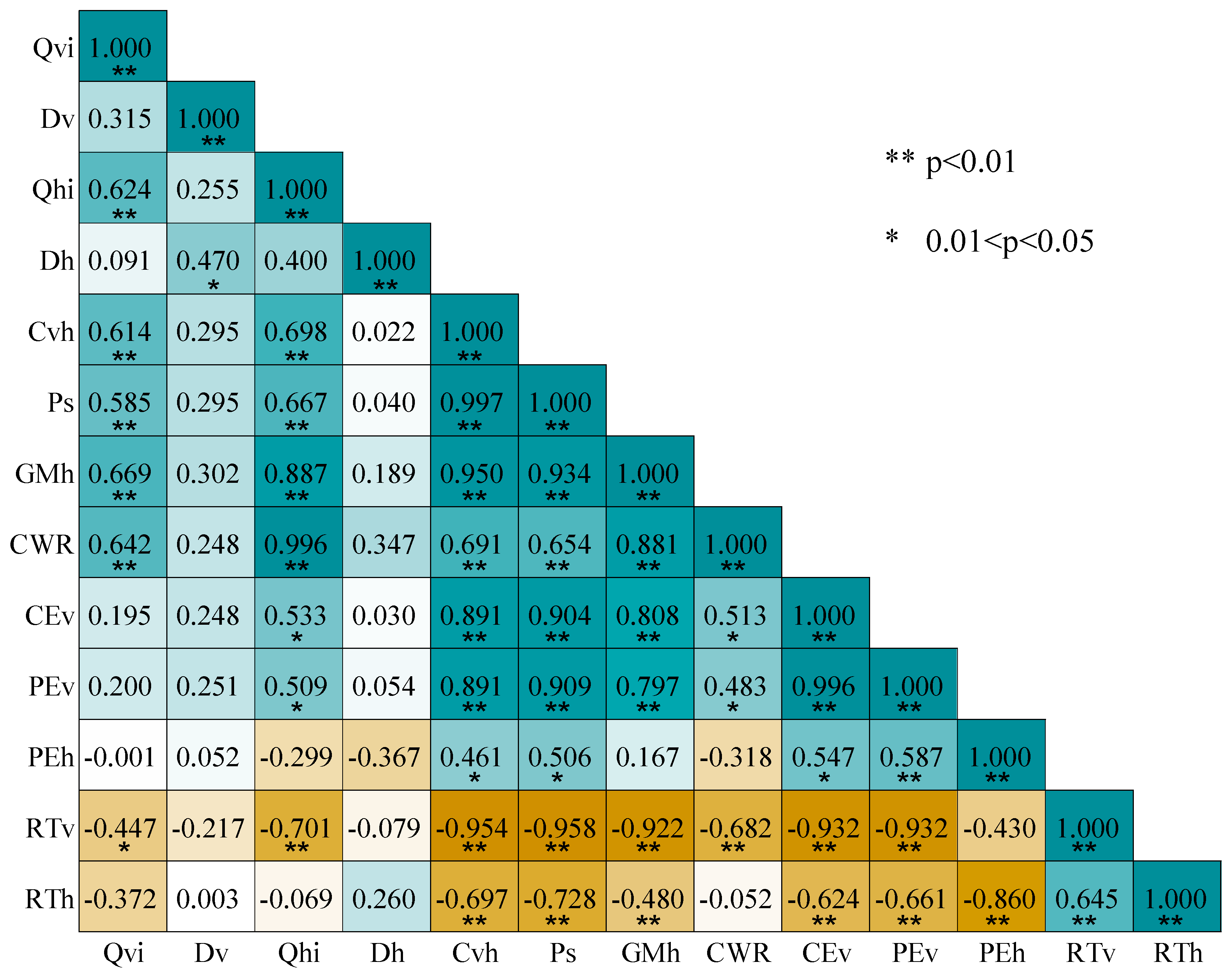
Figure 4 shows the correlation coefficients matrix of the components and characteristic variables of CWR in the NCR. On the annual scale, P s was highly correlated with C v h (r > 0.99). Its correlations with R T v , C E v , P E v , and G M h also exceeded 0.9. However, the correlation coefficients between P s and D v (water vapor convergence) and between P s and D h (hydrometeor convergence) were lower, at only 0.29 and 0.04, respectively. This indicates that precipitation formation in the NCR depends more directly on local condensation processes and the total amount of hydrometeor, rather than on advective transport processes, suggesting that the regulation of water vapor convergence by topography may have nonlinear characteristics.
The variation in CWR is highly consistent with that of Q h i (r > 0.99). Seasonal composition analysis indicates that CWR in winter and spring was dominated by Q h i , with its value exceeding those of C v h and P s , while the opposite is true in summer and autumn. Although C v h and P s were almost completely synchronized (r > 0.99) and about 89.2% ( P s / C v h ) of the condensation amount was converted into precipitation throughout the year (with seasonal proportions ranging from 59.2% to 94.8%), the contribution of Q h i to CWR exceeded 84% in each season ( Q h i /CWR). This indicates that the influx of hydrometeors across boundaries is the main source of CWR.
This characteristic of “CWR being dominated by boundary transport” differs from the conclusion of Zhou et al. [22], which suggested a greater contribution from local condensation based on a short-term study. This discrepancy may stem from the differential influence of the complex “plain–mountain–plateau” topography in the NCR on water vapor transport pathways, uplift processes, and cloud water renewal times across different time scales. The specific mechanisms require further verification with higher-resolution topographic and dynamic analyses.

3.2. Spatial Distribution Characteristics of Gridded CWR

3.2.1. Climatic Distribution of CWR Throughout the Year

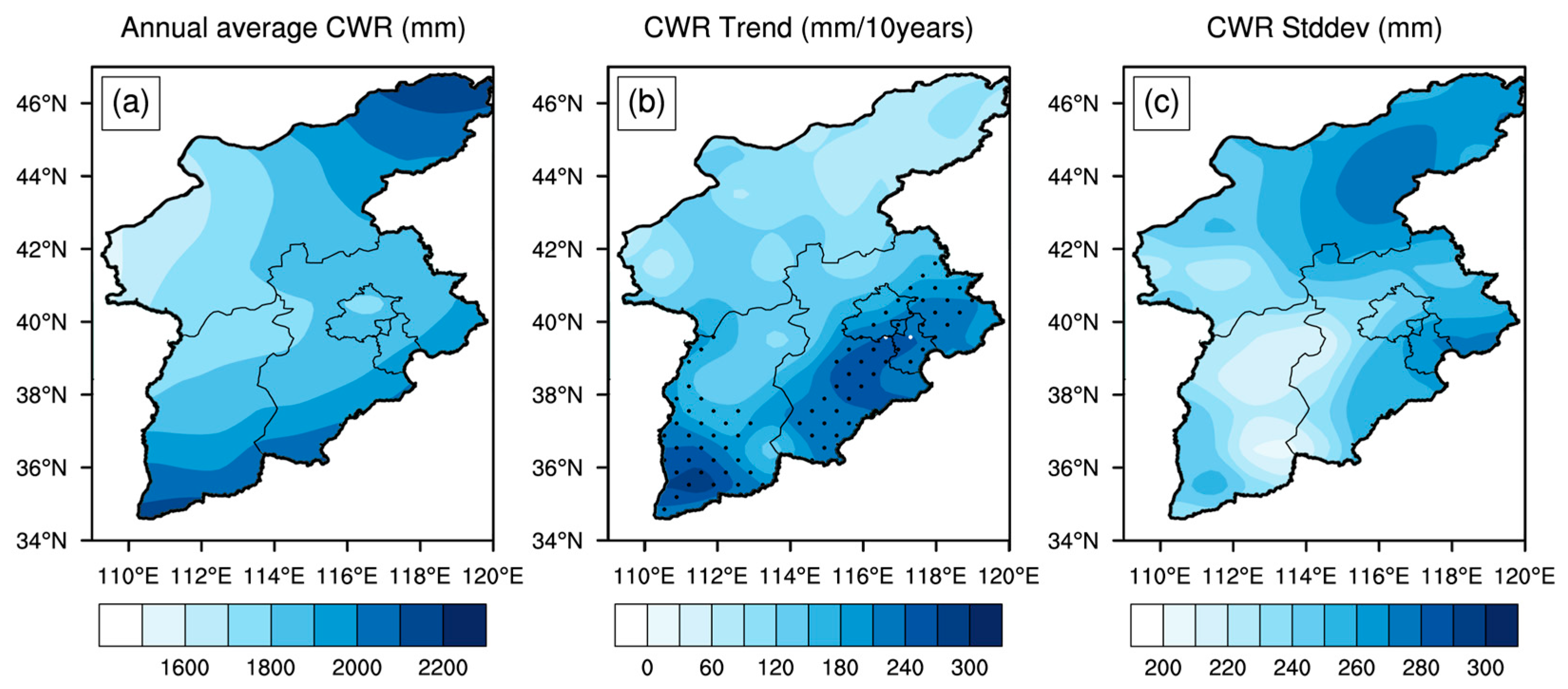
Spatial distribution characteristics of CWR were further analyzed using 1° × 1° grid data over the NCR. An obvious feature shown in the annual average spatial distribution pattern and change trend of CWR (Figure 5) is that the CWR in a 1° × 1° grid are one order of magnitude larger than the overall CWR in the region (Table 1). This is because, in the CWR components, horizontal transport is integrated over the regional boundary, and changes in evaluation scale affect horizontal flow, which in turn influences CWR values. For small-area CWR assessments, the advection item (influx and outflux of hydrometeors) is the largest, but as the assessment area expands, horizontal fluxes within the area offset each other. The importance of horizontal flux decreases with increasing assessment area, resulting in a gross mass of CWR per unit area that is less than the CWR per small grid within the area [22]. Cai et al. [25] also reached similar conclusions on the comparison of mainland China and six weather modification zones. The sum mass of CWR in six zones is greater than that in mainland China as a whole.
The spatial pattern of the annual total CWR on the 1° × 1° grid over the NCR is characterized by “higher values in the south and north, lower values in the central part; higher values in the east, lower values in the west” (Figure 5a). Low-value areas are located in the western part of the region, such as around Baotou in IMGR (less than 1600 mm), while high-value areas appear in topographically flat areas like the Xilingol League in IMGR and the Yuncheng Basin in southern Shanxi (greater than 2200 mm). Over the past 20 years, CWR in most parts of the region have generally increased at a rate of 5–300 mm/10 years (Figure 5b), but with significant regional differences. The increase was significant (confidence level > 95%) in the central–southern parts (Beijing–Tianjin–Hebei, central and southern Shanxi), with the largest increase (297 mm/10 years) in the Linfen–Yuncheng Basin. In contrast, the northern parts (IMGR, northern Hebei) showed non-significant increasing trends.
There is an obvious difference between the spatial distribution of the interannual variability in CWR and their average value (Figure 5c). The variability is smaller west of 114° E and larger to the east. Mountainous areas like the Taihang, Yinshan, and Yanshan Mountains exhibit lower variability, whereas the NCP and the Xilingol Grassland area of the IMP show higher variability. Comparative analysis indicates that the Xilingol Grassland area has relatively abundant CWR but experiences significant interannual fluctuations and no clear trend. The southeastern Shanxi–southern Hebei–Tianjin area also has relatively abundant CWR and shows a clear increasing trend, with southeastern Shanxi having the smallest standard deviation, indicating the most stable growth. Overall, the stability of CWR shows some association with topography: CWR are relatively stable in mountainous regions, while they are less stable over the IMP and the NCP.
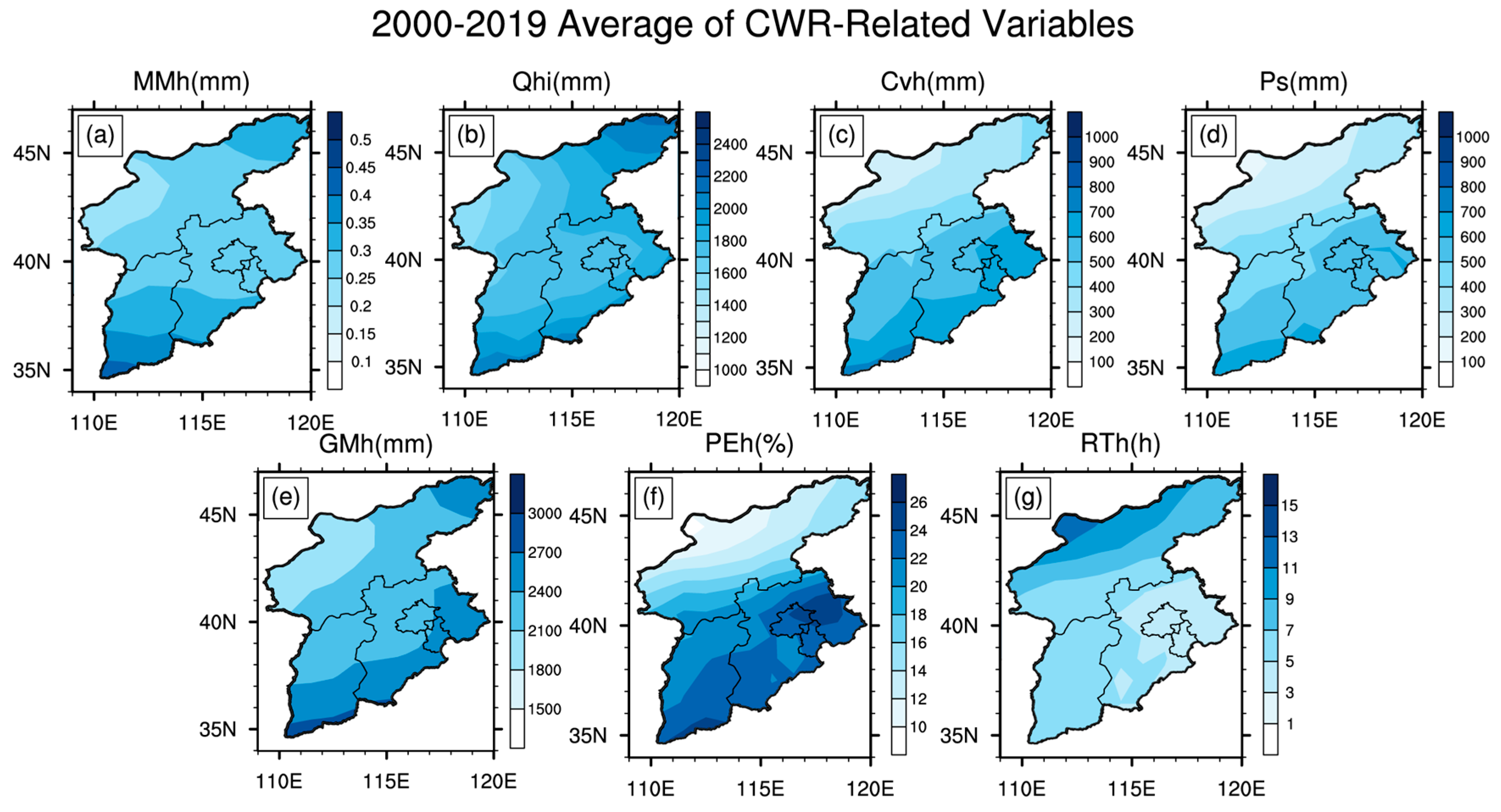
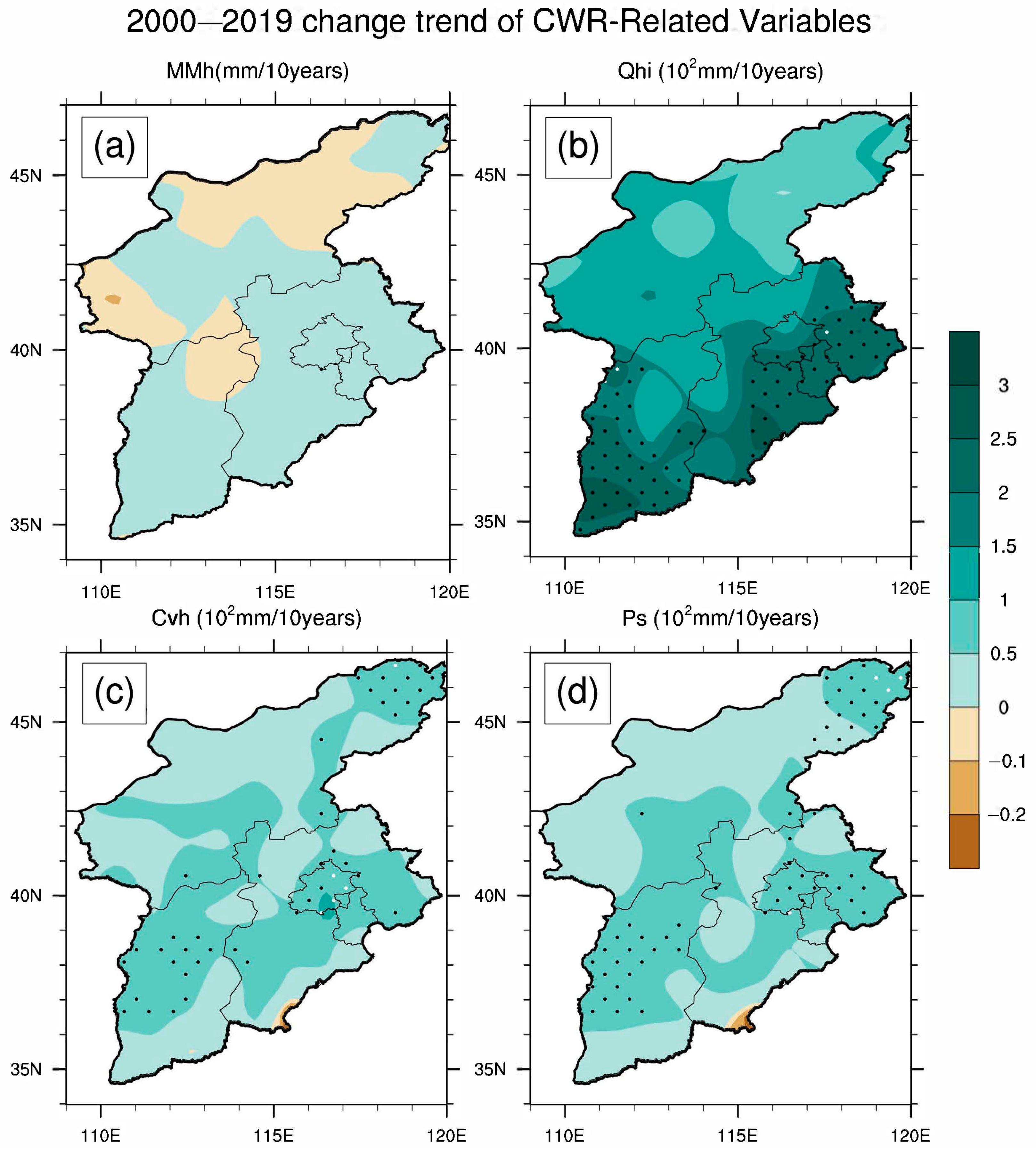
From the distribution (Figure 6) and the variation tendency (Figure 7) of CWR components and characteristic variables from 2000 to 2019, the following can be seen on a multi-year average basis.
The mean mass of hydrometeors ( M M h ) is the smallest (Figure 6a), with a value of 2–4 orders of magnitude smaller than the advection items ( Q h i ) and source/sink items ( C v h , P s ) of hydrometeors (Figure 6b–d), and the change trends in most areas do not past the 95% confidence level test (Figure 7a). Consequently, the contribution of M M h to the annual-scale CWR is negligible, although its spatial distribution pattern resembles that of CWR (Figure 5a).
For the 1° × 1° grid, Q h i has the largest magnitude, exceeding C v h and P s by one order of magnitude. The magnitude, spatial distribution (Figure 5a and Figure 6b), and variation trend (Figure 5b and Figure 7b) of Q h i (Figure 5a and Figure 6b) are highly consistent with those of CWR, contributing up to 97.0% (figure omitted) and playing a dominant role.
C v h and P s are also highly synchronized in terms of value, spatial distribution (Figure 6c,d), and variation trend (Figure 7c,d), with a correlation coefficient as high as 99% (figure omitted). Both show a belt-shaped distribution increasing from northwest to southeast, and the precipitation in the southeastern part is about 3 times that in the western part. C v h and P s show an increasing trend in most parts of the NCR, with only a slight decrease in a few areas in southeastern Hebei.
It is noteworthy that although the precipitation is relatively low in IMG (Figure 6d), it is a high-value area of hydrometeor influx (Figure 5a), resulting in relatively abundant CWR there (Figure 6b). Among the characteristic variables of CWR, G M h is similar in magnitude and spatial distribution to CWR. P E h ranges from 10% to 25%, sharing a distribution pattern with P s of “low in the northwest and high in the southeast”. In contrast, R T h (which has an opposite distribution to P E h ) is 1–5 h in most regions.
Therefore, for small regions (1° × 1° grid), CWR constitute the vast majority of G M h , and its value is mainly controlled by Q h i . This also reflects that the spatial distribution pattern of CWR in NCR may be comprehensively affected by topographic factors. For example, characteristics such as high P E h in the southeast and active hydrometeor inflow in the northwest correspond to some extent with the regional topographic configuration.

3.2.2. Climatic Distribution of CWR in Four Seasons

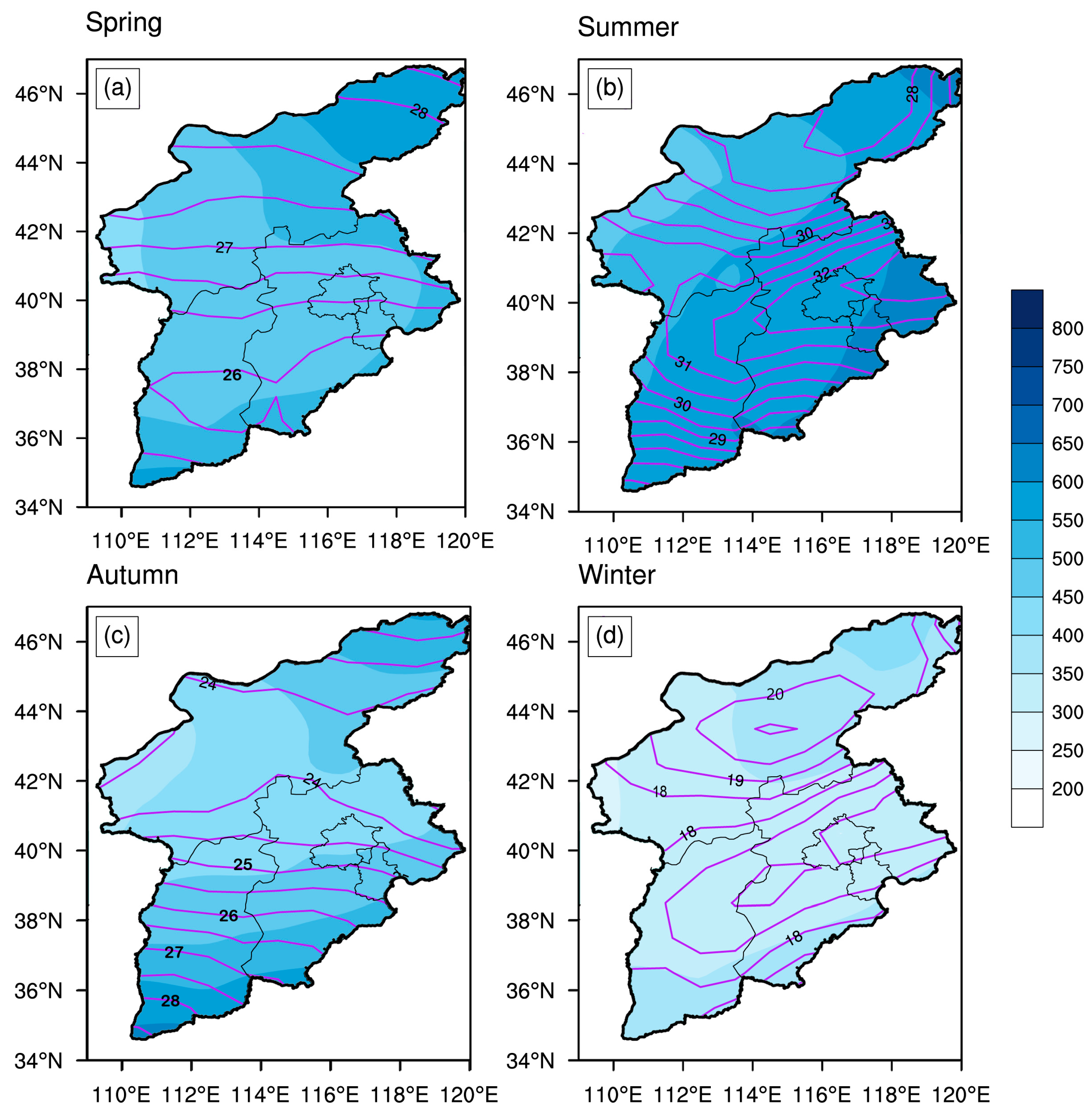
Affected by the monsoon circulation and topography, the seasonal distribution of CWR in the NCR exhibits distinct characteristics (Figure 8). The spatial patterns in spring and autumn are similar to the annual distribution pattern, with high-value areas located in the Xilingol League of IMP and southern NCR and low-value areas in the northwest. CWR in spring and autumn account for 25–28% and 24–28% of the annual total, respectively. Conversely, summer and winter exhibit opposite patterns. Summer has the most abundant CWR, increasing from northwest to southeast, accounting for 28–32% of the annual total, with a seasonal low-value center near the Xilingol League and a high-value center near Tianjin. Winter has the least CWR, accounting for 18–20%, with a high-value center near the Xilingol League and a low-value center near Tianjin. Winter CWR are the lowest throughout the year across all locations, while the areas where summer contributes the largest proportion are mainly distributed in the Beijing–Tianjin–Hebei region and the southern NCR.
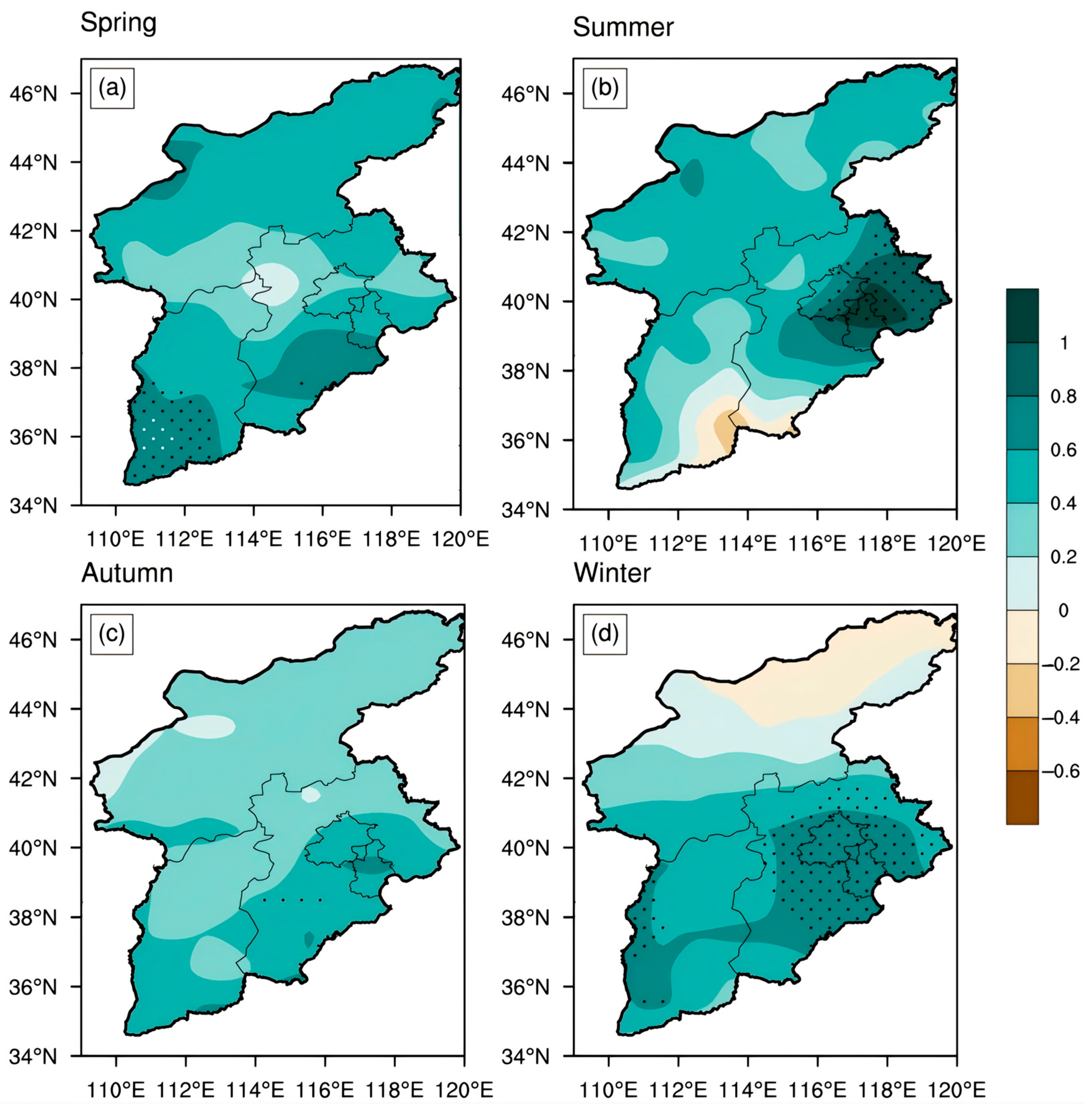
The seasonal variation trends show (Figure 9) that CWR generally increase across the region in spring and autumn. In spring, the central and southern parts of Shanxi and Hebei show a significant increase (60–80 mm/10 years), while the junction area of Shanxi–IMGR–Hebei (including Ulanqab, Datong, and Zhangjiakou) has the smallest increase. In autumn, the increase ranges from 20–60 mm/10 years, and the trend in northern Shanxi, central Hebei, and Tianjin passes the 90% confidence level test.
In summer, CWR show an increasing trend in most areas, with the Bohai Rim region seeing an increase of over 100 mm/10 years, while a slight decrease occurs at the junction of Shanxi–Hebei–Henan. In winter, except for a decrease near the Xilingol League, CWR increase in all other areas, with the central and southern parts showing an increase of over 60 mm/10 years.
Overall, CWR show an increasing trend in most seasons across most parts of the NCR, with the most significant spatial differences in summer and winter. This once again highlights the regional climate differences under the combined influence of complex topography and monsoon circulation.

3.3. EOF Analysis of CWR Anomalies

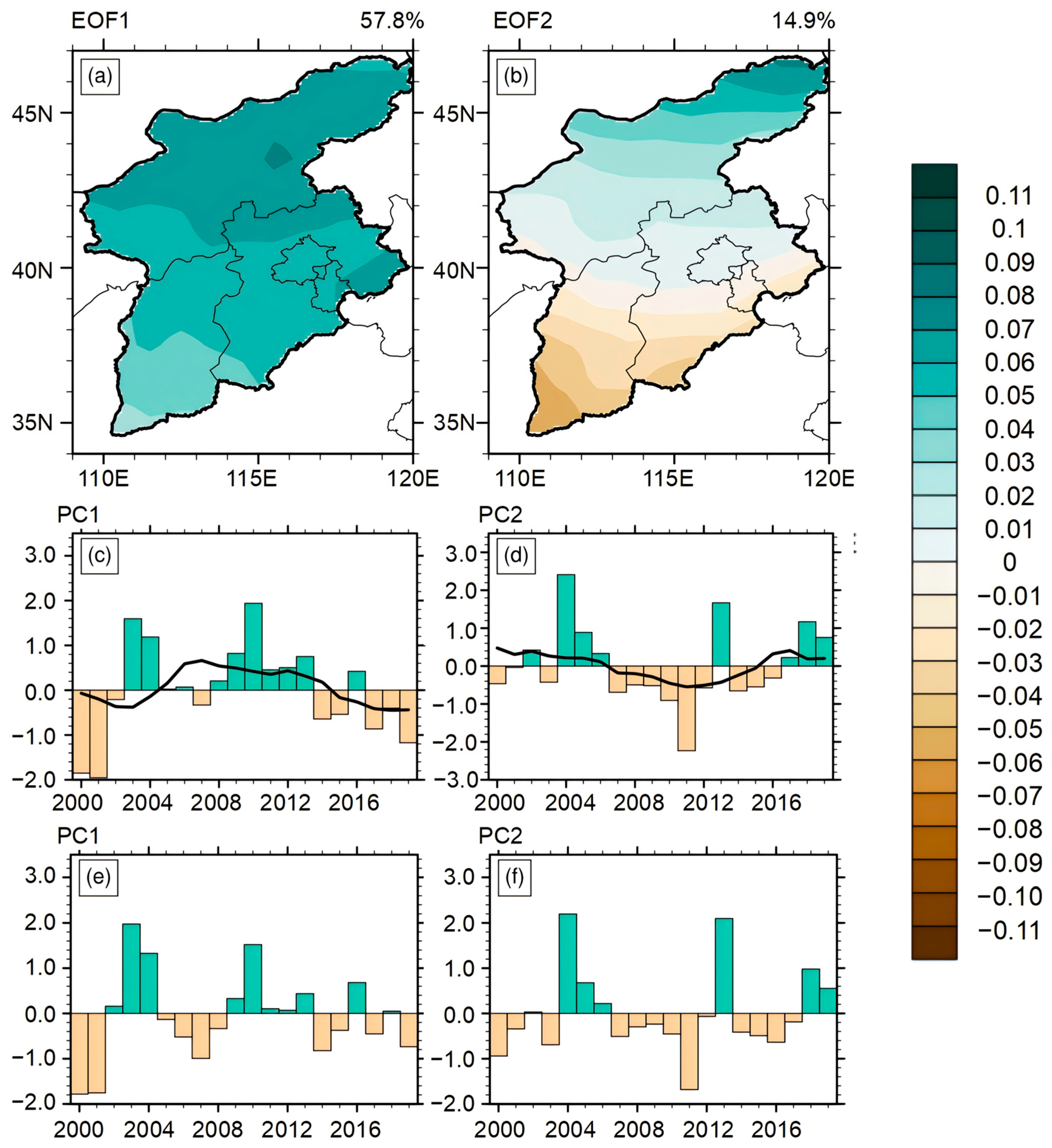
To objectively describe the spatiotemporal distribution characteristics of CWR in the NCR during 2000–2019, EOF decomposition was applied to the detrended CWR anomaly field. To isolate the interdecadal variability, a 9-year moving average was applied to the principal component (PC) time series, thereby filtering out higher-frequency interannual fluctuations. The first two modes collectively account for 72.7% of the total variance and both pass North’s significance test [33], indicating they well represent the main spatiotemporal characteristics of CWR anomalies.
The first mode (EOF1, variance contribution of 57.8%) exhibits a “region-wide consistent pattern” (Figure 10a), indicating that CWR variations across the NCR are characterized by significant in-phase fluctuations. Spatially, it shows consistent positive anomalies across most of the region, with the high-value area located over the relatively flat IMP in the northern part of the NCR. The overall spatial structure displays a “low in the south, high in the north” configuration, reflecting that the amplitude of CWR variation is relatively small in the south and more pronounced in the north. Combined with the time coefficient (Figure 10c,e), the first mode has obvious clear interannual-to-decadal fluctuations. After removing the interdecadal trend (Figure 10e), the detrended principal component shows a strong correlation (r = 0.83) with the interannual variation series of CWR shown in Figure 2a, demonstrating that EOF1 primarily represents regionally consistent, climate-scale regional changes.
The second mode (EOF2, variance contribution of 14.9%) exhibits a “north–south out-of-phase dipole pattern” (Figure 10b), whose spatial structure shows clear correspondence with the stepped topographic configuration of the NCR. It is characterized by a north–south dipole structure roughly centered around 40° N, with negative anomalies in the south and positive anomalies in the north. The positive anomaly center is situated over the relatively uniform, high-elevation terrain of the northern IMP, while the negative anomaly center covers the topographically complex area of southern Shanxi and the NCP. This dipole pattern reflects differential modulation of CWR by distinct topographic units: the elevated and relatively homogeneous terrain of the northern IMP favors orographic uplift that helps sustain cloud water, while the complex topography of the southern Taihang Mountains and the NCP makes water vapor transport and convergence processes more susceptible to adjustments in atmospheric circulation, potentially leading to the formation of an anomaly structure opposite to that in the north. This mode exhibits significant decadal-scale variability (Figure 10d,f). During 2006–2016, the dipole spatial pattern showed a trend of “positive south, negative north,” whereas it was predominantly “negative south, positive north” during other periods.
The EOF analysis indicates that variations in CWR over the NCR are predominantly characterized by a region-wide consistent pattern (EOF1), while the north–south reverse dipole pattern (EOF2) is also an important distribution mode. Against the decadal background, the interannual variations in CWR show periodic characteristics. Notably, in recent years, the pattern of negative anomalies in the central–southern parts has become more frequent. These findings provide a basis for further understanding the spatiotemporal differentiation of CWR in complex terrain regions.

4. Conclusions and Discussion

Based on the Chinese 1° × 1° resolution CWR diagnostic dataset from 2000 to 2019, this study investigated the spatiotemporal patterns of CWR and key physical quantities related to CWR under the complex topography of the NCR using mathematical statistics, correlation analysis, and EOF analysis. The main conclusions are as follows:
All CWR-related physical quantities exhibited significant seasonal differences, with most being highest in summer and lowest in winter. Water vapor convergence was strongest in summer and weakest in winter, showing divergence during spring and autumn. In contrast, hydrometeors demonstrated year-round convergence, being minimal in summer and maximal in winter. Although CWR themselves showed relatively small seasonal differences, both R T h and P E h displayed marked seasonal variations, indicating potential for artificial precipitation enhancement in all seasons.
On the annual scale, P s is highly consistent with C v h (r > 0.99) and is closely correlated with G M h and R T v (r > 0.9). However, its correlation with D v and D h remains weak. This reflects that precipitation formation in the NCR depends more on local condensation processes than advection transport. CWR is mainly controlled by hydrometeor influx (r > 0.99).
Over the past 20 years, both CWR and P s have shown an increasing trend, with growth rates of 34.8 mm/10 years and 49.2 mm/10 years, respectively. While their interannual variations demonstrate some synchronization, significant seasonal differences are evident: CWR increase in all four seasons, with the largest interannual variation amplitude in autumn, whereas P s shows a slight decrease in winter, with the largest interannual variation amplitude in spring.
Spatially, CWR present a pattern of “more in the north and south, less in the central part; more in the east, less in the west”. CWR are most abundant in summer, increasing from northwest to southeast; their distribution patterns in spring, autumn, and winter are similar. CWR have shown an overall increasing trend throughout the year, with a significant increase in the central and southern parts; they have also generally increased in most regions across all seasons.
EOF analysis identifies two main spatial modes: a “region-wide consistent pattern” (EOF1) and the “north–south out-of-phase dipole pattern” (EOF2). These two modes, respectively, reflect the spatiotemporal regularity of the in-phase variation in the entire region and the north–south out-of-phase variation in the region. EOF1 dominates interannual variations, while EOF2 may be related to differences in water vapor transport and uplift between the north and south caused by topographic differences. Both modes are significant on the interdecadal scale; in recent years, the pattern of abnormally low CWR in the central and southern parts has become more common.
This study statistically reveals the spatiotemporal pattern characteristics of CWR in the NCR under complex topography. It is found that the relationships between physical variables exhibit obvious regional specificity and scale dependence—especially the weak correlation between the convergence of water vapor/hydrometeors and P s , which differs from that in other regions. These findings provide a reference for understanding the formation mechanisms of cloud water in topographic areas. Future work will combine higher-resolution topographic and meteorological data to further reveal the detailed processes of terrain–cloud water interaction on monthly and daily scales.

Author Contributions

Conceptualization: J.Z., M.C., Y.Z. and Z.C.; methodology: J.Z., M.C., J.Y. and S.S.; software: J.Z. and J.Y.; validation: M.C., S.S. and Z.C.; formal analysis: J.Z. and J.Y.; investigation: J.Z., M.C., Y.Z. and Z.C.; data curation: J.O.; writing—original draft preparation: J.Z. and M.C.; writing—review and editing: J.Z., M.C. and Z.C.; supervision: Y.Z.; funding acquisition: M.C. and Z.C. All authors have read and agreed to the published version of the manuscript.

Funding

This study was supported by the National Natural Science Foundation of China (No. 42175099), the National Key Research and Development Program of China (No. 2024YFF1308202; No. 2016YFA0601701), and the Open Project of the Joint Research Center for Weather Modification of China Meteorological Administration and Chengdu University of Information Technology (No. 2023GDRY009).

Data Availability Statement

The original contributions presented in the study are included in the article; further inquiries can be directed to the corresponding author. For scientists who show interest in the relevant research and who ensure that the data will be used only for research work, the authors can provide the data for their work under the permission of the China Meteorological Administration.

Acknowledgments

The authors would like to thank the National Climate Centre and European Centre for Medium-Range Weather Forecasts (ECMWF) and the GEBCO data center for their online data. They would also like to thank editors and anonymous reviewers for their helpful comments that improved this paper.

Conflicts of Interest

Author Jianjun Ou was employed by the company Shanghai by Weather Technology Co., Ltd. The remaining authors declare that the research was conducted in the absence of any commercial or financial relationships that could be construed as a potential conflict of interest.

References

  1. IPCC. Climate Change 2022: Impacts, Adaptation and Vulnerability; Contribution of Working Group II to the Sixth Assessment Report of the Intergovernmental Panel on Climate Change; Pörtner, H.-O., Roberts, D.C., Tignor, M.M.B., Poloczanska, E., Mintenbeck, K., Alegría, A., Craig, M., Langsdorf, S., Löschke, S., Möller, V., et al., Eds.; Cambridge University Press: Cambridge, UK; New York, NY, USA, 2022; 3056p. [Google Scholar] [CrossRef]
  2. Zheng, X.; Ma, C.; Lv, H.; Wang, F.; Wang, H. Evolution and drivers of water use in Northern China. J. Hydrol. Reg. Stud. 2025, 59, 102419. [Google Scholar] [CrossRef]
  3. Chen, X.; Wang, P.; Muhammad, T.; Xu, Z.C.; Li, Y.K. Subsystem-level groundwater footprint assessment in North China Plain—The world’s largest groundwater depression cone. Ecol. Indic. 2020, 117, 106662. [Google Scholar] [CrossRef]
  4. Xia, P.C.; Lu, C.P.; Wu, G.Z.; Wang, Y.Q.; Cheng, W.S. Attribution analysis of groundwater depth dynamic changes in the water receiving region of the South-to-North water diversion middle route project in China. J. Hydrol. Reg. Stud. 2025, 58, 102210. [Google Scholar] [CrossRef]
  5. Zhang, C.; Duan, Q.; Yeh, P.J.-F.; Pan, Y.; Gong, H.L.; Gong, W.; Di, Z.H.; Lei, X.H.; Liao, W.H.; Huang, Z.Y.; et al. The effectiveness of the south-to-north water diversion middle route project on water delivery and groundwater recovery in North China Plain. Water Resour. Res. 2020, 56, 10. [Google Scholar] [CrossRef]
  6. Chien, S.S.; Hong, D.L.; Lin, P.H. Ideological and volume politics behind cloud water resource governance—Weather modification in China. Geoforum 2017, 85, 225–233. [Google Scholar] [CrossRef]
  7. Yin, X.Z.; Wang, Y.R.; Xu, W.J.; Zhang, F.W.; Qiao, Y.J.; Chen, Q.; Pang, C.Y. New progress in research on the development potential of cloud water resources in Qilian Mountains. Desert Oasis Meteorol. 2020, 14, 134–140. (In Chinese) [Google Scholar] [CrossRef]
  8. Zheng, G.G.; Guo, X.L. Status and development of sciences and technology for weather modification. Strateg. Study CAE 2012, 14, 20–27. (In Chinese) [Google Scholar] [CrossRef]
  9. Flossmann, A.I.; Manton, M.; Abshaev, A.; Bruintjes, R.; Murakami, M.; Prabhakaran, T.; Yao, Z.Y. Review of advances in precipitation enhancement research. Bull. Am. Meteor. Soc. 2019, 100, 1465–1480. [Google Scholar] [CrossRef]
  10. Yao, Z.Y.; An, L.; Zhang, P.; Guo, L.S.; Jia, S.; Wang, W.J.; Zhao, W.H. Characteristics of cloud water resource and precipitation efficiency of hydrometeors over Northwest China. J. Meteor. Res. 2023, 37, 353–369. [Google Scholar] [CrossRef]
  11. Zhang, Q.; Wang, Y.; Zhang, P. Cloud Water resources and precipitation conversion in Northwest China. Adv. Earth Sci. 2025, 40, 473–486. (In Chinese) [Google Scholar] [CrossRef]
  12. Xiao, J.S.; Mao, F.; Qiu, X.M. Artificial precipitation enhancement and the rational development of water resources in air. Yunnan Environ. Sci. 2006, 25, 11–13+27. (In Chinese) [Google Scholar] [CrossRef]
  13. Dettinger, M.D.; Ralph, F.M.; Das, T.; Neiman, P.J.; Cayan, D.R. Atmospheric rivers, floods and the water resources of California. Water 2011, 3, 445–478. [Google Scholar] [CrossRef]
  14. Chen, Y.H.; Huang, J.P.; Chen, C.H.; Zhang, Q.; Feng, J.D.; Jin, H.C.; Wang, T.H. Temporal and spatial distributions of cloud water resources over Northwestern China. Plateau Meteor. 2005, 24, 905–912. (In Chinese) [Google Scholar]
  15. Li, X.Y.; Guo, X.L.; Zhu, J. Climatic distribution features and trends of cloud water resources over China. Chin. J. Atmos. Sci. 2008, 32, 1094–1106. (In Chinese) [Google Scholar]
  16. Yan, Y.F.; Liu, Y.M.; Lu, J.H. Cloud vertical structure, precipitation, and cloud radiative effects over Tibetan Plateau and its neighboring regions. J. Geophys. Res. 2016, 121, 5864–5877. [Google Scholar] [CrossRef]
  17. He, X.H.; Song, M.H.; Zhou, Z.X. Temporal and spatial characteristics of water vapor and cloud water over the Qinghai-Xizang Plateau in Summer. Plateau Meteor. 2020, 39, 1339–1347. (In Chinese) [Google Scholar] [CrossRef]
  18. Zhang, P.; Yao, Z.Y.; Jia, S.; Chang, Z.L.; Sang, J.R.; Gao, L.S.; Zhao, W.H.; Wang, W.J.; Zhu, X.Y. Study of the characteristics of atmospheric water resources and hydrometeor precipitation efficiency over the Liupan Shan area. Chin. J. Atmos. Sci. 2020, 44, 421–434. (In Chinese) [Google Scholar] [CrossRef]
  19. Li, G.W.; Xing, F.H.; Ao, J.; Mao, Y.Z. Temporal and spatial characteristics of cloud water resources in Hainan island over the past 30 years. J. Bio. Meteor. 2022, 13, 331–338. (In Chinese) [Google Scholar] [CrossRef]
  20. Ma, C.; Liu, Y.; Liu, J.; Yang, L.M. Spatial and temporal distribution characteristics of cloud water resources in the Tarim Basin in summer. Arid Zone Res. 2025, 42, 223–235. (In Chinese) [Google Scholar] [CrossRef]
  21. Cai, M. Cloud Water Resources and Precipitation Efficiency Evaluation over China. Ph.D. Thesis, Nanjing University of Information Science & Technology, Nanjing, China, 2013. [Google Scholar]
  22. Zhou, Y.Q.; Cai, M.; Tan, C.; Mao, J.T.; Hu, Z.J. Quantifying the cloudwater resource: Basic concepts and characteristics. J. Meteor. Res. 2020, 34, 1242–1255. [Google Scholar] [CrossRef]
  23. Cai, M.; Zhou, Y.Q.; Liu, J.Z.; Tan, C.; Tang, Y.H.; Ma, Q.R.; Li, Q.; Mao, J.T.; Hu, Z.J. Quantifying the cloud water resource: Methods based on observational diagnosis and cloud model simulation. J. Meteor. Res. 2020, 34, 1256–1270. [Google Scholar] [CrossRef]
  24. Tan, C.; Cai, M.; Zhou, Y.Q.; Liu, W.G.; Hu, Z.J. Cloud water resource in north China in 2017 simulated by the CMA-CPEFS cloud resolving model: Validation and quantification. J. Meteor. Res. 2022, 36, 520–538. [Google Scholar] [CrossRef]
  25. Cai, M.; Zhou, Y.Q.; Liu, J.Z.; Tan, C.; Zhao, J.J.; Ou, J.J. Diagnostic quantification of the cloud water resource in China during 2000–2019. J. Meteor. Res. 2022, 36, 292–310. [Google Scholar] [CrossRef]
  26. An, L.; Yao, Z.Y.; Zhang, P.; Jia, S.; Zhao, J.Y.; Gao, L.S.; Liu, Z. Regional characteristics and exploitation potential of atmospheric water resources in China. Int. J. Climatol. 2022, 42, 3225–3245. [Google Scholar] [CrossRef]
  27. Wang, R.Y.; Zhou, W.T.; Dan, R.Y.; Xue, W.H. Cloud water resources assessment in Shaanxi province based on ERA5 data. J. Shaanxi Meteor. 2023, 6, 10–16. (In Chinese) [Google Scholar]
  28. Cheng, J.Y.; You, Q.L.; Cai, M.; Sun, J.; Zhou, Y.Q. Cloud water resource over the Asian water tower in recent decades. Atmos. Res. 2022, 269, 106038. [Google Scholar] [CrossRef]
  29. Zhang, Z.G.; Jian, Y.; Li, Y.Z.; Zhan, Y.Y. Assessment of cloud water resources of Guangxi based on ERA5 data. Meteorol. Sci. Technol. 2021, 49, 806–814. (In Chinese) [Google Scholar] [CrossRef]
  30. Gao, J.L.; Feng, J.J.; Cao, Y.; Zheng, X.Y. Evaluation of cloud water resources in the Huaihe River Basin based on ERA5 data. Atmosphere 2023, 14, 1253. [Google Scholar] [CrossRef]
  31. Huffman, G.J.; Adler, R.F.; Morrissey, M.M.; Bolvin, D.T.; Curtis, S.; Joyce, R.; McGavock, B.; Susskind, J. Global precipitation at one-degree daily resolution from multisatellite observations. J. Hydrometeor. 2001, 2, 36–50. [Google Scholar] [CrossRef]
  32. Zhang, Z.; Moore, J.C. Mathematical and Physical Fundamentals of Climate Change, 1st ed.; Elsevier: Amsterdam, The Netherlands, 2015; pp. 161–197. [Google Scholar]
  33. North, G.R.; Bell, T.L.; Cahalan, R.F.; Moeng, F.J. Sampling errors in the estimation of empirical orthogonal functions. Mon. Weather Rev. 1982, 110, 699–706. [Google Scholar] [CrossRef]
Figure 1. Topographic distribution around the NCR based on GEBCO elevation data (color-shaded; unit: m). The thick black solid line highlights the NCR. BJ denotes Beijing, TJ denotes Tianjin, HB denotes Hebei Province, SX denotes Shanxi Province, and IMGR denotes the central region of the Inner Mongolia Autonomous Region.
Climate 13 00230 g001
Figure 2. The interannual time series of CWR and P s in the NCR for (a) annual average, (b) spring, (c) summer, (d) autumn, and (e) winter. Thick solid lines representing the original values of CWR and P s , dashed lines indicate their trends, and colored bars show normalized anomalies during 2000–2019 (green for CWR, blue for P s , * p < 0.05).
Climate 13 00230 g002
Figure 3. Monthly variations in CWR-related compositions (ad) and characteristic variables (eh) in the NCR from 2000 to 2019. Bars represent the difference between monthly and annual averages; lines with dots indicate monthly trends (black dots: increasing trend; red dots: decreasing trend; * p < 0.05).
Climate 13 00230 g003
Figure 4. Correlation matrix of key physical quantities related to CWR (color-shaded: correlation coefficient, all abbreviations correspond to the variables defined in Table 1).
Climate 13 00230 g004
Figure 5. Distributions of CWR in the NCR during 2000 to 2019. (a) Annual average CWR (units: mm); (b) linear trend of annual CWR (units: mm/10 years), where regions with the black and white dots indicate CWR trends over the 95% and 99% confidence levels, respectively; (c) standard deviation of CWR (units: mm). Note: The CWR values here represent the grid-scale assessment and are typically an order of magnitude larger than the overall regional values presented in Table 1.
Climate 13 00230 g005
Figure 6. The average distribution of (a) M M h (unit: mm), (b) Q h i (unit: mm), (c) C v h (unit: mm), (d) P s (unit: mm), (e) G M h (unit: mm), (f) P E h (unit: %), and (g) R T h (unit: hour) in NCR during 2000−2019. Note: The CWR values here represent the grid-scale assessment and are typically an order of magnitude larger than the overall regional values presented in Table 1.
Climate 13 00230 g006
Figure 7. The linear trend distribution of (a) M M h (unit: mm/10 years), (b) Q h i (unit: 102 mm/10 years), (c) C v h (unit: 102 mm/10 years), and (d) P s (unit: 102 mm/10 years) in the NCR during 2000−2019. The regions with the black (white) dots represent the trends exceeding the 95% (99%) confidence levels, respectively. Note: The CWR values here represent the grid-scale assessment and are typically an order of magnitude larger than the overall regional values presented in Table 1.
Climate 13 00230 g007
Figure 8. The distributions of seasonal CWR (shading, units: mm) and seasonal percentage (purple contour, units: %) in the NCR in (a) spring, (b) summer, (c) autumn, and (d) winter. Note: The CWR values here represent the grid-scale assessment and are typically an order of magnitude larger than the overall regional values presented in Table 1.
Climate 13 00230 g008
Figure 9. The linear trend distribution of CWR in different seasons in the NCR (shading, units: 102 mm/10 years) in (a) spring, (b) summer, (c) autumn, and (d) winter. The regions with black (white) dots represent trends exceeding the 95% (99%) confidence levels, respectively. Note: The CWR values here represent the grid-scale assessment and are typically an order of magnitude larger than the overallregional values presented in Table 1.
Climate 13 00230 g009
Figure 10. The eigenvectors (a,b) and time coefficients (bars) and their 9-year moving average (curves) (c,d) and annual change (e,f) time coefficient minus the value of 9-year moving average of the first two main modes of the EOF decomposition of CWR in the NCR.
Climate 13 00230 g010
Table 1. Seasonal and annual averages (2000–2019) of overall regional CWR components and characteristic variables for the NCR.
ClassPhysical QuantitySymbolUnitSpringSummerAutumnWinterYear
componentswater vapor influxQvimm1914.13620.92054.5947.68537.1
water vapor convergenceDv(QviQvo)mm−8.419.0−18.713.45.3
hydrometeor influxQhimm89.898.183.963.4335.1
hydrometeor convergenceDh(QhiQho)mm5.70.84.78.219.3
cloud condensation C v h mm82.5280.310527.7495.4
surface precipitationPsmm67.5265.692.316.4441.8
surface evaporationEsmm79.9253.289.4−5.4417
water surplusPsEsmm−12.412.42.921.824.8
characteristic variableswater vapor grossGMvmm2035.13955.92202.3971.49030.0
hydrometeor grossGMhmm173.0379.5189.891.5830.7
CWR grossCWRmm105.5113.897.575.1388.8
condensation efficiency of water vaporCEv%4.17.14.82.95.5
precipitation efficiency of water vaporPEv%3.36.74.21.74.9
precipitation efficiency of hydrometeorPEh%39.070.048.617.953.1
water vapor renewal timeRTvday17.19.017.128.410.0
hydrometeor renewal timeRThhour13.43.811.836.35.8
Disclaimer/Publisher’s Note: The statements, opinions and data contained in all publications are solely those of the individual author(s) and contributor(s) and not of MDPI and/or the editor(s). MDPI and/or the editor(s) disclaim responsibility for any injury to people or property resulting from any ideas, methods, instructions or products referred to in the content.