


Abstract
Vibration energy harvesting has emerged as a sustainable solution for powering low-energy devices such as wireless sensors and wearable electronics. However, conventional vibration energy harvesters often suffer from narrow operational bandwidth and limited output performance under ultra-low excitation conditions. To overcome these limitations, this study proposes an asymmetric tristable vibration energy harvester integrated with an elastic magnifier (EM), hereafter referred to as the asymmetric TVEH with EM, to enhance energy conversion efficiency under weak excitation. A nonlinear two-degree-of-freedom electromechanical model is developed to describe the coupled dynamics between the cantilever beam and the EM, incorporating nonlinear restoring forces and electromechanical coupling effects. The system performance is investigated using the harmonic balance method (HBM) and time-domain numerical simulations. In addition, parametric studies are conducted to examine the influence of the EM mass and stiffness ratios on the dynamic response and energy harvesting performance. The numerical results demonstrate that the inclusion of the EM significantly amplifies the system response under ultra-low excitation , enabling improved inter-well motion and enhancing energy conversion efficiency by up to 45%. To validate the analytical and numerical findings, an experimental prototype is fabricated and tested. The experimental results confirm the effectiveness of the proposed design, achieving a root mean square voltage of across a load resistance of under a base acceleration of at 14 Hz, measured over a 30 s window with a low-pass filter cut-off frequency of 100 Hz. The proposed asymmetric TVEH with EM consistently outperforms both the symmetric TVEH with EM and the asymmetric configuration without EM. Overall, the results highlight the pivotal role of the elastic magnifier in enhancing the dynamic response and harvesting performance under weak excitations, demonstrating strong potential for powering low-power electronic devices in practical applications. Furthermore, this work supports the United Nations Sustainable Development Goal SDG 7 (Affordable and Clean Energy) by promoting decentralized and renewable vibration-based energy harvesting technologies.
1. Introduction
Energy harvesting through vibration is a technology that helps in converting ambient mechanical energy from the vibrations to electricity through an appropriate transduction process. Several energy conversion approaches, like piezoelectric, electromagnetic, magnetostrictive, and triboelectric, among others, have been explored by researchers, and the energy harvested can be utilized for self-powered wireless sensor networks, health monitoring, and emergency power systems [1,2,3,4,5,6]. The efficacy of linear vibration energy harvesters (VEHs) can only be achieved near the resonance region. Numerous approaches, such as amplification methods, tuning of the resonance, and adding nonlinearity, among others, have been suggested for improving the efficacy of the linear VEH in a broader-frequency region [7,8,9,10,11].
However, in the development of the VEH from a monostable to a bistable systems, some new insights into VEHs were gained [12,13]. The idea that bistable VEHs could be realized using nonlinear springs or, alternatively, magnets has been extensively studied [14,15,16,17,18] to enhance VEHs. VEHs exhibit inter-well and intra-well periodic and chaotic motion and are sensitive to initial conditions. A threshold excitation amplitude is required to overcome the potential barrier and initiate large-amplitude inter-well motion. The geometry and the asymmetry of the potential affect the performance of the bistable VEH [19]. Unfortunately, most of the ambient vibration is so weak that the nonlinear VEH, especially a bistable VEH, cannot overcome the potential barrier, which leads to a degradation or even failure in energy harvesting [20]. As a remedy, multistable VEHs were created using extra springs and magnets [21,22]. Multistable VEHs have relatively shallower potential wells than bistable VEHs and therefore can cause inter-well motion even when exposed to low-amplitude excitation.
Other than multi-stability, there are many approaches used for enhancing the efficiency of bistable VEHs under low-amplitude excitation. Incorporating an elastic magnifier or a displacement amplification system in between the base vibration and the VEH to amplify the magnitude of the base excitation is one of the notable contributions towards accomplishing this objective. The magnitude of the base excitation can be amplified through manipulation of the mass and stiffness ratio between the VEH and the elastic magnifier. Wang et al. [23,24] conducted numerical and experimental studies on the behavior of a bistable VEH with an elastic magnifier, and it was noted that incorporating the elastic magnifier resulted in the improvement in the VEH output, even with low-amplitude excitation.
The research work on nonlinear bistable VEHs has mainly focused on symmetric systems and their corresponding potential energy wells. More recently, the existence of asymmetric potentials in the bistable systems with external harmonic excitation was studied by Wang et al. [25], and it was found that the existence of asymmetric potentials in bistable VEHs has a mostly negative impact on the system performance at low-amplitude excitation. Devarajan and Santhosh [26] studied the performance enhancement of asymmetric bistable VEHs with an asymmetric potential function using EM and found that under low-amplitude excitation, the proposed VEH outperformed asymmetric VEHs without EM, as well as symmetric bistable VEHs with and without EM configurations in terms of energy harvesting capabilities. In another study, Devarajan and Santhosh [27] harvested more energy by integrating a displacement amplification mechanism into a snap-through VEH under weak-amplitude excitation. This work mainly focuses on the development of a tristable VEH and the enhancement of its energy harvesting performance. Therefore, the following section presents a detailed review of the existing literature on tristable VEHs and associated performance improvement approaches.
The remainder of this paper is organized as follows: Section 2 reviews related work on symmetric and asymmetric tristable VEH with EM. Section 3 presents the analytical modeling of the asymmetric TVEH with EM, including governing equations and system dynamics. Section 4 analyzes the potential energy, highlighting parameter effects on tristable behavior. Section 5 presents a numerical time-domain analysis, covering bifurcations and the influence of mass and stiffness ratios. Section 6 examines frequency-domain responses via the harmonic balance method and compares different VEH configurations. Section 7 provides a performance comparison of the asymmetric tristable VEH with and without EM, as well as the symmetric tristable VEH with EM. Section 8 details the experimental setup and compares asymmetric and symmetric TVEHs with and without EM. Section 9 concludes with a discussion and future perspectives.
2. Related Work
The primary objective of this work is to investigate an asymmetric tristable VEH and to enhance its energy harvesting performance through the integration of an elastic magnifier (EM) mechanism. Accordingly, this section presents a comprehensive review of related studies on tristable VEHs, with particular emphasis on recently developed techniques and strategies aimed at improving their performance.
2.1. Symmetric Tristable VEH
This tristable VEH belongs to the class of nonlinear VEHs that have three identical potential wells that are much wider and shallower compared to other nonlinear VEHs like bistable VEHs. Thus, the tristable VEH is likely to generate relatively high output energy levels with less ambient vibration excitation. So far, the tristable VEH has been extensively studied for the purpose of efficient energy harvesting [28,29,30,31,32,33,34,35,36].
Yang et al. [28,29] developed a novel tristable hybrid VEH based on geometric nonlinearity. The proposed tristable VEH configuration enabled a larger dynamic response and higher harvested power under low-amplitude excitation, while also providing a wider operational frequency bandwidth than bistable VEHs. Zhou et al. [30,31] established an electromechanical model of a wideband tristable piezoelectric VEH incorporating a magnetic-induced triple-well potential. Their experimental results showed good agreement with numerical predictions and confirmed that the tristable VEH generated higher power output than the bistable VEH under weak excitation. Furthermore, Zhang et al. [32,33,34] investigated a tristable hybrid VEH under narrow-band random excitation and dual-frequency harmonic excitations, and reported that the tristable VEH consistently outperformed the bistable VEH.
Cui and Shang [35] investigated the global dynamics of a general tristable VEH with two fixed external magnets, and performed a primary resonance analysis of the intra-well and inter-well responses to determine the optimum separation distance for efficient energy harvesting. Wang et al. [36] proposed a tristable VEH model based on geometric non-linearity and geometric effects. The influence of these two parameters on the stability of equilibrium states and the potential energy landscape was investigated. In the above studies, tristable VEHs are generally mounted on a rigid base.
2.2. Symmetric Tristable VEH with EM
Under weak ambient excitation, a rigidly mounted tristable VEH cannot acquire sufficient kinetic energy to overcome the potential barrier. Consequently, the system is confined to low-energy intra-well oscillations and fails to achieve high-energy inter-well motion, resulting in a substantial reduction in harvested power. Furthermore, the natural frequency of tristable VEHs is typically much higher than the dominant frequency content of ambient vibrations and human-induced excitations, leading to poor performance in low-frequency energy harvesting. To mitigate these drawbacks, a tristable VEH with an elastic boundary (EB) has been proposed by utilizing elastic constraints and structural coupling to enhance the dynamic response, particularly under broadband ultra-low-amplitude excitation [37,38,39]. In the above studies, the potential energy function is symmetric in nature.
2.3. Asymmetric Tristable VEH
Most existing studies on nonlinear tristable VEHs have primarily focused on VEHs with symmetric potential wells. Such configurations typically exhibit relatively high potential barriers, which limit the transition from intra-well to inter-well motion, especially under ultra-low-amplitude excitation. Zhou and Zuo [40] investigated the nonlinear dynamic behavior of an asymmetric tristable VEH and improved its energy harvesting performance under different excitation conditions. They also examined the influence of unstable equilibrium positions on the system response. Zhang et al. [41] studied the dynamics of an asymmetric tristable hybrid VEH under colored noise excitation. Their findings indicated that the energy harvesting efficiency can be significantly enhanced by reducing the asymmetry level and correlation time, adopting a hybrid configuration, and selecting appropriate coupling strength and time-constant ratio.
Zheng et al. [42] proposed an asymmetric tristable VEH and carried out both theoretical and experimental investigations of its bifurcation behaviour, transition mechanisms, and nonlinear dynamic responses. The results demonstrated that, compared with a symmetric tristable VEH, the asymmetric configuration can more readily achieve inter-well oscillations under low excitation levels, thereby producing higher response amplitudes and improved output performance over a broader frequency bandwidth. Wang et al. [43] proposed a tristable VEH with asymmetric potential wells and reported that the proposed design exhibits significant advantages in energy harvesting performance compared with symmetric configurations.
2.4. Asymmetric Tristable VEH with EM
All the limitations associated with tristable VEHs possessing symmetric potential wells are also applicable to tristable VEHs with asymmetric potential wells. Man et al. [44,45,46] proposed an asymmetric tristable piezoelectric VEH integrated with an elastic boundary (EB) to improve broadband energy harvesting under ultra-low-amplitude vibration conditions. Their work employed detailed analytical modeling and numerical simulations to investigate the nonlinear dynamic responses and to evaluate the energy harvesting performance of the proposed system.
2.5. Research Gap and Motivation
Table 1 compares closely related studies with the present work. The reviewed literature highlights three main challenges:
Table 1.
Comparison of related studies with the proposed work.
- Narrow operational bandwidth in conventional linear VEHs, which limits effective energy harvesting to a small frequency range near resonance.
- Difficulty in triggering inter-well motion under weak ambient excitation, since bistable and tristable systems often require a threshold excitation to overcome the potential barrier.
- Limited capability to harvest low-frequency and ultra-low-amplitude vibrations because most tristable VEHs have natural frequencies higher than typical ambient vibration sources, leading to reduced output performance.
To the best of the authors’ knowledge, experimental studies on asymmetric tristable VEHs with an elastic magnifier (EM) are still limited. This work addresses this gap by developing an experimental prototype to compare asymmetric and symmetric tristable VEHs, with and without EM. It also demonstrates the advantages of the proposed asymmetric TVEH with EM. In addition, the nonlinear dynamics and energy harvesting performance are studied using analytical and numerical methods. The main contributions of this work are as follows:
- Proposed a novel asymmetric tristable VEH integrated with an EM to enhance energy harvesting under ultra-low excitation level.
- Performed analytical investigation using HBM to derive frequency–amplitude and frequency–voltage response relations.
- Conducted detailed numerical time-domain analysis, including bifurcation analysis, phase portraits, and response classification (intra-/inter-well, periodic/chaotic) and studied the influence of EM parameters (mass ratio and stiffness ratio) and showed their role in improving bandwidth and voltage output.
- Compared performance across three configurations: (i) asymmetric tristable VEH without EM, (ii) symmetric tristable VEH with EM, (iii) proposed asymmetric tristable VEH with EM, proving the proposed design provides superior response under weak excitation.
- Conducted experimental investigation using a fabricated prototype, demonstrating enhanced displacement amplification and improved RMS voltage output ( = 5 V at = 100 k under 1.4 and 14 Hz).
- Demonstrated improved energy conversion efficiency (45% improvement) due to EM integration, confirming its effectiveness for ultra-low excitation amplitude vibration harvesting.
3. Analytical Modeling
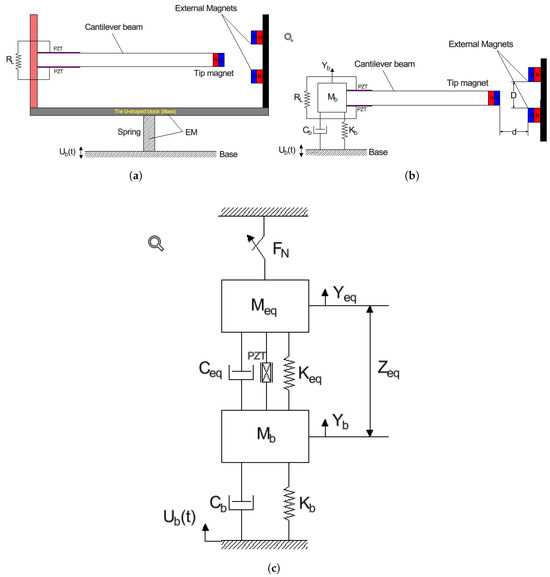
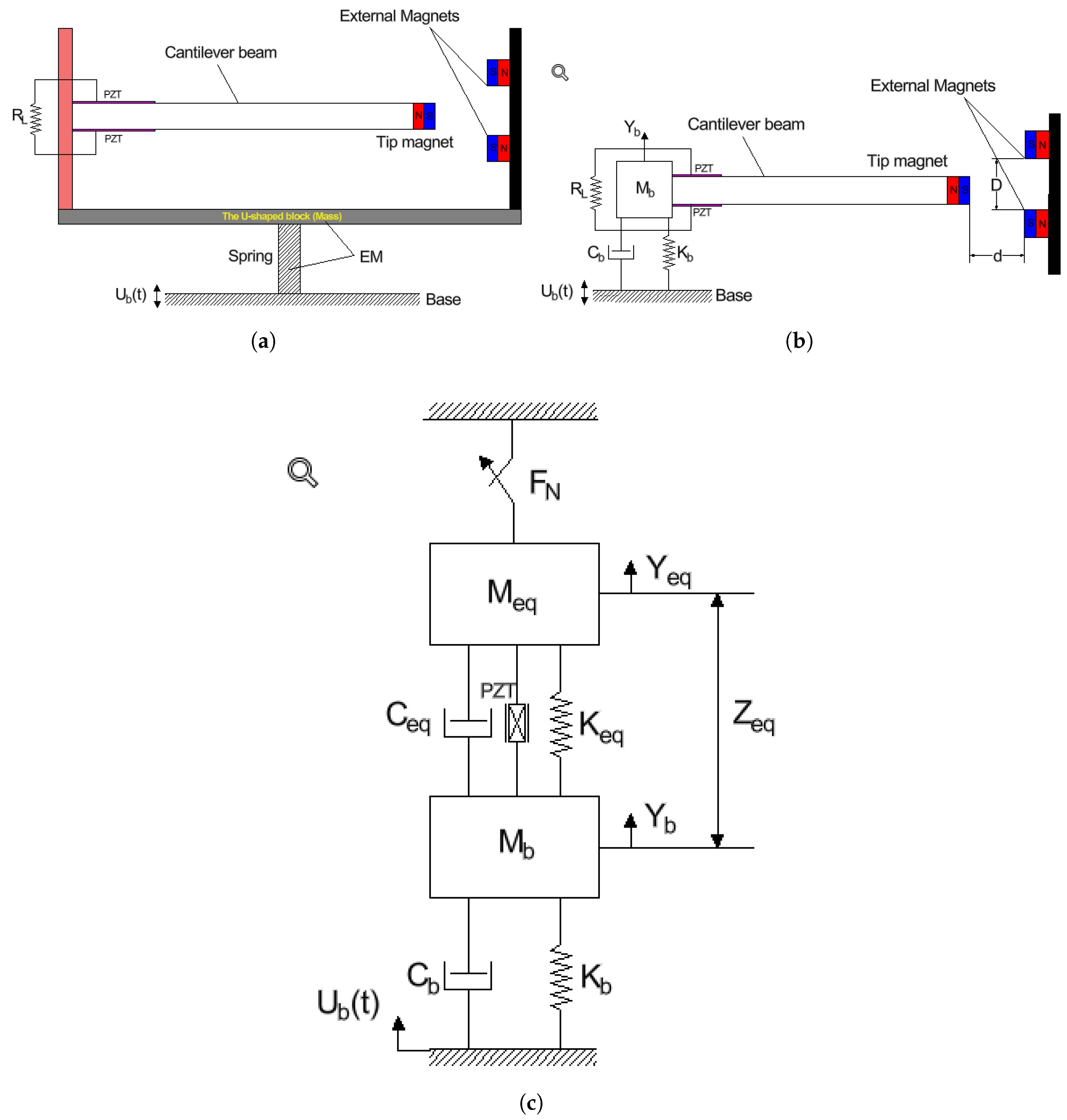
Figure 1 shows the schematic diagram of the asymmetric TVEH with EM. The proposed VEH is a tristable magnetic repulsive VEH. The proposed VEH consists of a cantilever beam with a nonlinear force at the free end. A N32 neodymium permanent magnet as a proof mass is fixed at the free end of the cantilever and its magnetic field orientation is of opposite polarity to the field of a fixed magnet. The piezoelectric patches oppositely polarized in the thickness direction is bonded to the top of the cantilever beam as shown in Figure 1. The EM consisting of a mass, damper and spring element is placed between the asymmetric TVEH and the base. To model the system shown in Figure 1, the asymmetric TVEH with EM system can be simplified as a two-degree-of-freedom (2-DOF) vibration model in which , , and denote the equivalent mass, stiffness, and damping of the EM receptively, and , , and are the equivalent mass, stiffness, and damping constant of the cantilever beam. and are the capacitance and electromechanical coupling term of the piezoelectric material and is the load resistance. is the repulsive force between the magnets. The asymmetric TVEH with EM is subjected to a base excitation of which produces an output displacement of the mass and are written as and respectively as illustrated in Figure 1. The equation of motion of the asymmetric TVEH with an EM is derived based on the simplified model (shown in Figure 1a) and it can be written as follows.
where the is the nonlinear restoring force which can be expressed as
where are the linear, quadratic, cubic, quartic and pentic stiffness coefficients. Using the relative motion between the asymmetric TVEH and EM
Equations (1)–(3) can be written as
The non-dimensional parameters are defined as follows:
Time derivatives are then denoted as follows:
The non-dimensional equations of motion are obtained as follows:
where , is the mass ratio, is the damping ratio and is the stiffness ratio.
Figure 1.
(a) Schematic diagram of the general structure of asymmetric TVEH with EM (b) simplified model of the asymmetric TVEH with EM and (c) two-degree-of-freedom (2-DOF) nonlinear lumped-parameter model of the asymmetric TVEH with EM.
4. Potential Energy Analysis
The potential energy analysis of asymmetric TVEH with EM is discussed in this section. The state space form of Equations (9)–(11) can be expressed as follows:
where the state variables are , , , and . Next, the open-circuit case is examined in this paper. The effective forcing function of the whole system can be written as
and the effective potential function of the whole system can be written as follows
whereas = ≫ 1 and > 1, the system behaves as a tristable oscillator and the effective potential function of Equation (13) is reduced as follows
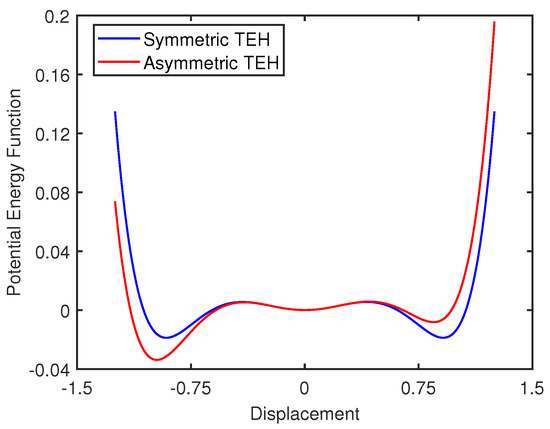
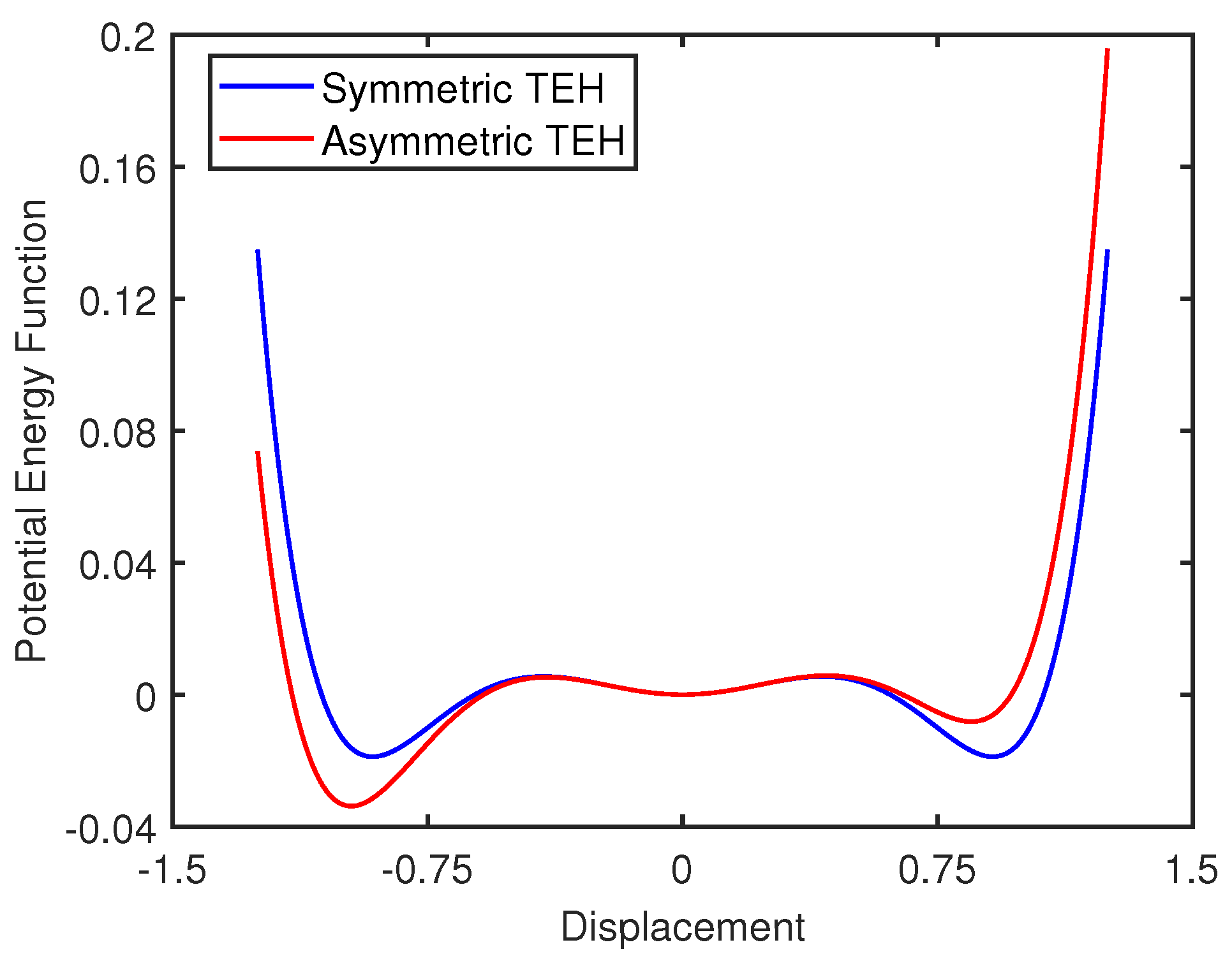
The potential energy comparison of asymmetric and symmetric TVEH with EM is shown in Figure 2.
Figure 2.
The potential energy function for the symmetric TVEH with EM configuration with parameters = 1.1746, = 0.0, = 1.0, = 0.0, = 1.0 and asymmetric TVEH with EM configuration with parameters = 1.1746, = 0.0, = 1.0, = 2.0, = 1.0.
5. Analysis in the Time Domain
This section presents a numerical investigation of the performance of an asymmetric TVEH with an EM. Bifurcation analysis is performed using the bifurcation parameters: mass ratio , stiffness ratio , excitation frequency , and excitation amplitude f. The influence of the mass ratio and stiffness ratio on the system dynamics is examined using phase portraits, time series responses, and frequency spectra, respectively. The parameter grid resolutions for and are set to 1 and 0.001 along the x and y axes, respectively. For the excitation amplitude f, the grid resolution is 0.1 in both the x and y directions. For the excitation frequency , the grid resolution is 0.01 in both directions. The parameter step sizes for and are 1, while the step sizes for excitation amplitude f and excitation frequency are and , respectively. The total integration time is set to , and the initial 80% of the simulation time is discarded to eliminate transients.
5.1. Bifurcation Analyses
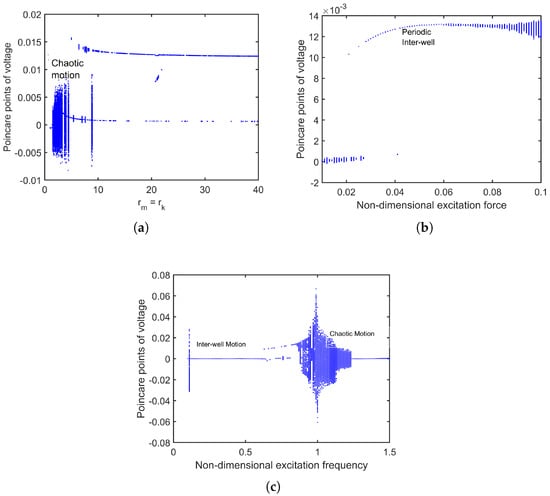
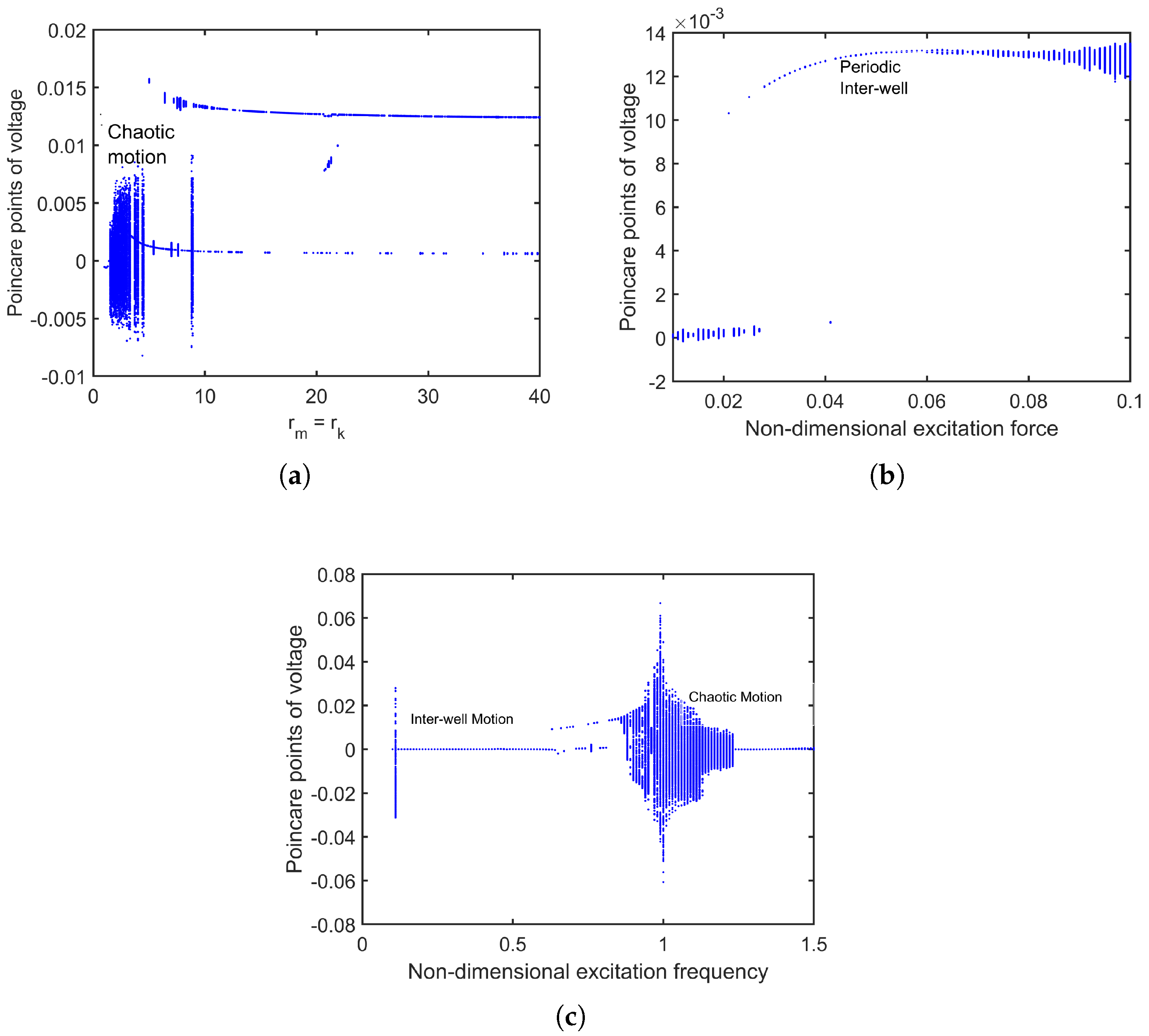
Bifurcation analysis provides a systematic framework for examining qualitative transitions in system dynamics that occur as governing parameters are varied. The bifurcation analysis of an asymmetric TVEH with EM is investigated by varying the system parameters , , f, and for the following system parameters: = 1.1746, = 0.0, = 1.0, = 2.0, = 1.0, f = 0.04, = 4.1250, = 0.0589. The bifurcation analysis of the asymmetric TVEH with EM, along with regime classification criteria such as intra-/inter-well and periodic/chaos, is shown in Figure 3.
Figure 3.
Bifurcation analysis of the asymmetric TVEH with EM for the following parameters = 1.1746, = 0.0, = 1.0, = 2.0, = 1.0, f = 0.04, = 4.1250, = 0.0589. (a) and are the bifurcation parameter when f = 0.04 and = 0.80 (b) f is the bifurcation parameter when = = 20 and = 0.80 (c) is the bifurcation parameter when = = 20 and f = 0.80.
5.2. Effect of Mass Ratio
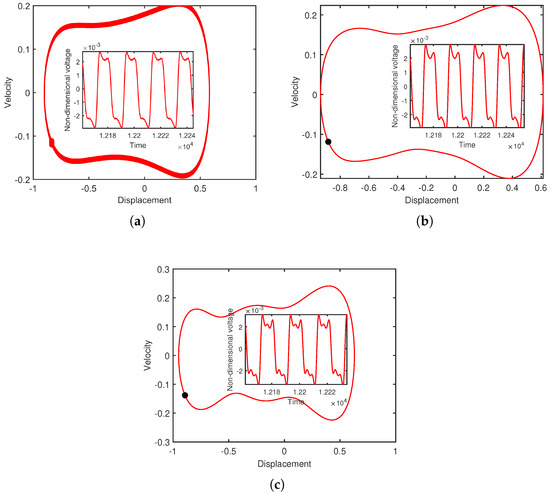
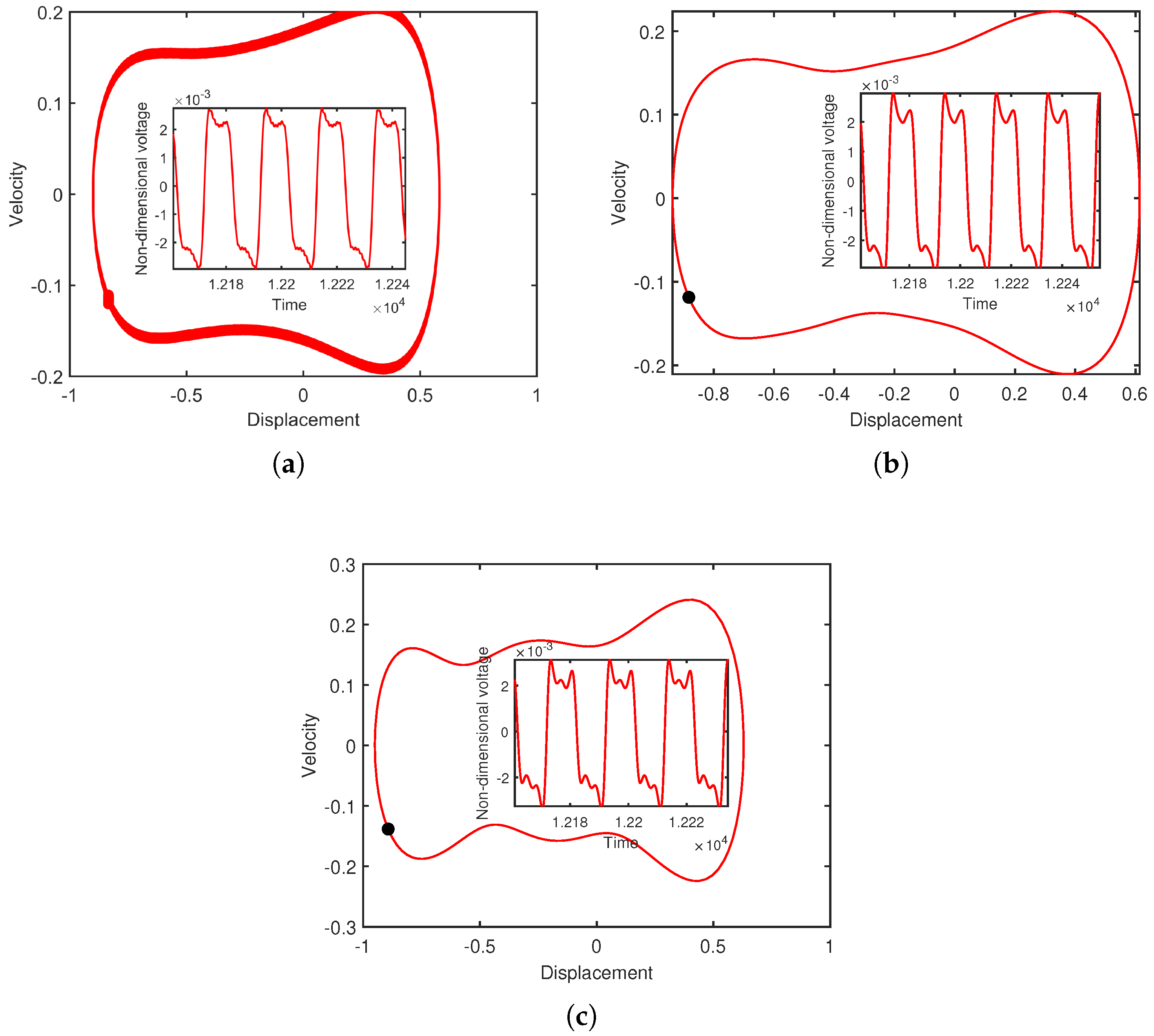
In this subsection, the effect of the mass ratio () on the response of the system is studied. The following conclusions are drawn regarding the dynamics of the asymmetric TVEH with EM using phase portraits and time series responses, as shown in Figure 4. The system undergoes asymmetric inter-well motion when , as shown in Figure 4a, and again exhibits inter-well motion when , as shown in Figure 4b. The system then exhibits tristable periodic inter-well motion when , as shown in Figure 4c.
Figure 4.
Effect of mass ratio on the response of the system for the following parameters = 0.98, = 0.0, = 0.3, = 1.0, = 1.0, f = 0.055, = 0.30, = 4.1250, = 0.0589 and = 31. (a) phase portrait and the time series when = 1.0, (b) phase portrait and the time series when = 5.0 and (c) phase portrait and the time series when = 14.
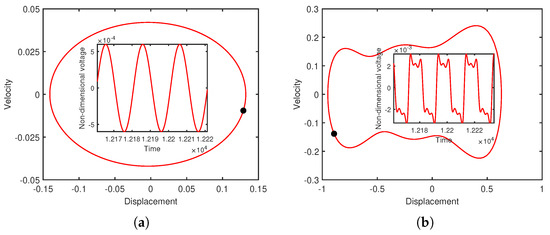
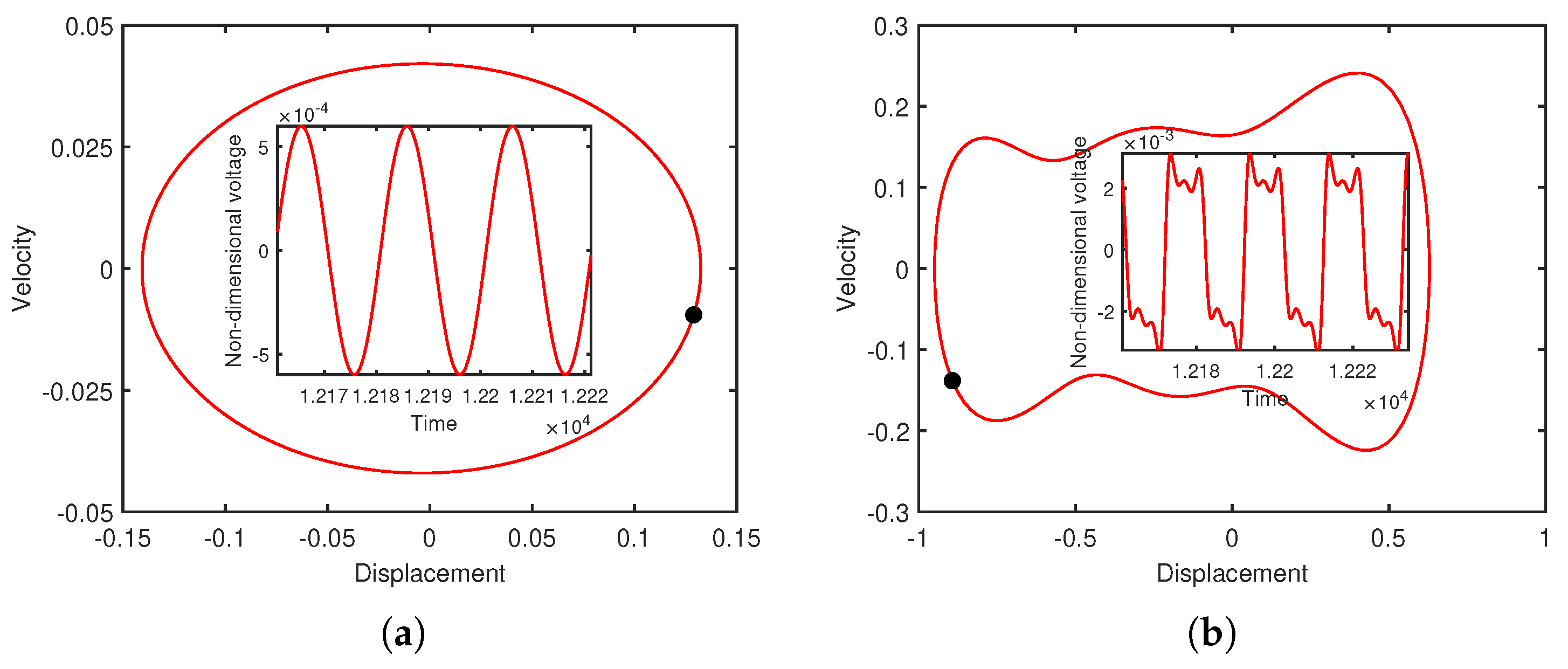
Observing the excitation force bifurcation diagram shown in Figure 3a, the region of interest lies between , where periodic inter-well motion is observed. Beyond this region, chaotic motion begins. From the phase portraits and time response plots at , the system exhibits intra-well motion, as shown in Figure 5a, while at , the system overcomes the potential barrier and exhibits large-amplitude periodic tristable inter-well motion, as shown in Figure 5b.
Figure 5.
Effect of non-dimensional excitation force on the response of the system for the following parameters = 0.98, = 0.0, = 0.3, = 1.0, = 1.0, = 0.30, = 4.1250, = 0.0589, = 14 and = 31, (a) phase portrait and the time series when f = 0.01 and (b) phase portrait and the time series when f = 0.055.
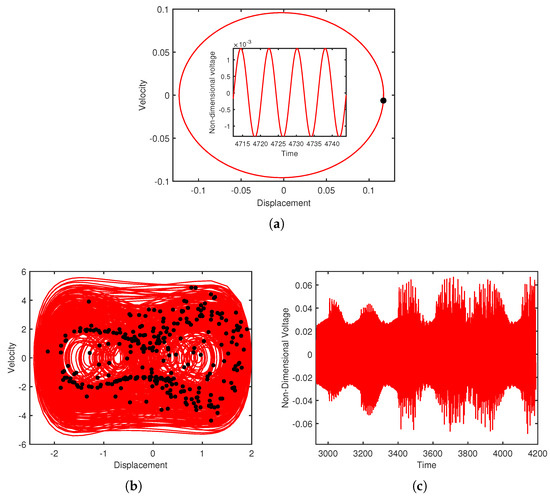
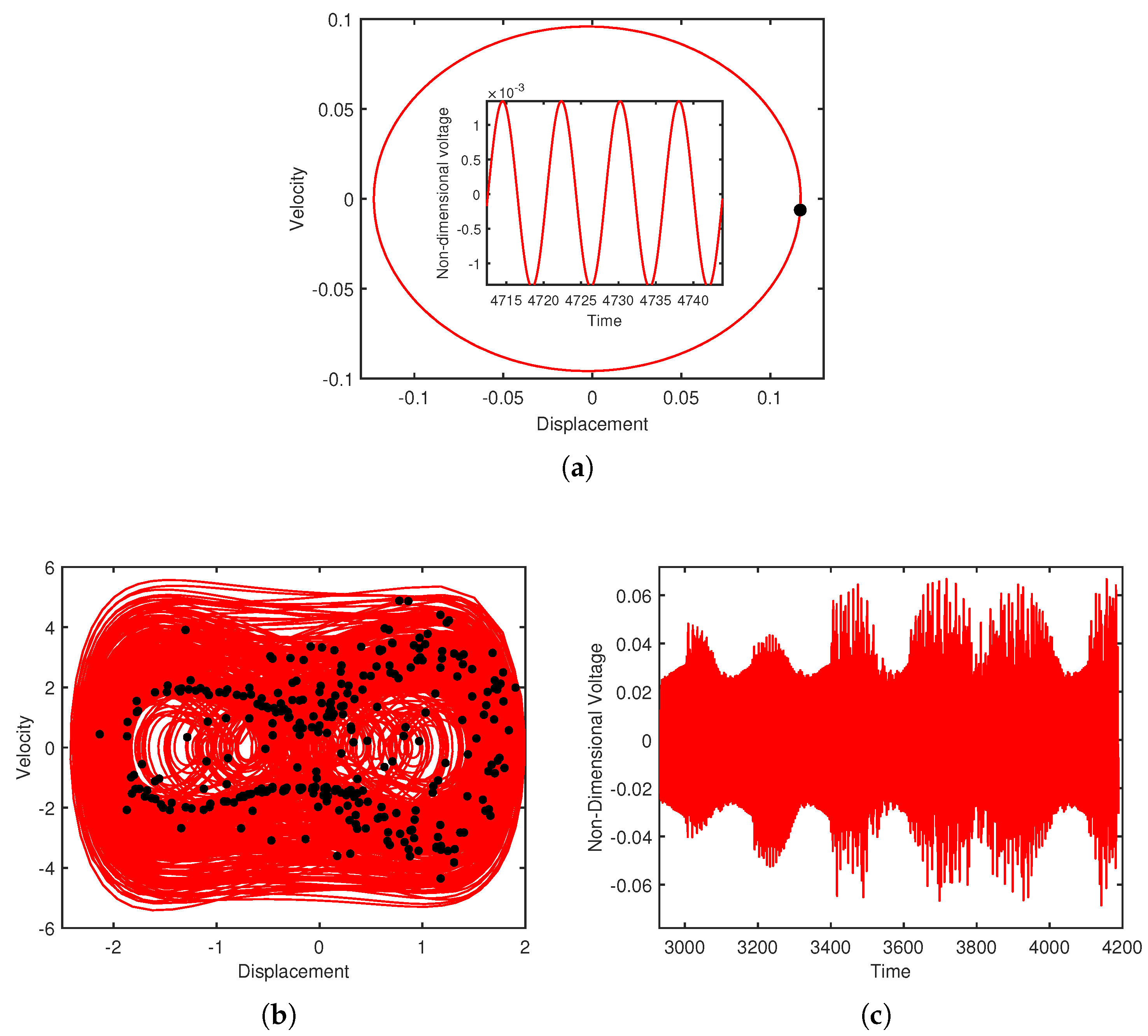
When , the system exhibits periodic intra-well motion, as shown in Figure 6a. As the excitation frequency increases to , the system transitions to chaotic inter-well motion, as evidenced by the Poincaré points (black dots) in Figure 6b, and the corresponding time series plot is shown in Figure 6c.
Figure 6.
Effect of non-dimensional excitation frequency on the response of the system for the following parameters = 0.98, = 0.0, = 0.3, = 1.0, = 1.0, f = 0.055, = 4.1250, = 0.0589, = 14 and = 31, (a,b) phase portrait and the time series when = 0.80 and (c) phase portrait and the time series when = 1.50.
6. Analysis in the Frequency Domain
In this section, the dynamics and performance of the asymmetric TVEH with EM under harmonic excitation are investigated. The base excitation is expressed as , where f and denote the excitation amplitude and frequency, respectively. The frequency–amplitude relationship is derived analytically using the single-term harmonic balance method (HBM). The performance of the proposed asymmetric TVEH with EM is compared with that of an asymmetric TVEH without EM and a symmetric TVEH with EM to highlight the advantages of the proposed configuration. The parameters used in this section are as follows: , , , , , , , , , , and .
6.1. Analytical Investigation Using HBM
The HBM is used to solve the nonlinear equation to obtain the frequency response of the system. From Equation (10), the term is substituted into Equation (9) to eliminate from Equation (10). Then it is solved for to obtain the following equation.
differentiating it twice to get into Equation (5), we obtain a fourth-order nonlinear differential equation in terms of the variable z only. The simplified voltage and mechanical couple equation can be written as
Harmonic time signal are written as follows, where is the base excitation
The displacement and voltage are expressed in terms of Fourier time signals where A, B, P and Q are the Fourier coefficients of the displacement and voltage equations respectively.
Substituting Equations (19) and (20) into Equation (11) and balancing the terms of sin and cos one can arrive at
Solving for P and Q from Equations (21) and (22) one can get
Substituting the expression for , , P and Q and balancing the terms of sin and cos after neglecting the higher order harmonics to get
where and , squaring and adding the above two equations the frequency–amplitude relation can be derived.
the amplitude of voltage can be expressed as
substituting Equation (28) into the frequency–amplitude relation we get the frequency–voltage relation
6.2. Effect of Mass and Stiffness Ratio on the Response
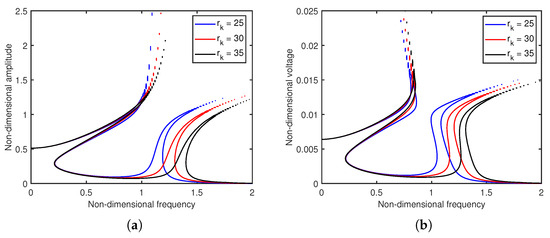
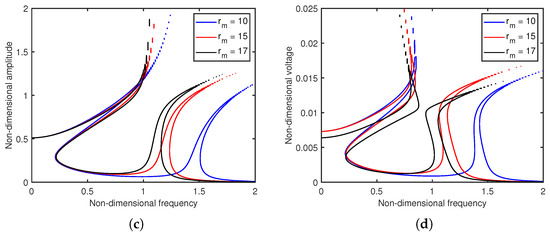
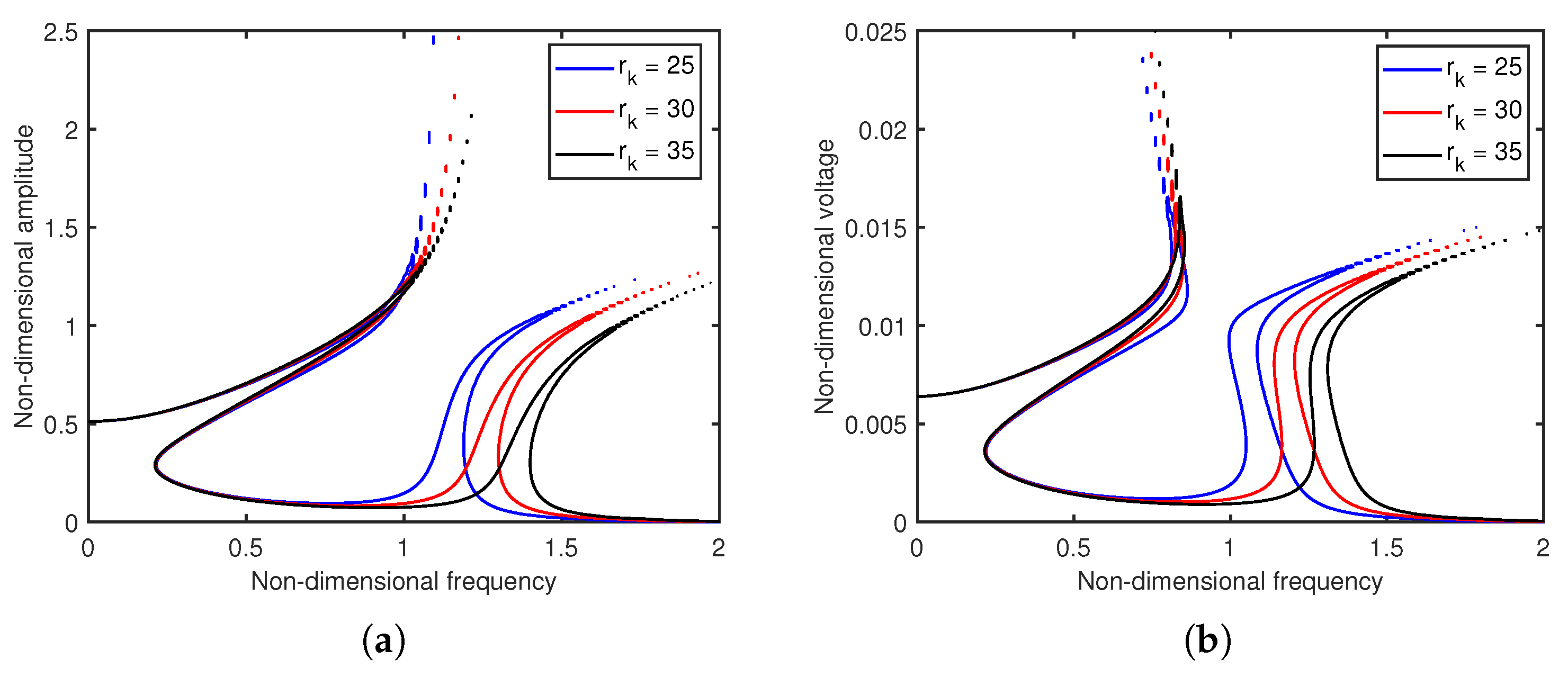
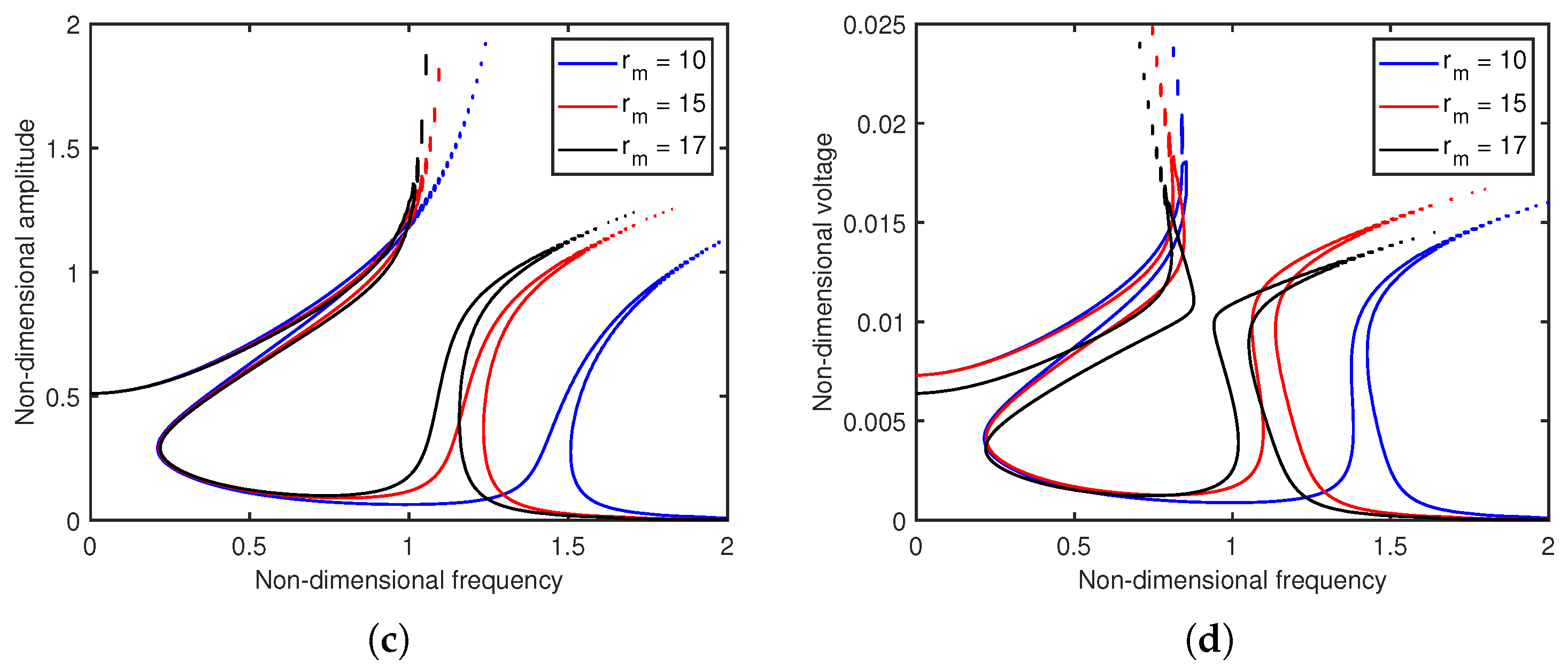
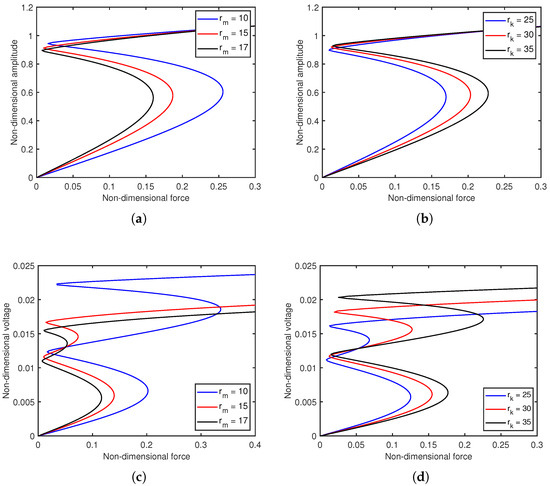
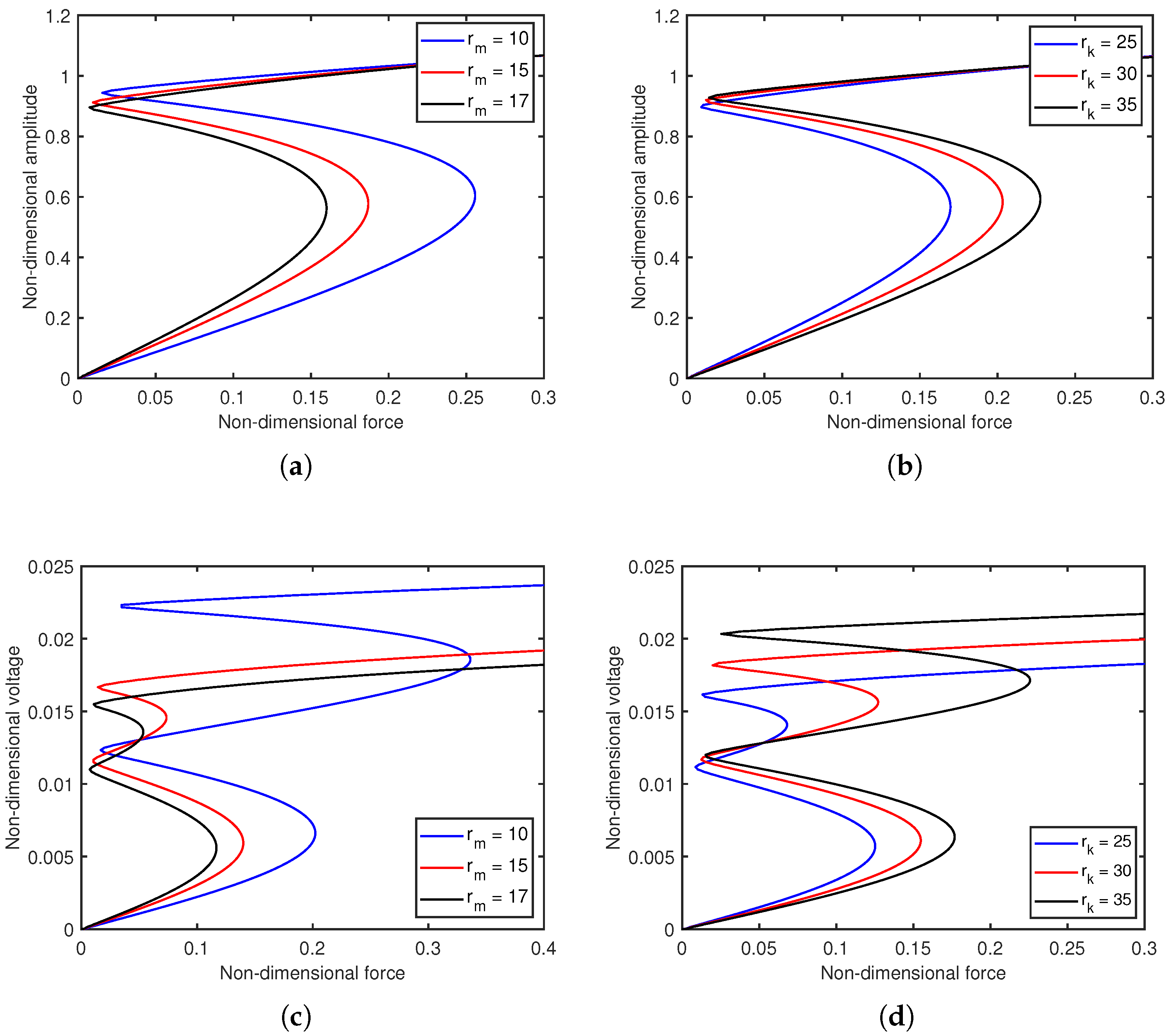
The influence of the mass ratio and stiffness ratio on the output of the asymmetric TVEH with EM is shown in Figure 7 for the following input parameters: = 1.1746, = 0.0, = 1.0, = 2.0, = 1.0, f = 0.04, = 4.1250, and = 0.0589. From Figure 7, it is seen that as the value of increases, the response curve shifts to the right, whereas as the value of increases, the resonant frequency decreases.
Figure 7.
Effect of mass and stiffness ratio on the amplitude and voltage response of the system for the following parameters = 1.1746, = 0.0, = 1.0, = 2.0, = 1.0, f = 0.04, = 4.1250, = 0.0589, (a,b) results for = 20 (c,d) results for = 20.
The effect of mass and stiffness ratios on the force–amplitude response of the asymmetric TVEH with EM is depicted in Figure 8. It is observed that as the mass ratio decreases, the output voltage increases. Similarly, as the stiffness ratio increases, the voltage response increases, as shown in Figure 8.
Figure 8.
Effect of mass and stiffness ratio on the amplitude and voltage response of the system for the following parameters = 1.1746, = 0.0, = 1.0, = 2.0, = 1.0, = 0.8, = 4.1250, = 0.0589, (a,b) results for = 20 (c,d) results for = 20.
7. Performance Comparison
In this section, a comparison is made to evaluate the efficiency of the asymmetric TVEH with EM with respect to the asymmetric TVEH without EM. In addition, an analysis is carried out to compare the asymmetric TVEH with EM and the symmetric TVEH with EM in order to evaluate their performance in vibration energy harvesting under low-amplitude excitation.
7.1. Comparison with Asymmetric TVEH Without EM
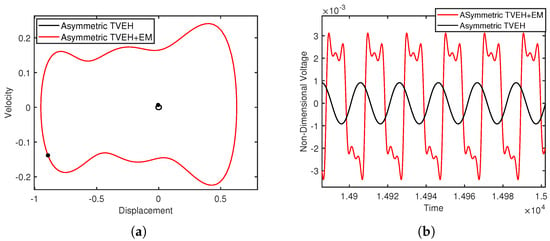
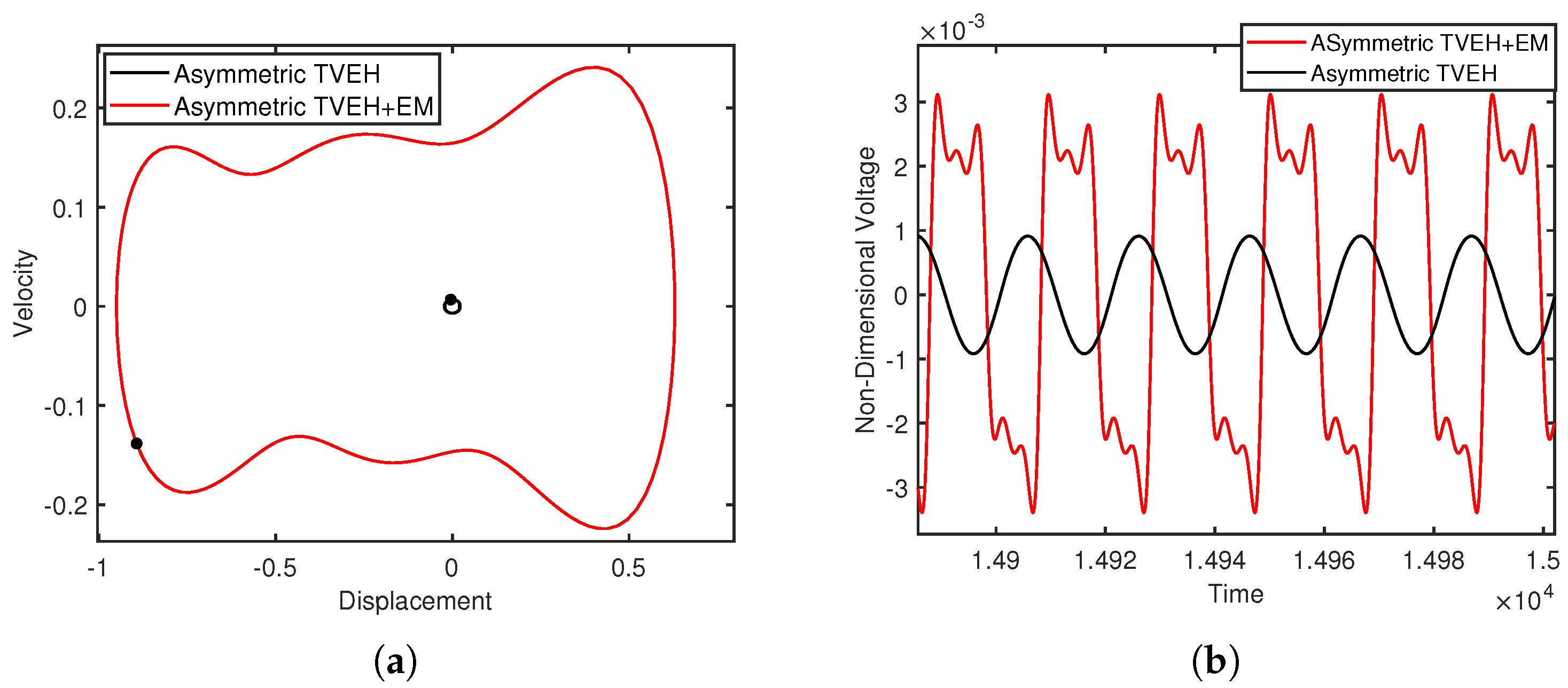
The performance comparison between the asymmetric TVEH with and without the EM is carried out in this subsection under low-amplitude harmonic excitation. The following parameter values are considered: , , , , , , , , , , and . To demonstrate the advantages of the asymmetric TVEH with EM, the phase-plane trajectories and time histories of the non-dimensional voltage response for both VEHs are presented in Figure 9a and Figure 9b, respectively. It is clearly observed that the asymmetric TVEH with EM exhibits superior performance compared to the asymmetric TVEH without EM under low-amplitude harmonic excitation (e.g., ).
Figure 9.
Performance comparison of the asymmetric TVEH with and without the EM for the following parameters = 0.98, = 0.0, = 0.3, = 1.0, = 1.0, f = 0.055, = 4.1250, = 0.0589, = 0.1, = 14, and = 31 (with EM) and = 0.1 (without EM). (a) Phase-plane representation and (b) corresponding time-history response.
7.2. Comparison with Symmetric TVEH with EM
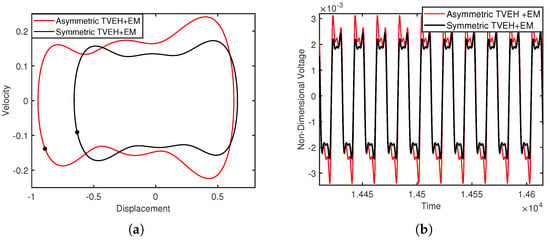
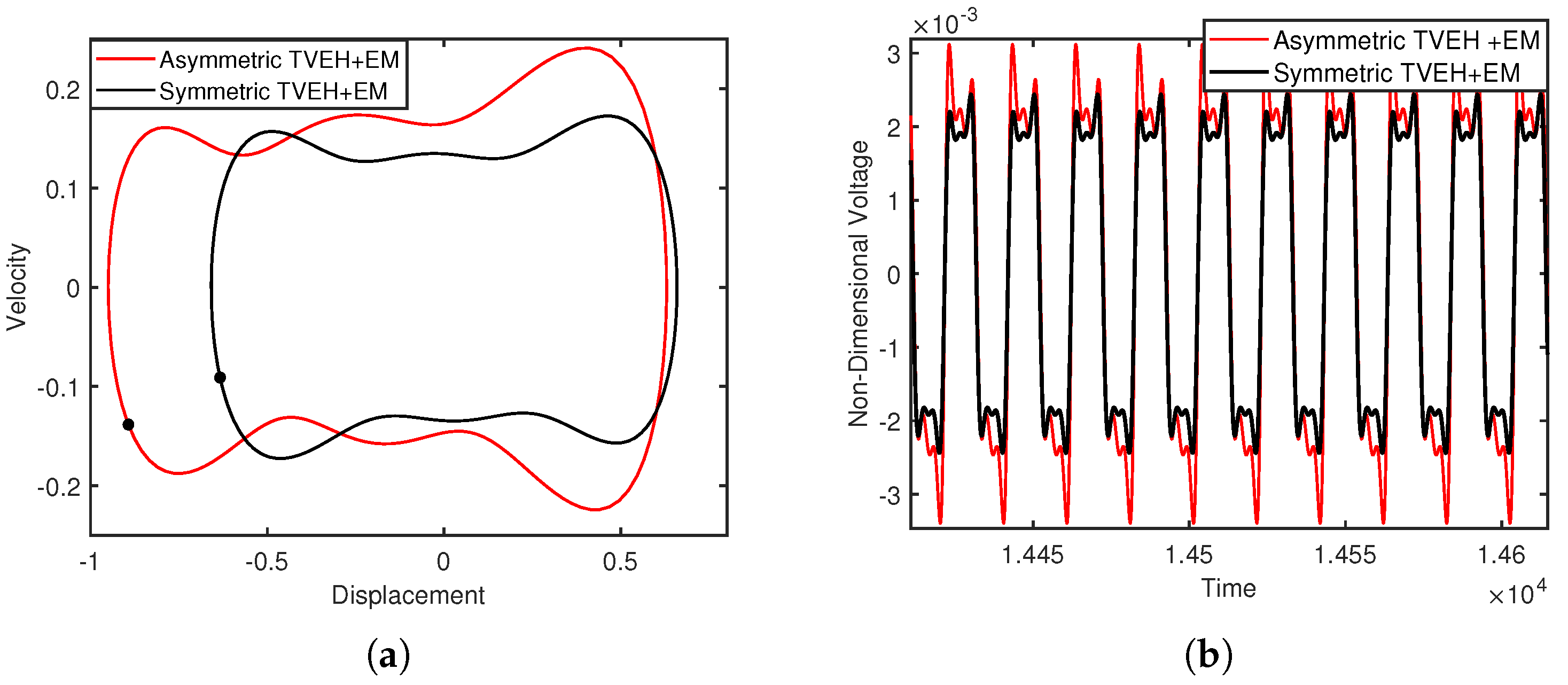
In this subsection, the performance of the asymmetric TVEH with EM is compared with that of the symmetric TVEH with EM to assess the effectiveness of the proposed harvester under low-amplitude vibration conditions. The comparison is carried out for the parameter values , , , , , , , , , , and . The results indicate that the asymmetric TVEH with EM exhibits superior performance compared to the symmetric TVEH with EM under low-amplitude harmonic excitation (), as shown in Figure 10. This improved performance is further supported by the corresponding phase portraits (Figure 10a) and time-series responses (Figure 10b), which highlight the enhanced dynamic response and energy harvesting capability of the asymmetric configuration.
Figure 10.
Performance comparison of the asymmetric TVEH with EM and symmetric TVEH with EM for the following parameters = 0.98, = 0.0, = 0.3, = 1.0, = 1.0, f = 0.055, = 4.1250, = 0.0589, = 0.10, = 14 and = 31. (a) Phase-plane representation response and (b) corresponding time series response.
8. Experimental Investigations
This section presents the experimental investigations conducted on both asymmetric and symmetric TVEH configurations, with and without the EM. A detailed comparative analysis is performed to evaluate the performance of the asymmetric TVEH with and without the EM, and to compare it with the symmetric TVEH with the EM. The results demonstrate the advantages of the proposed asymmetric TVEH with EM configuration over the other configurations.
8.1. Apparatus and Instrumentation
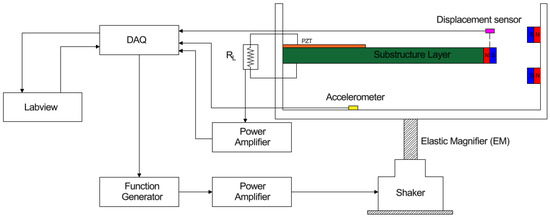
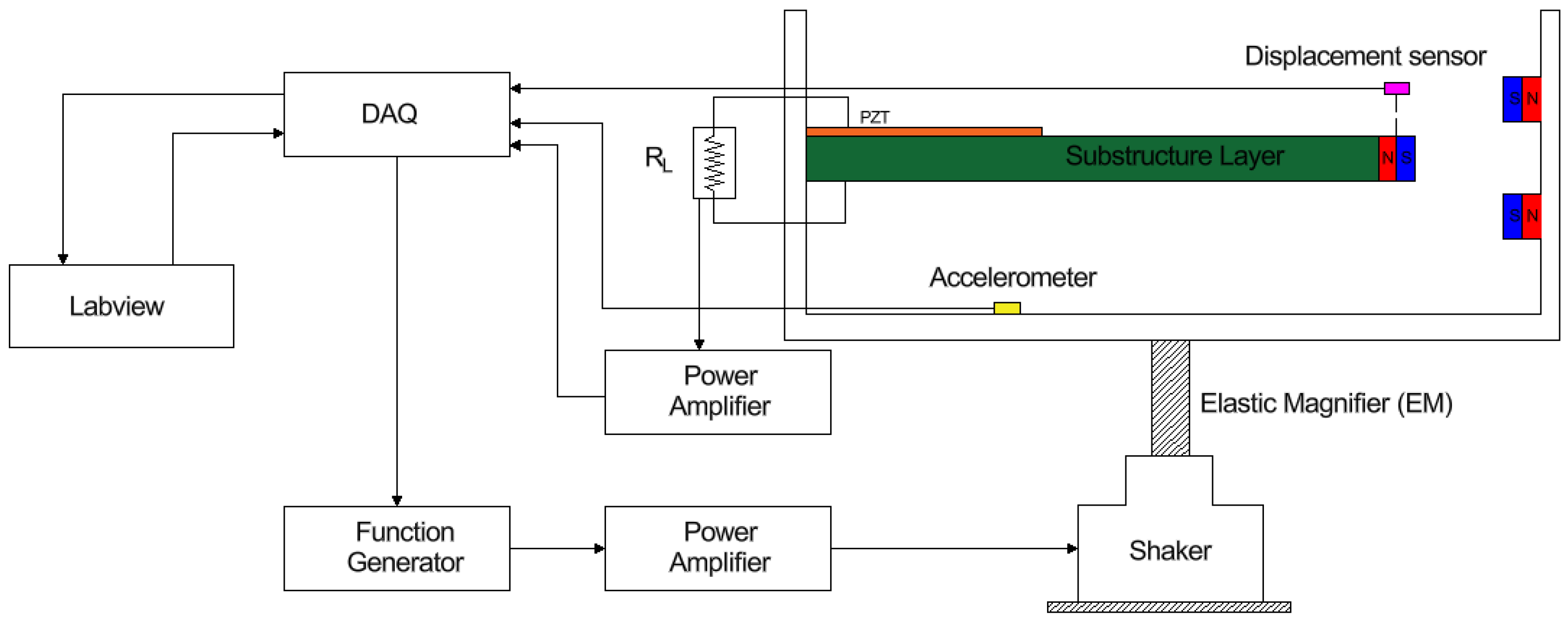
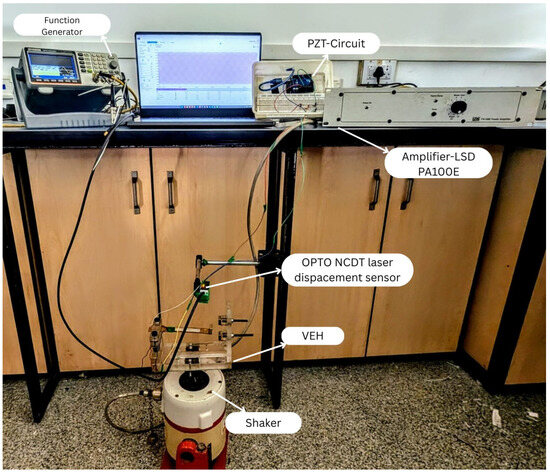
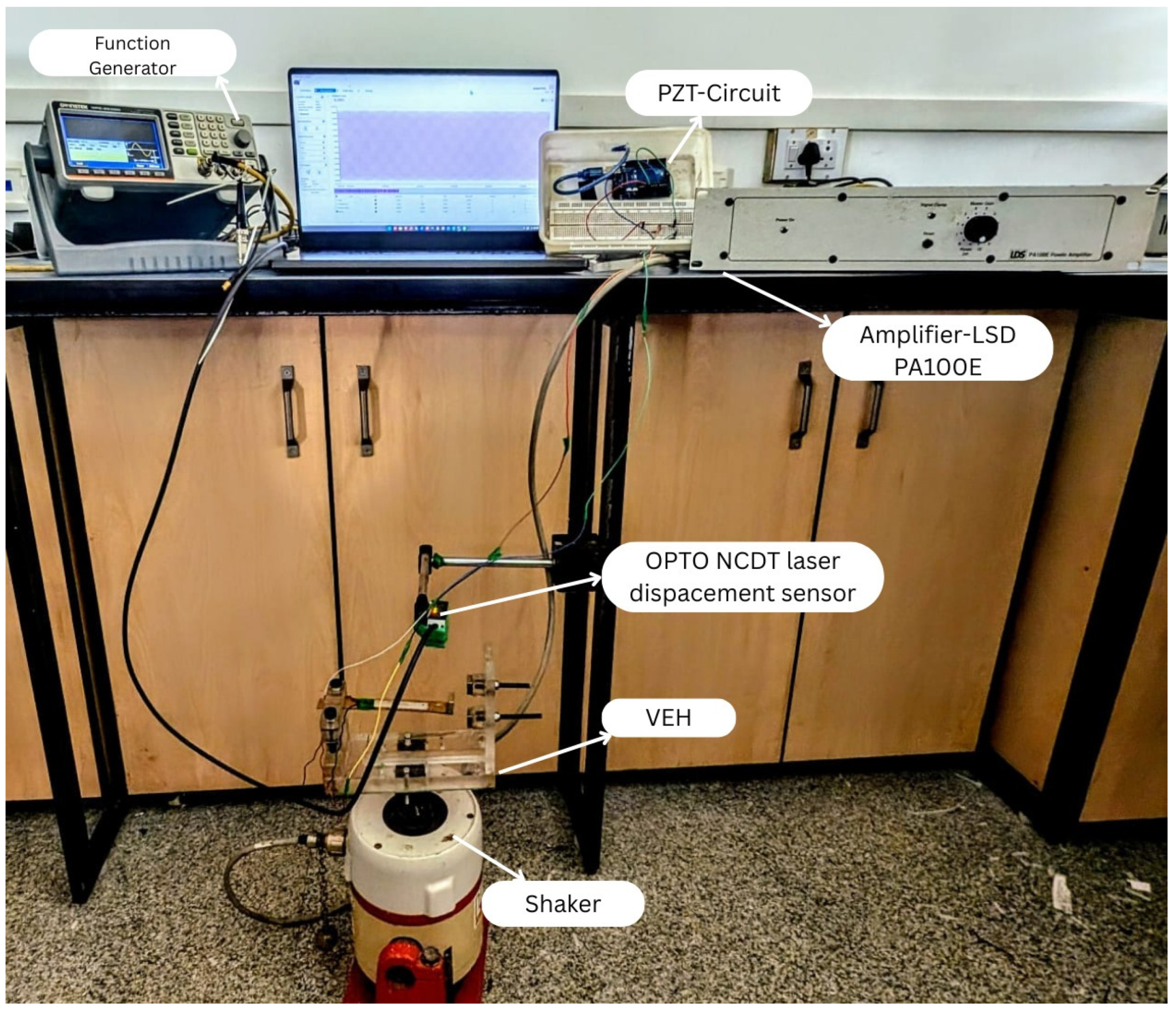
The schematic diagram of the asymmetric TVEH with EM experimental setup is shown in Figure 11. A function generator (GW Instek MFG-2230M) is used to produce the harmonic excitation signal, which is amplified using a power amplifier (LDS PA100E) and supplied to an electrodynamic shaker (LDS V406) to excite the asymmetric TVEH with EM. The base acceleration is measured using a single-axis accelerometer, while the beam displacement is captured using a laser displacement sensor (optoNCDT 1320). The time-history response of the harvested voltage is recorded using an Arduino UNO. A piezoelectric layer (PZT-4A, Piezo System Inc.) is bonded to the top surface of the cantilever beam. The EM consists of a spring element with stiffness 4570 N/m and a lumped mass of 252 g, positioned between the asymmetric TVEH and the base. The material properties and physical parameters of the asymmetric TVEH with EM are listed in Table 2.
Figure 11.
Experimental set-up of the asymmetric TVEH with EM.
Table 2.
Material properties and physical parameters used in the experimental set-up.
The stiffness values were experimentally determined from the slope of the force–displacementt curve obtained using a universal testing machine (UTM). Multiple loading–unloading trials were performed to ensure repeatability. The measurement uncertainty mainly arises from load cell calibration and displacement sensor resolution, and the overall error in stiffness estimation is within .
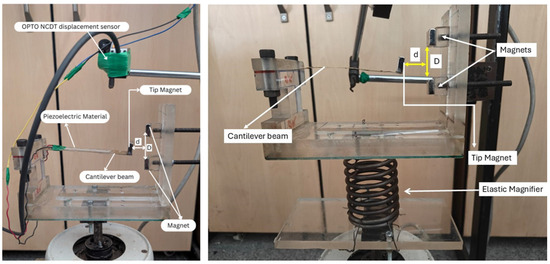
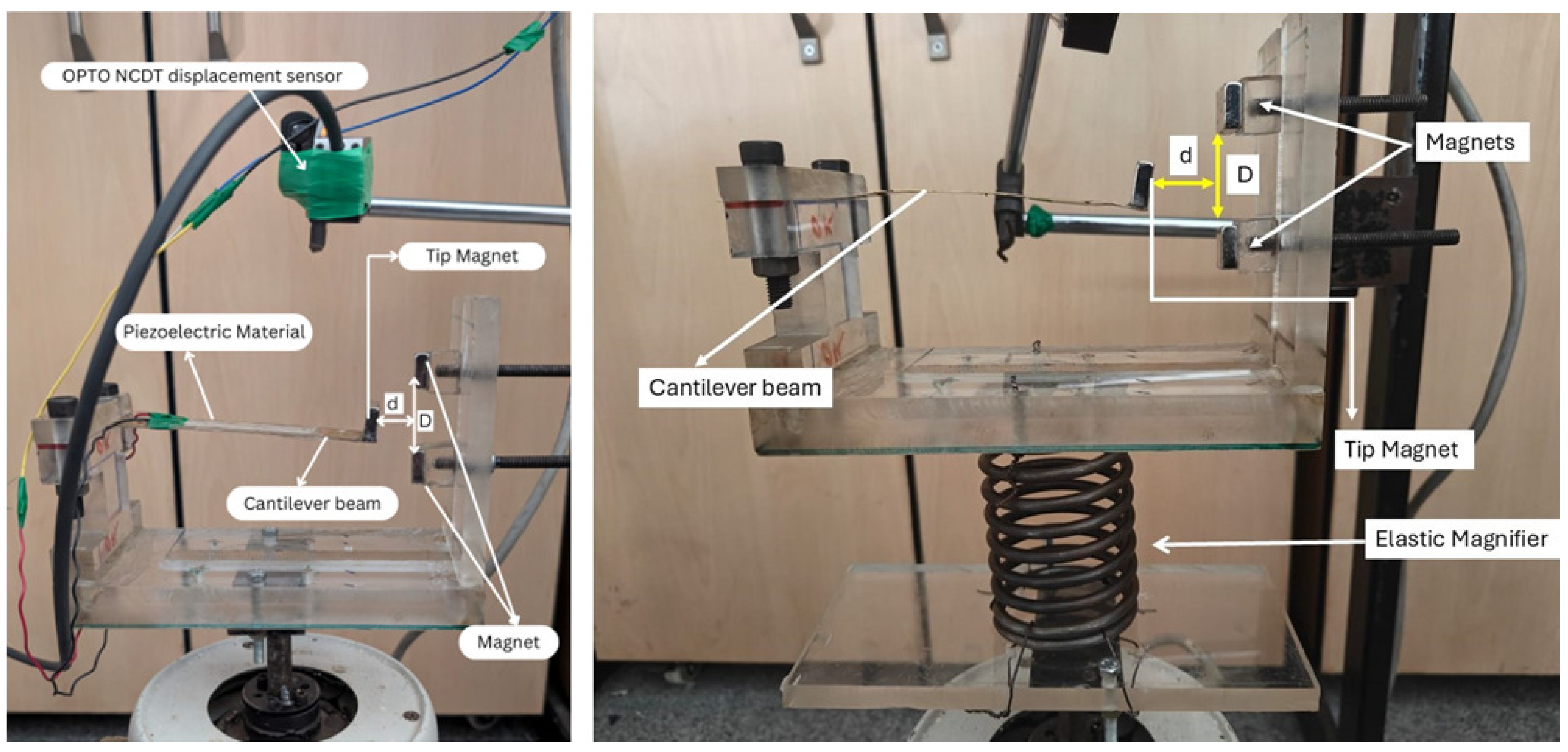
The vibration energy harvesting experimental setup consists of a cantilevered brass beam with dimensions of 90 mm in length, 20 mm in width, and 0.4 mm in thickness. A PZT-4A piezoelectric layer is bonded to the beam surface to generate voltage under mechanical strain, and an N32 neodymium magnet is attached to the free end of the cantilever beam. The entire assembly is mounted on a U-shaped platform on which two additional magnets are fixed. These magnets generate the nonlinear restoring force required to induce tristable oscillations of the beam between the magnetic fields, thereby enhancing the strain in the piezoelectric layer. The experimental configuration is illustrated in Figure 12 and Figure 13.
Figure 12.
Experimental set-up of asymmetric TVEH with EM configuration.
Figure 13.
Experimental set-up of asymmetric TVEH without EM and with EM configurations.
8.2. Experimental Results and Discussions
In this subsection, the performance of the asymmetric TVEH with EM is experimentally compared with that of the asymmetric TVEH without EM and the symmetric TVEH with EM configurations to demonstrate the superiority of the proposed asymmetric TVEH with EM. To ensure reproducibility and statistical reliability, the experimental conditions are carefully defined and consistently maintained. The output voltage is measured in terms of peak voltage () across a load resistance of 100 k, using a 30 s averaging time window for each run. A low-pass filter with a cut-off frequency of 100 Hz is applied to suppress high-frequency noise. Each experiment is repeated five times under identical excitation conditions (1.4 at 14 Hz), and the mean, standard deviation, and confidence intervals are computed. These procedures provide a rigorous basis for comparing the energy harvesting performance of the configurations with and without the EM.
8.2.1. Analysis of Asymmetric TVEH Without EM
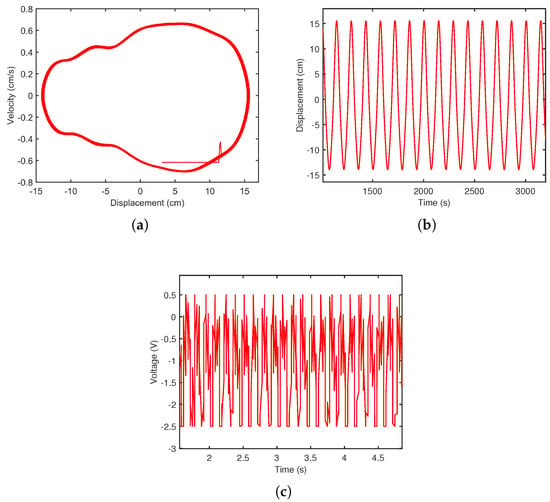
A controlled level of asymmetry is introduced into the system by adjusting the distance between the magnets fixed on the U-shaped platform. The experimental investigation of the asymmetric TVEH without EM is conducted under an excitation acceleration of and an excitation frequency of Hz, with cm, cm, and = 1 cm. The corresponding experimental results for the tip displacement response and phase portrait of the asymmetric TVEH without EM are presented in Figure 14.
Figure 14.
Experimental analysis of asymmetric TVEH without EM when the excitation acceleration is = 1.4 and frequency () = 14 Hz. The other system parameters are: d = 1.7 cm, = 0.75 cm, = 1 cm (a) Phase portrait (b) Time vs displacement and (c) Time vs voltage response.
The asymmetric TVEH without EM exhibits a periodic inter-well vibration response. Under steady-state conditions, the measured tip displacement amplitudes are 10 cm and 14.7 cm, while the corresponding tip velocities are 0.70 cm/s and 0.72 cm/s, respectively. The peak harvested voltage from the system is approximately 3.0 V.
8.2.2. Analysis of Asymmetric TVEH with EM
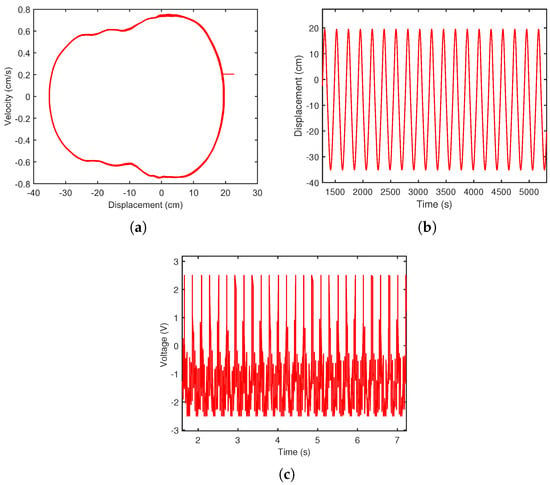
In this subsection, the experimental investigation of the asymmetric TVEH with EM is carried out under the following parameters: excitation acceleration , excitation frequency Hz, , , cm, cm, and cm. The corresponding results are shown in Figure 15.
Figure 15.
Experimental results of the asymmetric TVEH with EM at an excitation amplitude = 1.4 and excitation frequency () = 14 Hz. Other system parameters used in the experiments are = 0.01, = 6.72, d = 1.7 cm, = 0.75 cm, = 1 cm (a) Phase portrait, (b) time-displacement response, and (c) time-voltage response.
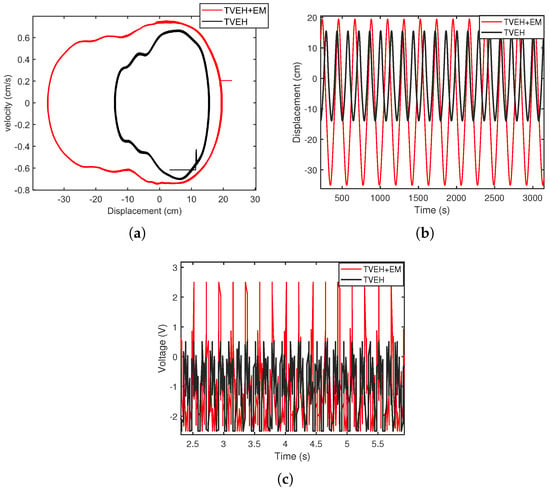
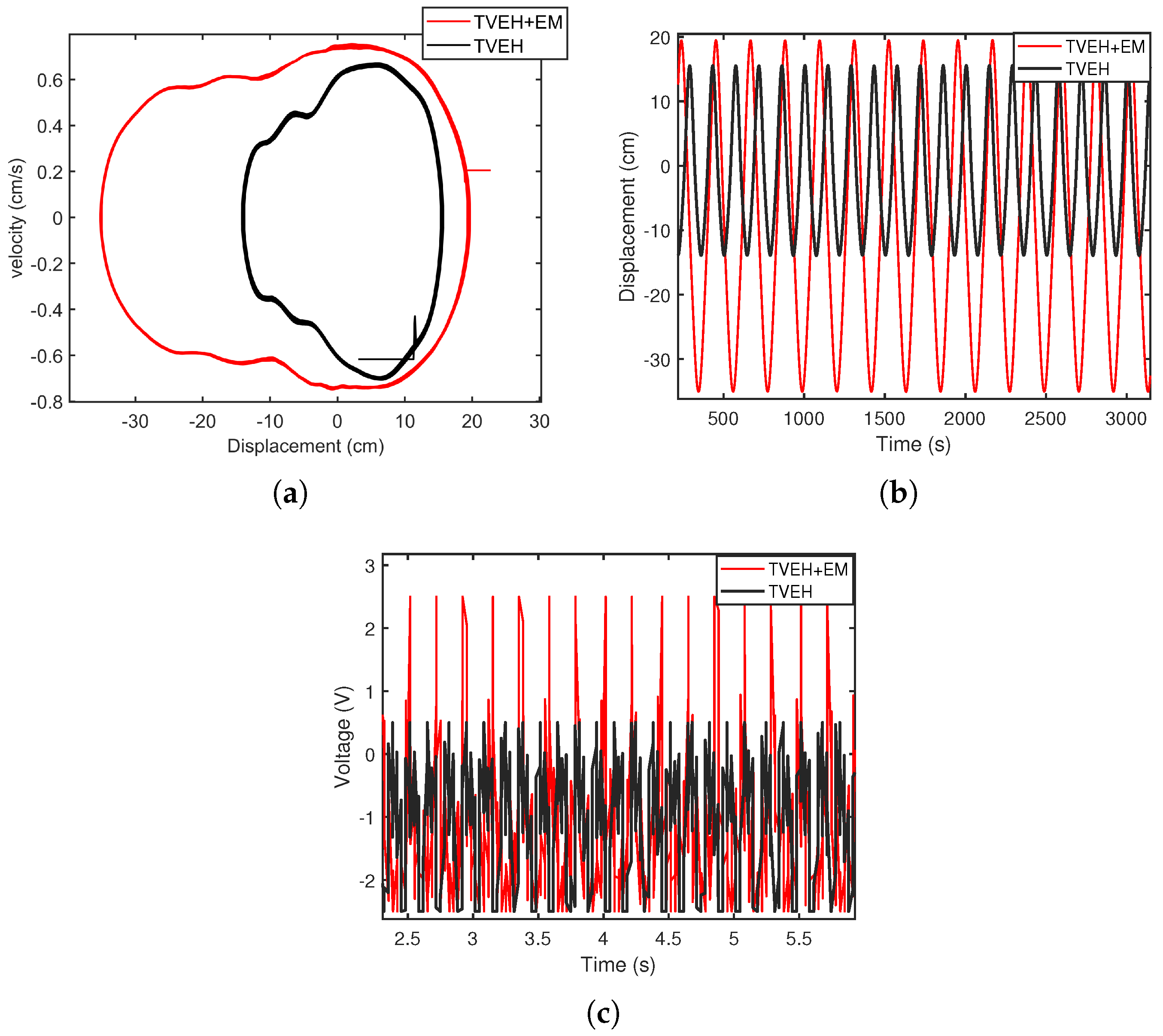
It is observed that the beam displacement range is significantly increased from approximately −40 cm to 20 cm when the EM is introduced between the asymmetric TVEH and the base. Moreover, the peak output voltage generated by the asymmetric TVEH reaches around 5.00 V. These results confirm that the EM effectively amplifies low-amplitude base excitation and transfers the enhanced vibration input to the asymmetric TVEH, thereby magnifying the cantilever beam motion and improving the energy harvesting performance.
8.2.3. Comparison Between Asymmetric TVEH with and Without EM
Figure 16 compares the responses of the asymmetric and symmetric TVEH configurations, with and without the EM, for the selected system parameters. As discussed in the previous subsection, integrating the EM between the asymmetric TVEH and the base results in a substantial increase in voltage output, accompanied by larger inter-well beam motion. The experimental results clearly indicate that the EM plays a crucial role in enhancing the performance of the harvester by amplifying low-amplitude excitation inputs. Specifically, the response data show that the EM enhances the beam velocity by approximately 1.5 times, the displacement by nearly 3 times, and the voltage output by about 2 times. These improvements significantly enhance the energy harvesting capability of the system and enable it to power devices requiring higher operating voltages.
Figure 16.
Performance comparison of the asymmetric TVEH with and without EM at an excitation amplitude of = 1.4 and frequency () = 14 Hz. For the system with EM: = 0.01, = 6.72, d = 1.7 cm, = 0.75 cm, = 1 cm; for the system without EM: = 0.0, = 0.0, d = 1.7 cm, = 0.75 cm, = 1 cm. (a) Phase portrait, (b) time-displacement response, (c) time-voltage response.
8.2.4. Analysis of Symmetric TVEH with EM
In this subsection, experimental investigations of the symmetric TVEH integrated with an EM are conducted under an excitation amplitude of and an excitation frequency of . The system parameters are set as , , , , and . The corresponding experimental results for the symmetric TVEH with EM are illustrated in Figure 17.
Figure 17.
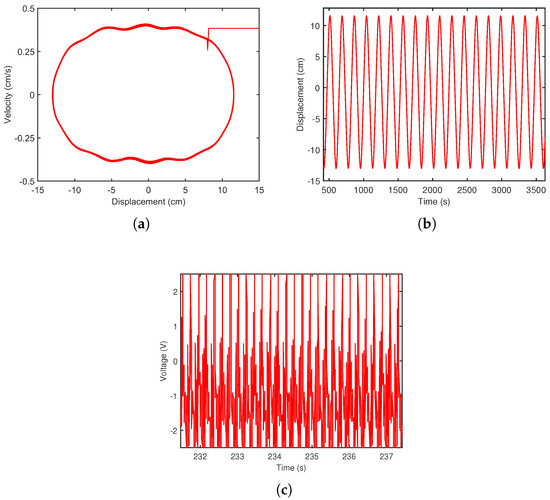
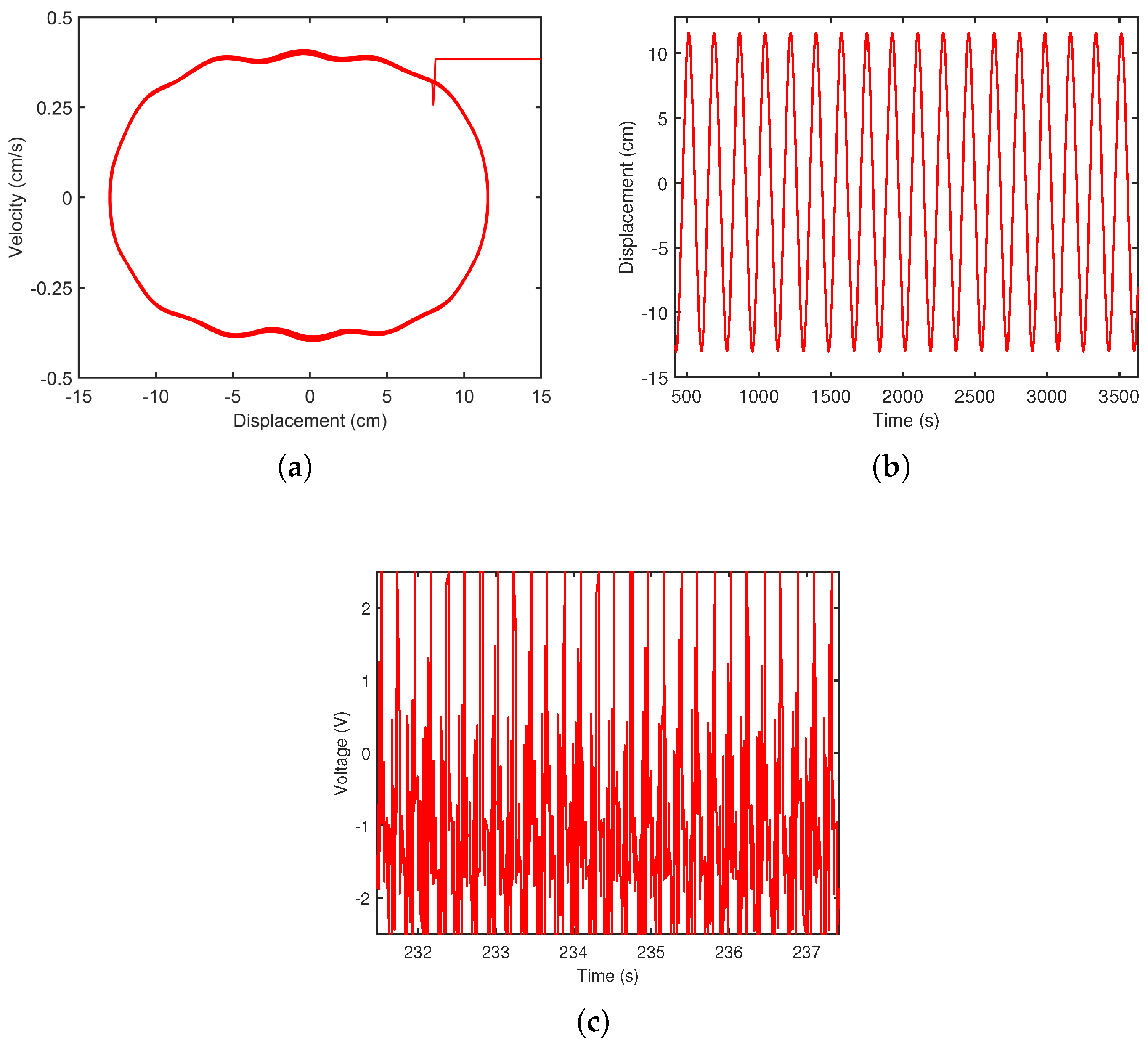
Experimental analysis of the symmetric TVEH with EM at an excitation amplitude of = 1.4 and excitation frequency () = 14 Hz. The other system parameters are = 0.01, = 6.72, d = 1.7 cm, = 0.75 cm, = 0.75 cm. (a) Phase portrait (b) Time-displacement response, and (c) Time-voltage response.
The measured tip displacement of the VEH oscillates between approximately −10 cm and 10 cm, while the peak velocity reaches about 0.30 cm/s. The phase-plane response is centered around the zero reference position, clearly confirming the symmetric nature of the system. Furthermore, the voltage generated by the piezoelectric element due to beam deformation reaches approximately 4.50 V.
8.2.5. Comparison Between Asymmetric and Symmetric TVEH with EM
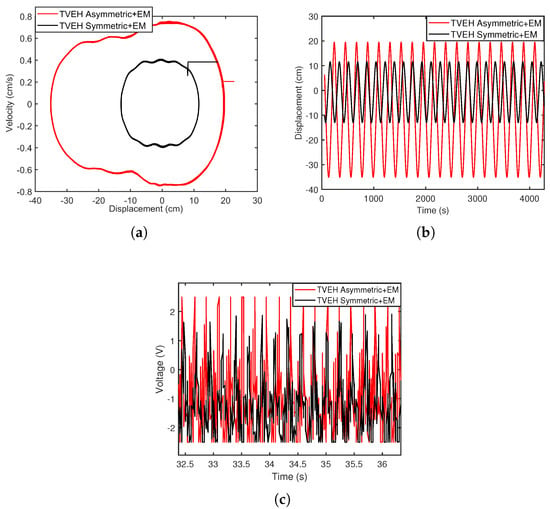
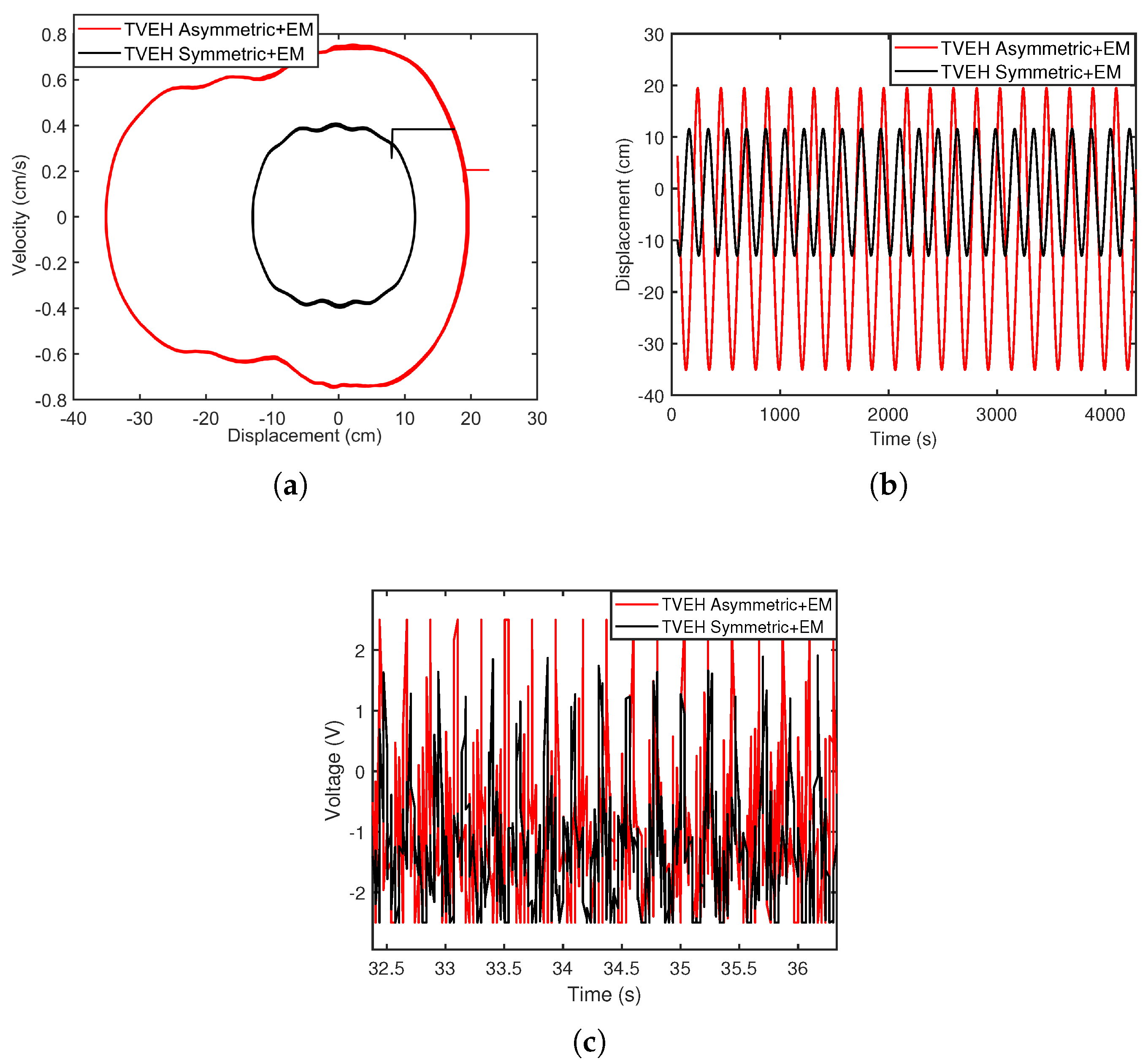
The performance of the asymmetric and symmetric TVEH configurations integrated with an EM is experimentally compared for the selected system parameters. The results show that the asymmetric TVEH with EM exhibits superior performance compared to the symmetric TVEH with EM, as illustrated in Figure 18.
Figure 18.
Performance comparison between the asymmetric and symmetric TVEH with EM at an excitation amplitude of = 1.4 and excitation frequency () = 14 Hz. For the asymmetric TVEH with EM: = 0.01, = 6.72, d = 1.7 cm, = 0.75 cm, = 1 cm; for the symmetric TVEH with EM: = 0.01, = 6.72, d = 1.7 cm, = 0.75 cm, = 0.75 cm. (a) Phase portrait, (b) time-displacement response, and (c) time-voltage response.
9. Conclusions
This work presents a comprehensive analytical, numerical, and experimental investigation of an asymmetric tristable vibration energy harvester (TVEH) integrated with an elastic magnifier (EM), designed for operation under ultra-low-level harmonic excitations. A nonlinear two-degree-of-freedom (2-DOF) electromechanical model is developed to capture the coupled mechanical and piezoelectric nonlinearities. Both numerical and experimental results demonstrate that the incorporation of the EM significantly enhances the response amplitude and voltage output of the system.
Parametric investigations reveal that increasing the EM mass and stiffness ratios broadens the operational frequency bandwidth and enhances the system response, leading to peak voltage improvements of up to 67% and 45%, respectively. Experimental results further validate these findings, confirming that the asymmetric TVEH with EM consistently outperforms both the configuration without EM and the symmetric TVEH design under identical excitation conditions. From a practical perspective, successful implementation of the proposed design requires precise tuning of the EM parameters to match the targeted vibration frequencies and excitation amplitudes typically encountered in real-world environments.
Compared to conventional vibration energy harvesting technologies, the proposed asymmetric TVEH with EM demonstrates superior energy conversion efficiency under ultra-low excitation levels, making it particularly suitable for powering low-power electronic devices such as wireless sensor nodes and wearable systems. Future work will focus on improving robustness, scalability, and adaptability, including optimizing the harvester for a wider frequency range and evaluating its performance under varying environmental and operational conditions. Such investigations are essential for transitioning the proposed concept from laboratory validation to real-world deployment in structurally dynamic environments.
While the present study primarily focuses on quantitative performance evaluation, future research will also include more detailed qualitative analyses to provide deeper physical insights into the system dynamics. In addition, an extensive comparison between theoretical predictions and experimental measurements will be conducted in future studies to further strengthen the validation of the proposed model.
Author Contributions
Conceptualization and methodology, D.K.; Software, K.M.J.; Formal analysis, S.V.K.A.T. and K.S.A.; Writing—original draft, H.K.B.; Writing—review and editing, M.T. All authors have read and agreed to the published version of the manuscript.
Funding
This research received no external funding.
Data Availability Statement
The raw data supporting the conclusions of this article will be made available by the authors upon request.
Conflicts of Interest
The authors declare no conflicts of interest.
References
- Roundy, S.; Wright, P.K. A piezoelectric vibration based generator for wireless electronics. Smart Mater. Struct. 2004, 13, 1131. [Google Scholar] [CrossRef] [Scilit]
- Gao, M.; Wang, P.; Wang, Y.; Yao, L. Self-powered zigbee wireless sensor nodes for railway condition monitoring. IEEE Trans. Intell. Transp. Syst. 2018, 19, 900–909. [Google Scholar] [CrossRef] [Scilit]
- Yan, B.; Yu, N.; Zhang, L.; Ma, M.; Wu, C.; Wang, K.; Zhou, S. Scavenging vibrational energy with a novel bistable electromagnetic energy harvester. Smart Mater. Struct. 2020, 29, 025022. [Google Scholar] [CrossRef] [Scilit]
- Li, K.; He, X.; Wang, X.; Jiang, S. A Nonlinear Electromagnetic Energy Harvesting System for Self-Powered Wireless Sensor Nodes. J. Sens. Actuator Netw. 2019, 8, 18. [Google Scholar] [CrossRef] [Scilit]
- Sharma, H.; Haque, A.; Jaffery, Z.A. Modeling and Optimisation of a Solar Energy Harvesting System for Wireless Sensor Network Nodes. J. Sens. Actuator Netw. 2018, 7, 40. [Google Scholar] [CrossRef] [Scilit]
- Boccalero, G.; Boragno, C.; Caviglia, D.D.; Morasso, R. A Wind Powered Supply for Autonomous Sensor Nodes. J. Sens. Actuator Netw. 2016, 5, 15. [Google Scholar] [CrossRef] [Scilit]
- Renno, J.M.; Daqaq, M.F.; Inman, D.J. On the optimal energy harvesting from a vibration source. J. Sound Vib. 2009, 320, 386–405. [Google Scholar] [CrossRef] [Scilit]
- Erturk, A.; Inman, D.J. An experimentally validated bimorph cantilever model for piezoelectric energy harvesting from base excitations. Smart Mater. Struct. 2009, 18, 1–19. [Google Scholar] [CrossRef] [Scilit]
- Daqaq, M.F.; Masana, R.; Erturk, A.; Quinn, D. On the role of non-linearities in vibratory energy harvesting: A critical review and discussion. Appl. Mech. Rev. 2014, 66, 040801. [Google Scholar] [CrossRef] [Scilit]
- Daqaq, M.F. On intentional introduction of stiffness nonlinearities for energy harvesting under white Gaussian excitations. Nonlinear Dyn. 2012, 69, 1063–1079. [Google Scholar] [CrossRef] [Scilit]
- Tran, N.; Ghayesh, M.H.; Arjomandi, M. Ambient vibration energy harvesters: A review on nonlinear techniques for performance enhancement. Int. J. Eng. Sci. 2018, 127, 162–185. [Google Scholar] [CrossRef] [Scilit]
- He, Q.; Daqaq, M.F. Electric load optimization of a nonlinear monostable duffing harvester excited by white noise. Meccanica 2016, 51, 1027–1039. [Google Scholar] [CrossRef] [Scilit]
- Nguyena, H.T.; Genov, D.; Bardaweel, H. Mono-stable and bi-stable magnetic spring based vibration energy harvesting systems subject to harmonic excitation: Dynamic modeling and experimental verification. Mech. Syst. Signal Process. 2019, 134, 106361. [Google Scholar] [CrossRef] [Scilit]
- Panyamn, M.; Masana, R.; Daqaq, M.F. On approximating the effective bandwidth of bistable energy harvesters. Int. J.-Non-Linear Mech. 2014, 67, 153–163. [Google Scholar] [CrossRef] [Scilit]
- Harne, R.L.; Wang, K. A review of the recent research on vibration energy harvesting via bistable systems. Smart Mater. Struct. 2013, 22, 023001. [Google Scholar] [CrossRef] [Scilit]
- Jiang, Q.; Yu, C.; Zhou, Y.; Zhao, Z.; Gao, Q.; Sun, B. Modeling and analysis of beam-spring magnetically coupled bistable energy harvester for broadband vibration energy harvesting. J. Sound Vib. 2024, 579, 118373. [Google Scholar] [CrossRef] [Scilit]
- Guo, C.; Wang, Y.; Luan, H.; Ren, S.; Shen, H. Harmonic analysis and experimental validation of bistable vibration energy harvesters interfaced with DSSH circuit. Mech. Syst. Signal Process. 2025, 234, 112847. [Google Scholar] [CrossRef] [Scilit]
- Mann, B.P.; Owens, B.A. Investigations of a nonlinear energy harvester with a bistable potential well. J. Sound Vib. 2010, 329, 1215–1226. [Google Scholar] [CrossRef] [Scilit]
- Wang, W.; Cao, J.; Bowen, C.R.; Zhang, Y.; Lin, J. Nonlinear dynamics and performance enhancement of asymmetric potential bistable energy harvesters. Nonlinear Dyn. 2018, 94, 1183–1194. [Google Scholar] [CrossRef] [Scilit]
- Zhao, Z.; Wang, G.; Tan, J. Dynamic characteristics in time-frequency domain and experimental research of the bi-stable piezoelectric vibration energy harvester. Chin. J. Sens. Actuators 2019, 8, 1200–1208. [Google Scholar]
- Wang, W.; Li, B.; Liu, S.; Wei, Z.H. Bifurcation analysis and nonlinear dynamics of a rolling magnet multistable electromagnetic energy harvester. Commun. Nonlinear Sci. Numer. Simul. 2023, 118, 107027. [Google Scholar] [CrossRef] [Scilit]
- Wang, W.; Li, B.; Liu, S.; Wei, Z.H. Design and investigation of a quad-stable piezoelectric vibration energy harvester by using geometric nonlinearity of springs. J. Sound Vib. 2023, 547, 117484. [Google Scholar]
- Wang, G.Q.; Liao, W.H.; Yang, B.; Wang, X.; Xu, W.; Li, X. Dynamic and energetic characteristics of a bistable piezoelectric vibration energy harvester with an elastic magnifier. Mech. Syst. Signal Process. 2018, 105, 427–446. [Google Scholar] [CrossRef] [Scilit]
- Wang, G.Q.; Liao, W.H. A bistable piezoelectric oscillator with an elastic magnifier for energy harvesting enhancement. J. Intell. Mater. Syst. Struct. 2016, 38, 392–407. [Google Scholar] [CrossRef] [Scilit]
- Wang, W.; Cao, J.; Bowen, C.R.; Litak, G. Multiple solutions of asymmetric potential bistable energy harvesters: Numerical simulation and experimental validation. Eur. Phys. J. B 2018, 91, 1–9. [Google Scholar] [CrossRef] [Scilit]
- Devarajan, K.; Santhosh, B. Performance enhancement of bistable energy harvester With asymmetric potential function using an elastic Magnifier. Vib. Eng. Technol. Mach. 2023, 137, 191–205. [Google Scholar]
- Devarajan, K.; Santhosh, B. Performance enhancement of snap-through vibration energy harvester with displacement amplifier. Int. J. Mech. Sci. 2023, 253, 108391. [Google Scholar] [CrossRef] [Scilit]
- Yang, T.; Cao, Q. Dynamics and performance evaluation of a novel tristable hybrid energy harvester for ultra-low level vibration resources. Int. J. Mech. Sci. 2019, 156, 123–136. [Google Scholar] [CrossRef] [Scilit]
- Yang, T.; Cao, Q. Dynamics and high-efficiency of a novel multi-stable energy harvesting system. Chaos Solitons Fractals 2019, 131, 109516. [Google Scholar] [CrossRef] [Scilit]
- Zhou, S.; Cao, J.; Inman, D.J.; Lin, J.; Liu, S.; Wang, Z. Broadband tristable energy harvester: Modeling and experiment verification. Appl. Energy 2004, 13, 33–39. [Google Scholar] [CrossRef] [Scilit]
- Zhou, S.; Cao, J.; Inman, D.J.; Lin, J.; Li, D. Harmonic balance analysis of nonlinear tristable energy harvesters for performance enhancement. J. Sound Vib. 2016, 373, 223–235. [Google Scholar] [CrossRef] [Scilit]
- Zhang, Y.; Jin, Y.; Zhang, Z. Dynamics of a tristable hybrid energy harvester under narrow-band random excitation. Int. J. Nonlinear Mech. 2023, 148, 104294. [Google Scholar] [CrossRef] [Scilit]
- Zhang, T.; Jin, Y.; Xu, Y.; Yue, X. Dynamical response and vibrational resonance of a tristable energy harvester interfaced with a standard rectifier circuit. Chaos 2022, 32, 093150. [Google Scholar] [CrossRef] [Scilit]
- Zhang, T.; Jin, Y. An improved coupled tristable energy harvesting system with spring stops for passive control. Commun. Nonlinear Sci. Numer. Simul. 2024, 135, 108050. [Google Scholar] [CrossRef] [Scilit]
- Cui, D.; Shang, H. Global dynamic analysis of a typical tristable piezoelectric energy harvester for performance enhancement. Chaos Solitons Fractals 2024, 186, 115277. [Google Scholar] [CrossRef] [Scilit]
- Wang, G.; Zhao, Z.; Liao, W.H.; Tan, J.; Ju, Y.; Li, Y. Characteristics of a tristable piezoelectric vibration energy harvester by considering geometric nonlinearity and gravitation effects. Mech. Syst. Signal Process. 2020, 138, 106571. [Google Scholar] [CrossRef] [Scilit]
- Zhi, Y.; Li, X.; Zhang, J.; Zhang, L.; Li, J.; Zhao, W.; Yang, K.; Hu, N.; Wang, B. A novel tristable piezoelectric vibration energy harvester with an elastic boundary. Mech. Syst. Signal Process. 2025, 228, 112504. [Google Scholar] [CrossRef] [Scilit]
- Wang, G.; Ju, Y.; Liao, W.H.; Zhao, Z.; Li, Y.; Tan, J. A hybrid piezoelectric device combining a tristable energy harvester with an elastic base for low-orbit vibration energy harvesting enhancement. Smart Mater. Struct. 2021, 30, 075028. [Google Scholar] [CrossRef] [Scilit]
- Man, D.; Jiang, B.; Zhang, Y.; Tang, L.; Xu, Q.; Chen, D.; Han, T. Enhancing low-orbit vibration energy harvesting by a tristable piezoelectric energy harvester with an innovative dynamic amplifier. AIP Adv. 2024, 14, 045210. [Google Scholar] [CrossRef] [Scilit]
- Zhou, S.; Zuo, L. Nonlinear dynamic analysis of asymmetric tristable energy harvesters for enhanced energy harvesting. Commun. Nonlinear Sci. Numer. Simul. 2018, 61, 271–284. [Google Scholar] [CrossRef] [Scilit]
- Zhang, Y.; Jin, Y.; Zhang, T. Dynamical analysis of an asymmetric tristable hybrid energy harvesting system driven by colored noise. Acta Mech. 2023, 234, 4391–4406. [Google Scholar] [CrossRef] [Scilit]
- Zheng, Y.; Wang, G.; Zhu, Q.; Li, G.; Zhou, Y.; Hou, L.; Jiang, Y. Bifurcations and nonlinear dynamics of asymmetric tristable piezoelectric vibration energy harvesters. Commun. Nonlinear Sci. Numer. Simul. 2023, 119, 107077. [Google Scholar] [CrossRef] [Scilit]
- Wang, G.; Zheng, Y.; Zhu, Q.; Liu, Z.; Zhou, S. Asymmetric tristable energy harvester with a compressible and rotatable magnet-spring oscillating system for energy harvesting enhancement. J. Sound Vib. 2023, 543, 117384. [Google Scholar] [CrossRef] [Scilit]
- Man, D.; Jiang, B.; Zhang, Y.; Tang, L.; Xu, Q.; Chen, D.; Han, T. A Hybrid Tri-Stable Piezoelectric Energy Harvester with Asymmetric Potential Wells for Rotational Motion Energy Harvesting Enhancement. Energies 2024, 17, 2134. [Google Scholar] [CrossRef] [Scilit]
- Man, D.; Hu, Q.; Jiang, B.; Zhang, Y.; Tang, L.; Xu, Q.; Chen, D.; Chen, L. A novel asymmetric tristable piezoelectric vibration energy harvester for low-orbit vibration energy harvesting enhancement. AIP Adv. 2024, 14, 065223. [Google Scholar] [CrossRef] [Scilit]
- Man, D.; Hu, Q.; Xu, Q.; Tang, L.; Chen, D.; Yuan, Z.; Han, T. Numerical analysis of dynamic characteristics of an asymmetric tristable piezoelectric energy harvester under random vibrations in building structures. Buildings 2024, 14, 2210. [Google Scholar] [CrossRef] [Scilit]

Disclaimer/Publisher’s Note: The statements, opinions and data contained in all publications are solely those of the individual author(s) and contributor(s) and not of MDPI and/or the editor(s). MDPI and/or the editor(s) disclaim responsibility for any injury to people or property resulting from any ideas, methods, instructions or products referred to in the content. |
© 2026 by the authors. Licensee MDPI, Basel, Switzerland. This article is an open access article distributed under the terms and conditions of the Creative Commons Attribution (CC BY) license.