Article

SsPit2A/B Effectors from Sporisorium scitamineum Interact with the Sugarcane PLCP ScRD21A and Reduce ScRD21A-Associated Cysteine Protease Activity via a Conserved LXRR Motif


State Key Laboratory for Conservation and Utilization of Subtropical Agro-Bioresources, College of Life Science and Technology, Guangxi University, Nanning 530004, China
*
Authors to whom correspondence should be addressed.
These authors contributed equally to this work.
Plants 2026, 15(9), 1408; https://doi.org/10.3390/plants15091408
Submission received: 15 April 2026 / Revised: 30 April 2026 / Accepted: 30 April 2026 / Published: 5 May 2026
(This article belongs to the Section Plant Molecular Biology)

Abstract

Papain-like cysteine proteases (PLCPs) are central immune hubs frequently targeted by pathogen effectors. Sugarcane smut, caused by Sporisorium scitamineum, threatens global sugarcane yield, yet effector manipulation of host PLCPs remains unclear. Genome-wide analysis of Saccharum spontaneum AP85-441 identified 61 PLCP-encoding genes, which were classified into nine conserved subfamilies. Among these, ScRD21A, a member of the RD21 subfamily, was prioritized for functional characterization. Two Pit2 homologs, SsPit2A and SsPit2B, were identified from S. scitamineum. Yeast two-hybrid, BiFC and pull-down assays demonstrated that both effectors interact with ScRD21A, and that this interaction depends on a conserved LXRR motif within their PID14-like region. In total protein extracts from Nicotiana benthamiana, co-expression of SsPit2A or SsPit2B reduced ScRD21A-associated cysteine protease activity. Transient expression of ScRD21A enhanced flg22-induced ROS production, attenuated Pst DC3000-induced hypersensitive response-associated necrosis, and increased resistance to Botrytis cinerea. Together, these results support a conserved PLCP-targeting strategy in smut fungi and identify the ScRD21A–SsPit2A/B module as a tractable framework for studying effector–protease interactions relevant to sugarcane smut.

1. Introduction

Sugarcane (Saccharum spp. hybrids) is one of the most economically important C4 crops worldwide, supplying more than 80% of global sugar production and serving as a critical biomass feedstock for bioenergy and bioproducts [1,2]. Cultivated on over 26 million hectares across tropical and subtropical regions, sugarcane supports the livelihoods of millions of smallholder farmers, particularly in major producing countries such as Brazil, India, China, and Thailand [2]. As sessile organisms, plants—including sugarcane—are continuously exposed to a wide array of microbial pathogens, with initial host–pathogen interactions often occurring at epidermal surfaces and within the apoplast [3]. Among the major biotic stresses limiting sugarcane productivity, sugarcane smut, caused by the obligate biotrophic basidiomycete fungus S. scitamineum, is particularly destructive. The pathogen preferentially infects young buds, establishes systemic colonization through vascular tissues, and ultimately induces the formation of a characteristic whip-like sorus filled with teliospores. Under warm and humid environmental conditions, smut epidemics can result in yield losses ranging from 10% to 50%, with severe outbreaks occasionally causing complete crop failure in susceptible cultivars [4,5]. Beyond direct yield reduction, smut infection also decreases sucrose content and compromises ratoon crop performance, imposing substantial economic and agronomic burdens on the global sugar industry [2,4,5].
Plants have evolved a sophisticated two-layered innate immune system, consisting of pattern-triggered immunity (PTI) and effector-triggered immunity (ETI) [6]. PTI is initiated at the plant plasma membrane by pattern recognition receptors (PRRs), which recognize conserved pathogen-associated molecular patterns (PAMPs), such as flg22 (a conserved 22-amino-acid epitope derived from bacterial flagellin) or fungal chitin [6]. A hallmark early PTI response is the rapid production of reactive oxygen species (ROS) by the NADPH oxidase RESPIRATORY BURST OXIDASE HOMOLOG D (RBOHD), which reinforces cell walls, promotes stomatal closure, and activates downstream defense signaling [7,8]. However, host-adapted pathogens deliver secreted effector proteins into host cells to suppress PTI. For example, the effector AvrPtoB directly targets PRRs to disrupt immune signaling cascades [9]. To counteract effector-mediated immune suppression, plants activate ETI via intracellular nucleotide-binding domain and leucine-rich repeat (NLR) receptors, which directly or indirectly recognize cognate effectors [10]. This process typically triggers localized programmed cell death (PCD), the hypersensitive response (HR), and subsequent systemic acquired resistance (SAR) [11]. Accumulating evidence has demonstrated that PTI and ETI function synergistically rather than as independent, uncoupled pathways [8]. RBOHD-dependent apoplastic ROS burst acts as a core signaling node that connects these two immune branches and fine-tunes the amplitude and duration of plant immune responses [12]. This dynamic immune interplay is continuously shaped by the adaptive evolution of pathogens, driving the perpetual molecular arms race between host plants and their co-evolving pathogens [13].
Within this immune network, papain-like cysteine proteases (PLCPs, MEROPS family C1A) also participate in plant growth, development, and stress adaptation, while serving important functions in antimicrobial defense, immune signal amplification, and stress-associated programmed cell death [14,15]. PLCPs are synthesized as inactive preproproteins containing an N-terminal signal peptide, an autoinhibitory prodomain, and a mature catalytic domain [16]. In land plants, they are phylogenetically grouped into nine major subfamilies (AALP, CEP, CTB, RD19, RD21, SAG12, THI, XBCP, and XCP), each exhibiting distinct subcellular localization, substrate specificity, and physiological roles [17,18]. Among them, RD21-like PLCPs are particularly notable because they repeatedly emerge as pathogen effector targets in diverse pathosystems [14].
Recent studies have strengthened the view that RD21 proteins are immune-relevant proteases rather than merely general degradative enzymes. In Arabidopsis, RD21 contributes positively to resistance against bacterial and fungal pathogens [15]. In wheat and Nicotiana systems, RD21-related proteolysis has been linked to the release of defense-active peptides and to amplification of ROS-associated antiviral defense [19,20]. RD21 abundance and activity are also regulated by post-translational mechanisms, including ubiquitination-dependent turnover by SINAT4 and stabilization by the deubiquitinase OTU2 [21,22]. Conversely, pathogens can directly target RD21-type proteases; for example, the root-knot nematode effector MiCE108 promotes degradation of Arabidopsis RD21A to suppress host defense [23]. These findings collectively position RD21-like proteases at an important interface between host immunity and pathogen virulence [15].
Time-ordered gene co-expression network analysis following S. scitamineum infection revealed higher transcript abundance of PLCPs in the smut-resistant sugarcane cultivar YT93-159 than in the susceptible cultivar ROC22, particularly at late infection stages [24]. Research on sugarcane proteases remains relatively limited, with previous studies focusing mainly on protease inhibitors such as cystatins [25]. Proteomic analyses have identified multiple proteases in sugarcane stem cell walls [26]. To our knowledge, genome-wide identification and systematic functional characterization of proteases, particularly the PLCP family, remain scarce in sugarcane, likely due to its extreme polyploidy and genome complexity [1,27]. Similarly, functional characterization of S. scitamineum effectors has also been confined to only a few candidates, and many reported effectors remain at the stage of genome-based prediction [28,29].
The genome of S. scitamineum shares close genomic homology with that of Ustilago maydis (maize smut fungus), and homologs of effectors such as Pep1, Cmu1, and Tin2 have been identified with high sequence similarity [29]. These effectors play pivotal virulence roles during smut infection: SsPEP1 inhibits the activity of sugarcane POD-1a to alleviate ROS burst, interferes with mating and mitogen-activated protein kinase (MAPK) signaling pathways, and promotes early colonization [30]. Moreover, these effectors show varied subcellular localization patterns, targeting distinct host compartments or structures such as the nucleoplasm, mitochondria, and cell wall. For instance, g5159 localizes to the cell wall and inhibits AvrB-induced ETI, while g3890 interacts with host protein phosphatase 2A (PP2A) subunits and endochitinases to disrupt immune signaling [28]. Evolutionary analysis has shown that genes such as Srt1 and Pit1 are driven by either positive selection or intermittent selection, evading host recognition through polymorphism [31]. Recently, it has also been found that SsPE15 hijacks ScVSR1-mediated vacuolar vesicular trafficking to escape immune surveillance [32]; SsEF83, a cysteine-rich effector, induces cell death in N. benthamiana, and its deletion significantly impairs virulence [33].
Given the crucial role of PLCPs as central immune hubs targeted by pathogen effectors in diverse plant–pathogen interactions, and the lack of systematic research on sugarcane PLCPs and their regulation by S. scitamineum effectors, this aspect remains poorly understood in sugarcane. Building on the genomes of S. spontaneum AP85-441, the present study aimed to systematically identify the sugarcane PLCP gene family, characterize the functional role of key PLCP members, and explore the interaction between S. scitamineum effectors and sugarcane PLCPs. This study is expected to improve our understanding of effector–PLCP interactions in the sugarcane–S. scitamineum pathosystem and to highlight candidate molecular components potentially relevant to sugarcane smut resistance improvement.

2. Results

2.1. Genome-Wide Identification, Phylogenetic Classification, and Evolutionary Expansion Mechanisms of the ScPLCP Family

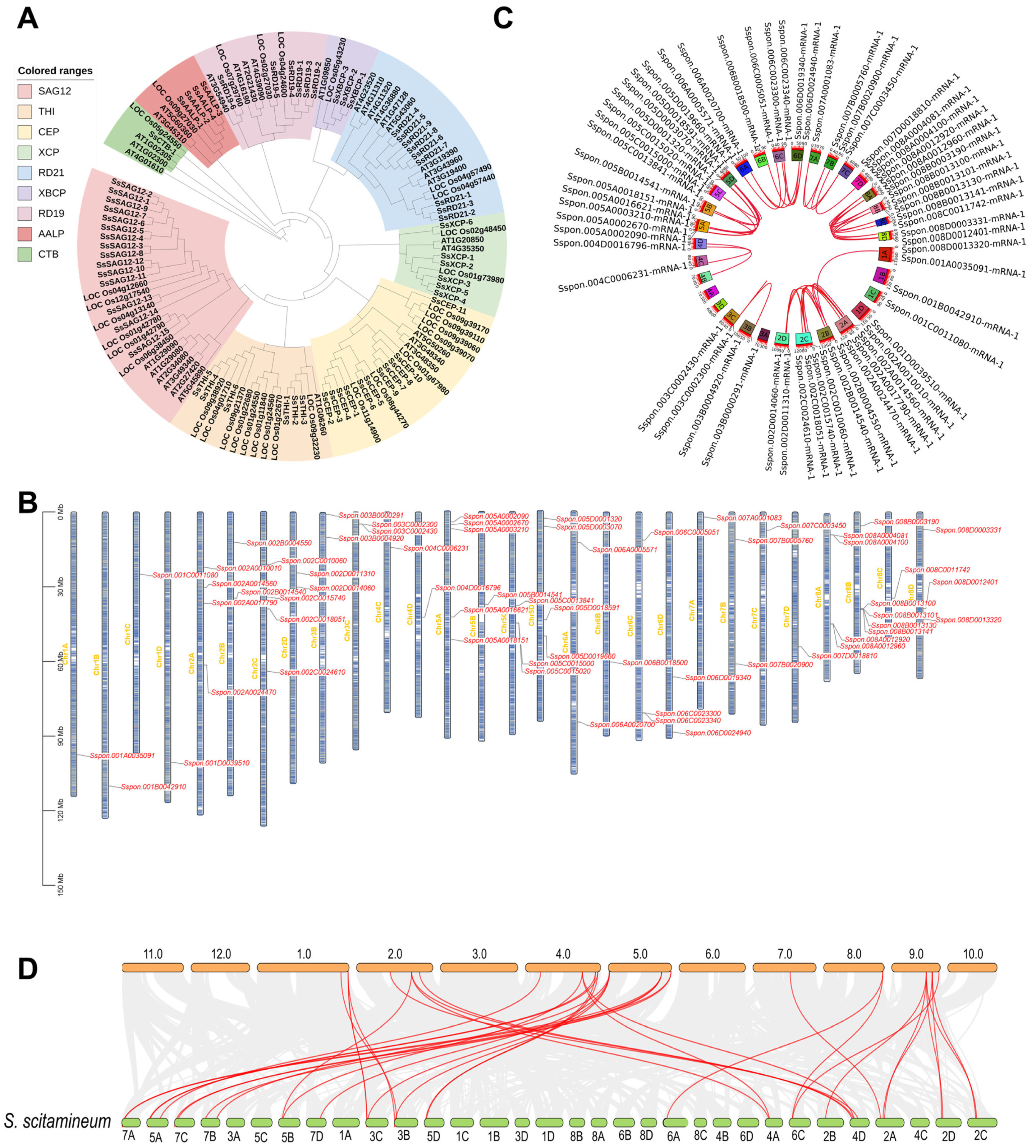
Using HMMER searches for the Peptidase_C1 domain followed by reciprocal BLASTP validation, we identified 61 non-redundant PLCP genes in the monoploid S. spontaneum AP85-441 genome (Table 1). A maximum likelihood (ML) phylogenetic tree constructed with Arabidopsis and rice PLCPs separated the sugarcane proteins into nine subfamilies: AALP, CEP, CTB, RD19, RD21, SAG12, THI, XBCP, and XCP (Figure 1A). The major subfamily groupings were consistent with those obtained from the neighbor-joining (NJ) analysis (Figure S1), whereas some topological differences were observed at deeper phylogenetic levels (e.g., the phylogenetic position of XBCP). Proteins within the same subfamily exhibit high similarity (Figure S2). All nine canonical PLCP lineages represented in Arabidopsis and rice were also present in sugarcane, indicating overall conservation of major family structure across these species [18,34].
Physicochemical analysis showed that most ScPLCP proteins are 300–400 aa in length and 37–50 kDa in predicted molecular weight. Extreme variations were observed in specific members, such as RD21-6 (1533 aa, 165.4 kDa) and RD19-4 (177 aa) (Table 1), suggesting specialized evolutionary adaptations through domain fusion or truncation [18]. The predicted isoelectric points varied across subfamilies, with SAG12 members generally acidic (pI 4.69–6.03) and AALP members spanning a broader range (pI 5.59–8.3) (Table 1). Taken together, these results demonstrate that the sugarcane PLCP family exhibits detectable divergence in protein size and charge properties, and this charge variation suggests that distinct ScPLCP subfamilies may be adapted to exert their biological functions efficiently in disparate subcellular compartments (e.g., the acidic vacuole).
Chromosomal mapping showed that the 61 ScPLCP genes are distributed unevenly across the 28 chromosomes of S. spontaneum, with most chromosomes carrying 1–3 members and chromosome 8B containing five loci (Figure 1B). Given the highly autopolyploid nature of the sugarcane genome, we further investigated the mechanisms underlying ScPLCP family expansion. Intra-genomic synteny analysis identified 42 collinear gene pairs, supporting the conclusion that segmental duplication and whole-genome duplication, rather than tandem duplication, were the predominant contributors to the expansion of the ScPLCP family (Figure 1C). This pattern agrees with the extensive polyploidization history of the Saccharum lineage [1]. Interspecific synteny analysis identified 34 orthologous gene pairs between sugarcane and rice, supporting substantial conservation of PLCP-associated syntenic blocks between the two genomes (Figure 1D).

2.2. Structural Features and Promoter Analysis of the ScPLCP Family

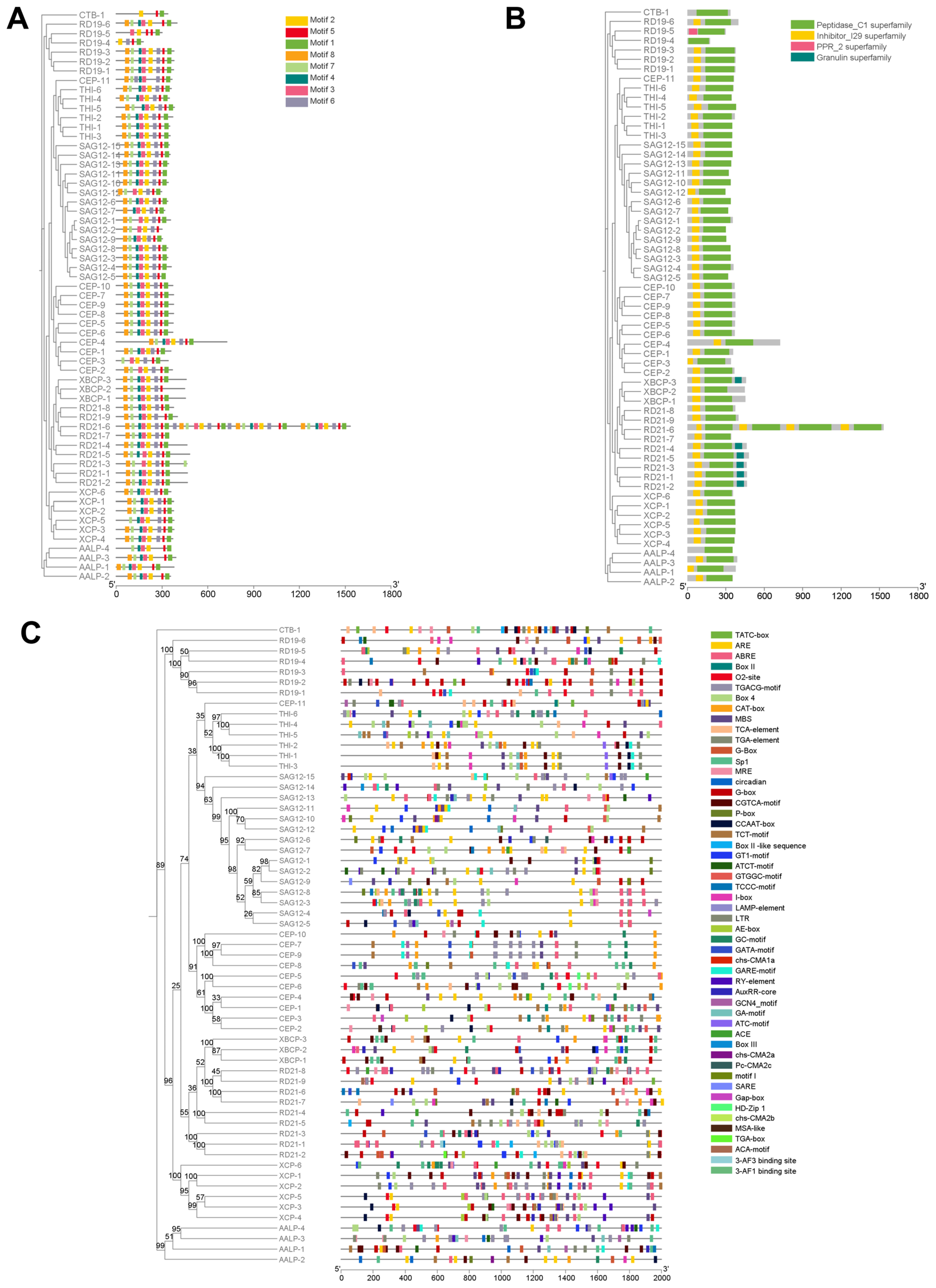
All identified ScPLCPs contained the characteristic Peptidase_C1 (PF00112) catalytic domain, and most of them possessed a detectable N-terminal Inhibitor_I29 (PF08246) pro-domain (Figure 2B). MEME analysis identified eight conserved motifs; motifs 1–6 mapped mainly to the catalytic region, whereas motifs 7 and 8 corresponded mainly to the pro-peptide autoinhibitory region (Figure 2A,B, Supplementary Table S3). In addition, certain members harbor extra domains, including a C-terminal Granulin (GRAN) domain in XCP-3 and several RD21 proteins, as well as a pentatricopeptide repeat (PPR) domain in RD19-5, indicating structural diversification within the family [18].
Promoter analysis of the 2000 bp upstream regions revealed that ScPLCP genes are enriched in hormone- and stress-responsive cis-acting regulatory elements (Figure 2C). Abscisic acid (ABA)-responsive elements were present in 91.8% of promoters, and methyl jasmonate (MeJA)-responsive motifs were present in 83.6%. Light-responsive elements (G-box, Box 4) and abiotic stress-related motifs, such as anaerobic-responsive elements (83.6%) and drought-responsive MBS elements (73.8%), were also common. Collectively, these findings suggest that transcription of ScPLCP genes is likely regulated by multiple hormonal and environmental cues.

2.3. ScRD21A Was Prioritized as a Representative Sugarcane RD21-like Candidate for Downstream Characterization

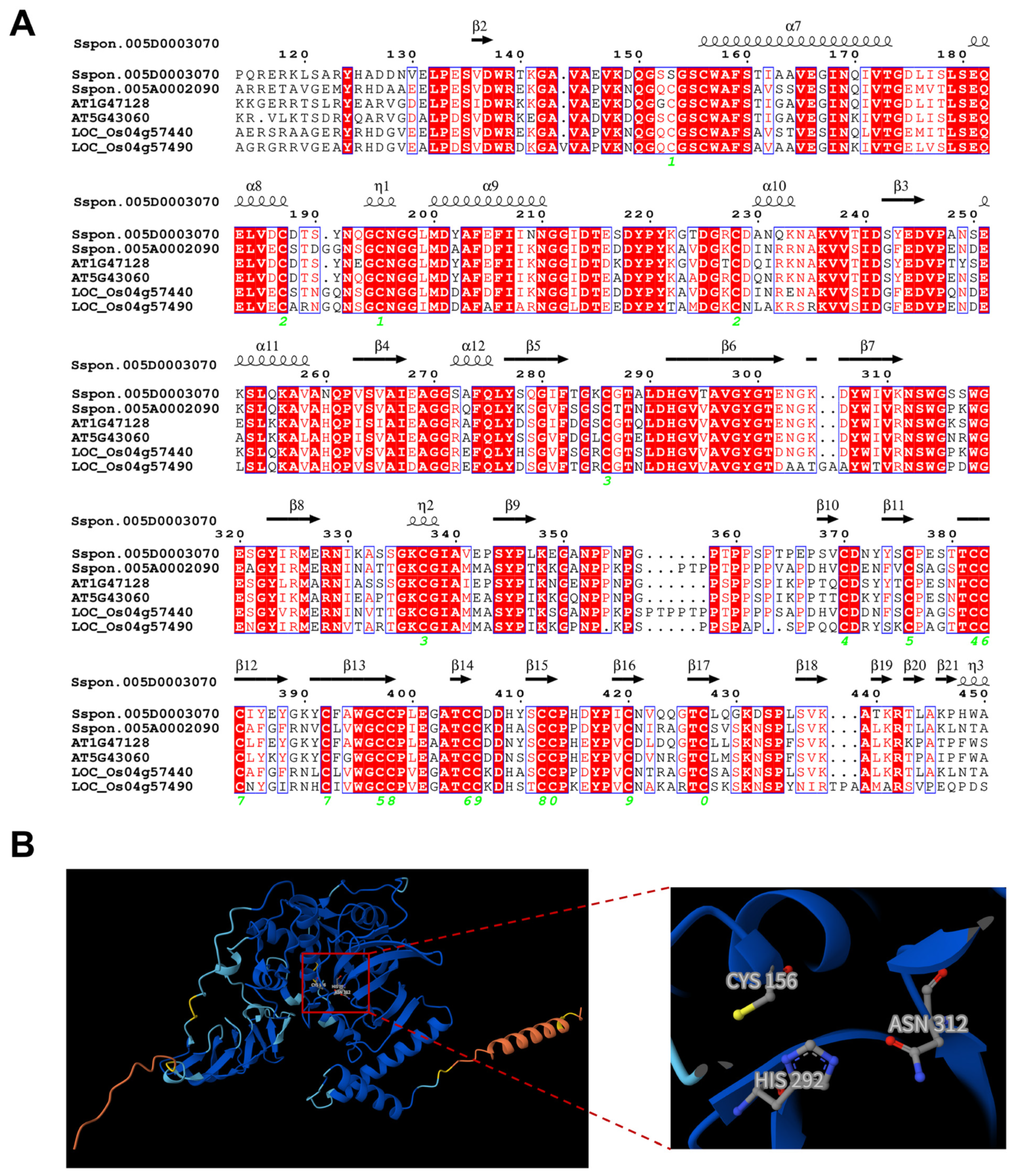
Because RD21-like proteases are widely implicated in plant immunity and are frequent effector targets [17,21], we examined the sugarcane RD21 clade in greater detail. Multiple sequence alignment with Arabidopsis and rice orthologs showed strong conservation of the catalytic triad (Cys-His-Asn) and adjacent residues in the predicted substrate-binding region (Figure 3A). Among the sugarcane RD21-like members, SsRD21-4 and SsRD21-5 were the two closest homologs of Arabidopsis AtRD21A (Figure 1A). Based on BLASTP identity calculated as identical residues over the alignment length, SsRD21-4 showed higher identity to AtRD21A than SsRD21-5 (70.02% for SsRD21-4 versus 66.89% for SsRD21-5) (Figure S3). On this basis, SsRD21-4/Sspon.005D0003070 was selected as a representative sugarcane RD21-like candidate for downstream analysis and was designated ScRD21A.
AlphaFold3 modeling predicted that ScRD21A adopts the typical papain-like fold, with an L-domain enriched in α-helices and an R-domain dominated by antiparallel β-sheets (Figure 3B). The catalytic triad is positioned in the cleft between the two domains, with Cys156, His292, and Asn312 arranged in a geometry consistent with papain-family proteases (Figure 3B). This spatial arrangement is highly similar to that reported for biochemically characterized PLCPs, supporting the annotation of ScRD21A as a canonical papain-like cysteine protease [18].

2.4. SsPit2A/B Interact with ScRD21A in an LXRR-Dependent Manner

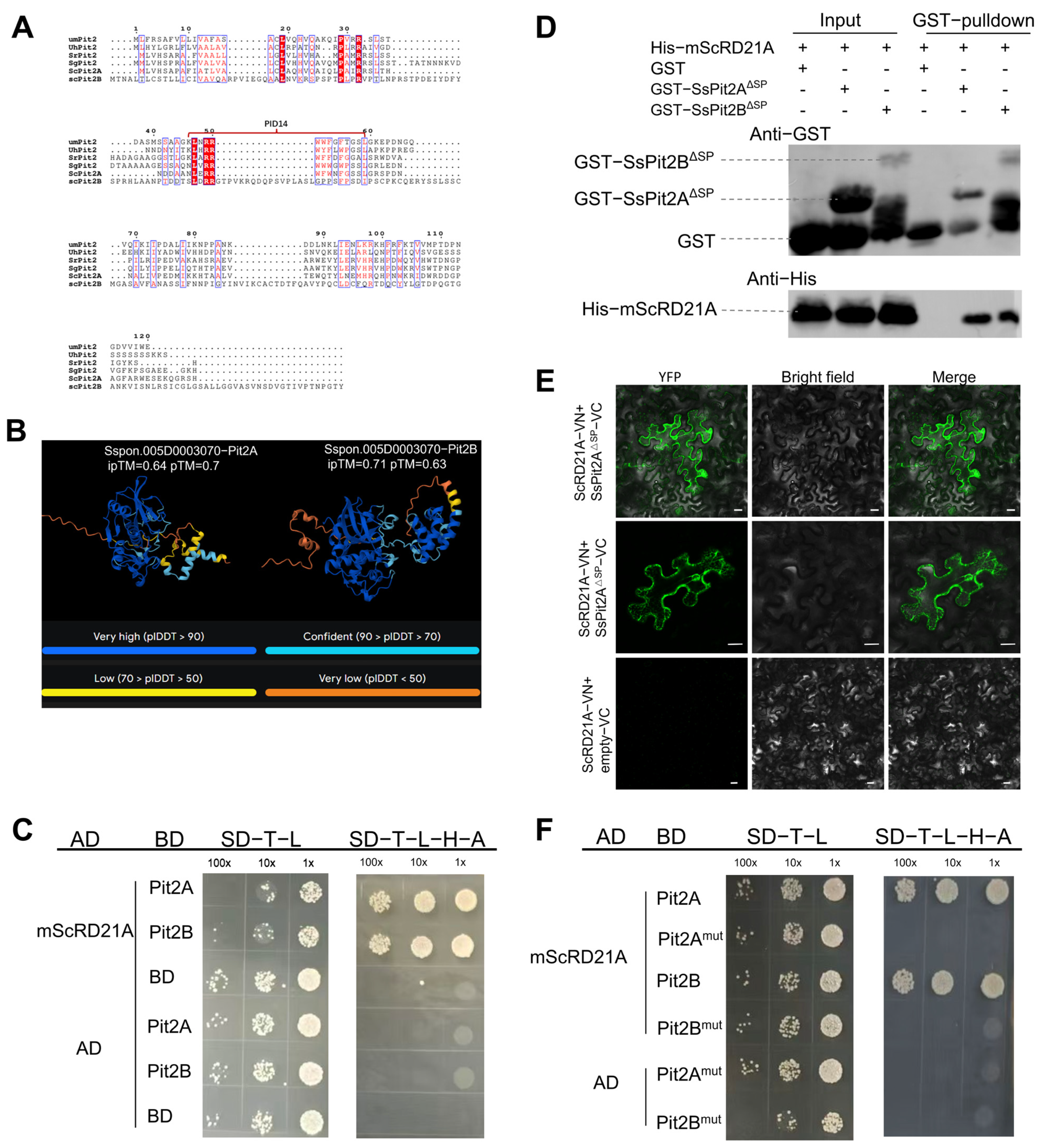
PLCPs are key regulators of plant immunity and are recurrent targets of pathogen effectors that suppress host defense signaling [14,35]. We identified two Pit2-related sequences in S. scitamineum, designated SsPit2A and SsPit2B. SsPit2A represents the closest homolog to UmPit2, exhibiting the highest overall sequence similarity and a clearly conserved PID14 domain [36]. SsPit2B corresponds to the gene previously annotated as SsPIT2 in a comparative expression study of high- and low-virulent S. scitamineum isolates [37]. Although SsPit2B shares moderate overall sequence identity with UmPit2, it possesses a PID14-like domain with notable conservation of key structural features, particularly the LXRR motif within this region (Figure 4A). We therefore selected SsPit2A and SsPit2B for further analysis. Sequence analysis revealed that SsPit2A harbors a canonical PID14 motif, whereas SsPit2B contains a structurally divergent PID14-like region with an insertion. Despite this variation, both proteins retain the conserved LXRR motif, which forms the functional core of the PID14 peptide and is essential for PLCP inhibition in other smut fungi [38].
We subsequently used AlphaFold3 to predict the complex structure between ScRD21A and the S. scitamineum effectors SsPit2A/B (Figure 4B). Model reliability was assessed by interface predicted template modeling score (ipTM) and predicted template modeling score (pTM). Both ScRD21A–SsPit2A and ScRD21A–SsPit2B pairs yielded ipTM values above 0.6, indicating a high probability of interaction, and pTM values above 0.5, supporting reliable overall complex folding. We further validated this interaction experimentally. In yeast two-hybrid (Y2H) assays, all co-transformants grew on SD/-Trp/-Leu medium (transformation control), whereas growth on SD/-Trp/-Leu/-His/-Ade was observed only for the ScRD21A–SsPit2A/B combinations, indicating interaction with the catalytic C1 domain of ScRD21A (Figure 4C). This interaction was further confirmed by GST pull-down assays, indicating direct physical association in vitro (Figure 4D). In planta, Bimolecular Fluorescence Complementation (BiFC) assays revealed robust complex formation between ScRD21A and SsPit2A/B, demonstrating that this interaction occurs in living plant cells (Figure 4E).
To identify the molecular determinant underlying this interaction, we mutated the basic amino acid residues within the conserved LXRR motif to alanine or glycine. Both wild-type SsPit2A and SsPit2B supported yeast growth on quadruple dropout medium, whereas the corresponding LXRR-mutated versions did not, indicating that the core LXRR motif is required for ScRD21A association (Figure 4F, Supplementary Table S4). Together, these data support an LXRR motif-dependent mode of ScRD21A targeting by SsPit2A and SsPit2B and are consistent with a substrate-mimicry model.

2.5. SsPit2A/B Co-Localize with ScRD21A and Are Associated with Its Subcellular Redistribution

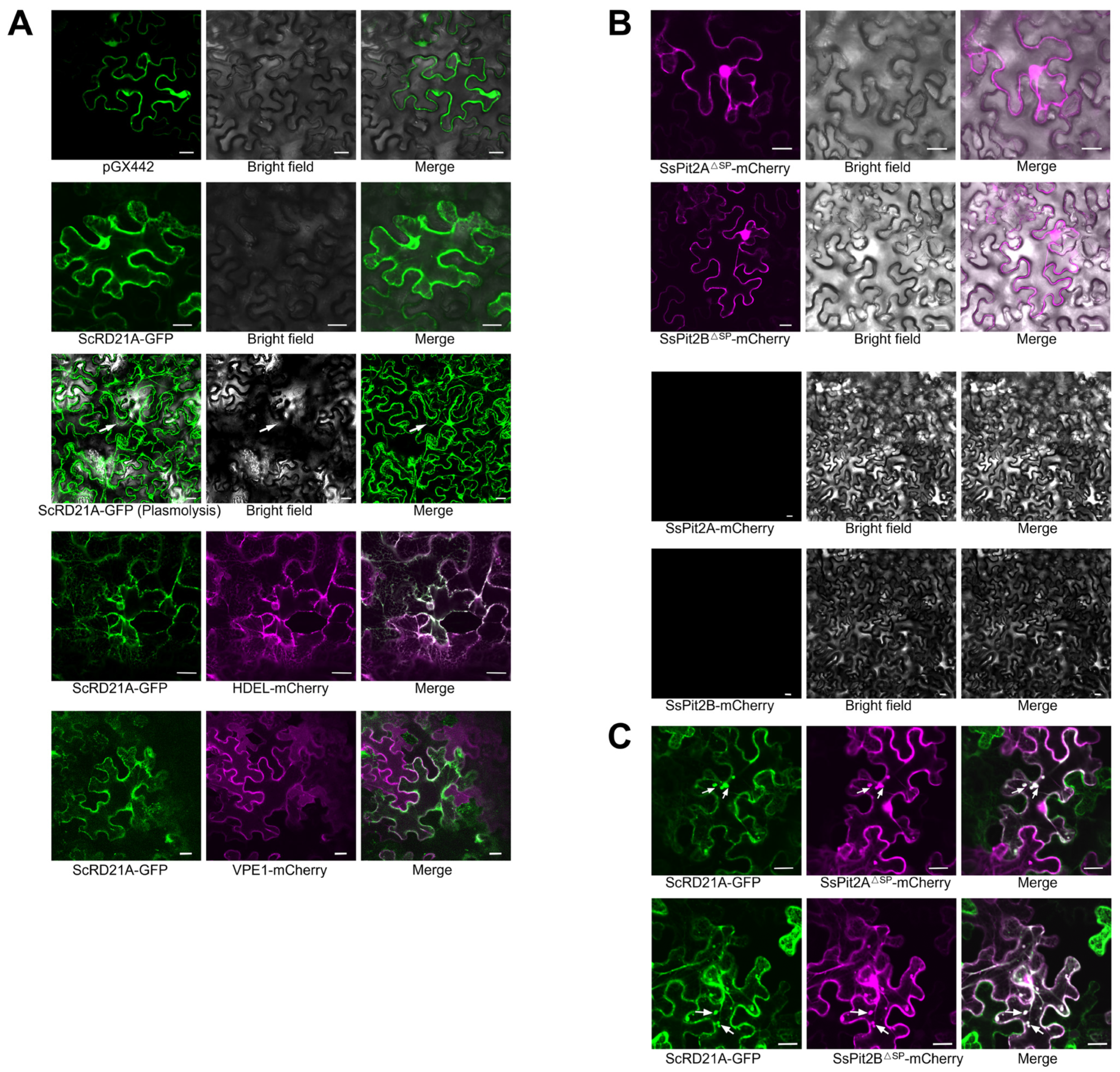
The activity of RD21-like proteases is tightly linked to their subcellular localization and maturation state [18,39]. Previous studies place RD21-type PLCPs along the secretory–vacuolar route, including the endoplasmic reticulum (ER), vacuole, and apoplast [40]. Under non-stressed conditions, RD21 is largely sequestered in the vacuole and ER bodies, but vacuolar membrane disruption can release RD21 into the cytosol, where it promotes vacuole-driven cell death and defense-associated responses [41,42]. To determine the localization of ScRD21A, we transiently expressed ScRD21A-GFP in N. benthamiana. ScRD21A localized predominantly to intracellular compartments and showed no detectable apoplastic signal following plasmolysis, indicating retention within the endomembrane system (Figure 5A). Co-localization analysis revealed partial overlap with both ER and vacuolar markers, consistent with the canonical secretory–vacuolar trafficking route of RD21 proteases (Figure 5A). This localization pattern is compatible with a model in which ScRD21A undergoes maturation within vacuolar compartments before activation.
Most predicted S. scitamineum secreted effectors encode an N-terminal signal peptide [28]. For transient expression assays, signal peptide-deleted constructs are commonly used to retain proteins intracellularly and improve detection [43]. When signal peptide-deleted SsPit2A/B-mCherry fusions were transiently expressed in N. benthamiana, fluorescence was detected in both the nucleus and cytoplasm, whereas the full-length constructs yielded no detectable intracellular signal (Figure 5B). Because the predicted signal peptides are expected to route the full-length fusions into the secretory pathway, the lack of detectable intracellular fluorescence may reflect secretion-associated low accumulation, extracellular instability, proteolytic processing, or reduced mCherry stability after secretion. Thus, the SsPit2A/BΔSP-mCherry fusions were used in subsequent localization and co-expression assays as predicted mature effector forms. Strikingly, co-expression of SsPit2A/BΔSP induced a pronounced relocalization of ScRD21A from a diffuse intracellular distribution to discrete cytoplasmic puncta, suggesting altered trafficking or compartmentalization (Figure 5C). Effector-mediated relocalization of host proteins is an emerging mechanism for suppressing plant immunity [44]. Given that RD21 activation depends on proper trafficking and proteolytic processing, the redistribution of ScRD21A observed here likely impacts its maturation state or substrate accessibility. These findings indicate that SsPit2A and SsPit2B not only interact with ScRD21A but may also be associated with changes in its spatial distribution within plant cells.

2.6. SsPit2A/B Reduce ScRD21A-Associated Cysteine Protease Activity, Whereas ScRD21A Supports Defense-Related Responses

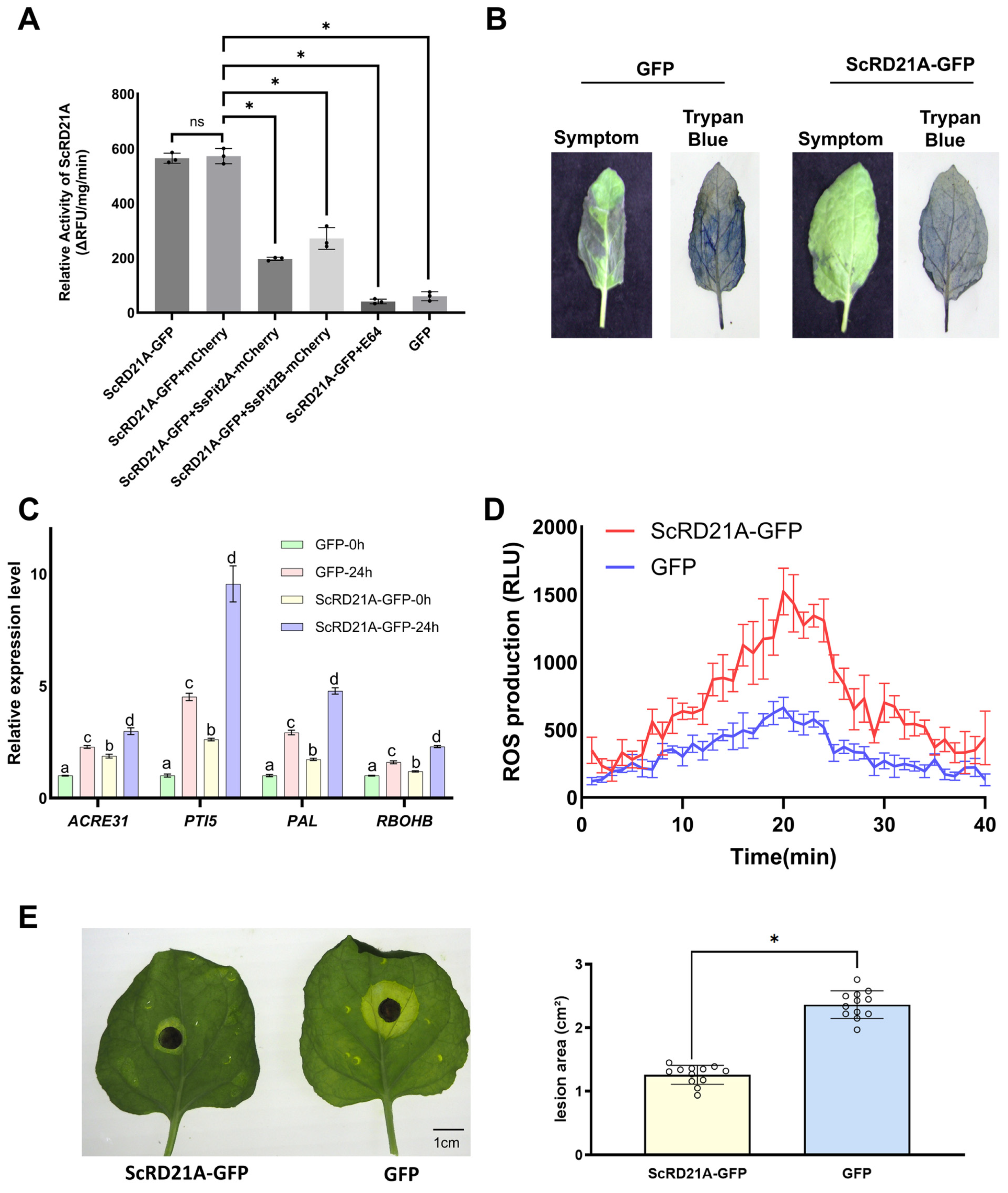
To determine the functional consequence of SsPit2A/B–ScRD21A interaction, we measured protease activity using a fluorogenic substrate. Co-expression with SsPit2A or SsPit2B significantly reduced the measured cysteine protease activity in total protein extracts to 49.2% and 35.3% of control levels, respectively (Figure 6A). The sensitivity of the assay to E-64 confirmed that the measured activity corresponds to cysteine proteases. Protease inhibition is a hallmark virulence strategy, particularly for PLCPs that function as immune regulators [14,45]. Although the use of crude extracts from transiently expressing N. benthamiana tissue and a generic fluorogenic substrate does not by itself establish direct biochemical inhibition of purified ScRD21A, the significant reduction in E-64-sensitive activity upon SsPit2A/B co-expression supports the conclusion that SsPit2A/B attenuate ScRD21A-associated cysteine protease activity in this system.
To evaluate the role of ScRD21A in plant immunity, we employed the well-established Pseudomonas syringae pv. tomato (Pst) DC3000–N. benthamiana pathosystem, which triggers a robust hypersensitive response (HR). At 48 h post-inoculation with Pst DC3000, trypan blue staining revealed extensive deep-blue necrotic lesions in GFP control leaves, indicative of severe cell death. In contrast, leaves transiently overexpressing ScRD21A-GFP exhibited markedly reduced necrotic areas, suggesting that ScRD21A attenuates pathogen-induced hypersensitive cell death (Figure 6B).
To further assess downstream transcriptional responses, we quantified the expression of defense-associated marker genes. qRT-PCR analysis revealed significantly higher transcript levels of the PTI marker genes ACRE31 and PTI5, the ROS-producing gene RBOHB, and the salicylic acid (SA) pathway gene PAL in ScRD21A-GFP-expressing leaves than in GFP controls (Figure 6C). Notably, all four genes exhibited elevated basal expression in ScRD21A-GFP leaves even before inoculation, with their induction remaining substantially stronger following pathogen challenge. Upon flg22 treatment, leaves expressing ScRD21A displayed a stronger and more rapid ROS burst compared with control tissues (Figure 6D). This enhanced ROS production was characterized by both a higher peak amplitude and accelerated induction kinetics, indicating that ScRD21A contributes to the amplification of early immune signaling.
In detached-leaf assays with B. cinerea, lesion areas in ScRD21A-GFP-expressing leaves were markedly smaller than in controls at 72 h post-inoculation (Figure 6E), suggesting that ScRD21A also enhances resistance to this necrotrophic fungal pathogen. Together, these results establish ScRD21A as a positive regulator of plant immunity.

3. Discussion

PLCPs are important components of plant immune regulation and are frequent targets of pathogen effectors [14,15]. In this study, we combined genome-wide characterization of the sugarcane PLCP family with functional analysis of an effector–protease module relevant to sugarcane smut. We identified 61 ScPLCP genes in the S. spontaneum AP85-441 genome, defined their major structural and evolutionary features, and selected the RD21-like protease ScRD21A for downstream analysis. We further identified two effectors from sugarcane smut, SsPit2A and SsPit2B, and showed that they associate with ScRD21A in an LXRR-dependent manner and reduce ScRD21A-associated cysteine protease activity. We also analyzed the co-localization of ScRD21A with SsPit2A/B, while functional assays supported a positive role for ScRD21A in defense-related responses. Together, these findings provide a framework for understanding effector–PLCP interactions in the sugarcane–S. scitamineum pathosystem.
ScRD21A was prioritized because RD21-like proteases occupy a particularly relevant position at the interface between host defense and pathogen virulence, and because ScRD21A/SsRD21-4 showed the highest sequence identity to AtRD21A among the sugarcane RD21-like candidates examined. In Arabidopsis and other systems, RD21-family members contribute to resistance-associated proteolysis and are recurrent targets of pathogen interference [15,19,20,21,22,23,39]. The conservation of the catalytic triad and the overall papain-like fold in ScRD21A therefore supports its annotation as a plausible immune-relevant protease in sugarcane. Given the size of the sugarcane PLCP family and the complexity of the sugarcane genome, ScRD21A is best viewed as a representative entry point for investigating defense-relevant PLCPs in this pathosystem, rather than as the only PLCP likely to contribute to host defense.
We identified two Pit2 homologs in S. scitamineum, and both SsPit2A and SsPit2B interact with ScRD21A. This observation is important because Pit2 represents one of the best characterized PLCP targeting effectors in smut fungi. In the U. maydis–maize pathosystem, Pit2 is processed by host proteases to release a short inhibitory region, and a conserved motif within this region is essential for suppression of host PLCP activity [38,45]. Our data suggest that a related mode of PLCP targeting may also operate in the sugarcane smut fungus. In particular, the mutational results indicate that the PID14-like region, especially the embedded LXRR motif, is important for ScRD21A targeting by SsPit2A/B. Although SsPit2B contains an insertion relative to the canonical PID14 motif and the two proteins differ substantially outside this region, the loss of interaction caused by LXRR mutation suggests that this motif may be more critical than the surrounding sequence context for maintaining PLCP-directed activity. This interpretation is consistent with the idea that smut effectors can diversify extensively at the sequence level while retaining short functional elements required for host target engagement [15]. Whether the two S. scitamineum Pit2 paralogs differ in inhibitory capacity, or infection-stage regulation remains unresolved and will require direct testing in the native pathosystem.
Functional assays further showed that SsPit2A and SsPit2B reduce ScRD21A-associated protease activity. Because the fluorogenic assay was performed using total protein extracts from transiently expressing N. benthamiana tissue, the reduced substrate turnover should be interpreted with appropriate caution and may reflect the integrated consequences of effector association with ScRD21A in planta rather than a fully resolved biochemical mechanism. Nevertheless, the combination of pull-down evidence, interaction in planta, and the dependence on the conserved LXRR motif strongly supports effector-associated attenuation of ScRD21A-related protease output. These findings place SsPit2A/B within an expanding set of RD21-targeting effectors and support an RD21-directed virulence strategy in the sugarcane smut fungus, although the precise biochemical mechanism will require further resolution [14,15].
In addition, we observed that co-expression with SsPit2A/B was associated with changes in the subcellular distribution pattern of ScRD21A, suggesting that these effectors may also influence the localization of the host protease. This aspect is mechanistically intriguing because RD21-like proteases are tightly linked to endomembrane trafficking, maturation, and compartment-specific activation. Endogenous regulators such as Serpin1 and the deubiquitinase OTU2 illustrate that RD21 activity and abundance are under multilayered control even in the absence of pathogens [22,40]. The punctate co-localization patterns observed here are consistent with altered trafficking or maturation of ScRD21A, but the available data do not yet support a definitive conclusion. Because the localization experiments used signal-peptide-deleted effectors in a heterologous system, the puncta could represent trafficking intermediates, aberrant aggregates, or host compartments not resolved by the current markers. In the classical secretory pathway, N-terminal signal peptides are generally cleaved during ER translocation, and the U. maydis Pit2 effector has been discussed as a mature protein after signal peptide cleavage [38]. Thus, the ΔSP constructs used here likely represent the predicted mature SsPit2A/B forms. The absence of detectable fluorescence from full-length SsPit2A/B-mCherry may reflect weak apoplastic accumulation, extracellular instability, proteolytic processing, or reduced mCherry maturation/stability after secretion. Therefore, these assays support the behavior of the predicted mature effector forms but do not directly demonstrate secretion of full-length SsPit2A/B during infection. Defining the identity of these structures, and testing whether protease activity or the LXRR motif is required for their formation, will be important next steps.
In the N. benthamiana transient expression system, ScRD21A enhanced flg22-triggered ROS burst, attenuated Pst DC3000-induced cell death, and increased resistance to B. cinerea. Although these assays do not reproduce the native sugarcane-smut interaction, they consistently support a positive contribution of ScRD21A to plant immunity. This pattern is consistent with evidence that PLCPs do not function solely as terminal degradative enzymes, but can also shape immune signaling outputs more broadly. For example, the XCP1-CYSTATIN6 module affects pattern-triggered immunity by influencing RBOHD stability, and RD21-related proteolysis can release bioactive peptides that reinforce host defense [19,46]. Our data do not yet reveal whether ScRD21A acts through direct antimicrobial proteolysis, processing of endogenous immune signals, regulation of protein turnover along the secretory-vacuolar route, or a combination of these mechanisms. Nevertheless, the elevated basal and inducible expression of defense-associated marker genes together with the stronger flg22-triggered ROS burst are consistent with the interpretation that ScRD21A contributes positively to immune responses rather than merely altering tissue damage.
However, because the functional analyses in this study were performed in a heterologous system rather than in sugarcane, the precise contribution of ScRD21A to smut resistance still warrants validation in the native host. This point should be considered in the context of the highly polyploid and genetically complex sugarcane genome, in which functional overlap among PLCP family members is likely [1]. In parallel, although only a limited number of S. scitamineum effectors have been experimentally characterized to date, the available studies already indicate that this pathogen deploys multiple virulence strategies, including peptide mimicry and manipulation of host trafficking [28,32,47]. Within this context, the ScRD21A–SsPit2A/B module offers a practical entry point for dissecting effector–protease interactions during sugarcane smut infection. From an applied perspective, SsPit2A/B could be used as molecular probes to screen sugarcane germplasm for RD21-like PLCP alleles that show reduced effector association while retaining protease function. ScRD21A may also serve as a candidate host factor for testing whether RD21-like protein abundance, processing, trafficking, effector sensitivity, or protease output correlates with smut tolerance in resistant and susceptible sugarcane materials. These possibilities remain provisional and will require validation in sugarcane germplasm and infection assays. Future work should prioritize direct validation of ScRD21A in sugarcane and determine whether SsPit2A/B affect ScRD21A accumulation or maturation and whether LXRR mutation compromises their inhibitory activity in the native host. Clarifying whether ScRD21A functions through immune-relevant substrates or defense-active peptides will further refine its role in this interaction [19]. These analyses will also help assess whether RD21-related pathways could support resistance improvement [22,48]. Overall, the ScRD21A–SsPit2A/B module provides a testable model for understanding sugarcane smut pathogenesis and for future host-directed validation.

4. Materials and Methods

4.1. Genome-Wide Analysis of the ScPLCP Family

Genome-wide identification of the PLCP family in sugarcane was performed using the monoploid genome of S. spontaneum AP85-441 available in the Sugarcane Genome Database (ScDB; http://sugarcane.gxu.edu.cn/scdb/ (accessed on 13 May 2025)) [1]. The Hidden Markov Model (HMM) profile of the papain family cysteine protease domain (PF00112) was employed to search the sugarcane protein database with HMMER 3.0 (E-value cutoff < 1 × 10⁻⁵) [49]. The representative HMMER command used to retrieve candidate PLCPs as Supplementary Information (Supplementary Table S2). Candidate sequences were further validated by BLASTP searches (E-value < 1 × 10⁻⁵) against well-characterized PLCP sequences from Arabidopsis Col-0 and rice Nipponbare, retrieved from TAIR (https://www.arabidopsis.org (accessed on 13 May 2025)) and the Rice Genome Annotation Project (http://rice.uga.edu (accessed on 13 May 2025)), respectively [18,34,50]. Redundant sequences were removed, resulting in the identification of 61 non-redundant ScPLCP genes.
Physicochemical properties of the deduced ScPLCP proteins, including molecular weight (MW), isoelectric point (pI), amino acid length, grand average of hydropathicity (GRAVY), and instability index, were calculated using the ExPASy ProtParam tool (https://web.expasy.org/protparam/ (accessed on 13 May 2025)) [51]. Multiple sequence alignment was conducted with Clustal Omega. A phylogenetic tree was constructed using MEGA X with the Neighbor-Joining method based on the Jones-Taylor-Thornton (JTT) model and 1000 bootstrap replicates; branches with bootstrap support > 50 were considered reliable [52]. Maximum likelihood (ML) phylogenetic analysis was performed using IQ-TREE via the TBtools Phylogenetics module (IQ-tree Wrapper plugin). The tree was visualized and annotated using iTOL (https://itol.embl.de/ (accessed on 13 May 2025)) [53], allowing classification of ScPLCPs into nine subfamilies.
Pairwise protein similarity matrices were generated using TBtools v2.0 (Protein Pairwise Similarity Matrix module, default gap penalties) [54]. Conserved domains were identified using the NCBI Conserved Domain Search (CD-Search) tool. Conserved motifs were analyzed with the MEME Suite [55]. Chromosomal locations of ScPLCP genes were mapped using the Circos module in TBtools based on the corresponding GFF3 annotation file. Synteny analysis between S. spontaneum AP85-441 and O. sativa (Nipponbare) was performed with MCScanX [56].
To investigate potential regulatory elements, 2000 bp upstream promoter sequences of ScPLCP genes were extracted and analyzed for cis-acting regulatory elements using PlantCARE (https://bioinformatics.psb.ugent.be/webtools/plantcare/html/ (accessed on 13 May 2025)) [57]. Elements were classified according to their predicted functions (e.g., hormone-responsive: ABA, SA; stress-responsive: pathogen, drought; developmental: meristem-specific) and visualized with TBtools.
The ScPLCP member showing the highest sequence similarity to AtRD21A (Sspon.005D0003070, hereafter designated ScRD21A) was selected for structural modeling. Its three-dimensional structure was predicted using the AlphaFold3 online server (https://alphafoldserver.com/ (accessed on 13 May 2025)) [58]. Model confidence was evaluated using the confidence metrics reported by AlphaFold3, including per-residue pLDDT values and overall pTM/ipTM scores where applicable. Structural visualization and comparison of the conserved catalytic triad (Cys-His-Asn) were performed using UCSF ChimeraX 1.8 [59]. AlphaFold3-multimer modeling was performed to predict effector–protease interaction interfaces [58].

4.2. Subcellular Localization

Constructs for transient expression (35S::ScRD21A-GFP, 35S::mCherry, and 35S::SsPit2A/B-mCherry) were introduced into Agrobacterium tumefaciens strain GV3101. Overnight cultures were resuspended in infiltration buffer (10 mM MES, 10 mM MgCl2, 150 μM acetosyringone, pH 5.6) and adjusted to an OD600 of approximately 0.6. The suspensions were infiltrated into the abaxial surface of fully expanded leaves of 4-week-old N. benthamiana plants. Fluorescence signals were observed 48 h post-infiltration using an Olympus FV3000 confocal laser scanning microscope (Olympus Corporation, Tokyo, Japan) with appropriate excitation/emission settings for GFP and mCherry.

4.3. Y2H

Y2H assays were conducted essentially as described previously [60]. The C1 protease domain of ScRD21A and full-length fragments of SsPit2A/B were cloned into the pGADT7 (prey) and pGBKT7 (bait) vectors, respectively. Constructs were co-transformed into yeast strain Y2HGold. Transformants were first selected on SD/-Trp/-Leu medium (SD-T-L) and then assayed on SD/-Trp/-Leu/-His/-Ade medium (SD-T-L-H-A) (Takara Bio USA, Inc., San Jose, CA, USA). Empty vectors served as negative controls. Site-directed mutagenesis was used to generate LXRR motif mutants of SsPit2A/B to evaluate their contribution to the interaction.

4.4. BiFC

BiFC assays were performed following established protocols [60] with minor modifications. For ScRD21A, the coding sequence of the mature protein was amplified; for SsPit2A and SsPit2B, the coding sequences devoid of the signal peptide (ΔSP) were amplified. The resulting fragments were cloned into the pDOE-03 vector, a single-vector dual-ORF expression system designed for BiFC analysis, via the In-Fusion cloning strategy. Recombinant constructs were transformed into A. tumefaciens strain GV3101 and co-infiltrated into N. benthamiana leaves as described in Section 4.2. At 48 h post-infiltration, YFP fluorescence was visualized using an Olympus FV3000 confocal laser scanning microscope under the following acquisition parameters: excitation at 488 nm and emission collection between 520 and 560 nm. As a negative control, an empty VC cassette was incorporated into the same pDOE-03 backbone alongside the ScRD21A-VN fusion cassette. For each experimental combination, a minimum of three independently infiltrated leaves were examined, with three to five fields of view captured per leaf.

4.5. Protease Activity Assays

Total proteins were extracted from N. benthamiana leaves 48 h post-infiltration and quantified by BCA assay. Cysteine protease activity was measured fluorometrically using the substrate N-CBZ-Phe-Arg-AMC (Aladdin, Shanghai, China). The 50 μL reaction mixture contained 40 μL crude protein extract and 10 μL of 1 mM N-CBZ-Phe-Arg-AMC. Reactions were incubated in the dark for 10 min at 25 °C, after which fluorescence intensity was monitored (excitation 380 nm, emission 460 nm) using a BioTek Synergy H1 multimode reader (BioTek Instruments, Inc., Winooski, VT, USA) [21]. E-64 was included as an inhibitor control to verify cysteine-protease-dependent activity. Enzymatic activity was normalized to total protein abundance and expressed as ΔRFU/mg/min. Because total extracts and a generic substrate were used, the measured values are interpreted as ScRD21A-associated cysteine protease output rather than direct activity of purified ScRD21A. All assays were performed in three independent biological replicates, and results are presented as means ± standard deviation.

4.6. Disease-Related Assays

Transient overexpression in N. benthamiana was achieved via A. tumefaciens GV3101 infiltration as detailed in Section 4.2. For ROS burst, Pst DC3000 challenge, defense-gene expression, and B. cinerea assays, leaves were infiltrated with 35S::ScRD21A-GFP or GFP control only; SsPit2A/B constructs were not used in these assays. Assays were conducted at the indicated time points post-infiltration.
For ROS burst assays, N. benthamiana leaves were agroinfiltrated and incubated for 48 h. Leaf disks were floated in water overnight and then treated with 100 nM flg22, 100 μM luminol, and 20 μg mL−1 horseradish peroxidase. Luminescence was measured every 1 min for 40 min using a BioTek Synergy H1 multimode reader [61].
At 24 h post-agroinfiltration, N. benthamiana leaves were inoculated with Pst DC3000 at OD600 = 0.3. Defense-related gene expression was analyzed by qRT-PCR at 24 hpi with Pst DC3000. Cell death was visualized by trypan blue staining at 48 hpi with Pst DC3000. Cell death was visualized by trypan blue staining at 48 h post-inoculation with Pst DC3000 [62]. For defense-gene expression analysis, total RNA was isolated from the indicated leaf tissues and reverse transcribed for qRT-PCR. Relative transcript levels were normalized to NbEF1α and calculated against the 0 h control. Unless otherwise indicated, primer pairs used for transcript analysis are listed in the Supplementary Materials.
For B. cinerea infection assays, 6 mm mycelial plugs were placed on wounded leaves at 48 h after agro-infiltration, and lesion areas were measured 72 h later under high humidity at 22 °C [63].
Statistical analyses were performed using the tests specified for each experiment, including one-way ANOVA with Dunnett’s post hoc test, two-way ANOVA for multi-factor comparisons, and Student’s t-test for pairwise comparisons. Differences were considered significant at p < 0.05.

4.7. Pull-Down Assays

His-mScRD21A and GST-SsPit2A/BΔSP fusion proteins were expressed in Escherichia coli BL21 following induction with 1 mM IPTG at 16 °C for 16 h. GST-tagged bait proteins were immobilized onto glutathione-agarose beads (Thermo Fisher Scientific, Waltham, MA, USA) by incubation at 4 °C for 1–2 h with gentle rotation. The beads were subsequently washed three times with ice-cold binding buffer (20 mM Tris-HCl, pH 7.5; 150 mM NaCl; 0.5–1% Triton X-100; 1 mM EDTA; 1 mM DTT; 1 mM MgCl2) to remove unbound proteins, then blocked with 2–3 mg/mL BSA in wash buffer at 4 °C for 30–60 min. Following a brief wash, the bead-bound GST fusions were incubated with purified His-mScRD21A prey protein at 4 °C for 1–2 h with gentle rotation. The beads were extensively washed with ice-cold wash buffer (20 mM Tris-HCl, pH 7.5; 250–300 mM NaCl; 0.5–1% Triton X-100; 1 mM EDTA; 1 mM DTT; 1 mM MgCl2) to eliminate non-specifically bound proteins. Bound proteins were eluted by boiling in 1× SDS loading buffer at 95–100 °C for 5–10 min. The eluates were subjected to SDS-PAGE and analyzed by Western blot using anti-His (EasyBio, Hangzhou, China) and anti-GST (TransGen Biotech, Beijing, China) antibodies. GST alone served as a negative control throughout the assay.

Supplementary Materials

The following supporting information can be downloaded at: https://www.mdpi.com/article/10.3390/plants15091408/s1, Table S1: Primer sequences used in this study; Table S2: Representative HMMER command and filtering criteria used for PLCP retrieval; Table S3: MEME motif information associated with the eight conserved ScPLCP motifs. Table S4: Mutation sites and amino acid changes introduced in SsPit2A and SsPit2B. Figure S1: Neighbor-joining phylogenetic tree of PLCP proteins from sugarcane (S. spontaneum AP85-441), Arabidopsis thaliana (ecotype Columbia-0) and Oryza sativa ssp. japonica cv. Nipponbare. Subfamily-specific clades are color-coded. Figure S2: Pairwise protein sequence similarity matrix of ScPLCPs visualized using TBtools; Figure S3: Multiple sequence alignment of SsRD21-4 (Sspon.005D0003070), SsRD21-5 (Sspon.005A0003210) and AtRD21A (AT1G47128) from sugarcane and Arabidopsis, generated with MEGA and visualized using ESPript 3.0.

Author Contributions

Y.Z.: Data curation, Methodology, Investigation, Writing—original draft. Z.H.: Methodology, Investigation, Validation. J.W. (Junyi Wen): Investigation, Validation. J.W. (Jiangming Wei): Investigation, Validation. K.L.: Investigation. Y.S.: Resources, Validation. Y.L.: Conceptualization, Supervision, Writing—review and editing. S.G.: Conceptualization, Supervision, Funding acquisition, Writing—review and editing. All authors have read and agreed to the published version of the manuscript.

Funding

This work was supported by the Guangxi Natural Science Foundation (2025GXNSFBA069068, Guike-AD25069107) and Innovation Project of Guangxi Graduate Education (YCSW2024023).

Data Availability Statement

The original contributions presented in this study are included in the article. Further inquiries can be directed to the corresponding authors.

Acknowledgments

We thank Ru Li (Guangxi University) for providing the sugarcane smut fungal strain and Yi Xu (Guangxi University) for providing the sugarcane materials.

Conflicts of Interest

The authors declare no conflicts of interest.

Abbreviations

The following abbreviations are used in this manuscript:
ABAAbscisic acid
BiFCBimolecular fluorescence complementation
EREndoplasmic reticulum
ETIEffector-triggered immunity
flg2222-amino-acid epitope of bacterial flagellin
HRHypersensitive response
ipTMInterface predicted Template Modeling score
MeJAMethyl jasmonate
PAMPPathogen-associated molecular pattern
PCDProgrammed cell death
PID14Pit2 inhibitory domain 14
pTMPredicted Template Modeling score
PLCPPapain-like cysteine protease
PRRPattern recognition receptor
PTIPattern-triggered immunity
RBOHDNADPH oxidase RESPIRATORY BURST OXIDASE HOMOLOG D
ROSReactive oxygen species
SASalicylic acid
SARSystemic acquired resistance
Y2HYeast two-hybrid

References

  1. Zhang, J.; Zhang, X.; Tang, H.; Zhang, Q.; Hua, X.; Ma, X.; Zhu, F.; Jones, T.; Zhu, X.; Bowers, J.; et al. Allele-Defined Genome of the Autopolyploid Sugarcane Saccharum spontaneum L. Nat. Genet. 2018, 50, 1565–1573. [Google Scholar] [CrossRef]
  2. Solomon, S.; Rao, G.P.; Li, Y.R.; Vanichsriratana, W.; Manimeklai, R.; Singh, P.; Duong, C.A. Silver Jubilee Special Issue: Sustainability through Diversification in the Sugar Industry. Sugar Tech. 2024, 26, 921–925. [Google Scholar] [CrossRef]
  3. Gupta, R.; Lee, S.E.; Agrawal, G.K.; Rakwal, R.; Park, S.; Wang, Y.; Kim, S.T. Understanding the Plant-Pathogen Interactions in the Context of Proteomics-Generated Apoplastic Proteins Inventory. Front. Plant Sci. 2015, 6, 352. [Google Scholar] [CrossRef]
  4. Bhuiyan, S.A.; Magarey, R.C.; McNeil, M.D.; Aitken, K.S. Sugarcane Smut, Caused by Sporisorium scitamineum, a Major Disease of Sugarcane: A Contemporary Review. Phytopathology 2021, 111, 1905–1917. [Google Scholar] [CrossRef] [PubMed]
  5. Zeng, Z.; Wu, Q.; Wang, D.; Zhao, W.; Zhang, Y.; Sun, T.; Shen, W.; Que, Y. Pathogenesis, Host Resistance and Integrated Management of Sugarcane Smut Caused by Sporisorium scitamineum: A Comprehensive Review. Mol. Plant Pathol. 2025, 26, e70191. [Google Scholar] [CrossRef]
  6. Jones, J.D.G.; Dangl, J.L. The Plant Immune System. Nature 2006, 444, 323–329. [Google Scholar] [CrossRef] [PubMed]
  7. Torres, M.A. ROS in Biotic Interactions. Physiol. Plant. 2010, 138, 414–429. [Google Scholar] [CrossRef]
  8. Yuan, M.; Ngou, B.P.M.; Ding, P.; Xin, X.-F. PTI-ETI Crosstalk: An Integrative View of Plant Immunity. Curr. Opin. Plant Biol. 2021, 62, 102030. [Google Scholar] [CrossRef]
  9. He, P.; Shan, L.; Lin, N.-C.; Martin, G.B.; Kemmerling, B.; Nürnberger, T.; Sheen, J. Specific Bacterial Suppressors of MAMP Signaling Upstream of MAPKKK in Arabidopsis Innate Immunity. Cell 2006, 125, 563–575. [Google Scholar] [CrossRef]
  10. Sun, X.; Lapin, D.; Feehan, J.M.; Stolze, S.C.; Kramer, K.; Dongus, J.A.; Rzemieniewski, J.; Blanvillain-Baufumé, S.; Harzen, A.; Bautor, J.; et al. Pathogen Effector Recognition-Dependent Association of NRG1 with EDS1 and SAG101 in TNL Receptor Immunity. Nat. Commun. 2021, 12, 3335. [Google Scholar] [CrossRef]
  11. Tsuda, K.; Somssich, I.E. Transcriptional Networks in Plant Immunity. New Phytol. 2015, 206, 932–947. [Google Scholar] [CrossRef]
  12. Yuan, M.; Jiang, Z.; Bi, G.; Nomura, K.; Liu, M.; Wang, Y.; Cai, B.; Zhou, J.-M.; He, S.Y.; Xin, X.-F. Pattern-Recognition Receptors Are Required for NLR-Mediated Plant Immunity. Nature 2021, 592, 105–109. [Google Scholar] [CrossRef]
  13. Anderson, J.P.; Gleason, C.A.; Foley, R.C.; Thrall, P.H.; Burdon, J.B.; Singh, K.B. Plants versus Pathogens: An Evolutionary Arms Race. Funct. Plant Biol. 2010, 37, 499–512. [Google Scholar] [CrossRef]
  14. Misas-Villamil, J.C.; Van Der Hoorn, R.A.L.; Doehlemann, G. Papain-like Cysteine Proteases as Hubs in Plant Immunity. New Phytol. 2016, 212, 902–907. [Google Scholar] [CrossRef] [PubMed]
  15. Huang, J.; Van Der Hoorn, R.A.L. RD21-like Proteases: Key Effector Hubs in Plant–Pathogen Interactions. J. Exp. Bot. 2025, 76, 4212–4219. [Google Scholar] [CrossRef] [PubMed]
  16. Liu, H.; Hu, M.; Wang, Q.; Cheng, L.; Zhang, Z. Role of Papain-Like Cysteine Proteases in Plant Development. Front. Plant Sci. 2018, 9, 1717. [Google Scholar] [CrossRef]
  17. Martínez, M.; Cambra, I.; González-Melendi, P.; Santamaría, M.E.; Díaz, I. C1A Cysteine-proteases and Their Inhibitors in Plants. Physiol. Plant 2012, 145, 85–94. [Google Scholar] [CrossRef]
  18. Richau, K.H.; Kaschani, F.; Verdoes, M.; Pansuriya, T.C.; Niessen, S.; Stüber, K.; Colby, T.; Overkleeft, H.S.; Bogyo, M.; Van Der Hoorn, R.A.L. Subclassification and Biochemical Analysis of Plant Papain-Like Cysteine Proteases Displays Subfamily-Specific Characteristics. Plant Physiol. 2012, 158, 1583–1599. [Google Scholar] [CrossRef] [PubMed]
  19. Liu, P.; Shi, C.; Liu, S.; Lei, J.; Lu, Q.; Hu, H.; Ren, Y.; Zhang, N.; Sun, C.; Chen, L.; et al. A Papain-like Cysteine Protease-Released Small Signal Peptide Confers Wheat Resistance to Wheat Yellow Mosaic Virus. Nat. Commun. 2023, 14, 7773. [Google Scholar] [CrossRef]
  20. Zhong, K.; Xu, G.; Shi, J.; Liu, P.; Tu, A.; Wu, M.; Liu, J.; Chen, J.; Yang, J. NbPIRIN Promotes the Protease Activity of Papain-like Cysteine Protease NbRD21 to Inhibit Chinese Wheat Mosaic Virus Infection. PLoS Pathog. 2025, 21, e1013037. [Google Scholar] [CrossRef]
  21. Liu, Y.; Wang, K.; Cheng, Q.; Kong, D.; Zhang, X.; Wang, Z.; Wang, Q.; Xie, Q.; Yan, J.; Chu, J.; et al. Cysteine Protease RD21A Regulated by E3 Ligase SINAT4 Is Required for Drought-Induced Resistance to Pseudomonas syringae in Arabidopsis. J. Exp. Bot. 2020, 71, 5562–5576. [Google Scholar] [CrossRef]
  22. Li, C.; Li, S.; Feng, L.; Cheng, J.; Xie, J.; Lin, Y.; Fu, Y.; Tsuda, K.; Jiang, D.; Chen, T. Arabidopsis OTU2 Deubiquitinates Cysteine Protease RD21A to Enhance Clubroot Resistance. Plant J. 2025, 122, e70148. [Google Scholar] [CrossRef] [PubMed]
  23. Yu, J.; Yuan, Q.; Chen, C.; Xu, T.; Jiang, Y.; Hu, W.; Liao, A.; Zhang, J.; Le, X.; Li, H.; et al. A Root-knot Nematode Effector Targets the Arabidopsis Cysteine Protease RD21A for Degradation to Suppress Plant Defense and Promote Parasitism. Plant J. 2024, 118, 1500–1515. [Google Scholar] [CrossRef]
  24. Wu, Q.; Zhang, C.; Xu, F.; Zang, S.; Wang, D.; Sun, T.; Su, Y.; Yang, S.; Ding, Y.; Que, Y. Transcriptional Regulation of Sugarcane Response to Sporisorium scitamineum: Insights from Time-Course Gene Coexpression and Ca2+ Signaling. J. Agric. Food Chem. 2024, 72, 10506–10520. [Google Scholar] [CrossRef]
  25. Shibao, P.Y.T.; Santos-Júnior, C.D.; Santiago, A.C.; Mohan, C.; Miguel, M.C.; Toyama, D.; Vieira, M.A.S.; Narayanan, S.; Figueira, A.; Carmona, A.K.; et al. Sugarcane Cystatins: From Discovery to Biotechnological Applications. Int. J. Biol. Macromol. 2021, 167, 676–686. [Google Scholar] [CrossRef]
  26. Calderan-Rodrigues, M.J.; Jamet, E.; Douché, T.; Bonassi, M.B.R.; Cataldi, T.R.; Fonseca, J.G.; San Clemente, H.; Pont-Lezica, R.; Labate, C.A. Cell Wall Proteome of Sugarcane Stems: Comparison of a Destructive and a Non-Destructive Extraction Method Showed Differences in Glycoside Hydrolases and Peroxidases. BMC Plant Biol. 2016, 16, 14. [Google Scholar] [CrossRef]
  27. Thirugnanasambandam, P.P.; Hoang, N.V.; Henry, R.J. The Challenge of Analyzing the Sugarcane Genome. Front. Plant Sci. 2018, 9, 616. [Google Scholar] [CrossRef]
  28. Teixeira-Silva, N.S.; Schaker, P.D.C.; Rody, H.V.S.; Maia, T.; Garner, C.M.; Gassmann, W.; Monteiro-Vitorello, C.B. Leaping into the Unknown World of Sporisorium scitamineum Candidate Effectors. J. Fungi 2020, 6, 339. [Google Scholar] [CrossRef] [PubMed]
  29. Barnabas, L.; Ashwin, N.M.R.; Ramesh Sundar, A.; Malathi, P.; Viswanathan, R. Putative Orthologs of Ustilago maydis Effectors Screened from the Genome of Sugarcane Smut Fungus—Sporisorium scitamineum. Australas. Plant Pathol. 2017, 46, 147–156. [Google Scholar] [CrossRef]
  30. Lu, S.; Wang, Y.; Shen, X.; Guo, F.; Zhou, C.; Li, R.; Chen, B. SsPEP1, an Effector with Essential Cellular Functions in Sugarcane Smut Fungus. J. Fungi 2021, 7, 954. [Google Scholar] [CrossRef]
  31. Dutheil, J.Y.; Mannhaupt, G.; Schweizer, G.; Sieber, C.M.K.; Münsterkötter, M.; Güldener, U.; Schirawski, J.; Kahmann, R. A Tale of Genome Compartmentalization: The Evolution of Virulence Clusters in Smut Fungi. Genome Biol. Evol. 2016, 8, 681–704. [Google Scholar] [CrossRef]
  32. Ling, H.; Fu, X.; Huang, N.; Zhong, Z.; Liu, T.; Cui, H.; Que, Y. A Sugarcane Smut Fungus Effector Hijacks Plant Vacuolar Sorting Receptor-Mediated Trafficking to Evade Host Immune Detection. Plant Cell Environ. 2025, 48, 5271–5289. [Google Scholar] [CrossRef] [PubMed]
  33. Huang, X.; Liu, Z.; Su, Y.; Qiu, J.; Wu, H.; Ming, Z.; Li, R. Decoding Sugarcane Smut: The Role of Effector SsEF83 in Fungal Virulence and Plant Interaction. Front. Microbiol. 2025, 16, 1586720. [Google Scholar] [CrossRef] [PubMed]
  34. Wang, W.; Zhou, X.; Xiong, H.; Mao, W.; Zhao, P.; Sun, M. Papain-like and Legumain-like Proteases in Rice: Genome-Wide Identification, Comprehensive Gene Feature Characterization and Expression Analysis. BMC Plant Biol. 2018, 18, 87. [Google Scholar] [CrossRef]
  35. Van Der Hoorn, R.A.L. Plant Proteases: From Phenotypes to Molecular Mechanisms. Annu. Rev. Plant Biol. 2008, 59, 191–223. [Google Scholar] [CrossRef] [PubMed]
  36. Schweizer, G.; Münch, K.; Mannhaupt, G.; Schirawski, J.; Kahmann, R.; Dutheil, J.Y. Positively Selected Effector Genes and Their Contribution to Virulence in the Smut Fungus Sporisorium reilianum. Genome Biol. Evol. 2018, 10, 629–645. [Google Scholar] [CrossRef]
  37. Nalayeni, K.; Ashwin, N.M.R.; Barnabas, L.; Vinodhini, T.; Agisha, V.N.; Ramesh Sundar, A.; Malathi, P.; Viswanathan, R. Comparative Expression Analysis of Potential Pathogenicity-Associated Genes of High- and Low-Virulent Sporisorium scitamineum Isolates during Interaction with Sugarcane. 3 Biotech 2021, 11, 353. [Google Scholar] [CrossRef]
  38. Misas Villamil, J.C.; Mueller, A.N.; Demir, F.; Meyer, U.; Ökmen, B.; Schulze Hüynck, J.; Breuer, M.; Dauben, H.; Win, J.; Huesgen, P.F.; et al. A Fungal Substrate Mimicking Molecule Suppresses Plant Immunity via an Inter-Kingdom Conserved Motif. Nat. Commun. 2019, 10, 1576. [Google Scholar] [CrossRef]
  39. Shindo, T.; Misas-Villamil, J.C.; Hörger, A.C.; Song, J.; Van Der Hoorn, R.A.L. A Role in Immunity for Arabidopsis Cysteine Protease RD21, the Ortholog of the Tomato Immune Protease C14. PLoS ONE 2012, 7, e29317. [Google Scholar] [CrossRef]
  40. Rustgi, S.; Boex-Fontvieille, E.; Reinbothe, C.; Von Wettstein, D.; Reinbothe, S. Serpin1 and WSCP Differentially Regulate the Activity of the Cysteine Protease RD21 during Plant Development in Arabidopsis thaliana. Proc. Natl. Acad. Sci. USA 2017, 114, 2212–2217. [Google Scholar] [CrossRef]
  41. Lampl, N.; Alkan, N.; Davydov, O.; Fluhr, R. Set-Point Control of RD21 Protease Activity by AtSerpin1 Controls Cell Death in Arabidopsis. Plant J. 2013, 74, 498–510. [Google Scholar] [CrossRef]
  42. Koh, E.; Carmieli, R.; Mor, A.; Fluhr, R. Singlet Oxygen-Induced Membrane Disruption and Serpin-Protease Balance in Vacuolar-Driven Cell Death. Plant Physiol. 2016, 171, 1616–1625. [Google Scholar] [CrossRef] [PubMed]
  43. Tintor, N.; Nieuweboer, G.A.M.; Bakker, I.A.W.; Takken, F.L.W. The Intracellularly Acting Effector Foa3 Suppresses Defense Responses When Infiltrated Into the Apoplast. Front. Plant Sci. 2022, 13, 813181. [Google Scholar] [CrossRef] [PubMed]
  44. Petre, B.; Kamoun, S. How Do Filamentous Pathogens Deliver Effector Proteins into Plant Cells? PLoS Biol. 2014, 12, e1001801. [Google Scholar] [CrossRef] [PubMed]
  45. Mueller, A.N.; Ziemann, S.; Treitschke, S.; Aßmann, D.; Doehlemann, G. Compatibility in the Ustilago maydis–Maize Interaction Requires Inhibition of Host Cysteine Proteases by the Fungal Effector Pit2. PLoS Pathog. 2013, 9, e1003177. [Google Scholar] [CrossRef]
  46. Liu, Y.; Gong, T.; Kong, X.; Sun, J.; Liu, L. XYLEM CYSTEINE PEPTIDASE 1 and Its Inhibitor CYSTATIN 6 Regulate Pattern-Triggered Immunity by Modulating the Stability of the NADPH Oxidase RESPIRATORY BURST OXIDASE HOMOLOG D. Plant Cell 2024, 36, 471–488. [Google Scholar] [CrossRef]
  47. Ling, H.; Fu, X.; Huang, N.; Zhong, Z.; Su, W.; Lin, W.; Cui, H.; Que, Y. A Sugarcane Smut Fungus Effector Simulates the Host Endogenous Elicitor Peptide to Suppress Plant Immunity. New Phytol. 2022, 233, 919–933. [Google Scholar] [CrossRef]
  48. Liu, M.; Wang, F.; He, B.; Hu, J.; Dai, Y.; Chen, W.; Yi, M.; Zhang, H.; Ye, Y.; Cui, Z.; et al. Targeting Magnaporthe oryzae Effector MoErs1 and Host Papain-like Protease OsRD21 Interaction to Combat Rice Blast. Nat. Plants 2024, 10, 618–632. [Google Scholar] [CrossRef]
  49. Eddy, S.R. Accelerated Profile HMM Searches. PLoS Comput. Biol. 2011, 7, e1002195. [Google Scholar] [CrossRef]
  50. Altschul, S. Gapped BLAST and PSI-BLAST: A New Generation of Protein Database Search Programs. Nucleic Acids Res. 1997, 25, 3389–3402. [Google Scholar] [CrossRef]
  51. Gasteiger, E.; Hoogland, C.; Gattiker, A.; Duvaud, S.; Wilkins, M.R.; Appel, R.D.; Bairoch, A. Protein Identification and Analysis Tools on the ExPASy Server. In The Proteomics Protocols Handbook; Walker, J.M., Ed.; Humana Press: Totowa, NJ, USA, 2005; pp. 571–607. [Google Scholar]
  52. Kumar, S.; Stecher, G.; Li, M.; Knyaz, C.; Tamura, K. MEGA X: Molecular Evolutionary Genetics Analysis across Computing Platforms. Mol. Biol. Evol. 2018, 35, 1547–1549. [Google Scholar] [CrossRef] [PubMed]
  53. Letunic, I.; Bork, P. Interactive Tree of Life (iTOL) v6: Recent Updates to the Phylogenetic Tree Display and Annotation Tool. Nucleic Acids Res. 2024, 52, W78–W82. [Google Scholar] [CrossRef] [PubMed]
  54. Chen, C.; Chen, H.; Zhang, Y.; Thomas, H.R.; Frank, M.H.; He, Y.; Xia, R. TBtools: An Integrative Toolkit Developed for Interactive Analyses of Big Biological Data. Mol. Plant 2020, 13, 1194–1202. [Google Scholar] [CrossRef]
  55. Bailey, T.L.; Boden, M.; Buske, F.A.; Frith, M.; Grant, C.E.; Clementi, L.; Ren, J.; Li, W.W.; Noble, W.S. MEME SUITE: Tools for Motif Discovery and Searching. Nucleic Acids Res. 2009, 37, W202–W208. [Google Scholar] [CrossRef] [PubMed]
  56. Wang, Y.; Tang, H.; DeBarry, J.D.; Tan, X.; Li, J.; Wang, X.; Lee, T.-H.; Jin, H.; Marler, B.; Guo, H.; et al. MCScanX: A Toolkit for Detection and Evolutionary Analysis of Gene Synteny and Collinearity. Nucleic Acids Res. 2012, 40, e49. [Google Scholar] [CrossRef]
  57. Lescot, M. PlantCARE, a Database of Plant Cis-Acting Regulatory Elements and a Portal to Tools for in Silico Analysis of Promoter Sequences. Nucleic Acids Res. 2002, 30, 325–327. [Google Scholar] [CrossRef]
  58. Abramson, J.; Adler, J.; Dunger, J.; Evans, R.; Green, T.; Pritzel, A.; Ronneberger, O.; Willmore, L.; Ballard, A.J.; Bambrick, J.; et al. Accurate Structure Prediction of Biomolecular Interactions with AlphaFold 3. Nature 2024, 630, 493–500. [Google Scholar] [CrossRef]
  59. Pettersen, E.F.; Goddard, T.D.; Huang, C.C.; Meng, E.C.; Couch, G.S.; Croll, T.I.; Morris, J.H.; Ferrin, T.E. UCSF ChimeraX: Structure Visualization for Researchers, Educators, and Developers. Protein Sci. 2021, 30, 70–82. [Google Scholar] [CrossRef]
  60. Ge, S.; Zhang, R.-X.; Wang, Y.-F.; Sun, P.; Chu, J.; Li, J.; Sun, P.; Wang, J.; Hetherington, A.M.; Liang, Y.-K. The Arabidopsis Rab Protein RABC1 Affects Stomatal Development by Regulating Lipid Droplet Dynamics. Plant Cell 2022, 34, 4274–4292. [Google Scholar] [CrossRef]
  61. Jantean, L.; Okada, K.; Kawakatsu, Y.; Kurotani, K.; Notaguchi, M. Measurement of Reactive Oxygen Species Production by Luminol-Based Assay in Nicotiana benthamiana, Arabidopsis thaliana, and Brassica rapa ssp. rapa. Plant Biotechnol. 2022, 39, 415–420. [Google Scholar] [CrossRef]
  62. Wei, H.-L.; Chakravarthy, S.; Mathieu, J.; Helmann, T.C.; Stodghill, P.; Swingle, B.; Martin, G.B.; Collmer, A. Pseudomonas syringae pv. tomato DC3000 Type III Secretion Effector Polymutants Reveal an Interplay between HopAD1 and AvrPtoB. Cell Host Microbe 2015, 17, 752–762. [Google Scholar] [CrossRef]
  63. Zhu, W.; Dong, H.; Xu, R.; You, J.; Yan, D.; Xiong, C.; Wu, J.; Bi, K. Botrytis cinerea BcCDI1 Protein Triggers Both Plant Cell Death and Immune Response. Front. Plant Sci. 2023, 14, 1136463. [Google Scholar] [CrossRef]
Figure 1. Identification and family analyses of sugarcane PLCPs. (A) Maximum likelihood phylogenetic tree of PLCP proteins from sugarcane (S. spontaneum AP85-441), Arabidopsis thaliana (ecotype Columbia-0) and Oryza sativa ssp. japonica cv. Nipponbare. Subfamily-specific clades are color-coded. (B) Chromosomal distribution of the 61 ScPLCP genes across the 28 chromosomes of sugarcane. Genes are arranged vertically by chromosomal position. The scale bar on the left indicates chromosome length (Mb). (C) Synteny analysis of ScPLCP genes within the sugarcane genome. Red lines highlight synteny specifically among ScPLCP genes. (D) Synteny analysis between the sugarcane genome and the monocot model plant rice. Gray background lines represent all syntenic relationships between the two species, while red lines indicate synteny between PLCP genes of sugarcane and rice.
Plants 15 01408 g001
Figure 2. Conserved structural architecture and transcriptional regulatory landscape of ScPLCPs. (A) Phylogenetic tree and conserved motif analysis of ScPLCP family. Different colors indicate distinct motifs. Scale bar represents protein length (amino acids). (B) Phylogenetic tree and conserved domain analysis of ScPLCP family. Different colors denote different conserved domains. Scale bar indicates protein length. (C) Cis-regulatory element distribution in ScPLCP promoter regions. Colored boxes represent hormone- and stress-related cis-elements. Scale bar shows promoter length.
Plants 15 01408 g002
Figure 3. Structural characterization of ScRD21A. (A) Multiple sequence alignment of RD21 subfamily members from sugarcane, rice, and Arabidopsis generated with MEGA and visualized using ESPript 3.0. Strictly conserved residues are shaded red. Secondary structure elements are shown above the alignment based on the predicted three-dimensional structure of sugarcane RD21 member Sspon.005D0003070. Disulfide bridges are indicated by green numbers below the sequences, with identical numbers denoting paired cysteine residues. (B) AlphaFold3 predicted three-dimensional structure of ScRD21A highlighting the catalytic triad (Cys-His-Asn) at the substrate-binding cleft.
Plants 15 01408 g003
Figure 4. SsPit2A/B interact with ScRD21A in an LXRR-dependent manner. (A) Multiple sequence alignment of Pit2 homologs from S. scitamineum and other smut fungi (Sporisorium reilianum, Sporisorium graminicola, Ustilago hordei, U. maydis). Alignment was visualized with ESPript 3.0; red shading indicates strictly conserved residues. (B) AlphaFold3 predicted structure of the ScRD21A–SsPit2A/B interaction complex. pLDDT scores indicate per-residue local confidence; ipTM assesses interface reliability; pTM reflects overall complex folding accuracy. (C) Y2H assay showing interaction between the ScRD21A catalytic domain and SsPit2A/B. AD, GAL4 activation domain; BD, GAL4 DNA-binding domain; SD-T-L, synthetic dropout medium lacking Trp and Leu; SD-T-L-H-A, synthetic dropout medium lacking Trp, Leu, His, and Ade. (D) In vitro GST pull-down assay verifying direct binding of mature ScRD21A to SsPit2A/B. (E) BiFC assay showed ScRD21A interacts with SsPit2A/B in N. benthamiana. Scale bar, 20 μm. (F) Y2H analysis of interactions between ScRD21A and LXRR-mutated SsPit2A or SsPit2B proteins. Wild-type effectors supported growth on interaction-selective medium, whereas the corresponding LXRR-mutated variants did not. Combinations of Pit2Amut or Pit2Bmut with the empty AD vector were included as negative controls.
Plants 15 01408 g004
Figure 5. Co-localization analysis of SsPit2A/B and ScRD21A. (A) Subcellular localization of ScRD21A-GFP in N. benthamiana leaves. Plasmolysis was induced by treatment with 1 M mannitol for 10 min; white arrows indicate plasmolysis. Scale bar, 20 μm. (B) SsPit2A/BΔSP-mCherry show nucleocytoplasmic distribution; full-length versions with native signal peptides are undetectable. Scale bar, 20 μm. (C) Co-expression of ScRD21A-GFP with SsPit2A/BΔSP-mCherry produces cytoplasmic co-localization and punctate aggregates (white arrows). Scale bar, 20 μm. Green indicates GFP, magenta indicates mCherry, and their colocalization is shown in white.
Plants 15 01408 g005
Figure 6. Analysis of ScRD21A cysteine protease activity in the presence of SsPit2A/B and evaluation of ScRD21A-associated defense phenotypes. (A) Assessment of ScRD21A-associated enzymatic activity in the presence of SsPit2A/B. Total protein was extracted from N. benthamiana leaves 48 h after transient expression, activity was measured in vitro using the fluorogenic substrate N-CBZ-Phe-Arg-AMC and expressed as ΔRFU mg−1 min−1. Data are shown as means ± SD, n = 3. One-way ANOVA with Dunnett’s post hoc test (* p < 0.05). (B) Trypan blue staining of leaves infiltrated with Pst DC3000 at 48 hpi, revealing reduced hypersensitive cell death in ScRD21A-expressing leaves compared to controls. (C) Expression of defense-related genes before (0 h) and 24 h after Pst DC3000 inoculation. Transcript levels of representative immunity genes were quantified by qRT-PCR using NbEF1α as internal reference. Data are normalized to the 0 h control (set to 1). Data are shown as means ± SD, n = 3; Different letters denote significant differences (p < 0.05) using Tukey’s multiple comparisons test after two-way ANOVA. (D) Dynamic ROS production in leaf disks after flg22 elicitation. Leaf disks from N. benthamiana transiently expressing ScRD21A-GFP or GFP control were incubated in luminol assay solution; relative light units (RLU) were recorded continuously for 40 min. Data are shown as mean RLU ± SD (n = 8–12 disks per group). (E) Detached-leaf assay with B. cinerea. Leaves expressing ScRD21A-GFP or GFP control (48 h post-infiltration) were inoculated with 6 mm mycelial plugs. Lesion diameters were measured after 72 h at 22 °C under high humidity. Bars = mean ± SD (n = 10–15). * p < 0.05 vs. GFP control (Student’s t-test).
Plants 15 01408 g006
Table 1. Summary of sugarcane ScPLCP family members including gene IDs, sequence length, isoelectric point, molecular weight, and hydrophobicity index.
SubfamilyGene IDSequence IDNumber of Amino AcidMolecular Weight (Da)Theoretical pIInstability IndexAliphatic IndexGrand Average of Hydropathicity
AALPAALP-1Sspon.002D001406037741,001.366.2931.372.23−0.274
AALP-2Sspon.002C001805135438,364.438.321.5376.98−0.127
AALP-3Sspon.002B001454038742,083.688.1529.1675.19−0.145
AALP-4Sspon.002A001779035237,873.635.5928.2278.49−0.076
CEPCEP-1Sspon.006A002070035839,878.816.1745.3371.17−0.463
CEP-10Sspon.003B000492036940,474.196.1439.5270.08−0.413
CEP-11Sspon.006D002494036440,728.875.1129.8371.48−0.448
CEP-2Sspon.006D001934036740,754.666.0944.2971.61−0.44
CEP-3Sspon.006C002330034037,833.347.642.8164.32−0.627
CEP-4Sspon.006C002334072379,608.897.3249.8387.58−0.161
CEP-5Sspon.006C000505137240,301.236.283470.16−0.348
CEP-6Sspon.006A000557137040,116.996.1433.570.03−0.35
CEP-7Sspon.001B004291037540,880.646.3637.169.73−0.392
CEP-8Sspon.001C001108037540,994.746.539.5368.93−0.422
CEP-9Sspon.001D003951037540,880.646.3637.169.73−0.392
CTBCTB-1Sspon.002C001006033636,571.16.3934.0288.450.019
RD19RD19-1Sspon.005D001859137541,229.396.1632.374.13−0.355
RD19-2Sspon.005C001384137641,282.456.1632.5874.97−0.354
RD19-3Sspon.005A001662137741,499.766.1630.9275.81−0.334
RD19-4Sspon.005B001454117719,410.997.7222.5870.96−0.321
RD19-5Sspon.004D001679629932,207.265.4324.1275.69−0.209
RD19-6Sspon.002A001001039842,444.389.7445.5477.64−0.167
RD21RD21-1Sspon.005A000209046550,182.635.6734.0970.75−0.269
RD21-2Sspon.005D000132046550,194.625.6734.3371.38−0.27
RD21-3Sspon.005A000267046350,078.466.636.6669.59−0.355
RD21-4Sspon.005D000307046450,311.754.9536.0862.95−0.465
RD21-5Sspon.005A000321048052,240.94.6934.2567.75−0.393
RD21-6Sspon.008D00033311533165,423.45.0834.0578.49−0.22
RD21-7Sspon.008A000410034337,453.754.8232.9579.13−0.31
RD21-8Sspon.008A000408137540,869.835.6631.5676.03−0.396
RD21-9Sspon.008B000319039943,447.755.2333.6576.32−0.307
SAG12SAG12-1Sspon.008B001310135438,429.415.4423.4368.42−0.247
SAG12-2Sspon.008D001332030132,470.495.5217.768.14−0.292
SAG12-3Sspon.008D001240133936,747.475.3919.4265.96−0.259
SAG12-4Sspon.008B001313035939,029.975.423.1968.27−0.303
SAG12-5Sspon.008A001292032034,685.095.2817.9668.66−0.265
SAG12-6Sspon.008B001314133936,732.395.2616.3467.14−0.292
SAG12-7Sspon.008A001296031934,358.785.3620.2265.55−0.244
SAG12-8Sspon.008B001310033836,563.246.0319.9766.15−0.293
SAG12-9Sspon.008C001174230432,785.915.2619.261.71−0.325
SAG12-10Sspon.005A001815133936,641.745.7424.8870.27−0.167
SAG12-11Sspon.005C001502032435,2195.2221.6875.31−0.13
SAG12-12Sspon.005D001966029832,560.85.5722.2564.83−0.389
SAG12-13Sspon.005C001500034336,822.724.6929.1963.82−0.328
SAG12-14Sspon.001A003509135337,484.685.5435.7169.86−0.248
SAG12-15Sspon.006B001850034737,043.164.8223.569.83−0.199
THITHI-1Sspon.002D001131035137,619.526.1530.5173.68−0.198
THI-2Sspon.002C001574036939,876.195.4128.3579.02−0.131
THI-3Sspon.002A001456035137,838.855.6531.8175.36−0.202
THI-4Sspon.002C002461034637,097.284.9137.7369.74−0.35
THI-5Sspon.002A002447038140,719.495.440.4371.29−0.292
THI-6Sspon.002B000455036039,585.637.6939.2571.56−0.452
XBCPXBCP-1Sspon.007A000108345347,750.326.7540.6277.7−0.042
XBCP-2Sspon.007B000576044847,737.648.5537.9788.33−0.009
XBCP-3Sspon.007C000345045848,455.866.1643.0369.15−0.189
XCPXCP-1Sspon.007B002090037440,745.385.1933.4770.72−0.389
XCP-2Sspon.007D001881037440,757.435.1932.9571.5−0.374
XCP-3Sspon.003C000230037640,886.55.2239.0973.43−0.405
XCP-4Sspon.003C000243036940,133.685.2739.4274.04−0.396
XCP-5Sspon.003B000029137740,783.375.5640.2769.89−0.418
XCP-6Sspon.004C000623135639,289.56.5132.2872.89−0.264
Disclaimer/Publisher’s Note: The statements, opinions and data contained in all publications are solely those of the individual author(s) and contributor(s) and not of MDPI and/or the editor(s). MDPI and/or the editor(s) disclaim responsibility for any injury to people or property resulting from any ideas, methods, instructions or products referred to in the content.