Article

Unveiling Chemical Profile and Insecticidal Potential of Essential Oils from Leaves of Seven Eugenia L. Species (Myrtaceae)


by
Lorene Armstrong
1,2,*,
Nayana Figueiredo Pereira
3,
Diefrey Ribeiro Campos
4,
Yara Peluso Cid
4,
Irailson Thierry Monchak
1,
Neide Mara Menezes Epifânio
5,
Douglas Siqueira Almeida Chaves
5 and
Jane Manfron
1,2
1
Postgraduate Program in Pharmaceutical Sciences, State University of Ponta Grossa, Ponta Grossa 84030900, Paraná, Brazil
2
Postgraduate Program in Health Sciences, State University of Ponta Grossa, Ponta Grossa 84030900, Paraná, Brazil
3
Programa de Pós-Graduação em Química, Universidade Federal Rural do Rio de Janeiro, Seropédica, Rio de Janeiro 23897000, Brazil
4
Clinical Research and Technological Innovation Center—Laerte Grisi, Federal Rural University of Rio de Janeiro, Seropédica, Rio de Janeiro 23897000, Brazil
5
Laboratório de Farmacognosia, Universidade Federal Rural do Rio de Janeiro, Seropédica, Rio de Janeiro 23897000, Brazil
*
Author to whom correspondence should be addressed.
Plants 2026, 15(9), 1406; https://doi.org/10.3390/plants15091406
Submission received: 20 March 2026 / Revised: 30 April 2026 / Accepted: 1 May 2026 / Published: 5 May 2026

Abstract

The genus Eugenia (Myrtaceae) is widely distributed in Brazil and is known for producing diverse secondary metabolites with various biological activities, although several species remain poorly explored. This study aimed to characterize the chemical composition of essential oils (EOs) from the leaves of seven Eugenia species (E. brasiliensis, E. involucrata, E. longipedunculata, E. myrcianthes, E. neoverrucosa, E. pyriformis, and E. uniflora), compare their chemical profiles using multivariate analysis, and evaluate their insecticidal activity against the flea Ctenocephalides felis felis. EOs were obtained from dried leaves by hydrodistillation using a Clevenger apparatus and analyzed by gas chromatography–mass spectrometry (GC–MS). Principal component analysis (PCA) was applied to compare chemical compositions, and contact bioassays were conducted to assess insecticidal activity against adult fleas. The EOs showed distinct chemical compositions, with major constituents varying by species, including α-pinene, (E)-caryophyllene, viridiflorene, β-selinene, limonene, and germacrone. PCA revealed clear differences among species, particularly highlighting oils dominated by α-pinene and sesquiterpene-derived compounds. In the bioassays, E. uniflora showed the highest insecticidal activity, reaching 95.1% mortality at 800 µg·cm−2 and presenting an LC50 of 9.12 µg·cm−2, whereas E. brasiliensis showed moderate activity (LC50 = 157.82 µg·cm−2). These findings expand the chemical knowledge of the genus and indicate the potential of E. uniflora EO as a natural source of insecticidal compounds against C. felis felis.

1. Introduction

Ctenocephalides felis felis is the most common flea species found in cats and dogs. These ectoparasites have a remarkable ability to jump and feed on their hosts’ blood, from which they may remain for several consecutive days. In addition to causing skin allergies in pets, they can act as vectors of pathogens harmful to humans and other animals, including the Gram-negative bacteria Rickettsia felis and Bartonella henselae. These microorganisms are associated with typhus-like illness, flea-borne spotted fever, and cat-scratch disease in humans, respectively, representing a relevant public health concern [1,2,3,4].
Several classes of natural products contain compounds with antifeedant, insecticidal, and repellent properties, such as alkaloids, flavonoids, and terpenoids. Essential oils (EOs) are primarily composed of monoterpenes, sesquiterpenes, and phenylpropanoids [1,4]. Previous studies have reported the insecticidal potential of EOs from Cannabis sativa and Piper aduncum L. against C. felis felis [5,6].
The genus Eugenia L. (Myrtaceae) comprises approximately 1239 accepted species worldwide [7] and is widely distributed in Brazil, with around 421 species [8]. Species of this genus are known to contain diverse chemical classes, including flavonoids, phenolic acids, tannins, and terpenoids [9]. Numerous Eugenia species have had their EOs characterized and described in the literature, and these findings will be discussed in further detail in the Section 3 [9,10].
Eugenia species have demonstrated biological activity against various parasites. Eugenia uniflora L. exhibits anti-Leishmania activity [11], while Eugenia stipitata McVaugh shows larvicidal and pupicidal effects against Aedes aegypti, with LC50 values of 0.34 mg/mL and 2.33 mg/mL, respectively [12]. The EO from the leaves and fruits of Eugenia langsdorffii O. Berg has also been reported to possess acaricidal activity against Tetranychus urticae [13]. Despite evidence of antiparasitic activity in some Eugenia species, no study has evaluated the genus against C. felis felis.
The aims of this study are: (i) to identify compounds not previously described for Eugenia longipedunculata Nied.; (ii) to analyze the chemical profiles of seven Eugenia species by gas chromatography coupled with mass spectrometry (GC–MS); (iii) to compare the profiles using principal component analysis (PCA); and (iv) to evaluate the insecticidal activity against C. felis felis, which has not yet been studied for this genus. Therefore, the chemical investigation of Eugenia species is relevant for generating new data on understudied taxa, for comparing their chemical profiles with regionally related species, and for contributing to the understanding of biological activities not yet reported in the literature for the parasite evaluated.

2. Results

2.1. Chemical Composition of Essential Oil

It is noted that among the Eugenia species: E. brasiliensis Lam.; E. longipedunculata; E. neoverrucosa Sobral. and E. uniflora had higher yields (Table 1). Eugenia neoverrucosa stands out, presenting a yield of 0.90%. The color of the oil varies from colorless to yellow in E. involucrata, E. myrcianthes, E. neoverrucosa, and E. pyriformis, transparent and very slightly yellowish in E. brasiliensis and E. longipedunculata, and yellow in E. uniflora. Regarding the smell, all species have an aromatic, fresh, and slightly citrusy odor, with E. brasiliensis and E. neoverrucosa being sweeter.
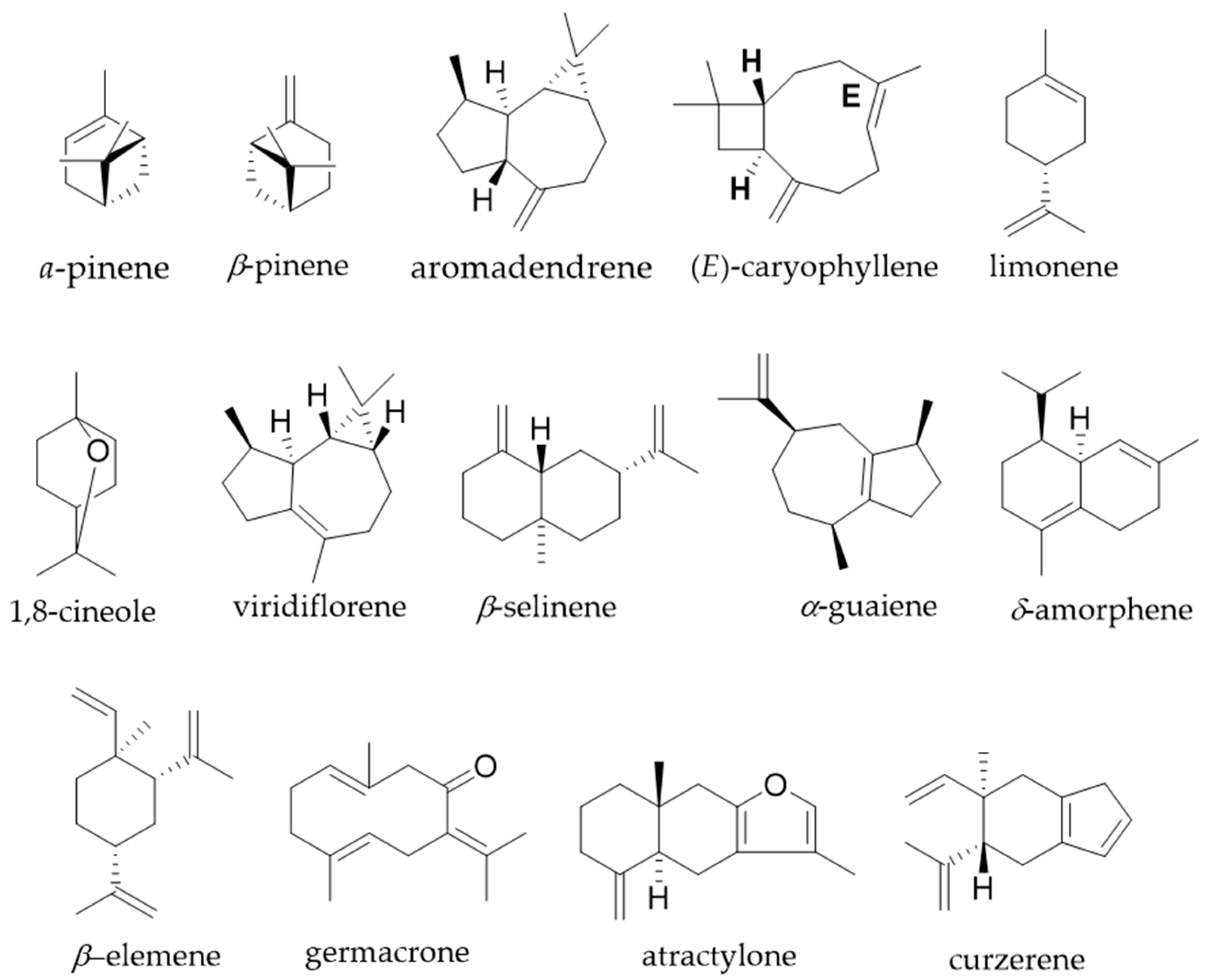
According to Table 2, the major components identified are α-pinene (20.51%), (E)-caryophyllene (17.52%) and 1,8-cineole (17.01%) in E. brasiliensis; (E)-caryophyllene (25.59%), viridiflorene (26.32%) and aromadendrene (18.96%) in E. involucrata; (E)-caryophyllene (19.19%) and viridiflorene (9.31%) in E. longipedunculata; β-selinene (22.88%), α-guaiene (16.23%), δ-amorphene (12.21%) and β-elemene (9.73%) in E. myrcianthes; α-pinene (79.92%) in E. neoverrucosa; α-pinene (32.94%) and limonene (24.56%) in E. pyriformis, and the germacrene-type sesquiterpenoids germacrone (26.48%), atractylone (11.08%) and curzerene (9.94%) in E. uniflora, Figure 1. Both hydrocarbon and oxygenated mono- and sesquiterpenes were identified. Minor compounds are listed in Table 2.

2.2. Chemical Analysis of Essential Oils from Eugenia Species Using Molecular Networking and Principal Component Analysis (PCA)

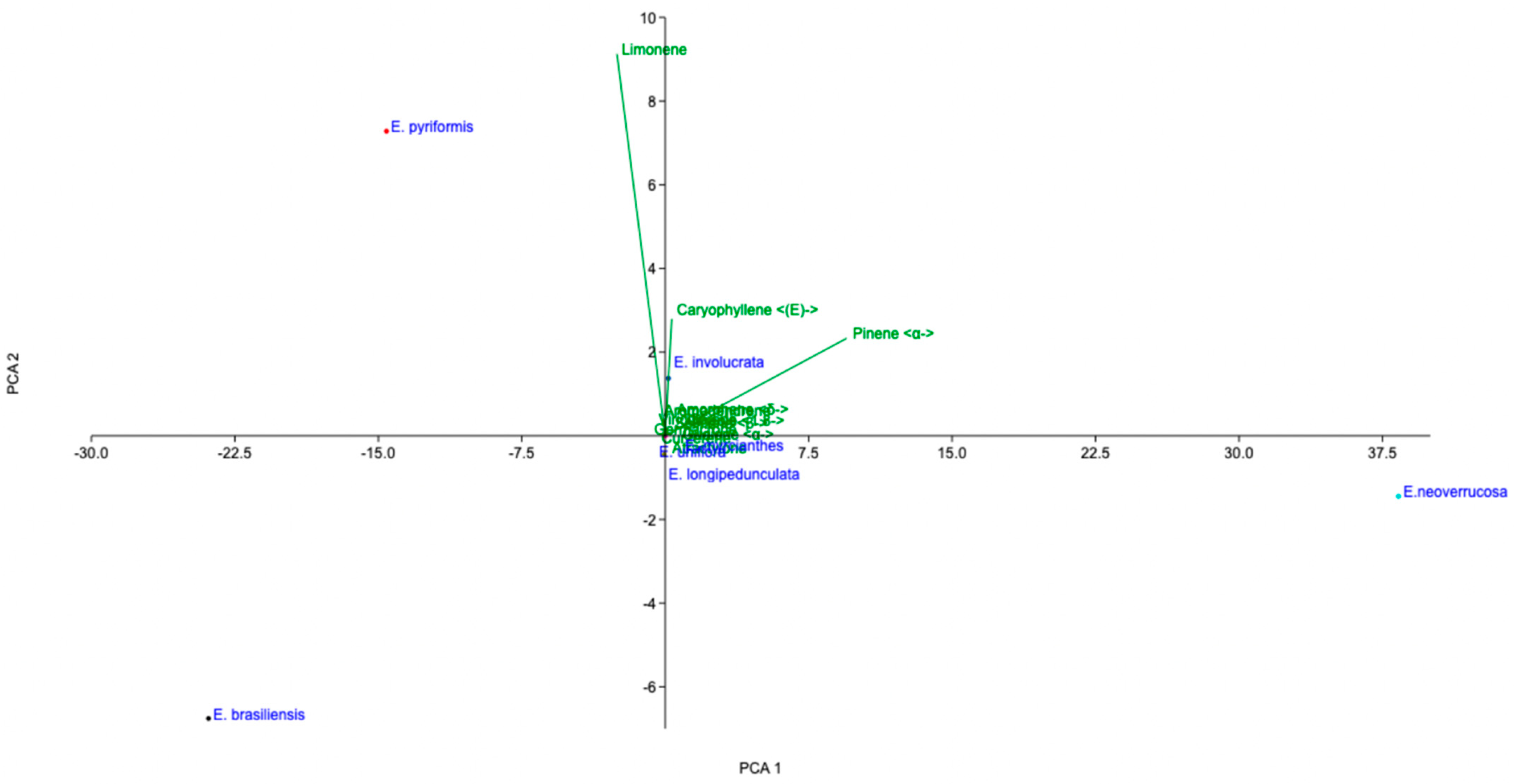
Correlation and multivariate analyses were conducted to highlight differences in chemical composition among the seven Eugenia species (Table 2) and the compounds presented (Figure 2). The loadings were calculated and are shown in Figure S1. Similarities among the EOs are evident in the PCA (Figure 2).
PC1 was mainly associated with monoterpenes such as α-pinene and sesquiterpenes like (E)-caryophyllene, which contributed positively to the separation along the horizontal axis. In contrast, PC2 was strongly influenced by limonene, which showed a high loading and was the primary driver of vertical separation.
The score plot revealed distinct clustering patterns among the samples. E. neoverrucosa was clearly separated along the positive PC1 axis, indicating a strong association with compounds such as α-pinene and (E)-caryophyllene. On the opposite side, E. pyriformis was positioned in the negative PC1 region, suggesting a different chemical profile with lower contributions from these compounds.
Additionally, E. brasiliensis was distinctly separated along the negative PC2 axis, indicating a unique composition likely characterized by lower limonene content or the presence of other compounds not strongly represented in the first two components. Samples such as E. involucrata and E. longipedunculata were grouped near the origin, suggesting similar and less chemically distinct profiles compared to the other species.
The loading plot corroborated these observations, showing that limonene was the most influential variable for PC2, while α-pinene and (E)-caryophyllene contributed significantly to PC1. The clustering pattern indicates clear chemical differentiation among species, reflecting variability in their secondary metabolite profiles.
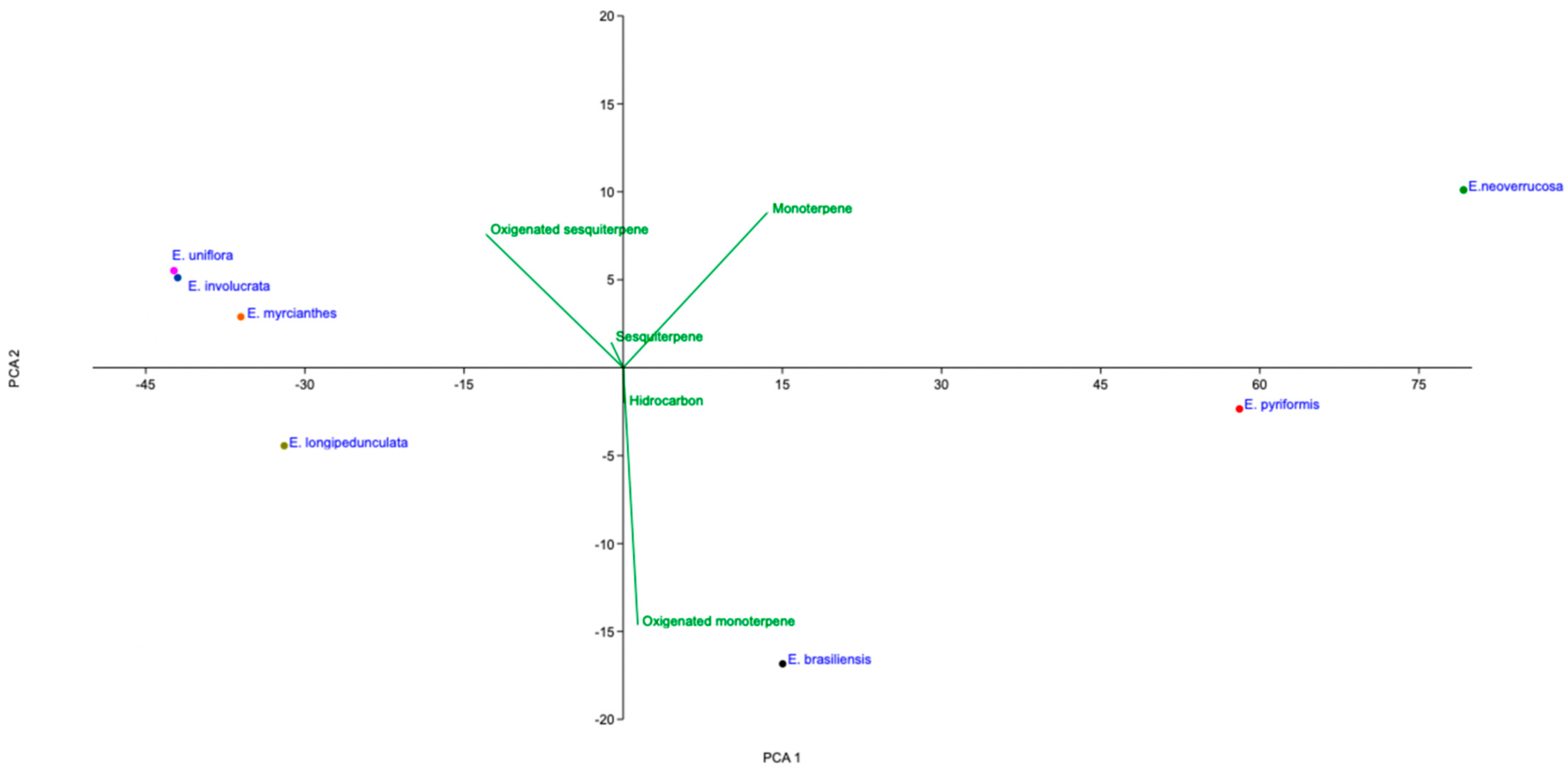
In Figure 3, the score plot showed distinct groupings among the species. E. neoverrucosa was clearly separated along the positive PC1 and PC2 axes, indicating a profile rich in monoterpenes and, to some extent, oxygenated sesquiterpenes. E. pyriformis was also positioned on the positive side of PC1 but closer to the negative side of PC2, suggesting a composition dominated by monoterpenes with lower contributions from oxygenated compounds.
In contrast, E. uniflora, E. involucrata, and E. myrcianthes clustered in the negative PC1 and positive PC2 regions, indicating a stronger association with oxygenated sesquiterpenes. E. longipedunculata fell in the negative regions of both PC1 and PC2, suggesting a distinct profile with reduced contributions from both monoterpenes and oxygenated compounds.
Notably, E. brasiliensis was separated along the negative PC2 axis, strongly associated with oxygenated monoterpenes, indicating a unique chemical profile compared to the other species.
The loading plot confirmed that monoterpenes, oxygenated monoterpenes, and oxygenated sesquiterpenes were the main variables responsible for sample discrimination, while hydrocarbons and sesquiterpenes showed lower influence on the separation pattern.

2.3. Insecticidal Activity Against Adult Fleas

A general increase in insecticidal activity was observed with increasing concentration for most of the evaluated EOs, although the intensity and consistency of this response varied among species. The EO of E. uniflora was the most active across nearly the entire concentration range, achieving 95.1% mortality at 800 µg·cm−2, demonstrating a strong dose–response relationship. The EO of E. brasiliensis showed moderate activity at low and intermediate concentrations but exhibited a marked increase at higher doses, achieving 80.0% mortality at 800 µg·cm−2.
In contrast, EOs pyriformis, E. neoverrucosa, and E. myrcianthes showed intermediate insecticidal activity, with mortalities of 60.0%, 52.4%, and 50.0%, respectively, at the highest tested concentration. Finally, E. involucrata was the least active oil among those evaluated, with a maximum mortality of 38.9% at 800 µg·cm−2 (Table 3).
Based on the mortality data, LC50 estimation was possible only for E. uniflora and E. brasiliensis. E. uniflora showed an LC50 of 9.12 µg·cm−2 (95% CI: 6.59–12.17), whereas E. brasiliensis presented an LC50 of 157.82 µg/cm2 (95% CI: 116.16–225.18). The slope coefficients were 1.19 for E. uniflora and 1.09 for E. brasiliensis. Chi-square tests indicated no significant deviation from the model (p ≥ 0.999) (Table 4).

3. Discussion

3.1. Chemistry of Essential Oils

According to Borsoi et al. [14], the EO yield from dried leaves of E. brasiliensis by hydrodistillation was 0.39%, similar to the value observed in this study and higher than yields from fresh leaves (0.08–0.14%) [15]. For E. involucrata, yields of 0.45% and 0.21% from dried leaves have been reported [16], which are higher than those obtained in the present study. Ref. [17] reported yields of 0.06% for E. myrcianthes, 0.42% for E. neoverrucosa, and 0.17% for E. pyriformis. In E. uniflora, yields reported in the literature vary widely (0.15–3.1%), and the yield obtained in this study (0.55%) falls within this range [14]. Overall, the yields obtained here are consistent with the literature, except for E. neoverrucosa, which exhibited a considerably higher yield.
Similar chemical profiles are observed in E. brasiliensis, E. neoverrucosa, and E. pyriformis, particularly due to the presence of α-pinene, which was most abundant in E. neoverrucosa. The substance (E)-caryophyllene was common to E. brasiliensis and E. longipedunculata. Viridiflorene was found in E. involucrata and E. longipedunculata. Differences among species and variations in minor constituents are shown in Table 2.
The major compounds observed in E. brasiliensis have previously been reported by [18], whose samples collected from different cities revealed that this species generally presents the same major constituents. These authors identified α-selinene (13.3–14.8%) and β-selinene (12.6–17.3%) as the main compounds and reported the bicyclic sesquiterpene (E)-caryophyllene (8.7–12.6%), which was also reported in the present study. The remaining compounds were also detected, but only in minor amounts. In fresh leaves of E. brasiliensis, the major constituent was α-muurolol (12.1%), and α-pinene was not detected [19]. In contrast, α-pinene (15.94%) was identified as the major compound in winter leaves of E. brasiliensis [15]. Germacrene B (22.17 ± 1.72), byciclogermacrene (19.76 ± 1.28), and β-elemene (10.86 ± 0.93) were detected as major compounds in E. involucrata by [16]. Elixene (26.53%) and caryophyllene (13.16%) were identified by [20]. This last compound corroborates with the current study: aromadendrene was found in minor amounts, and viridiflorene was not found in the studies mentioned.
There are no reports on the EO composition of E. longipedunculata; however, (E)-caryophyllene was common in other species examined in this study and in other species within the genus. The compound viridiflorene has been reported in dried leaves of E. uniflora [21], and E. myrcianthes [17,22] also reported E. myrcianthes (syn.: Hexachlamys edulis (O. Berg) Kausel & D. Legrand), in which the hydrocarbon sesquiterpene β-selinene (16.1%) was the major compound; β-elemene (1.0%) was detected in very small amounts, while the remaining constituents were not reported. The compound β-copaen-4-α-ol (31.7%) was identified by [17].
Nonpolar fractions of E. myrcianthes contained the following volatile compounds: in the hexane fraction, the triterpenes lupenyl acetate (45.39%), β-amyrone (12.69%), and squalene (12.18%); the cadinane sesquiterpenoid τ-muurolol (10.80%); viridiflorene (7.21%); and the tricyclic sesquiterpenoid spathulenol (4.57%). In the chloroform fraction, δ-cadinene (9.0%) and α-muurolene (4.15%) were detected, whereas in this study, they were present at 0.71% [23]. Different compounds were observed in extractions using nonpolar solvents, with sesquiterpenes and triterpenes predominating, whereas a distinct profile was obtained from Clevenger hydrodistillation in the present work.
In E. neoverrucosa, ref. [17] reported a high α-pinene concentration of 94.5%. In E. pyriformis, previous research [17] identified the bicyclic monoterpene isomers β-pinene (39.7%) and α-pinene (31.5%) as major compounds. Hydrodistillation of dried leaves identified β-caryophyllene (17.82%), bicyclogermacrene (12.84%), and globulol (5.96%) [24]. A seasonal analysis showed β-pinene as the most prevalent, with levels fluctuating between 0.2% and 25.7% and peaking in January. α-Pinene was present in small amounts (0.5–7.4%), and limonene varied from 0.3% to 22.0%, peaking in October [25].
This study identified high levels of α-pinene and limonene, along with a small amount of β-pinene (2.78%). Although seasonality was not examined here, the same compounds were present. The EO composition of E. uniflora has been widely studied using both fresh and dried leaves. The main compounds identified by hydrodistillation of dried leaves generally align with those reported in this study, though their proportions vary across studies. Frequently reported compounds include germacrone, curzerene, germacrene B, caryophyllene oxide, spathulenol, and α-selinene [14,21,26]. Additionally, atractylone, a sesquiterpenoid identified here, has been detected in minor amounts in other samples [14,26,27].

3.2. Insecticidal Activity of the Essential Oils

Among the species tested, only E. brasiliensis and E. uniflora showed insecticidal activity against adult C. felis felis. E. uniflora produced higher mortality than E. brasiliensis at concentrations of 5000, 10,000, 20,000, and 40,000 µg/mL, with mortality rates of 88.3%, 89.5%, 94.7%, and 95.1%, respectively. By comparison, E. brasiliensis produced mortalities of 25.1%, 55.0%, 75.0%, and 80.0% at the same concentrations. Accordingly, the LC50 for E. uniflora was about 17 times lower than that of E. brasiliensis (Table 4), indicating much higher toxicity. These results suggest that E. uniflora has greater insecticidal potential than E. brasiliensis against adult C. felis felis.
Recent studies have highlighted the potential of plant-derived essential oils to control parasite infestations in dogs and cats, including C. felis felis (fleas). EOs from Alpinia zerumbet B.L. Burtt & R.M. Smith, Cinnamomum spp., Cymbopogon nardus (L.) Rendle, Laurus nobilis L., Mentha spicata L., and Ocimum gratissimum L. have demonstrated activity against C. felis felis across developmental stages, including adults, larvae, and eggs [28]. In these species, 1,8-cineole (eucalyptol) was the major compound in A. zerumbet, O. gratissimum, and L. nobilis, as in E. brasiliensis. 1,8-cineole (24.11%), camphor (12.13%), and curzerenone (9.68%) were detected in the EO of fresh Curcuma zedoaria (Christm.) Roscoe rhizomes produced 100%, 94.23%, 100%, and 98% mortality against adult fleas, pupal stages, larvae, and eggs of C. felis felis, respectively, at concentrations of 800 µg·cm−2, 396 µg·cm−2, 117.5 µg·cm−2, and 396 µg·cm−2 [29].
The EO from fresh leaves of Piper aduncum L., rich in the phenylpropanoid dillapiole (77.56–85.52%), promoted 100% mortality of flea eggs at 100 µg/mL and of adults at 1000 µg/mL [6], a chemical profile not observed in the present study. Ref. [30] demonstrated that the EO from Baccharis trimera (Less.) DC. and Mimosa verrucosa Benth exhibited strong insecticidal activity against adult fleas, achieving 100% mortality at 800 µg·cm−2, with residual activity lasting up to three days and low toxicity (LC50 = 369.22 µg·cm−2). Interestingly, M. verrucosa contains α-pinene and (E)-caryophyllene as major constituents, compounds also identified in E. brasiliensis. The major compounds found in E. brasiliensis and E. uniflora have previously been associated with antiparasitic activity in other organisms. The compound (E)-caryophyllene, isolated from Ageratum conyzoides L. and tested orally in cross-bred male calves, was effective against tick species, such as the IVRI-I strain of Rhipicephalus microplus, R. annulatus, and Hyalomma anatolicum [31].
The EO of Psidium brownianum Mart. ex DC. contains isogermafurene (52.93%) and germacrone (16.02%), and the tested oil inhibited the parasites Leishmania braziliensis (92.61%), Leishmania infantum (84.16%), and Trypanosoma cruzi (57.05%) at 1000 µ/mL [32]. Additionally, Pretel et al. [33] synthesized various germacrene-derived compounds, among which 7,11-epoxieudesma-3,7(11)-dien-8-one exhibited insecticidal activity against the aphid Rhopalosiphum padi, a plant parasite, while 1,10-epoxygermacrone showed acaricidal activity against the tick Hyalomma lusitanicum and demonstrated greater activity than germacrone. These findings suggest that germacrone, identified in E. uniflora in the present study, may also serve as a promising precursor for bioactive derivatives.
The chemical component α-pinene has been reported to cause toxicity by fumigation and contact exposure in Sitophilus zeamais, with an LC50 value of 4.133 ppm after 14 days [34]. This compound has also shown activity against the cattle tick Rhipicephalus microplus at high concentrations [35], supporting its potential contribution to the insecticidal activity observed in the present study.
Despite the promising results, the use of essential oils in animals requires caution, as adverse reactions such as depression, incoordination, muscle tremors, pruritus, scratching, and weakness have been reported in pets [36,37]. Therefore, the findings presented here should be considered preliminary, highlighting the need for further toxicological and formulation studies before practical applications involving Eugenia essential oils.

4. Materials and Methods

Species of the genus Eugenia were collected in the state of Paraná, southern Brazil, within the Atlantic Forest biome. Botanical identification was performed, and voucher specimens were deposited in the Herbarium of the State University of Ponta Grossa, as detailed in Appendix A, Table A1. The collections were registered in the National System for the Management of Genetic Heritage and Associated Traditional Knowledge (SisGen) under registration code ADDD35A. Plant material for essential oil extraction was collected between September and December of 2024.

4.1. Preparation of Plant Material and Essential Oil Extraction

For the procedures below, the leaves were dried in an oven (LUCA-82, Lucadema®, São José do Rio Preto, São Paulo, Brazil) at 26 ± 4 °C and crushed in a blender. They were immediately subjected to essential oil extraction. The EO extraction was performed using a Clevenger apparatus via hydrodistillation for 2 h [38].

4.2. Gas Chromatography Coupled with Mass Spectrometry (GC-MS) Analyses

To separate, detect, and quantify the constituents, 1 μL of the volatile oil samples diluted in dichloromethane (10 μL/mL) at the defined times was injected into a gas chromatography (GC) instrument. A Hewlett-Packard 5890 Series II (Palo Alto, CA, USA), equipped with flame ionization detection and a split/splitless injector, in a split ratio of 1:20, was used to separate and detect the constituents in the volatile oil. The compounds were separated with a fused silica capillary column (5% phenyl and 95% dimethylpolysiloxane), with 30 m × 0.25 mm (i.d.) × 0.25 μm (film thickness). Helium was used as the carrier gas at a flow rate of 1 mL/min. The column temperature was programmed as follows: 60 °C for 2 min, then heating at 5 °C/min to 110 °C, at 3 °C/min to 150 °C, and finally at 15 °C/min to 290 °C, with a hold of 15 min. The injector temperature was 220 °C, and the detector temperature was 290 °C. To separate and identify the substances, 1 μL of the volatile oil samples, diluted in dichloromethane (10 μL/mL), was injected at defined times into the gas chromatograph coupled to a mass spectrometer (GC-MS) QP-2010 Plus (Shimadzu, Kyoto, Japan). The flow of the helium gas carrier, the capillary column, and the temperature conditions for the GC-MS analysis were the same as described for the GC. The temperature of the injector was 220 °C and the interface temperature was 250 °C. Mass spectra were obtained with a quadrupole detector operating at 70 eV, with a 40–400 m/z mass range and a scanning rate equal to 0.5 scan/s. The identification of volatile compounds in the volatile oil has been based on linear retention indices (LRI) and mass spectra of the samples, compared with authentic standards injected under the same conditions, with the NIST database (2008). The LRI was calculated based on the co-injection of an alkane series [39,40].

4.3. Insecticidal Activity Against Ctenocephalides felis felis

For each replicate, ten unfed adult fleas (five males and five females), 14 days post-emergence from the pupal stage, of the subspecies Ctenocephalides felis felis were used. Fleas originated from a laboratory colony maintained on cats, with approval from the Animal Use Ethics Committee (CEUA-IV-UFRRJ), protocol number 4313110419.
EOs of Eugenia spp. were diluted in analytical-grade acetone and prepared through a 1:2 serial dilution to obtain a range of ten concentrations from 40,000 to 78.125 µg/mL. For the bioassay, filter paper strips (Whatman No. 1, 80 g; area = 10 cm2) were impregnated with 200 µL of each solution. After impregnation, papers were left on the bench for at least 30 min to allow solvent evaporation. Final concentrations corresponded to the mass of EO remaining on the filter paper after acetone evaporation, resulting in a surface concentration range of 800 to 1.5 µg/cm2.
Each concentration was tested in six replicates. A negative control consisting of filter paper strips treated with acetone only was included to confirm the absence of vehicle effects. A positive control was performed using fipronil at 8 µg/cm2.
Bioassays were conducted to evaluate insecticidal activity by contact exposure of adult fleas. After drying, impregnated filter paper strips were placed inside test tubes, and fleas were introduced. Tubes were maintained in a climatic chamber at 27 ± 1 °C and 70 ± 10% relative humidity for 24 h.
After the exposure period, specimens were examined under a stereomicroscope to determine the biological effect. Mortality was assessed based on motility; individuals showing no movement were considered dead. The mortality percentage was calculated for each concentration according to the formula:
Mortality (%) = 100 × (number of dead individuals/total individuals exposed)
Lethal concentrations causing 50% (LC50) and 90% (LC90) mortality were estimated by probit analysis. Statistical analyses were performed in RStudio interface (version 4.3.2) (R Core Team) using the ecotoxicoly package, with a 95% confidence interval.

4.4. Data Analysis

Principal component analysis was performed using the PAST program, version 3.13.12. The data used for the multivariate analyses were the dependent variables compounds of the EOs and classes such as monoterpene hydrocarbons (MHs), oxygenated monoterpenes (OMs), sesquiterpene hydrocarbons (SHs), oxygenated sesquiterpenes (OSs), and diterpene (DIT), while the independent variables were essential oil samples based on species.

5. Conclusions

The findings of this work demonstrate significant chemical variability among EOs obtained from the leaves of the Eugenia species studied, with monoterpenes and oxygenated sesquiterpenes as the predominant constituents. Major compounds such as α-pinene, (E)-caryophyllene, viridiflorene, β-selinene, aromadendrene, limonene, and germacrone characterized distinct chemical profiles among species, as confirmed by principal component analysis. Among the evaluated samples, E. neoverrucosa presents the highest essential oil yield, while E. uniflora exhibited a distinctive composition rich in germacrone-type sesquiterpenoids. In the insecticidal assays against adult C. felis felis, E. uniflora shows the highest activity, reaching 95.1% mortality at 800 µg·cm−2 and presenting the lowest LC50 (9.12 µg·cm−2), whereas E. brasiliensis displays moderate activity; E. pyriformis, E. neoverrucosa, and E. myrcianthes show intermediate activity, and E. involucrata demonstrates lower effects. These findings expand the chemical knowledge of the genus and represent the first report of the EO composition of E. longipedunculata, and the insecticidal activity of Eugenia EOs against C. felis felis, highlighting E. uniflora as a promising source of natural compounds for ectoparasite control, although further studies on toxicity, active constituents, and formulation are still required.

Supplementary Materials

The following supporting information can be downloaded at: https://www.mdpi.com/article/10.3390/plants15091406/s1, Figure S1, Loadings calculated for the multivariate analysis of essential oils from Eugenia species.

Author Contributions

Conceptualization, methodology, formal analysis, investigation, writing—original draft preparation, writing—review and editing, L.A.; formal analysis, investigation, N.F.P.; formal analysis, investigation, writing—original draft preparation, D.R.C.; formal analysis, investigation, Y.P.C.; methodology, writing—original draft preparation, I.T.M.; formal analysis, investigation, N.M.M.E.; data curation, investigation, writing—original draft preparation, writing—review and editing, D.S.A.C.; supervision, project administration, writing—review and editing, J.M. All authors have read and agreed to the published version of the manuscript.

Funding

We would like to thank the National Council for Scientific and Technological Development (CNPq) for the post-doctoral senior fellowship, process number 175618/2023-2.

Data Availability Statement

Data are contained within the article and Supplemental Material.

Conflicts of Interest

The authors declare no conflicts of interest.

Abbreviations

The following abbreviations are used in this manuscript:
ALalcohol
ALDaldehyde
DITditerpene
EOsessential oils
LRILinear Retention Index
MHsmonoterpene hydrocarbons
GC-MSgas chromatography–mass spectrometry
OMsoxygenated monoterpenes
OSsoxygenated sesquiterpenes
PCAPrincipal component analysis
SHsesquiterpenes hydrocarbons

Appendix A

Table A1. Data collection of the Eugenia species.
SpeciesPopular NameSite of CollectionCoordinatesRegister
E. brasiliensisgrumixama, grumixameira ibaropoti, cumbixaba Ponta Grossa25°07′30.2″ S 50°09′25.5″ WHUPG23392
E. involucratacereja-do-mato, cerejeira-do-mato, cereja-do-rio-grandePonta Grossa 25°05′42.0″ S 50°09′42.8″ WHUPG 2824
E. longipedunculatapitanga-laranja, grumixama-mirim, grumixama-da-mata, grumixama-miúdaPonta Grossa25°07′30.2″ S 50°09′25.5″ WHUEPG23518
E. myrcianthespessegueiro-do-mato, ubajaí, Carambeí24°54′35.9″ S 50°09′41.5″ WHUEPG23349
E. neoverrucosaibirubá, guamirim-ripa, ibacurú, araçá-ripaPonta Grossa25°15′10.8″ S 50°00′06.1″ WHUEPG23391
E. pyriformisuvaia, uvalha, uvaieira, uvalheiraCarambeí25°07′30.2″ S 50°09′25.5″ WHUEPG23346
E. uniflorapitanga, pitangueiraPonta Grossa25°07′30.2″ S 50°09′25.5″ WHUEPG23347

References

  1. Banuls, D.; Brun, J.; Blua, J.L.; Cadiergues, M.C. A Dietary Plant Extract Formulation Helps Reduce Flea Populations in Cats: A Double-Blind Randomized Study. Pharmaceuticals 2023, 16, 195. [Google Scholar] [CrossRef] [PubMed]
  2. Tufan-Cetin, O.; Cetin, H. Insecticidal potential of Cedrus libani tar in eco-friendly control of cat flea, Ctenocephalides felis, from different populations in Türkiye. Heliyon 2024, 10, e39958. [Google Scholar] [CrossRef]
  3. Pereira, A.; Cruz, A.; Novo, T.; Maia, C. Ctenocephalides felis (cat flea). Trends Parasitol. 2025, 41, 249–250. [Google Scholar] [CrossRef]
  4. Wiles, D.; Pearson, J.S.; Beddoe, T. Harnessing Plant-Derived Terpenoids for Novel Approaches in Combating Bacterial and Parasite Infections in Veterinary and Agricultural Settings. Curr. Microbiol. 2025, 82, 134. [Google Scholar] [CrossRef]
  5. Soares, E.F.M.S.; Carlos, D.F.L.P.; Epifanio, N.M.M.; Coumendouros, K.; Cid, Y.P.; Chaves, D.S.A.; Campos, D.R. Insecticidal activity of essential oil of Cannabis sativa against the immature and adult stages of Ctenocephalides felis felis. Braz. J. Vet. Parasitol. 2023, 32, e015122. [Google Scholar] [CrossRef] [PubMed]
  6. Assunção, J.A.S.; Machado, D.B.; Felisberto, J.S.; Chaves, D.S.A.; Campos, D.R.; Cid, Y.P.; Sadgrove, N.J.; Ramos, Y.J.; Moreira, D.L. Insecticidal activity of essential oils from Piper aduncum against Ctenocephalides felis felis: A promising approach for flea control. Braz. J. Vet. Parasitol. 2024, 33, e007624. [Google Scholar] [CrossRef] [PubMed]
  7. POWO. Plants of the World Online: Eugenia P. Micheli ex L. Facilitated by the Royal Botanic Gardens, Kew. 2026. Available online: https://powo.science.kew.org/taxon/urn:lsid:ipni.org:names:326088-2 (accessed on 5 March 2026).
  8. Flora e Funga do Brasil: Eugenia L. 2026. Available online: https://floradobrasil.jbrj.gov.br/FB10338 (accessed on 5 March 2026).
  9. de Souza, A.A.; de Oliveira, C.F.; de Oliveira, V.B.; Betim, F.C.M.; Miguel, O.G.; Miguel, M.D. Traditional Uses, Phytochemistry, and Antimicrobial Activities of Eugenia Species—A Review. Planta Med. 2018, 84, 1232–1248. [Google Scholar] [CrossRef]
  10. Amorim, M.S.; Verdan, M.H.; Oliveira, C.S.; Santos, A.D.C. Essential Oils of Neotropical Myrtaceae Species from 2011 Until 2023: An Update. Chem. Biodivers. 2024, 22, e202401503. [Google Scholar] [CrossRef]
  11. Rodrigues, K.A.F.; Amorim, L.V.; Oliveira, J.M.G.; Dias, C.N.; Moraes, D.F.C.; Andrade, E.H.A.; Maia, J.G.S.; Carneiro, S.M.P.; Carvalho, F.A.A. Eugenia uniflora L. Essential Oil as a Potential Anti-Leishmania Agent: Effects on Leishmania amazonensis and Possible Mechanism of Action. Evid. Based Complement. Altern. Med. 2013, 2013, 279726. [Google Scholar] [CrossRef]
  12. Costa, W.K.; Cruz, R.C.D.; Carvalho, K.S.; Souza, I.A.; Correia, M.T.S.; Oliveira, A.M.; Silva, M.V. Insecticidal activity of essential oil from leaves of Eugenia stipitata McVaugh against Aedes aegypti. Parasitol. Int. 2024, 98, 102820. [Google Scholar] [CrossRef]
  13. Moraes, M.M.; Camara, C.A.G.; Santos, M.L.; Fagg, C.W. Essential Oil Composition of Eugenia langsdorffii O. Berg.: Relationships Between Some Terpenoids and Toxicity Against Tetranychus urticae. J. Braz. Chem. Soc. 2012, 23, 1647–1656. [Google Scholar] [CrossRef]
  14. Borsoi, F.T.; Possas, A.; Pastore, G.M.; Arruda, H.S. Essential Oil from Native Brazilian Plants of the Genus Eugenia as an Innovative and Sustainable Source of Active Ingredients for Food Systems and Human Health and Well-Being. Horticulturae 2024, 10, 768. [Google Scholar] [CrossRef]
  15. Siebert, D.A.; Tenfen, A.; Yamanaka, C.N.; Cordova, C.M.M.; Scharf, D.R.; Simionatto, E.L.; Alberton, M.D. Evaluation of seasonal chemical composition, antibacterial, antioxidant and anticholinesterase activity of essential oil from Eugenia brasiliensis Lam. Nat. Prod. Res. 2014, 29, 289–292. [Google Scholar] [CrossRef] [PubMed]
  16. D’Almeida, W.; Monteiro, L.M.; Raman, V.; Rehman, J.U.; Paludo, K.S.; Maia, B.H.L.N.S.; Casapula, I.; Khan, I.A.; Farago, P.V.; Budel, J.M. Microscopy of Eugenia involucrata, Chemical Composition and Biological Activities of the Volatile Oil. Rev. Bras. Farmacogn. 2021, 31, 239–243. [Google Scholar] [CrossRef]
  17. Perigo, C.V.; Haber, L.L.; Facanali, R.; Vieira, M.A.R.; Torres, R.B.; Bernacci, L.C.; Guimarães, E.F.; Baitello, J.B.; Sobral, M.E.G.; Quecini, V.; et al. Essential Oils of Aromatic Plant Species from the Atlantic Rainforest Exhibit Extensive Chemical Diversity and Antimicrobial Activity. Antibiotics 2022, 11, 1844. [Google Scholar] [CrossRef]
  18. Fischer, D.C.H.; Limberger, R.P.; Henrique, A.T.; Moreno, P.R.H. Essential Oils from Leaves of Two Eugenia brasiliensis Specimes from Southeastern Brazil. J. Essent. Oil Res. 2005, 17, 499–500. [Google Scholar] [CrossRef]
  19. da Silva, R.O.M.; Castro, J.W.G.; Dantas, O.M., Jr.; de Araújo, A.C.J.; Leandro, M.K.N.S.; Costa, R.J.O.; Pinto, L.L.; Leandro, L.M.G.; da Silva, L.E.; Amaral, W.; et al. Photoinduced Antibacterial Activity of the Essential Oils from Eugenia brasiliensis Lam. and Piper mosenii C. DC. by Blue Led Light. Antibiotics 2019, 8, 242. [Google Scholar] [CrossRef]
  20. Toledo, A.G.; Souza, J.G.L.; Silva, J.P.B.; Favreto, W.A.J.; Costa, W.F.; Pinto, F.G.S. Chemical composition, antimicrobial and antioxidante activity of the essential oil of leaves Eugenia involucrata DC. Biosci. J. 2020, 36, 568–577. [Google Scholar] [CrossRef]
  21. da Costa, J.S.; Barroso, A.S.; Mourão, R.H.V.; da Silva, J.K.R.; Maia, J.G.S.; Figueiredo, P.L.B. Seasonal and Antioxidant Evaluation of Essential Oil from Eugenia uniflora L., Curzerene-Rich, Thermally Produced in Situ. Biomolecules 2020, 10, 328. [Google Scholar] [CrossRef]
  22. Apel, M.A.; Sobral, M.; Menut, C.; Bassiere, J.M.; Zuanazzi, J.A.; Schapoval, E.E.S.; Henriques, A.T. Volatile constituents of four Hexachlamys species growing in South Brazil. Flavour Frag. J. 2005, 20, 176–179. [Google Scholar] [CrossRef]
  23. Grau, L.; Marin, L.; Ferreira, F.; Gayozo, E.; Moura-Mendes, J.; Gamenara, D. Chemical constituents of non-polar fractions and biological activities of Eugenia myrcianthes (Myrtaceae) leaves. Lilloa 2025, 62, 323–339. [Google Scholar] [CrossRef]
  24. Souza, A.M.; Oliveira, V.B.; Oliveira, C.F.; Betim, F.C.M.; Pacheco, S.D.G.; Cogo, L.L.; Miguel, O.G.; Miguel, M.D. Chemical Composition and In Vitro Antimicrobial Activity of the Essential Oil Obtained from Eugenia pyriformis Cambess. (Myrtaceae). Braz. Arch. Biol. Technol. 2021, 64, e21200663. [Google Scholar] [CrossRef]
  25. Stefanello, M.É.A.; Wisniewski, A., Jr.; Simionatto, E.L.; Cervi, A.C. Composição Química e Variação Sazonal dos Óleos Essenciais de Eugenia pyriformis (Myrtaceae). Lat. Am. J. Pharm. 2009, 28, 449–453. [Google Scholar]
  26. de Jesus, E.N.S.; Tavares, M.S.; Barros, P.A.C.; Miller, D.C.; da Silva, P.I.C.; Freitas, J.J.S.; de Lima, A.B.; Setzer, W.N.; da Silva, J.K.R.; Figueiredo, P.L.B. Chemical composition, antinociceptive and anti-inflammatory activities of the curzerene type essential oil of Eugenia uniflora from Brazil. J. Ethnopharmacol. 2023, 317, 116859. [Google Scholar] [CrossRef]
  27. Lobo, A.P.; Camara, C.A.G.; Melo, J.P.R.; Moraes, M.M. Chemical composition and repellent activity of essential oils from the leaves of Cinnamomum zeylanicum and Eugenia uniflora against Diaphania hyalinata L. (Lepidoptera: Crambidade). J. Plant Dis. Prot. 2019, 126, 79–87. [Google Scholar] [CrossRef]
  28. Santos, J.F.S.; Rocha, J.E.; Bezerra, C.F.; Silva, M.K.N.; Matos, Y.M.L.S.; Freitas, T.S.; Santos, A.T.L.; Cruz, R.P.; Machado, A.J.T.; Rodrigues, T.H.S.; et al. Chemical composition, antifungal activity and potential anti-virulence evaluation of the Eugenia uniflora essential oil against Candida spp. Food Chem. 2018, 261, 233–239. [Google Scholar] [CrossRef]
  29. Luna, F.D.F.L.; Souza, B.A.; Campos, D.R.; Camargo, N.S.; Riger, C.J.; Cid, Y.P.; Simas, N.K.; Barreto, A.S.; Oliveira, R.G., Jr.; Chaves, D.S.A. Evaluation of the pulicidal potential of the essential oil of Curcuma zedoaria. Phytochem. Lett. 2024, 61, 280–285. [Google Scholar] [CrossRef]
  30. Pereira, N.F.; Souza, B.A.; Campos, D.R.; Camargo, N.S.; Carlos, D.F.L.P.; Cruz, T.A.; Riger, C.J.; Rodriguez, S.A.; Cid, Y.P.; Chaves, D.S.A. Evaluation of Essential Oils from the Brazilian Species Baccharis trimera (Less.) DC. and Mimosa verrucosa Benth. against Ctenocephalides felis felis Bouché. Braz. Arch. Biol. Technol. 2025, 68, e25240095. [Google Scholar] [CrossRef]
  31. Chigure, G.M.; Sharma, A.K.; Ajithkumar, K.G.; Fular, A.; Tayade, A.B.; Kumar, R.; Jadhav, N.D.; Kumar, S.; Gupta, S.; Nagar, G.; et al. Evaluation of β-caryophyllene(1-3) as a potential anti-tick molecule for controlling tick infestations on animals. Exp. Parasitol. 2025, 274, 108969. [Google Scholar] [CrossRef] [PubMed]
  32. Bezerra, J.N.; Gomez, M.C.V.; Rolón, M.; Coronel, C.; Almeida-Bezerra, J.W.; Fidelis, K.R.; Menezes, S.A.; Cruz, R.P.; Duarte, A.E.; Ribeiro, P.R.V.; et al. Chemical composition, Evaluation of Antiparasitary and Cytotoxic Activity of the essential oil Psidium brownianum Mart ex DC. Biocatal. Agric. Biotechnol. 2022, 39, 102247. [Google Scholar] [CrossRef]
  33. Pretel, A.G.; Pérez del Pulgar, H.; Guerrero de León, E.; López-Pérez, J.L.; Olmeda, A.S.; Gonzalez-Coloma, A.; Barrero, A.F.; Quílez del Moral, J.F. Germacrone Derivatives as New Insecticidal and Acaricidal Compounds: A Structure–Activity Relationship. Molecules 2019, 24, 2898. [Google Scholar] [CrossRef]
  34. Allenspach, M.; Steuer, C. α-Pinene: A never-ending story. Phytochemistry 2021, 190, 112857. [Google Scholar] [CrossRef] [PubMed]
  35. Arantes, A.C.S.; Ribeiro, J.C.S.; Soares, D.S.; Reis, A.C.; Cardoso, M.G.; Remedio, R.N. Alpha- and beta-pinene isomers act differently to control Rhipicephalus microplus (Acari: Ixodidae). Parasitol. Res. 2024, 123, 164. [Google Scholar] [CrossRef]
  36. Rust, M.K. Recent Advancements in the Control of Cat Fleas. Insects 2020, 11, 668. [Google Scholar] [CrossRef] [PubMed]
  37. Tadee, P.; Chansakaow, S.; Tipduangta, P.; Tadee, P.; Khaodang, P.; Chukiatsiri, K. Essential oil Pharmaceutical for killing ectoparasites on dogs. J. Vet. Sci. 2024, 25, e5. [Google Scholar] [CrossRef]
  38. Agência Nacional de Vigilância Sanitária (ANVISA). Farmacopeia Brasileira, 7th ed.; ANVISA: Brasília, Brazil, 2024.
  39. Van den Dool, H.; Kratz, P.D. A generalization of the retention index system including linear temperature programmed gas–liquid partition chromatography. J. Chromatogr. 1963, 11, 463–471. [Google Scholar] [CrossRef]
  40. Adams, R.P. Identification of Essential Oil Components by Gas Chromatography/Mass Spectrometry; Allured Publishing Corporation: Carol Stream, IL, USA, 2001. [Google Scholar]
Figure 1. Major structures in Eugenia species.
Plants 15 01406 g001
Figure 2. Principal component analysis (PCA1 = 94.53, PCA2 = 4.31%, and PCA3 = 1.15) of 7 essential oil samples from Eugenia species, obtained by hydrodistillation and analyzed by GC–MS, and the correlation of all chemical components was identified in the analysis. Only compounds with concentrations above 10% were considered for analysis.
Plants 15 01406 g002
Figure 3. Principal component analysis (PCA1 = 96.70, PCA2 = 2.90%) of 7 essential oil samples from Eugenia species, obtained by hydrodistillation and analyzed by GC–MS, and the correlation of the presented class (hydrocarbons, monoterpenes, oxygenated monoterpenes, sesquiterpenes, and oxygenated sesquiterpenes).
Plants 15 01406 g003
Table 1. Essential oil yield observed in seven species of Eugenia genus.
Mass (g)Yield (mL)Yield (%)
E. brasiliensis806.352.40.30
E. involucrata2577.692.30.09
E. longipedunculata356.801.20.34
E. myrcianthes1543.981.30.08
E. neoverrucosa498.614.50.90
E. pyriformis2370.232.30.1
E. uniflora829.654.50.55
Source: The author, 2026.
Table 2. Chemical composition of essential oils from the leaves of Eugenia species.
CompoundsLRIE.
brasiliensis
E.
involucrata
E.
longipedunculata
E.
myrcianthes
E.
neoverrucosa
E.
pyriformis
E.
uniflora
Class
2-Hexanol 7962.182.07-1.3-3.2-AL
(2E)-Hexenal8460.73--0.12---ALD
(3Z)-Hexenol8500.67-----0.44AL
Santene884-----2.1-MH
α-Pinene93220.51-7.76-81.932.94-MH
Camphene946----0.32--MH
β-Pinene974----3.712.78-MH
Myrcene988---1.030.372-MH
δ-3-Carene (based on RI)10010.96----0.58-MH
α-Phellandrene1002-----2.8-MH
ρ-Cymene10205.9------MH
Limonene10243.14-1.42-2.6724.56-MH
1,8-Cineole102617.01-5.99--0.41-OM
(Z)-β-Ocimene (based on RI)1032-----3.36-MH
α-Campholenal1122-----6.44-MH
γ-Terpinene10542.08-1.01-0.27--MH
Isoborneol1155-----1.87-OM
γ-Terpineol1162----3.9--OM
Borneol11650.72------OM
α-Terpineol11861.25---0.27--OM
Cubebene13482.380.64-2.270.530.63.35SH
Isoledene1374-0.28----1.26SH
α-Copaene1376--3.32----SH
β-Panasinsene1381-0.96-----SH
β-Elemene1389-3.391.559.73--1.29SH
Bornyl acetate1284----0.25--OM
α-Ylangene1373----1.52--SH
(E)-Caryophyllene141717.5225.5919.196.974.298.355.28SH
α-Guaiene1437---16.23-4.02-SH
Aromadendrene1439-18.963.93----SH
(Z)-β-Farnesene14400.66------SH
cis-Muurola-3.5-diene14481.990.66-----SH
Himachalene1449------0.09SH
trans-Muurola-3.5-diene1451-----1-SH
α-Humulene14522.043.032.753.16---SH
β-Farnesene1454-----0.1-SH
allo-Aromadendrene 1458---0.56-2.94.58SH
Dehydroaromadendrane1460--4.37----SH
9-epi-(E)-Caryophyllene 1464--1.8----SH
γ-Gurjunene1475---3.1---SH
γ-Muurolene1478---5.7--0.39SH
Germacrene D14800.781.16----2.76SH
α-Amorphene1483---0.22--0.4SH
β-Selinene1489-7.360.7422.88--1.01SH
δ-Selinene1492--0.65----SH
γ-Amorphene14951.42-2.491.3--0.59SH
Viridiflorene14962.0126.329.31----SH
Curzerene1499------11.2SH
α-Muurolene1500--0.890.71--1.45SH
trans-β-Guaiene1502--1.72----SH
β-Bisabolene15055.810.576.83----SH
Germacrene A1508---0.85---SH
δ-Amorphene1511--4.412.21--7.51SH
7-epi-α-Selinene 1520---0.17---SH
δ-Cadinene15222.663.96-----SH
Zonarene1529--0.74----SH
Z-Nerolidol (based on RI)1531------1.57SH
α-Cadinene1537------6.36SH
Selina-3,7(11)-diene1545------2.98SH
Spathulenol15774.87-1.6----OS
Globulol1590--3.57----OS
Viridiflorol1592--2.04----OS
Cubeban-11-ol1595--0.88----OS
Rosifoliol1600--1.82----OS
1-epi-Cubenol1627--1.81----OS
Cedranone1628-0.68-----OS
epi-α-Muurolol1640--1.73----OS
α-Cadinol1652---1.37---OS
neo-Intermedol1658--2.650.41---OS
Atractylone1657------16.08OS
Selin-11-en-4-α-ol1658---4.26-- OS
Germacrone1693------26.48OS
Hydrocarbons 3.582.0701.4203.20.44
Monoterpene 30.5101.421.0388.9767.760
Oxygenated monoterpene 21.0607.004.4412.080
Sesquiterpene 2.385.274.8712.00.530.65.9
Oxygenated sesquiterpene 39.7688.2975.9180.16.0615.3788.73
Total 97.395.697.094.610010095.1
Footnote: -: not detected; bold: major components; Al: alcohol; ADL: aldehyde; LRI: Linear Retention Index; MHs: monoterpene hydrocarbons; OMs: oxygenated monoterpenes; OSs: oxygenated sesquiterpenes; SHs: sesquiterpene hydrocarbons.
Table 3. Insecticidal activity (%) of essential oils from Eugenia spp. against adults of Ctenocephalides felis felis.
Concentration (µg·cm−2)E.
brasiliensis
E.
involucrata
E.
longipedunculata
E.
myrcianthes
E.
neoverrucosa
E.
pyriformis
E.
uniflora
1.50.00.00.00.00.020.05.3
30.00.00.04.89.555.020.0
615.05.35.69.517.69.521.1
1217.00.010.04.819.416.747.3
2519.25.310.615.020.013.655.0
5023.85.042.228.623.810.070.6
10025.119.038.942.124.345.088.3
20055.031.665.363.222.231.689.5
40075.031.660.035.025.542.994.7
80080.038.965.350.052.460.095.1
Note: The positive control resulted in 100% mortality in all bioassays, while the negative control produced no mortality.
Table 4. Lethal concentration (LC50) values of essential oils from Eugenia uniflora and Eugenia brasiliensis obtained by probit analysis.
Essential OilLC50 (µg/cm2)95% CI (Lower–Upper)Slope ± SER2χ2p-Value
E. uniflora9.126.59–12.171.19 ± 3.860.91113.2401.000
E. brasiliensis157.82116.16–225.181.09 ± 2.590.89021.7700.999
Disclaimer/Publisher’s Note: The statements, opinions and data contained in all publications are solely those of the individual author(s) and contributor(s) and not of MDPI and/or the editor(s). MDPI and/or the editor(s) disclaim responsibility for any injury to people or property resulting from any ideas, methods, instructions or products referred to in the content.