Anti-Inflammatory Properties of Garrya flavescens: Phytochemical Profiling and Mitigation of LPS-Induced Neuroinflammation via ERK Signaling and Mitochondrial Modulation

 , , ,
, , ,
Abstract
1. Introduction
2. Results
2.1. Chemical Profiling and Quantitative Analysis of Garrya flavescens Extract
2.2. Anti-Inflammatory Activity of Garrya flavescens Extract
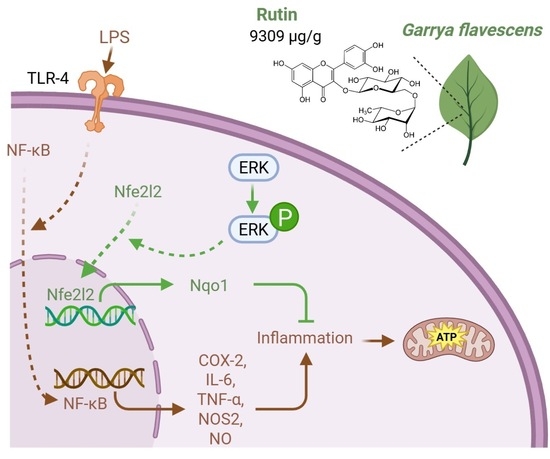
2.3. Signaling Pathways of Garrya flavescens Extract in Microglial Cells Under LPS Stimulation
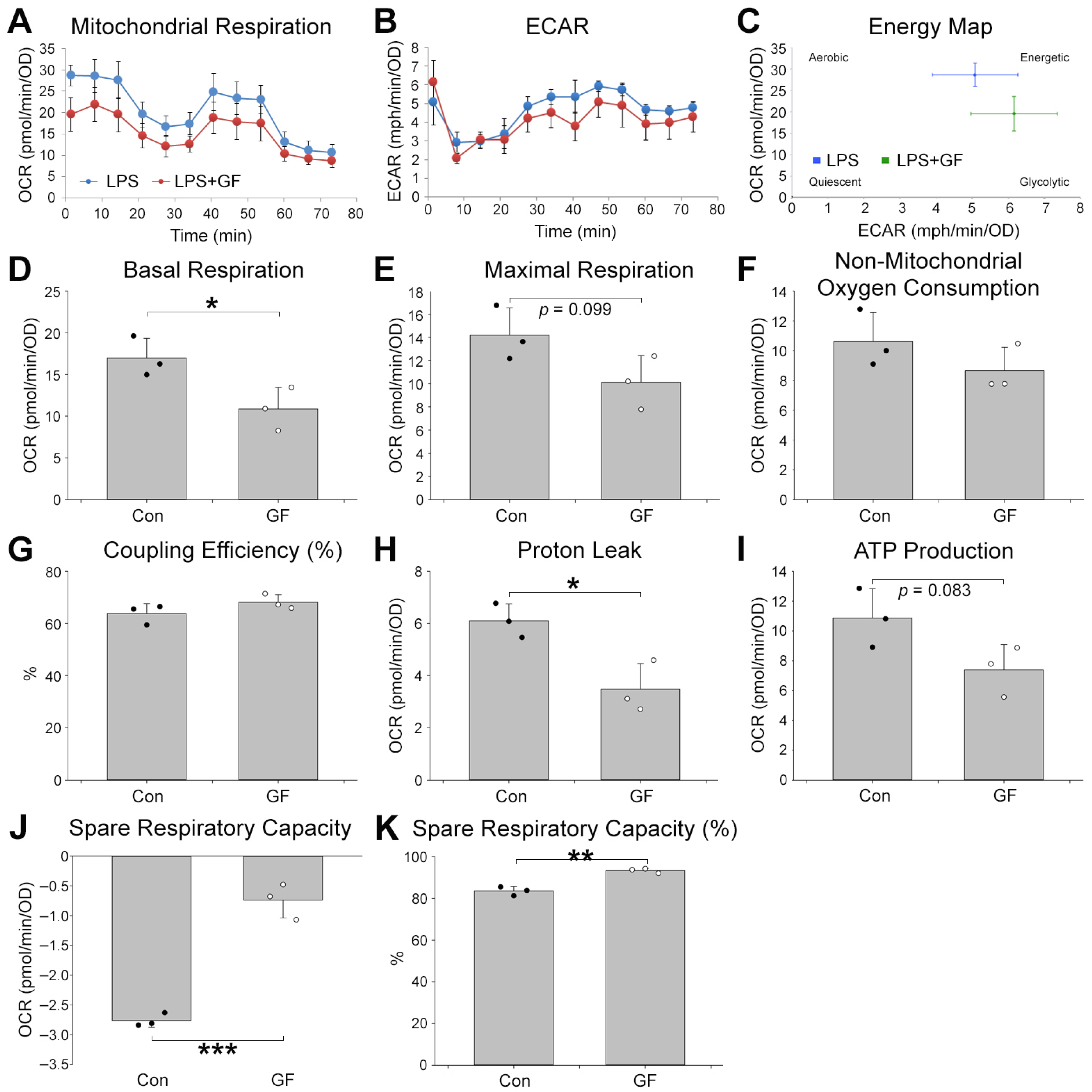
2.4. Effects of Garrya flavescens Extract on Mitochondrial Function Parameters in Microglial Cells Under LPS Stimulation
3. Discussion
4. Materials and Methods
4.1. Plant Material and Extract Preparation
4.2. LC-HRMS and HPLC
4.3. Cell Culture and Treatment
4.4. Quantitative Real-Time PCR
4.5. Elisa, Nitric Oxide Measurement and Cell Viability
4.6. Western Blot Analysis
4.7. Antibodies and Chemicals
4.8. Seahorse Extracellular Flux Analysis
4.9. Statistical Analysis
Supplementary Materials
Author Contributions
Funding
Data Availability Statement
Acknowledgments
Conflicts of Interest
Abbreviations
References
- Yarnell, E.A.; Abascal, K. Spasmolytic Botanicals: Relaxing Smooth Muscle with Herbs. Altern. Complement. Ther. 2011, 17, 169–174. [Google Scholar] [CrossRef]
- Colonna, M.; Butovsky, O. Microglia Function in the Central Nervous System During Health and Neurodegeneration. Annu. Rev. Immunol. 2017, 35, 441–468. [Google Scholar] [CrossRef]
- Alzahrani, N.A.; Bahaidrah, K.A.; Mansouri, R.A.; Alsufiani, H.M.; Alghamdi, B.S. Investigation of the optimal dose for experimental lipopolysaccharide-induced recognition memory impairment: Behavioral and histological studies. J. Integr. Neurosci. 2022, 21, 49. [Google Scholar] [CrossRef] [PubMed]
- Zhao, J.; Bi, W.; Xiao, S.; Lan, X.; Cheng, X.; Zhang, J.; Lu, D.; Wei, W.; Wang, Y.; Li, H.; et al. Neuroinflammation induced by lipopolysaccharide causes cognitive impairment in mice. Sci. Rep. 2019, 9, 5790. [Google Scholar] [CrossRef]
- Deng, I.; Corrigan, F.; Zhai, G.; Zhou, X.F.; Bobrovskaya, L. Lipopolysaccharide animal models of Parkinson’s disease: Recent progress and relevance to clinical disease. Brain Behav. Immun. Health 2020, 4, 100060. [Google Scholar] [CrossRef]
- Vandenbark, A.A.; Offner, H.; Matejuk, S.; Matejuk, A. Microglia and astrocyte involvement in neurodegeneration and brain cancer. J. Neuroinflamm. 2021, 18, 298. [Google Scholar] [CrossRef] [PubMed]
- Jung, H.; Lee, D.; You, H.; Lee, M.; Kim, H.; Cheong, E.; Um, J.W. LPS induces microglial activation and GABAergic synaptic deficits in the hippocampus accompanied by prolonged cognitive impairment. Sci. Rep. 2023, 13, 6547. [Google Scholar] [CrossRef]
- Liu, D.; Wang, Z.; Liu, S.; Wang, F.; Zhao, S.; Hao, A. Anti-inflammatory effects of fluoxetine in lipopolysaccharide(LPS)-stimulated microglial cells. Neuropharmacology 2011, 61, 592–599. [Google Scholar] [CrossRef]
- Choi, S.S.; Park, H.R.; Lee, K.A. A Comparative Study of Rutin and Rutin Glycoside: Antioxidant Activity, Anti-Inflammatory Effect, Effect on Platelet Aggregation and Blood Coagulation. Antioxidants 2021, 10, 1696. [Google Scholar] [CrossRef] [PubMed]
- Lee, G.B.; Kim, Y.; Lee, K.E.; Vinayagam, R.; Singh, M.; Kang, S.G. Anti-Inflammatory Effects of Quercetin, Rutin, and Troxerutin Result From the Inhibition of NO Production and the Reduction of COX-2 Levels in RAW 264.7 Cells Treated with LPS. Appl. Biochem. Biotechnol. 2024, 196, 8431–8452. [Google Scholar] [CrossRef]
- Kwon, H.S.; Koh, S.H. Neuroinflammation in neurodegenerative disorders: The roles of microglia and astrocytes. Transl. Neurodegener. 2020, 9, 42. [Google Scholar] [CrossRef]
- Naveed, M.; Hejazi, V.; Abbas, M.; Kamboh, A.A.; Khan, G.J.; Shumzaid, M.; Ahmad, F.; Babazadeh, D.; FangFang, X.; Modarresi-Ghazani, F.; et al. Chlorogenic acid (CGA): A pharmacological review and call for further research. Biomed. Pharmacother. 2018, 97, 67–74. [Google Scholar] [CrossRef] [PubMed]
- Kimura, A.; Kitajima, M.; Nishida, K.; Serada, S.; Fujimoto, M.; Naka, T.; Fujii-Kuriyama, Y.; Sakamato, S.; Ito, T.; Handa, H.; et al. NQO1 inhibits the TLR-dependent production of selective cytokines by promoting IκB-ζ degradation. J. Exp. Med. 2018, 215, 2197–2209. [Google Scholar] [CrossRef] [PubMed]
- Li, Y.; Xia, X.; Wang, Y.; Zheng, J.C. Mitochondrial dysfunction in microglia: A novel perspective for pathogenesis of Alzheimer’s disease. J. Neuroinflamm. 2022, 19, 248. [Google Scholar] [CrossRef] [PubMed]
- Shahar, B.; Indira, A.; Santosh, O.; Dolma, N.; Chongtham, N. Nutritional composition, antioxidant activity and characterization of bioactive compounds from Thymus serpyllum L.: An underexploited wild aromatic plant. Meas. Food 2023, 10, 100092. [Google Scholar] [CrossRef]
- Slimestad, R.; Fossen, T.; Brede, C. Flavonoids and other phenolics in herbs commonly used in Norwegian commercial kitchens. Food Chem. 2020, 309, 125678. [Google Scholar] [CrossRef]
- Kraujalis, P.; Venskutonis, P.R.; Ibáñez, E.; Herrero, M. Optimization of rutin isolation from Amaranthus paniculatus leaves by high pressure extraction and fractionation techniques. J. Supercrit. Fluids 2015, 104, 234–242. [Google Scholar] [CrossRef]
- Tobar-Delgado, E.; Mejia-Espana, D.; Osorio-Mora, O.; Serna-Cock, L. Rutin: Family Farming Products’ Extraction Sources, Industrial Applications and Current Trends in Biological Activity Protection. Molecules 2023, 28, 5864. [Google Scholar] [CrossRef]
- Kreft, I.; Fabjan, N.; Yasumoto, K. Rutin content in buckwheat (Fagopyrum esculentum Moench) food materials and products. Food Chem. 2006, 98, 508–512. [Google Scholar] [CrossRef]
- Soares, M.S.; da Silva, D.F.; Forim, M.R.; da Silva, M.F.; Fernandes, J.B.; Vieira, P.C.; Silva, D.B.; Lopes, N.P.; de Carvalho, S.A.; de Souza, A.A.; et al. Quantification and localization of hesperidin and rutin in Citrus sinensis grafted on C. limonia after Xylella fastidiosa infection by HPLC-UV and MALDI imaging mass spectrometry. Phytochemistry 2015, 115, 161–170. [Google Scholar] [CrossRef]
- Muvhulawa, N.; Dludla, P.V.; Ziqubu, K.; Mthembu, S.X.H.; Mthiyane, F.; Nkambule, B.B.; Mazibuko-Mbeje, S.E. Rutin ameliorates inflammation and improves metabolic function: A comprehensive analysis of scientific literature. Pharmacol. Res. 2022, 178, 106163. [Google Scholar] [CrossRef]
- Habtemariam, S. Rutin as a Natural Therapy for Alzheimer’s Disease: Insights into its Mechanisms of Action. Curr. Med. Chem. 2016, 23, 860–873. [Google Scholar] [CrossRef]
- Li, C.; Chen, T.; Zhou, H.; Zhang, C.; Feng, Y.; Tang, F.; Hoi, M.P.; He, C.; Zheng, Y.; Lee, S.M. Schisantherin A Attenuates Neuroinflammation in Activated Microglia: Role of Nrf2 Activation Through ERK Phosphorylation. Cell. Physiol. Biochem. 2018, 47, 1769–1784. [Google Scholar] [CrossRef] [PubMed]
- Li, C.; Yang, F.; Liu, F.; Li, D.; Yang, T. NRF2/HO-1 activation via ERK pathway involved in the anti-neuroinflammatory effect of Astragaloside IV in LPS induced microglial cells. Neurosci. Lett. 2018, 666, 104–110. [Google Scholar] [CrossRef]
- Nair, S.; Sobotka, K.S.; Joshi, P.; Gressens, P.; Fleiss, B.; Thornton, C.; Mallard, C.; Hagberg, H. Lipopolysaccharide-induced alteration of mitochondrial morphology induces a metabolic shift in microglia modulating the inflammatory response in vitro and in vivo. Glia 2019, 67, 1047–1061. [Google Scholar] [CrossRef] [PubMed]
- Zhou, L.; Zhang, Y.F.; Yang, F.H.; Mao, H.Q.; Chen, Z.; Zhang, L. Mitochondrial DNA leakage induces odontoblast inflammation via the cGAS-STING pathway. Cell Commun. Signal. 2021, 19, 58. [Google Scholar] [CrossRef]
- Caesar, L.K.; Cech, N.B. Synergy and antagonism in natural product extracts: When 1 + 1 does not equal 2. Nat. Prod. Rep. 2019, 36, 869–888. [Google Scholar] [CrossRef] [PubMed]
- Riva, A.; Kolimar, D.; Spittler, A.; Wisgrill, L.; Herbold, C.W.; Abranko, L.; Berry, D. Conversion of Rutin, a Prevalent Dietary Flavonol, by the Human Gut Microbiota. Front. Microbiol. 2020, 11, 585428. [Google Scholar] [CrossRef]



| Category | Parameter | Description/Condition |
|---|---|---|
| Materials | Solvents | Ultrapure water (Milli-Q); Acetonitrile (Honeywell B&J, Muskegon, MI, USA) |
| Reagent | Formic acid (Sigma-Aldrich, St. Louis, MO, USA) | |
| LC System | Instrument | Ultimate 3000 UHPLC system (Thermo Fisher Scientific, Waltham, MA, USA) |
| Column | Acquity UPLC BEH C18 (1.7 μm; Waters, Milford, MA, USA) | |
| Mobile phase | A: 0.1% Formic acid in water; B: 0.1% Formic acid in acetonitrile | |
| Flow rate | 400 μL/min | |
| Injection volume | 2 μL | |
| Gradient elution | 0–1.5 min: 5%B; 1.5–20 min: 70% B | |
| MS System | Instrument | LTQ-Orbitrap XL (Thermo Fisher Scientific) |
| Ionization mode | Electrospray ionization (ESI), Positive mode ([M+H]+) | |
| Scan range | PDA: 200–500 nm; MS: m/z 150–1500 | |
| Spray voltage | 3.5 kV | |
| Capillary voltage | 20 V | |
| Capillary temp. | 350 °C | |
| Software | Xcalibur (version 4.1; Thermo Fisher Scientific, Waltham, MA, USA) |
| Parameter | Operating Conditions |
|---|---|
| Column | Kromasil 100-3.5-C18 |
| Column temperature | Room temperature |
| Column dimension | 4.6 × 250 mm |
| Flow rate | 1 mL/min |
| Detector | UV Detector |
| Particle size | 5 micron |
| Detection | Rutin 254 nm |
| Injection volume | 10 μL |
| Mobile phase condition | Rutin (A. Methanol; B. Water) 0~10 min: 10-65% A; 10~20 min: 65%A; 20~40 min: 65-100%A; 40~45 min: 100%A; 45~47 min: 100-10%A; 47~50 min: 10%A |
| Sample | tR (min) | Observed m/z | Theoretical m/z | Δ (ppm) | RDB | Formula ([M+H]+) | Identification |
|---|---|---|---|---|---|---|---|
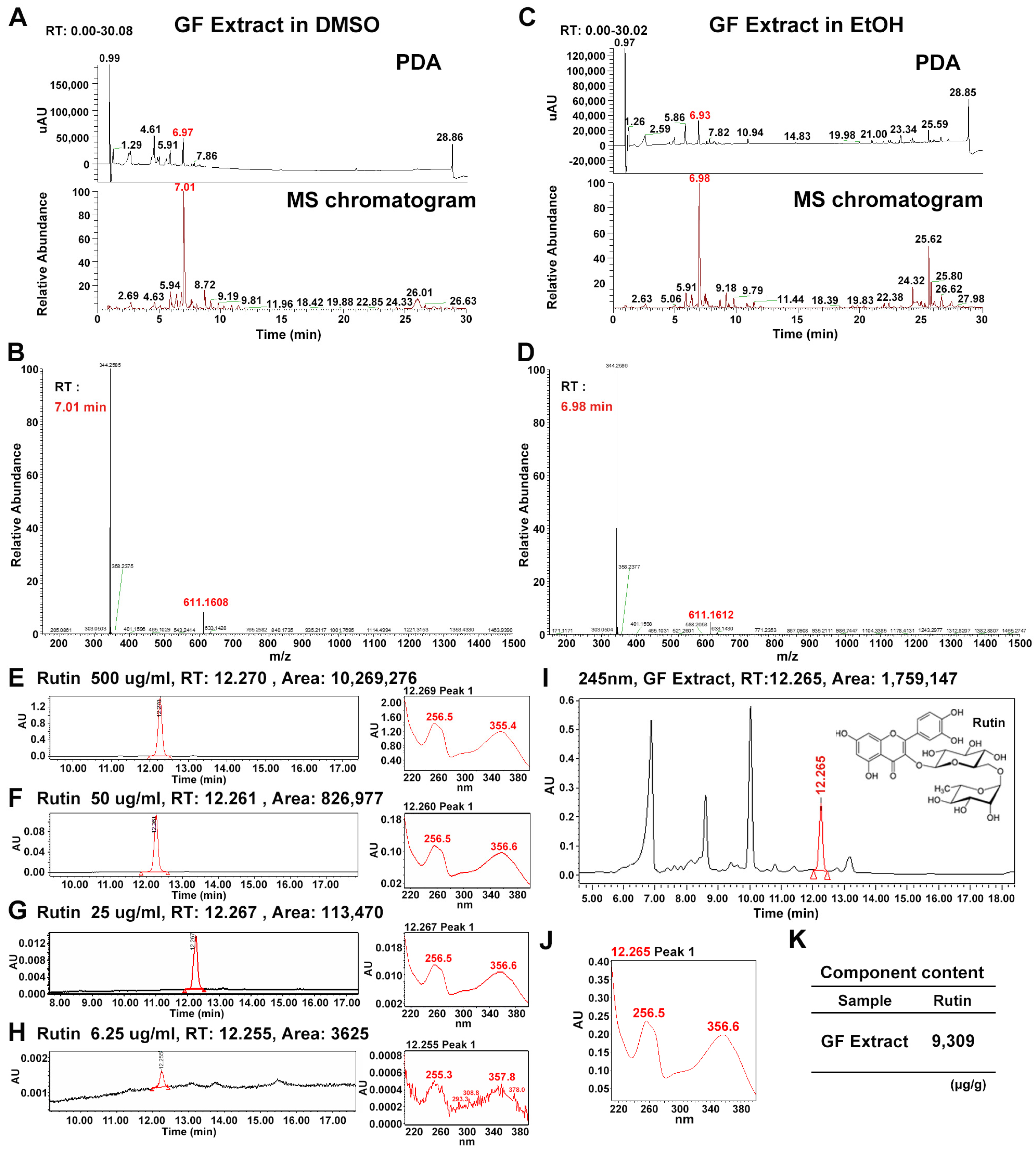
| GF in DMSO | 7.01 | 611.1608 | 611.1607 | 0.28 | 12.5 | C27H31O16 | Rutin |
| GF in EtOH | 6.98 | 611.1615 | 611.1607 | 1.37 | 12.5 | C27H31O16 | Rutin |
Disclaimer/Publisher’s Note: The statements, opinions and data contained in all publications are solely those of the individual author(s) and contributor(s) and not of MDPI and/or the editor(s). MDPI and/or the editor(s) disclaim responsibility for any injury to people or property resulting from any ideas, methods, instructions or products referred to in the content. |
© 2026 by the authors. Licensee MDPI, Basel, Switzerland. This article is an open access article distributed under the terms and conditions of the Creative Commons Attribution (CC BY) license.
Share and Cite
Yang, H.-J.; Kwon, O.; Kim, D.; Lee, A.; Cho, K.; Ihm, H.; Kim, J.Y. Anti-Inflammatory Properties of Garrya flavescens: Phytochemical Profiling and Mitigation of LPS-Induced Neuroinflammation via ERK Signaling and Mitochondrial Modulation. Plants 2026, 15, 1319. https://doi.org/10.3390/plants15091319
Yang H-J, Kwon O, Kim D, Lee A, Cho K, Ihm H, Kim JY. Anti-Inflammatory Properties of Garrya flavescens: Phytochemical Profiling and Mitigation of LPS-Induced Neuroinflammation via ERK Signaling and Mitochondrial Modulation. Plants. 2026; 15(9):1319. https://doi.org/10.3390/plants15091319
Chicago/Turabian StyleYang, Hyun-Jeong, Ohwook Kwon, Dalnim Kim, Ahreum Lee, Kyohee Cho, Hyeran Ihm, and Ji Young Kim. 2026. "Anti-Inflammatory Properties of Garrya flavescens: Phytochemical Profiling and Mitigation of LPS-Induced Neuroinflammation via ERK Signaling and Mitochondrial Modulation" Plants 15, no. 9: 1319. https://doi.org/10.3390/plants15091319
APA StyleYang, H.-J., Kwon, O., Kim, D., Lee, A., Cho, K., Ihm, H., & Kim, J. Y. (2026). Anti-Inflammatory Properties of Garrya flavescens: Phytochemical Profiling and Mitigation of LPS-Induced Neuroinflammation via ERK Signaling and Mitochondrial Modulation. Plants, 15(9), 1319. https://doi.org/10.3390/plants15091319