Review

Towards Robust UAV Navigation in Agriculture: Key Technologies, Application, and Future Directions

1
College of Engineering, China Agricultural University, Qinghua East Road No. 17, Haidian, Beijing 100083, China
2
College of Information and Electrical Engineering, China Agricultural University, 17 Qinghua East Road, Haidian, Beijing 100083, China
*
Authors to whom correspondence should be addressed.
Plants 2026, 15(9), 1303; https://doi.org/10.3390/plants15091303
Submission received: 27 March 2026 / Revised: 19 April 2026 / Accepted: 22 April 2026 / Published: 23 April 2026
(This article belongs to the Special Issue Advanced Remote Sensing and AI Techniques in Agriculture and Forestry)

Abstract

Unmanned aerial vehicles (UAVs) are becoming an important platform for precision agriculture, supporting both high-throughput sensing and active field operations such as spraying, monitoring, and phenotyping. However, unlike general UAV applications, agricultural environments impose distinctive challenges due to heterogeneous field structures, canopy occlusion, terrain variation, dynamic disturbances, and strong coupling between navigation performance and task quality. To address this gap, this review presents a systematic analysis of UAV navigation in agricultural environments from a system-level perspective. The review first summarizes the core technical components of agricultural UAV navigation, including sensing, localization, mapping, planning, and control. It then discusses how navigation requirements vary across representative scenarios such as open fields, orchards, and terraced farmland, and examines their roles in key applications including aerial mapping, field monitoring, precision spraying, and close-range orchard operations. In addition, datasets, simulation platforms, and evaluation protocols relevant to agricultural UAV navigation are reviewed. Finally, major challenges are identified, including scene heterogeneity, perception degradation, insufficient task-semantic integration, limited control robustness, and the lack of standardized benchmarks. Future research should move toward robust, task-aware, and modular navigation architectures that support reliable and scalable agricultural UAV deployment.

1. Introduction

With continued advances in productivity and agricultural technology, global population growth is placing increasing pressure on food security [1]. The world population is projected to exceed 9 billion by 2050 and may surpass 10 billion by the end of this century [1,2,3]. Under such pressure, agricultural systems must improve productivity under limited land, water, and labor resources, making agricultural automation and precision agriculture increasingly important for enhancing resource-use efficiency and production resilience [4,5,6]. Precision agriculture relies on continuous sensing, quantitative analysis, and data-driven decision-making to support refined crop and field management [7,8,9,10,11]. In parallel, rapid progress in automation, computer vision, and artificial intelligence [12,13,14,15,16,17,18,19,20,21,22,23,24,25,26,27] has accelerated the deployment of unmanned aerial vehicles (UAVs) as flexible platforms for aerial sensing and field operations across the agricultural production chain [28,29].
Because of their high maneuverability, low-altitude accessibility, and relatively low deployment cost, UAVs have been widely adopted not only in agriculture but also in forestry, geospatial applications, and urban remote sensing [30,31,32,33,34,35]. In these domains, UAVs support tasks such as object detection, mapping, search, and 3D modeling [30,34,36,37,38]. More broadly, practical UAV systems typically rely on onboard vision and related sensors to perceive the environment, support autonomous navigation, and enable task execution [28,39].
In recent years, UAV applications in agriculture have expanded from remote sensing tools to active operational platforms involved in agricultural production. In monitoring tasks, UAVs have been widely used for crop growth assessment, abiotic stress identification, biotic stress detection, and yield estimation, thereby supporting high-throughput phenotyping, breeding, and agricultural decision-making [40,41,42,43,44,45]. Beyond monitoring, UAVs have also progressed in active operations such as precision spraying. Representative studies have demonstrated UAV-based closed-loop workflows that integrate sensing, prescription generation, and spray control, highlighting the transition of UAVs from passive observation platforms to operational systems for agricultural intervention [46,47].
Despite this progress, agricultural UAV deployment remains less mature than UAV applications in non-agricultural domains such as urban mapping, inspection, and general remote sensing, because agricultural environments impose distinct task requirements, engineering constraints, and environmental disturbances [48,49,50]. Unlike many general UAV applications that focus primarily on observation or data acquisition, agricultural UAVs often require tight coupling between sensing, decision-making, and physical task execution. This is particularly evident in operations such as spraying, where payload variation, liquid sloshing, and wind disturbances increase dynamic uncertainty and control difficulty [51]. In addition, agricultural task quality is highly sensitive to flight altitude, speed, and path deviation, since these factors directly affect deposition uniformity, coverage quality, and drift risk [52]. Large-area operations under limited endurance further make coverage planning a key challenge [53], while near-ground flight in the presence of irregular field boundaries, vegetation occlusion, airflow, and dust places higher demands on perception robustness and flight stability [54].
Against this background, navigation is becoming a foundational capability for agricultural UAVs to move from being merely flyable and observable to being reliably task-executable. High-precision localization and trajectory tracking directly affect operational repeatability and spraying consistency, while autonomous agricultural operation further requires the integration of perception, planning, and control under complex environmental conditions [28,46,55,56]. More broadly, agricultural UAV systems are increasingly evolving toward a closed-loop precision-operation paradigm that links perception, decision-making, and execution [57].
Existing reviews have examined agricultural UAVs from multiple perspectives, but most remain focused on application-level themes such as remote sensing, crop monitoring, deep learning-based perception, or spraying systems [44,45,54]. Even broader reviews of agricultural UAVs often treat navigation as an auxiliary module rather than as a system-level problem involving the coordinated interaction of perception, localization, mapping, planning, control, and safety [48]. By contrast, the non-agricultural UAV literature contains a much richer body of work specifically dedicated to autonomous navigation [28]. Therefore, a systematic review of UAV navigation in agricultural environments from a system perspective is still lacking.
To address this gap, this paper presents a systematic review of UAV navigation in agricultural environments from a system perspective (Appendix A). The specific objectives are as follows:
1.
to systematically review and classify the key technological components of UAV navigation in agricultural environments;
2.
to analyze the applicability and development trends of different navigation technologies in relation to representative agricultural operational requirements;
3.
to summarize the major challenges in current agricultural UAV navigation research and discuss possible future directions.
The remainder of this paper is organized as follows. Section 2 describes the key technologies for UAV navigation in agricultural environments. Section 3 discusses the applications of UAV navigation in agricultural environments. Section 4 reviews datasets, simulation platforms, and evaluation protocols for agricultural UAV navigation. Section 5 highlights key challenges and future perspectives. Section 6 concludes the paper.
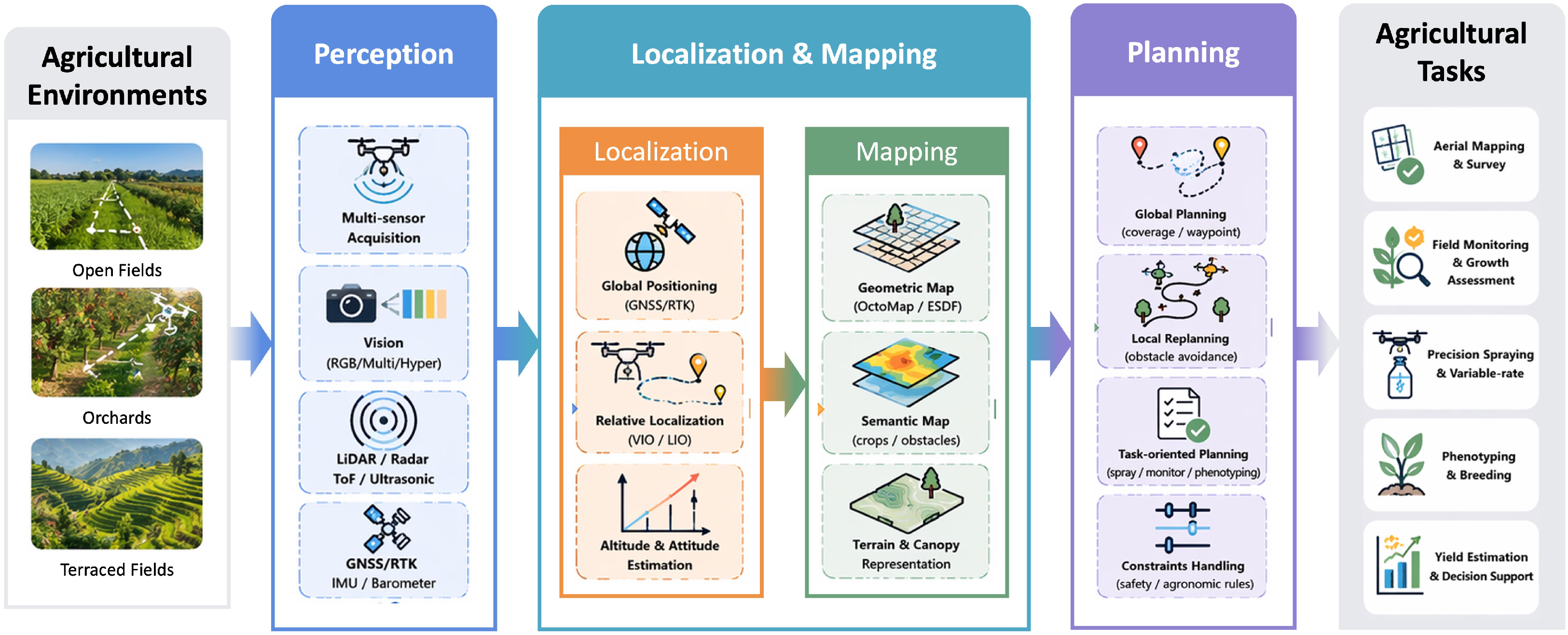
To provide a system-level overview of the scope of this review, Figure 1 summarizes the hierarchical organization of agricultural UAV navigation, including the relationships among agricultural environments, perception, localization and mapping, planning, and representative task applications. This framework serves as a conceptual roadmap for the subsequent sections.

2. Key Technologies for UAV Navigation in Agricultural Environments

2.1. Agricultural Operational Scenarios and Navigation Requirements

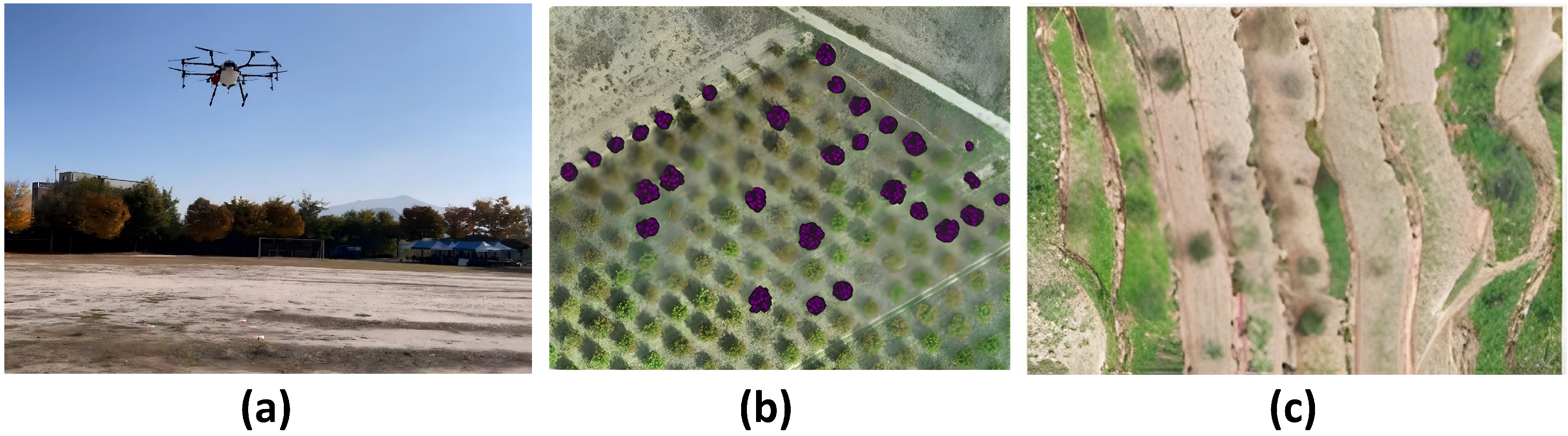
The navigation requirements of agricultural UAVs are largely determined by operational scenarios. Different agricultural environments vary substantially in spatial structure, operational mode, and environmental disturbances, leading to distinct technical demands on localization accuracy, path planning, and flight control. In particular, environmental factors such as wind shear or airflow disturbances, GNSS signal degradation, and dense canopy occlusion can directly affect state estimation, perception reliability, and trajectory stability, and therefore should be regarded as core determinants of navigation performance in agricultural UAV systems. Figure 2 illustrates three representative UAV operational scenarios in agriculture: open fields, orchards, and terraced or mountainous farmlands. These scenarios not only cover the main application types of agricultural UAVs, but also reflect the typical technical characteristics of navigation problems in agricultural environments.
In typical agricultural operations, different environments impose differentiated requirements on UAV navigation systems (Figure 2). In open-field environments (Figure 2a), UAVs are commonly used for large-area crop protection spraying, variable-rate application, and field monitoring [46]. Because spraying is inherently position-sensitive, deviations in flight trajectory as well as fluctuations in altitude or speed can directly affect droplet coverage uniformity and deposition performance. Therefore, high-precision localization and stable trajectory tracking are essential for closed-loop spraying control. Meanwhile, large-scale continuous operations place higher demands on coverage path planning and trajectory stability, while wind disturbances, including low-altitude gusts and wind-shear effects over large open areas, together with payload variations, further increase navigation uncertainty and trajectory-tracking difficulty [46]. In orchards and forestry environments (Figure 2b), UAVs are mainly used for high-resolution data acquisition and plant-level management [58]. Such applications typically require repeatable flight paths and stable positioning to enable multi-temporal data registration. However, dense canopy occlusion, repetitive textures, and partial GNSS degradation beneath or near tree canopies often degrade both visual and satellite-based localization performance, thereby imposing greater demands on 3D environmental perception and robust localization [58]. In terraced or mountainous farmlands (Figure 2c), complex terrain makes conventional surveying difficult to implement efficiently, whereas UAV photogrammetry can provide high-resolution topographic information [59]. However, pronounced terrain variation and fragmented field structures require navigation systems to maintain stable localization and terrain-following flight capability in order to ensure flight safety and data quality. GNSS blockage and airflow disturbances may further reduce navigation stability [59].
Overall, agricultural UAVs are evolving from information acquisition tools into operational platforms for agricultural production, and navigation systems form the key foundation for stable operation. Different scenarios emphasize different navigation capabilities: open fields prioritize trajectory stability and coverage efficiency, orchards emphasize 3D perception and repeatable flight paths, and terraced fields require terrain adaptability and flight safety. Accordingly, agricultural UAV navigation typically relies on multi-sensor fusion and multi-layer navigation strategies to ensure robust operation. Based on these scenario-specific requirements, the next section discusses the key sensing technologies for agricultural UAV navigation. Although this review mainly focuses on representative open agricultural scenarios, confined agricultural environments such as greenhouses and plant factories, where GNSS is denied and navigation must place greater emphasis on alternative positioning and disturbance-rejection control, also represent an important direction for future agricultural UAV research [60].

2.2. UAV Sensors

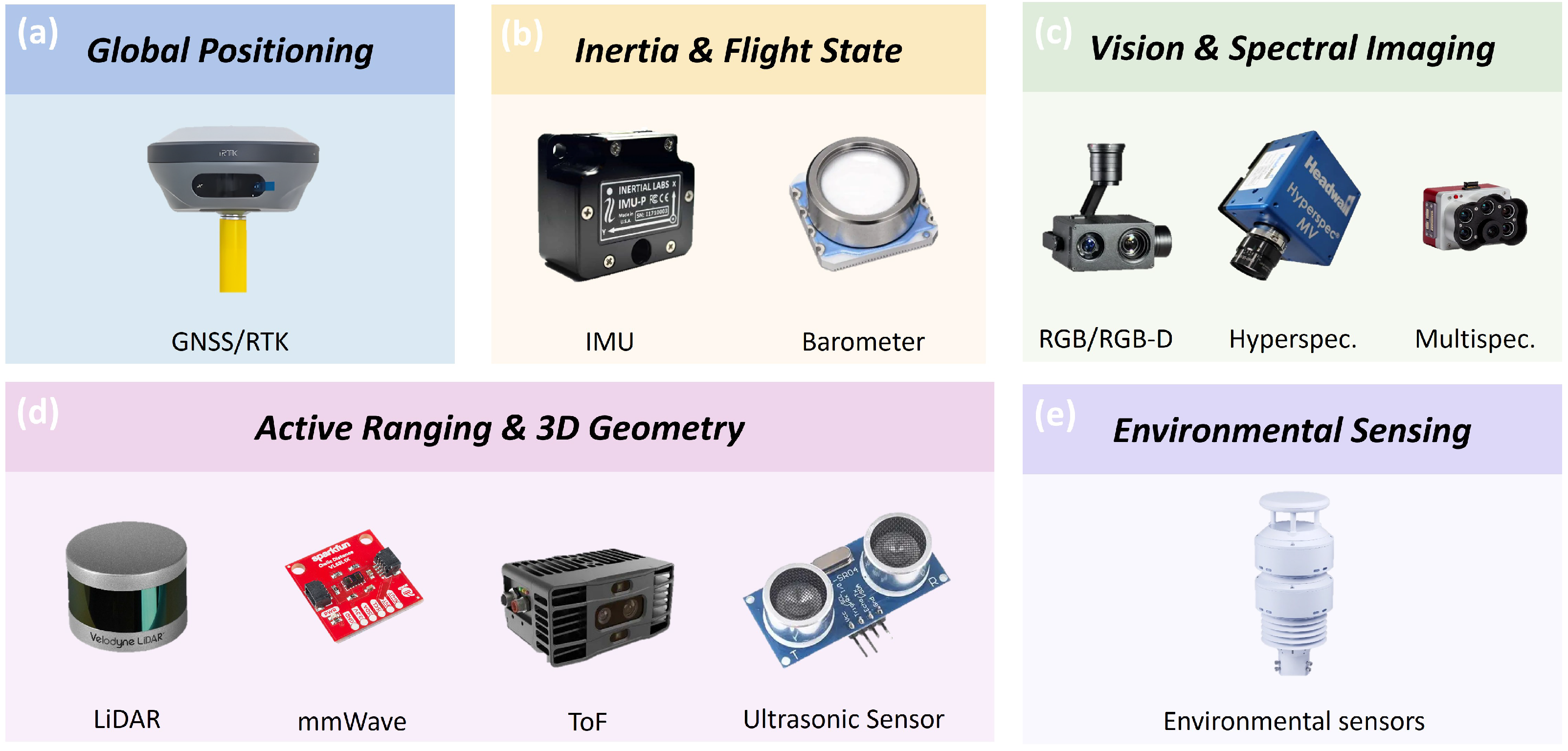
Autonomous navigation of agricultural UAVs depends on multi-sensor fusion for localization, environmental perception, and state estimation [61]. Considering both agricultural remote sensing payloads and operational characteristics, sensors relevant to agricultural UAV navigation can be grouped into five categories (Figure 3): (i) global positioning sensors, such as GNSS and RTK (Real-Time Kinematic); (ii) inertial and flight-state sensors, such as the Inertial Measurement Unit (IMU) and barometer; (iii) visual and spectral imaging sensors, such as RGB, multispectral, and hyperspectral cameras; (iv) active ranging and 3D perception sensors, including LiDAR (Light Detection and Ranging), millimeter-wave radar, ToF, and ultrasonic sensors; and (v) environmental disturbance sensing sensors, such as anemometers for wind speed and direction.
GNSS/RTK provides absolute position references in a global coordinate frame and serves as the fundamental localization method for agricultural UAV navigation systems. However, its accuracy can degrade under vegetation occlusion or complex terrain, so it is commonly fused with other sensors to improve robustness [61]. IMUs and barometers are used for flight-state estimation and closed-loop control input. The IMU provides high-frequency motion information but suffers from drift, and thus typically requires correction from external localization sources [61,62]. Visual and spectral imaging sensors are among the most common onboard devices for agricultural UAVs. RGB cameras support visual odometry and environmental perception and can provide complementary localization information in GNSS-limited environments [63]. Multispectral and hyperspectral sensors are primarily used for agricultural monitoring and prescription generation, although flight path repeatability and attitude stability directly affect data consistency [48,64,65]. Active ranging sensors support obstacle avoidance, altitude maintenance, and mapping by providing distance or geometric information, including LiDAR, millimeter-wave radar, ToF, and ultrasonic sensors [61]. Among these, LiDAR is suitable for high-precision 3D mapping; millimeter-wave radar is more robust under low-light or dusty conditions [66]; and ToF and ultrasonic sensors are commonly used for short-range distance measurement and altitude control [67]. In addition, ultrasonic anemometers are often used for onboard wind measurement to support the stability assessment of spraying operations.
Compared with general-purpose UAVs, agricultural UAVs often carry spraying systems or remote sensing payloads, and their variable payloads can alter system dynamics and increase uncertainty in navigation and control. As a result, stable agricultural UAV operation generally depends on multi-sensor fusion. The next section further discusses localization and state estimation methods for agricultural UAV navigation.

2.3. Localization

In autonomous UAV navigation systems, localization is the core state-estimation component linking perception, planning, and control in a closed loop [68]. Its objective is to provide a reliable absolute pose reference for global path planning before takeoff and to continuously estimate the UAV’s 6-DoF pose during flight [69], together with its relative relationship to maps or environmental elements such as crop rows, terrain, and obstacles, thereby supporting online replanning, trajectory tracking, and obstacle avoidance [70]. Given the environmental characteristics and operational requirements of agricultural scenarios, current mainstream localization methods can be broadly categorized into three groups: (i) GNSS-RTK-based absolute localization; (ii) relative localization based on vision, inertia, and LiDAR (e.g., VIO, SLAM, and LIO); and (iii) altitude estimation and terrain-following methods for operational safety.
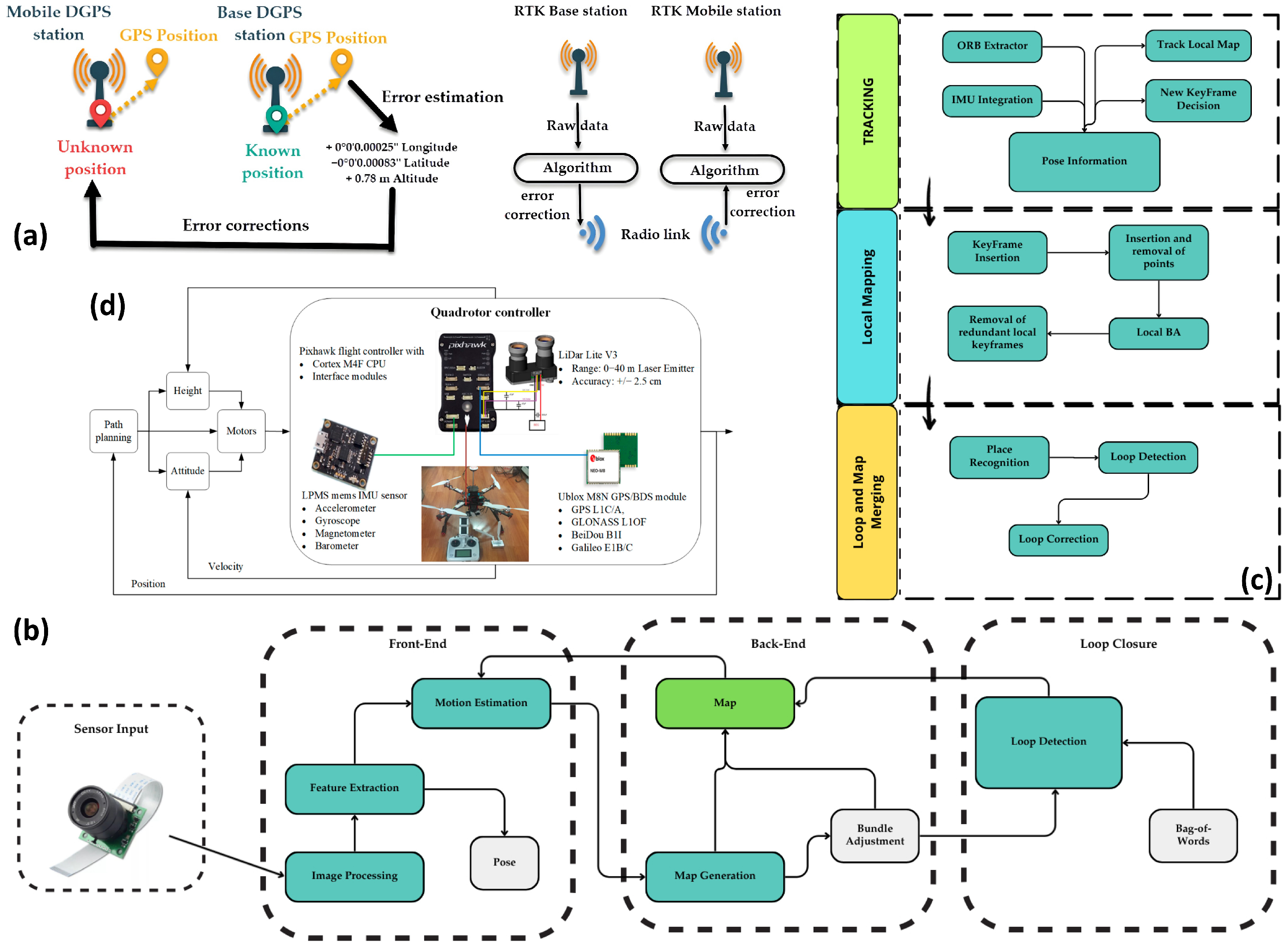
In open-field agricultural scenarios, GNSS-RTK is one of the most widely used localization approaches (Figure 4a), as it can directly provide centimeter-level absolute coordinates [71] and is well suited to route tracking, field-boundary constraints, and precision spraying control [72]. Common implementations include onboard RTK and network RTK (VRS), often fused with IMU and compass data through extended Kalman filtering (EKF) or factor-graph methods [72,73]. This fusion combines high-frequency attitude information with low-frequency absolute positioning, thereby improving control stability and georeferencing consistency [74,75]. It also reduces the risks associated with IMU drift and single-sensor failure [76]. In agricultural surveying and precision mapping, RTK supports direct georeferencing, reduces dependence on ground control points (GCPs), and improves mapping efficiency [77]. Network RTK has been shown to provide uniform centimeter-level accuracy over distances of tens of kilometers [78,79]. However, GNSS remains susceptible to occlusion, multipath effects, and ionospheric interference [80], and its performance may deteriorate in orchards, greenhouses, or hilly environments, making integration with relative localization methods necessary.
When GNSS is unreliable or when higher-frequency and smoother pose estimates are required, visual-inertial odometry (VIO) [83] (Figure 4b) and visual SLAM [81] (Figure 4c) become core navigation approaches. Optimization-based methods, such as OKVIS [84], tightly couple visual and IMU constraints through sliding-window nonlinear optimization [69], enabling continuous real-time 6-DoF pose estimation [81,85]. Filtering-based methods, such as MSCKF [86] and Real-time Visual Odometry and Mapping [87], use EKF to achieve high-frequency state estimation with relatively low computational cost. In addition, loop closure and pose graph optimization, as in ORB-SLAM3 [88], can reduce long-range drift and improve global consistency. However, in agricultural environments, repetitive textures, illumination variation, and dynamic vegetation often degrade pure vision-based methods, making drift accumulation and localization instability more pronounced during long-duration operation. To address this limitation, LiDAR–Inertial Odometry (LIO) approaches such as FAST-LIO use tightly coupled iterative EKF fusion of LiDAR and IMU measurements to improve robustness in weak-texture and vegetation-disturbed environments [89]. Compared with VIO and visual SLAM, LIO is generally more robust under degraded agricultural conditions, but it usually imposes higher requirements on sensing hardware, payload, and system complexity. Agricultural multi-sensor datasets such as AgriLiRa4D further support the applicability of multimodal SLAM for orchard inspection and inter-row navigation [90].
In practical agricultural UAV deployment, however, localization methods must also satisfy strict onboard constraints in computation, memory, payload, and energy consumption [91]. For this reason, lightweight SLAM and state-estimation frameworks are becoming increasingly important for engineering implementation [91,92]. Compared with high-complexity mapping and optimization pipelines, deployable agricultural UAV systems often require more compact front-end processing, efficient sensor selection and fusion, and reduced map or feature representations, so as to maintain real-time pose estimation under limited onboard resources. Therefore, future agricultural UAV localization research should not only pursue accuracy and robustness in degraded environments, but also explicitly consider computational efficiency, memory footprint, and power-aware deployment for long-duration field operation [93].
In agricultural operations, altitude control is often more critical than planar position. Maintaining a constant distance from the canopy directly affects spraying uniformity, while aerial surveying requires stable flight altitude. Common approaches fuse barometer readings, GNSS altitude, and downward-looking ranging sensors such as ultrasonic, infrared, or laser sensors (Figure 4d) [82]. Barometers provide smooth short-term estimates but are prone to drift, GNSS altitude is affected by multipath interference [62], and downward-looking range sensors are most accurate at low altitude but are constrained by measurement range and surface reflectance. Accordingly, EKF or complementary filtering is typically used to fuse multiple altitude sources [94]. In environments with pronounced terrain variation or unreliable GNSS, terrain matching methods such as TERCOM/TRN can be used to improve navigation robustness by matching onboard altitude profiles with digital elevation models [95]. Such methods are particularly suitable for route following in hilly terraced fields, constant-height spraying in orchards, and inspection tasks over undulating terrain [82]. Table 1 summarizes localization methods for agricultural UAV navigation.

2.4. Mapping and Representation

In autonomous UAV navigation systems, the core objective of mapping is to transform sensor observations into environmental representations that can support path planning and obstacle avoidance [96,97,98]. Compared with conventional robotic environments, agricultural scenes are characterized by large scale, repetitive structures, and dynamic vegetation. Therefore, map representations must not only describe environmental geometry, but also support real-time updating and task-level decision-making. Existing studies mainly focus on three types of map representation: geometric maps, visual reconstruction maps, and semantic and dynamic maps.
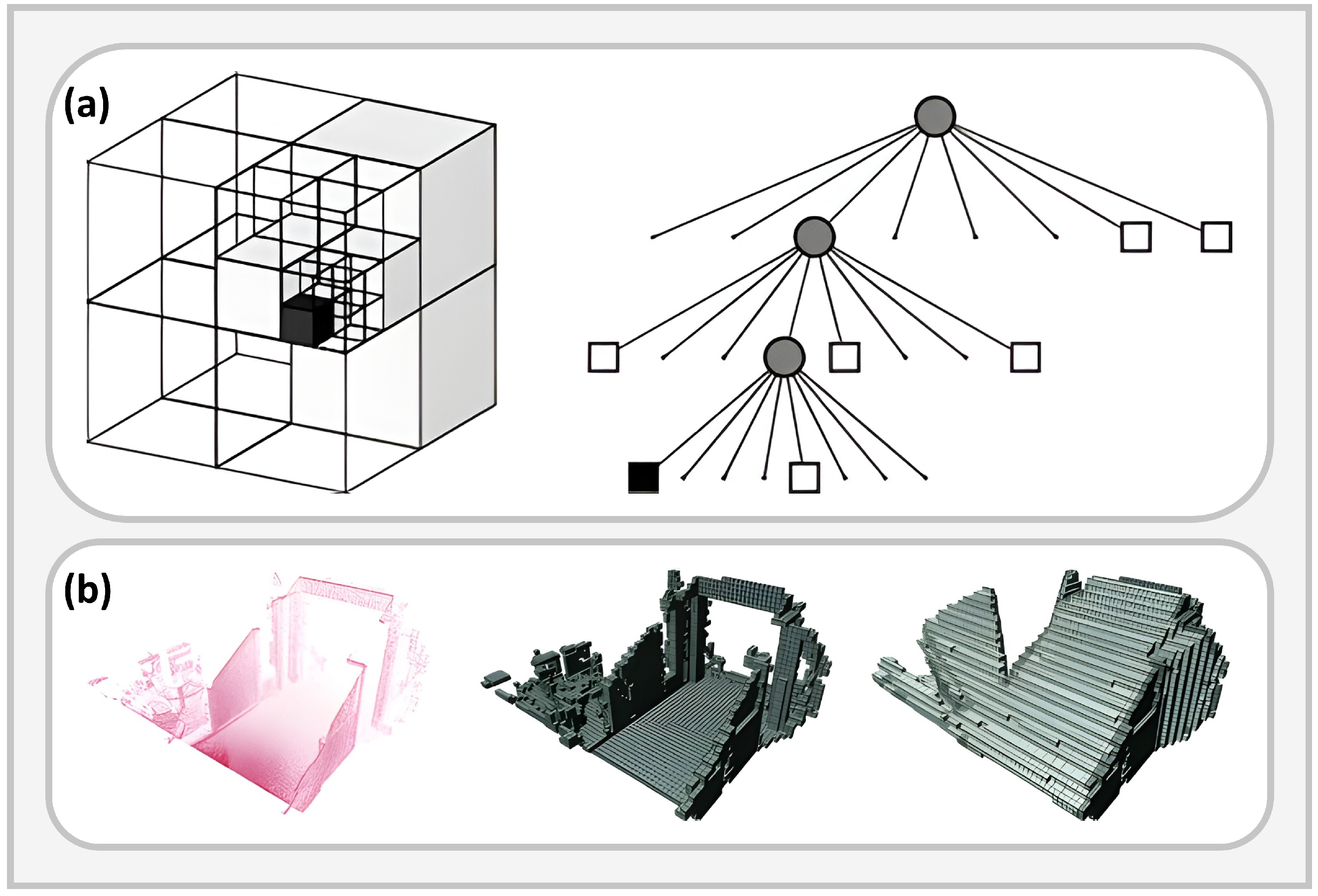
Geometric maps constitute the most basic form of environmental representation for UAV navigation, with occupancy grids, voxel maps, and their 3D extensions being the most common [99,100,101]. A representative example is OctoMap, which recursively represents spatial occupancy probabilities using an octree structure and can efficiently distinguish occupied, free, and unknown space while supporting efficient storage and querying in large-scale 3D environments (Figure 5) [102]. In agricultural scenarios, such maps are commonly used for low-altitude obstacle avoidance, farm-road identification, and spatial representation of field obstacles.
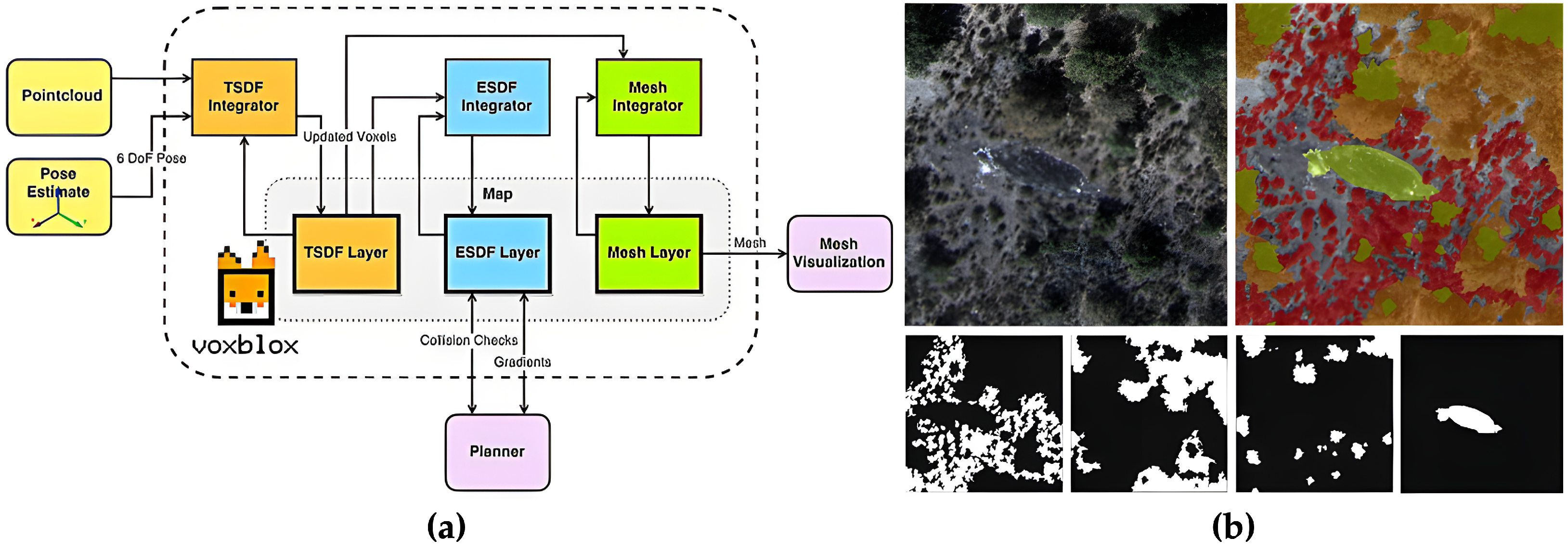
However, occupancy maps provide only reachability information and are therefore insufficient for direct trajectory optimization. Many systems further construct Euclidean Signed Distance Fields (ESDFs), which encode obstacle distance and gradient information for planning [103]. Representative methods such as Voxblox incrementally generate ESDFs from truncated signed distance fields to support real-time distance queries, while FIESTA improves update efficiency for online replanning through a BFS-based incremental strategy [104,105,106]. As illustrated in Figure 6a, such distance-field representations are particularly suitable for near-ground low-altitude flight and canopy-proximal obstacle avoidance in agricultural UAV applications.
Another important class of maps is derived from visual SLAM, which can be broadly divided into sparse feature maps and dense or semi-dense depth maps [108]. Sparse maps, represented by ORB-SLAM2 [109], maintain keyframes and a limited number of 3D feature points, offering low computational cost and supporting real-time localization, but providing limited geometric completeness for fine obstacle avoidance or close-range operation. By contrast, dense or semi-dense maps provide more continuous geometric structure and are therefore more suitable for near-ground low-altitude applications. Typical examples include RGB-D reconstruction methods such as KinectFusion [110], multi-view stereo (MVS) reconstruction [111], and semi-dense methods such as LSD-SLAM [112]. These representations can better describe canopy geometry and obstacle distance, which is particularly valuable for orchard inspection and canopy-proximal flight.
As agricultural UAV navigation evolves from passability-oriented navigation to task-driven navigation, geometry alone is no longer sufficient for decision-making, and semantic mapping is becoming increasingly important. Metric-semantic mapping frameworks combine geometric reconstruction with semantic labels to produce maps that explicitly encode task-relevant elements such as crop rows, canopies, roads, ditches, utility poles, and other risk-related objects [107,113]. As shown in Figure 6b, such semantic representations provide stronger support for task planning and safety-aware navigation in agricultural environments.
In LiDAR-based mapping systems, point-cloud preprocessing is also critical to map quality. Common steps include ground segmentation [114], outlier removal [115], and voxel downsampling [116], which improve the stability of occupancy-map or ESDF updates [104]. For agricultural environments, dedicated farmland point-cloud filtering methods have also been developed. For example, Liu et al. [117] combined elevation-frequency histograms with a multi-feature Gaussian Mixture Model (GMM) to separate ground points, and further integrated geometric, intensity, and spectral features to improve ground-segmentation accuracy, thereby enhancing map construction quality in complex farmland environments. From an engineering perspective, mapping representations differ not only in geometric expressiveness and planning utility, but also in their suitability for resource-constrained onboard deployment. In agricultural UAV systems, this distinction is particularly important because onboard computing power, memory, payload, and energy are often limited. As summarized in Table 2, occupancy and sparse visual maps are generally more compatible with lightweight onboard deployment, whereas ESDF-based, dense, semantic, and dynamic representations typically impose higher memory, update, and inference costs. Therefore, the choice of mapping representation should be jointly determined by task requirements, scene complexity, and real-time processing constraints.

2.5. Path Planning and Obstacle Avoidance

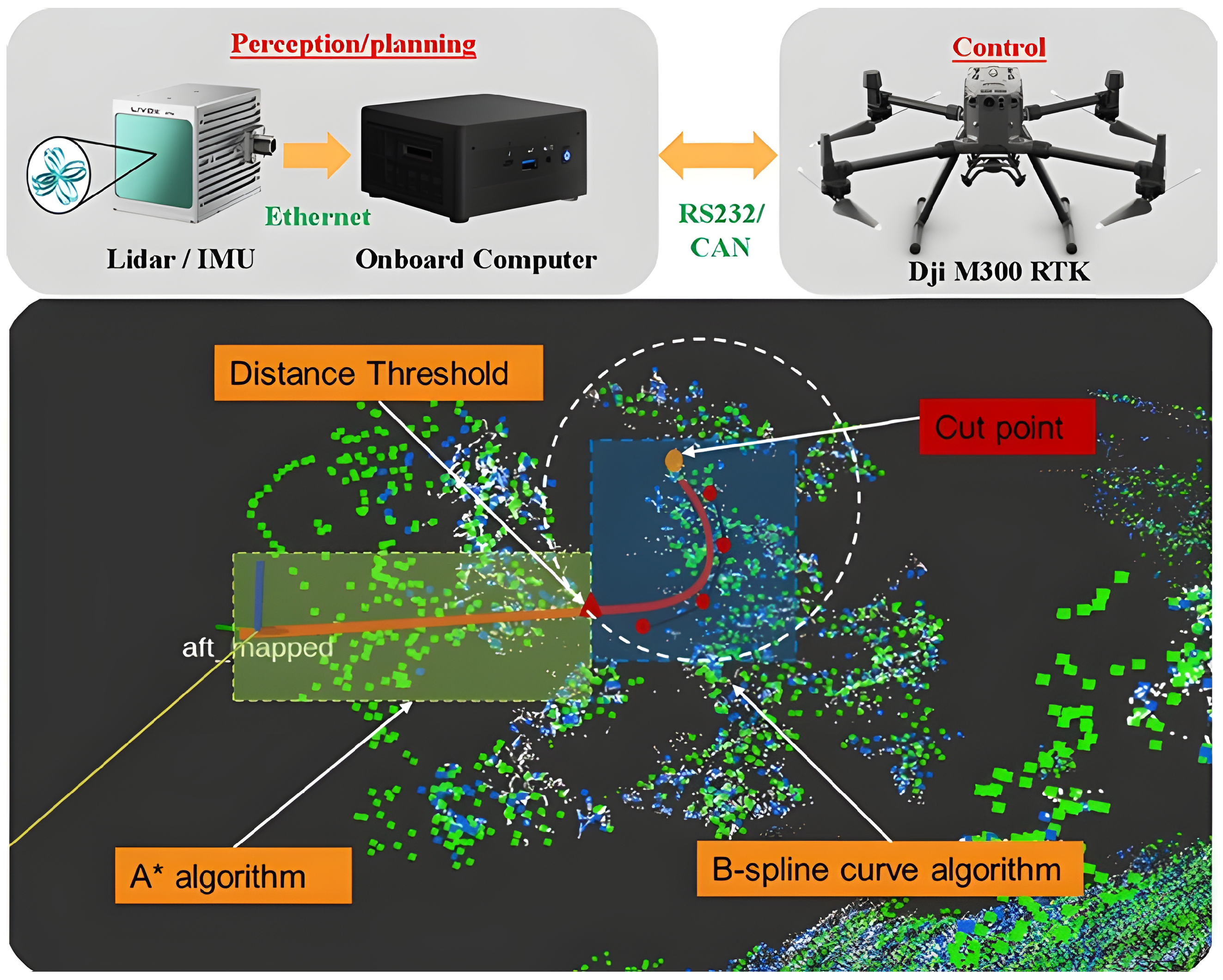
Conventional planning generally follows a hierarchical framework composed of global planning and local planning [119]. In agricultural operations, global planning is usually based on prior information such as field boundaries, operational areas, no-entry zones, and waypoint tasks, with the objective of generating coverage paths or multi-waypoint visiting routes for applications such as spraying, spreading, and inspection [120,121,122]. Existing reviews have systematically summarized graph-search and sampling-based paradigms, including A*, D*/D* Lite, PRM, RRT/RRT and their variants, while emphasizing the trade-offs among time, energy consumption, and safety constraints [120,123]. From an onboard deployment perspective, graph-search methods such as A* are generally more suitable for structured environments with relatively clear map constraints [124], sampling-based methods such as RRT/RRT* offer stronger adaptability to high-dimensional or kinodynamically constrained planning but often at higher online computational cost [125], whereas DRL-based planners can provide fast inference after training but require substantial training cost and still face challenges in runtime stability and deployment reliability under real agricultural conditions [53]. For 3D agricultural operations, combinatorial planning has also attracted increasing attention, such as combining Hybrid A* with the Traveling Salesman Problem (TSP) to generate efficient 3D trajectories [126]. In more spatially constrained environments such as orchards, planning places greater emphasis on kinematic feasibility and safety-clearance constraints [127]. Accordingly, Hybrid A* is often adopted in practice to combine discrete search with continuous kinematic constraints, thereby producing smoother and executable trajectories [128], and this framework can be extended to 3D trajectories and multi-target tasks [129]. For example, the orchard fruit-picking UAV proposed by Li et al. [127] uses LiDAR to construct a dual static-dynamic map and combines it with an improved B-spline-based Hybrid A* planner to safely reach target clusters while satisfying operational motion constraints, as shown in Figure 7. Local planning, by contrast, typically updates trajectories in real time within a limited sensing range and enforces collision constraints, forming a closed-loop replanning process with global planning. For instance, combining RRT* with the Dynamic Window Approach (DWA) can improve real-time correction capability and energy efficiency in dynamic environments [130]. Such a framework that couples global sampling with local real-time adjustment is directly relevant to agricultural scenarios where predefined operational routes coexist with temporary dynamic obstacles.
Deep learning-based path planning places greater emphasis on end-to-end or near-end-to-end decision-making from perception to control by directly mapping image, depth, or state inputs to velocity commands or action sequences [131,132]. Typical technical routes include deep reinforcement learning, imitation learning, and hybrid architectures that combine learning-based local planners with conventional constraints [133]. For agricultural applications, the key advantage is that under conditions such as visual degradation, complex terrain, or the frequent appearance of targets and obstacles, these methods can generate executable actions within short decision cycles, thereby improving the responsiveness of online planning and control [134]. For example, Wang et al. [134] proposed Land-Automatic Curriculum Learning (Land-ACL), a deep reinforcement learning framework that improves the stability of high-speed autonomous navigation under partially observable conditions, providing a transferable learning-based navigation paradigm for applications such as agricultural irrigation. Overall, learning-based planning is better suited to serve as the local decision or reaction layer, and can be integrated with task-level constraints and safety rules to form a hybrid planning architecture for agricultural UAVs [132].
From an engineering perspective, lightweight path planning and edge-side navigation inference are also critical for agricultural UAV deployment [135]. Because onboard computing power and power supply are both limited, planning modules must generate feasible actions within short decision cycles while maintaining low computational overhead [122,136]. In practice, this makes lightweight local planning, simplified environment representation, and computationally efficient collision checking particularly important for near-ground agricultural navigation. Similarly, when learning-based navigation is deployed onboard, edge-side inference must emphasize low latency, stable runtime, and robustness under varying field conditions, rather than relying solely on computationally intensive models [137]. As a result, future agricultural UAV navigation systems will likely depend on lightweight hybrid architectures that balance planning quality, inference speed, and deployment efficiency. This also reflects a fundamental engineering trade-off in agricultural UAV navigation: higher mapping fidelity, planning complexity, and perception accuracy often improve task performance, but may also increase onboard energy consumption and reduce effective flight endurance under strict payload and battery constraints.
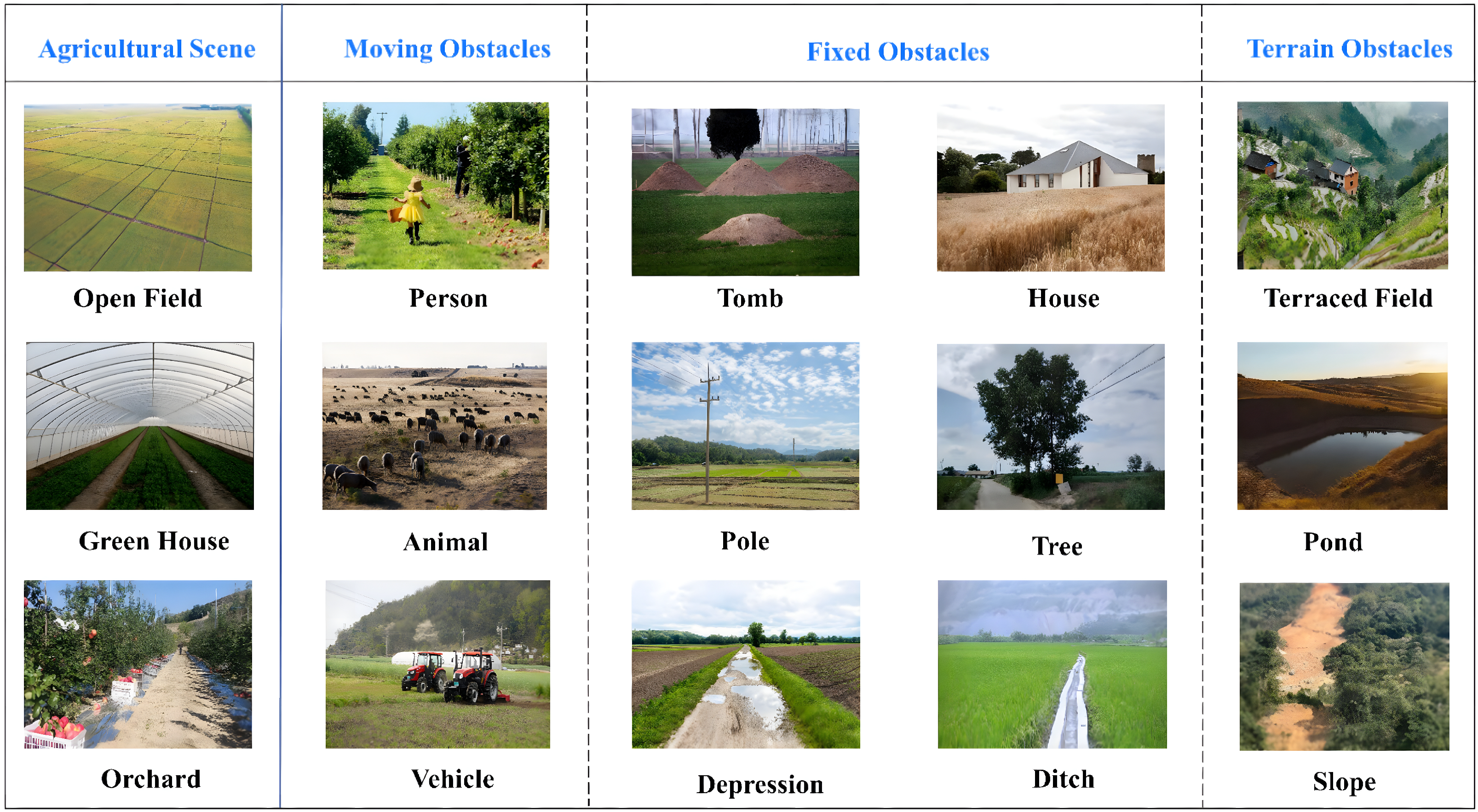
It should be emphasized that obstacle avoidance in this section refers to real-time decision-making at the planning and control levels, rather than the geometric collision representations discussed in the previous mapping section. In agricultural environments, dynamic risks mainly arise from humans, agricultural machinery, vehicles, and animals [138] (Figure 8). A typical pipeline first performs dynamic-object recognition and localization through object detection or semantic segmentation, then transforms the detected objects into safety distances, no-entry regions, or cost terms, and finally generates short-horizon velocity and heading commands through a local planner or policy network to achieve real-time avoidance [139]. In complex agricultural environments, real-time detection frameworks such as YOLO are widely used for dynamic obstacle recognition because of their speed advantages [140,141,142], and are often combined with multi-sensor fusion to improve reliability [138,143]. For example, Zhou et al. [144] proposed an improved YOLOv8-based obstacle detection model that significantly improves detection performance for typical field obstacles while satisfying real-time operational requirements. Studies on orchard fruit-picking UAVs have also demonstrated an engineering pathway based on tight coupling of perception, mapping, and planning, in which LiDAR is used to construct a dual static-dynamic map and planning algorithms are then applied to achieve obstacle-avoidance motion [127].
Visual navigation emphasizes the use of visual cues for localization, trajectory following, and target reaching, and shows particular potential in orchard canopies, greenhouse corridors, and understory environments where GNSS is unreliable [145,146,147]. Building on this, vision-language navigation (VLN) further introduces language instructions by mapping task descriptions to visual understanding and action sequences, thereby providing a more natural human–machine interaction interface for agricultural task scheduling [148]. Recently, SkyVLN integrated VLN with nonlinear model predictive control (NMPC), using large models to interpret instructions and coordinate with the control module to generate feasible trajectories [149,150,151]. In addition, Bhattacharyya et al. [152] proposed the VisNAV framework for open-field scenarios and compared it with GNSS-RTK, VIO, LiDAR, and UWB-based solutions, reporting a localization error of 12–14 cm, which demonstrates the feasibility of visual navigation in agricultural environments.
In large-scale agricultural operations, path planning is increasingly extending from single-UAV navigation to multi-UAV collaborative navigation [153,154]. For representative tasks such as large-area spraying, cooperative inspection, and distributed mapping, multi-UAV systems can substantially improve coverage efficiency, shorten operation time, and alleviate the endurance limitations of individual platforms [155]. From a technical perspective, multi-UAV collaborative navigation typically involves several tightly coupled components, including task allocation, cooperative coverage path planning, formation or spacing maintenance, inter-UAV collision avoidance, communication-aware coordination, and distributed replanning under dynamic field conditions [156]. Compared with single-UAV planning, the main challenge is that navigation is no longer determined solely by environment constraints and vehicle kinematics, but also by coordination consistency across multiple platforms. In agricultural environments, where fields may be spatially large, operational regions may be fragmented, and communication quality may vary across space, these coordination requirements become particularly important. Therefore, multi-UAV collaborative navigation can be regarded as a system-level extension of agricultural UAV planning, in which coverage optimization, safety constraints, and real-time coordination must be jointly considered to support scalable field deployment.

3. Applications of UAV Navigation in Agriculture

3.1. Aerial Mapping and Field Monitoring

In open-field environments, the integration of UAV navigation and remote sensing is mainly reflected in three task categories: mapping/georeferencing, phenotyping, and monitoring. Compared with close-range scenarios such as orchards, open fields are characterized by regular plot structures and relatively sparse obstacles. Therefore, the main system challenges are typically not narrow-space obstacle avoidance, but coverage completeness, flight repeatability, and cross-temporal georeferencing consistency. In this context, navigation quality is closely tied to high-precision localization and coverage-oriented path planning.
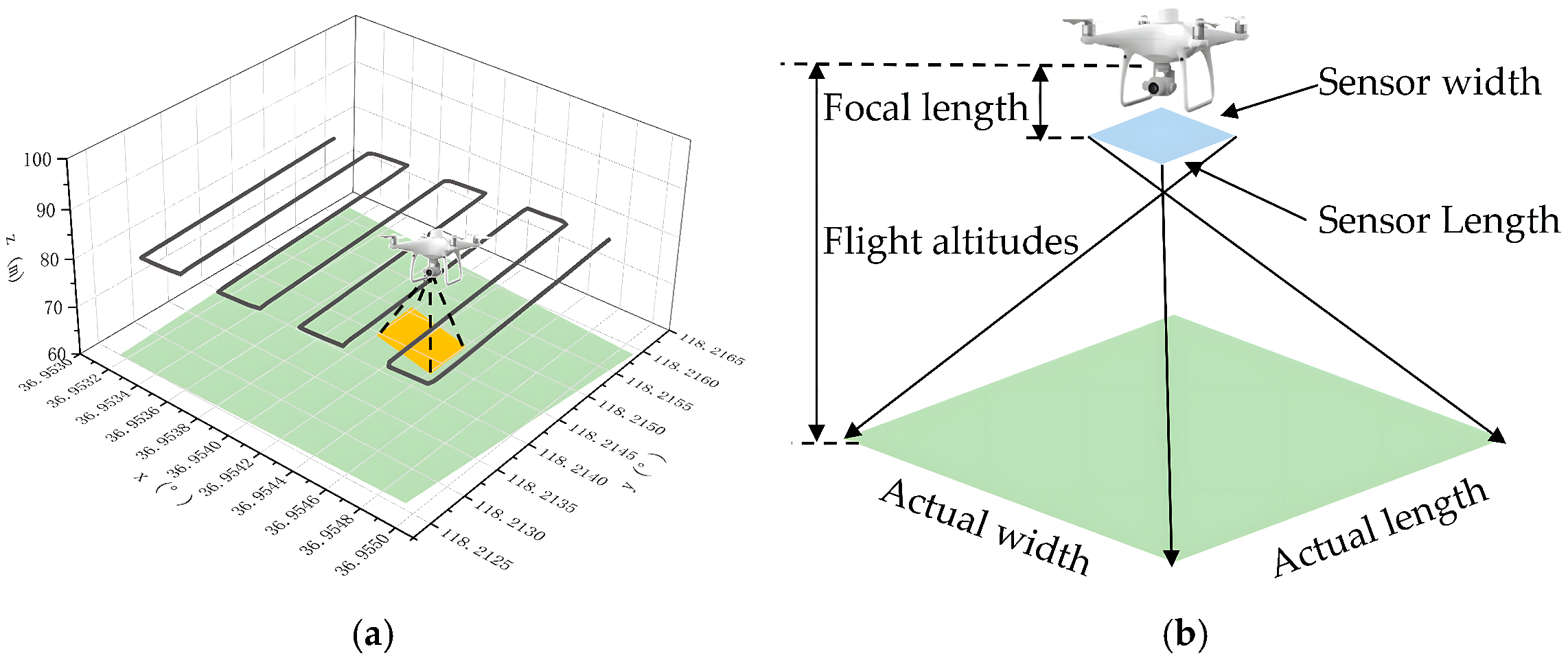
For open-field mapping, existing studies mainly focus on the localization and delineation of field plots and experimental subplots for breeding and high-throughput analysis. Han et al. [157] used an A-UNet-based framework for plot extraction from UAV RGB imagery and demonstrated stable performance across different resolutions and plot scales, while earlier work by Luna et al. [158] provided practical evidence for UAV-based mapping in large-scale fields. In such regular farmland settings, mapping quality depends strongly on complete coverage and reduced missed scans, making coverage path planning a natural and effective paradigm. As illustrated in Figure 9, the study by Xue et al. [159] further highlights the coupling among flight-path design, sensor-to-ground imaging geometry, and mapping quality. Accordingly, RTK-supported repeatable flight and high-precision trajectory tracking are particularly suitable for maintaining stable georeferencing of field boundaries, plots, and target objects, thereby establishing a consistent spatial basis for subsequent phenotyping and monitoring tasks.
Beyond spatial mapping, another major open-field application is high-throughput phenotyping, which can be broadly divided into two paradigms: structural or count-based phenotyping, and continuous trait inversion using multi-source remote sensing with machine learning or regression. For structural and count-based phenotyping, Valente et al. [160] combined conventional image processing with CNN-based transfer learning for field plant identification and counting. More recent studies increasingly rely on deep learning for organ-level detection and segmentation. For example, Jia et al. [161] developed a multi-temporal maize tassel detection framework, Peng et al. [162] used Mask R-CNN to extract wheat spike traits and support yield estimation, and Lu et al. [163] proposed a pipeline integrating segmentation, detection, classification, and trait estimation for rice panicle phenotyping. For continuous trait inversion, Zhu et al. [164] systematically compared hyperspectral, thermal, RGB, and LiDAR data for maize trait estimation, showing that different sensing modalities are better suited to different trait types and that multi-source fusion can improve performance under some conditions.
From a navigation perspective, high-throughput phenotyping differs from general mapping in its stronger requirement for repeated revisits to the same trial areas and consistent sampling across growth stages. This places higher demands on flight repeatability, stable low-altitude motion, and local fine alignment. Accordingly, such tasks are better supported by RTK-GNSS for global revisit referencing, combined with vision-based row detection or semantic segmentation and IMU integration for local correction under low-altitude conditions [165]. This hybrid navigation strategy can reduce the effects of canopy appearance changes and environmental disturbances on data consistency, thereby improving both trait comparability and georeferencing stability.
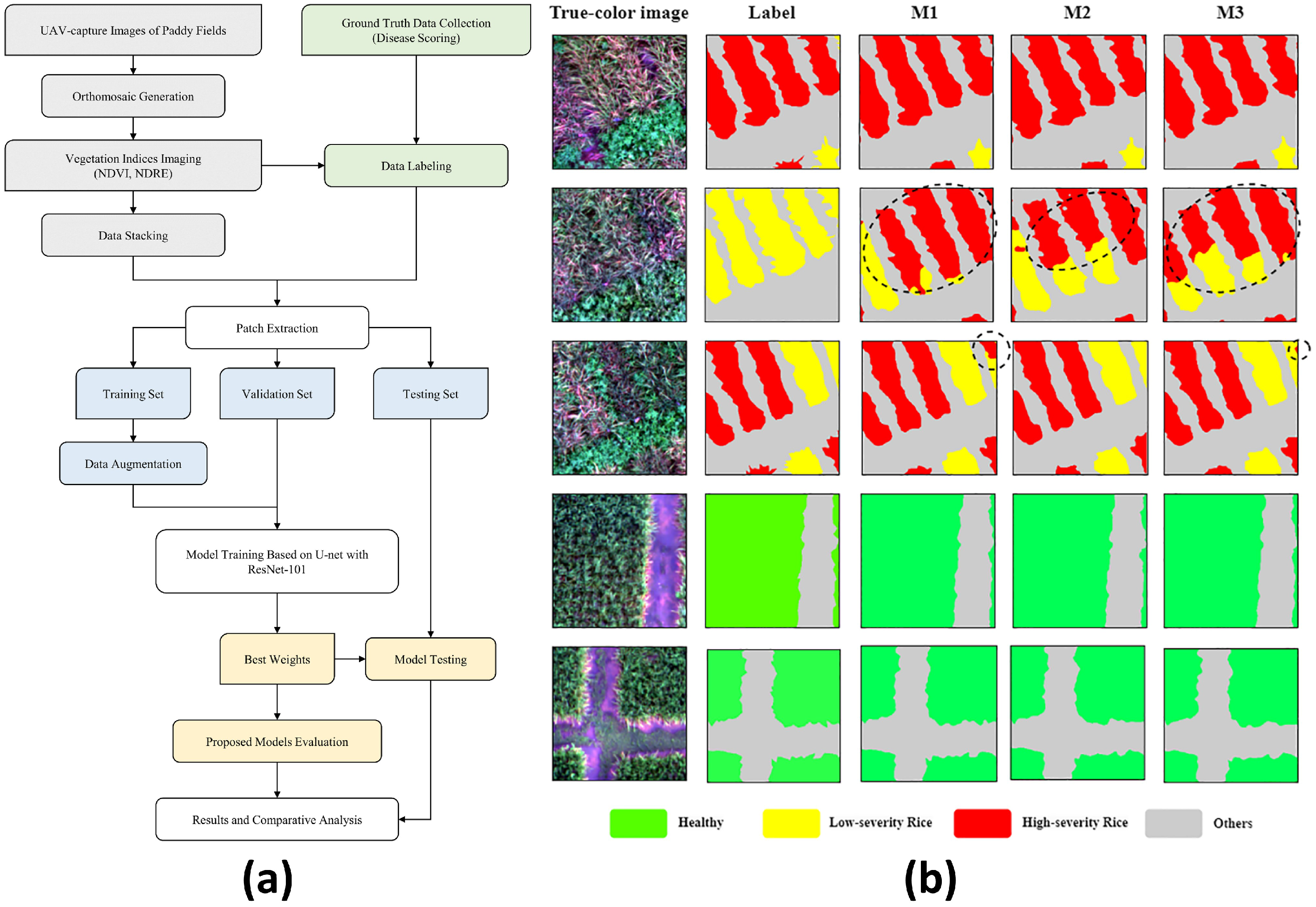
Open-field monitoring mainly targets the spatiotemporal identification of abiotic stresses, such as water stress, drought, and salinity, as well as biotic stresses such as pests and diseases [166,167]. A common technical paradigm is multispectral or hyperspectral imaging, optionally combined with thermal infrared sensing, followed by feature extraction or deep learning-based analysis and spatial mapping. Representative studies include water-stress estimation from multispectral and thermal imagery [168], salinity estimation using multi-source remote sensing and machine learning [169], and disease monitoring based on UAV multispectral imaging and deep segmentation models [170]. As shown in Figure 10, Logavitool et al. [170] demonstrated a UAV multispectral workflow for rice bacterial leaf blight monitoring, highlighting the role of image-based disease segmentation in field-scale stress assessment.
At the navigation level, open-field monitoring is not only a sensing problem but also a task-driven revisiting problem. Because early pest and disease symptoms are often patchy, sparse, and spatially heterogeneous, these tasks are better suited to a two-stage navigation strategy: RTK-supported high-altitude scanning is first used to obtain field-scale risk distributions, after which adaptive replanning is triggered to revisit hotspot regions at lower altitude for detailed verification [171]. This combination of coverage planning and task-driven local revisiting better matches the spatial heterogeneity of field stresses and the need for high-resolution confirmation.

3.2. Precision Spraying and Variable-Rate Application

Precision spraying and variable-rate application (VRA) represent a typical transition of agricultural UAVs from remote sensing platforms to operational platforms for agricultural production. Unlike monitoring tasks, spraying is highly position-sensitive: trajectory deviation, altitude and speed fluctuations, and payload variation directly affect droplet coverage, deposition uniformity, and drift risk. As a result, variable-rate spraying systems usually exhibit a closed-loop coupled structure of prescription information or real-time perception, spray-rate regulation, and navigation with trajectory maintenance. In this framework, navigation provides the spatiotemporal basis for prescription execution and spraying consistency, whereas spray-rate control determines whether dosage can reliably vary according to spatial and canopy demands.
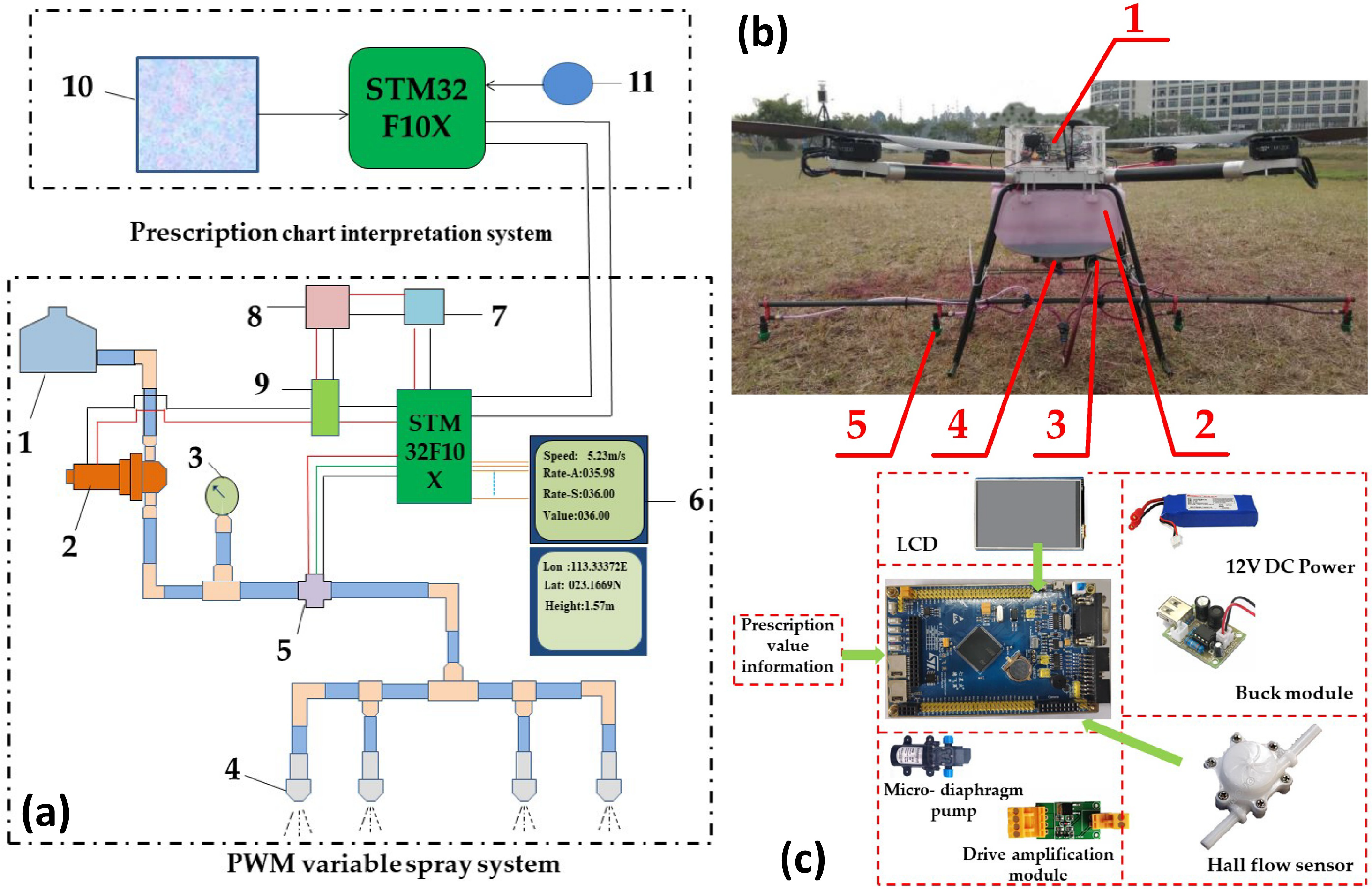
In open-field scenarios, where field geometry is relatively regular and obstacles are limited, VRA usually takes the form of strip-based full coverage. Accordingly, the main bottlenecks are not complex obstacle avoidance, but coverage completeness, trajectory stability, and closed-loop dosage accuracy. As shown in Figure 11, Wen et al. [172] developed a prescription-driven UAV variable spraying system based on PWM–PID flow regulation, illustrating a practical closed-loop workflow linking map interpretation, flow control, and navigation. As VRA evolves from prescription-zone-based treatment to growth- or state-responsive spraying, real-time perception is increasingly incorporated into the control loop. For example, Liu et al. [173] proposed a LiDAR-assisted variable-rate spraying system that dynamically adjusts operational strategy during flight, further highlighting the dependence of variable spraying on online sensing and navigation consistency.
Spraying operations are also subject to time-varying payloads, model uncertainty, and external wind disturbances, making robust flight control essential for maintaining dosage consistency. In addition, fault-tolerant control has also become increasingly important for plant protection UAVs under actuator failure and operation-induced uncertainties such as time-varying mass and disturbance amplification during spraying [174]. Under such disturbance conditions, Ijaz et al. [175] proposed a hybrid robust control strategy, while Zhang et al. [176] introduced FOSM-ADRC to improve disturbance rejection, suppress chattering, and enhance control response. From a navigation perspective, because open-field spraying emphasizes regular coverage and minimal missed application, coverage path planning supported by RTK-GNSS and IMU provides an appropriate spatial reference for prescription execution and helps reduce the impact of trajectory errors on spraying consistency [173].
As agricultural spraying missions continue to expand in operational scale, multi-UAV collaborative spraying is becoming an important development direction [156,177]. In large fields, collaborative spraying systems can improve operational efficiency through region partitioning, parallel route execution, and cooperative task scheduling, while also reducing the constraints imposed by the limited endurance and payload of a single UAV [155,156]. However, such systems place higher demands on navigation and coordination, since flight trajectories must remain not only individually stable but also mutually consistent across platforms. In this context, multi-UAV collaborative spraying depends on the joint support of cooperative coverage planning, inter-UAV conflict avoidance, timing synchronization, and communication–robust task execution. From a systems perspective, this means that future spraying navigation frameworks should evolve from single-platform trajectory maintenance toward multi-platform coordinated navigation that integrates planning, control, and execution consistency.
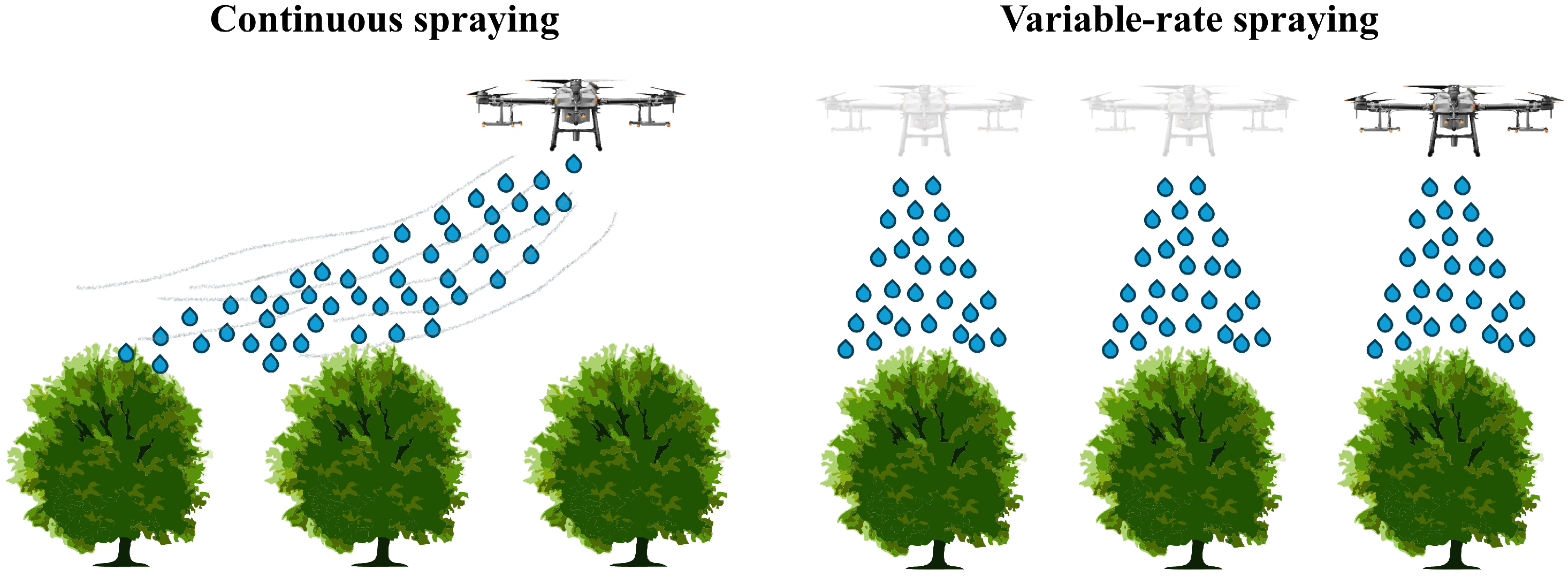
Unlike open fields, orchard VRA must address highly heterogeneous three-dimensional canopy structures. In this context, the objective of variable spraying is not only zonal pesticide allocation, but also dose adaptation to canopy geometry and density. Figure 12 illustrates this shift by comparing continuous-rate and variable-rate spraying in orchard environments. Chen et al. [178] proposed a canopy-volume-based UAV spraying method using LiDAR-derived 3D point clouds to generate differentiated prescription maps, while Zhao et al. [179] combined GNSS positioning with acoustic estimation of canopy leaf area density to enable real-time spray adjustment. Both studies showed that canopy-aware variable spraying can improve within-canopy deposition quality while reducing ground loss and runoff [178,179].
From a navigation perspective, orchard spraying imposes stronger constraints than open-field operation, requiring stable row-following flight, safe canopy-proximal distances, and repeatable trajectories to ensure consistency in 3D canopy perception and prescription execution. Therefore, compared with open-field VRA, which can often rely primarily on GNSS, orchard VRA is better supported by navigation paradigms that integrate GNSS with 3D perception technologies such as LiDAR, thereby mitigating localization degradation caused by canopy occlusion and narrow corridors while enabling closed-loop canopy-aware spraying [178]. More broadly, this indicates that orchard variable spraying depends on tighter coupling among perception, localization, and spray-rate regulation, rather than simply overlaying prescription maps onto a spraying controller.

3.3. Orchard Navigation and Close-Range Operations

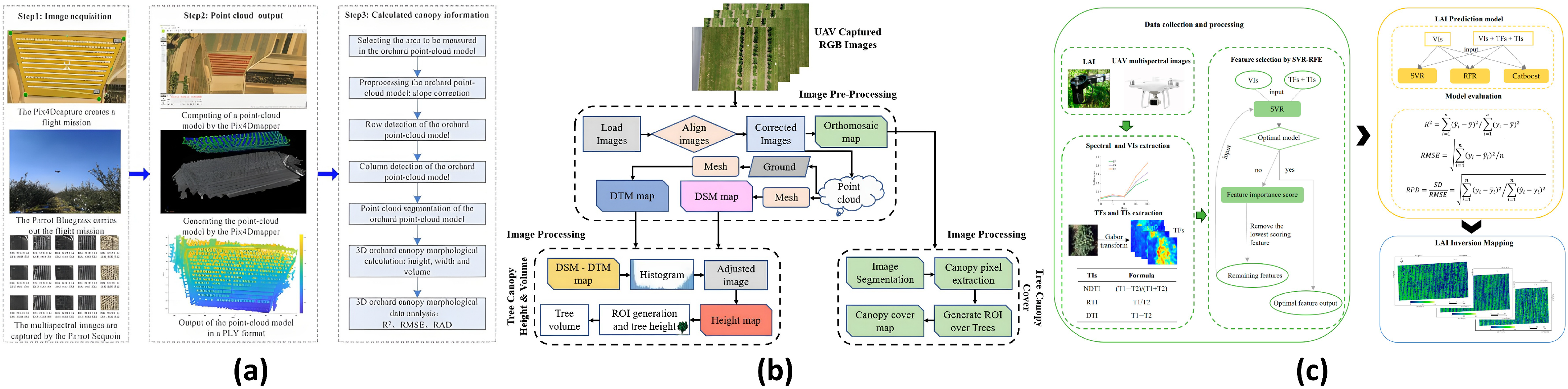
Orchards and perennial cash-crop planting areas are characterized by pronounced three-dimensional canopy structures, narrow inter-row corridors, and severe occlusion. In such environments, UAVs are used not only for remote sensing observation, but increasingly for canopy-proximal sampling and close-range operational support. Accordingly, navigation is no longer limited to reaching or covering a target area, but instead requires repeatable flight paths, stable relocalization, close-range obstacle avoidance, and consistent attitude control. Because orchard phenotyping and monitoring often depend on highly overlapping imagery and stable flight altitude for cross-temporal alignment, while canopy occlusion and repetitive textures degrade both GNSS and pure vision-based localization, orchard UAV operation places higher robustness demands on the localization–mapping–planning chain. Figure 13 summarizes representative UAV applications in orchard environments and illustrates how these perception and mapping tasks impose scenario-specific navigation requirements.
In orchard environments, UAV mapping commonly targets canopies and fruits for spatial localization and georeferencing to support precision management [180,183]. As illustrated in Figure 13a, canopy-scale mapping methods such as that of Sun et al. [180] rely on photogrammetric point-cloud reconstruction and row-structured representation, which in turn require stable headings and repeatable observation geometry along tree rows. This creates a natural coupling between orchard mapping and row-constrained navigation. To improve stable flight and repeatable sampling under GNSS degradation, recent studies have mainly followed two directions: vision-based control or learning-based navigation [184], and fusion-based localization [185]. These methods are better aligned with the orchard-specific challenge that absolute localization may degrade under occlusion, while the tasks still require repeatable trajectories and stable relocalization.
Another important direction is fruit-level spatial localization, where the objective extends from fruit detection and counting to 3D spatialized yield assessment [126,183,186]. Existing studies have combined video-based detection, hyperspectral sensing, LiDAR mapping, and 3D planning to support fruit localization, repeated-count suppression, and spatial yield estimation [126,183,186]. The navigation implication is that, once orchard tasks move from coverage-oriented observation to near-target multi-view inspection and multi-point access, localization and planning must explicitly support viewpoint repeatability, safe near-obstacle motion, and spatially aware trajectory generation. Such applications are therefore better supported by fusion-based localization and 3D planning frameworks, particularly those constrained by LiDAR geometry or hybrid SLAM/GNSS localization.
Orchard phenotyping tasks often focus on canopy structure, flower and fruit density, and fruit morphology, all of which impose strong constraints on image overlap, viewpoint consistency, and altitude stability. Representative studies include canopy-structure estimation from UAV RGB imagery and photogrammetric reconstruction [181,187], flower-density mapping based on RGB imagery and point clouds [188], and finer-scale 3D fruit phenotyping through panoramic mapping and shape reconstruction [189]. As shown in Figure 13b, these tasks require repeatable cruising along tree rows with stable canopy-relative altitude and consistent viewpoints to ensure cross-temporal comparability and accurate spatial registration. Accordingly, orchard phenotyping is better matched to navigation paradigms constrained by tree-row centerlines, such as LiDAR–IMU fusion methods that support inter-row navigation, headland turning, and repeatable data acquisition under canopy occlusion [190].
Orchard monitoring tasks likewise depend on multi-temporal repeated sampling and stable relocalization to maintain temporal alignment and spatial consistency. Figure 13c shows a representative multispectral analysis workflow for orchard monitoring [182]. Existing studies have used UAV multispectral or high-resolution imagery for leaf area index estimation [182], water-status and transpiration mapping [191], disease detection [192], and yield estimation [193]. Because these tasks require repeated acquisition along similar flight paths across time, they are better supported by tree-row centerline-constrained navigation [190], LiDAR–IMU fusion [194], or SLAM/GNSS fusion and 3D SLAM frameworks [185,195], which improve trajectory stability, relocalization, and cross-flight map consistency under weakened or occluded GNSS conditions. More broadly, orchard monitoring highlights that, in close-range agricultural environments, navigation quality directly affects not only flight safety but also the spatial consistency and interpretability of long-term monitoring outputs.

4. Datasets, Simulation, and Evaluation Protocols

4.1. Data Fusion and Datasets

The core objective of multimodal data fusion in agricultural UAV navigation is to exploit sensor complementarity to improve localization, mapping, obstacle avoidance, and navigation robustness. In this context, fusion should be understood primarily as a navigation-oriented mechanism for enhancing state estimation, environmental perception, and real-time decision-making under occlusion, illumination variation, and GNSS degradation. According to the stage of information flow, fusion strategies are commonly categorized as early fusion, intermediate fusion, and late fusion [143], corresponding to input-level, feature-level, and decision-level fusion, respectively. Early fusion directly integrates multimodal inputs to strengthen cross-modal interaction. Zhao et al. [196] proposed LIF-Seg, a coarse-to-fine camera–LiDAR early fusion network for LiDAR image segmentation with offset correction for spatiotemporal misalignment. Although not developed specifically for UAVs, this paradigm is relevant to low-altitude agricultural UAV navigation, where RGB, LiDAR, and semantic segmentation can support obstacle recognition, risk understanding, and traversable-area segmentation. Intermediate fusion emphasizes feature alignment and joint optimization within a unified state-estimation framework, making it naturally compatible with tightly coupled odometry and SLAM. Zheng et al. [197] proposed FAST-LIVO2, which integrates IMU, LiDAR, and visual measurements through an efficient error-state iterated Kalman filter (ESIKF) for accurate and robust state estimation. Such approaches are particularly suitable for agricultural UAV navigation because they support continuous 6-DoF pose estimation and improved robustness when GNSS becomes unreliable. Late fusion combines independently estimated modality-specific outputs through weighting or consistency constraints, offering modularity and deployment flexibility. Ali et al. [198] proposed a modular late-fusion framework using camera, LiDAR, and radar data for target classification. Although developed in a UGV context, this paradigm is also applicable to embedded agricultural UAV systems by combining the all-weather robustness of radar with the semantic and geometric capabilities of vision and LiDAR for low-altitude risk recognition and obstacle-avoidance triggering. Overall, the significance of these three fusion paradigms lies not in fusion itself, but in their shared ability to improve navigation reliability in heterogeneous agricultural environments.
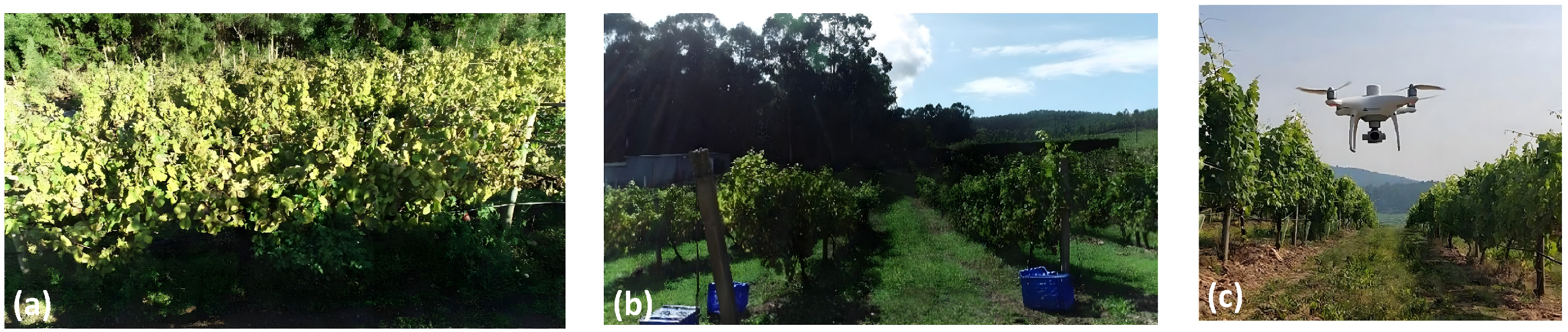
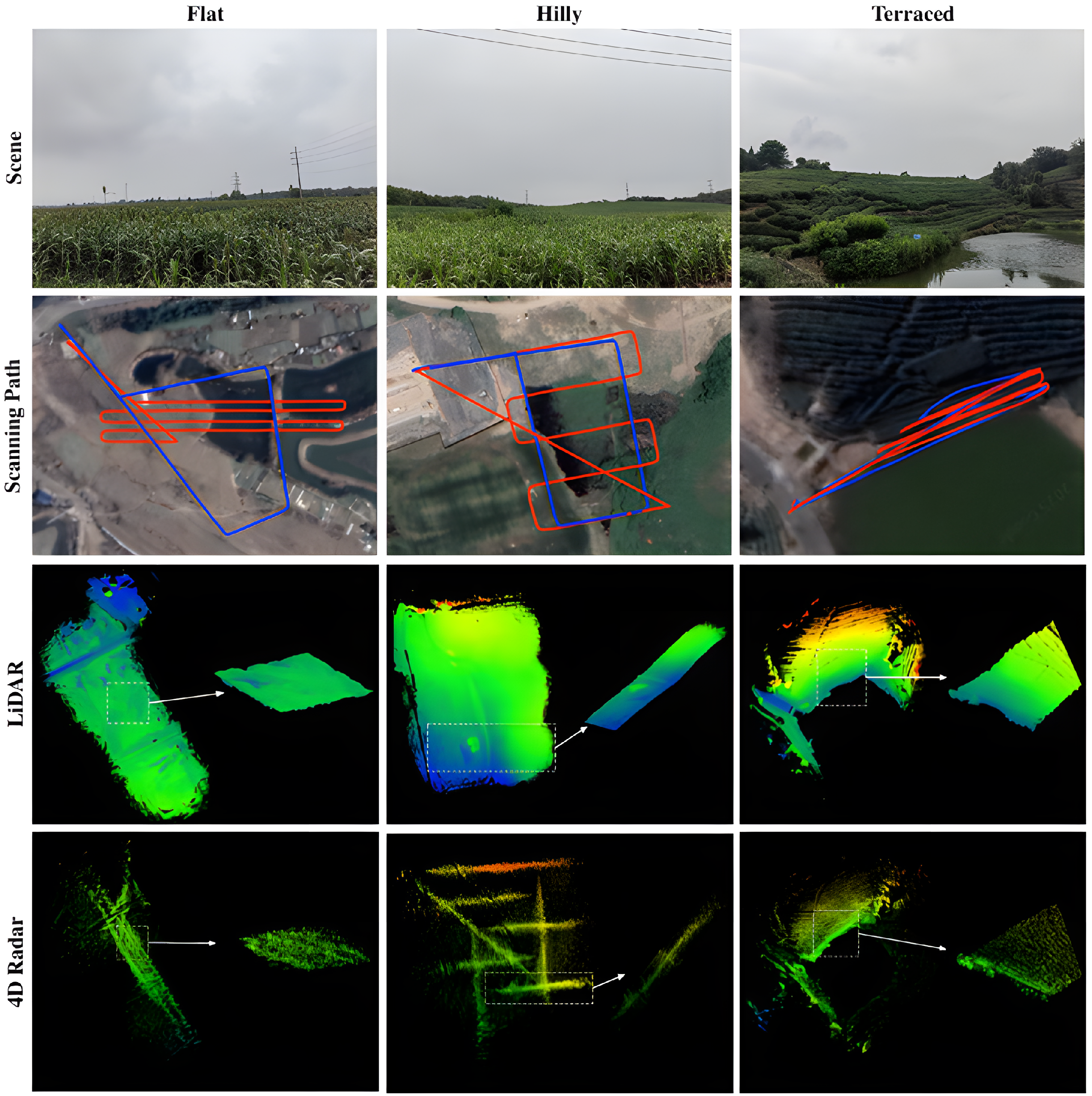
At the data level, the main bottleneck is no longer data scarcity, but the lack of high-quality, standardized, and reproducible datasets for navigation and sensor fusion. For agricultural UAV navigation, such datasets must support rigorous evaluation of localization accuracy, mapping consistency, and robustness across representative field conditions. Dataset construction should therefore provide: (1) strict time synchronization among visual, LiDAR, IMU, and GNSS data; (2) complete calibration, including intrinsic, extrinsic, and temporal parameters; (3) high-quality ground truth, such as RTK/INS, total station measurements, or high-definition maps and trajectories; (4) task-relevant metadata, including flight altitude and speed, crop type, row orientation, occlusion level, illumination, wind conditions, and radiometric settings; and (5) coverage of scenarios with different difficulty levels, such as plains, hills, and terraced fields, as well as weak-texture, repetitive-structure, and strong illumination-variation conditions. GrapeSLAM [199] provides UAV monocular visual data together with RTK/IMU trajectories for vineyard environments (Figure 14), making it suitable for visual SLAM, SfM, and orchard-navigation research. AgriLiRa4D [90], by contrast, contains 33 sequences of LiDAR, 4D radar, and IMU data across plains, hills, and terraced fields (Figure 15), providing a more systematic benchmark for multimodal SLAM and localization in agricultural UAV applications. Overall, these datasets show that future benchmarks should be designed not merely for multimodal sensing, but for navigation-oriented evaluation under representative agricultural disturbances and scene variability. However, current agricultural UAV navigation datasets still exhibit several important limitations. Most available datasets cover only a limited number of crop types, sensing configurations, or operating conditions, and many lack unified calibration standards, sufficiently accurate ground truth, explicit task annotations, or standardized evaluation splits. In addition, cross-dataset comparability remains weak because scenario definitions, sensor combinations, and reporting protocols are often inconsistent. As a result, although recent datasets have improved data availability, they still fall short of supporting fully standardized and reproducible benchmark evaluation for agricultural UAV navigation.

4.2. Simulation and Digital Twin

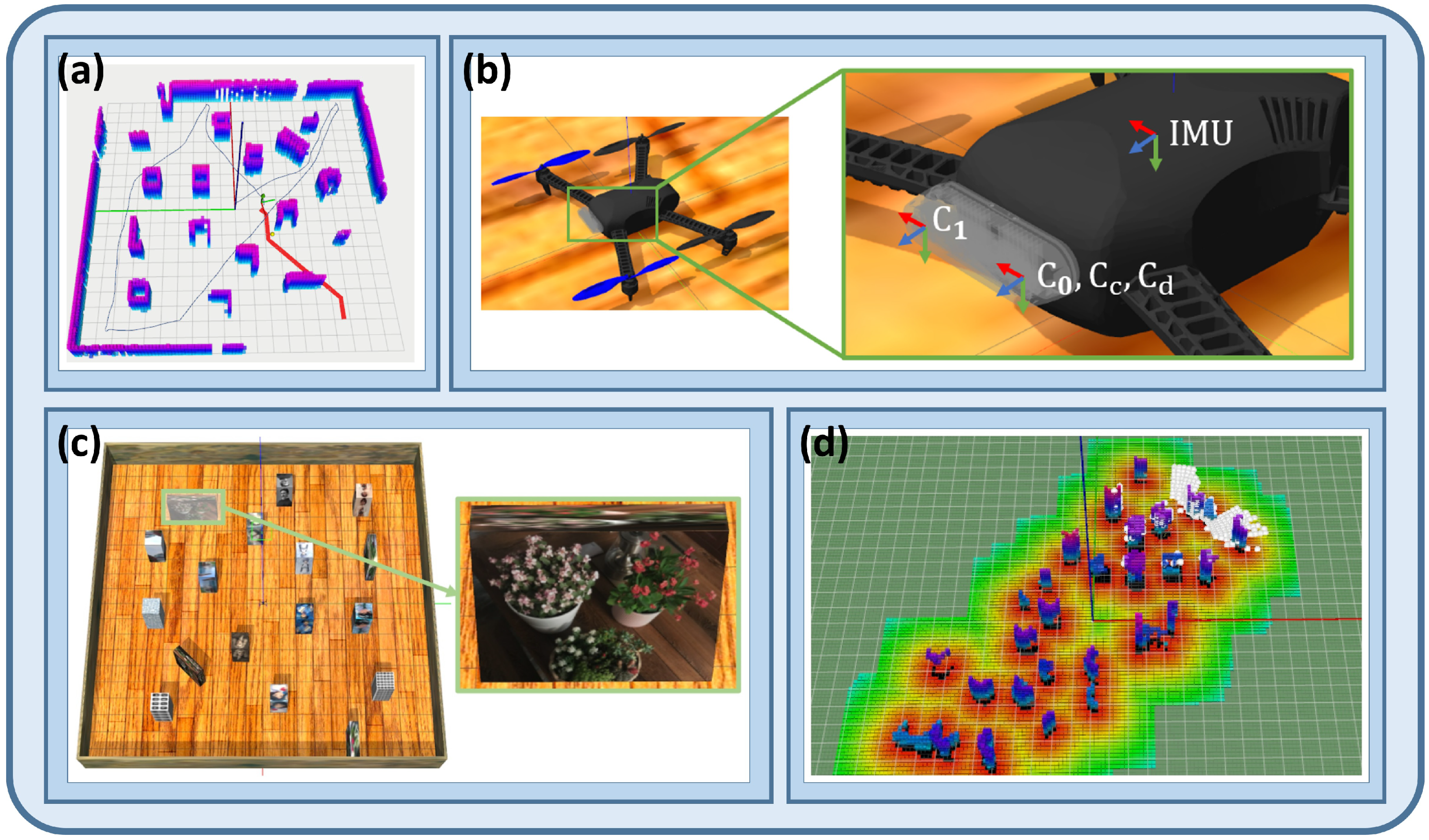
Simulation is a fundamental tool for validating safety, expanding data scale, and accelerating iteration in UAV navigation and control research. However, different platforms emphasize different aspects: control-loop and dynamic accuracy, ROS-based closed-loop multi-sensor integration, and high-fidelity perception with large-scale training often require different software ecosystems. In general, MATLAB is more suitable for flight dynamics and control-loop modeling [200,201], Gazebo is better suited to ROS-based closed-loop validation and multi-sensor integration [202], and Isaac Sim is more appropriate for high-fidelity perception simulation, synthetic data generation, and large-scale training [203]. In agricultural UAV applications, MATLAB is commonly used for flight control and autopilot or hardware-in-the-loop (HIL) validation [204,205]; Gazebo is frequently used for closed-loop testing of visual SLAM, autonomous navigation, trajectory tracking, and obstacle-avoidance logic [202,206]; and Isaac Sim is more suitable for high-fidelity validation and training of multirotor control and motion-planning algorithms [207,208]. Figure 16 presents a Gazebo-based workflow for click-and-fly navigation in unknown environments, including sensor configuration and ESDF/map visualization in Rviz [206], illustrating a closed-loop validation pipeline of simulation, mapping, planning, and execution.
Digital twins further extend simulation into an updatable virtual–physical interactive system, in which the environment, platform, and task states are continuously synchronized in virtual space, thereby supporting path planning, risk prediction, online validation, and model transfer. Wu et al. [209] combined digital twins with 3D A* planning to validate UAV navigation and obstacle-avoidance processes in a virtual campus environment. For agriculture, this paradigm is particularly suitable for geometry-sensitive close-range scenarios, such as orchard inter-row flight, greenhouse corridors, sloped or terraced fields, and multi-UAV collaborative field inspection, where it can be used to rapidly assess system-level trade-offs among planning strategy, safety margin, and operational efficiency. At the same time, the key to Sim2Real lies in reducing the gap between simulation and the real world. Recent UAV remote sensing studies have improved transferability through high-fidelity scene reconstruction and diversified rendering [210,211], thereby providing a more practical technical pathway for synthetic data generation, Sim2Real, and Sim2Real2Sim in agricultural navigation. However, even high-fidelity simulation cannot fully reproduce the complexity of real agricultural deployment, including wind-driven canopy motion, illumination variation, GNSS instability, spray interference, terrain irregularity, and communication uncertainty [212,213]. Therefore, simulation results should be interpreted primarily as a controllable pre-validation tool, whereas real-world field deployment remains essential for assessing robustness, transferability, and task-level reliability [214,215]. In this sense, the Sim-to-Real gap in agricultural UAV navigation lies not only in perception realism, but also in the mismatch between controlled virtual validation and long-duration operation under coupled environmental and task disturbances.

4.3. Evaluation Metrics

Since existing studies on agricultural UAV navigation are conducted under heterogeneous platforms, sensing configurations, task settings, and validation protocols, direct metric-level comparison across all methods is often difficult. Therefore, the purpose of this section is not to impose a single unified ranking, but to summarize the most commonly used and practically meaningful evaluation metrics in the literature, so as to provide a clearer analytical basis for interpreting reported results and to support future benchmark design and more standardized cross-study comparison. As summarized in Table 3, the evaluation of agricultural UAV navigation can be organized into six closely related categories: localization and mapping, trajectory tracking, control performance, mission efficiency, safety and robustness, and agronomic task quality. For localization and mapping, the most widely used metrics are absolute trajectory error (ATE) and relative pose error (RPE), which characterize global trajectory deviation and local drift, respectively, and are commonly used in SLAM, VIO, LIO, and fusion-based localization evaluation [216]. For trajectory tracking, representative metrics include RMSE/MAE and cross-track error, which reflect point-wise tracking deviation and lateral line-following quality in tasks such as waypoint following, spraying route tracking, and crop-row navigation [217]. For control performance, settling time and overshoot are commonly used to evaluate response speed and dynamic stability under disturbances, especially for PID-, sliding-mode-, ADRC-, and MPC-based controllers under wind disturbance or time-varying payload conditions [135]. At the mission level, path length and flight time provide compact measures of planning efficiency and operational cost, while success rate, collision rate, and minimum clearance are important for assessing navigation safety and robustness in cluttered or uncertain environments [218]. In addition, because agricultural UAVs are ultimately designed for field operations rather than navigation alone, agronomic task quality must also be considered. Typical indicators include coverage rate, miss rate, overlap rate, spray deposition density, deposition uniformity measured by coefficient of variation (CV), and drift loss, which help translate navigation and control performance into differences in actual operational quality.

5. Discussion

5.1. Challenges

The high heterogeneity of agricultural environments makes it difficult to develop universally transferable UAV navigation solutions. Compared with general low-altitude scenarios, agricultural environments differ markedly in spatial structure, terrain variation, crop morphology, occlusion conditions, and task objectives [1,219]. Open fields emphasize large-area coverage and trajectory repeatability, orchards require canopy-proximal perception and stable flight in narrow corridors, and terraced or mountainous farmlands impose stricter demands on terrain adaptation and flight safety. This strong coupling among scenario, task, and navigation requirements means that existing methods often perform well only under specific conditions and are difficult to transfer reliably across crop types, seasons, and operational modes [124]. Therefore, the key challenge in agricultural UAV navigation is not the isolated performance of individual algorithms, but the lack of a systematic methodology that links environmental characteristics, task requirements, and navigation architecture selection. This also limits the scalability and real-world applicability of current navigation systems, since methods validated in one agricultural scenario often do not transfer reliably across different crops, terrains, and operational conditions.
Perception degradation and unstable localization remain central bottlenecks to robust autonomous navigation in agriculture. Agricultural environments commonly involve weak or repetitive textures, dynamic vegetation, severe illumination variation, GNSS occlusion, and disturbances from dust and airflow [220,221,222]. These factors jointly degrade visual localization, GNSS/RTK positioning, and low-altitude state estimation. More importantly, localization errors propagate beyond the state-estimation layer into mapping, replanning, trajectory control, and task execution, ultimately affecting spraying uniformity, phenotyping consistency, and revisit accuracy [223]. Although multi-sensor fusion improves robustness, its field deployment remains constrained by time synchronization, extrinsic calibration, payload, energy, and computational limitations. As a result, agricultural UAVs still lack localization solutions capable of reliable long-duration operation in complex environments.
Another major challenge is the disconnect between environmental representation, path planning, and agricultural task objectives in current navigation pipelines. Most existing studies still design navigation systems primarily around geometric traversability, collision avoidance, or path executability [224], whereas agricultural operations are more directly evaluated by outcome-oriented indicators such as spraying deposition consistency, stable canopy-relative distance, cross-temporal route reproducibility, and efficient revisiting of pest or disease hotspots [154,225]. Consequently, a geometrically feasible path is not necessarily optimal for agricultural operation. For example, a trajectory that satisfies obstacle-avoidance constraints may still be unsuitable for canopy-proximal variable spraying, while a globally complete coverage route may not support adaptive revisiting of hotspot regions. Overall, current agricultural UAV navigation remains largely geometry-driven, while task semantics such as crop rows, canopy boundaries, risk regions, and no-spray zones are still insufficiently incorporated. A truly closed-loop navigation framework oriented toward agricultural task quality has not yet been established.
Time-varying payloads, wind disturbances, and near-ground operating conditions further increase the robustness requirements of agricultural UAV control systems. During spraying, canopy-proximal inspection, and terrain-following tasks, liquid consumption, liquid sloshing, crosswind disturbances, and low-altitude aerodynamic effects all increase dynamic uncertainty, making conventional fixed-parameter control strategies prone to performance degradation [226,227]. Unlike general UAV missions, control in agricultural scenarios is not only concerned with flight stability, but also directly affects canopy-relative height maintenance, sensing geometry, and spraying-quality consistency [228]. Therefore, the challenge of agricultural UAV control lies in maintaining both state stability and task-output stability, which requires control objectives to extend beyond attitude and position regulation toward robust closed-loop control for operational quality.
Finally, the lack of standardized datasets, unified evaluation protocols, and task-oriented benchmarks limits the comparability and reproducibility of agricultural UAV navigation research. Although several navigation and multi-sensor datasets have emerged for agricultural scenarios, they still suffer from incomplete modality coverage, limited scenario diversity, insufficient ground truth, and scarce task annotations. More importantly, many studies rely on private datasets, heterogeneous platforms, and inconsistent evaluation metrics, making fair comparison across methods difficult [229]. Existing evaluations still focus mainly on localization error, path length, and success rate, while giving insufficient attention to agriculture-specific indicators such as spraying deposition uniformity, revisit consistency, and safety margins in canopy-proximal operations. As a result, the relationship between navigation performance and agricultural task outcomes remains unclear, slowing the transition of agricultural UAV navigation from algorithmic validation to engineering maturity.

5.2. Future Perspectives

Future development of agricultural UAV navigation should shift from single-scenario optimization to systematic architecture design that explicitly accounts for scenario differences. Given the substantial differences among open fields, orchards, and terraced farmlands in spatial structure, occlusion characteristics, and operational objectives, future research should no longer pursue a single universal solution. Instead, it should establish a navigation technology selection framework oriented toward environmental structure and task attributes, in which sensor configuration, localization strategy, map representation, planning method, and control architecture are co-designed. The key is not to identify one optimal algorithm for all scenarios, but to develop a modular navigation system that can be adaptively configured, rapidly deployed, and stably transferred according to the characteristics of agricultural environments.
Future research must also further develop multi-source robust perception and fault-tolerant localization mechanisms for complex agricultural environments. In addition, future agricultural UAV navigation should move toward lightweight, energy-aware, and edge-deployable architectures to support robust localization, planning, and inference under realistic onboard resource constraints [91,230]. At the methodological level, deeper integration of GNSS, vision, LiDAR, IMU, radar, and environmental sensing information is needed to improve the stability of state estimation under weak GNSS, dynamic occlusion, and low-texture conditions [231,232,233]. However, a major gap in current multi-sensor fusion research is that many methods are still developed and evaluated under relatively controlled conditions, while agricultural environments often involve asynchronous sensing, temporary sensor degradation, calibration drift, canopy motion induced by wind, dust or spray interference, and intermittent GNSS blockage. Future fusion frameworks should therefore move beyond accuracy-oriented integration toward uncertainty-aware, fault-aware, and recovery-oriented architectures that can support sensor reweighting, adaptive modality switching, and degradation under dynamic field conditions. At the system level, greater attention should be paid to engineering issues such as time synchronization, extrinsic calibration, fault detection, and switching under degraded operating conditions [234,235]. In particular, the localization system of agricultural UAVs should not focus solely on improving average accuracy, but should emphasize recoverability and robustness during long-duration operations and under complex disturbances. In other words, the goal should evolve from high-precision localization to high-reliability localization.
In perception and environmental modeling, future research may increasingly incorporate general-purpose visual foundation models, such as the DINO series [236,237,238,239] and the SAM series [240], to improve representation generalization and task transferability in agricultural scenarios. Compared with conventional data-driven approaches that depend heavily on task-specific annotations, these models offer potential advantages in weakly supervised representation learning, open-scene segmentation, cross-domain feature extraction, and few-shot adaptation. As a result, they may provide more transferable visual priors for crop-row extraction, canopy-boundary perception, obstacle recognition, traversable-area segmentation, and hotspot localization of disease symptoms. When combined with 3D reconstruction, dense depth estimation, or multi-view geometric modeling [241], they may further support 3D semantic mapping for structural understanding of agricultural environments, thereby improving the modeling of complex canopies, sloped terrain, and low-altitude traversable space. However, their deployment on agricultural UAV platforms still depends on addressing key challenges related to computational cost, real-time performance, cross-season generalization, and multimodal adaptation. Therefore, these models should be regarded as enhancement modules for high-level environmental understanding and task perception, rather than direct replacements for existing navigation pipelines.
Future navigation systems should also evolve toward task-semantic-driven and closed-loop decision-making. Agricultural UAV navigation should not remain limited to geometric maps and feasible paths, but should explicitly incorporate task semantics such as crop rows, canopy structures, pest and disease hotspots, prescription regions, and safety-risk zones into map representations, cost functions, and replanning logic, thereby forming a closed-loop chain of environmental understanding, task planning, and execution feedback. For typical applications such as spraying, monitoring, and phenotyping [242,243], this means that future systems must advance from simply being able to avoid obstacles and reach targets to being able to make optimal decisions around agricultural objectives, thereby unifying navigation performance with operational quality. Another important direction is the tighter integration of UAV navigation with agricultural decision-support systems. In future workflows, prescription maps, disease-risk maps, phenotyping priorities, and stress-monitoring outputs should not merely serve as offline references, but should directly inform route generation, sensing resolution allocation, revisiting strategy, and mission scheduling. Such integration would enable agricultural UAV navigation to evolve from reactive path execution toward decision-informed and agronomy-aware mission adaptation.
At the control level, agricultural UAVs need to evolve from conventional trajectory-tracking control toward intelligent control frameworks that integrate robustness with task adaptability. ADRC is particularly promising in agricultural scenarios [244,245], because it can estimate and compensate for total disturbances online through an extended state observer under model uncertainty, strong external disturbances, and significant parameter variation [246,247]. This makes it well suited for the complex uncertainties associated with spraying payload changes, wind disturbances, and low-altitude flight [248]. Further integration of ADRC with model predictive control, learning-based control, or multi-sensor state feedback may enable control architectures that jointly satisfy fast response, disturbance rejection, and task-output constraints [249,250]. More broadly, from a cybernetics perspective, agricultural UAV navigation should be understood as a closed-loop adaptive system spanning perception, decision-making, execution, and feedback. Its central challenge lies not only in the local performance of individual controllers, but also in the self-correcting and continuously optimizing capability of the overall system under dynamic conditions.
Future studies should also accelerate the development of standardized data, simulation, and evaluation benchmark systems for agricultural UAV navigation. This requires not only high-quality multimodal public datasets [229], but also unified calibration standards, real trajectory ground truth, representative task definitions, and cross-scenario evaluation protocols. Furthermore, evaluation frameworks should move beyond isolated navigation metrics toward joint assessment of localization accuracy, trajectory stability, task efficiency, safety margins, and agricultural operation quality, so that navigation performance can be interpreted in relation to spraying quality, phenotyping consistency, and disease revisit effectiveness. In particular, future benchmarks should explicitly evaluate robustness under dynamic agricultural conditions, such as wind-driven canopy motion, illumination variation, intermittent GNSS availability, sensor dropout, moving obstacles, and time-varying payloads during spraying. This is essential for narrowing the gap between algorithmic validation under idealized conditions and reliable deployment in real agricultural operations. In addition, reproducible test loops based on high-fidelity simulation, digital twins, and Sim-to-Real technologies [214,215] will provide an important foundation for advancing agricultural UAV navigation from laboratory validation to large-scale deployment.

6. Conclusions

This paper has systematically reviewed UAV navigation in agricultural environments from a system perspective, covering key technical components including perception, localization, mapping, planning, control, and data and evaluation frameworks. It has further analyzed the differences in navigation requirements and application patterns across representative scenarios such as open fields, orchards, and terraced farmlands. The review shows that agricultural UAV navigation is no longer a standalone problem of localization or path planning, but rather a comprehensive technical system deeply coupled with operational objectives, environmental structure, and system constraints. Its performance affects not only flight safety and trajectory stability, but also spraying quality, monitoring accuracy, phenotyping consistency, and revisit effectiveness. At present, the field still faces several critical challenges, including strong scenario heterogeneity, significant perception degradation, insufficient integration of task semantics, limited control robustness, and the lack of standardized benchmarks. In the future, agricultural UAV navigation should move beyond local optimization for individual scenarios toward systematic architecture design under the joint constraints of complex environments and agricultural tasks. Through the combined advancement of multi-source robust perception, task-semantic-driven decision-making, intelligent control, and standardized evaluation systems, agricultural UAVs can evolve from being merely flyable and observable to becoming highly reliable autonomous systems that are stable, interpretable, and scalable for real agricultural operations.

Author Contributions

Conceptualization, X.L. and H.W.; methodology, G.D., X.L. and H.W.; validation, G.D.; formal analysis, G.D.; investigation, G.D.; resources, X.L. and H.W.; data curation, G.D.; writing—original draft preparation, G.D.; writing—review and editing, X.L. and H.W.; visualization, G.D.; supervision, X.L. and H.W.; project administration, X.L. and H.W.; funding acquisition, X.L. and H.W. All authors have read and agreed to the published version of the manuscript.

Funding

This research received no external funding.

Data Availability Statement

No new data were created or analyzed in this study.

Acknowledgments

During the preparation of the English version of this manuscript, the authors used ChatGPT (OpenAI; GPT-5.4 Thinking) for limited language assistance, including translation support, grammar correction, wording refinement, and improvement of readability. This tool was used solely to improve the linguistic expression of the manuscript and was not used to generate scientific content, interpretations, or conclusions. The authors carefully reviewed and edited all AI-assisted output and take full responsibility for the final content of this publication.

Conflicts of Interest

The authors declare no conflicts of interest.

Appendix A. Review Methodology

This review adopted a structured literature-survey approach to synthesize research on UAV navigation in agricultural environments from a system perspective. Relevant studies were primarily collected from Web of Science, Scopus, IEEE Xplore, and Google Scholar. The search mainly focused on literature published from 2018 to 2026, while earlier seminal studies were retained when they were necessary to describe foundational methods or benchmark frameworks. Representative search terms included combinations of “UAV”, “drone”, “agriculture”, “navigation”, “localization”, “mapping”, “SLAM”, “path planning”, “trajectory tracking”, “obstacle avoidance”, and “spraying”, together with related terms such as “multimodal fusion”, “digital twin”, and “edge deployment”.
The collected literature was screened according to its relevance to agricultural UAV navigation and to the system-level scope of this review (Table A1). Studies were included when they addressed core navigation-related topics, such as sensing, localization, mapping, planning, control, datasets, simulation, or evaluation, in agricultural UAV scenarios or in closely related technical contexts with clear transferability. Studies were excluded when they focused only on general remote sensing analysis without clear navigation relevance, on non-UAV systems without transferable insight, or on papers lacking sufficient technical detail. The final literature set was then organized according to the main structure of this review, including key technologies, representative applications, and supporting datasets, simulation platforms, and evaluation protocols.
Table A1. Inclusion and exclusion criteria for literature selection in this review.
Criterion TypeDescription
InclusionStudies directly related to agricultural UAV navigation or to key navigation-enabling components, including sensing, localization, mapping, SLAM, path planning, obstacle avoidance, trajectory tracking, control, datasets, simulation, and evaluation.
Studies conducted in representative agricultural scenarios, such as open fields, orchards, and terraced or mountainous farmland, or technically related contexts with clear relevance to agricultural UAV navigation.
Seminal earlier studies retained when they provide foundational methods or widely used benchmark frameworks.
ExclusionStudies focused only on crop monitoring or remote sensing interpretation without clear relevance to UAV navigation.
Studies on non-UAV platforms or non-agricultural systems without sufficiently transferable navigation insight.
Papers lacking clear technical content, methodological detail, or relevance to the system-level focus of this review.

References

  1. Wang, R.F.; Qu, H.R.; Su, W.H. From sensors to insights: Technological trends in image-based high-throughput plant phenotyping. Smart Agric. Technol. 2025, 12, 101257. [Google Scholar] [CrossRef]
  2. United Nations, Dept. of Economic. World Population Prospects: The 2002 Revision. Sex and Age; Number 222–223; United Nations Publications: New York, NY, USA, 2003. [Google Scholar]
  3. Pingali, P.L. Green revolution: Impacts, limits, and the path ahead. Proc. Natl. Acad. Sci. USA 2012, 109, 12302–12308. [Google Scholar] [CrossRef]
  4. Yao, M.; Huo, Y.; Tian, Q.; Zhao, J.; Liu, X.; Wang, R.; Xue, L.; Wang, H. FMRFT: Fusion mamba and DETR for query time sequence intersection fish tracking. Comput. Electron. Agric. 2025, 237, 110742. [Google Scholar] [CrossRef]
  5. Africa, S.; Ghanem, H. Report of the FAO Expert Meeting on How to Feed the World in 2050. In Economic and Social Report; Food and Agriculture Organization, The United Nations: Rome, Italy, 2009; pp. 1–23. [Google Scholar]
  6. Wang, R.F.; Su, W.H. The application of deep learning in the whole potato production Chain: A Comprehensive review. Agriculture 2024, 14, 1225. [Google Scholar] [CrossRef]
  7. Yang, Z.Y.; Xia, W.K.; Chu, H.Q.; Su, W.H.; Wang, R.F.; Wang, H. A comprehensive review of deep learning applications in cotton industry: From field monitoring to smart processing. Plants 2025, 14, 1481. [Google Scholar] [CrossRef] [PubMed]
  8. Saha, S.; Kucher, O.D.; Utkina, A.O.; Rebouh, N.Y. Precision agriculture for improving crop yield predictions: A literature review. Front. Agron. 2025, 7, 1566201. [Google Scholar] [CrossRef]
  9. Han, Y.S.; Zhao, S.L.; Chen, C.; Cui, K.; Hu, P.; Wang, R.F. SEAF-Net: A Sustainable and Lightweight Attention-Enhanced Detection Network for Underwater Fish Species Recognition. J. Mar. Sci. Eng. 2026, 14, 351. [Google Scholar] [CrossRef]
  10. Zhao, C.T.; Wang, R.F.; Tu, Y.H.; Pang, X.X.; Su, W.H. Automatic lettuce weed detection and classification based on optimized convolutional neural networks for robotic weed control. Agronomy 2024, 14, 2838. [Google Scholar] [CrossRef]
  11. Cui, K.; Zhu, R.; Wang, M.; Tang, W.; Larsen, G.D.; Pauca, V.P.; Alqahtani, S.; Yang, F.; Segurado, D.; Lutz, D.A.; et al. Detection and geographic localization of natural objects in the wild: A case study on palms. In Proceedings of the Thirty-Fourth International Joint Conference on Artificial Intelligence, Montreal, QC, Canada, 16–22 August 2025; pp. 9601–9609. [Google Scholar]
  12. Chu, Y.; Zhou, L.; Luo, G.; Kang, K.; Dong, S.; Han, Z.; Wu, L.; Meng, X.; Yang, C.; Guo, X.; et al. HorusEye: A self-supervised foundation model for generalizable X-ray tomography restoration. Nat. Comput. Sci. 2026, 6, 372–387. [Google Scholar] [CrossRef]
  13. Wang, R.F.; Tu, Y.H.; Li, X.C.; Chen, Z.Q.; Zhao, C.T.; Yang, C.; Su, W.H. An intelligent robot based on optimized yolov11l for weed control in lettuce. In Proceedings of the 2025 ASABE Annual International Meeting; American Society of Agricultural and Biological Engineers: Saint Joseph, MI, USA, 2025; p. 1. [Google Scholar]
  14. Xia, W.; Shu, J.; Sang, C.; Wang, K.; Wang, Y.; Sun, T.; Xu, X. The prediction of RNA-small-molecule ligand binding affinity based on geometric deep learning. Comput. Biol. Chem. 2025, 115, 108367. [Google Scholar] [CrossRef] [PubMed]
  15. Liu, S.; Liang, X.; Zhang, C.; Jia, Y. Multiscale characterization of pore damage evolution and mechanical response of rocks: Real-time computed tomography scanning and discrete element simulation. J. Rock Mech. Geotech. Eng. 2026. [Google Scholar] [CrossRef]
  16. Lv, J.; Wang, C.; Xie, L. Adaptive distributed observer design for nonlinear multiagent systems. Automatica 2026, 183, 112625. [Google Scholar] [CrossRef]
  17. Tan, L.; Li, C.; He, X.; Huang, T. Distributed output feedback leader-following consensus for nonlinear multiagent systems with time delay. Nonlinear Dyn. 2021, 105, 1673–1687. [Google Scholar] [CrossRef]
  18. Guan, A.; Zhou, S.; Gu, W.; Liu, H.; Gao, M.; Zhao, B.; Lv, H.; Chen, J. Region-Driven Two-Layer Refined Scheduling for Multi-stack-integrated Alkaline Electrolyzer in Wind-Hydrogen System. IEEE Trans. Smart Grid 2026. [Google Scholar] [CrossRef]
  19. Wang, Z.; Wang, R.; Wang, M.; Lai, T.; Zhang, M. Self-supervised transformer-based pre-training method with General Plant Infection dataset. In Proceedings of the Chinese Conference on Pattern Recognition and Computer Vision (PRCV); Springer: Singapore, 2024; pp. 189–202. [Google Scholar]
  20. Jiao, P.; Yan, P.; Zhang, J.; Zhao, Z.; Su, F.; Zhang, W. Mining User Features with Hyperbolic Representations for Diffusion Prediction. Neural Netw. 2026, 200, 108855. [Google Scholar] [CrossRef]
  21. Jiang, R.; Tong, S.; Wu, J.; Hu, H.; Zhang, R.; Wang, H.; Zhao, Y.; Zhu, W.; Li, S.; Zhang, X. A novel EEG artifact removal algorithm based on an advanced attention mechanism. Sci. Rep. 2025, 15, 19419. [Google Scholar] [CrossRef]
  22. Zhou, G.; Wang, R.F.; Cui, K. A Local Perspective-based Model for Overlapping Community Detection. In Proceedings of the 2025 IEEE International Conference on Systems, Man, and Cybernetics (SMC), Vienna, Austria, 5–8 October 2025; pp. 2965–2970. [Google Scholar]
  23. Chen, J.; Zhang, Q.; Han, P.; Zhang, Y.; Lu, Y.; Zheng, P. Energy-aware Scheduling of Workflow Applications Towards Schedule Length Optimization in Heterogeneous Distributed Embedded Systems. ACM Trans. Des. Autom. Electron. Syst. 2025, 31, 1–27. [Google Scholar] [CrossRef]
  24. Wang, R.F.; Tu, Y.H.; Chen, Z.Q.; Zhao, C.T.; Su, W.H. A Lettpoint-Yolov11l Based Intelligent Robot for Precision Intra-Row Weeds Control in Lettuce. 2025. Available online: https://ssrn.com/abstract=5162748 (accessed on 6 March 2026).
  25. Yang, D.; Wang, M.; Chen, Z.; Gao, H. A causal learning framework integrating LASSO and information theory for source localization in power system forced oscillations. Adv. Eng. Inform. 2026, 72, 104441. [Google Scholar] [CrossRef]
  26. Ma, F.; Chen, J.; Dai, Z.; Cai, F.; Hu, Y. Autonomous inverse modeling of complex groundwater systems via a physics-integrated large language model multi-agent framework. Water Res. 2026, 299, 125886. [Google Scholar] [CrossRef] [PubMed]
  27. Chen, Y.; Mao, J.; Wang, R.F. Joint Learning of Emotion and Singing Style for Enhanced Music Style Understanding. Sensors 2025, 25, 7575. [Google Scholar] [CrossRef] [PubMed]
  28. Katkuri, A.V.R.; Madan, H.; Khatri, N.; Abdul-Qawy, A.S.H.; Patnaik, K.S. Autonomous UAV navigation using deep learning-based computer vision frameworks: A systematic literature review. Array 2024, 23, 100361. [Google Scholar] [CrossRef]
  29. Sun, H.; Chu, H.Q.; Qin, Y.M.; Hu, P.; Wang, R.F. Empowering Smart Soybean Farming with Deep Learning: Progress, Challenges, and Future Perspectives. Agronomy 2025, 15, 1831. [Google Scholar] [CrossRef]
  30. Cui, K.; Tang, W.; Zhu, R.; Wang, M.; Larsen, G.D.; Pauca, V.P.; Alqahtani, S.; Yang, F.; Segurado, D.; Fine, P.; et al. Efficient localization and spatial distribution modeling of canopy palms using uav imagery. IEEE Trans. Geosci. Remote Sens. 2025, 63. [Google Scholar] [CrossRef]
  31. Cui, K.; Shao, Z.; Larsen, G.; Pauca, V.; Alqahtani, S.; Segurado, D.; Pinheiro, J.; Wang, M.; Lutz, D.; Plemmons, R.; et al. Palmprobnet: A probabilistic approach to understanding palm distributions in ecuadorian tropical forest via transfer learning. In Proceedings of the 2024 ACM Southeast Conference, Marietta, GA, USA, 18–20 April 2024; pp. 272–277. [Google Scholar]
  32. Rabie, A.B.; Elhag, M.; Subyani, A. Remote sensing, GIS, and machine learning in water resources management for arid agricultural regions: A review. Water 2025, 17, 3125. [Google Scholar] [CrossRef]
  33. Yang, S.; Cui, K.; Jia, Y.; Ding, Y.; Guan, R.; Ding, Y. Superpixel-Level Hypergraph Regularized Multi-View Clustering for Hyperspectral Images. IEEE J. Sel. Top. Appl. Earth Obs. Remote Sens. 2026, 19, 10473–10488. [Google Scholar] [CrossRef]
  34. Di, X.; Cui, K.; Wang, R.F. Toward efficient uav-based small object detection: A lightweight network with enhanced feature fusion. Remote Sens. 2025, 17, 2235. [Google Scholar] [CrossRef]
  35. Zhang, W.; Huang, Q.; Ma, M.; Jiang, Y.; Chen, Y.; Huang, Z.; Wu, W.; Cui, K.; Lian, R.; Wu, Z.; et al. Center-guided classifier for semantic segmentation of remote sensing images. IEEE Trans. Geosci. Remote Sens. 2026, 64, 4404916. [Google Scholar] [CrossRef]
  36. Cai, H.; Zhong, X.; Zhou, B. UAV-Based Collaborative Mapping Framework with Environmental Semantic Extraction. ISPRS Ann. Photogramm. Remote Sens. Spat. Inf. Sci. 2025, 10, 1–7. [Google Scholar] [CrossRef]
  37. Yang, L.; Hao, Y.; Xu, J.; Li, M. Multi-UAV collaborative target search method in unknown dynamic environment. Sensors 2024, 24, 7639. [Google Scholar] [CrossRef]
  38. Dong, L.; Lu, M.; Wu, Y.; Li, X.; Wu, Y.; Yuan, X. RIS-assisted energy-efficient UAV data collection method based on deep reinforcement learning. Mob. Netw. Appl. 2025, 30, 736–746. [Google Scholar] [CrossRef]
  39. Shekh, M.; Rani, S.; Datta, R. Review on design, development, and implementation of an unmanned aerial vehicle for various applications. Int. J. Intell. Robot. Appl. 2025, 9, 299–318. [Google Scholar] [CrossRef]
  40. Maimaitijiang, M.; Sagan, V.; Sidike, P.; Daloye, A.M.; Erkbol, H.; Fritschi, F.B. Crop monitoring using satellite/UAV data fusion and machine learning. Remote Sens. 2020, 12, 1357. [Google Scholar] [CrossRef]
  41. Gou, C.; Zafar, S.; Fatima, N.; Hasnain, Z.; Aslam, N.; Iqbal, N.; Abbas, S.; Li, H.; Li, J.; Chen, B.; et al. Machine and deep learning: Artificial intelligence application in biotic and abiotic stress management in plants. Front. Biosci.-Landmark 2024, 29, 20. [Google Scholar] [CrossRef] [PubMed]
  42. Duarte, A.; Borralho, N.; Cabral, P.; Caetano, M. Recent advances in forest insect pests and diseases monitoring using UAV-based data: A systematic review. Forests 2022, 13, 911. [Google Scholar] [CrossRef]
  43. Aldakn, H.; Dragonetti, G.; Khadra, R.; Abdelmoneim, A.A.A.; Derardja, B. UAV-Based Computer Vision Approach for Melon Fruit Detection and Yield Estimation. AgriEngineering 2026, 8, 53. [Google Scholar] [CrossRef]
  44. Zhu, H.; Lin, C.; Liu, G.; Wang, D.; Qin, S.; Li, A.; Xu, J.L.; He, Y. Intelligent agriculture: Deep learning in UAV-based remote sensing imagery for crop diseases and pests detection. Front. Plant Sci. 2024, 15, 1435016. [Google Scholar] [CrossRef]
  45. Wang, J.; Zhang, S.; Lizaga, I.; Zhang, Y.; Ge, X.; Zhang, Z.; Zhang, W.; Huang, Q.; Hu, Z. UAS-based remote sensing for agricultural Monitoring: Current status and perspectives. Comput. Electron. Agric. 2024, 227, 109501. [Google Scholar] [CrossRef]
  46. Wang, P.; Hanif, A.S.; Yu, S.H.; Lee, C.G.; Kang, Y.H.; Lee, D.H.; Han, X. Development of an autonomous drone spraying control system based on the coefficient of variation of spray distribution. Comput. Electron. Agric. 2024, 227, 109529. [Google Scholar] [CrossRef]
  47. Han, L.; Wang, Z.; He, M.; Liu, Y.; He, X. PWM offline variable application based on UAV remote sensing 3D prescription map. Artif. Intell. Agric. 2025, 15, 496–507. [Google Scholar] [CrossRef]
  48. Guebsi, R.; Mami, S.; Chokmani, K. Drones in precision agriculture: A comprehensive review of applications, technologies, and challenges. Drones 2024, 8, 686. [Google Scholar] [CrossRef]
  49. Li, R.; Cui, K.; Chan, R.H.; Plemmons, R.J. Classification of hyperspectral images using SVM with shape-adaptive reconstruction and smoothed total variation. In Proceedings of the IGARSS 2022-2022 IEEE International Geoscience and Remote Sensing Symposium, Kuala Lumpur, Malaysia, 17–22 July 2022; pp. 1368–1371. [Google Scholar]
  50. Shao, Z.; Wang, Y.; Wang, Q.; Jiang, T.; Du, Z.; Ye, H.; Zhuo, D.; Chen, Y.; Li, H. Flashsvd: Memory-efficient inference with streaming for low-rank models. In Proceedings of the AAAI Conference on Artificial Intelligence, Singapore, 22–25 January 2026; Volume 40, pp. 25278–25285. [Google Scholar]
  51. Kartal, M.R.; Ignatyev, D.; Zolotas, A. Comprehensive review of agriculture spraying UAVs challenges and advances: Modelling and control. Aeronaut. J. 2025, 129, 2859–2879. [Google Scholar] [CrossRef]
  52. Sassu, A.; Psiroukis, V.; Bettucci, F.; Ghiani, L.; Fountas, S.; Gambella, F. Unmanned aerial system plant protection products spraying performance evaluation on a vineyard. Precis. Agric. 2024, 25, 2082–2112. [Google Scholar] [CrossRef]
  53. Fu, H.; Li, Z.; Zhang, W.; Feng, Y.; Zhu, L.; Long, Y.; Li, J. Path Planning for Agricultural UAVs Based on Deep Reinforcement Learning and Energy Consumption Constraints. Agriculture 2025, 15, 943. [Google Scholar] [CrossRef]
  54. Talaeizadeh, A.; Sharifi, I.; Alasty, A.; Ghatrehsamani, S. Agricultural spraying drones: A comprehensive review. Smart Agric. Technol. 2025, 12, 101519. [Google Scholar] [CrossRef]
  55. Li, Z.; Sun, C.; Wang, H.; Wang, R.F. Hybrid optimization of phase masks: Integrating Non-Iterative methods with simulated annealing and validation via tomographic measurements. Symmetry 2025, 17, 530. [Google Scholar] [CrossRef]
  56. Zhou, G.; Wang, R.F. The heterogeneous network community detection model based on self-attention. Symmetry 2025, 17, 432. [Google Scholar] [CrossRef]
  57. Li, W.; Luo, Y.; Jiang, P.; Dong, X.; Tang, K.; Liang, Z.; Shi, Y. A sustainable crop protection through integrated technologies: UAV-based detection, real-time pesticide mixing, and adaptive spraying. Sci. Rep. 2025, 15, 35748. [Google Scholar] [CrossRef] [PubMed]
  58. Sarron, J.; Malézieux, É.; Sané, C.A.B.; Faye, É. Mango yield mapping at the orchard scale based on tree structure and land cover assessed by UAV. Remote Sens. 2018, 10, 1900. [Google Scholar] [CrossRef]
  59. Fang, X.; Gu, Z.; Zhu, Y. Quantification of agricultural terrace degradation in the loess plateau using UAV-based digital elevation model and imagery. Sustainability 2023, 15, 10800. [Google Scholar] [CrossRef]
  60. Ye, H.; Cao, J.; Yang, X.; Shao, S. Safety-critical Model Predictive Control for quadcopter UAV subject to wind disturbances and measurement errors in confined environments. Aerosp. Sci. Technol. 2026, 173, 111790. [Google Scholar] [CrossRef]
  61. Lateef, F.; Kas, M.; Ruichek, Y. From GPS to AI: A comprehensive review of Unmanned Aerial Vehicle (UAV) localization solutions. ISPRS J. Photogramm. Remote Sens. 2025, 230, 402–451. [Google Scholar] [CrossRef]
  62. Ariante, G.; Falco, P.; Del Core, G. Flight Altitude Estimation for Unmanned Aerial Vehicles Using GNSS-Barometer Data Fusion. In Proceedings of the AISEM Annual Conference on Sensors and Microsystems; Springer: Cham, Switzerland, 2025; pp. 393–398. [Google Scholar]
  63. Fan, Z.; Zhang, L.; Wang, X.; Shen, Y.; Deng, F. LiDAR, IMU, and camera fusion for simultaneous localization and mapping: A systematic review. Artif. Intell. Rev. 2025, 58, 174. [Google Scholar] [CrossRef]
  64. Cui, K.; Plemmons, R.J. Unsupervised classification of AVIRIS-NG hyperspectral images. In Proceedings of the 2021 11th Workshop on Hyperspectral Imaging and Signal Processing: Evolution in Remote Sensing (WHISPERS), Amsterdam, The Netherlands, 24–26 March 2021; pp. 1–5. [Google Scholar]
  65. Polk, S.L.; Cui, K.; Chan, A.H.; Coomes, D.A.; Plemmons, R.J.; Murphy, J.M. Unsupervised diffusion and volume maximization-based clustering of hyperspectral images. Remote Sens. 2023, 15, 1053. [Google Scholar] [CrossRef]
  66. Awan, M.A.; Dalveren, Y.; Kara, A.; Derawi, M. Advancing mmWave Altimetry for Unmanned Aerial Systems: A Signal Processing Framework for Optimized Waveform Design. Drones 2024, 8, 440. [Google Scholar] [CrossRef]
  67. Naveenkumar, G.; Suriyaprakash, M.; Prem Anand, T. Autonomous Drone Using Time-of-Flight Sensor for Collision Avoidance. In Intelligent Communication Technologies and Virtual Mobile Networks; Springer: Singapore, 2023; pp. 57–73. [Google Scholar]
  68. Oleynikova, H.; Lanegger, C.; Taylor, Z.; Pantic, M.; Millane, A.; Siegwart, R.; Nieto, J. An open-source system for vision-based micro-aerial vehicle mapping, planning, and flight in cluttered environments. J. Field Robot. 2020, 37, 642–666. [Google Scholar] [CrossRef]
  69. Qin, T.; Li, P.; Shen, S. Vins-mono: A robust and versatile monocular visual-inertial state estimator. IEEE Trans. Robot. 2018, 34, 1004–1020. [Google Scholar] [CrossRef]
  70. Lu, H.; Shen, H.; Tian, B.; Zhang, X.; Yang, Z.; Zong, Q. Flight in GPS-denied environment: Autonomous navigation system for micro-aerial vehicle. Aerosp. Sci. Technol. 2022, 124, 107521. [Google Scholar] [CrossRef]
  71. Gyagenda, N.; Hatilima, J.V.; Roth, H.; Zhmud, V. A review of GNSS-independent UAV navigation techniques. Robot. Auton. Syst. 2022, 152, 104069. [Google Scholar] [CrossRef]
  72. González-García, J.; Swenson, R.L.; Gómez-Espinosa, A. Real-time kinematics applied at unmanned aerial vehicles positioning for orthophotography in precision agriculture. Comput. Electron. Agric. 2020, 177, 105695. [Google Scholar] [CrossRef]
  73. Rabah, M.; Basiouny, M.; Ghanem, E.; Elhadary, A. Using RTK and VRS in direct geo-referencing of the UAV imagery. NRIAG J. Astron. Geophys. 2018, 7, 220–226. [Google Scholar] [CrossRef]
  74. Liu, W.; Song, D.; Wang, Z.; Fang, K. Comparative analysis between error-state and full-state error estimation for KF-based IMU/GNSS integration against IMU faults. Sensors 2019, 19, 4912. [Google Scholar] [CrossRef]
  75. Angelino, C.V.; Baraniello, V.R.; Cicala, L. UAV position and attitude estimation using IMU, GNSS and camera. In Proceedings of the 2012 15th International Conference on Information Fusion, Singapore, 9–12 July 2012; pp. 735–742. [Google Scholar]
  76. Bhatti, U.I. An improved sensor level integrity algorithm for GPS/INS integrated system. In Proceedings of the 19th International Technical Meeting of the Satellite Division of The Institute of Navigation (ION GNSS 2006), Fort Worth, TX, USA, 26–29 September 2006; pp. 3012–3023. [Google Scholar]
  77. Bareth, G.; Hütt, C. Evaluation of direct RTK-georeferenced UAV images for crop and pasture monitoring using polygon grids. J. Photogramm. Remote Sens. Geoinf. Sci. 2023, 91, 471–483. [Google Scholar] [CrossRef]
  78. Clédat, E.; Jospin, L.V.; Cucci, D.A.; Skaloud, J. Mapping quality prediction for RTK/PPK-equipped micro-drones operating in complex natural environment. ISPRS J. Photogramm. Remote Sens. 2020, 167, 24–38. [Google Scholar] [CrossRef]
  79. Martínez-Carricondo, P.; Agüera-Vega, F.; Carvajal-Ramírez, F. Accuracy assessment of RTK/PPK UAV-photogrammetry projects using differential corrections from multiple GNSS fixed base stations. Geocarto Int. 2023, 38, 2197507. [Google Scholar] [CrossRef]
  80. Tejero-Ruiz, D.; Montes-Grova, M.A.; Pérez-Grau, F.J.; Viguria, A.; Ollero, A. Autonomous UAV Pipeline Landing via Depth-LiDAR Fusion in GNSS-Denied Refineries. IEEE Robot. Autom. Lett. 2026, 11, 3692–3699. [Google Scholar] [CrossRef]
  81. Pereira, T.; Viegas, C.; Soares, S.; Ferreira, N. Visual and Visual–Inertial SLAM for UGV Navigation in Unstructured Natural Environments: A Survey of Challenges and Deep Learning Advances. Robotics 2026, 15, 35. [Google Scholar] [CrossRef]
  82. Yang, Y.; Huang, Y.; Yang, H.; Zhang, T.; Wang, Z.; Liu, X. Real-time terrain-following of an autonomous quadrotor by multi-sensor fusion and control. Appl. Sci. 2021, 11, 1065. [Google Scholar] [CrossRef]
  83. Luo, H.; Li, G.; Zou, D.; Li, K.; Li, X.; Yang, Z. UAV navigation with monocular visual inertial odometry under GNSS-denied environment. IEEE Trans. Geosci. Remote Sens. 2023, 61, 1001615. [Google Scholar] [CrossRef]
  84. Boche, S.; Jung, J.; Laina, S.B.; Leutenegger, S. Okvis2-x: Open keyframe-based visual-inertial slam configurable with dense depth or lidar, and gnss. IEEE Trans. Robot. 2025, 41, 6064–6083. [Google Scholar] [CrossRef]
  85. Leutenegger, S.; Furgale, P.; Rabaud, V.; Chli, M.; Konolige, K.; Siegwart, R. Keyframe-based visual-inertial slam using nonlinear optimization. In Proceedings of the Robotis Science and Systems (RSS) 2013, Berlin, Germany, 24–28 June 2013. [Google Scholar]
  86. Yang, C.; Gao, Z.; Fang, S.; Cui, H.; Yang, C.; Zheng, Y. Measurement-update-delayed-MSCKF driven reliable real-time PPP/INS/visual integration. IEEE Sens. J. 2026, 26, 5376–5386. [Google Scholar] [CrossRef]
  87. Whelan, T.; Johannsson, H.; Kaess, M.; Leonard, J.J.; McDonald, J. Robust real-time visual odometry for dense RGB-D mapping. In Proceedings of the 2013 IEEE International Conference on Robotics and Automation, Karlsruhe, Germany, 6–10 May 2013; pp. 5724–5731. [Google Scholar]
  88. Campos, C.; Elvira, R.; Rodríguez, J.J.G.; Montiel, J.M.; Tardós, J.D. Orb-slam3: An accurate open-source library for visual, visual–inertial, and multimap slam. IEEE Trans. Robot. 2021, 37, 1874–1890. [Google Scholar] [CrossRef]
  89. Xu, W.; Zhang, F. Fast-lio: A fast, robust lidar-inertial odometry package by tightly-coupled iterated kalman filter. IEEE Robot. Autom. Lett. 2021, 6, 3317–3324. [Google Scholar] [CrossRef]
  90. Zhan, Z.; Ming, Y.; Li, S.; Yuan, J. AgriLiRa4D: A Multi-Sensor UAV Dataset for Robust SLAM in Challenging Agricultural Fields. arXiv 2025, arXiv:2512.01753. [Google Scholar]
  91. Kühne, J.; Vogt, C.; Magno, M.; Benini, L. LEVIO: Lightweight Embedded Visual Inertial Odometry for Resource-Constrained Devices. IEEE Sens. J. 2025, 26, 5026–5036. [Google Scholar] [CrossRef]
  92. Cremona, J.; Comelli, R.; Pire, T. Experimental evaluation of visual-inertial odometry systems for arable farming. J. Field Robot. 2022, 39, 1121–1135. [Google Scholar] [CrossRef]
  93. Kühne, J.; Magno, M.; Benini, L. Low latency visual inertial odometry with on-sensor accelerated optical flow for resource-constrained UAVs. IEEE Sens. J. 2024, 25, 7838–7847. [Google Scholar] [CrossRef]
  94. Ranđelović, D.M.; Vorotović, G.; Bengin, A.; Petrović, P.N. Quadcopter altitude estimation using low-cost barometric, infrared, ultrasonic and LIDAR sensors. FME Trans. 2021, 49, 21–28. [Google Scholar] [CrossRef]
  95. Kim, S.; Park, J.; Bang, H. Enhanced Terrain-Referenced Navigation Through Adaptive Radar Altimeter Error Estimation with Monte Carlo Sampling. Int. J. Aeronaut. Space Sci. 2025, 26, 1954–1974. [Google Scholar] [CrossRef]
  96. Nex, F.; Remondino, F. UAV for 3D mapping applications: A review. Appl. Geomat. 2014, 6, 1–15. [Google Scholar] [CrossRef]
  97. Christiansen, M.P.; Laursen, M.S.; Jørgensen, R.N.; Skovsen, S.; Gislum, R. Designing and testing a UAV mapping system for agricultural field surveying. Sensors 2017, 17, 2703. [Google Scholar] [CrossRef]
  98. Sestras, P.; Badea, G.; Badea, A.C.; Salagean, T.; Oniga, V.E.; Rosca, S.; Bilasco, S.; Bruma, S.; Spalević, V.; Kader, S.; et al. A novel method for landslide deformation monitoring by fusing UAV photogrammetry and LiDAR data based on each sensor’s mapping advantage in regards to terrain feature. Eng. Geol. 2025, 346, 107890. [Google Scholar] [CrossRef]
  99. Geng, S.; Ning, Z.; Zhang, F.; Zhou, B. Epic: A lightweight lidar-based uav exploration framework for large-scale scenarios. IEEE Robot. Autom. Lett. 2025, 10, 5090–5097. [Google Scholar] [CrossRef]
  100. Jang, M.; Kim, D.; Lee, J. A Voxel-Based Optimal Path Planning Method for UAV Navigation in Smart Cities. ISPRS Int. J. Geo-Inf. 2025, 14, 457. [Google Scholar] [CrossRef]
  101. Merei, A.; Mcheick, H.; Ghaddar, A.; Rebaine, D. A survey on obstacle detection and avoidance methods for uavs. Drones 2025, 9, 203. [Google Scholar] [CrossRef]
  102. Hornung, A.; Wurm, K.M.; Bennewitz, M.; Stachniss, C.; Burgard, W. OctoMap: An efficient probabilistic 3D mapping framework based on octrees. Auton. Robot. 2013, 34, 189–206. [Google Scholar] [CrossRef]
  103. Chen, M.; Lu, Q.; Liu, X. Map-Change-Driven Closed-Loop Replanning for UAV Navigation in Unknown Indoor Environments. Drones 2026, 10, 168. [Google Scholar] [CrossRef]
  104. Oleynikova, H.; Taylor, Z.; Fehr, M.; Siegwart, R.; Nieto, J. Voxblox: Incremental 3d euclidean signed distance fields for on-board mav planning. In Proceedings of the 2017 IEEE/RSJ International Conference on Intelligent Robots and Systems (IROS), Vancouver, BC, Canada, 24–28 September 2017; pp. 1366–1373. [Google Scholar]
  105. Yuan, Q.; Wang, P.; Luo, W.; Zhou, Y.; Chen, H.; Meng, Z. Simultaneous localization and mapping system for agricultural yield estimation based on improved VINS-RGBD: A case study of a strawberry field. Agriculture 2024, 14, 784. [Google Scholar] [CrossRef]
  106. Han, L.; Gao, F.; Zhou, B.; Shen, S. Fiesta: Fast incremental euclidean distance fields for online motion planning of aerial robots. In Proceedings of the 2019 IEEE/RSJ International Conference on Intelligent Robots and Systems (IROS), Macau, China, 3–8 November 2019; pp. 4423–4430. [Google Scholar]
  107. Trenčanová, B.; Proença, V.; Bernardino, A. Development of semantic maps of vegetation cover from UAV images to support planning and management in fine-grained fire-prone landscapes. Remote Sens. 2022, 14, 1262. [Google Scholar] [CrossRef]
  108. Macario Barros, A.; Michel, M.; Moline, Y.; Corre, G.; Carrel, F. A comprehensive survey of visual slam algorithms. Robotics 2022, 11, 24. [Google Scholar] [CrossRef]
  109. Mur-Artal, R.; Tardós, J.D. Orb-slam2: An open-source slam system for monocular, stereo, and rgb-d cameras. IEEE Trans. Robot. 2017, 33, 1255–1262. [Google Scholar] [CrossRef]
  110. Izadi, S.; Kim, D.; Hilliges, O.; Molyneaux, D.; Newcombe, R.; Kohli, P.; Shotton, J.; Hodges, S.; Freeman, D.; Davison, A.; et al. Kinectfusion: Real-time 3d reconstruction and interaction using a moving depth camera. In Proceedings of the 24th Annual ACM Symposium on User Interface Software and Technology, Santa Barbara, CA, USA, 16–19 October 2011; pp. 559–568. [Google Scholar]
  111. Furukawa, Y.; Ponce, J. Accurate, dense, and robust multi-view stereopsis (pmvs). In Proceedings of the IEEE Computer Society Conference on Computer Vision and Pattern Recognition, Minneapolis, MN, USA, 17–22 June 2007; Volume 2. [Google Scholar]
  112. Engel, J.; Schöps, T.; Cremers, D. LSD-SLAM: Large-scale direct monocular SLAM. In Proceedings of the European Conference on Computer Vision; Springer: Cham, Switzerland, 2014; pp. 834–849. [Google Scholar]
  113. Rosinol, A.; Abate, M.; Chang, Y.; Carlone, L. Kimera: An open-source library for real-time metric-semantic localization and mapping. In Proceedings of the 2020 IEEE International Conference on Robotics and Automation (ICRA), Paris, France, 31 May–31 August 2020; pp. 1689–1696. [Google Scholar]
  114. Shan, T.; Englot, B. Lego-loam: Lightweight and ground-optimized lidar odometry and mapping on variable terrain. In Proceedings of the 2018 IEEE/RSJ International Conference on Intelligent Robots and Systems (IROS), Madrid, Spain, 1–5 October 2018; pp. 4758–4765. [Google Scholar]
  115. Balta, H.; Velagic, J.; Bosschaerts, W.; De Cubber, G.; Siciliano, B. Fast statistical outlier removal based method for large 3D point clouds of outdoor environments. IFAC-PapersOnLine 2018, 51, 348–353. [Google Scholar] [CrossRef]
  116. Lyu, W.; Ke, W.; Sheng, H.; Ma, X.; Zhang, H. Dynamic downsampling algorithm for 3D point cloud map based on voxel filtering. Appl. Sci. 2024, 14, 3160. [Google Scholar] [CrossRef]
  117. Liu, C.; Wang, H.; Feng, B.; Wang, C.; Lei, X.; Chang, J. Integrating Elevation Frequency Histogram and Multi-Feature Gaussian Mixture Model for Ground Filtering of UAV LiDAR Point Clouds in Densely Vegetated Areas. Remote Sens. 2025, 17, 3261. [Google Scholar] [CrossRef]
  118. Bescos, B.; Fácil, J.M.; Civera, J.; Neira, J. DynaSLAM: Tracking, mapping, and inpainting in dynamic scenes. IEEE Robot. Autom. Lett. 2018, 3, 4076–4083. [Google Scholar] [CrossRef]
  119. Tang, Y.; Miao, Y.; Barnawi, A.; Alzahrani, B.; Alotaibi, R.; Hwang, K. A joint global and local path planning optimization for UAV task scheduling towards crowd air monitoring. Comput. Netw. 2021, 193, 107913. [Google Scholar] [CrossRef]
  120. Basiri, A.; Mariani, V.; Silano, G.; Aatif, M.; Iannelli, L.; Glielmo, L. A survey on the application of path-planning algorithms for multi-rotor UAVs in precision agriculture. J. Navig. 2022, 75, 364–383. [Google Scholar] [CrossRef]
  121. Fu, H.; Li, Z.; Zhang, W.; Feng, Y.; Zhu, L.; Fang, X.; Li, J. Research on path planning of agricultural UAV based on improved deep reinforcement learning. Agronomy 2024, 14, 2669. [Google Scholar] [CrossRef]
  122. Li, J.; Sheng, H.; Zhang, J.; Zhang, H. Coverage path planning method for agricultural spraying UAV in arbitrary polygon area. Aerospace 2023, 10, 755. [Google Scholar] [CrossRef]
  123. Sheltami, T.; Ahmed, G.; Ghaleb, M.; Mahmoud, A. UAV Path Planning and Trajectory Optimization: A Comprehensive Survey. Arab. J. Sci. Eng. 2025, 51, 105–145. [Google Scholar] [CrossRef]
  124. Tsouros, D.C.; Bibi, S.; Sarigiannidis, P.G. A review on UAV-based applications for precision agriculture. Information 2019, 10, 349. [Google Scholar] [CrossRef]
  125. Huang, A.; Zhou, M.; Liu, M.; Pan, Y.; Guo, J.; Hu, Y. Adaptive Path Planning for Robotic Winter Jujube Harvesting Using an Improved RRT-Connect Algorithm. Agriculture 2025, 16, 47. [Google Scholar] [CrossRef]
  126. Garg, K.; Chandna, N.; Aggarwal, S.; Sehgal, C.; Gupta, A.; Rohilla, R. Autonomous uav navigation and mapping for accurate fruit detection and counting in controlled environments: Simulation and real-world validation. In Proceedings of the 2025 International Conference on Unmanned Aircraft Systems (ICUAS), Charlotte, NC, USA, 14–17 May 2025; pp. 243–248. [Google Scholar]
  127. Li, J.; Zhou, H.; Mai, Y.; Jia, Y.; Zhou, Z.; Wu, K.; Chen, H.; Lin, H.; Luo, M.; Shi, L. An autonomous obstacle avoidance and path planning method for fruit-picking UAV in orchard environments. Smart Agric. Technol. 2025, 10, 100752. [Google Scholar] [CrossRef]
  128. Dolgov, D.; Thrun, S.; Montemerlo, M.; Diebel, J. Path planning for autonomous driving in unknown environments. In Proceedings of the Experimental Robotics: The Eleventh International Symposium; Springer: Berlin/Heidelberg, Germany, 2009; pp. 55–64. [Google Scholar]
  129. Sautenkov, O.; Akhmetkazy, A.; Yaqoot, Y.; Mustafa, M.A.; Tadevosyan, G.; Lykov, A.; Tsetserukou, D. UAV-VLPA*: A vision-language-path-action system for optimal route generation on a large scales. arXiv 2025, arXiv:2503.02454. [Google Scholar]
  130. Jain, K.; Kashyap, A. Integrated RRT* and Dynamic Window Approach for UAV Obstacle Control. Aerotec. Missili Spaz. 2025, 105, 183–196. [Google Scholar] [CrossRef]
  131. Bhattacharya, A.; Rao, N.; Parikh, D.; Kunapuli, P.; Wu, Y.; Tao, Y.; Matni, N.; Kumar, V. Vision transformers for end-to-end vision-based quadrotor obstacle avoidance. In Proceedings of the 2025 IEEE International Conference on Robotics- and Automation (ICRA), Atlanta, GA, USA, 19-23 May 2025; pp. 1–8. [Google Scholar]
  132. Golroudbari, A.A.; Sabour, M.H. Recent advancements in deep learning applications and methods for autonomous navigation: A comprehensive review. arXiv 2023, arXiv:2302.11089. [Google Scholar] [CrossRef]
  133. Azar, A.T.; Koubaa, A.; Ali Mohamed, N.; Ibrahim, H.A.; Ibrahim, Z.F.; Kazim, M.; Ammar, A.; Benjdira, B.; Khamis, A.M.; Hameed, I.A.; et al. Drone deep reinforcement learning: A review. Electronics 2021, 10, 999. [Google Scholar] [CrossRef]
  134. Wang, C.; Wang, J.; Wei, C.; Zhu, Y.; Yin, D.; Li, J. Vision-based deep reinforcement learning of UAV-UGV collaborative landing policy using automatic curriculum. Drones 2023, 7, 676. [Google Scholar] [CrossRef]
  135. Meng, W.; Zhang, X.; Zhou, L.; Guo, H.; Hu, X. Advances in UAV path planning: A comprehensive review of methods, challenges, and future directions. Drones 2025, 9, 376. [Google Scholar] [CrossRef]
  136. Zhang, H.W.; Qin, Y.M.; Wu, A.Q.; Xi, X.; Hu, P.; Wang, R.F. Ground Mobile Robots for High-Throughput Plant Phenotyping: A Review from the Closed-Loop Perspective of Perception, Decision, and Action. Plants 2026, 15, 1218. [Google Scholar] [CrossRef]
  137. van Essen, R.; van Henten, E.; Kootstra, G. UAV-based path planning for efficient localization of non-uniformly distributed weeds using prior knowledge: A reinforcement-learning approach. Comput. Electron. Agric. 2025, 237, 110651. [Google Scholar] [CrossRef]
  138. Chen, Z.; Yin, J.; Farhan, S.M.; Liu, L.; Zhang, D.; Zhou, M.; Cheng, J. A comprehensive review of obstacle avoidance for autonomous agricultural machinery in multi-operational environment. Artif. Intell. Agric. 2025, 16, 139–163. [Google Scholar] [CrossRef]
  139. Xu, B.; Tao, A.; Thomas, H.; Zhang, J.; Barfoot, T.D. MakeWay: Object-Aware Costmaps for Proactive Indoor Navigation Using LiDAR. arXiv 2024, arXiv:2408.17034. [Google Scholar]
  140. Wang, R.F.; Qin, Y.M.; Zhao, Y.Y.; Xu, M.; Schardong, I.B.; Cui, K. RA-CottNet: A Real-Time High-Precision Deep Learning Model for Cotton Boll and Flower Recognition. AI 2025, 6, 235. [Google Scholar] [CrossRef]
  141. Sun, H.; Wang, R.F. BMDNet-YOLO: A Lightweight and Robust Model for High-Precision Real-Time Recognition of Blueberry Maturity. Horticulturae 2025, 11, 1202. [Google Scholar] [CrossRef]
  142. Huo, Y.; Wang, R.F.; Zhao, C.T.; Hu, P.; Wang, H. Research on Obtaining Pepper Phenotypic Parameters Based on Improved YOLOX Algorithm. AgriEngineering 2025, 7, 209. [Google Scholar] [CrossRef]
  143. Yang, Z.X.; Li, Y.; Wang, R.F.; Hu, P.; Su, W.H. Deep learning in multimodal fusion for sustainable plant care: A comprehensive review. Sustainability 2025, 17, 5255. [Google Scholar] [CrossRef]
  144. Zhou, X.; Chen, W.; Wei, X. Improved field obstacle detection algorithm based on YOLOv8. Agriculture 2024, 14, 2263. [Google Scholar] [CrossRef]
  145. Lu, Y.; Xue, Z.; Xia, G.S.; Zhang, L. A survey on vision-based UAV navigation. Geo-Spat. Inf. Sci. 2018, 21, 21–32. [Google Scholar] [CrossRef]
  146. Jarraya, I.; Al-Batati, A.; Kadri, M.B.; Abdelkader, M.; Ammar, A.; Boulila, W.; Koubaa, A. Gnss-denied unmanned aerial vehicle navigation: Analyzing computational complexity, sensor fusion, and localization methodologies. Satell. Navig. 2025, 6, 9. [Google Scholar] [CrossRef]
  147. Wang, R.F.; Xu, R.; Chee, P.W.; Wang, H.; Li, C. A review of visual navigation for agricultural robots in open fields and controlled environments. Comput. Electron. Agric. 2026, 248, 111754. [Google Scholar] [CrossRef]
  148. Anderson, P.; Wu, Q.; Teney, D.; Bruce, J.; Johnson, M.; Sünderhauf, N.; Reid, I.; Gould, S.; Van Den Hengel, A. Vision-and-language navigation: Interpreting visually-grounded navigation instructions in real environments. In Proceedings of the IEEE Conference on Computer Vision and Pattern Recognition, Salt Lake City, UT, USA, 18–22 June 2018; pp. 3674–3683. [Google Scholar]
  149. Li, T.; Huai, T.; Li, Z.; Gao, Y.; Li, H.; Zheng, X. SkyVLN: Vision-and-Language Navigation and NMPC Control for UAVs in Urban Environments. In Proceedings of the 2025 IEEE/RSJ International Conference on Intelligent Robots and Systems (IROS), Hangzhou, China, 19–25 October 2025; pp. 17199–17206. [Google Scholar]
  150. Saxena, P.; Raghuvanshi, N.; Goveas, N. Uav-vln: End-to-end vision language guided navigation for uavs. In Proceedings of the 2025 European Conference on Mobile Robots (ECMR), Padua, Italy, 2–5 September 2025; pp. 1–6. [Google Scholar]
  151. Wang, Q.; Ye, H.; Kim, J.; Ke, J.; Wang, Y.; Kuo, M.; Shao, Z.; Li, D.; Lin, Y.; Jiang, T.; et al. T2S-Bench & Structure-of-Thought: Benchmarking and Prompting Comprehensive Text-to-Structure Reasoning. arXiv 2026, arXiv:2603.03790. [Google Scholar]
  152. Bhattacharyya, T.; Anand, A.; Sundaravadivel, P.; Torbert, H.A. VisNAV: An Autonomous, Unified, Focus-assisted Navigation in UAVs for Agricultural Field Operations. In Proceedings of the Great Lakes Symposium on VLSI 2025, New Orleans, LA, USA, 30 June–2 July 2025; pp. 962–967. [Google Scholar]
  153. Lee, H.S.; Shin, B.S.; Thomasson, J.A.; Wang, T.; Zhang, Z.; Han, X. Development of multiple UAV collaborative driving systems for improving field phenotyping. Sensors 2022, 22, 1423. [Google Scholar] [CrossRef]
  154. Ju, C.; Son, H.I. Multiple UAV systems for agricultural applications: Control, implementation, and evaluation. Electronics 2018, 7, 162. [Google Scholar] [CrossRef]
  155. Xu, Y.; Xue, X.; Sun, Z.; Gu, W.; Cui, L.; Jin, Y.; Lan, Y. Joint path planning and scheduling for vehicle-assisted multiple Unmanned Aerial Systems plant protection operation. Comput. Electron. Agric. 2022, 200, 107221. [Google Scholar] [CrossRef]
  156. Huang, J.; Luo, Y.; Quan, Q.; Wang, B.; Xue, X.; Zhang, Y. An autonomous task assignment and decision-making method for coverage path planning of multiple pesticide spraying UAVs. Comput. Electron. Agric. 2023, 212, 108128. [Google Scholar] [CrossRef]
  157. Han, X.; Zhou, M.; Guo, C.; Ai, H.; Li, T.; Li, W.; Zhang, X.; Chen, Q.; Jiang, C.; Cheng, T.; et al. A fully convolutional neural network model combined with a Hough transform to extract crop breeding field plots from UAV images. Int. J. Appl. Earth Obs. Geoinf. 2024, 132, 104057. [Google Scholar] [CrossRef]
  158. Luna, I.; Lobo, A. Mapping crop planting quality in sugarcane from UAV imagery: A pilot study in Nicaragua. Remote Sens. 2016, 8, 500. [Google Scholar] [CrossRef]
  159. Xue, G.; Zhang, E.; An, G.; Du, J.; Yin, X.; Zhou, P.; Zhang, X. UAV-Based Coverage Path Planning for Unmanned Agricultural Vehicles. Sensors 2026, 26, 927. [Google Scholar] [CrossRef] [PubMed]
  160. Valente, J.; Sari, B.; Kooistra, L.; Kramer, H.; Mücher, S. Automated crop plant counting from very high-resolution aerial imagery. Precis. Agric. 2020, 21, 1366–1384. [Google Scholar] [CrossRef]
  161. Jia, Y.; Fu, K.; Lan, H.; Wang, X.; Su, Z. Maize tassel detection with CA-YOLO for UAV images in complex field environments. Comput. Electron. Agric. 2024, 217, 108562. [Google Scholar] [CrossRef]
  162. Peng, J.; Wang, D.; Zhu, W.; Yang, T.; Liu, Z.; Rezaei, E.E.; Li, J.; Sun, Z.; Xin, X. Combination of UAV and deep learning to estimate wheat yield at ripening stage: The potential of phenotypic features. Int. J. Appl. Earth Obs. Geoinf. 2023, 124, 103494. [Google Scholar] [CrossRef]
  163. Lu, X.; Shen, Y.; Xie, J.; Yang, X.; Shu, Q.; Chen, S.; Shen, Z.; Cen, H. Phenotyping of panicle number and shape in rice breeding materials based on unmanned aerial vehicle imagery. Plant Phenomics 2024, 6, 0265. [Google Scholar] [CrossRef]
  164. Zhu, W.; Sun, Z.; Huang, Y.; Yang, T.; Li, J.; Zhu, K.; Zhang, J.; Yang, B.; Shao, C.; Peng, J.; et al. Optimization of multi-source UAV RS agro-monitoring schemes designed for field-scale crop phenotyping. Precis. Agric. 2021, 22, 1768–1802. [Google Scholar] [CrossRef]
  165. Zhang, Z.; Li, Z.; Yang, M.; Cui, J.; Shao, Y.; Ding, Y.; Yang, W.; Qiao, W.; Song, P. An autonomous navigation method for field phenotyping robot based on ground-air collaboration. Artif. Intell. Agric. 2025, 15, 610–621. [Google Scholar] [CrossRef]
  166. Polk, S.L.; Chan, A.H.; Cui, K.; Plemmons, R.J.; Coomes, D.A.; Murphy, J.M. Unsupervised detection of ash dieback disease (Hymenoscyphus fraxineus) using diffusion-based hyperspectral image clustering. In Proceedings of the IGARSS 2022-2022 IEEE International Geoscience and Remote Sensing Symposium, Kuala Lumpur, Malaysia, 17–22 July 2022; pp. 2287–2290. [Google Scholar]
  167. Cui, K.; Li, R.; Polk, S.L.; Lin, Y.; Zhang, H.; Murphy, J.M.; Plemmons, R.J.; Chan, R.H. Superpixel-based and spatially regularized diffusion learning for unsupervised hyperspectral image clustering. IEEE Trans. Geosci. Remote Sens. 2024, 62, 1–18. [Google Scholar] [CrossRef]
  168. Mali, S.S.; Scobie, M.; Baillie, J.; Plant, C.; Shammi, S.; Das, A. Integrating UAV-based multispectral and thermal infrared imageries with machine learning for predicting water stress in winter wheat. Precis. Agric. 2025, 26, 44. [Google Scholar] [CrossRef]
  169. Luo, Z.; Deng, M.; Tang, M.; Liu, R.; Feng, S.; Zhang, C.; Zheng, Z. Estimating soil profile salinity under vegetation cover based on UAV multi-source remote sensing. Sci. Rep. 2025, 15, 2713. [Google Scholar] [CrossRef] [PubMed]
  170. Logavitool, G.; Horanont, T.; Thapa, A.; Intarat, K.; Wuttiwong, K.O. Field-scale detection of Bacterial Leaf Blight in rice based on UAV multispectral imaging and deep learning frameworks. PLoS ONE 2025, 20, e0314535. [Google Scholar] [CrossRef]
  171. van Essen, R.; van Henten, E.; Kooistra, L.; Kootstra, G. Adaptive path planning for efficient object search by UAVs in agricultural fields. Smart Agric. Technol. 2025, 12, 101075. [Google Scholar] [CrossRef]
  172. Wen, S.; Zhang, Q.; Deng, J.; Lan, Y.; Yin, X.; Shan, J. Design and experiment of a variable spray system for unmanned aerial vehicles based on PID and PWM control. Appl. Sci. 2018, 8, 2482. [Google Scholar] [CrossRef]
  173. Liu, X.; Liu, Y.; Chen, X.; Wan, Y.; Gao, D.; Cao, P. LiDAR-assisted UAV variable-rate spraying system. Agriculture 2025, 15, 1782. [Google Scholar] [CrossRef]
  174. Yang, X.; Hu, X.; Ye, H.; Liu, W.; Shen, H. Fraction-order MRAC method based fault tolerant control for plant protection UAV with actuator failure and uncertainty. Int. J. Control. Autom. Syst. 2023, 21, 2623–2633. [Google Scholar] [CrossRef]
  175. Ijaz, S.; Shi, Y.; Khan, Y.A.; Khodaverdian, M.; Javaid, U. Robust adaptive control law design for enhanced stability of agriculture UAV used for pesticide spraying. Aerosp. Sci. Technol. 2024, 155, 109676. [Google Scholar] [CrossRef]
  176. Zhang, Z.; Zhang, H. Fractional-order sliding mode with active disturbance rejection control for UAVs. Appl. Sci. 2025, 15, 556. [Google Scholar] [CrossRef]
  177. Du, B. A precision spraying mission assignment and path planning performed by multi-quadcopters. In Proceedings of the 2017 2nd International Conference on Electrical, Control and Automation Engineering (ECAE 2017); Atlantis Press: Dordrecht, The Netherlands, 2017; pp. 233–237. [Google Scholar]
  178. Chen, P.; Ma, H.; Cui, Z.; Li, Z.; Wu, J.; Liao, J.; Liu, H.; Wang, Y.; Lan, Y. Field study of UAV variable-rate spraying method for orchards based on canopy volume. Agriculture 2025, 15, 1374. [Google Scholar] [CrossRef]
  179. Zhao, H.; Yang, S.; Li, W.; Feng, H.; Jiang, S.; Liu, W.; Li, J.; Zheng, Y.; Zhang, S. Orchard variable-rate spraying method integrating GNSS and wind-excited audio-conducted leaf area density. Front. Plant Sci. 2025, 16, 1621080. [Google Scholar] [CrossRef] [PubMed]
  180. Sun, G.; Wang, X.; Ding, Y.; Lu, W.; Sun, Y. Remote measurement of apple orchard canopy information using unmanned aerial vehicle photogrammetry. Agronomy 2019, 9, 774. [Google Scholar] [CrossRef]
  181. Mahmud, M.S.; He, L.; Heinemann, P.; Choi, D.; Zhu, H. Unmanned aerial vehicle based tree canopy characteristics measurement for precision spray applications. Smart Agric. Technol. 2023, 4, 100153. [Google Scholar] [CrossRef]
  182. Yu, J.; Zhang, Y.; Song, Z.; Jiang, D.; Guo, Y.; Liu, Y.; Chang, Q. Estimating leaf area index in apple orchard by UAV multispectral images with spectral and texture information. Remote Sens. 2024, 16, 3237. [Google Scholar] [CrossRef]
  183. Santos, T.T.; de Souza, K.X.; Neto, J.C.; Koenigkan, L.V.; Moreira, A.S.; Ternes, S. Multiple orange detection and tracking with 3-D fruit relocalization and neural-net based yield regression in commercial sweet orange orchards. Comput. Electron. Agric. 2024, 224, 109199. [Google Scholar] [CrossRef]
  184. Wei, P.; Ragbir, P.; Vougioukas, S.G.; Kong, Z. Vision-based navigation of unmanned aerial vehicles in orchards: An imitation learning approach. Comput. Electron. Agric. 2025, 238, 110802. [Google Scholar] [CrossRef]
  185. Zhou, H.; Wang, J.; Chen, Y.; Hu, L.; Li, Z.; Xie, F.; He, J.; Wang, P. Neural network-based SLAM/GNSS fusion localization algorithm for agricultural robots in orchard GNSS-degraded or denied environments. Agriculture 2025, 15, 1612. [Google Scholar] [CrossRef]
  186. Osco, L.P.; De Arruda, M.d.S.; Junior, J.M.; Da Silva, N.B.; Ramos, A.P.M.; Moryia, É.A.S.; Imai, N.N.; Pereira, D.R.; Creste, J.E.; Matsubara, E.T.; et al. A convolutional neural network approach for counting and geolocating citrus-trees in UAV multispectral imagery. ISPRS J. Photogramm. Remote Sens. 2020, 160, 97–106. [Google Scholar] [CrossRef]
  187. Zhang, W.; Peng, X.; Bai, T.; Wang, H.; Takata, D.; Guo, W. A UAV-based single-lens stereoscopic photography method for phenotyping the architecture traits of orchard trees. Remote Sens. 2024, 16, 1570. [Google Scholar] [CrossRef]
  188. Yuan, W.; Hua, W.; Heinemann, P.H.; He, L. UAV photogrammetry-based apple orchard blossom density estimation and mapping. Horticulturae 2023, 9, 266. [Google Scholar] [CrossRef]
  189. Wang, K.; Pan, Y.; Magistri, F.; Kooistra, L.; Stachniss, C.; Wang, W.; Valente, J. UAV-based monocular 3D panoptic mapping for fruit shape completion in orchard. ISPRS J. Photogramm. Remote Sens. 2026, 231, 608–621. [Google Scholar] [CrossRef]
  190. Zhenyu, C.; Hanjie, D.; Yuanyuan, G.; Changyuan, Z.; Xiu, W.; Wei, Z. Research on an orchard row centreline multipoint autonomous navigation method based on LiDAR. Artif. Intell. Agric. 2025, 15, 221–231. [Google Scholar] [CrossRef]
  191. Chandel, A.K.; Khot, L.R.; Stöckle, C.O.; Kalcsits, L.; Mantle, S.; Rathnayake, A.P.; Peters, T.R. Canopy Transpiration Mapping in an Apple Orchard Using High-Resolution Airborne Spectral and Thermal Imagery with Weather Data. AgriEngineering 2025, 7, 154. [Google Scholar] [CrossRef]
  192. Ye, N.; Mai, W.; Qin, F.; Yuan, S.; Liu, B.; Li, Z.; Liu, C.; Wan, F.; Qian, W.; Wu, Z.; et al. Early detection of Citrus Huanglongbing by UAV remote sensing based on MGA-UNet. Front. Plant Sci. 2025, 16, 1503645. [Google Scholar] [CrossRef]
  193. Bakas, K.; Saddik, A.; Dliou, A.; Hssaisoune, M.; El Hachemy, S.; Ait-Ichou, H.; El Hafyani, M.; Labbaci, A.; Bouchaou, L. UAV-Based Citrus Tree Segmentation, Counting and Yield Estimation Using Lightweight Deep Learning Approaches. Smart Agric. Technol. 2025, 12, 101618. [Google Scholar] [CrossRef]
  194. Choi, S.; Han, X.; Chang, E.; Jeong, H. LiDAR-IMU Sensor Fusion-Based SLAM for Enhanced Autonomous Navigation in Orchards. Agriculture 2025, 15, 1899. [Google Scholar] [CrossRef]
  195. Xia, Y.; Lei, X.; Pan, J.; Chen, L.; Zhang, Z.; Lyu, X. Research on orchard navigation method based on fusion of 3D SLAM and point cloud positioning. Front. Plant Sci. 2023, 14, 1207742. [Google Scholar] [CrossRef]
  196. Zhao, L.; Zhou, H.; Zhu, X.; Song, X.; Li, H.; Tao, W. Lif-seg: Lidar and camera image fusion for 3d lidar semantic segmentation. IEEE Trans. Multimed. 2023, 26, 1158–1168. [Google Scholar] [CrossRef]
  197. Zheng, C.; Xu, W.; Zou, Z.; Hua, T.; Yuan, C.; He, D.; Zhou, B.; Liu, Z.; Lin, J.; Zhu, F.; et al. Fast-livo2: Fast, direct lidar–inertial–visual odometry. IEEE Trans. Robot. 2024, 41, 326–346. [Google Scholar] [CrossRef]
  198. Ali, A.; Tawfik, M.M.; Saafan, M.M. Cross-dataset late fusion of Camera–LiDAR and radar models for object detection. Sci. Rep. 2026, 16, 879. [Google Scholar] [CrossRef] [PubMed]
  199. Wang, K.; Vélez, S.; Kooistra, L.; Wang, W.; Valente, J. GrapeSLAM: UAV-based monocular visual dataset for SLAM, SfM and 3D reconstruction with trajectories under challenging illumination conditions. Data Brief 2025, 60, 111495. [Google Scholar] [CrossRef] [PubMed]
  200. Fan, Y. Flight control system simulation for quadcopter unmanned aerial vehicle (UAV) based on Matlab Simulink. Proc. J. Phys. Conf. Ser. 2022, 2283, 012011. [Google Scholar] [CrossRef]
  201. Hussain, S.R.; Sajid, S.; Eswar, D. Autonomous LiDAR-guided dynamic altitude profiling for real-time UAV navigation in structured environments. Int. J. Inf. Technol. 2026, 1–12. [Google Scholar] [CrossRef]
  202. Tosun, D.C. Drone Simulation, Mapping and Navigation via ROS. In Proceedings of the International Symposium on Unmanned Systems and The Defense Industry; Springer: Cham, Switzerland, 2021; pp. 179–188. [Google Scholar]
  203. Senthil Kumar, S.S.; Chhaya, H.; Ramos, H.; Longmire, M.A.; Paquet, J.; Brink, K. Enabling Autonomous Navigation With Radar-Only Perception in GPS-Denied Environments. In Proceedings of the AIAA SCITECH 2026 Forum, Orlando, FL, USA, 12–16 January; p. 1070.
  204. von Eichel-Streiber, J.; Weber, C.; Altenburg, J. Design and Implementation of an Autopilot for an UAV. In Proceedings of the International Conference on Computer Aided Systems Theory; Springer: Cham, Switzerland, 2019; pp. 3–10. [Google Scholar]
  205. Dai, X.; Ke, C.; Quan, Q.; Cai, K.Y. RFlySim: Automatic test platform for UAV autopilot systems with FPGA-based hardware-in-the-loop simulations. Aerosp. Sci. Technol. 2021, 114, 106727. [Google Scholar] [CrossRef]
  206. Chen, S.; Zhou, W.; Yang, A.S.; Chen, H.; Li, B.; Wen, C.Y. An end-to-end UAV simulation platform for visual SLAM and navigation. Aerospace 2022, 9, 48. [Google Scholar] [CrossRef]
  207. Jacinto, M.; Pinto, J.; Patrikar, J.; Keller, J.; Cunha, R.; Scherer, S.; Pascoal, A. Pegasus simulator: An isaac sim framework for multiple aerial vehicles simulation. In Proceedings of the 2024 International Conference on Unmanned Aircraft Systems (ICUAS), Crete, Greece, 4–7 June 2024; pp. 917–922. [Google Scholar]
  208. Xu, B.; Gao, F.; Yu, C.; Zhang, R.; Wu, Y.; Wang, Y. Omnidrones: An efficient and flexible platform for reinforcement learning in drone control. IEEE Robot. Autom. Lett. 2024, 9, 2838–2844. [Google Scholar] [CrossRef]
  209. Wu, R.; Lu, K.; Pan, K.; Yu, J.; Niu, M.; Zhang, L. Digital Twin Based Unmanned Aerial Vehicle Navigation System: A Proof of Concept. In Proceedings of the International Conference on Autonomous Unmanned Systems; Springer: Singapore, 2024; pp. 506–516. [Google Scholar]
  210. Liao, F.; Liu, Y.; Xu, W.; Wang, X.; Liu, G.; Yang, K.; Li, J. Bridging the Sim2Real Gap in UAV Remote Sensing: A High-Fidelity Synthetic Data Framework for Vehicle Detection. Remote Sens. 2026, 18, 361. [Google Scholar] [CrossRef]
  211. Jiang, T.; Wang, Y.; Ye, H.; Shao, Z.; Sun, J.; Zhang, J.; Chen, Z.; Zhang, J.; Chen, Y.; Li, H. SADA: Stability-guided Adaptive Diffusion Acceleration. In Proceedings of the International Conference on Machine Learning, Vancouver, BC, Canada, 13–19 July 2025; pp. 27649–27669. [Google Scholar]
  212. Guo, Q.; Li, L.; Yu, R.; Zhang, Z.; Huang, H. Simulation-to-Reality transfer learning with UAV-based imagery for forest inventory attribute prediction. Comput. Electron. Agric. 2026, 241, 111262. [Google Scholar] [CrossRef]
  213. Ali, A.M.; Gupta, A.; Hashim, H.A. Deep reinforcement learning for sim-to-real policy transfer of VTOL-UAVs offshore docking operations. Appl. Soft Comput. 2024, 162, 111843. [Google Scholar] [CrossRef]
  214. Li, Z.; Xu, R.; Li, C.; Fu, L. Visual navigation and crop mapping of a phenotyping robot MARS-PhenoBot in simulation. Smart Agric. Technol. 2025, 11, 100910. [Google Scholar] [CrossRef]
  215. Liu, D.; Li, Z.; Wu, Z.; Li, C. Digital Twin/MARS-CycleGAN: Enhancing Sim-to-Real Crop/Row Detection for MARS Phenotyping Robot Using Synthetic Images. J. Field Robot. 2025, 42, 625–640. [Google Scholar] [CrossRef]
  216. Sturm, J.; Engelhard, N.; Endres, F.; Burgard, W.; Cremers, D. A benchmark for the evaluation of RGB-D SLAM systems. In Proceedings of the 2012 IEEE/RSJ International Conference on Intelligent Robots and Systems, Vilamoura-Algarve, Portugal, 7–12 October 2012; pp. 573–580. [Google Scholar]
  217. Fraundorfer, F.; Scaramuzza, D. Visual odometry: Part ii: Matching, robustness, optimization, and applications. IEEE Robot. Autom. Mag. 2012, 19, 78–90. [Google Scholar] [CrossRef]
  218. Darlan, D.; Ajani, O.S.; Paul, A.; Mallipeddi, R. A multi-objective benchmark for UAV path planning with baseline results. Swarm Evol. Comput. 2025, 96, 101968. [Google Scholar] [CrossRef]
  219. Qin, Y.M.; Tu, Y.H.; Li, T.; Ni, Y.; Wang, R.F.; Wang, H. Deep Learning for sustainable agriculture: A systematic review on applications in lettuce cultivation. Sustainability 2025, 17, 3190. [Google Scholar] [CrossRef]
  220. Wang, R.F.; Xu, M.; Bauer, M.; Schardong, I.; Ma, X.; Chee, P.; Cui, K. Cott-ADNet: Lightweight Real-Time Cotton Boll and Flower Detection Under Field Conditions. In Proceedings of the IEEE/CVF Winter Conference on Applications of Computer Vision, Tucson, AZ, USA, 6–10 March 2026; pp. 500–509. [Google Scholar]
  221. Han, S.; Wang, H. Application of Deep Learning Technology in Monitoring Plant Attribute Changes. Sustainability 2025, 17, 7602. [Google Scholar] [CrossRef]
  222. Wu, A.Q.; Li, K.L.; Song, Z.Y.; Lou, X.; Hu, P.; Yang, W.; Wang, R.F. Deep learning for sustainable aquaculture: Opportunities and challenges. Sustainability 2025, 17, 5084. [Google Scholar] [CrossRef]
  223. Delavarpour, N.; Koparan, C.; Nowatzki, J.; Bajwa, S.; Sun, X. A technical study on UAV characteristics for precision agriculture applications and associated practical challenges. Remote Sens. 2021, 13, 1204. [Google Scholar] [CrossRef]
  224. Adão, T.; Hruška, J.; Pádua, L.; Bessa, J.; Peres, E.; Morais, R.; Sousa, J.J. Hyperspectral imaging: A review on UAV-based sensors, data processing and applications for agriculture and forestry. Remote Sens. 2017, 9, 1110. [Google Scholar] [CrossRef]
  225. Wang, Z.; Zhang, H.W.; Dai, Y.Q.; Cui, K.; Wang, H.; Chee, P.W.; Wang, R.F. Resource-efficient cotton network: A lightweight deep learning framework for cotton disease and pest classification. Plants 2025, 14, 2082. [Google Scholar] [CrossRef] [PubMed]
  226. Chen, H.; Lan, Y.; Fritz, B.K.; Hoffmann, W.C.; Liu, S. Review of agricultural spraying technologies for plant protection using unmanned aerial vehicle (UAV). Int. J. Agric. Biol. Eng. 2021, 14, 38–49. [Google Scholar] [CrossRef]
  227. Faiçal, B.S.; Freitas, H.; Gomes, P.H.; Mano, L.Y.; Pessin, G.; de Carvalho, A.C.; Krishnamachari, B.; Ueyama, J. An adaptive approach for UAV-based pesticide spraying in dynamic environments. Comput. Electron. Agric. 2017, 138, 210–223. [Google Scholar] [CrossRef]
  228. Hanif, A.S.; Han, X.; Yu, S.H. Independent control spraying system for UAV-based precise variable sprayer: A review. Drones 2022, 6, 383. [Google Scholar] [CrossRef]
  229. Zhang, H.W.; Wang, R.F.; Wang, Z.; Su, W.H. DLCPD-25: A Large-Scale and Diverse Dataset for Crop Disease and Pest Recognition. Sensors 2025, 25, 7098. [Google Scholar] [CrossRef]
  230. Tao, J.; Wang, Z.; Wu, J.; Li, Y.; Fukuda, T.; Zhang, J. EF-YOLO: Detecting Small Targets in Early-Stage Agricultural Fires via UAV-Based Remote Sensing. Remote Sens. 2026, 18, 1119. [Google Scholar] [CrossRef]
  231. Xin, Z.; Liu, Y.; Xing, J.; Huang, J.; Bian, J.; Zhang, Y. A novel multimodal fusion sensing-based channel prediction method for UAV communications. IEEE Internet Things J. 2024, 12, 3948–3960. [Google Scholar] [CrossRef]
  232. Tang, Z.; Wu, Z.; Li, M.; Wen, J.; Zhang, B.; Xu, Y.; Li, J. Adaptive Fine-Grained Fusion Network for Multimodal UAV Object Detection. IEEE Trans. Image Process. 2026, 35, 1870–1882. [Google Scholar] [CrossRef]
  233. Xin, Z.; Liu, Y.; Xing, J.; Huang, J.; Bian, J.; Bai, Z.; Wang, C. Multimodal Fusion-Based Channel Prediction and Characterization for mmWave UAV A2G Communications. IEEE Trans. Commun. 2026, 74, 5089–5104. [Google Scholar] [CrossRef]
  234. Puchalski, R.; Giernacki, W. UAV fault detection methods, state-of-the-art. Drones 2022, 6, 330. [Google Scholar] [CrossRef]
  235. Freeman, P.; Pandita, R.; Srivastava, N.; Balas, G.J. Model-based and data-driven fault detection performance for a small UAV. IEEE/ASME Trans. Mechatron. 2013, 18, 1300–1309. [Google Scholar] [CrossRef]
  236. Caron, M.; Touvron, H.; Misra, I.; Jégou, H.; Mairal, J.; Bojanowski, P.; Joulin, A. Emerging properties in self-supervised vision transformers. In Proceedings of the IEEE/CVF International Conference on Computer Vision, Montreal, QC, Canada, 11–17 October 2021; pp. 9650–9660. [Google Scholar]
  237. Oquab, M.; Darcet, T.; Moutakanni, T.; Vo, H.; Szafraniec, M.; Khalidov, V.; Fernandez, P.; Haziza, D.; Massa, F.; El-Nouby, A.; et al. Dinov2: Learning robust visual features without supervision. arXiv 2023, arXiv:2304.07193. [Google Scholar]
  238. Siméoni, O.; Vo, H.V.; Seitzer, M.; Baldassarre, F.; Oquab, M.; Jose, C.; Khalidov, V.; Szafraniec, M.; Yi, S.; Ramamonjisoa, M.; et al. Dinov3. arXiv 2025, arXiv:2508.10104. [Google Scholar]
  239. Wang, R.F.; Petti, D.; Chen, Y.; Li, C. DINOv3 Visual Representations for Blueberry Perception Toward Robotic Harvesting. arXiv 2026, arXiv:2603.02419. [Google Scholar] [CrossRef]
  240. Carion, N.; Gustafson, L.; Hu, Y.T.; Debnath, S.; Hu, R.; Suris, D.; Ryali, C.; Alwala, K.V.; Khedr, H.; Huang, A.; et al. Sam 3: Segment anything with concepts. arXiv 2025, arXiv:2511.16719. [Google Scholar] [CrossRef]
  241. Yao, M.; Huo, Y.; Ran, Y.; Tian, Q.; Wang, R.; Wang, H. Neural Radiance Field-based Visual Rendering: A Comprehensive Review. IEEE Trans. Vis. Comput. Graph. 2026, 1–20. [Google Scholar] [CrossRef] [PubMed]
  242. Zhu, R.; Cui, K.; Tang, W.; Wang, R.F.; Alqahtani, S.; Lutz, D.; Yang, F.; Fine, P.; Karubian, J.; Plemmons, R.; et al. From Orthomosaics to Raw UAV Imagery: Enhancing Palm Detection and Crown-Center Localization. arXiv 2025, arXiv:2509.12400. [Google Scholar] [CrossRef]
  243. Sun, H.; Xi, X.; Wu, A.Q.; Wang, R.F. ToRLNet: A Lightweight Deep Learning Model for Tomato Detection and Quality Assessment Across Ripeness Stages. Horticulturae 2025, 11, 1334. [Google Scholar] [CrossRef]
  244. Tan, L.; Liang, S.; Su, H.; Qin, Z.; Li, L.; Huo, J. Research on amphibious multi-rotor UAV out-of-water control based on ADRC. Appl. Sci. 2023, 13, 4900. [Google Scholar] [CrossRef]
  245. Tu, Y.H.; Wang, R.F.; Su, W.H. Active disturbance rejection control—New trends in agricultural cybernetics in the future: A comprehensive review. Machines 2025, 13, 111. [Google Scholar] [CrossRef]
  246. Zhang, S.; Xue, X.; Chen, C.; Sun, Z.; Sun, T. Development of a low-cost quadrotor UAV based on ADRC for agricultural remote sensing. Int. J. Agric. Biol. Eng. 2019, 12, 82–87. [Google Scholar] [CrossRef]
  247. Niu, T.; Xiong, H.; Zhao, S. Based on ADRC UAV longitudinal pitching Angle control research. In Proceedings of the 2016 IEEE Information Technology, Networking, Electronic and Automation Control Conference, Chongqing, China, 20–22 May 2016; pp. 21–25. [Google Scholar]
  248. Semenišin, M.; Steponavičius, D.; Kemzūraitė, A.; Savickas, D. Optimizing UAV spraying for sustainability: Different system spray drift control and adjuvant performance. Sustainability 2025, 17, 2083. [Google Scholar] [CrossRef]
  249. Khadraoui, S.; Fareh, R.; Baziyad, M.; Elbeltagy, M.B.; Bettayeb, M. A comprehensive review and applications of active disturbance rejection control for unmanned aerial vehicles. IEEE Access 2024, 12, 185851–185868. [Google Scholar] [CrossRef]
  250. Lotufo, M.A.; Colangelo, L.; Perez-Montenegro, C.; Canuto, E.; Novara, C. UAV quadrotor attitude control: An ADRC-EMC combined approach. Control Eng. Pract. 2019, 84, 13–22. [Google Scholar] [CrossRef]
Figure 1. Overview of the hierarchical framework of agricultural UAV navigation and its representative task applications.
Plants 15 01303 g001
Figure 2. UAV operation scenarios. (a) Open fields [46]; (b) Orchard [58]; (c) Terraced fields [59].
Plants 15 01303 g002
Figure 3. Representative sensors relevant to agricultural UAV navigation: (a) for global positioning; (b) for inertia & flight state; (c) for visual & spectral imaging; (d) for active ranging & 3D geometry; (e) for environmental sensing.
Plants 15 01303 g003
Figure 4. Representative localization frameworks for agricultural UAV navigation. (a) Principle of GNSS-RTK and differential positioning [72]; (b) General workflow of Visual SLAM [81]; (c) ORB-SLAM architecture with loop closure and multi-map support [81]; (d) Multi-sensor fusion architecture for position, attitude, and terrain-following height control [82].
Plants 15 01303 g004
Figure 5. OctoMap representation of 3D occupancy grids based on octree structures. (a) Principle of octree storage for occupied and free cells. (b) Example octree map generated from point-cloud observations [102].
Plants 15 01303 g005
Figure 6. Representative mapping representations for agricultural UAV navigation: (a) structural diagram of the Voxblox system [105]; (b) example of a semantic map with labeled regions and corresponding binary masks [107].
Plants 15 01303 g006
Figure 7. Hardware platform of a fruit-picking UAV and example trajectories generated by a B-spline-based Hybrid A* planner in orchard environments [127].
Plants 15 01303 g007
Figure 8. Typical obstacles in agricultural environments [138].
Plants 15 01303 g008
Figure 9. Coverage-oriented flight paths and sensor–ground mapping geometry for open-field aerial surveys [159]: (a) representative UAV flight paths over a target field and (b) relationship between sensor parameters and ground sampling distance.
Plants 15 01303 g009
Figure 10. UAV multispectral workflow for rice bacterial leaf blight (BLB) monitoring: (a) Workflow of BLB detection in rice field based on UAV multispectral imaging; (b) segmentation results for BLB disease in rice field based on UAV image [170].
Plants 15 01303 g010
Figure 11. Variable-rate spraying system driven by prescription-map interpretation: (a) schematic of prescription interpretation and PWM-based flow control. Note: 1. Medicine box; 2. micro-diaphragm pump; 3. digital pressure gague; 4. pressure nozzle; 5. hall flow sensor; 6. liquid crystal display (LCD); 7. buck module; 8. 12 V direct-current power; 9. drive amplification module; 10. prescription figure; 11. GPS. (b) physical implementation of the UAV spraying system. Note: 1. Prescription map interpretation system and spray controller; 2. medicine case; 3. Hall flow sensor; 4. miniature diaphragm pump; 5. pressure nozzle. (c) hardware schematic of the spray controller [172].
Plants 15 01303 g011
Figure 12. Comparison between continuous-rate spraying and variable-rate spraying in orchard environments, illustrating the motivation for canopy-aware dose modulation [178].
Plants 15 01303 g012
Figure 13. Applications of UAV in orchard environments. (a) Operating principle of the UAV canopy photogrammetry system for modern standard orchards [180]; (b) Sample workflow for tree canopy characteristics measurements through image analysis [181]; (c) Flowchart of UAV multispectral images data analysis and processing (with spectral and texture information) [182].
Plants 15 01303 g013
Figure 14. GrapeSLAM dataset [199]: (a) side-view video collection; (b) front-view video collection; (c) UAV position and pose trajectories during flights.
Plants 15 01303 g014
Figure 15. Visualization of the three representative farmland scenarios and their corresponding sensor data [90].
Plants 15 01303 g015
Figure 16. Example of UAV navigation in the Gazebo simulator [206]: (a) click-and-fly navigation in an unknown environment (blue: executed trajectory; red: planned global path); (b) UAV model and on-board sensors; (c) a 20 × 20 m world with obstacles and feature-rich textures; (d) visualization of global/local/ESDF maps in Rviz for closed-loop navigation.
Plants 15 01303 g016
Table 1. Comparison of localization methods in agricultural UAV navigation.
CategoryRepresentative MethodsAdvantagesLimitationsTypical Agricultural Applications
GNSS-RTKOnboard RTK, VRS, and EKF-based fusion [72,73]Centimeter-level absolute positioning for trajectory tracking, precision spraying, and direct georeferencing [77]Sensitive to occlusion and interference; dependent on base stations or network connectivityOpen-field autonomous operation; aerial surveying and mapping
VIO/SLAMOKVIS, VINS, and ORB-SLAM3 [85,88]High-frequency, smooth pose estimation; usable in GNSS-denied environmentsDegrades under challenging visual conditions; drift accumulates over long distancesOrchard inspection, inter-row navigation, and greenhouse operations
LIOFAST-LIO [89]Robust in weak-texture and dynamic vegetation environmentsHigher cost, payload, and system complexityLow-altitude flight beneath orchard canopies and in complex environments
Altitude estimationFusion of barometric, GNSS, and ranging measurements [82]Improves canopy-relative altitude stabilityRequires careful fusion tuning; reflective surfaces may affect ranging accuracyConstant-height spraying and terrain-following flight
Table 2. Comparison of mapping representations for agricultural UAV navigation.
Method CategoryRepresentative MethodsAdvantagesLimitationsComputational CharacteristicsTypical Agricultural Applications
Occupancy/Voxel MapsOctoMap [102]Compressed structure for large-scale 3D storage and queryNo explicit distance information for trajectory optimizationModerate cost; memory-efficient, but update/query cost grows with scene scaleFarmland obstacle avoidance; accessibility assessment of roads or irrigation channels
Distance Field MapsVoxblox [104], FIESTA [106]Provides distance and gradient information for online trajectory optimizationHigh computational and memory overheadHigher online update burden than occupancy mapsOrchard corridor flight; canopy safety-distance constraints
Sparse Visual MapsORB-SLAM2 [109]Efficient for real-time localizationSparse geometric representationLightweight and suitable for onboard deployment, but geometrically limitedOrchard inspection and inter-row navigation
Dense/Semi-dense MapsKinectFusion [110], LSD-SLAM [112]Continuous geometry for fine-grained obstacle avoidanceHigh computational demandHigh memory and processing cost; less suitable for long-duration edge deploymentCanopy-proximal operations and near-ground inspection
Semantic MapsKimera [113]Combines geometry and semantics for task-oriented decision-makingDepends on semantic modelsAdditional inference cost from semantic labelingCrop-row recognition and risk-area annotation
Dynamic MappingDynaSLAM [118]Removes dynamic objects from mapsHigh computational complexityHigh real-time cost for detection, masking, and reconstructionDynamic obstacle avoidance involving machinery, humans, and animals
LiDAR Point ProcessingGround segmentation [114], point cloud filtering [115], farmland point cloud separation [117]Improves map qualitySensitive to parameters and scene conditionsModerate to high preprocessing cost depending on point-cloud density and update rateTerrace terrain modeling and farmland obstacle extraction
Table 3. Evaluation metrics for UAV navigation in agriculture, covering localization/mapping, tracking/control, mission efficiency, safety/robustness, and task-specific agronomic quality.
Metric CategoryCommon MetricsWhat It MeasuresTypical Tasks
Localization & MappingATE [216]Global trajectory deviation from ground truthSLAM, VIO/LIO, GNSS/INS fusion
RPE [216]Local relative pose drift over short intervalsVO/VIO, short-term stability
Trajectory trackingRMSE/MAE [217]Point-wise tracking error to a reference trajectoryWaypoint tracking, spraying line following
Cross-track error [217]Lateral deviation from a reference line (line-following quality)Coverage flight, row-following, variable-rate execution
Control performanceSettling time/Overshoot [135]Dynamic response speed and overshoot under disturbancesPID/SMC/ADRC/MPC, payload/wind disturbances
Mission efficiencyPath length/Flight time [218]Mission cost and time-to-completionPlanning, autonomous inspection, coverage missions
Safety & robustnessSuccess rate/Collision rate/Minimum clearance [218]Completion reliability and safety marginsAutonomous navigation in cluttered/unknown environments
Agronomic task qualityCoverage rate/Miss rate/Overlap rateCompleteness and redundancy of field operationsMapping, spraying, variable-rate application
Deposition density/CV/Drift lossSpray deposition quality and environmental lossPrecision spraying and VRA
Abbreviations: ATE, absolute trajectory error; RPE, relative pose error; RMSE, root mean square error; MAE, mean absolute error; CV, coefficient of variation; VRA, variable-rate application.
Disclaimer/Publisher’s Note: The statements, opinions and data contained in all publications are solely those of the individual author(s) and contributor(s) and not of MDPI and/or the editor(s). MDPI and/or the editor(s) disclaim responsibility for any injury to people or property resulting from any ideas, methods, instructions or products referred to in the content.