Article

Genome-Wide Identification and Characterization of the 14-3-3 Gene Family in Avena sativa

1
Center for Agricultural Genetic Resources Research, Shanxi Agricultural University, Taiyuan 030031, China
2
Houji Laboratory in Shanxi Province, Center for Agricultural Genetic Resources Research, Shanxi Agricultural University, Taiyuan 030031, China
3
Key Laboratory of Minor Crop Germplasm Innovation and Molecular Breeding (Co-Construction by Ministry and Province), Ministry of Agriculture and Rural Affairs, Taiyuan 030031, China
*
Author to whom correspondence should be addressed.
Plants 2026, 15(9), 1280; https://doi.org/10.3390/plants15091280
Submission received: 25 March 2026 / Revised: 15 April 2026 / Accepted: 20 April 2026 / Published: 22 April 2026
(This article belongs to the Section Plant Response to Abiotic Stress and Climate Change)

Abstract

14-3-3 proteins are highly conserved regulatory proteins that integrate signaling pathways governing plant growth, development, and stress responses. However, the 14-3-3 gene family in oat (Avena sativa) has not been systematically investigated. Here, we performed a comprehensive analysis of oat 14-3-3 genes, including their physicochemical properties, gene structures, phylogeny, conserved motifs, promoter cis-elements, and selective pressures. A total of 19 AsGF14 genes were identified and classified into the ε and non-ε groups. The AsGF14 gene family expanded primarily through segmental duplications and has been under strong purifying selection during evolution. qRT-PCR analysis revealed that six AsGF14 genes were significantly upregulated at one or more time points under drought stress. Notably, AsGF14k exhibited sustained and significant upregulation. Subcellular localization analysis showed that AsGF14k localized to both the nucleus and the cytoplasm. Furthermore, Y2H assays indicated that AsGF14k does not form homodimers. Our results provide a systematic characterization of the AsGF14 gene family and their drought-responsive expression patterns, establishing a preliminary basis for the functional validation of AsGF14 genes under drought stress.

1. Introduction

14-3-3 proteins are a family of highly conserved, small, acidic regulatory proteins ubiquitously expressed in all eukaryotes [1]. First discovered in bovine brain approximately 60 years ago, these proteins were subsequently identified in plants about 30 years later [2,3]. In plants, they are designated as GRF (General Regulatory Factor) or GF14 (G-box Factor 14-3-3) owing to their role as components of the G-box protein complex. 14-3-3 proteins function primarily as homodimers or heterodimers [4,5]. Although lacking intrinsic enzymatic activity, they specifically recognize phosphorylated serine/threonine motifs on target proteins, thereby regulating their subcellular localization, stability, and activity [6,7,8]. Through this mechanism, 14-3-3 proteins play pivotal roles in signal transduction and metabolic regulation. Phylogenetic analyses classify plant 14-3-3 isoforms into two major groups: the ε group and the non-ε group [9]. Notably, non-ε isoforms exhibit both stronger binding to and more potent activation of plasma membrane H+-ATPase than ε isoforms, as demonstrated in Arabidopsis [10]. Plants comprise multiple cell types, and developmental and stress responses arise from complex intercellular interactions [11]. Given this complexity, protein localization at the cell-type level is essential for understanding functional mechanisms. 14-3-3 proteins localize to various subcellular compartments (e.g., nucleus, plasma membrane, cytoplasm, and mitochondria), mediating diverse interactions with target proteins and distinct functional roles [4,12]. Notably, the same 14-3-3 protein can display different localization patterns across cell types, indicating cell-type-specific functionality [13].
As pivotal regulatory hubs in plants, 14-3-3 proteins integrate diverse signaling pathways that govern essential processes, including growth, development, and responses to abiotic and biotic stresses [6,14,15]. The conserved and multifunctional roles of these proteins have been elucidated across various species. For instance, in Arabidopsis, 14-3-3λ and κ facilitate the assembly of the phyB-PIF3-PPK complex to modulate light signaling [16]. Similarly, heterologous overexpression of mango MiGF6A and MiGF6B in Arabidopsis accelerates flowering [17]. In soybean, the 14-3-3 protein GmSMS6 is a key regulator of seed development, influencing both seed weight and protein content [18]. Beyond developmental roles, 14-3-3 proteins are central to stress adaptation. The MdPBL34-MdGRF10 phosphorylation module stabilizes MdASMT1 to confer salt tolerance in apple [19]. Additionally, interactions between At14-3-3PSI/Nt14-3-3C and the metabolic enzymes AtMDH1/AtGS1 enhance formaldehyde detoxification [20]. In rice, OsGF14d acts as a positive regulator of cold stress tolerance and is targeted for mono-ubiquitination by OsATL38 [21].
Given their extensive involvement in critical signaling pathways, the 14-3-3 gene family has been systematically characterized in several major cereal crops. To date, genome-wide analyses have identified 17, 8, 28, 6, 6, and 8 14-3-3 genes in wheat [22], rice [12], maize [23], sorghum [23], barley [24], and foxtail millet [25], respectively. In contrast, the 14-3-3 gene family in oat has not yet been comprehensively characterized, despite its agricultural and nutritional importance.
Oat (Avena sativa L.) is an allohexaploid cereal ranked seventh in global production and valued for its diverse array of health-promoting compounds [26,27], such as β-glucan, phenolic acids, tocols, sterols, avenacosides, avenanthramides, as well as unique proteins and peptides [28,29,30]. In China, oat is widely cultivated on arid and semi-arid marginal lands in northern and northwestern regions, where drought stress constitutes a primary constraint on growth and yield potential [31,32]. To identify candidate 14-3-3 genes potentially involved in oat drought response, this study aimed to (1) systematically characterize the 14-3-3 gene family in oat genome-wide and (2) profile their drought-responsive expression patterns. This work provides a basis for future functional studies of the 14-3-3 gene family in oat drought adaptation.

2. Results

2.1. Identification, Characterization, and Chromosomal Localization of AsGF14 Genes in A. sativa

In this study, 19 AsGF14 genes were identified in the oat genome and designated AsGF14a to AsGF14s based on their chromosomal locations (Table 1, Table S1). The deduced AsGF14 proteins ranged from 248 to 266 amino acids in length, with molecular weights between 28.17 and 29.67 kDa. Their theoretical isoelectric points (pI) varied from 4.66 to 5.10, with an average of 4.81. Thirteen of the 19 AsGF14 proteins exhibited instability indices above 40, indicating they are likely unstable; only AsGF14d, AsGF14g, AsGF14i, AsGF14k, AsGF14o, and AsGF14s showed values below this threshold. Additionally, all AsGF14 proteins exhibited negative grand average of hydropathy (GRAVY) values, confirming their hydrophilic nature. Multiple sequence alignment revealed that the N- and C-terminal regions are poorly conserved, whereas the central region is relatively conserved among AsGF14 proteins (Figure S1). 3D structure prediction of AsGF14 proteins revealed a conserved core region composed of nine α-helices, with α3 and α4 being the longest helices across all AsGF14 proteins (Figure S2).
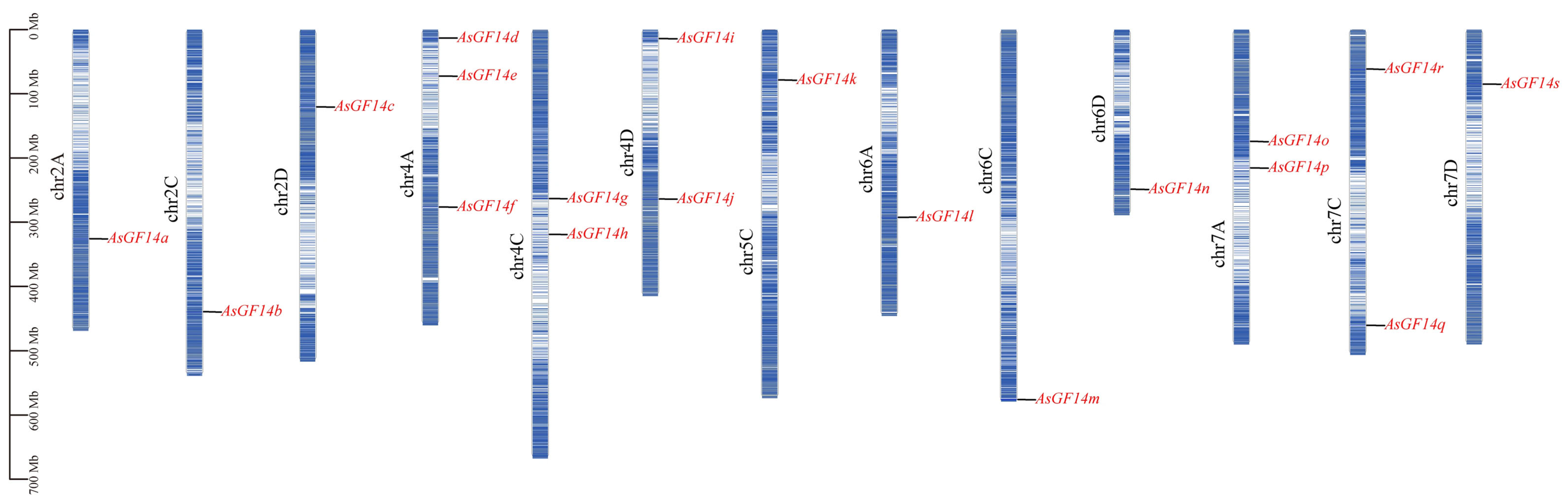
Chromosomal localization analysis revealed that the 19 AsGF14 genes were distributed across 13 oat chromosomes belonging to homoeologous groups 2, 4, 5, 6, and 7 (Figure 1). The number of AsGF14 genes assigned to each homoeologous group ranged from 1 to 7. Each chromosome harbored one to three AsGF14 genes: a single gene was located on chromosomes 2A, 2C, 2D, 5C, 6A, 6C, 6D, and 7D, whereas three genes (AsGF14d, AsGF14e, and AsGF14f) were clustered on chromosome 4A. In total, the A and C sub-genomes each contained seven AsGF14 genes, and the D sub-genome carried five.

2.2. Phylogenetic and Synteny Analyses

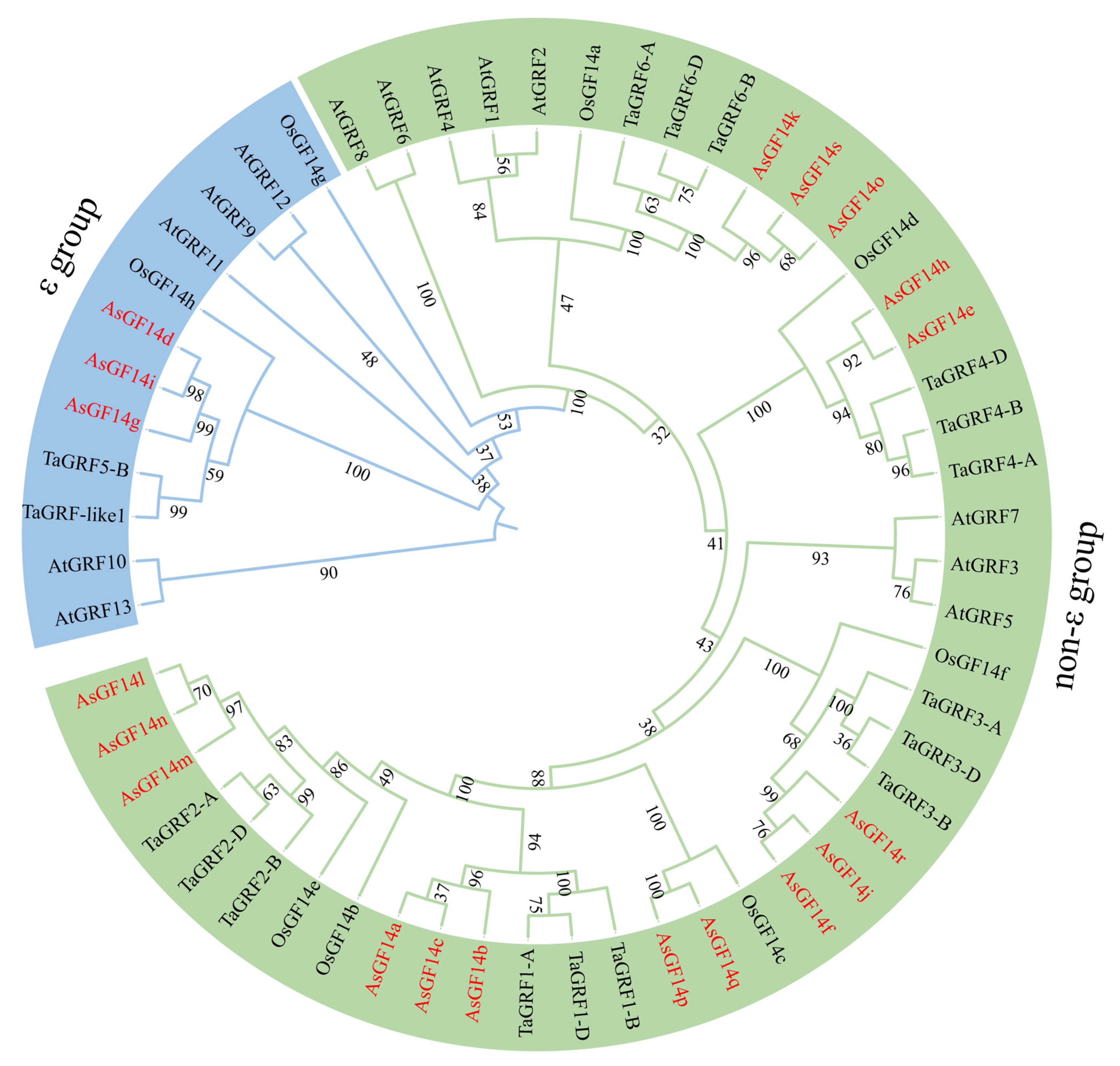
To investigate the evolutionary relationships within the 14-3-3 gene family, a phylogenetic tree was constructed using protein sequences from A. sativa, A. thaliana, rice (Oryza sativa), and wheat (Triticum aestivum) (Figure 2). Based on sequence similarity, the 14-3-3 proteins were clearly classified into two distinct groups: the ε group and the non-ε group. The ε group comprises 12 members, including three from oat, five from A. thaliana, two from rice, and two from wheat. In contrast, the non-ε group contains 45 members: 16 from oat, eight from A. thaliana, six from rice, and 15 from wheat. Notably, oat and wheat 14-3-3 proteins formed closer phylogenetic clusters than those from A. thaliana or rice, indicating a closer evolutionary relationship between these two species.
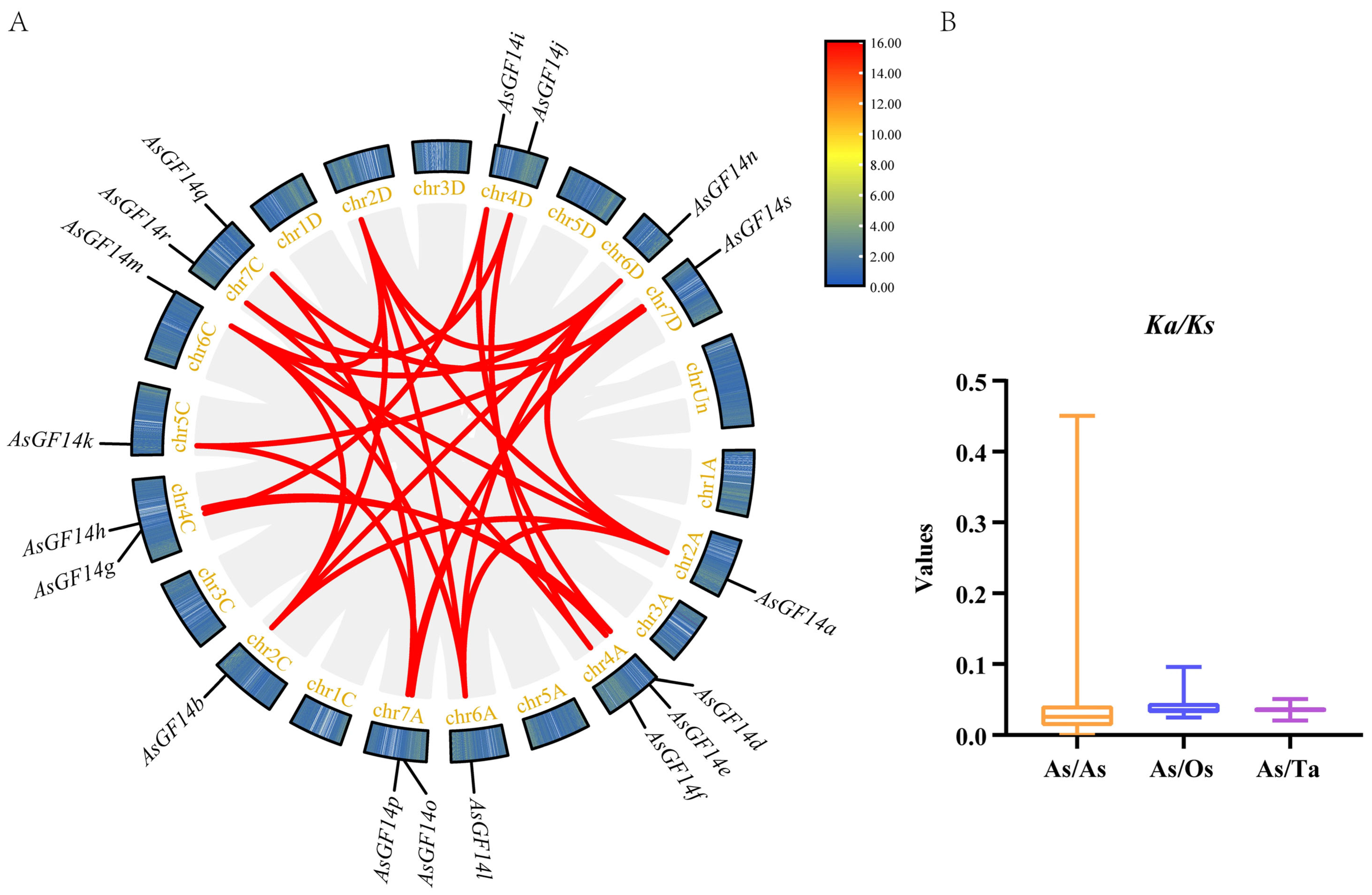
To investigate the genomic mechanisms driving the expansion of the AsGF14 gene family in oat, we performed a genome-wide synteny analysis. A total of 20 AsGF14-AsGF14 syntenic pairs were identified, involving 18 of the 19 AsGF14 genes (Figure 3A). All syntenic AsGF14 genes were associated with segmental duplications, with no evidence of tandem duplication. The ε group contained three syntenic pairs, whereas the non-ε group comprised the remaining 17. These segmental duplications represent the primary driver of the expansion of non-ε AsGF14 genes, suggesting that non-ε members have undergone functional diversification.
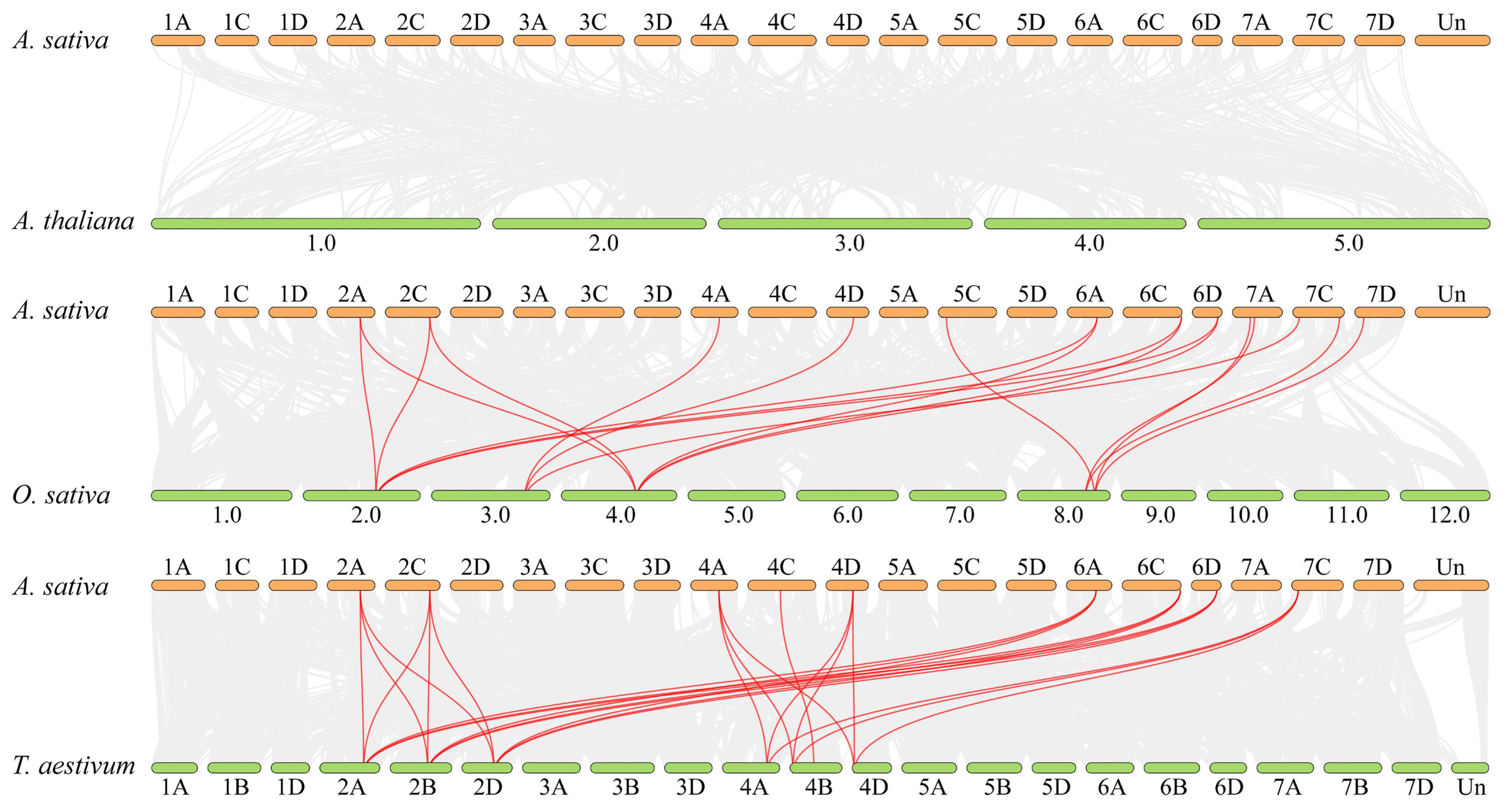
Comparative synteny analysis revealed extensive synteny between oat and three other species (Figure 4). Specifically, AsGF14 genes formed 25 syntenic pairs with wheat orthologs, with eight AsGF14 members (AsGF14a, AsGF14b, AsGF14f, AsGF14j, AsGF14L, AsGF14m, AsGF14n, and AsGF14r) each syntenic with three wheat orthologs (Table S2). Thirteen AsGF14 genes were syntenic with rice orthologs, forming 18 syntenic pairs; notably, five of these (AsGF14a, AsGF14b, AsGF14L, AsGF14m, and AsGF14n) each paired with two rice orthologs (Table S3). No synteny was detected between oat and A. thaliana 14-3-3 genes. The Ka/Ks ratios for the oat–wheat syntenic pairs ranged from 0.0206 to 0.0509 (Figure 3B, Table S4), while those for oat–rice pairs ranged from 0.0249 to 0.0962 (Figure 3B, Table S5). All values were substantially less than 1, indicating that these orthologous 14-3-3 gene pairs have undergone strong purifying selection during evolution. Divergence times were estimated from Ks values using the molecular clock model. The average divergence time between A. sativa and T. aestivum was approximately 37.24 million years ago (Mya) (Table S4), and between A. sativa and O. sativa, approximately 44.49 Mya (Table S5).
Selection pressures on duplicated AsGF14-AsGF14 gene pairs were assessed by calculating Ka/Ks ratios (Figure 3B, Table S6). One syntenic pair (AsGF14d/AsGF14i), which exhibited a Ks value of zero, was excluded from further selection pressure analysis because a reliable Ka/Ks ratio could not be calculated. For all remaining syntenic pairs, Ka/Ks ratios were substantially less than 1, indicating that the AsGF14 gene family has predominantly undergone purifying selection. Notably, four gene pairs displayed Ka/Ks values of zero, suggesting strong functional constraint and no nonsynonymous substitutions since duplication. Interestingly, the ε group exhibited a higher average Ka/Ks ratio compared to the non-ε group, implying relatively relaxed selection within this group. The average divergence time for duplicated AsGF14 pairs was approximately 22.58 Mya (Table S6).

2.3. Gene Structure and Conserved Motif Analysis of AsGF14 Genes

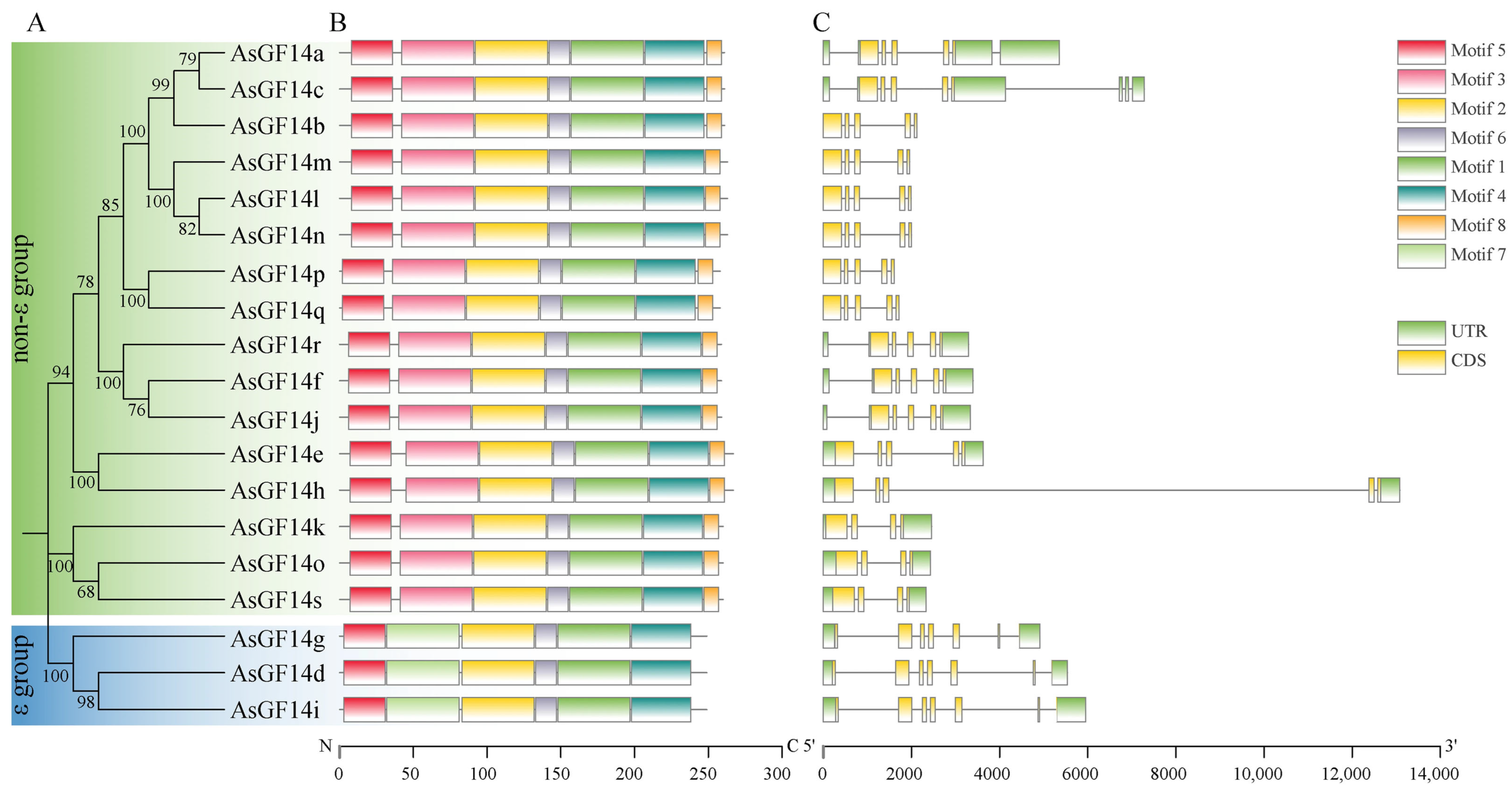
To gain insights into the structural and functional divergence of the AsGF14 family, we integrated phylogenetic classification analysis with gene structure and conserved characterization (Figure 5, Figure S3). Conserved motif analysis revealed that all members of the ε group contained six conserved motifs: motifs 1, 2, 4, 5, 6, and 7. In contrast, AsGF14 proteins in the non-ε group harbored seven motifs: motifs 1, 2, 3, 4, 5, 6, and 8. Notably, motif 3 and motif 8 were exclusively present in the non-ε group, whereas motif 7 was exclusively present in the ε group, suggesting potential functional specialization. Gene structure analysis revealed that ε group genes contained seven exons, the most among AsGF14 genes. In comparison, non-ε group genes contained four or five exons: AsGF14k, AsGF14o, and AsGF14s had four exons, while the remaining 13 possessed five. The distinct motif architectures and exon–intron organizations of AsGF14 genes in these two phylogenetic groups indicate evolutionary and functional divergence.

2.4. Cis-Acting Elements in the Promoter Regions of AsGF14 Genes

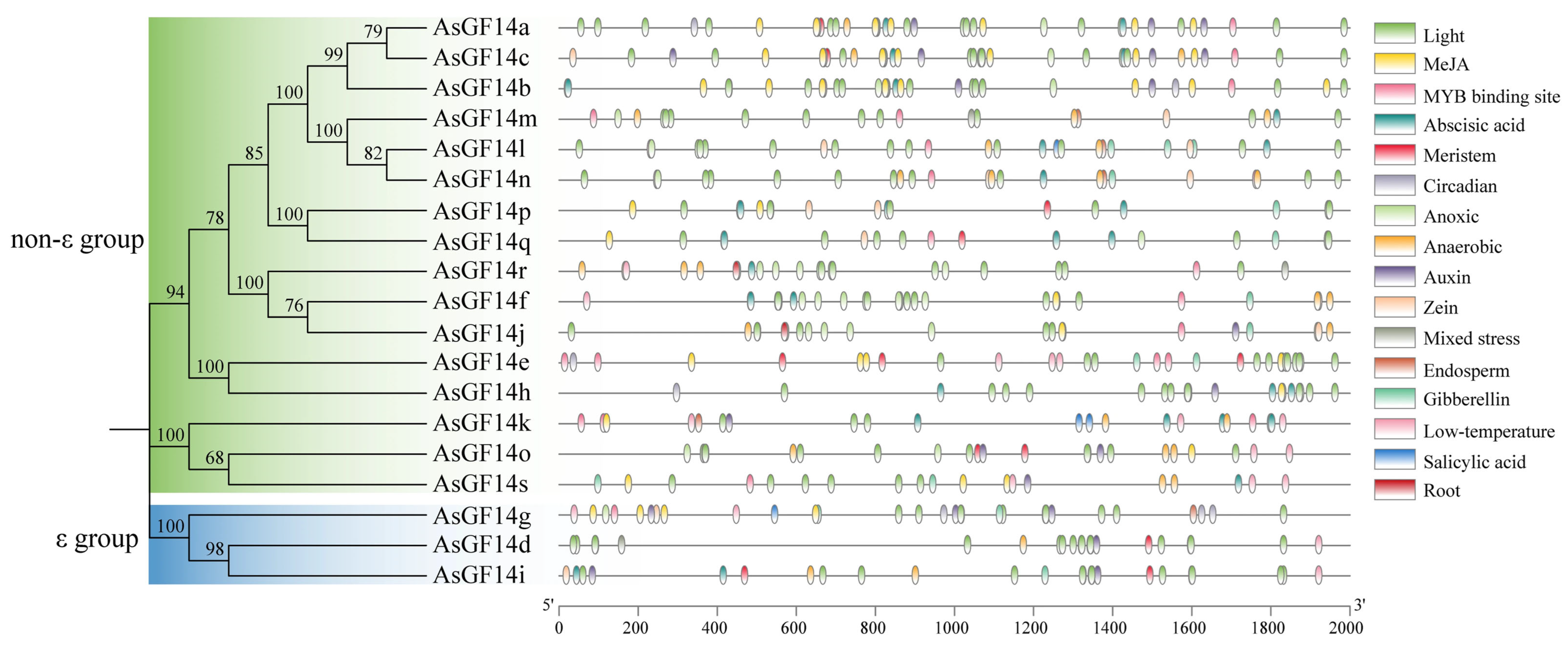
Analysis of cis-acting elements in AsGF14 promoters identified 16 distinct types associated with hormone responses, environmental stress, and growth and development (Figure 6, Figure S4). Abscisic acid- and light-responsive elements were present in all promoters. Fourteen genes contained anoxic stress-responsive and MYB-binding site elements; 13 harbored anaerobic stress-responsive and MeJA-responsive elements; 11 contained auxin-responsive and low-temperature-responsive elements; and 10 harbored gibberellin-responsive and zein metabolism-regulation elements. Additionally, eight genes contained meristem-specific elements; five contained circadian control and endosperm-specific elements; and three contained elements linked to mixed stress, root specificity, and salicylic acid responsiveness. The total number of cis-elements varied considerably among promoters, ranging from 20 in AsGF14m to 45 in AsGF14c.

2.5. Expression Patterns of AsGF14 Genes Under Drought Stress

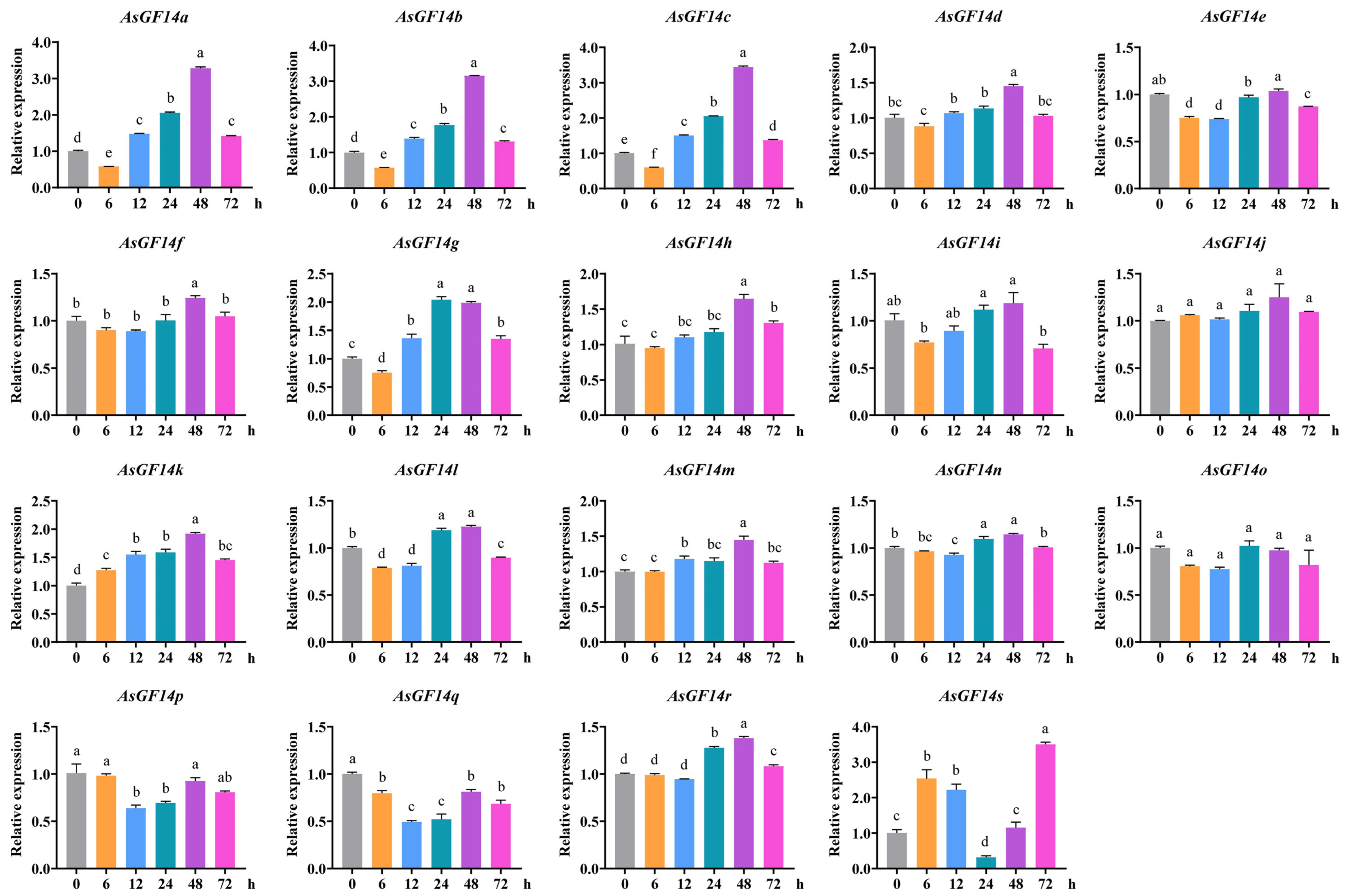
To characterize the expression patterns of AsGF14 genes under drought stress, we profiled AsGF14 gene expression in root tissues at six time points (0, 6, 12, 24, 48, and 72 h) following drought treatment (Figure 7). Six genes (AsGF14d, AsGF14f, AsGF14h, AsGF14k, AsGF14m, and AsGF14r) were significantly upregulated at one or more time points. Notably, AsGF14k exhibited sustained upregulation throughout the treatment period, peaking at 48 h. Conversely, three genes (AsGF14i, AsGF14j, and AsGF14o) showed no significant differential expression. Three others (AsGF14e, AsGF14p, and AsGF14q) were significantly downregulated at specific time points. The remaining seven genes (AsGF14a, AsGF14b, AsGF14c, AsGF14g, AsGF14L, AsGF14n, and AsGF14s) displayed dynamic and variable expression patterns, with transient upregulation or downregulation at specific time points. This differential expression suggests functional diversification among AsGF14 genes during drought adaptation.

2.6. Subcellular Localization of the AsGF14k Protein

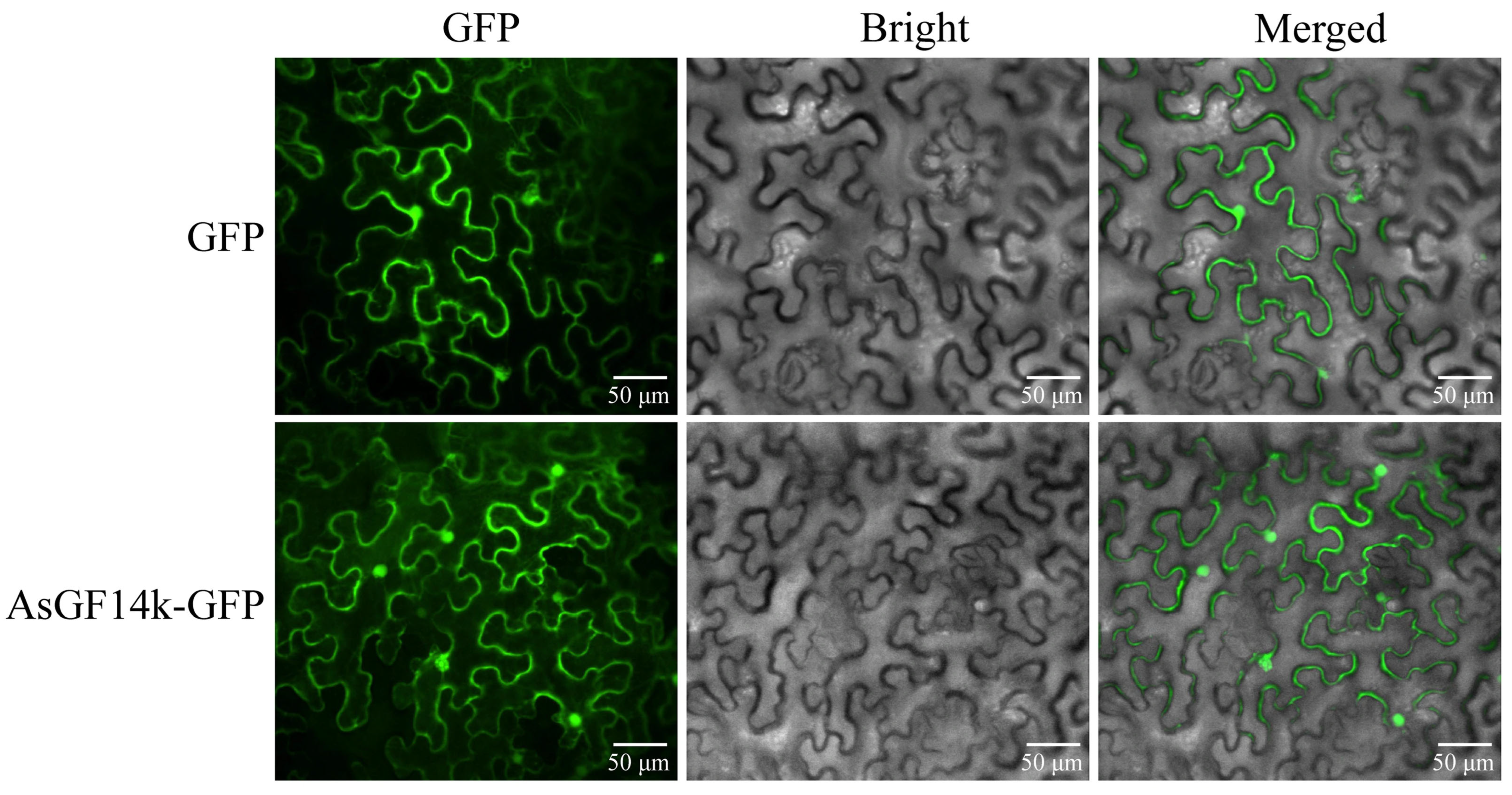
Given that AsGF14k was continuously and significantly upregulated under drought stress, we investigated its subcellular localization by transiently expressing an AsGF14k-GFP fusion protein in Nicotiana benthamiana leaves. Confocal microscopy revealed that the AsGF14k-GFP signal localized to multiple subcellular compartments, including the nucleus and cytoplasm (Figure 8).

2.7. Assessment of AsGF14k Homodimerization by Yeast Two-Hybrid (Y2H)

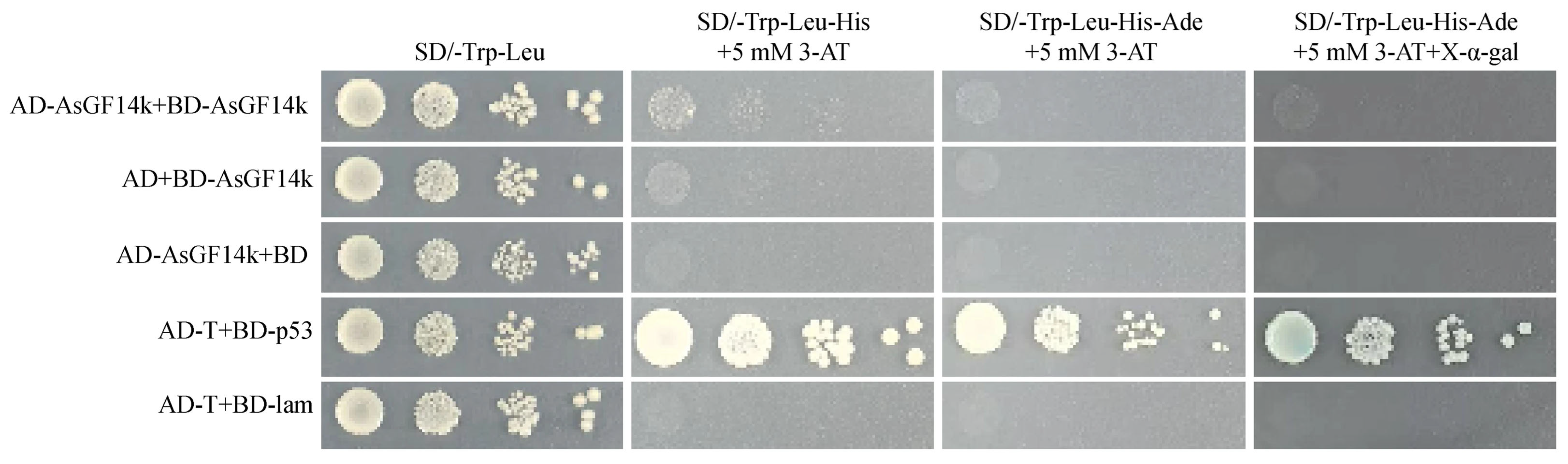
To determine whether AsGF14k functions as a homodimer, we performed a Y2H assay. The BD-AsGF14k fusion protein exhibited transcriptional autoactivation activity, which was effectively suppressed by 5 mM 3-amino-1,2,4-triazole (3-AT) (Figure S5). Yeast co-transformed with AD-AsGF14k and BD-AsGF14k grew normally on SD/-Trp-Leu medium but failed to grow on selective media (SD/-Trp-Leu-His and SD/-Trp-Leu-His-Ade) supplemented with 5 mM 3-AT and showed no blue coloration on SD/-Trp-Leu-His-Ade plates containing X-α-gal (Figure 9). These results indicate that AsGF14k does not self-interact, suggesting it likely does not function as a homodimer.

3. Discussion

The nomenclature of the 14-3-3 gene family exhibits considerable variation across plant species. For instance, members are designated GRF followed by Arabic numerals in Medicago sativa (MsGRF1–MsGRF66) [33] and Camellia sinensis (CsGRF1–CsGRF26) [34], or by lowercase letters in Arachis hypogaea (AhGRFa–AhGRFv) [35]. In other species, the prefix “14-3-3” is combined with a letter, as in Olyra latifolia (Ol14-3-3a–Ol14-3-3h) [36], or with Roman numerals, as in Manihot esculenta (Me14-3-3I–Me14-3-3XVI) [8]. Alternatively, the prefix GF14 is used in O. sativa (OsGF14a–OsGF14h) [12] and Malus domestica (MdGF14a–MdGF14r) [37]. In this study, to maintain consistency with rice nomenclature, we adopted the GF14-based system for oat 14-3-3 genes, designating them AsGF14a to AsGF14s. All AsGF14 proteins exhibited a pI below 7, consistent with their classification as acidic proteins. Notably, ε group members displayed higher pI values than non-ε group members, suggesting distinct electrostatic properties between groups. Regarding protein stability, an instability index above 40 typically predicts an unstable protein [38]. All ε group AsGF14 proteins exhibited instability indices below 40, whereas only three non-ε group members (AsGF14k, AsGF14o, and AsGF14s) fell below this threshold, indicating that ε group AsGF14 proteins are likely more stable than their non-ε isoforms.
Phylogenetic analysis classifies 14-3-3 proteins into distinct groups, providing insights into their structural features, evolutionary history, and functional conservation or divergence. The 14-3-3 proteins in A. thaliana and rice are classified into ε and non-ε groups, with the ε group comprising AtGRF9–AtGRF13 in A. thaliana and OsGF14g–OsGF14h in rice [1,12]. Accordingly, we applied this conserved phylogenetic framework to classify oat AsGF14 proteins, identifying three ε group members. Moreover, ε group 14-3-3 genes consistently contain more exons than non-ε genes in multiple plant species, including O. sativa [1], Solanum tuberosum [39] and M. esculenta [8]. Consistent with this pattern, all three ε group AsGF14 genes contain seven exons, whereas non-ε group members possess four or five. These differences suggest evolutionary divergence in gene structure between groups. In contrast, non-ε group AsGF14 proteins contain more conserved motifs than ε group proteins. Specifically, motif 7 is unique to the N-terminus of ε-group proteins, whereas motifs 3 and 8 are specific to the N- and C-termini of non-ε proteins, respectively. Previous studies suggest that the C-terminal region of 14-3-3 proteins may be involved in target protein specificity, whereas the N-terminal region contributes to dimerization [14]. Therefore, we speculate that these group-specific motifs may contribute to functional divergence between ε and non-ε AsGF14 proteins. Cis-regulatory element analysis further revealed distinct compositional patterns between groups: all ε group members contained cis-elements responsive to abscisic acid, auxin, light, and low temperature, whereas non-ε group members consistently harbored only abscisic acid– and light-responsive elements. Cis-acting elements associated with drought stress responses primarily include abscisic acid-responsive elements (ABREs), dehydration-responsive elements (DREs), and MYB-binding sites (MBS) [40]. In this study, ABREs were identified in the promoter regions of all six drought-upregulated AsGF14 genes (AsGF14d, AsGF14f, AsGF14h, AsGF14k, AsGF14m, and AsGF14r), with copy numbers ranging from one to six. Furthermore, MBS elements were also detected in the promoters of AsGF14f, AsGF14k, AsGF14m, and AsGF14r. These findings suggest that these cis-elements may play a role in oat drought adaptation (Figure S4). Collectively, these divergent features in gene structure, conserved motifs, and regulatory profiles are consistent with the phylogenetic clustering of AsGF14 genes, suggesting evolutionary divergence and likely functional specialization between groups.
Gene duplication is a major driver of gene family expansion and functional diversification in plant evolution [41,42]. Hexaploid oat has undergone a whole-genome duplication (WGD) event during its evolutionary history [43]. Our analysis revealed that the AsGF14 gene family expanded primarily through segmental duplications, with no evidence of tandem duplications. This indicates that WGD and segmental duplications were the predominant mechanisms underlying AsGF14 gene family expansion. To assess selective pressures acting on duplicated genes, we calculated the Ka/Ks ratio, a widely used metric for evaluating evolutionary constraints [44]. Ka/Ks ratios below 1 indicate purifying selection [45]. All 19 syntenic paralogous pairs of AsGF14 genes exhibited Ka/Ks ratios less than 1. Similarly, Ka/Ks ratios between AsGF14 genes and their orthologs in rice and wheat were also below 1. Notably, homoeologous pairs within the wheat 14-3-3 gene family have likewise been reported to exhibit Ka/Ks ratios below 1 [22]. Collectively, these results demonstrate that the 14-3-3 gene family has been under strong purifying selection and displays a high degree of functional conservation across oat, rice, and wheat.
14-3-3 proteins are crucial regulators of plant metabolism and signal transduction, governing growth, development, and stress adaptation, particularly to drought. For instance, in rice, OsGF14f positively modulates drought tolerance by interacting with the transcription factor OsbZIP23 [46]. In wheat, TaGF14b enhances drought tolerance through interaction with TaABF2 to potentiate ABA signaling [47]. Conversely, silencing Hv14-3-3A in barley increases stomatal density, reduces water-use efficiency, and heightens drought sensitivity [24]. Similar to the drought-induced expression of OsGF14f, TaGF14b, and Hv14-3-3A, we observed transcriptional upregulation of six AsGF14 genes under drought stress, suggesting that transcriptional activation of specific 14-3-3 isoforms constitutes a conserved drought response mechanism across cereal crops. Notably, AsGF14k exhibited significant and sustained upregulation, highlighting it as a promising candidate for drought tolerance in oat. However, transcriptional induction alone does not conclusively demonstrate functional involvement. Therefore, future studies will focus on functional validation through genetic transformation or gene silencing to determine the specific roles of AsGF14k in drought tolerance. Furthermore, plant roots are complex organs composed of diverse cell types with distinct functions. Although qRT-PCR reveals global expression trends of AsGF14 genes, these represent tissue-averaged signals. Recent studies indicate that stress responses can be highly cell-type-specific [11]. Consequently, the cell-type-specific expression of AsGF14 genes remains to be elucidated.
14-3-3 proteins modulate the activity, stability, and subcellular localization of target proteins via direct binding and are broadly distributed, consistent with their diverse cellular roles [14]. For instance, ApGRF6-2 has been detected in both the cytoplasm and nucleus [4], whereas PbGRF8 and PbGRF18 localize to the cytoplasm and plasma membrane; moreover, PbGRF11 and MsGRF2 have been observed in the cytoplasm, plasma membrane, and nucleus [5,33]. In this study, AsGF14k localized to both the cytoplasm and nucleus, suggesting potential involvement in cytoplasmic signaling and nuclear transcriptional regulation. This dual localization may enable the transmission of drought signals from the cytoplasm to the nucleus, potentially influencing transcription factor activity. However, whether this reflects active nucleocytoplasmic shuttling under drought stress requires further investigation. 14-3-3 proteins typically function as homodimers or heterodimers. For instance, the apple 14-3-3 protein MdGRF10 forms a homodimer to interact with MdASMT1, thereby enhancing salt tolerance [19]. In contrast, in vitro biochemical analyses have shown that the peanut 14-3-3 protein AhGRFi is incapable of homodimer formation [35]. Consistent with this, our Y2H assay revealed that AsGF14k exhibits no self-interaction, suggesting it is unlikely to function as a homodimer. This finding raises the possibility that AsGF14k functions as a monomer or preferentially forms heterodimers with other partners. Future studies should focus on identifying these interacting partners and determining whether post-translational modifications regulate AsGF14k activity under drought conditions.

4. Materials and Methods

4.1. Genome-Wide Identification and Characterization of the 14-3-3 Gene Family in Oat

The genome data for A. sativa were obtained from the GrainGenes database (https://wheat.pw.usda.gov/GG3/, accessed on 22 October 2024) [48]. To identify 14-3-3 proteins, previously characterized 14-3-3 sequences from A. thaliana (13 members) (Table S7) [49] and O. sativa (8 members) (Table S7) [12] were used as queries in BLASTP searches against the A. sativa protein dataset, with an E-value cutoff of 1 × 10⁻⁵. Additionally, the Hidden Markov Model (HMM) profile of the 14-3-3 domain (PF00244) was employed to scan the A. sativa genome [50]. The overlapping candidates from the BLASTP and HMM searches were filtered to remove incomplete gene models, retaining the longest transcript isoform per locus. The presence of the conserved 14-3-3 domain in all candidate proteins was further confirmed using the NCBI-CDD (https://www.ncbi.nlm.nih.gov/Structure/cdd/wrpsb.cgi, accessed on 18 May 2025), Pfam (http://pfam.xfam.org/, accessed on 18 May 2025), and SMART (https://smart.embl.de/, accessed on 18 May 2025) databases. Only sequences containing a complete 14-3-3 domain were considered members of the oat 14-3-3 gene family. The physicochemical properties of the AsGF14 proteins were analyzed using TBtools v2.423 [51].

4.2. Chromosomal Location, Gene Structure, Conserved Motif, and Cis-Acting Analysis

The chromosomal locations and exon–intron structures of the AsGF14 genes were determined using TBtools based on the genome annotation of A. sativa. Conserved protein motifs were identified by submitting the AsGF14 protein sequences to the MEME web server, with the maximum number of motifs set to 8 and the remaining parameters at default settings [52]. To analyze cis-acting regulatory elements, the 2000 bp promoter region upstream of the start codon was extracted for each AsGF14 gene and analyzed using the PlantCARE database (https://bioinformatics.psb.ugent.be/webtools/plantcare/html/, accessed on 27 May 2025) [53]. The chromosomal locations, gene structures, conserved motifs, and cis-acting elements were then integrated and visualized using TBtools.

4.3. Sequence Alignment, 3D Structure Prediction, and Phylogenetic Tree Construction

The amino acid sequences of 14-3-3 proteins in A. sativa were analyzed using DNAMAN 7 software. The 3D structures of these proteins were predicted with AlphaFold 3 and visualized using PyMOL v3.0.3 [54]. A phylogenetic tree was constructed from the aligned amino acid sequences of the 14-3-3 gene family across A. thaliana, O. sativa, T. aestivum (Table S7), and A. sativa. Multiple sequence alignment was performed with ClustalW in MEGA v7.0. A maximum-likelihood tree was generated with 1,000 bootstrap replicates and visualized using iTOL (https://itol.embl.de/, accessed on 29 May 2025) [55].

4.4. Synteny Analysis and Selection Pressure of AsGF14 Genes

Synteny analysis between A. sativa and three other species (A. thaliana, O. sativa, and T. aestivum) was performed using the One Step MCScanX module in TBtools. Subsequently, the non-synonymous (Ka) and synonymous (Ks) substitution rates for all syntenic gene pairs were calculated using the Simple Ka/Ks Calculator in TBtools. Ka/Ks ratios >1, <1, and =1 were considered indicative of positive, purifying, and neutral selection, respectively [45]. The divergence time was estimated using the formula T = Ks/(2λ), where λ represents the synonymous substitution rate per site per year. Following previous studies in grasses, we adopted λ = 6.5 × 10⁻⁹ [56].

4.5. Plant Materials

Oat seeds (cv. Pinyan No. 8), provided by the Center for Agricultural Genetic Resources Research at Shanxi Agricultural University, were surface-sterilized with 1.0% sodium hypochlorite for 20 min and rinsed three times with sterile distilled water [57]. After germination in Petri dishes, the seedlings were transferred to a modified Hoagland nutrient solution and grown in a greenhouse under a 16 h light/8 h dark photoperiod at 25 °C with a light intensity of 250 μmol·m−2·s−1. At the one-leaf stage, drought stress was simulated by adding polyethylene glycol 6000 (PEG 6000) to the nutrient solution to a final concentration of 15% (w/v) [58]. Root samples were collected at 0, 6, 12, 24, 48, and 72 h post-treatment, with three biological replicates for each time point.

4.6. qRT-PCR Analysis

Total RNA was extracted from each sample using the DP432 RNAprep Pure Plant Kit (Tiangen, Beijing, China). First-strand cDNA was synthesized with the HiScript IV All-in-One Ultra RT SuperMix (Vazyme, Nanjing, China). qRT-PCR was performed using FastReal qPCR PreMix (Tiangen, China). The AsActin gene was used as an internal reference. Relative expression levels were calculated using the 2−ΔΔCt method and are presented as the mean ± SEM of three technical replicates [59]. All primer sequences are listed in Table S8.

4.7. Subcellular Location

The coding sequence of AsGF14k (excluding the stop codon) was cloned into the pCAMBIA1302 vector to generate a C-terminal GFP fusion. The construct was transformed into Agrobacterium strain GV3101 and transiently expressed in N. benthamiana leaves via agroinfiltration. The empty pCAMBIA1302-GFP vector served as a control [60]. Fluorescence signals were visualized using a spinning disk confocal laser-scanning microscope (UltraView VoX, PerkinElmer, Waltham, MA, USA). Each experiment was performed with three biological replicates. GFP was excited using a 488 nm solid-state laser (UltraView VoX, PerkinElmer, Waltham, MA, USA), and emission signals were collected through a 525/50 nm band-pass filter (emission filter wheel, position 2).

4.8. Y2H Assay

The AsGF14k cDNA was cloned into the pGADT7 (AD) and pGBKT7 (BD) vectors. The constructs were co-transformed into the yeast strain AH109 [61]. Transformants were initially selected on SD/-Leu/-Trp medium. Protein interactions were assessed by growth on SD/-Leu/-Trp/-His and SD/-Leu/-Trp/-His/-Ade media supplemented with 5 mM 3-AT and by blue colony formation on plates containing X-α-gal. AD-T + BD-p53 and AD-T + BD-lam were used as the positive and negative controls, respectively. Primers are listed in Table S8.

Supplementary Materials

The following supporting information can be downloaded at: https://www.mdpi.com/article/10.3390/plants15091280/s1. Figure S1: Multiple amino acid sequence alignment of AsGF14 proteins. The blue frame indicates the 14-3-3 domain; Figure S2: 3D structure prediction analysis of AsGF14 proteins; Figure S3: Conserved motifs of AsGF14 proteins; Figure S4: Number of cis-acting regulatory elements in the promoters of AsGF14 genes; Figure S5: Self-activation and suppression assays of the AsGF14k protein in Y2H systems. AD-T + BD-p53 and AD-T + BD-lam served as the positive and negative controls, respectively; Table S1: Protein and coding sequences of the AsGF14 gene family in oat; Table S2: Orthologous pairs of 14-3-3 genes between A. sativa and T. aestivum; Table S3: Orthologous pairs of 14-3-3 genes between A. sativa and O. sativa; Table S4: Ka/Ks ratios of 14-3-3 orthologous genes between A. sativa and T. aestivum; Table S5: Ka/Ks ratios of 14-3-3 orthologous genes between A. sativa and O. sativa; Table S6: Selection pressure on AsGF14 genes in oat; Table S7: Protein sequences of the 14-3-3 gene family in A. thaliana, O. sativa, and T. aestivum; Table S8: Primer sequences used in this study for AsGF14 genes.

Author Contributions

Writing—original draft preparation, writing—review and editing, conceptualization, formal analysis, methodology, investigation, funding acquisition, project administration, visualization, data curation, S.X.; Methodology, investigation, formal analysis, M.M., Z.L., and L.Z.; Writing—review and editing, investigation, funding acquisition, project administration, resources, L.L. All authors have read and agreed to the published version of the manuscript.

Funding

This project was supported by the Fundamental Research Program of Shanxi Province (202503021212182), the PhD of Shanxi Agricultural University Scientific Research Start-up Project (2024BQ50), the Shanxi Province Doctoral Work Award-Scientific Research Project (SXBYKY2024114), the China Agriculture Research System of MOF and MARA (CARS-07-A-2), the Key R&D Project in Shanxi Province (2022ZDYF110), and the Hou Ji Laboratory in Shanxi Province (202404010930003).

Data Availability Statement

The original contributions presented in the study are included in the article and Supplementary Materials, further inquiries can be directed to the corresponding author.

Conflicts of Interest

The authors declare no conflicts of interest.

References

  1. Yao, Y.; Du, Y.; Jiang, L.; Liu, J.Y. Molecular analysis and expression patterns of the 14-3-3 gene family from Oryza sativa. J. Biochem. Mol. Biol. 2007, 40, 349–357. [Google Scholar] [CrossRef] [PubMed]
  2. Lu, G.; DeLisle, A.J.; de Vetten, N.C.; Ferl, R.J. Brain proteins in plants: An Arabidopsis homolog to neurotransmitter pathway activators is part of a DNA binding complex. Proc. Natl. Acad. Sci. USA 1992, 89, 11490–11494. [Google Scholar] [CrossRef] [PubMed]
  3. Moore, B.W.; Perez, V.J.J.P. Specific acidic proteins of the nervous system. Physiol. Biochem. Asp. Nerv. Integr. 1967, 343–359. [Google Scholar]
  4. Zhao, J.Y.; Liu, S.Q.; Ren, H.; Afriyie, O.E.; Zhang, M.Z.; Xu, D.C.; Huang, X.Z. Genome-wide identification and comparative evolution of 14-3-3 gene family members in five Brassicaceae species. BMC Genom. 2025, 26, 309. [Google Scholar] [CrossRef]
  5. Zhu, R.X.; Cao, B.B.; Sun, M.Y.; Wu, J.; Li, J.M. Genome-wide identification and evolution of the GRF gene family and functional characterization of PbGRF18 in Pear. Int. J. Mol. Sci. 2023, 24, 14690. [Google Scholar] [CrossRef]
  6. Sedlov, I.A.; Sluchanko, N.N. The big, mysterious world of plant 14-3-3 proteins. Biochemistry 2025, 90, S1–S35. [Google Scholar] [CrossRef]
  7. Jiang, W.; He, J.; Babla, M.; Wu, T.; Tong, T.; Riaz, A.; Zeng, F.R.; Qin, Y.; Chen, G.; Deng, F.L.; et al. Molecular evolution and interaction of 14-3-3 proteins with H+-ATPases in plant abiotic stresses. J. Exp. Bot. 2024, 75, 689–707. [Google Scholar] [CrossRef]
  8. Pan, R.R.; Wang, Y.J.; An, F.F.; Yao, Y.; Xue, J.J.; Zhu, W.L.; Luo, X.Q.; Lai, H.G.; Chen, S.B. Genome-wide identification and characterization of 14-3-3 gene family related to negative regulation of starch accumulation in storage root of Manihot esculenta. Front. Plant Sci. 2023, 14, 1184903. [Google Scholar] [CrossRef]
  9. He, F.Y.; Duan, S.G.; Jian, Y.Q.; Xu, J.F.; Hu, J.; Zhang, Z.C.; Lin, T.R.; Cheng, F.; Li, G.C. Genome-wide identification and gene expression analysis of the 14-3-3 gene family in potato (Solanum tuberosum L.). BMC Genom. 2022, 23, 811. [Google Scholar] [CrossRef]
  10. Pallucca, R.; Visconti, S.; Camoni, L.; Cesareni, G.; Melino, S.; Panni, S.; Torreri, P.; Aducci, P. Specificity of ε and non-ε isoforms of Arabidopsis 14-3-3 proteins towards the H+-ATPase and other targets. PLoS ONE 2014, 9, e90764. [Google Scholar] [CrossRef]
  11. Pasternak, T.; Yaroshko, O. Molecular biology needs a map: Spatial in situ approaches in plant science. Plant Biol. 2026, 28, 323–327. [Google Scholar] [CrossRef]
  12. Chen, F.; Li, Q.; Sun, L.; He, Z. The rice 14-3-3 gene family and its involvement in responses to biotic and abiotic stress. DNA Res. 2006, 13, 53–63. [Google Scholar] [CrossRef] [PubMed]
  13. Paul, A.L.; Sehnke, P.C.; Ferl, R.J. Isoform-specific subcellular localization among 14-3-3 proteins in Arabidopsis seems to be driven by client interactions. Mol. Biol. Cell 2005, 16, 1735–1743. [Google Scholar] [CrossRef] [PubMed]
  14. Huang, Y.; Wang, W.S.; Yu, H.; Peng, J.H.; Hu, Z.R.; Chen, L. The role of 14-3-3 proteins in plant growth and response to abiotic stress. Plant Cell Rep. 2022, 41, 833–852. [Google Scholar] [CrossRef] [PubMed]
  15. Dong, X.J.; Feng, F.; Li, Y.J.; Li, L.; Chen, S.; Zhou, J.M. 14-3-3 proteins facilitate the activation of MAP kinase cascades by upstream immunity-related kinases. Plant Cell 2023, 35, 2413–2428. [Google Scholar] [CrossRef]
  16. Song, P.Y.; Yang, Z.D.; Guo, C.; Han, R.; Wang, H.; Dong, J.; Kang, D.M.; Guo, Y.; Yang, S.H.; Li, J.G. 14-3-3 proteins regulate photomorphogenesis by facilitating light-induced degradation of PIF3. New Phytol. 2023, 237, 140–159. [Google Scholar] [CrossRef]
  17. Zhu, J.W.; Li, Y.Z.; Zhang, Y.L.; Xia, L.M.; Hu, W.L.; Huang, X.; Li, K.J.; He, X.H.; Luo, C. Overexpression of MiSPL3a and MiSPL3b confers early flowering and stress tolerance in Arabidopsis thaliana. Int. J. Biol. Macromol. 2024, 262, 129913. [Google Scholar] [CrossRef]
  18. Li, B.B.; Yang, C.; Yong, B.; Wang, Y.; Zhu, W.W.; Gu, Y.Z.; An, Z.H.; Yu, H.Q.; Chen, M.Y.; He, C.Y. A 14-3-3 modulator of seed weight and quality for unlocking the yield potential of soybean. Nat. Commun. 2025, 16, 10547. [Google Scholar] [CrossRef]
  19. Hu, Z.H.; Yan, T.C.; Zhang, T.; Dong, S.L.; Bai, Y.X.; Song, H.D.; Wang, C.Y.; Liu, X.; Li, R.X.; Zhao, H.P.; et al. MdGRF10 phosphorylation stabilizes MdASMT1 for melatonin-mediated salt tolerance in apple. J. Integr. Plant Biol. 2025, 67, 2863–2878. [Google Scholar] [CrossRef]
  20. Zhao, X.; Yang, X.T.; Li, Y.F.; Nian, H.J.; Li, K.Z. 14-3-3 proteins regulate the HCHO stress response by interacting with AtMDH1 and AtGS1 in tobacco and Arabidopsis. J. Hazard. Mater. 2023, 458, 132036. [Google Scholar] [CrossRef]
  21. Cui, L.H.; Min, H.J.; Yu, S.G.; Byun, M.Y.; Oh, T.R.; Lee, A.; Yang, H.W.; Kim, W.T. OsATL38 mediates mono-ubiquitination of the 14-3-3 protein OsGF14d and negatively regulates the cold stress response in rice. J. Exp. Bot. 2022, 73, 307–323. [Google Scholar] [CrossRef] [PubMed]
  22. Shao, W.N.; Chen, W.; Zhu, X.G.; Zhou, X.Y.; Jin, Y.Y.; Zhan, C.; Liu, G.S.; Liu, X.; Ma, D.F.; Qiao, Y.L. Genome-wide identification and characterization of wheat 14-3-3 genes unravels the role of TaGRF6-A in salt stress tolerance by binding MYB transcription factor. Int. J. Mol. Sci. 2021, 22, 1904. [Google Scholar] [CrossRef] [PubMed]
  23. Wang, Y.P.; Xu, Q.; Shan, H.C.; Ni, Y.; Xu, M.; Xu, Y.J.; Cheng, B.J.; Li, X.Y. Genome-wide analysis of 14-3-3 gene family in four gramineae and its response to mycorrhizal symbiosis in maize. Front. Plant Sci. 2023, 14, 1117879. [Google Scholar] [CrossRef] [PubMed]
  24. Jiang, W.; Tong, T.; Li, W.; Huang, Z.H.; Chen, G.; Zeng, F.R.; Riaz, A.; Amoanimaa-Dede, H.; Pan, R.; Zhang, W.Y.; et al. Molecular evolution of plant 14-3-3 proteins and function of Hv14-3-3A in stomatal regulation and drought tolerance. Plant Cell Physiol. 2023, 63, 1857–1872. [Google Scholar] [CrossRef]
  25. Liu, J.M.; Jiang, C.Y.; Kang, L.; Zhang, H.C.; Song, Y.; Zou, Z.R.; Zheng, W.J. Over-expression of a 14-3-3 protein from foxtail millet improves plant tolerance to salinity stress in Arabidopsis thaliana. Front. Plant Sci. 2020, 11, 449. [Google Scholar] [CrossRef]
  26. Paudel, D.; Dhungana, B.; Caffe, M.; Krishnan, P. A review of health-beneficial properties of oats. Foods 2021, 10, 2591. [Google Scholar] [CrossRef]
  27. Li, W.; Wang, Y.; Liu, J.N.; He, Q.; Zhou, Y.; Li, M.H.; Liu, N.K.; Liang, H.F.; Yun, Y.G.; Gong, Z.Z.; et al. A gap-free complete genome assembly of oat and OatOmics, a multi-omics database. Mol. Plant 2025, 18, 179–182. [Google Scholar] [CrossRef]
  28. Rafique, H.; Dong, R.; Wang, X.L.; Alim, A.; Aadil, R.M.; Li, L.; Zou, L.; Hu, X.Z. Dietary-nutraceutical properties of oat protein and peptides. Front. Nutr. 2022, 9, 950400. [Google Scholar] [CrossRef]
  29. Armeni, M.; Cardilin, T.; Fristedt, R.; Karlsson, T.; Jenkins, C.O.; Nordin, E.; Qin, P.; Jirstrand, M.; Kristiansen, K.; Savolainen, O.; et al. Avenanthramides and avenacosides as biomarkers of oat intake: A pharmacokinetic study of solid and liquid oat consumption under single and repeated dose conditions. Nutr. J. 2025, 24, 136. [Google Scholar] [CrossRef]
  30. Puganen, A.; Damerau, A.; Pöysä, M.; Lampi, A.M.; Piironen, V.; Yang, B.R.; Linderborg, K.M. Lipid and volatile profiles of Finnish oat batches of pure cultivars: Effect of storage on the volatile formation. Food Chem. 2024, 451, 139448. [Google Scholar] [CrossRef]
  31. Zhang, D.J.; Cheng, Y.C.; Lu, Z.Y.; Wang, J.G.; Ye, X.S.; Zhang, X.Q.; Luo, X.; Wang, H.; Zhang, B.W. Global insights to drought stress perturbed genes in oat (Avena sativa L.) seedlings using RNA sequencing. Plant Signal. Behav. 2021, 16, 1845934. [Google Scholar] [CrossRef]
  32. Nan, J.S.; Ling, Y.; An, J.H.; Wang, T.; Chai, M.N.; Fu, J.; Wang, G.C.; Yang, C.; Yang, Y.; Han, B. Genome resequencing reveals independent domestication and breeding improvement of naked oat. GigaScience 2022, 12, giad061. [Google Scholar] [CrossRef] [PubMed]
  33. Chai, L.; Liu, Y.X.; Sun, J.D.; Duan, X.H.; Yang, M.; Qian, K.L.; Zhang, P. Functional characterization of the 14-3-3 gene family in alfalfa and the role of MsGRF2 in drought response mechanisms. Int. J. Mol. Sci. 2024, 25, 12304. [Google Scholar] [CrossRef] [PubMed]
  34. Zhang, Z.B.; Wang, X.K.; Wang, S.; Guan, Q.; Zhang, W.; Feng, Z.G. Expansion and diversification of the 14-3-3 gene family in Camellia sinensis. J. Mol. Evol. 2022, 90, 296–306. [Google Scholar] [CrossRef] [PubMed]
  35. Zhang, Z.; Gangurde, S.S.; Chen, S.B.; Mandlik, R.R.; Liu, H.Y.; Deshmukh, R.; Xu, J.L.; Wu, Z.K.; Hong, Y.B.; Li, Y. Overexpression of peanut (Arachis hypogaea L.) AhGRFi gene enhanced root growth inhibition under exogenous NAA treatment in Arabidopsis thaliana. Front. Plant Sci. 2023, 14, 1184058. [Google Scholar] [CrossRef]
  36. Guo, D.; Zhu, C.; Yang, K.B.; Liu, Y.; Xiao, X.Y.; Li, Z.Y.; Gao, Z.M. Identification of the 14-3-3 gene family in bamboo and characterization of Pe14-3-3b reveals its potential role in promoting growth. Int. J. Mol. Sci. 2022, 23, 11221. [Google Scholar] [CrossRef]
  37. Zuo, X.Y.; Wang, S.X.; Xiang, W.; Yang, H.R.; Tahir, M.M.; Zheng, S.G.; An, N.; Han, M.Y.; Zhao, C.P.; Zhang, D. Genome-wide identification of the 14-3-3 gene family and its participation in floral transition by interacting with TFL1/FT in apple. BMC Genom. 2021, 22, 41. [Google Scholar] [CrossRef]
  38. Gamage, D.G.; Gunaratne, A.; Periyannan, G.R.; Russell, T.G. Applicability of instability index for in vitro protein stability prediction. Protein Pept. Lett. 2019, 26, 339–347. [Google Scholar] [CrossRef]
  39. Hajibarat, Z.; Saidi, A.; Hajibarat, Z. Genome-wide identification of 14-3-3 gene family and characterization of their expression in developmental stages of Solanum tuberosum under multiple biotic and abiotic stress conditions. Funct. Integr. Genom. 2022, 22, 1377–1390. [Google Scholar] [CrossRef]
  40. Kim, J.S.; Kidokoro, S.; Yamaguchi-Shinozaki, K.; Shinozaki, K. Regulatory networks in plant responses to drought and cold stress. Plant Physiol. 2024, 195, 170–189. [Google Scholar] [CrossRef]
  41. Feng, X.; Chen, Q.P.; Wu, W.H.; Wang, J.X.; Li, G.H.; Xu, S.H.; Shao, S.; Liu, M.; Zhong, C.R.; Wu, C.I.; et al. Genomic evidence for rediploidization and adaptive evolution following the whole-genome triplication. Nat. Commun. 2024, 15, 1635. [Google Scholar] [CrossRef] [PubMed]
  42. Shi, T.; Gao, Z.Y.; Chen, J.M.; Van de Peer, Y. Dosage sensitivity shapes balanced expression and gene longevity of homoeologs after whole-genome duplications in angiosperms. Plant Cell 2024, 36, 4323–4337. [Google Scholar] [CrossRef] [PubMed]
  43. Peng, Y.Y.; Yan, H.H.; Guo, L.C.; Deng, C.; Wang, C.L.; Wang, Y.B.; Kang, L.P.; Zhou, P.P.; Yu, K.Q.; Dong, X.L.; et al. Reference genome assemblies reveal the origin and evolution of allohexaploid oat. Nat. Genet. 2022, 54, 1248–1258. [Google Scholar] [CrossRef] [PubMed]
  44. Zhang, Z. KaKs_Calculator 3.0: Calculating selective pressure on coding and non-coding sequences. Genom. Proteom. Bioinform. 2022, 20, 536–540. [Google Scholar] [CrossRef]
  45. Wang, L.N.; Lin, M.; Zou, L.N.; Zhang, S.R.; Lan, Y.G.; Yan, H.W.; Xiang, Y. Comprehensive investigation of BZR gene family in four dicots and the function of PtBZR9 and PtBZR12 under drought stress. Plant Physiol. Biochem. PPB 2024, 207, 108360. [Google Scholar] [CrossRef]
  46. Ma, Y.M.; Wu, Z.Y.; Dong, J.F.; Zhang, S.H.; Zhao, J.L.; Yang, T.F.; Yang, W.; Zhou, L.; Wang, J.; Chen, J.S.; et al. The 14-3-3 protein OsGF14f interacts with OsbZIP23 and enhances its activity to confer osmotic stress tolerance in rice. Plant Cell 2023, 35, 4173–4189. [Google Scholar] [CrossRef]
  47. Zhao, H.Y.; Zhang, Y.; Yu, P.; Ma, J.F.; Wang, R.B.; Du, C.H.; Zhang, Q.; Li, L.; Zhang, Y.F.; Wu, Y.N.; et al. The 14-3-3 protein TaGF14b coordinates TaABF2-dependent ABA signaling and TaSPS2-mediated sugar homeostasis to enhance drought tolerance in wheat. Plant J. 2025, 124, e70561. [Google Scholar] [CrossRef]
  48. Kamal, N.; Tsardakas Renhuldt, N.; Bentzer, J.; Gundlach, H.; Haberer, G.; Juhász, A.; Lux, T.; Bose, U.; Tye-Din, J.A.; Lang, D.; et al. The mosaic oat genome gives insights into a uniquely healthy cereal crop. Nature 2022, 606, 113–119. [Google Scholar] [CrossRef]
  49. Sehnke, P.C.; Chung, H.J.; Wu, K.; Ferl, R.J. Regulation of starch accumulation by granule-associated plant 14-3-3 proteins. Proc. Natl. Acad. Sci. USA 2001, 98, 765–770. [Google Scholar] [CrossRef]
  50. Wang, Y.B.; Ling, L.; Jiang, Z.F.; Tan, W.W.; Liu, Z.J.; Wu, L.C.; Zhao, Y.L.; Xia, S.Y.; Ma, J.; Wang, G.J.; et al. Genome-wide identification and expression analysis of the 14-3-3 gene family in soybean (Glycine max). PeerJ 2019, 7, e7950. [Google Scholar] [CrossRef]
  51. Chen, C.J.; Wu, Y.; Li, J.W.; Wang, X.; Zeng, Z.H.; Xu, J.; Liu, Y.L.; Feng, J.T.; Chen, H.; He, Y.H.; et al. TBtools-II: A “one for all, all for one” bioinformatics platform for biological big-data mining. Mol. Plant 2023, 16, 1733–1742. [Google Scholar] [CrossRef] [PubMed]
  52. Bailey, T.L.; Johnson, J.; Grant, C.E.; Noble, W.S. The MEME suite. Nucleic Acids Res. 2015, 43, W39–W49. [Google Scholar] [CrossRef] [PubMed]
  53. Lescot, M.; Déhais, P.; Thijs, G.; Marchal, K.; Moreau, Y.; Van de Peer, Y.; Rouzé, P.; Rombauts, S. PlantCARE, a database of plant cis-acting regulatory elements and a portal to tools for in silico analysis of promoter sequences. Nucleic Acids Res. 2002, 30, 325–327. [Google Scholar] [CrossRef] [PubMed]
  54. Abramson, J.; Adler, J.; Dunger, J.; Evans, R.; Green, T.; Pritzel, A.; Ronneberger, O.; Willmore, L.; Ballard, A.J.; Bambrick, J.; et al. Accurate structure prediction of biomolecular interactions with AlphaFold 3. Nature 2024, 630, 493–500. [Google Scholar] [CrossRef]
  55. Letunic, I.; Bork, P. Interactive Tree Of Life (iTOL) v5: An online tool for phylogenetic tree display and annotation. Nucleic Acids Res. 2021, 49, W293–W296. [Google Scholar] [CrossRef]
  56. Gaut, B.S.; Morton, B.R.; McCaig, B.C.; Clegg, M.T. Substitution rate comparisons between grasses and palms: Synonymous rate differences at the nuclear gene Adh parallel rate differences at the plastid gene rbcL. Proc. Natl. Acad. Sci. USA 1996, 93, 10274–10279. [Google Scholar] [CrossRef]
  57. Xu, S.R.; Ji, X.J.; Sai, F.M.; Ma, M.C.; Liu, Z.; Zhang, L.J.; Liu, L.L. Comprehensive investigation of GRF transcription factors and associated responses to drought stress in oat (Avena sativa). Plants 2026, 15, 160. [Google Scholar] [CrossRef]
  58. Chen, Y.; Li, A.X.; Yun, P.; Chen, Q.; Pan, D.Y.; Guo, R.; Zhang, H.; Ahmed, H.A.I.; Hu, H.Y.; Peng, Y.Y.; et al. Genome-wide analysis of MYB transcription factor family and AsMYB1R subfamily contribution to ROS homeostasis regulation in Avena sativa under PEG-induced drought stress. BMC Plant Biol. 2024, 24, 632. [Google Scholar] [CrossRef]
  59. Lu, P.; Guo, L.; Wang, Z.Z.; Li, B.B.; Li, J.; Li, Y.H.; Qiu, D.; Shi, W.Q.; Yang, L.J.; Wang, N.; et al. A rare gain of function mutation in a wheat tandem kinase confers resistance to powdery mildew. Nat. Commun. 2020, 11, 680. [Google Scholar] [CrossRef]
  60. Hu, K.D.; Zhang, X.Y.; Yao, G.F.; Rong, Y.L.; Ding, C.; Tang, J.; Yang, F.; Huang, Z.Q.; Xu, Z.M.; Chen, X.Y.; et al. A nuclear-localized cysteine desulfhydrase plays a role in fruit ripening in tomato. Hortic. Res. 2020, 7, 211. [Google Scholar] [CrossRef]
  61. Zhou, M.J.; Zhang, J.; Shen, J.; Zhou, H.; Zhao, D.D.; Gotor, C.; Romero, L.C.; Fu, L.; Li, Z.M.; Yang, J.; et al. Hydrogen sulfide-linked persulfidation of ABI4 controls ABA responses through the transactivation of MAPKKK18 in Arabidopsis. Mol. Plant 2021, 14, 921–936. [Google Scholar] [CrossRef]
Figure 1. Chromosome localization of AsGF14 genes.
Plants 15 01280 g001
Figure 2. Phylogenetic analysis of 14-3-3 gene family members in A. sativa, A. thaliana, O. sativa and T. aestivum. Different groups are indicated by different colors.
Plants 15 01280 g002
Figure 3. Duplication and evolutionary analysis of the AsGF14 gene family. (A) Intra-genomic synteny and duplication events. Gray lines represent systemic blocks within the A. sativa genome; red lines highlight systemic paralogous AsGF14 gene pairs. (B) Ka/Ks values for homologous gene pairs. As/As refers to paralogous pairs within A. sativa; As/Os refers to orthologous pairs between A. sativa and O. sativa; and As/Ta refers to orthologous pairs between A. sativa and T. aestivum.
Plants 15 01280 g003
Figure 4. Syntenic relationships between the 14-3-3 genes of A. sativa and three other species (A. thaliana, O. sativa and T. aestivum). Gray lines represent syntenic blocks within the genomes, and red lines highlight collinear 14-3-3 gene pairs.
Plants 15 01280 g004
Figure 5. Phylogeny, conserved motifs and exon–intron structures of AsGF14 genes. (A) Phylogenetic analysis of AsGF14 proteins. (B) Motif analysis of AsGF14 proteins. (C) Exon–intron structures of AsGF14 genes.
Plants 15 01280 g005
Figure 6. Cis-acting element analysis in the promoter of AsGF14 genes.
Plants 15 01280 g006
Figure 7. Relative expression of AsGF14 genes under drought stress. Error bars show mean ± SEM of three independent experiments. Statistical significance was determined using one-way ANOVA with Tukey’s test. Different lowercase letters indicate significant differences (p < 0.05).
Plants 15 01280 g007
Figure 8. Subcellular localization of AsGF14k. Bars, 50 μm.
Plants 15 01280 g008
Figure 9. Y2H analysis of AsGF14k protein interactions. AD-T + BD-p53 and AD-T + BD-lam served as the positive and negative controls, respectively.
Plants 15 01280 g009
Table 1. Detailed in formation of AsGF14 genes in oat.
Gene NameGene IDAmino Acid NumberMolecular Weight (kDa)pIInstability IndexGRAVY14-3-3
Domain
Group
Asgf14aAVESA.00010b.r2.2AG0225100.126029.614.7251.42−0.4839–253non-ε group
AsGF14bAVESA.00010b.r2.2CG0304460.126029.564.7248.94−0.4609–253non-ε group
AsGF14cAVESA.00010b.r2.2DG0378320.126029.594.7250.35−0.4739–253non-ε group
AsGF14dAVESA.00010b.r2.4AG0574560.124828.205.0336.09−0.31710–229ε group
AsGF14eAVESA.00010b.r2.4AG0578030.126629.254.7651.93−0.4558–248non-ε group
AsGF14fAVESA.00010b.r2.4AG0602980.125829.014.8242.52−0.4437–250non-ε group
AsGF14gAVESA.00010b.r2.4CG1298730.124828.175.0939.81−0.29610–229ε group
AsGF14hAVESA.00010b.r2.4CG1301940.126629.344.8051.20−0.4718–248non-ε group
AsGF14iAVESA.00010b.r2.4DG0718860.124828.225.1034.54−0.29510–229ε group
AsGF14jAVESA.00010b.r2.4DG0746960.125829.014.8242.52−0.4437–250non-ε group
AsGF14kAVESA.00010b.r2.5CG0924170.125928.694.8037.04−0.3198–244non-ε group
AsGF14LAVESA.00010b.r2.6AG1038270.126229.664.7049.39−0.5029–252non-ε group
AsGF14mAVESA.00010b.r2.6CG1076180.126229.674.6649.83−0.5039–252non-ε group
AsGF14nAVESA.00010b.r2.6DG1161890.126229.664.7049.39−0.5029–252non-ε group
AsGF14oAVESA.00010b.r2.7AG1224470.125928.694.8037.91−0.3198–244non-ε group
AsGF14pAVESA.00010b.r2.7AG1227370.125728.884.7945.01−0.4203–239non-ε group
AsGF14qAVESA.00010b.r2.7CG0661980.125728.884.7945.01−0.4203–239non-ε group
AsGF14rAVESA.00010b.r2.7CG0698850.125828.994.8241.29−0.4337–250non-ε group
AsGF14sAVESA.00010b.r2.7DG1383830.125928.694.8037.91−0.3198–244non-ε group
Disclaimer/Publisher’s Note: The statements, opinions and data contained in all publications are solely those of the individual author(s) and contributor(s) and not of MDPI and/or the editor(s). MDPI and/or the editor(s) disclaim responsibility for any injury to people or property resulting from any ideas, methods, instructions or products referred to in the content.