Article

Effect of Fertilization, Irrigation and Microbial Biostimulant on the Antioxidant Profile of Some Sweet Pepper Genotypes


by
Marisa Jiménez-Pérez
,
Estela Moreno-Peris
,
Ana M. Adalid-Martínez
,
Ana Fita
,
María D. Raigón
and
Adrián Rodríguez-Burruezo
*
Instituto Universitario de Conservación y Mejora de la Agrodiversidad Valenciana (COMAV), Universitat Politècnica de València, Camino de Vera s/n, 46022 Valencia, Spain
*
Author to whom correspondence should be addressed.
Plants 2026, 15(8), 1278; https://doi.org/10.3390/plants15081278
Submission received: 9 March 2026 / Revised: 12 April 2026 / Accepted: 17 April 2026 / Published: 21 April 2026

Abstract

Sweet peppers (Capsicum annuum L.) are an important dietary source of antioxidants. Optimizing fruit antioxidant quality under reduced inputs is essential to valorize sustainable pepper production. Here, we evaluated seven Spanish genotypes (traditional/local, derived experimental hybrids and commercial hybrids) across six treatments combining two fertilization (100% and 50%) and irrigation (100% and 75%) regimes, with plant growth-promoting rhizobacteria (PGPR) applied under reduced fertilization treatments. Vitamin C and flavonoids were quantified by HPLC at the green-ripe and fully ripe stages, and carotenoids were determined spectrophotometrically at the fully ripe stage. Several genotypes largely maintained antioxidant content under stress treatments, whereas specific genotype × ripening stage combinations showed maximum increases in vitamin C (+102%), flavonoids (+86% for kaempferol) and carotenoids (+67% for yellow-orange carotenoids) under certain low-input treatments compared to the control. The PGPR effects on vitamin C and carotenoids were generally small, with occasional reductions. However, the PGPR increased total and some individual flavonoids by up to 96% (luteolin) in green-ripe Piquillo and 128% (quercetin) in fully ripe Isabel F1 fruits compared to the corresponding non-inoculated treatments. This multi-genotype, two ripening-stage evaluation identifies Spanish traditional germplasm and derived hybrids with stable or improved antioxidant profiles under low-input conditions and provides insight into PGPR effects. These results support the use of traditional genotypes in breeding for sustainable production.

1. Introduction

Sweet peppers (Capsicum annuum L.) are among the most widely consumed vegetables worldwide, valued for their particular flavor and diversity of colors and shapes [1]. Pepper is a horticultural crop of major economic importance worldwide. In 2024, the global pepper production exceeded 44.7 million tonnes, with an estimated production value of over USD 50.7 billion. Continental China was the leading producer, reaching around 17.3 million tonnes, while Spain ranked sixth, producing approximately 1.5 million tonnes [2]. They are also well-known sources of vitamin C, flavonoids and carotenoids (e.g., provitamin A carotenoids) [3,4,5], particularly at the fully ripe stage [6]. These compounds contribute to fruit nutritional quality and to plant physiology. Vitamin C comprises the reduced form, ascorbic acid, and its oxidized form, dehydroascorbic acid [7]. As a major water-soluble antioxidant, this redox couple contributes to cellular redox balance during plant development, fruit ripening and stress responses [8]. Flavonoids are a diverse group of polyphenolic secondary metabolites involved in plant growth, defense responses and seed development [9]. Carotenoids, lipophilic pigments ranging from yellow to red, are structural components of the photosynthetic apparatus in plants, contributing to light harvesting, photoprotection and the coloration of flowers and fruits [10].
These bioactive molecules are relevant to human health due to their antioxidant and other protective properties. Vitamin C is also important because of its roles in collagen synthesis, hormone production, gene transcription and iron absorption, among other functions. Its deficiency affects normal physiological functions and may ultimately lead to scurvy. Additionally, vitamin C has been associated with a protective role against certain cancers, cardiovascular diseases and infections [11]. Flavonoids can also induce different antioxidant enzymes and chelate metals such as iron or copper, reducing free radical formation. Accordingly, flavonoids have been associated with antioxidant, anti-carcinogenic and anti-inflammatory effects [12]. Regarding carotenoids, some of them can act as provitamin A precursors, contributing to dietary vitamin A intake. They have also been associated with protective effects against cardiovascular diseases, type 2 diabetes and certain cancers, as well as with positive effects on eye health [10,12]. Thus, a 100 g portion of fresh pepper can supply over 100% of the recommended daily intake of vitamin C [13] and make a meaningful contribution to provitamin A intake [14], according to the Food and Nutrition Board of National Academies [15]. However, fruit composition is strongly influenced by genotype, ripening stage and environmental conditions [16], making nutritional value dependent on both agronomic and genetic factors.
Intensive vegetable production has traditionally relied on high yields supported by high-input practices, including the extensive use of chemical fertilizers and irrigation water, which has resulted in multiple environmental risks [17]. Ensuring food production for a growing population while reducing the use of natural resources has therefore become a major challenge for the agricultural sector [18]. This concern is particularly critical in countries such as Spain, which faces strong spatial and temporal variability in water availability, with recurrent droughts severely affecting southeastern regions such as Almería, Murcia and Alicante [19]. These pressures also affect greenhouse horticultural production, a key component of agriculture in southeastern Spain, as in other Mediterranean countries. Moreover, greenhouses only partially control growing environment and still depend on external climatic conditions [20]. Consequently, adaptation strategies are necessary to avoid detrimental impacts on yield, fruit nutritional quality and postharvest performance [20,21]. Many of these strategies aim to improve resource use efficiency, including fertilization and irrigation optimization [20]. Overall, the combined challenges of intensive farming and global warming in these areas are driving the urgent development of more sustainable and resilient agroecosystems [22].
Alongside the transition to lower input farming systems, the development of crop varieties better adapted to limited resources and with improved resistance or tolerance to pests and diseases is essential. Such advances would reduce dependence on agricultural inputs, such as chemical fertilizers and pesticides [20,23]. Screening and breeding pepper genotypes better adapted to sustainable farming is particularly important, as pepper yield is highly sensitive to multiple factors, including nutrient and water deficit [24]. Thus, traditional cultivars and landraces are valuable reservoirs of genetic variation for traits suited to current climatic instability [25], and they are also associated with distinctive fruit nutritional quality profiles [26].
Spain, as a secondary center of diversity for Capsicum annuum, has numerous ecotypes adapted to diverse agronomic and climatic conditions. Some of them are highly appreciated by consumers and hold Protected Geographical Indications (PGIs) and Protected Designations of Origin (PDOs), such as Padrón-Herbón (Galicia), Bola (Murcia), Piquillo de Lodosa (Navarra), Riojano (La Rioja), among others [27]. However, many of these genotypes remain underrepresented in studies evaluating fruit nutritional quality at the two main commercial ripening stages under realistic, moderately low-input conditions, particularly in greenhouse systems of southeastern Spain.
In addition to advancements in breeding tools, plant biostimulants have emerged as a promising sustainable strategy to improve crop yield and quality while reducing environmental impact [28]. They are defined as microorganisms or substances that enhance plant growth without including pesticides, nutrients and soil improvers [29]. Among them, microbial biostimulants, particularly plant growth-promoting rhizobacteria (PGPR), are of particular interest due to their natural associations with plant roots [30]. PGPR effects are associated with several mechanisms, including those related to nutrient acquisition, such as phosphorus and other micronutrient solubilization, atmospheric nitrogen fixation and siderophore production, which contribute to the stabilization and plant availability of Fe3+ ions. They are also associated with the production or modulation of phytohormones such as auxins, cytokinins, abscisic acid (ABA) or ethylene. These compounds can influence root system development and the uptake of nutrients and water [31]. In addition, PGPR can induce plant defense responses, such as the induced systemic resistance (ISR), with potential effects on redox regulation and secondary metabolism [32]. PGPR efficacy depends on the strain, environmental conditions and host genotype, as well as on successful rhizosphere colonization and compatibility with the native soil microbiome [31,33]. All these factors, together with the complexity of antioxidant regulation, could explain the variable and sometimes contradictory PGPR effects reported for these compounds [34,35]. Moreover, in sweet pepper, evidence on PGPR effects on fruit antioxidant composition remains limited, particularly under low-input greenhouse conditions across diverse Spanish germplasm and considering ripening stages. In this context, we used a commercial PGPR consortium including genera widely applied as microbial biofertilizers to improve nutrient availability and uptake (i.e., Pseudomonas, Bacillus and Azospirillum) [36], which have also been reported to mitigate water deficit effects [32].
Therefore, complementary to our previous work in this trial [37], which reported agronomic performance, rhizosphere enzymatic activities and fruit sugar profiles of this collection, we focused here on fruit antioxidant quality. In this study, we aimed to identify Spanish sweet pepper genotypes with robust antioxidant profiles under agronomically realistic, moderate input reductions in fertilization (100% and 50%) and irrigation (100% and 75%), selected as feasible greenhouse input-saving scenarios. Additionally, we evaluated whether PGPR inoculation could further support fruit antioxidant quality under low-input management. Given the intended use of these microbial strains as biofertilizers under stress, and to keep the experimental design manageable, inoculation was implemented only in the 50% fertilization treatments. Thus, PGPR responses were interpreted within reduced fertilization conditions and were not extrapolated to full fertilization. We quantified vitamin C and key flavonoids at the green-ripe and fully ripe (red) stages, the two main commercial ripening stages, and carotenoids at the fully ripe stage, in a collection comprising Spanish traditional/local genotypes, derived experimental hybrids and commercial hybrids. This study extends the characterization of this collection under low-input management and PGPR application. It provides a basis for identifying the genotypes that best maintain fruit internal quality (i.e., fruit antioxidant composition) and for further exploring Spanish traditional/local germplasm as a source of alleles for breeding programs targeting sustainable production systems.

2. Results

2.1. Effects of Genotype, Treatment, Ripening Stage and Their Interactions on the Studied Traits

On the whole, the general three-way ANOVA showed significant effects of all the main factors: genotype (G), treatment (T) and ripening stage (R) on the evaluated bioactive compounds (Table 1). According to the mean squares (MS), the ripening stage was generally the main contributor to the variation of most antioxidants, followed by the genotype.
Exceptions were observed for luteolin and total flavonoids, for which the genotype was the main contributor. Finally, the treatment also contributed considerably to variation in vitamin C, quercetin and kaempferol (Table 1).
Among interactions, the T × R interaction had a strong effect on vitamin C, quercetin and kaempferol, indicating specific accumulation patterns depending on treatment and ripening stage. In addition, both the G × T and, especially, the G × R interactions significantly contributed to the variation in vitamin C (Table 1), reflecting genotype-dependent accumulation patterns across treatments and ripening stages. By contrast, the G × T effects were significant only for quercetin, kaempferol and apigenin, while G × R showed variable effects among flavonoids, with quercetin being the only flavonoid not significantly affected (Table 1).
Given the strong impact of the ripening stage on most antioxidants, separate ANOVAs were also performed for each ripening stage to minimize biases in estimating the effects of genotype and treatment (Table 1). Carotenoids were analyzed only at the fully ripe stage, when their accumulation is predominant.
At the green-ripe stage, the results were consistent with the general ANOVA, showing significant effects of genotype and treatment for all compounds. Genotype generally contributed the most to variation, followed by treatment and, to a lesser extent, by the G × T interaction. The significant G × T interaction for vitamin C indicated specific genotype responses to treatments. For flavonoids, G × T effects were generally weak, as they were not significant for luteolin and kaempferol, whereas quercetin, apigenin and total flavonoids showed significant, but smaller, G × T terms (Table 1).
By contrast, at the fully ripe stage, the treatment was the main contributor to the variation in vitamin C, quercetin and kaempferol, while the genotype was the most important one to luteolin, apigenin, total flavonoids and red, yellow-orange and total carotenoids. The G × T interaction significantly influenced only some compounds, mainly vitamin C and carotenoids, while showing a weaker effect for flavonoids, with no significant effects on quercetin, luteolin and total flavonoids (Table 1).

2.2. Vitamin C Content

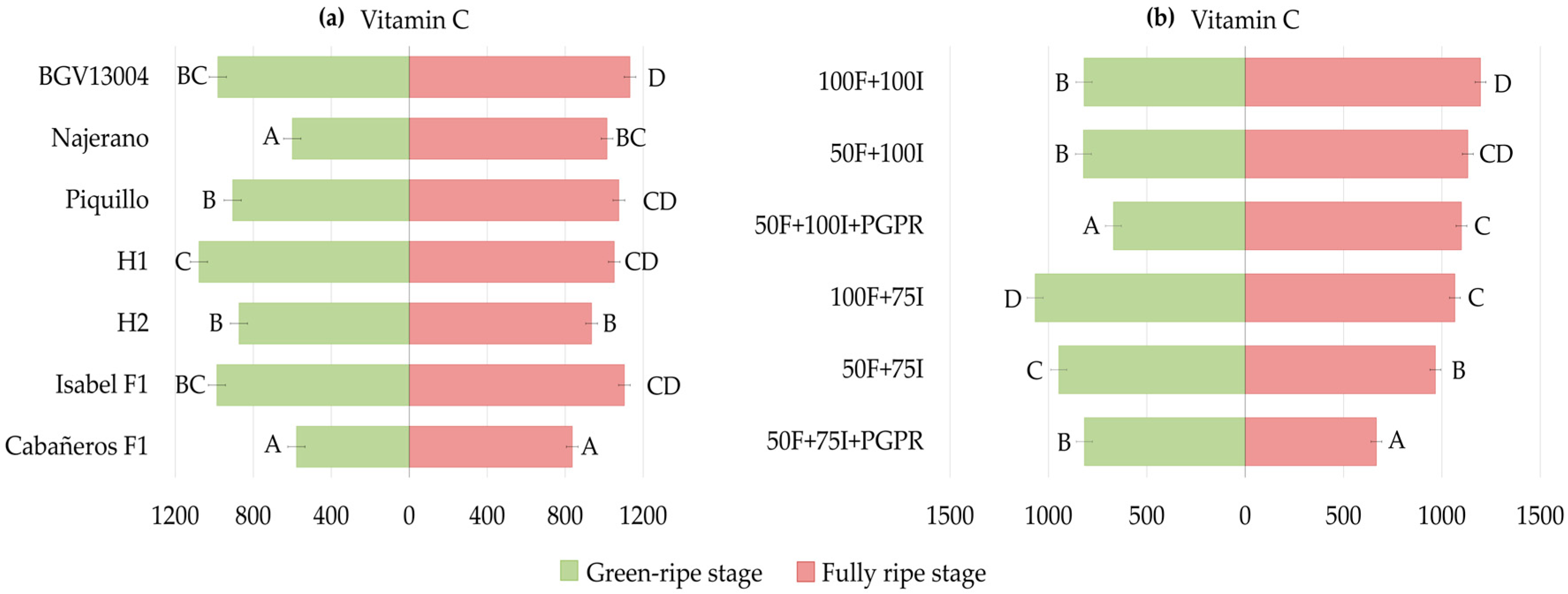
The considerable variability observed in vitamin C content among genotypes at both ripening stages was supported by the significant genotype effect detected in the ANOVA. At the green-ripe stage, genotype means across treatments ranged from 578 and 600 mg kg−1 in Cabañeros F1 and Najerano, respectively, to 1078 mg kg−1 in H1. At the fully ripe stage, vitamin C increased in all genotypes. Cabañeros F1 again showed the lowest mean value (836 mg kg−1) and BGV13004 the highest (1132 mg kg−1) (Figure 1a, Table S1).
Regarding treatment effects, vitamin C differed significantly at both ripening stages, in agreement with the ANOVA. At the green-ripe stage, vitamin C averaged 819 mg kg−1 across genotypes in the control (100F + 100I, reference baseline). Relative to the control, vitamin C increased by 30% under low irrigation (100F + 75I; 1068 mg kg−1) and by 16% under combined fertilizer and irrigation reduction (50F + 75I; 948 mg kg−1). By contrast, values under fertilizer reduction (50F + 100I) remained comparable to 100F + 100I. Under 50F + 100I + PGPR, vitamin C reached 670 mg kg−1, corresponding to an approximately 20% reduction compared to 50F + 100I and the control. Under 50F + 75I + PGPR, it averaged 818 mg kg−1, 14% lower than under 50F + 75I (Figure 1b, Table S2).
At the fully ripe stage, vitamin C reached 1196 mg kg−1 in the control and decreased under 100F + 75I and 50F + 75I to 1066 and 967 mg kg−1, respectively (11% and 19% below the control). Again, 50F + 100I showed contents comparable to the control. Under 50F + 100I + PGPR, vitamin C averaged 1099 mg kg−1, similar to 50F + 100I but slightly lower than the control. It also decreased to 667 mg kg−1 under 50F + 75I + PGPR, 31% and 44% lower than under 50F + 75I and 100F + 100I, respectively (Figure 1b, Table S2).
Genotype-specific responses were also observed, although most genotypes remained stable in comparison to the control within each stage. At the green-ripe stage, 50F + 100I increased vitamin C only in BGV13004 and H1, by 75% and 48%, respectively, compared to the control. The strongest positive responses were observed under 100F + 75I, with increases of 75–102% in BGV13004, Najerano and H1 compared to 100F + 100I. Under 50F + 75I, only H1 increased vitamin C, by 74% (Table 2 and Table S3). At the fully ripe stage, most genotypes remained stable under 50F + 100I, except for BGV13004 and Cabañeros F1, which decreased by approximately 27% compared to the control. Under 100F + 75I, Isabel F1 increased vitamin C by 24% compared to 100F + 100I, whereas BGV13004, Piquillo and Cabañeros F1 decreased it by 17–41%. Under 50F + 75I, reductions were observed only in BGV13004 and H2, both around 40% below 100F + 100I (Table 3 and Table S4).
Overall, PGPR inoculation within reduced fertilization treatments showed limited and genotype-dependent variations in vitamin C. In green-ripe fruits, a significant decrease was only detected in BGV13004 under 50F + 100I + PGPR compared to 50F + 100I (−54%), although values remained comparable to 100F + 100I (Table 2 and Table S3). At the fully ripe stage, PGPR treatments showed more variation across treatments and genotypes. Thus, in Cabañeros F1, vitamin C was 23% higher under 50F + 100I + PGPR than under 50F + 100I, but 13% lower than in the control. By contrast, 50F + 75I + PGPR reduced vitamin C in several genotypes compared to 50F + 75I, including H1, Isabel F1 and Cabañeros F1 (36%, 61% and 64% lower than under 50F + 75I, respectively). These values were also 46%, 63% and 68% lower than under 100F + 100I, respectively (Table 3 and Table S4).

2.3. Main Flavonoids (Quercetin, Luteolin, Kaempferol and Apigenin)

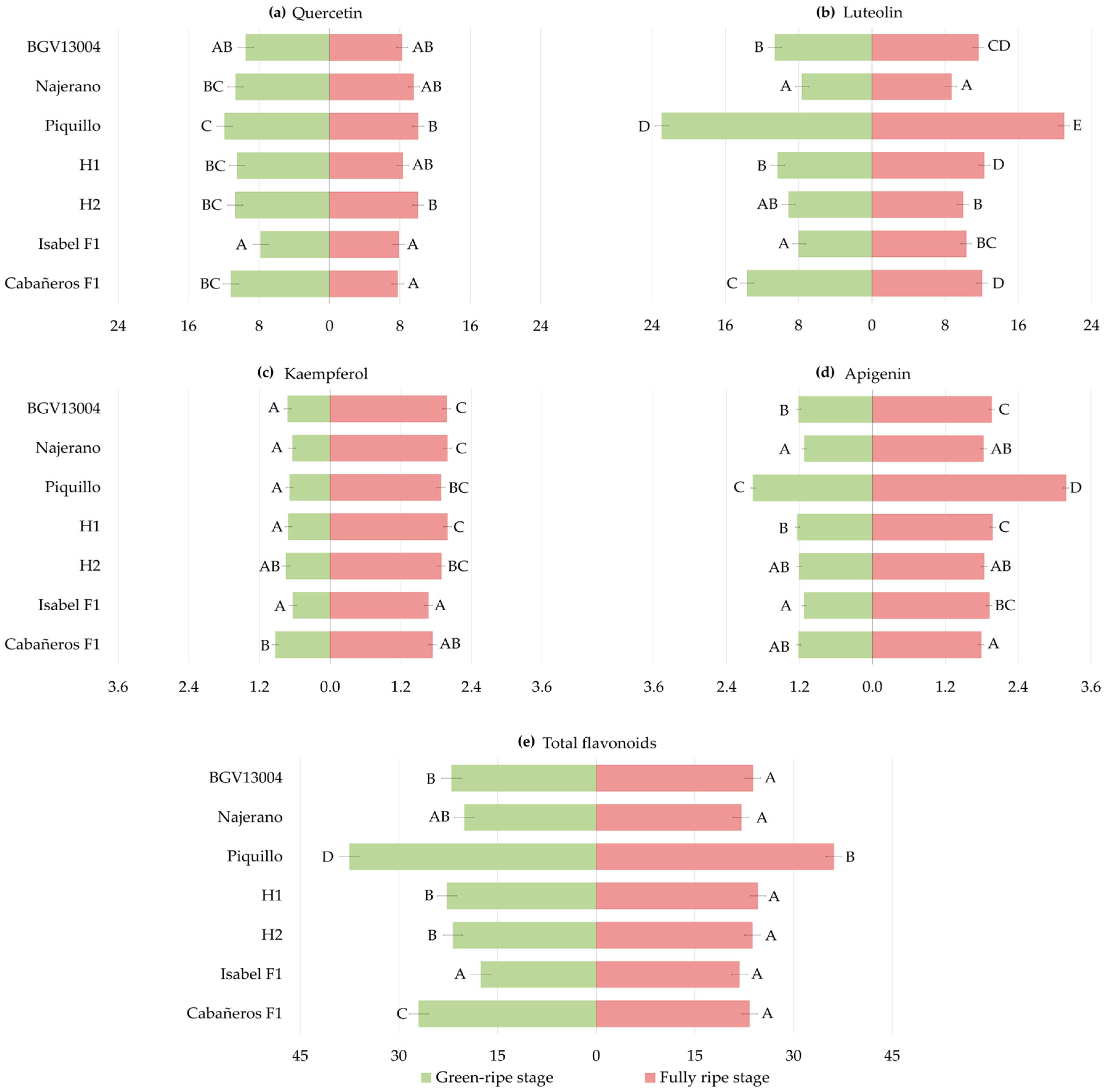
Genotype means were consistent with the significant genotype effects detected in the ANOVA. At the green-ripe stage, quercetin means across treatments ranged from 7.83 mg kg−1 in Isabel F1 to 11.92 mg kg−1 in Piquillo (Figure 2a, Table S1). Luteolin ranged from 7.64–7.98 mg kg−1 in Najerano and Isabel F1 to 22.95 mg kg−1 in Piquillo (Figure 2b, Table S1). Kaempferol was relatively uniform among genotypes, ranging from 0.63–0.72 mg kg−1 in Isabel F1, Najerano, Piquillo, H1 and BGV13004 to 0.93 mg kg−1 in Cabañeros F1 (Figure 2c, Table S1). Apigenin varied from 1.12 mg kg−1 in Najerano and Isabel F1 to 1.97 mg kg−1 in Piquillo (Figure 2d, Table S1), whereas total flavonoids were lowest in Isabel F1 (17.57 mg kg−1) and highest in Piquillo (37.52 mg kg−1) (Figure 2e, Table S1).
At the fully ripe stage, patterns varied across compounds. Quercetin ranged from 7.73–7.86 mg kg−1 in Cabañeros F1 and Isabel F1 to 10.04–10.06 mg kg−1 in H2 and Piquillo, respectively (Figure 2a, Table S1). Luteolin ranged from 8.68 mg kg−1 in Najerano to 20.98 mg kg−1 in Piquillo (Figure 2b, Table S1). Kaempferol varied from 1.67 mg kg−1 in Isabel F1 to 1.98–2.00 mg kg−1 in BGV13004, Najerano and H1 (Figure 2c, Table S1), while apigenin was lowest in Cabañeros F1 (1.79 mg kg−1), and highest in Piquillo (3.19 mg kg−1) (Figure 2d, Table S1). Finally, total flavonoids were highest in Piquillo (36.12 mg kg−1), whereas the remaining genotypes accumulated 21.76–24.56 mg kg−1 (Figure 2e, Table S1).
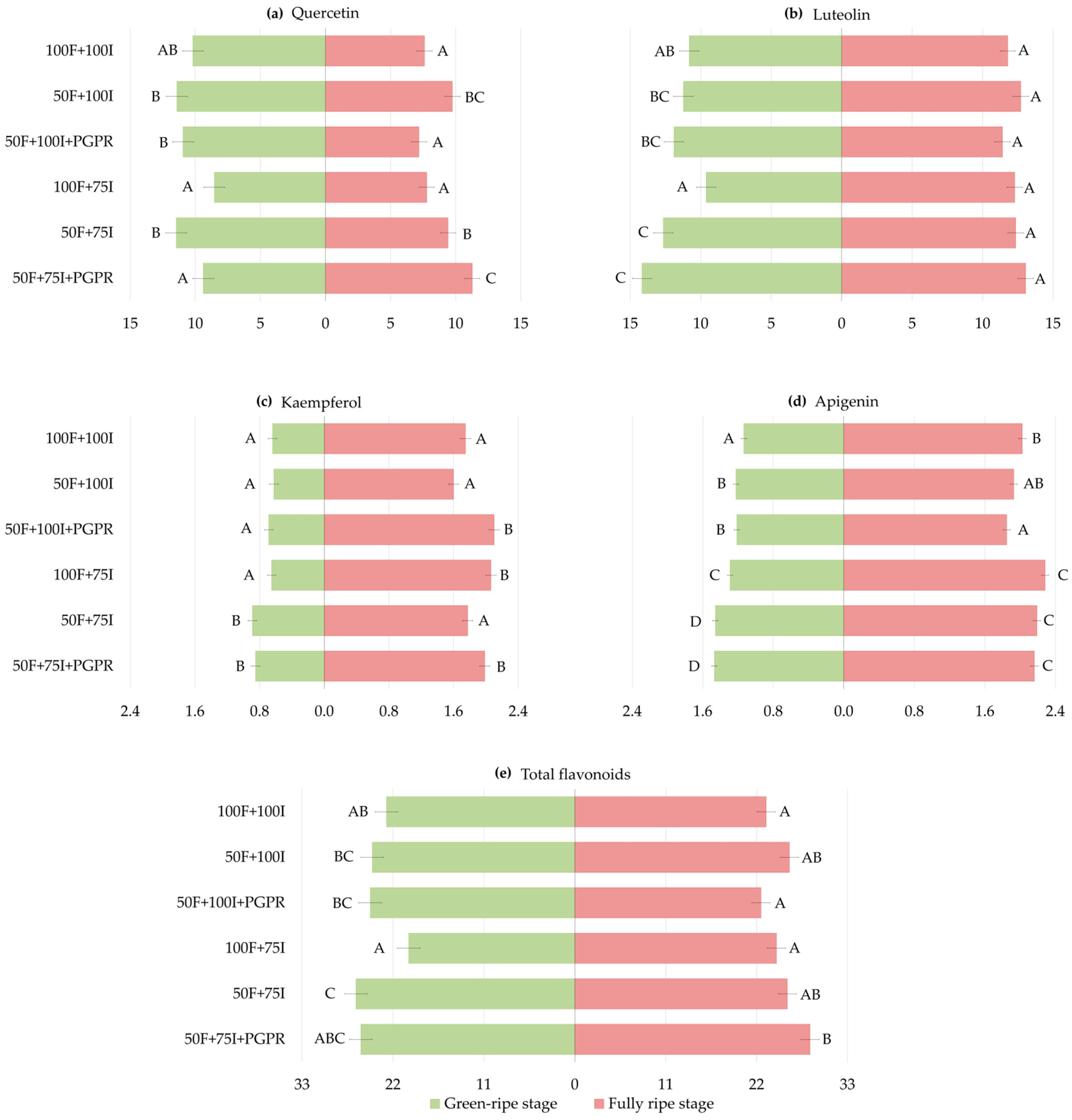
A general treatment effect was observed for most flavonoids at both ripening stages, corroborating the ANOVA. At the green-ripe stage, quercetin averaged 10.20 mg kg−1 across genotypes in the control and remained broadly stable across stress treatments. Under 50F + 75I + PGPR (9.40 mg kg−1), quercetin was 18% lower than under 50F + 75I (Figure 3a, Table S2). Luteolin averaged 10.82 mg kg−1 in the control and increased by 17% under 50F + 75I (12.66 mg kg−1). Under 50F + 75I + PGPR (14.18 mg kg−1), luteolin was 31% higher than under 100F + 100I (Figure 3b, Table S2). Similarly, kaempferol was 0.64 mg kg−1 in the control, and it increased by 39% under 50F + 75I (0.89 mg kg−1). Under 50F + 75I + PGPR, it reached 0.85 mg kg−1, 33% higher than in the control (Figure 3c, Table S2). Apigenin was lowest under 100F + 100I (1.13 mg kg−1) and increased slightly under 50F + 100I and 100F + 75I, reaching 1.46 mg kg−1 under 50F + 75I (29% higher than the control). Under PGPR inoculation, it reached 1.47 mg kg−1 in 50F + 75I + PGPR, corresponding to a 30% increase compared to 100F + 100I (Figure 3d, Table S2). Finally, total flavonoids averaged 22.79 mg kg−1 under 100F + 100I. Only a significant increase of 16% under 50F + 75I (26.48 mg kg−1) was observed. PGPR inoculation did not significantly modify total flavonoids compared to the corresponding non-inoculated stress treatments (Figure 3e, Table S2).
At the fully ripe stage, quercetin averaged 7.60 mg kg−1 in the control, increasing by about 26% under 50F + 100I (9.74 mg kg−1) and 50F + 75I (9.41 mg kg−1). Under PGPR treatments, quercetin decreased to 7.18 mg kg−1 under 50F + 100I + PGPR, 26% lower than under 50F + 100I. However, it reached 11.27 mg kg−1 under 50F + 75I + PGPR, 20% and 48% higher than under 50F + 75I and the control, respectively (Figure 3a, Table S2). By contrast, luteolin did not differ among treatments (Figure 3b, Table S2). Kaempferol averaged 1.75 mg kg−1 in the control, increasing by 18% under 100F + 75I (2.06 mg kg−1). Under 50F + 100I + PGPR, it reached 2.10 mg kg−1, which was 31% and 20% higher than 50F + 100I (1.60 mg kg−1) and 100F + 100I, respectively. Under 50F + 75I + PGPR, it increased to 1.99 mg kg−1, about 13% higher than 50F + 75I (1.77 mg kg−1) and 100F + 100I (Figure 3c, Table S2). Apigenin averaged 2.03 mg kg−1 under 100F + 100I and increased slightly under 100F + 75I and 50F + 75I (2.28 and 2.19 mg kg−1, respectively). Under PGPR treatments, apigenin was 1.85 mg kg−1 under 50F + 100I + PGPR and 2.16 mg kg−1 under 50F + 75I + PGPR, indicating a slight decrease and increase compared to 100F + 100I, respectively (Figure 3d, Table S2). Total flavonoids did not differ among treatments, except under 50F + 75I + PGPR, where they reached 28.47 mg kg−1, 23% higher than in the control (Figure 3e, Table S2).
Genotype-specific responses were observed across compounds and ripening stages. At the green-ripe stage, responses under 50F + 100I compared to 100F + 100I were limited, with increased apigenin in H1 by 25%, and higher quercetin, kaempferol and total flavonoids in H2 (50–82%). Under 100F + 75I, quercetin, luteolin and total flavonoids were largely unchanged. However, kaempferol increased in H2 by 64% but decreased in Piquillo by 25%, compared to 100F + 100I. Apigenin also increased in Najerano, H1 and Cabañeros F1 by 26–38%. Under 50F + 75I, luteolin increased only in H2, by 68% compared to 100F + 100I. Kaempferol rose in H1 and H2 by 78% and 86%, respectively. Apigenin increased in BGV13004, Najerano, Piquillo, H1 and H2 by 17–62%, while total flavonoids rose only in H2 (49%) (Table 4 and Table S5).
At the fully ripe stage, 50F + 100I increased quercetin only in H2 by 78% compared to the control, whereas Najerano showed a 11% decrease in apigenin. Under 100F + 75I, kaempferol rose in BGV13004, Najerano and Isabel F1 by 36–68% compared to 100F + 100I, while apigenin increased by 16–30% in BGV13004, H1 and H2. By contrast, quercetin decreased in Piquillo by 43%. Under 50F + 75I, luteolin increased only in Cabañeros F1 by 49% compared to the control, whereas kaempferol increased in Isabel F1 and Cabañeros F1 by 32% and 53%, respectively. Apigenin rose by around 27% in H1 and Cabañeros F1, while total flavonoids remained unchanged (Table 5 and Table S6).
Genotype-specific variations were observed under PGPR inoculation under reduced fertilization treatments. At the green-ripe stage, the strongest responses under 50F + 75I + PGPR were observed in Piquillo and H2. In Piquillo, quercetin, luteolin, apigenin and total flavonoids significantly increased compared to 50F + 75I and/or 100F + 100I. The largest increases were observed for luteolin, which was 96% and 89% higher, respectively, than under 50F + 75I and the control, while total flavonoids increased by 77% and 69%, respectively. By contrast, H2 showed marked decreases in quercetin, kaempferol and total flavonoids, including reductions of 54% and 40% in quercetin compared to 50F + 75I and 100F + 100I, respectively, and a 48% decrease in total flavonoids compared to 50F + 75I. Najerano also showed a 40% decrease in quercetin compared to 50F + 75I (Table 4 and Table S5).
At the fully ripe stage, quercetin showed contrasting responses, decreasing in Piquillo under 50F + 100I + PGPR, by about 46% compared to both 50F + 100I and 100F + 100I, and by 43% in H2 compared to 50F + 100I. Under 50F + 75I + PGPR, quercetin increased in Isabel F1, being 128% and 71% higher than under 50F + 75I and the control, respectively. By contrast, luteolin was largely unchanged. Kaempferol increased in several genotypes under PGPR treatments. Thus, under 50F + 100I + PGPR, Najerano, Isabel F1 and Cabañeros F1 increased kaempferol by 46–74% compared to 50F + 100I and by 49–73% compared to 100F + 100I. Under 50F + 75I + PGPR, kaempferol increased in Najerano and Isabel F1, being 41% and 23% higher than under 50F + 75I, and 47% and 63% higher than in the control, respectively. Apigenin did not show significant differences under PGPR compared to the corresponding non-inoculated treatments, while for total flavonoids, Piquillo decreased by about 35% under 50F + 100I + PGPR compared to 50F + 100I and 100F + 100I, while their content rose in Isabel F1 by 48% and 34% under 50F + 75I + PGPR in relation to 50F + 75I and 100F + 100I, respectively (Table 5 and Table S6).
Overall, these genotype-specific patterns supported the significant G × T interactions detected in the ANOVAs (Table 1, Table 4 and Table 5).

2.4. Total Carotenoids (Red and Yellow-Orange Carotenoids)

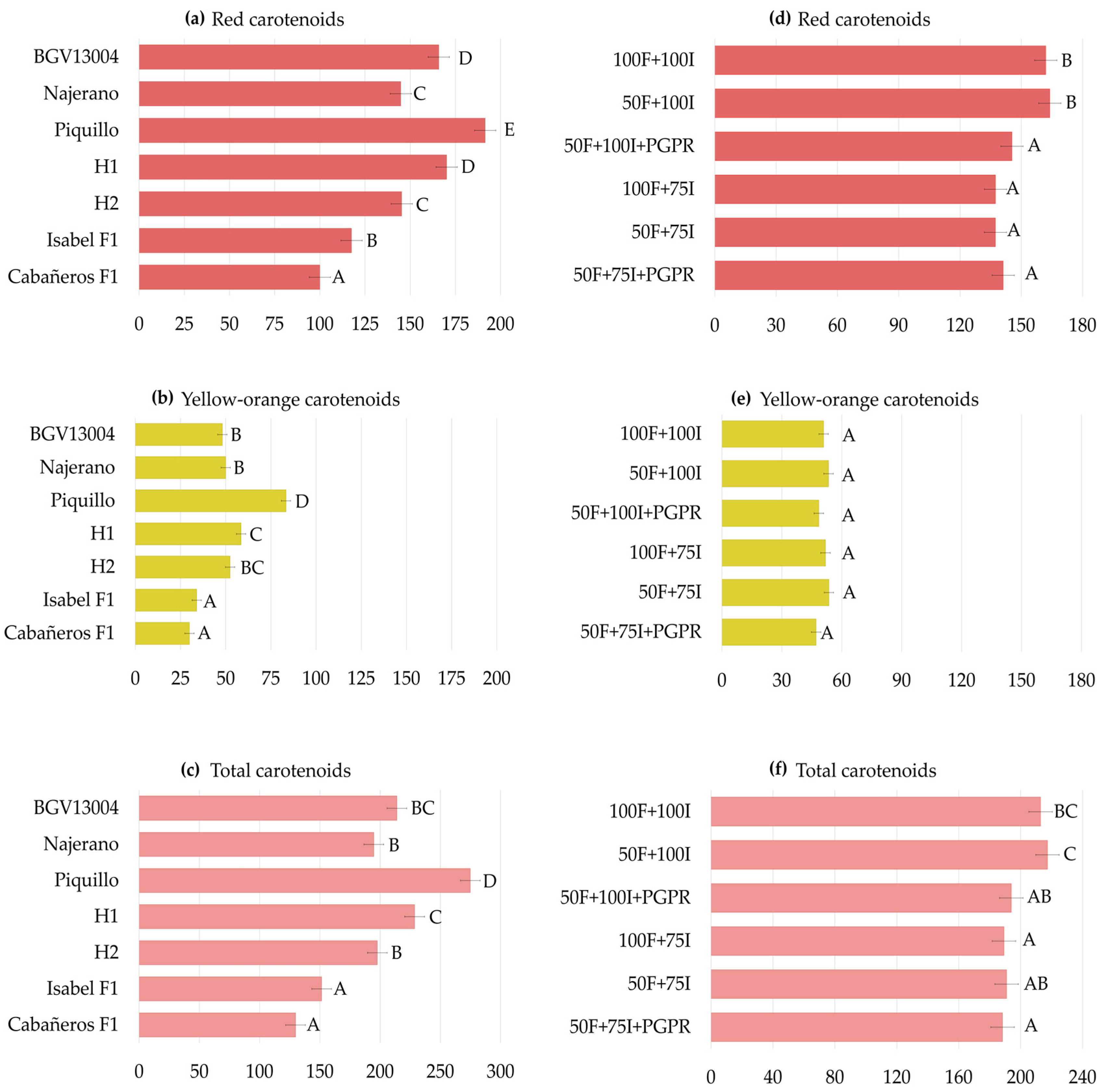
In agreement with the ANOVA, the genotype factor had a significant influence on carotenoid profiles. Averaged across treatments, Cabañeros F1 showed the lowest red carotenoid content (100 mg kg−1), whereas Piquillo reached the highest value (191 mg kg−1) (Figure 4a and Table S1). Yellow-orange carotenoids followed the same pattern, ranging from 30–34 mg kg−1 in Cabañeros F1 and Isabel F1 to 83 mg kg−1 in Piquillo (Figure 4b and Table S1). Similarly, total carotenoids varied from 130–151 mg kg−1 in Cabañeros F1 and Isabel F1 to 275 mg kg−1 in Piquillo (Figure 4c and Table S1).
Across treatments, red and total carotenoids also varied significantly. Under control conditions, red carotenoids averaged 162 mg kg−1. Compared to 100F + 100I, they decreased by 15% under both 100F + 75I and 50F + 75I (137 mg kg−1) and remained comparable under 50F + 100I. Under PGPR inoculation, red carotenoids averaged 145 mg kg−1 under 50F + 100I + PGPR, about 12% lower than under 50F + 100I and the control. Under 50F + 75I + PGPR, they reached 141 mg kg−1, being 13% lower than under 100F + 100I (Figure 4d and Table S2). Yellow-orange carotenoids were 51 mg kg−1 in the control and ranged from 47 to 54 mg kg−1 across treatments, with no significant differences (Figure 4e and Table S2). Total carotenoids averaged 213 mg kg−1 in the control and showed only minor changes across treatments, highlighting a 11% decrease under 100F + 75I (189 mg kg−1). Under PGPR inoculation, total carotenoids decreased by 11% under 50F + 100I + PGPR (194 mg kg−1) compared to 50F + 100I (217 mg kg−1) and 12% under 50F + 75I + PGPR (188 mg kg−1) in comparison to the control (Figure 4f and Table S2).
Genotype-specific responses were also observed. Under 50F + 100I, few differences were detected compared to 100F + 100I, except for H1, which increased both red and total carotenoids by 43%. Under 100F + 75I, BGV13004 reduced red, yellow-orange and total carotenoids by approximately 45% compared to the control. Similarly, Piquillo reduced red and total carotenoids by 24%. By contrast, Najerano increased yellow-orange carotenoids by 67%. Under 50F + 75I, few changes were detected, except for BGV13004, in which red and total carotenoids decreased by around 27% compared to 100F + 100I (Table 6 and Table S7).
PGPR inoculation generally showed stable or lower carotenoid levels compared to their non-inoculated stress treatments. In H1, red carotenoids were 26% lower under 50F + 100I + PGPR than under 50F + 100I. Piquillo also showed a 31% reduction under 50F + 100I + PGPR compared to 50F + 100I and 100F + 100I. Yellow-orange carotenoids also decreased in Piquillo under 50F + 100I + PGPR, by 31% compared to 50F + 100I. Total carotenoids followed similar patterns. In Piquillo, they were about 30% lower under 50F + 100I + PGPR than under 50F + 100I and 100F + 100I, while in H1, total carotenoids decreased by 24% compared to 50F + 100I (Table 6 and Table S7).
The variable genotype-specific responses were in line with the significant G × T interactions detected by the ANOVA in most compounds, reflecting the differential impact of treatments on carotenoid accumulation across the collection (Table 1 and Table 6).

2.5. Spearman’s Correlations

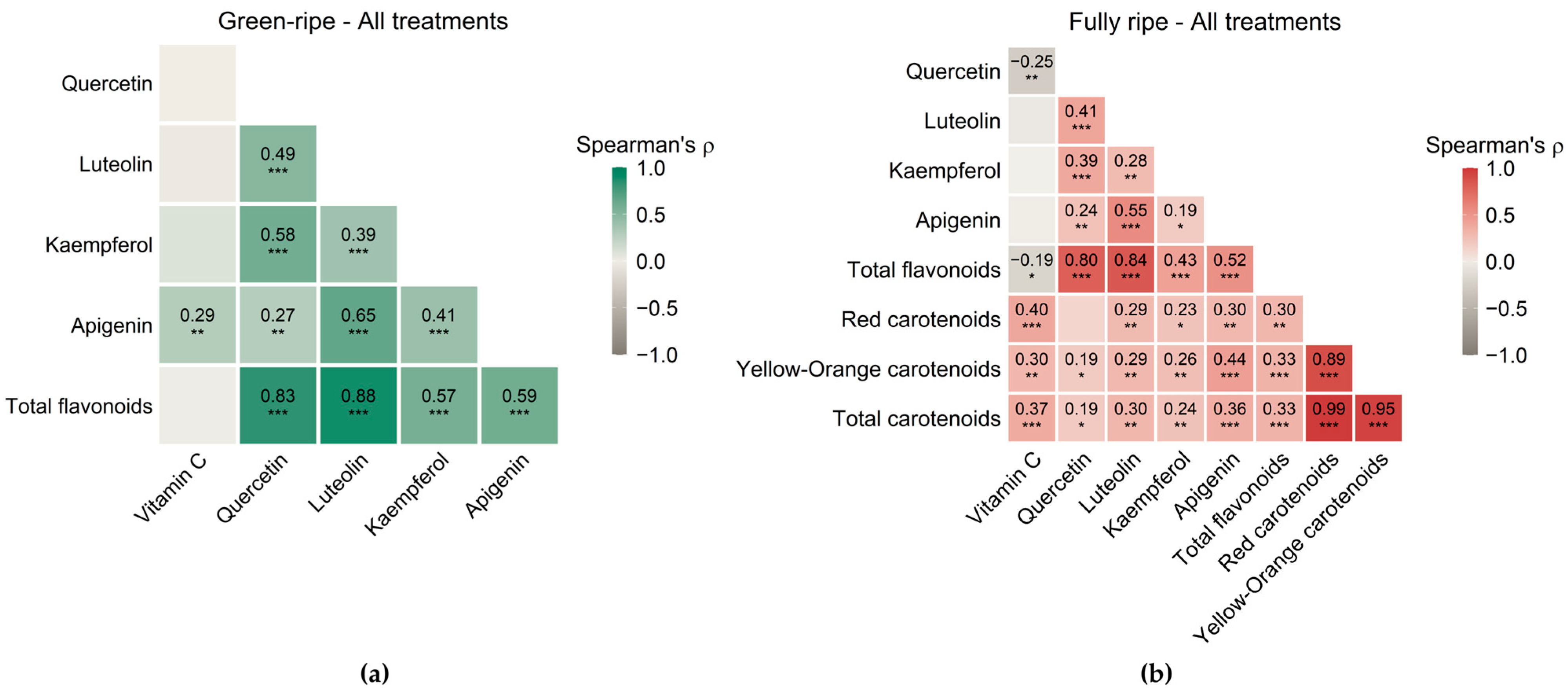
Correlations among the evaluated antioxidants differed between ripening stages and treatment categories (Figure 5 and Figure S1). At the green-ripe stage, vitamin C showed no relevant correlations with flavonoids, except for a modest association with apigenin (ρ = 0.29). However, flavonoids were strongly intercorrelated, and total flavonoids correlated most strongly with quercetin and luteolin. The highest individual flavonoids correlations were observed between luteolin and apigenin (ρ = 0.65), quercetin and kaempferol (ρ = 0.58), followed by quercetin and luteolin (ρ = 0.49) (Figure 5a). When data were analyzed separately by treatment category (control: 100F + 100I; low-input without PGPR: 50F + 100I, 100F + 75I, 50F + 75I; reduced fertilization with PGPR: 50F + 100I + PGPR and 50F + 75I + PGPR), the correlation between vitamin C and apigenin remained significant only in the Low-input without PGPR category (ρ = 0.29), whereas the main flavonoid associations (quercetin and kaempferol, luteolin and apigenin, or quercetin and luteolin) were consistently observed across categories (Figure S1a–c).
At the fully ripe stage, vitamin C showed a negative association with quercetin (ρ = −0.25) and total flavonoids (ρ = −0.19), whereas it correlated positively with red, yellow-orange and total carotenoids (ρ = 0.30–0.40). Flavonoids remained intercorrelated, and total flavonoids correlated most again with quercetin and luteolin. Among individual flavonoids, luteolin and apigenin showed a strong association (ρ = 0.55), and moderate correlations were observed between quercetin and luteolin (ρ = 0.41) and between quercetin and kaempferol (ρ = 0.39). Regarding flavonoid and carotenoid relationships, apigenin showed the highest correlations (ρ = 0.30–0.44), followed by total flavonoids (ρ = 0.30–0.33), luteolin (ρ = 0.29–0.30) and kaempferol (0.23–0.26). As expected, red and yellow-orange carotenoids were strongly correlated with each other and with total carotenoids (Figure 5b). When analyses were stratified by treatment category, a distinct negative association between quercetin and vitamin C emerged in reduced fertilization with PGPR (ρ = −0.49). By contrast, positive correlations between vitamin C and carotenoids were mainly observed in the low-input without PGPR category. Similarly, some intercorrelations among individual flavonoids were more pronounced in low-input without PGPR. Correlations between flavonoids and carotenoids were particularly evident for apigenin in low-input without PGPR (ρ = 0.37–0.47), whereas kaempferol showed higher correlations with carotenoids mainly in the control (ρ = 0.68–0.70). Finally, correlations among carotenoids remained strong across treatment categories (Figure S1d–f).

3. Discussion

Agroecosystems are highly vulnerable to climate change [38], due to the rising temperatures, water salinization, increasingly erratic drought and rainfall patterns [39] and soil degradation [40]. This vulnerability also extends to partially protected cultivation systems, including Mediterranean greenhouses [20]. More sustainable management is needed to ensure long-term productivity and ecosystem resilience, in line with the United Nations 2030 Agenda for Sustainable Development [41]. Achieving these goals requires a holistic approach that combines improved greenhouse environmental control [20], the conservation of genetic diversity, the use and breeding of resilient genotypes, optimized resource use and innovative agronomic strategies [42], including plant biostimulants [43]. Sustainable crop management aims not only to maintain yield while optimizing inputs such as fertilizer and irrigation [44], but also to preserve or enhance fruit quality, including internal nutritional quality and postharvest traits (e.g., physiological disorders and shelf-life performance) that affect market value and consumer acceptance [21,45]. Moreover, fruit composition, firmness and storability can be strongly affected by preharvest conditions, such as the irrigation, nutrient balance, temperature, light intensity and humidity [21]. Here, we focus on fruit internal quality, specifically the antioxidant profile.
Given the distinct genetic backgrounds represented in our collection, which included Spanish traditional/local cultivars previously characterized for genetic diversity and varietal typification [27,46], together with experimental and commercial hybrids, genotype-dependent responses across treatments were expected. These patterns may reflect differences in constitutive antioxidant status and in the developmental regulation of ascorbate (vitamin C), phenylpropanoid/flavonoid and carotenoid metabolisms [47,48,49]. Mechanistically, these compounds play complementary roles within a coordinated antioxidant network involved in ROS control and redox homeostasis. Ascorbate also interacts with different phytohormone pathways. Flavonoids, particularly those with a dihydroxy B-ring, such as quercetin and luteolin, can limit lipid oxidative damage. Carotenoids also contribute to photoprotection and further reduce lipid peroxidation [50]. Responses under the tested low-input conditions may be influenced by differential sensitivity and responsiveness among genotypes to nutrient and water limitation [51] and by PGPR signals that can modulate pathways related to stress and defense [52].
A general tendency to accumulate vitamin C and phenolic compounds under nitrogen limitation has been widely reported. Nitrogen deprivation can induce oxidative stress and antioxidant responses, including shifts in ascorbate metabolism and recycling (e.g., the ascorbate-glutathione cycle) [7]. In pepper fruits, nitrogen limitation has been linked to higher abundance of ascorbic acid precursors, and responses appear to be ripening-dependent [53]. In parallel, low nitrogen often promotes the accumulation of carbon-based phenolics/flavonoids, sometimes interpreted as a photoprotective response [54]. However, fertilizer effects on carotenoids are less consistent. This may be because carotenoid accumulation is strongly dependent on ripening and varies with stress intensity and genotype. But, enhanced carotenoid biosynthesis under low nitrogen has also been described [55,56]. In our study, some genotypes showed significant increases in vitamin C, as also reported in tomato by Flores et al. [57], but also reductions under stress conditions, particularly at the fully ripe stage, as previously observed in mature pepper fruits [58]. Similarly, some flavonoids increased under nutrient limitation at the green-ripe stage, consistent with observations in early tomato development [59]. However, most genotypes maintained stable concentrations of vitamin C, flavonoids and carotenoids under reduced fertilization, with only specific variations. This stability agreed with previous findings in pepper [60], and other crops [61,62].
Under reduced irrigation, accumulation of vitamin C and flavonoids has frequently been reported, often linked to ROS scavenging [63,64]. For carotenoids, some studies have described detrimental effects [65], whereas others have reported increases under oxidative conditions [66]. Carotenoids act as precursors of abscisic acid (ABA), which typically accumulates under drought. Moreover, ABA signaling can modulate the expression of carotenoid pathway genes. Thus, the variability observed in carotenoids may partly reflect their roles in both pigmentation and drought responses [67]. In our work, only a subset of genotypes showed significant changes. By contrast, several compounds remained stable in part of the sweet pepper collection across treatments and/or ripening stages, particularly for quercetin, luteolin and carotenoids. Similar stability in vitamin C was reported by Kopta et al. [68] and Agyemang Duah et al. [69] in most pepper and chili cultivars under deficit irrigation. Medina-Lozano et al. [70] also found that drought reduced vitamin C in some lettuce varieties, while others maintained stable contents. In our collection, vitamin C increases were more evident at the green-ripe stage, whereas responses at full ripening were smaller and occasionally negative. A stronger negative effect of water deficit at advanced ripening has also been reported in pepper [71]. This stage dependence could reflect the developmental regulation of ascorbate metabolism during pepper fruit ripening, with marked changes in the expression of key biosynthetic genes (e.g., GMP, GME and GGP) across ripening stages and among cultivars [48]. For flavonoids, increases in kaempferol and apigenin aligned with previous reports of phenolic and flavonoid increases under drought [72,73]. These increases are consistent with the activation of the phenylpropanoid pathway, including the expression of genes such as PAL and CHS [74], and may also involve broader stress-responsive regulatory networks [75]. Carotenoids also showed variable responses, as described in tomato [76] and carrot [77].
When fertilizer and irrigation were simultaneously reduced, we also observed overall stability in these compounds. Thus, Zahedifar et al. [78] reported no significant differences in vitamin C across most treatments combining fertilizer and irrigation reduction in tomato. Conversely, Wang et al. [79] found higher vitamin C under the lowest input combinations. For flavonoids, kaempferol and apigenin again showed the highest number of significant differences, in line with studies showing that regulation of specific phenolics varies with the stress type and also depends on the crop and genotype [72,80]. Additionally, stable flavonoid contents under reduced irrigation and no phosphorus application have been reported in melon [81], whereas increased flavonoids under different fertilizer and irrigation inputs were observed in Calendula officinalis L. [82]. For carotenoids, only slight changes under combined reductions of fertilizer and irrigation were described in rocket [83], while total carotenoids decreased at the lowest doses in Swiss chard, with similar values across intermediate doses [84].
The overall stability of the evaluated compounds under low fertilizer and/or irrigation suggests that the imposed stress levels were insufficient to trigger a strong oxidative response or a generalized shift toward secondary metabolism [64,85]. This agrees with previous work that indicated that moderate deficit irrigation (around 75% of full irrigation) is a feasible water-saving strategy in pepper under Mediterranean conditions [86]. Consistently, our previous study from the same experiment showed that yield, fruit weight and fruit soluble sugars remained largely unaffected in several genotypes under low inputs [37]. This suggested that carbon supply and allocation to growth and fruit development were not substantially compromised under these moderate reductions [37,87,88]. However, limited variation in antioxidant concentrations may also reflect efficient redox homeostasis [85]. Antioxidants such as ascorbic acid, flavonoids and carotenoids participate within an integrated system in which cycling and regeneration can help maintain relatively stable basal antioxidant concentrations even when ROS signaling occurs [50]. Moreover, constitutive antioxidant capacity and acclimation ability are genotype-dependent [50,89], which may explain the stability observed in part of our collection under low-input treatments. Although plant water and nutrient status were not directly quantified, the generally stable yields and fruit weights reported in our previous work [37] suggested that a “concentration” or “dilution” effect due to changes in fruit size or biomass was unlikely to explain the largely stable antioxidant concentrations observed here [6,90]. However, changes in assimilate allocation may still contribute to variation in compound composition [90]. These results provide a useful basis for comparison with those obtained in comparable Mediterranean coastal greenhouse systems. However, extrapolating these results beyond the tested conditions should be made with caution. Further validation across seasons and locations is still needed.
PGPR inoculation has been proposed as an eco-friendly tool to enhance plant growth and fruit quality on numerous crops under stress [34,91]. However, in our study, vitamin C remained largely unchanged or even decreased in inoculated plants under reduced fertilization compared to their corresponding non-inoculated stress treatments at either ripening stage. This agreed with reports of reduced ascorbic acid under PGPR combined with stress, for example in Brassica oleracea var. botrytis under the lowest fertilization treatment [35]. Lower vitamin C may result from increased ascorbate peroxidase activity and ascorbic acid consumption during ROS detoxification [92]. Alternatively, it may derive from stress alleviation by PGPR, which could reduce ROS levels and the need for a strong antioxidant response [93]. Our findings also suggested that ripening stage modulates vitamin C responses under PGPR, supporting the work of Amor et al. [94].
Flavonoids changed only slightly under PGPR inoculation, and most genotypes maintained similar levels across stress treatments with and without inoculation. Similar flavonoid contents under fertilizer reduction and combined fertilizer stress with rhizobacteria were also described in spinach [95]. Interestingly, some genotypes in this study exhibited significant increases, highlighting Piquillo under combined fertilizer and irrigation reduction at early ripening and Isabel F1 at the fully ripe stage. Similar increases under PGPR inoculation have been reported in lettuce under reduced mineral fertilization, suggesting a possible synergistic effect on the synthesis of secondary metabolites [96]. In our work, increases in specific flavonoids may be linked to the activation of defense signaling by PGPR, including induced systemic resistance (ISR), largely mediated by jasmonic acid and other signaling components such as ethylene and salicylic acid. ISR can stimulate the phenylpropanoid pathway and the expression of genes involved in flavonoid synthesis in responsive genotypes [97]. Measuring these hormones and related molecular markers would help to confirm ISR activation.
Carotenoids showed no clear benefits from PGPR inoculation under reduced fertilization in our study. Some genotypes remained stable whereas others decreased, as also described in pepper under low fertilizer with PGPR [98]. Such reductions may reflect stress alleviation in some contexts, since bacterial priming has been associated with lower ROS signaling and a reduced induction of antioxidant defenses under stress [93]. By contrast, higher carotenoids under PGPR have been reported in lettuce under fertilizer reduction compared to non-inoculated plants under stress [34] and in pepper under lower fertilization with PGPE [98]. These contrasting results suggest that PGPR may influence carotenoid regulation by acting as biotic elicitors that modulate ROS and phytohormone pathways, including ABA signaling, which could potentially influence ripening dynamics and carotenoid biosynthesis and, therefore, final carotenoid accumulation [67,99]. Carotenoid synthesis in pepper is also sensitive to nitrogen nutrition [100]. In addition, PGPR can modify nutrient acquisition and nitrogen status [31], which may indirectly affect carotenoid accumulation through changes in plant nutritional balance and carbon allocation.
The inconsistent patterns observed between inoculated and non-inoculated plants in our study indicate genotype-dependent antioxidant variations in response to PGPR under the tested stress conditions [34,35,91,92,94]. This supported targeted application rather than a general use. PGPR performance is also influenced by plant-microbe interaction, in which root exudates seem to play a key role [101], soil properties [102], the sensitivity of bacterial strains to environmental conditions (e.g., fertilizer composition) [96], and interactions with native microbial communities [103]. Accordingly, our conclusions about PGPR effects are restricted to this single season and location, the seven pepper genotypes evaluated, the commercial PGPR consortium used and its application under reduced fertilization. The extrapolation to other seasons, environments, regimes, inoculants or pepper genotypes requires further validation.
In our trial, variability across compounds highlighted the strong influence of genotype and ripening stage on sweet pepper antioxidant profiles [6], as also reflected in the general and green-ripe ANOVAs. These results suggest that antioxidant variations to abiotic stress and PGPR under the tested conditions were complex and genotype-dependent [104,105]. At the fully ripe stage, treatment effects became more evident for vitamin C and certain flavonoids, consistent with studies that have detected a stronger environmental modulation at advanced maturity [6]. Although the magnitude of the G × T interactions varied among compounds, being less pronounced for flavonoids, the interaction patterns were consistent with the specific genotype responses observed here. Moreover, ripening involves major biochemical changes and shifts in metabolism within specific tissues in pepper that vary among genotypes [106]. These changes may partially mask or amplify treatment effects, in line with the G × R interaction detected for vitamin C and most flavonoids [6,107].
Najerano and Piquillo were included because previous work reported an interesting antioxidant profile at the fully ripe stage under organic management [6]. Piquillo has also been described as having a vigorous root system and high phosphorus uptake efficiency, with preliminary evidence of rhizosphere ammonification potential [108,109], traits that are relevant under PGPR inoculation. Thus, H1 (BGV13004-derived F1) showed the most consistent increases in vitamin C under low-input treatments at the green-ripe stage, together with BGV13004. At the fully ripe stage, Isabel F1 showed the clearest improvement in vitamin C under reduced irrigation. For flavonoids, Piquillo consistently showed high contents under reduced treatments at both ripening stages, followed by H2 (Najerano-derived F1) at the green-ripe stage. To a lesser extent, H1 increased specific flavonoids under some reduced treatments at both stages, whereas Cabañeros F1 showed higher contents of some flavonoids under combined reductions at the fully ripe stage. For carotenoids, H1 and Najerano showed the most favorable patterns under reduced fertilization and reduced irrigation, respectively. Piquillo maintained the highest overall carotenoid levels, despite specific decreases under irrigation reduction. The main increases associated with PGPR under reduced fertilization were for flavonoids in Piquillo (green-ripe) and Isabel F1 (fully ripe), compared to their corresponding non-inoculated treatments.
Overall, our main mechanistic interpretation is that the G × T and G × R interactions reflect genotype differences in constitutive antioxidant status and developmental regulation of antioxidant metabolism. These interactions also suggest differential responsiveness to moderate nutrient and water limitation [47,48,49,50,51,52,53,54,55,56,63,67,85]. Moreover, the complex and specific responses observed under PGPR inoculation suggest a redox homeostasis modulation dependent on the genotype, ripening stage and PGPR treatment, possibly involving effects on gene expression and enzyme activity related to ROS scavenging [92,93]. These responses may also depend on plant-microbe compatibility and traits associated with root characteristics, which affect nutrient uptake and hormone signaling [92,93,94,97,99,101]. Although these mechanisms were not directly assessed in the present study, our previous results from the same trial provided complementary information [37]. For instance, H1 showed antioxidant increases under stress in green fruits, although yield and fruit weight were more sensitive to reduced irrigation treatments [37]. This is compatible with antioxidant increases at early ripening in responsive genotypes [64], and it may also be related to differences in fruit size under these stress conditions [90]. By contrast, Piquillo combined elevated antioxidant contents, higher total flavonoids at the green-ripe stage under PGPR, and stable yield and fruit weight under reduced inputs [37], making it one of the most promising genotypes. Piquillo also had the smallest fruits and was the only genotype with medium mesocarp thickness (Table 7). This performance may also be related to fruit morphology, as larger and fleshy fruits have been traditionally proposed to show lower concentrations of some compounds due to a ‘dilution effect’ [6,110]. However, evidence linking fruit morphology to antioxidant concentration in pepper remains limited and inconsistent [111].
Correlation analyses provided additional insight into antioxidant coordination. At the green-ripe stage, flavonoids showed multiple positive intercorrelations [107], whereas vitamin C was largely decoupled, suggesting partially independent regulation. These associations were broadly consistent across treatment categories, indicating limited trade-offs between vitamin C and flavonoids in green fruits within our data. In fully ripe fruits, vitamin C was positively associated with carotenoids, particularly under Low-input without PGPR, but it tended to show negative associations with flavonoids, most notably with quercetin under Reduced fertilization with PGPR. These different patterns may reflect the metabolic changes related to defense signaling [47,48,50] combined with the developmental reprogramming during ripening [106]. Overall, the predominance of positive associations suggests that selecting genotypes with enhanced levels of one antioxidant class will not necessarily imply broad detrimental effects in others. However, specific antagonistic relationships may emerge under particular genotype × treatment × stage contexts.
In general terms, antioxidant responses were mainly determined by genotype and ripening stage, with more variable treatment effects. These findings support the feasibility of low-input management without major penalties in fruit nutritional quality in this collection and highlight traditional germplasm as a source of useful alleles for nutritional quality in future breeding programs [112]. Combining selected PGPR strains with well-performing genotypes could be explored as a targeted strategy, particularly for modulating flavonoids in responsive combinations under the tested conditions.

4. Materials and Methods

4.1. Plant Material

In this work, seven Capsicum annuum L. genotypes were evaluated, comprising three local/traditional Spanish materials, two experimental F1 hybrids developed at the COMAV Institute, and two commercial F1 hybrids (Table 7). The local and traditional genotypes were selected to represent contrasting Spanish sweet pepper morphotypes and quality attributes, including two cultivars under official EU quality schemes (PDO “Piquillo de Lodosa” and PGI “Riojano”). The experimental hybrids were new materials obtained by crossing BGV13004 or Najerano with a sweet California Wonder breeding line carrying the L4 resistance gene. The two commercial F1 hybrids were representative of cultivars widely grown in southeastern Spain.
Table 7. Evaluated genotypes, descriptions, descriptive fruit traits and origin.
AccessionDescriptionCultivar TypeFruit TypeMesocarpWeight (g)Origin (Provider)
BGV13004Bell pepper Local ecotypeMedium-elongated, triangularThick flesh135 (102–167) 2Spain, Basque Country
NajeranoP. G. I. Pimiento RiojanoTraditionalMedium-elongated, triangularThick flesh110 (87–143)Spain, La Rioja
PiquilloCons. Reg. P.D.O. Pimiento Piquillo de LodosaTraditionalShort conicalMedium26 (20–31)Spain, Navarra
H1BGV13004 derived F1 1Experimental F1Medium-elongated, triangularThick flesh143 (107–169)Spain, Valencia (COMAV)
H2Najerano derived F1 1Experimental F1Medium-elongated, triangularThick flesh132 (84–178)Spain, Valencia (COMAV)
Isabel F1Blocky sweet pepperCommercial F1BlockyThick flesh156 (112–203)Spain (Ramiro Arnedo)
Cabañeros F1Elongated sweet pepperCommercial F1Elongated blocky (Lamuyo)Thick flesh231 (219–250)Spain (Ramiro Arnedo)
1 H1 and H2 were developed by crossing BGV13004 or Najerano with a red sweet California Wonder breeding line carrying the L4 resistance gene. 2 Mean fruit weight and range of values. Fruit weight was previously reported in Jiménez-Pérez et al. [37].

4.2. Experimental Design and Pepper Cultivation Conditions

The experiment was conducted during the 2021 winter-summer season in a 400 m2 multi-tunnel greenhouse at the Torreblanca experimental farm (IMIDA Institute, Murcia, Spain; 37°46′34.6′′ N, 0°53′47.7′′ W). The soil at the experimental site was classified as silty loam (44.55% sand, 52.50% silt, 2.95% clay) with an alkaline pH (8.2, 1:2 soil:water at 23.9 °C). Organic matter content was 4.21%, with 2.4% organic carbon and 0.212% total nitrogen. Available macronutrients were 11.5 mg kg−1 phosphorus (Olsen), 317 mg kg−1 potassium, 23,900 mg kg−1 calcium, 1170 mg kg−1 magnesium, and 1380 mg kg−1 sodium. Soil parameters were obtained from an external laboratory report for site description.
Six treatments were tested, combining two fertilization levels, two irrigation levels and PGPR. The full fertilizer dose (100%) consisted of 195 kg ha−1 N, 162 kg ha−1 P2O5, 292 kg ha−1 K2O, 120 kg ha−1 Ca and 20 kg ha−1 Mg. The full irrigation regime (100%) was delivered through pressure-compensating drippers at 2.2 L h−1 per plant. The PGPR consisted of a commercial mix of plant growth-promoting bacteria (Bactogreen®, Thader Biotechnology, S.L., Murcia, Spain) containing phosphorus-solubilizing Pseudomonas fluorescens, potassium-solubilizing Bacillus megaterium and Bacillus circulans, and nitrogen-fixing Azospirillum brasilense (each ≥ 1 × 10⁹ CFU mL−1). PGPR was applied monthly at 3 mL plant−1. Due to logistical constraints and based on the composition of this PGPR mixture and the provider’s recommendations, inoculation was applied only under reduced fertilization treatments. Accordingly, PGPR responses were interpreted within the reduced fertilization context and were not extrapolated to full fertilization. Therefore, the six treatments were described in Table 8.
For the experimental design, the greenhouse was divided into two main blocks, which served as spatial replicates for possible positional heterogeneity. Each block included six cultivation rows, corresponding to the six treatments, distributed randomly. Within each row, the genotypes were also arranged randomly as subplots and included ten plants each. Thus, each genotype × treatment combination included a total of twenty plants (ten plants per block × two blocks). Plants were spaced 0.4 m within row and 1 m between rows. Cultivation followed the technical specifications for integrated pepper production established by the Order of 10 May 2012 [113].

4.3. Fruit Analyses

4.3.1. Fruit Sampling and Preparation

Pepper fruits were collected at the two commercial ripening stages: green-ripe (final size, firm fruit, fully green) and fully ripe (firm fruit, fully red), based on the criteria used by trained technicians in commercial pepper production. For each genotype × treatment × ripening stage combination, three biological replicates were prepared. Each replicate consisted of a pooled sample of fruits harvested from four plants (two plants per block), using different plants for each replicate (i.e., sample 1: plants 2 and 3 from both blocks; sample 2: plants 5 and 6 from both blocks; sample 3: plants 8 and 9 from both blocks). A minimum of five fruits were collected per block (≥ten fruits per biological replicate). The mixture of fruits from both blocks within each replicate was done to dilute possible block/position effects. Fruits at both ripening stages could be collected from the same plants, although they were analyzed separately.
To minimize potential bias in fruit composition due to harvest timing among ripening stages and/or genotypes, fruits from all genotypes and ripening stages were sampled within the same time slot (7–11 June 2021), which coincided with the production peak of both green and fully ripe peppers. Fruits were transported to the laboratory immediately after harvest for sample preparation. Fruits were washed, the seeds were removed, and they were cut into small pieces. Each replicate was then split into two subsamples. One subsample was homogenized with a BAPI 1000 PLUS INOX domestic blender (Taurus, Oliana, Spain) to obtain a liquid extract, which was immediately aliquoted and stored at −80 °C for vitamin C analysis. The second subsample was freeze-dried in a VirTis Genesis unit (SP Scientific, Warminster, PA, USA). Samples were weighed before lyophilization to record fresh weight and again after drying to obtain dry weight. The dry material was milled with an ML130 domestic grinder (Jata, Tudela, Spain) to a fine powder and stored under dry and dark conditions until flavonoids and carotenoids analyses.

4.3.2. Vitamin C

Determination of vitamin C, as the sum of ascorbic acid and dehydroascorbic acid, was based on the protocol described by Chebrolu et al. [114], with slight modifications. Vitamin C was quantified by HPLC–UV-Vis, using an Agilent 1220 Infinity LC System (Agilent Technologies, Santa Clara, CA, USA). For each sample, a liquid extract was homogenized with a vortex spin and centrifuged for 5 min at 12,000 rpm at 4 °C. The supernatant was diluted 1:4, containing 3% metaphosphoric acid (Acros Organics, Geel, Belgium), vortexed, centrifuged 5 min at 12,000 rpm and filtered with a 0.20 µm Phenex-RC 15 mm syringe filter (Phenomenex, Torrance, CA, USA). Two aliquots of the same sample were prepared, one for direct ascorbic acid quantification, and an aliquot reduced by adding an equal volume of 5 mM Tris(2-carboxyethyl)phosphine hydrochloride (Sigma-Aldrich, St. Louis, MO, USA), reducing dehydroascorbic acid to ascorbic acid to quantify total vitamin C. Chromatographic separation used a Brisa LC2 C18 column (3 µm; 150 × 4.6 mm; Teknokroma, Barcelona, Spain) at 254 nm. The analysis was performed under isocratic conditions for 15 min using a mobile phase of 5% methanol and 95% HPLC-grade water at 1% acetic acid. The injection volume was 5 µL, and the flow rate was 1.0 mL min−1. Quantification was based on a calibration curve for the external standard of ascorbic acid (99%) (Sigma-Aldrich). Ascorbic acid and vitamin C (ascorbic acid + dehydroascorbic acid) were expressed as mg kg−1 fresh weight (fw). Because ascorbic acid showed similar magnitudes and trends to vitamin C, only vitamin C is presented in the main text; ascorbic acid values are available in Tables S1–S4.

4.3.3. Flavonoids

The main flavonoids in pepper were analyzed using a method based on Bae et al. [115]. Determination of quercetin, luteolin, kaempferol and apigenin was performed by HPLC–UV-Vis, using a 1220 Infinity LC System (Agilent Technologies). For flavonoids extraction, one sample of 0.1 g per lyophilized replicate was mixed with 1.5 mL of extraction solution of methanol: Milli-Q® water (80:20, v/v) with 0.1% (w/v) of 2,3-tert-butyl-4-hydroxyanisole (BHT). Each sample was homogenized, incubated in an Elmasonic Select ultrasonic bath (Elma, Hohentwiel, Germany) 1h at 40˚C and centrifuged at 10,000 rpm for 5 min. Then, the acid hydrolysis of flavonoid glucosides to the aglycone form was performed treating the supernatant with 3 M HCl (2:1) in a multiplace dry block heater (J.P. SELECTA®, Barcelona, Spain) at 95˚C for 1h. The hydrolyzed replicate was centrifuged at 7000 rpm for 5 min and filtered with a 0.20 µm Econofltr PTFE 13 mm syringe filter (Agilent Technologies). The main flavonoids were separated using a Brisa LC2 C18 column (3 µm; 150 × 4.6 mm; Teknokroma) at 360 nm. Column temperature was set to 30 °C and injection volume was 10 µL. The mobile phase consisted of HPLC-grade water at 0.1% formic acid (A) and HPLC-grade methanol at 0.1% formic acid (B). A gradient elution for 20 min, with a flow rate of 0.8 mL min−1, was used as follows: a linear gradient of 40–100% B (0–10 min), 100% B (10–15 min), and a linear gradient of 40–100% B (15–20 min). Flavonoid quantification consisted of performing calibration curves for external standards of quercetin (≥95%), luteolin (98%), kaempferol (97%) and apigenin (95%) (Sigma-Aldrich). Total flavonoids were calculated as the sum of the four individual flavonoids and were expressed as mg kg−1 fw.

4.3.4. Carotenoids

For carotenoids analysis, a spectrophotometric method described by Hornero-Méndez and Mínguez-Mosquera, with some modifications [116], was used. Red carotenoids, yellow–orange carotenoids and total carotenoids were analyzed by spectrophotometry, using a UviLine 9400 UV–vis spectrophotometer (SCHOTT Instruments, Mainz, Germany). Carotenoid extraction was performed using 0.1 g of each lyophilized replicate in 20 mL of acetone (ITW Reagents, Monza, Italy), by orbital shaking using a Vibrax shaker (OVAN, Barcelona, Spain) for 1h at 200 rpm, maintaining the samples in the dark. Each sample was filtered with a 0.11 µm FILTER-LAB® filter paper (Filtros Anoia, Barcelona, Spain), and acetone was added to 25 mL. Carotenoids were quantified by measuring the absorbance values at 472 nm (Δ472) and 508 nm (Δ508) and applying the following formulas:
R e d   c a r o t e n o i d s   µ g   m L 1 =   508 · 2144 472 · 403.3 270.9
Y e l l o w o r a n g e   c a r o t e n o i d s   µ g   m L 1 = 472 · 1724.3 508 · 2450.1 270.9
Total carotenoids were calculated as the sum of red carotenoids and yellow-orange carotenoids. Concentrations were expressed as mg kg−1 fw.

4.3.5. Statistical Analysis

For each genotype × treatment combination, values were averaged at both ripening stages. Normality was evaluated using the Kolmogorov–Smirnov test for global comparisons (n > 50) and the Shapiro–Wilk test for comparisons within each genotype × treatment and treatment × genotype subset at each ripening stage (n < 50) [117], using Statgraphics Centurion 18 (StatPoint Technologies, Warrenton, VA, USA). When necessary, datasets were transformed to better meet ANOVA assumptions.
A general three-way ANOVA was fitted with genotype (G; the seven studied genotypes), treatment (T; the six combinations of fertilizer dose, irrigation dose and PGPR inoculation) and ripening stage (R; green-ripe and fully ripe) as main factors, including all two-way interactions. In addition, separate two-way ANOVAs (factors G, T, G × T) were performed at each ripening stage. The relative contributions of the factors were interpreted from the ANOVA mean squares. Overall means for genotype and treatment were reported as least-squares means (LS means) with their LS standard errors (LS SE). Mean separation was performed using Duncan’s post hoc test at p < 0.05, based on the ANOVA residual mean square. Subsequently, simple effect comparisons were also performed among genotypes within each treatment and among treatments within each genotype. Given the large number of comparisons in this multi-factor experiment, Duncan’s test was used as an exploratory mean separation procedure to identify genotype × treatment patterns and was interpreted in conjunction with the ANOVA. Because PGPR was applied only under reduced fertilization, PGPR effects were evaluated by comparison with the corresponding non-inoculated stress treatments. Comparisons with the control were also reported as a descriptive reference baseline to provide a common reference across treatments.
Correlations between antioxidant traits were evaluated using Spearman’s rank correlation coefficient (ρ) in R (version 4.5.2; RStudio, Posit Software, Boston, MA, USA). Analyses were performed separately for each ripening stage: vitamin C and flavonoids at the green-ripe stage, and vitamin C, flavonoids and carotenoids at the fully ripe stage (n = 126 per stage). Additionally, analyses were repeated within three treatment categories: control (100F + 100I), low-input treatments without PGPR (50F + 100I, 100F + 75I, 50F + 75I) and reduced fertilization with PGPR (50F + 100I + PGPR, 50F + 75I + PGPR) (Figure S1). The p-values were adjusted for multiple testing using the Benjamini–Hochberg false discovery rate (FDR) procedure.

5. Conclusions

Genotype and ripening stage were the main determinants of the antioxidant profile, whereas treatment effects depended more on the evaluated compound, genotype and ripening stage. Under the tested stress conditions, several genotypes maintained largely stable vitamin C, flavonoids and carotenoids, consistent with a limited influence of these input reductions. Some traditional genotypes and related experimental hybrids (e.g., Piquillo and H1) performed similarly or, for specific compounds and stages, better under stress than in control conditions.
PGPR inoculation did not provide consistent benefits for vitamin C or carotenoids under reduced fertilization, and in some genotype × treatment combinations these traits decreased. By contrast, PGPR effects were mainly observed for flavonoids, with increases in total and/or specific flavonoids in selected genotypes and ripening stages. Therefore, under this specific season, location, the genotype collection and inoculant tested, this PGPR consortium does not appear suitable as a general strategy to improve the antioxidant profile under reduced fertilization. Its potential seems to lie in targeted genotype-inoculant combinations for modulating flavonoids under the evaluated conditions.
Correlation analyses suggested limited overall trade-offs among antioxidant compounds. However, vitamin C was the main exception, showing negative associations with flavonoids at the fully ripe stage, most notably with quercetin.
From a breeding perspective, these findings highlight the value of screening and selecting materials from local and traditional Spanish germplasm as valuable sources of fruit nutritional quality under more sustainable pepper production systems in southeastern Spain. Future research should include multi-season and multi-location validation, testing PGPR inoculation at both fertilization levels and evaluating additional PGPR × genotype combinations under other suboptimal conditions. In addition, it would be valuable to include the assessment of postharvest traits (e.g., physiological disorders, shelf-life performance), as well as direct measurements of plant water and nutrient status.

Supplementary Materials

The following supporting information can be downloaded from: https://www.mdpi.com/article/10.3390/plants15081278/s1; Table S1. Mean content of ascorbic acid (AA), vitamin C (VC), quercetin (QUE), luteolin (LUT), kaempferol (KAE), apigenin (API), total flavonoids (TF), red carotenoids (RC), yellow-orange carotenoids (Y-OC) and total carotenoids (TC) in green-ripe and fully ripe pepper fruits across the evaluated genotypes within all treatments; Table S2. Mean content of ascorbic acid (AA), vitamin C (VC), quercetin (QUE), luteolin (LUT), kaempferol (KAE), apigenin (API), total flavonoids (TF), red carotenoids (RC), yellow-orange carotenoids (Y-OC) and total carotenoids (TC) in green-ripe and fully ripe pepper fruits across the evaluated treatments within all genotypes; Table S3. Mean content of ascorbic acid and total vitamin C in green-ripe pepper fruits across the evaluated genotypes and treatments; Table S4. Mean content of ascorbic acid and total vitamin C in fully ripe pepper fruits across the evaluated genotypes and treatments; Table S5. Mean content of quercetin, luteolin, kaempferol, apigenin and total flavonoids in green-ripe pepper fruits across the evaluated genotypes and treatments; Table S6. Mean content of quercetin, luteolin, kaempferol, apigenin and total flavonoids in fully ripe pepper fruits across the evaluated genotypes and treatments; Table S7. Mean content of red, yellow-orange and total carotenoids in fully ripe pepper fruits across the evaluated genotypes and treatments. Figure S1. Spearman’s rank correlation (ρ) heatmap for green-ripe stage: (a) control, (b) low-input without PGPR and (c) reduced fertilization with PGPR categories; and for the fully ripe stage: (d) control, (e) low-input without PGPR and (f) reduced fertilization with PGPR categories. *, ** and *** indicate p < 0.05, 0.01 and 0.001, respectively.

Author Contributions

Conceptualization, M.J.-P., A.F. and A.R.-B.; methodology, M.J.-P., E.M.-P. and A.M.A.-M.; software, M.J.-P., A.M.A.-M. and A.R.-B.; validation, A.M.A.-M., M.D.R. and A.R.-B.; formal analysis, M.J.-P. and A.R.-B.; investigation, M.J.-P., E.M.-P. and A.M.A.-M.; resources, A.F., M.D.R. and A.R.-B.; data curation, M.J.-P. and A.M.A.-M.; writing—original draft preparation, M.J.-P. and A.R.-B.; writing—review and editing, M.J.-P., E.M.-P., A.M.A.-M., M.D.R. and A.R.-B.; visualization, A.R.-B.; supervision, A.R.-B.; project administration, A.F. and A.R.-B.; funding acquisition, A.R.-B. All authors have read and agreed to the published version of the manuscript.

Funding

This work is part of the project PID2022-137735OR-C33, financed by MCIN/AEI/10.13039/501100011033/FEDER, UE. Marisa Jiménez Pérez is grateful for her PhD grant, FPU20/03486, financed by the Ministerio de Universidades.

Data Availability Statement

The raw data supporting the conclusions of this article will be made available by the authors on request.

Conflicts of Interest

The authors declare no conflicts of interest. The funders had no role in the design of this study; in the collection, analyses, or interpretation of data; in the writing of the manuscript; or in the decision to publish the results.

References

  1. Csilléry, G. Pepper Taxonomy and the Botanical Description of the Species. Acta Agron. Hung. 2006, 54, 151–166. [Google Scholar] [CrossRef]
  2. Food and Agriculture Organization of the United Nations. FAOSTAT. Available online: https://www.fao.org/faostat/es/#home (accessed on 30 March 2026).
  3. Tincheva, P.A. The Effect of Heating on the Vitamin C Content of Selected Vegetables. World J. Adv. Res. Rev. 2019, 3, 027–032. [Google Scholar] [CrossRef]
  4. Ulaszewska, M.M.; Trost, K.; Stanstrup, J.; Tuohy, K.M.; Franceschi, P.; Chong, M.F.-F.; George, T.; Minihane, A.M.; Lovegrove, J.A.; Mattivi, F. Urinary Metabolomic Profiling to Identify Biomarkers of a Flavonoid-Rich and Flavonoid-Poor Fruits and Vegetables Diet in Adults: The FLAVURS Trial. Metabolomics 2016, 12, 32. [Google Scholar] [CrossRef]
  5. Mohd Hassan, N.; Yusof, N.A.; Yahaya, A.F.; Mohd Rozali, N.N.; Othman, R. Carotenoids of Capsicum Fruits: Pigment Profile and Health-Promoting Functional Attributes. Antioxidants 2019, 8, 469. [Google Scholar] [CrossRef]
  6. Ribes-Moya, A.M.; Raigón, M.D.; Moreno-Peris, E.; Fita, A.; Rodríguez-Burruezo, A. Response to Organic Cultivation of Heirloom Capsicum Peppers: Variation in the Level of Bioactive Compounds and Effect of Ripening. PLoS ONE 2018, 13, e0207888. [Google Scholar] [CrossRef] [PubMed]
  7. Zhang, X.; Yu, H.J.; Zhang, X.M.; Yang, X.Y.; Zhao, W.C.; Li, Q.; Jiang, W.J. Effect of Nitrogen Deficiency on Ascorbic Acid Biosynthesis and Recycling Pathway in Cucumber Seedlings. Plant Physiol. Biochem. 2016, 108, 222–230. [Google Scholar] [CrossRef] [PubMed]
  8. Wu, P.; Li, B.; Liu, Y.; Bian, Z.; Xiong, J.; Wang, Y.; Zhu, B. Multiple Physiological and Biochemical Functions of Ascorbic Acid in Plant Growth, Development, and Abiotic Stress Response. Int. J. Mol. Sci. 2024, 25, 1832. [Google Scholar] [CrossRef]
  9. Panche, A.N.; Diwan, A.D.; Chandra, S.R. Flavonoids: An Overview. J. Nutr. Sci. 2016, 5, e47. [Google Scholar] [CrossRef]
  10. Swapnil, P.; Meena, M.; Singh, S.K.; Dhuldhaj, U.P.; Harish; Marwal, A. Vital Roles of Carotenoids in Plants and Humans to Deteriorate Stress with Its Structure, Biosynthesis, Metabolic Engineering and Functional Aspects. Curr. Plant Biol. 2021, 26, 100203. [Google Scholar] [CrossRef]
  11. Doseděl, M.; Jirkovský, E.; Macáková, K.; Krčmová, L.K.; Javorská, L.; Pourová, J.; Mercolini, L.; Remião, F.; Nováková, L.; Mladěnka, P.; et al. Vitamin C—Sources, Physiological Role, Kinetics, Deficiency, Use, Toxicity, and Determination. Nutrients 2021, 13, 615. [Google Scholar] [CrossRef] [PubMed]
  12. Andarwulan, N.; Cahyarani Puspita, N.; Saraswati; Średnicka-Tober, D. Antioxidants Such as Flavonoids and Carotenoids in the Diet of Bogor, Indonesia Residents. Antioxidants 2021, 10, 587. [Google Scholar] [CrossRef]
  13. Palma, J.M.; Sevilla, F.; Jiménez, A.; del Río, L.A.; Corpas, F.J.; Álvarez de Morales, P.; Camejo, D.M. Physiology of Pepper Fruit and the Metabolism of Antioxidants: Chloroplasts, Mitochondria and Peroxisomes. Ann. Bot. 2015, 116, 627–636. [Google Scholar] [CrossRef]
  14. Wahyuni, Y.; Ballester, A.-R.; Sudarmonowati, E.; Bino, R.J.; Bovy, A.G. Secondary Metabolites of Capsicum Species and Their Importance in the Human Diet. J. Nat. Prod. 2013, 76, 783–793. [Google Scholar] [CrossRef] [PubMed]
  15. Dwyer, J.T.; Melanson, K.J.; Sriprachy-anunt, U.; Cross, P.; Wilson, M. Table 15. Dietary Reference Intakes (DRIs): Recommended Intakes for Individuals, Vitamins (292): Food and Nutrition Board, Institute of Medicine, The National Academies. Available online: https://www.ncbi.nlm.nih.gov/books/NBK278991/table/diet-treatment-obes.table15die/ (accessed on 19 February 2026).
  16. Lahbib, K.; Bnejdi, F.; Pandino, G.; Lombardo, S.; El-Gazzah, M.; El-Bok, S.; Dabbou, S. Changes in Yield-Related Traits, Phytochemical Composition, and Antioxidant Activity of Pepper (Capsicum annuum) Depending on Its Variety, Fruit Position, and Ripening Stage. Foods 2023, 12, 3948. [Google Scholar] [CrossRef]
  17. Wang, X.; Zou, C.; Zhang, Y.; Shi, X.; Liu, J.; Fan, S.; Liu, Y.; Du, Y.; Zhao, Q.; Tan, Y.; et al. Environmental Impacts of Pepper (Capsicum annuum L.) Production Affected by Nutrient Management: A Case Study in Southwest China. J. Clean. Prod. 2018, 171, 934–943. [Google Scholar] [CrossRef]
  18. Abdo, A.I.; Sun, D.; Shi, Z.; Abdel-Fattah, M.K.; Zhang, J.; Kuzyakov, Y. Conventional Agriculture Increases Global Warming While Decreasing System Sustainability. Nat. Clim. Change 2025, 15, 110–117. [Google Scholar] [CrossRef]
  19. Hervás-Gámez, C.; Delgado-Ramos, F. Drought Management Planning Policy: From Europe to Spain. Sustainability 2019, 11, 1862. [Google Scholar] [CrossRef]
  20. Fanourakis, D.; Tsaniklidis, G.; Makraki, T.; Nikoloudakis, N.; Bartzanas, T.; Sabatino, L.; Fatnassi, H.; Ntatsi, G. Climate Change Impacts on Greenhouse Horticulture in the Mediterranean Basin: Challenges and Adaptation Strategies. Plants 2025, 14, 3390. [Google Scholar] [CrossRef] [PubMed]
  21. Fanourakis, D.; Makraki, T.; Spyrou, G.P.; Karavidas, I.; Tsaniklidis, G.; Ntatsi, G. Environmental Drivers of Fruit Quality and Shelf Life in Greenhouse Vegetables: Species-Specific Insights. Agronomy 2026, 16, 48. [Google Scholar] [CrossRef]
  22. Zimmerer, K.S.; Olivencia, Y.J.; Rodríguez, L.P.; López-Estébanez, N.; Álvarez, F.A.; Olmo, R.M.; Ochoa, C.Y.; Pulpón, Á.R.R.; García, Ó.J. Assessing Social-Ecological Connectivity of Agricultural Landscapes in Spain: Resilience Implications amid Agricultural Intensification Trends and Urbanization. Agric. Syst. 2022, 203, 103525. [Google Scholar] [CrossRef]
  23. Saavedra, G.; Elgueta, S.; Kehr, E.; Jana, C. Climate Change Mitigation Using Breeding as a Tool in the Vegetables Value Chain. In Agriculture Value Chain—Challenges and Trends in Academia and Industry; Hernández, J.E., Kacprzyk, J., Eds.; Studies in Systems, Decision and Control; Springer: Cham, Switzerland, 2020; Volume 280, pp. 67–77. [Google Scholar]
  24. Abayomi, Y.A.; Aduloju, M.O.; Egbewunmi, M.A.; Suleiman, B.O. Effects of Soil Moisture Contents and Rates of NPK Fertilizer Application on Growth and Fruit Yields of Pepper (Capsicum spp.) Genotypes. Int. J. AgriScience 2012, 2, 651–663. [Google Scholar]
  25. Ficiciyan, A.M.; Loos, J.; Tscharntke, T. Similar Yield Benefits of Hybrid, Conventional, and Organic Tomato and Sweet Pepper Varieties Under Well-Watered and Drought-Stressed Conditions. Front. Sustain. Food Syst. 2021, 5, 628537. [Google Scholar] [CrossRef]
  26. Sánchez, A.S.; Flores, P.; Hernández, V.; Sánchez, E.; Molina, E.; López, N.; Rodríguez-Burruezo, A.; Fenoll, J.; Hellín, P. Fruit Agronomic and Quality Traits of Tomato F1 Hybrids Derived from Traditional Varieties. Horticulturae 2024, 10, 440. [Google Scholar] [CrossRef]
  27. Pereira-Dias, L.; Fita, A.; Vilanova, S.; Sánchez-López, E.; Rodríguez-Burruezo, A. Phenomics of Elite Heirlooms of Peppers (Capsicum annuum L.) from the Spanish Centre of Diversity: Conventional and High-Throughput Digital Tools towards Varietal Typification. Sci. Hortic. 2020, 265, 109245. [Google Scholar] [CrossRef]
  28. Rouphael, Y.; Colla, G. Editorial: Biostimulants in Agriculture. Front. Plant Sci. 2020, 11, 40. [Google Scholar] [CrossRef] [PubMed]
  29. Lau, S.-E.; Teo, W.F.A.; Teoh, E.Y.; Tan, B.C. Microbiome Engineering and Plant Biostimulants for Sustainable Crop Improvement and Mitigation of Biotic and Abiotic Stresses. Discov. Food 2022, 2, 9. [Google Scholar] [CrossRef]
  30. Vandenkoornhuyse, P.; Quaiser, A.; Duhamel, M.; Le Van, A.; Dufresne, A. The Importance of the Microbiome of the Plant Holobiont. New Phytol. 2015, 206, 1196–1206. [Google Scholar] [CrossRef]
  31. Timofeeva, A.M.; Galyamova, M.R.; Sedykh, S.E. Plant Growth-Promoting Soil Bacteria: Nitrogen Fixation, Phosphate Solubilization, Siderophore Production, and Other Biological Activities. Plants 2023, 12, 4074. [Google Scholar] [CrossRef]
  32. Chieb, M.; Gachomo, E.W. The Role of Plant Growth Promoting Rhizobacteria in Plant Drought Stress Responses. BMC Plant Biol. 2023, 23, 407. [Google Scholar] [CrossRef]
  33. Singh, A.A.; Singh, A.K. Role of Bacterial Quorum Sensing in Plant Growth Promotion. World J. Microbiol. Biotechnol. 2025, 41, 18. [Google Scholar] [CrossRef]
  34. Consentino, B.B.; Aprile, S.; Rouphael, Y.; Ntatsi, G.; De Pasquale, C.; Iapichino, G.; Alibrandi, P.; Sabatino, L. Application of PGPB Combined with Variable N Doses Affects Growth, Yield-Related Traits, N-Fertilizer Efficiency and Nutritional Status of Lettuce Grown under Controlled Condition. Agronomy 2022, 12, 236. [Google Scholar] [CrossRef]
  35. Jagriti Thakur, J.T.; Pardeep Kumar, P.K.; Mohit, M. Studies on Conjoint Application of Nutrient Sources and PGPR on Growth, Yield, Quality, and Economics of Cauliflower (Brassica Oleracea Var. Botrytis L.). J. Plant Nutr. 2018, 41, 1862–1867. [Google Scholar] [CrossRef]
  36. Gupta, S.; Pandey, S. Plant Growth Promoting Rhizobacteria to Mitigate Biotic and Abiotic Stress in Plants. In Sustainable Agriculture Reviews 60: Microbial Processes in Agriculture; Singh, N.K., Chattopadhyay, A., Lichtfouse, E., Eds.; Springer Nature: Cham, Switzerland, 2023; pp. 47–68. [Google Scholar] [CrossRef]
  37. Jiménez-Pérez, M.; Adalid-Martínez, A.M.; Moreno-Peris, E.; Sánchez, A.; Hernández, V.; Flores, P.; Hellín, P.; Rodríguez-Burruezo, A. Response of Sweet Pepper Varieties to Low-Input Conditions and Microbial Biostimulant Application. Horticulturae 2025, 11, 1207. [Google Scholar] [CrossRef]
  38. Moss, E.D.; Evans, D.M.; Atkins, J.P. Investigating the Impacts of Climate Change on Ecosystem Services in UK Agro-Ecosystems: An Application of the DPSIR Framework. Land Use Policy 2021, 105, 105394. [Google Scholar] [CrossRef]
  39. Gerakari, M.; Ralli, P.; Giannakoula, A.; Ouzounidou, G.; Anagnostou, A.; Antoniadis, C.; Avdikos, I.D. Agronomic, Morphological, and Nutritional Characterization of Greek Traditional Pepper (Capsicum annuum L.) Landraces at Commercial and Physiological Maturity for Sustainable and Climate-Smart Vegetable Systems. Plants 2025, 14, 3164. [Google Scholar] [CrossRef]
  40. Dheri, G.S.; Pasricha, N.S. Carbon Dynamics Under Conservation Agriculture. In Conservation Agriculture: A Sustainable Approach for Soil Health and Food Security: Conservation Agriculture for Sustainable Agriculture; Jayaraman, S., Dalal, R.C., Patra, A.K., Chaudhari, S.K., Eds.; Springer: Singapore, 2021; pp. 321–337. [Google Scholar] [CrossRef]
  41. Transforming Our World: The 2030 Agenda for Sustainable Development | Department of Economic and Social Affairs. Available online: https://sdgs.un.org/2030agenda (accessed on 22 October 2025).
  42. Ahtisham, M.; Obaid, F.; Sattari, H.A.N. Advancing Modern Agriculture: Integrating Sustainable Practices for a Resilient Future. PJPB 2025, 3, 100015. [Google Scholar] [CrossRef]
  43. Capo, L.; Sopegno, A.; Reyneri, A.; Ujvári, G.; Agnolucci, M.; Blandino, M. Agronomic Strategies to Enhance the Early Vigor and Yield of Maize Part II: The Role of Seed Applied Biostimulant, Hybrid, and Starter Fertilization on Crop Performance. Front. Plant Sci. 2023, 14, 1240313. [Google Scholar] [CrossRef]
  44. Wang, J.; Gao, Z.; Sun, T.; Huang, W.; Jia, Y.; Li, X.; Zhang, Z.; Hu, X. Preharvest Reduction in Nutrient Solution Supply of Pepper (Capsicum annuum L.) Contributes to Improve Fruit Quality and Fertilizer Efficiency While Stabilising Yields. Agronomy 2022, 12, 3004. [Google Scholar] [CrossRef]
  45. Stoleru, V.; Mangalagiu, I.; Amăriucăi-Mantu, D.; Teliban, G.-C.; Cojocaru, A.; Rusu, O.-R.; Burducea, M.; Mihalache, G.; Rosca, M.; Caruso, G.; et al. Enhancing the Nutritional Value of Sweet Pepper through Sustainable Fertilization Management. Front. Nutr. 2023, 10, 1264999. [Google Scholar] [CrossRef]
  46. Pereira-Dias, L.; Vilanova, S.; Fita, A.; Prohens, J.; Rodríguez-Burruezo, A. Genetic Diversity, Population Structure, and Relationships in a Collection of Pepper (Capsicum spp.) Landraces from the Spanish Centre of Diversity Revealed by Genotyping-by-Sequencing (GBS). Hortic. Res. 2019, 6, 54. [Google Scholar] [CrossRef]
  47. Feng, P.; Wang, Y.; Wen, J.; Ren, Y.; Zhong, Q.; Li, Q. Cloning and Analysis of Expression of Genes Related to Carotenoid Metabolism in Different Fruit Color Mutants of Pepper (Capsicum annuum L.). Genes 2024, 15, 315. [Google Scholar] [CrossRef]
  48. Aguiar, É.S.d; Dias, A.N.; Sousa, R.M.; Germano, T.A.; de Sousa, R.O.; Miranda, R.d.S.; Costa, J.H.; dos Santos, C.P. Genome and Transcriptome Analyses of Genes Involved in Ascorbate Biosynthesis in Pepper Indicate Key Genes Related to Fruit Development, Stresses, and Phytohormone Exposures. Plants 2023, 12, 3367. [Google Scholar] [CrossRef]
  49. Carvalho Lemos, V.; Reimer, J.J.; Wormit, A. Color for Life: Biosynthesis and Distribution of Phenolic Compounds in Pepper (Capsicum annuum). Agriculture 2019, 9, 81. [Google Scholar] [CrossRef]
  50. Rao, M.J.; Duan, M.; Zhou, C.; Jiao, J.; Cheng, P.; Yang, L.; Wei, W.; Shen, Q.; Ji, P.; Yang, Y.; et al. Antioxidant Defense System in Plants: Reactive Oxygen Species Production, Signaling, and Scavenging During Abiotic Stress-Induced Oxidative Damage. Horticulturae 2025, 11, 477. [Google Scholar] [CrossRef]
  51. Zhang, X.; Ma, X.; Wang, S.; Liu, S.; Shi, S. Physiological and Genetic Aspects of Resistance to Abiotic Stresses in Capsicum Species. Plants 2024, 13, 3013. [Google Scholar] [CrossRef] [PubMed]
  52. Kaushal, P.; Ali, N.; Saini, S.; Pati, P.K.; Pati, A.M. Physiological and Molecular Insight of Microbial Biostimulants for Sustainable Agriculture. Front. Plant Sci. 2023, 14, 1041413. [Google Scholar] [CrossRef]
  53. Zhang, L.; Zhang, F.; Wang, Y.; Ma, X.; Shen, Y.; Wang, X.; Yang, H.; Zhang, W.; Lakshmanan, P.; Hu, Y.; et al. Physiological and Metabolomic Analysis Reveals Maturity Stage-Dependent Nitrogen Regulation of Vitamin C Content in Pepper Fruit. Front. Plant Sci. 2023, 13, 1049785. [Google Scholar] [CrossRef]
  54. Becker, C.; Urlić, B.; Jukić Špika, M.; Kläring, H.-P.; Krumbein, A.; Baldermann, S.; Goreta Ban, S.; Perica, S.; Schwarz, D. Nitrogen Limited Red and Green Leaf Lettuce Accumulate Flavonoid Glycosides, Caffeic Acid Derivatives, and Sucrose While Losing Chlorophylls, Β-Carotene and Xanthophylls. PLoS ONE 2015, 10, e0142867. [Google Scholar] [CrossRef]
  55. Shen, L.; Zhang, C.; Xia, Y.; Yang, S.; Chang, T.; Ullah, S.; Ji, X. Transcript Analysis Reveals Positive Regulation of CA12g04950 on Carotenoids of Pigment Pepper Fruit under Nitrogen Reduction. Agriculture 2024, 14, 521. [Google Scholar] [CrossRef]
  56. Hallmann, E.; Rembiałkowska, E. Characterisation of Antioxidant Compounds in Sweet Bell Pepper (Capsicum annuum L.) under Organic and Conventional Growing Systems. J. Sci. Food Agric. 2012, 92, 2409–2415. [Google Scholar] [CrossRef]
  57. Flores, P.; Hernández, V.; Hellín, P.; Fenoll, J.; Cava, J.; Mestre, T.; Martínez, V. Metabolite Profile of the Tomato Dwarf Cultivar Micro-Tom and Comparative Response to Saline and Nutritional Stresses with Regard to a Commercial Cultivar. J. Sci. Food Agric. 2016, 96, 1562–1570. [Google Scholar] [CrossRef]
  58. Wu, C.; Sun, Q.; Ren, Z.; Xia, N.; Wang, Z.; Sun, H.; Wang, W. Combined Effects of Nitrogen Fertilizer and Biochar on the Growth, Yield, and Quality of Pepper. Open Life Sci. 2024, 19, 20220882. [Google Scholar] [CrossRef]
  59. Stewart, A.J.; Chapman, W.; Jenkins, G.I.; Graham, I.; Martin, T.; Crozier, A. The Effect of Nitrogen and Phosphorus Deficiency on Flavonol Accumulation in Plant Tissues. Plant Cell Environ. 2001, 24, 1189–1197. [Google Scholar] [CrossRef]
  60. Ekincialp, A. Effects of Chemical and Organic Fertilizer Combinations on Bioactive Compounds and Macro-Micro Nutrients in Bell Peppers (Capsicum annuum L.) Fruits. Acta Sci. Pol. Hortorum Cultus 2024, 23, 17–37. [Google Scholar] [CrossRef]
  61. Ordóñez-Díaz, J.L.; Cardeñosa, V.; Muñoz-Redondo, J.M.; Ferreres, F.; Pereira-Caro, G.; Medrano, E.; Moreno-Rojas, J.M.; Moreno, D.A. Impact of Abiotic Stresses (Nitrogen Reduction and Salinity Conditions) on Phenolic Compounds and Antioxidant Activity of Strawberries. Processes 2021, 9, 1044. [Google Scholar] [CrossRef]
  62. Qadir, O.; Siervo, M.; Seal, C.J.; Brandt, K. Manipulation of Contents of Nitrate, Phenolic Acids, Chlorophylls, and Carotenoids in Lettuce (Lactuca sativa L.) via Contrasting Responses to Nitrogen Fertilizer When Grown in a Controlled Environment. J. Agric. Food Chem. 2017, 65, 10003–10010. [Google Scholar] [CrossRef] [PubMed]
  63. Medyouni, I.; Zouaoui, R.; Rubio, E.; Serino, S.; Ahmed, H.B.; Bertin, N. Effects of Water Deficit on Leaves and Fruit Quality during the Development Period in Tomato Plant. Food Sci. Nutr. 2021, 9, 1949–1960. [Google Scholar] [CrossRef] [PubMed]
  64. Erol, Ü.H. Pepper Fruits at Different Ripening Periods Have Potential Phyto-Biochemical and Enzymatic Responses to Irrigation Levels. J. Food Qual. 2024, 2024, 9082436. [Google Scholar] [CrossRef]
  65. Tian, S.-L.; Lu, B.-Y.; Gong, Z.-H.; Shah, S.N.M. Effects of Drought Stress on Capsanthin during Fruit Development and Ripening in Pepper (Capsicum annuum L.). Agric. Water Manag. 2014, 137, 46–51. [Google Scholar] [CrossRef]
  66. Espley, R.V.; Jaakola, L. The Role of Environmental Stress in Fruit Pigmentation. Plant Cell Environ. 2023, 46, 3663–3679. [Google Scholar] [CrossRef]
  67. Rocha Júnior, D.S.; Barbosa, A.C.O.; Batista, I.A.; Camillo, L.R.; Lopes, N.S.; Costa, M.G.C. Impact of Moderate Water Deficit at the Fruit Development Stage of Tomato (Solanum lycopersicum L.): Effects on Plant Growth, Physiology, Fruit Yield and Quality and Expression of Carotenoid Biosynthesis Genes. Acta Physiol. Plant. 2023, 45, 65. [Google Scholar] [CrossRef]
  68. Kopta, T.; Sekara, A.; Pokluda, R.; Ferby, V.; Caruso, G. Screening of Chilli Pepper Genotypes as a Source of Capsaicinoids and Antioxidants under Conditions of Simulated Drought Stress. Plants 2020, 9, 364. [Google Scholar] [CrossRef]
  69. Agyemang Duah, S.; Silva e Souza, C.; Nagy, Z.; Pék, Z.; Neményi, A.; Daood, H.G.; Vinogradov, S.; Helyes, L. Effect of Water Supply on Physiological Response and Phytonutrient Composition of Chili Peppers. Water 2021, 13, 1284. [Google Scholar] [CrossRef]
  70. Medina-Lozano, I.; Bertolín, J.R.; Díaz, A. Impact of Drought Stress on Vitamin C and Anthocyanin Content in Cultivated Lettuces (Lactuca sativa L.) and Wild Relatives (Lactuca spp.). Front. Plant Sci. 2024, 15, 1369658. [Google Scholar] [CrossRef]
  71. Ahmed, A.F.; Yu, H.; Yang, X.; Jiang, W. Deficit Irrigation Affects Growth, Yield, Vitamin C Content, and Irrigation Water Use Efficiency of Hot Pepper Grown in Soilless Culture. HortScience 2014, 49, 722–728. [Google Scholar] [CrossRef]
  72. Murcia-Asensi, C.; Fita, A.; de Luis-Margarit, A.; Guijarro-Real, C.; Raigón, M.D.; Blanca-Giménez, V.; Díez-Diaz, M.; Rodríguez-Burruezo, A. Grafting in Capsicum Peppers as a Strategy to Mitigate the Effects of Climate Change on Yield and Quality Factors. Not. Bot. Horti Agrobo 2024, 52, 13653. [Google Scholar] [CrossRef]
  73. Li, B.; Fan, R.; Sun, G.; Sun, T.; Fan, Y.; Bai, S.; Guo, S.; Huang, S.; Liu, J.; Zhang, H.; et al. Flavonoids Improve Drought Tolerance of Maize Seedlings by Regulating the Homeostasis of Reactive Oxygen Species. Plant Soil 2021, 461, 389–405. [Google Scholar] [CrossRef]
  74. Lv, X.; Xiao, H.; Jie, H.; Ma, Y.; Long, Z.; He, P.; Xing, H.; Jie, Y. Response of Lignin and Flavonoid Metabolic Pathways in Capsicum annuum to Drought and Waterlogging Stresses. Not. Bot. Horti Agrobot. Cluj-Napoca 2024, 52, 13819. [Google Scholar] [CrossRef]
  75. Wang, M.; Du, P.; Xi, L.; Lin, H.; Zhang, S. Dynamic Coordination: How ERF Transcription Factors Coordinate Plant Development and Adaptive Stress Responses. Biomolecules 2026, 16, 466. [Google Scholar] [CrossRef] [PubMed]
  76. Patanè, C.; Siah, S.; Pellegrino, A.; Cosentino, S.L.; Siracusa, L. Fruit Yield, Polyphenols, and Carotenoids in Long Shelf-Life Tomatoes in Response to Drought Stress and Rewatering. Agronomy 2021, 11, 1943. [Google Scholar] [CrossRef]
  77. Zhang, R.-R.; Wang, Y.-H.; Li, T.; Tan, G.-F.; Tao, J.-P.; Su, X.-J.; Xu, Z.-S.; Tian, Y.-S.; Xiong, A.-S. Effects of Simulated Drought Stress on Carotenoid Contents and Expression of Related Genes in Carrot Taproots. Protoplasma 2021, 258, 379–390. [Google Scholar] [CrossRef] [PubMed]
  78. Zahedifar, M.; Moosavi, A.A.; Gavili, E.; Ershadi, A. Tomato Fruit Quality and Nutrient Dynamics under Water Deficit Conditions: The Influence of an Organic Fertilizer. PLoS ONE 2025, 20, e0310916. [Google Scholar] [CrossRef]
  79. Wang, H.; Qu, Y.; Wen, Z.; Cheng, M.; Zhang, F.; Fan, J.; Yang, Q.; Liu, X.; Wang, X. Interactive Effects of Irrigation and N Fertilization Management on Fruit Yield, Quality and Water-N Productivity of Greenhouse Cherry Tomato. Sci. Hortic. 2024, 328, 112895. [Google Scholar] [CrossRef]
  80. Genzel, F.; Dicke, M.D.; Junker-Frohn, L.V.; Neuwohner, A.; Thiele, B.; Putz, A.; Usadel, B.; Wormit, A.; Wiese-Klinkenberg, A. Impact of Moderate Cold and Salt Stress on the Accumulation of Antioxidant Flavonoids in the Leaves of Two Capsicum Cultivars. J. Agric. Food Chem. 2021, 69, 6431–6443. [Google Scholar] [CrossRef]
  81. Dolatmand-Shahri, N.; Modarres-Sanavy, S.A.M.; Mirjalili, M.H.; Mokhtassi-Bidgoli, A. Phosphorus Fertilizer and Arbuscular Mycorrhizal Fungi Application Improves Bitter Melon Fruit Yield and Some Phytochemical Compounds under Irrigation Deficit Stress. Curr. Plant Biol. 2025, 42, 100446. [Google Scholar] [CrossRef]
  82. Rahmani, N.; Taherkhani, T.; Zandi, P.; Aghdam, A. Effect of Regulated Deficit Irrigation and Nitrogen Levels on Flavonoid Content and Extract Performance of Marigold (Calendula officinalis L.). J. Biol. Res. 2012, 3, 2624–2630. [Google Scholar]
  83. Sarabi, B. Effect of Nutrient Solution Concentrations and Irrigation Levels Combined with Humic Acid on Physiological and Quality Characteristics of Rocket Crop (Eruca Sativa (Mill.) Thell.). Arid. Land Res. Manag. 2024, 38, 201–225. [Google Scholar] [CrossRef]
  84. Ivanović, L.; Milašević, I.; Topalovic, A.; Djurovic, D.; Mugoša, B.; Knežević, M.; Vrvic, M. Nutritional and Phytochemical Content of Swiss Chard from Montenegro, under Different Fertilization and Irrigation Treatments. Br. Food J. 2018, 121, 411–425. [Google Scholar] [CrossRef]
  85. Kadoglidou, K.; Xanthopoulou, A.; Kalyvas, A.; Mellidou, I. Utilization of Tomato Landraces to Improve Seedling Performance under Salt Stress. Stresses 2021, 1, 238–252. [Google Scholar] [CrossRef]
  86. Colak, Y.B. Leaf Water Potential for Surface and Subsurface Drip Irrigated Bell Pepper under Various Deficit Irrigation Strategies. Chil. J. Agric. Res. 2021, 81, 491–506. [Google Scholar] [CrossRef]
  87. Sami, A.; Han, S.; Haider, M.Z.; Khizar, R.; Ali, Q.; Shafiq, M.; Tabassum, J.; Khalid, M.N.; Javed, M.A.; Sajid, M.; et al. Genetics Aspect of Vitamin C (Ascorbic Acid) Biosynthesis and Signaling Pathways in Fruits and Vegetables Crops. Funct. Integr. Genom. 2024, 24, 73. [Google Scholar] [CrossRef]
  88. Ma, Y.; Zhou, Z.; Xu, X.; Shen, Y.; Huang, X.; Shi, Y.; Qian, F.; Chen, D.; Si, J.; Liu, J. Carbohydrate Metabolic Responses to Water Stress in Plants: Implications for Yield and Quality. Phytochem. Rev. 2025. [Google Scholar] [CrossRef]
  89. Chhapekar, S.S.; Jaiswal, V.; Ahmad, I.; Gaur, R.; Ramchiary, N. Progress and Prospects in Capsicum Breeding for Biotic and Abiotic Stresses. In Biotic and Abiotic Stress Tolerance in Plants; Vats, S., Ed.; Springer: Singapore, 2018; pp. 279–322. [Google Scholar] [CrossRef]
  90. Sane, A.K.; Ngom, M.; Ba, O.; Kane, A.; Sy, M.O. Salinity Stress in Plants and Enhancing Tomato Tolerance: Insights from Chemical and Bio-Organic Fertilization, Priming, and Breeding Approaches. Agron. J. 2025, 117, e70252. [Google Scholar] [CrossRef]
  91. Sharma, M.; Sharma, V.; Delta, A.K.; Kaushik, P. Rhizophagus Irregularis and Nitrogen Fixing Azotobacter with a Reduced Rate of Chemical Fertilizer Application Enhances Pepper Growth along with Fruits Biochemical and Mineral Composition. Sustainability 2022, 14, 5653. [Google Scholar] [CrossRef]
  92. Tiepo, A.N.; Constantino, L.V.; Madeira, T.B.; Gonçalves, L.S.A.; Pimenta, J.A.; Bianchini, E.; de Oliveira, A.L.M.; Oliveira, H.C.; Stolf-Moreira, R. Plant Growth-Promoting Bacteria Improve Leaf Antioxidant Metabolism of Drought-Stressed Neotropical Trees. Planta 2020, 251, 83. [Google Scholar] [CrossRef]
  93. Kasim, W.; Osman, M.; Omar, N.; Abd El-Daim, I.; Bejai, S.; Meijer, J. Control of Drought Stress in Wheat Using Plant-Growth-Promoting Bacteria. J. Plant Growth Regul. 2013, 32, 122–130. [Google Scholar] [CrossRef]
  94. Del Amor, F.M.; Serrano-Martínez, A.; Fortea, M.I.; Legua, P.; Núñez-Delicado, E. The Effect of Plant-Associative Bacteria (Azospirillum and Pantoea) on the Fruit Quality of Sweet Pepper under Limited Nitrogen Supply. Sci. Hortic. 2008, 117, 191–196. [Google Scholar] [CrossRef]
  95. Khalid, M.; Hassani, D.; Bilal, M.; Asad, F.; Huang, D. Influence of Bio-Fertilizer Containing Beneficial Fungi and Rhizospheric Bacteria on Health Promoting Compounds and Antioxidant Activity of Spinacia oleracea L. Bot. Stud. 2017, 58, 35. [Google Scholar] [CrossRef]
  96. Ikiz, B.; Dasgan, H.Y.; Gruda, N.S. Utilizing the Power of Plant Growth Promoting Rhizobacteria on Reducing Mineral Fertilizer, Improved Yield, and Nutritional Quality of Batavia Lettuce in a Floating Culture. Sci. Rep. 2024, 14, 1616. [Google Scholar] [CrossRef]
  97. Jakubowska, Z.; Gradowski, M.; Dobrzyński, J. Role of Plant Growth-Promoting Bacteria (PGPB) in Enhancing Phenolic Compounds Biosynthesis and Its Relevance to Abiotic Stress Tolerance in Plants: A Review. Antonie Van Leeuwenhoek 2025, 118, 123. [Google Scholar] [CrossRef]
  98. Adiel, M.; Ashry, N. Integration Between Biochar and Plant Growth Promoting Bacteria Affecting Growth of Pepper (Capsicum annum L.) Plant. Int. J. Microbiol. Res. 2019, 10, 53–61. [Google Scholar] [CrossRef]
  99. Sonbarse, P.P.; Kiran, K.; Sharma, P.; Parvatam, G. Biochemical and Molecular Insights of PGPR Application for the Augmentation of Carotenoids, Tocopherols, and Folate in the Foliage of Moringa Oleifera. Phytochemistry 2020, 179, 112506. [Google Scholar] [CrossRef]
  100. Zhang, L.; Zhang, F.; He, X.; Dong, Y.; Sun, K.; Liu, S.; Wang, X.; Yang, H.; Zhang, W.; Lakshmanan, P.; et al. Comparative Metabolomics Reveals Complex Metabolic Shifts Associated with Nitrogen-Induced Color Development in Mature Pepper Fruit. Front. Plant Sci. 2024, 15, 1319680. [Google Scholar] [CrossRef]
  101. Oburger, E.; Jones, D.L. Sampling Root Exudates—Mission Impossible? Rhizosphere 2018, 6, 116–133. [Google Scholar] [CrossRef]
  102. Murtic, S.; Oljaca, R.; Murtic, M.S.; Koleska, I.; Karic, L.; Avdic, J. Effect of Microbiological Fertilizer for Mitigating Water Stress in Cherry Tomato. Bulg. J. Agric. Sci. 2018, 24, 106–111. [Google Scholar]
  103. Li, H.; Qiu, Y.; Yao, T.; Ma, Y.; Zhang, H.; Yang, X. Effects of PGPR Microbial Inoculants on the Growth and Soil Properties of Avena Sativa, Medicago Sativa, and Cucumis Sativus Seedlings. Soil Tillage Res. 2020, 199, 104577. [Google Scholar] [CrossRef]
  104. Biermann, R.T.; Bach, L.T.; Kläring, H.-P.; Baldermann, S.; Börnke, F.; Schwarz, D. Discovering Tolerance—A Computational Approach to Assess Abiotic Stress Tolerance in Tomato Under Greenhouse Conditions. Front. Sustain. Food Syst. 2022, 6, 878013. [Google Scholar] [CrossRef]
  105. Al-Ashkar, I.; Sallam, M.; Ibrahim, A.; Ghazy, A.; Al-Suhaibani, N.; Ben Romdhane, W.; Al-Doss, A. Identification of Wheat Ideotype under Multiple Abiotic Stresses and Complex Environmental Interplays by Multivariate Analysis Techniques. Plants 2023, 12, 3540. [Google Scholar] [CrossRef]
  106. Seong, G.-U.; Yun, D.-Y.; Cho, J.-S.; Park, S.-K.; Lee, G.S.; Choi, J.H.; Park, K.-J.; Lim, J.-H. Ripening-Related Metabolic Changes in Different Chili Pepper Cultivars Revealed by Nuclear Magnetic Resonance Spectroscopy. J. Sci. Food Agric. 2025, 105, 6084–6093. [Google Scholar] [CrossRef] [PubMed]
  107. Ribes-Moya, A.M.; Adalid, A.M.; Raigón, M.D.; Hellín, P.; Fita, A.; Rodríguez-Burruezo, A. Variation in Flavonoids in a Collection of Peppers (Capsicum sp.) under Organic and Conventional Cultivation: Effect of the Genotype, Ripening Stage, and Growing System. J. Sci. Food Agric. 2020, 100, 2208–2223. [Google Scholar] [CrossRef] [PubMed]
  108. Pereira-Dias, L.; Gil-Villar, D.; Castell-Zeising, V.; Quiñones, A.; Calatayud, Á.; Rodríguez-Burruezo, A.; Fita, A. Main Root Adaptations in Pepper Germplasm (Capsicum spp.) to Phosphorus Low-Input Conditions. Agronomy 2020, 10, 637. [Google Scholar] [CrossRef]
  109. Morales-Manzo, I.I.; Ribes-Moya, A.M.; Pallotti, C.; Jimenez-Belenguer, A.; Moro, C.P.; Raigón, M.D.; Rodríguez-Burruezo, A.; Fita, A. Root–Soil Interactions for Pepper Accessions Grown under Organic and Conventional Farming. Plants 2023, 12, 1873. [Google Scholar] [CrossRef]
  110. Francesca, S.; Cirillo, V.; Cuccurullo, A.; Choukri, R.; Pollaro, N.; Addonizio, M.; Faize, M.; Baghour, M.; Rigano, M.M. Interactive Effects of High Planting Density and Drought on Physiological Traits and Yield in Tomato. J. Sci. Food Agric. 2025, 106, 2648–2655. [Google Scholar] [CrossRef]
  111. García-González, C.A.; Silvar, C. Phytochemical Assessment of Native Ecuadorian Peppers (Capsicum spp.) and Correlation Analysis to Fruit Phenomics. Plants 2020, 9, 986. [Google Scholar] [CrossRef]
  112. Rodriguez-Burruezo, A.; Moreno-Peris, E.; Fita, A.; Bosland, P.W.; González-Mas, M.d.C. The Taste-of-the-Past from Ancient Landraces. How Modern Non-Organic Breeding Has Affected Aroma Quality in Peppers and Tomatoes. In Proceedings of the Organic World Congress 2021, Rennes, France, 8–10 September 2021. [Google Scholar]
  113. BORM Orden de 10 de Mayo de 2012, Por La Que Se Regulan Las Normas Técnicas de Producción Integrada En El Cultivo de Pimiento de Invernadero. Available online: https://www.borm.es/services/anuncio/ano/2012/numero/8027/pdf?id=530489 (accessed on 4 August 2025).
  114. Chebrolu, K.K.; Jayaprakasha, G.K.; Yoo, K.S.; Jifon, J.L.; Patil, B.S. An Improved Sample Preparation Method for Quantification of Ascorbic Acid and Dehydroascorbic Acid by HPLC. LWT 2012, 47, 443–449. [Google Scholar] [CrossRef]
  115. Bae, H.; Jayaprakasha, G.K.; Jifon, J.; Patil, B.S. Variation of Antioxidant Activity and the Levels of Bioactive Compounds in Lipophilic and Hydrophilic Extracts from Hot Pepper (Capsicum spp.) Cultivars. Food Chem. 2012, 134, 1912–1918. [Google Scholar] [CrossRef]
  116. Hornero-Méndez, D.; Mínguez-Mosquera, M.I. Rapid Spectrophotometric Determination of Red and Yellow Isochromic Carotenoid Fractions in Paprika and Red Pepper Oleoresins. J. Agric. Food Chem. 2001, 49, 3584–3588. [Google Scholar] [CrossRef] [PubMed]
  117. Gerald, B. A Brief Review of Independent, Dependent and One Sample t-Test. Int. J. Appl. Math. Theor. Phys. 2018, 4, 50. [Google Scholar] [CrossRef]
Figure 1. (a) Genotype means across treatments for vitamin C (mg kg−1) at the green-ripe (left; green) and fully ripe (right; red) stages (LS means ± LS SE, n = 18). (b) Treatment means across genotypes for vitamin C (mg kg−1) at the green-ripe (left; green) and fully ripe (right; red) stages (LS means ± LS SE, n = 21). Different capital letters indicate significant differences among genotypes within each stage in (a) and among treatments within each stage in (b) (Duncan’s test, p < 0.05).
Plants 15 01278 g001
Figure 2. Genotype means across treatments for (a) quercetin, (b) luteolin, (c) kaempferol, (d) apigenin and (e) total flavonoids (mg kg−1) at the green-ripe (left; green) and fully ripe (right; red) stages (LS means ± LS SE, n = 18). Different capital letters indicate significant differences among genotypes within each stage (Duncan’s test, p < 0.05).
Plants 15 01278 g002
Figure 3. Treatment means across genotypes for (a) quercetin, (b) luteolin, (c) kaempferol, (d) apigenin and (e) total flavonoids (mg kg−1) at the green-ripe (left; green) and fully ripe (right; red) stages (LS means ± LS SE, n = 21). Different capital letters indicate significant differences among treatments within each stage (Duncan’s test, p < 0.05).
Plants 15 01278 g003
Figure 4. Genotype means across treatments for (a) red, (b) yellow-orange and (c) total carotenoids (mg kg−1) at the fully ripe stage (LS means ± LS SE, n = 18). Treatment means across genotypes for (d) red, (e) yellow-orange and (f) total carotenoids at the fully ripe stage (LS means ± LS SE, n = 21). Different capital letters indicate significant differences among genotypes (ac) and among treatments (df) (Duncan’s test, p < 0.05).
Plants 15 01278 g004
Figure 5. Spearman’s rank correlation (ρ) heatmap for (a) vitamin C and flavonoids at the green-ripe stage and (b) vitamin C, flavonoids and carotenoids at the fully ripe stage. *, ** and *** indicate FDR-adjusted p < 0.05, 0.01 and 0.001, respectively.
Plants 15 01278 g005
Table 1. General three-way ANOVA and individual two-way ANOVAs at green-ripe and fully ripe stages for vitamin C (VC), quercetin (QUE), luteolin (LUT), kaempferol (KAE), apigenin (API) and total flavonoids (TF). Individual ANOVA for fully ripe stage for red carotenoids (RC), yellow-orange carotenoids (Y-OC) and total carotenoids (TC).
General ANOVAVC QUELUTKAEAPITF RCY-OCTC
Effectdf 1MS 2 dfMSMSMSMSMS dfMSMSMS
Main effect
Genotype (G)6695709
***
60.08
***
0.70
***
0.04
*
0.41
***
2.15 3
***
Treatment (T)5541725
***
50.08
***
0.03
**
0.13
***
0.12
***
0.31
**
Ripening stage (R)11.7E6
***
10.26
***
0.11
***
17.38
***
5.91
***
1.11
***
Interactions
G × T3067829
**
300.03
*
0.01 NS0.03
**
0.01
**
0.13 NS
G × R6181431
***
60.02 NS0.03
**
0.06
**
0.03
***
0.25
*
T × R5595963
***
50.10
***
0.02
*
0.09
***
0.03
***
0.35
**
Error19834889 1980.020.010.020.000.09
Green-ripe stage ANOVA
Main effect
Genotype (G)6683125
***
60.06
**
0.47
***
0.01
*
0.31
***
0.18
***
Treatment (T)5385786
***
50.06
*
0.05
**
0.02
***
0.12
***
0.03
**
Interactions
G × T3074184
**
300.03
*
0.02 NS0.00 NS0.01
**
0.02
*
Error8434811 840.020.010.000.010.01
Fully ripe stage ANOVA
Main effect
Genotype (G)6194016
***
618.81
*
0.26
***
0.30
**
0.13 ***0.09
***
617859
***
5553
***
41741
***
Treatment (T)5751902
***
552.51
***
0.01 NS0.85
***
0.03 ***0.02
**
53065
***
142 NS3483
***
Interactions
G × T3081913
***
3010.00 NS0.01 NS0.21
***
0.00
*
0.01 NS 301668
***
305
***
3267
**
Error8415904 847.100.010.080.000.01 846221171206
1 df: degrees of freedom. 2 MS: mean square (values are shown rounded for readability). NS, *, ** and *** indicate non-significant (p ≥ 0.05) and significant at p < 0.05, p < 0.01 and p < 0.001, respectively, based on ANOVA F-tests. 3 For TF, MS values in the general ANOVA are shown as MS × 103 for presentation.
Table 2. Mean content of total vitamin C in green-ripe pepper fruits across the evaluated genotypes and treatments.
Vitamin C (mg kg−1)
Genotype100F + 100I50F + 100I50F + 100I + PGPR100F + 75I50F + 75I50F + 75I + PGPR
BGV13004714 ab 1AB 21250 eCD572 abcA1442 dD984 bBC929 bABC
Najerano507 aA461 abA514 abA907 abB638 aAB572 aA
Piquillo1010 abA925 cdA714 bcA980 bA1022 bA781 abA
H1747 abA1103 deBC801 bcAB1309 cdC1296 cC1215 cC
H2968 abA733 bcA878 cA1044 bcA915 abA701 abA
Isabel F11168 bA852 cdA895 cA1150 bcdA993 bA860 abA
Cabañeros F1621 aAB435 aAB317 aA644 aAB787 abB666 abAB
Data are the mean of three replicates. 1 Different lowercase letters indicate significant differences among genotypes within a treatment; 2 different uppercase letters indicate significant differences among treatments within a genotype (Duncan’s test, p < 0.05).
Table 3. Mean content of total vitamin C in fully ripe pepper fruits across the evaluated genotypes and treatments.
Vitamin C (mg kg−1)
Genotype100F + 100I50F + 100I50F + 100I + PGPR100F + 75I50F + 75I50F + 75I + PGPR
BGV130041602 d 1C 21203 bcB1317 cB949 abA921 bA800 cA
Najerano1021 aAB1003 bAB1039 abAB1144 bB1008 bcAB871 cA
Piquillo1243 cB1261 cB1115 abcAB862 aA1077bcAB893cA
H11177 abcBC1325 cC1111 abcBC1068 abB990bcB635 abcA
H21065 abB1173 bcB972 abB1073 abB650 aA678 bcA
Isabel F11181 bcB1188 bcB1197 bcB1468 cC1143cB443 abA
Cabañeros F11083 abcD766 aB941 aC897 aBC978 bcCD349 aA
Data are the mean of three replicates. 1 Different lowercase letters indicate significant differences among genotypes within a treatment; 2 different uppercase letters indicate significant differences among treatments within a genotype (Duncan’s test, p < 0.05).
Table 4. Mean content of quercetin, luteolin, kaempferol, apigenin and total flavonoids in green-ripe pepper fruits across the evaluated genotypes and treatments.
Quercetin (mg kg−1)
Genotype100F + 100I50F + 100I50F + 100I + PGPR100F + 75I50F + 75I50F + 75I + PGPR
BGV1300412.69a 1A 210.39 abA9.85abA6.11aA12.34abA5.60abA
Najerano9.45aAB9.79 abAB9.99abAB11.54bAB14.53bB8.67bcdA
Piquillo11.52aABC13.32bBC12.04abABC8.43 abA10.35abAB15.83dC
H19.63aA13.66 bA12.64abA9.00 abA8.39 abA9.57cdA
H28.85aB16.06bC14.33bC8.29abB11.53abBC5.30aA
Isabel F17.64 aA6.90aA7.93aA8.27 abA7.69aA8.55abcA
Cabañeros F111.60 aA9.83 abA9.85abA8.18 abA15.46bA12.29cdA
Luteolin (mg kg−1)
BGV1300412.69 bcA10.79bA11.54bA7.76 abA12.74 abA7.98abA
Najerano5.82 aA7.71aAB7.71aAB6.75aAB8.18aAB9.65bcB
Piquillo20.46 cA21.09cA21.23cA16.60dA19.71cA38.59dB
H18.76 abA9.08abA11.55abA9.82bcA11.81abA10.64 bcA
H27.41 abAB11.12bBC9.91abABC6.92abA12.42abC6.76aA
Isabel F18.36 abA7.39aA8.92abA5.98aA8.30aA8.94abA
Cabañeros F112.22 abcA11.47bA12.48 bA13.49cdA15.50cA16.68cdA
Kaempferol (mg kg−1)
BGV130040.60 aAB0.78 aAB0.74abAB0.72 bcAB0.96 aB0.53 aA
Najerano0.57aA0.55aA0.55aA0.72bcA0.76 aA0.68bA
Piquillo0.65aB0.58aAB0.62abAB0.49aA0.73aBC1.06 cdC
H10.55aA0.66aAB0.71abAB0.62abcAB0.98 aB0.75bcAB
H20.50aA0.75 aBC0.91 bC0.82 cBC0.93 aC0.60abAB
Isabel F10.55aAB0.40aA0.57 aAB0.51abA0.76 aBC1.00 cdC
Cabañeros F11.07 aA0.65aA0.72 abA0.70 abcA1.12 aA1.34 dA
Apigenin (mg kg−1)
BGV130041.11 bA1.17 aAB1.25 cAB1.27 bAB1.30 aB1.19 aAB
Najerano0.99 abA1.05 aAB1.08 abBC1.25 bD1.19 aCD1.17 aCD
Piquillo1.71 cA1.89 bA1.75dA1.71 cA2.12 bB2.62 bC
H10.93 aA1.16 aB1.18 bcB1.28 bBC1.48 aC1.39 aC
H21.02 abA1.07 aA1.16 bcAB1.13 aAB1.65 aB1.21 aAB
Isabel F11.13 bABC1.08 aAB1.04 aA1.04 aA1.19 aBC1.26 aC
Cabañeros F11.06 abA1.14 aAB1.04 aA1.36 bB1.26 aAB1.43 aB
Total flavonoids (mg kg−1)
BGV1300427.08 abA23.13 bcA23.38 abcA15.86 aA27.35 abA15.30 abA
Najerano16.83aA19.09abA19.33abA20.26abcA24.65abA20.17bcA
Piquillo34.34bA36.88cA35.64dA27.23cA32.91bA58.10cB
H119.87abA24.55bcA26.07bcdA20.72abcA22.66abA22.34cA
H217.78abB29.00cC26.31cdC17.14abB26.54 abC13.86aA
Isabel F117.68abA15.77aA18.46aA15.80aA17.93aA19.75bcA
Cabañeros F125.95 abA23.09bcA24.08abcdA23.72bcA33.30bA31.74cdA
Data are the mean of three replicates. 1 Different lowercase letters indicate significant differences among genotypes within a treatment; 2 different uppercase letters indicate significant differences among treatments within a genotype (Duncan’s test, p < 0.05).
Table 5. Mean content of quercetin, luteolin, kaempferol, apigenin and total flavonoids in fully ripe pepper fruits across the evaluated genotypes and treatments.
Quercetin (mg kg−1)
Genotype100F + 100I50F + 100I50F + 100I + PGPR100F + 75I50F + 75I50F + 75I + PGPR
BGV130046.80 a 1A 29.09 aA5.88 aA7.46 abA10.19 abA10.01 aA
Najerano5.85aA10.95 aAB8.79aAB10.93bAB7.47abAB13.34aB
Piquillo11.45bB11.05aB6.05aA6.56aA12.24abB13.01aB
H17.75abA8.59aA6.58aA8.43abA8.62abA9.95aA
H27.31abA12.98aB7.35aA8.06abAB13.25bAB11.29aAB
Isabel F17.80abA7.29aA6.47aA6.38aA5.85aA13.36aB
Cabañeros F16.22aA8.23aA9.11aA6.62aA8.25abA7.96aA
Luteolin (mg kg−1)
BGV130049.53 abA11.90 aA10.56abcA12.12bA12.44bcA13.25aA
Najerano9.08aA9.63aA9.58abA7.83aA6.96aA8.98aA
Piquillo22.10cAB22.05bAB14.91dA21.12cAB21.69dA24.03bB
H111.72bA12.40aA11.94bcdA12.81bA11.48bcA13.25aA
H210.31abA10.00 aA8.84aA10.25abA9.83bA10.50aA
Isabel F110.18abA10.52 aA10.36abcA9.96abA9.73bcA11.12aA
Cabañeros F19.60abA12.45aAB13.66cdAB11.87bAB14.33cdB10.22aAB
Kaempferol (mg kg−1)
BGV130041.81bcAB1.52abA2.10abABC2.46bC2.19aBC1.82aAB
Najerano1.63abA1.55abA2.43bB2.27bB1.69aA2.39bB
Piquillo2.08cA2.00bA1.79aA1.61aA1.70aA2.11abA
H12.13cAB1.79abA2.12abAB2.35bB1.68aA1.90aAB
H22.05bcA1.67abA2.04abA2.04abA1.54aA2.00aA
Isabel F11.20aA1.33aA1.94abC2.01abC1.58aB1.95aC
Cabañeros F11.33aA1.32aA2.30abB1.70aAB2.04aB1.73aAB
Apigenin (mg kg−1)
BGV130041.95bA1.76aA1.78aA2.27cB2.04abAB1.97aA
Najerano1.93bC1.71aAB1.65aA1.94bC1.84aABC1.89aBC
Piquillo3.22cABC2.97bAB2.60bA3.76dC3.24cBC3.34bBC
H11.75abA1.96aABC1.80aAB2.16cC2.20bC2.01aBC
H21.68abA1.66aA1.71aA2.19cB1.88aAB1.93aAB
Isabel F12.05bB1.74aAB1.65aA1.98bAB2.10abB2.04aB
Cabañeros F11.60aA1.72aAB1.76aAB1.68aA2.05abC1.95aBC
Total flavonoids (mg kg−1)
BGV1300420.10aA24.27aA20.32aA24.30abA26.86abcA27.04abA
Najerano18.48aA23.85aA22.45aA22.97aA17.96aA26.60aA
Piquillo38.86bB38.07bB25.34aA33.06bAB38.88cB42.49bB
H123.35aA24.74aA22.44aA25.75abA23.97abcA27.11abA
H221.36aA26.31abA19.94aA22.54abA26.50abcA25.72aA
Isabel F121.22aA20.88aA20.42aA20.33aA19.26abA28.48abB
Cabañeros F118.75aA23.73aA26.83aA21.87aA26.67bcA21.86aA
Data are the mean of three replicates. 1 Different lowercase letters indicate significant differences among genotypes within a treatment; 2 different uppercase letters indicate significant differences among treatments within a genotype (Duncan’s test, p < 0.05).
Table 6. Mean content of red, yellow-orange and total carotenoids in fully ripe pepper fruits across the evaluated genotypes and treatments.
Red Carotenoids (mg kg−1)
Genotype100F + 100I50F + 100I50F + 100I + PGPR100F + 75I50F + 75I50F + 75I + PGPR
BGV13004219c 1C 2178cdBC165cAB126abA155bcdAB152bcAB
Najerano147bAB122abA150bcAB166abB130bcAB155bcAB
Piquillo222cC221deC153bcA167bAB195dBC191cB
H1164bA234eB173cA151abA168cdA132abA
H2170bA174cdA131abA135abA115abA147bA
Isabel F1106aAB141bcB126abAB118abAB122abcAB92aA
Cabañeros F1107aA79aA120aA98aA77aA119abA
Yellow–Orange carotenoids (mg kg−1)
BGV1300465dB48abcAB47abAB33aA54bcAB42bcAB
Najerano43bcA39abA44abA72bB49abcA53cA
Piquillo87eAB97dB67dA70bA96dB82dAB
H152cdAB74cdB61cdAB57abAB64cAB42bcA
H256cdA53bcA50bcA57abA46abcA52cA
Isabel F129abAB41abB34aAB40aB37abAB23aA
Cabañeros F123aA22aA36aA35aA28aA35bA
Total carotenoids (mg kg−1)
BGV13004284cB225bAB212bcA159abA209bcA194bA
Najerano190bAB161abA193abAB238bB179bcA207bAB
Piquillo309cC318cC220bcA237bAB291dC274cBC
H1216bA308cB234cA208abA232cdA174bA
H2226bA227bA182abA192abA161abA199bA
Isabel F1134aAB182bB160aAB157abAB160abAB116aA
Cabañeros F1130aA100aA156aA133aA105aA155abA
Data are the mean of three replicates. 1 Different lowercase letters indicate significant differences among genotypes within a treatment; 2 different uppercase letters indicate significant differences among treatments within a genotype (Duncan’s test, p < 0.05).
Table 8. Treatment codes and descriptions.
Treatment CodeFertilizer Dose (%)Irrigation Dose (%)PGPR Inoculation
100F + 100I (Control)100100No
50F + 100I50100No
50F + 100I + PGPR50100Yes
100F + 75I10075No
50F + 75I5075No
50F + 75I + PGPR5075Yes
Disclaimer/Publisher’s Note: The statements, opinions and data contained in all publications are solely those of the individual author(s) and contributor(s) and not of MDPI and/or the editor(s). MDPI and/or the editor(s) disclaim responsibility for any injury to people or property resulting from any ideas, methods, instructions or products referred to in the content.