Review

Functional Analysis of MADS-Box Gene Family in Stress Response and Prospects of Breeding Application

1
College of Life Sciences, Northeast Agricultural University, Harbin 150030, China
2
College of Horticulture and Landscape Architecture, Northeast Agricultural University, Harbin 150030, China
*
Authors to whom correspondence should be addressed.
Plants 2026, 15(8), 1262; https://doi.org/10.3390/plants15081262
Submission received: 28 February 2026 / Revised: 26 March 2026 / Accepted: 17 April 2026 / Published: 20 April 2026

Abstract

The MADS-box family is a multifunctional family of transcription factors characterized by the presence of a unique MADS domain, which plays an important part in regulating essential biological processes, including metabolic synthesis and the stress response. In this review, we analyze the structural features and classification of MADS-box proteins, then summarize the functions of the MADS-box family in the stress response. The MADS-box family can directly regulate downstream functional genes by binding to the CArG-box in the promoters of target genes, thereby influencing growth, development, and stress responses. Also, MADS-box transcription factors can form protein complexes with both MADS-box proteins and other types of transcription factors and chromatin regulatory proteins to modulate the chromatin state or transcriptional activation. Furthermore, they can regulate plant physiological responses by facilitating the synthesis of essential signaling molecules, including hormones and non-coding RNA. Finally, we discuss the potential of the MADS-box family in crop molecular breeding, offering a novel approach for developing high-yield and stress-resistant cultivars for solving global food security and climate change challenges.

1. Introduction

The MADS-box family constitutes a critical group of transcription factors in plants, governing diverse fundamental biological processes such as growth, development, metabolic regulation, and stress responses. The designation “MADS” is an acronym derived from the four founding members: MCM1 from Saccharomyces cerevisiae, AGAMOUS (AG) from Arabidopsis thaliana, DEFICIENS (DEF) from Antirrhinum majus, and SRF from Homo sapiens [1].
MADS-box genes play pivotal regulatory roles throughout the plant life cycle, encompassing seed germination, root and shoot morphogenesis, apical meristem maintenance, leaf development, and fruit ripening [2]. Notably, this family is instrumental in the evolution of floral morphology and the regulation of floral organ identity. By controlling flowering time and floral architecture, MADS-box genes directly determine fruit development and yield potential [3,4,5]. Consequently, precise manipulation of these genes offers a strategy to optimize crop growth cycles and enhance adaptation to climate change.
Furthermore, the MADS-box family is integral to stress response networks, conferring tolerance to abiotic stresses such as drought, salinity, extreme temperatures, and ion toxicity, as well as resistance to biotic stresses like fungal pathogens [6]. By integrating and modulating the expression of downstream stress-responsive genes, MADS-box proteins enhance crop survival and resilience under adverse environmental conditions.
This review elucidates the structural characteristics, classification, and evolutionary history of MADS-box proteins. We systematically summarize their functional roles in plant metabolism and stress responses, and discuss their potential applications in molecular breeding. Ultimately, this work aims to provide a comprehensive reference for understanding MADS-box regulatory networks and to offer novel insights for agricultural genetic improvement.

2. The Structure and Classification of the MADS-Box Proteins

Based on sequence homology within the MADS-domain, these transcription factors are classified into Type I and Type II. Type I factors, designated as M-type, encode shorter proteins characterized by a conserved region limited to the MADS-domain. In contrast, Type II factors, known as MIKC-type, possess a more extended architecture comprising the MADS-domain in conjunction with additional conserved regions, notably the K-domain. Type II factors play pivotal roles in plant growth, reproductive development, and stress responses [7,8,9]. Phylogenetically, Type I proteins are divided into four subgroups: Mα, Mβ, Mγ, and Mδ. Type II factors comprise two subfamilies: MIKCc and MIKC* [10,11]. In Arabidopsis thaliana, members of the MADS-box family exhibit a broad yet distinct expression landscape. Transcriptomic analyses reveal that out of the 107 identified MADS-box genes, 101 are expressed in at least one of four major tissues: roots, rosette leaves, inflorescences, or siliques [11]. Beyond this widespread presence, the family displays marked spatial specificity [11]. Type II members are predominantly associated with reproductive development—governing floral organ identity, flowering time, and fruit formation—and consequently show highly restricted expression in reproductive organs. In contrast, Type I members display diverse expression patterns [11]. Specific subclades within Type I are localized to distinct vegetative or reproductive tissues: certain Mα (e.g., AGL56) and Mβ (e.g., AGL26) subfamily members are primarily root-expressed, whereas others, such as the Mα member AGL85, are leaf-specific. Furthermore, distinct expression in inflorescences or siliques is observed in members of the Mγ (e.g., AGL36, AGL90) and Mδ (e.g., AGL104) subfamilies [11]. Type II MADS-box transcription factors are primarily divided into two structural groups: MIKCc and MIKC*. Type II MADS-box transcription factors are further classified into distinct subfamilies, including AGAMOUS (AG), APETALA1 (AP1), FRUITFULL (FUL), SEPALLATA (SEP), APETALA3/PISTILLATA (AP3/PI), SHORT VEGETATIVE PHASE (SVP), SUPPRESSOR OF OVEREXPRESSION OF CONSTANS 1 (SOC1), TM3, FLOWERING LOCUS C (FLC), AGL6, and AGL17. The functional roles of these subfamilies have been partially elucidated [12]. The AGL17 subfamily predominantly regulates root development, with expression localized to the root apical meristem, lateral root primordia, and vascular tissues. It governs root system architecture and facilitates the transition from vegetative to reproductive growth [13,14]. The SOC1 and SVP subfamilies function as floral promoters and repressors, respectively. They integrate exogenous cues, such as ambient temperature, with endogenous hormonal signals to modulate the expression of downstream targets, thereby orchestrating the flowering process. Notably, certain SOC1 subfamily members, including AGL42 in Arabidopsis, also contribute to the regulation of root development [15,16]. The AP3/PI subfamily, which corresponds to B-function in the ABCDE model, plays a critical role in floral and fruit development. During floral organogenesis, these proteins interact with PI-homologous partners to specify petal and stamen identity. Functioning as E-class proteins, the SEP subfamily acts as a “molecular glue,” serving as an essential scaffold for the formation of functional tetrameric complexes, such as AP1-AP3-PI-SEP3 and AG-SEP3-AP3-PI [17,18,19,20]. Phylogenetically closely related to the SEP subfamily, the AGL6 subfamily represents an extension of E-class function, regulating floral organ identity and meristem determination [21].
MADS-box proteins are structurally characterized by a conserved MADS-domain accompanied by I, K, and C domains [22]. Located at the N-terminus, the MADS-domain is primarily responsible for binding to the promoters of downstream target genes. These target sequences predominantly consist of (CC(A/T)6GG) motifs and related variants, collectively termed CArG boxes. Following the MADS-domain, the I domain forms an α-helix that interacts with the MADS-domain α-helix, thereby facilitating dimerization [23,24]. Consequently, these factors facilitate the assembly of dimers and heterotetrameric complexes [24]. In Arabidopsis, for instance, the floral homeotic proteins AP3 and PI first form a heterodimer, which subsequently associates with AP1 and SEP3 to constitute a tetrameric complex that specifies petal cell identity [24]. Composed of hydrophobic α-helices, the K domain is critical for protein dimerization and oligomerization, which modulates transcriptional regulatory functions [5]. Furthermore, the K domain mediates interactions with other transcriptional regulators, enabling the assembly of complexes that precisely control downstream gene expression [25]. The C-terminal domain modulates transcriptional activity by mediating interactions with other transcription factors or co-regulators [26].

3. The Function of the MADS-Box Gene Family in Stress Response

3.1. Response of the MADS-Box Gene Family to Heat Stress

3.1.1. Functional Diversity of MADS-Box Genes in Heat Stress Responses

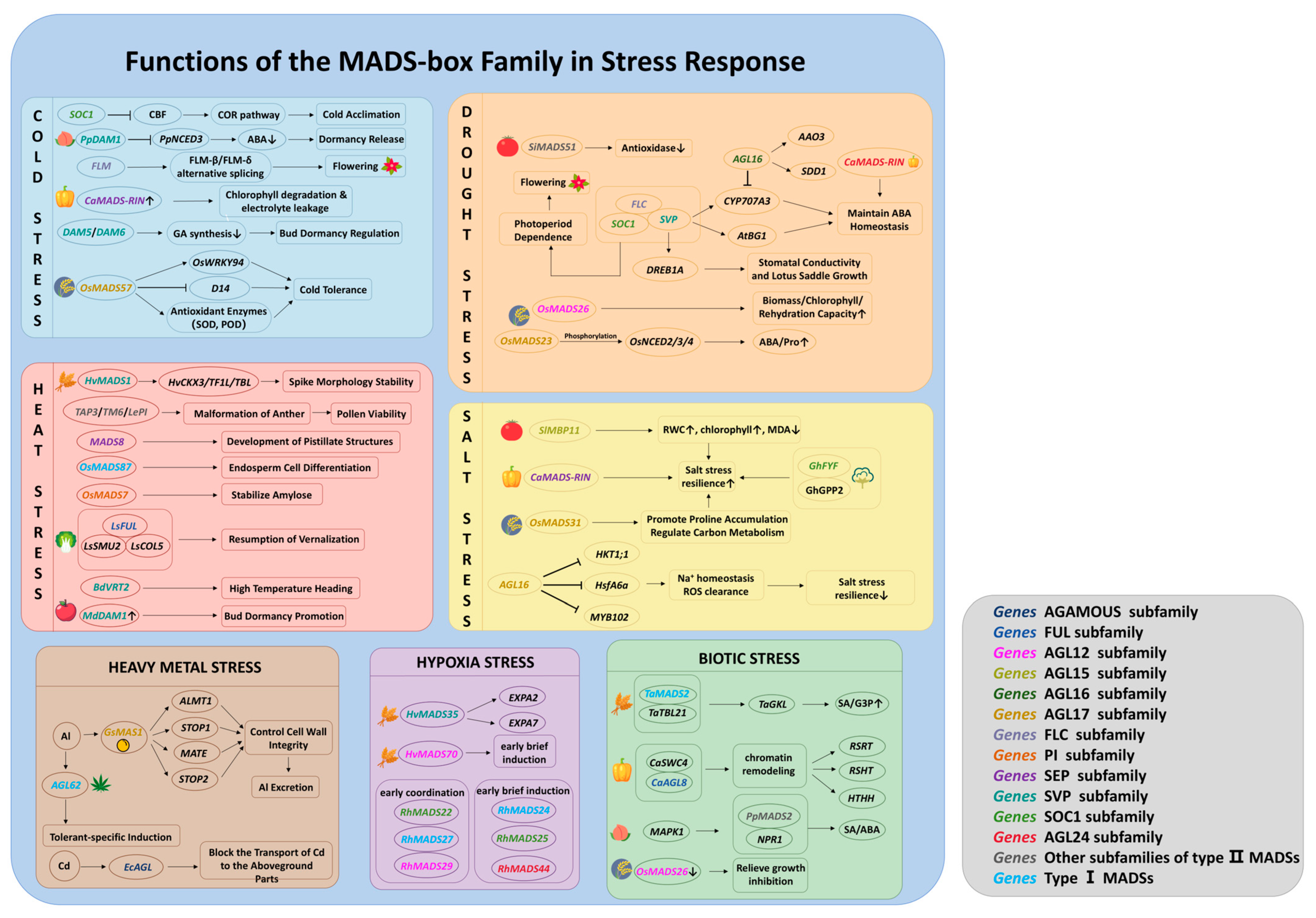
The MADS-box gene family plays a pivotal role in plant responses to heat stress, modulating critical biological processes including reproductive development, morphogenesis, seed development, growth cycle regulation, and energy metabolism. For instance, MADS8 (SEP subfamily) governs floral meristem determination and ovule formation in barley and rice under high-temperature conditions, facilitating proper pistil development [27]. In barley, HvMADS1 (SVP subfamily) stabilizes panicle morphology under heat stress by binding to floral differentiation genes, such as HvCKX3, HvTFL1L, and HvTB1L, thereby regulating floral differentiation and hormone signaling to prevent heat-induced structural anomalies (Figure 1) [28]. Conversely, in tomato, heat stress suppresses the expression of class B MADS-box genes (TAP3/TM6/LePI), resulting in the homeotic conversion of anthers to carpellary structures and reduced pollen viability, ultimately compromising fertility (Figure 1) [29]. RNA silencing of TM6 results in anther malformation and reduced pollen viability under heat stress, confirming its critical role in maintaining floral organ stability [30]. Regarding developmental timing, the MADS-box transcription factor BdVRT2 (SVP subfamily) in the temperate grass model Brachypodium distachyon facilitates the resumption of vernalization following heat interruption and modulates vernalization duration (Figure 1) [31]. In rice, short-term heat stress (48 h) upregulates type I MADS genes (e.g., OsMADS87), exacerbating grain heat sensitivity. Furthermore, suppression of OsMADS7 (AGL17 subfamily) in rice endosperm under heat stress stabilizes amylose content and preserves panicle fertility (Figure 1) [32]. Rice OsMADS87 influences seed size and vigor under high temperatures by regulating the endosperm cellularization process. Notably, overexpression of OsMADS87 alleviates the reduction in seed size typically induced by heat stress (Figure 1) [30]. Conversely, deletion of these genes enhances seed heat tolerance and increases seed size; although this negatively affects endosperm cellularization, it ultimately mitigates heat-induced grain damage [33]. Additionally, in Lactuca sativa L., the LsFUL (AGL8/FUL subfamily) protein associates with LsSMU2 and LsCOL5 to exert synergistic regulatory effects on bolting time under high temperature (Figure 1) [34]. Finally, in apple, elevated temperatures induce MdDAM1 (SVP subfamily) expression, which promotes bud dormancy and increases chilling requirements (Figure 1) [35].

3.1.2. Current Knowledge Gaps in MADS-Box-Mediated Heat Stress Mechanisms

Despite these findings, the specific mechanisms underlying MADS-box-mediated heat stress responses remain insufficiently characterized, representing a significant knowledge gap. The current literature predominantly focuses on model systems and major cereals such as rice and barley, with limited investigation into staple crops like maize or horticultural species such as Chinese cabbage. Moreover, existing studies often rely on reductionist approaches examining single genes, traits, or pathways in isolation. There is a paucity of research regarding synergistic or antagonistic interactions among MADS-box genes within a species, cross-regulatory crosstalk with core heat stress pathways (e.g., HSF-HSP) and hormone signaling networks, and tissue-specific regulatory variations. Additionally, the spatiotemporal dynamics of heat stress are frequently overlooked; the differential effects of acute versus chronic heat exposure, as well as stress imposed at distinct developmental stages, on MADS-box function remain unclear. Crucially, most studies have established correlations between transcriptional changes and phenotypes without elucidating the intermediate physiological mechanisms, such as hormone metabolism or cell differentiation, leaving the “molecular–physiological–phenotypic” regulatory continuum incomplete.

3.1.3. Future Research Directions for MADS-Box Genes in Thermal Adaptation

To address these limitations, future research should prioritize the following directions. First, species and gene coverage must be expanded by leveraging omics and transgenic technologies to validate core candidate genes in non-model crops. Second, comprehensive regulatory networks should be constructed to elucidate gene–gene interactions and their crosstalk with core stress pathways. Third, investigations should account for the spatiotemporal characteristics of heat stress and combined stress scenarios (e.g., heat co-occurring with biotic stress or drought), with functional validation conducted under field conditions. Ultimately, these efforts aim to facilitate the breeding of heat-tolerant cultivars or varieties with reduced chilling requirements adapted to warming winters, thereby mitigating the agricultural impacts of global climate change.

3.2. Response of the MADS-Box Gene Family to Cold Stress

3.2.1. Regulation of the Core CBF Cold Response Pathway by MADS-Box Genes

The MADS-box transcription factor family is implicated in the regulation of plant responses to cold stress. Research indicates that cold stress significantly upregulates CaMADS-RIN (SEP subfamily) expression in pepper. Knockdown of CaMADS-RIN results in chlorophyll degradation, increased electrolyte leakage, and reduced cold tolerance; conversely, overexpression markedly enhances cold stress tolerance (Figure 1) [36]. The CBF-dependent pathway constitutes a fundamental regulatory network for cold adaptation, wherein MADS-box proteins can either activate or repress CBF expression. In Arabidopsis, the MADS-box transcription factor SOC1 (TM3/SOC1 subfamily) directly interacts with the CArG box in the CBF promoter, thereby diminishing CBF transcription levels and negatively modulating the cold response (Figure 1) [37]. In rice, OsMADS57 (AGL17 subfamily) is induced by cold and improves tolerance by upregulating antioxidant enzymes (e.g., SOD, POD) and genes associated with photosynthetic protection (Figure 1) [38]. Also, rice OsMADS57 activates OsWRKY94 and represses D14 in a temperature-dependent manner to enhance cold tolerance. Consequently, OsMADS57 overexpression lines exhibit significantly higher survival rates at 4 °C compared to wild-type plants (Figure 1) [30]. In Arabidopsis, the FLOWERING LOCUS M (FLM, FLC subfamily) gene generates isoforms via alternative splicing that form heterodimers with SVP to modulate flowering time in response to temperature fluctuations (Figure 1) [30]. Furthermore, SOC1 balances cold tolerance and floral development by suppressing the CBF/COR cold response pathway [30].

3.2.2. Multidimensional Regulatory Mechanisms of MADS-Box Genes in Cold Adaptation

Beyond regulating the primary CBF-mediated signaling pathway, MADS-box transcription factors establish a multifaceted regulatory system by integrating signals from crucial hormones such as abscisic acid (ABA) and gibberellin (GA), facilitating adaptive responses to low temperatures. The MADS-box transcription factor PpDAM1 (SVP subfamily) directly binds to the CArG motif in the promoter region of PpNCED3, a key rate-limiting gene in the ABA biosynthesis pathway. This interaction activates PpNCED3 expression and enhances ABA levels, mediating ABA-dependent cold resistance (Figure 1) [39]. Additionally, MADS-box proteins regulate GA levels to indirectly modulate cold stress responses. DAM genes, belonging to the SVP/StMADS11 evolutionary lineage, inhibit critical genes in the GA signaling pathway (e.g., GA biosynthesis genes), thereby reducing GA accumulation. During winter, sustained elevated expression of DAM5 and DAM6 maintains bud dormancy by suppressing GA synthesis or enhancing GA inactivation, preventing premature germination under low-temperature conditions (Figure 1) [40]. At the physiological level, the MADS-box family enhances cold resistance via a dual mechanism: safeguarding the structure and function of the photosynthetic system to ensure stable energy metabolism, and activating the antioxidant defense system to mitigate ROS-mediated oxidative damage [30,41]. In summary, the MADS-box transcription factor family exhibits functional diversity and intricate regulatory networks, establishing a plant cold stress response system through three dimensions: CBF-dependent pathway modulation, hormone signal integration, and targeted physiological protection.

3.3. Response of the MADS-Box Gene Family to Drought Stress

3.3.1. Positive Regulatory Roles of MADS-Box Genes in Drought Stress Responses

The MADS-box gene family plays a pivotal role in regulating plant responses to drought stress, with underlying mechanisms extensively characterized. Central to this regulation is the abscisic acid (ABA) signaling pathway. ABA induces stomatal closure, thereby attenuating plant respiration and transpiration [42]. As carotenoids serve as the direct precursors of ABA, MADS-box transcription factors exert regulatory control over nearly all stages of carotenoid metabolism, ranging from biosynthesis to degradation [43,44]. Specifically, the oxidative cleavage of C40 carotenoids into C15 xanthophylls, catalyzed by 9-cis-epoxycarotenoid dioxygenase (NCED), represents the first committed and irreversible step in ABA biosynthesis. MADS-box transcription factors modulate NCED expression by directly binding to CArG-box motifs within the promoters of NCED genes [39,43]. In rice, OsMADS23 (AGL17 subfamily) is phosphorylated by SAPK9, facilitating the accumulation of endogenous ABA and proline by modulating critical biosynthetic genes (OsNCED2/3/4 and OsP5CR), thereby markedly improving tolerance to drought and salinity (Figure 1) [45]. Similarly, the pepper CaMADS-RIN gene is activated by diverse abiotic stimuli, including drought, contributing to osmotic stress responses via the ABA signaling pathway (Figure 1) [36]. In Arabidopsis, the SVP gene maintains ABA homeostasis and enhances drought resistance by downregulating ABA catabolic genes (CYP707A1/3) and upregulating the ABA activation gene AtBG1 (Figure 1) [30]. Concurrently, SVP modulates early drought-responsive genes such as DREB1A, thereby influencing stomatal conductance and rosette growth (Figure 1) [30]. Rice OsMADS26 (AGL12 subfamily) functions as a negative regulator; RNA silencing of this gene significantly improves biomass, chlorophyll content, and recovery capacity upon rewatering under drought conditions (Figure 1) [30]. However, the regulatory role of OsMADS26 remains debated, as some studies suggest it may positively regulate reactive oxygen species (ROS)-related genes [30]. Regarding developmental plasticity, the Arabidopsis SOC1, FLC, and SVP genes constitute a regulatory module that controls drought-escape flowering via a photoperiod-dependent mechanism (Figure 1) [30]. Specifically, SOC1 induces flowering under long-day conditions, whereas the FLC/SVP complex suppresses flowering under short-day conditions, ensuring life cycle completion in favorable environments (Figure 1) [30].

3.3.2. Negative Regulatory Roles of MADS-Box Genes in Drought Stress Responses

Conversely, certain MADS-box factors function as negative regulators. In Arabidopsis, AGL16 (AGL17 subfamily) modulates the expression of ABA-metabolizing genes (CYP707A3, AAO3) and the stomatal density-regulating gene SDD1 by binding to CArG motifs in their promoter regions, negatively controlling drought resistance through stomatal density and ABA metabolism (Figure 1) [46]. Whole-genome analysis in Foxtail Millet (Setaria italica) identified 25 drought-responsive SiMADS genes, with SiMADS51 (a member of MIKC-type MADS) serving as a prominent negative regulator; its overexpression increases malondialdehyde levels and reduces antioxidant enzyme activity, substantially compromising drought resistance (Figure 1) [47].

3.3.3. Conserved and Species-Specific Regulatory Features of MADS-Box Genes in Drought Adaptation

Collectively, MADS-box genes regulate drought stress through diverse pathways, including ABA signaling, stomatal development, and the biosynthesis of osmotic regulatory substances. Recent studies indicate that these genes exhibit bidirectional regulatory functions, with functional differentiation intricately linked to species evolution and ecological adaptability. While the ABA pathway represents a conserved mechanism—as evidenced by OsMADS23 (AGL17 subfamily) triggering ABA synthesis [45], AGL16 regulating ABA metabolism [46], and CaMADS-RIN responding to ABA signals [36]—species-specificity is markedly evident. For instance, although both SiMADS51 in monocotyledonous crops [47] and AGL16 in dicotyledonous plants [46] serve as negative regulators, they operate through distinct downstream target genes. Furthermore, response patterns of MIKC-type MADS-box genes in Camelina sativa [48] and LcMADS genes in lychee (Litchi chinensis) [49] exhibit significant differences, correlating with distinct drought resistance strategies such as tolerance in cereals versus long-term stress adaptation in woody species. Subsequent research should clarify the regulatory networks of MADS-box genes across various plant species to identify additional molecular targets for enhancing drought resistance in crops.

3.4. Response of the MADS-Box Gene Family to Salt Stress

3.4.1. Differential Expression Profiles of MADS-Box Genes Under Salt Stress

Salt stress represents a major environmental constraint that limits plant growth and productivity by inhibiting seed germination and impairing development, flowering, and fruiting [50,51,52]. Emerging evidence underscores the critical role of MADS-box proteins in mitigating salt stress. Genomic profiling in sugar beet (Beta vulgaris) identified several BvMADS members sensitive to salt stress [53]. Similarly, in banana (Musa spp.), the expression of MbMADS27 (a member of the SOC1 subfamily) is downregulated under high-salinity conditions [54]. This repression is mirrored by other members of the same subfamily, including MbMADS71, MbMADS77, and an unnamed homolog. In contrast, MbMADS76 (TM3/SOC1 subfamily) acts as a core upregulated gene within this subfamily under salt stress [54]. This functional divergence, characterized by concurrent activation and repression among TM3/SOC1 members, constitutes a pivotal regulatory mechanism for banana’s salt stress response. Furthermore, multiple Type II MIKCc genes from the AG, SEP/AGL2, and AGL17 subfamilies exhibit non-significant transcriptional fluctuations [54]. Together with the TM3/SOC1 subfamily, these genes form a comprehensive MADS-box regulatory network mediating banana’s adaptation to salinity stress [54].

3.4.2. Bidirectional Regulatory Functions of MADS-Box Genes in Salt Tolerance

In rice, OsMADS31 (AGL17 subfamily) enhances salt tolerance by stimulating antioxidant activity, promoting proline accumulation, and modulating carbon metabolism and hormone signaling (Figure 1) [55]. Conversely, in Arabidopsis, AGL16 acts as a negative regulator; it binds to CArG motifs in the promoters of HKT1;1, HsfA6a, and MYB102, repressing their expression. This repression disrupts Na+ homeostasis and impairs ROS scavenging, ultimately reducing salt tolerance (Figure 1) [46]. In tomato, SlMBP11 (AGL15 subfamily), is induced by salt stress. Overexpression of SlMBP11 enhances salt tolerance by increasing the relative water content (RWC) and chlorophyll levels while mitigating oxidative damage, evidenced by reduced malondialdehyde accumulation and electrolyte leakage (Figure 1) [30]. In contrast, its homolog, SlMBP8 (AGL15 subfamily), acts as a negative regulator, with RNAi lines exhibiting improved tolerance to both salt and drought stresses [30]. Heterologous overexpression of cotton GhFYF (SOC1 subfamily) in Arabidopsis significantly improves salt tolerance, mediated by its interaction with the stress-related protein GhGPP2 (Figure 1) [56]. In pepper, CaMADS-RIN functions as a positive regulator by activating ROS scavenging mechanisms, enhancing osmolyte synthesis, and modulating downstream stress response genes, thereby maintaining cellular redox and osmotic homeostasis (Figure 1) [36].

3.4.3. Unresolved Mechanisms and Current Knowledge Gaps in Salt Stress Regulation

Collectively, these findings underscore the functional diversity of MADS-box transcription factors in salinity responses. Although their involvement is well-documented across species, the underlying regulatory networks remain incompletely characterized. In particular, the direct downstream targets and specialized regulatory mechanisms governing specific members, such as MbMADS27, warrant further investigation.

3.5. Response of the MADS-Box Gene Family to Heavy Metal Stress

3.5.1. Functional Characterization of MADS-Box Genes Under Heavy Metal Stress

Anthropogenic contamination has resulted in the persistent accumulation of phytotoxic heavy metals, such as cadmium (Cd), nickel (Ni), and aluminum (Al), in soil systems, posing severe threats to plant growth and ecosystem integrity. To mitigate heavy metal toxicity, plants have evolved sophisticated molecular defense mechanisms, within which MADS-box transcription factors serve as pivotal regulators of adaptive responses.
Investigations into MADS-box-mediated heavy metal stress responses have largely centered on aluminum (Al) toxicity. In soybean (Glycine soja), a member of MIKC-type MADS, GsMAS1 (AGL17 subfamily) acts as a key regulator of Al tolerance by activating the expression of downstream genes, including ALMT1, STOP1, MATE, and STOP2, thereby enhancing resistance and maintaining cell wall integrity (Figure 1) [57,58]. Similarly, in flax (Linum usitatissimum), the transcription of AGL62 (type I MADS gene) is specifically induced in Al-tolerant genotypes, suggesting a strong association with natural variation in Al tolerance (Figure 1) [59]. Beyond aluminum, MADS-box genes also modulate responses to other heavy metals. In Erigeron canadensis, EcAGL expression is significantly upregulated under Cd stress; heterologous expression in Arabidopsis revealed that this gene impedes Cd translocation to shoots without compromising root accumulation (Figure 1) [60].

3.5.2. Research Limitations and Future Perspectives on Heavy Metal Stress Responses

Collectively, these findings establish the MADS-box family as an integral component of the plant heavy metal detoxification machinery, governing processes such as metal transport, stress signaling, and structural adaptation. However, notable limitations persist in the current literature. Existing studies are restricted to a narrow range of non-model plant species and have primarily examined Al, Ni, and Cd stress. Moreover, most reports rely predominantly on expression profiling without elucidating underlying molecular mechanisms or regulatory pathways. Future research should expand the scope to include additional heavy metals (e.g., chromium, lead, mercury) and diverse plant species. Crucially, efforts must focus on dissecting the specific signaling pathways and regulatory networks controlled by MADS-box factors to comprehensively understand their role in heavy metal stress resilience.

3.6. Response of the MADS-Box Gene Family to Hypoxia Stress

3.6.1. Spatiotemporal Regulatory Patterns of MADS-Box Genes Under Hypoxia Stress

Waterlogging stress has emerged as a prevalent abiotic constraint, exacerbated by global climate change and increased precipitation patterns. Accumulating evidence indicates that MADS-box transcription factors serve as pivotal regulators of waterlogging tolerance across diverse plant species. These transcription factors exhibit temporally coordinated expression profiles, facilitating staged adaptive responses to hypoxic environments. Conserved expression motifs were observed in barley (Hordeum vulgare), where HvMADS35 and HvMADS70 (SVP and AGL12 subfamilies, respectively) constitute a core regulatory module for waterlogging response. HvMADS35 was specifically induced in root tissues and is predicted to physically interact with the expansins EXPA2 and EXPA7, potentially facilitating cell wall remodeling during prolonged hypoxia. In contrast, HvMADS70 displayed transient early induction but was downregulated after 10 days, implicating it in initial hypoxic signal transduction (Figure 1) [61]. In Rhododendron hainanense, distinct temporal expression peaks were observed under hypoxic conditions: RhMADS24, RhMADS25, and RhMADS44 (type I, SOC1, and AGL24 clades) reached peak expression at 3, 12, and 24 h, respectively. This temporal divergence suggests stage-specific functions during hypoxia stress. Conversely, RhMADS22, RhMADS27, and RhMADS29 (SOC1, type I, and AGL12 clades) formed a co-regulatory module, showing synchronous upregulation at 3 h, which implies a collaborative role in early stress signaling cascades (Figure 1) [62].

3.6.2. Current Limitations and Future Directions in Hypoxia Stress Regulation

Collectively, these findings substantiate that MADS-box transcription factors coordinate hypoxic adaptation through stage-specific functional specialization. Their co-expression patterns provide a theoretical framework for understanding plant adaptation to fluctuating oxygen levels and offer candidate targets for breeding waterlogging-resistant crops. Nevertheless, significant gaps persist in the current literature. Research on major cereal crops (e.g., rice, wheat) and vegetables (e.g., cabbage, tomato) remains limited, particularly regarding functional validation via heterologous expression. Furthermore, the underlying molecular mechanisms of identified genes remain largely elusive. Future research should leverage multi-omics approaches to systematically identify hypoxia-responsive MADS-box genes, elucidate their specific regulatory mechanisms, and utilize gene editing technologies to validate their functions for crop improvement.

3.7. Response of the MADS-Box Gene Family to Biotic Stress

3.7.1. Functional Diversity of MADS-Box Genes in Biotic Stress Defense

MADS-box transcription factors mediate disease resistance across diverse plant species through multiple molecular pathways, including pathogen recognition, modulation of defense signaling, and protein–protein interactions. Certain members indirectly influence disease resistance by modulating pathogen virulence factors.
Genome-wide expression profiling reveals that wheat MIKC-type MADS-box genes are broadly upregulated under diverse biotic stresses, including Fusarium head blight, rice blast, stripe rust, powdery mildew, and wheat leaf spot. Among these, the floral homeotic subfamilies (AP1, AP3, PI, AG/STK, AGL6, and SEP) exhibit the highest transcript abundance in spikes challenged by Fusarium graminearum. Moreover, AP1-like genes display specific upregulation in response to Magnaporthe oryzae infection, suggesting their involvement in pathogen-specific defense mechanisms [63]. Conversely, some MADS-box genes act as negative regulators. Downregulation of OsMADS26 in rice enhances resistance to Magnaporthe oryzae and Xanthomonas oryzae and improves drought tolerance without compromising growth, illustrating the decoupling of defense mechanisms from developmental processes (Figure 1) [64]. This offers a promising strategy for precise genetic improvement in crop breeding. In wheat, TaMADS2 (type I MADS-box gene) interacts with TaTBL21 to upregulate TaGKL, facilitating the accumulation of defense metabolites such as salicylic acid (SA) and glycerol-3-phosphate (G3P), thereby enhancing resistance to stripe rust (Figure 1) [65]. This elucidates the mechanism by which MADS-box factors regulate defense metabolite production.

3.7.2. Molecular Regulatory Mechanisms of MADS-Box Genes in Biotic Stress Responses

MADS-box transcription factors also modulate chromatin states and transcriptional activation via protein interactions, thereby promoting downstream defense gene expression. In pepper, CaAGL8 (FUL subfamily) interacts with CaSWC4 to activate defense-related genes (e.g., RSRT, RSHT, HTHH) through chromatin remodeling, initiating the resistance response (Figure 1) [66]. In citrus, co-expression of a CsMIKC-type MADS-box factor with PgSCP, a protein secreted by the biocontrol yeast Pichia galeiformis, enhances transcriptional activation of PR1-like proteins and ATPase promoters, improving resistance to green mold and providing a novel strategy for integrating biocontrol with genetic regulation [67]. The Prunus persica MADS-box gene PpMADS2 overexpressed in Arabidopsis interacts with NPR1, conferring DNA-binding capability essential for transcribing SA-dependent pathogenesis-related (PR) genes and ABA-induced CalS genes, thereby facilitating β-aminobutyric acid (BABA)-induced resistance (Figure 1) [68]. This process involves MAPK1-mediated post-translational modification of MADS2. Overexpression of PpMADS2 (a member of MIKC-type MADS) significantly improves fungal resistance in transgenic Arabidopsis, underscoring the critical role of MADS-box factors in the crosstalk between hormone signaling and disease resistance mechanisms.
In conclusion, plant MADS-box transcription factors exhibit complex and multifaceted roles in disease resistance mechanisms. Comprehensive elucidation of their molecular mechanisms and translational potential is critical for breeding disease-resistant crops and implementing sustainable pest management strategies, thereby underscoring the substantial research significance and practical applications of this field.

4. Breeding Potential of the MADS-Box Gene Family

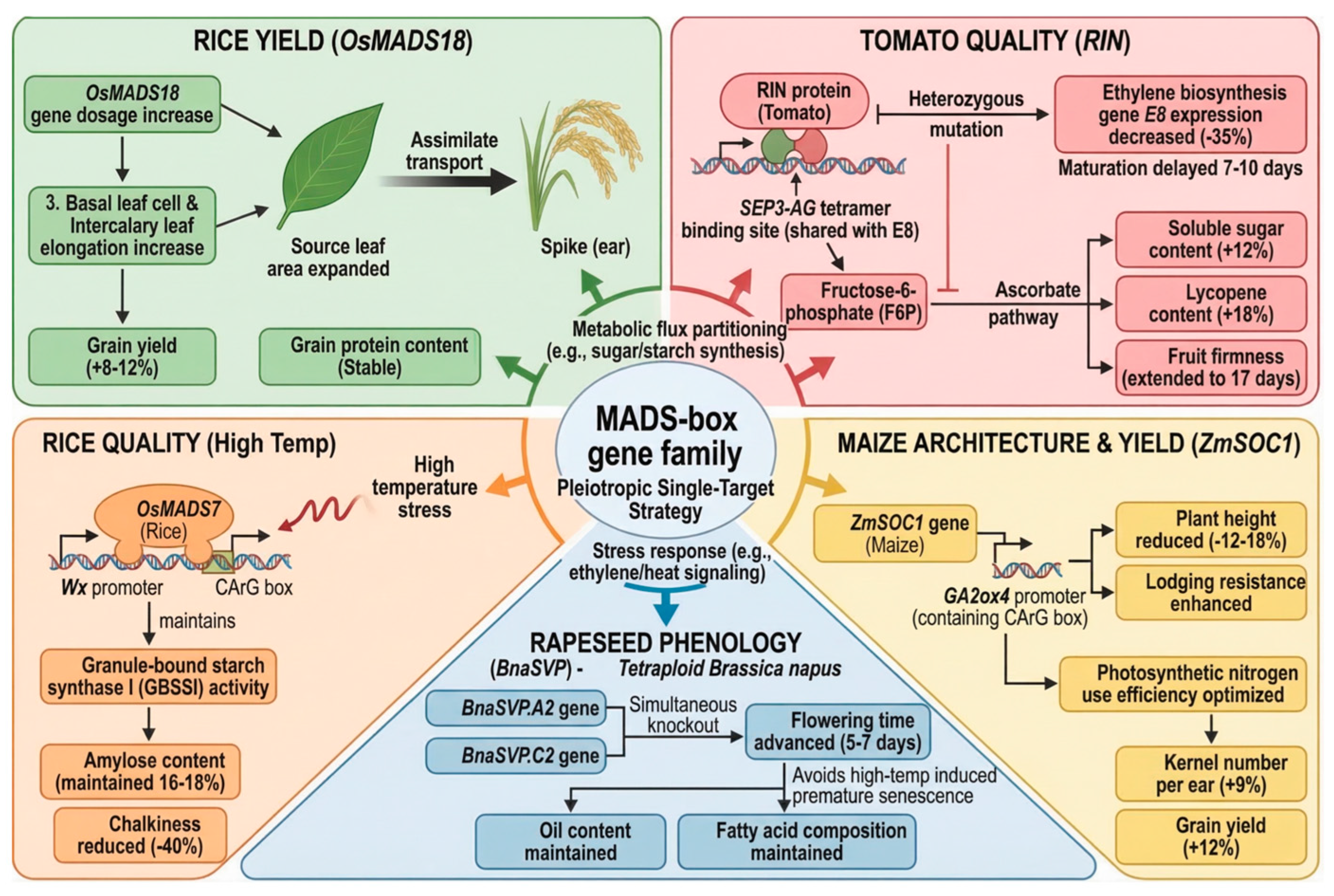
The MADS-box gene family holds significant potential for molecular breeding owing to its multifaceted regulatory mechanisms. Regarding yield improvement, gene dosage analyses of OsMADS18 (TM3/SOC1 subfamily) demonstrated that each additional copy induces an 8% elongation of basal leaf cells and intercalary elongation, increasing source leaf area and enhancing assimilate translocation to the panicle. Consequently, this results in an 8–12% yield increase while maintaining stable grain protein content (Figure 2) [69]. Also, building on the established role of OsMADS26 in modulating drought responses, recent studies have successfully employed the CRISPR/Cas9 system to silence this gene in rice (Oryza sativa). This targeted knockout strategy significantly enhanced the resistance to drought tolerance and pathogens, demonstrating the potential of precise genome editing to optimize stress resilience without compromising yield [70]. Beyond yield traits, the capacity of MADS-box proteins to regulate quality metabolic networks at multiple nodes expands their utility in breeding programs. In tomato, the RIN (SEP subfamily) protein shares a SEP3-AG tetramer binding site with the promoter of the ethylene biosynthesis gene E8. Heterozygous mutations reduced E8 expression by 35% and delayed ripening by 7–10 days. Concurrently, redirecting the glycolytic intermediate fructose-6-phosphate toward the ascorbic acid pathway increased soluble sugars by 12% and lycopene by 18%, while extending fruit firmness retention from 10 to 17 days without the defects associated with immature mutants (Figure 2) [71]. In rice, OsMADS7 binds to the CArG box within the Waxy (Wx) promoter, sustaining granule-bound starch synthase I (GBSSI) activity under high-temperature stress. This maintains amylose content at 16–18%, reduces chalkiness by 40%, and mitigates the deterioration of commercial rice quality associated with warming climates (Figure 2) [32]. Collectively, these studies demonstrate that the MADS-box family offers a ‘multi-effect single-target’ strategy for enhancing crop quality by concurrently regulating metabolic flux allocation (e.g., sugar/starch synthesis) and stress responses (e.g., ethylene/heat signaling) (Figure 2) [32].
The MADS-box gene family also holds significant potential for crop ideotype design. In maize (Zea mays), ZmSOC1 (TM3/SOC1 subfamily) exerts dual regulation via a shared CArG box in the GA2ox4 promoter region: it reduces plant height by 12–18% while enhancing lodging resistance and optimizes photosynthetic nitrogen use efficiency to increase grain number per panicle by 9%, ultimately boosting yield by 12% and achieving synergistic improvements in both architecture and productivity (Figure 2) [72]. Constitutive overexpression of the endogenous SOC1 homolog (ZmSOC1) in transgenic lines accelerated flowering time and reduced plant height while maintaining individual grain yield [72]. These phenotypic modifications suggest that ZmSOC1 engineering facilitates high-density planting architectures, thereby unlocking greater yield potential per unit area through optimized population management [7]. In tetraploid rapeseed (Brassica napus), simultaneous knockout of BnaSVP.A2 (SVP subfamily) and BnaSVP.C2 (SVP subfamily) advances flowering by 5–7 days, avoiding heat-induced premature ripening while preserving oil content and fatty acid composition, thereby providing a framework for synchronous editing in polyploid crops (Figure 2) [73].
In summary, the breeding value of the MADS-box gene family is primarily realized through two mechanisms: incremental trait enhancement via fine-tuning of gene expression levels, and synergistic regulation of diverse pathways through signal integration. Collectively, these attributes establish the theoretical basis for an ‘expression level–phenotype’ quantitative relationship model, offering a novel, quantifiable, and verifiable approach for breeding design within multigenic networks. This field is undergoing a paradigm shift from conventional single-gene regulation to systematic molecular design breeding, facilitated by advanced technologies such as single-cell multi-omics. Future breeding strategies should leverage advanced technologies, including CRISPR/Cas9-based precision genome editing systems, single-cell multi-omics, and high-throughput functional validation. By pyramiding superior alleles of stress-resistance MADS-box genes and optimizing their expression patterns, it will be possible to develop novel crop varieties characterized by broad-spectrum stress resilience, yield stability, and superior quality. These innovations will ensure the stability of food and economic crop production, offering robust genetic solutions to mitigate the adverse impacts of global climate change.

5. Summary

A synthesis of MADS-box responses to diverse stresses reveals a highly conserved core mechanism: proteins function via CArG-box binding and dynamic complex formation through protein–protein interactions and post-translational modifications. Given their ancestral roles in development, these genes typically couple stress tolerance with developmental regulation. However, a critical subset possesses the unique capacity to decouple stress resistance from growth inhibition, thereby mitigating yield penalties and offering a pivotal advantage for crop improvement.
While the molecular basis is conserved, functional outcomes exhibit significant species-specific divergence driven by ecological niches and life-history strategies. Monocots (e.g., rice, wheat) prioritize yield stability via SVP/SOC1/AGL17-mediated networks, whereas dicots (e.g., Arabidopsis, tomato) employ more pathway-specific mechanisms. Furthermore, herbaceous crops rely on rapid hormonal responses, while woody perennials utilize dormancy-associated programs (e.g., DAM genes) for long-term adaptation. This diversity underscores the need to move beyond model systems to explore lineage-specific regulatory networks in non-model species.
Comparative genomic analyses demonstrate that the structural modularity and evolutionary divergence of MADS-box genes underpin functional conservation across monocot and dicot lineages, while lineage-specific differentiation drives agronomic trait plasticity. Recent empirical evidence underscores the pivotal roles of this family in yield determination (e.g., OsMADS18-mediated tillering in rice) [74], floral morphogenesis (e.g., regulatory innovations in Asteraceae) [75], fruit quality (e.g., VvAGL12 (AGL12 subfamily) -associated growth in grapes) [76], and abiotic stress resilience (e.g., SlMBP22 (AG subfamily)-conferred drought tolerance in tomato) [77]. However, critical knowledge gaps persist: the spatiotemporal dynamics of MADS-box protein interactions within hormone signaling networks remain incompletely elucidated; functional annotation of orthologs in non-model crops is insufficient, limiting breeding utility; and the precision of gene editing strategies regarding dosage and tissue specificity necessitates further optimization.
To address these challenges, the field is undergoing a paradigm shift from “single-gene, single-stress” studies toward multidimensional, network-oriented frameworks. First, cross-stress crosstalk is being elucidated to identify multifunctional targets (e.g., OsMADS26). Second, “growth-tolerance decoupling” is being engineered to break yield trade-offs. Third, multi-omics data is being integrated to construct comprehensive regulatory cascades involving chromatin remodeling. Fourth, resource mining is being expanded to wild germplasm and woody species. Concurrently, the integration of precise gene editing with agronomic practices is accelerating the translation of basic findings into resilient varieties.
This review synthesizes our current understanding of MADS-box transcription factor regulatory networks, highlighting that while significant progress has been made in model systems, a systematic framework for crop application remains elusive. Elucidating these mechanistic circuits offers substantial translational potential for engineering crops with enhanced performance and resilience. Ultimately, leveraging MADS-box gene functionality is imperative for advancing agricultural innovation and addressing global food security challenges.

Author Contributions

Conceptualization, J.W. and Y.C.; writing—original draft preparation, J.W., H.W., M.L., Y.C., B.S., Y.L., X.M., J.L., W.L., and Y.G.; writing—review and editing, Y.Z.; funding acquisition, Y.Z. and A.W. All authors have read and agreed to the published version of the manuscript.

Funding

This research was supported by the Heilongjiang Science and Technology Talent Spring Goose Support Program (CYQN24016), and the Postdoctoral Foundation of China (2023MD744176).

Data Availability Statement

No new data were created or analyzed in this study.

Conflicts of Interest

The authors declare no conflicts of interest.

References

  1. Schwarz-Sommer, Z.; Huijser, P.; Nacken, W.; Saedler, H.; Sommer, H. Genetic Control of Flower Development by Homeotic Genes in Antirrhinum majus. Science 1990, 250, 931–936. [Google Scholar] [CrossRef]
  2. Smaczniak, C.; Immink, R.G.H.; Angenent, G.C.; Kaufmann, K. Developmental and Evolutionary Diversity of Plant MADS-Domain Factors: Insights from Recent Studies. Development 2012, 139, 3081–3098. [Google Scholar] [CrossRef]
  3. Giovannoni, J.J. Genetic Regulation of Fruit Development and Ripening. Plant Cell 2004, 16, S170–S180. [Google Scholar] [CrossRef]
  4. Verelst, W.; Twell, D.; de Folter, S.; Immink, R.; Saedler, H.; Münster, T. MADS-Complexes Regulate Transcriptome Dynamics during Pollen Maturation. Genome Biol. 2007, 8, R249. [Google Scholar] [CrossRef] [PubMed]
  5. Theißen, G.; Saedler, H. Floral Quartets. Nature 2001, 409, 469–471. [Google Scholar] [CrossRef]
  6. Wilson, D.C.; Kempthorne, C.J.; Carella, P.; Liscombe, D.K.; Cameron, R.K. Age-Related Resistance in Arabidopsis thaliana Involves the MADS-Domain Transcription Factor SHORT VEGETATIVE PHASE and Direct Action of Salicylic Acid on Pseudomonas Syringae. Mol. Plant-Microbe Interact. 2017, 30, 919–929. [Google Scholar] [CrossRef]
  7. Ma, M.-M.; Zhang, H.-F.; Tian, Q.; Wang, H.-C.; Zhang, F.-Y.; Tian, X.; Zeng, R.-F.; Huang, X.-M. MIKC Type MADS-Box Transcription Factor LcSVP2 Is Involved in Dormancy Regulation of the Terminal Buds in Evergreen Perennial Litchi (Litchi chinensis Sonn.). Hortic. Res. 2024, 11, uhae150. [Google Scholar] [CrossRef]
  8. Ning, K.; Zhang, W.; Zhang, D.; El-Kassaby, Y.A.; Zhou, T. Genome-Wide Analysis of MIKCC-Type MADS-Box Genes Reveals Their Involvement in Flower Development in Malus lineage. Horticulturae 2023, 9, 373. [Google Scholar] [CrossRef]
  9. Mou, Y.; Yuan, C.; Sun, Q.; Yan, C.; Zhao, X.; Wang, J.; Wang, Q.; Shan, S.; Li, C. MIKC-Type MADS-Box Transcription Factor Gene Family in Peanut: Genome-Wide Characterization and Expression Analysis under Abiotic Stress. Front. Plant Sci. 2022, 13, 980933. [Google Scholar] [CrossRef] [PubMed]
  10. Zhang, Z.; Zou, W.; Lin, P.; Wang, Z.; Chen, Y.; Yang, X.; Zhao, W.; Zhang, Y.; Wang, D.; Que, Y.; et al. Evolution and Function of MADS-Box Transcription Factors in Plants. Int. J. Mol. Sci. 2024, 25, 13278. [Google Scholar] [CrossRef]
  11. Parenicová, L.; de Folter, S.; Kieffer, M.; Horner, D.S.; Favalli, C.; Busscher, J.; Cook, H.E.; Ingram, R.M.; Kater, M.M.; Davies, B.; et al. Molecular and Phylogenetic Analyses of the Complete MADS-Box Transcription Factor Family in Arabidopsis: New Openings to the MADS World. Plant Cell 2003, 15, 1538–1551. [Google Scholar] [CrossRef]
  12. Gramzow, L.; Theissen, G. A Hitchhiker’s Guide to the MADS World of Plants. Genome Biol. 2010, 11, 214. [Google Scholar] [CrossRef]
  13. Tapia-López, R.; García-Ponce, B.; Dubrovsky, J.G.; Garay-Arroyo, A.; Pérez-Ruíz, R.V.; Kim, S.-H.; Acevedo, F.; Pelaz, S.; Alvarez-Buylla, E.R. An AGAMOUS-Related MADS-Box Gene, XAL1 (AGL12), Regulates Root Meristem Cell Proliferation and Flowering Transition in Arabidopsis. Plant Physiol. 2008, 146, 1182–1192. [Google Scholar] [CrossRef] [PubMed]
  14. Zhang, H.; Forde, B.G. Regulation of Arabidopsis Root Development by Nitrate Availability. J. Exp. Bot. 2000, 51, 51–59. [Google Scholar] [CrossRef] [PubMed]
  15. Xie, L.; Zhang, Y.; Wang, K.; Luo, X.; Xu, D.; Tian, X.; Li, L.; Ye, X.; Xia, X.; Li, W.; et al. TaVrt2, an SVP-like Gene, Cooperates with TaVrn1 to Regulate Vernalization-Induced Flowering in Wheat. New Phytol. 2021, 231, 834–848. [Google Scholar] [CrossRef] [PubMed]
  16. Hacham, Y.; Holland, N.; Butterfield, C.; Ubeda-Tomas, S.; Bennett, M.J.; Chory, J.; Savaldi-Goldstein, S. Brassinosteroid Perception in the Epidermis Controls Root Meristem Size. Development 2011, 138, 839–848. [Google Scholar] [CrossRef]
  17. Zahn, L.M.; Leebens-Mack, J.; dePamphilis, C.W.; Ma, H.; Theissen, G. To B or Not to B a Flower: The Role of DEFICIENS and GLOBOSA Orthologs in the Evolution of the Angiosperms. J. Hered. 2005, 96, 225–240. [Google Scholar] [CrossRef]
  18. Mao, W.-T.; Hsu, W.-H.; Li, J.-Y.; Yang, C.-H. Distance-Based Measurement Determines the Coexistence of B Protein Hetero- and Homodimers in Lily Tepal and Stamen Tetrameric Complexes. Plant J. 2021, 105, 1357–1373. [Google Scholar] [CrossRef]
  19. Hugouvieux, V.; Blanc-Mathieu, R.; Janeau, A.; Paul, M.; Lucas, J.; Xu, X.; Ye, H.; Lai, X.; Le Hir, S.; Guillotin, A.; et al. SEPALLATA-Driven MADS Transcription Factor Tetramerization Is Required for Inner Whorl Floral Organ Development. Plant Cell 2024, 36, 3435–3450. [Google Scholar] [CrossRef]
  20. Espinosa-Soto, C.; Immink, R.G.; Angenent, G.C.; Alvarez-Buylla, E.R.; de Folter, S. Tetramer Formation in Arabidopsis MADS Domain Proteins: Analysis of a Protein-Protein Interaction Network. BMC Syst. Biol. 2014, 8, 9. [Google Scholar] [CrossRef]
  21. Li, H.; Liang, W.; Jia, R.; Yin, C.; Zong, J.; Kong, H.; Zhang, D. The AGL6-like Gene OsMADS6 Regulates Floral Organ and Meristem Identities in Rice. Cell Res. 2010, 20, 299–313. [Google Scholar] [CrossRef]
  22. Zhao, D.; Chen, Z.; Xu, L.; Zhang, L.; Zou, Q. Genome-Wide Analysis of the MADS-Box Gene Family in Maize: Gene Structure, Evolution, and Relationships. Genes 2021, 12, 1956. [Google Scholar] [CrossRef] [PubMed]
  23. Qiu, Y.; Li, Z.; Walther, D.; Köhler, C. Updated Phylogeny and Protein Structure Predictions Revise the Hypothesis on the Origin of MADS-Box Transcription Factors in Land Plants. Mol. Biol. Evol. 2023, 40, msad194. [Google Scholar] [CrossRef]
  24. Huang, K.; Louis, J.M.; Donaldson, L.; Lim, F.; Sharrocks, A.D.; Clore, G.M. Solution Structure of the MEF2A–DNA Complex: Structural Basis for the Modulation of DNA Bending and Specificity by MADS-box Transcription Factors. EMBO J. 2000, 19, 2615–2628. [Google Scholar] [CrossRef]
  25. Melzer, R.; Theißen, G. Reconstitution of ‘Floral Quartets’ In Vitro Involving Class B and Class E Floral Homeotic Proteins. Nucleic Acids Res. 2009, 37, 2723–2736. [Google Scholar] [CrossRef]
  26. Kaufmann, K.; Melzer, R.; Theißen, G. MIKC-Type MADS-Domain Proteins: Structural Modularity, Protein Interactions and Network Evolution in Land Plants. Gene 2005, 347, 183–198. [Google Scholar] [CrossRef] [PubMed]
  27. Shen, C.; Zhang, Y.; Li, G.; Shi, J.; Wang, D.; Zhu, W.; Yang, X.; Dreni, L.; Tucker, M.R.; Zhang, D. MADS8 Is Indispensable for Female Reproductive Development at High Ambient Temperatures in Cereal Crops. Plant Cell 2024, 36, 65–84. [Google Scholar] [CrossRef] [PubMed]
  28. Li, G.; Kuijer, H.N.J.; Yang, X.; Liu, H.; Shen, C.; Shi, J.; Betts, N.; Tucker, M.R.; Liang, W.; Waugh, R.; et al. MADS1 Maintains Barley Spike Morphology at High Ambient Temperatures. Nat. Plants 2021, 7, 1093–1107. [Google Scholar] [CrossRef]
  29. Müller, F.; Xu, J.; Kristensen, L.; Wolters-Arts, M.; de Groot, P.F.M.; Jansma, S.Y.; Mariani, C.; Park, S.; Rieu, I. High-Temperature-Induced Defects in Tomato (Solanum lycopersicum) Anther and Pollen Development Are Associated with Reduced Expression of B-Class Floral Patterning Genes. PLoS ONE 2016, 11, e0167614. [Google Scholar] [CrossRef]
  30. Castelán-Muñoz, N.; Herrera, J.; Cajero-Sánchez, W.; Arrizubieta, M.; Trejo, C.; García-Ponce, B.; de la Paz Sánchez, M.; Álvarez-Buylla, E.R.; Garay-Arroyo, A. MADS-Box Genes Are Key Components of Genetic Regulatory Networks Involved in Abiotic Stress and Plastic Developmental Responses in Plants. Front. Plant Sci. 2019, 10, 853. [Google Scholar] [CrossRef]
  31. Kennedy, A.; Li, M.; Vandeperre, A.; Hameed, M.U.; Van Dyck, M.; Engelen, S.; Preston, J.C.; Geuten, K. Transcription Factor VRT2 Reinitiates Vernalization When Interrupted by Warm Temperatures in a Temperate Grass Model. Plant Physiol. 2024, 196, 2614–2624. [Google Scholar] [CrossRef] [PubMed]
  32. Zhang, H.; Xu, H.; Feng, M.; Zhu, Y. Suppression of OsMADS7 in Rice Endosperm Stabilizes Amylose Content under High Temperature Stress. Plant Biotechnol. J. 2018, 16, 18–26. [Google Scholar] [CrossRef]
  33. Chen, C.; Begcy, K.; Liu, K.; Folsom, J.J.; Wang, Z.; Zhang, C.; Walia, H. Heat Stress Yields a Unique MADS Box Transcription Factor in Determining Seed Size and Thermal Sensitivity. Plant Physiol. 2016, 171, 606–622. [Google Scholar] [CrossRef]
  34. Zhong, M.; Wang, H.; Hao, X.; Liu, C.; Hao, J.; Fan, S.; Han, Y. LsFUL–LsSMU2 Module Positively Controls Bolting Time in Leaf Lettuce (Lactuca sativa L.) under High Temperature. Plant Sci. 2024, 347, 112195. [Google Scholar] [CrossRef]
  35. Moser, M.; Asquini, E.; Miolli, G.V.; Weigl, K.; Hanke, M.-V.; Flachowsky, H.; Si-Ammour, A. The MADS-Box Gene MdDAM1 Controls Growth Cessation and Bud Dormancy in Apple. Front. Plant Sci. 2020, 11, 1003. [Google Scholar] [CrossRef]
  36. Chen, R.; Ma, J.; Luo, D.; Hou, X.; Ma, F.; Zhang, Y.; Meng, Y.; Zhang, H.; Guo, W. CaMADS, a MADS-Box Transcription Factor from Pepper, Plays an Important Role in the Response to Cold, Salt, and Osmotic Stress. Plant Sci. 2019, 280, 164–174. [Google Scholar] [CrossRef]
  37. Lee, J.-H.; Jung, J.-H.; Park, C.-M. INDUCER OF CBF EXPRESSION 1 Integrates Cold Signals into FLOWERING LOCUS C-Mediated Flowering Pathways in Arabidopsis. Plant J. 2015, 84, 29–40. [Google Scholar] [CrossRef] [PubMed]
  38. Chen, L.; Zhao, Y.; Xu, S.; Zhang, Z.; Xu, Y.; Zhang, J.; Chong, K. OsMADS57 Together with OsTB1 Coordinates Transcription of Its Target OsWRKY94 and D14 to Switch Its Organogenesis to Defense for Cold Adaptation in Rice. New Phytol. 2018, 218, 219–231. [Google Scholar] [CrossRef] [PubMed]
  39. Tuan, P.A.; Bai, S.; Saito, T.; Ito, A.; Moriguchi, T. Dormancy-Associated MADS-Box (DAM) and the Abscisic Acid Pathway Regulate Pear Endodormancy Through a Feedback Mechanism. Plant Cell Physiol. 2017, 58, 1378–1390. [Google Scholar] [CrossRef]
  40. Li, Z.; Reighard, G.L.; Abbott, A.G.; Bielenberg, D.G. Dormancy-Associated MADS Genes from the EVG Locus of Peach [Prunus persica (L.) Batsch] Have Distinct Seasonal and Photoperiodic Expression Patterns. J. Exp. Bot. 2009, 60, 3521–3530. [Google Scholar] [CrossRef]
  41. Liu, Y.; Dang, P.; Liu, L.; He, C. Cold Acclimation by the CBF–COR Pathway in a Changing Climate: Lessons from Arabidopsis thaliana. Plant Cell Rep. 2019, 38, 511–519. [Google Scholar] [CrossRef] [PubMed]
  42. Agurla, S.; Gahir, S.; Munemasa, S.; Murata, Y.; Raghavendra, A.S. Mechanism of Stomatal Closure in Plants Exposed to Drought and Cold Stress. In Survival Strategies in Extreme Cold and Desiccation: Adaptation Mechanisms and Their Applications; Iwaya-Inoue, M., Sakurai, M., Uemura, M., Eds.; Springer: Singapore, 2018; pp. 215–232. [Google Scholar]
  43. Taylor, I.B.; Burbidge, A.; Thompson, A.J. Control of Abscisic Acid Synthesis. J. Exp. Bot. 2000, 51, 1563–1574. [Google Scholar] [CrossRef] [PubMed]
  44. Lu, S.; Zhang, Y.; Zhu, K.; Yang, W.; Ye, J.; Chai, L.; Xu, Q.; Deng, X. The Citrus Transcription Factor CsMADS6 Modulates Carotenoid Metabolism by Directly Regulating Carotenogenic Genes. Plant Physiol. 2018, 176, 2657–2676. [Google Scholar] [CrossRef]
  45. Li, X.; Yu, B.; Wu, Q.; Min, Q.; Zeng, R.; Xie, Z.; Huang, J. OsMADS23 Phosphorylated by SAPK9 Confers Drought and Salt Tolerance by Regulating ABA Biosynthesis in Rice. PLoS Genet. 2021, 17, e1009699. [Google Scholar] [CrossRef]
  46. Zhao, P.-X.; Zhang, J.; Chen, S.-Y.; Wu, J.; Xia, J.-Q.; Sun, L.-Q.; Ma, S.-S.; Xiang, C.-B. Arabidopsis MADS-Box Factor AGL16 Is a Negative Regulator of Plant Response to Salt Stress by Downregulating Salt-Responsive Genes. New Phytol. 2021, 232, 2418–2439. [Google Scholar] [CrossRef]
  47. Zhao, W.; Zhang, L.-L.; Xu, Z.-S.; Fu, L.; Pang, H.-X.; Ma, Y.-Z.; Min, D.-H. Genome-Wide Analysis of MADS-Box Genes in Foxtail Millet (Setaria italica L.) and Functional Assessment of the Role of SiMADS51 in the Drought Stress Response. Front. Plant Sci. 2021, 12, 659474. [Google Scholar] [CrossRef]
  48. Tahmasebi, S.; Jonoubi, P.; Majdi, M.; Majd, A.; Heidari, P. Genome-Wide Characterization and Expression Profiling of MADS-Box Family Genes during Organ Development and Drought Stress in Camelina sativa L. Sci. Rep. 2025, 15, 9327. [Google Scholar] [CrossRef]
  49. Yang, J.; Chen, R.; Liu, W.; Xiang, X.; Fan, C. Genome-Wide Characterization and Phylogenetic and Stress Response Expression Analysis of the MADS-Box Gene Family in Litchi (Litchi chinensis Sonn.). Int. J. Mol. Sci. 2024, 25, 1754. [Google Scholar] [CrossRef] [PubMed]
  50. Zhao, S.; Zhang, Q.; Liu, M.; Zhou, H.; Ma, C.; Wang, P. Regulation of Plant Responses to Salt Stress. Int. J. Mol. Sci. 2021, 22, 4609. [Google Scholar] [CrossRef]
  51. Park, H.J.; Kim, W.-Y.; Yun, D.-J. A Role for GIGANTEA: Keeping the Balance between Flowering and Salinity Stress Tolerance. Plant Signal. Behav. 2013, 8, e24820. [Google Scholar] [CrossRef]
  52. Quan, R.; Lin, H.; Mendoza, I.; Zhang, Y.; Cao, W.; Yang, Y.; Shang, M.; Chen, S.; Pardo, J.M.; Guo, Y. SCABP8/CBL10, a Putative Calcium Sensor, Interacts with the Protein Kinase SOS2 to Protect Arabidopsis Shoots from Salt Stress. Plant Cell 2007, 19, 1415–1431. [Google Scholar] [CrossRef]
  53. Cao, J.; Gong, Y.; Zou, M.; Li, H.; Chen, S.; Ma, C. Genome-Wide Identification and Salt Stress Response Analysis of the MADS-Box Transcription Factors in Sugar Beet. Physiol. Plant. 2024, 176, e70001. [Google Scholar] [CrossRef] [PubMed]
  54. Zheng, Y.; Liu, M.; Jia, C.; Wang, J.; Xu, B.; Jin, Z.; Li, W.; Liu, J. Characteristics of Banana B Genome MADS-Box Family Demonstrate Their Roles in Fruit Development, Ripening, and Stress. Sci. Rep. 2020, 10, 20840. [Google Scholar] [CrossRef]
  55. Yin, X.; Gao, Q.; Wang, F.; Liu, W.; Yu, S.; Zhong, S.; Feng, J.; Bai, R.; Luo, Y.; Chen, L.; et al. MIKC-Type MADS-Box Transcription Factor OsMADS31 Positively Regulates Salinity Tolerance in Rice. Front. Plant Sci. 2025, 16, 1628305. [Google Scholar] [CrossRef]
  56. Xue, Y.; Ma, L.; Wang, H.; Hao, P.; Cheng, S.; Su, Z.; Li, L.; Yu, S.; Wei, H. The MADS Transcription Factor GhFYF Is Involved in Abiotic Stress Responses in Upland Cotton (Gossypium hirsutum L.). Gene 2022, 815, 146138. [Google Scholar] [CrossRef]
  57. Kobayashi, Y.; Ohyama, Y.; Kobayashi, Y.; Ito, H.; Iuchi, S.; Fujita, M.; Zhao, C.-R.; Tanveer, T.; Ganesan, M.; Kobayashi, M.; et al. STOP2 Activates Transcription of Several Genes for Al- and Low pH-Tolerance That Are Regulated by STOP1 in Arabidopsis. Mol. Plant 2014, 7, 311–322. [Google Scholar] [CrossRef] [PubMed]
  58. Zhang, X.; Li, L.; Yang, C.; Cheng, Y.; Han, Z.; Cai, Z.; Nian, H.; Ma, Q. GsMAS1 Encoding a MADS-Box Transcription Factor Enhances the Tolerance to Aluminum Stress in Arabidopsis thaliana. Int. J. Mol. Sci. 2020, 21, 2004. [Google Scholar] [CrossRef] [PubMed]
  59. Krasnov, G.S.; Dmitriev, A.A.; Zyablitsin, A.V.; Rozhmina, T.A.; Zhuchenko, A.A.; Kezimana, P.; Snezhkina, A.V.; Fedorova, M.S.; Novakovskiy, R.O.; Pushkova, E.N.; et al. Aluminum Responsive Genes in Flax (Linum usitatissimum L.). BioMed. Res. Int. 2019, 2019, 5023125. [Google Scholar] [CrossRef]
  60. Zuo, D.; Hu, M.; Zhou, W.; Lei, F.; Zhao, J.; Gu, L. EcAGL Enhances Cadmium Tolerance in Transgenic Arabidopsis thaliana through Inhibits Cadmium Transport and Ethylene Synthesis Pathway. Plant Physiol. Biochem. 2023, 201, 107900. [Google Scholar] [CrossRef]
  61. Wang, F.; Zhou, Z.; Zhu, L.; Gu, Y.; Guo, B.; Lv, C.; Zhu, J.; Xu, R. Genome-Wide Analysis of the MADS-Box Gene Family Involved in Salt and Waterlogging Tolerance in Barley (Hordeum vulgare L.). Front. Plant Sci. 2023, 14, 1178065. [Google Scholar] [CrossRef]
  62. Huo, S.; Li, Y.; Li, R.; Chen, R.; Xing, H.; Wang, J.; Zhao, Y.; Song, X. Genome-Wide Analysis of the MADS-Box Gene Family in Rhododendron hainanense Merr. and Expression Analysis under Heat and Waterlogging Stresses. Ind. Crop. Prod. 2021, 172, 114007. [Google Scholar] [CrossRef]
  63. Raza, Q.; Riaz, A.; Atif, R.M.; Hussain, B.; Rana, I.A.; Ali, Z.; Budak, H.; Alaraidh, I.A. Genome-Wide Diversity of MADS-Box Genes in Bread Wheat Is Associated with Its Rapid Global Adaptability. Front. Genet. 2022, 12, 818880. [Google Scholar] [CrossRef] [PubMed]
  64. Khong, G.N.; Pati, P.K.; Richaud, F.; Parizot, B.; Bidzinski, P.; Mai, C.D.; Bès, M.; Bourrié, I.; Meynard, D.; Beeckman, T.; et al. OsMADS26 Negatively Regulates Resistance to Pathogens and Drought Tolerance in Rice. Plant Physiol. 2015, 169, 2935–2949. [Google Scholar] [CrossRef] [PubMed]
  65. Zhao, S.; Chu, H.; Lu, Y.; Chen, J.; Wang, X.; Tian, G.; Zhang, M.; Song, P.; Zhang, Y.; Bai, G.; et al. The TaMADS2-TaTBL21 Module Enhances Wheat Resistance to Stripe Rust by Activating TaGKL-Mediated Immunity. Plant Biotechnol. J. 2025, 24, 2153–2168. [Google Scholar] [CrossRef]
  66. Zhang, Y.; Cai, W.; Wang, A.; Huang, X.; Zheng, X.; Liu, Q.; Cheng, X.; Wan, M.; Lv, J.; Guan, D.; et al. MADS-Box Protein AGL8 Interacts with Chromatin-Remodelling Component SWC4 to Activate Thermotolerance and Environment-Dependent Immunity in Pepper. J. Exp. Bot. 2023, 74, 3667–3683. [Google Scholar] [CrossRef]
  67. Chen, O.; Huang, R.; Xu, Y.; Wang, W.; Ming, J.; Zeng, K. Yeast-Secreted Protein PgSCP and Citrus Transcription Factor CsMIKC Synergize to Activate Green Mould Resistance in Fruit. Mol. Plant Pathol. 2025, 26, e70166. [Google Scholar] [CrossRef]
  68. Li, C.; Lei, C.; Wang, K.; Tan, M.; Xu, F.; Wang, J.; Zheng, Y. MADS2 Regulates Priming Defence in Postharvest Peach through Combined Salicylic Acid and Abscisic Acid Signaling. J. Exp. Bot. 2022, 73, 3787–3806. [Google Scholar] [CrossRef] [PubMed]
  69. Tripathi, A.; Vishwakarma, K.; Tripathi, S.; Jadaun, J.S.; Nayak, A.K. Utilization of MADS-Box Genes for Agricultural Advancement: Current Insights and Future Prospects. Mol. Biol. Rep. 2025, 53, 20. [Google Scholar] [CrossRef]
  70. Luo, H.; Zou, H.; Lin, S.; Liu, J.; Zhou, G.; Gao, L.; Huang, J.; Li, J.; Gao, J.; Ma, C. Multiplex Editing of OsMads26, OsBsr-D1, OsELF3-2 and OsERF922 with CRISPR/Cas9 Confers Enhanced Resistance to Pathogens and Abiotic Stresses and Boosts Grain Yield in Rice (Oryza sativa). Int. J. Mol. Sci. 2026, 27, 781. [Google Scholar] [CrossRef]
  71. Tiwari, J.K.; Singh, A.K.; Behera, T.K. CRISPR/Cas Genome Editing in Tomato Improvement: Advances and Applications. Front. Plant Sci. 2023, 14, 1121209. [Google Scholar] [CrossRef]
  72. Song, G.; Han, X.; Ryner, J.T.; Thompson, A.; Wang, K. Utilizing MIKC-Type MADS-Box Protein SOC1 for Yield Potential Enhancement in Maize. Plant Cell Rep. 2021, 40, 1679–1693. [Google Scholar] [CrossRef] [PubMed]
  73. Zhou, E.; Zhang, Y.; Wang, H.; Jia, Z.; Wang, X.; Wen, J.; Shen, J.; Fu, T.; Yi, B. Identification and Characterization of the MIKC-Type MADS-Box Gene Family in Brassica napus and Its Role in Floral Transition. Int. J. Mol. Sci. 2022, 23, 4289. [Google Scholar] [CrossRef] [PubMed]
  74. Yin, X.; Liu, X.; Xu, B.; Lu, P.; Dong, T.; Yang, D.; Ye, T.; Feng, Y.-Q.; Wu, Y. OsMADS18, a Membrane-Bound MADS-Box Transcription Factor, Modulates Plant Architecture and the Abscisic Acid Response in Rice. J. Exp. Bot. 2019, 70, 3895–3909. [Google Scholar] [CrossRef] [PubMed]
  75. Xiong, W.; Risse, J.; Berke, L.; Zhao, T.; van de Geest, H.; Oplaat, C.; Busscher, M.; Ferreira de Carvalho, J.; van der Meer, I.M.; Verhoeven, K.J.F.; et al. Phylogenomic Analysis Provides Insights into MADS-Box and TCP Gene Diversification and Floral Development of the Asteraceae, Supported by De Novo Genome and Transcriptome Sequences from Dandelion (Taraxacum officinale). Front. Plant Sci. 2023, 14, 1198909. [Google Scholar] [CrossRef]
  76. Mao, T.; Wang, X.; Gao, H.; Gong, Z.; Liu, R.; Jiang, N.; Zhang, Y.; Zhang, H.; Guo, X.; Yu, C. Ectopic Expression of MADS-Box Transcription Factor VvAGL12 from Grape Promotes Early Flowering, Plant Growth, and Production by Regulating Cell-Wall Architecture in Arabidopsis. Genes 2023, 14, 2078. [Google Scholar] [CrossRef]
  77. Li, F.; Chen, X.; Zhou, S.; Xie, Q.; Wang, Y.; Xiang, X.; Hu, Z.; Chen, G. Overexpression of SlMBP22 in Tomato Affects Plant Growth and Enhances Tolerance to Drought Stress. Plant Sci. 2020, 301, 110672. [Google Scholar] [CrossRef]
Figure 1. Mechanism of the MADS-box gene family in stress response. This schematic illustrates the complex regulatory network where MADS-box transcription factors act as central hubs integrating various upstream signals to modulate downstream physiological processes and stress responses. Upward and downward arrows denote upregulation and downregulation, respectively.
Plants 15 01262 g001
Figure 2. Multifaceted regulatory mechanisms of the MADS-box gene family in crop molecular breeding. Overview of key examples demonstrating yield improvement (OsMADS18), quality regulation (RIN, OsMADS7), and ideotype design (ZmSOC1, BnaSVP). These cases illustrate a “multi-effect single-target” strategy that concurrently optimizes metabolic flux, stress responses, and architectural traits.
Plants 15 01262 g002
Disclaimer/Publisher’s Note: The statements, opinions and data contained in all publications are solely those of the individual author(s) and contributor(s) and not of MDPI and/or the editor(s). MDPI and/or the editor(s) disclaim responsibility for any injury to people or property resulting from any ideas, methods, instructions or products referred to in the content.