Breeding Climate-Resilient Soybeans for 2050 and Beyond: Leveraging Novel Technologies to Mitigate Yield Stagnation and Climate Change Impacts

 ,
,  ,
, 
Abstract
1. Introduction
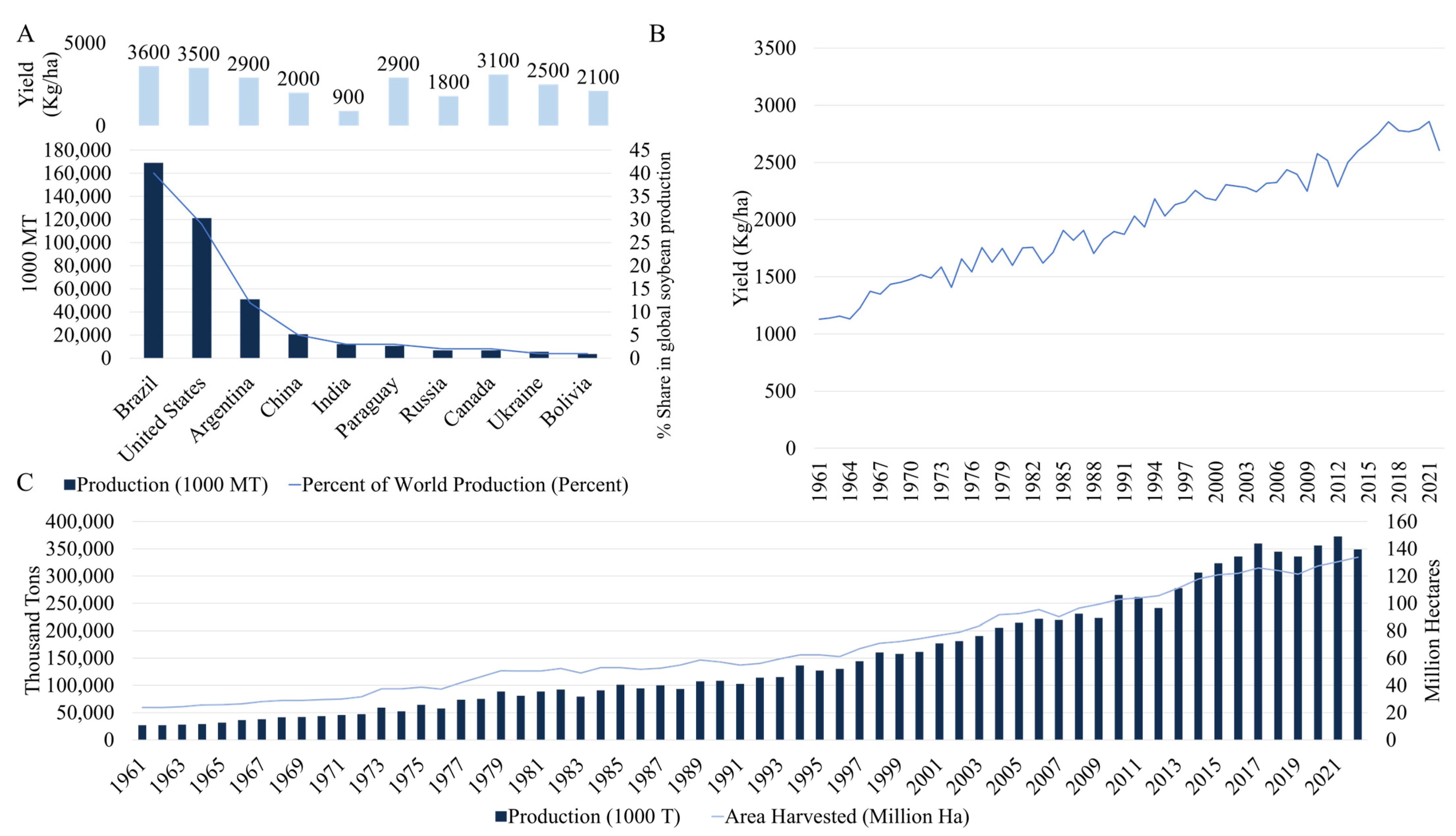
2. Yield Stagnation: Pressure, Pattern, and Production Risks
3. Impact of Climate Change on Soybean Yield and Productivity
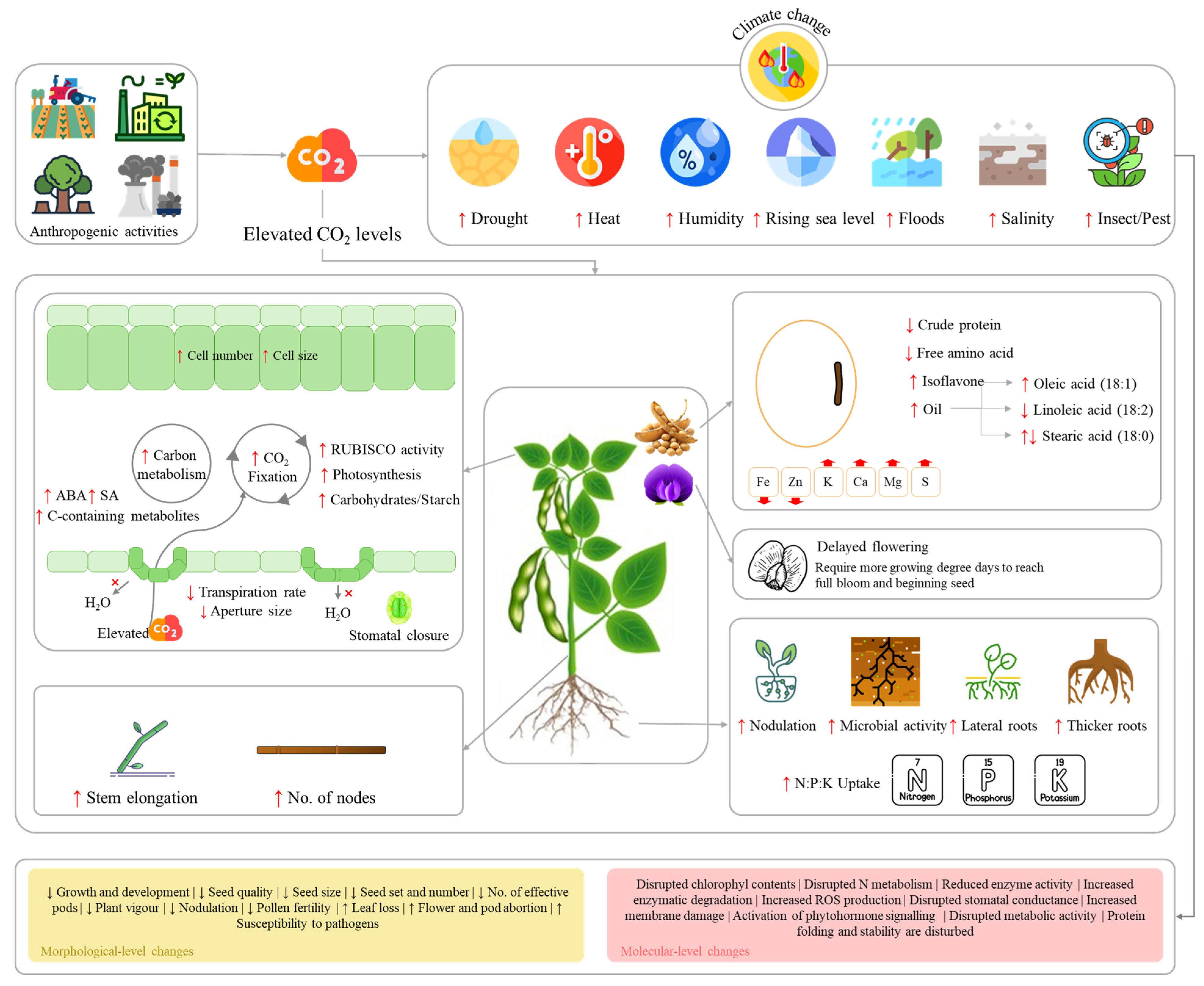
3.1. Elevated CO2 Levels Affect Soybean Growth, Development, and Production in a Non-Linear Way
3.2. eCO2 Combined with High Temperatures Significantly Amplifies the Negative Impacts of Climate Change on Soybean Crops
3.3. eCO2 Induced Climate Change Intensifies Biotic Stress and Subsequently Impacts Soybean
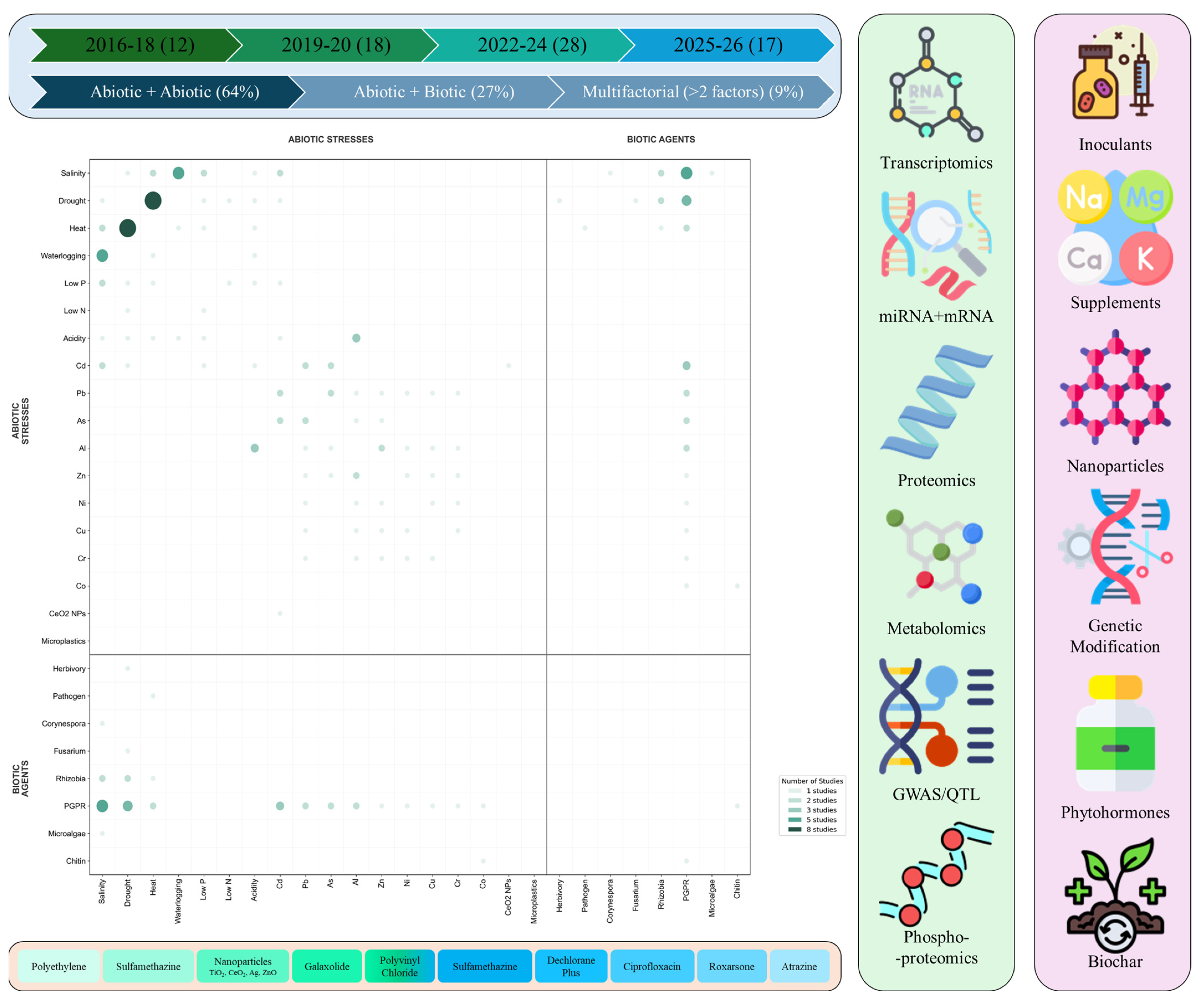
3.4. Effects of Combined Abiotic Stresses Related to Climate Change on Soybean Yield and Production
4. Novel Strategies for Soybean Breeding
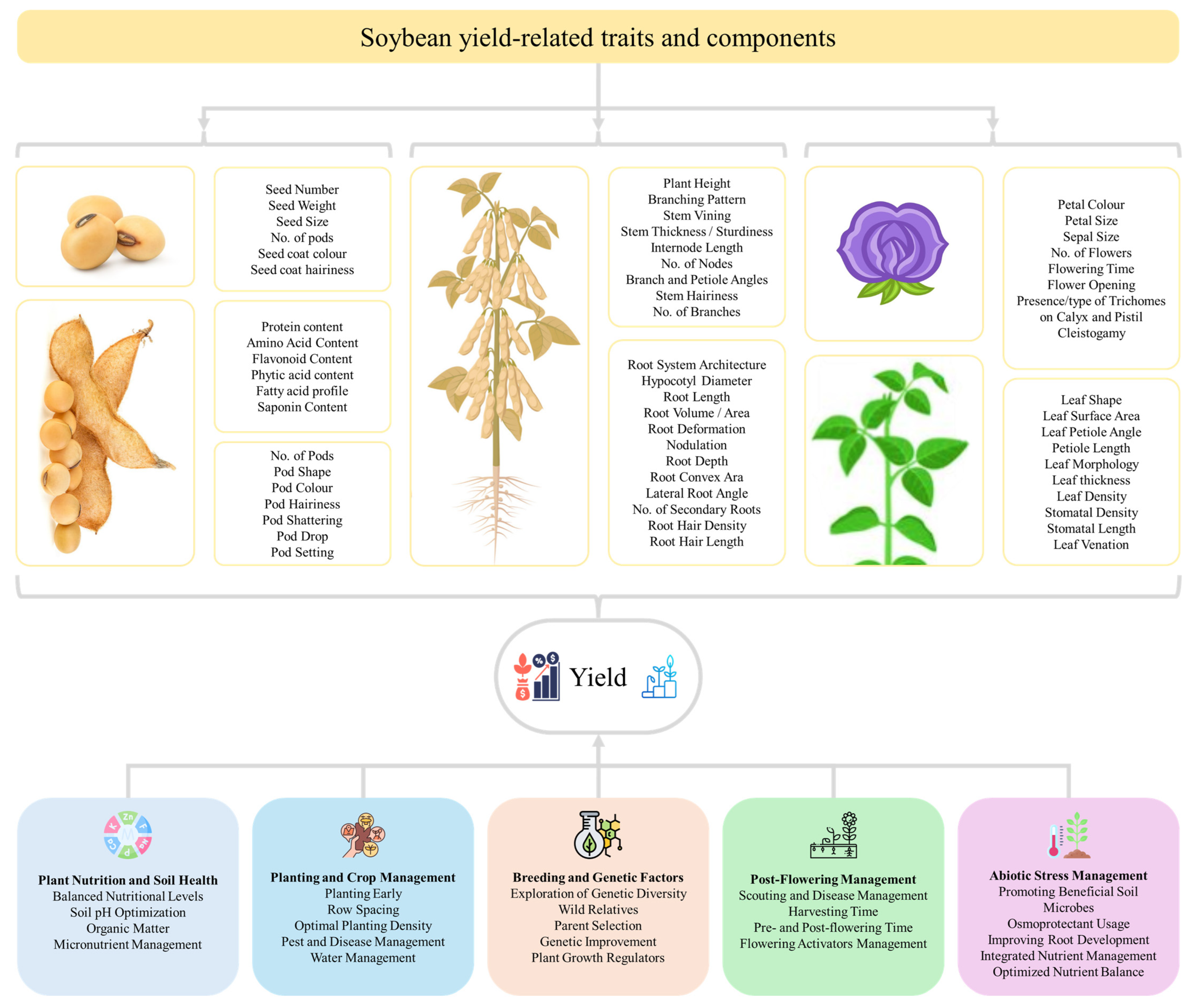
4.1. Deeper Understanding of the Traits of Interest


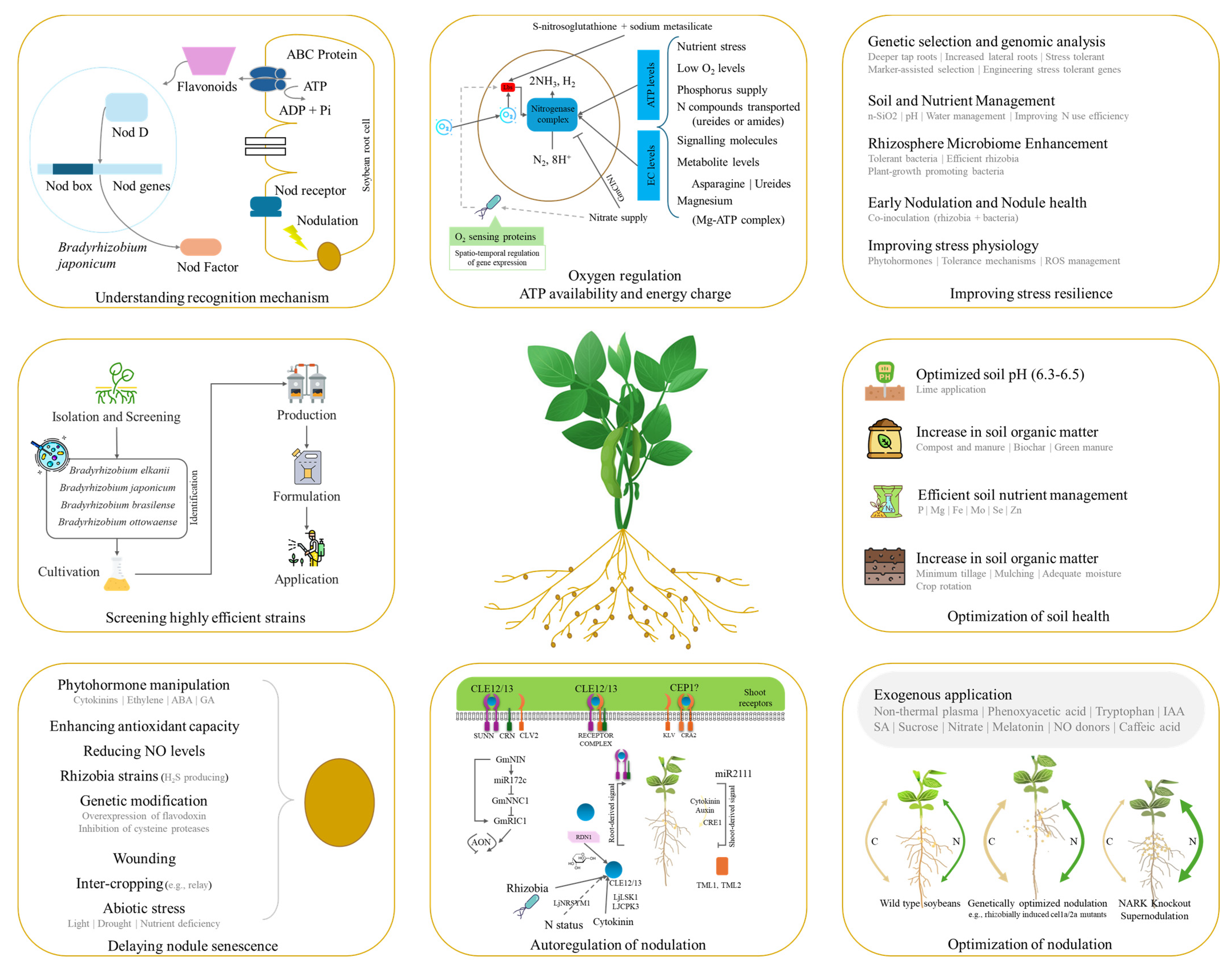
| Gene(s) Modified (Type of Modification) | Effect on BNF/Nodulation | Impact on Yield & Related Traits |
|---|---|---|
| Autoregulation of nodulation (AON) pathway | ||
| RIC1a/2a (Rhizobia-Induced CLE 1a/2a)—(KO/CRISPR) | Moderately increased nodule number; improved N & P content; enhanced carbon/nitrogen balance. | 10–31% increase in grain yield and increased protein content in field trials [216]. |
| NARK (Nodule Autoregulation Receptor Kinase)—(KO/Mutation) | Supernodulation (excessive nodule formation). | Often results in a yield penalty or stunted shoot growth due to excessive carbon drain [217]. |
| Nitrate inhibition of nodulation | ||
| GmNIC1a/b (Nitrate-Induced CLE 1a/b)—(OE) | Inhibited nodulation in a GmNARK-dependent manner. | Not specified [218]. |
| GmNLP1, GmNLP4 (NIN-like Proteins)—(KO/CRISPR) | Unveiled a nitrate-tolerant nodulation phenotype, allowing nodulation even with high nitrate. | Not specified [219]. |
| Phosphate (Pi) homeostasis & nutrient acquisition | ||
| GmPHR1 (PHOSPHATE-STARVATION-RESPONSE 1)—(OE) | Promotes nodulation, increases nodule size, enhances N & P acquisition, boosts nitrogenase activity. | ~10.8% increase in single-plant yield under field conditions [220]. |
| GmPAP4 (Acid Phosphatase)—(Underexpression) | Significantly affected nodulation and BNF efficiency under phosphorus-deficient conditions. | Affected yield under P-deficient conditions [221]. |
| GmEXPB2 (β-expansin)—(OE) | Enhanced nodule enlargement, increased infected cell abundance, improved N2 fixation capacity. | Promoted increases in N and P content, biomass, and yield under low P stress [222]. |
| Nodule senescence | ||
| GmCYP35, GmCYP37, GmCYP39, GmCYP45 (Cysteine Proteases)—(Quadruple KO) | Delayed nodule senescence, significantly higher nitrogenase activity in older nodules. | Potential for prolonged N-fixing period (field impact not specified) [223]. |
| GmNAC039, GmNAC018 (NAC Transcription Factors)—(OE/Mutation) | Overexpression causes early senescence; mutants delay senescence. | Not specified [223]. |
| Plant hormone signaling | ||
| GmCRE1 (Cytokinin Response 1)—(KO) | Decreased nodule number and size, almost complete abrogation of BNF. | Significant yield reduction [224]. |
| GmRR11d (B-type Response Regulator)—(KO/CRISPR) | Significantly increased nodule numbers (nearly doubled in hairy roots). | Not specified in current field studies [225]. |
| Gibberellin receptor gene—(Editing) | Improves N fixation and overall plant growth processes. | Improves yield [226]. |
| GmNMH7 (MADS-box TF)—(OE) | Inhibited root and nodule development, acts as a negative regulator. | Not specified [227]. |
| Nodule organogenesis (central regulator) | ||
| GmNINa (Nodule Inception a)—(OE/Knockdown) | Central regulator; required for nodule formation. Knockdown inhibits root hair deformation and infection threads. | Not specified [228]. |
| Carbon metabolism and allocation | ||
| GmSWEET10a/b—(OE/KO), GmSWEET3c, GmSWEET38 | Regulates sugar transport to seeds/nodules. OE increases sugar availability to nodules. | OE increases single-plant yield by 11–20%; KO decreases yield by 40.2% [229]. |
| Nodule function (micronutrient cofactors) | ||
| Leghaemoglobin (Lb genes)—(OE) | Regulates internal oxygen levels to protect nitrogenase from oxidative damage. | Not specified [230]. |
| Root nodule symbiotic specificity | ||
| Rj4 (Thaumatin-Like Protein)—(Mutation) | Controls nodulation specificity; recessive mutant allows nodulation with otherwise incompatible strains. | Critical for managing specific rhizobial inoculants (not a direct yield trait) [231]. |
4.2. Understanding Soybean’s (Abiotic) Stress Physiology
4.3. Increased Understanding of Biotic Stress Tolerance and Pathogen Dynamics Under Climate-Change Scenario
4.4. Optimizing Water Use Efficiency and Sustainability in Soybean Production
4.5. Accelerating Breeding Through Phenomics
4.6. New Technologies and Tools: Lab to Field
5. The Future Soybean Breeder: A Hybrid Orchestrator of Data and Dirt
6. Conclusions and Future Recommendations
- Establishment of international pre-breeding consortia to systematically introgress wild soybean alleles into elite backgrounds.
- Development of open-access phenotyping platforms for climate stress screening.
- Creation of a global soybean innovation fund to support public-good breeding research.
- Implementation of farmer participatory networks for trait prioritization and variety testing.
- Advancement of regulatory science to enable responsible use of gene editing in public breeding programs.
Author Contributions
Funding
Informed Consent Statement
Data Availability Statement
Acknowledgments
Conflicts of Interest
References
- Hymowitz, T.; Harlan, J.R. Introduction of soybean to North America by Samuel Bowen in 1765. Econ. Bot. 1983, 37, 371–379. [Google Scholar] [CrossRef]
- Bukowski, M.; Swearingen, B.; Vaiknoras, K. Oil Crops Outlook: May 2024 (Report No. OCS-24e); United States Department of Agriculture: Washington, DC, USA, 2024; p. 22.
- O’Keefe, S.F.; Bianchi, L.; Sharman, J. Soybean nutrition. SM J. Nutr. Metab. 2015, 1, 9. [Google Scholar]
- Dukariya, G.; Shah, S.; Singh, G.; Kumar, A. Soybean and its products: Nutritional and health benefits. J. Nutr. Sci. Healthy Diet. 2020, 1, 22–29. [Google Scholar]
- Conijn, J.; Bindraban, P.S.; Schröder, J.; Jongschaap, R. Can our global food system meet food demand within planetary boundaries? Agric. Ecosyst. Environ. 2018, 251, 244–256. [Google Scholar] [CrossRef]
- Langemeier, M. International Benchmarks for Soybean Production (2024); Purdue University: West Lafayete, IN, USA, 2024. [Google Scholar]
- Baraibar, M.; Deutsch, L. The Soybean Through World History: Lessons for Sustainable Agrofood Systems, 1st ed.; Routledge: London, UK, 2023; p. 266. [Google Scholar]
- William Shurtleff, A.A. Early History of Soybeans and Soyfoods Worldwide (1024 bce to 1899): Extensively Annotated Bibliography and Sourcebook; Soyinfo Center: Lafayette, CA, USA, 2021. [Google Scholar]
- United States Department of Agriculture FAS. World Agriculture Production; United States Department of Agriculture, Foreign Agricultural Service: Washington, DC, USA, 2025; p. 39.
- Vieira, C.C.; Chen, P. The numbers game of soybean breeding in the United States. Crop Breed. Appl. Biotechnol. 2021, 21, e387521S387510. [Google Scholar] [CrossRef]
- Li, M.W.; Wang, Z.; Jiang, B.; Kaga, A.; Wong, F.L.; Zhang, G.; Han, T.; Chung, G.; Nguyen, H.; Lam, H.M. Impacts of genomic research on soybean improvement in East Asia. Theor. Appl. Genet. 2020, 133, 1655–1678. [Google Scholar] [CrossRef] [PubMed]
- Waqar, A.; Li, S.; Liu, Y.; Jiang, K.; Wang, S.; Yang, M.; Yuan, S.; Chen, Q.; Hu, L.; Xu, L. Genetic yield improvements and associated physiological and agronomic traits in soybean cultivars released from 1940 to 2021 in Northeast China. Field Crops Res. 2025, 328, 109956. [Google Scholar] [CrossRef]
- Milioli, A.S.; Meira, D.; Panho, M.C.; Madella, L.A.; Woyann, L.G.; Todeschini, M.H.; Zdziarski, A.D.; Ramos Campagnolli, O.; Menegazzi, C.P.; Colonelli, L.L. Genetic improvement of soybeans in Brazil: South and Midwest regions. Crop Sci. 2022, 62, 2276–2293. [Google Scholar] [CrossRef]
- da Silva, E.D.B.; Xavier, A.; Faria, M.V. Impact of Genomic Prediction Model, Selection Intensity, and Breeding Strategy on the Long-Term Genetic Gain and Genetic Erosion in Soybean Breeding. Front. Genet. 2021, 12, 637133. [Google Scholar] [CrossRef]
- Abdala, L.J.; Otegui, M.E.; Di Mauro, G. On-farm soybean genetic progress and yield stability during the early 21st century: A case study of a commercial breeding program in Argentina and Brazil. Field Crops Res. 2024, 308, 109277. [Google Scholar] [CrossRef]
- Lange, C.E.; Federizzi, L.C. Estimation of soybean genetic progress in the South of Brazil using multi-environmental yield trials. Sci. Agric. 2009, 66, 309–316. [Google Scholar] [CrossRef][Green Version]
- Umburanas, R.C.; Kawakami, J.; Ainsworth, E.A.; Favarin, J.L.; Anderle, L.Z.; Dourado-Neto, D.; Reichardt, K. Changes in soybean cultivars released over the past 50 years in southern Brazil. Sci. Rep. 2022, 12, 508. [Google Scholar] [CrossRef]
- Krause, M.D.; Piepho, H.P.; Dias, K.O.G.; Singh, A.K.; Beavis, W.D. Models to estimate genetic gain of soybean seed yield from annual multi-environment field trials. Theor. Appl. Genet. 2023, 136, 252. [Google Scholar] [CrossRef]
- Rincker, K.; Nelson, R.; Specht, J.; Sleper, D.; Cary, T.; Cianzio, S.R.; Casteel, S.; Conley, S.; Chen, P.; Davis, V. Genetic improvement of US soybean in maturity groups II, III, and IV. Crop Sci. 2014, 54, 1419–1432. [Google Scholar] [CrossRef]
- Wang, C.; Wu, T.; Sun, S.; Xu, R.; Ren, J.; Wu, C.; Jiang, B.; Hou, W.; Han, T. Seventy-five years of improvement of yield and agronomic traits of soybean cultivars released in the Yellow-Huai-Hai River Valley. Crop Sci. 2016, 56, 2354–2364. [Google Scholar] [CrossRef]
- Karmakar, P.; Bhatnagar, P. Genetic improvement of soybean varieties released in India from 1969 to 1993. Euphytica 1996, 90, 95–103. [Google Scholar] [CrossRef]
- Ramteke, R.; Gupta, G.; Murlidharan, P.; Sharma, S. Genetic progress of soybean varieties released during 1969 to 2008 in India. Indian J. Genet. Plant Breed. 2011, 71, 333–340. [Google Scholar]
- Yoosefzadeh-Najafabadi, M.; Rajcan, I. Six decades of soybean breeding in Ontario, Canada: A tradition of innovation. Can. J. Plant Sci. 2022, 103, 333–352. [Google Scholar] [CrossRef]
- Cober, E.R.; Voldeng, H.D. A retrospective look at short-season soybean cultivar development in Ontario. Can. J. Plant Sci. 2012, 92, 1239–1243. [Google Scholar] [CrossRef]
- Wesz Junior, V.J. Soybean production in Paraguay: Agribusiness, economic change and agrarian transformations. J. Agrar. Change 2022, 22, 317–340. [Google Scholar] [CrossRef]
- Henderson, J.; Godar, J.; Frey, G.P.; Börner, J.; Gardner, T. The Paraguayan Chaco at a crossroads: Drivers of an emerging soybean frontier. Reg. Environ. Change 2021, 21, 72. [Google Scholar] [CrossRef]
- Vinichenko, N.; Salina, E.; Kochetov, A. The scope of use of molecular markers in soybean breeding. Lett. Vavilov J. Genet. Breed. 2020, 6, 107–125. [Google Scholar]
- Sinegovskii, M.; Yuan, S.; Sinegovskaya, V.; Han, T. Current status of the soybean industry and research in the Russian Federation. Soybean Sci. 2018, 37, 7. [Google Scholar]
- Yatsenko, V.; Yatsenko, N.; Komisarenko, N.; Kravchenko, V.; Vyshnevska, L.; Kovtunyuk, Z.; Lozinska, A.; Usyk, S. Assessing the yield potential of soybean maturity groups in different Ukrainian climatic zones. Agron. Res. 2025, 23, 1697–1718. [Google Scholar] [CrossRef]
- Petrychenko, V.; Babych, A.; Ivanyuk, S. Soybean: State and perspective of the development in the Ukraine. Legume Perspect. 2013, 1, 37. [Google Scholar]
- McKay, B.; Colque, G. Bolivia’s soy complex: The development of ‘productive exclusion’. In Soy, Globalization, and Environmental Politics in South America; Routledge: London, UK, 2017; pp. 333–360. [Google Scholar]
- Tejada, I. Soy in Uruguay from 1961–2016: How the Adoption of Soy Has Influenced Agricultural Production Systems and Land-Use. Ph.D. Thesis, Flinders University, College of Science and Engineering, Adelaide, Australia, 2019. [Google Scholar]
- Baraibar, M. Green Deserts or New Opportunities? Competing and Complementary Views on the Soybean Expansion in Uruguay, 2002–2013; Department of Economic History, Stockholm University: Stockholm, Sweden, 2014. [Google Scholar]
- Jenkins, J. Georgia Farmer Bests Own Soybean Record: Alex Harrell Breaks World Record with Soybean Plot Yielding 218.2856 BPA. Available online: https://www.dtnpf.com/agriculture/web/ag/crops/article/2024/08/13/alex-harrell-breaks-world-record-218#:~:text=38%20AM%20CST-,UPDATE:%20Alex%20Harrell%20Breaks%20World%20Record%20With%20Soybean%20Plot%20Yielding,by%20more%20than%2011%20bpa (accessed on 9 April 2026).
- Gerber, J.S.; Ray, D.K.; Makowski, D.; Butler, E.E.; Mueller, N.D.; West, P.C.; Johnson, J.A.; Polasky, S.; Samberg, L.H.; Siebert, S. Global spatially explicit yield gap time trends reveal regions at risk of future crop yield stagnation. Nat. Food 2024, 5, 125–135. [Google Scholar] [CrossRef]
- Yang, L.; Song, W.; Xu, C.; Sapey, E.; Jiang, D.; Wu, C. Effects of high night temperature on soybean yield and compositions. Front. Plant Sci. 2023, 14, 1065604. [Google Scholar] [CrossRef]
- Staniak, M.; Czopek, K.; Stępień-Warda, A.; Kocira, A.; Przybyś, M. Cold stress during flowering alters plant structure, yield and seed quality of different soybean genotypes. Agronomy 2021, 11, 2059. [Google Scholar] [CrossRef]
- Jumrani, K.; Bhatia, V.S. Impact of combined stress of high temperature and water deficit on growth and seed yield of soybean. Physiol. Mol. Biol. Plants 2018, 24, 37–50. [Google Scholar] [CrossRef]
- Wu, C.; Chen, P.; Hummer, W.; Zeng, A.; Klepadlo, M. Effect of flood stress on soybean seed germination in the field. Am. J. Plant Sci. 2016, 8, 53–68. [Google Scholar] [CrossRef]
- Tripathi, N.; Tripathi, M.K.; Tiwari, S.; Payasi, D.K. Molecular Breeding to Overcome Biotic Stresses in Soybean: Update. Plants 2022, 11, 1967. [Google Scholar] [CrossRef] [PubMed]
- Qiao, C.; Cheng, C.; Ali, T. How climate change and international trade will shape the future global soybean security pattern. J. Clean. Prod. 2023, 422, 138603. [Google Scholar] [CrossRef]
- Sands, R. Patterns of Global Food Consumption Expected to Shift in Next Quarter Century as Population, Incomes Rise. Amber Waves Econ. Food Farming Nat. Resour. Rural. Am. 2024, 2024, 356082. [Google Scholar] [CrossRef]
- Winck, J.E.M.; Tagliapietra, E.L.; Schneider, R.A.; Inklman, V.B.; Dalla Nora, M.; Savegnago, C.; Paula, L.S.; Da Silva, M.R.; Zanon, A.J.; Streck, N.A. Decomposition of yield gap of soybean in environment× genetics× management in Southern Brazil. Eur. J. Agron. 2023, 145, 126795. [Google Scholar] [CrossRef]
- Grassini, P.; Torrion, J.A.; Yang, H.S.; Rees, J.; Andersen, D.; Cassman, K.G.; Specht, J.E. Soybean yield gaps and water productivity in the western US Corn Belt. Field Crops Res. 2015, 179, 150–163. [Google Scholar] [CrossRef]
- Dorokhov, A.s.S.; Belyshkina, M.E.; Bolsheva, K.K. Soy production in the Russian Federation: Basic trends and development prospects. Vestn. Ulyanovsk. State Agric. Acad. 2019, 3, 25–33. [Google Scholar] [CrossRef][Green Version]
- Arora, N.K. Impact of climate change on agriculture production and its sustainable solutions. Environ. Sustain. 2019, 2, 95–96. [Google Scholar] [CrossRef]
- Hamed, R.; Lesk, C.; Shepherd, T.G.; Goulart, H.M.; van Garderen, L.; van den Hurk, B.; Coumou, D. One-third of the global soybean production failure in 2012 is attributable to climate change. Commun. Earth Environ. 2025, 6, 199. [Google Scholar] [CrossRef]
- Thenveettil, N.; Bheemanahalli, R.; Reddy, K.N.; Gao, W.; Reddy, K.R. Temperature and elevated CO2 alter soybean seed yield and quality, exhibiting transgenerational effects on seedling emergence and vigor. Front. Plant Sci. 2024, 15, 1427086. [Google Scholar] [CrossRef]
- Sakurai, G.; Iizumi, T.; Nishimori, M.; Yokozawa, M. How much has the increase in atmospheric CO2 directly affected past soybean production? Sci. Rep. 2014, 4, 4978. [Google Scholar] [CrossRef] [PubMed]
- Drag, D.W.; Slattery, R.; Siebers, M.; DeLucia, E.H.; Ort, D.R.; Bernacchi, C.J. Soybean photosynthetic and biomass responses to carbon dioxide concentrations ranging from pre-industrial to the distant future. J. Exp. Bot. 2020, 71, 3690–3700. [Google Scholar] [CrossRef]
- Ziska, L.H. The impact of elevated CO2 on yield loss from a C3 and C4 weed in field-grown soybean. Glob. Change Biol. 2000, 6, 899–905. [Google Scholar] [CrossRef]
- Li, Y.; Yu, Z.; Jin, J.; Zhang, Q.; Wang, G.; Liu, C.; Wu, J.; Wang, C.; Liu, X. Impact of elevated CO2 on seed quality of soybean at the fresh edible and mature stages. Front. Plant Sci. 2018, 17, 1413. [Google Scholar] [CrossRef]
- Ainsworth, E.A.; Rogers, A.; Vodkin, L.O.; Walter, A.; Schurr, U. The effects of elevated CO2 concentration on soybean gene expression. An analysis of growing and mature leaves. Plant Physiol. 2006, 142, 135–147. [Google Scholar] [CrossRef] [PubMed]
- Zheng, G.; Chen, J.; Li, W. Impacts of CO(2) elevation on the physiology and seed quality of soybean. Plant Divers. 2020, 42, 44–51. [Google Scholar] [CrossRef] [PubMed]
- Sun, W.; Fleisher, D.; Timlin, D.; Li, S.; Wang, Z.; Reddy, V. Effects of elevated CO2 and temperature on soybean growth and gas exchange rates: A modified GLYCIM model. Agric. For. Meteorol. 2022, 312, 108700. [Google Scholar] [CrossRef]
- Bunce, J.A. Responses of soybeans and wheat to elevated CO2 in free-air and open top chamber systems. Field Crops Res. 2016, 186, 78–85. [Google Scholar] [CrossRef]
- Ainsworth, E.A.; Davey, P.A.; Bernacchi, C.J.; Dermody, O.C.; Heaton, E.A.; Moore, D.J.; Morgan, P.B.; Naidu, S.L.; Yoo Ra, H.S.; Zhu, X.G. A meta-analysis of elevated [CO2] effects on soybean (Glycine max) physiology, growth and yield. Glob. Change Biol. 2002, 8, 695–709. [Google Scholar] [CrossRef]
- Zheng, Y.; Li, F.; Hao, L.; Yu, J.; Guo, L.; Zhou, H.; Ma, C.; Zhang, X.; Xu, M. Elevated CO2 concentration induces photosynthetic down-regulation with changes in leaf structure, non-structural carbohydrates and nitrogen content of soybean. BMC Plant Biol. 2019, 19, 255. [Google Scholar] [CrossRef] [PubMed]
- Bredow, M.; Khwanbua, E.; Sartor Chicowski, A.; Qi, Y.; Breitzman, M.W.; Holan, K.L.; Liu, P.; Graham, M.A.; Whitham, S.A. Elevated CO2 alters soybean physiology and defense responses, and has disparate effects on susceptibility to diverse microbial pathogens. New Phytol. 2025, 246, 2718–2737. [Google Scholar] [CrossRef]
- Boru, G.; Vantoai, T.; Alves, J.; Hua, D.; Knee, M. Responses of soybean to oxygen deficiency and elevated root-zone carbon dioxide concentration. Ann. Bot. 2003, 91, 447–453. [Google Scholar] [CrossRef]
- Bunce, J.A.; Hilacondo, W.C. Responses of flowering time to elevated carbon dioxide among soybean photoperiod isolines. Am. J. Plant Sci. 2016, 7, 773–779. [Google Scholar] [CrossRef]
- Kaur, R.; Durstock, M.; Prior, S.A.; Runion, G.B.; Ainsworth, E.A.; Baxter, I.; Sanz-Sáez, A.; Leisner, C.P. Investigating the impact of elevated CO2 on biomass accumulation and mineral concentration in foliar and edible tissues in soybeans. Plant Cell Environ. 2025, 48, 8712–8726. [Google Scholar] [CrossRef]
- Schlenker, W.; Roberts, M.J. Nonlinear temperature effects indicate severe damages to U.S. crop yields under climate change. Proc. Natl. Acad. Sci. USA 2009, 106, 15594–15598. [Google Scholar] [CrossRef]
- Sana, A.; Shahani, A.A.; Ihsan, U.; Hameed, R.; Abbas, A.; Balooch, S.; Summiya, F.; Zulfiqar, U.; Prasad, P.V.; Djalovic, I. Traversing the heat-A review on heat stress untangling the modern approaches in soybean (Glycine max L.). Plant Stress 2025, 15, 100731. [Google Scholar] [CrossRef]
- Qian, B.; Smith, W.; Jing, Q.; Kim, Y.M.; Jégo, G.; Grant, B.; Duguid, S.; Hester, K.; Nelson, A. Climate conditions in the near-term, mid-term and distant future for growing soybeans in Canada. Can. J. Plant Sci. 2022, 103, 161–174. [Google Scholar] [CrossRef]
- Jumrani, K.; Bhatia, V.S.; Kataria, S.; Landi, M. Screening soybean genotypes for high-temperature tolerance by maximin-minimax method based on yield potential and loss. Agronomy 2022, 12, 2854. [Google Scholar] [CrossRef]
- Nahar, K.; Hasanuzzaman, M.; Fujita, M. Heat stress responses and thermotolerance in soybean. In Abiotic and Biotic Stresses in Soybean Production; Elsevier: Amsterdam, The Netherlands, 2016; pp. 261–284. [Google Scholar]
- Novikova, L.Y.; Bulakh, P.P.; Nekrasov, A.Y.; Seferova, I.V. Soybean response to weather and climate conditions in the Krasnodar and Primorye territories of Russia over the past decades. Agronomy 2020, 10, 1278. [Google Scholar] [CrossRef]
- Zhao, J.; Wang, Y.; Zhao, M.; Rodriguez, D.; de Voil, P.; Tan, Z.; Chu, Q. Anticipated changes in soybean drought stress and yield stability under future climates in Northeast China. npj Sustain. Agric. 2025, 3, 14. [Google Scholar] [CrossRef]
- Palacios, C.J.; Grandis, A.; Carvalho, V.J.; Salatino, A.; Buckeridge, M.S. Isolated and combined effects of elevated CO2 and high temperature on the whole-plant biomass and the chemical composition of soybean seeds. Food Chem. 2019, 275, 610–617. [Google Scholar] [CrossRef]
- Xu, G.; Singh, S.K.; Reddy, V.R.; Barnaby, J.Y.; Sicher, R.C.; Li, T. Soybean grown under elevated CO2 benefits more under low temperature than high temperature stress: Varying response of photosynthetic limitations, leaf metabolites, growth, and seed yield. J. Plant Physiol. 2016, 205, 20–32. [Google Scholar] [CrossRef]
- Jin, J.; Tang, C.; Sale, P. The impact of elevated carbon dioxide on the phosphorus nutrition of plants: A review. Ann. Bot. 2015, 116, 987–999. [Google Scholar] [CrossRef] [PubMed]
- Xu, G.; Singh, S.; Barnaby, J.; Buyer, J.; Reddy, V.; Sicher, R. Effects of growth temperature and carbon dioxide enrichment on soybean seed components at different stages of development. Plant Physiol. Biochem. 2016, 108, 313–322. [Google Scholar] [CrossRef]
- Zeng, Z.; Wu, W.; Li, Y.; Huang, C.; Zhang, X.; Peñuelas, J.; Zhang, Y.; Gentine, P.; Li, Z.; Wang, X. Increasing meteorological drought under climate change reduces terrestrial ecosystem productivity and carbon storage. One Earth 2023, 6, 1326–1339. [Google Scholar] [CrossRef]
- Wang, C.; Sun, A.; Zhu, L.J.; Liu, M.; Zhang, Q.; Wang, L.; Gao, X. Drought and rewatering effects on soybean photosynthesis, physiology and yield. PeerJ 2025, 13, e19658. [Google Scholar] [CrossRef] [PubMed]
- Kulundžić, A.M.; Josipović, A.; Kočar, M.M.; Vuletić, M.V.; Dunić, J.A.; Varga, I.; Cesar, V.; Sudarić, A.; Lepeduš, H. Physiological insights on soybean response to drought. Agric. Water Manag. 2022, 268, 107620. [Google Scholar] [CrossRef]
- Lumactud, R.A.; Dollete, D.; Liyanage, D.K.; Szczyglowski, K.; Hill, B.; Thilakarathna, M.S. The effect of drought stress on nodulation, plant growth, and nitrogen fixation in soybean during early plant growth. J. Agron. Crop Sci. 2023, 209, 345–354. [Google Scholar] [CrossRef]
- Du, X.; Zhang, X.; Chen, X.; Jin, W.; Huang, Z.; Kong, L. Drought stress reduces the photosynthetic source of subtending leaves and the transit sink function of podshells, leading to reduced seed weight in soybean plants. Front. Plant Sci. 2024, 15, 1337544. [Google Scholar] [CrossRef]
- Zhou, Q.; Song, S.; Wang, X.; Yan, C.; Ma, C.; Dong, S. Effects of drought stress on flowering soybean physiology under different soil conditions. Plant Soil. Environ. 2022, 68, 487–498. [Google Scholar] [CrossRef]
- Wei, Y.; Jin, J.; Jiang, S.; Ning, S.; Liu, L. Quantitative response of soybean development and yield to drought stress during different growth stages in the Huaibei Plain, China. Agronomy 2018, 8, 97. [Google Scholar] [CrossRef]
- Board, J.; Kumudini, S.; Omielan, J.; Prior, E.; Kahlon, C. Yield response of soybean to partial and total defoliation during the seed-filling period. Crop Sci. 2010, 50, 703–712. [Google Scholar] [CrossRef]
- Adam, Y.A.A.; Muhi, E.H.I.; Samia, O.Y. Effects of irrigation regimes at different growth stages on seed yield and yield components of two soybeans (Glycine max L. (Merr.)) varieties in semi-arid conditions. Afr. J. Agric. Res. 2023, 19, 1100–1120. [Google Scholar] [CrossRef]
- Rasheed, A.; Mahmood, A.; Maqbool, R.; Albaqami, M.; Sher, A.; Sattar, A.; Bakhsh, G.; Nawaz, M.; Hassan, M.U.; Al-Yahyai, R. Key insights to develop drought-resilient soybean: A review. J. King Saud. Univ.-Sci. 2022, 34, 102089. [Google Scholar] [CrossRef]
- Wang, X.; Wu, Z.; Zhou, Q.; Wang, X.; Song, S.; Dong, S. Physiological Response of Soybean Plants to Water Deficit. Front. Plant Sci. 2021, 12, 809692. [Google Scholar] [CrossRef]
- Rogers, J.S.; Maneta, M.M.; Sain, S.R.; Madaus, L.E.; Hacker, J.P. The role of climate and population change in global flood exposure and vulnerability. Nat. Commun. 2025, 16, 1287. [Google Scholar] [CrossRef] [PubMed]
- Kim, W.; Iizumi, T.; Hosokawa, N.; Tanoue, M.; Hirabayashi, Y. Flood impacts on global crop production: Advances and limitations. Environ. Res. Lett. 2023, 18, 054007. [Google Scholar] [CrossRef]
- Ye, H.; Song, L.; Chen, H.; Valliyodan, B.; Cheng, P.; Ali, L.; Vuong, T.; Wu, C.; Orlowski, J.; Buckley, B.; et al. A major natural genetic variation associated with root system architecture and plasticity improves waterlogging tolerance and yield in soybean. Plant Cell Environ. 2018, 41, 2169–2182. [Google Scholar] [CrossRef]
- Kurose, R.; Tanaka, S.; Horikawa, S.; Yonekawa, Y.; Noriyuki, S.; Taniguchi, T.; Hamaoka, N.; Suriyasak, C.; Ishibashi, Y. Soybean was sensitive to short-term waterlogged condition at full-pod stage causing yield loss with nitrogen deficiency. Plant Prod. Sci. 2025, 28, 186–193. [Google Scholar] [CrossRef]
- Rajendran, A.; Ramlal, A.; Harika, A.; Subramaniam, S.; Raju, D.; Lal, S.K. Waterlogging stress mechanism and membrane transporters in soybean (Glycine max (L.) Merr.). Plant Physiol. Biochem. 2025, 220, 109579. [Google Scholar] [CrossRef]
- Manghwar, H.; Hussain, A.; Alam, I.; Khoso, M.A.; Ali, Q.; Liu, F. Waterlogging stress in plants: Unraveling the mechanisms and impacts on growth, development, and productivity. Environ. Exp. Bot. 2024, 224, 12. [Google Scholar] [CrossRef]
- Hassani, A.; Azapagic, A.; Shokri, N. Global predictions of primary soil salinization under changing climate in the 21st century. Nat. Commun. 2021, 12, 6663. [Google Scholar] [CrossRef]
- Siti Nurminah Nasution, M.G.; Melati, M. Impact of Salinity Stress on Soybean Growth and Yield under Saturated Soil Culture in Tidal Lands: A Comparative Study of Tolerant Varieties. J. Trop. Crop Sci. 2024, 11, 12. [Google Scholar] [CrossRef]
- Otie, V.; Udo, I.; Shao, Y.; Itam, M.O.; Okamoto, H.; An, P.; Eneji, E.A. Salinity Effects on Morpho-Physiological and Yield Traits of Soybean (Glycine max L.) as Mediated by Foliar Spray with Brassinolide. Plants 2021, 10, 541. [Google Scholar] [CrossRef]
- Chen, J.; Jiang, K.; Li, Y.; Wang, S.; Bu, W. Climate change effects on the diversity and distribution of soybean true bugs pests. Pest. Manag. Sci. 2024, 80, 5157–5167. [Google Scholar] [CrossRef] [PubMed]
- Gendron St-Marseille, A.-F.; Bourgeois, G.; Brodeur, J.; Mimee, B. Simulating the impacts of climate change on soybean cyst nematode and the distribution of soybean. Agric. For. Meteorol. 2019, 264, 178–187. [Google Scholar] [CrossRef]
- Tada, T.; Tanaka, C.; Katsube-Tanaka, T.; Shiraiwa, T. Effects of wounding and relative humidity on the incidence of Phytophthora root and stem rot in soybean seedlings. Physiol. Mol. Plant Pathol. 2021, 116, 101737. [Google Scholar] [CrossRef]
- Mengistu, A.; Smith, J.R.; Ray, J.D.; Bellaloui, N. Seasonal Progress of Charcoal Rot and Its Impact on Soybean Productivity. Plant Dis. 2011, 95, 1159–1166. [Google Scholar] [CrossRef]
- Lahlali, R.; Taoussi, M.; Laasli, S.-E.; Gachara, G.; Ezzouggari, R.; Belabess, Z.; Aberkani, K.; Assouguem, A.; Meddich, A.; El Jarroudi, M. Effects of climate change on plant pathogens and host-pathogen interactions. Crop Environ. 2024, 3, 159–170. [Google Scholar] [CrossRef]
- Wegulo, S.; Giesler, L.; Harveson, R.; Jackson-Ziems, T.A.; Liu, B.; Korus, K. Impacts of Drought on Disease Development and Management. In 2013 Crop Production Clinic Proceedings; Papers in Plant Pathology; University of Nebraska-Lincoln Extension, Institute of Agriculture and Natural Resources: Lincoln, Nebraska, 2013; pp. 125–127. Available online: http://digitalcommons.unl.edu/plantpathpapers/537 (accessed on 9 April 2026).
- Workneh, F.; Yang, X.B. Prevalence of sclerotinia stem rot of soybeans in the north-central United States in relation to tillage, climate, and latitudinal positions. Phytopathology 2000, 90, 1375–1382. [Google Scholar] [CrossRef] [PubMed]
- Hiltpold, I.; Moore, B.D.; Johnson, S.N. Elevated atmospheric carbon dioxide concentrations alter root morphology and reduce the effectiveness of entomopathogenic nematodes. Plant Soil. 2020, 447, 29–38. [Google Scholar] [CrossRef]
- Liu, Y.; Mizuta, K.; Morokuma, M.; Toyota, M. Effects of combined high temperature and water stress on soybean growth and physiological processes in a temperature gradient chamber. Field Crops Res. 2025, 333, 110063. [Google Scholar] [CrossRef]
- Gangana Gowdra, V.M.; Lalitha, B.S.; Halli, H.M.; Senthamil, E.; Negi, P.; Jayadeva, H.M.; Basavaraj, P.S.; Harisha, C.B.; Boraiah, K.M.; Adavi, S.B.; et al. Root growth, yield and stress tolerance of soybean to transient waterlogging under different climatic regimes. Sci. Rep. 2025, 15, 6968. [Google Scholar] [CrossRef]
- Jumrani, K.; Bhatia, V.S.; Kataria, S.; Rastogi, A. The interactive effect of high temperature and water deficit stress on nitrogen fixation, photosynthesis, chlorophyll fluorescence, seed yield and quality in soybean (Glycine max). Plant Physiol. Rep. 2024, 29, 125–140. [Google Scholar] [CrossRef]
- Vital, R.G.; Muller, C.; Freire, F.B.S.; Silva, F.B.; Batista, P.F.; Fuentes, D.; Rodrigues, A.A.; Moura, L.M.F.; Daloso, D.M.; Silva, A.A.; et al. Metabolic, physiological and anatomical responses of soybean plants under water deficit and high temperature condition. Sci. Rep. 2022, 12, 16467. [Google Scholar] [CrossRef] [PubMed]
- Peláez-Vico, M.Á.; Sinha, R.; Induri, S.P.; Lyu, Z.; Venigalla, S.D.; Vasireddy, D.; Singh, P.; Immadi, M.S.; Pascual, L.S.; Shostak, B. The impact of multifactorial stress combination on reproductive tissues and grain yield of a crop plant. Plant J. 2024, 117, 1728–1745. [Google Scholar] [CrossRef] [PubMed]
- Rahman, M.M.; Mostofa, M.G.; Keya, S.S.; Ghosh, P.K.; Abdelrahman, M.; Anik, T.R.; Gupta, A.; Tran, L.P. Jasmonic acid priming augments antioxidant defense and photosynthesis in soybean to alleviate combined heat and drought stress effects. Plant Physiol. Biochem. 2024, 206, 108193. [Google Scholar] [CrossRef]
- Arraes, F.B.; Beneventi, M.A.; Lisei de Sa, M.E.; Paixao, J.F.; Albuquerque, E.V.; Marin, S.R.; Purgatto, E.; Nepomuceno, A.L.; Grossi-de-Sa, M.F. Implications of ethylene biosynthesis and signaling in soybean drought stress tolerance. BMC Plant Biol. 2015, 15, 213. [Google Scholar] [CrossRef]
- Alzahrani, Y. Evaluation of drought and salinity tolerance potentials of different soybean genotypes based upon physiological, biochemical, and genetic indicators. Front. Plant Sci. 2024, 15, 1466363. [Google Scholar] [CrossRef]
- Wang, L.; Liu, L.; Ma, Y.; Li, S.; Dong, S.; Zu, W. Transcriptome profilling analysis characterized the gene expression patterns responded to combined drought and heat stresses in soybean. Comput. Biol. Chem. 2018, 77, 413–429. [Google Scholar] [CrossRef]
- Van Roekel, R.J.; Purcell, L.C.; Salmerón, M. Physiological and management factors contributing to soybean potential yield. Field Crops Res. 2015, 182, 86–97. [Google Scholar] [CrossRef]
- Soba, D.; Arrese-Igor, C.; Aranjuelo, I. Additive effects of heatwave and water stresses on soybean seed yield is caused by impaired carbon assimilation at pod formation but not at flowering. Plant Sci. 2022, 321, 111320. [Google Scholar] [CrossRef] [PubMed]
- Vogel, J.T.; Liu, W.; Olhoft, P.; Crafts-Brandner, S.J.; Pennycooke, J.C.; Christiansen, N. Soybean yield formation physiology—A foundation for precision breeding based improvement. Front. Plant Sci. 2021, 12, 719706. [Google Scholar] [CrossRef]
- Tayade, R.; Imran, M.; Ghimire, A.; Khan, W.; Nabi, R.B.S.; Kim, Y. Molecular, genetic, and genomic basis of seed size and yield characteristics in soybean. Front. Plant Sci. 2023, 14, 1195210. [Google Scholar] [CrossRef]
- Zhao, B.; Dai, A.; Wei, H.; Yang, S.; Wang, B.; Jiang, N.; Feng, X. Arabidopsis KLU homologue GmCYP78A72 regulates seed size in soybean. Plant Mol. Biol. 2016, 90, 33–47. [Google Scholar] [CrossRef]
- Liang, S.; Duan, Z.; He, X.; Yang, X.; Yuan, Y.; Liang, Q.; Pan, Y.; Zhou, G.; Zhang, M.; Liu, S. Natural variation in GmSW17 controls seed size in soybean. Nat. Commun. 2024, 15, 7417. [Google Scholar] [CrossRef]
- Duan, Z.; Zhang, M.; Zhang, Z.; Liang, S.; Fan, L.; Yang, X.; Yuan, Y.; Pan, Y.; Zhou, G.; Liu, S.; et al. Natural allelic variation of GmST05 controlling seed size and quality in soybean. Plant Biotechnol. J. 2022, 20, 1807–1818. [Google Scholar] [CrossRef] [PubMed]
- Gu, Y.; Li, W.; Jiang, H.; Wang, Y.; Gao, H.; Liu, M.; Chen, Q.; Lai, Y.; He, C. Differential expression of a WRKY gene between wild and cultivated soybeans correlates to seed size. J. Exp. Bot. 2017, 68, 2717–2729. [Google Scholar] [CrossRef] [PubMed]
- Hu, Y.; Liu, Y.; Wei, J.J.; Zhang, W.K.; Chen, S.Y.; Zhang, J.S. Regulation of seed traits in soybean. aBIOTECH 2023, 4, 372–385. [Google Scholar] [CrossRef]
- Cai, Z.; Xian, P.; Cheng, Y.; Ma, Q.; Lian, T.; Nian, H.; Ge, L. CRISPR/Cas9-mediated gene editing of GmJAGGED1 increased yield in the low-latitude soybean variety Huachun 6. Plant Biotechnol. J. 2021, 19, 1898–1900. [Google Scholar] [CrossRef] [PubMed]
- Fang, T.; Bai, Y.; Huang, W.; Wu, Y.; Yuan, Z.; Luan, X.; Liu, X.; Sun, L. Identification of Potential Gene Regulatory Pathways Affecting the Ratio of Four-Seed Pod in Soybean. Front. Genet. 2021, 12, 717770. [Google Scholar] [CrossRef]
- Xu, K.; Zhang, X.-M.; Chen, H.; Zhang, C.; Zhu, J.; Cheng, Z.; Huang, P.; Zhou, X.; Miao, Y.; Feng, X. Fine-tuning florigen increases field yield through improving photosynthesis in soybean. Front. Plant Sci. 2021, 12, 710754. [Google Scholar] [CrossRef]
- Xu, C.; Li, R.; Song, W.; Wu, T.; Sun, S.; Han, T.; Wu, C. High density and uniform plant distribution improve soybean yield by regulating population uniformity and canopy light interception. Agronomy 2021, 11, 1880. [Google Scholar] [CrossRef]
- Amanullah; Khan, J.A.; Yasir, M. Improving soybean yield and oil productivity: An integrated nutrient management approach for sustainable soybean production. BMC Plant Biol. 2025, 25, 293. [Google Scholar] [CrossRef] [PubMed]
- Miransari, M. Soybean, protein, and oil production under stress. In Environmental Stresses in Soybean Production; Elsevier: Amsterdam, The Netherlands, 2016; pp. 157–176. [Google Scholar]
- Šarčević, H.; Iljkić, D.; Andrijanić, Z.; Sudarić, A.; Gunjača, J.; Varnica, I.; Rastija, M.; Godena, S.; Maričević, M.; Stepinac, D. Stability of protein and oil content in soybean across dry and normal environments—A case study in Croatia. Agronomy 2022, 12, 915. [Google Scholar] [CrossRef]
- Kakati, J.P.; Fallen, B.; Armstrong, P.; Yan, S.; Bridges, W.; Narayanan, S. High-protein soybean lines with stable seed protein content under heat and drought stresses. J. Agric. Food Res. 2024, 18, 101469. [Google Scholar] [CrossRef]
- Boerma, H.; Hussey, R.; Phillips, D.; Wood, E.; Rowan, G.; Finnerty, S. Registration of ‘Benning’ Soybean. Crop Sci. 1997, 37, 1982. [Google Scholar] [CrossRef]
- Mao, T.; Jiang, Z.; Han, Y.; Teng, W.; Zhao, X.; Li, W. Identification of quantitative trait loci underlying seed protein and oil contents of soybean across multi-genetic backgrounds and environments. Plant Breed. 2013, 132, 630–641. [Google Scholar] [CrossRef]
- Cao, Y.; Li, S.; Wang, Z.; Chang, F.; Kong, J.; Gai, J.; Zhao, T. Identification of Major Quantitative Trait Loci for Seed Oil Content in Soybeans by Combining Linkage and Genome-Wide Association Mapping. Front. Plant Sci. 2017, 8, 1222. [Google Scholar] [CrossRef] [PubMed]
- Mitchell, A.A.; Lin, F.; Ye, H.; Vuong, T.; Wen, Z.; Tessema, B.; Laurenz, R.; Thada Magar, R.; Nguyen, H.T.; Wang, D. Genetic mapping of novel QTL for seed protein stability in food-grade soybean (Glycine max). Theor. Appl. Genet. 2025, 138, 304. [Google Scholar] [CrossRef] [PubMed]
- Souza, R.; Buckley, B.; Mian, M.R.; Li, Z. Mining exotic germplasm for genetic improvement of protein quantity and quality in soybean (Glycine max). Plant Breed. 2024, 143, 292–304. [Google Scholar] [CrossRef]
- Marega Filho, M.; Destro, D.; Miranda, L.A.; Spinosa, W.A.; Carrão-Panizzi, M.C.; Montalván, R. Relationships among oil content, protein content and seed size in soybeans. Braz. Arch. Biol. Technol. 2001, 44, 23–32. [Google Scholar] [CrossRef]
- Naik, H.R.; Sekhon, K.S. Influence of defatted soy flour addition on the quality and stability of pretzel type product. J. Food Sci. Technol. 2014, 51, 571–576. [Google Scholar] [CrossRef]
- Guo, B.; Sun, L.; Jiang, S.; Ren, H.; Sun, R.; Wei, Z.; Hong, H.; Luan, X.; Wang, J.; Wang, X. Soybean genetic resources contributing to sustainable protein production. Theor. Appl. Genet. 2022, 135, 4095–4121. [Google Scholar] [CrossRef]
- Liu, S.; Liu, Z.; Hou, X.; Li, X. Genetic mapping and functional genomics of soybean seed protein. Mol. Breed. 2023, 43, 29. [Google Scholar] [CrossRef]
- Goettel, W.; Zhang, H.; Li, Y.; Qiao, Z.; Jiang, H.; Hou, D.; Song, Q.; Pantalone, V.R.; Song, B.-H.; Yu, D. POWR1 is a domestication gene pleiotropically regulating seed quality and yield in soybean. Nat. Commun. 2022, 13, 3051. [Google Scholar] [CrossRef]
- Miao, L.; Yang, S.; Zhang, K.; He, J.; Wu, C.; Ren, Y.; Gai, J.; Li, Y. Natural variation and selection in GmSWEET39 affect soybean seed oil content. New Phytol. 2020, 225, 1651–1666. [Google Scholar] [CrossRef]
- Zhang, Q.; Sun, T.; Wang, J.; Fei, J.; Liu, Y.; Liu, L.; Wang, P. Genome-wide association study and high-quality gene mining related to soybean protein and fat. BMC Genom. 2023, 24, 596. [Google Scholar] [CrossRef] [PubMed]
- Weiliang, M.; Zheng, X.; Zhao, X.; Chen, X.; Zhang, L.; Qin, J.; Yang, Z.; Zuo, Z. Balancing act: Progress and prospects in breeding soybean varieties with high oil and seed protein content. Front. Plant Sci. 2025, 16, 1560845. [Google Scholar] [CrossRef] [PubMed]
- Bellaloui, N.; Reddy, K.N.; Mengistu, A. Drought and heat stress effects on soybean fatty acid composition and oil stability. In Processing and Impact on Active Components in Food; Elsevier: Amsterdam, The Netherlands, 2015; pp. 377–384. [Google Scholar]
- Sagun, J.V.; Yadav, U.P.; Alonso, A.P. Progress in understanding and improving oil content and quality in seeds. Front. Plant Sci. 2023, 14, 1116894. [Google Scholar] [CrossRef]
- Liu, A.; Cheng, S.-S.; Yung, W.-S.; Li, M.-W.; Lam, H.-M. Genetic regulations of the oil and protein contents in soybean seeds and strategies for improvement. Adv. Bot. Res. 2022, 102, 259–293. [Google Scholar]
- Duan, Z.; Li, Q.; Wang, H.; He, X.; Zhang, M. Genetic regulatory networks of soybean seed size, oil and protein contents. Front. Plant Sci. 2023, 14, 1160418. [Google Scholar] [CrossRef]
- Manan, S.; Alabbosh, K.F.; Al-Andal, A.; Ahmad, W.; Khan, K.A.; Zhao, J. Soybean LEAFY COTYLEDON 1: A key target for genetic enhancement of oil biosynthesis. Agronomy 2023, 13, 2810. [Google Scholar] [CrossRef]
- Manan, S.; Ahmad, M.Z.; Zhang, G.; Chen, B.; Haq, B.U.; Yang, J.; Zhao, J. Soybean LEC2 Regulates Subsets of Genes Involved in Controlling the Biosynthesis and Catabolism of Seed Storage Substances and Seed Development. Front. Plant Sci. 2017, 8, 1604. [Google Scholar] [CrossRef] [PubMed]
- Wang, Z.; Wang, Y.; Shang, P.; Yang, C.; Yang, M.; Huang, J.; Ren, B.; Zuo, Z.; Zhang, Q.; Li, W.; et al. Overexpression of Soybean GmWRI1a Stably Increases the Seed Oil Content in Soybean. Int. J. Mol. Sci. 2022, 23, 5084. [Google Scholar] [CrossRef] [PubMed]
- Reverdatto, S.; Beilinson, V.; Nielsen, N.C. A multisubunit acetyl coenzyme A carboxylase from soybean. Plant Physiol. 1999, 119, 961–978. [Google Scholar] [CrossRef]
- Zhang, Y.; Zhu, Y.; Rui, X.; Li, Y.; Wang, J.; Zhan, Y.; Li, Y.; Zhao, X.; Han, Y.; Zhao, X. Genome-Wide Identification and Analysis of the Fatty Acid Export Family Revealed the Role of GmFAX8 in Improving Soybean Oil Accumulation. Plants 2025, 14, 3166. [Google Scholar] [CrossRef]
- Roesler, K.; Shen, B.; Bermudez, E.; Li, C.; Hunt, J.; Damude, H.G.; Ripp, K.G.; Everard, J.D.; Booth, J.R.; Castaneda, L.; et al. An Improved Variant of Soybean Type 1 Diacylglycerol Acyltransferase Increases the Oil Content and Decreases the Soluble Carbohydrate Content of Soybeans. Plant Physiol. 2016, 171, 878–893. [Google Scholar] [CrossRef]
- Flyckt, K.S.; Roesler, K.; Haug Collet, K.; Jaureguy, L.; Booth, R.; Thatcher, S.R.; Everard, J.D.; Ripp, K.G.; Liu, Z.B.; Shen, B.; et al. A Novel Soybean Diacylglycerol Acyltransferase 1b Variant with Three Amino Acid Substitutions Increases Seed Oil Content. Plant Cell Physiol. 2024, 65, 872–884. [Google Scholar] [CrossRef]
- Zhang, D.; Zhang, H.; Hu, Z.; Chu, S.; Yu, K.; Lv, L.; Yang, Y.; Zhang, X.; Chen, X.; Kan, G.; et al. Artificial selection on GmOLEO1 contributes to the increase in seed oil during soybean domestication. PLoS Genet. 2019, 15, e1008267. [Google Scholar] [CrossRef]
- Liu, W.X.; Liu, H.L.; Qu, L.Q. Embryo-specific expression of soybean oleosin altered oil body morphogenesis and increased lipid content in transgenic rice seeds. Theor. Appl. Genet. 2013, 126, 2289–2297. [Google Scholar] [CrossRef]
- Kanai, M.; Yamada, T.; Hayashi, M.; Mano, S.; Nishimura, M. Soybean (Glycine max L.) triacylglycerol lipase GmSDP1 regulates the quality and quantity of seed oil. Sci. Rep. 2019, 9, 8924. [Google Scholar] [CrossRef]
- Ding, L.N.; Guo, X.J.; Li, M.; Fu, Z.L.; Yan, S.Z.; Zhu, K.M.; Wang, Z.; Tan, X.L. Improving seed germination and oil contents by regulating the GDSL transcriptional level in Brassica napus. Plant Cell Rep. 2019, 38, 243–253. [Google Scholar] [CrossRef] [PubMed]
- Fu, M.; Chen, L.; Cai, Y.; Su, Q.; Chen, Y.; Hou, W. CRISPR/Cas9-mediated mutagenesis of GmFAD2-1A and/or GmFAD2-1B to create high-oleic-acid soybean. Agronomy 2022, 12, 3218. [Google Scholar] [CrossRef]
- Flores, T.; Karpova, O.; Su, X.; Zeng, P.; Bilyeu, K.; Sleper, D.A.; Nguyen, H.T.; Zhang, Z.J. Silencing of Gm FAD3 gene by siRNA leads to low α-linolenic acids (18: 3) of fad3-mutant phenotype in soybean [Glycine max (Merr.)]. Transgenic Res. 2008, 17, 839–850. [Google Scholar] [CrossRef]
- Ma, J.; Sun, S.; Whelan, J.; Shou, H. CRISPR/Cas9-mediated knockout of GmFATB1 significantly reduced the amount of saturated fatty acids in soybean seeds. Int. J. Mol. Sci. 2021, 22, 3877. [Google Scholar] [CrossRef] [PubMed]
- Lu, L.; Wei, W.; Li, Q.T.; Bian, X.H.; Lu, X.; Hu, Y.; Cheng, T.; Wang, Z.Y.; Jin, M.; Tao, J.J.; et al. A transcriptional regulatory module controls lipid accumulation in soybean. New Phytol. 2021, 231, 661–678. [Google Scholar] [CrossRef] [PubMed]
- Song, Q.X.; Li, Q.T.; Liu, Y.F.; Zhang, F.X.; Ma, B.; Zhang, W.K.; Man, W.Q.; Du, W.G.; Wang, G.D.; Chen, S.Y.; et al. Soybean GmbZIP123 gene enhances lipid content in the seeds of transgenic Arabidopsis plants. J. Exp. Bot. 2013, 64, 4329–4341. [Google Scholar] [CrossRef]
- Sun, J.; Li, W.; Wei, X.; Shou, H.; Tran, L.S.P.; Feng, X.; Wang, S. Mechanistic roles of GmSWEET10a/b and GmSUT1 in the oil–protein balance in soybean mature seeds at transcriptional and metabolic levels. Plant J. 2025, 123, e70435. [Google Scholar] [CrossRef]
- Morley, S.A.; Ma, F.; Alazem, M.; Frankfater, C.; Yi, H.; Burch-Smith, T.; Clemente, T.E.; Veena, V.; Nguyen, H.; Allen, D.K. Expression of malic enzyme reveals subcellular carbon partitioning for storage reserve production in soybeans. New Phytol. 2023, 239, 1834–1851. [Google Scholar] [CrossRef]
- Szeluga, N.; AlBader, N.; Pelletier, S.; Weis, K.; Johnson, A.; Fahlgren, N.; Neequaye, M.; Vogt, G.; DelPercio, R.; Baldrich, P.; et al. Redesigning petal shape, size, and color in soybean reveals unexpected phenotypes for floral organ development. bioRxiv Prepr. 2025. [Google Scholar] [CrossRef]
- Li, F.; Shao, Y.-P.; Ejaz, I.; Chen, Z.-Y.; Wang, Z.-W.; Wang, X.; Zhou, S.-L. A morphological and anatomical study for tracking the growth and development of individual flowers and pods in soybean (Glycine max L.). Crop J. 2025, 13, 304–309. [Google Scholar] [CrossRef]
- Jin, S.; Tian, H.; Ti, M.; Song, J.; Hu, Z.; Zhang, Z.; Xin, D.; Chen, Q.; Zhu, R. Genetic Analysis of Soybean Flower Size Phenotypes Based on Computer Vision and Genome-Wide Association Studies. Int. J. Mol. Sci. 2024, 25, 7622. [Google Scholar] [CrossRef]
- Sundaramoorthy, J.; Park, G.T.; Lee, J.-D.; Kim, J.H.; Seo, H.S.; Song, J.T. Genetic and molecular regulation of flower pigmentation in soybean. J. Korean Soc. Appl. Biol. Chem. 2015, 58, 555–562. [Google Scholar] [CrossRef]
- Poudel, S.; Vennam, R.R.; Shrestha, A.; Reddy, K.R.; Wijewardane, N.K.; Reddy, K.N.; Bheemanahalli, R. Resilience of soybean cultivars to drought stress during flowering and early-seed setting stages. Sci. Rep. 2023, 13, 1277. [Google Scholar] [CrossRef]
- Kai, W.; Fu, Y.; Wang, J.; Liang, B.; Li, Q.; Leng, P. Functional analysis of SlNCED1 in pistil development and fruit set in tomato (Solanum lycopersicum L.). Sci. Rep. 2019, 9, 16943. [Google Scholar] [CrossRef] [PubMed]
- Ding, X.; Lv, M.; Liu, Y.; Guo, Q.; Gai, J.; Yang, S. A small heat shock protein GmHSP18.5a improves the male fertility restorability of cytoplasmic male sterility-based restorer line under high temperature stress in soybean. Plant Sci. 2023, 337, 111867. [Google Scholar] [CrossRef] [PubMed]
- Yerzhebayeva, R.; Didorenko, S.; Amangeldiyeva, A.; Daniyarova, A.; Mazkirat, S.; Zinchenko, A.; Shavrukov, Y. Marker-Assisted Selection for Early Maturing E Loci in Soybean Yielded Prospective Breeding Lines for High Latitudes of Northern Kazakhstan. Biomolecules 2023, 13, 1146. [Google Scholar] [CrossRef]
- Gupta, S.; Agrawal, N.; Tripathi, R.; Kumawat, G.; Nataraj, V.; Maranna, S.; Satpute, G.K.; Ratnaparkhe, M.B.; Rajesh, V.; Chandra, S. Long juvenility trait: A vehicle for commercial utilization of soybean (Glycine max) in lower latitudes. Plant Breed. 2021, 140, 543–560. [Google Scholar] [CrossRef]
- Su, Q.; Chen, L.; Cai, Y.; Wang, L.; Chen, Y.; Zhang, J.; Liu, L.; Zhang, Y.; Yuan, S.; Gao, Y.; et al. The FLOWERING LOCUS T 5b positively regulates photoperiodic flowering and improves the geographical adaptation of soybean. Plant Cell Environ. 2024, 47, 246–258. [Google Scholar] [CrossRef]
- Jiang, B.; Nan, H.; Gao, Y.; Tang, L.; Yue, Y.; Lu, S.; Ma, L.; Cao, D.; Sun, S.; Wang, J.; et al. Allelic combinations of soybean maturity Loci E1, E2, E3 and E4 result in diversity of maturity and adaptation to different latitudes. PLoS ONE 2014, 9, e106042. [Google Scholar] [CrossRef]
- Clark, C.B.; Ma, J. The genetic basis of shoot architecture in soybean. Mol. Breed. 2023, 43, 55. [Google Scholar] [CrossRef]
- Yue, L.; Li, X.; Fang, C.; Chen, L.; Yang, H.; Yang, J.; Chen, Z.; Nan, H.; Chen, L.; Zhang, Y.; et al. FT5a interferes with the Dt1-AP1 feedback loop to control flowering time and shoot determinacy in soybean. J. Integr. Plant Biol. 2021, 63, 1004–1020. [Google Scholar] [CrossRef]
- Lockhart, J. Finding Dt2, the dominant gene that specifies the semideterminate growth habit in soybean. Plant Cell. 2014, 26, 2725. [Google Scholar] [CrossRef]
- Li, Z.F.; Guo, Y.; Ou, L.; Hong, H.; Wang, J.; Liu, Z.X.; Guo, B.; Zhang, L.; Qiu, L. Identification of the dwarf gene GmDW1 in soybean (Glycine max L.) by combining mapping-by-sequencing and linkage analysis. Theor. Appl. Genet. 2018, 131, 1001–1016. [Google Scholar] [CrossRef]
- Xiang, X.; Yang, H.; Yuan, X.; Dong, X.; Mai, S.; Zhang, Q.; Chen, L.; Cao, D.; Chen, H.; Guo, W.; et al. CRISPR/Cas9-mediated editing of GmDWF1 brassinosteroid biosynthetic gene induces dwarfism in soybean. Plant Cell Rep. 2024, 43, 116. [Google Scholar] [CrossRef] [PubMed]
- Qin, C.; Li, Y.-h.; Li, D.; Zhang, X.; Kong, L.; Zhou, Y.; Lyu, X.; Ji, R.; Wei, X.; Cheng, Q. PH13 improves soybean shade traits and enhances yield for high-density planting at high latitudes. Nat. Commun. 2023, 14, 6813. [Google Scholar] [CrossRef] [PubMed]
- Cheng, Q.; Dong, L.; Su, T.; Li, T.; Gan, Z.; Nan, H.; Lu, S.; Fang, C.; Kong, L.; Li, H.; et al. CRISPR/Cas9-mediated targeted mutagenesis of GmLHY genes alters plant height and internode length in soybean. BMC Plant Biol. 2019, 19, 562. [Google Scholar] [CrossRef] [PubMed]
- Hou, Z.; Huang, H.; Wang, Y.; Chen, L.; Yue, L.; Liu, B.; Kong, F.; Yang, H. Molecular Regulation of Shoot Architecture in Soybean. Plant Cell Environ. 2024. [Google Scholar] [CrossRef]
- Wu, T.; Lu, S.; Cai, Y.; Xu, X.; Zhang, L.; Chen, F.; Jiang, B.; Zhang, H.; Sun, S.; Zhai, H.; et al. Molecular breeding for improvement of photothermal adaptability in soybean. Mol. Breed. 2023, 43, 60. [Google Scholar] [CrossRef]
- Zhang, Z.; Gao, L.; Ke, M.; Gao, Z.; Tu, T.; Huang, L.; Chen, J.; Guan, Y.; Huang, X.; Chen, X. GmPIN1-mediated auxin asymmetry regulates leaf petiole angle and plant architecture in soybean. J. Integr. Plant Biol. 2022, 64, 1325–1338. [Google Scholar] [CrossRef]
- Xiong, R.; Liu, S.; Considine, M.J.; Siddique, K.H.M.; Lam, H.M.; Chen, Y. Root system architecture, physiological and transcriptional traits of soybean (Glycine max L.) in response to water deficit: A review. Physiol. Plant 2021, 172, 405–418. [Google Scholar] [CrossRef]
- Kunert, K.J.; Vorster, B.J.; Fenta, B.A.; Kibido, T.; Dionisio, G.; Foyer, C.H. Drought Stress Responses in Soybean Roots and Nodules. Front. Plant Sci. 2016, 7, 1015. [Google Scholar] [CrossRef]
- Fan, C.; Hou, M.; Si, P.; Sun, H.; Zhang, K.; Bai, Z.; Wang, G.; Li, C.; Liu, L.; Zhang, Y. Response of root and root hair phenotypes of cotton seedlings under high temperature revealed with RhizoPot. Front. Plant Sci. 2022, 13, 1007145. [Google Scholar] [CrossRef]
- El-Esawi, M.A.; Alaraidh, I.A.; Alsahli, A.A.; Alamri, S.A.; Ali, H.M.; Alayafi, A.A. Bacillus firmus (SW5) augments salt tolerance in soybean (Glycine max L.) by modulating root system architecture, antioxidant defense systems and stress-responsive genes expression. Plant Physiol. Biochem. 2018, 132, 375–384. [Google Scholar] [CrossRef]
- Lombardi, M.; De Gara, L.; Loreto, F. Determinants of root system architecture for future-ready, stress-resilient crops. Physiol. Plant 2021, 172, 2090–2097. [Google Scholar] [CrossRef]
- Feng, X.; Li, C.; He, F.; Xu, Y.; Li, L.; Wang, X.; Chen, Q.; Li, F. Genome-Wide Identification of Expansin Genes in Wild Soybean (Glycine soja) and Functional Characterization of Expansin B1 (GsEXPB1) in Soybean Hair Root. Int. J. Mol. Sci. 2022, 23, 5407. [Google Scholar] [CrossRef] [PubMed]
- Ogura, T.; Goeschl, C.; Filiault, D.; Mirea, M.; Slovak, R.; Wolhrab, B.; Satbhai, S.B.; Busch, W. Root system depth in Arabidopsis is shaped by EXOCYST70A3 via the dynamic modulation of auxin transport. Cell 2019, 178, 400–412. [Google Scholar] [CrossRef] [PubMed]
- Wang, Y.; Chai, C.; Valliyodan, B.; Maupin, C.; Annen, B.; Nguyen, H.T. Genome-wide analysis and expression profiling of the PIN auxin transporter gene family in soybean (Glycine max). BMC Genom. 2015, 16, 951. [Google Scholar] [CrossRef] [PubMed]
- Seck, W.; Torkamaneh, D.; Belzile, F. Comprehensive Genome-Wide Association Analysis Reveals the Genetic Basis of Root System Architecture in Soybean. Front. Plant Sci. 2020, 11, 590740. [Google Scholar] [CrossRef]
- Le, B.; Nawaz, M.A.; Rehman, H.M.; Le, T.; Yang, S.H.; Golokhvast, K.S.; Son, E.; Chung, G. Genome-wide characterization and expression pattern of auxin response factor (ARF) gene family in soybean and common bean. Genes Genom. 2016, 38, 1165–1178. [Google Scholar] [CrossRef]
- Ali, S.; Wang, W.; Zhang, Z.; Xie, L.; Boer, D.R.; Khan, N. Genome-Wide Identification, Expression and Interaction Analysis of ARF and AUX/IAA Gene Family in Soybean. Front. Biosci. 2022, 27, 251. [Google Scholar] [CrossRef] [PubMed]
- Guo, J.; Wang, S.; Wang, G.; Lu, R.; Wang, Y.; Guo, Y.; Ji, W. Overexpression of GmSUMO2 gene confers increased abscisic acid sensitivity in transgenic soybean hairy roots. Mol. Biol. Rep. 2020, 47, 3475–3484. [Google Scholar] [CrossRef]
- Puértolas, J.; Castro-Valdecantos, P.; Chen, M.; Zhang, J.; Dodd, I.C. Drought-Induced Abscisic Acid Accumulation in Soybean Roots Depends on NCED Gene Expression More Than Shoot-to-Root ABA Transport. Plant Cell Environ. 2025. [Google Scholar] [CrossRef]
- Wang, Y.; Suo, H.; Zheng, Y.; Liu, K.; Zhuang, C.; Kahle, K.T.; Ma, H.; Yan, X. The soybean root-specific protein kinase GmWNK1 regulates stress-responsive ABA signaling on the root system architecture. Plant J. 2010, 64, 230–242. [Google Scholar] [CrossRef]
- Chapman, K.; Ivanovici, A.; Taleski, M.; Sturrock, C.J.; Ng, J.L.P.; Mohd-Radzman, N.A.; Frugier, F.; Bennett, M.J.; Mathesius, U.; Djordjevic, M.A. CEP receptor signalling controls root system architecture in Arabidopsis and Medicago. New Phytol. 2020, 226, 1809–1821. [Google Scholar] [CrossRef]
- Wu, S.; Wang, X.; Qin, J.; Tian, W.; Wang, M.; Yue, A.; Wang, L.; Du, W.; Zhao, J. Soybean CEP6 Signaling Peptides Positively Regulate Nodulation. Agronomy 2024, 14, 988. [Google Scholar] [CrossRef]
- Prince, S.J.; Valliyodan, B.; Ye, H.; Yang, M.; Tai, S.; Hu, W.; Murphy, M.; Durnell, L.A.; Song, L.; Joshi, T. Understanding genetic control of root system architecture in soybean: Insights into the genetic basis of lateral root number. Plant Cell Environ. 2019, 42, 212–229. [Google Scholar] [CrossRef]
- Bogati, S.; Carpenter, J.; Jung, J.; Schafer, S.; Danao, J.; Woods, E.; Song, Q.; Kantar, M.; Ma, J.; Wang, D.R. Divergence of root system plasticity in soybean between modern breeding lines and diverse germplasm accessions. Crop Sci. 2025, 65, e70190. [Google Scholar] [CrossRef]
- Liu, S.; Begum, N.; An, T.; Zhao, T.; Xu, B.; Zhang, S.; Deng, X.; Lam, H.M.; Nguyen, H.T.; Siddique, K.H.M.; et al. Characterization of Root System Architecture Traits in Diverse Soybean Genotypes Using a Semi-Hydroponic System. Plants 2021, 10, 2781. [Google Scholar] [CrossRef]
- Hansel, F.D.; Amado, T.J.; Ruiz Diaz, D.A.; Rosso, L.H.; Nicoloso, F.T.; Schorr, M. Phosphorus fertilizer placement and tillage affect soybean root growth and drought tolerance. Agron. J. 2017, 109, 2936–2944. [Google Scholar] [CrossRef]
- Monsefi, A.; Sharma, A.; Rang, Z.N.; Behera, U.; Das, T. Effect of tillage and residue management on productivity of soybean and physico-chemical properties of soil in soybean-wheat cropping system. Int. J. Plant Prod. 2014, 8, 429–440. [Google Scholar]
- Noh, E.; Fallen, B.; Payero, J.; Narayanan, S. Parsimonious root systems and better root distribution can improve biomass production and yield of soybean. PLoS ONE 2022, 17, e0270109. [Google Scholar] [CrossRef]
- Araujo, F.F.; Bonifacio, A.; Bavaresco, L.G.; Mendes, L.W.; Araujo, A.S.F. Bacillus subtilis changes the root architecture of soybean grown on nutrient-poor substrate. Rhizosphere 2021, 18, 100348. [Google Scholar] [CrossRef]
- de Borja Reis, A.F.; Moro Rosso, L.; Purcell, L.C.; Naeve, S.; Casteel, S.N.; Kovacs, P.; Archontoulis, S.; Davidson, D.; Ciampitti, I.A. Environmental Factors Associated With Nitrogen Fixation Prediction in Soybean. Front. Plant Sci. 2021, 12, 675410. [Google Scholar] [CrossRef]
- Alexandre, A.; Oliveira, S. Most heat-tolerant rhizobia show high induction of major chaperone genes upon stress. FEMS Microbiol. Ecol. 2011, 75, 28–36. [Google Scholar] [CrossRef]
- Win, K.T.; Wasai-Hara, S.; Tanaka, F.; Oo, A.Z.; Minamisawa, K.; Shimoda, Y.; Imaizumi-Anraku, H. Synergistic N2-fixation and salt stress mitigation in soybean through dual inoculation of ACC deaminase-producing Pseudomonas and Bradyrhizobium. Sci. Rep. 2023, 13, 17050. [Google Scholar] [CrossRef] [PubMed]
- Nguyen, H.P.; Miwa, H.; Obirih-Opareh, J.; Suzaki, T.; Yasuda, M.; Okazaki, S. Novel rhizobia exhibit superior nodulation and biological nitrogen fixation even under high nitrate concentrations. FEMS Microbiol. Ecol. 2020, 96, fiz184. [Google Scholar] [CrossRef] [PubMed]
- Kidaj, D.; Wielbo, J.; Skorupska, A. Nod factors stimulate seed germination and promote growth and nodulation of pea and vetch under competitive conditions. Microbiol. Res. 2012, 167, 144–150. [Google Scholar] [CrossRef]
- Pérez-Pizá, M.C.; Cejas, E.; Zilli, C.; Prevosto, L.; Mancinelli, B.; Santa-Cruz, D.; Yannarelli, G.; Balestrasse, K. Enhancement of soybean nodulation by seed treatment with non–thermal plasmas. Sci. Rep. 2020, 10, 4917. [Google Scholar] [CrossRef]
- Lavres, J.; Castro Franco, G.; de Sousa Câmara, G.M. Soybean seed treatment with nickel improves biological nitrogen fixation and urease activity. Front. Environ. Sci. 2016, 4, 37. [Google Scholar] [CrossRef]
- Luo, K.; Xie, C.; Yuan, X.; Liu, S.; Chen, P.; Du, Q.; Zheng, B.; Fu, Z.; Wang, X.; Yong, T.; et al. Biochar and biofertilizer reduced nitrogen input and increased soybean yield in the maize soybean relay strip intercropping system. BMC Plant Biol. 2023, 23, 38. [Google Scholar] [CrossRef]
- Roy, S.; Liu, W.; Nandety, R.S.; Crook, A.; Mysore, K.S.; Pislariu, C.I.; Frugoli, J.; Dickstein, R.; Udvardi, M.K. Celebrating 20 Years of Genetic Discoveries in Legume Nodulation and Symbiotic Nitrogen Fixation. Plant Cell 2020, 32, 15–41. [Google Scholar] [CrossRef]
- Zhong, X.; Wang, J.; Shi, X.; Bai, M.; Yuan, C.; Cai, C.; Wang, N.; Zhu, X.; Kuang, H.; Wang, X.; et al. Genetically optimizing soybean nodulation improves yield and protein content. Nat. Plants 2024, 10, 736–742. [Google Scholar] [CrossRef]
- Lin, Y.H.; Ferguson, B.J.; Kereszt, A.; Gresshoff, P.M. Suppression of hypernodulation in soybean by a leaf-extracted, NARK-and Nod factor-dependent, low molecular mass fraction. New Phytol. 2010, 185, 1074–1086. [Google Scholar] [CrossRef]
- Reid, D.E.; Ferguson, B.J.; Gresshoff, P.M. Inoculation- and nitrate-induced CLE peptides of soybean control NARK-dependent nodule formation. Mol. Plant Microbe Interact. 2011, 24, 606–618. [Google Scholar] [CrossRef] [PubMed]
- Fu, M.; Yao, X.; Li, X.; Liu, J.; Bai, M.; Fang, Z.; Gong, J.; Guan, Y.; Xie, F. GmNLP1 and GmNLP4 activate nitrate-induced CLE peptides NIC1a/b to mediate nitrate-regulated root nodulation. Plant J. 2024, 119, 783–795. [Google Scholar] [CrossRef] [PubMed]
- Li, Y.; Ma, W.; Zhang, K.; Wang, X.; Liu, R.; Tian, Y.; Ma, N.; Zhao, Q.; Xu, R.; Zhong, Y. Overexpression of GmPHR1 promotes soybean yield through global regulation of nutrient acquisition and root development. Int. J. Mol. Sci. 2022, 23, 15274. [Google Scholar] [CrossRef]
- Sun, X.; Zhang, H.; Yang, Z.; Xing, X.; Fu, Z.; Li, X.; Kong, Y.; Li, W.; Du, H.; Zhang, C. Overexpression of GmPAP4 Enhances Symbiotic Nitrogen Fixation and Seed Yield in Soybean under Phosphorus-Deficient Condition. Int. J. Mol. Sci. 2024, 25, 3649. [Google Scholar] [CrossRef]
- Li, X.; Zhao, J.; Tan, Z.; Zeng, R.; Liao, H. GmEXPB2, a cell wall β-expansin, affects soybean nodulation through modifying root architecture and promoting nodule formation and development. Plant Physiol. 2015, 169, 2640–2653. [Google Scholar] [CrossRef] [PubMed]
- Yu, H.; Xiao, A.; Wu, J.; Li, H.; Duan, Y.; Chen, Q.; Zhu, H.; Cao, Y. GmNAC039 and GmNAC018 activate the expression of cysteine protease genes to promote soybean nodule senescence. Plant Cell 2023, 35, 2929–2951. [Google Scholar] [CrossRef]
- Sun, B.; Wang, Y.; Yang, Q.; Gao, H.; Niu, H.; Li, Y.; Ma, Q.; Huan, Q.; Qian, W.; Ren, B. A high-resolution transcriptomic atlas depicting nitrogen fixation and nodule development in soybean. J. Integr. Plant Biol. 2023, 65, 1536–1552. [Google Scholar] [CrossRef] [PubMed]
- Chen, J.; Wang, Z.; Wang, L.; Hu, Y.; Yan, Q.; Lu, J.; Ren, Z.; Hong, Y.; Ji, H.; Wang, H.; et al. The B-type response regulator GmRR11d mediates systemic inhibition of symbiotic nodulation. Nat. Commun. 2022, 13, 7661. [Google Scholar] [CrossRef]
- Tang, J.; Yang, S.; Li, S.; Yue, X.; Jin, T.; Yang, X.; Zhang, K.; Yang, Q.; Liu, T.; Zhao, S.; et al. Editing a gibberellin receptor gene improves yield and nitrogen fixation in soybean. J. Integr. Plant Biol. 2025, 68, 75–95. [Google Scholar] [CrossRef] [PubMed]
- Wei, L.; Shi, S.; Tian-fu, H.; Yong-jun, F.; Cun-xiang, W. GmNMH7, a MADS-box transcription factor, inhibits root development and nodulation of soybean (Glycine max [L.] Merr.). J. Integr. Agric. 2019, 18, 553–562. [Google Scholar]
- Wang, L.; Sun, Z.; Su, C.; Wang, Y.; Yan, Q.; Chen, J.; Ott, T.; Li, X. A GmNINa-miR172c-NNC1 Regulatory Network Coordinates the Nodulation and Autoregulation of Nodulation Pathways in Soybean. Mol. Plant 2019, 12, 1211–1226. [Google Scholar] [CrossRef]
- Ding, S.; Chen, L.; Hou, W.; Cai, Y. Gene Editing for Sugar Perception Transport and Source–Sink Optimization in Soybean. Agronomy 2025, 15, 2621. [Google Scholar] [CrossRef]
- Gresshoff, P.M.; Su, C.; Su, H.; Hastwell, A.; Cha, Y.; Zhang, M.; Grundy, E.B.; Chu, X.; Ferguson, B.J.; Li, X. Functional genomics dissection of the nodulation autoregulation pathway (AON) in soybean (Glycine max). J. Integr. Plant Biol. 2025, 67, 762–772. [Google Scholar] [CrossRef] [PubMed]
- Hayashi, M.; Shiro, S.; Kanamori, H.; Mori-Hosokawa, S.; Sasaki-Yamagata, H.; Sayama, T.; Nishioka, M.; Takahashi, M.; Ishimoto, M.; Katayose, Y.; et al. A thaumatin-like protein, Rj4, controls nodule symbiotic specificity in soybean. Plant Cell Physiol. 2014, 55, 1679–1689. [Google Scholar] [CrossRef] [PubMed]
- Deshmukh, R.; Sonah, H.; Patil, G.; Chen, W.; Prince, S.; Mutava, R.; Vuong, T.; Valliyodan, B.; Nguyen, H.T. Integrating omic approaches for abiotic stress tolerance in soybean. Front. Plant Sci. 2014, 5, 244. [Google Scholar] [CrossRef]
- Mutava, R.N.; Prince, S.J.K.; Syed, N.H.; Song, L.; Valliyodan, B.; Chen, W.; Nguyen, H.T. Understanding abiotic stress tolerance mechanisms in soybean: A comparative evaluation of soybean response to drought and flooding stress. Plant Physiol. Biochem. 2015, 86, 109–120. [Google Scholar] [CrossRef]
- Basal, O.; Zargar, T.B.; Veres, S. Elevated tolerance of both short-term and continuous drought stress during reproductive stages by exogenous application of hydrogen peroxide on soybean. Sci. Rep. 2024, 14, 2200. [Google Scholar] [CrossRef]
- Esan, V.I.; Obisesan, I.A.; Ogunbode, T.O. Root System Architecture and Physiological Characteristics of Soybean (Glycine max L.) Seedlings in Response to PEG6000-Simulated Drought Stress. Int. J. Agron. 2023, 2023, 9697246. [Google Scholar] [CrossRef]
- Chen, Y.; Wang, Z.; Ye, H.; Liu, S.; Nguyen, H.T.; Lam, H.-M.; Siddique, K.H. Root physiology and morphology of soybean in relation to stress tolerance. In Advances in Botanical Research; Elsevier: Amsterdam, The Netherlands, 2022; Volume 102, pp. 77–103. [Google Scholar]
- Dayoub, E.; Lamichhane, J.R.; Debaeke, P.; Maury, P. Genotypic differences in root traits to design drought-avoiding soybean ideotypes. OCL 2022, 29, 26. [Google Scholar] [CrossRef]
- Chen, H.; Kumawat, G.; Yan, Y.; Fan, B.; Xu, D. Mapping and validation of a major QTL for primary root length of soybean seedlings grown in hydroponic conditions. BMC Genom. 2021, 22, 132. [Google Scholar] [CrossRef]
- Chandnani, R.; Qin, T.; Ye, H.; Hu, H.; Panjvani, K.; Tokizawa, M.; Macias, J.M.; Medina, A.A.; Bernardino, K.; Pradier, P.L.; et al. Application of an Improved 2-Dimensional High-Throughput Soybean Root Phenotyping Platform to Identify Novel Genetic Variants Regulating Root Architecture Traits. Plant Phenomics 2023, 5, 0097. [Google Scholar] [CrossRef]
- Yang, Z.; Gao, Z.; Zhou, H.; He, Y.; Liu, Y.; Lai, Y.; Zheng, J.; Li, X.; Liao, H. GmPTF1 modifies root architecture responses to phosphate starvation primarily through regulating GmEXPB2 expression in soybean. Plant J. 2021, 107, 525–543. [Google Scholar] [CrossRef]
- Xu, Z.; Ye, L.; Shen, Q.; Zhang, G. Advances in the study of waterlogging tolerance in plants. J. Integr. Agric. 2024, 23, 2877–2897. [Google Scholar] [CrossRef]
- Leung, H.S.; Chan, L.Y.; Law, C.H.; Li, M.W.; Lam, H.M. Twenty years of mining salt tolerance genes in soybean. Mol. Breed. 2023, 43, 45. [Google Scholar] [CrossRef]
- Liu, F.; Xi, M.; Liu, T.; Wu, X.; Ju, L.; Wang, D. The central role of transcription factors in bridging biotic and abiotic stress responses for plants’ resilience. New Crops 2024, 1, 100005. [Google Scholar] [CrossRef]
- Staniak, M.; Szpunar-Krok, E.; Kocira, A. Responses of soybean to selected abiotic stresses—Photoperiod, temperature and water. Agriculture 2023, 13, 146. [Google Scholar] [CrossRef]
- Dong, S.; Jiang, Y.; Dong, Y.; Wang, L.; Wang, W.; Ma, Z.; Yan, C.; Ma, C.; Liu, L. A study on soybean responses to drought stress and rehydration. Saudi J. Biol. Sci. 2019, 26, 2006–2017. [Google Scholar] [CrossRef]
- Carrera, C.S.; Solis, S.M.; Ferrucci, M.S.; Vega, C.C.; Galati, B.G.; Ergo, V.; Andrade, F.H.; Lascano, R.H. Leaf structure and ultrastructure changes induced by heat stress and drought during seed filling in field-grown soybean and their relationship with grain yield. An. Acad. Bras. Ciências 2021, 93, e20191388. [Google Scholar] [CrossRef]
- Li, S.; Sun, Z.; Sang, Q.; Qin, C.; Kong, L.; Huang, X.; Liu, H.; Su, T.; Li, H.; He, M. Soybean reduced internode 1 determines internode length and improves grain yield at dense planting. Nat. Commun. 2023, 14, 7939. [Google Scholar] [CrossRef]
- Singh, B.; Kaur, G.; Quintana-Ashwell, N.E.; Singh, G.; Lo, T.H.; Nelson, K.A. Row spacing and irrigation management affect soybean yield, water use efficiency and economics. Agric. Water Manag. 2023, 277, 108087. [Google Scholar] [CrossRef]
- Fletcher, A.L.; Sinclair, T.R.; Allen, L.H., Jr. Transpiration responses to vapor pressure deficit in well watered ‘slow-wilting’ and commercial soybean. Environ. Exp. Bot. 2007, 61, 145–151. [Google Scholar] [CrossRef]
- Nargund, R.; Bhatia, V.S.; Sinha, N.K.; Mohanty, M.; Jayaraman, S.; Dang, Y.P.; Nataraj, V.; Drewry, D.; Dalal, R.C. Assessing soybean yield potential and yield gap in different agroecological regions of India using the DSSAT model. Agronomy 2024, 14, 1929. [Google Scholar] [CrossRef]
- Steven, S.; Islam, M.S.; Ghimire, A.; Methela, N.J.; Kwon, E.H.; Yun, B.W.; Lee, I.J.; Kim, S.H.; Kim, Y. Chitosan-GSNO Nanoparticles and Silicon Priming Enhance the Germination and Seedling Growth of Soybean (Glycine max L.). Plants 2024, 13, 1290. [Google Scholar] [CrossRef] [PubMed]
- Kokebie, D.; Enyew, A.; Kassaw, E.; Wendu, A.; Worku, G.; Fentie, T. Evaluating salinity tolerance in soybean (Glycine max L.) varieties under salinity stress: A multivariate analysis approach using PCA and GGE Biplot models. J. Plant Interact. 2025, 20, 2580049. [Google Scholar] [CrossRef]
- Mannan, M.; Rima, I.; Karim, A. Physiological and biochemical basis of stress tolerance in soybean. In Soybean-Recent Advances in Research and Applications; IntechOpen: London, UK, 2022. [Google Scholar]
- Sarkar, K.; Mannan, M.; Haque, M.; Ahmed, J. Physiological basis of water stress tolerance in soybean. Bangladesh Agron. J. 2015, 18, 71–78. [Google Scholar] [CrossRef]
- Zhang, M.; Cao, J.; Zhang, T.; Xu, T.; Yang, L.; Li, X.; Ji, F.; Gao, Y.; Ali, S.; Zhang, Q. A putative plasma membrane Na+/H+ antiporter GmSOS1 is critical for salt stress tolerance in Glycine max. Front. Plant Sci. 2022, 13, 870695. [Google Scholar] [CrossRef]
- Lee, S.; Kim, J.-H.; Sundaramoorthy, J.; Park, G.T.; Lee, J.-D.; Kim, J.H.; Chung, G.; Seo, H.S.; Song, J.T. Identification of GmSALT3 haplotypes and development of molecular markers based on their diversity associated with salt tolerance in soybean. Mol. Breed. 2018, 38, 86. [Google Scholar] [CrossRef]
- Ploschuk, R.A.; Miralles, D.J.; Striker, G.G. A quantitative review of soybean responses to waterlogging: Agronomical, morpho-physiological and anatomical traits of tolerance. Plant Soil. 2022, 475, 237–252. [Google Scholar] [CrossRef]
- Jia, Q.; Song, J.; Zheng, C.; Fu, J.; Qin, B.; Zhang, Y.; Liu, Z.; Jia, K.; Liang, K.; Lin, W.; et al. Genome-Wide Analysis of Cation/Proton Antiporter Family in Soybean (Glycine max) and Functional Analysis of GmCHX20a on Salt Response. Int. J. Mol. Sci. 2023, 24, 16560. [Google Scholar] [CrossRef]
- Essa, T. Effect of salinity stress on growth and nutrient composition of three soybean (Glycine max L. Merrill) cultivars. J. Agron. Crop Sci. 2002, 188, 86–93. [Google Scholar] [CrossRef]
- Garcia, N.; da-Silva, C.J.; Cocco, K.L.T.; Pomagualli, D.; de Oliveira, F.K.; da Silva, J.V.L.; de Oliveira, A.C.B.; do Amarante, L. Waterlogging tolerance of five soybean genotypes through different physiological and biochemical mechanisms. Environ. Exp. Bot. 2020, 172, 103975. [Google Scholar] [CrossRef]
- Cohen, I.; Zandalinas, S.I.; Fritschi, F.B.; Sengupta, S.; Fichman, Y.; Azad, R.K.; Mittler, R. The impact of water deficit and heat stress combination on the molecular response, physiology, and seed production of soybean. Physiol. Plant 2021, 172, 41–52. [Google Scholar] [CrossRef] [PubMed]
- da Silva Martins, T.; Da-Silva, C.J.; Shimoia, E.P.; Posso, D.A.; Carvalho, I.R.; de Oliveira, A.C.B.; do Amarante, L. Short-term reoxygenation is not enough for the recovery of soybean plants exposed to saline waterlogging. Plant Physiol. Biochem. 2024, 217, 109221. [Google Scholar] [CrossRef]
- Matsunami, T.; Jung, G.-H.; Oki, Y.; Kokubun, M. Effect of waterlogging during vegetative stage on growth and yield in supernodulating soybean cultivar sakukei 4. Plant Prod. Sci. 2007, 10, 112–121. [Google Scholar] [CrossRef]
- Song, L.; Prince, S.; Valliyodan, B.; Joshi, T.; Maldonado dos Santos, J.V.; Wang, J.; Lin, L.; Wan, J.; Wang, Y.; Xu, D.; et al. Genome-wide transcriptome analysis of soybean primary root under varying water-deficit conditions. BMC Genom. 2016, 17, 57. [Google Scholar] [CrossRef]
- Fang, X.; Zhang, J.; Fan, C.; Liu, B.; Kong, F.; Li, H. Molecular Regulatory Network of Soybean Responses to Abiotic Stress. Plant Cell Environ. 2025. [Google Scholar] [CrossRef] [PubMed]
- Pham, T.T.N.; Nguyen, H.Q.; Nguyen, T.N.L.; Dao, X.T.; Sy, D.T.; Van Son, L.; Hoang Mau, C. Overexpression of the ‘GmDREB2’ gene increases proline accumulation and tolerance to drought stress in soybean plants. Aust. J. Crop Sci. 2020, 14, 495–503. [Google Scholar] [CrossRef]
- Nguyen, Q.H.; Vu, L.T.K.; Nguyen, L.T.N.; Pham, N.T.T.; Nguyen, Y.T.H.; Le, S.V.; Chu, M.H. Overexpression of the GmDREB6 gene enhances proline accumulation and salt tolerance in genetically modified soybean plants. Sci. Rep. 2019, 9, 19663. [Google Scholar] [CrossRef]
- Dong, S.; Mao, Z.; Yang, Z.; Li, X.; Hu, D.; Wu, F.; Yu, D.; Huang, F. A Soybean Pyrroline-5-Carboxylate Dehydrogenase GmP5CDH1 Modulates Plant Growth and Proline Sensitivity. Agronomy 2024, 14, 2411. [Google Scholar] [CrossRef]
- Kokebie, D.; Enyew, A.; Masresha, G.; Fentie, T.; Mulat, E. Morphological, physiological, and biochemical responses of three different soybean (Glycine max L.) varieties under salinity stress conditions. Front. Plant Sci. 2024, 15, 1440445. [Google Scholar] [CrossRef]
- Li, J.; Zhi, X.; Chen, H.; Chen, L.; Lu, Y.; Liao, W.; Tian, Z.; Wu, M.; Shan, Y.; Wang, H.; et al. Physiological and molecular mechanisms of leaf response to high-temperature stress in high-temperature-resistant soybean varieties. BMC Genom. 2024, 25, 1145. [Google Scholar] [CrossRef]
- Chennupati, P.; Seguin, P.; Chamoun, R.; Jabaji, S. Effects of high-temperature stress on soybean isoflavone concentration and expression of key genes involved in isoflavone synthesis. J. Agric. Food Chem. 2012, 60, 12421–12427. [Google Scholar] [CrossRef] [PubMed]
- Guan, J.; Gai, Y.; Guan, Y.; Rasheed, A.; Zhao, Q.; Xie, Z.; Mahmood, A.; Zhang, S.; Zhang, Z.; Zhao, Z.; et al. Improvement of heat stress tolerance in soybean (Glycine max L.), by using conventional and molecular tools. Front. Plant Sci. 2022, 13, 993189. [Google Scholar] [CrossRef]
- Da-Silva, C.J.; do Amarante, L. Time-course biochemical analyses of soybean plants during waterlogging and reoxygenation. Environ. Exp. Bot. 2020, 180, 104242. [Google Scholar] [CrossRef]
- Borella, J.; Amarante, L.d.; Oliveira, D.d.S.C.d.; Oliveira, A.C.B.d.; Braga, E.J.B. Waterlogging-induced changes in fermentative metabolism in roots and nodules of soybean genotypes. Sci. Agric. 2014, 71, 499–508. [Google Scholar] [CrossRef]
- Noor, J.; Ahmad, I.; Ullah, A.; Iqbal, B.; Anwar, S.; Jalal, A.; Okla, M.K.; Alaraidh, I.A.; Abdelgawad, H.; Fahad, S. Enhancing saline stress tolerance in soybean seedlings through optimal NH4+/NO3− ratios: A coordinated regulation of ions, hormones, and antioxidant potential. BMC Plant Biol. 2024, 24, 572. [Google Scholar] [CrossRef] [PubMed]
- Farhangi-Abriz, S.; Ghassemi-Golezani, K. How can salicylic acid and jasmonic acid mitigate salt toxicity in soybean plants? Ecotoxicol. Environ. Saf. 2018, 147, 1010–1016. [Google Scholar] [CrossRef]
- Yung, W.S.; Wang, Q.; Huang, M.; Wong, F.L.; Liu, A.; Ng, M.S.; Li, K.P.; Sze, C.C.; Li, M.W.; Lam, H.M. Priming-induced alterations in histone modifications modulate transcriptional responses in soybean under salt stress. Plant J. 2022, 109, 1575–1590. [Google Scholar] [CrossRef]
- He, J.; Chen, Y.; Zhang, M.; Qiu, Y.; Zhou, H.; Li, M. Current perspectives on improving soybean performance on saline-alkaline lands. New Crops 2025, 3, 100079. [Google Scholar] [CrossRef]
- Wang, X.; Komatsu, S. Review: Proteomic Techniques for the Development of Flood-Tolerant Soybean. Int. J. Mol. Sci. 2020, 21, 7497. [Google Scholar] [CrossRef] [PubMed]
- Valliyodan, B.; Ye, H.; Song, L.; Murphy, M.; Shannon, J.G.; Nguyen, H.T. Genetic diversity and genomic strategies for improving drought and waterlogging tolerance in soybeans. J. Exp. Bot. 2017, 68, 1835–1849. [Google Scholar] [CrossRef] [PubMed]
- Braga-Reis, I.; Neris, D.M.; Ribas, A.F.; Vieira, L.G.E.; Souza, G.M. Gamma-aminobutyric acid (GABA) and acetylcholine (ACh) alleviate water deficit effects in soybean: From gene expression up to growth performance. Environ. Exp. Bot. 2021, 182, 104303. [Google Scholar] [CrossRef]
- Kefale, H.; You, J.; Zhang, Y.; Getahun, S.; Berhe, M.; Abbas, A.A.; Ojiewo, C.O.; Wang, L. Metabolomic insights into the multiple stress responses of metabolites in major oilseed crops. Physiol. Plant. 2024, 176, e14596. [Google Scholar] [CrossRef]
- Pi, E.; Zhu, C.; Fan, W.; Huang, Y.; Qu, L.; Li, Y.; Zhao, Q.; Ding, F.; Qiu, L.; Wang, H.; et al. Quantitative Phosphoproteomic and Metabolomic Analyses Reveal GmMYB173 Optimizes Flavonoid Metabolism in Soybean under Salt Stress. Mol. Cell Proteom. 2018, 17, 1209–1224. [Google Scholar] [CrossRef]
- Das, A.; Rushton, P.J.; Rohila, J.S. Metabolomic Profiling of Soybeans (Glycine max L.) Reveals the Importance of Sugar and Nitrogen Metabolism under Drought and Heat Stress. Plants 2017, 6, 21. [Google Scholar] [CrossRef]
- Wei, W.; Li, Q.T.; Chu, Y.N.; Reiter, R.J.; Yu, X.M.; Zhu, D.H.; Zhang, W.K.; Ma, B.; Lin, Q.; Zhang, J.S.; et al. Melatonin enhances plant growth and abiotic stress tolerance in soybean plants. J. Exp. Bot. 2015, 66, 695–707. [Google Scholar] [CrossRef]
- Rustgi, S.; Kakati, J.P.; Jones, Z.T.; Zoong Lwe, Z.S.; Narayanan, S. Heat tolerance as a function of membrane lipid remodeling in the major US oilseed crops (soybean and peanut). J. Plant Biochem. Biotechnol. 2021, 30, 652–667. [Google Scholar] [CrossRef]
- Lin, F.; Chhapekar, S.S.; Vieira, C.C.; Da Silva, M.P.; Rojas, A.; Lee, D.; Liu, N.; Pardo, E.M.; Lee, Y.-C.; Dong, Z. Breeding for disease resistance in soybean: A global perspective. Theor. Appl. Genet. 2022, 135, 3773–3872. [Google Scholar] [CrossRef]
- Ngaki, M.N.; Srivastava, S.K.; Feifei, W.; Bhattacharyya, M.K. The soybean plasma membrane GmDR1 protein conferring broad-spectrum disease and pest resistance regulates several receptor kinases and NLR proteins. Sci. Rep. 2024, 14, 12253. [Google Scholar] [CrossRef]
- Wang, W.; Chen, L.; Fengler, K.; Bolar, J.; Llaca, V.; Wang, X.; Clark, C.B.; Fleury, T.J.; Myrvold, J.; Oneal, D.; et al. A giant NLR gene confers broad-spectrum resistance to Phytophthora sojae in soybean. Nat. Commun. 2021, 12, 6263. [Google Scholar] [CrossRef] [PubMed]
- Zeng, M.; Qiu, P.; Ouyang, H.; Sun, Y.; Chen, Z.; Cheng, Y.; Zhang, M.; Ye, Y.; Wang, L.; Zheng, Z.; et al. The receptor-like protein RXEG1 confers broad-spectrum resistance in soybean and cotton by recognizing microbial glycoside hydrolase 12 proteins. Plant Biotechnol. J. 2025, 23, 3417–3430. [Google Scholar] [CrossRef]
- Rao, W.; Wan, L.; Wang, E. Plant immunity in soybean: Progress, strategies, and perspectives. Mol. Breed. 2023, 43, 52. [Google Scholar] [CrossRef]
- Nawaz, M.A.; Lin, X.; Chan, T.-F.; Ham, J.; Shin, T.-S.; Ercisli, S.; Golokhvast, K.S.; Lam, H.-M.; Chung, G. Korean wild soybeans (Glycine soja Sieb & Zucc.): Geographic distribution and germplasm conservation. Agronomy 2020, 10, 214. [Google Scholar] [CrossRef]
- Wang, J.; Feng, H.; Jia, X.; Ma, S.; Ma, C.; Wang, Y.; Pan, S.; Chen, Q.; Xin, D.; Liu, C. Identifications of QTLs and Candidate Genes Associated with Pseudomonas syringae Responses in Cultivated Soybean (Glycine max) and Wild Soybean (Glycine soja). Int. J. Mol. Sci. 2023, 24, 4618. [Google Scholar] [CrossRef]
- Duan, Z.; Xu, L.; Zhou, G.; Zhu, Z.; Wang, X.; Shen, Y.; Ma, X.; Tian, Z.; Fang, C. Unlocking soybean potential: Genetic resources and omics for breeding. J. Genet. Genom. 2025, 52, 1337–1346. [Google Scholar] [CrossRef] [PubMed]
- Bailey-Serres, J.; Parker, J.E.; Ainsworth, E.A.; Oldroyd, G.E.D.; Schroeder, J.I. Genetic strategies for improving crop yields. Nature 2019, 575, 109–118. [Google Scholar] [CrossRef]
- Costa Netto, J.R.; Almtarfi, H.I.T.; Li, J.; Anderson, D.T.; Fritschi, F.B. Soybean water-use efficiency increased over 80 years of breeding. Crop Sci. 2025, 65, e21404. [Google Scholar] [CrossRef]
- Chamarthi, S.K.; Purcell, L.C.; Fritschi, F.B.; Ray, J.D.; Smith, J.R.; Kaler, A.S.; King, C.A.; Gillman, J.D. Association mapping for water use efficiency in soybean identifies previously reported and novel loci and permits genomic prediction. Front. Plant Sci. 2024, 15, 1486736. [Google Scholar] [CrossRef] [PubMed]
- He, J.; Du, Y.-L.; Wang, T.; Turner, N.C.; Yang, R.-P.; Jin, Y.; Xi, Y.; Zhang, C.; Cui, T.; Fang, X.-W. Conserved water use improves the yield performance of soybean (Glycine max (L.) Merr.) under drought. Agric. Water Manag. 2017, 179, 236–245. [Google Scholar] [CrossRef]
- Anda, A.; Simon, B.; Soós, G.; Teixeira da Silva, J.A.; Kucserka, T. Crop-water relation and production of two soybean varieties under different water supplies. Theor. Appl. Climatol. 2019, 137, 1515–1528. [Google Scholar] [CrossRef]
- Joana Colussi, N.P.; Schnitkey, G.; Baltz, J. Comparing Direct Costs of Soybean Production in the United States and Brazil; Farmdoc Daily: Urbana IL, USA, 2023. [Google Scholar]
- Lee, S.; Moschini, G. On the value of innovation and extension information: SCN-resistant soybean varieties. Am. J. Agric. Econ. 2022, 104, 1177–1202. [Google Scholar] [CrossRef]
- Vandeplas, I.; Vanlauwe, B.; Driessens, L.; Merckx, R.; Deckers, J. Reducing labour and input costs in soybean production by smallholder farmers in south-western Kenya. Field Crops Res. 2010, 117, 70–80. [Google Scholar] [CrossRef]
- Telles, T.S.; Nogueira, M.A.; Hungria, M. Economic value of biological nitrogen fixation in soybean crops in Brazil. Environ. Technol. Innov. 2023, 31, 103158. [Google Scholar] [CrossRef]
- Raza, M.A.; Din, A.M.U.; Gul, H.; Zhiqi, W.; Yasin, H.S.; Khalid, M.H.B.; Iqbal, N.; Saeed, A.; Bukhari, B.; Al Dosary, M.A. Sugarcane/soybean intercropping enhances crop productivity, nutrient uptake, and net economic return with reduced inputs. Field Crops Res. 2024, 314, 109428. [Google Scholar] [CrossRef]
- Ávila, C.J.; Vessoni, I.C.; da Silva, I.F.; de Souza Vieira, E.C.; Mariani, A.; da Silva Moreira, S.C. IPM in soybeans: How to reduce crop damage and increase profit for the farmer. Rev. Agric. Neotrop. 2024, 11, e8214. [Google Scholar] [CrossRef]
- Wang, T.; Jin, H.; Sieverding, H.; Kumar, S.; Miao, Y.; Rao, X.; Obembe, O.; Nafchi, A.M.; Redfearn, D.; Cheye, S. Understanding farmer views of precision agriculture profitability in the US Midwest. Ecol. Econ. 2023, 213, 107950. [Google Scholar] [CrossRef]
- Alves, A.K.S.; Araujo, M.S.; Chaves, S.F.S.; Dias, L.A.S.; Corredo, L.P.; Pessoa, G.; Bezerra, A.R.G. High throughput phenotyping in soybean breeding using RGB image vegetation indices based on drone. Sci. Rep. 2024, 14, 32055. [Google Scholar] [CrossRef]
- Maimaitijiang, M.; Ghulam, A.; Sidike, P.; Hartling, S.; Maimaitiyiming, M.; Peterson, K.; Shavers, E.; Fishman, J.; Peterson, J.; Kadam, S. Unmanned Aerial System (UAS)-based phenotyping of soybean using multi-sensor data fusion and extreme learning machine. ISPRS J. Photogramm. Remote Sens. 2017, 134, 43–58. [Google Scholar] [CrossRef]
- Ranđelović, P.; Đorđević, V.; Miladinović, J.; Prodanović, S.; Ćeran, M.; Vollmann, J. High-throughput phenotyping for non-destructive estimation of soybean fresh biomass using a machine learning model and temporal UAV data. Plant Methods 2023, 19, 89. [Google Scholar] [CrossRef] [PubMed]
- Singh, A.K.; Singh, A.; Sarkar, S.; Ganapathysubramanian, B.; Schapaugh, W.; Miguez, F.E.; Carley, C.N.; Carroll, M.E.; Chiozza, M.V.; Chiteri, K.O. High-throughput phenotyping in soybean. In High-Throughput Crop Phenotyping; Springer International Publishing: Cham, Switzerland, 2021; pp. 129–163. [Google Scholar]
- Zhang, C.; Lu, X.; Ma, H.; Hu, Y.; Zhang, S.; Ning, X.; Hu, J.; Jiao, J. High-Throughput classification and counting of vegetable soybean pods based on deep learning. Agronomy 2023, 13, 1154. [Google Scholar] [CrossRef]
- Li, X.; Chen, M.; He, S.; Xu, X.; He, L.; Wang, L.; Gao, Y.; Tang, F.; Gong, T.; Wang, W.; et al. Estimation of soybean yield based on high-throughput phenotyping and machine learning. Front. Plant Sci. 2024, 15, 1395760. [Google Scholar] [CrossRef]
- Campbell, M.; Walia, H.; Morota, G. Utilizing random regression models for genomic prediction of a longitudinal trait derived from high-throughput phenotyping. Plant Direct 2018, 2, e00080. [Google Scholar] [CrossRef]
- Espina, M.J.C.; Lovell, J.T.; Jenkins, J.; Shu, S.; Sreedasyam, A.; Jordan, B.D.; Webber, J.; Boston, L.; Bruna, T.; Talag, J.; et al. Assembly, comparative analysis, and utilization of a single haplotype reference genome for soybean. Plant J. 2024, 120, 1221–1235. [Google Scholar] [CrossRef]
- Xie, M.; Chung, C.Y.; Li, M.W.; Wong, F.L.; Wang, X.; Liu, A.; Wang, Z.; Leung, A.K.; Wong, T.H.; Tong, S.W.; et al. A reference-grade wild soybean genome. Nat. Commun. 2019, 10, 1216. [Google Scholar] [CrossRef] [PubMed]
- Zhang, C.; Shao, Z.; Kong, Y.; Du, H.; Li, W.; Yang, Z.; Li, X.; Ke, H.; Sun, Z.; Shao, J. High-quality genome of a modern soybean cultivar and resequencing of 547 accessions provide insights into the role of structural variation. Nat. Genet. 2024, 56, 2247–2258. [Google Scholar] [CrossRef]
- Zhou, Z.; Jiang, Y.; Wang, Z.; Gou, Z.; Lyu, J.; Li, W.; Yu, Y.; Shu, L.; Zhao, Y.; Ma, Y.; et al. Resequencing 302 wild and cultivated accessions identifies genes related to domestication and improvement in soybean. Nat. Biotechnol. 2015, 33, 408–414. [Google Scholar] [CrossRef]
- Tian, Z.; Nepomuceno, A.L.; Song, Q.; Stupar, R.M.; Liu, B.; Kong, F.; Ma, J.; Lee, S.H.; Jackson, S.A. Soybean2035: A decadal vision for soybean functional genomics and breeding. Mol. Plant 2025, 18, 245–271. [Google Scholar] [CrossRef]
- Raza, A.; Khare, T.; Zhang, X.; Rahman, M.M.; Hussain, M.; Gill, S.S.; Chen, Z.H.; Zhou, M.; Hu, Z.; Varshney, R.K. Novel strategies for designing climate-smart crops to ensure sustainable agriculture and future food security. J. Sustain. Agric. Environ. 2025, 4, e70048. [Google Scholar] [CrossRef]
- Qi, X.; Li, M.W.; Xie, M.; Liu, X.; Ni, M.; Shao, G.; Song, C.; Kay-Yuen Yim, A.; Tao, Y.; Wong, F.L.; et al. Identification of a novel salt tolerance gene in wild soybean by whole-genome sequencing. Nat. Commun. 2014, 5, 4340. [Google Scholar] [CrossRef] [PubMed]
- Zhang, D.; Sun, L.; Li, S.; Wang, W.; Ding, Y.; Swarm, S.A.; Li, L.; Wang, X.; Tang, X.; Zhang, Z. Elevation of soybean seed oil content through selection for seed coat shininess. Nat. Plants 2018, 4, 30–35. [Google Scholar] [CrossRef] [PubMed]
- Chu, J.; Li, W.; Shao, Z.; Yang, Z.; Xing, X.; Zhang, H.; Tian, R.; Zhang, H.; Li, X.; Zhang, C. Novel genetic loci and a functional gene Gm18GRSC3 conferring SMV-SC3 resistance in soybean. Crop J. 2025, 13, 1127–1136. [Google Scholar] [CrossRef]
- Luo, T.; Ma, C.; Fan, Y.; Qiu, Z.; Li, M.; Tian, Y.; Shang, Y.; Liu, C.; Cao, Q.; Peng, Y.; et al. CRISPR-Cas9-mediated editing of GmARM improves resistance to multiple stresses in soybean. Plant Sci. 2024, 346, 112147. [Google Scholar] [CrossRef]
- Li, W.; Wang, L.; Xue, H.; Zhang, M.; Song, H.; Qin, M.; Dong, Q. Molecular and genetic basis of plant architecture in soybean. Front. Plant Sci. 2024, 15, 1477616. [Google Scholar] [CrossRef]
- Buzdar, M.I.; Awan, M.J.A.; Raza, G.; Naqvi, R.Z.; Mansoor, S.; Amin, I. Potential of conventional and new breeding technologies to manage soybean diseases. Phytopathol. Res. 2025, 7, 49. [Google Scholar] [CrossRef]
- de Freitas, V.F.; Cerezini, P.; Hungria, M.; Nogueira, M.A. Strategies to deal with drought-stress in biological nitrogen fixation in soybean. Appl. Soil. Ecol. 2022, 172, 104352. [Google Scholar] [CrossRef]
- Singh, A.K.; Jones, S.E.; Van der Laan, L.; Ayanlade, T.T.; Raigne, J.; Saleem, N.; Joshi, S.; Arshad, M.A.; ZareMehrjerdi, H.; Rairdin, A. Use of artificial intelligence in soybean breeding and production. Adv. Agron. 2025, 190, 199–273. [Google Scholar]
- Shafiq, M.; Azeem, F.; Waheed, Y.; Pamirsky, I.E.; Feng, X.; Golokhvast, K.S.; Nawaz, M.A. Meta-analysis of RNA-seq data of soybean under heat, water, and drought stresses. Plant Biotechnol. Rep. 2025, 19, 205–222. [Google Scholar] [CrossRef]
- Yang, Q.; Jin, H.; Yu, X.; Fu, X.; Zhi, H.; Yuan, F. Rapid identification of soybean resistance genes to soybean mosaic virus by SLAF-seq bulked segregant analysis. Plant Mol. Biol. Rep. 2020, 38, 666–675. [Google Scholar] [CrossRef]
- Zhou, L.; Wang, S.B.; Jian, J.; Geng, Q.C.; Wen, J.; Song, Q.; Wu, Z.; Li, G.J.; Liu, Y.Q.; Dunwell, J.M.; et al. Identification of domestication-related loci associated with flowering time and seed size in soybean with the RAD-seq genotyping method. Sci. Rep. 2015, 5, 9350. [Google Scholar] [CrossRef]
- Jarquín, D.; Kocak, K.; Posadas, L.; Hyma, K.; Jedlicka, J.; Graef, G.; Lorenz, A. Genotyping by sequencing for genomic prediction in a soybean breeding population. BMC Genom. 2014, 15, 740. [Google Scholar] [CrossRef]
- Li, Y.H.; Zhou, G.; Ma, J.; Jiang, W.; Jin, L.G.; Zhang, Z.; Guo, Y.; Zhang, J.; Sui, Y.; Zheng, L.; et al. De novo assembly of soybean wild relatives for pan-genome analysis of diversity and agronomic traits. Nat. Biotechnol. 2014, 32, 1045–1052. [Google Scholar] [CrossRef]
- Li, Y.H.; Qin, C.; Wang, L.; Jiao, C.; Hong, H.; Tian, Y.; Li, Y.; Xing, G.; Wang, J.; Gu, Y.; et al. Genome-wide signatures of the geographic expansion and breeding of soybean. Sci. China Life Sci. 2023, 66, 350–365. [Google Scholar] [CrossRef]
- Almeida-Silva, F.; Moharana, K.C.; Venancio, T.M. The state of the art in soybean transcriptomics resources and gene coexpression networks. In Silico Plants 2021, 3, diab005. [Google Scholar] [CrossRef]
- Zhang, X.; Luo, Z.; Marand, A.P.; Yan, H.; Jang, H.; Bang, S.; Mendieta, J.P.; Minow, M.A.A.; Schmitz, R.J. A spatially resolved multi-omic single-cell atlas of soybean development. Cell 2025, 188, 550–567.e19. [Google Scholar] [CrossRef] [PubMed]
- Cervantes-Pérez, S.A.; Zogli, P.; Amini, S.; Thibivilliers, S.; Tennant, S.; Hossain, M.S.; Xu, H.; Meyer, I.; Nooka, A.; Ma, P. Single-cell transcriptome atlases of soybean root and mature nodule reveal new regulatory programs that control the nodulation process. Plant Commun. 2024, 5, 100984. [Google Scholar] [CrossRef]
- Fan, J.; Shen, Y.; Chen, C.; Chen, X.; Yang, X.; Liu, H.; Chen, R.; Liu, S.; Zhang, B.; Zhang, M.; et al. A large-scale integrated transcriptomic atlas for soybean organ development. Mol. Plant 2025, 18, 669–689. [Google Scholar] [CrossRef]
- Mohale, K.; Nogemane, N. Metabolomics as a prospective tool for soybean (Glycine max) crop improvement. Curr. Issues Mol. Biol. 2022, 44, 4181–4196. [Google Scholar] [CrossRef]
- Schmutz, J.; Cannon, S.B.; Schlueter, J.; Ma, J.; Mitros, T.; Nelson, W.; Hyten, D.L.; Song, Q.; Thelen, J.J.; Cheng, J.; et al. Genome sequence of the palaeopolyploid soybean. Nature 2010, 463, 178–183. [Google Scholar] [CrossRef] [PubMed]
- Zhao, H.; Yang, A.; Kong, L.; Xie, F.; Wang, H.; Ao, X. Proteome characterization of two contrasting soybean genotypes in response to different phosphorus treatments. AoB Plants 2021, 13, plab019. [Google Scholar] [CrossRef]
- Ji, W.; Cong, R.; Li, S.; Li, R.; Qin, Z.; Li, Y.; Zhou, X.; Chen, S.; Li, J. Comparative proteomic analysis of soybean leaves and roots by iTRAQ provides insights into response mechanisms to short-term salt stress. Front. Plant Sci. 2016, 7, 573. [Google Scholar] [CrossRef] [PubMed]
- Khan, M.N.; Ahmed, I.; Ud Din, I.; Noureldeen, A.; Darwish, H.; Khan, M. Proteomic insight into soybean response to flooding stress reveals changes in energy metabolism and cell wall modifications. PLoS ONE 2022, 17, e0264453. [Google Scholar] [CrossRef]
- Fu, S.; Wang, L.; Li, C.; Zhao, Y.; Zhang, N.; Yan, L.; Li, C.M.; Niu, Y. Integrated Transcriptomic, Proteomic, and Metabolomic Analyses Revealed Molecular Mechanism for Salt Resistance in Soybean (Glycine max L.) Seedlings. Int. J. Mol. Sci. 2024, 25, 13559. [Google Scholar] [CrossRef]
- Kao, P.H.; Baiya, S.; Lai, Z.Y.; Huang, C.M.; Jhan, L.H.; Lin, C.J.; Lai, Y.S.; Kao, C.F. An advanced systems biology framework of feature engineering for cold tolerance genes discovery from integrated omics and non-omics data in soybean. Front. Plant Sci. 2022, 13, 1019709. [Google Scholar] [CrossRef] [PubMed]
- Miglani, G.S.; Kaur, M. Multi-epiomics and Crop Improvement for Sustainable Agriculture. In Omics and Genome Editing: Revolution in Crop Improvement for Sustainable Agriculture; Springer: Berlin/Heidelberg, Germany, 2025; pp. 37–53. [Google Scholar]
- Chu, S.; Zhang, X.; Yu, K.; Lv, L.; Sun, C.; Liu, X.; Zhang, J.; Jiao, Y.; Zhang, D. Genome-Wide Analysis Reveals Dynamic Epigenomic Differences in Soybean Response to Low-Phosphorus Stress. Int. J. Mol. Sci. 2020, 21, 6817. [Google Scholar] [CrossRef]
- Wang, Y.; Xun, H.; Lv, J.; Ju, W.; Jiang, Y.; Wang, M.; Guo, R.; Zhang, M.; Ding, X.; Liu, B.; et al. A modulatory role of CG methylation on gene expression in soybean implicates its potential utility in breeding. Plant Biotechnol. J. 2025, 23, 1585–1600. [Google Scholar] [CrossRef]
- Zhang, L.; Zhang, Y.; Liu, J.; Li, H.; Liu, B.; Zhao, T. N6-methyladenosine mRNA methylation is important for the light response in soybean. Front. Plant Sci. 2023, 14, 1153840. [Google Scholar] [CrossRef]
- Han, X.; Wang, J.; Zhang, Y.; Kong, Y.; Dong, H.; Feng, X.; Li, T.; Zhou, C.; Yu, J.; Xin, D.; et al. Changes in the m6A RNA methylome accompany the promotion of soybean root growth by rhizobia under cadmium stress. J. Hazard. Mater. 2023, 441, 129843. [Google Scholar] [CrossRef]
- Zhang, S.; Xiao, Z.; Liu, A.; Ren, D.; Chen, S.; Zhang, H.; Zhang, L.; Wang, Z.; Yang, J.; Lam, H.M. Salt Stress Adaptations in Soybean Involve Alterations in Pre-mRNA Processing. Plant Cell Environ. 2025. [Google Scholar] [CrossRef]
- Yoosefzadeh-Najafabadi, M.; Torabi, S.; Tulpan, D.; Rajcan, I.; Eskandari, M. Genome-Wide Association Studies of Soybean Yield-Related Hyperspectral Reflectance Bands Using Machine Learning-Mediated Data Integration Methods. Front. Plant Sci. 2021, 12, 777028. [Google Scholar] [CrossRef]
- Arshad, K.; Wang, Y.; Han, S.; Zheng, M.; Xie, M.; Song, Y.; Hu, L.; Ou, R.; Gu, M.; Ouyang, C.; et al. GWAS on HTP-enabled dynamic traits unravels novel genetic architecture of salt tolerance in soybean. Plant J. 2025, 122, e70177. [Google Scholar] [CrossRef]
- Xu, H.; Guo, Y.; Qiu, L.; Ran, Y. Progress in Soybean Genetic Transformation Over the Last Decade. Front. Plant Sci. 2022, 13, 900318. [Google Scholar] [CrossRef] [PubMed]
- Yao, D.; Zhou, J.; Zhang, A.; Wang, J.; Liu, Y.; Wang, L.; Pi, W.; Li, Z.; Yue, W.; Cai, J.; et al. Advances in CRISPR/Cas9-based research related to soybean [Glycine max (Linn.) Merr] molecular breeding. Front. Plant Sci. 2023, 14, 1247707. [Google Scholar] [CrossRef]
- Kuwabara, C.; Miki, R.; Maruyama, N.; Yasui, M.; Hamada, H.; Nagira, Y.; Hirayama, Y.; Ackley, W.; Li, F.; Imai, R.; et al. A DNA-free and genotype-independent CRISPR/Cas9 system in soybean. Plant Physiol. 2024, 196, 2320–2329. [Google Scholar] [CrossRef] [PubMed]
- Florentino, L.H.; Lima, R.N.; Molinari, M.D. Soybean functional proteins and the synthetic biology. In Soybean-Recent Advances in Research and Applications; Takuji Ohyama, Y.T., Ohtake, N., Sato, T., Tanabata, S., Eds.; IntechOpen: London, UK, 2022; pp. 203–226. [Google Scholar]
- Jahne, F.; Hahn, V.; Wurschum, T.; Leiser, W.L. Speed breeding short-day crops by LED-controlled light schemes. Theor. Appl. Genet. 2020, 133, 2335–2342. [Google Scholar] [CrossRef]
- Fang, Y.; Wang, L.; Sapey, E.; Fu, S.; Wu, T.; Zeng, H.; Sun, X.; Qian, S.; Khan, M.A.A.; Yuan, S.; et al. Speed-Breeding System in Soybean: Integrating Off-Site Generation Advancement, Fresh Seeding, and Marker-Assisted Selection. Front. Plant Sci. 2021, 12, 717077. [Google Scholar] [CrossRef] [PubMed]
- Knight, J. Crop improvement: A dying breed. Nature 2003, 421, 568–570. [Google Scholar] [CrossRef]
- Bassi, F.M.; Sanchez-Garcia, M.; Ortiz, R. What plant breeding may (and may not) look like in 2050? Plant Genome 2024, 17, e20368. [Google Scholar] [CrossRef] [PubMed]
- Repinski, S.L.; Hayes, K.N.; Miller, J.K.; Trexler, C.J.; Bliss, F.A. Plant Breeding Graduate Education: Opinions about Critical Knowledge, Experience, and Skill Requirements from Public and Private Stakeholders Worldwide. Crop Sci. 2011, 51, 2325–2336. [Google Scholar] [CrossRef]
- Nawaz, M.A.; Yang, S.H.; Chung, G. Wild Soybeans: An Opportunistic Resource for Soybean Improvement. In Rediscovery of Landraces as a Resource for the Future; Grillo, O., Ed.; InTechOpen: London, UK, 2018; Volume 9, pp. 153–174. [Google Scholar]


| Country | Approximate Genetic Gain Rate | Resources |
|---|---|---|
| Brazil | 12–46 kg ha−1 yr−1 Up to 84 kg ha−1 yr−1 (specific regional studies) ~39.4 kg ha−1 yr−1 (over 1960–2021) | [13,15,16,17] |
| United States of America | 18–40 kg ha−1 yr−1 (1989–2019) ~8.7 kg ha−1 yr−1 (1923–2008) | [18,19] |
| Argentina | 20.5–46.1 kg ha−1 yr−1 (last 15 years) ~32.2 kg ha−1 yr−1 (over 1960–2021) | [15] |
| China | ~17.4 kg ha−1 yr−1 (Henan province) ~5.8–16.2 kg ha−1 yr−1 (Northeast China, 1923–2008) | [12,20] |
| India | ~22–23 kg ha−1 yr−1 (1969–2008) | [21,22] |
| Canada | ~10–11 kg ha−1 yr−1 between 1934 and 1992 Up to 30 kg ha−1 yr−1 between 1976 and 1992 Up to 26 kg ha−1 yr−1 were reported in uniform tests up to 2001 ~1% annually (Southern Ontario) | [23,24] |
| Paraguay | Consistent yield increases noted as more land is allocated to the crop | [25,26] |
| Bolivia, Russia, Ukraine, Uruguay | Specific, quantifiable genetic gain rates are not easily found in search results. Russian sources mention variety development and a positive trend in production but lack quantitative genetic gain data. | Russia [27,28] Ukraine [29,30] Bolivia [31] Uruguay [32,33] |
Disclaimer/Publisher’s Note: The statements, opinions and data contained in all publications are solely those of the individual author(s) and contributor(s) and not of MDPI and/or the editor(s). MDPI and/or the editor(s) disclaim responsibility for any injury to people or property resulting from any ideas, methods, instructions or products referred to in the content. |
© 2026 by the authors. Licensee MDPI, Basel, Switzerland. This article is an open access article distributed under the terms and conditions of the Creative Commons Attribution (CC BY) license.
Share and Cite
Nawaz, M.A.; Chung, G.; Pamirsky, I.E.; Golokhvast, K.S. Breeding Climate-Resilient Soybeans for 2050 and Beyond: Leveraging Novel Technologies to Mitigate Yield Stagnation and Climate Change Impacts. Plants 2026, 15, 1201. https://doi.org/10.3390/plants15081201
Nawaz MA, Chung G, Pamirsky IE, Golokhvast KS. Breeding Climate-Resilient Soybeans for 2050 and Beyond: Leveraging Novel Technologies to Mitigate Yield Stagnation and Climate Change Impacts. Plants. 2026; 15(8):1201. https://doi.org/10.3390/plants15081201
Chicago/Turabian StyleNawaz, Muhammad Amjad, Gyuhwa Chung, Igor Eduardovich Pamirsky, and Kirill Sergeevich Golokhvast. 2026. "Breeding Climate-Resilient Soybeans for 2050 and Beyond: Leveraging Novel Technologies to Mitigate Yield Stagnation and Climate Change Impacts" Plants 15, no. 8: 1201. https://doi.org/10.3390/plants15081201
APA StyleNawaz, M. A., Chung, G., Pamirsky, I. E., & Golokhvast, K. S. (2026). Breeding Climate-Resilient Soybeans for 2050 and Beyond: Leveraging Novel Technologies to Mitigate Yield Stagnation and Climate Change Impacts. Plants, 15(8), 1201. https://doi.org/10.3390/plants15081201