Article

Genome-Wide Analysis of the KNOX Gene Family in Malus sieversii

1
Changli Institute of Pomology, Hebei Academy of Agriculture and Forestry Sciences, Qinhuangdao 066600, China
2
Shijiazhuang Institute of Pomology, Hebei Academy of Agriculture and Forestry Sciences, Shijiazhuang 050000, China
*
Authors to whom correspondence should be addressed.
These authors contributed equally to this work.
Plants 2026, 15(8), 1152; https://doi.org/10.3390/plants15081152
Submission received: 5 March 2026 / Revised: 24 March 2026 / Accepted: 1 April 2026 / Published: 9 April 2026
(This article belongs to the Section Plant Genetics, Genomics and Biotechnology)

Abstract

KNOTTED1-LIKE HOMEOBOX (KNOX) genes are conserved transcription factors that play crucial roles in plant growth, development, and stress responses. However, systematic characterization of the KNOX family in Malus sieversii, a valuable germplasm resource with outstanding stress tolerance and flavonoid accumulation, remains lacking. In this study, we performed a genome-wide identification of the KNOX gene family in M. sieversii and identified 21 MsiKNOX genes. Phylogenetic analysis classified these genes into three subfamilies (Class I, II, and M), with structural features and motif compositions consistent with those of their orthologs in Arabidopsis thaliana and cultivated apple. Chromosomal localization revealed an uneven distribution across 13 chromosomes, and synteny analysis indicated both conserved evolution and lineage-specific expansion of the KNOX family in M. sieversii. Promoter cis-element analysis suggested that MsiKNOX genes are potentially involved in responses to multiple abiotic stresses and hormone signaling. Expression profiling under ABA and GA treatments showed that most MsiKNOX genes responded differentially to these phytohormones. Notably, MsiKNOX09 was significantly upregulated by ABA and downregulated by GA, and was further shown to physically interact with the anthocyanin-associated MsiMYB1 in yeast two-hybrid and split-luciferase assays. These findings provide a comprehensive overview of the KNOX gene family in M. sieversii and suggest that MsiKNOX09 acts as a hormone-responsive regulator and may participate in MsiMYB1-mediated regulatory pathways.

1. Introduction

Apple production faces serious challenges from inbreeding depression. The narrowing of the genetic base has led to cultivated apples with poor nutritional quality and low flavonoid content. Recently, there has been growing recognition of the critical role of Malus sieversii in apple domestication and breeding [1,2]. M. sieversii, commonly referred to as “Xinjiang wild apple”, is distributed mainly in the Tianshan Mountains across China, Kazakhstan, Kyrgyzstan, and Uzbekistan [3,4]. As the wild ancestor of cultivated apple, it represents an elite genetic resource for improving both stress resistance and flavonoid-related traits in apple breeding [1,5]. Therefore, identifying key genes regulating flavonoid accumulation in M. sieversii is of great importance for its conservation and utilization.
KNOTTED1-LIKE HOMEOBOX (KNOX) genes, members of the three amino acid loop extension (TALE) homeodomain superfamily, are typically characterized by four conserved domains—KNOXI, KNOXII, ELK, and HD—although the ELK and HD domains are absent in some cases [6]. KNOX is a conserved transcription factor (TF) family that is widely distributed among sequenced plants, including Arabidopsis thaliana, Malus domestica, Oryza sativa, Solanum lycopersicum, Populus trichocarpa, and Zea mays [7,8,9,10]. Based on sequence similarity, phylogenetic analysis, expression patterns, and intron position, KNOXs can be categorized into two subclasses: class I and class II [11]. Additionally, KNOX lacking the HD domain was identified in A. thaliana, which defined a novel class designated KNATM [12]. In A. thaliana, four class I KNOXs (SHOOT-MERISTEMLESS [STM], KNAT1, KNAT2, and KNAT6) and four class II members (KNAT3, KNAT4, KNAT5, and KNAT7) have been identified. Class I KNOXs are well characterized for their roles in meristem maintenance, leaf blade morphogenesis, internode elongation, hormone homeostasis, and inflorescence patterning [13,14,15]. KNAT1 is expressed in shoot and inflorescence tissues but not in leaves, while KNAT2 shows high transcript levels in these tissues yet low abundance in leaves, affecting leaf morphology. KNAT6, by contrast, is expressed at lateral root initiation sites and plays a role in meristem activity and organ separation [16,17]. STM loss-of-function mutations lead to embryos devoid of a shoot apical meristem [18]. Class II KNOXs exhibit relatively pervasive expression patterns across diverse tissues and organs and primarily function in the regulation of plant organ differentiation and secondary cell wall biosynthesis [6]. KNAT3, KNAT4, and KNAT5 function redundantly in root development and lateral organ differentiation [19]. Both KNAT3 and KNAT7 regulate mucilage biosynthesis in Arabidopsis seeds, thereby contributing to the development and properties of this essential seed component [20]. KNATM gene is specifically expressed in the proximal–lateral domains of organ primordia and along the edges of mature organs, playing a role in modulating leaf polarity and leaf traits [12,21].
KNOXs also play crucial roles in modulating plant metabolism, hormone signaling, and stress responses in crops [22,23,24]. KNOXs are involved in regulating target gene expression and interacting with other proteins [25,26,27]. MdKNOX19 enhances ABA sensitivity in apple calli through direct activation of MdABI5 expression in M. domestica [23]. MdKNOX15 controls flowering time and plant height by modulating GA levels via activation of MdGA2ox7 expression [28]. OsHOS59 negatively regulates plant architecture as well as rice grain size and glume cell length in O. sativa [29]. The DELLA protein SLR1 physically interacts with KNOX protein OsOSH1 to suppress OSH1-mediated activation of downstream genes involved in panicle development [30]. The BELL-KNOX module qSH1-OSH71 controls rice seed shattering by directly activating the xyloglucanase gene OsXTH12 [31]. KNOXs coordinate spatiotemporal ripening in S. lycopersicum and shape a gradient of fruit chloroplast development through regulation of GOLDEN2-LIKE expression [9,32]. KNAT2/6b suppresses xylem differentiation through regulation of NAC TFs in P. trichocarpa [33]. KNOTTED1 activates the GA catabolism gene GA2ox1 to establish a boundary between shoot meristem cells and rapidly elongating cells in Z. mays [34].
M. sieversii is widely appreciated for its outstanding adaptability to diverse environments and its rich flavonoid accumulation. While the KNOX family has been identified in Malus domestica [35], its characterization in M. sieversii remains undocumented. This study aims to identify and characterize the KNOX gene family in M. sieversii at the genome-wide level. Based on the high-quality apple genome data [36] and the KNOX classification system established in A. thaliana, a total of 21 KNOX genes were identified. Their gene structures, conserved motifs, subcellular localization, chromosomal distributions, phylogenetic relationships, and promoter cis-elements were systematically analyzed. Through RT-qPCR and protein interaction analysis, MsiKNOX09 was preliminarily characterized. These findings provide a foundation for further functional studies and offer new insights for apple breeding.

2. Result

2.1. Identification and Phylogenetic Analysis of Members of the KNOX Gene Family in M. sieversii

By combining BLASTP and HMMER searches followed by manual curation, a total of 21 KNOX proteins were identified from the M. sieversii genome. Multiple sequence alignment of these MsiKNOX proteins revealed four conserved domains—KNOX1, KNOX2, ELK, and Homeobox_KN—which are typical of the plant KNOX family. Among these, the KNOX1 domain exhibited higher sequence conservation compared to the others (Supplementary Figure S1).
Using the ProtParam tool, we analyzed the physicochemical properties of the proteins encoded by these 21 genes, revealing significant differences among various KNOX protein sequences (Supplementary Table S1). The amino acid length ranged from 139 to 574 aa, with most sequences falling between 300 and 400 aa. Protein molecular weight ranged from 15.51 to 64.61 kDa. Isoelectric points varied from 4.67 to 6.67, with all proteins having an isoelectric point below 7, indicating that they are acidic to neutral proteins. This is consistent with their role as TFs, which typically require an acidic nature to interact with negatively charged DNA molecules [37]. The average hydrophilicity of the proteins ranged from −1.017 to −0.404, indicating that all KNOX family members are hydrophilic proteins. Subcellular localization predictions showed that all 21 members were predicted to localize in the nucleus, which aligns well with their core biological function as TFs—binding to chromosomal DNA and regulating downstream gene transcription. Notably, eight members (MsiKNOX06, 07, 08, 09, 13, 16, 17, and 18) were predicted to localize in both the cytoplasm and the nucleus. Additionally, MsiKNOX06 was further predicted to possibly localize in chloroplasts. These dual- or multi-localization predictions suggest that some KNOX proteins may undergo post-translational modifications, protein–protein interactions, or signal-mediated regulation, enabling dynamic shuttling between the cytoplasm and the nucleus to fine-tune their transcriptional activity.
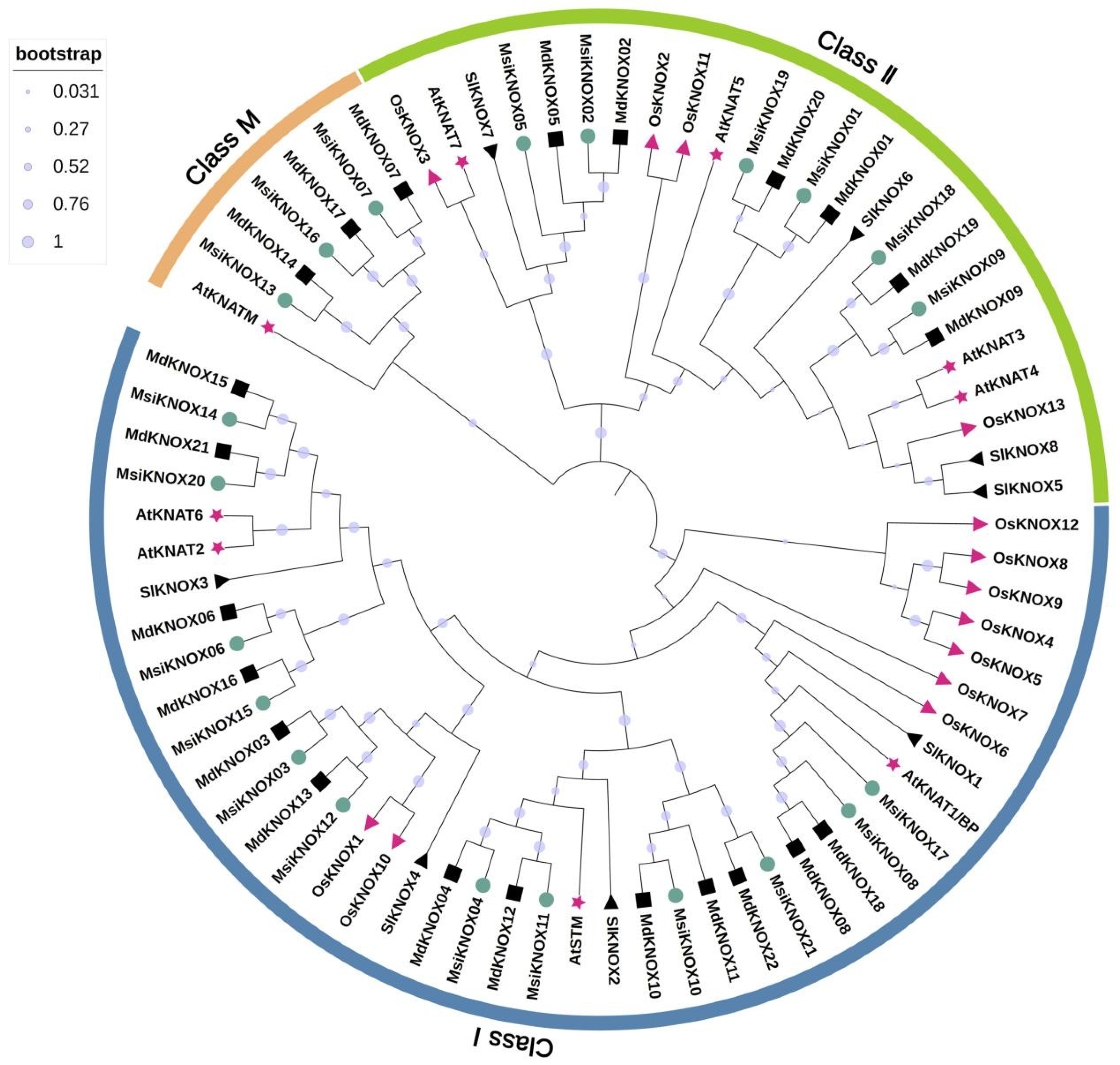
Additionally, a phylogenetic tree was constructed based on the full-length amino acid sequences of KNOX proteins from 22 M. domestica var. ‘Golden Delicious’, 9 A. thaliana, 13 O. sativa, 8 S. lycopersicum, and the 21 M. sieversii proteins identified in this study (Figure 1). Phylogenetic analysis classified the 21 M. sieversii KNOX proteins into three subfamilies. The Class I subfamily contained 12 members orthologous to functionally characterized A. thaliana genes such as STM, KNAT1, KNAT2, and KNAT6, and all possessed the typical KNOX1, KNOX2, ELK, and Homeobox_KN domains. The Class II subfamily consisted of six proteins, each containing the KNOX1, ELK, and Homeobox_KN domains. The Class M subfamily included three proteins orthologous to AtKNATM, which contained only the KNOX1 and KNOX2 domains. In M. domestica, 13 Class I, 6 Class II, and 3 Class M KNOX proteins were identified, suggesting a slight expansion or functional diversification of the Class I subfamily in M. domestica. Overall, the core KNOX family structure is conserved between M. sieversii and M. domestica.

2.2. Analysis of MsiKNOX Gene Structure, Motifs, and Domains

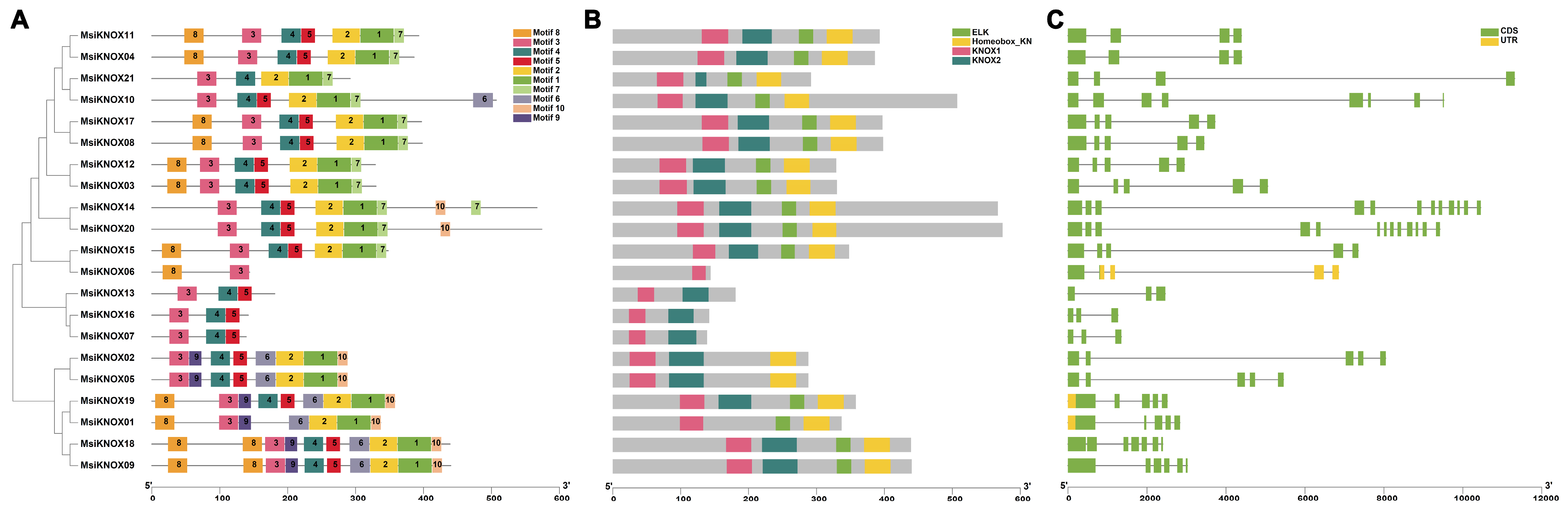
We conducted a gene structure analysis of KNOX genes in M. sieversii and found that most members exhibited considerable variation, containing 3 to 13 exons and 2 to 12 introns, with the majority possessing 5 exons and 4 introns. Additionally, only MsiKNOX01/06/19 contained UTR sequences (Figure 2C).
Subsequently, we analyzed the conserved motifs of the KNOX proteins in M. sieversii and identified 10 conserved motifs, designated Motif 1 to Motif 10, ranging from 15 to 50 amino acids in length. These motifs were annotated using the Pfam and SMART databases, revealing that Motif 1, Motif 3, and Motif 4 correspond to the conserved domains of the Homeobox_KN, KNOX1, and KNOX2 superfamilies, respectively (Supplementary Figure S2). As shown in Figure 2A, all KNOX proteins in M. sieversii contain 2 to 10 conserved motifs. Among them, MsiKNOX09 and MsiKNOX18 possess the highest number of conserved motifs (10 each), whereas MsiKNOX06 contains the fewest (only Motif 3 and Motif 8). Phylogenetic analysis indicated that members with close evolutionary relationships generally share similar motif compositions. It was also observed that most KNOX proteins in M. sieversii contain the Motif 3, Motif 4, and Motif 5. Overall, the KNOX proteins in M. sieversii exhibit high conservation. The analysis of the conserved domains of the M. sieversii KNOX proteins is shown in Figure 2B, where all KNOX proteins contain a conserved KNOX1 domain; among them, MsiKNOX06 contains the only domain KNOX1.

2.3. Chromosome Mapping of MsiKNOXs

The chromosomal locations of the MsiKNOXs were obtained from the apple genome database, and a chromosome distribution map was generated using TBtools (v2.056, Supplementary Figure S3). The 21 MsiKNOXs were found to be unevenly distributed across 13 chromosomes. Specifically, chromosomes 2 (MsiKNOX01), 5 (MsiKNOX04), 9 (MsiKNOX10), 10 (MsiKNOX11), 12 (MsiKNOX12), 16 (MsiKNOX20), and 17 (MsiKNOX21) each contained a single gene. Chromosome 4 harbored two genes (MsiKNOX02 and MsiKNOX03), and chromosome 15 harbored three genes (MsiKNOX17, MsiKNOX18, and MsiKNOX19). In summary, the apple MsiKNOX gene family shows a single-copy distribution in the genome.

2.4. Analysis of Cis-Acting Elements

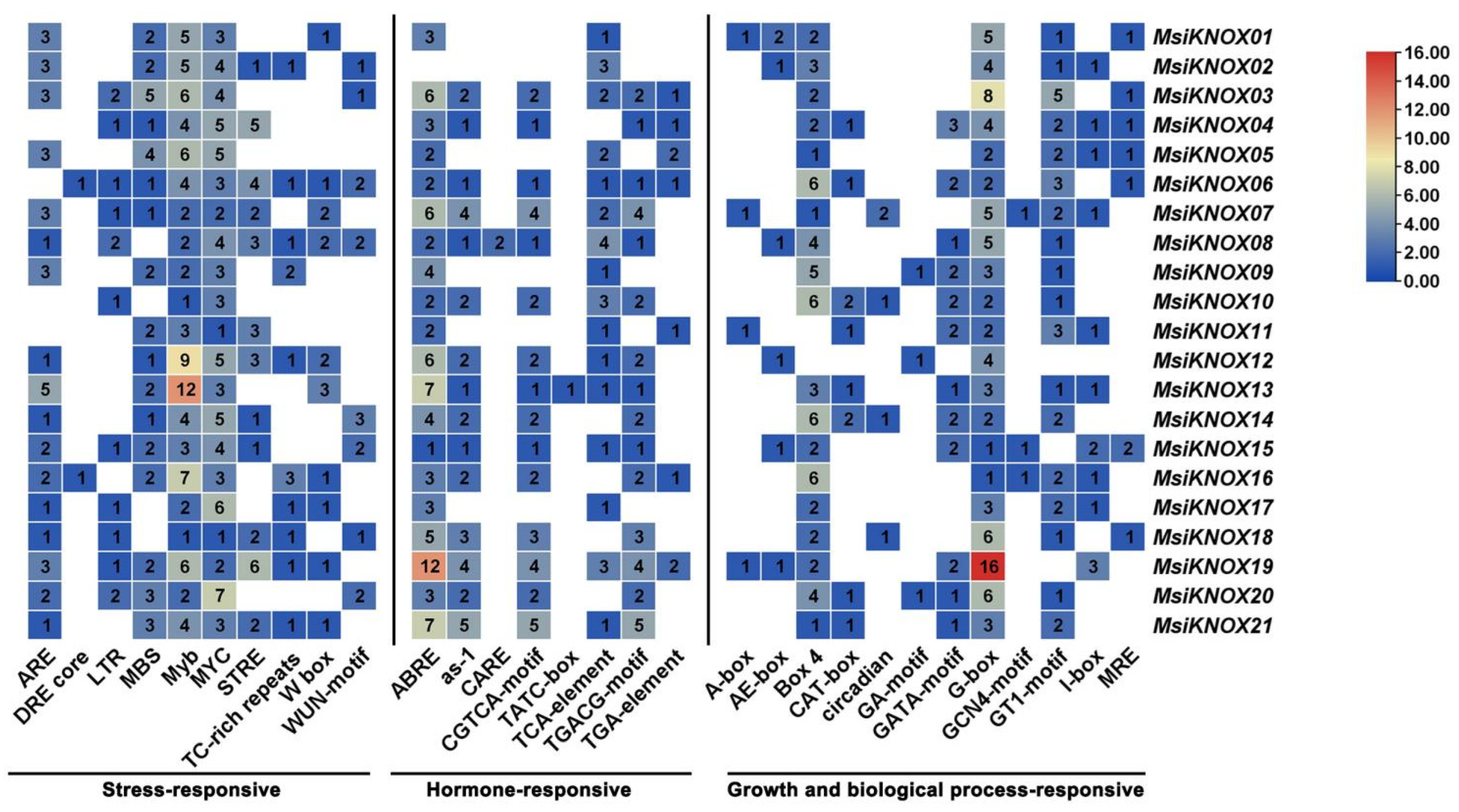
Promoter analysis of the 2 kb upstream regions of the KNOX genes in M. sieversii was performed using PlantCARE (Figure 3). The results revealed that the promoter regions of the 21 MsiKNOXs contain 30 distinct types of cis-acting elements, including those involved in stress responsiveness, hormone signaling, and growth/development-related processes. The stress-responsive elements identified include Myb, MYC, ARE, LTR, and STRE; hormone-responsive elements include ABRE, as-1, and TGACG-motif; and growth/development-related elements include G-Box, Box 4, and GT1-motif. Among these, elements associated with hormone signaling and light responsiveness were more abundantly represented across the MsiKNOX promoters. Notably, MsiKNOX13 harbors 12 MYB elements, while MsiKNOX19 contains 12 ABRE elements and 16 G-box elements. These cis-element variations suggest that MsiKNOXs may play diverse roles in hormonal and environmental signaling pathways.

2.5. Collinearity Analysis of MsiKNOXs

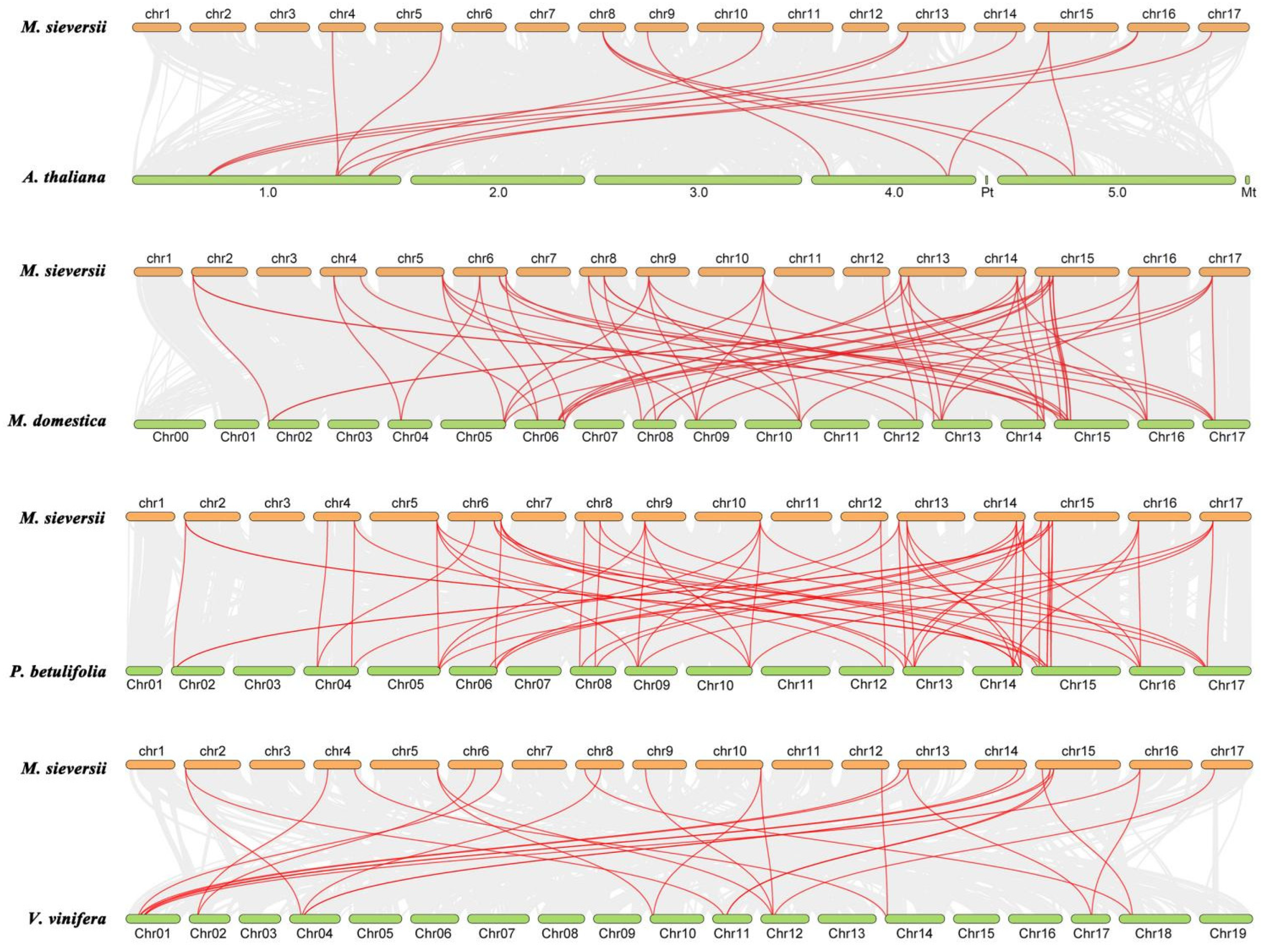
To investigate the evolutionary dynamics of the KNOX gene family in M. sieversii, we performed comparative synteny analysis with four representative species: A. thaliana, M. domestica, Pyrus betulifolia, and Vítis vinifera (Figure 4). Additionally, M. sieversii, V. vinifera, and P. betulifolia were selected for collinearity analysis to reveal the evolutionary conservation and divergence of KNOX genes by integrating closely related Rosaceae species and a representative basal eudicot with an ancestral genome. The number of syntenic gene pairs varied considerably across species. The fewest pairs were detected between M. sieversii and A. thaliana (15 pairs), whereas the highest number was observed with P. betulifolia (62 pairs), suggesting a closer evolutionary relationship between the KNOX families of M. sieversii and P. betulifolia. A similar number of syntenic pairs was found with M. domestica (59 pairs), indicating conserved synteny within the Malus lineage. In contrast, only 27 syntenic pairs were identified with V. vinifera, comparable to the number observed with A. thaliana. When compared to the A. thaliana genome, 10 out of the 21 MsiKNOXs exhibited syntenic relationships, while the remaining 11 genes (MsiKNOX01/03/05/06/07/08/12/13/16/17/19) showed no detectable synteny. In comparison with M.domestica, all MsiKNOX genes except MsiKNOX03 and MsiKNOX12 displayed evidence of gene expansion, suggesting that most members of this family have undergone duplication events during the evolution of cultivated apple. Overall, these results indicate that the KNOX gene family has experienced both conserved evolution and lineage-specific expansion, with functional conservation maintained within M. sieversii.

2.6. Expression Analysis of Six MsiKNOXs

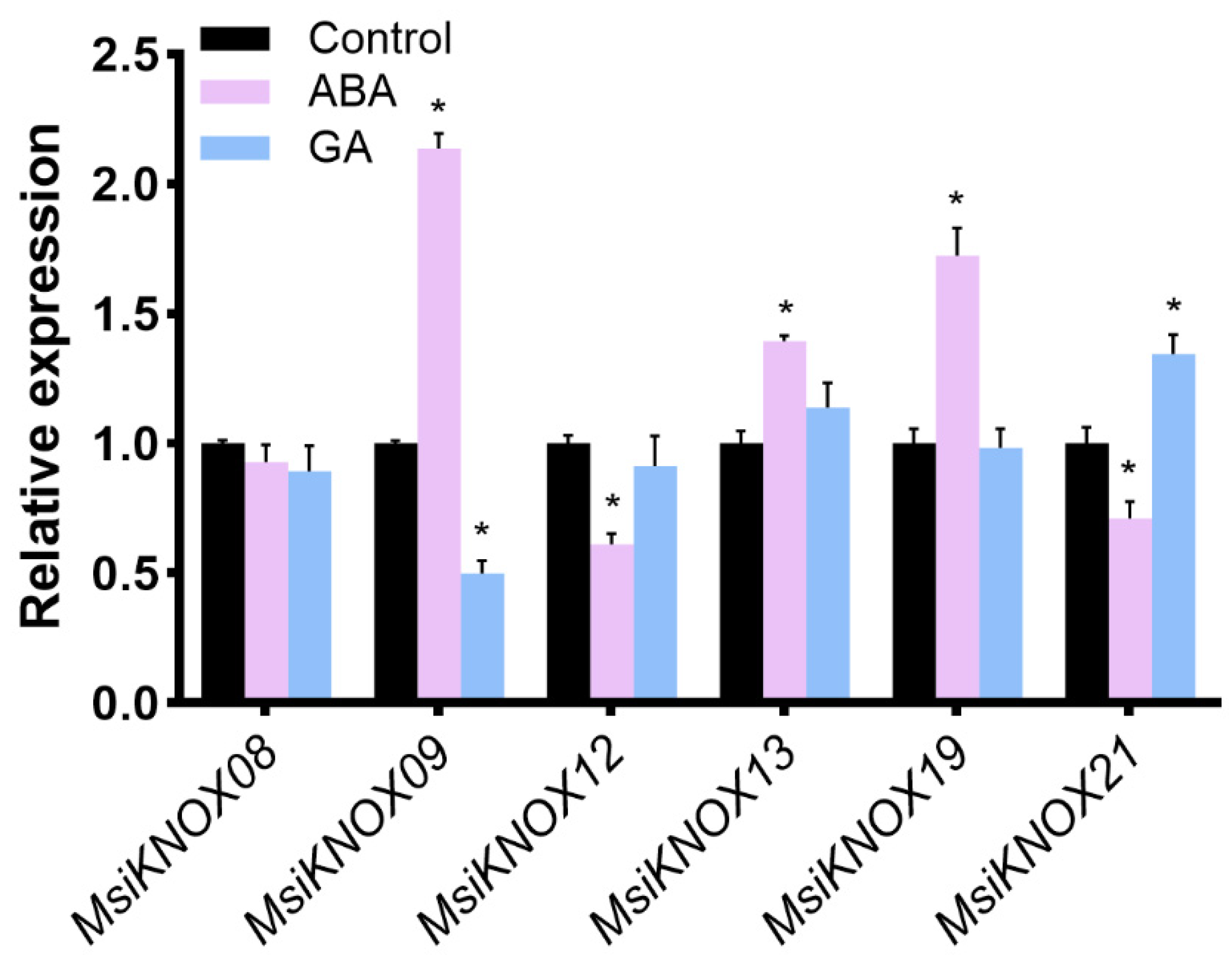
The genes were selected according to phylogeny, conserved motifs, gene structure, and expression levels. Only genes with complete conserved domains and distinct expression patterns were chosen for further analysis. Abscisic acid (ABA) and gibberellins (GA) are well-documented key regulators that antagonistically or synergistically control anthocyanin biosynthesis in various plant species [38]. To further investigate the response of MsiKNOXs to these hormones, we examined the expression patterns of six representative MsiKNOXs in M. sieversii under ABA and GA treatments (Figure 5). Under ABA treatment, the expression levels of MsiKNOX09, MsiKNOX13, and MsiKNOX19 were significantly upregulated, whereas those of MsiKNOX12 and MsiKNOX21 were downregulated. Under GA treatment, MsiKNOX09 was downregulated, while MsiKNOX21 was upregulated compared to the control. MsiKNOX08 expression remained unchanged under both treatments. Among these genes, MsiKNOX09 exhibited the most pronounced response, with a fold change greater than two under both ABA and GA treatments. In conclusion, expression analysis of the six selected MsiKNOXs revealed that they respond differentially to ABA and GA treatments, suggesting their potential involvement in phytohormone-mediated regulatory networks.

2.7. Physical Interaction Between MsiKNOX09 and MsiMYB1

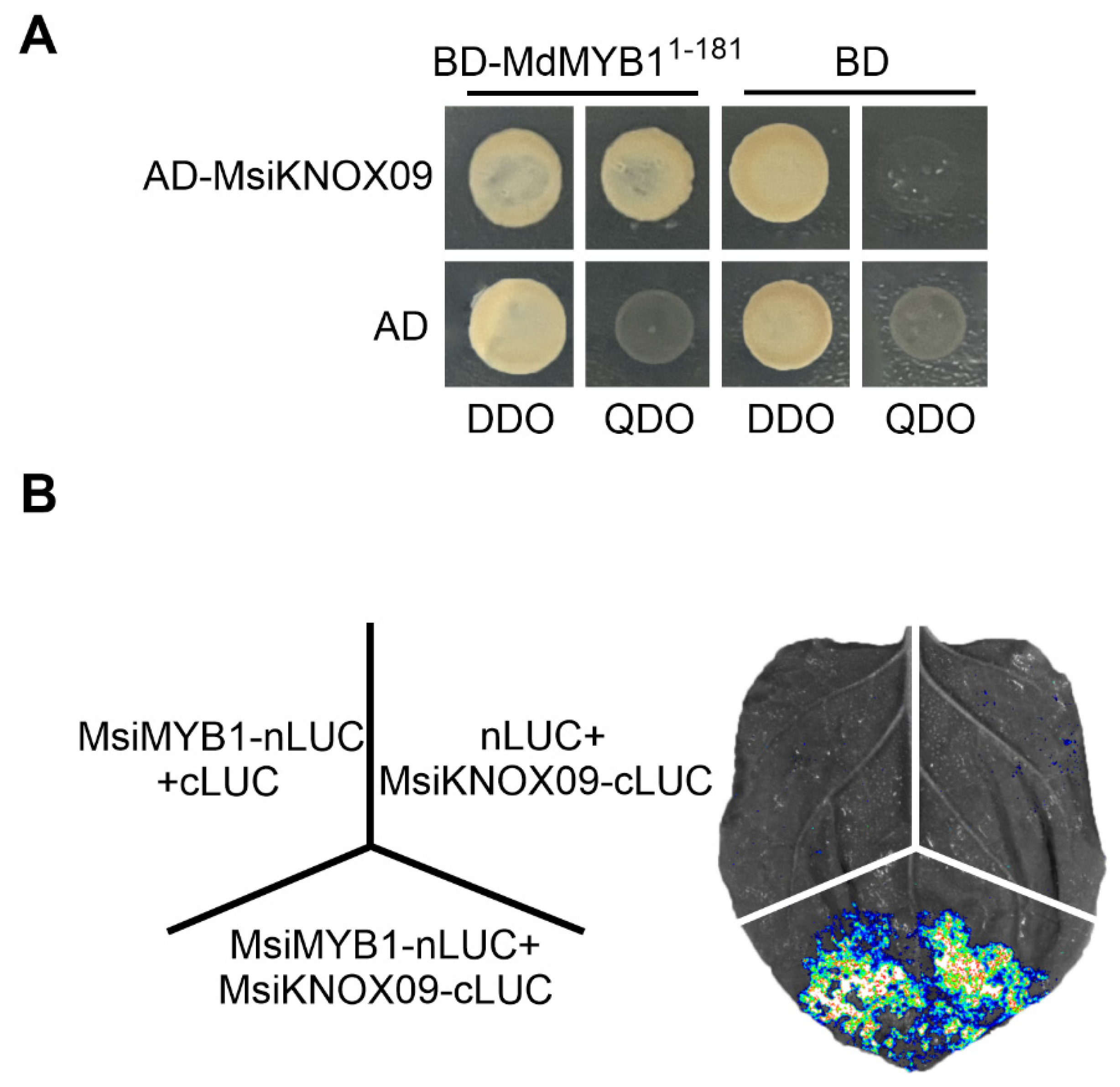
To preliminarily investigate whether MsiKNOX09 participates in the MsiMYB1-mediated signaling, we performed yeast two-hybrid (Y2H) and split-luciferase complementation assays. MsiMYB1 was chosen as a candidate interactor of MsiKNOX09 because it functions as a key MYB transcription factor that directly regulates anthocyanin accumulation and stress adaptation in apple and related species [38]. The coding sequences of MsiMYB1 and MsiKNOX09 were cloned into pGBKT7 and pGADT7, respectively. Co-transformation of these constructs into yeast strain Y2H Gold resulted in positive growth on SD/−Leu/−Trp/−His/−Ade medium, indicating a physical interaction between MsiMYB1 and MsiKNOX09 (Figure 6). This interaction was further confirmed by split-luciferase assays in Nicotiana benthamiana leaves, where co-infiltration of nLUC-MsiMYB1 and cLUC-MsiKNOX09 produced strong luciferase signals. Together, these results demonstrate that MsiMYB1 physically interacts with MsiKNOX09 in vitro and in vivo.

3. Discussion

M. sieversii is a tertiary relict fruit tree and the direct ancestor of cultivated apple (M. domestica), with extremely unique biological characteristics and important research value. It has undergone long-term natural selection in the Tianshan Mountains of Xinjiang, retaining rich genetic and phenotypic diversity that is significantly higher than that of modern cultivars. It possesses strong tolerance to drought, cold, poor soil and diseases, making it a core wild germplasm for apple stress resistance breeding. Furthermore, it shows unique morphological, reproductive and adaptive features distinct from cultivated apples [1,2]. As a unique and conserved TF family, KNOX was first identified in Z. mays and is highly conserved across land plants [35]. KNOX proteins play key roles in transcriptional regulation in land plants and are primarily localized in the nucleus [22]. Certain conserved TF families, such as bHLH and NAC, play essential roles in plant metabolism and stress tolerance during plant evolution, including the MYB and NF-Y gene families [39,40]. However, some TF families crucial for plant evolution remain poorly characterized. A deeper understanding of the transcriptional mechanisms and functions of KNOX genes is therefore needed. In this study, 21 MsiKNOX genes were identified in M. sieversii, one fewer than that in the cultivated apple cultivar ‘Golden Delicious’ (22 KNOX genes). This difference in gene number may reflect functional divergence shaped by distinct growth environments between the two species. MsiKNOX genes are predominantly distributed at the distal ends of chromosomes. This non-random localization pattern implies a potential correlation with their conserved roles in phytohormone signaling and stress adaptation, which may facilitate the rapid response of these genes to environmental cues (Supplementary Figure S3).
In this study, our phylogenetic analysis based on five representative land plant species suggests that KNOX genes have diverged into three distinct subfamilies early during land plant evolution (Figure 1). Researchers further classified KNOXs into three types based on the sequence similarity: phylogenetic analysis, expression patterns, and intron position. This classification is also applicable to wild M. sieversii and is consistent with the previous classifications in other land plants [13]. Gene duplication can arise from segmental duplication, random duplication, or retroposition [41]. Polyploidization in plants has resulted in the preservation of extensive duplicated chromosomal regions, among which segmental duplication is the most common mechanism driving gene family expansion [42]. Synteny analysis suggested that some KNOX genes in M. sieversii have been lost or expanded over evolutionary time (Figure 4).
Conserved motif analysis revealed that all 21 MsiKNOX proteins contain Motif 3. Structural analysis further confirmed that this motif resides within the conserved domain characteristic of the KNOX family, indicating that Motif 3 is a highly conserved element critical for KNOX protein functions (Figure 2). The KNOX genes in M. sieversii exhibit relatively complex structures, with only three members containing fewer than five exons—a feature highly similar to that observed in species such as Toona fargesii [43] and Ipomoea batatas [44]. Genes containing multiple introns have the potential to generate multiple protein variants through alternative splicing, which may contribute to functional diversification and evolutionary flexibility. Future studies using transcriptome data from M. domestica or M. sieversii will be needed to identify and validate potential splice forms of KNOX genes.
Cis-acting elements serve as TF binding sites that enable plants to adapt to environmental stress by modulating transcriptional activity. In M. sieversii, 11 MsiKNOX genes contain low-temperature responsive elements, and all 21 MsiKNOXs harbor MYB TF binding sites associated with drought induction. Additionally, multiple hormone-responsive cis-elements (e.g., ABRE, auxin, and jasmonic acid motifs) were identified in their promoters (Figure 3). These findings suggest that MsiKNOXs may not only actively respond to diverse abiotic stresses but also enhance stress tolerance by modulating the synthesis of related phytohormones. M. domestica is taxonomically closely related to M. sieversii, and its genome has been well assembled and annotated, which provides a high-quality and reliable reference for sequence alignment, gene identification and evolutionary analysis in this study [36]. The higher number of syntenic pairs between M. sieversii and P. betulifolia than between M. sieversii and M. domestica may be due to intensive artificial selection, chromosomal rearrangements, and gene loss during apple domestication, which have altered the genome structure of cultivated apples. By contrast, P. betulifolia maintains a relatively ancestral genome, showing stronger synteny with the wild species M. sieversii.
It has been shown that the regulation of stress responses is intimately connected with anthocyanin accumulation. In A. thaliana, AtMYB111 modulates salt responses by regulating anthocyanin accumulation [39]. AtMYB112 promotes anthocyanin formation during salinity and high light stress [45]. In Prunus avium, PacMYBA promotes ABA-mediated anthocyanin accumulation [46]. Furthermore, anthocyanin accumulation induced by diverse external stimuli is often associated with MYB1-related regulatory pathways in M. domestica. MdMYB308L promotes cold tolerance and anthocyanin accumulation [47]. MdWRKY40 interacts with MdMYB1 to promote wounding-mediated anthocyanin accumulation [48]. MdbZIP44 promotes ABA-mediated anthocyanin accumulation through the interaction with MdMYB1 and enhances the binding of MdMYB1 to the downstream targets [49]. MdERF38 promotes anthocyanin accumulation in response to drought stress by facilitating the binding of MdMYB1 to its target genes [50]. In this study, MsiKNOX09 interacts with MsiMYB1 protein (Figure 6). Expression analysis of six selected KNOX genes revealed that most responded to the treatments applied. Notably, MsiKNOX09 was significantly induced by ABA but repressed by GA (Figure 5). Accordingly, these results imply that MsiKNOX09 may be involved in drought or salinity stress responses in M. sieversii, possibly by regulating MsiMYB1-mediated signaling, which provides a clue for further investigating its function as a potential regulatory transcription factor, for which subcellular localization and transcriptional activity assays are essential. To further clarify the biological functions of MsiKNOX09, functional verification experiments such as overexpression and CRISPR/Cas9-mediated gene editing will be conducted in subsequent research. Notably, the absence of specific conserved domains typically present in KNOX family members may be associated with functional divergence or specialization; further experimental evidence is needed to clarify their biological significance.

4. Material and Methods

4.1. Identification of KNOX Gene Family Members in M. sieversii

To identify KNOX family members in M. sieversii, a BLASTP search was performed using A. thaliana KNOX protein sequences as queries against the M. sieversii proteome, implemented in TBtools (v2.056) [51]. Redundant sequences were removed, and candidate proteins were aligned using DNAMAN to verify uniqueness. Conserved domains were initially assessed using the NCBI CDD (https://www.ncbi.nlm.nih.gov/cdd, accessed on 1 April 2026). Proteins lacking the RGRP conserved domain were discarded. The remaining candidates were further validated using PFAM (http://pfam.xfam.org/, accessed on 1 April 2026) and SMART (https://smart.embl.de/, accessed on 1 April 2026) to confirm the presence of characteristic KNOX domains, ultimately defining the complete set of KNOX genes in M. sieversii. The genomic information of M. sieversii, A. thaliana, M. domestica, P. betulifolia, V. vinifera, O. sativa, and S. lycopersicum is listed in Supplementary Table S2.

4.2. Phylogenetic Analysis of the KNOX in M. sieversii

Multiple sequence alignment was performed using ClustalW (v2.0) integrated in MEGA X (v10.2.4) [52]. A phylogenetic tree was constructed via the Neighbor-Joining (NJ) method with M. sieversii and A. thaliana KNOX family members. The bootstrap test was conducted with 1000 replicates to assess node reliability.

4.3. Chromosomal Localization of MsiKNOXs

Based on the retrieved genomic information, the chromosomal locations of all KNOX motif genes in M. sieversii were determined, and a chromosomal localization map was generated.

4.4. Analysis of Gene Structure, Conserved Motifs and Phylogenetic of MsiKNOXs

Gene structures of the M. sieversii KNOX family were analyzed using the GSDS 2.0 online tool (http://gsds.cbi.pku.edu.cn/, accessed on 1 April 2026). Conserved motifs of KNOX proteins were identified with the MEME suite (https://meme-suite.org/meme/, accessed on 1 April 2026). To obtain M. sieversii KNOX gene sequences, a homology search was conducted by aligning A. thaliana KNOX protein sequences against the M. sieversii CDS database. Based on the combined KNOX gene sequences from both species, an evolutionary tree was constructed using MEGA X and visualized with the iTOL online tool (https://itol.embl.de/, accessed on 1 April 2026). The tree was built using the Maximum Likelihood method with 1000 bootstrap replicates.

4.5. Cis Acting Element Analysis

Promoter sequences (2000 bp upstream of the start codon) of KNOX family genes were extracted from the M. sieversii genome database. Cis-acting regulatory elements were predicted using PlantCARE (http://bioinformatics.psb.ugent.be/webtools/plantcare/html, accessed on 1 April 2026). Data analysis was performed with Excel 16.0, and the identified cis-elements were visualized using TBtools (v2.056) [51].

4.6. Real Time Fluorescence Quantitative (RT-qPCR) Analysis

ABA solution at a concentration of 100 μM and gibberellic acid GA3 solution at a concentration of 100 μM were prepared using distilled water containing 0.05% (v/v) Tween-80. Fourteen-day-old uniformly grown apple seedlings were treated with GA3 and ABA, respectively. M. sieversii seedlings were grown in tissue culture rooms at 25 ± 2 °C under a 16 h light/8 h dark photoperiod with a light intensity of 100–200 μmol m−2 s−1. Samples were immediately frozen in liquid nitrogen and stored at −80 °C for subsequent analysis. Gene-specific primers were designed using Primer3.0 software and synthesized by Sangon Biotech (Shanghai, China). Actin was used as the internal reference gene. Total RNA was extracted using the RNA plant Kit (Transgene, Beijing, China), and cDNA was synthesized with the PrimeScript RT reagent Kit (Takara, Shiga, Japan) following the manufacturer’s instructions. Each experiment was performed with three biological replicates. Relative gene expression levels were calculated using the 2−ΔΔCT method. All RT-qPCR primers are listed in Supplementary Table S3.

4.7. Yeast Two-Hybrid Assay

The coding sequences of MsiKNOX09 and MsiMYB1 were amplified from M. sieversii cDNA and cloned into pGADT7 and pGBKT7 vectors, respectively, to generate fusion expression constructs. The resulting plasmids (BD-MsiMYB1 and AD-MsiKNOX09), along with empty BD and AD vectors as controls, were co-transformed into yeast competent cells. Transformants were first plated onto SD/−Trp/−Leu double-dropout medium and incubated at 30 °C for 4–5 days. Six individual colonies from each transformation were then streaked onto SD/−Trp/−Leu/−His/−Ade quadruple-dropout medium and incubated for an additional 3–5 days to assess protein–protein interactions.

4.8. Luciferase Assay

The coding sequences of MsiKNOX09 and MsiMYB1 were amplified from M. sieversii cDNA and inserted into the pCAMBIA1300-nLUC and pCAMBIA1300-cLUC vectors, respectively, to generate fusion expression constructs. These constructs were introduced into Agrobacterium tumefaciens and transiently expressed in Nicotiana benthamiana leaves via agroinfiltration. For substrate preparation, 25 mg of D-luciferin potassium salt was dissolved in 0.7852 mL of sterile water to obtain a 100 mM stock solution. Prior to use, the stock was diluted with sterile water to a final concentration of 1–5 mM. The diluted substrate was evenly applied to the infiltrated leaf areas. After a 5 min incubation in the dark, luminescence signals were captured using an in vivo plant imaging system (Tanon, Shanghai, China).

Supplementary Materials

The following supporting information can be downloaded at https://www.mdpi.com/article/10.3390/plants15081152/s1. Supplementary Figure S1. Multiple sequence alignment of MsiKNOX proteins. Supplementary Figure S2. Sequence logo of the conserved motifs in MsiKNOX proteins. Supplementary Figure S3. Chromosomal distribution of KNOX genes in M. sieversii. Supplementary Table S1. Information of MsiKNOX genes and their encoded proteins identified in the Malus sieversii genome. Supplementary Table S2. Genomic information of multiple species. Supplementary Table S3. Primers used in this study.

Author Contributions

D.Z. and G.Z. conceived and designed the research; D.C. and T.Z. per-formed the experiments; L.J., H.W., X.L., B.Z. and G.N. provided technical assistance; D.Z., X.Z. and C.Z. (Chao Zhao) wrote the manuscript with contributions from all the authors; C.Z. (Chaohong Zhang) supervised and complemented the writing. All authors have read and agreed to the published version of the manuscript.

Funding

This work was supported by the Modern Agricultural Industry Technology System of Hebei (HBCT2024150302), the Provincial Key Technology R&D Program of Hebei (21326308D), China Agriculture Research System of Apple (CARS-28), and PhD Start-up Fund of Hebei Academy of Agriculture and Forestry Sciences (grant no. C25R0603; C25R0708).

Data Availability Statement

The raw data supporting the conclusions of this article will be made available by the authors on request.

Conflicts of Interest

The authors declare no conflicts of interest.

References

  1. Wang, N.; Jiang, S.; Zhang, Z.; Fang, H.; Xu, H.; Wang, Y.; Chen, X. Malus sieversii: The origin, flavonoid synthesis mechanism, and breeding of red-skinned and red-fleshed apples. Hortic. Res. 2018, 5, 70. [Google Scholar] [CrossRef]
  2. Jalali, M.; Abedi, M.; Tabarsa, M.; Moreno, D.A. Morphological and biochemical characteristics of wild red-fleshed apples (Malus sieversii f. niedzwetzkyana) in the North and Northeast of Iran. BMC Plant Biol. 2024, 24, 899. [Google Scholar] [CrossRef]
  3. Harshman, J.M.; Evans, K.M.; Allen, H.; Potts, R.; Flamenco, J.; Aldwinckle, H.S.; Wisniewski, M.E.; Norelli, J.L. Fire blight resistance in wild accessions of Malus sieversii. Plant Dis. 2017, 101, 1738–1745. [Google Scholar] [CrossRef]
  4. Yan, G.; Long, H.; Song, W.; Chen, R. Genetic polymorphism of Malus sieversii populations in Xinjiang, China. Genet. Resour. Crop Evol. 2008, 55, 171–181. [Google Scholar] [CrossRef]
  5. Wang, Z.-H.; Tian, J.; Geng, W.-J.; Qin, W.; Turdi, M. Characterization of CBF1, CBF2, CBF3, and CBF4 genes of Malus sieversii and analysis of their expression in different habitats. Eur. J. Hortic. Sci. 2017, 82, 81–89. [Google Scholar] [CrossRef]
  6. Liu, L.; Lu, W.; Fan, S.; Yang, Y. Genome-wide identification and characterization of the KNOX gene family in Vitis amurensis. PeerJ 2025, 13, e19250. [Google Scholar] [CrossRef] [PubMed]
  7. Xiong, H.; Shi, A.; Wu, D.; Weng, Y.; Qin, J.; Ravelombola, W.S.; Shu, X.; Zhou, W. Genome-Wide identification, classification and evolutionary expansion of KNOX gene family in rice (Oryza sativa) and Populus (Populustrichocarpa). Am. J. Plant Sci. 2018, 9, 1071–1092. [Google Scholar] [CrossRef]
  8. Gu, D.; Wang, Y.; Zhao, M.; Chen, H.; Wu, S.; Jin, X.; Deng, L.; Ji, R.; Xu, J.; Zheng, F. Phytochrome B stabilizes the KNOX transcription factor BP/KNAT1 to promote light-initiated seed germination in Arabidopsis thaliana. Plant Commun. 2025, 6, 101517. [Google Scholar] [CrossRef]
  9. Keren-Keiserman, A.; Shtern, A.; Levy, M.; Chalupowicz, D.; Furumizu, C.; Alvarez, J.P.; Amsalem, Z.; Arazi, T.; Alkalai-Tuvia, S.; Efroni, I.; et al. CLASS-II KNOX genes coordinate spatial and temporal ripening in tomato. Plant Physiol. 2022, 190, 657–668. [Google Scholar] [CrossRef]
  10. Zhao, C.-J.; Song, J.-Q.; Du, M.-X.; Xu, S.-Y.; Xu, J.-Y.; Li, Z.-T. Genome wide identification and expression profile of KNOX gene family in Zea mays. Acta Bot. Boreali-Occident. Sin. 2021, 41, 1109–1119. [Google Scholar]
  11. Furumizu, C.; Alvarez, J.P.; Sakakibara, K.; Bowman, J.L. Antagonistic roles for KNOX1 and KNOX2 genes in patterning the land plant body plan following an ancient gene duplication. PLoS Genet. 2015, 11, e1004980. [Google Scholar] [CrossRef]
  12. Magnani, E.; Hake, S. KNOX lost the OX: The Arabidopsis KNATM gene defines a novel class of KNOX transcriptional regulators missing the homeodomain. Plant Cell 2008, 20, 875–887. [Google Scholar] [CrossRef]
  13. Tsuda, K.; Kurata, N.; Ohyanagi, H.; Hake, S. Genome-wide study of KNOX regulatory network reveals brassinosteroid catabolic genes important for shoot meristem function in rice. Plant Cell 2014, 26, 3488–3500. [Google Scholar] [CrossRef] [PubMed]
  14. Tsuda, K.; Ito, Y.; Sato, Y.; Kurata, N. Positive autoregulation of a KNOX gene is essential for shoot apical meristem maintenance in rice. Plant Cell 2011, 23, 4368–4381. [Google Scholar] [CrossRef] [PubMed]
  15. Tsuda, K.; Hake, S. Diverse functions of KNOX transcription factors in the diploid body plan of plants. Curr. Opin. Plant Biol. 2015, 27, 91–96. [Google Scholar] [CrossRef] [PubMed]
  16. Byrne, M.E.; Barley, R.; Curtis, M.; Arroyo, J.M.; Dunham, M.; Hudson, A.; Martienssen, R.A. Asymmetric leaves1 mediates leaf patterning and stem cell function in Arabidopsis. Nature 2000, 408, 967–971. [Google Scholar] [CrossRef]
  17. Belles-Boix, E.; Hamant, O.; Witiak, S.M.; Morin, H.; Traas, J.; Pautot, V. KNAT6: An Arabidopsis homeobox gene involved in meristem activity and organ separation. Plant Cell 2006, 18, 1900–1907. [Google Scholar] [CrossRef]
  18. Barton, M.K.; Poethig, R.S. Formation of the shoot apical meristem in Arabidopsis thaliana: An analysis of development in the wild type and in the shoot meristemless mutant. Development 1993, 119, 823–831. [Google Scholar] [CrossRef]
  19. Truernit, E.; Haseloff, J. A role for KNAT class II genes in root development. Plant Signal. Behav. 2007, 2, 10–12. [Google Scholar] [CrossRef]
  20. Zhang, Y.; Yin, Q.; Qin, W.; Gao, H.; Du, J.; Chen, J.; Li, H.; Zhou, G.; Wu, H.; Wu, A.-M. The Class II KNOX family members KNAT3 and KNAT7 redundantly participate in Arabidopsis seed coat mucilage biosynthesis. J. Exp. Bot. 2022, 73, 3477–3495. [Google Scholar] [CrossRef]
  21. Luo, M.; Yu, C.-W.; Chen, F.-F.; Zhao, L.; Tian, G.; Liu, X.; Cui, Y.; Yang, J.-Y.; Wu, K. Histone deacetylase HDA6 is functionally associated with AS1 in repression of KNOX genes in Arabidopsis. PLoS Genet. 2012, 8, e1003114. [Google Scholar] [CrossRef]
  22. Sun, R.; Qin, T.; Wall, S.B.; Wang, Y.; Guo, X.; Sun, J.; Liu, Y.; Wang, Q.; Zhang, B. Genome-wide identification of KNOX transcription factors in cotton and the role of GhKNOX4-A and GhKNOX22-D in response to salt and drought stress. Int. J. Biol. Macromol. 2023, 226, 1248–1260. [Google Scholar] [CrossRef] [PubMed]
  23. Jia, P.; Xing, L.; Zhang, C.; Zhang, D.; Ma, J.; Zhao, C.; Han, M.; Ren, X.; An, N. MdKNOX19, a class II knotted-like transcription factor of apple, plays roles in ABA signalling/sensitivity by targeting ABI5 during organ development. Plant Sci. 2021, 302, 110701. [Google Scholar] [PubMed]
  24. Qin, W.; Yin, Q.; Chen, J.; Zhao, X.; Yue, F.; He, J.; Yang, L.; Liu, L.; Zeng, Q.; Lu, F. The class II KNOX transcription factors KNAT3 and KNAT7 synergistically regulate monolignol biosynthesis in Arabidopsis. J. Exp. Bot. 2020, 71, 5469–5483. [Google Scholar] [CrossRef]
  25. Li, E.; Bhargava, A.; Qiang, W.; Friedmann, M.C.; Forneris, N.; Savidge, R.A.; Johnson, L.A.; Mansfield, S.D.; Ellis, B.E.; Douglas, C.J. The Class II KNOX gene KNAT7 negatively regulates secondary wall formation in Arabidopsis and is functionally conserved in Populus. New Phytol. 2012, 194, 102–115. [Google Scholar] [CrossRef] [PubMed]
  26. Petzold, H.E.; Chanda, B.; Zhao, C.; Rigoulot, S.B.; Beers, E.P.; Brunner, A.M. DIVARICATA AND RADIALIS INTERACTING FACTOR (DRIF) also interacts with WOX and KNOX proteins associated with wood formation in Populus trichocarpa. Plant J. 2018, 93, 1076–1087. [Google Scholar] [CrossRef]
  27. Lu, M.; Li, P.; Rong, Y.-Y.; Zhang, M.-H.; Jia, P.; Luan, H.-A.; Qi, G.-H.; Zhang, X.-M.; Dong, Q.-L. Cloning, expression and protein-protein interaction analysis of seven KNOX transcription factors in apple. J. Fruit Sci. 2023, 40, 841–851. [Google Scholar]
  28. Jia, P.; Xing, L.; Zhang, C.; Chen, H.; Li, Y.; Zhang, D.; Ma, J.; Zhao, C.; Han, M.; Ren, X. MdKNOX15, a class I knotted-like transcription factor of apple, controls flowering and plant height by regulating GA levels through promoting the MdGA2ox7 transcription. Environ. Exp. Bot. 2021, 185, 104411. [Google Scholar] [CrossRef]
  29. Sheng, M.; Ma, X.; Wang, J.; Xue, T.; Li, Z.; Cao, Y.; Yu, X.; Zhang, X.; Wang, Y.; Xu, W. KNOX II transcription factor HOS59 functions in regulating rice grain size. Plant J. 2022, 110, 863–880. [Google Scholar] [CrossRef]
  30. Su, S.; Hong, J.; Chen, X.; Zhang, C.; Chen, M.; Luo, Z.; Chang, S.; Bai, S.; Liang, W.; Liu, Q. Gibberellins orchestrate panicle architecture mediated by DELLA–KNOX signalling in rice. Plant Biotechnol. J. 2021, 19, 2304–2318. [Google Scholar] [CrossRef]
  31. Wu, L.; Yang, H.; Li, B.; Liu, H.; Yuan, X.; Shi, H.; Yue, J.; Huang, M.; Wang, J.; Wang, H. The BELL-KNOX module qSH1-OSH71 regulates rice seed shattering via direct activation of OsXTH12 xyloglucanase. Plant Physiol. 2025, 198, kiaf320. [Google Scholar] [CrossRef]
  32. Nadakuduti, S.S.; Holdsworth, W.L.; Klein, C.L.; Barry, C.S. KNOX genes influence a gradient of fruit chloroplast development through regulation of GOLDEN2-LIKE expression in tomato. Plant J. 2014, 78, 1022–1033. [Google Scholar] [CrossRef]
  33. Song, X.; Zhao, Y.; Wang, J.; Lu, M.-Z. The transcription factor KNAT2/6b mediates changes in plant architecture in response to drought via down-regulating GA20ox1 in Populus alba× P. glandulosa. J. Exp. Bot. 2021, 72, 5625–5637. [Google Scholar] [CrossRef]
  34. Bolduc, N.; Hake, S. The Maize Transcription Factor KNOTTED1 Directly Regulates the Gibberellin Catabolism Gene ga2ox1. Plant Cell 2009, 21, 1647–1658. [Google Scholar] [CrossRef]
  35. Jia, P.; Zhang, C.; Xing, L.; Li, Y.; Shah, K.; Zuo, X.; Zhang, D.; An, N.; Han, M.; Ren, X. Genome-wide identification of the MdKNOX gene family and characterization of its transcriptional regulation in Malus domestica. Front. Plant Sci. 2020, 11, 128. [Google Scholar] [CrossRef] [PubMed]
  36. Sun, X.; Jiao, C.; Schwaninger, H.; Chao, C.T.; Ma, Y.; Duan, N.; Khan, A.; Ban, S.; Xu, K.; Cheng, L. Phased diploid genome assemblies and pan-genomes provide insights into the genetic history of apple domestication. Nat. Genet. 2020, 52, 1423–1432. [Google Scholar] [CrossRef]
  37. Kazi Amirul, H.; Mateusz, K.; Joanna, S.; Subrahmanyam, S.; Miłosz, W.; Jacek, C. How acidic amino acid residues facilitate DNA target site selection. Proc. Natl. Acad. Sci. USA 2023, 120, e2212501120. [Google Scholar] [CrossRef]
  38. Zhang, D.; Zhu, B.; Liu, X.; Wang, H.; Zhao, G.; Jia, L.G.; Chen, D.; Zhao, T.; Niu, G.; Zhang, C. Gene Regulatory Networks Controlling Fruit Anthocyanin Accumulation: A Review. Appl. Fruit Sci. 2026, 68, 75. [Google Scholar] [CrossRef]
  39. Li, B.; Fan, R.; Guo, S.; Wang, P.; Zhu, X.; Fan, Y.; Chen, Y.; He, K.; Kumar, A.; Shi, J.; et al. The Arabidopsis MYB transcription factor, MYB111 modulates salt responses by regulating flavonoid biosynthesis. Environ. Exp. Bot. 2019, 166, 103807. [Google Scholar] [CrossRef]
  40. Liu, X.; Hu, P.; Huang, M.; Tang, Y.; Li, Y.; Li, L.; Hou, X. The NF-YC-RGL2 module integrates GA and ABA signalling to regulate seed germination in Arabidopsis. Nat. Commun. 2016, 7, 12768. [Google Scholar] [CrossRef]
  41. Panchy, N.; Lehti-Shiu, M.; Shiu, S.H. Evolution of Gene Duplication in Plants. Plant Physiol. 2016, 171, 2294–2316. [Google Scholar] [CrossRef]
  42. Adams, K.L.; Wendel, J.F. Polyploidy and genome evolution in plants. Curr. Opin. Plant Biol. 2005, 8, 135–141. [Google Scholar] [CrossRef]
  43. Zhong, Q.; Cheng, Q.; Du, X.; Xiao, Y.; Guo, C.; Zhang, L.; Ma, J. Genome-wide identification and integrative analysis of KNOX family characterization, duplication and expression provide insights into PEG-induced drought stress in Toona fargesii. BMC Genom. 2025, 26, 423. [Google Scholar] [CrossRef] [PubMed]
  44. Jia, L.-C.; Yang, Z.-T.; Shang, L.-L.; He, S.-Z.; Zhang, H.; Li, X.; Xin, G.-S. Genome-wide identification and expression analysis of the KNOX family and its diverse roles in response to growth and abiotic tolerance in sweet potato and its two diploid relatives. BMC Genom. 2024, 25, 572. [Google Scholar] [CrossRef]
  45. Lotkowska, M.E.; Tohge, T.; Fernie, A.R.; Xue, G.-P.; Balazadeh, S.; Mueller-Roeber, B. The Arabidopsis transcription factor MYB112 promotes anthocyanin formation during salinity and under high light stress. Plant Physiol. 2015, 169, 1862–1880. [Google Scholar] [CrossRef]
  46. Shen, X.; Zhao, K.; Liu, L.; Zhang, K.; Yuan, H.; Liao, X.; Wang, Q.; Guo, X.; Li, F.; Li, T. A role for PacMYBA in ABA-regulated anthocyanin biosynthesis in red-colored sweet cherry cv. Hong Deng (Prunus avium L.). Plant Cell Physiol. 2014, 55, 862–880. [Google Scholar] [CrossRef]
  47. An, J.P.; Wang, X.F.; Zhang, X.W.; Xu, H.F.; Bi, S.Q.; You, C.X.; Hao, Y.J. An apple MYB transcription factor regulates cold tolerance and anthocyanin accumulation and undergoes MIEL1-mediated degradation. Plant Biotechnol. J. 2020, 18, 337–353. [Google Scholar] [CrossRef]
  48. An, J.P.; Zhang, X.W.; You, C.X.; Bi, S.Q.; Wang, X.F.; Hao, Y.J. MdWRKY40 promotes wounding-induced anthocyanin biosynthesis in association with MdMYB1 and undergoes MdBT2-mediated degradation. New Phytol. 2019, 224, 380–395. [Google Scholar] [CrossRef] [PubMed]
  49. An, J.P.; Yao, J.F.; Xu, R.R.; You, C.X.; Wang, X.F.; Hao, Y.J. Apple bZIP transcription factor MdbZIP44 regulates abscisic acid-promoted anthocyanin accumulation. Plant Cell Environ. 2018, 41, 2678–2692. [Google Scholar] [CrossRef] [PubMed]
  50. An, J.P.; Zhang, X.W.; Bi, S.Q.; You, C.X.; Wang, X.F.; Hao, Y.J. The ERF transcription factor MdERF38 promotes drought stress-induced anthocyanin biosynthesis in apple. Plant J. 2020, 101, 573–589. [Google Scholar] [CrossRef]
  51. Chen, C.; Wu, Y.; Li, J.; Wang, X.; Zeng, Z.; Xu, J.; Liu, Y.; Feng, J.; Chen, H.; He, Y. TBtools-II: A “one for all, all for one” bioinformatics platform for biological big-data mining. Mol. Plant 2023, 16, 1733–1742. [Google Scholar] [CrossRef] [PubMed]
  52. Kumar, S.; Stecher, G.; Li, M.; Knyaz, C.; Tamura, K. MEGA X: Molecular evolutionary genetics analysis across computing platforms. Mol. Biol. Evol. 2018, 35, 1547–1549. [Google Scholar] [CrossRef] [PubMed]
Figure 1. Systematic evolutionary analysis of KNOX family proteins. Neighbor-joining tree representing phylogenetic relationships among KNOX genes from A. thaliana, M. sieversii, M. domestica, O. sativa, and S. lycopersicum.
Plants 15 01152 g001
Figure 2. Schematic representation of protein and gene structures of MsiKNOXs. (A) Motifs 1–10 identified using the MEME search tool are marked on the protein sequences. (B) Analysis of conserved domains. (C) Analysis of the coding sequence and untranslated regions.
Plants 15 01152 g002
Figure 3. Cis-acting elements in the promoter regions of MsiKNOXs. The types of elements are displayed at the bottom, and the numbers indicate the quantity of each type.
Plants 15 01152 g003
Figure 4. Collinear analysis of M. sieversii, A. thaliana, M. domestica, P. betulifolia, and V. vinifera KNOX family genes. Red lines indicate syntenic gene pairs.
Plants 15 01152 g004
Figure 5. Quantitative expression levels of six MsiKNOXs under ABA and GA treatments. The x-axis represents different genes, and the y-axis shows the relative expression levels under various treatments, with the control value normalized to 1. One-way analysis of variance (ANOVA) followed by post hoc tests to determine significant differences between groups. All data are presented as mean ± standard deviation (SD) from at least three independent biological replicates. *, p < 0.05.
Plants 15 01152 g005
Figure 6. The validation of the protein interaction between MsiKNOX09 and MsiMYB1. (A). Yeast two-hybrid assay. (B). Luciferase assay. QDO and DDO refer to yeast deficient-type medium; DTO, SD/-Trp/-Leu. QDO, SD/-Trp/-Leu/-His/-Ade. The empty AD, BD, nLUC, and cLUC constructs serve as negative controls.
Plants 15 01152 g006
Disclaimer/Publisher’s Note: The statements, opinions and data contained in all publications are solely those of the individual author(s) and contributor(s) and not of MDPI and/or the editor(s). MDPI and/or the editor(s) disclaim responsibility for any injury to people or property resulting from any ideas, methods, instructions or products referred to in the content.