Article

Drip Fertigation Enhances Nitrogen Uptake and Improves Winter Wheat Yield and Stability Across Planting Densities

1
College of Life Science, Linyi University, Linyi 276000, China
2
Feixian Agricultural Technology Extension Center, Feixian, Linyi 273400, China
3
Linyi Agricultural Technology Extension Center, Linyi 276001, China
4
Agricultural and Rural Development Center of Hedong District, Linyi 276000, China
*
Author to whom correspondence should be addressed.
Plants 2026, 15(7), 1090; https://doi.org/10.3390/plants15071090
Submission received: 24 February 2026 / Revised: 26 March 2026 / Accepted: 30 March 2026 / Published: 2 April 2026
(This article belongs to the Special Issue Nutrient Management for Crop Production and Quality)

Abstract

Drip fertigation (DF) is increasingly adopted to improve winter wheat productivity, yet its interactions with planting density (PD) and the underlying source–sink mechanisms remain insufficiently quantified. Here, we evaluated winter wheat performance under two water–nitrogen (N) regimes—conventional management (CM) and DF—across a wide PD gradient (100–800 seeds m−2) during two growing seasons. Grain yield, yield components, population traits, dry matter production, source–sink indices, canopy N status, N uptake and N-use efficiencies were assessed. Across seasons, DF increased grain yield by 15.4–20.8% relative to CM. Yield exhibited a quadratic response to PD under both regimes; however, DF shifted the optimal PD upward (456–487 seeds m−2) compared with CM (377–378 seeds m−2) and sustained near-maximum yields over a broader PD range. DF improved population productivity by increasing productive stem percentage and grains per ear, resulting in greater grain number per m2 (sink size). DF also strengthened source capacity during grain filling: post-anthesis dry matter production increased by 15.5–17.6% and strongly associated with yield (r2 ≥ 0.819). Source–sink analysis suggested that DF was associated with more density treatments showing simultaneously high grain number and high post-anthesis dry matter accumulation, a pattern consistent with a broader high-yield density range. Enhanced N acquisition, especially after anthesis, may have contributed to this response. DF increased N nutrition index at anthesis and markedly increased post-anthesis N uptake by 47.7–49.5%, thereby raising total N uptake at maturity and grain N accumulation. DF improved fertilizer-N recovery efficiency and agronomic efficiency by 33.9–42.3% and 26.7–30.9%, respectively. Collectively, DF improved N uptake and source–sink coordination, enabling high yield and reduced yield penalties when planting density deviated from the optimum.

1. Introduction

Winter wheat is one of the most widely grown cereal crops and a cornerstone of global food security [1,2,3]. In major wheat-producing regions, sustaining high and reliable yields is increasingly challenged by variable weather, uncertainty in stand establishment, and the need to maintain strong crop growth through key developmental stages [4]. Agronomic optimization is therefore essential, because yield formation in wheat is highly sensitive to management decisions that shape canopy development, spike formation, and grain filling [5,6]. Among these decisions, planting density and water–nitrogen (N) management are two of the most influential levers: they determine population structure, resource competition within the canopy, and ultimately whether the crop can achieve high yield consistently [7,8,9,10]. Accordingly, understanding how density interacts with water–N supply strategies is fundamental for developing practical recommendations that deliver both high productivity and robust yield performance.
Planting density directly regulates yield formation through its effects on population size and individual plant productivity [11,12]. As density increases, ears per unit area typically increase, while grains per ear and grain weight often decline due to intensified competition for light, water, and nutrients [13,14]. This compensation among yield components frequently results in a unimodal (quadratic) yield response to density, with yield penalties occurring at both low density (insufficient ear number and sink capacity) and excessive density (strong intra-population competition and reduced per-plant productivity). Density also influences canopy development and crop N status: higher density accelerates canopy closure and increases LAI, but it may dilute plant N availability per unit leaf area and shorten the effective photosynthetic duration during grain filling, thereby limiting assimilate supply [15,16]. Consequently, density can affect not only yield level but also the efficiency by which applied N is captured and converted into grain, as reflected in indices such as fertilizer-N recovery efficiency (REN) and agronomic efficiency (AEN).
Optimizing water–N management is equally critical for achieving high yield and mitigating the adverse effects of density-driven competition. Conventional practices in many intensive wheat systems rely on relatively few irrigation events combined with large basal and single topdressing N applications. Such strategies can create temporal mismatches between N supply and crop demand, leading to periods of oversupply and deficiency across the season, which may constrain ear development, accelerate senescence, and reduce grain filling—especially under dense stands. Drip fertigation (DF), which integrates irrigation and split N delivery directly into the root zone, provides an alternative approach with strong potential to support both yield formation and N acquisition [10,17,18]. By increasing the frequency of water and N supply and adjusting their proportional distribution across growth stages, DF can enhance root-zone N availability when crop demand is high, sustain canopy N status, and promote post-anthesis N uptake [19,20,21]. These mechanisms are expected to strengthen post-anthesis source capacity (assimilate supply) while supporting sink establishment (grain number), thereby improving source–sink coordination during grain filling and ultimately enhancing yield performance.
Despite the increasing adoption of DF in recent years, the interactive mechanisms between planting density and DF-driven water–N supply remain insufficiently resolved, particularly across a wide density gradient. It is unclear whether DF simply shifts the optimum density or whether it also broadens the density range that can achieve near-maximum yield by alleviating density-induced limitations on N acquisition and post-anthesis canopy function. We hypothesized that DF, by altering the number and proportion of water and N applications—especially by strengthening late-season water–N supply—can better match crop demand at higher densities. This improved alignment would maintain N availability and N uptake during critical stages (from stem elongation to anthesis and into early grain filling), sustain post-anthesis assimilate supply, and reduce the sensitivity of yield to planting density. In other words, DF is expected to broaden the planting density range over which high yield can be maintained, possibly through patterns consistent with improved source–sink matching.
To test these hypotheses, we conducted two-year field experiments comparing a drip fertigation-based management package (DF) with conventional management (CM) across eight planting densities (100–800 seeds m−2; PD1 = 100, PD2 = 200, PD3 = 300, PD4 = 400, PD5 = 500, PD6 = 600, PD7 = 700, PD8 = 800 seeds m−2) in a split-plot design. Under CM, N was applied mainly as a large basal dose with a single topdressing at jointing, and irrigation was provided by flood irrigation at three key timings. Under DF, basal N input was reduced, and the remaining N was applied through multiple fertigation events aligned with major developmental stages, together with more frequent drip irrigation. We measured grain yield and its components, population traits related to tiller survival and ear formation, dry matter production and harvest index, canopy traits at anthesis (LAI and N nutrition status), N uptake before and after anthesis, and indices of N-use efficiency. Based on these measurements, and their associations with source- and sink-related indicators such as grain number per unit area and post-anthesis dry matter accumulation, this study evaluated how the DF management package was associated with density-dependent yield formation and fertilizer-N effectiveness, and identified a practical planting density range for achieving high yield with improved N-use performance. Because multiple management components changed simultaneously under DF, the results should be interpreted as the integrated response to this treatment package rather than the isolated effect of any single factor.

2. Results

2.1. Yield Performance and Yield Components

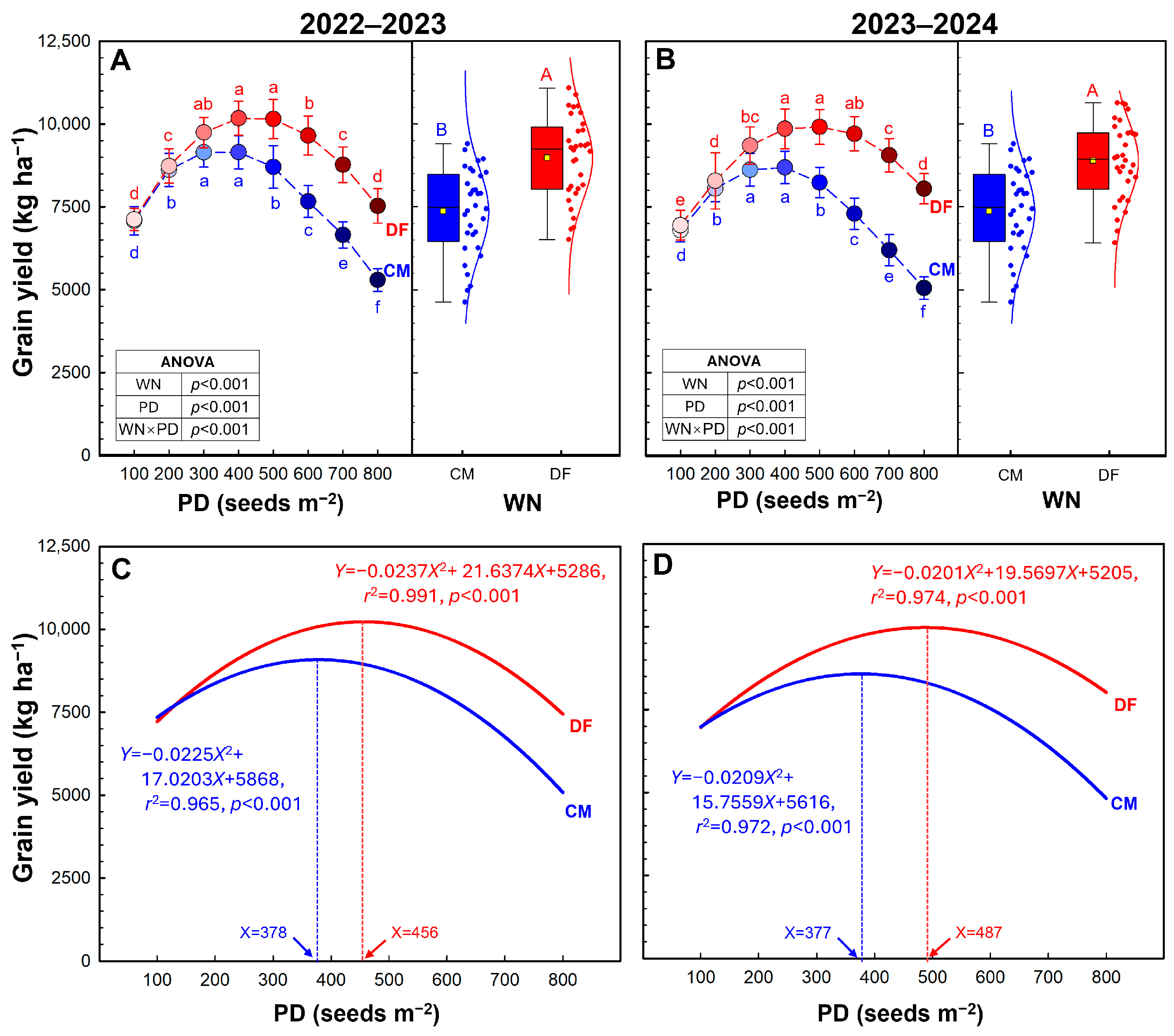
The grain yield was significantly affected by Water and N management regime (WN) and planting density (PD) (Figure 1A,B). Averaged across all PD, DF produced 15.4% and 20.8% higher yield than CM in 2022–2023 and 2023–2024, respectively. The grain yield increased initially and then decreased with the increasing PD under both WN regimes. In the 2022–2023 season, the highest yields of 9149 and 10,175 kg ha−1 were obtained at PD4 under CM and DF (Figure 1A). In the 2023–2024 season, PD5 and PD4 produced the highest yields of 8689 and 9913 kg ha−1 under CM and DF, respectively (Figure 1B). There is a strong quadratic regression relationship between yield and PD under both WN regimes (r2 ≥ 0.965, p < 0.001, Figure 1C,D). Using the fitted quadratic curves, the optimal PD under CM is 377–378 seeds m−2, while under DF, the optimal PD is 456–487 seeds m−2.
All yield components (ears per m2, grains per ear, and grain weight) were significantly affected by WN and PD in both seasons (Table 1). However, only the ears per m2 was not affected by the interaction between WN and PD. Compared to CM, DF promoted the average ears per m2, grains per ear, and grain weight by 6.2%, 5.5% and 2.6%, respectively, in 2022–2023. The corresponding increases were 5.7%, 4.6%, and 8.3% in 2023–2024. The ears per m2 increased with density, while the grains per ear and grain weight show a declining trend. The grain number per m2 showed a trend of first increasing and then decreasing under both WN regimes. Under CM, the maximum value was observed at PD4, while under DF, the maximum value occurred at PD5 or PD6. DF increased the average grain number per m2 by 12.2–13.5% relative to CM.

2.2. Population Size and Individual Productivity

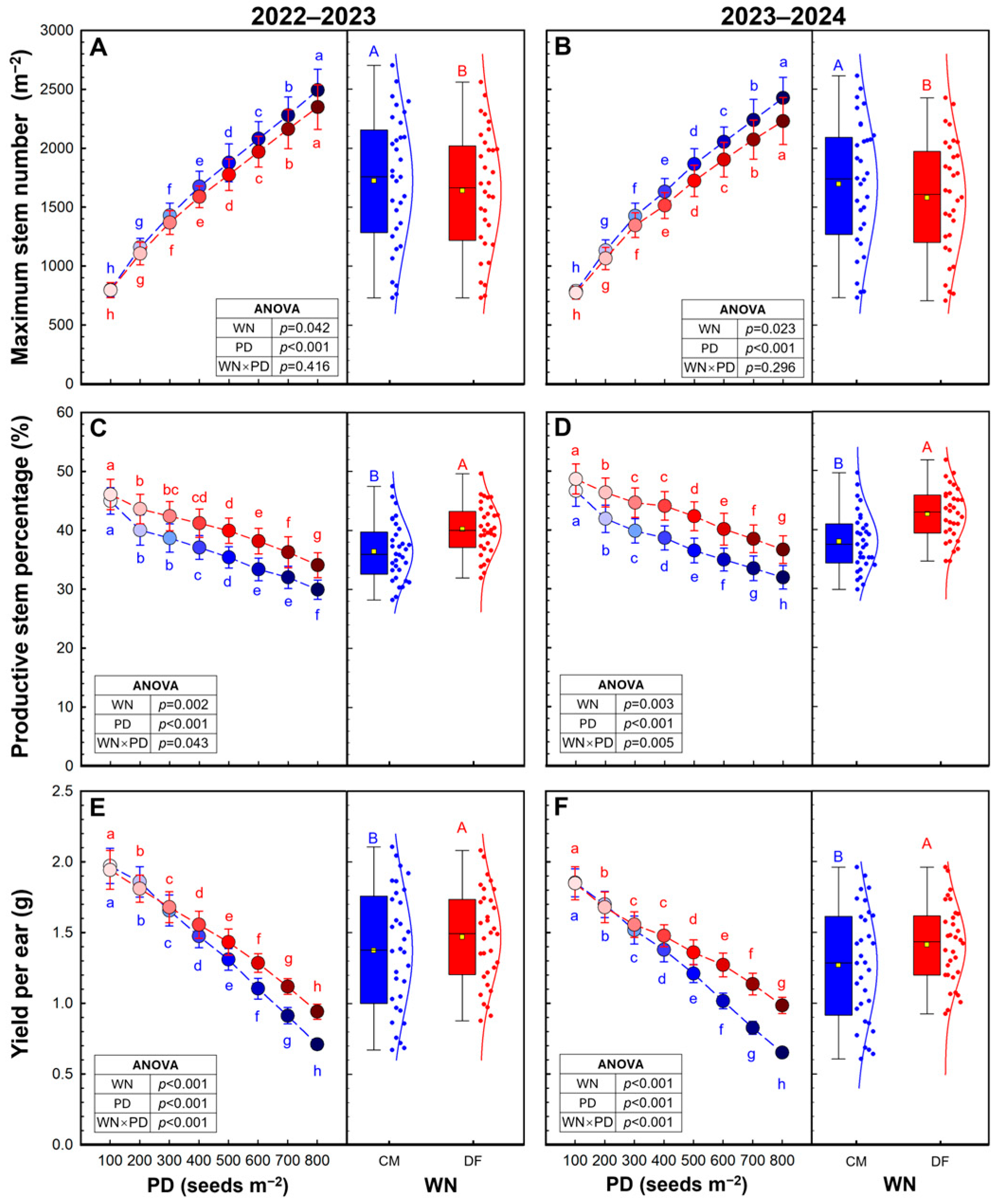
DF had a slight negative effect on the maximum stem number (−4.9% to −6.9%) but significantly increased the productive stems percentage and yield per ear by 10.4–12.3% and 7.0–11.4% (Figure 2). DF significantly increased the productive stems percentage at any PD, except for PD1. However, the yield per ear improvement by DF was observed at PD of 400–800 seeds m−2.

2.3. Dry Matter Production and Harvest Index

Both dry matter production and harvest index were significantly affected by WN, PD, and their interaction effects (Table 2). Averaged across all planting densities, DF increased dry matter at maturity and harvest index by 10.5–11.1% and 4.5–9.7%, respectively. As planting density increased, dry matter at maturity showed a trend of first increasing and then decreasing, while harvest index continued to decrease. The peak dry matter at maturity achieved at PD4 and PD5 under CM and DF, respectively.
Compared to CM, DF promoted dry matter at anthesis and after anthesis by 7.0–8.6% and 15.5–17.6%, respectively. Dry matter at anthesis increases with planting density, but there is no clear decreasing trend. In contrast, dry matter after anthesis shows a clear trend of first increasing and then decreasing, with peak values occurring at PD3 and PD4 under CM and DF, respectively.

2.4. Source–Sink Coordination for High Yield Achievement

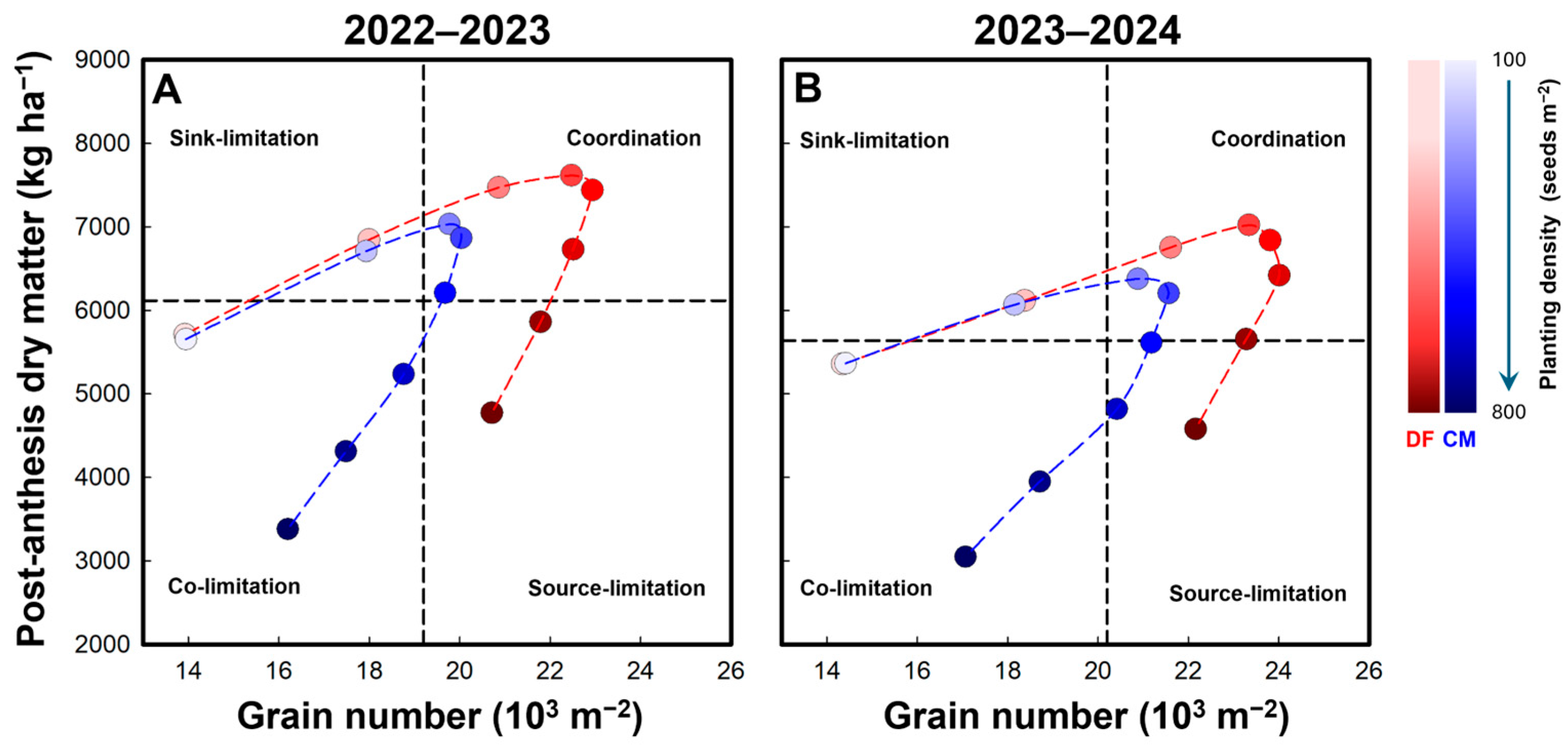
The overall mean values of grain number and post-anthesis dry matter production across all treatments within each growing season were used as reference points for comparative interpretation (Figure 3). Treatments with post-anthesis dry matter production or grain number below the corresponding seasonal mean were interpreted as showing patterns consistent with relatively weaker source support or smaller sink size, respectively. This classification was intended as a descriptive and heuristic framework for comparing treatment differences, rather than as a strict physiological diagnosis based on independent biological thresholds.
Under CM, similar patterns were observed in both growing seasons. Treatments at PD1, PD7, and PD8 were located in the region characterized by relatively low grain number and low post-anthesis dry matter accumulation, indicating possible co-limitation of sink size and source support. PD2 showed a pattern consistent with relatively lower sink size, whereas the relatively high yields at PD3 and PD4 were associated with comparatively favorable source–sink matching.
Under DF, broadly similar seasonal patterns were also observed. PD2, PD8, and PD1 were located in regions suggestive of relatively lower sink size, relatively weaker source support, and possible co-limitation, respectively. In contrast, the superior yields observed at PD3–PD6 were associated with combinations of relatively high grain number and relatively high post-anthesis dry matter accumulation, a pattern consistent with improved source–sink matching under the DF management package.

2.5. Leaf Area Index and N Nutrition Index at Anthesis

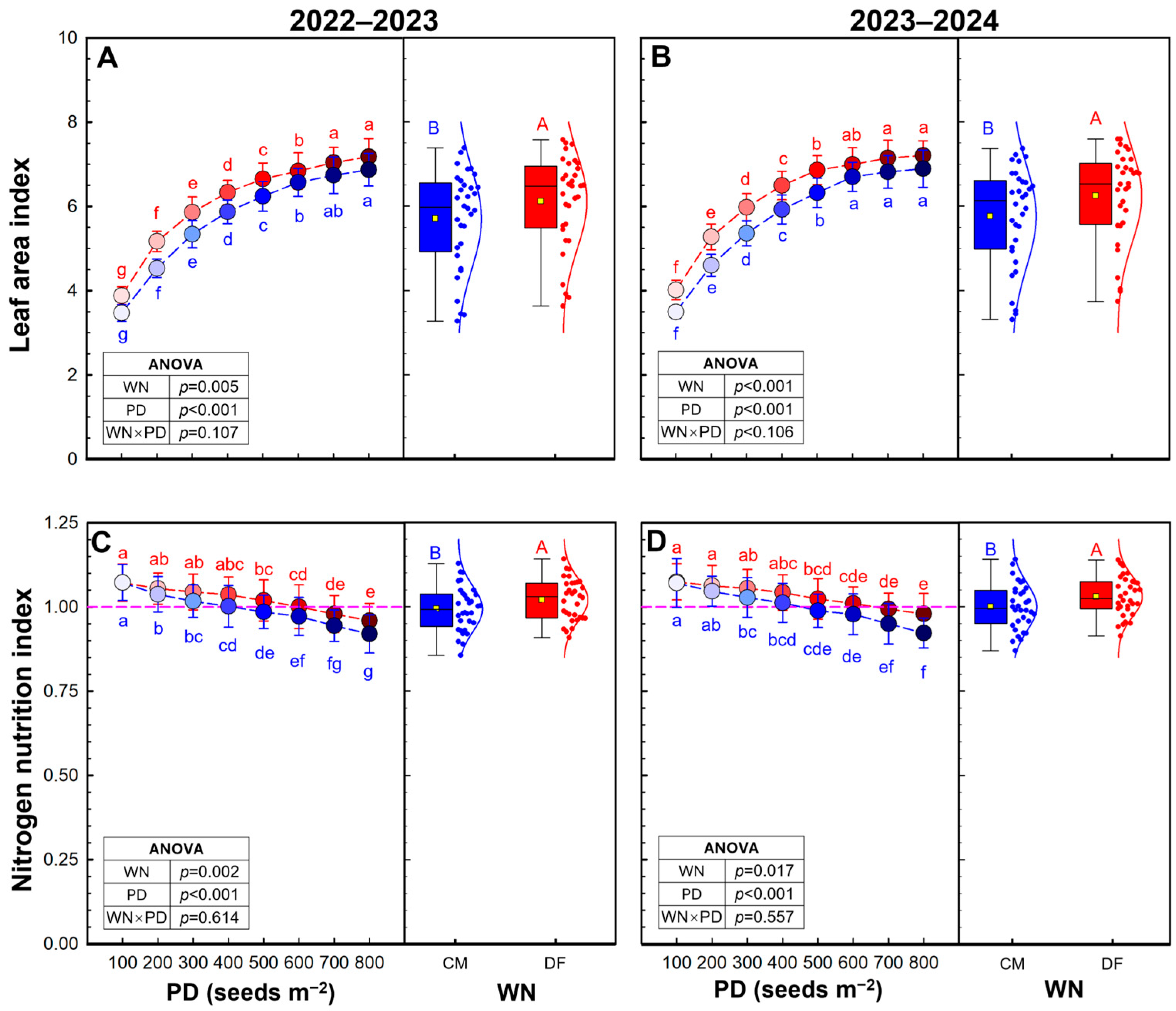
Two-way ANOVA indicated that both WN and PD significantly affected leaf aera index (LAI) in both seasons, while their interaction was not significant in either season (Figure 4A,B). Across densities, DF resulted in 7.3–8.4% higher LAI at anthesis than CM. LAI at anthesis increased progressively with planting density in both seasons.
Both water–N regime and planting density significantly influenced N nutrition index (NNI) in both seasons, whereas the WN × PD interaction was not significant (Figure 4C,D). Compared to CM, DF promoted the average NNI by 2.7–3.1%. In contrast to LAI, NNI at anthesis declined with increasing planting density. NNI values were generally above 1.0 at low to moderate densities but decreased progressively at higher densities, particularly under CM.

2.6. N Uptake and Efficiencies of N Use

N uptake at anthesis (NA), during the post-anthesis period (NPA), at maturity (NUP), and grain N accumulation (GNA) were significantly affected by WN, PD, and their interaction in both growing seasons (Table 3). Across seasons, DF consistently increased N uptake compared with CM. Averaged across densities, DF increased NA by 7.3% and 7.0%, NPA by 47.7% and 49.5%, NUP by 13.8% and 12.4%, and GNA by 15.7% and 21.4% in 2022–2023 and 2023–2024, respectively. Under both water-N regimes, NA increased from low to moderate densities and tended to plateau or slightly decline at the highest densities. In contrast, NPA showed a clear density-dependent pattern, with peak values occurring at intermediate densities (PD4–PD6 under DF), followed by declines at excessive densities. Consequently, total NUP and GNA were maximized at moderate densities (PD4–PD6), particularly under DF, where the highest NUP (296.1 and 292.8 kg ha−1 in 2022–2023; 287.9 and 283.9 kg ha−1 in 2023–2024) and GNA (222.8 and 221.5 kg ha−1; 221.4 and 220.9 kg ha−1, respectively) were observed.
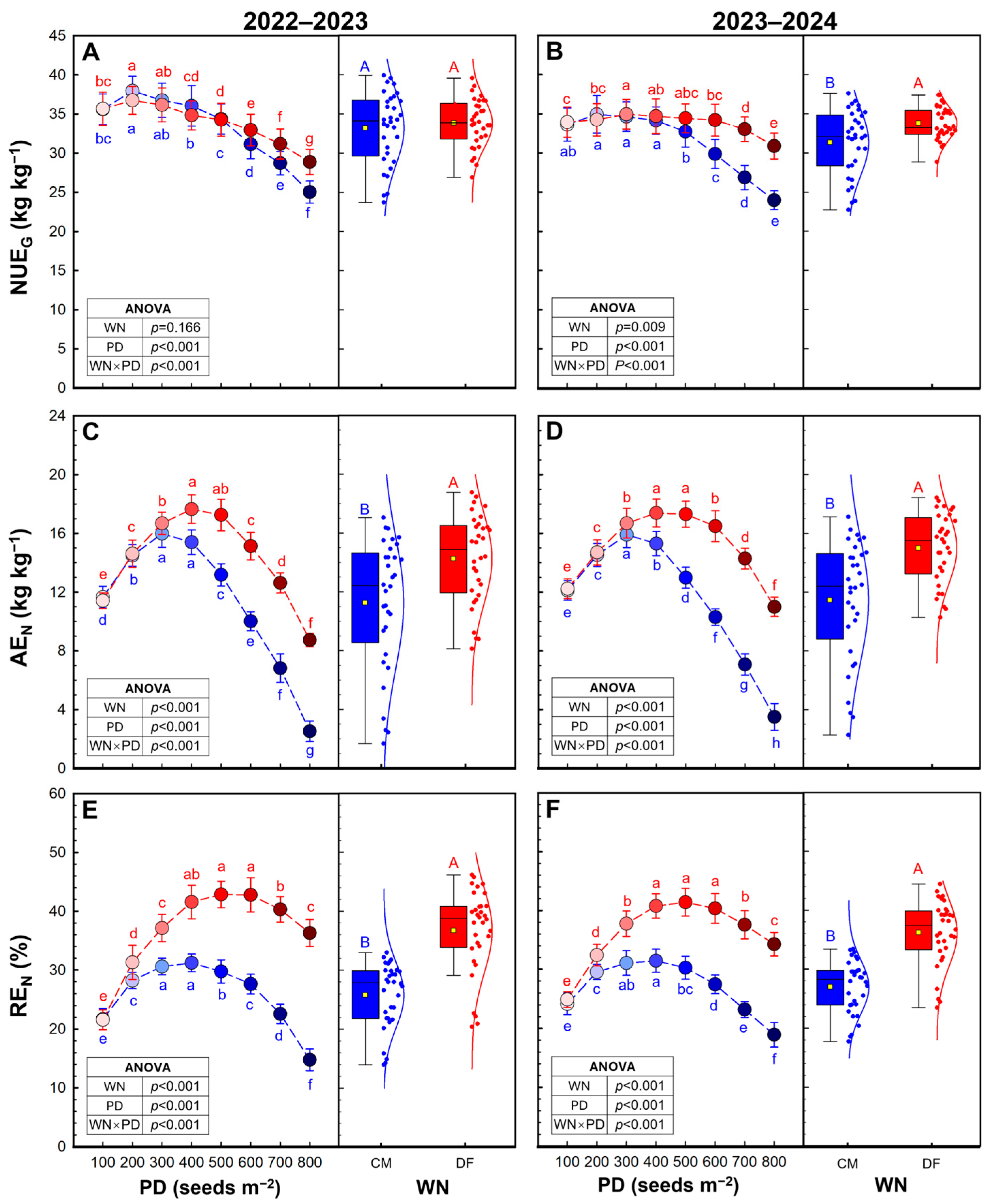
N use efficiency for grain production (NUEG), agronomic use efficiency of N fertilizer (AEN) and recovery efficiency of N fertilizer (REN) were significantly influenced by water and N regime, planting density and their interaction in both seasons (Figure 5), except for NUEG in 2022–2023 (Figure 5A). In 2023–2024, DF increased the average NUEG by 7.8%. Across both seasons, NUEG tended to decline progressively with increasing planting density, particularly at high densities (PD6–PD8).
Averaged across planting densities, DF increased AEN by 26.7–30.9% relative to CM (Figure 5C,D). AEN exhibited a unimodal response to planting density, increasing from low to moderate densities and declining sharply at excessive densities (PD7–PD8). Under DF, AEN reached peak values at intermediate densities (PD3–PD5), whereas under CM it declined markedly beyond moderate densities. At the highest density, AEN dropped substantially under both management regimes, but the reduction was more pronounced under CM.
DF improved the averaged REN by 33.9–42.3% compared with CM (Figure 5E,F). REN increased from low to moderate densities and then decreased at high densities. DF consistently enhanced REN across densities, with the greatest improvement observed at intermediate densities. Under CM, REN declined sharply at high PD, indicating reduced nitrogen recovery efficiency under excessive canopy competition.

2.7. Correlation Analysis

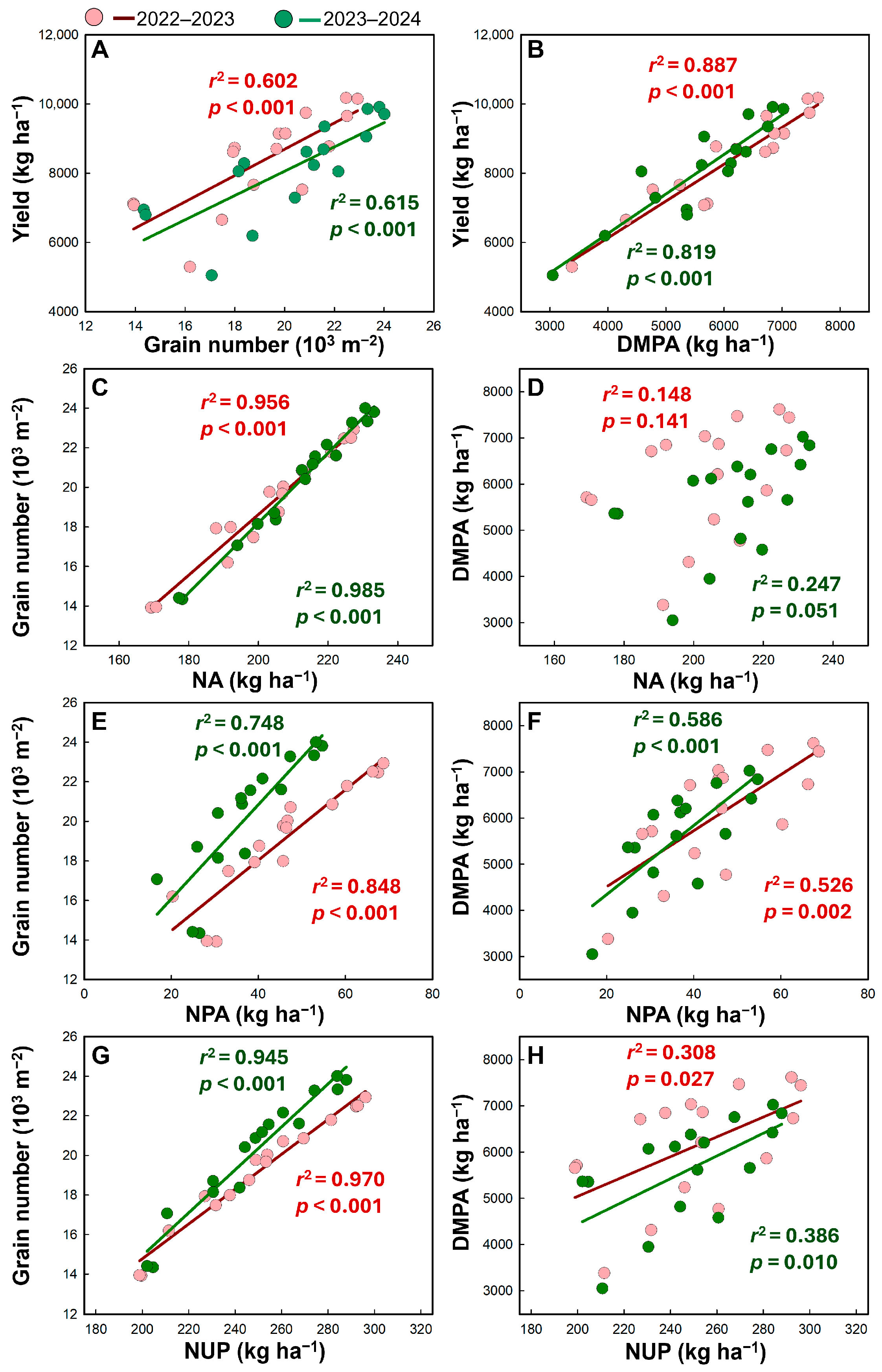
Grain yield was positively correlated with grain number in both seasons (2022–2023: r2 ≥ 0.602, p < 0.001, Figure 6A). A stronger association was observed between yield and post-anthesis dry matter production (r2 ≥ 0.819; p < 0.001, Figure 6B). N uptake at anthesis, after anthesis and at maturity were tightly associated with grain number (r2 ≥ 0.748, p < 0.001, Figure 6C,E,G), whereas their relationship with post-anthesis dry matter was not statistically significant (r2 ≤ 0.247, p > 0.05, Figure 6D) or relatively weak (r2 ≥ 0.308, p < 0.05, Figure 6F,H).

3. Discussion

Across two growing seasons, DF consistently outperformed CM in grain yield, producing 15.4–20.8% higher yields (Figure 1), in agreement with previous reports [18,22,23]. In practice, identifying an appropriate planting density (PD) range is essential for achieving high and reliable winter wheat yields [7,8,16,24]. In the present study, grain yield under both water–N regimes exhibited a typical quadratic response to PD, increasing from low densities to an optimum and then declining at excessive densities. Notably, DF shifted the optimum PD upward (456–487 seeds m−2) relative to CM (377–378 seeds m−2) and sustained high yields across a broader density interval (particularly PD3–PD6). This widened high-yield plateau suggests that DF reduced yield penalties at both low and high planting densities, thereby broadening the range of planting densities over which high yield could be maintained.
The yield advantage of DF was initially reflected in improved stand structure and sink formation. DF reduced basal N input, which likely constrained excessive tillering at high densities and prevented the overproduction of non-productive stems. Meanwhile, split N applications under DF improved synchronization between N supply and crop demand during key developmental stages (regreen-up, heading, and anthesis), thereby enhancing tiller survival and ear formation. As a result, increases in productive ear number were achieved without a proportional penalty in grains per ear (Table 1). Consistent with this interpretation, grain number per m2 (sink size) peaked at PD4 under CM and decreased significantly at PD6, whereas under DF it peaked at PD5 or PD6. Thus, DF facilitated the establishment and maintenance of a larger sink size at medium-to-high densities, creating a stronger basis for higher yield potential.
However, high yield depends not only on sink size but also on whether the crop can sustain adequate assimilate supply to fill that sink. Achieving high crop yield is widely recognized to require improved source–sink coordination, i.e., concurrent strengthening of assimilate supply and sink capacity [25,26,27]. In this study, DF increased post-anthesis dry matter accumulation by 15.5–17.6% relative to CM, and yield was strongly associated with post-anthesis dry matter production (r2 ≥ 0.819). These results are consistent with the hypothesis that, once a relatively large sink had been established under DF, achieving high yield at medium-to-high planting densities was associated with greater post-anthesis dry matter production during grain filling.
This source advantage is particularly important because high planting density commonly accelerates canopy closure and increases LAI, but it also intensifies self-shading and competition for N, shortening the effective photosynthetic duration and reducing canopy photosynthetic efficiency during grain filling [16,28,29,30]. Under CM, these density-induced constraints likely contributed to the decline in post-anthesis biomass production at excessive densities, consistent with the observed yield reduction beyond the optimum PD. In contrast, DF partly alleviated these limitations by sustaining a stronger post-anthesis source. DF maintained higher N nutritional status at anthesis (higher NNI across densities, Figure 4C,D), which likely improved leaf N concentration and delayed premature senescence. More importantly, DF markedly enhanced post-anthesis N uptake (by 47.7–49.5%). This pattern is consistent with the hypothesis that greater N uptake after anthesis may help sustain canopy greenness and photosynthetic activity during grain filling, particularly under relatively dense stands where N dilution is more pronounced. The significant correlations between post-anthesis N uptake and both sink size (r2 ≥ 0.748) and source capacity (r2 ≥ 0.526) further suggest that post-anthesis N acquisition under DF may have contributed to both sink realization and source support during grain filling. However, these relationships should be interpreted as associations rather than direct proof of a causal mechanism.
From a classical crop growth perspective, grain yield is determined not only by dry matter production but also by the efficiency with which assimilates are partitioned to grain, commonly quantified as harvest index [5,31,32]. Therefore, increased post-anthesis assimilation contributes to yield only when a sufficient proportion of the additional biomass is allocated to developing grains. In the present study, DF improved harvest index by 4.5–9.7%, indicating that the extra assimilates produced during grain filling were more effectively converted into grain rather than retained in vegetative tissues. This enhanced partitioning complements the DF-induced increases in sink size and post-anthesis source strength, providing an additional explanation for superior yield performance at medium-to-high densities.
Taken together, Figure 3 provides an interpretive framework for understanding why the DF management package was associated with higher yield and a broader high-yield planting density range. Compared with CM, DF was associated with a larger sink, reflected by a higher grain number per m−2 maintained at intermediate-to-high planting densities (with the peak occurring at PD5–PD6 rather than PD4 and without the marked decline observed at PD6 under CM), and with greater post-anthesis dry matter production, which is consistent with stronger source support during grain filling. These concurrent responses placed more DF treatments within the domain characterized by relatively high grain number together with relatively high post-anthesis dry matter accumulation, particularly across PD3–PD6, whereas CM more often showed patterns consistent with sink limitation at lower densities and source limitation or co-limitation at excessive densities. Improved N uptake, especially after anthesis, may have contributed to this pattern by helping to sustain canopy function during grain filling and support assimilate supply for sink realization. As a result, DF was associated with a broader planting density range over which near-maximum yield could be maintained, thereby reducing yield penalties when planting density deviated from the apparent optimum. Because DF involved simultaneous changes in irrigation method, irrigation frequency, and N application strategy, these responses should be interpreted as the integrated effect of the DF treatment package rather than the isolated contribution of any single component.
The improvements in REN and AEN further support the agronomic advantages of the DF management package. Low REN (often around or below 30%) has been widely recognized as a major constraint on yield improvement in intensive cereal systems in China [33,34,35]. In the present study, REN under CM reached only 31.2–31.5% at best (PD4), whereas DF increased peak REN to 41.4–42.9% (PD5). This pattern suggests that DF was associated with better synchronization between N supply and crop demand, possibly by maintaining more favorable root-zone N availability during periods of high N requirement, such as stem elongation to anthesis and early grain filling. By reducing the temporal mismatch between early-season N supply and later crop demand, DF may have enhanced crop N capture and reduced the fraction of fertilizer N exposed to loss pathways, thereby increasing the proportion of applied N recovered in aboveground biomass. Notably, the shift in peak REN from PD4 under CM to PD5 under DF suggests that DF was associated with more effective fertilizer N recovery at a relatively higher planting density, a pattern consistent with the higher canopy N status and greater post-anthesis source activity observed under DF.
AEN reflects the marginal yield response to applied N, and conceptually its improvement is often associated with greater N recovery because yield gains depend, at least in part, on the amount of applied N taken up by the crop [36]. In this study, DF increased AEN by 26.7–30.9% and simultaneously raised REN by 33.9–42.3% relative to CM, suggesting that the AEN advantage under DF was closely associated with improved N recovery. Higher REN under DF is also consistent with better temporal matching between N availability and crop demand, which may have helped sustain canopy function during grain filling, in line with the greater post-anthesis N uptake observed under DF. The unimodal response of AEN to planting density further suggests that intermediate densities favored greater yield return per unit N input, whereas excessive densities likely intensified competition and N dilution, thereby limiting the conversion of recovered N into additional grain yield. Overall, these results demonstrate that DF enhanced both sink formation and post-anthesis source strength through improved N uptake dynamics, thereby enabling higher yield and reduced sensitivity to planting density variation, with intermediate densities (PD3–PD6) representing a practical range for achieving high yield alongside improved fertilizer-N effectiveness.

4. Materials and Methods

4.1. Site Description

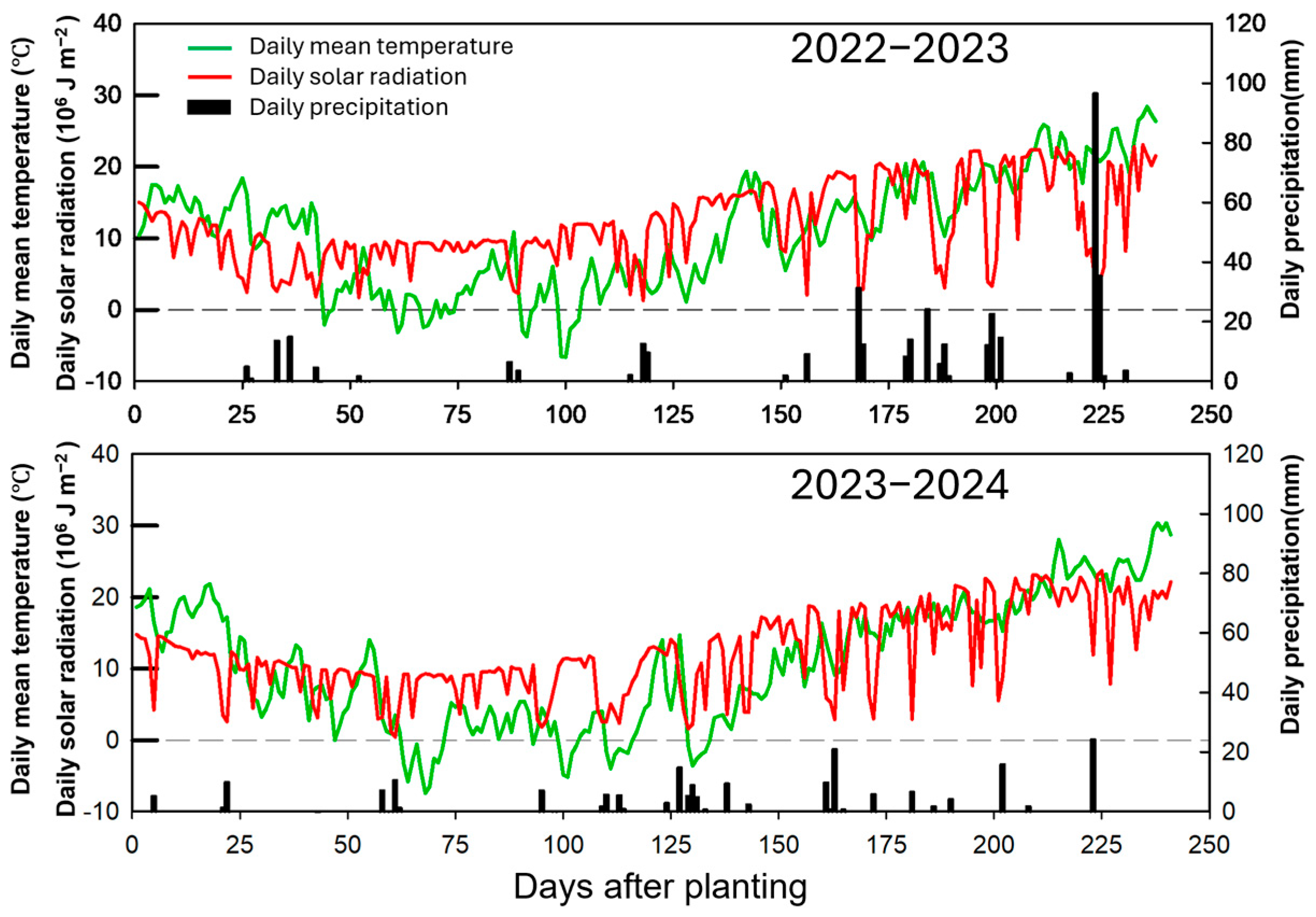
Two consecutive field trials were carried out during the 2022–2023 and 2023–2024 winter wheat seasons at Quanyuan Town, Tancheng County, Shandong Province, China (34°42′ N, 118°25′ E). The local production system is dominated by a winter wheat–summer maize rotation. Seasonal precipitation totaled 407.9 mm in 2022–2023 and 221.9 mm in 2023–2024 (Figure 7). The experimental soil was classified as a clay loam. Prior to planting, soil samples (0–20 cm) were collected in each season to characterize baseline fertility. Soil organic matter was 16.0 and 16.6 g kg−1, total N was 1.02 and 0.98 g kg−1, Olsen-P was 16.36 and 88.04 mg kg−1, available K was 142.3 and 139.0 mg kg−1, and soil pH was 8.18 and 8.22 in 2022 and 2023, respectively.

4.2. Experimental Design and Crop Management

The experiment followed a split-plot arrangement with four replications. Water and N regime (WN) was treated as the main-plot factor, and planting density was treated as the subplot factor. Individual subplots measured 7.5 m × 1.6 m and consisted of eight rows (row spacing 0.20 m). The high-yielding winter wheat cultivar ‘Linmai 9’ was used. Eight target seeding rates were established: 100, 200, 300, 400, 500, 600, 700, and 800 seeds m−2 (PD1–PD8). Seeds were planted manually at approximately 3 cm depth. Planting dates were October 17 (2022) and October 14 (2023). Stand counts at the three-leaf stage indicated high and uniform establishment, with plant-to-seed ratios of 95.2% (2022) and 95.0% (2023), and no significant differences among treatments within each season.
Basal phosphorus and potassium were applied uniformly to all plots before sowing: 120 kg P2O5 ha−1 as calcium superphosphate (16% P2O5) and 90 kg K2O ha−1 as potassium chloride (52% K2O). The total N rate was 210 kg N ha−1 (urea, 46% N) under both WN regimes, but N timing differed. In CM, 60% of N (126 kg ha−1) was incorporated as a pre-planting basal application and the remaining 40% (84 kg ha−1) was applied once at jointing.
Under the DF regime, basal N application accounted for 40% of the total N rate (84 kg ha−1), while the remaining 60% was supplied through fertigation in four split applications at green-up, jointing, booting, and anthesis, accounting for 10%, 30%, 10%, and 10% of the total N input, respectively (21, 63, 21, and 21 kg ha−1).
Irrigation schedules also differed between the two management regimes. CM plots were flood-irrigated three times during the growing season, namely before winter dormancy, at jointing, and at anthesis, with 80 mm applied at each event. In contrast, DF plots were irrigated through a drip irrigation system six times, namely before winter dormancy, at green-up, jointing, booting, anthesis, and early milk stage, with 40 mm applied at each event. Thus, the two regimes differed not only in the timing of N application, but also in irrigation method and irrigation frequency, while receiving the same total irrigation amount over the season.
Drip tapes (16 mm in diameter) were installed at 0.40 m spacing, with one tape serving two wheat rows. Emitters were spaced 0.30 m apart and had a nominal discharge rate of 1 L−1. During fertigation, urea was dissolved in water and injected into the irrigation line using a Venturi injector before being distributed to each plot. Each fertigation event lasted approximately 6 h: fertilizer injection began during the second hour and continued for about 3 h, followed by flushing with clean water to clear the lines.
To calculate fertilizer N recovery efficiency (REN) and agronomic efficiency (AEN), additional unfertilized plots corresponding to all eight planting densities under both water-management regimes were established in an adjacent field with similar soil conditions.
All plots were managed to avoid confounding stress effects. Disease and insect pressure were controlled as needed, and weeds were suppressed by herbicide applications conducted three times in each growing season.

4.3. Sampling and Measurements

The maximum stem number (main stems plus tillers) was recorded at jointing. Counts were taken in four representative central rows over 1.25 m length (equivalent to 1.0 m2). At maturity, the number of ears per unit area was determined, and the productive stem percentage was calculated as the ratio of the ears number at maturity relative to the maximum number of stems at jointing.
Leaf area and canopy development were assessed at anthesis. Plants were sampled from a representative central row over 0.50 m length (0.100 m2). Green leaf blades were separated and their area measured using a leaf area meter (LI-3100C, LI-COR, Lincoln, NE, USA). Leaf area index (LAI) was computed as
L A I = L e a f   a r e a / S a m p l e d   l a n d   a r e a
For biomass and plant N determination, whole aboveground plants were collected at anthesis and maturity from a central row segment of 0.50 m (0.100 m2) in each plot. At anthesis, samples were partitioned into stem (including sheath), leaf blade, and ear; at maturity, samples were separated into straw and grain. All plant fractions were heat-killed at 105 °C for 30 min and then oven-dried at 80 °C to constant weight for dry matter determination. Tissue N concentration (mg g−1) was measured using an automated Kjeldahl analyzer (Kjeltec 8400, FOSS, Hillerød, Denmark). Nitrogen uptake at anthesis (NA) and at maturity (NUP) was calculated as the sum of the products of dry matter and N concentration for each plant component. Post-anthesis N uptake (NPA) was calculated as the difference between NUP and NA. Based on yield and N uptake data, N use efficiency for grain production (NUEG), AEN and REN were calculated as follows:
N U E G ( k g k g 1 ) = Y i e l d / N   u p t a k e
A E N ( k g k g 1 ) = Y i e l d Y 0 / N   r a t e
R E N % = N   u p t a k e N 0 / N   r a t e × 100
where N uptake is the total aboveground N uptake at maturity, Y0 and N0 are yield and N uptake from the zero-N plots; and N rate is the applied N rate.
N nutritional status at anthesis was evaluated using the nitrogen nutrition index (NNI), which compares the measured canopy N concentration with the critical N concentration required to avoid N limitation. Specifically, NNI was defined as the quotient of the actual aboveground N concentration (Nt) and the critical N concentration (Nct):
N N I = N t / N c t
The critical N concentration (Nct) was obtained from the wheat critical N dilution relationship proposed by Justes et al. [37], expressed as a function of aboveground dry matter (DM) at anthesis:
N c t = 5.35 × D M 0.442
The actual N concentration at anthesis (Nt) was calculated from the measured aboveground N uptake and dry matter at anthesis:
N t = N A / D M A
where NA is N uptake at anthesis (kg ha−1), and DMA is dry matter at anthesis (kg ha−1).
At maturity, grain yield was determined by harvesting ears from the center of each plot over 2.0 m2 (2.0 m length across five representative rows). Grain yield was converted to a standard moisture content of 13.0%, with moisture measured using a digital tester (PM8188A, Kett Electric Laboratory, Tokyo, Japan). Grain weight was determined from three randomly selected 50.00 g subsamples; grain weight values were also corrected to 13.0% moisture. Grains per ear (GPE) were calculated as
G P E = Y i e l d / G W × E N × 1000
where Yield is grain yield per unit area (g m−2), GW is single-grain weight (mg), and EN is ear number per m2.

4.4. Data Analysis

Statistical analyses were performed with Statistix 9.0 (Analytical Software, Tallahassee, FL, USA). Data were analyzed separately for each growing season using analysis of variance (ANOVA) appropriate for a split-plot design, with water–nitrogen management regime (WN) as the main-plot factor and planting density (PD) as the subplot factor. The interaction between WN and PD was also tested within each growing season, and the corresponding error terms for the main plot and subplot were used to assess the significance of main effects and interactions. When ANOVA indicated significant effects, treatment means were compared using a single consistent post hoc procedure at the 0.05 probability level. Similarities in treatment responses between growing seasons were evaluated descriptively rather than through a combined multi-year ANOVA. Simple linear regression and quadratic curve fitting were used to quantify relationships between variables, and the coefficient of determination (r2) was reported. Graphical representations of data were produced using SigmaPlot 15.0 (Systat Software Inc., Point Richmond, CA, USA) and Origin 2021 (OriginLab Corporation, Northampton, MA, USA).

5. Conclusions

Across two growing seasons, drip fertigation (DF) increased winter wheat grain yield by 15.4–20.8% compared with conventional management (CM) across planting densities. Yield responded quadratically to planting density under both regimes, but DF shifted the optimal density upward (456–487 seeds m−2 vs. 377–378 seeds m−2 for CM) and maintained near-maximum yields across a wider density range (300–600 seeds m−2), indicating greater yield resilience. DF improved population productivity by increasing productive stem percentage and yield per ear, enhancing grain number per m2, and it promoted post-anthesis dry matter production and harvest index, reflecting stronger source capacity and better partitioning. DF also markedly increased post-anthesis N uptake (48–50%), leading to higher total N uptake and grain N accumulation, and it improved agronomic and recovery efficiencies of N use by 26.7–30.9% and 33.9–42.3%, respectively. Under the conditions of this study, DF was associated with a broader high-yield planting density range and smaller yield penalties when planting density deviated from the apparent optimum.

Author Contributions

Conceptualization, X.Z. and X.H.; methodology, X.Z. and X.H.; software, X.Z.; validation, X.H.; formal analysis, X.Z., M.Q. and D.G.; investigation, X.Z., M.Q. and F.W.; resources, F.L., S.F. and Y.W.; data curation, X.Z., M.Q. and D.G.; writing—original draft preparation, X.Z., M.Q. and F.Z.; writing—review and editing, X.H.; visualization, X.Z.; supervision, X.H.; project administration, X.H.; funding acquisition, X.Z. and X.H. All authors have read and agreed to the published version of the manuscript.

Funding

This work was supported by the Shandong Province Major Agricultural Technology Collaborative Extension Program (SDNYXTTG-2025-09); the National Major Agricultural Science and Technology Project (NK20220607); the Linyi University Undergraduate Innovation and Entrepreneurship Program (X2025104521017).

Data Availability Statement

The original contributions presented in this study are included in the article. Further inquiries can be directed to the corresponding author.

Acknowledgments

We sincerely acknowledge Yuechao Wang for his valuable assistance in data analysis and manuscript revision.

Conflicts of Interest

The authors declare no conflicts of interest.

References

  1. Xiang, K.Y.; Wang, B.; Liu, D.L.; Chen, C.; Ji, F.; Yao, S.Y.; Huete, A.; Li, Y.; Yu, Q. Future climate change increases the risk of wheat yield loss due to agricultural drought in southeastern Australia. Eur. J. Agron. 2026, 173, 127909. [Google Scholar] [CrossRef]
  2. Zhuang, H.M.; Zhang, Z.; Xu, J.L.; Han, J.C.; Cheng, F.; Tao, F. Overcoming wheat yield stagnation in China depends more on cultivar improvements than water and fertilizer management. Field Crops Res. 2025, 333, 110089. [Google Scholar] [CrossRef]
  3. Shiferaw, B.; Smale, M.; Braun, H.J.; Duveiller, E.; Reynolds, M.; Muricho, G. Crops that feed the world 10. Past successes and future challenges to the role played by wheat in global food security. Food Sec. 2013, 5, 291–317. [Google Scholar] [CrossRef]
  4. Lobell, D.B.; Schlenker, W.; Costa-Roberts, J. Climate Trends and Global Crop Production Since 1980. Science 2011, 333, 616–620. [Google Scholar] [CrossRef]
  5. Cassman, K.G. Ecological intensification of cereal production systems: Yield potential, soil quality, and precision agriculture. Proc. Natl. Acad. Sci. USA 1999, 96, 5952–5959. [Google Scholar] [CrossRef]
  6. Finch-Savage, W.E.; Bassel, G.W. Seed vigour and crop establishment: Extending performance beyond adaptation. J. Exp. Bot. 2016, 67, 567–591. [Google Scholar] [CrossRef]
  7. Dai, X.L.; Xiao, L.L.; Jia, D.Y.; Kong, H.B.; Wang, Y.C.; Li, C.C.; Zhang, Y.; He, M.R. Increased plant density of winter wheat can enhance nitrogen–uptake from deep soil. Plant Soil 2014, 384, 141–152. [Google Scholar] [CrossRef]
  8. Li, W.; Xiong, Y.L.; Tong, J.; Lin, W.; Xue, J.F.; Wang, Y.C.; Gao, Z.Q. Higher seed rates enlarge effects of wide-belt sowing on canopy radiation capture, distribution, and use efficiency in winter wheat. Plants 2024, 13, 986. [Google Scholar] [CrossRef]
  9. Hu, C.L.; Sadras, V.O.; Lu, G.Y.; Zhang, P.X.; Han, Y.; Liu, L.; Xie, J.Y.; Yang, X.Y.; Zhang, S.L. A global meta-analysis of split nitrogen application for improved wheat yield and grain protein content. Soil Tillage Res. 2021, 213, 105111. [Google Scholar] [CrossRef]
  10. Wang, Y.C.; Li, W.; Deng, Y.Y.; Xue, J.F.; Gao, Z.Q. Higher seed rates enlarge the effects of wide-belt sowing on root length density, thereby improving nitrogen uptake and use efficiencies in winter wheat. Plants 2024, 13, 2476. [Google Scholar] [CrossRef] [PubMed]
  11. Bastos, L.M.; Carciochi, W.; Lollato, R.P.; Jaenisch, B.R.; Rezende, C.R.; Schwalbert, R.; Prasad, P.V.V.; Zhang, G.R.; Fritz, A.K.; Foster, C.; et al. Wheat yield response to plant density as a function of yield environment and tillering potential: A review and field studies. Front. Plant Sci. 2020, 11, 54. [Google Scholar] [CrossRef]
  12. Foulkes, M.J.; Slafer, G.A.; Davies, W.J.; Berry, P.M.; Sylvester-Bradley, R.; Martre, P.; Calderini, D.F.; Griffiths, S.; Reynolds, M.P. Raising Yield Potential of Wheat. III. Optimizing Partitioning to Grain While Maintaining Lodging Resistance. J. Exp. Bot. 2011, 62, 469–486. [Google Scholar] [CrossRef] [PubMed]
  13. Hiltbrunner, J.; Streit, B.; Liedgens, M. Are seeding densities an opportunity to increase grain yield of winter wheat in a living mulch of white clover? Field Crops Res. 2007, 102, 163–171. [Google Scholar] [CrossRef]
  14. Liu, Y.; Liao, Y.C.; Liu, W.Z. High nitrogen application rate and planting density reduce wheat grain yield by reducing filling rate of inferior grain in middle spikelets. Crop J. 2021, 9, 412–426. [Google Scholar] [CrossRef]
  15. Dreccer, M.F.; van Oijen, M.; Schapendonk, A.H.C.M.; Pot, C.S.; Rabbinge, R. Dynamics of Vertical Leaf Nitrogen Distribution in a Vegetative Wheat Canopy. Impact on Canopy Photosynthesis. Ann. Bot. 2000, 86, 821–831. [Google Scholar] [CrossRef]
  16. Gao, Y.M.; Wang, Q.; Liu, Y.; He, J.; Chen, W.W.; Xing, J.; Sun, M.; Gao, Z.Q.; Wang, Z.M.; Zhang, M.; et al. Optimal water, nitrogen, and density management increased wheat yield by improving population uniformity. Agric. Water Manag. 2025, 310, 109362. [Google Scholar] [CrossRef]
  17. Yao, C.S.; Li, J.P.; Gao, Y.M.; Zhang, Z.; Liu, Y.; Sun, Z.C.; Wang, Z.M.; Zhang, Y.H. Delayed application of water and fertilizer increased wheat yield but did not improve quality parameters. Field Crops Res. 2024, 319, 109649. [Google Scholar] [CrossRef]
  18. Li, W.; Fan, Y.Y.; Yang, Q.; Lin, W.; Xue, J.F.; Wang, Y.C.; Gao, Z.Q. Optimizing water and nitrogen management to reduce basal nitrogen inputs, improve nitrogen uptake and utilization efficiencies, and achieve high yields and low soil nitrate residue in wheat production. Crop Environ. 2026, 5, 100113. [Google Scholar] [CrossRef]
  19. Li, H.R.; Mei, X.R.; Wang, J.D.; Huang, F.; Hao, W.P.; Li, B.G. Drip fertigation significantly increased crop yield, water productivity and nitrogen use efficiency with respect to traditional irrigation and fertilization practices: A meta-analysis in China. Agric. Water Manag. 2021, 244, 106534. [Google Scholar] [CrossRef]
  20. Abubakar, S.A.; Hamani, A.K.M.; Wang, G.S.; Liu, H.; Faisal Mehmood, F.; Abdullahi, A.S.; Gao, Y.; Duan, A.W. Growth and nitrogen productivity of drip-irrigated winter wheat under different nitrogen fertigation strategies in the North China Plain. J. Integr. Agric. 2023, 22, 908–922. [Google Scholar] [CrossRef]
  21. Fan, Y.Y.; Li, W.; Zhang, L.M.; Song, X.J.; Wang, D.P.; Xue, J.F.; Wang, Y.C.; Gao, Z.Q. Wheat nitrogen use and grain protein characteristics under no-tillage: A greater response to drip fertigation compared to intensive tillage. Agronomy 2025, 15, 588. [Google Scholar] [CrossRef]
  22. Li, J.P.; Xu, X.X.; Lin, G.; Wang, Y.Q.; Liu, Y.; Zhang, M.; Zhou, J.Y.; Wang, Z.M.; Zhang, Y.H. Micro-irrigation improves grain yield and resource use efficiency by co-locating the roots and N-fertilizer distribution of winter wheat in the North China Plain. Sci. Total Environ. 2018, 643, 367–377. [Google Scholar] [CrossRef] [PubMed]
  23. Tong, J.; Xiong, Y.L.; Lu, Y.; Li, W.; Lin, W.; Xue, J.F.; Min, S.; Wang, Y.C.; Gao, Z.Q. Drip fertigation enhances the responses of grain yield and quality to nitrogen topdressing rate in irrigated winter wheat in North China. Plants 2024, 13, 1439. [Google Scholar] [CrossRef]
  24. Tian, Z.W.; Yin, Y.Y.; Li, B.W.; Zhong, K.T.; Liu, X.X.; Jiang, D.; Cao, W.X.; Dai, T.B. Optimizing planting density and nitrogen application to mitigate yield loss and improve grain quality of late-sown wheat under rice–wheat rotation. J. Integr. Agric. 2025, 24, 2558–2574. [Google Scholar] [CrossRef]
  25. Serrago, R.A.; Alzueta, I.; Savin, R.; Slafer, G.A. Understanding grain yield responses to source–sink ratios during grain filling in wheat and barley under contrasting environments. Field Crops Res. 2013, 150, 42–51. [Google Scholar] [CrossRef]
  26. Dai, Y.L.; Liao, Z.Q.; Pei, S.Z.; Zhang, F.C.; Li, Z.J.; Fan, J.L.; Cui, Y.L. Winter wheat source-sink relationships under various planting modes, complementary irrigation, and planting densities. Agron. J. 2024, 116, 2483–2497. [Google Scholar] [CrossRef]
  27. Slafer, G.A.; Foulkes, M.J.; Reynolds, M.P.; Murchie, E.H.; Carmo-Silva, E.; Flavell, R.; Gwyn, J.; Sawkins, M.; Griffiths, S. A ‘wiring diagram’ for sink strength traits impacting wheat yield potential. J. Exp. Bot. 2023, 74, 40–71. [Google Scholar] [CrossRef] [PubMed]
  28. Bertheloot, J.; Martre, P.; Andrieu, B. Dynamics of light and nitrogen distribution during grain filling within wheat canopy. Plant Physiol. 2008, 148, 1707–1720. [Google Scholar] [CrossRef]
  29. Dueri, S.; Brown, H.; Asseng, S.; Ewert, F.; Webber, H.; George, M.; Craigie, R.; Guarin, J.R.; Pequeno, D.N.; Stella, T.; et al. Simulation of winter wheat response to variable sowing dates and densities in a high-yielding environment. J. Exp. Bot. 2022, 73, 5715–5729. [Google Scholar] [CrossRef]
  30. Wang, C.C.; Zhang, K.; Liu, Q.; Zhang, X.F.; Shi, Z.K.; Wang, X.; Guo, C.L.; Cao, Q.; Tian, Y.C.; Zhu, Y.; et al. Effects of dense planting patterns on photosynthetic traits of different vertical layers and yield of wheat under different ni-trogen rates. Crop J. 2024, 12, 594–604. [Google Scholar] [CrossRef]
  31. Monteith, J.L.; Moss, C.J. Climate and the Efficiency of Crop Production in Britain. Philos. Trans. R. Soc. B 1977, 281, 277–294. [Google Scholar] [CrossRef]
  32. Reynolds, M.; Foulkes, J.; Furbank, R.; Griffiths, S.; King, J.; Murchie, E.; Parry, M.; Slafer, G. Achieving yield gains in wheat. Plant Cell Environ. 2012, 35, 1799–1823. [Google Scholar] [CrossRef]
  33. Fan, M.S.; Shen, J.B.; Yuan, L.X.; Jiang, R.F.; Chen, X.P.; Davies, W.J.; Zhang, F.S. Improving crop productivity and resource use efficiency to ensure food security and environmental quality in China. J. Exp. Bot. 2012, 63, 13–24. [Google Scholar] [CrossRef]
  34. Ju, X.T.; Xing, G.X.; Chen, X.P.; Zhang, S.L.; Zhang, L.J.; Liu, X.J.; Cui, Z.L.; Yin, B.; Christie, P.; Zhu, Z.L.; et al. Reducing environmental risk by improving N management in intensive Chinese agricultural systems. Proc. Natl. Acad. Sci. USA 2009, 106, 3041–3046. [Google Scholar] [CrossRef] [PubMed]
  35. Cui, S.H.; Shi, Y.L.; Groffman, P.M.; Schlesinger, W.H.; Zhu, Y.G. Centennial-scale analysis of the creation and fate of reactive nitrogen in China (1910–2010). Proc. Natl. Acad. Sci. USA 2013, 110, 2052–2057. [Google Scholar] [CrossRef] [PubMed]
  36. Ladha, J.K.; Pathak, H.; Krupnik, T.J.; Six, J.; van Kessel, C. Efficiency of fertilizer nitrogen in cereal production: Retrospects and prospects. Adv. Agron. 2005, 87, 85–156. [Google Scholar]
  37. Justes, E.; Mary, B.; Meynard, J.M.; Machet, J.M.; Thelier-Huchu, L. Determination of a critical nitrogen dilution curve for winter wheat crops. Ann. Bot. 1994, 74, 397–407. [Google Scholar] [CrossRef]
Figure 1. Grain yield of winter wheat (A,B) and its quadratic curve fitting (C,D) in 2022–2023 and 2023–2024 growing seasons. Data are means and error bars are SD (n = 4). Different lowercase letters indicate that there are significant differences among the planting densities (PD) at the same water-N regime (WN) according to the least significant difference test (α = 0.05). Different uppercase letters indicate significant differences between the means of WN across the eight PD according to the least significant difference test (α = 0.05). Blue and red represent CM and DF, respectively.
Plants 15 01090 g001
Figure 2. The maximum stem number (A,B), productive stems percentage (C,D) and yield per ear (E,F) in 2022–2023 and 2023–2024 growing seasons. Data are means and error bars are SD (n = 4). Different lowercase letters indicate that there are significant differences among the planting densities (PD) at the same water and N regime (WN) according to the least significant difference test (α = 0.05). Different uppercase letters indicate significant differences between the means of WN across the eight PD according to the least significant difference test (α = 0.05). Blue and red represent CM and DF, respectively.
Plants 15 01090 g002
Figure 3. Relationship between post-anthesis dry matter accumulation and grain number under different planting densities in the 2022–2023 (A) and 2023–2024 (B) growing seasons. Vertical and horizontal dashed lines indicate the seasonal mean values of grain number and post-anthesis dry matter accumulation, respectively. The figure is intended to provide a heuristic framework for comparing treatment patterns in terms of source- and sink-related characteristics, rather than a strict physiological diagnosis based on independent biological thresholds.
Plants 15 01090 g003
Figure 4. Leaf area index (A,B) and N nutrition index (C,D) of winter wheat 2022–2023 and 2023–2024 growing seasons. Data are means and error bars are SD (n = 4). Different lowercase letters indicate that there are significant differences among the planting densities (PD) at the Same water and N regime (WN) according to the least significant difference test (α = 0.05). Different uppercase letters indicate significant differences between the means of WN across the eight PD according to the least significant difference test (α = 0.05). The pink horizontal dashed line indicates NNI = 1.0. Blue and red represent CM and DF, respectively.
Plants 15 01090 g004
Figure 5. Nitrogen use efficiency for grain production (NUEG, A,B), agronomic efficiency of N fertilizer (AEN, C,D), and recovery efficiency of N fertilizer (REN, E,F) in 2022–2023 and 2023–2024 growing seasons. Data are means and error bars are SD (n = 4). Different lowercase letters indicate that there are significant differences among the planting densities (PD) at the same water and N regime (WN) according to the least significant difference test (α = 0.05). Different uppercase letters indicate significant differences between the means of WN across the eight PD according to the least significant difference test (α = 0.05).
Plants 15 01090 g005
Figure 6. Relationships among grain yield, grain number, post-anthesis dry matter production (DMPA), N uptake at anthesis (NA), post-anthesis N uptake (NPA), and total nitrogen uptake at maturity (NUP) across planting densities and water–nitrogen management regimes in the 2022–2023 and 2023–2024 growing seasons.
Plants 15 01090 g006
Figure 7. Daily mean temperature, solar radiation, and precipitation in 2022–2023 and 2023–2024 growing seasons.
Plants 15 01090 g007
Table 1. Ear number (EN), grains per ear (GPE), grain weight (GW) and grain number (GN) of winter wheat in the 2022–2023 and 2023–2024 growing seasons.
WNPD2022–20232023–2024
(m−2)EN
(m−2)
GPEGW
(mg)
GN
(103 m−2)
EN
(m−2)
GPEGW
(mg)
GN
(103 m−2)
CM100359.2 g38.8 a50.8 a13.9 f367.0 g39.3 a47.2 a14.4 g
 200463.7 f38.7 a48.1 b17.9 cd474.1 f38.3 ab44.4 b18.1 e
 300552.3 e35.8 b46.3 c19.8 a568.0 e36.8 b41.3 c20.9 bc
 400620.7 d32.3 c45.7 c20.0 a630.4 d34.2 c40.3 d21.6 a
 500664.4 c29.6 d44.2 d19.7 ab680.6 c31.1 d38.9 e21.2 ab
 600694.3 b27.0 e40.9 e18.8 bc717.9 b28.4 e35.7 f20.4 c
 700729.9 a24.0 f38.1 f17.5 d749.3 ab25.0 f33.1 g18.7 d
 800745.9 a21.7 g32.7 g16.2 e775.1 a22.0 g29.6 h17.1 f
  Mean 603.8 B31.0 B43.3 B18.0 B620.3 B31.9 B38.8 B19.0 B
DF100366.5 g38.0 a51.1 a13.9 e375.8 g38.2 a48.4 a14.3 d
 200482.5 f37.3 a48.6 b18.0 d493.6 f37.2 a45.1 b18.4 c
 300580.3 d35.9 b46.7 c20.9 c600.8 e36.0 b43.3 c21.6 b
 400654.2 d34.3 c45.3 d22.5 ab667.3 d35.0 b42.2 d23.3 a
 500708.8 c32.4 d44.3 e22.9 a729.2 c32.7 c41.6 d23.8 a
 600751.6 b30.0 e42.9 f22.5 ab763.8 bc31.4 d40.4 e24.0 a
 700784.3 ab27.8 f40.3 g21.8 b797.7 ab29.2 e38.9 f23.3 a
 800800.4 a25.9 g36.4 h20.7 c817.3 a27.1 f36.3 g22.2 b
 Mean641.1 A32.7 A44.4 A20.4 A655.7 A33.3 A42.0 A21.4 A
ANOVA---------------------------------------------p value-------------------------------------------
WN 0.0010.0030.0040.0010.0010.009<0.0010.001
PD <0.001<0.001<0.001<0.001<0.001<0.001<0.001<0.001
WN × PD 0.252<0.001<0.001<0.0010.619<0.001<0.001<0.001
Different uppercase letters indicate a significant difference between the means of water-N regimes (WN) across eight planting densities (PD) according to the least significant difference test (α = 0.05). Within a column and a specific WN, different lowercase letters indicate significant differences between planting densities according to the least significant difference test (α = 0.05).
Table 2. Dry matter production at anthesis (DMA), after anthesis (DMPA), at maturity (DM) and harvest index (HI) of winter wheat in the 2022–2023 and 2023–2024 growing seasons.
WNPD2022–20232023–2024
DMADMPADMHIDMADMPADMHI
(m−2)(kg ha−1)(%)(kg ha−1)(%)
CM1006668 e5657 d12,325 e50.0 a7153 e5365 c12,518 e47.2 a
 2008409 d6712 b15,120 c49.6 a9250 d6070 b15,320 c45.7 ab
 30010,034 c7035 a17,069 ab46.6 b10,669 c6378 a17,047 ab44.0 b
 40010,671 b6867 ab17,538 a45.4 bc11,321 abc6206 ab17,527 a43.1 bc
 50010,970 ab6211 d17,181 ab44.1 c11,739 a5616 c17,355 ab41.3 c
 60011,141 a5236 e16,377 b40.7 d11,751 a4819 d16,571 b38.3 d
 70010,997 ab4313 f15,310 c37.8 e11,474 ab3949 e15,423 c34.9 e
 80010,771 ab3381 g14,152 d32.5 f10,995 bc3049 f14,044 d31.3 f
 Mean9958 B5676 B15,634 B43.3 B10,544 B5182 B15,725 B 40.7 B
DF1006572 e5713 c12,285 f50.4 a7181 e5357 e12,538 e48.2 a
 2008497 d6847 b15,344 e49.5 ab9421 d6118 c15,539 d46.4 ab
 30010,360 c7473 a17,833 cd47.5 bc11,036 c6756 a17,793 bc45.7 bc
 40011,613 b7618 a19,231 ab46.0 cd12,106 b7024 a19,130 a44.8 bcd
 50012,232 ab7441 a19,673 a44.9 de12,695 a6840 a19,535 a44.1 cd
 60012,567 a6732 b19,300 ab43.5 ef12,751 a6421 b19,172 a44.0 cd
 70012,482 a5862 c18,345 bc41.6 f12,742 a5656 d18,399 ab42.8 de
 80012,159 ab4772 d16,931 d38.7 g12,347 ab4578 f16,925 d41.4 e
 Mean10,810 A6557 A17,368 A45.3 A11,285 A6094 A17,379 A44.7 A
ANOVA-------------------------------------------------p value-----------------------------------------
WN 0.003<0.0010.0020.038<0.001<0.0010.001<0.001
PD <0.001<0.001<0.001<0.001<0.001<0.001<0.001<0.001
WN × PD <0.001<0.001<0.0010.0010.018<0.001<0.001<0.001
Different uppercase letters indicate a significant difference between the means of Water and N regimes (WN) across eight planting densities (PD) according to the least significant difference test (α = 0.05). Within a column and a specific WN, different lowercase letters indicate significant differences between PD according to the least significant difference test (α = 0.05).
Table 3. N uptake at anthesis (NA), after anthesis (NPA), at maturity (NUP) and grain N accumulation (GNA) of winter wheat in the 2022–2023 and 2023–2024 growing seasons.
WNPD2022–20232023–2024
NANPANUPGNANANPANUPGNA
 (m−2)(kg ha−1)(kg ha−1)
CM100170.6 e28.2 d198.8 d149.7 d177.2 d24.9 c202.1 c147.3 d
 200187.8 d39.1 b227.0 b183.6 b199.8 bc30.7 b230.5 b175.1 b
 300203.2 ab45.7 a248.9 a193.7 a212.5 a36.3 a248.8 a185.5 a
 400207.1 a46.7 a253.8 a196.6 a216.3 a38.2 a254.5 a191.4 a
 500206.9 ab46.4 a253.3 a191.7 a215.6 a36.0 a251.6 a184.8 a
 600205.8 ab40.2 b246.0 a171.4 c213.5 a30.7 b244.2 a166.3 c
 700198.6 bc33.1 c231.7 b152.3 d204.6 b25.9 c230.5 b145.9 d
 800191.2 cd20.3 e211.5 d121.5 e194.0 c16.7 d210.7 c118.3 e
 Mean196.4 B37.5 B233.9 B170.1 B204.2 B29.9 B234.1 B 164.3 B
DF100169.2 e30.4 d199.6 f150.4 g178.2 d26.5 e204.6 f150.7 e
 200192.0 d45.7 c237.7 e186.2 e205.0 d36.9 d241.9 e180.1 d
 300212.5 c57.0 b269.5 c209.9 c222.3 ab45.3 b267.5 cd205.5 b
 400224.6 a67.5 a292.1 a221.5 a231.3 a52.8 a284.1 ab219.8 a
 500227.4 a68.7 a296.1 a222.8 a233.2 a54.7 a287.9 a221.4 a
 600226.6 a66.2 a292.8 a214.9 b230.7 ab53.2 a283.9 ab220.9 a
 700220.9 ab60.4 b281.3 b197.2 d226.9 ab47.3 b274.2 bc208.6 b
 800213.3 bc47.4 c260.7 d171.4 f219.7 b40.9 c260.6 d188.7 c
 Mean210.8 A55.4 A266.2 A196.8 A218.4 A44.7 A263.1 A199.5 A
ANOVA------------------------------------------------p value--------------------------------------------
WN <0.001<0.001<0.001<0.001<0.001<0.001<0.001<0.001
PD <0.001<0.001<0.001<0.001<0.001<0.001<0.001<0.001
WN × PD <0.001<0.001<0.001<0.0010.006<0.001<0.001<0.001
Different uppercase letters indicate a significant difference between the means of water-N regimes (WN) across eight planting densities (PD) according to the least significant difference test (α = 0.05). Within a column and a specific WN, different lowercase letters indicate significant differences between planting densities according to the least significant difference test (α = 0.05).
Disclaimer/Publisher’s Note: The statements, opinions and data contained in all publications are solely those of the individual author(s) and contributor(s) and not of MDPI and/or the editor(s). MDPI and/or the editor(s) disclaim responsibility for any injury to people or property resulting from any ideas, methods, instructions or products referred to in the content.