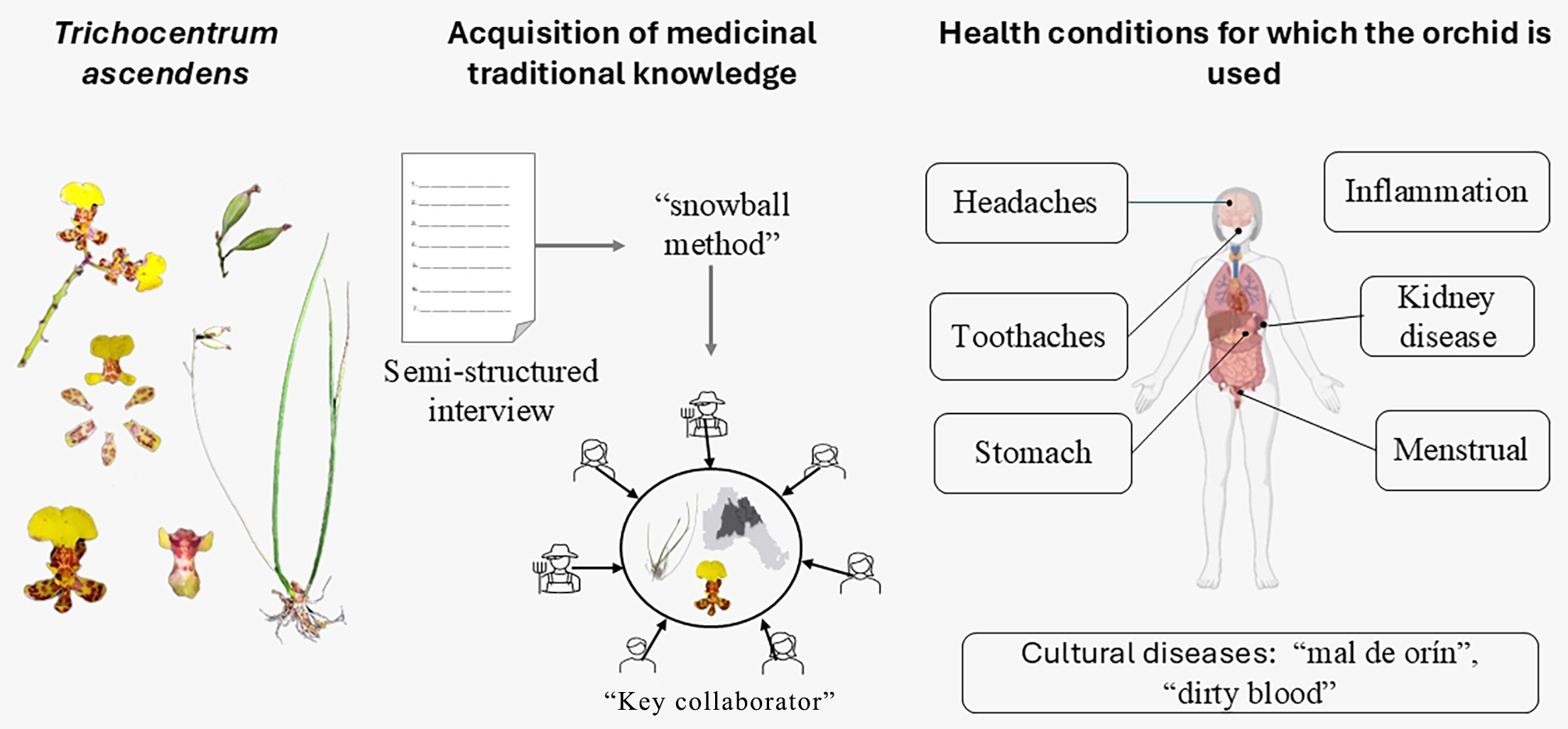
Ethnomedicinal Knowledge of Trichocentrum ascendens (Orchidaceae) in an Indigenous Region of Oaxaca, Mexico

 , ,
, ,  and
and
Abstract
1. Introduction
2. Results
2.1. Socioeconomic Aspects of the Collaborators
2.2. Medicinal Practices
3. Discussion
4. Materials and Methods
4.1. Study Zone
4.2. Ethics Approval and Consent to Participate
4.3. Collection of Information
5. Conclusions
Author Contributions
Funding
Data Availability Statement
Acknowledgments
Conflicts of Interest
References
- Villaseñor, J.L. Checklist of the native vascular plants of Mexico. Rev. Mex. Biodivers. 2016, 87, 559–902. [Google Scholar] [CrossRef]
- Rodríguez-Hernández, A.A.; Flores-Soria, F.G.; Patiño-Rodríguez, O.; Escobedo-Moratilla, A. Sanitary registries and popular medicinal plants used in medicines and herbal remedies in Mexico (2001–2020): A review and potential perspectives. Horticulturae 2022, 8, 377. [Google Scholar] [CrossRef]
- Cruz-Pérez, L.A.; Barrera-Ramos, J.; Bernal-Ramírez, A.; Bravo-Avilez, D.; Rendón-Aguilar, B. Actualized inventory of medicinal plants used in traditional medicine in Oaxaca, Mexico. J. Ethnobiol. Ethnomed. 2021, 17, 7. [Google Scholar] [CrossRef]
- Huerta-Martínez, F.M. Traditional use of biodiversity for nutrition and health in the Americas: A case study from Mexico. In Ethnic Knowledge and Perspectives of Medicinal Plants: Volume 1: Curative Properties and Treatment Strategies; Apple Academic Press: Waretown, NJ, USA, 2023; pp. 3–52. [Google Scholar]
- Cabada-Aguirre, P.; López-López, A.M.; Mendoza, K.C.O.; Garay-Buenrostro, K.D.; Luna-Vital, D.A.; Mahady, G.B. Mexican traditional medicines for women’s reproductive health. Sci. Rep. 2023, 13, 2807. [Google Scholar] [CrossRef]
- Ortega-Villaseñor, H. Indigenous peoples, memory and envisioning the future. A brief multidimensional study. J. Ethn. Cult. Stud. 2022, 9, 39–55. [Google Scholar] [CrossRef]
- Caballero, J.; Cortés, L.; Martínez-Alfaro, M.; Lira-Saade, R. Uso y manejo tradicional de la diversidad vegetal. In Biodiversidad de Oaxaca; García-Mendoza, A.J., Ordoñez, M.J., Briones-Salas, M.A., Eds.; Instituto de Biología, Universidad Nacional Autónoma de México: Fondo Oaxaqueño para la Conservación de la Biodiversidad-World Wildlife Fund: Mexico City, Mexico, 2004; pp. 541–564. [Google Scholar]
- Meave, J.A.; Rincón-Gutiérrez, A.; Ibarra-Manríquez, G.; Gallardo-Hernández, C.; Romero-Romero, M.A. Checklist of the vascular flora of a portion of the hyper-humid region of La Chinantla, Northern Oaxaca Range, Mexico. Bot. Sci. 2017, 95, 722–759. [Google Scholar] [CrossRef]
- Hossain, M.M. Therapeutic orchids: Traditional uses and recent advances—An overview. Fitoterapia 2011, 82, 102–140. [Google Scholar] [CrossRef] [PubMed]
- Teoh, E.S. Medicinal Orchids of Asia; Springer: Cham, Switzerland, 2016. [Google Scholar]
- Teoh, E.S. (Ed.) Medicinal Orchids of Central America. In Orchids as Aphrodisiac, Medicine or Food; Springer International Publishing: Cham, Switzerland, 2019; pp. 139–158. [Google Scholar]
- Camelo-Júnior, A.E.; Ferreira, A.W.C.; Andrade, I.M.; Mayo, S.J.; Nollet, F.; Silva, J.L.; Barros, M.C.; Fraga, E.; Pessoa, E.M. Species delimitation in the Trichocentrum cepula (Oncidiinae, Orchidaceae) complex: A multidisciplinary approach. Syst. Biodivers. 2022, 20, 1–18. [Google Scholar] [CrossRef]
- Cetzal-Ix, W.; Carnevali, G.; Castro, V.P. Cohniella (Orchidaceae: Oncidiinae) south of the Amazon River. Syst. Bot. 2012, 37, 58–77. [Google Scholar] [CrossRef]
- Cetzal-Ix, W.; Carnevali, G.; Noguera-Savelli, E.; Romero-González, G.A. What is Cohniella cebolleta? recircumscription and new and reinstated species and combinations (Orchidaceae). Syst. Bot. 2013, 38, 606–623. [Google Scholar] [CrossRef]
- Jacquin, N.J. Selectarum Stirpium Americanarum Historia in qua ad Linnaeanum Systema Determinatae Descriptae que Sistuntor Plantae Illae, Quas in Insulis Martinica, Jamaica, Domingo Aliisque et in Vicinae Continentis Parte, Observavit Rariores, Adspectis Iconibus in Solo Delineatis; Office Krausiana: Vienna, Austria, 1763. [Google Scholar]
- Ossenbach, C. Orchids and orchidology in Central America. 500 years of history. Lankesteriana 2009, 9, 1–228. [Google Scholar] [CrossRef]
- Teoh, E.S. (Ed.) Orchids as Aphrodisiac, Medicine or Food; Springer International Publishing: Cham, Switzerland, 2019. [Google Scholar]
- Stermitz, F.R.; Suess, T.R.; Schauer, C.K.; Anderson, O.P.; Bye, R.A. New and old phenanthrene derivatives from Oncidium cebolleta, a peyote-replacement plant. J. Nat. Prod. 1983, 46, 417–423. [Google Scholar] [CrossRef]
- Carnevali, G.; Cetzal-Ix, W.; Narváez, R.B.; Romero-González, G.A. A synopsis of Cohniella (Orchidaceae, Oncidiinae). Brittonia 2010, 62, 153–177. [Google Scholar] [CrossRef]
- Perez-Barron, G.; Estrada-Soto, S.; Arias-Duran, L.; Cruz-Torres, K.C.; Ornelas-Mendoza, K.; Bernal-Fernandez, G.; Perea-Arango, I.; Villalobos-Molina, R. Calcium channel blockade mediates the vasorelaxant activity of dichloromethane extract from roots of Oncidium cebolleta on isolated rat aorta. Biointerface Res. Appl. Chem. 2023, 13, 80. [Google Scholar] [CrossRef]
- Alemán-Pantitlán, S. 4,8-Dihidroxi-2-Metoxi-9,10-Dihidrofenantreno: Un Nuevo Estilbenoide de Oncidium pachyphyllum Con Actividad Vasorrelajante. Ph.D. Thesis, Universidad Autónoma del Estado de Morelos, Cuernavaca, Mexico, 2008. [Google Scholar]
- Alemán-Pantitlán, S. Determinación del Mecanismo de Acción del 4,8-Dihidroxi-2-Metoxi-9,10-Dihidrofenantreno Oncidium Pachyphyllum; Universidad Autónoma del Estado de Morelos: Cuernavaca, Mexico, 2011. [Google Scholar]
- Hágsater, E.; Soto-Arenas, M.A.; Salazar-Chávez, G.A.; Jiménez-Machorro, R.; López-Rosas, M.A.; Dressler, R.L. Las Orquídeas de México; Instituto Chinoin: Mexico City, Mexico, 2005. [Google Scholar]
- Abdala-Roberts, L.; Parra-Tabla, V.; Navarro, J. Is Floral Longevity Influenced by Reproductive Costs and Pollination Success in Cohniella ascendens (Orchidaceae)? Ann. Bot. 2007, 100, 1367–1371. [Google Scholar] [CrossRef] [PubMed]
- Parra-Tabla, V.c.; Vargas, C.F.; Magaña-Rueda, S.; Navarro, J. Female and male pollination success of Oncidium ascendens Lindey (Orchidaceae) in two contrasting habitat patches: Forest vs agricultural field. Biol. Conserv. 2000, 94, 335–340. [Google Scholar] [CrossRef]
- Cetzal-Ix, W.; Carnevali, G. A revision of Cohniella Pfitzer (Orchidaceae) in Mexico. J. Torrey Bot. Soc. 2010, 137, 180–213. [Google Scholar] [CrossRef]
- Ankli, A.S. Yucatec Mayan Medicinal Plants: Ethnobotany, Biological Evaluation and Phytochemical Study of Crossopetalum gaumeri. Ph.D. Thesis, Swiss Federal Institute of Technology (ETH Zurich), Zurich, Switzerland, 2000. [Google Scholar]
- Asseleih, L.M.C.; García, R.A.M.; Cruz, J.Y.S.R. Ethnobotany, pharmacology and chemistry of medicinal orchids from Veracruz. J. Agric. Sci. Technol. A 2015, 5, 745–754. [Google Scholar] [CrossRef][Green Version]
- Bussmann, R.W.; Glenn, A.; Sharon, D. Healing the body and soul: Traditional remedies for “magical” ailments, nervous system and psychosomatic disorders in Northern Peru. Afr. J. Pharm. Pharmacol. 2010, 4, 580–629. [Google Scholar]
- Zamora-Martinez, M.C.; de Pascual-Pola, C.N. Medicinal plants used in some rural populations of Oaxaca, Puebla and Veracruz, Mexico. J. Ethnopharmacol. 1992, 35, 229–257. [Google Scholar] [CrossRef]
- de la Rosa-Manzano, E.; Andrade, J.L.; García-Mendoza, E.; Zotz, G.; Reyes-García, C. Photoprotection related to xanthophyll cycle pigments in epiphytic orchids acclimated at different light microenvironments in two tropical dry forests of the Yucatan Peninsula, Mexico. Planta 2015, 242, 1425–1438. [Google Scholar] [CrossRef]
- Neneng, L.; Nawan, N.; Naibaho, F.G.; Rahman, S.; Septya, L.; Panjaitan, D.; Lestari, R.W.; Irsyam, A.S.D.; Norwahyunie, N.; Noraini, N. Botanical survey of ethnomedicines in Dayak sub-ethnic groups, Ot Danum and Tomum in Central Kalimantan, Indonesia. Biodiversitas 2025, 26, 458–469. [Google Scholar] [CrossRef]
- Pahwa, M.; Cavanagh, A.; Vanstone, M. Key Informants in Applied Qualitative Health Research. Qual. Health Res. 2023, 33, 1251–1261. [Google Scholar] [CrossRef]
- Muellmann, S.; Brand, T.; Jürgens, D.; Gansefort, D.; Zeeb, H. How many key collaborators are enough? Analysing the validity of the community readiness assessment. BMC Res. Notes 2021, 14, 85. [Google Scholar] [CrossRef]
- Mushir, A.; Jahan, N.; Sofi, G. Exploration of Unani concept of blood purifying drugs and likely models for its screening. Bangladesh J. Med. Sci. 2019, 18, 312–321. [Google Scholar] [CrossRef]
- Van Vuuren, S.; Frank, L. Review: Southern African medicinal plants used as blood purifiers. J. Ethnopharmacol. 2020, 249, 112434. [Google Scholar] [CrossRef]
- Estivi, L.; Buratti, S.; Fusi, D.; Benedetti, S.; Rodríguez, G.; Brandolini, A.; Hidalgo, A. Alkaloid content and taste profile assessed by electronic tongue of Lupinus albus seeds debittered by different methods. J. Food Compos. Anal. 2022, 114, 104810. [Google Scholar] [CrossRef]
- Alijanpour, S.; Jafaripour, S.; Ghasemzadeh, Z.; Khakpai, F.; Zarrindast, M.R. Harmaline potentiates morphine-induced antinociception via affecting the ventral hippocampal GABA-A receptors in mice. Eur. J. Pharmacol. 2021, 893, 173806. [Google Scholar] [CrossRef] [PubMed]
- Shi, M.M.; Piao, J.H.; Xu, X.L.; Zhu, L.; Yang, L.; Lin, F.L.; Chen, J.; Jiang, J.G. Chinese medicines with sedative-hypnotic effects and their active components. Sleep Med. Rev. 2016, 29, 108–118. [Google Scholar] [CrossRef] [PubMed]
- Deciga-Campos, M.; Palacios-Espinosa, J.F.; Reyes-Ramirez, A.; Mata, R. Antinociceptive and anti-inflammatory effects of compounds isolated from Scaphyglottis livida and Maxillaria densa. J. Ethnopharmacol. 2007, 114, 161–168. [Google Scholar] [CrossRef]
- Toth, B.; Hohmann, J.; Vasas, A. Phenanthrenes: A promising group of plant secondary metabolites. J. Nat. Prod. 2018, 81, 661–678. [Google Scholar] [CrossRef]
- Yáñez-Barrientos, E.; González-Ibarra, A.A.; Wrobel, K.; Wrobel, K.; Corrales-Escobosa, A.R.; Alonso-Castro, A.J.; Carranza-Álvarez, C.; Ponce-Hernández, A.; Isiordia-Espinoza, M.A.; Ortiz-Andrade, R.; et al. Antinociceptive effects of Laelia anceps Lindl. and Cyrtopodium macrobulbon (Lex.) G.A. Romero & Carnevali, and comparative evaluation of their metabolomic profiles. J. Ethnopharmacol. 2022, 291, 115172. [Google Scholar] [CrossRef] [PubMed]
- Velasco-Murguía, A.; Medina, E.D.; Rivera, R.; Bray, D.B. Cambios en la cobertura arbolada de comunidades indígenas con y sin iniciativas de conservación, en Oaxaca, México. Investig. Geogr. Bol. Inst. Geogr. 2014, 55–73. [Google Scholar] [CrossRef][Green Version]
- Berget, C.; Duran, E.; Bray, D.B. Participatory restoration of degraded agricultural areas invaded by bracken fern (Pteridium aquilinum) and conservation in the Chinantla region, Oaxaca, Mexico. Hum. Ecol. 2015, 43, 547–558. [Google Scholar] [CrossRef]
- Rodríguez-Robayo, K.J.; Perevochtchikova, M.; Ávila-Foucat, S.; De la Mora De la Mora, G. Influence of local context variables on the outcomes of payments for ecosystem services. Evidence from San Antonio del Barrio, Oaxaca, Mexico. Environ. Dev. Sustain. 2020, 22, 2839–2860. [Google Scholar] [CrossRef]
- Ellestad, P.; Farrera, M.A.P.; Forest, F.; Buerki, S. Uncovering haplotype diversity in cultivated Mexican vanilla species. Am. J. Bot. 2022, 109, 1120–1138. [Google Scholar] [CrossRef]
- Ticktin, T.; Johns, T. Chinanteco management of Aechmea Magdalenae: Implications for the use of TEK and TRM in management plans. Econ. Bot. 2002, 56, 177–191. [Google Scholar] [CrossRef]
- Wilsey, D.S.; Hildebrand, P.E. Chamaedorea Palm Frond Commercialization and Certification Considered from a Smallholder Livelihood System Perspective. Small-Scale For. 2011, 10, 67–81. [Google Scholar] [CrossRef]
- Briones-Salas, M.; Galindo-Aguilar, R.E.; González, G.E.; Luna-Krauletz, M.D. Diversity and conservation of mammals in indigenous territories of southern Mexico: Proposal for an “Archipelago Reserve”. PeerJ 2023, 11, e16345. [Google Scholar] [CrossRef]
- Waters, J. Snowball sampling: A cautionary tale involving a study of older drug users. Int. J. Soc. Res. Methodol. 2015, 18, 367–380. [Google Scholar] [CrossRef]



| Informant | Gender | Age | Occupation | Education | Place of Residence | Language | Medicinal Use | Knowledge Source |
|---|---|---|---|---|---|---|---|---|
| 1 | F | 29 | Medicinal plant traders | HS | Santa María Jacatepec | S | Stomachache, headache, swelling, coughing | Traditional medicine practicioner |
| 2 | M | 42 | Farmer | UG | La Gran Lucha, Valle Nacional | Bl | Headache and toothache | Father |
| 3 | M | 58 | Traditional healer | NS | San José Chiltepec | Bl | Kidney disease | Great-grandfather |
| 4 | F | 31 | Traditional healer | UG | Ejido Emiliano Zapata, Santa María Jacatepec | Bl | “Mal de orin” and “sangre sucia” | Mother |
| 5 | F | 59 | Traditional healer | PES | Ejido Emiliano Zapata, Santa María Jacatepec | Bl | “Mal de orin” and “sangre sucia”, painful menstruation | Great aunt |
| 6 | M | 37 | Farmer | HS | Plan de Águila, San José Chiltepec | Bl | Headache | Family |
| 7 | F | 32 | Seasonal vendor 1 | UG | Plan de Águila, San José Chiltepec | S | Headache and body pain | Family |
| Condition | Plant Part Used | Preparation | Dosage | Patient Type |
|---|---|---|---|---|
| Stomachache | Leaves | Infusion | “Agua de tiempo” max. 3 days (small leaf piece) | All ages |
| Headache | Leaves | Infusion | “Agua de tiempo” max. 3 days (small leaf piece) | All ages |
| Menstrual pain | Leaves | Infusion | “Agua de tiempo”; 2×/day, max. 3 days (small leaf piece) | Women |
| Toothache | Leaves | Crushed | A drop of the crushed leaves, when the pain occurs | All ages |
| Body pain | Leaves | Infusion | “Agua de tiempo”; max. 3 days (small leaf piece) | All ages |
| Inflammation | Leaves | Infusion | 3×/day, max. 3 days (small leaf piece) | All ages |
| Kidney diseases | Leaves | Infusion | 3×/day, max. 3 days (small leaf piece) | All ages |
| “Mal de orin” | Leaves | Infusion | 3×/day, max. 3 days (small leaf piece) | All ages |
| “Sangre sucia” | Leaves | Infusion | 3×/day, max. 3 days (small leaf piece) | All ages |
| Cough | Leaves | Infusion | “Agua de tiempo” max. 3 days (small leaf piece) | All ages |
Disclaimer/Publisher’s Note: The statements, opinions and data contained in all publications are solely those of the individual author(s) and contributor(s) and not of MDPI and/or the editor(s). MDPI and/or the editor(s) disclaim responsibility for any injury to people or property resulting from any ideas, methods, instructions or products referred to in the content. |
© 2026 by the authors. Licensee MDPI, Basel, Switzerland. This article is an open access article distributed under the terms and conditions of the Creative Commons Attribution (CC BY) license.
Share and Cite
García-Patiño, M.A.; Lagunez-Rivera, L.; Barragán-Zárate, G.S.; Ríos-Solis, J.A.; Solano, R. Ethnomedicinal Knowledge of Trichocentrum ascendens (Orchidaceae) in an Indigenous Region of Oaxaca, Mexico. Plants 2026, 15, 873. https://doi.org/10.3390/plants15060873
García-Patiño MA, Lagunez-Rivera L, Barragán-Zárate GS, Ríos-Solis JA, Solano R. Ethnomedicinal Knowledge of Trichocentrum ascendens (Orchidaceae) in an Indigenous Region of Oaxaca, Mexico. Plants. 2026; 15(6):873. https://doi.org/10.3390/plants15060873
Chicago/Turabian StyleGarcía-Patiño, Mayra Ariadna, Luicita Lagunez-Rivera, Gabriela Soledad Barragán-Zárate, Jesús Alejandro Ríos-Solis, and Rodolfo Solano. 2026. "Ethnomedicinal Knowledge of Trichocentrum ascendens (Orchidaceae) in an Indigenous Region of Oaxaca, Mexico" Plants 15, no. 6: 873. https://doi.org/10.3390/plants15060873
APA StyleGarcía-Patiño, M. A., Lagunez-Rivera, L., Barragán-Zárate, G. S., Ríos-Solis, J. A., & Solano, R. (2026). Ethnomedicinal Knowledge of Trichocentrum ascendens (Orchidaceae) in an Indigenous Region of Oaxaca, Mexico. Plants, 15(6), 873. https://doi.org/10.3390/plants15060873