Early Plant Development as a Systems-Level Trait: Integrating Omics, Artificial Intelligence, and Emerging Biotechnologies

Abstract
1. Introduction
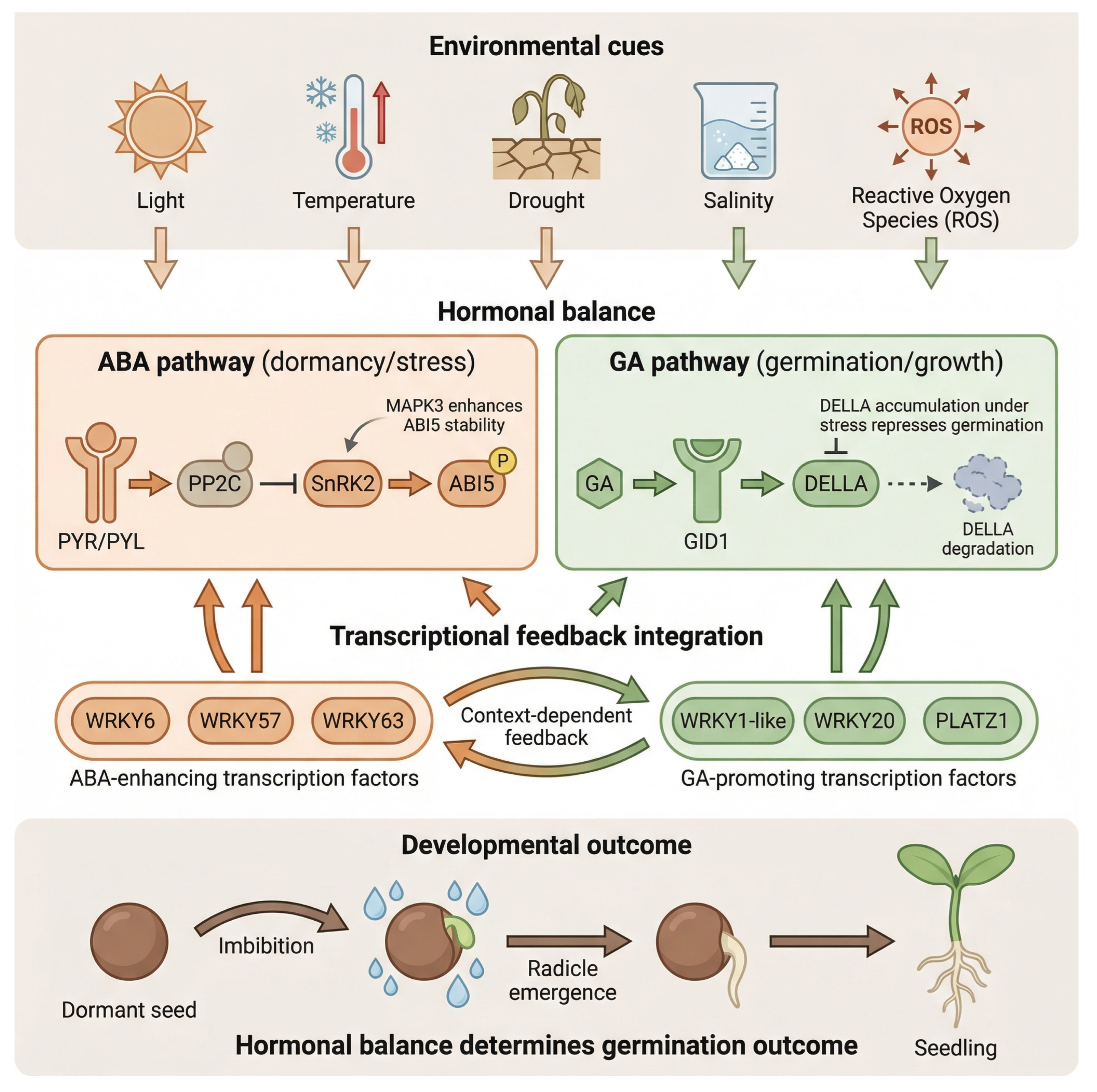
2. Key Regulatory Components Governing Hormone-Responsive Germination
3. Biotechnological Innovations for Trait Enhancement
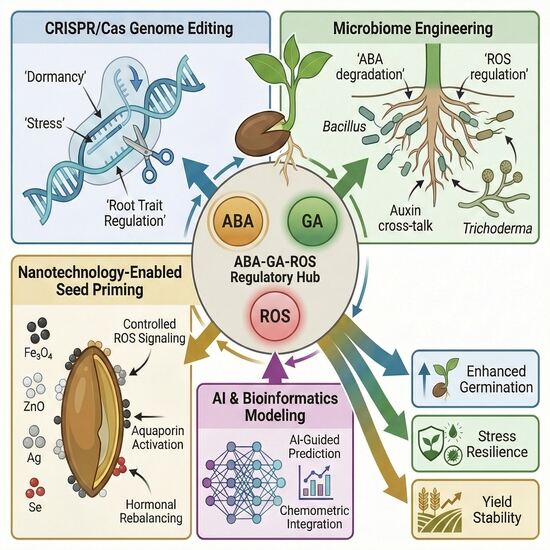
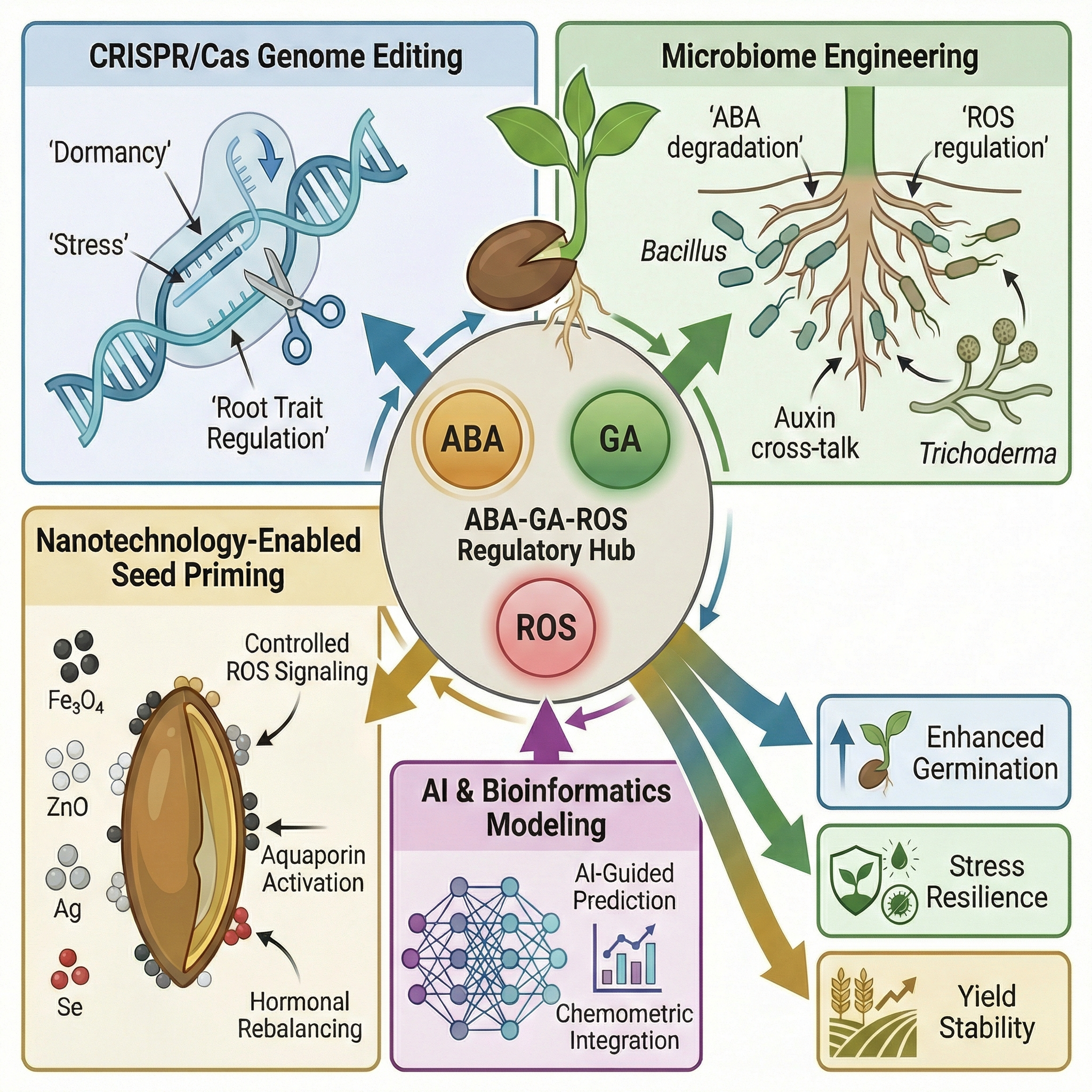
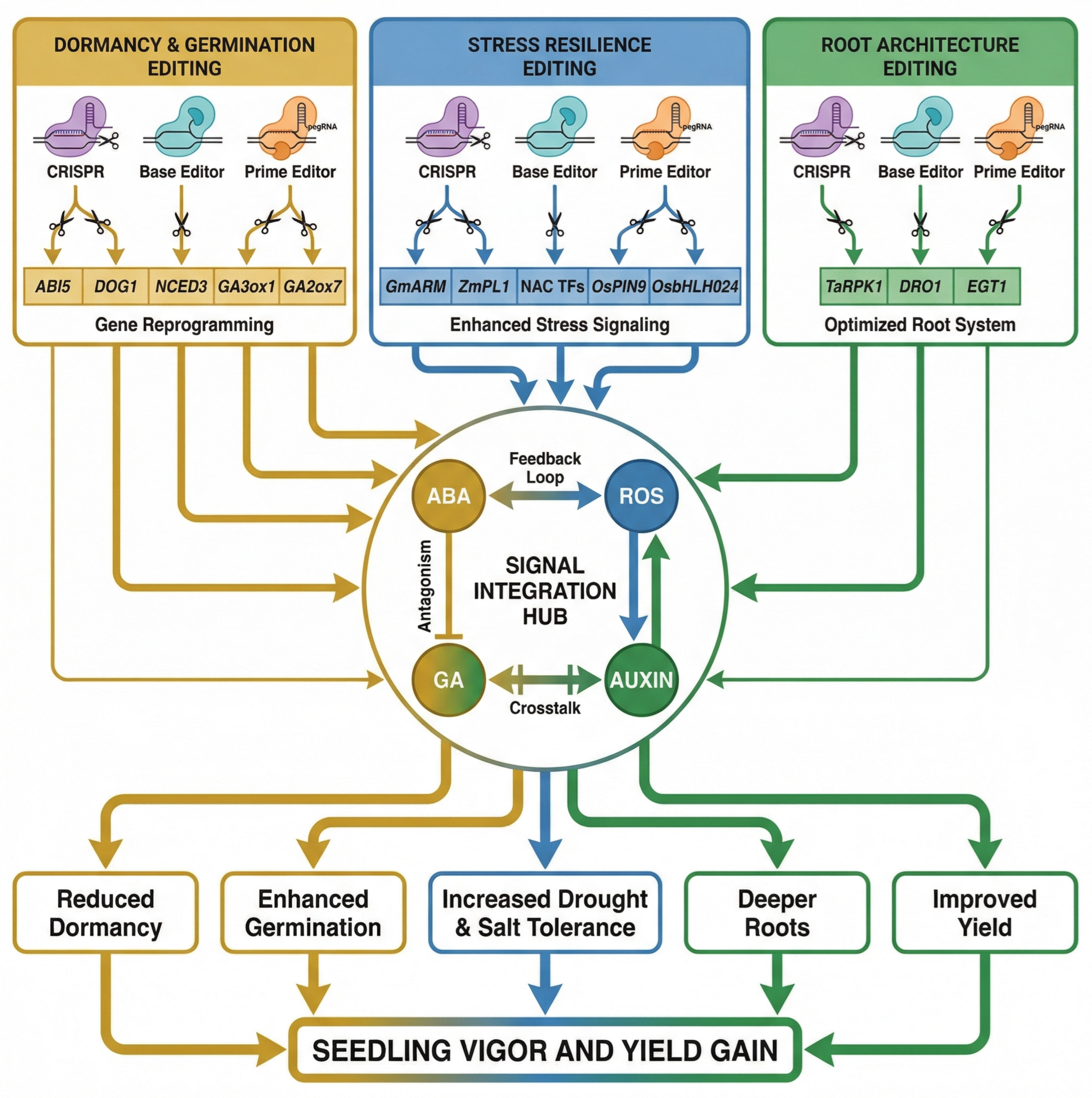
3.1. CRISPR/Cas-Based Modulation of Dormancy, Stress, and Root Traits
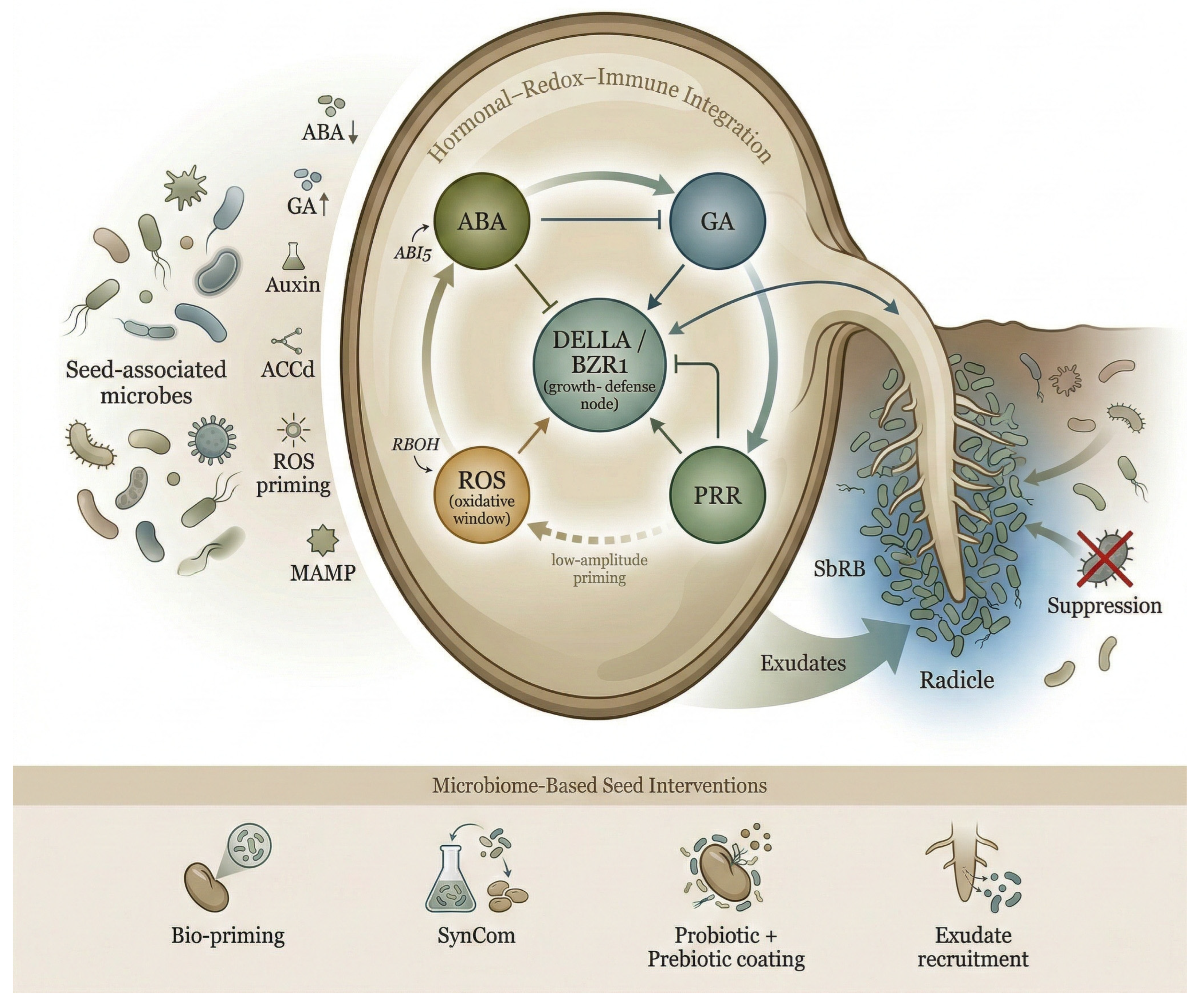
3.2. Microbiome-Assisted Germination and Root-Soil Interaction Engineering
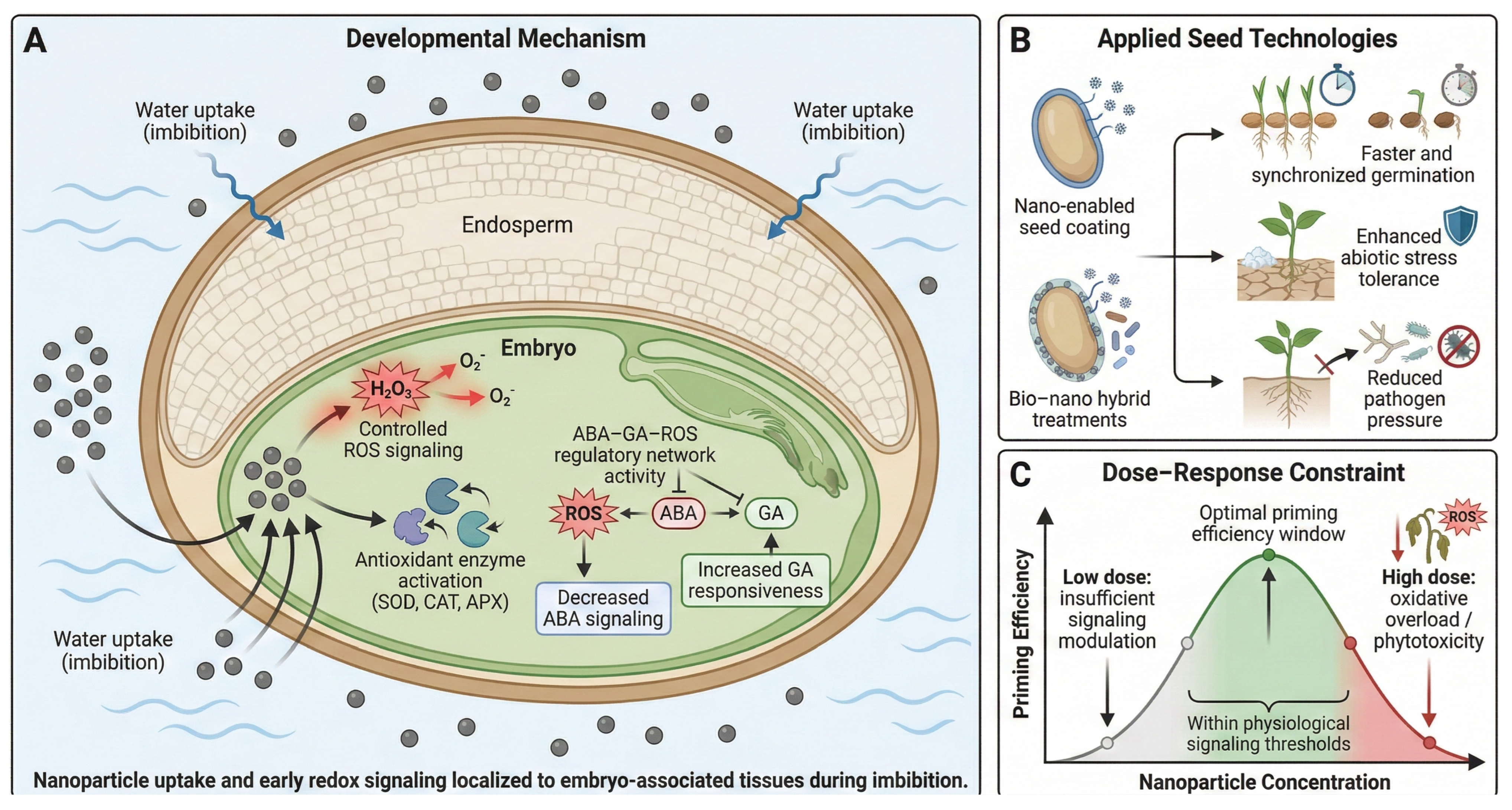
3.3. Nanotechnology-Enabled Seed Priming for Enhanced Germination and Stress Tolerance
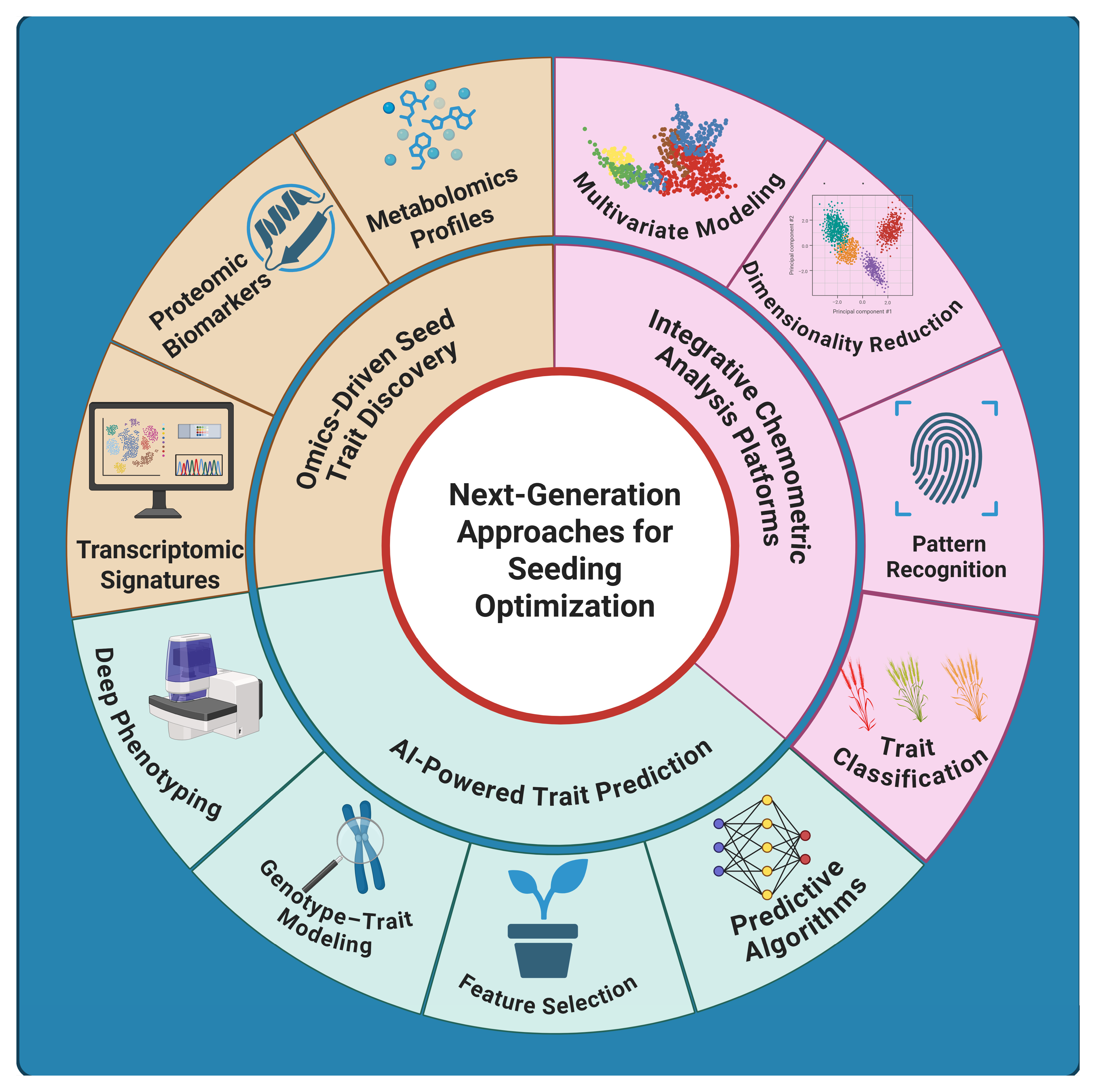
4. Bioinformatics and Omics-Driven Trait Discovery
5. Artificial Intelligence in Developmental Modeling
6. Conclusions
Author Contributions
Funding
Data Availability Statement
Acknowledgments
Conflicts of Interest
References
- Gardarin, A.; Coste, F.; Wagner, M.-H.; Dürr, C. How do seed and seedling traits influence germination and emergence parameters in crop species? A comparative analysis. Seed Sci. Res. 2016, 26, 317–331. [Google Scholar] [CrossRef]
- Kozaki, A.; Aoyanagi, T. Molecular Aspects of Seed Development Controlled by Gibberellins and Abscisic Acids. Int. J. Mol. Sci. 2022, 23, 1876. [Google Scholar] [CrossRef] [PubMed]
- Carta, A.; Fernández-Pascual, E.; Gioria, M.; Müller, J.V.; Rivière, S.; Rosbakh, S.; Saatkamp, A.; Vandelook, F.; Mattana, E. Climate shapes the seed germination niche of temperate flowering plants: A meta-analysis of European seed conservation data. Ann. Bot. 2022, 129, 775–786. [Google Scholar] [CrossRef] [PubMed]
- Wang, X.; Gomes, M.M.; Bailly, C.; Nambara, E.; Corbineau, F. Role of ethylene and proteolytic N-degron pathway in the regulation of Arabidopsis seed dormancy. J. Integr. Plant Biol. 2021, 63, 2110–2122. [Google Scholar] [CrossRef]
- Dekkers, B.J.W.; Bentsink, L. Regulation of seed dormancy by abscisic acid and DELAY OF GERMINATION 1. Seed Sci. Res. 2015, 25, 82–98. [Google Scholar] [CrossRef]
- Konuma, H. Status and Outlook of Global Food Security and the Role of Underutilized Food Resources: Sago Palm. In Sago Palm; Ehara, H., Toyoda, Y., Johnson, D., Eds.; Springer: Singapore, 2018; pp. 3–16. [Google Scholar]
- Reed, R.C.; Bradford, K.J.; Khanday, I. Seed germination and vigor: Ensuring crop sustainability in a changing climate. Heredity 2022, 128, 450–459. [Google Scholar] [CrossRef]
- Ghadirnezhad Shiade, S.R.; Rahimi, R.; Zand-Silakhoor, A.; Fathi, A.; Fazeli, A.; Radicetti, E.; Mancinelli, R. Enhancing Seed Germination Under Abiotic Stress: Exploring the Potential of Nano-Fertilization. J. Soil Sci. Plant Nutr. 2024, 24, 5319–5341. [Google Scholar] [CrossRef]
- El Hajj, A.K. Current and Future of Plant Breeding Strategies to Cope with Climate Change: A Review. Open Access J. Agric. Res. 2023, 8, 1–2. [Google Scholar] [CrossRef]
- Rahman, M.A.; Khatun, H.; Ruhul, M.; Sarker, A.; Hossain, H.; Quddus, M.R.; Iftekharuddaula, K.M.; Kabir, M.S. Enhancing Abiotic Stress Tolerance to Develop Climate-Smart Rice Using Holistic Breeding Approach. In Cereal Grains; IntechOpen: London, UK, 2021. [Google Scholar]
- Fernandez, R.; Crabos, A.; Maillard, M.; Nacry, P.; Pradal, C. High-throughput and automatic structural and developmental root phenotyping on Arabidopsis seedlings. Plant Methods 2022, 18, 127. [Google Scholar] [CrossRef]
- Stingaciu, L.; Schulz, H.; Pohlmeier, A.; Behnke, S.; Zilken, H.; Javaux, M.; Vereecken, H. In situ root system architecture extraction from magnetic resonance imaging for water uptake modeling. Vadose Zone J. 2013, 12, vzj2012-0019. [Google Scholar] [CrossRef]
- Pound, M.P.; French, A.P.; Wells, D.M.; Bennett, M.J.; Pridmore, T.P. CellSeT: Novel software to extract and analyze structured networks of plant cells from confocal images. Plant Cell 2012, 24, 1353–1361. [Google Scholar] [CrossRef] [PubMed]
- Zhao, J.; Bodner, G.; Rewald, B.; Leitner, D.; Nagel, K.A.; Nakhforoosh, A. Root architecture simulation improves the inference from seedling root phenotyping towards mature root systems. J. Exp. Bot. 2017, 68, 965–982. [Google Scholar] [CrossRef] [PubMed]
- Song, Z.X.; Chai, H.H.; Chen, F.; Yu, L.; Fang, C. A Foldable Chip Array for the Continuous Investigation of Seed Germination and the Subsequent Root Development of Seedlings. Micromachines 2019, 10, 884. [Google Scholar] [CrossRef] [PubMed]
- Kaya, C. Optimizing Crop Production with Plant Phenomics Through High-Throughput Phenotyping and AI in Controlled Environments. Food Energy Secur. 2025, 14, e70050. [Google Scholar] [CrossRef]
- Novielli, P.; Romano, D.; Pavan, S.; Losciale, P.; Stellacci, A.M.; Diacono, D.; Bellotti, R.; Tangaro, S.S. Explainable artificial intelligence for genotype-to-phenotype prediction in plant breeding: A case study with a dataset from an almond germplasm collection. Front. Plant Sci. 2024, 15, 1434229. [Google Scholar] [CrossRef]
- Shu, K.; Liu, X.-D.; Xie, Q.; He, Z.-H. Two Faces of One Seed: Hormonal Regulation of Dormancy and Germination. Mol. Plant 2016, 9, 34–45. [Google Scholar] [CrossRef]
- Xu, X. Gibberellic Acid and Abscisic Acid Effects on Germination Across Arabidopsis Genotypes: Confirmation of Compound Identity and Genotypic Responses. Theor. Nat. Sci. 2024, 54, 55–62. [Google Scholar] [CrossRef]
- Anwar, A.; Zhao, Q.; Zhang, H.; Zhang, S.; He, L.; Wang, F.; Gao, J. The fundamental role of DELLA protein and regulatory mechanism during plant growth and development. Not. Bot. Horti Agrobot. Cluj-Napoca 2021, 49, 12561. [Google Scholar] [CrossRef]
- Ali, F.; Wei, Z.; Li, Y.; Gan, L.; Yang, Z.; Li, F.; Wang, Z. An uncanonical transcription factor-DREB2B regulates seed vigor negatively through ABA pathway. bioRxiv 2020. [Google Scholar] [CrossRef]
- Bhagat, P.K.; Verma, D.; Verma, N.; Sinha, A.K. A novel positive feedback mechanism of ABI5 phosphorylation by mitogen activated protein kinase-3 regulates ABA signaling in Arabidopsis. bioRxiv 2021. [Google Scholar] [CrossRef]
- Hussain, S.; Cheng, Y.; Li, Y.; Wang, W.; Tian, H.; Zhang, N.; Wang, Y.; Yuan, Y.; Hussain, H.; Lin, R.; et al. AtbZIP62 Acts as a Transcription Repressor to Positively Regulate ABA Responses in Arabidopsis. Plants 2022, 11, 3037. [Google Scholar] [CrossRef]
- Ullah, A.; Sun, H.; Hakim; Yang, X.; Zhang, X. A novel cotton WRKY gene, GhWRKY6-like, improves salt tolerance by activating the ABA signaling pathway and scavenging of reactive oxygen species. Physiol. Plant. 2018, 162, 439–454. [Google Scholar] [CrossRef] [PubMed]
- Yan, Y.; Jia, H.; Wang, F.; Wang, C.; Liu, S.; Guo, X. Overexpression of GhWRKY27a reduces tolerance to drought stress and resistance to Rhizoctonia solani infection in transgenic Nicotiana benthamiana. Front. Physiol. 2015, 6, 265. [Google Scholar] [CrossRef] [PubMed]
- Li, Y.; Chen, H.; Li, S.; Yang, C.; Ding, Q.; Song, C.; Wang, D. GhWRKY46 from upland cotton positively regulates the drought and salt stress responses in plant. Environ. Exp. Bot. 2021, 186, 104438. [Google Scholar] [CrossRef]
- Dong, T.; Hu, Y.; Wang, J.; Wang, Y.; Chen, P.; Xing, J.; Duan, H. GhWRKY4 binds to the histone deacetylase GhHDA8 promoter to regulate drought and salt tolerance in Gossypium hirsutum. Int. J. Biol. Macromol. 2024, 262, 129971. [Google Scholar] [CrossRef]
- Hu, Q.; Ao, C.; Wang, X.; Wu, Y.; Du, X. GhWRKY1-like, a WRKY transcription factor, mediates drought tolerance in Arabidopsis via modulating ABA biosynthesis. BMC Plant Biol. 2021, 21, 458. [Google Scholar] [CrossRef]
- Yan, H.; Jia, H.; Chen, X.; Hao, L.; An, H.; Guo, X. The cotton WRKY transcription factor GhWRKY17 functions in drought and salt stress in transgenic Nicotiana benthamiana through ABA signaling and the modulation of reactive oxygen species production. Plant Cell Physiol. 2014, 55, 2060–2076. [Google Scholar] [CrossRef]
- Ma, Q.; Xia, Z.; Cai, Z.; Li, L.; Cheng, Y.; Liu, J.; Nian, H. GmWRKY16 Enhances Drought and Salt Tolerance Through an ABA-Mediated Pathway in Arabidopsis thaliana. Front. Plant Sci. 2019, 9, 1979. [Google Scholar] [CrossRef]
- Huang, S.; Hu, L.; Zhang, S.; Zhang, M.; Jiang, W.; Wu, T.; Du, X. Rice OsWRKY50 Mediates ABA-Dependent Seed Germination and Seedling Growth, and ABA-Independent Salt Stress Tolerance. Int. J. Mol. Sci. 2021, 22, 8625. [Google Scholar] [CrossRef]
- Yu, Y.; He, L.; Wu, Y. Wheat WRKY transcription factor TaWRKY24 confers drought and salt tolerance in transgenic plants. Plant Physiol. Biochem. 2023, 205, 108137. [Google Scholar] [CrossRef]
- Luo, X.; Bai, X.; Sun, X.; Zhu, D.; Liu, B.; Ji, W.; Cai, H.; Cao, L.; Wu, J.; Hu, M.; et al. Expression of wild soybean WRKY20 in Arabidopsis enhances drought tolerance and regulates ABA signalling. J. Exp. Bot. 2013, 64, 2155–2169. [Google Scholar] [CrossRef]
- Huang, Y.; Feng, C.-Z.; Ye, Q.; Wu, W.-H.; Chen, Y.-F. Arabidopsis WRKY6 Transcription Factor Acts as a Positive Regulator of Abscisic Acid Signaling during Seed Germination and Early Seedling Development. PLoS Genet. 2016, 12, e1005833. [Google Scholar] [CrossRef] [PubMed]
- Ren, X.; Chen, Z.; Liu, Y.; Zhang, H.; Zhang, M.; Liu, Q.; Hong, X.; Zhu, J.-K.; Gong, Z. ABO3, a WRKY transcription factor, mediates plant responses to abscisic acid and drought tolerance in Arabidopsis. Plant J. 2010, 63, 417–429. [Google Scholar] [CrossRef] [PubMed]
- Jiang, Y.; Liang, G.; Yu, D. Activated expression of WRKY57 confers drought tolerance in Arabidopsis. Mol. Plant 2012, 5, 1375–1388. [Google Scholar] [CrossRef] [PubMed]
- Xu, Q.; Feng, W.; Peng, H.; Ni, Z.; Sun, Q. TaWRKY71, a WRKY Transcription Factor from Wheat, Enhances Tolerance to Abiotic Stress in Transgenic Arabidopsis thaliana. Cereal Res. Commun. 2014, 42, 47–57. [Google Scholar] [CrossRef]
- Bai, X.; Liu, P.; Zhu, F.; Zhang, C.; Pang, H.; Zhang, Y. CsWRKY46 Is Involved in the Regulation of Cucumber Salt Stress by Regulating Abscisic Acid and Modulating Cellular Reactive Oxygen Species. Horticulturae 2025, 11, 251. [Google Scholar] [CrossRef]
- Dong, Q.; Zheng, W.; Duan, D.; Huang, D.; Wang, Q.; Liu, C.; Li, C.; Gong, X.; Li, C.; Mao, K.; et al. MdWRKY30, a group IIa WRKY gene from apple, confers tolerance to salinity and osmotic stresses in transgenic apple callus and Arabidopsis seedlings. Plant Sci. 2020, 299, 110611. [Google Scholar] [CrossRef]
- Wei, W.; Cui, M.-Y.; Hu, Y.; Gao, K.; Xie, Y.-G.; Jiang, Y.; Feng, J.-Y. Ectopic expression of FvWRKY42, a WRKY transcription factor from the diploid woodland strawberry (Fragaria vesca), enhances resistance to powdery mildew, improves osmotic stress resistance, and increases abscisic acid sensitivity in Arabidopsis. Plant Sci. 2018, 275, 60–74. [Google Scholar] [CrossRef]
- Zhang, S.; Yang, R.; Huo, Y.; Liu, S.; Yang, G.; Huang, J.; Zheng, C.; Wu, C. Expression of cotton PLATZ1 in transgenic Arabidopsis reduces sensitivity to osmotic and salt stress for germination and seedling establishment associated with modification of the abscisic acid, gibberellin, and ethylene signalling pathways. BMC Plant Biol. 2018, 18, 218. [Google Scholar] [CrossRef]
- Zhu, L.; Li, S.; Ouyang, M.; Yang, L.; Sun, S.; Wang, Y.; Cai, X.; Wu, G.; Li, Y. Overexpression of watermelon ClWRKY20 in transgenic Arabidopsis improves salt and low-temperature tolerance. Sci. Hortic. 2022, 295, 110848. [Google Scholar] [CrossRef]
- Hao, J.; Ma, Q.; Hou, L.; Zhao, F.; Xin, L. VvWRKY13 enhances ABA biosynthesis in Vitis vinifera. Acta Soc. Bot. Pol. 2017, 86, 3546. [Google Scholar] [CrossRef]
- Wang, X.; Zeng, J.; Li, Y.; Rong, X.; Sun, J.; Sun, T.; Li, M.; Wang, L.; Feng, Y.; Chai, R.; et al. Expression of TaWRKY44, a wheat WRKY gene, in transgenic tobacco confers multiple abiotic stress tolerances. Front. Plant Sci. 2015, 6, 615. [Google Scholar] [CrossRef] [PubMed]
- Zhang, A.; Shang, J.; Xiao, K.; Zhang, M.; Wang, S.; Zhu, W.; Wu, X.; Zha, D. WRKY transcription factor 40 from eggplant (Solanum melongena L.) regulates ABA and salt stress responses. Sci. Rep. 2024, 14, 19289. [Google Scholar] [CrossRef] [PubMed]
- Shibata, N.; Kagiyama, M.; Nakagawa, M.; Hirano, Y.; Hakoshima, T. Crystallization of the plant hormone receptors PYL9/RCAR1, PYL5/RCAR8 and PYR1/RCAR11 in the presence of (+)-abscisic acid. Acta Crystallogr. Sect. F Struct. Biol. Cryst. Commun. 2010, 66, 456–459. [Google Scholar] [CrossRef]
- Lee, S.C.; Lim, C.W.; Lan, W.; He, K.; Luan, S. ABA signaling in guard cells entails a dynamic protein–protein interaction relay from the PYL-RCAR family receptors to ion channels. Mol. Plant 2013, 6, 528–538. [Google Scholar] [CrossRef]
- Yoshida, T.; Fujita, Y.; Maruyama, K.; Mogami, J.; Todaka, D.; Shinozaki, K.; Yamaguchi-Shinozaki, K. Four Arabidopsis AREB/ABF transcription factors function predominantly in gene expression downstream of SnRK2 kinases in abscisic acid signalling in response to osmotic stress. Plant Cell Environ. 2015, 38, 35–49. [Google Scholar] [CrossRef]
- Fujita, Y.; Nakashima, K.; Yoshida, T.; Katagiri, T.; Kidokoro, S.; Kanamori, N.; Umezawa, T.; Fujita, M.; Maruyama, K.; Ishiyama, K.; et al. Three SnRK2 protein kinases are the main positive regulators of abscisic acid signaling in response to water stress in Arabidopsis. Plant Cell Physiol. 2009, 50, 2123–2132. [Google Scholar] [CrossRef]
- Hasan, M.M.; Liu, X.-D.; Waseem, M.; Guang-Qian, Y.; Alabdallah, N.M.; Jahan, M.S.; Fang, X.-W. ABA activated SnRK2 kinases: An emerging role in plant growth and physiology. Plant Signal. Behav. 2022, 17, 2071024. [Google Scholar] [CrossRef]
- Wei, Y.; Peng, L.; Zhou, X. SnRK2s: Kinases or Substrates? Plants 2025, 14, 1171. [Google Scholar] [CrossRef]
- Sirichandra, C.; Davanture, M.; Turk, B.E.; Zivy, M.; Valot, B.; Leung, J.; Merlot, S. The Arabidopsis ABA-activated kinase OST1 phosphorylates the bZIP transcription factor ABF3 and creates a 14-3-3 binding site involved in its turnover. PLoS ONE 2010, 5, e13935. [Google Scholar] [CrossRef]
- Ali, A.; Zareen, S.; Park, J.; Khan, H.A.; Lim, C.J.; Bader, Z.E.; Hussain, S.; Chung, W.S.; Gechev, T.; Pardo, J.M.; et al. ABA INSENSITIVE 2 promotes flowering by inhibiting OST1/ABI5-dependent FLOWERING LOCUS C transcription in Arabidopsis. J. Exp. Bot. 2024, 75, 2481–2493. [Google Scholar] [CrossRef] [PubMed]
- Lee, S.; Cheng, H.; King, K.E.; Wang, W.; He, Y.; Hussain, A.; Lo, J.; Harberd, N.P.; Peng, J. Gibberellin regulates Arabidopsis seed germination via RGL2, a GAI/RGA-like gene whose expression is up-regulated following imbibition. Genes Dev. 2002, 16, 646–658. [Google Scholar] [CrossRef] [PubMed]
- Zhang, S.; Jiang, L.; Chen, H.; Liu, H.; Xiong, M.; Niu, Y.; Xie, L.; Wang, L.; Mao, Z.; Guo, T.; et al. Gibberellin triggers ATG8-dependent autophagic degradation of DELLA proteins to promote seed germination and skotomorphogenesis under nutrient starvation in Arabidopsis. Mol. Plant 2025, 18, 2101–2118. [Google Scholar] [CrossRef] [PubMed]
- Zhong, C.; Xu, H.; Ye, S.; Wang, S.; Li, L.; Zhang, S.; Wang, X. Gibberellic acid-stimulated Arabidopsis6 serves as an integrator of gibberellin, abscisic acid, and glucose signaling during seed germination in Arabidopsis. Plant Physiol. 2015, 169, 2288–2303. [Google Scholar]
- Piskurewicz, U.; Jikumaru, Y.; Kinoshita, N.; Nambara, E.; Kamiya, Y.; Lopez-Molina, L. The gibberellic acid signaling repressor RGL2 inhibits Arabidopsis seed germination by stimulating abscisic acid synthesis and ABI5 activity. Plant Cell 2008, 20, 2729–2745. [Google Scholar] [CrossRef]
- Geshnizjani, N.; Ghaderi-Far, F.; Willems, L.A.; Hilhorst, H.W.; Ligterink, W. Characterization of and genetic variation for tomato seed thermo-inhibition and thermo-dormancy. BMC Plant Biol. 2018, 18, 229. [Google Scholar] [CrossRef]
- Toh, S.; Imamura, A.; Watanabe, A.; Nakabayashi, K.; Okamoto, M.; Jikumaru, Y.; Hanada, A.; Aso, Y.; Ishiyama, K.; Tamura, N.; et al. High temperature-induced abscisic acid biosynthesis and its role in the inhibition of gibberellin action in Arabidopsis seeds. Plant Physiol. 2008, 146, 1368–1385. [Google Scholar] [CrossRef]
- Zhang, H.J.; Zhang, N.; Yang, R.C.; Wang, L.; Sun, Q.Q.; Li, D.B.; Cao, Y.Y.; Weeda, S.; Zhao, B.; Ren, S.; et al. Melatonin promotes seed germination under high salinity by regulating antioxidant systems, ABA and GA4 interaction in cucumber (Cucumis sativus L.). J. Pineal Res. 2014, 57, 269–279. [Google Scholar] [CrossRef]
- Wang, X.; Zong, N.; Wang, X.; Niu, J.; Zhang, X.; Shu, K.; Wang, G.; Hui, W. Gamma-aminobutyric acid (GABA) releases seed dormancy by orchestrating abscisic acid and gibberellin metabolism and signaling. BMC Plant Biol. 2025, 25, 676. [Google Scholar] [CrossRef]
- Chen, F.; Chen, L.; Yan, Z.; Xu, J.; Feng, L.; He, N.; Guo, M.; Zhao, J.; Chen, Z.; Chen, H.; et al. Recent advances of CRISPR-based genome editing for enhancing staple crops. Front. Plant Sci. 2024, 15, 1478398. [Google Scholar] [CrossRef]
- Usman, B.; Nawaz, G.; Zhao, N.; Liao, S.; Liu, Y.; Li, R. Precise Editing of the OsPYL9 Gene by RNA-Guided Cas9 Nuclease Confers Enhanced Drought Tolerance and Grain Yield in Rice (Oryza sativa L.) by Regulating Circadian Rhythm and Abiotic Stress Responsive Proteins. Int. J. Mol. Sci. 2020, 21, 7854. [Google Scholar] [CrossRef] [PubMed]
- Zhang, Z.; Wang, W.; Ali, S.; Luo, X.; Xie, L. CRISPR/Cas9-mediated multiple knockouts in abscisic acid receptor genes reduced the sensitivity to ABA during soybean seed germination. Int. J. Mol. Sci. 2022, 23, 16173. [Google Scholar] [CrossRef] [PubMed]
- Luo, D.; Huang, Q.; Chen, M.; Li, H.; Lu, G.; Feng, H.; Lv, Y. ABA Enhances Drought Resistance During Rapeseed (Brassica napus L.) Seed Germination Through the Gene Regulatory Network Mediated by ABA Insensitive 5. Plants 2025, 14, 1276. [Google Scholar] [CrossRef] [PubMed]
- Cheng, J.; Hill, C.; Han, Y.; He, T.; Ye, X.; Shabala, S.; Guo, G.; Zhou, M.; Wang, K.; Li, C. New semi-dwarfing alleles with increased coleoptile length by gene editing of gibberellin 3-oxidase 1 using CRISPR-Cas9 in barley (Hordeum vulgare L.). Plant Biotechnol. J. 2023, 21, 806–818. [Google Scholar] [CrossRef]
- Zeng, P.; Xie, T.; Shen, J.; Liang, T.; Yin, L.; Liu, K.; He, Y.; Chen, M.; Tang, H.; Chen, S.; et al. Potassium transporter OsHAK9 regulates seed germination under salt stress by preventing gibberellin degradation through mediating OsGA2ox7 in rice. J. Integr. Plant Biol. 2024, 66, 731–748. [Google Scholar] [CrossRef]
- Lee, Y.R.; Ko, K.S.; Lee, H.E.; Lee, E.S.; Han, K.; Yoo, J.Y.; Vu, B.N.; Choi, H.N.; Lee, Y.N.; Hong, J.C.; et al. CRISPR/Cas9-mediated HY5 gene editing reduces growth inhibition in Chinese cabbage (Brassica rapa) under ER stress. Int. J. Mol. Sci. 2023, 24, 13105. [Google Scholar] [CrossRef]
- Hisano, H.; Hoffie, R.E.; Abe, F.; Munemori, H.; Matsuura, T.; Endo, M.; Mikami, M.; Nakamura, S.; Kumlehn, J.; Sato, K. Regulation of germination by targeted mutagenesis of grain dormancy genes in barley. Plant Biotechnol. J. 2022, 20, 37–46. [Google Scholar] [CrossRef]
- Kim, J.-S.; Kidokoro, S.; Yamaguchi-Shinozaki, K.; Shinozaki, K. Regulatory networks in plant responses to drought and cold stress. Plant Physiol. 2024, 195, 170–189. [Google Scholar] [CrossRef]
- Luo, T.; Ma, C.; Fan, Y.; Qiu, Z.; Li, M.; Tian, Y.; Shang, Y.; Liu, C.; Cao, Q.; Peng, Y.; et al. CRISPR-Cas9-mediated editing of GmARM improves resistance to multiple stresses in soybean. Plant Sci. 2024, 346, 112147. [Google Scholar] [CrossRef]
- Alam, M.S.; Kong, J.; Tao, R.; Ahmed, T.; Alamin, M.; Alotaibi, S.S.; Abdelsalam, N.R.; Xu, J.-H. CRISPR/Cas9 Mediated Knockout of the OsbHLH024 Transcription Factor Improves Salt Stress Resistance in Rice (Oryza sativa L.). Plants 2022, 11, 1184. [Google Scholar] [CrossRef]
- Xu, H.; Yang, X.; Zhang, Y.; Wang, H.; Wu, S.; Zhang, Z.; Ahammed, G.J.; Zhao, C.; Liu, H. CRISPR/Cas9-mediated mutation in auxin efflux carrier OsPIN9 confers chilling tolerance by modulating reactive oxygen species homeostasis in rice. Front. Plant Sci. 2022, 13, 967031. [Google Scholar] [CrossRef] [PubMed]
- Park, J.-R.; Kim, E.-G.; Jang, Y.-H.; Jan, R.; Farooq, M.; Ubaidillah, M.; Kim, K.-M. Applications of CRISPR/Cas9 as New Strategies for Short Breeding to Drought Gene in Rice. Front. Plant Sci. 2022, 13, 850441. [Google Scholar] [CrossRef] [PubMed]
- Choudry, M.W.; Riaz, R.; Nawaz, P.; Ashraf, M.; Ijaz, B.; Bakhsh, A. CRISPR-Cas9 mediated understanding of plants’ abiotic stress-responsive genes to combat changing climatic patterns. Funct. Integr. Genom. 2024, 24, 132. [Google Scholar] [CrossRef] [PubMed]
- Hao, J.; Kang, X.; Zhang, L.; Chen, J.; Wang, D.; Dong, S.; Li, X.; Gao, L.; Yang, G.; Yuan, X.; et al. CRISPR/Cas9-Mediated SiEPF2 Mutagenesis Attenuates Drought Tolerance and Yield in Foxtail Millet (Setaria italica). Plant Cell Environ. 2025, 48, 6043–6046. [Google Scholar] [CrossRef]
- Alrajhi, A.; Alharbi, S.; Beecham, S.; Alotaibi, F. Regulation of root growth and elongation in wheat. Front. Plant Sci. 2024, 15, 1397337. [Google Scholar] [CrossRef]
- Li, Z.; Rao, M.J.; Li, J.; Wang, Y.; Chen, P.; Yu, H.; Ma, C.; Wang, L. CRISPR/Cas9 Mutant Rice Ospmei12 Involved in Growth, Cell Wall Development, and Response to Phytohormone and Heavy Metal Stress. Int. J. Mol. Sci. 2022, 23, 16082. [Google Scholar] [CrossRef]
- Rachappanavar, V. Utilizing CRISPR-based genetic modification for precise control of seed dormancy: Progress, obstacles, and potential directions. Mol. Biol. Rep. 2025, 52, 204. [Google Scholar] [CrossRef]
- Waltz, E. With a free pass, CRISPR-edited plants reach market in record time. Nat. Biotechnol. 2018, 36, 6–7. [Google Scholar] [CrossRef]
- Nonaka, S.; Arai, C.; Takayama, M.; Matsukura, C.; Ezura, H. Efficient increase of ɣ-aminobutyric acid (GABA) content in tomato fruits by targeted mutagenesis. Sci. Rep. 2017, 7, 7057. [Google Scholar] [CrossRef]
- Ayi, Q.; Zeng, B.; Yang, K.; Lin, F.; Zhang, X.; van Bodegom, P.M.; Cornelissen, J.H.C. Similar Growth Performance but Contrasting Biomass Allocation of Root-Flooded Terrestrial Plant Alternanthera philoxeroides (Mart.) Griseb. in Response to Nutrient Versus Dissolved Oxygen Stress. Front. Plant Sci. 2019, 10, 111. [Google Scholar] [CrossRef]
- Garrido-Sanz, D.; Keel, C. Seed-borne bacteria drive wheat rhizosphere microbiome assembly via niche partitioning and facilitation. Nat. Microbiol. 2025, 10, 1130–1144. [Google Scholar] [CrossRef] [PubMed]
- Li, D.; Chen, W.; Luo, W.; Zhang, H.; Liu, Y.; Shu, D.; Wei, G. Seed microbiomes promote Astragalus mongholicus seed germination through pathogen suppression and cellulose degradation. Microbiome 2025, 13, 23. [Google Scholar] [CrossRef] [PubMed]
- Zheng, X.; Huang, Y.; Lin, X.; Chen, Y.; Fu, H.; Liu, C.; Chu, D.; Yang, F. Effects of Marquandomyces marquandii SGSF043 on the Germination Activity of Chinese Cabbage Seeds: Evidence from Phenotypic Indicators, Stress Resistance Indicators, Hormones and Functional Genes. Plants 2024, 14, 58. [Google Scholar] [CrossRef] [PubMed]
- Desai, V.; Sharma, A.K.; Chauhan, P. Endophytes and Plants Interaction: A Hidden Microbial World Inside the Plant. J. Basic Microbiol. 2025, 65, e70112. [Google Scholar] [CrossRef]
- Puglia, G.D. Reactive oxygen and nitrogen species (RONS) signalling in seed dormancy release, perception of environmental cues, and heat stress response. Plant Growth Regul. 2024, 103, 9–32. [Google Scholar] [CrossRef]
- Rivas, F.J.M.; Fernie, A.R.; Aarabi, F. Roles and regulation of the RBOHD enzyme in initiating ROS-mediated systemic signaling during biotic and abiotic stress. Plant Stress 2024, 11, 100327. [Google Scholar] [CrossRef]
- Huang, H.; Ullah, F.; Zhou, D.-X.; Yi, M.; Zhao, Y. Mechanisms of ROS regulation of plant development and stress responses. Front. Plant Sci. 2019, 10, 800. [Google Scholar] [CrossRef]
- Chen, X.-Y.; Chen, J.; Xu, F.; Cai, X.-Z. RALF-FER, a master ligand–receptor pair in plant health. Crop. Health 2025, 3, 4. [Google Scholar] [CrossRef]
- De Bruyne, L.; Höfte, M.; De Vleesschauwer, D. Connecting growth and defense: The emerging roles of brassinosteroids and gibberellins in plant innate immunity. Mol. Plant 2014, 7, 943–959. [Google Scholar] [CrossRef]
- Ortiz-Morea, F.A.; He, P.; Shan, L.; Russinova, E. It takes two to tango—Molecular links between plant immunity and brassinosteroid signalling. J. Cell Sci. 2020, 133, jcs246728. [Google Scholar] [CrossRef]
- Liu, Y.; Shi, A.; Chen, Y.; Xu, Z.; Liu, Y.; Yao, Y.; Wang, Y.; Jia, B. Beneficial microorganisms: Regulating growth and defense for plant welfare. Plant Biotechnol. J. 2025, 23, 986–998. [Google Scholar] [CrossRef]
- Yadav, R.R.R.; Vasundhara, S.; Reddy, B.R.K.; Reddy, M.R. Effect of Bio-Priming on Seed Quality Parameters of Rice (Oryza sativa L.). Microbiol. Res. J. Int. 2025, 35, 57–64. [Google Scholar] [CrossRef]
- Brajesh Kumar, M.; Chetan Kumar, J.; Saxena, S.N.; Sharma, Y.K.; Kant, K.; Kiran, D.K.; Reddy, K.; Jangir, C.K. Bio-priming: A precision approach to augment seed emergence and yield in Ajwain (Trachyspermum ammi). Int. J. Seed Spices 2024, 12, 48–53. [Google Scholar]
- Hungria, M.; Campo, R.J.; Souza, E.M.; Pedrosa, F.O. Inoculation with selected strains of Azospirillum brasilense and A. lipoferum improves yields of maize and wheat in Brazil. Plant Soil 2010, 331, 413–425. [Google Scholar] [CrossRef]
- Nile, S.H.; Thiruvengadam, M.; Wang, Y.; Samynathan, R.; Shariati, M.A.; Rebezov, M.; Nile, A.; Sun, M.; Venkidasamy, B.; Xiao, J.; et al. Nano-priming as emerging seed priming technology for sustainable agriculture—Recent developments and future perspectives. J. Nanobiotechnol. 2022, 20, 254. [Google Scholar] [CrossRef]
- García-Locascio, E.; Valenzuela, E.I.; Cervantes-Avilés, P. Impact of seed priming with Selenium nanoparticles on germination and seedlings growth of tomato. Sci. Rep. 2024, 14, 6726. [Google Scholar] [CrossRef]
- Stałanowska, K.; Railean, V.; Pomastowski, P.; Pszczółkowska, A.; Okorski, A.; Lahuta, L.B. Seeds Priming with Bio-Silver Nanoparticles Protects Pea (Pisum sativum L.) Seedlings Against Selected Fungal Pathogens. Int. J. Mol. Sci. 2024, 25, 11402. [Google Scholar] [CrossRef]
- Akbay, B.; Yalçın, F.S. Effect of ZnO nano priming on germination and root length of soybean seeds (Glycine max L.). Int. J. Second. Metab. 2025, 12, 204–215. [Google Scholar] [CrossRef]
- Sonawane, H.; Arya, S.; Math, S.; Shelke, D. Myco-synthesized silver and titanium oxide nanoparticles as seed priming agents to promote seed germination and seedling growth of Solanum lycopersicum: A comparative study. Int. Nano Lett. 2021, 11, 371–379. [Google Scholar] [CrossRef]
- Makvandi, P.; Iftekhar, S.; Pizzetti, F.; Zarepour, A.; Zare, E.N.; Ashrafizadeh, M.; Agarwal, T.; Padil, V.V.T.; Mohammadinejad, R.; Sillanpaa, M.; et al. Functionalization of polymers and nanomaterials for water treatment, food packaging, textile and biomedical applications: A review. Environ. Chem. Lett. 2021, 19, 583–611. [Google Scholar] [CrossRef]
- Mazhar, M.W.; Ishtiaq, M.; Maqbool, M.; Akram, R. Seed priming with Calcium oxide nanoparticles improves germination, biomass, antioxidant defence and yield traits of canola plants under drought stress. S. Afr. J. Bot. 2022, 151, 889–899. [Google Scholar] [CrossRef]
- Adhikary, S.; Biswas, B.; Chakraborty, D.; Timsina, J.; Pal, S.; Tarafdar, J.C.; Banerjee, S.; Hossain, A.; Roy, S. Seed priming with selenium and zinc nanoparticles modifies germination, growth, and yield of direct-seeded rice (Oryza sativa L.). Sci. Rep. 2022, 12, 7103. [Google Scholar] [CrossRef]
- Khepar, V.; Sidhu, A.; Mankoo, R.K.; Manchanda, P.; Sharma, A.B. Nanobiostimulant action of trigolic formulated zinc sulfide nanoparticles (ZnS-T NPs) on rice seeds by triggering antioxidant defense network and plant growth specific transcription factors. Plant Physiol. Biochem. 2024, 210, 108605. [Google Scholar] [CrossRef] [PubMed]
- Nagdalian, A.A.; Blinov, A.V.; Siddiqui, S.A.; Gvozdenko, A.A.; Golik, A.B.; Maglakelidze, D.G.; Rzhepakovsky, I.V.; Kukharuk, M.Y.; Piskov, S.I.; Rebezov, M.B.; et al. Effect of selenium nanoparticles on biological and morphofunctional parameters of barley seeds (Hordéum vulgáre L.). Sci. Rep. 2023, 13, 6453. [Google Scholar] [CrossRef] [PubMed]
- Wang, X.; Ge, M.; He, X. Effect of Green Synthesized Fe3O4NP Priming on Alfalfa Seed Germination Under Drought Stress. Plants 2025, 14, 1236. [Google Scholar] [CrossRef] [PubMed]
- Hasanaklou, N.T.; Mohagheghi, V.; Hasanaklou, H.T.; Ma’mani, L.; Malekmohammadi, M.; Moradi, F.; Dalvand, Y. Seed nano-priming using silica nanoparticles: Effects in seed germination and physiological properties of Stevia Rebaudiana Bertoni. Chem. Biol. Technol. Agric. 2023, 10, 96. [Google Scholar] [CrossRef]
- Kim, D.-Y.; Kim, M.; Sung, J.-S.; Koduru, J.R.; Nile, S.H.; Syed, A.; Bahkali, A.H.; Seth, C.S.; Ghodake, G.S. Extracellular synthesis of silver nanoparticle using yeast extracts: Antibacterial and seed priming applications. Appl. Microbiol. Biotechnol. 2024, 108, 150. [Google Scholar] [CrossRef]
- Acharya, P.; Jayaprakasha, G.K.; Crosby, K.M.; Jifon, J.L.; Patil, B.S. Nanoparticle-Mediated Seed Priming Improves Germination, Growth, Yield, and Quality of Watermelons (Citrullus lanatus) at multi-locations in Texas. Sci. Rep. 2020, 10, 5037. [Google Scholar] [CrossRef]
- Khan, I.; Raza, M.A.; Awan, S.A.; Shah, G.A.; Rizwan, M.; Ali, B.; Tariq, R.; Hassan, M.J.; Alyemeni, M.N.; Brestic, M.; et al. Amelioration of salt induced toxicity in pearl millet by seed priming with silver nanoparticles (AgNPs): The oxidative damage, antioxidant enzymes and ions uptake are major determinants of salt tolerant capacity. Plant Physiol. Biochem. 2020, 156, 221–232. [Google Scholar] [CrossRef]
- Garza-Alonso, C.A.; González-García, Y.; Cadenas-Pliego, G.; Olivares-Sáenz, E.; Trejo-Téllez, L.I.; Benavides-Mendoza, A. Seed priming with ZnO nanoparticles promotes early growth and bioactive compounds of Moringa oleifera. Not. Bot. Horti Agrobot. Cluj-Napoca 2021, 49, 12546. [Google Scholar] [CrossRef]
- Bayat, M.; Zargar, M.; Murtazova, K.M.-S.; Nakhaev, M.R.; Shkurkin, S.I. Ameliorating Seed Germination and Seedling Growth of Nano-Primed Wheat and Flax Seeds Using Seven Biogenic Metal-Based Nanoparticles. Agronomy 2022, 12, 811. [Google Scholar] [CrossRef]
- Rizwan, M.; Ali, S.; Ali, B.; Adrees, M.; Arshad, M.; Hussain, A.; Zia ur Rehman, M.; Waris, A.A. Zinc and iron oxide nanoparticles improved the plant growth and reduced the oxidative stress and cadmium concentration in wheat. Chemosphere 2019, 214, 269–277. [Google Scholar] [CrossRef] [PubMed]
- Ishtiaq, M.; Mazhar, M.W.; Maqbool, M.; Hussain, T.; Hussain, S.A.; Casini, R.; Abd-ElGawad, A.M.; Elansary, H.O. Seed Priming with the Selenium Nanoparticles Maintains the Redox Status in the Water Stressed Tomato Plants by Modulating the Antioxidant Defense Enzymes. Plants 2023, 12, 1556. [Google Scholar] [CrossRef] [PubMed]
- Xing, R.-X.; Sun, X.-D.; Wang, Y.; Xie, X.-M.; Tan, M.-M.; Xu, M.-X.; Liu, X.-Y.; Jiang, Y.-Q.; Liu, M.-Y.; Duan, J.-L.; et al. Seed Priming with Dynamically Transformed Selenium Nanoparticles to Enhance Salt Tolerance in Rice. Environ. Sci. Technol. 2024, 58, 19725–19735. [Google Scholar] [CrossRef] [PubMed]
- Kathiravan, M.; Vanitha, C.; Umarani, R.; Marimuthu, S.; Ayyadurai, P.; Sathiya, K.; Yuvaraj, M.; Jaiby, C. Seed Priming with Biosynthesized Zinc Oxide Nanoparticles for Enhancing Seed Germination and Vigour through Promoting Antioxidant and Hydrolytic Enzyme Activity in Green gram (Vigna radiata). Agric. Res. 2024, 14, 697–709. [Google Scholar] [CrossRef]
- El-Badri, A.M.; Batool, M.; Wang, C.; Hashem, A.M.; Tabl, K.M.; Nishawy, E.; Kuai, J.; Zhou, G.; Wang, B. Selenium and zinc oxide nanoparticles modulate the molecular and morpho-physiological processes during seed germination of Brassica napus under salt stress. Ecotoxicol. Environ. Saf. 2021, 225, 112695. [Google Scholar] [CrossRef]
- Khalaki, M.A.; Moameri, M.; Lajayer, B.A.; Astatkie, T. Influence of nano-priming on seed germination and plant growth of forage and medicinal plants. Plant Growth Regul. 2020, 93, 13–28. [Google Scholar] [CrossRef]
- Rajani, K.; Kumar, R.R.; Ranjan, T.; Kumar, A. Global Approaches for Identification of Markers of Seed Quality. Int. J. Adv. Agric. Sci. Technol. 2017, 4, 29–43. [Google Scholar]
- Sano, N.; Lounifi, I.; Cueff, G.; Collet, B.; Clément, G.; Balzergue, S.; Huguet, S.; Valot, B.; Galland, M.; Rajjou, L. Multi-Omics Approaches Unravel Specific Features of Embryo and Endosperm in Rice Seed Germination. Front. Plant Sci. 2022, 13, 867263. [Google Scholar] [CrossRef]
- Li, W.; Yang, B.; Xu, J.; Peng, L.; Sun, S.; Huang, Z.; Jiang, X.; He, Y.; Wang, Z. A genome-wide association study reveals that the 2-oxoglutarate/malate translocator mediates seed vigor in rice. Plant J. 2021, 108, 478–491. [Google Scholar] [CrossRef]
- Chen, Z.; Vu, J.L.; Vu, B.L.; Buitink, J.; Leprince, O.; Verdier, J. Genome-Wide Association Studies of Seed Performance Traits in Response to Heat Stress in Medicago truncatula Uncover MIEL1 as a Regulator of Seed Germination Plasticity. Front. Plant Sci. 2021, 12, 673072. [Google Scholar] [CrossRef]
- Wang, A.; Guo, W.; Wang, S.; Wang, Y.; Kong, D.; Li, W. Transcriptome analysis unveiled the genetic basis of rapid seed germination strategies in alpine plant Rheum pumilum. Sci. Rep. 2024, 14, 19194. [Google Scholar] [CrossRef] [PubMed]
- Yan, H.; Zhang, Z.; Lv, Y.; Nie, Y. Integrated multispectral imaging, germination phenotype, and transcriptomic analysis provide insights into seed vigor responsive mechanisms in quinoa under artificial accelerated aging. Front. Plant Sci. 2024, 15, 1435154. [Google Scholar] [CrossRef] [PubMed]
- Catusse, J.; Strub, J.-M.; Job, C.; Van Dorsselaer, A.; Job, D. Proteome-wide characterization of sugarbeet seed vigor and its tissue specific expression. Proc. Natl. Acad. Sci. USA 2008, 105, 10262–10267. [Google Scholar] [CrossRef] [PubMed]
- Ginsawaeng, O.; Gorka, M.; Erban, A.; Heise, C.; Brueckner, F.; Hoefgen, R.; Kopka, J.; Skirycz, A.; Hincha, D.K.; Zuther, E. Characterization of the Heat-Stable Proteome during Seed Germination in Arabidopsis with Special Focus on LEA Proteins. Int. J. Mol. Sci. 2021, 22, 8172. [Google Scholar] [CrossRef]
- Yacoubi, R.; Job, C.; Belghazi, M.; Chaibi, W.; Job, D. Toward Characterizing Seed Vigor in Alfalfa Through Proteomic Analysis of Germination and Priming. J. Proteome Res. 2011, 10, 3891–3903. [Google Scholar] [CrossRef]
- Fu, Z.; Jin, X.; Ding, D.; Li, Y.; Fu, Z.; Tang, J. Proteomic analysis of heterosis during maize seed germination. Proteomics 2011, 11, 1462–1472. [Google Scholar] [CrossRef]
- Chen, B.-X.; Fu, H.; Gao, J.-D.; Zhang, Y.-X.; Huang, W.-J.; Chen, Z.-J.; Zhang, Q.; Yan, S.-J.; Liu, J. Identification of Metabolomic Biomarkers of Seed Vigor and Aging in Hybrid Rice. Rice 2022, 15, 7. [Google Scholar] [CrossRef]
- Yang, Z.; Chen, W.; Jia, T.; Shi, H.; Sun, D. Integrated Transcriptomic and Metabolomic Analyses Identify Critical Genes and Metabolites Associated with Seed Vigor of Common Wheat. Int. J. Mol. Sci. 2024, 25, 526. [Google Scholar] [CrossRef]
- Pang, X.; Suo, J.; Liu, S.; Xu, J.; Yang, T.; Xiang, N.; Wu, Y.; Lu, B.; Qin, R.; Liu, H.; et al. Combined transcriptomic and metabolomic analysis reveals the potential mechanism of seed germination and young seedling growth in Tamarix hispida. BMC Genom. 2022, 23, 109. [Google Scholar] [CrossRef]
- Malabarba, J.; Windels, D.; Xu, W.; Verdier, J. Regulation of DNA (de)Methylation Positively Impacts Seed Germination during Seed Development under Heat Stress. Genes 2021, 12, 457. [Google Scholar] [CrossRef]
- Liao, D.; An, R.; Wei, J.; Wang, D.; Li, X.E.; Qi, J. Transcriptome profiles revealed molecular mechanisms of alternating temperatures in breaking the epicotyl morphophysiological dormancy of Polygonatum sibiricum seeds. BMC Plant Biol. 2021, 21, 370. [Google Scholar] [CrossRef]
- Pauli, D.; Ziegler, G.; Ren, M.; Jenks, M.A.; Hunsaker, D.J.; Zhang, M.; Baxter, I.R.; Gore, M.A. Multivariate Analysis of the Cotton Seed Ionome Reveals a Shared Genetic Architecture. G3 Genes|Genomes|Genet. 2018, 8, 1147–1160. [Google Scholar] [CrossRef] [PubMed]
- Nahar, K.M.O.; Atitallah, N.; Shquier, M.M.A.; Zreiqat, D.Z.; Alhawiti, K.M. Medicinal Plant Recognition Based on the Seedling Image and Deep Learning. J. Adv. Res. Appl. Sci. Eng. Technol. 2024, 57, 209–219. [Google Scholar] [CrossRef]
- Jia, Z.; Zhang, X.; Yang, H.; Lu, Y.; Liu, J.; Yu, X.; Feng, D.; Gao, K.; Xue, J.; Ming, B.; et al. Comparison and Optimal Method of Detecting the Number of Maize Seedlings Based on Deep Learning. Drones 2024, 8, 175. [Google Scholar] [CrossRef]
- Yasrab, R.; Atkinson, J.A.; Wells, D.M.; French, A.P.; Pridmore, T.P.; Pound, M.P. RootNav 2.0: Deep learning for automatic navigation of complex plant root architectures. GigaScience 2019, 8, giz123. [Google Scholar] [CrossRef]
- Genze, N.; Bharti, R.; Grieb, M.; Schultheiss, S.J.; Grimm, D.G. Accurate machine learning-based germination detection, prediction and quality assessment of three grain crops. Plant Methods 2020, 16, 157. [Google Scholar] [CrossRef]
- Samiei, S.; Rasti, P.; Vu, J.L.; Buitink, J.; Rousseau, D. Deep learning-based detection of seedling development. Plant Methods 2020, 16, 103. [Google Scholar] [CrossRef]
- Couasnet, G.; Cordier, M.; Garbouge, H.; Mercier, F.; Pierre, D.; El Ghaziri, A.; Rasti, P.; Rousseau, D. Growth Data—An automatic solution for seedling growth analysis via RGB-Depth imaging sensors. SoftwareX 2023, 24, 101572. [Google Scholar] [CrossRef]
- Zhang, H.; Jiang, Z.; Zheng, G.; Yao, X. Semantic segmentation of UAV remote sensing images based on improved U-Net. In Proceedings of the 2023 8th International Conference on Intelligent Computing and Signal Processing (ICSP); IEEE: New York, NY, USA, 2003; pp. 1735–1740. [Google Scholar]
- Weihs, B.J.; Heuschele, D.-J.; Tang, Z.; York, L.M.; Zhang, Z.; Xu, Z. The State of the Art in Root System Architecture Image Analysis Using Artificial Intelligence: A Review. Plant Phenomics 2024, 6, 0178. [Google Scholar] [CrossRef]
- Jin, C.; Zhou, L.; Pu, Y.; Zhang, C.; Qi, H.; Zhao, Y. Application of deep learning for high-throughput phenotyping of seed: A review. Artif. Intell. Rev. 2025, 58, 76. [Google Scholar] [CrossRef]
- Colmer, J.; O’Neill, C.M.; Wells, R.; Bostrom, A.; Reynolds, D.; Websdale, D.; Shiralagi, G.; Lu, W.; Lou, Q.; Le Cornu, T.; et al. SeedGerm: A cost-effective phenotyping platform for automated seed imaging and machine-learning based phenotypic analysis of crop seed germination. New Phytol. 2020, 228, 778–793. [Google Scholar] [CrossRef] [PubMed]
- Yao, Q.; Zheng, X.; Zhou, G.; Zhang, J. SGR-YOLO: A method for detecting seed germination rate in wild rice. Front. Plant Sci. 2024, 14, 1305081. [Google Scholar] [CrossRef] [PubMed]
- Silva, C.S.; Kamantha, U.D.B.; Niruni, R.M.C.; Thennakoon, T.M.T.N.B.; Jayaprada, N.V.T. Prediction of Germination Ability of Tomato Seeds Based on Phenotypic Traits using Machine Learning. In Proceedings of the 2024 Moratuwa Engineering Research Conference (MERCon); IEEE: New York, NY, USA, 2004; pp. 151–156. [Google Scholar]
- Li, Z.; Wu, Y.; Jiang, H.; Lei, D.; Pan, F.; Qiao, J.; Fu, X.; Guo, B. RT-DETR-SoilCuc: Detection method for cucumber germinationinsoil based environment. Front. Plant Sci. 2024, 15, 1425103. [Google Scholar] [CrossRef] [PubMed]
- Eckhardt, J.; Xing, Z.; Subramanian, V.; Vaidya, A.; Cutler, S. Robotic Imaging and Machine Learning Analysis of Seed Germination: Dissecting the Influence of ABA and DOG1 on Germination Uniformity. bioRxiv 2024. [Google Scholar] [CrossRef]
- Garbouge, H.; Rasti, P.; Rousseau, D. Enhancing the Tracking of Seedling Growth Using RGB-Depth Fusion and Deep Learning. Sensors 2021, 21, 8425. [Google Scholar] [CrossRef]
- Tan, S.; Liu, J.; Lu, H.; Lan, M.; Yu, J.; Liao, G.; Wang, Y.; Li, Z.; Qi, L.; Ma, X. Machine Learning Approaches for Rice Seedling Growth Stages Detection. Front. Plant Sci. 2022, 13, 914771. [Google Scholar] [CrossRef]
- Zhang, Y.; Lu, Y.; Guan, H.; Yang, J.; Zhang, C.; Yu, S.; Li, Y.; Guo, W.; Yu, L. A Phenotypic Extraction and Deep Learning-Based Method for Grading the Seedling Quality of Maize in a Cold Region. Agronomy 2024, 14, 674. [Google Scholar] [CrossRef]
- Dobos, O.; Horváth, P.; Nagy, F.; Danka, T.; Viczián, A. A Deep Learning-Based Approach for High-Throughput Hypocotyl Phenotyping. Plant Physiol. 2019, 181, 1415–1424. [Google Scholar] [CrossRef]
- Zhao, J.; Bodner, G.; Rewald, B. Phenotyping: Using Machine Learning for Improved Pairwise Genotype Classification Based on Root Traits. Front. Plant Sci. 2016, 7, 1864. [Google Scholar] [CrossRef]
- Zhu, C.; Yu, H.; Lu, T.; Li, Y.; Jiang, W.; Li, Q. Deep learning-based association analysis of root image data and cucumber yield. Plant J. 2024, 118, 696–716. [Google Scholar] [CrossRef]
- Binas, J.; Luginbuehl, L.H.; Bengio, Y. Reinforcement Learning for Sustainable Agriculture. In Proceedings of the ICML 2019 Workshop on Climate Change: How Can AI Help? Long Beach, CA, USA, 14 June 2019. [Google Scholar]
- Upadhyaya, A.; Rahul. Optimizing Plant Health with Q-Learning: A Deep Reinforcement Learning Approach. In Proceedings of the 2024 15th International Conference on Computing Communication and Networking Technologies (ICCCNT); IEEE: New York, NY, USA, 2024; pp. 1–5. [Google Scholar]
- Gorantla, S.; Veluchamy, S. Automated Crop Growth Monitoring and Optimizing the Yield with Reinforcement Learning. In Proceedings of the 2023 3rd International Conference on Mobile Networks and Wireless Communications (ICMNWC); IEEE: New York, NY, USA, 2023; pp. 1–6. [Google Scholar]
- Su, Y.; Yu, Q.; Zeng, L. Parameter Self-Tuning PID Control for Greenhouse Climate Control Problem. IEEE Access 2020, 8, 186157–186171. [Google Scholar] [CrossRef]
- Morcego, B.; Yin, W.; Boersma, S.; van Henten, E.; Puig, V.; Sun, C. Reinforcement Learning versus Model Predictive Control on greenhouse climate control. Comput. Electron. Agric. 2023, 215, 108372. [Google Scholar] [CrossRef]
- Platero-Horcajadas, M.; Pardo-Pina, S.; Cámara-Zapata, J.-M.; Brenes-Carranza, J.-A.; Ferrández-Pastor, F.-J. Enhancing Greenhouse Efficiency: Integrating IoT and Reinforcement Learning for Optimized Climate Control. Sensors 2024, 24, 8109. [Google Scholar] [CrossRef] [PubMed]
- Younis, O.G.; Corinzia, L.; Athanasiadis, I.N.; Krause, A.; Buhmann, J.M.; Turchetta, M. Breeding programs optimization with reinforcement learning. arXiv 2024, arXiv:2406.03932. [Google Scholar] [CrossRef]
- Mahmood, A.R.; Korenkevych, D.; Komer, B.J.; Bergstra, J. Setting up a Reinforcement Learning Task with a Real-World Robot. In Proceedings of the 2018 IEEE/RSJ International Conference on Intelligent Robots and Systems (IROS); IEEE: New York, NY, USA, 2018; pp. 4635–4640. [Google Scholar]
- Hiranaka, A.; Hwang, M.; Lee, S.; Wang, C.; Fei-Fei, L.; Wu, J.; Zhang, R. Primitive Skill-Based Robot Learning from Human Evaluative Feedback. In Proceedings of the 2023 IEEE/RSJ International Conference on Intelligent Robots and Systems (IROS); IEEE: New York, NY, USA, 2023; pp. 7817–7824. [Google Scholar]
- Zhang, W.; Cao, X.; Yao, Y.; An, Z.; Luo, D.; Xiao, X. Robust Model-based Reinforcement Learning for Autonomous Greenhouse Control. arXiv 2021, arXiv:2108.11645. [Google Scholar] [CrossRef]
- Harfouche, A.L.; Nakhle, F.; Harfouche, A.; Sardella, O.G.; Dart, E.; Jacobson, D.A. A primer on artificial intelligence in plant digital phenomics: Embarking on the data to insights journey. Trends Plant Sci. 2022, 28, 154–184. [Google Scholar] [CrossRef]
- Al-Akayleh, F.; Agha, A.S.A. Trust, ethics, and user-centric design in AI-integrated genomics. In Proceedings of the 2024 2nd International Conference on Cyber Resilience (ICCR); IEEE: New York, NY, USA, 2024; pp. 1–6. [Google Scholar]
- Aburub, F.; Al-Akayleh, F.; Abdel-Rahem, R.A.; Al-Remawi, M.; Agha, A.S.A. AI-Driven Transcriptomics: Advancing Gene Expression Analysis and Precision Medicine. In Proceedings of the 2025 1st International Conference on Computational Intelligence Approaches and Applications (ICCIAA); IEEE: New York, NY, USA, 2025; pp. 1–5. [Google Scholar]
- Mostafa, S.; Mondal, D.; Panjvani, K.; Kochian, L.V.; Stavness, I. Explainable deep learning in plant phenotyping. Front. Artif. Intell. 2023, 6, 1203546. [Google Scholar] [CrossRef]
- Al-Adham, I.S.I.; Agha, A.S.A.A.; Al-Akayleh, F.; Al-Remawi, M.; Jaber, N.; Al Manasur, M.; Collier, P.J. Prebiotics Beyond the Gut: Omics Insights, Artificial Intelligence, and Clinical Trials in Organ-Specific Applications. Probiotics Antimicrob. Proteins 2025, 17, 2500–2521. [Google Scholar] [CrossRef]
- Ghunaim, L.; Agha, A.S.A.; Al-Samydai, A.; Aburjai, T. The Future of Pediatric Care: AI and ML as Catalysts for Change in Genetic Syndrome Management. Jordan Med. J. 2024, 58, 510–528. [Google Scholar] [CrossRef]
- Namin, S.T.; Esmaeilzadeh, M.; Najafi, M.; Brown, T.B.; Borevitz, J.O. Deep phenotyping: Deep learning for temporal phenotype/genotype classification. Plant Methods 2017, 14, 66. [Google Scholar] [CrossRef]
- Ubbens, J.R.; Cieslak, M.; Prusinkiewicz, P.; Stavness, I. The use of plant models in deep learning: An application to leaf counting in rosette plants. Plant Methods 2018, 14, 6. [Google Scholar] [CrossRef]
- Cope, O.L.; Keefover-Ring, K.; Kruger, E.L.; Lindroth, R.L. Growth–defense trade-offs shape population genetic composition in an iconic forest tree species. Proc. Natl. Acad. Sci. USA 2021, 118, e2103162118. [Google Scholar] [CrossRef]


| Component | Role in Early Development | Stress Interaction | Reference |
|---|---|---|---|
| DELLA proteins | Negative regulators of GA signaling; integrate stress signals | Accumulate under stress to suppress growth | [20] |
| DREB2B (Arabidopsis) | Negatively regulates seed vigor via ABA-responsive genes | Suppresses germination under drought stress | [21] |
| ABI5 phosphorylation | MAPK3-mediated loop enhances ABA response | Regulates ABI5 nuclear localization under stress | [22] |
| AtbZIP62 (Arabidopsis) | Enhances seed germination and cotyledon greening via ABA signaling | Promotes drought tolerance through positive regulation of ABA-responsive genes | [23] |
| GhWRKY6-like | Enhances germination rate and root length | Improves salt/drought tolerance via ABA & ROS regulation | [24] |
| GhWRKY27a | Represses germination and root growth | Enhances drought susceptibility via ABA and stomatal misregulation | [25] |
| GhWRKY46 | Improves survival and biomass | Upregulates RD22, CBL10, and CPK3 for drought/salt tolerance | [26] |
| GhWRKY4 | Enhances seedling stress resilience | Targets GhHDA8 to regulate drought/salt response genes | [27] |
| GhWRKY1-like | Promotes germination via ABA biosynthesis genes | Enhances drought tolerance by activating NCED gene family | [28] |
| GhWRKY17 (cotton) | Negatively regulates seed germination and ABA sensitivity | Reduces tolerance to drought and salt via ABA signaling and ROS modulation | [29] |
| GmWRKY16 (soybean) | Promotes seed germination and root growth under stress | Enhances drought and salt tolerance via ABA pathway activation | [30] |
| OsWRKY50 (rice) | Represses ABA-induced germination and seedling growth | Increases salt tolerance independently of ABA | [31] |
| TaWRKY24 (wheat) | Enhances germination and root elongation | Improves drought and salt tolerance by regulating proline, ROS, and ABA responses | [32] |
| GsWRKY20 (soybean) | Represses ABA sensitivity during germination | Enhances drought tolerance via ABA and epicuticular wax regulation | [33] |
| WRKY6 (Arabidopsis) | Positively regulates ABA signaling during germination | Enhances ABA response by repressing RAV1, modulating ABI genes | [34] |
| WRKY63 (ABO3) | Regulates seedling establishment and ABF2 expression | ABA hypersensitivity, reduced drought tolerance | [35] |
| WRKY57 | Enhances ABA biosynthesis and sensitivity | Improves drought tolerance, upregulates RD29A, NCED3 | [36] |
| TaWRKY71 | Improves seed germination under ABA | Enhances salt and drought tolerance in Arabidopsis | [37] |
| CsWRKY46 (cucumber) | Enhances ABA sensitivity and germination rate | Improves salt and drought tolerance | [38] |
| MdWRKY30 (apple) | Enhances germination and cotyledon greening | Promotes tolerance to salt/osmotic stress in Arabidopsis | [39] |
| FvWRKY42 (strawberry) | Increases ABA sensitivity, improves germination under salt/drought | Enhances drought and salinity tolerance via ABA and antioxidant pathway regulation | [40] |
| GhPLATZ1 (cotton) | Accelerates germination under stress, reduces ABA content in dry seeds | Improves seedling establishment via modulation of ABA/GA/ethylene pathways | [41] |
| ClWRKY20 (watermelon) | Enhances ABA response during germination, improves stress gene expression | Enhances salt and chilling tolerance by coordinating ABA, ethylene, and jasmonate signals | [42] |
| VvWRKY13 (grapevine) | Activates ABA biosynthesis pathway genes | Delays germination and enhances drought-related ABA signaling | [43] |
| TaWRKY44 (wheat) | Improves germination under osmotic stress | Increases salt and drought tolerance via ROS scavenging and ABA/GA response | [44] |
| SmWRKY40 (Eggplant) | Promotes seed germination and root elongation | Enhances tolerance to salt via ABA signaling and antioxidant activation | [45] |
| Crop (NP Type) | Priming Objective | Dose | Germination Impact | Seedling Growth Impact | Biochemical/Physiological Mechanisms | Yield/Final Outcome | Reference |
|---|---|---|---|---|---|---|---|
| Pea (Fe3O4 NPs) | Drought stress | 75 ppm | ↑ germination rate | ↑ root length (+38%), ↑ leaf number (+24%) | ↑ antioxidant status, ↑ Fe uptake | ↑ yield under drought | [103] |
| Canola (CaO NPs) | Germination & vigor | 75 ppm | ↑ germination (+30%) | ↑ seedling FW (+34%), ↑ leaf number (+16%), ↑ chlorophyll (+29%) | Improved emergence under PEG stress | ↑ yield (+35%) | [103] |
| Tomato (Se NPs) | Biotic & abiotic stress | ~75 ppm | ↑ germination (+22%) | ↑ biomass, ↑ survival under pathogen (+72.9%) | ↑ resistance to Phytophthora, Botrytis | Enhanced field resistance | [98] |
| Pea (Ag NPs, bio) | Disease resistance | 50–100 mg/L | No inhibition | Healthy seedlings | ↓ fungal infection (93–95%), ↓ disease index (78–88%) | ↓ damping-off | [99] |
| Rice (ZnO + Se) | Germination & yield | Not stated | ↑ emergence, ↑ vigor | ↑ leaf area, ↑ nutrient uptake | ↑ chlorophyll, ↑ phenolics | ↑ grain yield | [104] |
| Rice (ZnS NPs) | Vigor & antioxidant | 50 µg/mL | ↑ germination | ↑ seedling length, ↑ dry weight | ↑ SOD, APX, CAT; ↑ gene expression | ↑ seedling vigor | [105] |
| Wheat (Fe2O3 NPs) | Iron biofortification | Not stated | ↑ germination %, ↑ uniformity | ↑ seedling vigor | ↑ Fe accumulation in grain | ↑ Fe content | [97] |
| Barley (Se NPs) | Growth stimulation | 5–10 mg/L | ↑ germinability, ↑ energy | ↑ root/shoot length, ↑ thickness | Dose-dependent; >5 mg/L = oxidative stress | ↑ root traits (5 mg/L) | [106] |
| Chickpea (Fe3O4 NPs) | Antioxidant priming | Not stated | ↑ germination rate | ↑ seedling development | ↑ tocopherols, ↑ carotenoids | ↑ oxidative stress tolerance | [97] |
| Alfalfa (Fe3O4 NPs, green) | Drought stress | 20–60 mg/L | ↑ germination (+22–25%) | ↑ shoot elongation (+115%), ↑ root surface area (+20.5%) | ↑ α-amylase, ↑ lateral roots | ↑ drought resilience | [107] |
| Stevia (SiO2 NPs) | Vigor & enzyme | 10 ppm | ↑ germination (+106%) | ↑ root DW (+283%), ↑ shoot DW (+169%) | ↑ catalase, ↑ peroxidase | ↑ early vigor | [108] |
| Maize (CuO NPs) | Drought tolerance | Not stated | ↑ germination | ↑ biomass, ↑ pigments | ↑ RWC, ↑ grain number | ↑ yield under drought | [97] |
| Sorghum (Ag NPs, green) | Disease & vigor | Not stated | ↑ germination rate | ↑ seedling survival | ↓ damping-off | ↑ emergence | [109] |
| Watermelon (Ag NPs, green) | Growth & yield | Not stated | ↑ germination uniformity | ↑ seedling vigor | Maintained fruit quality | ↑ yield | [110] |
| Tomato (MWCNTs) | Nano-carbon priming | Not stated | ↑ germination (~90%) | ↑ early seedling vigor | ↑ aquaporins, ↑ water uptake | ↑ germination kinetics | [97] |
| Pearl Millet (Ag NPs) | Salinity stress | Not stated | ↑ germination | ↑ seedling vigor | ↑ antioxidants, ↑ chlorophyll | ↑ salinity tolerance | [111] |
| Moringa (ZnO NPs) | Vigor & phytochemicals | 10 mg/L | ↑ germination speed & uniformity | ↑ root/shoot length | ↑ antioxidants, ↑ phytochemicals | ↑ bioactive profile | [112] |
| Category | Focus | Model/Technique | Key Outcome | Reference |
|---|---|---|---|---|
| Germination | Germination scoring in 5 crops | SeedGerm + ML | Matched expert scoring across multiple crops | [145] |
| Germination | Germination rate in wild rice | SGR-YOLO (CNN) | 94–98% accuracy; <1% trait error | [146] |
| Germination | Tomato seed germination prediction | KNN | 94% accuracy from image features | [147] |
| Germination | Germination in soil under stress | RT-DETR-SoilCuc (Transformer) | 98.2% mAP; robust to real soil images | [148] |
| Germination | Arabidopsis germination with robotics | SPENCER + ML | 8000 seeds phenotyped; high-throughput under stress | [149] |
| Seedling Growth | Growth stage detection (e.g., cotyledons) | CNN + LSTM | >90% stage classification accuracy | [140] |
| Seedling Growth | Elongation tracking with depth info | CNN + RGB-D | Depth improves trait detection at night | [150] |
| Seedling Growth | Seedling emergence/vigor under field-like conditions | GrowthData (RGB-D) | Tracks uniformity, rate under soil/moisture variability | [141] |
| Seedling Growth | Rice seedling density/gap mapping from UAV | Compact U-Net | Accurate early emergence detection via drone imaging | [142] |
| Seedling Growth | BBCH stage classification in rice | EfficientNetB4 CNN | 99.4% stage classification accuracy | [151] |
| Seedling Growth | Grading cold-region maize seedlings | CNN | 98.6% precision for seedling quality grading | [152] |
| Root Architecture | RSA extraction | RootNav 2.0 (CNN) | 10× faster than manual; expert-level segmentation | [138] |
| Root Architecture | Hypocotyl trait segmentation | U-Net | Achieves human-level accuracy on RGB | [153] |
| Root Architecture | Cultivar classification via root traits | RF + SVM | 86% accuracy in pea cultivar identification | [154] |
| Root Architecture | Root-based yield grade prediction (cucumber) | U-Net + ResNet50 | F1 score = 0.86; yield grade predicted from root phenotypes | [155] |
Disclaimer/Publisher’s Note: The statements, opinions and data contained in all publications are solely those of the individual author(s) and contributor(s) and not of MDPI and/or the editor(s). MDPI and/or the editor(s) disclaim responsibility for any injury to people or property resulting from any ideas, methods, instructions or products referred to in the content. |
© 2026 by the authors. Licensee MDPI, Basel, Switzerland. This article is an open access article distributed under the terms and conditions of the Creative Commons Attribution (CC BY) license.
Share and Cite
Al-Sawa’eer, A.S.; Al-Samydai, A.; Odeh, L.; Haj Ahmad, F.; Obekh, R.; Elqader, Y.M.A.; Khaleel, A.; Al-Athamneh, A.M.; Gabriele, M.; Di Simone, S.C.; et al. Early Plant Development as a Systems-Level Trait: Integrating Omics, Artificial Intelligence, and Emerging Biotechnologies. Plants 2026, 15, 787. https://doi.org/10.3390/plants15050787
Al-Sawa’eer AS, Al-Samydai A, Odeh L, Haj Ahmad F, Obekh R, Elqader YMA, Khaleel A, Al-Athamneh AM, Gabriele M, Di Simone SC, et al. Early Plant Development as a Systems-Level Trait: Integrating Omics, Artificial Intelligence, and Emerging Biotechnologies. Plants. 2026; 15(5):787. https://doi.org/10.3390/plants15050787
Chicago/Turabian StyleAl-Sawa’eer, Abdallah S., Ali Al-Samydai, Lama Odeh, Fatima Haj Ahmad, Renata Obekh, Yousef M. Abd Elqader, Anas Khaleel, Ahmad M. Al-Athamneh, Mariachiara Gabriele, Simonetta Cristina Di Simone, and et al. 2026. "Early Plant Development as a Systems-Level Trait: Integrating Omics, Artificial Intelligence, and Emerging Biotechnologies" Plants 15, no. 5: 787. https://doi.org/10.3390/plants15050787
APA StyleAl-Sawa’eer, A. S., Al-Samydai, A., Odeh, L., Haj Ahmad, F., Obekh, R., Elqader, Y. M. A., Khaleel, A., Al-Athamneh, A. M., Gabriele, M., Di Simone, S. C., Ferrante, C., Menghini, L., & Ali Agha, A. S. A. (2026). Early Plant Development as a Systems-Level Trait: Integrating Omics, Artificial Intelligence, and Emerging Biotechnologies. Plants, 15(5), 787. https://doi.org/10.3390/plants15050787