From Plains to Mountains: Results of Current and Future Climatic Suitability Analysis for Crocus sativus L. Cultivation in Italy




Abstract
1. Introduction
2. Materials and Methods
2.1. Occurrence Data Source
2.2. Environmental Data
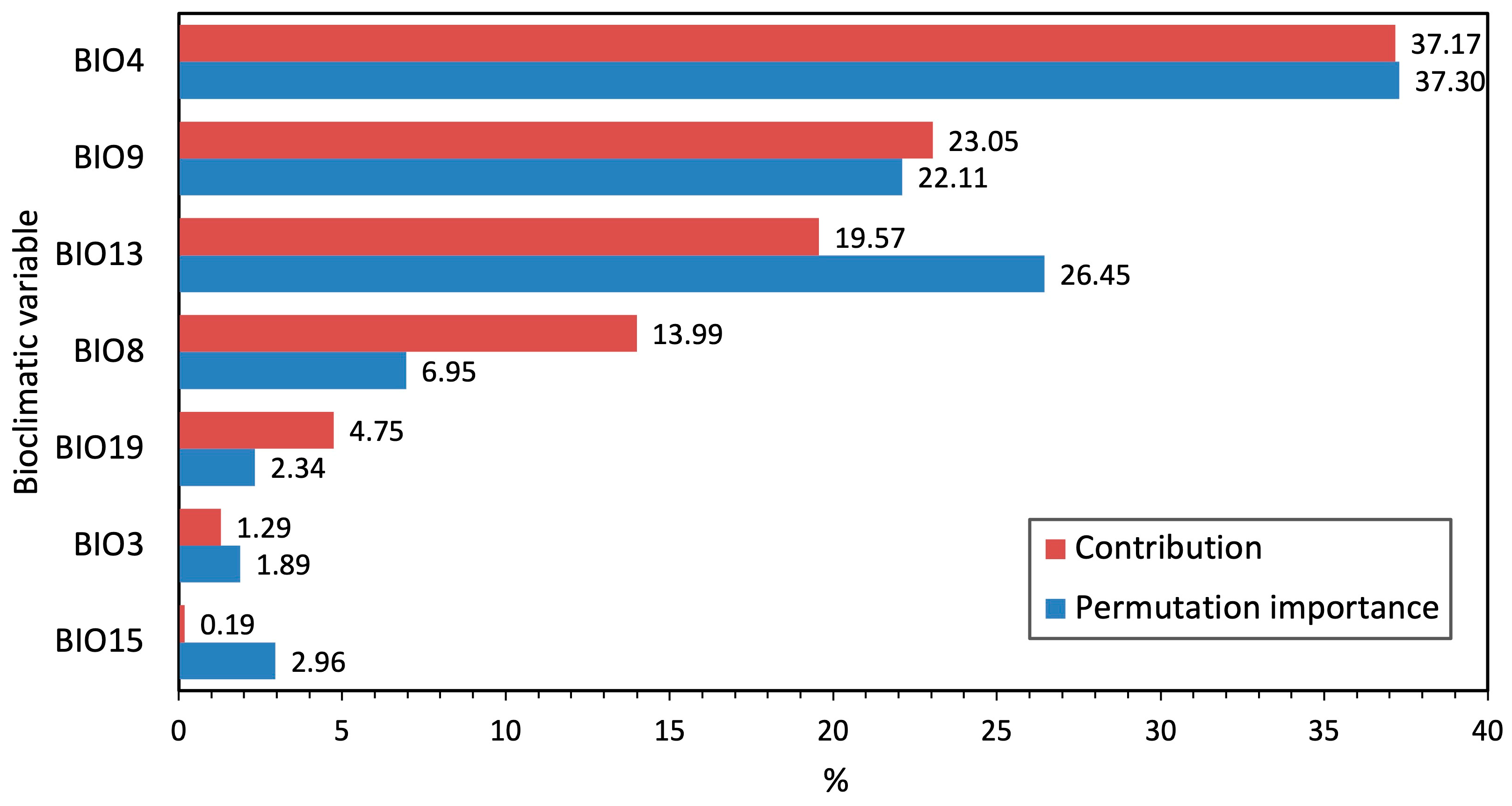
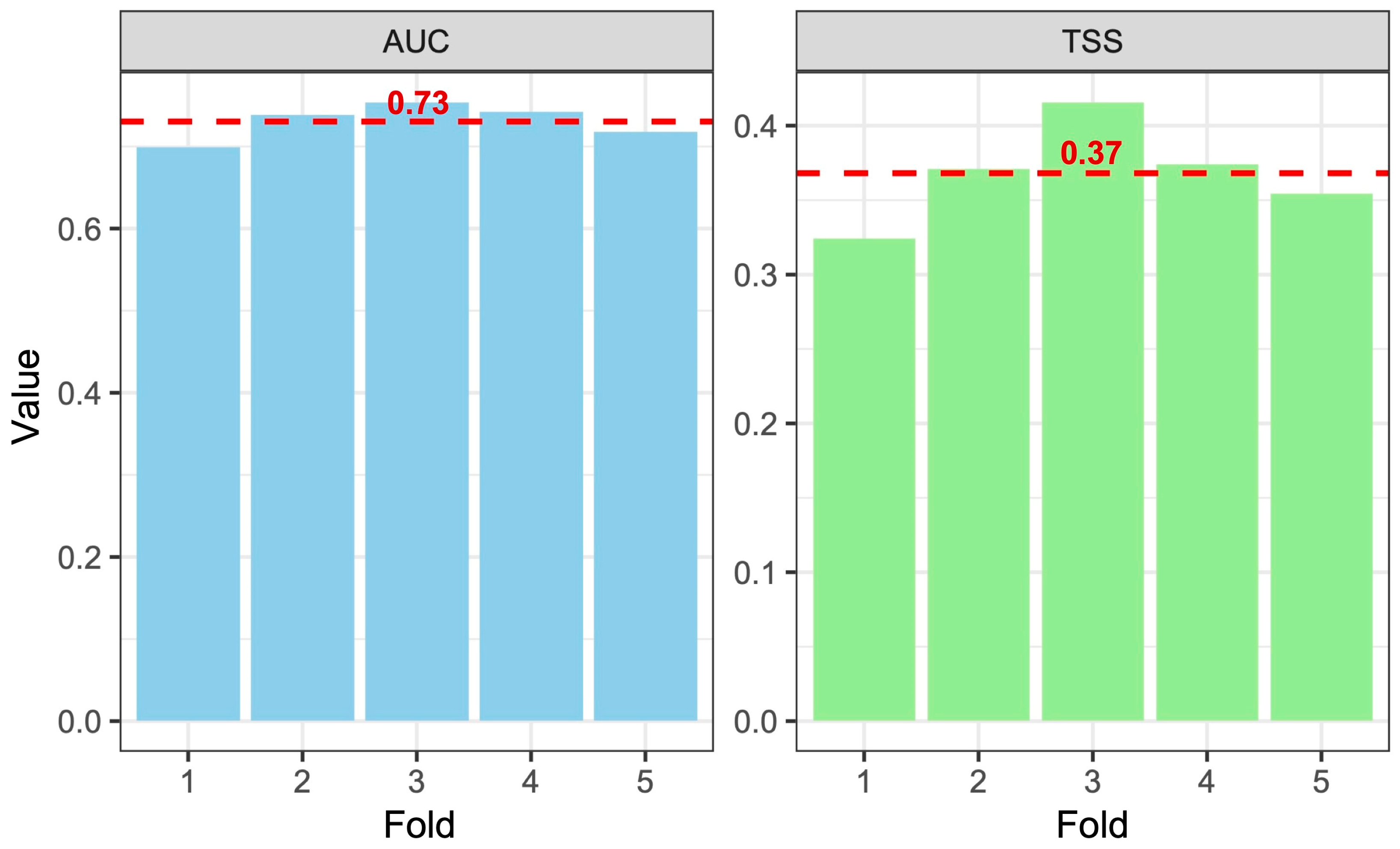
2.3. Species Distribution Modelling and Model Evaluation
2.4. Current Climate Suitability Analysis
2.5. Future Climate Suitability Analysis
3. Results
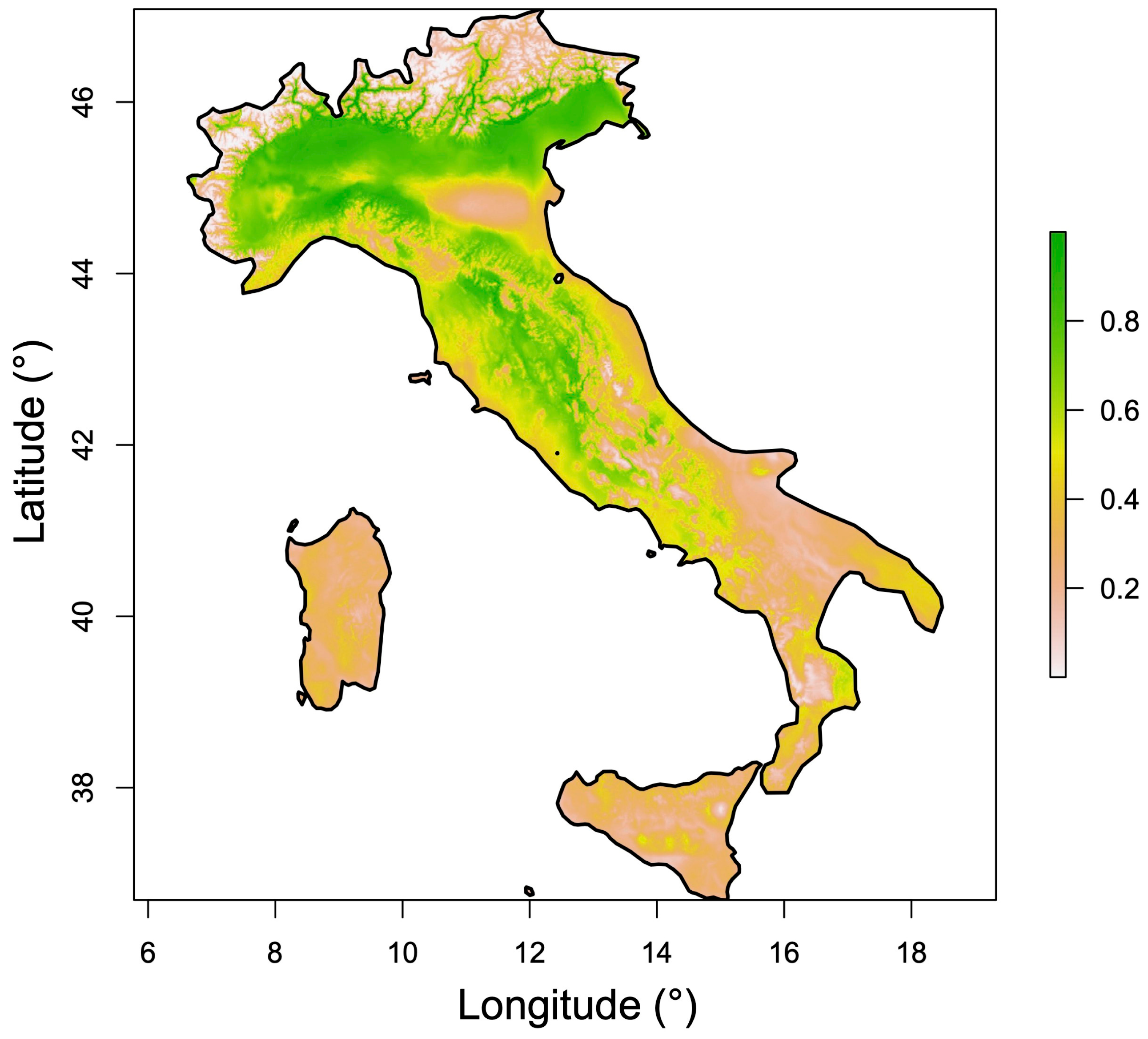
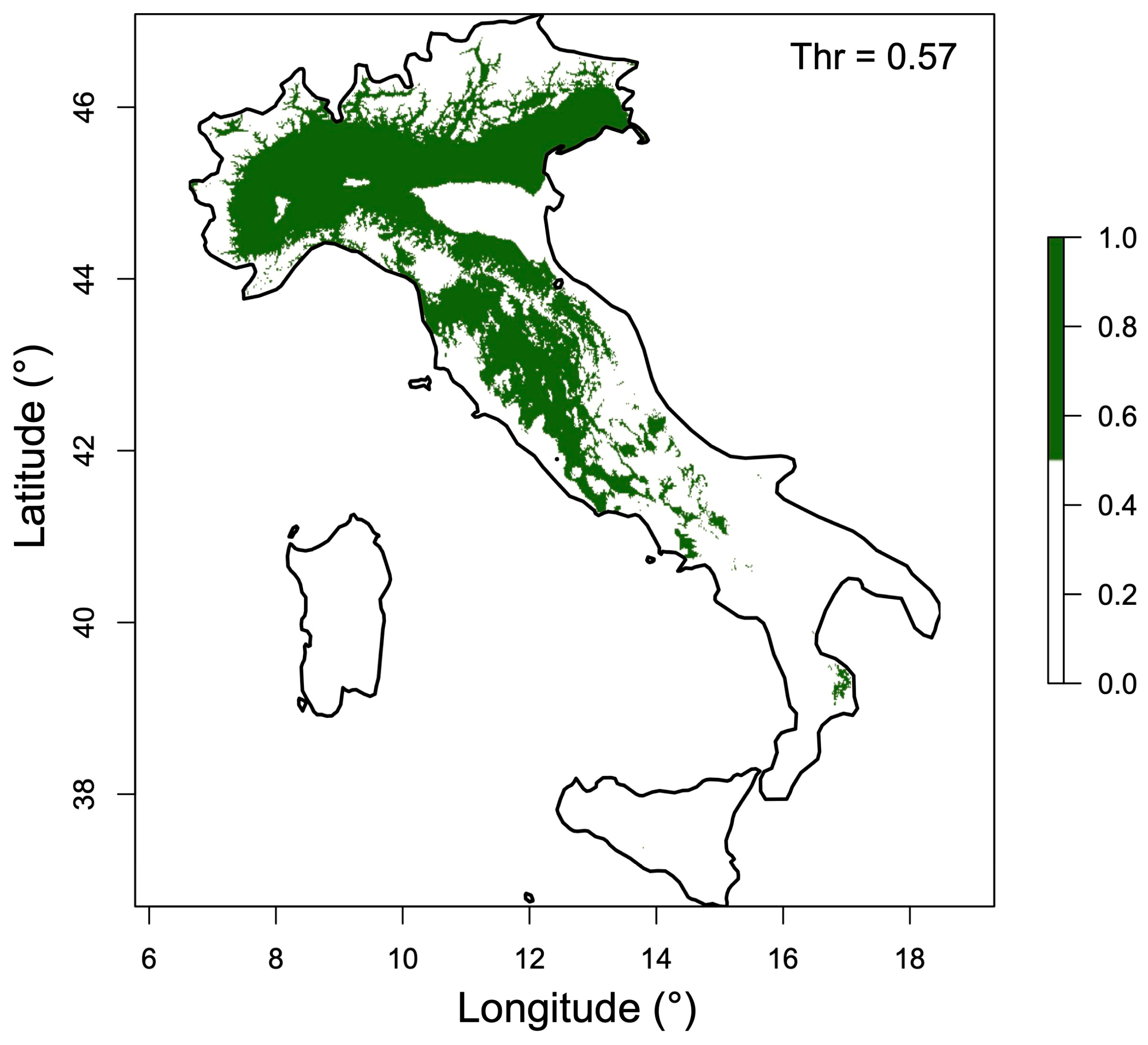
3.1. Areas of Current Climate Suitability
3.2. Areas of Future Climate Suitability
4. Discussion
5. Conclusions
Supplementary Materials
Author Contributions
Funding
Data Availability Statement
Acknowledgments
Conflicts of Interest
References
- Winterhalter, P.; Straubinger, M. Saffron—Renewed Interest in An Ancient Spice. Food Rev. Int. 2000, 16, 39–59. [Google Scholar] [CrossRef]
- Nemati, Z.; Harpke, D.; Gemicioglu, A.; Kerndorff, H.; Blattner, F.R. Saffron (Crocus sativus) Is an Autotriploid That Evolved in Attica (Greece) from Wild Crocus Cartwrightianus. Mol. Phylogenetics Evol. 2019, 136, 14–20. [Google Scholar] [CrossRef]
- Kazemi-Shahandashti, S.-S.; Mann, L.; El-nagish, A.; Harpke, D.; Nemati, Z.; Usadel, B.; Heitkam, T. Ancient Artworks and Crocus Genetics Both Support Saffron’s Origin in Early Greece. Front. Plant Sci. 2022, 13, 834416. [Google Scholar] [CrossRef]
- Shokrpour, M. Saffron (Crocus sativus L.) Breeding: Opportunities and Challenges. In Advances in Plant Breeding Strategies: Industrial and Food Crops: Volume 6; Al-Khayri, J.M., Jain, S.M., Johnson, D.V., Eds.; Springer International Publishing: Cham, Switzerland, 2019; pp. 675–706. ISBN 978-3-030-23265-8. [Google Scholar]
- Cardone, L.; Castronuovo, D.; Perniola, M.; Cicco, N.; Candido, V. Saffron (Crocus sativus L.), the King of Spices: An Overview. Sci. Hortic. 2020, 272, 109560. [Google Scholar] [CrossRef]
- The Observatory of Economic Complexity. Available online: https://oec.world/en (accessed on 10 November 2025).
- Cardone, L.; Castronuovo, D.; Perniola, M.; Cicco, N.; Candido, V. Evaluation of Corm Origin and Climatic Conditions on Saffron (Crocus sativus L.) Yield and Quality. J. Sci. Food Agric. 2019, 99, 5858–5869. [Google Scholar] [CrossRef]
- Gresta, F.; Lombardo, G.M.; Siracusa, L.; Ruberto, G. Saffron, an Alternative Crop for Sustainable Agricultural Systems. A Review. Agron. Sustain. Dev. 2008, 28, 95–112. [Google Scholar] [CrossRef]
- Giorgi, A.; Pentimalli, D.; Giupponi, L.; Panseri, S. Quality Traits of Saffron (Crocus sativus L.) Produced in the Italian Alps. Open Agric. 2017, 2, 52–57. [Google Scholar] [CrossRef]
- Manzo, A.; Panseri, S.; Bertoni, D.; Giorgi, A. Economic and Qualitative Traits of Italian Alps Saffron. J. Mt. Sci. 2015, 12, 1542–1550. [Google Scholar] [CrossRef]
- Caser, M.; Victorino, Í.M.M.; Demasi, S.; Berruti, A.; Donno, D.; Lumini, E.; Bianciotto, V.; Scariot, V. Saffron Cultivation in Marginal Alpine Environments: How AMF Inoculation Modulates Yield and Bioactive Compounds. Agronomy 2018, 9, 12. [Google Scholar] [CrossRef]
- Giupponi, L.; Leoni, V.; Sala, S.; Giorgi, A.; Bertoni, D. Saffron Growing in Italy: A Sustainable Secondary Activity for Farms in Hilly and Sub-Mountain Areas. Int. J. Agric. Sustain. 2023, 21, 2270263. [Google Scholar] [CrossRef]
- Giupponi, L.; Ceciliani, G.; Leoni, V.; Panseri, S.; Pavlovic, R.; Lingua, G.; Di Filippo, A.; Giorgi, A. Quality Traits of Saffron Produced in Italy: Geographical Area Effect and Good Practices. J. Appl. Bot. Food Qual. 2019, 92, 336–342. [Google Scholar] [CrossRef]
- Locatelli, I.; Pedrali, D.; Grassi, S.; Buratti, S.; Giorgi, A.; Giupponi, L. Progress in Quality Assessment of Italian Saffron. Sci. Rep. 2025, 15, 2175. [Google Scholar] [CrossRef]
- EU Commission. A Farm to Fork Strategy for a Fair, Healthy and Environmentally-Friendly Food System. COM/2020/381 Final, Brussels. Retrieved. 2020. Available online: https://eur-lex.europa.eu/legal-content/EN/TXT/?uri=CELEX:52020DC0381 (accessed on 20 February 2024).
- Fabbrini, F. Italy’s National Recovery and Resilience Plan: Context, Content and Challenges. J. Mod. Ital. Stud. 2022, 27, 658–676. [Google Scholar] [CrossRef]
- Calvin, K.; Dasgupta, D.; Krinner, G.; Mukherji, A.; Thorne, P.W.; Trisos, C.; Romero, J.; Aldunce, P.; Barrett, K.; Blanco, G.; et al. IPCC, 2023: Climate Change 2023: Synthesis Report. Contribution of Working Groups I, II and III to the Sixth Assessment Report of the Intergovernmental Panel on Climate Change, 1st ed.; Core Writing Team, Lee, H., Romero, J., Eds.; Intergovernmental Panel on Climate Change (IPCC): Geneva, Switzerland, 2023. [Google Scholar]
- Busconi, M.; Wischnitzki, E.; Del Corvo, M.; Colli, L.; Soffritti, G.; Stagnati, L.; Fluch, S.; Sehr, E.M.; de los Mozos Pascual, M.; Fernández, J.A. Epigenetic Variability Among Saffron Crocus (Crocus sativus L.) Accessions Characterized by Different Phenotypes. Front. Plant Sci. 2021, 12, 642631. [Google Scholar] [CrossRef]
- Fernández, J.A. Biology, Biotechnology and Biomedicine of Saffron; Research Signpost: Trivandrum, India, 2004; pp. 127–159. ISBN 81-7736-239-9. [Google Scholar]
- Guisan, A.; Thuiller, W.; Zimmermann, N.E. Habitat Suitability and Distribution Models: With Applications in R; Ecology, Biodiversity and Conservation; Cambridge University Press: Cambridge, UK, 2017; ISBN 978-0-521-76513-8. [Google Scholar]
- Elith, J.; Leathwick, J.R. Species Distribution Models: Ecological Explanation and Prediction Across Space and Time. Annu. Rev. Ecol. Evol. Syst. 2009, 40, 677–697. [Google Scholar] [CrossRef]
- R: The R Project for Statistical Computing. Available online: https://www.r-project.org/ (accessed on 10 November 2025).
- Brun, P.; Zimmermann, N.E.; Hari, C.; Pellissier, L.; Karger, D.N. Global climate-related predictors at kilometer resolution for the past and future (CHELSA-BIOCLIM+ v2.1). Earth Syst. Sci. Data 2022, 14, 5573–5603. [Google Scholar] [CrossRef]
- Naimi, B.; Hamm, N.A.S.; Groen, T.A.; Skidmore, A.K.; Toxopeus, A.G. Where is positional uncertainty a problem for species distribution modelling? Ecography 2014, 37, 191–203. [Google Scholar] [CrossRef]
- Phillips, S.J.; Anderson, R.P.; Schapire, R.E. Maximum Entropy Modeling of Species Geographic Distributions. Ecol. Model. 2006, 190, 231–259. [Google Scholar] [CrossRef]
- Fitzgibbon, A.; Pisut, D.; Fleisher, D. Evaluation of Maximum Entropy (Maxent) Machine Learning Model to Assess Relationships between Climate and Corn Suitability. Land 2022, 11, 1382. [Google Scholar] [CrossRef]
- Tang, X.; Yuan, Y.; Li, X.; Zhang, J. Maximum Entropy Modeling to Predict the Impact of Climate Change on Pine Wilt Disease in China. Front. Plant Sci. 2021, 12, 652500. [Google Scholar] [CrossRef] [PubMed]
- Hijmans, R.J.; Phillips, S.; Leathwick, J.; Elith, J. Species Distribution Modeling. R Package Version 1.3-16. Available online: https://cran.r-project.org/web/packages/dismo/dismo.pdf (accessed on 10 November 2025).
- Elith, J.; Graham, C.H.; Anderson, R.P.; Dudík, M.; Ferrier, S.; Guisan, A.; Hijmans, R.J.; Huettmann, F.; Leathwick, J.R.; Lehmann, A.; et al. Novel methods improve prediction of species’ distributions from occurrence data. Ecography 2006, 29, 129–151. [Google Scholar] [CrossRef]
- Liu, C.; Berry, P.M.; Dawson, T.P.; Pearson, R.G. Selecting thresholds of occurrence in the prediction of species distributions. Ecography 2005, 28, 385–393. [Google Scholar] [CrossRef]
- Dunne, J.P.; Horowitz, L.W.; Adcroft, A.J.; Ginoux, P.; Held, I.M.; John, J.G.; Zadeh, N. The GFDL Earth System Model version 4.1 (GFDL-ESM4.1): Overall coupled model description and simulation characteristics. J. Adv. Model. Earth Syst. 2020, 12, e2019MS002015. [Google Scholar] [CrossRef]
- Intergovernmental Panel on Climate Change (IPCC) (Ed.) IPCC 2021: Summary for Policymakers. In Climate Change 2021—The Physical Science Basis: Working Group I Contribution to the Sixth Assessment Report of the Intergovernmental Panel on Climate Change; Cambridge University Press: Cambridge, UK, 2023; pp. 3–32. ISBN 978-1-009-15788-9.
- Riahi, K.; van Vuuren, D.P.; Kriegler, E.; Edmonds, J.; O’Neill, B.C.; Fujimori, S.; Bauer, N.; Calvin, K.; Dellink, R.; Fricko, O.; et al. The Shared Socioeconomic Pathways and their energy, land use, and greenhouse gas emissions implications: An overview. Glob. Environ. Change 2017, 42, 153–168. [Google Scholar] [CrossRef]
- O’Neill, B.C.; Kriegler, E.; Ebi, K.L.; Kemp-Benedict, E.; Riahi, K.; Rothman, D.S.; van Ruijven, B.J.; van Vuuren, D.P.; Birkmann, J.; Kok, K.; et al. The roads ahead: Narratives for shared socioeconomic pathways describing world futures in the 21st century. Glob. Environ. Change 2016, 42, 169–180. [Google Scholar] [CrossRef]
- Elith, J.; Kearney, M.; Phillips, S. The art of modelling range-shifting species. Methods Ecol. Evol. 2010, 1, 330–342. [Google Scholar] [CrossRef]
- Allouche, O.; Tsoar, A.; Kadmon, R. Assessing the Accuracy of Species Distribution Models: Prevalence, Kappa and the True Skill Statistic (TSS). J. Appl. Ecol. 2006, 43, 1223–1232. [Google Scholar] [CrossRef]
- Giorgi, A.; Bertoni, D.; Manzo, A.; Panseri, S. L’oro Rosso Delle Alpi—Manuale Tecnico-Scientifico Di Produzione Dello Zafferano, 1st ed.; Biblion: Milano, Italy, 2015. [Google Scholar]
- Jarvis, A.; Lane, A.; Hijmans, R.J. The Effect of Climate Change on Crop Wild Relatives. Agric. Ecosyst. Environ. 2008, 126, 13–23. [Google Scholar] [CrossRef]
- Duke, J.A. Ecosystematic Data on Economic Plants. Q. J. Crude Drug Res. 1979, 17, 91–109. [Google Scholar] [CrossRef]
- Kumar, R.; Singh, V.; Devi, K.; Sharma, M.; Singh, M.K.; Ahuja, P.S. State of Art of Saffron (Crocus sativus L.) Agronomy: A Comprehensive Review. Food Rev. Int. 2008, 25, 44–85. [Google Scholar] [CrossRef]
- Molina, R.V.; Valero, M.; Navarro, Y.; Guardiola, J.L.; García-Luis, A. Temperature Effects on Flower Formation in Saffron (Crocus sativus L.). Sci. Hortic. 2005, 103, 361–379. [Google Scholar] [CrossRef]
- Wang, Z.; Li, X.; Xu, J.; Yang, Z.; Zhang, Y. Effects of Ambient Temperature on Flower Initiation and Flowering in Saffron (Crocus sativus L.). Sci. Hortic. 2021, 279, 109859. [Google Scholar] [CrossRef]
- Pirasteh-Anosheh, H.; Babaie-Zarch, M.J.; Nasrabadi, M.; Parnian, A.; Alavi-Siney, S.M.; Beyrami, H.; Kaveh, H.; Hashemi, S.E.; Durrer, U.; McDonald, K.; et al. Climate and Management Factors Influence Saffron Yield in Different Environments. Agrosystems Geosci. Environ. 2023, 6, e20418. [Google Scholar] [CrossRef]
- Kumar, A.; Devi, M.; Kumar, R.; Kumar, S. Introduction of High-Value Crocus sativus (Saffron) Cultivation in Non-Traditional Regions of India through Ecological Modelling. Sci. Rep. 2022, 12, 11925. [Google Scholar] [CrossRef]
- Shinde, D.A.; Talib, A.R.; Gorantiwar, S.M. Composition and Classification of Some Typical Soils of Saffron Growing Areas of Jammu and Kashmir. J. Indian Soc. Soil Sci. 1984, 32, 473–477. [Google Scholar]
- Statistiche INFC2015—Inventario Nazionale Delle Foreste e Dei Serbatoi Forestali Di Carbonio—INFC. Available online: https://www.inventarioforestale.org/it/statistiche_infc/ (accessed on 10 November 2025).
- Cislaghi, A.; Giupponi, L.; Tamburini, A.; Giorgi, A.; Bischetti, G.B. The Effects of Mountain Grazing Abandonment on Plant Community, Forage Value and Soil Properties: Observations and Field Measurements in an Alpine Area. CATENA 2019, 181, 104086. [Google Scholar] [CrossRef]
- Giupponi, L.; Pedrali, D.; Leoni, V.; Rodari, A.; Giorgi, A. The Analysis of Italian Plant Agrobiodiversity Databases Reveals That Hilly and Sub-Mountain Areas Are Hotspots of Herbaceous Landraces. Diversity 2021, 13, 70. [Google Scholar] [CrossRef]
- Flemons, P.; Guralnick, R.; Krieger, J.; Ranipeta, A.; Neufeld, D. A Web-Based GIS Tool for Exploring the World’s Biodiversity: The Global Biodiversity Information Facility Mapping and Analysis Portal Application (GBIF-MAPA). Ecol. Inform. 2007, 2, 49–60. [Google Scholar] [CrossRef]
- Ivanova, N.V.; Shashkov, M.P. The Possibilities of GBIF Data Use in Ecological Research. Russ. J. Ecol. 2021, 52, 1–8. [Google Scholar] [CrossRef]
- Chandler, M.; See, L.; Copas, K.; Bonde, A.M.Z.; López, B.C.; Danielsen, F.; Legind, J.K.; Masinde, S.; Miller-Rushing, A.J.; Newman, G.; et al. Contribution of Citizen Science towards International Biodiversity Monitoring. Biol. Conserv. 2017, 213, 280–294. [Google Scholar] [CrossRef]
- Bowler, D.E.; Bhandari, N.; Repke, L.; Beuthner, C.; Callaghan, C.T.; Eichenberg, D.; Er Minio Otton, E.; Henle, K.; Klenke, R.; Richter, A.; et al. Decision-Making of Citizen Scientists When Recording Species Observations. Sci. Rep. 2022, 12, 11069. [Google Scholar] [CrossRef] [PubMed]
- Hartmann, D.L. Chapter 11—Global Climate Models. In Global Physical Climatology, 2nd ed.; Hartmann, D.L., Ed.; Elsevier: Boston, MA, USA, 2016; pp. 325–360. ISBN 978-0-12-328531-7. [Google Scholar]



| Code | Bioclimatic Variable | VIF |
|---|---|---|
| BIO3 | Isothermality | 1.62 |
| BIO8 | Mean Temperature of Wettest Quarter | 2.11 |
| BIO15 | Precipitation Seasonality | 3.00 |
| BIO9 | Mean Temperature of Driest Quarter | 3.41 |
| BIO13 | Precipitation of Wettest Month | 3.60 |
| BIO19 | Precipitation of Coldest Quarter | 4.42 |
| BIO4 | Temperature Seasonality | 4.84 |
Disclaimer/Publisher’s Note: The statements, opinions and data contained in all publications are solely those of the individual author(s) and contributor(s) and not of MDPI and/or the editor(s). MDPI and/or the editor(s) disclaim responsibility for any injury to people or property resulting from any ideas, methods, instructions or products referred to in the content. |
© 2026 by the authors. Licensee MDPI, Basel, Switzerland. This article is an open access article distributed under the terms and conditions of the Creative Commons Attribution (CC BY) license.
Share and Cite
Giupponi, L.; Pedrali, D.; Giorgi, A. From Plains to Mountains: Results of Current and Future Climatic Suitability Analysis for Crocus sativus L. Cultivation in Italy. Plants 2026, 15, 693. https://doi.org/10.3390/plants15050693
Giupponi L, Pedrali D, Giorgi A. From Plains to Mountains: Results of Current and Future Climatic Suitability Analysis for Crocus sativus L. Cultivation in Italy. Plants. 2026; 15(5):693. https://doi.org/10.3390/plants15050693
Chicago/Turabian StyleGiupponi, Luca, Davide Pedrali, and Annamaria Giorgi. 2026. "From Plains to Mountains: Results of Current and Future Climatic Suitability Analysis for Crocus sativus L. Cultivation in Italy" Plants 15, no. 5: 693. https://doi.org/10.3390/plants15050693
APA StyleGiupponi, L., Pedrali, D., & Giorgi, A. (2026). From Plains to Mountains: Results of Current and Future Climatic Suitability Analysis for Crocus sativus L. Cultivation in Italy. Plants, 15(5), 693. https://doi.org/10.3390/plants15050693