Cedarwood Oils: The Wood Essential Oil Compositions from Trees Known as “Cedar”



Abstract
1. Introduction
2. Materials and Methods
2.1. Literature Search
2.2. Essential Oil Analysis
3. Conclusions
Author Contributions
Funding
Institutional Review Board Statement
Informed Consent Statement
Data Availability Statement
Acknowledgments
Conflicts of Interest
References
- De Siqueira, R.J.; Rodrigues, K.M.S.; Da Silva, M.T.B.; Correia Junior, C.A.B.; Duarte, G.P.; Magalhães, P.J.C.; Dos Santos, A.A.; Maia, J.G.S.; Da Cunha, P.J.S.; Lahlou, S. Linalool-Rich Rosewood Oil Induces Vago-Vagal Bradycardic and Depressor Reflex in Rats. Phyther. Res. 2014, 28, 42–48. [Google Scholar] [CrossRef]
- Sampaio, L.D.F.S.; Maia, J.G.S.; De Parijós, A.M.; De Souza, R.Z.; Barata, L.E.S. Linalool from Rosewood (Aniba rosaeodora Ducke) Oil Inhibits Adenylate Cyclase in the Retina, Contributing to Understanding Its Biological Activity. Phyther. Res. 2012, 26, 73–77. [Google Scholar] [CrossRef]
- May, P.H.; Barata, L.E.S. Rosewood Exploitation in the Brazilian Amazon: Options for Sustainable Production. Econ. Bot. 2004, 58, 257–265. [Google Scholar] [CrossRef]
- Maia, J.G.S.; Andrade, E.H.A.; Couto, H.A.R.; da Silva, A.C.M.; Marx, F.; Henke, C. Plant Sources of Amazon Rosewood Oil. Quim. Nova 2007, 30, 1906–1910. [Google Scholar] [CrossRef]
- Chantraine, J.-M.; Dhénin, J.-M.; Moretti, C. Chemical Variability of Rosewood (Aniba rosaeodora Ducke) Essential Oil in French Guiana. J. Essent. Oil Res. 2009, 21, 486–495. [Google Scholar] [CrossRef]
- de Almeida, R.N.; Araújo, D.A.M.; Gonçalves, J.C.R.; Montenegro, F.C.; de Sousa, D.P.; Leite, J.R.; Mattei, R.; Benedito, M.A.C.; de Carvalho, J.G.B.; Cruz, J.S.; et al. Rosewood Oil Induces Sedation and Inhibits Compound Action Potential in Rodents. J. Ethnopharmacol. 2009, 124, 440–443. [Google Scholar] [CrossRef]
- Burdock, G.A.; Carabin, I.G. Safety Assessment of Sandalwood Oil (Santalum album L.). Food Chem. Toxicol. 2008, 46, 421–432. [Google Scholar] [CrossRef] [PubMed]
- Howes, M.R.; Simmonds, M.S.J.; Kite, G.C. Evaluation of the Quality of Sandalwood Essential Oils by Gas Chromatography–Mass Spectrometry. J. Chromatogr. 2004, 1028, 307–312. [Google Scholar] [CrossRef] [PubMed]
- Sciarrone, D.; Costa, R.; Ragonese, C.; Tranchida, P.Q.; Tedone, L.; Santi, L.; Dugo, P.; Dugo, G.; Joulain, D.; Mondello, L. Application of a Multidimensional Gas Chromatography System with Simultaneous Mass Spectrometric and Flame Ionization Detection to the Analysis of Sandalwood Oil. J. Chromatogr. A 2011, 1218, 137–142. [Google Scholar] [CrossRef] [PubMed]
- Baldovini, N.; Delasalle, C.; Joulain, D. Phytochemistry of the Heartwood from Fragrant Santalum Species: A Review. Flavour Fragr. J. 2011, 26, 7–26. [Google Scholar] [CrossRef]
- Braun, N.A.; Sim, S.; Kohlenberg, B.; Lawrence, B.M. Hawaiian Sandalwood: Oil Composition of Santalum paniculatum and Comparison with Other Sandal Species. Nat. Prod. Commun. 2014, 9, 1365–1368. [Google Scholar] [CrossRef] [PubMed]
- Piggott, M.J.; Ghisalberti, E.L.; Trengove, R.D. Western Australian Sandalwood Oil: Extraction by Different Techniques and Variations of the Major Components in Different Sections of a Single Tree. Flavour Fragr. J. 1997, 12, 43–46. [Google Scholar] [CrossRef]
- Shellie, R.; Marriott, P.; Morrison, P. Comprehensive Two-Dimensional Gas Chromatography with Flame Ionization and Time-of-Flight Mass Spectrometry Detection: Qualitative and Quantitative Analysis of West Australian Sandalwood Oil. J. Chromatogr. Sci. 2004, 42, 417–422. [Google Scholar] [CrossRef]
- Setzer, W.N.; Poudel, A.; Satyal, P.; Swor, K.; Ankney, E. Enantioselective Gas Chromatographic Analysis of Cupressaceae Foliar Essential Oils: Callitropsis nootkatensis, Calocedrus decurrens, Sequoia sempervirens, and Thuja plicata. J. Essent. Oil Plant Compos. 2025, 3, 140–153. [Google Scholar] [CrossRef]
- Manter, D.K.; Karchesy, J.J.; Kelsey, R.G. The Sporicidal Activity of Yellow-Cedar Heartwood, Essential Oil and Wood Constituents towards Phytophthora ramorum in Culture. For. Pathol. 2006, 36, 297–308. [Google Scholar] [CrossRef]
- Manter, D.K.; Kelsey, R.G.; Karchesy, J.J. Antimicrobial Activity of Extractable Conifer Heartwood Compounds toward Phytophthora ramorum. J. Chem. Ecol. 2007, 33, 2133–2147. [Google Scholar] [CrossRef]
- Panella, N.A.; Dolan, M.C.; Karchesy, J.J.; Xiong, Y.; Peralta-Cruz, J.; Khasawneh, M.; Montenieri, J.A.; Maupin, G.O. Use of Novel Compounds for Pest Control: Insecticidal and Acaricidal Activity of Essential Oil Components from Heartwood of Alaska Yellow Cedar. J. Med. Entomol. 2005, 42, 352–358. [Google Scholar] [CrossRef] [PubMed]
- Xiong, Y. Essential Oil Components of Alaska Cedar Heartwood. Master’s Thesis, Oregon State University, Corvallis, OR, USA, 2000. [Google Scholar]
- Liu, X. Analysis and Comparison of Essential Oil Components Extracted from the Heartwoods of Leyland Cypress, Alaska Yellow Cedar, and Monterey Cypress. Master’s Thesis, Oregon State University, Corvallis, OR, USA, 2009. [Google Scholar]
- Khasawneh, M.A.; Xiong, Y.; Peralta-Cruz, J.; Karchesy, J.J. Biologically Important Eremophilane Sesquiterpenes from Alaska Cedar Heartwood Essential Oil and Their Semi-Synthetic Derivatives. Molecules 2011, 16, 4775–4785. [Google Scholar] [CrossRef] [PubMed]
- Veluthoor, S.; Kelsey, R.G.; González-Hernández, M.P.; Panella, N.; Dolan, M.; Karchesy, J. Composition of the Heartwood Essential Oil of Incense Cedar (Calocedrus decurrens Torr.). Holzforschung 2011, 65, 333–336. [Google Scholar] [CrossRef]
- Dolan, M.C.; Dietrich, G.; Panella, N.A.; Montenieri, J.A.; Karchesy, J.J. Biocidal Activity of Three Wood Essential Oils against Ixodes scapularis (Acari: Ixodidae), Xenopsylla cheopis (Siphonaptera: Pulicidae), and Aedes aegypti (Diptera: Culicidae). J. Econ. Entomol. 2007, 100, 622–625. [Google Scholar] [CrossRef]
- eFloras.org Calocedrus macrolepis var. formosana (Florin) W.C. Cheng & L.K. Fu. Available online: http://www.efloras.org/florataxon.aspx?flora_id=2&taxon_id=200005407 (accessed on 10 January 2026).
- Hsiao, W.W.; Senthil Kumar, K.J.; Lee, H.-J.; Tsao, N.-W.; Wang, S.-Y. Anti-Melanogenic Activity of Calocedrus formosana Wood Essential Oil and Its Chemical Composition Analysis. Plants 2022, 11, 62. [Google Scholar] [CrossRef] [PubMed]
- Cheng, S.-S.; Chang, H.-T.; Wu, C.-L.; Chang, S.-T. Anti-Termitic Activities of Essential Oils from Coniferous Trees against Coptotermes formosanus. Bioresour. Technol. 2007, 98, 456–459. [Google Scholar] [CrossRef] [PubMed]
- Vargas Suarez, A.; Satyal, P.; Setzer, W.N. Volatile Components of the Wood of Spanish Cedar, Cedrela odorata, from Costa Rica. Am. J. Essent. Oils Nat. Prod. 2018, 6, 27–30. [Google Scholar]
- Brunke, E.-J.; Hammerschmidt, F.-J.; Köster, F.-H. Essential Oil of Cedrela odorata L. (Meliaceae) from Brazil—Revised List of Constituents. In Progress in Essential Oil Research, Proceedings of the International Symposium on Essential Oils, Holzminden/Neuhaus, Germany, 18–21 September 1985; Brunke, E.-J., Ed.; Walter de Gruyter: Berlin, Germany, 1986; pp. 117–122. [Google Scholar]
- Ugah, T.C.; Aboaba, S.A.; Ekundayo, O. Volatile Oil Constituents of the Leaves and Woods of Cedrela odorata and Dalbergia latifolia from South West Nigeria. South. Braz. J. Chem. 2015, 23, 83–90. [Google Scholar] [CrossRef]
- Adams, R.P. Identification of Essential Oil Components by Gas Chromatography/Mass Spectrometry, 4th ed.; Allured Publishing: Carol Stream, IL, USA, 2007; ISBN 978-1-932633-21-4. [Google Scholar]
- Bennouna, F.; Lachkar, M.; El Abed, S.; Koraichi, S.I. Cedrus atlantica Essential Oil: Antimicrobial Activity and Effect on the Physicochemical Properties of Cedar Wood Surface. Moroc. J. Biol. 2020, 16, 35–45. [Google Scholar]
- Benouaklil, F.; Hamaidi-Chergui, F.; Hamaidi, M.S.; Saidi, F. Chemical Composition and Antimicrobial Properties of Algerian Cedrus atlantica M. Essential Oils. Rev. Agrobiol. 2017, 7, 355–362. [Google Scholar]
- Moustaid, W.; Saffaj, T.; Annemer, S.; Assouguem, A.; Ullah, R.; Ali, E.A.; Ercisli, S.; Marc, R.A.; Farah, A. Simultaneous Hydrodistillation of Healthy Cedrus atlantica Manetti and Infected by Trametes pini and Ungulina officinalis: Effect on Antibacterial Activity Utilizing a Mixture-Design Method. ACS Omega 2023, 8, 31899–31913. [Google Scholar] [CrossRef]
- Satrani, B.; Aberchane, M.; Farah, A.; Chaouch, A.; Talbi, M. Composition Chimique et Activité Antimicrobienne Des Huiles Essentielles Extraites Par Hydrodistillation Fractionnée Du Bois de Cedrus atlantica Manetti. Acta Bot. Gall. 2006, 153, 97–104. [Google Scholar] [CrossRef]
- Zrira, S.; Ghanmi, M. Chemical Composition and Antibacterial Activity of the Essential of Cedrus atlantica (Cedarwood Oil). J. Essent. Oil-Bear. Plants 2016, 19, 1267–1272. [Google Scholar] [CrossRef]
- Fidah, A.; Salhi, N.; Rahouti, M.; Kabouchi, B.; Ziani, M.; Aberchane, M.; Famiri, A. Natural Durability of Cedrus atlantica Wood Related to the Bioactivity of Its Essential Oil against Wood Decaying Fungi. Maderas Cienc. Tecnol. 2016, 18, 567–576. [Google Scholar] [CrossRef]
- Al Kamaly, O.; Saleh, A.; Al Sfouk, A.; Alanazi, A.S.; Parvez, M.K.; Ousaaid, D.; Assouguem, A.; Mechchate, H.; Bouhrim, M. Cedrus atlantica (Endl.) Manetti ex Carrière Essential Oil Alleviates Pain and Inflammation with No Toxicity in Rodent. Processes 2022, 10, 581. [Google Scholar] [CrossRef]
- Martins, D.F.; Emer, A.A.; Batisti, A.P.; Donatello, N.; Carlesso, M.G.; Mazzardo-Martins, L.; Venzke, D.; Micke, G.A.; Pizzolatti, M.G.; Piovezan, A.P.; et al. Inhalation of Cedrus atlantica Essential Oil Alleviates Pain Behavior through Activation of Descending Pain Modulation Pathways in a Mouse Model of Postoperative Pain. J. Ethnopharmacol. 2015, 175, 30–38. [Google Scholar] [CrossRef]
- Gruin, S.; Creţu, O.; Mioc, A.; Mioc, M.; Prodea, A.; Atyim, E.; Lukinich-Gruia, A.T.; Pricop, M.-A.; Gogulescu, A.; Şoica, C. Evaluation of Cedrus atlantica Essential Oil: Chemical Composition, Anticancer Activity and Molecular Docking Studies. Molecules 2026, 31, 46. [Google Scholar] [CrossRef] [PubMed]
- Aberchane, M.; Fechtal, M.; Chaouch, A. Analysis of Moroccan Atlas Cedarwood Oil (Cedrus atlantica Manetti). J. Essent. Oil Res. 2004, 16, 542–547. [Google Scholar] [CrossRef]
- Boudarene, L.; Rahim, L.; Baaliouamer, A.; Meklati, B.Y. Analysis of Algerian Essential Oils from Twigs, Needles and Wood of Cedrus atlantica G. Manetti by GC/MS. J. Essent. Oil Res. 2004, 16, 531–534. [Google Scholar] [CrossRef]
- Chalchat, J.C.; Garry, R.-P.; Miehet, A.; Benjilali, B. Essential Oil Components in Sawdust of Cedrus atlantica from Morocco. J. Essent. Oil Res. 1994, 6, 323–325. [Google Scholar] [CrossRef]
- Jaouadi, I.; Cherrad, S.; Bouyahya, A.; Koursaoui, L.; Satrani, B.; Ghanmi, M.; Chaouch, A. Chemical Variability and Antioxidant Activity of Cedrus atlantica Manetti Essential Oils Isolated from Wood Tar and Sawdust. Arab. J. Chem. 2021, 14, 103441. [Google Scholar] [CrossRef]
- Nam, A.M.; Bighelli, A.; Ghanmi, M.; Satrani, B.; Casanova, J.; Tomi, F. Deodarone Isomers in Cedrus atlantica Essential Oils and Tar Oils. Nat. Prod. Commun. 2015, 10, 1905–1906. [Google Scholar] [CrossRef]
- Ninich, O.; El Fahime, E.; Satrani, B.; Burri, S.; Ghanmi, M.; Aarabi, S.; Chauiyakh, O.; Kettani, K.; Ettahir, A. Comparative Chemical and Biological Analysis of Wood and Tar Essential Oils from Cedrus atlantica and Juniperus oxycedrus in Morocco. Trop. J. Nat. Prod. Res. 2024, 8, 6570–6581. [Google Scholar] [CrossRef]
- Paoli, M.; Nam, A.M.; Castola, V.; Casanova, J.; Bighelli, A. Chemical Variability of the Wood Essential Oil of Cedrus atlantica Manetti from Corsica. Chem. Biodivers. 2011, 8, 344–351. [Google Scholar] [CrossRef] [PubMed]
- Saab, A.M.; Harb, F.Y.; Koenig, W.A. Essential Oil Components in Heart Wood of Cedrus libani and Cedrus atlantica from Lebanon. Minerva Biotecnol. 2005, 17, 159–161. [Google Scholar]
- Uehara, A.; Tommis, B.; Belhassen, E.; Satrani, B.; Ghanmi, M.; Baldovini, N. Odor-Active Constituents of Cedrus atlantica Wood Essential Oil. Phytochemistry 2017, 144, 208–215. [Google Scholar] [CrossRef]
- Chauiyakh, O.; Et-tahir, A.; Kettani, K.; Cherrat, A.; Benayad, A.; Chaouch, A. Review on Health Status, Chemical Composition and Antimicrobial Properties of the Four Species of the Genus Cedrus. Int. Wood Prod. J. 2022, 13, 272–285. [Google Scholar] [CrossRef]
- Douros, A.; Christopoulou, A.; Kikionis, S.; Nikolaou, K.; Skaltsa, H. Volatile Components of Heartwood, Sapwood, and Resin from a Dated Cedrus brevifolia. Nat. Prod. Commun. 2019, 14, 1934578X19859125. [Google Scholar] [CrossRef]
- Chaudhary, A.K.; Ahmad, S.; Mazumder, A. Cedrus deodara (Roxb.) Loud.: A Review on Its Ethnobotany, Phytochemical and Pharmacological Profile. Pharmacogn. J. 2011, 3, 12–17. [Google Scholar] [CrossRef]
- Gupta, S.; Walia, A.; Malan, R. Phytochemistry and Pharmacology of Cedrus deodera: An Overview. Int. J. Pharm. Sci. Res. 2011, 2, 2010–2020. [Google Scholar]
- Kumar, S.; Kumar, A.; Pradesh, H.; Kumar, I.R.; Kumar, R. Himalayan (Himachal Region) Cedar Wood (Cedrus deodara: Pinaceae) Essential Oil, Its Processing, Ingredients and Uses: A Review. J. Pharmacogn. Phytochem. 2019, 8, 2228–2238. [Google Scholar]
- Nadeem, F.; Khalid, T.; Jilani, M.I.; Rahman, S. A Review on Ethnobotanical, Phytochemical and Pharmacological Potentials of Cedrus deodara. Int. J. Chem. Biochem. Sci. 2019, 15, 28–34. [Google Scholar]
- Sinha, D. A Review on Phytochemical, Ethnobotanical, Pharmacological, and Antimicrobial Importance of Cedrus deodara (Roxb. Ex D. Don) G. Don. Int. J. Green Pharm. 2019, 13, 1–12. [Google Scholar] [CrossRef]
- Bisht, A.; Jain, S.; Misra, A.; Dwivedi, J.; Paliwal, S.; Sharma, S. Cedrus deodara (Roxb. Ex D.Don) G.Don: A Review of Traditional Use, Phytochemical Composition and Pharmacology. J. Ethnopharmacol. 2021, 279, 114361. [Google Scholar] [CrossRef] [PubMed]
- Grover, M. An Overview on the Ornamental Coniferous Tree Cedrus deodara (Roxburgh) G. Don (Himalayan Cedar). J. Ayurveda Integr. Med. Sci. 2021, 6, 291–302. [Google Scholar]
- Pathak, H.; Pathania, S.; Metha, S.; Sharma, R. Cedrus deodara (Roxb.): A Review on the Recent Update on Its Pharmacological and Phytochemical Profile. RPS Pharm. Pharmacol. Rep. 2023, 2, 1–6. [Google Scholar] [CrossRef]
- Sargar, V.; Chougule, N.; Latake, P.; Chavan, S. Cedrus deodara: A Comprehensive Review. Kron. J. 2024, 24, 95–109. [Google Scholar]
- Chaudhary, A.; Kaur, P.; Singh, B.; Pathania, V. Chemical Composition of Hydrodistilled and Solvent Volatiles Extracted from Woodchips of Himalayan Cedrus: Cedrus deodara (Roxb.) Loud. Nat. Prod. Commun. 2009, 4, 1257–1260. [Google Scholar] [CrossRef]
- Kala, S.; Sogan, N.; Naik, S.N.; Agarwal, A.; Kumar, J. Impregnation of Pectin-Cedarwood Essential Oil Nanocapsules onto Mini Cotton Bag Improves Larvicidal Performances. Sci. Rep. 2020, 10, 14107. [Google Scholar] [CrossRef]
- Güleç, M.; Kiremitci, S.A.; Olgun, A. Cedrus libani A. Rich. In Novel Drug Targets with Traditional Herbal Medicines; Dereli, F.T.G., Ilhan, M., Belwal, T., Eds.; Springer: Cham, Switzerland, 2022; pp. 109–119. ISBN 978-3-031-07752-4. [Google Scholar]
- Saab, A.M.; Gambari, R.; Sacchetti, G.; Guerrini, A.; Lampronti, I.; Tacchini, M.; El Samrani, A.; Medawar, S.; Makhlouf, H.; Tannoury, M.; et al. Phytochemical and Pharmacological Properties of Essential Oils from Cedrus Species. Nat. Prod. Res. 2018, 32, 1415–1427. [Google Scholar] [CrossRef]
- Nayal, R.; Abajy, M.Y.; Al Bakour, A. Phytochemicals and Bioactivities of Cedrus libani A. Rich. Bull. Pharm. Sci. Assiut Univ. 2023, 46, 881–897. [Google Scholar] [CrossRef]
- Venditti, A.; Maggi, F.; Saab, A.M.; Bramucci, M.; Quassinti, L.; Petrelli, D.; Vitali, L.A.; Lupidi, G.; El Samrani, A.; Borgatti, M.; et al. Antiproliferative, Antimicrobial and Antioxidant Properties of Cedrus libani and Pinus pinea Wood Oils and Juniperus excelsa Berry Oil. Plant Biosyst. 2022, 156, 384–395. [Google Scholar] [CrossRef]
- Loizzo, M.R.; Saab, A.; Tundis, R.; Statti, G.A.; Lampronti, I.; Menichini, F.; Gambari, R.; Cinatl, J.; Doerr, H.W. Phytochemical Analysis and in Vitro Evaluation of the Biological Activity against Herpes Simplex Virus Type 1 (HSV-1) of Cedrus libani A. Rich. Phytomedicine 2008, 15, 79–83. [Google Scholar] [CrossRef]
- Başer, K.H.C.; Demirçakmak, B. The Essential Oil of Taurus Cedar (Cedrus libani A. Rich): Recent Results. Chem. Nat. Compd. 1995, 31, 16–20. [Google Scholar] [CrossRef]
- Zobel, D.B. Chamaecyparis lawsoniana (A. Murr.) Parl. Port-Orford-Cedar. In Silvics of North America, Volume 1. Conifers; Burns, R.M., Honkala, B.H., Eds.; Forest Service, United States Department of Agriculture: Washington, DC, USA, 1990; pp. 88–96. [Google Scholar]
- Tucker, A.O.; Maciarello, M.J.; Karchesy, J.J. Commercial “Rose of Cedar” Oil, the Wood Oil of Port Orford Cedar, Chamaecyparis lawsoniana (A. Murray) Parl. (Cupressaceae). J. Essent. Oil Res. 2000, 12, 24–26. [Google Scholar] [CrossRef]
- Duringer, J.M.; Swan, L.R.; Walker, D.B.; Craig, A.M. Acute Aquatic Toxicity of Western Juniper (Juniperus cccidentalis) Foliage and Port Orford Cedar (Chamaecyparis lawsoniana) Heartwood Oils. Environ. Monit. Assess. 2010, 170, 585–598. [Google Scholar] [CrossRef] [PubMed]
- Narita, H.; Yatagai, M. Terpenes from Bogwood of Cryptomeria japonica D. Don and Characterization of Its Ash. Org. Geochem. 2006, 37, 818–826. [Google Scholar] [CrossRef]
- Mizushina, Y.; Kuriyama, I. Cedar (Cryptomeria japonica) Oils. In Essential Oils in Food Preservation, Flavor and Safety; Preedy, V.R., Ed.; Elsevier: London, UK, 2016; pp. 317–324. ISBN 978-0-12-416641-7. [Google Scholar]
- Cheng, S.-S.; Lin, H.-Y.; Chang, S.-T. Chemical Composition and Antifungal Activity of Essential Oils from Different Tissues of Japanese Cedar (Cryptomeria japonica). J. Agric. Food Chem. 2005, 53, 614–619. [Google Scholar] [CrossRef]
- Takao, Y.; Kuriyama, I.; Yamada, T.; Mizoguchi, H.; Yoshida, H.; Mizushina, Y. Antifungal Properties of Japanese Cedar Essential Oil from Waste Wood Chips Made from Used Sake Barrels. Mol. Med. Rep. 2012, 5, 1163–1168. [Google Scholar] [CrossRef] [PubMed]
- Li, C.; Wu, B.; Wang, W.; Yang, X.; Zhou, X.; Zhang, Y.; Rao, X.; Yang, C.; Zhao, P. Composition, Antimicrobial, Anti-Inflammatory, and Potential Neuroprotective Activities of Volatile Oils in Solid Wood Boards from Different Tree Ages of Cryptomeria japonica. Int. J. Mol. Sci. 2025, 26, 2400. [Google Scholar] [CrossRef]
- Matsubara, E.; Tsunetsugu, Y.; Ohira, T.; Sugiyama, M. Essential Oil of Japanese Cedar (Cryptomeria japonica) Wood Increases Salivary Dehydroepiandrosterone Sulfate Levels after Monotonous Work. Int. J. Environ. Res. Public Health 2017, 14, 97. [Google Scholar] [CrossRef]
- Matsubara, E.; Ohira, T. Inhalation of Japanese Cedar (Cryptomeria japonica) Wood Odor Causes Psychological Relaxation after Monotonous Work among Female Participants. Biomed. Res. 2018, 39, 241–249. [Google Scholar] [CrossRef]
- Narita, H.; Yatagai, M.; Ohira, T. Chemical Composition of the Essential Oils from Bogwood of Cryptomeria japonica D. Don. J. Essent. Oil Res. 2006, 18, 68–70. [Google Scholar] [CrossRef]
- Moiteiro, C.; Esteves, T.; Ramalho, L.; Rojas, R.; Alvarez, S.; Zacchino, S.; Bragança, H. Essential Oil Characterization of Two Azorean Cryptomeria japonica Populations and Their Biological Evaluations. Nat. Prod. Commun. 2013, 8, 1785–1790. [Google Scholar] [CrossRef] [PubMed]
- Lima, A.; Arruda, F.; Frias, J.; Wortham, T.; Janeiro, A.; Rodrigues, T.; Baptista, J.; Lima, E. Anticholinesterase and Anti-Inflammatory Activities of the Essential Oils of Sawdust and Resin-Rich Bark from Azorean Cryptomeria japonica (Cupressaceae): In Vitro and in Silico Studies. Antioxidants 2024, 13, 728. [Google Scholar] [CrossRef]
- Yang, J.; Huang, Y.; Su, M.; Liu, M.; Yang, J.; Wu, Q. Spatial Distribution Patterns of the Key Afforestation Species Cupressus funebris: Insights from an Ensemble Model under Climate Change Scenarios. Forests 2024, 15, 1280. [Google Scholar] [CrossRef]
- Adams, R.P.; Li, S. The Botanical Source of Chinese Cedarwood Oil: Cupressus funebris or Cupressaceae Species? J. Essent. Oil Res. 2008, 20, 235–242. [Google Scholar] [CrossRef]
- Carroll, J.F.; Tabanca, N.; Kramer, M.; Elejalde, N.M.; Wedge, D.E.; Bernier, U.R.; Coy, M.; Becnel, J.J.; Demirci, B.; Başer, K.H.C. Essential Oils of Cupressus funebris, Juniperus communis, and J. chinensis (Cupressaceae) as Repellents against Ticks (Acari: Ixodidae) and Mosquitoes (Diptera: Culicidae) and as Toxicants against Mosquitoes. J. Vector Ecol. 2011, 36, 258–269. [Google Scholar] [CrossRef]
- Adams, R.P. Cedar Wood Oil—Analyses and Properties. In Modern Methods of Plant Analysis; Linskens, H.F., Jackson, J.F., Eds.; Springer: Berlin/Heidelberg, Germany, 1991; Volume 12, pp. 159–173. [Google Scholar]
- Adams, R.P. Chemosystematics—Analyses of Populational Differentiation and Variability of Ancestral and Recent Populations of Juniperus ashei. Ann. Mo. Bot. Gard. 1977, 64, 184–209. [Google Scholar] [CrossRef]
- Wanner, J.; Schmidt, E.; Bail, S.; Jirovetz, L.; Buchbauer, G.; Gochev, V.; Girova, T.; Atanasova, T.; Stoyanova, A. Chemical Composition and Antibacterial Activity of Selected Essential Oils and Some of Their Main Compounds. Nat. Prod. Commun. 2010, 5, 1359–1364. [Google Scholar] [CrossRef]
- Tumen, I.; Süntar, I.; Eller, F.J.; Keleş, H.; Akkol, E.K. Topical Wound-Healing Effects and Phytochemical Composition of Heartwood Essential Oils of Juniperus virginiana L., Juniperus occidentalis Hook., and Juniperus ashei J. Buchholz. J. Med. Food 2013, 16, 48–55. [Google Scholar] [CrossRef]
- Radford, A.E.; Ahles, H.E.; Bell, C.R. Manual of the Vascular Flora of the Carolinas; University of North Carolina Press: Chapel Hill, NC, USA, 1968; ISBN 0-8078-1087-8. [Google Scholar]
- Brown, C.L.; Kirkman, L.K. Trees of Georgia and Adjacent States; Timber Press, Inc.: Portland, OR, USA, 1990; ISBN 0-88192-480-6. [Google Scholar]
- Zhang, K.; Yao, L. The Anxiolytic Effect of Juniperus virginiana L. Essential Oil and Determination of Its Active Constituents. Physiol. Behav. 2018, 189, 50–58. [Google Scholar] [CrossRef] [PubMed]
- Zhang, K.; Lu, J.; Yao, L. Involvement of the Dopamine D1 Receptor System in the Anxiolytic Effect of Cedrol in the Elevated plus Maze and Light–Dark Box Tests. J. Pharmacol. Sci. 2020, 142, 26–33. [Google Scholar] [CrossRef]
- Tsao, N.-W.; Chien, S.-C.; Tseng, Y.-H.; Wang, S.-Y. Anti-Inflammatory and Antifungal Activities of Wood Essential Oil from Juniperus morrisonicola Hayata. Plants 2025, 14, 2924. [Google Scholar] [CrossRef]
- Ghorbani, F.; Forqani, M.A.; Hosseini, M.; Forouzanfar, F. Protective Effects of Cedrol on Aging-Induced Cognitive Impairment in Rats. Exp. Aging Res. 2026, in press. [Google Scholar] [CrossRef]
- Johnston, W.F. Thuja occidentalis L. Northern White-Cedar. In Silvics of North America, Volume 1. Conifers; Burns, R.M., Honkala, B.H., Eds.; Forest Service, United States Department of Agriculture: Washington, DC, USA, 1990; pp. 580–589. [Google Scholar]
- Naser, B.; Bodinet, C.; Tegtmeier, M.; Lindequist, U. Thuja occidentalis (Arbor Vitae): A Review of Its Pharmaceutical, Pharmacological and Clinical Properties. Evid.-Based Complement. Altern. Med. 2005, 2, 69–78. [Google Scholar] [CrossRef]
- Caruntu, S.; Ciceu, A.; Olah, N.K.; Don, I.; Hermenean, A.; Cotoraci, C. Thuja occidentalis L. (Cupressaceae): Ethnobotany, Phytochemistry and Biological Activity. Molecules 2020, 25, 5416. [Google Scholar] [CrossRef]
- Thakur, M.; Sobti, R.; Kaur, T. Medicinal and Biological Potential of Thuja occidentalis: A Comprehensive Review. Asian Pac. J. Trop. Med. 2023, 16, 148–161. [Google Scholar] [CrossRef]
- Weyerstahl, P.; Marschall, H.; Collin, G. Two New Guaiadiene Derivatives Isolated from Thuja occidentalis L. Wood Oil. Liebigs Ann. 1996, 1996, 99–101. [Google Scholar] [CrossRef]
- Andersen, A.; Gagnon, H.; Collin, G.; Adams, R.P. Essential Oil of the Wood of Thuja occidentalis L. J. Essent. Oil Res. 1995, 7, 489–495. [Google Scholar] [CrossRef]
- Mellouk, H.; Khezami, L.; Rezzoug, S.A.; Capart, R. Total Valorisation of Red Cedar (Thuja plicata) Sawmills Wastes. Isolation of Extractives and Production of Activated Carbon from the Solid Residue. BioResources 2008, 3, 1156–1172. [Google Scholar] [CrossRef]
- Sadgrove, N.J.; Senbill, H.; Ben-Erik Van, W.; Greatrex, B.W. New Labdanes with Antimicrobial and Acaricidal Activity: Terpenes of Callitris and Widdringtonia (Cupressaceae). Antibiotics 2020, 9, 173. [Google Scholar] [CrossRef]
- Kamatou, G.P.P.; Viljoen, A.M.; Özek, T.; Başer, K.H.C. Chemical Composition of the Wood and Leaf Oils from the “Clanwilliam Cedar” (Widdringtonia cedarbergensis J.A. Marsh): A Critically Endangered Species. S. Afr. J. Bot. 2010, 76, 652–654. [Google Scholar] [CrossRef]
- Green, C.L.; Wood, A.B.; Robinson, J.M. A Re-Examination of Mulanje Cedarwood Oil (Widdringtonia whytei Rendle). Flavour Fragr. J. 1988, 3, 105–108. [Google Scholar] [CrossRef]
- World Flora Online. An Online Flora of All Known Plants. Available online: https://www.worldfloraonline.org/ (accessed on 24 November 2025).
- Dictionary of Natural Prodcuts. 2025. Available online: https://dnp.chemnetbase.com/help/About.xhtml?dswid=-9952 (accessed on 17 January 2026).
- National Institutes of Health. PubChem. Available online: https://pubchem.ncbi.nlm.nih.gov/ (accessed on 17 January 2026).
- National Institute of Standards and Technology. NIST Chemistry WebBook, NIST Standard Reference Database Number 69. Available online: https://webbook.nist.gov/chemistry/ (accessed on 17 January 2026).



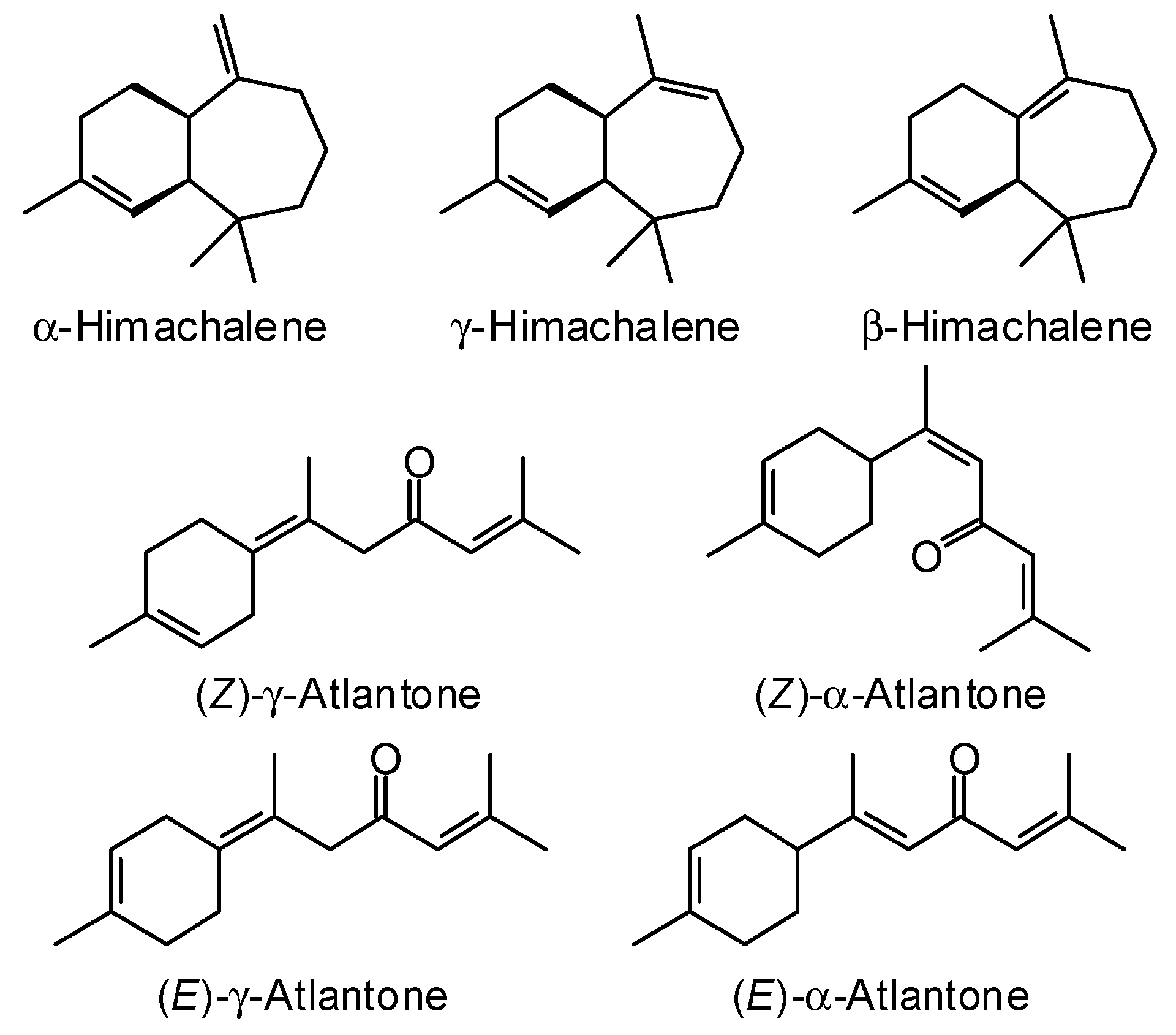
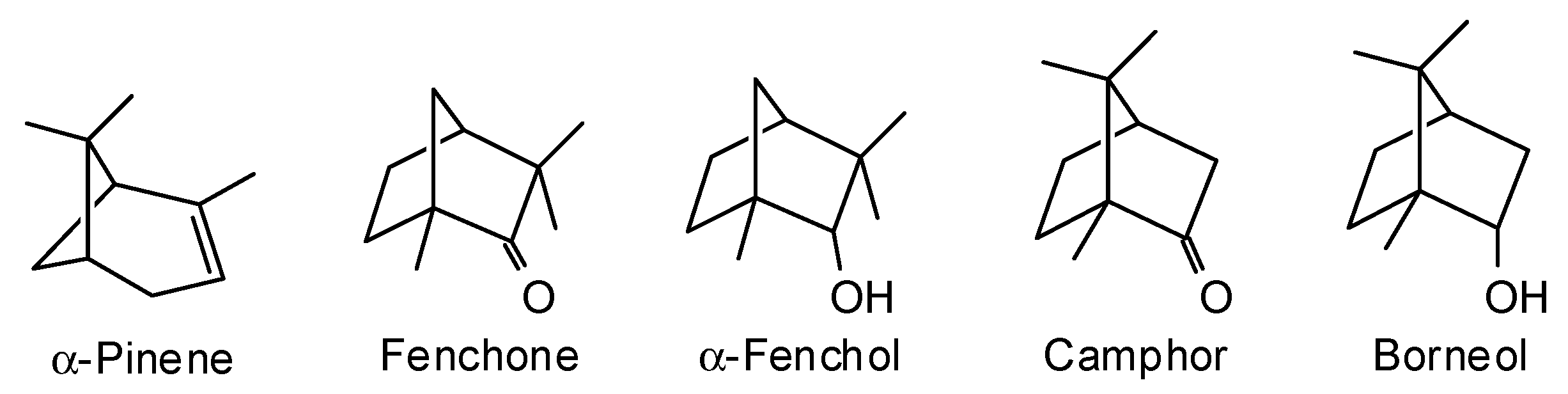
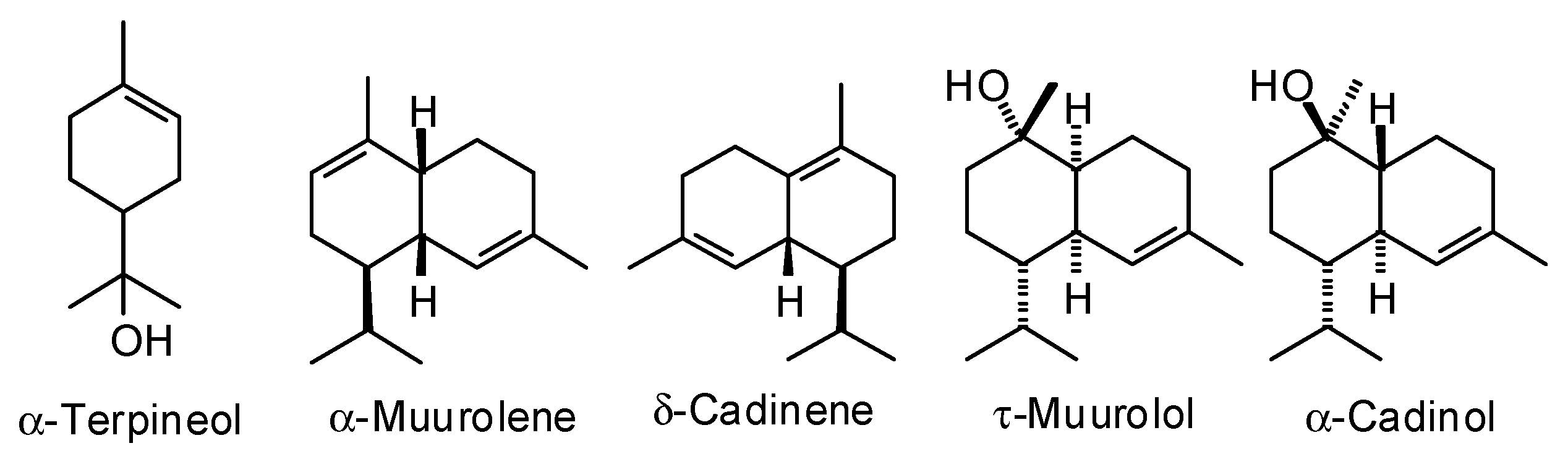


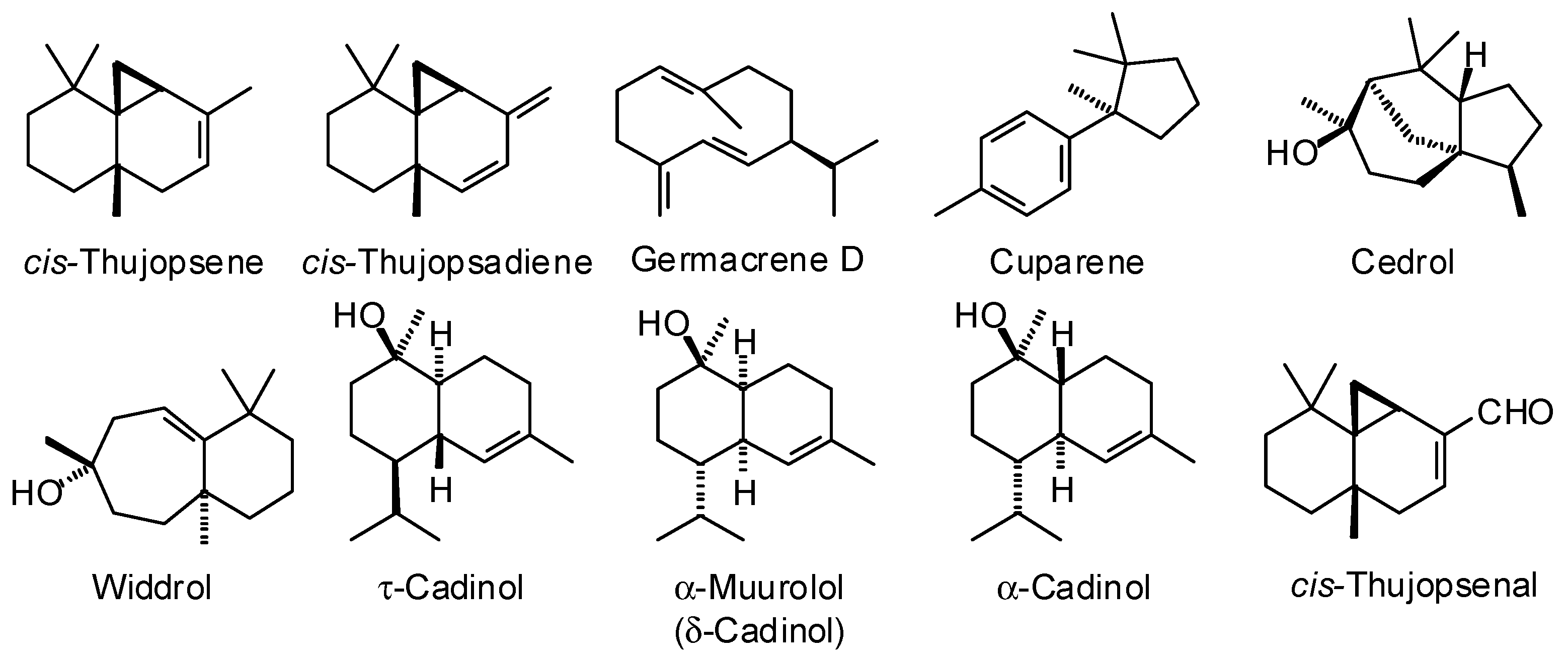

| Tree Species | Common Name |
|---|---|
| Callitropsis nootkatensis (D. Don) Oerst. (syn. Chamaecyparis nootkatensis (D. Don) Spach, Xanthocyparis nootkatensis (D. Don) Farjon & D.K. Harder) | Alaska cedar |
| Calocedrus decurrens (Torr.) Florin | California incense cedar |
| Calocedrus formosana (Florin) Florin (syn. Calocedrus macrolepis var. formosana (Florin) W.C. Cheng & L.K. Fu) | Taiwan incense cedar |
| Cedrela odorata L. | Spanish cedar |
| Cedrus atlantica (Endl.) Manetti ex Carrière | Atlas cedar |
| Cedrus brevifolia (Hook.f.) Elwes & A. Henry (syn. Cedrus libani var. brevifolia Hook.f.) | Cyprian cedar |
| Cedrus deodara (Roxb. ex D. Don) G. Don | Deodara cedar |
| Cedrus libani (L.) A. Rich. | Cedar of Lebanon |
| Chamaecyparis lawsoniana (A. Murray bis) Parl. | Port Orford cedar |
| Cryptomeria japonica (Thunb. ex L.) D. Don | Japanese cedar |
| Cupressus funebris Endl. | Chinese cedar |
| Juniperus ashei J. Buchholz | Texas cedar |
| Juniperus virginiana L. | Eastern red cedar |
| Thuja occidentalis L. | Northern white cedar |
| Thuja plicata Donn ex D. Don | Western red cedar |
| Widdringtonia Endl. species |
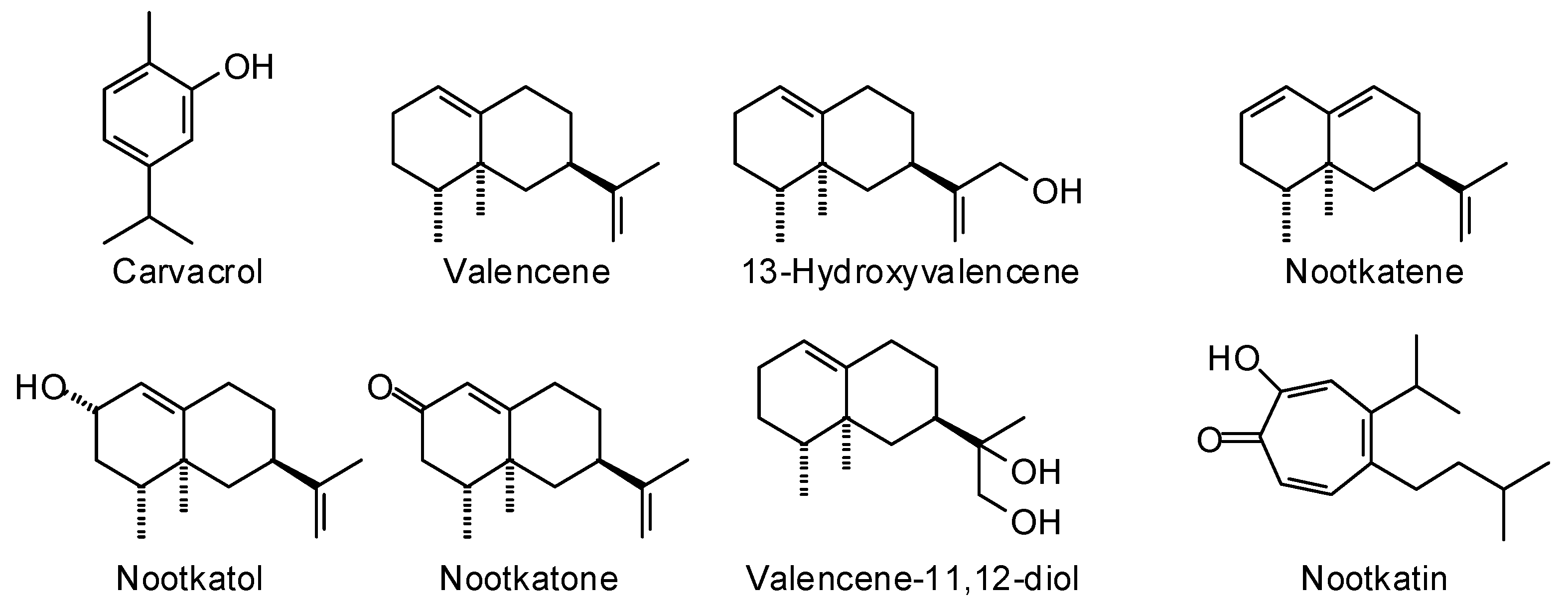
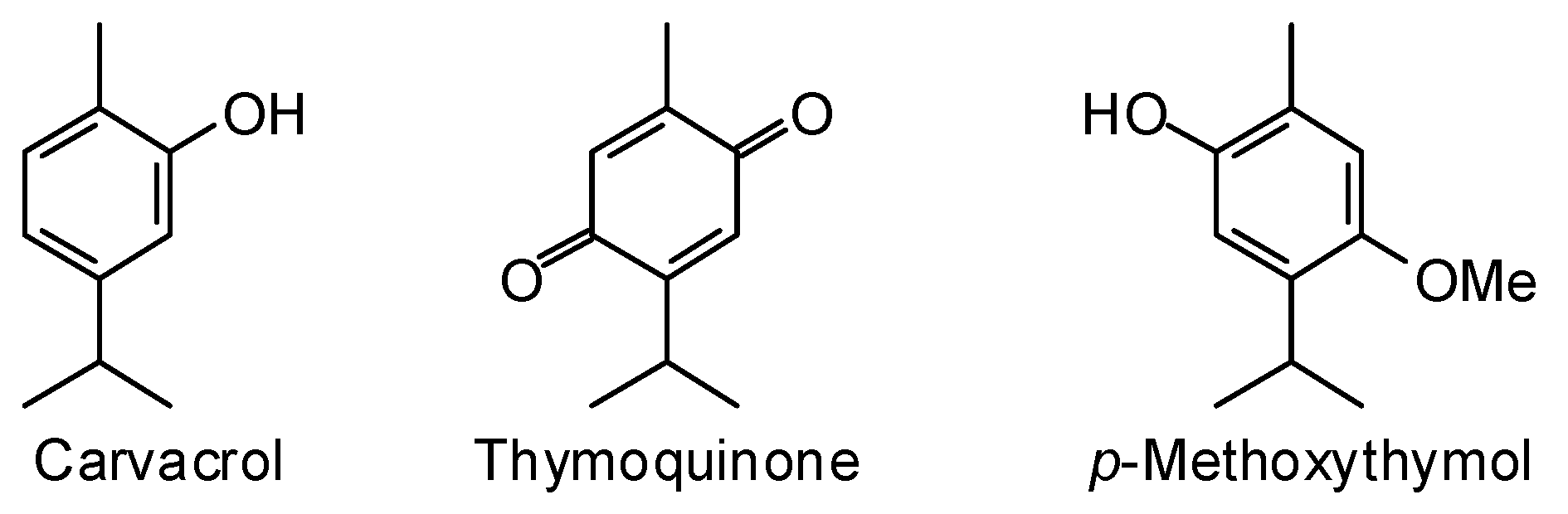
| Compounds | Xiong 2000 a | Liu 2009 b | Khasawneh et al., 2011 c | Commercial 2016 d | Commercial 2020 d |
|---|---|---|---|---|---|
| Carvacrol | 27.2 | 12.5 | 35.4 | 7.3 | 9.1 |
| Valencene | 2.5 | 2.8 | 1.5 | 7.2 | 6.9 |
| Nootkatene | 13.3 | 17.3 | 20.1 | 48.4 | 46.9 |
| Nootkatol | 5.7 | tr e | 5.2 | nd f | 0.4 |
| Valencen-13-ol | 5.6 | 6.4 | 6.4 | 3.1 | 3.5 |
| Nootkatone | 12.9 | 9.7 | 17.4 | 3.0 | 4.6 |
| Nootkatin | xtal g | 3.1 | 3.5 | 0.2 | 0.8 |
| Compounds | Brazil [27] | Nigeria [28] | Costa Rica [26] | Colombia [26] | |
|---|---|---|---|---|---|
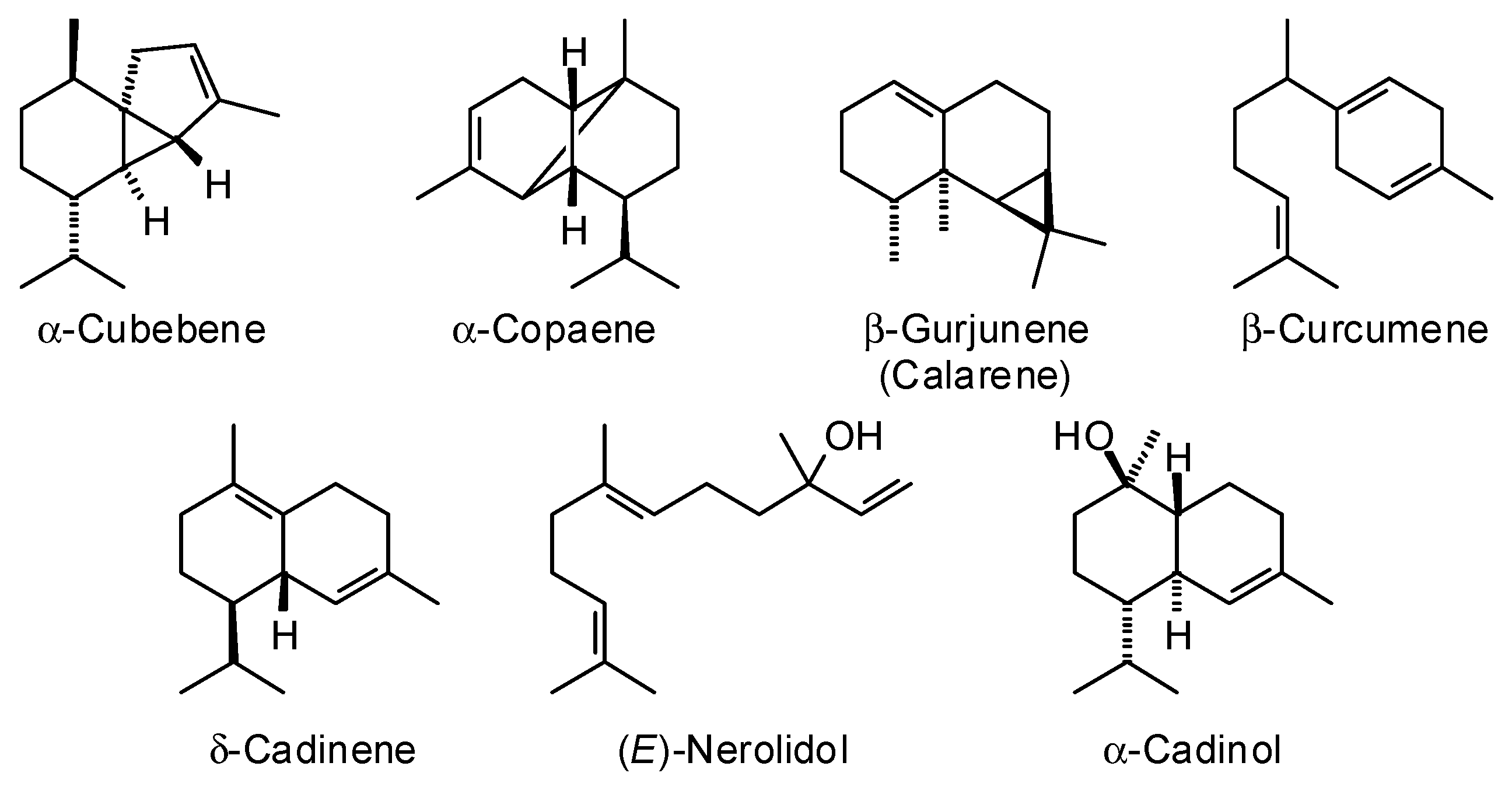
| α-Cubebene | 8.0 | nd | tr | tr | 0.3 |
| α-Copaene | 15.6 | 0.7 | 0.3 | 0.2 | 1.3 |
| α-Cedrene | nd | 17.6 | nd | nd | nd |
| β-Gurjunene (Calarene) | 3.4 | nd | 5.5 | 5.7 | nd |
| trans-α-Bergamotene | 2.7 | 5.6 | nd | nd | tr |
| α-Curcumene | nd | 12.3 a | nd | nd | nd |
| β-Curcumene | 6.8 | nd | 13.0 | 12.8 | 2.2 |
| δ-Cadinene | 11.7 | nd | 26.0 | 26.3 | 53.2 |
| (E)-Nerolidol | 8.0 | 9.2 b | 1.2 | 1.1 | nd |
| γ-Eudesmol | nd | 8.8 | nd | nd | 0.1 |
| α-Cadinol | 1.5 | nd | 4.7 | 5.0 | 2.7 |
| α-Eudesmol | nd | 5.4 c | nd | nd | nd |
| β-Bisabolol | 0.5 | 11.0 d | 1.2 | 1.3 | tr |
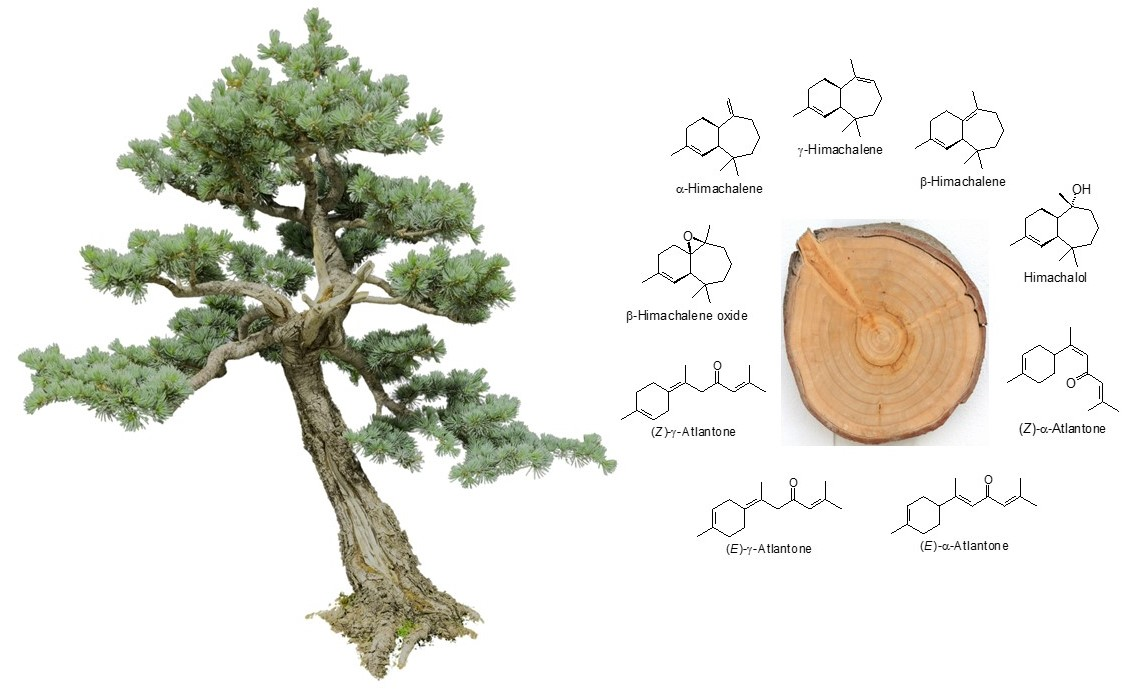
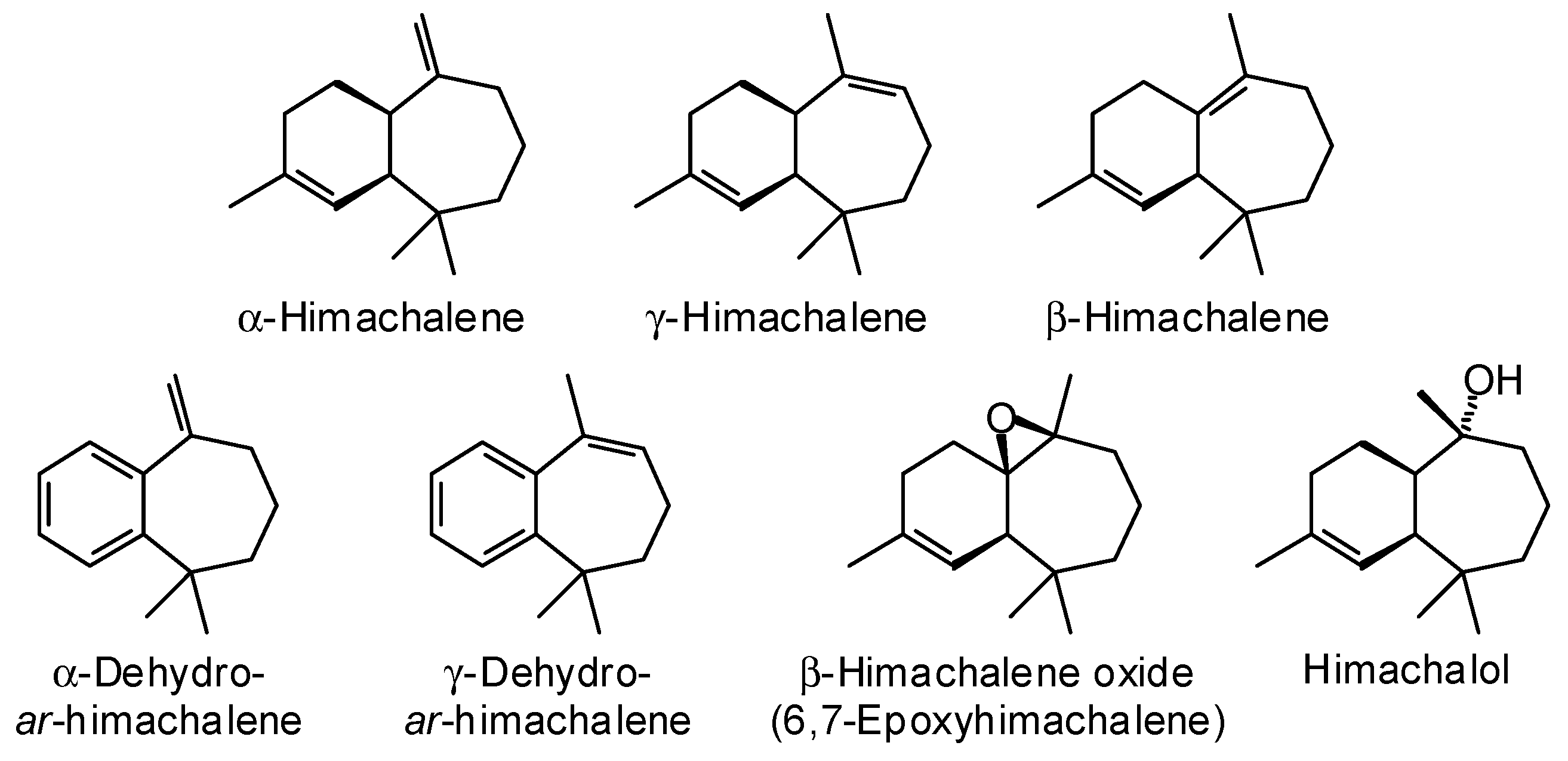
| Source | Ref. | α- Himachalene | γ- Himachalene | β- Himachalene | (E)-γ- Atlantone | (E)-α- Atlantone | Others |
|---|---|---|---|---|---|---|---|
| Morocco | [39] | 11.6 | 7.5 | 33.8 | 2.5 | 12.1 | |
| Morocco | [36] | 15.8 | 12.1 | 50.9 | 0.0 | 3.7 | |
| Algeria | [31] | 15.0 | 11.2 | 31.6 | 0.0 | 0.0 | |
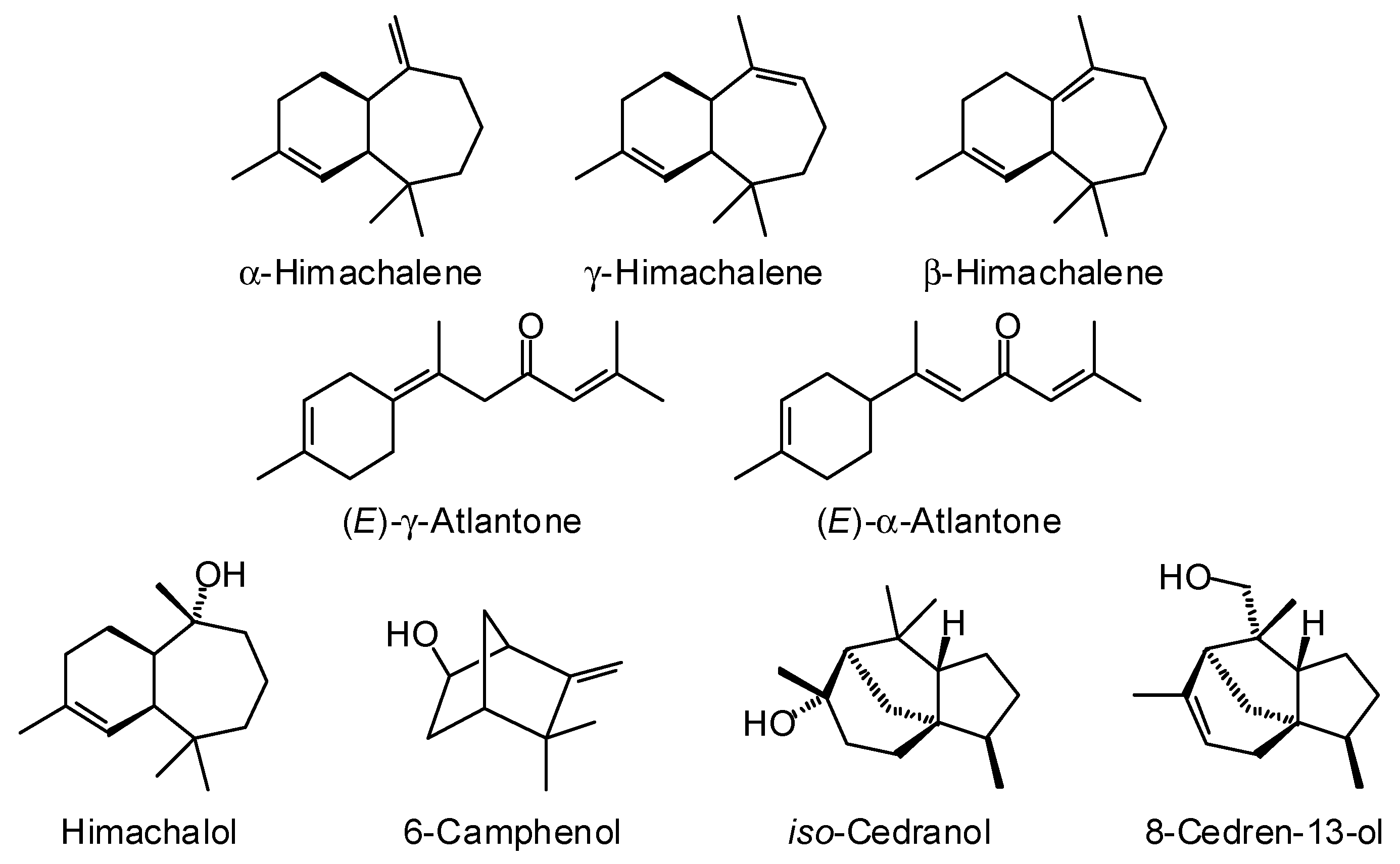
| Algeria | [40] | 2.1 | 2.3 | 3.7 | 0.9 | 1.6 | 28.1% himachalol |
| Morocco | [41] | 15.5 | 10.6 | 42.9 | 2.1 | 2.5 | |
| Morocco | [35] | 14.4 | 1.0 | 29.0 | 19.7 | 16.9 | 11.7% iso-cedranol |
| Morocco | [42] | 12.2 | 8.5 | 27.7 | 0.0 | 0.0 | 9.4% himachalol |
| Morocco | [42] | 16.7 | 11.3 | 44.2 | 0.0 | 0.0 | 4.5% 6-camphenol |
| Commercial | [37] | 16.6 | 10.4 | 46.4 | 0.9 | 0.0 | |
| Morocco | [32] | 10.9 | 6.9 | 33.8 | 1.9 | 11.2 | |
| Commercial | [43] | 14.6 | 9.3 | 39.4 | 0.8 | 4.0 | |
| Morocco | [43] | 10.8 | 8.3 | 19.7 | 1.1 | 10.1 | |
| Morocco | [44] | 11.4 | 0.5 | 26.7 | 0.0 | 6.0 | 7.8% 6-camphenol |
| Corsica | [45] | 0.9 | 0.9 | 1.7 | 0.0 | 0.3 | 55.0% α-pinene |
| Corsica | [45] | 6.0 | 5.5 | 7.6 | 0.0 | 2.0 | 48.8% himachalol |
| Lebanon | [46] | 8.0 | 14.0 | 7.0 | 1.5 | 0.0 | 46.3% himachalol |
| Lebanon | [46] | 6.1 | 15.8 | 6.6 | 2.3 | 0.9 | 42.2% himachalol |
| Morocco | [33] | 5.7 | 4.8 | 14.6 | 0.0 | 28.8 | 7.1% himachalol, 4.4% deodarone |
| Commercial | [47] | 12.7 | 8.3 | 33.5 | 1.3 | 6.2 | |
| Morocco | [34] | 5.1 | 3.3 | 15.1 | 0.0 | 19.3 | 13.1% 8-cedren-13-ol |
| Romania | [38] | 16.8 | 13.0 | 39.2 | 0.0 | 0.0 |
| Compounds | Commercial (APRC Collection) a | Chaudhary et al. [59] | Kala et al. [60] |
|---|---|---|---|
| α-Himachalene | 13.6 ± 2.1 | 17.1 | 15.4 |
| γ-Himachalene | 8.7 ± 1.1 | 12.6 | 7.4 |
| β-Himachalene | 34.8 ± 3.8 | 38.8 | 19.9 |
| (Z)-γ-Atlantone | 4.0 ± 1.4 | 2.3 | 5.1 |
| (E)-γ-Atlantone | 4.7 ± 1.5 | 2.4 | 5.4 |
| (Z)-α-Atlantone | 2.5 ± 0.6 | 1.4 | 3.4 |
| (E)-α-Atlantone | 11.2 ± 3.1 | 8.6 | 14.0 |
| Compounds | Geographical Location | |||||
|---|---|---|---|---|---|---|
| Antalya, Türkiye [66] | Tarsus, Türkiye [66] | Fethiye, Türkiye [66] | Tanourine, Lebanon [46] | Tanourine, Lebanon [65] | Tanourine, Lebanon [64] | |
| α-Himachalene | 12.8 | 11.5 | 4.9 | 7.1 | 10.5 | 9.6 |
| γ-Himachalene | 7.6 | 6.8 | 4.4 | 7.0 | 9.1 | 5.9 |
| β-Himachalene | 38.2 | 34.3 | 8.1 | 11.9 | 21.9 | 19.0 |
| 6,7-Epoxyhimachalene | nd | nd | 7.5 | 0.1 | nd | 1.3 |
| Himachalol | 1.2 | 8.8 | 19.7 | 43.1 | 22.5 | 7.0 a |
| (Z)-γ-Atlantone | 1.1 | 0.4 | 0.3 | nd | 1.7 | 4.4 |
| (E)-γ-Atlantone | 1.0 | 0.5 | 0.3 | nd | 1.7 | 3.6 |
| (Z)-α-Atlantone | 1.1 | 2.1 | 1.9 | nd | 2.1 | 4.6 |
| (E)-α-Atlantone | 7.8 | 14.8 | 19.7 | 0.9 | 0.8 | 19.3 |
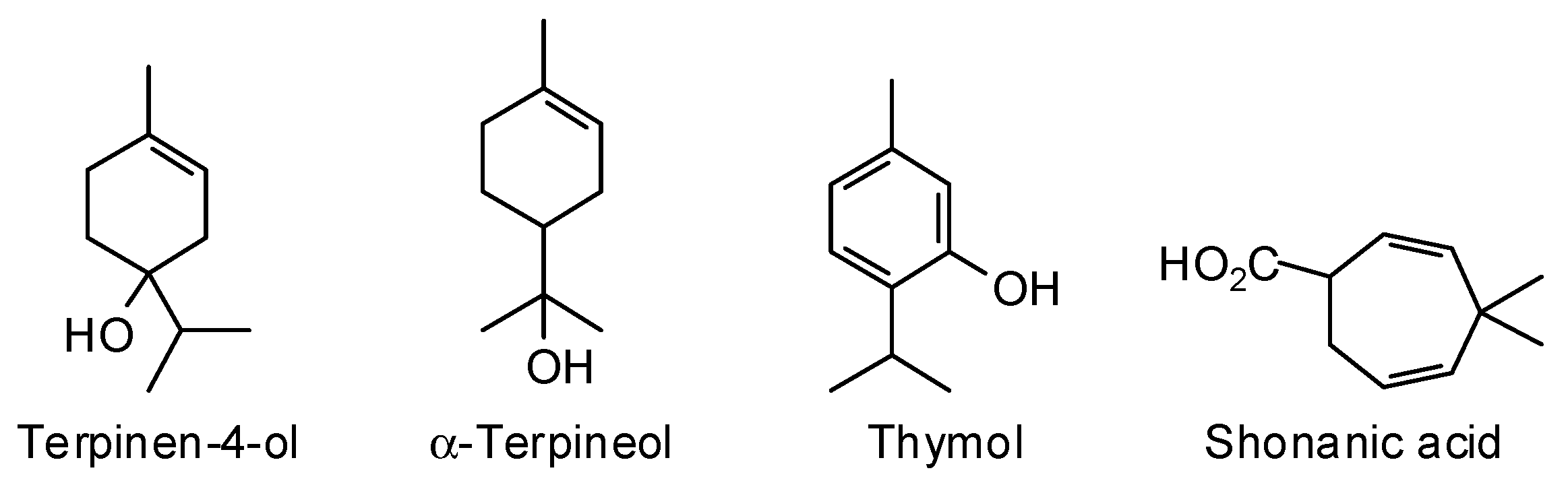
| Compounds | [68] a | [16] b | [69] c |
|---|---|---|---|
| α-Pinene | 6.5 | nr | nr |
| Fenchone | 4.7 | nr | 7.4 |
| α-Fenchol | 5.5 | 1.3 | 11.1 |
| Camphor | 5.9 | nr | 9.9 |
| Borneol | nr | 2.1 | 12.2 |
| α-Terpineol | 14.3 | 8.6 | 29.5 |
| α-Muurolene | 4.2 | 6.6 | nr |
| δ-Cadinene | 8.2 | 17.0 | nr |
| τ-Muurolol | 2.7 | 19.7 | nr |
| α-Cadinol | 5.3 | 21.4 | nr |
| Compounds | Geographical Location | |||||||||||
|---|---|---|---|---|---|---|---|---|---|---|---|---|
| Kitayama, Japan [70] | Shimane, Japan [73] | Shimane, Japan [77] | Nara, Japan [73] | Kitayama, Japan [75] | Commercial, Japan [71] | Okayama, Japan [74] | Okayama, Japan [74] | Okayama, Japan [74] | Azores [78] a | Azores [78] a | Azores [79] | |
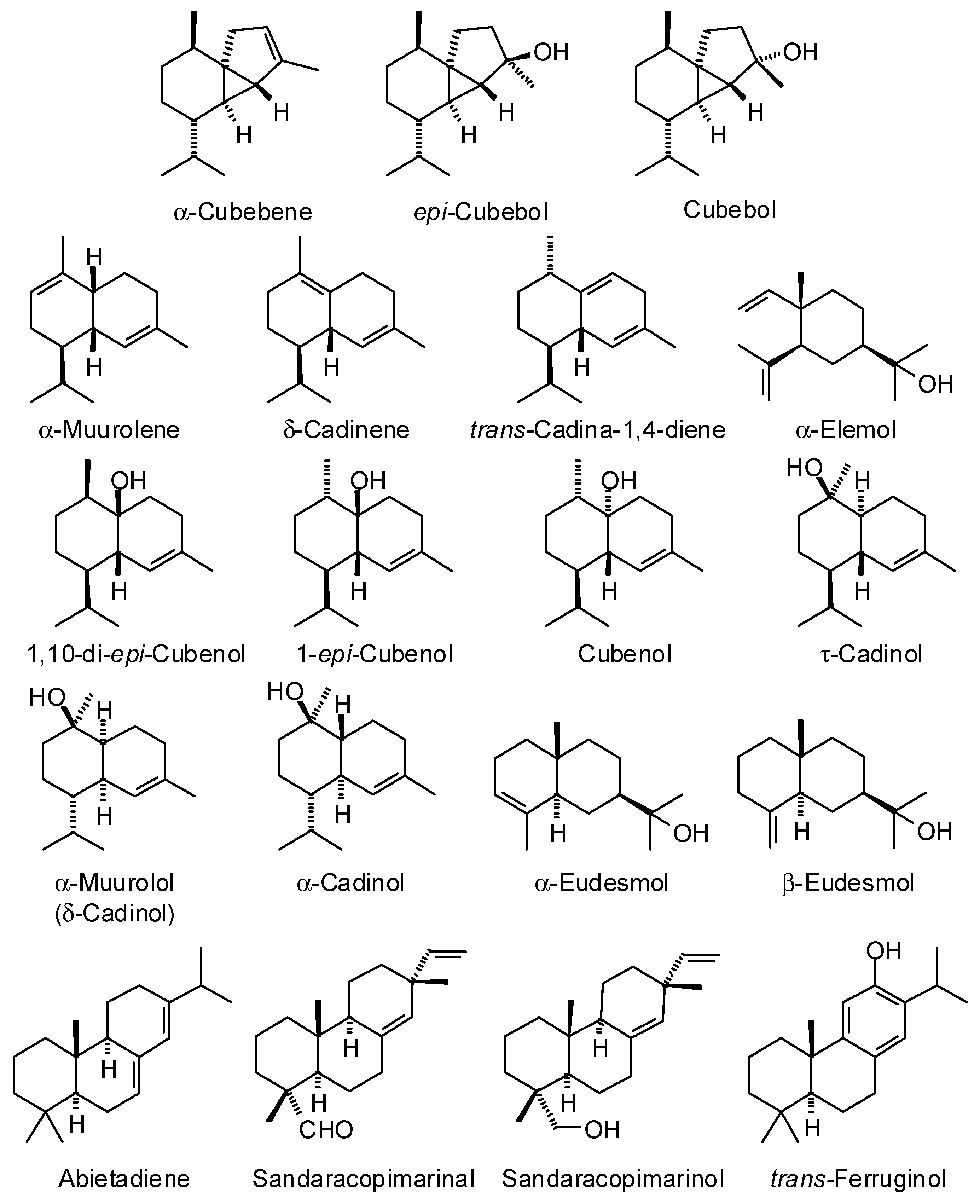
| α-Cubebene | 0.8 | 0.1 | 0.2 | 3.0 | 0.8 | 2.1 | 12.8 | 10.5 | 10.0 | 0.1–0.4 | tr-0.4 | 0.2 |
| epi-Cubebol | 18.0 | nd | nd | nd | 16.4 | nd | 4.9 | 4.5 | 3.7 | 4.1–26.9 | 12.3–21.2 | 4.7 |
| α-Muurolene | 6.5 | 2.7 | 3.0 | 9.3 | 6.5 | 8.5 | 0.1 | tr | 0.1 | 2.0–3.3 | 1.5–2.9 | 0.5 |
| Cubebol | 16.4 | nd | 0.3 | nd | 18.0 | nd | 5.0 | 4.4 | 4.3 | 2.7–39.9 | 14.6–33.8 | 6.8 |
| δ-Cadinene | 21.4 | 13.9 | 16.8 | 25.9 | 21.4 | 22.8 | tr | 0.1 | 0.1 | 6.2–10.8 | 6.4–10.9 | 6.4 |
| trans-Cadina-1,4-diene | nd | 0.6 | nd | nd | nd | nd | 9.3 | 7.5 | 7.2 | 0.5–1.6 | 0.6–1.0 | 0.7 |
| α-Elemol | nd | 3.4 | 2.8 | nd | 1.5 | 6.7 | 0.1 | 0.6 | 0.4 | 1.7–14.1 | 1.8–9.2 | 2.6 |
| 1,10-di-epi-Cubenol | 5.8 | nd | nd | nd | 5.8 | nd | nd | nd | nd | 5.5–17.2 | 4.0–18.4 | 0.1 |
| 1-epi-Cubenol | 3.8 | 24.7 | 23.3 | nd | 3.8 | 7.9 | 6.3 | 4.5 | 4.4 | nd | nd | 10.7 |
| Cubenol | nd | 12.5 | 11.6 | 6.3 | nd | 4.6 | 4.9 | 3.3 | 3.5 | nd | nd | nd |
| τ-Cadinol | nd | nd | nd | 0.5 | nd | 1.8 | nd | nd | nd | 1.1–3.9 | 1.0–3.9 | 8.2 |
| α-Muurolol (δ-Cadinol) | 1.1 | 5.4 | 4.6 | 3.8 | 1.1 | 3.6 | nd | nd | nd | nd | nd | 4.3 |
| α-Cadinol | nd | nd | nd | nd | nd | nd | 1.1 | nd | 2.0 | tr-5.2 | tr-4.0 | nd |
| β+α-Eudesmol | 3.2 | 11.2 | 9.8 | 7.1 | 3.2 | 9.7 | 0.3 | 4.1 | 1.7 | 3.1–16.8 | 4.9–11.8 | 13.5 |
| Abietadiene | 1.0 | 0.3 | 0.4 | nd | 1.0 | nd | 13.7 | 8.2 | 9.8 | nd | nd | 0.5 |
| Sandaracopimarinal | nd | 1.0 | 1.7 | nd | nd | nd | 3.2 | 6.0 | 5.9 | 0.2–0.5 | 0.2–1.6 | 3.0 |
| Sandaracopimarinol | nd | nd | nd | nd | nd | nd | 13.7 | 17.1 | 17.6 | tr-0.5 | tr-2.0 | 5.5 |
| trans-Ferruginol | nd | nd | nd | nd | nd | nd | 11.3 | 10.6 | 10.2 | tr-0.5 | 0.1–1.2 | 3.6 |
| Compounds | [83] a | [81] b | [81] c | [82] d | APRC e | ||||
|---|---|---|---|---|---|---|---|---|---|
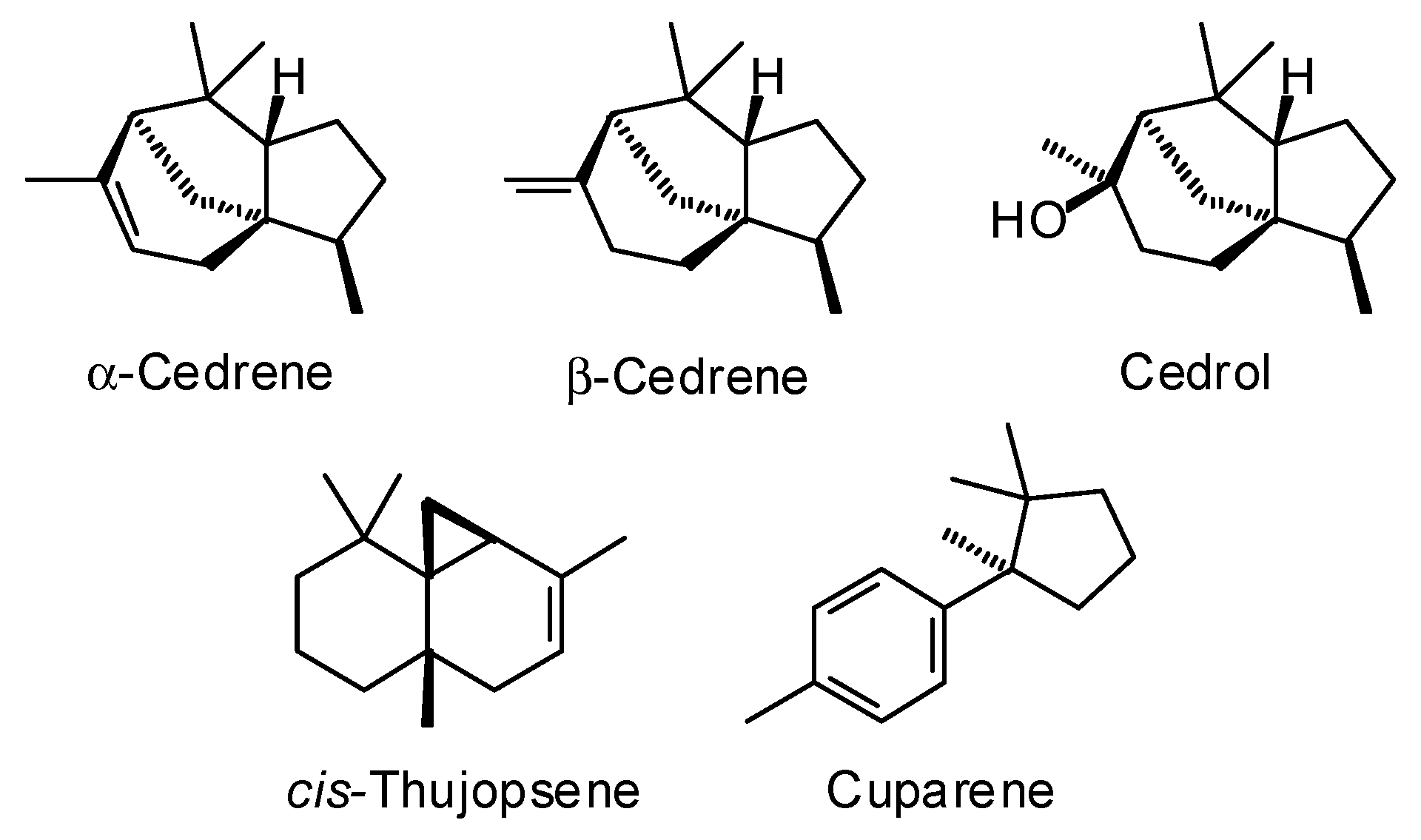
| α-Cedrene | 26.4 | 3.4 | 1.8 | 0.7 | 2.2 | 22.2 ± 10.7 | 16.9 | 18.1 | 10.7 |
| β-Cedrene | 9.2 | 1.9 | 2.1 | 0.3 | 0.8 | 6.7 ± 2.3 | 5.7 | 5.0 | 3.2 |
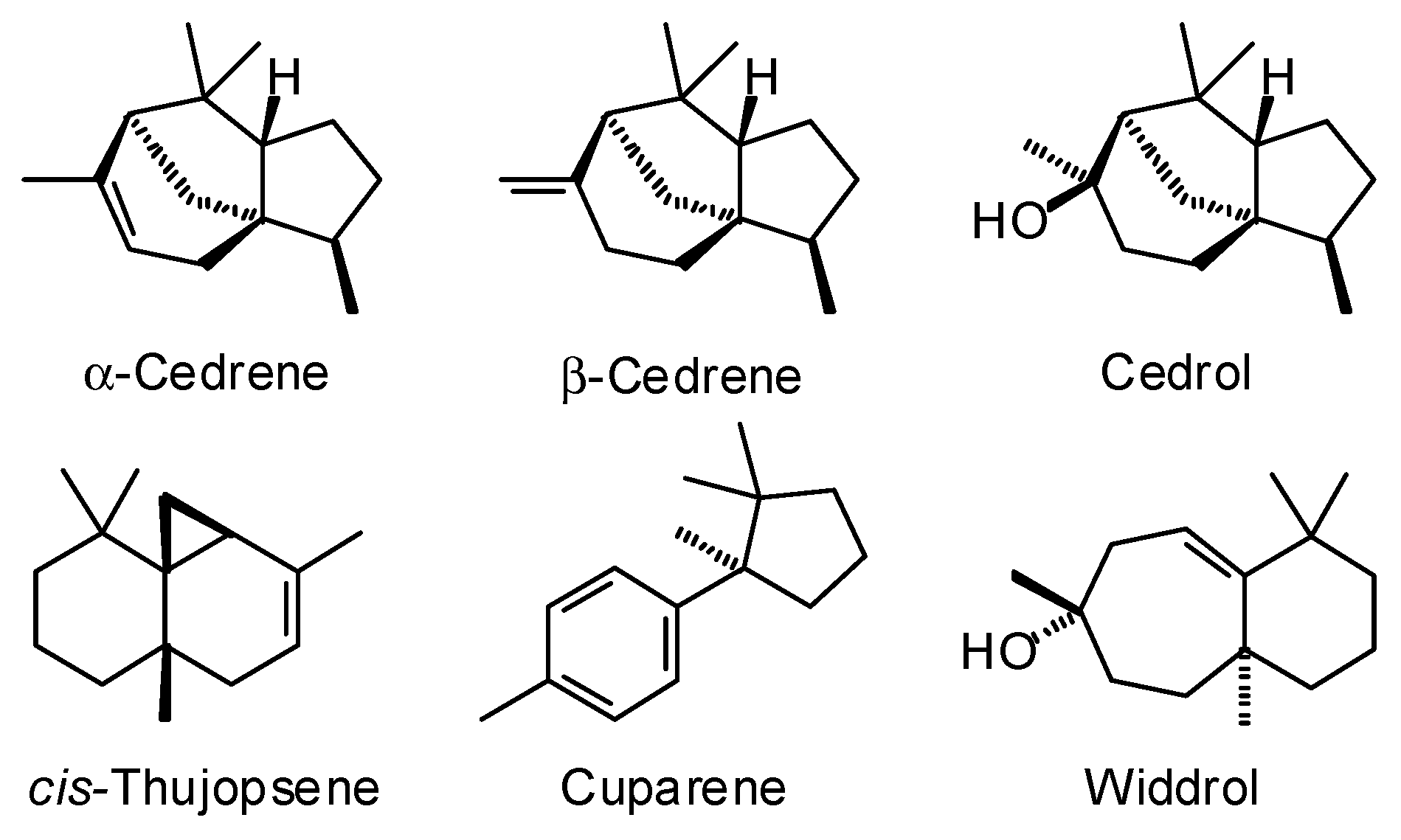
| cis-Thujopsene | 29.9 | 2.3 | 0.8 | 1.4 | 18.7 | 27.4 ± 10.7 | nd | 29.6 | 10.5 |
| Cuparene | 3.4 | nd | 0.3 | 0.5 | 2.4 | 4.2 ± 2.4 | 5.4 | 4.4 | 29.4 |
| Cedrol | 9.6 | 43.9 | 54.6 | 72.8 | 45.0 | 13.8 ± 6.6 | 7.6 | 18.8 | 7.1 |
| Compounds | [83] a | [85] b | [86] c | APRC d | |||
|---|---|---|---|---|---|---|---|
| α-Cedrene | 30.7 | 8.6 | 0.7 | 12.5 | 11.4 | 13.3 | 10.6 |
| β-Cedrene | 5.5 | 3.4 | 1.1 | 3.4 | 3.3 | 2.6 | 2.7 |
| cis-Thujopsene | 25.0 | 38.4 | 40.7 | 36.2 | 38.6 | 38.5 | 39.8 |
| Cedrol | 19.1 | 28.9 | 37.2 | 30.3 | 29.4 | 23.1 | 27.3 |
| Compounds | Weyerstahl et al. [97] a | Anderson et al. [98] a |
|---|---|---|
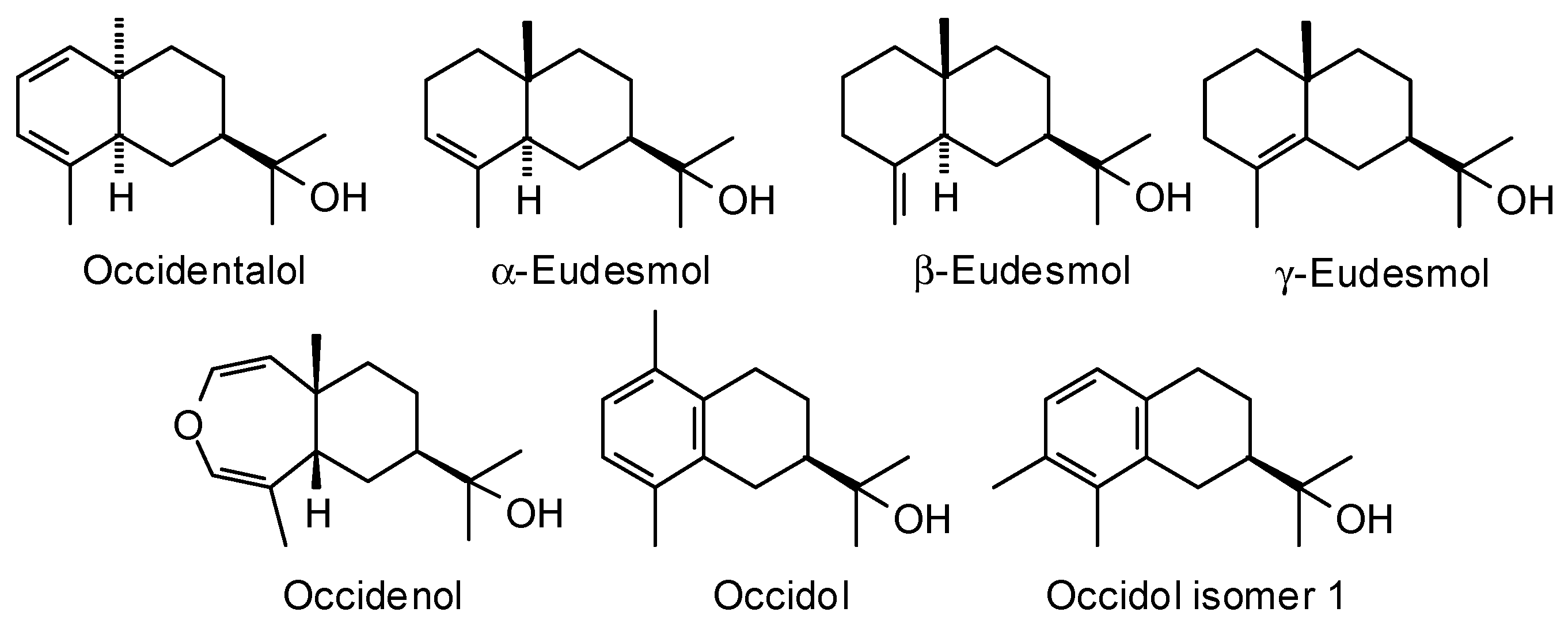
| Occidentalol | 27.1 | 28.3 |
| γ-Eudesmol | 8.3 | 7.6 |
| β-Eudesmol | 9.1 | 9.1 |
| α-Eudesmol | 5.2 | 5.0 |
| Occidenol | 10.5 | 13.9 |
| Occidol | 21.2 | 21.3 |
| Occidol isomer 1 | 5.3 | 5.1 |
| Compounds | W. nodiflora [100] | W. schwartzii [100] | W. nodiflora [101] a | W. whytei [102] |
|---|---|---|---|---|
| cis-Thujopsene | 15.4 | 11.8 | 47.1 | 31.9 |
| Germacrene D | 3.6 | 18.3 | nd | nd |
| cis-Thujopsadiene | nd | nd | 1.8 | 7.1 |
| Cuparene | 3.0 | 14.3 | 4.0 | 3.8 |
| Cedrol | 10.4 | 10.1 | 10.7 | 13.6 b |
| Widdrol | 4.3 | 3.2 | 8.5 | 4.9 c |
| τ-Cadinol | 1.3 | 5.9 | nd | nd |
| α-Muurolol | nd | 13.5 | nd | nd |
| α-Cadinol | 7.2 | nd | nd | nd |
| Thujopsenal (=Widdrenal) | 1.8 | 11.0 | 3.2 | nd |
Disclaimer/Publisher’s Note: The statements, opinions and data contained in all publications are solely those of the individual author(s) and contributor(s) and not of MDPI and/or the editor(s). MDPI and/or the editor(s) disclaim responsibility for any injury to people or property resulting from any ideas, methods, instructions or products referred to in the content. |
© 2026 by the authors. Licensee MDPI, Basel, Switzerland. This article is an open access article distributed under the terms and conditions of the Creative Commons Attribution (CC BY) license.
Share and Cite
Setzer, W.N.; Satyal, P. Cedarwood Oils: The Wood Essential Oil Compositions from Trees Known as “Cedar”. Plants 2026, 15, 659. https://doi.org/10.3390/plants15040659
Setzer WN, Satyal P. Cedarwood Oils: The Wood Essential Oil Compositions from Trees Known as “Cedar”. Plants. 2026; 15(4):659. https://doi.org/10.3390/plants15040659
Chicago/Turabian StyleSetzer, William N., and Prabodh Satyal. 2026. "Cedarwood Oils: The Wood Essential Oil Compositions from Trees Known as “Cedar”" Plants 15, no. 4: 659. https://doi.org/10.3390/plants15040659
APA StyleSetzer, W. N., & Satyal, P. (2026). Cedarwood Oils: The Wood Essential Oil Compositions from Trees Known as “Cedar”. Plants, 15(4), 659. https://doi.org/10.3390/plants15040659