Article

Linking Leaf Gas Exchange to Non-Structural Carbohydrate Allocation to Understand the Early Establishment of Young Quercus and Fraxinus Species


1
Department of Environmental Biology, Sapienza University of Rome, 00185 Rome, Italy
2
Department of Agricultural, Food, Environmental and Animal Sciences, University of Udine, 33100 Udine, Italy
*
Author to whom correspondence should be addressed.
Plants 2026, 15(3), 434; https://doi.org/10.3390/plants15030434
Submission received: 29 December 2025 / Revised: 23 January 2026 / Accepted: 27 January 2026 / Published: 30 January 2026
(This article belongs to the Section Plant Response to Abiotic Stress and Climate Change)

Abstract

Forest restoration programs are increasingly adopted to mitigate climate change-driven ecosystem degradation, yet the plant functional strategies underpinning successful tree establishment are not fully understood. We investigated the effect of vapour pressure deficit and soil conditions on the interplay between leaf gas exchange and carbon metabolism in three-year-old saplings of different species characterised by distinct functional strategies, as well as non-structural carbohydrate (NSC) partitioning at plant desiccation. We performed two complementary experiments to evaluate interspecific functional differences between Fraxinus ornus L., Quercus cerris L., and Quercus pubescens Willd. in a Mediterranean restored woodland and to compare them with fully irrigated nursery conspecifics. Stomatal sensitivity to closure was similar between species, whereas higher leaf gas exchange and reduced leaf shedding increased twig sugars, as in the case of F. ornus, likely contributing to its better establishment. Irrigation augmented gas exchange rates in potted saplings under moderate evaporative demand but overall did not increase NSCs compared with outplanted conspecifics, possibly because of different carbon demand. Desiccated saplings maintained substantial NSCs, but their reduced pools, especially starch, suggested that they were consumed as a response to drought. Overall, findings indicate that NSC allocation can help define proxies of plant performance in restoration programs.

1. Introduction

Recent global policies have emphasised the restoration of damaged forest ecosystems as a key approach to tackling the current climate and biodiversity crises [1]. The need for restoration has arisen due to various threats affecting forests worldwide, including fires, pests, and droughts [2]. Traditionally, restoration practice has been dictated by the re-establishment of historical species assemblages, based on the assumption of a static equilibrium. However, climate change-driven environmental variation has prompted a revision of restoration goals, highlighting the need to consider plant ecophysiology [3,4]. Functional traits, which are measurable characteristics (morphological, physiological, or phenological) at individual or other relevant levels of organisation [5,6], have recently received increasing interest as a quantitative tool in restoration plans [4,7]. Functional traits facilitate the selection of local species with contrasting forms and functions to respond to prevailing environmental forcing [8], thereby synergistically advancing biodiversity conservation and ecosystem resilience. Furthermore, traits enable a nuanced quantification of restoration progress, extending beyond traditional community-level metrics, such as plant cover and abundance [4,9].
The coordination of traits defines different functional strategies that contribute to the successful establishment of plants under varying environmental pressures [10]. Among these, drought is a primary limiting factor influencing plant establishment, thereby affecting forest decline and regeneration [11,12]. Tree responses, such as stomatal closure and transpiration declines, occur in response to both soil and atmospheric drought, making it challenging to disentangle their effects under field conditions [13]. One common way to measure atmospheric drought, or atmospheric desiccation strength, is through the vapour pressure deficit (VPD) [14]. While some studies indicated that stomatal conductance is more strongly influenced by VPD than by soil moisture [15], others showed that this sensitivity is modulated by soil water availability [13,16]. Furthermore, stomatal sensitivity to VPD, referred to as the slope between stomatal conductance and the natural logarithm of vapour pressure deficit [17], varies across species [18,19]. Fast-growing species [20], which prioritise rapid resource acquisition at the cost of lower hydraulic resistance, tend to exhibit higher stomatal sensitivity to VPD [21]. Higher stomatal sensitivity is also expected in more isohydric species, as they usually maintain their water potential relatively stable through stomatal regulation [14,22]. However, this remains an open area of research, since the link between plant water status and stomatal conductance is complex, and the ‘isohydricity’ framework can be misleading, depending on its definition and plant–environment interactions [23,24].
By regulating photosynthesis and transpiration, stomatal conductance represents an early response to drought. Decreased transpiration alleviates xylem tension [17,25], thereby reducing the risk of xylem cavitation, which disrupts water flow and can lead to irreversible cellular dehydration [26]. Conversely, reduced photosynthesis, combined with leaf shedding during lingering water stress either as a water regulation strategy or a consequence of hydraulic damage [27,28], results in a prolonged carbon deficit [29,30]. Under carbon assimilation constraints, trees can rely on previously stored non-structural carbohydrates (NSCs) for sustaining their growth, metabolism and recovery from drought by fuelling cellular turgor maintenance and hydraulic integrity via osmoregulation functions [31,32,33], or the synthesis of defensive compounds [30,34]. Although previous empirical evidence has shown that xylem hydraulic failure is a widespread phenomenon among tree species experiencing drought-induced mortality, it can occur in combination with reductions in NSCs [35]. Currently, whole-plant NSC partitioning in desiccated saplings has been rarely assessed, but it can provide interesting insights, as the mechanisms that can affect tree drought vulnerability (e.g., impairment of phloem transport) remain debated due to the wide range of results obtained under different conditions and the lack of direct testing [36]. Furthermore, the interplay between leaf-level functional behaviour and carbon depletion during drought stress remains complex and not yet fully understood [24].
We focused on a reforestation program in a protected Mediterranean site in central Italy as our case study. First, our research aimed to examine the interplay of leaf gas exchange and NSCs in three-year-old outplanted saplings of Fraxinus ornus L. (Oleaceae), Quercus cerris L. (Fagaceae), and Quercus pubescens Willd. (Fagaceae). We chose these species because they differ in growth rates [37,38] and span the isohydry–anisohydry continuum [39,40,41], with oak species generally exhibiting slower growth and a more anisohydric behaviour. To achieve this, we evaluated whether the species showed different leaf gas exchange responses to VPD at the leaf level (VPDL) and soil volumetric water content (θ), leaf shedding, and NSC allocation. Furthermore, we evaluated this interplay between leaf gas exchange responses to VPD and NSCs at the intraspecific level by comparing field saplings with nursery conspecifics of the same age and origin, irrigated at pot capacity. Finally, we aimed to explore the NSC partitioning in plants with completely desiccated epigeal tissues compared to non-desiccated conspecifics at the study site. We expected: (1) both θ and VPD to affect leaf gas exchange responses in the field and F. ornus to exhibit greater stomatal sensitivity, more acquisitive leaf function, overall higher photosynthesis activity, and NSC reserves; (2) outplanted saplings to exhibit lower leaf water content, and NSC pools than nursery-grown conspecifics, due to diminished leaf gas exchanges during the summer months; (3) desiccated saplings to exhibit lower but not depleted concentrations of NSCs in all their organs.

2. Results

2.1. Interspecific Variability in Water Use and Carbon Assimilation

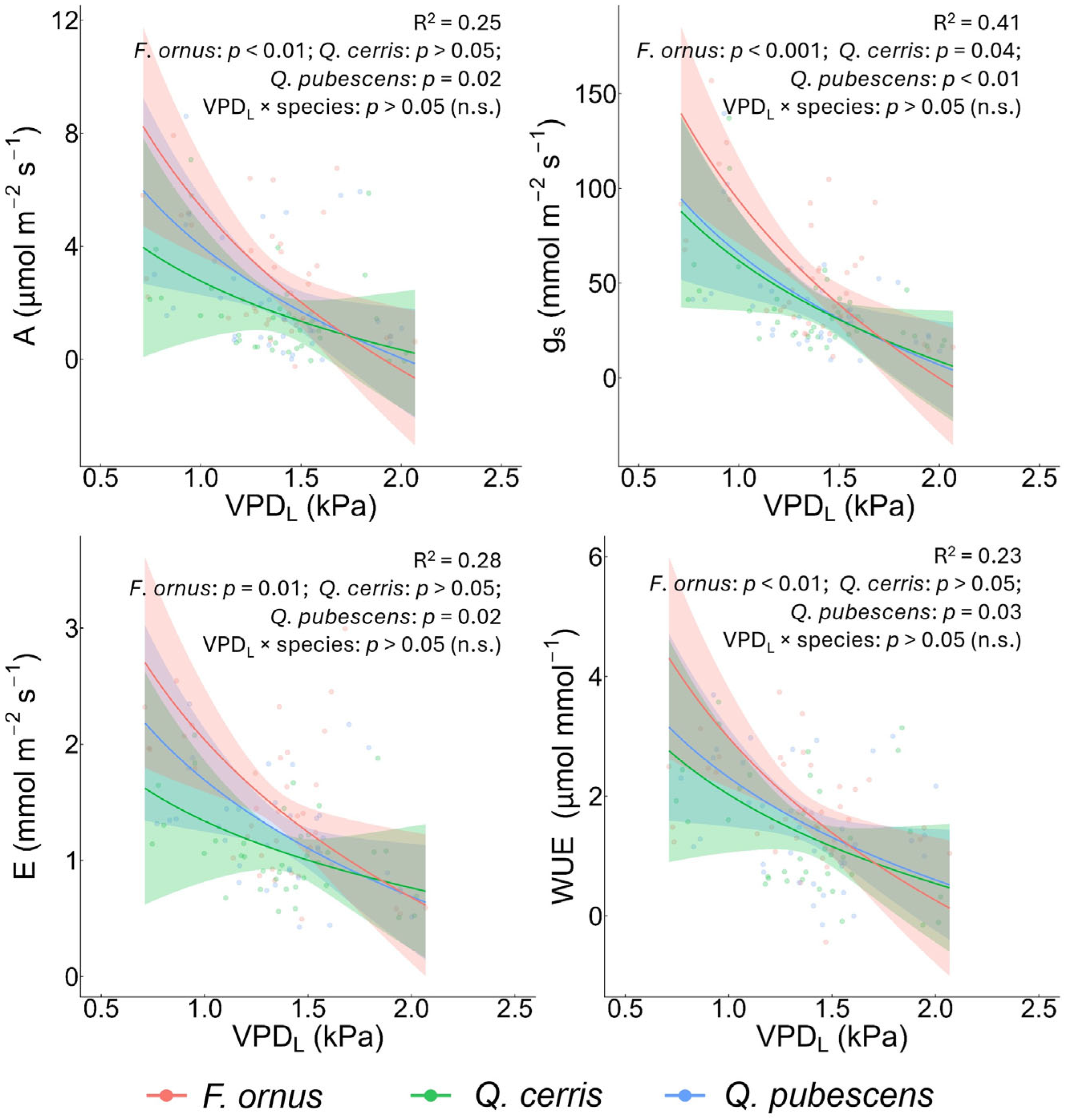
Overall, the increase in VPDL significantly reduced net assimilation rate (A, µmol m−2 s−1), transpiration rate (E, mmol m−2 s−1), stomatal conductance (gS, mmol m−2 s−1) and water use efficiency (WUE, photosynthesis to transpiration ratio, µmol CO2 mmol−1 H2O) in the studied species, whereas θ had a minor effect (Figure 1 and Figure S1). Specifically, gS declined significantly across varying VPDL in all species (all p < 0.05), A decreased significantly in F. ornus and Q. pubescens (p < 0.01; p = 0.02, respectively), as did E (p = 0.01; p = 0.02, respectively), and WUE (p < 0.01; p = 0.03, respectively). The soil volumetric water content had a significant negative effect only on gS in F. ornus (p < 0.01), and its interaction with VPDL was significant only in this species for gS and WUE (p = 0.04; p = 0.01, respectively). Interactions between species and log(VPDL), log(θ), or their combination were not significant (Figure 1 and Figure S1). However, interspecific differences emerged for all parameters. Overall, A was higher in F. ornus than in Q. cerris (p = 0.04), as well as E (p = 0.02), WUE (p = 0.05), and gS (p = 0.05). By contrast, no differences were found between the two Quercus species and between F. ornus and Q. pubescens for any of the assessed parameters. The minimum VPDL (≈0.78 kPa) was observed in autumn (September) and the maximum (≈2 kPa) in summer (July), while the minimum θ (≈0.23 m3 m−3) was observed in autumn (October) and the maximum (≈0.32 m3 m−3) at the beginning of summer (June). No interspecific differences were found for specific leaf area (SLA), while leaf water content (LWC) was higher in F. ornus than in the remaining species (p = 0.01) (Figure S2).
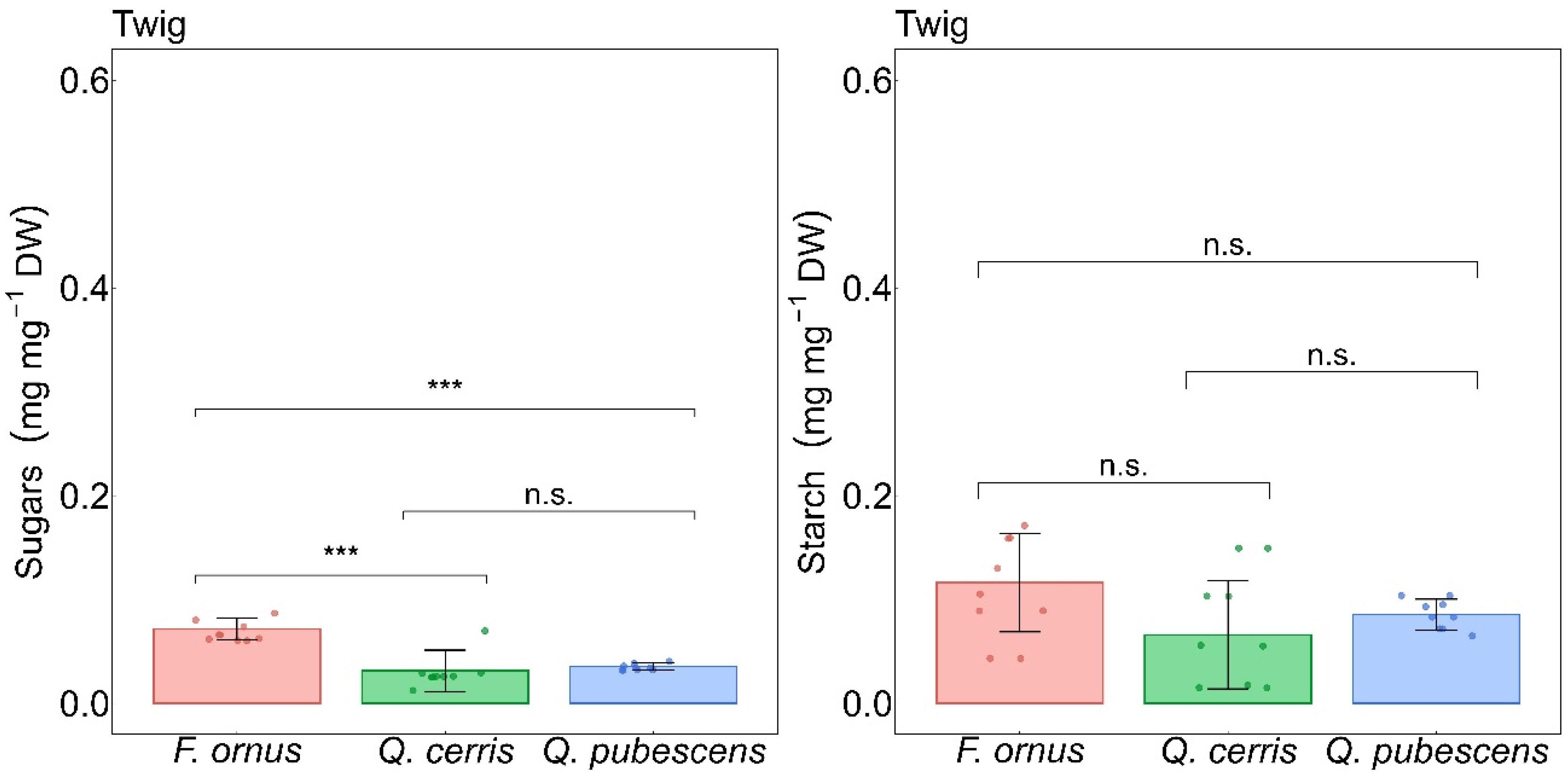
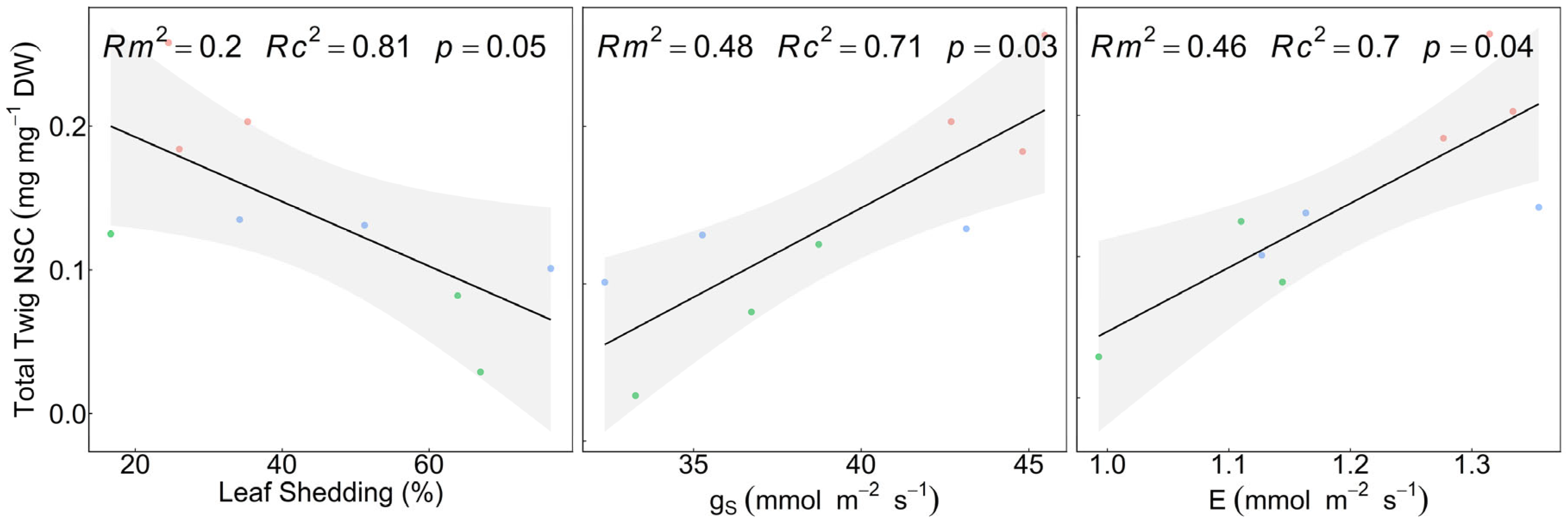
The species exhibited differences in sugar concentrations in the twigs (Figure 2), with F. ornus presenting higher soluble NSCs than both Q. cerris (p < 0.001) and Q. pubescens (p = 0.001), whereas no differences were observed in the other organs or in starch (Figure S3). The total twig NSCs of all species were negatively correlated with the percentage of leaf shedding (marginal R2: R2m = 0.20, conditional R2: R2c = 0.81; p = 0.05) and positively correlated with gS (R2m = 0.48, R2c = 0.71; p = 0.03) and E (R2m = 0.46, R2c = 0.70; p = 0.04) (Figure 3). In contrast, A did not significantly affect the total twig NSCs (R2m = 0.08, R2c = 0.68; p = 0.29). Plant summer leaf shedding significantly occurred in Q. cerris (p = 0.05) (Figure S4). The species exhibited contrasting desiccation patterns following the summer season, with F. ornus experiencing the lowest percentage (3.33%), whereas Q. pubescens showed higher values (37.15%), and Q. cerris the highest (42.10%).

2.2. Intraspecific Variability in Non-Structural Carbohydrates and Leaf Traits

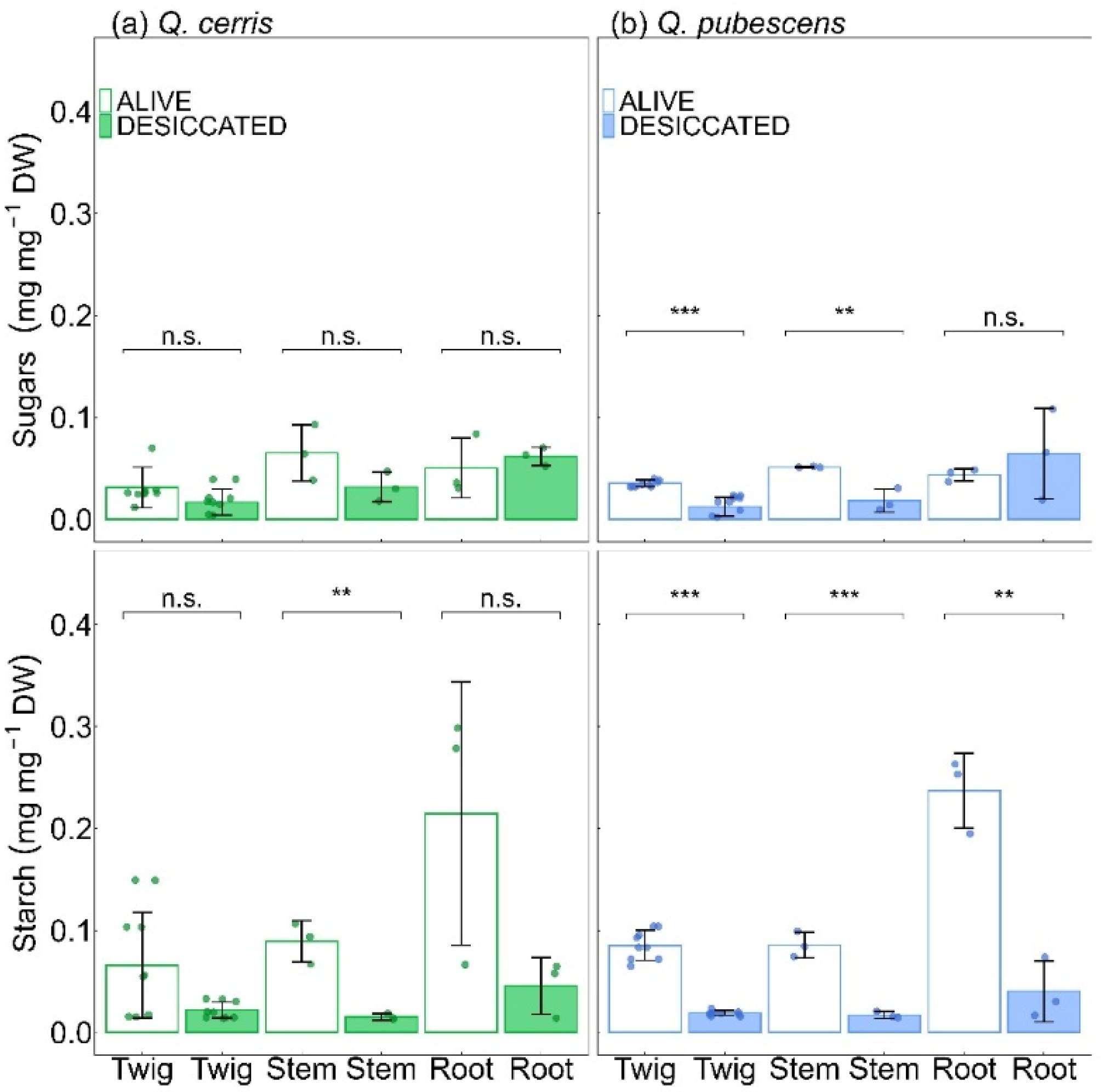
NSCs were generally lower in desiccated plants than in living non-desiccated conspecifics, although they were not completely exhausted (Figure 4). Specifically, desiccated saplings showed reduced starch concentration compared to alive conspecifics: in stems of Q. cerris (p < 0.01) and all woody organs of Q. pubescens (p < 0.001; p = 0.001; p < 0.01). Desiccated Q. pubescens saplings also showed lower sugar concentrations in twigs (p = 0.001) and stems (p = 0.01), while Q. cerris maintained similar sugar levels in both groups.
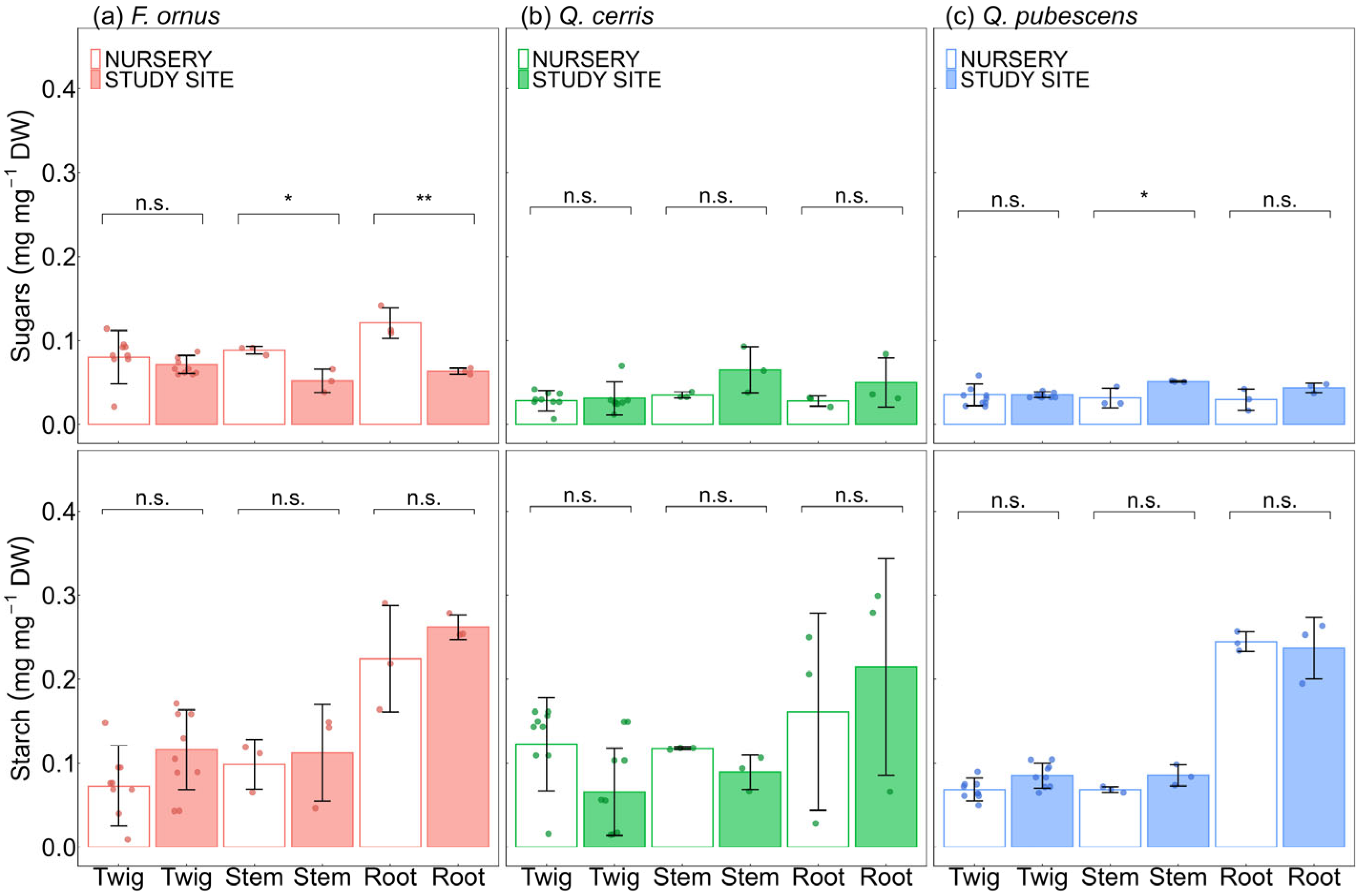
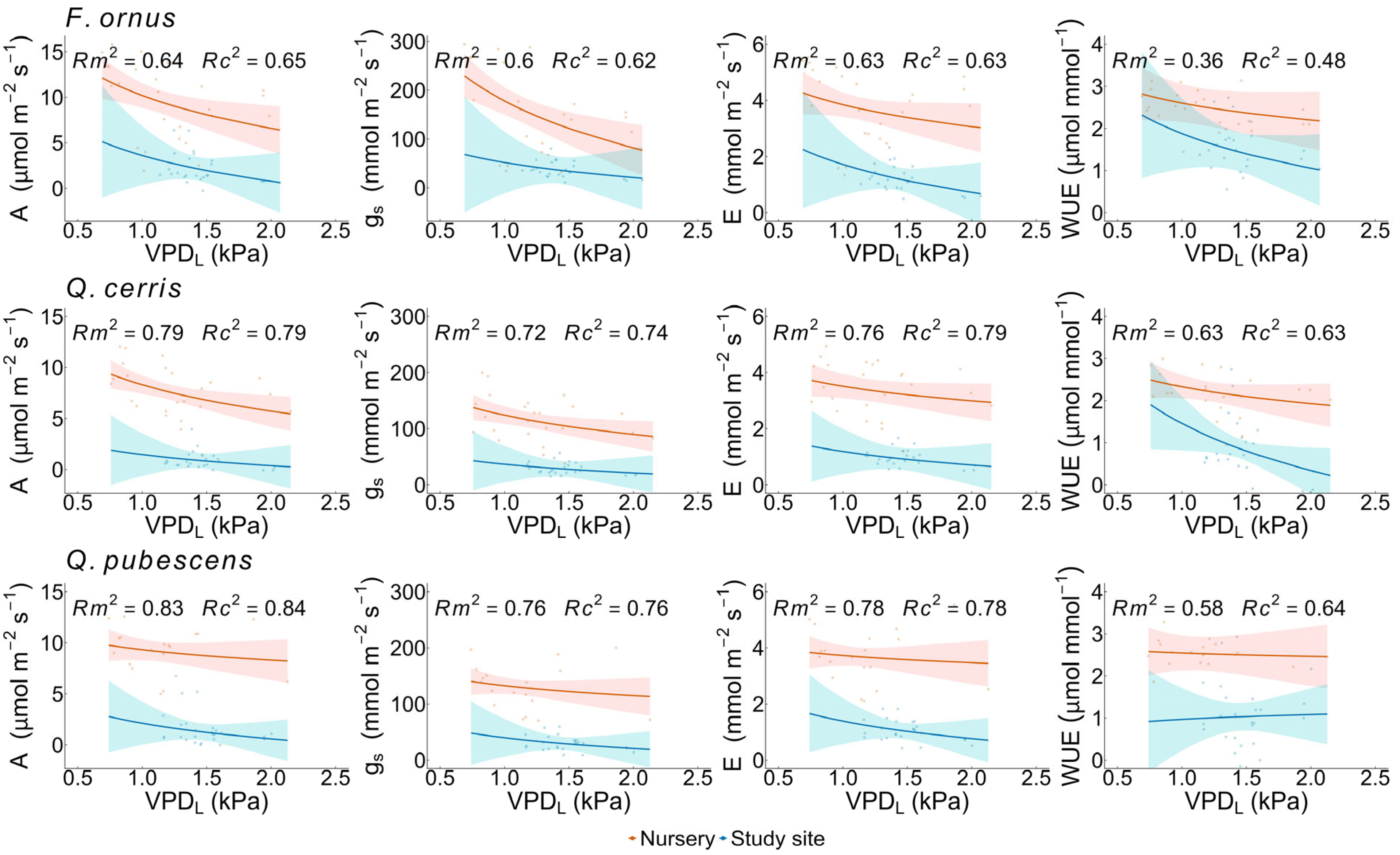
Sugars, starch (Figure 5) and mannitol (Figure S5) reserves were similar in outplanted and nursery saplings, with few exceptions. In Q. pubescens, nursery saplings had lower (p = 0.04) sugar concentration in stems than outplanted saplings. By contrast, in F. ornus, sugar concentration was higher in nursery saplings in both stems (p = 0.04) and roots (p = 0.01). No differences in LWC were found between nursery and outplanted conspecifics throughout the study period (Figure S6). Overall, the nursery saplings were more responsive to summer VPDL than outplanted saplings. In F. ornus and Q. cerris, both A (all p = 0.01) and gS (p < 0.001 and p = 0.02, respectively) significantly declined with increasing VPDL in the nursery saplings. WUE declined significantly with rising VPDL in outplanted saplings of Q. cerris (p = 0.04). Interactions between growing condition (nursery vs. study site) and the natural logarithm of VPDL were not significant for any assessed parameter and species (Figure 6). A, gS, and E were significantly higher in nursery saplings than in outplanted conspecifics in F. ornus (p = 0.001 for all parameters), Q. cerris (p < 0.001 for all parameters), and Q. pubescens (p < 0.001 for all parameters). WUE was also higher in nursery saplings in Q. cerris (p = 0.01) and in Q. pubescens (p = 0.001).

3. Discussion

3.1. Interspecific Variability in Leaf Gas Exchange and Non-Structural Carbohydrates

Overall, the significant decline of A, gS, and E with VPDL indicated that this environmental parameter was a critical driver of leaf gas exchange responses, consistent with previous empirical evidence [17,42,43]. Because the volumetric water content at a depth of 30 cm remained nearly stable and did not fall below critical levels, we could not fully disentangle the effects of soil drought from those of atmospheric drought on leaf gas exchanges under field conditions. This can also explain why soil moisture overall did not significantly affect leaf gas exchanges. However, its significant effect on stomatal conductance in F. ornus, but not in Quercus species, may reflect differences in their root distribution. Notably, several factors influence stomatal conductance, such as heat stress [44], photosynthetically active radiation [45,46], or intercellular CO2 concentration, which fluctuates with mesophyll CO2 demand [47], which potentially contributed to the observed patterns besides VPDL and θ.
We expected F. ornus to exhibit a sharper decline in stomatal conductance with increasing VPDL and decreasing soil moisture than Q. cerris and Q. pubescens, due to its relatively more isohydric strategy [39,40,41]. However, we found that all gas exchange parameters showed a similar sensitivity to drought across all species. Thus, interspecific differences in LWC likely did not depend on differences in the slopes of stomatal closure to VPDL and θ across species. The relationship between leaf water potential and stomatal conductance was not explicitly assessed in this study, which prevented us from positioning the species along an isohydry-anisohydry continuum. However, the similar stomatal sensitivity across species may suggest that this response was independent of differences related to the isohydricity framework. While F. ornus exhibited a higher net photosynthesis rate and evapotranspiration than Q. cerris, its greater water use efficiency indicates that photosynthetic assimilation was less affected by VPDL and θ than water loss in this species. This pattern can be explained by interspecific differences in the relationship between A and gS, as E tightly depends on gS (Figure S7). Because the A-gS relationship is saturating [48], moderate declines in gS result in only slight reductions in A, which can lead to higher WUE. When gS declines become more pronounced, A is increasingly limited [48], and the A-gS relationship can be complicated by changes in mesophyll conductance and biochemical capacity [49], which may vary between species. These differences between F. ornus and Q. cerris likely contributed to the higher twig NSC concentration in the former species, as leaf gas exchange, particularly stomatal conductance and transpiration rate, significantly explained NSC variability in twigs in all species. Conversely, the lack of significant correlation between twig NSCs and net photosynthesis rate may be due to the high temporal variability of this parameter. Furthermore, the pronounced summer leaf shedding observed in Q. cerris reduced the amount of photosynthetic tissue, negatively affecting total twig NSCs and further contributing to the observed interspecific differences. Findings of interspecific variability in leaf gas exchanges and twig NSCs align with the generally higher growth rate of F. ornus with respect to Quercus species [37,38]. While we did not find interspecific differences in SLA, the differences in leaf gas exchange and NSC pools support a more acquisitive strategy in F. ornus, especially compared to Q. cerris, as expected in our first hypothesis. A more acquisitive strategy can be advantageous for survival during saplings’ early life stages, as saplings may accumulate more reserves to facilitate their recovery from drought [33] or develop deeper roots, thereby favouring the homeostasis of plant water status [50,51]. This functional strategy might have contributed to the better establishment of F. ornus, which exhibited lower post-summer desiccation than the Quercus species. Consistent with this result, previous evidence has shown high survival rates in the first years of establishment for F. ornus saplings [52], even higher than those observed in Quercus species, such as Q. faginea and Q. ilex [53].

3.2. Intraspecific Variability in Leaf Gas Exchanges and Non-Structural Carbohydrates Between Nursery and Outplanted Saplings

We found that nursery- and outplanted conspecific plants, which were subjected to similar VPDL ranges but different soil conditions, exhibited different rates of leaf gas exchange during the summer but comparable accumulated NSC pools in autumn. Although leaf gas exchange sensitivity to increasing VPDL appeared independent of the soil conditions, saplings fully irrigated in the nursery maintained higher A, gS, and E across the full VPDL range than outplanted saplings under suboptimal soil volumetric water content (θ < θ at field capacity). Notably, although rooting depth was likely similar in potted and outplanted plants because they originated from the same nursery lot, the physical limitation of rooting volume in the nursery may have restricted lateral root development, potentially constraining water uptake and leaf gas exchange rates in potted saplings, independently of the irrigation regime. Overall, we found no clear evidence that nursery saplings had higher LWC and NSC concentrations than outplanted conspecifics, contrary to our second hypothesis. Previous studies found that LWC remained stable under moderate drought stress and declined only under severe drought stress [54,55,56], which can explain the absence of differences observed for this parameter. Several factors could clarify why NSC levels remained stable under varying soil water availability. Within the source–sink framework, carbon balance may be determined by photosynthetic supply regulating sink activities (source control) or by sink demand (e.g., growth, respiration) modulating photosynthesis (sink control), with environmental factors influencing which control predominates [57]. Among the examined parameters, the lower summer photosynthetic activity of outplanted saplings likely limited carbon assimilation in the field. Thus, the overall similar NSC accumulation in nursery and outplanted saplings did not clearly reflect differences in carbon assimilation. This could result from either environmental [58] or carbon supply constraints on growth at the study site, or from contrasting respiration rates, as well as heat stress damage to the photosynthetic system [59] in the two conditions. Alternatively, enhanced leaf gas exchange under lower autumn VPD may have partially compensated for reduced summer assimilation. Similarly, no significant changes in NSCs were observed under imposed drought in previous studies of other woody species [60,61,62]. However, contrasting responses have also been observed, with both decreases [63] and increases [64,65] in NSC levels under water deficit. Moreover, in our study, we observed distinct patterns of NSCs between the nursery and outplanted groups for F. ornus and Q. pubescens, which may stem from the species-specific variations in carbon supply and demand [66]. Therefore, numerous challenges remain in understanding how different soil moisture levels affect NSC storage and whether increased reserves under these conditions improve the sapling survival after transplanting.

3.3. Intraspecific Variability of Non-Structural Carbohydrate Pools Between Living and Desiccated Saplings

Overall, desiccated saplings had lower NSC concentrations, especially starch, than their living non-desiccated counterparts, but their NSC reserves were not completely depleted. This result suggests that desiccated oak saplings still had substantial NSC pools; however, their pools were consumed, likely as a response to drought, in agreement with our third hypothesis. On the one hand, comparable or reduced—but not depleted—sugar levels in desiccated plants indicate that NSCs remained available for sink activities (growth, respiration) or for osmoregulation. On the other hand, the parallel reduction of starch in desiccated tissues is consistent with a sugar-starch conversion, a fairly typical response to dry conditions [62,66,67,68]. In response to water stress, mobilised sugars are indeed used to raise leaf water potential [31], sustain osmoregulation functions to maintain cell turgor [69,70], and repair embolised xylem vessels [71,72,73]. Hydraulic traits were not evaluated in this study, limiting our ability to quantify drought stress in the saplings. Nevertheless, recent evidence suggested that VPD around 2 kPa for several weeks was sufficient to induce substantial embolism in both mesic and xerophilous deciduous tree species, even in the absence of soil drought [74]. At our study site, in addition to the summer VPDL of approximately 2 kPa, summer cumulative precipitation was below 50 mm. Therefore, the environmental conditions and the severe decline in leaf gas exchange with VPDL and θ, down to gS values below 50 mmol m−2 s−1, may suggest a certain degree of drought stress in the outplanted saplings. Our results of reduced starch in desiccated saplings raise essential questions about whether increased NSCs can sustain sapling survival in plantation trials, as suggested by O’ Brien et al. [31] and Piper et al. [75].

4. Materials and Methods

4.1. Study Site Characterisation

The study was based on an experimental plot established within a reforestation program conducted at the “Palo Laziale” woodland site, located near the coastline in Italy, approximately 40 km from Rome (41°56′24″ N, 12°06′03″ E) (Figure S8). The woodland is legally protected as it is part of the European Natura 2000 Network (ZSC IT6030022). It extends over 50 hectares, with an altitude ranging from 3 to 10 m above sea level. The soil is classified as clay loam [76], and the climate is characterised as Mediterranean according to the bioclimatic classification applied to Italy by Pesaresi et al. [77]. Throughout the study period (summer-autumn 2023), the mean soil water content (m3 H2O m−3 soil) was nearly constant around 0.25 m3 m−3 (Figure S9), above the wilting point (θW = 0.19 m3 m−3) but below the field capacity (θFC = 0.32 m3 m−3) [76]. During summer (June–July) 2023, the mean air temperature and standard deviation were 24.12 ± 2.46 °C, the mean relative humidity and standard deviation were 76.34 ± 6.86%, and the cumulative precipitation was 36.8 mm (Figure S9). In autumn (September–October) 2023, the mean temperature was 21.70 ± 1.74 °C, the relative humidity was 74.69 ± 9.85%, and the cumulative precipitation was 125 mm (Figure S9). The vegetation is predominantly deciduous, consisting mainly of Quercus species [78]. The site was affected by a severe oak decline in 2003, primarily due to a severe drought event amplified by the spread of the pathogenic fungus Biscogniauxia mediterranea (De Not.) Kuntze (Ascomycota, Xylariales, Graphostromataceae) [79,80]. Thus, the woodland gradually decreased, making way for scrubland and larger clearings [78].

4.2. Plant Material and Experimental Design

Three native plant species were selected for the reforestation activities in the Palo Laziale site: F. ornus, Q. cerris, and Q. pubescens. The saplings were cultivated in a forest nursery from locally sourced seeds and transplanted at the study site in 2023 at 3 years old (see Supplementary Methods). The monitored reforested plot extended to 382 m2 and comprised 30 F. ornus, 38 Q. cerris, and 24 Q. pubescens positioned in mixed groups with random spacing. The soil volumetric water content was monitored near the experimental plot at 15-min intervals at a depth of 30 cm by means of thermo-hygrometers with data loggers (EL-USB2+, Lascar Electronics, UK). To monitor atmospheric attributes at our study site, mean temperature (°C), relative humidity (%), and precipitation (mm) were collected from the ‘Ladispoli-Palo Laziale’ (RM30CME) monitoring station, situated within the site.
For each species, six potted plants were randomly selected from the nursery lot. The saplings were cultivated in 2.6 L plastic pots filled with a peat–sand substrate (70:30 v/v). The saplings were monitored at the Botanic Garden of the University of Rome La Sapienza (Rome, 41°53′32” N, 12°27′51” E) and placed on a mulching panel beneath a transparent, retractable roof. To maintain the saplings under optimal watering conditions, we determined the pot capacity gravimetrically. Water was then applied via an automatic irrigation system every two to three days to maintain the pot weight at its capacity (Table S1). The saplings were periodically and randomly rotated to ensure uniform watering conditions. To monitor atmospheric attributes, daily temperature (°C) and relative humidity (%) were recorded hourly using a USB data logger (Easy Log, EL-USB-2) set near the plants. Throughout the summer, the average daily temperature was 24.80 ± 4.94 °C, and the average daily relative humidity was 65.99 ± 17.69%.
Physiological and morphological analyses were conducted in summer and autumn 2023 on both potted lots of 3-year-old F. ornus, Q. cerris, and Q. pubescens, as well as outplanted saplings of the same species, origin and age, in one experimental plot of the reforestation project at the study site (Figure S10).

4.3. Leaf Exchange Measurements

Leaf gas exchange was measured between 10:00 a.m. and 1:00 p.m. twelve times at the study site between summer and autumn, and eight times in the nursery during summer, at intervals of approximately one to two weeks. Measurements were conducted on nine fully expanded, healthy leaves per species (three leaves per plant), sampled from three individuals at both the nursery and the study site. The same individuals were measured throughout the study, except in cases of crown desiccation. Leaf temperature, net assimilation rate (µmol m−2 s−1), transpiration rate (mmol m−2 s−1), and stomatal conductance (mmol m−2 s−1) were measured with an open-system gas analyser (CIRAS-2, PP Systems), while water use efficiency (µmol mmol−1) was calculated as the ratio between photosynthesis and transpiration rate. Photosynthetically active radiation, reference CO2 concentration, relative humidity, and leaf chamber temperature were set at 1000 µmol m−2 s−1, 425 ppm, 60% and ambient values, respectively.

4.4. Leaf Traits

Specific leaf area (m2 kg−1) and leaf absolute water content (%) were measured in both the nursery and the study site to assess differences in leaf water status and morphology. Leaf trait measurements were performed in the early morning to maintain consistent environmental conditions and were repeated twice during the summer at monthly intervals. Four leaves per species were harvested from the plant’s upper crown to measure the SLA and LWC, each from a different sapling. Fresh leaves were scanned on the same day of sample collection using a flatbed scanner (Brother MFC-L2700DW, Nagoya, Japan), and the leaf area (LA, m2) was determined using ImageJ software (version 1.54e) [81]. The samples were oven-dried at 60 °C for 72 h, and their dry weight (DW, kg) was measured using an analytical balance (Gibertini E154, Novate Milanese, Italy) with a resolution of 0.0001 g. SLA was then calculated as the ratio of LA to DW [82]. LWC was obtained from the same leaves used for SLA, following Garnier et al. [83]: LWC = [(FW − DW)/FW] × 100, where FW is the leaf fresh weight (g), and DW is the leaf dry weight (g). Mean leaf area of four leaves per plant was assessed on ten individuals per species in late spring and early autumn at the study site (Table S2) and then multiplied by leaf number to obtain total leaf area (TLA, m2). Leaf shedding (%) was computed as: ((NI − NF)/NI) × 100, where NI and NF denote the initial and final leaf counts, respectively.

4.5. Plant Desiccation Assessment

Plant desiccation was evaluated on the above-ground plant organs at 15-day intervals in the plot at the study site from summer to autumn 2023 to compare non-structural carbohydrate pools between completely desiccated and alive, non-desiccated saplings. Saplings were classified as desiccated when both the canopy and phloem were brown and dry, and no buds were present [84]. The saplings assessed comprised 30 F. ornus, 38 Q. cerris, and 24 Q. pubescens, corresponding to the total number of individuals originally outplanted in the plot and alive in late spring.

4.6. Non-Structural Carbohydrates

Samples for NSC analyses were collected at 9:00 a.m. in late autumn 2023 to assess starch and sugar concentrations in woody tissues of nursery-grown and outplanted (alive non-desiccated and desiccated) saplings. Twig samples were collected from six saplings per species and group, limiting destructive measurements of stem and root samples to three saplings. From each plant, 2-year-old twigs, stem sections (apex, middle, base; pooled), and coarse roots were collected. We focused on the woody organs, as NSCs are typically accumulated in these organs at the end of the growing season, serving as reserves during winter following leaf drop [85,86]. Comparisons between desiccated and alive non-desiccated conspecifics were restricted to Q. cerris and Q. pubescens, due to insufficient desiccated F. ornus specimens in the monitored plot.
The samples were microwaved at 700 W for 3 min to halt enzymatic activity. After oven-drying at 70 °C for 48 h, samples were ball milled to a fine powder (MM400; Retsch GmbH, Haan, Germany), and 15 ± 1 mg of each dried sample was used for sugar extraction. NSC extraction and analysis followed Landhäusser et al. [87] and Quentin et al. [88], with modifications for small amounts following Gargiulo et al. [89]. Samples were suspended in 80% ethanol, incubated at 80 °C for 30 min, and centrifuged at 14,000 rpm for 3 min three times (Mikro 120, Hettich Zentrifugen, Tuttlingen, Germany) to separate sugars from starch, and the supernatant obtained was dried at 70 °C overnight. Pellet was resuspended in 10 mM Tris-HCl (pH 6.7), and samples were boiled for 1 h to allow starch gelatinisation. Starch was hydrolysed to glucose in two overnight steps at 70 °C using α-amylase (100 U/sample) dissolved in 10 mM Tris-HCl (pH 6.7) and γ-amylase (25 U/sample) dissolved in 25 mM Na Acetate (pH 4.5).
Sugar concentration was determined using the Anthrone assay [90], by reading sample absorbance at 620 nm (Anthrone peak) using a multi-plate reader (Victor3, PerkinElmer, Boston, MA, USA) and compared with absorbance at known glucose concentrations (mg mg−1 DW). Starch analysis was performed with the enzymatic method proposed by Bergmeyer and Bernt [91]. Glucose derived from starch digestion was quantified via NADPH formation using hexokinase (0.2 U/sample) and glucose-6-phosphate dehydrogenase (0.5 U/sample) in a buffered solution containing NAD+ (50 mM), NaATP (0.4 M) and MgCl2 (2 M) for 5 μL of each sample. Reactions were performed at 32 °C, absorbance was measured at 340 nm, and hydrolysed starch was compared with known amounts of commercial amylose (mg mg−1 DW), which followed the same procedure as for the samples. Since mannitol is a polyol widely present in the Oleaceae family, we additionally measured mannitol concentration in F. ornus [92]. Mannitol concentration was determined enzymatically following Lunn et al. [93], as modified by Gargiulo et al. (under review), using mannitol dehydrogenase (0.6 U/sample) in a buffer solution with Tris-HCl (50 mM) and NAD+ (50 mM). Samples were incubated at 40 °C, and NADH formation was measured at 340 nm and compared with known amounts of mannitol.

4.7. Vapour Pressure Deficit Calculation

We chose soil volumetric water content (m3 m−3) as a metric of soil moisture and the vapour pressure deficit at the leaf surface (VPDL, kPa) as a proxy for the desiccating strength of the atmosphere at the plant level throughout the monitored period. VPDL was calculated as the difference between the saturated vapour pressure in the leaf (es) and the actual vapour pressure of the ambient air (ea) [14], using the equations described in Andersson-Sköld et al. [94]. Es was calculated based on the leaf temperature measured by the gas exchange analyser. Since the instrument consistently overestimated daily air temperature compared to the meteorological station, we quantified the temperature difference between the two and applied this correction to the leaf temperature values, as described in Lombardi et al. [76]. We verified that daily air temperature accurately predicted the adjusted leaf temperature [76] (Figure S11).

4.8. Statistical Analysis

To assess interspecific differences in leaf gas exchanges at the study site (hypothesis 1), we performed linear mixed effects models using the lme4 package [95] with each gas exchange parameter as a function of the interaction between the natural logarithm of VPDL, θ and species, and sapling identity as a random effect. Intraspecific differences between nursery and outplanted saplings were tested using species-specific linear mixed effects models (hypothesis 2), with each gas exchange parameter as response variable and the interaction between the natural logarithm of VPDL and growing condition (nursery vs. study site) as fixed effects, including only summer data to harmonise observation periods. Linear mixed-effects models were also used to test relationships between mean gas exchange parameters, leaf shedding (%) and total twig NSCs, using all study-site data and including species as a random effect. Leaf shedding was assessed using a two-way ANOVA followed by post hoc tests, with species and season as fixed factors and TLA as the response variable.
NSC interspecific (hypothesis 1) and intraspecific differences (hypothesis 2, 3) were tested using one-way ANOVAs with Tukey post hoc tests, separately by plant organ and NSC fraction. LWC and SLA were compared using one-way repeated-measures ANOVAs implemented in the afex [96] and emmeans [97] R packages (version 4.3.2). Normality of data and homogeneity of variances were checked before the analyses, using quantile–quantile plots and Levene’s test, respectively. All statistical analyses were performed using R version 4.3.2 [98].

5. Conclusions

Our study provided new insights into the interplay between leaf gas exchange and non-structural carbohydrate dynamics across and within species, identifying potentially relevant physiological mechanisms that influence reforestation outcomes. While we did not detect differences in stomatal sensitivity to closure between species, F. ornus presented higher twig NSC pools at the end of the growing season than both oak species and maintained overall higher photosynthetic activity and water use efficiency than Q. cerris, suggesting a more acquisitive strategy. We proposed that its more acquisitive strategy contributed to its higher survival percentage, although additional experimentation is needed. We found that NSCs, particularly starch, were reduced but not depleted in all woody organs of desiccated oak plants, suggesting a starch-to-sugar conversion and indicating that NSCs were maintained at substantial levels during plant desiccation. Irrigation significantly affected leaf gas exchange rates under moderate evaporative demand, but higher carbon assimilation did not necessarily translate into greater NSC accumulation, likely because of differences in C utilisation for sink activities between nursery and outplanted saplings. Measurements of hydraulic and belowground traits would have enhanced our ability to assess plant water status and should be integrated into future work to strengthen mechanistic understanding of species resistance to drought. Given the growing applications of forest restoration projects, clarifying these NSC-related aspects is an essential direction for future research, providing valuable guidance for developing standards and protocols for the use and choice of saplings in reforestation trials.

Supplementary Materials

The following supporting information can be downloaded at: https://www.mdpi.com/article/10.3390/plants15030434/s1, Figure S1: Relationship between leaf gas exchange of outplanted saplings and volumetric water content (θ) during summer and autumn; Figure S2: Interspecific comparison of specific leaf area and leaf water content at the study site; Figure S3: Interspecific comparison of non-structural carbohydrates (sugars and starch) in stems and roots at the study site; Figure S4: Intraspecific comparison of total leaf area (TLA) between late spring and early autumn at the study site; Figure S5: Mannitol concentrations in outplanted and nursery saplings of F. ornus; Figure S6: Intraspecific comparison of leaf water content (LWC) between nursery and outplanted saplings in summer; Figure S7: Relationship between leaf transpiration and stomatal conductance; Figure S8: Location and overview of the study site (Palo Laziale Woodland); Figure S9: Meteorological data at the study site; Figure S10: Experimental design; Figure S11: Relationship between leaf and air temperature at the nursery and study site; Supplementary Methods: Plant material; Table S1: Monitoring of nursery pot capacity; Table S2: Estimation of leaf area from allometric data.

Author Contributions

Conceptualization, E.S. and M.V.; formal analysis, E.S.; investigation, E.S., A.A. and S.G.; resources, M.V. and V.C.; writing—original draft preparation, E.S.; writing—review and editing, V.C., S.G., A.A. and M.V.; visualization, E.S.; supervision, M.V. and V.C. All authors have read and agreed to the published version of the manuscript.

Funding

This research received no external funding.

Data Availability Statement

The original contributions presented in this study are included in the article/Supplementary Material. Further inquiries can be directed to the corresponding author.

Acknowledgments

The authors gratefully acknowledge the EU project LIFE PRIMED (LIFE17 NAT/GR/000511). We thank G. Fabrini (Sapienza University of Rome) for providing some of the instruments used for this study. We thank M. di Musciano (University of Aquila) for his helpful insights and expertise in data analysis during the early phase of the work. We are grateful to K. Micalizzi and D. Lombardi (Sapienza University of Rome) for their valuable comments, and to L. Balducci (Sapienza University of Rome) and L. Chojnacki (University of Wageningen) for their support in one experimental field. We gratefully acknowledge M. Mencuccini (Centre for Ecological Research and Forestry Applications, Barcelona) for his valuable suggestions regarding non-structural carbohydrates, which substantially improved the present work. Any errors are the authors’ responsibility and should not be attributed to the abovementioned esteemed persons.

Conflicts of Interest

The authors declare no conflicts of interest.

References

  1. Silliman, B.R.; Hensel, M.J.S.; Gibert, J.P.; Daleo, P.; Smith, C.S.; Wieczynski, D.J.; Angelini, C.; Paxton, A.B.; Adler, A.M.; Zhang, Y.S.; et al. Harnessing Ecological Theory to Enhance Ecosystem Restoration. Curr. Biol. 2024, 34, R418–R434. [Google Scholar] [CrossRef] [PubMed]
  2. International Union of Forest Research Organizations. Global Fire Challenges in a Warming World; Robinne, F.N., Burns, J., Kant, P., de Groot, B., Flannigan, M.D., Kleine, M., Wotton, D.M., Eds.; Occasional Paper No. 32; IUFRO: Vienna, Austria, 2018. [Google Scholar]
  3. Perring, M.P.; Standish, R.J.; Price, J.N.; Craig, M.D.; Erickson, T.E.; Ruthrof, K.X.; Whiteley, A.S.; Valentine, L.E.; Hobbs, R.J. Advances in Restoration Ecology: Rising to the Challenges of the Coming Decades. Ecosphere 2015, 6, 131. [Google Scholar] [CrossRef]
  4. Valliere, J.M.; Ruscalleda Alvarez, J.; Cross, A.T.; Lewandrowski, W.; Riviera, F.; Stevens, J.C.; Tomlinson, S.; Tudor, E.P.; Wong, W.S.; Yong, J.W.H.; et al. Restoration Ecophysiology: An Ecophysiological Approach to Improve Restoration Strategies and Outcomes in Severely Disturbed Landscapes. Restor. Ecol. 2022, 30, e13571. [Google Scholar] [CrossRef]
  5. Violle, C.; Navas, M.-L.; Vile, D.; Kazakou, E.; Fortunel, C.; Hummel, I.; Garnier, E. Let the Concept of Trait Be Functional! Oikos 2007, 116, 882–892. [Google Scholar] [CrossRef]
  6. Dawson, S.K.; Carmona, C.P.; González-Suárez, M.; Jönsson, M.; Chichorro, F.; Mallen-Cooper, M.; Melero, Y.; Moor, H.; Simaika, J.P.; Duthie, A.B. The Traits of “Trait Ecologists”: An Analysis of the Use of Trait and Functional Trait Terminology. Ecol. Evol. 2021, 11, 16434–16445. [Google Scholar] [CrossRef]
  7. Funk, J.L.; Cleland, E.E.; Suding, K.N.; Zavaleta, E.S. Restoration Through Reassembly: Plant Traits and Invasion Resistance. Trends Ecol. Evol. 2008, 23, 695–703. [Google Scholar] [CrossRef]
  8. Laughlin, D.C. Applying Trait-Based Models to Achieve Functional Targets for Theory-Driven Ecological Restoration. Ecol. Lett. 2014, 17, 771–784. [Google Scholar] [CrossRef]
  9. Ruiz-Jaen, M.C.; Mitchell Aide, T. Restoration Success: How Is It Being Measured? Restor. Ecol. 2005, 13, 569–577. [Google Scholar] [CrossRef]
  10. Wright, I.J.; Reich, P.B.; Westoby, M.; Ackerly, D.D.; Baruch, Z.; Bongers, F.; Cavender-Bares, J.; Chapin, T.; Cornelissen, J.H.C.; Diemer, M.; et al. The Worldwide Leaf Economics Spectrum. Nature 2004, 428, 821–827. [Google Scholar] [CrossRef]
  11. Villar-Salvador, P.; Puértolas, J.; Peñuelas, J.L. Assessing Morphological and Physiological Plant Quality for Mediterranean Woodland Restoration Projects. In Land Restoration to Combat Desertification: Innovative Approaches, Quality Control and Project Evaluation; Fundación Centro de Estudios Ambientales del Mediterráneo (CEAM): Valencia, Spain, 2010; pp. 103–120. [Google Scholar]
  12. Batllori, E.; Lloret, F.; Aakala, T.; Anderegg, W.R.L.; Aynekulu, E.; Bendixsen, D.P.; Bentouati, A.; Bigler, C.; Burk, C.J.; Camarero, J.J.; et al. Forest and Woodland Replacement Patterns Following Drought-Related Mortality. Proc. Natl. Acad. Sci. USA 2020, 117, 29720–29729. [Google Scholar] [CrossRef]
  13. Preisler, Y.; Grünzweig, J.M.; Ahiman, O.; Amer, M.; Oz, I.; Feng, X.; Muller, J.D.; Ruehr, N.; Rotenberg, E.; Birami, B.; et al. Vapour Pressure Deficit Was Not a Primary Limiting Factor for Gas Exchange in an Irrigated, Mature Dryland Aleppo Pine Forest. Plant Cell Environ. 2023, 46, 3775–3790. [Google Scholar] [CrossRef]
  14. Grossiord, C.; Buckley, T.N.; Cernusak, L.A.; Novick, K.A.; Poulter, B.; Siegwolf, R.T.W.; Sperry, J.S.; McDowell, N.G. Plant Responses to Rising Vapor Pressure Deficit. N. Phytol. 2020, 226, 1550–1566. [Google Scholar] [CrossRef] [PubMed]
  15. Novick, K.A.; Ficklin, D.L.; Stoy, P.C.; Williams, C.A.; Bohrer, G.; Oishi, A.C.; Papuga, S.A.; Blanken, P.D.; Noormets, A.; Sulman, B.N. The Increasing Importance of Atmospheric Demand for Ecosystem Water and Carbon Fluxes. Nat. Clim. Change 2016, 6, 1023–1027. [Google Scholar] [CrossRef]
  16. Ruehr, N.K.; Martin, J.G.; Law, B.E. Effects of Water Availability on Carbon and Water Exchange in a Young Ponderosa Pine Forest: Above-and Belowground Responses. Agric. For. Meteorol. 2012, 164, 136–148. [Google Scholar] [CrossRef]
  17. Oren, R.; Sperry, J.S.; Katul, G.G.; Pataki, D.E.; Ewers, B.E.; Phillips, N.; Schäfer, K.V.R. Survey and Synthesis of Intra- and Interspecific Variation in Stomatal Sensitivity to Vapour Pressure Deficit. Plant Cell Environ. 1999, 22, 1515–1526. [Google Scholar] [CrossRef]
  18. Meinzer, F.C.; Woodruff, D.R.; Eissenstat, D.M.; Lin, H.S.; Adams, T.S.; McCulloh, K.A. Above- and Belowground Controls on Water Use by Trees of Different Wood Types in an Eastern US Deciduous Forest. Tree Physiol. 2013, 33, 345–356. [Google Scholar] [CrossRef]
  19. Flo, V.; Martínez-Vilalta, J.; Granda, V.; Mencuccini, M.; Poyatos, R. Vapour Pressure Deficit Is the Main Driver of Tree Canopy Conductance across Biomes. Agric. For. Meteorol. 2022, 322, 109029. [Google Scholar] [CrossRef]
  20. Reich, P.B. The World-Wide ‘Fast–Slow’ Plant Economics Spectrum: A Traits Manifesto. J. Ecol. 2014, 102, 275–301. [Google Scholar] [CrossRef]
  21. Novick, K.A.; Ficklin, D.L.; Grossiord, C.; Konings, A.G.; Martínez-Vilalta, J.; Sadok, W.; Trugman, A.T.; Williams, A.P.; Wright, A.J.; Abatzoglou, J.T.; et al. The Impacts of Rising Vapour Pressure Deficit in Natural and Managed Ecosystems. Plant Cell Environ. 2024, 47, 3561–3589. [Google Scholar] [CrossRef]
  22. Tardieu, F.; Simonneau, T. Variability Among Species of Stomatal Control Under Fluctuating Soil Water Status and Evaporative Demand: Modelling Isohydric and Anisohydric Behaviours. J. Exp. Bot. 1998, 49, 419–432. [Google Scholar] [CrossRef]
  23. Hochberg, U.; Rockwell, F.E.; Holbrook, N.M.; Cochard, H. Iso/Anisohydry: A Plant–Environment Interaction Rather Than a Simple Hydraulic Trait. Trends Plant Sci. 2018, 23, 112–120. [Google Scholar] [CrossRef]
  24. Kannenberg, S.A.; Guo, J.S.; Novick, K.A.; Anderegg, W.R.L.; Feng, X.; Kennedy, D.; Konings, A.G.; Martínez-Vilalta, J.; Matheny, A.M. Opportunities, Challenges and Pitfalls in Characterizing Plant Water-Use Strategies. Funct. Ecol. 2022, 36, 24–37. [Google Scholar] [CrossRef]
  25. Sperry, J.S.; Wang, Y.; Wolfe, B.T.; Mackay, D.S.; Anderegg, W.R.L.; McDowell, N.G.; Pockman, W.T. Pragmatic Hydraulic Theory Predicts Stomatal Responses to Climatic Water Deficits. N. Phytol. 2016, 212, 577–589. [Google Scholar] [CrossRef] [PubMed]
  26. Choat, B.; Brodribb, T.J.; Brodersen, C.R.; Duursma, R.A.; López, R.; Medlyn, B.E. Triggers of Tree Mortality Under Drought. Nature 2018, 558, 531–539. [Google Scholar] [CrossRef] [PubMed]
  27. Poyatos, R.; Aguadé, D.; Galiano, L.; Mencuccini, M.; Martínez-Vilalta, J. Drought-Induced Defoliation and Long Periods of Near-Zero Gas Exchange Play a Key Role in Accentuating Metabolic Decline of Scots Pine. N. Phytol. 2013, 200, 388–401. [Google Scholar] [CrossRef]
  28. Li, X.; Xi, B.; Wu, X.; Choat, B.; Feng, J.; Jiang, M.; Tissue, D. Unlocking Drought-Induced Tree Mortality: Physiological Mechanisms to Modeling. Front. Plant Sci. 2022, 13, 835921. [Google Scholar] [CrossRef]
  29. Martínez-Vilalta, J.; Sala, A.; Asensio, D.; Galiano, L.; Hoch, G.; Palacio, S.; Piper, F.I.; Lloret, F. Dynamics of Non-Structural Carbohydrates in Terrestrial Plants: A Global Synthesis. Ecol. Monogr. 2016, 86, 495–516. [Google Scholar] [CrossRef]
  30. McDowell, N.G.; Sapes, G.; Pivovaroff, A.; Adams, H.D.; Allen, C.D.; Anderegg, W.R.L.; Arend, M.; Breshears, D.D.; Brodribb, T.; Choat, B.; et al. Mechanisms of Woody-Plant Mortality Under Rising Drought, CO2 and Vapour Pressure Deficit. Nat. Rev. Earth Environ. 2022, 3, 294–308. [Google Scholar] [CrossRef]
  31. O’Brien, M.J.; Leuzinger, S.; Philipson, C.D.; Tay, J.; Hector, A. Drought Survival of Tropical Tree Seedlings Enhanced by Non-Structural Carbohydrate Levels. Nat. Clim. Change 2014, 4, 710–714. [Google Scholar] [CrossRef]
  32. Sevanto, S.; Mcdowell, N.G.; Dickman, L.T.; Pangle, R.; Pockman, W.T. How Do Trees Die? A Test of the Hydraulic Failure and Carbon Starvation Hypotheses. Plant Cell Environ. 2014, 37, 153–161. [Google Scholar] [CrossRef]
  33. Tomasella, M.; Petrussa, E.; Petruzzellis, F.; Nardini, A.; Casolo, V. The Possible Role of Non-structural Carbohydrates in the Regulation of Tree Hydraulics. Int. J. Mol. Sci. 2020, 21, 144. [Google Scholar] [CrossRef] [PubMed]
  34. Goodsman, D.W.; Lusebrink, I.; Landhäusser, S.M.; Erbilgin, N.; Lieffers, V.J. Variation in Carbon Availability, Defense Chemistry and Susceptibility to Fungal Invasion Along the Stems of Mature Trees. N. Phytol. 2013, 197, 586–594. [Google Scholar] [CrossRef] [PubMed]
  35. Adams, H.D.; Zeppel, M.J.B.; Anderegg, W.R.L.; Hartmann, H.; Landhäusser, S.M.; Tissue, D.T.; Huxman, T.E.; Hudson, P.J.; Franz, T.E.; Allen, C.D.; et al. A Multi-Species Synthesis of Physiological Mechanisms in Drought-Induced Tree Mortality. Nat. Ecol. Evol. 2017, 1, 1285–1291. [Google Scholar] [CrossRef] [PubMed]
  36. Sala, A.; Piper, F.; Hoch, G. Physiological Mechanisms of Drought-Induced Tree Mortality Are Far from Being Resolved. N. Phytol. 2010, 186, 274–281. [Google Scholar] [CrossRef]
  37. Caudullo, G.; de Rigo, D. Fraxinus ornus. In European Atlas of Forest Tree Species; Publications Office of the European Union: Luxembourg, 2016. [Google Scholar]
  38. Villar, R.; Ruiz-Benito, P.; de la Riva, E.G.; Poorter, H.; Cornelissen, J.H.C.; Quero, J.L. Growth and Growth-Related Traits for a Range of Quercus Species Grown as Seedlings Under Controlled Conditions and for Adult Plants from the Field. In Oaks Physiological Ecology. Exploring the Functional Diversity of Genus Quercus L.; Gil-Pelegrín, E., Peguero-Pina, J.J., Sancho-Knapik, D., Eds.; Springer International Publishing: Cham, Switzerland, 2017; pp. 393–417. [Google Scholar]
  39. Gortan, E.; Nardini, A.; Gasc, A.; Salleo, S. The Hydraulic Conductance of Fraxinus ornus Leaves Is Constrained by Soil Water Availability and Coordinated with Gas Exchange Rates. Tree Physiol. 2009, 29, 529–539. [Google Scholar] [CrossRef]
  40. Wolkerstorfer, S.V.; Wonisch, A.; Stankova, T.; Tsvetkova, N.; Tausz, M. Seasonal Variations of Gas Exchange, Photosynthetic Pigments, and Antioxidants in Turkey Oak (Quercus cerris L.) and Hungarian Oak (Quercus frainetto Ten.) of Different Age. Trees Struct. Funct. 2011, 25, 1043–1052. [Google Scholar] [CrossRef]
  41. Laoué, J.; Gea-Izquierdo, G.; Dupouyet, S.; Conde, M.; Fernandez, C.; Ormeño, E. Leaf Morpho-Anatomical Adjustments in a Quercus pubescens Forest after 10 Years of Partial Rain Exclusion in the Field. Tree Physiol. 2024, 44, tpae047. [Google Scholar] [CrossRef]
  42. Hernandez-Santana, V.; Rodriguez-Dominguez, C.M.; Sebastian-Azcona, J.; Perez-Romero, L.F.; Diaz-Espejo, A. Role of Hydraulic Traits in Stomatal Regulation of Transpiration under Different Vapour Pressure Deficits Across Five Mediterranean Tree Crops. J. Exp. Bot. 2023, 74, 4597–4612. [Google Scholar] [CrossRef]
  43. Middleby, K.B.; Cheesman, A.W.; Cernusak, L.A. Impacts of Elevated Temperature and Vapour Pressure Deficit on Leaf Gas Exchange and Plant Growth Across Six Tropical Rainforest Tree Species. N. Phytol. 2024, 243, 648–661. [Google Scholar] [CrossRef]
  44. Teskey, R.; Wertin, T.; Bauweraerts, I.; Ameye, M.; McGuire, M.A.; Steppe, K. Responses of Tree Species to Heat Waves and Extreme Heat Events. Plant Cell Environ. 2015, 38, 1699–1712. [Google Scholar] [CrossRef]
  45. Jarvis, P.G. The Interpretation of the Variations in Leaf Water Potential and Stomatal Conductance Found in Canopies in the Field. Philos. Trans. R. Soc. London B Biol. Sci. 1976, 273, 593–610. [Google Scholar] [CrossRef]
  46. Poyatos, R.; Martínez-Vilalta, J.; Čermák, J.; Ceulemans, R.; Granier, A.; Irvine, J.; Köstner, B.; Lagergren, F.; Meiresonne, L.; Nadezhdina, N.; et al. Plasticity in Hydraulic Architecture of Scots Pine across Eurasia. Oecologia 2007, 153, 245–259. [Google Scholar] [CrossRef] [PubMed]
  47. Mott, K.A. Do Stomata Respond to CO2 Concentrations Other than Intercellular? Plant Physiol. 1988, 86, 200–203. [Google Scholar] [CrossRef] [PubMed]
  48. Farquhar, G.D.; Sharkey, T.D. Stomatal Conductance and Photosynthesis. Annu. Rev. Plant Biol. 1982, 33, 317–345. [Google Scholar] [CrossRef]
  49. Flexas, J.; Medrano, H. Drought-Inhibition of Photosynthesis in C3 Plants: Stomatal and Non-stomatal Limitations Revisited. Ann. Bot. 2002, 89, 183–189. [Google Scholar] [CrossRef] [PubMed]
  50. Nardini, A.; Casolo, V.; Dal Borgo, A.; Savi, T.; Stenni, B.; Bertoncin, P.; Zini, L.; McDowell, N.G. Rooting Depth, Water Relations and Non-Structural Carbohydrate Dynamics in Three Woody Angiosperms Differentially Affected by an Extreme Summer Drought. Plant Cell Environ. 2016, 39, 618–627. [Google Scholar] [CrossRef]
  51. Ramírez-Valiente, J.A.; Santos del Blanco, L.; Alía, R.; Robledo-Arnuncio, J.J.; Climent, J. Adaptation of Mediterranean Forest Species to Climate: Lessons from Common Garden Experiments. J. Ecol. 2022, 110, 1022–1042. [Google Scholar] [CrossRef]
  52. Helluy, M.; Gavinet, J.; Prévosto, B.; Fernandez, C. Influence of Light, Water Stress and Shrub Cover on Sapling Survival and Height Growth: The Case of A. unedo, F. ornus and S. domestica Under Mediterranean Climate. Eur. J. For. Res. 2021, 140, 635–647. [Google Scholar] [CrossRef]
  53. del Campo, A.D.; Segura-Orenga, G.; Ceacero, C.J.; González-Sanchis, M.; Molina, A.J.; Reyna, S.; Hermoso, J. Reforesting Drylands Under Novel Climates with Extreme Drought Filters: The Importance of Trait-Based Species Selection. For. Ecol. Manag. 2020, 467, 118156. [Google Scholar] [CrossRef]
  54. Zhou, H.; Zhou, G.; He, Q.; Zhou, L.; Ji, Y.; Lv, X. Capability of Leaf Water Content and Its Threshold Values in Reflection of Soil–Plant Water Status in Maize during Prolonged Drought. Ecol. Indic. 2021, 124, 107395. [Google Scholar] [CrossRef]
  55. Gebauer, R.; Volařík, D.; Houšková, K.; Matoušková, M.; Paschová, Z.; Štykar, J.; Vitásek, R.; Urban, J.; Plichta, R. Sensitivity of Physiological Traits to Different Short-Term Drought Events and Subsequent Recovery at the Sapling Stage in European White Elm (Ulmus laevis Pall.). Environ. Exp. Bot. 2023, 214, 105469. [Google Scholar] [CrossRef]
  56. Ichie, T.; Igarashi, S.; Tanimoto, T.; Inoue, Y.; Mohizah, M.; Kenzo, T. Ecophysiological Responses of Seedlings of Six Dipterocarp Species to Short-Term Drought in Borneo. Front. For. Glob. Change 2023, 6, 1112852. [Google Scholar] [CrossRef]
  57. Gessler, A.; Zweifel, R. Beyond Source and Sink Control—Toward an Integrated Approach to Understand the Carbon Balance in Plants. N. Phytol. 2024, 242, 858–869. [Google Scholar] [CrossRef]
  58. Körner, C. Carbon Limitation in Trees. J. Ecol. 2003, 91, 4–17. [Google Scholar] [CrossRef]
  59. Nawaz, A.F.; Gargiulo, S.; Pichierri, A.; Casolo, V. Exploring the Role of Non-Structural Carbohydrates (NSCs) Under Abiotic Stresses on Woody Plants: A Comprehensive Review. Plants 2025, 14, 328. [Google Scholar] [CrossRef]
  60. Anderegg, W.R.L.; Berry, J.A.; Smith, D.D.; Sperry, J.S.; Anderegg, L.D.L.; Field, C.B. The Roles of Hydraulic and Carbon Stress in a Widespread Climate-Induced Forest Die-Off. Proc. Natl. Acad. Sci. USA 2012, 109, 233–237. [Google Scholar] [CrossRef]
  61. Anderegg, W.R.L.; Anderegg, L.D.L. Hydraulic and Carbohydrate Changes in Experimental Drought-Induced Mortality of Saplings in Two Conifer Species. Tree Physiol. 2013, 33, 252–260. [Google Scholar] [CrossRef]
  62. Kannenberg, S.A.; Phillips, R.P. Non-Structural Carbohydrate Pools Not Linked to Hydraulic Strategies or Carbon Supply in Tree Saplings during Severe Drought and Subsequent Recovery. Tree Physiol. 2020, 40, 259–271. [Google Scholar] [CrossRef]
  63. Galiano, L.; Martínez-Vilalta, J.; Lloret, F. Carbon Reserves and Canopy Defoliation Determine the Recovery of Scots Pine 4 Yr after a Drought Episode. N. Phytol. 2011, 190, 750–759. [Google Scholar] [CrossRef]
  64. Galvez, D.A.; Landhäusser, S.M.; Tyree, M.T. Root Carbon Reserve Dynamics in Aspen Seedlings: Does Simulated Drought Induce Reserve Limitation? Tree Physiol. 2011, 31, 250–257. [Google Scholar] [CrossRef]
  65. Piper, F.I.; Fajardo, A. Carbon Dynamics of Acer pseudoplatanus Seedlings under Drought and Complete Darkness. Tree Physiol. 2016, 36, 1400–1408. [Google Scholar] [CrossRef] [PubMed]
  66. Mitchell, P.J.; O’Grady, A.P.; Tissue, D.T.; Worledge, D.; Pinkard, E.A. Co-Ordination of Growth, Gas Exchange and Hydraulics Define the Carbon Safety Margin in Tree Species with Contrasting Drought Strategies. Tree Physiol. 2014, 34, 443–458. [Google Scholar] [CrossRef] [PubMed]
  67. Woodruff, D.R. The Impacts of Water Stress on Phloem Transport in Douglas-Fir Trees. Tree Physiol. 2014, 34, 5–14. [Google Scholar] [CrossRef] [PubMed]
  68. Klein, T.; Hoch, G.; Yakir, D.; Körner, C. Drought Stress, Growth and Nonstructural Carbohydrate Dynamics of Pine Trees in a Semi-Arid Forest. Tree Physiol. 2014, 34, 981–992. [Google Scholar] [CrossRef]
  69. Hartmann, H.; Trumbore, S. Understanding the Roles of Nonstructural Carbohydrates in Forest Trees—From What We Can Measure to What We Want to Know. N. Phytol. 2016, 211, 386–403. [Google Scholar] [CrossRef]
  70. Aranda, I.; Cadahía, E.; Fernández de Simón, B. Specific Leaf Metabolic Changes That Underlie Adjustment of Osmotic Potential in Response to Drought by Four Quercus Species. Tree Physiol. 2021, 41, 728–743. [Google Scholar] [CrossRef]
  71. Pagliarani, C.; Casolo, V.; Ashofteh Beiragi, M.; Cavalletto, S.; Siciliano, I.; Schubert, A.; Gullino, M.L.; Zwieniecki, M.A.; Secchi, F. Priming Xylem for Stress Recovery Depends on Coordinated Activity of Sugar Metabolic Pathways and Changes in Xylem Sap pH. Plant Cell Environ. 2019, 42, 1775–1787. [Google Scholar] [CrossRef]
  72. Trifilò, P.; Kiorapostolou, N.; Petruzzellis, F.; Vitti, S.; Petit, G.; Lo Gullo, M.A.; Nardini, A.; Casolo, V. Hydraulic Recovery from Xylem Embolism in Excised Branches of Twelve Woody Species: Relationships with Parenchyma Cells and Non-Structural Carbohydrates. Plant Physiol. Biochem. 2019, 139, 513–520. [Google Scholar] [CrossRef]
  73. Vuerich, M.; Petrussa, E.; Boscutti, F.; Braidot, E.; Filippi, A.; Petruzzellis, F.; Tomasella, M.; Tromba, G.; Pizzuto, M.; Nardini, A.; et al. Contrasting Responses of Two Grapevine Cultivars to Drought: The Role of Non-Structural Carbohydrates in Xylem Hydraulic Recovery. Plant Cell Physiol. 2023, 64, 920–932. [Google Scholar] [CrossRef]
  74. Schönbeck, L.C.; Schuler, P.; Lehmann, M.M.; Mas, E.; Mekarni, L.; Pivovaroff, A.L.; Turberg, P.; Grossiord, C. Increasing Temperature and Vapour Pressure Deficit Lead to Hydraulic Damages in the Absence of Soil Drought. Plant Cell Environ. 2022, 45, 3275–3289. [Google Scholar] [CrossRef]
  75. Piper, F.I.; Moreno-Meynard, P.; Fajardo, A. Nonstructural Carbohydrates Predict Survival in Saplings of Temperate Trees Under Carbon Stress. Funct. Ecol. 2022, 36, 2806–2818. [Google Scholar] [CrossRef]
  76. Lombardi, D.; Micalizzi, K.; Vitale, M. Assessing Carbon and Water Fluxes in a Mixed Mediterranean Protected Forest Under Climate Change: An Integrated Bottom-Up and Top-Down Approach. Ecol. Inform. 2023, 78, 102318. [Google Scholar] [CrossRef]
  77. Pesaresi, S.; Biondi, E.; Casavecchia, S. Bioclimates of Italy. J. Maps 2017, 13, 955–960. [Google Scholar] [CrossRef]
  78. La Montagna, D.; Buffi, F.; Cambria, V.E.; De Sanctis, M.; Attorre, F.; Fanelli, G. Square-Grid Sampling to Address the Vegetation Patterns of Declined Mediterranean Forest Ecosystems. Community Ecol. 2024, 25, 211–220. [Google Scholar] [CrossRef]
  79. Scarnati, L.; Attorre, F. Multidisciplinary Analysis of the Palo Laziale Wood for the Conservation of Its Natural Habitats; CIRBFEP Centro Interuniversitario di Ricerca “Biodiversità, Fitosociologia ed Ecologia del Paesaggio”: Rome, Italy, 2014. [Google Scholar]
  80. Beccacioli, M.; Grottoli, A.; Scarnati, L.; Faino, L.; Reverberi, M. Nanopore Hybrid Assembly of Biscogniauxia Mediterranea Isolated from Quercus cerris Affected by Charcoal Disease in an Endangered Coastal Wood. Microbiol. Resour. Announc. 2021, 10, e0045021. [Google Scholar] [CrossRef]
  81. Schindelin, J.; Arganda-Carreras, I.; Frise, E.; Kaynig, V.; Longair, M.; Pietzsch, T.; Preibisch, S.; Rueden, C.; Saalfeld, S.; Schmid, B.; et al. Fiji: An Open-Source Platform for Biological-Image Analysis. Nat. Methods 2012, 9, 676–682. [Google Scholar] [CrossRef]
  82. Pérez-Harguindeguy, N.; Díaz, S.; Garnier, E.; Lavorel, S.; Poorter, H.; Jaureguiberry, P.; Bret-Harte, M.S.; Cornwell, W.K.; Craine, J.M.; Gurvich, D.E.; et al. New Handbook for Standardised Measurement of Plant Functional Traits Worldwide. Aust. J. Bot. 2013, 61, 167–234, Correction in Aust. J. Bot. 2016, 64, 715–716. https://doi.org/10.1071/BT12225_CO.. [Google Scholar] [CrossRef]
  83. Garnier, E.; Laurent, G. Leaf Anatomy, Specific Mass and Water Content in Congeneric Annual and Perennial Grass Species. N. Phytol. 1994, 128, 725–736. [Google Scholar] [CrossRef]
  84. Cregg, B.M. Carbon Allocation, Gas Exchange, and Needle Morphology of Pinus ponderosa Genotypes Known to Differ in Growth and Survival Under Imposed Drought. Tree Physiol. 1994, 14, 883–898. [Google Scholar] [CrossRef]
  85. Barbaroux, C.; Bréda, N.; Dufrêne, E. Distribution of Above-Ground and Below-Ground Carbohydrate Reserves in Adult Trees of Two Contrasting Broad-Leaved Species (Quercus petraea and Fagus sylvatica). N. Phytol. 2003, 157, 605–615. [Google Scholar] [CrossRef]
  86. Tixier, A.; Guzmán-Delgado, P.; Sperling, O.; Amico Roxas, A.; Laca, E.; Zwieniecki, M.A. Comparison of Phenological Traits, Growth Patterns, and Seasonal Dynamics of Non-Structural Carbohydrate in Mediterranean Tree Crop Species. Sci. Rep. 2020, 10, 347. [Google Scholar] [CrossRef]
  87. Landhäusser, S.M.; Chow, P.S.; Turin Dickman, L.; Furze, M.E.; Kuhlman, I.; Schmid, S.; Wiesenbauer, J.; Wild, B.; Gleixner, G.; Hartmann, H.; et al. Standardized Protocols and Procedures Can Precisely and Accurately Quantify Non-Structural Carbohydrates. Tree Physiol. 2018, 38, 1764–1778. [Google Scholar] [CrossRef] [PubMed]
  88. Quentin, A.G.; Pinkard, E.A.; Ryan, M.G.; Tissue, D.T.; Baggett, L.S.; Adams, H.D.; Maillard, P.; Marchand, J.; Landhäusser, S.M.; Lacointe, A.; et al. Non-Structural Carbohydrates in Woody Plants Compared among Laboratories. Tree Physiol. 2015, 35, 1146–1165. [Google Scholar] [CrossRef] [PubMed]
  89. Gargiulo, S.; Boscutti, F.; Carrer, M.; Prendin, A.L.; Unterholzner, L.; Dibona, R.; Casolo, V. Snowpack Permanence Shapes the Growth and Dynamic of Non-Structural Carbohydrates in Juniperus communis in Alpine Tundra. Sci. Total Environ. 2024, 948, 174891. [Google Scholar] [CrossRef] [PubMed]
  90. Yemm, E.W.; Willis, A.J. The Estimation of Carbohydrates in Plant Extracts by Anthrone. Biochem. J. 1954, 57, 508–514. [Google Scholar] [CrossRef]
  91. Bergmeyer, H.U.; Bernt, E. UV-Assay with Pyruvate and NADH. In Methods of Enzymatic Analysis, 2nd ed.; Bergmeyer, H.U., Ed.; Academic Press: Cambridge, MA, USA, 1974; pp. 574–579. [Google Scholar]
  92. Stoop, J.M.H.; Williamson, J.D.; Mason Pharr, D. Mannitol Metabolism in Plants: A Method for Coping with Stress. Trends Plant Sci. 1996, 1, 139–144. [Google Scholar] [CrossRef]
  93. Lunn, P.G.; Northrop, C.A.; Northrop, A.J. Automated Enzymatic Assays for the Determination of Intestinal Permeability Probes in Urine. 2. Mannitol. Clin. Chim. Acta 1989, 183, 163–170. [Google Scholar] [CrossRef]
  94. Andersson-Sköld, Y.; Simpson, D.; Ødegaard, V. Humidity Parameters from Temperature: Test of a Simple Methodology for European Conditions. Int. J. Climatol. 2008, 28, 961–972. [Google Scholar] [CrossRef]
  95. Bates, D.; Mächler, M.; Bolker, B.M.; Walker, S.C. Fitting Linear Mixed-Effects Models Using Lme4. J. Stat. Softw. 2015, 67, 1–48. [Google Scholar] [CrossRef]
  96. Singmann, H.; Bolker, B.; Westfall, J.; Aust, F.; Ben-Shachar, M. Afex: Analysis of Factorial Experiments; The R Foundation: Vienna, Austria, 2025. [Google Scholar]
  97. Lenth, R. Emmeans: Estimated Marginal Means, Aka Least-Squares Means; CRAN: Vienna, Austria, 2025. [Google Scholar]
  98. R Core Team. R: A Language and Environment for Statistical Computing, R version 4.3.2; R Foundation for Statistical Computing: Vienna, Austria, 2023; Available online: https://www.R-project.org/ (accessed on 26 January 2026).
Figure 1. Linear mixed effects models of leaf gas exchange of outplanted saplings as a function of vapour pressure deficit at the leaf level (VPDL) during summer and autumn. A: net photosynthesis; gS: stomatal conductance; E: transpiration rate; and WUE: water-use efficiency. Points represent mean values measured per plant at each sampling date, while lines show predicted relationships with VPDL with confidence intervals. Colours indicate species: Fraxinus ornus L. (red), Quercus cerris L. (green), and Quercus pubescens Willd. (blue). R2 (marginal and conditional) of the models, along with the significance of the VPDL effects on species-specific slopes and of the VPDL × species interaction, are reported at the top of each panel.
Plants 15 00434 g001
Figure 2. Interspecific differences in non-structural carbohydrates (sugars and starch) in twigs. Statistical significance is indicated as n.s. (not significant), *** (p ≤ 0.001). Bars show mean ± standard deviation, with the dots indicating data points and colours indicating species: Fraxinus ornus L. (red), Quercus cerris L. (green), and Quercus pubescens Willd. (blue).
Plants 15 00434 g002
Figure 3. Linear mixed-effect models between leaf gas exchange, leaf shedding, and total twig non-structural carbohydrates. NSC: non-structural carbohydrates, leaf shedding percentage, gS: stomatal conductance, and E: transpiration rate. The regression lines are represented as black lines with confidence intervals. Dots indicate data points, with colours denoting species: Fraxinus ornus L. (red), Quercus cerris L. (green), and Quercus pubescens Willd. (blue). Marginal (R2m) and conditional (R2c) R2 values of the models and p-value (p) are reported at the top of each panel.
Plants 15 00434 g003
Figure 4. Comparisons of non-structural carbohydrate concentrations (sugars and starch) in desiccated and living non-desiccated conspecific saplings. (a) Quercus cerris L., (b) Quercus pubescens Willd. Statistical significance is indicated as n.s. (not significant), ** (p ≤ 0.01), and *** (p ≤ 0.001). Bars show mean ± standard deviation, with empty bars for living saplings and filled bars for desiccated saplings. Dots indicate data points. Colours indicate species: Quercus cerris L. (green), and Quercus pubescens Willd. (blue).
Plants 15 00434 g004
Figure 5. Comparison of non-structural carbohydrate concentrations (sugars and starch) in outplanted and nursery conspecific saplings. (a) Fraxinus ornus L., (b) Quercus cerris L., (c) Quercus pubescens Willd. Statistical significance is indicated as n.s. (not significant), * (p ≤ 0.05), and ** (p ≤ 0.01). Bars show mean ± standard deviation, with empty bars for nursery saplings irrigated at pot capacity and filled bars for outplanted saplings at the study site. Dots indicate data points and colours indicate species: Fraxinus ornus (red), Quercus cerris (green), and Quercus pubescens (blue).
Plants 15 00434 g005
Figure 6. Relationship of leaf gas exchange and vapour pressure deficit at the leaf level (VPDL) during the summer season in nursery and outplanted saplings. A: net photosynthesis; gS: stomatal conductance; E: transpiration rate; and WUE: water-use efficiency. Points represent mean values per plant and sampling date, while lines indicate the predicted relationships with VPDL with confidence intervals. Colours indicate growing condition: nursery saplings irrigated at pot capacity (orange) and outplanted saplings at the study site under natural conditions (blue). Rows correspond to species, from top to bottom: Fraxinus ornus L., Quercus cerris L., and Quercus pubescens Willd. Marginal (R2m) and conditional (R2c) R2 values of the models are reported at the top of each graph.
Plants 15 00434 g006
Disclaimer/Publisher’s Note: The statements, opinions and data contained in all publications are solely those of the individual author(s) and contributor(s) and not of MDPI and/or the editor(s). MDPI and/or the editor(s) disclaim responsibility for any injury to people or property resulting from any ideas, methods, instructions or products referred to in the content.