Evaluation of Phytochemistry, Toxicity and Radical-Scavenging Capacity of Two Erigeron Species (E. annuus (L.) Pers. and E. strigosus Muhl. ex Willd.) Extracts


Abstract
1. Introduction
2. Results
2.1. Chemical Composition of Erigeron annuus (L.) Pers. (Annual Fleabane) Extracts
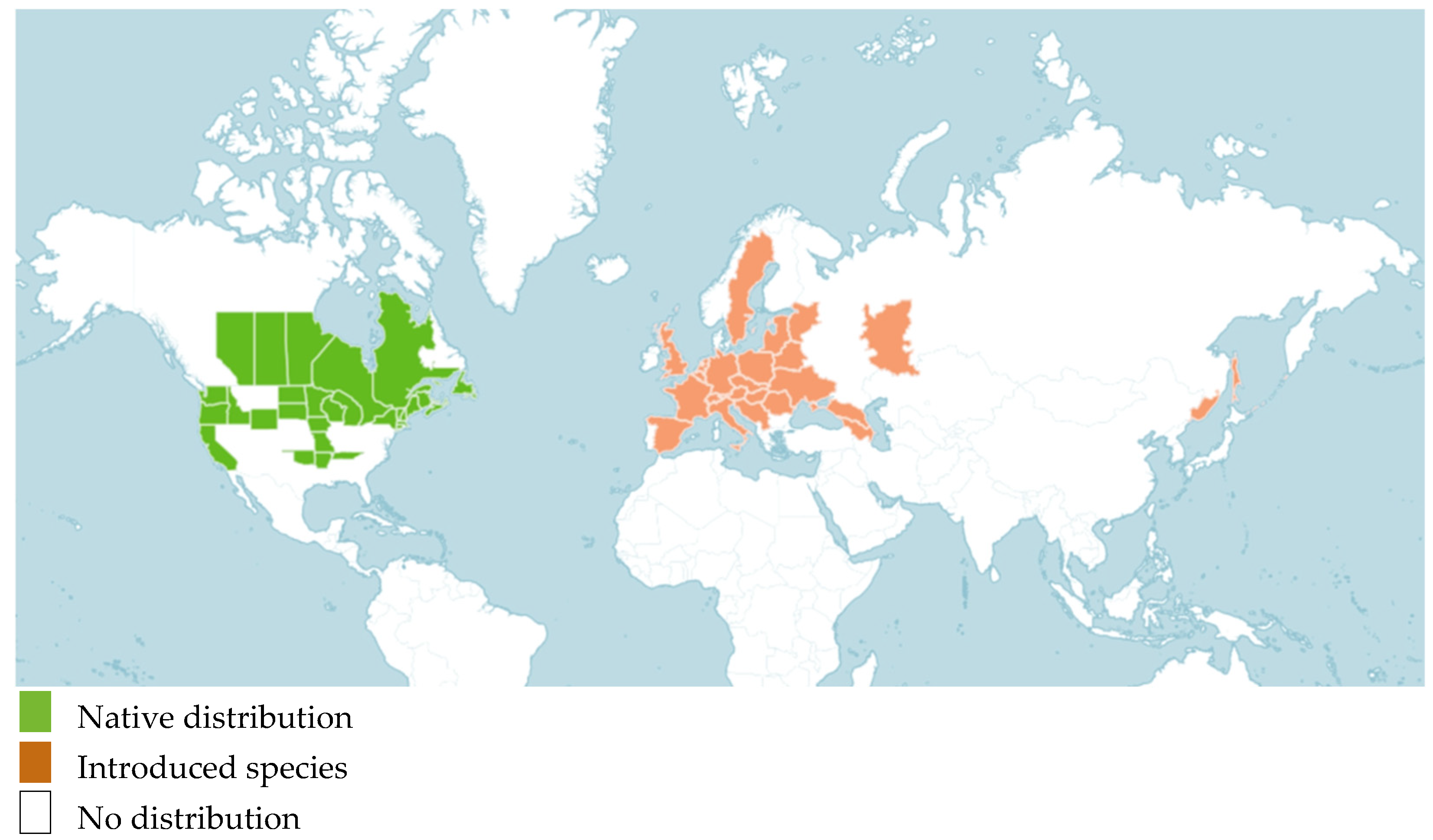
2.2. Chemical Composition of Erigeron strigosus Muhl. ex Willd. (Rough Fleabane) Extracts
2.3. Toxic Activity of Erigeron annuus (L.) Pers. and Erigeron strigosus Muhl. ex Willd. Aqueous Extracts
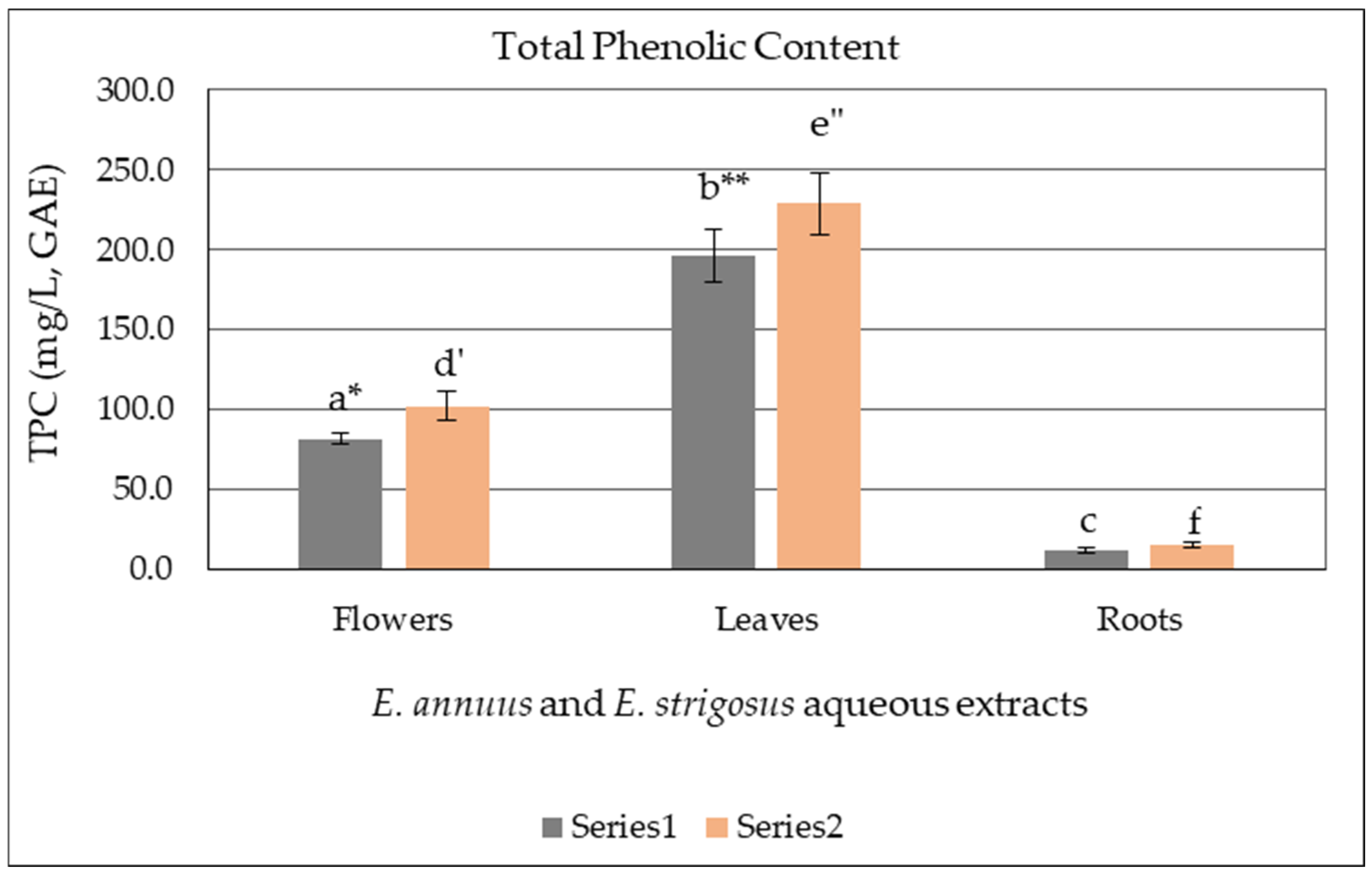
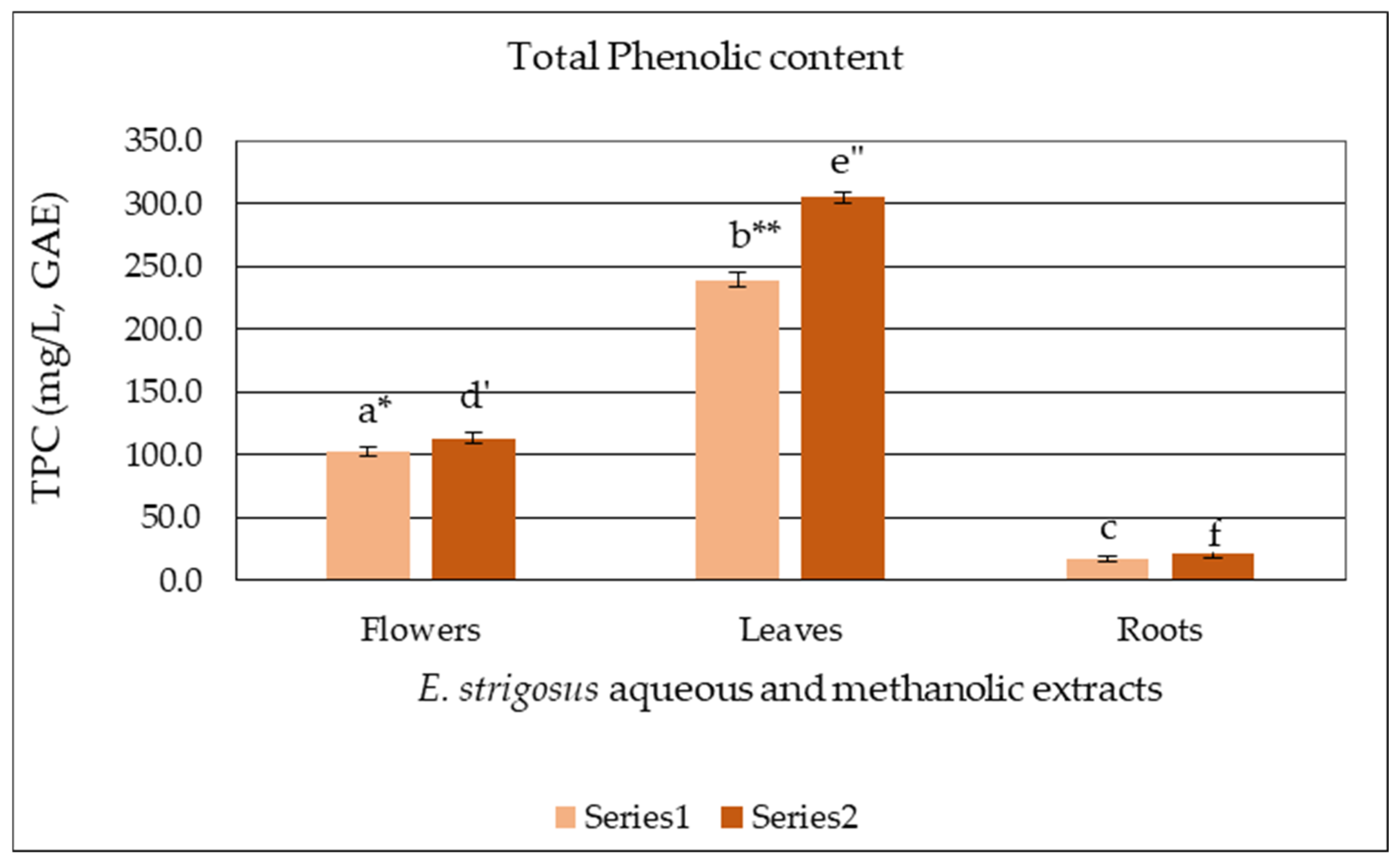
2.4. Total Phenolic Content (TPC) of Erigeron annuus (L.) Pers. and Erigeron strigosus Muhl. ex Willd. Extracts
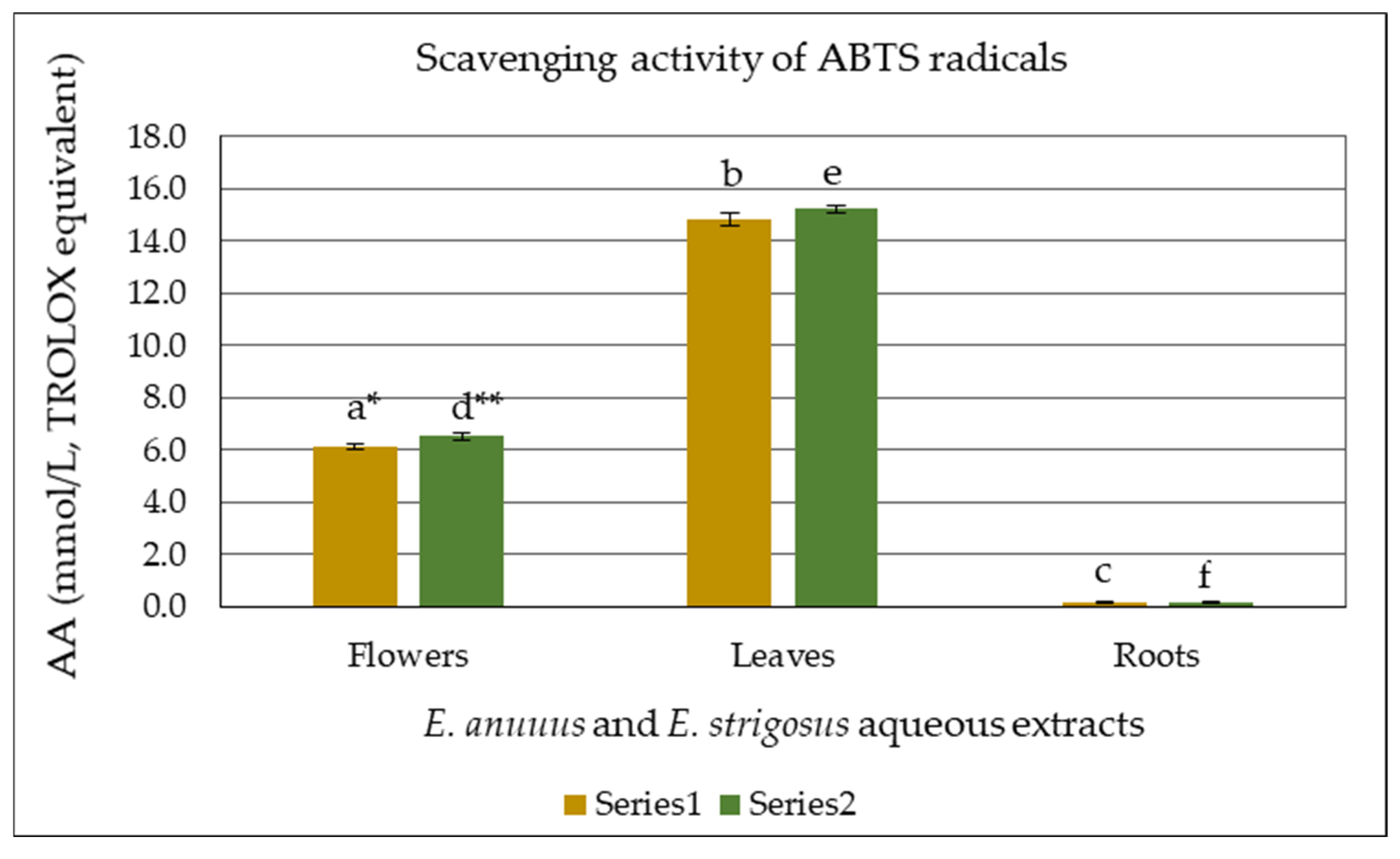
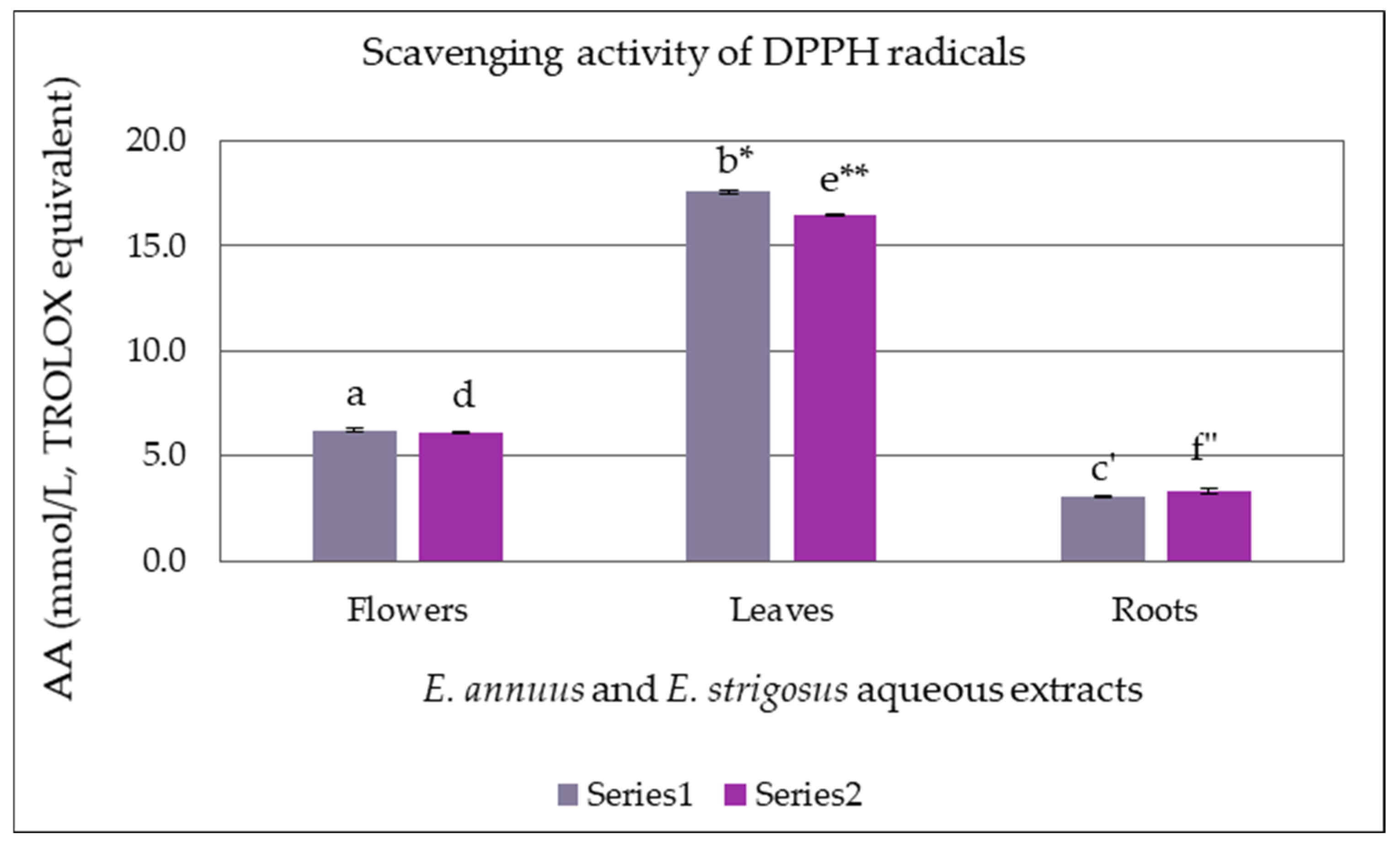
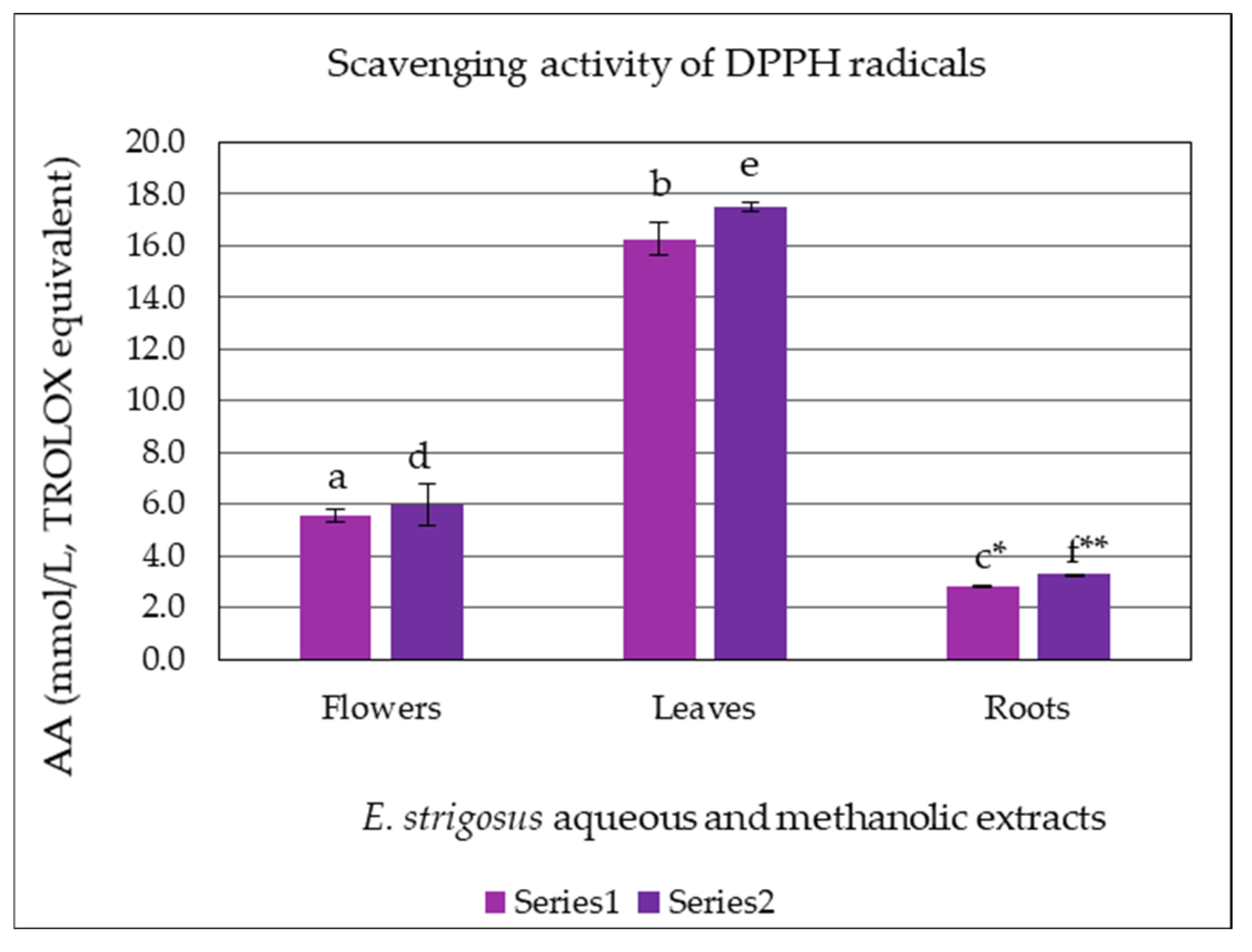
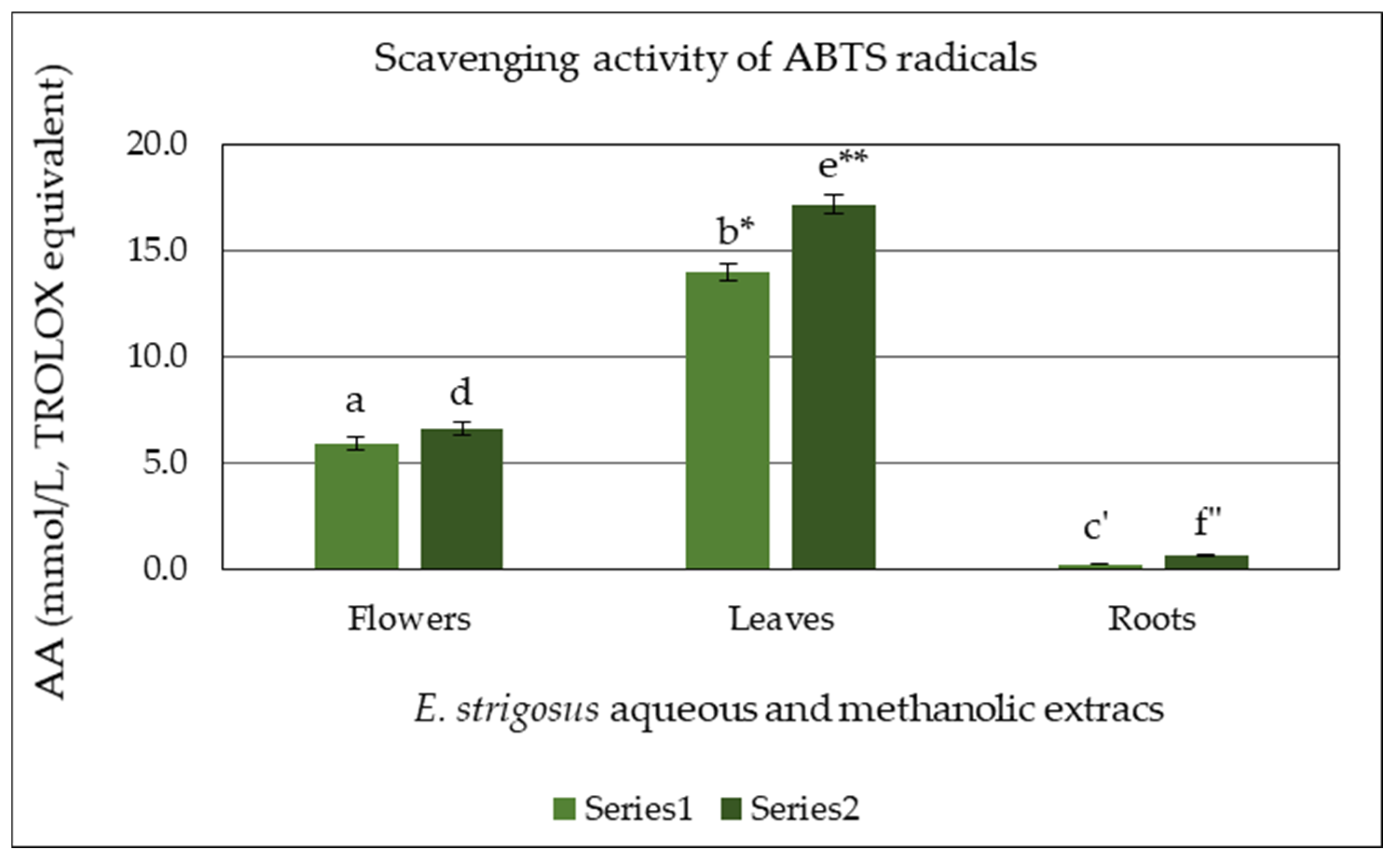
2.5. Antioxidant Ability (AA) of Erigeron annuus (L.) Pers. and Erigeron strigosus Muhl. ex Willd. Extracts
3. Discussion
4. Materials and Methods
4.1. Plant Material
4.2. Preparation of Extracts for HPLC/DAD/TOF Analysis, Toxicity Tests and TPC Determination
4.3. HPLC-DAD-MS (TOF) Analysis
4.4. Toxicity Tests
4.5. Spectrophotometric ABTS●+ and DPPH● Scavenging Assays
4.6. Statistical Data Analysis
5. Conclusions
Supplementary Materials
Author Contributions
Funding
Data Availability Statement
Acknowledgments
Conflicts of Interest
Abbreviations
| HPLC/DAD/TOF | High-performance liquid chromatography/diode array detector/time of flight mass spectrometry |
| TROLOX | 6-Hydroxy-2,5,7,8-tetramethylchroman-2-carboxylic acid (C14H18O4) |
| ABTS | 2,2’-Azino-bis-(3-ethylbenzotiazoline-6-sulfonic acid) diammonium salt |
| DPPH | 2,2-Diphenyl-1-picrylhydrazyl |
| GAE | Gallic acid equivalent |
References
- World Flora Online. WFO Plant List. Available online: https://www.worldfloraonline.org (accessed on 2 June 2026).
- Plants of the World Online (POWO). Royal Botanical Gardens, Kew, UK. Available online: https://powo.science.kew.org (accessed on 25 May 2026).
- Global Biodiversity Information Facility (GBIF). Available online: https://www.gbif.org/occurrence/map?taxon_key=3642949&occurrence_status=present (accessed on 1 June 2026). [CrossRef]
- Fitzgerald, H.; Helpdesk, G.N. Nordic Crop Wild Relative (CWR) Checklist, version 1.16; Nordic Genetic Resource Center (NORDGEN): Lomma, Sweden, 2020; Available online: https://www.gbif.org/dataset/8027d8d5-c8bc-4d54-bee9-f854f141b442 (accessed on 3 June 2026). [CrossRef]
- Bánki, O.; Roskov, Y.; Döring, M.; Ower, G.; Robles, H.D.R.; Corredor, P.C.A.; Jeppesen, S.T.; Örn, A.; Pape, T.; Hobern, D. Catalogue of Life (2026-08-26 XR); Catalogue of Life Foundation: Amsterdam, The Netherlands, 2026; Available online: https://doi.org/10.48580/dgyy9 (accessed on 1 June 2026).
- Patamsytė, J.; Rančelis, V.; Čėsnienė, T.; Kleizaitė, V.; Tunaitienė, V.; Naugžemys, D.; Vaitkūnienė, V.; Žvingila, D. Clonal structure and reduced diversity of the invasive alien plant Erigeron annuus in Lithuania. Cent. Eur. J. Biol. 2013, 8, 898–911. [Google Scholar] [CrossRef] [Scilit]
- Gudžinskas, Z.; Petrulaitis, L.; Uogintas, D.; Vaitonis, G.; Balčiauskas, L.; Rakauskas, V.; Arbačiauskas, K.; Butkus, R.; Karalius, S.; Janulaitienė, L.; et al. Invasive and Alien Species in Lithuania; Gudžinskas, Z., Rašomavičius, V., Eds.; Nature Research Centre: Vilnius, Lithuania, 2023; pp. 44–45. ISBN 978-609-8255-32-4. [Google Scholar]
- Nesom, G.L. Erigeron (Asteraceae). In Flora of North America (FNA) Volume 20; Editorial Committee, Ed.; Oxford University Press: New York, NY, USA; Oxford, UK, 2006; pp. 262, 320, 344, 345, 346, 347. Available online: http://www.efloras.org/florataxon.aspx?flora_id=1&taxon_id=242416508 (accessed on 3 June 2026).
- Nature Reserve Explorer. Available online: https://explorer.natureserve.org/Taxon/ELEMENT_GLOBAL.2.132001/Erigeron_strigosus (accessed on 3 June 2026).
- Regarding the Amendment of the Minister of the Environment of the Republic of Lithuania “Regarding the Approval of the List of Species of Invasive Organisms in Lithuania and the Recognition of Some Orders of the Minister of the Environment as Having Lost Their Validity”. Available online: https://e-seimas.lrs.lt/portal/legalAct/lt/TAD/0754e1b0b56011e6a3e9de0fc8d85cd8 (accessed on 12 June 2026).
- Anonymous. Fleabane Benefits: Medicinal, Garden & Ecological Uses [Power Weed]. Available online: https://scicentric.org/fleabane-benefits-medicinal-ecological-uses (accessed on 14 September 2026).
- Rana, R.; Pundir, S.; Lal, U.R.; Chauhan, R.; Upadhyay, S.K.; Kumar, D. Phytochemistry and biological activity of Erigeron annuus (L.) Pers. Naunyn-Schmiedeb. Arch. Pharmacol. 2023, 396, 2331–2346. [Google Scholar] [CrossRef] [Scilit]
- Sharma, R.K.; Verma, N.; Jha, K.K.; Singh, N.K.; Kumar, B. Phytochemistry, pharmacological activity, traditional and medicinal uses of Erigeron species: A review. IJARI 2014, 2, 274–280. [Google Scholar] [CrossRef] [Scilit]
- Li, X.; Yang, M.; Han, Y.F.; Gao, K. New sesquiterpenes from Erigeron annuus. Planta Med. 2005, 71, 268–272. [Google Scholar] [CrossRef] [Scilit]
- Judžentienė, A. Compositional variability of essential oils and their bioactivity in native and invasive Erigeron species. Molecules 2025, 30, 2989. [Google Scholar] [CrossRef] [Scilit]
- Nazaruk, J.; Kalemba, D. Chemical Composition of the essential oils from the roots of Erigeron acris L. and Erigeron annuus (L.) Pers. Molecules 2009, 14, 2458–2465. [Google Scholar] [CrossRef] [Scilit]
- Yoo, N.H.; Jang, D.S.; Kim, J.S. Phytochemical constituents of the roots of Erigeron annuus. J. Appl. Biol. Chem. 2008, 51, 305–308. [Google Scholar] [CrossRef] [Scilit]
- El-Razek, A.M.H. A new flavan from the aerial part of Erigeron annuus. Chin. Pharm. J. 2006, 58, 95–104. [Google Scholar]
- Jeong, C.H.; Jeong, H.R.; Choi, G.N.; Kim, D.O.; Lee, U.; Heo, H.J. Neuroprotective and anti-oxidant effects of caffeic acid isolated from Erigeron annuus leaf. Chin. Med. 2011, 6, 25. [Google Scholar] [CrossRef] [Scilit]
- Jang, D.S.; Yoo, N.H.; Lee, Y.M.; Yoo, J.L.; Kim, Y.S.; Kim, J.S. Constituents of the flowers of Erigeron annuus with inhibitory activity on the formation of advanced glycation end products (AGEs) and aldose reductase. Arch. Pharm. Res. 2008, 31, 900–904. [Google Scholar] [CrossRef] [Scilit]
- Jang, D.S.; Yoo, N.H.; Kim, N.H.; Lee, Y.M.; Kim, C.S.; Kim, J.; Kim, J.H.; Kim, J.S. 3,5-Di-O-caffeoyl-epi-quinic acid from the leaves and stems of Erigeron annuus inhibits protein glycation, aldose reductase, and cataractogenesis. Biol. Pharm. Bull. 2010, 33, 329–333. [Google Scholar] [CrossRef] [Scilit]
- Lee, H.J.; Seo, Y. Antioxidant properties of Erigeron annuus extract and its three phenolic constituents. Biotechnol. Bioprocess Eng. 2006, 11, 13–18. [Google Scholar] [CrossRef] [Scilit]
- Oh, H.; Lee, S.; Lee, H.S.; Lee, D.H.; Lee, S.Y.; Chung, H.T.; Kim, T.S.; Kwon, T.O. Germination inhibitory constituents from Erigeron annuus. Phytochemistry 2002, 61, 175–179. [Google Scholar] [CrossRef] [Scilit]
- Kim, H.Y.; Kim, K. Protein glycation inhibitory and antioxidative activities of some plant extracts in vitro. J. Agric. Food Chem. 2003, 51, 1586–1591. [Google Scholar] [CrossRef] [Scilit]
- Yusuf, E.H. Total phenolic content and antioxidant activities of invasive Erigeron annuus Pers. (Asteraceae) from different localities. Int. J. Agric. Environ. Food Sci. 2021, 5, 173–178. [Google Scholar] [CrossRef] [Scilit]
- Zhang, L.; Xu, Q.; Li, L.; Lin, L.; Yu, J.; Zhu, J.; Zhang, H.; Xia, G.; Zang, H. Antioxidant and enzyme-inhibitory activity of extracts from Erigeron annuus flower. Ind. Crops Prod. 2020, 148, 112283. [Google Scholar] [CrossRef] [Scilit]
- Zheng, Y.; Choi, Y.-H.; Lee, J.-H.; Lee, S.-Y.; Kang, I.-J. Anti-obesity effect of Erigeron annuus (L.) Pers. extract containing phenolic acids. Foods 2021, 10, 1266. [Google Scholar] [CrossRef] [Scilit]
- Lee, H.K.; Nam, Y.H.; Shin, S.W.; Kim, M.C.; An, J.I.; Kim, N.W.; Shim, J.H.; Srinath, S.; Hong, B.N.; Kwak, J.H.; et al. Erigeron annuus extract alleviates insulin resistance via regulating the expression of mitochondrial damage and endoplasmic reticulum stress-related genes. Nutrients 2023, 15, 2685. [Google Scholar] [CrossRef] [Scilit]
- Song, K.; Zheng, X.K.; Zhang, J.K.; Zhang, Y.L.; Li, M.; Wang, J.C.; Zou, Z.M.; Feng, W.S. Chemical constituents of Erigeron annuus (L.). Pers. Chin. Pharm. J. 2016, 51, 1462–1466. [Google Scholar] [CrossRef]
- Yoo, N.H.; Jang, D.S.; Yoo, J.L.; Lee, Y.M.; Kim, Y.S.; Cho, J.H.; Kim, J.S. Erigeroflavanone, a flavanone derivative from the flowers of Erigeron annuus with protein glycation and aldose reductase inhibitory activity. J. Nat. Prod. 2008, 71, 713–715. [Google Scholar] [CrossRef] [Scilit]
- Kim, O.S.; Kim, Y.S.; Jang, D.S.; Yoo, N.H.; Kim, J.S. Cytoprotection against hydrogen peroxide-induced cell death in cultured mouse mesangial cells by erigeroflavanone, a novel compound from the flowers of Erigeron annuus. Chem. Biol. Interact. 2009, 180, 414–420. [Google Scholar] [CrossRef] [Scilit]
- Zhang, X.; Zhou, S.; Yu, H.; Zhu, Y.; Zhang, L.; Niu, F.; Zhou, C.; Wan, X.; Gao, L. Investigating the antiviral activity of Erigeron annuus (L.) pers extract against RSV and examining its active components. J. Ethnopharmacol. 2024, 334, 118581. [Google Scholar] [CrossRef] [Scilit]
- Kovalev, S.V.; Golovach, A.R.; Kovalev, V.N.; Khilya, V.P. Flavonoids from Erigeron annuus. Chem. Nat. Compd. 2023, 59, 776–777. [Google Scholar] [CrossRef] [Scilit]
- Thakur, M.; Verma, R.; Kumar, D.; Sivakumar, M.; Malik, T. Investigation into the impact of solvents on the phytochemical composition, antioxidant capacities, and antihyperglycemic activities of Erigeron annuus (L.) Pers. BioMed Res. Int. 2025, 1, 2314–6133. [Google Scholar] [CrossRef] [Scilit]
- Kim, D.H.; Jung, S.J.; Chung, I.S.; Lee, Y.-H.; Kim, D.-K.; Kim, S.-H.; Kwon, B.-M.; Jeong, T.-S.; Park, M.-H.; Seoung, N.-S.; et al. Ergosterol peroxide from flowers of Erigeron annuus L. as an anti-atherosclerosis agent. Arch. Pharm. Res. 2005, 28, 541–545. [Google Scholar] [CrossRef] [Scilit]
- Kovalev, S.V.; Golovach, A.R.; Kovalev, V.N.; Poleszak, E.; Akhmedov, E.; Bobrytska, O. Study and determination of fructan-type polysaccharide content in Erigeron annuus L. Curr. Issues Pharm. Med. Sci. 2022, 35, 95–98. [Google Scholar] [CrossRef] [Scilit]
- Kovalev, S.V.; Golovach, A.R.; Kovalev, V.M.; Deviatkina, N. Determination of carbohydrates in the herb Erigeron annuus. Fr.-Ukr. J. Chem. (FUJC) 2024, 12, 39–50. [Google Scholar] [CrossRef] [Scilit]
- Kovalev, S.V.; Golovach, A.R.; Kovalev, V.M. An identification and study of amino acids of Erigeron annuus herb. Methods Objects Chem. Anal. 2021, 16, 88–92. [Google Scholar] [CrossRef] [Scilit]
- Li, X.; Pan, J.; Gao, K. Gamma-pyranone derivatives and other constituents from Erigeron annuus. Pharmazie 2006, 61, 474–477. Available online: https://storage.imrpress.com/IMR/pharmazie/application/61_05_S474_477.pdf (accessed on 16 July 2026).
- Iijima, T.; Yaoita, Y.; Kikuchi, M. Two new cyclopentenone derivatives and a new cyclooctadienone derivative from Erigeron annuus (L.) PERS., Erigeron philadelphicus L., and Erigeron sumatrensis RETZ. Chem. Pharm. Bull. 2003, 51, 894–896. [Google Scholar] [CrossRef] [Scilit]
- Jeong, M.; Kwon, H.; Kim, Y.; Jin, H.; Choi, G.-E.; Hyun, K.-Y. Erigeron annuus extract improves DNCB-induced atopic dermatitis in a mouse model via the Nrf2/HO-1 pathway. Nutrients 2024, 16, 451. [Google Scholar] [CrossRef] [Scilit]
- Choi, Y.H.; Lee, O.H.; Zheng, Y.; Kang, I.J. Erigeron annuus (L.) Pers. extract inhibits reactive oxygen species (ROS) production and fat accumulation in 3T3-L1 cells by activating an AMP-dependent kinase signaling pathway. Antioxidants 2019, 8, 139. [Google Scholar] [CrossRef] [Scilit]
- Kim, S.C.; Cho, I.J.; Kim, Y.W. Roots of Erigeron annuus inhibits acute inflammatory response through NF-κB inactivation. Toxicol. Lett. 2013, 221, S152. [Google Scholar] [CrossRef] [Scilit]
- Jo, M.J.; Lee, J.R.; Cho, I.J.; Kim, Y.W.; Kim, S.C. Roots of Erigeron annuus attenuate acute inflammation as mediated with the inhibition of NF- κ B-associated nitric oxide and prostaglandin E2 production. Evid. Based Complement. Altern. Med. 2013, 2013, 297427. [Google Scholar] [CrossRef] [Scilit]
- Sung, M.S.; Kim, Y.H.; Choi, Y.M.; Ham, H.M.; Jeong, H.S.; Lee, J.S. Anti-Inflammatory effect of Erigeron annuus L. flower extract through heme oxygenase-1 induction in RAW264.7 macrophages. J. Korean Soc. Food Sci. Nutr. 2011, 40, 1507–1511. [Google Scholar] [CrossRef] [Scilit]
- Liu, J.; Liu, X.; Fu, S.; Wang, H.; Mu, L. Allelopathic Impact of Erigeron canadensis and Erigeron annuus on major crop species. Diversity 2025, 17, 318. [Google Scholar] [CrossRef] [Scilit]
- Tak, H.; Fronczek, F.R.; Fischer, N.H. Molecular structure of 3-hydroxy-4-pyrone. Spectrosc. Lett. 1994, 27, 1431–1435. [Google Scholar] [CrossRef] [Scilit]
- Cantrell, C.L.; Fischer, N.H.; Urbatsch, L.; McGuire, M.S.; Franzblau, S.G. Antimycobacterial crude plant extracts from South, Central, and North America. Phytomedicine 1998, 5, 137–145. [Google Scholar] [CrossRef] [Scilit]
- Anwar, T.; Qureshi, H.; Sarwar, G.; Siddiqi, E.H.; Ashraf, T. Preserving ethnomedicinal knowledge: Revealing the therapeutic potential of wild indigenous flora. Ecol. Front. 2024, 44, 1079–1089. [Google Scholar] [CrossRef] [Scilit]
- Uprety, Y.; Lacasse, A.; Asselin, H. Traditional uses of medicinal plants from the Canadian boreal forest for the management of chronic pain syndromes. Pain Pract. 2015, 16, 459–466. [Google Scholar] [CrossRef] [Scilit]
- Kanerva, L.; Estlander, T.; Alanko, K.; Jolanki, R. Patch test sensitization to Compositae mix, sesquiterpene-lactone mix, Compositae extracts, laurel leaf, chlorophorin, mansonone A, and dimethoxydalbergione. Am. J. Contact Dermat. 2001, 12, 18–24. [Google Scholar] [CrossRef] [Scilit]
- Borchardt, J.R.; Wyse, D.L.; Sheaffer, C.C.; Kauppi, K.L.; Fulcher, R.G.; Ehlke, N.J.; Biesboer, D.D.; Bey, R.F. Antimicrobial activity of native and naturalized plants of Minnesota and Wisconsin. J. Med. Plants Res. 2008, 2, 98–110. Available online: https://www.scopus.com/pages/publications/73449149012 (accessed on 16 June 2026). [CrossRef]
- Judzentiene, A.; Budiene, J.; Nedveckyte, I.; Garjonyte, R. Antioxidant and toxic Activity of Helichrysum arenarium (L.) Moench and Helichrysum italicum (Roth) G. Don essential oils and extracts. Molecules 2022, 27, 1311. [Google Scholar] [CrossRef] [Scilit]
- Voynikov, Y. Arzanol: A review of chemical properties and biological activities. Plants 2025, 14, 3474. [Google Scholar] [CrossRef] [Scilit]
- Bajek-Bil, A.; Chmiel, M.; Włoch, A.; Stompor-Gorący, M. Baicalin—Current trends in detection methods and health-promoting properties. Pharmaceuticals 2023, 16, 570. [Google Scholar] [CrossRef] [Scilit]
- Ozma, M.A.; Khodadadi, E.; Pakdel, F.; Kamounah, F.S.; Yousefi, M.; Yousefi, B.; Asgharzadeh, M.; Ganbarov, K.; Kafil, H.S. Baicalin, a natural antimicrobial and anti-biofilm agent. J. Herb. Med. 2021, 27, 100432. [Google Scholar] [CrossRef] [Scilit]
- Meng, X.; Ning, C.; Kang, M.; Wang, X.; Yu, Z.; Hao, X.; Guo, H. Baicalin: Natural sources, extraction techniques, and therapeutic applications against bacterial infections. Molecules 2025, 30, 3464. [Google Scholar] [CrossRef] [Scilit]
- Ložienė, K.; Petraitytė, E. The Influence of water extraction methods on the isolation of polyphenols and tannins from various Ericaceae and Rosaceae species. Plants 2026, 15, 808. [Google Scholar] [CrossRef] [Scilit]
- Xu, L.; Wang, X. A Comprehensive review of phenolic compounds in horticultural plants. Int. J. Mol. Sci. 2025, 26, 5767. [Google Scholar] [CrossRef] [Scilit]
- Ložienė, K.; Chochlovaitė, I. Effect of phenological stage and leaf age on changes of chlorophyll and carotenoid contents in some weeds and invasive species. Molecules 2025, 30, 3788. [Google Scholar] [CrossRef] [Scilit]
- Judžentienė, A.; Kundrotaitė, A.; Charkova, T.; Nedveckytė, I. Phytochemistry and allelopathic properties of invasive Heracleum sosnowskyi aqueous extracts against lettuce (Lactuca sativa L.), perennial ryegrass (Lolium perenne L.), timothy (Phleum pratense L.) and white clover (Trifolium repens L.). Plants 2026, 15, 346. [Google Scholar] [CrossRef] [Scilit]
- McLaughlin, J.L.; Rogers, L.L.; Anderson, J.E. The use of biological assays to evaluate botanicals. Drug Inform. J. 1998, 32, 513–524. [Google Scholar] [CrossRef] [Scilit]
- Judžentienė, A.; Būdienė, J. Low-Thujone A. absinthium L. (Wormwood) essential oils and extracts with potential antioxidative/prooxidant activity. Molecules 2026, 31, 1551. [Google Scholar] [CrossRef] [Scilit]






| Constituents | Formula | Molecular Weight | m/z ESI+ (Da) | m/z ESI− (Da) | UV Absorb., λmax, nm | Literature ** |
|---|---|---|---|---|---|---|
| Acids: | ||||||
| * Fumaric L | C4H4O4 | 116.1 | 116.072 | 210 | ||
| * Succinic L | C4H6O4 | 118.1 | 118.084 | 220 | [24] | |
| Glutaric F | C5H8O4 | 132.1 | 133.061 | 210 | ||
| Malic R | C4H6O5 | 134.1 | 133.018 | 340 | ||
| Protocatechuic R | C7H6O4 | 154.1 | 155.975 | 260; 290 | [20] | |
| p-Coumaric F | C9H8O3 | 164.2 | 166.086 | 260 | [23] | |
| Quinic acid F, L, R | C7H12O6 | 192.2 | 191.017 | 195 | [27] | |
| Gelseminic (Scopoletin) L | C10H8O4 | 192.2 | 190.986 | 340 | ||
| * Chlorogenic (3-O-caffeoylquinic) L, F, R | C16H18O9 | 354.3 | 355.106 | 353.092 | 210; 315 | [27,28] |
| Neochlorogenic (5-O-caffeoylquinic) L, F, R | C16H18O9 | 354.3 | 355.097 | 353.089 | 210; 315 | |
| Betulinic/Ursolonic L | C30H48O3 | 456.7 | 456.885 | 210 | [18] | |
| Isochlorogenic (3,5-Dicaffeoylquinic) acid A L, F | C25H24O12 | 516.5 | 517.134 | 515.123 | 325 | [20,21,27] |
| Isochlorogenic (3,4-Dicaffeoylquinic) acid B R | C25H24O12 | 516.5 | 517.134 | 515.148 | 325 | [21,27] |
| Other: | ||||||
| Umbelliferone F, L | C9H6O3 | 162.1 | 163.039 | 160.981 | 300 | [18] |
| Matricaria lactone F, L | C10H10O2 | 162.2 | 163.039 | 160.981 | [15,16] | |
| Loliolide F, L, R | C11H16O3 | 196.2 | 195.055 | [29] | ||
| Isoscutellarein F, L | C15H10O6 | 286.2 | 285.043 | 275 | [12] | |
| Kaempferol/Luteolin F | C15H10O6 | 286.2 | 285.046 | 265; 360 | [18,27,33] | |
| Sesquiterpene hydrocarbon(s) F, L | C15H24 | 204.4 | 205.096 | [12,14,15,16] | ||
| Apigenin F | C15H10O5 | 270.2 | 269.048 | 210; 325 | [17,21,22,39] | |
| Acacetin (Linarigenin; 5,7-Dihydroxy-4′-methoxyflavone) F | C16H12O5 | 284.3 | 282.942 | |||
| Hispidulin (Scutellarein 6-methyl ether; 4′,5,7-Trihydroxy-6-methoxyflavone) L | C16H12O6 | 300.3 | 298.918 | [29] | ||
| * Quercetin F | C15H10O7 | 302.2 | 301.038 | 225; 255; 370 | [18,32] | |
| Arenol F | C21H24O7 | 388.4 | 386.926 | |||
| Arzanol F, L | C22H26O7 | 402.4 | 401.026 | |||
| Erigeroflavanone F, L | C19H18O10 | 406.3 | 407.033 | 405.031 | [30,31] | |
| Erigeside I (6′-O-Caffeoylerigeroside) F, L | C20H20O11 | 436.4 | 435.008 | [21,29,39] | ||
| * Baicalin (7-D-Glucuronic acid-5,6-dihydroxyflavone) F, L | C21H18O11 | 446.4 | 447.099 | 444.968 | 275; 315 | |
| Apigenin-7-O-glucuronide F, L, R | C21H18O11 | 446.4 | 447.099 | 445.083 | [17,21] | |
| Astragalin (Kaempferol 3-O-glucoside)/Quercitrin (Quercetin 3-rhamnoside) F | C21H20O11 | 448.4 | 446.956 | 265; 346 | [21] | |
| Scutellarin (Scutellarein-7-O-glucuronide; Breviscapin) F, L, R | C21H18O12 | 462.4 | 463.084 | 461.078 | 285, 335 | |
| Quercetin 3′-O-glucoside R | C21H20O12 | 464.4 | 465.104 | 463.084 | 255; 365 | [22,33] |
| Apigenin-7-O-glucuronide-6′-ethyl ester L, R | C23H22O11 | 474.4 | 475.084 | [39] | ||
| Isorhamnetin 3-O-glucoside F | C22H22O12 | 478.4 | 476.954 | |||
| Caffeoylshikimic acid glucoside F, L | C22H26O13 | 499.1 | 499.12 | |||
| Rutin F | C27H30O16 | 610.5 | 609.130 | 255; 355 |
| Compounds | Formula | Molar Mass | m/z ESI+, (Da) | m/z ESI− (Da) | UV Absorb., λmax, nm |
|---|---|---|---|---|---|
| Acids: | |||||
| Pyromeconic (3-hydroxy-pyran-4-one) F | C5H4O3 | 112.1 | 113.022 | 210; 270 | |
| * Fumaric F | C4H4O4 | 116.1 | 116.072 | 210 | |
| * Succinic F | C4H6O4 | 118.1 | 118.084 | 220 | |
| Malic F, L, R | C4H6O5 | 134.1 | 133.018 | 340 | |
| Protocatechuic F | C7H6O4 | 154.1 | 156.042 | 260; 295 | |
| p-Coumaric F, L, R | C9H8O3 | 164.2 | 166.040 | 163.081 | 260 |
| * Caffeic acid F | C9H8O4 | 180.2 | 181.122 | 220; 295–325 | |
| Gelseminic (scopoletin) F, L | C10H8O4 | 192.2 | 191.061 | 340 | |
| Quinic F, R | C7H12O6 | 192.2 | 191.108 | 195 | |
| * Syringic R | C9H10O5 | 198.2 | 199.061 | 210; 260 | |
| Linolenic (9,12,15-octadecatrienoic) F, L, R | C18H30O2 | 278.5 | 279.157 | 277.225 | 210 |
| 9,12,13-Trixydroxy-10E-octadecenoic F, R | C18H34O5 | 330.5 | 331.189 | 329.238 | |
| * Chlorogenic (3-O-caffeoylquinic) F, L, R | C16H18O9 | 354.3 | 355.108 | 353.092 | 210; 315 |
| Neochlorogenic (5-O-caffeoylquinic) L, F, R | C16H18O9 | 354.3 | 355.097 | 353.089 | 210; 315 |
| 3-O-Feruloylquinic L, R | C17H20O9 | 368.3 | 367.145 | ||
| Oleanolic R | C30H48O3 | 456.7 | 455.236 | 195; 230 | |
| Isochlorogenic (3,5-dicaffeoylquinic) acid A F, L, R | C25H24O12 | 516.5 | 517.155 | 515.148 | 325 |
| Isochlorogenic (3,4-dicaffeoylquinic) acid B F | C25H24O12 | 516.5 | 517.134 | 515.124 | 325 |
| Other: | |||||
| Coumaran (2,3-dihydrobenzofuran) F, L, R | C8H8O | 120.2 | 121.052 | 210 | |
| Isoamyl butyrate L, R | C9H18O2 | 158.2 | 158.996 | 210 | |
| Umbelliferone L, R | C9H6O3 | 162.1 | 163.039 | 300 | |
| Lachnophyllum ester F, L | C11H12O2 | 176.1 | 177.092 | 175.10 | |
| 5,7-Dihydroxychromone L | C9H6O4 | 178.1 | 179.108 | 177.025 | |
| Loliolide F, L | C11H16O3 | 196.2 | 197.118 | 195.055 | |
| Sesquiterpene hydrocarbon(s) L | C15H24 | 204.4 | 205.096 | ||
| * Baicalein F, L | C15H10O5 | 270.2 | 271.228 | 269.051 | 270; 330 |
| Apigenin F, L | C15H10O5 | 270.2 | 271.228 | 269.051 | 210; 230; 325 |
| Kaempferol/Luteolin L | C15H10O6 | 286.2 | 285.046 | 265; 364 | |
| * Epicatechin F, L, R | C15H14O6 | 290.3 | 291.098 | 280 | |
| * Catechin F, R | C15H14O6 | 290.3 | 291.233 | 280 | |
| * Quercetin F | C15H10O7 | 302.2 | 303.233 | 301.040 | 225; 255; 370 |
| Quercetin 3′,4′,7-trimethyl ether F, L | C18H16O7 | 344.3 | 346.259 | 343.042 | |
| Erigeside I (6′-O-Caffeoylerigeroside) F, L, R | C20H20O11 | 436.4 | 437.104 | 435.096 | |
| Erigerol L | C25H40O6 | 436.6 | 435.094 | ||
| * Baicalin F, L | C21H18O11 | 446.4 | 447.099 | 445.083 | 275; 315 |
| Apigenin-7-O-glucuronide F, L | C21H18O11 | 446.4 | 447.099 | 445.083 | |
| Astragalin/Quercitrin L | C21H20O11 | 448.4 | 447.229 | 265; 345 | |
| (-)-Epigallocatechin gallate R | C22H18O11 | 458.4 | 457.251 | 275 | |
| Apigenin 7-O-methylglucuronide F, R | C22H20O11 | 460.4 | 461.281 | 459.148 | |
| Scutellarin (scutellarein-7-O-glucuronide) F, L | C21H18O12 | 462.4 | 463.085 | 285; 335 | |
| * Quercetin 3′-O-glucoside F, L | C21H20O12 | 464.4 | 465.104 | 463.094 | 255; 365 |
| Apigenin-7-O-glucuronide-6′-ethyl ester F, L | C23H22O11 | 474.4 | 475.085 | ||
| Caffeoylshikimic acid glucoside L, | C22H26O13 | 498.5 | 499.124 | ||
| (-)-Syringaresinol-4-O-β-D-glucopyranoside F, R | C28H36O13 | 580.6 | 582.145 | 579.182 | |
| * Rutin R | C27H30O16 | 610.5 | 611.426 | 255; 355 | |
| Artemia salina Nauplii Mortality, % | ||||||
|---|---|---|---|---|---|---|
| Dosage * | E. annuus | E. strigosus | ||||
| Volume, mL | Flowers | Leaves | Roots | Flowers | Leaves | Roots |
| 0.1 | 0.0 ± 0.0 | 6.1 ± 8.6 | 0.0 ± 0.0 | 0.0 ± 0.0 | 0.0 ± 0.0 | 0.0 ± 0.0 |
| 0.5 | 34.8 ± 10.7 | 72.3 ± 2.4 | 0.0 ± 0.0 | 47.2 ± 5.0 | 66.7 ± 4.3 | 0.0 ± 0.0 |
| 1.0 | 38.6 ± 3.9 | 82.8 ± 1.3 | 4.8 ± 6.7 | 87.7 ± 9.0 | 97.9 ± 2.9 | 15.2 ± 4.3 |
| 2.0 | 80.1 ± 5.4 | 100 ± 0.0 | 51.5 ± 5.1 | 100 ± 0.0 | 100 ± 0.0 | 75.4 ± 2.4 |
| 3.0 | 100 ± 0.0 | 90.2 ± 2.0 | 91.8 ± 6.3 | |||
| 4.5 | 100 ± 0.0 | 100 ± 0.0 | ||||
Disclaimer/Publisher’s Note: The statements, opinions and data contained in all publications are solely those of the individual author(s) and contributor(s) and not of MDPI and/or the editor(s). MDPI and/or the editor(s) disclaim responsibility for any injury to people or property resulting from any ideas, methods, instructions or products referred to in the content. |
© 2026 by the authors. Licensee MDPI, Basel, Switzerland. This article is an open access article distributed under the terms and conditions of the Creative Commons Attribution (CC BY) license.
Share and Cite
Judžentienė, A.; Būdienė, J. Evaluation of Phytochemistry, Toxicity and Radical-Scavenging Capacity of Two Erigeron Species (E. annuus (L.) Pers. and E. strigosus Muhl. ex Willd.) Extracts. Plants 2026, 15, 2851. https://doi.org/10.3390/plants15182851
Judžentienė A, Būdienė J. Evaluation of Phytochemistry, Toxicity and Radical-Scavenging Capacity of Two Erigeron Species (E. annuus (L.) Pers. and E. strigosus Muhl. ex Willd.) Extracts. Plants. 2026; 15(18):2851. https://doi.org/10.3390/plants15182851
Chicago/Turabian StyleJudžentienė, Asta, and Jurga Būdienė. 2026. "Evaluation of Phytochemistry, Toxicity and Radical-Scavenging Capacity of Two Erigeron Species (E. annuus (L.) Pers. and E. strigosus Muhl. ex Willd.) Extracts" Plants 15, no. 18: 2851. https://doi.org/10.3390/plants15182851
APA StyleJudžentienė, A., & Būdienė, J. (2026). Evaluation of Phytochemistry, Toxicity and Radical-Scavenging Capacity of Two Erigeron Species (E. annuus (L.) Pers. and E. strigosus Muhl. ex Willd.) Extracts. Plants, 15(18), 2851. https://doi.org/10.3390/plants15182851