1. Introduction
Olea europaea L. is one of the most important woody crops of the Mediterranean basin, although it has also been traditionally cultivated in marginal and non-Mediterranean areas, such as Galicia (north-western Spain), where olive growing has a long historical presence [
1,
2]. Preserving the genetic identity of each variety requires clonal propagation, which is traditionally achieved by semi-hardwood cuttings. This technique is simpler and less costly than in vitro culture, but its success varies widely with genotype [
3]: rooting percentages range from above 80–90% in easy-to-propagate cultivars to only 5–20% in strongly recalcitrant ones such as the Portuguese cultivar ‘Galega vulgar’ [
4]. In addition to genotype, the timing of cutting collection also modulates rooting response in a cultivar-specific way through its effect on shoot lignification and carbohydrate content, as described for the Italian cultivars ‘Frantoio’ and ‘Gentile di Larino’ [
5] and for the cultivar ‘Sevillano’ [
6].
Galicia (north-western Spain) supported a substantial area of olive cultivation until the Middle Ages, when heavy taxation of olive trees and other economic and political factors [
7] drove a rapid decline, and olive cultivation had virtually disappeared by the twentieth century. A recent survey of 117 centuries-old olive trees scattered across the region combined microsatellite (SSR) genotyping with full botanical characterisation following UPOV descriptors, leading to the identification and description of twelve previously unknown olive varieties [
1,
2], which are well adapted to the soil and climatic conditions of their region of origin and produce distinctive, high-quality fruits. None of the surveyed trees tested positive for the regulated pathogens considered under EU legislation (
Verticillium dahliae,
Xylella fastidiosa,
Pseudomonas savastanoi pv.
savastanoi, or the surveyed viruses), providing a phytosanitary green light for using this material as a source for vegetative propagation [
2].
Transferring this heritage-recovery effort to the production sector—nurseries, growers and the authorities involved in variety registration and commercialisation—requires effective, variety-specific propagation protocols, because rooting behaviour cannot be extrapolated from one variety to another [
3]. Gago et al. [
2] reported having recently begun propagating this material by cuttings for future agronomic characterisation, explicitly identifying this as a necessary next step; the present work reports the results of that propagation effort. Concurrently, and within the framework of a collaborative research project involving the authors of the present article, in vitro micropropagation experiments were conducted on the same varieties using the same source plant material and demonstrated significant differences among genotypes in their response to this alternative propagation approach [
8].
Castanea sativa Mill. and its hybrids show a similar genotype-dependent rooting response, with moderate heritability and a substantial contribution of non-additive genetic variance [
9]. A comparable pattern, combining a marked cultivar effect with cultivar × environment interactions, could therefore be expected in olive. To date, no data have been published on the semi-hardwood cutting propagation ability of these autochthonous Galician olive varieties. This study provides a first quantitative evaluation of the following, under a single standard propagation protocol, as a basis for future more targeted optimisation of propagation protocols for these varieties (i) survival, callus formation, and rooting in semi-hardwood cuttings of 12 autochthonous Galician olive varieties and of a Portuguese control variety (Cobrançosa); (ii) the effect of variety, cutting date (winter vs. summer), and their interaction on these variables; and (iii) the relationships between survival, callus formation, flowering on the mother plant, and rooting.
3. Discussion
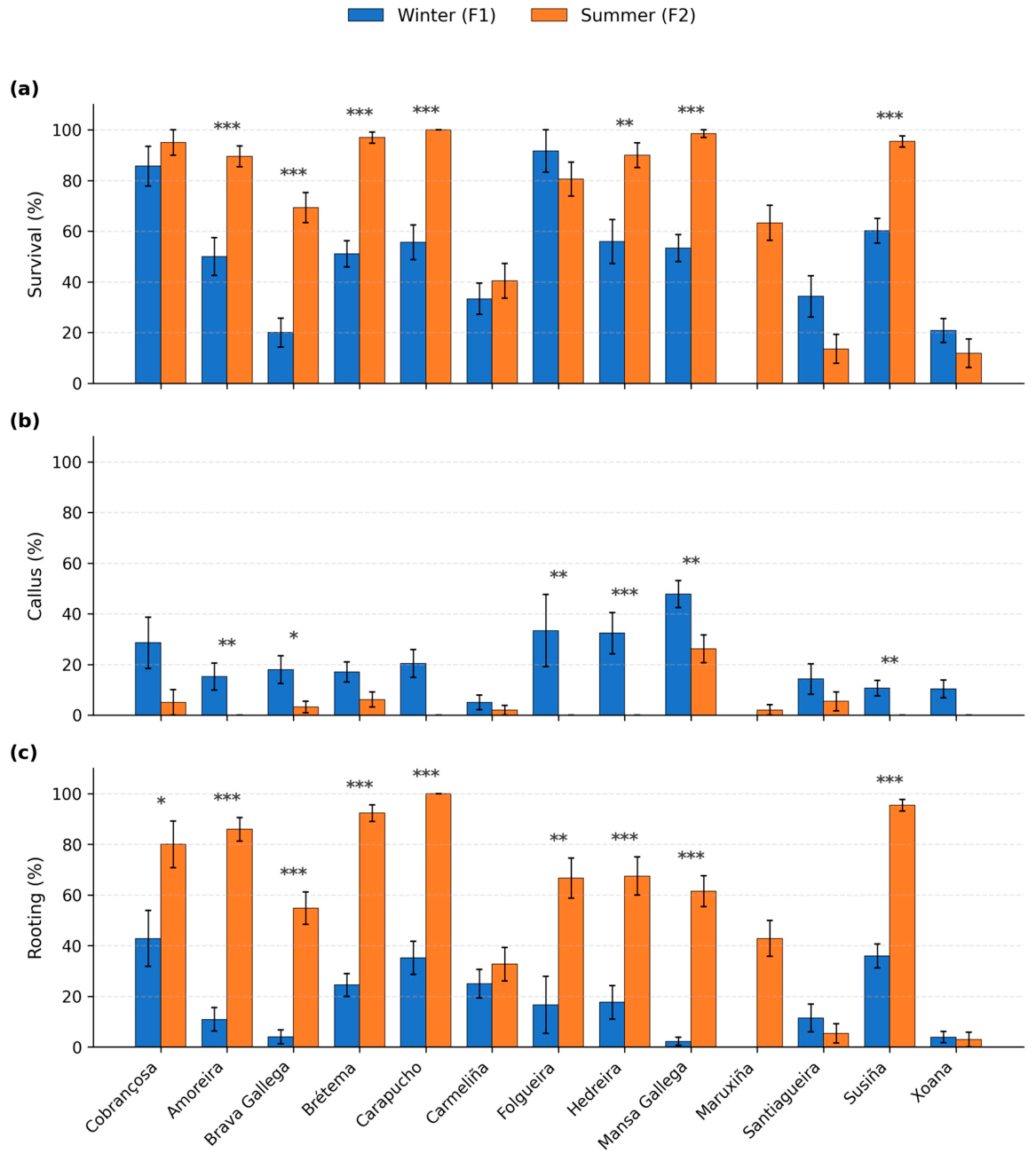
The variety effect was, by far, the most determinant factor for survival, callus formation and rooting (
Table 1), confirming that semi-hardwood cutting behaviour in olive is markedly variety-dependent. These results are consistent with those reported in other olive varietal collections [
4,
5] and with observations made by other authors in cultivars of other agriculturally important and recalcitrant woody species, such as chestnut (
Castanea sativa Mill. and its hybrids), where the rooting ability of cuttings also showed strong genetic dependence [
9]. Among the Galician autochthonous varieties, Folgueira and the control variety Cobrançosa stood out for their ease of propagation in winter, and Carapucho, Susiña, Brétema and Mansa Gallega in summer, while Xoana and Santiagueira behaved as recalcitrant on both dates, with rooting percentages comparable to those described for the Portuguese cultivar ‘Galega vulgar’ (5–20%) [
4]. Before discarding these latter varieties as difficult to propagate, it would be worth testing specific treatments (IBA concentration, substrate, mother-plant age or vigour), since recalcitrance to cutting propagation can be partially mitigated through protocol adjustments [
4]. The marked variety effect detected in this study is consistent with the molecular and botanical characterisation of this material: Gago et al. [
2] confirmed, using microsatellite markers and UPOV descriptors, that the autochthonous Galician olive varieties constitute genetically distinct resources, both from each other and from reference Mediterranean cultivars, rather than clones or synonyms of already known varieties. This genuine genetic diversity, shaped by centuries of adaptation to Galicia’s environmental conditions, provides a direct explanation for the wide range of behaviours observed here, from easily propagated to clearly recalcitrant varieties, and reinforces the need for variety-specific propagation protocols rather than a single protocol for the whole germplasm collection.
Although cutting date showed no significant main effect overall, the variety × date interaction was significant for survival and rooting, indicating that the effect of timing on these two variables depends on genotype, whereas no significant variety × date interaction was detected for callus formation. This is best explained statistically rather than biologically: the callus formation model showed quasi-complete separation in several genotype × date cells with 0% or 100% observed callus (e.g., Amoreira F2, Carapucho F2, Folgueira F2, and Hedreira F2), consistent with the sparse, often near-binary callus response observed across varieties (
Table 2); this reduces the estimable degrees of freedom for the interaction term and destabilises the corresponding F-test (see
Section 4.3). In most varieties, rooting increased markedly from the winter to the summer trial (e.g., Carapucho, Susiña, Amoreira or Mansa Gallega), a pattern consistent with that described by [
5] for ‘Frantoio’ and ‘Gentile di Larino’, in which the timing of material collection—and the degree of lignification and carbohydrate reserves of the shoot at that time—modulates rooting response differently depending on the cultivar. However, Santiagueira and Xoana showed the opposite pattern (better performance in winter than in summer), reinforcing the idea that there is no single optimal propagation window valid for all varieties. A plausible physiological explanation for this genotype-dependent seasonal response is that winter and summer cuttings differ in their physiological status, including endogenous auxin levels, carbohydrate reserves and the degree of shoot lignification, all factors known to influence adventitious root formation in olive [
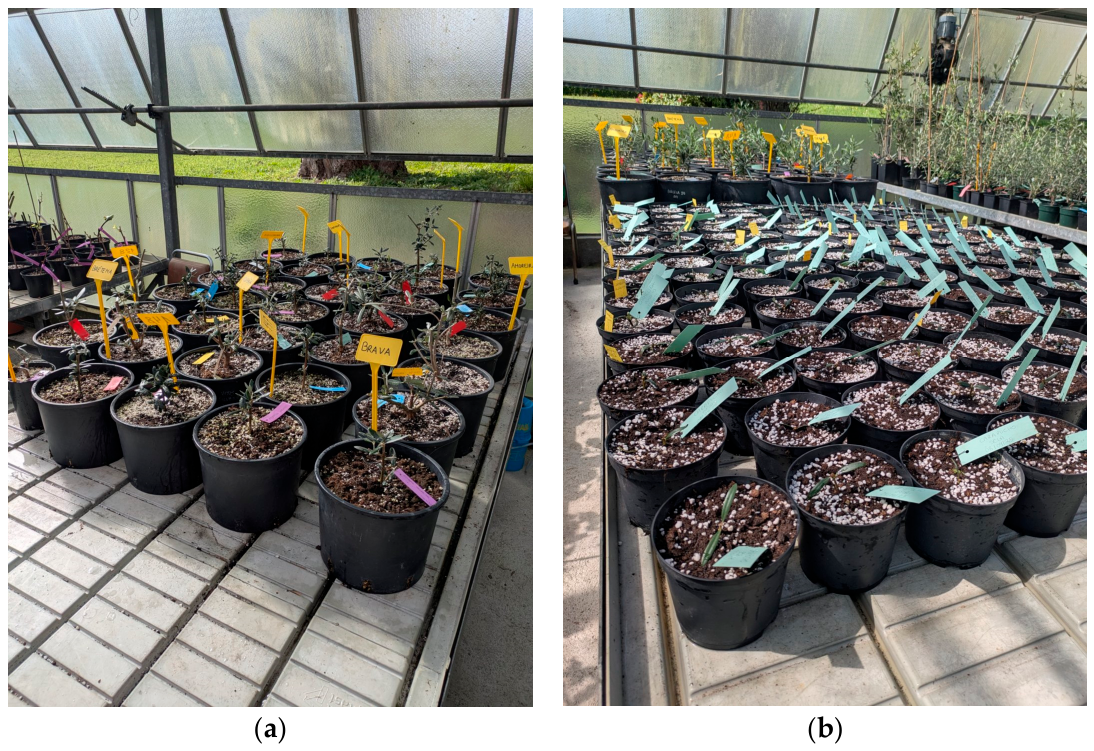
10], and that varieties differ in how strongly each of these factors constrains rooting at a given time of year; testing this hypothesis directly—for example through carbohydrate or hormone profiling of the shoots at collection—is a priority for future work. From a practical standpoint, these results suggest that nurseries should prioritise summer collection for most of these varieties but winter collection specifically for Santiagueira and Xoana.
The strong negative correlation observed between the presence of flowering on the mother plant and cutting rooting (ρ = −0.75) is consistent with the well-known competition between reproductive development and rhizogenesis for the carbohydrate reserves available in the mother plant and in the cutting itself [
3]. As detailed in
Section 2.3, flowering in the winter trial was an all-or-nothing, variety-level trait, present in three varieties (Brava Gallega, Mansa Gallega and Xoana) and absent in the remaining ten, with all three flowering varieties also showing very low winter rooting (2–4%); the correlation therefore reflects a contrast between these three varieties and the rest rather than a continuous, within-variety relationship. Nonetheless, it directly suggests a practical intervention: removing flower buds (disbudding) from mother plants of varieties prone to flowering to maximise rooting performance in subsequent cutting cycles.
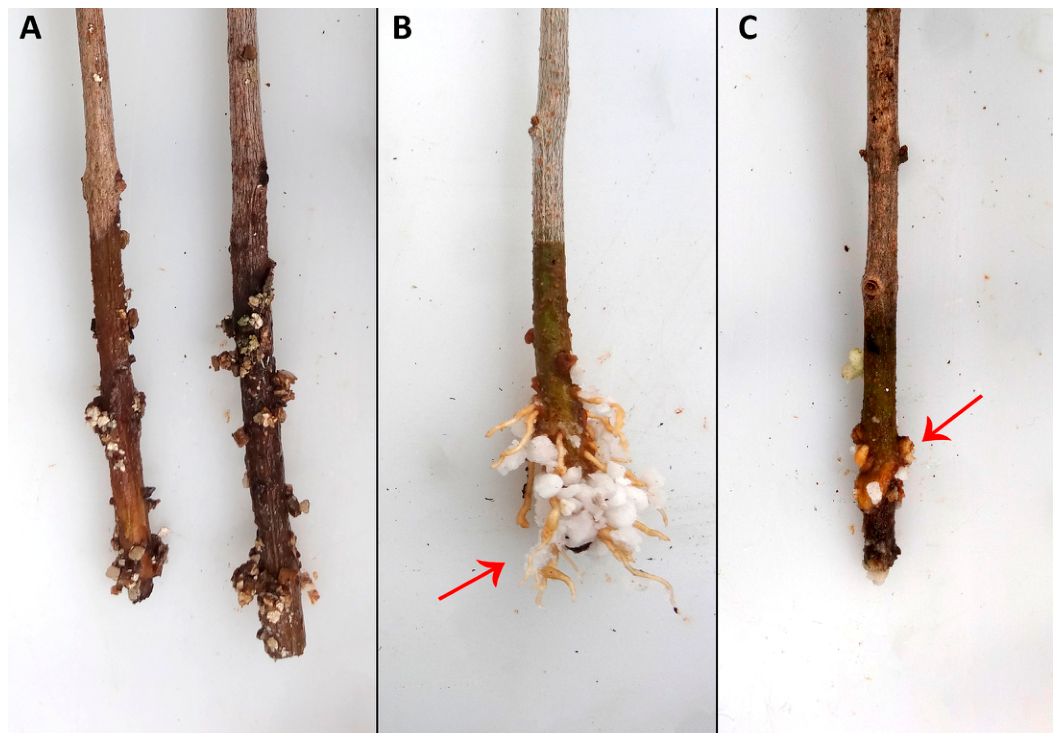
Finally, the absence of a significant correlation between callus formation and rooting on either date indicates that, under the conditions of this study, a callus is neither an obligatory step nor a good predictor of subsequent rooting. This agrees with the review of Porfírio et al. [
10], who reported that in olive, callogenesis and adventitious root formation are related but partly independent developmental processes. Although both responses may be induced by auxin treatment and wound healing, adventitious roots do not necessarily arise from callus tissue, and abundant callus formation is not consistently associated with improved rooting performance. Callus formation and rooting appear to be governed by at least partially independent processes in these varieties, which may originate through distinct cellular differentiation pathways in recalcitrant woody species. This has a direct practical implication: the presence of a callus should not be used as an early selection criterion for varieties or cuttings with good rooting potential. It should also be noted that callus was scored here as a binary presence/absence trait; a quantitative or ordinal scale (e.g., callus size or coverage) would allow a more nuanced test of its relationship with rooting in future work.
Genotype-dependent recalcitrance to cutting propagation is not unique to olive. In chestnut (
Castanea sativa Mill. and its hybrids), another rooting-recalcitrant woody species, a previous study [
9] found that rooting ability under optimised juvenile conditions can reach very high values (91% and 82% in two trials), far above the 64% mean obtained from 60-year-old mother plants of the same genotypes, illustrating how strongly maturation state constrains rooting independently of genotype. That same study showed rooting ability to be under moderate genetic control (broad-sense heritability Ĥ
2 = 0.33–0.43), driven mainly by dominance and epistasis rather than additive effects (narrow-sense heritability < 0.10 in all cases), so that selecting for rooting ability had to rely on choosing the best-rooting individual clones or families rather than on general parental breeding values [
9]. The present olive study cannot partition genetic variance into additive and non-additive components since it compares named varieties rather than structured full-sib families; nonetheless, the wide range of behaviours found here, from Cobrançosa and Folgueira (easy-to-root) to Xoana and Santiagueira (recalcitrant), is consistent with genotype-level control of comparable magnitude, and a controlled-cross breeding design, as used in chestnut, would be a logical next step for exploring the genetic architecture of rooting in these Galician varieties. Beyond chestnut, similar genotype-dependent recalcitrance to cutting propagation has been reported in walnut (
Juglans spp.), where the rooting of cuttings is notoriously difficult and highly genotype-dependent, to the point that clonal propagation of many valuable genotypes remains largely unresolved despite decades of work [
11], and in grapevine (
Vitis spp.), where a recent QTL study on a large rootstock mapping population found that rooting success in hardwood cuttings has a polygenic genetic architecture, with individual loci explaining only 3–4% of the phenotypic variance, and that the genetic determinants differ between hardwood cuttings and grafted plants [
12]. Together with the present results, this reinforces the view that cutting propagation ability in woody perennials is typically governed by many factors of small individual effect and by genotype-specific physiological constraints, rather than by a single, easily selectable trait—supporting the case for variety-specific rather than universal propagation protocols.
This study has several limitations that should guide the interpretation of its results and the design of future work. A single IBA concentration (2 g/L) and no alternative auxin were tested, so genotype differences in rooting cannot be fully disentangled from a possibly suboptimal hormone treatment for some varieties; concentration and auxin-type trials are a priority, particularly for the more recalcitrant varieties (Xoana and Santiagueira). The winter–summer contrast reported here reflects a single annual cycle and a single mother plant per variety, grown under ambient, non-continuously monitored greenhouse conditions; confirming these patterns over successive years, with more than one mother plant per variety and logged environmental data, would strengthen their generality. Rooting and callus formation were recorded as binary (presence/absence) traits, and no root-quality metrics (root number, length, and biomass) or post-transplant survival were measured; quantitative root-quality assessment is needed before translating these results into definitive nursery recommendations. Finally, rooting behaviour was characterised here at the phenotypic level only; candidate-gene or QTL-level analyses, such as those reported for the AOX1 subfamily during IBA-induced adventitious rooting in ‘Galega vulgar’ [
4], were outside the scope of this work and are a natural next step.
Despite these limitations, this study provides the first quantitative reference on the vegetative propagation ability of autochthonous Galician olive varieties identified to date, supplying information that is needed both by the nurseries collaborating in their multiplication and for the conservation and registration goals pursued by the administrations and entities involved. The work also fulfils a need previously identified by Gago et al. [
2], who reported having just begun cutting-based propagation of this material for future agronomic characterisation; this study can be regarded as reporting the first results of that effort. Furthermore, the results presented here are complementary to those being obtained in parallel, within the same Operational Group, for in vitro micropropagation of these varieties [
8]. Together, both approaches will contribute to the development of variety-specific multiplication protocols and help identify the most efficient propagation strategy for each genotype.