Article

Gshdz4-GmU2AFb-GmCML27 Regulatory Pathway Reshapes Root System Architecture and Enhances Alkaline Tolerance in Soybean

1
College of Horticulture, Northeast Agricultural University, No. 600, Changjiang Road, Xiangfang District, Harbin 150030, China
2
Institute of Molecular Biology and Biotechnology (IMBB), The University of Lahore, Lahore 54000, Pakistan
3
School of Geography and Tourism, Harbin University, No. 109, Zhongxing Avenue, Nangang District, Harbin 150076, China
*
Author to whom correspondence should be addressed.
These authors contributed equally to this work.
Plants 2026, 15(14), 2191; https://doi.org/10.3390/plants15142191
Submission received: 6 June 2026 / Revised: 3 July 2026 / Accepted: 10 July 2026 / Published: 17 July 2026

Abstract

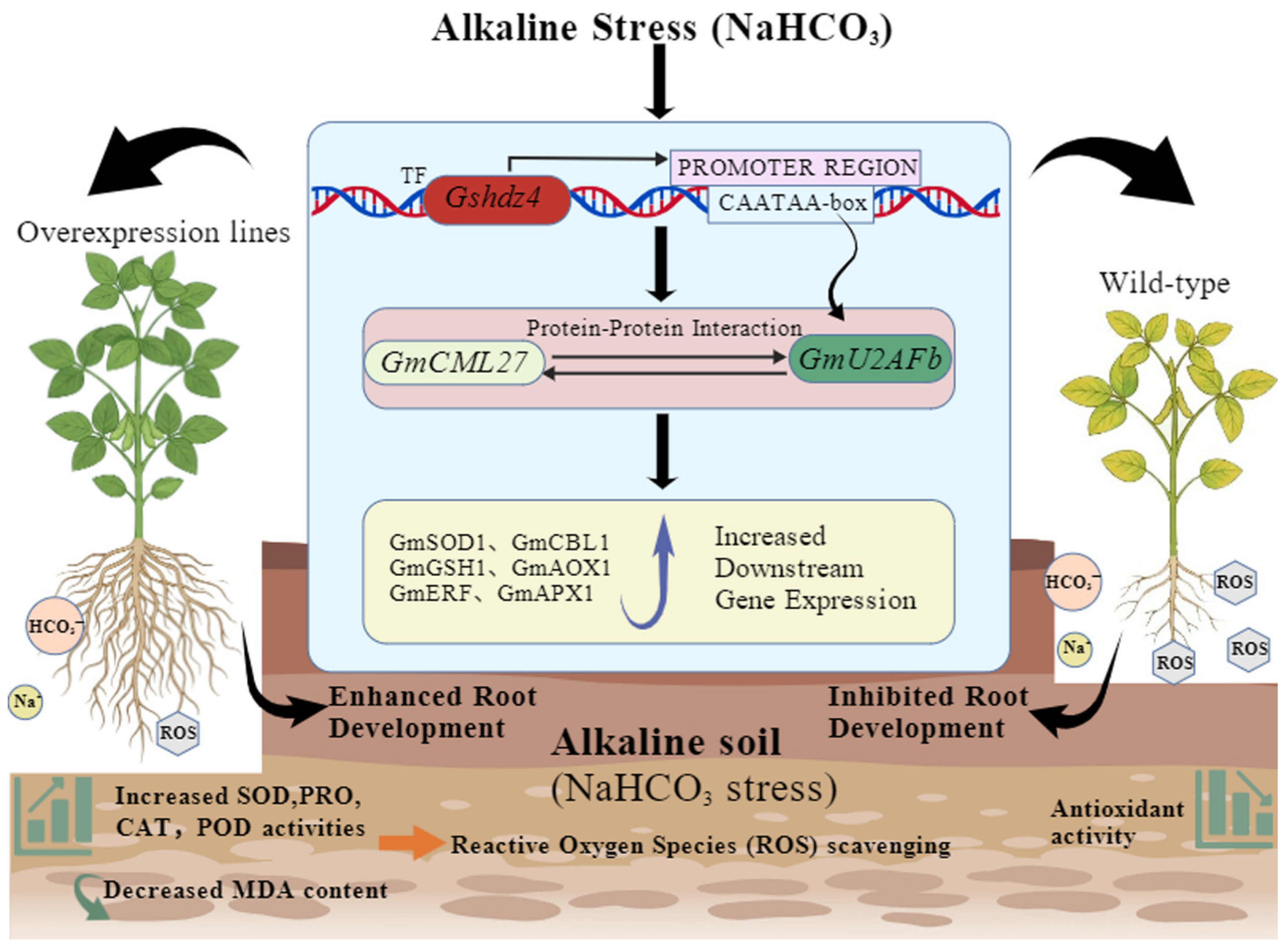
Alkaline soil limits soybean production. This study elucidates the molecular mechanism by which the Gshdz4-GmU2AFb-GmCML27 module regulates soybean alkaline tolerance. Transcriptome analysis, yeast one-hybrid and dual-luciferase assays confirm that the HD-Zip transcription factor Gshdz4 binds to the CAATAA motif in the GmU2AFb promoter and activates its transcription. Subcellular localization verifies the nuclear distribution of GmU2AFb. Overexpression of GmU2AFb improves alkaline tolerance by increasing antioxidant enzyme activities and proline levels, reducing MDA accumulation, facilitating root development, and upregulating alkaline-responsive genes, including GmSOD1, while gene knockout impairs stress resistance. Combined Y2H, BiFC and LCI assays validate the nuclear protein interaction between GmU2AFb and the calcium-binding protein GmCML27, and overexpression of GmCML27 also enhances antioxidant capacity and root growth in soybean. Co-overexpression of the two genes generates obvious synergistic effects; compared with single-gene overexpression lines, co-transgenic plants possess higher antioxidant levels and elevated transcription of downstream alkaline-tolerant genes, accompanied by alleviated growth inhibition under alkaline stress. In summary, Gshdz4 transcriptionally activates GmU2AFb, and the interaction between GmU2AFb and GmCML27 connects RNA splicing with calcium signaling pathways to synergistically trigger downstream defense responses and promote root development, thereby enhancing soybean alkaline tolerance at multiple layers. This work provides candidate genes for molecular breeding of alkali-resistant soybean.

1. Introduction

Alkaline soil conditions exert multifaceted stress on plants through a range of interconnected physicochemical and physiological mechanisms, while at the molecular level they trigger complex regulatory responses. The wild soybean (Glycine soja) accession G07256 exhibits the capacity to sustain normal growth in severe saline–alkaline environments, even at pH levels exceeding 8.5 [1]. It harbors a rich repertoire of stress-responsive gene clusters and exhibits outstanding alkaline tolerance, making it a valuable material for discovering alkaline tolerance genes [2]. Soybean is a crucial food and oil crop in China, playing a vital role in national food security. Molecular biology techniques can be employed to enhance soybean resistance to both biotic and abiotic stresses. For instance, seed priming with SME (Stress Memory Encoder) biofertilizer induces somatic heat stress memory in soybean via upregulating heat-responsive genes, optimizing physiological performance and improving thermotolerance [3]. Current research on soybean covers diverse areas; for example, GmMYB14 positively regulates soybean tolerance to alkaline stress by activating the phenylpropane metabolic pathway to maintain iron homeostasis and scavenge reactive oxygen species [4]. The soybean nodule receptor kinase GmNARK is induced by alkaline stress and enhances soybean alkaline tolerance by regulating the ROS signaling pathway [5]. Natural variation in GmPM30 enhances soybean salt tolerance by strengthening protein interactions of GmLEA1-GmLEC1, and can be applied to molecular breeding improvement of soybeans in saline–alkali lands [6]. GmCHYR16 regulates soybean tolerance to bicarbonate stress via ubiquitin-mediated degradation of GmERF71 [7].
Utilizing genetic resources and regulatory mechanisms associated with saline–alkaline tolerance from wild soybean represents an effective strategy for improving the tolerance of cultivated soybean. For example, studies have shown that overexpression of the GsJAZ2 gene enhances saline–alkaline tolerance in Arabidopsis [8]; GsSnRK1 acts synergistically with GsERF7 to significantly improve the saline–alkaline tolerance of soybean hairy root composite plants [9]; GsCPI14 from wild soybean interacts with GsCBRLK and inhibits cysteine protease activity, positively regulating plant tolerance to alkaline stress [10]; GsEXPA8 enhances soybean tolerance to sodium bicarbonate stress by modulating root system architecture and the expression of alkaline stress-related genes [11]; GsSnRK1 phosphorylates GsSRF2 (at T514), promoting its ubiquitination and degradation to enhance soybean salt tolerance [12]. GsSKP21 from wild soybean positively confers tolerance to alkaline stress in plants via regulating the expression of ABA signaling pathway-related genes [13]. GsCYP93D1 from wild soybean positively confers alkaline stress tolerance in plants by reinforcing antioxidant capacity and regulating the ABA signaling pathway [14]. Despite a growing number of studies, the molecular and physiological mechanisms underlying alkaline tolerance in soybean remain largely unresolved.
The HD-Zip protein family comprises plant-specific transcription factors divided into four subclasses, with core functions in regulating growth, development, and abiotic stress responses [15,16]. Gshdz4, a member of this family, has been demonstrated to markedly enhance stress tolerance under NaHCO3 treatment in Arabidopsis, soybean, and lupinus when overexpressed. In previous work, our research group identified Gshdz4, GsNAC019, and GsEXPA8 as key alkaline tolerance genes in wild soybean (Glycine soja) [11,17,18], and progressively elucidated their hierarchical regulatory mechanisms. Yeast one-hybrid assays demonstrated that Gshdz4 specifically recognizes and binds the CAATAA/CAATTA cis-element in the AtNAC019 promoter, thereby activating its expression and enhancing alkaline tolerance in transgenic Arabidopsis [18]. Further analysis revealed that the GsNAC019 promoter in wild soybean also contains potential Gshdz4 binding sites, suggesting that Gshdz4 directly activates GsNAC019 transcription [18]. Based on these findings, a “nucleus–nucleus–membrane” multi-level regulatory model was established in wild soybean: Gshdz4 in the nucleus upregulates GsNAC019 expression, and GsNAC019, acting as an intermediate hub, recognizes the CGTA conserved motif in the promoter of the downstream functional gene GsEXPA8, forming a sequential activation pathway of “Gshdz4-GsNAC019-GsEXPA8” that collectively enhances alkaline tolerance in soybean [19]. By integrating RNA-seq and CUT&Tag-seq analyses, Gshdz4 was further found to directly regulate multiple stress-related genes such as GmDEAH5 and GmATG1c, broadly participating in hormone signaling pathways including ABA and IAA [19]. Under alkali or cadmium stress, Gshdz4 establishes a broad-spectrum defense mechanism by regulating targets such as GmSLX8 and GmGMFL01, revealing its core function as a master regulator of multiple stresses [19]. Given the lack of HD-Zip family genes in the lupinus genome, our study introduced GsHZ4 (Gshdz4) from wild soybean into lupinus hairy roots via transcriptome analysis and genetic transformation. Overexpression of GsHZ4 (Gshdz4) significantly enhanced antioxidant enzyme activities (CAT, POD, SOD) under NaHCO3 stress, reduced malondialdehyde content, and upregulated key responsive genes such as LaKIN and LaMYB34 [20]. This study confirmed that heterologous expression of GsHZ4 (Gshdz4) effectively improves alkaline tolerance in lupinus, providing a new strategy for crop improvement in saline–alkaline soils.
Integrative analysis of prior RNA-seq and CUT&Tag data suggests that Gshdz4 positively regulates the splicing factor GmU2AFb, facilitating its role in enhancing plant tolerance to alkaline stress. In plants, splicing factors process pre-mRNA to generate mature transcripts, ensuring proper protein synthesis and regulating growth, development, and stress responses [21]. For example, GsSCL30a from wild soybean, phosphorylated by GsSnRK1, enhances splicing activity and confers improved alkaline stress tolerance [22]. Additionally, the splicing regulator OsRBP11, upon activation by bacterial TALEs, promotes alternative splicing of OsNPR3 to produce a truncated variant that antagonizes the defense function of OsNPR1, thereby enhancing disease susceptibility in rice [23]. In Arabidopsis, the spliceosome component SKIP enhances osmotic tolerance under salt stress by regulating alternative splicing of NHX1 and CBL1 and preventing aberrant transcripts with premature stop codons [24]. Meanwhile, in another study, SAP18 regulates nuclear splicing of leaf development genes but relocates to the cytoplasm under heat stress to form stress granules, thereby coordinating development and heat tolerance in Arabidopsis [25]. In maize, ZmHsf23 undergoes alternative splicing to produce two transcripts, Hsf23L and Hsf23S; Hsf23S directly activates sHSPs and TIL1 expression, while Hsf23L enhances its transcriptional activation capacity through interaction with Hsf23S, collectively improving thermotolerance [26]. The nuclear condensate protein EMB1579 in Arabidopsis interacts with the splicing factors SKIP and RBP47C to regulate stem cell maintenance and cell division in the root meristem at both transcriptional and splicing levels [27]. The plant U2AF65B gene participates in abiotic stress responses through alternative splicing and negatively regulates root elongation and ABA-dependent germination inhibition in Arabidopsis [28]. Based on these findings, the splicing factor GmU2AFb likely acts as a key downstream target of Gshdz4. Considering that Gshdz4 influences root development and that U2AFb family members are reported to regulate root morphology, it is plausible that GmU2AFb also contributes to this regulatory pathway.
Through library screening for the splicing factor GmU2AFb, we identified GmCML27 as one of its interacting proteins. GmCML27, a member of the EF-hand family of calcium-binding proteins, functions as a critical calcium signal sensor and transducer in plants. By binding or releasing calcium ions, it perceives intracellular calcium concentration changes and transmits signals to downstream target proteins, thereby regulating plant growth, development, and stress responses. Research has revealed that calcium ions (Ca2+) function as ubiquitous second messengers, playing critical roles in plant responses to diverse physiological and environmental stimuli. For instance, 262 calcium signaling-related genes containing EF-hand motifs have been identified in soybean, confirming their widespread involvement in stress responses and the Ca2+-binding capacity of certain calmodulin-like (CML) proteins [29]. In maize, ZmNSA1 undergoes proteasomal degradation upon Ca2+ binding, which upregulates plasma membrane H+-ATPase and promotes SOS1-mediated Na+ efflux, thereby enhancing plant tolerance to saline–alkaline stress [30]. In the liverwort Marchantia polymorpha, serine phosphorylation in the N-terminal EF-hand region of RBOHB increases its affinity for calcium ions, synergistically activating the protein in a Ca2+-dependent manner—a mechanism conserved in land plants [31]. Additionally, the rice calcium-binding protein OsCCD1 binds Ca2+ and positively regulates seedling tolerance to salt and osmotic stress by modulating the expression of downstream stress-responsive genes [32]. The wild soybean calcium-binding protein GsCML27, which contains four EF-hand domains, enhances tolerance to bicarbonate stress when ectopically expressed in Arabidopsis, yet reduces tolerance to salt and osmotic stress during seed germination and early growth stages [33]. In this study, we found that GsCML27 and GmCML27 share 99.45% sequence similarity, suggesting that GmCML27 identified in this work is also involved in the regulation of alkali stress responses.
It is speculated that the overexpression of GmU2AFb and GmCML27 can significantly enhance the tolerance of soybean to alkaline stress. Nevertheless, whether the co-overexpression of these two genes can further synergistically improve soybean resistance to alkaline stress remains to be elucidated. Accumulating studies have demonstrated that the co-overexpression and interaction of stress-resistant genes constitute a vital regulatory strategy for plants to adapt to diverse abiotic stresses. For example, the co-overexpression and interaction of AKR2A and AVP1 synergistically enhance plant salt tolerance by regulating sodium compartmentalization and auxin polar transport and promoting lateral root development [34]. The co-overexpression of ZmWRKY104 and ZmCCaMK activates antioxidant defense pathways, thereby positively regulating brassinosteroid-mediated salt tolerance in maize [35]. In tomato, the co-overexpression and interaction of SlDREBA4 and SlCAB3 strengthen antioxidant defense and heat stress response pathways to positively regulate thermotolerance and improve high-temperature resistance [36]. In soybean, GmCBL9 and GmCIPK6 co-express to form a protein complex that phosphorylates and activates downstream GmAKT1, which facilitates potassium influx and maintains Na+/K+ homeostasis, thereby positively modulating soybean salt tolerance [37].
Based on transcriptome sequencing data from Gshdz4-overexpressing soybean under alkali treatment, we observed that GmU2AFb was significantly upregulated under alkaline stress, leading us to hypothesize that it might be a key downstream target gene of Gshdz4. By overexpressing and knocking out GmU2AFb in cultivated soybean roots, we found that GmU2AFb overexpression enhances root tolerance to alkaline stress. To further elucidate the functional role of GmU2AFb, its interacting protein partners were systematically identified and functionally characterized. Meanwhile, the potential mechanism underlying the coordinated regulation of alkaline tolerance in soybean via co-overexpression of GmU2AFb and its interacting proteins was comprehensively investigated.

2. Results

2.1. Transcriptomic Analysis of GmU2AFb

Transcriptomic analysis of soybean plants heterologously overexpressing Gshdz4 revealed high biological reproducibility and correlation among samples (Figure 1A). A large number of genes encoding splicing factors were identified in the transcript annotation. Functional enrichment analyses using KEGG and GO revealed that the differentially expressed splicing factor genes were significantly enriched in the spliceosome pathway, indicating their primary involvement in mRNA splicing-related biological processes (Figure 1B). Further, Gene Ontology (GO) functional classification indicated that GmU2AFb could be categorized into three principal domains: biological process, cellular component, and molecular function. Within the biological process category, GmU2AFb was predominantly associated with cellular and metabolic processes; in the cellular component category, it was mainly localized to structures such as cells and organelles; and in the molecular function category, it primarily exhibited binding activity. Among these, RNA binding was identified as the core molecular function of GmU2AFb, participating in the recognition of mRNA splice sites (Figure 1C). Transcriptome data further indicated that GmU2AFb was highly expressed in the transcriptome (Figure 1D).

2.2. GmU2AFb Is a Downstream Target Gene of Gshdz4

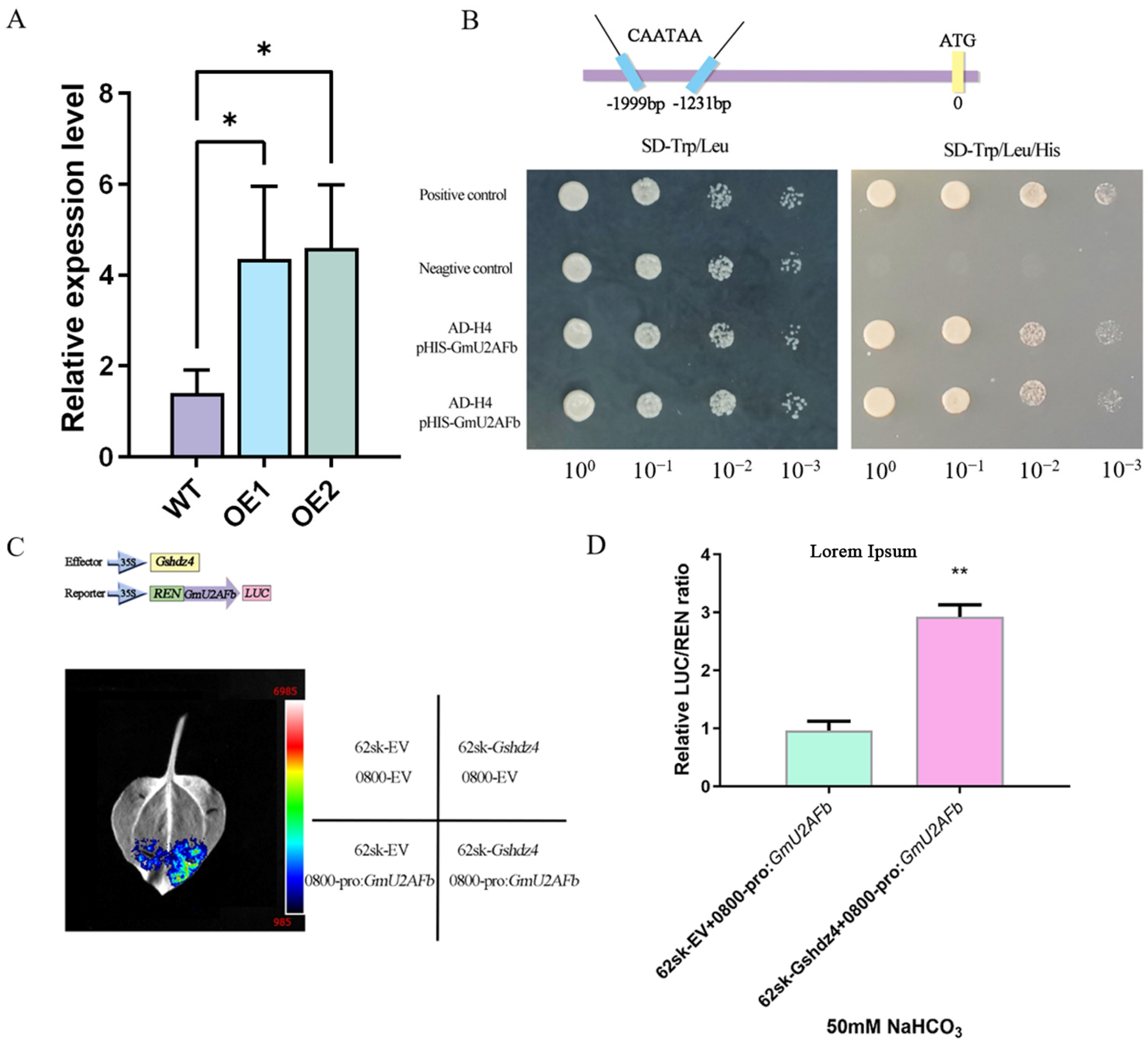
Transcriptomic data from soybean plants heterologously overexpressing Gshdz4 revealed that GmU2AFb expression was significantly upregulated 3 h after alkali treatment, preliminarily confirming that GmU2AFb, as a downstream target gene of Gshdz4, responds to alkali stress signals (Figure S1). To validate the transcriptomic data, wild-type and Gshdz4-overexpressing soybean plants were treated with 50 mM NaHCO3 for 6 h. The relative expression level of GmU2AFb was significantly higher in the overexpressing plants than in wild-type plants, indicating that Gshdz4 enhances alkali tolerance in soybean by upregulating GmU2AFb (Figure 2A). Yeast one-hybrid assays demonstrated that Gshdz4 specifically binds to the CAATAA-box within the promoter fragment, as evidenced by the growth of positive yeast colonies on SD/-Trp/-Leu and SD/-Trp/-His/-Leu solid media with the experimental group growing on the triple dropout medium (Figure 2B). Luciferase assays showed that the luminescence value was higher when 62sk-Gshdz4 was co-expressed with 0800-pro:GmU2AFb compared to 62sk-EV co-expressed with 0800-pro:GmU2AFb, and the increased luciferase activity indicated that Gshdz4 expression enhances GmU2AFb expression (Figure 2C,D). Both the yeast one-hybrid and luciferase assays confirmed a positive regulatory relationship between Gshdz4 and GmU2AFb. Therefore, it is suggested that GmU2AFb is a key downstream target gene of Gshdz4.

2.3. Protein Structure, Sequence Characteristics, Tissue Expression Pattern, and Subcellular Localization of GmU2AFb

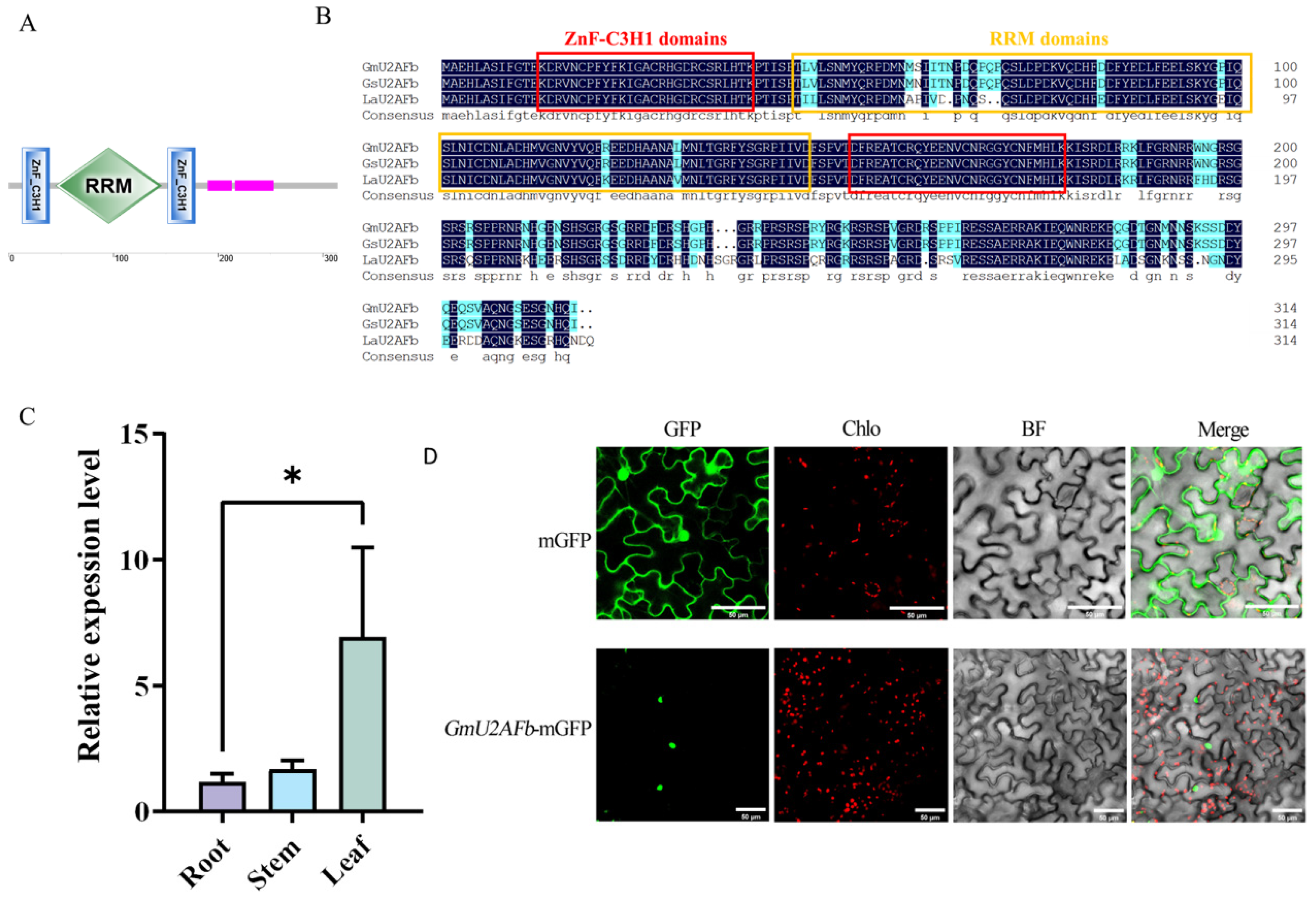
Domain analysis of the GmU2AFb protein revealed that it consists of an N-terminal ZnF-C3H1 domain, a central RRM (RNA recognition motif) domain, and a C-terminal ZnF-C3H1 domain arranged in tandem, suggesting its potential function in RNA binding and regulation (Figure 3A). Multiple sequence alignment results showed that GmU2AFb shares up to 92.19% sequence similarity with its homologs from wild soybean (GsU2AFb) and lupinus (LaU2AFb). Among these, the ZnF-C3H1 domains (marked by red boxes) and the RRM domain (marked by a yellow box) are highly conserved across different species, further indicating that these domains are critical for the function of GmU2AFb (Figure 3B). Tissue expression pattern analysis revealed that GmU2AFb is expressed in roots, stems, and leaves of soybean, with expression levels being significantly higher in leaves than in roots and stems (Figure 3C). Subcellular localization experiments further confirmed that the GmU2AFb-mGFP fusion protein transiently expressed in tobacco leaves exhibited green fluorescence signals concentrated in the nucleus, whereas the control mGFP was uniformly distributed throughout the entire cell. Combined with observations of chloroplast autofluorescence (Chlo), bright field (BF), and merged images (Merge), with scale bars representing 10 μm, these results clearly demonstrate that GmU2AFb is a nuclear-localized protein (Figure 3D).

2.4. Overexpression of the Splicing Factor GmU2AFb Enhances Saline–Alkaline Tolerance in Soybean

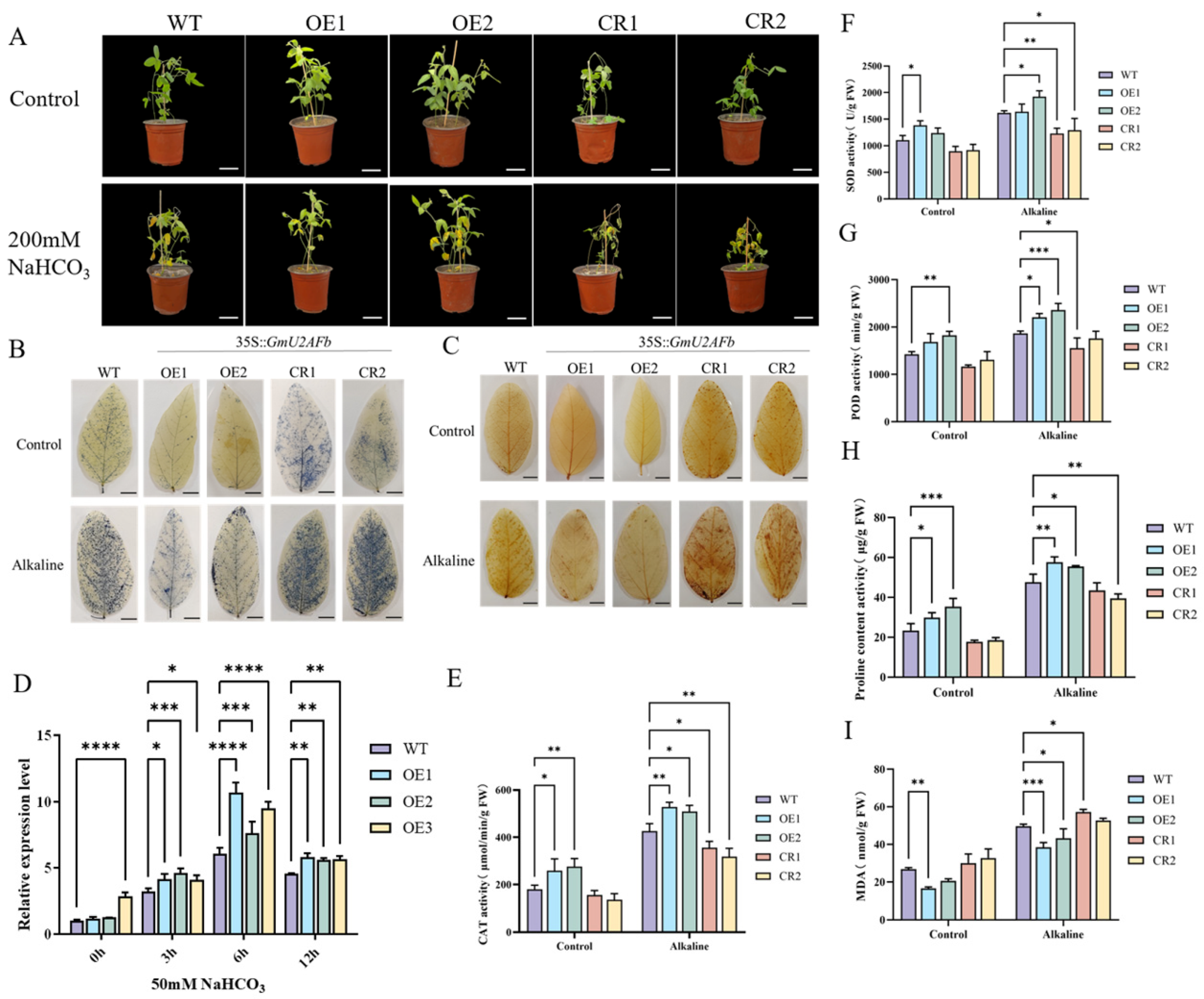
To elucidate the functional role of the splicing factor gene GmU2AFb, functional analysis was performed. The results showed that compared with wild-type plants, overexpressing plants maintained green leaves and grew more robustly under alkaline stress while knockout plants were significantly shorter than wild-type plants and exhibited faster wilting, chlorosis, and growth arrest under stress treatment (Figure 4A). NBT and DAB staining assays were used to assess leaf damage. Our results revealed that composite hairy root plants overexpressing GmU2AFb displayed lower oxidative stress levels in leaves relative to wild-type plants, reflecting more steady and vigorous metabolic status of the whole plant. On the contrary, leaves of GmU2AFb knockout hairy root plants showed darker blue-brown staining, indicative of aggravated plant oxidative injury (Figure 4B,C). To further investigate the expression level of GmU2AFb under 50 mM NaHCO3 treatment at 0, 3, 6, and 12 h, RT-qPCR analysis was performed. The results showed that GmU2AFb expression gradually increased within 0–6 h, peaked at 6 h, and then gradually decreased (Figure 4D).
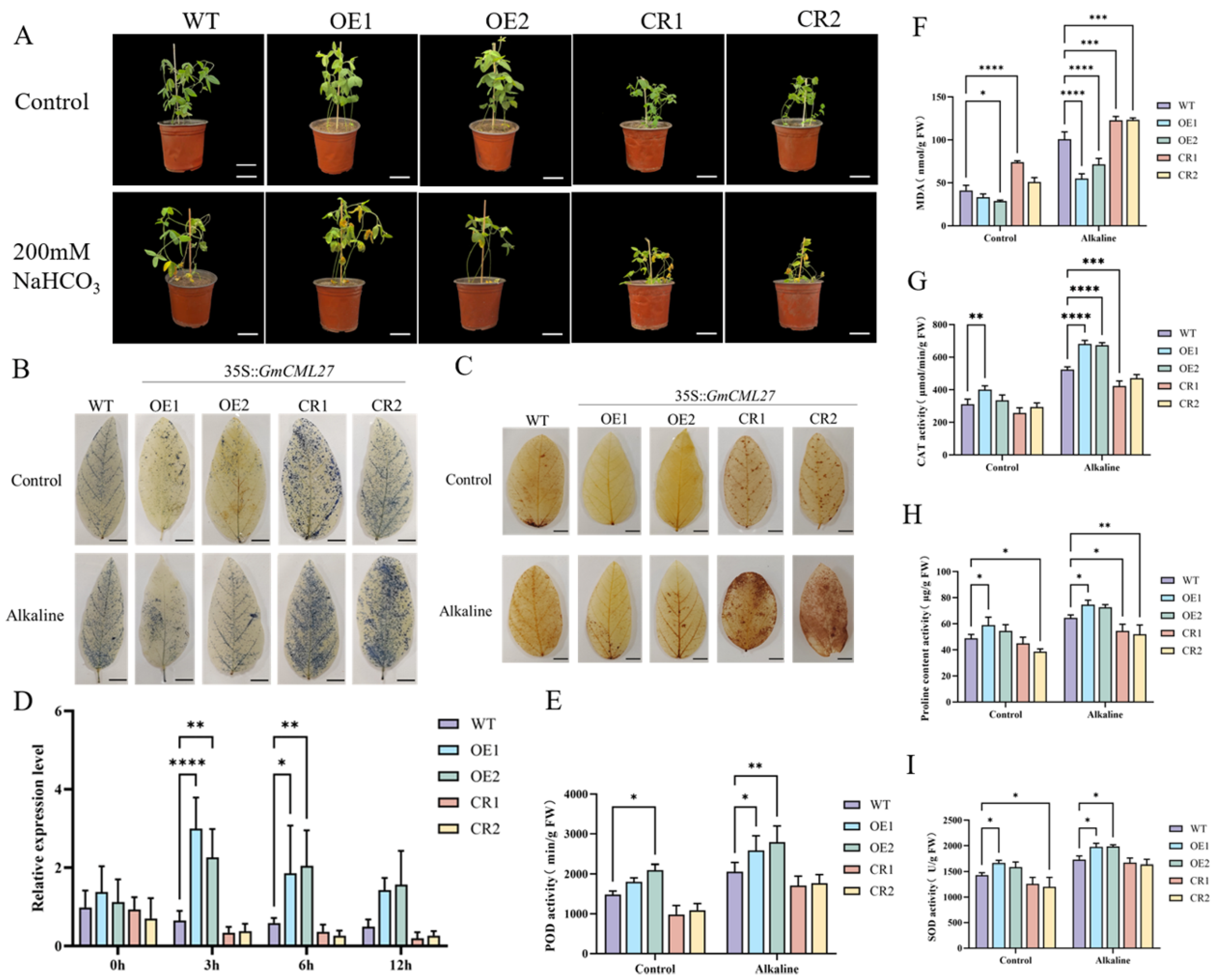
Following alkaline treatment with 200 mmol L−1 NaHCO3, wild-type (WT), GmU2AFb-overexpressing lines (OE1, OE2) and knockout lines (CR1, CR2) displayed significant variations in physiological indices. Under optimal growth conditions, the OE lines exhibited markedly higher activities of SOD, POD and CAT as well as elevated proline concentrations, while their MDA contents were substantially lower relative to WT. After alkaline stress, antioxidant-related parameters were universally increased across all genotypes; the OE lines maintained further enhanced levels of antioxidant enzyme activities and proline accumulation but consistently reduced MDA contents compared with WT. In contrast, the CR lines possessed significantly lower SOD, POD, CAT activities and proline contents alongside remarkably higher MDA levels than WT under both normal and alkaline conditions (Figure 4E–I). Collectively, these results demonstrate that GmU2AFb positively improves alkaline tolerance and antioxidant capacity in soybean by boosting antioxidant enzyme activities and proline biosynthesis and restricting excessive accumulation of the lipid peroxidation product MDA, whereas knockout of this gene drastically compromises soybean resistance to alkali-induced oxidative damage.

2.5. GmU2AFb Promotes Root System Development in Soybean

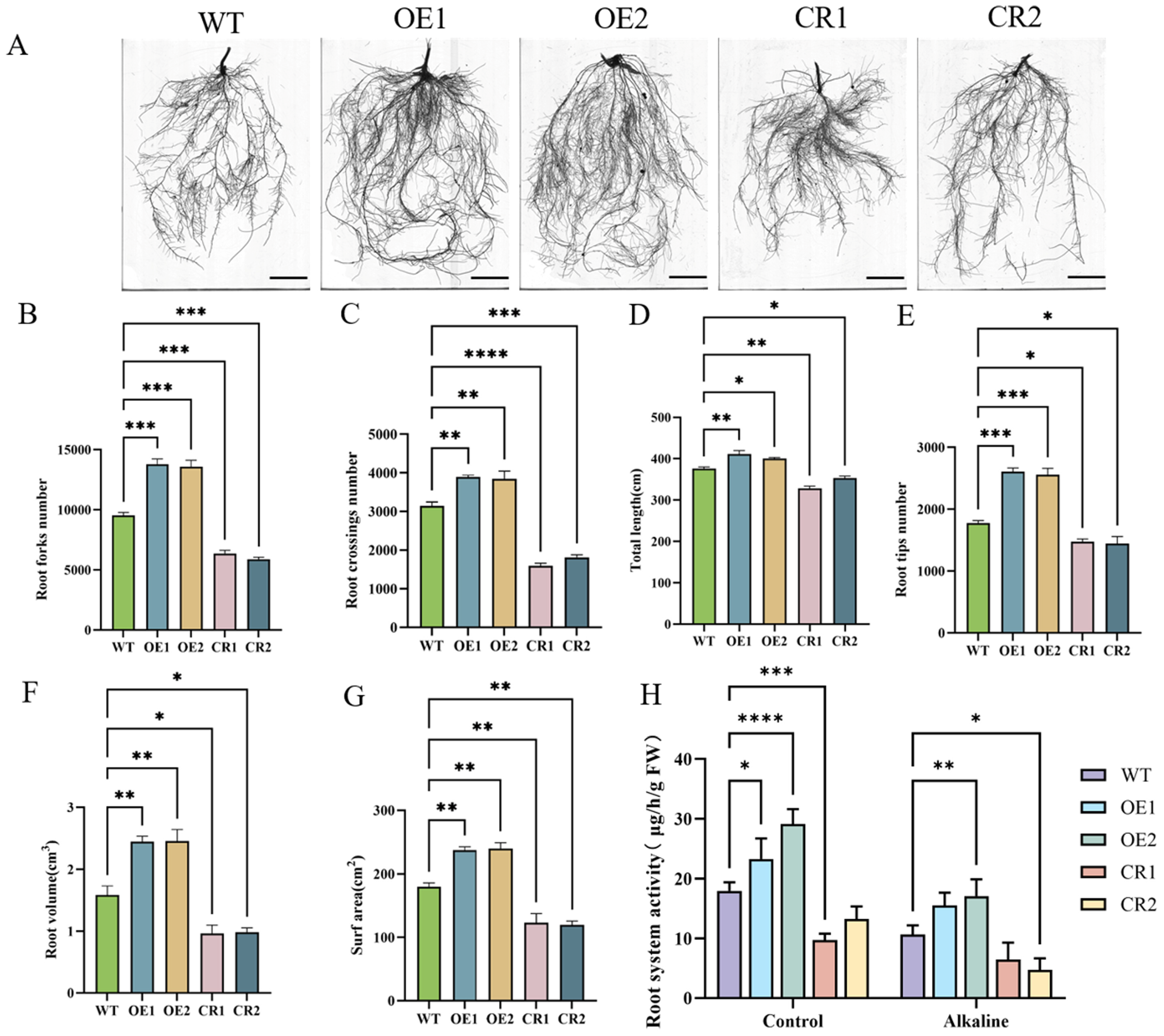
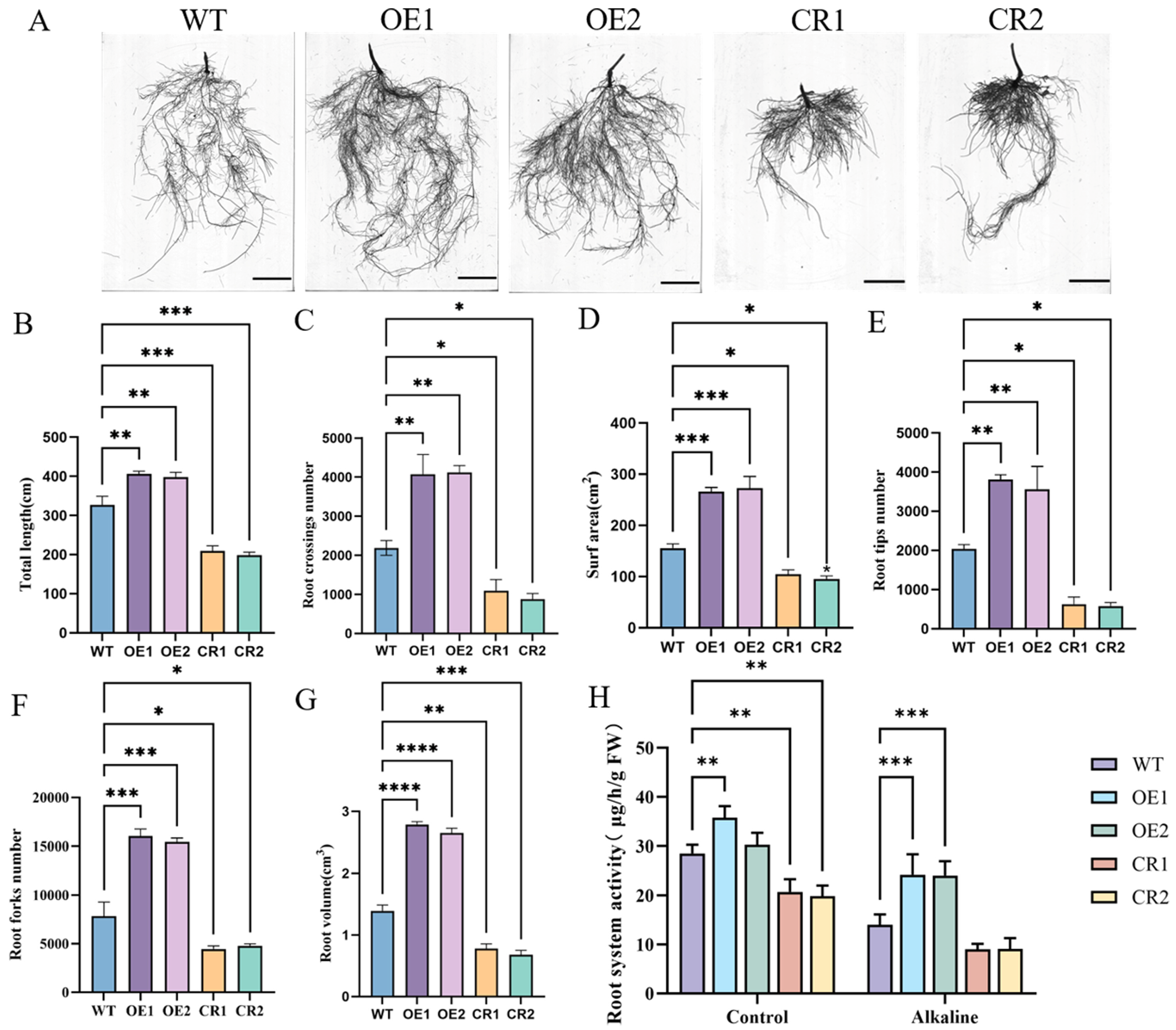
To investigate the effect of GmU2AFb on root system development in soybean, root morphology was photographed and quantitatively analyzed using a root scanner. The results showed that overexpression of GmU2AFb promoted root system development, resulting in overall larger and denser root architecture, whereas knockout of GmU2AFb led to smaller and shorter roots (Figure 5A). Quantitative analysis revealed that compared with wild-type plants, GmU2AFb-overexpressing plants exhibited significant increases in root forks, root crossings, total root length, and root tip number. In contrast, all measured root parameters were significantly lower in GmU2AFb knockout plants than in wild-type plants (Figure 5B–G). Plants were irrigated with 200 mM NaHCO3 solution until distinct phenotypic differences were observed, after which root tissues were collected to determine root activity. Root activity analysis further showed that overexpression of GmU2AFb enhanced root activity (Figure 5H). These findings suggest that GmU2AFb enhances root growth and development prior to alkali stress, thereby increasing belowground growth potential and providing a foundation for vegetative growth under various environmental stresses.

2.6. GmU2AFb Upregulates Alkaline Tolerance-Related Genes in Soybean

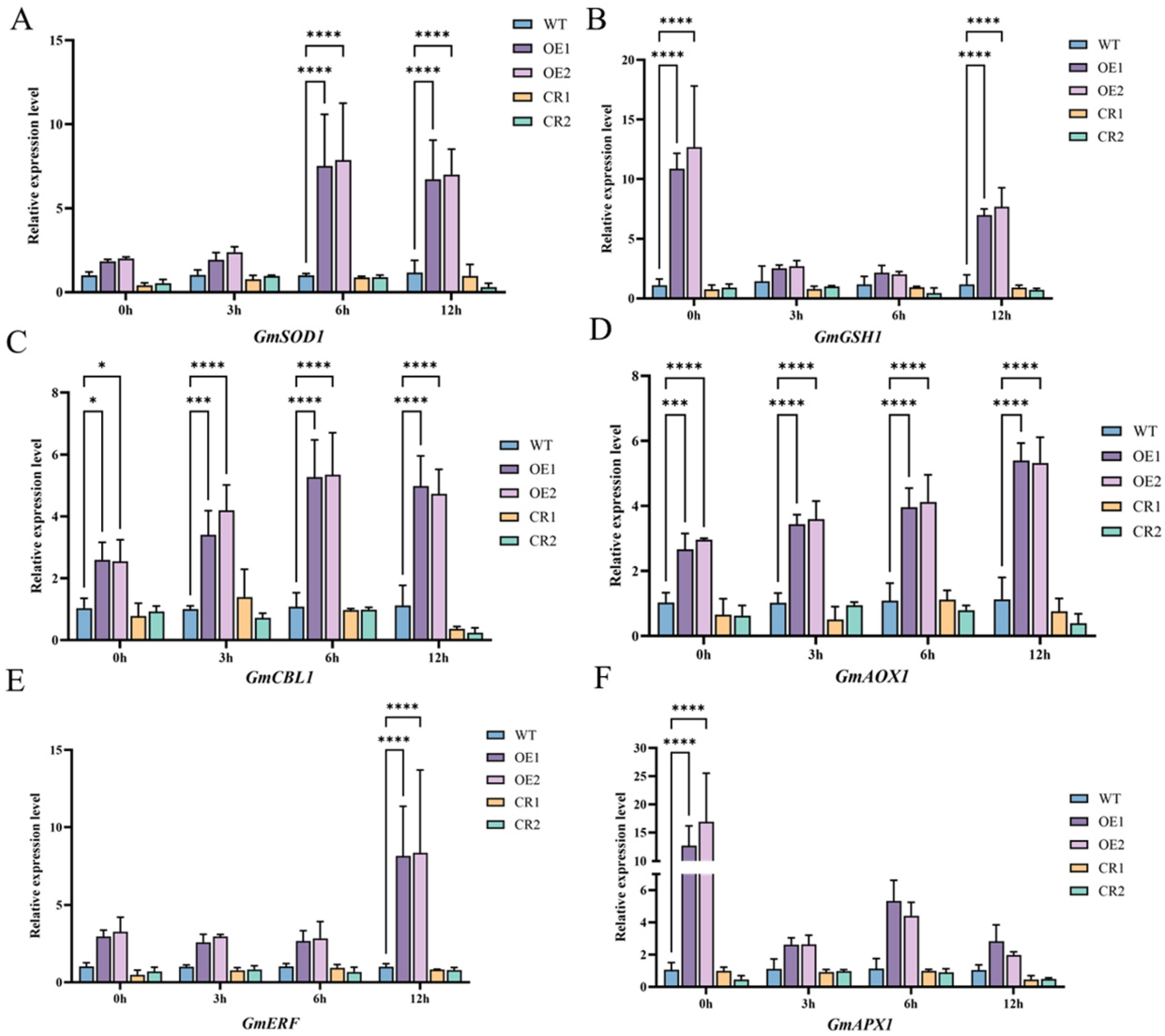
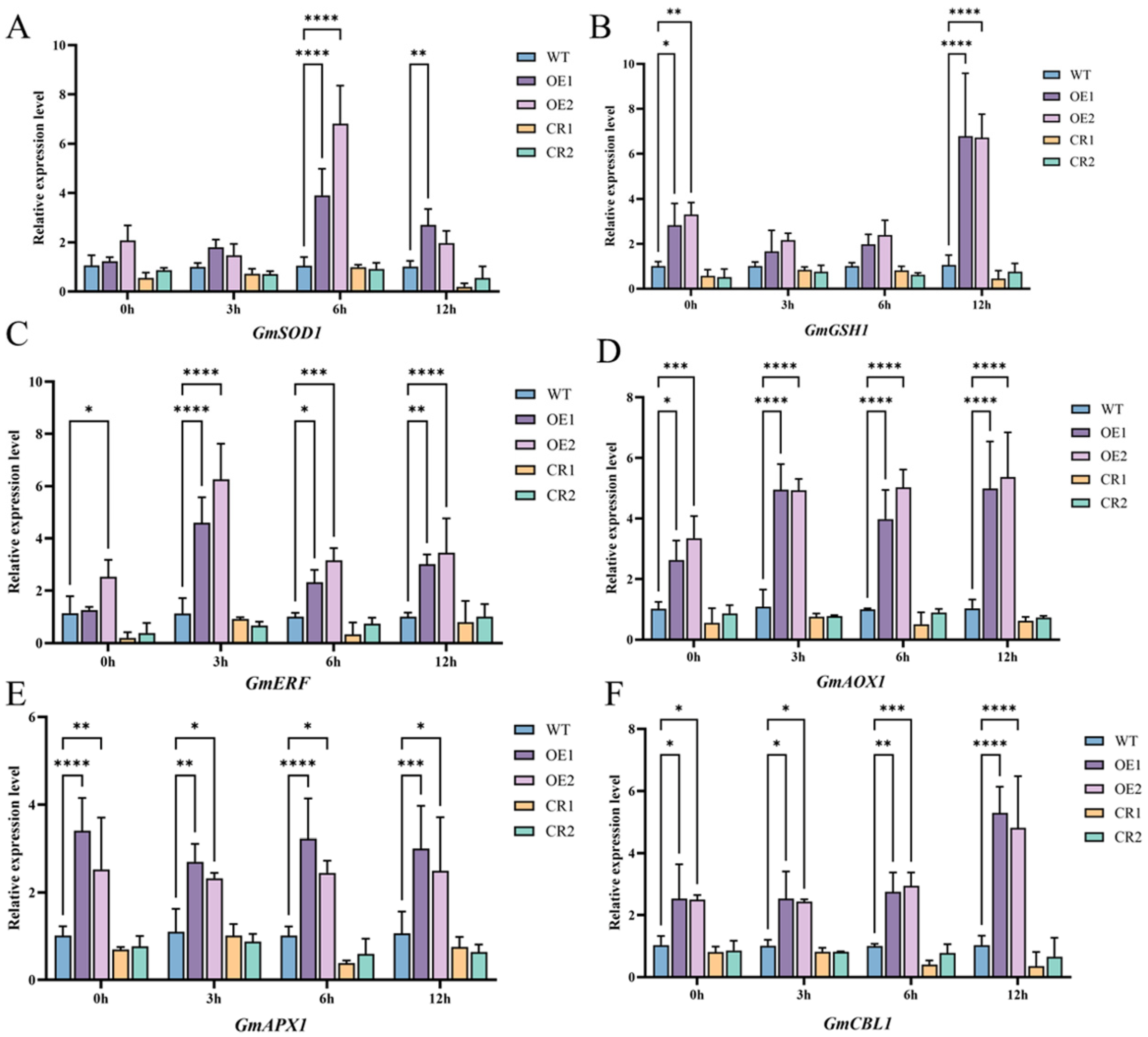
To investigate the regulatory pathways mediated by GmU2AFb, roots of wild-type, overexpression, and knockout lines were treated with 0 or 50 mM NaHCO3 solution for 0, 3, 6, and 12 h. The expression levels of key alkaline stress-responsive genes GmSOD1, GmGSH1, GmCBL1, GmAOX1, GmERF, and GmAPX1 were determined by RT-qPCR. The expression dynamics of different alkaline-responsive genes exhibit distinct temporal patterns under NaHCO3 treatment, which explains the varying significance levels at different time points. The results showed that in the roots of overexpression lines, GmSOD1 was upregulated at 6 h and 12 h of treatment (Figure 6A), GmGSH1 was upregulated at 0 h and 12 h (Figure 6B), GmCBL1 was upregulated at all time points (Figure 6C), GmAOX1 was upregulated at all time points (Figure 6D), GmERF was upregulated at 12 h (Figure 6E), and GmAPX1 was upregulated only at 0 h (Figure 6F). These results indicate that GmU2AFb positively activates a series of alkaline-responsive genes to participate in soybean alkali tolerance. In stark contrast, all marker genes maintained low basal expression in GmU2AFb-knockout lines under both normal and alkaline conditions, with no stress-triggered transcriptional elevation or obvious expression fluctuations at any time point. Three distinct regulatory mechanisms may account for this phenomenon. First, GmU2AFb functions as a splicing factor at the post-transcriptional level. It amplifies stress signals via alternative splicing rather than regulating basal gene transcription, and knockout of GmU2AFb disrupts this signal amplification cascade, leaving marker genes confined to low basal expression. Second, plant post-transcriptional buffering systems only sustain minimal basal transcription and cannot compensate for the loss of stress-inducible gene expression resulting from impaired signal transduction. Third, other independent stress pathways in soybean merely support constitutive basal expression and fail to drive gene upregulation under alkaline stress.

2.7. Interaction Between GmU2AFb and GmCML27

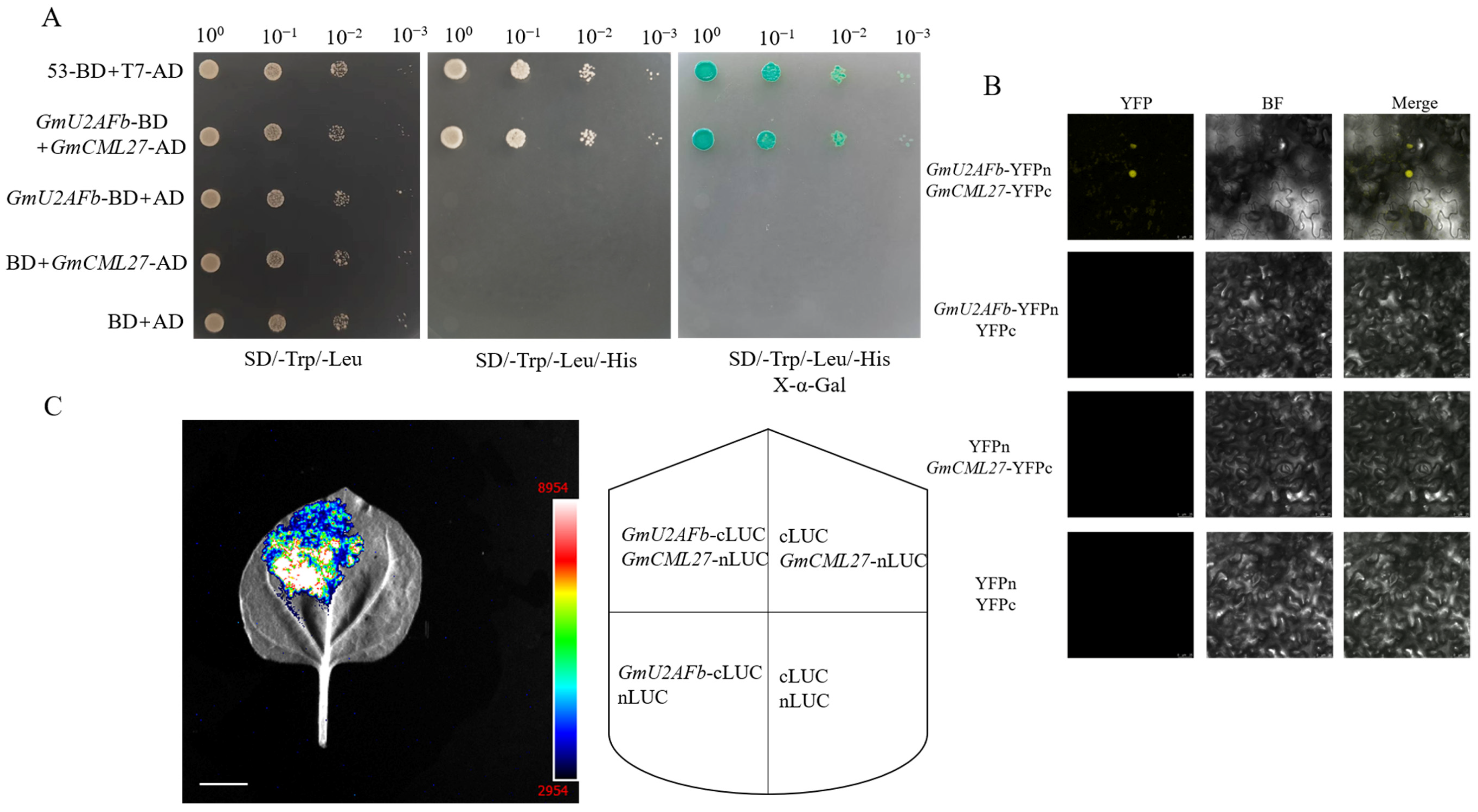
To dissect the molecular mechanism whereby GmU2AFb modulates alkaline stress responses, yeast two-hybrid (Y2H) library screening was performed to identify interacting partners of GmU2AFb, and preliminary screening indicated a potential physical interaction between GmU2AFb and GmCML27. Three independent in vivo assays, including Y2H, bimolecular fluorescence complementation (BiFC) and luciferase complementation imaging (LCI), were further employed to verify their interaction. Y2H assays revealed that yeast cells co-transformed with GmCML27-AD and GmU2AFb-BD grew normally on SD/-Trp/-Leu/-His triple-dropout medium and developed blue colonies upon chromogenic reaction (Figure 7A). BiFC analysis confirmed that their physical interaction occurred in the nucleus of Nicotiana benthamiana mesophyll cells, while robust luminescent signals were captured in LCI assays to validate the protein–protein interaction in plant cells (Figure 7B,C).

2.8. Protein Structure, Sequence Characteristics, Tissue Expression Pattern, and Subcellular Localization of GmCML27

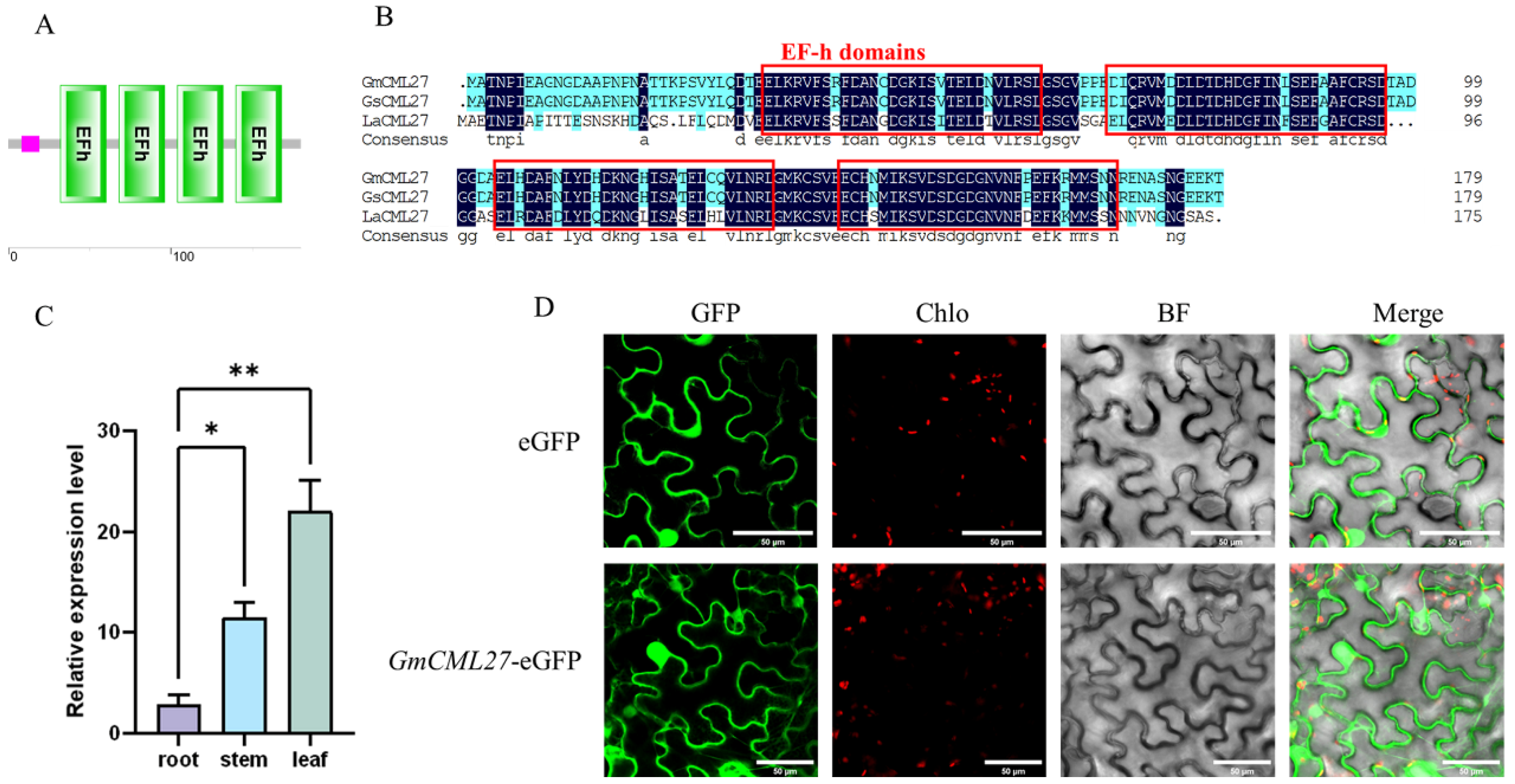
Domain analysis of the GmCML27 protein revealed that it contains four tandemly arranged EF-hand domains, which typically serve as core calcium ion binding sites, suggesting that GmCML27 may play a critical regulatory role in calcium ion sensing and signal transduction (Figure 8A). Multiple sequence alignment further showed that GmCML27 shares high sequence similarity, up to 88.03%, with its homologs from wild soybean (GsCML27) and lupinus (LaCML27). The EF-hand domains (marked by red boxes) are highly conserved across different species, confirming the evolutionary importance of these calcium-binding domains (Figure 8B). Tissue expression pattern analysis revealed that GmCML27 is transcriptionally expressed in soybean roots, stems, and leaves, with the highest expression level observed in leaves, followed by stems, and the lowest expression in roots, indicating a distinct tissue-specific expression pattern (Figure 8C). Published studies have verified that GsCML27 is localized in the nucleus, cell membrane and cytoplasm [33]. Given the sequence identity between GsCML27 and GmCML27 reaches up to 99.45%, we initially hypothesized that GmCML27 shares the same subcellular localization pattern. Subsequent subcellular localization assays further clarified the actual intracellular distribution of GmCML27 protein. The fusion protein GmCML27-enhanced green fluorescent protein (GmCML27-eGFP) was transiently expressed in Nicotiana benthamiana leaf epidermal cells. The green fluorescent signals of the fusion protein were visualized and merged with chloroplast autofluorescence (Chlo) and bright field (BF) images. As the negative control, free enhanced green fluorescent protein (eGFP) distributed uniformly throughout the whole cell. Combined with merged images (Merge) with a scale bar of 10 μm, we confirmed that GmCML27 protein is localized to the cell membrane, nucleus and cytoplasm. (Figure 8D).

2.9. GmCML27 Enhances Saline–Alkaline Tolerance in Soybean

To investigate the role of GmCML27 under alkaline stress, GmCML27 was overexpressed in soybean roots. Phenotypic analysis revealed that under 0 and 200 mM NaHCO3 treatment, soybean plants overexpressing GmCML27 in roots exhibited greener and healthier leaves compared to wild-type plants (Figure 9A). DAB and NBT staining of each line showed that leaves of plants overexpressing GmCML27 in roots displayed lighter staining, indicating enhanced antioxidant capacity in the leaves (Figure 9B,C). To further examine the expression level of GmCML27 under 50 mM NaHCO3 treatment at 0, 3, 6, and 12 h, RT-qPCR analysis was performed. The results showed that GmCML27 expression gradually increased within 0–3 h, peaked at 3 h, and then gradually decreased (Figure 9D). Physiological measurements of stress-related parameters showed that under optimal growth conditions, GmCML27-overexpressing lines (OE1, OE2) exhibited significantly higher activities of SOD, POD and CAT as well as elevated proline contents, whereas their MDA concentrations were markedly lower relative to wild-type (WT). Following alkaline stress with 200 mmol·L−1 NaHCO3, antioxidant-related physiological indices were universally upregulated across all genotypes; the OE lines possessed substantially enhanced SOD, POD, CAT activities and proline accumulation but remarkably reduced MDA levels compared with WT. In contrast, knockout lines (CR1, CR2) displayed significantly lower SOD, CAT activities and proline contents than WT under both normal and alkaline treatments. Upon alkaline exposure, CR lines accumulated drastically increased MDA, while no obvious alteration was observed in POD activity (Figure 9E–I). Collectively, these findings verify that GmCML27 improves the antioxidant capacity of soybean under alkaline conditions, and knockout of this gene compromises plant tolerance to alkaline stress and associated oxidative damage.

2.10. GmCML27 Promotes Root System Development in Soybean

Given that GmU2AFb enhances root development when overexpressed, and given the interaction between GmU2AFb and GmCML27, we hypothesized that GmCML27 may possess a similar function. Therefore, roots of GmCML27-overexpressing plants were scanned using a root scanner. The results showed that under optimal growth conditions, GmCML27 overexpression resulted in larger and longer roots, whereas GmCML27 knockout led to thicker and shorter roots (Figure 10A). Statistical analysis revealed that total root length, number of root forks, root surface area, root tip number, number of root crossings, and root volume were significantly higher in overexpressing plants than in wild-type plants, and significantly lower in knockout plants than in wild-type plants (Figure 10B–G). Root activity assays showed that under optimal growth conditions, GmCML27-overexpressing plants exhibited slightly higher root activity, while knockout plants showed significantly reduced root activity; under stress conditions, GmCML27-overexpressing plants maintained higher root activity (Figure 10H). These results indicate that GmCML27 not only enhances plant tolerance to alkaline stress but also improves root activity, thereby contributing to enhanced alkaline stress tolerance.

2.11. GmCML27 Modulates the Expression of Genes Associated with Alkaline Stress Tolerance in Soybean

To investigate the regulatory pathways involving GmCML27, we examined the relative expression levels of alkaline tolerance-related genes. The results showed that GmSOD1 was upregulated at 6 h of alkaline treatment in overexpressing plants (Figure 11A), while GmGSH1 was upregulated at 0 h and 12 h of treatment (Figure 11B). Expression changes for these two genes were not significant at other time points in overexpressing plants or in knockout plants. For GmERF (Figure 11C), GmAOX1 (Figure 11D), GmAPX1 (Figure 11E), and GmCBL1 (Figure 11F), the relative expression levels in overexpressing plants were significantly higher than those in wild-type plants at 0 h, 3 h, 6 h, and 12 h under alkaline treatment, whereas no significant changes were observed in knockout plants compared with wild-type plants. Comparison with the regulatory patterns of GmU2AFb revealed that both genes jointly upregulated GmSOD1 at 6 h, GmGSH1 at 0 h and 12 h, GmCBL1 at 6 h and 12 h, GmAOX1 at 3 h, 6 h, and 12 h, GmERF at 12 h, and GmAPX1 at 0 h under alkaline treatment. Accordingly, it is speculated that the interaction between GmU2AFb and GmCML27 likely functions upstream to coordinately regulate the relative expression levels of the aforementioned genes.
Similar to GmU2AFb knockout lines, GmCML27 knockout lines displayed a consistent phenotype: all marker genes maintained low basal transcript levels, with no stress-induced transcriptional upregulation or obvious expression fluctuations observed at any time point. Several potential factors may contribute to the sustained low expression and lack of stress-triggered fluctuations in GmCML27 knockout mutants. First, genetic redundancy might partially account for this phenotype. Second, GmCML27 may amplify alkaline stress signals via calcium perception and physical interaction with GmU2AFb, rather than sustaining high basal transcription of target genes. Knockout of GmCML27 may block the calcium-splicing signaling cascade, and other calcium sensors and stress pathways likely only support extremely low basal transcript abundance. In addition, post-transcriptional compensatory mechanisms in plant cells may merely stabilize basal mRNA levels and fail to restore stress-inducible gene activation. Collectively, the protein complex formed by GmU2AFb and GmCML27 may primarily drive stress-dependent gene upregulation, and this regulatory effect is only prominent under gene overexpression. Disruption of either protein component could interrupt signal amplification, leaving target genes at low basal expression under alkaline stress.

2.12. Co-Overexpression of GmU2AFb and GmCML27 Further Enhances Alkaline Tolerance in Soybean

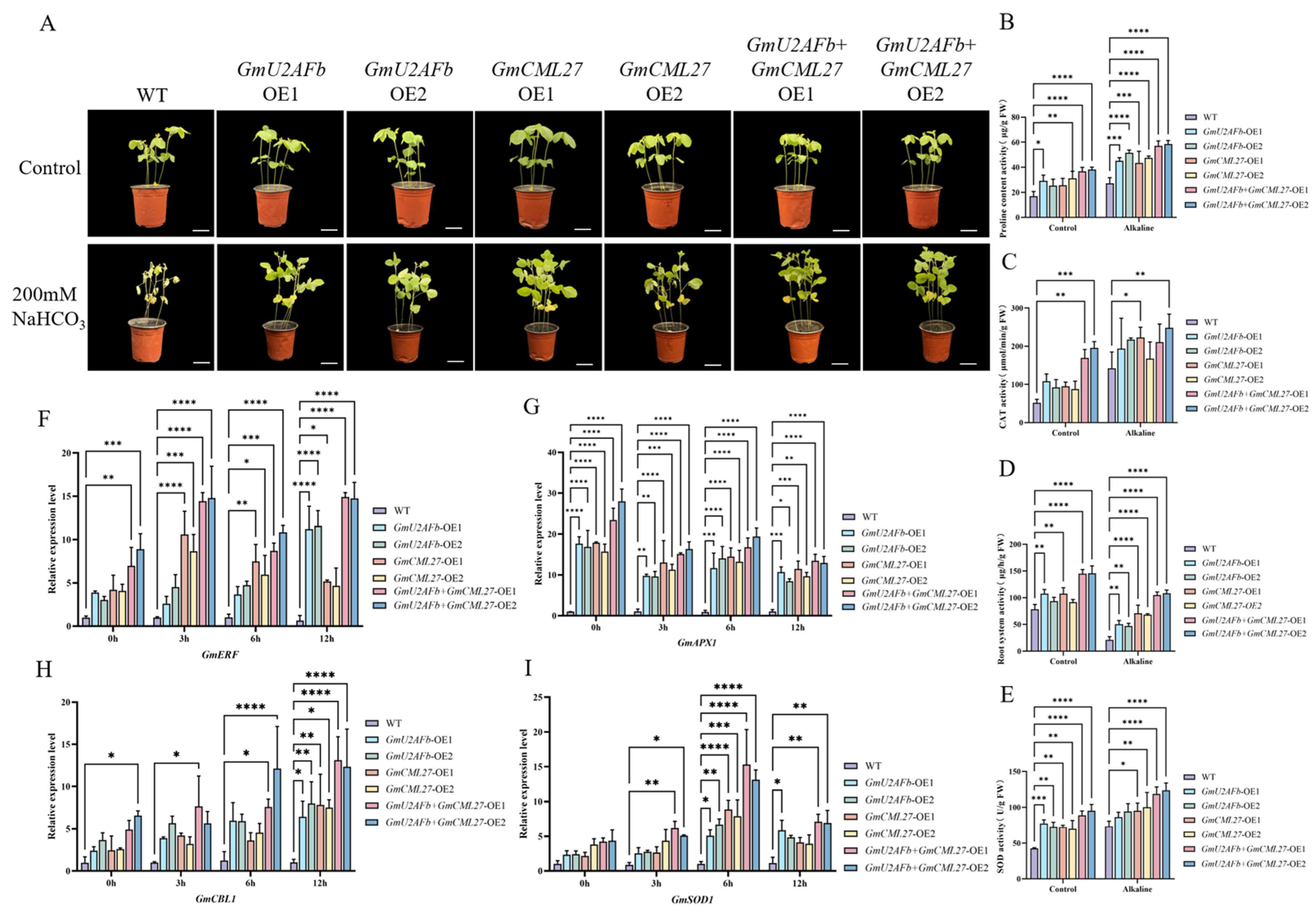
Previous studies have confirmed that individual overexpression of either GmU2AFb or GmCML27 significantly improves alkaline tolerance in soybean, and the two proteins physically interact with each other. Accordingly, we hypothesized that co-overexpression of these two genes could exert synergistic effects and further enhance soybean resistance to alkaline stress. To verify this hypothesis, four types of soybean materials, including wild-type (WT), GmU2AFb-single overexpression lines, GmCML27-single overexpression lines, and GmU2AFb-GmCML27 co-overexpression lines, were subjected to systematic analyses of plant phenotype, stress-related physiological parameters and transcriptional abundance of alkaline-responsive marker genes under alkaline treatment.
Phenotypic observations revealed that after continuous exposure to 200 mmol·L−1 NaHCO3 for 20 days, WT plants exhibited severe wilting and partial mortality. Plants overexpressing GmU2AFb or GmCML27 alone survived and kept growing but displayed obvious leaf chlorosis. In contrast, co-overexpression lines presented mildest leaf yellowing, more newly emerging leaves and superior growth status under alkaline conditions, which directly verified the synergistic improvement of alkaline tolerance mediated by dual-gene co-overexpression.
Physiological measurements (Figure 12B–E) indicated that under optimal growth conditions, proline content, CAT activity, root activity and SOD activity were significantly higher in single-gene overexpression lines relative to WT, and these four physiological indices were further elevated in co-overexpression lines. Upon alkaline stress, all genotypes displayed generally increased physiological parameters, among which co-overexpression lines possessed the highest levels of osmotic adjustment and antioxidant-related indicators across all tested lines.
Quantitative real-time PCR results (Figure 12F–I) demonstrated that alkaline stress induced the time-dependent upregulation of four stress marker genes (GmERF, GmAPX1, GmCBL1, GmSOD1). At each sampling time point, the transcript abundances of these marker genes were markedly higher in single-gene overexpression lines than in WT, and co-overexpression lines exhibited significantly elevated gene expression levels compared with both types of single-transgenic lines. Collectively, phenotypic, physiological and molecular evidence confirms that GmU2AFb and GmCML27 function synergistically via protein–protein interaction to positively modulate soybean alkaline tolerance at both physiological and molecular regulatory levels.

3. Discussion

3.1. Gshdz4 Directly Targets and Regulates GmU2AFb and Its Subcellular Localization

This study confirms that Gshdz4, a member of the HD-Zip transcription factor family, directly activates the transcriptional expression of GmU2AFb by recognizing and binding to the CAATAA-box element in its promoter region. HD-Zip transcription factors are plant-specific regulators widely involved in growth, development, and stress responses [17]. For example, the rice HD-Zip I transcription factors Oshox12 and Oshox14, orthologs of barley Vrs1, bind to specific DNA sequences and regulate spike development, with overexpression resulting in shortened spikes and reduced plant height [38]; cotton GhHB12, induced by auxin, negatively regulates plant height by inhibiting auxin transport and signaling and altering the expression of cell wall extensibility-related genes [39]; ArHDZ22 in Anoectochilus roxburghii, an HD-Zip III transcription factor, negatively regulates plant growth, development, and salt tolerance by downregulating the expression of growth-related genes [40]; members of the HD-Zip I subfamily typically regulate downstream genes by binding to CAAT-motif cis-elements [41], and both soybean Gshdz4 and Arabidopsis AtHB1 participate in stress tolerance regulation by recognizing such elements, consistent with the finding in this study that Gshdz4 binds to the CAATAA-box [17]. Yeast one-hybrid and luciferase assays further validated the direct regulatory relationship, establishing GmU2AFb as a direct downstream target gene of Gshdz4.
GmU2AFb encodes the large subunit of the U2AF splicing factor, which is responsible for recognizing the 3′ splice site during pre-mRNA splicing and belongs to the SR protein-related splicing factor family [42]. The role of splicing factors in plant stress responses has garnered increasing attention. For instance, Arabidopsis U2AF65A participates in cold stress responses [43]; alternative splicing variants of CsWRKY21 in tea plants enhance protein accumulation and regulate abscisic acid content by inhibiting ABA synthesis-related genes, contributing to cold tolerance [44]; the Arabidopsis splicing factors SUA and RSN2 are involved in mediating plant immune defense responses by regulating the proper splicing of SNC4 and CERK1 [45]; rice OsRBP11 promotes alternative splicing of OsNPR3 to produce a truncated protein that suppresses the defense function of OsNPR1, thereby exacerbating bacterial blight susceptibility, and its mutation can restore disease resistance [23]. The direct regulation of a splicing factor gene by Gshdz4 suggests that it may broadly influence the splicing patterns of alkaline tolerance-related genes at the post-transcriptional level, thereby amplifying its regulatory effects. Subcellular localization revealed that Gshdz4 is localized in the nucleus, consistent with its function as a transcription factor and providing a spatial basis for its nuclear regulation of GmU2AFb transcription.
In summary, this study reveals an alkaline stress response pathway that operates from transcriptional regulation to RNA processing, expands our understanding of the downstream target genes of HD-Zip transcription factors, and establishes a foundation for elucidating the function of GmU2AFb within the alkaline tolerance network.

3.2. The Splicing Factor GmU2AFb Enhances Alkaline Tolerance in Soybean by Promoting Root Development and the Antioxidant System

This study confirms that GmU2AFb participates in a multi-level regulatory network centered on Gshdz4 as a downstream target gene. As a splicing factor, the core function of GmU2AFb is to participate in pre-mRNA splicing by recognizing the 3′ splice site and regulating alternative splicing events, thereby affecting the production of mature mRNA for stress-responsive genes. The downstream alkaline tolerance-related genes examined in this study (GmSOD1, GmGSH1, GmCBL1, GmAOX1, GmERF, and GmAPX1) belong to distinct functional pathways: GmSOD1 (superoxide dismutase) and GmAPX1 (ascorbate peroxidase) are key enzymes in the reactive oxygen species (ROS) scavenging system; GmGSH1 (glutathione synthetase) is involved in maintaining cellular redox homeostasis; GmAOX1 (alternative oxidase) is involved in antioxidant protection within the mitochondrial respiratory chain; GmCBL1, a core component of calcium signaling pathways, senses and transmits calcium signals; and GmERF is an ethylene response factor that regulates plant growth, development, and stress responses. GmU2AFb positively upregulates a series of alkaline-responsive genes including GmSOD1, GmGSH1 and GmCBL1. However, we have not yet examined the alternative splicing patterns of these genes in the present study, and there is no direct experimental evidence to verify that GmU2AFb mediates their transcriptional upregulation by modulating pre-mRNA splicing efficiency or transcript stability. Further experiments focusing on alternative splicing will be carried out in our follow-up research to dissect the precise molecular mechanism by which this splicing factor regulates its downstream target genes.
Both GmU2AFb and GmCML27 are key functional genes involved in the response to alkaline stress in soybean. Each significantly enhances the alkaline tolerance of soybean roots, whereas gene knockout leads to a marked decline in alkaline tolerance, indicating that both act as positive regulators in the soybean alkaline stress response pathway. GmCML27 belongs to the calmodulin-like protein (CML) family, a group of calcium-binding proteins containing EF-hand domains. Calcium ions (Ca2+), acting as second messengers, are involved in plant responses to various environmental stimuli, including both biotic and abiotic stresses [46]. As calcium signal sensors, CML family genes perceive changes in intracellular calcium concentration and transmit stress signals to downstream response elements, playing important roles in plant stress responses. For example, GsCML27 from wild soybean contains four conserved EF-hand domains, is induced by bicarbonate stress, and enhances tolerance to bicarbonate stress when heterologously expressed in Arabidopsis [33]. Additionally, Arabidopsis TCH3 (CML12), a calcium-binding protein, is induced by touch and temperature stimuli, is highly expressed in root tip growth regions and vascular tissues, and participates in mechanical stimulation responses and root development regulation [47]. Pepper CaCIPK7 interacts with CaCBLs, is regulated by CaMYB4/88, and enhances drought tolerance by scavenging ROS and mediating ABA signaling pathways [48]. Soybean GmCIPK10 interacts with GmCBL4 and positively regulates salt tolerance by enhancing antioxidant capacity and maintaining ion homeostasis [49]. Alfalfa MsCML70 significantly enhances salt tolerance in Arabidopsis by regulating ion transport, antioxidant, and stress-related gene expression [50]. SmCML56 in Salix matsudana mediates calcium signaling and positively regulates salt tolerance, with overexpression significantly enhancing salt tolerance [51]. These studies provide important references for the function of GmCML27 in this study. GmCML27 likely binds calcium ions, undergoes conformational changes, and interacts with downstream target proteins to regulate the expression of stress-responsive genes. In this study, overexpression of GmCML27 upregulated multiple alkaline tolerance-related genes, including GmSOD1, GmGSH1, GmERF, GmAOX1, GmCBL1 [52], and GmAPX1, suggesting that GmCML27 may broadly activate downstream defense responses through calcium signaling pathways.
Under alkaline stress, plants suffer oxidative damage due to the massive accumulation of intracellular ROS. In this study, soybean plants overexpressing either GmU2AFb or GmCML27 exhibited significantly increased activities of antioxidant enzymes such as SOD, CAT, and POD in roots, elevated levels of osmotic regulators such as proline, and significantly reduced MDA content. These results indicate that both genes alleviate alkaline stress-induced damage to roots by enhancing the antioxidant system, mitigating oxidative damage, and improving cellular osmotic regulation. This finding is consistent with reports that GsCML27 enhances bicarbonate tolerance by increasing antioxidant capacity. Furthermore, as a downstream target gene of Gshdz4, GmU2AFb is directly transcriptionally activated by Gshdz4, while GmCML27 acts as its interacting protein, together forming a “Gshdz4-GmU2AFb/GmCML27” cascade regulatory module that integrates transcriptional regulation with calcium signaling, enabling a multi-level response to alkaline stress in soybean. This provides a new perspective on the molecular regulatory mechanisms underlying plant responses to alkaline stress. Notably, the regulation of alkaline tolerance by both genes is centered on roots, aligning with the role of roots as the primary organ for sensing soil alkaline stress. This suggests that the GmU2AFb-GmCML27 alkaline tolerance module represents a specialized root-specific regulatory system for alkaline stress responses in soybean.

3.3. The GmU2AFb and GmCML27 Module Influences Root System Development

The root system is the primary organ responsible for water and mineral nutrient uptake in plants. Under alkaline stress, alterations in soil physicochemical properties severely inhibit root development, thereby affecting nutrient absorption and stress tolerance. This study found that GmU2AFb and GmCML27 are not only involved in alkaline stress responses but also significantly regulate root system growth and development in soybean. Moreover, this regulatory effect is observed under both optimal growth conditions and alkaline stress, indicating that both genes are bifunctional, participating in both growth regulation and stress responses. Root morphological analysis revealed that soybean plants overexpressing either GmU2AFb or GmCML27 exhibited significantly higher total root length, root tip number, root fork number, and root volume compared with wild-type plants, whereas knockout plants displayed shorter, sparser root phenotypes and significantly reduced root activity. These results indicate that both genes positively regulate root initiation and elongation, promote root system architecture establishment, enhance root physiological activity, and ensure normal root function, thereby forming a synergistic mechanism integrating “developmental regulation and stress response.”
From a functional perspective, GmU2AFb encodes a splicing factor whose core function is to participate in mRNA splicing. Proper splicing of root development-related genes provides the molecular basis for root system architecture formation. Studies in Arabidopsis have shown that the splicing factor RDM16 influences root apical meristem activity and root elongation by regulating the alternative splicing of key transcription factors involved in root stem cell maintenance, such as PLT1 and PLT2, as well as splicing events of cytokinin signaling components (e.g., ARR1, ARR2, and ARR11) [53]. The rdm16 mutant exhibits reduced root apical meristem cell numbers and shorter roots, and exogenous application of cytokinin or expression of the full-length ARR1 sequence partially restores root growth [53]. Similarly, the splicing factor PORCUPINE/SmE1 regulates temperature-dependent root development by maintaining auxin homeostasis, and its loss significantly alters root apical meristem structure [54]. Based on these findings, it is plausible that GmU2AFb may regulate alternative splicing of root development-related transcription factors (such as PLT homologs) or hormone signaling pathway genes (such as auxin/cytokinin response factors) in soybean, ensuring their proper expression and thereby promoting root growth.
As a calcium-binding protein, GmCML27 belongs to the EF-hand calcium signaling family, and calcium signaling is a crucial pathway regulating root cell division, elongation, and differentiation. As a second messenger, changes in intracellular calcium concentration are sensed and transmitted by calcium-binding proteins, which subsequently regulate the expression of downstream root development-related genes. For instance, Arabidopsis TCH3 (CML12) is highly expressed in the root tip growth region and participates in root development regulation [47]; the calcium-binding protein CMI1 rapidly transmits auxin signals to regulate root growth [55]. Additionally, the phosphorylation regulatory module composed of the calcium-dependent protein kinase CPK and the endoplasmic reticulum calcium pump ECA1 integrates calcium signaling with abscisic acid homeostasis to regulate root growth under osmotic stress [56]. Therefore, GmCML27 may perceive calcium concentration changes induced by alkaline stress or developmental signals, thereby activating downstream root development-related transcription factors or protein kinases to regulate root growth.
The protein interaction between GmU2AFb and GmCML27 may couple mRNA splicing regulation with calcium signaling to coordinately regulate root development-related pathways. It is hypothesized that this interaction may occur through the following cross-regulatory mechanisms: under alkaline stress, GmCML27 undergoes conformational changes upon sensing calcium signals, interacts with GmU2AFb, and may recruit it to specific pre-mRNAs, thereby enhancing the splicing efficiency of GmU2AFb on root development-related genes (such as hormone signaling pathway genes or transcription factor genes); alternatively, GmU2AFb may influence the expression of calcium signaling pathway components (such as calcium channel proteins or calcium-binding proteins) through splicing regulation, forming a feedback regulatory loop with GmCML27. Such a “calcium signaling–splicing regulation” coupling mechanism would enable more precise and efficient molecular regulation of root development, synergistically enhancing root system architecture establishment and alkaline tolerance in soybean. However, this hypothesis requires further experimental validation.

3.4. Expression, Antioxidant Function and Research Limitations of GmU2AFb in Leaves

Quantitative tissue expression analysis revealed that GmU2AFb was transcriptionally expressed in soybean roots, stems and leaves, with its transcript abundance significantly higher in leaves than in roots and stems (Figure 3C). Such an expression pattern implies that GmU2AFb may perform unique physiological functions in leaves, in addition to its regulatory roles in roots under alkaline stress. Most molecular quantification, root morphology and physiological assays in this study were performed using soybean hairy root transformation materials, where bicarbonate stress was applied to root tissues. Nevertheless, stress signals can be transmitted throughout the whole plant, so we conducted NBT and DAB staining on leaf tissues to evaluate the overall oxidative damage of plants under stress. The staining results demonstrated that leaves of GmU2AFb-overexpressing lines accumulated less reactive oxygen species (ROS) after alkaline treatment, whereas knockout lines suffered severe oxidative injury (Figure 4B,C). This directly indicates that GmU2AFb participates in leaf antioxidant defense by scavenging ROS and alleviating alkali-induced leaf oxidative damage. The leaf antioxidant phenotype serves as a systemic external manifestation of the regulatory effect of root-expressed GmU2AFb. Meanwhile, highly abundant leaf-localized GmU2AFb can perceive stress signals transported from underground tissues and independently activate leaf defense responses, forming a coordinated regulatory relationship between roots and leaves.
Restricted by the hairy root transformation system, we cannot completely isolate signaling effects between root and leaf tissues in the present study. Hence, it remains unclear whether GmU2AFb possesses leaf-specific regulatory cascades, such as independent regulation of leaf development, photosynthetic metabolism or root-independent leaf stress responses. This research direction is worthy of further exploration, and our research group will carry out in-depth relevant investigations in the follow-up work.

3.5. Co-Overexpression of GmU2AFb and GmCML27 Synergistically Modulates Alkaline Tolerance in Soybean

Accumulating evidence has demonstrated that combined overexpression of two physically interacting stress-resistant genes can trigger synergistic effects, conferring much stronger stress tolerance than individual gene overexpression, which serves as a vital strategy for genetic improvement of crops against abiotic stresses. For instance, co-overexpression of interacting CrWRKY57 and CrABF3 synergistically activates the transcription of CrCYCD61, modulates root development and positively enhances drought tolerance in citrus [57]. Protein interaction between co-expressed ClWRKY61 and ClLEA55 improves salt tolerance of watermelon via transcriptional regulation of multiple core salt-responsive genes [58]. By physical interaction, GhBGH2 binds to the transcriptional activation domain of GhGLK1 and represses its transcriptional activation on downstream salt-tolerant genes, thereby negatively regulating salt resistance in cotton [59].
Previous assays including Y2H, BiFC and LCI have verified the physical nuclear interaction between GmU2AFb and GmCML27 in the present study. Individual overexpression of either GmU2AFb or GmCML27 improves soybean alkaline tolerance by boosting antioxidant enzyme activities and facilitating root growth. Further dual-gene co-overexpression experiments revealed that after prolonged alkaline stress with 200 mmol·L−1 NaHCO3, GmU2AFb-GmCML27 co-overexpressing soybean exhibited the mildest wilting and leaf chlorosis, accompanied by more newly formed leaves and superior overall growth performance compared with wild-type and single-gene transgenic lines.
Physiological quantification indicated that under both normal and alkaline growth conditions, co-overexpression lines possessed significantly higher activities of SOD and CAT, stronger root vigor and greater proline accumulation relative to two types of single-overexpression materials, alongside further reduced MDA concentration (an indicator of membrane lipid peroxidation). These findings suggested that dual-gene co-overexpression synergistically strengthens antioxidant capacity and osmotic protection to alleviate alkali-triggered oxidative injury. qRT-PCR results illustrated that the transcript abundances of core alkaline-tolerant genes (GmERF, GmAPX1, GmCBL1, GmSOD1) were consistently significantly higher in co-overexpression lines than in single-transgenic counterparts across all sampled time points of alkaline treatment.
Mechanistically, as a splicing factor, GmU2AFb mediates pre-mRNA maturation and modulates target gene expression at the post-transcriptional level; as an EF-hand calcium-binding protein, GmCML27 senses cytosolic calcium signals and transduces stress cues downstream. Their physical interaction enables the crosstalk between post-transcriptional RNA splicing and calcium signal transduction pathways. Such two-layered regulatory cascade synergistically activates downstream stress-defensive genes, achieving functional complementarity in promoting root architecture formation, scavenging reactive oxygen species and maintaining cellular homeostasis, and consequently leading to additive improvement of alkaline tolerance.
Collectively, these findings supplement functional evidence supporting the hierarchical regulatory cascade of Gshdz4-GmU2AFb-GmCML27, and imply that pyramiding GmU2AFb and GmCML27 is a feasible molecular breeding strategy for developing alkali-tolerant soybean cultivars.

3.6. Speculation on the Synergistic Alkaline Tolerance Mechanism of GmCML27-GmU2AFb Under the Bidirectional Regulatory Pathway of Calcium Signaling and Alternative

GmCML27 is a calcium-binding protein, while GmU2AFb functions as a splicing factor. Our study verified the physical interaction between these two proteins. Beyond their direct protein–protein interaction, they may possess interrelated cross-regulatory functions, which represents a research direction with great potential.
Accumulated published studies have identified two interlocking regulatory axes linking calcium signaling and splicing machinery in plants. On the one hand, abiotic stress induces a sharp elevation of cytosolic Ca2+ concentration; calcium-binding proteins bind Ca2+ and undergo conformational changes to form functional complexes with splicing factors, thereby globally orchestrating genome-wide alternative pre-mRNA splicing events. For instance, studies on wild soybean have revealed that stress-triggered calcium signals activate the kinase GsSnRK1, which phosphorylates the SR-type splicing factor GsSCL30a. This phosphorylation strengthens the capacity of GsSCL30a to recognize intronic GAAG cis-elements and interact with the U1-70 spliceosome component, systematically modulating the splicing efficiency of numerous stress-related genes and fully elucidating the molecular route through which Ca2+ signals reprogram splicing via kinase-mediated modification of splicing factors [22].
On the other hand, stress signals can first activate splicing factors, which target pre-mRNAs of calcium-binding protein genes to execute alternative splicing and generate functionally distinct protein isoforms, thereby retroactively modulating intracellular calcium signal transduction. For example, Dendrobium officinale DcaCIPK generates diurnally differentiated transcripts through alternative splicing: full-length functional transcripts dominate calcium signaling under drought during daytime, whereas truncated transcripts repress kinase activity at night, enabling time-dependent feedback regulation of calcium signals [60]. In Vitis amurensis, VaCML21 produces four protein isoforms via alternative transcription initiation and intron retention. Isoforms v1 and v2 mediate calcium signals in response to salt and osmotic stresses, while v3 and v4 specifically participate in low-temperature signaling. Different isoforms differentially activate cold-responsive DREB and COR genes, which clearly demonstrates that alternative splicing remodels calcium sensor proteins to precisely decode diverse stress-derived calcium signals [61].
The bidirectional regulatory model, in which Ca2+ signals activate splicing programs and splicing factors in turn diversify calcium sensor isoforms, has been validated in legumes, grapes and various other plant species. We therefore hypothesize that the GmCML27-GmU2AFb module fits into this bidirectional cross-regulatory cascade, providing a theoretical reference for dissecting their multilayered functional crosstalk. Whether GmCML27 and GmU2AFb exert dual cross effects (calcium signal-mediated splicing regulation and splicing-dependent remodeling of calcium sensor isoforms) in soybean requires further experimental verification.
Previous research has reported that the calcium sensor GsCML27 from wild soybean is rapidly induced in roots under bicarbonate alkaline stress; its protein localizes to the plasma membrane, cytoplasm and nucleus. Upon Ca2+ binding, GsCML27 undergoes conformational rearrangement and positively enhances plant alkaline tolerance by maintaining intracellular Na+/K+ homeostasis [34]. Sequence alignment shows that GmCML27 characterized in this study shares 99.45% sequence identity with GsCML27, indicating highly conserved functions and analogous positive regulatory roles under alkaline stress. Combined with the two established “calcium-binding protein-splicing factor” bidirectional regulatory axes reported in studies, we propose that GmCML27 and GmU2AFb coordinate alkaline responses in soybean via a “calcium signal perception-splicing regulation coupling” mechanism. Under NaHCO3 stress, cytosolic Ca2+ concentration surges. GmCML27, which contains four conserved EF-hand motifs, binds Ca2+ and changes its conformation, then physically interacts with nucleus-localized GmU2AFb to assemble a functional complex. This complex synergistically upregulates a set of core alkaline-tolerant genes including GmSOD1 and GmCBL1, elevates the activities of SOD, CAT and POD as well as proline accumulation, and reduces malondialdehyde (MDA) content to alleviate oxidative damage. Meanwhile, it maintains intracellular Na+/K+ homeostasis, reinforces antioxidant defense and facilitates root development to jointly improve soybean adaptability to alkaline environments. This regulatory module integrates calcium signal transduction and RNA processing, forming a multi-layered rapid response cascade from stress perception to downstream gene expression regulation.

3.7. Multiple Potential Reasons for the Lack of Significant Induction of Antioxidant and Calcium Signaling Marker Genes in Wild-Type Hairy Roots Under Short-Term Alkali Stress

Combining the characteristics of our experimental hairy root system, the temporal pattern of alkali stress responses, multi-layer post-transcriptional regulatory networks, polyploid genomic features of soybean, and the molecular function of GmU2AFb, we propose several plausible speculations for the unchanged expression of GmSOD1, GmGSH1, GmERF, GmAOX1, GmAPX1 and GmCBL1 in wild-type soybean hairy roots after 0–12 h NaHCO3 treatment.
First, this observation may partly stem from intrinsic limitations of the composite hairy root system. All plant materials in this study are composite soybean plants with hairy roots induced by Agrobacterium rhizogenes K599. As the primary organ sensing alkaline signals, wild-type hairy roots possess weak basal stress tolerance, accompanied by generally low basal transcription of endogenous stress-responsive pathways. Even if alkali stress triggers partial signal transduction cascades, the resulting transcriptional upregulation may be too modest to reach statistical significance within our 0–12 h sampling window.
Second, the 0, 3, 6 and 12 h sampling time points may impose temporal restrictions on transcriptional activation. Although alkali stress presumably initiates stress-sensing cascades, the signal strength may be insufficient to rapidly trigger robust transcription of antioxidant and calcium-signaling marker genes within short-term treatment. In contrast, constitutive high expression of GmU2AFb or GmCML27 in overexpression lines may artificially amplify downstream signal flux, conferring more sensitive and pronounced transcriptional responses under identical stress conditions. The expression peaks of these marker genes in wild-type roots may fall outside our sampling range; their transient, low-magnitude induction may also be indistinguishable from basal transcript levels via statistical analysis. Multiple published time-series studies on soybean alkali stress support this speculation. Time-series transcriptome analyses of wild soybean treated with 50 mM NaHCO3 have revealed that alkali stress within 0–12 h mostly only activates genes related to early signal transduction, while large-scale transcriptional activation of antioxidant and calcium-signaling genes such as SOD, APX and CBL may predominantly take place after 24 h of treatment [1]. From a post-transcriptional splicing perspective, Wild soybean endogenous SR splicing factor GsSCL30a exhibits low basal abundance. Under alkaline stress, overexpression of this splicing regulatory module significantly elevates the transcript levels of antioxidant genes such as GmSOD and GmAPX, whereas these genes show only marginal induction in wild-type hairy roots [22]. Experiments using the soybean hairy root system induced by Agrobacterium rhizogenes revealed that antioxidant genes maintained low basal expression levels in wild-type hairy roots. Overexpression of GmNARK significantly elevated the transcript abundance of antioxidant genes such as GmSOD1 and GmAPX1, and simultaneously increased the activities of SOD, CAT and POD antioxidant enzymes [5].
Third, wild-type soybean harbors intrinsic buffering mechanisms at the post-transcriptional and translational levels. The detected marker genes participate in antioxidant defense, redox homeostasis, calcium signal transduction and transcriptional regulation. To sustain basal physiological homeostasis, these genes are tightly modulated by multiple post-transcriptional controls, including the regulation of mRNA stability, alternative splicing and translational repression, which together form an endogenous physiological buffering system. We speculate that even upon perception of early stress signals, transcriptional outputs may be suppressed at the RNA level within 12 h. Physiological responses such as increased enzyme activity may emerge later or be mediated by post-translational protein modifications. Such weak, transient transcriptional induction is widely documented in abiotic stress research, as these expression shifts are often tissue-specific and easily masked by rapid mRNA turnover.
Fourth, genetic redundancy and functional compensation derived from soybean’s ancient polyploid genome may buffer transcriptional fluctuations of downstream target genes. Massive gene duplication events have occurred during soybean evolution, leading to extensive functional redundancy among homologous gene families. We hypothesize that functional complementation between multiple U2AF and CML paralogs can offset the compromised activity of single isoforms and mitigate transcriptional variation in downstream targets. The unique regulatory capacity of specific isoforms such as GmU2AFb and GmCML27 can only be fully manifested upon forced overexpression, thereby markedly activating downstream marker genes. This hypothesis is consistent with our knockout line results: all tested marker genes maintain low basal expression and barely respond to alkali stress, indicating they cannot be autonomously activated and require a specialized signal-amplification cascade that is only fully triggered in overexpression backgrounds.
Finally, this differential expression pattern can be explained by the intrinsic molecular function of GmU2AFb as a splicing factor. Instead of directly recruiting RNA polymerase II to initiate transcription, GmU2AFb presumably modulates pre-mRNA splicing efficiency and mature mRNA stability. The elevated transcript abundance of downstream genes in overexpression lines is therefore likely attributed to improved splicing efficiency and enhanced stability of mature transcripts, rather than stimulated transcription initiation. Endogenous splicing factors in wild-type plants only retain basal activity sufficient to sustain constitutive low-level expression of target genes, which cannot support massive, significant accumulation of mature mRNA under short-term alkali stress. Collectively, the above multi-layered speculations reasonably explain the prominent stress-triggered transcriptional responses in overexpression lines and the lack of detectable expression fluctuations of related marker genes in wild-type hairy roots subjected to 0–12 h alkali treatment.

4. Materials and Methods

4.1. Construction of Hairy Root Transformation Vector and Plant Transformation of Soybean

The coding sequences (CDS) of GmU2AFb and GmCML27 were cloned into the pCAMBIA1302 vector using the NcoI restriction site to generate transgenic soybean plants. The recombinant constructs were transformed into Agrobacterium rhizogenes strain K599 (Weidi, Shanghai, China) for subsequent soybean hairy root transformation assays [62]. The hairy root transformation system was adopted to generate transgenic soybean (cv. Dongnong 50, DN50) roots overexpressing GmU2AFb and GmCML27.
For CRISPR/Cas9-mediated gene knockout experiments, this study employed the modified binary vector pHK2-Cas9-U6 (Biorun, Wuhan, China), which is specifically designed for gene editing in dicotyledonous plants. Dual-target guide RNAs for GmU2AFb and GmCML27 were designed using an online design tool (https://zlab.squarespace.com/guide-design-resources, accessed on 14 October 2025) and directionally inserted into the Eco31I restriction site of the pHK2-Cas9-U6 vector [63]. The constructed recombinant expression vectors were transformed into Escherichia coli DH5α (Weidi, Shanghai, China). Following positive clone selection, recombinant plasmids were extracted and subsequently introduced into Agrobacterium rhizogenes K599 competent cells. Genetic transformation was performed using the Agrobacterium-mediated root infection method to ultimately obtain CRISPR-edited plants (CR plants). Identification results of CRISPR-edited plants for GmU2AFb and GmCML27 are shown in Supplementary Figures S2–S5.

4.2. Plant Growth Conditions and Experimental Treatments

The cultivated soybean variety Dongnong 50 (DN50, preserved by the College of Horticulture, Northeast Agricultural University) was grown in a growth chamber at the College of Horticulture and Landscape Architecture, Northeast Agricultural University, in a soil:vermiculite mixture (1:2). Growth conditions were set as follows: day/night temperature of 25–30 °C, a 16 h photoperiod, and relative humidity maintained at 60–70%.
Alkali stress treatment experiments were performed using wild-type (WT), gene-overexpressing, co-overexpressing and mutant soybean lines. Soybean roots were treated with water or 50 mM NaHCO3 solution for 0, 3, 6, and 12 h. Samples were then collected, immediately frozen in liquid nitrogen, and stored at −80 °C [11].

4.3. RNA Extraction and qRT-PCR Analysis

Root tissues were collected at 0, 3, 6, and 12 h after alkali treatment, immediately frozen in liquid nitrogen, and stored at −80 °C. Total RNA was extracted using the Trans Zol Up Kit (ET111-01-V2, TransGen Biotech, Beijing, China), and first-strand cDNA was synthesized using the SPARK script II RT Plus Kit (with gDNA Eraser; AG0304-B; Sparkjade Biotechnology, Jinan, China). Quantitative real-time PCR (qRT-PCR) was performed on a CFX384 Real-Time System (Bio-Rad, Hercules, CA, USA) using SYBR Green Master Mix (AH0105-B; Sparkjade Biotechnology, Jinan, China). Relative expression levels were calculated using the 2−ΔΔCT method [64], with GmGAPDH used as the internal reference control.

4.4. Protein Subcellular Localization

The CDSs of GmU2AFb and GmCML27 (without stop codons) were amplified using primers containing homology arms to the pCAMBIA1300-GFP vector (SparkJade Taq PCR Master Mix with dye; Sparkjade Biotechnology, Jinan, China) (Supplemental Table S1). The amplified fragments were inserted into the NcoI-linearized pCAMBIA1300-GFP vector using a homologous recombinase (Vazyme, Nanjing, China) to construct the GmU2AFb-GFP and GmCML27-GFP fusion vectors. The recombinant plasmids pCAMBIA1300-GmU2AFb-GFP and pCAMBIA1300-GmCML27-GFP, along with the empty vector pCAMBIA1300, were transformed into Agrobacterium tumefaciens strain GV3101 (pSoup-p19) (Weidi, Shanghai, China). Bacterial suspensions containing the plasmids (OD600 = 0.6) were collected by centrifugation and resuspended in a bacterial resuspension buffer containing final concentrations of 10 mM MES, 10 mM MgCl2, and 100 μM acetosyringone (AS). After incubation at room temperature for 3 h, the mixtures were infiltrated into different areas of tobacco (Nicotiana benthamiana) leaves using a 1 mL needleless syringe, and the infiltration sites were marked. Following overnight incubation in the dark, the infiltrated plants were returned to the greenhouse for 48 h [11]. Leaf tissue sections from the infiltrated areas were prepared and mounted on glass slides. Images were captured using a Leica TCS SP8 confocal laser scanning microscope (Leica, Wetzlar, Germany) [11].

4.5. Analysis of Antioxidant and Physiological Indices Under Alkali Stress

Two groups of soil irrigation treatments were performed using a 200 mmol/L sodium bicarbonate solution. One group subjected wild-type soybean lines, GmU2AFb-overexpressing lines, GmCML27-overexpressing (OE) lines and corresponding mutant (CR) lines to alkaline stress for 10 days. The other group treated wild-type plants, GmU2AFb-overexpressing plants, GmCML27-overexpressing plants, and dual GmU2AFb and GmCML27 co-overexpressing plants with alkaline stress for 14 days. Root samples of soybean plants cultivated under regular watering conditions and those stressed with 200 mmol/L sodium bicarbonate solution are collected separately for subsequent experimental analysis. Antioxidant enzyme activities, including peroxidase (POD), superoxide dismutase (SOD), and catalase (CAT), were determined to evaluate the oxidative stress response. Physiological parameters, such as malondialdehyde (MDA) content and proline (PRO) accumulation, were measured as indicators of membrane damage and osmotic adjustment, respectively. In addition, root activity was assessed to determine the functional status of the root system. POD activity was quantified using a commercial assay kit (No. BN0051-W96; Bainian Chuangxing Biotechnology, Chongqing, China), whereas SOD, CAT, MDA, PRO, and root activity were measured using corresponding assay kits (Geruisi Biotechnology, Suzhou, China), following the manufacturers’ protocols.

4.6. RNA-Seq Analysis

Twenty-five-day-old transgenic Gshdz4 and wild-type (WT) plants were treated with 50 mM NaHCO3 or 0.5 mM CdCl2, respectively. Root samples (approximately 500 mg) were collected at 0 and 3 h after treatment, immediately frozen in liquid nitrogen, and stored at −80 °C. Total RNA was extracted, and RNA sequencing was performed on a DNBSEQ platform by BGI (Shenzhen, China). Raw reads were subjected to quality filtering and aligned to the soybean reference genome (Williams82.a2.v1) using HISAT2. Differential gene expression analysis was conducted using DESeq2 (v1.4.5). Differentially expressed splicing factor genes were subjected to Gene Ontology (GO) and KEGG pathway enrichment analysis using clusterProfiler, with terms considered significantly enriched at FDR < 0.05. A heatmap was generated using ChiPlot (https://www.chiplot.online, accessed on 18 October 2025) based on the average expression levels of splicing factors in the transcriptome.

4.7. Root System Architecture Analysis Using WinRHIZO

A root analysis system (WinRHIZO Bas STD 4800, Regent, Quebec, Canada) was used for high-throughput, automated multi-parameter measurement of soybean roots. Each seedling was carefully washed and placed in a tray with water covering the roots. The scanned images were analyzed to measure total root length, root volume, root fork and cross counts, root tip number, and surface area [11].

4.8. Yeast Two-Hybrid (Y2H) Assay

The pGBKT7 vector was digested with SmaI and PstI, while the pGADT7 vector was digested with EcoRI. The coding sequences (CDS) of GmU2AFb and GmCML27 were directionally inserted into the linearized pGBKT7 and pGADT7 vectors, respectively, to successfully construct the recombinant plasmids pGBKT7-GmU2AFb and pGADT7-GmCML27. The recombinant plasmids were co-transformed into Y2HGold yeast competent cells (Weidi, Shanghai, China). Positive co-transformed colonies were selected on SD/-Trp/-Leu dropout medium and cultured at 30 °C for 3–5 d. Positive yeast cultures were collected, subjected to 10×, 100×, and 1000× serial dilutions, and spotted onto SD/-Trp/-Leu/-His dropout medium (Takara, Shiga, Japan) for interaction visualization. Co-transformation of pGADT7-T7 and pGBKT7-53 served as a positive control. All plates were incubated at 30 °C for 3–5 d, after which the results were observed and recorded [65].

4.9. Yeast One-Hybrid (Y1H) Assay

The pHIS2 vector was digested with EcoRI, and the promoter fragment containing the CAATAA-box recognized by Gshdz4 was ligated into the pHIS2 vector. The open reading frame of Gshdz4 was fused with the GAL4 activation domain of the yeast expression vector pGADT7 to generate pGADT7-H4. Positive yeast colonies were spotted onto SD/-Trp/-Leu and SD/-Trp/-His/-Leu solid media, with growth on the triple dropout medium indicating a positive interaction [66].

4.10. Bimolecular Fluorescence Complementation (BiFC) Assay

The YFPn and YFPc vectors were linearized by single digestion with BamHI, followed by purification and recovery. Specific primers containing homology arms were used to amplify the coding sequences (CDS) of GmU2AFb and GmCML27, which were then inserted into the linearized vectors via homologous recombination to generate the recombinant expression constructs YFPn-GmU2AFb and YFPc-GmCML27, ensuring the fusion of GmU2AFb with the N-terminal fragment of YFP and GmCML27 with the C-terminal fragment of YFP [67]. These recombinant vectors were separately transformed into Agrobacterium tumefaciens strain GV3101 (pSoup-p19) competent cells (Weidi, Shanghai, China). Co-infiltration was subsequently performed on the leaves of 4-week-old N. benthamiana plants. After infiltration, the plants were incubated in the dark for 2 d, and YFP fluorescence signals were observed and captured using a Leica TCS SP8 Confocal Laser Scanning Microscope (Leica, Germany).

4.11. Luciferase Complementation Imaging (LCI) Assay

The nLUC and cLUC vectors were linearized by single digestion with BamHI and subsequently purified (Takara, Shiga, Japan). Specific primers with homology arms were used to amplify the coding sequences (CDS) of GmU2AFb and GmCML27, which were inserted into the linearized vectors via homologous recombination to generate the recombinant constructs cLUC-GmU2AFb and nLUC-GmCML27. These were subsequently transformed into Agrobacterium tumefaciens strain GV3101 (pSoup-p19) [65]. The following negative controls were included: cLUC + nLUC-GmCML27, cLUC-GmU2AFb + nLUC, and cLUC + nLUC.
Following standard Agrobacterium-mediated transformation procedures, the prepared Agrobacterium cultures, supplemented with acetosyringone (AS) and MES buffer, were co-infiltrated into the leaves of 4-week-old N. benthamiana plants. After infiltration, the plants were incubated in the dark overnight and then cultured under normal conditions for 48 h. The tobacco leaves were uniformly sprayed with 1 mM luciferin potassium salt solution (Puxitong, Beijing, China) and incubated in the dark for 5–10 min. Luminescence signals were captured and analyzed using a fully automated chemiluminescence imaging system (Tanon, Shanghai, China).

4.12. Dual-Luciferase Transactivation Assay

The pGreenII 62SK vector was linearized by single digestion with PstI, purified, and the CDS of Gshdz4 was cloned into the pGreenII 62SK vector. The promoter fragment of GmU2AFb containing the CAATAA-box recognized by Gshdz4 was inserted into the pGreenII 0800-LUC vector. Plasmids were introduced into Agrobacterium strain GV3101 (pSoup-p19). Bacterial cultures (OD600 = 0.8) were mixed in a 1:1 ratio (effector:reporter) and infiltrated into the leaves of 4-week-old N. benthamiana plants. After 72 h, firefly and Renilla luciferase activities were measured using a dual-luciferase assay kit (Yeasen Biotechnology, 11402ES60). Transactivation activity was calculated as the ratio of LUC to REN [19].

4.13. Notes

Two sodium bicarbonate treatment regimens were adopted to meet different experimental requirements in this study. The 50 mM NaHCO3 root immersion treatment enables rapid stress stimulation via direct exposure of roots to the solution, which was used for RT-qPCR quantification of target genes using root samples collected at multiple time points. The 200 mM NaHCO3 soil irrigation treatment creates mild and long-lasting stress buffered by the growing medium, and was applied for long-term phenotypic observation as well as the measurement of physiological indicators including antioxidant enzyme activities, proline, MDA and root activity.

5. Conclusions

As is well known, Gshdz4, an HD-Zip transcription factor, directly activates the transcription of GmU2AFb by recognizing and binding to the CAATAA-box element in its promoter region. The present study verified that GmU2AFb, a nucleus-localized splicing factor, not only responds to alkaline stress but also interacts with the calcium-binding protein GmCML27 to form a functional module. This module coordinately regulates the expression of a series of alkaline tolerance-related downstream genes, including GmSOD1, GmAPX1, and GmCBL1, significantly increases the activities of antioxidant enzymes (SOD, CAT, POD), reduces oxidative damage (MDA content), and promotes root development (increasing root length, root tip number and root vigor). Moreover, at the physiological level, the Gshdz4-GmU2AFb-GmCML27 module enhances stress tolerance and root adaptability in soybean under alkaline stress (Figure 11). Therefore, when plants are subjected to alkaline stress, this module integrates transcriptional regulation, RNA processing and calcium signaling to form a multi-level and highly efficient stress response signaling pathway (Figure 13). Our future work will focus on dissecting how the GmU2AFb-GmCML27 module precisely modulates the splicing and expression of downstream target genes to fully elucidate its potential application value in the genetic improvement of crop stress tolerance.

Supplementary Materials

The following supporting information can be downloaded at: https://www.mdpi.com/article/10.3390/plants15142191/s1, Figure S1: the expression level of GmU2AFb in Gshdz4 heterologous overexpression soybean plants under 3 h alkali treatment; Figure S2: Identify overexpression and mutant lines of GmU2AFb via RT-PCR; Figure S3: Sequence chromatogram verification of GmU2AFb mutant lines; Figure S4: Identify overexpression and mutant lines of GmCML27 via RT-PCR; Figure S5: Sequence chromatogram verification of GmCML27 mutant lines; Table S1: the sequences of primers adopted in the article.

Author Contributions

X.W. and Y.L. contributed equally to this work; X.W. and Y.L. designed the experiments; Y.L., Y.R. and J.Z. performed transcriptome analysis, yeast one-hybrid assay and dual-luciferase transactivation assay; M.Z. and X.D. conducted plant cultivation and treatment; Y.F. and T.Z. carried out literature review; X.W. analyzed the data and wrote the manuscript; X.S., J.W. and Z.u.N. is responsible for revising the paper format; L.C. is in charge of the fund and overall collation. All authors have read and agreed to the published version of the manuscript.

Funding

This work was supported by the National Natural Science Foundation of China (32001505) and the Natural Science Foundation of Heilongjiang Province (LH2023C006).

Data Availability Statement

The RNA-seq data generated in this study (accession number PRJNA1120591) have been deposited in the Sequence Read Archive (SRA) database of the National Center for Biotechnology Information (NCBI) and made publicly available in our previously published article [19].

Acknowledgments

We are grateful to the College of Horticulture and Landscape Architecture at Northeast Agricultural University for providing the experimental platform.

Conflicts of Interest

The authors declare no competing interests.

References

  1. Ge, Y.; Li, Y.; Zhu, Y.M.; Bai, X.; Lv, D.K.; Guo, D.J.; Ji, W.; Cai, H. Global transcriptome profiling of wild soybean (Glycine soja) roots under NaHCO3 treatment. BMC Plant Biol. 2010, 10, 153. [Google Scholar] [CrossRef] [PubMed]
  2. Duanmu, H.; Wang, Y.; Bai, X.; Cheng, S.; Deyholos, M.K.; Wong, G.K.-S.; Li, D.; Zhu, D.; Li, R.; Yu, Y.; et al. Wild soybean roots depend on specific transcription factors and oxidation reduction related genesin response to alkaline stress. Funct. Integr. Genom. 2015, 15, 651–660. [Google Scholar] [CrossRef] [PubMed]
  3. Tasca, H.C.; Posso, D.A.; Braga, E.J.B.; Rethore, E.; Pluchon, S.; Valduga, G.R.; Smith, J.P.; Bloisi, L.F.M.; Souza, G.M. Analysis on Biofertilization-Induced Memory Acquisition for Heat Stress Mitigation in Soybean Plants. Plants 2026, 15, 1468. [Google Scholar] [CrossRef] [PubMed]
  4. Zhang, Q.X.; Yang, Z.M.; Zeng, F.Y.; Wang, Y.Y.; Zhao, X.L.; Gao, J.; Rao, D.M.; Zhang, W.; You, J.F.; Meng, X.X. Temporal transcriptome analysis identified GmMYB14 conferred the tolerance against sodic alkaline stress through activating phenylpropanoid metabolism. Plant Physiol. Biochem. 2025, 229, 110634. [Google Scholar] [CrossRef] [PubMed]
  5. Ma, H.Y.; Liu, X.; Zhang, R.; Li, M.L.; Li, Q.; Ding, X.D.; Xiao, J.L. Function of Nodulation-Associated GmNARK Kinase in Soybean Alkali Tolerance. Int. J. Mol. Sci. 2025, 26, 325. [Google Scholar] [CrossRef] [PubMed]
  6. Huang, S.Y.; Xia, Y.H.; Yang, J.T.; Si, Y.J.; Chen, X.; Zhang, H.; Liu, T.S.; Zheng, W.Y.; Chen, X.; Zhao, Z.J.; et al. A Coding SNP in GmPM30 Enhances Soybean Salinity Tolerance and Yield through the GmLEA1-GmPM30-GmLEC1 Module. Adv. Sci. 2025, 12, e09391. [Google Scholar] [CrossRef] [PubMed]
  7. Wu, T.; Wang, Y.; Jin, J.; Zhao, B.; Wu, S.; Jia, B.; Sun, X.; Zhang, D.; Sun, M. Soybean RING-type E3 ligase GmCHYR16 ubiquitinates the GmERF71 transcription factor for degradation to negatively regulate bicarbonate stress tolerance. New Phytol. 2025, 246, 1128–1146. [Google Scholar] [CrossRef] [PubMed]
  8. Zhu, D.; Cai, H.; Luo, X.; Bai, X.; Deyholos, M.K.; Chen, Q.; Chen, C.; Ji, W.; Zhu, Y. Over-expression of a novel JAZ family gene from Glycine soja, increases salt and alkali stress tolerance. Biochem. Biophys. Res. Commun. 2012, 426, 273–279. [Google Scholar] [CrossRef] [PubMed]
  9. Feng, X.; Feng, P.; Yu, H.; Yu, X.; Sun, Q.; Liu, S.; Minh Thuy, N.; Chen, J.; Wang, D.; Zhang, Q.; et al. GsSnRK1 interplays with transcription factor GsERF7 from wild soybean to regulate soybean stress resistance. Plant Cell Environ. 2020, 43, 1192–1211. [Google Scholar] [CrossRef] [PubMed]
  10. Sun, X.; Yang, S.; Sun, M.; Wang, S.; Ding, X.; Zhu, D.; Ji, W.; Cai, H.; Zhao, C.; Wang, X.; et al. A novel Glycine soja cysteine proteinase inhibitor GsCPI14, interacting with the calcium/calmodulin-binding receptor-like kinase GsCBRLK, regulated plant tolerance to alkali stress. Plant Mol. Biol. 2014, 85, 33–48. [Google Scholar] [CrossRef] [PubMed]
  11. Liu, M.; Tang, J.; Ma, S.; Liu, Y.; Wang, X.; Du, X.; Sun, X.; Zeng, Y.; Zeng, Y.; Ding, X.; et al. GsEXPA8 Enhances Soybean Tolerance of NaHCO3 Stress by Regulating Root Morphology. Agronomy 2025, 15, 16. [Google Scholar] [CrossRef]
  12. Liu, S.Y.; Li, M.L.; Liu, X.; Sun, Q.; Feng, P.; Li, Q.; Xiao, J.L.; Xu, P.F.; Zhang, S.Z.; Ding, X.D. GsSnRK1-Dependent Degradation of the E3 Ubiquitin Ligase GsSRF2 Positively Regulates Soybean Resistance to Salt Stress. J. Agric. Food Chem. 2026, 74, 5028–5043. [Google Scholar] [CrossRef] [PubMed]
  13. Liu, A.L.; Yu, Y.; Duan, X.B.; Sun, X.L.; Duanmu, H.Z.; Zhu, Y.M. GsSKP21, a Glycine soja S-phase kinase-associated protein, mediates the regulation of plant alkaline tolerance and ABA sensitivity. Plant Mol. Biol. 2015, 87, 111–124. [Google Scholar] [CrossRef] [PubMed]
  14. Chen, C.; Dai, J.Y.; Xu, N.; Zhou, W.Y.; Xu, L.K.; Pang, Q.Y.; Duanmu, H.; Li, H.Y. GsCYP93D1, a Cytochrome P450 Gene from Wild Soybean, Mediates the Regulation of Plant Alkaline Tolerance and ABA Sensitivity. Plants 2025, 14, 2623. [Google Scholar] [CrossRef] [PubMed]
  15. Ariel, F.D.; Manavella, P.A.; Dezar, C.A.; Chan, R.L. The true story of the HD-Zip family. Trends Plant Sci. 2007, 12, 419–426. [Google Scholar] [CrossRef] [PubMed]
  16. Li, Y.; Yang, Z.; Zhang, Y.; Guo, J.; Liu, L.; Wang, C.; Wang, B.; Han, G. The roles of HD-ZIP proteins in plant abiotic stress tolerance. Front. Plant Sci. 2022, 13, 1027071. [Google Scholar] [CrossRef] [PubMed]
  17. Cao, L.; Yu, Y.; Duanmu, H.; Chen, C.; Duan, X.; Zhu, P.; Chen, R.; Li, Q.; Zhu, Y.; Ding, X. A novel Glycine soja homeodomain-leucine zipper (HD-Zip) I gene, Gshdz4, positively regulates bicarbonate tolerance and responds to osmotic stress in Arabidopsis. BMC Plant Biol. 2016, 16, 184. [Google Scholar] [CrossRef] [PubMed]
  18. Cao, L.; Yu, Y.; Ding, X.; Zhu, D.; Yang, F.; Liu, B.; Sun, X.; Duan, X.; Yin, K.; Zhu, Y. The Glycine soja NAC transcription factor GsNAC019 mediates the regulation of plant alkaline tolerance and ABA sensitivity. Plant Mol. Biol. 2017, 95, 253–268. [Google Scholar] [CrossRef] [PubMed]
  19. Liu, M.; Liu, Y.; Tang, J.; Wang, X.; Du, X.; Ruan, Y.; Wang, H.; Zhou, M.; Fu, Y.; Sun, X.; et al. Integrated CUT&Tag-seq and RNA-seq analysis reveals the transcriptional regulatory network of Gshdz4 under alkaline and heavy metal stress. Plant Physiol. Biochem. 2026, 232, 111087. [Google Scholar] [CrossRef] [PubMed]
  20. Tang, J.; Liu, M.; Liu, Y.; Wang, X.; Du, X.; Liu, X.; Zhou, M.; Mao, H.; Feng, Y.; Gao, Q.; et al. Leveraging Transcriptome Insights and GsHZ4 Gene Expression to Improve Alkaline Tolerance in Lupinus angustifolius. Plants 2025, 14, 3408. [Google Scholar] [CrossRef] [PubMed]
  21. Liu, G.; Wang, H.; Gao, H.; Yu, S.; Liu, C.; Wang, Y.; Sun, Y.; Zhang, D. Alternative Splicing of Functional Genes in Plant Growth, Development, and Stress Responses. Int. J. Mol. Sci. 2025, 26, 5864. [Google Scholar] [CrossRef] [PubMed]
  22. Li, M.; Liu, X.; Zhao, X.; Liu, F.; Xue, M.; Liu, H.; Sun, X.; Liu, C.; Liu, Z.; Ding, X.; et al. Phosphorylation of Wild Soybean (Glycine soja) Splicing Factor GsSCL30a by GsSnRK1 Regulates Soybean Tolerance to Alkali Stress. Plant Cell Environ. 2025, 48, 7714–7728. [Google Scholar] [CrossRef] [PubMed]
  23. Chen, X.; Yao, X.; Yan, F.; Li, S.; Wang, Z.-D.; Yin, F.-Y.; Zhou, M.; Wang, Z.; Qin, L.; Zhao, B.; et al. Alternative splicing of OsNPR3 promoted by the bacterial TAL effectors-targeted splicing regulator OsRBP11 antagonizes OsNPR1 function and enhances disease susceptibility in rice. Mol. Plant 2025, 18, 1505–1525. [Google Scholar] [CrossRef] [PubMed]
  24. Feng, J.; Li, J.; Gao, Z.; Lu, Y.; Yu, J.; Zheng, Q.; Yan, S.; Zhang, W.; He, H.; Ma, L.; et al. SKIP Confers Osmotic Tolerance during Salt Stress by Controlling Alternative Gene Splicing in Arabidopsis. Mol. Plant 2015, 8, 1038–1052. [Google Scholar] [CrossRef] [PubMed]
  25. Larran, A.S.; Ge, J.; Martin, G.; De la Concepcion, J.C.; Dagdas, Y.; Questa, J.I. Nucleo-cytoplasmic distribution of SAP18 reveals its dual function in splicing regulation and heat- stress response in Arabidopsis. Plant Commun. 2025, 6, 101180. [Google Scholar] [CrossRef] [PubMed]
  26. Wang, J.; Song, N.; Qin, Q.; Su, A.; Si, W.; Cheng, B.; Wu, L.; Peng, X.; Jiang, H. Alternative splicing of ZmHsf23 modulates maize heat tolerance by regulating sHSPs and TIL1 expression. Crop J. 2025, 13, 1041–1053. [Google Scholar] [CrossRef]
  27. Aljedaani, F.; Luo, Y.; Deng, Y.; Smet, W.; Nasim, Z.; Xu, X.; Hameed, U.F.S.; Xiao, T.T.; Gonzalez-Kise, J.K.; Arold, S.; et al. The dual function of EMB1579 in transcription and splicing governs tissue patterning in the Arabidopsis root meristem. Cell Rep. 2025, 44, 115660. [Google Scholar] [CrossRef] [PubMed]
  28. Meng, X.; Wang, Y.; Tang, B.; Zhou, J.; Gu, Y.; Shen, Q.; Zhou, Y.; Wang, B.; Fang, H.; Cao, Y. A Comprehensive Analysis of the Alternative Splicing Co-Factor U2AF65B Gene Family Reveals Its Role in Stress Responses and Root Development. Int. J. Mol. Sci. 2025, 26, 3901. [Google Scholar] [CrossRef] [PubMed]
  29. Zeng, H.Q.; Zhang, Y.X.; Zhang, X.J.; Pi, E.X.; Zhu, Y.Y. Analysis of EF-Hand Proteins in Soybean Genome Suggests Their Potential Roles in Environmental and Nutritional Stress Signaling. Front. Plant Sci. 2017, 8, 877. [Google Scholar] [CrossRef] [PubMed]
  30. Cao, Y.B.; Zhang, M.; Liang, X.Y.; Li, F.R.; Shi, Y.L.; Yang, X.H.; Jiang, C.F. Natural variation of an EF-hand Ca2+-binding-protein coding gene confers saline-alkaline tolerance in maize. Nat. Commun. 2020, 11, 186. [Google Scholar] [CrossRef] [PubMed]
  31. Hashimoto, T.; Hashimoto, K.; Shindo, H.; Tsuboyama, S.; Miyakawa, T.; Tanokura, M.; Kuchitsu, K. Enhanced Ca2+ binding to EF-hands through phosphorylation of conserved serine residues activates MpRBOHB and chitin-triggered ROS production. Physiol. Plant. 2023, 175, e14101. [Google Scholar] [CrossRef] [PubMed]
  32. Jing, P.; Zou, J.Z.; Kong, L.; Hu, S.Q.; Wang, B.Y.; Yang, J.; Xie, G.S. OsCCD1, a novel small calcium-binding protein with one EF-hand motif, positively regulates osmotic and salt tolerance in rice. Plant Sci. 2016, 247, 104–114. [Google Scholar] [CrossRef] [PubMed]
  33. Chen, C.; Sun, X.; Duanmu, H.; Zhu, D.; Yu, Y.; Cao, L.; Liu, A.; Jia, B.; Xiao, J.; Zhu, Y. GsCML27, a Gene Encoding a Calcium-Binding Ef-Hand Protein from Glycine soja, Plays Differential Roles in Plant Responses to Bicarbonate, Salt and Osmotic Stresses. PLoS ONE 2015, 10, e0141888. [Google Scholar] [CrossRef] [PubMed]
  34. Jiang, C.K.; Mishra, N.; Lu, H.L.; Hu, W.J.; Yu, S.F.; Cai, Y.F.; Hu, R.B.; Zhang, H.; Shen, G.X.; Chen, L. Co-Overexpression of Ankyrin Repeat Domain-Containing Protein 2A and Vacuolar H+-Pyrophosphatase Enhances Salt Tolerance through Auxin Homeostasis in Cotton. J. Agric. Food Chem. 2026, 74, 8139–8150. [Google Scholar] [CrossRef] [PubMed]
  35. Zhao, L.L. ZmWRKY104-ZmCCaMK interaction enhances brassinosteroid-promoted salt tolerance in maize (Zea mays L.) via antioxidant defense. Plant Signal. Behav. 2026, 21, 2611639. [Google Scholar] [CrossRef] [PubMed]
  36. Zhou, Y.; Xu, J.Q.; Han, S.; Zhang, H.R.; Chen, K.Y.; Ma, Z.S.; Liu, Y.; Jing, Y.H.; Wang, Y.Y.; Zhao, K. A Chlorophyll a/b-Binding Protein SlCAB3 Positively Regulates Heat Tolerance Through Interaction with SlDREBA4 in Tomato. Horticulturae 2026, 12, 609. [Google Scholar] [CrossRef]
  37. Feng, C.; Hussain, M.A.; Zhao, Y.; Wang, Y.N.; Song, Y.Y.; Li, Y.X.; Gao, H.T.; Jing, Y.; Xu, K.H.; Zhang, W.P.; et al. GmAKT1-mediated K+ absorption positively modulates soybean salt tolerance by GmCBL9-GmCIPK6 complex. Plant Biotechnol. J. 2025, 23, 2276–2289. [Google Scholar] [CrossRef] [PubMed]
  38. Shao, J.X.; Haider, I.; Xiong, L.Z.; Zhu, X.Y.; Hussain, R.M.F.; Övernäs, E.; Meijer, A.H.; Zhang, G.S.; Wang, M.; Bouwmeester, H.J.; et al. Functional analysis of the HD-Zip transcription factor genes Oshox12 and Oshox14 in rice. PLoS ONE 2018, 13, e0199248. [Google Scholar] [CrossRef] [PubMed]
  39. Liu, Y.; Wang, W.P.; Zhang, L.; Zhu, L.F.; Zhang, X.L.; He, X. The HD-Zip transcription factor GhHB12 represses plant height by regulating the auxin signaling in cotton. J. Integr. Agric. 2023, 22, 2015–2024. [Google Scholar] [CrossRef]
  40. Zhang, Y.; Wan, S.Q.; Xing, B.C.; Peng, C.Y.; Zhu, J.J.; Shao, Q.S.; Lv, A.M. An HD-Zip transcription factor ArHDZ22 regulates plant height and decreases salt tolerance in Anoectochilus roxburghii. Ind. Crops Prod. 2025, 223, 120251. [Google Scholar] [CrossRef]
  41. Sessa, G.; Morelli, G.; Ruberti, I. DNA-binding specificity of the homeodomain-leucine zipper domain. J. Mol. Biol. 1997, 274, 303–309. [Google Scholar] [CrossRef] [PubMed]
  42. Wang, Y.Y.; Xiong, F.; Ren, Q.P.; Wang, X.L. Regulation of flowering transition by alternative splicing: The role of the U2 auxiliary factor. J. Exp. Bot. 2020, 71, 751–758. [Google Scholar] [CrossRef] [PubMed]
  43. Lu, S.; Gao, C.; Wang, Y.; He, Y.; Du, J.; Chen, M.; Zhao, H.; Fang, H.; Wang, B.; Cao, Y. Phylogenetic Analysis of the Plant U2 snRNP Auxiliary Factor Large Subunit A Gene Family in Response to Developmental Cues and Environmental Stimuli. Front. Plant Sci. 2021, 12, 739671. [Google Scholar] [CrossRef] [PubMed]
  44. Mi, X.; Tang, M.; Zhu, J.; Shu, M.; Zhu, J.; Wei, C. Alternative splicing of CsWRKY21 positively regulates cold response in tea plant. Plant Physiol. Biochem. 2024, 208, 108473. [Google Scholar] [CrossRef] [PubMed]
  45. Zhang, Z.B.; Liu, Y.A.; Ding, P.T.; Li, Y.; Kong, Q.; Zhang, Y.L. Splicing of Receptor-Like Kinase-Encoding SNC4 and CERK1 is Regulated by Two Conserved Splicing Factors that Are Required for Plant Immunity. Mol. Plant 2014, 7, 1766–1775. [Google Scholar] [CrossRef] [PubMed]
  46. Kim, K.N. Stress responses mediated by the CBL calcium sensors in plants. Plant Biotechnol. Rep. 2013, 7, 1–8. [Google Scholar] [CrossRef]
  47. Antosiewicz, D.M.; Polisensky, D.H.; Braam, J. Cellular localization of the Ca2+ binding TCH3 protein of Arabidopsis. Plant J. Cell Mol. Biol. 1995, 8, 623–636. [Google Scholar] [CrossRef] [PubMed]
  48. Ma, X.; Yu, Y.N.; Li, Y.; Gong, Z.H. The CBL-interacting protein kinase CaCIPK7 enhances drought resistance in pepper. Sci. Hortic. 2023, 310, 111726. [Google Scholar] [CrossRef]
  49. Li, H.; Lu, Y.; Wang, X.; Wang, L.; Qiu, T.; Zhang, X.; Huang, H.; Cui, X. GmCIPK10, a CBL-interacting protein kinase promotes salt tolerance in soybean. Acta Agron. Sin. 2023, 49, 1272–1281. [Google Scholar] [CrossRef]
  50. An, Y.X.; Liu, B.J.; Cao, Y.W.; Wang, Z.Q.; Yin, S.X.; Chen, L. Systematic characterization of the calmodulin-like (CML) gene family in alfalfa and functional analysis of MsCML70 under salt stress. Int. J. Biol. Macromol. 2025, 304, 140835. [Google Scholar] [CrossRef] [PubMed]
  51. Xu, T.T.; Wei, H.; Yang, P.J.; Zhou, X.X.; Ma, D.J.; Luo, C.Y.; Chen, Y.H.; Zhang, J. Genome-wide identification of CML gene family in Salix matsudana and functional verification of SmCML56 in tolerance to salts tress. Plant Physiol. Biochem. 2025, 221, 109600. [Google Scholar] [CrossRef] [PubMed]
  52. Jiao, F.; Zhang, D.; Chen, Y.; Wu, J. Genome-Wide Identification of Members of the Soybean CBL Gene Family and Characterization of the Functional Role of GmCBL1 in Responses to Saline and Alkaline Stress. Plants 2024, 13, 1304. [Google Scholar] [CrossRef] [PubMed]
  53. Lv, B.; Hu, K.; Tian, T.; Wei, K.; Zhang, F.; Jia, Y.; Tian, H.; Ding, Z. The pre-mRNA splicing factor RDM16 regulates root stem cell maintenance in Arabidopsis. J. Integr. Plant Biol. 2021, 63, 662–678. [Google Scholar] [CrossRef] [PubMed]
  54. El Arbi, N.; Nardeli, S.M.; Simura, J.; Ljung, K.; Schmid, M. The Arabidopsis splicing factor PORCUPINE/SmE1 orchestrates temperature-dependent root development via auxin homeostasis maintenance. New Phytol. 2024, 244, 1408–1421. [Google Scholar] [CrossRef] [PubMed]
  55. Hazak, O.; Mamon, E.; Lavy, M.; Sternberg, H.; Behera, S.; Schmitz-Thom, I.; Bloch, D.; Dementiev, O.; Gutman, I.; Danziger, T.; et al. A novel Ca2+-binding protein that can rapidly transduce auxin responses during root growth. PLoS Biol. 2019, 17, e3000085. [Google Scholar] [CrossRef] [PubMed]
  56. Liang, X.; Zhou, Y.; Xu, W.; Liang, J. An intracellular CPK-ECA1 phosphoregulatory circuit couples calcium signatures to ABA homeostasis for plant osmosensivity. Sci. Adv. 2025, 11, eadz2428. [Google Scholar] [CrossRef] [PubMed]
  57. Mo, J.X.; Xiong, X.T.; Zhong, Z.F.; Liu, L.; Xiong, Y.; Wang, M.; Dai, W.S.; Zeng, S.H.; Peng, T. CrWRKY57 and CrABF3 cooperatively activate CrCYCD6;1 to modulate drought tolerance and root development. Hortic. Res. 2025, 12. [Google Scholar] [CrossRef] [PubMed]
  58. Lan, G.P.; Xuan, C.Q.; Guo, Y.D.; Huang, X.; Feng, M.J.; Yuan, L.; Li, H.; Ma, J.X.; Zhang, Y.; Wang, Z.Y.; et al. The transcription factor ClWRKY61 interacts with ClLEA55 to enhance salt tolerance in watermelon. Hortic. Res. 2025, 12, uhaf158. [Google Scholar] [CrossRef] [PubMed]
  59. Wang, P.L.; Wang, J.M.; Si, H.; Li, C.H.; Zhou, L.L.; Xu, X.Y.; Li, W.L.; Su, X.F.; Guo, W.F.; Chen, X.F.; et al. A GhBGH2-GhGLK1 Regulatory Module Mediates Salt Tolerance in Cotton. Plant Biotechnol. J. 2025, 23, 5197–5210. [Google Scholar] [CrossRef] [PubMed]
  60. Wan, X.; Zou, L.H.; Zheng, B.Q.; Wang, Y. Circadian Regulation of Alternative Splicing of Drought-Associated CIPK Genes in Dendrobium catenatum (Orchidaceae). Int. J. Mol. Sci. 2019, 20, 688. [Google Scholar] [CrossRef] [PubMed]
  61. Aleynova, O.A.; Kiselev, K.; Ogneva, Z.; Dubrovina, A.S. The Grapevine Calmodulin-Like Protein Gene CML21 Is Regulated by Alternative Splicing and Involved in Abiotic Stress Response. Int. J. Mol. Sci. 2020, 21, 7939. [Google Scholar] [CrossRef] [PubMed]
  62. Xiang, T.-H.; Wang, L.-L.; Pang, J.-L.; Chen, M.; Xu, C. Hairy root induced by wild-type agrobacterium rhizogenes K599 in soybean, cucumber and garden balsam in vivo. Yi Chuan Hered. 2005, 27, 783–786. [Google Scholar]
  63. Li, S.; Zhang, B.; Ma, P.; Zhang, Y.; Hu, Z.; Wu, X.; Chen, Q.; Zhao, Y. The 13-lipoxygenase GmLOX6 is involved in JA biosynthesis and serves as a positive regulator of salt stress tolerance in soybean. Plant J. 2025, 124, e70550. [Google Scholar] [CrossRef] [PubMed]
  64. Livak, K.J.; Schmittgen, T.D. Analysis of relative gene expression data using real-time quantitative PCR and the 2−ΔΔCT Method. Methods 2001, 25, 402–408. [Google Scholar] [CrossRef] [PubMed]
  65. Liu, J.; Huang, Y.; Fang, X.; Gou, H.; Xuan, H.; Deng, S.; Li, L.; Wang, Y.; Wang, X.; Gan, L.; et al. A GmeIF2B5-GmPRX4 Regulatory Axis Divergently Governs Drought-Lignin and Salt-Ion Homeostasis in Soybean. Plant Biotechnol. J. 2025, 24, 2405–2418. [Google Scholar] [CrossRef] [PubMed]
  66. Reece-Hoyes, J.S.; Walhout, A.J.M. Yeast one-hybrid assays: A historical and technical perspective. Methods 2012, 57, 441–447. [Google Scholar] [CrossRef] [PubMed]
  67. Yang, Y.; Chen, X.; Deng, P.; Liu, B.; Xu, W.; Chen, Y.; Du, H.; Gou, H.; Zhi, H.; Zhao, J.; et al. Soybean Phosphomethylpyrimidine Synthase GmTHIC Contributes to Thiamine Biosynthesis and Salt Tolerance. J. Agric. Food Chem. 2026, 74, 3440–3451. [Google Scholar] [CrossRef] [PubMed]
  68. Jiang, S.; Li, H.Q.; Zhang, L.W.Y.; Mu, W.P.; Zhang, Y.; Chen, T.J.; Wu, J.X.; Tang, H.Y.; Zheng, S.X.; Liu, Y.F.; et al. Generic Diagramming Platform (GDP): A comprehensive database of high-quality biomedical graphics. Nucleic Acids Res. 2024, 53, D1670–D1676. [Google Scholar] [CrossRef] [PubMed]
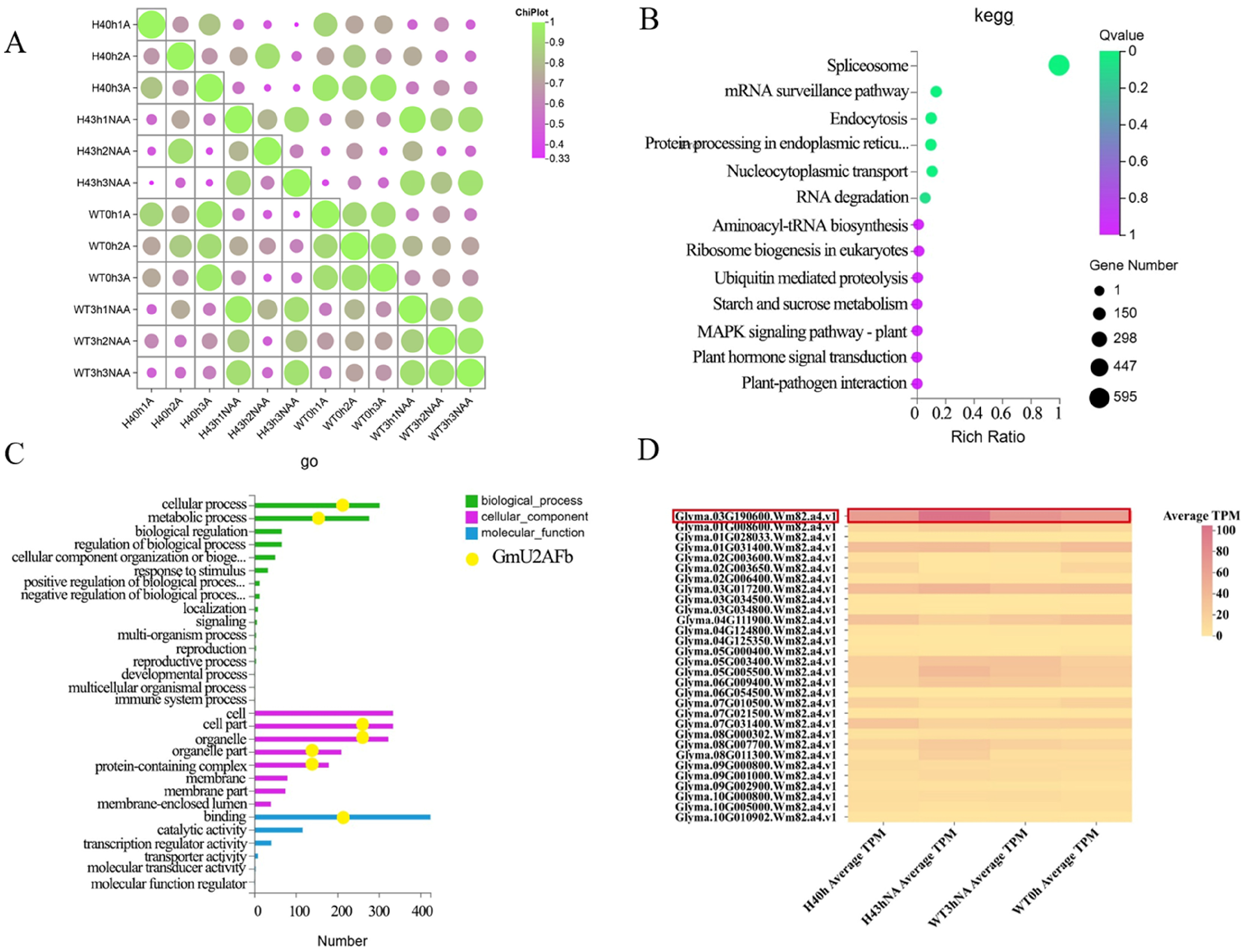
Figure 1. Transcriptomic analysis and functional annotation of GmU2AFb. (A) Heatmap of correlation analysis among transcriptome samples from soybean plants heterologously overexpressing Gshdz4, showing high biological reproducibility between samples. (B) Bubble plot of KEGG enrichment analysis of differentially expressed splicing factors, indicating significant enrichment of genes in the spliceosome pathway. (C) Bar chart of GO functional classification of GmU2AFb, displaying enrichment across the three main categories of biological process, cellular component, and molecular function, with RNA binding identified as the core molecular function. (D) Heatmap of expression levels of splicing factor-encoding genes in Gshdz4-overexpressing soybean plants, showing high expression level of GmU2AFb.
Plants 15 02191 g001
Figure 2. Validation of GmU2AFb as a direct downstream target gene of Gshdz4. (A) Relative expression levels of GmU2AFb in wild-type (WT) and Gshdz4-overexpressing (OE) soybean plants after treatment with 50 mM NaHCO3 for 6 h, * p < 0.05. (B) Yeast one-hybrid assay showing yeast growth on SD/-Trp/-Leu and SD/-Trp/-His/-Leu dropout media after co-transformation of the pHIS2 vector containing the GmU2AFb promoter fragment with the CAATAA-box and pGADT7-Gshdz4. (C) Schematic diagram of the luciferase complementation assay, showing the construction of the 62sk-Gshdz4 effector vector and the 0800-pro:GmU2AFb reporter vector. (D) Lucif-erase activity assay after co-overexpression of 62sk-Gshdz4 and 0800-pro:GmU2AFb, with 62sk-EV as the empty vector control, ** p < 0.01.
Plants 15 02191 g002
Figure 3. Protein structure, sequence characteristics, tissue expression pattern, and subcellular localization of GmU2AFb. (A) Schematic diagram of the GmU2AFb protein domains, showing that it comprises an N-terminal ZnF-C3H1 domain, a central RRM domain, and a C-terminal ZnF-C3H1 domain. (B) Multiple sequence alignment analysis of GmU2AFb with its homologs from wild soybean (GsU2AFb) and lupinus (LaU2AFb). The results showed that the three proteins share 92.19% sequence similarity, with the ZnF-C3H1 domains marked by red boxes and the RRM domain marked by a yellow box. (C) Tissue-specific expression analysis of GmU2AFb in soybean roots, stems, and leaves. Asterisks indicate significant differences (Student’s t-test, * p < 0.05). The results show that GmU2AFb exhibits the highest expression level in leaves. (D) Subcellular localization analysis of GmU2AFb. mGFP (control) and GmU2AFb-mGFP fusion proteins were expressed in tobacco leaves. Observations were made using GFP fluorescence, chloroplast autofluorescence (Chlo), bright field (BF), and merged images (Merge). Scale bar = 50 μm. The results show that GmU2AFb is localized in the nucleus.
Plants 15 02191 g003
Figure 4. Overexpression of GmU2AFb enhances tolerance to alkaline stress in soybean. (A) Phenotypic observation of whole plants was performed on wild-type (WT), GmU2AFb-overexpressing lines (OE1, OE2) and knockout lines (CR1, CR2) at 15 days after treatment with 0 or 200 mmol·L−1 NaHCO3. Scale bar = 5 cm. (B) NBT staining detecting superoxide anion accumulation in leaves of each line, with staining intensity indicating the degree of oxidative damage. Scale bar = 1 cm. (C) DAB staining detecting hydrogen peroxide accumulation in leaves of each line, with staining intensity indicating the degree of oxidative damage. Scale bar = 1 cm. (D) Expression levels of GmU2AFb in WT and OE plants treated with 50 mM NaHCO3 for 0, 3, 6, and 12 h. (EI) Alkaline treatment was applied to wild-type (WT), overexpression (OE), and knockout (CR) soybean lines, and the contents of catalase (CAT, (E)), superoxide dismutase (SOD, (F)), peroxidase (POD, (G)), proline (H), and malondialdehyde (MDA, (I)) were measured. Statistical significance was determined using Student’s t-test (* p < 0.05, ** p < 0.01, *** p < 0.001, **** p < 0.0001).
Plants 15 02191 g004
Figure 5. Root scan analysis of wild-type, GmU2AFb-overexpressing, and GmU2AFb-CRISPR soybean lines. (A) Root scan images of wild-type (WT), GmU2AFb-overexpressing (OE), and GmU2AFb-CRISPR mutant (CR) soybean lines. Scale bar = 5 cm. (B) Number of root forks. (C) Number of root crossings. (D) Total root length. (E) Number of root tips. (F) Root volume. (G) Root surface area. (H) Root activity. Error bars represent the standard deviation (SD) of three biological replicates. Statistical significance was determined using Student’s t-test (* p < 0.05, ** p < 0.01, *** p < 0.001, **** p < 0.0001).
Plants 15 02191 g005
Figure 6. Relative expression levels of alkaline stress-responsive genes in roots of GmU2AFb transgenic soybean under normal and alkaline stress conditions. (A) GmSOD1; (B) GmGSH1; (C) GmCBL1; (D) GmAOX1; (E) GmERF; (F) GmAPX1. Error bars represent the standard deviation (SD) of three biological replicates. GmGAPDH was used as the reference gene. Statistical significance was determined using Student’s t-test (* p < 0.05, *** p < 0.001, **** p < 0.0001).
Plants 15 02191 g006
Figure 7. Interaction between GmU2AFb and GmCML27. (A) Yeast two-hybrid (Y2H) assay confirming the interaction between GmU2AFb and GmCML27. (B) Bimolecular fluorescence complementation (BiFC) assay confirming the interaction between GmU2AFb and GmCML27. YFP: yellow fluorescent protein; BF: bright field; Merge: overlay of YFP and BF. (C) Luciferase complementation imaging (LCI) assay. Different combinations were co-infiltrated into distinct areas of tobacco leaves. Only the combination of GmCML27-nLUC and GmU2AFb-cLUC exhibited bright luminescence. Scale bar = 1 cm.
Plants 15 02191 g007
Figure 8. Protein structure, sequence characteristics, tissue expression pattern, and subcellular localization of GmCML27. (A) Schematic diagram of the GmCML27 protein domains, showing that it consists of four tandem EF-hand domains. (B) Multiple sequence alignment analysis of GmCML27 with its homologs from wild soybean (GsCML27) and lupinus (LaCML27). EF-hand domains are marked by red boxes. The results show that the core domains are highly conserved across the three species. (C) Tissue-specific expression analysis of GmCML27 in soybean roots, stems, and leaves. Asterisks indicate significant differences (Student’s t-test, * p < 0.05, ** p < 0.01). The results show that GmCML27 exhibits the highest expression level in leaves. (D) Subcellular localization analysis of GmCML27. eGFP (control) and GmCML27-eGFP fusion proteins were expressed in tobacco leaves. Observations were made using GFP fluorescence, chloroplast autofluorescence (Chlo), bright field (BF), and merged images (Merge). Scale bar = 50 μm. The results show that GmCML27 is localized to the plasma membrane, nucleus, and endoplasmic reticulum.
Plants 15 02191 g008
Figure 9. Overexpression of GmCML27 enhances tolerance to alkaline stress in soybean. (A) Phenotypes of whole plants from wild-type (WT), GmCML27-overexpressing lines (OE1, OE2) and knockout lines (CR1, CR2) were assessed at 15 days post-treatment with 0 or 200 mmol L−1 NaHCO3. Scale bar = 5 cm. (B) NBT staining detecting superoxide anion accumulation in leaves of each line, with staining intensity indicating the degree of oxidative damage. Scale bar = 1 cm. (C) DAB staining detecting hydrogen peroxide accumulation in leaves of each line, with staining intensity indicating the degree of oxidative damage. Scale bar = 1 cm. (D) Expression levels of GmCML27 in WT and OE plants treated with 50 mM NaHCO3 for 0, 3, 6, and 12 h. (EI) Alkaline treatment was applied to wild-type (WT), overexpression (OE), and knockout (CR) soybean lines, and the contents of peroxidase (POD, (E)), malondialdehyde (MDA, (F)), catalase (CAT, (G)), proline (H), and superoxide dismutase (SOD, (I)) were measured. Statistical significance was determined using Student’s t-test (* p < 0.05, ** p < 0.01, *** p < 0.001, **** p < 0.0001).
Plants 15 02191 g009
Figure 10. Root scan analysis of wild-type, GmCML27-overexpressing, and GmCML27-CRISPR soybean lines. (A) Root scan images of wild-type (WT), GmCML27-overexpressing (OE), and GmCML27-CRISPR mutant (CR) soybean lines. Scale bar = 5 cm. (B) Total root length. (C) Number of root crossings. (D) Root surface area. (E) Number of root tips. (F) Number of root forks. (G) Root volume. (H) Root activity. Error bars represent the standard deviation (SD) of three biological replicates. Statistical significance was determined using Student’s t-test (* p < 0.05, ** p < 0.01, *** p < 0.001, **** p < 0.0001).
Plants 15 02191 g010
Figure 11. Relative expression levels of alkaline stress-responsive genes in roots of GmCML27 transgenic soybean under normal and alkaline stress conditions. (A) GmSOD1; (B) GmGSH1; (C) GmERF; (D) GmAOX1; (E) GmAPX1; (F) GmCBL1. Error bars represent the standard deviation (SD) of three biological replicates. GmGAPDH was used as the reference gene. Statistical significance was determined using Student’s t-test (* p < 0.05, ** p < 0.01, *** p < 0.001, **** p < 0.0001).
Plants 15 02191 g011
Figure 12. Co-overexpression of GmU2AFb and GmCML27 synergistically enhances alkaline stress tolerance in soybean. (A) Whole-plant phenotypes of wild-type (WT), individual GmU2AFb-overexpressing lines (OE1, OE2), individual GmCML27-overexpressing lines (OE1, OE2), and GmU2AFb-GmCML27 co-overexpressing lines (OE1, OE2) after cultivation under 0 or 200 mmol·L−1 NaHCO3 for 20 days. Scale bar = 5 cm. (BE) Measurements of four stress-associated physiological parameters, including proline content (B), CAT activity (C), root activity (D) and SOD activity (E), in various soybean lines under control and alkaline stress conditions. (FI) Relative transcript abundances of alkaline-responsive marker genes, namely GmERF (F), GmAPX1 (G), GmCBL1 (H) and GmSOD1 (I), in different soybean genotypes upon treatment with 50 mmol·L−1 NaHCO3 for 0, 3, 6 and 12 h, respectively. Statistical significance was determined using Student’s t-test (* p < 0.05, ** p < 0.01, *** p < 0.001, **** p < 0.0001).
Plants 15 02191 g012
Figure 13. The Gshdz4-GmU2AFb-GmCML27 module: a multi-level regulatory model for plant alkaline tolerance. Under alkaline stress (NaHCO3), the transcription factor Gshdz4 is activated and initiates the transcription of its downstream target gene GmU2AFb by binding to the CAATAA-box cis-element in the promoter region. GmU2AFb interacts with GmCML27 at the protein level, which upregulates the expression of downstream alkaline tolerance-related genes, including GmSOD1, GmCBL1, GmGSH1, GmAOX1, GmERF, and GmAPX1. High expression of these genes enhances the activities of antioxidant enzymes such as SOD, PRO, CAT, and POD, thereby effectively scavenging reactive oxygen species (ROS) and reducing malondialdehyde (MDA) content. Meanwhile, it significantly promotes root development and improves soybean tolerance to alkaline soil. In contrast, under alkaline stress, wild-type plants lack the above regulatory mechanism, resulting in inhibited antioxidant enzyme activities, excessive ROS accumulation, and impaired root development, ultimately leading to an alkaline-sensitive phenotype. Created with BioGDP.com [68].
Plants 15 02191 g013
Disclaimer/Publisher’s Note: The statements, opinions and data contained in all publications are solely those of the individual author(s) and contributor(s) and not of MDPI and/or the editor(s). MDPI and/or the editor(s) disclaim responsibility for any injury to people or property resulting from any ideas, methods, instructions or products referred to in the content.